

Submitted:
30 October 2026
Posted:
02 November 2026
You are already at the latest version
Abstract
HIV infection and antiretroviral therapy (ART) both alter the composition of saliva, which is easy to collect. This narrative review examined whether salivary biomarkers differ in persons living with HIV (PLWH) receiving ART, with and without periodontal disease (PD). We searched Pub-Med, Europe PMC, Semantic Scholar and Google Scholar for articles published between January 2010 and July 2026 and included 14 studies. Compared with HIV-negative controls, PLWH had lower salivary flow, sodium, chloride and uric acid, higher calcium and IgA, and more oxidative stress. Protein and electrolyte levels differed by ART status, and oral bacteria differed between ART regimens. Citric acid accumulated at low CD4+ T-cell counts, and metabolite profiles shifted after ART was started. Salivary Torque teno virus and several bacterial and fungal genera tracked CD4+ counts. Human β-defensin-2 (hBD-2) and secretory leukocyte protease inhibitor varied with ART status and duration. hBD-2 was associated with PD in HIV-negative individuals but not in PLWH, whereas salivary miR-324-5p tracked periodontal inflammation in PLWH on ART. Most studies were small and cross-sectional, and none identified a consistent ART-specific profile. Saliva could help monitor immune status and treatment response in PLWH, but longitudinal studies with standardized periodontal assessment are needed first.
Keywords:
HIV
; antiretroviral therapy
; saliva
; biomarkers
; periodontal disease
; oral microbiome
1. Introduction
Human immunodeficiency virus (HIV) remains a major global public health concern despite remarkable advances in its diagnosis and management [1]. The widespread use of antiretroviral therapy (ART) has transformed HIV infection from a fatal disease into a manageable chronic condition, significantly reducing morbidity, mortality, and viral transmission [2,3,4]. Despite effective treatment, oral manifestations and chronic inflammatory conditions remain clinically relevant in PLWH, particularly when immune dysfunction, medication effects, xerostomia, smoking, metabolic comorbidity, or periodontal inflammation coexist [3,4]. The oral cavity is influenced by both systemic immune status and local ecological conditions. HIV has a greater influence on innate immunity and oral environment causing changes in salivary biomarker composition, oral candidiasis, linear gingival erythema (LGE), necrotizing and ulcerative gingivitis (NUG) or periodontitis (NUP), oral hairy leucoplakia (OHL) and single other lesions [5]. Periodontal disease (PD) itself can alter local inflammatory mediators, host-defense proteins, microbial communities, and tissue-derived molecules in saliva [6,7]. Consequently, a salivary change observed in a person receiving ART should not automatically be interpreted as a direct pharmacologic effect of ART.
Saliva is attractive for biomarker research because collection is non-invasive, repeatable, and compatible with molecular, immunologic, microbiologic, and biochemical assays [8,9]. Salivary composition and function in persons living with HIV (PLWH) are greatly affected by antiretroviral therapy (ART), which affects metabolic and immune-related parameters [10,11]. Studies have addressed PD biomarkers in salivary proteins associated with innate immunity, mostly due to the alteration in the concentration of many of these proteins in the presence of inflammation [7,12].
Biomarkers are measurable indicators of normal biological processes, which provide an objective assessment of the physiologic state of living systems [13]. Saliva contains several biomarkers that serve as a diagnostic tool in health and disease [9,14]. Evaluation of a multitude of salivary components could potentially predict the clinical outcome. On the other hand, some systemic diseases can modify salivary protein concentrations, which may change their importance or role as specific biomarkers [12].
Antiretroviral therapy, while highly effective in suppressing viral replication and restoring immune function, may also influence salivary composition and biomarker expression. Immune reconstitution following ART can reduce systemic and oral inflammation, whereas certain antiretroviral drugs have been associated with adverse oral effects such as xerostomia, salivary gland dysfunction, and altered salivary flow [10]. These changes may modify the concentration and diagnostic performance of salivary biomarkers, potentially influencing their utility in evaluating periodontal disease among PLWH. However, published studies have reported variable findings depending on ART regimen, duration of therapy, viral suppression, CD4⁺ T-cell count, periodontal status, and study methodology [15,16,17]. Scrupulous evaluation of relevant biomarkers could facilitate the early detection of HIV, determine the stage of infection and monitor the disease progression [18,19].
A comprehensive understanding of the relationship between ART, salivary biomarkers, and periodontal disease is essential for developing reliable, non-invasive diagnostic strategies and improving oral healthcare in PLWH. Identifying biomarker profiles that accurately reflect periodontal inflammation and treatment outcomes could support personalized disease monitoring and facilitate the integration of oral health into routine HIV care.
The central scientific issue is therefore not simply whether ART “changes saliva,” but whether salivary biomarkers can distinguish HIV-associated immune effects, treatment-associated effects, and local periodontal inflammation with adequate reproducibility and clinical specificity. Previous reviews of saliva in viral infections have focused largely on detecting viral shedding, for example of herpesviruses, human papillomavirus, Torque teno virus and respiratory viruses, and have considered HIV mainly as a cause of immunosuppression [14]. To our knowledge, how ART and periodontal disease shape salivary biomarkers in PLWH has not been reviewed specifically. This review critically summarizes the available evidence on salivary biomarkers in PLWH receiving ART and evaluates the extent to which the current literature supports their use in monitoring immune status, ART-associated changes, and periodontal or oral health.
2. Materials and Methods
A literature search was conducted to identify studies examining the relationships among human immunodeficiency virus (HIV) infection, antiretroviral therapy (ART), salivary biomarkers, the oral microbiome, and periodontal disease. Studies published between January 2010 and 2026 were considered. Search terms included combinations of HIV, antiretroviral therapy, ART, saliva, salivary biomarkers, oral microbiome, and periodontal disease. Relevant literature was identified using PubMed, Google Scholar, Semantic Scholar, and Europe PMC. Studies were considered relevant if they evaluated salivary biomarkers, oral microbial profiles, immune or inflammatory markers, biochemical parameters, oxidative stress markers, or other saliva-based measures in persons living with HIV (PLWH), particularly in relation to ART and/or periodontal and oral health. Approximately 18 publications, including observational studies and relevant review articles, were initially examined. Following assessment of their relevance to the objectives of this narrative review, 14 publications were selected for detailed evaluation and synthesis. Findings were summarized according to the reported effects or associations of HIV infection, ART exposure, immune status, and periodontal/oral health with salivary biomarker profiles.
3. Results
Approximately 18 publications, including cross-sectional studies and relevant literature reviews, were initially evaluated, of which 14 were considered directly relevant to the objectives of this review and were included in the primary synthesis (Table 1). Collectively, the reviewed studies demonstrated alterations in multiple categories of salivary biomarkers in persons living with HIV (PLWH), including inflammatory and immune mediators, salivary proteins, electrolytes, oxidative stress markers, host-defense molecules, and oral microbial profiles. The observed changes varied according to HIV status, immune function, ART exposure and duration, and oral or periodontal health status.
Where antiretroviral regimens were reported, they were typically integrase strand-transfer inhibitor (INSTI)-based. For example, participants in one study received tenofovir alafenamide (TAF) with bictegravir (BIC) or dolutegravir (DTG) [20], and another compared INSTI- with non-nucleoside reverse-transcriptase inhibitor (NNRTI)-based regimens [17]. Most of the included studies, however, did not report specific regimens. However, the available studies did not consistently permit the effects of individual antiretroviral agents to be distinguished from those of HIV infection, immune status, or periodontal inflammation.
Overall, the evidence suggests that ART exposure is associated with changes in salivary composition and oral microbial profiles in PLWH. Some findings are consistent with partial restoration of immune and oral homeostasis following effective HIV treatment, whereas others indicate persistent alterations in salivary flow, biochemical composition, microbial communities, and host-defense biomarkers. These findings support the potential utility of saliva for investigating HIV- and ART-associated biological changes; however, the heterogeneity of study designs and populations limits definitive conclusions regarding ART-specific effects.
3.1. Effects of ART on Salivary Biomarkers:
Saliva represents a readily accessible and non-invasive biological fluid that can be used to evaluate changes in host immune responses, biochemical composition, oxidative stress, and oral microbial communities [9]. These characteristics make saliva a potentially useful adjunct for monitoring oral and systemic changes in persons living with HIV (PLWH), particularly in the context of antiretroviral therapy (ART).
The available evidence indicates that salivary composition in PLWH receiving ART is influenced by multiple interacting factors, including HIV infection [21,22], degree of immune reconstitution [16,23], duration and type of ART [11,15,17], and oral and periodontal health [12,20]. Reported alterations include changes in salivary flow [10,22], proteins and electrolytes [11,22], innate host-defense and immune mediators [12,15,24], oxidative stress markers [21], metabolites [25], and oral microbial profiles [16,17,26]. However, these changes should not be attributed exclusively to ART, because most of the available studies are observational and differ substantially in participant characteristics, comparison groups, ART regimens, and oral health status [11,12,17,22].
Biochemical studies have reported altered salivary concentrations of sodium, chloride, calcium, uric acid, immunoglobulins, and total protein in PLWH receiving ART [11,22]. In one cross-sectional comparison, salivary flow rate, sodium, chloride, and uric acid were lower in PLWH receiving ART than in HIV-negative controls, whereas calcium and salivary IgA concentrations were higher [22]. These findings suggest that HIV infection and/or ART may be associated with alterations in salivary gland function and biochemical composition; however, the contribution of ART cannot be completely separated from that of HIV infection using these comparisons.
Salivary metabolites show a similar pattern. Citric acid accumulated in the saliva of PLWH with CD4+ T-cell counts below 200 cells/mm³, and several tricarboxylic acid cycle intermediates and amino acids increased after ART was started [25]. By contrast, a study of youth with perinatally acquired HIV found no salivary metabolite differences that withstood correction for multiple comparisons [27].
ART and immune reconstitution may also influence inflammatory and host-defense biomarkers in saliva. Changes in cytokines, antioxidant activity, salivary peroxidase, human β-defensin-2 (hBD-2), and secretory leukocyte protease inhibitor (SLPI) have been reported in PLWH [15,21,24]. Importantly, the direction and magnitude of these changes are not uniform across studies. For example, hBD-2 expression appears to vary according to HIV status and ART duration [12,15], suggesting that treatment duration and immune status should be considered when interpreting salivary host-defense biomarkers.
Alterations in the oral microbiome have also been observed in PLWH receiving ART. Studies evaluating different ART regimens have identified differences in the relative abundance of specific oral bacterial taxa [17], while other investigations have associated particular microbial profiles with the degree of immune recovery [16]. These findings suggest that ART regimen and immune reconstitution may contribute to oral microbial variation; however, current evidence does not establish that ART uniformly restores the oral microbiome to an HIV-negative state.
Periodontal disease represents an additional important consideration because periodontal inflammation can independently alter salivary inflammatory mediators, host-defense proteins, and microbial composition [7]. Consequently, salivary biomarker changes in PLWH receiving ART should be interpreted in the context of periodontal status rather than being attributed solely to HIV infection or ART.
Overall, the available evidence indicates that ART is associated with changes in several classes of salivary biomarkers in PLWH, but the observed profiles likely reflect the combined effects of HIV infection, immune reconstitution, ART exposure, ART regimen and duration, and oral and periodontal health. Further longitudinal studies with well-defined periodontal phenotypes and appropriate HIV-positive and HIV-negative comparison groups are required to determine which salivary biomarkers specifically reflect ART-associated biological changes.
3.2. Salivary Microbiome and Mycobiome
Alterations in oral microbial communities have been associated with HIV disease status, immune function, and ART exposure. Guo et al. investigated the salivary mycobiome in 25 men who have sex with men (MSM), classified according to HIV status and CD4+ T-cell counts [26]. The study identified 51 fungal genera, with Pseudogymnoascus reported as the predominant genus, and demonstrated differences in fungal community composition across HIV disease stages. A total of 113 KEGG pathways were identified, including 69 pathways unique to Stage 3 disease and predominantly related to metabolic and disease-associated processes. Auricularia abundance was positively correlated with CD4+ T-cell counts, whereas Mucor showed a negative correlation. These findings suggest that salivary fungal community structure may reflect HIV-associated immune status, although validation in larger longitudinal cohorts is required.
ART regimen may also contribute to variation in the oral microbiome. Narayanan et al. (2024) compared gut and oral microbial profiles in 69 PLWH and 80 HIV-negative controls and examined differences associated with ART regimens [17]. PLWH demonstrated lower overall microbial diversity than controls. Among ART-treated participants, integrase strand-transfer inhibitor (INSTI)-based therapy and non-nucleoside reverse-transcriptase inhibitor (NNRTI)-based therapy were associated with different microbial profiles. In oral samples, Veillonella was more prevalent among participants receiving INSTI-based therapy, whereas Fusobacterium and Alloprevotella were more abundant among those receiving NNRTI-based therapy. These observations suggest that ART regimen may contribute to microbial variation; however, the cross-sectional design limits conclusions regarding causality.
The relationship between the salivary microbiome and immune reconstitution was further demonstrated by Xie et al. [16]. The investigators compared 30 immunological responders with 34 immunological non-responders after sustained viral suppression. Overall salivary bacterial diversity was similar between the groups; however, differences were observed in specific bacterial taxa. Immunological non-responders exhibited greater abundance of Selenomonas, whereas immunological responders demonstrated greater abundance of Candidatus Saccharimonas and an unclassified Saccharimonas-related taxon (norank_p_Saccharimonas), both of which were positively associated with current CD4+ T-cell counts. Candidatus Saccharimonas was positively associated with current CD4+ T-cell counts and markers of adaptive immunity. These findings indicate that specific microbial taxa, rather than overall microbial diversity alone, may be associated with the degree of immune recovery during ART.
3.3. Salivary Biochemical and Electrolyte Markers
Changes in salivary biochemical composition have also been reported in PLWH receiving ART. Berrezouga et al. compared 50 PLWH receiving ART with 50 age-matched HIV-negative controls [22]. Although the overall decayed, missing, and filled teeth (DMFT) index did not differ significantly between groups, PLWH had fewer filled teeth. Salivary flow rate and concentrations of sodium, chloride, and uric acid were significantly lower in PLWH, whereas calcium and salivary IgA concentrations were higher. These findings demonstrate altered salivary biochemical profiles in PLWH receiving ART but do not, by themselves, distinguish the effects of HIV infection from those of ART.
Mahajan et al. (2021) provided a more direct assessment of ART-associated differences by comparing three groups: 66 HIV-positive individuals receiving ART for at least six months, 66 HIV-positive individuals not receiving ART, and 66 HIV-negative controls [11]. Significant group differences were identified in total salivary protein and electrolyte concentrations, including sodium, potassium, chloride, and ionized calcium. Because both ART-treated and untreated HIV-positive groups were included, this study provides evidence that salivary biochemical alterations may reflect contributions from both HIV infection and ART exposure.
3.4. Salivary Viral and Immune-Related Biomarkers
Salivary viral markers may also provide information regarding systemic immune status. Honorato et al. examined salivary Torque Teno virus (TTV) titers in individuals receiving ART [23]. Salivary TTV titers were inversely associated with circulating CD4+ T-cell concentrations and positively associated with circulating HIV levels. Individuals with AIDS-associated Kaposi sarcoma exhibited higher salivary TTV and HIV titers and lower CD4+ T-cell counts than asymptomatic individuals. These findings suggest that salivary TTV may reflect the degree of immune suppression in ART-treated individuals and warrants further investigation as a potential non-invasive marker of immune status.
A scoping review protocol by Prasad et al. proposed a systematic evaluation of salivary biomarkers associated with HIV disease progression [19]. The protocol highlighted the potential utility of saliva as a patient-acceptable alternative to blood-based monitoring and emphasized the need to identify and validate biomarkers suitable for future point-of-care applications. Because this publication was a protocol, however, it should be considered methodological background rather than primary evidence demonstrating biomarker performance.
3.5. Oxidative Stress Biomarkers
Oxidative stress represents another biological process that can be evaluated using saliva. Amjad et al. compared 49 HIV-positive participants with 49 HIV-negative controls and reported significantly higher salivary malondialdehyde (MDA), a marker of lipid peroxidation, in the HIV-positive group [21]. Total antioxidant capacity was significantly lower among HIV-positive participants. These findings are consistent with increased oxidative stress and reduced antioxidant defense in HIV infection. However, because the comparison primarily involved HIV status, these results should not be interpreted as demonstrating an ART-specific effect without additional treatment-stratified analyses.
3.6. Innate Host-Defense Biomarkers and Periodontal Disease
Human β-defensin-2 (hBD-2) has received particular attention because of its role in mucosal innate immunity and its potential relationship with periodontal inflammation. Lourenço et al. evaluated salivary hBD-2 concentrations in 48 HIV-negative and 53 HIV-positive individuals while considering periodontal status, viral load, CD4+ T-cell count, and ART exposure [12]. Among HIV-negative participants, hBD-2 concentrations were associated with periodontal disease. In HIV-positive participants, however, hBD-2 concentrations were influenced by HIV/ART-related factors and were not clearly associated with periodontal status, CD4+ T-cell count, or viral load. These observations suggest that HIV infection and treatment may modify the relationship between periodontal inflammation and salivary hBD-2.
Nittayananta et al. further examined hBD-2 in HIV-positive individuals with differing ART exposure and HIV-negative controls [15]. Salivary hBD-2 concentrations were elevated in HIV-positive individuals overall, while the relationship between hBD-2 and ART differed according to treatment duration and saliva collection conditions. Short-term ART was associated with increased hBD-2 protein levels compared with no ART, whereas long-term ART was associated with different patterns in stimulated saliva [15]. No significant differences in buccal mucosal hBD-2 mRNA expression were observed. These findings indicate that salivary hBD-2 is influenced by HIV infection and ART exposure, but its interpretation as a periodontal biomarker in PLWH is complex.
Nittayananta et al. also examined secretory leukocyte protease inhibitor (SLPI), another innate antimicrobial protein, in oral tissues and saliva from 157 HIV-positive individuals with and without ART and from HIV-negative controls [24]. SLPI levels in stimulated saliva were significantly lower in HIV-positive individuals than in controls (P < 0.001) and differed according to ART status (P = 0.007). Smoking, CD4+ T-cell count, and HIV viral load were also associated with SLPI expression. The authors proposed that altered salivary SLPI may help identify PLWH at greater risk of oral infection and malignant transformation, although this has not yet been tested prospectively.
4. Discussion
Saliva is increasingly used to diagnose viral infections and to follow their course [8,14]. This review asked whether that potential extends to PLWH receiving ART, and whether periodontal disease complicates it. The included studies suggest that saliva carries both kinds of information, though neither has yet been validated for clinical use.
Diagnostic value. Saliva in PLWH differs from that of HIV-negative individuals across several biomarker classes. These include lower flow, sodium, chloride and uric acid; higher calcium and secretory IgA; higher malondialdehyde with lower antioxidant capacity; altered salivary metabolites; and altered hBD-2 and SLPI [15,21,22,24,25]. These differences show that HIV infection leaves a measurable signature in saliva, although one metabolomic study in youth found no differences that survived strict statistical correction [27]. Most studies compared PLWH on ART with HIV-negative controls, so the signature cannot be assigned to the infection or to its treatment. Only Mahajan et al. and Du et al. included untreated PLWH, and both found that salivary composition differed by ART status as well as by HIV status [11,25]. Measured concentration also depends on how saliva was collected. HIV and some antiretroviral drugs reduce salivary flow rate [10], and hBD-2 behaved differently in stimulated and unstimulated saliva [15].
Prognostic and monitoring value. The more promising findings relate to tracking immune status during treatment. Salivary Torque teno virus titres fell as CD4+ T-cell counts rose and increased with circulating HIV levels [23]. Candidatus Saccharimonas was more abundant in immunological responders and correlated with CD4+ counts [16], and fungal genera such as Auricularia and Mucor shifted with disease stage [26]. Du et al. provide the only longitudinal evidence: citric acid accumulated at low CD4+ counts, and tricarboxylic acid cycle intermediates and amino acids rose over 18 months of ART, suggesting that salivary metabolites may reflect both progression and treatment response [25]. Oral bacterial profiles also differed between integrase inhibitor- and NNRTI-based regimens [17], which suggests that regimen as well as immune status shapes the salivary environment. If confirmed, markers like these could complement blood-based CD4+ and viral load monitoring, particularly where repeated blood sampling is difficult [19]. Each finding, however, comes from a single study.
Periodontal disease as a confounder. Periodontal inflammation independently alters host-derived salivary biomarkers [7], yet only three included studies analyzed salivary biomarkers against periodontal status in PLWH. Lourenço et al. found that hBD-2 was associated with periodontal disease in HIV-negative individuals but not in PLWH [12]. Schulte et al. found that the periodontitis-associated metabolite cadaverine differed less with periodontal status in youth with HIV than in uninfected youth [27]. Both results suggest that HIV infection or its treatment can mask the salivary signal of periodontal inflammation, so markers validated in the general population may not transfer directly to PLWH. In contrast, salivary miR-324-5p tracked periodontal inflamed surface area in PLWH on ART, showing that some markers can reflect periodontal severity in this population [20]. Because most of the other included studies did not report a standardized periodontal assessment, some of the microbial and host-defense differences attributed to HIV or ART may partly reflect undiagnosed periodontal disease.
Translating salivary biomarkers into clinical practice will require prospective longitudinal cohorts that sample PLWH before ART initiation and at defined intervals thereafter [22]. Such cohorts should include ART-naïve HIV-positive and HIV-negative comparison groups. They should also document ART regimen, duration of therapy, viral suppression, CD4+ T-cell nadir and recovery, and confounders such as smoking and diabetes. Periodontal status should be characterized using standardized case definitions, such as the 2017 World Workshop staging and grading system, together with continuous measures of inflammatory burden such as periodontal inflamed surface area. This would allow periodontal effects to be modelled separately from those of HIV and ART. Pre-analytical variables also need to be standardized: whether saliva is stimulated or unstimulated, time of collection, fasting status, and normalization to flow rate or total protein. Finally, integrating microbiome, metabolome, microRNA and host-protein profiles from the same participants, analyzed with multivariable or machine-learning approaches and tested in independent validation cohorts, would show whether a combined biomarker panel achieves the sensitivity and specificity needed for clinical monitoring.
5. Study Limitations
To our knowledge, this is the first review to synthesize salivary biomarker evidence in PLWH specifically in relation to ART and periodontal disease, but it has several limitations. Because it is a narrative rather than a systematic review, it did not follow a pre-registered protocol, a reproducible search strategy, formal risk-of-bias assessment or quantitative synthesis. Relevant studies may therefore have been missed, and selection bias cannot be excluded. The evidence base was small, comprising 14 articles, and was dominated by cross-sectional designs with modest sample sizes. This precludes causal inference about the effects of ART, and with sample sizes this small, studies may have been underpowered to detect differences between groups. Substantial clinical and methodological heterogeneity was evident across studies, including differences in study populations, comparison groups, ART regimens and duration, biomarker classes and analytical platforms, and saliva collection and normalization procedures. This precluded direct comparison or pooling of results. In addition, periodontal status was rarely assessed with standardized case definitions, which limits conclusions about periodontal disease as an effect modifier. Finally, one included article was a study protocol [19] and contributed methodological context rather than primary data.
6. Conclusions
Saliva carries measurable signatures of HIV infection, ART and immune status in PLWH, spanning electrolytes and proteins, oxidative stress markers, metabolites, innate host-defense proteins and the oral microbiome (Figure 1). Salivary Torque teno virus, Candidatus Saccharimonas and citric acid may help monitor immune status and treatment response, and salivary miR-324-5p may reflect periodontal inflammation in PLWH on ART. However, no uniform ART-specific salivary profile has emerged, periodontal status has rarely been assessed, and most of the evidence is cross-sectional. Longitudinal studies with defined periodontal phenotypes and standardised saliva collection are needed before salivary biomarkers can complement routine clinical and laboratory monitoring in PLWH.
Author Contributions
Conceptualization, P.R.G. H. S., and B.G.; methodology, B.G. and C.S.; investigation, B.G.; data curation, B.G.; writing original draft preparation, B.G. & H. S.; review and editing, C.S. and P.R.G.; visualization, B.G.; supervision, P.R.G.; project administration, P.R.G.; funding acquisition, P.R.G. All authors have read and agreed to the published version of the manuscript.
Funding
Dental student research is supported by the HRSA-COE funding (D34HP00002) to the School of Dentistry, Meharry Medical College, and Nashville, Tennessee. The research reported in this presentation was supported by the National Institute of Dental & Craniofacial Research under award number U01DE033241 (Pandu Gangula), National Institute of General Medical Sciences under award number R16GM149440 (Pandu Gangula) and National Institute on Minority Health and Health Disparities (NIMHD), USA, Grant (UC2MD019626, PG, Drs. Lindsey and Chearis).
Institutional Review Board Statement
Not applicable.
Informed Consent Statement
Not applicable.
Data Availability Statement
Literature review.
Conflicts of Interest
The authors declare no conflicts of interest.
Abbreviations
The following abbreviations are used in this manuscript:
| 3TC | Lamivudine |
| ART | Antiretroviral therapy |
| BIC | Bictegravir |
| BMI | Body mass index |
| CD4 | Cluster of differentiation 4 |
| DMFT | Decayed, missing and filled teeth |
| DTG | Dolutegravir |
| FTC | Emtricitabine |
| HAART | Highly active antiretroviral therapy |
| hBD-2 | Human β-defensin-2 |
| HIV | Human immunodeficiency virus |
| IgA | Immunoglobulin A |
| INSTI | Integrase strand-transfer inhibitor |
| KEGG | Kyoto Encyclopedia of Genes and Genomes |
| LC–MS/MS | Liquid chromatography–tandem mass spectrometry |
| LGE | Linear gingival erythema |
| MDA | Malondialdehyde |
| miR | MicroRNA |
| MSM | Men who have sex with men |
| NNRTI | Non-nucleoside reverse-transcriptase inhibitor |
| NUG | Necrotizing ulcerative gingivitis |
| NUP | Necrotizing ulcerative periodontitis |
| OHL | Oral hairy leukoplakia |
| PD | Periodontal disease |
| PHEU | Perinatally HIV-exposed uninfected |
| PHIV | Perinatally acquired HIV |
| PISA | Periodontal inflamed surface area |
| PLWH | Persons living with HIV |
| SLPI | Secretory leukocyte protease inhibitor |
| TAC | Total antioxidant capacity |
| TAF | Tenofovir alafenamide |
| TDF | Tenofovir disoproxil fumarate |
| TTV | Torque teno virus |
References
- Collaborators GH. Global, regional, and national burden of HIV/AIDS, 1990-2021, and forecasts to 2050, for 204 countries and territories: the Global Burden of Disease Study 2021. Lancet HIV. 2024;11 12:e807-e22. https://www.ncbi.nlm.nih.gov/pubmed/39608393. [CrossRef]
- Samji H, Cescon A, Hogg RS, Modur SP, Althoff KN, Buchacz K, et al. Closing the gap: increases in life expectancy among treated HIV-positive individuals in the United States and Canada. PLoS One. 2013;8 12:e81355. https://www.ncbi.nlm.nih.gov/pubmed/24367482. [CrossRef]
- Deeks SG, Lewin SR, Havlir DV. The end of AIDS: HIV infection as a chronic disease. Lancet. 2013;382 9903:1525-33. https://www.ncbi.nlm.nih.gov/pubmed/24152939. [CrossRef]
- Rodger AJ, Cambiano V, Bruun T, Vernazza P, Collins S, Degen O, et al. Risk of HIV transmission through condomless sex in serodifferent gay couples with the HIV-positive partner taking suppressive antiretroviral therapy (PARTNER): final results of a multicentre, prospective, observational study. Lancet. 2019;393 10189:2428-38. https://www.ncbi.nlm.nih.gov/pubmed/31056293. [CrossRef]
- Classification and diagnostic criteria for oral lesions in HIV infection. Journal of Oral Pathology & Medicine. 22 7:289-91. [CrossRef]
- Bertoldi C, Nasi M, Salvatori R, Pinti M, Montagna S, Tonetti M, et al. Salivary Biomarker Analysis to Distinguish Between Health and Periodontitis Status: A Preliminary Study. Dent J (Basel). 2025;13 9. https://www.ncbi.nlm.nih.gov/pubmed/41002709. [CrossRef]
- Kc S, Wang XZ, Gallagher JE. Diagnostic sensitivity and specificity of host-derived salivary biomarkers in periodontal disease amongst adults: Systematic review. J Clin Periodontol. 2020;47 3:289-308. https://www.ncbi.nlm.nih.gov/pubmed/31701554. [CrossRef]
- Corstjens PL, Abrams WR, Malamud D. Saliva and viral infections. Periodontol 2000. 2016;70 1:93-110. https://www.ncbi.nlm.nih.gov/pubmed/26662485. [CrossRef]
- Kaczor-Urbanowicz KE, Martin Carreras-Presas C, Aro K, Tu M, Garcia-Godoy F, Wong DT. Saliva diagnostics—Current views and directions. Exp Biol Med (Maywood). 2017;242 5:459-72. https://www.ncbi.nlm.nih.gov/pubmed/27903834. [CrossRef]
- Navazesh M, Mulligan R, Karim R, Mack WJ, Ram S, Seirawan H, et al. Effect of HAART on salivary gland function in the Women’s Interagency HIV Study (WIHS). Oral Dis. 2009;15 1:52-60. https://www.ncbi.nlm.nih.gov/pubmed/19017280. [CrossRef]
- Mahajan PG, Kheur SM, Mahajan GD, Kheur M, Raj AT, Patil S, et al. Comparison of salivary total protein and electrolyte profile in HIV patients with and without antiretroviral therapy. Dis Mon. 2021;67 9:101165. https://www.ncbi.nlm.nih.gov/pubmed/33640174. [CrossRef]
- Lourenco AG, Rodrigues Alves Ribeiro AE, Nakao C, Fragoso Motta AC, Machado AA, Komesu MC. Influence of antiretroviral therapy and periodontal disease on human salivary beta-defensin 2 in patients infected with HIV. Curr HIV Res. 2014;12 1:44-9. https://www.ncbi.nlm.nih.gov/pubmed/24720483. [CrossRef]
- Strimbu K, Tavel JA. What are biomarkers? Curr Opin HIV AIDS. 2010;5 6:463-6. https://www.ncbi.nlm.nih.gov/pubmed/20978388. [CrossRef]
- Oliveira Neto NF, Caixeta RAV, Zerbinati RM, Zarpellon AC, Caetano MW, Pallos D, et al. The Emergence of Saliva as a Diagnostic and Prognostic Tool for Viral Infections. Viruses. 2024;16 11. https://www.ncbi.nlm.nih.gov/pubmed/39599873. [CrossRef]
- Nittayananta W, Kemapunmanus M, Amornthatree K, Talungchit S, Sriplung H. Oral human beta-defensin 2 in HIV-infected subjects with long-term use of antiretroviral therapy. J Oral Pathol Med. 2013;42 1:53-60. https://www.ncbi.nlm.nih.gov/pubmed/22680235. [CrossRef]
- Xie Y, Sun J, Hu C, Ruan B, Zhu B. Oral Microbiota Is Associated With Immune Recovery in Human Immunodeficiency Virus-Infected Individuals. Front Microbiol. 2021;12:794746. https://www.ncbi.nlm.nih.gov/pubmed/34956162. [CrossRef]
- Narayanan A, Kieri O, Vesterbacka J, Manoharan L, Chen P, Ghorbani M, et al. Exploring the interplay between antiretroviral therapy and the gut-oral microbiome axis in people living with HIV. Sci Rep. 2024;14 1:17820. https://www.ncbi.nlm.nih.gov/pubmed/39090139. [CrossRef]
- Munshi SU, Panda H, Holla P, Rewari BB, Jameel S. MicroRNA-150 is a potential biomarker of HIV/AIDS disease progression and therapy. PLoS One. 2014;9 5:e95920. https://www.ncbi.nlm.nih.gov/pubmed/24828336. [CrossRef]
- Prasad P, D’Souza V, Mithra P, Radhakrishnan R. Salivary biomarkers associated with the progression of disease in people living with HIV: A scoping review protocol. F1000Res. 2021;10:130. https://www.ncbi.nlm.nih.gov/pubmed/37273261. [CrossRef]
- Nurhamim M, Yokoi A, Hagiya H, Maruyama T, Ekuni D. Salivary miR-324-5p Is Associated with Periodontal Inflamed Surface Area in People Living with HIV Receiving Antiretroviral Therapy: A Case-Control Study. Int J Mol Sci. 2026;27 18. https://www.ncbi.nlm.nih.gov/pubmed/42794547. [CrossRef]
- Amjad SV, Davoodi P, Goodarzi MT, Abdolsamadi H, Poorolajal J, Parsa S, et al. Salivary Antioxidant and Oxidative Stress Marker Levels in HIV-Positive Individuals. Comb Chem High Throughput Screen. 2019;22 1:59-64. https://www.ncbi.nlm.nih.gov/pubmed/30843481. [CrossRef]
- Berrezouga L, Kooli I, Marrakchi W, Neffati F, Najjar F, Chakroun M. Salivary biochemical parameters in people living with HIV on ART and dental caries: a cross-sectional study in Monastir, Tunisia. BMC Oral Health. 2024;24 1:35. https://www.ncbi.nlm.nih.gov/pubmed/38184520. [CrossRef]
- Honorato L, Witkin SS, Mendes-Correa MC, Conde Toscano ALC, Linhares IM, de Paula AV, et al. The Torque Teno Virus Titer in Saliva Reflects the Level of Circulating CD4(+) T Lymphocytes and HIV in Individuals Undergoing Antiretroviral Maintenance Therapy. Front Med (Lausanne). 2021;8:809312. https://www.ncbi.nlm.nih.gov/pubmed/35096897. [CrossRef]
- Nittayananta W, Tao R, Jiang L, Peng Y, Huang Y. Oral innate immunity in HIV infection in HAART era. J Oral Pathol Med. 2016;45 1:3-8. https://www.ncbi.nlm.nih.gov/pubmed/25639844. [CrossRef]
- Du F, Li R, He R, Li K, Liu J, Xiang Y, et al. Exploring salivary metabolome alterations in people with HIV: towards early diagnostic markers. Front Public Health. 2024;12:1400332. https://www.ncbi.nlm.nih.gov/pubmed/38912274. [CrossRef]
- Guo Y, Lin L, Zhang M, Yu Y, Wang Y, Cao J, et al. Salivary mycobiome alterations in HIV-infected MSM: dominance of Pseudogymnoascus and functional shifts across disease stages. Front Cell Infect Microbiol. 2025;15:1564891. https://www.ncbi.nlm.nih.gov/pubmed/40415955. [CrossRef]
- Schulte F, King OD, Paster BJ, Moscicki AB, Yao TJ, Van Dyke RB, et al. Salivary metabolite levels in perinatally HIV-infected youth with periodontal disease. Metabolomics. 2020;16 9:98. https://www.ncbi.nlm.nih.gov/pubmed/32915320. [CrossRef]
Figure 1.
Summary of the evidence on salivary biomarkers in persons living with HIV (PLWH) receiving antiretroviral therapy (ART). HIV infection, ART and immune reconstitution drive changes across six classes of salivary biomarkers, which point to diagnostic, monitoring and peri-odontal uses. Periodontal disease independently alters many of the same markers and can be masked by HIV or ART. Numbers in brackets are reference numbers. Arrows (↑/↓) show the di-rection of change in PLWH relative to HIV-negative controls, or with lower CD4+ counts. hBD-2, human β-defensin-2; INSTI, integrase strand-transfer inhibitor; NNRTI, non-nucleoside re-verse-transcriptase inhibitor; SLPI, secretory leukocyte protease inhibitor; TCA, tricarboxylic acid.
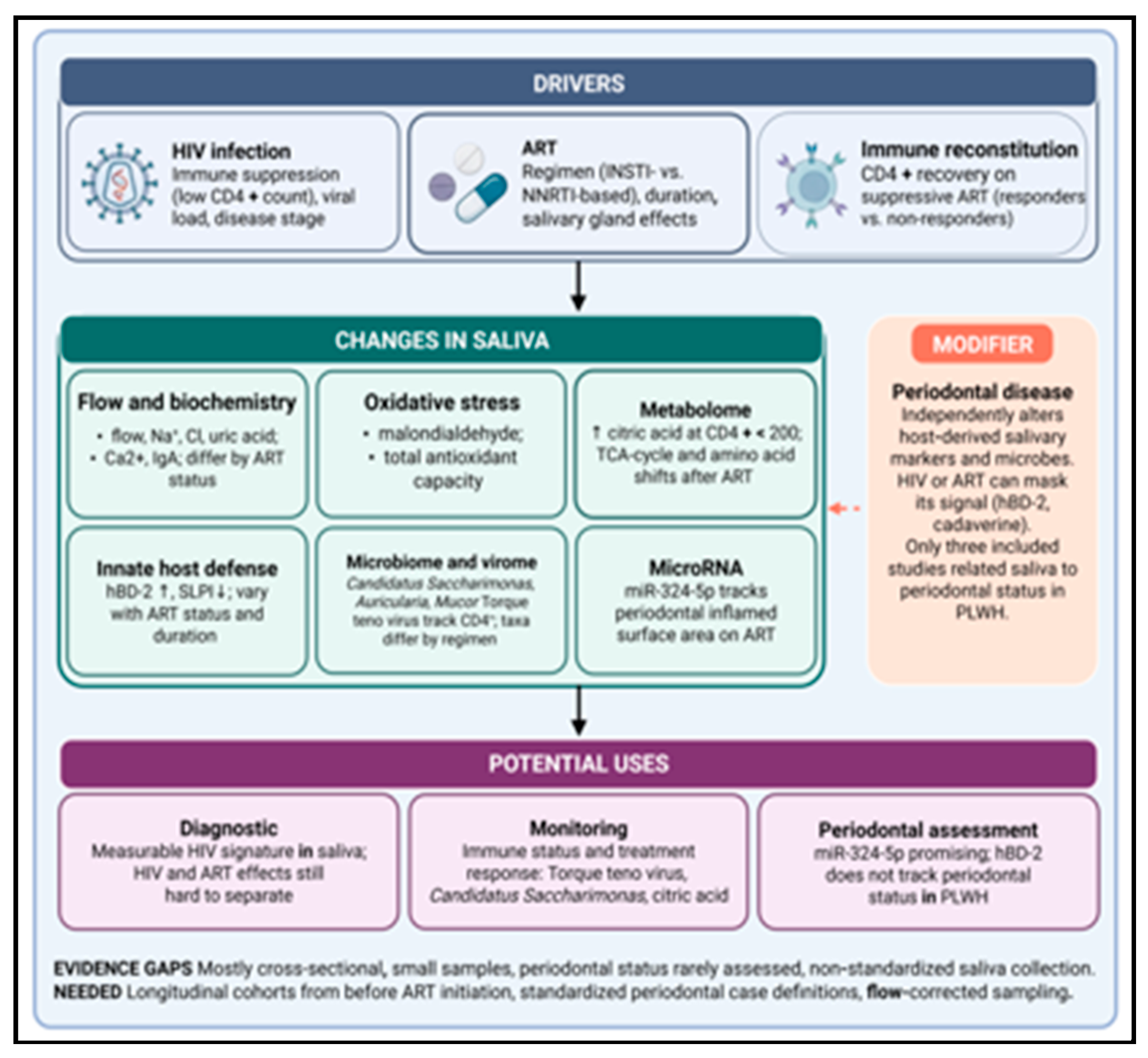

Table 1.
Summary of the studies included in this review.
| Study (Ref#) | Design and participants | Biomarker(s) | Key findings | Implication |
| Nurhamim et al., [20] | Case–control. Discovery: 12 PLWH on ART with periodontitis vs. 12 HIV-negative individuals with periodontitis. Validation: 15 PLWH on TAF with bictegravir or dolutegravir | Salivary extracellular-vesicle miR-324-5p; PISA | miR-324-5p expression was significantly associated with PISA in PLWH on ART | May reflect periodontitis severity in PLWH; small sample, not yet replicated |
| Guo et al., [26] | Cross-sectional; 25 MSM in five groups by HIV status and CD4+ count | Salivary mycobiome | 51 fungal genera and 113 KEGG pathways (69 unique to stage 3); Pseudogymnoascus predominant; Auricularia correlated positively and Mucor negatively with CD4+ count | Mycobiome may reflect HIV disease stage; longitudinal validation needed |
| Berrezouga et al., [22] | Cross-sectional; 50 PLWH on ART vs. 50 age-matched HIV-negative controls | DMFT; salivary flow and biochemistry | No overall DMFT difference, but fewer filled teeth in PLWH; lower flow rate, sodium, chloride and uric acid; higher calcium and salivary IgA | Supports preventive oral care; cannot separate effects of HIV from ART |
| Narayanan et al., [17] | Cross-sectional; 69 PLWH on ART vs. 80 HIV-negative controls | Gut and oral microbiota by ART regimen; BMI | Lower microbial diversity in PLWH; in oral samples, Veillonella more prevalent with INSTI-based ART, Fusobacterium and Alloprevotella with NNRTI-based ART | ART regimen may shape the oral microbiome; causality not established |
| Du et al., [25] | 30 healthy controls and 90 untreated PLWH stratified by CD4+ count (<200, 200–500, >500 cells/mm³), re-sampled 6, 12 and 18 months after starting HAART | Salivary metabolome (LC–MS/MS) | Altered energy-metabolism pathways; citric acid accumulated at CD4+ <200 cells/mm³; cis-aconitic acid and L-glutamic acid higher after HAART | Citric acid, L-glutamic acid and L-histidine proposed as markers of progression or recovery; only longitudinal included study |
| Honorato et al., [23] | Cross-sectional; 276 asymptomatic PLWH on ART and 48 with AIDS-associated Kaposi sarcoma | Salivary TTV titre | TTV inversely associated with CD4+ count and positively with circulating HIV; higher TTV and HIV and lower CD4+ in Kaposi sarcoma | Candidate non-invasive marker of immune status |
| Mahajan et al., [11] | Cross-sectional; 66 PLWH on ART ≥6 months, 66 untreated PLWH and 66 HIV-negative controls | Total protein; sodium, potassium, chloride, ionized calcium | Total protein and all four electrolytes differed significantly among the three groups | Salivary composition reflects both HIV infection and ART |
| Xie et al.,[16] | Cross-sectional; 30 immunological responders vs. 34 non-responders (CD4+ <200 cells/µL after 2 years of viral suppression) | Salivary microbiota | Similar overall diversity; Selenomonas higher in non-responders; Candidatus Saccharimonas higher in responders and correlated with CD4+ count | Specific taxa may indicate immune reconstitution |
| Prasad et al., [19] | Scoping review protocol | Salivary biomarkers of HIV progression | Search strategy for MEDLINE, EMBASE and the Cochrane Library; no results reported | Methodological framework only; no primary data |
| Schulte et al., [27] | Cross-sectional; 20 PHIV and 20 PHEU youth with or without moderate periodontitis | Salivary metabolome (LC–MS/MS) | No differences survived correction for multiple comparisons; cadaverine higher with periodontitis, more so in PHEU than PHIV youth | HIV or its treatment may alter oral bacterial metabolism and mask periodontal signals |
| Amjad et al., [21] | Cross-sectional; 49 HIV-positive vs. 49 HIV-negative participants | MDA; TAC | Higher MDA and lower TAC in HIV-positive participants | Saliva can index oxidative stress; ART effect not assessed |
| Lourenço et al., [12] | Cross-sectional; 53 HIV-positive vs. 48 HIV-negative participants, by periodontal status | Salivary hBD-2 | hBD-2 associated with periodontal disease in HIV-negative participants; in HIV-positive participants, influenced by HIV status and ART but not by periodontal status, CD4+ count or viral load | hBD-2 is unreliable as a periodontal marker in PLWH |
| Nittayananta et al., [15] | Cross-sectional; 157 participants: PLWH on and off ART and HIV-negative controls | Salivary hBD-2 protein; buccal mucosal hBD-2 mRNA | Salivary hBD-2 elevated in PLWH; protein levels varied with ART duration and saliva type; mRNA unchanged | May track oral innate immunity during long-term ART |
| Nittayananta et al., [24] | Cross-sectional; 157 PLWH on and off ART and HIV-negative controls | SLPI in oral tissue and saliva | SLPI lower in stimulated saliva of PLWH (P < 0.001) and differed by ART status (P = 0.007); associated with smoking, CD4+ count and viral load | Possible marker of risk of oral infection and malignancy; not tested prospectively |
Abbreviations: ART, antiretroviral therapy; BMI, body mass index; DMFT, decayed, missing and filled teeth; HAART, highly active antiretroviral therapy; hBD-2, human β-defensin-2; INSTI, integrase strand-transfer inhibitor; KEGG, Kyoto Encyclopedia of Genes and Genomes; LC–MS/MS, liquid chromatography–tandem mass spectrometry; MDA, malondialdehyde; MSM, men who have sex with men; NNRTI, non-nucleoside reverse-transcriptase inhibitor; PHEU, perinatally HIV-exposed uninfected; PHIV, perinatally acquired HIV; PISA, periodontal inflamed surface area; PLWH, people living with HIV; SLPI, secretory leukocyte protease inhibitor; TAC, total antioxidant capacity; TAF, tenofovir alafenamide; TTV, Torque teno virus.
Disclaimer/Publisher’s Note: The statements, opinions and data contained in all publications are solely those of the individual author(s) and contributor(s) and not of MDPI and/or the editor(s). MDPI and/or the editor(s) disclaim responsibility for any injury to people or property resulting from any ideas, methods, instructions or products referred to in the content. |
© 2026 by the authors. Licensee MDPI, Basel, Switzerland. This article is an open access article distributed under the terms and conditions of the Creative Commons Attribution (CC BY) license (http://creativecommons.org/licenses/by/4.0/).
Copyright: This open access article is published under a Creative Commons CC BY 4.0 license, which permit the free download, distribution, and reuse, provided that the author and preprint are cited in any reuse.