
Submitted:
31 October 2026
Posted:
02 November 2026
You are already at the latest version
Abstract
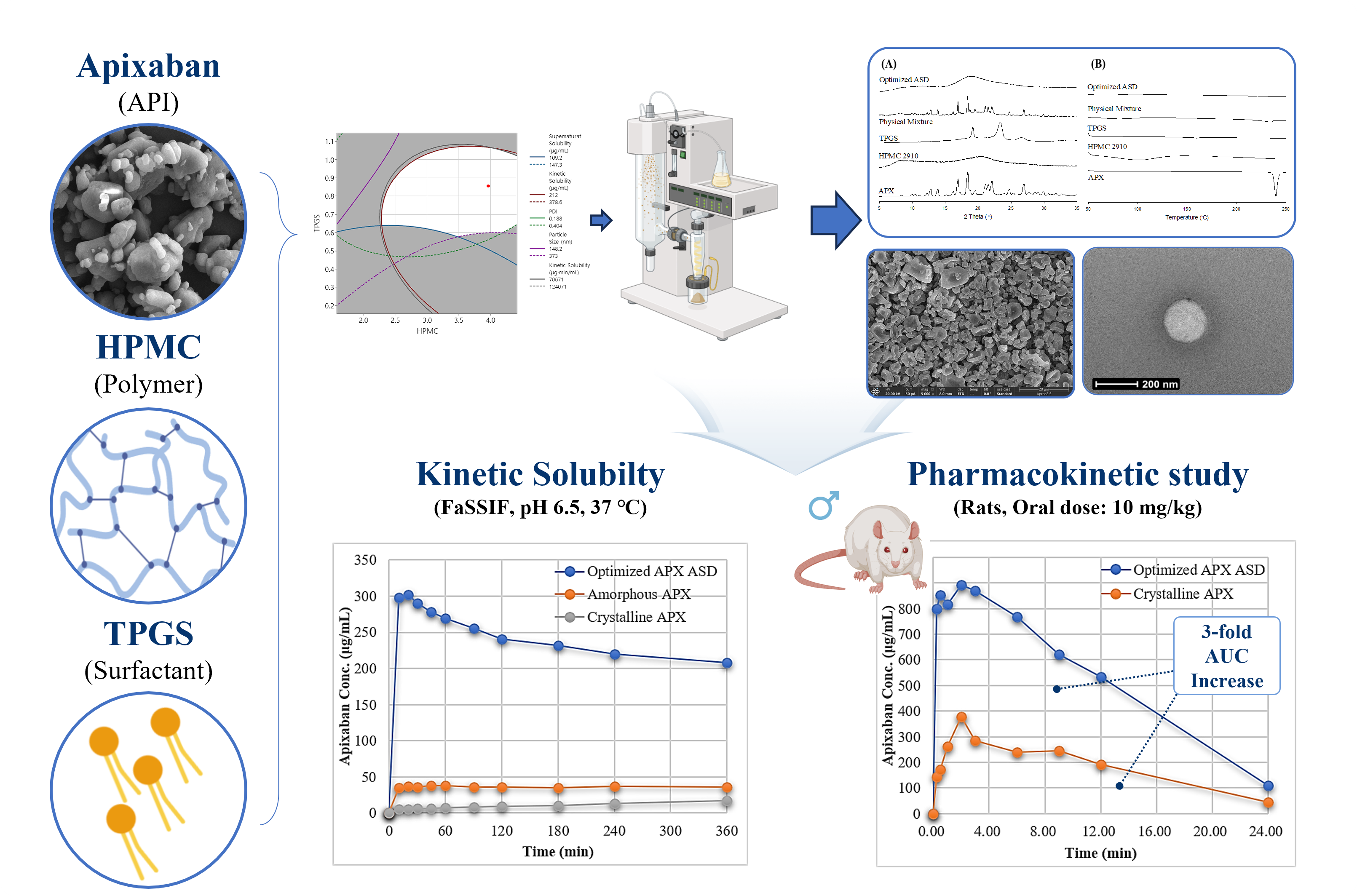
An HPMC/TPGS-based amorphous solid dispersion (ASD) of Apixaban (APX) was developed to improve supersaturation maintenance, colloidal dispersion, and oral exposure. Screening studies showed that HPMC was the most suitable polymer for maintaining APX supersaturation, while TPGS provided the greatest solubilizing effect among the surfactants tested. The HPMC and TPGS ratios were subsequently optimized using a central composite design based on five responses: supersaturation solubility, kinetic solubility at 30 min, kinetic solubility area under the curve (AUC), particle size, and polydispersity index (PDI). The selected formulation contained HPMC and TPGS at ratios of 3.93 and 0.85 relative to APX, respectively, with a composite desirability of 0.8491. Validation of the optimized ASD yielded a supersaturation solubility of 112.1 ± 2.2 μg/mL, a 30-min kinetic solubility of 360.1 ± 4.4 μg/mL, a kinetic solubility AUC of 118545.6 ± 1053.6 μg·min/mL, a particle size of 203.4 ± 17.3 nm, and a PDI of 0.246 ± 0.018. PXRD and DSC analyses showed loss of APX crystallinity, while morphological observations by SEM and TEM, together with DLS measurements after aqueous dispersion, supported the formation of nanosized colloidal particles. The optimized ASD also maintained higher kinetic solubility in fasted-state simulated intestinal fluid (FaSSIF, pH 6.5) than crystalline and amorphous APX. For pharmacokinetic evaluation, the formulations were orally administered to rats, and plasma APX concentrations were measured. Compared with crystalline APX powder, the optimized ASD increased Cmax, AUC0–24, and AUC0–inf by 2.46-, 3.04-, and 2.80-fold, respectively. Overall, the HPMC/TPGS-based ASD improved both the dissolution-related performance and systemic exposure of APX.
Keywords:
apixaban
; amorphous solid dispersion
; central composite design
; response surface methodology
; supersaturation
; oral absorption
Copyright: This open access article is published under a Creative Commons CC BY 4.0 license, which permit the free download, distribution, and reuse, provided that the author and preprint are cited in any reuse.