

Submitted:
30 October 2026
Posted:
02 November 2026
You are already at the latest version
Abstract
This paper presents a simple geometric activity that begins with an elementary question: if an unknown angle is given and only a compass is available, can its measure be determined? We show that repeated copying of the angle around a circle provides a natural algorithm for measuring every rational degree angle exactly and for approximating irrational degree angles. Although the construction is purely geometric, understanding why it works introduces ideas from different areas of mathematics. The process leads to modular arithmetic, where the return of the copied ray is governed by divisibility and the greatest common divisor. This explains why the method succeeds for rational angles and why irrational angles never return exactly to the starting position. The same construction can also be interpreted algebraically by representing each rotation as multiplication by eiθ on the unit circle. From this viewpoint, repeated compass steps generate finite cyclic groups, the return condition becomes an equation involving roots of unity, and the construction connects naturally to cyclotomic polynomials and the classical theory of regular polygons. Rather than presenting new mathematical results, this paper shows how one accessible geometric problem can bridge geometry, number theory, and complex numbers. The same construction is viewed from three complementary perspectives: as a geometric algorithm, a number-theoretic explanation based on modular arithmetic, and an algebraic interpretation using roots of unity. This unified viewpoint illustrates how concepts usually taught separately can emerge naturally from a single geometric process and may help students develop a more connected understanding of mathematics.
Keywords:
angle measurement
; compass constructions
; mathematical connections
; modular arithmetic
; roots of unity
1. Introduction
Suppose someone draws an unknown angle and gives you only a compass. No ruler, no marked straightedge, and no protractor. Can the measure of the angle still be determined?
At first sight, this appears to be a simple question in elementary geometry. However, seemingly simple geometric questions often lead to mathematical ideas that extend well beyond their original setting. Throughout the history of mathematics, elementary constructions have frequently revealed unexpected connections between geometry, arithmetic, algebra, and other mathematical disciplines (Heath, 1956; Courant & Robbins, 1996; Coxeter & Greitzer, 1967). From an educational perspective, recognizing such connections is equally important. Contemporary views of mathematics learning emphasize that meaningful understanding develops when learners are able to relate ideas across different mathematical domains rather than viewing them as isolated procedures (Skemp, 1976; Hiebert & Carpenter, 2006; Ferrini-Mundy, 2000; National Research Council, 2001). Activities that encourage movement between different representations of the same mathematical idea can therefore support deeper conceptual understanding (Lesh et al., 1987; Arcavi, 2003; Duval, 2006).
Geometry provides a particularly natural environment for developing these connections. Geometric objects can be explored visually before being described numerically or symbolically, allowing learners to move gradually from concrete constructions to more abstract mathematical reasoning (Fischbein, 1993; Presmeg, 2006; Duval, 2006). Such transitions between visual, numerical, and algebraic representations have long been recognized as an important characteristic of mathematical thinking (Polya, 2014; Lakatos, 2015; Schoenfeld, 2014). Rather than introducing ideas from geometry, number theory, and algebra as independent topics, an accessible geometric activity can provide a common setting in which these ideas emerge naturally and reinforce one another.
The present paper is built around the motivating question posed above. We consider an unknown angle and assume that only a compass is available. The proposed procedure is remarkably simple. The given angle is copied repeatedly around a circle until the copied ray returns to the starting ray. If the angle is rational (measured in degrees), this return occurs after finitely many steps, allowing the exact angle measure to be recovered by counting the equal sectors produced during the construction. If the angle is irrational, an exact return never occurs, although repeated copying can produce approximations of arbitrary accuracy. The construction itself requires only repeated compass operations and elementary geometric reasoning, making it accessible without any prior knowledge of algebra or number theory.
Although the construction is purely geometric, understanding why it works naturally introduces ideas from several different areas of mathematics. The return of the copied ray is governed by modular arithmetic, while the number of rotations required is determined by the greatest common divisor of the angle and a full rotation. Thus, a simple compass construction leads directly to elementary ideas from number theory concerning divisibility, congruences, periodicity, and cyclic behaviour (Hardy & Wright, 1979; Ireland & Rosen, 1990; Gallian, 2021). The same construction also admits an algebraic interpretation. By representing each rotation through an angle θ by the complex number , every compass copy becomes multiplication by ‘z’, and the sequence of copied rays becomes the sequence 1,z,z2,z3,…. Returning to the starting ray is then equivalent to the equation zn = 1, identifying the generated points as roots of unity. From this viewpoint, repeated compass constructions generate finite cyclic groups on the unit circle, while the resulting point sets connect naturally to cyclotomic polynomials and the classical theory of regular polygon constructibility developed by Gauss (Gauss, 1870; Artin, 1991; Stillwell, 2020). Importantly, these mathematical ideas are not introduced as separate topics. Instead, they arise successively as different ways of understanding the same elementary geometric process.
The mathematics discussed in this paper is entirely classical. Modular arithmetic, greatest common divisors, roots of unity, cyclic groups, and cyclotomic polynomials are all well-established topics in mathematics. Accordingly, the contribution of this paper is not a new theorem, a new proof, or a new algebraic result. Rather, it presents a simple geometric activity that provides a coherent mathematical pathway linking these classical ideas through three complementary viewpoints. The same construction is first understood as a geometric algorithm for measuring angles, then explained through elementary number theory, and finally interpreted using complex numbers and roots of unity. Although these topics are usually introduced in different courses and often at different stages of mathematical learning, they emerge here as different descriptions of the same underlying mathematical process.
This perspective is consistent with current views of mathematics education that emphasize mathematical connections, multiple representations, and transitions between visual and symbolic reasoning (Hiebert & Carpenter, 2006; National Research Council, 2001; Duval, 2006). The paper does not claim that this approach necessarily improves learning outcomes, nor does it report classroom implementation or empirical evidence. Instead, it illustrates how one elementary geometric construction may provide opportunities for connected mathematical thinking. The activity offers a common context for discussing elementary geometry, modular arithmetic, greatest common divisors, complex numbers, roots of unity, and introductory algebra, allowing learners to experience how different branches of mathematics can describe the same phenomenon from complementary perspectives.
The remainder of the paper is organized as follows. Section 2 introduces the compass-only construction and presents the angle measurement algorithm together with its behaviour for rational and irrational angles. Section 3 explains the mathematical basis of the construction using modular arithmetic and the greatest common divisor. Section 4 develops an algebraic interpretation through complex numbers and repeated multiplication on the unit circle. Section 5 briefly relates the generated points to roots of unity and cyclotomic polynomials. Section 6 brings together the geometric, number-theoretic, and algebraic viewpoints within a unified framework. Section 7 discusses the educational implications of the proposed approach, Section 8 outlines its limitations and possible directions for future work, and Section 9 concludes the paper. In this way, the paper argues that one elementary compass construction can serve not only as a method for investigating angles, but also as a natural bridge between geometry, number theory, and algebra, illustrating how different branches of mathematics can emerge from a single mathematical question.
2. A Compass-Only Method for Measuring Angles
2.1. The Basic Construction
Suppose an unknown angle θ is given, and only a compass is available. No protractor, ruler, or marked straightedge is used. The aim is to determine the measure of the angle using repeated compass constructions alone.
Let O be the vertex of the given angle. Draw any circle centred at O. Let the rays of the angle intersect the circle at points A and B. The chord AB represents the given angle on the circle. Now set the compass to the length of the chord AB. Beginning at point B, use the compass to mark a new point C on the circumference such that BC = AB. Repeat the same construction from each newly obtained point, always keeping the compass opening fixed. In this way, the same chord is copied repeatedly around the circle. Each copied chord subtends the same central angle as the original one. Consequently, every step produces another copy of the given angle. As the construction continues, a sequence of equally spaced rays is produced from the centre of the circle. At this stage, no measurements are made. The construction relies only on the ability of the compass to copy equal distances repeatedly. The repeated copying process is illustrated in Figure 1.
2.2. The Measurement Procedure
The repeated copying process naturally leads to a simple procedure for measuring the unknown angle.
Step 1. Draw a circle centred at the vertex of the unknown angle.
Step 2. Mark the two points where the rays of the angle intersect the circle.
Step 3. Set the compass to the chord determined by these two points.
Step 4. Copy the same chord repeatedly around the circumference.
Step 5. Continue until the copied ray first coincides with the original starting ray.
Step 6. Count the total number of equal sectors into which the circle has been divided.
Step 7. Count how many consecutive sectors make up the original angle.
These two counts completely determine the angle. Suppose the repeated construction divides the circle into ‘m’ equal sectors, and suppose the original angle occupies ‘k’ consecutive sectors. Since a complete circle measures 360°, each sector has measure 360°/m. The original angle is therefore
Thus, determining the angle reduces to a simple counting task rather than a direct measurement (see Figure 2 for an example). The compass is used only to reproduce equal chord lengths, while the numerical value of the angle is obtained from the resulting subdivision of the circle. It is important to note that this procedure itself does not explain why the construction returns to the starting ray after a certain number of steps. At this stage, it simply provides a practical geometric method for determining the angle whenever such a return occurs.
2.3. Rational and Irrational Degree Angles
The behaviour of the construction depends on the nature of the given angle. When the angle is a rational number of degrees, repeated copying eventually brings the final ray back to the starting ray. The circle is then divided into a finite number of equal sectors, making it possible to determine the exact value of the angle by applying the counting procedure described above.
For example, if the given angle is 72°, five copies complete one full rotation around the circle. The construction divides the circle into five equal sectors, each measuring 72°. Similarly, if the angle is 16°, forty-five copies complete the circle, producing forty-five equal sectors, each measuring 8°. Similarly, if the angle is 18.5°, seven hundred twenty copies complete the circle, producing seven hundred twenty equal sectors, each measuring 0.5°.
A different situation occurs when the angle is irrational in degree measure. In this case, repeated copying still generates a sequence of rays around the circle, but the construction never returns exactly to the starting ray after any finite number of steps. Instead, the successive rays continue to move around the circle without returning to starting ray exactly. Although an exact return never occurs, the copied rays may pass arbitrarily close to the starting ray. Consequently, if only an approximate measurement is required, the construction may be continued until a sufficiently close return is observed. Increasing the number of compass steps improves the approximation, although exact equality is never achieved.
This contrast between rational and irrational angles raises a natural mathematical question. Why do some angles return exactly to the starting ray while others never do? The answer is not purely geometric. It depends on arithmetic properties of the angle, which are explored in the next section. Figure 3 shows a comparison of repeated compass copying for rational and irrational angles.
3. Why Does the Construction Work?
The compass construction presented in the previous section provides a practical procedure for measuring an unknown angle whenever the copied ray eventually returns to its starting position. However, the construction itself does not explain why this return occurs for some angles and never occurs for others.
The answer lies in elementary number theory. Although the construction is carried out entirely with a compass, every compass step represents another rotation by the same angle around the circle. Understanding the behaviour of repeated rotations naturally leads to modular arithmetic and the greatest common divisor. These arithmetic ideas explain exactly when the construction closes and why the measurement algorithm succeeds.
3.1. Repeated Rotations and Modular Arithmetic
Suppose the given angle is θ. Every time the compass copies the same chord, the ray rotates by another angle of θ. After one step the total rotation is θ, after two steps it is 2θ, after three steps it is 3θ, and so on.
Since one complete revolution is 360°, only the position of the ray modulo 360° matters. After ‘n’ compass steps, the direction of the copied ray is therefore determined by nθ (mod 360∘). The construction returns to its starting position precisely when the accumulated rotation equals one or more complete revolutions. In other words, the return condition is
nθ≡0 (mod 360∘).
Thus, the geometric question “When does the copied ray return to the starting position?” becomes the arithmetic question “For which positive integer ‘n’ does Equation (2) hold?” This simple observation (see flow diagram in Figure 4) reveals the hidden mathematics behind the compass construction. Repeated compass copying is equivalent to repeatedly adding the same angle modulo 360°.
3.2. Rational Angles and the Role of the Greatest Common Divisor
Assume that the given angle is rational in degrees. It can therefore be written in lowest terms as where ‘p’ and ‘q’ are positive integers with gcd (p, q) = 1. Substituting this expression into Equation (2) gives
Multiplying both sides by ‘q’ yields
np≡0 (mod 360q)
The smallest positive integer satisfying this congruence is
This is exactly the number of compass steps required before the copied ray first returns to the starting ray. When the angle is an integer number of degrees (q = 1), Equation (5) reduces to
The greatest common divisor therefore has a simple geometric meaning. It determines the smallest angular unit produced by the repeated compass construction. Once this unit is known, the original angle is simply an integer multiple of it. Thus, the compass construction is governed entirely by the arithmetic relationship between the given angle and a complete revolution. Geometry determines the construction, while number theory explains why it behaves as it does.
3.3. Why Irrational Angles Never Return?
The behaviour changes completely when the given angle is irrational in degree measure. Suppose, for contradiction, that an irrational angle θ returns exactly to the starting ray after ‘n’ compass steps. Then there must exist integers ‘m’ and ‘n > 0’ such that nθ = 360m. Rearranging gives which is a rational number. This contradicts the assumption that θ is irrational. Therefore, no irrational degree angle can return exactly to its starting position after finitely many compass steps.
Although exact return is impossible, irrational angles can still be approximated arbitrarily closely by rational numbers. Suppose where is a rational approximation of the given angle. The compass construction may then be performed using this rational approximation. Since the approximation satisfies Equation (5), the copied ray will eventually return after finitely many steps, producing an approximate measurement of the original angle.
As the rational approximation becomes more accurate, the measured value also becomes more accurate. Thus, the same geometric procedure can approximate irrational angles to any desired degree of accuracy, although an exact return can never occur.
This distinction between rational and irrational angles is entirely arithmetic. The compass construction itself is identical in both cases. Only the arithmetic properties of the angle determine whether the construction closes exactly or only approximately.
3.4. Examples
The following examples illustrate how the arithmetic determines the behaviour of the compass construction.
Example 1 (Integer angle). Suppose the given angle is 17°.
Since gcd (17, 360) = 1, equation (6) gives The construction divides the circle into 360 equal sectors, each measuring 1°. The original angle occupies 17 consecutive sectors.
Example 2 (Integer angle). Suppose the given angle is 54°.
Since gcd (54, 360) = 18, the construction returns after steps. The circle is divided into 20 equal sectors, each measuring 18°, and the original angle occupies 3 consecutive sectors.
Example 3 (Rational angle). Consider the angleHere, gcd (22.5, 360) = gcd (45, 720)/2 = 45/2 = 22.5, so equation (5) gives The construction therefore returns after sixteen compass steps, dividing the circle into 16 equal sectors of 22.5°.
Example 4 (Rational angle). ConsiderSince gcd (18.5, 360) = gcd (37, 720)/2 = 1/2 = 0.5, the construction returns after steps. The construction therefore returns after 720 compass steps, dividing the circle into 720 equal sectors of 0.5°. Although the procedure requires many more compass steps, the measurement is still exact because the angle is rational.
Example 5 (Irrational angle). Suppose the given angle is π∘.
Since π is irrational, the construction can never return exactly to the starting ray. However, we may use the rational approximationBecause gcd (3.14, 360) = gcd (157, 18000)/50 = 1/50 = 0.02, the corresponding compass construction returns after 18000 steps, providing an approximation to the original angle. Using a more accurate rational approximation, such as 3.14159°, produces an even better approximation.
Example 6 (Irrational angle). Consider the angleAgain, the construction never closes exactly becauseis irrational. Using the rational approximationthe compass construction returns after finitely many steps and provides an approximate measurement. Increasing the accuracy of the rational approximation improves the measurement, but exact closure never occurs.
These examples (as stated above and summarized in Table 1) show that the geometric construction is identical in every case. The only difference lies in the arithmetic properties of the angle. Rational angles always produce finite periodic constructions, while irrational angles produce an infinite sequence of rotations that never returns exactly to the starting ray. The arithmetic explanation developed in this section completes the justification of the compass-only measurement algorithm. It also prepares the way for a different interpretation of the same construction. Instead of viewing each compass step as repeated addition of an angle, the next section interprets it as multiplication by a complex number on the unit circle. This algebraic viewpoint naturally leads to roots of unity, cyclic groups, and ultimately to cyclotomic polynomials.
4. An Algebraic Interpretation
The previous section explained the compass construction using modular arithmetic. Every compass step was viewed as adding another copy of the same angle. Although this arithmetic description explains why the construction works, the same process can also be described from a different perspective.
Instead of following rays on a circle, we may represent each ray by a point on the complex unit circle. Under this interpretation, repeated compass constructions become repeated multiplication by a single complex number. The geometry remains exactly the same, but its description changes from repeated addition of angles to repeated multiplication in the complex plane. This provides another way to understand the compass construction and naturally connects it with roots of unity.
4.1. From Rays to Complex Numbers
Consider a circle of radius one centred at the origin of the complex plane. A ray making an angle θ with the positive real axis corresponds to the complex number
This is simply the point where the ray meets the unit circle. Under this representation, every direction is identified with a point of modulus one. Moving from one ray to another by rotating through an angle θ corresponds to multiplying by . Thus, a geometric rotation becomes an algebraic operation. The compass construction described earlier therefore has a natural interpretation in the complex plane. Each copied angle is represented by multiplication by the same complex number ‘z’.
4.2. Repeated Compass Steps as Multiplication by ‘z’
Suppose the initial ray is represented by the complex number 1. After one compass step, the ray has rotated through an angle θ, giving After two compass steps, after three steps, and after ‘n’ steps, Thus, the sequence produced by the compass construction becomes 1, z, z2, z3,..., zn, ....
Each multiplication represents one compass copy of the original angle. The geometry has not changed; only its language has changed. What was previously viewed as repeated addition of angles is now viewed as repeated multiplication on the unit circle. Figure 5 illustrates this interpretation.
4.3. Returning to the Starting Ray
The compass construction returns to the starting ray exactly when the accumulated rotation equals a whole number of complete revolutions. From the geometric viewpoint, this occurs when From the complex-number viewpoint, the same condition becomes
zn = 1.
Thus, the return condition is simply the statement that repeated multiplication eventually returns to the original point on the unit circle. If θ is rational in degrees, there exists a smallest positive integer ‘n’ for which equation (8) holds. Consequently, the sequence 1, z, z2, …, zn−1 contains finitely many distinct points before repeating.
If θ is irrational in degrees, no positive integer satisfies zn = 1. The sequence therefore never returns exactly to its starting point, although successive points may come arbitrarily close. This is precisely the same distinction between rational and irrational angles that was established geometrically in Section 2 and arithmetically in Section 3.
4.4. The Same Construction Seen Differently
One of the interesting features of the compass construction is that nothing changes mathematically when we move from geometry to complex numbers. Only the representation changes.
- In the geometric construction, each compass step produces another ray.
- In the arithmetic interpretation, each step adds another copy of the angle modulo 360°.
- In the complex-number interpretation, each step multiplies by the same complex number eiθ.
These three descriptions represent exactly the same process. They simply emphasize different aspects of it. Geometry makes the construction visible, modular arithmetic explains why it closes, and complex numbers provide an algebraic representation of repeated rotation. This change of viewpoint prepares the way for the next section. Since the construction returns precisely when zn = 1, every finite compass construction corresponds naturally to a collection of roots of unity on the unit circle. The geometric points generated by repeated compass steps therefore connect directly with one of the classical objects of algebra.
5. Roots of Unity and Cyclotomic Polynomials
The previous section showed that repeated compass constructions can be interpreted as repeated multiplication by the complex number Each copy of the given angle corresponds to another power of ‘z’, 1, z, z2, z3, ... . When the angle is rational, this sequence eventually returns to the starting point because zn = 1 for some positive integer ‘n’. This observation gives another way to understand the compass construction. Rather than viewing it only as a geometric procedure or an application of modular arithmetic, we may also view it as generating a finite collection of equally spaced points on the unit circle. These points are precisely the roots of unity. This section briefly explores that interpretation.
5.1. Finite Cyclic Groups on the Unit Circle
Suppose the given angle is rational, and let ‘n’ be the smallest positive integer for which zn = 1. The repeated compass construction generates the sequence 1, z, z2, …, zn−1, before returning to the starting point. Geometrically, these points divide the unit circle into ‘n’ equal sectors. Algebraically, they form a finite cyclic group under complex multiplication, {1,z,z2,…,zn−1}. Thus, every repeated compass construction of a rational angle naturally generates a cyclic group. Several familiar geometric figures appear as special cases.
- If n = 3, the points form an equilateral triangle.
- If n = 4, they form a square.
- If n = 5, they form a regular pentagon.
- If n = 6, they form a regular hexagon.
These polygons are not introduced separately. They arise automatically from repeatedly copying a single angle around the circle (see Figure 6). This viewpoint gives another interpretation of the compass algorithm. The construction is no longer simply copying an angle repeatedly; it is generating the complete orbit of one point under repeated rotation.
5.2. Roots of Unity
The points produced by the compass construction are examples of the roots of unity. A complex number is called an n-th root of unity if zn = 1. These numbers are equally spaced around the unit circle and correspond exactly to the vertices of a regular n-gon.
From the geometric viewpoint developed in this paper, every repeated compass step multiplies the current point by the same complex number . Consequently, the successive compass steps generate the sequence 1, z, z2,…, zn−1, which consists of all the roots obtained by repeated multiplication by ‘z’. The return to the starting ray occurs precisely when the first repeated power equals one, zn = 1. This is the same condition that was expressed geometrically in Section 2 as returning to the initial ray and arithmetically in Section 3 as Therefore, the same mathematical event can now be viewed in three different ways.
- In geometry, the copied ray returns to its starting position.
- In number theory, the accumulated angle becomes congruent to 0° modulo 360°.
- In algebra, the corresponding complex number becomes equal to 1.
Although these descriptions use different mathematical language, they describe exactly the same process.
5.3. A Brief Connection to Cyclotomic Polynomials
The roots generated by the compass construction also have a natural connection with cyclotomic polynomials. All n-th roots of unity are solutions of the equation zn − 1 = 0. However, not all of these roots are fundamentally new. Some correspond to smaller repeating patterns. The remaining ones, called primitive roots of unity, generate the entire set through repeated multiplication.
Cyclotomic polynomials are the polynomials whose roots are exactly these primitive roots of unity. For example, z6 − 1 = (z − 1)(z + 1)(z2 − z + 1)(z2 + z + 1). Each factor corresponds to primitive roots associated with different cyclic structures.
A detailed study of cyclotomic polynomials belongs to algebra and number theory and is beyond the scope of this paper. Nevertheless, mentioning them helps place the compass construction within a broader mathematical context. The same roots of unity produced by a simple geometric activity have long played an important role in classical mathematics, particularly in the study of regular polygons. Gauss’s celebrated work on polygon constructibility showed that cyclotomic polynomials provide the algebraic framework for understanding which regular polygons can be constructed using classical geometric tools. The purpose of introducing this connection is not to develop cyclotomic theory, but to illustrate how an elementary geometric construction naturally leads to mathematical ideas that reappear in more advanced areas of algebra.
Starting from a simple compass construction, we have now reached another mathematical viewpoint. Repeated copying of an angle produces equally spaced points on the unit circle, these points form finite cyclic groups, satisfy the equation zn = 1, and are precisely the roots of unity. Looking one step further reveals their connection with cyclotomic polynomials, which have an important place in the classical theory of regular polygons. Viewed in this way, the original question of measuring an angle with only a compass becomes more than a geometric construction. It becomes a pathway that naturally connects elementary geometry with ideas from algebra and number theory, without requiring any change to the underlying construction itself.
6. One Problem, Three Mathematical Viewpoints
The compass construction presented in this paper begins with a very simple geometric question: can an unknown angle be measured using only a compass? The answer develops through repeated copying of the angle around a circle until the construction either returns to the starting ray or comes arbitrarily close to it. At first glance, this appears to be an elementary geometric activity. However, the previous sections have shown that the same process can be understood from several different mathematical viewpoints.
From a geometric perspective, the construction is an algorithm. The compass is used to copy the same angle repeatedly, producing equally spaced rays on the circle. If the angle is rational, the construction eventually returns exactly to the starting ray. If the angle is irrational, no exact return occurs, although repeated copying can produce increasingly accurate approximations. Everything in this viewpoint is visual and constructive.
The same construction can also be described using elementary number theory. Every compass step adds another copy of the angle, so the process becomes repeated addition modulo 360°. The question “When do we return to the starting ray?” becomes the congruence The number of compass steps needed for the first return is therefore determined by the order of the rotation, which depends on the greatest common divisor of the angle and 360° in the rational case. The geometry is unchanged; only the language used to describe it has changed.
A third viewpoint comes from complex numbers. Instead of representing an angle by a ray, we represent it by the point on the unit circle. Every compass copy now corresponds to multiplication by ‘z’. The sequence of copied rays becomes 1,z,z2,z3,…. Returning to the starting ray is exactly the condition zn = 1. Thus, the same compass construction naturally produces roots of unity. The finite set of points generated by repeated copying forms a cyclic subgroup of the unit circle. The connection to cyclotomic polynomials discussed in the previous section provides one further algebraic interpretation of the same geometric process.
An important observation is that none of these viewpoints replaces another. Each explains the same construction from a different perspective. Geometry provides the algorithm, number theory explains why the algorithm works, and complex numbers offer an algebraic interpretation of the same repeated rotations. The mathematics remains the same, but each representation highlights different ideas that may not be immediately visible from the others. Table 2 summarizes the correspondence between these three viewpoints.
The purpose of presenting these viewpoints together is not to introduce advanced mathematics, but to illustrate how one simple geometric activity naturally connects ideas that are often taught separately. A student may first understand the process visually through compass constructions, then explain it using modular arithmetic, and finally recognize the same pattern in the language of complex numbers. In this way, a single problem becomes a pathway connecting several classical areas of mathematics while preserving the same underlying mathematical structure (see Figure 7).
7. Educational Implications
The compass-only construction presented in this paper begins with a simple geometric question: Can an unknown angle be measured using only a compass? Although the construction itself is elementary, following the question to its mathematical explanation naturally brings together ideas from several areas of mathematics. This progression suggests that the activity may have educational value beyond learning a single geometric construction. Rather than treating geometry, number theory, and complex numbers as unrelated topics, the activity offers one mathematical process that can be examined from different perspectives.
7.1. Learning Through a Connected Mathematical Journey
School mathematics is often organised into separate topics such as geometry, algebra, number theory, and complex numbers. Students may therefore learn these subjects independently without seeing how they are related. The compass construction described in this paper offers an alternative pathway. Students first encounter a purely geometric activity: repeatedly copying an angle around a circle. The natural question of why the construction eventually returns to its starting position introduces modular arithmetic and the greatest common divisor. Representing the same rotations on the complex plane then leads naturally to roots of unity and, at an introductory level, cyclotomic polynomials.
The important feature is that none of these ideas is introduced artificially. Each new concept arises because it helps explain the previous one. In this way, the activity illustrates how different branches of mathematics can develop naturally from a single problem. Table 3 summarizes one possible learning progression through the activity, showing how each stage of the construction naturally motivates the introduction of a new mathematical idea.
7.2. Multiple Representations of the Same Process
One feature of mathematical understanding is the ability to recognise the same idea in different representations. The construction in this paper can be viewed in at least three complementary ways.
- As a geometric process, it consists of repeatedly copying an angle around a circle.
- As a number-theoretic process, it becomes repeated addition modulo 360°, with the return determined by divisibility and the greatest common divisor.
- As an algebraic process, each rotation corresponds to multiplication by , and returning to the starting ray becomes the condition zn = 1.
These representations describe the same mathematical phenomenon using different languages. Moving between them may help students recognise that mathematical ideas are often connected rather than isolated.
7.3. From Visual Reasoning to Abstract Reasoning
The activity also illustrates a gradual transition from visual reasoning to symbolic reasoning. Students can begin by observing a concrete geometric pattern produced by repeated compass constructions. They may notice that some angles return quickly while others require many more rotations. These observations naturally lead to questions such as:
- Why does the construction return?
- Why do different angles require different numbers of steps?
- Why do some angles divide the circle into many more sectors than others?
Answering these questions requires increasingly abstract mathematical ideas. Geometry motivates the questions, number theory explains the behaviour, and complex numbers provide another interpretation of the same process. This progression demonstrates one possible pathway from visual intuition to mathematical abstraction.
7.4. Opportunities for Classroom Use
The construction may be used in a variety of instructional settings depending on the mathematical background of the learners. At an introductory level, students can perform the compass construction, count the number of rotations, and compare the behaviour of different rational angles. This emphasises geometric reasoning and pattern recognition. At an intermediate level, the same activity can motivate modular arithmetic and the role of the greatest common divisor in determining periodic behaviour. For more advanced students, the construction provides a concrete geometric interpretation of roots of unity and finite cyclic groups on the unit circle. A brief discussion of cyclotomic polynomials can further illustrate how ideas encountered in elementary geometry connect with topics usually studied much later in mathematics.
Because the same construction supports discussions at different levels, it may serve as a useful bridge between secondary mathematics, undergraduate mathematics, and introductory abstract algebra.
7.5. An Example of Connected Mathematics
Perhaps the most important educational message of this work is not the compass construction itself, but the mathematical pathway that it creates.
A question that begins as an elementary exercise in geometry develops naturally into ideas from number theory and complex numbers without changing the underlying mathematical process. Each perspective explains something that the previous one leaves unanswered, while all describe the same repeated rotations on a circle. The activity therefore offers an example of connected mathematical thinking, where different areas of mathematics complement one another rather than being presented as independent topics. Although the educational value of this approach should ultimately be examined through classroom-based research, the construction provides a simple setting in which students may experience how a single mathematical question can unify ideas that are often learned separately.
8. Limitations and Future Directions
8.1. Limitations
The results presented in this paper are intentionally elementary and focus on the mathematical ideas that arise from a simple compass construction. Several limitations should therefore be noted.
- Exact angle measurement using the proposed procedure is possible only when the angle is rational (when its degree measure is a rational number). In this case, repeated compass copying eventually returns to the starting ray after finitely many steps. For irrational angles, the construction never returns exactly to its initial position. In practice, the angle may be approximated by a nearby rational angle with sufficiently large denominator, allowing measurements of increasing accuracy, but an exact finite construction is not possible within this framework.
- The discussion of roots of unity and cyclotomic polynomials is intended only as an interpretation of the geometric process. The paper does not develop the deeper algebraic theory involving field extensions, Galois theory, or classical constructibility results. Those topics lie beyond the scope of the present work.
- Although educational implications have been discussed, no classroom study has been conducted. Consequently, the paper does not evaluate learning outcomes, student reasoning, or instructional effectiveness. The educational discussion should therefore be viewed as a theoretical proposal rather than an empirical conclusion.
8.2. Future Directions
The above limitations naturally suggest several directions for future work.
- One direction is to investigate irrational rotations more systematically. Their dense behaviour on the circle connects the present construction with classical results from dynamical systems and Diophantine approximation. Continued fractions may provide a natural framework for studying rational approximations of irrational angles and analysing the accuracy of compass-based measurements.
- A second direction is educational research. Classroom implementation could investigate how students move between the geometric, number-theoretic, and algebraic representations presented in this paper. Such studies could examine conceptual understanding, mathematical reasoning, and students’ ability to recognise connections across different areas of mathematics.
- Finally, digital geometry environments such as GeoGebra could be used to simulate the compass construction dynamically, allowing students to explore both rational and irrational rotations interactively. Such implementations may provide additional opportunities for inquiry-based learning and multiple mathematical representations.
9. Conclusion
This paper began with a simple geometric question: Can an unknown angle be measured using only a compass?
For rational angles, repeated compass copying provides an exact measurement procedure based on counting the number of rotations required to return to the starting ray. For irrational angles, the same idea leads naturally to rational approximations and increasingly accurate estimates. Beyond the construction itself, the paper shows that this elementary geometric process can be understood from several complementary mathematical viewpoints. Geometrically, it is an iterative compass construction based on repeated copying of a fixed angle. From the perspective of number theory, its behaviour is explained by modular arithmetic and the greatest common divisor, which determine the period of the construction. In the complex plane, the same process becomes repeated multiplication by , leading naturally to roots of unity, finite cyclic groups, and an introductory connection with cyclotomic polynomials. The contribution of the paper is therefore not the discovery of a new theorem, but the presentation of a simple mathematical pathway that connects ideas usually introduced separately. Beginning with a concrete geometric activity and ending with algebraic interpretations, the construction illustrates how a single question can reveal relationships across different areas of mathematics.
From an educational perspective, this offers a possible example of connected mathematical thinking. The same construction can be explored visually, explained arithmetically, and interpreted algebraically, allowing students to move between multiple representations of the same underlying process. Although empirical classroom studies remain for future work, the approach illustrates how elementary geometry can serve as a natural gateway to broader mathematical ideas. Ultimately, the paper suggests that a simple compass construction is more than a method for measuring angles. It provides a concrete example of how geometry, number theory, and complex numbers can be viewed as complementary ways of understanding the same mathematical process.
Acknowledgments
The author gratefully acknowledges the Indian Institute of Technology (Indian School of Mines), Dhanbad, for providing the facilities and institutional support necessary for this study.
Data Availability Statement
The datasets and computational codes supporting the findings of this study are available from the corresponding author upon reasonable request.
CRediT Authorship Contribution Statement
Pranjal Srivastava: Conceptualization, Methodology, Formal analysis, Validation, Visualization, Writing - original draft, Writing - review & editing.
Declaration of Competing Interests
The author declares that there are no known financial or personal relationships that could have appeared to influence the work reported in this paper.
Funding Sources
This research did not receive any specific grant from funding agencies in the public, commercial, or not-for-profit sectors.
Declaration of Generative AI Use
During the preparation of this manuscript, ChatGPT (OpenAI) was used solely to improve language, grammar, clarity, and readability. All scientific content, interpretations, analyses, and conclusions were developed, verified, and approved by the author, who takes full responsibility for the published work.
Declaration of Originality
The author declares that this manuscript is original, has not been published previously, and is not under consideration for publication elsewhere.
Ethics Approval
This study did not involve human participants or animals. Therefore, ethics committee approval was not required.
Informed Consent
Informed consent was not applicable because the study did not involve human participants.
Financial and Non-Financial Interests
The author declares no financial or non-financial interests related to this work.
References
- Arcavi, A. The role of visual representations in the learning of mathematics. Educational Studies in Mathematics 52 2003, 215–241. [Google Scholar] [CrossRef]
- Artin, M. Algebra; Prentice Hall, 1991. [Google Scholar]
- Courant, R.; Robbins, H. What is mathematics?: An elementary approach to ideas and methods; Oxford University Press, 1996. [Google Scholar]
- Coxeter, H. S. M.; Greitzer, S. L. Geometry revisited; Mathematical Association of America, 1967; Vol. 19. [Google Scholar]
- Duval, R. A cognitive analysis of problems of comprehension in a learning of mathematics. Educational Studies in Mathematics 61 2006, 103–131. [Google Scholar] [CrossRef]
- Ferrini-Mundy, J. Principles and standards for school mathematics: A guide for mathematicians. Notices of the American Mathematical Society 2000, 47(8), 868–876. Available online: https://www.ams.org/journals/notices/200008/comm-ferrini.pdf.
- Fischbein, E. The theory of figural concepts. Educational Studies in Mathematics 24 1993, 139–162. [Google Scholar] [CrossRef]
- Gallian, J. A. Contemporary abstract algebra, 10th ed.; Chapman and Hall/CRC, 2021. [Google Scholar] [CrossRef]
- Gauss, C. F. Disquisitiones arithmeticae; K. Gesellschaft der Wissenschaften zu Göttingen, 1870; Vol. 1. [Google Scholar]
- Hardy, G. H.; Wright, E. M. An introduction to the theory of numbers, 5th ed.; Oxford University Press, 1979. [Google Scholar]
- Heath, T. L. (Ed.) The thirteen books of Euclid’s Elements; Dover Publications, 1956. [Google Scholar]
- Hiebert, J.; Carpenter, T. P. Learning and teaching with understanding. In Handbook of research on mathematics teaching and learning: A project of the National Council of Teachers of Mathematics; Grouws, D. A., Ed.; Emerald Publishing Limited, 2006. [Google Scholar] [CrossRef]
- Ireland, K.; Rosen, M. A classical introduction to modern number theory, 2nd ed.; Springer, 1990; Vol. 84. [Google Scholar]
- Lakatos, I. Proofs and refutations: The logic of mathematical discovery; Worrall, J., Zahar, E., Eds.; Cambridge University Press, 2015. [Google Scholar] [CrossRef]
- Lesh, R.; Post, T. R.; Behr, M. Representations and translations among representations in mathematics learning and problem solving. In Problems of representation in the teaching and learning of mathematics; Janvier, C., Ed.; Lawrence Erlbaum Associates, 1987; pp. 33–40. Available online: https://experts.umn.edu/en/publications/representations-and-translations-among-representations-in-mathema.
- National Research Council. Adding it up: Helping children learn mathematics; National Academies Press, 2001. [Google Scholar] [CrossRef]
- Polya, G. How to solve it: A new aspect of mathematical method; Princeton University Press, 2014. [Google Scholar] [CrossRef]
- Presmeg, N. Research on visualization in learning and teaching mathematics. In Handbook of research on the psychology of mathematics education: Past, present and future; Gutiérrez, A., Boero, P., Eds.; Sense Publishers, 2006; pp. 205–235. [Google Scholar] [CrossRef]
- Schoenfeld, A. H. Mathematical problem solving; Elsevier, 2014. [Google Scholar]
- Skemp, R. R. Relational understanding and instrumental understanding. Mathematics Teaching 77 1976, 20–26. Available online: http://davidtall.com/skemp/pdfs/instrumental-relational.pdf.
- Stillwell, J. Mathematics and its history: A concise edition; Springer, 2020. [Google Scholar] [CrossRef]
Figure 1.
Compass-only construction obtained by repeatedly copying the chord corresponding to the given angle around the circle. Equal chords produce equal central angles.
Figure 1.
Compass-only construction obtained by repeatedly copying the chord corresponding to the given angle around the circle. Equal chords produce equal central angles.
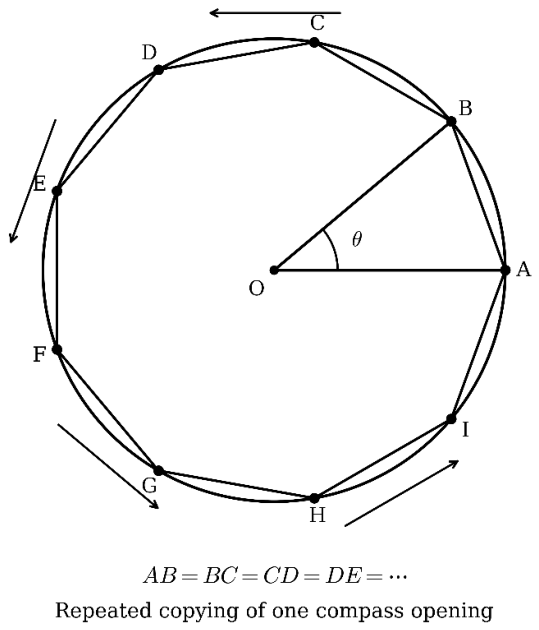
Figure 2.
Determining an unknown angle by counting the total number of equal sectors produced and the number occupied by the original angle.
Figure 2.
Determining an unknown angle by counting the total number of equal sectors produced and the number occupied by the original angle.
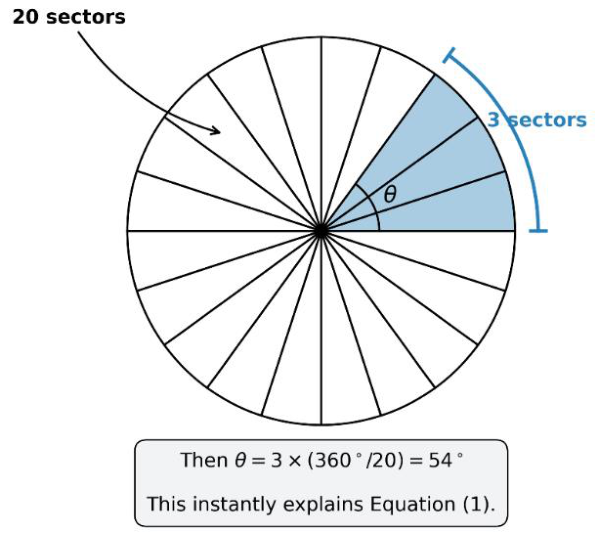
Figure 3.
Comparison of repeated compass copying for rational and irrational angles. Rational angles return to the starting ray after finitely many steps, whereas irrational angles approach the starting ray without ever coinciding exactly.
Figure 3.
Comparison of repeated compass copying for rational and irrational angles. Rational angles return to the starting ray after finitely many steps, whereas irrational angles approach the starting ray without ever coinciding exactly.
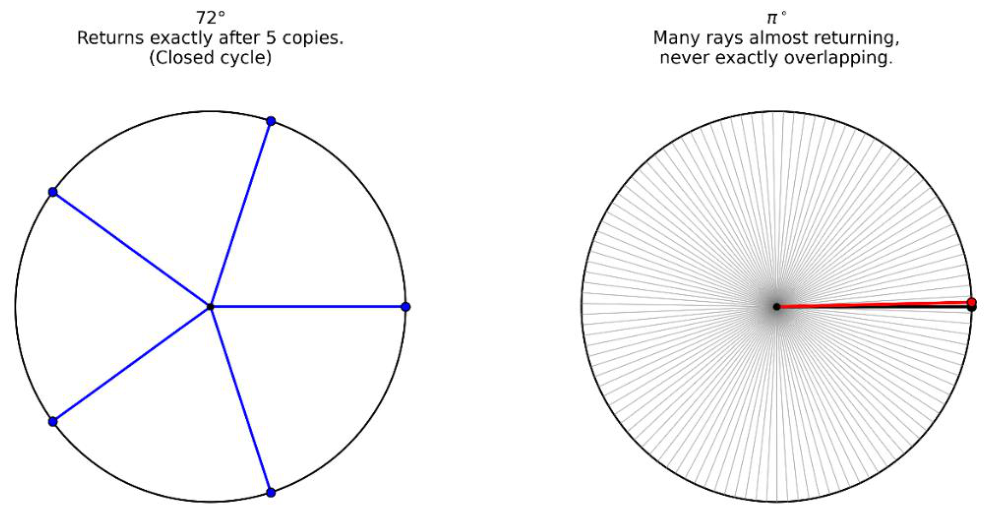
Figure 4.
The geometric construction translated into modular arithmetic. Repeated compass copying is equivalent to repeated addition of the same angle modulo 360°.
Figure 4.
The geometric construction translated into modular arithmetic. Repeated compass copying is equivalent to repeated addition of the same angle modulo 360°.
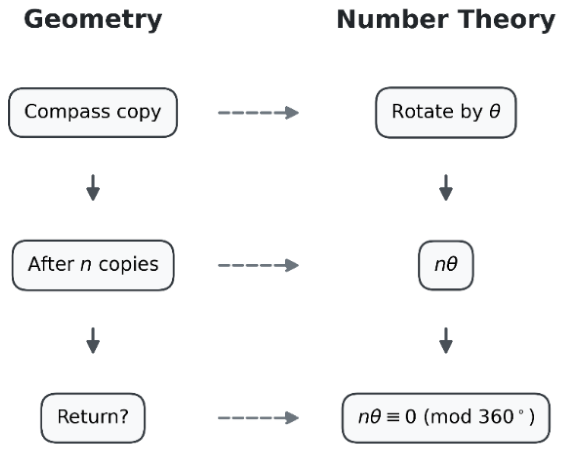
Figure 5.
Algebraic interpretation of the compass construction. Each compass step corresponds to multiplication by on the unit circle.
Figure 5.
Algebraic interpretation of the compass construction. Each compass step corresponds to multiplication by on the unit circle.
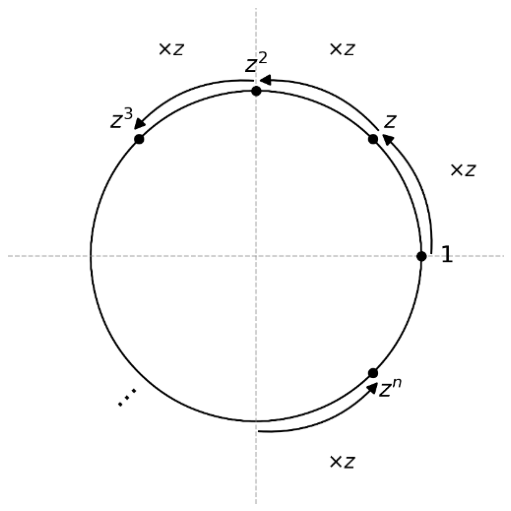
Figure 6.
Finite cyclic groups generated by repeated rotations. The generated points coincide with the roots of unity and the vertices of regular polygons.
Figure 6.
Finite cyclic groups generated by repeated rotations. The generated points coincide with the roots of unity and the vertices of regular polygons.
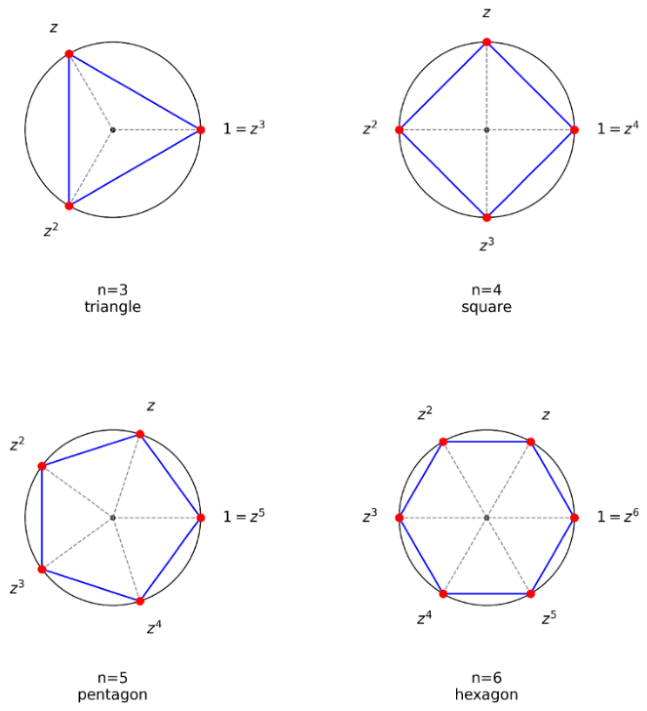
Figure 7.
A single geometric problem viewed through three complementary mathematical perspectives, illustrating how geometry, number theory, and algebra describe the same underlying process.
Figure 7.
A single geometric problem viewed through three complementary mathematical perspectives, illustrating how geometry, number theory, and algebra describe the same underlying process.
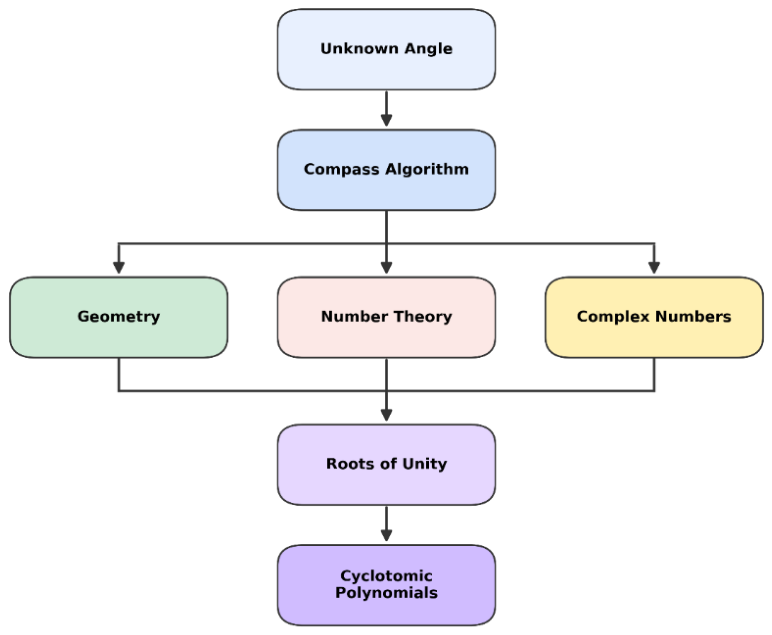

Table 1.
Behaviour of the compass-only algorithm for representative rational and irrational angles.
| Given angle | Rational / Irrational | First return after how many steps | Exact / Approximate | Number of sectors | Angle of each sector |
|---|---|---|---|---|---|
| 17° | Rational | 360 | Exact | 360 | 1° |
| 54° | Rational | 20 | Exact | 20 | 18° |
| 22.5° | Rational | 16 | Exact | 16 | 22.5° |
| 18.5° | Rational | 720 | Exact | 720 | 0.5° |
| π° | Irrational | Never | Approximate | Depends on approximation | Depends on approximation |
| √2° | Irrational | Never | Approximate | Depends on approximation | Depends on approximation |
Table 2.
Equivalent interpretations of the same compass construction from geometric, number-theoretic, and algebraic viewpoints.
Table 2.
Equivalent interpretations of the same compass construction from geometric, number-theoretic, and algebraic viewpoints.
| Geometry | Number Theory | Complex Numbers |
|---|---|---|
| Compass copy | Repeated addition modulo 360° | Multiplication by |
| Return to start | Congruence | zn = 1 |
| Equal sectors | Order of rotation | Roots of unity |
| Construction | Divisibility | Finite cyclic group |
| Circle | Modulo arithmetic | Unit circle |
Table 3.
Suggested learning progression through the compass-only activity, illustrating how a single geometric construction naturally introduces ideas from geometry, number theory, and algebra.
Table 3.
Suggested learning progression through the compass-only activity, illustrating how a single geometric construction naturally introduces ideas from geometry, number theory, and algebra.
| Stage of the activity | What the student does | New mathematical idea introduced | Main mathematical domain |
|---|---|---|---|
| Observe an unknown angle | Draw the given angle and circle; identify the corresponding chord | An angle can be represented geometrically by a chord and a central angle | Geometry |
| Repeat the compass construction | Copy the same chord repeatedly around the circle | Equal chords produce equal rotations and repeated geometric patterns | Geometry |
| Ask why the construction returns | Count repeated rotations until the starting ray is reached | Periodicity, congruence modulo 360∘, and the role of the greatest common divisor | Number Theory |
| Represent rotations algebraically | Interpret each rotation as multiplication by z = eiθ | Complex-number representation of rotation | Algebra / Complex Numbers |
| Study the generated points | Examine the sequence 1,z,z2,…,zn−1 on the unit circle | Roots of unity and finite cyclic groups | Algebra |
| Extend the discussion | Relate the generated roots to regular polygons and cyclotomic polynomials | Connections between geometry, algebra, and number theory | Integrated Mathematical Thinking |
Disclaimer/Publisher’s Note: The statements, opinions and data contained in all publications are solely those of the individual author(s) and contributor(s) and not of MDPI and/or the editor(s). MDPI and/or the editor(s) disclaim responsibility for any injury to people or property resulting from any ideas, methods, instructions or products referred to in the content. |
© 2026 by the authors. Licensee MDPI, Basel, Switzerland. This article is an open access article distributed under the terms and conditions of the Creative Commons Attribution (CC BY) license (http://creativecommons.org/licenses/by/4.0/).
Copyright: This open access article is published under a Creative Commons CC BY 4.0 license, which permit the free download, distribution, and reuse, provided that the author and preprint are cited in any reuse.