

Submitted:
30 October 2026
Posted:
02 November 2026
You are already at the latest version
Abstract
This study presents new geochemical and geochronological data on granites from the south-eastern part of the Kalba-Narym batholith, Eastern Kazakhstan, which hosts several rare-metal (Sn-W) deposits. The granites are assigned to the first and second intrusive phases of the Kalba Complex. U-Pb dating of magmatic zircon indicates crystallisation ages of 297-290 Ma for the first-phase granites and 292-289 Ma for the second-phase granites. The geochronological and geochemical data suggest that the granitoids of both intrusive phases are genetically related and most likely evolved through differentiation of a common parental magma. The transition from the first-phase to the second-phase granites is characterised by increasing SiO2 and Na2O contents and enrichment in volatile components, accompanied by decreasing concentrations of TiO2, Fe2O3, MgO, CaO, Al2O3, Ba, Th, Nb, Sr, Zr, Eu and Y. The geological characteristics and inferred timing of formation of the rare-metal deposits in the study area are also discussed. The results suggest that the Palatsy, Leninskoye and Cherdoyak deposits formed through differentiation of granitic magmas in magma chambers, followed by the partitioning of rare metals into an exsolved fluid phase and the development of Sn-W-enriched greisen stockworks. Based on these findings, the south-eastern part of the Kalba-Narym batholith is considered prospective for additional tin-tungsten mineralisation, particularly within the exocontact zones and apical parts of large granite massifs of the Kalba Complex.
Keywords:
South‐Eastern Kalba
; granitoids
; U‐Pb geochronology
; granite differentiation
; rare‐metal deposits
; Sn‐W mineralisation
; perspective
1. Introduction
Rare metals are of critical importance to modern high-technology industries and are widely used in the development and manufacture of advanced materials with specific properties. Lithium is among the most sought-after rare metals, owing to its extensive use in energy storage technologies, particularly rechargeable batteries. Niobium, tantalum and beryllium are important alloying elements used in the production of lightweight, high-strength materials with enhanced corrosion and heat resistance. Caesium is used in electronics and medicine. Tin has long been an important industrial metal, and its significance has increased in recent years owing to its growing applications in electronics, microelectronics and green-energy technologies [1]. Tungsten is also in high demand in metallurgy, electronics and electrical engineering. Global demand for rare metals continues to grow rapidly. At current production rates, identified tin reserves would last approximately 15-20 years, and tungsten reserves would last approximately 50-55 years [2]. Given rising consumption, the background of increasing consumption, the identification of prospective mineralised areas and the discovery of new deposits are becoming increasingly important.
Many primary tin and tungsten deposits are associated with metasomatic alteration, particularly greisenisation, and hydrothermal processes related to granitic intrusions [3,4,5,6,7,8,9]. Previous studies have identified distinctive geochemical characteristics of granites associated with Sn-W mineralisation, providing a basis for recognising potentially ore-bearing granitic systems [8,10,11,12]. Nevertheless, despite extensive investigations of granites and associated rare-metal deposits, universally applicable criteria for identifying rare-metal mineralisation and assessing the metallogenic potential of individual granitic intrusions have yet to be established. This uncertainty largely reflects the considerable compositional diversity of granitic magmas and the different processes and pathways involved in their differentiation. Addressing this problem therefore requires an integrated assessment of the geochemical characteristics and crystallisation ages of granites in relation to the mineralogical composition and timing of associated rare-metal mineralisation. In this study, we apply this approach to the South-Eastern Kalba region of Eastern Kazakhstan, with the aim of evaluating the potential of its granitic intrusions to host rare-metal mineralisation.
2. Geological Background
Eastern Kazakhstan forms part of the Zaisan Fold Belt, which developed during the Late Palaeozoic as a result of accretionary-collisional interactions between the Siberian and Kazakhstan continents [13,14,15]. During the post-orogenic stage of regional evolution, the large Kalba-Narym granitoid batholith was emplaced within the Kalba-Narym terrane (Figure 1a). The batholith comprises two major granitoid associations [16]: (1) the Kalba granodiorite-granite complex, which accounts for approximately 80-85% of the batholith volume and was emplaced between 297 and 287 Ma; and (2) the Monastyr granite-leucogranite complex, which comprises several large, discrete plutons, accounts for approximately 15-20% of the batholith volume, and was emplaced between 283 and 276 Ma. The granites intrude the Devonian-Carboniferous terrigenous sedimentary rocks of the Takyr Formation (D3-C1), composed predominantly of siltstones, mudstones, and black shales.
The Kalba-Narym zone hosts the Kalba-Narym rare-metal metallogenic belt [18,19], which contains numerous rare-metal pegmatite deposits characterised by Li-Cs-Ta-Be mineralisation [20,21,22,23,24]. Rare-metal mineralisation is mainly associated with granites of the Kalba Complex. Most ore occurrences are concentrated in the apical parts and endocontact zones of granitic intrusions. Mineralisation occurs as pegmatite veins and pegmatite fields, greisen bodies, and quartz-vein systems. Four major ore districts have been recognised within the belt (Figure 1, a): Sh-Shulbinsk, NWK-North-Western Kalba, CK-Central Kalba, and N-Narym [18]. Most of the well-studied Li-Cs-Ta-Be pegmatite deposits, including Tochka, Yubileynoye, Belogorskoye, and Bakennoye, are located within the Central Kalba ore district. These deposits were actively mined during the second half of the twentieth century. The North-Western Kalba district hosts the large Kvartsevoye deposit [24], along with several smaller pegmatite deposits. In addition, both the Central and North-Western Kalba districts host numerous small Sn-W deposits and occurrences [20,25].
Compared with the well- studied Central Kalba and North-Western Kalba ore districts, the Narym ore district, located in South-Eastern Kalba, remains comparatively poorly explored. No economically significant rare-metal pegmatite deposits have been identified in this district; however, several deposits characterised by greisen-related and hydrothermal Sn–W mineralisation have been documented [20].
3. Materials and Methods
Geochemical and geochronological analyses were conducted on granites from South-Eastern Kalba. A total of 27 rock samples were collected from outcrops. The samples were photographed and described at D. Serikbayev East Kazakhstan Technical University (EKTU) (Ust-Kamenogorsk, Kazakhstan).
Analytical work was conducted at the VERITAS Laboratory of EKTU and the V.S. Sobolev Institute of Geology and Mineralogy of the Siberian Branch of the Russian Academy of Sciences (IGM) (Novosibirsk, Russia). Petrographic examination of polished thin sections was performed using a Carl Zeiss AxioScope.A1 (ZEISS, Oberkochen, Germany) polarising light microscope equipped with a Canon PowerShot A640 digital camera (Canon, Tokyo, Japan).
Whole-rock compositions were determined by XRF and ICP-MS. Major-element oxides were analysed at IGM by X-ray fluorescence (XRF) with an Applied Research Laboratories ARL-9900-XP analyser (Thermo Fisher Scientific, Waltham, MA, USA) following a standard procedure. Trace elements were determined at EKTU by inductively coupled plasma mass spectrometry (ICP-MS) with an Agilent 7500cx instrument (Agilent Technologies, Santa Clara, CA, USA), capable of determining 73 elements with high sensitivity. Prior to geochemical analysis, the samples were digested using a multi-acid digestion procedure. Following digestion, the prepared sample solutions were analysed using calibration solutions of known elemental concentrations. Calibration solutions were prepared by diluting certified reference solutions (CMS-1, IV-Stock-21, and IV-Stock-29 manufactured by Inorganic Ventures, Christiansburg, VA, USA) with 2% or 5% nitric acid, 10% hydrochloric acid, or distilled water. A 5% nitric acid solution was used as an analytical blank.
Geochronological analyses were performed at IGM using U-Pb dating methods. U-Pb ages of individual zircon grains from granites (40-50 grains per sample) were determined by LA-SF-ICP-MS following the procedure described by Semenova et al. [26]. Zircon grains were mounted in epoxy resin and polished to approximately half of their thickness prior to analysis. Laser-ablation spots were selected based on optical and cathodoluminescence (CL) images. Measurements were performed using a Thermo Fisher Scientific Element XR magnetic sector-field ICP mass spectrometer (Thermo Fisher Scientific, Waltham, MA, USA) coupled to an Analyte Excite (Teledyne CETAC Technologies, Omaha, NE, USA) excimer laser ablation system. All measurements were conducted using electrostatic scanning (E-scan) at masses of 202Hg, 204(Hg + Pb), 206Pb, 207Pb, 208Pb, 232Th, and 238U. Signals were acquired in counting mode for all isotopes except 238U and 232Th. Zircons were analysed with a laser spot diameter of 25-35 μm, a fluence of 2-3 J/cm2, and a repetition rate of 10 Hz for 30 s. Plešovice zircon (337 Ma) [27] was used as the external standard to correct for mass bias, instrument drift, and downhole Pb/U fractionation during laser ablation. Temora zircon (417 Ma) [28] was used as the secondary standard. For each sample, six analyses of the Plešovice standard and six analyses of the Temora standard were performed. Ages were calculated without correction for common Pb. Data reduction was performed with the Glitter software package [29]. Concordia diagrams were constructed, and concordia ages were calculated using Isoplot-3 [30]. All uncertainties are reported at the 2σ level.
4. Granites of South-Eastern Kalba
4.1. Lithology
The Cherdoyak massif is located in the southeastern part of the study area. It is a large intrusion with an exposed area of approximately 300 km² (Figure 1b). The massif comprises rocks of two intrusive phases. The first-phase rocks predominate, constituting most of the massif, and are represented by medium- to coarse-grained granodiorites. They contain 30-35 vol.% K-feldspar, 30-35 vol.% plagioclase, 15-20 vol.% quartz and up to 20 vol.% biotite (Figure 2a). The second-phase rocks form discrete bodies up to 100 m across, as well as veins that cross-cut the first-phase granites. The second-phase granites account for 15-20% of the total volume of the Cherdoyak massif. They are fine- to medium-grained granites and leucogranites containing 30–40 vol.% quartz, 20–25 vol.% K-feldspar, 25-30 vol.% sodic plagioclase and up to 10 vol.% muscovite (Figure 2b). Accessory garnet and tourmaline occur in some second-phase granites, with a combined abundance of 2-3 vol.%.
The Sergeevka massif is located west of the Cherdoyak massif and has a nearly circular outcrop pattern, approximately 11 km in diameter (Figure 1b). More than 95% of the massif consists of first-phase rocks represented by medium- to coarse-grained granodiorites. These contain approximately 35 vol.% K-feldspar, 30 vol.% plagioclase, 15-20 vol.% quartz, and up to 15 vol.% biotite (Figure 2c).
The Narym massif is located north of the Cherdoyak massif, along the southern shore of the Bukhtarma Reservoir. It is a large intrusion with an exposed area exceeding 400 km²; the present study focused on the granites from its western part (Figure 1b). Two intrusive phases are exposed within the massif. The first phase comprises medium-grained biotite granites containing approximately 30 vol.% K-feldspar, 35 vol.% sodic plagioclase, 20–25 vol.% quartz and up to 10 vol.% biotite (Figure 2d). The second phase is represented by fine-grained muscovite-biotite granites containing approximately 25-30 vol.% K-feldspar, 30 vol.% plagioclase, 20-25 vol.% quartz, 5-7 vol.% biotite and 5-7 vol.% muscovite (Figure 2e). Muscovite occupies interstitial spaces between previously crystallised feldspar and quartz grains, indicating its late-magmatic origin.
The Mirolyubovka massif is located north of the Bukhtarma Reservoir. It is elongated in a north–south direction and covers an area of approximately 200 km² (Figure 1b). The massif consists predominantly of medium- to coarse-grained first-phase biotite granites containing approximately 30-35 vol.% K-feldspar, 30 vol.% plagioclase, 20 vol.% quartz and up to 15 vol.% biotite (Figure 2f). The second-phase granites are exposed in the central part of the massif. These are fine- to medium-grained muscovite granites containing approximately 25-30 vol.% K-feldspar, 25-30 vol.% plagioclase, 30–35 vol.% quartz and up to 7 vol.% muscovite (Figure 2g). Accessory tourmaline is a characteristic mineral of these granites, with an abundance of up to 5 vol.%.
4.2. U-Pb Zircon Geochronology
The crystallisation ages of the granites from the Cherdoyak, Sergeevka, Narym, and Mirolyubovka massifs were determined by U–Pb dating of accessory magmatic zircon. The measured U-Pb isotope ratios are presented in Table 1 (Supplementary Materials).
For the Cherdoyak massif, samples representing both intrusive phases were selected for dating. A biotite granodiorite sample (Ch-42) was selected from the first intrusive phase. Zircon grains are strongly elongated, generally 150-200 μm in length and approximately 50 μm in width, with prismatic habits and well-developed bipyramidal faces. Magmatic oscillatory zoning is clearly visible in cathodoluminescence (CL) images (Figure 3a) and consistent with Th/U ratios of 0.14-0.56. Forty analytical spots were analysed. The concordia age calculated from 23 concordant analyses is 290.0 ± 1.5 Ma (MSWD = 1.01) (Figure 3a). A muscovite leucogranite sample (Ch-41) was selected from the second intrusive phase. Zircon grains are elongated, generally 100-150 μm in length and 50–60 μm in width, with prismatic and bipyramidal morphologies. Magmatic oscillatory zoning is clearly visible in CL images (Figure 3b) and consistent with Th/U ratios of 0.08-0.59. Twenty analytical spots were analysed. The concordia age calculated from 10 concordant analyses is 289.0 ± 2.4 Ma (MSWD = 0.97) (Figure 3b).
For the Sergeevka massif, a first-phase biotite granodiorite sample was selected for dating. Zircon grains are strongly elongated, generally 200 μm in length and approximately 50 μm in width, with prismatic habits and well-developed bipyramidal faces. Magmatic oscillatory zoning is clearly visible in CL images (Figure 3c) and consistent with Th/U ratios of 0.12-0.76. Forty analytical spots were analysed. The concordia age calculated from 15 concordant analyses is 297.3 ± 2.4 Ma (MSWD = 0.43) (Figure 3c).
For the Narym massif, a first-phase biotite granite sample was selected for dating. Zircon grains are strongly elongated, generally 200-250 μm in length and approximately 50-60 μm in width, with prismatic habits and well-developed bipyramidal and also pinacoid faces. Magmatic oscillatory zoning is clearly visible in CL images (Figure 3d) and consistent with Th/U ratios in of 0.04-1.04. Twenty-five analytical spots were analysed. The concordia age calculated from 6 concordant analyses is 295.5 ± 4.1 Ma (MSWD = 7.2) (Figure 3d).
For the Mirolyubovka massif, a second-phase muscovite granite sample was selected for dating. Zircon grains are strongly elongated, generally 150-200 μm in length and approximately 40-50 μm in width, with prismatic habits and well-developed bipyramidal faces. Magmatic oscillatory zoning is clearly visible in CL images (Figure 3e). Fifty analytical spots were analysed. The concordia age calculated from 40 concordant analyses is 291.8 ± 0.6 Ma (MSWD = 0.76) (Figure 3e).
4.3. Geochemistry of the Granites
The analytical data are presented in Table 2 (Supplementary Materials). For the geochemical study of granitoids, only samples that show no visible secondary alteration and contain only а primary igneous minerals paragenesis were selected. This was verified by petrographic observations.
On the total alkali-silica (TAS) diagram [31], the compositions of the studied rocks plot within the granodiorite and granite fields (Figure 4a). The first-phase granites of the Cherdoyak massif are represented by granodiorites, whereas the second-phase rocks of the same massif are leucocratic granites. Most of the studied granitoids belong to the high-K calc-alkaline series (Figure 4b) on the SiO2 vs K2O diagram [32]. According to the classification of Frost et al. [33], most of the studied granites are ferroan (Figure 4c), belong to the alkali-calcic or calc-alkalic series (Figure 4d), and are peraluminous (Figure 4e). The first-phase granodiorites of the Cherdoyak massif have the highest concentrations of mafic components (Figure 4f-h), as well as CaO, Al2O3 and P2O5 (Figure 4i-k). The compositions of the first-phase granodiorites of the Cherdoyak massif, the granites of the Sergeevka massif, and the first-phase granites of the Narym and Mirolyubovka massifs define a common trend of decreasing major-element concentrations with increasing SiO2 (Figure 4f-k). The second-phase granites of the Cherdoyak, Narym and Mirolyubovka massifs are characterised by higher SiO2 concentrations and, for most components, also follow the compositional differentiation trend defined by the first-phase granites (Figure 4f-j). However, the second-phase granites of the Narym and Mirolyubovka massifs show P2O5 enrichment relative to the first-phase granites (Figure 4k); this indicates phosphorus accumulation during the differentiation of granitic magma.
The first-phase granitoids of the Cherdoyak, Sergeevka, Narym and Mirolyubovka massifs are enriched in light rare earth elements (LREEs) relative to heavy rare earth elements (HREEs), with (La/Yb)N ratios ranging from 6 to 29. Their total rare earth element (REE) concentrations range from 22 to 130 ppm, which are generally higher than those of the second-phase granites (Figure 5a). The first-phase granites of the Narym massif are notably depleted in REEs. Most first-phase granites exhibit weak negative Eu anomalies: the Eu/EuN ratio is 0.5–1.0, whereas only three samples show weak positive Eu anomalies, with Eu/EuN ratios of 1.1–1.3 (Figure 5a). Primitive mantle-normalized [35] trace-element patterns for the first-phase granites indicate pronounced negative Ba, Th and Nb anomalies and positive Ta, K and Hf anomalies (Figure 5b). The first-phase granodiorites of the Cherdoyak massif also show a negative Zr anomaly and a weakly positive Ti anomaly, whereas the first-phase granites of the Mirolyubovka massif show, in contrast, a weakly positive Zr anomaly and negative Ti anomaly (Figure 5b).
The second-phase granites of the Cherdoyak, Narym and Mirolyubovka massifs are enriched in LREEs relative to HREEs, with (La/Yb)N ratios ranging from 3 to 10. Their total REE concentrations range from 7 to 49 ppm, which are generally lower than those of the first-phase granites (Figure 5c). Only one sample of the second-phase granites from the Cherdoyak massif exhibits elevated LREE concentrations, resulting in a higher total REE concentration (93 ppm) and a (La/Yb)N ratio of 61. This may indicate a locally anomalous concentration of accessory monazite in the sample. All second-phase granites exhibit negative Eu anomalies: the Eu/Eu*N ratio is 0.3–0.9; the most pronounced Eu anomaly occurs in the second-phase granites of the Cherdoyak massif. Primitive mantle-normalized [35] trace-element patterns for second-phase granites indicate pronounced negative Ba, Th, Nb, Eu, Ti and LREE anomalies and a positive Ta, U, K, Hf and Y anomalies (Figure 5d).
In addition, rare metal abundances provide a more informative basis for comparison. Figure 6 shows average continental crust-normalized rare-metal patterns for the South-Eastern Kalba granites [36]. The first-phase granitoids of the studied massifs show relative depletion in Li, Be, Sn and Zn and enrichment in W and Ag (Figure 6a). The first-phase granodiorites of the Cherdoyak massif are notably enriched in Ta, whereas the first-phase granites of the Mirolyubovka massif are enriched in Pb and slightly enriched in Bi (Figure 6a). The second-phase granites of the studied massifs show relative depletion in Li, Be and Zn and enrichment in Cs, W, Bi and Ag (Figure 6b).
5. Rare-Metal Deposits of South-Eastern Kalba
5.1. The Cherdoyak Deposit
The Cherdoyak deposit is located along the western exocontact of the Cherdoyak granite massif. It comprises a series of veins and stockworks that cut through the host rocks of the Takyr Formation (D3-C1) and the older granites of the Kunush massif (Figure 7). Three ore zones have been identified within the deposit. Each zone consists of an envelope of quartz veins and quartz-greisen stockwork bodies. Numerous thin quartz veins occur within these envelopes, commonly intersecting one another to form dense networks. According to exploration data, the mineralised envelopes are lenticular in shape, ranging from 30 to 110 m in length and from a few metres to several tens of metres in thickness. In some of these envelopes, mineralisation has been traced to depths of up to 250 m. Mining at the deposit began in the 1950s and ceased in the 1990s.
According to our recent investigations [17], the ore-bearing rocks comprise greisens, graphite-bearing microgreisens, tourmaline-quartz veins, and quartz veins. Microgreisens are cryptocrystalline rocks, typically dark grey in colour owing to the presence of aggregates of greenish muscovite and graphite. In contrast, greisens have a visibly crystalline texture, with distinct flakes of pale grey or pale green muscovite reaching 1 cm in size. The ore minerals identified in both greisens and veins include cassiterite, scheelite, arsenopyrite, pyrite and chalcopyrite. Cassiterite occurs predominantly in quartz veins, where it is commonly associated with tourmaline. It typically forms individual crystals up to 2-3 cm in size and, less commonly, crystal clusters (druses). Scheelite occurs mainly in quartz veins and veinlets as yellowish-white granular aggregates and is frequently associated with fluorite. Arsenopyrite occurs predominantly in greisens and, less commonly, in quartz veins.
The results of our geochronological and geochemical studies support a genetic relationship between the Cherdoyak deposit and the magmatic evolution of the Cherdoyak massif. The formation of the deposit was controlled by fluid exsolution during granitic magma and interactions between the exsolved fluids and the host rocks of the Takyr Formation [17].
5.2. The Leninskoye Deposit
The Leninskoye deposit occurs within the southwestern endocontact zone of the Narym granite massif (Figure 8). It comprises a series of veins that cut through the first-phase biotite granites of the massif. The ore bodies consist predominantly of quartz veins, with quartz-feldspar veins being less common. The veins are subparallel, strike approximately east-west and dip northwards at angles of 30-40°. Their thickness ranges from 0.1 to 0.8 m (averaging 0.35 m), and their lengths range from 15 to 200 m. Most ore veins are accompanied by greisenisation halos, characterised by the development of muscovite-rich selvages 10-15 cm thick in the host granites.
The principal minerals in the ore veins are quartz, microcline, fine-grained albite and muscovite, with tourmaline, garnet and beryl also present. Cassiterite is the dominant ore mineral, accompanied by arsenopyrite, pyrite, galena and sphalerite, whereas chalcopyrite, scheelite and wolframite occur less frequently. Cassiterite forms well-developed crystals up to 1 cm in size, with occasional crystals reaching several centimetres. According to exploration data [37], tin grades in the ore bodies range from 0.2 to 3%, locally reaching 15% in individual vein segments. The deposit was mined during the 1950s and 1960s, after which mining ceased. Exploration results suggested that the ore bodies might increase in thickness with depth. According to Lopatnikov et al. [37], the present erosion level exposes the frontal part of the deposit, whereas the main zone of ore-body concentration probably extends southeastwards to depths of 500-600 m.
The Osinovskoye ore occurrence is situated northwest of the Leninskoye deposit (Figure 8) and is regarded as its marginal part. Veins striking approximately east-west and northwest-southeast are exposed in this area. The ore bodies consist predominantly of quartz veins, together with less abundant quartz-feldspar veins. These veins contain quartz, microcline and tourmaline. Scheelite is the principal ore mineral, whereas cassiterite occurs in smaller amounts; arsenopyrite and pyrite are also present [37]. The Osinovskoye ore occurrence remains poorly explored.
Based on the available evidence, the Leninskoye ore field can be regarded as a prospective Sn-W mineralised system containing substantial quantities of tin (the Leninskoye deposit) and tungsten (the Osinovskoye occurrence).
5.3. The Palatsy Deposit
The Palatsy deposit lies within the eastern endocontact zone of the Mirolyubovka granite massif. It comprises a series of veins cutting through the first-phase granites of the massif. The ore veins are themselves cross-cut by younger granite-porphyry and monzodiorite-porphyry dykes (Figure 9). The veins strike approximately north-south, range from 0.2 to 1 m in thickness and extend for 150-200 m along strike, with the largest vein reaching a length of 900 m. They are subvertical, dipping at angles of 80-88°. The principal minerals in the ore veins are quartz (90-95%), muscovite (up to 2%), tourmaline (up to 2%) and scheelite (up to 2%).
Greisenisation halos occur in the host granites surrounding clusters of ore veins. The abundance of secondary muscovite increases markedly in the altered granites, which are locally completely replaced by a muscovite–tourmaline assemblage. These greisens contain up to 2% scheelite and up to 1% arsenopyrite. Individual cassiterite crystals up to 1 cm in size also occur in the greisens.
The Palatsy deposit was explored and mined during the 1940s and 1950s. Most exploration activities involved the excavation of trenches and the drilling of shallow boreholes (up to 10-20 m deep). Only a very limited number of deeper boreholes were drilled. Consequently, the Palatsy deposit remains insufficiently explored and is considered highly prospective for tungsten mineralisation, given the substantial abundance of scheelite in the exposed ore veins.
6. Discussion
6.1. Age of the Granites and Deposits
U-Pb dating of the granitic massifs of South-Eastern Kalba indicates that all the studied massifs formed during the Early Permian (Asselian-Sakmarian age), between 297 and 289 Ma (Figure 5). Two stages of granite emplacement can be distinguished: (1) 297-296 Ma, corresponding to the emplacement of the first-phase granites of the Sergeevka and Narym massifs; and (2) 292-289 Ma, corresponding to the emplacement of the Cherdoyak granites and the second-phase granites of the Mirolyubovka massif. These results suggest that the first-phase granites were emplaced and crystallised several million years earlier than the second-phase granites. Nevertheless, the formation of both intrusive phases was apparently associated with the evolution of a common deep-seated magmatic system. The timing of granite emplacement in South-Eastern Kalba coincides with that of the Kalba Complex granites throughout the Kalba-Narym batholith (Figure 10) [16,38].
Li-Cs-Ta-Be rare-metal pegmatite deposits are spatially and genetically associated with the granites of the Kalba Complex, as previously demonstrated for Central Kalba [21,22] and the Kvartsevoye deposit in North-Western Kalba [24]. Ar-Ar dating of micas from rare-metal pegmatites has yielded ages of 295 to 282 Ma. The younger Ar-Ar mica ages relative to the U-Pb zircon ages of the granites may be explained by the lower closure temperature of the K-Ar isotopic system in mica (approximately 300 °C) compared with that of the U-Pb isotopic system in zircon, resulting in younger apparent mica ages [21]. Similarly, Ar-Ar dating of micas from greisens at the Cherdoyak deposit yielded an age of 280 ± 5 Ma [17], which is younger than the crystallisation ages of the Cherdoyak granites. This difference may also be attributed to the lower closure temperature of the K-Ar isotopic system in mica.
No direct geochronological constraints are available for the formation of greisens and quartz veins at the Leninskoye and Palatsy deposits. However, the timing of mineralisation at the Palatsy deposit can be constrained by geological relationships. The quartz veins and greisens at Palatsy are cross-cut by monzodiorite-porphyry dykes of the Mirolyubovka Complex (Figure 9), which have previously been dated at 279 ± 3 Ma [39]. Taken together, the formation of the Sn-W deposits of South-Eastern Kalba can be broadly constrained to approximately 290-280 Ma. This temporal relationship supports a genetic association between rare-metal mineralisation and the magmatic evolution of the Kalba Complex.
6.2. Metallogenic Potential of the Granites
Previous petrological and geochemical investigations suggest that the parental magmas of the Kalba Complex were generated by partial melting of hydrous crustal metasedimentary and metavolcanic source rocks at mid-crustal depths [16]. Geological, petrographic, geochronological and geochemical evidence indicates that the granitoids of the first and second intrusive phases of the studied massifs are genetically related and most likely evolved through differentiation of parental magmas derived from a common source. Major-element compositions reveals several systematic changes from the first-phase to the second-phase granites, including increasing in SiO₂ content and decreasing TiO2, Fe2O2, MgO, CaO and Al2O3 contents (Figure 4f-j). Furthermore, the second-phase granites generally have lower rare-earth element (REE) concentrations (Figure 5c) and exhibit relative depletion in Ba, Th, Nb, Sr, Zr, Eu, Ti and Y relative to the first-phase granites (Figure 6d). These compositional trends are consistent with the fractionation of Fe-Ti oxides, biotite, plagioclase and accessory minerals, including zircon, monazite and xenotime, during magmatic evolution.
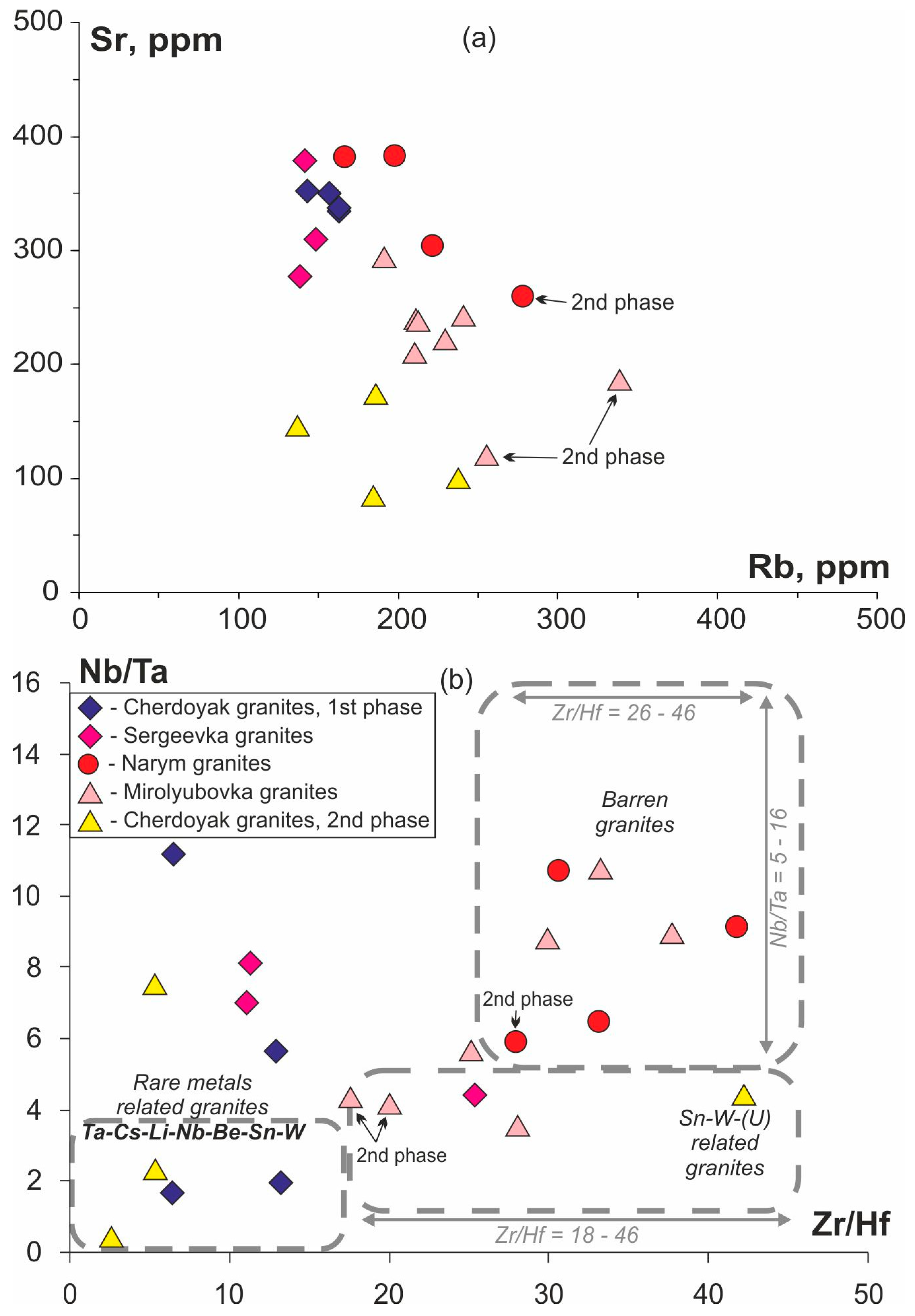
Rb-Sr relationships indicate that the second-phase granites of the Narym and Mirolyubovka massifs have higher Rb and lower Sr concentrations than their first-phase counterparts, whereas the second-phase granites of the Cherdoyak massif are characterised by pronounced Sr depletion (Figure 11a). The occurrence of muscovite in the second-phase granites may reflect the evolution of increasingly hydrous, peraluminous residual melts. In addition, the second-phase granites exhibit slightly higher Na2O contents than the first-phase rocks (Table S2). These trends are characteristic of the differentiation of volatile-rich peraluminous granitic magmas, when a change in “normal” peraluminous melt composition to an Na-rich aqueous silica–bearing fluid occurs [40,41]. The lower REE concentrations in the second-phase granites compared with the first-phase granites are also a consequence of such differentiation, since aqueous silica-bearing fluid has lower contents K, Fe, Nb, Ti, Y, and REE then the parent peraluminous silica melt [40,41,42]. Geochemical studies have shown that such aqueous silica-bearing fluid is enriched in F, Rb, Cs, Sn, W, Ta, Be, and Mn [40,43]. Although rare-metal concentrations in the second-phase granites are broadly comparable to those in the first-phase granites (Figure 6), the overall geochemical trends towards increasing SiO2 and Na2O contents and volatile enrichment suggest that the evolution of the South-Eastern Kalba granitic magmas was accompanied by the generation of late-magmatic to post-magmatic aqueous fluids.
Geochemical studies of peraluminous granites have demonstrated that Nb/Ta and Zr/Hf ratios can serve as useful indicators of magmatic differentiation and fluid–melt interaction [44,45,46]. Nb/Ta ratios below 5 may indicate interaction between granitic magmas and late-magmatic fluids [45]. The first-phase granodiorites of the Cherdoyak massif have Nb/Ta ratios ranging from 1.7 to 11.1, with values below 5 recorded in two samples, potentially indicating post-magmatic fluid interaction. The first-phase granites of the Sergeevka massif have Nb/Ta ratios of 4.4-8.1, whereas those of the Narym massif range from 6.5 to 10.7. The first-phase granites of the Mirolyubovka massif have Nb/Ta ratios of 3.6-11.3. The second-phase granites of the Narym massif have an Nb/Ta ratio of 5.9, lower than the ratios of the first-phase granites. The second-phase granites of the Mirolyubovka massif have Nb/Ta ratios of 4.2-4.3 and relatively low Zr/Hf ratios of 17.5-20.0. The second-phase granites of the Cherdoyak massif have low Nb/Ta ratios of 0.4-7.5, while three of the four analysed samples have Zr/Hf ratios of 2.6-5.3. On the Nb/Ta versus Zr/Hf discrimination diagram proposed by Ballouard et al. [45], most second-phase granite samples plot within the field of Sn-W related granites (Figure 11b). Collectively, these geochemical characteristics support a genetic association between the granites and the Sn-W deposits of South-Eastern Kalba.
7. Conclusions
The integration of geological, geochronological and geochemical data suggests that the Sn-W deposits of South-Eastern Kalba formed during the magmatic and post-magmatic fluid evolution of granitic magmas of the Kalba Complex. Previous geological exploration and the results of the present study allow several key exploration indicators to be identified:
- Crustal magma generation and volatile enrichment. The granitic magmas of the Kalba Complex were generated under hydrous crustal conditions. Subsequent enrichment of residual melts in volatile components may have promoted advanced magmatic differentiation and the concentration of ore-forming elements.
- Tourmalinisation, graphitisation and chloritisation indicate interactions between granite-derived fluids and the surrounding rocks, including the black shales of the Takyr Formation. These interactions may have created favourable physicochemical conditions for ore deposition.
- The widespread distribution of minor tin and tungsten occurrences throughout the region may indirectly indicate the presence of concealed portions of granitic intrusions that do not crop out.
Together, these indicators highlight the exploration potential of South-Eastern Kalba and suggest that additional rare-metal and tin-tungsten deposits may occur within the region. Further exploration should focus on detailed investigations of the contact zones of Kalba Complex granite intrusions, supported by additional drilling. Particular attention should also be given to the latest derivatives of granitic magmatism, including the relatively rare aplite and pegmatite veins observed, for example, in the Cherdoyak massif. Detailed mineralogical and geochemical investigations of accessory and rare-metal mineralisation in pegmatite and hydrothermal quartz veins are also recommended.
Supplementary Materials
The following supporting information can be downloaded at the website of this paper posted on Preprints.org, Table S1: U-Pb data on analysis of zircon grains from SE Kalba granites; Table S2: Rocks of SE Kalba granites composition.
Author Contributions
Conceptualization, O.N.K. and S.V.K.; methodology, S.V.K., O.N.K., O.V.A. and M.O.S.; validation O.N.K., S.V.K. and M.A.M.; formal analysis, S.V.K. O.V.A. and M.O.S.; resources, O.N.K.; data curation, S.V.K.; writing - original draft preparation, S.V.K. and O.N.K.; writing - review and editing, S.V.K. and O.N.K.; visualization, S.V.K., and O.V.A.; supervision, S.V.K.; project administration, O.N.K.; funding O.N.K. and S.V.K. All authors have read and agreed to the published version of the manuscript.
Funding
This research was funded by the Science Committee of the Ministry of Science and Higher Education of the Republic of Kazakhstan (Grant No. AP23486908) and by the State As-signment of IGM SB RAS (Project No FWZN-2026-0009).
Data Availability Statement
The data presented in this study are available on request from the corresponding author.
Acknowledgments
We wish to thank analysts from the VERITAS Engineering Laboratory (EKTU) and from the Analytical Center (IGM) for the analytical work. Thanks are extended to Tatiana N. Antsiferova for aid in manuscript preparation.
Conflicts of Interest
The authors declare no conflict of interest.
References
- Nurbayev, B.; Dmitriyeva, E.; Shongalova, A.; Kemelbekova, A. Tin-Based Perovskite Solar Cells: Structural Fundamentals, Material Engineering, and Prospects for Lead-Free Photovoltaics. Nanomaterials 2026, 16, 1138. [CrossRef]
- Mineral commodity summaries 2026: U.S. Geological Survey, 222 p. [CrossRef]
- Lehmann, B. Magmatic enrichment of tin. In Metallogeny of Tin; Springer: Berlin/Heidelberg, Germany, 1990; pp. 45–85.
- Simons, B.; Andersen, J.; Shail, R.; Jenner, F. Fractionation of Li, Be, Ga, Nb, Ta, In, Sn, Sb, W and Bi in the peraluminous Early Permian Variscan granites of the Cornubian Batholith: Precursor processes to magmatic-hydrothermal mineralisation. Lithos 2017, 278–281, 491–512. [CrossRef]
- Togizov, K.; Muratkhanov, D.; Aksholakov, Y. Rare-earth element concentration conditions in the rare-metal deposits of the Karakamys ore district. In Proceedings of the SGEM International Multidisciplinary Scientific GeoConference EXPO Proceedings, Albena, Bulgaria, 18–24 August 2020; pp. 271–278. [CrossRef]
- Ni, P.; Pan, J.Y.; Han, L.; Cui, J.M.; Gao, Y.; Fan, M.O.S.; Li, W.S.; Chi, Z.; Zhang, K.H.; Cheng, Z.L.; et al. Tungsten and tin deposits in South China: Temporal and spatial distribution, metallogenic models and prospecting directions. Ore Geol. Rev. 2023, 157, 105453. [CrossRef]
- Liu, Y.; Wang, C.; Feng, M.; Cui, Y.; Fang, G.; Feng, Z.; Fu, W.; Zhao, C.; Wang, C. Caledonian Sn Mineralization in the Yuechengling Granitic Batholith, South China: Geochronology, Geochemistry, Zircon Hf Isotopes, and Tourmaline Chemistry and B Isotopes of the Lijia Sn Deposit and Its Hosting Granites. Minerals 2024, 14, 1243. [CrossRef]
- Li, W.; Guo, N.; Lu, J.; Lang, X.; Lian, D.; Yuan, Q.; Chen, S. Geochemical Characteristics, U-Pb Age, and Hf Isotope of Zircons from Muscovite Granite in Aotou Sn Deposit, Eastern Nanling Range, South China. Minerals 2025, 15, 1331. [CrossRef]
- Kenzhetaev, Z.; Toksanbayev, B.; Togizov, K.; Zhapabayev, K.; Mukatay, B.; Kurmangazhina, M.; Svetlakova, K. Assessment of rare earth elements fractionation in sandstone and magmatic uranium ores: Implications for deposit typing. Minerals 2026, 16, 362. [CrossRef]
- Tauson L.V. The geochemical types and ore potential of granitoids. Nauka. 1977, 282 p. [In Russian].
- Kruk, N.N.; Gavryushkina, O.A.; Kruk, E.A.; Mednikov, S.L.; Fedoseev, D.G.; Orekhov, A.A.; Kasatkin, S.A. Rare-metal granites of the Tigriny massif (Sikhote-Alin): Geochemistry, mineralogy and evolution. Russ. J. Pac. Geol. 2022, 16, 42–61. [CrossRef]
- Mota, A.; Sant’Ovaia, H.; Fádon, O.; Noronha, F. The Geochemistry of Granites Associated with W-Sn Deposits of North and Central Portugal and Castilla-León in Spain. Minerals 2026, 16, 823. [CrossRef]
- Zonenshain, L.P.; Kuzmin, M.I.; Natapov, L.M. Geology of the USSR: A Plate Tectonic Synthesis. Geodynamic Series 21; American Geophysical Union: Washington, DC, USA, 1990; 242p.
- Vladimirov, A.G.; Kruk, N.N.; Khromykh, S.V.; Polyansky, O.P.; Chervov, V.V.; Vladimirov, V.G.; Travin, A.V.; Babin, G.A.; Kuibida, M.L.; Khomyakov, V.D. Permian magmatism and lithospheric deformation in the Altai caused by crustal and mantle thermal processes. Russ. Geol. Geophys. 2008, 49, 468–479. [CrossRef]
- Khromykh, S.V. Basic and associated granitoid magmatism and geodynamic evolution of the Altai accretion–collision system (Eastern Kazakhstan). Russ. Geol. Geophys. 2022, 63, 279–299. [CrossRef]
- Kotler, P.D.; Khromykh, S.V.; Kruk, N.N.; Sun, M.; Li, P.; Khubanov, V.B.; Semenova, D.V.; Vladimirov, A.G. Granitoids of the Kalba batholith, Eastern Kazakhstan: U–Pb zircon age, petrogenesis and tectonic implications. Lithos 2021, 388–389, 106056. [CrossRef]
- Kuzmina, O.N.; Khromykh, S.V.; Tsareva, M.D.; Senko, A.D.; Shapovalova, M.O.; Mizernaya, M.A. Geochemistry and genesis of rare metal (Sn-W) Cherdoyak deposit, Eastern Kazakhstan. Minerals. 2026, 16, 958. [CrossRef]
- D'yachkov, B.A.; Sapargaliev, E.M.; Titov, D.V. Ore belts of the Greater Altai and their ore resource potential. Geology of Ore Deposits 2009, 51, 197-211. [CrossRef]
- D′yachkov, B.A.; Mizernaya, M.A.; Khromykh, S.V.; Bissatova, A.Y.; Oitseva, T.A.; Miroshnikova, A.P.; Frolova, O.V.; Kuzmina, O.N.; Zimanovskaya, N.A.; Pyatkova, A.P.; et al. Geological History of the Great Altai: Implications for Mineral Exploration. Minerals 2022, 12, 744. [CrossRef]
- D’yachkov, B.A. Genetic Types of Rare Metal Deposits of the Kalba-Narym Belt; EKSTU: Ust-Kamenogorsk, Kazakhstan, 2012; 130p. (In Russian).
- Khromykh, S.V.; Oitseva, T.A.; Kotler, P.D.; D’Yachkov, B.A.; Smirnov, S.Z.; Travin, A.V.; Vladimirov, A.G.; Sokolova, E.N.; Kuzmina, O.N.; Mizernaya, M.A.; et al. Rare-Metal Pegmatite Deposits of the Kalba Region, Eastern Kazakhstan: Age, Composition and Petrogenetic Implications. Minerals 2020, 10, 1017. [CrossRef]
- Zimanovskaya, N.A.; Oitseva, T.A.; Khromykh, S.V.; Travin, A.V.; Bissatova, A.Y.; Annikova, I.Y.; Aitbayeva, S.S. Geology, Mineralogy, and Age of Li-Bearing Pegmatites: Case Study of Tochka Deposit (East Kazakhstan). Minerals 2022, 12, 1478. [CrossRef]
- Oitseva, T.A.; Dyachkov, B.A.; Bissatova, A.Y.; Orazbekova, G.B.; Zinyakin, S.S. Features of formation, material composition and geological structure of rare metal and pegmatite deposits of the Kalba region on the example of the Yubileinoye deposit. Bul. Tomsk Polytech. Univ. Geo As. Eng. 2023, 334, 164–176. [CrossRef]
- Oitseva, T.A.; Khromykh, S.V.; Naryzhnova, A.V.; Kotler, P.D.; Mizernaya, M.A.; Kuzmina, O.N.; Dremov, A.K. Rare Metal (Li–Ta–Nb) mineralization and age of the Kvartsevoye pegmatite deposit (Eastern Kazakhstan). Minerals 2025, 15, 737. [CrossRef]
- Oitseva, T.A.; Khromykh, S.V. Geochemistry of granites and pegmatites of the North-Western Kalba (Eastern Kazakhstan): Implications for the exploration of rare-metal mineralization. Geosciences 2026, 16, 4. [CrossRef]
- Semenova, D.V.; Vladimirov, V.G.; Karmysheva, I.V.; Yakovlev, V.A. The age of early collisional granitoids of Western Sangilen (SE Tuva): Implications for estimating the duration of orogeny at the margin of the Tuva-Mongolian massif. Geodyn. Tectonophys. 2024, 15, 0767. [CrossRef]
- Slama, J.; Kosler, J.; Condon, D.J.; Crowley, J.L.; Gerdes, A.; Hanchar, J.M.; Horstwood, M.O.S.A.; Morris, G.A.; Nasdala, L.; Norberg, N.; et al. Plesovice zircon—A new natural reference material for U-Pb and Hf isotopic microanalysis. Chem. Geol. 2008, 249, 1–35. [CrossRef]
- Wiedenbeck, M.; Alle, P.; Corfu, F.; Griffin, W.L.; Meier, M.; Oberli, F.; Von Quadt, A.; Roddick, J.C.; Spiegel, W. Three natural zircon standards for U-Th-Pb, Lu-Hf, trace element and REE analyses. Geostand. Newslett. 1995, 9, 1–23. [CrossRef]
- Griffin, W.L.; Powell, W.J.; Pearson, N.J.; O’Reilly, S.Y. GLITTER: Data Reduction Software for Laser Ablation ICPMS. In Laser Ablation ICP-MS in the Earth Sciences: Current Practices and Outstanding Issues; Mineralogical Association of Canada Short Course Series; Sylvester, P.J., Ed.; Mineralogical Association of Canada: Vancouver, BC, Canada, 2008; 40, pp. 308–311.
- Ludwig, K.R. Isoplot/Ex Version 3.00: A Geochronological Toolkit for Microsoft Excel; Berkeley Geochronology Center: Berkeley, CA, USA, 2003.
- Middlemost, E.A.K. Naming materials in the magma/igneous rock system. Earth Sci. Rev. 1994, 37, 215–224. [CrossRef]
- Peccerillo, A.; Taylor, S.R. Geochemistry of Eocene calc-alkaline volcanic rocks from the Kastamonu area, Northern Turkey. Contrib. To Mineral. Petrol. 1976, 58, 63–81. [CrossRef]
- Frost, B.R.; Barnes, C.G.; Collins, W.J.; Arculus, R.J.; Ellis, D.J.; Frost, C.D. A geochemical classification for granitic rocks. J. Petrol. 2001, 42, 2033–2048. [CrossRef]
- Harker, A. The Natural History of Igneous Rocks; Macmillan: New York, NY, USA, 1909; 384p.
- Sun, S.S.; McDonough, W.F. Chemical and Isotopic Systematics of Oceanic Basalts: Implications for Mantle Composition and Processes; Geological Society, London, Special Publications; Geological Society Publishing House: Bath, UK, 1989; 42, pp. 313–345.
- Rudnick, R.L.; Gao, S. 3.01-Composition of the Continental Crust. In Treatise on Geochemistry; Holland, H.D., Turekian, K.K., Eds.; Pergamon: Oxford, UK, 2003; pp. 1–64. [CrossRef]
- Lopatnikov, V.V.; Zhurutin, S.A.; Nikitin, Yu.G.; Nevsky, V.N.; Nechaev, A.V.; Azovsky, Yu.G; Kalugin, A.A. Geological structure and mineral deposits of SE part of Kalba-Narym zone. Report by the Bulandinskaya Group on geological surveying and geophysical work at a scale of 1:50,000. Vostkazgeology: Ust-Kamenogorsk, Kazakhstan, 1985; 499p. (In Russian).
- Khromykh, S.V.; Tsygankov, A.A.; Kotler, P.D.; Navozov, O.V.; Kruk, N.N.; Vladimirov, A.G.; Travin, A.V.; Yudin, D.S.; Burmakina, G.N.; Khubanov, V.B.; et al. Late Paleozoic granitoid magmatism of Eastern Kazakhstan and Western Transbaikalia: Plume model test. Russ. Geol. Geophys. 2016, 57, 773–789. [CrossRef]
- Khromykh, S.V.; Vishnevskiy, A.V.; Kotler, P.D.; Antsiferova, T.N.; Semenova, D.V.; Kulikova, A.V. The Kalba batholith dyke swarms (Eastern Kazakhstan): Mafic magmas effect on granite formation. Lithos, 2022. 426-427, 106801. [CrossRef]
- Muller, A.; Kearsley, A.; Spratt, J.; Seltmann, R. Petrogenetic implications of magmatic garnet in granitic pegmatites from Southern Norway. Can. Mineral. 2012, 50, 1095–1115. [CrossRef]
- Smirnov, S.Z. The fluid regime of crystallization of water-saturated granitic and pegmatitic magmas: A physicochemical analysis. Russ. Geol. Geophys. 2015, 56, 1292–1307. [CrossRef]
- Pichavant, M.; Erdmann, S.; Kontak, D.J.; Michaud, J.A.S.; Villaros, A. Trace element partitioning in strongly peraluminous rare-metal silicic magmas—Implications for fractionation processes and for the origin of the Macusani Volcanics (SE Peru). Geochim. Cosmochim. Acta 2024, 365, 229–252. [CrossRef]
- Canosa, F.; Martin-Izard, A.; Fuertes-Fuente, M. Evolved granitic systems as a source of rare-element deposits: The Ponte Segade case (Galicia, NW Spain). Lithos 2012, 153, 165–176. [CrossRef]
- Zaraisky, G.P.; Aksyuk, A.M.; Devyatova, V.N.; Udoratina, O.V.; Chevychelov, V.Y. The Zr/Hf ratio as a fractionation indicator of rare metal granites. Petrology, 2009, 17, 25–45. [CrossRef]
- Ballouard, C.; Poujol, M.; Boulvais, P.; Branquet, Y.; Tartèse, R.; Vigneresse, J.L. Nb-Ta fractionation in peraluminous granites: A marker of the magmatic-hydrothermal transition. Geology 2016, 44, 231–234. [CrossRef]
- Wu, F.; Liu, X.; Ji, W.; Wang, J.; Yang, L. Highly fractionated granites: Recognition and research. Sci. China Earth Sci. 2017, 60, 1201–1219. [CrossRef]
Figure 1.
(a) Scheme of the geological structure of Kalba–Narym metallogenic belt [17]. The main ore districts are shown: Sh—Shulbinsk, NWK—North-Western Kalba, CK—Central Kalba and N—Narym. The rare metal deposits are shown: 1 – Mokhnatukha; 2 — Malo-Kaindy; 3 — Kvartsevoye; 4 — Zelenoye; 5 — Novo-Saryozek; 6 — Kanaika; 7 — Medvedka, 8 — Ognevka; 9 — Bakennoye; 10 — Yubileinoye; 11 — Belaya Gora; 12 – Karagoin; 13 — Komarovskoye; 14 — Kozlovskoye; 15 — Shebuntai; 16 — Komsomolskoye; 17 — Palatsy; 18 — Kasatkinskoye; 19 — Cherdoyak; 20 — Burabai; 21 — Karasu. The inset shows the position of the Kalba–Narym belt (black polygon) on the scheme of terranes of the western part of the Central Asian Fold Belt (CAOB), according to [15]. (b) Scheme of the geological structure of South-Eastern Kalba.
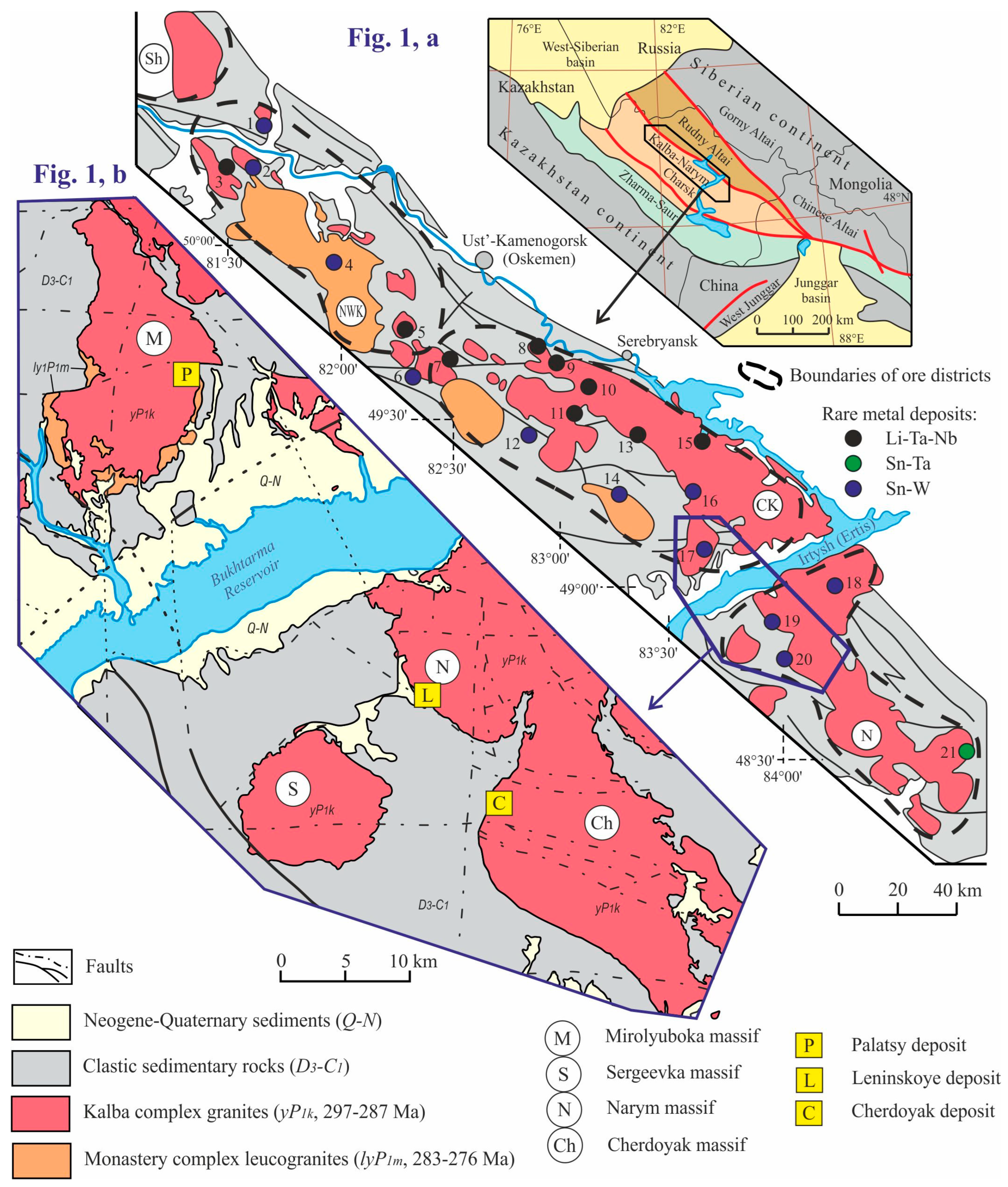
Figure 2.
Photomicrographs of South-Eastern Kalba granites. (a) Cherdoyak massif, granodiorites of 1st phase; (b) Cherdoyak massif, Ms leucogranites of 2st phase; (c) Sergeevka massif, granodiorites of 1st phase; (d) Narym massif, Bt granites of 1st phase; (e) Narym massif, Ms-Bt granites of 2st phase; (f) Mirolyubovka massif, Bt granites of 1st phase; (g) Mirolyubovka massif, Trm-Ms granites of 2st phase.
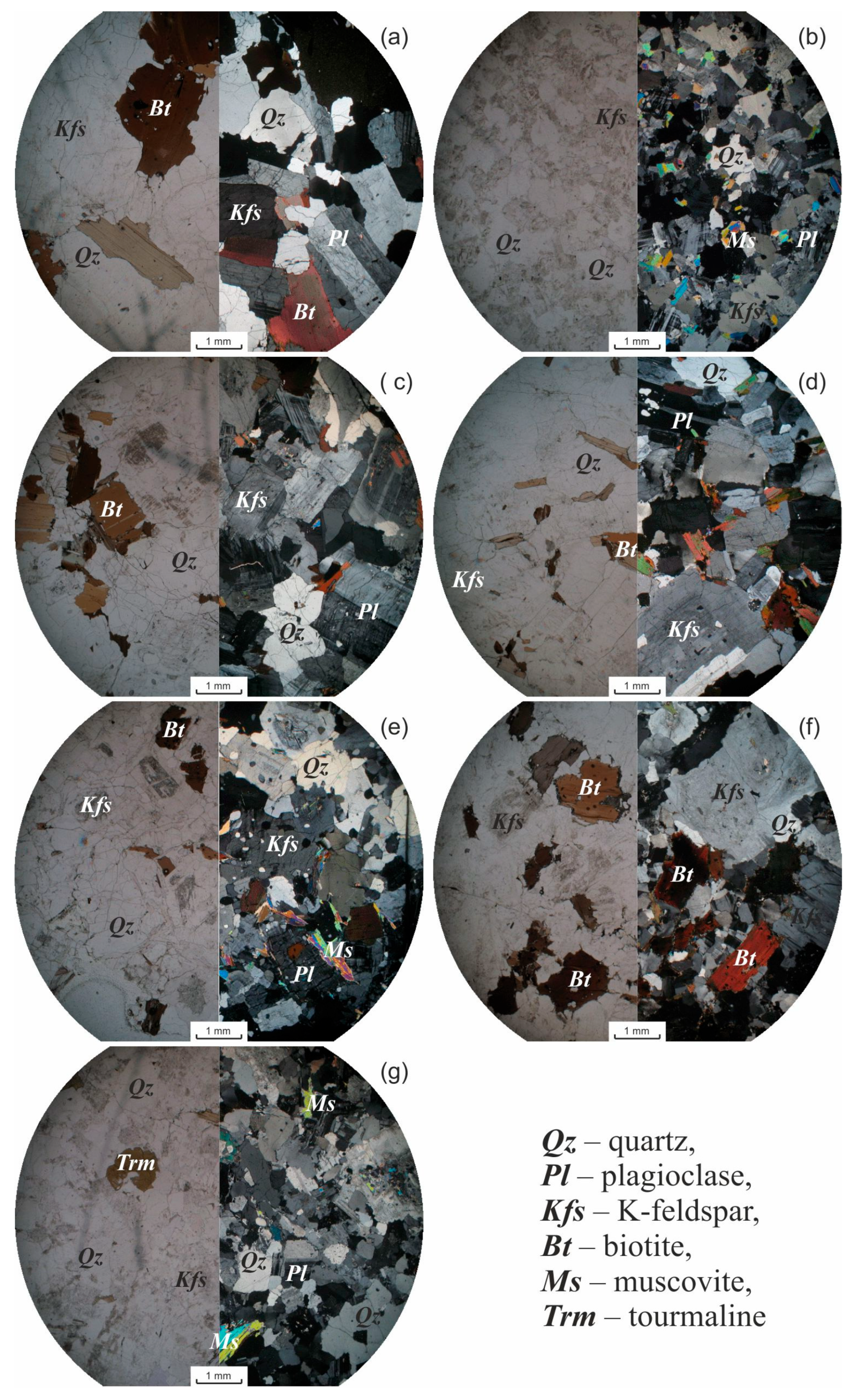
Figure 3.
Results of U-Pb dating (concordia Wetherill diagrams) of magmatic zircon grains from Cherdoyak (a,b), Sergeevka (c), Narum (d) and Mirolyubovka (e) granitoids. Errors of single analyses and calculated concordant ages are given at the level of 2σ. At the right are CL-images of the most typical zircon grains.
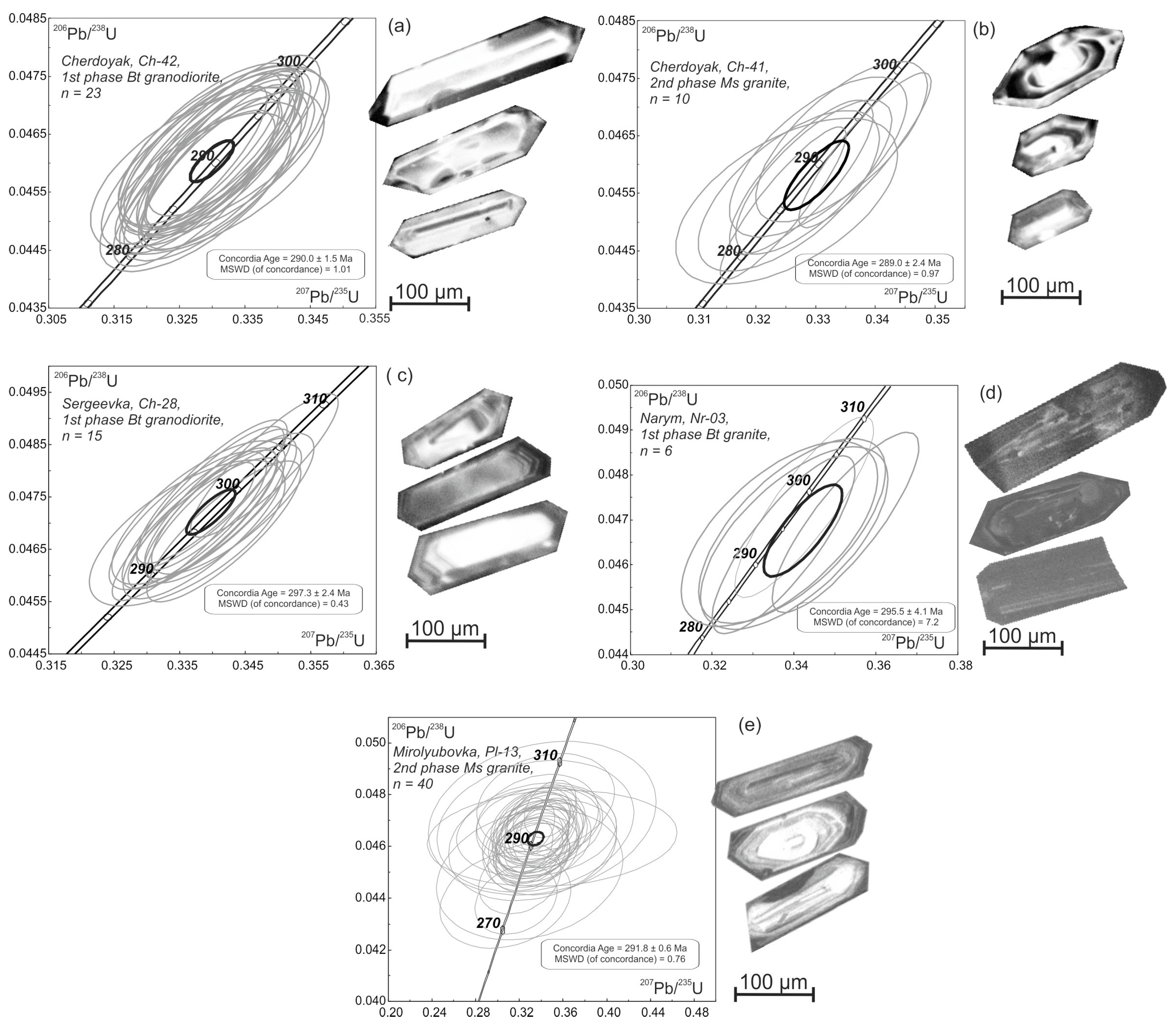
Figure 4.
Composition of SE Kalba granites on a binary diagrams: (a) TAS diagram [31]; (b) SiO2 vs. K2O [32]; (c) SiO2 vs. FeO/(FeOtot + MgO) [33]; (d) SiO2 vs. MALI [33]; (e) ASI vs. A/NK [33]; (f-k) — Harker diagrams from [34]: (f) SiO2 vs. TiO2, (g) SiO2 vs. Fe2O3t, (h) SiO2 vs. MgO, (i) SiO2 vs. CaO, (j) SiO2 vs. Al2O3, (i) SiO2 vs. P2O5. Concentrations are in wt %. All of the data sources can be found in Table S2.
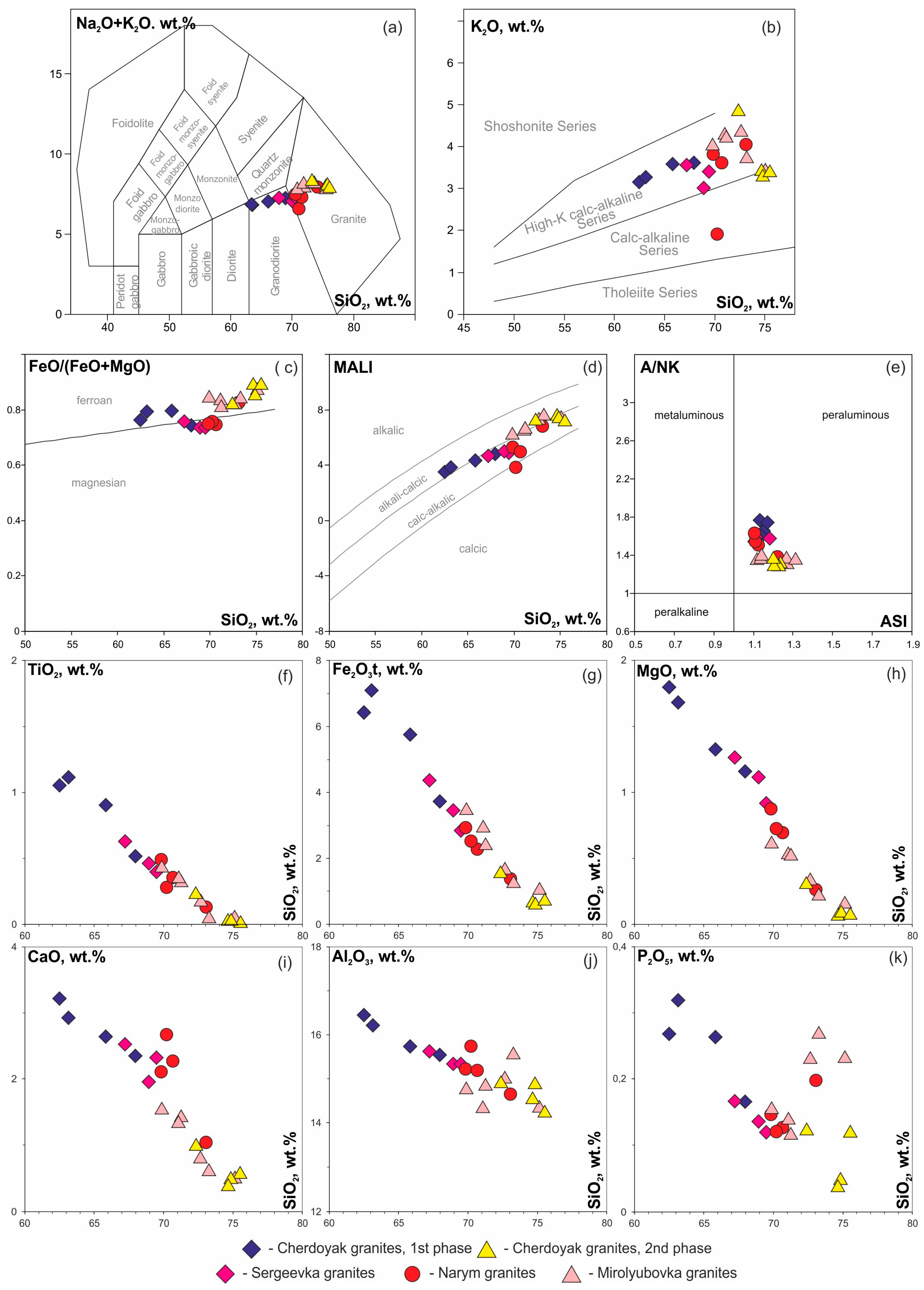
Figure 5.
Chondrite-normalized rare earth element patterns (a, c) and primitive mantle-normalized spider diagrams (b, d) for SE Kalba granites. Normalizing values are from Sun and McDonough [35].
Figure 5.
Chondrite-normalized rare earth element patterns (a, c) and primitive mantle-normalized spider diagrams (b, d) for SE Kalba granites. Normalizing values are from Sun and McDonough [35].
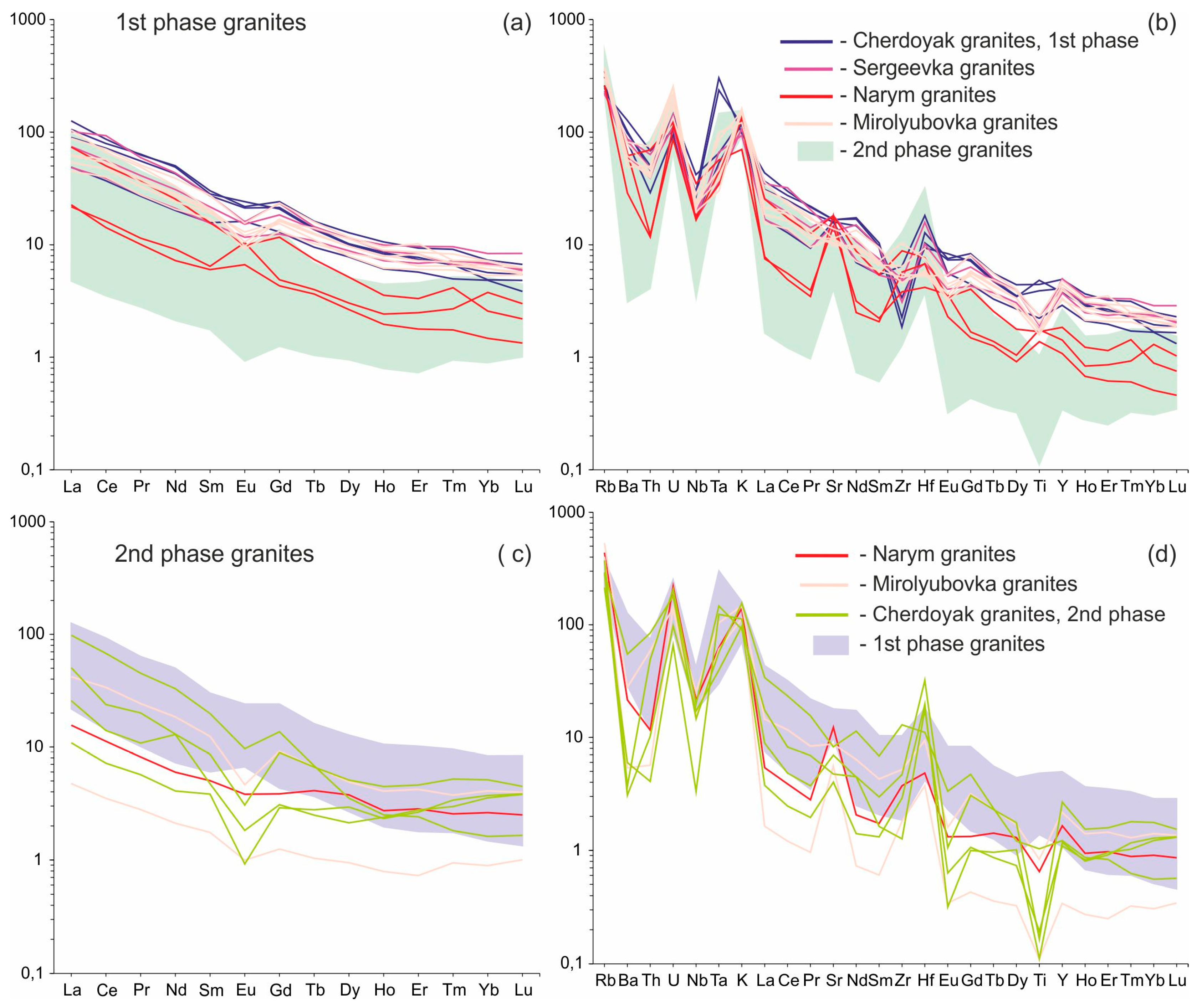
Figure 6.
Average continental crust-normalized rare metal element patterns for SE Kalba granites. Normalizing values are from Rudnick and Gao [36].
Figure 6.
Average continental crust-normalized rare metal element patterns for SE Kalba granites. Normalizing values are from Rudnick and Gao [36].
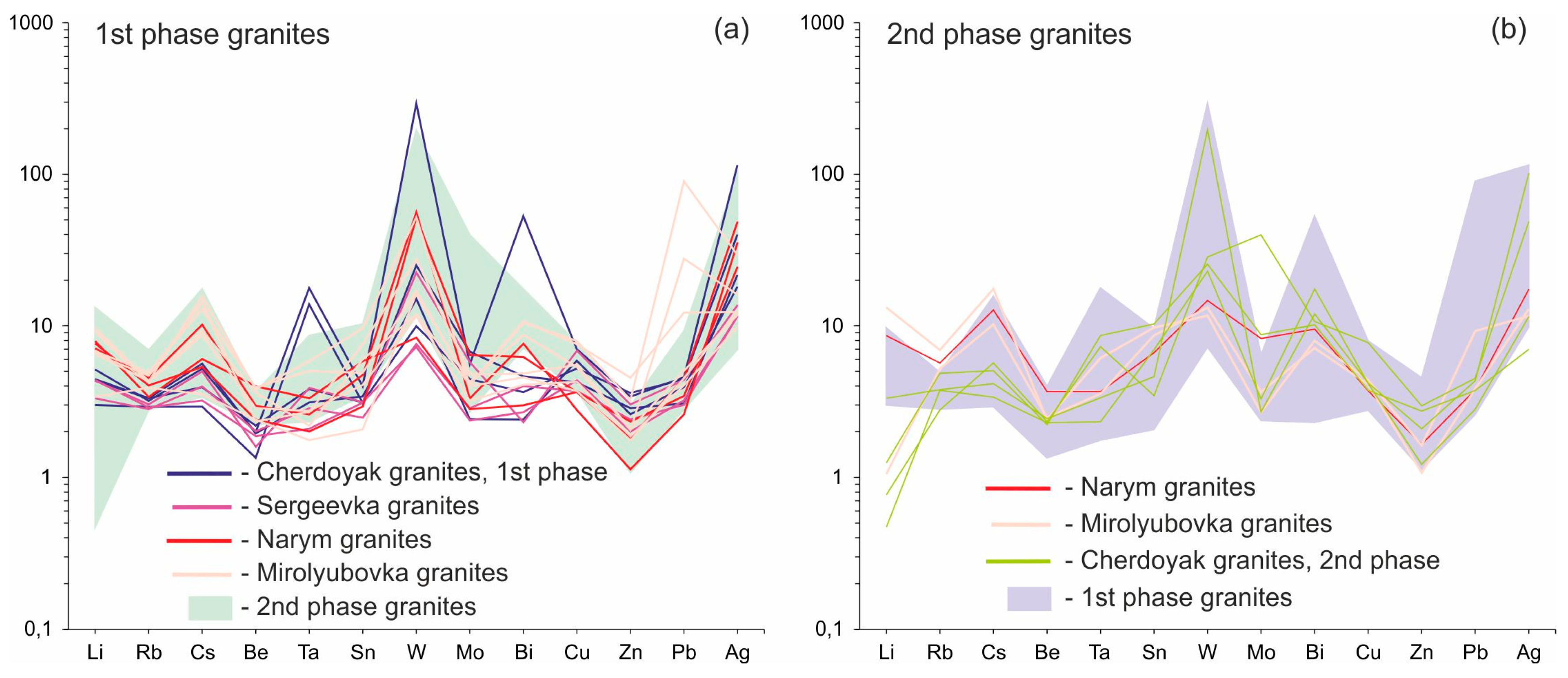
Figure 7.
Geological scheme of the Cherdoyak deposit [17].
Figure 7.
Geological scheme of the Cherdoyak deposit [17].
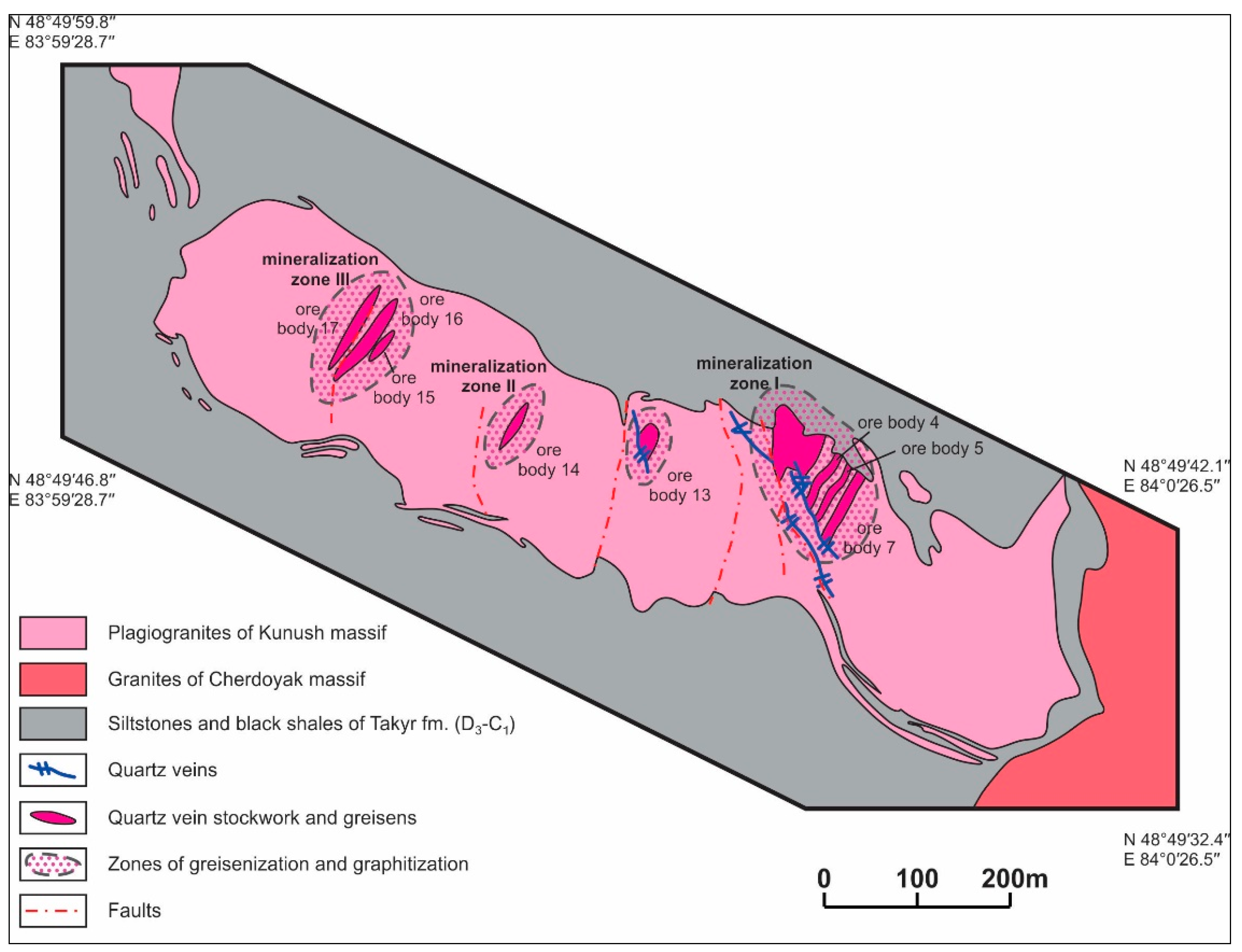
Figure 8.
Geological scheme of the Leninskoe deposit after V.V. Lopatnikov [37].
Figure 8.
Geological scheme of the Leninskoe deposit after V.V. Lopatnikov [37].
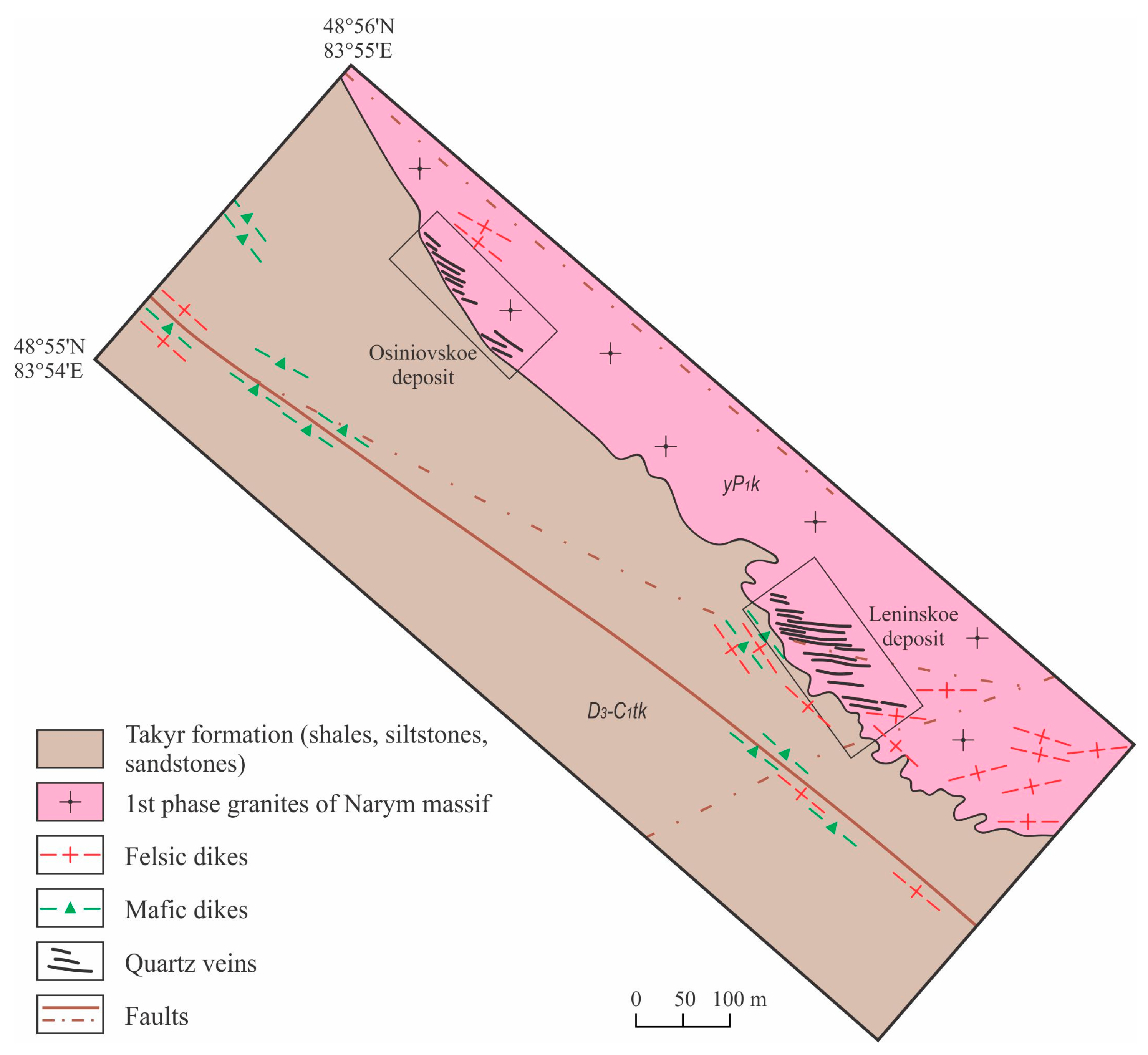
Figure 9.
Geological scheme of the Palatsy deposit after V.V. Lopatnikov [37].
Figure 9.
Geological scheme of the Palatsy deposit after V.V. Lopatnikov [37].
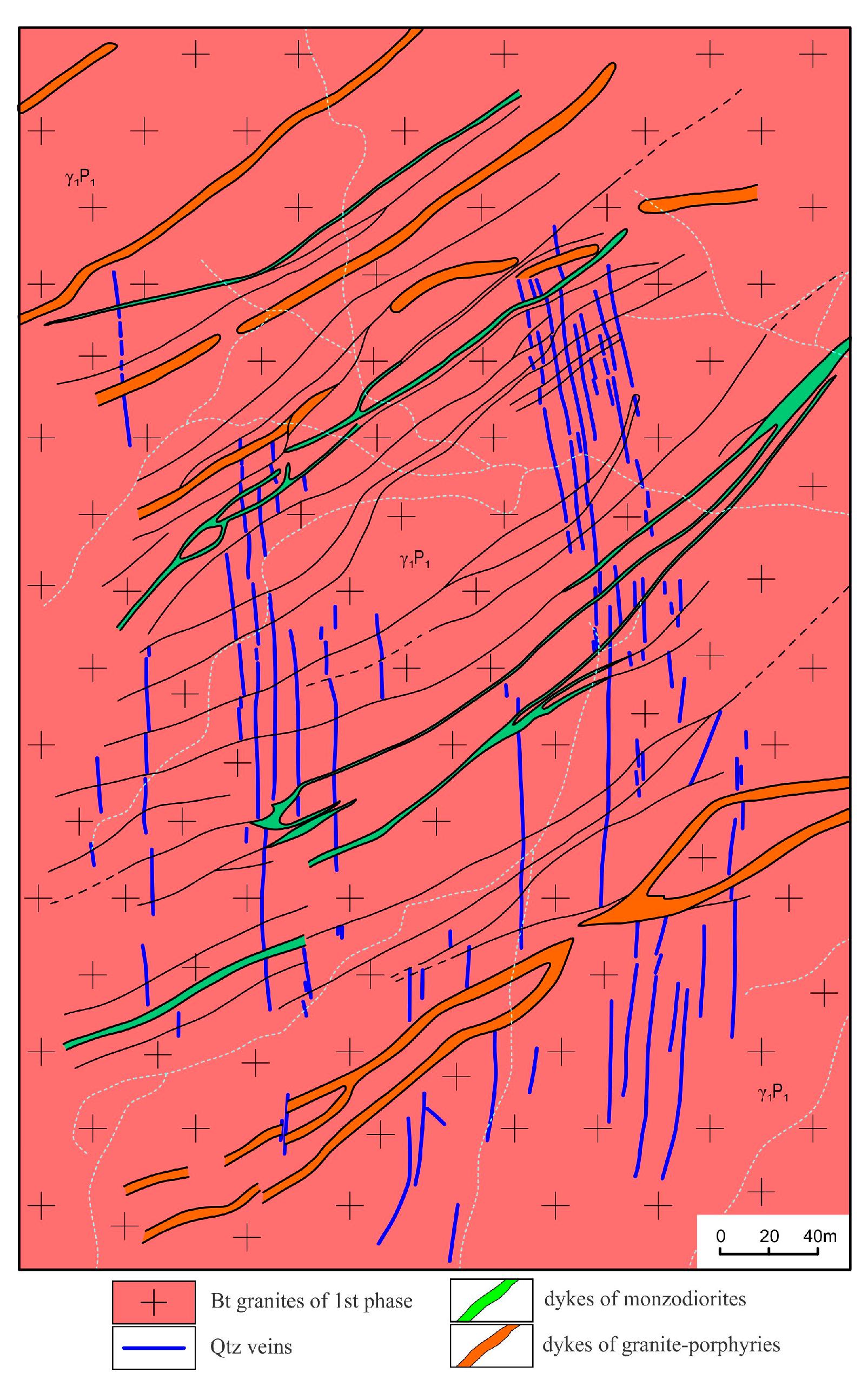
Figure 10.
Comparison of ages of granite intrusions and rare metal deposits in the Kalba–Narym belt, used [16,17,21,22,24,38] and new data.
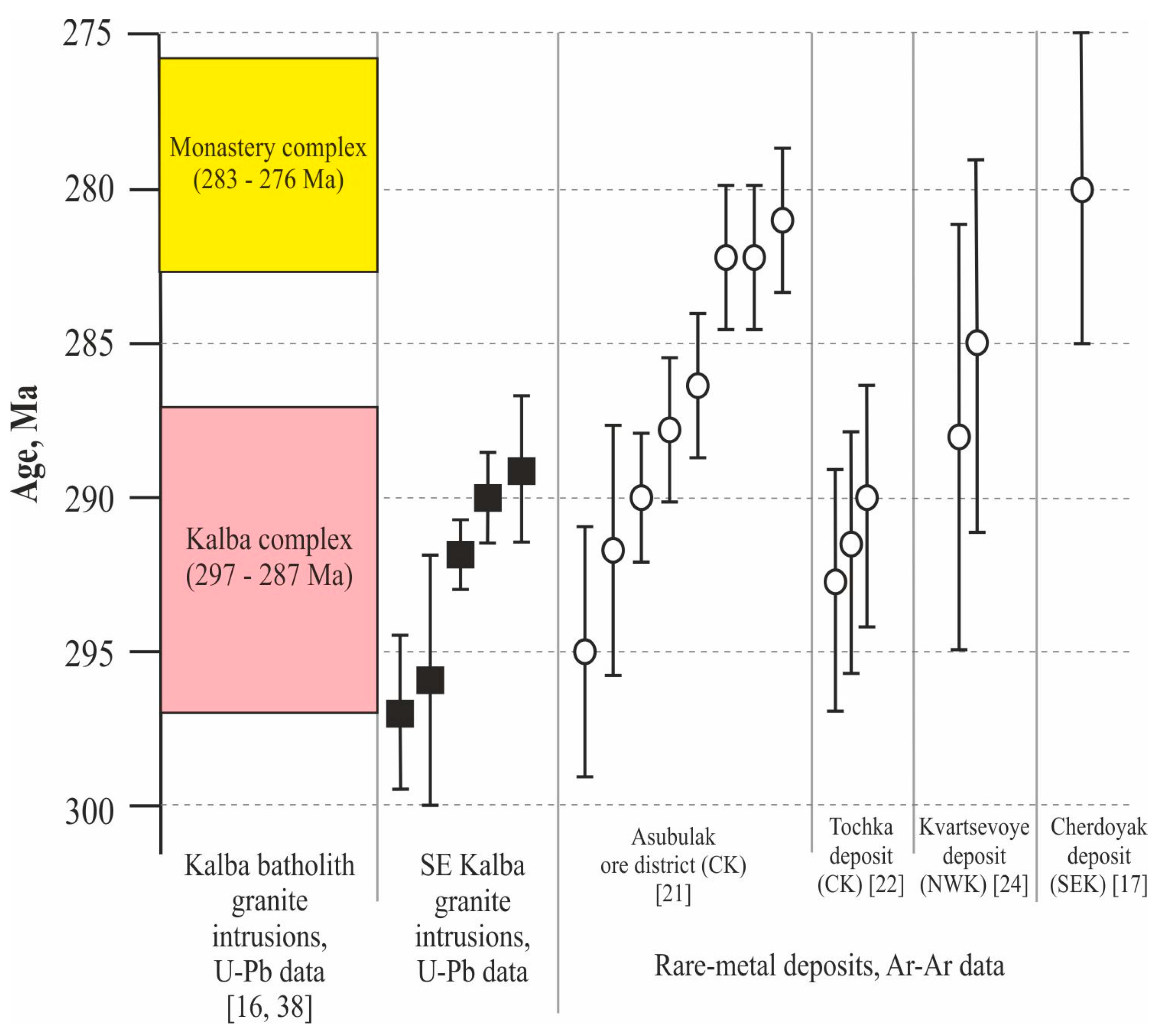
Figure 11.
SE Kalba granites composition. (a) Sr vs Rb diagram; (b) Nb/Ta vs. Zr/Hf diagram differentiating barren and ore-bearing peraluminous granites [45].
Figure 11.
SE Kalba granites composition. (a) Sr vs Rb diagram; (b) Nb/Ta vs. Zr/Hf diagram differentiating barren and ore-bearing peraluminous granites [45].
Disclaimer/Publisher’s Note: The statements, opinions and data contained in all publications are solely those of the individual author(s) and contributor(s) and not of MDPI and/or the editor(s). MDPI and/or the editor(s) disclaim responsibility for any injury to people or property resulting from any ideas, methods, instructions or products referred to in the content. |
© 2026 by the authors. Licensee MDPI, Basel, Switzerland. This article is an open access article distributed under the terms and conditions of the Creative Commons Attribution (CC BY) license (http://creativecommons.org/licenses/by/4.0/).
Copyright: This open access article is published under a Creative Commons CC BY 4.0 license, which permit the free download, distribution, and reuse, provided that the author and preprint are cited in any reuse.