

Submitted:
30 October 2026
Posted:
30 October 2026
You are already at the latest version
Abstract
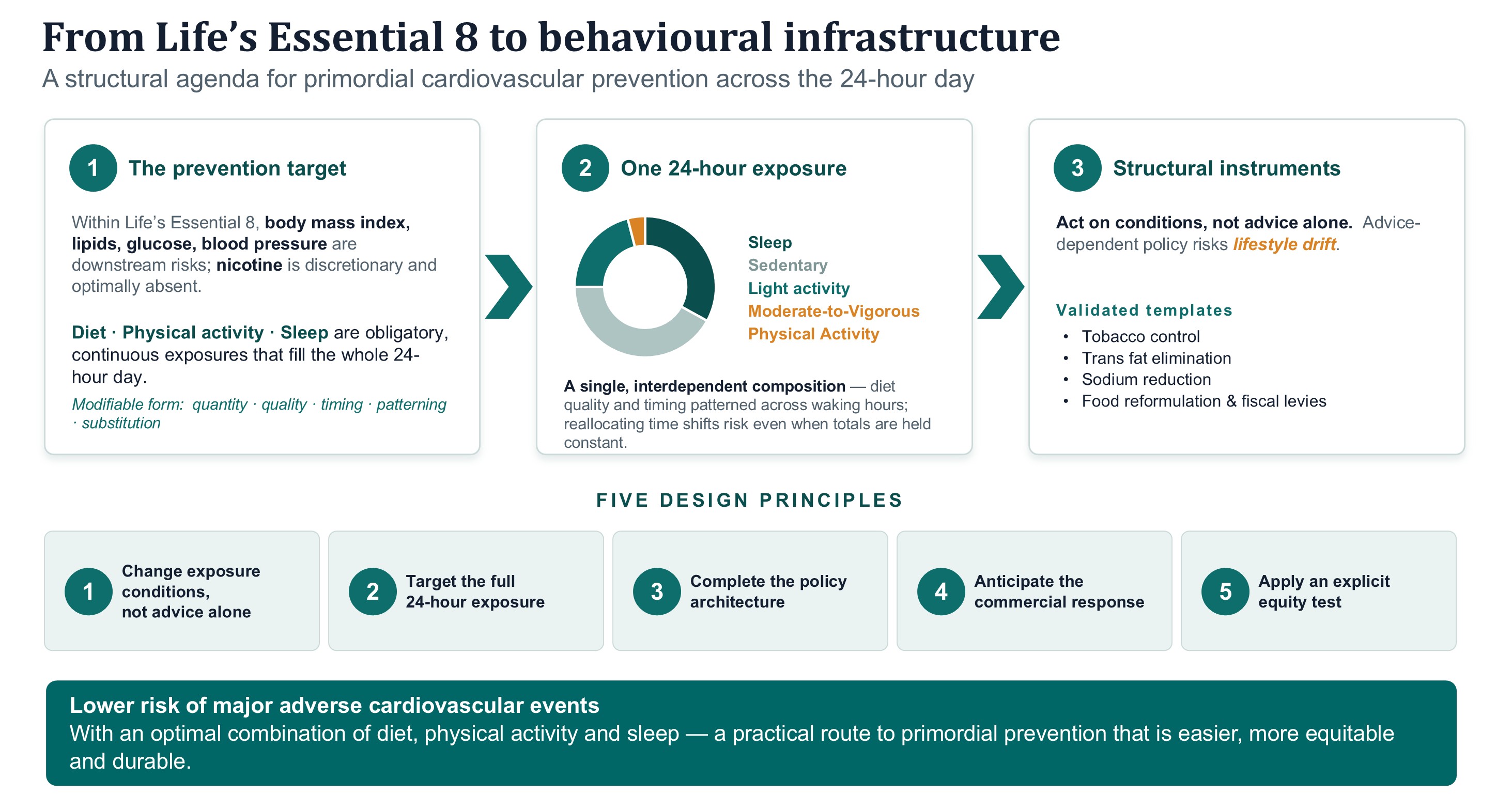
Cardiovascular disease remains the leading cause of death worldwide, and much of its burden is driven by modifiable behaviours. Diet, physical activity and sleep are central to cardiovascular health as they influence common biological pathways, including glucose regulation, endothelial function, blood pressure, inflammation and adiposity. This is increasingly reflected in prevention frameworks. In 2022, the American Heart Association added sleep to Life's Essential 8, recognising it alongside diet and physical activity as a core component of cardiovascular health. In addition, emerging large-scale evidence indicates that the combined pattern of higher diet quality, greater physical activity and healthier sleep across the 24-hour day is associated with greater cardiovascular benefit than any single behaviour alone. Even modest simultaneous improvements across all three behaviours, without a large change in any single behaviour, have been linked to meaningful risk reduction. Yet prevention continues to address these behaviours largely in isolation, relying heavily on individual behaviour change while sleep remains frequently omitted from research and policy. Drawing on previous public health successes, this review argues that individualised prevention messages should be complemented by behavioural infrastructure. Behavioural infrastructure refers to the everyday systems that shape diet, physical activity and sleep as a single 24-hour behavioural exposure, making healthier routines easier, more sustained and equitable. We propose five design principles that transfer a validated structural prevention logic to diet, physical activity and sleep as a practical route to primordial cardiovascular prevention.
Keywords:
cardiovascular disease prevention
; primordial prevention
; Life’s Essential 8
; sleep
; physical activity
; diet
; 24-hour behaviours
; commercial determinants of health
; health equity
; structural intervention
Introduction
Cardiovascular disease remains the leading cause of death worldwide, with much of this burden attributable to modifiable risk factors.1 Among these, diet, physical activity and sleep are central because they influence shared cardiometabolic pathways, including glucose homeostasis, endothelial function, blood pressure, chronic low-grade inflammation, and adiposity.2-5 In 2022, the American Heart Association added sleep to Life’s Essential 8, placing it alongside diet and physical activity as a component of cardiovascular health.6 The inclusion of sleep signals a shift from a traditional lifestyle triad of diet, activity and smoking towards a broader 24-hour model of cardiovascular health.
However, the components of Life’s Essential 8 are not structurally equivalent. Four components (body mass index, blood lipids, blood glucose, and blood pressure6) are metabolic factors that reflect the integrated biological effects of upstream exposures, rather than independent behaviours themselves. Although these factors remain essential clinical targets, conceptually they differ from behaviours as they are downstream risk states as well as treatment targets. These factors are also substantially influenced by behaviour. Of the four behavioural components, nicotine exposure is also distinct as majority population have no exposure, and the optimal state is complete absence. In the contrary, diet, physical activity, and sleep are obligatory, continuous exposures that occupy the full 24-hour day with no unexposed state (Table 1).
The prevention target is therefore not whether these behaviours occur, but their quantity, quality, timing, patterning, and substitution (Figure 1). For instance, reallocating time from sedentary behaviour to moderate-to-vigorous activity, or from sleep to wakefulness, alters risk even when the total of any one behaviour is held constant. This principle is formalised in isotemporal substitution and compositional data analysis of the 24-hour movement composition.7 The same logic applies within diet, where substituting one nutrient, food or dietary pattern for another while holding total energy intake constant is an established causal contrast in nutritional epidemiology.8 Capturing only quantity and quality therefore omits timing, patterning, and substitution. For example, a recent prospective cohort study using objective sleep data found that sleep regularity was a stronger predictor of mortality risk than sleep duration.9
Diet, physical activity and sleep have historically been studied and addressed in separate disciplinary siloes.10 Recent methodological developments and cohort evidence now support a more integrated view.2,11 In UK Biobank, an optimal combination of higher diet quality and device measured physical activity and sleep was associated with a 57% lower risk of major adverse cardiovascular events (hazard ratio 0.43; 95% confidence interval 0.30–0.62), with similar reductions for myocardial infarction, heart failure, and stroke.2 A modest combined difference of three diet-quality points, 4.5 minutes per day of moderate-to-vigorous physical activity, and 11 minutes per day of sleep was associated with a 10% lower risk, without requiring a large change in any single behaviour.2 A companion analysis linked the same combined behavioural pattern to lower all-cause mortality and longer lifespan and healthspan.12 An accompanying editorial proposed a 24/7 behavioural cycle paradigm, calling for cardiovascular prevention to move beyond single behaviour approaches toward an integrated model.10
This integrated view is closely aligned with primordial prevention, which aims to prevent the emergence of risk factors by acting on the conditions that produce them.13,14 Yet research and policy have not fully matched this conceptual shift. At the level of research infrastructure, a portfolio review of studies funded by the United States National Institutes of Health found that few studies capture validated temporal data on diet, physical activity, and sleep simultaneously, with sleep most often missing.15 Similarly, a National Heart, Lung, and Blood Institute workshop and the Prospective Physical Activity, Sitting and Sleep (ProPASS) consortium have called for harmonised, device-based assessment of the full 24-hour behavioural profile to inform guidelines, interventions, and precision prevention.11,16 At the policy level, cardiovascular prevention still relies heavily on advising individuals to eat, move and sleep better. When such advice is delivered without changing the conditions that shape daily behaviour, it risks lifestyle drift, whereby population level prevention reverts to individual responsibility and may widen health inequities.17 The most effective cardiovascular prevention strategies have not relied primarily on individual vigilance. Clean air legislation, elimination of industrial trans fats, population salt reduction, and tobacco control have reduced cardiovascular risk by changing the conditions of everyday life rather than by relying only on personal choice.18-21
This review argues that the combined diet, physical activity, and sleep exposure should be addressed through behavioural infrastructure. Behavioural infrastructure is defined as the everyday systems that shape interconnected modifiable behaviours, including food systems, housing, transport, workplaces, schools and digital environments. Here, we draw on established cardiovascular prevention frameworks, major global burden of disease evidence, and policy case studies that illustrate structural intervention mechanisms relevant to diet, physical activity, and sleep. We specifically (1) summarise the evidence that diet, physical activity and sleep form one continuously distributed 24-hour exposure; (2) show how structural interventions used for other cardiovascular risk factors provide a transferable template; (3) identify sleep as the least addressed pillar despite its formal inclusion in cardiovascular health; and (4) propose a five principle framework with an explicit equity test. We position this structural approach as an operational route to primordial cardiovascular prevention. This argument does not diminish the importance of individual behavioural change, clinical counselling or personal agency. It rather positions behavioural infrastructure as the set of enabling conditions that make healthy diet, sufficient physical activity and optimal sleep more feasible, sustained and equitable.
A Shift in the Dominant Exposures
The classical epidemiological transition described a shift from infectious and deficiency related mortality towards chronic non-communicable disease as populations age, urbanise and undergo socioeconomic change.22 The latest Global Burden of Disease (GBD) 2023 analysis extends this framing to the level of risk factors. In 2023, almost half of global disability-adjusted life years were attributable to the 88 modifiable risks assessed in the GBD. Among the leading contributors were high systolic blood pressure, high fasting plasma glucose, smoking, high body mass index and high low density lipoprotein cholesterol.1 These risks act substantially through cardiovascular pathways. Cardiovascular prevention is therefore increasingly confronting a risk factor landscape dominated by behavioural and metabolic risks. Diet, physical activity and sleep are central to this landscape because they are modifiable upstream behaviours that influence several of the metabolic risks.
Tobacco exposure has been most consistently addressed through structural public health measures, including taxation, advertising restrictions, smoke free environments, warning labels and standardised packaging.23 It is also the risk factor for which sustained population level declines are most evident.24 By contrast, the risks now increasing in relative importance are those shaped by everyday systems, diet, physical activity, sleep and the metabolic consequences that follow. These exposures continue to be addressed largely through individual advice rather than through structural prevention. The remainder of this review addresses why such individual advice alone is often insufficient when the surrounding conditions remain unchanged, and outlines a behavioural infrastructure approach to primordial cardiovascular prevention.
From three Behaviours to One Exposure: The 24-Hour Composition
Diet, physical activity and sleep are conventionally treated as separate prevention targets, governed by separate guidelines, disciplines and programmes. This separation is partly a consequence of how these behaviours have been measured and studied.11,15 However, there are strong physiological and temporal reasons to treat them as components of a single 24-hour behavioural exposure.
Physiologically, these behaviours are interconnected. Short or disturbed sleep is associated with altered appetite regulation, glucose handling and energy balance, while physical activity and sleep show reciprocal relationships; diet quality may also influence sleep and activity patterns.25 Intervening on one behaviour without considering the others may therefore shift risk across the behavioural system rather than reduce overall cardiometabolic risk.
Time allocated to sedentary behaviour, physical activity and sleep is mutually exclusive and exhaustive: increasing time in one domain necessarily reduces time available for another. This recognition underpins integrated 24-hour movement guidelines, which specify these behaviours jointly rather than in isolation.26 It has also motivated the use of compositional data analysis, which models the relative distribution of time across behaviours and estimates the potential effect of reallocating time from one behaviour to another.7 This framing shifts the question from whether physical activity is beneficial to the expected effect of reallocating a fixed amount of time from sedentary behaviour to sleep, light-intensity activity or moderate-to-vigorous physical activity.
Two implications follow. First, adherence to the integrated 24-hour target is low. In pooled estimates involving more than 380,000 adolescents from 23 countries, fewer than 3% met all three components of the 24-hour movement guidelines.27 Second, the structural drivers of these behaviours overlap. The same environments that promote energy dense diets may also discourage movement and erode sleep through long commutes, extended or irregular working hours, pervasive screen exposure, and neighbourhoods that are neither walkable nor quiet.28-31 Thus, treating diet, physical activity and sleep as a single integrated exposure shaped by shared conditions shifts prevention beyond separate messaging campaigns towards the social, commercial and built environments that structure the 24-hour day.
Lifestyle Drift
Lifestyle drift is the tendency for policy to begin by acknowledging upstream structural determinants, but then shift during implementation towards interventions aimed primarily at individual behaviour.17 In this process, population-level prevention is translated into social marketing, education campaigns and personal-responsibility messaging, while the structural commitments identified at the outset remain largely unenacted. Lifestyle drift matters for two reasons. First, behaviour change interventions delivered without environmental change often produce modest public health effects and can be difficult to sustain. This is because they rely on continued individual agency while leaving the conditions that shape behaviour largely unchanged.32-34 Second, interventions that rely primarily on information and advice may widen inequities.33,35,36 Such interventions are most readily acted upon by people with the time, income, security and resources needed to respond. In contrast, populations exposed to constrained food environments, unsafe or unwalkable neighbourhoods, shift work, insecure employment and poor housing conditions are least able to act on behavioural advice, while remaining most exposed to the conditions that such advice cannot modify. A strategy that improves behaviour preferentially among advantaged groups may therefore increase the very disparities it aims to reduce.33,35-37
The lifestyle drift is reinforced by a structural tendency to favour interventions that are familiar, politically less contested, easier to evaluate using conventional trial designs and consistent with narratives of personal responsibility.17 Commercial interests may further amplify this tendency by framing diet, physical activity and sleep as matters of individual choice, thereby shifting attention away from the production and regulation of unhealthy environments and towards the behaviour of consumers.38,39 Policy instruments that best resist lifestyle drift are those that modify exposure conditions directly, rather than relying primarily on sustained individual effort.
Proof of Concept
Structural instruments that changed the food environment
Implemented and evaluated food policies show that structural instruments can reduce behavioural risk by removing harmful exposures, incentivising reformulation, mandating clear information and protecting key settings.
Industrially produced trans fat
Industrially produced trans fat has no established health benefit and is causally associated with coronary heart disease, contributing to several hundred thousand deaths globally each year.19 The World Health Organization’s (WHO) Review, Promote, Legislate, Assess, Create, Enforce, and Evaluate (REPLACE) package provides a framework for eliminating industrially produced trans fat through mandatory limits and bans. By 2023, best-practice policies covered more than 50 countries and approximately 3.7 billion people, with an estimated potential to avert 183,000 deaths annually.19 Because these policies remove the hazardous exposure from the food supply, trans fat elimination is a clear example of structural prevention for diet-related cardiovascular risk (Table 2).
Sugar-sweetened beverage levies
The United Kingdom Soft Drinks Industry Levy illustrates how fiscal policy can incentivise reformulation.20 Tiered by sugar content, the levy created a financial incentive for manufacturers to reduce sugar concentrations in eligible beverages. Following its announcement and implementation, the sales-weighted mean sugar content of soft drinks declined from 4.4 to 2.9 g per 100 mL between 2015 and 2018, a reduction of approximately one third.20 The intervention reduced exposure across the population, including among consumers who did not actively change their purchasing patterns (Table 2).
Front-of-pack warning labels
Chile’s 2016 Law of Food Labelling and Advertising was the first national policy to combine mandatory front-of-pack warning labels for products high in sugar, sodium, saturated fat or energy with restrictions on child-directed marketing and a ban on their sale in schools.40 Evaluations showed reductions in purchases of labelled products, energy and nutrients of concern, alongside reformulation by manufacturers seeking to avoid warning labels.40 The policy has since been adopted across several Latin American countries and beyond.41,42 Its key design lesson is that information can operate structurally when it is mandatory, simple and combined with marketing and setting based restrictions, rather than delivered as voluntary guidance alone (Table 2).
Sodium reduction
Excess sodium intake raises blood pressure, one of the leading modifiable risk factors for cardiovascular disease.21 Much dietary sodium comes from processed and packaged foods. Therefore, reformulation targets, food industry monitoring, labelling and public procurement standards can lower sodium in the food supply and reduce population exposure without requiring sustained consumer effort.21,43,44 National salt reduction programmes, including the programme implemented in England, show that gradual reformulation can reduce population salt intake and coincide with reductions in blood pressure and cardiovascular mortality.43 Policies that reduce sodium in commonly consumed foods are therefore a direct cardiovascular example of behavioural infrastructure, lowering risk at population scale by changing the composition of the food supply (Table 2).
Building for physical activity
The WHO estimates that approximately one-third of adults and four-fifths of adolescents do not meet recommended physical activity levels.45 Multi-country evidence using device measured activity shows that higher residential density, street connectivity, public-transport access and proximity to destinations are associated with higher physical activity.29 Active-transport infrastructure provides a structural pathway for increasing everyday movement. Protected cycling networks, safe pedestrian routes, low-traffic neighbourhoods, traffic-calming measures and integration of public transport with walking can increase physical activity.46-49 Examples include the UK iConnect programme, which created new traffic free walking and cycling routes, and London’s Mini-Holland programme, which combined protected cycling infrastructure, traffic calming and low-traffic neighbourhoods to increase active travel (Table 2).47,49
Governing sleep and time
Sleep is increasingly recognised as a determinant of health and a measurable dimension of cardiovascular health, comparable in importance to nutrition and physical activity. 25,50 Yet it remains largely absent from major prevention policy frameworks.51 The WHO menu of cost-effective interventions for noncommunicable diseases addresses tobacco, alcohol, diet and physical activity, but not sleep.50 Feasible structural approaches are already evident. For example, delaying secondary school start times to better align with adolescent circadian biology has been associated with longer total sleep time and reductions in daytime sleepiness and depressive symptoms (Table 2).52 Other structural approaches include regulating shift-work schedules, limiting extended working hours, and reducing residential light and noise exposure.30,53,54 Because diet, physical activity and sleep form a single 24-hour behavioural exposure, omitting sleep from policy leaves this exposure only partly governed. Inclusion of sleep in behavioural assessment and profiling to supports integrated analysis, prevention modelling and precision prevention.11,16,50
Commercial and Equity Dimensions
The conditions that shape diet, physical activity and sleep are produced, amplified or constrained by commercial actors. The commercial determinants of health describe the systems, products and practices through which commercial interests influence population health (Figure 2).38 Evidence shows that the products of a small number of industries, including tobacco, alcohol, fossil fuels and ultra-processed foods, account for a substantial share of preventable deaths.38 These systems also interact with undernutrition and climate change as part of a wider global syndemic.28 A common feature of these industries is the strategic framing of health harms as matters of individual choice.38,39 Therefore, a structural prevention agenda is a contest over the conditions created by commercial systems. Policy design must account for established forms of commercial opposition, including the production of scientific doubt, industry funded evidence, lobbying against regulation and the promotion of voluntary measures as substitutes for binding policy.38,39
Equity should be a core criterion for evaluating behavioural infrastructure. Constrained food environments, unsafe or unwalkable neighbourhoods, insecure or irregular work, and poor housing conditions are more common among disadvantaged populations, increasing exposure to adverse patterns of diet, physical activity and sleep. Interventions that rely heavily on individual capacity may be more readily adopted by advantaged groups and can therefore widen disparities. In contrast, structural interventions that change defaults can reach broader populations and can be designed to prioritise groups with the greatest exposure to adverse conditions.33,35,36,55 Prevention should therefore be judged not only by its average effect, but also by whether it narrows or widens inequalities in cardiovascular risk (Figure 2).
A Framework for Behavioural Infrastructure
The preceding evidence supports a framework for structural cardiovascular prevention. Individual advice remains important, particularly in clinical and community settings, but its effectiveness depends on whether surrounding environments enable or constrain the recommended behaviours. We define behavioural infrastructure as the food, built, transport, work, school and digital environments that shape the population distribution of diet, physical activity and sleep as a 24-hour behavioural exposure, together with the policies that govern these conditions. The framework rests on five design principles (Figure 3).
First, change exposure conditions, not advice alone. Interventions should make healthier options easier, safer and more routine, reducing reliance on continuous individual effort. Trans fat elimination and reformulation prompted by sugar-sweetened beverage levies illustrate this principle.19,20 Second, target the full 24-hour exposure. Because diet, physical activity and sleep are interdependent, interventions should be evaluated for their combined effects across the day, rather than for one behaviour alone. Policies should avoid improving one behaviour at the expense of another.7,26 Third, complete the policy architecture. Sleep and time should be incorporated alongside diet and physical activity. The omission of sleep from cost-effective intervention leaves the 24-hour behavioural exposure only partly governed. This gap could be addressed through school scheduling, working-hours regulation, shift-work standards, and controls on light and noise exposure.50 Fourth, anticipate commercial response. Many behavioural environments are commercially produced. Effective policy should therefore use mandatory measures where justified, include independent monitoring and enforcement, and protect decision-making from conflicted influence.38 Fifth, apply an explicit equity test. Interventions should be judged not only by their average effect, but also by their effect on the distribution of exposure. Priority should be given to instruments that reach populations with the greatest exposure to adverse behavioural conditions. An intervention that improves the population mean while widening inequalities fails this test.
These five principles extend the established logic of tobacco control, trans-fat elimination, sodium reduction and food reformulation to the behavioural exposures that now dominate preventable cardiovascular risk. The framework makes this transfer explicit. Prevention should be integrated across the 24-hour day, complete in its inclusion of sleep, resilient to commercial opposition and judged by its distributional effects (Table 3).
Implications for policy, practice, and research
For policy, the priority is to extend proven structural instruments from tobacco control, trans fat elimination, sodium reduction and food reformulation to the combined domains of diet, physical activity and sleep. This includes fiscal policies that incentivise reformulation, mandatory labelling combined with marketing restrictions, removal or reformulation of harmful food components, built and transport systems that make physical activity safe and routine, and scheduling and environmental regulation that protect sleep. Incorporating sleep into national noncommunicable disease strategies and global cost-effective intervention menus would address one of the clearest gaps in prevention policy.50
For practice, clinical and community services should address not only behaviours, but also the conditions that shape them. This includes social prescribing, referral to food and housing support, and workplace or school programmes that modify schedules and environments. Practitioners can also document the structural barriers faced by patients and communities, translating clinical experience into evidence for policy advocacy.
For research, diet, physical activity and sleep should be analysed as an integrated 24-hour compositional exposure. Causal questions should therefore be framed as substitution and time-reallocation effects, estimated using compositional methods where appropriate.7 Structural interventions should be evaluated through natural experiments, quasi-experimental designs and target trial emulation approaches that accommodate population level exposures, delayed effects and complex pathways. Priorities include standardised, device-based measurement of the full 24-hour behavioural profile, so that all three behaviours can be incorporated into burden estimates, prevention models and precision prevention strategies.11,15,16,25 Future studies should also quantify who benefits from structural interventions, so that the equity test can be assessed empirically.
Limitations
Several cautions are necessary. Much of the evidence linking integrated 24-hour behaviours with cardiovascular outcomes is observational, and many structural interventions are evaluated through natural experiments rather than randomised trials. The framework should therefore be interpreted as a prevention logic supported by converging evidence, not as evidence that any single infrastructure intervention will produce uniform benefit across settings. Implementation requires context specific evaluation, attention to unintended substitutions across diet, physical activity and sleep, and explicit assessment of distributional and equity effects.
Conclusion
Diet, physical activity and sleep are essential to cardiovascular prevention, but they are shaped by the conditions of daily life. They should therefore be understood as an integrated 24-hour exposure, not as separate behaviours governed by individual choice alone. The structural logic that transformed tobacco control, trans fat elimination, sodium reduction and food reformulation offers a template for modifying this exposure at population scale, with sleep remaining the clearest policy gap. Reframing diet, physical activity and sleep as behavioural infrastructure provides a practical route to primordial cardiovascular prevention: one that supports personal agency while making healthy routines easier, more equitable and more durable.
Author Contributions
YAM conceived and conceptualised the study, developed the framework, conducted the literature review and drafted the manuscript. JHYW critically reviewed the manuscript and provided intellectual input. Both authors reviewed and approved the final manuscript.
Funding
This work received no specific grant from any funding agency in the public, commercial or not-for-profit sectors.
Conflicts of Interest
The author declares no conflicts of interest.
References
- Burden of 375 diseases and injuries, risk-attributable burden of 88 risk factors, and healthy life expectancy in 204 countries and territories, including 660 subnational locations, 1990-2023: a systematic analysis for the Global Burden of Disease Study 2023. Lancet 2025, 406(10513), 1873–922. [CrossRef]
- Koemel, N.A.; Biswas, R.K.; Simpson, S.J.; et al. Combined variations in sleep, physical activity, and nutrition and the risk of major adverse cardiovascular events. Eur. J. Prev. Cardiol. 2026. [Google Scholar] [CrossRef]
- St-Onge, M.P.; Grandner, M.A.; Brown, D.; et al. Sleep Duration and Quality: Impact on Lifestyle Behaviors and Cardiometabolic Health: A Scientific Statement From the American Heart Association. Circulation 2016, 134(18), e367–e86. [Google Scholar] [CrossRef]
- Lima do Vale, M.R.; Buckner, L.; Mitrofan, C.G.; et al. A synthesis of pathways linking diet, metabolic risk and cardiovascular disease: a framework to guide further research and approaches to evidence-based practice. Nutr. Res. Rev. 2023, 36(2), 232–58. [Google Scholar] [CrossRef]
- Mi, M.Y.; Perry, A.S.; Krishnan, V.; Nayor, M. Epidemiology and Cardiovascular Benefits of Physical Activity and Exercise. Circ. Res. 2025, 137(2), 120–38. [Google Scholar] [CrossRef]
- Lloyd-Jones, D.M.; Allen, N.B.; Anderson, C.A.M.; et al. Life’s Essential 8: Updating and Enhancing the American Heart Association’s Construct of Cardiovascular Health: A Presidential Advisory From the American Heart Association. Circulation 2022, 146(5), e18–e43. [Google Scholar] [CrossRef]
- Dumuid, D.; Stanford, T.E.; Martin-Fernández, J.A.; et al. Compositional data analysis for physical activity, sedentary time and sleep research. Stat. Methods Med. Res. 2018, 27(12), 3726–38. [Google Scholar] [CrossRef]
- Ibsen, D.B.; Laursen, A.S.D.; Würtz, A.M.L.; et al. Food substitution models for nutritional epidemiology. Am. J. Clin. Nutr. 2021, 113(2), 294–303. [Google Scholar] [CrossRef]
- Windred, D.P.; Burns, A.C.; Lane, J.M.; et al. Sleep regularity is a stronger predictor of mortality risk than sleep duration: A prospective cohort study. Sleep 2024, 47(1). [Google Scholar] [CrossRef]
- Makarem, N. Breaking Out of Silos and Leaning into Multidimensionality: A 24/7 Behavioral Cycle Paradigm for Cardiovascular Disease Prevention. Eur. J. Prev. Cardiol. 2026. [Google Scholar] [CrossRef]
- Anaya, G.; Pettee Gabriel, K.; St-Onge, M.P.; et al. Optimal Instruments for Measurement of Dietary Intake, Physical Activity, and Sleep Among Adults in Population-Based Studies: Report of a National Heart, Lung, and Blood Institute Workshop. J. Am. Heart Assoc. 2024, 13(21), e035818. [Google Scholar] [CrossRef]
- Koemel, N.A.; Biswas, R.K.; Ahmadi, M.N.; et al. Minimum combined sleep, physical activity, and nutrition variations associated with lifeSPAN and healthSPAN improvements: a population cohort study. EClinicalMedicine 2026, 92, 103741. [Google Scholar] [CrossRef]
- Labarthe, D.R. From cardiovascular disease to cardiovascular health: a quiet revolution? Circ. Cardiovasc Qual. Outcomes 2012, 5(6), e86-92. [Google Scholar]
- Gillman, M.W. Primordial prevention of cardiovascular disease. Circulation 2015, 131(7), 599–601. [Google Scholar] [CrossRef]
- Shams-White, M.M.; Faust, E.J.; Zimmer, M.; et al. Diet, Physical Activity, and Sleep Assessment: A Portfolio Scoping Review of Measures in NIH-Funded Epidemiologic Studies. AJPM Focus 2026, 5(1), 100454. [Google Scholar] [CrossRef]
- Stamatakis, E.; Koemel, N.A.; Mitchell, J.J.; et al. Prospective Physical Activity, Sitting and Sleep consortium (ProPASS): addressing methodological and geographical barriers to inform global public health guidelines, interventions and precision medicine. Br. J. Sports Med. 2026, bjsports-2025-111283. [Google Scholar] [CrossRef]
- Williams, O.; Fullagar, S. Lifestyle drift and the phenomenon of ‘citizen shift’ in contemporary UK health policy. Sociol. Health Illn. 2019, 41(1), 20–35. [Google Scholar] [CrossRef]
- Ten great public health achievements--United States, 1900-1999. MMWR Morb. Mortal. Wkly. Rep. 1999, 48(12), 241–3.
- World Health Organization. Countdown to a trans fat-free world: WHO five-year milestone report on global trans fat elimination 2018-2023; WHO: Geneva, 2024. [Google Scholar]
- Bandy, L.K.; Scarborough, P.; Harrington, R.A.; Rayner, M.; Jebb, S.A. Reductions in sugar sales from soft drinks in the UK from 2015 to 2018. BMC Med. 2020, 18(1), 20. [Google Scholar] [CrossRef]
- He, F.J.; Tan, M.; Ma, Y.; MacGregor, G.A. Salt Reduction to Prevent Hypertension and Cardiovascular Disease: JACC State-of-the-Art Review. J. Am. Coll. Cardiol. 2020, 75(6), 632–47. [Google Scholar]
- Omran, A.R. The epidemiologic transition: a theory of the epidemiology of population change. Milbank Q. 1971, 83(4), 731–57. [Google Scholar]
- Gravely, S.; Giovino, G.A.; Craig, L.; et al. Implementation of key demand-reduction measures of the WHO Framework Convention on Tobacco Control and change in smoking prevalence in 126 countries: an association study. Lancet Public Health 2017, 2(4), e166–e74. [Google Scholar] [CrossRef]
- Flor, L.S.; Reitsma, M.B.; Gupta, V.; Ng, M.; Gakidou, E. The effects of tobacco control policies on global smoking prevalence. Nat. Med. 2021, 27(2), 239–43. [Google Scholar] [CrossRef]
- Dolezal, B.A.; Neufeld, E.V.; Boland, D.M.; Martin, J.L.; Cooper, C.B. Interrelationship between Sleep and Exercise: A Systematic Review. Adv. Prev. Med. 2017, 2017, 1364387. [Google Scholar] [CrossRef]
- Tremblay, M.S.; Carson, V.; Chaput, J.P.; et al. Canadian 24-Hour Movement Guidelines for Children and Youth: An Integration of Physical Activity, Sedentary Behaviour, and Sleep. Appl. Physiol. Nutr. Metab. 2016, 41((6) Suppl 3, S311–27. [Google Scholar] [CrossRef]
- Tapia-Serrano, M.A.; Sevil-Serrano, J.; Sánchez-Miguel, P.A.; López-Gil, J.F.; Tremblay, M.S.; García-Hermoso, A. Prevalence of meeting 24-Hour Movement Guidelines from pre-school to adolescence: A systematic review and meta-analysis including 387,437 participants and 23 countries. J. Sport Health Sci. 2022, 11(4), 427–37. [Google Scholar] [CrossRef]
- Swinburn, B.A.; Kraak, V.I.; Allender, S.; et al. The Global Syndemic of Obesity, Undernutrition, and Climate Change: The Lancet Commission report. Lancet 2019, 393(10173), 791–846. [Google Scholar] [CrossRef]
- Sallis, J.F.; Cerin, E.; Conway, T.L.; et al. Physical activity in relation to urban environments in 14 cities worldwide: a cross-sectional study. Lancet 2016, 387(10034), 2207–17. [Google Scholar] [CrossRef]
- Kecklund, G.; Axelsson, J. Health consequences of shift work and insufficient sleep. BMJ 2016, 355, i5210. [Google Scholar] [CrossRef]
- Billings, M.E.; Hale, L.; Johnson, D.A. Physical and Social Environment Relationship With Sleep Health and Disorders. Chest 2020, 157(5), 1304–12. [Google Scholar] [CrossRef]
- Murray, J.M.; Brennan, S.F.; French, D.P.; Patterson, C.C.; Kee, F.; Hunter, R.F. Effectiveness of physical activity interventions in achieving behaviour change maintenance in young and middle aged adults: A systematic review and meta-analysis. Soc. Sci. Med. 2017, 192, 125–33. [Google Scholar] [CrossRef]
- Adams, J.; Mytton, O.; White, M.; Monsivais, P. Why Are Some Population Interventions for Diet and Obesity More Equitable and Effective Than Others? The Role of Individual Agency. PLoS Med. 2016, 13(4), e1001990. [Google Scholar] [CrossRef]
- Frieden, T.R. A framework for public health action: the health impact pyramid. Am. J. Public Health 2010, 100(4), 590–5. [Google Scholar] [CrossRef]
- Lorenc, T.; Petticrew, M.; Welch, V.; Tugwell, P. What types of interventions generate inequalities? Evidence from systematic reviews. J. Epidemiol. Community Health 2013, 67(2), 190–3. [Google Scholar] [CrossRef]
- Capewell, S.; Graham, H. Will cardiovascular disease prevention widen health inequalities? PLoS Med. 2010, 7(8), e1000320. [Google Scholar] [CrossRef]
- McGill, R.; Anwar, E.; Orton, L.; et al. Are interventions to promote healthy eating equally effective for all? Systematic review of socioeconomic inequalities in impact. BMC Public Health 2015, 15, 457. [Google Scholar] [CrossRef]
- Gilmore, A.B.; Fabbri, A.; Baum, F.; et al. Defining and conceptualising the commercial determinants of health. Lancet 2023, 401(10383), 1194–213. [Google Scholar] [CrossRef]
- Baker, P.; Slater, S.; White, M.; et al. Towards unified global action on ultra-processed foods: understanding commercial determinants, countering corporate power, and mobilising a public health response. Lancet 2025, 406(10520), 2703–26. [Google Scholar] [CrossRef]
- Taillie, L.S.; Reyes, M.; Colchero, M.A.; Popkin, B.; Corvalán, C. An evaluation of Chile’s Law of Food Labeling and Advertising on sugar-sweetened beverage purchases from 2015 to 2017: A before-and-after study. PLoS Med. 2020, 17(2), e1003015. [Google Scholar] [CrossRef]
- Crosbie, E.; Gomes, F.S.; Olvera, J.; Rincón-Gallardo Patiño, S.; Hoeper, S.; Carriedo, A. A policy study on front-of-pack nutrition labeling in the Americas: emerging developments and outcomes. Lancet Reg. Health Am. 2023, 18, 100400. [Google Scholar] [CrossRef]
- Afroza, U.; Abrar, A.K.; Nowar, A.; Sobhan, S.M.M.; Ide, N.; Choudhury, S.R. Global overview of government-endorsed nutrition labeling policies of packaged foods: a document review. Front Public Health 2024, 12, 1426639. [Google Scholar] [CrossRef]
- He, F.J.; Pombo-Rodrigues, S.; Macgregor, G.A. Salt reduction in England from 2003 to 2011: its relationship to blood pressure, stroke and ischaemic heart disease mortality. BMJ Open 2014, 4(4), e004549. [Google Scholar] [CrossRef]
- World Health Organization. WHO global report on sodium intake reduction This supports sodium-reduction policy tools, including monitoring and national sodium policy implementation; World Health Organization: Geneva, 2023. [Google Scholar]
- World Health Organization. Physical activity: fact sheet; WHO: Geneva, 2024. [Google Scholar]
- Smith, M.; Hosking, J.; Woodward, A.; et al. Systematic literature review of built environment effects on physical activity and active transport - an update and new findings on health equity. Int. J. Behav. Nutr. Phys. Act. 2017, 14(1), 158. [Google Scholar] [CrossRef]
- Goodman, A.; Sahlqvist, S.; Ogilvie, D. New walking and cycling routes and increased physical activity: one- and 2-year findings from the UK iConnect Study. Am. J. Public Health 2014, 104(9), e38-46. [Google Scholar] [CrossRef]
- Panter, J.; Heinen, E.; Mackett, R.; Ogilvie, D. Impact of New Transport Infrastructure on Walking, Cycling, and Physical Activity. Am. J. Prev. Med. 2016, 50(2), e45-53. [Google Scholar] [CrossRef]
- Aldred, R.; Croft, J.; Goodman, A. Impacts of an active travel intervention with a cycling focus in a suburban context: One-year findings from an evaluation of London’s in-progress mini-Hollands programme. Transp. Res. Part A Policy Pract. 2019, 123, 147–69. [Google Scholar] [CrossRef]
- Buysse, D.J. Sleep health: can we define it? Does it matter? Sleep 2014, 37(1), 9–17. [Google Scholar] [CrossRef]
- Lim, D.C.; Najafi, A.; Afifi, L.; et al. The need to promote sleep health in public health agendas across the globe. Lancet Public Health 2023, 8(10), e820–e6. [Google Scholar] [CrossRef]
- Minges, K.E.; Redeker, N.S. Delayed school start times and adolescent sleep: A systematic review of the experimental evidence. Sleep Med. Rev. 2016, 28, 86–95. [Google Scholar] [CrossRef]
- World Health Organization Regional Office for Europe. Environmental Noise Guidelines for the European Region; WHO Regional Office for Europe: Copenhagen, 2018. [Google Scholar]
- Cho, Y.; Ryu, S.H.; Lee, B.R.; Kim, K.H.; Lee, E.; Choi, J. Effects of artificial light at night on human health: A literature review of observational and experimental studies applied to exposure assessment. Chronobiol. Int. 2015, 32(9), 1294–310. [Google Scholar] [CrossRef]
- Marmot, M.; Friel, S.; Bell, R.; Houweling, T.A.; Taylor, S. Closing the gap in a generation: health equity through action on the social determinants of health. Lancet 2008, 372(9650), 1661–9. [Google Scholar] [CrossRef]
- Colchero, M.A.; Popkin, B.M.; Rivera, J.A.; Ng, S.W. Beverage purchases from stores in Mexico under the excise tax on sugar sweetened beverages: observational study. BMJ 2016, 352, h6704. [Google Scholar] [CrossRef]
- Falbe, J.; Thompson, H.R.; Becker, C.M.; Rojas, N.; McCulloch, C.E.; Madsen, K.A. Impact of the Berkeley Excise Tax on Sugar-Sweetened Beverage Consumption. Am. J. Public Health 2016, 106(10), 1865–71. [Google Scholar] [CrossRef]
- Silver, L.D.; Ng, S.W.; Ryan-Ibarra, S.; et al. Changes in prices, sales, consumer spending, and beverage consumption one year after a tax on sugar-sweetened beverages in Berkeley, California, US: A before-and-after study. PLoS Med. 2017, 14(4), e1002283. [Google Scholar] [CrossRef]
- Brandt, E.J.; Myerson, R.; Perraillon, M.C.; Polonsky, T.S. Hospital Admissions for Myocardial Infarction and Stroke Before and After the Trans-Fatty Acid Restrictions in New York. JAMA Cardiol. 2017, 2(6), 627–34. [Google Scholar] [CrossRef]
- Charlton, K.E.; Corso, B.; Ware, L.; et al. Effect of South Africa’s interim mandatory salt reduction programme on urinary sodium excretion and blood pressure. Prev. Med. Rep. 2021, 23, 101469. [Google Scholar] [CrossRef]
- Batis, C.; Rivera, J.A.; Popkin, B.M.; Taillie, L.S. First-Year Evaluation of Mexico’s Tax on Nonessential Energy-Dense Foods: An Observational Study. PLoS Med. 2016, 13(7), e1002057. [Google Scholar] [CrossRef]
- Vartiainen, E.; Laatikainen, T.; Peltonen, M.; et al. Thirty-five-year trends in cardiovascular risk factors in Finland. Int. J. Epidemiol. 2010, 39(2), 504–18. [Google Scholar] [CrossRef]
- Chesham, R.A.; Booth, J.N.; Sweeney, E.L.; et al. The Daily Mile makes primary school children more active, less sedentary and improves their fitness and body composition: a quasi-experimental pilot study. BMC Med. 2018, 16(1), 64. [Google Scholar] [CrossRef]
- Salvy, S.J.; Bowker, J.C. Peers and Obesity during Childhood and Adolescence: A Review of the Empirical Research on Peers, Eating, and Physical Activity. J. Obes. Weight Loss Ther. 2014, 4(1). [Google Scholar]
- Dunster, G.P.; de la Iglesia, L.; Ben-Hamo, M.; et al. Sleepmore in Seattle: Later school start times are associated with more sleep and better performance in high school students. Sci. Adv. 2018, 4(12), eaau6200. [Google Scholar] [CrossRef]
- Lo, J.C.; Lee, S.M.; Lee, X.K.; et al. Sustained benefits of delaying school start time on adolescent sleep and well-being. Sleep 2018, 41(6). [Google Scholar] [CrossRef]
- World Health Organization. Countdown to 2023: WHO report on global trans fat elimination 2023; World Health Organization: Geneva, 2024. [Google Scholar]
- Pedišić, Ž.; Dumuid, D.; Olds, T.S. Integrating sleep, sedentary behaviour, and physical activity research in the emerging field of time-use epidemiology: definitions, concepts, statistical methods, theoretical framework, and future directions. Kinesiology 2017, 49(2), 252–69. [Google Scholar]
Figure 1.
From Life’s Essential 8 to a single 24-hour behavioural exposure: the modifiable prevention target and its five dimensions. Within Life’s Essential 8, body mass index, blood lipids, blood glucose and blood pressure are downstream metabolic readouts, while nicotine exposure is discretionary and optimally absent. Diet, physical activity and sleep are different: they are obligatory, continuous exposures that fill the 24-hour day. The prevention target is therefore the form of these exposures, defined by five modifiable dimensions: quantity, quality, timing, patterning and substitution. AHA, American Heart Association.
Figure 1.
From Life’s Essential 8 to a single 24-hour behavioural exposure: the modifiable prevention target and its five dimensions. Within Life’s Essential 8, body mass index, blood lipids, blood glucose and blood pressure are downstream metabolic readouts, while nicotine exposure is discretionary and optimally absent. Diet, physical activity and sleep are different: they are obligatory, continuous exposures that fill the 24-hour day. The prevention target is therefore the form of these exposures, defined by five modifiable dimensions: quantity, quality, timing, patterning and substitution. AHA, American Heart Association.
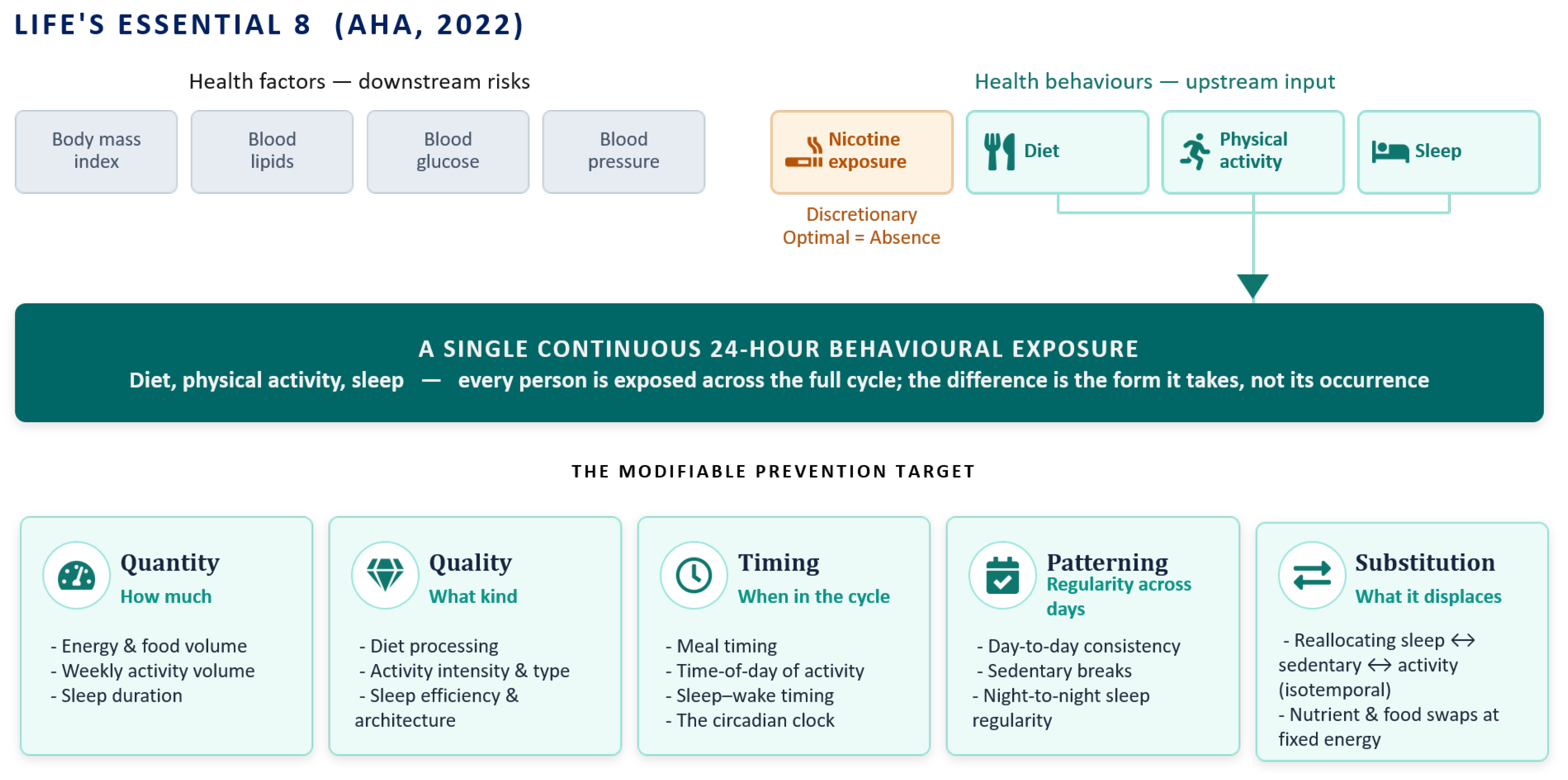
Figure 2.
Behavioural infrastructure: from structural conditions to cardiovascular outcomes, with the commercial and equity dimensions that determine the trajectory. Food, built and transport, work and school, and digital and light environments shape a single 24-hour behavioural exposure comprising diet, sleep, sedentary time, and physical activity. This exposure influences cardiovascular outcomes. Structural instruments act on conditions rather than individuals through hazard removal, fiscal reformulation, default information and protected environments. The resulting trajectory depends on two cross-cutting considerations: commercial influence, which requires mandatory and enforceable policy where justified, and equity, which requires judging interventions by their distributional effects as well as their average effects. PA, physical activity; MVPA, moderate-to-vigorous physical activity.
Figure 2.
Behavioural infrastructure: from structural conditions to cardiovascular outcomes, with the commercial and equity dimensions that determine the trajectory. Food, built and transport, work and school, and digital and light environments shape a single 24-hour behavioural exposure comprising diet, sleep, sedentary time, and physical activity. This exposure influences cardiovascular outcomes. Structural instruments act on conditions rather than individuals through hazard removal, fiscal reformulation, default information and protected environments. The resulting trajectory depends on two cross-cutting considerations: commercial influence, which requires mandatory and enforceable policy where justified, and equity, which requires judging interventions by their distributional effects as well as their average effects. PA, physical activity; MVPA, moderate-to-vigorous physical activity.
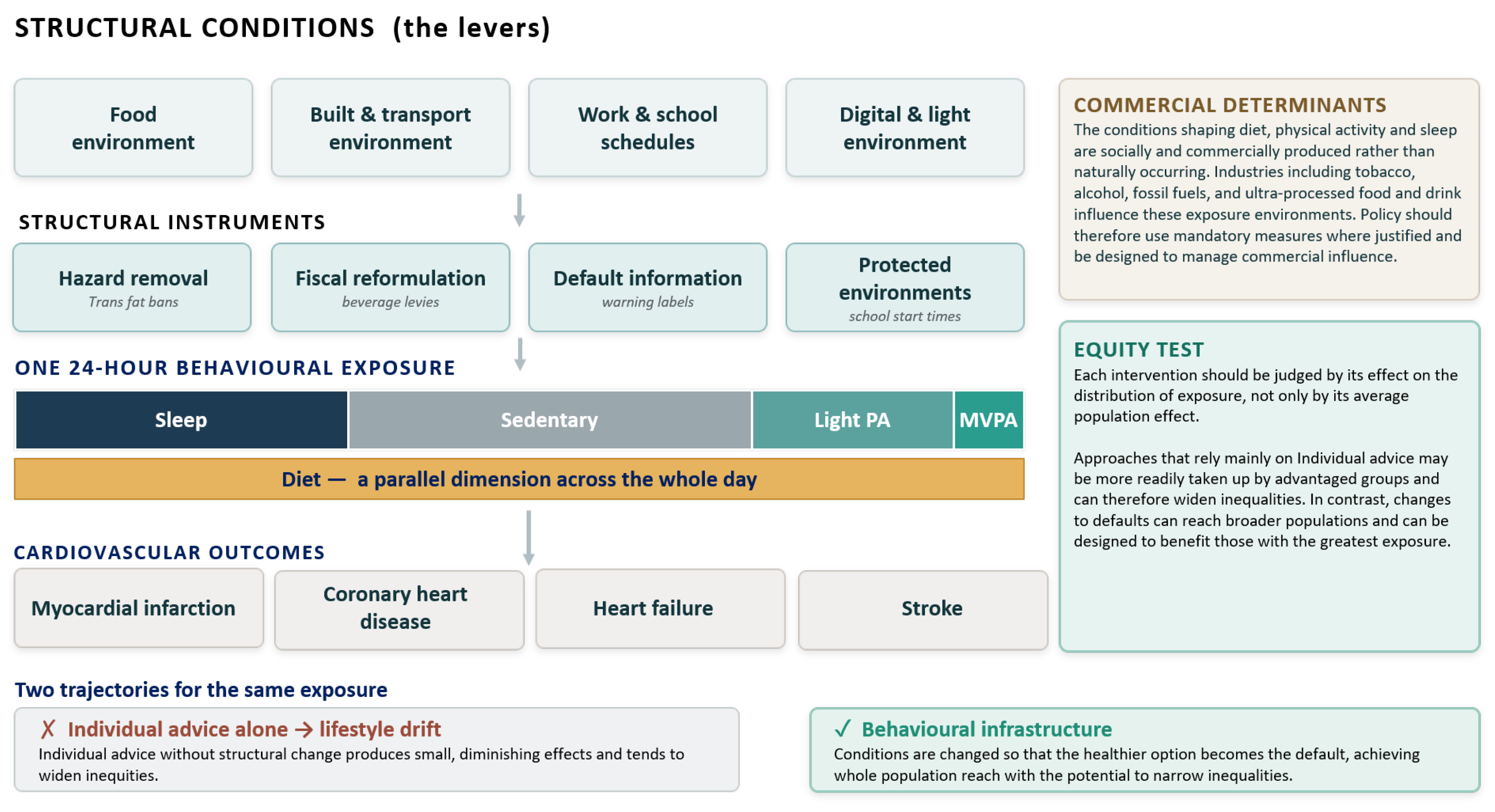
Figure 3.
A framework for behavioural infrastructure: the construct and its five design principles. Behavioural infrastructure refers to the everyday environments and policies that shape diet, physical activity and sleep as a 24-hour behavioural exposure. The framework is operationalised through five principles: changing exposure conditions rather than relying on advice alone; targeting the full 24-hour exposure; completing the policy architecture by including sleep and time; anticipating commercial response; and applying an explicit equity test based on distributional effects, not only population averages. COI, conflict of interest.
Figure 3.
A framework for behavioural infrastructure: the construct and its five design principles. Behavioural infrastructure refers to the everyday environments and policies that shape diet, physical activity and sleep as a 24-hour behavioural exposure. The framework is operationalised through five principles: changing exposure conditions rather than relying on advice alone; targeting the full 24-hour exposure; completing the policy architecture by including sleep and time; anticipating commercial response; and applying an explicit equity test based on distributional effects, not only population averages. COI, conflict of interest.
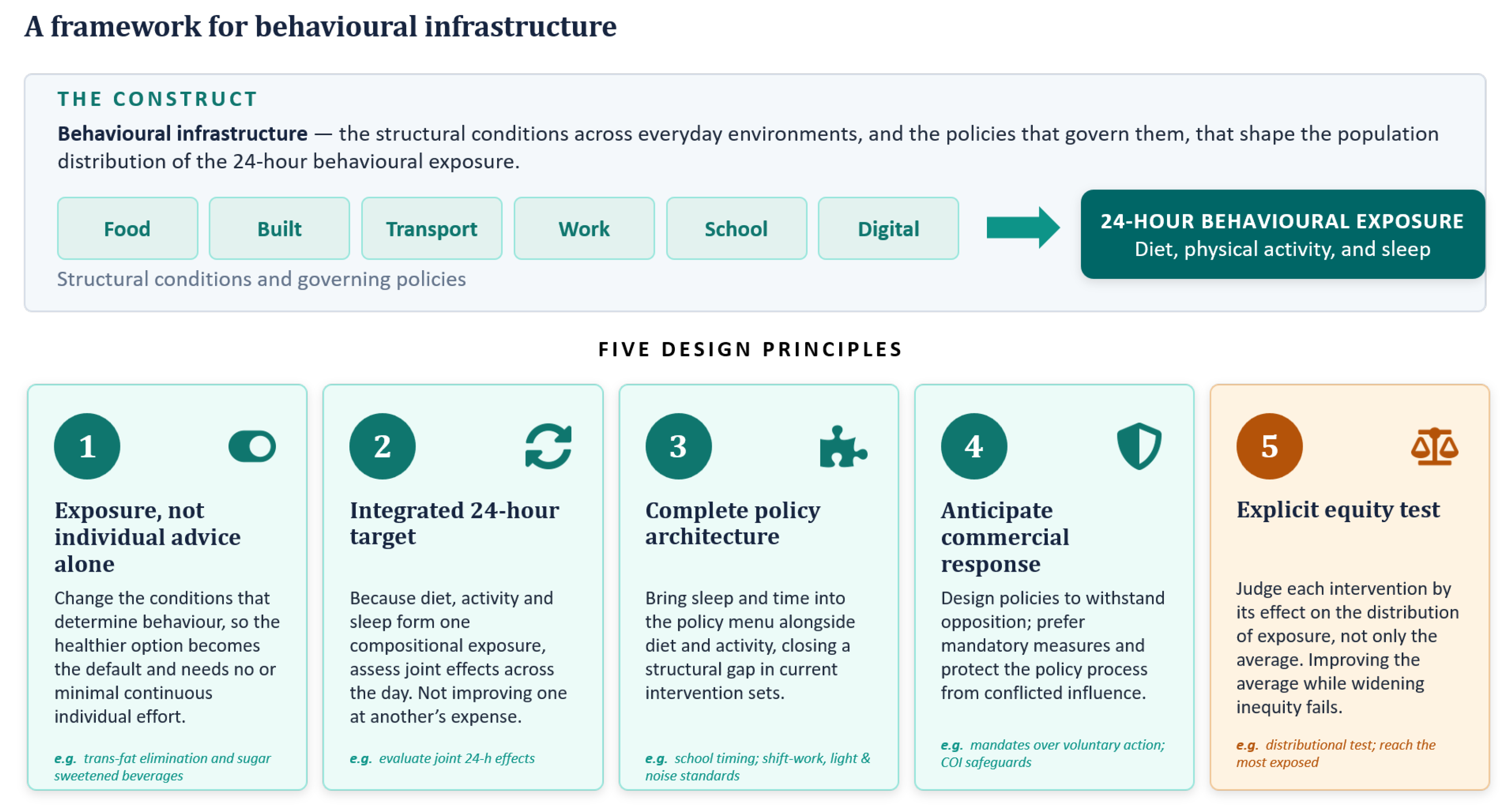

Table 1.
Conceptual distinction between Life’s Essential 8 behaviours and biological risk factors for causal and compositional modelling.
Table 1.
Conceptual distinction between Life’s Essential 8 behaviours and biological risk factors for causal and compositional modelling.
| LE8 component | AHA domain | Universal or continuous exposure? | Optimal state | Causal role | Constrained by the fixed 24-hour time budget? |
| Diet | Behaviour | Yes; all individuals are exposed through food intake, with variation in composition, quantity, quality and timing | High-quality dietary pattern with appropriate quantity and timing | Upstream behavioural exposure | Partly; timing and eating occasions occur within the day, but diet is not primarily a time-use behaviour |
| Physical activity | Behaviour | Yes; activity and inactivity are universal time-use states | Sufficient volume and intensity of movement | Upstream behavioural exposure | Yes; physical activity directly displaces sedentary time, sleep or other activities |
| Sleep | Behaviour | Yes; sleep is a universal time-use state | Adequate duration, quality, regularity and timing | Upstream behavioural exposure | Yes; sleep directly competes with wake behaviours within the 24-hour day |
| Nicotine exposure | Behaviour | No; exposure is discretionary and avoidable | Complete absence of nicotine exposure | Upstream behavioural exposure | No; nicotine use is not inherently constrained by the 24-hour behavioural composition |
| Body mass index | Health factor | Not applicable; a biological state rather than a direct behavioural exposure | Healthy body weight/adiposity range | Downstream intermediate risk marker | No |
| Blood lipids | Health factor | Not applicable; a biological state rather than a direct behavioural exposure | Optimal lipid profile | Downstream intermediate risk marker | No |
| Blood glucose | Health factor | Not applicable; a biological state rather than a direct behavioural exposure | Normoglycaemia/optimal glycaemic control | Downstream intermediate risk marker | No |
| Blood pressure | Health factor | Not applicable; a biological state rather than a direct behavioural exposure | Normotension/optimal blood pressure | Downstream intermediate risk marker | No |
Note: LE8 = Life’s Essential 8; AHA = American Heart Association. Behavioural components represent upstream, potentially modifiable exposures, whereas biological health factors are downstream risk states that partly reflect the cumulative effects of behavioural, genetic, social and clinical determinants. Physical activity and sleep are directly embedded within the fixed 24-hour time-use budget; increasing one necessarily reduces time available for another. Diet is universal and modifiable but only partly time-constrained, mainly through meal timing and eating occasions. Nicotine exposure differs from the other behavioural components because non-use represents the optimal state rather than an optimal level within a universal exposure distribution.
Table 2.
Major real-world structural interventions relevant to cardiovascular prevention, acting on diet, physical activity, or sleep.
Table 2.
Major real-world structural interventions relevant to cardiovascular prevention, acting on diet, physical activity, or sleep.
| # | Intervention & setting (country) | Authority / body | Design & population (N) | Key outcome & effect size (cardiovascular endpoint where reported) |
| DIET — food environment (fiscal, labelling, reformulation, and hazard-removal instruments) | ||||
| 1 | Sugar-sweetened beverage excise tax, 2014 (Mexico)56 | Government of Mexico | Before–after observational; household purchases, 6,253 households, 53 cities | Taxed-beverage purchases ↓~6% in year 1 (to ~12% by month 12); ~7.6%/yr sustained over 2 yr; bottled-water purchases ↑ |
| 2 | Sugar-sweetened beverage excise tax, 2015 (Berkeley, USA)57,58 | City of Berkeley | Repeated cross-sectional intake survey + store sales, comparison cities | SSB intake ↓21% in low-income neighbourhoods; store SSB sales ↓9.6%, water sales ↑15.6% |
| 3 | Soft Drinks Industry Levy (tiered by sugar), 2018 (UK)20 | HM Treasury / UK government | Interrupted time series; product reformulation analysis | Sales-weighted sugar in soft drinks ↓~34% (4.4→2.9 g/100 mL, 2015–18) |
| 4 | Front-of-pack warning labels + child-marketing and school-sales bans, 2016 (Chile)40 | Chilean Ministry of Health (Law 20.606) | Controlled before–after household purchases (n=2,383) | Energy purchased from labelled products ↓8.3%; sugar from beverages ↓~20%; industry reformulation |
| 5 | Mandatory industrial trans-fat limits (REPLACE), 2018–23 (53 countries)19 | WHO & national governments | Policy-coverage tracking + modelled mortality | ~46% of world population protected; ~183,000 coronary deaths/yr avertable |
| 6 | Industrial trans fat restrictions, 2007–11 (New York State, USA)59 | County and State health departments | Natural experiment; hospital admissions, difference-in-differences | Combined myocardial-infarction + stroke admissions ↓~6.2% beyond non-restriction counties |
| 7 | National voluntary salt reduction programme, 2003– (UK)43 | UK Food Standards Agency | Repeated national surveys, 24-h urinary sodium; ecological linkage | Salt intake ↓1.4 g/day (2003–11); SBP ↓~3 mmHg; stroke mortality ↓42%, IHD ↓40% (multifactorial) |
| 8 | Mandatory maximum sodium in processed foods, 2016 (South Africa)60 | Government of South Africa (first national mandate) | Pre–post population sodium sampling | Population salt intake ↓~1.2 g/day over 4.5 yr |
| 9 | 8% tax on nonessential energy dense foods, 2014 (Mexico)61 | Government of Mexico | Before–after observational, household purchases | Purchases of taxed foods ↓~5–6% in year 1; larger reductions in lower-SES households |
| 10 | North Karelia community programme, 1972– (Finland)62 | Finnish national & regional health authorities | Long-term population surveillance; quasi-experimental | Large falls in serum cholesterol, blood pressure and diet-related coronary mortality over follow-up |
| PHYSICAL ACTIVITY — built, transport and school environments | ||||
| 11 | New active travel infrastructure (Guided Busway), 2011 (Cambridgeshire, UK)48 | Local transport authority | Quasi-experimental natural-experiment cohort (n≈470), objective exposure | Active commuting ↑ (RRR 1.76 among least active at baseline); weekly cycle-commute time ↑ |
| 12 | Activity-supportive urban design (IPEN) (14 countries)29 | International research consortium (urban-planning evidence) | Cross-sectional, accelerometer, 6,822 adults | Most vs least activity-friendly neighbourhoods differed by ~68–89 min MVPA/week |
| 13 | The Daily Mile (daily 15-min school run/walk), 2016 (Scotland, UK)63 | Schools / education authorities | Controlled pre–post, accelerometer, primary-school children | MVPA ↑~9 min/day; sedentary time ↓; fitness and body composition improved |
| 14 | VERB national mass-media campaign, 2002–06 (USA)64 | US Centers for Disease Control and Prevention | Nationally representative youth cohort, pre–post, dose–response | Free-time physical-activity sessions ↑ in children (~34% more among 9–10 y); effect scaled with exposure |
| SLEEP — time and schedule environments | ||||
| 15 | Delayed school start times (experimental-evidence synthesis) (multi-country)52 | Education authorities (various) | Systematic review of 6 experimental studies | 25–60 min delay → total sleep ↑25–77 min/weeknight; daytime sleepiness and depressive symptoms ↓ |
| 16 | District-wide later high-school start (7:50→8:45), 2016 (Seattle, USA)65 | Seattle Public Schools | Pre/post natural experiment, wrist actigraphy (n≈90) | Median daily sleep ↑~34 min; grades ↑4.5%; attendance and punctuality improved |
| 17 | Delayed school start (45 min), sustained follow-up (Singapore)66 | School (Ministry of Education context) | Prospective cohort, actigraphy + surveys | Sleep duration and well-being increased and were sustained at follow-up |
Inclusion criteria: Interventions were included if they were (1) structural or population-level, (2) implemented in real-world settings, (3) evaluated using robust experimental, (4) quasi-experimental, (5) natural-experiment, interrupted time-series or modelling designs, and (6) reported behavioural, biomarker or health outcomes. Evidence was restricted to peer-reviewed studies or recognised authority reports, prioritising landmark evaluations from 2003–2024 and covering across diet, physical activity and sleep. Cardiovascular relevance: Each intervention acts on a component of the combined sleep–physical activity–nutrition exposure linked to major adverse cardiovascular events. Some interventions report direct cardiovascular endpoints; others act through established intermediate risk factors, including blood pressure, adiposity, glycaemic load, physical activity and sleep. Caveats: Evidence is stronger and more mature for diet than for sleep, reflecting the current policy gap. Whole population evaluations, including salt reduction and North Karelia programmes, should be interpreted as programme level associations rather than isolated causal effects. Abbreviations: SSB, sugar-sweetened beverage; MVPA, moderate-to-vigorous physical activity; MACE, major adverse cardiovascular events; CHD, coronary heart disease; SBP, systolic blood pressure; IHD, ischaemic heart disease; SES, socio-economic status.
Table 3.
Transferring a validated logic of behavioral infrastructure framework: principles to instruments.
Table 3.
Transferring a validated logic of behavioral infrastructure framework: principles to instruments.
| Design principle | What it requires | Example structural instruments |
| Exposure, not individual advice alone | Shift the default so the healthier option requires no ongoing individual effort | Industrial trans fat elimination; sugar sweetened beverage levies and reformulation67 20 |
| Integrated 24-hour target | Assess joint effects across diet, physical activity and sleep; avoid behavioural trade offs | Compositional or 24-hour evaluation of policies rather than single behaviour appraisal7,68 |
| Complete policy architecture | Incorporate sleep and time alongside diet and physical activity | School start times; working-hours and shift-work standards; control of light and noise52,65,66 |
| Anticipate commercial response | Withstand opposition; prefer mandatory over voluntary measures | Mandates in place of voluntary pledges; conflict-of-interest safeguards for the policy process38 |
| Explicit equity test | Judge by distributional effect; prioritise the most exposed populations | Distributional impact assessment; instruments targeted to high exposure groups |
The framework is to specify the transfer concretely and to make explicit the integration, completeness and distributional criteria that individual behavioural strategies often omit. The framework does not require a new prevention logic; it transfers the existing structural logic of tobacco control and trans fat elimination to the behaviours that now dominate preventable risk.
Disclaimer/Publisher’s Note: The statements, opinions and data contained in all publications are solely those of the individual author(s) and contributor(s) and not of MDPI and/or the editor(s). MDPI and/or the editor(s) disclaim responsibility for any injury to people or property resulting from any ideas, methods, instructions or products referred to in the content. |
© 2026 by the authors. Licensee MDPI, Basel, Switzerland. This article is an open access article distributed under the terms and conditions of the Creative Commons Attribution (CC BY) license (http://creativecommons.org/licenses/by/4.0/).
Copyright: This open access article is published under a Creative Commons CC BY 4.0 license, which permit the free download, distribution, and reuse, provided that the author and preprint are cited in any reuse.