

Submitted:
14 November 2026
Posted:
16 November 2026
You are already at the latest version
Abstract
We classify null-projected supersymmetric Yang--Mills theories with a Majorana--Weyl gaugino in signature $(s,t)$, defined by five conditions on the gaugino constraint, the transformation rules, the residual gauge field, the translation bracket and the absorption of the cubic gaugino terms. Such a theory built on \(k\) null vectors exists if and only if \(s+t-2k=10\) and \(s-t\in\{8,0,-8\}\), or \(s+t-2k=2\) and \(s=t\). The key step is a converse of the cubic gamma-matrix identity: symmetric gamma matrices that satisfy it act on spinors of dimension \(2(d-2)\). Hence the signatures (9+8n+q)+(1+q) with n ≥ 1 and 0 ≤ q ≤ 3 proposed by Rios, Marrani and Chester, among them \(27+3\), carry no such theory, and several algebraic statements made alongside them, such as an embedding of \(\mathfrak{f}_{4(-20)}\) in \(\mathfrak{so}(25,1)\), are false. Neither another contraction of the source, nor any number of gauginos, mixed or not, nor a gauge bracket that is not a Lie bracket changes this. In the single-time signatures (9 + 8n) + 1 no unitary massless multiplet without tensor charges consists of scalars, spinors and vectors.
Keywords:
Supersymmetric Yang–Mills theory
; spinors
; null projections
MSC: 81T60; 81T13; 15A66; 17B25; 81R25; 83E15
1. Introduction
In more than two dimensions, conventional minimal supersymmetric Yang–Mills theory with only a gauge field and a gaugino exists for a single time in three, four, six and ten dimensions [1,2,3,4]. The reason is one algebraic fact. Varying the gauge field inside the covariant derivative of the gaugino kinetic term produces a term cubic in the gaugino, and no other term in the variation of the Lagrangian can cancel it. This term vanishes precisely when the symmetric gamma matrices obey the Fierz identity
which holds for the Majorana spinors of three and four dimensions, the Weyl spinors of six and the Majorana–Weyl spinors of ten, the spinors attached to the four normed division algebras [2,3,4]. The same identity makes the Green–Schwarz superstring -symmetric [5], its analogues for forms of higher degree produce the scan of supersymmetric branes [6,7], and Blencowe and Duff extended that scan to spacetimes with several times [8]. Above ten dimensions the spinors are too large: a Majorana–Weyl spinor in D dimensions has components, while (1) allows of them (Theorem 3.3).
The null-frame constructions considered here extend this field content by introducing additional timelike as well as spacelike directions. Signatures with several times have been studied for several reasons. F-theory points to a twelve-dimensional origin of type IIB string theory [9]; Bars proposed an S-theory in dimensions and made a case for fourteen [10,11]; in two-time physics an gauge symmetry removes one time and one space direction [12,13,14]; and the dualities of string theory and M-theory relate theories of different signatures [15,16]. Superparticles beyond eleven dimensions were studied by Rudychev and Sezgin [17], and supergravity in dimensions by Nishino [18]. Supersymmetric Yang–Mills equations in dimensions were written by Nishino and Sezgin [19], a theory in dimensions was given by Sezgin [20], and the mechanism behind these constructions was set out by Rudychev, Sezgin and Sundell [21]. Nishino then built supersymmetric Yang–Mills theories in every signature [22]. His construction introduces m mutually orthogonal null vectors , constrains the gaugino by , and lets the supersymmetry algebra close on translations contracted with . The cubic gaugino terms then need not vanish. They only have to take a form that can be absorbed into the field equation of the gauge field, and in Nishino’s construction they do.
Rios, Marrani and Chester used the periodic reality and symmetry properties of spinors to propose that Nishino’s existence proofs could be transferred to new signatures [23]. Their proposal keeps and modulo eight fixed while moving timelike directions into space. The resulting four families are
with the chiral superalgebras of their eqs. (3.5)–(3.8). They called these theories exceptional super Yang–Mills theories. The signature , the case of the third family, was then proposed as the home of a theory whose fields fill the exceptional Jordan algebra and whose worldvolume would carry M-theory [24]. The same theory was used to model dark matter [25], and it entered the construction of “monstrous” M-theory [26] and the programme of exceptional periodicity [27]. Here we test this proposed transfer within the explicit transformation, projection and absorption assumptions (N1)–(N5). Proposition 7.1 writes out what repeating Nishino’s proof in requires and shows that each choice of the null frame fails: Nishino’s rank does not fit, the translation bracket allows only rank two, and at rank two the cubic terms cannot be absorbed.
The transfer does not work under (N1)–(N5). Reality and symmetry of spinors are not the only data that enter this mechanism. The null vectors must be mutually orthogonal, and if they annihilate a real gaugino they lie in the complexification of a real totally isotropic subspace, whose dimension cannot exceed (Lemmas 2.2 and 2.3). Moving timelike directions into space lowers this number, and with it the number of null directions that can be projected out. What remains after the projection is a theory on the orthogonal complement of the null frame, of dimension for k null vectors. We show that the cubic terms can be absorbed only if the residual spinors satisfy (1) themselves, and this forces whenever . The main result, proved in Section 5.4, reads as follows.
Main Theorem.
Let a supersymmetric Yang–Mills theory with a Majorana–Weyl gaugino in signature be built on a frame of k null vectors in the manner of Nishino, in the sense of the axioms (N1)–(N5) of Definition 5.3. Then and , so that . In particular there is no such theory in any of the signatures (2) with , and none in or in .
Figure 1 shows the geometry. Nishino’s signatures lie on the plane , while every signature of the families (2) with has residual dimension at least 16 for every admissible k. The necessary residual-dimension condition depends on and the available Witt index, beyond their residue data.1 The conditions of the Main Theorem are sharp for residual dimension ten. A complex isometry that keeps D and the rank of the frame carries Nishino’s equations to every signature with and , and the transported theory keeps a Majorana–Weyl gaugino and satisfies (N1)–(N5) (Theorem 5.12). For residual dimension at least three a theory therefore exists exactly when the Main Theorem allows it (Corollary 5.13). In particular and , two signatures of the second degenerate family of Ref. [23], do carry such theories, while its members with do not. The conditions are sharp for residual dimension two as well. In Nishino’s transformations, written with a real frame of rank k, satisfy (N1)–(N5): the cubic gaugino terms vanish identically, and the supersymmetry algebra closes off shell on translations along one null direction of the residual plane (Theorem 5.14). The Main Theorem is therefore a classification. A theory of rank k exists if and only if and , or and (Corollary 5.15).
The exclusion of the families (2) does not depend on the null contraction in the translation bracket either. Whatever fixed tensor contracts the source in the field equation of the gauge field, with or without a constraint on the gaugino, the cubic gaugino terms cannot be absorbed once the residual dimension is sixteen or more, and every real frame in these families leaves at least sixteen (Theorem 7.3 and Corollary 7.4). This covers, for instance, the contraction of the eleven-form charge of with ten spacelike vectors. Several gauginos do not help either. If each gaugino transforms into the field strength with its own parameter, the cubic terms that couple two different gauginos must vanish, and they do not once the residual dimension is three or more (Proposition 7.5). If the gauginos are mixed by their transformation rules, as in extended supersymmetry, the cross terms between two gauginos can be absorbed only when the Weyl spinors of the residual space have components, that is for or 6; with Majorana–Weyl gauginos this forces , for any number of gauginos (Theorem 7.6 and Corollary 7.7). The Lie algebra is not needed: for any bilinear gauge bracket the conclusions of the Main Theorem hold, and a bracket that is not antisymmetric, such as the product of a Jordan algebra, leaves only residual dimension two (Theorem 7.11). Transformation rules and field equations nonlinear in the gaugino, and auxiliary fields, change nothing as long as they produce no new term with exactly two undifferentiated gauginos in the variation of the gaugino equation (Lemma 7.13 and Proposition 7.14).
These results do not exclude every theory in , and no statement about the superalgebra alone could, since the superalgebra acts on superfields (Remark 7.16). An exclusion has to name the fields and their transformation rules. Auxiliary fields whose equations contain a product of two undifferentiated gauginos, the further mechanisms listed in Remark 7.15, and gauge structures in which the variation of the gauge field involves further fields lie outside the present results.
For a single time we can say more, without any assumption about how the theory is built. In the anticommutator of two supercharges contains the momentum, and in a unitary theory the supercharges that act nontrivially on a massless state generate a Clifford algebra with generators. A massless multiplet without tensor charges then has at least states, half of them bosonic (Theorem 6.1). For that is states, against the 16 bosonic states of a vector field in eighteen dimensions.
The paper is organized as follows. Section 2 collects what we need about spinors in signature : the decomposition of the symmetric square of a Weyl spinor, which shows that the superalgebras of Ref. [23] are the most general ones and carry no information about dynamics, and two lemmas on isotropic subspaces. Section 3 proves the theorem on which everything else rests: if symmetric gamma matrices obey an identity of the type that absorption requires, the spinor dimension is . Section 4 applies it to ordinary super Yang–Mills theory. Section 5 describes null frames by fermionic oscillators, states the axioms, proves the reduction to ten residual dimensions and the Main Theorem, and shows that its conditions are also sufficient. Section 6 treats the single-time family by representation theory, and Section 7 spells out what the results mean for and , including the transfer of Nishino’s construction (Proposition 7.1), arbitrary contractions of the source (Theorem 7.3), several gauginos (Proposition 7.5), gauginos mixed by their transformation rules (Theorem 7.6), gauge brackets that are not Lie brackets (Theorem 7.11), nonlinear transformation rules and auxiliary fields (Proposition 7.14) and the scope of the axioms. Appendix A proves the oscillator decomposition, Appendix B describes numerical checks in explicit gamma matrices, Appendix C lists the symmetric squares for the families (2), Appendix D checks Proposition 7.1 in explicit gamma matrices, Appendix E does the same for Theorems 5.12 and 7.3, Appendix F for Theorem 5.14 and Proposition 7.5, and Appendix G for Theorems 7.6 and 7.11. Appendix H applies the same tools, the signature of an invariant form, the Witt index, the branching of spinors and the symmetric square of a Weyl spinor, to algebraic statements made alongside the proposal and in a related grand-unified model, and shows that they are false. Figure 2 shows how the results depend on one another.
2. Spinors in Signature
2.1. Conventions
Let with metric
with s plus signs and t minus signs, and . Except in Remark 5.11 we take with . The Clifford relations are . The Dirac module of the complex Clifford algebra has dimension and splits into the Weyl modules of dimension , the eigenspaces of the chirality operator , normalized so that . For a vector u we write , and is the antisymmetrized product of unit weight, so that when the indices are distinct and the basis is orthonormal.
There is a nondegenerate bilinear form B on , unique up to a factor once a sign is chosen, such that
with determined by r and [29,30,31]. We write and . The form B pairs with when r is even and with when r is odd.
A real structure on is an antilinear map with that commutes with every . It exists exactly when , and it preserves exactly when [29,30,32]. A Majorana spinor is a spinor with . Majorana–Weyl spinors, which are the spinors of all the theories in this paper, therefore exist if and only if , and every signature in (2) and in Nishino’s list has this property.
2.2. The Symmetric Square of a Weyl Spinor
The anticommutator of two supercharges in the Weyl module is a symmetric element of , so the superalgebras that can be written down in signature are classified by the decomposition of [31,35]. We write , and stands for the half of the middle-dimensional forms selected by .
Proposition 2.1.
For ,
In particular if and only if , that is , and if and only if .
Proof.
The forms restricted to vanish unless , and those with , , give an isomorphism [29,30]. (As a check, .) It remains to decide which summands are symmetric. By (3),
so the p-th form has symmetry , and . The symmetric summands are therefore either those with or those with . Using and summing over the fourth roots of unity, the first set has total dimension
because and the term with vanishes. This is for , while the second set has dimension . Hence the symmetric summands are those with . □
Appendix C lists the decomposition for the families (2). For one has , and consists of the forms of degrees ; for the degrees are ; for they are ; and for they are . These are exactly the right-hand sides of eqs. (3.5)–(3.8) of Ref. [23]. The superalgebras proposed there are therefore maximal central supertranslation algebras: the anticommutator of two supercharges is an arbitrary element of , with a central charge for every summand. Such an algebra exists for every Weyl spinor in every signature, and its existence alone does not establish a field-theoretic realization.2 It contains the momentum only for .
2.3. Isotropic Subspaces
A subspace U of V or of is totally isotropic if for all .
Lemma 2.2.
A real totally isotropic subspace has , and the bound is attained.3
Proof.
Write with positive definite of dimension s and negative definite of dimension t. If , then forces , so the projection is injective and . Exchanging the roles gives . With orthonormal bases of and of , the vectors , , span a totally isotropic subspace of dimension . □
The next lemma says that a Majorana spinor cannot distinguish a complex null vector from its complex conjugate.
Lemma 2.3.
Let and let be a Majorana spinor. The set is a complex totally isotropic subspace invariant under complex conjugation. Hence with real and totally isotropic, and .
Proof.
If and , then , so . Since C is antilinear and commutes with the , , so implies . A conjugation-invariant complex subspace is the complexification of its real points, and the real points of a totally isotropic subspace form a totally isotropic subspace of V. Lemma 2.2 finishes the proof. □
Figure 3 illustrates the lemma in , where : two independent real null vectors are never orthogonal.
3. Vector Structures and the Cubic Identity
Every condition on cubic fermion terms that appears in this paper is a statement about the following structure.
Definition 3.1.
Let W be a complex vector space of dimension d with a nondegenerate symmetric bilinear form η, and let Σ be a complex vector space of dimension with dual . Avector structureon Σ is a pair of linear maps, γ from W to the symmetric maps and from W to the maps , such that in a basis of W
In a basis of Σ we write and for the matrix entries; .
The standard example is in with r odd, through B, , and the Clifford action ; by Proposition 2.1 the forms are symmetric when . In ten dimensions these are the familiar matrices and [41].
Lemma 3.2.
Let be a vector structure with . Then
- (a)
- each is symmetric, and in an orthonormal basis (no sum);
- (b)
- and ;
- (c)
- .
Proof. (a) Setting in (5) gives and , and the inverse of a symmetric map is symmetric. (b) Contracting the second relation in (5) gives the first identity, and then . (c) On the operators obey , and anticommutes with every . In an orthonormal basis take and choose , which is possible because . The invertible operator commutes with and anticommutes with , so ; and . The restriction of to is , and its trace therefore vanishes for . For it is by (a). □
The condition that absorption of cubic terms will produce is the following. For a constant consider
For this is the identity (1).
Theorem 3.3.
Proof.
Contract (6) with , which is symmetric by Lemma 3.2(a), and sum over . Inside the bracket on the left, the first term gives and the second gives , by Lemma 3.2(b),(c). The right-hand side gives . Since ,
Next contract with and sum over . Both terms in the bracket give , and the right-hand side gives , so
Substituting into (8) gives , that is . As , we get and .
For the divisibility, the operators and of the proof of Lemma 3.2(c) make a module over the complex Clifford algebra on generators. This algebra is semisimple and its irreducible modules have dimension , so divides . For it does not, and for one has . This leaves . □
Remark 3.4.
The four solutions are the Majorana spinors of three and four dimensions, the Weyl spinors of six (with their doublet) and the Majorana–Weyl spinors of ten, and in each case (1) holds [2,3,4]. Theorem 3.3 is a converse that makes no reference to division algebras and allows a general constant j: the dimension count alone fixes both N and j. The constant j is left free because absorbing the cubic terms into a modified field equation, the mechanism of Nishino’s construction, produces (6) with a constant that is not known in advance (Section 5). Figure 4 compares with the smallest admissible N.
4. Ordinary Super Yang–Mills Theory
Before turning to null projections we record what Theorem 3.3 gives without them. Let the gauge algebra be a compact non-abelian Lie algebra with structure constants , totally antisymmetric in an orthonormal basis. Let the gaugino and the parameter be Grassmann-odd Weyl spinors in (Majorana–Weyl when ), and consider
with and nonzero constants .
Proposition 4.1.
Proof.
The kinetic term is nonzero only if B pairs with , that is for r odd, and it is not a total derivative only if the form is symmetric: for Grassmann-odd and antisymmetric G, . With , and the Clifford action , the relations (5) are those of , so is a vector structure with and .
The terms of cubic in come only from inside the covariant derivative, since is linear in F and is linear in . They are
where the sign depends only on the ordering convention for Grassmann variables. They contain no derivative, so they must vanish. The tensor T is totally symmetric: exchanging two of its indices and relabelling the gauge indices produces one sign from f and one from the anticommuting . It spans . Indeed contains a subalgebra , and for with values in it for every symmetric c, after normalizing . Since the monomials are linearly independent, only annihilates every T. Hence, for every , the part of symmetric in vanishes. Because each factor is symmetric in its own pair of indices, that symmetrization is one third of the sum over the three ways of pairing with , or , which is (1). Theorem 3.3 with and gives , whose only solution with is . Majorana–Weyl spinors in require . □
The proposition is the familiar statement that ten is the largest dimension of super Yang–Mills theory [1], obtained here from the dimension count of Theorem 3.3 rather than from an explicit Fierz rearrangement. For , changing the signature does not evade this conventional nondegenerate-kinetic-term ansatz, because the proof uses only D. The degenerate two-dimensional case is not covered by the proposition. The higher-dimensional constructions examined here therefore constrain the gaugino.
5. Null-Projected Super Yang–Mills Theories
5.1. Null Frames as Fermionic Oscillators
Definition 5.1.
Anull frame of rank kis a set of vectors with
It isrealif all the vectors lie in V. Itsresidual spaceis the orthogonal complement of , of dimension , and we set .
The span of the and is a sum of k hyperbolic planes, so for a real frame is real of signature . By Lemma 2.2, a real null frame of rank k exists exactly when . In Nishino’s notation and ; his signatures carry real frames of rank m with residual space .
The relations (12) say that the operators
obey the canonical anticommutation relations , . (The dagger is notation; no adjoint is implied.) The number operators
are Nishino’s projectors [22], and they commute with each other. For let be the joint eigenspace on which ; mode i is occupied in if . Write , , , and for the i-th unit vector of . For vectors of we use primed indices, .
Lemma 5.2.
- (i)
- . Each preserves every , and each is a Dirac module of , of dimension .
- (ii)
- maps with isomorphically onto and annihilates with ; does the reverse. Hence
- (iii)
- maps isomorphically onto K, annihilates for , and satisfies ; in particular T commutes with .
- (iv)
- unless .
- (v)
- On each the chirality equals , where is the chirality of , is the number of occupied modes, and the overall sign does not depend on a. Thus and are the two Weyl modules of .
The proof is in Appendix A. Figure 5 shows the case . The kernel K of all the is the fully occupied corner, the kernel of all the is the empty corner, T climbs from one to the other, and B pairs opposite corners.
5.2. The Axioms
Definition 5.3.
Anull-projected super Yang–Mills theory of rank kin signature , , consists of a null frame of rank k, a compact non-abelian gauge algebra , a gauge field , a Grassmann-odd gaugino and Grassmann-odd supersymmetry parameters ϵ, subject to the following conditions.
- (N1)
- Constraint.The complexified gaugino value space is the full corner for a fixed chirality χ; takes values there, that is, for all i. The parameter ϵ ranges over a Weyl module .4
- (N2)
- Transformations. with , and for a linear map Φ from two-forms to that does not depend on λ. The covariant derivative is with .
- (N3)
- Residual gauge field.The components along do not vanish identically.
- (N4)
- Closure.The commutator of two supersymmetries contains the translation byand its components along do not vanish identically. The displayed translation bracket is the coefficient in the supersymmetry anticommutator, so its matrix in the commuting spinor indices is symmetric. This graded symmetry is part of the closure requirement.
- (N)
- Absorption.For every λ with values in there are , depending on λ but not on ϵ, such that for every ϵ the part of quadratic in λ equals
Axiom e is what makes the theory consistent: a term of the form (17) is cancelled by a source term in the field equation of the gauge field, which becomes . For the axiom says that the cubic terms have the form .
Example 5.4.
Nishino’s theories [22] in satisfy a–e with . His constraint (2.12), the contraction of v with , is equivalent to for every i, and he rewrites it as in Equation (2.22). The transformations b are his Equation (2.3), with , and the closure d is his eqs. (2.16)–(2.18). Axiom e is his Equation (2.29): the surviving cubic term is contracted with the bilinear , and for gauginos in K this -form is the wedge product of v with a residual vector (Lemma A1), so the term has the form (17); it is absorbed by the source in his field equation (2.15).5 The residual space is , so .
The variation of the gaugino equation follows directly from the axioms.
Lemma 5.5.
Under b, the part of quadratic in λ is .
Proof.
. The first term is independent of because is, and the second is . □
5.3. Reduction to the Residual Space
Theorem 5.6.
In a null-projected super Yang–Mills theory of rank k the residual dimension equals 10 or 2.
Proof.
is even, and because c requires residual directions. Assume ; we prove . The proof has three steps.
Step 1: projection onto the occupied corner. Since , the inverse metric decomposes as , so
For the bracket vanishes, because annihilates K. By Lemma 5.5 the left-hand side of e is therefore
which lies in the occupied corner because preserves every . On the right-hand side of (17), write for the antisymmetrized product of gamma matrices attached to a -vector , normalized so that for mutually orthogonal . Up to a nonzero factor, which we absorb into J, the right-hand side is . Decompose with . Since , the vector is orthogonal to all the , and is orthogonal to all with ,
where the last formula uses . Now take . Then , while lies in , in which mode i is empty. Applying the projection onto to both sides of e, we obtain for all
Step 2: the residual vector structure. By Lemma 5.2(iii), ranges over with as ranges over . Define
By Lemma 5.2(iv) and the nondegeneracy of B, is a nondegenerate pairing of with the Weyl half of that B pairs with , and it is -invariant by Lemma 5.2(iii). In this notation
the first because only the -component of pairs with , the second by (20), with the normalization of v absorbed into c. Both residual bilinears depend only on the components of their supersymmetry parameters: T kills every other corner and B pairs opposite corners. Their nonvanishing in (N3) and (N4) therefore survives this restriction. Thus is a nonzero equivariant pairing by d, and a nonzero equivariant pairing by c. By Lemma 5.2(v), and are Weyl modules of . With , Proposition 2.1 and its analogue for opposite chiralities, , show that the tensor square of a Weyl module contains only for odd, and the product of the two Weyl modules only for even. Hence is odd and and have the same -chirality. Both lie in , so by Lemma 5.2(v) they coincide: .
Next, is symmetric on . The commutator of two supersymmetries is antisymmetric under , and so is the parameter of the translation in it. For Grassmann-odd one has , so in (23) the symmetric part of G contributes a term that is odd under the exchange and the antisymmetric part a term that is even. The even term must vanish, and since are independent Grassmann variables the antisymmetric part of G is zero.6 By d, . So G is a nonzero symmetric equivariant map , and Proposition 2.1 gives . Let be the opposite Weyl half of . The nondegenerate pairing defines an isomorphism
Writing for the ambient Clifford action, define
The matrix of the first map is , hence symmetric. In both compositions of (5), cancels and the ambient Clifford relations apply. Thus is a vector structure on with and .
Step 3: the identity. Write and . Exchanging and and relabelling gives one sign from f and one from the anticommuting , so is symmetric. In components, (21) reads
with , the sign fixed by the ordering convention. Since (24) holds for all x, it is an identity between the matrices that multiply . Contracting with and using Lemma 3.2(c),
The current is determined explicitly, without a multiplicity argument. By the symmetry of and Lemma 3.2(b),
Consequently
This is a linear function of fixed by the absorption equation itself. Substituting into (24),
The tensors span : for with values in an , up to normalization, and the monomials are independent.7 Hence the part of the bracket in (26) symmetric in vanishes:
Exchanging the names of and and using the symmetry of gives exactly (6). Theorem 3.3 now gives , whose only solution is , that is . □
Step 1 is where the transplanted constructions fail. In Nishino’s signatures the occupied corner K is a sixteen-dimensional Weyl module of the residual , and (21) holds by the ten-dimensional identity (1): contracting (1) with a symmetric gives , so is a multiple of the residual fermion current, the source that Nishino places in the field equation (2.15) of the gauge field. Setting the non-residual components of J to zero extends this absorption solution from to every parameter: the left-hand side depends only on its component, and the right-hand side is , which has the same dependence. This solves the absorption condition itself; it supplies no independent construction of the transformation or of full closure. In with the frame has at most null vectors, so the residual space has dimension at least , and its Weyl spinors are too large for any identity (6).
Remark 5.7.
The case escapes the argument because Lemma 3.2(c) needs . There Σ is one-dimensional, is a null vector, and (6) holds trivially because both sides vanish. The residual gauge field in two dimensions has no local transverse gauge-boson polarizations; this does not by itself determine the propagation of every other field. By Theorem 5.8(iii) below it can occur only for .
5.4. The Main Theorem
Theorem 5.8
(Main Theorem). Let a null-projected super Yang–Mills theory of rank k in signature have a Majorana–Weyl gaugino, so that . Then
- (i)
- , and lie in the complexification of a real totally isotropic subspace of V;
- (ii)
- ;
- (iii)
- , and if .
Proof. (i) The values of a Majorana–Weyl gaugino are real spinors in , and by c the gaugino does not vanish identically, so contains a Majorana spinor . By Lemma 2.3, is the complexification of a real totally isotropic subspace , so . (ii) is Theorem 5.6. (iii) From (i) and (ii), , and leaves ; if , then forces . □
Corollary 5.9.
There is no null-projected super Yang–Mills theory with a Majorana–Weyl gaugino in any of the signatures (2) with . In particular there is none in , , or .
Proof.
In the families (2), for . □
Remark 5.10.
The reality of the gaugino is essential for (i). With a complex Weyl gaugino a complex frame of rank is allowed, and Theorem 5.6 still gives when . For instance admits a complex frame of rank four with residual dimension ten, and the absorption equation (21) can then be solved, as the numerical check of Appendix B confirms. But the occupied corner of such a frame contains no Majorana spinor (Lemma 2.3), so this projected sector has no Majorana real form compatible with the original real signature and frame. Its residual Clifford algebra is the ten-dimensional complex one. The superalgebras of Ref. [23] are built on Majorana–Weyl generators.
Remark 5.11.
For odd D there are no Weyl spinors, so there are no Majorana–Weyl gauginos and the Main Theorem has no odd-dimensional counterpart; the families (2) all have even D. Theorem 3.3 itself does not assume that d is even.
Figure 6 summarizes the numerical test of Step 1 in explicit gamma matrices, described in Appendix B: the absorption equation (21) has a solution to machine precision in the tested cases with , and large residuals in the other tested cases.
5.5. Sufficiency for Residual Dimension Ten
Theorem 5.8 gives necessary conditions. When the residual dimension is ten they are also sufficient. Nishino’s theories carry over to every signature with the same total dimension and the same rank of the frame, as long as the frame stays real, and these are exactly the signatures with residual dimension ten that Theorem 5.8 leaves.
Theorem 5.12.
Let with and . Then carries a real null frame of rank k with residual space , or . Nishino’s equations for (Example 5.4), written with this frame, define a null-projected super Yang–Mills theory of rank k in with a Majorana–Weyl gaugino. It satisfies a–e, and its supersymmetry transformations close as in Nishino’s eqs. (2.16)–(2.18). For it is Nishino’s theory, and for it is ordinary super Yang–Mills theory in , or .
Proof.
Since , , so a real null frame of rank k exists by Lemma 2.2, and its residual space has signature , with and .
Let with Nishino’s frame and with a real frame . The complexified residual spaces are nondegenerate quadratic spaces of dimension ten, so there is a complex isometry between them, and sending , extends it to a complex isometry , by (12). It induces an isomorphism of the complex Clifford algebras and, since the Dirac module is unique, a linear isomorphism with . Labelling the chiralities of V so that preserves them, maps Weyl modules to Weyl modules and the corners K, of the first frame onto those of the second, and it carries to a nonzero multiple of B, because a form with the property (3) for a given is unique up to a factor. Nishino’s constraint, transformation rules, field equations and closure relations are polynomial identities in the gamma matrices, the metric, the frame, the structure constants and the components of the fields and parameters. The maps and preserve all of them. Hence the same equations, written in V with the frame , satisfy every identity that they satisfy in , and a–e hold for them over , with .
It remains to impose reality. Since , carries a real structure C that commutes with every and preserves (Section 2). As the are real, C commutes with every and preserves K, so the Majorana elements of form a real form of ; this is a with a Majorana–Weyl gaugino. The form again satisfies (3) with the same , so for a constant c, and applying the construction twice gives . Replacing B by , we may assume that is real for Majorana spinors , . Then is real for real a, and is a Majorana spinor because the gamma matrices commute with C and F and v are real. The real fields therefore form a consistent sector of the transported theory. □
Corollary 5.13.
Let and let a real null frame of rank k have residual dimension . A null-projected super Yang–Mills theory of rank k with a Majorana–Weyl gaugino exists in if and only if and . In particular such theories exist in the signatures (with ) and (with ) of the second degenerate family of Ref. [23], and in no member of that family with .
Proof.
Necessity is Theorem 5.8, since excludes . Sufficiency is Theorem 5.12. In one has , which lies in for , and gives . □
The theorem shows what a transfer of Nishino’s construction must keep. A complex isometry keeps the total dimension D and the rank k, and the transported theory stays real when the frame can be chosen real, , and Majorana–Weyl spinors exist, . With these conditions force . In thirty dimensions, for example, Nishino’s rank in carries over to and , and to no signature with three times. Figure 7 shows the signatures that carry these theories. For residual dimension two, which Theorem 5.8 allows when , no ten-dimensional theory can be transported, and Theorem 5.14 below constructs the theory directly.
5.6. Residual Dimension Two
The Main Theorem leaves a second case, with , so the signatures with a frame of rank k. Here no ten-dimensional theory can be transported, and we build the theory directly. The residual plane is spanned by two real null vectors with . Since and , the two Weyl modules of a Dirac module of are and , and each is one-dimensional. We label so that the gaugino space is (Lemma 5.2(i),(v)), and we take of the chirality for which , so that ranges over as ranges over (Lemma 5.2(iii)). The pairing of (22) is -invariant and nondegenerate, and acts on the two Weyl modules with opposite weights, so pairs with ; hence for a basis vector e of .
Theorem 5.14.
Let , let be a real null frame of rank k in with , and let be a compact non-abelian Lie algebra. Take Nishino’s transformations
with , a Majorana–Weyl gaugino with values in , the constraints and of Nishino’s eqs. (2.11)–(2.13), and the gaugino equation . Then:
- (i)
- the constraints are preserved by (27), and a–e hold with residual space ;
- (ii)
- the part of quadratic in λ vanishes for every ϵ, so e holds with ;
- (iii)
- the commutator of two supersymmetries is, off shell, the translation by ξ on λ, and the translation by ξ, a gauge transformation and a shift of the components on A;
- (iv)
- the gaugino equation is , and ξ is a multiple of plus a combination of the .
For these are the transformations of two-dimensional super Yang–Mills theory with one Majorana–Weyl supercharge.
Proof.
A real null frame of rank k exists because , its residual space has signature , and Majorana–Weyl spinors exist because . Reality of the transformations follows as in the proof of Theorem 5.12, since the frame is real.
Reduction to the residual plane. The constraint says that F lies in of . Raising its indices, the legs along W that are not residual are multiples of the , and these die in the wedge product with v. Hence is a nonzero multiple of , with the residual part of F and . On the operator acts as 1, and , so
for a constant ; components of outside are annihilated by T (Lemma 5.2(iii)). In particular , and the gaugino constraint is preserved. For a vector Y, . It vanishes for , because , and for , because . For it is , since B pairs only with (Lemma 5.2(iv)). With and , and Grassmann-odd, this is , which gives c. The constraint is preserved, since , and so is , since by the Bianchi identity and .
The gaugino equation and the cubic terms. In the basis , whose dual basis is ,
because takes values in and ; as is injective on , the gaugino equation is . By Lemma 5.5 the part of quadratic in is . In the same basis the frame terms are , and the residual terms are , since annihilates . This proves (ii), for every and not only for .
Closure. By d, . For it vanishes, and for it is a multiple of , which vanishes for . Hence with a nonzero multiple of ; this is (iv), and it gives d, because the bracket is symmetric in the commuting spinor indices of the one-dimensional space . Since and , the translation by acts as the translation by . On , (28) and give
the translation along , without use of any field equation. On A, the components are invariant and ; the component along is invariant and ; and the component along changes by
which is with the same coefficient. The translation of a gauge field by is up to a gauge transformation with parameter , and the remaining components change by the extra transformation of Nishino’s Equation (2.10), which shifts each independently. This proves (iii), and (i) follows from the preceding steps. For the frame is empty, , and (27) is , . □
Corollary 5.15.
Let and let carry a real null frame of rank k. A null-projected super Yang–Mills theory of rank k with a Majorana–Weyl gaugino exists if and only if either and , or and . Thus the conditions of the Main Theorem are necessary and sufficient.
Proof.
Necessity is Theorem 5.8. Sufficiency is Theorem 5.12 for residual dimension ten and Theorem 5.14 for residual dimension two. □
The theories of Theorem 5.14 are chiral: the gaugino moves along only, and supersymmetry translates along the same direction, so on shell the commutator acts trivially on . Their cubic gaugino terms vanish for the same reason as in four, six and ten dimensions: the residual spinors satisfy the identity (1), here trivially, because the only nonzero component of the vector bilinear is along and annihilates them. None of the families (2) reaches residual dimension two, since there .
6. A Single Time: Counting States
For the first family in (2) the time is single, and representation theory gives a bound that does not depend on how the theory is constructed. Consider a unitary, Poincaré-invariant quantum theory in with , whose supercharges form one Majorana–Weyl spinor, so that there are real supercharges. By Proposition 2.1 the most general anticommutator is
with the charge conjugation matrix and tensor charges, in accordance with the general structure of supersymmetry algebras [35,42]. Tensor charges of this kind are carried by extended objects [43]; in ten dimensions the five-form charge is carried by five-branes. We state their absence on the massless multiplet as hypothesis (H).
Theorem 6.1.
Assume (H) that the tensor charges vanish on a massless supermultiplet. Then the multiplet has at least states for each momentum, half of them bosonic. In particular the theory has no massless vector multiplet: such a multiplet would have bosonic states for each generator of the gauge algebra.
Proof.
On the multiplet, with momentum p, , , the anticommutator is , a real symmetric matrix, positive semidefinite because the are Hermitian and the norm is positive. Its rank is : choosing a real null frame of rank one with , Lemma 5.2 shows that annihilates exactly the half K of each Weyl module. A supercharge Q in the kernel of M has , so and Q vanishes on every state of the multiplet. The remaining combinations, rescaled, satisfy and generate a complex Clifford algebra on generators, whose irreducible representations have dimension and are split evenly by . The multiplet is a direct sum of such representations. □
For the bound is : the eight bosonic and eight fermionic states of ten-dimensional super Yang–Mills theory. For , , it is , against sixteen bosonic and 128 fermionic states of a vector and a Majorana–Weyl gaugino. Figure 8 shows the gap for . The argument is the one that bounds the helicity of massless supermultiplets in four dimensions by one for sixteen supercharges and by two for thirty-two [44,45]. To exclude arbitrary multiplicities of vector, spinor and scalar fields, a state count alone is insufficient. The following helicity argument supplies the needed bound.
Lemma 6.2
(Helicity span). Under the hypotheses of Theorem 6.1, suppose the massless multiplet has a finite helicity spectrum for a rotation J in a transverse two-plane. If and are its least and greatest helicities, then
In particular a multiplet containing only scalar, spinor and vector polarizations has , independently of their multiplicities.
Proof.
Choose the null momentum in a four-dimensional Lorentzian subspace and let J generate rotations in its transverse two-plane. A transverse spinor has J-weights and with equal multiplicities. In its occupation basis the first occupation fixes this weight, while the chirality condition fixes only the parity of the remaining occupations; there are equally many choices for the two weights. On the real active supercharges, complexification therefore gives operators of each weight. The positive anticommutator of Theorem 6.1, invariant under J, pairs the two weights nondegenerately. After normalization the operators may be written , , with
Take a unit vector of helicity . Each lowers helicity by , so . The canonical anticommutation relations give
This nonzero vector has helicity , proving the span bound. A scalar has helicity 0, a spinor has helicities , and a vector has helicities under this rotation. Arbitrary multiplicities of these polarizations still have their spectrum in . Thus , or . □
7. What This Means for and
In the Weyl spinor has components, and its symmetric square contains forms of degrees 3, 7, 11 and 15 only. The anticommutator of two supercharges contains no momentum. In the constructions of Refs. [19,20,22] translations are obtained by contracting a form charge with null vectors, as in d; the decomposition of the symmetric square does not by itself force this mechanism, and Sec. Section 7.2 treats the other contractions. With three times , so the residual space has dimension at least 24, and Corollary 5.9 applies: the cubic gaugino terms cannot be absorbed. The same holds in , where the residual dimension is at least 16, and in every other signature of the families (2) with . For any compact non-abelian Lie gauge algebra, the obstruction (21) already arises on an subalgebra and is unaffected by additional representation labels. A non-Lie extension or other field content would require assumptions beyond the present definition.
7.1. The Transfer of Nishino’s Construction
The theories in rest on one argument of Ref. [23]. Moving timelike directions into space keeps and modulo eight, so the reality and symmetry properties of spinors and gamma matrices are unchanged, and the authors conclude that Nishino’s existence proofs can be repeated in the new signatures.8 The paper on takes this theory as given: its superalgebra (2.1) is (3.7) at ,
and it gives no transformation rules or field equations.9 The quoted sentence names the proofs for (3.1) and (3.2), whose transfers are the first two families of (2); for those, Section 5 already shows that the repetition fails. The signatures come from (3.3), the superalgebra of Nishino’s Section 4, which treats . That section is the proof to be repeated, and we write it out.
Nishino’s coordinates in are , with and timelike [22]. His null vectors, eqs. (4.5) and (4.6), are
each pairing one spacelike with one timelike unit vector, so the vectors use different times. With his theory consists of
together with the closure (4.13), (4.14), whose translation parameter is . Here denotes p antisymmetrized indices. The right-hand side of () is the source that absorbs the cubic gaugino terms, and () shows where the momentum comes from: the -form charge contracted with v. Repeating the proof in means keeping these equations and choosing a null frame in the new signature. Since the rank may be too large there, we allow any rank k.
Proposition 7.1.
Let and let be a compact non-abelian Lie algebra. In consider a gauge field , a Majorana–Weyl gaugino and a Majorana–Weyl parameter ϵ of the same chirality, as in (3.7) of Ref. [23] and (30), a real null frame of rank with ( if ), a coupling in , and Nishino’s equations with replaced by k, as identities for all gaugino values allowed by (b) and all ϵ:
- (a)
- and , as in (32);
- (b)
- if , as in (), and the gaugino values are all Majorana spinors satisfying it;
- (c)
- the commutator of two supersymmetries contains the translation by , the coefficient of in as in (), and its residual components do not vanish identically;
- (d)
- the terms quadratic in λ in are cancelled by a source in the field equation of the gauge field, as in ().
Then:
- (i)
- , so Nishino’s rank cannot be kept.
- (ii)
- Condition (c) holds only for .
- (iii)
- For conditions (a)–(c) imply a–d, condition (d) is e, the residual space is , and (d) fails: absorption would force the identity (6) on the residual Weyl module, of dimension , while Theorem 3.3 requires .
Hence no field theory in , in particular none in or , satisfies (a)–(d) for any rank of the null frame.
Proof.
We write , so , and use the oscillator notation of Section 5: K is the joint kernel of the and the joint kernel of the . The gaugino does not vanish identically, since otherwise and no field transforms.
Step 1: the rank is at most three. First, (b) says exactly that takes values in K. Indeed is, for each choice of , a linear combination of , so for all i implies (b). Conversely, contract (b) with in the slots for all ; since , only the term with in the last slot survives, and (b) becomes a nonzero multiple of . Next, the are real, mutually orthogonal null vectors, linearly independent because , so they span a real totally isotropic subspace of dimension k, and Lemma 2.2 gives . Lemma 2.3 gives the same bound for any frame, real or complex, once the values of are Majorana spinors. Nishino’s rank is , which proves (i). The same count holds in the source signature, where leaves room for his frame.
Step 2: only rank two gives a translation. By Proposition 2.1, the forms on vanish for even p, are symmetric in for , and antisymmetric for . For the degrees are
and the symmetric ones are the charges of (30). The parameter of (c) is the component of in degree . For and the degree is even and vanishes identically. For the degree is one, the form is antisymmetric, and the momentum is absent from the anticommutator; this is why, among the superalgebras (3.1)–(3.8) of Ref. [23], only (3.1) and (3.5) contain . For the degree is three and the form is symmetric. With this leaves , which proves (ii). Nishino’s rank would draw the momentum from the -form charge, symmetric as well, contracted with a null form of rank ; in this is the eleven-form charge of Ref. [24], and his contraction needs ten mutually orthogonal real null vectors, whereas by Step 1 there are at most three.
Step 3: at rank two the axioms (N1)–(N4) hold. Let . Axiom a holds because, by hypothesis, the gaugino values are all spinors allowed by (b), and by Step 1 these form the full corner ; ranges over the full module, as in Nishino’s construction. Axiom b is (a), with and , which is linear in F and independent of , and by hypothesis. For c and d we use Lemma 5.2. Since k is even and and have the same chirality, ranges over as ranges over , and is a Weyl module of the residual space , of dimension . As r is odd, B pairs with , so of (22) pairs nondegenerately with the opposite Weyl half of , and maps injectively into . Therefore and , as in (23), do not vanish identically, and the pairing in is symmetric because . Condition (d) asserts that the quadratic terms have the form (17), which is e.
Step 4: absorption fails. Theorem 5.6 now applies and gives , whereas . Concretely, Steps 1–3 of its proof turn (d) into the identity (6) on with and . The second contraction (9) fixes the constant, , and the first contraction (8) then requires , which is false for every because for . This proves (iii). □
For the numbers are , and , and (8) would require , that is . In Nishino’s own signatures the same count gives , because his frame has rank and leaves the residual space . Compare Sezgin’s theory: in a rank-two frame leaves ten residual dimensions and everything closes; in the same rank, the only one the translation bracket allows, leaves twenty-six. Table 1 and Figure 9 and Figure 10 collect the two cases singled out in Refs. [23,24], and Appendix D checks each step in explicit gamma matrices of size .
Remark 7.2.
The transfer becomes consistent only by giving up the reality of the gaugino. The complexified Clifford algebra of depends only on D, so Nishino’s equations in can be written with a complex null frame of rank 10 in and read in the coordinates of . The residual space is then ten-dimensional and the absorption holds, as in Remark 5.10. But the frame spans a complex totally isotropic subspace of dimension , so by Lemma 2.3 its occupied corner contains no nonzero Majorana spinor: the gaugino, and through the gauge field, are complex. These are the complexified equations of the theory in , whose real form there carries a real frame. The data that Ref. [23] keeps fixed, D and modulo eight, fix the complex Clifford algebra and the reality type of its spinors, but not the Witt index that a real null frame needs.10
7.2. Other Contractions
Proposition 7.1 keeps the null contraction of Nishino’s translation bracket. The superalgebra (30) admits others. Contracting its eleven-form charge with ten orthonormal spacelike vectors , for instance, gives with a orthogonal to the and the central, a consistent superalgebra with symmetry . The next theorem shows that no choice of this kind rescues the field theory. Whatever fixed tensor contracts the source in the field equation of the gauge field, the cubic gaugino terms cannot be absorbed once the residual dimension is sixteen or more. The theorem does not use d, and it includes a gaugino without any constraint ().
For a multivector let be the antisymmetrized product of gamma matrices, as in Step 1 of the proof of Theorem 5.6. For a null frame, is the direct sum of , and , and for we write for the coefficient of in the part of that contains no .
Theorem 7.3.
Let , let a null frame of rank , real or complex, be given (for there is no frame and ), and let . Suppose that the gaugino takes all values in , that b and c hold, and that there is a fixed such that for every λ there are , independent of ϵ, with
Let . Then has at most one element p, and . Consequently , and when .
Proof.
Projection. As in Step 1 of the proof of Theorem 5.6, for the left-hand side of (36) is with and as in (22), and it lies in . On the right, expand in the monomials with . The factors for different i and the residual factor span mutually orthogonal subspaces, so of such a monomial is, up to sign, the product of , of for , of for , and of for . By Lemma 5.2(ii) it maps into , so it maps into K only if and . Projecting both sides onto K therefore gives, for every ,
Write with . A term produces an , and contributes only through the coefficient of in the part of u without m’s. Hence lies in a subspace , , of dimension at most .
Degrees. By Lemma 5.2(i), K is a Dirac module of , and is a nondegenerate form on it with , by Lemma 5.2(iii) and (3). Such a form is unique up to a factor, so it is symmetric or antisymmetric, and the proof of Proposition 2.1 applies to it: with , the map that sends to its components in the forms of degree , , is an isomorphism onto . The left-hand side of (37) is with , and in an orthonormal basis
because anticommutes with the factors of a basis monomial that differ from it and commutes with the one equal to it. On the left-hand side is therefore , summed over , , where the term with vanishes. The right-hand side is with , and on a Weyl module of the operators and coincide by Hodge duality, while the operators with of different degrees are independent. As in Step 3 of the proof of Theorem 5.6, the tensors span , so for every the components fill , while . Hence every equals , and then is the image of E under Hodge duality or E itself, so .
For both and lie in , so . For and one has and , and , exceed unless . □
Corollary 7.4.
Let be one of the signatures (2) with . Let the Majorana–Weyl gaugino take all values in the joint kernel of mutually orthogonal null vectors, and let b and c hold. Then for no multivector u can the cubic gaugino terms be absorbed by a source of the form . In this covers every , the spacelike contraction above, every contraction with a mixture of null and non-null vectors, and the gaugino without constraint.
Proof.
By Lemma 2.3 the null vectors lie in a real totally isotropic subspace, so , and they extend to a real null frame of rank k. Its residual dimension is , which Theorem 7.3 excludes. □
Theorem 7.3 is weaker than Theorem 5.6 in one respect and stronger in two. Without d it does not force : for the projected cubic terms vanish identically, and for a source of degree seven in the residual directions absorbs them. But it allows any fixed tensor u, and its bound holds for every frame. Figure 11 shows the degrees that decide it. Appendix E checks the theorem in explicit gamma matrices.
7.3. Several Gauginos
With several gauginos the natural extension of b lets each gaugino transform into the field strength with its own parameter. This is the structure of extended supersymmetry, where a pairing of the gaugino and parameter labels that is invariant under the R-symmetry makes both transformation rules diagonal. A source in the field equation of the gauge field enters the variation of the field equation of only through , so the cubic terms it can absorb are linear in ; the cubic terms produced by the other parameters must vanish. The next proposition shows that they do not vanish once the residual dimension is at least three.
Proposition 7.5.
Let a null frame of rank , real or complex, have residual dimension , and let be non-abelian. Consider gauginos in the adjoint representation, where takes all values in for a chirality , with independent parameters and transformations
where the linear maps do not depend on λ and with . Suppose that the residual components do not vanish identically. Then for some A the part of quadratic in λ does not vanish when , so it cannot be absorbed by a source.
Proof.
For and one has by (22), and for in the other corners, by Lemma 5.2(i) and (iv). Hence the residual components of are , and by hypothesis there is an index B with for which the residual vector with components is not identically zero for , .
Choose , which is possible as , and put for . Then , and the part of quadratic in is . In the basis and a basis of the frame terms are , since annihilates K, and what remains is
with . Take for a single value of J and otherwise, for a single K with for some I, and , where , y, are commuting spinors and , , are Grassmann-odd. Since and are independent fields, the product is not zero, so if the cubic terms vanished for we would have
Let . It contains a nonzero vector . As is invariant under and , the subspace W is invariant under , hence under its Lie algebra and, being complex, under . For the vector representation of is irreducible, so . But contains a vector g with , and then makes invertible, so . This contradiction proves the proposition. □
The proof uses neither d nor the form of the source, and it holds for every frame, real or complex, and for gauginos of either chirality. For it gives nothing: there is a multiple of , which annihilates , and the cross terms vanish, as in the proof of Theorem 5.14. Appendix F checks in explicit gamma matrices that the cross terms are nonzero for and vanish for .
7.4. Mixed Gauginos
Proposition 7.5 lets each gaugino transform with its own parameter. In extended supersymmetry the gauginos are in general mixed: the gauge field transforms into several gauginos with the same parameter, and a gaugino transforms into the field strength with several parameters. In six dimensions this is the structure of super Yang–Mills theory, whose gaugino is a doublet paired by , and in four dimensions that of theory written with the two Weyl halves of a Majorana gaugino. Mixing therefore changes the answer, and the next theorem says exactly how.
Let a null frame of rank , real or complex, be given (for there is no frame and ), with residual dimension . Consider gauginos , where takes all values in , and parameters , where ranges over , with
where the are constants, the linear maps from two-forms to do not depend on the gauginos, and with and structure constants that are not all zero. We impose two conditions.
- (M1)
- The residual components do not vanish identically.
- (M2)
- For all A and P and every value of the gauginos there are , independent of the parameters, such that for every , with for , the part of quadratic in the gauginos equals .
Condition b is the absorption axiom e for each gaugino equation and each parameter. A source J in the field equation of the gauge field enters the variation of the field equation of through , and with a multiple of Nishino’s map of Example 5.4 it produces b with . Allowing an independent current for every pair only weakens the hypothesis. If the gaugino equations are with an invertible matrix c, condition b for these combinations is equivalent to b as stated, since the right-hand side of b is preserved by invertible linear combinations over A.
Theorem 7.6.
Under a and b, either or . If , the dimension of a Weyl module of equals .
Proof.
Assume . We use the pairing of (22), now for all ; it is nondegenerate and satisfies with , by Lemma 5.2(iii) and (3). For let be the vector with components , and write for .
The cross term. As in the proof of Proposition 7.5, the residual components of are , and only the -components of the parameters enter. By a there are P and B with such that is not identically zero for , , and . Choose , possible as , put for and take . By Lemma 5.5, applied to each gaugino, the part of quadratic in the gauginos is . The frame terms of (18) vanish because annihilates K, and projecting b onto as in Step 1 of the proof of Theorem 5.6 gives, with ,
Choose with , and take , , , with commuting spinors , , , Grassmann-odd , and all other components of all gauginos zero. The term with contains , so the left-hand side of (40) is . The current lies in the Grassmann algebra generated by and , since it does not depend on the parameters, and comparing the coefficients of shows that for all and there is a vector with
The cross term is not zero. If for all , , , the argument of the last paragraph of the proof of Proposition 7.5 applies: the space of with contains a nonzero vector and is invariant under , hence equals , which contains a vector g with . Hence the left-hand side of (41) does not vanish identically.
Chirality. By Lemma 5.2(v), X and are Weyl modules of in , so either or is the other Weyl half . In the second case the left-hand side of (41) lies in and the right-hand side in , so both vanish, which was just excluded. Hence .
The current. Fix and , apply to both sides of (41) and take the trace over . On the left, the map has image in X and trace . On the right, by the argument of Lemma 3.2(c), which needs , so the trace is . Therefore
the same constant as in Step 3 of the proof of Theorem 5.6.
Both x and range over X, so the identity may be applied with their roles exchanged, and then . The left-hand side is not identically zero, so , and as , , that is . This holds for , and for the left-hand side exceeds the right. Hence . □
The proof uses neither d nor the Jacobi identity, and it holds for every frame, real or complex. It does not assume that the gauginos are paired with the parameters in any particular way: a single gaugino in the variation of the gauge field and a single further gaugino with the covariant derivative suffice. For it says that a second adjoint gaugino with rules of the form (39) is incompatible with absorption, and for it says that ordinary super Yang–Mills theory with a gauge field and gauginos, no other fields and rules of the form (39) is possible in more than two dimensions only in four and six. Proposition 7.5 treats rules in which contains only . A source then enters the equation of only through , so that for , and the conclusion is stronger: there is no such theory for .
Corollary 7.7.
Proof.
By a some gaugino does not vanish identically, and its values are Majorana spinors in some . The proof of Theorem 5.8(i) then gives , so . The residual dimension is even and positive, so by Theorem 7.6 it lies in . Then and force . □
For the identity that the proof of Theorem 7.6 extracts from b holds, and so does the vanishing of the term of a gaugino with itself.
Lemma 7.8.
Let , let X be a Weyl module of in , and let Y be the Weyl module of for which G does not vanish identically on ; thus for and for . Then for all and
Proof.
Both left-hand sides are trilinear and -equivariant, because is -invariant, and they are symmetric in and in . They are therefore equivariant linear maps and , since exchanges the two Weyl modules of , and it suffices to show that the targets do not occur in the sources [38]. For , with Weyl modules and , and the vector module lies in and not in , as stated. Then does not contain , and does not contain . For , with Weyl modules and and vector module , so , say . By Pieri’s rule , of dimensions 20 and 20, which does not contain . □
Proposition 7.9.
Let , take g, f and the rules (39) as above with f antisymmetric, and for each P let , , and be as in Lemma 7.8. Suppose that for each P every gaugino with takes values in and every other gaugino in , and, for , that at most one C has . Then b holds.
Proof.
Fix A and P and take ; by Step 1 of the proof of Theorem 5.6 it suffices to write the left-hand side of (40) as with residual J, since both sides then depend only on the -component of the parameter. The term with appears only if , so that takes values in , and as f is antisymmetric it is a sum of terms , which vanish by Lemma 7.8(b). A term with and has in and, for , in by the uniqueness of C; for also takes values in . It is a sum of terms with , , and by Lemma 7.8(a) each equals with , which does not depend on x. Collecting these terms gives . □
Remark 7.10.
For both residual dimensions occur. Four-dimensional theory, with the two Weyl halves of the gaugino as independent fields , , and six-dimensional theory, with the doublet written as two independent fields of one chirality and proportional to , satisfy the hypotheses of Proposition 7.9. Transported to and by a complex isometry as in the proof of Theorem 5.12, they have real coefficients and hence real forms with Majorana–Weyl gauginos, by the last paragraph of that proof. In both, ( and ), the cross term (41) is absorbed with , , and the total spinor dimension is the one of Theorem 3.3. For Proposition 7.9 shows that the cubic terms can be absorbed in and , but a complete theory, with transformation rules and closure, has not been constructed: no null-projected theory of residual dimension four or six is available to transport by the method of Theorem 5.12, and the direct construction of Theorem 5.14 has not been carried out for these residual dimensions. The number M is not fixed by a and b, because the currents are independent; fixing it requires relating them to a single source.
7.5. Gauge Brackets That Are Not Lie Brackets
The proofs of Theorem 5.6 and of the Main Theorem use the gauge algebra only through the structure constants in the cubic term of Lemma 5.5. We replace b by the following weaker condition.
- (N2′)
- The gaugino takes values in for a complex vector space R with basis , the gauge field in a complex vector space with basis , andwith , a linear map , a bilinear map , and independent of . The bracket is , and it is not zero.
No Jacobi identity, antisymmetry, invariant metric or compactness is assumed, and need not equal R. For a Lie algebra in the adjoint representation, and f is the Lie bracket. For the product of a Jordan algebra, f is symmetric.
Theorem 7.11.
Let a theory satisfy (N2′), and a, c, d and e with replaced by R. Then . If for some , then .
Proof.
Lemma 5.5 becomes, with the same proof, the statement that the part of quadratic in is . Steps 1 and 2 of the proof of Theorem 5.6 do not involve the bracket, except that by c the vector is not identically zero, so that is not identically zero; they give, for , a vector structure on with and . In Step 3 the tensor is no longer symmetric, but (24), (25) and the computation that follows hold for an arbitrary and give
for every value of the gaugino. Write with antisymmetric and symmetric in . For , take , and all other components zero; for take . In both cases
Since (42) is linear in and holds for and for , it holds for both parts separately.
If , choose with . Then (42) holds for all antisymmetric S, on which the second term vanishes because is symmetric. Hence is symmetric in :
Contract with . By Lemma 3.2(b),(c) the left-hand side gives and the right-hand side , so , which is impossible. Hence forces .
If , then gives I and with , the tensors span , and the rest of Step 3 gives (6) and, by Theorem 3.3, . □
Corollary 7.12.
The Main Theorem and Corollary 5.9 hold with b replaced by (N2′), for every nonzero bracket. If the bracket is not antisymmetric, a theory with a Majorana–Weyl gaugino has and . In particular a gauge structure given by a commutative product, such as the product of the exceptional Jordan algebra, carries no such theory of residual dimension greater than two.
Proof.
Part (i) of the Main Theorem does not involve the gauge structure, and part (ii) is Theorem 7.11; part (iii) and Corollary 5.9 follow as before. If the bracket is not antisymmetric, and give . □
Theorem 7.11 covers every gauge structure that enters through a covariant derivative bilinear in the gauge field and the gaugino and a variation of the gauge field linear in the gaugino. Structures in which the variation of the gauge field involves further fields, as for three-algebras, where it contains scalars, lie outside it.
7.6. Nonlinear Transformation Rules and Auxiliary Fields
Let the fields be the gaugino , the gauge field and finitely many Grassmann-even fields , the auxiliary fields, in any representation. A supersymmetry transformation is a derivation of the algebra of polynomials in the components of the fields and their derivatives, even, commuting with , and linear in the constant parameter . The gaugino equation is an odd polynomial with values in . For a polynomial Q let be its part made of monomials that are products of exactly two undifferentiated components of , with constant coefficients that may contain . We assume:
- (B1)
- has no term independent of the fields;
- (B2)
- , where no monomial of is a constant times one undifferentiated component of ;
- (B3)
- no monomial of is a constant times one undifferentiated component of ;
- (B4)
- , where contains no monomial of the form , or with a constant c and undifferentiated factors.
Apart from these conditions , , and are arbitrary: may contain any products of , F, A, H and their derivatives, and any terms of order three or more in the gaugino.
Lemma 7.13.
Under a–d, .
Proof.
For a monomial in components of fields and their derivatives, . A term contributes to only if the factors with , which are unchanged, are undifferentiated components of , and the chosen term of , multiplied by them, has exactly two undifferentiated components of and no other field. If with , then , and every term of it either vanishes or contains a derivative of a field, since is constant. So is undifferentiated and , a constant times and p undifferentiated components of .
If is a component of , then m has gaugino factors and is odd, so . For , , which does not occur in E by d, since contains only differentiated or multiplied by A. For the term of must be independent of the fields, which a excludes, and is impossible. If is a component of A or of H, oddness of m forces p odd, and the term of must contain gaugino factors and no other field, so and the term is a constant times one undifferentiated component of . For H this is excluded by c. For A, by b the term is , and by d the monomials of E are those of . Their contribution is the stated expression. □
The absorption axiom e says that the part of quadratic in is . In a nonlinear theory the source in the field equation of the gauge field is a polynomial in the fields, and since is linear with constant coefficients, . We therefore use
- for every with values in there are , independent of , with for every .
Proposition 7.14.
Let a theory satisfy a, d, a–d and a, and c for the term of , with , , and E otherwise arbitrary. Then , and with a Majorana–Weyl gaugino the conclusions of the Main Theorem and of Corollary 5.9 hold.
Proof.
By Lemma 7.13, a is the equation (19) of Step 1 of the proof of Theorem 5.6. Step 2 uses c only through the pairing that appears in the term , and d only through the translation bracket, which does not involve the fields. Step 3 and the proof of Theorem 5.8 then apply unchanged. □
Remark 7.15.
Conditions a–d mark the mechanisms that could change the result. A term in the gaugino equation together with a term of quadratic in λ, a field-independent term in (a nonlinear realization of supersymmetry) together with a term cubic in λ in the gaugino equation, or a further boson whose variation contains without derivative and which couples to λ without derivative, all contribute to . Auxiliary fields enter in a second way. If is only required to vanish modulo all field equations, the field equations of the auxiliary fields may appear. When these equations vanish at zero fields, they contribute to only through constant multiples of their own parts , with coefficients linear in ϵ. If no auxiliary field equation contains a product of two undifferentiated gauginos, this contribution vanishes and Proposition 7.14 applies. If one does, the absorption condition constrains nothing: an auxiliary field with values in whose equation sets it equal to , read as a linear map of ϵ, matches the cubic terms in every dimension. For such theories the obstruction moves to the supersymmetry variation of the auxiliary field equations and to the closure of the algebra on the auxiliary fields, which the present methods do not decide.
7.7. Scope
Remark 7.16.
The results of this section concern theories whose fields and transformation rules are written down, and no statement about the superalgebra alone can exclude every theory in . The superalgebra (30) acts on functions of Grassmann coordinates and of commuting coordinates , antisymmetric in their indices, for : the operators
satisfy (30) with , because the matrices of these degrees are symmetric. Such a realization carries no dynamics, and nothing in this paper bears on it. What is excluded is a field content with specified transformation rules: one constrained gaugino with the null contraction of the translation bracket (Theorem 5.8), with any bilinear gauge bracket (Theorem 7.11) and with rules and field equations nonlinear in the gaugino under the conditions a–d (Proposition 7.14); one gaugino, constrained or not, with any contraction of the source (Theorem 7.3); and any number of gauginos, mixed by their transformation rules or not (Theorem 7.6 and Corollary 7.7). Outside these results lie auxiliary fields whose equations contain a product of two undifferentiated gauginos, the mechanisms that a–d exclude (Remark 7.15), gauge structures in which the variation of the gauge field involves further fields, and mechanisms carried by the 11-brane.
The results leave the algebraic structures of Refs. [23,26,27] untouched. The superalgebras (3.5)–(3.8) of Ref. [23] exist by Proposition 2.1, and so do the cosets and Jordan-algebraic constructions built on them. Several statements made alongside them fail for the reasons used above, the signature of an invariant form and the symmetric square of a Weyl spinor: has no nonzero homomorphism into , no real form of in splits the Majorana–Weyl spinor into odd forms, and no Lie superalgebra with odd part the of has an anticommutator with a component in (Appendix H). The obstruction concerns realization by the specific null-projected field theory defined here. Applications invoking a theory by this particular transfer, including a worldvolume theory for M-theory [24] and the dark matter model of Ref. [25], require a construction outside the assumptions of this section, or a change to the claimed transfer; by Theorem 7.3, changing only the contraction of the source does not suffice. Every theory satisfying (N1)–(N5) obeys the necessary condition . For residual dimension greater than two its cubic fermion structure satisfies the ten-dimensional identity, and by Theorem 5.12 a theory exists in every signature with residual dimension ten that the Main Theorem leaves. For residual dimension two, which the Main Theorem allows when , Theorem 5.14 gives a theory in every such signature, with vanishing cubic terms. This agrees with the view, expressed already in Ref. [21], that the null projections of super Yang–Mills theories beyond ten dimensions encode ten-dimensional theories with a covariant presentation of the extra directions.
Two remarks fix the scope of the results. The Main Theorem concerns theories with a single gaugino of definite chirality and the transformation rules b. Theorem 7.11 allows any bilinear gauge bracket, Proposition 7.14 allows rules and field equations nonlinear in the gaugino and auxiliary fields, subject to a–d, and Theorem 7.6 allows any number of gauginos mixed by their transformation rules, which then forces residual dimension two, four or six and, for Majorana–Weyl gauginos, ; what remains open is listed in Remark 7.16. Theorem 6.1 assumes unitarity and hypothesis (H), which is why it covers only the single-time family: we do not assume the positive-energy unitary representation used in the counting argument for the several-time signatures. The algebraic Theorem 5.8 is the result applied there.
Remark 7.17.
The axioms a–e are conditions on transformation rules and field equations, and they can be checked only for a theory whose equations are written down. By Corollary 5.9 no theory in satisfies them, by Corollary 7.4 none satisfies a–c and absorbs the cubic terms with any other contraction of the source, by Corollary 7.7 adding gauginos, mixed by their transformation rules or not, does not help, and by Corollary 7.12 neither does a gauge bracket that is not a Lie bracket. The content of Proposition 7.1 is that the one field-theoretic construction proposed for , the repetition of Nishino’s proof in Ref. [23], would satisfy them, and therefore does not exist. The superalgebra (2.1) of Ref. [24] lists the possible central charges, but it contains no gaugino constraint, transformation rule or field equation, so by itself it can neither satisfy nor violate the axioms. A theory in that realizes it by other means, with auxiliary fields whose equations contain gaugino bilinears, rules outside a–d, a gaugino constraint other than annihilation by null vectors, a gauge structure in which the variation of the gauge field involves further fields, or a mechanism carried by the 11-brane, is not decided here. The Magic Star algebras of Ref. [27], which are not Lie algebras, fall under Corollary 7.12 if they enter through a covariant derivative and a variation of the gauge field of the form (N2′); we have not checked whether the constructions there do so. The worldvolume theory invoked in Ref. [24] is the theory of Sezgin in [20], Nishino’s case with a frame of rank two. It satisfies a–e with residual space and , in agreement with Theorem 5.8, and nothing in this paper bears on whether the 11-brane in carries it.
8. Conclusions
Supersymmetric Yang–Mills theories built with null projections in signatures with several times are governed by an invariant that the Clifford algebra does not see. The bound limits the number of null directions that can be projected out of a real gaugino, and a residual dimension greater than two must equal ten because the absorption equation forces the ten-dimensional Fierz identity. The dimension count of Theorem 3.3 makes the second statement rigid, and together the two leave only the signatures with . The families , , and with , including and , are excluded; in particular the repetition of Nishino’s proof proposed for these signatures fails for every rank of the null frame (Proposition 7.1), and no other contraction of the source in the field equation of the gauge field repairs it (Theorem 7.3). The conditions are also sufficient. For residual dimension ten Nishino’s theories carry over to every signature with and a real frame of the same rank, among them and (Theorem 5.12), and for residual dimension two his transformations give theories in every signature , with vanishing cubic terms and off-shell closure (Theorem 5.14). Several gauginos that transform with their own parameters are impossible once the residual dimension is three or more (Proposition 7.5), and gauginos mixed by their transformation rules need residual dimension two, four or six, hence (Corollary 7.7). The conclusions hold for every bilinear gauge bracket (Theorem 7.11) and for rules and field equations nonlinear in the gaugino under the conditions a–d (Proposition 7.14). For , Theorem 6.1 and Lemma 6.2 exclude massless vector multiplets and finite multiplets made only of scalar, spinor and vector fields under the stated unitarity and tensor-charge hypotheses. A supersymmetric gauge theory in these signatures would need auxiliary fields whose equations contain gaugino bilinears, one of the mechanisms excluded by a–d, or a gauge structure in which the variation of the gauge field involves further fields, and it would then no longer be a repetition of Nishino’s proof. Two questions remain open within the present framework: whether such auxiliary fields can close the algebra, and whether complete theories with mixed gauginos exist for residual dimension four or six when .
Funding
The author received no funding for this work.
Data Availability Statement
The general results are proved in the text; numerical samples are supplementary. The plotted and tabulated residuals of Appendix B retain the archived reference run of the 34 checks of verify.py, which a fresh run on 24 October 2026 reproduced. The 24 checks of Appendix D are made by transfer_check.py, the 32 checks of Appendix E by contraction_check.py, the 50 checks of Appendix F by residual_two_check.py, and the 122 checks of Appendix G by mixed_check.py; all five programs build their gamma matrices with clifford.py. The finite arithmetic of Appendix H is rechecked by f4_signature.py, spinor_checks.py and arithmetic_checks.py, which are in the folder null-sym-appendix of [47]. Figure 7 and Figure 11 are drawn by make_v4_figures.py. The complete source, the five numerical programs and their verification logs are archived with every earlier version of this manuscript under one concept record [46]. The schematics of Figure 2 and Figure 5 are drawn in the source with TikZ.
Conflicts of Interest
The author declares no competing interests.
Appendix A. The Oscillator Decomposition
We prove Lemma 5.2. The are commuting projections, so the products are orthogonal idempotents with , and with . For , anticommutes with and and therefore commutes with . From and we get , that is and . Hence annihilates when and maps into when ; on the latter , so the map is injective. The same argument with gives an injection , so both maps are isomorphisms. This proves (ii), and all the have the same dimension .
Each anticommutes with every and , hence commutes with every and preserves every . Therefore is a module over , which for even is a simple algebra of dimension with a unique irreducible module, of dimension . As , is that module. This proves (i).
For (iii), up to the sign , T is the composition of the isomorphisms of (ii) along the path , it annihilates every with by (ii), and anticommutes with each of its factors. For (iv), by (3), . So if , and , then , and similarly if . For (v), choose an orthonormal basis of consisting of a basis of and the vectors , , with and . Then , and the chirality operator, proportional to the product of all basis gamma matrices, is , with the sign fixed by . On the product equals .
.1 (Null-frame current).Lemma Let . After identifying vectors and covectors with the metric, the -form
has the form for a residual one-form .
Proof.
Evaluate on the null-frame basis and a basis of . Both spinors are in the fully occupied corner. By Lemma 5.2(iv), a Clifford word pairing nontrivially with the first spinor must take the second to the empty corner. It must therefore contain every lowering operator . A word of degree can do this only by using exactly these k operators and one residual generator: an additional raising operator would require another lowering operator and hence at least factors. Antisymmetrization preserves this occupancy count. Thus a nonzero component has one argument for every i and one residual argument. Since , these are exactly the components of . □
Appendix B. Numerical Checks in Explicit Gamma Matrices
The program verify.py in the repository builds the gamma matrices of as Kronecker products of Pauli matrices, multiplying the first t Euclidean generators by i, and checks the Clifford relations. It finds a charge conjugation matrix with among the products of the real or of the imaginary Euclidean generators, and builds the vector forms of Definition 3.1 from it. It then runs the following checks, all of which pass (34 checks, no failures; runtime depends on the numerical libraries and hardware).
- (a)
- Proposition 2.1: the dimension count for , and the form degrees of the four families (2) for .
- (b)
- The identity (1) on random spinors: it holds in , and (relative residual at most ) and fails in , , and (relative residual between and ).
- (c)
- (d)
- Lemma 3.2(b),(c) in and , exactly.
- (e)
- (f)
- Lemma 2.3 in with a complex frame of rank four: the complex conjugate of each is , and , so the occupied corner contains no Majorana spinor.
- (g)
- Lemma 2.2: real null frames of rank satisfying (12).
- (h)
- Theorem 6.1: the counts of Figure 8 for .

Table A1.
The absorption equation (21) in explicit gamma matrices. The residual is the relative norm of the least-squares remainder over three random draws. These samples are consistent with the analytic obstruction of Theorem 5.6 for ; the complex frame in is the case of Remark 5.10.
Table A1.
The absorption equation (21) in explicit gamma matrices. The residual is the relative norm of the least-squares remainder over three random draws. These samples are consistent with the analytic obstruction of Theorem 5.6 for ; the complex frame in is the case of Remark 5.10.
| k | frame | residual | solvable | |||
|---|---|---|---|---|---|---|
| 0 | – | 10 | 16 | yes | ||
| 1 | real | 10 | 16 | yes | ||
| 2 | real | 10 | 16 | yes | ||
| 3 | real | 10 | 16 | yes | ||
| 4 | real | 10 | 16 | yes | ||
| 1 | real | 10 | 16 | yes | ||
| 2 | real | 10 | 16 | yes | ||
| 0 | – | 18 | 256 | no | ||
| 1 | real | 18 | 256 | no | ||
| 0 | – | 22 | 1024 | no | ||
| 2 | real | 18 | 256 | no | ||
| 1 | real | 22 | 1024 | no | ||
| 3 | real | 18 | 256 | no | ||
| 4 | complex | 10 | 16 | yes (complex sector) | ||
| 2 | complex | 18 | 256 | no |
Appendix C. Symmetric Squares for the Four Families
Table A2 lists , by Proposition 2.1, for the families (2) with , together with the residual dimension of a real null frame of the largest rank . The momentum occurs only in the first family. Since decreases as k grows, a residual dimension of ten is reachable only when , that is only for .
Table A2.
Symmetric squares of the Weyl spinor for the families (2), . The last column is , the residual dimension of a real null frame of rank . For Nishino’s frames have and ; a frame with gives , which Theorem 5.6 excludes. For every admissible frame has .
Table A2.
Symmetric squares of the Weyl spinor for the families (2), . The last column is , the residual dimension of a real null frame of rank . For Nishino’s frames have and ; a frame with gives , which Theorem 5.6 excludes. For every admissible frame has .
| D | degrees in | at | |||
|---|---|---|---|---|---|
| 10 | 16 | 5, 1 | 136 | 8 | |
| 12 | 32 | 6, 2 | 528 | 8 | |
| 14 | 64 | 7, 3 | 2 080 | 8 | |
| 16 | 128 | 8, 4, 0 | 8 256 | 8 | |
| 18 | 256 | 9, 5, 1 | 32 896 | 16 | |
| 20 | 512 | 10, 6, 2 | 131 328 | 16 | |
| 22 | 1 024 | 11, 7, 3 | 524 800 | 16 | |
| 24 | 2 048 | 12, 8, 4, 0 | 2 098 176 | 16 | |
| 26 | 4 096 | 13, 9, 5, 1 | 8 390 656 | 24 | |
| 28 | 8 192 | 14, 10, 6, 2 | 33 558 528 | 24 | |
| 30 | 16 384 | 15, 11, 7, 3 | 134 225 920 | 24 | |
| 32 | 32 768 | 16, 12, 8, 4, 0 | 536 887 296 | 24 |
Appendix D. The Transfer in Explicit Gamma Matrices
The program transfer_check.py in the repository checks Proposition 7.1 in the gamma matrices of Appendix B, which in thirty dimensions have size . Real frames pair the i-th timelike generator with a spacelike one, , as in Nishino’s eqs. (4.5) and (4.6). Dimensions of corners are traces of the projections restricted to a chirality, so they are exact integers. For the cubic terms we take with a random , use the residual pairing of Step 2 of the proof of Theorem 5.6, and evaluate , which vanishes for every x exactly when the identity (1) holds; the identity (6) is tested with j fitted by least squares. Sezgin’s and Nishino’s source signature serve as controls. All 24 checks pass; Table A3 lists them. They confirm the written proof and do not replace it.
Table A3.
Checks of Proposition 7.1 in explicit gamma matrices. Relative errors of the identities that hold are below .
Table A3.
Checks of Proposition 7.1 in explicit gamma matrices. Relative errors of the identities that hold are below .
| signature | check | result |
|---|---|---|
| all four | Clifford relations, spinor dimension | hold |
| , | degrees symmetric on | ; antisymmetric ; even degrees zero |
| degrees symmetric on | ; antisymmetric ; even degrees zero | |
| , | translation bracket for real frames of rank 1 and 3 | vanishes identically |
| , | real frame, , | exists; ; 24 |
| , | real frame, , | exists; ; 26 |
| , | , nonzero, symmetric | yes (asymmetry ) |
| , | identity (1); identity (6) for some j | fail ( relative ; residual ) |
| , | , ; , | 256, 18; nonzero, symmetric |
| , | identity (1); identity (6) for some j | fail ( relative ; residual ) |
| , complex | ; Majorana spinors in the corner | yes; none (corner of dimension 32) |
| , | , ; identities (1), (6) | 16, 10; hold, |
| , | , ; identities (1), (6) | 16, 10; hold, |
Appendix E. Sufficiency and Other Contractions in Explicit Gamma Matrices
The program contraction_check.py in the repository checks Theorems 5.12 and 7.3 in the gamma matrices of Appendix B. For a real frame of rank k and a fixed multivector u it takes two random gauginos in the occupied corner, forms the operator on , which is the polarisation of the left-hand side of (36), and fits it by least squares with the operators , . A relative residual at machine precision means that a source absorbs the cubic terms for this pair of gauginos; a residual of order one means that no source of this form does. The contractions are , products of spacelike basis vectors, and with w a product of residual basis vectors; indices refer to the orthonormal basis in which are timelike, and the frame is , . For Theorem 5.12 the program also evaluates the residual bilinears and of c and d for random parameters and checks that is symmetric. All 32 checks pass; Table A4 lists them. They confirm the written proofs and do not replace them.
Table A4.
Checks of Theorems 7.3 (upper part) and 5.12 (lower part) in explicit gamma matrices. In the lower part the asymmetry of is below and the residuals of absorption below .
Table A4.
Checks of Theorems 7.3 (upper part) and 5.12 (lower part) in explicit gamma matrices. In the lower part the asymmetry of is below and the residuals of absorption below .
| signature, rank | contraction u | result (relative residual) | |
|---|---|---|---|
| , , | 1 | 10 | absorbed () |
| , | 10 | not absorbed () | |
| , | ; 1 | 8 | absorbed (); not absorbed () |
| , | 1; ; | 12 | not absorbed (; ; ) |
| , | 14 | not absorbed () | |
| , | 16 | not absorbed () | |
| , | (Sezgin); | 10 | absorbed (); not absorbed () |
| , | ; | 12 | not absorbed (; ) |
| , | ; | 18 | not absorbed (; ) |
| , | 16 | not absorbed () | |
| , | 20 | not absorbed () | |
| , , , | , ; | 10 | nonzero, symmetric; absorbed |
| , ; , | , ; | 10 | nonzero, symmetric; absorbed |
| , | , ; | 10 | nonzero, symmetric; absorbed |
| , | , ; | 10 | nonzero, symmetric; absorbed |
Appendix F. Checks for Residual Dimension Two and Several Gauginos
The program residual_two_check.py checks Theorem 5.14 and Proposition 7.5 in the gamma matrices of Appendix B, with the real frame , of Appendix E. For Nishino’s transformations (27) with random field strengths obeying it checks that stays in K, that the residual components of and are nonzero and that is symmetric, and that the commutator of two supersymmetries with Grassmann parameters is the translation by : on A for every vector in and in the span of the , and on for random derivatives in K with , both on shell and, for , off shell. The commutators are written as symmetric parts of explicit matrices, and the coefficient of the translation, which is fixed by the closure on A, is the same on . It then evaluates the cubic term for every in the Weyl module of the parameter, and the cross term of two independent gauginos . Nishino’s theories in with and with serve as controls. All 50 checks pass; Table A5 lists them. They confirm the written proofs and do not replace them.
Table A5.
Checks of Theorem 5.14 (upper part, with Nishino’s theories as controls) and of Proposition 7.5 (lower part) in explicit gamma matrices. A nonzero cross term is of the size of the product of the two gauginos, at least times it in every random sample.
Table A5.
Checks of Theorem 5.14 (upper part, with Nishino’s theories as controls) and of Proposition 7.5 (lower part) in explicit gamma matrices. A nonzero cross term is of the size of the product of the two gauginos, at least times it in every random sample.
| signature, rank | check | result | |
|---|---|---|---|
| , ; , | 2 | ; (N3), (N4) | holds; nonzero, symmetric |
| , ; , | 2 | closure on A | translation by (residual ) |
| closure on , on and off shell | translation by (residual ) | ||
| cubic term; cross term | both vanish () | ||
| , ; , | 10 | ; (N3), (N4); closure on A and | hold (residual ) |
| cubic term; cross term | both nonzero | ||
| , , ; , | 4 | cross term | nonzero |
| , , ; , | 6 | cross term | nonzero |
| , ; , ; , | 8 | cross term | nonzero |
| , | 10 | cross term | nonzero |
Appendix G. Checks for Mixed Gauginos and General Brackets
The program mixed_check.py uses the gamma matrices of Appendix B and the real frames of Appendix E. For two independent gauginos , and a parameter of chirality it fits the cross term by the least-squares source , , simultaneously for a basis of parameters, in every chirality configuration with . For a single gaugino it separates the parts of the cubic term that come from the antisymmetric and from the symmetric part of the bracket, and for residual dimension four and six it evaluates the term of a gaugino with itself. It also confirms that with has only the solutions among the even . All 122 checks pass; Table A6 lists them. They confirm the written proofs and do not replace them.
Table A6.
Checks of Theorem 7.6, Lemma 7.8 and Proposition 7.9 (upper and middle parts) and of Theorem 7.11 (lower part) in explicit gamma matrices. In the upper part the parameters run over and, in a second run for , over the whole Weyl module, with the same results; is the residual part of the fitted current.
| signature, rank | check | result | |
|---|---|---|---|
| , , ; , ; , | 4 | cross term, | absorbed (), |
| cross term, other chirality | not absorbed (residual ) | ||
| , , ; , | 6 | cross term, | absorbed (), |
| cross term, other chirality | not absorbed (residual ) | ||
| , ; , ; , | 4 | term of a gaugino with itself | vanishes () |
| , ; , ; , | 6 | term of a gaugino with itself | vanishes () |
| , ; , | 8 | cross term | not absorbed (residual ) |
| , , ; , | 10 | cross term | not absorbed (residual ) |
| , ; , ; , | 12, 14, 16 | cross term | not absorbed (residual ) |
| , , ; , , | 10 | antisymmetric bracket; symmetric bracket | absorbed (); not absorbed () |
| , ; , ; , | 2 | antisymmetric bracket; symmetric bracket | both vanish |
Appendix H. Further Obstructions in the 27+3 and Grand-Unified Constructions
Several algebraic statements made alongside the proposals of Section 7 can be decided with the tools of Section 2: the signature of an invariant form, the Witt index, the branching of spinors and the symmetric square of a Weyl spinor. We take up five of them, from Refs. [24,25,28]; equation numbers refer to the arXiv versions listed in the bibliography. All five are statements about Lie algebras, Lie superalgebras and their modules. They do not involve the axioms a–e, and the scope fixed in Remark 7.16 is unchanged: theories outside those axioms are not excluded by anything below. A real Lie algebra and its modules are compared through their complexifications ; for a complex orthogonal space W of dimension or we write for its Dirac module and for its Weyl modules when is even, as in Section 2. For the labels denote and the vector module, up to triality.
Lemma A.1.
Let be a complex orthogonal space with even.
- (i)
- As a module of , , and the chirality operators can be normalized so that
- (ii)
- If with , then each of restricts to as the spinor module .
Proof. (i) It suffices to treat . Let act on , and let be the chirality operator of , with . On put and . Since anticommutes with every , these operators satisfy the Clifford relations of V; the module has dimension , so it is the Dirac module of the simple algebra . The quadratic elements are and , so acts by the tensor product action. The product of the of an orthonormal basis of V is, up to a nonzero factor, , so , and the sign can be absorbed into .
(ii) For put . As anticommutes with and squares to 1, , hence . The are even, so they preserve , which thereby become modules of of dimension , where . This is the dimension of the irreducible modules of , and acts through the quadratic elements , so each is the spinor module of [38]. □
The Real form f 4(-20) and so(25,1)
Section 4 of Ref. [24] states: “A non-compact real form of a theorem by Dynkin [28] yields the maximal and non-symmetric `anomalous’ embedding [29]
under which the vector representation of stays irreducible, providing the fundamental representation of the minimally non-compact real form of .” This is Equation (4.4) there, and Equation (4.6) identifies the vector of with the traceless part of the Lorentzian octonionic Jordan algebra, .11
Proposition H.2.
Let with be a homomorphism of real Lie algebras. If , then . In particular every homomorphism is zero, and (A1) does not hold.
Proof.
Write . Since is simple, is injective, and becomes a real -module M of dimension 26 with an invariant nondegenerate symmetric form . The nontrivial irreducible modules of have dimension at least 26, and there is exactly one of dimension 26 [38,39]. Hence is that module, and M is irreducible.
Let be a Cartan decomposition. Here and is the spinor module of dimension 16 [39,40], and under the module decomposes as [39], the branching quoted in Equation (4.7) of Ref. [24]. Complex conjugation of maps -submodules to -submodules of the same dimension, and the three summands have different dimensions, so it preserves each of them. Their real points are irreducible -modules with .
The compact real form of acts on , and since the corresponding simply connected group is compact, carries a -invariant Hermitian product h. The elements of and of act by skew-Hermitian operators, so those of act by Hermitian ones. On M the real part is an inner product for which acts by antisymmetric and by symmetric operators. Inequivalent irreducible summands of an orthogonal module are orthogonal, so are mutually orthogonal.
Write with J symmetric and invertible. Invariance of reads , so for and for . Thus J preserves each , and on it is a symmetric operator commuting with an irreducible action, so with .
The action map is -equivariant, hence equivariant for the simply connected group , whose central element acts by on and and by on and on . Therefore every maps into . If , then is an -submodule, contradicting irreducibility; so some has a nonzero component , and the component of from to gives , that is . The same argument applied to gives . Hence is definite of one sign on the 10-dimensional space and of the opposite sign on the orthogonal 16-dimensional space , and its signature is or . □
The proof also shows where the Peirce decomposition places its pieces: the summands and have one sign and the other. The of is realized on , as eqs. (4.5) and (4.6) of Ref. [24] say, and by Proposition H.2 its invariant form has signature , in agreement with the computation described at the end of this appendix. The correct form of (A1) is therefore .
The so(15)-Covariant Splitting of the Spinor of so(27,3)
Equation (3.4) of Ref. [24] reads
and Equation (3.5) gives the conjugate spinor as .12 The dimensions agree, . The question is whether some inside realizes the splitting.
Proposition H.3.
Let be a subalgebra isomorphic to for some , the compact included, and let S be a Majorana–Weyl module of of either chirality. Then , restricted to , is the sum of 128 copies of the spinor module of . In particular it is isomorphic neither to nor to , and (A2) holds for no such .
Proof.
Let , a faithful -module with invariant form , and let W be the vector module of . The irreducible modules of of dimension at most 30 are and W; the next smallest has dimension 105 [38,39]. As acts faithfully, with trivial action on , or .
The case does not occur. The vector module of is the real form of W, with invariant form g of signature , unique up to a factor because W is irreducible. Since , V contains a copy of , whose invariant complement is a real form of W, hence again isomorphic to . So , and an invariant bilinear form on it is an element of , that is for a bilinear form c on , which is symmetric and nondegenerate because and g are. Diagonalizing c shows that has signature , or . Since 27 is odd, none of these is .
The case . Call the trivial summand U. For , and , , and , so and both are nondegenerate. Hence embeds in , and since both have dimension 105, . Choose a unit vector and put and , of dimensions 16 and 14. By Lemma H.1(i), restricts to as , and by Lemma H.1(ii) both restrict to as the spinor module . As , .
The module is irreducible of dimension 128, while contains and contains . Neither is a summand of . □
In the excluded case the claimed splitting would indeed follow: is then the sum of the two -invariant maximal isotropic subspaces and , where are the isotropic lines of c, and Chevalley’s construction identifies the Weyl modules with and , twisted by a character of that is trivial on [33]. For the compact the form g is definite and the only indefinite option is , with real Witt index 15, whereas has Witt index 3 (Lemma 2.2). This is the obstruction of Section 5 in another guise: the spinors see D and modulo eight, while the splitting needs isotropic subspaces that the signature does not provide.
The Magic Star Algebra e 7 (2) and e 11
Section 2 of Ref. [24] states: “It can also be shown that contains , which is precisely .” We read the sentence as saying that , with its bracket, is a Lie subalgebra of .
Proposition H.4.
There is no complex Lie algebra in which is a subalgebra, is a -submodule isomorphic to or , and . The same holds for every real form, since complexification preserves these properties.
Proof.
Let be a Cartan subalgebra of , of dimension 11. The -weights of are the vectors , so those of have integer coordinates, and the equivariant component of the bracket vanishes. Hence , and the map equal to 1 on and on is an automorphism of .
The radical of is invariant under automorphisms, so with . Here is a solvable ideal of the semisimple , so , and is a -submodule of the irreducible . If , then , which is excluded. So and is semisimple.
The elements of act diagonalizably on and on , and no weight of vanishes, so the centralizer of in is . A toral subalgebra equal to its own centralizer is maximal toral, so has rank 11. For a simple Lie algebra of rank the ratio of dimension to rank is , , , for and for [38], never more than 31. A semisimple Lie algebra of rank 11 therefore has dimension at most 341, while . □
A Lie subalgebra of of the stated module type therefore has . In the bracket of two elements of does not vanish: is a Lie algebra acting on , so with the Jacobi identity would hold, whereas Ref. [24] attributes the failure of the Jacobi identity in the Magic Star algebras to their spinor generators and calls these algebras non-Lie. Read as a statement about subalgebras, the quoted sentence is therefore false.13
Appendix A Superconformal Algebra in 11+3 Dimensions
Section 1 of Ref. [28] states: “This Lie superalgebra, denoted as , is the superconformal algebra”. Here is the Grassmann envelope of , and its generators and are required to satisfy, in Equation (6) there,
Proposition H.5.
Let be a real Lie superalgebra, of any dimension, with and isomorphic, under , to a Majorana–Weyl module . Then for every -equivariant linear map . In particular, elements and a basis of satisfy (A3) only if every is zero.
Proof.
The map is symmetric, because the bracket of two odd elements is, and -equivariant, by the super Jacobi identity for . Since , the complexification of is a Weyl module of , say , and is an equivariant map . By Proposition 2.1 with , , of dimensions 1, 1820 and 6435, and . These forms are irreducible -modules [38], and , of dimension 120, is isomorphic to none of the summands of . By Schur’s lemma .
For the second statement, the right-hand side of (A3), with the index of lowered by an invariant pairing of the with itself, has the form , where is a nonzero equivariant bilinear map from to . By Proposition 2.1, occurs in only inside , so is antisymmetric, while the bracket is symmetric. Hence for all . As is surjective onto the irreducible , the forms , , are linearly independent, and all vanish. □
In a superconformal algebra the anticommutator of the supercharges contains the translations of the conformal algebra, so its projection to the conformal algebra is not zero. By Proposition H.5, no Lie superalgebra whose even part is finite dimensional and contains the conformal algebra of , and whose odd part is a single , has this property; for finite-dimensional the projection onto along an invariant complement exists by complete reducibility. The Grassmann envelope is a different object. It is a Lie superalgebra over the even part of the Grassmann algebra, with even part and odd part , infinite dimensional over when the Grassmann algebra is, and the bracket of two of its odd elements, , carries the antisymmetric bracket of , in agreement with . It is not a Lie superalgebra with even part and odd part a single , and by Proposition H.5 no such superalgebra satisfies (A3) with .
Brane Branchings in 28+4
Proposition H.6.
Let S be either Majorana–Weyl module of and decompose . Then restricted to is the sum of four irreducible modules , with Weyl modules of the two and C one of , and for any two of the three factors the four pairs of labels are distinct. Neither the second line of (A4) nor that of () has this property, and none acquires it after applying automorphisms of the factors, such as triality of or or the exchange . Moreover the two semispinors of restrict to non-isomorphic modules of , and those of to non-isomorphic modules of .
Proof.
All signatures involved have , so the real Weyl modules are real forms of the complex ones and it suffices to work over . By Lemma H.1(i) with , over the four sign triples with a fixed product . Any two signs determine the third, so for any two factors the four pairs are distinct; since for and , distinct sign pairs are distinct pairs of isomorphism classes. In the second line of (A4) the pair of labels occurs twice, and so does ; in that of () the pair of labels occurs twice, and so does . An automorphism of a factor permutes the isomorphism classes of its modules, so a repeated pair stays repeated after any relabeling. For the last statement, Lemma H.1(i) with gives under , and under ; the two restrictions differ in each case. □
Computational Checks
The finite arithmetic of this appendix is rechecked by three programs, each run as a single Python process with python3 -I. The program f4_signature.py builds with the product , , verifies the Jordan identity, and solves for the derivations: it finds a 52-dimensional algebra whose trace form on the 27-dimensional algebra has 16 positive and 36 negative eigenvalues, a 26-dimensional span of the images of the derivations, a one-dimensional space of invariant symmetric forms on it, and signature both for that form and for the Jordan trace form. The program spinor_checks.py works with weights. It restricts the semispinors of to in the orders of (A4) and () and finds that none of the 72 relabelings by triality of each factor and exchange of the semispinors of reproduces either equation; it restricts the semispinors of to in the two cases of the proof of Proposition H.3 and lists the signatures and ; and with explicit gamma matrices of it finds the bilinear forms on symmetric for and antisymmetric for . Among other counts, arithmetic_checks.py recomputes the dimensions in (A2) and compares the 1206 roots that the algebra of Proposition H.4 would need with the largest number, 258, of roots in rank 11. The outputs agree with the statements above; they confirm the proofs and do not replace them.
References
- Brink, L.; Schwarz, J. H.; Scherk, J. Supersymmetric Yang–Mills theories. Nucl. Phys. B 1977, 121 77. [Google Scholar] [CrossRef]
- Kugo, T.; Townsend, P. K. Supersymmetry and the division algebras. Nucl. Phys. B 1983, 221, 357. [Google Scholar] [CrossRef]
- Evans, J. M. Supersymmetric Yang–Mills theories and division algebras. Nucl. Phys. B 1988, 298 92. [Google Scholar] [CrossRef]
- Baez, J. C.; Huerta, J. Division algebras and supersymmetry I, in Superstrings, Geometry, Topology, and C*-algebras. In Proc. Sympos. Pure Math. 81; American Mathematical Society: Providence, 2010; p. 65. [Google Scholar] [CrossRef]
- Green, M. B.; Schwarz, J. H. Covariant description of superstrings. Phys. Lett. B 1984, 136, 367. [Google Scholar] [CrossRef]
- Achúcarro, A.; Evans, J. M.; Townsend, P. K.; Wiltshire, D. L. Super p-branes. Phys. Lett. B 1987, 198 441. [Google Scholar] [CrossRef]
- Bergshoeff, E.; Sezgin, E.; Townsend, P. K. Supermembranes and eleven-dimensional supergravity. Phys. Lett. B 1987, 189 75. [Google Scholar] [CrossRef]
- Blencowe, M. P.; Duff, M. J. Supermembranes and the signature of space-time. Nucl. Phys. B 1988, 310 387. [Google Scholar] [CrossRef]
- . Vafa, Evidence for F-theory. Nucl. Phys. B 1996, arXiv:hep-th/9602022469 403. [CrossRef]
- . Bars, S-theory. Phys. Rev. D. 1997, arXiv:hep55, 2373. [CrossRef]
- . Bars, A case for 14 dimensions. Phys. Lett. B 1997, arXiv:hep-th/9704054403 257. [CrossRef]
- Bars, I.; Kounnas, C. Theories with two times. Phys. Lett. B 1997, arXiv:hep402 25. [Google Scholar] [CrossRef]
- Bars, I.; Deliduman, C.; Andreev, O. Gauged duality, conformal symmetry and spacetime with two times. Phys. Rev. D. 1998, arXiv:hep-th/980318858, 066004. [Google Scholar] [CrossRef]
- . Bars, Two-time physics in field theory. Phys. Rev. D. 2000, arXiv:hep-th/000310062, 046007. [CrossRef]
- C. M. Hull, Duality and the signature of space-time. JHEP 1998, arXiv:hep11 017. [CrossRef]
- Hull, C. M. Timelike T-duality, de Sitter space, large N gauge theories and topological field theory. JHEP 1998, arXiv:hep07 021. [Google Scholar] [CrossRef]
- Rudychev, I.; Sezgin, E. Superparticles in. Phys. Lett. B 1997, arXiv:hep415, 363. [Google Scholar] [CrossRef]
- Nishino, H. Supergravity in 10+2 dimensions as consistent background for superstring. Phys. Lett. B 1998, arXiv:hep428 85. [Google Scholar] [CrossRef]
- Nishino, H.; Sezgin, E. Supersymmetric Yang–Mills equations in 10+2 dimensions. Phys. Lett. B 1996, arXiv:hep-th/9607185388, 569. [Google Scholar] [CrossRef]
- Sezgin, E. Super Yang–Mills in (11,3) dimensions. Phys. Lett. B 1997, arXiv:hep403 265. [Google Scholar] [CrossRef]
- Rudychev, I.; Sezgin, E.; Sundell, P. Supersymmetry in dimensions beyond eleven. Nucl. Phys. B Proc. Suppl. 1998, arXiv:hep-th/971112768 285. [Google Scholar] [CrossRef]
- Nishino, H. Supersymmetric Yang–Mills theories in D≥12. Nucl. Phys. B 1998, arXiv:hep523 450. [Google Scholar] [CrossRef]
- Rios, M.; Marrani, A.; Chester, D. Geometry of exceptional super Yang–Mills theories. Phys. Rev. D. 2019, arXiv:1811.0610199, 046004. [Google Scholar] [CrossRef]
- Rios, M.; Marrani, A.; Chester, D. Exceptional super Yang–Mills in 27+3 and worldvolume M-theory. Phys. Lett. B 2020, arXiv:1906.10709808, 135674. [Google Scholar] [CrossRef]
- Paduroiu, S.; Rios, M.; Marrani, A.; Chester, D. Warm dark matter from higher-dimensional gauge theories. Universe 2021, arXiv:2202.084597 462. [Google Scholar] [CrossRef]
- Marrani, A.; Rios, M.; Chester, D. Monstrous M-theory. Symmetry 2023, arXiv:2008.0674215, 490. [Google Scholar] [CrossRef]
- Truini, P.; Marrani, A.; Rios, M.; de Graaf, W. Exceptional periodicity and Magic Star algebras. Expo. Math. 2025, 43, 125621. [Google Scholar] [CrossRef]
- Chester, D.; Marrani, A.; Rios, M.; Irwin, K. Flipped SU(5) GUT with conformal gravity from a single supermultiplet. J. Phys. Conf. Ser. 2024, arXiv:2412.201912912, 012040. [Google Scholar] [CrossRef]
- Deligne, P. Notes on spinors. In Quantum Fields and Strings: A Course for Mathematicians; American Mathematical Society: Providence, 1999; vol. 1, pp. 99–135. [Google Scholar]
- Van Proeyen, A. Tools for supersymmetry. Ann. Univ. Craiova Phys. 1999, arXiv:hep9 1. [Google Scholar]
- D’Auria, R.; Ferrara, S.; Lledó, M. A.; Varadarajan, V. S. Spinor algebras. J. Geom. Phys. 2001, arXiv:hep-th/001012440 101. [Google Scholar] [CrossRef]
- Lawson, H. B.; Michelsohn, M.-L. Spin Geometry; Princeton University Press: Princeton, 1989. [Google Scholar] [CrossRef]
- . Chevalley, The Algebraic Theory of Spinors; Columbia University Press: New York, 1954. [CrossRef]
- Budinich, P.; Trautman, A. The Spinorial Chessboard; Springer: Berlin, 1988. [Google Scholar] [CrossRef]
- van Holten, J. W.; Van Proeyen, A. N=1 supersymmetry algebras in d=2,3,4 mod 8. J. Phys. A 1982, 15, 3763. [Google Scholar] [CrossRef]
- . Witt, Theorie der quadratischen Formen in beliebigen Körpern. J. Reine Angew. Math. 1937, 176 31. [CrossRef]
- Lam, T. Y. Introduction to Quadratic Forms over Fields. In Grad. Stud. Math. 67; American Mathematical Society: Providence, 2005. [Google Scholar] [CrossRef]
- Fulton, W.; Harris, J. Representation Theory: A First Course, Grad. In Texts in Math. 129; Springer: New York, 1991. [Google Scholar] [CrossRef]
- Slansky, R. Group theory for unified model building. Phys. Rep. 1981, 79 1. [Google Scholar] [CrossRef]
- S. Helgason, Differential Geometry, Lie Groups, and Symmetric Spaces. In Grad. Stud. Math. 34; American Mathematical Society: Providence, 2001. [CrossRef]
- Freedman, D. Z.; Van Proeyen, A. Supergravity; Cambridge University Press: Cambridge, 2012. [Google Scholar] [CrossRef]
- Haag, R.; opuszański, J. T.; Sohnius, M. All possible generators of supersymmetries of the S-matrix. Nucl. Phys. B 1975, 88 257. [Google Scholar] [CrossRef]
- de Azcárraga, J. A.; Gauntlett, J. P.; Izquierdo, J. M.; Townsend, P. K. Topological extensions of the supersymmetry algebra for extended objects. Phys. Rev. Lett. 1989, 63, 2443. [Google Scholar] [CrossRef]
- . Nahm, Supersymmetries and their representations. Nucl. Phys. B 1978, 135 149. [CrossRef]
- Strathdee, J. A. Extended Poincaré supersymmetry. Int. J. Mod. Phys. A 1987, 2 273. [Google Scholar] [CrossRef]
- Bhattacharjee, D. Source and verification files for residual-dimension obstructions for null-projected supersymmetric Yang–Mills theories. Zenodo Version 2.0.0 All. Earlier Versions 2026. [Google Scholar] [CrossRef]
- Bhattacharjee, D. creelie/ff-2, verification programs, GitHub. 2026. Available online: https://github.com/creelie/ff-2.
| 1 | Bott periodicity makes the real Clifford algebras of and isomorphic, but no isomorphism carries the space of generators onto . Null vectors, their orthogonality and the bound are properties of the generators. |
| 2 | For one has and , of dimension . These are the 3-, 7-, 11- and 15-form charges of Equation (2.1) of Ref. [24]. |
| 3 | |
| 4 | As in Nishino’s construction, is not constrained. The proof uses only the component of in , which by Lemma 5.2(iv) is the only component that enters the residual components of . Any family of parameters whose -components form a nonzero -invariant subspace leads to the same conclusions. |
| 5 | Nishino writes for the class and treats in the same way. We write k for the number of null vectors in all cases. |
| 6 | This is the usual reason why the anticommutator of supercharges is symmetric: with Grassmann parameters, up to convention-dependent factors. |
| 7 | For Majorana gauginos the components are real Grassmann generators in a real basis of . The identity (26) is linear in , so it extends to all complex symmetric tensors. |
| 8 | Ref. [23]: “The simple but crucial observation is that, by switching timelike dimensions into spacelike dimensions in the above space-time signatures, one keeps D and unchanged, and so all the properties of spinors and -matrices relevant for the definition of the above super-Poincaré algebras are left unchanged. Thus, one can check that the proofs given in [6] (see also [5]) for the existence of SYM’s with superalgebras (3.1) and (3.2) can be successfully repeated to show the existence of SYM’s based on global minimal, chiral (1,0) superalgebras in the following space-time signatures”. Here modulo eight, [6] is Ref. [22] and [5] is Ref. [20]; the list that follows is eqs. (3.5)–(3.8), and the third entry is with the superalgebra (3.7). |
| 9 | Ref. [24]: “In , the electric 11-brane has a multi-time worldvolume, with signature , which can be used to provide a worldvolume realization for the SYM of Bars and Sezgin [7–9].” Its footnote 2 reads: “It should be recalled that the Bars-Sezgin SYM theories in are not Lorentz covariant, and so are the generalizations presented here.” The lack of Lorentz covariance is the choice of the null vectors. |
| 10 | |
| 11 | Dynkin’s theorem concerns complex Lie algebras, where it gives ; for the compact form the invariant form on the is definite and . For a noncompact real form the signature of the ambient algebra has to be determined, and this is done below. |
| 12 | The list in Equation (3.5) ends with , which should read . |
| 13 | Whether contains a subalgebra together with a subspace transforming as , without closing into a subalgebra, is not decided here. |
Figure 1.
Signatures and numbers k of null vectors. Blue points: Nishino’s signatures with , on the plane (blue). Red segments: the signatures of the families (2) for and , with every ; the star marks . The grey surface is the wall , beyond which real null frames do not exist. No red point reaches the blue plane.
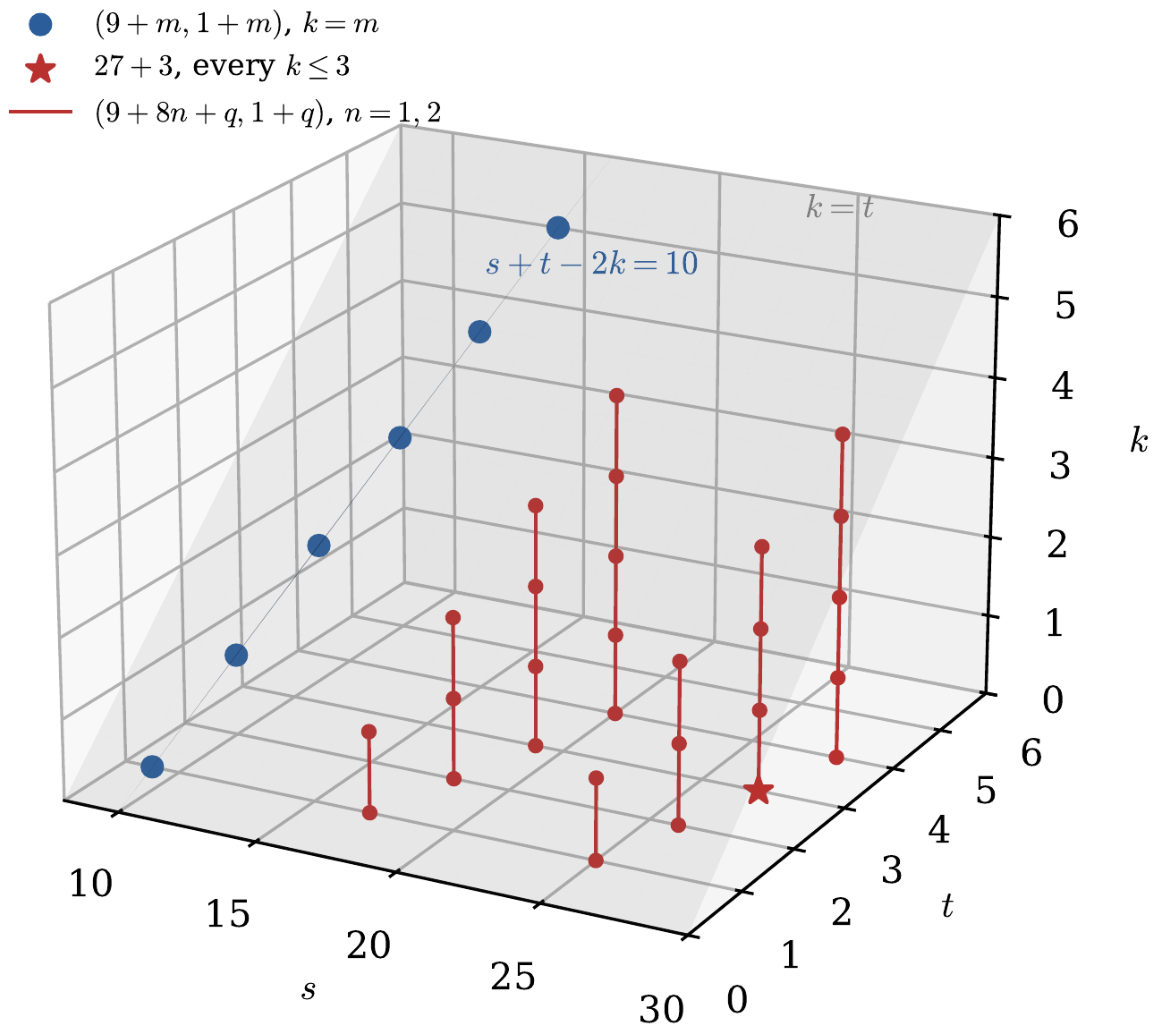
Figure 2.
The logical structure of the paper. The axioms pass through the oscillator decomposition and Steps 1–3 to the identity (6) on the residual spinors; Theorem 3.3 turns that identity into , and the bound on the number of null vectors converts this into a condition on . Proposition 2.1 enters Step 2 (dashed) and the single-time theorem. Proposition 4.1 is the case without null vectors. In the fourth row, Theorems 5.14 and 5.12 show that the conditions of the Main Theorem are sufficient when and . Theorem 7.3 drops (N4) and allows any contraction of the source; it uses Proposition 2.1 (dashed) and, for real gauginos, the bound on the number of null vectors. Proposition 7.5 uses the same projection (dashed) and excludes several gauginos. In the last row, Proposition 7.14 and Theorem 7.11 rerun Steps 1–3 of Theorem 5.6 for nonlinear rules and for any bilinear bracket, and Theorem 7.6 extends Proposition 7.5 to gauginos mixed by their transformation rules.
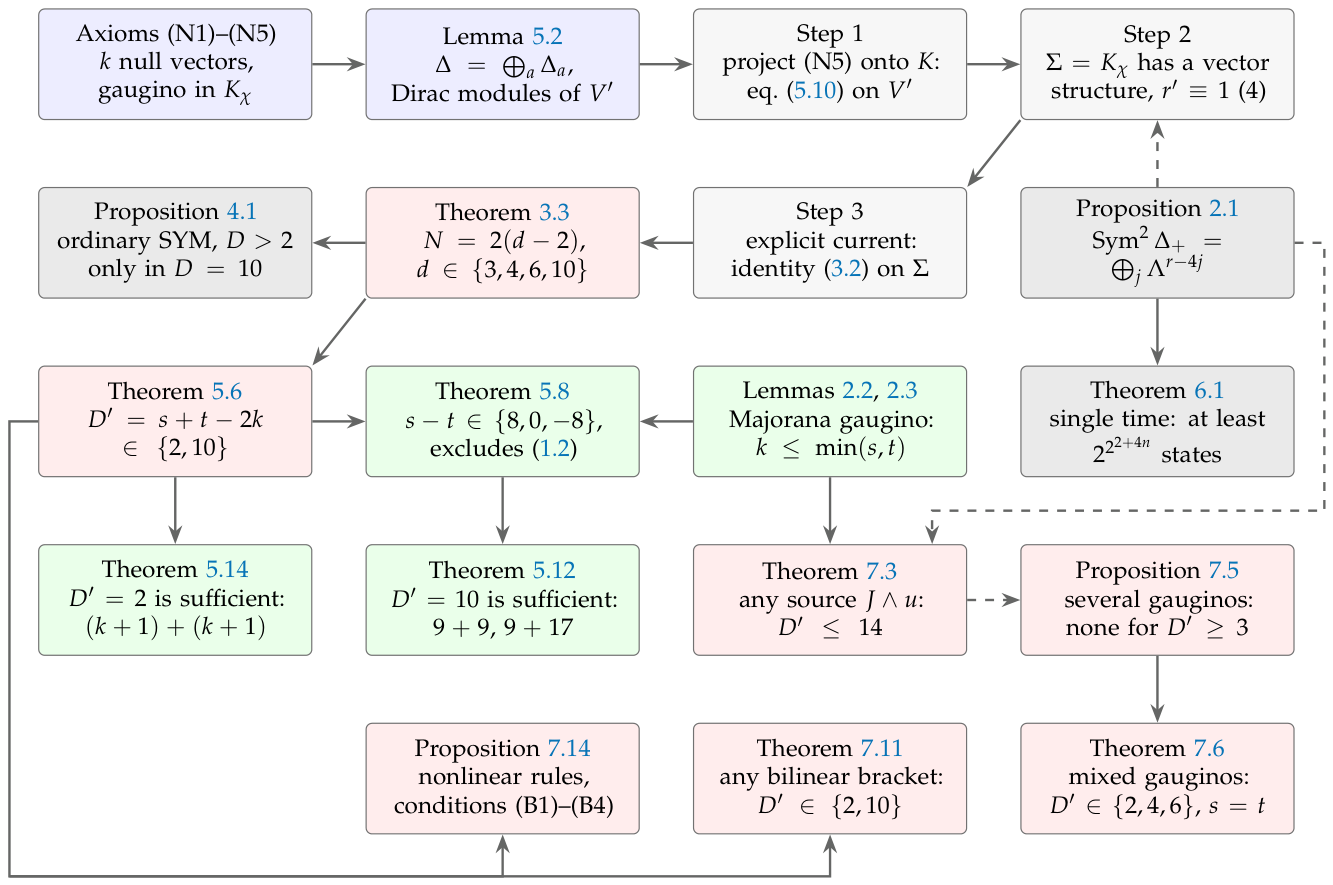
Figure 3.
The light cone of . Two independent real null vectors and satisfy , so the plane they span (grey) is not isotropic. In the largest isotropic subspaces have dimension (Lemma 2.2).
Figure 3.
The light cone of . Two independent real null vectors and satisfy , so the plane they span (grey) is not isotropic. In the largest isotropic subspaces have dimension (Lemma 2.2).
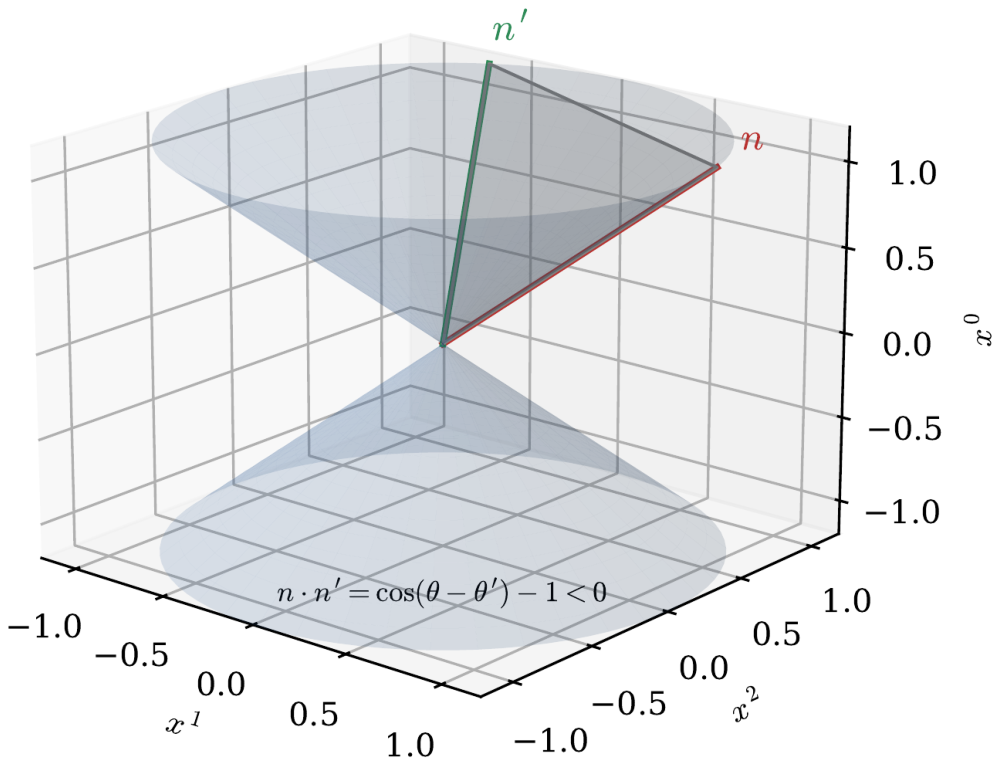
Figure 4.
The spinor dimension forced by the cubic identity (blue) against the smallest dimension that a vector structure can have (red). A solution requires the blue value to be a multiple of the red one. This happens for (circles) and never again, because the red curve grows exponentially.
Figure 4.
The spinor dimension forced by the cubic identity (blue) against the smallest dimension that a vector structure can have (red). A solution requires the blue value to be a multiple of the red one. This happens for (circles) and never again, because the red curve grows exponentially.
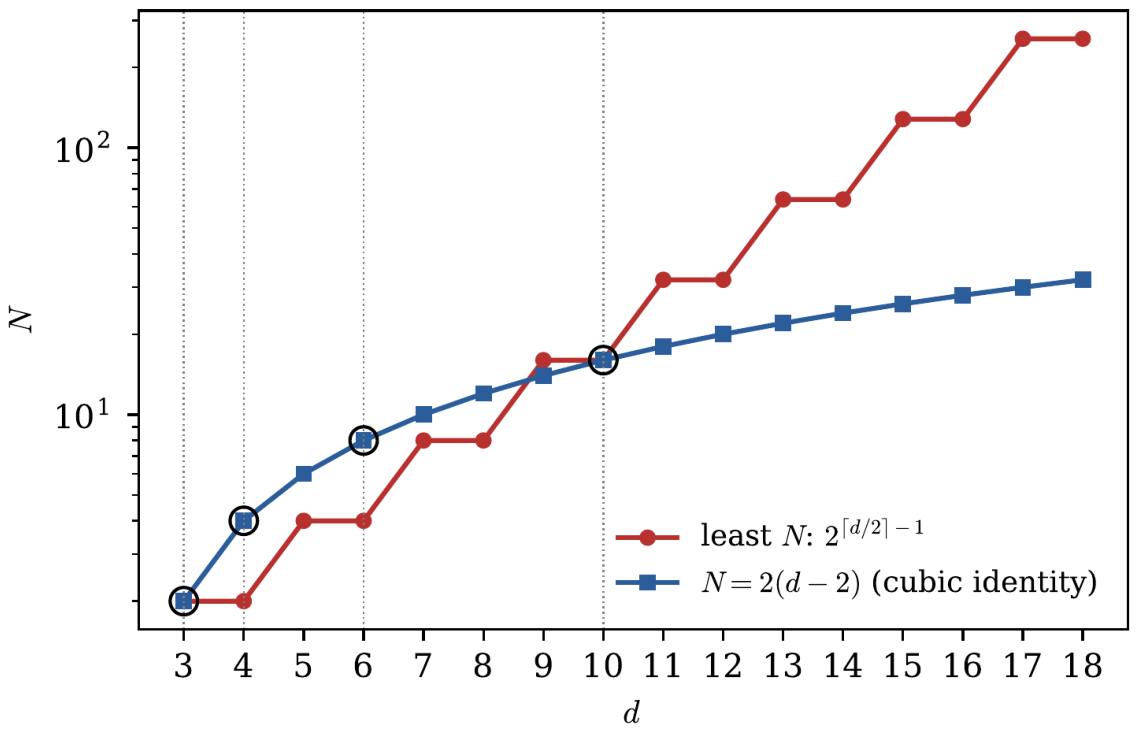
Figure 5.
The decomposition of the Dirac module for a null frame of rank . The vertices are the joint eigenspaces of the number operators , each a Dirac module of the residual space . The gaugino lives in the fully occupied corner K; the supersymmetry parameters that act on the residual components of the gauge field live in the opposite corner .
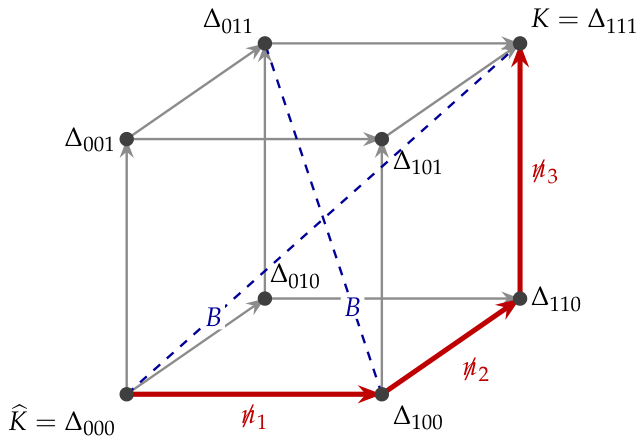
Figure 6.
Relative residual of the least-squares solution of the absorption equation (21) for real frames, plotted as against s and k. Blue: , , , , with , and , with , all with ; the residuals are below . Red: , , , with every tested k, ; the residuals lie between and 1, so no solution is found in these samples; the exact exclusion follows from the analytic theorem.
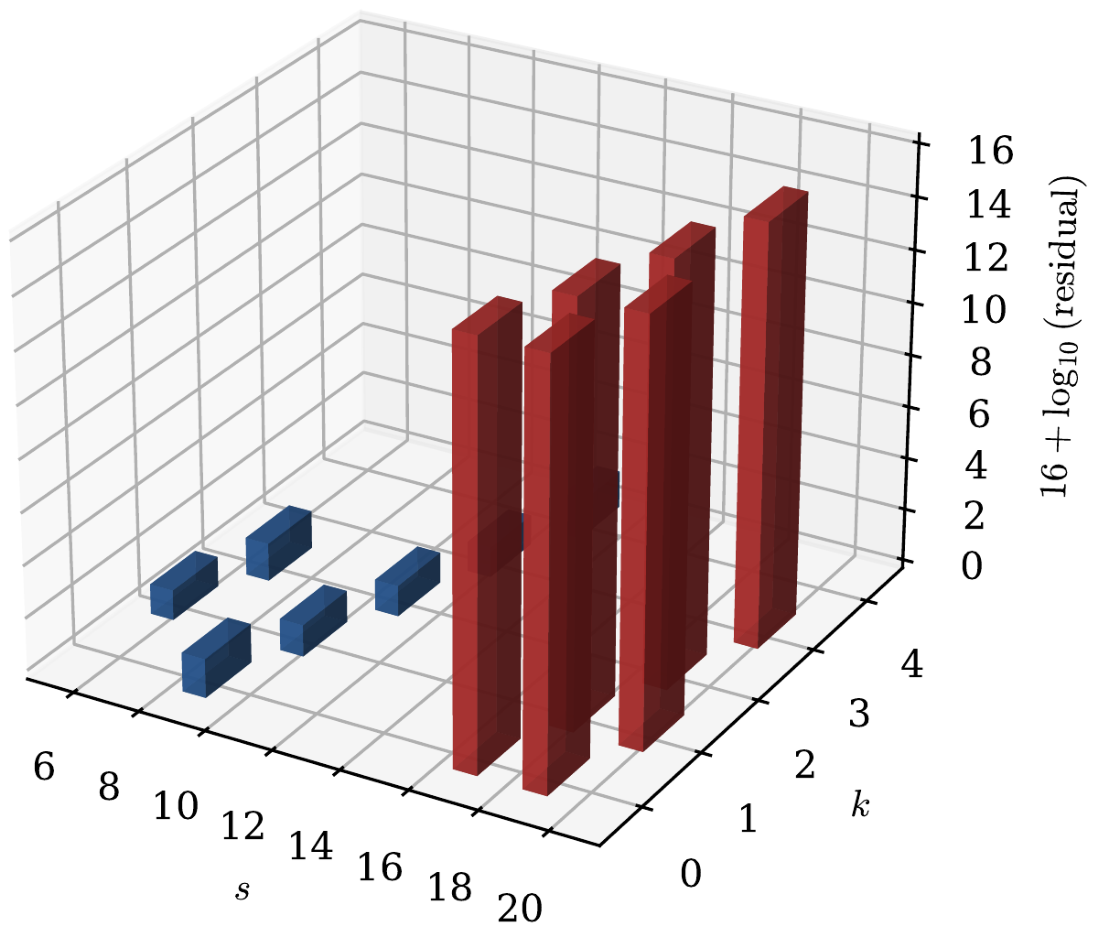
Figure 7.
The signatures and ranks k that carry a null-projected super Yang–Mills theory (Corollary 5.15). Blue: Nishino’s signatures . Green: the signatures and reached from them by complex isometries that keep D and k (Theorem 5.12); the large green points are and of the second degenerate family. Purple: residual dimension two, (Theorem 5.14). Red: the signatures , , with every rank ; only Sezgin’s with meets the plane .
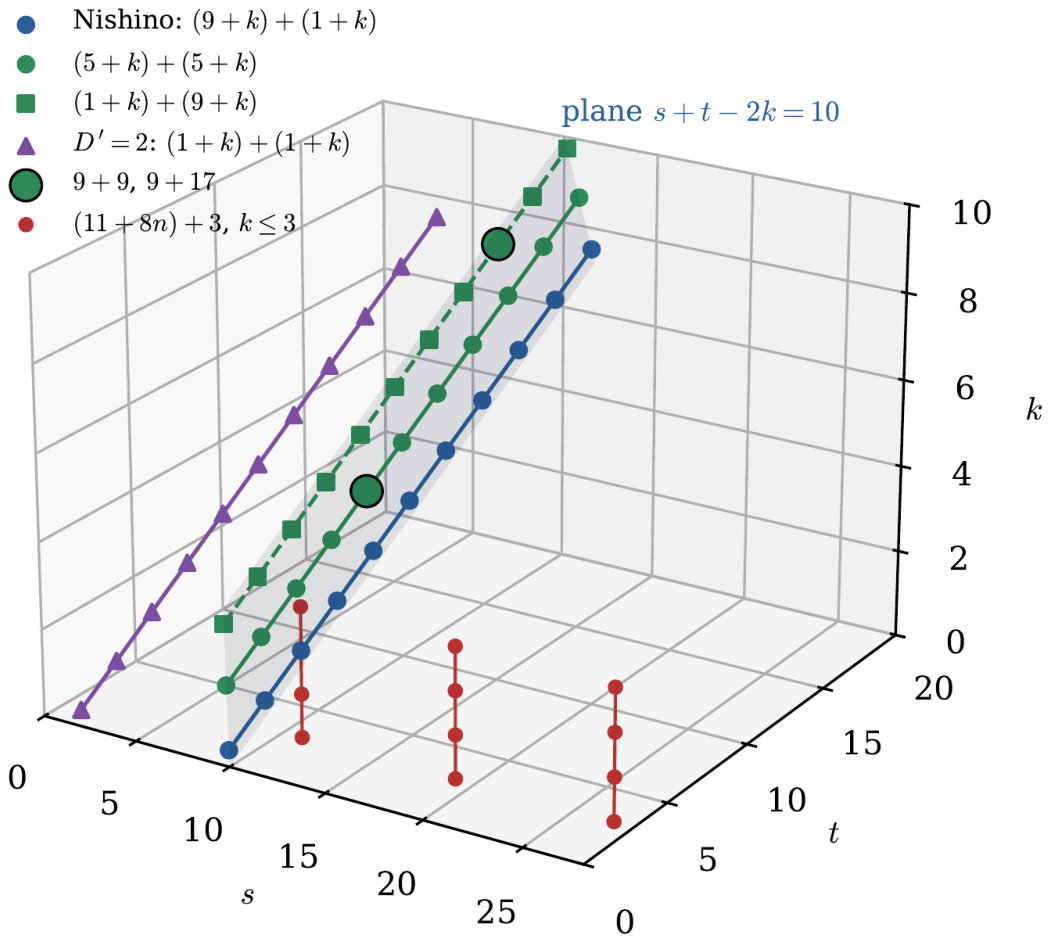
Figure 8.
Massless multiplets in , plotted as of the number of states. Blue: a vector field and a Majorana–Weyl gaugino, states. Red: the least number of states of a massless multiplet without tensor charges (Theorem 6.1). The two agree only for .
Figure 8.
Massless multiplets in , plotted as of the number of states. Blue: a vector field and a Majorana–Weyl gaugino, states. Red: the least number of states of a massless multiplet without tensor charges (Theorem 6.1). The two agree only for .
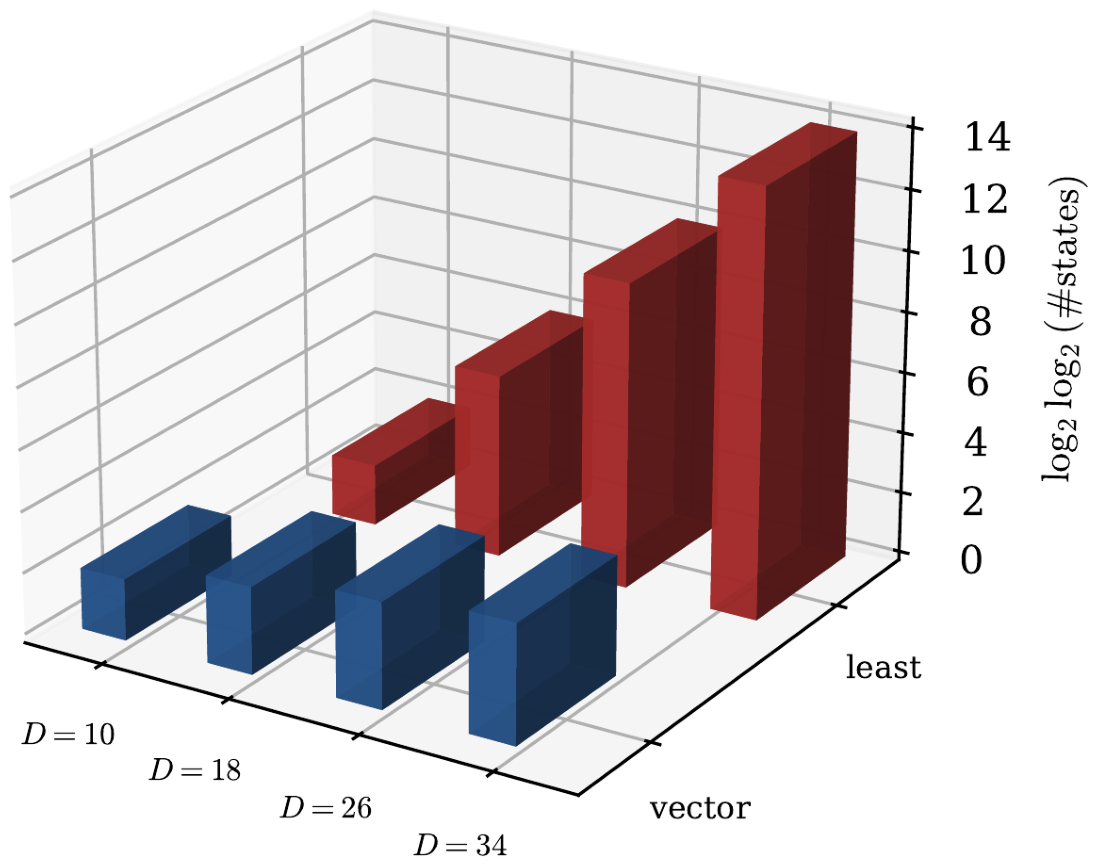
Figure 9.
The transfer in the space of signatures and ranks . Blue: Nishino’s real frames of rank in for , all below the wall (grey). Dashed: moving times into space. Red circles: the same ranks in , above the wall, since a real frame there has at most three null vectors. Green stars: the rank , the only one compatible with the translation bracket; at it is Sezgin’s theory in .
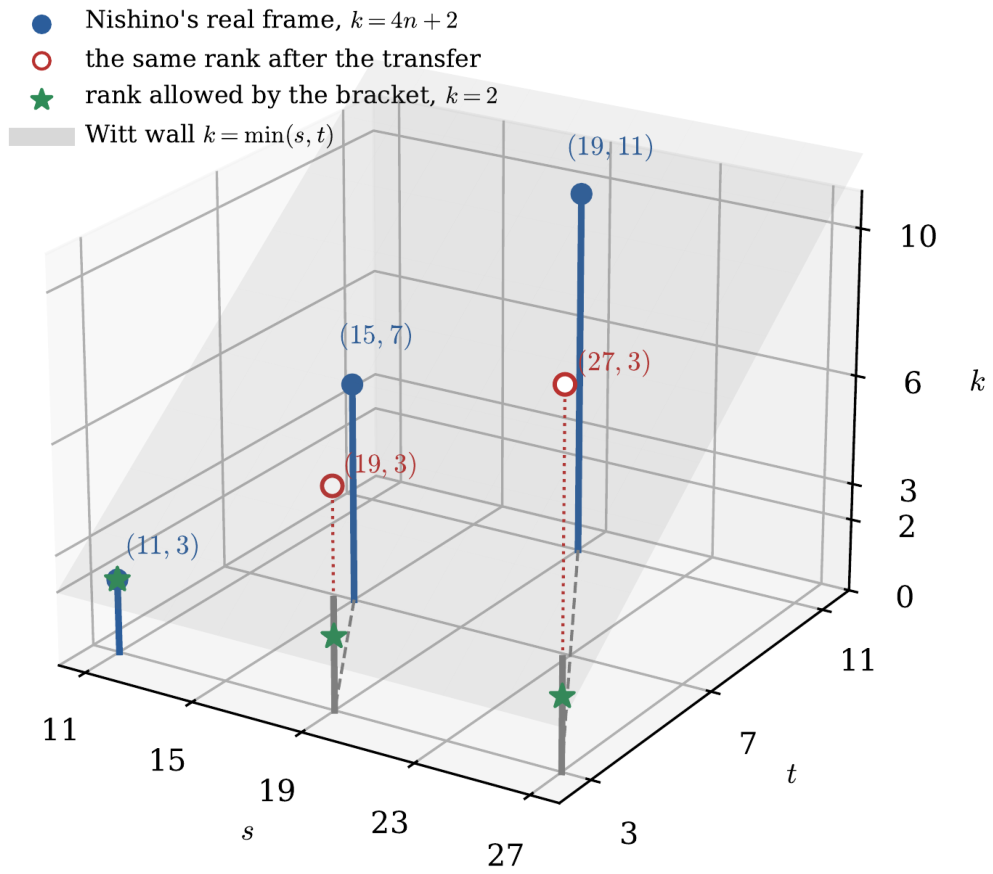
Figure 10.
At rank two in , the dimension of the residual Weyl module (red) against the dimension that absorption of the cubic terms requires by Theorem 3.3 (blue), on a logarithmic scale. They agree only for , Sezgin’s theory.
Figure 10.
At rank two in , the dimension of the residual Weyl module (red) against the dimension that absorption of the cubic terms requires by Theorem 3.3 (blue), on a logarithmic scale. They agree only for , Sezgin’s theory.
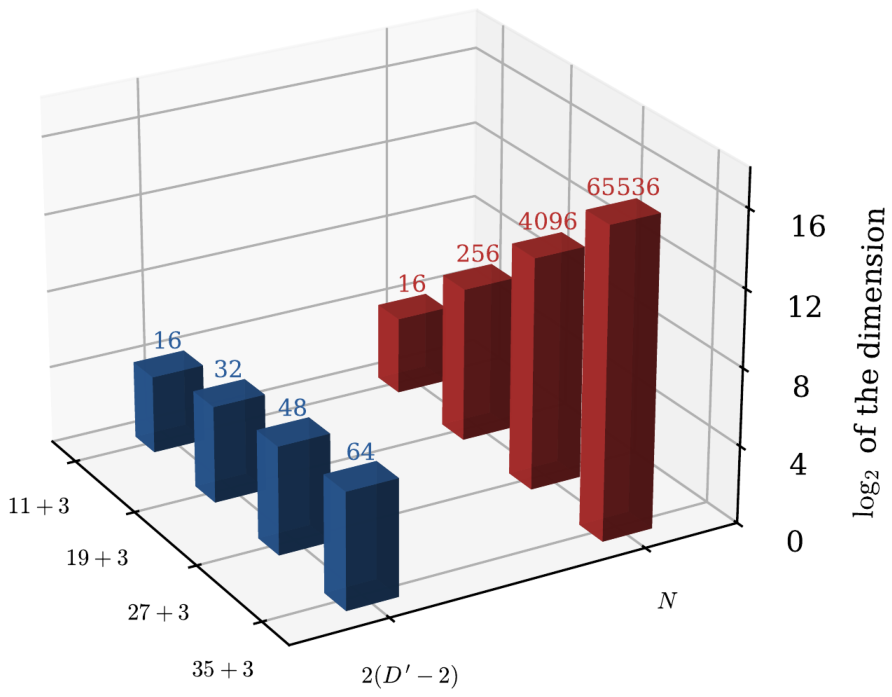
Figure 11.
The degrees in which the projected cubic terms have nonzero components (Theorem 7.3), for residual dimensions . Bar heights are , the dimension of the forms that a source must supply in degree p. Grey: is empty and the cubic terms vanish after projection. Green: one degree of dimension at most , so a source can absorb them ( and ). Orange: one degree, too large unless the frame has rank at least 54 (, 14). Red: two or more degrees, which no source of a single degree can supply (, where every signature of (2) with lies).
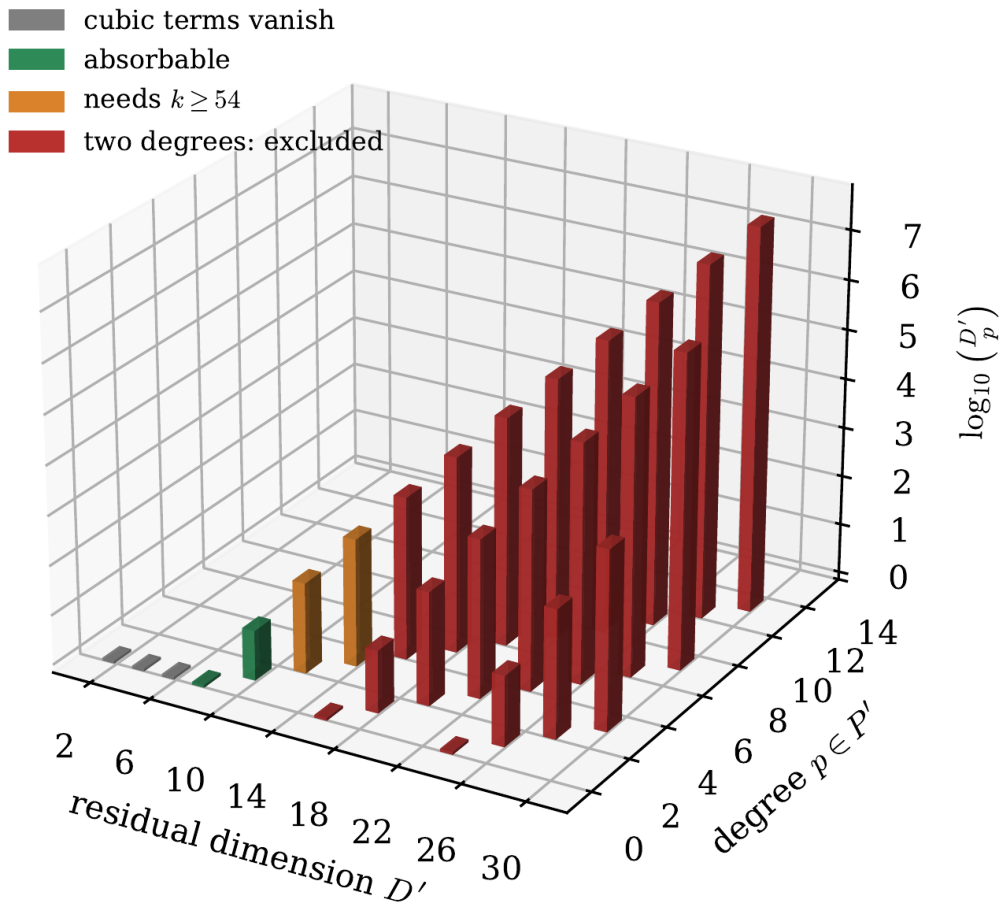
Table 1.
The transfer of Nishino’s construction from to for (Proposition 7.1). The rank of Nishino’s frame exceeds the Witt index 3 of the target; the only rank compatible with the translation bracket is 2; and at rank 2 the residual Weyl module has N components where absorption needs .
Table 1.
The transfer of Nishino’s construction from to for (Proposition 7.1). The rank of Nishino’s frame exceeds the Witt index 3 of the target; the only rank compatible with the translation bracket is 2; and at rank 2 the residual Weyl module has N components where absorption needs .
| target | source | Nishino’s k | largest real k | k allowed by (c) | N | ||
|---|---|---|---|---|---|---|---|
| 6 | 3 | 2 | 18 | 256 | 32 | ||
| 10 | 3 | 2 | 26 | 4 096 | 48 |
Disclaimer/Publisher’s Note: The statements, opinions and data contained in all publications are solely those of the individual author(s) and contributor(s) and not of MDPI and/or the editor(s). MDPI and/or the editor(s) disclaim responsibility for any injury to people or property resulting from any ideas, methods, instructions or products referred to in the content. |
© 2026 by the author. Licensee MDPI, Basel, Switzerland. This article is an open access article distributed under the terms and conditions of the Creative Commons Attribution (CC BY) license.
Copyright: This open access article is published under a Creative Commons CC BY 4.0 license, which permit the free download, distribution, and reuse, provided that the author and preprint are cited in any reuse.