

Submitted:
29 October 2026
Posted:
30 October 2026
You are already at the latest version
Abstract
Introduction: Broad-Based Black Economic Empowerment (BBBEE) certification and compliance evaluation are intended to support economic transformation, broaden participation and improve opportunities for historically disadvantaged enterprises in South Africa. Yet certification status is not necessarily equivalent to demonstrated transformation or MSME development. This review examined how BBBEE certification and compliance evaluation relate to evidential value for economic transformation and MSME development, including associated opportunities, risks, implementation conditions and evidence gaps. Methods: The researcher-selected databases and information sources were Google Scholar, ERIC, OpenAlex, Crossref. The eligibility protocol restricted publication years to 2013–2023. COSTAQDA recorded source-level retrieval through OpenAlex (75 retrieved; 660 available), Crossref (75 retrieved; 2656 available). Where researcher-selected sources did not expose a suitable direct bulk-search connector, COSTAQDA used its OpenAlex/Crossref discovery bridge while preserving the researcher-selected source names in the PRISMA record. The identification run recorded 150 records before cross-source deduplication and 144 unique records after deduplication. Results: Five higher-order conclusions emerged. BBBEE compliance provided signals of opportunity but not consistent proof of MSME development; market access was a principal linking mechanism; outcomes depended on implementation capacity, support and contextual fit; fronting, corruption and unequal distribution weakened evidential value; and the available evidence was fragmented and insufficient for certificate-level causal evaluation. Evidence included positive perceptions, procurement access, enterprise and supplier development, skills initiatives and employee inclusion, alongside adverse or uncertain business effects and implementation failures. Discussion/Conclusion: BBBEE certification is best interpreted as an access, compliance and accountability signal rather than as standalone evidence that economic transformation or MSME development has occurred. Stronger conclusions require transparent, longitudinal and outcome-linked analysis connecting certification records with firm, beneficiary and distributional outcomes.
Keywords:
BBBEE certification
; economic transformation
; MSMEs
; South Africa
; systematic review
1. Introduction
Broad-Based Black Economic Empowerment (BBBEE) occupies a central position in South Africa’s post-apartheid economic transformation framework. Its instruments include ownership, management control, employment equity, skills development, preferential procurement, enterprise development and socio-economic development. For MSMEs, compliance status and scorecards may influence access to public procurement, supplier relationships and strategic partnerships, while also creating expectations concerning ownership, skills and beneficiary participation. The review therefore addresses an important distinction: whether certification and compliance evaluation merely indicate formal participation in the transformation system or provide credible evidence that transformation and MSME development have occurred.
The supplied literature indicates that BBBEE can generate business opportunities. Studies describe procurement credentials and scorecards as conditions affecting access to tenders and markets, while enterprise and supplier development may support supplier capability, learning and participation (Niekerk, 2019; Pooe, 2016; Shai et al., 2019). Other studies report perceived organisational, employee and skills benefits, including employee shareholding, training, productivity and organisational effectiveness (Irene, 2017; Juggernath et al., 2013; Mudau, 2022). These findings suggest that compliance can operate as an institutional gateway through which enterprises obtain opportunities and demonstrate alignment with transformation objectives.
The evidence is nevertheless qualified and internally divergent. Some findings associate BBBEE with adverse or uncertain business effects, financial risk, weak skills outcomes or impeded transformation following legislative change (Irene, 2017; Forbes & Rust, 2019; Dreyer et al., 2021; Maclean, 2021). Other evidence identifies fronting, corruption, nepotism, elite concentration and weak accountability as threats to the redistributive integrity of the system (Niekerk, 2019; Gerber, 2018; Shava, 2017; Bracking, 2019). Sectoral charters, changing codes, uneven institutional support and geographically bounded implementation further complicate comparison across enterprises and settings (Ngcobo & Ladzani, 2016; Zulu, 2018; Mofokeng, 2017).
What remains insufficiently understood is the evidential relationship between certification status and substantive outcomes. The supplied studies examine perceptions, scorecards, procurement, organisational effects, sector implementation and broader transformation, but they do not provide a direct longitudinal analysis of the proposed 28,000 certificates from 2013 to 2023. Nor do they establish that certification itself causes MSME growth, beneficiary advancement or economy-wide transformation. A systematic review was therefore needed to integrate the fragmented evidence, preserve contradictory findings, assess methodological limitations and clarify what certification can and cannot validly demonstrate.
2. Research Objectives
RO1: To examine how Broad-Based Black Economic Empowerment (BBBEE) certification and compliance verification influences Evidential value regarding economic transformation and MSME development outcomes among Micro, Small, and Medium Enterprises (MSMEs) and commercial business entities in South Africa within South Africa, reflecting the 2013–2023 policy implementation and certification timeframe.
RO2: To identify the principal opportunities, benefits and enabling conditions associated with Broad-Based Black Economic Empowerment (BBBEE) certification and compliance verification in relation to Evidential value regarding economic transformation and MSME development outcomes.
RO3: To analyse the challenges, risks, ethical considerations and implementation barriers associated with Broad-Based Black Economic Empowerment (BBBEE) certification and compliance verification for Micro, Small, and Medium Enterprises (MSMEs) and commercial business entities in South Africa.
RO4: To examine the contextual, institutional and practice-related factors that shape the adoption and effective use of Broad-Based Black Economic Empowerment (BBBEE) certification and compliance verification within South Africa, reflecting the 2013–2023 policy implementation and certification timeframe.
RO5: To identify gaps in the available evidence and derive implications for future research, policy and practice relevant to BBBEE Certification as Evidence of Economic Transformation: Assessing the Evidential Value of 28,000 Certificates from 2013–2023 for MSME Development in South Africa.
3. Research Methods
3.1. Review Design
The selected review type was a Systematic Review. Evidence synthesis was understood as the systematic integration of existing research to identify patterns, differences, limitations and implications across studies. This design was appropriate because the question spans empirical, conceptual, sectoral, legal and implementation evidence and requires transparent searching, eligibility decisions, critical appraisal and structured synthesis. PRISMA was used as the reporting framework, whereas CASP was used for study-level critical appraisal. SALSA concepts distinguish searching, appraisal, synthesis and analysis; these functions should not be conflated with PRISMA reporting or with COSTAQDA software support (Grant & Booth, 2009; Page et al., 2021).
3.2. Search Strategy and Information Sources
The researcher-selected databases and information sources were Google Scholar, ERIC, OpenAlex, Crossref. The eligibility protocol restricted publication years to 2013–2023. COSTAQDA recorded source-level retrieval through OpenAlex (75 retrieved; 660 available), Crossref (75 retrieved; 2656 available). Where researcher-selected sources did not expose a suitable direct bulk-search connector, COSTAQDA used its OpenAlex/Crossref discovery bridge while preserving the researcher-selected source names in the PRISMA record. The identification run recorded 150 records before cross-source deduplication and 144 unique records after deduplication. The recorded search execution timestamp was 2026-10-29T07:38:46.547Z.
3.3. Inclusion and Exclusion Criteria
Inclusion
- Studies focusing on micro, small, and medium enterprises (MSMEs) operating within South Africa.
- Studies examining Broad-Based Black Economic Empowerment (BBBEE) certification or compliance as a primary or secondary phenomenon.
- Studies that evaluate the relationship between BBBEE certification and economic transformation outcomes.
- Studies that assess the impact or role of BBBEE certification on MSME development or growth.
- Peer-reviewed journal articles published between 2013 and 2023.
- Studies written in the English language.
- Studies providing empirical or theoretical analysis of BBBEE certificates as evidence of economic transformation.
Exclusion
- Studies focusing exclusively on large enterprises or multinational corporations without reference to MSMEs.
- Studies that do not address BBBEE certification or compliance evaluation.
- Studies that do not discuss economic transformation or MSME development outcomes.
- Studies set entirely outside of the South African economic context.
- Documents published before 2013 or after 2023.
- Non-English language publications.
- Document types other than peer-reviewed journal articles, such as books, conference proceedings, or grey literature.
- Studies that mention BBBEE only in passing without evaluating its evidential value for transformation or development.
3.4. Screening and Study Selection
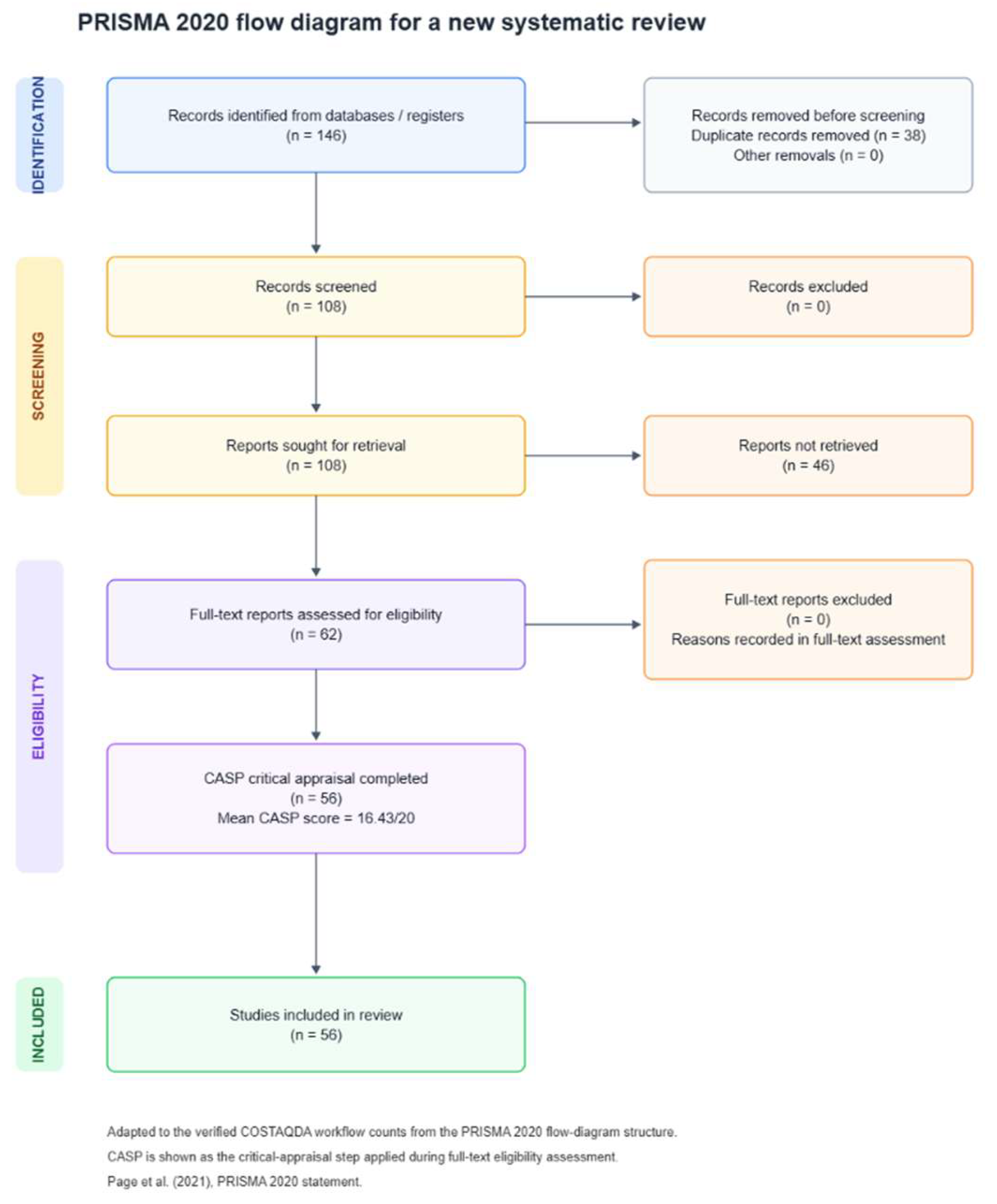
The PRISMA selection counts are persisted, but the decision rule used during title/abstract screening is not available in the verified audit payload. COSTAQDA therefore reports the recorded workflow counts without reconstructing an unverified screening procedure.
The persisted PRISMA workflow records 146 identified records, 38 duplicates, 108 records screened, 108 reports sought for retrieval, 0 records excluded at the title/abstract stage, 62 full texts assessed, 0 full-text exclusions and 56 included records. These counts describe study selection and are not substantive review findings.
Figure 1.
PRISMA 2020 Flow Diagram — Identification, Screening, Eligibility and Included. The PRISMA figure should be read as a reporting account of study identification and selection, not as a substantive finding about BBBEE. The recorded flow comprises 146 identified records, 38 duplicates, 108 screened records, 108 reports sought, 62 full texts assessed and 56 included studies. Because the supplied counts contain the unresolved discrepancy between full texts assessed, full-text exclusions and included records, the figure can transparently display the persisted values but cannot be treated as a reconciled audit trail. PRISMA supports transparent reporting of the review process rather than validation of the substantive conclusions (Page et al., 2021). Source: COSTAQDA PRISMA Workflow, navigation item 8: PRISMA Flow Diagram; four-stage structure showing Identification, Screening, Eligibility (including CASP critical appraisal) and Included; adapted from PRISMA 2020 (Page et al., 2021).
3.5. Critical Appraisal
CASP was used in the PRISMA full-text workspace, and 56 of 56 currently included studies had completed appraisals. CASP provides structured study-design-specific questions concerning methodological validity, findings and relevance; it is not a universal measure of evidential truth or a substitute for synthesis judgment. The supplied workspace reports a mean score of 16.43, but no overall quality labels or criterion-level rationales were preserved. Accordingly, the mean is treated descriptively rather than as a validated total-quality score (Critical Appraisal Skills Programme, 2024; Long et al., 2020).
The appraisal record shows substantial variation in reported CASP scores, including lower scores for studies such as Van Scheers (2016), Reddy and Rampersad (2013), Mudau (2022), and Klaaren (2021), and higher scores for Bingwa (2022), Mofokeng (2017), Hlakudi (2013) and several other studies. These scores do not by themselves establish that one study’s findings are correct or that another study’s findings are unusable. They indicate that the supplied text-based appraisal identified differing levels of methodological concern, while the absence of detailed criterion rationales limits the ability to determine whether a concern reflected demonstrated weakness, incomplete reporting or uncertainty.
Study-linked limitations are more interpretable where the supplied record preserves them. Greyling’s Boksburg family-business study used a geographically bounded, non-probability convenience sample, with 41 questionnaires returned from 150 businesses, limiting representativeness (Greyling, 2015). Mofokeng’s Clarens accommodation-sector evidence was also bounded by a small local setting and a sample of 22 respondents, while Zulu’s Soweto study linked weak implementation and limited support to difficulty achieving intended tourism transformation (Mofokeng, 2017; Zulu, 2018). These concerns constrain generalisation from local implementation findings to South African MSMEs as a whole.
The synthesis therefore weighted convergence and divergence rather than treating CASP as an arithmetic gate. Evidence about procurement access, enterprise development and institutional conditions converged across several studies, whereas evidence about business performance, skills outcomes and distributional effects diverged. The appraisal concerns reinforce caution about causal interpretation, especially where findings were perceptual, conceptual, geographically bounded or based on secondary material. No finding-level confidence assessment was recorded, so CASP appraisal informed interpretation but did not generate formal confidence ratings or CERQual judgments (Noyes et al., 2018; Lewin et al., 2018).
Figure 2.
CASP Critical Appraisal Intelligence — PRISMA Workflow, Step 6: Full-Text Screening.Source: COSTAQDA PRISMA Workflow, navigation item 6: Full-Text Screening (CASP critical appraisal outputs). The Word figure is generated from the same deterministic COSTAQDA CASP visual.
Figure 2.
CASP Critical Appraisal Intelligence — PRISMA Workflow, Step 6: Full-Text Screening.Source: COSTAQDA PRISMA Workflow, navigation item 6: Full-Text Screening (CASP critical appraisal outputs). The Word figure is generated from the same deterministic COSTAQDA CASP visual.
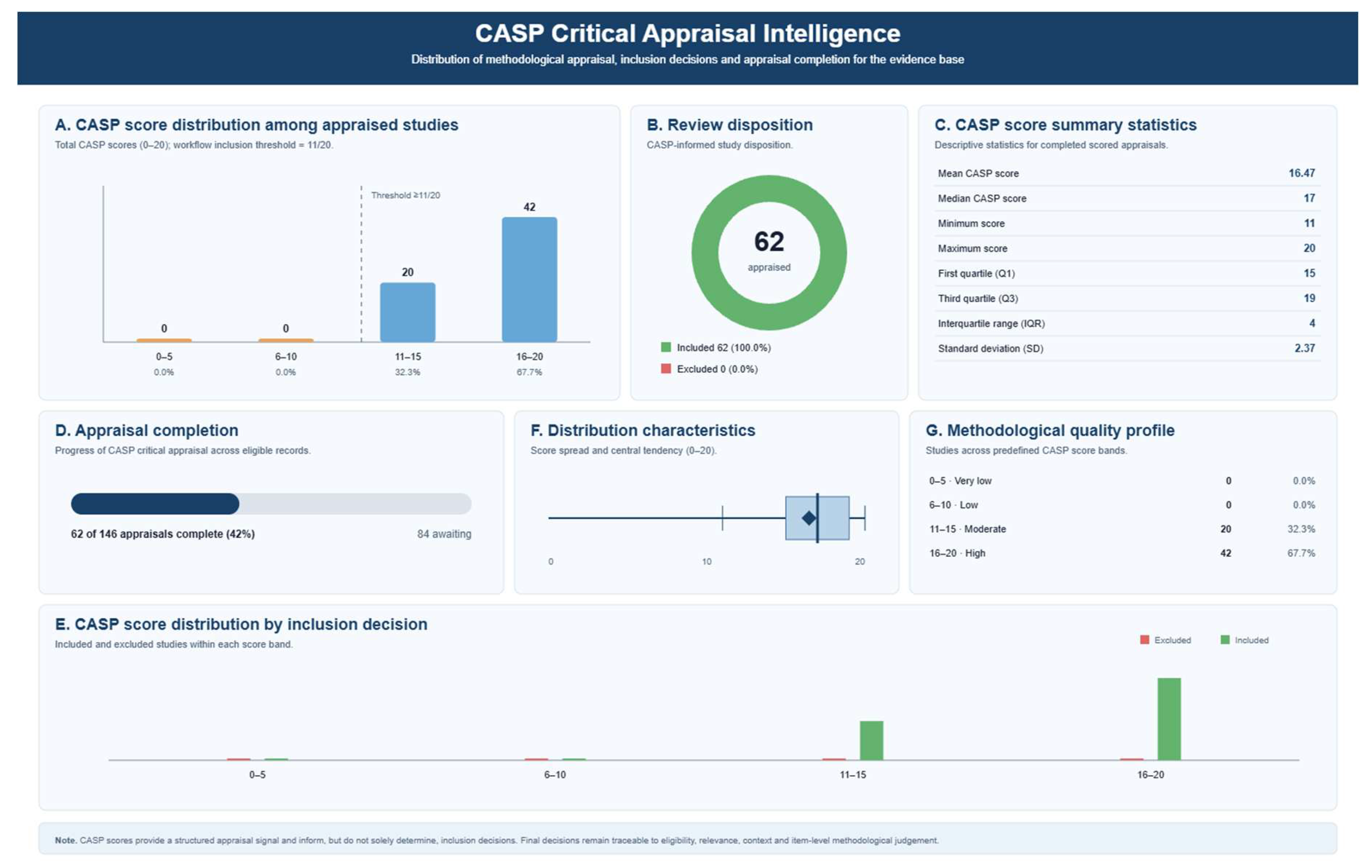
The CASP figure represents study-level appraisal outputs for 56 included studies, all marked complete, with a recorded mean score of 16.43. It is appropriate as a visual summary of appraisal activity and recorded judgments, but the figure cannot establish a single underlying construct of quality because the checklist criteria are study-design-specific and the supplied record does not preserve criterion-level rationales for every study.
The observable pattern is dispersion rather than a basis for ranking evidence as simply strong or weak. Recorded scores range from 11 for Nyamunda (2016) to 20 for Bingwa (2022), with several studies between these values. The spread suggests variation in methodological reporting and appraisal concerns across empirical, conceptual, legal, repository and secondary sources. It does not demonstrate that higher-scoring studies provide more influential or more causally valid findings.
The CASP record also contains conservative text-evidence decisions generated when the configured appraisal service was unavailable. Unsupported criteria were recorded as “Can’t tell” and require researcher verification. This is important methodological information: missing reporting should not be silently converted into demonstrated methodological failure, and automated completion should not be interpreted as equivalent to a fully documented human appraisal rationale (Long et al., 2020).
For synthesis interpretation, the figure supports caution around evidence concerning causal effects of certification on MSME development. It does not replace study-specific reading, does not provide finding-level confidence, and does not constitute GRADE-CERQual. Its principal contribution is traceability of appraisal completion and recorded concern, consistent with the use of structured evidence-management support in COSTAQDA (Costa & Costa, 2024).
3.6. Data Extraction
A formal data-extraction procedure was not recorded in the project workspace. Nevertheless, the verified synthesis demonstrates that extracted finding-level material was available: 331 findings contributed by 45 studies. The available record includes study identifiers, titles, authors, years, source information, abstracts, appraisal fields and finding-level text. Because the extraction protocol, duplicate checking procedure and extraction form were not recorded, the completeness and consistency of extraction cannot be independently established.
3.7. Data Synthesis and Analysis
Qualitative evidence synthesis was conducted on 331 extracted findings contributed by 45 studies. The COSTAQDA synthesis engine applied thematic synthesis, moving from traceable finding-level evidence to 11 initial codes, 4 categories, 1 descriptive themes and 4 analytical themes.
Theme development was constrained to the extracted finding-level evidence supplied by eligible studies. Each synthesised theme retained supporting study IDs and finding IDs, while contradictory evidence was preserved where identified. Titles, abstracts and bibliographic prominence were not treated as substitutes for extracted qualitative findings.
Recorded synthesis limitations included: The supplied findings do not provide the proposed 28,000-certificate dataset or a direct longitudinal analysis of certificates issued between 2013 and 2023.; Much of the evidence concerns BBBEE, BEE scores, contributor status or implementation generally rather than independently verified certification outcomes.; The evidence is heterogeneous across sectors, firm sizes and outcomes, limiting direct cross-study comparability.; Several studies are geographically bounded or use small, convenience or non-probability samples, including the Boksburg family-business study and the Clarens accommodation-sector study.; Some supplied extracts report methods, literature or research questions rather than substantive findings and therefore contribute little to conclusions about transformation outcomes.; The synthesis identifies convergence and contradiction in the supplied findings but cannot establish causality between compliance evaluation and MSME development..
3.8. Bibliometric Intelligence and Confidence in the Evidence Base
Bibliometric intelligence provides a structural view of the evidence base that complements PRISMA selection, critical appraisal and qualitative synthesis. The following analyses examine citation relationships, scholarly influence, evidence connectivity and knowledge development within the included corpus. They provide contextual evidence about the intellectual structure and provenance of the literature and are not substitutes for methodological quality appraisal.
3.8.1. Local Citation Network
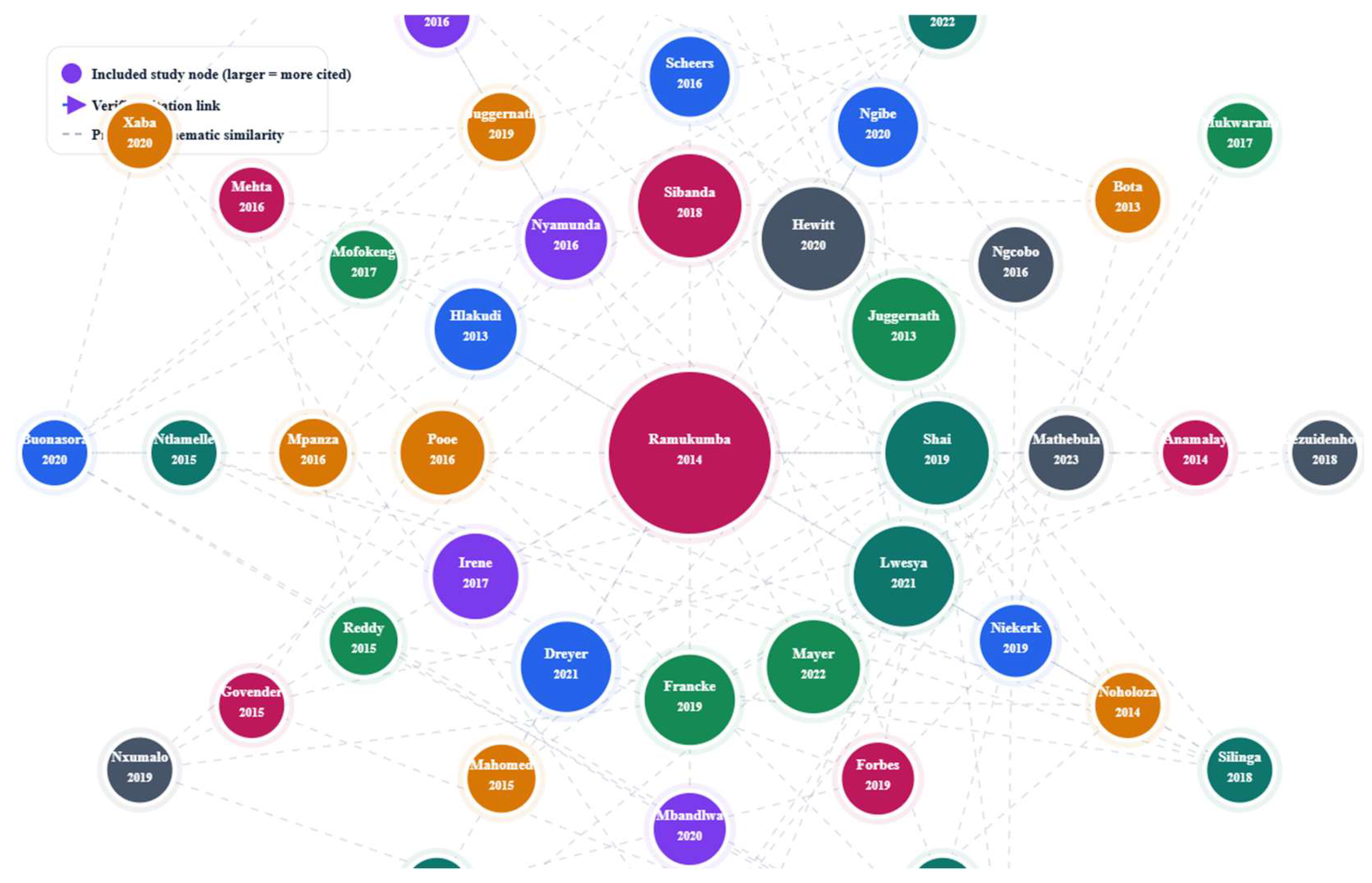
The Local Citation Network maps citation relationships within the included evidence base. It shows how studies are connected within the review corpus and supports examination of intellectual connectedness, centrality, bridging and isolation. These citation relationships describe the structure of the literature and do not, by themselves, establish methodological quality or validity.
Figure 3.
Local Citation Network — Bibliometric Intelligence, Step 12.Source: COSTAQDA PRISMA Workflow, navigation item 12: Bibliometric Intelligence — Local Citation Network.
Figure 3.
Local Citation Network — Bibliometric Intelligence, Step 12.Source: COSTAQDA PRISMA Workflow, navigation item 12: Bibliometric Intelligence — Local Citation Network.
3.8.2. Influence Pyramid
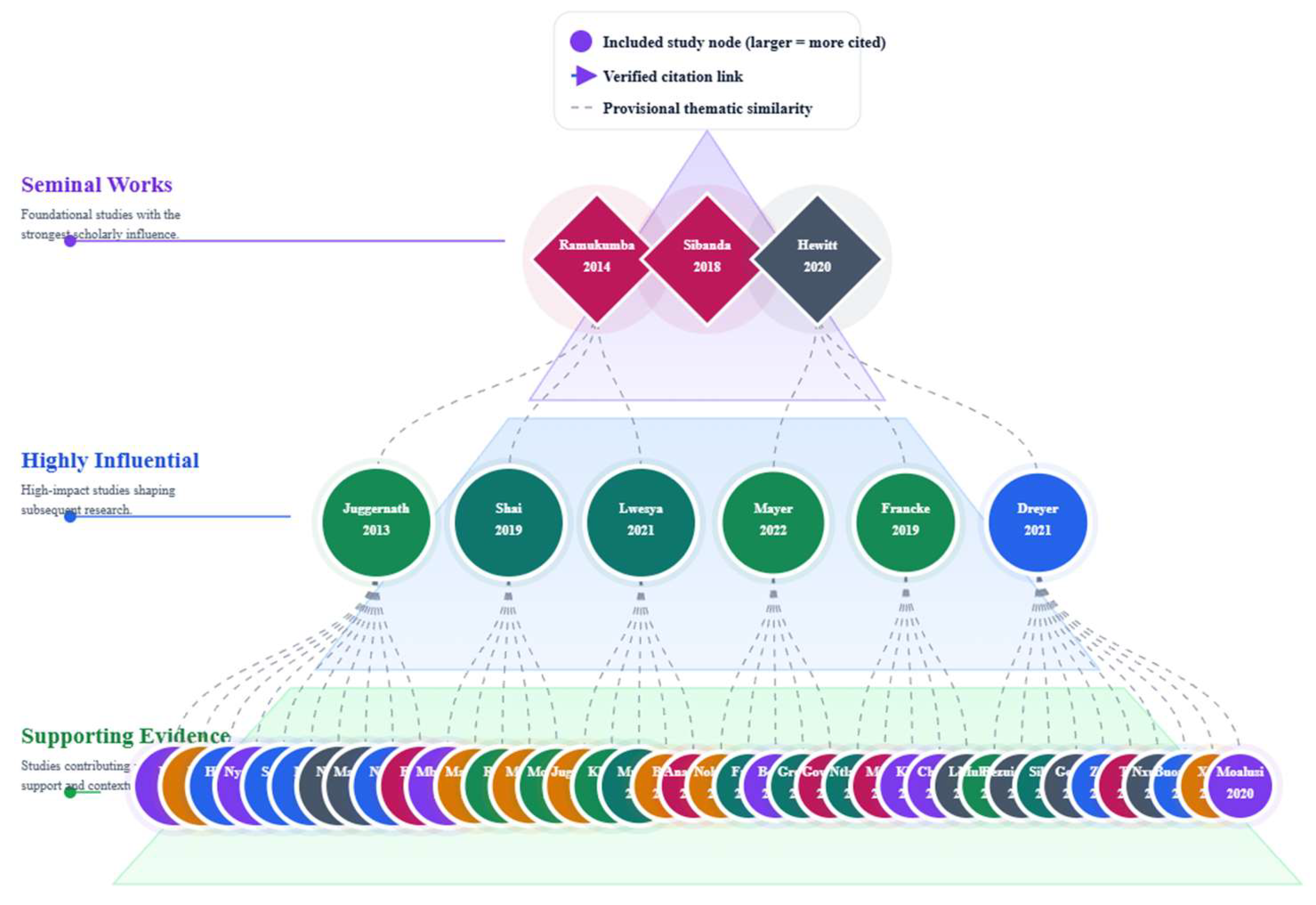
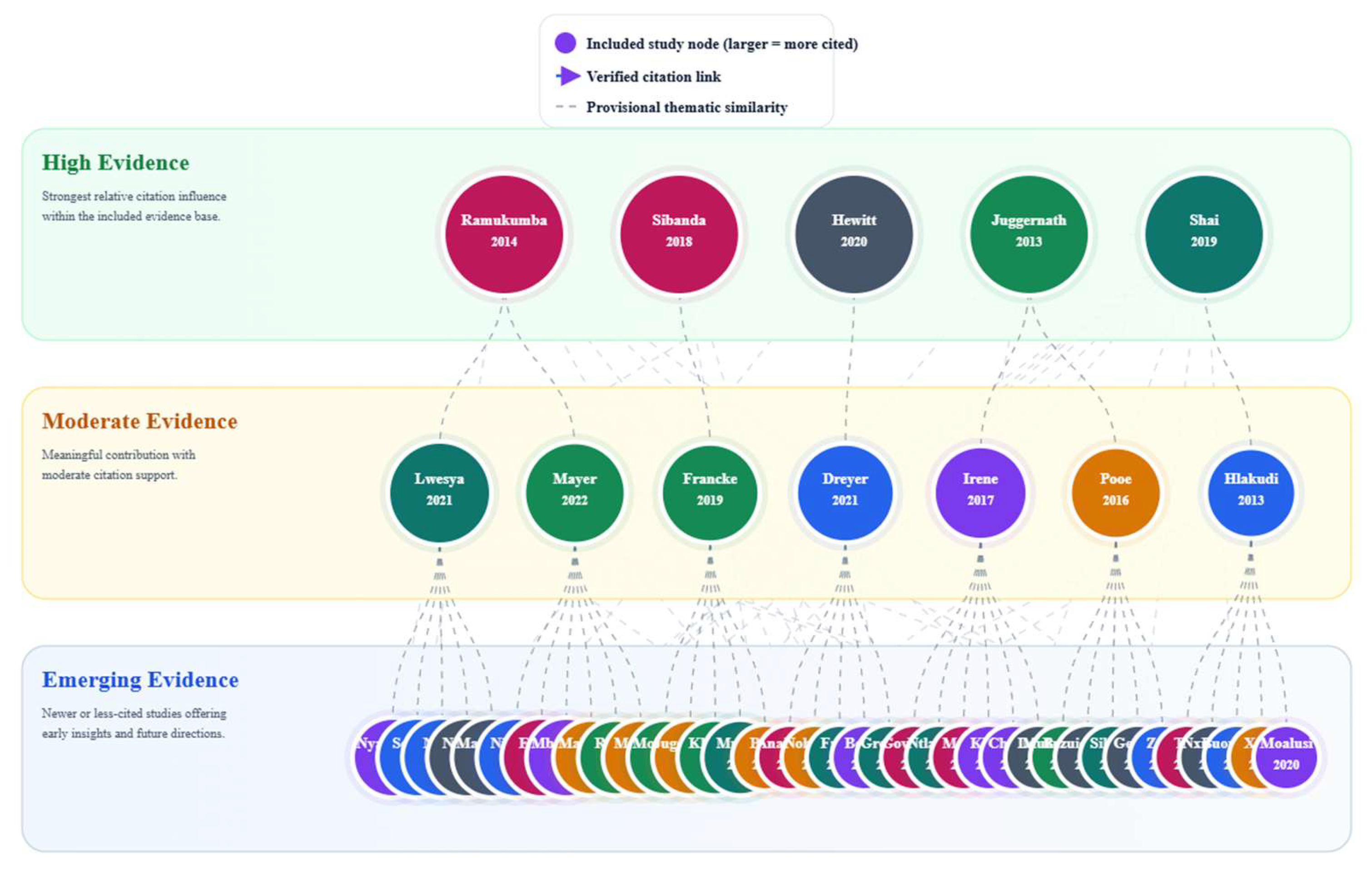
The Influence Pyramid represents the distribution of scholarly influence within the included evidence base. It helps identify how bibliometric prominence is distributed across the reviewed studies. Influence is interpreted separately from methodological quality, which is assessed through critical appraisal.
Figure 4.
Influence Pyramid — Bibliometric Intelligence, Step 12. The Influence Pyramid is interpreted as a bibliometric prominence visualisation, not as methodological quality. Its recorded unit is the publication node: the OpenAlex intelligence contains 49 included nodes, 49 thematic clusters, 379 global citations, 0 local citations, 87 links and influenceScore values recorded as 0. The visualisation is appropriate for showing how bibliometric prominence and thematic placement are distributed across the mapped publication set, but the supplied metadata do not provide the influenceScore formula or establish the comparability of citation coverage. The strongest observable pattern is that the mapped evidence ecosystem contains a small number of publications with comparatively higher recorded global citation counts, including Overcoming SMEs Challenges through Critical Success Factors with 105, The impact of SME access to finance and performance on exporting behaviour at firm level with 60, The role of business incubators in creating sustainable small and medium enterprises with 42, and Corporate responsibility for socio-economic transformation with 31. These values indicate bibliometric prominence within the supplied OpenAlex record; they do not establish quality, causal strength, consensus or relevance to the 28,000-certificate question. The pyramid can therefore contextualise which works are more visible in the mapped literature while the thematic synthesis determines what extracted findings say. Citation coverage may favour older, indexed or more discoverable publications, and the 49-node bibliometric set does not equal the 56 records in the PRISMA inclusion count or the 45 studies contributing extracted findings. The absence of local citations and the zero influenceScore values further limit independent interpretation. Bibliometric prominence must not be equated with CASP appraisal or confidence in qualitative findings (Donthu et al., 2021; Zupic & Čater, 2015). Source: COSTAQDA PRISMA Workflow, navigation item 12: Bibliometric Intelligence — Influence Pyramid.
3.8.3. Evidence Strength
The Evidence Strength analysis examines the structure and strength of relationships within the evidence ecosystem assembled for the review. It complements, but does not replace, CASP methodological appraisal and must not be interpreted as a direct estimate of causal effect.
Figure 5.
Evidence Strength Network — Bibliometric Intelligence, Step 12. The Evidence Strength Network represents the structure of relationships within the mapped evidence ecosystem, not methodological quality or formal evidential confidence. Its recorded network contains 49 publication nodes and 87 direct edges; edge weights are null, and the supplied relation type is “direct.” The network is appropriate for displaying how the mapped works are connected in the project’s recorded evidence structure, but the absence of numerical weights means that tie strength cannot be interpreted beyond the displayed direct relationships. The observable structure connects work on procurement, enterprise development, implementation, fronting, organisational effects, transformation measurement and MSME support. This supports an interpretation of an interconnected evidence ecosystem rather than a set of isolated topics. However, an edge does not establish independent corroboration, study quality, causal strength, confidence or an observed effect. The network therefore complements, but cannot replace, CASP appraisal or thematic synthesis (Aria & Cuccurullo, 2017; van Eck & Waltman, 2010). Source: COSTAQDA PRISMA Workflow, navigation item 12: Bibliometric Intelligence — Evidence Strength Network.
3.8.4. Knowledge Evolution
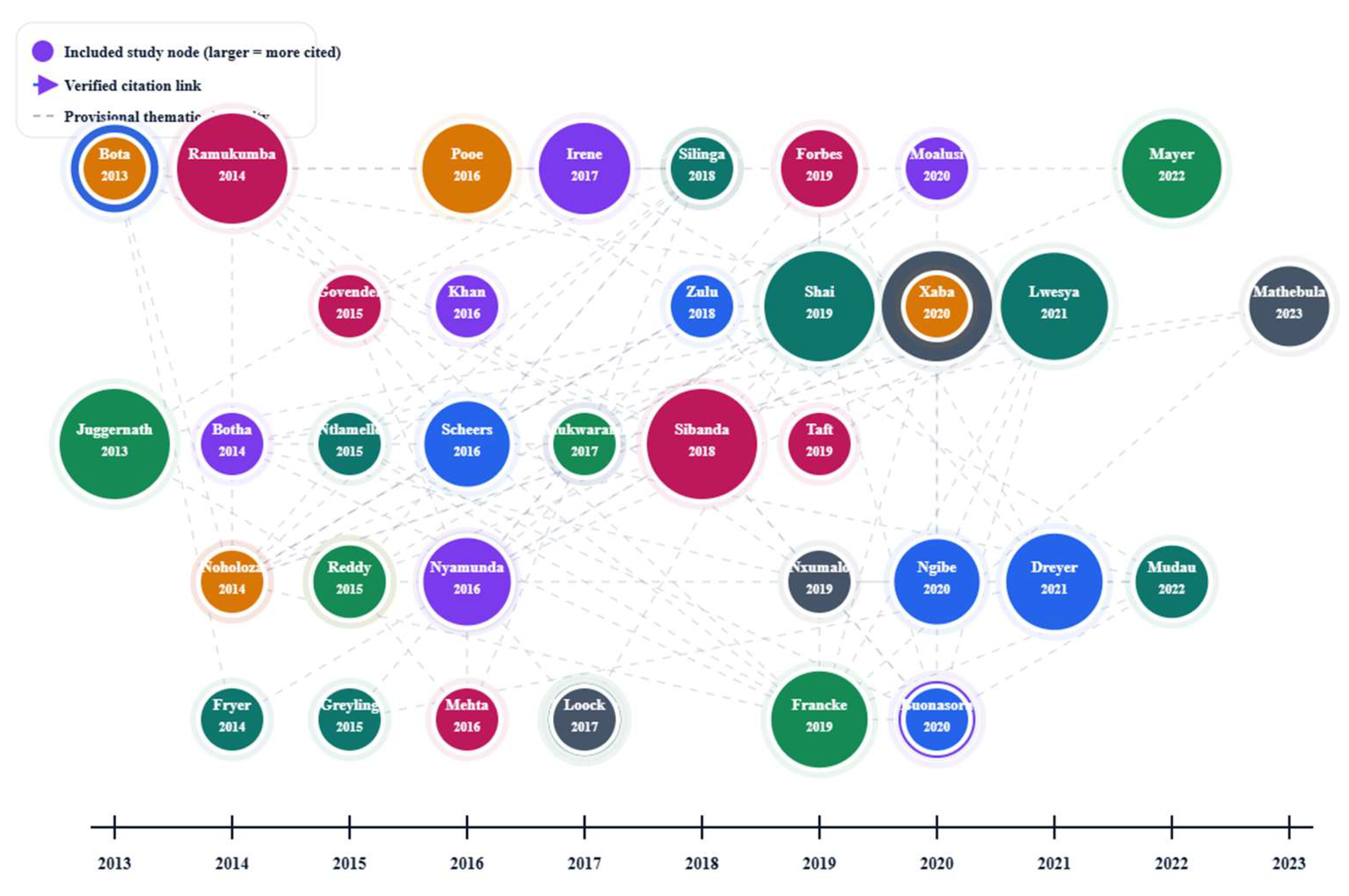
Knowledge Evolution examines the temporal and intellectual development of the included evidence base. It traces how research contributions develop over time and, where supported by the Step 12 data, how later studies extend, connect, challenge or consolidate earlier contributions.
Figure 6.
Knowledge Evolution — Bibliometric Intelligence, Step 12.Source: COSTAQDA PRISMA Workflow, navigation item 12: Bibliometric Intelligence — Knowledge Evolution.
Figure 6.
Knowledge Evolution — Bibliometric Intelligence, Step 12.Source: COSTAQDA PRISMA Workflow, navigation item 12: Bibliometric Intelligence — Knowledge Evolution.
3.8.5. Integrated Confidence in the Synthesised Evidence
No separate finding-level confidence method was recorded. CASP provided methodological appraisal at study level, but it was not converted into formal confidence in synthesised findings. Thematic convergence, contradiction, study limitations, contextual boundedness and the directness of evidence were considered qualitatively. The review therefore makes cautious interpretive claims and does not claim that CERQual, GRADE-CERQual or another formal confidence framework was conducted (Lewin et al., 2018; Noyes et al., 2018).
4. Findings
4.1. Search and Selection Results
The recorded search and selection process identified 146 records, removed 38 duplicates, screened 108 records, sought 108 reports, assessed 62 full texts and included 56 records. No records were recorded as excluded at title and abstract screening or full-text assessment. These counts describe review workflow rather than BBBEE outcomes. The 62-assessed, 0-excluded and 56-included figures contain an unresolved discrepancy and are therefore reported without reconciliation.
4.2. Characteristics of Included Studies
The included evidence was heterogeneous in source type, design, sector and outcome. It included studies of MSME perceptions, procurement, enterprise and supplier development, tourism, construction, accounting, mining, organisational effectiveness, financial health, fronting, economic transformation and broader policy implementation. The evidence also included repository studies, conceptual analyses, legal analysis and secondary or documentary work alongside journal articles. The thematic synthesis drew on 45 studies and 331 findings, whereas the PRISMA workspace recorded 56 included records; this difference reflects the distinction between included records and studies contributing extracted findings.
The evidence was distributed across local and sector-specific contexts, including Boksburg family businesses, Soweto tourism, Clarens accommodation, Gauteng enterprises, construction, mining, accountancy and public procurement. Some studies examined commercial entities rather than MSMEs directly, while others addressed broader BBBEE or transformation conditions. This breadth supports cross-study synthesis but limits direct comparability and makes certificate-level inference inappropriate.
4.3. Methodological Strengths and Limitations of Included Studies
Methodological strengths included the use of empirical surveys, regression analysis, case studies, interviews, documentary analysis and conceptual frameworks, allowing the review to examine BBBEE from multiple perspectives. Some studies reported substantial datasets or explicit analytical procedures, such as the 500-participant study of female SME operators, the 379-company financial-health study and the 159-SME survey reported in the supplied evidence (Irene, 2017; Dreyer et al., 2021; Sibanda et al., 2018).
Limitations included geographically bounded and non-probability samples, incomplete reporting, conceptual or secondary evidence, heterogeneous outcomes and inconsistent direct measurement of certification. Greyling’s Boksburg study reported 41 returned questionnaires from 150 businesses and explicitly cautioned against generalisation; Mofokeng’s Clarens study concerned a small accommodation-sector setting; and several supplied extracts consisted primarily of methods, literature or research questions rather than substantive findings (Greyling, 2015; Mofokeng, 2017). These limitations constrain causal and national-level conclusions.
4.4. Thematic Synthesis
Thematic synthesis is a systematic qualitative evidence-synthesis method used to integrate findings across multiple studies while retaining a transparent connection to the underlying evidence. The process moves iteratively from extracted study findings to coding, the grouping of related codes into descriptive categories or themes, and the development of higher-order analytical themes that answer the review question and research objectives. Its purpose is not merely to count how often an idea appears, but to identify patterned meaning across studies, examine convergence and divergence, preserve contextual differences, and develop an auditable interpretation that remains traceable to the contributing evidence.
In this review, thematic synthesis was applied to the verified extracted findings retained in the active COSTAQDA project. Findings were compared across eligible studies, coded and grouped according to conceptual similarity, and then developed into 5 analytical themes represented across 15 evidence-contributing studies. The active synthesis retained 25 verified theme-to-study support assignments, allowing the analytical interpretation to remain traceable to the underlying studies rather than being reconstructed from titles or bibliographic prominence. The resulting analytical themes include “BBBEE compliance as an evidential signal rather than proof of transformation”, “Market access, enterprise development and inclusion as principal opportunities”, “Implementation, ethical and distributional risks”, “Contextual and institutional conditions shaping effective use”, with the widest cross-study support recorded for “BBBEE compliance as an evidential signal rather than proof of transformation” (5 contributing studies). Table 1 therefore operationalises the synthesis as an auditable evidence map linking each analytical theme to the studies that supplied verified supporting findings.
Table 1. Thematic Synthesis Matrix.
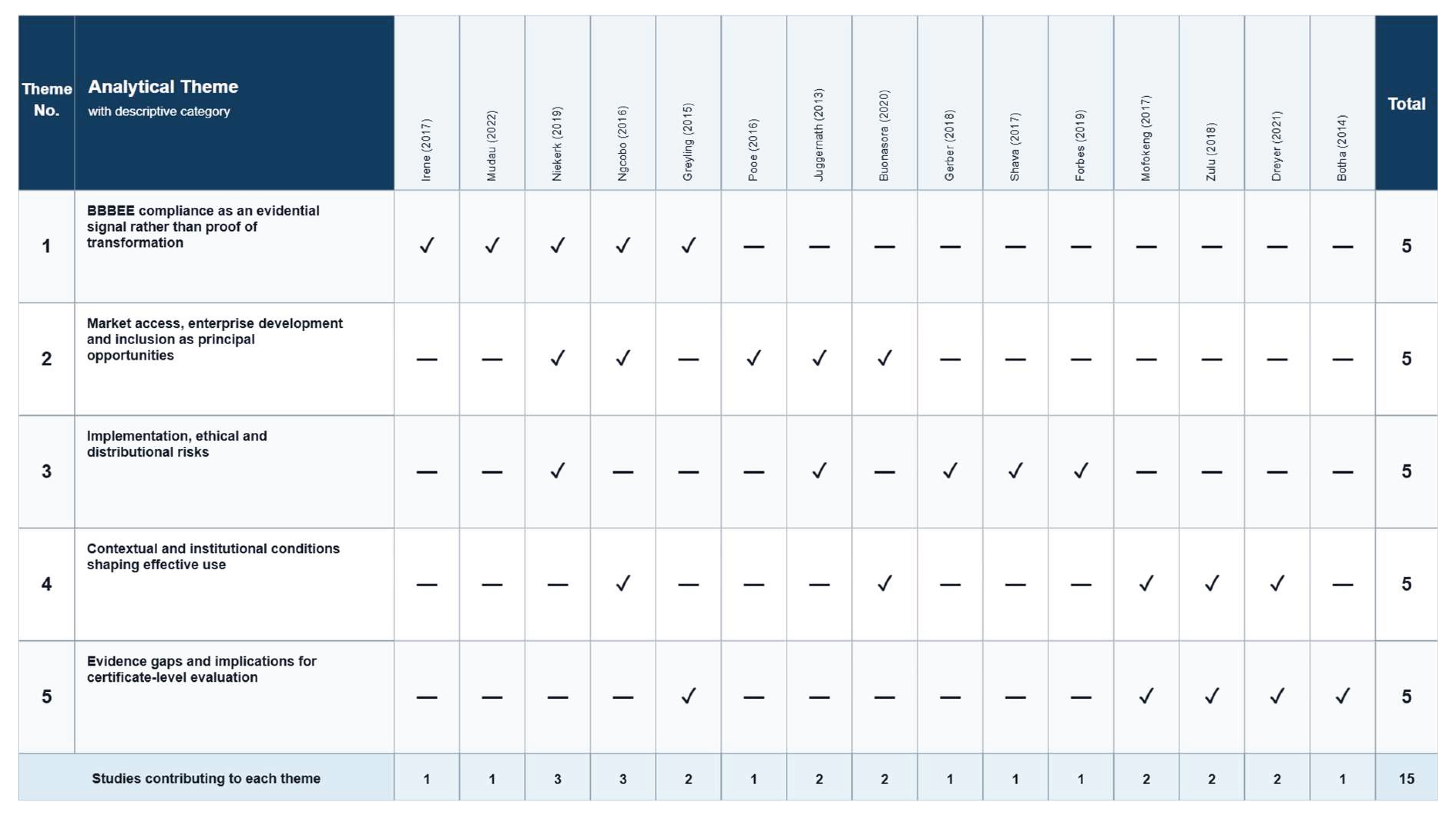
Table 1 legend: Only studies contributing verified extracted qualitative evidence are displayed. ✓ = verified extracted evidence from the study supports the theme; — = the study contributed to the synthesis but no supporting extracted finding from that study was assigned to this theme. An em dash does not indicate contradictory evidence.
Table 1 presents the thematic synthesis matrix linking the verified analytical themes only to studies with verified extracted evidence supporting at least one of the themes displayed in the matrix. Any study with no verified supporting contribution to any displayed theme is excluded, even if it was included elsewhere in the systematic review or qualitative evidence base. Rows represent analytical themes and columns represent theme-contributing studies. A check mark (✓) indicates that at least one verified extracted finding from that study was assigned to the theme; an em dash (—) indicates that the study contributed evidence to the synthesis overall but no supporting extracted finding from that study was assigned to that particular theme. The absence of a supporting assignment must not be interpreted as contradictory evidence. The totals report the number of evidence-contributing studies providing verified support to each theme. The matrix therefore functions as an audit trail between thematic interpretation and the underlying finding-level evidence rather than as a measure of methodological quality or effect size.
The most widely supported analytical theme was “BBBEE compliance as an evidential signal rather than proof of transformation”, with verified support from 5 of 15 studies. The least widely distributed theme was “Evidence gaps and implications for certificate-level evaluation”, with verified support from 5 of 15 studies. Differences in the number of supporting studies indicate the distribution of traceable thematic evidence across the included literature, not the relative importance or quality of a theme. Themes supported by fewer studies may still be analytically important when the underlying findings are conceptually rich, contextually distinctive or directly relevant to the review question. Conversely, wider study support indicates cross-study recurrence but does not by itself establish stronger methodological quality. The thematic patterns shown in Table 1 should therefore be interpreted alongside critical appraisal, contextual variation, contradictory findings where verified, and the detailed theme-led discussion that follows.
4.5. RO1: BBBEE Compliance as an Evidential Signal Rather than Proof of Transformation
Across the evidence, BBBEE compliance was associated with opportunities for procurement, enterprise development, supplier participation, employee inclusion and organisational benefits, but these relationships did not amount to consistent proof of MSME development. The evidence included positive perceptions of business benefit and organisational effectiveness, yet also reported adversarial business-performance perceptions, uncertain financial effects and weak skills outcomes (Irene, 2017; Mudau, 2022; Dreyer et al., 2021; Maclean, 2021). The resulting pattern is qualified: certification or contributor status may signal eligibility, participation or formal compliance, but it does not independently demonstrate growth, redistribution or beneficiary improvement.
The distinction is especially important because several studies examined scores, perceptions or policy implementation rather than independently verified certificates linked to longitudinal enterprise outcomes. The supplied evidence does not provide the proposed 28,000-certificate dataset or directly connect certificate status to firm growth, ownership change, employment, procurement value or beneficiary-level transformation. Accordingly, the relationship identified under RO1 is evidential and institutional rather than causal.
4.6. RO2: Market Access, Enterprise Development and Inclusion as Principal Opportunities
The most consistent opportunity identified was market access. BBBEE credentials and scorecards could shape eligibility for public tenders, procurement opportunities, supplier relationships and strategic partnerships (Niekerk, 2019; Hlakudi, 2013; Shai et al., 2019). Enterprise and supplier development extended this mechanism by potentially improving supplier capability, learning, performance measurement and participation in value chains (Pooe, 2016; Silinga, 2018).
Additional benefits included employee shareholding, training, diversity management, job satisfaction, organisational effectiveness and skills development (Juggernath et al., 2013; Mudau, 2022). These opportunities were conditional rather than automatic. The evidence indicates that support offices, mediation, monitoring, evaluation, clear benchmarks, sector alignment and adequate understanding of changing codes were enabling conditions (Zulu, 2018; Ngcobo & Ladzani, 2016; Buonasora, 2020).
4.7. RO3: Implementation, Ethical and Distributional Risks
The principal risks concerned fronting, corruption, nepotism, fraud, weak accountability and the concentration of benefits among connected or elite groups. These risks weaken the relationship between formal compliance and substantive transformation because a compliant status may coexist with limited beneficiary participation or distorted procurement outcomes (Niekerk, 2019; Gerber, 2018; Shava, 2017; Bracking, 2019).
Implementation burdens also arose from changing codes, unclear beneficiary definitions, different sector benchmarks and insufficient understanding among enterprises. Forbes and Rust (2019) reported that legislative change resulted in non-compliance for QSEs and impeded transformation goals, while Maclean (2021) identified uncertainty in applying the skills-development element. These findings show that compliance evaluation can create uncertainty and risk for smaller firms while still failing to ensure that intended benefits reach disadvantaged groups.
4.8. RO4: Contextual and Institutional Conditions Shaping Effective Use
The review found that sector, locality, firm characteristics, ownership structure, institutional arrangements and policy interpretation shaped how BBBEE was adopted and used. Sector charters differed in benchmarks and legal effect, while procurement consequences varied according to whether a charter was gazetted and binding on public entities (Ngcobo & Ladzani, 2016). Local implementation also varied: the Clarens accommodation evidence showed limited Black participation, while Soweto tourism evidence indicated that planned interventions were not effectively implemented (Mofokeng, 2017; Zulu, 2018).
Effective use depended on support and implementation capacity. The evidence identified the need for MSME support offices, road shows, mediation, monitoring and evaluation, harmonised benchmarks, management involvement and training (Zulu, 2018; Juggernath et al., 2013; Buonasora, 2020). These conditions mediate the pathway from formal compliance to practical opportunity and explain why similar BBBEE instruments may produce different outcomes across sectors and localities.
4.9. RO5: Evidence Gaps and Implications for Certificate-Level Evaluation
The available evidence is fragmented across perceptions, scorecards, procurement, sector implementation, organisational effects and broader transformation indicators. Studies often used local, small, convenience or non-probability samples, and several extracts reported methods or research questions rather than substantive outcomes (Greyling, 2015; Mofokeng, 2017). The evidence therefore supports a structured account of mechanisms and risks but not a validated certificate-level measure of transformation.
The principal gap is the absence of a direct longitudinal linkage between certification records and outcomes for MSMEs and intended beneficiaries. The supplied material does not include the proposed 28,000 certificates from 2013 to 2023, nor does it establish whether certification predicts firm survival, employment, ownership, procurement access, revenue, skills, supplier development or distributional change. Future analysis must therefore distinguish certification, compliance verification, contributor status and substantive transformation outcomes.
5. Discussion
The review answers RO1 by showing that BBBEE certification and compliance evaluation have evidential value, but only in a qualified sense. They indicate that an enterprise has entered a formal regulatory and market-recognition system, and they may shape access to procurement and partnerships. They do not, without additional evidence, establish that economic transformation or MSME development has occurred. This conclusion reconciles positive findings concerning business benefit, organisational effectiveness and market access with contradictory evidence concerning adverse performance perceptions, non-compliance, weak skills outcomes and incomplete transformation (Irene, 2017; Mudau, 2022; Forbes & Rust, 2019; Maclean, 2021).
The findings addressing RO2 show that market access is the principal mechanism linking compliance with opportunity. Procurement credentials can open doors to tenders and supplier relationships, while enterprise and supplier development may improve capability and learning (Hlakudi, 2013; Pooe, 2016; Shai et al., 2019). However, the pathway is institutionally dependent. If smaller firms lack support, information or the resources needed to respond to changing requirements, certification can become a compliance burden rather than a development mechanism. The review therefore interprets opportunity as conditional on implementation capacity, not as an automatic consequence of certification.
The findings addressing RO3 demonstrate why evidential value is also an ethical and distributional issue. Fronting, corruption, nepotism and concentration among connected groups can produce formal compliance without substantive redistribution (Gerber, 2018; Shava, 2017; Bracking, 2019). These findings do not establish that all certificates are invalid. They do establish that certificate status should be interpreted alongside ownership, management control, procurement flows, skills outcomes, enterprise-development inputs and beneficiary-level effects. A status-only evaluation risks overstating transformation and obscuring who benefits.
The findings addressing RO4 emphasise contextual fit. Sector charters, locality, firm size, ownership structure and institutional support shape how compliance is understood and converted into opportunity. The contrast between sectoral charter analysis, Clarens accommodation evidence and Soweto tourism implementation demonstrates that the same broad policy framework can have different practical effects (Ngcobo & Ladzani, 2016; Mofokeng, 2017; Zulu, 2018). The review consequently rejects a universal interpretation of certification and supports context-sensitive evaluation.
RO5 is addressed by identifying a fundamental evidence gap: the supplied corpus does not contain a direct longitudinal analysis of the proposed 28,000 certificates. The review contributes a framework for such analysis by specifying the outcomes and risks that certificates should be tested against, but it cannot substitute for the missing dataset. The methodological heterogeneity, incomplete reporting and absence of a recorded finding-level confidence method further require the conclusions to remain cautious.
6. Conclusion
BBBEE certification and compliance evaluation relate to evidential value for economic transformation and MSME development primarily by signalling formal eligibility, market access, institutional participation and accountability. The evidence does not support treating certification as standalone proof that transformation or MSME development has occurred. Opportunities are most evident in procurement, enterprise and supplier development, skills and organisational inclusion, but outcomes depend on implementation capacity, support, sectoral context, transparent measurement and integrity. Fronting, corruption, unequal distribution, changing codes and weak implementation reduce the reliability of status-only evidence. The review therefore answers the objectives by concluding that BBBEE certification is a partial and conditional indicator whose substantive meaning must be established through linked, longitudinal and beneficiary-sensitive outcome evidence.
7. Recommendations
Practice: Enterprises and certifying or verifying bodies should treat certification as one component of an evidence portfolio and retain auditable records connecting compliance claims to procurement participation, supplier development, skills, ownership, management and beneficiary outcomes.
Practice: MSME support should include accessible guidance on changing codes, sector-specific requirements, enterprise-development opportunities and monitoring processes, with particular attention to smaller firms that may experience compliance as a resource burden.
Policy: BBBEE monitoring should strengthen transparency, anti-fronting controls, accountability and beneficiary-level reporting, while harmonising or clearly explaining sector benchmarks and distinguishing formal status from substantive transformation outcomes.
Policy: Procurement and enterprise-development programmes should incorporate measurable indicators of additionality, continuity, supplier capability and distribution of benefits rather than relying solely on contributor level or certificate validity.
Future research: The proposed 28,000-certificate dataset should be analysed longitudinally from 2013 to 2023 and linked, where lawfully and ethically possible, to firm survival, employment, revenue, ownership, procurement, skills, enterprise-development and beneficiary outcomes.
Future research: New studies should use transparent sampling, consistent outcome definitions, sectoral and geographic comparison, repeated measurement and mixed-method designs capable of distinguishing certification effects from broader institutional and economic conditions.
Funding
Researchers did not seek funding for this article.
Acknowledgments
COSTAQDA was used as an AI-assisted evidence-synthesis and manuscript-development environment. AI-assisted functions supported the organisation, synthesis and presentation of verified project evidence and manuscript preparation within the documented COSTAQDA workflow. AI did not replace researcher responsibility for study selection, eligibility decisions, critical appraisal, verification of extracted evidence, interpretation of findings or final scholarly judgement. The human authors reviewed and approved the final manuscript and remain responsible for its accuracy, integrity, interpretations, citations and conclusions.
Conflicts of Interest
The authors declare no competing interests.
Appendix A. Article-Level CASP Scores
The article-level CASP scores are retained as an audit appendix. The main report presents the CASP Critical Appraisal Intelligence dashboard.
Study 1: The Macroeconomic Landscape of Post-Apartheid South Africa: A Critical Review of the Effect of the Broad-Based Black Economic Empowerment (BBBEE) Program on the Success of Female SMEs Operators — 15/20
Study 2: The perception of broad-based Black economic empowerment (BBBEE) in Small and Medium enterprises — 16/20
Study 3: Corporate responsibility for socio-economic transformation: A focus on broad-based black economic empowerment and its implementation in South Africa — 16/20
Study 4: Investigating the impact of broad-based black economic empowerment on SMEs in selected areas — 18/20
Study 5: Responses of selected enterprises to amended broad-based black economic empowerment legislation — 17/20
Study 6: The role of business incubators in creating sustainable small and medium enterprises — 16/20
Study 7: Broad-Based Black Economic Empowerment and corporate financial health — 16/20
Study 8: Black economic empowerment and local economic development in the accommodation sector : the case of Clarens, in the Free State Province — 19/20
Study 9: The latest ‘big thing’ for South African companies: Enterprise and supplier development – proposing an implementation framework — 16/20
Study 10: Public Procurement in the Context of Broad-Based Black Economic Empowerment (BBBEE) in South Africa—Lessons Learned for Sustainable Public Procurement — 15/20
Study 11: The sustainability of small, medium and micro enterprises within the Nelson Mandela Bay Metropole — 19/20
Study 12: Analysis of economic transformation intervention in South Africa - the CA charter — 14/20
Study 13: PREFERENTIAL PROCUREMENT AND EMERGING ENTERPRISES — 19/20
Study 14: BACK TO THE DRAWING BOARD?: AFRIBUSINESS NPC V MINISTER OF FINANCE [2020] ZASCA 140 AND THE POTENTIAL FOR RECONSIDERATION OF PREFERENTIAL PROCUREMENT LAW & POLICY IN SOUTH AFRICA — 13/20
Study 15: B-BBEE and its impact on the South African construction industry — 17/20
Study 16: The influence of broad-based black economic empowerment policies on organisational effectiveness : a case of South African companies — 13/20
Study 17: A historical analysis of the relationship between B-BBEE score and share return in South Africa — 16/20
Study 18: A critical analysis of the success of small businesses before and after B-BBEE intervention in Gauteng Province — 19/20
Study 19: Factors Contributing to SMEs Failure in Meeting Supplier Performance Standards — 12/20
Study 20: Analysing the role of enterprise and supplier development within Mercedes Benz South Africa in improving their B-BBEE scorecard — 19/20
Study 21: A critical appraisal of the misapplications of black economic empowerment and the common misperceptions that surround it. — 13/20
Study 22: An appraisal of the offence of “fronting” in the context of broad-based black economic empowement (B-BBEE) in South Africa — 17/20
Study 23: The state and black business development: The Small Enterprises Development Corporation and the politics of indigenisation and economic empowerment in Zimbabwe — 11/20
Study 24: The Efficacy of South Africa’s Broad-based Black Economic Empowerment Policy — 14/20
Study 25: Sustainability in Industry 4.0 Business Practice: Insights From a Multinational Technology Company — 19/20
Study 26: A comparative study of Afrikaner Economic Empowerment and Black Economic Empowerment : a case study of a former South African parastatal in Vanderbijlpark — 14/20
Study 27: The efficacy of SMME incubation as a strategy for enterprise development in South Africa — 18/20
Study 28: Entrepreneurial orientation and business challenges : a study of eThekwini-based construction companies. — 18/20
Study 29: The application of BEE legislation on employment — 14/20
Study 30: Trust in business alliances between traditional companies and previously disadvantaged institutions: A barometer for black economic empowerment — 19/20
Study 31: An evaluation of BEE implementation in small, medium and micro enterprises (SMMES) of the tourism sector : Soweto in South Africa — 14/20
Study 32: Governance of corporate social responsibility and return on assets in the South African mining firms — 17/20
Study 33: An investigation on the role of Development Finance Institutions (DFI) in building small emerging enterprises for property development initiatives in South Africa — 18/20
Study 34: Influence of public policy on private equity impact investing — 18/20
Study 35: Measuring economic transformation: Tracking the progress of an elusive South African dream — 17/20
Study 36: Entrepreneurial development in South Africa through innovation: A model for poverty alleviation — 19/20
Study 37: Factors affecting the impact of BEE strategies in enhancing previously disadvantaged beneficiaries in Manquma Local Municipality — 19/20
Study 38: The impact of SME access to finance and performance on exporting behaviour at firm level: A case of furniture manufacturing SMEs in Zimbabwe — 17/20
Study 39: The accounting firms’ managers’ and trainees’ perceptions of Chartered Accountancy Profession Charter in KwaZulu-Natal, South Africa. — 19/20
Study 40: Factors influencing strategic decision-making in South African small businesses — 18/20
Study 41: ‘Delangokubona’ and the distribution of rents and opportunity: An exploration of tensions over race-based policies of redress and redistribution in South Africa — 15/20
Study 42: Black Economic Empowerment, ICT, and Preferential Public Procurement in South Africa — 12/20
Study 43: Corporate Social Responsibility Preferences in South Africa — 16/20
Study 44: Navigating Precarious Livelihoods: Youth in the SME Sector in Zimbabwe — 15/20
Study 45: A framework for the management of B-BBEE Skills Development element for small, medium and micro enterprises — 19/20
Study 46: Black Economic Empowerment in South Africa: Challenges and Prospects — 17/20
Study 47: Critical success factors towards SMEs sustainability in Johannesburg municipality — 18/20
Study 48: Black economic empowerment policy in Durban, eThekwini, South Africa: economic justice, economic fraud and ‘leaving money on the table’ — 16/20
Study 49: Banking on agriculture:an assessment of Absa Bank’s Shared Growth Strategy for Agriculture. — 19/20
Study 50: An empirical assessment of how the government policies influenced the performance of the SMEs in Zimbabwe — 16/20
Study 51: Business transformation in Durban : perceptions of black entrepreneurs in the context of black economic empowerment. — 19/20
Study 52: What impedes micro, small and medium firms’ growth the most in South Africa? Evidence from World Bank Enterprise Surveys — 15/20
Study 53: Mentoring of women-owning SMEs in the South African construction industry — 20/20
Study 54: Role of Insurance in the Development of India’s Micro, Small and Medium Enterprises — 13/20
Study 55: Compliance or management: The benefits that small business owners gain from frequently sourcing accounting services — 19/20
Study 56: 7 Inclusiveness and small businesses in emerging markets — 13/20
References
- Irene, B. The Macroeconomic Landscape of Post-Apartheid South Africa: A Critical Review of the Effect of the Broad-Based Black Economic Empowerment (BBBEE) Program on the Success of Female SMEs Operators. J. Educ. Soc. Res. 2017. [Google Scholar] [CrossRef]
- Niekerk, A. V. The perception of broad-based Black economic empowerment (BBBEE) in Small and Medium enterprises. In Boloka Institutional Repository (North-west University); 2019. [Google Scholar]
- Juggernath, S.; Rampersad, R.; Reddy, K. Corporate responsibility for socio-economic transformation: A focus on broad-based black economic empowerment and its implementation in South Africa. In AFRICAN JOURNAL OF BUSINESS MANAGEMENT; 2013. [Google Scholar] [CrossRef]
- Greyling, T. Investigating the impact of broad-based black economic empowerment on SMEs in selected areas. In Boloka Institutional Repository (North-west University); 2015. [Google Scholar]
- Forbes, J.; Rust, A. Responses of selected enterprises to amended broad-based black economic empowerment legislation. Probl. Perspect. Manag. 2019. [Google Scholar] [CrossRef]
- Hewitt, L. M.; Rensburg, L. J. J. V. The role of business incubators in creating sustainable small and medium enterprises. South. Afr. J. Entrep. Small Bus. Manag. 2020. [Google Scholar] [CrossRef]
- Dreyer, J. A.; Viviers, S.; Mans-Kemp, N. Broad-Based Black Economic Empowerment and corporate financial health. South Afr. J. Econ. Manag. Sci. 2021. [Google Scholar] [CrossRef]
- Mofokeng, N. E. M. Black economic empowerment and local economic development in the accommodation sector: the case of Clarens, in the Free State Province; Durban University of Technology, 2017. [Google Scholar] [CrossRef]
- Pooe, D. R. The latest ‘big thing’ for South African companies: Enterprise and supplier development – proposing an implementation framework. J. Transp. Supply Chain Manag. 2016. [Google Scholar] [CrossRef]
- Shai, L.; Molefinyana, C.; Quinot, G. Public Procurement in the Context of Broad-Based Black Economic Empowerment (BBBEE) in South Africa—Lessons Learned for Sustainable Public Procurement. Sustainability 2019. [Google Scholar] [CrossRef]
- Taft, G. S. The sustainability of small, medium and micro enterprises within the Nelson Mandela Bay Metropole. In Nelson Mandela University Research Repository; 2019. [Google Scholar]
- Ngcobo, R. N.; Ladzani, W. Analysis of economic transformation intervention in South Africa - the CA charter. Environ. Econ. 2016. [Google Scholar] [CrossRef]
- Hlakudi, J. N. PREFERENTIAL PROCUREMENT AND EMERGING ENTERPRISES. In University of the Witwatersrand, Johannesburg Institutional Repository on DSpace; 2013. [Google Scholar]
- Klaaren, J. BACK TO THE DRAWING BOARD?: AFRIBUSINESS NPC V MINISTER OF FINANCE [2020] ZASCA 140 AND THE POTENTIAL FOR RECONSIDERATION OF PREFERENTIAL PROCUREMENT LAW & POLICY IN SOUTH AFRICA. Afr. Public Procure. Law J. 2021. [Google Scholar] [CrossRef]
- Mpanza, J. B-BBEE and its impact on the South African construction industry; Open University of Cape Town, 2016. [Google Scholar]
- Mudau, D. The influence of broad-based black economic empowerment policies on organisational effectiveness: a case of South African companies; Durban University of Technology, 2022. [Google Scholar] [CrossRef]
- Mehta, U. B. A historical analysis of the relationship between B-BBEE score and share return in South Africa. In UpSpace Institutional Repository; 2016. [Google Scholar]
- Bezuidenhout, R. C. J. A critical analysis of the success of small businesses before and after B-BBEE intervention in Gauteng Province. In UpSpace Institutional Repository; 2018. [Google Scholar]
- Scheers, L. V. Factors Contributing to SMEs Failure in Meeting Supplier Performance Standards. In Foundations of Management; 2016. [Google Scholar] [CrossRef]
- Silinga, Z. Analysing the role of enterprise and supplier development within Mercedes Benz South Africa in improving their B-BBEE scorecard. In Nelson Mandela University Research Repository; 2018. [Google Scholar]
- Govender, P. A critical appraisal of the misapplications of black economic empowerment and the common misperceptions that surround it; ResearchSpace, 2015. [Google Scholar]
- Gerber, G. A. An appraisal of the offence of “fronting” in the context of broad-based black economic empowement (B-BBEE) in South Africa. In UpSpace Institutional Repository; 2018. [Google Scholar]
- Buonasora, R. The Efficacy of South Africa’s Broad-based Black Economic Empowerment Policy. Perspect. Bus. Econ. 2020. [Google Scholar] [CrossRef]
- Zulu, V. N. An evaluation of BEE implementation in small, medium and micro enterprises (SMMES) of the tourism sector: Soweto in South Africa; SUNScholar, 2018. [Google Scholar]
- Maclean, C. A framework for the management of B-BBEE Skills Development element for small, medium and micro enterprises. In Nelson Mandela University Research Repository; 2021. [Google Scholar]
- Shava, E. Black Economic Empowerment in South Africa: Challenges and Prospects. J. Econ. Behav. Stud. 2017. [Google Scholar] [CrossRef]
- Bracking, S. Black economic empowerment policy in Durban, eThekwini, South Africa: economic justice, economic fraud and ‘leaving money on the table’. Rev. Afr. Political Econ. 2019. [Google Scholar] [CrossRef]
- Mthimkhulu, A. M.; Aziakpono, M. J. What impedes micro, small and medium firms’ growth the most in South Africa? Evidence from World Bank Enterprise Surveys. South Afr. J. Bus. Manag. 2015. [Google Scholar] [CrossRef]
- Bingwa, N. Mentoring of women-owning SMEs in the South African construction industry. In Nelson Mandela University Research Repository; 2022. [Google Scholar]
- Grant, M. J.; Booth, A. A typology of reviews: An analysis of 14 review types and associated methodologies. Health Inf. Libr. J. 2009, 26(2), 91–108. [Google Scholar] [CrossRef]
- Page, M. J. The PRISMA 2020 statement: An updated guideline for reporting systematic reviews. BMJ 2021, 372, n71. [Google Scholar] [CrossRef]
- Critical Appraisal Skills Programme CASP checklist: For qualitative research. 2024. Available online: https://casp-uk.net/casp-checklists/CASP-checklist-qualitative-2024.pdf.
- Noyes, J.; Booth, A.; Flemming, K.; Garside, R.; Harden, A.; Lewin, S.; Pantoja, T.; Hannes, K.; Cargo, M.; Thomas, J. Cochrane Qualitative and Implementation Methods Group guidance series—paper 3: Methods for assessing methodological limitations, data extraction and synthesis, and confidence in synthesized qualitative findings. J. Clin. Epidemiol. 2018, 97, 49–58. [Google Scholar] [CrossRef]
- Long, H. A.; French, D. P.; Brooks, J. M. Optimising the value of the critical appraisal skills programme (CASP) tool for quality appraisal in qualitative evidence synthesis. Res. Methods Med. Health Sci. 2020, 1(1), 31–42. [Google Scholar] [CrossRef]
- Lewin, S.; Booth, A.; Glenton, C. Applying GRADE-CERQual to qualitative evidence synthesis findings: Introduction to the series. Implement. Sci. 2018, 13 (Suppl 1), 2. [Google Scholar] [CrossRef]
- Costa, K.; Costa, A. P. Qualitative evidence synthesis using COSTAQDA. In Computer supported qualitative research (Lecture Notes in Networks and Systems; Ribeiro, J., Brandão, C., Ntsobi, M., Kasperiuniene, J., Costa, A. P., Eds.; Springer, 2024; Vol. 1061. [Google Scholar] [CrossRef]
- Costa, K.; Mfolo, L. Qualitative evidence synthesis using the COSTAQDA online software [Preprint; Research Square, 2024. [Google Scholar] [CrossRef]
- Donthu, N.; Kumar, S.; Mukherjee, D.; Pandey, N.; Lim, W. M. How to conduct a bibliometric analysis: An overview and guidelines. J. Bus. Res. 2021, 133, 285–296. [Google Scholar] [CrossRef]
- Zupic, I.; Čater, T. Bibliometric methods in management and organization. Organ. Res. Methods 2015, 18(3), 429–472. [Google Scholar] [CrossRef]
- Aria, M.; Cuccurullo, C. bibliometrix: An R-tool for comprehensive science mapping analysis. J. Inf. 2017, 11(4), 959–975. [Google Scholar] [CrossRef]
- van Eck, N. J.; Waltman, L. Software survey: VOSviewer, a computer program for bibliometric mapping. Scientometrics 2010, 84, 523–538. [Google Scholar] [CrossRef]
- Hlakudi, J. N. PREFERENTIAL PROCUREMENT AND EMERGING ENTERPRISES. In University of the Witwatersrand, Johannesburg Institutional Repository on DSpace; University of the Witwatersrand: Johannesburg, 2013. [Google Scholar]
- Mpanza, J. B-BBEE and its impact on the South African construction industry. In Open University of Cape Town (University of Cape Town); 2016. [Google Scholar]
- Mehta, U. B. A historical analysis of the relationship between B-BBEE score and share return in South Africa. In UpSpace Institutional Repository; University of Pretoria, 2016. [Google Scholar]
- Bezuidenhout, R. C. J. A critical analysis of the success of small businesses before and after B-BBEE intervention in Gauteng Province. In UpSpace Institutional Repository; University of Pretoria, 2018. [Google Scholar]
- Govender, P. A critical appraisal of the misapplications of black economic empowerment and the common misperceptions that surround it. In ResearchSpace; University of KwaZulu-Natal, 2015. [Google Scholar]
- Gerber, G. A. An appraisal of the offence of “fronting” in the context of broad-based black economic empowement (B-BBEE) in South Africa. In UpSpace Institutional Repository (University of Pretoria); 2018. [Google Scholar]
- Zulu, V. N. An evaluation of BEE implementation in small, medium and micro enterprises (SMMES) of the tourism sector: Soweto in South Africa. In SUNScholar (Stellenbosch University); 2018. [Google Scholar]
Disclaimer/Publisher’s Note: The statements, opinions and data contained in all publications are solely those of the individual author(s) and contributor(s) and not of MDPI and/or the editor(s). MDPI and/or the editor(s) disclaim responsibility for any injury to people or property resulting from any ideas, methods, instructions or products referred to in the content. |
© 2026 by the authors. Licensee MDPI, Basel, Switzerland. This article is an open access article distributed under the terms and conditions of the Creative Commons Attribution (CC BY) license (http://creativecommons.org/licenses/by/4.0/).
Copyright: This open access article is published under a Creative Commons CC BY 4.0 license, which permit the free download, distribution, and reuse, provided that the author and preprint are cited in any reuse.