

Submitted:
01 November 2026
Posted:
04 November 2026
You are already at the latest version
Abstract
A document-level knowledge graph has one node per entity, with all of its mentions, an entity type, and typed relations to other entities. End-to-end extractors build such graphs by fine-tuning encoders pretrained on 512-token contexts and extend them to longer documents with segments or added positions, while the prompted generative baselines we test obtain low strict scores. We present FREGE (Frozen REpresentations for Graph Extraction), which reads coreference clusters, entity types and relations from the hidden states and attention of a frozen decoder-only language model with lightweight probes; only a small span detector (125M parameters) is fine-tuned, and the language model is never updated. On DWIE, a benchmark of long documents with complete graphs, FREGE with Qwen2.5-7B reaches 67.8 F1 on relations with entity types, 15.5 points above the strongest fine-tuned system we trained on the same split, and its advantage over TaG and our position-extended JEREX baseline grows with document length. On SciREX, whose test documents average 6,876 tokens, it reaches 18.3 binary relation F1 under the original benchmark's soft cluster-matching protocol, against 9.6 for the original SciREX baseline; on Re-DocRED it is on par with the strongest baseline.
Keywords:
knowledge graph construction
; document-level relation extraction
; coreference resolution
; probing
; frozen language models
1. Introduction
A document-level knowledge graph has entities as nodes and typed relations as edges. Building it from text requires four decisions: which spans mention entities, which mentions refer to the same entity, what type each entity has, and which relations hold between entities, often across sentences. Frege’s “morning star” and “evening star” are two expressions with one referent [1]; a knowledge graph needs one node per referent, not per expression.
End-to-end extractors such as JEREX [2], TaG [3], the DWIE model [4] and KBIE [5] learn these decisions by fine-tuning encoders pretrained on 512-token contexts; longer documents are split into segments or windows, or the position embeddings are extended. Many documents are longer: on DWIE, 59% of the test documents exceed 512 tokens and 21% exceed 1,024 (Table 1). On these documents the relation scores of TaG and JEREX drop sharply (Figure 2). The prompted language models of 7–9B parameters that we test read whole documents but rarely reproduce an exact typed graph under our decoding and alignment protocol: under the strict metric they reach at most 1.4 F1 on DWIE relations (Table 2).
We ask whether a frozen decoder-only language model already encodes the graph of a long document well enough to be read out by small probes. FREGE (Frozen REpresentations for Graph Extraction; Figure 1) passes the document through a frozen model and reads coreference links, entity types and relations from its hidden states and attention with lightweight probes. The language model is never updated. The only fine-tuned component is a small span detector (RoBERTa-base, 125M parameters), because mention detection is the bottleneck of a fully frozen pipeline (Section 6). The approach builds on probing work that reads entities, relations and coreference from decoder internals [6,7,8], and turns it into a complete extractor with typed entities as exact mention clusters.
DWIE [4] is our main benchmark, because it combines long news documents with complete graphs (mentions, coreference, entity types and relations); Re-DocRED [9] is the standard reference for document-level relation extraction; SciREX [10] tests full scientific papers of several thousand tokens. We evaluate with the strict end-to-end metric of JEREX and with each dataset’s official scorer, and we train the fine-tuned baselines ourselves on the same splits with three seeds.
Our contributions are:
- FREGE and FREGE+, document-level knowledge graph extraction with a frozen language model, lightweight probes and a small fine-tuned span detector (Section 3).
- Analyses of the mention detector, of frozen backbones of several families, and of attention features against hidden-state probes with at least as many parameters.
2. Related Work
- Document-level joint extraction.
DocRED and its revision Re-DocRED [9,11] made document-level relation extraction a standard task, but most systems assume gold entities [12]. End-to-end systems predict the whole graph: JEREX [2] with a multi-task encoder, TaG [3] with table filling and a graph network, and the models of Xu and Choi [13] and REXEL [14]. All of them fine-tune encoders pretrained on 512-token contexts and handle longer documents with segments or extended positions.
- Long documents.
DWIE [4] annotates complete graphs over news articles; its authors’ model and KBIE [5] are the reference systems. SciREX [10] annotates salient entities and n-ary relations in full scientific papers; CitationIE [15] adds citation context, and later systems report SciREX results with other matchers and metrics: template generation (TempGen; [16]), iterative extraction by imitation learning (IterX; [17]) and MGPO [18]. Long-document coreference has been studied on LitBank [19,20,21], and MMUIE [22] trains DocUIE, a fine-tuned language model for long-document extraction, on LLM-annotated data.
- Generative and span-based extraction.
Instruction-tuned language models extract structures from guidelines or schemas [23,24,25]. Span-based models such as GLiNER [26], GLiNER-Relex [27] and GLiREL [28] detect entities and relations with compact encoders, without coreference.
- Extraction from frozen representations.
Knowledge has been extracted from frozen models by searching attention [29,30,31], and frozen encoders have been combined with trained extraction layers [32,33]. Probes on decoder internals recover entities, relations, discourse and coreference [6,7,8,34,35]; control tasks guard against probes that learn the task themselves [36]. What is new here is the combination of a frozen decoder, complete typed graphs with exact mention clusters, and long documents, rather than any single component.
3. Method
FREGE builds the graph in four steps (Figure 1). A span detector proposes mentions; a frozen decoder-only language model, Qwen2.5-7B [37] in the main experiments, reads the document once, and features are pooled at the predicted mention spans; probes on its hidden states and attention then link mentions into entities, type the entities, and classify relations between them. The language model is never updated. Every probe is trained on the training split of each dataset.
- Features.
The document is tokenized with a sink token prepended and processed in one forward pass; features are pooled during the pass, so no attention tensor is stored. For a mention, the hidden-state features are the mean over its tokens and its last token in the residual stream after eight evenly spaced layers, combined by a learned scalar mix. For a pair of mentions with token sets (earlier) and (later), the attention features are, for every layer and head, the maximum and the mean attention from to and the maximum of attention weighted by the norm of the value vector projected to the residual stream [38], giving features per pair for L layers and H heads [8]. The later mention attends to the earlier one, so these features exist in causal models. Pairs are formed between each mention and its K preceding mentions (; for SciREX). DWIE and Re-DocRED documents fit into a single pass; SciREX papers are processed in windows of 3,072 tokens that overlap by half; each mention is read in the first window that contains it, and attention features are computed for its candidates within that window.
- Mention detection.
The detector is a span classifier on RoBERTa-base [39]: every span of up to 30 words within a sentence is a candidate, nested spans are allowed, and a span is represented by the encoder states of its first and last subword, their mean over the span, and a width embedding, followed by an MLP trained with binary cross-entropy. Documents are encoded in overlapping windows of 512 subwords, and each span is scored in the window where it has the most context. The epoch, the decision threshold and the decoding (all spans above the threshold, or greedy removal of overlapping spans) are selected on dev. The linker, type and relation probes are not retrained for this detector: they keep the training mentions of the frozen detector described next, and only the dev and test mentions change; the SciREX saliency probe (below) is refit for each mention list. We also report a fully frozen variant, in which the detector is a probe on hidden states and on the attention that a span receives from later tokens [8], and further detectors as ablations (Section 6).
- Coreference.
Mentions are linked by mention ranking. For mention j, a probe scores each of its K preceding candidates i and a dummy antecedent with score 0, and is trained to maximize the marginal likelihood of gold antecedents. The probe is an MLP over the hidden-state representations of both mentions, their product, the attention features projected to 256 dimensions, and distance features. It is trained on predicted mentions of the training set, with the detector scores as additional features, and spurious mentions are trained to select the dummy [40]. Each mention is linked to its best antecedent if that score exceeds the dummy; connected mentions form entities.
- Entity typing with rejection.
A type probe classifies each mention into one of the entity types of the dataset or none. An entity receives the type with the highest mean log-probability over its mentions after adding a bias to the none score, selected on dev; entities typed none are removed from the graph. In SciREX only salient entities are annotated, so a separate saliency probe on cluster features (mean hidden states of the mentions, cluster size, position and section statistics) decides which clusters enter the graph; it is fit on the training clusters, with learning rate, epoch and threshold chosen on dev.
- Relation extraction.
For an entity pair, the attention features of all pairs of their mentions are log-transformed, standardized, and max-pooled separately for the two orders of the mentions; each entity is represented by the mean hidden-state features of its mentions, and entity types and sentence distance enter as one-hot features. An MLP trained with adaptive thresholding [41] predicts any number of relation types or none. It is trained on gold entities and applied unchanged to the predicted entities.
- FREGE+.
FREGE+ changes two decisions without training new linker, type or relation probes: the linker is an ensemble of the three probe seeds with the dummy threshold raised to , and the relation scores of each seed are averaged over the probes with (HA) and without (H) attention features (six relation probes in total). The three FREGE+ runs therefore share the linker ensemble and differ in the type and relation probes; with the fine-tuned detector, three detector seeds give nine runs. This recipe was selected once on Re-DocRED dev and is applied unchanged to every dataset. In the tables, FREGE denotes the single-probe pipeline and FREGE+ the recipe; (det. B) marks our fine-tuned span detector.
4. Experimental Setup
- Data.
DWIE [4] is our main benchmark: 802 news articles with mentions, coreference clusters, entity types and relations. We use its official test set of 100 documents and split the official training set into 632 training and 70 dev documents (we will release the dev identifiers with the code); entity types are mapped to eight coarse classes. Re-DocRED [9] is the standard reference for document-level relation extraction; its documents are short. SciREX [10] annotates salient entities (methods, tasks, datasets, metrics) and their relations in full machine-learning papers; we evaluate the graph of salient entities and their binary relations. Table 1 gives the sizes and lengths.
- Metrics.
The main measure is the strict end-to-end metric of JEREX [2], micro F1 at five levels: mentions (exact span), coreference (exact cluster), entities (exact cluster and type), relations (exact head and tail clusters and relation type), and relations with entity types (REET). We also use each dataset’s own scorer: the official DWIE scorer (average of MUC, B3 and CEAFe for coreference; hard and soft relation F1) and the official SciREX scorer, which matches predicted to gold salient clusters softly and reports binary and 4-ary relation F1.
- Baselines.
On DWIE and Re-DocRED we train the following systems ourselves on the same splits, each with three seeds: JEREX with its published code and, for DWIE, with position embeddings copied beyond 512 tokens; TaG with a small typing adapter on its predicted entities, since its outputs carry no entity types; the DWIE model and KBIE [5] with the authors’ code, epoch selected on our dev set; and GLiNER-Relex [27] fine-tuned on each dataset, with Maverick [21] for coreference. As generative baselines we run the released DocUIE model [22] and few-shot Qwen2.5-7B-Instruct, Qwen3-8B [42] and Gemma-2-9B-it [43]. On SciREX, and where the setting differs from ours, we report published numbers. Appendix B lists the settings and compares our runs of published systems with their published results (Table A1).
- Statistics.
FREGE rows average three probe seeds; the rows with the fine-tuned detector average nine runs (three detector seeds by three probe seeds, Section 3); trained baselines average three seeds. Intervals are 95% paired bootstrap intervals over test documents (1,000 resamples), conditional on the trained models. Decision thresholds, learning rates, stopping epochs and decoding variants are selected on development data.
5. Results
- DWIE.
FREGE+ with the fine-tuned detector reaches 67.8 REET (Table 2). The strongest fine-tuned systems we trained on the same split are the DWIE model (52.2) and KBIE (51.7); FREGE+ exceeds the DWIE model by 15.5 points [+11.2, +19.9], TaG by 26.5 [+19.8, +33.0], and JEREX with copied position embeddings by 25.0 [+20.1, +29.8]. The official scorer gives the same picture: 64.9 hard relation F1 against 50.1 for our runs of the DWIE model and KBIE, close to their published 50.4 and 52.1 (Table A1). TaG and GLiNER-Relex reach a similar mention F1 (97.0 and 96.9 against 96.6); the largest gaps appear at the cluster and relation levels. The fully frozen FREGE+ already scores 56.4, above every trained baseline. The published scores of Xu and Choi [13] (without entity types) and REXEL (with its own multi-label type definition) are computed on gold annotations without empty concepts and with all 702 training documents, so they are not directly comparable with ours. The generative baselines we test obtain low strict scores under our decoding and alignment protocol: the released DocUIE reaches 24.2 and the prompted models at most 1.4; they find many mentions but rarely an exact typed relation between exact clusters, and the Qwen models often reach the output budget (Appendix B).
- Re-DocRED.
On short documents FREGE+ with the fine-tuned detector is on par with the strongest baseline (Table 3): 48.8 REET against 47.3 for TaG, a difference of +1.4 [−0.2, +2.9], and +3.7 [+2.1, +5.3] above JEREX. The generative baselines again stay far below (at most 5.9).
- SciREX.
On full papers (Table 4), FREGE+ with the fine-tuned detector reaches 18.3 binary and 3.1 4-ary relation F1 under the official scorer, against 9.6 and 0.8 for the SciREX model and 7.70 and 1.48 for CitationIE; the fully frozen variants reach 15.0–16.1. These systems were not retrained by us, so the comparison rests on the published numbers and the original protocol; later systems report SciREX results with other matchers or metrics (Section 2), which we do not compare directly. The strict columns are near zero for every variant: a salient entity has about 14 mentions on average (Table 1), and the strict metric credits an entity only if its whole cluster is reproduced exactly.
6. Analysis
- Document length.
Figure 2 splits the DWIE test set by length. FREGE+ scores 77.0, 60.7 and 69.6 in the three bins, while TaG falls from 69.0 to 23.7. Against TaG and JEREX the advantage grows with length: above 1,024 tokens (21) it is +45.9 [+35.8, +57.3] points over TaG and +34.1 [+26.1, +43.4] over JEREX with copied position embeddings, and the difference between the longest and the shortest bin is +37.8 [+25.9, +50.5] and +15.6 [+6.1, +26.3]. Against the DWIE model and KBIE, which were designed for these documents, the advantage is large but flat: +16.5 and +19.3 points over the DWIE model in the shortest and longest bin, with a difference of +2.8 [-8.0, +13.9]. Before the DWIE results we fixed a two-bin test for the frozen pipeline: the advantage on documents above 512 tokens should be positive with an interval above zero and larger than below 512. It holds against TaG (+17.1 [+9.2, +24.5] above 512 tokens, -5.2 below) and against JEREX with copied position embeddings (+12.5 [+6.8, +17.4] against +5.3); the difference between the two bins is significant against TaG (+22.3 [+12.3, +31.7]) but not against JEREX (+7.2 [-1.3, +16.3]).
Figure 2.
DWIE test REET by document length in Qwen2.5 tokens (≤512, 513–1024, >1024; documents per bin under the axis). (a) F1 per bin. (b) Difference between FREGE+ with the fine-tuned detector and each baseline, with the 95% paired bootstrap interval.
Figure 2.
DWIE test REET by document length in Qwen2.5 tokens (≤512, 513–1024, >1024; documents per bin under the axis). (a) F1 per bin. (b) Difference between FREGE+ with the fine-tuned detector and each baseline, with the 95% paired bootstrap interval.
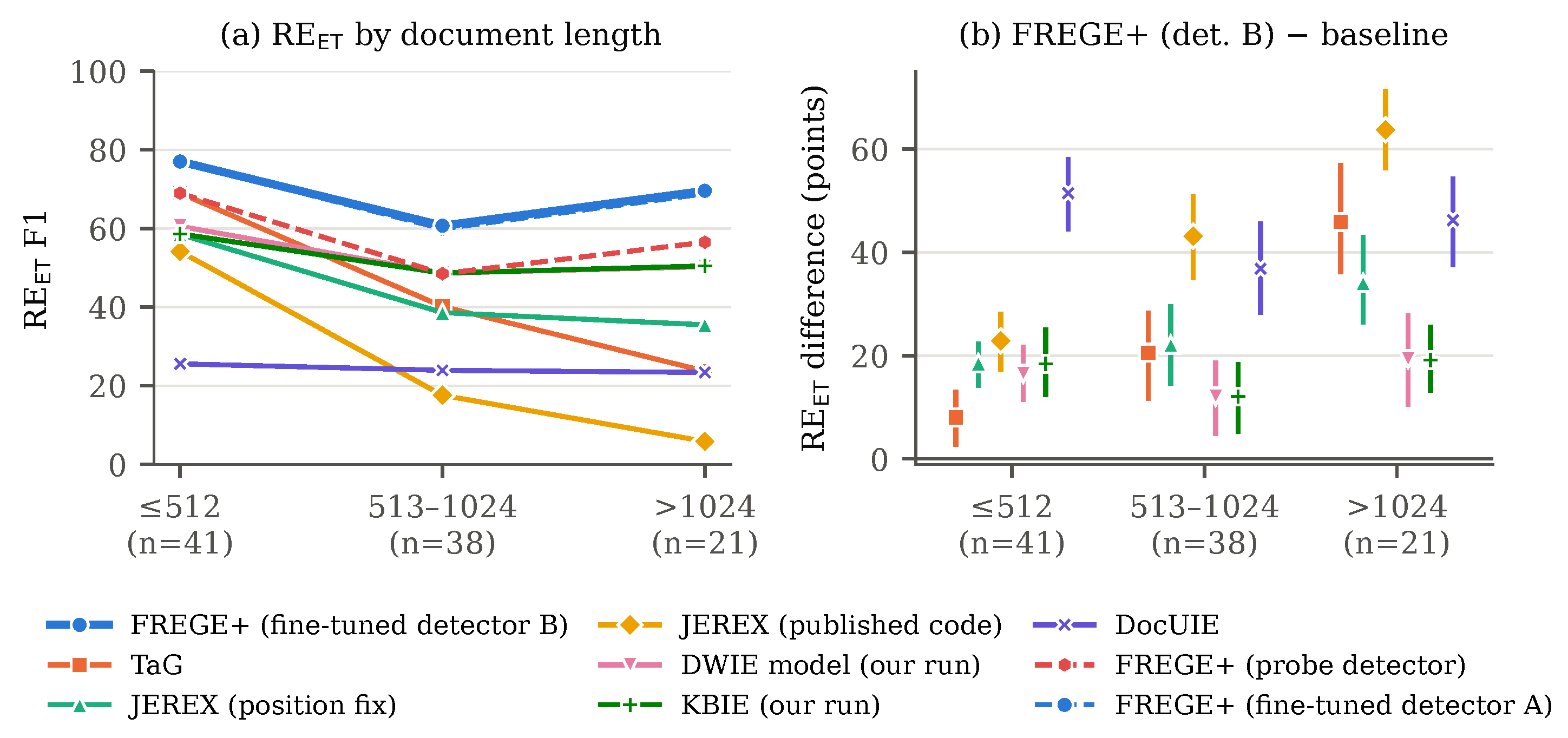
Re-DocRED documents are short (only 8 test documents exceed 512 tokens), so we split its test set into length quartiles (at most 188, 189–222, 223–266 and more than 266 tokens; 131, 119, 125 and 125 documents). FREGE+ with the fine-tuned detector differs from TaG by +2.0, +1.6, −1.7 and +4.1 points and from JEREX by +2.7, +3.7, +0.0 and +7.7 points. The advantage is largest in the longest quartile, where it is significant against both (TaG [+1.3, +7.1], JEREX [+4.5, +10.9]); the difference between the longest and the shortest quartile is significant against JEREX (+5.0 [+0.7, +9.8]) but not against TaG (+2.0 [−2.1, +6.4]).
- Mention detection.
With a frozen probe detector, mention detection is the bottleneck: on DWIE it reaches 93.6 mention F1, and residual mention errors propagate to the downstream graph decisions. Better mention lists alone, with the linker, type and relation probes unchanged, raise REET by 8.5 to 11.4 points on DWIE (Table 5): decoding the frozen detector without overlapping spans (b1) or averaging three detector seeds (b2) already helps, and fine-tuned detectors help most. Our span detector gives +11.4 [+8.2, +14.8] on DWIE and +3.1 [+2.1, +4.1] on Re-DocRED, and raises the official SciREX binary score from 16.1 to 18.3 (Table 4). The result hardly depends on the detector seed: on DWIE the three detector seeds give 68.5, 67.1 and 67.6.
- Attention features.
The relation probe and the mention linker use attention between mentions in addition to hidden states. To separate the attention signal from probe capacity, we widened the hidden-state-only probes to at least the parameter count of the probes with attention. On Re-DocRED, with the frozen detector, the probes with attention remain better in all four decoders tested (Qwen2.5-0.5B and 7B, Llama-3.2-3B, Mistral-7B): by +2.3 to +2.5 REET points for the relation probe and +1.2 to +1.9 for the linker, all intervals above zero.
- Backbone families.
With the same probe recipe and the frozen detector, frozen decoders of 0.5B to 8B parameters reach 42.1 to 44.6 REET on Re-DocRED, an embedding model of the Qwen3 family 42.6, and the frozen encoder ModernBERT-large 37.0 (Appendix C). The tested instruction-tuned checkpoint, Qwen2.5-7B-Instruct, does not improve over its base model under this configuration (42.8 against 43.9).
- Cost.
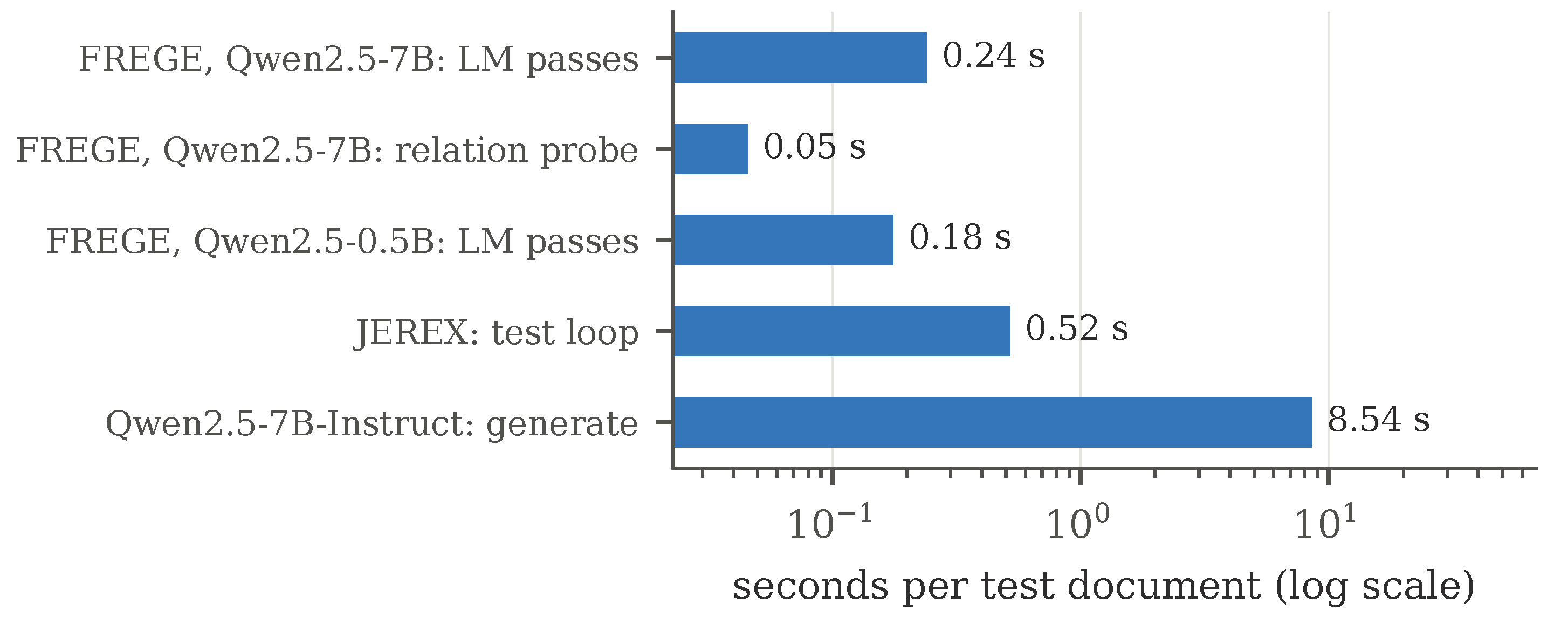
Appendix D reports measured inference components on Re-DocRED.
7. Conclusions
FREGE builds document-level knowledge graphs from a frozen decoder-only language model, with probes on its hidden states and attention and a small fine-tuned span detector. On DWIE it exceeds the strongest fine-tuned system we trained on the same split by 15.5 REET points, its advantage over TaG and JEREX grows with document length, and on SciREX it reaches 18.3 binary relation F1 under the original protocol, against 9.6 for the original SciREX baseline. On the short documents of Re-DocRED it is on par with the best baseline. Attention between mentions carries information beyond what hidden-state probes with at least as many parameters recover, and better mention detection was the largest single gain. Open questions are the comparison with language models fine-tuned on the same data, more long-document benchmarks with complete annotation, and causal tests of which heads carry the signal.
Limitations
We evaluate on English only and on three benchmarks; few long-document datasets annotate complete graphs, and DWIE, our main benchmark, has 100 test documents, so the bins of the length analysis are small (21 documents above 1,024 tokens) and their intervals wide. On SciREX we compare with published results under the original protocol, not with our own runs of those systems or with later systems evaluated by other matchers, and we evaluate only salient entities and their relations. We have not compared with a language model fine-tuned on the same training data for graph generation; the prompted and released generative models we report are not trained on these splits. The linker, type and relation probes are trained with the mentions of the frozen detector and are not adapted to the fine-tuned detector. Graph quality depends on a 7B backbone that needs a GPU with 24 GB of memory at inference, and SciREX papers must be processed in windows. Our analyses of attention are correlational: they show that attention features help the probes, not which heads cause it.
7.0.0.23. LLM Usage Statement.
This manuscript acknowledges the use of Claude Opus 5.5 [44], developed by Anthropic, and of GPT-6.1 Sol [45], developed by OpenAI, to improve language clarity, refine sentence structure, and enhance overall writing precision. The study design, experiments, analysis, results, and conclusions remain the sole responsibility of the authors.
Appendix A. Dataset Protocols
- DWIE.
We use the official annotations with content. The official training set of 702 documents is split into 632 training and 70 dev documents (identifiers to be released with the code); the test set is the official one (100 documents). Entity types are mapped to eight coarse classes. Concepts without mentions are excluded from the gold graph of the strict metric and kept for the official scorer, as in its released evaluation code.
- Re-DocRED.
Standard splits (3,053 / 500 / 500 documents), six entity types and 96 relation types; single-mention entities are kept in evaluation.
- SciREX.
The graph contains the salient clusters of methods, tasks, datasets and metrics. The strict metric uses these clusters and the binary relations derived from the 4-ary relations; the official scorer matches predicted to gold clusters by span overlap and reports binary and 4-ary relation F1. The official scorer forms 4-ary relations from quadruples of predicted clusters (dataset, metric, task, method) whose six role pairs are all predicted binary relations. The span detector is trained and applied on paper fragments split at sentence boundaries, whose predictions are merged per paper. FREGE extracts features in windows of 3,072 tokens that overlap by half, reads each mention in the first window that contains it, and uses preceding candidates per mention.
Appendix B. Baselines
- JEREX.
Published code and the joint configuration for DocRED, 20 epochs, epoch selected on dev, three seeds. For DWIE we extend the position and token-distance embeddings to 2,048 and the sentence-distance embeddings to 128, and cap the relation pairs per training document at 200; “published code” initializes the new positions as the code does, “position fix” copies the pretrained position embeddings beyond 512. Relation classification at inference is chunked, which leaves the output unchanged. Our implementation of the strict metric agrees with JEREX’s own evaluation on its outputs.
- TaG.
Published code with RoBERTa-base: mention extraction (20 epochs) and the table-to-graph model (50 epochs), each selected on dev. TaG outputs no entity types, so a typing adapter (a classifier on RoBERTa-base mention representations, trained on the same training set) assigns them; Table 2 and Table 3 report TaG with this adapter.
- DWIE model and KBIE.
Authors’ code, trained on our 632 training documents, epoch selected on our dev set, three seeds. Our runs are close to the published official scores (Table A1), which were obtained with all 702 training documents.
- GLiNER-Relex with Maverick.
GLiNER-Relex is fine-tuned on each training set with two ways of turning entity-level relations into mention-pair targets (every co-occurring mention pair, or only pairs in the same sentence and otherwise the closest pair), chosen on dev; Maverick (PreCo checkpoint) clusters the predicted mentions; three seeds. A zero-shot variant uses the released model.
- Generative models.
DocUIE is the released model, prompted in its own format. Qwen2.5-7B-Instruct, Qwen3-8B and Gemma-2-9B-it receive the schema and of the shortest training documents as examples (k chosen on dev), decode greedily with an output budget of the 99th percentile of the tokenized gold graphs of the training set (DWIE: 1,426 tokens for the Qwen models, 1,510 for Gemma; Re-DocRED: 1,156 and 1,141), and their strings are mapped to every matching span of the document. On DWIE, 57, 74 and 6 of the 100 test outputs of Qwen2.5-7B-Instruct, Qwen3-8B and Gemma-2-9B-it reach the budget; on Re-DocRED, 203, 126 and 76 of the 500.

Table A1.
Published results vs. our runs of the same systems. DWIE model and KBIE: our split with 632 training documents, mean of three seeds; TaG: seed 0, scored with TaG’s own evaluation.
Table A1.
Published results vs. our runs of the same systems. DWIE model and KBIE: our split with 632 training documents, mean of three seeds; TaG: seed 0, scored with TaG’s own evaluation.
| System | Data | Metric | Published | Ours |
|---|---|---|---|---|
| DWIE model | DWIE | Hard RE (official) | 50.4 | 50.1 |
| DWIE model | DWIE | Coref avg (official) | 91.1 | 91.2 |
| KBIE | DWIE | Hard RE (official) | 52.1 | 50.1 |
| KBIE | DWIE | Coref avg (official) | 91.5 | 91.0 |
| TaG | Re-DocRED | RE (TaG scorer) | 49.38 | 48.5 |
Appendix C. Model Families
Table A2 applies the same probe recipe to frozen backbones of several families on Re-DocRED (condition FREGE, frozen probe detector, three probe seeds). The last column replaces the relation probe by one on hidden states only. Qwen2.5-0.5B, Qwen2.5-7B, Llama-3.2-3B and Mistral-7B were run with our original pipeline, the other models with our generalized pipeline and the same recipe.
Table A2.
FREGE with different frozen backbones on Re-DocRED test (strict metric, micro F1, mean over three probe seeds).
Table A2.
FREGE with different frozen backbones on Re-DocRED test (strict metric, micro F1, mean over three probe seeds).
| Model | Mention | Coref | Entity | RE | REET | REET, H-only RE |
|---|---|---|---|---|---|---|
| Frozen encoders | ||||||
| ModernBERT-large | 90.4 | 79.1 | 74.9 | 38.7 | 37.0 | 36.1 |
| Frozen embedders | ||||||
| BGE-M3 | 88.3 | 76.5 | 73.0 | 36.4 | 35.0 | 34.0 |
| Qwen3-Embedding-8B | 91.4 | 80.8 | 78.0 | 44.4 | 42.6 | 40.7 |
| Frozen decoders (base) | ||||||
| Qwen2.5-0.5B | 91.5 | 80.9 | 78.1 | 43.9 | 42.1 | 39.9 |
| Llama-3.2-3B | 91.9 | 81.3 | 78.5 | 46.3 | 44.6 | 42.1 |
| Qwen2.5-7B | 91.8 | 80.9 | 78.1 | 45.7 | 43.9 | 41.9 |
| Mistral-7B-v0.3 | 91.9 | 81.2 | 78.7 | 46.0 | 44.4 | 42.3 |
| Qwen3-8B-Base | 91.6 | 81.0 | 78.2 | 44.0 | 42.2 | 40.1 |
| Frozen decoders (instruction-tuned) | ||||||
| Qwen2.5-7B-Instruct | 91.8 | 80.6 | 77.7 | 44.6 | 42.8 | 40.5 |
Appendix D. Cost
FREGE trains only probes and the span detector; the language model runs once per document at inference. Figure A1 shows inference components on Re-DocRED measured with an earlier version of the pipeline (frozen probe detector). The components have different boundaries (for example, the JEREX test loop includes its own encoder, while the FREGE probes are timed without the detector), so the figure does not rank complete systems.
Figure A1.
Measured inference components on the Re-DocRED test set (one RTX 3090): seconds per test document. FREGE probes timed separately; JEREX test loop with chunked inference; generation amortized over batches of eight. The fine-tuned span detector is not included.
Figure A1.
Measured inference components on the Re-DocRED test set (one RTX 3090): seconds per test document. FREGE probes timed separately; JEREX test loop with chunked inference; generation amortized over batches of eight. The fine-tuned span detector is not included.
Appendix E. Training Settings
- Probes.
AdamW with weight decay , learning rates selected on dev, seeds 0–2. Linker: up to 15 epochs, patience 3, batches of 8 documents. Type probe: 10 epochs, batches of 256 mentions, none bias selected on dev. Relation probe: up to 20 epochs, patience 5, batches of 4 documents. Frozen detector: 8 epochs, learning rate , one document per batch. SciREX saliency probe: MLP with 512 hidden units, binary cross-entropy weighted by class ratio, 20 epochs, selected by average precision on dev, threshold on dev.
- Span detector.
RoBERTa-base, AdamW (encoder learning rate , head , weight decay 0.01), linear warm-up over 10% of the steps and linear decay, gradient clipping at 1.0, batches of 8 windows, 20 epochs (SciREX 10), bf16 autocast; epoch, threshold and decoding selected by mention F1 on dev; seeds 0–2.
- FREGE+.
Linker ensemble over probe seeds 0–2 with the dummy threshold and relation scores averaged over the HA and H probes, selected once on Re-DocRED dev.
References
- Frege, G. Über Sinn und Bedeutung. Z. Für Philos. Und Philos. Krit. 1892, 100, 25–50. [Google Scholar]
- Eberts, M.; Ulges, A. An End-to-end Model for Entity-level Relation Extraction using Multi-instance Learning. In Proceedings of the Proceedings of the 16th Conference of the European Chapter of the Association for Computational Linguistics: Main Volume; Merlo, P., Tiedemann, J., Tsarfaty, R., Eds.; Online, 2021; pp. 3650–3660. [Google Scholar] [CrossRef]
- Zhang, R.; Li, Y.; Zou, L. A Novel Table-to-Graph Generation Approach for Document-Level Joint Entity and Relation Extraction. In Proceedings of the Proceedings of the 61st Annual Meeting of the Association for Computational Linguistics; Rogers, A., Boyd-Graber, J., Okazaki, N., Eds.; Toronto, Canada, 2023; Volume 1, pp. 10853–10865. [Google Scholar] [CrossRef]
- Zaporojets, K.; Deleu, J.; Develder, C.; Demeester, T. DWIE: An entity-centric dataset for multi-task document-level information extraction. Inf. Process. Manag. 2021, 58, 102563. [Google Scholar] [CrossRef]
- Verlinden, S.; Zaporojets, K.; Deleu, J.; Demeester, T.; Develder, C. Injecting Knowledge Base Information into End-to-End Joint Entity and Relation Extraction and Coreference Resolution. In Proceedings of the Findings of the Association for Computational Linguistics: ACL-IJCNLP 2021; Zong, C., Xia, F., Li, W., Navigli, R., Eds.; Online, 2021; pp. 1952–1957. [Google Scholar] [CrossRef]
- Popovic, N.; Färber, M. Embedded Named Entity Recognition using Probing Classifiers. In Proceedings of the Proceedings of the 2024 Conference on Empirical Methods in Natural Language Processing; Al-Onaizan, Y., Bansal, M., Chen, Y.N., Eds.; Miami, Florida, USA, 2024; pp. 17830–17850. [Google Scholar] [CrossRef]
- Popovič, N.; Färber, M. Tracing Relational Knowledge Recall in Large Language Models. In Proceedings of the Findings of the Association for Computational Linguistics: ACL 2026; Liakata, M., Moreira, V.P., Zhang, J., Jurgens, D., Eds.; San Diego, California, United States, 2026; pp. 43490–43509. [Google Scholar] [CrossRef]
- Podstawski, M. Look Back, Look Ahead: Coreference Signals in Pretrained Language Model Attention. Preprints.org 202610.2874.v1, 2026. [Google Scholar] [CrossRef]
- Tan, Q.; Xu, L.; Bing, L.; Ng, H.T.; Aljunied, S.M. Revisiting DocRED - Addressing the False Negative Problem in Relation Extraction. In Proceedings of the Proceedings of the 2022 Conference on Empirical Methods in Natural Language Processing; Goldberg, Y., Kozareva, Z., Zhang, Y., Eds.; Abu Dhabi, United Arab Emirates, 2022; pp. 8472–8487. [Google Scholar] [CrossRef]
- Jain, S.; van Zuylen, M.; Hajishirzi, H.; Beltagy, I. SciREX: A Challenge Dataset for Document-Level Information Extraction. In Proceedings of the Proceedings of the 58th Annual Meeting of the Association for Computational Linguistics; Jurafsky, D., Chai, J., Schluter, N., Tetreault, J., Eds.; Online, 2020; pp. 7506–7516. [Google Scholar] [CrossRef]
- Yao, Y.; Ye, D.; Li, P.; Han, X.; Lin, Y.; Liu, Z.; Liu, Z.; Huang, L.; Zhou, J.; Sun, M. DocRED: A Large-Scale Document-Level Relation Extraction Dataset. In Proceedings of the Proceedings of the 57th Annual Meeting of the Association for Computational Linguistics; Korhonen, A., Traum, D., Màrquez, L., Eds.; Florence, Italy, 2019; pp. 764–777. [Google Scholar] [CrossRef]
- Li, J.; Wang, Y.; Zhang, S.; Zhang, M. Rethinking Document-Level Relation Extraction: A Reality Check. In Proceedings of the Findings of the Association for Computational Linguistics: ACL 2023, Toronto, Canada, 2023; pp. 5715–5730. [Google Scholar] [CrossRef]
- Xu, L.; Choi, J. Modeling Task Interactions in Document-Level Joint Entity and Relation Extraction. In Proceedings of the Proceedings of the 2022 Conference of the North American Chapter of the Association for Computational Linguistics: Human Language Technologies; Carpuat, M., de Marneffe, M.C., Meza Ruiz, I.V., Eds.; Seattle, United States, 2022; pp. 5409–5416. [Google Scholar] [CrossRef]
- Bouziani, N.; Tyagi, S.; Fisher, J.; Lehmann, J.; Pierleoni, A. REXEL: An End-to-end Model for Document-Level Relation Extraction and Entity Linking. In Proceedings of the Proceedings of the 2024 Conference of the North American Chapter of the Association for Computational Linguistics: Human Language Technologies; Yang, Y., Davani, A., Sil, A., Kumar, A., Eds.; Mexico City, Mexico, 2024; Volume 6, pp. 119–130. [Google Scholar] [CrossRef]
- Viswanathan, V.; Neubig, G.; Liu, P. CitationIE: Leveraging the Citation Graph for Scientific Information Extraction. In Proceedings of the Proceedings of the 59th Annual Meeting of the Association for Computational Linguistics and the 11th International Joint Conference on Natural Language Processing; Zong, C., Xia, F., Li, W., Navigli, R., Eds.; Online, 2021; Volume 1, pp. 719–731. [Google Scholar] [CrossRef]
- Huang, K.H.; Tang, S.; Peng, N. Document-level Entity-based Extraction as Template Generation. In Proceedings of the Proceedings of the 2021 Conference on Empirical Methods in Natural Language Processing, 2021; Association for Computational Linguistics; pp. 5257–5269. [Google Scholar] [CrossRef]
- Chen, Y.; Gantt, W.; Gu, W.; Chen, T.; White, A.S.; Van Durme, B. Iterative Document-level Information Extraction via Imitation Learning. In Proceedings of the Proceedings of the 17th Conference of the European Chapter of the Association for Computational Linguistics, 2023; Association for Computational Linguistics; pp. 1858–1874. [Google Scholar] [CrossRef]
- Tang, J.; Liu, M.; Sarabi, A. Learning What to Remember: Long-horizon Counterfactual Memory Optimization. arXiv 2026, arXiv:cs. [Google Scholar]
- Bamman, D.; Lewke, O.; Mansoor, A. An Annotated Dataset of Coreference in English Literature. In Proceedings of the Proceedings of the Twelfth Language Resources and Evaluation Conference; Calzolari, N., Béchet, F., Blache, P., Choukri, K., Cieri, C., Declerck, T., Goggi, S., Isahara, H., Maegaard, B., Mariani, J., et al., Eds.; Marseille, France, 2020; pp. 44–54. [Google Scholar]
- Toshniwal, S.; Xia, P.; Wiseman, S.; Livescu, K.; Gimpel, K. On Generalization in Coreference Resolution. In Proceedings of the Proceedings of the Fourth Workshop on Computational Models of Reference, Anaphora and Coreference; Ogrodniczuk, M., Pradhan, S., Poesio, M., Grishina, Y., Ng, V., Eds.; Punta Cana, Dominican Republic, 2021; pp. 111–120. [Google Scholar] [CrossRef]
- Martinelli, G.; Barba, E.; Navigli, R. Maverick: Efficient and Accurate Coreference Resolution Defying Recent Trends. In Proceedings of the Proceedings of the 62nd Annual Meeting of the Association for Computational Linguistics; Ku, L.W., Martins, A., Srikumar, V., Eds.; Bangkok, Thailand, 2024; Volume 1, pp. 13380–13394. [Google Scholar] [CrossRef]
- Zhang, S.; Chen, Z.; Li, S.; Tu, K.; Jing, L.; Jia, Z.; Zheng, Z. MMUIE: Massive Multi-Domain Universal Information Extraction for Long Documents. In Proceedings of the Findings of the Association for Computational Linguistics: EACL 2026, Rabat, Morocco, 2026; pp. 6338–6370. [Google Scholar] [CrossRef]
- Sainz, O.; García-Ferrero, I.; Agerri, R.; Lopez de Lacalle, O.; Rigau, G.; Agirre, E. GoLLIE: Annotation Guidelines improve Zero-Shot Information-Extraction. In Proceedings of the The Twelfth International Conference on Learning Representations (ICLR), 2024. [Google Scholar]
- Ilves, M.; Barbu, E.; Übi, J. Large Language Models for Knowledge Graph Extraction: A Schema-Constrained Evaluation Framework. In Proceedings of the Proceedings of the Knowledge Graphs and Large Language Models Workshop (KG-LLM) @ LREC26, Palma, Mallorca (Spain), 2026; pp. 221–228. [Google Scholar] [CrossRef]
- Choubey, P.K.; Su, X.; Luo, M.; Peng, X.; Xiong, C.; Le, T.; Rosenman, S.; Lal, V.; Mui, P.; Ho, R.; et al. Scaling Knowledge Graph Construction through Synthetic Data Generation and Distillation. In Proceedings of the The Fourteenth International Conference on Learning Representations (ICLR), 2026. [Google Scholar]
- Zaratiana, U.; Tomeh, N.; Holat, P.; Charnois, T. GLiNER: Generalist Model for Named Entity Recognition using Bidirectional Transformer. In Proceedings of the Proceedings of the 2024 Conference of the North American Chapter of the Association for Computational Linguistics: Human Language Technologies; Duh, K., Gomez, H., Bethard, S., Eds.; Mexico City, Mexico, 2024; Volume 1, pp. 5364–5376. [Google Scholar] [CrossRef]
- Stepanov, I.; Lukashov, O.; Shtopko, M.; Kalyanarangan, V. GLiNER-Relex: A Unified Framework for Joint Named Entity Recognition and Relation Extraction. arXiv 2026, arXiv:2605.10108. [Google Scholar]
- Boylan, J.; Hokamp, C.; Gholipour Ghalandari, D. GLiREL – Generalist Model for Zero-Shot Relation Extraction. In Proceedings of the Proceedings of the 2025 Conference of the Nations of the Americas Chapter of the Association for Computational Linguistics: Human Language Technologies, Albuquerque, New Mexico, 2025; Volume 1, pp. 8230–8245. [Google Scholar] [CrossRef]
- Wang, C.; Liu, X.; Song, D. Language Models are Open Knowledge Graphs. arXiv 2020, arXiv:2010.11967. [Google Scholar]
- Wang, C.; Liu, X.; Chen, Z.; Hong, H.; Tang, J.; Song, D. Zero-Shot Information Extraction as a Unified Text-to-Triple Translation. In Proceedings of the Proceedings of the 2021 Conference on Empirical Methods in Natural Language Processing, Online and Punta Cana, Dominican Republic, 2021; pp. 1225–1238. [Google Scholar] [CrossRef]
- Anand, A. The Topology Probe: Contextually Primed Knowledge Graph Extraction via Large Language Model Attention Mechanics. OpenReview. 2026. Available online: https://openreview.net/forum?id=rlGv3r7pBe.
- Wang, J.; Lu, W. Two are Better than One: Joint Entity and Relation Extraction with Table-Sequence Encoders. In Proceedings of the Proceedings of the 2020 Conference on Empirical Methods in Natural Language Processing (EMNLP), Online, 2020; pp. 1706–1721. [Google Scholar] [CrossRef]
- Ma, Y.; Hiraoka, T.; Okazaki, N. Joint Entity and Relation Extraction Based on Table Labeling Using Convolutional Neural Networks. In Proceedings of the Proceedings of the Sixth Workshop on Structured Prediction for NLP, Dublin, Ireland, 2022; pp. 11–21. [Google Scholar] [CrossRef]
- Morand, V.; Tomeh, N.; Mothe, J.; Piwowarski, B. ToMMeR - Efficient Entity Mention Detection from Large Language Models. In Proceedings of the Proceedings of the 64th Annual Meeting of the Association for Computational Linguistics; Liakata, M., Moreira, V.P., Zhang, J., Jurgens, D., Eds.; San Diego, California, United States, 2026; Volume 1, pp. 27489–27509. [Google Scholar] [CrossRef]
- Eichin, F.; Liu, Y.J.; Plank, B.; Hedderich, M.A. Probing LLMs for Multilingual Discourse Generalization Through a Unified Label Set. In Proceedings of the Proceedings of the 63rd Annual Meeting of the Association for Computational Linguistics; Che, W., Nabende, J., Shutova, E., Pilehvar, M.T., Eds.; Vienna, Austria, 2025; Volume 1, pp. 18665–18684. [Google Scholar] [CrossRef]
- Hewitt, J.; Liang, P. Designing and Interpreting Probes with Control Tasks. In Proceedings of the Proceedings of the 2019 Conference on Empirical Methods in Natural Language Processing and the 9th International Joint Conference on Natural Language Processing (EMNLP-IJCNLP), Hong Kong, China, 2019; pp. 2733–2743. [Google Scholar] [CrossRef]
- Qwen Team; Yang, A.; Yang, B.; Zhang, B.; Hui, B.; Zheng, B.; et al. Qwen2.5 Technical Report. arXiv 2024, arXiv:2412.15115. [Google Scholar]
- Kobayashi, G.; Kuribayashi, T.; Yokoi, S.; Inui, K. Attention is Not Only a Weight: Analyzing Transformers with Vector Norms. In Proceedings of the Proceedings of the 2020 Conference on Empirical Methods in Natural Language Processing, 2020. [Google Scholar]
- Liu, Y.; Ott, M.; Goyal, N.; Du, J.; Joshi, M.; Chen, D.; Levy, O.; Lewis, M.; Zettlemoyer, L.; Stoyanov, V. RoBERTa: A Robustly Optimized BERT Pretraining Approach. arXiv 2019, arXiv:1907.11692. [Google Scholar]
- Zhu, Y.; Peng, S.; Pradhan, S.; Zeldes, A. SPLICE: A Singleton-Enhanced PipeLIne for Coreference REsolution. In Proceedings of the Proceedings of the 2024 Joint International Conference on Computational Linguistics, Language Resources and Evaluation (LREC-COLING 2024); Calzolari, N., Kan, M.Y., Hoste, V., Lenci, A., Sakti, S., Xue, N., Eds.; Torino, Italia, 2024; pp. 15191–15201. [Google Scholar]
- Zhou, W.; Huang, K.; Ma, T.; Huang, J. Document-Level Relation Extraction with Adaptive Thresholding and Localized Context Pooling. In Proceedings of the Proceedings of the AAAI Conference on Artificial Intelligence, 2021. [Google Scholar]
- Yang, A.; Li, A.; Yang, B.; Zhang, B.; Hui, B.; Zheng, B.; et al. Qwen3 Technical Report. arXiv 2025, arXiv:2505.09388. [Google Scholar]
- Gemma Team; Riviere, M.; Pathak, S.; Sessa, P.G.; Hardin, C.; Bhupatiraju, S.; et al. Gemma 2: Improving Open Language Models at a Practical Size. arXiv 2024, arXiv:2408.00118. [Google Scholar]
- Anthropic. System Card: Claude Opus 5.5. 2026. Available online: https://www.anthropic.com/claude-opus-5-5-system-card.
- OpenAI. Addendum to GPT-6 Astra System Card: GPT-6.1 Sol. 29 September 2026. Available online: https://deploymentsafety.openai.com/gpt-6-1-sol.
Figure 1.
FREGE. A small fine-tuned span encoder detects mentions; a frozen decoder-only language model reads the whole document once (in windows of 3,072 tokens for SciREX), and probes on its hidden states and on attention between mention pairs link mentions into entities, type them (or reject them), and classify relations between entities.
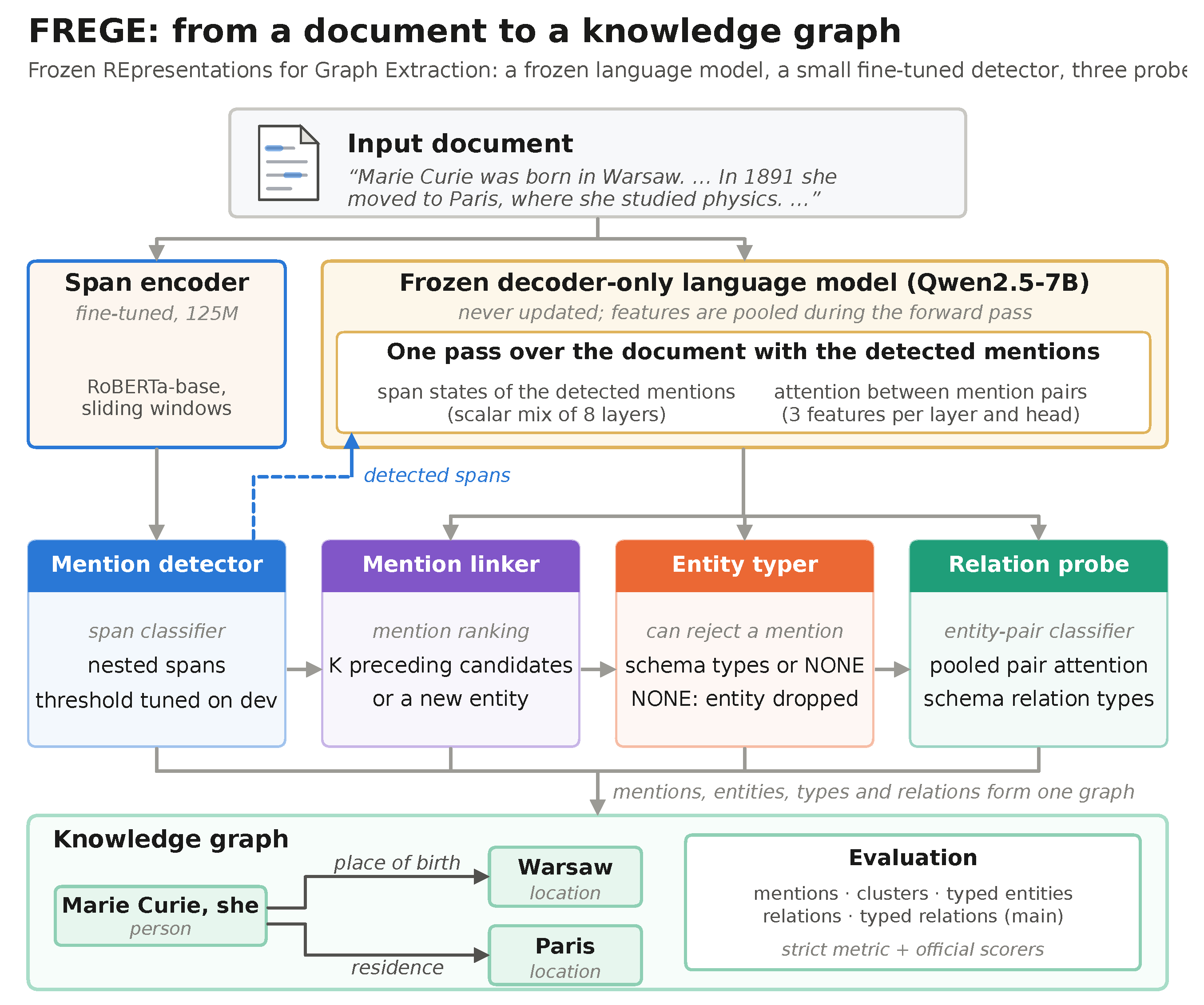
Table 1.
Datasets: documents per split; mean (max) Qwen2.5 tokens of test documents; test mentions, entities and relations as counted by the strict metric.
Table 1.
Datasets: documents per split; mean (max) Qwen2.5 tokens of test documents; test mentions, entities and relations as counted by the strict metric.
| Data | Train | Dev | Test | Tokens (test) | Mentions | Entities | Relations |
|---|---|---|---|---|---|---|---|
| Re-DocRED | 3,053 | 500 | 500 | 239 (635) | 12,949 | 9,778 | 17,448 |
| DWIE | 632 | 70 | 100 | 695 (1,728) | 5,433 | 2,623 | 2,453 |
| SciREX | 306 | 66 | 66 | 6,876 (16,603) | 4,628 | 341 | 585 |
Table 2.
DWIE test (100 documents), micro F1. Strict: JEREX metric, REET is the main measure. Official: DWIE scorer (coreference average of MUC, B3 and CEAFe; hard and soft relation F1). Detector: probe = frozen probe detector; FT (A) = the mention stage of TaG trained by us; FT (B) = our fine-tuned span detector. FREGE rows average three probe seeds, FT (B) nine runs (three detector seeds by three probe seeds); trained baselines average three seeds; released and prompted models are run once. The best value per column among systems evaluated on our split is in bold. †Published, trained on all 702 training documents. ‡Published strict relation F1 on gold annotations without empty concepts, without entity types. §Published E2E-RE under the REXEL protocol (exact clusters with their types as defined there), gold annotations without empty concepts.
| Strict (JEREX metric) | Official DWIE scorer | ||||||||
|---|---|---|---|---|---|---|---|---|---|
| System | Detector | Mention | Coref | Entity | RE | REET | Coref | Hard RE | Soft RE |
| Published (different training data or gold filtering) | |||||||||
| DWIE model [4]† | – | – | – | – | – | 91.1 | 50.4 | – | |
| KBIE [5]† | – | – | – | – | – | 91.5 | 52.1 | – | |
| Xu and Choi [13]‡ | – | – | – | 62.85 | – | – | – | – | |
| REXEL [14]§ | – | – | – | 65.8 | – | – | – | – | |
| Fine-tuned extractors, our split | |||||||||
| JEREX (published code) | 70.8 | 53.0 | 51.5 | 23.3 | 23.3 | 66.0 | 22.4 | 42.7 | |
| JEREX (position fix) | 92.6 | 79.6 | 77.6 | 42.9 | 42.8 | 89.4 | 41.1 | 61.2 | |
| TaG (+ typing adapter) | 97.0 | 76.7 | 75.1 | 41.5 | 41.3 | 88.9 | 39.8 | 73.7 | |
| DWIE model (our run) | 96.2 | 81.4 | 79.2 | 52.4 | 52.2 | 91.2 | 50.1 | 71.8 | |
| KBIE (our run) | 95.0 | 81.8 | 78.9 | 52.4 | 51.7 | 91.0 | 50.1 | 67.5 | |
| GLiNER-Relex + Maverick (fine-tuned) | 96.9 | 69.9 | 68.2 | 28.5 | 28.4 | 87.0 | 27.3 | 68.3 | |
| Generative language models | |||||||||
| DocUIE (released model) | 89.6 | 77.1 | 74.2 | 24.8 | 24.2 | 86.6 | 23.8 | 44.9 | |
| Qwen2.5-7B-Instruct (prompted) | 57.5 | 19.4 | 15.8 | 0.5 | 0.5 | 39.6 | 0.5 | 3.8 | |
| Qwen3-8B (prompted) | 47.7 | 31.0 | 24.9 | 0.5 | 0.5 | 44.2 | 0.5 | 2.0 | |
| Gemma-2-9B-it (prompted) | 57.7 | 38.8 | 35.7 | 1.7 | 1.4 | 51.5 | 1.6 | 4.8 | |
| FREGE (frozen Qwen2.5-7B) | |||||||||
| FREGE | probe | 93.6 | 82.2 | 80.2 | 54.2 | 53.6 | 90.7 | 51.8 | 75.4 |
| FREGE+ | probe | 93.6 | 83.2 | 81.3 | 57.0 | 56.4 | 91.1 | 54.4 | 76.1 |
| FREGE+ | FT (A) | 96.6 | 89.2 | 87.1 | 67.4 | 67.1 | 94.5 | 64.3 | 79.8 |
| FREGE+ | FT (B) | 96.6 | 89.6 | 87.3 | 68.0 | 67.8 | 94.6 | 64.9 | 79.9 |
Table 3.
Re-DocRED test (500 documents), strict metric, micro F1. FREGE averages three probe seeds, FREGE+ (det. B) nine runs; trained baselines three seeds.
Table 3.
Re-DocRED test (500 documents), strict metric, micro F1. FREGE averages three probe seeds, FREGE+ (det. B) nine runs; trained baselines three seeds.
| System | Mention | Coref | Entity | RE | REET |
|---|---|---|---|---|---|
| JEREX | 92.7 | 83.1 | 80.2 | 46.7 | 45.1 |
| TaG (+ typing adapter) | 93.0 | 83.2 | 80.3 | 49.0 | 47.3 |
| GLiNER-Relex + Maverick (fine-tuned) | 91.9 | 81.4 | 78.9 | 47.3 | 45.7 |
| GLiNER-Relex + Maverick (zero-shot) | 77.4 | 67.7 | 37.8 | 15.4 | 3.1 |
| DocUIE (released model) | 85.6 | 75.3 | 72.4 | 31.0 | 29.8 |
| Qwen2.5-7B-Instruct (prompted) | 61.6 | 50.1 | 41.2 | 2.8 | 2.4 |
| Qwen3-8B (prompted) | 67.8 | 58.7 | 50.9 | 6.5 | 5.9 |
| Gemma-2-9B-it (prompted) | 69.3 | 62.1 | 54.9 | 3.6 | 3.2 |
| FREGE | 91.8 | 80.9 | 78.1 | 45.7 | 43.9 |
| FREGE+ | 91.8 | 81.3 | 78.4 | 47.5 | 45.7 |
| FREGE+ (det. A) | 92.8 | 82.3 | 79.3 | 49.0 | 47.0 |
| FREGE+ (det. B) | 93.9 | 83.8 | 80.7 | 50.8 | 48.8 |
Table 4.
SciREX test (66 papers), graph of salient entities. Strict: JEREX metric. Official: SciREX scorer with soft cluster matching, binary and 4-ary relation F1. (b1): frozen detector with removal of overlapping spans. FREGE rows average three probe seeds, det. B nine runs. †Published, original SciREX evaluation protocol.
| Strict | Official | |||||
|---|---|---|---|---|---|---|
| System | Mention | Coref | Entity | RE | Binary | 4-ary |
| SciREX [10]† | – | – | – | – | 9.6 | 0.8 |
| CitationIE [15]† | – | – | – | – | 7.70 | 1.48 |
| FREGE | 49.4 | 3.1 | 3.1 | 0.1 | 15.0 | 2.4 |
| FREGE, no saliency probe | 47.5 | 3.2 | 3.2 | 0.0 | 15.5 | 3.0 |
| FREGE+ | 49.8 | 2.9 | 2.9 | 0.0 | 16.1 | 2.2 |
| FREGE+ (b1) | 47.9 | 2.9 | 2.9 | 0.0 | 17.3 | 2.6 |
| FREGE+ (det. B) | 49.7 | 3.3 | 3.3 | 0.0 | 18.3 | 3.1 |
Table 5.
FREGE+ with different mention detectors (test, mean over probe seeds; det. B over nine runs). (b1): frozen probe detector with removal of overlapping spans; (b2): average of three frozen detector seeds; A: the mention stage of TaG trained by us; B: our span detector. : difference to the frozen probe detector with a 95% paired bootstrap interval.
| Detector | Mention | Entity | REET | REET [95% CI] |
|---|---|---|---|---|
| DWIE | ||||
| frozen probe | 93.6 | 81.3 | 56.4 | |
| (b1) no-overlap | 94.8 | 84.0 | 64.8 | +8.5 [+5.2, +11.8] |
| (b2) seed ensemble | 95.0 | 84.3 | 65.9 | +9.5 [+6.4, +12.8] |
| fine-tuned A (TaG-ME) | 96.6 | 87.1 | 67.1 | +10.8 [+7.1, +14.3] |
| fine-tuned B (ours) | 96.6 | 87.3 | 67.8 | +11.4 [+8.2, +14.8] |
| Re-DocRED | ||||
| frozen probe | 91.8 | 78.4 | 45.7 | |
| (b1) no-overlap | 92.7 | 79.5 | 47.1 | +1.4 [+0.8, +2.1] |
| fine-tuned A (TaG-ME) | 92.8 | 79.3 | 47.0 | +1.4 [+0.0, +2.7] |
| fine-tuned B (ours) | 93.9 | 80.7 | 48.8 | +3.1 [+2.1, +4.1] |
Disclaimer/Publisher’s Note: The statements, opinions and data contained in all publications are solely those of the individual author(s) and contributor(s) and not of MDPI and/or the editor(s). MDPI and/or the editor(s) disclaim responsibility for any injury to people or property resulting from any ideas, methods, instructions or products referred to in the content. |
© 2026 by the authors. Licensee MDPI, Basel, Switzerland. This article is an open access article distributed under the terms and conditions of the Creative Commons Attribution (CC BY) license (http://creativecommons.org/licenses/by/4.0/).
Copyright: This open access article is published under a Creative Commons CC BY 4.0 license, which permit the free download, distribution, and reuse, provided that the author and preprint are cited in any reuse.