
Submitted:
28 October 2026
Posted:
29 October 2026
You are already at the latest version
Abstract
Artificial intelligence (AI) is reshaping how AI itself is developed. From designing learning algorithms to automating research workflows and evaluation, this expanding role has fueled the rapid growth of AI for AI (AI4AI). Yet a fundamental question remains: as AI takes on more research tasks, which decisions does it actually control? Even systems that execute entire research workflows may still rely on humans to define research goals, allowable modifications, and criteria for success. Existing taxonomies, typically organized by technique or target artifact, offer limited insight into these differences in research responsibility. This survey presents a unified, control-centered perspective on AI4AI, viewing its evolution as a progressive transfer of control over three key decisions in the discovery loop: search direction, search space, and evaluation signal. We introduce an L0–L3 control-source framework, complemented by full responsibility profiles, to characterize different forms of human–AI research responsibility without conflating control with overall capability or end-to-end autonomy. This perspective unifies research across AI4AI Learning, Inference, Data, and Infrastructure, while motivating an evaluation framework that goes beyond downstream performance to assess decision quality, discovery efficiency, transfer, evaluator independence, and robustness under optimization. Looking further ahead, AI4AI may enable recursive self-improvement, where advances in AI enhance the process of making subsequent discoveries. If sustained and independently validated, such improvements could offer a pathway toward superintelligence. By connecting research autonomy with the conditions for reliable and cumulative progress, this survey provides a unified foundation for understanding the evolution and long-term potential of AI4AI.
Keywords:
AI for AI
; automated AI research
; research autonomy
MSC: https://ai4ai-research.github.io
1. Introduction
The development of artificial intelligence (AI) has traditionally been guided by human researchers. They decide what kinds of solutions to explore, which experiments to conduct, and how to evaluate the results. As AI systems and design spaces grew more complex, this fully human-directed process became a scalability bottleneck: too many consequential research decisions still depended on limited human attention and manual experimentation.
Early automation began to relieve this bottleneck by automating candidate search, but it did not fundamentally change who controlled the research process. Hyperparameter optimization, AutoML, and neural architecture search replaced manual trial-and-error with systematic exploration of model configurations, development pipelines, and architectures [1,2,3,4,5,6]. Subsequent advances extended automation beyond model selection to the learning process itself, enabling systems to adapt training schedules, learn optimization rules, and even discover complete learning algorithms from primitive operations [7,8,9]. More recently, systems such as FunSearch and AlphaEvolve have demonstrated the discovery and improvement of executable algorithms and programs [10,11], while language-model-based approaches have made prompts and agent architectures objects of automated optimization [12,13,14]. Across these developments, the scope of automation has expanded from selecting numerical configurations to modifying increasingly complex artifacts. Yet this growing flexibility does not necessarily imply greater research autonomy: humans may still determine the problems to solve, the boundaries of allowable modifications, and the criteria for success.
Automation is now extending beyond individual AI artifacts to the research process itself. Systems such as The AI Scientist and The AI Scientist-v2 integrate idea generation, experimentation, and reporting into increasingly automated research workflows [15,16]. In parallel, AI is taking a more active role in evaluation, generating feedback that guides subsequent improvements. Constitutional AI and RLAIF use model-generated critiques or preferences to guide training [17,18]; Eureka synthesizes executable reward functions [19]; and self-rewarding language models use their own judgments to guide further training [20]. Although these approaches often operate under human-defined objectives, AI-generated feedback can influence which candidates are selected and how models are improved. This growing role creates opportunities for more adaptive discovery, while underscoring the importance of independent validation, as model-generated judgments can be biased and improvements under imperfect reward signals may not translate into genuine progress [21,22,23]. Together, these developments show that automating a research workflow and controlling its key decisions are fundamentally different. An AI system may execute an entire research workflow while humans still determine which problems to pursue, what can be modified, and what counts as success. Conversely, AI may construct or substantively revise the evaluation signal that governs candidate selection, even when humans carry out the experiments and implement the changes. Research autonomy should therefore be characterized by which decisions AI makes or revises, rather than by how many research tasks it executes.
Figure 1.
The progressive transfer of control over the AI4AI discovery loop.
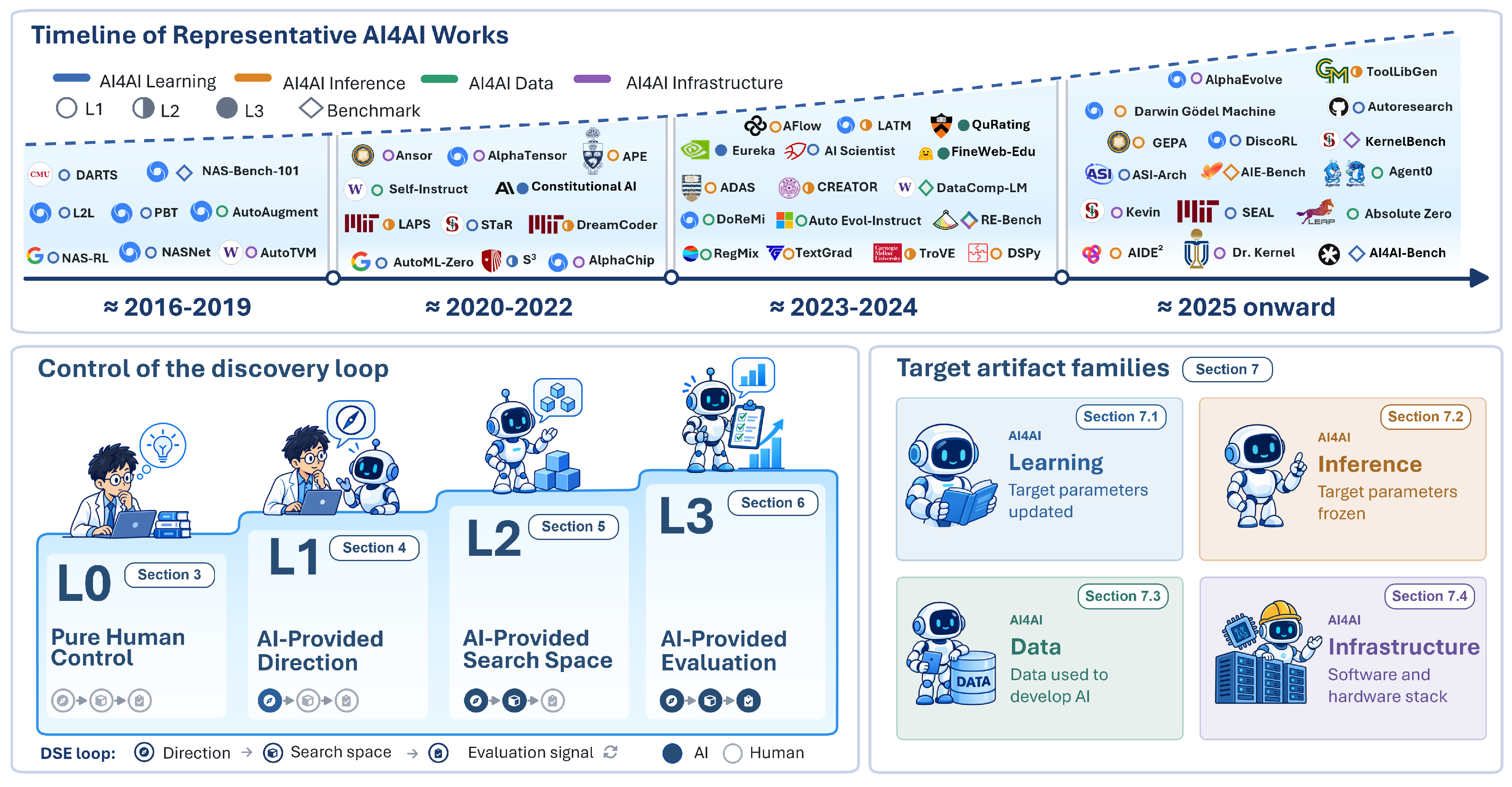
These developments reflect the growing field of AI for AI (AI4AI), in which AI contributes to the development and improvement of AI systems themselves. Yet despite its rapid expansion, how control over the discovery process is distributed between humans and AI remains insufficiently characterized. To address this gap, we view AI development as a discovery loop in which candidate improvements are proposed, evaluated, and selected or revised based on feedback. We distinguish three key decisions in this loop: search direction (D), which determines which avenues to pursue; search space (S), which defines what can be changed; and evaluation signal (E), which determines what counts as progress.
Existing taxonomies typically organize AI4AI research by technique or target artifact. While useful for mapping the field, they do not fully capture how responsibility for these decisions is divided between humans and AI. Indeed, systems that improve similar AI artifacts may differ fundamentally in which decisions they control. This motivates the central perspective of our survey:

Identifying these three decisions is only the first step; understanding research autonomy also requires determining who actually controls them. Generating candidate solutions does not mean deciding where to explore, just as running an evaluation does not mean defining what counts as success. We therefore attribute control to AI only when it originates or substantively revises a decision that shapes the subsequent discovery process.
To characterize how these responsibilities are distributed between humans () and AI (), we assign each system a responsibility profile:
where the coordinates indicate whether each decision is human-specified or externally fixed, or substantively AI-provided. Based on the responsibility profile, we distinguish four control-source levels, where denotes either source:
- L0 (): Humans provide all three decisions, serving as the reference case.
- L1 (): AI provides the search direction, while the search space and evaluation remain human-defined.
- L2 (): AI constructs or substantively revises the search space, while evaluation remains human-defined.
- L3 (): AI provides or substantively revises the evaluation signal, regardless of who determines direction or space.
Levels are assigned by the precedence , which determines the classification label rather than implying cumulative autonomy or greater capability. The level label provides a concise classification, while the full responsibility profile preserves how control over direction, space, and evaluation is distributed between humans and AI.
The ladder captures the source of research control rather than the extent of automation or a system’s overall capability. For example, FunSearch and AlphaEvolve guide program search using evaluation histories while operating within human-defined edit boundaries and evaluators [10,11]. Similarly, The AI Scientist and the Darwin Gödel Machine automate research or self-revision processes without necessarily controlling the underlying search space or success criteria [15,24]. These distinctions matter because greater control does not guarantee better outcomes: AI may pursue ineffective directions, construct unproductive search spaces, or generate evaluation signals that reward misleading improvements. Independent validation is therefore essential, especially when AI helps determine what counts as progress.
Our main contributions are threefold. First, we synthesize AI4AI research through the lens of control over discovery decisions, offering a unified perspective on techniques and applications that are otherwise fragmented. Second, we formalize this perspective in a Direction–Space–Evaluation framework that pairs L0–L3 control-source levels with full responsibility profiles, distinguishing the different forms of human–AI research responsibility without conflating them with end-to-end autonomy. Third, we identify key open questions and outline promising directions for future research.
2. Key Concepts and Related Surveys
2.1. Key Concepts
AI4AI.
Artificial intelligence for artificial intelligence (AI4AI) refers to the use of AI models or feedback-driven search to discover and improve AI systems and their development processes. Within the broader landscape of AI for Science, AI4AI specifically targets the advancement of AI itself. A defining requirement is that AI substantively contributes to discovery rather than merely executing a predetermined workflow.
Automated Machine Learning.
Automated machine learning (AutoML) automates the optimization of model configurations, architectures, learning algorithms, and training pipelines, typically within human-defined search spaces and evaluation criteria [4,25,26]. It provides an important foundation for AI4AI by replacing manual design choices with systematic search.
AI Scientists.
AI scientists extend automation from individual optimization tasks to broader research processes, including hypothesis generation, experiment design, implementation, analysis, and reporting [27,28,29]. Such systems fall within AI4AI when their research aims to improve AI systems or the processes used to develop them.
Self-Evolving AI.
Self-evolving AI systems improve their own parameters, instructions, memories, tools, or behaviors through feedback and accumulated experience [30,31,32,33]. However, self-modification does not necessarily imply control over the improvement process, as humans may still define the objectives, allowable changes, and evaluation criteria.
Recursive Self-Improvement.
Recursive self-improvement (RSI) refers to a process in which improvements to an AI system enhance its ability to produce further improvements [34]. Unlike repeated optimization of a fixed target, RSI requires improvements to the discovery mechanism itself. Demonstrating RSI therefore requires sustained gains in subsequent improvement cycles under independent evaluation. Such gains may provide a path toward superintelligence, although sustained recursive improvement remains an open challenge.
Search Direction.
The search direction (D) determines which possibilities to pursue within a search space, such as which bottleneck to address, hypothesis to test, or candidate region to explore. It guides the allocation of exploration effort based on research objectives and previous results.
Search Space.
The search space (S) defines the set of admissible solutions through editable components, candidate representations, available operations, and constraints. It determines what can be explored, while generating candidates within a predefined space does not itself constitute control over that space.
Evaluation Signal.
The evaluation signal (E) determines what counts as progress through metrics, tests, rewards, or acceptance criteria that guide candidate selection. Applying a predefined evaluation rule does not imply control over the criteria themselves. Together, D, S, and E provide three distinct dimensions for characterizing how control over AI discovery is distributed between humans and AI.
Figure 2 brings together these three control variables and shows how evidence connects candidate generation, evaluation, updating, and iterative improvement.
2.2. Related Surveys
Existing surveys offer detailed accounts of automated optimization, evolving agents, autonomous research, and the artifacts produced by these systems. However, these research traditions focus on different aspects of AI-driven progress. Table 1 groups existing surveys into five lenses accordingly. We summarize how each lens understands the field, identify the limitation they share, and explain the different starting point of this survey.
Perspectives in existing surveys.
Search-centric surveys, spanning AutoML, neural architecture search, meta-learning, and LLM-based algorithm design, organize methods around the representations being searched, the optimization strategy, and the procedure for estimating candidate quality [25,36,40]. This decomposition is valuable for explaining how search works, but does not necessarily track whether those components are specified by humans or constructed by AI. Self-evolution surveys instead ask what can be updated, when adaptation occurs, and which feedback mechanisms support it [31,32,33]. Research-lifecycle surveys emphasize the integration of ideation, experimentation, review, and reporting into increasingly automated workflows [28,29,47]. Component-oriented reviews examine particular technologies, such as model judges, data selection, and electronic design automation [50,53,56]. Finally, work on recursive improvement and levels of intelligence or agent autonomy offers broader conceptual accounts of independence and capability [34,58,59]. These perspectives address distinct, legitimate questions; their limitation for our purpose is the absence of a common unit for attributing consequential research decisions across all four AI4AI artifact families. The perspectives differ in axis but share one limitation: they describe what AI does rather than what it decides. As Table 1 shows, each lens brings at most one of the three decisions in the AI4AI discovery loop into focus.
Positioning of this survey.
We begin from a different premise on who holds the authority to decide. A discovery process depends on three decisions: which directions to explore, what solutions can be considered, and how progress is evaluated. Existing surveys typically organize AI4AI systems by their techniques, outputs, or workflows. While useful, these approaches often overlook changes in who controls the research process. We therefore view the development of AI4AI through the transfer of three key decisions from humans to AI: search direction, search space, and evaluation signal. These transfers represent a progression in research control: from choosing what to explore, to defining what can be explored, and ultimately to determining what counts as progress. This perspective also provides a common way to compare different AI4AI systems. A hyperparameter optimizer, a kernel-search agent, and an AI scientist can all be assessed by the decisions they control, regardless of their underlying techniques. Claims of research autonomy should therefore be supported by evidence of who makes each decision, rather than by how much of the research workflow is automated.
3. Preliminaries
This section establishes the formal framework for analyzing and classifying AI4AI systems. We first formalize the discovery process, then examine the provenance of its three control decisions: search direction (D), search space (S), and evaluation signal (E). Based on these decisions, we introduce responsibility profiles and a protocol for assigning L0–L3 levels. The levels follow a classification precedence of , rather than representing an ordinal scale of intelligence, capability, or autonomy. Table 2 summarizes the notation.
3.1. The AI4AI Discovery Process
We assess control provenance at the level of individual system configurations, rather than assigning fixed control responsibilities to models or methods. Each configuration is characterized by its target AI artifact, search procedure, editable boundaries, available tools, evaluator, and human-intervention policy. This scope encompasses classical AutoML and neural architecture search [4,25], as well as more recent AI4AI applications such as visual-token pruning and test-time capability transfer [60,61].
Under our operational criterion, a system qualifies as AI4AI when an AI model or feedback-adaptive search procedure originates or substantively revises at least one control decision (D, S, or E), and that decision causally influences candidate generation, selection, updating, or acceptance. Merely executing a predefined workflow or applying a fixed evaluation rule does not, by itself, establish such control. Consequently, the same model or method may assume different control responsibilities depending on its specific configuration.
Three boundary conditions follow. Generic AI-assisted coding is included only when the generated code changes the target AI artifact or discovery procedure; code that merely implements a human-fixed design is excluded. AI for science is adjacent but not automatically AI4AI: a mathematical or scientific discovery enters scope only when the resulting artifact or discovery mechanism materially contributes to AI development. Automated experimentation is likewise insufficient when the experiment plan, editable objects, and acceptance criteria remain human-authored. Benchmarks for algorithmic design are especially informative because they test whether an agent can alter learning procedures rather than only tune familiar parameters [62]. The unit of analysis is a demonstrated configuration: the model and software versions, prompts, tools, data, search budget, evaluator, orchestration, random seeds, and human-intervention policy used in a particular result. The same model can therefore receive different profiles in different configurations. A language model may construct an evaluator in one loop but merely execute a human rubric in another. We consequently do not assign an intrinsic level to a foundation model, method name, or paper title.
Let denote the target AI system at discovery cycle t, the accumulated research history, and the available resource budget. A discovery cycle is written as
The procedure first specifies the editable objects, admissible candidates, constraints, and operators. Conditioned on , determines how the system should search inside that space. The generator realizes a candidate set , the evaluator produces candidate-level evidence , the updater executes the selection or update implied by that evidence, and records the history used by later cycles. Selection, aggregation, thresholds, and stopping rules that determine acceptance belong to the evaluation signal; only executes those decisions. Resource allocation within a fixed evaluation protocol may be part of , whereas a learned or revised pruning, acceptance, or stopping criterion is part of . If an approval or update rule in changes operative acceptance, that change is recorded as part of E or as residual human control. Each procedure may be implemented by people, algorithms, learned models, or hybrids.
For the schematic batch cycle used here, the main dependency is
This arrow is a batch-processing abstraction that separates the space, direction, candidate, and evaluation roles; it is not a strict temporal law for every system. Online systems may instead revise and alternately as new evidence arrives. Each procedure may be human-provided, AI-provided, or jointly specified, and the source of one procedure does not determine the sources of the others. Hyperparameter optimization can generate thousands of configurations under a human-defined task, domain, and metric [1,2,3]; program search can produce novel solutions while retaining a human-provided problem and executable evaluator [10,11]. Operational scale therefore does not by itself establish responsibility for the discovery loop.
3.2. Search-Space Provision
The search space defines where to explore and what the candidates can be. It contains the editable objects, their representation, admissible primitives, constraints, and operators that transform one candidate into another. It is distinct from the realized set : sampling or generating candidates from a fixed human-provided space does not amount to constructing that space. L2 control requires AI to substantively construct or revise at least one defining component of , such as the representation, primitive library, legal operators, or validity constraints.
Neural architecture search illustrates this distinction. Reinforcement learning, regularized evolution, and differentiable relaxation search architectures effectively, but their results remain conditioned on human-designed operator spaces and validation objectives [5,6,63]. Population-based training adapts schedules within a chosen setup [7]; learned optimization and meta-learning broaden the editable learning process while retaining human-selected task distributions and meta-objectives [8,64].
Later work increases the expressive depth of . AutoML-Zero composes learning algorithms from primitive mathematical operations [9], while evolved reinforcement-learning losses treat computational graphs as candidate learning rules [65]. AlphaTensor and AlphaDev search algorithmic and assembly-level representations [66,67]. Language models make instructions, critiques, and programs editable: APE, ProTeGi, OPRO, and Promptbreeder search or evolve prompts [12,13,68,69]; Eureka generates reward programs, which belong to rather than [19]; Automated Design of Agentic Systems searches agent scaffolds [14]; and STOP and the Darwin Gödel Machine modify improver or agent code over repeated cycles [24,70]. These examples are not automatically L2: a method receives L2 only when the demonstrated configuration makes the search space substantively AI-provided while remains human- or externally provided. If is AI-controlled, the precedence rule assigns L3 and the AI-provided space remains in the full profile. In the cited configurations, prompt- and agent-code systems remain L1 direction-selection systems when is fixed; a variant becomes L2 if AI also changes the representation, primitive library, legal operators, or validity constraints that define . Reward-program systems such as Eureka are classified by their control of and may be L3.
3.3. Direction Selection Within a Search Space
The search direction defines how to explore within . It may specify a capability gap to address, failure to diagnose, bottleneck to remove, research question to pose, or hypothesis to test. Direction is not merely a textual idea: it must causally change which interventions are generated, prioritized, or tested within the available space. A direction is AI-provided only when the configuration gives AI substantive responsibility for selecting or revising that direction in response to the target and its accumulated evidence.
Literature-grounded ideation systems begin to operationalize this responsibility by proposing and revising research questions [71]. Experimentation benchmarks test whether agents can convert observations into subsequent plans [72]. The AI Scientist and AI Scientist-v2 combine ideation with implementation and reporting, whereas Agent Laboratory organizes literature review, experimentation, and reporting from a human-provided idea [15,16,73]. A generated proposal counts as AI-provided direction only when it is more than a restatement of the human prompt and when changing that proposal would materially change the ensuing search.
The dependence is important. A direction is meaningful only relative to the interventions that the current space permits. A human may specify the direction while AI constructs a new search space for pursuing it, producing an L2 profile such as . Conversely, AI may identify a direction while people retain the editable space and evaluator, producing the L1 profile .
3.4. Evaluation as the Feedback Signal
The evaluation signal defines what counts as progress. It may include metrics, tests, verifiers, reward models, critics, statistical protocols, cost models, aggregation rules, and stopping conditions. A fixed human-authored rubric or benchmark remains externally fixed even when a model executes it; producing a score under that fixed criterion is not by itself AI control of . L3 requires AI to generate or substantively revise an operative component of —for example, a test distribution, judgment mapping, aggregation rule, or stopping condition—and that component must govern candidate selection, training, resource allocation, or acceptance in the discovery loop.
Human-preference learning converts judgments into trainable rewards [74], while process supervision assigns credit to intermediate reasoning steps [75]. Constitutional AI and RLAIF transfer parts of critique and preference production to models while retaining human-authored principles, prompts, or targets [17,18]. LLM-as-a-judge systems make open-ended evaluation scalable but introduce position and verbosity biases [21], as well as self-preference bias when a model favors its own outputs or identity [22]; self-rewarding models further couple improvement and reward production [20].
Evaluation control is identified by provenance; independence is a quality check on the resulting signal rather than a prerequisite for the L3 label. Self-feedback methods such as Self-Refine and Reflexion can provide useful feedback while leaving the criterion externally specified in the cited configurations [76,77]. L3 requires AI to construct or substantively revise the operative criterion, but it does not require AI-provided direction or search space. Such signals should be tested under optimization pressure because maximizing an imperfect proxy can eventually reduce performance under an independent reference metric [23].
3.5. Responsibility Profiles and Control Strength
For each control variable , let denote whether the demonstrated configuration treats the operative decision as human- or AI-provided. The binary responsibility profile is
Here denotes human-authored or externally fixed, non-AI-originated control, while denotes AI-originated substantive control. A fixed model that only executes a human-authored rubric or benchmark remains an external implementation; a learned or generated mapping is AI-provided only when it has operative authority and passes the counterfactual test. A shared or partial component is recorded separately in the provenance audit and control-strength vector; it receives when the AI component originates or revises the operative decision and changes the downstream loop, even if a human anchor remains. The profile records information that a single level label suppresses. A program-search system with a human problem, AI-provided program space, and human executable evaluator has profile and is L2. A system whose AI constructs the operative evaluation signal for human-selected candidates may have profile and is L3. A shared decision should not be rounded up to full AI control without evidence; its mixed provenance must be recorded in the accompanying audit and, where useful, in the control-strength vector. Neither representation should be read as end-to-end AI control.
Binary labels conceal shared control. We therefore also recommend a descriptive control-strength vector
where summarizes the degree of AI responsibility. This vector is a reporting aid rather than a validated scalar metric or a threshold for assigning L0–L3. Evidence for a high value should cover four properties:
- Origination: AI produces substantive content not explicitly supplied by a human specification;
- Task specificity: the decision adapts to evidence from the present target rather than replaying a generic template;
- Causal efficacy: changing the AI-produced decision changes candidate generation, selection, or the resulting artifact; and
- Revisability: the system can update the decision when feedback reveals that it is ineffective or invalid.
These conditions distinguish substantive control from transcription, execution, or superficial linguistic variation. They also prevent a system from receiving credit for a nominally AI-generated component that the actual search trajectory ignores.
3.6. The Control-Source Ladder, Assignment, and Reporting
The three variables connect through the operational source of control. The resulting labels identify the focal AI-provided variable; they do not assign provenance to every other component. Because a configuration can combine human and AI sources across the three variables, the label is assigned by a fixed precedence rule rather than by an assumption that later labels are more autonomous.
- L0.
- Human-authored or externally fixed discovery loop. Humans or external fixed procedures provide the search space, select the direction within it, and define the evaluation signal. Computation may execute training or measurement, but none of the three control variables is originated or substantively revised by AI. L0 is the human-controlled reference profile.
- L1.
- AI-provided search direction. AI determines how to explore, while people or external fixed procedures still provide the search space and evaluation signal. Typical evidence includes target-specific bottleneck diagnosis, hypothesis generation, or direction prioritization that causally changes the ensuing research plan. This label applies only when S and E remain human-authored or externally fixed.
- L2.
- AI-provided search space. AI determines where exploration occurs and which candidate interventions become available, while evaluation remains human-authored or externally fixed. The direction may be human- or AI-provided, so both and are L2.
- L3.
- AI-provided evaluation signal. AI constructs or substantively revises what counts as progress. Direction and space may be human- or AI-provided; equivalently, L3 includes every profile with . Only places all three control variables under AI control.
A label identifies a different source of operational control, not a greater degree of intelligence, usefulness, reliability, or alignment. We assign one label using the precedence : if , assign L3; otherwise, if , assign L2; otherwise, if , assign L1; assign L0 only when all three coordinates are human-authored or externally fixed. The full profile must accompany the label whenever the remaining allocation of control matters.
Level assignment and reporting.
We use the following protocol when coding a paper or system:
- Fix the unit of analysis. Record the exact model and software versions, prompts, tools, orchestration, dataset, budget, evaluator version, random seeds, and human-intervention policy.
- Trace provenance. For D, S, and E, identify the source of the operative decision in the reported configuration. Separate human-authored constraints from AI-originated choices within those constraints, and distinguish a human seed from an AI revision that changes the decision used by the loop. If an AI component changes the operative accept/reject decision while a human anchor remains, code the coordinate as AI-provided and record the anchor separately.
- Apply the counterfactual test. Ask whether removing or changing the AI-produced component would materially alter the downstream search trajectory. If not, the component does not establish control.
- Test adaptation and revision. Record whether the system changes the decision in response to target-specific evidence and whether it can recover when that decision proves misleading. The absence of adaptation does not erase one-shot substantive control.
- Assign the full profile first. Code . If , assign L3; otherwise, if , assign L2; otherwise, if , assign L1; assign L0 only when all coordinates are human-authored or externally fixed.
- Report residual human control. List human seeds, templates, primitive libraries, task distributions, rubrics, hidden tests, approval gates, rescue interventions, and stopping rules.
Candidate generation shows that the system acts within a space; by itself it establishes neither AI-provided direction nor AI-provided space. The system is L2 only when AI substantively constructs or revises the representation, primitives, operators, or constraints that define which candidates are expressible, even if a person chose the direction. A generated score establishes L3 only when AI constructs or revises the operative criterion that governs selection, rather than merely executing a fixed prompt or benchmark. Self-modification likewise does not establish L2 by itself: it qualifies only when the modification changes the space-defining objects or operators. Recursive self-improvement additionally requires evidence that the modification improves the process producing later improvements.
Every AI4AI result should report both an outcome and a responsibility audit. The outcome report includes target capability, transfer, resource use, variance, failed trials, and comparisons with human-designed and automated baselines. The responsibility audit records , optional control strengths , human inputs, evaluator visibility, candidate/evaluator model overlap, contamination controls, intervention frequency, and the number of completed discovery generations. When provenance changes across cycles, report the profile for each cycle and state the reporting window rather than collapsing the trajectory into one unqualified label.
Evidence should match the claimed control variable. Direction quality should be assessed with independent judgments of importance, novelty, feasibility, actionability, and whether the proposed trajectory changes the next interventions. Search-space quality requires validity, coverage, diversity, expressivity, and matched-compute comparisons. Evaluation-signal quality requires calibration, adversarial robustness, resistance to reward hacking, and agreement with hidden external criteria. Claims of recursive benefit require cross-generation evidence under a frozen or held-out evaluator: an improvement at cycle t must increase the productivity or capability of the improver at , not merely the score of the current target.
4. L1: AI Provides the Search Direction
The control transferred at L1.
L1 transfers control over how to explore. Its defining capability is substantive AI control of the search direction: this may be expressed in a single target-specific intervention or through history-conditioned direction selection. In the latter case, given a human-specified search space and evaluation rule, the AI reads previous candidates, scores, critiques, failures, and partial discoveries, then decides which improvement trajectory should be pursued next. Section 4.1 formalizes this view. Section 4.2 studies evolutionary program improvement, including FunSearch and OpenEvolve. Section 4.3 covers prompt and workflow optimization. Section 4.4 connects direction discovery to reflection, memory, and explicit search over reasoning trajectories. Section 4.5 examines experiment-driven research agents, and Section 4.6 summarizes evaluation criteria, failure modes, and the boundary with L2.
Figure 3.
History-conditioned direction selection at L1. The search space S and the operative evaluation criterion E are fixed externally, so the profile is and AI controls only the direction of the search. The AI reads four carriers of accumulated history—performance (candidate scores, learning curves, budget), evolutionary (population archive, ancestry, variation), reflective (execution traces, critiques, suggested edits), and experimental (hypotheses, results, persistent memory)—and its direction policy applies selection, diagnosis, abstraction, and portfolio control to that record. The resulting directional act selects an ancestor, repairs a module, changes an operator, proposes a new hypothesis, or allocates the next experiment. After execution and evaluation, the new candidates and the evidence they carry return along the rail at the bottom and close the loop. L1 is thus defined by what to try next within a fixed representation and objective; L2 begins when AI instead changes what can be tried.
Figure 3.
History-conditioned direction selection at L1. The search space S and the operative evaluation criterion E are fixed externally, so the profile is and AI controls only the direction of the search. The AI reads four carriers of accumulated history—performance (candidate scores, learning curves, budget), evolutionary (population archive, ancestry, variation), reflective (execution traces, critiques, suggested edits), and experimental (hypotheses, results, persistent memory)—and its direction policy applies selection, diagnosis, abstraction, and portfolio control to that record. The resulting directional act selects an ancestor, repairs a module, changes an operator, proposes a new hypothesis, or allocates the next experiment. After execution and evaluation, the new candidates and the evidence they carry return along the rail at the bottom and close the loop. L1 is thus defined by what to try next within a fixed representation and objective; L2 begins when AI instead changes what can be tried.
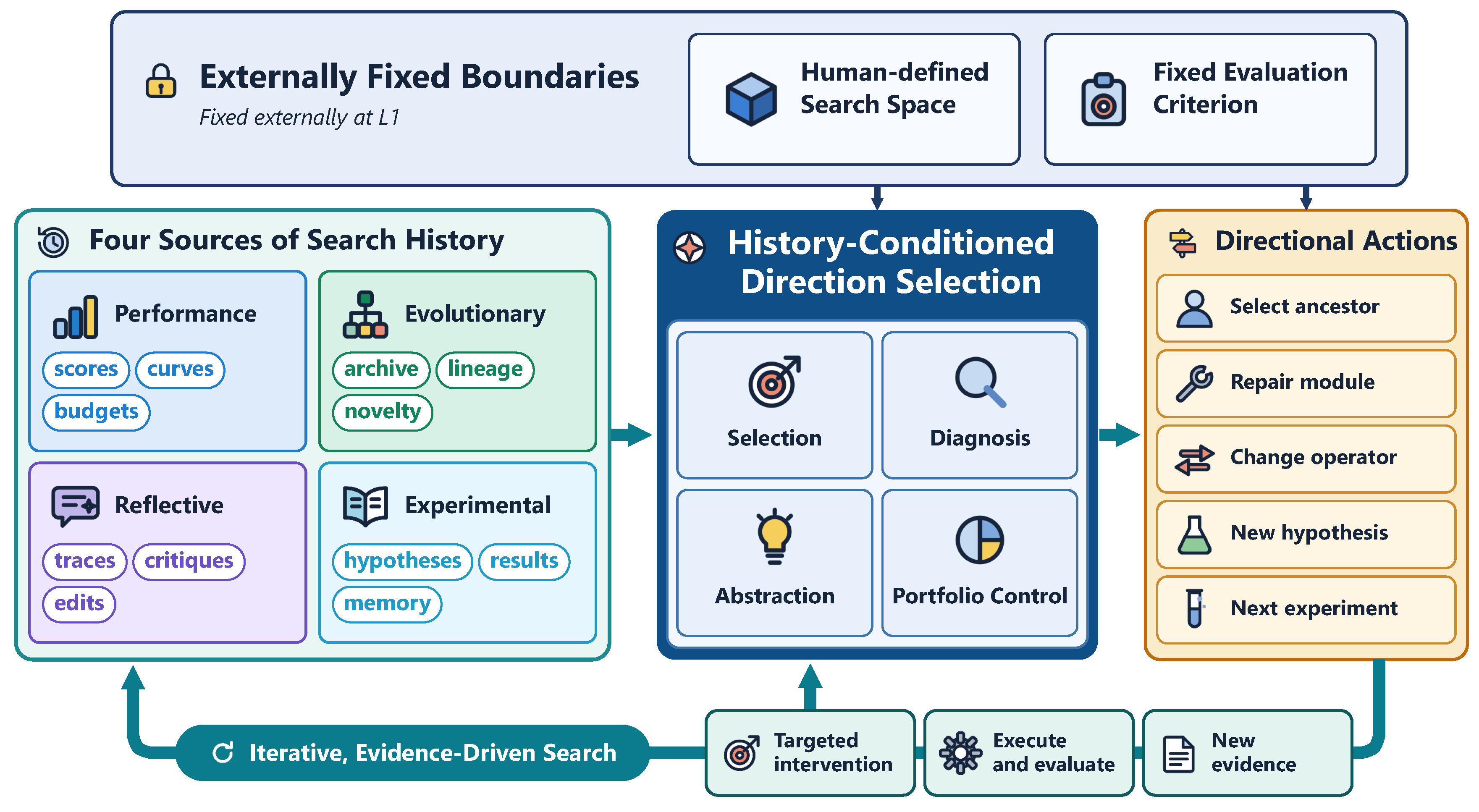
4.1. History-Conditioned Direction Selection
History as search state.
Let the research history at cycle t contain attempted interventions, observed evidence, and the relations among them:
Here is a previous candidate, its measured outcome, an optional textual or structured diagnosis, and its lineage, neighborhood, or experimental context. The direction policy may select a bottleneck, an ancestor to elaborate, a region to abandon, an operator to emphasize, or a hypothesis that explains the observed pattern. At canonical L1, the search space and the operative evaluation criterion remain externally fixed; AI controls which intervention or resource allocation is pursued within that space. A fixed pruning or acceptance rule is part of , not an additional L1 decision.
Performance histories: scalar allocation.
This definition connects recent LLM systems to a longer history of adaptive search. Random search provides a history-agnostic baseline, whereas Bayesian optimization, model-based AutoML, and population methods use accumulated observations to decide which configuration or training regime deserves the next unit of compute [1,2,3,7]. Hyperband, BOHB, Optuna, and Freeze-Thaw Bayesian optimization provide useful allocation baselines: their fixed pruning or promotion criteria remain part of the external evaluation protocol, while the history-conditioned policy determines which configuration or budget receives the next unit of attention [78,79,80,81]. If an AI system learns or revises the pruning, acceptance, or stopping criterion, that component is evaluation control and is assigned L3 by the precedence rule rather than L1.
Performance histories: response surfaces.
Neural architecture search similarly learns or evolves proposal policies from previously evaluated architectures [5,6,25,63]. Progressive NAS and Neural Architecture Optimization use evaluated architectures to predict productive expansions or latent-space moves; ENAS and Network Morphism preserve information through shared parameters or function-preserving transformations [82,83,84,85]. Predictor-based methods such as BANANAS and Neural Predictor fit explicit response surfaces over architecture histories, while early performance prediction, zero-cost proxies, and Once-for-All reduce the evidence cost of deciding which direction deserves full training [86,87,88,89,90]. Reproducible suites including NAS-Bench-101, NAS-Bench-201, NATS-Bench, and surrogate NAS benchmarks make it possible to replay identical histories and compare direction policies rather than incomparable final models [91,92,93,94].
Evolutionary histories: archives and variation.
Population-based systems retain more than scores: they preserve ancestry, island membership, mutation operators, novelty, and rediscovery. FunSearch, AlphaEvolve, OpenEvolve, and ShinkaEvolve use archive state to decide which ancestor or island should generate the next program, while Language Model Crossover, LLMatic, SBLLM, PromptBreeder, and CodeEvolve use successful lineages to choose a variation strategy [10,11,13,95,96,97,98,99,100]. Here the history is relational: direction depends on where a candidate sits in an evolving population, not only on its scalar value.
Reflective histories: critiques and trajectories.
Language makes failed attempts directly interpretable as search evidence. ProTeGi, OPRO, TextGrad, and GEPA translate errors, scores, or execution traces into targeted edits to AI artifacts [12,69,101,102]. These methods treat a critique as a directional signal rather than as a final evaluation alone.
Experimental histories: replay and research memory.
The fourth family grounds direction selection in reproducible experimental records. NAS-Bench-101, NAS-Bench-201, NATS-Bench, and surrogate benchmarks permit counterfactual replay of the same evaluated history, making competing direction policies directly comparable [91,92,93,94]. Research agents such as AI Scientist, MLE-STAR, and AutoResearchClaw extend the same principle to literature, hypotheses, code, failed runs, and reviewer feedback, using accumulated evidence to select the next experiment [15,103,104]. Experimental history therefore supports both discovery and audit: it records why a direction was chosen and whether the choice survives replication.
From observation to a directional act.
Across the four families, history influences direction through selection, diagnosis, abstraction, and portfolio control. Performance histories primarily rank or predict; evolutionary histories preserve ancestry and strategy; reflective histories explain what should change; and experimental histories determine which uncertainty should be resolved next. Modern systems often combine several carriers. The history is therefore not merely a log, but the state from which the system constructs its next research move.
Figure 4 organizes the field into performance, evolutionary, reflective, and experimental histories according to the evidence that the AI actually reads. This organization is intentionally causal rather than application-based: one system may combine scores, lineages, critiques, and experimental memory, but each carrier supports a different kind of directional act. Table 3 then decomposes representative methods into their direction policy, the history evidence they read, and the next directional act they control.
4.2. Evolutionary Program Improvement
Archive-conditioned program evolution.
Evolutionary coding agents are the clearest current realization of history-conditioned direction discovery. FunSearch stores high-performing programs in an island-structured archive, samples exemplars from that archive, and asks an LLM to continue the observed line of improvement under a human-provided program skeleton and executable evaluator [10]. AlphaEvolve scales the same basic pattern to general codebases and multiple evaluators [11]; OpenEvolve exposes an open implementation with program databases, diversity-aware sampling, and iterative LLM mutation [95]. In all three, the decisive L1 operation is the use of accumulated program lineages and scores to choose how the next proposal should depart from its ancestors.
Language models as history-sensitive variation operators.
Several adjacent systems make this direction policy more explicit. Algorithm Evolution and Evolution of Heuristics evolve natural-language algorithmic ideas together with executable implementations [109,110]. LLMs can also serve as evolutionary optimizers, surrogate models, or learned variation operators that infer productive moves from the current population [111,112]. Evolution through Large Models and Language Model Crossover showed that pretrained models can produce semantic mutations and recombinations from parent examples rather than blind syntactic perturbations [97,113]. LLMatic couples this capacity to a quality-diversity archive for neural architecture search, and SBLLM retrieves successful optimization patterns before composing the next code edit [98,99]. These systems turn population history into an implicit local model of “what kind of change works here.”
Evolving the proposal policy.
EvoPrompt applies evolutionary selection to prompts [114], while PromptBreeder evolves both task prompts and the mutation prompts that generate them [13]. ShinkaEvolve adds novelty rejection, bandit-based model selection, and parent sampling to improve sample efficiency [96]. This is a stronger L1 pattern than merely sampling more candidates: past outcomes alter which parent, mutation model, and novelty threshold govern the next move. It remains L1 so long as the program representation, admissible edits, and executable objective are supplied externally.
Strategy-level archives.
The same loop now appears across algorithm and system design. CodeEvolve combines island-based evolution with inspiration-driven crossover [100]; LLM-FE evolves feature-engineering programs [115]; program-search benchmarks test whether search histories support reusable abstractions across games and ARC-like tasks [116,117]. Evolution of Kernels, SeaEvo, graph-augmented evolution, and adaptive population handoff further study how the archive should route proposals among local strategies [106,118,119,120]. Work isolating the contribution of evolutionary selection shows that the population mechanism, not only the base model, materially changes performance [121]. EvoTrace goes further by replaying evolutionary histories and separating structural innovations from constant tuning, rediscovery, and cyclic edits [107].
The L1–L2 classification test.
Under our unit-of-analysis rule, FunSearch and OpenEvolve belong to L1 when the mutable program boundary, programming language, evaluator, and admissibility constraints are supplied by humans and AI uses the archive to choose the next improvement direction. The same software can exhibit an L2 component if it invents new representations, primitives, or edit operators that redefine which candidates are expressible. This distinction classifies the demonstrated control decision, not the project name.
4.3. Prompt, Pipeline, and Workflow Optimization
Textual gradients over prompt histories.
Prompt optimization provides a second large family of L1 systems because the optimization trace can be represented directly in language. Automatic Prompt Engineer samples and ranks candidate instructions [68]; ProTeGi turns errors into textual gradients and edits prompts by beam search [12]; OPRO places previous solutions and scores in the optimizer model’s context so that it proposes a better next instruction [69]. PromptAgent formulates prompt revision as strategic planning [122], and TextGrad propagates language feedback through compound pipelines [101]. These methods differ in their search operator, but each converts a record of prior failures and successes into a directional signal.
Editable units from tokens to compound programs.
The field has progressively expanded the editable unit. AutoPrompt, BBT, BBTv2, GrIPS, RLPrompt, and TEMPERA optimize discrete tokens, continuous surrogates, edit sequences, or test-time prompt policies [123,124,125,126,127,128]. SAMMO searches structured prompt programs [129]; DSPy compiles declarative language-model modules into optimized pipelines [130]; MIPRO jointly selects instructions and demonstrations for multi-stage programs [131]. PromptWizard, CriSPO, and automatic instruction-exemplar selection use task analyses or multi-aspect critiques to decide which component should change next [132,133,134]. Local prompt optimization studies whether local edits can outperform global rewrites under constrained budgets [135].
Reflective evolution.
GEPA makes the L1 mechanism unusually visible: it samples execution trajectories, reflects on natural-language feedback, proposes targeted prompt updates, and maintains a Pareto frontier of candidates [102]. The value of such reflection is not guaranteed. Re-evaluations of OPRO show sensitivity to the optimizer model, scorer, handcrafted meta-instruction, and token budget [136]. These results motivate a distinction between history exposure and history use: placing scores in a context window does not establish that the next edit is causally responsive to them.
Credit assignment across workflows.
History-conditioned workflow search is especially important for AI4AI because prompts, evaluators, data filters, and agent roles interact. A weak pipeline may not need a globally better instruction; it may need a new decomposition, a different handoff, or a targeted repair at the module responsible for a recurring failure. DSPy-style compilation, textual gradients, and critique-suggestion loops make such credit assignment partially explicit [101,130,133]. They therefore move L1 from selecting among isolated prompt strings toward selecting directions in a structured development process.
Fixed workflow or AI-provided space?
The L1 interpretation depends on what remains fixed. If humans define the modules and AI only decides how to revise them using observed performance, the focal control is direction. If AI invents the module graph, the representation language, or an unbounded family of tools, it begins to provide the search space and must also be reported as L2. The same optimization trace should therefore be accompanied by its full responsibility profile rather than by the method label alone.
4.4. Reflection, Memory, and Search over Trajectories
Diagnostic histories.
Scalar scores are often too weak to identify a productive direction. In-scope reflective systems use execution traces, evaluator feedback, or artifact-level critiques to decide which AI artifact should be revised next. Textual gradients, structured critiques, and multi-stage code-generation flows provide such evidence when they change a prompt, program, training procedure, or agent scaffold; standalone answer-refinement and reasoning protocols are outside the AI4AI scope.
Branching histories.
Explicit search methods retain several possible directions. In AI4AI settings, the retained branches must correspond to alternative artifact edits, experiments, or research hypotheses rather than merely alternative answers to one task. STaR converts successful reasoning traces into training data for subsequent improvement [137]; this parameter update is why it belongs to AI4AI Learning. Choosing an AI4AI direction may therefore require maintaining a topology of artifact alternatives rather than compressing history into a single incumbent.
Persistent histories.
Long-term memory extends the horizon over which direction can change. MemoryBank and MemGPT distinguish active context from persistent experience [138,139]; ExpeL extracts transferable lessons across task trajectories [140]; Voyager accumulates an executable skill library and uses environment feedback to select increasingly ambitious goals [141]. Generative Agents similarly retrieve, reflect on, and synthesize past events into higher-level plans [142]. These systems are not automatically AI4AI, but their memory mechanisms become L1 components when the remembered experience guides the improvement of an AI artifact or its development process.
Self-correction is an empirical claim.
Evidence on intrinsic self-correction is mixed. Controlled studies report that language models often fail to repair reasoning without reliable external feedback, while other work finds gains under carefully constructed intrinsic critique protocols [143,144]. ReSTEM shows a different route: successful and unsuccessful traces can be converted into iterative self-training data rather than used only at inference time [145]. For L1, the central question is therefore not whether a model can produce a critique, but whether the critique selects a better intervention than score-only, shuffled-history, or no-history controls.
Counterfactual dependence on history.
The central limitation is that reflection is evidence of control only when it changes the search trajectory. A fluent critique that restates the failure message, a memory item that is never retrieved, or a tree whose branches collapse to the same proposal does not establish AI-provided direction. Causal ablations should remove, shuffle, or replace the historical record and measure whether the resulting direction and final discoveries change.
4.5. Experiment-Driven Research Direction
Research history as a heterogeneous record.
At the scale of research workflows, history consists of literature, experimental plans, implementation traces, failed runs, reviewer feedback, and intermediate results. ResearchAgent uses literature-grounded retrieval to propose and refine research ideas [71]. MLAgentBench evaluates whether language agents can plan and execute machine-learning experiments [72], while MLE-bench tests end-to-end machine-learning engineering under realistic competition tasks [146]. The AI Scientist and AI Scientist-v2 use prior experimental evidence to revise hypotheses, code, and reports over repeated cycles [15,16]. Agent Laboratory distributes literature review, experimentation, and writing among collaborating agents [73].
Search and targeted experimental refinement.
MLE-STAR first retrieves plausible model families and then uses block-level ablations to decide which part of a machine-learning solution should be refined next [103]. AutoResearchClaw similarly emphasizes persistent research memory and self-reinforcing cycles, while Jr. AI Scientist begins from a baseline paper and conducts autonomous extensions [104,147]. These systems are closer to L1 than agents that merely execute a static plan because experimental results can redirect attention among hypotheses, implementation components, and follow-up tests.
Multi-agent evidence aggregation.
General agent frameworks supply complementary mechanisms. Data Interpreter records data-science plans and execution feedback [148]; MetaGPT, AutoGen, and AgentVerse coordinate specialized roles through shared messages and artifacts [149,150,151]. AgentCoder iterates code generation against testing agents [152], while SWE-agent and Agentless expose how repository feedback can be converted into repair strategies with very different amounts of scaffolding [153,154]. OSWorld broadens the executable environment in which such history-conditioned decisions can be evaluated [155]. Automated Design of Agentic Systems treats the agent organization itself as an editable artifact [14].
AgentBench, AgentBoard, GAIA, and SWE-bench add complementary views of whether multi-turn histories improve action selection in interactive, assistant, and software-engineering settings [156,157,158,159]. More Agents Is All You Need reports gains from sampling and aggregating multiple agents, whereas AgentScope provides engineering support for maintaining their messages and states [160,161]. For L1, however, parallelism counts only when disagreement or complementary evidence changes the next research direction; a larger ensemble that repeats the same trajectory is additional compute, not additional control.
Degrees of directional autonomy.
These systems reveal a spectrum of directional autonomy. At the weakest end, AI executes a human-authored experiment list. Stronger systems diagnose why a run failed, compare competing explanations, and allocate the next experiment to resolve uncertainty. Stronger still, they may revise the research question after evidence invalidates its assumptions. Such revision is one strong example, but L1 more generally requires a target-specific change in how the investigation proceeds, rather than simply completing the next queued operation.
Research-agent audits.
Recent audits expose why final-paper appearance is an inadequate proxy for L1 competence. Evaluations of the AI Scientist report mixed reproducibility and uneven experimental validity [108]; implementation-focused analyses argue that weak execution and verification remain binding bottlenecks [162]. Other studies find that automation can hide consequential intermediate decisions, that independent AI scientists may disagree, and that headline scientific impact remains far from established [163,164,165]. MLReplicate measures whether autonomous systems can reproduce machine-learning results, while SciIntegrity-Bench tests citation, attribution, and experimental-integrity failures [166,167]. Package hallucinations provide a concrete example of a seemingly productive direction failing at the implementation layer [168].
Discoveries that update the improver.
Program-search systems also become research agents when discoveries feed back into the next cycle. AlphaTensor and AlphaDev used learned search to reveal new algorithmic strategies [66,67]; Eureka evolves reward programs from environment outcomes and is therefore an L3 evaluator-generation case rather than an L1 row here [19]; STOP and the Darwin Gödel Machine use previous improvements to modify an improver or coding agent within a fixed edit boundary [24,70]. AutoRISE applies related strategy evolution to adversarial testing [169]. Such systems are particularly informative because their histories contain both object-level results and evidence about the process that produced those results.
4.6. Direction Quality, Failure Modes, and the Boundary with L2
Degrees of history use.
History conditioning is not a binary property of an entire system. History-exposed systems receive earlier candidates or scores but need not respond to them. History-responsive systems produce detectably different proposals when the record changes. History-explanatory systems identify which observation supports the chosen move. History-counterfactual systems can state what would have been tried under a different outcome. The stronger degrees support more credible claims that AI, rather than a fixed script, supplies the direction. Reproducible NAS studies show why this distinction matters: sophisticated adaptive policies can lose to random search when budgets, spaces, and evaluation protocols are controlled [105,170,171].
Evaluating the direction rather than only the destination.
L1 should be evaluated at the level of the direction, not only the final artifact. A useful evaluation stack asks whether the chosen direction is novel relative to the supplied history, causally responsive to evidence, feasible under the remaining budget, diverse across independent runs, and more productive than random, greedy, or history-ablated baselines. For population methods, reporting should include archive coverage, lineage depth, repeated-edit rates, and the contribution of crossover or diversity maintenance [107,121]. For prompt and reflection methods, it should include edit locality, critique-action agreement, retrieval usage, and robustness to misleading history [101,133,140].
Characteristic failure modes.
Four failure modes recur. Historical anchoring keeps the search close to early incumbents; archive collapse removes competing hypotheses; credit misassignment attributes a gain to the wrong edit or module; and feedback overfitting selects directions that exploit a fixed evaluator. Evolutionary archives and multi-agent portfolios mitigate some of these risks but can also multiply compute without producing genuinely distinct research trajectories [10,100,150]. Direction discovery therefore needs independent replay, counterfactual history ablations, and held-out evaluators.
Boundary with L2.
The L1–L2 boundary is determined by the origin of the candidate domain. L1 may select ancestors, mutation strategies, modules to repair, or hypotheses to test inside a human-fixed representation. L2 begins when AI substantively changes the editable objects, primitives, constraints, or operators that define what can be proposed. FunSearch and OpenEvolve are canonical L1 examples in this chapter because their central mechanism uses previous programs and evaluator feedback to choose the next improvement direction under an externally supplied coding boundary. If a deployment allows the same agent to invent that boundary, its full profile must record the additional L2 control.
5. L2: AI Provides the Search Space
At L2, the focal object is the search space itself: where improvement can occur and what objects or moves are available there. A system reaches L2 only when AI substantively determines the search space by selecting, constructing, expanding, compressing, or revising its representation, primitive library, legal composition rules, or validity constraints. Direction may come from either source, while the evaluation signal remains human-authored or externally fixed. Note that AI-generated candidates alone do not establish L2. A system may produce highly novel designs within a human-specified space; L2 requires AI to substantively determine or revise the space from which those candidates can be generated. This process is summarized in Figure 5.
5.1. Formalization and Evaluation of AI-Defined Search Spaces
This subsection formalizes the L2 search space, its main components, and its evaluation. We first distinguish the AI-defined active space from the broader ambient universe, then decompose it into its representation, available primitives, legal composition and edit operators, and validity constraints, and finally discuss how to evaluate the space by distinguishing its contribution from that of the navigation policy. Figure 6 organizes L2 work by the search-space artifact supplied by AI.
AI-defined active search spaces.
At L2, AI defines an active search space within a broader universe. Let denote this ambient universe: a programming language, hardware interface, broad architecture grammar, or set of executable APIs. At iteration t, the active space is represented by
where is the representation, the available primitives or modules, the legal composition and edit operators, and the validity constraints. The candidates induced by this representation belong to the ambient universe, so . L2 requires AI to construct or substantively revise the search space that shapes candidate generation:
What matters for L2 is that AI determines , after which is the candidate-generation or navigation policy that samples or constructs candidates inside that space. In the batch abstraction of Section 3, is formed before is selected within it; online systems may instead alternate space construction and direction selection as evidence arrives. The ambient universe may remain human-defined, just as a programming language can stay fixed while AI learns a new domain-specific library. This separates search-space construction from navigation: defines the domain over which downstream search operates, whereas determines how that domain is explored under the available budget. For an L2 assignment, in the displayed equation is held externally fixed; if AI constructs or revises its operative criterion, the precedence rule assigns L3.
Search-space evaluation and attribution.
Evaluation of an L2 system should focus on the quality and consequences of the AI-defined search space itself. Evidence should identify which components of are constructed or revised by AI and characterize how these changes alter the candidates, compositions, or constraints available to downstream search. Because downstream performance also depends on the navigation policy , evaluation should control for this factor rather than treat it as part of the L2 contribution. Comparisons under a fixed or matched navigation policy can therefore help attribute gains specifically to the AI-defined search space.
We review existing L2 methods by the part of the search space that AI constructs or revises. Figure 6 provides an overview of this component-based organization. while Table 4 decomposes representative methods into their space-construction policies, human-provided ambient universes, and AI-provided active spaces. We organize the discussion around changes to primitives , representations , composition and edit operators , and admissibility constraints . Methods affecting multiple components are discussed under their primary space-defining change, with secondary effects noted where relevant.
Selecting and constructing primitives.
Primitive-level construction changes the modules from which downstream candidates are assembled. Neural operations, library functions, and callable tools or skills instantiate in different settings; the candidate space consists of architectures, programs, or action routines built from these primitives under the remaining components of . Selection alone can define an active primitive set. DDSAS represents a subspace as a binary edge–operation mask over a fixed architectural graph. Upper Confidence Bound (UCB)-guided global top-L selection dynamically constructs the active subspace, and differentiable optimization subsequently searches within and updates this subspace. [173]. The main change is therefore to the available neural operations, not to the graph encoding or the rules for editing architectures.
Program-library learning constructs new primitives rather than selecting existing ones. EC2 learns reusable domain-specific subroutines while jointly training a neural recognition model to guide search over programs expressed in the learned domain-specific language(DSL) [174]. DreamCoder interleaves task solving with abstraction learning that extends its DSL with reusable symbolic abstractions, and drawing-program induction applies the same library-learning mechanism to induce reusable, abstract, and compositional drawing subroutines. [175,176]. LAPS additionally uses natural-language supervision to learn abstractions and search heuristics [177]. Stitch synthesizes abstractions that capture recurring program structure and compress the program corpus, while LILO integrates LLM-guided and enumerative program synthesis, Stitch-based library compression, and an LLM-based auto-documentation (AutoDoc) module that generates human-readable names and docstrings for learned abstractions. [178,179]. Across these systems, the learned functions become callable constituents of subsequent programs, making the library update the primary intervention.
Tool-making systems expose the same mechanism through agent interfaces. CREATOR generates a tool before deciding how to apply it, LATM caches generated Python tools for subsequent requests, and Toolink creates a toolkit before planning and tool calling [180,181,182]. CRAFT abstracts generated code solutions into reusable tools, forming a specialized toolset for downstream retrieval and use, whereas TROVE incrementally grows and trims a toolbox of reusable high-level functions [183,184]. ToolLibGen clusters question-specific tools and refactors them into structured libraries with unified interfaces [185]. Here, tools affect the search space because later solutions invoke them as available building blocks, rather than because tool generation itself constitutes a final solution.
Voyager and DynaSaur extend this construction across tasks by accumulating executable skills or actions that later solutions can reuse [141,187]. Memento-Skills maintains and refines multi-artifact skills comprising declarative specifications, helper scripts, and prompts [188]. Their L2-relevant object is the evolving repertoire of usable routines, not the retrieval or routing policy that selects among them. Such primitives can encapsulate behavior already expressible in the base language; they need not introduce new semantic capabilities to alter the building blocks and lengths of candidate solutions.
ToolMaker illustrates a related but narrower case: it implements reusable tools from scientific code repositories and prepares their execution environments, while the desired task specification, repository, and required input arguments are provided externally [186]. This establishes tool realization, but does not by itself establish autonomous selection of the primitive vocabulary.
Learning candidate representations.
Representation-level construction changes the encoding through which candidates are exposed to downstream search, rather than merely changing how often fixed candidates are proposed. In hierarchical generative NAS, a graph variational autoencoder learns embeddings of cell architectures, while clustering based on zero-cost performance proxies identifies families of similar cells. The macro search operates on sequences of cell-family identifiers, channel counts, and strides; conditional generation with CCNF and G-VAE decoding then instantiates these high-level descriptions as concrete architectures. The method first explores this high-level space using evolutionary search (HL-Evo) and subsequently trains a sequence generator on the explored architectures [172]. We therefore attribute its primary learned space abstraction to the graph representation and cell-family abstraction. The human-specified architectural template remains distinct from this learned encoding, as does the sequence generator’s role in proposing candidate architectures.
Revising composition and edit operators.
Operator-level construction would change the reusable rules that assemble or transform candidates, such as grammar productions or admissible graph rewrites. This differs from adding a function that can be invoked through an unchanged composition language, and from selecting a particular sequence of existing actions. Under this distinction, the reviewed abstraction and tool-learning systems mainly modify , and do not provide a clear primary example of learned . SkillX further illustrates this boundary: although it learns hierarchical reusable skills, these skills are retrieved as execution guidance rather than modifying the underlying composition operators [189]. Such guidance does not by itself demonstrate that AI has changed the legal composition or edit operators. We therefore retain operator construction as a distinct intervention target without assigning these systems to it solely because they describe or perform composition.
Adapting admissibility constraints.
Constraint-level construction changes which otherwise expressible candidates are admitted to the active search. S3 represents an architecture space through admissible sets of values for design dimensions, including depth, embedding dimension, attention heads, window size, MLP ratio, and query–key–value dimensions. Their Cartesian product defines the active search space. Using a supernet-based space-quality estimate, S3 evolves these value sets before the final architecture search [190]. With the design variables and architectural building blocks held fixed, we classify this intervention primarily as a change to : it revises the active admissibility conditions rather than simply selecting an individual architecture.
5.2. Evaluation and Minimum Evidence for L2
Having identified the different components of that AI can construct or revise, the next question is whether downstream improvements can actually be attributed to the resulting search space. This requires evaluating the space itself while controlling for other factors that affect search performance.
Evaluating AI-defined search spaces.
Evaluation of an L2 system should assess the quality and consequences of the AI-defined search space , rather than only the performance of an individual selected candidate. The quality of a final candidate reflects not only the space construction process, but also the navigation policy , evaluator variance, and search budget. A source-matched L2 evaluation should therefore isolate the contribution of by comparing controlled conditions: the AI-constructed space with a fixed search procedure; a human-designed space under the same search procedure; a randomized or stale AI-derived space with comparable capacity; and the original method with its full procedure. Evaluation should consider properties of the induced space, including validity, unique coverage, semantic diversity, achievable quality under matched sampling, transfer performance, and search cost.
For induced libraries and toolboxes, space-level evaluation should further consider compression, reuse frequency, interface validity, and held-out task benefit, rather than relying only on performance over the tasks used for construction. Because downstream results depend jointly on and the navigation policy , evaluations should control or match across conditions so that improvements can be attributed to changes in the search space itself.
Such attribution requires evaluation environments where the evaluator and task distribution remain external while the provenance of the search space is systematically varied.
Existing benchmarks.
Existing benchmarks provide standardized environments for evaluating search procedures and agent capabilities. In neural architecture search, NAS-Bench-101, NAS-Bench-201, NATS-Bench, and surrogate NAS benchmarks enable reproducible comparisons by providing predefined architecture spaces together with tabulated or learned performance estimates [91,92,93,94]. These resources allow researchers to replay architecture search algorithms under controlled conditions without repeatedly training all candidate architectures.
For tool- and skill-based agents, SWE-bench, OSWorld, AgentBench, AgentBoard, and MLE-bench provide task environments and execution-based evaluation protocols covering software engineering, computer interaction, general agent behavior, and machine learning workflows [146,155,156,157,159]. Together, these benchmarks establish common grounds for comparing systems that differ in their internal search spaces, tools, or learned capabilities.
Minimum reporting package.
An L2 paper should report: (i) the human-provided ambient universe ; (ii) the machine-produced artifact defining ; (iii) the changed components of ; (iv) whether the artifact is persistent and reusable, where applicable; (v) freeze-and-replay or otherwise navigation-matched comparisons under matched compute; and (vi) who supplied direction and evaluator E. Together, these measurements attribute downstream gains specifically to the AI-defined search space.
5.3. Composition with Direction and Evaluation Control
Practical systems often combine L2 with other forms of AI control. It is therefore necessary to distinguish which system components determine direction, search space, and evaluation, rather than assigning a single control level to the system as a whole.
Composition with direction control.
Search within an AI-defined space may follow directions specified by humans or predefined rules, and can also be guided by an L1 component that determines which directions to pursue. Voyager exemplifies this combination: its automatic curriculum selects goals, while AI-generated skills expand the available reusable components [141]. Direction control determines what to pursue, while search-space construction defines the representations, primitives, operations, and constraints available for pursuing it. Voyager also uses AI-based self-verification to judge whether a task has been completed, which determines whether the resulting program is committed to its skill library, constituting L3 evaluation control under our taxonomy.
Evaluation remains external.
L3 begins when AI constructs or substantively revises what counts as progress. Eureka, Constitutional AI, RLAIF, LLM-as-a-judge, self-rewarding models, and process supervision concern evaluation control rather than search-space provenance [17,18,19,20,21,75]. Such mechanisms can coexist with L2, but their contributions should be attributed separately: an AI-generated library remains an L2 artifact when judged by a fixed external evaluator, whereas an AI-generated or substantively revised reward belongs to evaluation control even when the candidate space is entirely human-designed.
L2 should therefore be attributed to the component that constructs or revises , rather than to the system as a whole. A single system may combine direction control, search-space construction, navigation, and evaluation control; when AI additionally begins to construct or revise the criterion E by which progress is judged, the analysis moves from L2 search-space control to L3 evaluation control.
6. L3: AI Provides the Evaluation Signal
The control transferred at L3.
L3 transfers control over the criterion that determines progress. An AI system qualifies for L3 when it constructs or substantially revises the operative signal used to rank candidates, allocate search effort, accept discoveries, or terminate the loop. Humans may still specify the direction and search space. L3 therefore includes every profile whose evaluation coordinate is AI-provided: , , , and . Only the last profile places all three control variables under AI control. The defining property of L3 is the provenance of the evaluation signal, rather than end-to-end autonomy.
The evaluator papers below are counted as AI4AI L3 evidence only when their AI-generated tests, judgments, rewards, or adaptive environments enter a discovery loop and change candidate selection, training, or acceptance. Standalone benchmark scoring, answer ranking, or post hoc review remains an evaluation technique, not an AI4AI intervention.
6.1. The Object of Attribution: the Operative Evaluation Signal
Evaluation as a structured artifact.
At iteration t, represent the operative evaluation object as
where contains tests, tasks, or environments; maps evidence to local judgments; aggregates judgments across criteria, samples, or evaluators; and defines acceptance, rejection, or stopping thresholds. L3 requires an AI-generated component to enter the subsequent discovery loop:
Here is the accumulated research history used in Chapter 2, denotes the model or agent that constructs the evaluator when such a model is present, and is an individual candidate. The evaluator may be instantiated before candidate scoring from , or it may update online with additional history absorbed into ; in either case, is the candidate-level evidence used by selection. The selected candidate is the candidate-level counterpart of the target update in the full discovery cycle. The sources of direction and search space do not determine the L3 label. The relevant criterion is whether AI generates a component of and whether that component causally governs selection.
The ranking-intervention test.
A strong L3 claim should make inspectable and replay the same candidate set under four conditions: the AI-generated evaluator, a human-authored anchor, a capacity-matched stale or randomized evaluator, and an independent holdout evaluator. The analysis should report rank correlation, pairwise disagreement, calibration, false-accept and false-reject rates, and downstream regret. It should repeat these comparisons after swapping candidate order and model identity, while matching output length and style and checking for contamination. If replacing the evaluator leaves the search trajectory unchanged, the evaluator provides auxiliary commentary rather than operative evaluation control.
Figure 7 summarizes how an AI-provided evaluation signal connects human anchors and generated evaluation components to consequential discovery decisions. The separate validation branch audits candidate gains using independent anchors; it does not grant the optimizing system control over the external evaluator.
6.2. Executable Evaluation Artifacts
Generated tests can become operative, but generation alone is insufficient.
CodeT uses language-model-generated tests and a dual execution-agreement score, combining agreement with the generated tests and with other sampled programs, to select a program at inference time [191]. ChatUniTest constructs unit tests tailored to the focal Java method and validates or repairs those tests. CodeJudge uses an LLM to estimate semantic code correctness without test cases [192,193]. These methods can act on different parts of E: test synthesis changes , whereas semantic judging changes J. The technical ability to generate a test or judgment does not by itself establish L3. ChatUniTest and CodeJudge count as L3 only when their generated tests or semantic judgments enter candidate selection, training, resource allocation, or an operative accept–reject rule; test repair, annotation, or post hoc scoring remains evaluation support. Their evidence is strongest when generated tests are checked for validity, coverage, independence from the candidate generator, and agreement with hidden tests.
Outcome verifiers learn a pass–fail boundary.
CodeRL trains a critic to predict functional correctness and feeds its dense feedback into actor updates and critical sampling. LEVER combines execution results with a learned verifier to rerank programs generated by a language model [194,195]. Cobbe et al. train an outcome verifier on final-answer correctness and use it to select among sampled GSM8K solutions with Best-of-N [212]. CRITIC instead runs a generate, tool-check, and revise loop for individual outputs. Its feedback can guide revision, although the paper neither trains a reward model nor explicitly ranks a population [213]. CRITIC counts as L3 only when the critique controls the operative revision or accept–reject decision in the analyzed discovery loop; a one-off tool check or post hoc critique remains an evaluation technique.
Process supervision localizes evaluation.
Outcome rewards score complete trajectories, whereas process rewards score intermediate steps and can reveal where a derivation first fails. PRM800K provides human step labels. Its solution score is the product of step-positive probabilities; minimum reduction is evaluated as an alternative for Best-of-N selection [75]. Math-Shepherd estimates step quality from rollout success without human step annotations and uses the resulting process reward for verification and PPO [196]. Generative verifiers recast verification as next-token prediction: GenRM scores a candidate by the probability of the “Yes” token, while GenRM-CoT aggregates scores across sampled verification rationales [197]. These methods move different parts of E from fixed specifications and final-answer checks to AI-generated judgments; their labels, rollouts, and aggregation procedures should therefore be reported separately.
6.3. Learned Preference Evaluation and Model Judges
Preference models turn comparisons into a reusable objective.
Preference-based reinforcement learning learns a reward function from human comparisons, and InstructGPT uses the inferred reward to guide PPO updates [74,198]. These are mixed-control L3 examples when the learned mapping is the operative score consumed by optimization: humans provide the comparisons, while the learned mapping produces the signal. Constitutional AI replaces part of direct human feedback with model-generated critiques, revisions, and preferences conditioned on written principles. RLAIF trains a reward model from AI-generated preferences and uses that model for reinforcement learning [17,18]. In both systems, the human constitution or task specification serves as an anchor, whereas the labels and reward are machine-generated; the L3 designation still requires that this machine-generated signal change training, selection, or acceptance.
Model judges often function as evaluation technologies rather than closed loops.
MT-Bench, G-Eval, JudgeLM, Prometheus, and Prometheus 2 introduce language-model evaluators, rubrics, and tests of alignment with human judgments. Their original papers mainly report benchmark scores and evaluator quality rather than downstream candidate optimization [21,199,200,201,214]. They therefore become L3 components only when their ratings influence candidate survival, resource allocation, or acceptance. PandaLM is a narrower closed-loop case: its judge feeds or supports instruction-tuning hyperparameter selection, while its synthetic GPT-3.5 judgments and human holdout serve distinct evidentiary roles [202]. Treating PandaLM as L3 requires evidence that these judgments causally alter which configuration is retained or receives resources, rather than merely informing an offline comparison.
Rubric generation changes the measurement model.
A fixed human rubric delegates scoring but not the selection of criteria. A stronger L3 system derives criteria, weights, counterexamples, and disqualifying conditions from the task and then applies them. Reports should state whether AI changed , J, A, or , whether those changes entered optimization, and whether generated criteria survived expert review or predicted delayed real-world outcomes.
6.4. Generated Objectives and Self-Evaluation
Executable reward design exposes the evaluator as code.
Text2Reward translates a natural-language objective into executable reward code for reinforcement learning. Its term “data-free” refers to the absence of offline demonstrations, not to the absence of human task specifications or optional feedback. Eureka uses an LLM to synthesize and iteratively improve reward programs from environment code and training feedback [19,203]. The resulting program can be versioned, executed, ablated, and supplied to a different policy optimizer. This makes generated rewards unusually auditable L3 artifacts when the generated program is the operative training or selection signal. Eureka also illustrates compositional control. Reward-code evolution can additionally function as L1 direction over prior reward candidates if the configuration uses those alternatives to decide which objective to pursue; otherwise it remains part of the L3 evaluator. The underlying simulator and action interface may remain human-provided.
Self-reward closes the generator–evaluator loop.
Self-Rewarding Language Models use the model itself as a judge to create preference data for iterative training, placing response generation and part of evaluation in one shared loop [20]. Meta-Rewarding Language Models add a meta-judge that evaluates the quality of the model’s own judgments, creating a second-order evaluator over [204]. These systems are structurally important because evaluator improvement can amplify candidate improvement. However, shared-model errors, self-preference, and feedback collapse make independent anchors essential. Reported gains should therefore be separated from external benchmark validation, which does not itself provide the training signal.
6.5. Adaptive Oversight, Robustness, and Recursive Evidence
Adaptive evaluation searches for failures.
Language-model red teaming generates adversarial questions that elicit harmful behavior and changes the test distribution in response to the system under evaluation [205]. POET co-evolves environments and agents; PAIRED trains an adversarial environment generator through regret; and LLM-POET uses language models to propose and mutate environments [206,207,208]. Their evaluation artifact is not a static score but an adaptive distribution whose difficulty and coverage evolve with the candidate population. An adaptive is only operative L3 evidence when its changes alter the judgment mapping, aggregation, threshold, or candidate selection/training in the analyzed loop. If it only generates challenge cases or acts as a curriculum while the evaluator and acceptance rule remain fixed, it is an adaptive test or training artifact rather than L3 evaluation control.
Scalable oversight distributes judgment across agents.
AI safety via debate proposes adversarial arguments as a way to help a human judge questions that are difficult to evaluate directly [209]. Scalable-oversight work studies whether models and assistance protocols can extend human supervision, while weak-to-strong generalization asks whether weak supervision can elicit stronger model capabilities [211,215]. CriticGPT trains a critic to identify subtle errors in model-written code and improve human review quality [210]. These protocols combine human anchors with AI-produced evidence, but neither debate, CriticGPT, nor weak-to-strong generalization is automatically L3. They count as L3 only when the generated arguments, critiques, or supervision signals change the operative J, A, or and thereby alter selection, training, or acceptance in the discovery loop.
Evaluation-guided search and scientific review.
An AI score matters for AI4AI when it changes parent selection, mutation, experiment allocation, early stopping, or acceptance. Candidate-level evaluations should therefore be linked to a trajectory-level quantity such as cumulative independent utility, best-so-far quality, or discovery regret. This causal view separates systems that merely summarize experimental outputs from systems whose evaluators control the next experiment.
Scientific review is a compound evaluator.
The AI Scientist combines idea generation, experiment execution, manuscript production, and automated review; its successor increases the degree of end-to-end automation [15,16]. Automated review can apply criteria such as novelty, soundness, clarity, and significance, but it remains a proxy for scientific value. A rigorous decomposition should expose the review rubric, reviewer model, aggregation procedure, acceptance threshold, and any literature or execution checks. Review-model scores should be calibrated against blinded expert judgments and later reproducibility rather than treated as ground truth.
Evaluator cascades can combine heterogeneous evidence.
Low-cost unit tests may filter obvious failures before expensive learned judges, formal checkers, or expert audits. Such cascades should report which stage has veto power and how uncertainty propagates. Otherwise, an apparently independent final evaluator can inherit a biased candidate pool created by an earlier AI judge.
Optimization pressure exposes proxy mismatch.
Reward-model performance can degrade when policies are optimized beyond the data regime on which the reward was trained [23]. Reward hacking occurs when proxy improvement lowers the intended reward. Goal misgeneralization occurs when an agent pursues the wrong objective out of distribution, and sycophancy occurs when preference optimization favors agreement over truth [216,217,218]. These failure modes are related but distinct. The distinction matters at L3 because the evaluator is a mutable component inside the optimization loop.
Model judges have systematic preferences.
LLM evaluators can exhibit position bias and inconsistent pairwise preferences [219]. Broader audits find sensitivity to model identity and to demographic or stylistic features; evaluators may also prefer outputs generated by themselves or related models [22,220]. Evaluator ensembles can reduce some forms of overoptimization and variance in synthetic settings, but correlated training data and architectures preserve shared blind spots [221]. Optimization may therefore follow a proxy reward model while leaving the latent objective unchanged. Ensembles mitigate this risk but do not eliminate it [222].
Minimum reporting package.
An L3 paper should report: (i) the human-provided specification and data; (ii) the AI-generated components of ; (iii) how the signal changes selection; (iv) agreement and calibration against independent anchors; (v) robustness under increased optimization pressure; (vi) sensitivity to evaluator identity, prompts, ordering, and contamination; and (vii) the provenance of direction and search space. Useful anchors include executable ground truth, formal verification, hidden human-authored tests, cross-model judging, delayed real-world outcomes, preregistered protocols, and randomized expert audits.
Self-evaluation is necessary but not sufficient.
STOP uses a language model to improve a scaffolding program that recursively improves solutions. The Darwin Gödel Machine iteratively edits an agent and empirically validates proposed modifications [24,70]. Under the fixed boundaries used in the application table, both systems are neighboring L1 systems. They become L3 only if an AI-produced evaluator or acceptance rule governs the next modification. Self-rewarding and meta-rewarding systems, by contrast, place learned evaluators inside iterative improvement loops. These systems demonstrate increasingly tight feedback between candidate and evaluator, but a single generation can benefit from evaluator drift, benchmark overfitting, or lucky search.
Claims must survive a frozen external evaluator.
A recursive-improvement claim should show that generation improves the mechanism that produces generation . It should also show that gains persist across multiple generations and that each generation remains better under an evaluator frozen before the run. The evaluator itself must be versioned so that criterion changes are not mistaken for candidate improvement. AI4AI-Bench begins to isolate agents’ ability to modify training algorithms rather than merely tune hyperparameters or collect data [62]. Stronger evidence would combine such mechanism-level tasks with held-out domains, compute-matched baselines, lineage tracking, rollback tests, and external evaluation that the improving system cannot inspect or rewrite. L3 therefore marks control over evaluation; it becomes evidence for recursive self-improvement only when evaluator improvement and candidate improvement remain distinguishable across generations.
7. Applications and Benchmarks
Complementing the analysis of control in Section 4, Section 5 and Section 6, this section offers a distinct perspective through applications, examining what AI4AI improves and how those improvements are evaluated across domains. We organize the discussion into four families: AI4AI Learning, AI4AI Inference, AI4AI Data, and AI4AI Infrastructure. These cover improvements to learning procedures, frozen-model behavior, data, and the software and hardware stack. Figure 10 groups representative methods by these targets. The tables select representative methods that illustrate distinct application artifacts, retaining the earlier level labels and summarizing AI-produced artifacts alongside the human-provided setup. Methods with several applications may contribute to more than one family. Research workflows and shared evaluation components connect these families, while Table 10 connects representative benchmarks to AI4AI development tasks and their validation.
Figure 9.
Overview of AI4AI applications organized by the target of improvement: Learning, Inference, Data, and Infrastructure.
Figure 9.
Overview of AI4AI applications organized by the target of improvement: Learning, Inference, Data, and Infrastructure.
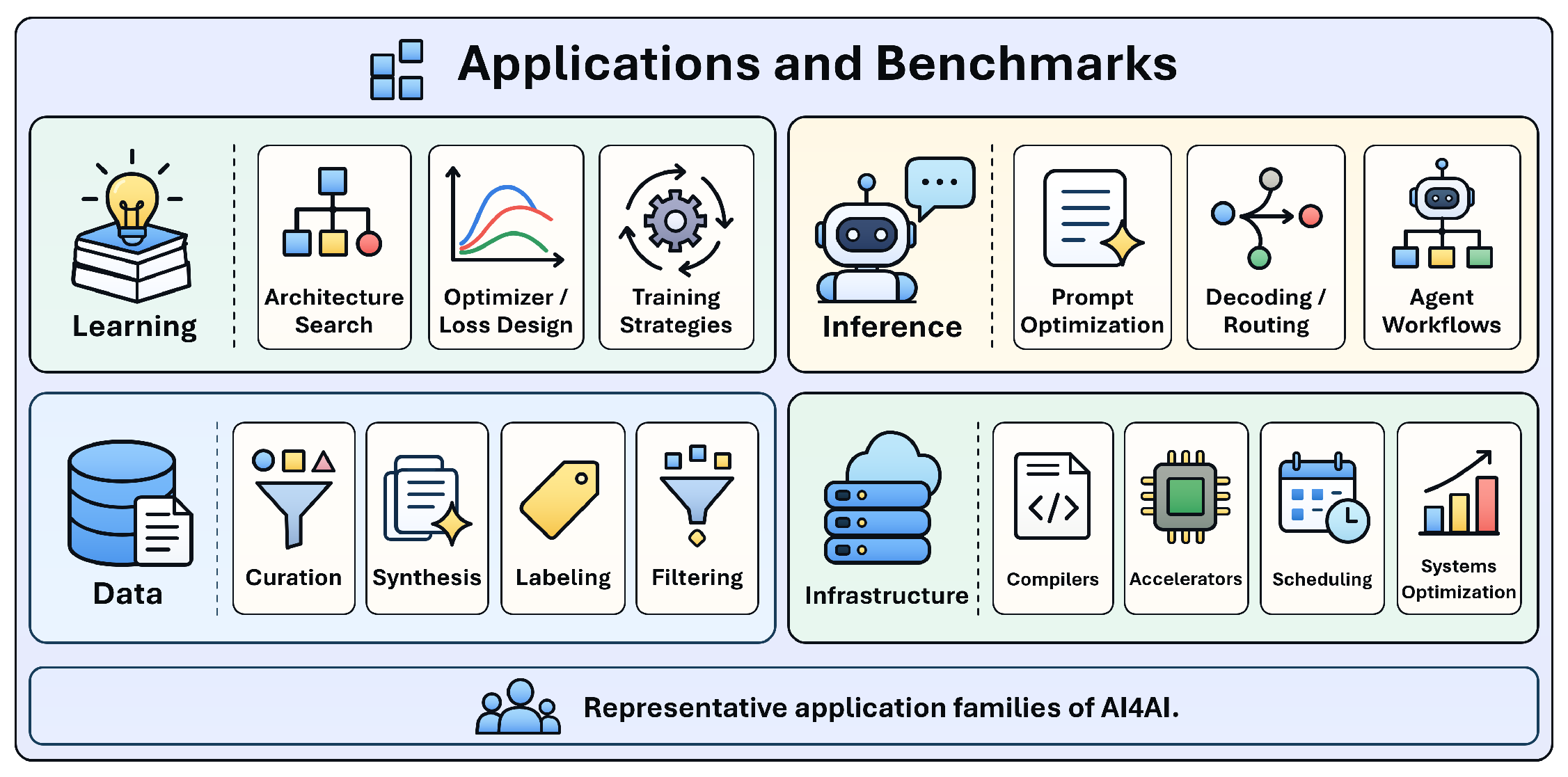
Figure 10.
Taxonomy of AI4AI applications. Representative methods are organized by the artifact being improved: learning procedures, inference-time behavior and computation, data construction, and infrastructure artifacts or tool flows. Benchmarks are listed separately in Table 10. This application axis is orthogonal to the L0–L3 control hierarchy: methods in any branch may differ in whether AI controls the search direction, search space, or evaluation signal. A superscript * marks the same configuration-dependent condition used in the application tables; the figure is representative rather than exhaustive.
Figure 10.
Taxonomy of AI4AI applications. Representative methods are organized by the artifact being improved: learning procedures, inference-time behavior and computation, data construction, and infrastructure artifacts or tool flows. Benchmarks are listed separately in Table 10. This application axis is orthogonal to the L0–L3 control hierarchy: methods in any branch may differ in whether AI controls the search direction, search space, or evaluation signal. A superscript * marks the same configuration-dependent condition used in the application tables; the figure is representative rather than exhaustive.
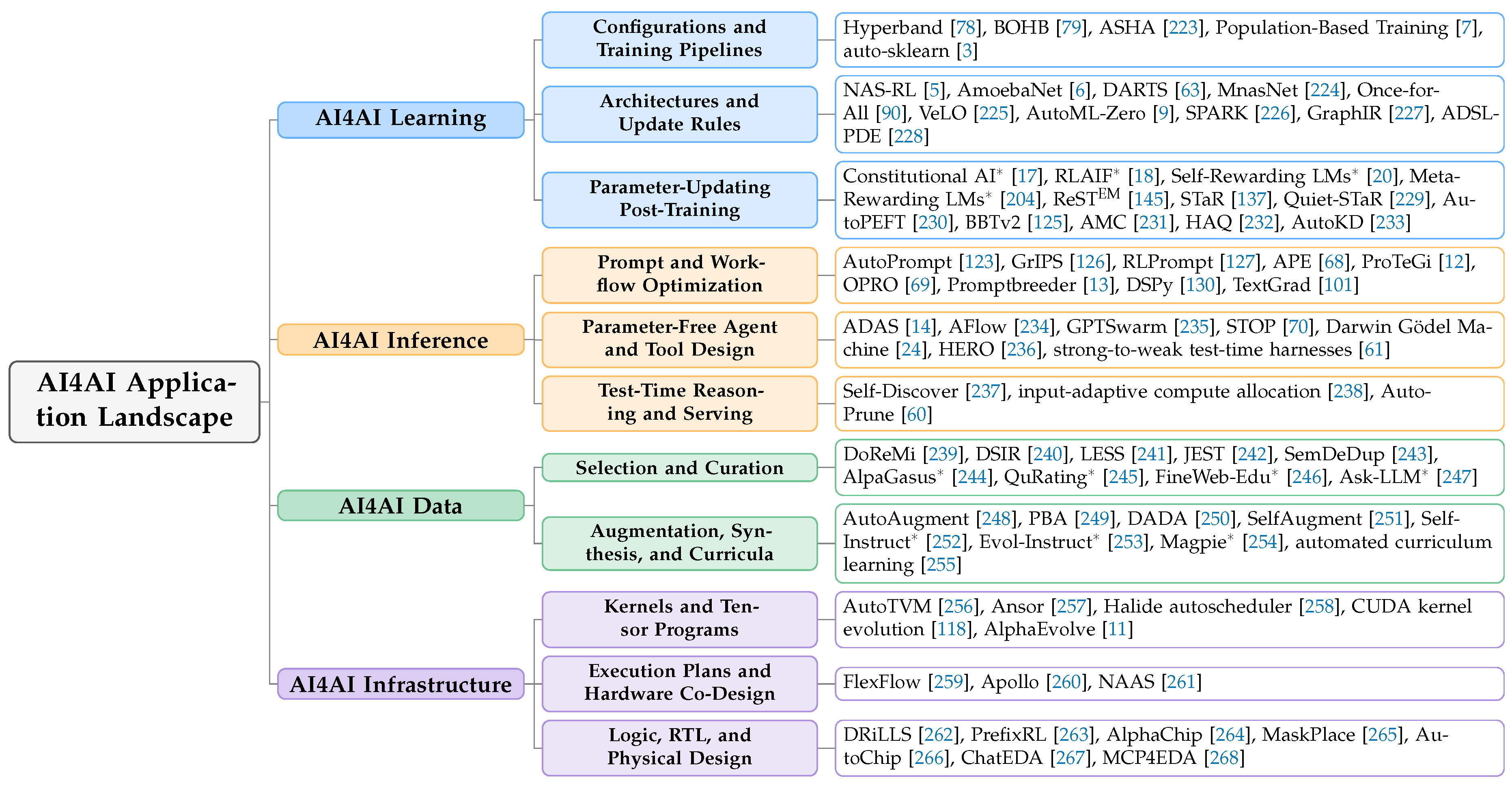
7.1. AI4AI Learning
AI4AI Learning improves procedures that update a target model’s parameters. Its artifacts include configurations, pipelines, architectures, optimizers, learning rules, rewards, adapters, and compressed or distilled models. This includes continuous prompt vectors and recovery training. The resulting model is evaluated after the discovered procedure has been applied.

Table 6.
Representative AI4AI Learning methods, selected to illustrate distinct training artifacts. Level labels follow Section 4, Section 5 and Section 6.
| Method | Level | AI-designed | Human-fixed |
|---|---|---|---|
| Configurations and training pipelines | |||
| Hyperband [78] |  |
configurations promoted at each rung | search space, budget schedule, fidelity metric |
| auto-sklearn [3] | |
pipeline, hyperparameters, ensemble | pipeline grammar, meta-tasks, validation metric |
| PBT [7] | |
per-member hyperparameter schedule | config space, mutation operators, train budget |
| Architectures and update rules | |||
| DARTS [63] | |
mixed-op weights, then discrete cell | operator set, search space, validation loss |
| S3 [190] |  |
admissible architectural value sets | ViT blocks, initial choices, budgets |
| VeLO [225] | |
learned update-rule weights | optimizer family, meta-training distribution |
| AutoML-Zero [9] | |
setup, predict and learn programs | primitive set, function set, meta-distribution |
| Parameter-updating post-training | |||
| Constitutional AI [17] |  |
critiques, revisions, preference labels | constitution, harm rules, base model |
| Eureka [19] | |
executable training reward programs | task description, simulator, policy optimizer |
| STaR [137] | |
rationales and rationalizations | seed rationales, answer key, fine-tuning recipe |
| Adaptation and compression | |||
| AutoPEFT [230] | |
adapter types, sizes, insertion layers | adapter space, performance and parameter cost |
| AMC [231] | |
per-layer compression ratios | pruning space, latency constraint, recovery |
7.1.1. Configurations and Training Pipelines
Hyperparameter optimization uses trial outcomes to choose configurations and allocate training resources. Bayesian optimization learns a response surface over validation outcomes [2]. Freeze–Thaw Bayesian optimization, Hyperband, BOHB, ASHA, and DEHB use partial learning curves or adaptive allocation to concentrate resources on promising trials [78,79,81,223,269]; SMAC3 and Optuna support conditional and mixed domains [80,270]. Random search provides a reference for the benefit of adaptation [1].
AutoML systems expand the target from a configuration to a pipeline composing preprocessing, model choice, and training [3,271,272]. Population-Based Training adapts schedules during training by copying model states and mutating hyperparameters [7]. Comparisons should include the full trial budget and the cost of interrupted, resumed, and unsuccessful runs.
7.1.2. Architectures and Update Rules
Neural architecture search optimizes cells and macro-structures through reinforcement learning, evolution, progressive expansion, learned predictors, differentiable relaxation, and shared-weight training [5,6,63,82,83,84]. Network Morphism reuses trained networks through function-preserving transformations, while BANANAS and Neural Predictor guide proposals using evaluated architectures [85,86,87,171]. Performance prediction and zero-cost proxies reduce screening cost [88,89,105]. MnasNet and ProxylessNAS incorporate device latency, and Once-for-All and BigNAS extract device-specific subnetworks from a trained supernet [90,224,273,274]. EfficientNet combines a searched base network with compound scaling [275].
The search domain can itself be adapted to the workload. DDSAS dynamically selects active edge–operation combinations; hierarchical generative NAS learns cell embeddings and cell-family abstractions; and S3 evolves admissible sets of architectural dimensions before the final search [172,173,190]. These are the architecture-design applications of the L2 methods in Section 5. LLMatic uses language-model variation and a quality-diversity archive to explore architectures [98]. SPARK, GraphIR, and ADSL-PDE expose structured edit surfaces through factors, intermediate representations, and a domain-specific language for neural solvers [226,227,228].
The update rule itself can be discovered. Learned optimizers and VeLO learn neural update rules; symbolic optimizer search and evolved reinforcement-learning losses discover compact learning programs; and AutoML-Zero evolves complete algorithms from mathematical primitives [8,9,65,225,276,277]. MAML learns initial parameters for rapid adaptation across tasks [64]. Transfer to held-out workloads, longer horizons, larger models, and altered data regimes tests the usefulness of the discovered procedure. Evaluation should place discovery or meta-training cost alongside downstream learning curves.
7.1.3. Parameter-Updating Post-Training
Learned feedback supports alignment and task-specific training. Preference-based reinforcement learning and InstructGPT fit rewards from comparisons; Constitutional AI and RLAIF use model-generated critiques or preferences to guide training [17,18,74,198]. Self-Rewarding Language Models produce their own preference judgments, Meta-Rewarding adds a judge of those judgments, and PandaLM applies model judgments to instruction-tuning hyperparameter selection [20,202,204]. These applications reuse the evaluation mechanisms reviewed in Section 6.3.
Executable reward design provides feedback for reinforcement learning. Text2Reward translates task descriptions into reward code, and Eureka revises reward programs using environment code and training results [19,203]. CodeRL trains a correctness critic for code-policy updates, PRM800K supplies human step supervision, and Math-Shepherd builds step-quality labels from rollout outcomes and uses process rewards for verification and PPO [75,194,196]. Self-training provides a complementary route: ReSTEM retrains on correctness-filtered solutions, STaR fine-tunes on successful rationales and rationalizations, and Quiet-STaR learns internal rationales through token-prediction feedback [137,145,229].
AutoPEFT and NOAH search trainable adaptation modules, while BBT and BBTv2 optimize continuous prompt vectors [124,125,230,278]. AMC, MetaPruning, AutoCompress, HAQ, AutoQNN, and AutoKD optimize pruning, quantization, or distillation choices with subsequent training [231,232,233,279,280,281]. Reports should separate discovery cost from adaptation or recovery cost and include trainable parameters, optimizer-state memory, and final model accuracy.
Benchmarks for AI4AI Learning.
NAS-Bench-101, NAS-Bench-201, NATS-Bench, and NAS-Bench-301 provide exact or surrogate outcomes over architecture spaces; TransNAS-Bench-101 adds task diversity and HW-NAS-Bench adds device costs [91,92,93,94,282,283,284]. HPO-B and HPOBench provide reproducible black-box and multi-fidelity optimization tasks [285,286]. For learned architecture spaces, comparisons should run the same search procedure over the constructed space and a human-designed counterpart at matched cost, following Section 5.2.
AI4AI-Bench asks agents to modify training algorithms in frozen repositories and reruns submissions from scratch under a hidden evaluator [62]. RE-Bench compares agents with human experts at matched time budgets on training, scaling-law, and kernel-optimization tasks [287]. Automated LLM Speedrunning measures reproduction of known training-speed improvements [288]. MLAgentBench, MLE-bench, MLGym, PaperBench, and MLReplicate assess experiment implementation and result replication [72,146,166,289,290].
PostTrainBench adds autonomous LLM post-training under a bounded compute budget, allowing agents to develop training strategies, curate data, and run experiments [291]. MLS-Bench requires improvements to targeted method components to generalize across controlled settings and scales, with edit scopes, capacity constraints, and repeated evaluation limiting alternative sources of gain [292]. Its catalog also includes ML systems tasks, so individual tasks may belong to other application families. These protocols strengthen evidence for method effectiveness and transfer; scientific novelty requires additional assessment.
7.2. AI4AI Inference
AI4AI Inference improves behavior while target-model and adapter parameters remain frozen. Its artifacts include discrete prompts and demonstrations, workflows, agent scaffolds, reusable tools and libraries, routing and context policies, and test-time computation policies. A search controller or recognition model may be trained to produce these artifacts; the target model is used without parameter updates.
Table 7.
Representative AI4AI Inference methods, selected to illustrate distinct prompts, agents, libraries, and computation policies. Target-model and adapter parameters stay frozen.
Table 7.
Representative AI4AI Inference methods, selected to illustrate distinct prompts, agents, libraries, and computation policies. Target-model and adapter parameters stay frozen.
| Method | Level | AI-designed | Human-fixed |
|---|---|---|---|
| Prompt and workflow optimization | |||
| APE [68] | |
candidate instructions; final pick | proposal prompt, output format, task metric |
| GEPA [102] | |
reflection-guided edits and candidate selection | editable prompts, task feedback, budget |
| DSPy [130] | |
module instructions, few-shot demos | program signature, module set, program metric |
| Agent, tool, and library design | |||
| ADAS [14] | |
agent code: roles, tools, control flow | tool pool, role template, task and holdout sets |
| DreamCoder [175] | |
reusable program abstractions | base DSL, execution semantics, task examples |
| CRAFT [183] | |
specialized reusable tool library | runtime, task APIs, training tasks, validators |
| Voyager [141] | |
skills, curriculum, success judgments | Minecraft APIs, environment mechanics |
| Test-time reasoning and serving | |||
| Self-Discover [237] | |
chosen modules; reasoning structure | module library, selection rules, task metric |
| Input-adaptive allocation [238] | |
learned per-input compute budget | budget grid, cost model, task mix |
| AutoPrune [60] | |
token-pruning policy in the DSL | pruning DSL, token budget, task metric |
7.2.1. Prompt and Workflow Optimization
AutoPrompt, GrIPS, and RLPrompt search discrete prompts using token substitutions, phrase edits, or a learned prompt policy [123,126,127]. APE generates and ranks instructions, ProTeGi uses error critiques to guide edits, OPRO conditions proposals on previous prompts and scores, and EvoPrompt and Promptbreeder apply evolutionary search [12,13,68,69,114]. PromptAgent plans prompt revisions, while TEMPERA learns test-time prompt-editing policies [122,128].
Compound applications optimize several prompts or model calls together. SAMMO searches structured prompt programs, DSPy compiles language-model pipelines, MIPRO jointly selects instructions and demonstrations, and TextGrad propagates textual feedback through a computation graph [101,129,130,131]. PromptWizard, CriSPO, and instruction-exemplar selection use task analysis or multi-aspect critiques, while local prompt optimization focuses on constrained edits [132,133,134,135]. GEPA combines execution-trace reflection with a Pareto archive to select targeted changes [102]. Comparisons should report optimization cost and transfer across tasks and models; OPRO re-evaluations also motivate disclosing the optimizer model, scorer, meta-instruction, and token budget [136].
7.2.2. Agent, Tool, and Library Design
ADAS searches agent programs containing roles, tool calls, memory, and control flow; AFlow searches code-represented workflows; and GPTSwarm optimizes node prompts and graph connectivity [14,234,235]. STOP and the Darwin Gödel Machine revise improver or agent code across validated iterations [24,70]. HERO extracts and recombines program edits for applications including agent design [236]. AI4AI at Test-Time studies a stronger builder that constructs routing, deterministic code, and answer-format controls for a weaker frozen target [61].
Reusable tools change the building blocks available to an agent. CREATOR constructs tools before planning their use, LATM caches generated Python tools, and Toolink builds task-family toolkits [180,181,182]. CRAFT abstracts solutions into a specialized toolset, TroVE grows and trims reusable functions, and ToolLibGen aggregates tools into libraries with unified interfaces [183,184,185]. Voyager accumulates executable skills together with a curriculum and self-verification, DynaSaur expands available actions, and Memento-Skills refines skills comprising specifications, scripts, and prompts [141,187,188]. ToolMaker realizes tools from supplied repositories, and SkillX constructs skill knowledge used as execution guidance [186,189].
Program-library learning provides a complementary route to reusable inference-time components. EC2, DreamCoder, and drawing-program induction learn reusable subroutines; LAPS adds language supervision; Stitch compresses recurring program structure; and LILO combines synthesis, compression, and documentation [174,175,176,177,178,179]. These applications connect the library-construction work in Section 5 to downstream program synthesis and agent development. Their value depends on interface validity, reuse, and held-out task benefit, together with library construction and maintenance cost.
7.2.3. Test-Time Reasoning and Serving
Self-Discover selects and adapts reasoning modules into a task-specific structure [237]. Input-adaptive allocation learns how to distribute computation across inputs, and AutoPrune searches training-free visual-token pruning policies for frozen multimodal models [60,238]. Best-of-N, majority voting, and fixed verifier-guided search provide reference quality–cost curves for these policy-design applications [293]. Useful measurements include generated tokens, verifier calls, tool calls, latency, memory, and energy.
Verification components support selection and refinement of generated programs and reasoning traces. CodeT selects programs using generated tests and execution agreement, LEVER combines execution with a learned verifier, and outcome verifiers select among sampled mathematical solutions [191,195,212]. GenRM produces generative correctness judgments, and CRITIC uses tool feedback to guide revision [197,213]. These mechanisms supply evaluation components for the AI4AI loops reviewed in Section 6. Their contribution to a developed prompt, agent, or computation policy can be measured by replacing the verifier while matching candidates and serving budgets.
Benchmarks for AI4AI Inference.
AIE-Bench evaluates agents that build or modify agents, and VeRO-Bench evaluates versioned target–optimizer pairs under controlled budgets [294,295]. AgentBench, AgentBoard, and GAIA assess interactive task performance; SWE-bench and OSWorld provide software and computer-interaction environments for evaluating developed agents and tools [155,156,157,158,159]. Code-to-Play and ConceptSearch add program-search tasks over games and ARC-like problems [116,117]. Prompt and workflow studies should report optimization cost alongside task scores, with target models, tool access, and serving budgets held comparable.
AutoHarnessBench separates a proposer from a fixed-weight actor: the proposer revises the actor’s harness using bounded public feedback, and an independent evaluator compares the frozen result with the initial harness on held-out tasks [296]. -Bench extends agent construction to client requirements, business records, inherited code, production APIs, and serving constraints, evaluating the delivered agent against held-out simulated users [297]. These protocols assess the development intervention as well as the resulting agent’s behavior.
7.3. AI4AI Data
AI4AI Data improves the examples, mixtures, transformations, and curricula used to develop AI systems. The discovered artifact is the data or data policy; downstream training tests its usefulness. Comparisons use a shared training recipe and report data construction and processing costs.
Table 8.
Representative AI4AI Data methods, selected to illustrate distinct data artifacts and policies.
Table 8.
Representative AI4AI Data methods, selected to illustrate distinct data artifacts and policies.
| Method | Level | AI-designed | Human-fixed |
|---|---|---|---|
| Selection and mixing | |||
| DoReMi [239] | |
domain mixture weights | domain partition, reference model, excess-loss objective |
| LESS [241] | |
gradient-similarity scores; subset | target examples, warm-up recipe |
| Model-judged quality filtering | |||
| QuRating [245] | |
pairwise judgments; trained rater | named quality criteria, sampling rule |
| Augmentation and feature construction | |||
| AutoAugment [248] | |
op pairs, probabilities, magnitudes | operation set, magnitude bins, child model |
| LLM-FE [115] | |
evolved feature-engineering programs | tabular tasks, input schema, validation metric |
| Synthetic corpora and curricula | |||
| Self-Instruct [252] | |
new instructions, inputs and outputs | seed tasks, output format, heuristic filters |
| Automated curriculum [255] | |
which task to train on next | task set, progress signals |
7.3.1. Selection and Curation
DoReMi optimizes domain weights with a proxy model; DSIR resamples toward a target distribution; LESS selects instruction data through gradient alignment; and JEST jointly selects batches using learner and reference-model losses [239,240,241,242]. SemDeDup supplies a semantic deduplication baseline [243]. Influence functions, TracIn, dataset cartography, and forgetting events offer complementary signals for diagnosing and selecting examples [298,299,300,301]. Rankings should be validated on disjoint data and across architectures.
Model-judged filtering makes quality evaluation part of corpus construction. AlpaGasus rates instruction–response pairs, QuRating learns a corpus rater from pairwise judgments, FineWeb-Edu distills educational-value annotations into a classifier, and Ask-LLM judges informativeness for pretraining [244,245,246,247]. These applications reuse the model judges reviewed in Section 6.3. Downstream value should be evaluated independently of the rater, including corpus coverage and sensitivity to rating prompts and thresholds.
7.3.2. Augmentation, Synthesis, and Curricula
AutoAugment, Population Based Augmentation, DADA, and SelfAugment search transformation policies or schedules [248,249,250,251]. SelfAugment uses a self-supervised proxy in place of labeled validation accuracy. Policies should be tested across child architectures and datasets, with controller cost separated from final training cost.
Self-Instruct, Evol-Instruct, Orca, UltraChat, and Magpie generate instructions, responses, or dialogues. Cosmopedia generates textbook-style pretraining text, and Nemotron-CC combines quality filtering with synthetic rephrasing [252,253,254,302,303,304,305]. The generator, quality filter, deduplication rule, and downstream recipe can be ablated separately at matched token budgets. LLM-FE adds a feature-engineering application by evolving programs for tabular learning [115].
Curriculum methods determine which tasks or environments supply subsequent training data. Automated curriculum learning treats task selection as a nonstationary bandit rewarded by learning progress [255]. POET, PAIRED, and LLM-POET generate or evolve environments together with agents [206,207,208]. Their generated environments serve as training artifacts, while their evaluation roles follow the component analysis in Section 6.5. Evaluation should test transfer beyond the construction curriculum.
Benchmarks for AI4AI Data.
DataPerf, DataComp, and DataComp-LM compare data artifacts under standardized downstream tasks and training protocols [306,307,308]. DataPerf covers several data-centric tasks, DataComp targets image–text pretraining, and DataComp-LM uses a standardized Common Crawl pool for language-model pretraining. Data-Juicer supplies processing infrastructure for such experiments [309]. Reports should include coverage, duplication, contamination, privacy, licensing, and fairness, and confirm proxy-scale rankings at larger model and data scales.
Synthetic-data evaluation adds complementary evidence. AgoraBench compares language models as data generators through standardized student-training outcomes, while DataEnvGym provides teacher environments in which generation policies adapt to student errors and skill feedback across training iterations [310,311]. The former isolates generation utility; the latter tests a feedback-driven data-construction process.
Curation-Bench holds the model, training recipe, and evaluator fixed while agents inspect data and iteratively implement selection policies; its vision–language instruction-tuning experiments distinguish successful execution from effective research exploration [312]. RSIBench-Data evaluates data-centric post-training research through capability-gap diagnosis, data strategies, and checkpoint feedback using shared training and evaluation services [313]. Because it also permits changes to specified training settings, reports should identify which gains arise from data and which involve learning-procedure changes. Training a student to assess data value does not by itself change the primary domain from Data to Learning.
7.4. AI4AI Infrastructure
AI4AI Infrastructure improves the software and hardware stack used to train and serve AI: algorithms, kernels, tensor programs, compiler schedules, parallel execution plans, accelerators, RTL, and physical design. Artifacts are evaluated through execution, compilation, simulation, or hardware measurement. General-purpose logic and EDA methods provide complementary techniques for this stack; Table 9 identifies their application scope.
7.4.1. Kernels and Tensor Programs
AlphaTensor searches matrix-multiplication algorithms, and AlphaDev searches assembly implementations of sorting routines [66,67]. AutoTVM, Ansor, and the Halide autoscheduler optimize tensor-program schedules with learned cost models [256,257,258]. LLM-driven kernel evolution extends the target to CUDA source and dispatch logic [118]. AlphaEvolve applies program evolution to a matrix-multiplication tiling heuristic used in Gemini training and an arithmetic-circuit simplification for a TPU [11].
Evolutionary program systems provide reusable optimization machinery for these applications. FunSearch, OpenEvolve, ShinkaEvolve, and CodeEvolve maintain archives and generate edits from successful lineages [10,95,96,100]. Algorithm Evolution and Evolution of Heuristics combine algorithmic ideas with implementations; Evolution through Large Models, Language Model Crossover, and LLM evolutionary optimizers or surrogates supply proposal and variation mechanisms [97,109,110,111,112,113]. SBLLM retrieves code-optimization patterns, while SeaEvo, graph-augmented evolution, and adaptive population handoff organize strategy archives [99,106,119,120]. Their infrastructure applications are assessed on the executable algorithm or implementation produced. EvoTrace and evolutionary-search ablations distinguish structural changes from constant tuning, rediscovery, and additional sampling [107,121].
Kernel comparisons should cover tiling, warp mapping, memory layout, fusion, and dispatch under a common correctness and timing harness. Shapes, dtypes, strides, masks, and numerical tolerances belong in correctness tests. Search and compiler costs should accompany steady-state speedups.
7.4.2. Execution Plans and Hardware Co-Design
FlexFlow searches distributed-training parallelization strategies with an execution simulator [259]. Apollo optimizes accelerator parameters under area constraints, and NAAS jointly searches accelerator architecture, compiler mapping, and neural architecture [260,261]. ArchGym supplies common interfaces between searchers and architecture simulators [314]. Co-design studies should report fixed-compiler and retuned-compiler comparisons, multiple devices, search cost, and quality–latency–energy–area trade-offs.
7.4.3. Logic, RTL, and Physical Design
DRiLLS and PrefixRL search synthesis sequences and parallel-prefix circuits; AlphaChip, AutoDMP, and MaskPlace optimize macro placement or placement parameters [262,263,264,265,315]. AlphaChip and PrefixRL have been applied to production TPU and GPU blocks, respectively. AutoChip, ChatEDA, and MCP4EDA connect language-model generation to compilation, simulation, or RTL-to-GDSII feedback [266,267,268]. VeriGen and RTLCoder supply learned HDL generation, GPT4AIGChip targets AI accelerator generation, and DeepGate supplies circuit representations for the surrounding design process [316,317,318,319]. Evaluation should separate generation, repair, and tool orchestration and validate final power, performance, and area (PPA) with independent verification.
Benchmarks for AI4AI Infrastructure.
KernelBench evaluates GPU kernels through correctness and speedup over PyTorch reference workloads [320]. CompilerGym and ArchGym provide compiler and architecture search environments with runtime, code-size, or simulator costs [314,321]. VerilogEval and RTLLM evaluate HDL correctness and design quality, ChipBench covers hierarchical Verilog generation, and ChiPBench evaluates placement through a full physical-design flow [322,323,324,325]. RE-Bench includes a kernel-optimization research task [287]. Reports should include compile or synthesis success, latency distributions, memory traffic, energy, verification coverage, PPA, tool runtime, and transfer across shapes, devices, designs, and technology libraries.
FastKernels checks whether kernel-level gains persist inside production-model execution paths, while -Bench extends evaluation to repository-level implementation and end-to-end optimization of training and inference infrastructure [326,327]. KernelGenBench evaluates generated Triton kernels across operator sources and hardware platforms, adding controlled evidence about deployment transfer and its cost [328]. MetaKernelBench instead transfers a natural-language skill distilled from one optimization attempt to a fresh attempt at the same problem in another domain-specific language [329]. This diagnostic remains within Infrastructure: it measures same-problem, cross-language knowledge reuse, which should be distinguished from transfer to new tasks or hardware.
7.5. Research Workflows and Shared Evaluation
Research workflows connect the application families.
ResearchAgent proposes literature-grounded ideas; The AI Scientist, The AI Scientist-v2, and Agent Laboratory connect ideation or a supplied goal to experiments and reporting [15,16,71,73]. MLE-STAR refines machine-learning pipelines through search and ablations, AutoResearchClaw maintains persistent research evidence, and Jr. AI Scientist extends a baseline paper [103,104,147]. Their application is the development workflow: an investigation can modify a training recipe, data policy, inference scaffold, or implementation. The direction-selection components in Section 4.5 support these changes, and automated reviewers supply complementary evaluation components.
Data Interpreter, MetaGPT, AutoGen, AgentVerse, and AgentScope provide planning and coordination; AgentCoder, SWE-agent, and Agentless provide code-development and repair mechanisms [148,149,150,151,152,153,154,161]. MemoryBank, MemGPT, ExpeL, and Generative Agents offer memory and experience-management techniques that can support artifact improvement [138,139,140,142]. Multi-agent aggregation also provides a compute baseline for coordinated workflows [160]. Workflow comparisons should track experimental validity, reproducibility, implementation failures, and discovery cost alongside artifact quality [108,162,163,164,165].
AIRS-Bench evaluates idea generation, implementation, experiment analysis, and iterative refinement on paper-derived research tasks without supplying baseline code [330]. RSIGym supplies shared research services with Data, Harness, and Joint tracks, allowing component-specific studies and joint optimization of data, training settings, and execution harnesses [331]. These are complementary research protocols across the four application families. Their domain coverage follows the actual task and permitted intervention; an extensible environment does not establish coverage of every family, and each track’s fixed components should be reported separately.
Evaluation components serve several applications.
ChatUniTest and CodeJudge supply generated tests and semantic code judgments; MT-Bench judging, G-Eval, JudgeLM, Prometheus, and Prometheus 2 provide reusable model judges [21,192,193,199,200,201,214]. Their use across training, data filtering, and agent development follows the integration analysis in Section 6. Red teaming and AutoRISE supply adaptive adversarial tests; debate, scalable oversight, CriticGPT, and weak-to-strong supervision combine AI-produced evidence with human oversight [169,205,209,210,211,215]. Independent checks should test evaluator agreement, calibration, model and style biases, and resistance to optimization pressure [21,22,23,219,220,221,222].
Benchmarks for research diagnostics.
WhatWorkedBench measures experimental understanding by asking agents to acquire budgeted measurements and reconstruct configuration responses, conditional component effects, and interactions [332]. It complements the direction-selection analysis in Section 4.5 by assessing what agents learn from experiments beyond their best observed score. BenchBench evaluates the validity, discrimination, and interaction biases of automatically generated test suites [333]. EvalResearchBench evaluates budgeted task selection or synthesis, grader implementation, and pilot-driven revision, followed by independent assessment of the frozen evaluator’s measurement quality and execution cost [334]. These evaluation-design benchmarks provide evidence relevant to E. Under Section 6, an L3 assignment additionally requires that the AI-produced signal becomes operative in a specified improvement loop; independent outer scoring can remain human-defined.
Comparable application evidence.
Across the four families, evaluation should report artifact quality, total discovery cost, transfer, and variation across runs. Table 10 links each benchmark to an AI4AI development task, the protocol used to assess it, and the evidence it provides. Some protocols run the optimizer or research agent, while others validate the resulting architecture, dataset, agent, or implementation through shared downstream tests. Search and deployment costs should be separated, including failed trials. MLReplicate adds reproducibility checks, while SciIntegrity-Bench tests research integrity through dilemmas that place honest acknowledgment of failure in conflict with task completion [166,167]. Together with the application-specific measures above, these protocols connect the direction, space, and evaluation mechanisms reviewed earlier to observable benefits in AI development.
System domains and assessment roles should remain separate from method-level responsibility profiles. A fixed task permits history-conditioned direction selection, while evidence for AI-provided search space requires tracing changes to active representations or constraints rather than candidate code alone. Repeated research runs should test whether benefits survive variation in experimental trajectories. Recursive progress requires an additional comparison: accepted changes must improve how subsequent improvements are produced. RSIGym’s current experiments do not establish this subsequent-cycle benefit [331]. Thus, improved artifacts, reusable research knowledge, and improved future discovery require distinct evidence.
Table 10.
Representative benchmarks for AI4AI development. Domain groups indicate primary targets; the cross-family group covers research workflows, experimental understanding, and evaluator design.
Table 10.
Representative benchmarks for AI4AI development. Domain groups indicate primary targets; the cross-family group covers research workflows, experimental understanding, and evaluator design.
| Benchmark | AI4AI task | Evaluation protocol | Evidence provided |
|---|---|---|---|
| AI4AI Learning | |||
| NAS-Bench-201 [92] | Select neural architectures for training | Query tabulated outcomes under a shared cell space and training recipe | Accuracy or regret versus search cost |
| HPOBench [286] | Tune hyperparameters and allocate trial budgets | Compare optimizers on common datasets, spaces, and fidelities | Anytime performance and cost to reach target quality |
| AI4AI-Bench [62] | Redesign training algorithms | Rerun edited code from scratch against the original algorithm; hidden evaluator | Capability gain from the revised learning procedure |
| AI4AI Inference | |||
| AutoHarnessBench [296] | Improve a fixed actor’s execution harness | Separate proposer and actor; freeze the selected harness after public trials; assess held-out lift | Generalization of harness improvements and research cost |
| -Bench [297] | Build a deployable task agent | Construct from client requirements, business records, APIs, and inherited code; test with held-out simulated users | Delivery success under serving constraints |
| AI4AI Data | |||
| DataComp [307] | Select or filter multimodal training data | Train CLIP with a shared recipe and compute scale | Downstream gains from the submitted dataset |
| DataEnvGym [311] | Construct training data from student feedback | Iterate generation, student training, and evaluation in shared teacher environments | Student gains across rounds and use of feedback |
| Curation-Bench [312] | Discover data-selection policies | Fix the model, training recipe, and evaluation; iterate executable data policies | Data efficiency and research behavior beyond execution |
| AI4AI Infrastructure | |||
| KernelBench [320] | Generate and refine ML GPU kernels | Execute against PyTorch references on specified hardware | Fraction correct and faster than a speedup threshold |
| -Bench [327] | Engineer training and inference infrastructure | Implement and optimize real-repository tasks; gate rewards on correctness and anti-hacking checks | Repository-level functionality and performance |
| ChiPBench [325] | Optimize chip-placement methods | Run placements through a shared downstream physical-design flow | Final routed PPA beyond intermediate placement proxies |
| Cross-family AI research and evaluation | |||
| RE-Bench [287] | Automate ML research engineering | Compare agents and human experts under matched time budgets | Task improvement versus time and monetary cost |
| PaperBench [290] | Reproduce AI research methods and experiments | Execute submitted code in a fresh environment; grade with paper-specific rubrics | Weighted replication score over implementation and result checks |
| WhatWorkedBench [332] | Understand effects of experimental changes | Buy limited configuration measurements; predict effects and interactions against exhaustive references | Effect recovery, configuration choice, and experimental understanding |
| EvalResearchBench [334] | Construct reliable executable evaluators | Select or synthesize tasks, implement graders, and pilot within budgets; freeze for independent assessment | Score/rank agreement and execution cost |
8. Open Questions and Future Works
The preceding sections organized AI4AI by the source of control over direction, search space, and evaluation. This section addresses two complementary questions: what remains unresolved about AI-controlled discovery, and what evidence and research methods would be needed to address these gaps.
8.1. Open Questions
When is research control worth delegating? AI-provided direction, search space, or evaluation does not necessarily improve research quality [38,163]. The value of delegation may depend on how quickly errors become observable, whether their consequences are reversible, how costly independent verification is, and how much human effort the decision would otherwise require [215]. These properties need not favor the same responsibility profile across domains or stages of a project. Control variables may also interact: a constructed space may be productive only under a compatible direction policy, while that policy may depend on feedback that an existing evaluator cannot provide. Which task properties predict these dependencies, and when does joint delegation outperform selective delegation?
Answering this question requires separating decision provenance, causal influence, and beneficial contribution. An AI-generated decision may change the search trajectory without improving it; observed gains may also reflect mechanisms other than the one a system claims to introduce [107,170]. A small intervention may instead unlock discoveries that would otherwise remain inaccessible. Can these effects be identified through controlled interventions rather than inferred from system descriptions? More broadly, should research autonomy be a fixed configuration or a revisable allocation of authority that changes with evidence, uncertainty, and failure risk?
Can AI expand the boundaries of practical discoverability? A sufficiently expressive language may already represent a desirable algorithm without making it discoverable within a realistic budget. New abstractions, primitives, and composition rules can shorten useful descriptions, alter search neighborhoods, or eliminate unproductive combinations without necessarily enlarging the set of theoretically expressible solutions [171,175,179]. The central question for search-space construction is therefore not simply whether AI can propose more candidates, but whether it can make previously inaccessible, high-quality solutions practically reachable. When does a learned representation expand this frontier, and when does it merely encode a narrow preference for familiar solutions?
The same question extends to the organization of discovery. Recent systems illustrate both progress and remaining constraints. AIDE2 recursively improves research-agent mechanisms while retaining a fixed benchmark-based acceptance rule [335]. The Agentic Scientist supports AI-generated task interfaces and evaluators, but its main empirical studies rely on manually prepared tasks, and reliable task construction remains challenging in complex settings [336]. At a given unit of analysis, AI may provide D, S, and E while higher-level rules for maintaining hypotheses, decomposing experiments, accumulating evidence, and coordinating research programs remain human-designed. Can AI identify limitations in this organization and improve the research workflow itself? Such changes can be analyzed by shifting the unit of analysis rather than introducing another autonomy level. Whether improved workflows transfer beyond the settings in which they were discovered remains a separate question from whether they improve the current run.
What establishes progress when evaluation itself evolves? When a candidate system and its evaluator change together, increasing internal scores does not isolate capability improvement from changes in the measurement procedure. Even a fixed proxy can become unreliable under stronger optimization [23,222], while evolving model-based judgments introduce further risks of changing standards and shared biases [22,204]. A revised evaluator may detect previously overlooked failures, but it may also reward easier tasks, favor the generator’s characteristic outputs, or relax acceptance conditions. These effects can influence not only the current ranking but also which evidence becomes available to later discovery cycles. How can a system distinguish better measurement of an intended objective from an unintended change in what it is optimizing?
Reliable assessment requires evidence that is not reducible to the improving loop’s own judgments. Such grounding need not consist exclusively of human ratings: it may include executable checks, independent experiments, hidden tests, or delayed observations [75,195,215]. However, each anchor has a limited scope. Formal correctness does not establish scientific importance, and agreement with a simulator does not establish validity in the target environment. What combination of independent evidence is sufficient for a particular discovery claim? How does the required verification budget scale with optimization pressure, discovery horizon, and shared errors between generator and evaluator? Any assurance must remain conditional on the validity and coverage of these anchors.
When do local improvements become cumulative research knowledge? An artifact can be useful without revealing why it works, when its advantages persist, or how it should inform subsequent designs. The stronger question is whether AI4AI can convert experimental outcomes into knowledge that supports new predictions and discoveries. Prior work on learned program libraries and experiential learning provides starting points for reusable abstractions and accumulated knowledge [140,175,179]. Such knowledge might take the form of executable abstractions, experimentally supported design rules, or validated negative results with explicit applicability conditions. It need not be immediately reducible to a concise human-readable explanation, nor must every constituent be unprecedented. Its research value depends on whether others can test, reuse, and revise it.
What representations allow successful discoveries to remain reusable without turning contingent observations into rigid assumptions? Approaches based on persistent skill libraries show one way to carry experience forward [141,188], but the ability to preserve conflicting evidence and recognize misleading abstractions remains an open question. Most importantly, how can the contribution of accumulated knowledge be distinguished from access to more compute, longer histories, or stored solutions? A convincing account of cumulative discovery should explain how inherited knowledge changes the productivity of research on genuinely new problems, not merely how it reproduces previous successes.
When does recursive self-improvement become sustained and reinforcing? Successive improvements to an artifact do not establish that the mechanism producing those improvements has become more capable. Likewise, repeated self-modification does not, by itself, establish sustained gains in research productivity [24,70]. A claim of recursive benefit requires evidence that an earlier improvement strengthens the production of later improvements. Recent tests of self-improving research agents illustrate both the relevance and difficulty of measuring this effect independently [335]. Under what conditions does this feedback remain beneficial across generations, and when does it saturate because verification, experimentation, or accessible novelty becomes the limiting factor? Sustained improvement and accelerating improvement are also distinct claims; neither should be inferred from generation count alone.
The relevant feedback may extend beyond a single self-editing agent. AI-assisted methods have already produced advances in algorithm discovery, data optimization, and computational infrastructure [11,239,256]; these advances do not, by themselves, establish recursive benefits across these areas. Can improvements in inference, learning, data, and infrastructure reinforce one another after accounting for integration costs, verification overhead, and resource constraints? Conversely, which dependencies prevent local gains from propagating through the wider AI development process? These questions concern the dynamics of improvement rather than its control label: an externally evaluated loop may exhibit recursive gains, while an AI-evaluated loop may fail to do so.
8.2. Future Work
Causal evaluation and adaptive allocation of research control. Future evaluation environments should expose D, S, and E as inspectable, versioned components that can be replaced independently or jointly where their interfaces permit meaningful comparisons. Reproducible search benchmarks and trajectory-level analyses offer useful starting points, but need to be extended to comparisons of control-source changes [91,107,287]. Runs should share initial targets and resource constraints while recording human effort, candidate histories, rejected directions, space revisions, evaluator changes, and rescue interventions. Comparisons should distinguish whether a component changes the discovery trajectory from whether that change improves independently assessed outcomes. Joint interventions are needed to reveal interactions that single-component ablations may miss.
These environments could support adaptive delegation policies that allocate authority according to uncertainty, decision consequences, and verification cost, extending concerns already raised in work on automated learning and scalable oversight [38,215]. Such policies should also specify when to seek external approval or restore an earlier configuration. Their objective would be reliable research productivity under resource and risk constraints, rather than maximizing the number of AI-controlled variables. This would make evolving responsibility profiles experimentally testable choices about how research should be organized.
Open-ended search-space construction and meta-discovery. Research systems should be able to construct and revise candidate representations, reusable primitives, composition operators, and task-specific admissibility constraints within explicit external boundaries. Program abstraction learning and dynamic search-space methods provide partial precedents [173,175,179]. Suitable tasks would require the system to diagnose why an existing representation obstructs progress and then propose a space-defining artifact that supports subsequent discovery. Both expansion and compression should be permitted: a smaller space may be more productive if it removes irrelevant combinations while preserving useful alternatives.
Evaluation should include the cost of constructing the space and test its utility on unseen tasks with multiple compatible search procedures. This can help separate reusable space quality from adaptation between one representation and one search policy. A complementary direction is to make experimental decomposition, hypothesis management, and evidence-update protocols editable research objects, building on broader work on automated agent and workflow design [14,234]. Improvements to these mechanisms should be tested through independent replay and transfer, while execution permissions, resource limits, and non-negotiable validity requirements remain outside the system’s unilateral control.
Independently grounded evaluator co-evolution. A promising experimental design separates an adaptive internal evaluator from an independent validation path. Research on AI-generated rewards and meta-judges illustrates mechanisms for constructing or refining internal evaluation signals [203,204]. The internal evaluator may generate tests, revise judgment mappings, or improve feedback as new failures emerge. The validation path should assess whether those revisions remain faithful to the intended objective and should not be rewritable by the improving system during the same run. Independence should be investigated through error analysis and interventions rather than assumed from different model names, given documented biases in model-based judgments [22,219].
Experiments should vary search intensity, discovery horizon, and evaluator flexibility while measuring false acceptance, false rejection, and divergence between internal scores and external outcomes wherever independently assessed outcomes are available. Evaluating optimized high-scoring candidates is essential because static evaluator quality may not survive optimization pressure [23,222]; rejected candidates should also be sampled to detect discoveries that a biased evaluator excludes. Longer studies could use pre-specified audit updates and cross-version calibration, with fresh audit data unavailable to the optimizing loop. The resulting evidence could characterize how verification requirements scale, rather than treating evaluator accuracy on a fixed candidate distribution as sufficient.
Knowledge-producing research memory. Research memory should preserve more than successful candidates and their scores. Existing systems have demonstrated the utility of retaining experiences, skills, and reusable program abstractions [140,141,179]. Structured records can connect hypotheses, implementation versions, experimental conditions, failures, applicability boundaries, and replication results. Proposed abstractions should retain links to supporting and conflicting evidence so that later systems can inspect their provenance and revise them when conditions change.
Knowledge extraction should be evaluated through its downstream consequences. One system could infer a design rule from historical experiments, while another independently implements it and tests predictions on unseen tasks. Ablations should distinguish access to original artifacts, raw histories, textual summaries, and reusable abstractions under comparable budgets. Shared repositories should also support negative and retracted findings, allowing accumulation to reduce redundant exploration rather than merely enlarge the archive. The central outcome is whether inherited knowledge enables new discoveries more effectively, not whether the system produces persuasive retrospective explanations.
Longitudinal and cross-family recursive-improvement experiments. Multi-generation studies should evaluate both the current artifact and the system’s ability to produce subsequent improvements. Initial work on self-improving agents and benchmarks for AI algorithm design motivates this distinction [62,70,335]. Each generation should be tested on common starting targets and held-out research tasks under matched budgets. Relevant controls include a frozen initial improver, a system that accumulates history without modifying its research mechanism, and alternatives given equivalent additional computation. Selective rollback and interrupted inheritance can test whether later gains causally depend on earlier discoveries.
Integrated environments could further allow improvements to propagate across Learning, Inference, Data, and Infrastructure. Existing work demonstrates optimization within several of these areas, but not necessarily a closed, mutually reinforcing cross-family loop [11,239,256]. Experiments should separately report research capability at fixed resources, gains from reinvesting saved resources, and the total cost of validation and integration. Blocking individual feedback paths would reveal whether cross-family coupling adds value beyond isolated improvements. Measuring progress against both resource use and elapsed time would help distinguish persistent productivity gains from apparent acceleration caused by changing budgets or shorter discovery cycles.
AI4AI4Science: discovering AI methods for scientific discovery. AI4AI4Science extends this agenda to the AI-driven discovery of methods that enable scientific progress. Work on algorithmic discovery and automated scientific research provides relevant foundations [10,11,15], but AI4AI4Science specifically targets improvements to the AI methods used in scientific inquiry. These methods may include representations, architectures, learning rules, data strategies, inference procedures, and computational implementations. Their ultimate value is assessed through the scientific investigations they make possible. The defining intervention is a substantive AI-originated change to a scientific AI method, rather than simply executing a fixed AI-assisted research workflow.
Future environments could couple scientific bottleneck diagnosis with AI-method construction. In scientific computing, a system might respond to numerical or long-horizon prediction failures by proposing new solver representations, training objectives, or computational implementations; automated design of neural PDE solvers offers a relevant starting point [228]. In molecular or materials research, it might revise generative methods, uncertainty estimation, or experimental acquisition strategies when evidence exposes limitations in existing approaches. These examples are proposed research settings, not evidence that reliable end-to-end AI4AI4Science loops have already been established.
Evaluation should establish both methodological and scientific value. First, the discovered AI method should be compared with appropriate baselines under matched data, compute, and experimental conditions. Second, its gains should translate into independently supported scientific outcomes, more reliable predictions, or lower costs of obtaining useful evidence. Improvements against a surrogate model or simulator must not be equated with scientific validation. Studies of benchmark and metric failures in automated research, alongside reward overoptimization, illustrate why internal or proxy improvements require careful interpretation [23,163]. Stronger evidence may require higher-fidelity computation, independent measurements, or physical experiments. The long-term research objective is a reciprocal process in which scientific problems motivate new AI methods, and independently validated method improvements expand the range of scientific questions that can be investigated.
9. Conclusion and Limitations
AI4AI research can be analyzed through changing sources of control over the discovery loop: who specifies how to explore, where to explore, and what counts as progress. This survey formalizes these differences through a Direction–Space–Evaluation ladder. Under the proposed taxonomy, the highest-ranked AI-provided component determines a system’s level. L0 serves as the reference level, with direction, space, and evaluation specified by humans. L1 denotes AI-provided direction while space and evaluation remain human-authored. L2 denotes AI-provided search space with human-authored evaluation, regardless of who supplies direction. L3 denotes AI-provided evaluation regardless of who supplies direction or space.
Higher levels are not guaranteed to produce better systems. At L1, promising directions may not translate into successful experiments [162], and learned exploration strategies may fail to transfer across tasks, scales, or optimization horizons [225,276]. Learning from execution can also improve average outcomes without improving the best discoveries. At L2, richer representations do not necessarily yield more usable search spaces. Learned abstractions may be difficult to compose or reuse [179], while observed gains may come from additional sampling rather than the constructed space itself [170]. At L3, evaluation errors can become selection pressures. Signals that perform well on fixed candidates may become unreliable under sustained optimization [23,222], and more faithful evaluation can consume resources otherwise available for discovery [78,105].
Across levels, end-to-end improvements do not by themselves identify which control mechanism contributed to progress [107,121]. Comparisons must separate changes in research control from differences in underlying models, experimental infrastructure, and computational investment [170,287]. Jointly adapting control mechanisms introduces a further challenge: stronger task performance does not establish a stronger capacity for subsequent self-improvement [62,70]. Overall, the proposed taxonomy provides a systematic basis for comparing AI4AI systems, while distinguishing the allocation of research control from evidence of its effectiveness.
References
- Bergstra, J.; Bengio, Y. Random Search for Hyper-Parameter Optimization. Journal of Machine Learning Research 2012, 13, 281–305.
- Snoek, J.; Larochelle, H.; Adams, R.P. Practical Bayesian Optimization of Machine Learning Algorithms. In Proceedings of the Advances in Neural Information Processing Systems, 2012, Vol. 25.
- Feurer, M.; Klein, A.; Eggensperger, K.; Springenberg, J.T.; Blum, M.; Hutter, F. Efficient and Robust Automated Machine Learning. In Proceedings of the Advances in Neural Information Processing Systems, 2015, Vol. 28, pp. 2962–2970.
- Hutter, F.; Kotthoff, L.; Vanschoren, J., Eds. Automated Machine Learning: Methods, Systems, Challenges; Springer, 2019. [CrossRef]
- Zoph, B.; Le, Q.V. Neural Architecture Search with Reinforcement Learning. In Proceedings of the International Conference on Learning Representations, 2017.
- Real, E.; Aggarwal, A.; Huang, Y.; Le, Q.V. Regularized Evolution for Image Classifier Architecture Search. In Proceedings of the Proceedings of the AAAI Conference on Artificial Intelligence, 2019, Vol. 33, pp. 4780–4789. [CrossRef]
- Jaderberg, M.; Dalibard, V.; Osindero, S.; Czarnecki, W.M.; Donahue, J.; Razavi, A.; Vinyals, O.; Green, T.; Dunning, I.; Simonyan, K.; et al. Population Based Training of Neural Networks. arXiv preprint arXiv:1711.09846 2017, [1711.09846].
- Andrychowicz, M.; Denil, M.; Gomez, S.; Hoffman, M.W.; Pfau, D.; Schaul, T.; Shillingford, B.; de Freitas, N. Learning to Learn by Gradient Descent by Gradient Descent. In Proceedings of the Advances in Neural Information Processing Systems, 2016, Vol. 29.
- Real, E.; Liang, C.; So, D.; Le, Q.V. AutoML-Zero: Evolving Machine Learning Algorithms from Scratch. In Proceedings of the Proceedings of the 37th International Conference on Machine Learning, 2020, Vol. 119, Proceedings of Machine Learning Research, pp. 8007–8019.
- Romera-Paredes, B.; Barekatain, M.; Novikov, A.; Balog, M.; Kumar, M.P.; Dupont, E.; Ruiz, F.J.R.; Ellenberg, J.S.; Wang, P.; Fawzi, O.; et al. Mathematical Discoveries from Program Search with Large Language Models. Nature 2024, 625, 468–475. [CrossRef]
- Novikov, A.; Vu, N.; Eisenberger, M.; Dupont, E.; Huang, P.S.; Wagner, A.Z.; Shirobokov, S.; Kozlovskii, B.; Ruiz, F.J.R.; Mehrabian, A.; et al. AlphaEvolve: A Coding Agent for Scientific and Algorithmic Discovery. arXiv preprint arXiv:2506.13131 2025, [2506.13131].
- Pryzant, R.; Iter, D.; Li, J.; Lee, Y.; Zhu, C.; Zeng, M. Automatic Prompt Optimization with “Gradient Descent” and Beam Search. In Proceedings of the Proceedings of the 2023 Conference on Empirical Methods in Natural Language Processing, 2023, pp. 7957–7968. [CrossRef]
- Fernando, C.; Banarse, D.S.; Michalewski, H.; Osindero, S.; Rocktäschel, T. Promptbreeder: Self-Referential Self-Improvement via Prompt Evolution. In Proceedings of the Proceedings of the 41st International Conference on Machine Learning, 2024, Vol. 235, Proceedings of Machine Learning Research, pp. 13481–13544.
- Hu, S.; Lu, C.; Clune, J. Automated Design of Agentic Systems. In Proceedings of the The Thirteenth International Conference on Learning Representations, 2025.
- Lu, C.; Lu, C.; Lange, R.T.; Foerster, J.; Clune, J.; Ha, D. The AI Scientist: Towards Fully Automated Open-Ended Scientific Discovery. arXiv preprint arXiv:2408.06292 2024, [2408.06292].
- Yamada, Y.; Lange, R.T.; Lu, C.; Hu, S.; Lu, C.; Foerster, J.; Clune, J.; Ha, D. The AI Scientist-v2: Workshop-Level Automated Scientific Discovery via Agentic Tree Search. arXiv preprint arXiv:2504.08066 2025, [2504.08066].
- Bai, Y.; Kadavath, S.; Kundu, S.; Askell, A.; Kernion, J.; Jones, A.; Chen, A.; Goldie, A.; Mirhoseini, A.; McKinnon, C.; et al. Constitutional AI: Harmlessness from AI Feedback. arXiv preprint arXiv:2212.08073 2022, [2212.08073].
- Lee, H.; Phatale, S.; Mansoor, H.; Mesnard, T.; Ferret, J.; Lu, K.; Bishop, C.; Hall, E.; Carbune, V.; Rastogi, A.; et al. RLAIF vs. RLHF: Scaling Reinforcement Learning from Human Feedback with AI Feedback. arXiv preprint arXiv:2309.00267 2023, [2309.00267].
- Ma, Y.J.; Liang, W.; Wang, G.; Huang, D.A.; Bastani, O.; Jayaraman, D.; Zhu, Y.; Fan, L.; Anandkumar, A. Eureka: Human-Level Reward Design via Coding Large Language Models. arXiv preprint arXiv:2310.12931 2023, [2310.12931].
- Yuan, W.; Pang, R.Y.; Cho, K.; Li, X.; Sukhbaatar, S.; Xu, J.; Weston, J. Self-Rewarding Language Models. In Proceedings of the Proceedings of the 41st International Conference on Machine Learning, 2024, Vol. 235, Proceedings of Machine Learning Research, pp. 57905–57923.
- Zheng, L.; Chiang, W.L.; Sheng, Y.; Zhuang, S.; Wu, Z.; Zhuang, Y.; Lin, Z.; Li, Z.; Li, D.; Xing, E.P.; et al. Judging LLM-as-a-Judge with MT-Bench and Chatbot Arena. arXiv preprint arXiv:2306.05685 2023, [2306.05685].
- Wataoka, K.; Takahashi, T.; Ri, R. Self-Preference Bias in LLM-as-a-Judge. arXiv preprint arXiv:2410.21819 2024, [2410.21819].
- Gao, L.; Schulman, J.; Hilton, J. Scaling Laws for Reward Model Overoptimization. In Proceedings of the Proceedings of the 40th International Conference on Machine Learning, 2023, Vol. 202, Proceedings of Machine Learning Research, pp. 10835–10866.
- Zhang, J.; Hu, S.; Lu, C.; Lange, R.T.; Clune, J. Darwin Gödel Machine: Open-Ended Evolution of Self-Improving Agents. arXiv preprint arXiv:2505.22954 2025, [2505.22954].
- Elsken, T.; Metzen, J.H.; Hutter, F. Neural Architecture Search: A Survey. Journal of Machine Learning Research 2019, 20, 1–21.
- He, X.; Zhao, K.; Chu, X. AutoML: A Survey of the State-of-the-Art. Knowledge-Based Systems 2021, 212, 106622. [CrossRef]
- Luo, Z.; Yang, Z.; Xu, Z.; Yang, W.; Du, X. LLM4SR: A Survey on Large Language Models for Scientific Research. arXiv preprint arXiv:2501.04306 2025, [2501.04306].
- Zheng, T.; Deng, Z.; Tsang, H.T.; Wang, W.; Bai, J.; Wang, Z.; Song, Y. From Automation to Autonomy: A Survey on Large Language Models in Scientific Discovery. In Proceedings of the Proceedings of the 2025 Conference on Empirical Methods in Natural Language Processing, 2025, pp. 17733–17750. [CrossRef]
- Tie, G.; Zhou, P.; Sun, L. A Survey of AI Scientists: Surveying the Automatic Scientists and Research. arXiv preprint arXiv:2510.23045 2025, [2510.23045].
- Tao, Z.; Lin, T.E.; Chen, X.; Li, H.; Wu, Y.; Li, Y.; Jin, Z.; Huang, F.; Tao, D.; Zhou, J. A Survey on Self-Evolution of Large Language Models. arXiv preprint arXiv:2404.14387 2024, [2404.14387].
- Gao, H.a.; Geng, J.; Hua, W.; Hu, M.; Juan, X.; Liu, H.; Liu, S.; Qiu, J.; Qi, X.; Ren, Q.; et al. A Survey of Self-Evolving Agents: What, When, How, and Where to Evolve on the Path to Artificial Super Intelligence. Transactions on Machine Learning Research 2026.
- Fang, J.; Peng, Y.; Zhang, X.; Wang, Y.; Yi, X.; Zhang, G.; Xu, Y.; Wu, B.; Liu, S.; Li, Z.; et al. A Comprehensive Survey of Self-Evolving AI Agents: A New Paradigm Bridging Foundation Models and Lifelong Agentic Systems. arXiv preprint arXiv:2508.07407 2025, [2508.07407].
- Ren, Z.; Chen, Y.; Guo, D.; Rong, G.; Li, T.; Xiong, R.B.; Lan, Q.; Wang, W.; Li, N.; Yang, Y.; et al. Self-Improvements in Modern Agentic Systems: A Survey. arXiv preprint arXiv:2607.13104 2026, [2607.13104].
- Chen, M.; Wang, L.; Qu, B. Recursive Self-Improvement in AI: From Bounded Self-Refinement to Autonomous Research Loops. arXiv preprint arXiv:2607.07663 2026, [2607.07663].
- White, C.; Safari, M.; Sukthanker, R.; Ru, B.; Elsken, T.; Zela, A.; Dey, D.; Hutter, F. Neural Architecture Search: Insights from 1000 Papers. arXiv preprint arXiv:2301.08727 2023, [2301.08727].
- Hospedales, T.; Antoniou, A.; Micaelli, P.; Storkey, A. Meta-Learning in Neural Networks: A Survey. IEEE Transactions on Pattern Analysis and Machine Intelligence 2022, 44, 5149–5169. [CrossRef]
- Parker-Holder, J.; Rajan, R.; Song, X.; Biedenkapp, A.; Miao, Y.; Eimer, T.; Zhang, B.; Nguyen, V.; Calandra, R.; Faust, A.; et al. Automated Reinforcement Learning (AutoRL): A Survey and Open Problems. Journal of Artificial Intelligence Research 2022, 74, 517–568. [CrossRef]
- Tornede, A.; Deng, D.; Eimer, T.; Giovanelli, J.; Mohan, A.; Ruhkopf, T.; Segel, S.; Theodorakopoulos, D.; Tornede, T.; Wachsmuth, H.; et al. AutoML in the Age of Large Language Models: Current Challenges, Future Opportunities and Risks. Transactions on Machine Learning Research 2024.
- Gu, Y.; You, H.; Cao, J.; Yu, M.; Fan, H.; Qian, S. Large Language Models for Constructing and Optimizing Machine Learning Workflows: A Survey. ACM Transactions on Software Engineering and Methodology 2026, 35, 1–46. [CrossRef]
- Liu, F.; Yao, Y.; Guo, P.; Yang, Z.; Zhao, Z.; Lin, X.; Tong, X.; Mao, K.; Lu, Z.; Wang, Z.; et al. A Systematic Survey on Large Language Models for Algorithm Design. arXiv preprint arXiv:2410.14716 2024, [2410.14716].
- Wu, X.; Wu, S.h.; Wu, J.; Feng, L.; Tan, K.C. Evolutionary Computation in the Era of Large Language Model: Survey and Roadmap. IEEE Transactions on Evolutionary Computation 2025, 29, 534–554. [CrossRef]
- Ramnath, K.; Zhou, K.; Guan, S.; Mishra, S.S.; Qi, X.; Shen, Z.; Wang, S.; Woo, S.; Jeoung, S.; Wang, Y.; et al. A Systematic Survey of Automatic Prompt Optimization Techniques. In Proceedings of the Proceedings of the 2025 Conference on Empirical Methods in Natural Language Processing, 2025, pp. 33078–33110. [CrossRef]
- Yue, L.; Bhandari, K.R.; Ko, C.Y.; Patel, D.; Lin, S.; Zhou, N.; Gao, J.; Chen, P.Y.; Pan, S. From Static Templates to Dynamic Runtime Graphs: A Survey of Workflow Optimization for LLM Agents. arXiv preprint arXiv:2603.22386 2026, [2603.22386].
- Du, S.; Zhao, J.; Shi, J.; Xie, Z.; Jiang, X.; Bai, Y.; He, L. A Survey on the Optimization of Large Language Model-Based Agents. ACM Computing Surveys 2026, 58, 1–37. [CrossRef]
- Chen, Q.; Yang, M.; Qin, L.; Liu, J.; Yan, Z.; Guan, J.; Peng, D.; Ji, Y.; Li, H.; Hu, M.; et al. Ai4research: A Survey of Artificial Intelligence for Scientific Research. Science China Information Sciences 2026, 69, 201101. [CrossRef]
- Wei, J.; Yang, Y.; Zhang, X.; Chen, Y.; Zhuang, X.; Gao, Z.; Zhou, D.; Wang, G.; Gao, Z.; Cao, J.; et al. From AI for Science to Agentic Science: A Survey on Autonomous Scientific Discovery. arXiv preprint arXiv:2508.14111 2025, [2508.14111].
- Tie, G.; Shi, J.; Song, D.; Huang, Y.; Sheng, Z.; Zhou, X.; Liu, D.; Zhou, P.; Chen, Y.; Xu, R.; et al. AutoResearch AI: Towards AI-Powered Research Automation for Scientific Discovery. arXiv preprint arXiv:2605.23204 2026, [2605.23204].
- Kong, L.; Sun, X.; Chow, W.; Li, L.; Lin, K.Q.; Zhang, X.B.; Wang, S.; Li, R.; Wu, Q.; Gao, W.; et al. AI for Auto-Research: Roadmap & User Guide. arXiv preprint arXiv:2605.18661 2026, [2605.18661].
- Ding, T.; Nannapaneni, A.; Liu, B.; Zhang, L. Autonomous Research Agents: A Survey of AI Scientists and the Verification Gap, 2026, [arXiv:cs.CY/2608.05179].
- Gu, J.; Jiang, X.; Shi, Z.; Tan, H.; Zhai, X.; Xu, C.; Li, W.; Shen, Y.; Ma, S.; Liu, H.; et al. A Survey on LLM-as-a-Judge. arXiv preprint arXiv:2411.15594 2024, [2411.15594].
- Li, D.; Jiang, B.; Huang, L.; Beigi, A.; Zhao, C.; Tan, Z.; Bhattacharjee, A.; Jiang, Y.; Chen, C.; Wu, T.; et al. From Generation to Judgment: Opportunities and Challenges of LLM-as-a-Judge. arXiv preprint arXiv:2411.16594 2024, [2411.16594].
- Casper, S.; Davies, X.; Shi, C.; Gilbert, T.K.; Scheurer, J.; Rando, J.; Freedman, R.; Korbak, T.; Lindner, D.; Freire, P.; et al. Open Problems and Fundamental Limitations of Reinforcement Learning from Human Feedback. Transactions on Machine Learning Research 2023.
- Albalak, A.; Elazar, Y.; Xie, S.M.; Longpre, S.; Lambert, N.; Wang, X.; Muennighoff, N.; Hou, B.; Pan, L.; Jeong, H.; et al. A Survey on Data Selection for Language Models. Transactions on Machine Learning Research 2024.
- Long, L.; Wang, R.; Xiao, R.; Zhao, J.; Ding, X.; Chen, G.; Wang, H. On LLMs-Driven Synthetic Data Generation, Curation, and Evaluation: A Survey. In Proceedings of the Findings of the Association for Computational Linguistics: ACL 2024, 2024, pp. 11065–11082. [CrossRef]
- Yu, Y.; Zang, P.; Tsai, C.H.; Wu, H.; Shen, Y.; Zhang, J.; Wang, H.; Xiao, Z.; Shi, J.; Luo, Y.; et al. Towards Automated Kernel Generation in the Era of Llms. In Proceedings of the Proceedings of the Thirty-Fifth International Joint Conference on Artificial Intelligence, IJCAI-26; Calvanese, D., Ed. International Joint Conferences on Artificial Intelligence Organization, 2026, pp. 8069–8077. [CrossRef]
- Zhong, R.; Du, X.; Kai, S.; Tang, Z.; Xu, S.; Zhen, H.L.; Hao, J.; Xu, Q.; Yuan, M.; Yan, J. LLM4EDA: Emerging Progress in Large Language Models for Electronic Design Automation. arXiv preprint arXiv:2401.12224 2023, [2401.12224].
- Wang, Z.; O’Boyle, M. Machine Learning in Compiler Optimization. Proceedings of the IEEE 2018, 106, 1879–1901. [CrossRef]
- Morris, M.R.; Sohl-Dickstein, J.; Fiedel, N.; Warkentin, T.; Dafoe, A.; Faust, A.; Farabet, C.; Legg, S. Position: Levels of AGI for Operationalizing Progress on the Path to AGI. In Proceedings of the Proceedings of the 41st International Conference on Machine Learning, 2024, Vol. 235, Proceedings of Machine Learning Research, pp. 36308–36321.
- Feng, K.J.K.; McDonald, D.W.; Zhang, A.X. Levels of Autonomy for AI Agents. arXiv preprint arXiv:2506.12469 2025, [2506.12469].
- Liu, Z.; Huang, W.; Song, W.; Liu, Y.; Yang, Z.; Fu, J. An AI4AI Framework for Visual Token Pruning. arXiv preprint arXiv:2608.07193 2026, [2608.07193].
- Qian, C.; Zhao, W.; Yang, L.; Wang, H.; Qiu, J.; Ji, H.; Savarese, S.; Wang, H.; Heinecke, S. AI4AI at Test-Time: Strong-to-Weak Capability Transfer via Harnesses. arXiv preprint arXiv:2608.12307 2026, [2608.12307].
- Chi, Y.; Li, W.; Hong, D.; Wang, X.; Gao, M.; Yang, K.; He, B.; Zheng, Y.; Xiao, C.; Na, Q. AI4AI-Bench: Benchmarking LLM Agents in Algorithmic Design for Recursive Self-Improvement. arXiv preprint arXiv:2608.20318 2026, [2608.20318].
- Liu, H.; Simonyan, K.; Yang, Y. DARTS: Differentiable Architecture Search. In Proceedings of the International Conference on Learning Representations, 2019.
- Finn, C.; Abbeel, P.; Levine, S. Model-Agnostic Meta-Learning for Fast Adaptation of Deep Networks. In Proceedings of the Proceedings of the 34th International Conference on Machine Learning, 2017, Vol. 70, Proceedings of Machine Learning Research, pp. 1126–1135.
- Co-Reyes, J.D.; Miao, Y.; Peng, D.; Real, E.; Levine, S.; Le, Q.V.; Lee, H.; Faust, A. Evolving Reinforcement Learning Algorithms. In Proceedings of the International Conference on Learning Representations, 2021.
- Fawzi, A.; Balog, M.; Huang, A.; Hubert, T.; Romera-Paredes, B.; Barekatain, M.; Novikov, A.; Ruiz, F.J.R.; Schrittwieser, J.; Swirszcz, G.; et al. Discovering Faster Matrix Multiplication Algorithms with Reinforcement Learning. Nature 2022, 610, 47–53. [CrossRef]
- Mankowitz, D.J.; Michi, A.; Zhernov, A.; Gelmi, M.; Selvi, M.; Paduraru, C.; Leurent, E.; Iqbal, S.; Lespiau, J.B.; Ahern, A.; et al. Faster Sorting Algorithms Discovered Using Deep Reinforcement Learning. Nature 2023, 618, 257–263. [CrossRef]
- Zhou, Y.; Muresanu, A.I.; Han, Z.; Paster, K.; Pitis, S.; Chan, H.; Ba, J. Large Language Models Are Human-Level Prompt Engineers. In Proceedings of the International Conference on Learning Representations, 2023.
- Yang, C.; Wang, X.; Lu, Y.; Liu, H.; Le, Q.V.; Zhou, D.; Chen, X. Large Language Models as Optimizers. In Proceedings of the International Conference on Learning Representations, 2024.
- Zelikman, E.; Lorch, E.; Mackey, L.; Kalai, A.T. Self-Taught Optimizer (STOP): Recursively Self-Improving Code Generation. arXiv preprint arXiv:2310.02304 2023, [2310.02304].
- Baek, J.; Jauhar, S.K.; Cucerzan, S.; Hwang, S.J. ResearchAgent: Iterative Research Idea Generation over Scientific Literature with Large Language Models. arXiv preprint arXiv:2404.07738 2024, [2404.07738].
- Huang, Q.; Vora, J.; Liang, P.; Leskovec, J. MLAgentBench: Evaluating Language Agents on Machine Learning Experimentation. arXiv preprint arXiv:2310.03302 2023, [2310.03302].
- Schmidgall, S.; Su, Y.; Wang, Z.; Sun, X.; Wu, J.; Yu, X.; Liu, J.; Moor, M.; Liu, Z.; Barsoum, E. Agent Laboratory: Using LLM Agents as Research Assistants. arXiv preprint arXiv:2501.04227 2025, [2501.04227].
- Christiano, P.F.; Leike, J.; Brown, T.B.; Martic, M.; Legg, S.; Amodei, D. Deep Reinforcement Learning from Human Preferences. In Proceedings of the Advances in Neural Information Processing Systems, 2017, Vol. 30.
- Lightman, H.; Kosaraju, V.; Burda, Y.; Edwards, H.; Baker, B.; Lee, T.; Leike, J.; Schulman, J.; Sutskever, I.; Cobbe, K. Let’s Verify Step by Step. arXiv preprint arXiv:2305.20050 2023, [2305.20050].
- Madaan, A.; Tandon, N.; Gupta, P.; Hallinan, S.; Gao, L.; Wiegreffe, S.; Alon, U.; Dziri, N.; Prabhumoye, S.; Yang, Y.; et al. Self-Refine: Iterative Refinement with Self-Feedback. In Proceedings of the Advances in Neural Information Processing Systems, 2023, Vol. 36.
- Shinn, N.; Cassano, F.; Gopinath, A.; Narasimhan, K.; Yao, S. Reflexion: Language Agents with Verbal Reinforcement Learning. In Proceedings of the Advances in Neural Information Processing Systems, 2023, Vol. 36.
- Li, L.; Jamieson, K.; DeSalvo, G.; Rostamizadeh, A.; Talwalkar, A. Hyperband: A Novel Bandit-Based Approach to Hyperparameter Optimization. Journal of Machine Learning Research 2018, 18, 1–52.
- Falkner, S.; Klein, A.; Hutter, F. BOHB: Robust and Efficient Hyperparameter Optimization at Scale. In Proceedings of the Proceedings of the 35th International Conference on Machine Learning, 2018, Vol. 80, Proceedings of Machine Learning Research, pp. 1437–1446.
- Akiba, T.; Sano, S.; Yanase, T.; Ohta, T.; Koyama, M. Optuna: A next-Generation Hyperparameter Optimization Framework. In Proceedings of the Proceedings of the 25th ACM SIGKDD International Conference on Knowledge Discovery and Data Mining, 2019, pp. 2623–2631. [CrossRef]
- Swersky, K.; Snoek, J.; Adams, R.P. Freeze-Thaw Bayesian Optimization. arXiv preprint arXiv:1406.3896 2014, [1406.3896].
- Liu, C.; Zoph, B.; Neumann, M.; Shlens, J.; Hua, W.; Li, L.J.; Li, F.F.; Yuille, A.; Huang, J.; Murphy, K. Progressive Neural Architecture Search. In Proceedings of the Computer Vision – ECCV 2018, 2018, Vol. 11205, Lecture Notes in Computer Science, pp. 19–35. [CrossRef]
- Luo, R.; Tian, F.; Qin, T.; Chen, E.; Liu, T.Y. Neural Architecture Optimization. arXiv preprint arXiv:1808.07233 2018, [1808.07233].
- Pham, H.; Guan, M.Y.; Zoph, B.; Le, Q.V.; Dean, J. Efficient Neural Architecture Search via Parameter Sharing. arXiv preprint arXiv:1802.03268 2018, [1802.03268].
- Wei, T.; Wang, C.; Rui, Y.; Chen, C.W. Network Morphism. arXiv preprint arXiv:1603.01670 2016, [1603.01670].
- White, C.; Neiswanger, W.; Savani, Y. BANANAS: Bayesian Optimization with Neural Architectures for Neural Architecture Search. arXiv preprint arXiv:1910.11858 2019, [1910.11858].
- Wen, W.; Liu, H.; Li, H.; Chen, Y.; Bender, G.; Kindermans, P.J. Neural Predictor for Neural Architecture Search. arXiv preprint arXiv:1912.00848 2019, [1912.00848].
- Baker, B.; Gupta, O.; Raskar, R.; Naik, N. Accelerating Neural Architecture Search Using Performance Prediction. arXiv preprint arXiv:1705.10823 2017, [1705.10823].
- Mellor, J.; Turner, J.; Storkey, A.; Crowley, E.J. Neural Architecture Search without Training. arXiv preprint arXiv:2006.04647 2020, [2006.04647].
- Cai, H.; Gan, C.; Wang, T.; Zhang, Z.; Han, S. Once-for-All: Train One Network and Specialize It for Efficient Deployment. In Proceedings of the International Conference on Learning Representations, 2020.
- Ying, C.; Klein, A.; Real, E.; Christiansen, E.; Murphy, K.; Hutter, F. NAS-Bench-101: Towards Reproducible Neural Architecture Search. arXiv preprint arXiv:1902.09635 2019, [1902.09635].
- Dong, X.; Yang, Y. NAS-Bench-201: Extending the Scope of Reproducible Neural Architecture Search. arXiv preprint arXiv:2001.00326 2020, [2001.00326].
- Dong, X.; Liu, L.; Musial, K.; Gabrys, B. NATS-Bench: Benchmarking NAS Algorithms for Architecture Topology and Size. IEEE Transactions on Pattern Analysis and Machine Intelligence 2021. [CrossRef]
- Zela, A.; Siems, J.N.; Zimmer, L.; Lukasik, J.; Keuper, M.; Hutter, F. Surrogate NAS Benchmarks: Going beyond the Limited Search Spaces of Tabular NAS Benchmarks. In Proceedings of the International Conference on Learning Representations, 2022.
- Sharma, A. OpenEvolve: An Open-Source Evolutionary Coding Agent, 2025.
- Lange, R.T.; Imajuku, Y.; Cetin, E. ShinkaEvolve: Towards Open-Ended and Sample-Efficient Program Evolution. arXiv preprint arXiv:2509.19349 2025, [2509.19349].
- Meyerson, E.; Nelson, M.J.; Bradley, H.; Gaier, A.; Moradi, A.; Hoover, A.K.; Lehman, J. Language Model Crossover: Variation through Few-Shot Prompting. arXiv preprint arXiv:2302.12170 2023, [2302.12170].
- Nasir, M.U.; Earle, S.; Cleghorn, C.; James, S.; Togelius, J. LLMatic: Neural Architecture Search via Large Language Models and Quality Diversity Optimization. arXiv preprint arXiv:2306.01102 2023, [2306.01102].
- Gao, S.; Gao, C.; Gu, W.; Lyu, M. Search-Based LLMs for Code Optimization. arXiv preprint arXiv:2408.12159 2024, [2408.12159].
- Assumpção, H.; Ferreira, D.; Campos, L.; Murai, F. CodeEvolve: An Open Source Evolutionary Coding Agent for Algorithmic Discovery and Optimization. arXiv preprint arXiv:2510.14150 2025, [2510.14150].
- Yuksekgonul, M.; Bianchi, F.; Boen, J.; Liu, S.; Huang, Z.; Guestrin, C.; Zou, J. TextGrad: Automatic “Differentiation” via Text. arXiv preprint arXiv:2406.07496 2024, [2406.07496].
- Agrawal, L.A.; Tan, S.; Soylu, D.; Ziems, N.; Khare, R.; Opsahl-Ong, K.; Singhvi, A.; Shandilya, H.; Ryan, M.J.; Jiang, M.; et al. GEPA: Reflective Prompt Evolution Can Outperform Reinforcement Learning. arXiv preprint arXiv:2507.19457 2025, [2507.19457].
- Nam, J.; Yoon, J.; Chen, J.; Shin, J.; Arik, S.O.; Pfister, T. MLE-STAR: Machine Learning Engineering Agent via Search and Targeted Refinement. arXiv preprint arXiv:2506.15692 2025, [2506.15692].
- Liu, J.; Qiu, S.; Li, M.; Li, B.; Ji, H.; Han, S.; Ye, X.; Xia, P.; Dong, Z.; Chen, M.; et al. AutoResearchClaw: Self-Reinforcing Autonomous Research with Human–AI Collaboration. arXiv preprint arXiv:2605.20025 2026, [2605.20025].
- White, C.; Zela, A.; Ru, B.; Liu, Y.; Hutter, F. How Powerful Are Performance Predictors in Neural Architecture Search? arXiv preprint arXiv:2104.01177 2021, [2104.01177].
- Luo, S.; Huang, Y.; Luo, H.; Liu, F.; Deng, G.; Li, L.; Yao, Q.; Hu, Z.; Feng, J.; Liu, Q. SeaEvo: Advancing Algorithm Discovery with Strategy Space Evolution. arXiv preprint arXiv:2604.24372 2026, [2604.24372].
- Pelleriti, N.; Nelaturu, S.H.; Zhou, Z.; Li, Z.; Zimmer, M.; Han, B.; Pokutta, S. What Do Evolutionary Coding Agents Evolve? arXiv preprint arXiv:2605.20086 2026, [2605.20086].
- Beel, J.; Kan, M.Y.; Baumgart, M. Evaluating Sakana’s AI Scientist: Bold Claims, Mixed Results, and a Promising Future? arXiv preprint arXiv:2502.14297 2025, [2502.14297].
- Liu, F.; Tong, X.; Yuan, M.; Zhang, Q. Algorithm Evolution Using Large Language Model. arXiv preprint arXiv:2311.15249 2023, [2311.15249].
- Liu, F.; Tong, X.; Yuan, M.; Lin, X.; Luo, F.; Wang, Z.; Lu, Z.; Zhang, Q. Evolution of Heuristics: Towards Efficient Automatic Algorithm Design Using Large Language Model. arXiv preprint arXiv:2401.02051 2024, [2401.02051].
- Liu, S.; Chen, C.; Qu, X.; Tang, K.; Ong, Y.S. Large Language Models as Evolutionary Optimizers. arXiv preprint arXiv:2310.19046 2023, [2310.19046].
- Hao, H.; Zhang, X.; Zhou, A. Large Language Models as Surrogate Models in Evolutionary Algorithms: A Preliminary Study. arXiv preprint arXiv:2406.10675 2024, [2406.10675].
- Lehman, J.; Gordon, J.; Jain, S.; Ndousse, K.; Yeh, C.; Stanley, K.O. Evolution through Large Models. arXiv preprint arXiv:2206.08896 2022, [2206.08896].
- Guo, Q.; Wang, R.; Guo, J.; Li, B.; Song, K.; Tan, X.; Liu, G.; Bian, J.; Yang, Y. EvoPrompt: Connecting Llms with Evolutionary Algorithms Yields Powerful Prompt Optimizers. arXiv preprint arXiv:2309.08532 2023, [2309.08532].
- Abhyankar, N.; Shojaee, P.; Reddy, C.K. LLM-FE: Automated Feature Engineering for Tabular Data with Llms as Evolutionary Optimizers. arXiv preprint arXiv:2503.14434 2025, [2503.14434].
- Eberhardinger, M.; Goodman, J.; Dockhorn, A.; Perez-Liebana, D.; Gaina, R.D.; Çakmak, D.; Maghsudi, S.; Lucas, S. From Code to Play: Benchmarking Program Search for Games Using Large Language Models. arXiv preprint arXiv:2412.04057 2024, [2412.04057].
- Singhal, K.; Shroff, G. ConceptSearch: Towards Efficient Program Search Using LLMs for Abstraction and Reasoning Corpus (ARC). arXiv preprint arXiv:2412.07322 2024, [2412.07322].
- Guo, P.; Li, C.; Feng, Y.; Zhang, C. Code Evolution for Control: Synthesizing Policies via LLM-Driven Evolutionary Search, 2026, [arXiv:cs.AI/2601.06845].
- Chen, X.; Cheng, T. GAE: Graph-Augmented Evolution for Scientific Discovery via Reinforcement Optimization. arXiv preprint arXiv:2607.10127 2026, [2607.10127].
- Luo, S.; Huang, Y.; Deng, G.; Wang, H.; Luo, H.; Li, L.; Hu, Z.; Feng, J.; Liu, Q. Relay, Don’t Route: Adaptive Population Handoff for Cost-Efficient LLM-Driven Evolution. arXiv preprint arXiv:2608.05651 2026, [2608.05651].
- Zhang, R.; Liu, F.; Lin, X.; Wang, Z.; Lu, Z.; Zhang, Q. Understanding the Importance of Evolutionary Search in Automated Heuristic Design with Large Language Models. arXiv preprint arXiv:2407.10873 2024, [2407.10873].
- Wang, X.; Li, C.; Wang, Z.; Bai, F.; Luo, H.; Zhang, J.; Jojic, N.; Xing, E.P.; Hu, Z. PromptAgent: Strategic Planning with Language Models Enables Expert-Level Prompt Optimization. arXiv preprint arXiv:2310.16427 2023, [2310.16427].
- Shin, T.; Razeghi, Y.; Logan, IV, R.L.; Wallace, E.; Singh, S. AutoPrompt: Eliciting Knowledge from Language Models with Automatically Generated Prompts. arXiv preprint arXiv:2010.15980 2020, [2010.15980].
- Sun, T.; Shao, Y.; Qian, H.; Huang, X.; Qiu, X. Black-Box Tuning for Language-Model-as-a-Service. arXiv preprint arXiv:2201.03514 2022, [2201.03514].
- Sun, T.; He, Z.; Qian, H.; Zhou, Y.; Huang, X.; Qiu, X. BBTv2: Towards a Gradient-Free Future with Large Language Models. arXiv preprint arXiv:2205.11200 2022, [2205.11200].
- Prasad, A.; Hase, P.; Zhou, X.; Bansal, M. GrIPS: Gradient-Free, Edit-Based Instruction Search for Prompting Large Language Models. arXiv preprint arXiv:2203.07281 2022, [2203.07281].
- Deng, M.; Wang, J.; Hsieh, C.P.; Wang, Y.; Guo, H.; Shu, T.; Song, M.; Xing, E.P.; Hu, Z. RLPrompt: Optimizing Discrete Text Prompts with Reinforcement Learning. arXiv preprint arXiv:2205.12548 2022, [2205.12548].
- Zhang, T.; Wang, X.; Zhou, D.; Schuurmans, D.; Gonzalez, J.E. TEMPERA: Test-Time Prompting via Reinforcement Learning. arXiv preprint arXiv:2211.11890 2022, [2211.11890].
- Schnabel, T.; Neville, J. Symbolic Prompt Program Search: A Structure-Aware Approach to Efficient Compile-Time Prompt Optimization. arXiv preprint arXiv:2404.02319 2024, [2404.02319].
- Khattab, O.; Singhvi, A.; Maheshwari, P.; Zhang, Z.; Santhanam, K.; Vardhamanan, S.; Haq, S.; Sharma, A.; Joshi, T.T.; Moazam, H.; et al. DSPy: Compiling Declarative Language Model Calls into Self-Improving Pipelines. arXiv preprint arXiv:2310.03714 2023, [2310.03714].
- Opsahl-Ong, K.; Ryan, M.J.; Purtell, J.; Broman, D.; Potts, C.; Zaharia, M.; Khattab, O. Optimizing Instructions and Demonstrations for Multi-Stage Language Model Programs. arXiv preprint arXiv:2406.11695 2024, [2406.11695].
- Agarwal, E.; Singh, J.; Dani, V.; Magazine, R.; Ganu, T.; Nambi, A. PromptWizard: Task-Aware Prompt Optimization Framework. arXiv preprint arXiv:2405.18369 2024, [2405.18369].
- He, H.; Liu, Q.; Xu, L.; Shivade, C.; Zhang, Y.; Srinivasan, S.; Kirchhoff, K. CriSPO: Multi-Aspect Critique-Suggestion-Guided Automatic Prompt Optimization for Text Generation. arXiv preprint arXiv:2410.02748 2024, [2410.02748].
- Wan, X.; Sun, R.; Nakhost, H.; Arik, S.O. Teach Better or Show Smarter? On Instructions and Exemplars in Automatic Prompt Optimization. arXiv preprint arXiv:2406.15708 2024, [2406.15708].
- Jain, Y.; Chowdhary, V. Local Prompt Optimization. arXiv preprint arXiv:2504.20355 2025, [2504.20355].
- Zhang, T.; Yuan, J.; Avestimehr, S. Revisiting OPRO: The Limitations of Small-Scale LLMs as Optimizers. arXiv preprint arXiv:2405.10276 2024, [2405.10276].
- Zelikman, E.; Wu, Y.; Mu, J.; Goodman, N.D. STaR: Bootstrapping Reasoning with Reasoning. arXiv preprint arXiv:2203.14465 2022, [2203.14465].
- Zhong, W.; Guo, L.; Gao, Q.; Ye, H.; Wang, Y. MemoryBank: Enhancing Large Language Models with Long-Term Memory. arXiv preprint arXiv:2305.10250 2023, [2305.10250].
- Packer, C.; Wooders, S.; Lin, K.; Fang, V.; Patil, S.G.; Stoica, I.; Gonzalez, J.E. MemGPT: Towards Llms as Operating Systems. arXiv preprint arXiv:2310.08560 2023, [2310.08560].
- Zhao, A.; Huang, D.; Xu, Q.; Lin, M.; Liu, Y.J.; Huang, G. ExpeL: LLM Agents Are Experiential Learners. arXiv preprint arXiv:2308.10144 2023, [2308.10144].
- Wang, G.; Xie, Y.; Jiang, Y.; Mandlekar, A.; Xiao, C.; Zhu, Y.; Fan, L.; Anandkumar, A. Voyager: An Open-Ended Embodied Agent with Large Language Models. arXiv preprint arXiv:2305.16291 2023, [2305.16291].
- Park, J.S.; O’Brien, J.C.; Cai, C.J.; Morris, M.R.; Liang, P.; Bernstein, M.S. Generative Agents: Interactive Simulacra of Human Behavior. arXiv preprint arXiv:2304.03442 2023, [2304.03442].
- Huang, J.; Chen, X.; Mishra, S.; Zheng, H.S.; Yu, A.W.; Song, X.; Zhou, D. Large Language Models Cannot Self-Correct Reasoning Yet. arXiv preprint arXiv:2310.01798 2024, [2310.01798].
- Liu, D.; Nassereldine, A.; Yang, Z.; Xu, C.; Hu, Y.; Li, J.; Kumar, U.; Lee, C.; Qin, R.; Shi, Y.; et al. Large Language Models Have Intrinsic Self-Correction Ability. arXiv preprint arXiv:2406.15673 2024, [2406.15673].
- Singh, A.; Co-Reyes, J.D.; Agarwal, R.; Anand, A.; Patil, P.; Garcia, X.; Liu, P.J.; Harrison, J.; Lee, J.; Xu, K.; et al. Beyond Human Data: Scaling Self-Training for Problem-Solving with Language Models. arXiv preprint arXiv:2312.06585 2023, [2312.06585].
- Chan, J.S.; Chowdhury, N.; Jaffe, O.; Aung, J.; Sherburn, D.; Mays, E.; Starace, G.; Liu, K.; Maksin, L.; Patwardhan, T.; et al. MLE-Bench: Evaluating Machine Learning Agents on Machine Learning Engineering. arXiv preprint arXiv:2410.07095 2024, [2410.07095].
- Miyai, A.; Toyooka, M.; Otonari, T.; Zhao, Z.; Aizawa, K. Jr. AI Scientist and Its Risk Report: Autonomous Scientific Exploration from a Baseline Paper. arXiv preprint arXiv:2511.04583 2025, [2511.04583].
- Hong, S.; Lin, Y.; Liu, B.; Liu, B.; Wu, B.; Zhang, C.; Wei, C.; Li, D.; Chen, J.; Zhang, J.; et al. Data Interpreter: An LLM Agent for Data Science. arXiv preprint arXiv:2402.18679 2024, [2402.18679].
- Hong, S.; Zhuge, M.; Chen, J.; Zheng, X.; Cheng, Y.; Zhang, C.; Wang, J.; Wang, Z.; Yau, S.K.S.; Lin, Z.; et al. MetaGPT: Meta Programming for a Multi-Agent Collaborative Framework. arXiv preprint arXiv:2308.00352 2023, [2308.00352].
- Wu, Q.; Bansal, G.; Zhang, J.; Wu, Y.; Li, B.; Zhu, E.; Jiang, L.; Zhang, X.; Zhang, S.; Liu, J.; et al. AutoGen: Enabling next-Gen LLM Applications via Multi-Agent Conversation. arXiv preprint arXiv:2308.08155 2023, [2308.08155].
- Chen, W.; Su, Y.; Zuo, J.; Yang, C.; Yuan, C.; Chan, C.M.; Yu, H.; Lu, Y.; Hung, Y.H.; Qian, C.; et al. AgentVerse: Facilitating Multi-Agent Collaboration and Exploring Emergent Behaviors. arXiv preprint arXiv:2308.10848 2023, [2308.10848].
- Huang, D.; Zhang, J.M.; Luck, M.; Bu, Q.; Qing, Y.; Cui, H. AgentCoder: Multi-Agent-Based Code Generation with Iterative Testing and Optimisation. arXiv preprint arXiv:2312.13010 2023, [2312.13010].
- Yang, J.; Jimenez, C.E.; Wettig, A.; Lieret, K.; Yao, S.; Narasimhan, K.; Press, O. SWE-Agent: Agent-Computer Interfaces Enable Automated Software Engineering. arXiv preprint arXiv:2405.15793 2024, [2405.15793].
- Xia, C.S.; Deng, Y.; Dunn, S.; Zhang, L. Agentless: Demystifying LLM-Based Software Engineering Agents. arXiv preprint arXiv:2407.01489 2024, [2407.01489].
- Xie, T.; Zhang, D.; Chen, J.; Li, X.; Zhao, S.; Cao, R.; Hua, T.J.; Cheng, Z.; Shin, D.; Lei, F.; et al. OSWorld: Benchmarking Multimodal Agents for Open-Ended Tasks in Real Computer Environments. arXiv preprint arXiv:2404.07972 2024, [2404.07972].
- Liu, X.; Yu, H.; Zhang, H.; Xu, Y.; Lei, X.; Lai, H.; Gu, Y.; Ding, H.; Men, K.; Yang, K.; et al. AgentBench: Evaluating LLMs as Agents. arXiv preprint arXiv:2308.03688 2023, [2308.03688].
- Ma, C.; Zhang, J.; Zhu, Z.; Yang, C.; Yang, Y.; Jin, Y.; Lan, Z.; Kong, L.; He, J. AgentBoard: An Analytical Evaluation Board of Multi-Turn LLM Agents. arXiv preprint arXiv:2401.13178 2024, [2401.13178].
- Mialon, G.; Fourrier, C.; Swift, C.; Wolf, T.; LeCun, Y.; Scialom, T. GAIA: A Benchmark for General AI Assistants. arXiv preprint arXiv:2311.12983 2023, [2311.12983].
- Jimenez, C.E.; Yang, J.; Wettig, A.; Yao, S.; Pei, K.; Press, O.; Narasimhan, K. SWE-Bench: Can Language Models Resolve Real-World GitHub Issues? In Proceedings of the International Conference on Learning Representations, 2024, Vol. 2024, pp. 54107–54157.
- Li, J.; Zhang, Q.; Yu, Y.; Fu, Q.; Ye, D. More Agents Is All You Need. arXiv preprint arXiv:2402.05120 2024, [2402.05120].
- Gao, D.; Li, Z.; Pan, X.; Kuang, W.; Ma, Z.; Qian, B.; Wei, F.; Zhang, W.; Xie, Y.; Chen, D.; et al. AgentScope: A Flexible yet Robust Multi-Agent Platform. arXiv preprint arXiv:2402.14034 2024, [2402.14034].
- Zhu, M.; Xie, Q.; Weng, Y.; Wu, J.; Lin, Z.; Yang, L.; Zhang, Y. AI Scientists Fail without Strong Implementation Capability. arXiv preprint arXiv:2506.01372 2025, [2506.01372].
- Luo, Z.; Kasirzadeh, A.; Shah, N.B. The More You Automate, the Less You See: Hidden Pitfalls of AI Scientist Systems. arXiv preprint arXiv:2509.08713 2025, [2509.08713].
- Fu, X.; Liu, Z.; Tegmark, M. Do Two AI Scientists Agree? arXiv preprint arXiv:2504.02822 2025, [2504.02822].
- Xie, Q.; Weng, Y.; Zhu, M.; Shen, F.; Huang, S.; Lin, Z.; Zhou, J.; Mao, Z.; Yang, Z.; Yang, L.; et al. How Far Are AI Scientists from Changing the World? arXiv preprint arXiv:2507.23276 2025, [2507.23276].
- Gaddipati, S.K.; Muhammed, D.; Keya, F.; Rabby, G.; Auer, S. MLReplicate: Benchmarking Autonomous Research Systems for Machine Learning Reproducibility. arXiv preprint arXiv:2605.16616 2026, [2605.16616].
- Yang, Z.; Liu, X.; Xu, X. SciIntegrity-Bench: A Benchmark for Evaluating Academic Integrity in AI Scientist Systems. arXiv preprint arXiv:2605.10246 2026, [2605.10246].
- Spracklen, J.; Wijewickrama, R.; Sakib, A.H.M.N.; Maiti, A.; Viswanath, B.; Jadliwala, M. We Have a Package for You! A Comprehensive Analysis of Package Hallucinations by Code Generating LLMs. arXiv preprint arXiv:2406.10279 2024, [2406.10279].
- Gautam, T.; Bahramali, A.; Atluri, S. AutoRISE: Agent-Driven Strategy Evolution for Red-Teaming Large Language Models. arXiv preprint arXiv:2604.22871 2026, [2604.22871].
- Li, L.; Talwalkar, A. Random Search and Reproducibility for Neural Architecture Search. In Proceedings of the Proceedings of the 35th Uncertainty in Artificial Intelligence Conference; Adams, R.P.; Gogate, V., Eds. PMLR, 2020, Vol. 115, Proceedings of Machine Learning Research, pp. 367–377.
- White, C.; Neiswanger, W.; Nolen, S.; Savani, Y. A Study on Encodings for Neural Architecture Search. arXiv preprint arXiv:2007.04965 2020, [2007.04965].
- Xiang, L.; Dudziak, .; Abdelfattah, M.S.; Mehrotra, A.; Lane, N.D.; Wen, H. Towards Neural Architecture Search through Hierarchical Generative Modeling. In Proceedings of the Proceedings of the 41st International Conference on Machine Learning, 2024, Vol. 235, Proceedings of Machine Learning Research, pp. 54236–54254.
- Yang, L.; Hu, Y.; Lu, S.; Sun, Z.; Mei, J.; Zeng, Y.; Shi, Z.; Han, Y.; Li, X. DDSAS: Dynamic and Differentiable Space-Architecture Search. In Proceedings of the Proceedings of the 13th Asian Conference on Machine Learning, 2021, Vol. 157, Proceedings of Machine Learning Research, pp. 284–299.
- Ellis, K.; Morales, L.; Sablé-Meyer, M.; Solar-Lezama, A.; Tenenbaum, J.B. Learning Libraries of Subroutines for Neurally-Guided Bayesian Program Induction. In Proceedings of the Advances in Neural Information Processing Systems, 2018, Vol. 31.
- Ellis, K.; Wong, C.; Nye, M.; Sable-Meyer, M.; Cary, L.; Morales, L.; Hewitt, L.; Solar-Lezama, A.; Tenenbaum, J.B. DreamCoder: Growing Generalizable, Interpretable Knowledge with Wake-Sleep Bayesian Program Learning. arXiv preprint arXiv:2006.08381 2020, [2006.08381].
- Tian, L.Y.; Ellis, K.; Kryven, M.; Tenenbaum, J.B. Learning Abstract Structure for Drawing by Efficient Motor Program Induction. In Proceedings of the Advances in Neural Information Processing Systems, 2020, Vol. 33, pp. 2686–2697.
- Wong, C.; Ellis, K.; Tenenbaum, J.B.; Andreas, J. Leveraging Language to Learn Program Abstractions and Search Heuristics. arXiv preprint arXiv:2106.11053 2021, [2106.11053].
- Bowers, M.; Olausson, T.X.; Wong, L.; Grand, G.; Tenenbaum, J.B.; Ellis, K.; Solar-Lezama, A. Top-down Synthesis for Library Learning. arXiv preprint arXiv:2211.16605 2022, [2211.16605].
- Grand, G.; Wong, L.; Bowers, M.; Olausson, T.X.; Liu, M.; Tenenbaum, J.B.; Andreas, J. LILO: Learning Interpretable Libraries by Compressing and Documenting Code. arXiv preprint arXiv:2310.19791 2023, [2310.19791].
- Qian, C.; Han, C.; Fung, Y.R.; Qin, Y.; Liu, Z.; Ji, H. CREATOR: Tool Creation for Disentangling Abstract and Concrete Reasoning of Large Language Models. In Proceedings of the Findings of the Association for Computational Linguistics: EMNLP 2023, 2023, pp. 6922–6939. [CrossRef]
- Cai, T.; Wang, X.; Ma, T.; Chen, X.; Zhou, D. Large Language Models as Tool Makers. arXiv preprint arXiv:2305.17126 2023, [2305.17126].
- Qian, C.; Xiong, C.; Liu, Z.; Liu, Z. Toolink: Linking Toolkit Creation and Using through Chain-of-Solving on Open-Source Model. In Proceedings of the Proceedings of the 2024 Conference of the North American Chapter of the Association for Computational Linguistics: Human Language Technologies (Volume 1: Long Papers), 2024, pp. 831–854. [CrossRef]
- Yuan, L.; Chen, Y.; Wang, X.; Fung, Y.R.; Peng, H.; Ji, H. Craft: Customizing Llms by Creating and Retrieving from Specialized Toolsets. In Proceedings of the International Conference on Learning Representations, 2024, Vol. 2024, pp. 40097–40125.
- Wang, Z.; Fried, D.; Neubig, G. TroVE: Inducing Verifiable and Efficient Toolboxes for Solving Programmatic Tasks. arXiv preprint arXiv:2401.12869 2024, [2401.12869].
- Yue, M.; Liu, Z.; Yang, L.; Zhang, J.; Liu, Z.; Chen, H.; Yao, Z.; Savarese, S.; Xiong, C.; Heinecke, S.; et al. ToolLibGen: Scalable Automatic Tool Creation and Aggregation for LLM Reasoning. arXiv preprint arXiv:2510.07768 2025, [2510.07768].
- Wölflein, G.; Ferber, D.; Truhn, D.; Arandjelović, O.; Kather, J.N. LLM Agents Making Agent Tools. arXiv preprint arXiv:2502.11705 2025, [2502.11705].
- Nguyen, D.; Lai, V.D.; Yoon, S.; Rossi, R.A.; Zhao, H.; Zhang, R.; Mathur, P.; Lipka, N.; Wang, Y.; Bui, T.; et al. DynaSaur: Large Language Agents beyond Predefined Actions. arXiv preprint arXiv:2411.01747 2024, [2411.01747].
- Zhou, H.; Guo, S.; Liu, A.; Yu, Z.; Gong, Z.; Zhao, B.; Chen, Z.; Zhang, M.; Chen, Y.; Li, J.; et al. Memento-Skills: Let Agents Design Agents. arXiv preprint arXiv:2603.18743 2026, [2603.18743].
- Wang, C.; Yu, Z.; Xie, X.; Yao, W.; Fang, R.; Qiao, S.; Cao, K.; Zheng, G.; Qi, X.; Zhang, P.; et al. SkillX: Automatically Constructing Skill Knowledge Bases for Agents. arXiv preprint arXiv:2604.04804 2026, [2604.04804].
- Chen, M.; Wu, K.; Ni, B.; Peng, H.; Liu, B.; Fu, J.; Chao, H.; Ling, H. Searching the Search Space of Vision Transformer. In Proceedings of the Advances in Neural Information Processing Systems, 2021, Vol. 34, pp. 8714–8726.
- Chen, B.; Zhang, F.; Nguyen, A.; Zan, D.; Lin, Z.; Lou, J.G.; Chen, W. CodeT: Code Generation with Generated Tests. In Proceedings of the International Conference on Learning Representations, 2023.
- Chen, Y.; Hu, Z.; Zhi, C.; Han, J.; Deng, S.; Yin, J. ChatUniTest: A Framework for LLM-Based Test Generation. arXiv preprint arXiv:2305.04764 2024, [2305.04764].
- Tong, W.; Zhang, T. CodeJudge: Evaluating Code Generation with Large Language Models. In Proceedings of the Proceedings of the 2024 Conference on Empirical Methods in Natural Language Processing, 2024, pp. 20032–20051. [CrossRef]
- Le, H.; Wang, Y.; Gotmare, A.D.; Savarese, S.; Hoi, S.C.H. CodeRL: Mastering Code Generation through Pretrained Models and Deep Reinforcement Learning. In Proceedings of the Advances in Neural Information Processing Systems, 2022, Vol. 35.
- Ni, A.; Iyer, S.; Radev, D.; Stoyanov, V.; Yih, W.t.; Wang, S.I.; Lin, X.V. LEVER: Learning to Verify Language-to-Code Generation with Execution. In Proceedings of the Proceedings of the 40th International Conference on Machine Learning, 2023, Vol. 202, Proceedings of Machine Learning Research, pp. 26106–26128.
- Wang, P.; Li, L.; Shao, Z.; Xu, R.; Dai, D.; Li, Y.; Chen, D.; Wu, Y.; Sui, Z. Math-Shepherd: Verify and Reinforce LLMs Step-by-Step without Human Annotations. In Proceedings of the Proceedings of the 62nd Annual Meeting of the Association for Computational Linguistics (Volume 1: Long Papers), 2024, pp. 9426–9439. [CrossRef]
- Zhang, L.; Hosseini, A.; Bansal, H.; Kazemi, S.M.; Kumar, A.; Agarwal, R. Generative Verifiers: Reward Modeling as next-Token Prediction. In Proceedings of the International Conference on Learning Representations, 2025.
- Ouyang, L.; Wu, J.; Jiang, X.; Almeida, D.; Wainwright, C.L.; Mishkin, P.; Zhang, C.; Agarwal, S.; Slama, K.; Ray, A.; et al. Training Language Models to Follow Instructions with Human Feedback. arXiv preprint arXiv:2203.02155 2022, [2203.02155].
- Liu, Y.; Iter, D.; Xu, Y.; Wang, S.; Xu, R.; Zhu, C. G-Eval: NLG Evaluation Using GPT-4 with Better Human Alignment. In Proceedings of the Proceedings of the 2023 Conference on Empirical Methods in Natural Language Processing, 2023, pp. 2511–2522. [CrossRef]
- Zhu, L.; Wang, X.; Wang, X. JudgeLM: Fine-Tuned Large Language Models Are Scalable Judges. arXiv preprint arXiv:2310.17631 2023, [2310.17631].
- Kim, S.; Suk, J.; Longpre, S.; Lin, B.Y.; Shin, J.; Welleck, S.; Neubig, G.; Lee, M.; Lee, K.; Seo, M. Prometheus 2: An Open Source Language Model Specialized in Evaluating Other Language Models. arXiv preprint arXiv:2405.01535 2024, [2405.01535].
- Wang, Y.; Yu, Z.; Zeng, Z.; Yang, L.; Wang, C.; Chen, H.; Jiang, C.; Xie, R.; Wang, J.; Xie, X.; et al. PandaLM: An Automatic Evaluation Benchmark for LLM Instruction Tuning Optimization. arXiv preprint arXiv:2306.05087 2023, [2306.05087].
- Xie, T.; Zhao, S.; Wu, C.H.; Liu, Y.; Luo, Q.; Zhong, V.; Yang, Y.; Yu, T. Text2Reward: Reward Shaping with Language Models for Reinforcement Learning. In Proceedings of the International Conference on Learning Representations, 2024.
- Wu, T.; Yuan, W.; Golovneva, O.; Xu, J.; Tian, Y.; Jiao, J.; Weston, J.; Sukhbaatar, S. Meta-Rewarding Language Models: Self-Improving Alignment with LLM-as-a-Meta-Judge. arXiv preprint arXiv:2407.19594 2024, [2407.19594].
- Perez, E.; Huang, S.; Song, F.; Cai, T.; Ring, R.; Aslanides, J.; Glaese, A.; McAleese, N.; Irving, G. Red Teaming Language Models with Language Models. In Proceedings of the Proceedings of the 2022 Conference on Empirical Methods in Natural Language Processing, 2022, pp. 3419–3448. [CrossRef]
- Wang, R.; Lehman, J.; Clune, J.; Stanley, K.O. Paired Open-Ended Trailblazer (POET): Endlessly Generating Increasingly Complex and Diverse Learning Environments and Their Solutions. arXiv preprint arXiv:1901.01753 2019, [1901.01753].
- Dennis, M.; Jaques, N.; Vinitsky, E.; Bayen, A.; Russell, S.J.; Critch, A.; Levine, S. Emergent Complexity and Zero-Shot Transfer via Unsupervised Environment Design. In Proceedings of the Advances in Neural Information Processing Systems, 2020, Vol. 33.
- Aki, F.; Ikeda, R.; Saito, T.; Regan, C.; Oka, M. LLM-POET: Evolving Complex Environments Using Large Language Models. arXiv preprint arXiv:2406.04663 2024, [2406.04663].
- Irving, G.; Christiano, P.; Amodei, D. AI Safety via Debate. arXiv preprint arXiv:1805.00899 2018, [1805.00899].
- McAleese, N.; Pokorny, R.M.; Uribe, J.F.C.; Nitishinskaya, E.; Trebacz, M.; Leike, J. LLM Critics Help Catch LLM Bugs. arXiv preprint arXiv:2407.00215 2024, [2407.00215].
- Burns, C.; Izmailov, P.; Kirchner, J.H.; Baker, B.; Gao, L.; Aschenbrenner, L.; Chen, Y.; Ecoffet, A.; Joglekar, M.; Leike, J.; et al. Weak-to-Strong Generalization: Eliciting Strong Capabilities with Weak Supervision. arXiv preprint arXiv:2312.09390 2023, [2312.09390].
- Cobbe, K.; Kosaraju, V.; Bavarian, M.; Chen, M.; Jun, H.; Kaiser, L.; Plappert, M.; Tworek, J.; Hilton, J.; Nakano, R.; et al. Training Verifiers to Solve Math Word Problems. arXiv preprint arXiv:2110.14168 2021, [2110.14168].
- Gou, Z.; Shao, Z.; Gong, Y.; Shen, Y.; Yang, Y.; Duan, N.; Chen, W. CRITIC: Large Language Models Can Self-Correct with Tool-Interactive Critiquing. arXiv preprint arXiv:2305.11738 2023, [2305.11738].
- Kim, S.; Shin, J.; Cho, Y.; Jang, J.; Longpre, S.; Lee, H.; Yun, S.; Shin, S.; Kim, S.; Thorne, J.; et al. Prometheus: Inducing Fine-Grained Evaluation Capability in Language Models. arXiv preprint arXiv:2310.08491 2023, [2310.08491].
- Bowman, S.R.; Hyun, J.; Perez, E.; Chen, E.; Pettit, C.; Heiner, S.; Lukošiūtė, K.; Askell, A.; Jones, A.; Chen, A.; et al. Measuring Progress on Scalable Oversight for Large Language Models. arXiv preprint arXiv:2211.03540 2022, [2211.03540].
- Skalse, J.; Howe, N.H.R.; Krasheninnikov, D.; Krueger, D. Defining and Characterizing Reward Hacking. arXiv preprint arXiv:2209.13085 2022, [2209.13085].
- Langosco, L.; Koch, J.; Sharkey, L.; Pfau, J.; Krueger, D. Goal Misgeneralization in Deep Reinforcement Learning. In Proceedings of the Proceedings of the 39th International Conference on Machine Learning, 2022, Vol. 162, Proceedings of Machine Learning Research, pp. 12004–12019.
- Sharma, M.; Tong, M.; Korbak, T.; Duvenaud, D.; Askell, A.; Bowman, S.R.; Cheng, N.; Durmus, E.; Hatfield-Dodds, Z.; Johnston, S.R.; et al. Towards Understanding Sycophancy in Language Models. arXiv preprint arXiv:2310.13548 2023, [2310.13548].
- Wang, P.; Li, L.; Chen, L.; Cai, Z.; Zhu, D.; Lin, B.; Cao, Y.; Kong, L.; Liu, Q.; Liu, T.; et al. Large Language Models Are Not Fair Evaluators. In Proceedings of the Proceedings of the 62nd Annual Meeting of the Association for Computational Linguistics (Volume 1: Long Papers), 2024, pp. 9440–9450. [CrossRef]
- Ye, J.; Wang, Y.; Huang, Y.; Chen, D.; Zhang, Q.; Moniz, N.; Gao, T.; Geyer, W.; Huang, C.; Chen, P.Y.; et al. Justice or Prejudice? Quantifying Biases in LLM-as-a-Judge. arXiv preprint arXiv:2410.02736 2024, [2410.02736].
- Coste, T.; Anwar, U.; Kirk, R.; Krueger, D. Reward Model Ensembles Help Mitigate Overoptimization. arXiv preprint arXiv:2310.02743 2023, [2310.02743].
- Eisenstein, J.; Nagpal, C.; Agarwal, A.; Beirami, A.; D’Amour, A.; Dvijotham, DJ.; Fisch, A.; Heller, K.; Pfohl, S.; Ramachandran, D.; et al. Helping or Herding? Reward Model Ensembles Mitigate but Do Not Eliminate Reward Hacking. arXiv preprint arXiv:2312.09244 2023, [2312.09244].
- Li, L.; Jamieson, K.; Rostamizadeh, A.; Gonina, E.; Ben-Tzur, J.; Hardt, M.; Recht, B.; Talwalkar, A. A System for Massively Parallel Hyperparameter Tuning. In Proceedings of the Proceedings of Machine Learning and Systems, 2020, Vol. 2.
- Tan, M.; Chen, B.; Pang, R.; Vasudevan, V.; Sandler, M.; Howard, A.; Le, Q.V. MnasNet: Platform-Aware Neural Architecture Search for Mobile. In Proceedings of the Proceedings of the IEEE/CVF Conference on Computer Vision and Pattern Recognition (CVPR), 2019, pp. 2820–2828.
- Metz, L.; Harrison, J.; Freeman, C.D.; Merchant, A.; Beyer, L.; Bradbury, J.; Agrawal, N.; Poole, B.; Mordatch, I.; Roberts, A.; et al. VeLO: Training Versatile Learned Optimizers by Scaling Up. arXiv preprint arXiv:2211.09760 2022, [2211.09760].
- Liu, Z.; Liu, Y.; Wang, J.; Song, W.; Liu, J.; Fu, J. Structured Progressive Knowledge Activation for LLM-Driven Neural Architecture Search. arXiv preprint arXiv:2605.04057 2026, [2605.04057].
- Liu, Z.; Zhou, W.; Bai, S.; Liu, Y.; Wang, J.; Fu, J. GraphIR: Architecture-Level Search States for LLM-Guided Neural Architecture Evolution. arXiv preprint arXiv:2608.01633 2026, [2608.01633].
- Kong, S.; Xu, L.; Fu, J. Improving Auto-Design of Neural PDE Solvers with a Domain-Specific Language. arXiv preprint arXiv:2608.04384 2026, [2608.04384].
- Zelikman, E.; Harik, G.; Shao, Y.; Jayasiri, V.; Haber, N.; Goodman, N.D. Quiet-STaR: Language Models Can Teach Themselves to Think before Speaking. arXiv preprint arXiv:2403.09629 2024, [2403.09629].
- Zhou, H.; Wan, X.; Vulić, I.; Korhonen, A. AutoPEFT: Automatic Configuration Search for Parameter-Efficient Fine-Tuning. Transactions of the Association for Computational Linguistics 2024, 12, 525–542. [CrossRef]
- He, Y.; Lin, J.; Liu, Z.; Wang, H.; Li, L.J.; Han, S. AMC: AutoML for Model Compression and Acceleration on Mobile Devices. In Proceedings of the Proceedings of the European Conference on Computer Vision (ECCV), 2018, pp. 784–800.
- Wang, K.; Liu, Z.; Lin, Y.; Lin, J.; Han, S. HAQ: Hardware-Aware Automated Quantization with Mixed Precision. In Proceedings of the Proceedings of the IEEE/CVF Conference on Computer Vision and Pattern Recognition (CVPR), 2019, pp. 8612–8620.
- Eyono, R.H.; Carlucci, F.M.; Esperança, P.M.; Ru, B.; Torr, P.H.S. AutoKD: Automatic Knowledge Distillation into a Student Architecture Family. arXiv preprint arXiv:2111.03555 2021, [2111.03555].
- Zhang, J.; Xiang, J.; Yu, Z.; Teng, F.; Chen, X.H.; Chen, J.; Zhuge, M.; Cheng, X.; Hong, S.; Wang, J.; et al. AFlow: Automating Agentic Workflow Generation. In Proceedings of the International Conference on Learning Representations (ICLR), 2025.
- Zhuge, M.; Wang, W.; Kirsch, L.; Faccio, F.; Khizbullin, D.; Schmidhuber, J. GPTSwarm: Language Agents as Optimizable Graphs. In Proceedings of the Proceedings of the 41st International Conference on Machine Learning, 2024, Vol. 235, Proceedings of Machine Learning Research, pp. 62743–62767.
- Fu, J.; Liu, Z.; Liu, Y.; Zhang, H.; Zheng, N. Overcoming the Weakest-Link Effect in LLM-Driven Program Optimization via Heterogeneous Edit Recombination. arXiv preprint arXiv:2607.28947 2026, [2607.28947]. [CrossRef]
- Zhou, P.; Pujara, J.; Ren, X.; Chen, X.; Cheng, H.T.; Le, Q.V.; Chi, E.H.; Zhou, D.; Mishra, S.; Zheng, H.S. Self-Discover: Large Language Models Self-Compose Reasoning Structures. arXiv preprint arXiv:2402.03620 2024, [2402.03620].
- Damani, M.; Shenfeld, I.; Peng, A.; Bobu, A.; Andreas, J. Learning How Hard to Think: Input-Adaptive Allocation of LM Computation. In Proceedings of the International Conference on Learning Representations (ICLR), 2025.
- Xie, S.M.; Pham, H.; Dong, X.; Du, N.; Liu, H.; Lu, Y.; Liang, P.; Le, Q.V.; Ma, T.; Yu, A.W. DoReMi: Optimizing Data Mixtures Speeds up Language Model Pretraining. In Proceedings of the Advances in Neural Information Processing Systems, 2023, Vol. 36, pp. 69798–69818. [CrossRef]
- Xie, S.M.; Santurkar, S.; Ma, T.; Liang, P. Data Selection for Language Models via Importance Resampling. arXiv preprint arXiv:2302.03169 2023, [2302.03169].
- Xia, M.; Malladi, S.; Gururangan, S.; Arora, S.; Chen, D. LESS: Selecting Influential Data for Targeted Instruction Tuning. arXiv preprint arXiv:2402.04333 2024, [2402.04333].
- Evans, T.; Parthasarathy, N.; Merzic, H.; Henaff, O.J. Data Curation via Joint Example Selection Further Accelerates Multimodal Learning. arXiv preprint arXiv:2406.17711 2024, [2406.17711].
- Abbas, A.; Tirumala, K.; Simig, D.; Ganguli, S.; Morcos, A.S. SemDeDup: Data-Efficient Learning at Web-Scale through Semantic Deduplication. arXiv preprint arXiv:2303.09540 2023, [2303.09540].
- Chen, L.; Li, S.; Yan, J.; Wang, H.; Gunaratna, K.; Yadav, V.; Tang, Z.; Srinivasan, V.; Zhou, T.; Huang, H.; et al. AlpaGasus: Training a Better Alpaca with Fewer Data. In Proceedings of the International Conference on Learning Representations (ICLR), 2024.
- Wettig, A.; Gupta, A.; Malik, S.; Chen, D. QuRating: Selecting High-Quality Data for Training Language Models. In Proceedings of the Proceedings of the 41st International Conference on Machine Learning, 2024, Vol. 235, Proceedings of Machine Learning Research, pp. 52915–52971.
- Penedo, G.; Kydlíček, H.; Ben Allal, L.; Lozhkov, A.; Mitchell, M.; Raffel, C.; von Werra, L.; Wolf, T. The FineWeb Datasets: Decanting the Web for the Finest Text Data at Scale. In Proceedings of the Advances in Neural Information Processing Systems, 2024, Vol. 37.
- Sachdeva, N.; Coleman, B.; Kang, W.C.; Ni, J.; Hong, L.; Chi, E.H.; Caverlee, J.; McAuley, J.; Cheng, D.Z. How to Train Data-Efficient LLMs. arXiv preprint arXiv:2402.09668 2024, [2402.09668].
- Cubuk, E.D.; Zoph, B.; Mane, D.; Vasudevan, V.; Le, Q.V. AutoAugment: Learning Augmentation Strategies from Data. In Proceedings of the Proceedings of the IEEE/CVF Conference on Computer Vision and Pattern Recognition, 2019, pp. 113–123.
- Ho, D.; Liang, E.; Chen, X.; Stoica, I.; Abbeel, P. Population Based Augmentation: Efficient Learning of Augmentation Policy Schedules. In Proceedings of the Proceedings of the 36th International Conference on Machine Learning, 2019, Vol. 97, Proceedings of Machine Learning Research, pp. 2731–2741.
- Li, Y.; Hu, G.; Wang, Y.; Hospedales, T.; Robertson, N.M.; Yang, Y. DADA: Differentiable Automatic Data Augmentation. In Proceedings of the Proceedings of the European Conference on Computer Vision, 2020, pp. 580–595. [CrossRef]
- Reed, C.J.; Metzger, S.; Srinivas, A.; Darrell, T.; Keutzer, K. SelfAugment: Automatic Augmentation Policies for Self-Supervised Learning. In Proceedings of the Proceedings of the IEEE/CVF Conference on Computer Vision and Pattern Recognition, 2021, pp. 2674–2683.
- Wang, Y.; Kordi, Y.; Mishra, S.; Liu, A.; Smith, N.A.; Khashabi, D.; Hajishirzi, H. Self-Instruct: Aligning Language Models with Self-Generated Instructions. In Proceedings of the Proceedings of the 61st Annual Meeting of the Association for Computational Linguistics (Volume 1: Long Papers), 2023, pp. 13484–13508. [CrossRef]
- Xu, C.; Sun, Q.; Zheng, K.; Geng, X.; Zhao, P.; Feng, J.; Tao, C.; Lin, Q.; Jiang, D. WizardLM: Empowering Large Pre-Trained Language Models to Follow Complex Instructions. In Proceedings of the The Twelfth International Conference on Learning Representations, 2024.
- Xu, Z.; Jiang, F.; Niu, L.; Deng, Y.; Poovendran, R.; Choi, Y.; Lin, B.Y. Magpie: Alignment Data Synthesis from Scratch by Prompting Aligned LLMs with Nothing. arXiv preprint arXiv:2406.08464 2024, [2406.08464].
- Graves, A.; Bellemare, M.G.; Menick, J.; Munos, R.; Kavukcuoglu, K. Automated Curriculum Learning for Neural Networks. In Proceedings of the Proceedings of the 34th International Conference on Machine Learning, 2017, Vol. 70, Proceedings of Machine Learning Research, pp. 1311–1320.
- Chen, T.; Zheng, L.; Yan, E.; Jiang, Z.; Moreau, T.; Ceze, L.; Guestrin, C.; Krishnamurthy, A. Learning to Optimize Tensor Programs. In Proceedings of the Proceedings of the 32nd International Conference on Neural Information Processing Systems, Red Hook, NY, USA, 2018; NIPS’18, pp. 3393–3404.
- Zheng, L.; Jia, C.; Sun, M.; Wu, Z.; Yu, C.H.; Haj-Ali, A.; Wang, Y.; Yang, J.; Zhuo, D.; Sen, K.; et al. Ansor: Generating High-Performance Tensor Programs for Deep Learning. In Proceedings of the 14th USENIX Symposium on Operating Systems Design and Implementation (OSDI 20), 2020, pp. 863–879.
- Adams, A.; Ma, K.; Anderson, L.; Baghdadi, R.; Li, T.M.; Gharbi, M.; Steiner, B.; Johnson, S.; Fatahalian, K.; Durand, F.; et al. Learning to Optimize Halide with Tree Search and Random Programs. ACM Transactions on Graphics 2019, 38, 121:1–121:12. [CrossRef]
- Jia, Z.; Zaharia, M.; Aiken, A. Beyond Data and Model Parallelism for Deep Neural Networks. In Proceedings of the Proceedings of Machine Learning and Systems, 2019, Vol. 1.
- Jones, A.; Yazdanbakhsh, A.; Akin, B.; Angermueller, C.; Laudon, J.P.; Swersky, K.; Hashemi, M.; Narayanaswami, R.; Chatterjee, S.; Zhou, Y. Apollo: Transferable Architecture Exploration. In Proceedings of the ML for Systems Workshop at NeurIPS 2020, 2020.
- Lin, Y.; Yang, M.; Han, S. NAAS: Neural Accelerator Architecture Search. In Proceedings of the Proceedings of the 58th Annual ACM/IEEE Design Automation Conference, San Francisco, California, United States, 2021; Dac ’21, pp. 1051–1056. [CrossRef]
- Hosny, A.; Hashemi, S.; Shalan, M.; Reda, S. DRiLLS: Deep Reinforcement Learning for Logic Synthesis. In Proceedings of the Asia and South Pacific Design Automation Conference, 2020, pp. 581–586. [CrossRef]
- Roy, R.; Raiman, J.; Kant, N.; Elkin, I.; Kirby, R.; Siu, M.; Oberman, S.; Godil, S.; Catanzaro, B. PrefixRL: Optimization of Parallel Prefix Circuits Using Deep Reinforcement Learning. arXiv preprint arXiv:2205.07000 2022, [2205.07000].
- Mirhoseini, A.; Goldie, A.; Yazgan, M.; Jiang, J.W.; Songhori, E.; Wang, S.; Lee, Y.J.; Johnson, E.; Pathak, O.; Nova, A.; et al. A Graph Placement Methodology for Fast Chip Design. Nature 2021, 594, 207–212. [CrossRef]
- Lai, Y.; Mu, Y.; Luo, P. MaskPlace: Fast Chip Placement via Reinforced Visual Representation Learning. arXiv preprint arXiv:2211.13382 2022, [2211.13382].
- Thakur, S.; Blocklove, J.; Pearce, H.; Tan, B.; Garg, S.; Karri, R. AutoChip: Automating HDL Generation Using LLM Feedback. arXiv preprint arXiv:2311.04887 2023, [2311.04887].
- Wu, H.; He, Z.; Zhang, X.; Yao, X.; Zheng, S.; Zheng, H.; Yu, B. ChatEDA: A Large Language Model Powered Autonomous Agent for EDA. IEEE Transactions on Computer-Aided Design of Integrated Circuits and Systems 2024, 43, 3184–3197. [CrossRef]
- Wang, Y.; Ye, W.; He, Y.; Chen, Y.; Qu, G.; Li, A. MCP4EDA: LLM-Powered Model Context Protocol RTL-to-GDSII Automation with Backend-Aware Synthesis Optimization. arXiv preprint arXiv:2507.19570 2025, [2507.19570].
- Awad, N.; Mallik, N.; Hutter, F. DEHB: Evolutionary Hyperband for Scalable, Robust and Efficient Hyperparameter Optimization. In Proceedings of the Proceedings of the Thirtieth International Joint Conference on Artificial Intelligence, 2021, pp. 2147–2153. [CrossRef]
- Lindauer, M.; Eggensperger, K.; Feurer, M.; Biedenkapp, A.; Deng, D.; Benjamins, C.; Ruhkopf, T.; Sass, R.; Hutter, F. SMAC3: A Versatile Bayesian Optimization Package for Hyperparameter Optimization. Journal of Machine Learning Research 2022, 23, 1–9.
- Feurer, M.; Eggensperger, K.; Falkner, S.; Lindauer, M.; Hutter, F. Auto-Sklearn 2.0: Hands-Free AutoML via Meta-Learning. Journal of Machine Learning Research 2022, 23, 1–61.
- Zimmer, L.; Lindauer, M.; Hutter, F. Auto-PyTorch: Multi-Fidelity MetaLearning for Efficient and Robust AutoDL. IEEE Transactions on Pattern Analysis and Machine Intelligence 2021, 43, 3079–3090. [CrossRef]
- Cai, H.; Zhu, L.; Han, S. ProxylessNAS: Direct Neural Architecture Search on Target Task and Hardware. In Proceedings of the International Conference on Learning Representations, 2019.
- Yu, J.; Jin, P.; Liu, H.; Bender, G.; Kindermans, P.J.; Tan, M.; Huang, T.; Song, X.; Pang, R.; Le, Q.V. BigNAS: Scaling up Neural Architecture Search with Big Single-Stage Models. In Proceedings of the European Conference on Computer Vision, 2020, pp. 702–717. [CrossRef]
- Tan, M.; Le, Q.V. EfficientNet: Rethinking Model Scaling for Convolutional Neural Networks. In Proceedings of the Proceedings of the 36th International Conference on Machine Learning, 2019, Vol. 97, Proceedings of Machine Learning Research, pp. 6105–6114.
- Wichrowska, O.; Maheswaranathan, N.; Hoffman, M.W.; Colmenarejo, S.G.; Denil, M.; de Freitas, N.; Sohl-Dickstein, J. Learned Optimizers That Scale and Generalize. In Proceedings of the Proceedings of the 34th International Conference on Machine Learning, 2017, Vol. 70, Proceedings of Machine Learning Research, pp. 3751–3760.
- Chen, X.; Liang, C.; Huang, D.; Real, E.; Wang, K.; Liu, Y.; Pham, H.; Dong, X.; Luong, T.; Hsieh, C.J.; et al. Symbolic Discovery of Optimization Algorithms. arXiv preprint arXiv:2302.06675 2023, [2302.06675].
- Zhang, Y.; Zhou, K.; Liu, Z. Neural Prompt Search. arXiv preprint arXiv:2206.04673 2022, [2206.04673].
- Liu, Z.; Mu, H.; Zhang, X.; Guo, Z.; Yang, X.; Cheng, K.T.; Sun, J. MetaPruning: Meta Learning for Automatic Neural Network Channel Pruning. In Proceedings of the Proceedings of the IEEE/CVF International Conference on Computer Vision, 2019, pp. 3296–3305.
- Liu, N.; Ma, X.; Xu, Z.; Wang, Y.; Tang, J.; Ye, J. AutoCompress: An Automatic DNN Structured Pruning Framework for Ultra-High Compression Rates. Proceedings of the AAAI Conference on Artificial Intelligence 2020, 34, 4876–4883. [CrossRef]
- Gong, C.; Lu, Y.; Dai, S.R.; Deng, Q.; Du, C.K.; Li, T. AutoQNN: An End-to-End Framework for Automatically Quantizing Neural Networks. Journal of Computer Science and Technology 2024, 39, 401–420. [CrossRef]
- Siems, J.; Zimmer, L.; Zela, A.; Lukasik, J.; Keuper, M.; Hutter, F. NAS-Bench-301 and the Case for Surrogate Benchmarks for Neural Architecture Search, 2020, [arXiv:cs.LG/2008.09777].
- Duan, Y.; Chen, X.; Xu, H.; Chen, Z.; Liang, X.; Zhang, T.; Li, Z. TransNAS-Bench-101: Improving Transferability and Generalizability of Cross-Task Neural Architecture Search. arXiv preprint arXiv:2105.11871 2021, [2105.11871].
- Li, C.; Yu, Z.; Fu, Y.; Zhang, Y.; Zhao, Y.; You, H.; Yu, Q.; Wang, Y.; Lin, Y. HW-NAS-Bench: Hardware-Aware Neural Architecture Search Benchmark. arXiv preprint arXiv:2103.10584 2021, [2103.10584].
- Arango, S.P.; Jomaa, H.S.; Wistuba, M.; Grabocka, J. HPO-B: A Large-Scale Reproducible Benchmark for Black-Box HPO Based on OpenML, 2021, [2106.06257].
- Eggensperger, K.; Müller, P.; Mallik, N.; Feurer, M.; Sass, R.; Klein, A.; Awad, N.; Lindauer, M.; Hutter, F. HPOBench: A Collection of Reproducible Multi-Fidelity Benchmark Problems for HPO, 2021, [2109.06716].
- Wijk, H.; Lin, T.; Becker, J.; Jawhar, S.; Parikh, N.; Broadley, T.; Chan, L.; Chen, M.; Clymer, J.; Dhyani, J.; et al. RE-Bench: Evaluating Frontier AI R&D Capabilities of Language Model Agents against Human Experts. arXiv preprint arXiv:2411.15114 2024, [2411.15114].
- Zhao, B.; Magka, D.; Jiang, M.; Li, X.; Raileanu, R.; Shavrina, T.; Gagnon-Audet, J.C.; Niu, K.; Sodhani, S.; Shvartsman, M.; et al. The Automated LLM Speedrunning Benchmark: Reproducing NanoGPT Improvements. In Proceedings of the Advances in Neural Information Processing Systems, 2025, Vol. 38. [CrossRef]
- Nathani, D.; Madaan, L.; Roberts, N.; Bashlykov, N.; Menon, A.; Moens, V.; Plekhanov, M.; Budhiraja, A.; Magka, D.; Vorotilov, V.; et al. MLGym: A New Framework and Benchmark for Advancing AI Research Agents. In Proceedings of the Second Conference on Language Modeling, 2025.
- Starace, G.; Jaffe, O.; Sherburn, D.; Aung, J.; Chan, J.S.; Maksin, L.; Dias, R.; Mays, E.; Kinsella, B.; Thompson, W.; et al. PaperBench: Evaluating AI’s Ability to Replicate AI Research. In Proceedings of the Proceedings of the 42nd International Conference on Machine Learning, 2025, Vol. 267, Proceedings of Machine Learning Research, pp. 56843–56873.
- Rank, B.; Bhatnagar, H.; Prabhu, A.; Eisenberg, S.; Nguyen, K.; Bethge, M.; Andriushchenko, M. PostTrainBench: Can LLM Agents Automate LLM Post-Training? In Proceedings of the Forty-third International Conference on Machine Learning, 2026.
- Lyu, B.; Yang, Y.; Huang, S.; Zhang, J.; Xu, Q.; Li, X.; Han, X.; Zhang, Y.; Zhang, H.; Huang, R.; et al. MLS-Bench: A Holistic and Rigorous Assessment of AI Systems on Building Better AI, 2026, [arXiv:cs.LG/2605.08678].
- Snell, C.; Lee, J.; Xu, K.; Kumar, A. Scaling LLM Test-Time Compute Optimally Can Be More Effective than Scaling Model Parameters. arXiv preprint arXiv:2408.03314 2024, [2408.03314].
- Mishra, A.; Palanimalai, S.; Manawat, Y.; Verboomen, S.; Hebbar, P.; Vrabac, D.; Nathani, D.; Motwani, S.R.; Bhatia, K.; Baskaran, V. AIE-Bench: Benchmarking Agents That Build Agents. 1st Workshop on Combining Theory and Benchmarks (CTB), ICML 2026, 2026.
- Ursekar, V.; Shanker, A.; Chatrath, V.; Xue, Y.; Denton, S.M. VeRO: A Harness for Agents to Optimize Agents, 2026, [2602.22480].
- Sleiman, E.; Abbasi, M.; Chakravarthy, A.; Nguyen, K. AutoHarnessBench: AI R&D at the Harness Layer. https://github.com/essamsleiman/autoharnessbench, 2026.
- Shi, Q.; Dhandhania, K.; Narasimhan, K.; Barres, V. ττ-Bench: An Environment for End-To-End, Realistic Agent Construction, 2026, [arXiv:cs.AI/2609.04611].
- Koh, P.W.; Liang, P. Understanding Black-Box Predictions via Influence Functions. In Proceedings of the Proceedings of the 34th International Conference on Machine Learning, 2017, Vol. 70, Proceedings of Machine Learning Research, pp. 1885–1894.
- Pruthi, G.; Liu, F.; Kale, S.; Sundararajan, M. Estimating Training Data Influence by Tracing Gradient Descent. In Proceedings of the Advances in Neural Information Processing Systems, 2020, Vol. 33.
- Swayamdipta, S.; Schwartz, R.; Lourie, N.; Wang, Y.; Hajishirzi, H.; Smith, N.A.; Choi, Y. Dataset Cartography: Mapping and Diagnosing Datasets with Training Dynamics. In Proceedings of the Proceedings of the 2020 Conference on Empirical Methods in Natural Language Processing (EMNLP), 2020, pp. 9275–9293. [CrossRef]
- Toneva, M.; Sordoni, A.; des Combes, R.T.; Trischler, A.; Bengio, Y.; Gordon, G.J. An Empirical Study of Example Forgetting during Deep Neural Network Learning. In Proceedings of the International Conference on Learning Representations, 2019.
- Mukherjee, S.; Mitra, A.; Jawahar, G.; Agarwal, S.; Palangi, H.; Awadallah, A. Orca: Progressive Learning from Complex Explanation Traces of GPT-4. arXiv preprint arXiv:2306.02707 2023, [2306.02707].
- Ding, N.; Chen, Y.; Xu, B.; Qin, Y.; Zheng, Z.; Hu, S.; Liu, Z.; Sun, M.; Zhou, B. Enhancing Chat Language Models by Scaling High-Quality Instructional Conversations. arXiv preprint arXiv:2305.14233 2023, [2305.14233].
- Ben Allal, L.; Lozhkov, A.; van Strien, D. Cosmopedia: How to Create Large-Scale Synthetic Data for Pre-Training. Hugging Face Blog, 2024.
- Su, D.; Kong, K.; Lin, Y.; Jennings, J.; Norick, B.; Kliegl, M.; Patwary, M.; Shoeybi, M.; Catanzaro, B. Nemotron-CC: Transforming Common Crawl into a Refined Long-Horizon Pretraining Dataset. arXiv preprint arXiv:2412.02595 2024, [2412.02595].
- Mazumder, M.; Banbury, C.; Yao, X.; Karlaš, B.; Gaviria Rojas, W.; Diamos, S.; Diamos, G.; He, L.; Parrish, A.; Kirk, H.R.; et al. DataPerf: Benchmarks for Data-Centric AI Development. In Proceedings of the Advances in Neural Information Processing Systems, Datasets and Benchmarks Track, 2023, Vol. 36, pp. 5320–5347. [CrossRef]
- Gadre, S.Y.; Ilharco, G.; Fang, A.; Hayase, J.; Smyrnis, G.; Nguyen, T.; Marten, R.; Wortsman, M.; Ghosh, D.; Zhang, J.; et al. DataComp: In Search of the next Generation of Multimodal Datasets. In Proceedings of the Advances in Neural Information Processing Systems, 2023, Vol. 36, pp. 27092–27112, [2304.14108]. [CrossRef]
- Li, J.; Fang, A.; Smyrnis, G.; Ivgi, M.; Jordan, M.; Gadre, S.; Bansal, H.; Guha, E.; Keh, S.; Arora, K.; et al. DataComp-LM: In Search of the next Generation of Training Sets for Language Models. arXiv preprint arXiv:2406.11794 2024, [2406.11794].
- Chen, D.; Huang, Y.; Ma, Z.; Chen, H.; Pan, X.; Ge, C.; Gao, D.; Xie, Y.; Liu, Z.; Gao, J.; et al. Data-Juicer: A One-Stop Data Processing System for Large Language Models. arXiv preprint arXiv:2309.02033 2023, [2309.02033].
- Kim, S.; Suk, J.; Yue, X.; Viswanathan, V.; Lee, S.; Wang, Y.; Gashteovski, K.; Lawrence, C.; Welleck, S.; Neubig, G. Evaluating Language Models as Synthetic Data Generators. In Proceedings of the Proceedings of the 63rd Annual Meeting of the Association for Computational Linguistics (Volume 1: Long Papers); Che, W.; Nabende, J.; Shutova, E.; Pilehvar, M.T., Eds., Vienna, Austria, 2025; pp. 6385–6403. [CrossRef]
- Khan, Z.; Stengel-Eskin, E.; Cho, J.; Bansal, M. DataEnvGym: Data Generation Agents in Teacher Environments with Student Feedback. In Proceedings of the The Thirteenth International Conference on Learning Representations, 2025.
- Kang, F.; Li, H.; Nguyen, A.; Dabas, M.; Ma, J.W.; Sala, F.; Song, D.; Jia, R. Can Generalist Agents Automate Data Curation?, 2026, [arXiv:cs.AI/2606.04261].
- Meng, F.; Du, L.; Chen, Q.; Zhao, Z.; Lu, H.; Hu, M.; Shieh, M.Q. RSIBench-Data: Benchmarking Data-Centric Research for Recursive Self-Improvement, 2026, [arXiv:cs.SE/2607.25886].
- Krishnan, S.; Yazdanbaksh, A.; Prakash, S.; Jabbour, J.; Uchendu, I.; Ghosh, S.; Boroujerdian, B.; Richins, D.; Tripathy, D.; Faust, A.; et al. ArchGym: An Open-Source Gymnasium for Machine Learning Assisted Architecture Design. arXiv preprint arXiv:2306.08888 2023, [2306.08888].
- Agnesina, A.; Rajvanshi, P.; Yang, T.; Pradipta, G.; Jiao, A.; Keller, B.; Khailany, B.; Ren, H. AutoDMP: Automated DREAMPlace-Based Macro Placement. In Proceedings of the Proceedings of the 2023 International Symposium on Physical Design, 2023, pp. 149–157. [CrossRef]
- Thakur, S.; Ahmad, B.; Pearce, H.; Tan, B.; Dolan-Gavitt, B.; Karri, R.; Garg, S. VeriGen: A Large Language Model for Verilog Code Generation. arXiv preprint arXiv:2308.00708 2023, [2308.00708].
- Liu, S.; Fang, W.; Lu, Y.; Wang, J.; Zhang, Q.; Zhang, H.; Xie, Z. RTLCoder: Fully Open-Source and Efficient LLM-Assisted RTL Code Generation Technique. IEEE Transactions on Computer-Aided Design of Integrated Circuits and Systems 2025, 44, 1448–1461. [CrossRef]
- Fu, Y.; Zhang, Y.; Yu, Z.; Li, S.; Ye, Z.; Li, C.; Wan, C.; Lin, Y.C. GPT4AIGChip: Towards next-Generation AI Accelerator Design Automation via Large Language Models. arXiv preprint arXiv:2309.10730 2023, [2309.10730].
- Li, M.; Khan, S.; Shi, Z.; Wang, N.; Huang, Y.; Xu, Q. DeepGate: Learning Neural Representations of Logic Gates. In Proceedings of the Proceedings of the 59th ACM/IEEE Design Automation Conference, 2022, pp. 667–672. [CrossRef]
- Ouyang, A.; Guo, S.; Arora, S.; Zhang, A.L.; Hu, W.; Ré, C.; Mirhoseini, A. KernelBench: Can Llms Write Efficient GPU Kernels?, 2025, [2502.10517].
- Cummins, C.; Wasti, B.; Guo, J.; Cui, B.; Ansel, J.; Gomez, S.; Jain, S.; Liu, J.; Teytaud, O.; Steiner, B.; et al. CompilerGym: Robust, Performant Compiler Optimization Environments for AI Research, 2021, [2109.08267].
- Liu, M.; Pinckney, N.; Khailany, B.; Ren, H. VerilogEval: Evaluating Large Language Models for Verilog Code Generation. In Proceedings of the Proceedings of the 2023 IEEE/ACM International Conference on Computer-Aided Design, 2023.
- Lu, Y.; Liu, S.; Zhang, Q.; Xie, Z. RTLLM: An Open-Source Benchmark for Design RTL Generation with Large Language Model. arXiv preprint arXiv:2308.05345 2023, [2308.05345].
- Yu, Z.; Zhou, C.; Lin, Y.; Zhang, H.; Ye, H.; Cui, J.; Pan, Z.; Zhao, J.; Ding, Y. ChipBench: A next-Step Benchmark for Evaluating LLM Performance in AI-Aided Chip Design. arXiv preprint arXiv:2601.21448 2026, [2601.21448].
- Wang, Z.; Geng, Z.; Tu, Z.; Wang, J.; Qian, Y.; Xu, Z.; Liu, Z.; Xu, S.; Tang, Z.; Kai, S.; et al. Benchmarking End-to-End Performance of AI-Based Chip Placement Algorithms. arXiv preprint arXiv:2407.15026 2024, [2407.15026].
- Oliaro, G.; Lee, J.; Fu, Y.; Su, Z.; Lu, O.; Vennam, S.; Jiang, M.; Wang, J.; Zhang, H.; Jia, Z.; et al. FastKernels: Benchmarking GPU Kernel Generation in Production, 2026, [arXiv:cs.LG/2605.23215].
- Ding, L.; Wang, S.; Huang, Y.; Wan, F.; Zhang, Y.; Han, Q.; Xu, Y.; Zhang, F.; Chu, X.; You, G.; et al. Φ-Bench: Can Large Language Models Engineer the Infrastructure That Powers Them?, 2026, [arXiv:cs.CL/2609.10226].
- Zang, P.; Tao, J.; Zhang, J.; Yuan, Y.; Zhang, W.; Liu, G.; Lin, Y. KernelGenBench: Can LLMs and Agents Write Efficient Kernels Across Operator Sources and Hardware Platforms?, 2026, [arXiv:cs.AI/2607.27231].
- Chen, X.; Liu, S.; Jin, X.; Zheng, Y.; Li, X.; Bai, H.; Zhu, J.; Wang, H. MetaKernelBench: Measuring GPU Kernel Knowledge Transfer Beyond Code, 2026, [arXiv:cs.LG/2610.05014].
- Lupidi, A.; Gauri, B.; Foster, T.S.; Omari, B.A.; Magka, D.; Pepe, A.; Audran-Reiss, A.; Aghamelu, M.; Baldwin, N.; Cipolina-Kun, L.; et al. AIRS-Bench: a Suite of Tasks for Frontier AI Research Science Agents, 2026, [arXiv:cs.AI/2602.06855].
- Meng, F.; Du, L.; Lu, H.; Chen, Q.; Zhao, Z.; Wu, Z.; Zhuo, J.; Hu, M.; Shieh, M.Q. RSIGym: A Flexible Environment for Recursive Self-Improvement, 2026, [arXiv:cs.LG/2610.10310].
- Ning, J.; Li, X.; Kong, Y.; Li, D. WhatWorkedBench: Benchmarking Experimental Understanding in AI Agents, 2026, [arXiv:cs.AI/2609.27490].
- Zheng, Y.; Luo, H.; Lin, Z.; Liu, W.; Tuan, L.A. BenchBench: Benchmarking Automated Benchmark Generation, 2026, [arXiv:cs.CL/2603.20807].
- Zhang, Y.; Xu, T.; Zhao, Y.; Zhao, J.; Wu, Q.; Wang, H. EvalResearchBench: Can AI Agents Build Their Own Feedback for Recursive Self-Improvement?, 2026, [arXiv:cs.AI/2610.04184].
- Srikanth, D.; Zhao, B.; Xu, D.; Wu, Y.; Jiang, Z. Recursive Self-Improvement of AI Research Agents. arXiv preprint arXiv:2609.26457 2026, [arXiv:cs.AI/2609.26457].
- Lange, R.T.; Grillotti, L.; Yamada, Y.; Charakorn, R.; Ha, D. The Agentic Scientist: Orchestrating Coding Agents for Automated Scientific (Co-)Discovery. arXiv preprint arXiv:2610.18933 2026, [arXiv:cs.AI/2610.18933].
Figure 2.
AI4AI control framework. The upper band separates the three control variables—direction, search space, and evaluation—while the lower discovery loop connects evidence sources to candidate generation, evaluation, updating, and iterative improvement. The discovery process is formalized in Section 3; the source of each variable is assigned separately by the L0–L3 responsibility framework.
Figure 2.
AI4AI control framework. The upper band separates the three control variables—direction, search space, and evaluation—while the lower discovery loop connects evidence sources to candidate generation, evaluation, updating, and iterative improvement. The discovery process is formalized in Section 3; the source of each variable is assigned separately by the L0–L3 responsibility framework.
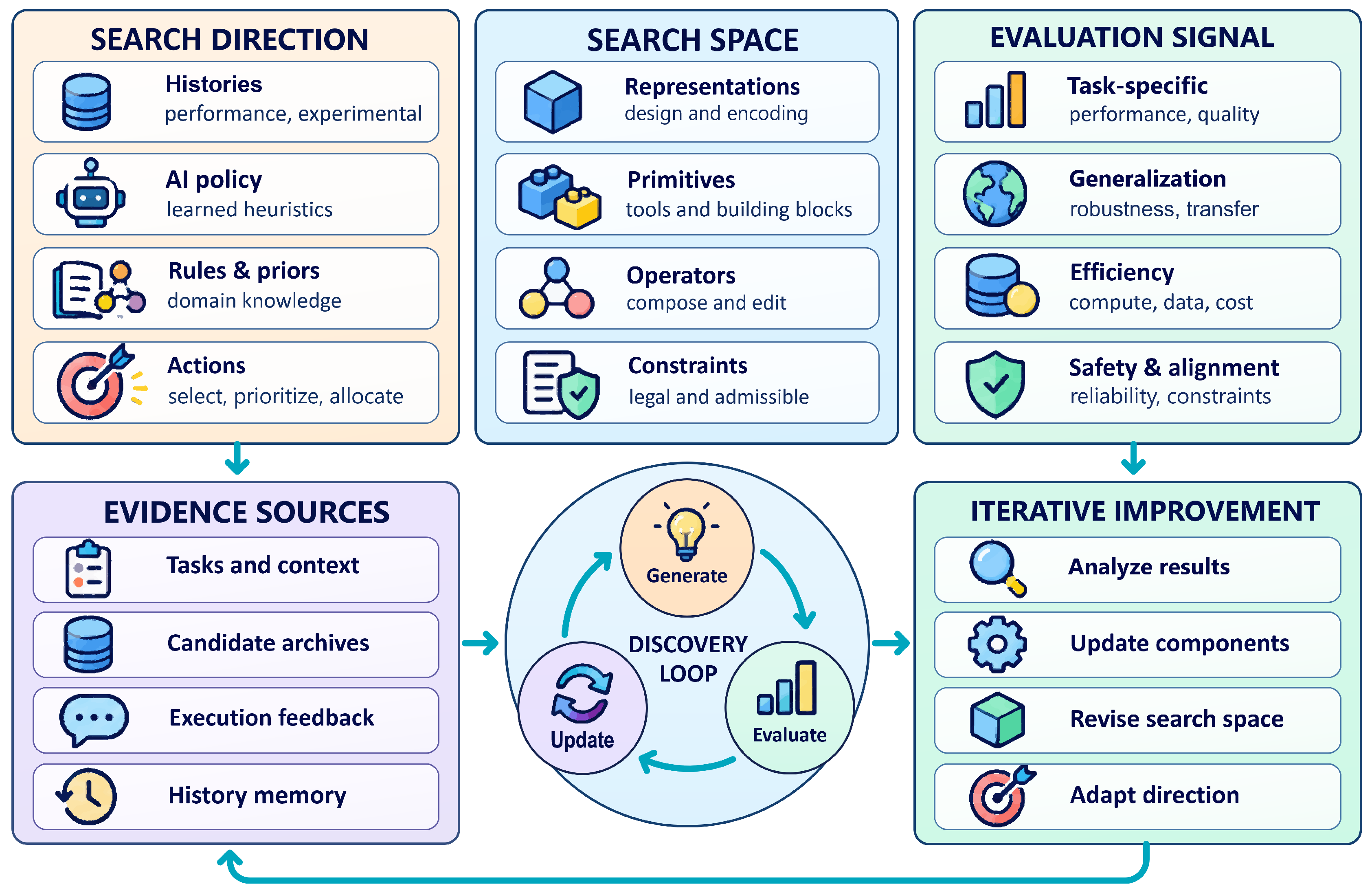
Figure 4.
Taxonomy of L1 search-direction discovery from accumulated history. The literature separates into four history carriers. Performance histories support budget allocation and response-surface prediction; evolutionary histories preserve archives, lineages, and variation strategies; reflective histories convert critiques and trajectories into targeted revisions; and experimental histories use replayable records or research memory to select the next experiment.
Figure 4.
Taxonomy of L1 search-direction discovery from accumulated history. The literature separates into four history carriers. Performance histories support budget allocation and response-surface prediction; evolutionary histories preserve archives, lineages, and variation strategies; reflective histories convert critiques and trajectories into targeted revisions; and experimental histories use replayable records or research memory to select the next experiment.
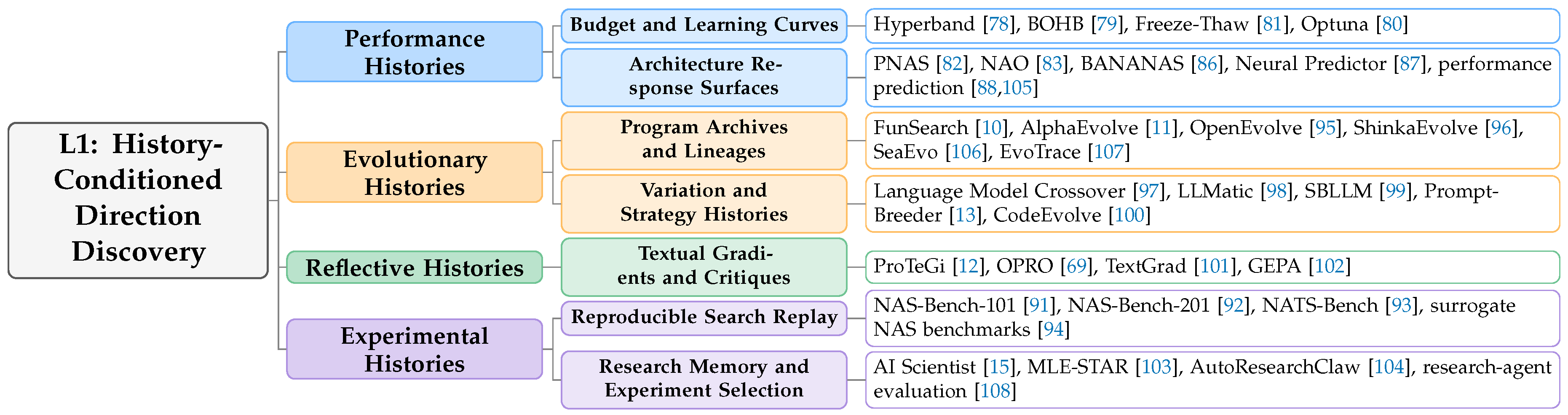
Figure 5.
AI construction of the active search space at L2. Within a human-provided ambient universe , AI draws on task context, candidate archives, execution feedback, and reuse history to construct or substantively revise the active search space. Selection, construction, compression, and revision can act on one or more space components: candidate representations , available primitives , legal composition and edit operators , and admissibility constraints . The resulting space shapes candidate generation, while execution and evaluation produce new evidence that can support iterative space refinement. Search direction may be supplied by humans, predefined rules, or an L1 component; the evaluation criterion E remains externally fixed.
Figure 5.
AI construction of the active search space at L2. Within a human-provided ambient universe , AI draws on task context, candidate archives, execution feedback, and reuse history to construct or substantively revise the active search space. Selection, construction, compression, and revision can act on one or more space components: candidate representations , available primitives , legal composition and edit operators , and admissibility constraints . The resulting space shapes candidate generation, while execution and evaluation produce new evidence that can support iterative space refinement. Search direction may be supplied by humans, predefined rules, or an L1 component; the evaluation criterion E remains externally fixed.
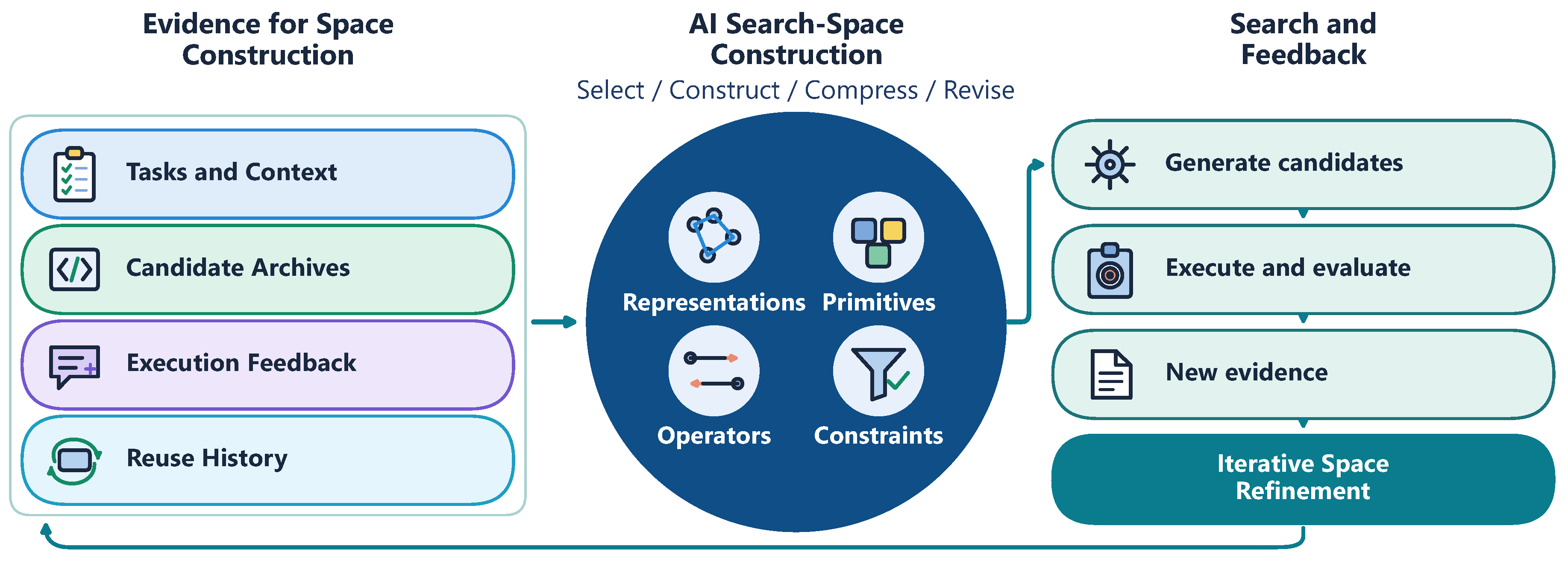
Figure 6.
Component-based taxonomy of L2 AI-provided search spaces. Methods are classified by the primary search-space component that AI constructs or revises: candidate representations (), available primitives (), legal composition and edit operators (), and admissibility constraints (). The operator branch is retained as a distinct intervention target without a clear primary example among the reviewed methods. ToolMaker and SkillX are marked as boundary cases rather than unqualified examples of primitive or operator construction. Attribution is component-specific.
Figure 6.
Component-based taxonomy of L2 AI-provided search spaces. Methods are classified by the primary search-space component that AI constructs or revises: candidate representations (), available primitives (), legal composition and edit operators (), and admissibility constraints (). The operator branch is retained as a distinct intervention target without a clear primary example among the reviewed methods. ToolMaker and SkillX are marked as boundary cases rather than unqualified examples of primitive or operator construction. Attribution is component-specific.
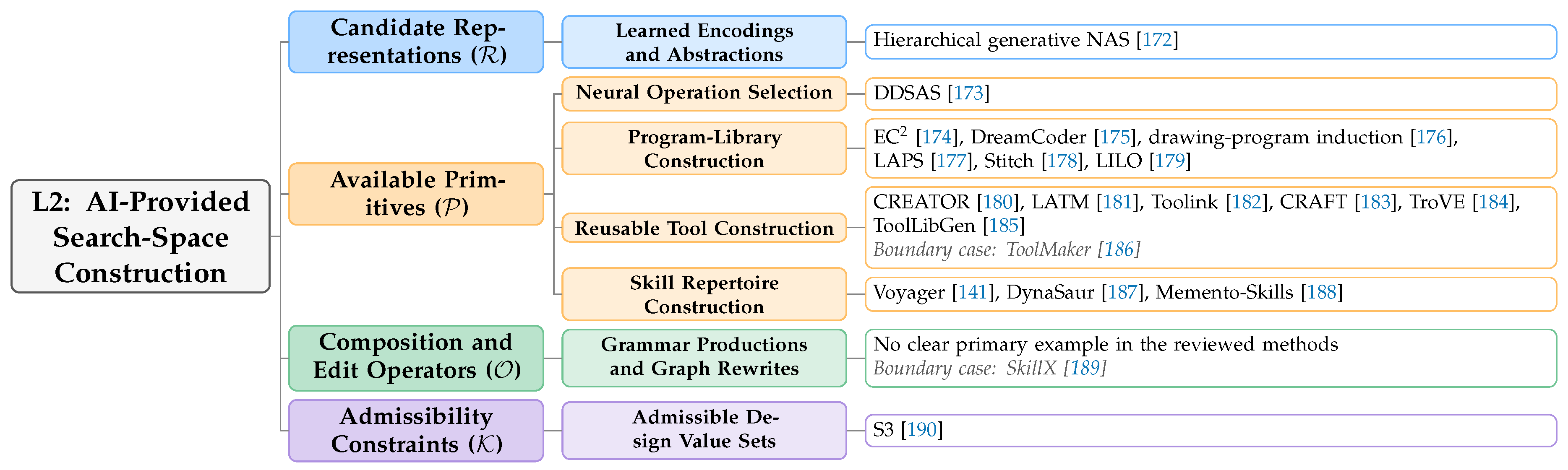
Figure 7.
AI-provided evaluation signals in the discovery loop. Human specifications, examples, and interfaces anchor an evaluator in which AI generates or substantially revises one or more components: tests and tasks , the judgment mapping J, aggregation rules A, or decision thresholds . The resulting scores or judgments govern candidate selection, training, or acceptance, and new evidence supports subsequent discovery. The independent-validation branch audits gains with a frozen external evaluator and held-out or cross-model checks; it remains distinct from the operative signal used for optimization. The sources of direction and search space are attributed separately.
Figure 7.
AI-provided evaluation signals in the discovery loop. Human specifications, examples, and interfaces anchor an evaluator in which AI generates or substantially revises one or more components: tests and tasks , the judgment mapping J, aggregation rules A, or decision thresholds . The resulting scores or judgments govern candidate selection, training, or acceptance, and new evidence supports subsequent discovery. The independent-validation branch audits gains with a frozen external evaluator and held-out or cross-model checks; it remains distinct from the operative signal used for optimization. The sources of direction and search space are attributed separately.
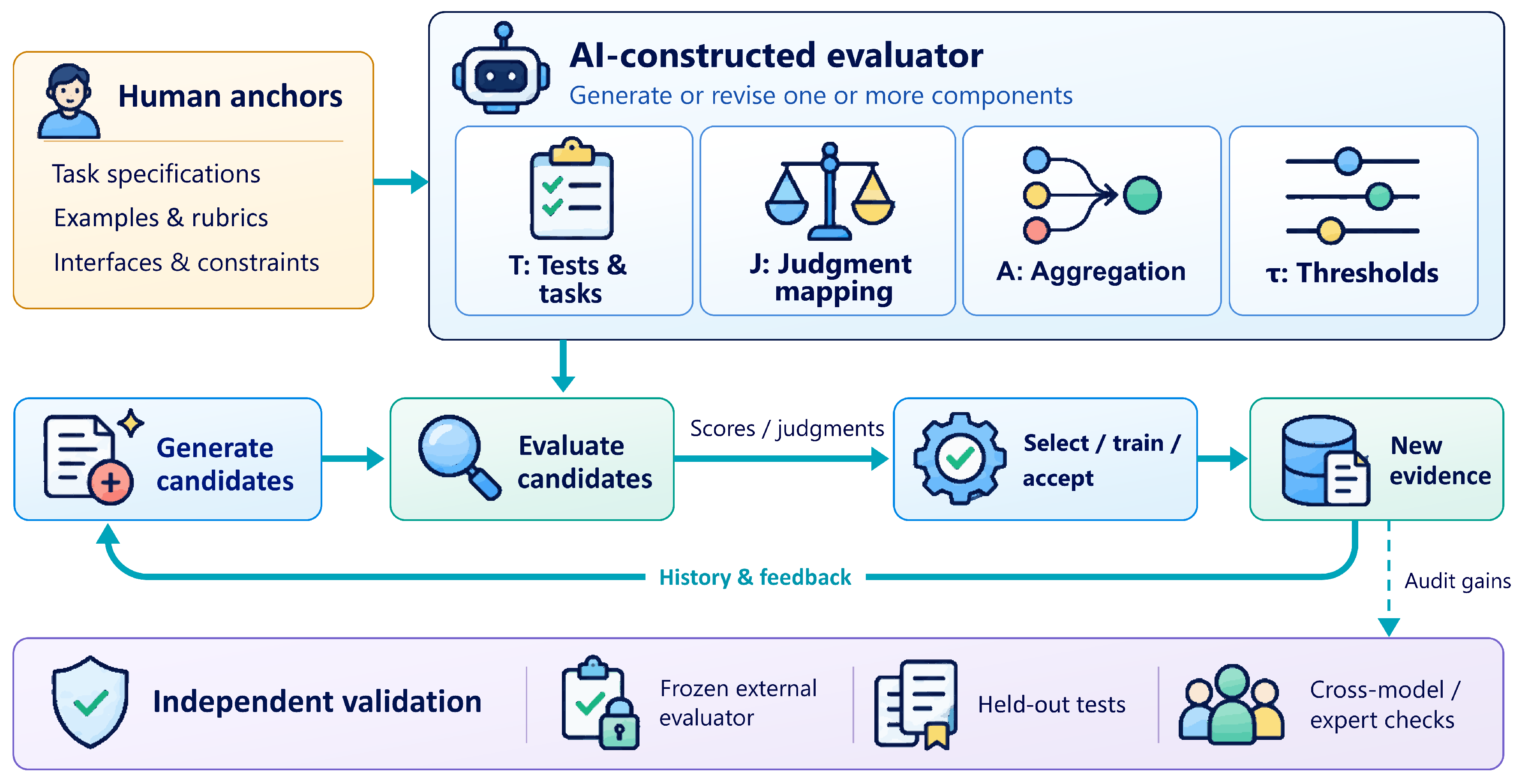
Figure 8.
Taxonomy of L3 AI-provided evaluation signals. The literature separates into executable evaluation artifacts, learned preference evaluation and model judges, generated objectives and self-evaluation, and adaptive evaluation and oversight. An L3 artifact may change the test distribution , judgment mapping J, aggregation rule A, or decision threshold , and must causally affect the discovery loop. The leaf nodes are candidate artifacts or representative methods, not unconditional L3 assignments; only configurations that satisfy the closed-loop counterfactual in Section 6.1 count as L3. Robustness and recursive-evidence checks are cross-cutting validation protocols applied across these families, not an additional artifact family.
Figure 8.
Taxonomy of L3 AI-provided evaluation signals. The literature separates into executable evaluation artifacts, learned preference evaluation and model judges, generated objectives and self-evaluation, and adaptive evaluation and oversight. An L3 artifact may change the test distribution , judgment mapping J, aggregation rule A, or decision threshold , and must causally affect the discovery loop. The leaf nodes are candidate artifacts or representative methods, not unconditional L3 assignments; only configurations that satisfy the closed-loop counterfactual in Section 6.1 count as L3. Robustness and recursive-evidence checks are cross-cutting validation protocols applied across these families, not an additional artifact family.
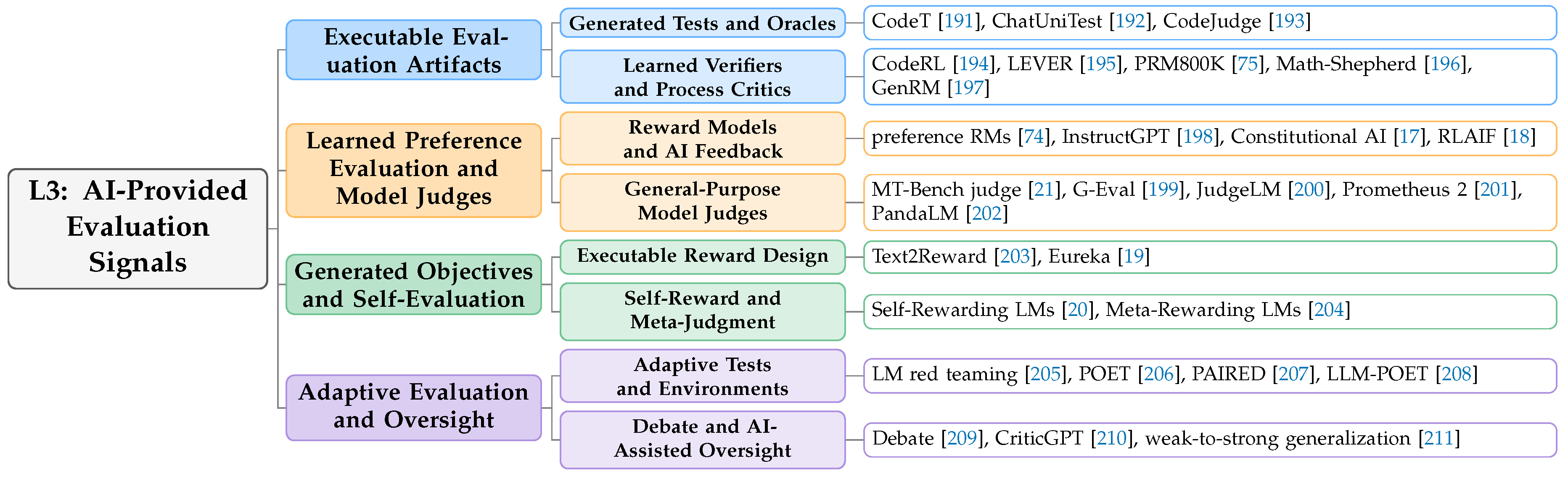
Table 1.
Survey perspectives on AI-built AI.
| Survey lens | Primary unit | Discovery control |
Cross-domain coverage |
||
|---|---|---|---|---|---|
| D | S | E | |||
| Search-centric [4,25,26,35,36,37,38,39,40,41,42,43] | Search procedure | ● | ◆ | ❍ | ◆ |
| Self-evolution [30,31,32,33,44] | Model or agent | ● | ◆ | ◆ | ◆ |
| Research lifecycle [27,28,29,45,46,47,48,49] | Research stage or workflow | ● | ❍ | ◆ | ❍ |
| Component and artifact [50,51,52,53,54,55,56,57] | Target artifact | ❍ | ❍ | ◆ | ❍ |
| Loop closure [34,58,59] | Capability, autonomy, or improvement loop | ◆ | ❍ | ● | ◆ |
| This survey | Discovery control | ● | ● | ● | ● |
● central to the lens; ◆ partial or present in only some surveys; ❍ absent.
D, S, and E indicate whether the lens analyzes AI control over search direction, search space, and evaluation signal, respectively. Cross-domain coverage refers to learning, inference, data, and infrastructure within one framework.
Table 2.
Notation used for the AI4AI discovery process and responsibility framework.
| Symbol | Meaning |
|---|---|
| Target AI system at discovery cycle t | |
| Accumulated research history available at cycle t | |
| Resource budget for candidate generation and evaluation | |
| Search space: editable objects, representations, constraints, and operators | |
| Validity or admissibility constraints defining the active search space | |
| Search direction selected within | |
| Realized set of candidate interventions | |
| Number of candidates in | |
| Evaluation procedure and the candidate-level evidence vector it produces | |
| Evidence assigned to candidate | |
| Target-system update rule that selects, aggregates, or implements an intervention | |
| History update rule that records candidates and evidence for later cycles | |
| Binary responsibility profile | |
| Descriptive control-strength vector |
Table 3.
Representative L1 methods as history-conditioned direction policies, grouped by the history carrier of Figure 4. Each method reads and emits a directional or resource-allocation decision .
Table 3.
Representative L1 methods as history-conditioned direction policies, grouped by the history carrier of Figure 4. Each method reads and emits a directional or resource-allocation decision .
| Method | Direction emitted | Evidence read | |
|---|---|---|---|
| Performance histories | |||
| Hyperband [78] | configuration and next budget (continue or resume) | learning curves, validation scores, rung budgets | |
| BOHB [79] | configuration and next budget | scores, budgets, model-based density estimates | |
| BANANAS [86] | architecture neighborhood to expand | evaluated architectures, encodings, predictor uncertainty | |
| Evolutionary histories | |||
| FunSearch [10] | parent program and semantic variation | island archive, program scores, ancestry | |
| OpenEvolve [95] | parent, edit operator, edit location | program database, lineage, diversity, evaluator feedback | |
| PromptBreeder [13] | parent prompt and mutation strategy | task prompts, mutation prompts, fitness history | |
| Reflective histories | |||
| TextGrad [101] | editable component and targeted revision | execution trace, loss, textual gradient | |
| GEPA [102] | parent and reflection-conditioned edit | reflective feedback, lineage, Pareto archive | |
| Experimental histories | |||
| AI Scientist [15] | next hypothesis and experiment | literature, hypotheses, code, results, reviews | |
| MLE-STAR [103] | pipeline component and revision strategy | pipeline trials, ablations, validation, memory | |
| AutoResearchClaw [104] | research action and artifact to revise | literature memory, experiment log, reviewer feedback | |
Table 4.
Search-space construction in representative L2 methods, grouped by the four space components of Figure 6. Each row separates the AI-constructed active space from the human-specified ambient universe . is accumulated search evidence, the reusable primitives ( initial), solved programs ( execution-checked training solutions), language annotations, and , , a task, task examples, and a task family.
Table 4.
Search-space construction in representative L2 methods, grouped by the four space components of Figure 6. Each row separates the AI-constructed active space from the human-specified ambient universe . is accumulated search evidence, the reusable primitives ( initial), solved programs ( execution-checked training solutions), language annotations, and , , a task, task examples, and a task family.
| Method | AI-constructed space | Human universe | |
|---|---|---|---|
| Candidate representations ·Learned encodings and abstractions | |||
| Hierarchical generative NAS [172] | G-VAE cell embeddings; proxy-clustered cell families | architectural template, cell space, zero-cost proxies | |
| Available primitives | |||
| DDSAS [173] | dynamic binary edge–operation mask | fixed architecture graph, candidate operations, budgets | |
| DreamCoder [175] | probabilistic DSL enriched with reusable abstractions | base DSL, primitives, execution semantics | |
| LAPS [177] | language-grounded abstractions | base DSL, program syntax, language annotations | |
| Stitch [178] | reusable functions that compress common program patterns | base DSL, primitives, valid expressions | |
| LILO [179] | compressed abstractions with LLM-written names and docstrings | base DSL, composition rules, task descriptions | |
| CREATOR [180] | reusable tools generated before planning their use | Python runtime, APIs, task specifications | |
| LATM [181] | verified Python tools cached for reuse | Python runtime, tool interface, task examples | |
| Toolink [182] | task-family toolkit for Chain-of-Solving planning | Python runtime, task family, tool interface | |
| CRAFT [183] | abstracted, validated, deduplicated tool library | task APIs, Python runtime, training tasks, validators | |
| TroVE [184] | execution-consistent reusable functions, pruned by usage | base primitives, programming language, execution interface | |
| Voyager [141] | success-verified, retrievable, composable skills | Minecraft APIs, JavaScript, environment mechanics | |
| Composition and edit operators ·Grammar productions and graph rewrites | |||
| No clear primary example. Boundary case: SkillX [189] learns skills that guide execution but do not change the operators. | |||
| Admissibility constraints ·Admissible design value sets | |||
| S3 [190] | evolved value sets for depth, width, heads, windows, MLP, Q–K–V | ViT blocks, design dimensions, initial choices, budgets | |
UCB: upper confidence bound; CTS: corpus-guided top-down search; G-VAE: graph variational autoencoder.
Table 5.
Evaluation-signal decomposition of representative L3 candidates, grouped by the artifact families of Figure 8. Each row separates the AI-produced component from its human anchor .
Table 5.
Evaluation-signal decomposition of representative L3 candidates, grouped by the artifact families of Figure 8. Each row separates the AI-produced component from its human anchor .
| Method | AI-produced signal | Human anchor | |
|---|---|---|---|
| Executable evaluation artifacts | |||
| CodeT [191] | generated test suite ; dual execution-agreement score | problem statement, language runtime, execution semantics | |
| Math-Shepherd [196] | auto-built step labels; learned process reward model | math problems, final-answer correctness checks | |
| GenRM [197] | generative verifier that judges correctness as tokens | verification demonstrations, supervised task corpus | |
| Learned preference evaluation and model judges | |||
| Constitutional AI [17] | critiques, revisions, preferences, learned reward | written constitution , seed helpfulness data | |
| RLAIF [18] | AI preference labels ; fitted reward model | task prompts, principles, calibration examples | |
| G-Eval [199] | CoT criterion use; probability-weighted score | human criteria r, task inputs, reference context | |
| Prometheus 2 [201] | trained rubric-conditioned direct or pairwise judgment | rubric r, reference answer , evaluation examples | |
| Generated objectives and self-evaluation | |||
| Eureka [19] | reward program evolved from training feedback | environment code, natural-language objective, simulator dynamics | |
| Self-Rewarding LMs [20] | responses, self-judgments, preference-training pairs | seed instruction data, judging prompt, training procedure | |
| Adaptive evaluation and oversight | |||
| LM red teaming† [205] | adaptive prompt distribution | harm taxonomy, target model, safety policy | |
| PAIRED† [207] | regret-shaped adaptive environment | generator interface, agents, task dynamics | |
| CriticGPT† [210] | learned critique that guides review | human reviewer, code task, known-error supervision | |
† Typically used for testing or review; L3 only if the AI signal changes downstream evaluation, selection, or operative acceptance.
Table 9.
Representative AI4AI Infrastructure methods, selected to illustrate distinct software and hardware artifacts.
Table 9.
Representative AI4AI Infrastructure methods, selected to illustrate distinct software and hardware artifacts.
| Method | Level | AI-designed | Human-fixed |
|---|---|---|---|
| Algorithms, kernels, and tensor programs | |||
| AlphaTensor [66] | |
matrix-multiplication algorithms | tensor formulation, action space, objective |
| Ansor [257] | |
sketch annotations: tiles, unrolling | sketch rules, schedule space, tests |
| AlphaEvolve [11] | |
matmul tiling heuristic; TPU circuit | candidate pool, diff encoder, evaluation harness |
| Execution plans and hardware co-design | |||
| FlexFlow [259] | |
per-operator parallelization strategy | parallelization space, simulator, hardware model |
| NAAS [261] | |
accelerator, mapping, network | architecture grammar, mapping space, simulator |
| Logic, RTL, and physical design | |||
| DRiLLS§ [262] | |
sequence of synthesis transformations | transformation set, cell library, area and delay |
| AlphaChip [264] | |
macro positions on the canvas | placement space, netlist, power and congestion |
| AutoChip§ [266] | |
Verilog modules and their repairs | RTL template, testbench, PPA objective |
§ General-purpose EDA application.
Disclaimer/Publisher’s Note: The statements, opinions and data contained in all publications are solely those of the individual author(s) and contributor(s) and not of MDPI and/or the editor(s). MDPI and/or the editor(s) disclaim responsibility for any injury to people or property resulting from any ideas, methods, instructions or products referred to in the content. |
© 2026 by the authors. Licensee MDPI, Basel, Switzerland. This article is an open access article distributed under the terms and conditions of the Creative Commons Attribution (CC BY) license.
Copyright: This open access article is published under a Creative Commons CC BY 4.0 license, which permit the free download, distribution, and reuse, provided that the author and preprint are cited in any reuse.