

Submitted:
29 October 2026
Posted:
29 October 2026
You are already at the latest version
Abstract
Background/Objectives: With rising autism prevalence, parent coaching has emerged as a useful model for teaching parents responsive strategies to support their child’s social communication and interaction skills within daily routines and play contexts. Telehealth parent coaching provides benefits of real-time guided generalisation in naturalistic environments as well as cost savings for families and providers. Methods: This randomised controlled trial examined whether parent coaching delivered via synchronous video conferencing was non-inferior to in-person sessions for improving the primary outcome of developmental skills in children with autism. 200 parent-child dyads were randomly assigned to receive 16 to 18 weekly parent coaching sessions based on naturalistic, relationship-focused intervention principles, delivered either through video conferencing (telerehabilitation arm) or in-person (standard arm). Results: Participants in both groups demonstrated comparable improvement in developmental skills, together with comparable changes in adaptive functioning, parent-child interaction, parental stress reduction and family quality of life. Conclusions: The findings of this study support video conferencing as a feasible and acceptable alternative platform for parent coaching while providing cost savings. However, given this study’s high attrition rate and the limited evidence base for telehealth parent coaching, additional research is needed to further validate the findings and parameters of use for optimal outcomes.
Keywords:
autism spectrum disorder
; telehealth
; parent coaching
; relationship-focused intervention
1. Introduction
Autism spectrum disorder (ASD) is characterised by persistent challenges in social communication and interaction as well as the demonstration of restricted and repetitive behaviour (DSM, 5th edition). Studies consistently report an increase in the prevalence of autism [1], which augment the need for further development of sustainable, evidence-based early intervention models to support children’s functioning [2]. Relationship-focused interventions enhance parent responsiveness and teaches parents to create learning opportunities in everyday parent-child interactions during daily routines and play activities [3]. This approach has been shown to produce positive and statistically significant effects on social communication [4]. Consequently, parent coaching has emerged as an important component of effective intervention programs for young children with autism [5]. Meta-analysis of parent-implemented interventions identified improvements in children’s social skills, communication skills and reduction in maladaptive behaviour [6].
Given the growing demand for services and the need for cost-effective intervention, alternative modalities are being explored to enhance parent coaching. In general, telemedicine (i.e., using technology to deliver healthcare remotely without requiring an in-person visit) has been found to be well-received by patients and healthcare providers alike and are considered equivalent to in-person care for many conditions [7]. Even when parent coaching is conducted remotely, it has been shown to improve language, social communication and imitation skills in children with ASD [8] and may have comparable treatment effectiveness with in-person parent coaching [9]. In addition, telehealth parent coaching facilitates parents’ implementation of therapeutic strategies in the child’s naturalistic setting [10,11] and is promising for increasing parents’ use of strategies [12]. While children with autism may have additional barriers assessing in-person healthcare due to challenging behaviours, telehealth may facilitate equitability of access by siting care at home.
However, success for telehealth parent coaching is not universal. It relies on active parent participation as parents carry out the sessions and prepare the materials and home setting for coaching. Beyond parental factors, it is unclear if children of various developmental levels can benefit from telehealth. There is also inadequate cost effectiveness data for telehealth parent coaching in comparison with in-person coaching. Lastly, there continues to be limited randomised controlled trials in this area, with Patel and Virani [13] finding only 24 studies in their systematic review of telehealth in ASD in 2025. Further, literature on direct comparison of telehealth to face-to-face intervention within practical clinical settings is even more limited. Notably, most existing studies are conducted in western populations and large countries that are geographically vast compared to small Asian countries. Thus, there is a need to further evaluate optimal telehealth intervention outcomes across diverse geographical and cultural settings.
The primary objective of this study was to determine if the effectiveness of synchronous video conferencing telehealth parent coaching is non-inferior to in-person parent coaching in improving developmental skills in children with ASD. The secondary objective was to determine if such comparability may also be found in important parent and child outcomes such as child’s adaptive behaviour, parent-child interaction quality, family quality of life and parental stress. Another secondary objective was to assess the cost-effectiveness of telehealth parent coaching as compared to the in-person program.
2. Materials and Methods
2.1. Study Design
This randomised, controlled, parallel group, non-inferiority study compared parent coaching delivered via video conferencing (telerehabilitation arm) with in-person delivery of intervention (standard arm) [14]. Block allocation (1:1) was used to ensure equal randomisation of participants to both study arms throughout the recruitment period. For more information about the study design,
2.2. Setting
The study was conducted in a specialised developmental paediatric clinic that provides diagnostic and assessment services for children with learning, behavioural and developmental needs from birth to 7 years of age. Nearly 30% of referrals were for concerns related to autism.
2.3. Participants
Children aged 15 to 48 months who received a clinical diagnosis of autism based on a comprehensive assessment integrating developmental history obtained through family interview and clinical expertise applied according to the DSM-5 criteria, met the cut-off score for ASD on Autism Diagnostic Observation Schedule-2 (ADOS) [15] and have at least one consistent parent(s) or caregiver(s) to attend most intervention and outcome measurement sessions were considered to meet the inclusion criteria. Parent(s) must also be digitally literate with the Zoom video conferencing platform [16]. Children were excluded if they had previously received or were receiving early intervention for ASD from another provider or if they had a diagnosed genetic disorder, auditory or visual impairment, seizure disorder, or other severe chronic medical illnesses.
2.4. Interventions
Study interventions were delivered by accredited speech therapists and psychologists (“Therapists”) who were trained in the in-house intervention curriculum, the Foundational Skills Program, adapted from Cumine et al. [17]. Therapists coached parents to facilitate their child’s development in core domains of social interaction, social communication, play skills and participation in daily routines. Each session comprised of three components – a) progress review and check-in with parents, b) observation of parent-child play activity with real-time coaching and c) collaborative planning discussion to facilitate home-based practice. Parents learnt responsive strategies such as following their child’s lead and imitating play actions that could be applied in parent-child interactions that occurred during play activities and daily routines. Regular study meetings were held to check in on therapists’ adherence to study procedures.
Participants in the telerehabilitation arm attended two in-person clinic-based sessions (60 min) first, followed by 16 video conferencing sessions (45 min) (total intervention time = 840 min). The two in-person sessions were used for joint planning of the child’s intervention targets based on initial assessment results. Therapist and parents also explored effective strategies that served as a foundation to the subsequent coaching through video conferencing. Participants in the standard arm attended 16 in-person clinic-based intervention sessions (60 min) (total intervention time = 960 min). This difference in intervention time is due to the removal of preparation time by the therapists. In the telehealth model, parents were tasked to select activities, prepare materials, set up the room and ready the child for the session. Participants who transited to longer-term community-based early intervention services during the study continued to receive intervention as per protocol until they began receiving interventions at their new service provider. These participants were also assessed per protocol at their midterm and final review timepoints.
2.5. Outcome Measures
2.5.1. Primary and Secondary Outcomes
The primary outcome measure is the mean change in the individual domains of developmental skills and overall developmental score measured on the Mullen Scales of Early Learning (MSEL) [18]. The MSEL t-scores of the individual domains and the overall standard score was calculated according to age norms and used to measure the child’s developmental skills. It was administered as part of the eligibility assessment and during the final review approximately one year after study enrolment. Secondary outcome measures include adaptive behaviour measured on the Vineland Adaptive Behaviour Scales (VABS-III) (Communication, Daily Living Skills and Socialisation domains only) [19], parent-child interaction measured on the Joint Engagement Rating Inventory (JERI) [20], parental stress measured on the Parenting Stress Index-Short Form (PSI-SF) [21], and family quality of life measured on the Families in Early Intervention Quality of Life Scale (FEIQoL) [22]. Further details pertaining to these outcome measures and how they were applied in this study have been published previously [14]. Quantitative study data initially collected on paper forms were entered into and managed using REDCap electronic data capture tools hosted by the National Healthcare Group [23].
2.5.2. Additional Outcomes
Cost surveys conducted with parents at baseline, midterm and final review sessions provided additional information about the amount parents earned from paid work to calculate the costs involved for participants to attend the intervention programs in this study (video conferencing vs. clinic-based). The indirect non-healthcare cost data (e.g., transport and productivity losses) were aggregated across participants in each program.
A mixed-methods approach was used to examine program acceptability and feasibility. Parents completed a Parent Satisfaction Survey to rate items on 5-point Likert scales. Feasibility and acceptability item responses across the two arms were compared. In-depth, semi-structured, one-to-one interviews were also held with a small proportion of 10 selected parent participants from the telerehabilitation arm (Refer to Appendix 1 for Interview Questions). Purposive heterogenous sampling [24] ensured representation of participants who variously completed, transited, or withdrew from the study for these interviews. Interview responses were audio-recorded and transcribed verbatim for subsequent thematic analysis.
2.6. Statistical Analysis
Paired-sample t-test compared mean pre-post primary (MSEL) and secondary (VABS-III, JERI, FEIQoL and PSI-SF) scores within each arm. Multiple regression model adjusted for proportion of completed therapy sessions (continuous variable), premature transition to early intervention programs (binary variable), ADOS Comparison Score (continuous variable) [25], age at pre-MSEL test (continuous variable), weighted by the inverse probability of complete post-program data for analysis due to the high attrition rate in this study. As MSEL t-score is normed by age, age was not added as an adjustment variable to the regression model for the analysis.
Taking reference from existing literature [26] and following consensus amongst study team members, the non-inferiority margin was set a priori at –5 for the difference in mean MSEL Early Learning Composite (ELC) across both groups. Non-inferiority of parent coaching delivered via video conferencing vs. parent coaching delivered in-person will be concluded if the lower limit of the 95% confidence interval for mean difference in pre-post improvement in primary outcome (MSEL telehealth – MSEL standard) is not lower than -5. Parent interview responses regarding feasibility and acceptability of the telehealth program were transcribed, with a preliminary set of codes developed deductively based on the interview guide. The codes were inductively and iteratively refined through renaming, merging and/or re-coding to generate themes reflecting parents’ experiences, program benefits, challenges faced and perception of the different modalities [27]. Further details pertaining to these statistical analysis methods have been published previously [14].
3. Results
3.1. Study Participants
200 participants were enrolled and randomly assigned to either the telerehabilitation arm (n=102) or standard arm (n=98). 11% of the randomised participants (n=22) withdrew consent after assignment and did not receive any intervention. The reasons for withdrawing from the study and the number of participants who withdrew were comparable across groups, with participants citing reasons such as starting external intervention programs, changing their minds about their child requiring intervention and inability to commit to the study schedule. Two standard arm participants who had yet to begin their programs were transferred to the telerehabilitation arm to avoid delays in their intervention when in-person clinic services were halted due to the COVID-19 pandemic. 59% of the enrolled participants (n=118) completed the study with 68 participants from the standard arm and 50 participants from the telerehabilitation arm (Figure 1).
The dropout rate of 30% was uneven with the telerehabilitation arm having a higher dropout rate (39% vs. 20%, p=.003). No association between participant characteristics (developmental skills or autism severity) or demographic factors (socioeconomic status or employment status of caregiver) and dropout were found. Transitions to community-based early intervention services was also similar across the two arms (10% in telerehabilitation arm vs. 4% in standard arm, N.S.). Reasons provided by participants for dropping out were similar across groups, except that some telehealth participants reported a preference for clinic-based sessions (n=9).
3.2. Sample Demographics
Participants did not differ significantly between arms for pertinent child, parent, and family characteristics (Table 1).
3.3. Intervention Duration
Mean duration for participants who completed the program is similar across arms with 11.32 (SD = 1.94) months for the standard arm and 11.11 (SD=1.60) months for the telerehabilitation arm (p = .526, N.S).
3.4. Change in Primary Outcome (MSEL Scores)
Significant improvement in MSEL Early Learning Composite (ELC) scores were found in both arms (Table 2). At the subscale level, Receptive Language improved for both arms while Expressive Language increased for the standard arm alone.
No significant difference was found for the change in all MSEL scores between the two arms (Table 3). Non-inferiority of the telerehabilitation arm vs. standard arm was supported by Visual Reception, Fine Motor, and Receptive Language Subscale scores based on the non-inferiority margin set a priori (i.e., lower limit of 95% CI is not lower than -5) (Table 3).
3.5. Change in Secondary Outcomes (VABS-III, JERI, PSI-SF, FEIQoL)
VABS-III scores generally improved pre-post across both arms, with no significant difference in these changes between arms (Table 4). Significant improvements were found in all JERI domains pre-post for both arms (Weighted Kappa, k = .873), with no significant difference in these changes between arms (Table 4). No significant change was found in pre-post PSI-SF scores across both arms (Table 4). Access to Information on the FEIQoL improved pre-post in both arms and Child Function improved for the standard arm. No significant difference was found in these changes between arms (Table 4).
3.6. Participant and Provider Costs
Overall, the telehealth program costs less than the standard program for participants (Table 5). Total therapy session time in the telehealth program was shorter due to the elimination of time required for familiarisation and settling-in. This resulted in reduced session costs and reduced loss in productivity (i.e., time spent away from paid work). Transportation costs were also lower in the telehealth program as most sessions were delivered remotely to the participants’ homes.
Healthcare provider cost was calculated based on projected therapist manpower and space rental costs, assuming participants completed the intervention program. Overall, the telehealth program resulted in cost savings as compared to the standard program (Table 6). Manpower cost was lower for the telehealth program due to shorter overall therapy session time. Space requirements for telerehabilitation was lower as video conferencing sessions only required space for a table and chair as compared to space for therapy activities involving the therapist, parent and child.
3.7. Program Acceptability and Feasibility
86% of the responses in the telerehabilitation arm were favourable (“Agree” or “Strongly Agree”) for items regarding program acceptability on the Parent Satisfaction survey (Appendix 2), which was comparable to favourable responses in the standard arm (93%). Majority of responses (71%) also indicated the telehealth program as being feasible i.e., parents had no technical difficulties during sessions, felt that the program saved transportation time and their homes were conducive for conducting therapy.
Semi-structured interview data from the telehealth group revealed distinct themes in acceptability and feasibility (Figure 2). Parents reported that the telehealth program resulted in cost and time savings, and they appreciated not having to commute to the clinic which may have resulted in challenging behaviours from their child during the commute. Parents also found the telehealth program to be a positive experience because therapists were able to guide them to practise therapeutic strategies in their own homes. However, although the home environment is familiar to both parent and child, some parents did not feel it was conducive for therapy. Moreover, some children were also distracted by the video conferencing device. Some parents felt that using devices limited therapists from observing all parent-child interactions clearly and the remote nature of this approach precluded therapists from hands-on demonstration of therapeutic strategies.
4. Discussion
Young children with autism often have delayed communication skills but children with better communication skills are more likely to have a better prognosis, making it an important intervention target and outcome measure. Based on MSEL results, participants in the telerehabilitation arm demonstrated comparable improvements in receptive language skills to those in the standard arm, in line with findings for both traditional in-person models [28,29,30,31] and telemedicine-mediated parent-implemented interventions [32,33,34]. The improvement on VABS-III Communication domain further suggests that improvements in receptive language generalised to communication in everyday life. However, improvement in expressive language was only observed in participants in the standard arm and not the telerehabilitation arm. This finding corroborates with Ingersoll and colleagues’ study [35] that reported the lack of treatment effect for telehealth coaching of parent-mediated NDBI on children’s expressive language ability. While changes in communication are observed on a parent self-reported measure (VABS-III), more time is possibly required for detectable, generalisable changes in expressive language on a standardised test (MSEL). Regardless, the improvement in receptive language t-scores observed over the intervention period is meaningful as it demonstrates improvement above and beyond natural maturation. This provides an important key to drive improvements in other developmental domains in the longer run including expressive language [36].
The large improvement in adaptive functioning demonstrated on VABS-III across all domains of communication, daily living skills and socialisation observed post-intervention for the telerehabilitation arm was comparable to the improvement observed in the standard arm. This suggests that coaching parents via video conferencing sessions facilitates children’s skill generalisation beyond treatment sessions. As the intervention model leverages on rich learning contexts in everyday routines to support the child’s development of adaptive behavioural skills [37,38], the child was able to learn useful skills in the context of their natural environment and everyday routines. Given the variability of findings on the impact of telehealth parent coaching on children’s adaptive functioning in existing studies [32,39,40], future research should use a range of self-reported and direct observation outcome measures.
The improvement in parent-child interaction for the telerehabilitation arm was comparable to the improvement observed in the standard arm. This suggests that coaching parents in their naturalistic home environment did not limit their generalisation of strategies to the clinic environment where parent-child interaction was assessed. However, a limitation of the study was the lack of measurement of caregiver strategy use in the home environment. Additionally, coaching fidelity measures, if included, would have allowed us to observe if differences in coaching modality brought about any difference in the therapist’s coaching practices and consequently, affecting parent learning in different environments. Directive coaching such as modelling a skill is important when parents are first learning the skill [41]. The intervention program in our telerehabilitation arm did not allow therapists to perform further hands-on demonstration of therapeutic strategies beyond the first two in-clinic sessions [14]. Indeed, this was a limitation identified by participants in our feasibility and acceptability assessment. Replacing some of the telehealth sessions in the program with in-person sessions in future versions of the program may enhance parent learning outcomes, reduce attrition and thereby improve child outcomes. Finally, parents in the telerehabilitation arm were required to play a bigger role in selecting activities used during treatment sessions and relied on verbal instructions from the therapist without demonstration to modify their interactional behaviours with their children. Careful assessment and consideration of personal characteristics of parents may play a part in determining if they will be successful in a telehealth intervention model.
The cost burden was nearly 50% lower for participants in the telerehabilitation arm than in the standard arm. Apart from reduced transport and productivity costs, which are sizable despite the country’s small geographical area, cost savings also arose from parents taking on the responsibility of setting up for therapy sessions. During clinic-based in-person sessions, therapists take time to set up therapy materials. Conversely, in the telehealth model, parents were tasked to select activities, prepare materials, set up the room and ready the child for the session. This transfer of preparatory duties eventually contributed to cost savings for participants. Costs to the healthcare provider in the telerehabilitation arm was also lower by 30% compared to the standard arm. As the study took place in one of the most digitised cities in the world with a robust telecommunications infrastructure, it was easy and cost-effective for healthcare providers to roll out telemedicine services [42]. Furthermore, there is high digital adoption by the general population who use the Internet for daily activities and thus equipment required for telehealth was often already owned by participants.
Most parents in the telerehabilitation arm did not experience technical difficulties during the video conferencing sessions and attending the intervention sessions at home helped them to save time. The high level of parental acceptability reported by parents in this study aligns with existing literature [43,44]. Parents echoed the practical benefits of being able to attend the sessions remotely through video conferencing, making therapy sessions more accessible and convenient. This was especially so for parents with flexible work arrangements. Moreover, commuting may trigger challenging behaviour in children with autism due to transitions to different environments, loud noises on public transport and a deviation from regular routines [45]. Overall, parent coaching conducted via telehealth was reported to be a positive and highly valued experience with adequate tailored guidance from the therapist that increased parents’ self-efficacy in supporting their children’s development.
This study was carried out within routine clinical operations where participants who were enrolled to community early intervention programs continued to be assessed at stipulated timepoints. Although this threatens internal validity as the pre-post changes cannot be solely attributed to the intervention program, the degree of participation was evaluated throughout the intervention and adjusted for in quantitative analyses. This intentional flexibility is reflective of the real-world nature of delivering intervention in the context of the study site, which serves to support its external validity with other similar real-world programs. Another limitation was that the comparability of the telerehabilitation arm was determined based on the primary outcome of developmental skills, but other outcome measures that could capture intervention effects in specific areas such as social communication, interaction, play skills and participation in daily routines may be more useful to determine the non-inferiority of telehealth parent coaching.
The high attrition rate in this study may also induce bias of the observed effect estimates. This occurred despite measures taken to minimise dropouts (e.g., flexible rescheduling of sessions, proactive mid-program check-ins to address participation barriers). A small group of parents who withdrew from the program prematurely cited their preference for in-person sessions as the reason for attrition. This suggests that in the context of a country where accessibility is not limiting and technology is ubiquitous, the perceived benefits of in-person sessions are still sought after by parents. This could be due to parents having to set aside additional preparation time and greater effort in managing their children during telehealth sessions in their home as compared to in-person sessions in the clinic [46]. Future program iterations should allow parents to experience both modalities extensively before evaluation to provide a more informed perspective about the benefits and challenges of each modality. To mitigate the potential attrition bias, a weighting adjustment method was integrated into the statistical analysis process. Nevertheless, there could be residual bias stemming from differential attrition due to unmeasured or unknown variables that might render the observed effect estimates biased. Despite this limitation, triangulation of quantitative and qualitative findings from the study provided better insights into the comparability of telehealth to standard care for parent coaching.
5. Conclusions
To conclude, our results demonstrated that telehealth parent coaching was comparable to in-person parent coaching in improving developmental skills in children with ASD. Improvements in child adaptive behaviour, parent-child interaction quality, family quality of life and parental stress were also comparable. Telehealth parent coaching was more cost-effective while being highly feasible and acceptable to parents of children with ASD. With the growth in telehealth anticipated to increase tremendously in the coming years, this study thus provided critical and timely information about the comparative treatment effectiveness of telehealth as compared to traditional in-person parent coaching as an intervention for children with ASD.
Supplementary Materials
The following supporting information can be downloaded at the website of this paper posted on Preprints.org.
Author Contributions
Conceptualization, M.M., S.C.C.; methodology, I.S., Y.Q.K, R.A., J.S.H.K., E.Y.J.Y, H.J.L, P.L., G.L., I.A., H.S.C, M.M., S.C.C.; writing—original draft preparation, Y.Q.K, R.A., P.L.; writing—review and editing, I.S., Y.Q.K, R.A., J.S.H.K., E.Y.J.Y, H.J.L, P.L., G.L., I.A., H.S.C, M.M., S.C.C.; project administration, I.S., Y.Q.K, R.A., J.S.H.K., E.Y.J.Y, H.J.L, P.L., S.C.C.; funding acquisition, I.S., M.M., S.C.C. All authors have read and agreed to the published version of the manuscript.
Funding
This research was funded by Department of Paediatrics 18NU02 from 1 July 2018 to 31 July 2023.
Institutional Review Board Statement
The study was conducted in accordance with the Declaration of Helsinki, and approved by the National Healthcare Group Domain Specific Review Board (Ref: 2018/0075, 7 December 2018).” for studies involving humans. The study was registered with the Clinicaltrials.gov (NCT05792449; date of registration, 31 March 2023 (retrospectively); clinicaltrials.gov/show/NCT05792449).
Informed Consent Statement
Informed consent was obtained from all subjects involved in the study. Written informed consent has been obtained from the patient(s) to publish this paper.
Data Availability Statement
The data that support the findings of this study are not publicly available but can be made available upon request.
Acknowledgments
We are grateful to all the families who participated in this research. We acknowledge the contribution of all clinical and non-clinical staff in the Child Development Unit who facilitated this study in one way or another, including the developmental paediatricians who referred and reviewed the patients (Dr Kalyani Mulay, Dr Tammy Lim, Dr Tan Mae Yue) as well as speech therapist (Ms Charmaine Kwok) and psychologist (Mr Jeremy Tang) who delivered the intervention. We would like to thank the Community Psychology Hub, especially Mr Peter Tan, for their partnership. We would like to also thank Dr Dimple Rajgor for her assistance in formatting the manuscript for publication.
Conflicts of Interest
The authors declare no conflicts of interest. The funders had no role in the design of the study; in the collection, analyses, or interpretation of data; in the writing of the manuscript; or in the decision to publish the results.
Abbreviations
The following abbreviations are used in this manuscript:
| ASD | Autism Spectrum Disorder |
Appendix 1: IDI interview guide to child’s parent(s)
Appendix 2: Parent Satisfaction Survey Results
References
- Grosvenor, L.P.; Croen, L.A.; Lynch, F.L.; Marafino, B.J.; Maye, M.; Penfold, R.B.; Simon, G.E.; Ames, J.L. Autism Diagnosis Among US Children and Adults, 2011-2022. JAMA Netw. Open 2024, 7, e2442218. [Google Scholar] [CrossRef]
- Reichow, B.; Barton, E.E.; Boyd, B.A.; Hume, K. Early intensive behavioral intervention (EIBI) for young children with autism spectrum disorders (ASD). Cochrane Database Syst. Rev. 2012, 10, Cd009260. [Google Scholar] [CrossRef]
- Mahoney, G.; Perales, F. Using Relationship-Focused Intervention to Enhance the Social—Emotional Functioning of Young Children with Autism Spectrum Disorders. Top. Early Child. Spec. Educ. 2003, 23, 74–86. [Google Scholar] [CrossRef]
- Sandbank, M.; Bottema-Beutel, K.; Crowley LaPoint, S.; Feldman, J.I.; Barrett, D.J.; Caldwell, N.; Dunham, K.; Crank, J.; Albarran, S.; Woynaroski, T. Autism intervention meta-analysis of early childhood studies (Project AIM): updated systematic review and secondary analysis. BMJ 2023, 383, e076733. [Google Scholar] [CrossRef]
- Prata, J.; Lawson, W.; Coelho, R. Parent training for parents of children on the autism spectrum: a review. Int. J. Clin. Neurosci. Ment. Health 2018, 5, 3. [Google Scholar] [CrossRef]
- Cheng, W.M.; Smith, T.B.; Butler, M.; Taylor, T.M.; Clayton, D. Effects of Parent-Implemented Interventions on Outcomes of Children with Autism: A Meta-Analysis. J. Autism Dev. Disord. 2023, 53, 4147–4163. [Google Scholar] [CrossRef]
- Shaver, J. The State of Telehealth Before and After the COVID-19 Pandemic. Prim. Care 2022, 49, 517–530. [Google Scholar] [CrossRef]
- Ellison, K.S.; Guidry, J.; Picou, P.; Adenuga, P.; Davis, T.E., 3rd. Telehealth and Autism Prior to and in the Age of COVID-19: A Systematic and Critical Review of the Last Decade. Clin. Child Fam. Psychol. Rev. 2021, 24, 599–630. [Google Scholar] [CrossRef]
- Pacia, C.; Holloway, J.; Gunning, C.; Lee, H. A Systematic Review of Family-Mediated Social Communication Interventions for Young Children with Autism. Rev. J. Autism Dev. Disord. 2022, 9, 208–234. [Google Scholar] [CrossRef]
- Simacek, J.; Elmquist, M.; Dimian, A.F.; Reichle, J. Current Trends in Telehealth Applications to Deliver Social Communication Interventions for Young Children with or at Risk for Autism Spectrum Disorder. Curr. Dev. Disord. Rep. 2021, 8, 15–23. [Google Scholar] [CrossRef]
- Sutherland, R.; Trembath, D.; Roberts, J. Telehealth and autism: A systematic search and review of the literature. Int. J. Speech Lang. Pathol. 2018, 20, 324–336. [Google Scholar] [CrossRef]
- Pacione, L. Telehealth-delivered caregiver training for autism: Recent innovations. Front Psychiatry 2022, 13, 916532. [Google Scholar] [CrossRef]
- Patel, A.; Virani, A. Effectiveness of telerehabilitation interventions for children with autism spectrum disorder: A literature review. Int. J. Pharmacol. Pharm. Res. 2025, 7, 15–24. [Google Scholar] [CrossRef]
- Sia, I.K.M.; Kang, Y.Q.; Lai, P.L.; Mahesh, M.; Chong, S.C. Parent coaching via telerehabilitation for young children with autism spectrum disorder (ASD): study protocol for a randomised controlled trial. Trials 2023, 24, 462. [Google Scholar] [CrossRef]
- Lord, C.; Rutter, M.; DiLavore, P.; Risi, S.; Gotham, K.; Bishop, S. Autism diagnostic observation schedule: ADOS-2 Western Psychological Services Torrance; CA, USA , 2012. [Google Scholar]
- Zoom. Security White Paper. Available online: https://support.zoom.com/hc/en/article?id=zm_kb&sysparm_article=KB0067357 (accessed on 8 October).
- Cumine, V.; Dunlop, J.; Stevenson, G. Autism in the early years: A practical guide; Routledge, 2009. [Google Scholar]
- Mullen, E.M. Mullen scales of early learning; AGS Circle Pines, MN, 1995. [Google Scholar]
- Sparrow, S.S.; Balla, D.A.; Cicchetti, D.V. Vineland adaptive behavior scales: Interview edition, survey form; American Guidance Service, 2000. [Google Scholar]
- Adamson, L.B.; Bakeman, R.; Suma, K. The joint engagement rating inventory (JERI); Technical Report; Unpublished manuscript; Department of Psychology, Georgia State University, 2016; p. 25. [Google Scholar]
- Abidin, R. Parenting stress index 3rd edition: Professional manual; Psychological Assessment Resources, Inc: Odessa, TX, 1995. [Google Scholar]
- Park, J.; Hoffman, L.; Marquis, J.; Turnbull, A.P.; Poston, D.; Mannan, H.; Wang, M.; Nelson, L.L. Toward assessing family outcomes of service delivery: validation of a family quality of life survey. J. Intellect. Disabil. Res. 2003, 47, 367–384. [Google Scholar] [CrossRef]
- Harris, P.A.; Taylor, R.; Thielke, R.; Payne, J.; Gonzalez, N.; Conde, J.G. Research electronic data capture (REDCap)--a metadata-driven methodology and workflow process for providing translational research informatics support. J. BioMed Inf. 2009, 42, 377–381. [Google Scholar] [CrossRef]
- Robinson, O.C. Sampling in Interview-Based Qualitative Research: A Theoretical and Practical Guide. Qual. Res. Psychol. 2014, 11, 25–41. [Google Scholar] [CrossRef]
- Gotham, K.; Pickles, A.; Lord, C. Standardizing ADOS scores for a measure of severity in autism spectrum disorders. J. Autism Dev. Disord. 2009, 39, 693–705. [Google Scholar] [CrossRef]
- Schumi, J.; Wittes, J.T. Through the looking glass: understanding non-inferiority. Trials 2011, 12, 106. [Google Scholar] [CrossRef]
- Braun, V.; Clarke, V. Using thematic analysis in psychology. Qual. Res. Psychol. 2006, 3, 77–101. [Google Scholar] [CrossRef]
- Althoff, C.E.; Dammann, C.P.; Hope, S.J.; Ausderau, K.K. Parent-Mediated Interventions for Children With Autism Spectrum Disorder: A Systematic Review. Am. J. Occup. Ther. 2019, 73. [Google Scholar] [CrossRef]
- Hardan, A.Y.; Gengoux, G.W.; Berquist, K.L.; Libove, R.A.; Ardel, C.M.; Phillips, J.; Frazier, T.W.; Minjarez, M.B. A randomized controlled trial of Pivotal Response Treatment Group for parents of children with autism. J. Child Psychol. Psychiatry 2015, 56, 884–892. [Google Scholar] [CrossRef]
- Oono, I.P.; Honey, E.J.; McConachie, H. Parent-mediated early intervention for young children with autism spectrum disorders (ASD). Evid.-Based Child Health A Cochrane Rev. J. 2013, 8, 2380–2479. [Google Scholar] [CrossRef]
- Tiede, G.; Walton, K.M. Meta-analysis of naturalistic developmental behavioral interventions for young children with autism spectrum disorder. Autism 2019, 23, 2080–2095. [Google Scholar] [CrossRef]
- Ingersoll, B.; Berger, N.I. Parent Engagement With a Telehealth-Based Parent-Mediated Intervention Program for Children With Autism Spectrum Disorders: Predictors of Program Use and Parent Outcomes. J. Med. Internet Res. 2015, 17, e227. [Google Scholar] [CrossRef]
- Li, F.; Wu, D.; Ren, F.; Shen, L.; Xue, M.; Yu, J.; Zhang, L.; Tang, Y.; Liu, X.; Tao, M.; et al. Effectiveness of Online-Delivered Project ImPACT for Children With ASD and Their Parents: A Pilot Study During the COVID-19 Pandemic. Front Psychiatry 2022, 13, 806149. [Google Scholar] [CrossRef]
- Vismara, L.A.; McCormick, C.; Young, G.S.; Nadhan, A.; Monlux, K. Preliminary findings of a telehealth approach to parent training in autism. J. Autism Dev. Disord. 2013, 43, 2953–2969. [Google Scholar] [CrossRef]
- Ingersoll, B.; Frost, K.M.; Straiton, D.; Ramos, A.P.; Casagrande, K. Telehealth coaching in Project ImPACT indirectly affects children’s expressive language ability through parent intervention strategy use and child intentional communication: An RCT. Autism Res. 2024, 17, 2177–2187. [Google Scholar] [CrossRef]
- Wetherby, A.M.; Watt, N.; Morgan, L.; Shumway, S. Social communication profiles of children with autism spectrum disorders late in the second year of life. J. Autism Dev. Disord. 2007, 37, 960–975. [Google Scholar] [CrossRef]
- Schreibman, L.; Dawson, G.; Stahmer, A.C.; Landa, R.; Rogers, S.J.; McGee, G.G.; Kasari, C.; Ingersoll, B.; Kaiser, A.P.; Bruinsma, Y.; et al. Naturalistic Developmental Behavioral Interventions: Empirically Validated Treatments for Autism Spectrum Disorder. J. Autism Dev. Disord. 2015, 45, 2411–2428. [Google Scholar] [CrossRef]
- Yoder, P.J.; Bottema-Beutel, K.; Woynaroski, T.; Chandrasekhar, R.; Sandbank, M. Social communication intervention effects vary by dependent variable type in preschoolers with autism spectrum disorders. Evid. Based Commun. Assess. Interv. 2013, 7, 150–174. [Google Scholar] [CrossRef]
- Gerow, S.; Radhakrishnan, S.; J, S.A.; McGinnis, K.; Swensson, R. Telehealth parent coaching to improve daily living skills for children with ASD. J. Appl. Behav. Anal. 2021, 54, 566–581. [Google Scholar] [CrossRef]
- Pickard, K.E.; Wainer, A.L.; Bailey, K.M.; Ingersoll, B.R. A mixed-method evaluation of the feasibility and acceptability of a telehealth-based parent-mediated intervention for children with autism spectrum disorder. Autism 2016, 20, 845–855. [Google Scholar] [CrossRef]
- Barnett, M.L.; Niec, L.N.; Acevedo-Polakovich, I.D. Assessing the Key to Effective Coaching in Parent-Child Interaction Therapy: The Therapist-Parent Interaction Coding System. J. Psychopathol. Behav. Assess. 2014, 36, 211–223. [Google Scholar] [CrossRef]
- Global-Is-Asian staff. Decoding Singapore’s digital economy. Available online: https://lkyspp.nus.edu.sg/gia/article/decoding-singapore’s-digital-economy (accessed on 8 October).
- Ashburner, J.; Vickerstaff, S.; Beetge, J.; Copley, J. Remote versus face-to-face delivery of early intervention programs for children with autism spectrum disorders: Perceptions of rural families and service providers. Res. Autism Spectr. Disord. 2016, 23, 1–14. [Google Scholar] [CrossRef]
- Wallisch, A.; Little, L.; Pope, E.; Dunn, W. Parent Perspectives of an Occupational Therapy Telehealth Intervention. Int. J. Telerehabil 2019, 11, 15–22. [Google Scholar] [CrossRef]
- Lim, P.Y.; Kong, P.; Cornet, H.; Frenkler, F. Facilitating independent commuting among individuals with autism – A design study in Singapore. J. Transp. Health 2021, 21, 101022. [Google Scholar] [CrossRef]
- Su, W.C.; Cleffi, C.; Srinivasan, S.; Bhat, A. Telehealth Versus Face-to-Face Fine Motor and Social Communication Interventions for Children With Autism Spectrum Disorder: Efficacy, Fidelity, Acceptability, and Feasibility. Am. J. Occup. Ther. 2023, 77. [Google Scholar] [CrossRef]
Figure 1.
CONSORT Flow Diagram.
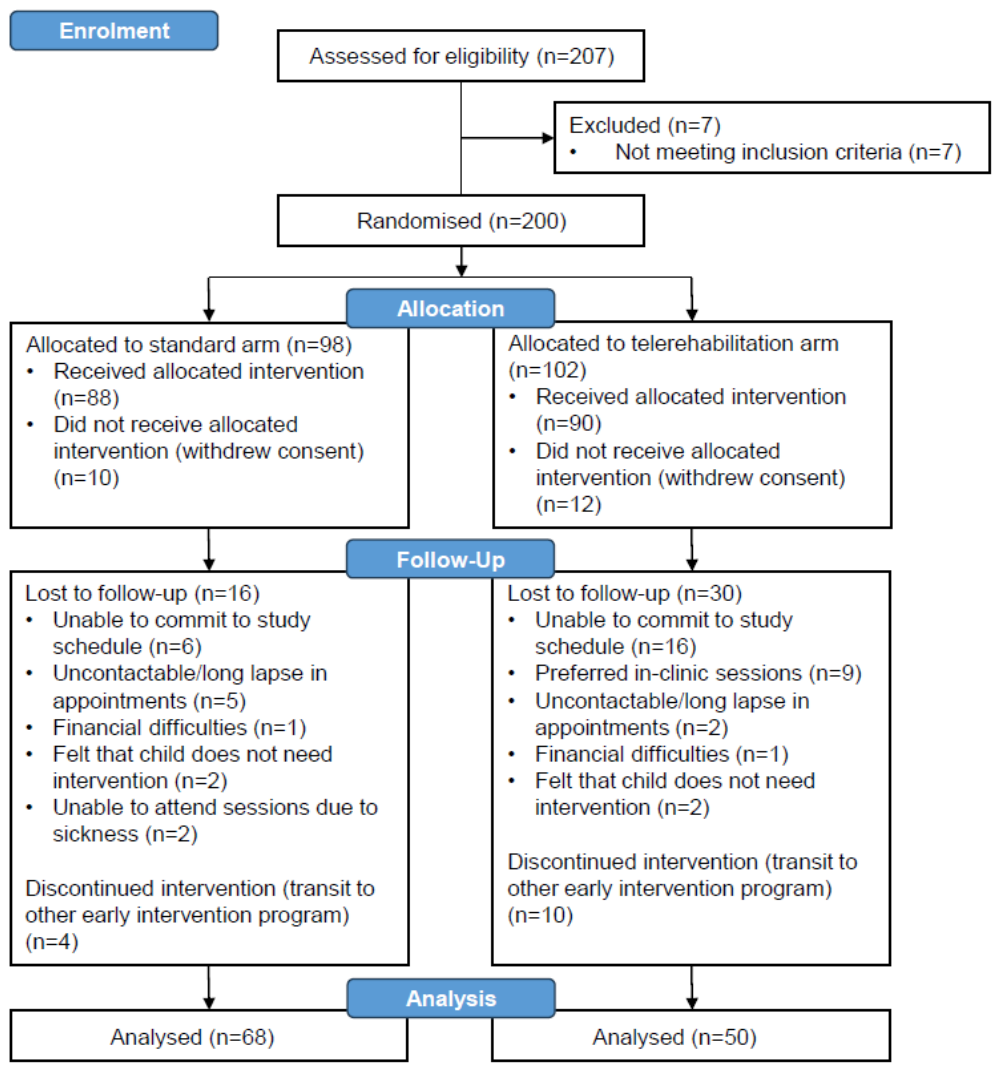
Figure 2.
Qualitative themes for perceived acceptability and feasibility of parent coaching via synchronous video conferencing.
Figure 2.
Qualitative themes for perceived acceptability and feasibility of parent coaching via synchronous video conferencing.
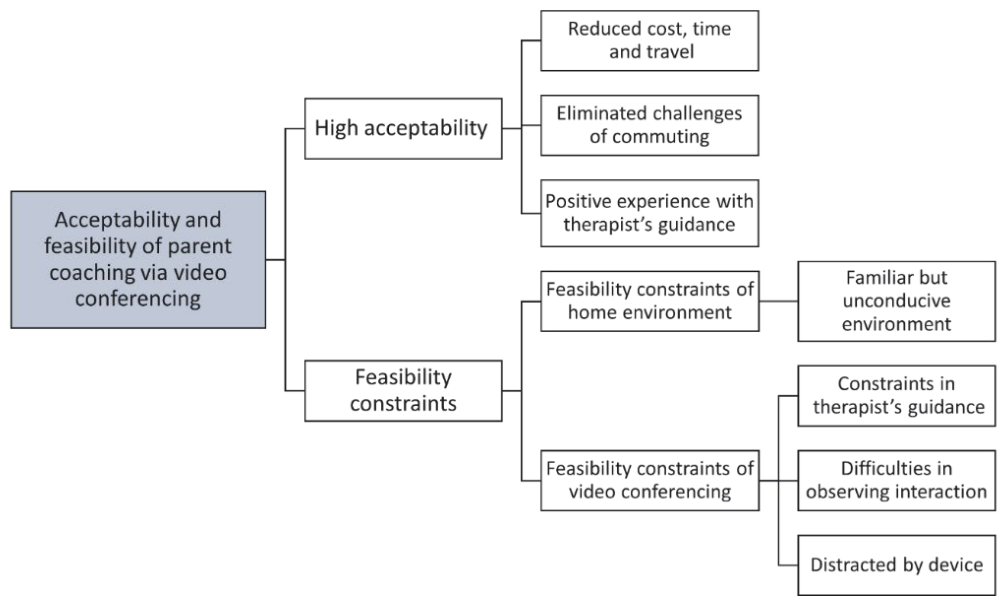

Table 1.
Baseline demographics by group.
| Standard (N-68) |
Telerehabilitation (N=50) |
p | N | |
|---|---|---|---|---|
| Child’s Age (months), Mean (SD) | 28.1 (8.42) | 28.3 (7.10) | .915 | 118 |
| Child’s ADOS Calibrated Severity Score, Mean (SD) | 7.8 (1.87) | 8.0 (1.70) | .492 | 118 |
| Child’s Gender | .513 | 118 | ||
| Female | 20 (29.4%) | 12 (24.0%) | ||
| Male | 48 (70.6%) | 38 (76.0%) | ||
| Child’s Ethnicity | .717 | 113 | ||
| Chinese | 38 (57.6%) | 32 (68.1%) | ||
| Malay | 23 (34.8%) | 12 (25.5%) | ||
| Indian | 3 (4.55%) | 2 (4.26%) | ||
| Mixed Ethnicity | 2 (3.03%) | 2 (2.13%) | ||
| Caregiver’s Age, Mean (SD) | 34.5 (5.91) | 35.6 (5.60) | .369 | 102 |
| Mother’s Highest Level of Education | .839 | 112 | ||
| Primary School or below | 2 (3.0%) | 1 (2.2%) | ||
| Secondary school | 8 (12.1%) | 9 (19.6%) | ||
| ITE/NTE | 8 (12.1%) | 5 (10.9%) | ||
| University | 29 (43.9%) | 16 (34.8%) | ||
| Postgraduate | 8 (12.1%) | 5 (10.9%) | ||
| Others | 11 (16.7%) | 10 (21.7%) | ||
| Father’s Highest Level of Education | .205 | 113 | ||
| Primary School or below | 4 (6.0%) | 1 (2.2%) | ||
| Secondary school | 5 (7.5%) | 10 (21.7%) | ||
| ITE/NTE | 11 (16.4%) | 10 (21.7%) | ||
| University | 23 (34.3%) | 13 (28.3%) | ||
| Postgraduate | 10 (14.9%) | 3 (6.5%) | ||
| Others | 14 (20.9%) | 9 (19.6%) | ||
| Caregiver’s Average Work Hours | .627 | 101 | ||
| < 10 hours | 8 (13.3%) | 9 (22.0%) | ||
| 10 - 20 hours | 3 (5.0%) | 3 (7.3%) | ||
| 20 - 30 hours | 4 (6.7%) | 2 (4.9%) | ||
| 30 - 40 hours | 11 (18.3%) | 4 (9.8%) | ||
| > 40 hours | 34 (56.7%) | 23 (56.1%) | ||
| Caregiver’s Monthly Income | .618 | 110 | ||
| $0 - $2000 | 7 (10.6%) | 2 (4.6%) | ||
| $2001 - $4000 | 17 (25.8%) | 15 (34.1%) | ||
| $4001 - $6000 | 14 (21.2%) | 11 (25.0%) | ||
| $6001 - $8000 | 11 (16.7%) | 4 (9.1%) | ||
| $8001 - $10000 | 6 (9.1%) | 6 (13.6%) | ||
| >$10000 | 11 (16.7%) | 6 (13.6%) |
Table 2.
Pre-post Comparison of Primary Outcome (MSEL ELC and T-scores).
| Standard | Telerehabilitation | |||||||||
|---|---|---|---|---|---|---|---|---|---|---|
| Baseline (n=98) |
Final (n=68) |
Difference (95% CI) (n=68) | p | Cohen’s d | Baseline (n=102) |
Final (n=50) |
Difference (95% CI) (n=50) | p | Cohen’s d | |
| Early Learning Composite | 62.5 (12.7) | 70.7 (22.9) | 5.96 (1.56, 10.36) |
.009 | 0.44 | 61.6 (13.2) | 67.2 (21.3) | 5.60 (1.29, 9.91) |
.012 | 0.32 |
| Visual Reception Subscale | 31.2 (10.8) | 35.1 (15.9) | 1.43 (-2.23, 5.08) |
.438 | 0.29 | 31.4 (11.6) | 34.2 (16.2) | 3.46 (-0.46, 7.38) |
.082 | 0.20 |
| Fine Motor Subscale | 31.7 (11.6) | 35.3 (16.0) | 1.28 (-2.43, 4.99) |
.494 | 0.26 | 31.9 (11.9) | 31.9 (16.1) | 2.14 (-2.21, 6.49) |
.328 | 0.00 |
| Receptive Language Subscale | 26.4 (9.3) | 32.9 (13.9) | 5.28 (2.54, 8.02) |
<.001 | 0.55 | 26.8 (9.7) | 31.1 (12.6) | 4.72 (2.08, 7.36) |
<.001 | 0.38 |
| Expressive Language Subscale | 26.0 (9.4) | 30.6 (10.4) | 4.25 (1.86, 6.64) |
<.001 | 0.46 | 26.5 (8.6) | 27.8 (10.2) | 1.56 (-1.06, 4.18) |
.237 | 0.14 |
Table 3.
Difference in Pre-Post Improvement Between Telehealth and Standard Arms.
| Difference in Pre-Post Improvement (Telerehabilitation– Standard) (95% CI) | p | |
|---|---|---|
| Early Learning Composite | 1.14 (-5.15, 7.43) | 0.720 |
| Visual Reception Subscale | 3.04 (-2.86, 8.94) | 0.279 |
| Fine Motor Subscale | 2.23 (-4.02, 8.49) | 0.445 |
| Receptive Language Subscale | -0.03 (-3.70, 3.63) | 0.431 |
| Expressive Language Subscale | -2.37 (-6.22, 1.48) | 0.138 |
Table 4.
Pre-post Comparison of Secondary Outcomes.
| Standard | Telerehabilitation | Difference | |||||||||
|---|---|---|---|---|---|---|---|---|---|---|---|
| VABS | |||||||||||
| Baseline (n=98) |
Final (n=68) |
Difference (95% CI) (n=68) |
p | Cohen’s d | Baseline (n=102) |
Final (n=50) |
Difference (95% CI) (n=50) |
p | Cohen’s d | p |
|
| Adaptive Behaviour Composite | 69.1 (11.3) | 78.5 (12.3) | 7.53 (5.12, 9.94) |
<.001 | 0.80 | 66.9 (10.8) | 74.6 (12.3) | 7.58 (5.28, 9.88) |
<.001 | 0.67 | .948 |
| Communication Domain | 61.6 (17.9) | 77.5 (16.8) | 13.51 (9.85, 17.18) |
<.001 | 0.92 | 60.1 (18.6) | 70.6 (18.3) | 12.34 (8.70,15.98) |
<.001 | 0.57 | .728 |
| Daily Living Skills Domain | 74.0 (15.4) | 85.1 (14.7) | 8.75 (5.04, 12.46) |
<.001 | 0.74 | 70.6 (14.1) | 82.9 (13.7) | 9.50 (5.36,13.64) |
<.001 | 0.88 | .707 |
| Socialisation Domain | 74.4 (12.5) | 78.5 (12.4) | 2.50 (-0.01, 5.01) |
.051 | 0.33 | 71.3 (11.0) | 74.4 (12.3) | 3.86 (1.28, 6.44) |
.004 | 0.27 | .681 |
| JERI | |||||||||||
|
Baseline (n=73) |
Final (n=66) |
Difference (95% CI) (n=68) |
p | Cohen’s d |
Baseline (n=62) |
Final (n=49) |
Difference (95% CI) (n=50) |
p | Cohen’s d |
p |
|
| Child Engagement State |
2.04 (0.68) | 2.76 (0.80) | 0.70 (0.48, 0.91) |
<.001 | 0.97 | 2.05 (0.64) |
2.62 (1.0) | 0.57 (0.30, 0.84) |
<.001 | 0.66 | .885 |
| Child Activity | 1.98 (0.78) | 2.81 (1.0) | 0.84 (0.61, 1.07) |
<.001 | 0.89 | 1.77 (0.71) |
2.53 (1.2) | 0.71 (0.41, 1.01) |
<.001 | 0.76 | .985 |
| Caregiver Activity | 3.05 (0.81) | 3.91 (0.83) | 0.79 (0.55, 1.04) |
<.001 | 1.05 | 3.09 (0.70) |
3.72 (0.83) | 0.53 (0.28, 0.78) |
<.001 | 0.82 | .211 |
| Dyadic Interaction | 2.10 (0.78) | 2.82 (1.2) | 0.71 (0.39, 1.04) |
<.001 | 0.73 | 2.11 (0.75) |
2.65 (1.2) | 0.47 (0.10, 0.84) |
.014 | 0.55 | .468 |
| PSI-SF | |||||||||||
|
Baseline (n=91) |
Final (n=60) |
Difference (95% CI) (n=68) |
p | Cohen’s d |
Baseline (n=96) |
Final (n=44) |
Difference (95% CI) (n=50) |
p | Cohen’s d |
p |
|
| Parental Distress | 28.3 (7.5) | 27.9 (7.2) | 1.07 (-0.78, 2.91) |
.252 | 0.05 | 28.2 (9.1) |
26.8 (8.2) | 2.88 (-0.21, 5.98) |
.067 | 0.16 | .391 |
| Parent-Child Dysfunctional Interaction | 28.8 (6.6) | 27.4 (6.2) | 0.72 (-1.04, 2.47) |
.418 | 0.22 | 28.7 (7.2) |
28.0 (6.9) | 1.07 (-1.57, 3.71) |
.419 | 0.10 | .987 |
| Difficult Child | 30.4 (7.8) | 30.0 (7.8) | -0.23 (-2.32, 1.85) |
.824 | 0.05 | 29.8 (7.8) |
30.5 (8.2) | -0.67 (-3.63, 2.28) |
.648 | 0.09 | .500 |
| Total Stress Score | 80.9 (28.7) | 85.3 (18.3) | -5.21 (-11.95, 1.53) |
.127 | 0.18 | 81.7 (28.8) | 85.2 (20.6) | -4.17 (-14.21, 5.87) |
.407 | 0.14 | .892 |
| FEIQoL | |||||||||||
|
Baseline (n=90) |
Final (n=62) |
Difference (95% CI) (n=68) |
p | Cohen’s d |
Baseline (n=89) |
Final (n=43) |
Difference (95% CI) (n=50) |
p | Cohen’s d |
p |
|
| Family Relationship | 3.22 (0.63) | 3.39 (0.66) | 0.15 (-0.03, 0.34) |
.103 | 0.26 | 3.11 (0.66) | 3.18 (0.67) | 0.08 (-0.07, 0.23) |
.292 | 0.11 | .424 |
| Access to Information | 3.10 (0.61) | 3.33 (0.66) | 0.30 (0.11, 0.50) |
.003 | 0.36 | 2.95 (0.63) | 3.27 (0.63) | 0.35 (0.17, 0.52) |
<.001 | 0.51 | .991 |
| Child Function | 2.75 (0.70) | 3.12 (0.62) | 0.31 (0.04, 0.57) |
.025 | 0.56 | 2.55 (0.67) | 2.73 (0.67) | 0.28 (-0.01, 0.57) |
.059 | 0.27 | .431 |
| Overall Life Situation | 3.24 (0.66) | 3.40 (0.62) | 0.13 (-0.05, 0.31) |
.148 | 0.25 | 3.24 (0.62) | 3.32 (0.66) | 0.14 (-0.02, 0.30) |
.093 | 0.12 | .697 |
| Note. Difference refers to the difference in pre-post improvement = Telehealth – Standard. | |||||||||||
Table 5.
Participant Cost Comparison (Per Program).
| Cost Item | Telehealth Program ($) | Standard Program ($) | Telerehabilitation Cost Savings (%) |
|---|---|---|---|
| Total Participant Costs | 952.20 | 1,856.20 | 48.7 |
| Therapy Session Time | 602.80 | 752.00 | 19.8 |
| Cost of time spent away from paid work for therapy | 265.30 | 419.00 | 36.7 |
| Transportation to therapy session | 34.90 | 296.90 | 88.2 |
| Time spent away from paid work to travel to the session | 49.20 | 388.30 | 87.3 |
Table 6.
Healthcare Provider Cost Comparison (Per Participant Per Program).
| Cost Item | Telerehabilitation Program ($) | Standard Program ($) | Telerehabilitation Cost Savings (%) |
|---|---|---|---|
| Total Provider Cost | 924.00 | 1,328.00 | 30.4 |
| Therapist Manpower | 898.00 | 1,267.00 | 29.1 |
| Space Rental | 26.00 | 61.00 | 57.4 |
Disclaimer/Publisher’s Note: The statements, opinions and data contained in all publications are solely those of the individual author(s) and contributor(s) and not of MDPI and/or the editor(s). MDPI and/or the editor(s) disclaim responsibility for any injury to people or property resulting from any ideas, methods, instructions or products referred to in the content. |
© 2026 by the authors. Licensee MDPI, Basel, Switzerland. This article is an open access article distributed under the terms and conditions of the Creative Commons Attribution (CC BY) license.
Copyright: This open access article is published under a Creative Commons CC BY 4.0 license, which permit the free download, distribution, and reuse, provided that the author and preprint are cited in any reuse.