

Submitted:
27 October 2026
Posted:
29 October 2026
You are already at the latest version
Abstract
Diagnosing Mycoplasma pneumoniae (MP) has followed three technological paths — seeing the organism, reading the host's antibodies, reading the pathogen's genome — and the winners were rarely the best assays. Culture was analytically supreme and never adopted; serology ruled the clinic for fifty years despite documented misclassification; PCR outperformed both by 1990 yet took a decade and a half to reach routine use. We reconstructed 120 years of MP diagnostics as a diffusion dataset, scoring each technology on Rogers' five adoption attributes against its contemporaneous competitor, and tested the scores against regulatory archives (FDA, CE-IVD, China NMPA; search concluded 30 September 2026). Every documented displacement is consistent with four empirical laws: relative advantage in time-to-result outweighed analytic accuracy; workflow compatibility decided more contests than sensitivity; displacement occurred when a successor's turnaround crossed the clinical decision window; and adoption lagged roughly a decade behind technological maturity (mean 8.5 years across the eight measurable transitions) — a severity-gated lag that relaxed measurably after the 2023 resurgence. Applying the validated rubric prospectively, we predict that CRISPR-based point-of-care testing will obtain first regulatory approvals (NMPA before FDA) by end-2027 and achieve decisive adoption in pediatric emergency settings by end-2028, conditional on extraction-free, sample-to-answer workflow, while metagenomic sequencing consolidates in severe and atypical niches without crossing into first-line use before 2030. The predictions are falsifiable and dated — the archive is offered as an evaluation instrument, not an opinion.
Keywords:
Mycoplasma pneumoniae
; diagnostics
; diffusion of innovations
; PCR
; serology
; point-of-care testing
; NMPA
; adoption
; metagenomic next-generation sequencing
; CRISPR
1. Introduction: A History That Only Makes Sense as a Race
Culture was more accurate than serology, yet serology ruled the clinic for half a century. Antigen assays were faster than culture, yet died within a decade of every launch. PCR outperformed both by 1990, yet took a decade and a half to reach routine use — and in much of the world still has not displaced the antibody tests it rendered obsolete on paper [1,2,3]. The history of Mycoplasma pneumoniae (MP) diagnostics makes no sense as a story of technical merit; this Minireview reads it as a story of adoption. The timing is practical: the 2023–2024 global resurgence filled pediatric wards and laboratories with a pathogen whose diagnostic pipeline — CRISPR point-of-care assays, metagenomic sequencing, syndromic panels, antigen chemiluminescence — is suddenly crowded, and laboratory directors must decide which candidates deserve procurement. Existing reviews catalog what each test does; none explains why the winners won or predicts what wins next. We therefore treat the 120-year archive as a dataset: each technology an observation, each displacement an outcome, scored on the five attributes of innovation diffusion theory against regulatory and deployment records — yielding four empirical laws and five falsifiable forecasts.
MP is among the commonest bacterial causes of community-acquired pneumonia (CAP) in school-age children and young adults — 10–40% of pediatric CAP in epidemic years [1,4]. The 2023–2024 resurgence, documented across three continents [5,6,7,8], showed how dependent management remains on laboratory answers that arrive too late (culture, paired serology) or too ambiguously (single-serum IgM) to guide the decision that matters: macrolide versus β-lactam.
The literature attests the gap: Waites and colleagues' 2017 synthesis remains the authoritative account of MP biology and diagnosis [1]; Gao and Sun's 2024 review, cited more than 100 times within two years of publication, has rapidly become the field's standard reference [2]; the 2024 IDSA/ASM utilization guide codifies which tests add value [3] — catalogs, all three, rather than explanations.
Three commitments organize the paper. First, history as data: §3–§5 follow the three technological paths, each closing with a pattern extraction. Second, pattern into theory: §6 distils four empirical laws, including the severity-gated adoption lag — the roughly decade-long delay between maturity and adoption in diseases perceived as mild — and §7 formalizes Rogers' five attributes [9] into a scoring rubric tested against China's NMPA record. Third, theory into prediction: §8 scores four candidate families and issues falsifiable forecasts with dates, enabling conditions and failure conditions.
The archive runs on two clocks behind a serological pre-history: Landsteiner's cold-agglutinating serum factors (1903) were a phenomenon attached to no disease [10]; Reimann named the syndrome in 1938 [11]; Horstmann and Tatlock connected the two in 1943 [12]; Eaton's filterable agent started the organism clock in 1944 [13]; cell-free cultivation came only in 1962 [14], the modern name in 1963 [15,16]. When we write "120 years of MP diagnostics," we mean twelve decades in which a laboratory signal has been available to chase — first a serological epiphenomenon (1903), then a named syndrome (1938), finally an organism (1944/1962) (Figure 1). Once the organism existed, three paths to detecting it diverged — and never reconverged.
2. Evidence Base and Analytical Framework
2.1. Three Evidence Streams
We triangulated three evidence streams. (i) The scientific record: PubMed/MEDLINE, Web of Science and Google Scholar for English-language literature on MP laboratory diagnosis from 1900 onward, and — because China hosts the largest MP testing market and its largest post-2022 outbreak — CNKI, Wanfang and SinoMed for Chinese-language sources, flagging claims resting on Chinese-language or regulatory rather than peer-reviewed English sources. (ii) The regulatory record: MP-relevant clearances and approvals from the FDA 510(k)/De Novo databases, CE-IVD listings, and China's National Medical Products Administration (NMPA) registry (registration-level detail in Table S1); the regulatory search concluded on 30 September 2026, and all temporal statements are made through September 2026. (iii) The deployment record: provincial procurement notices and routine-use documentation from China — the largest MP testing market — used to date when each technology entered reimbursed routine practice and at which institutional tier.
2.2. The Three-Path Framework
Throughout, we distinguish three paths along which any diagnostic technology must travel before it changes a prescription: the R&D path (first demonstration to technical maturity), the regulatory path (FDA clearance, CE marking, or NMPA registration), and the clinical adoption path (reimbursement, procurement, routine ordering). Technologies can be mature on one path and absent on another — the decade-long gaps this produces are the raw material of our analysis.
2.3. Scoring Discipline
Each technology was scored 1–5 on Rogers' five attributes using explicit anchors (Table S2, §7), against the technology's contemporaneous competitor, not modern standards — ELISA in 1985 is compared with complement fixation in 1985, not with qPCR in 2020. Accuracy evidence is drawn from published comparative evaluations and the 2024 IDSA/ASM utilization guide [3,17,18,19,20,21]; we performed no new accuracy meta-analysis: our unit of analysis is adoption, not accuracy. Box 1 defines the two coined terms used throughout.
> Box 1. Coined terms used in this review
> - Three-path framework — the decomposition of diagnostic diffusion into the R&D path, the regulatory path, and the clinical adoption path; a technology "wins" only when it has travelled all three.
> - Severity-gated adoption lag — the systematic delay (empirically ~5–16 years in MP diagnostics, roughly a decade on average: mean 8.5 years across the eight measurable transitions) between demonstrated maturity and routine clinical adoption, relaxing sharply when the disease is reclassified from mild to severe by clinicians, regulators and payers.
3. Path One: Seeing the Organism
3.1. Culture: Certainty Without Speed
Cell-free cultivation of MP, achieved in 1962 [14], was instantly anointed the reference standard; isolates remain indispensable for susceptibility testing and molecular epidemiology [1]. But MP is fastidious and slow-growing — colonies need one to three weeks — and its sensitivity is mediocre and specimen-dependent [1,2]. A result that arrives three weeks after a prescribing decision is not a result; it is a memorial.
The adoption record is unambiguous: culture never entered routine clinical use in any setting we could document — not "was slow to enter," never entered. It remains confined to reference and research laboratories, and the 2024 IDSA/ASM guide does not recommend it for routine diagnosis [3]. This is the archive's cleanest falsification of the naive theory that diagnostics diffuse on merit: the historical gold standard was analytically supreme and clinically irrelevant, simultaneously.
3.2. Antigen Detection: Speed Without Certainty
The countermove to culture's slowness was direct detection of the organism's components: direct fluorescent antibody (DFA) staining in the early 1970s, antigen-capture enzyme immunoassays (EIA), colloidal-gold lateral-flow tests and, most recently, automated chemiluminescent antigen assays delivering results in 15–60 minutes [1,22]. Yet antigen detection is the archive's graveyard. Every generation — DFA in the 1970s, membrane EIA in the 1980s–90s, lateral flow in the 2000s — launched with encouraging sensitivity (70–90% in favorable evaluations) and then stalled: sensitivity fell in adults, late presenters and post-antibiotic samples, while specificity suffered from cross-reaction and pharyngeal carriage [1,18,23]. Through September 2026 antigen assays hold a handful of approvals — 2 antigen products among 112 MP-related NMPA registrations (November 2023), against 21 nucleic acid and 72 antibody (authors' classification; Table S1) [24] — and occupy a narrow screening niche. Speed without certainty proved nearly as unmarketable as certainty without speed.
Pattern extraction 1: in the MP clinic, time-to-result is the currency, and analytic elegance is exchangeable for it at a punishing rate. The five-attribute scores are in Table 1; what the rest of the archive keeps repeating is that certainty without speed found no buyers — and speed without certainty nearly none.
4. Path Two: Reading the Host
4.1. Four Eras in One Dominance
Unable to see the organism in useful time, clinicians spent most of the 120 years reading the host's response instead; serology's reign divides into four eras (Fig. S1).
Era I — Early serology (1903–1969). Cold agglutinins, linked to primary atypical pneumonia in 1943 [10,12], were the first MP-associated test: inexpensive, bedside-adjacent, positive in only 50–60% of MP pneumonia and falsely positive in EBV and CMV [1]. The complement fixation test (CFT), standardized in the 1950s, improved specificity but required paired sera two to three weeks apart — retrospective confirmation rather than decision support [1,25].
Era II — Immunodetection (1970–1999). Enzyme immunoassays (from ~1980) delivered anti-MP IgM at >99% specificity, batchable on plate readers [1,17,26]; particle agglutination (Serodia Myco II) became the standard across Japan and much of Asia by requiring no instrument [27]; μ-capture IgM (ImmunoCard, FDA-cleared 1994) sharpened acute-phase specificity [19].
Era III — Point-of-care testing (POCT) and chemiluminescence (2000–2019). Colloidal-gold immunochromatography put serology at the point of care — 15–30 minutes, reaching Chinese community health centers by 2023 [24,28] — while automated chemiluminescence (CLIA, from 2014) industrialized the antibody; NMPA registered the first domestic MP-IgM CLIA kit (Autobio) in 2019 [24,29].
Era IV — Precision immunoassay (2020–September 2026). The frontier has folded back toward the organism: chemiluminescent antigen assays aim to combine Era III's automation with a one-to-two-day head start over seroconversion, and completed antigen-CLIA trials (registry-level, Tier-2 evidence) mark the direction [22,24]; the first MP antigen-CLIA registration has now been granted (Autobio, September 2026 [24]). The antibody path is modernizing in parallel rather than retreating: a further NMPA MP-IgM CLIA registration (Kanghua, December 2024; Table S1) extends the chemiluminescent antibody base — serology's installed platform, not an antigen product — into the current decade [24,29].
4.2. Why Serology Won—And Why It Is Losing
Serology's half-century dominance is the central fact any theory of this field must explain: on analytic merit it should never have happened. Single-serum IgM misclassifies both ways — falsely negative early in illness, falsely reassuring against background seroprevalence and prolonged IgM persistence [1,17,19,20,21] — and a 2005 evaluation of twelve commercial assays found every antibody format wanting [19]. And yet serology won, decisively, everywhere.
The diffusion reading dissolves the paradox: serology won because it fitted the clinic — cheap, batchable, familiar, reimbursable, needing no new capital equipment — its victory was compatibility doing the work usually credited to accuracy, defended by forty years of installed workflow, reference ranges and billing codes. Its displacement began where qPCR's turnaround fell below the clinical decision window (§6.1, P3) and where the one-to-two-week seroconversion window became untenable in severe and pediatric disease. In East Asian tertiary centers, where macrolide resistance exceeding 80% made the macrolide-versus-alternative decision genuinely consequential [30], molecular testing displaced serology fastest; in much of the world antibody tests remain the default [2,3]. In the settings reviewed here, the frontrunner changed where the race mattered.
Pattern extraction 2: adoption advantages and biological defects are different kinds of weakness. Serology's remaining advantages are adoption attributes (scores in Table 1); its defects are biological — window period, persistence, background seropositivity — and technologies whose weaknesses are biological can be displaced once a successor clears that hurdle. Antigen detection's weakness (§3.2) is mixed: a biological floor engineering cannot abolish — low analyte loads in adults and late presenters, carriage confounding specificity — wrapped in re-engineerable operational limitations. Era IV's antigen renaissance tests how much of that weakness lies above the floor — which is why it deserves watching.
5. Path Three: Reading the Genome
5.1. The Molecular Path Trades Certainty for Speed, Then Buys Both
PCR entered the MP field in 1989 [31]: analytic sensitivity orders of magnitude beyond culture, results in hours, a direct read on the organism. By 2005 real-time qPCR was the working gold standard — the reference for that year's twelve-assay evaluation [19,32]. The first FDA clearances of MP molecular products arrived only in 2012–2013 — the 20-target FilmArray Respiratory Panel added MP in May 2012; Meridian's illumigene Mycoplasma (LAMP) was cleared in June 2013, its extraction-free Direct version in 2016 — and the first NMPA registrations of domestic MP qPCR kits date to 2015 [24,33]: seven to ten years of regulatory silence after technical maturity. MP PCR existed as laboratory-developed tests (LDTs) from the mid-2000s but became routine reimbursed practice only around 2015 [24,28]: maturity 2005, routine adoption ~2015 — a ten-year lag we explain in §6.
5.2. Consolidation: From Single-Target PCR to Syndromic Panels
After 2015 the molecular path widened: multiplex qPCR folded MP into respiratory panels, and assays adding 23S rRNA macrolide-resistance mutations (A2063G/A2064G), NMPA-registered from 2023, converted diagnosis into an antibiotic-selection test [24,34]. The duplex class added two further NMPA registrations in 2026, including the first lyophilized format [24,28]. Sample-to-answer syndromic systems — BioFire FilmArray (FDA-cleared December 2011; MP target added May 2012), Luminex NxTAG respiratory pathogen panel (RPP) (2015), GenMark ePlex (2017) — moved molecular testing onto the routine bench, though deployment remains confined to tertiary centers [28,33] (Table S1). Droplet digital PCR added absolute quantification (2–3 copies/µL) [35]; metagenomic next-generation sequencing (mNGS) entered Chinese practice around 2020 for severe, undiagnosed pneumonia with a 24–48-hour turnaround [28,36]; in August 2026 NMPA granted the first class-III mNGS licences — the respiratory panel covers MP among the atypical pathogens — and the national medical-insurance authority created a nationally uniform billing item for mNGS/tNGS [24,28]. CRISPR-based detection [37,38,39] — adapted to MP in the early 2020s, validated in 2024 with reported 100% sensitivity and specificity (single-center, small cohort) — now stands where PCR stood in 1995: analytically proven, regulatorily embryonic.
5.3. What PCR Actually Beat
Two interpretive hazards discipline what follows. First, carriage: MP DNA is detectable in the upper respiratory tract of a non-trivial fraction of asymptomatic children, so a positive PCR is evidence of presence, not necessarily causation [40,41]. Second, guideline ambivalence: the 2019 ATS/IDSA adult CAP guideline treats etiologic testing as optional, rather than routinely recommended, for most outpatients [42] — itself a diffusion datum: even the winner has not convinced payers that the race was worth running in mild disease. PCR beat culture and is beating serology — head-to-head studies in acute infection consistently find nucleic acid amplification tests (NAATs) outperforming antibody formats [19,43] — but what it beat them on was time-to-result, workflow fit after automation, and — decisive after 2013 — the ability to answer the resistance question serology cannot even pose [34].
Pattern extraction 3: excellence is not the variable; the gate is. qPCR's five-attribute profile (Table 1) was excellent and essentially static from 2005 onward, so no attribute of the technology explains the lag between maturity (2005) and routine use (~2015). The missing variable is in the disease — or rather, in how mildly it was perceived. MP was "walking pneumonia," and health systems do not buy molecular answers for nuisances. Severity perception is the gate, and its relaxation is independently observable in the post-surge increment: the first MP + 23S resistance-mutation kits (2023), a further MP-IgM CLIA registration (December 2024), national sentinel NAAT surveillance (2024), and community POCT within months [24,28,34,44]. The causal evidence must be read in the increment, not the stock: the 112 NMPA products by November 2023 are a cumulative total, and with one-to-three-year registration cycles most entered the pipeline before the epidemic peaked. §6 names the lag this gate imposes.
Three paths, a dozen technologies, one archive. Read as a chronicle it is a museum; read as data, it is a lawbook.
6. Pattern: Four Laws of Diagnostic Adoption
Table 1 re-encodes §3–§5 in the language of the theory; composite scores are illustrative rankings, not measurements. Four regularities — recurrent across twelve decades, three paradigms and two hemispheres — emerge. We state them as laws because each is falsifiable and, prospectively, exposed to the record it did not fit.
6.1. The Four Laws
P1 — Speed beats precision. Every successful capture of clinical territory traded analytic perfection for time-to-result: serology occupied the niche that culture — analytically supreme, never clinically adopted — could never enter [19]; qPCR displaced serology at the bedside despite the carriage-interpretation handicap [40]; one-hour panels grew faster than superior two-to-four-hour LDTs [33]. We find no counterexample in the MP archive.
P2 — Compatibility decides. Workflow compatibility decided more contests than sensitivity ever did. Serology's five-decade reign was built on it (§4.2), and culture was excluded precisely by its lack of compatibility (§3.1); PCR's inflection coincided with automated closed-tube formats that fit the routine bench, not with any sensitivity gain [32,33]; and China's fastest-growing segment through September 2026 is magnetic-particle CLIA — an analytically unremarkable antibody technology winning by plugging into the installed immunoassay base [24,29].
P3 — The bedside threshold. Displacement clusters at the moment a successor's turnaround falls below the clinical decision window of the host setting — roughly the first antibiotic dose (2–3 hours in hospital, within 30–60 minutes in emergency/outpatient settings). Serology took territory culture could never occupy when single-sample IgM made same-day answers possible; qPCR displaced serology where its 2–3-hour result could redirect the first dose; antigen and CRISPR formats now compete at the sub-hour threshold PCR cannot cross [22,37,38,39]. The threshold is setting-specific, so displacement is always partial and segmented.
P4 — The severity-gated adoption lag. Across all three paths, MP diagnostic adoption runs ~5–16 years behind technological maturity. Conventional PCR took 16 years (1989 to routine reference-standard use ~2005; routine reimbursed practice only around 2015, §5.1); qPCR took 7 years to its first FDA-cleared MP product (2012) and 10 to first NMPA registration (2015); LAMP took 6 (2007–2013); sample-to-answer panels took 9 (2011/2012 to documented Chinese penetration after 2020); CLIA antibody took 5 (~2014–2019); mNGS took 5 (~2015–2020); MP+23S resistance-mutation assays took 10 (~2013–2023) [24,31,33,34,36,45]. The endpoints are not interchangeable: each is the first documented adoption event available for that technology — reference-standard status, first FDA clearance, first NMPA registration, or documented routine penetration — and is defined row by row in Table 1. The mean lag across the eight measurable transitions in Table 1 is 8.5 years (range 5–16). Adoption is gated not by technological readiness but by the perceived severity of the disease — and MP, self-limited, rarely fatal, "walking pneumonia," has historically been gated shut. The gate's existence is proven by what relaxes it: the 2023 resurgence spiked perceived severity and the adoption system responded within the ensuing registration cycles (the increment evidence is laid out in §5, Pattern extraction 3). The lag is the technical face of a broader accounting failure: a disease that does not kill is not counted, surveilled, or diagnosed with urgency [46].
6.2. The Regulatory Landscape: China NMPA in Global Context
China's NMPA registry is the archive's richest regulatory source (Fig. S2; registration-level detail in Table S1). Three features matter. First, the S-curve shape: slow growth for a decade (≈1–2/year, 2005–2014), inflection in 2015–2019, step-up in 2023–2024 — a steep limb that, on the increment evidence of §5 (Pattern extraction 3), was accelerated by the severity shock: P4 relaxing. Second, the class structure: antibody products outnumber NAAT products 72:21 — P2's installed base is visible in the registry itself. Third, the international contrast: the FDA pathway produced platform-defining molecular clearances (FilmArray 2011/2012; illumigene 2013; NxTAG 2015; ePlex 2017) but almost no MP-specific serology innovation after ImmunoCard (1994), while the CE-IVD space long privileged serology [27,33,45,47]; the European Union's In Vitro Diagnostic Regulation (IVDR) transition moves MP assays into higher-risk classes [48]. Regulatory geography is becoming diffusion geography.
Two disclaimers guard this reading. Approval is not performance: a registration certifies analytical validity against registered claims, not comparative clinical accuracy, and the 72:21 ratio reflects market and workflow forces (P2), not superiority — our accuracy judgments rest on the peer-reviewed comparative literature and the IDSA/ASM 2024 recommendations, not registration counts [3,17,19]. Deployment timelines derive from public procurement and routine-use records — heterogeneous Tier-2 evidence [28].
7. Theory: Adoption Kinetics Formalized
7.1. Rogers' Five Attributes, Operationalized for the Diagnostics Laboratory
Rogers showed across thousands of studies that adoption velocity is predicted by five perceived attributes — relative advantage, compatibility, complexity (inverse), trialability, observability [9]. Diagnostics add three twists that Rogers' general framework does not supply, each taught by an episode of §3–§5. First, the adopter is plural — laboratory director, ordering clinician, payer and regulator adopt separately and sequentially, so a technology must win the same race four times on the three paths of §2.2 (antigen detection in the 1980s was validated by laboratories and ignored by clinicians). Second, relative advantage decomposes into analytic and temporal components that trade against each other — P1. Third, adoption can be gated by the perceived severity of the disease, an exogenous variable absent from Rogers' formulation — P4.
We formalize this as a scoring rubric (Table S2). Composite adoption propensity is the compatibility-weighted mean — compatibility weighted double, reflecting P2's dominance in the archive (fitted to Table 1's displacement record and checked in §7.2(iii), not assumed a priori). The rubric converts a technology's profile into an adoption forecast; §8 applies it prospectively. Because the framework's parameters are adoption attributes rather than MP-specific biology, it may transfer to other diagnostic contests in which the disease is common, usually mild, and treated empirically.
7.2. Making the Theory Work: Quantitative Tests Against the Archive
A theory that only redescribes history is decoration; we subjected the framework to three quantitative checks against the regulatory record (technical detail in Supplementary Methods).
(i) Stock versus increment. Modeling the annual NMPA registration increment (2005–September 2026) rather than the 112-product cumulative stock, a single Bass-type diffusion curve [49] fitted to pre-2023 increments underpredicts 2023–2024, whereas a two-regime fit in which the carrying-rate parameter steps upward in 2023 fits the series: the gate behaves as a parameter shock. The case for increments over stocks is given in §5 (Pattern extraction 3). (ii) Displacement intervals decline by era. The mean lag of 8.5 years (§6.1, P4, with the per-technology endpoint definitions given there and in Table 1) falls from ≈16 years for the PCR generation to ≈6–10 for qPCR, LAMP and panels and ≈5 for CLIA and mNGS: diffusion accelerates as each technology inherits predecessors' installed platforms (P2) and epidemic memory (P4). (iii) Compatibility weighting. Across every documented displacement in Table 1, the winner held the compatibility advantage; it held the sensitivity advantage in only a minority of contests (§5.3). The double weighting of compatibility is therefore a calibration fitted to the archive, not an independent finding, and we report it as such. Its validation is staked on the prospective forecasts of §8, not on reproducing what it was fitted to (rankings are robust to weights of 1.5–2.5; Supplementary Methods). These checks arm §8's predictions with estimated rather than rhetorical parameters.
8. Prediction: The Next Winners
8.1. Scoring the Candidates
Four technology families contest the next S-curve: CRISPR-based point-of-care NAATs, mNGS and targeted next-generation sequencing (tNGS), multiplex syndromic panels, and host-response biomarkers coupled with AI-assisted imaging (Fig. S3). We score each on the Table S2 rubric against the incumbent in its target setting and convert scores into falsifiable predictions (Table 2).
CRISPR-POCT (illustrative composite 4.0) — the leading candidate in our scoring for the next decade. Its profile attacks every historical bottleneck: single-molecule sensitivity [37,38]; lateral-flow readout under 60 minutes, crossing the emergency bedside threshold (P3); no thermocycler, with compatibility rising further if it rides the colloidal-gold channel already proven at the community point of care [24]; and resistance-mutation multiplexing in one reaction [34] (attribute scores in Table 2). Its deficits are regulatory — no MP-CRISPR product had entered regulatory registration anywhere through September 2026 [24,33] — and trialability at scale. Prediction 1: CRISPR-based MP point-of-care testing will obtain first regulatory approvals (NMPA before FDA, per §6.2's geography) by end-2027 and achieve decisive adoption — displacing colloidal-gold IgM as the default first test in pediatric emergency and community settings in China — by end-2028, conditional on extraction-free, sample-to-answer workflow. Falsification: if no MP-CRISPR product holds NMPA registration by December 2027, the composite model overweights compatibility and must be revised.
Prediction 2: antigen-CLIA (§4.1, Era IV) is the dark horse of the same niche. P2 predicts that technologies riding the installed chemiluminescence base diffuse faster than equal-performance technologies requiring new hardware; we forecast ≥3 NMPA antigen-CLIA registrations by end-2027. The evidence anchoring this curve now includes the first MP antigen-CLIA registration (September 2026 [24]) plus the completed antigen-CLIA trials (§4.1) and the continued platformization of chemiluminescence in the NMPA registry — most recently the Kanghua MP-IgM CLIA registration (December 2024), an antibody product that documents the size and continued growth of the installed CLIA base an antigen-CLIA entrant would ride, not itself an antigen data point.
mNGS/tNGS (composite 3.1) — consolidates in the severity niche, does not cross. Sequencing owns the severity apex — the only technology whose relative advantage grows with disease severity [36,50] — but P3 bars it from the first-dose window and P2/P4 confine it to the severe and diagnostically negative settings where it is already entrenched (§5.2). The first class-III mNGS licences (August 2026) cover MP within broader respiratory panels [24] — niche consolidation without first-line crossing, as predicted. Prediction 3: mNGS/tNGS will consolidate as the standard of care for severe, immunocompromised and diagnostically negative MP pneumonia but will not displace qPCR as the first-line test before 2030 unless turnaround falls below 12 hours and the workflow becomes deployable outside referral centers; neither condition is met through September 2026.
Multiplex syndromic panels (composite 3.5) — segmented growth, gated by perceived severity. Panels solve the clinician's actual question ("which pathogen?") and hold the P3 threshold in sample-to-answer formats [33]; their brake is confinement to tertiary centers against a disease perceived as mild — P4 again. Prediction 4: panels will keep growing in inpatient and ICU settings but remain gated in pediatric outpatient and community settings through 2028. The gate lifts only if guideline bodies endorse routine multiplex testing for non-severe pediatric CAP; current guidance is at most permissive (adult CAP etiologic testing optional [42]; pediatric guidance similarly restrained [41]), and we predict it will not, given limited management impact in mild disease.
Host-response biomarkers + AI imaging (composite 2.4) — the longest lag. Host-side signatures reframe the question from "what organism" to "bacterial or viral, severe or mild" — potentially the most compatible test of all [51] — but observability and trialability are low, compatibility with antibiotic-decision habits is unproven, and no MP-specific validation cohort exists. Prediction 5: host-response approaches will not achieve routine MP-relevant adoption before 2030, entering piggybacked on multiplex platforms rather than standalone — as antigen detection's history (§3.2) warns, technologies answering a question adjacent to the one clinicians ask die young.
8.2. The Shape of the Next Curve
Assembling the forecasts (Fig. S3; Table 2): the 2025–2035 landscape is likely to be layered, not winner-take-all — CRISPR-POCT or antigen-CLIA at the community and emergency base, qPCR and resistance-mutation duplexes as the routine hospital standard, panels for inpatients, mNGS for the severe apex — boundaries set by the bedside threshold (P3), velocities by how warm 2023 left the system (P4).
Discussion
The MP diagnostic literature has excellent catalogs [1,2,3] and no theory; reading twelve decades of laboratory handles as a diffusion dataset converts an inventory into an instrument: four empirical laws, one fitted model, a maturity-to-adoption lag of roughly a decade (mean 8.5 years across the eight measurable transitions), and five falsifiable forecasts. The opening paradox dissolves into measurable attribute profiles and one exogenous gate.
The strongest objection to any scoring of history is that the scorers knew the endings. Our answer is structural, not procedural: five of the framework's parameters are now staked on dated, falsifiable forecasts (§8) — the model can be killed by the future it did not see.
One geographic consequence deserves emphasis: if IVDR-era Europe and an LDT-regulating United States slow the molecular-POCT class while China's registration system keeps its current pace, the next S-curve is likely to steepen in Shanghai and Zhengzhou before Boston and Berlin. The same configuration logic extends to low- and middle-income settings, where the decision window is shortest and infrastructure thinnest: there too, the laws predict that whichever technology reaches the community clinic first on workflow — not on brochure specifications — will set the curve.
Developers may read Table S2 as a design specification: the binding constraints are extraction-free workflow, sub-hour turnaround, compatibility with installed channels, and decision-relevant content such as resistance mutations. Purchasers and payers should procure against the three paths rather than the brochure, using Table S3 to place each purchase in its institutional tier. Guideline bodies hold the severity gate: the pivotal evidence gap is management impact rather than accuracy — trials showing that a sub-hour result changes antibiotic selection would relax P4 faster than any analytic improvement [3,42,52]. Regulators should note that registration class structure (72:21 antibody:NAAT in China) records adoption history rather than ranking performance; the IVDR transition and FDA's LDT posture will decide where the next steep limb runs.
Two forces are re-setting the gate. Epidemiologically, the 2023–2024 resurgence moved MP, at least temporarily, from background nuisance to ward-filling emergency, and the adoption system responded within the ensuing registration cycles [5,6,7,8,44]. Therapeutically, macrolide resistance exceeding 80–90% in parts of East Asia has made the antibiotic choice consequential — the default drug now fails predictably where burden is highest [30,53,54]. The resistance-mutation duplex assay (NMPA-registered since 2023) may therefore be the first MP test whose result routinely changes the drug rather than merely naming the illness — and per P1–P3, tests that change decisions diffuse. A framework built on 120 years of "mild disease" adoption kinetics must allow its central parameter to move: if perceived severity stays elevated, the lags we measured will compress; if memory of 2023 fades, they will re-expand.
Four limitations qualify these conclusions. First, retrospective scoring risks circularity: scores were assigned by authors who knew the outcomes; the mitigations are the anchored rubric (Table S2), contemporaneous-competitor discipline (§2.3), and, decisively, §8's prospective falsifiable predictions. Second, evidence heterogeneity: regulatory counts and deployment records are Tier-2 sources; the 112-product NMPA anchor (30 November 2023) is a cumulative stock, not an annual increment (§5, Pattern extraction 3); the September 2026 cutoff excludes later registrations. Third, no new diagnostic-accuracy meta-analysis was performed: performance statements synthesize published comparative evaluations and the 2024 IDSA/ASM recommendations [3,17,19]. Fourth, China-centric quantification: the S-curve analysis rests on the most complete registry record; transfer to FDA/CE-IVDR systems is argued qualitatively, not fitted.
Conclusion
The history of MP diagnostics is not behind us; it is a training set. Three reinventions — serology's reading of the host, molecular amplification's reading of the genome, and a point-of-care reinvention that, if it meets the workflow conditions of §8, will read both — obey the same adoption laws, and those laws now carry estimated parameters and dated predictions. The next winners are already visible to anyone who reads adoption instead of specifications: whoever crosses the bedside threshold in the community clinic, on infrastructure the clinic already owns, in a decade when the disease is finally perceived as worth diagnosing, wins. The race, as ever, is to the workflow.
Supplementary Materials
The following supporting information can be downloaded at the website of this paper posted on Preprints.org.
Acknowledgments
The authors thank the laboratory teams, regulators and hospital systems whose publicly available registration and deployment records underpin this analysis.
Author Contributions
Chen Shen: Conceptualization, Data curation, Formal analysis, Supervision, Funding acquisition, Project administration, Writing – review & editing. Deze Li: Data curation, Software, Validation, Visualization. Hao Chen: Methodology, Investigation, Formal analysis. All authors read and approved the final manuscript.
Funding
This work was supported by the Beijing Science and Technology Nova Program Interdisciplinary Project (20230484439) and the Beijing High-Level Public Health Technical Talents Project (2023-02-33). The funders had no role in study design, data collection, data analysis, data interpretation, or writing of the report.
Conflicts of interest
The authors declare no conflicts of interest.
Use of artificial intelligence
AI tools were used for language polishing and code drafting.
Data availability
All regulatory and deployment data derive from public sources (NMPA registry, FDA 510(k) database, provincial procurement and routine-use records) as cited; the technology–attribute scoring matrix and S-curve fitting code are available from the corresponding author on reasonable request.
Tables
- Table 1 (main text). Hinge table: MP diagnostic technologies × Rogers' five attributes (1–5 vs contemporaneous competitor) × adoption outcome × maturity-to-adoption lag.
- Table 2 (main text). Candidate scoring matrix and falsifiable forecasts: attribute scores, composites, S-curve phase, binding constraint, forecast, falsification condition.
(Supplementary material: Fig. S1–S3 and Tables S1–S4, including the five-attribute scoring rubric (Table S2), the institution-tiered configuration paths (Table S3), and the China NMPA registration detail (Table S1).)
References
- Waites, K.B.; Xiao, L.; Liu, Y.; Balish, M.F.; Atkinson, T.P. Mycoplasma pneumoniae from the respiratory tract (and beyond). Clin. Microbiol. Rev. 2017, 30, 747–809. [Google Scholar] [CrossRef]
- Gao, L.; Sun, Y. Laboratory diagnosis and treatment of Mycoplasma pneumoniae infection in children: a review. Ann. Med. 2024, 56, 2386636. [Google Scholar] [CrossRef]
- Miller, J.M.; Binnicker, M.J.; Campbell, S.; Carroll, K.C.; Chapin, K.C.; Gonzalez, M.D.; Harrington, A.; Jerris, R.C.; Kehl, S.C.; Leal, S.M., Jr.; Patel, R.; Pritt, B.S.; Richter, S.S.; Robinson-Dunn, B.; Snyder, J.W.; Telford, S., III; Theel, E.S.; Thomson, R.B., Jr.; Weinstein, M.P.; Yao, J.D. Guide to utilization of the microbiology laboratory for diagnosis of infectious diseases: 2024 update by the Infectious Diseases Society of America (IDSA) and the American Society for Microbiology (ASM). Clin. Infect. Dis. 2024, ciae104. [Google Scholar] [CrossRef]
- GBD 2021 Lower Respiratory Infections and Antimicrobial Resistance Collaborators. Global, regional, and national incidence and mortality burden of non-COVID-19 lower respiratory infections and aetiologies, 1990–2021: a systematic analysis from the Global Burden of Disease Study 2021. Lancet Infect. Dis. 2024, 24, 974–1002. [Google Scholar] [CrossRef]
- Meyer Sauteur, P.M.; Chalker, V.J.; Berger, C.; Nir-Paz, R.; Beeton, M.L. ESGMAC and the ESGMAC–MyCOVID Study Group Mycoplasma pneumoniae beyond the COVID-19 pandemic: where is it? Lancet Microbe 2022, 3, e897. [Google Scholar]
- ESGMAC MAPS Study Group. Mycoplasma pneumoniae: gone forever? Lancet Microbe 2023, 4, e763. [Google Scholar] [CrossRef]
- Meyer Sauteur, P.M.; Beeton, M.L. ESGMAC and the ESGMAC MAPS Study Group Mycoplasma pneumoniae: delayed re-emergence after COVID-19 pandemic restrictions. Lancet Microbe 2024, 5, e100–e101. [Google Scholar]
- Sun, Y.; Li, P.; Jin, R.; Liang, Y.; Yuan, J.; Lu, Z.; Liang, J.; Zhang, Y.; Ren, H.; Zhang, Y.; Chen, J.; Huang, Y.; Lin, C.; Li, Y.; Zhou, J.; Wang, X.; Li, Y.; Huang, S.; Xu, J.; Qin, T. Characterizing the epidemiology of Mycoplasma pneumoniae infections in China in 2022–2024: a nationwide cross-sectional study of over 1.6 million cases. Emerg. Microbes Infect. 2025, 14, 2482703. [Google Scholar] [CrossRef]
- Rogers, E.M. Diffusion of innovations, 5th ed.; Free Press: New York, NY, 2003. [Google Scholar]
- Landsteiner, K. Über Beziehungen zwischen dem Blutserum und den Körperzellen. Munch. Med. Wochenschr. 1903, 50, 1812–1814. [Google Scholar]
- Reimann, H.A. An acute infection of the respiratory tract with atypical pneumonia. JAMA 1938, 111, 2377–2384. [Google Scholar] [CrossRef]
- Horstmann, D.M.; Tatlock, H. Cold agglutinins: a diagnostic aid in certain types of primary atypical pneumonia. JAMA 1943, 122, 369–370. [Google Scholar] [CrossRef]
- Eaton, M.D.; Meiklejohn, G.; van Herick, W. Studies on the etiology of primary atypical pneumonia: a filterable infectious agent transmissible in cotton rats and hamsters. J. Exp. Med. 1944, 79, 649–668. [Google Scholar]
- Chanock, R.M.; Hayflick, L.; Barile, M.F. Growth on artificial medium of an agent associated with atypical pneumonia and its identification as a PPLO. Proc. Natl. Acad. Sci. U S A 1962, 48, 41–49. [Google Scholar] [CrossRef]
- Waites, K.B.; Talkington, D.F. Mycoplasma pneumoniae and its role as a human pathogen. Clin. Microbiol. Rev. 2004, 17, 697–728. [Google Scholar] [CrossRef]
- Chanock, R.M. Mycoplasma pneumoniae: proposed nomenclature for atypical pneumonia organism (Eaton agent). Science 1963, 140, 662. [Google Scholar] [CrossRef]
- Thurman, K.A.; Walter, N.D.; Schwartz, S.B.; Mitchell, S.L.; Dillon, M.T.; Baughman, A.L.; Deutscher, M.; Fulton, J.P.; Tongren, J.E.; Hicks, L.A.; Winchell, J.M. Comparison of laboratory diagnostic procedures for detection of Mycoplasma pneumoniae in community outbreaks. Clin. Infect. Dis. 2009, 48, 1244–1249. [Google Scholar] [CrossRef]
- Daxboeck, F.; Krause, R.; Wenisch, C. Laboratory diagnosis of Mycoplasma pneumoniae infection. Clin. Microbiol. Infect. 2003, 9, 263–273. [Google Scholar] [CrossRef]
- Beersma, M.F.C.; Dirven, K.; van Dam, A.P.; Templeton, K.E.; Claas, E.C.J.; Goossens, H. Evaluation of 12 commercial tests and the complement fixation test for Mycoplasma pneumoniae-specific IgG and IgM antibodies, with PCR used as the gold standard. J. Clin. Microbiol. 2005, 43, 2277–2285. [Google Scholar] [CrossRef]
- Hers, J.F.P.; Masurel, N. Infection with Mycoplasma pneumoniae in civilians in the Netherlands. Ann. N Y Acad. Sci. 1967, 143, 447–460. [Google Scholar] [CrossRef]
- Michelow, I.C.; Olsen, K.; Lozano, J.; Rollins, N.K.; Duffy, L.B.; Ziegler, T.; Kauppila, J.; Leinonen, M.; McCracken, G.H., Jr. Epidemiology and clinical characteristics of community-acquired pneumonia in hospitalized children. Pediatrics 2004, 113, 701–707. [Google Scholar] [CrossRef]
- Clinical Laboratory Group; Pediatric Society; Chinese Medical Association. Chinese expert consensus on laboratory diagnosis of Mycoplasma pneumoniae respiratory tract infection in children. Chin. J. Lab Med. In Chinese.. 2019, 42, 507–513. [Google Scholar]
- Jacobs, E. Serological diagnosis of Mycoplasma pneumoniae infections: a critical review of current procedures. Clin. Infect. Dis. 1993, 17, S79–S82. [Google Scholar] [CrossRef]
- National Medical Products Administration. Medical device registration database: Mycoplasma pneumoniae in vitro diagnostic products (searched through 30 September 2026; cumulative 112 MP-related registrations as of 30 November 2023; including 国械注准20163401088, 20193400698, 20203400074, 20243402460, the first MP antigen-CLIA registration 国械注准20263401866 (2026), and two 2026 MP+23S duplex registrations 国械注准20263400905 and 国械注准20263401716); NMPA: Beijing, China, 2025. [Google Scholar]
- Taylor-Robinson, D. Infections due to species of Mycoplasma and Ureaplasma: an update. Clin. Infect. Dis. 1996, 23, 671–682. [Google Scholar] [CrossRef]
- Waris, M.E.; Toikka, P.; Saarinen, T.; Nikkari, S.; Meurman, O.; Vainionpää, R.; Mertsola, J.; Ruuskanen, O. Diagnosis of Mycoplasma pneumoniae pneumonia in children. J. Clin. Microbiol. 1998, 36, 3155–3159. [Google Scholar] [CrossRef]
- Fujirebio, Inc. Serodia-Myco II gelatin particle agglutination assay: product documentation. Fujirebio, Tokyo, Japan (CE marked).
- Provincial public hospital procurement notices and routine-use deployment records, People's Republic of China (multiple provinces, 2005–2025). Data source for deployment timelines: entry of MP colloidal-gold POCT into community health centres (2023); qPCR reaching routine reimbursed practice (~2015); syndromic-panel deployment confined to tertiary centres; mNGS entering Chinese practice (~2020). Tier-2 evidence.
- Zhengzhou Autobio Diagnostics Co. MP-IgM (国械注准20193400698) and MP-IgG (国械注准20203400074) magnetic-particle chemiluminescence kits: NMPA registration dossiers. 2019, 2020. [Google Scholar]
- Kim, K.; Jung, S.; Kim, M.; Park, S.; Yang, H.J.; Lee, E. Global trends in the proportion of macrolide-resistant Mycoplasma pneumoniae infections: a systematic review and meta-analysis. JAMA Netw. Open 2022, 5, e2220949. [Google Scholar]
- Bernet, C.; Garret, M.; de Barbeyrac, B.; Bebear, C.; Bonnet, J. Detection of Mycoplasma pneumoniae by using the polymerase chain reaction. J. Clin. Microbiol. 1989, 27, 2492–2496. [Google Scholar] [CrossRef]
- Dumke, R.; Schurwanz, N.; Lenz, M.; Schuppler, M.; Lück, C.; Jacobs, E. Sensitive detection of Mycoplasma pneumoniae in human respiratory tract samples by optimized real-time PCR approach. J. Clin. Microbiol. 2007, 45, 2726–2730. [Google Scholar] [CrossRef]
- US Food and Drug Administration. 510(k)/De Novo clearances: BioFire FilmArray Respiratory Panel (initial clearance December 2011; 20-target version including M. pneumoniae, May 2012); Meridian illumigene Mycoplasma (LAMP; June 2013); Meridian illumigene Mycoplasma Direct (K160829, 2016); Luminex NxTAG Respiratory Pathogen Panel (K152386, 17 December 2015); GenMark ePlex RPP (2017); Meridian ImmunoCard Mycoplasma IgM (K934550, 1994); 2026 clearances with MP targets: BioCode RPP (K254139), BioFire RP2.1 (K263054), Cepheid Xpert Respiratory (K261336); FDA: Silver Spring, MD.
- National Medical Products Administration. M. pneumoniae + 23S rRNA (A2063G/A2064G) macrolide-resistance mutation detection kits, multiple manufacturers, first registrations 2023, additional entries 2024–2025. NMPA medical device registration database (registration numbers itemized in Table S1).
- Cao, Y.; Wang, J.; Jiang, Y.; Xu, L.; Tian, Y.; Fan, Z.; Pan, Z.; Mo, Y.; Zhu, X.; Zhang, X.; Huang, J.; Ren, F. Multiplex droplet digital PCR for the detection and quantitation of Streptococcus pneumoniae, Mycoplasma pneumoniae, and Haemophilus influenzae. Front Cell Infect. Microbiol. 2025, 15, 1548492. [Google Scholar] [CrossRef]
- Gu, W.; Miller, S.; Chiu, C.Y. Clinical metagenomic next-generation sequencing for pathogen detection. Annu Rev. Pathol. 2019, 14, 319–338. [Google Scholar] [CrossRef]
- Chen, J.S.; Ma, E.; Harrington, L.B.; Da Costa, M.; Tian, X.; Palefsky, J.M.; Doudna, J.A. CRISPR-Cas12a target binding unleashes indiscriminate single-stranded DNase activity. Science 2018, 360, 436–439. [Google Scholar] [CrossRef]
- Kellner, M.J.; Koob, J.G.; Gootenberg, J.S.; Abudayyeh, O.O.; Zhang, F. SHERLOCK: nucleic acid detection with CRISPR nucleases. Nat. Protoc. 2019, 14, 2986–3012. [Google Scholar] [CrossRef]
- Li, G.; Zhou, J.; Gao, N.; Liu, R.; Shen, J. Establishment of a rapid detection method for Mycoplasma pneumoniae based on RPA-CRISPR-Cas12a technology. Clin. Chim. Acta 2025, 564, 119906. [Google Scholar] [CrossRef]
- Spuesens, E.B.M.; Fraaij, P.L.A.; Visser, E.G.; Hoogenboezem, T.; Hop, W.C.J.; van Adrichem, L.N.A.; Weber, F.; Moll, H.A.M.; Broekman, B.F.P.; Berger, M.Y.; van Rijsoort-Vos, T.; van Belkum, A.; Schutten, M.; Pas, S.D.; Osterhaus, A.D.M.E.; Hartwig, N.G.; Vink, C.; van Rossum, A.M.C. Carriage of Mycoplasma pneumoniae in the upper respiratory tract of symptomatic and asymptomatic children: an observational study. PLoS Med. 2013, 10, e1001444. [Google Scholar] [CrossRef]
- Bradley, J.S.; Byington, C.L.; Shah, S.S.; Alverson, B.; Carter, E.R.; Harrison, C.; Kaplan, S.L.; Mace, S.E.; McCracken, G.H., Jr.; Moore, M.R.; St Peter, S.D.; Stockwell, J.A.; Swanson, J.T. The management of community-acquired pneumonia in infants and children older than 3 months of age: clinical practice guidelines by the Pediatric Infectious Diseases Society and the Infectious Diseases Society of America. Clin. Infect. Dis. 2011, 53, e25–e76. [Google Scholar] [CrossRef]
- Metlay, J.P.; Waterer, G.W.; Long, A.C.; Anzueto, A.; Brozek, J.; Crothers, K.; Cooley, L.A.; Dean, N.C.; Fine, M.J.; Flanders, S.A.; Griffin, M.R.; Metersky, M.L.; Musher, D.M.; Restrepo, M.I.; Whitney, C.G. Diagnosis and treatment of adults with community-acquired pneumonia: an official clinical practice guideline of the American Thoracic Society and Infectious Diseases Society of America. Am. J. Respir. Crit. Care Med. 2019, 200, e45–e67. [Google Scholar] [CrossRef]
- Nilsson, A.C.; Björkman, P.; Persson, K. Polymerase chain reaction is superior to serology for the diagnosis of acute Mycoplasma pneumoniae infection and reveals a high rate of persistent infection. BMC Microbiol. 2008, 8, 93. [Google Scholar] [CrossRef]
- Chinese Center for Disease Control and Prevention. National sentinel surveillance incorporating M. pneumoniae nucleic acid testing (ILI/SARI dual-track weekly reporting); China CDC: Beijing, China, 2024. [Google Scholar]
- Ratliff, A.E.; Duffy, L.B.; Waites, K.B. Comparison of the illumigene Mycoplasma DNA amplification assay and culture for detection of M. pneumoniae. J. Clin. Microbiol. 2014, 52, 1060–1063. [Google Scholar] [CrossRef]
- Shah, S.S. Mycoplasma pneumoniae as a cause of community-acquired pneumonia in children. Clin. Infect. Dis. 2019, 68, 13–14. [Google Scholar] [CrossRef]
- ELITechGroup. ELITe InGenius M. pneumoniae qPCR assay: CE-IVD documentation. 2012. [Google Scholar]
- Regulation (EU) 2017/746 of the European Parliament and of the Council on in vitro diagnostic medical devices (IVDR). Off. J. Eur. Union 2017, L117, 176–332.
- Bass, F.M. A new product growth for model consumer durables. Manag. Sci. 1969, 15, 215–227. [Google Scholar] [CrossRef]
- Wilson, M.R.; Naccache, S.N.; Samayoa, E.; Biagtan, M.; Bashir, H.; Yu, G.; Salamat, S.M.; Somasekar, S.; Federman, S.; Miller, S.; Sokolic, R.; Garabedian, E.; Candotti, F.; Buckley, R.H.; Reed, K.D.; Meyer, T.L.; Seroogy, C.M.; Galloway, R.; Henderson, S.L.; Gern, J.E.; DeRisi, J.L.; Chiu, C.Y. Actionable diagnosis of neuroleptospirosis by next-generation sequencing. N Engl. J. Med. 2014, 370, 2408–2417. [Google Scholar] [CrossRef]
- Tsalik, E.L.; Henao, R.; Nichols, M.; Burke, T.; Ko, E.R.; McClain, M.T.; Hudson, L.L.; Mazur, A.; Freeman, D.H.; Veldman, T.; Langley, R.J.; Quackenbush, E.B.; Glickman, S.W.; Cairns, C.B.; Jaehne, A.K.; Rivers, E.P.; Otero, R.M.; Zaas, A.K.; Kingsmore, S.F.; Lucas, J.; Fowler, V.G., Jr.; Carin, L.; Ginsburg, G.S.; Woods, C.W. Host gene expression classifiers diagnose acute respiratory illness etiology. Sci. Transl. Med. 2016, 8, 322ra11. [Google Scholar] [CrossRef]
- National Health Commission of the People's Republic of China. Guideline for diagnosis and treatment of Mycoplasma pneumoniae pneumonia in children (2023 edition); (In Chinese.); NHC: Beijing, China, 2023. [Google Scholar]
- Li, H.; Li, S.; Yang, H.; Chen, Z.; Zhou, Z. Resurgence of Mycoplasma pneumoniae by macrolide-resistant epidemic clones in China. Lancet Microbe 2024, 5, e515. [Google Scholar] [CrossRef]
- Pereyre, S.; Goret, J.; Bébéar, C. Mycoplasma pneumoniae: current knowledge on macrolide resistance and treatment. Front Microbiol. 2016, 7, 974. [Google Scholar] [CrossRef]
Figure 1.
Three S-curves and a forecast. Cumulative-adoption trajectories of the three paradigms (serology, 1943–2015 dominance; molecular amplification, 1989–present; point-of-care/CRISPR, early 2020s–, modeled) on the layered clock of §1. Vertical band: the 2023 severity shock; annotations mark the mean 8.5-year maturity→adoption lag (P4) and the §8 forecast window.
Figure 1.
Three S-curves and a forecast. Cumulative-adoption trajectories of the three paradigms (serology, 1943–2015 dominance; molecular amplification, 1989–present; point-of-care/CRISPR, early 2020s–, modeled) on the layered clock of §1. Vertical band: the 2023 severity shock; annotations mark the mean 8.5-year maturity→adoption lag (P4) and the §8 forecast window.
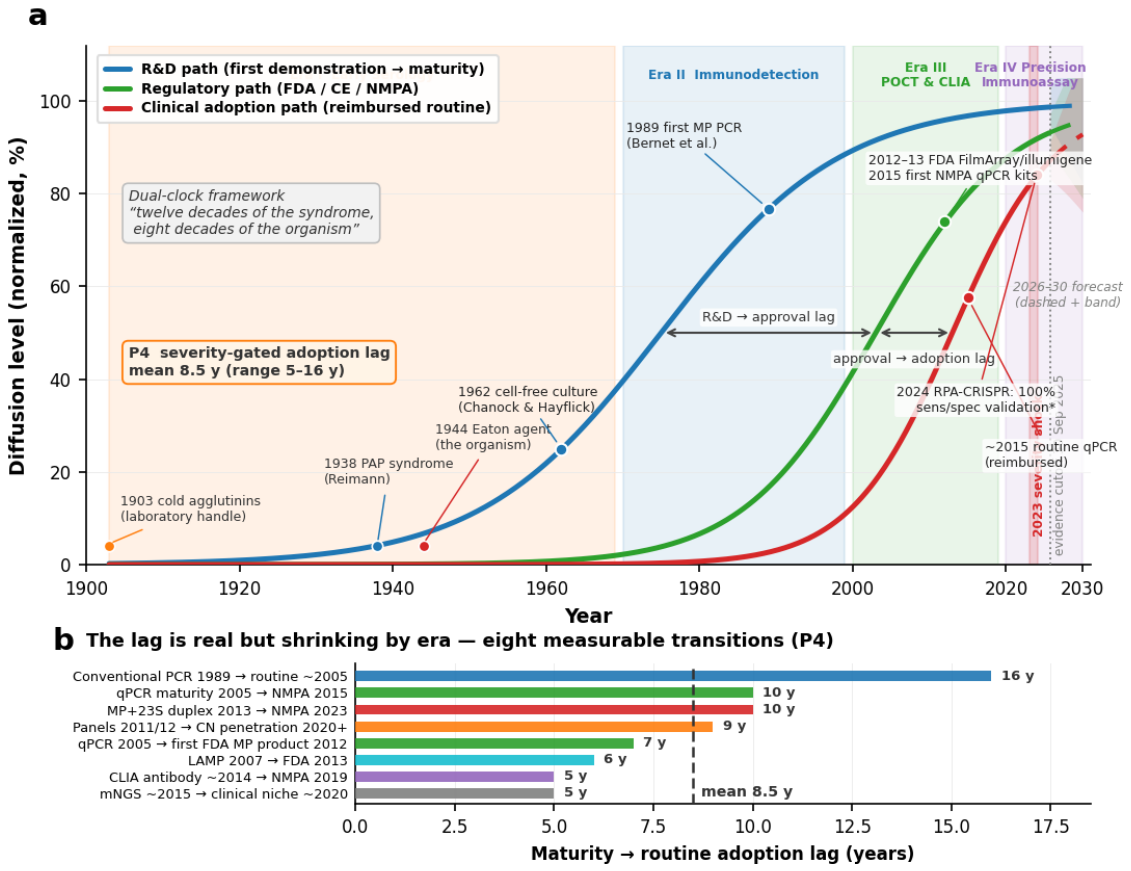

Table 1.
Hinge table — MP diagnostic technologies scored on Rogers' five adoption attributes.
| Technology (era) | Relative advantage | Compatibility | Complexity | Trialability | Observability | Adoption outcome | Lag (yr) |
|---|---|---|---|---|---|---|---|
| Culture (1944-1962) | 3 | 1 | 5 | 1 | 2 | Research only | not adopted |
| Cold agglutinin (1903/1943) | 2 | 4 | 5 | 5 | 3 | Dominant pre-PCR | — |
| Serology/CF (1960s-1990s) | 3 | 4 | 3 | 4 | 4 | Half-century dominance | — |
| Particle agglutination (1980s) | 4 | 4 | 4 | 4 | 4 | Regional (Japan/China) | — |
| Single PCR (1990s) | 5 | 3 | 3 | 3 | 5 | Displaced serology | 16 (1989→~2005) |
| Multiplex panel (2010s) | 5 | 4 | 3 | 4 | 5 | Hospital routine | 9 (2011/12→2020+) |
| CLIA/POCT (2000-2019) | 4 | 5 | 5 | 5 | 4 | Community/POCT niche | 5 (~2014→2019) |
| mNGS (2015-) | 5 | 3 | 2 | 3 | 5 | Severe/atypical niche | 5 (~2015→~2020) |
| CRISPR-POCT (2020-) | 5 | 5 | 5 | 5 | 5 | Emerging (predicted) | forecast |
Note. Lag = years from technological maturity to routine adoption among the eight measurable transitions (P4): conventional PCR 16 y (1989→~2005); qPCR→NMPA 10 y (2005→2015); MP+23S duplex 10 y (2013→2023); multiplex panels 9 y (2011/12→2020+); qPCR→first FDA MP product 7 y (2005→2012); LAMP 6 y (2007→2013); CLIA 5 y (~2014→2019); mNGS 5 y (~2015→~2020) — mean 8.5 y, range 5–16; — = not among the eight measurable transitions (pre-PCR era). Attribute scores are 1–5 vs the contemporaneous competitor; composite scores are illustrative rankings, not measurements.
Table 2.
Candidate scoring matrix and falsifiable forecasts.
| Candidate | Composite score | Predicted S-curve phase | Binding constraint | Forecast | Falsification condition |
|---|---|---|---|---|---|
| CRISPR-POCT | Highest | Early adoption | Workflow (extraction-free sample-to-answer) | Decisive adoption in paediatric ED by 2028 | No NMPA registration by end-2027 |
| Antigen-CLIA | High | Acceleration | Registration breadth | >=3 NMPA registrations by end-2027 | Fewer than 3 by end-2027 |
| mNGS | Moderate | Niche consolidation | Turnaround (<12 h) and niche evidence | Consolidates in severe/atypical niche | Breaks into routine if turnaround and deployment thresholds are crossed |
| Multiplex panel (outpatient) | Moderate | Gated | Severity gate | Outpatient adoption gated to 2028 | Earlier if decision-value evidence emerges |
| Host-response biomarkers | Low (immature) | Pre-clinical | Evidence maturity | Not routine before 2030 | Any guideline endorsement before 2030 |
Note. Composite scores are illustrative rankings, not measurements.
Disclaimer/Publisher’s Note: The statements, opinions and data contained in all publications are solely those of the individual author(s) and contributor(s) and not of MDPI and/or the editor(s). MDPI and/or the editor(s) disclaim responsibility for any injury to people or property resulting from any ideas, methods, instructions or products referred to in the content. |
© 2026 by the authors. Licensee MDPI, Basel, Switzerland. This article is an open access article distributed under the terms and conditions of the Creative Commons Attribution (CC BY) license (http://creativecommons.org/licenses/by/4.0/).
Copyright: This open access article is published under a Creative Commons CC BY 4.0 license, which permit the free download, distribution, and reuse, provided that the author and preprint are cited in any reuse.