
Submitted:
27 October 2026
Posted:
28 October 2026
You are already at the latest version
Abstract
Enterprise agentic AI systems exchange contextual information across functional modules, creating governance challenges when information crosses operational and organizational boundaries. This study distinguishes organizational governance boundaries from information exchange boundaries and proposes an Inter-Module Information Contract (IMIC) architecture for purpose-bounded context exchange. IMIC evaluates provenance, semantic and temporal validity, permitted information scope, and applicable originating constraints before downstream execution, independently of language-model reasoning. We compare IMIC with full-context sharing, reduced-context sharing, and strengthened structured handoff. In a deterministic benchmark of 32 synthetic conditions, joint correctness is achieved in 3, 10, 28, and 32 cases, respectively. The four differences between strengthened structured handoff and IMIC arise from conditions testing onward-transfer permission, recipient, purpose, and field scope. A downstream integration experiment evaluates 14 selected conditions across four local language models and three seeds, yielding 168 case–model–seed blocks and 672 method-level records. IMIC achieves correct exchange actions and information boundaries in all 168 blocks and joint correctness in 165 across four local LLMs and three seeds. Three permitted executions produce incorrect downstream responses despite correctly governed exchanges, demonstrating that information-exchange correctness does not guarantee correct downstream task performance. These results support the functional feasibility of the implemented originating-contract inheritance mechanism under controlled synthetic conditions. Generalizability to independent enterprise workflows, richer policy structures, multiple information providers, and derived information requires further validation.
Keywords:
agentic AI
; multi-agent systems
; enterprise AI
; information contracts
; contextual sufficiency
; information boundaries
; semantic interoperability
; context exchange
; lifecycle management
; onward transfer
1. Introduction
1.1. Information Governance Challenges in Enterprise Agentic AI Systems
Enterprise agentic AI systems increasingly distribute information processing through interactions among language models, software modules, business applications, and external tools. Such modularization enables specialized components to cooperate within a common workflow, but it also creates repeated transfers of contextual information across independently configured operational boundaries. The availability of information within a workflow does not by itself establish that every subsequent transfer or use is appropriate. Information may have been collected for a particular purpose, obtained from a particular source, observed at a particular time, or supplied under restrictions that continue to apply after the first transfer. Its operational meaning may also depend on units, confirmation status, provenance-related metadata, temporal validity, and the particular attributes required by the receiving task. A receiving module therefore needs not only sufficient information, but information whose transfer and use remain consistent with the conditions applicable to that exchange.
Conventional context-sharing strategies do not fully resolve this problem. Full-context sharing may expose information unnecessary for the receiving task, whereas reduced-context sharing limits volume without establishing semantic validity or permission for reuse. Structured handoff can make attributes and conditions explicit, but an onward transfer may still become inconsistent with restrictions imposed by the originating provider if those restrictions are not retained and evaluated at the next boundary. The present study therefore treats inter-module information transfer as an explicitly governed operation rather than as an incidental consequence of task coordination.
1.2. From Organizational Governance Boundaries to Information Exchange Boundaries
Enterprise information governance requires a distinction between the organizational activity being governed and the individual information transfers occurring within or across that activity. Our preceding Enterprise Systems Engineering study identifies the AI use case as an intermediate organizational governance boundary associated with purpose, authority, accountability, resources, records, technical dependencies, and lifecycle controls [1]. That boundary identifies the governed activity and the organizational arrangements under which information-use conditions may be established, but it does not determine the permissibility of every individual transfer.
An information exchange boundary addresses this narrower operational question. It identifies a proposed transfer between modules as an operation that must be evaluated against the receiving purpose, required information, information state, permitted disclosure scope, and applicable restrictions. Organizational and information exchange boundaries therefore need not coincide, because information may move between modules within the same governed activity or across different organizational activities.
The distinction becomes particularly important during successive transfers. In an A-to-B-to-C workflow, authorization for A to provide information to B does not necessarily authorize B to disclose the same information to C. A B-to-C decision must therefore evaluate the new receiving conditions while retaining any originating restrictions that remain applicable. Technical enforcement can operationalize such represented conditions at the exchange boundary, but it does not independently create the organizational authority or legal validity on which those conditions depend.
1.3. Research Gap and Research Questions
The research gap addressed here concerns the operational integration of task-specific contextual validity and applicable information-use restrictions at successive exchange boundaries. Existing research already provides mechanisms for purpose-based authorization, continuing usage conditions, provenance representation, information-flow control, and policy inheritance, as reviewed in Section 2. A proposed transfer may simultaneously depend on required-attribute completeness, semantic consistency, temporal validity, permitted disclosure scope, and restrictions inherited from an originating provider.
The study addresses three research questions.
- RQ1.
- How can task-specific information requirements and information-governance conditions be evaluated together before an inter-module context exchange is executed?
- RQ2.
- How can explicitly represented originating restrictions remain effective when contextual information is proposed for onward transfer through an intermediate module?
- RQ3.
- What functional differences arise between Inter-Module Information Contract (IMIC) and alternative information exchange methods under controlled synthetic conditions and downstream language-model integration?
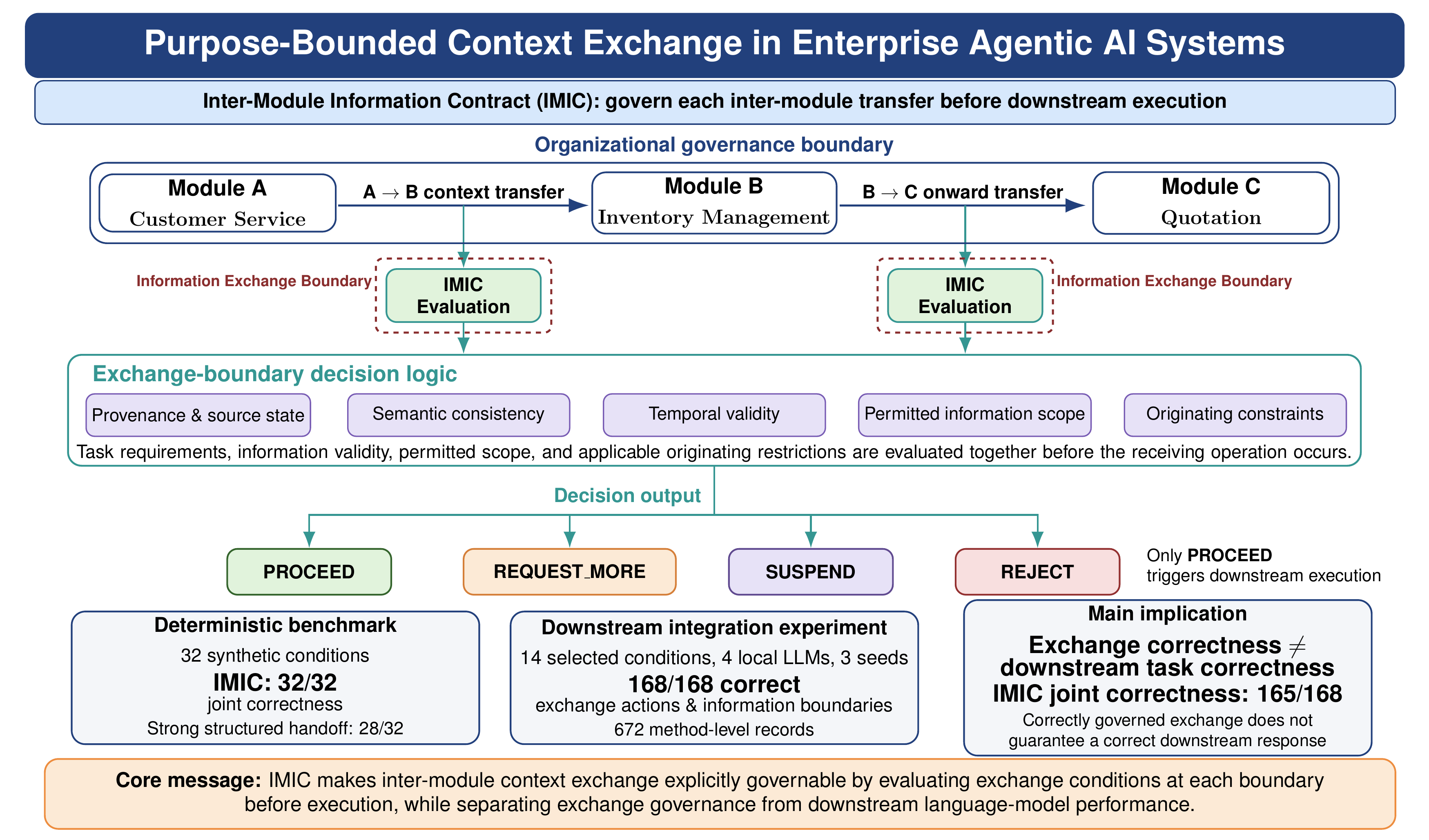
The research scope separates contract-mediated exchange decisions from downstream language-model reasoning. The exchange mechanism determines whether information may cross a specified boundary and whether downstream execution may proceed, while the correctness of a subsequent language-model response is evaluated separately. This separation allows information-governance errors to be distinguished from downstream generation errors and limits the claims of the study to the functional behavior of the implemented exchange mechanisms. Figure 1 summarizes the relationship among organizational governance boundaries, information exchange boundaries, and IMIC-mediated execution.
1.4. Research Contributions and Article Organization
This article proposes an Inter-Module Information Contract (IMIC) architecture for purpose-bounded context exchange in enterprise agentic AI systems. Its first contribution is a conceptual distinction between organizational governance boundaries and operational information exchange boundaries. Its second contribution is an information-contract architecture that evaluates task requirements, provenance-related metadata, semantic and temporal validity, permitted fields, and applicable originating restrictions before downstream execution. Its third contribution is a reusable decision mechanism that applies the same exchange logic to an initial transfer and to a subsequent transfer while retaining relevant originating restrictions. These contributions concern the operational integration of established information-governance concepts rather than the invention of purpose-based authorization, usage control, provenance, or policy inheritance as general principles. At the system level, this arrangement supports governed coordination among AI-enabled enterprise modules by making applicable originating information-use restrictions executable at inter-module exchange boundaries rather than relying on downstream generative components to preserve those restrictions implicitly.
The architecture is evaluated through a deterministic synthetic benchmark and a downstream language-model integration experiment. The comparison includes full-context sharing, reduced-context sharing, strengthened structured handoff, and IMIC, with the strengthened structured-handoff method serving as the principal comparison for examining the incremental contribution of originating-contract inheritance within the tested configuration. The evaluation distinguishes exchange-action correctness, information-boundary correctness, and downstream task correctness rather than treating successful downstream execution as evidence that the preceding information transfer was correctly governed.
The remainder of the article is organized as follows. Section 2 reviews the relevant conceptual and technical foundations, and Section 3 describes the research design and evaluation methodology. Section 4 defines organizational governance boundaries and information exchange boundaries, while Section 5 specifies the IMIC architecture and originating-contract inheritance mechanism. Section 6 presents the experimental evaluation, Section 7 discusses the architectural implications and limitations, and Section 8 concludes the article.
2. Related Work and Conceptual Foundations
Purpose-bounded context exchange in enterprise agentic AI systems draws on several established research traditions that operate at different architectural levels. Enterprise systems research identifies the organizational purposes and responsibilities within which information is used, agentic AI research explains how contextual information moves among computational participants, and information-governance research provides mechanisms for authorization, provenance, usage control, and restricted dissemination. The issue addressed by IMIC is therefore not the absence of these mechanisms, but their coordination at an operational boundary where contextual information is proposed for transfer and downstream execution. This section reviews the foundations required for that coordination and identifies the narrower architectural gap addressed by the present study.
2.1. Enterprise Systems Engineering and AI Use-Case Governance
Purpose-bounded information exchange presupposes an organizational context in which the purposes and responsibilities associated with information use can be identified. Enterprise Systems Engineering treats the enterprise as a purposeful system in which organizational processes, information, technology, and other components must be coordinated in relation to common objectives [2,3].
Modular enterprise architectures create interfaces at which independently configured components exchange information while performing specialized functions. Baldwin and Clark show that modularity enables components to be developed and modified separately when common design rules and interfaces preserve compatibility [4]. Technical interoperability at such an interface, however, does not by itself establish that the information transferred is appropriate for the organizational purposes of the participating modules. Modular decomposition therefore creates a need to govern information exchange in addition to specifying compatible interfaces.
Organizational authority and technical exchange control must consequently be treated as related but distinct concerns. Sociotechnical research shows that computational abstractions can omit institutional relationships relevant to system outcomes, while internal algorithmic-auditing research emphasizes organizational responsibilities and review processes beyond technical execution records [5,6]. Our preceding Enterprise Systems Engineering study accordingly treats the AI use case as an intermediate organizational governance boundary associated with purpose, authority, accountability, technical dependencies, resources, records, and lifecycle controls [1]. That boundary identifies the governed activity and the organizational source of applicable information-use conditions, whereas the present study focuses on the operational boundary at which a particular proposed transfer is evaluated. An exchange log can therefore preserve evidence about a technical decision without independently establishing the authority under which the applicable restriction was adopted.
Prior work by the authors developed the organizational governance perspective underlying the present study in several stages. Earlier work examined legal-organizational structures for AI-enabled activities, including cell- or series-based arrangements intended to differentiate deployment-specific governance responsibilities [7,8]. Subsequent work explored the translation of deployment-specific governance obligations into computable organizational clauses [9]. The later Enterprise Systems Engineering framework generalized these ideas by treating the AI use case as an intermediate organizational governance boundary that need not depend on any particular legal form [1]. The present study moves to a narrower technical layer by assuming that applicable information-use conditions have already been established and represented and by examining how those conditions are evaluated when contextual information crosses a module interface.
2.2. Context Exchange in Agentic AI and Modular Information Systems
Agentic AI systems make information exchange operationally significant because language models increasingly obtain observations from tools and cooperate with other computational participants. ReAct combines language-model reasoning with actions and environmental observations, while Toolformer examines model interaction with external APIs [10,11]. Multi-agent frameworks such as AutoGen, CAMEL, and MetaGPT extend this interaction to configurable agents, specialized roles, and structured coordination procedures [12,13,14]. These approaches demonstrate how information can move through successive interactions, but successful communication or coordination does not by itself establish that information received from one source may be disclosed to every subsequent participant.
Interoperability protocols further standardize communication among agents and access to external capabilities. The Agent2Agent protocol specifies mechanisms for communication, capability discovery, and task coordination among agent systems, while the Model Context Protocol standardizes interaction between language-model applications and external tools or information sources [15,16]. Such protocols provide important interoperability and security mechanisms, but they do not independently determine whether a particular onward disclosure satisfies the originating information-use conditions of an enterprise workflow. IMIC is therefore positioned as a complementary exchange-decision mechanism rather than as an alternative communication or tool-integration protocol.
Context selection introduces a separate distinction between information availability and information suitability. Retrieval-augmented generation and memory-management architectures show that language-model execution often depends on selecting or retaining task-relevant information rather than supplying all available context [17,18]. Reducing context, however, does not establish that the selected information is semantically valid, temporally appropriate, or authorized for a new recipient and purpose. A governed exchange must therefore consider both task sufficiency and the conditions under which the selected information may be transferred.
Exchange correctness must also be distinguished from the subsequent behavior of the receiving language model. Interactive-agent benchmarks and research on uncertainty show that models may still produce incorrect or incomplete outputs from valid inputs, while indirect prompt-injection research demonstrates additional risks when externally obtained information affects later agent behavior [19,20,21,22]. These problems motivate careful control of information entering downstream operations but are distinct from the question addressed here: whether a proposed transfer complies with represented information-use conditions. The present experiments therefore evaluate the exchange decision independently from the correctness of the subsequent language-model response.
2.3. Information Governance, Provenance, and Purpose Limitation
Authorization research establishes that permission depends on properties of the requested operation rather than merely on technical access to information. Role-based access control associates permissions with organizational roles, whereas attribute-based access control evaluates properties of subjects, objects, operations, and environmental conditions against applicable policies [23,24]. Purpose-based access control adds the intended use of information to the authorization decision, and contextual integrity similarly emphasizes that appropriate information flows depend on participants, context, and transmission conditions [25,26]. These approaches support the requirement that inter-module exchange be evaluated in relation to the receiving task rather than inferred from technical access alone.
Usage-control research extends this principle beyond the initial access decision. The UCONABC model incorporates authorizations, obligations, conditions, and mutable attributes, providing a foundation for re-evaluating information use when relevant state changes [27]. This is important for contextual information whose suitability may depend on source state, observation time, expiration, or other changing conditions. An attribute that was valid when first obtained may no longer support a subsequent exchange even when the recipient would otherwise be authorized to receive it.
Provenance and structured-validation research provide complementary mechanisms for establishing information origin, processing relationships, and representational validity. W3C PROV represents relationships among entities, activities, and agents, while provenance research distinguishes different forms of dependence on source information and mechanisms for capturing processing history [28,29,30,31]. Structured validation standards provide related building blocks: JSON Schema supports structural validation of JSON documents, PROV-DM specifies a provenance data model, and SHACL expresses constraints over RDF graphs [32,33,34]. These mechanisms address representation, validation, and provenance, but successful validation does not independently establish that disclosure to a particular recipient for a particular purpose is permitted. The IMIC prototype therefore uses explicitly supplied source-related metadata and encoded validity conditions without claiming to implement a general provenance calculus, trusted whole-system provenance capture, or full conformance with these standards.
Information suitability also has semantic and temporal dimensions that are analytically distinct from authorization and provenance. Values may use incompatible units, remain provisional rather than confirmed, or become stale relative to the receiving task. A valid exchange therefore requires both governance conditions concerning who may receive information and operational conditions concerning whether the information can meaningfully support the requested task. The architectural problem is to coordinate these conditions so that a proposed transfer produces a determinate execution decision.
2.4. Policy Propagation and Multi-Hop Information Transfer
Multi-hop exchange requires restrictions imposed by an originating provider to remain relevant when an intermediate recipient becomes the sender of a subsequent transfer. Myers and Liskov associate information-flow restrictions with multiple authorities, Denning provides a lattice model of secure information flow, and language-based information-flow research develops mechanisms for specifying and enforcing flow properties and controlled declassification [35,36,37,38]. IMIC does not implement a general security-label system, declassification semantics, or formal noninterference verification; it applies the narrower principle that applicable source restrictions must remain operative when contextual information is proposed for onward transfer.
Policy inheritance and distributed usage control provide more direct precedents for maintaining restrictions across successive relationships and systems. The W3C ODRL Information Model represents permissions, prohibitions, duties, actions, constraints, and policy inheritance, including inheritance from parent policies [39]. Distributed usage-control research likewise examines the continued enforcement of usage restrictions across systems and the architectural separation of policy decisions from controlled operations [40,41]. These contributions establish that policy inheritance and continuing control are existing concepts; the issue examined here is how an originating restriction participates in the same pre-execution decision as task-required information, semantic consistency, temporal validity, and permitted disclosure scope.
Enterprise data-sharing architectures demonstrate that such policy concepts can be operationalized at concrete information-system interfaces. Usage-control architectures for data sovereignty and data-sharing ecosystems incorporate policy evaluation and enforcement in business-to-business settings, including work associated with the International Data Spaces initiative [42,43]. The International Data Spaces reference architecture distinguishes policy decision and enforcement functions, and research on the initiative emphasizes the accompanying roles of governance, trust, and data sovereignty [44,45]. These precedents show that neither policy-governed exchange nor placement of an enforcement mechanism at a transfer boundary is, by itself, novel to IMIC.
The remaining multi-hop problem concerns the coordination of immediate contextual validity with restrictions inherited from an earlier exchange. The narrower architectural question is how these established controls are coordinated with the immediate contextual requirements of AI-enabled module interaction. A B-to-C transfer may contain complete, semantically valid, and temporally current information while still violating a restriction established when A originally supplied that information to B. Conversely, an onward transfer may be authorized in principle but remain unsuitable because required attributes are missing or invalid. The present study therefore treats each transfer as a separate decision while retaining applicable originating restrictions, so that authorization of A-to-B cannot substitute for authorization of B-to-C. This formulation also limits the empirical comparison: differences between IMIC and a baseline that omits originating-contract inheritance do not establish superiority over an existing policy-enforcement architecture configured to propagate equivalent restrictions.
2.5. Research Gap and Positioning of IMIC
The literature therefore identifies an architectural integration problem rather than an absence of mechanisms for governing information use. Enterprise systems research provides the organizational context of governed activity, agentic AI research establishes the operational importance of inter-component context exchange, and access-control, usage-control, provenance, information-flow, and data-sharing research provide established mechanisms for representing or enforcing information-use conditions. What remains to be examined is how these concerns can be coordinated into one executable decision when contextual information crosses a module boundary.
IMIC addresses this problem through an explicit information contract and a reusable pre-execution decision mechanism. For each proposed exchange, the mechanism relates the receiving task’s information requirements to source-related metadata, semantic and temporal validity, permitted disclosure scope, and applicable originating restrictions. When information is proposed for onward transfer, the new exchange is evaluated separately while restrictions established by the originating provider remain operative. The resulting contribution is therefore not a new general theory of access control, provenance, or policy inheritance, but an architectural arrangement that coordinates these established concerns for context exchange among AI-enabled enterprise modules.
The empirical evaluation correspondingly examines the implemented behavior of that arrangement rather than its general superiority over all structured-handoff, information-flow, usage-control, or data-space architectures. The strengthened structured-handoff comparator already implements substantial immediate-exchange validation, making originating-contract inheritance the principal additional capability tested in the multi-hop conditions. Section 3 defines the evaluation methodology, Section 4 formalizes the relevant organizational and information exchange boundaries, and Section 5 specifies the executable IMIC architecture.
3. Research Design and Methodology
This study adopts a design science research approach to develop and evaluate an executable architecture for governing contextual information exchanged between enterprise AI modules. The methodology proceeds from the research gap identified in Section 2 to artifact construction, controlled evaluation, and interpretation of the resulting evidence. It distinguishes the architectural specification, the behavior of its implementation, and the performance of downstream language models because success at one level does not establish success at the others.
3.1. Research Approach and Scope
The methodological objective is to construct and evaluate an information-governance artifact rather than to develop a new language model or autonomous agent-planning algorithm. Design science research in information systems emphasizes the development and evaluation of artifacts that address identified organizational and technical problems, while established methodologies distinguish artifact design from empirical investigation of its behavior in a specified context [46,47,48]. This perspective supports treating IMIC as an identifiable artifact whose requirements, implementation, and observed behavior can be evaluated separately.
The artifact is treated as an architectural arrangement whose design principles and empirical behavior must remain distinguishable. Gregor and Jones identify purpose and scope, constructs, principles of form and function, and testable propositions as components of information systems design theory [49]. Accordingly, IMIC is specified in terms of information exchange boundaries, contract representations, evaluation conditions, and execution decisions rather than merely as a software implementation. The present study evaluates the observable behavior of this arrangement through an executable prototype without claiming to establish a fully validated design theory for enterprise information governance.
The unit of analysis is a proposed information exchange between functional modules in an AI-enabled enterprise workflow. Each exchange is characterized by an originating source, proposed recipient, declared purpose, required information, applicable contract conditions, and the state of the contextual attributes being transferred. For a multi-hop workflow, each successive transfer constitutes a separate decision point even when the same evaluation mechanism is invoked repeatedly. The operational object of evaluation is therefore the individual exchange boundary rather than the organizational unit, the language model, or the enterprise considered independently.
The empirical setting is a controlled synthetic workflow involving customer service, inventory management, and quotation. Module A supplies contextual information for a replacement-inventory check performed by Module B, and selected scenarios allow Module B to propose an onward transfer to quotation Module C. The workflow therefore represents both A-to-B single-hop exchange and A-to-B-to-C two-hop exchange. The modules are simulated functional roles rather than independently operating autonomous language-model agents.
The evaluation uses two complementary experimental stages with different purposes. A deterministic Python benchmark compares four exchange methods over 32 synthetic condition variants without language-model inference, while a downstream integration experiment evaluates 14 selected conditions across local language models and generation seeds. The first stage isolates exchange-decision behavior, whereas the second examines how those decisions interact with subsequent generated business responses. Both stages evaluate the implemented synthetic workflow rather than real enterprise transactions, organizational adoption, or autonomous workflow discovery.
3.2. Research Questions and Evaluation Objectives
The research questions connect the architectural problem identified in Section 2 to distinct and observable evaluation objectives. RQ1 concerns integrated pre-execution validation, RQ2 concerns continuity of explicitly represented originating restrictions, and RQ3 concerns functional differences among the implemented exchange methods. The evaluation therefore examines representation, inheritance, and comparative behavior without treating downstream language-model accuracy as equivalent to information-governance correctness.
- RQ1.
- How can task-specific information requirements and information-governance conditions be evaluated together before an inter-module context exchange is executed?
RQ1 evaluates whether an exchange mechanism can distinguish information that is suitable and permitted for a receiving task from information that is incomplete, semantically inconsistent, temporally invalid, or outside the permitted disclosure scope. The corresponding objective is to encode these conditions explicitly and evaluate them before downstream execution. Evidence for RQ1 is obtained from cases that vary required attributes, semantic conditions, provenance-related metadata, information state, temporal validity, and transferred fields.
- RQ2.
- How can explicitly represented originating restrictions remain effective when contextual information is proposed for onward transfer through an intermediate module?
RQ2 evaluates whether different explicitly represented originating restrictions remain operative when an intermediate recipient becomes the sender of a new proposed exchange. The corresponding objective is to retain and re-evaluate originating constraints concerning general onward-transfer permission, permitted onward recipient, permitted onward purpose, and permitted onward field scope. Evidence for RQ2 is obtained from four paired two-hop condition classes in which each originating constraint is either satisfied or violated while the immediate B-to-C exchange conditions are otherwise held comparable.
- RQ3.
- What functional differences arise between IMIC and alternative information exchange methods under controlled synthetic conditions and downstream language-model integration?
RQ3 compares the observable consequences of four implemented exchange methods under identical scenario definitions. The principal comparison for originating-contract inheritance is between strengthened structured handoff and IMIC because the former already implements substantial immediate-exchange validation. The downstream language-model stage further tests whether exchange correctness can be evaluated separately from the correctness and completion of the generated business response.
The research questions are assessed through separate correctness criteria rather than through a single undifferentiated outcome measure. Exchange-action correctness concerns the disposition returned for a proposed operation, information-boundary correctness concerns whether transferred fields remain within reference permissions, and task correctness concerns the stipulated downstream business response when execution is expected. Joint correctness requires the applicable exchange, information-boundary, and execution conditions to be satisfied for the same observation. This separation prevents a successful business response from compensating for an impermissible transfer and prevents a correct exchange decision from being interpreted as proof of downstream language-model accuracy.
3.3. Architecture Construction and Prototype Development
The architecture was constructed by translating the research requirements into explicit contract inputs, evaluation functions, and execution decisions. The artifact comprises structured contextual attributes, represented exchange conditions, a reusable evaluator, and an execution gate. Its implementation is independent of downstream language-model judgment so that the exchange decision can be observed and tested separately. Detailed contract structures, decision rules, and originating-contract inheritance are specified in Section 5.
The executable prototype implements the four terminal dispositions PROCEED, REQUEST_MORE, SUSPEND, and REJECT and applies the same evaluation mechanism to successive exchanges. Information selection and field projection are processing functions rather than additional terminal dispositions. In a two-hop exchange, the A-to-B and B-to-C transfers are evaluated separately, while applicable restrictions originating from A remain available to the second evaluation. The deterministic implementation therefore exposes the disposition, transferred fields, decision reason, and synthetic task result for comparison with reference expectations.
Four implemented exchange methods provide the comparative structure of the evaluation. B1, Full Context, transfers available context without the complete contract checks of the stronger methods, while B2, Reduced Context, limits the information package without implementing the full validation behavior of B3 and B4. B3, Strong Structured Handoff, implements field scoping, provenance-related metadata, semantic checks, and temporal-validity handling. B4, IMIC, adds the retention and evaluation of applicable originating restrictions during onward transfer. These definitions characterize the tested implementations rather than all systems that could be described by the same general method names.
The B3–B4 comparison is intentionally narrower than the comparisons involving B1 or B2. B3 already implements substantial immediate-exchange validation, making originating-contract inheritance the principal additional capability of B4 in the tested multi-hop conditions. The prototype therefore evaluates a specified architectural difference rather than formally verifying all possible information flows or establishing superiority over every structured-handoff, usage-control, or policy-enforcement architecture.
3.4. Evaluation Strategy and Reproducibility
The evaluation strategy combines a frozen synthetic benchmark, a separately specified reference oracle, and repeated downstream language-model executions. This strategy is consistent with the design science principle that an artifact should be evaluated against the objectives and conditions for which it was constructed. The FEDS framework distinguishes evaluation purposes and strategies according to artifact characteristics and maturity, supporting the controlled and primarily artificial evaluation used here [50]. The resulting evidence concerns functional correctness under stipulated conditions rather than effectiveness in independently operated enterprise environments.
The deterministic benchmark contains 32 condition variants organized into four families covering context sufficiency, semantic and metadata consistency, lifecycle validity, and multi-hop transfer. All cases are derived from the same synthetic customer-service, inventory-management, and quotation workflow and use a fixed reference clock of 2026-10-11T10:00:00Z. The benchmark systematically varies selected attributes, information states, source updates, and explicitly represented originating restrictions while retaining a common task structure. The S4 multi-hop family contains four matched pairs that test general onward-transfer permission, permitted onward recipient, permitted onward purpose, and permitted onward field scope. Within each pair, one condition violates the relevant originating restriction and the corresponding condition satisfies it while the immediate B-to-C exchange conditions are otherwise kept comparable. The cases therefore form a constructed test suite rather than an independently sampled population of enterprise workflows.
The reference oracle specifies expected exchange actions, permitted field sets, and normalized business outcomes separately from the tested decision functions. This separation allows each implementation to be evaluated against explicit reference expectations rather than against an expected result generated by the method under test. The oracle is researcher-defined rather than externally validated ground truth, and the implications of that limitation are discussed in Section 7.
The correctness assessment distinguishes action correctness, information-boundary correctness, and business-task correctness. For case c and method m, let denote the observed exchange action and let denote the set of actions accepted by the reference oracle. Action correctness is defined as
Let and denote the observed field sets transferred at the two boundaries and let and denote the corresponding permitted field sets. The number of excess fields is
and information-boundary correctness requires .
Business-task correctness is evaluated only in relation to the outcome required by the reference oracle. When execution is expected, the observed normalized response must match the stipulated result, while a condition requiring execution to be withheld is satisfied only when no business-task response is produced. Let denote satisfaction of this execution outcome. Joint correctness is then defined as
This criterion requires exchange action, information boundary, and execution outcome to agree with the reference conditions for the same observation.
The deterministic stage evaluates all 32 conditions under B1–B4, producing 128 method-level comparisons. Every method is evaluated against the same frozen scenario inputs and reference oracle, and no language-model sampling occurs in this stage. Differences among methods therefore reflect their implemented exchange behavior under the stipulated benchmark conditions.
The downstream language-model stage adds generation variability to 14 purposively selected benchmark conditions: S101, S105, S202, S206, S301, S307, and all eight S4 conditions S401–S408. The first six conditions represent valid execution, missing context, semantic inconsistency, provisional information, expiration, and source update. The eight S4 conditions form four matched pairs covering general onward-transfer permission, permitted onward recipient, permitted onward purpose, and permitted onward field scope. Under the reference oracle, S101 and the four positive S4 conditions S402, S404, S406, and S408 require downstream execution, whereas S105, S202, S206, S301, S307, and the four negative S4 conditions S401, S403, S405, and S407 require execution to be withheld. The four exchange methods are evaluated across qwen3.5:9b-q4_K_M, gemma4:12b, llama3.1:8b, and phi4:14b using seeds 101, 202, and 303, yielding method-level records in 168 case–model–seed blocks. These records are repeated evaluations of selected synthetic conditions rather than 672 independent business workflows.
Language-model invocation is conditioned on the disposition produced by the corresponding exchange method. A PROCEED decision invokes the configured model with the downstream task context transferred by that method, whereas REQUEST_MORE, SUSPEND, and REJECT produce no model call and are recorded as NOT_CALLED. Generated business responses are normalized and compared programmatically with the reference oracle rather than evaluated by a second language model. Generation status is retained separately so that TRUNCATED output is not treated as a valid business response merely because the preceding exchange decision was correct. Blocks containing truncated or otherwise incomplete generation output are retained as observed rather than rerun until a valid response is obtained, and complete-block analyses exclude such blocks when a fully paired comparison is required.
Execution traceability is supported by frozen benchmark artifacts, cryptographic digests, response logs, and recorded run metadata. The v1.0 benchmark stores scenario inputs and reference expectations separately, associates their canonical JSON representations with SHA-256 digests, and verifies the frozen artifacts before evaluation. The v1.1 language-model runs use Ollama version 0.32.5 with temperature 0.7, a prediction-token limit of 3072, a context-window setting of 4096, a timeout of 180 seconds, and the specified generation seeds. Run manifests record model identifiers, model digests, generation options, execution statuses, result-file hashes, response-log hashes, and source-code hashes. The final audit validates 24 canonical seed–model–group manifests and their associated result and response files before merging the observations. Where more than one valid manifest exists for the same seed–model–group combination, the earliest valid run is retained as the canonical observation and later duplicate runs are excluded from the merged analysis. Generation seeds are treated as experimental conditions rather than guarantees of identical language-model output across separate executions.
The resulting design provides a traceable correspondence between the research questions and the evidence used to assess them. RQ1 is examined through cases involving information sufficiency, semantics, provenance-related metadata, and temporal conditions. RQ2 is examined through four paired multi-hop originating-restriction classes concerning general onward-transfer permission, permitted onward recipient, permitted onward purpose, and permitted onward field scope. RQ3 is examined through comparative action, boundary, task, and joint correctness across the deterministic and language-model stages. Section 6 reports the resulting observations, while Section 7 addresses the external-validity, oracle, comparison-design, and generalizability limitations of the evaluation.
4. Organizational and Information Exchange Boundaries
The conceptual foundation of IMIC is the distinction between governing an AI-enabled organizational activity and governing a particular transfer of contextual information associated with that activity. The organizational boundary establishes the purposes, authority, responsibilities, and lifecycle conditions under which an AI use case operates, whereas the information exchange boundary concerns whether specified information may cross a particular interface under applicable conditions. These boundaries are complementary but not interchangeable. This section defines their relationship and derives the requirements for purpose-bounded and multi-hop information exchange.
4.1. The AI Use Case as an Organizational Governance Boundary
An organizational governance boundary identifies the AI-enabled activity to which purpose, authority, responsibility, and lifecycle controls are attached. Our preceding Enterprise Systems Engineering study defines the AI use case as an intermediate organizational unit between individual technical components and the enterprise as a whole [1]. The boundary encompasses the activity through which technical capabilities acquire organizational meaning rather than identifying governance exclusively with a language model, software application, or data resource.
The organizational governance boundary provides the source of authority for information-use conditions but does not itself determine the permissibility of every technical transfer. Several technical modules may participate in one governed use case, and a workflow may also connect modules associated with different governed activities. Accordingly, an AI use-case module should not be equated with an individual language-model instance or with the functional modules used in the present simulation. The relevant organizational question is which purposes, responsibilities, and decision rights apply to the activity in which the exchange occurs.
Technical enforcement therefore requires an operational boundary distinct from the organizational governance boundary. An organization may establish that particular information is available for inventory checking, quotation, or customer support, but this does not automatically determine which fields a software component may send to another module or whether an originating restriction survives a later transfer. The information exchange boundary provides the point at which such established conditions are applied to an individual proposed transfer.
4.2. Information Exchange Boundaries Across Enterprise Modules
An information exchange boundary is an event-specific decision point at which a proposed transfer is evaluated before the receiving operation proceeds. Each exchange has an immediate sender, an intended recipient, a declared purpose, a requested operation, a proposed information package, and an evaluation time. Applicable conditions may additionally depend on the originating provider and restrictions attached to information before the immediate sender received it. The boundary is therefore defined by the proposed exchange rather than solely by the organizational identities of its participants.
Information exchange boundaries may occur either within or across organizational governance boundaries. Modules within the same governed activity may have different purposes and information requirements, while modules associated with different activities may legitimately exchange information when applicable conditions permit the transfer. Organizational location alone is therefore neither sufficient to authorize nor sufficient to prohibit an information transfer. Table 1 summarizes the distinction between the two boundary types.
The relationship between the two boundaries is complementary. Organizational governance establishes or authorizes information-use conditions, while the information exchange boundary applies relevant encoded conditions to a particular proposed transfer. The same exchange may also be constrained by conditions originating from more than one governance context or information provider. An intermediate sender therefore cannot be assumed to possess authority to relax restrictions associated with information received earlier.
An information exchange boundary must affect transfer or execution to function as an enforcement point rather than merely as documentation. A syntactically valid message may still contain semantically inconsistent, stale, excessive, or impermissibly disclosed information. Conversely, recording policy or provenance metadata without using it in the release decision does not enforce the represented conditions. IMIC therefore treats the exchange boundary as a pre-execution decision point whose detailed mechanism is specified in Section 5.
4.3. Purpose-Bounded Information Exchange
Purpose-bounded information exchange requires both task suitability and permission for disclosure to be evaluated in relation to the receiving operation. General access to an information resource does not establish that every attribute is needed or permitted for every receiving purpose. The exchange decision must therefore relate the declared task to the information requirements and restrictions applicable to the proposed transfer.
Task sufficiency and information minimization jointly determine the appropriate information scope. A receiving module must obtain the attributes required to perform its task, but task sufficiency does not justify transferring every attribute available to the sender. The permitted package must therefore contain information sufficient for the receiving operation while remaining within the applicable disclosure scope. A smaller package is not necessarily valid if required information is missing, just as a complete package is not necessarily permissible if it contains unauthorized fields.
Semantic, provenance-related, and temporal conditions determine whether otherwise available information is suitable for use at the receiving boundary. Values may be structurally valid but use incompatible units, remain provisional, originate from an unexpected source or version, or become stale before the proposed operation. Provenance-related metadata can identify the source and state relevant to evaluation, but it does not independently authorize disclosure. Purpose-bounded exchange therefore combines information suitability with information-use conditions rather than treating either dimension as sufficient by itself.
The exchange outcome must distinguish materially different reasons for withholding downstream execution. Missing required information, unresolved or invalid information state, and explicit prohibition represent different operational conditions. The IMIC architecture therefore uses PROCEED, REQUEST_MORE, SUSPEND, and REJECT as terminal exchange dispositions, while the detailed decision rules remain part of the architecture specified in Section 5. These dispositions govern whether downstream execution occurs and do not predict whether a language model will subsequently produce a correct business response.
4.4. Contract Continuity Across Multi-Hop Transfers
Multi-hop information exchange requires applicable originating restrictions to remain relevant when an intermediate recipient proposes a new transfer. Authorization for an A-to-B exchange permits only the evaluated transfer under its applicable conditions and does not automatically authorize B to disclose the same information to C. A B-to-C proposal therefore creates a new information exchange boundary with a new recipient, purpose, information scope, and evaluation context.
Successive transfers must consequently be evaluated separately while preserving the distinction between the immediate sender and the originating information provider. In the first exchange, A may be both the sender and the origin of the information. In the second exchange, B becomes the immediate sender, but A may remain the provider whose restrictions govern onward disclosure. Treating B as an unrestricted new origin would discard precisely the continuity that the multi-hop mechanism is intended to preserve.
Contract continuity preserves applicable originating restrictions rather than reproducing the complete first exchange unchanged. Such restrictions may concern general onward-transfer permission, permitted onward recipients, permitted onward purposes, and permitted onward fields. The B-to-C task may legitimately require fewer attributes than the A-to-B task and may operate under different immediate conditions. The second exchange should therefore apply its own task requirements and disclosure scope while retaining originating restrictions that remain relevant to the forwarded information. A narrower outgoing package does not itself remove restrictions established by the original provider.
The architectural consequence is that each proposed transfer requires a fresh decision using both current exchange conditions and applicable originating restrictions. Information may also change between exchanges, so a later decision may need to reconsider source state or temporal validity in addition to recipient, purpose, field scope, or general onward-transfer permission. The same decision mechanism may be invoked for both boundaries, but permission for the first invocation must not be treated as permission for the second. Section 5.4 specifies the limited two-hop inheritance mechanism implemented in the prototype.
4.5. Scope and Assumptions
The boundary model is an operational abstraction of information governance rather than a complete model of enterprise authority or legal responsibility. It assumes that relevant information-use conditions have been established through an appropriate organizational process before technical evaluation occurs. The prototype evaluates conformity with represented conditions but does not independently establish the authority of the rule issuer, the legal validity of an underlying agreement, or the completeness of enterprise governance arrangements.
The IMIC information contract is a machine-readable representation of exchange conditions rather than necessarily a legally binding contract. It should also be distinguished from the modular operating agreement proposed in the preceding Enterprise Systems Engineering framework [1]. The earlier construct concerns organizational configuration of an AI use case, whereas the IMIC contract concerns conditions applicable to a particular information exchange. Encoding organizational rules into the technical contract remains an implementation and governance responsibility rather than an automatically established legal fact.
The evaluated prototype makes deliberately limited assumptions about information sources, purposes, metadata, and transfer structure. It uses a predefined workflow, explicit field-level and validity conditions, and four classes of explicitly represented originating constraints in a controlled two-hop exchange. It does not implement unrestricted policy negotiation, arbitrary multi-level policy propagation, general conflict resolution among multiple originating providers, or automatic tracking of restrictions through summaries, derived datasets, or independently generated outputs. These limitations bound the architectural claim developed here and are considered further in Section 7.
5. Inter-Module Information Contract Architecture
The Inter-Module Information Contract (IMIC) architecture operationalizes the information exchange boundary defined in Section 4 through explicit pre-execution evaluation. For each proposed transfer, IMIC evaluates whether the information is sufficient and suitable for the receiving task and whether its disclosure satisfies the applicable immediate and originating restrictions. The architecture separates this exchange decision from downstream business processing and applies the same decision mechanism to successive transfers. This section specifies the architectural components, information contract, decision semantics, originating-contract inheritance, field boundaries, and revalidation mechanism implemented in the prototype.
5.1. Architectural Overview of IMIC
IMIC separates information-exchange governance from the business processing performed by the receiving module. A sending module proposes a contextual information package for a specified recipient and task, and the package is evaluated before downstream execution. Only a transfer receiving the disposition PROCEED is released to the corresponding downstream operation. The receiving language model, where used, does not determine whether its own input is authorized.
The core architecture consists of an exchange request, an applicable information contract, the IMIC decision engine, and a downstream execution gate. The exchange request identifies the sender, recipient, purpose, operation, and proposed contextual information. The contract supplies the conditions applicable to that transfer, and the decision engine evaluates the request and contextual facts against those conditions. The execution gate applies the resulting disposition to determine whether the receiving task may proceed.
Figure 2 shows the same decision engine invoked separately at the A-to-B and B-to-C information exchange boundaries. The first invocation evaluates the proposed transfer from originating module A to receiving module B. If B subsequently proposes an onward transfer to module C, a second invocation evaluates the new recipient, purpose, information scope, and applicable originating restrictions. Each invocation independently returns PROCEED, REQUEST_MORE, SUSPEND, or REJECT, so authorization of A-to-B does not imply authorization of B-to-C.
Originating-contract information and audit evidence have different architectural roles. The originating contract supplies restrictions that may remain operative during a subsequent exchange, whereas the audit record documents the conditions and result of an evaluation. A previous PROCEED record is therefore evidence of an earlier decision rather than authority for a later transfer. The prototype records experimental decision evidence but does not implement a separate tamper-resistant enterprise audit service or an independently deployed policy-administration service.
5.2. Information Contract Structure
The IMIC contract represents the operational and information-use conditions required to evaluate a proposed exchange. It makes the relevant conditions explicit rather than leaving them implicit in conversational instructions or downstream model reasoning. The representation separates properties of the exchange request, authorization conditions, and metadata associated with individual contextual attributes. Table 2 summarizes the contract elements relevant to the implemented exchange mechanism.
An exchange request identifies the immediate sender and recipient, declared purpose, requested operation, task state, and contextual facts proposed for transfer. The applicable policy identifies the authorized source and destination together with permitted purposes, operations, fields, and its activation status. These elements establish the immediate authorization context of the proposed exchange without granting unrestricted permission for subsequent transfers.
Contextual facts are associated with metadata required for semantic, provenance-related, and temporal evaluation. The implemented representation includes source identification, source version, observation time, expiration time, and information state. Where the interpretation of a fact value depends on a measurement or quantity unit, the unit is represented explicitly. For example, a quantity attribute may contain both a numerical value and a unit such as piece. These metadata allow the evaluator to distinguish a syntactically present value from one that is semantically inconsistent, provisional, expired, or otherwise unsuitable for the receiving task. They are evaluated as operational evidence and do not independently constitute authorization for disclosure.
The originating restrictions are represented separately from the immediate policy authorizing the first exchange. In the implemented two-hop evaluation, these restrictions may concern general onward-transfer permission, permitted onward recipients, permitted onward purposes, and permitted onward fields. The first policy determines whether A may disclose specified information to B, whereas the originating restrictions determine the conditions under which information received from A may subsequently be disclosed by B to C. These restrictions are explicit conditions in the synthetic scenarios rather than rules retrieved automatically from a general contract registry.
5.3. Contract Evaluation and Decision Semantics
The IMIC decision procedure maps a proposed exchange and its applicable conditions to an explicit exchange disposition before downstream execution. Let r denote the exchange request, F the contextual facts, P the immediate exchange policy, H the relevant originating restrictions, and t the evaluation time. At the architectural level, the evaluator is represented as
where a is the disposition, is the information selected for transfer when applicable, and is the recorded decision reason. This notation specifies the functional relationship between inputs and outputs rather than a mandatory algebraic implementation order.
A PROCEED decision requires the applicable task and governance conditions to be satisfied together. Let , , , , and denote satisfaction of required-context, semantic, temporal, immediate-policy, and originating-restriction conditions, respectively. For the valid conditions represented in the prototype,
A failed or unresolved condition prevents unconditional downstream execution.
The four dispositions distinguish different operational reasons for withholding or permitting execution. PROCEED permits the configured downstream operation, REQUEST_MORE indicates that required contextual information is missing, SUSPEND withholds execution because relevant information or task conditions are unresolved or unsuitable, and REJECT denotes a transfer prohibited by an applicable restriction. These dispositions are terminal exchange outcomes in the implemented prototype. Field selection and projection are processing functions and are not additional dispositions such as APPROVE or TRANSFORM.
The decision semantics specify the behavior evaluated in the benchmark without constituting a formally verified total calculus for every possible policy conflict. The prototype tests deliberately constructed combinations of missing context, semantic inconsistency, temporal or information-state conditions, and onward-transfer restrictions. It does not define general precedence rules for arbitrary conflicting policies, multiple incompatible originating authorities, or unrestricted policy composition. Section 6 evaluates the implemented behavior under the specified benchmark conditions.
5.4. Originating-Contract Inheritance
Originating-contract inheritance preserves applicable source-imposed restrictions when information is proposed for transfer by an intermediate recipient. After A supplies information to B, B becomes the immediate sender of a possible B-to-C exchange but does not thereby become the unrestricted origin of that information. The second evaluation therefore considers both the conditions of the proposed B-to-C exchange and the relevant originating restrictions established by A. This continuity is the principal additional capability examined in the multi-hop comparison between strengthened structured handoff and IMIC.
The inheritance mechanism operates through repeated evaluation of individual transfers rather than through authorization of an entire workflow. The A-to-B exchange is first evaluated under its applicable conditions. A later B-to-C proposal creates a separate exchange request with a new recipient, purpose, and information scope. The second decision is evaluated separately from the first disposition while remaining constrained by originating conditions that still apply.
The originating restrictions act as additional authorization constraints on the B-to-C transfer. Let denote the immediate permission applicable to B-to-C. Let denote the set of explicitly represented originating constraints that remain applicable to information proposed for onward transfer. In the implemented evaluation, these constraints concern general onward-transfer permission, permitted recipients, permitted purposes, and permitted fields. For a proposed B-to-C request and output field set , the originating-condition result is
The B-to-C authorization relationship is then
This formulation represents conjunction of the explicitly implemented originating constraints in the evaluated two-hop workflow. It does not define a general algebra for policy conflicts, delegation, arbitrary inheritance hierarchies, or restrictions on derived information.
Contract inheritance does not require the second exchange to reproduce the complete information package disclosed during the first exchange. Module C may require a narrower set of fields than module B, and those fields are evaluated against the requirements and permitted onward scope of the new receiving task. Reducing the outgoing package, however, does not remove originating restrictions that remain applicable to the information being forwarded. Field projection and originating-contract inheritance therefore remain complementary checks.
The implemented inheritance mechanism is deliberately limited in scope. It evaluates four classes of explicitly represented originating constraints in a controlled A-to-B-to-C workflow: general onward-transfer permission, permitted onward recipient, permitted onward purpose, and permitted onward field scope. It does not automatically propagate restrictions through arbitrary summaries, aggregates, derived datasets, transformed information, or independently generated outputs. It also does not implement generalized conflict resolution among restrictions imposed by multiple originating providers. The experimental results therefore demonstrate the functional effect of the implemented constraint classes in the evaluated two-hop workflow rather than general multi-hop policy enforcement.
5.5. Information Minimization and Transfer Boundaries
Information minimization constrains a permitted onward transfer to information required by the receiving task and allowed by the applicable disclosure scope. Let denote the fields required by the task associated with destination d, the onward fields permitted for disclosure to that destination, the fields available to the sender, and the fields released to the recipient. For an authorized transfer, the field boundary requires
Where the task requires the complete set , the transferred package must also satisfy
These conditions distinguish insufficient information from excessive disclosure. A missing required field prevents the receiving task from proceeding under the stipulated completeness conditions, whereas an available field outside remains impermissible to disclose. Selecting fewer fields therefore does not establish correctness if required information is absent, and availability does not override an applicable disclosure restriction. The permitted package must satisfy both task sufficiency and the field boundary.
The field scope may legitimately become narrower during onward transfer. In the evaluated workflow, the quotation task requires fewer attributes than the preceding inventory task, so B-to-C need not reproduce the complete A-to-B package. Nevertheless, a package containing only task-appropriate fields may still be prohibited by an applicable originating onward-transfer restriction. Information minimization therefore determines what may be included, while originating-contract inheritance determines whether the resulting package may be disclosed.
The implemented boundary check concerns explicitly represented structured fields. It does not establish protection against indirect reproduction, inference of protected information, semantic reconstruction, or disclosure through newly generated outputs. Accordingly, the information-boundary results reported in Section 6 concern the structured attributes observed at the experimental A-to-B and B-to-C transfer points.
5.6. Contract Revalidation and Lifecycle Changes
Contract evaluation is repeated when information or operational conditions relevant to a later use or transfer may have changed. A previous PROCEED decision does not establish permanent validity because an attribute may expire, remain provisional, or be superseded by a changed source state. The applicable information state must therefore be evaluated at the decision point relevant to the proposed operation.
The prototype implements revalidation through explicit observation, expiration, information-state, and source-update conditions. An expired or temporally inconsistent attribute fails the applicable validity conditions, while a provisional value may cause execution to remain suspended under the encoded task rules. The two-hop benchmark also contains explicitly simulated source updates occurring after the initial transfer. These mechanisms test stipulated revalidation conditions rather than continuous synchronization with independently operating production systems.
Revalidation and originating-contract inheritance address different aspects of continuing control. Inheritance preserves restrictions associated with the origin of information, whereas revalidation determines whether the information remains operationally suitable at the later decision point. A subsequent transfer may therefore fail because disclosure is prohibited, because the information is no longer valid, or for both reasons. Production mechanisms for continuous revocation, policy-version distribution, source subscriptions, and event-driven synchronization remain outside the implemented prototype and are discussed as deployment extensions in Section 7.
5.7. Literature-Informed Illustrative Application Scenario
An automotive demand-and-capacity coordination scenario provides a literature-informed illustration of how the IMIC architecture can be applied beyond the synthetic customer-service workflow used in the experiments. Studies of automotive supply chains report that manufacturers and suppliers exchange sensitive demand, capacity, inventory, and production-planning information while remaining concerned about data misuse, unintended disclosure, and competitive disadvantage [51,52]. Related usage-control research and the International Data Spaces architecture show that data providers may associate usage conditions with shared information and that such conditions can be evaluated and enforced after access has been granted [44]. The scenario below adopts these documented characteristics but introduces a hypothetical third recipient and explicit onward-transfer conditions solely to illustrate the behavior of IMIC. It does not reproduce a transaction reported in the cited studies and is not treated as additional empirical evidence.
Module A represents a first-tier supplier that provides current capacity information to an OEM demand-and-capacity coordination module, Module B. The information package contains a part identifier, a confirmed available quantity, a capacity time window, source and version metadata, and an expiration time. Module B uses these attributes to identify a potential production shortage and coordinate the manufacturer’s response. For this initial purpose, the originating contract permits A-to-B disclosure, and the required semantic, provenance-related, and temporal conditions are assumed to be satisfied. The resulting A-to-B exchange therefore satisfies the conditions for PROCEED.
The illustrative workflow then assumes that Module B proposes to send selected information to Module C, an external logistics-optimization service used to coordinate an emergency response to the predicted shortage. The existence and role of Module C are constructed assumptions of this article rather than elements reported in the source studies. The proposed B-to-C package is deliberately narrower than the information received by B and contains only the part identifier, confirmed shortfall quantity, and relevant delivery window. This construction illustrates that information minimization at the immediate boundary and authorization for onward transfer remain separate conditions.
In the first variant, the originating supplier permits the use of its capacity information by the OEM for demand-and-capacity coordination but prohibits onward disclosure to external service providers. The immediate B-to-C task may be legitimate, the selected fields may be sufficient and semantically valid, and the information may remain temporally current. Nevertheless, the originating restriction evaluates to false for the proposed recipient. Under the two-hop relationship defined in Section 5.4, may be true while is false, causing the combined B-to-C permission to fail. The expected IMIC disposition for this constructed variant is therefore REJECT.
In the second variant, the originating contract explicitly permits disclosure to an approved logistics provider for the narrowly defined purpose of shortage mitigation and restricts the transferable fields to those required for that task. If Module C is the approved recipient, the declared purpose matches the permitted onward purpose, the outgoing fields remain within the permitted onward scope, and the contextual information remains valid, both the immediate and originating permission conditions are satisfied. The expected B-to-C disposition is therefore PROCEED. This variant illustrates that originating-contract inheritance does not imply unconditional prohibition of onward transfer but preserves the conditions under which such transfer was authorized.
A third variant illustrates the independence of authorization and information validity. Suppose that the originating contract permits the B-to-C transfer but the supplier capacity value has passed its stipulated expiration time before Module B proposes the onward exchange. The recipient and purpose remain authorized, but the temporal-validity condition is no longer satisfied. The expected disposition is therefore SUSPEND until current information is obtained or the relevant state is otherwise resolved. The example demonstrates that a permissible onward disclosure does not by itself establish that the information remains suitable for downstream execution.
Table 3 summarizes the three constructed variants. The purpose of the illustration is to demonstrate how the same IMIC decision structure distinguishes originating prohibition, permitted onward transfer, and later invalidation within a business setting motivated by published automotive data-sharing research. Because the exact actors, fields, restrictions, and outcomes of the three variants are constructed for this article and were not executed as part of the benchmark, they should be interpreted as an architectural worked example rather than as additional experimental validation.
Applying the same representation to independently authored enterprise workflows would require an additional governance step that is not exercised by this illustration. Real organizational policies, contractual requirements, and legal obligations may be ambiguous, overlapping, exception-dependent, or context-specific and must therefore be interpreted and translated into explicit recipient, purpose, field-scope, validity, and exchange conditions before IMIC can evaluate them. That translation is a sociotechnical governance task rather than a function validated by the present prototype; disagreement or uncertainty may therefore arise before the PROCEED, REQUEST_MORE, SUSPEND, or REJECT logic is invoked.
6. Experimental Evaluation
The experimental evaluation examines the functional behavior of the four implemented information exchange methods under the controlled conditions defined in Section 3. The deterministic benchmark isolates exchange-rule behavior, while the downstream language-model experiment adds generation variability after the applicable exchange method permits execution. The analysis focuses on whether the observed exchange action, transferred information boundary, and downstream execution outcome satisfy the frozen reference conditions. Particular attention is given to the incremental effect of originating-contract inheritance in the comparison between strengthened structured handoff and IMIC.
6.1. Evaluation Scope
The evaluation uses the synthetic customer-service, inventory-management, and quotation workflow specified in Section 3. The deterministic stage evaluates all 32 condition variants under B1–B4, producing 128 method-level comparisons. The downstream language-model stage evaluates 14 selected conditions—S101, S105, S202, S206, S301, S307, and S401–S408—across four local models and three generation seeds, producing 168 case–model–seed blocks and 672 method-level records. The observations are evaluated using the action, information-boundary, task, and joint correctness criteria defined in Section 3.4.
The four scenario families test distinct requirements of the exchange mechanism. The S1 family concerns information sufficiency, the S2 family concerns semantic and metadata consistency, the S3 family concerns lifecycle and source-state validity, and the S4 family concerns continuity of explicitly represented originating restrictions during onward transfer. Within S4, four matched pairs test general onward-transfer permission, permitted onward recipient, permitted onward purpose, and permitted onward field scope. Cases S401, S403, S405, and S407 violate the respective originating constraint, whereas S402, S404, S406, and S408 satisfy the corresponding constraint while the immediate B-to-C conditions are otherwise held comparable. The paired construction is therefore designed to isolate the functional effect of each implemented originating-constraint class within the same controlled two-hop workflow.
6.2. Deterministic Benchmark Results
The deterministic benchmark shows increasing joint correctness as additional exchange conditions are incorporated into the implemented methods. Each method is evaluated over the same 32 frozen conditions. B1 satisfies joint correctness in 3 cases, B2 in 10 cases, B3 in 28 cases, and B4 in all 32 cases. Table 4 summarizes these results.
The lower results for B1 and B2 reflect the limited checks implemented by those comparison methods under the benchmark conditions. Full-context transfer does not distinguish required from unnecessary or impermissible information, while reduced-context transfer limits information volume without implementing the complete semantic, temporal, and authorization checks of the stronger methods. The results characterize these particular implementations rather than all systems that might be described as full-context or reduced-context exchange.
The comparison between B3 and B4 examines the incremental contribution of originating-contract inheritance within the tested configuration. B3 satisfies joint correctness in 28 of 32 cases and correctly handles the immediate-context, semantic, provenance-related, temporal, and field-scope conditions represented in the benchmark. Its four discrepancies are S401, S403, S405, and S407, corresponding respectively to violations of general onward-transfer permission, permitted onward recipient, permitted onward purpose, and permitted onward field scope. In each of these four conditions, the immediate B-to-C conditions are otherwise sufficient for B3 to proceed, whereas B4 additionally re-evaluates the applicable originating constraint and rejects the proposed onward transfer.
The S4 family makes this difference explicit through four matched negative–positive pairs. B3 satisfies joint correctness in 4 of the 8 S4 conditions because it proceeds in all four negative cases as well as the four corresponding positive cases. B4 satisfies joint correctness in all 8 S4 conditions by rejecting S401, S403, S405, and S407 while permitting S402, S404, S406, and S408. The B3–B4 difference therefore spans four explicitly represented originating-constraint classes rather than repeated instances of a single onward-prohibition rule. This result supports the functional claim that the implemented inheritance mechanism can retain and re-evaluate the four tested classes of originating restriction in the controlled two-hop workflow.
The IMIC method satisfies the stipulated reference conditions across the complete deterministic benchmark. B4 returns the required dispositions and respects the evaluated disclosure boundaries for all 32 tested cases. In the positive S4 conditions, the proposed onward exchange is permitted because the relevant originating constraint and immediate exchange conditions are satisfied. In the negative S4 conditions, the applicable originating constraint is violated, the onward exchange is rejected, and the B-to-C information transfer is withheld. The result demonstrates the functional feasibility of the implemented originating-constraint inheritance mechanism under the constructed two-hop conditions. It does not establish correctness for arbitrary policy hierarchies, policy conflicts, transformations, derived information, or independently sourced contractual restrictions.
6.3. Downstream LLM Integration Results
The downstream integration experiment examines whether the exchange decisions remain observable when permitted tasks are connected to generative language-model execution. The experiment evaluates 14 selected benchmark conditions: S101, S105, S202, S206, S301, S307, and all eight S4 conditions S401–S408. The conditions cover valid execution, missing context, semantic inconsistency, provisional information, expiration, source updates, and four paired classes of originating restriction concerning general onward-transfer permission, permitted recipient, permitted purpose, and permitted field scope. The 14 conditions are evaluated across Qwen3.5 9B, Gemma4 12B, Llama3.1 8B, and Phi4 14B using seeds 101, 202, and 303 with Ollama version 0.32.5. Each of the resulting 168 case–model–seed blocks contains observations for B1–B4, yielding 672 method-level records. Under the reference oracle, S101 and the four positive S4 conditions S402, S404, S406, and S408 require downstream business-task execution, whereas the remaining nine selected conditions require execution to be withheld.
A downstream language model is invoked only when the corresponding exchange method returns PROCEED. REQUEST_MORE, SUSPEND, and REJECT therefore produce NOT_CALLED rather than a generated business response. Across the 672 method-level records, 501 observations have status OK, 168 have status NOT_CALLED, and three are TRUNCATED. The three truncated generations occur for Qwen3.5: B2 in S105 with seed 101, B1 in S202 with seed 101, and B1 in S202 with seed 303. These observations are retained as recorded outcomes rather than rerun until a valid response is obtained.
The full-grid results show substantial differences among the four implemented exchange methods. Table 5 reports action correctness, information-boundary correctness, and joint correctness across all 168 case–model–seed blocks for each method. B1 achieves action, boundary, and joint correctness in 60, 60, and 11 blocks, respectively, while B2 achieves 60, 108, and 60. B3 achieves 120 action-correct, 120 boundary-correct, and 117 jointly correct blocks. B4 achieves correct exchange actions and information boundaries in all 168 blocks and joint correctness in 165.
The B1 and B2 results distinguish information-volume control from contract-mediated execution control. B2 improves information-boundary correctness relative to B1 by reducing the transferred information, but neither method implements the full set of conditions needed to withhold execution in the selected missing-context, semantic, validity, and originating-restriction cases. The comparison therefore shows that reducing information volume is not equivalent to satisfying the encoded exchange conditions.
The B3–B4 difference is concentrated in the four negative originating-restriction conditions S401, S403, S405, and S407. For each of these conditions, B3 proceeds because the immediate B-to-C exchange conditions are satisfied, whereas B4 re-evaluates the applicable originating constraint and rejects the transfer. Across four models and three seeds, this produces 48 B3–B4 action differences: 12 for general onward-transfer permission, 12 for permitted recipient, 12 for permitted purpose, and 12 for permitted field scope. B3 is jointly incorrect in all 48 of these negative-condition observations, while B4 is jointly correct in all 48. The observed B3–B4 difference therefore spans four explicitly represented originating-constraint classes rather than repeated observations of a single prohibition condition.
The positive members of the four S4 pairs distinguish correct authorization from subsequent task correctness. For S402, S404, and S406, B3 and B4 each achieve joint correctness in 11 of 12 model–seed observations, while both achieve 12 of 12 for S408. In the three unsuccessful observations, Llama3.1 8B with seed 101 receives a correctly authorized exchange but produces a business response that does not match the reference outcome. Consequently, B4 achieves action and information-boundary correctness in all 168 observations but joint correctness in 165. These three discrepancies are therefore downstream task-generation errors rather than failures of the exchange authorization or information-boundary mechanism.
The three truncated generations leave 165 case–model–seed blocks with complete observations for all four methods. Within these complete blocks, B1 achieves 60 action-correct, 57 boundary-correct, and 11 jointly correct outcomes; B2 achieves 60, 105, and 60; B3 achieves 117, 117, and 114; and B4 achieves 165, 165, and 162. The complete-block analysis therefore changes the denominator but preserves the substantive ordering and the originating-inheritance comparison observed in the full grid.
One additional generation-level observation illustrates that identical prompts do not necessarily yield identical normalized outputs across separate model invocations. For S101 with Llama3.1 8B and seed 101, B1, B3, and B4 use the same recorded prompt hash, but the normalized B1 response differs from the B3 and B4 responses. This single observed divergence is retained as evidence of generation variability rather than interpreted as a systematic property of the model.
6.4. Contract Correctness versus Downstream Task Correctness
The integration results show that joint correctness must not be interpreted as ordinary language-model answer accuracy. Nine of the 14 selected conditions require downstream execution to be withheld, accounting for 108 of the 168 case–model–seed blocks. B4 correctly withholds execution in all 108 of these blocks. The remaining five conditions require downstream execution, accounting for 60 blocks, of which B4 produces the stipulated business outcome in 57. Its 165 jointly correct outcomes therefore comprise 108 correct non-execution outcomes and 57 correct business responses among the 60 blocks in which downstream execution is required.
This decomposition clarifies the contribution of the exchange mechanism. IMIC determines whether information may cross the evaluated boundary and whether downstream execution may occur under the encoded conditions. When execution is prohibited or unresolved, successful behavior consists of preventing the downstream task rather than generating an answer. When execution is permitted, the quality of the resulting language-model response remains a separate source of error. The three B4 joint-correctness failures occur after correctly authorized exchanges and therefore do not represent failures of exchange action or information-boundary control.
The deterministic and language-model results provide complementary evidence for the three research questions. The S1–S3 conditions show that the implemented mechanism can distinguish missing, semantically inconsistent, provisional, expired, and source-invalidated context before downstream execution, addressing RQ1 within the encoded benchmark. The S4 conditions address RQ2 through four explicitly represented originating-constraint classes: general onward-transfer permission, permitted onward recipient, permitted onward purpose, and permitted onward field scope. Across the 48 negative S4 model–seed observations, B4 rejects every prohibited onward transfer, whereas B3 proceeds because it evaluates the immediate exchange conditions without retaining the applicable originating constraint. The four-method comparisons and downstream integration results address RQ3 by showing the functional consequences of the implemented exchange mechanisms while separating exchange-governance correctness from downstream generation correctness. These findings remain specific to the synthetic workflow, researcher-defined reference oracle, implemented comparison methods, selected model and seed configurations, and four originating-constraint classes evaluated in the controlled two-hop setting.
7. Discussion
The evaluation supports the functional feasibility of contract-mediated context exchange under the controlled conditions of the study while leaving broader questions of enterprise deployment and generalizability unresolved. The results show that exchange authorization can be evaluated independently of downstream language-model reasoning, that explicitly represented originating constraints can remain operative across the tested two-hop transfer, and that correct exchange governance does not guarantee a correct downstream business response. The principal comparative effect is concentrated in the four explicitly implemented originating-constraint classes rather than in a general difference between IMIC and all structured information-exchange architectures. This section discusses the architectural implications, organizational relationship, incremental contribution, practical deployment requirements, and limitations of these findings.
7.1. Architectural Implications for AI-Enabled Enterprise Information Systems
The principal architectural implication is that information-exchange governance can be implemented as an explicit operational function distinct from agent reasoning and downstream task execution. An AI-enabled module may be capable of receiving, interpreting, and acting on information without being the appropriate component to determine whether that information should have crossed the preceding boundary. IMIC therefore places the exchange decision before downstream execution and makes the resulting disposition an input to whether the receiving operation occurs. This separation reduces dependence on a language model to infer its own information-use authority from conversational context.
Information quality and information-use permission are complementary dimensions of the exchange decision. The benchmark includes conditions involving missing attributes, semantic inconsistency, provisional state, expiration, source updates, and four classes of originating restriction governing onward transfer. An architecture concerned only with task validity could overlook a continuing disclosure restriction, whereas an architecture concerned only with authorization could permit information that is unsuitable for the receiving operation. The tested IMIC design coordinates these conditions within one pre-execution decision without claiming that their underlying governance concepts are individually novel.
Repeated use of the same decision semantics across successive transfers provides a reusable architectural pattern without requiring a single centralized deployment. The prototype invokes the same evaluation mechanism for A-to-B and B-to-C, but the essential property is consistent evaluation of the current exchange together with any applicable originating constraints. A production implementation could realize this function through a shared service, distributed enforcement components, or another topology. The present experiments evaluate decision behavior rather than deployment topology, communication overhead, availability, or fault tolerance.
The results also show why information-governance correctness must remain distinct from end-to-end enterprise-system correctness. In the downstream experiment, B4 produces correct exchange actions and information boundaries in all 168 case–model–seed blocks, while three correctly authorized executions produce business responses that do not match the reference outcome. These observations demonstrate that a valid transfer can still be followed by faulty task execution. Information-exchange control and business-response validation therefore address different failure modes and should not be treated as substitutes. IMIC addresses the former in the evaluated prototype, while verification of generated outputs and execution of business rules remain separate system responsibilities.
7.2. Relationship Between Organizational and Information Governance Boundaries
Organizational governance establishes the authority under which information-use conditions are defined, whereas information-exchange governance provides the technical mechanism for evaluating those conditions at a proposed transfer. Our preceding Enterprise Systems Engineering framework treats the AI use case as an organizational governance unit associated with purpose, authority, accountability, resources, records, and lifecycle controls [1]. The information exchange boundary introduced here concerns a narrower object: a proposed transfer of contextual information between functional modules. IMIC evaluates represented conditions at that boundary but does not independently establish the organizational or legal authority through which those conditions became valid.
Organizational governance boundaries and information exchange boundaries need not coincide in location or scope. Modules within the same governed activity may have different information requirements and disclosure permissions, while modules associated with different activities may exchange information when the applicable conditions permit it. Organizational proximity therefore cannot be treated as unrestricted authority to share contextual information. The permissibility of a transfer depends on the particular recipient, purpose, information scope, state, and applicable originating and immediate-exchange conditions.
The distinction between the immediate sender and the originating information provider becomes especially important during successive transfers. In the evaluated two-hop workflow, B becomes the immediate sender of the B-to-C exchange, but A remains the originating provider whose applicable constraints may continue to govern onward disclosure. In the implemented evaluation, those constraints concern general onward-transfer permission, permitted onward recipient, permitted onward purpose, and permitted onward field scope. The ability of B to construct a new outgoing package does not establish authority to remove or disregard those originating constraints. This separation of immediate operational control from originating information authority is the architectural basis of the inheritance mechanism tested in the prototype.
The boundary distinction also clarifies the evidentiary role of technical records. An exchange record can document the contract identifier, evaluated conditions, disposition, and transferred fields and can therefore support reconstruction of a technical decision. Such evidence does not independently demonstrate that organizational oversight was effective, that the applicable policy was legitimate, or that a responsible actor reviewed inappropriate behavior. IMIC should consequently be understood as a technical component within a broader governance arrangement rather than as a substitute for organizational accountability.
7.3. Incremental Contribution Beyond Strong Structured Handoff
The most informative experimental comparison is between strengthened structured handoff and IMIC because both implementations already perform substantial immediate-exchange validation. B3 checks task-required context, semantic conditions, temporal validity, provenance-related information, and field scope within the tested configuration. B4 retains those capabilities and additionally re-evaluates explicitly represented originating constraints when information is proposed for onward transfer. The relevant incremental question is therefore whether the particular structured-handoff implementation preserves applicable source-imposed constraints when the first recipient becomes an intermediate sender.
The deterministic and downstream experiments show the functional effect of that additional inheritance mechanism across four originating-constraint classes. In the deterministic benchmark, all four B3–B4 differences occur in the negative S4 cases S401, S403, S405, and S407, corresponding respectively to general onward-transfer permission, permitted onward recipient, permitted onward purpose, and permitted onward field scope. In the downstream experiment, these four negative conditions are evaluated across four models and three seeds, producing 48 B3–B4 action differences, with 12 observations for each originating-constraint class. B3 proceeds in all 48 observations because the immediate B-to-C conditions are satisfied, whereas B4 rejects all 48 by retaining and re-evaluating the applicable originating constraint. The observed difference therefore spans four explicitly represented restriction types rather than repeated observations of a single prohibition rule.
The substantive significance of the inheritance mechanism is that an otherwise valid and appropriately scoped context package may still be impermissible for a subsequent recipient, purpose, or field set, or may be prohibited from onward transfer altogether. In the negative S4 conditions, the transferred information can satisfy the immediate task’s contextual, semantic, temporal, and field requirements while an originating constraint nevertheless disallows the proposed B-to-C exchange. The tested B3 implementation does not retain those originating constraints, whereas B4 supplies them as inputs to the subsequent decision. The distinction is therefore one of preserving authorization scope across a change in the immediate sender rather than simply reducing fields or improving contextual validation.
The observed behavior should not be interpreted as the invention of policy propagation or as evidence of superiority over established policy-inheritance and usage-control approaches. As reviewed in Section 2.4, existing information-flow, ODRL, distributed usage-control, and data-space architectures already provide mechanisms for expressing or enforcing continuing restrictions. A system based on those approaches and configured to propagate equivalent originating constraints could reasonably satisfy the same requirement. The incremental contribution supported by the present experiments is the executable integration of originating-contract continuity with task-specific contextual validation and field minimization in the specified enterprise-module workflow. The evidence remains limited to the four explicitly implemented originating-constraint classes and the controlled two-hop setting evaluated in this study.
7.4. Practical Implications for Enterprise Information Governance
Practical adoption of IMIC would require organizations to define authoritative information-use conditions before those conditions can be enforced at module interfaces. A machine-readable contract cannot determine legitimate business purposes, organizational authority, or applicable legal obligations solely from the content of an exchange request. Enterprise governance must therefore determine which purposes and recipients are authorized and which restrictions remain applicable after transfer. IMIC can then operationalize selected conditions as evaluable inputs to a pre-execution exchange decision.
Reliable decisions would also depend on the integrity and availability of the contractual and contextual inputs supplied to the evaluator. The prototype assumes correctly represented module identities, declared purposes, source metadata, information states, and originating permissions. Production deployment would require appropriate mechanisms for participant authentication, policy administration, contract protection, source verification, and controlled policy updates. A source identifier or version field is useful only to the extent that the surrounding system provides sufficient assurance that the represented metadata can be trusted.
Auditability introduces a related design trade-off. Recording exchange conditions, selected fields, reasons, and dispositions can support operational reconstruction and accountability processes. Those records may themselves contain sensitive information and create additional requirements concerning access, retention, disclosure, and protection. A production audit design would therefore need to balance evidentiary value against information minimization rather than assuming that more extensive logging is always preferable.
Practical value also depends on deployment cost in addition to functional correctness. Contract lookup, contextual validation, field selection, decision recording, and revalidation can introduce latency and resource requirements at each governed exchange. The amount of evaluation work would also be expected to increase as a workflow carries more attributes, applicable originating constraints, successive transfer points, or policy versions requiring revalidation. A centralized decision service could simplify policy consistency and audit integration but may introduce a shared performance or availability dependency, whereas distributed enforcement could reduce some communication costs while increasing requirements for policy synchronization, version consistency, and local enforcement assurance. These alternatives are deployment hypotheses rather than performance findings of the present study. The present experiments do not benchmark these costs or compare centralized and distributed deployment alternatives. The study therefore supports an exchange-level architectural function under controlled conditions rather than demonstrated improvements in enterprise productivity, regulatory compliance, or operating efficiency.
Recent research has identified security and privacy risks in LLM systems, including personally identifiable information leakage [53,54]. In enterprise settings, transmitting sensitive prompts to third-party LLM services can create an additional information-exposure pathway, while local or on-premise architectures provide one means of reducing reliance on external inference services [55,56]. The use of locally executed models in the present integration experiment is therefore also compatible with enterprise deployment settings in which sensitive contextual information is kept within controlled infrastructure. This study, however, does not evaluate privacy leakage, data-sovereignty compliance, or the comparative security of local versus externally hosted language-model deployments.
The principal deployment implication is that an information-contract mechanism should be integrated with existing enterprise governance and information infrastructure rather than treated as a stand-alone replacement for them. Purpose definition, participant authorization, policy administration, contextual-data assurance, exchange enforcement, downstream business controls, and audit responsibilities must operate together. IMIC provides one exchange-level decision function within such an arrangement. Its effectiveness in production organizations remains an empirical question for deployment studies.
7.5. Limitations and Threats to Validity
The principal limitation is that the empirical evidence comes from controlled variants of a single synthetic enterprise workflow. The 32 deterministic conditions share the same customer-service, inventory-management, and quotation structure, and the 14 language-model conditions are a purposively selected subset of that benchmark. The resulting correctness therefore does not establish equivalent behavior across unrelated enterprise processes, sectors, contractual arrangements, or independently developed information contracts. This limitation primarily affects external validity and the breadth of architectural generalization.
The researcher-defined reference oracle creates a construct-validity and confirmation risk. The oracle is stored separately from the decision simulator, but the scenarios, reference expectations, baseline implementations, and IMIC rules were developed within the same research program. Agreement between B4 and the oracle may therefore partly reflect close alignment between the designed artifact and the conditions selected to exercise its requirements. Independent scenario authorship, external policy review, and alternative reference oracles would provide stronger evidence. Independent evaluation should also test the preceding policy-operationalization step, because real enterprise requirements may not map unambiguously to the explicit conditions assumed by the benchmark. The present results therefore evaluate correctness after relevant governance conditions have been represented, not the correctness, legal validity, or organizational acceptability of the process by which those conditions are derived.
The implemented comparison methods also constrain the interpretation of comparative differences. B1 and B2 are intentionally simplified methods, while B3 incorporates substantial immediate-exchange validation. The large differences between B1 or B2 and B4 therefore cannot be attributed solely to originating-contract inheritance. Even the B3–B4 comparison isolates inheritance only within the particular functions assigned to these two implementations, and another structured-handoff, usage-control, or policy-enforcement system could implement equivalent originating-constraint propagation.
The inheritance evidence covers four explicitly represented originating-constraint classes but remains limited to a controlled two-hop workflow. The deterministic S4 family tests general onward-transfer permission, permitted onward recipient, permitted onward purpose, and permitted onward field scope through four matched negative–positive pairs. The downstream experiment repeats those classes across four models and three seeds, yielding 12 observations per negative constraint class rather than 12 independent organizational or contractual settings. The prototype does not test multiple conflicting originating providers, arbitrary policy hierarchies, delegated authority, transformed or derived information, automatic restriction propagation through generated outputs, or generalized policy-conflict resolution. The findings therefore support the implemented constraint classes in the evaluated A-to-B-to-C setting rather than a general theory or implementation of multi-hop information governance.
The downstream integration experiment provides limited evidence about language-model variability rather than a broad comparison of model capability. It uses four local models, three generation seeds, and 14 selected conditions, and the resulting 168 case–model–seed blocks are repeated evaluations of synthetic benchmark conditions rather than independent enterprise scenarios. Three generations are recorded as TRUNCATED, all under Qwen3.5, and are retained as observed outcomes rather than rerun until successful completion. The experiment also contains one observed case in which separate invocations with an identical recorded prompt hash produce different normalized outputs. These observations illustrate generation and execution variability that is analytically distinct from information-exchange governance, but they do not support statistical population inference about language models or enterprise workflows.
The distinction between exchange correctness and downstream task correctness also limits how the reported joint metric should be interpreted. B4 achieves correct exchange actions and information boundaries in all 168 language-model blocks, while three permitted executions produce incorrect downstream business responses and reduce joint correctness to 165 of 168. This separation is intentional in the evaluation design, but it means that joint correctness combines governance and downstream generation outcomes that arise from different mechanisms. The component measures should therefore be considered alongside the joint measure rather than interpreting the latter as a standalone estimate of either policy-enforcement accuracy or language-model capability.
Future research should therefore expand both the independence and the complexity of the evaluation. Priority areas include independently authored workflows, independently reviewed reference conditions, additional originating-constraint forms and combinations, multiple information providers, transformed and derived information, dynamic policy and source-state changes, and comparison with established policy-enforcement implementations configured for equivalent controls. Deployment studies should additionally measure decision latency, availability, administration cost, audit integration, and interaction with organizational authority and accountability processes. These extensions should preserve the analytical distinction among organizational governance, information-exchange correctness, and downstream task performance so that evidence at one layer is not interpreted as validation of the others.
8. Conclusions
This study addressed the governance of contextual information transferred across successive modules in enterprise agentic AI systems by distinguishing organizational governance boundaries from operational information exchange boundaries. The proposed Inter-Module Information Contract (IMIC) architecture treats each information transfer as a pre-execution decision in which task requirements, provenance-related metadata, semantic and temporal validity, permitted disclosure scope, and applicable originating constraints are evaluated together. In a two-hop exchange, the same decision mechanism is applied separately to A-to-B and B-to-C while retaining applicable constraints established by the originating information provider. The resulting contribution is an executable integration of established information-governance concepts at the exchange boundary rather than a new general theory of purpose limitation, provenance, usage control, or policy inheritance.
The controlled evaluation supports the functional feasibility of this architecture under the implemented synthetic conditions. In the deterministic benchmark, strengthened structured handoff satisfies joint correctness in 28 of 32 conditions, whereas IMIC satisfies all 32. The four differences arise from the negative conditions in the S4 family, which test general onward-transfer permission, permitted onward recipient, permitted onward purpose, and permitted onward field scope. In the downstream integration experiment, IMIC achieves correct exchange actions and information boundaries in all 168 case–model–seed blocks, while three permitted executions produce incorrect downstream business responses, resulting in joint correctness of 165 of 168. The inheritance-sensitive conditions repeat the four originating-constraint classes across four models and three seeds, providing repeated evidence of the implemented propagation behavior without constituting independent organizational or contractual settings.
The results also demonstrate that correct information exchange and correct downstream language-model behavior are distinct properties. The three incorrect downstream business responses occur after correctly governed permitted exchanges, showing that authorization and boundary enforcement do not guarantee correct downstream task execution. The evidence therefore supports the implemented exchange mechanism for the represented constraint classes in the evaluated A-to-B-to-C workflow, but it does not establish superiority over policy-enforcement architectures configured with equivalent propagation capabilities, correctness for arbitrary derived information or policy conflicts, or effectiveness across independently operated enterprise environments.
Future work should evaluate the architecture with independently developed workflows, independently reviewed reference conditions, additional originating-constraint forms and combinations, multiple information providers, derived and transformed information, and dynamic policy or source-state changes. Further implementation research should examine interoperability with established policy-expression and enforcement infrastructures together with deployment properties such as decision latency, availability, administration cost, and audit integration. Such studies should also examine the organizational processes through which exchange conditions are authorized, maintained, audited, and revised. These extensions should preserve the distinction among organizational governance, information-exchange correctness, and downstream task performance so that evidence at one layer is not interpreted as validation of the others.
Author Contributions
Conceptualization, M.J.O. and H.G.O.; methodology, M.J.O. and H.G.O.; software, H.G.O.; formal analysis, M.J.O.; investigation, M.J.O. and H.G.O.; resources, H.G.O.; writing—original draft preparation, H.G.O.; writing—review and editing, M.J.O. and H.G.O.; visualization, H.G.O.; supervision, M.J.O.; project administration, H.G.O.; funding acquisition, M.J.O. and H.G.O. All authors have read and agreed to the published version of the manuscript.
Funding
This research was supported by the Japan Society for the Promotion of Science under Grant No. 25K15291 for H.G.O. and M.J.O. and the 2025 Mitsubishi Foundation under the Research Grants in the Humanities for M.J.O.
Institutional Review Board Statement
Not applicable.
Informed Consent Statement
Not applicable.
Data Availability Statement
The synthetic benchmark scenarios, reference oracle, evaluation scripts, and experimental records supporting the findings of this study are available at https://github.com/gitchang893/imic-context-exchange.
Acknowledgments
During the preparation of this manuscript/study, the authors used ChatGPT-5.5 Thinking with ScholarAI plugin, Gemini-3 Pro, Copilot Free, Lexis+AI Protégé and DeepL Pro for the purposes of bibliographic search and editing. The authors have reviewed and edited the output and take full responsibility for the content of this publication.
Conflicts of Interest
The authors declare no conflicts of interest.
Abbreviations
The following abbreviations are used in this manuscript:
| ABAC | Attribute-Based Access Control |
| AI | Artificial intelligence |
| ESE | Enterprise Systems Engineering |
| FEDS | Framework for Evaluation in Design Science Research |
| IMIC | Inter-Module Information Contract |
| LLM | Large Language Model |
| ODRL | Open Digital Rights Language |
| PROV-O | PROV Ontology |
| RBAC | Role-Based Access Control |
| UCON | Usage Control |
References
- Okuno, M.J.; Okuno, H.G. Modular Legal Personhood for AI Use Cases: An Enterprise Systems Engineering Framework for Digital Transformation. Systems 2026, 14, 1157. [Google Scholar] [CrossRef]
- Rouse, W.B. Enterprises as Systems: Essential Challenges and Approaches to Transformation. Syst. Eng. 2005, 8, 138–150. [Google Scholar] [CrossRef]
- Giachetti, R.E. Design of Enterprise Systems: Theory, Architecture, and Methods, 1 ed.; CRC Press: Boca Raton, FL, USA, 2010. [Google Scholar] [CrossRef]
- Baldwin, C.Y.; Clark, K.B. Design Rules . In The Power of Modularity; The MIT Press: Cambridge, MA, 2000; Volume 1. [Google Scholar] [CrossRef]
- Selbst, A.D.; Boyd, D.; Friedler, S.A.; Venkatasubramanian, S.; Vertesi, J. Fairness and Abstraction in Sociotechnical Systems. In Proceedings of the 2019 Conference on Fairness, Accountability, and Transparency (FAT* ’19), New York, NY, USA, 2019; FAT* ’19, pp. 59–68. [Google Scholar] [CrossRef]
- Raji, I.D.; Smart, A.; White, R.N.; Mitchell, M.; Gebru, T.; Hutchinson, B.; Smith-Loud, J.; Theron, D.; Barnes, P. Closing the AI Accountability Gap: Defining an End-to-End Framework for Internal Algorithmic Auditing. In Proceedings of the 2020 Conference on Fairness, Accountability, and Transparency (FAT* ’20), New York, NY, USA, 2020; FAT* ’20, pp. 33–44. [Google Scholar] [CrossRef]
- Okuno, M.J.; Okuno, H.G. Legal frameworks for AI service business participants: a comparative analysis of liability protection across jurisdictions. AI Soc. 2025, 40, 5667–5683. [Google Scholar] [CrossRef]
- Okuno, M.J.; Okuno, H.G. Modular Legal Personhood for AI Use Cases. In Proceedings of the Proc. Intern’l Sympo. on Technology & Society (ISTAS-25), New York, N.Y., 2025; pp. 1–8. [Google Scholar] [CrossRef]
- Okuno, H.G.; Okuno, M.J. Governance-by-Design for AI Compliance -Compiling EU AI Act Duties into Computable Operating-Agreement Clauses. In Proceedings of the Proc. 21st Intern’l Conf. on Artificial Intelligence & Law (ICAIL ’26), New York, N.Y., 2026; pp. 1–10.
- Yao, S.; Zhao, J.; Yu, D.; Du, N.; Shafran, I.; Narasimhan, K.R.; Cao, Y. ReAct: Synergizing Reasoning and Acting in Language Models. In Proceedings of the Eleventh International Conference on Learning Representations (ICLR 2023), 2023; pp. 1–33. Available online: https://openreview.net/forum?id=WE_vluYUL-X.
- Schick, T.; Dwivedi-Yu, J.; Dessi, R.; Raileanu, R.; Lomeli, M.; Hambro, E.; Zettlemoyer, L.; Cancedda, N.; Scialom, T. Toolformer: Language Models Can Teach Themselves to Use Tools. In Proceedings of the Advances in Neural Information Processing Systems; Oh, A., Naumann, T., Globerson, A., Saenko, K., Hardt, M., Levine, S., Eds.; Curran Associates, Inc., 2023; Vol. 36, pp. 68539–68551. Available online: https://proceedings.neurips.cc/paper_files/paper/2023/file/d842425e4bf79ba039352da0f658a906-Paper-Conference.pdf.
- Wu, Q.; Bansal, G.; Zhang, J.; Wu, Y.; Li, B.; Zhu, E.; Jiang, L.; Zhang, X.; Zhang, S.; Liu, J.; et al. AutoGen: Enabling Next-Gen LLM Applications via Multi-Agent Conversations. In Proceedings of the Conference on Language Modeling, 2024; Available online: https://openreview.net/forum?id=BAakY1hNKS.
- Li, G.; Hammoud, H.; Itani, H.; Khizbullin, D.; Ghanem, B. CAMEL: Communicative Agents for “Mind” Exploration of Large Language Model Society. Proc. Adv. Neural Inf. Process. Syst. 2023, Vol. 36, 51991–52008. Available online: https://proceedings.neurips.cc/paper/2023/hash/a3621ee907def47c1b952ade25c67698-Abstract-Conference.html. [CrossRef]
- Hong, S.; Zhuge, M.; Chen, J.; Zheng, X.; Cheng, Y.; Wang, J.; Zhang, C.; Wang, Z.; Yau, S.K.S.; Lin, Z.; et al. MetaGPT: Meta Programming for a Multi-Agent Collaborative Framework. In Proceedings of the International Conference on Learning Representations (ICPR 2024), 2024; Available online: https://proceedings.iclr.cc/paper_files/paper/2024/hash/6507b115562bb0a305f1958ccc87355a-Abstract-Conference.html.
- Project, A.2A. Agent2Agent (A2A) Protocol Specification, 2026. Version 1.0.0. Available online: https://a2a-protocol.org/v1.0.0/specification/.
- Model Context Protocol. Model Context Protocol Specification, 2026. Protocol revision 2026-07-28. Available online: https://modelcontextprotocol.io/specification/2026-07-28.
- Lewis, P.; Perez, E.; Piktus, A.; Petroni, F.; Karpukhin, V.; Goyal, N.; Küttler, H.; Lewis, M.; Yih, W.t.; Rocktäschel, T.; et al. Retrieval-Augmented Generation for Knowledge-Intensive NLP Tasks. In Proceedings of the Advances in Neural Information Processing Systems (NeurIPS 2020), 2020; Vol. 33. Available online: https://proceedings.neurips.cc/paper/2020/hash/6b493230205f780e1bc26945df7481e5-Abstract.html.
- Packer, C.; Wooders, S.; Lin, K.; Fang, V.; Patil, S.G.; Stoica, I.; Gonzalez, J.E. MemGPT: Towards LLMs as Operating Systems. 2023. Available online: https://arxiv.org/abs/2310.08560.
- Liu, X.; Yu, H.; Zhang, H.; Xu, Y.; Lei, X.; Lai, H.; Gu, Y.; Ding, H.; Men, K.; Yang, K.; et al. AgentBench: Evaluating LLMs as Agents. In Proceedings of the International Conference on Learning Representations (ICLR 2024), 2024; Available online: https://proceedings.iclr.cc/paper_files/paper/2024/hash/e9df36b21ff4ee211a8b71ee8b7e9f57-Abstract-Conference.html.
- Farquhar, S.; Kossen, J.; Kuhn, L.; Gal, Y. Detecting Hallucinations in Large Language Models Using Semantic Entropy. Nature 2024, 630, 625–630. [Google Scholar] [CrossRef]
- Greshake, K.; Abdelnabi, S.; Mishra, S.; Endres, C.; Holz, T.; Fritz, M. Not What You’ve Signed Up For: Compromising Real-World LLM-Integrated Applications with Indirect Prompt Injection. In Proceedings of the 16th ACM Workshop on Artificial Intelligence and Security (AISec ’23), New York, NY, USA, 2023; pp. 79–90. [Google Scholar] [CrossRef]
- Debenedetti, E.; Zhang, J.; Balunović, M.; Beurer-Kellner, L.; Fischer, M.; Tramèr, F. AgentDojo: A Dynamic Environment to Evaluate Prompt Injection Attacks and Defenses for LLM Agents. Proc. Adv. Neural Inf. Process. Syst. 2024, Vol. 37. Available online: https://arxiv.org/abs/2406.13352.
- Sandhu, R.S.; Coyne, E.J.; Feinstein, H.L.; Youman, C.E. Role-Based Access Control Models. Computer 1996, 29, 38–47. [Google Scholar] [CrossRef]
- Hu, V.C.; Ferraiolo, D.; Kuhn, R.; Schnitzer, A.; Sandlin, K.; Miller, R.; Scarfone, K. 2014. Guide to Attribute Based Access Control (ABAC) Definition and Considerations. Technical Report NIST Special Publication 800-162;Includes subsequent updates. National Institute of Standards and Technology. [Google Scholar] [CrossRef]
- Byun, J.W.; Bertino, E.; Li, N. Purpose Based Access Control of Complex Data for Privacy Protection. In Proceedings of the Tenth ACM Symposium on Access Control Models and Technologies (SACMAT ’05), 2005; pp. 102–110. [Google Scholar] [CrossRef]
- Nissenbaum, H. Privacy as Contextual Integrity. Wash. Law Rev. 2004, 79, 119–158. Available online: https://digitalcommons.law.uw.edu/wlr/vol79/iss1/10/.
- Park, J.; Sandhu, R. The UCONABC Usage Control Model. ACM Trans. Inf. Syst. Secur. 2004, 7, 128–174. [Google Scholar] [CrossRef]
- Lebo, T.; Sahoo, S.; McGuinness, D. PROV-O: The PROV Ontology. W3C Recommendation. 2013. Available online: https://www.w3.org/TR/prov-o/.
- Herschel, M.; Diestelkämper, R.; Ben Lahmar, H. A Survey on Provenance: What for? What Form? What from? VLDB J. 2017, 26, 881–906. [Google Scholar] [CrossRef]
- Buneman, P.; Khanna, S.; Tan, W.C. Why and Where: A Characterization of Data Provenance. In Proceedings of the Database Theory—ICDT 2001; Van den Bussche, J., Vianu, V., Eds.; Springer; Lecture Notes in Computer Science , 2001; Vol. 1973, pp. 316–330. [Google Scholar] [CrossRef]
- Pasquier, T.; Han, X.; Goldstein, M.; Moyer, T.; Eyers, D.; Seltzer, M.; Bacon, J. Practical Whole-System Provenance Capture. In Proceedings of the 2017 Symposium on Cloud Computing, New York, NY, USA, 2017; pp. 405–418. [Google Scholar] [CrossRef]
- JSON Schema Organization. JSON Schema: Draft 2020-12. JSON Schema Specification, 2022. 16 June 2022. Available online: https://json-schema.org/draft/2020-12/.
- Moreau, L.; Missier, P. PROV-DM: The PROV Data Model. W3C recommendation, World Wide Web Consortium. 2013. Available online: https://www.w3.org/TR/prov-dm/.
- World Wide Web Consortium. Shapes Constraint Language (SHACL). W3C recommendation, World Wide Web Consortium. 2017. Available online: https://www.w3.org/TR/shacl/.
- Myers, A.C.; Liskov, B. A Decentralized Model for Information Flow Control. In Proceedings of the Sixteenth ACM Symposium on Operating Systems Principles, New York, NY, USA, 1997; pp. 129–142. [Google Scholar] [CrossRef]
- Denning, D.E. A Lattice Model of Secure Information Flow. Commun. ACM 1976, 19, 236–243. [Google Scholar] [CrossRef]
- Sabelfeld, A.; Myers, A.C. Language-Based Information-Flow Security. IEEE J. Sel. Areas Commun. 2003, 21, 5–19. [Google Scholar] [CrossRef]
- Sabelfeld, A.; Sands, D. Dimensions and Principles of Declassification. In Proceedings of the 18th IEEE Computer Security Foundations Workshop; IEEE, 2005; pp. 255–269. [Google Scholar] [CrossRef]
- Iannella, R.; Villata, S. ODRL Information Model 2.2. W3C Recommendation. 2018. Available online: https://www.w3.org/TR/odrl-model/.
- Pretschner, A.; Hilty, M.; Basin, D. Distributed Usage Control. Commun. ACM 2006, 49, 39–44. [Google Scholar] [CrossRef]
- Pretschner, A.; Hilty, M.; Schütz, F.; Schaefer, C.; Walter, T. Usage Control Enforcement: Present and Future. IEEE Secur. Priv. 2008, 6, 44–53. [Google Scholar] [CrossRef]
- Zrenner, J.; Möller, F.; Jung, C.; Eitel, A.; Otto, B. Usage Control Architecture Options for Data Sovereignty in Business Ecosystems. J. Enterp. Inf. Manag. 2019, 32, 477–495. [Google Scholar] [CrossRef]
- Muñoz-Arcentales, A.; López-Pernas, S.; Pozo, A.; Alonso, Á.; Salvachúa, J.; Huecas, G. An Architecture for Providing Data Usage and Access Control in Data Sharing Ecosystems. Procedia Comput. Sci. 2019, 160, 590–597. [Google Scholar] [CrossRef]
- International Data Spaces Association. International Data Spaces Reference Architecture Model, Version 4.0; Accessed; International Data Spaces Association, 2022; (accessed on 10 October 2026)Technical report. [Google Scholar]
- Otto, B.; Jarke, M. Designing a Multi-Sided Data Platform: Findings from the International Data Spaces Case. Electron. Mark. 2019, 29, 561–580. [Google Scholar] [CrossRef]
- Hevner, A.R.; March, S.T.; Park, J.; Ram, S. Design Science in Information Systems Research. MIS Q. 2004, 28, 75–105. [Google Scholar] [CrossRef]
- Peffers, K.; Tuunanen, T.; Rothenberger, M.A.; Chatterjee, S. A Design Science Research Methodology for Information Systems Research. J. Manag. Inf. Syst. 2007, 24, 45–77. [Google Scholar] [CrossRef]
- Wieringa, R.J. Design Science Methodology for Information Systems and Software Engineering; Springer, 2014. [Google Scholar] [CrossRef]
- Gregor, S.; Jones, D. The Anatomy of a Design Theory. J. Assoc. Inf. Syst. 2007, 8, 312–335. [Google Scholar] [CrossRef]
- Venable, J.; Pries-Heje, J.; Baskerville, R. FEDS: A Framework for Evaluation in Design Science Research. Eur. J. Inf. Syst. 2016, 25, 77–89. [Google Scholar] [CrossRef]
- Opriel, S.; Möller, F.; Burkhardt, U.; Otto, B. Requirements for Usage Control based Exchange of Sensitive Data in Automotive Supply Chains. In Proceedings of the Proceedings of the 54th Hawaii International Conference on System Sciences, 2021; pp. 431–440. [Google Scholar] [CrossRef]
- Opriel, S.; Möller, F.; Strobel, G.; Otto, B. Data Sovereignty in Inter-organizational Information Systems: Findings from Demand and Capacity Management in the Automotive Industry. Bus. Inf. Syst. Eng. 2025, 67, 833–853. [Google Scholar] [CrossRef]
- Das, B.C.; Amini, M.H.; Wu, Y. Security and Privacy Challenges of Large Language Models: A Survey. ACM Comput. Surv. 2025, 57, 1–39. [Google Scholar] [CrossRef]
- Cheng, S.; Li, Z.; Meng, S.; Ren, M.; Xu, H.; Hao, S.; Yue, C.; Zhang, F. Understanding PII Leakage in Large Language Models: A Systematic Survey. In Proceedings of the Thirty-Fourth International Joint Conference on Artificial Intelligence (IJCAI-25) Survey Track, 2025; pp. 10409–10417. [Google Scholar] [CrossRef]
- Kong, Y.; Bartolucci, S.; Caccioli, F.; Destefanis, G. Separation of Concerns for Privacy-Preserving LLM Adoption: A Banking Architecture Framework. In Proceedings of the 3rd IEEE/ACM Workshop on Software Engineering Challenges in Financial Firms, New York, NY, USA, 2026; pp. 1–8. [Google Scholar] [CrossRef]
- Mahesh, R.; Jagannathan, P.; G, S.; Raja, D. SecureRAG: A Configurable Local Small Language Model Pipeline with Role-Scoped Data Isolation and PII Masking for Enterprise Knowledge Retrieval. In Proceedings of the 2026 International Conference on Natural Language Processing and Computer Vision (ICNPCV); IEEE, 2026. [Google Scholar] [CrossRef]
Figure 1.
Conceptual overview of organizational governance and information exchange boundaries in an AI-enabled enterprise information system. The figure illustrates one example in which multiple functional modules operate within a common organizational governance boundary, while each proposed inter-module transfer creates a distinct information exchange boundary subject to IMIC evaluation. Information exchange boundaries may also occur across organizational governance boundaries, as discussed in Section 4.
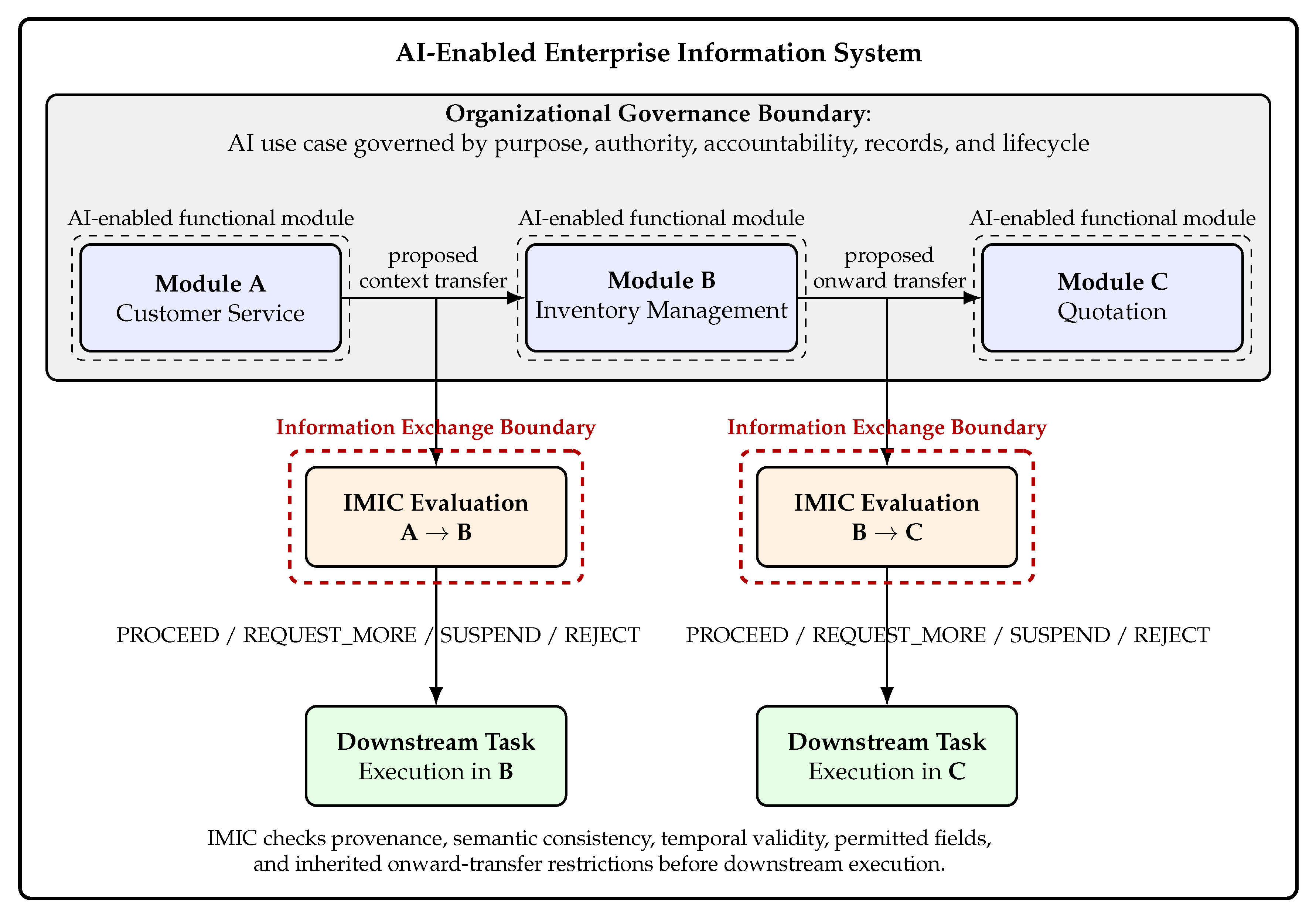
Figure 2.
Detailed architecture of the Inter-Module Information Contract (IMIC) for two-hop information exchange. The same decision engine is invoked separately for the A-to-B and B-to-C transfers. Solid arrows represent the first invocation and downstream execution in Module B, while dashed arrows represent a proposed onward transfer that triggers the second invocation. The second evaluation retains applicable restrictions from the originating contract. Dotted arrows indicate governance metadata and audit evidence rather than direct context transfers. Each invocation independently produces PROCEED, REQUEST_MORE, SUSPEND, or REJECT, and downstream delivery occurs only following PROCEED.
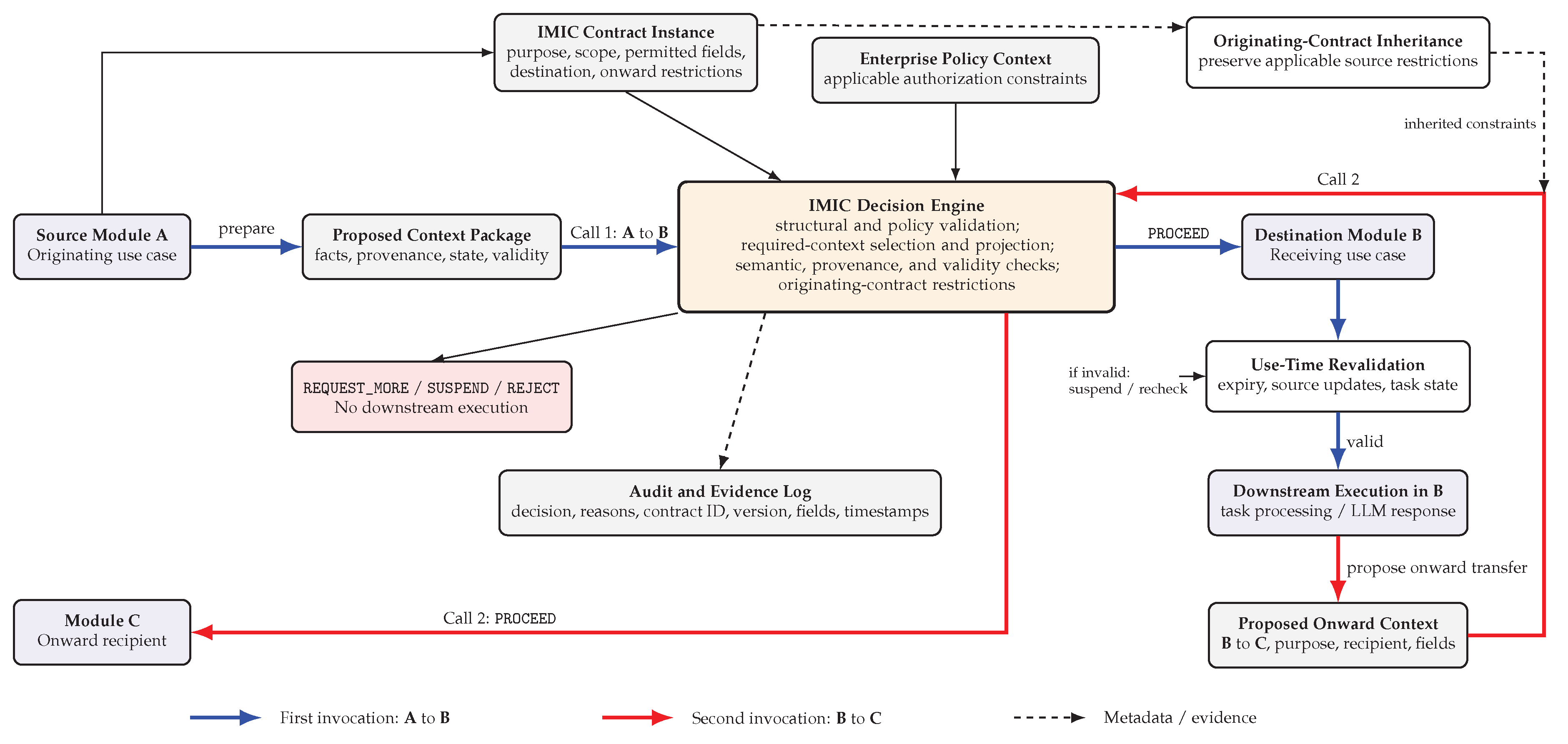

Table 1.
Conceptual distinction between organizational governance and information exchange boundaries.
Table 1.
Conceptual distinction between organizational governance and information exchange boundaries.
| Dimension | Organizational governance boundary | Information exchange boundary |
|---|---|---|
| Governed object | AI-enabled organizational activity or use case | Individual proposed inter-module information transfer |
| Primary concern | Purpose, authority, responsibility, resources, evidence, and lifecycle | Information requirements, permitted use, validity, disclosure scope, and inherited restrictions |
| Temporal character | Persistent across the governed activity’s lifecycle | Evaluated for each proposed transfer |
| Governance mechanism | Organizational, contractual, managerial, and oversight arrangements | Contract-mediated evaluation before downstream execution |
| Relevant question | Who is responsible for governing this activity and under what authority? | May this information be transferred to this recipient for this purpose under the applicable conditions? |
Table 2.
Principal information contract elements in the IMIC prototype.
| Element | Representation | Function |
|---|---|---|
| Exchange identity | Source, destination, task identifier, task state | Identifies the proposed operation and participating modules |
| Purpose and operation | Declared purpose, allowed purposes, allowed operations | Defines the authorized business activity |
| Policy state | Policy identifier, activation status | Identifies the applicable encoded exchange policy |
| Field scope | Allowed fields, task-required attributes | Constrains the attributes used or disclosed |
| Provenance | source_id, source_version | Identifies the recorded source and version of a fact |
| Temporal validity | observed_at, expires_at | Supports evaluation of observation and expiration conditions |
| Information semantics | Value, unit where applicable, information_state | Supports task-specific interpretation and state validation |
| Originating restrictions | General onward permission; permitted onward recipients; permitted onward purposes; permitted onward fields | Determines whether the proposed B-to-C transfer remains within the disclosure conditions established by the originating provider |
Table 3.
Literature-informed automotive scenario and expected IMIC decisions.
| Variant | Originating condition | B-to-C condition | Expected disposition | Interpretation |
|---|---|---|---|---|
| A | External onward disclosure prohibited | Required fields present and valid | REJECT | Immediate task validity cannot override the originating prohibition. |
| B | Approved logistics provider and shortage-mitigation purpose permitted | Recipient, purpose, fields, and validity conditions satisfied | PROCEED | Onward transfer is allowed within the inherited scope. |
| C | Onward disclosure permitted | Capacity information expired before transfer | SUSPEND | Authorization remains valid, but the information is no longer operationally suitable. |
Table 4.
Joint correctness in the deterministic benchmark over 32 synthetic condition variants.
| Method | Joint correct | Percentage |
|---|---|---|
| B1: Full Context | 3/32 | 9.4% |
| B2: Reduced Context | 10/32 | 31.3% |
| B3: Strong Structured Handoff | 28/32 | 87.5% |
| B4: IMIC | 32/32 | 100.0% |
Table 5.
Full-grid downstream LLM integration results across 168 case–model–seed blocks.
| Method | Action correct | Boundary correct | Joint correct |
|---|---|---|---|
| B1: Full Context | 60/168 | 60/168 | 11/168 |
| B2: Reduced Context | 60/168 | 108/168 | 60/168 |
| B3: Strong Structured Handoff | 120/168 | 120/168 | 117/168 |
| B4: IMIC | 168/168 | 168/168 | 165/168 |
Disclaimer/Publisher’s Note: The statements, opinions and data contained in all publications are solely those of the individual author(s) and contributor(s) and not of MDPI and/or the editor(s). MDPI and/or the editor(s) disclaim responsibility for any injury to people or property resulting from any ideas, methods, instructions or products referred to in the content. |
© 2026 by the authors. Licensee MDPI, Basel, Switzerland. This article is an open access article distributed under the terms and conditions of the Creative Commons Attribution (CC BY) license (http://creativecommons.org/licenses/by/4.0/).
Copyright: This open access article is published under a Creative Commons CC BY 4.0 license, which permit the free download, distribution, and reuse, provided that the author and preprint are cited in any reuse.