

Submitted:
28 October 2026
Posted:
28 October 2026
You are already at the latest version
Abstract
Cardiovascular risk communication often requires patients to interpret numerical information about risk and treatment benefits. However, how perceived difficulty interpreting this information relates to health self-efficacy remains unclear. We examined the association between perceived health numeracy difficulty and health self-efficacy among adults with cardiovascular disease (CVD) risk factors and assessed whether accounting for patient–provider communication influenced this association. We analyzed 2022 Health Information National Trends Survey (HINTS) data from 3,961 U.S. adults with ≥1 CVD risk factor. Perceived health numeracy difficulty was categorized as very easy/easy or hard/very hard. Health self-efficacy was assessed using a 5-level measure, and patient–provider communication using a 6-item composite score. Survey-weighted ordered logistic regression adjusted for CVD risk-factor burden and sociodemographic characteristics, with communication added in the final model. Participants were predominantly female (52.8%), non-Hispanic White (64.5%), with a mean age of 50.3 (SE 0.44) years. Complete health self-efficacy was more common among adults reporting easy numeracy than numeracy difficulty (28.9% vs 12.9%; P<0.001). Health numeracy difficulty was associated with lower health self-efficacy (aOR, 0.29; 95% CI, 0.23–0.36). After adjustment for communication, the association was attenuated but remained significant (aOR, 0.37; 95% CI, 0.29–0.46). Better communication was associated with greater health self-efficacy (aOR, 2.31; 95% CI, 1.96–2.74). Clear, personalized communication of numerical CVD risk information may support patients’ confidence and participation in shared decision-making for their cardiovascular health.
Keywords:
Health numeracy
; Health self-efficacy
; Patient–provider communication
; cardiovascular risk factors
; shared decision-making
Background
Cardiovascular disease (CVD) prevention increasingly depends on the ability of patients to interpret numerical risk information (Bakhit et al., 2024). Contemporary guidelines encourage clinicians to present individualized risk estimates derived from validated risk scores and to engage patients as active participants in treatment decisions (Khan et al., 2025) . This shift toward risk-based, shared decision-making has expanded the routine exposure of patients to percentages, probabilities, and other quantitative estimates of cardiovascular risk and treatment benefit (Navar et al., 2018).
Health numeracy, the ability to understand and use numerical information, influences how patients respond to information and may determine how patients interpret risk scores, understand their disease, and make decisions about treatment (Ancker & Kaufman, 2007; Navar et al., 2018). Patients who find numerical information difficult to interpret may struggle to understand their health status, and this difficulty may extend to confidence in self-management. For instance, adults with lower health numeracy may report less confidence navigating medical information and less favorable experience communicating with providers (Chen & Feeley, 2014; Smith et al., 2010) . Health self-efficacy, or patients’ confidence in their capacity to manage health-related tasks and decisions, is a plausible mechanism linking numeracy to downstream engagement in prevention, yet its association with perceived health numeracy difficulty has not been directly examined in the context of cardiovascular risk (Bandura, 1991; Rolison et al., 2020) .
Patients who struggle to interpret quantitative CVD risk may underestimate risk and are likely to be less motivated to initiate treatment, whereas those who overestimate their risk may experience unnecessary anxiety. However, clear explanation of risk estimates, opportunities for patients to ask questions, and communication tailored to individual information needs are associated with better patient understanding and participation in care decisions (Bakhit et al., 2024; Jin et al., 2026; Navar et al., 2018) . Additionally, utilizing visual aids improves the connection between verbal and visual information, which can support behavior and shared decision-making (Ruiz et al., 2013). Additional proven methods of communication include using understandable language and teach-back methods to reinforce understanding of the information discussed. Prior research has also linked the interpersonal context of clinical encounters to patients’ experiences of care. In a study by Cooper et al. (2003), race-concordant visits were longer, characterized by greater positive patient effect, and received higher patient ratings of participatory decision-making than race-discordant visits (Cooper et al., 2003) .
Health literacy plays a vital role as patients are expected to interpret risk estimates and play a role in treatment decisions (Magnani et al., 2018) . Understanding the association between perceived difficulty with health numeracy and health self-efficacy may provide insight into barriers to effective risk management. Patient–provider communication may mitigate or leave unaddressed numeracy-related barriers, influencing whether health numeracy difficulty translates into lower health self-efficacy (Chinn & Lopez, 2026).
The relevance of numeracy to health self-efficacy may also vary with the number of CVD risk factors. Essentially, patients managing multiple risk factors face more complex and more frequent numerical information than those managing a single risk factor. Whether the association between numeracy difficulty and health self-efficacy differs by CVD risk-factor burden is unclear.
The aim of this study was to examine the association between perceived health numeracy difficulty and health self-efficacy and determine whether accounting for patient-provider communication influenced this association.
Methods
Study Design and Population
We conducted a cross-sectional analysis of the 2022 Health Information National Trends Survey (HINTS 6), a nationally representative survey administered by the National Cancer Institute. (Blake et al., 2025; Winston, 2021). HINTS 6 was conducted from March 7 to November 8, 2022, using an address-based sampling approach with both web and paper survey options. One adult aged 18 years or older was selected from each sampled household using the next-birthday method. The survey included 6,252 respondents. Our analysis included adults with at least 1 CVD risk factor and complete information on perceived health numeracy difficulty, health self-efficacy, patient–provider communication and prespecified sociodemographic characteristics. The flow of participant selection is shown in Figure 1.
Measures
Perceived health numeracy difficulty was assessed with the question, “In general, how easy or hard do you find it to understand medical statistics?” Participants could respond very easy, easy, hard, or very hard. For this analysis, responses were grouped as very easy/easy and hard/very hard, with very easy/easy used as the reference group.
Health self-efficacy was assessed with the question, “Overall, how confident are you about your ability to take good care of your health?” Response options were completely confident, very confident, somewhat confident, a little confident, and not confident at all. Responses were analyzed as an ordered 5-level outcome. Higher values indicated greater health self-efficacy. The categories; ‘a little confident’ and ‘not confident at all’ were combined only for descriptive presentation.
Patient–provider communication was assessed with 6 items (Blake et al., 2025). Respondents reported how often during the previous 12 months health professionals gave them an opportunity to ask questions, addressed feelings and emotions, ensured understanding of self-care, explained information clearly, spent enough time with them, and helped with uncertainty about health or health care. Responses ranged from never to always and were coded from 1 to 4. Higher scores indicated more favorable patient-provider communication. The items had high internal consistency (Cronbach α = 0.92) and were averaged to create a composite score. We then transformed the scores to a 0-to-100 scale for descriptive analyses.
Cardiovascular risk-factor burden was based on five modifiable risk factors (hypertension, diabetes, current smoking, physical inactivity, and overweight or obesity). Hypertension and diabetes were identified from self-reported diagnoses. Smoking and physical activity were based on reported health behaviors. Physical inactivity was defined as less than 150 minutes of physical activity per week, and overweight or obesity as a body mass index of 25 kg/m² or greater. Risk factors were summed to generate a cumulative risk factor count, with participants categorized as having 1 (score = 1), 2 (score = 2), or ≥3 (score ≥3) risk factors.
Covariates were selected a priori based on their potential relationships with numeracy, communication, and health self-efficacy. We included age, sex, race and ethnicity, educational attainment, and household income.
Statistical Analysis
All analyses accounted for the complex HINTS survey design with the final survey weights and jackknife replicate weights. Participant characteristics were summarized with unweighted counts and survey-weighted percentages. Characteristics were compared across categories of CVD risk-factor burden.
Survey-weighted ordered logistic regression was used to estimate the association between perceived health numeracy difficulty and health self-efficacy. Model 1 included perceived health numeracy difficulty and CVD risk-factor burden and adjusted for age, sex, race and ethnicity, education, and household income. Model 2 added the patient–provider communication score. Average marginal effects from both models estimated the difference in the probability of complete confidence associated with perceived health numeracy difficulty. The change in the average marginal effect between models was used to describe attenuation after communication adjustment.
We performed additional analyses to examine whether the association between perceived health numeracy difficulty and health self-efficacy differed by individual CVD risk factors, educational attainment, race and ethnicity by testing separate interaction terms in the fully adjusted model.
Sensitivity analyses additionally adjusted for established heart disease, excluded participants with established heart disease, and modeled CVD risk-factor burden as a continuous measure.
Analyses were performed with Stata/MP version 19.0 (StataCorp LLC). All tests were 2-sided. P < .05 indicated statistical significance.
Study Approval
This study was deemed exempt from Institutional Review Board approval given that HINTS data is publicly available and includes deidentified data.
Results
Study Population and Sociodemographic Characteristics
Among 6,252 HINTS 6 respondents, sequential exclusions for incomplete CVD risk-factor, perceived health numeracy, health self-efficacy, patient–provider communication, and demographic/socioeconomic data yielded a final analytic sample of 3,961 adults with at least 1 CVD risk factor (Supplementary Table S1, Figure 1). Of these, 1,200 were classified as less confident and 2,761 as confident in their ability to take good care of their health. Participant characteristics by health self-efficacy are shown in Table 1.
Participants were predominantly female (52.8%), non-Hispanic White (64.5%), with a mean age of 50.3 (SE 0.44) years. Education and household income differed significantly by health self-efficacy status. Adults who rated their health self-efficacy level as confident were more likely to have a college education or higher (36.3% vs. 28.5%; p=0.021) and a household income of at least $75,000 (50.5% vs. 39.9%; p<0.001) than those who were less confident. CVD risk-factor burden also differed markedly by health self-efficacy status (p<0.001): those in less-confident group were more likely to have 3 or more risk factors (46.4% vs. 32.1%), whereas adults who reported confident self-efficacy status were more likely to report only 1 risk factor (33.6% vs. 18.2%). Perceived health numeracy difficulty was more common among those in less confident group than the confident group (42.2% vs. 17.0%; p<0.001). Age, sex, and race and ethnicity did not differ significantly by self-efficacy status.
Perceived Health Numeracy Difficulty, Health Self-Efficacy and Patient–Provider Communication
Health self-efficacy differed significantly by perceived health numeracy (Figure 2A; p<0.001). About 25% of participants reported that understanding medical statistics was hard or very hard, whereas 74.9% reported that it was easy or very easy. Adults who found medical statistics easy or very easy to understand were more than twice as likely to report being completely confident in their ability to take good care of their health compared with those who found them hard or very hard to understand (28.9% vs. 12.9%). Conversely, those who found medical statistics hard or very hard to understand were more likely to report being only somewhat confident (40.2% vs. 20.6%) or a little/not at all confident (13.5% vs. 3.9%).
Adults with perceived health numeracy difficulty had a lower mean communication score than those without difficulty (68.6 vs. 79.9; p<0.001). Differences were present across all 6 communication domains (all p<0.001) (Supplementary Table S2, Figure 2B). Adults with perceived health numeracy difficulty were less likely to report that health professionals always explained information clearly (41.1% vs. 66.4%), gave them an opportunity to ask questions (43.0% vs. 64.4%), ensured they understood next steps for self-care (39.0% vs. 63.2%), addressed their feelings (34.4% vs. 48.0%), spent enough time with them (24.7% vs. 46.3%), or helped them cope with uncertainty about their health (26.2% vs. 46.1%).
Association Between Perceived Health Numeracy Difficulty and Health Self-Efficacy
Perceived health numeracy difficulty was associated with lower health self-efficacy (Table 2). After adjustment for CVD risk-factor burden and sociodemographic characteristics, adults who found medical statistics hard or very hard to understand had lower odds of being in a higher health self-efficacy category than adults who found them very easy or easy to understand (adjusted odds ratio [aOR] 0.29; 95% CI 0.23–0.36, P < .001). After adjustment for patient–provider communication, the association was attenuated but remained significant (aOR, 0.37; 95% CI 0.29–0.46, P < .001). Better patient–provider communication was independently associated with greater health self-efficacy (aOR, 2.31; 95% CI, 1.96–2.74; P<.001).
The adjusted difference in the probability of complete confidence narrowed from −18.1 percentage points (95% CI −21.2 to −15.0) to −14.8 percentage points (95% CI −17.9 to −11.7). Each 1-point increase in the communication score was associated with greater odds of higher health self-efficacy (aOR, 2.31; 95% CI 1.96–2.74, P < .001) Table 2. (Figure 3).
Adjusted probabilities of complete health self-efficacy were lower among adults with perceived health numeracy difficulty across all three cardiovascular risk-factor burden categories (Figure 4).
Secondary and Sensitivity Analyses
The association between perceived health numeracy difficulty and health self-efficacy remained almost unchanged after additional adjustment for established heart disease (aOR, 0.37; 95% CI, 0.29-0.47), after exclusion of adults with established heart disease (aOR, 0.38; 95% CI, 0.30-0.49), and when CVD risk-factor burden was modeled continuously (aOR, 0.37; 95% CI, 0.29-0.47) (Supplemental Table S3).
Perceived health numeracy difficulty was associated with a lower probability of complete confidence in every individual CVD risk-factor subgroup. Among adults without the respective risk factors, adjusted differences ranged from −11.2 to −14.5 percentage points. Among those with the risk factor, differences ranged from −15.2 to −18.0 percentage points. The associations did not differ significantly by hypertension, diabetes, overweight or current smoking, or physical inactivity (interaction P=.056-.482). The association did not differ significantly by educational attainment (interaction P = .184) or race and ethnicity (interaction P = .129) Supplementary Table S4)
Discussion
In this nationally representative sample of adults with cardiovascular risk factors, difficulty understanding medical statistics was strongly associated with lower health self-efficacy. Adults who found medical statistics hard or very hard to understand had 71% lower odds of reporting higher self-efficacy, and they described less favorable patient–provider communication across all six communication domains assessed. This association persisted after adjustment for age, sex, race and ethnicity, education, household income, and cardiovascular risk-factor burden. However, accounting for patient–provider communication attenuated the association further, though it remained significant. This attenuation suggests that patient–provider communication may contribute to the observed association, although the cross-sectional design precludes conclusions about mediation.
Our findings extend earlier work linking numeracy to confidence in managing health, where greater confidence in health numeracy has been associated with higher health self-efficacy and more favorable health information-seeking experiences (Chen & Feeley, 2014; Smith et al., 2010). Our findings help to explain part of this relationship within the clinical encounter itself. Adults with numeracy difficulty were less likely to report that clinicians explained things clearly, gave them room to ask questions, helped them manage uncertainty, or made sure they understood what to do next, a pattern consistent with earlier studies linking lower subjective numeracy to less favorable perceptions of provider communication (Ciampa et al., 2010) . This pattern also suggests that poor provider-patient communication may be one pathway linking numeracy difficulty to lower self-efficacy. Difficulty with numerical information appears tied both to how confident patients feel managing their health and to how they experience the clinical encounter that shapes that confidence.
Perceived health numeracy difficulty may capture something beyond numerical skill itself. Confidence in understanding medical statistics has been shown to be only weakly related to performance on objective tests of data interpretation (Woloshin et al., 2005), and the measure used here is explicitly a subjective one, capturing how difficult respondents find medical statistics rather than how well they perform on them. Numerical information pervades nearly every point of contact with the health system, from laboratory results and medication instructions to portal messages, home monitoring, and estimates of future disease risk (Ancker & Kaufman, 2007) , leaving many opportunities for numeracy difficulty to undermine confidence outside any single conversation with a provider. However, it is worth noting that general health literacy was not measured in this study and may overlap with perceived health numeracy difficulty in ways that contribute to the residual association.
Communication remained strongly tied to health self-efficacy. In this study, each one-point increase in communication score was associated with more than twice the odds of greater self-efficacy, which is consistent with prior HINTS findings that patient-centered communication predicts greater confidence in managing health (Finney Rutten et al., 2016). This is particularly important for cardiovascular prevention, where risk is often expressed numerically and not always interpreted as clinicians intend. The context in which cardiovascular risk is discussed has been shown to shape how patients understand it (Lorenc et al., 2024). A risk estimate framed as a percentage chance of a future event, for instance, can be understood very differently depending on whether it is presented alongside a comparison, a visual aid, or a discussion of what the number means for a patient’s own treatment choices. Prevention increasingly relies on quantitative risk tools such as the American Heart Association’s PREVENT equations, which estimate 10- and 30-year risk from cardiovascular, kidney, and metabolic factors to guide primary-prevention discussions (Khan et al., 2025; Ndumele et al., 2023) ; a precise risk estimate is only as useful as a patient’s ability to understand what it means and what to do about it. The association between numeracy difficulty and lower health self-efficacy was consistent across cardiovascular risk factors, with no significant interactions by hypertension, diabetes, overweight, current smoking, or physical inactivity. These findings suggest that numeracy difficulty may represent a broader barrier to health self-efficacy rather than one specific to individual cardiovascular risk factors. Accordingly, strategies that simplify numerical health information may benefit adults across a range of cardiovascular risk profiles.
Finally, when we excluded adults with established heart disease, the association between numeracy difficulty and lower health self-efficacy remained similar. This suggests that numeracy difficulty is not simply a byproduct of living with a diagnosed illness, but a barrier that operates on its own terms, independent of disease status. For instance, a person recently diagnosed with heart failure and a person with no cardiovascular diagnosis at all who both find medical statistics hard to understand appear equally likely to have low confidence in managing their health. This timing matters practically and carries implications for patient–provider communication. Health self-efficacy is thought to shape whether someone acts on health information in the first place, not just follow from having acted on it, so a barrier already in place before disease develops may be quietly shaping decisions at the point where prevention still has the most room to work. There is therefore a need to intentionally build mechanisms into patient–provider communication that support patients with numeracy difficulty regardless of their diagnostic status, rather than reserving that support for those already living with disease.
Study Limitations
This study has several limitations. The cross-sectional design precludes assessment of temporality or causal relationships. Therefore, the attenuation after adjustment for communication should not be interpreted as evidence of mediation. Numeracy difficulty, patient–provider communication, health self-efficacy, and CVD risk factors were self-reported and may be subject to recall or reporting error. The numeracy measure reflects perceived difficulty understanding medical statistics rather than objectively measured numeracy. General health literacy was not measured and could not be separated from perceived health numeracy difficulty, leaving open the possibility that part of the observed association reflects broader literacy-related barriers rather than numeracy specifically.
Conclusions
Perceived health numeracy difficulty was associated with lower health self-efficacy among U.S. adults with cardiovascular risk factors. More favorable patient–provider communication was associated with greater health self-efficacy and modestly attenuated the association with numeracy difficulty. As cardiovascular prevention relies increasingly on quantitative risk estimates, attention to how numerical information is communicated may help patients understand and participate in decisions about their care. Prospective studies are needed to determine whether communication strategies tailored to numerical information improve risk understanding, health self-efficacy, and engagement in cardiovascular prevention.
Supplementary Materials
The following supporting information can be downloaded at the website of this paper posted on Preprints.org.
Disclosure Statement: No potential conflict of interest was reported by the author(s).
Funding
The author(s) reported there is no funding associated with the work featured in this article.
References
- Ancker, J. S.; Kaufman, D. Rethinking Health Numeracy: A Multidisciplinary Literature Review. J. Am. Med. Inform. Assoc. 2007, 14(6). [Google Scholar] [CrossRef]
- Bakhit, M.; Fien, S.; Abukmail, E.; Jones, M.; Clark, J.; Scott, A. M.; Glasziou, P.; Cardona, M. Cardiovascular disease risk communication and prevention: a meta-analysis. Eur. Heart J. 2024, Vol. 45, Number 12. [Google Scholar] [CrossRef]
- Bandura, A. Social cognitive theory of self-regulation. Organ. Behav. Hum. Decis. Process. 1991, 50(2). [Google Scholar] [CrossRef]
- Blake, K. D.; Moser, R. P.; D’Angelo, H.; Gaysynsky, A.; Vanderpool, R. C. The evolution of NCI’s Health Information National Trends Survey: methods, data, and future directions. J. Natl. Cancer Inst. 2025, Vol. 117, Number 6. [Google Scholar] [CrossRef]
- Chen, Y.; Feeley, T. H. Numeracy, Information Seeking, and Self-Efficacy in Managing Health: An Analysis Using the 2007 Health Information National Trends Survey (HINTS). Health Commun. 2014, 29(9). [Google Scholar] [CrossRef]
- Chinn, L. W.; Lopez, J. R. Health literacy, numeracy, and preoperative preparation and communication: A narrative review of evidence and practice. In Perioperative Care and Operating Room Management; 2026; Vol. 43. [Google Scholar] [CrossRef]
- Ciampa, P. J.; Osborn, C. Y.; Peterson, N. B.; Rothman, R. L. Patient numeracy, perceptions of provider communication, and colorectal cancer screening utilization. J. Health Commun. 2010, 15 (SUPPL. 3). [Google Scholar] [CrossRef]
- Cooper, L. A.; Roter, D. L.; Johnson, R. L.; Ford, D. E.; Steinwachs, D. M.; Powe, N. R. Patient-Centered Communication, Ratings of Care, and Concordance of Patient and Physician Race. Ann. Intern. Med. 2003, 139(11). [Google Scholar] [CrossRef]
- Finney Rutten, L. J.; Hesse, B. W.; St. Sauver, J. L.; Wilson, P.; Chawla, N.; Hartigan, D. B.; Moser, R. P.; Taplin, S.; Glasgow, R.; Arora, N. K. Health Self-Efficacy Among Populations with Multiple Chronic Conditions: the Value of Patient-Centered Communication. Adv. Ther. 2016, 33(8). [Google Scholar] [CrossRef]
- Jin, Y.; Qiu, Y.; Zhang, Q.; Allan, L. P.; Bam, K.; Guo, Z.; Olaiya, M. T.; Yao, M.; Cadilhac, D. A.; Lin, B. The effectiveness of eHealth-based cardiovascular disease risk communication: a systematic review and meta-analysis. npj Digit. Med. 2026, 9(1). [Google Scholar] [CrossRef]
- Khan, S. S.; Breathett, K.; Braun, L. T.; Chow, S. L.; Gupta, D. K.; Lekavich, C.; Lloyd-Jones, D. M.; Ndumele, C. E.; Rodriguez, C. J.; Allen, L. A. Risk-Based Primary Prevention of Heart Failure: A Scientific Statement From the American Heart Association. Circulation 2025, Vol. 151, Number 20. [Google Scholar] [CrossRef]
- Lorenc, T.; Stokes, G.; Fulbright, H.; Sutcliffe, K.; Sowden, A. Communicating cardiovascular risk: Systematic review of qualitative evidence. Patient Educ. Couns. 2024, 123. [Google Scholar] [CrossRef]
- Magnani, J. W.; Mujahid, M. S.; Aronow, H. D.; Cené, C. W.; Dickson, V. V.; Havranek, E.; Morgenstern, L. B.; Paasche-Orlow, M. K.; Pollak, A.; Willey, J. Z. Health Literacy and Cardiovascular Disease: Fundamental Relevance to Primary and Secondary Prevention: A Scientific Statement From the American Heart Association. Circulation 2018, Vol. 138, Number 2. [Google Scholar] [CrossRef]
- Navar, A. M.; Wang, T. Y.; Mi, X.; Robinson, J. G.; Virani, S. S.; Roger, V. L.; Wilson, P. W. F.; Goldberg, A. C.; Peterson, E. D. Influence of Cardiovascular Risk Communication Tools and Presentation Formats on Patient Perceptions and Preferences. JAMA Cardiol. 2018, 3(12). [Google Scholar] [CrossRef]
- Ndumele, C. E.; Rangaswami, J.; Chow, S. L.; Neeland, I. J.; Tuttle, K. R.; Khan, S. S.; Coresh, J.; Mathew, R. O.; Baker-Smith, C. M.; Carnethon, M. R.; Despres, J. P.; Ho, J. E.; Joseph, J. J.; Kernan, W. N.; Khera, A.; Kosiborod, M. N.; Lekavich, C. L.; Lewis, E. F.; Lo, K. B.; …; Elkind, M. S. V. Cardiovascular-Kidney-Metabolic Health: A Presidential Advisory from the American Heart Association. Circulation 2023, Vol. 148, Number 20. [Google Scholar] [CrossRef]
- Rolison, J. J.; Morsanyi, K.; Peters, E. Understanding Health Risk Comprehension: The Role of Math Anxiety, Subjective Numeracy, and Objective Numeracy. Med. Decis. Mak. 2020, 40(2). [Google Scholar] [CrossRef]
- Ruiz, J. G.; Andrade, A. D.; Garcia-Retamero, R.; Anam, R.; Rodriguez, R.; Sharit, J. Communicating global cardiovascular risk: Are icon arrays better than numerical estimates in improving understanding, recall and perception of risk? Patient Educ. Couns. 2013, 93(3). [Google Scholar] [CrossRef]
- Smith, S. G.; Wolf, M. S.; Wagner, C. Von. Socioeconomic status, statistical confidence, and patient-provider communication: An analysis of the Health Information National Trends Survey (HINTS 2007). J. Health Commun. 2010, 15 (SUPPL. 3). [Google Scholar] [CrossRef]
- Winston, S. Health Information National Trends Survey (HINTS.gov). Med. Ref. Serv. Q. 2021, 40(2). [Google Scholar] [CrossRef]
- Woloshin, S.; Schwartz, L. M.; Welch, H. G. Patients and medical statistics: Interest, confidence, and ability. J. General. Intern. Med. 2005, 20(11). [Google Scholar] [CrossRef]
Figure 1.
Participant flow chart for the final analytic sample. HINTS 6 is the Health Information National Trends Survey, cycle 6. Percentages are survey weighted.
Figure 1.
Participant flow chart for the final analytic sample. HINTS 6 is the Health Information National Trends Survey, cycle 6. Percentages are survey weighted.
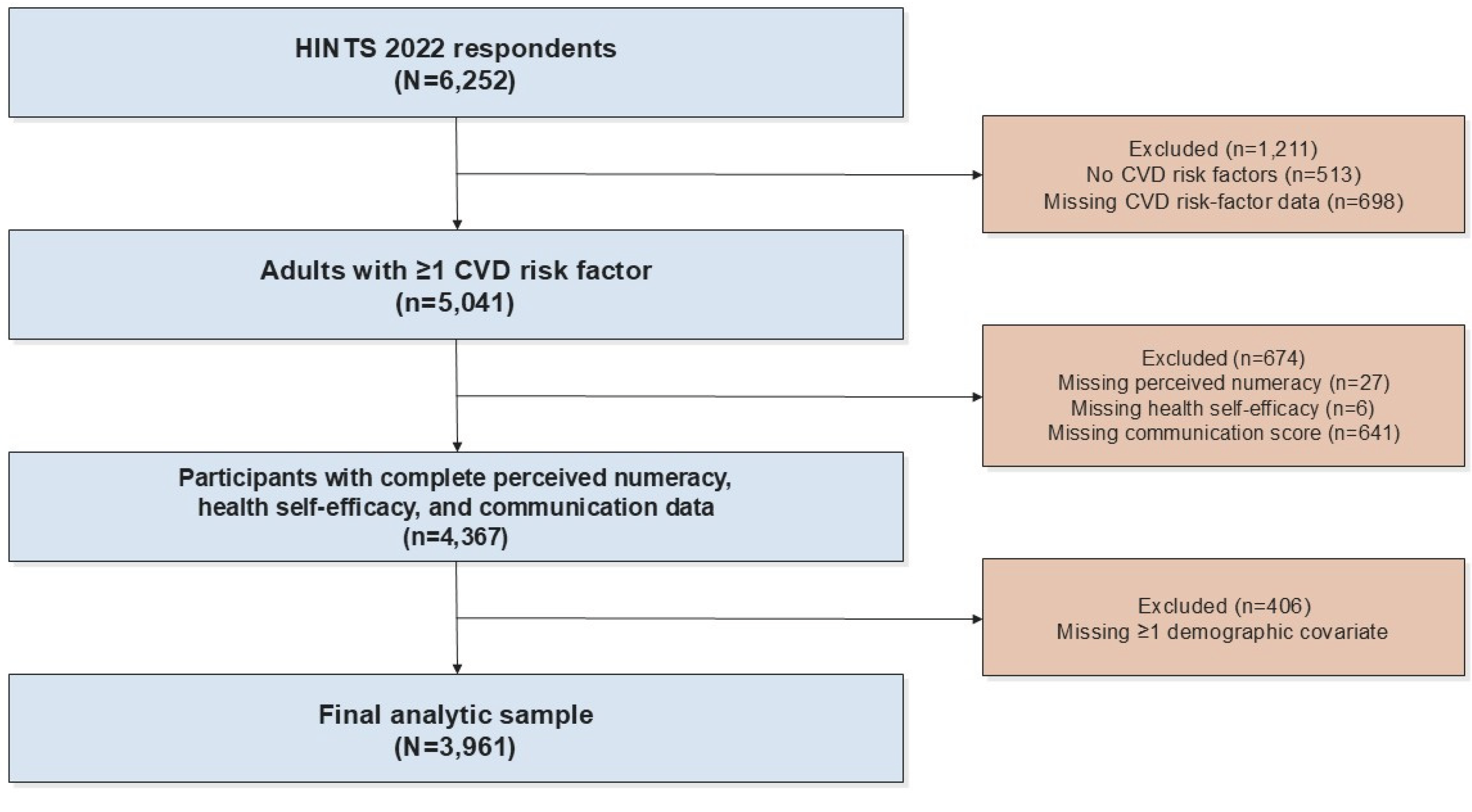
Figure 2.
Health self-efficacy and patient-provider communication by perceived health numeracy difficulty. Health self-efficacy (A) and patient–provider communication (B) by perceived health numeracy difficulty. Percentages are survey weighted; sample sizes are unweighted.
Figure 2.
Health self-efficacy and patient-provider communication by perceived health numeracy difficulty. Health self-efficacy (A) and patient–provider communication (B) by perceived health numeracy difficulty. Percentages are survey weighted; sample sizes are unweighted.
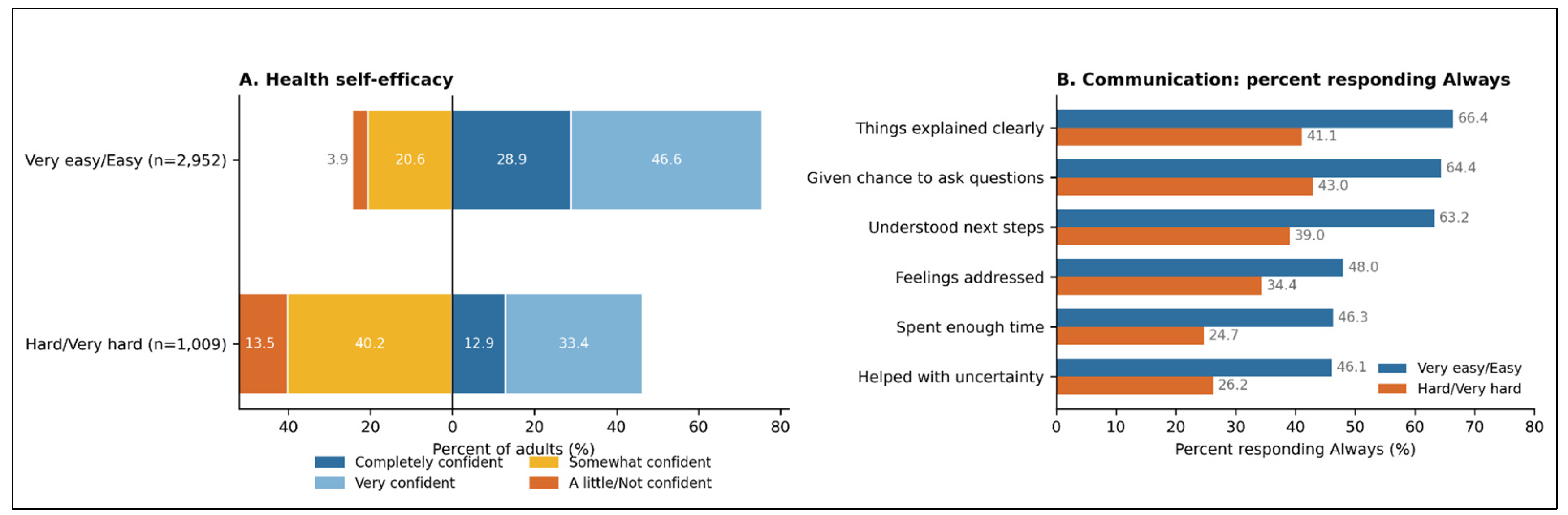
Figure 3.
Attenuation of the association between perceived health numeracy difficulty and health self-efficacy after adjustment for patient–provider communication. Points represent adjusted probability differences in complete health self-efficacy for adults reporting hard/very hard versus very easy/easy numeracy; bars indicate 95% confidence intervals. Model 1 adjusts for cardiovascular risk-factor burden and sociodemographic characteristics. Model 2 additionally adjusts for patient–provider communication.
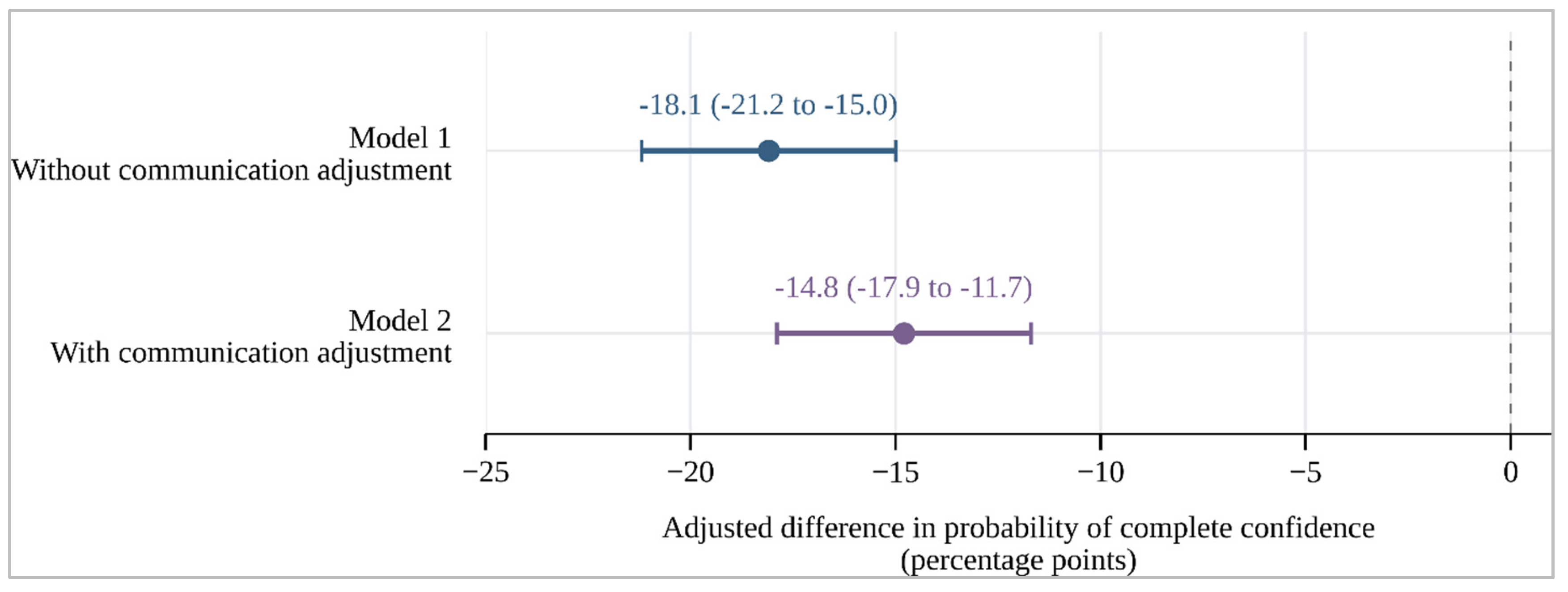
Figure 4.
Confidence by numeracy difficulty and cardiovascular risk burden. Probabilities are adjusted for communication score, age, sex, race and ethnicity, education, and household income. Shaded bands are 95% confidence intervals.
Figure 4.
Confidence by numeracy difficulty and cardiovascular risk burden. Probabilities are adjusted for communication score, age, sex, race and ethnicity, education, and household income. Shaded bands are 95% confidence intervals.
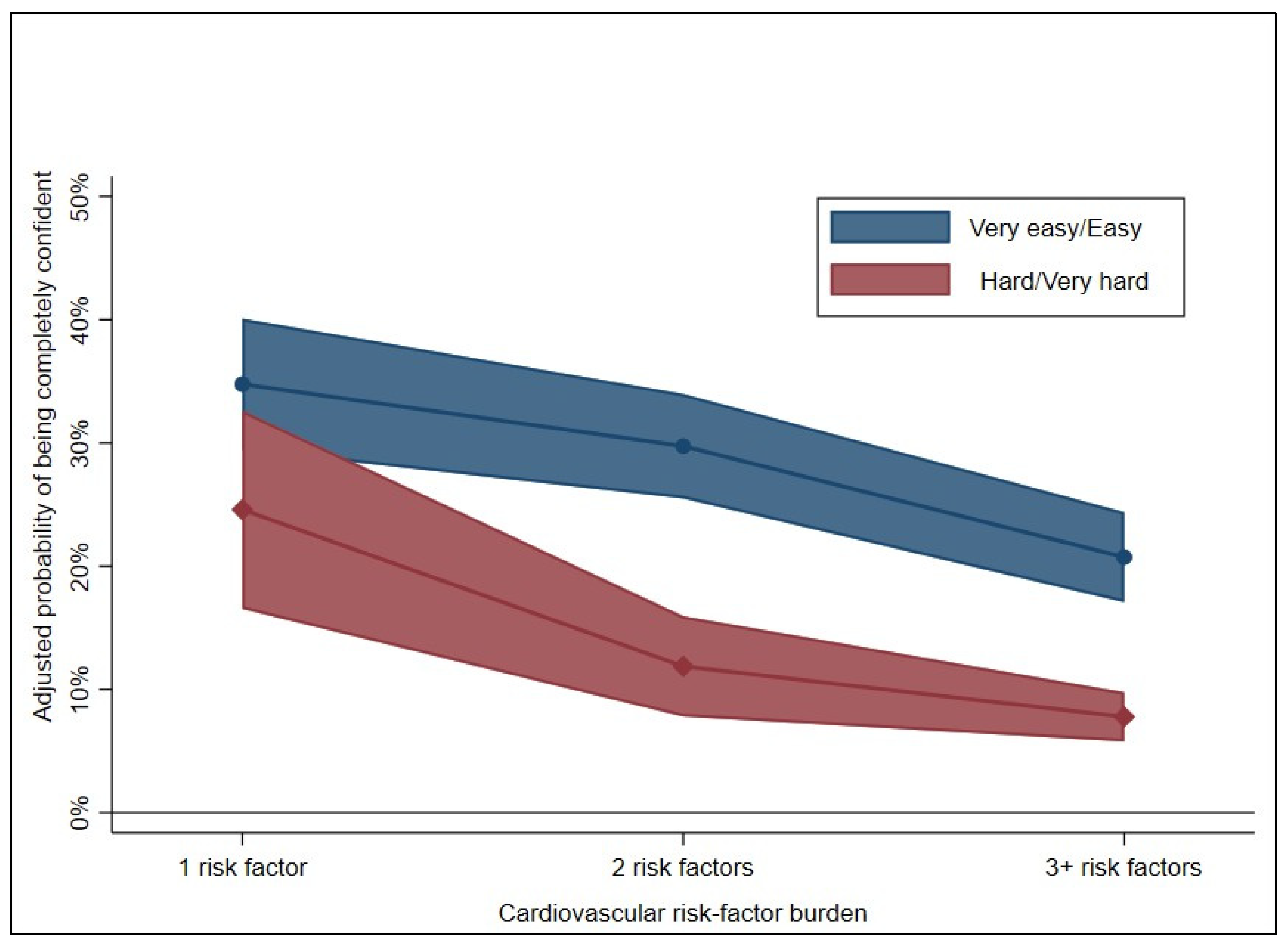

Table 1.
Participant Characteristics by Health Self-Efficacy.
| Characteristic | Overall, N=3,961 n (weighted %) |
Less confident, N=1,200 n (weighted %) |
Confident, N=2,761 n (weighted %) |
P value |
|---|---|---|---|---|
| Age, mean (SE), y | 50.3 (0.44) | 50.1 (0.88) | 50.4 (0.57) | 0.824 |
| Age, y | 0.538 | |||
| 18–44 | 1,078 (38.04) | 352 (39.99) | 726 (37.13) | |
| 45–64 | 1,447 (39.47) | 447 (38.82) | 1,000 (39.78) | |
| ≥65 | 1,436 (22.49) | 401 (21.20) | 1,035 (23.09) | |
| Sex | 0.284 | |||
| Male | 1,560 (47.20) | 494 (49.24) | 1,066 (46.25) | |
| Female | 2,401 (52.80) | 706 (50.76) | 1,695 (53.75) | |
| Race/ethnicity | 0.565 | |||
| Non-Hispanic White | 2,314 (64.51) | 684 (64.55) | 1,630 (64.49) | |
| Non-Hispanic Black/African American | 664 (11.84) | 180 (10.38) | 484 (12.52) | |
| Hispanic | 662 (14.61) | 214 (14.51) | 448 (14.65) | |
| Non-Hispanic Asian | 184 (4.34) | 77 (5.44) | 107 (3.84) | |
| Non-Hispanic Other | 137 (4.70) | 45 (5.12) | 92 (4.51) | |
| Education | 0.021 | |||
| Less than high school | 203 (5.02) | 90 (7.06) | 113 (4.07) | |
| High school graduate | 677 (20.94) | 234 (22.59) | 443 (20.17) | |
| Some college | 1,171 (40.26) | 390 (41.90) | 781 (39.49) | |
| College or more | 1,910 (33.78) | 486 (28.45) | 1,424 (36.26) | |
| Household income | <0.001 | |||
| <$35,000 | 1,115 (23.09) | 414 (25.82) | 701 (21.81) | |
| $35,000–<$75,000 | 1,221 (29.82) | 399 (34.33) | 822 (27.72) | |
| ≥$75,000 | 1,625 (47.09) | 387 (39.85) | 1,238 (50.47) | |
| CVD risk-factor burden | <0.001 | |||
| 1 risk factor | 985 (28.68) | 197 (18.22) | 788 (33.56) | |
| 2 risk factors | 1,339 (34.71) | 371 (35.40) | 968 (34.39) | |
| ≥3 risk factors | 1,637 (36.61) | 632 (46.38) | 1,005 (32.05) | |
| Perceived health numeracy | <0.001 | |||
| Very easy/Easy | 2,952 (74.96) | 689 (57.77) | 2,263 (82.99) | |
| Hard/Very hard | 1,009 (25.04) | 511 (42.23) | 498 (17.01) |
Note. Values are presented as unweighted n (survey-weighted %). Abbreviation: CVD, cardiovascular disease.
Table 2.
Multivariable Associations of Perceived Health Numeracy Difficulty, Cardiovascular Risk-Factor Burden, and Patient-Provider Communication with Health Self-Efficacy.
Table 2.
Multivariable Associations of Perceived Health Numeracy Difficulty, Cardiovascular Risk-Factor Burden, and Patient-Provider Communication with Health Self-Efficacy.
| Variable | Model 1 aOR (95% CI) |
P value | Model 2 aOR (95% CI) |
P value |
|---|---|---|---|---|
| Perceived health numeracy difficulty | ||||
| Very easy/Easy | Reference | Reference | ||
| Hard/Very hard | 0.29 (0.23-0.36) | <.001 | 0.37 (0.29-0.46) | <.001 |
| Cardiovascular risk-factor burden | ||||
| 1 CVD risk factor | Reference | Reference | ||
| 2 CVD risk factors | 0.65 (0.51-0.84) | .001 | 0.67 (0.52-0.86) | .002 |
| 3+ CVD risk factors | 0.40 (0.31-0.53) | <.001 | 0.40 (0.31-0.53) | <.001 |
| Patient-provider communication score (1-4), per 1-point increase | - | - | 2.31 (1.96-2.74) | <.001 |
| Marginal effect of perceived health numeracy difficulty on complete health self-efficacy | ||||
| Hard/Very hard vs Very easy/Easy, percentage points (95% CI) | -18.1 (-21.2 to -15.0) | <.001 | -14.8 (-17.9 to -11.7) | <.001 |
Note. aOR, adjusted odds ratio; CI, confidence interval. Model 1 adjusts for (age, sex, race/ethnicity, education, and household income). Model 2: Model 1+ patient-provider communication score.
Disclaimer/Publisher’s Note: The statements, opinions and data contained in all publications are solely those of the individual author(s) and contributor(s) and not of MDPI and/or the editor(s). MDPI and/or the editor(s) disclaim responsibility for any injury to people or property resulting from any ideas, methods, instructions or products referred to in the content. |
© 2026 by the authors. Licensee MDPI, Basel, Switzerland. This article is an open access article distributed under the terms and conditions of the Creative Commons Attribution (CC BY) license (http://creativecommons.org/licenses/by/4.0/).
Copyright: This open access article is published under a Creative Commons CC BY 4.0 license, which permit the free download, distribution, and reuse, provided that the author and preprint are cited in any reuse.