

Submitted:
27 October 2026
Posted:
28 October 2026
You are already at the latest version
Preprints on COVID-19 and SARS-CoV-2
Abstract
Mycoplasma pneumoniae (MP) infects tens of millions of children in an epidemic year, yet registers as a rounding error in the mortality metrics by which global health allocates resources. We audited this invisibility by triangulating three evidence streams: six national and multinational surveillance systems; a M. pneumoniae–specific secondary analysis of Global Burden of Disease (GBD) 2023 data; and GBD-derived counterfactual projections of the 2023 resurgence extrapolated from pre-pandemic epidemic cycles. Under non-pharmaceutical interventions (NPIs), MP disappeared more completely and for longer than influenza or RSV; it returned along a policy-timed interval gradient — 6–7 months after NPI relaxation in China, 21–22 months in Japan — exceeding the no-COVID counterfactual projection by 19.2%, breaching its upper prediction interval. Modeled MP mortality in children aged 0–19 years (26,382 deaths, 95% uncertainty interval (UI) 18,984–36,012; ninth of 26 modeled lower respiratory infection (LRI) etiologies) concentrated where measurement is absent: 81.6% of estimated deaths in sub-Saharan Africa and South Asia, while infections peak at school ages where death is rarest — an infection–mortality dissociation that no single instrument of global health accounting can see. Chronic sequelae compound the omission: bronchiolitis obliterans developed in 7.3% of the largest post-pneumonia follow-up cohort, converting a survivable infection into decades of disability invisible to mortality-weighted metrics. The 2023–2024 resurgence was not an anomaly but an audit finding — a structural failure of measurement, not of biology. We propose five corrections with named institutional owners: MP-specific sentinel surveillance, sequelae-weighted burden metrics, resistance-stewardship infrastructure, diagnostic adoption standards, and vaccine prioritization.
Keywords:
Mycoplasma pneumoniae
; COVID-19
; infection–mortality dissociation
; surveillance
; counterfactual excess
; macrolide resistance
; bronchiolitis obliterans
; global burden of disease
1. Introduction
In the winter of 2023–2024, pediatric wards from Beijing to Berlin filled with children whose radiographs showed the dense infiltrates of Mycoplasma pneumoniae (hereafter MP) pneumonia; in the mortality ledgers by which the world allocates health resources, almost none of it registered. This review is about that gap — a pathogen that infects tens of millions of children in an epidemic year yet, measured by the instruments global health trusts most, barely exists. The resurgence has been chronicled country by country; what has not been done is to quantify the return against pre-pandemic baselines, to reconcile the surveillance record with modeled mortality, and to explain why a pathogen of this scale escapes health-system accounting. We do all three, treating the pandemic as a controlled perturbation — three years of near-total suppression followed by release — and reading the response across six national surveillance systems and a M. pneumoniae–specific secondary analysis of GBD 2023 data. The result is an audit with a single diagnosis: infection–mortality dissociation, the structural uncoupling of where MP infects from where it kills, which rendered the pathogen invisible before, during, and after its largest modern epidemic.
Before 2020, MP was already the leading cause of community-acquired pneumonia in school-age children, cycling through epidemics every three to seven years (1, 2): the most frequently detected pathogen in Chinese hospital-based childhood CAP series (32.4–56.6%) (3, 4), present in 8% of U.S. children hospitalized with CAP in the landmark EPIC study but 19% of those aged five and older (2), and a fixture of Japan’s uninterrupted four-decade surveillance record (12, 18, 19). The organism is cell-wall-deficient, intrinsically resistant to all beta-lactams, adapted to the close-contact ecology of schools, and — critically for everything that follows — almost never fatal in the age group it infects most.
The pandemic then performed an experiment no ethics board would have approved: it switched off transmission of an endemic pathogen for nearly three years, and switched it back on. Under non-pharmaceutical interventions (NPIs), MP vanished from surveillance systems on four continents with a completeness that influenza and respiratory syncytial virus (RSV) never matched (5–8); when restrictions lifted, it returned along a staggered timetable set by the calendar of policy rather than the biology of the organism (7–9, 11). The ESGMAC Mycoplasma pneumoniae Surveillance (MAPS) network documented this disappearance and return with remarkable foresight (5–8, 47, 60), and the MAPS transmission-modeling analysis attributes much of the delay to MP’s long incubation (47); what remains undone is quantifying the return against pre-pandemic counterfactual baselines and reconciling it with modeled mortality — the entry point this review takes to a deeper structural question.
That question is not why did MP come back — the immunity-debt hypothesis answers that adequately (10) — but why a pathogen of this magnitude had to return at epidemic scale before anyone was obliged to count it.
The gap is threefold. First, the resurgence literature is descriptive: country-by-country reports that establish that MP returned without quantifying by how much, because no one had maintained the baselines. Second, the burden and surveillance literatures have never been reconciled: modeled mortality and observed incidence occupy separate journals and separate policy conversations, so that no reader ever sees the two curves on one page. Third, the chronic dimension — the sequelae that convert an acute, survivable pneumonia into decades of impaired lung function — is absent from every burden framework. This review closes all three gaps with a single analytical device: an audit of what the ledgers of global health recorded at each stage of the perturbation.
We term that invisibility infection–mortality dissociation: the structural uncoupling between where a pathogen’s infections concentrate (school-age children) and where its deaths concentrate (children under five, predominantly in settings without pathogen-specific surveillance) (Figure 1). The dissociation has four faces, each named and quantified below:
• a surveillance–burden inversion (the regions that measure MP least are those where its estimated mortality concentrates);
• a counterfactual excess (the 2023 resurgence overshot pre-pandemic-cycle projections by 19.2%, breaching the upper prediction interval);
• a delayed re-emergence interval gradient (the interval between NPI relaxation and MP return tracked policy timing, not pathogen biology);
• a COVID–MP niche seesaw (the two pathogens alternated occupancy of the respiratory niche with a measurable inverse correlation).
Each term is a ledger entry. Together they compose an audit of how global health accounting failed a pathogen it never learned to see.
The refrain of this review is simple, and it will recur in variation: a disease that does not kill does not count; what does not count is not measured, funded, followed up, stewarded, or prevented. Section by section, we will substitute each verb.
2. Analytical Framework and Evidence Base
This review triangulates three evidence streams. First, prospective and notifiable-reporting surveillance: Denmark’s laboratory-notifiable nationwide reporting (MiBa) — the only country with nationwide case capture, though completeness depends on testing practice; China’s CDC sentinel surveillance (90 consecutive weeks, Week 46 of 2024 onward); the ESGMAC MAPS network spanning 29 countries; Japan’s NESID; U.S. CDC surveillance networks; and Scotland’s CARI program (5–9, 11–14). Second, modeled burden estimates: the GBD lower respiratory infection (LRI) etiological-fraction framework (15), applied in the authors’ MP-specific secondary analysis of GBD 2023 data (IHME GBD Results Tool), which we use to decompose and report MP-specific LRI mortality at ages 0–19 years at a granularity not previously published from the GBD results (16; Figure 2). Third, counterfactual estimates: GBD-derived analyses in which a no-COVID counterfactual baseline is extrapolated from pre-pandemic epidemic cycles and estimated 2023 outcomes are compared against the projection interval (16; Supplementary Methods). Throughout, we maintain a strict separation between reported/observed data (surveillance systems) and estimated/modeled data (GBD), flagging the provenance of every key figure in the text and in the heterogeneity disclosure table (Table S3).
The literature component followed a structured narrative-review protocol, reported in full in the Supplementary Methods. Surveillance provenance is graded in three tiers — laboratory-notifiable nationwide capture (Denmark), official sentinel platforms (China, Japan, USA, Scotland), and voluntary laboratory networks (MAPS) — and every cross-system comparison in §3 is restricted to within-system trends rather than absolute levels, because case definitions, denominators, and testing platforms differ.
Three caveats govern interpretation, and we state them here rather than burying them in limitations. (i) China operated no national MP surveillance between 2021 and 2023 — MP is not a statutory notifiable disease there — so Chinese estimates for that window are literature-derived data assembled from hospital and regional studies, not national monitoring (17). (ii) UKHSA laboratory surveillance underwent a testing-platform discontinuity during the pandemic; we therefore describe UK data only in within-period segments and make no cross-breakpoint comparisons (14). (iii) The Danish nationwide cohort captures ages 0–17 years; adult dynamics are addressed separately in a dedicated subsection (§3.4, “The missing adult”) (9). Where evidence is genuinely absent — adult incidence in most countries, sequelae outside referral centers, any measurement at all across sub-Saharan Africa — we say so explicitly; in an audit, an empty cell is a finding, not an embarrassment.
Box 1 defines the five terms used as load-bearing vocabulary throughout the review — not as ornament but as audit categories: each names a distinct way in which a number can fail to make it into the ledger, and each recurs at least three times (defined here, operationalized in §3–§6, recalled in §7).
[BOX 1: Five terms of the audit | infection–mortality dissociation; surveillance–burden inversion; counterfactual excess (+19.2%); delayed re-emergence interval gradient; COVID–MP niche seesaw — each with one-line definition and the section where it is operationalized]
3. The Seesaw and the Return: Post-Pandemic Epidemiology
3.1. The Disappearance, 2020–2022: A Niche Emptied
Interventions designed for one respiratory virus produced a near-total, unintended natural experiment on another: as SARS-CoV-2 rose, MP fell — a seesaw measurable in surveillance data across four continents. The MAPS network recorded MP detection rates during April 2020–March 2021 that were a fraction of any previous year in its member laboratories’ three-decade records, with some laboratories reporting no detections for over a year (5, 6). Japan’s NESID saw detections collapse to near zero from April 2020 onward — the first interruption of its four-decade epidemic record; no epidemic recurred in Japan until 2024, nine years after the previous one (12, 55). Scotland’s CARI program and U.S. syndromic surveillance recorded only sporadic or negligible detections through 2021–2022 (13, 14).
The completeness of the disappearance distinguishes MP from its respiratory competitors: influenza and RSV were suppressed but not extinguished, rebounding within months of the first relaxations, often out of season (10, 46). Among the major respiratory pathogens compared here, MP exhibited the deepest and longest recorded absence: no detections, in multiple independent systems, for periods of 18 months or more (5–8). The biological plausibility is straightforward — MP requires prolonged close contact for transmission, lacks an environmental or animal reservoir, and is exquisitely sensitive to interruption of school and household mixing (1, 51) — but the empirical point deserves emphasis: among the pathogens COVID-19 displaced, MP was displaced most completely and returned most slowly.
The most instructive quantification of the seesaw comes from China, where the CDC’s sentinel program ran 90 consecutive weeks of multi-pathogen testing on a single platform, capturing both pathogens with a common denominator. During the summer SARS-CoV-2 waves of 2025 and 2026, when outpatient–emergency SARS-CoV-2 positivity climbed to 20.3% and 22.3% respectively, MP positivity was compressed below 0.5% at those peaks — and rose again as each COVID wave receded (11). This COVID–MP niche seesaw — the inverse, phase-locked alternation of the two pathogens within the same respiratory niche, measured on a single testing platform — provides the most direct single-platform evidence that MP’s pandemic disappearance was an ecological exclusion event, not extinction. The mechanism is plausibly double-sided: behavioral suppression of a contact-dependent pathogen during NPIs, and viral interference or competitive niche occupancy during subsequent COVID waves.
Modeled mortality reinforces the paradox from the other side: during the NPI period, modeled MP-LRI mortality in children declined only modestly while modeled RSV and influenza mortality fell sharply (16) — an asymmetry, dissected in §4.2, in which suppression was visible only where measurement existed. For three years, what no system was obliged to count was treated as if it did not exist.
3.2. The Delayed Re-Emergence Interval Gradient: Policy, Not Biology, Set the Clock
The question was never whether MP would return, but when — and the answer followed a gradient: the interval between NPI relaxation and re-emergence tracked the timing of policy, not the biology of the pathogen. The MAPS investigators documented the delay itself, assembled the multinational record of the staggered return, and modeled its reproduction under MP’s long incubation and generation time (6–8, 47); we treat the cross-national ordering of the re-emergence interval as a variable to be quantified against policy timing. That ordering — the interval gradient, not the delay itself — is the increment this review adds to the MAPS chronology; the chronology is its indispensable substrate.
Two-panel multi-country timeline, 2017–2025. Panel A: MP positivity across six surveillance systems (Denmark, China, Japan, USA, Scotland, MAPS network), with NPI-relaxation dates marked; annotated intervals (China 6–7 mo; Denmark 17–18 mo; USA ~20 mo; Japan 21–22 mo) constitute the delayed re-emergence interval gradient. Panel B: China CDC 90-week dual series — SARS-CoV-2 positivity (grey) versus MP positivity (red), showing the COVID–MP niche seesaw (COVID outpatient–emergency peaks 20.3%/22.3%; MP <0.5% during peaks). Danish nationwide counts annotated: 15 cases (2021/22) → 40,742 (2024/25).
Reading the interval from NPI relaxation to sustained MP resurgence across six systems yields the following delayed re-emergence interval gradient (Figure 3, Panel A; Table 1): China, which exited zero-COVID abruptly in December 2022, saw MP surge within 6–7 months; Denmark re-emerged at 17–18 months after reopening; the United States at approximately 20 months; and Japan — which maintained masking norms and staged reopening longest — at 21–22 months (7, 9, 11, 12, 14, 55). The ordering is monotonic with the duration and severity of suppression. The delay itself has a modeled biological substrate — the MAPS transmission-modeling analysis attributes much of it to MP’s long incubation period (47) — but incubation period, generation time and seasonality are broadly invariant across these countries, so a country-invariant biological mechanism cannot explain why the ordering of re-emergence follows policy timing; the cross-national gradient is the residue such a mechanism cannot sort. The clock was political: each country’s MP epidemic arrived on schedule with the demography of its susceptible pool, which in turn was manufactured by the duration of its suppression. Two boundaries bound this reading. First, the modal interval is partly a right-censoring artifact: the series ends in 2023, so rebound maxima falling in 2023 mark an endpoint still rising, not a completed cycle. Second, COVID-19 peak intensity showed no significant correlation with trough depth or rebound amplitude (|r| ≤ 0.21; p ≥ 0.09). The policy-timing gradient is therefore bounded, not asserted.
The gradient is what an immunity-debt process should look like at country scale: the susceptible pool accumulates silently during suppression, its size proportional to suppression duration, and the post-relaxation epidemic ignites when reseeding meets a critical density of susceptibles (10). Hence a forecasting corollary: for a country with known NPI-relaxation timing, the MP resurgence window may have been predictable within months — and may remain so for late-relaxing settings. No system pre-positioned pediatric respiratory capacity accordingly, because most had no MP surveillance with which to understand anything.
Denmark’s nationwide reporting provides the gradient’s most precisely measured endpoints: 15 MP cases in the entire country in 2021/22 — 0.3% of the pre-pandemic baseline — against 40,742 in 2024/25, 9.2 times that baseline (54). A pathogen reduced to fifteen cases in a nation of six million returned, three years later, at nine times its former intensity. Scotland’s CARI programme (weekly positivity peaking at 12.8% in the wider testing series (117/915) in January 2024, and at a programme-record 47.7% among laboratory-tested samples (31/65) in the same peak weeks (13)) and the United States on its own later timetable (14) replicate the pattern. Six systems, four continents, one gradient.
3.3. The Counterfactual Excess: +19.2% Above the World That Never Happened
Measured against a counterfactual baseline extrapolated from pre-pandemic cycles, the 2023–2024 resurgence was not a return to normal but an excess of 19.2%. The construction of this number matters, because it is the review’s central quantitative claim and the one most exposed to methodological challenge. Pre-pandemic MP epidemiology followed recurrent multi-year cycles (typically cited as 3–7 years) in the long-running surveillance systems where they have been studied, though with irregular intervals in some records (1, 12, 18, 19). The Japanese record shows repeated epidemic waves between 1981 and 2015 (1984, 1988, 2006, 2010–2012, 2015) (12); European and Chinese pre-pandemic surveillance show peaks recurring at comparable intervals (18, 19). Cycle regularity is what makes a counterfactual estimable: MP is one of the few respiratory pathogens for which “what would 2023 have looked like without COVID-19” is a well-posed question.
The underlying GBD counterfactual analysis modeled the no-pandemic world by a log-linear extrapolation of the 1990–2019 mortality trend — the cycle record motivates the question; the trend supplies the estimate — with uncertainty propagated into a prediction interval, and compared modeled 2023 outcomes against that interval (16). The estimated 2023 MP-LRI burden in children and adolescents exceeded the counterfactual point estimate by an estimated 19.2%, breaching the upper prediction interval. Three calibers keep this number honest: in level terms, 2023 (26,382 deaths) did not exceed the last pre-pandemic year (27,405 in 2019); against the recent 2015–2019 plateau there is no excess (−1.4%); the +19.2% exists only against the long-decline trendline extrapolated across the post-2005 plateau. This counterfactual excess (+19.2%) is therefore the formal answer to the objection that 2023 was “just a bad MP year”: even granting the cycle its full pre-pandemic amplitude, 2023 overshot it. This excess is a within-model quantity — the no-pandemic counterfactual and the 2023 estimate are both GBD 2023 outputs — and, as such, it answers the “just a big MP year” critique inside the model; it is not an externally verifiable quantity. Country-level replication disciplines the global figure: in the three countries with measured incidence, the 2023 excess was directionally heterogeneous — Denmark +37.2% (on a base of fewer than one death per year, so the percentage is unstable), China +10.2%, and Japan −23.3% (no excess) — so the global excess is neither universal nor confined to regions modeled at both ends (authors' analysis of GBD 2023 country series; Table S6). The excess is also window-sensitive: refitting the counterfactual on the recent 2015–2019 trend rather than 1990–2019 erases it (expected 26,743 versus observed 26,382; −1.4%, within the prediction interval), and the same refit flips Denmark’s excess (−5.6%) while amplifying China’s (+26.9%) — the +19.2% figure therefore stands on the long-window cycle assumption, and we report it with that dependency attached (Table S7).
We note the honest limits: the counterfactual inherits every assumption of cycle periodicity and pre-2020 ascertainment stability, and its prediction intervals are wide; but breaching the upper bound, not merely the point estimate, is a stronger statement than the width of the interval might suggest. The extraction and projection protocol is described in the Supplementary Methods.
The excess has a demographic signature consistent with the immunity-debt mechanism: the largest deviations from counterfactual occurred in the birth cohorts whose entire early childhood fell inside the suppression window — children born 2019–2022 reaching school-mixing age with no prior MP exposure (9, 10, 16). That the excess is denominated partly in modeled under-five deaths in unsurveyed regions — and therefore will never be fully verified — is precisely the problem §4 takes up.
3.4. Who Was Infected: Age Shifts, Severity Shifts, and the Missing Adult
The resurgence’s clinical texture is often assumed to have intensified, but the one system that measured severity with identical case definitions before and after the pandemic found otherwise. In Denmark’s nationwide 0–17-year cohort, severity did not change in 2023–24 relative to pre-pandemic seasons: the proportion of test-positive children hospitalized for more than 24 hours was unchanged (4% versus 4%), median hospital stay was 3 days in both periods, PICU admission was 4% in both, and MP-associated mortality did not increase between periods (9). What shifted was phenotype: among children hospitalized with pulmonary complications, oxygen therapy rose from 61% to 75%, and M. pneumoniae-induced rash and mucositis increased five-fold (9). Claims of severity enrichment from referral-center series cannot be adjudicated against this nationwide null — the Danish cohort measures a population, while referral series measure the apex of its severity pyramid.
Seasonality also blurred — China’s 2023 outbreak plateaued through the following spring rather than spiking and resolving (11, 17) — though whether this is durable alteration or the extended burn of an oversized susceptible pool awaits further cycles of the 90-week series (11).
The missing adult. A structural gap runs through the resurgence literature: the best surveillance captures children. Denmark’s nationwide cohort ends at 17; China’s sentinel system is weighted toward pediatric presentations; the MAPS network is laboratory-based and age-incomplete (5, 9, 11). What adult MP did during 2020–2024 is known mainly from fragmentary hospital series: the largest, a multi-center analysis of 121,357 MP cases drawn from 522 million visits in Wuhan during 2023, found incidence concentrated in children aged 1–10 years but hospitalization, severe disease, and death concentrated in adults over 60, with bacterial co-infection independently associated with hospitalization risk (20). In China’s October 2023 peak, MP positivity reached 59.63% among tested pediatric respiratory patients in Shanghai at a moment when national SARS-CoV-2 positivity among influenza-like illness was falling from 8.7% to 4.0% across the same October 2023 weeks (11, 58) — a juxtaposition that should retire any residual claim that the 2023 outbreak was a COVID epiphenomenon. Adults are the ledger’s missing column: infected less often, killed more often, and measured almost nowhere; an MP surveillance agenda that begins and ends with pediatric platforms will reproduce the blind spot it claims to fix.
Every figure in this section counts infections. Virtually none of them will appear in the statistics by which the world allocates resources — for three years, the resurgence was registered in syndromic surveillance and nowhere else. To see why, we must follow the numbers into the ledgers of global health.
4. The Dissociation: A Burden That Is Not Counted
4.1. Everywhere and Nowhere: Quantifying the Dissociation
In the accounting systems of global health, Mycoplasma pneumoniae is simultaneously everywhere and nowhere.
Begin with the infection side of the ledger. MP is among the most frequent bacterial causes of childhood pneumonia on Earth: 10–40% of pediatric community-acquired pneumonia in prospective etiological studies, the dominant pathogen in school-age children across East Asia, Europe, and North America (1–4, 18, 19). In a peak year, MP infections in children run comfortably into the tens of millions.
Now the mortality side. The authors’ MP-specific secondary analysis of GBD 2023 data (16), building on the GBD etiological-fraction framework (15), is, to our knowledge, the first decomposition of MP-specific LRI mortality at this age granularity from the public GBD 2023 results. It estimated 26,382 deaths (95% uncertainty interval 18,984–36,012) attributable to MP-LRI in children and adolescents aged 0–19 years in 2023 — ninth among the 26 LRI etiologies modeled, and 3.71% of pathogen-attributed LRI deaths in that age band (16). Two calibers of the 2023 total exist within the GBD 2023 interface: the modeled global aggregate (26,382 deaths) and the sum of the 204 country-level estimates (26,366); the 0.06% difference reflects country-level rounding in the interface, and no conclusion depends on the choice.
Ninth among twenty-six modeled pathogens — a position earned entirely by modeled under-five deaths in unsurveyed regions, since its observed deaths elsewhere approach zero. Remove the modeled component, as the accounting systems of high-income countries effectively do, and MP falls off the table; restore it, and MP is a top-ten pediatric killer (Figure 2). The decomposition of those 26,382 deaths reveals the dissociation in its purest form: an estimated 80.6% occurred in children under five years of age (16) — an age band in which MP infection is least common in every incidence dataset we are aware of. MP’s infection curve peaks at 5–15 years; its mortality curve peaks before age five. The two curves share a pathogen and almost nothing else.
Even the 26,382 modeled deaths never appear anywhere as “MP deaths”: within the LRI envelope they are one etiological fraction among twenty-six, and in most secondary uses of burden data the envelope is never decomposed at all, so MP’s 3.71% share dissolves into an aggregate dominated by pneumococcus and RSV. Meanwhile, MP’s tens of millions of annual infections register nowhere, because incidence of a self-limiting syndrome is not a burden-framework quantity. Deaths filed under another name, infections filed under none: between the two omissions, the pathogen disappears from the instruments that allocate resources.
This is infection–mortality dissociation in its quantitative form: the age axis along which MP is most visible (school-age incidence) is orthogonal to the age axis along which it kills (under-five mortality), so a surveillance system tuned to either axis is blind on the other. Pediatric surveillance sees the infection peak and concludes — correctly, locally — that MP is a mild disease; global mortality estimation sees the under-five peak and files it inside undifferentiated LRI. Neither instrument ever holds both ends of the paradox at once.
The case-fatality arithmetic completes the picture. Where capture is complete, MP’s case-fatality rate in children approaches zero — Denmark’s nationwide 0–17-year cohort found no increase in MP-associated mortality in the 2023–24 resurgence season (9), even as statutory reporting recorded cases at record scale across all ages (54) — while modeled under-five deaths accumulate in the tens of thousands in settings with no capture at all (16). A pathogen whose measured lethality appears to depend more on where a child is born than on any measured biological variable is not a mild pathogen; it is a pathogen whose severity is allocated by geography and read out only by models.
Lethality is also age-graded. Case-fatality estimates are near zero in school-age children everywhere, rise modestly in young adults, and climb steeply after age 60 — the Wuhan multi-center series found deaths concentrated in the oldest stratum (20), and adult ICU series report mortalities exceeding any pediatric figure (51, 59). The GBD 0–19-year estimate therefore understates MP’s total mortality; it is simply the only age band in which pathogen-attributed estimation has been attempted (16).
One caveat must be stated as plainly as the claim itself: this dissociation is an inference from two non-overlapping data systems — surveillance-measured incidence in low-burden settings against modeled mortality in high-burden ones; the age distribution of MP infection in high-burden regions has never been measured, which is itself a consequence of the inversion described below.
4.2. The Surveillance–Burden Inversion: The Geography of Ignorance
The geography of ignorance is the mirror image of the geography of burden. Overlay the map of MP surveillance infrastructure on the map of estimated MP-LRI mortality and the inversion is stark. The MP-specific secondary analysis attributes 57.3% of pediatric MP-LRI deaths to sub-Saharan Africa and a further 24.3% to South Asia — 81.6% of the global total concentrated in the two regions with the thinnest pathogen-specific surveillance on Earth (16) (Figure 4). Neither region operates a national MP surveillance program, nor routine MP testing in the district hospitals where most fatal childhood pneumonias present. The modeled deaths are estimated from etiological fractions extrapolated from a handful of study sites — necessary methodology, honestly reported with wide uncertainty intervals, but a ledger assembled from other people’s books.
Meanwhile, the systems that do measure MP — Denmark’s nationwide registry, Japan’s sentinel network, China’s 90-week platform, the MAPS laboratories (5, 9, 11, 12) — sit atop regions contributing a small minority of estimated mortality. We term this the surveillance–burden inversion: the inverse correlation across regions between measurement intensity and estimated burden, such that every increment of surveillance investment lands where it will see the least, and the largest entries in the mortality ledger are written by models alone. The inversion is self-sealing. Without surveillance, burden estimates remain modeled and uncertain; uncertain estimates attract no investment; without investment, no surveillance. The blank space on the map is not an oversight. It is an equilibrium.
Two clarifications keep the inversion honest. First, modeled estimates in unsurveyed regions are not fabrications: the GBD machinery triangulates etiological fractions from study sites, covariates, and neighboring geographies, reports wide uncertainty intervals, and is the best available approximation (15). The point is not that the models are wrong; it is that they are unverifiable where it matters most, and unverifiable numbers carry no political weight. Second, the inversion is not a demand for identical surveillance everywhere but for any measurement where the modeled burden is largest: a single well-run sentinel platform in a high-burden setting would narrow the uncertainty intervals for an entire region and convert a modeled estimate into a measured fact — the highest-information surveillance investment available anywhere in respiratory epidemiology.
The contrast with comparator pathogens quantifies how unusual MP’s position is. During the pandemic, modeled MP-LRI mortality declined by 17.1% against 65.2% for RSV and 62.6% for influenza (16) — not because MP transmission was uniquely resilient, but because the modeled MP deaths live predominantly in populations whose respiratory pathogen ecology was least perturbed by NPIs and whose deaths are least coupled to any measured signal. RSV and influenza deaths fell in step with their measured disappearance because both are surveilled where they kill; MP’s modeled deaths persisted in the dark.
4.3. The Costs of Invisibility: Three Empty Shelves
What does the dissociation purchase? Three empty shelves, each traceable to the same accounting failure.
No vaccine pipeline. Sixty years after the first inactivated MP vaccine trials, no licensed MP vaccine exists and none is in advanced clinical development (21, 22, 23). Vaccine development tends to follow measured burden; burden estimates follow mortality attribution; mortality attribution for MP is modeled, uncertain, and folded inside LRI aggregates that name other pathogens. A pathogen that does not appear on the mortality league table does not appear in the portfolio review.
No guidelines beyond the epidemic front line. MP-specific treatment guidance exists where MP is clinically unavoidable — East Asia’s guideline lineage culminating in the 2024 Chinese macrolide-resistant MP (MRMP) consensus, Japan’s severity-stratified algorithms (24, 25, 40) — and is a paragraph inside generic pneumonia guidance everywhere else. The regions carrying 81.6% of the modeled mortality have no MP-specific diagnostic or treatment guidance at all, and no surveillance that would reveal the omission (16). The guideline geography thus reproduces the inversion exactly: guidance exists in proportion to visibility, not burden.
No DALY line of sight. Because MP morbidity is not separately estimated in burden frameworks — incidence feeds syndromic LRI envelopes; sequelae are not attributed — the pathogen’s years lived with disability (YLD) are effectively zero in the books that set research priorities. Section 5 will show that this is the largest missing entry of all.
The dissociation is not an accident of missing data; it is a property of the measurement architecture: what is not measured cannot be weighed against the diseases that are. And the architecture misses more than cases. It misses time.
5. The Long Tail: Chronic Sequelae
5.1. A Pathogen that Rarely Kills Reliably Disables
The dissociation extends through time: a pathogen that rarely kills reliably disables.
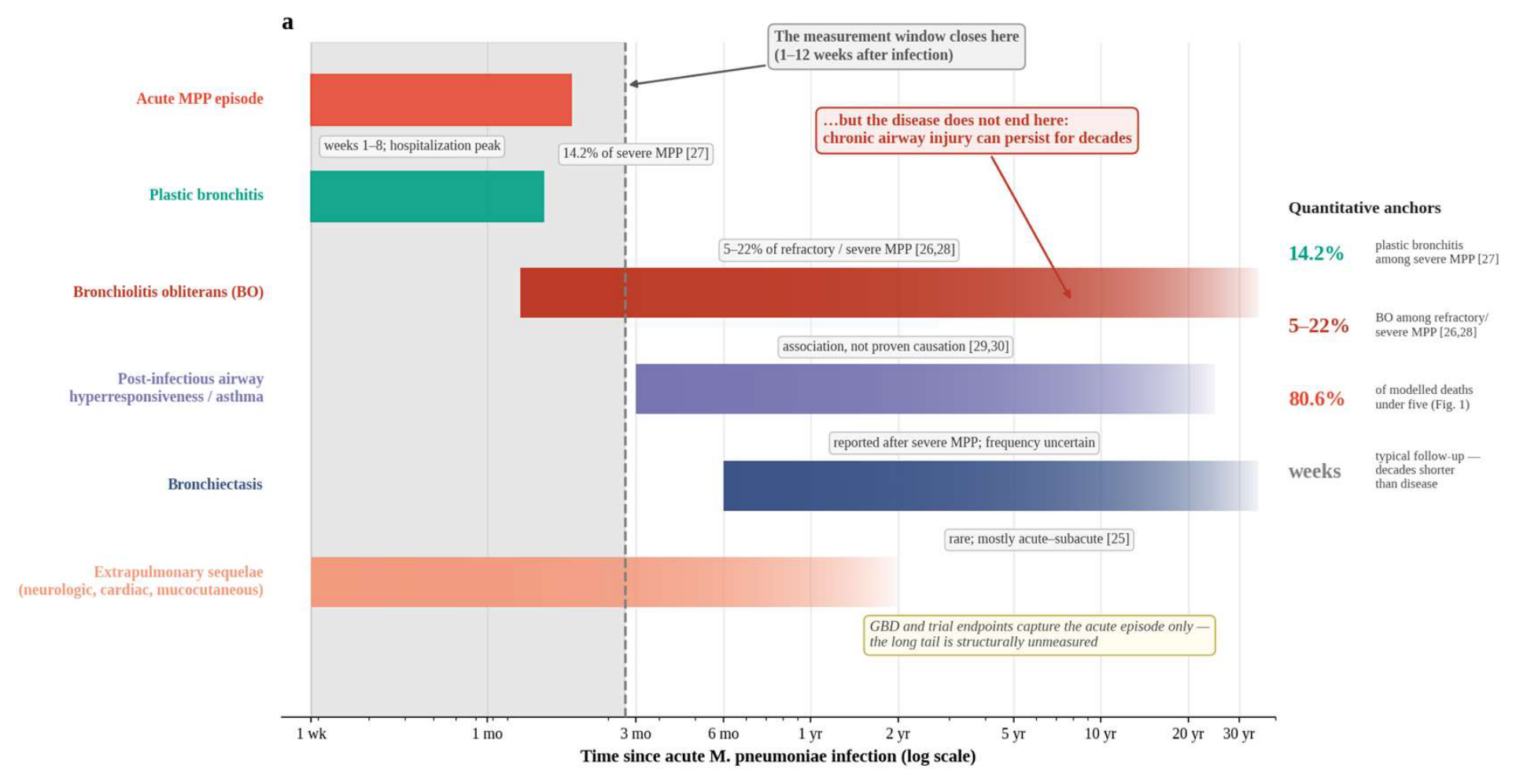
The acute episode of MP pneumonia (MPP) resolves, in the overwhelming majority of cases, within weeks. But a subset of children — concentrated among those with severe or refractory disease — emerge with airways that never fully recover. The sequelae spectrum is well characterized clinically even if absent from every burden ledger: bronchiolitis obliterans (BO), the fibrotic obliteration of small airways that converts a childhood pneumonia into a lifetime of obstructive lung disease; bronchiectasis; plastic bronchitis; post-infectious airway hyperresponsiveness and new-onset or worsened asthma; and extrapulmonary complications — neurological, dermatological, cardiac — some leaving permanent deficits (27–31).
BO deserves particular emphasis because it is the sequela with the longest shadow: once fibrotic obliteration of the small airways is established it is not reversible, and the clinical course — chronic cough, recurrent infection, exercise intolerance, mosaic attenuation on high-resolution CT — unfolds over years (28, 30). Adenovirus remains the most common infectious antecedent of post-infectious BO, but MP has emerged as the second most frequently implicated pathogen in pediatric series, and unlike adenoviral BO — a rare complication of a rare severe infection — MP-associated BO sits downstream of one of the commonest childhood pneumonias on Earth (30). Bronchiectasis follows a similar logic, concentrated among children whose acute illness was prolonged (28, 32).
The numbers, assembled from pediatric cohorts and systematic reviews, are not small (Table 2). Plastic bronchitis has been reported in 14.2% of children with severe MP pneumonia undergoing bronchoscopy (29). In the largest follow-up cohort to date — 981 children with MP pneumonia — post-infectious BO developed in 7.3%, with risk concentrated among those with prolonged fever, large lobar consolidation, bronchial mucus plugs, and mechanical ventilation (28). MP has been associated with asthma exacerbations and steroid-refractory airway disease, and mechanistic and animal-model evidence indicates airway remodeling persisting after bacterial clearance (31, 32). We deliberately use the language of association: for no sequela is the causal chain from MP infection to chronic deficit yet established to the standard of, say, post-adenoviral BO, and most evidence derives from retrospective series in high-incidence settings. But the direction of the association is uniform across every study that has looked, and the effect sizes are large.
Figure 5.
The long tail. Schematic of the sequelae timeline from acute MPP through chronic pulmonary and extrapulmonary outcomes on a log time axis; bar fading denotes persistence of uncertain duration. The acute window (weeks 1–8, hospitalization peak) is shaded, and the measurement window closes at 1–12 weeks — decades before the disease does. Quantitative anchors: plastic bronchitis in 14.2% of severe MPP undergoing bronchoscopy (29); post-infectious bronchiolitis obliterans in 7.3% of a 981-child post-MPP cohort, with 5–22% reported across refractory/severe series (28, 30); post-infectious airway hyperresponsiveness and asthma associations (31, 32). Association language throughout; no sequela is attributed causally beyond current evidence.
5.2. Quantifying What the Ledger Omits
To make the omission concrete, consider the accounting for a single severe case. A five-year-old with refractory MP pneumonia who develops BO will, on conservative assumptions, carry obstructive lung disease for decades. In DALY terms, that child accumulates years lived with disability at a substantial weight across an entire childhood and adulthood; in the current burden architecture, that child contributes nothing: the acute pneumonia is one line inside an LRI envelope, survival means zero YLL, and the sequelae — unattributed, unmeasured, unfollowed — vanish. A metric that counts only deaths will never see a disease whose costs are paid in decades of childhood lung function.
The non-medical ledger is likewise unrecorded: every epidemic cycle withdraws school-age children from classrooms for weeks and caregivers from work, and the 2023–2024 Chinese surge overwhelmed emergency departments and saturated pediatric emergency capacity for months (11, 17). No framework counts these costs for MP, because no framework counts MP.
The 2023–2024 resurgence matters here precisely because of its scale: Denmark’s nationwide cohort recorded a three-fold rise in infections and hospitalizations with severity per case unchanged (9), and the counterfactual excess (+19.2%) implies a larger pool of children entering the chronic-risk window than the no-pandemic world would have produced. Yet no national system we are aware of runs systematic post-MP follow-up; the sequelae literature is built from the minority of centers that chose to look. The long tail is known only from the ledgers of volunteers.
5.3. The Mechanism Hinge: Two Delays that Compound the Injury
Why does a usually-benign infection become airway-destroying in a minority? The mechanistic literature converges on a compounding of two delays.
The first delay is delayed clearance under macrolide resistance. In regions where MRMP predominates — over 90% of isolates in much of China through the 2010s (33, 34) — first-line therapy is, pharmacologically, no therapy: the organism continues replicating while the prescribed drug exerts a selective pressure the resistant organism simply ignores. Clinical studies consistently associate MRMP infection with prolonged fever and hospitalization, and the prolonged inflammatory window is the substrate in which plastic bronchitis and BO develop (28, 29, 35). Resistance does not make MP more virulent; it makes treatment slower, and slowness is the injury.
Severe and refractory MPP is driven predominantly by exuberant host response — hyperinflammatory cytokine profiles, airway hypersecretion, fibrinous cast formation — rather than by uncontrolled bacterial replication, which is why corticosteroids, not escalated antibiotics, are the pivot of refractory-case management (29, 35, 42). Prolonged antigen persistence under ineffective therapy extends exactly the inflammatory phase in which irreversible small-airway injury occurs (35).
The second delay is delayed diagnosis. MP diagnosis has historically run days to weeks behind the clinical decision point: serology confirms retrospectively, culture takes weeks, and molecular methods reached routine pediatric use only recently and unevenly (36, 37). Empirical macrolide therapy bridges the gap in most settings, which both drives resistance (first delay) and abandons severe cases to late escalation (sequelae risk); §6.3 examines the therapeutic consequences of this adoption failure (36, 37).
The sequelae spectrum is where the two delays meet the dissociation — a pathogen whose chronic costs are uncounted generates no pressure to close either delay.
5.4. The Uncounted half: YLD Without a Line Item
Step back to the ledger. For MP, the entire burden architecture rests on YLL — years of life lost — because mortality is what the architecture counts. But MP’s YLL is concentrated in under-fives in unmeasured regions (§4), while its YLD — sequelae, school absence, healthcare utilization, caregiver productivity loss — is distributed across the school-age populations of every country and extends decades forward from each epidemic year. By any honest weighting, MP’s YLD plausibly exceeds its YLL; by the current architecture, MP’s YLD is effectively zero. (We advance this as a qualitative argument, not a quantified comparison: MP’s YLD has never been estimated, so no ratio can be computed — that absence is itself the finding.) The dissociation is thus not only geographic (§4.2) and demographic (§4.1) but temporal: the measurement window closes at discharge, while the disease continues.
This is the strongest argument the MP case offers against mortality-weighted global health accounting: MP is not the exception to mortality-weighted accounting; it is the control experiment that exposes it.
If the disease is neither lethal nor brief, the question of how we treat it can no longer be an afterthought.
6. Treatment Evolution: The Stewardship Lag
6.1. Too Mild to Count, Too Mild to Steward
The stewardship lag is the dissociation read from the pharmacy: a pathogen invisible to burden accounting was, for the same reason, invisible to resistance surveillance — a disease deemed too mild to count was deemed too mild to steward.
For six decades, MP treatment was a settled question. Macrolides — erythromycin first, then clarithromycin and azithromycin — offered excellent in vitro activity, favorable lung pharmacokinetics, and an unmatched pediatric safety record; every major guideline from the 1960s onward designated them first-line for atypical pneumonia (1, 24, 38). The rationale was never revisited: the drugs worked, the disease resolved, and therapeutic failure was attributed to the patient rather than the regimen. The settlement was so complete that MP disappeared from antimicrobial stewardship discourse — resistance surveillance infrastructure never incorporated MP, and we are aware of no MP module in any national resistance monitoring system outside research networks. A pathogen too mild to count was presumed too mild to resist.
The complacency had a specific institutional form: the AMR apparatus built in the 2010s — national action plans, WHO priority-pathogen lists, surveillance mandates — was designed around bloodstream and hospital pathogens; community respiratory pathogens of children entered the frame, if at all, through pneumococcus. MP, lacking a surveillance base and a mortality signature, had no constituency inside the AMR movement at the moment the movement was being built — even as macrolides remained among the most frequently, and most inappropriately, prescribed antibiotic classes in Chinese ambulatory care (49, 52).
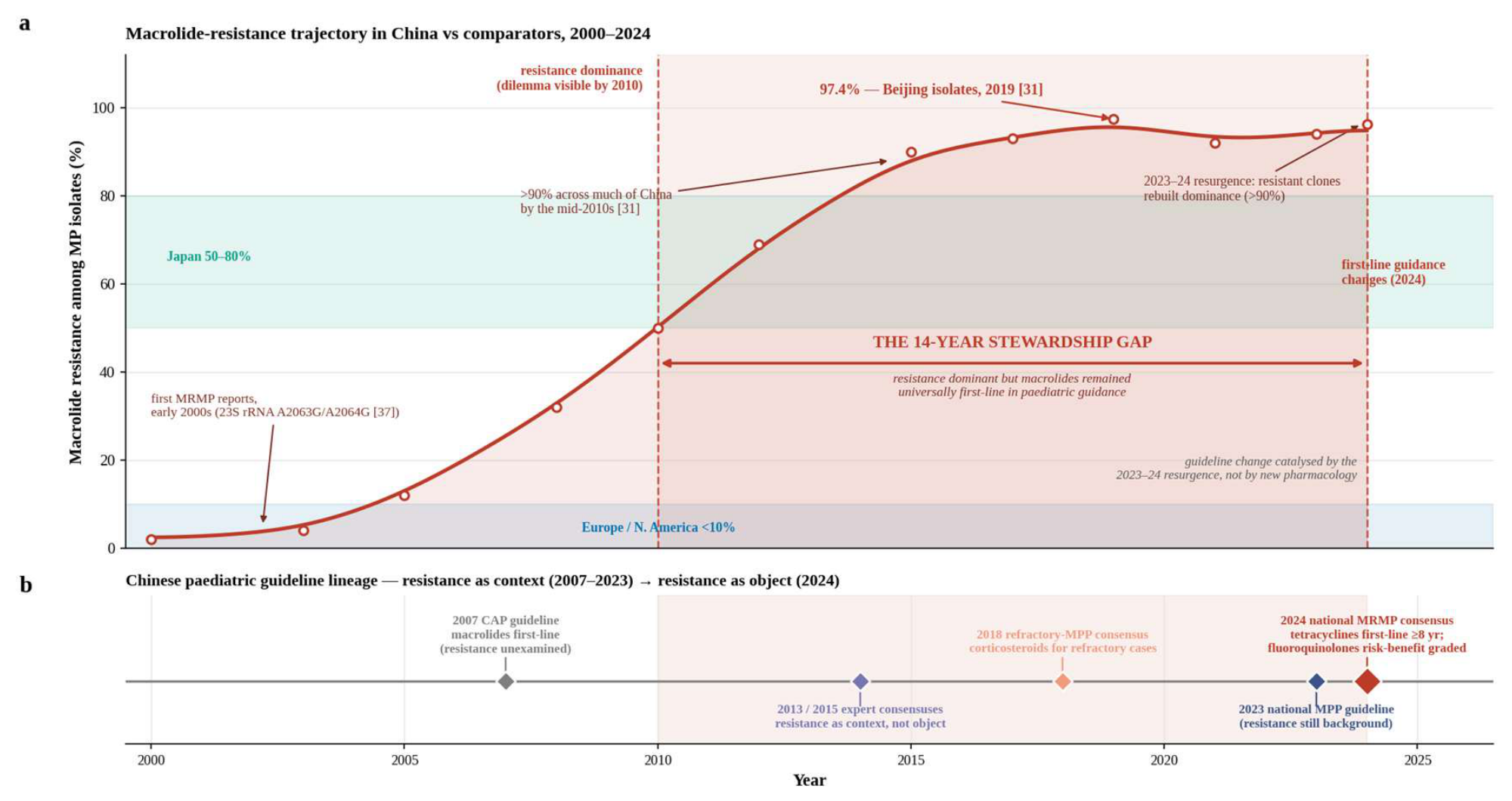
The presumption failed first and hardest in East Asia. Macrolide resistance in MP is conferred by point mutations in domain V of 23S rRNA — principally A2063G and A2064G — in an organism with a single rRNA operon and hence no mutational buffer (39). It climbed from sporadic reports in the early 2000s to regional dominance within a decade. A meta-analysis of 153 studies and 27,408 samples documents the Western Pacific proportion rising from 17.1% in 2001 to 76.5% by 2019, against rates below 10% in Europe and the Americas (33, 49). Chinese multicenter data show resistance reaching or exceeding 90% in much of the country by the mid-2010s and 97.4% in Beijing by 2019 (33, 49). A2063G accounts for ≈96.8% of resistant isolates, with A2064G accounting for most of the remainder (49); the epidemic clones dominating China’s resurgence — ST3 within the P1 type 1 lineage and ST14 within P1 type 2 — are macrolide-resistant (48). By 2015, the majority of MP infections in the world’s most populous country were being treated, per guideline, with antibiotics to which the causative organism was genotypically resistant (clinical consequences in §5.3) — and remained so treated for another nine years (24, 40).
The 97.4% is what an unstewarded common pathogen looks like after a decade of benign neglect.
6.2. The Pediatric Dilemma and the 2024 Watershed
The therapeutic alternatives existed all along, fenced off by age: tetracyclines and fluoroquinolones retain excellent activity against MRMP (38, 40) but were contraindicated or discouraged in children, leaving pediatricians in high-resistance regions with a first-line drug that did not work and second-line drugs they were told not to use. The world’s first dedicated expert consensus to resolve that dilemma arrived only in 2024 (40). Its central act was to make the risk-benefit arithmetic explicit, gating the antimicrobial switch by resistance genotype and age rather than severity. Tetracyclines are first-line for children ≥8 years; for younger children with severe MRMP, fluoroquinolones are permitted under documented risk-benefit assessment — on the reasoning that the measurable harms of untreated severe MRMP outweigh the theoretical harms of short-course fluoroquinolones. Severity grading governs the adjuncts (corticosteroids, IVIG, bronchoscopic intervention), not the choice of antimicrobial class (40). The consensus also repositioned corticosteroids — the mainstay of refractory MPP since the 2015 expert consensus (35, 42) — as adjuncts to effective antimicrobials rather than substitutes for them.
The timing is the indictment. The dilemma was visible by 2010; the resolution arrived in 2024, catalysed not by new pharmacology but by the scale of the 2023–2024 resurgence — fourteen years of guideline inertia for a pathogen infecting millions of children annually. We note for precision that the 2024 document is the first consensus dedicated to MRMP governance, building on a lineage that includes the 2015 MPP expert consensus, the 2019 bronchoscopic-intervention consensus, and the 2023 national MPP guideline (40–43); earlier documents treated resistance as context rather than object.
The international contrast sharpens the point. Japan, where macrolide resistance peaked at 81.8% in 2012 before declining to 14.3% by 2018 alongside p1-genotype clonal replacement (56, 57), adapted earlier: its guidelines positioned minocycline and tosufloxacin for high-resistance contexts, and its 48–72-hour fever-review culture operationalized the switch decision (12, 25). Korea, with documented resistance of 78.5% in 2019–2020, retained macrolide-centric guidance without enforcement, and its resistance plateaued (26, 49). The United States and Europe, with resistance below 10%, rationally retained macrolide first-line therapy — but their guidelines contain no contingency architecture for imported resistant strains beyond a travel-history caveat (38, 53). The stewardship lag is not uniform, and its duration correlates with nothing except whether anyone’s mandate included watching.
6.3. The Diagnostic–Therapeutic Coupling
Treatment lag and diagnostic lag are the same lag read from opposite ends. Because MP diagnosis in most settings is empirical or retrospective (§5.3), antibiotic selection is made without knowledge of the pathogen, let alone its resistance genotype; resistance results, where obtainable at all, arrive after the therapeutic decision has succeeded or failed. The 2024 consensus’s genotype- and age-gated algorithm is, functionally, a workaround for diagnostic absence — it substitutes clinical trajectory (fever persistence at 48–72 hours) for microbiological information (40). Rapid molecular resistance detection would convert that workaround into precision; its continued absence from routine practice, three decades after technical maturity, reflects the same perceived-mildness discount that has stalled every generation of MP diagnostics (36, 37). The coupling runs both ways: undiagnosed resistance cannot be stewarded, and unstewarded drugs cannot be prescribed rationally. It also sets the minimum specification for any surveillance system worth building: a positivity count without a resistance genotype is half a ledger, adequate for epidemiology and inadequate for therapy.
6.4. The Pipeline Mirrors the Vaccine Shelf
The forward pipeline mirrors the vaccine shelf (§4.3): lefamulin, a pleuromutilin active against MRMP, is approved for adult community-acquired pneumonia but has no pediatric development program (44, 45); solithromycin foundered on regulatory grounds unrelated to MP; host-directed therapies for refractory MPP remain at the mechanistic and observational stage (35). No vaccine candidate has entered clinical trials in decades; contemporary approaches — P1-adhesin-targeted and mRNA platforms — are preclinical (21, 22, 23). Each empty shelf hangs from the same hook: burden estimates that cannot see the pathogen cannot prioritize the countermeasure. The vaccine history makes the causality legible: the 1960s formalin-inactivated whole-organism candidates were abandoned after limited efficacy and enhanced-disease concerns, and in the six decades since, the absence of a quantified burden has deprived every subsequent candidate of its investment case (21, 22, 23). RSV’s trajectory is the counterexample — once its burden was measured, a vaccine pipeline that had stalled for fifty years produced licensed products within a decade. In the cases that have been measured, measurement preceded money.
Figure 6.
The stewardship lag timeline. Macrolide resistance trajectory in China (to 97.4% by 2019 (33)) plotted against the guideline lineage (2007 CAP guideline → 2015 MPP consensus → 2019 bronchoscopic-intervention consensus → 2023 national guideline → 2024 MRMP consensus (24, 40–43)), with the 14-year gap between resistance dominance (~2010) and first-line guideline change (2024) shaded.
7. Synthesis: Anatomy of a Blind Spot
Why was a pathogen of this scale invisible before, during, and after its largest modern epidemic? Because four structural properties of global health measurement stack, each reinforcing the others.
First, mortality-weighted accounting. The instruments that set global health priorities are calibrated to death. MP’s design specification — infection peak at 5–15 years, death concentrated in under-fives elsewhere — sits squarely in that blind spot: common enough to matter, lethal enough to rank among the top ten modeled pediatric LRI etiologies (16), yet never fully visible to any single instrument.
Second, absent pathogen-specific surveillance. MP is notifiable in few if any countries; Denmark’s laboratory notification feeding the nationwide MiBa database is the clearest nationwide example we are aware of (9). It is excluded from WHO’s sentinel respiratory frameworks and national AMR monitoring; surveillance exists where consortia built it (MAPS) or epidemics forced it (China’s post-2023 platform) (5, 11). Without systematic counting, every downstream number is modeled and discountable.
Third, the “mild disease” frame. MP’s self-limiting reputation is a product of where measurement happens: where capture is complete, MP genuinely is mild (no rise in MP-associated pediatric mortality in Denmark’s nationwide 0–17-year cohort (9), even amid record case counts (54)). The frame is locally true and globally false, and it propagates through textbook, guideline, and funding decision alike.
Fourth, disciplinary fragmentation. MP sits at the intersection of pediatrics, infectious diseases, respiratory medicine, and public health, owned by none — no standing conference, funding line, or advocacy constituency; the specialists who each hold one piece publish in different venues and rarely meet. A blind spot distributed across four professions is nobody’s blind spot.
The five terms of this review are the five faces of this single structural failure: the infection–mortality dissociation names the diagnostic problem (the wrong axis is measured); the surveillance–burden inversion names the geography (measurement allocated inversely to need); and the counterfactual excess names the magnitude (a top-ten pathogen overshooting its own envelope). The delayed re-emergence interval gradient names the dynamics — predictable, and unpredicted; the COVID–MP niche seesaw names the mechanism — an ecological vacancy filled and vacated on a policy timetable, visible in 90 weeks of single-platform data (11). Locking the five together is the review’s synthetic claim.
One might object that the dissociation is merely missing data — that with better surveillance the paradox dissolves into ordinary uncertainty. The objection is difficult to reconcile with the pandemic itself: when surveillance existed and the pathogen vanished, the disappearance was celebrated as an NPI side-benefit; when modeled MP mortality barely declined while that of RSV and influenza fell sharply (16), no alarm attached; when the pathogen returned above its counterfactual envelope, the event was read as immunological trivia (“immunity debt”) rather than as an accounting failure. Each stage had data; what was missing was a framework in which a high-morbidity, low-visibility pathogen could register as a problem. The dissociation is architectural, not informational.
The boundaries of this synthesis relative to prior work should be stated plainly, because the descriptive core of the resurgence story is not ours. The MAPS consortium established the disappearance, predicted the delay — which its transmission-modeling analysis attributes in large part to MP’s long incubation (47) — and documented the re-emergence across its network (5–8, 47); the Danish investigators produced the definitive incidence cohort (9); the IHME GBD 2023 data infrastructure supplied the mortality estimates on which the MP-specific attribution rests (15, 16). This review adds four things none of them attempted: a counterfactual quantification of the 2023 excess against pre-pandemic cycles (+19.2%); the formalization of the cross-national ordering of the re-emergence interval as a policy-determined gradient; the joint reading of infection-side and mortality-side evidence that defines the dissociation and the inversion; and the integration of the chronic sequelae and treatment-lag dimensions into a single structural explanation. The claim is synthetic, not proprietary — an audit presupposes ledgers kept by others.
Each term names one face of a single structural failure — and each, therefore, names one lever for fixing it. A disease that does not kill does not count; what does not count is not measured, funded, followed up, stewarded, or prevented. What has structural causes admits of structural remedies.
8. A Five-Point Agenda
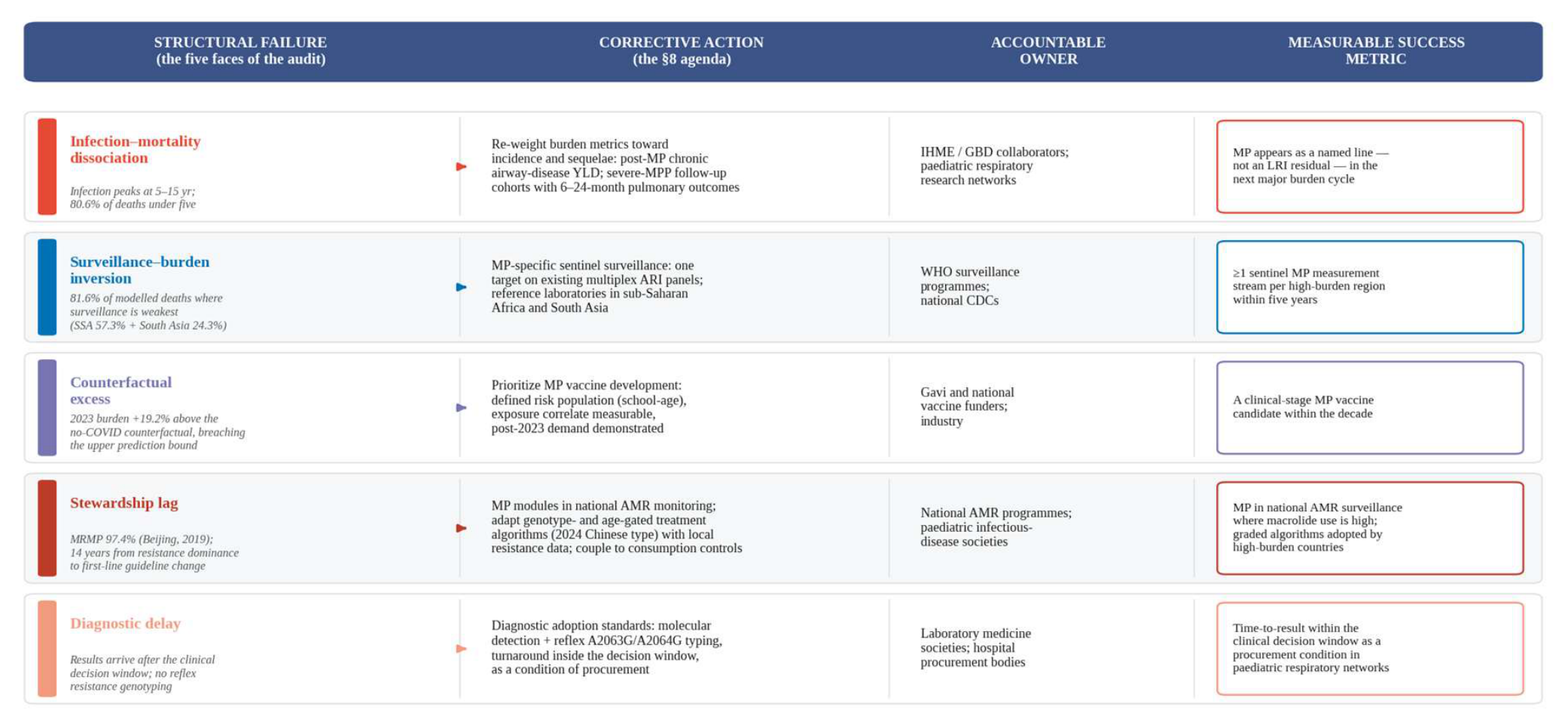
The audit is complete; what remains is the corrective journal entry. The agenda is deliberately conservative: nothing below requires a technology that does not exist. Five actions follow, each mapped to one face of the failure, each with an accountable owner and a measurable metric.
(1) Establish MP-specific sentinel surveillance — repairs the inversion. Add MP to existing acute respiratory infection sentinel platforms — in principle, one additional target on an existing multiplex panel — and designate reference laboratories in sub-Saharan Africa and South Asia, where 81.6% of modeled mortality is currently estimated without local measurement (16). Owners: WHO surveillance programs; national CDCs. Metric: within five years, at least one sentinel MP measurement stream operating in each high-burden region — the highest-information surveillance investment available anywhere in respiratory epidemiology (§4.2).
(2) Re-weight burden metrics toward incidence and sequelae — repairs the dissociation. GBD and national burden frameworks should attribute YLD for post-MP chronic airway disease, supported by prospective follow-up cohorts of severe pediatric MPP with standardized pulmonary outcomes at 6–24 months. Owners: IHME/GBD collaborators; pediatric respiratory research networks. Metric: MP appears as a named line — not an LRI residual — in the next major burden cycle.
(3) Build resistance-stewardship infrastructure for MP — repairs the stewardship lag. MP should enter national AMR monitoring where macrolide consumption is high, and genotype- and age-gated treatment algorithms of the 2024 Chinese type (40) should be adapted — with local resistance data — by other high-burden countries rather than awaiting their own crises. Owners: national AMR programs; pediatric infectious disease societies. Metric: MP resistance proportions reported through routine national channels in high-consumption settings.
(4) Adopt diagnostic adoption standards — closes the diagnostic delay. Molecular MP detection with reflex macrolide-resistance genotyping (A2063G/A2064G) should meet defined adoption criteria — turnaround inside the clinical decision window and workflow compatibility — as a condition of procurement in pediatric respiratory networks (36, 37, 50). Owners: laboratory medicine societies; hospital procurement bodies. Metric: resistance genotype available within the treatment-decision window.
(5) Prioritize vaccine development — prevents the next ledger entry. An MP vaccine is the only intervention that addresses infection, sequelae, and antibiotic consumption simultaneously; the target product profile is unusually favorable — a defined risk population (school-age children), a measurable correlate of exposure, a resurgence that demonstrated global reach. Owners: Gavi and national vaccine-research funders; industry. Metric: a clinical-stage candidate within the decade.
The sequencing is deliberate: measurement precedes re-weighting, because attributable sequelae fractions require attributable numerators; stewardship and diagnostics are coupled, because prescribing without detection reproduces the 2010s; the vaccine pillar comes last because the first four, taken together, would make it fundable. Five actions, one debt; all require only that the ledger be reopened.
Figure 7.
The decision matrix. Five-row matrix mapping each structural failure (dissociation / inversion / excess / stewardship lag / diagnostic delay) to its corrective action, accountable owner, and measurable success metric — the §8 agenda in graphical form, designed for direct reuse in policy presentations.
What is counted can be measured; what is measured can be funded; what is funded can be prevented. The refrain inverts because the diagnosis is structural: the blindness was built, and it can be rebuilt.
9. Conclusion
Return to the wards of the winter of 2023–2024: the bronchoscopy suites running double shifts, the Shanghai testing line where 59.63% of children carried a pathogen whose national surveillance system did not yet exist (11, 58). None of it was hidden; the GBD modellers saw it too, from the other end, as a stubborn residual in the under-five LRI estimates (15, 16). The two sightings never met, because no instrument exists on which an infection peak at age ten and a death peak before age five can be recorded as the same event.
The pandemic gave respiratory epidemiology a controlled experiment: suppress an endemic pathogen for three years, release it, and observe. What we observed — a seesaw, a gradient, and an excess — was measurable and largely unpredicted, and was followed by a return to the same invisibility that preceded it: ninth of twenty-six in a modeled mortality table (16), first in no one’s portfolio.
Unless the measurement changes. The corrections proposed here are neither expensive nor speculative: one target on an existing panel, one sequelae envelope in an existing burden model, one lineage of guideline logic already written and tested in the world’s largest MRMP epidemic (40). What they require is the admission that the ledger is wrong — that a pathogen can be simultaneously common, consequential, and uncounted, and that the fault lies with the counting.
The children in those wards were never invisible. Our instruments were. The measure makes the pathogen — it is time to remake the measure.
Supplementary Materials
The following supporting information can be downloaded at the website of this paper posted on Preprints.org.
Author Contributions
Chen Shen: Conceptualization, Data curation, Formal analysis, Supervision, Funding acquisition, Project administration, Writing – review & editing. Deze Li: Data curation, Software, Validation, Visualization. Hao Chen: Methodology, Investigation, Formal analysis. All authors read and approved the final manuscript.
Funding
This work was supported by the Beijing Science and Technology Nova Program Interdisciplinary Project (20230484439) and the Beijing High-Level Public Health Technical Talents Project (2023-02-33). The funders had no role in study design, data collection, data analysis, data interpretation, or writing of the report.
Data Availability
All data analyzed in this review derive from publicly available sources: peer-reviewed literature as cited; national surveillance reports and dashboards (11, 13, 14, 54); and the Global Burden of Disease Study 2023 (GBD 2023), Institute for Health Metrics and Evaluation (IHME), GBD Results Tool, Seattle, WA, 2024 (https://ghdx.healthdata.org/gbd-results-tool; cause: Mycoplasma; 1990–2023; 204 countries and territories). All 2023 MP-LRI figures cited in this review — 26,382 deaths (95% UI 18,984–36,012) in ages 0–19 years; rank 9 of 26 modeled LRI etiologies (3.71% of pathogen-attributed deaths); 80.6% under five years of age; 57.3% sub-Saharan Africa and 24.3% South Asia; +19.2% counterfactual excess of the 2023 resurgence; pandemic-period modeled mortality change of −17.1% versus −65.2% (RSV) and −62.6% (influenza) — derive from the authors’ Mycoplasma pneumoniae–specific secondary analysis of these publicly available GBD 2023 data (16). Extraction tables and analysis code for the secondary analysis are available from the corresponding author upon reasonable request.
Acknowledgments
We thank the ESGMAC Mycoplasma pneumoniae Surveillance (MAPS) network, the national and regional surveillance teams (Statens Serum Institut; Chinese Center for Disease Control and Prevention; Japan National Institute of Infectious Diseases; U.S. Centers for Disease Control and Prevention; Public Health Scotland; UK Health Security Agency) whose publicly available reports underpin this synthesis, and the Institute for Health Metrics and Evaluation for open access to Global Burden of Disease data. No medical writing or editorial assistance was used in the preparation of this manuscript.
Use of Artificial Intelligence
AI tools were used for language polishing and code drafting.
Conflicts of Interest
The authors declare no conflicts of interest.
References
- Waites, K.B.; Xiao, L.; Liu, Y.; Balish, M.F.; Atkinson, T.P. Mycoplasma pneumoniae from the respiratory tract and beyond. Clin. Microbiol. Rev. 2017, 30, 747–809. [Google Scholar] [CrossRef] [PubMed]
- Jain, S.; Williams, D.J.; Arnold, S.R.; Ampofo, K.; Bramley, A.M.; Reed, C.; Stockmann, C.; Anderson, E.J.; Grijalva, C.G.; Self, W.H.; Zhu, Y.; Patel, A.; Hymas, W.; Chappell, J.D.; Kaufman, R.A.; Kan, J.H.; Dansie, D.; Lenny, N.; Hillyard, D.R.; Haynes, L.M.; Levine, M.; Lindstrom, S.; Winchell, J.M.; Katz, J.M.; Erdman, D.; Schneider, E.; Hicks, L.A.; Wunderink, R.G.; Edwards, K.M.; Pavia, A.T.; McCullers, J.A.; Finelli, L.; CDC EPIC Study Team. Community-acquired pneumonia requiring hospitalization among U.S. children. N Engl. J. Med. 2015, 372, 835–845. [Google Scholar] [CrossRef] [PubMed]
- Guo, D.X.; Hu, W.J.; Wei, R.; Wang, H.; Xu, B.P.; Zhou, W.; Ma, S.J.; Huang, H.; Qin, X.G.; Jiang, Y.; Dong, X.P.; Fu, X.Y.; Shi, D.W.; Wang, L.Y.; Shen, A.D.; Xin, D.L. Epidemiology and mechanism of drug resistance of Mycoplasma pneumoniae in Beijing, China: a multicenter study. Bosn. J. Basic Med. Sci. 2019, 19, 288–296. [Google Scholar] [CrossRef] [PubMed]
- Oumei, H.; Xuefeng, W.; Jianping, L.; Kunling, S.; Rong, M.; Zhenze, C.; Li, D.; Huimin, Y.; Lining, W.; Zhaolan, L.; Xinmin, L.; Hua, X.; Zhiyan, J.; Yanning, L.; Yan, H.; Baoqing, Z.; Xiaochun, F.; Chunhui, H.; Yonghong, J.; Xue, Z.; Wei, W.; Zi, W. Etiology of community-acquired pneumonia in 1500 hospitalized children. J. Med. Virol. 2018, 90, 421–428. [Google Scholar] [CrossRef] [PubMed]
- Meyer Sauteur, P.M.; Beeton, M.L.; Uldum, S.A.; Bossuyt, N.; Vermeulen, M.; Loens, K.; Pereyre, S.; Bébéar, C.; Keše, D.; Day, J.; Afshar, B.; Chalker, V.J.; Greub, G.; Nir-Paz, R.; Dumke, R.; ESGMAC–MyCOVID Study Team. Mycoplasma pneumoniae detections before and during the COVID-19 pandemic: results of a global survey, 2017 to 2021. Euro Surveill. 2022, 27, 2100746. [Google Scholar] [CrossRef] [PubMed]
- Meyer Sauteur, P.M.; Beeton, M.L. ESGMAC and the ESGMAC MAPS Study Group Mycoplasma pneumoniae: gone forever? Lancet Microbe 2023, 4, e763. [Google Scholar] [PubMed]
- Meyer Sauteur, P.M.; Beeton, M.L.; European Society of Clinical Microbiology and Infectious Diseases (ESCMID) Study Group for Mycoplasma and Chlamydia Infections (ESGMAC); and the ESGMAC Mycoplasma pneumoniae Surveillance (MAPS) Study Group. Mycoplasma pneumoniae: delayed re-emergence after COVID-19 pandemic restrictions. Lancet Microbe 2024, 5, e100–e101. [Google Scholar] [CrossRef] [PubMed]
- Meyer Sauteur, P.M.; Beeton, M.L.; European Society of Clinical Microbiology and Infectious Diseases (ESCMID) Study Group for Mycoplasma and Chlamydia Infections (ESGMAC); and the ESGMAC Mycoplasma pneumoniae Surveillance (MAPS) Study Group. Pneumonia outbreaks due to re-emergence of Mycoplasma pneumoniae. Lancet Microbe 2024, 5, e514. [Google Scholar] [CrossRef] [PubMed]
- Dungu, K.H.S.; Holm, M.; Hartling, U.; Jensen, L.H.; Nielsen, A.B.; Schmidt, L.S.; Toustrup, L.B.; Hansen, L.H.; Dahl, K.W.; Matthesen, K.T.; Nordholm, A.C.; Uldum, S.; Emborg, H.D.; Rytter, M.J.H.; Nygaard, U. Mycoplasma pneumoniae incidence, phenotype, and severity in children and adolescents in Denmark before, during, and after the COVID-19 pandemic: a nationwide multicentre population-based cohort study. Lancet Reg. Health Eur. 2024, 47, 101103. [Google Scholar] [CrossRef] [PubMed]
- Cohen, R.; Levy, C.; Rybak, A.; Angoulvant, F.; Ouldali, N.; Grimprel, E. Immune debt: recrudescence of disease and confirmation of a contested concept. Infect. Dis. Now. 2023, 53, 104638. [Google Scholar] [CrossRef] [PubMed]
- Chinese Center for Disease Control and Prevention. National sentinel surveillance for acute respiratory infections: weekly multi-pathogen reports, weeks 46/2024–2026; and monthly national COVID-19 situation reports, 2023; China CDC: Beijing, China, 2026. [Google Scholar]
- Yamazaki, T.; Kenri, T. Epidemiology of Mycoplasma pneumoniae infections in Japan and therapeutic strategies for macrolide-resistant M. pneumoniae. Front Microbiol. 2016, 7, 693. [Google Scholar] [CrossRef] [PubMed]
- Public Health Scotland. Community Acute Respiratory Infection (CARI) surveillance programme: weekly surveillance dashboard and annual reports, October 2022–2025; PHS: Edinburgh, United Kingdom, 2025. [Google Scholar]
- UK Health Security Agency; U.S. Centers for Disease Control and Prevention; National Syndromic Surveillance Program. Mycoplasma pneumoniae surveillance summaries, 2020–2025. (Platform-change caveats as described in text.). 2025.
- GBD 2021 Lower Respiratory Infections and Antimicrobial Resistance Collaborators. Global, regional, and national incidence and mortality burden of non-COVID-19 lower respiratory infections and aetiologies, 1990–2021: a systematic analysis from the Global Burden of Disease Study 2021. Lancet Infect. Dis. 2024, 24, 974–1002. [Google Scholar] [CrossRef] [PubMed]
- Global Burden of Disease Study 2023. 2024. GBD Results Tool. Institute for Health Metrics and Evaluation (IHME), Seattle, WA. https://ghdx.healthdata.org/gbd-results-tool (cause: Mycoplasma; 1990–2023; 204 countries and territories). See Data Availability statement for the provenance of all GBD-derived figures, which derive from the authors’ Mycoplasma pneumoniae–specific secondary analysis of GBD 2023 data.
- Sun, Y.; Li, P.; Jin, R.; Liang, Y.; Yuan, J.; Lu, Z.; Liang, J.; Zhang, Y.; Ren, H.; Zhang, Y.; Chen, J.; Huang, Y.; Lin, C.; Li, Y.; Zhou, J.; Wang, X.; Li, Y.; Huang, S.; Xu, J.; Qin, T. Characterizing the epidemiology of Mycoplasma pneumoniae infections in China in 2022–2024: a nationwide cross-sectional study of over 1.6 million cases. Emerg. Microbes Infect. 2025, 14, 2482703. [Google Scholar] [CrossRef] [PubMed]
- Zhang, X.S.; Zhao, H.; Vynnycky, E.; Chalker, V. Positively interacting strains that co-circulate within a network structured population induce cycling epidemics of Mycoplasma pneumoniae. Sci. Rep. 2019, 9, 541. [Google Scholar] [CrossRef] [PubMed]
- Yan, C.; Sun, H.; Zhao, H. Latest surveillance data on Mycoplasma pneumoniae infections in children, suggesting a new epidemic occurring in Beijing. J. Clin. Microbiol. 2016, 54, 1400–1401. [Google Scholar] [CrossRef] [PubMed]
- Chen, B.; Pan, J.; Peng, Y.; Zhang, Y.; Wan, Y.; Wei, H.; Li, K.; Song, W.; Zhao, Y.; Fang, K.; Ye, H.; Cao, J.; Rui, J.; Zhao, Z.; Chen, T. Characteristics and risk factors for outcomes in patients with Mycoplasma pneumoniae mono- and coinfections: a multicenter surveillance study in Wuhan, China, 2023. Infect. Dis. Model 2025, 10, 989–1001. [Google Scholar] [CrossRef] [PubMed]
- Razin, S.; Hayflick, L. Highlights of mycoplasma research—an historical perspective. Biologicals 2010, 38, 183–190. [Google Scholar] [CrossRef] [PubMed]
- Jiang, Z.; Li, S.; Zhu, C.; Zhou, R.; Leung, P.H.M. Mycoplasma pneumoniae infections: pathogenesis and vaccine development. Pathogens 2021, 10, 119. [Google Scholar] [CrossRef] [PubMed]
- Zeng, Q.; Sun, P.; Li, W.; Tang, Y.; Hu, Y.; Zhou, J.; Zhou, Y.; Chen, L.; Wu, Y. Protective immunity induced by a novel P1 adhesin C-terminal anchored mRNA vaccine against Mycoplasma pneumoniae infection in BALB/c mice. Microbiol. Spectr. 2025, 13, e02140-24. [Google Scholar] [CrossRef] [PubMed]
- Subspecialty Group of Respiratory Diseases; Society of Pediatrics; Chinese Medical Association; Editorial Board of Chinese Journal of Pediatrics. Guidelines for management of community-acquired pneumonia in children (trial implementation). Zhonghua Er Ke Za Zhi 2007, 45, 83–90, 223–230. (In Chinese) [Google Scholar]
- Ishiwada, N.; Shinjoh, M.; Kusama, Y.; Arakawa, H.; Ohishi, T.; Saitoh, A.; Suzuki, A.; Tsutsumi, H.; Nishi, J.; Hoshino, T.; Mitsuda, T.; Miyairi, I.; Iwamoto-Kinoshita, N.; Kobayashi, H.; Satoh, K.; Shimizu, A.; Takeshita, K.; Tanaka, T.; Tamura, D.; Tokunaga, O.; Tomita, K.; Nagasawa, K.; Funaki, T.; Furuichi, M.; Miyata, I.; Yaginuma, M.; Yamaguchi, Y.; Yamamoto, S.; Uehara, S.; Kurosaki, T.; Okada, K.; Ouchi, K. Guidelines for the management of respiratory infectious diseases in children in Japan 2022. Pediatr. Infect. Dis. J. 2023, 42, e369–e376. [Google Scholar] [CrossRef] [PubMed]
- Lee, J.K.; Choi, Y.Y.; Sohn, Y.J.; Kim, K.M.; Kim, Y.K.; Han, M.S.; Park, J.Y.; Cho, E.Y.; Choi, J.H.; Choi, E.H. Persistent high macrolide resistance rate and increase of macrolide-resistant ST14 strains among Mycoplasma pneumoniae in South Korea, 2019–2020. J. Microbiol. Immunol. Infect. 2022, 55, 910–916. [Google Scholar] [CrossRef] [PubMed]
- Narita, M. Pathogenesis of extrapulmonary manifestations of Mycoplasma pneumoniae infection with special reference to pneumonia. J. Infect. Chemother. 2010, 16, 162–169. [Google Scholar] [CrossRef] [PubMed]
- Xu, W.; Wang, H.; Wen, X.; Yang, H.; Zhao, S.; Liu, J. Risk factors for bronchiolitis obliterans development in children after Mycoplasma pneumoniae pneumonia: a retrospective study of 981 patients. Ital. J. Pediatr. 2025, 51, 105. [Google Scholar] [CrossRef] [PubMed]
- Zhong, H.; Yin, R.; Zhao, R.; Jiang, K.; Sun, C.; Dong, X. Analysis of clinical characteristics and risk factors of plastic bronchitis in children with Mycoplasma pneumoniae pneumonia. Front Pediatr. 2021, 9, 735093. [Google Scholar] [CrossRef] [PubMed]
- Kurland, G.; Michelson, P. Bronchiolitis obliterans in children. Pediatr. Pulmonol. 2005, 39, 193–208. [Google Scholar] [CrossRef] [PubMed]
- Wei, R.; Zang, J.P.; Zhu, W.L.; Wang, H.J.; Liu, Y.H. Correlation between airway inflammation in bronchial asthma patients and Mycoplasma pneumoniae infection. Chin. J. Nosocomiol 2016, 26, 3927–3929. (In Chinese) [Google Scholar]
- Guo, Z.; Gu, S.; Tian, Z.; Du, B. A comprehensive review of Mycoplasma pneumoniae infection in chronic lung diseases: recent advances in understanding asthma, COPD, and bronchiectasis. Front Med. 2024, 11, 1437731. [Google Scholar] [CrossRef] [PubMed]
- Jiang, Y.; Dou, H.; Xu, B.; Xu, B.; Zhou, W.; Wang, H.; Ge, L.; Hu, Y.; Han, X.; Qin, X.; Li, J.; Ye, L.; Wu, L.; Zuo, H.; Zhang, Q.; Liu, L.; Hu, W.; Shao, J.; Yin, Q.; Han, L.; Fu, X.; Dong, X.; Dong, Y.; Fu, Y.; Zhao, M.; Sun, Q.; Huo, J.; Liu, D.; Liu, W.; Li, Y.; Wang, Y.; Xin, D.; Shen, K. Macrolide resistance of Mycoplasma pneumoniae in several regions of China from 2013 to 2019. Epidemiol. Infect. 2024, 152, e75. [Google Scholar] [CrossRef] [PubMed]
- Qu, J.; Chen, S.; Bao, F.; Gu, L.; Cao, B. Molecular characterization and analysis of Mycoplasma pneumoniae among patients of all ages with community-acquired pneumonia during an epidemic in China. Int. J. Infect. Dis. 2019, 83, 26–31. [Google Scholar] [CrossRef] [PubMed]
- Tamura, A.; Matsubara, K.; Tanaka, T.; Nigami, H.; Yura, K.; Fukaya, T. Methylprednisolone pulse therapy for refractory Mycoplasma pneumoniae pneumonia in children. J. Infect. 2008, 57, 223–228. [Google Scholar] [CrossRef] [PubMed]
- Dumke, R.; Schurwanz, N.; Lenz, M.; Schuppler, M.; Lück, C.; Jacobs, E. Sensitive detection of Mycoplasma pneumoniae in human respiratory tract samples by optimized real-time PCR approach. J. Clin. Microbiol. 2007, 45, 2726–2730. [Google Scholar] [CrossRef] [PubMed]
- Loens, K.; Ursi, D.; Goossens, H.; Ieven, M. Molecular diagnosis of Mycoplasma pneumoniae respiratory tract infections. J. Clin. Microbiol. 2003, 41, 4915–4923. [Google Scholar] [CrossRef] [PubMed]
- Metlay, J.P.; Waterer, G.W.; Long, A.C.; Anzueto, A.; Brozek, J.; Crothers, K.; Cooley, L.A.; Dean, N.C.; Fine, M.J.; Flanders, S.A.; Griffin, M.R.; Metersky, M.L.; Musher, D.M.; Restrepo, M.I.; Whitney, C.G. Diagnosis and treatment of adults with community-acquired pneumonia: an official clinical practice guideline of the American Thoracic Society and Infectious Diseases Society of America. Am. J. Respir. Crit. Care Med. 2019, 200, e45–e67. [Google Scholar] [CrossRef] [PubMed]
- Lucier, T.S.; Heitzman, K.; Liu, S.K.; Hu, P.C. Transition mutations in the 23S rRNA of erythromycin-resistant isolates of Mycoplasma pneumoniae. Antimicrob. Agents Chemother. 1995, 39, 2770–2773. [Google Scholar] [CrossRef] [PubMed]
- Wang, Y.S.; Zhou, Y.L.; Bai, G.N.; Li, S.X.; Xu, D.; Chen, L.N.; Chen, X.; Dong, X.Y.; Fu, H.M.; Fu, Z.; Hao, C.L.; Hong, J.G.; Liu, E.M.; Liu, H.M.; Lu, X.X.; Luo, Z.X.; Tang, L.F.; Tian, M.; Yin, Y.; Zhang, X.B.; Zhang, J.H.; Zhang, H.L.; Zhao, D.Y.; Zhao, S.Y.; Zhu, G.H.; Zou, Y.X.; Lu, Q.; Zhang, Y.Y.; Chen, Z.M. Expert consensus on the diagnosis and treatment of macrolide-resistant Mycoplasma pneumoniae pneumonia in children. World J. Pediatr. 2024, 20, 901–914. [Google Scholar] [CrossRef] [PubMed]
- Expert Panel on Paediatric Respiratory Endoscopy; National Health Commission. Expert consensus on bronchoscopic interventional diagnosis and treatment of refractory pneumonia in children in China. Zhongguo Shi Yong Er Ke Za Zhi 2019, 34, 449–457. (In Chinese) [Google Scholar]
- Subspecialty Group of Respiratory Diseases; Society of Pediatrics; Chinese Medical Association; Editorial Board of Chinese Journal of Applied Clinical Pediatrics. Expert consensus on diagnosis and treatment of Mycoplasma pneumoniae pneumonia in children (2015). Zhonghua Shi Yong Er Ke Lin. Chuang Za Zhi 2015, 30, 1304–1308. (In Chinese) [Google Scholar]
- National Health Commission of the People’s Republic of China. Guidelines for the diagnosis and treatment of Mycoplasma pneumoniae pneumonia in children (2023 edition). Guo Ji Liu Xing Bing Xue Chuan Ran Bing Za Zhi 2023, 50, 79–85. (In Chinese) [Google Scholar]
- File, T.M., Jr.; Goldberg, L.; Das, A.; Sweeney, C.; Saviski, J.; Gelone, S.P.; Seltzer, E.; Paukner, S.; Wicha, W.W.; Talbot, G.H.; Gasink, L.B. Efficacy and safety of intravenous-to-oral lefamulin, a pleuromutilin antibiotic, for the treatment of community-acquired bacterial pneumonia: the phase III lefamulin evaluation against pneumonia (LEAP 1) trial. Clin. Infect. Dis. 2019, 69, 1856–1867. [Google Scholar] [CrossRef] [PubMed]
- Alexander, E.; Goldberg, L.; Das, A.F.; Moran, G.J.; Sandrock, C.; Gasink, L.B.; Spera, P.; Sweeney, C.; Paukner, S.; Wicha, W.W.; Gelone, S.P.; Schranz, J. Oral lefamulin vs moxifloxacin for early clinical response among adults with community-acquired bacterial pneumonia: the LEAP 2 randomized clinical trial. JAMA 2019, 322, 1661–1671. [Google Scholar] [PubMed]
- Foley, D.A.; Yeoh, D.K.; Minney-Smith, C.A.; Martin, A.C.; Mace, A.O.; Sikazwe, C.T.; Le, H.; Levy, A.; Moore, H.C.; Blyth, C.C. The interseasonal resurgence of respiratory syncytial virus in Australian children following the reduction of coronavirus disease 2019–related public health measures. Clin. Infect. Dis. 2021, 73, e2829–e2830. [Google Scholar] [CrossRef] [PubMed]
- ESGMAC MAPS Study Group. Global spatiotemporal dynamics of Mycoplasma pneumoniae re-emergence after COVID-19 pandemic restrictions: an epidemiological and transmission modelling study. Lancet Microbe 2025, 6, 101019. [Google Scholar] [CrossRef] [PubMed]
- Li, H.; Li, S.; Yang, H.; Chen, Z.; Zhou, Z. Resurgence of Mycoplasma pneumoniae by macrolide-resistant epidemic clones in China. Lancet Microbe 2024, 5, e515. [Google Scholar] [CrossRef] [PubMed]
- Kim, K.; Jung, S.; Kim, M.; Park, S.; Yang, H.J.; Lee, E. Global trends in the proportion of macrolide-resistant Mycoplasma pneumoniae infections: a systematic review and meta-analysis. JAMA Netw. Open 2022, 5, e2220949. [Google Scholar] [PubMed]
- Waites, K.B.; Talkington, D.F. Mycoplasma pneumoniae and its role as a human pathogen. Clin. Microbiol. Rev. 2004, 17, 697–728. [Google Scholar] [CrossRef] [PubMed]
- Atkinson, T.P.; Balish, M.F.; Waites, K.B. Epidemiology, clinical manifestations, pathogenesis and laboratory detection of Mycoplasma pneumoniae infections. FEMS Microbiol. Rev. 2008, 32, 956–973. [Google Scholar] [CrossRef] [PubMed]
- Zhao, H.; Wei, L.; Li, H.; Zhang, M.; Cao, B.; Bian, J.; Zhan, S. Appropriateness of antibiotic prescriptions in ambulatory care in China: a nationwide descriptive database study. Lancet Infect. Dis. 2021, 21, 847–857. [Google Scholar] [CrossRef] [PubMed]
- Bradley, J.S.; Byington, C.L.; Shah, S.S.; Alverson, B.; Carter, E.R.; Harrison, C.; Kaplan, S.L.; Mace, S.E.; McCracken, G.H., Jr.; Moore, M.R.; St Peter, S.D.; Stockwell, J.A.; Swanson, J.T.; Pediatric Infectious Diseases Society and the Infectious Diseases Society of America. The management of community-acquired pneumonia in infants and children older than 3 months of age: clinical practice guidelines by the Pediatric Infectious Diseases Society and the Infectious Diseases Society of America. Clin. Infect. Dis. 2011, 53, e25–e76. [Google Scholar] [CrossRef] [PubMed]
- Statens Serum Institut. Integrated surveillance of respiratory infections in 2024/25—consolidated report. Statens Serum Institut, Copenhagen, Denmark. 2025. Available online: https://en.ssi.dk/surveillance-and-preparedness/surveillance-in-denmark/annual-reports-on-disease-incidence/i/integrated-surveillance-of-respiratory-infections-in-2024-25--consolidated-report.
- Oishi, T.; Kenri, T.; Yoshioka, D. Macrolide-resistant Mycoplasma pneumoniae among Japanese children from 2008 to 2024. Microorganisms 2025, 13, 2243. [Google Scholar] [CrossRef] [PubMed]
- Nakamura, Y.; Oishi, T.; Kaneko, K.; Kenri, T.; Tanaka, T.; Wakabayashi, S.; Kono, M.; Ono, S.; Kato, A.; Kondo, E.; Tanaka, Y.; Teranishi, H.; Akaike, H.; Miyata, I.; Ogita, S.; Ohno, N.; Nakano, T.; Ouchi, K. Recent acute reduction in macrolide-resistant Mycoplasma pneumoniae infections among Japanese children. J. Infect. Chemother. 2021, 27, 271–276. [Google Scholar] [CrossRef] [PubMed]
- Morozumi, M.; Tajima, T.; Sakuma, M.; Shouji, M.; Meguro, H.; Saito, K.; Iwata, S.; Ubukata, K. Sequence type changes associated with decreasing macrolide-resistant Mycoplasma pneumoniae, Japan. Emerg. Infect. Dis. 2020, 26, 2210–2213. [Google Scholar] [CrossRef] [PubMed]
- Zhu, X.; Liu, P.; Yu, H.; Wang, L.; Zhong, H.; Xu, M.; Lu, L.; Jia, R.; Su, L.; Cao, L.; Zhai, X.; Wang, Y.; Xu, J. An outbreak of Mycoplasma pneumoniae in children after the COVID-19 pandemic, Shanghai, China, 2023. Front Microbiol. 2024, 15, 1427702. [Google Scholar] [CrossRef] [PubMed]
- Khoury, T.; Sviri, S.; Rmeileh, A.A.; Nubani, A.; Abutbul, A.; Hoss, S.; van Heerden, P.V.; Bayya, A.E.; Hidalgo-Grass, C.; Moses, A.E.; Nir-Paz, R. Increased rates of intensive care unit admission in patients with Mycoplasma pneumoniae: a retrospective study. Clin. Microbiol. Infect. 2016, 22, 711–714. [Google Scholar] [CrossRef] [PubMed]
- Meyer Sauteur, P.M.; Chalker, V.J.; Berger, C.; Nir-Paz, R.; Beeton, M.L. ESGMAC and the ESGMAC–MyCOVID Study Group Mycoplasma pneumoniae beyond the COVID-19 pandemic: where is it? Lancet Microbe 2022, 3, e897. [Google Scholar] [PubMed]
Figure 1.
The dissociation, drawn. Dual-axis figure, 2023 estimates. (Left axis, bars) measured incidence — age distribution of MP infection from surveillance systems (peak 5–15 years; Denmark MiBa; China CDC sentinel; EPIC (2, 9, 11)). (Right axis, line with 95% UI ribbon) modeled mortality — age distribution of MP-LRI deaths from the authors’ MP-specific secondary analysis of GBD 2023 data (IHME GBD Results Tool, ages 0–19; 80.6% under five years; 26,382 deaths, UI 18,984–36,012 (16)). The two curves cross near age five. The two systems do not overlap; the crossing is a juxtaposition of calibers, not a measured dissociation (see §4.1).
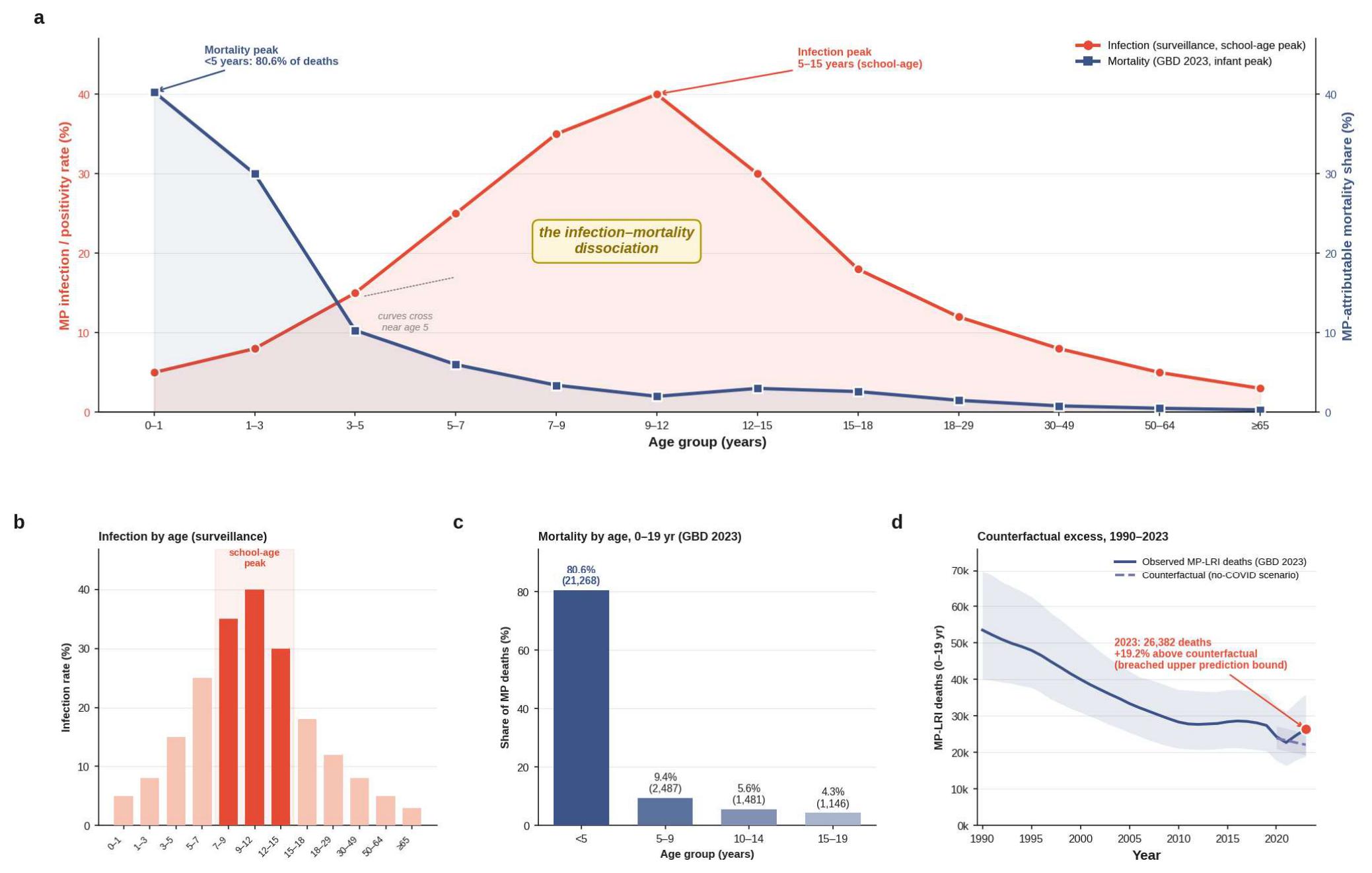
Figure 2.
Pathogen competition, ranked. Horizontal bar chart of modeled pathogen-attributed LRI mortality in ages 0–19, 2023, all 26 LRI etiologies modeled in the authors’ GBD 2023 secondary analysis, MP highlighted at rank 9 (3.71%) (16). Inset: pandemic-period mortality change for MP (−17.1%) versus RSV (−65.2%) versus influenza (−62.6%), computed as 2019 to the 2021 NPI trough, with the 2021→2023 rebound shown; whiskers in the ranked chart are 95% uncertainty intervals. Purpose: MP is not a minor pathogen; it is a top-ten killer filed as a mild disease.
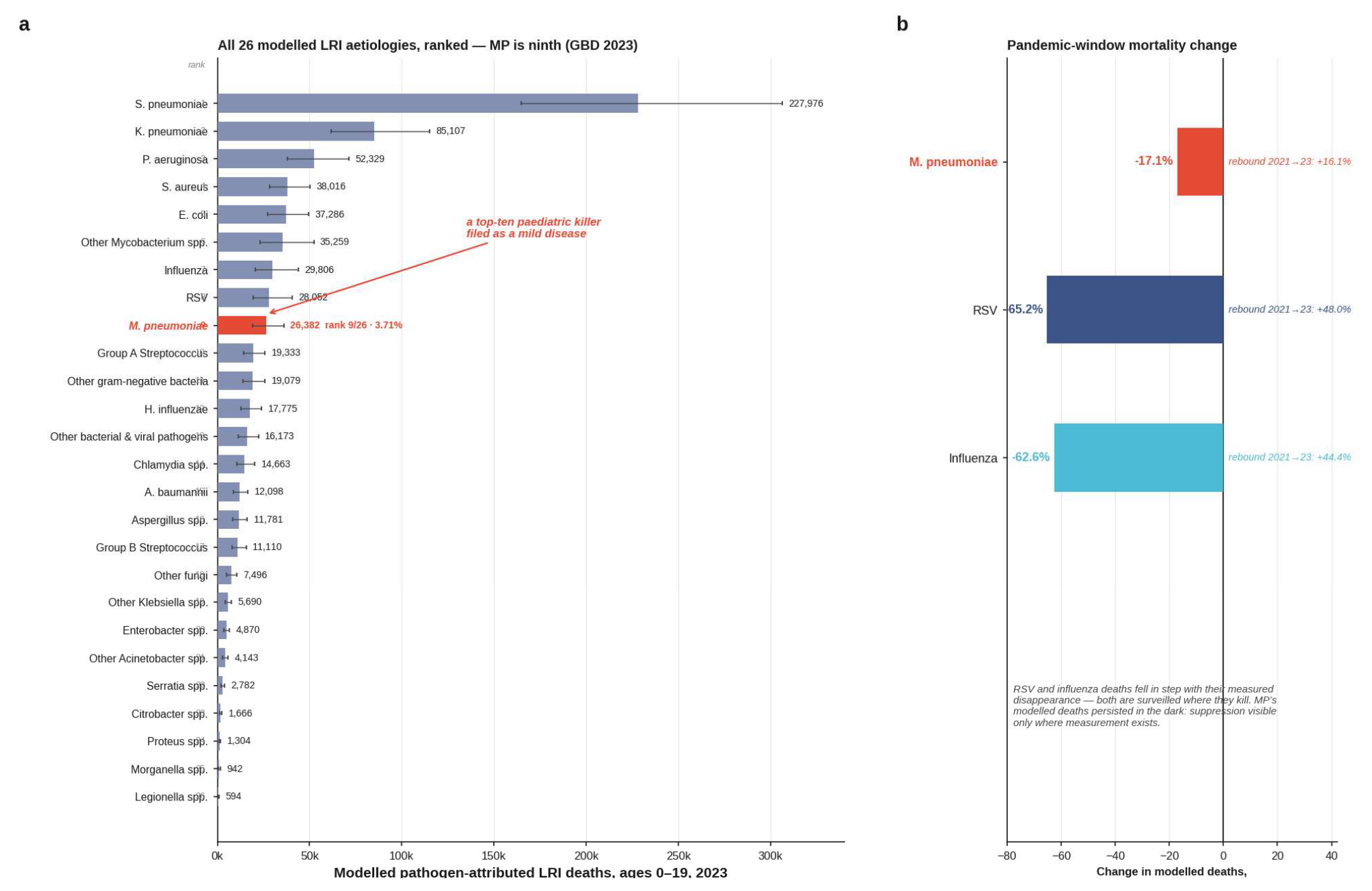
Figure 3.
The gradient and the seesaw.
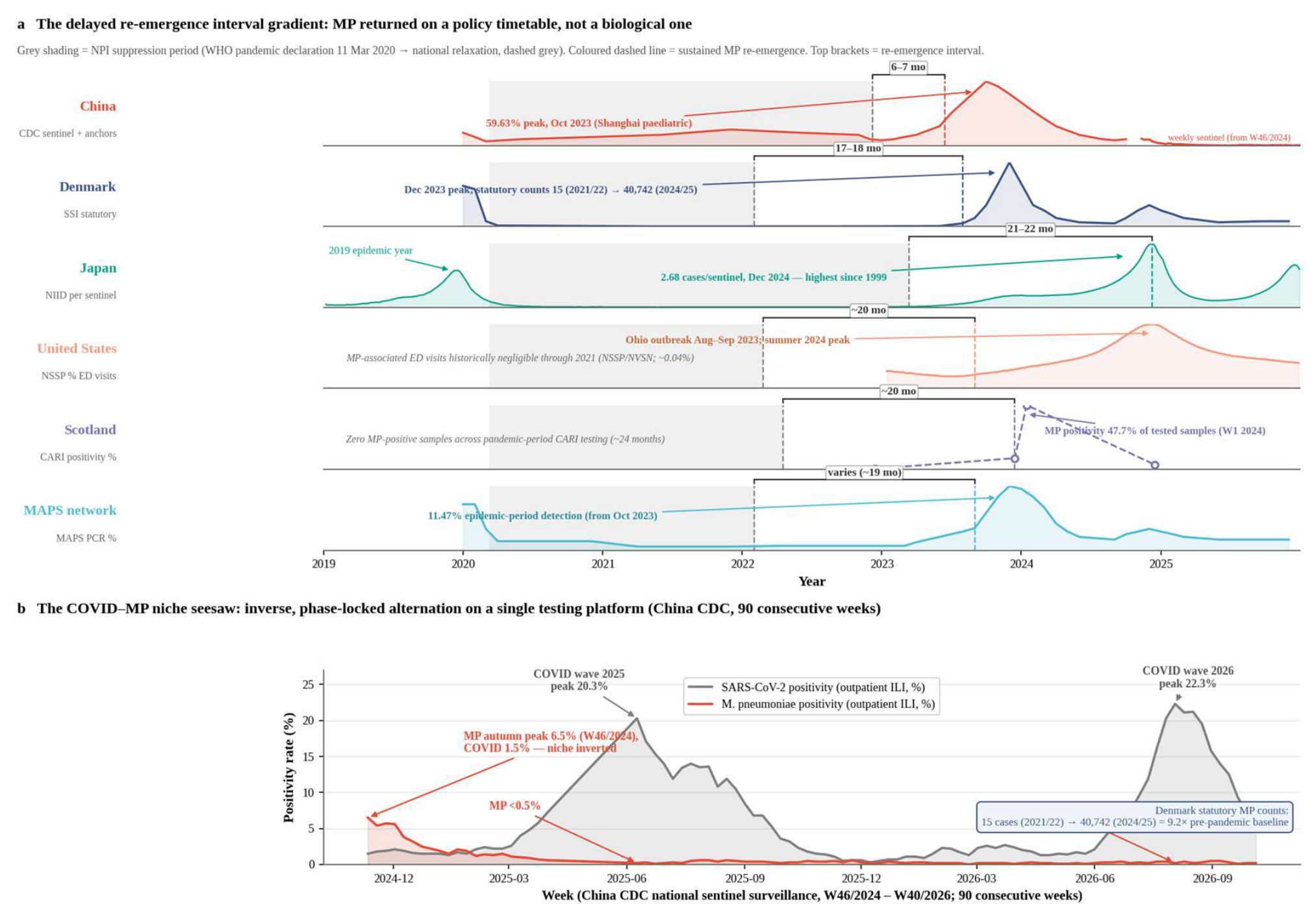
Figure 4.
The inversion map. World map, choropleth of surveillance intensity score (statutory reporting, sentinel network membership, laboratory capacity) overlaid with proportional symbols of modeled MP-LRI deaths by region from the authors’ MP-specific secondary analysis of GBD 2023 data (16); sub-Saharan Africa (57.3%) and South Asia (24.3%) highlighted. The visual statement of surveillance–burden inversion.
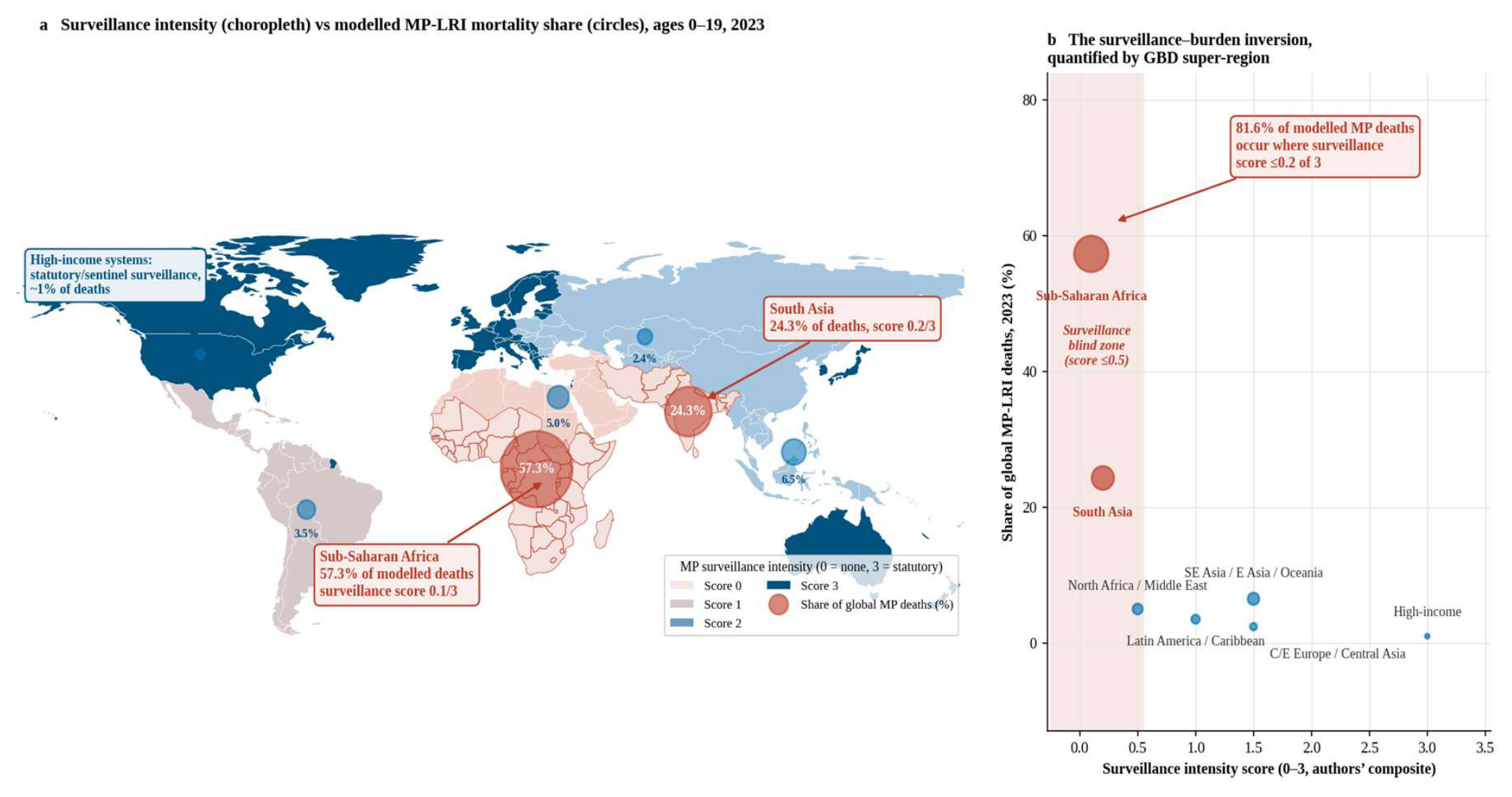

Table 1.
The delayed re-emergence interval gradient.
| Country / system | NPI relaxation / COVID peak | Sustained MP resurgence | Interval (months) | Peak vs baseline | Data source |
|---|---|---|---|---|---|
| China | Dec 2022 (reopening) | Jul 2023 (surge); Oct 2023 peak | ~6-7 | 59.63% (Shanghai peak) | Literature + China CDC |
| Denmark | Feb 2022 (NPI lifted) | Aug 2023 (W32); Nov-Dec peak | ~17-18 | 9.2x pre-pandemic season | Statutory reporting |
| United States | Jan 2022 (Omicron peak) | Sep 2023 (Ohio); 2024 summer peak | ~20 | NSSP 0.35% -> 0.89% | CDC NSSP/NVSN |
| Japan | Aug 2022 (7th wave) | May 2024 (W20); Nov 2024 record | ~21-22 | 2.68/sentinel (record since 1999) | NIID IDWR |
| Scotland (ref.) | 2022 | mid-2023; late 2024 peak | ~18 | 47.7% of tested samples (CARI record) | CARI |
| MAPS network (ref.) | 2022 | Oct 2023 (W40, 10 countries) | ~18-20 | 11.47% (vs 8.61% baseline) | ESGMAC MAPS |
Note. UKHSA (Scotland) data described only in within-period segments due to testing-platform discontinuity. Scotland’s peak is MP positivity among laboratory-tested samples (31/65, CARI programme record, week 1 of 2024); the wider weekly testing series peaked at 12.8% (117/915) in January 2024 (13).
Table 2.
Chronic sequelae of MP infection — evidence summary.
| Sequela | Population / setting | Reported frequency | Evidence type | Key limitation | Ref. |
|---|---|---|---|---|---|
| Bronchiolitis obliterans | Refractory/severe MPP, paediatric | 7.3% (981-child post-MPP cohort); 5–22% across series | Case series, retrospective cohorts | No absolute risk; selection bias | (28, 30) |
| Plastic bronchitis | Severe MPP with airway casts | 14.2% of severe cases | Case series | Severe-case denominator only | (29) |
| Bronchiectasis | Post-MPP follow-up | Reported, rate not established | Cohort follow-up | Attribution uncertain | (28, 32) |
| Airway hyperresponsiveness / asthma | Post-infection, paediatric | Associated (association only) | Case-control, cohort | Reverse causation possible | (31, 32) |
| Extrapulmonary chronic outcomes | Severe/systemic MPP | Case reports/series | Case series | Rare; no denominator | (27) |
Note. Association language throughout; no sequela is attributed causally beyond current evidence.
Disclaimer/Publisher’s Note: The statements, opinions and data contained in all publications are solely those of the individual author(s) and contributor(s) and not of MDPI and/or the editor(s). MDPI and/or the editor(s) disclaim responsibility for any injury to people or property resulting from any ideas, methods, instructions or products referred to in the content. |
© 2026 by the authors. Licensee MDPI, Basel, Switzerland. This article is an open access article distributed under the terms and conditions of the Creative Commons Attribution (CC BY) license (http://creativecommons.org/licenses/by/4.0/).
Copyright: This open access article is published under a Creative Commons CC BY 4.0 license, which permit the free download, distribution, and reuse, provided that the author and preprint are cited in any reuse.