

Submitted:
27 October 2026
Posted:
28 October 2026
You are already at the latest version
Abstract
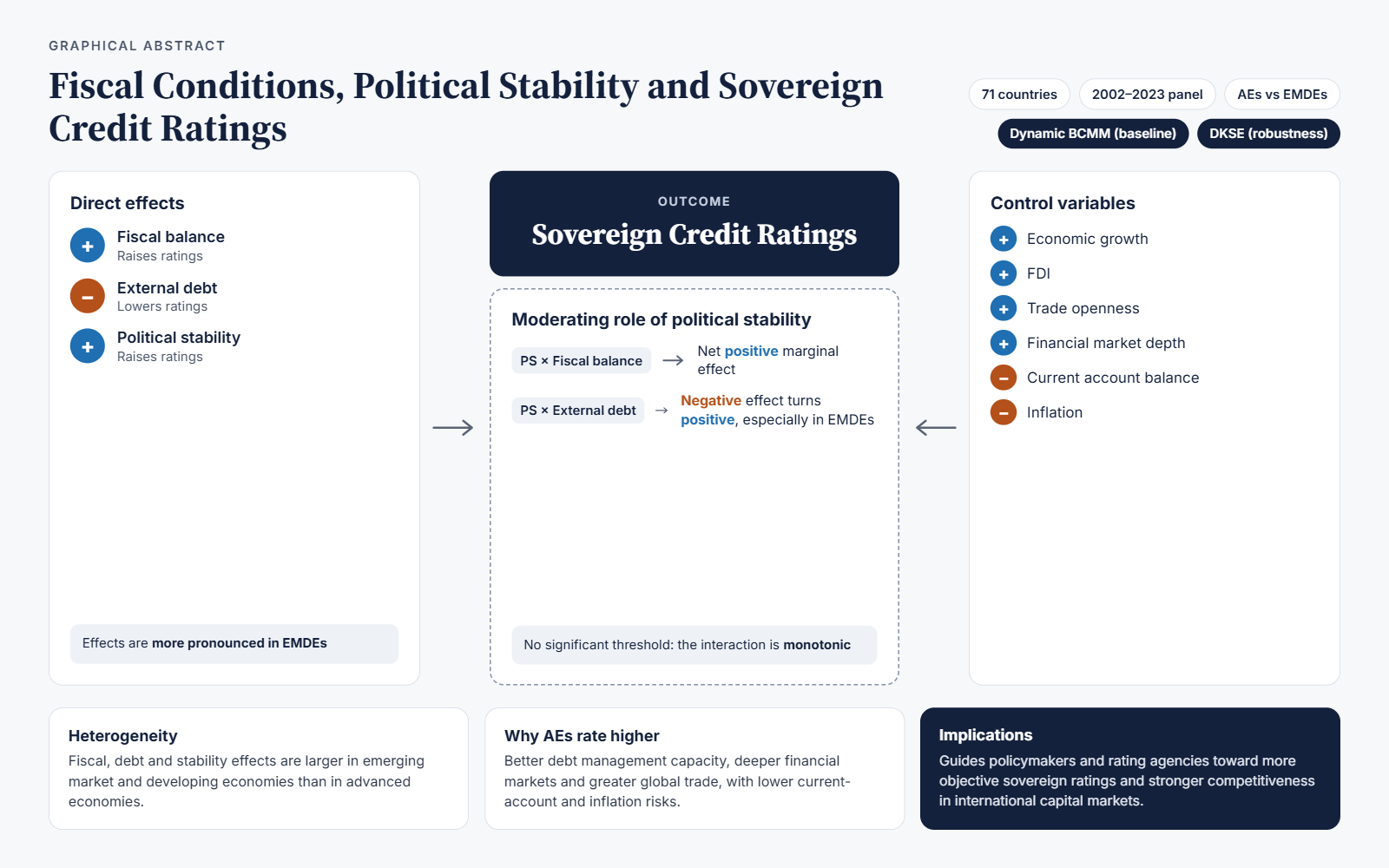
This study examines the direct effects of fiscal condition indicators (fiscal balance and external debt) and political stability on sovereign credit ratings, and the moderating role of political stability, using panel data from 71 countries covering the period from 2002 to 2023, which was further decomposed based on economic development levels. I used the dynamic BCMM to estimate the baseline results and applied the DKSE estimator for robustness checks and sensitivity analysis. The BCMM results show that fiscal balance and political stability positively affect sovereign credit ratings, while external debt has a negative effect. The magnitude of these effects varies, and they are more pronounced in EMDEs. The empirical results also show that political stability makes fiscal balance have a net positive marginal effect on sovereign credit ratings, while it turns the negative effect of external debt positive, especially in EMDEs. However, the study finds no statistically meaningful non-linear thresholds for political stability, implying a monotonic relationship when political stability interacts with fiscal balance and external debt. Among the control variables, economic growth, FDI, trade openness, and financial market depth are significantly and positively associated with sovereign credit ratings, while the current account balance and inflation are significantly and negatively associated. In comparison, the study finds empirical evidence that advanced economies' more favorable ratings than EMDEs can be attributed to better debt management capacity, deeper financial markets, and greater global trade, along with lower risks from current account deficits and inflation. The findings have significant implications for policymakers and global rating agencies in formulating policies that ensure better, more objective sovereign credit ratings and competitiveness in international capital markets.
Keywords:
sovereign credit ratings
; fiscal balance
; external debt
; political stability
; advanced economies
; EMDEs
1. Introduction
Sovereign credit ratings summarize a government’s capacity and willingness to meet its financial obligations (Cantor & Packer, 1996; Choy et al., 2021; Niyonshuti et al., 2026) and affect access to international finance, borrowing costs, and investor decisions (Arogundade et al., 2025; Wüste, 2022; Overes & Wel, 2023). In international financial markets, investors rely on credit ratings assigned by the three (3) global credit rating agencies (Standard and Poor’s [S&P], Fitch, and Moody’s) to indicate a country’s ability and willingness to meet debt obligations (Hmiden et al., 2025; Overes & Wel, 2023). Loussouarn and Vasse (2025) note that sovereign credit ratings continue to play a crucial role in the global financial system, influencing how USD 130 trillion in bond investments are distributed across the globe, and shaping the financing conditions of sovereign states in terms of interest rates, financing capacity, and debt maturities. Sovereign credit ratings offer several advantages, including assessing a country’s credit strengths and weaknesses, protecting investors against adverse selection, deciding the country risk premium, determining appropriate borrowing costs, and influencing corporate investment decisions (Hmiden et al., 2025; Montes & Costa, 2022; UNDP, 2025). They also affect government borrowing costs, government spending in terms of debt servicing, and the fiscal deficit (Bastida et al., 2017; Overes & Wel, 2023; Slapnik & Loncarski, 2021), and shape sovereign financing conditions, banking stability, and the macroeconomic policy landscape (Baglan & Kearney, 2026). Sovereign credit ratings also serve as proxies for sovereign risk and market assessment of sovereign creditworthiness (Wüste, 2022), the potential levels of information asymmetry and agency problems between lenders and borrowers in the international financial markets (Coelho et al., 2026; Ramirez-Rondan et al., 2023), and they dictate risk pricing and influence private capital flows (De et al., 2021; Goel & Singh, 2025). Sovereign credit ratings also influence ratings for sub-sovereign entities, such as non-financial corporations, banks, public sector enterprises, municipal governments, and other borrowers of the same nationality (Cantor & Packer, 1996; Mohapatra et al., 2016). The UNDP (2025) notes that credit ratings for developing countries have been consistently low and declining compared with advanced economies because of perceived high risk from political instability, elevated debt burdens, weak financial institutions, inflation, exposure to commodity market volatility, and insufficient data and a lack of fiscal transparency.
Nevertheless, Overes and Wel (2023) note that these global rating agencies (S&P, Moody’s, and Fitch) use a combination of objective and subjective factors to arrive at sovereign credit ratings, with no single exact methodology and the perceived lack of transparency, leaving global investors and policymakers no choice but to criticize what seems to be an opaque methodology, although all have developed rating methodologies. In view of the strategic importance of sovereign credit ratings in the international financial markets and as an indicator of competitiveness, the dynamics of macroeconomic fundamentals, political stability, fiscal sustainability indicators, institutional efficiency, monetary flexibility, and policy credibility continue to feature in the rating methodologies (Hmiden et al., 2025; Ramírez-Rondán et al., 2023; S&P Global Ratings, 2017). Development status can also shape sovereign credit rating determinants, including differences in economic structure, institutional capacity, and the credibility of information. Advanced economies generally have broader domestic capital markets, greater monetary credibility, a wider tax base, and more power to issue debt in their own currencies. These features can absorb shocks that would threaten debt repayment capacity elsewhere. EMDEs face more foreign-currency borrowing, commodity cycles, concentrated exports, and sudden shifts in international capital flows (IMF, 2024; Wüste, 2022). Baglan & Kearney (2026) also highlight financial sector fragility and macro-financial vulnerability. EMDEs are characterized by higher macroeconomic volatility, shallower financial markets, more prevalent foreign-currency borrowing, and sudden changes in capital flows (Botha & Pretorius, 2020; Wüste, 2022).
Sovereign credit rating methodologies adopted by the three (3) global credit rating agencies (Standard and Poor’s [S&P], Fitch, and Moody’s), and other regional and national credit rating agencies, indicate that fiscal factors and political institutions are among the variables that these rating agencies factor into decisions on upgrades and downgrades (Baglan & Kearney, 2026; Montes & Costa, 2022; S&P Global Ratings, 2017). Several theories, such as the fiscal theory of sovereign risk, sovereign debt model, macroeconomic fundamentals theory, and institutional theory, suggest that fiscal conditions (especially fiscal balance and external debt) and political stability can explain sovereign ratings. In addition, some empirical studies have examined how fiscal condition indicators (Cantor & Packer, 1996; Barglan & Kearney, 2026; Klusak et al., 2024; Montes & Costa, 2022; Wüste, 2022) and political stability (Choy et al., 2021; Goel & Singh, 2025) affect sovereign credit ratings. The continued importance of fiscal conditions and political stability in the sovereign credit rating framework, along with rating disparities between advanced economies and EMDEs, motivates this study. Therefore, this study’s critical empirical questions are: Do fiscal conditions and political stability have material implications for sovereign credit ratings worldwide, and do they affect sovereign credit ratings differently in advanced economies and EMDEs? Does political stability moderate the effects of fiscal balance and external debt on sovereign credit ratings across the study’s sample compositions in any significant way?
Answering these important questions matters because fiscal conditions, including fiscal balance and external debt positions (Montes & Costa, 2022), signal the viability and sustainability of fiscal operations, the probability of government default, the risk of tax and interest rate hikes, government solvency, and overall fiscal credibility. Fiscal credibility and external vulnerability strongly influence sovereign credit ratings, making fiscal balance and external debt dynamics key drivers (Baglan & Kearney, 2026). In particular, Hmiden et al. (2024) note that government debt and fiscal balance are key quantitative factors explaining variation in sovereign credit ratings. Recently, fiscal sustainability has become a central focus for policymakers, lawmakers, analysts, and multinational financial institutions (World Bank and IMF), and studies on its impact on macroeconomic outcomes have intensified (Montes & Costa, 2022; Wüste, 2022). Studies on the effect of external debt on sovereign credit ratings (Baglan & Kearney, 2026; Hmiden et al., 2025) and borrowing costs (Bastida et al., 2017; Colak et al., 2025) have also increased. International markets react quickly to fiscal sustainability news because it reflects uncertainty about government solvency, fiscal resilience, public debt management, and government efficiency (Montes & Costa, 2022). Furthermore, sovereign credit ratings are much higher in developed countries than in EMDEs because developed countries have relatively better national income per capita, government debt management, fiscal flexibility, default history, political stability, and the rule of law (Wüste, 2022).
Hence, the sovereign credit ratings for developed countries and EMDEs can differ based on societal structure, economic conditions, and the effectiveness of governance institutions (Wüste, 2022). Nonetheless, credit rating agencies have been blamed for the higher borrowing costs developing countries incur in international financial markets because of their higher risk perception. The 2022 UN Inter-Agency Task Force on Financing for Development flags the lack of fairness and transparency of the credit rating agencies, accusing them of easily downgrading the credit ratings of developing countries and being lenient and slow in doing the same with developed countries despite larger debt increases and slowing economic growth (Gbohoui et al., 2023). However, these arguments, insinuations, and assertions need more empirical support to inform further reforms that national governments in advanced economies and EMDEs may need, as well as the factors global rating agencies should consider more. This paper argues that fiscal conditions and political stability could explain variations in sovereign credit ratings globally, in advanced economies, and in EMDEs, alongside other macro-structural variables and external forces.
Furthermore, fiscal balance and external debt may cross a threshold before they harm sovereign credit ratings. As Baglan and Kearney (2026) note, when external debt and fiscal deficits are low or moderate, market participants and credit rating agencies may view them as manageable; but as they escalate, risks to government solvency and financial sustainability may emerge, leading to regime-dependent shifts in sovereign credit assessments. This notion suggests that fiscal balance and external debt may have a non-linear relationship with sovereign credit ratings, with identifiable turning points. The empirical literature has understudied a non-linear relationship between financial conditions, proxied by fiscal balance and external debt, and sovereign credit ratings. Rating agencies also respond more strongly to fiscal debt or external vulnerability (Baglan & Kearney, 2026), suggesting that sovereign credit ratings may respond asymmetrically to negative versus positive changes in fiscal balance and external debt.
Additionally, many studies on the determinants of sovereign credit ratings have focused more on quantitative variables, such as macroeconomic factors and external viability indicators, and less on qualitative factors, such as political and institutional quality. Both quantitative and qualitative factors shape sovereign credit ratings, providing a more holistic picture (Choy et al., 2021; Goel & Singh, 2025). Mellios and Paget-Blanc (2006) argue that global credit rating agencies use a combination of quantitative and qualitative factors to assign a credit rating to a debtor or debt instrument, and that excluding political variables may bias sovereign credit rating parametrization. Institutional quality defines the behavior of the government and state authorities. This is pertinent because sovereign credit ratings reflect both the ability and the willingness of a country to meet its debt obligations. The ability component reflects quantitative factors, while the willingness component reflects institutional character and credibility. Among the governance indicators is political stability, which the literature on sovereign credit rating determination has included (Coelho et al., 2026; Goel & Singh, 2025; Mellios & Paget-Blanc, 2006; Mikhaylova & Timushev, 2022). A large proportion of sovereign ratings remain unexplained by quantitative macroeconomic factors, with qualitative knowledge from the rating committee filling in or complementing the quantitative variables (Slapnik & Loncarski, 2021). Hence, this study examines whether this political-institution credibility matters more in developed countries than in EMDEs. Relatedly, political stability may provide the institutional credibility that reduces the perceived risk associated with elevated fiscal deficits and external debt. This kind of interaction effect of fiscal condition indicators and political stability is missing in the empirical literature. Accordingly, this study examines how political stability moderates the effects of fiscal condition indicators (fiscal balance and external debt) on sovereign credit ratings across all sample compositions.
Therefore, this study makes significant contributions. First, many existing studies have been exploratory, searching for the determinants of sovereign credit ratings (Cantor & Packer, 1996; Coelho et al., 2026; Gbohoui et al., 2023; Hill et al., 2010; Hmiden et al., 2025; Mellios & Paget-Blanc, 2006; Mohapatra et al., 2016; Niyonshuti et al., 2026; Overes & Wel, 2023; Proenca et al., 2020; Slapnik & Loncarski, 2021). This study uniquely focuses on the effects of fiscal condition indicators (fiscal balance and external debt) on sovereign credit ratings and how they influence sovereign credit rating adjustments across all sample compositions. Second, the study examines how fiscal conditions and political stability explain variations in sovereign credit ratings. This will reduce controversy over allegations of bias toward high-income countries (Goel & Singh, 2025; Griffith-Jones & Kraemer, 2021), the accusations of subjective assessment by rating agencies (Mikhaylova & Timushev, 2022), and interference from conflicts of interest by the U.S.-based Big Three rating agencies (S&P, Moody’s, and Fitch) that make them hesitate in assigning poor sovereign credit ratings to U.S. and other developed countries (Loussouarn & Vasse, 2025). Finally, this study investigates whether political stability moderates the effects of fiscal balance and external debt on sovereign credit, including whether non-linear thresholds exist. The existing empirical literature has done little in this area. The closest studies are Chowdhury et al. (2023) and Nounamo et al. (2021). Chowdhury et al. (2023) examined the moderating effect of institutional quality on the relationship between government debt and macroeconomic stability, confirming that institutional quality can change the direction of the effect of government debt on macroeconomic stability. Nounamo et al. (2021) investigated the moderating effect of governance indicators in the external debt-economic growth nexus. This study is unique as it examines how political stability moderates the effects of fiscal balance and external debt on sovereign credit ratings in advanced economies and EMDEs
This study will benefit several entities. Understanding how fiscal conditions and political stability influence sovereign credit ratings will help governments, investors, financial institutions, and academics. Governments can forecast ratings based on these factors and improve fiscal conditions and political-stability expectations to secure favorable credit-rating upgrades and sustain international competitiveness. Investors and financial institutions can understand how changes in fiscal conditions and political stability influence credit rating revisions and adjustments, and how these changes affect perceptions of sovereign risk, debt-servicing capacity, debt refinancing, investment planning, and asset portfolios. Academics can use the findings to develop, refine, and modify relevant theories, improving their predictive and informational power in this area of study.
This paper is structured into five sections. Section 1 discusses the study’s background, motivation, objective, and significance. Section 2 reviews the theoretical and empirical literature and helps formulate the research hypotheses. Section 3 focuses on the methodology and empirical modeling strategy. Section 4 presents and discusses the empirical results, while Section 5 provides the conclusions, implications, and recommendations, including suggestions for future research.
2. Literature Review
2.1. Theoretical Review
Several theories exist that explain factors that influence sovereign credit ratings either directly or indirectly. These comprise the fiscal theory of sovereign risk, the debt overhang theory, the sovereign debt and default theory, institutional and governance theory, and macroeconomic fundamentals theory. Each of these theories is discussed in the ensuing paragraphs.
The first theory explored in the study is the fiscal theory of sovereign risk. According to Uribe (2006), the fiscal theory of sovereign risk argues that sovereign default risk is high when a country runs a large fiscal deficit and finances it through external borrowing, which it can do only by paying high interest rates; the central bank will find it difficult to use interest rates to control inflation. The scholar further explains that, under certain monetary and fiscal policies, potential conflicts between monetary and fiscal policy exacerbate the risk of sovereign default. For instance, when the central bank tries to impose price stability by fixing or pegging the price level, a fiscal deficit makes sovereign default inevitable, and any attempt to postpone default will not only lead to explosive inflation but also to a larger default than the one being postponed or avoided. The theory explains that sovereign default and risk premia inevitably follow misaligned monetary-fiscal policy regimes, and when accumulated debt exceeds future fiscal surpluses, default or restructuring becomes inevitable. Further, Mpapalika and Malikane (2019) clarify that if a country runs a fiscal deficit and cannot raise taxes, it is likely to finance the deficit through external borrowing; hence, sovereign default risk can set in, and high sovereign default risk can lead to a high country risk premium. It is explained further that public external debt can create a credibility crisis and dampen investors’ confidence about debt sustainability, which in turn increases the risk of sovereign default and leads to sovereign credit rating deterioration; however, the effect of fiscal deficits on sovereign risk premium and cost of borrowing can be moderated when a country has a strict fiscal rule (Heinemann et al., 2014). The fiscal theory of sovereign risk holds that inflation-targeting strategies trade off inflation stabilization against suppressing sovereign default risk (Okano & Kazuyuki, 2016). With high debt, repaying existing debt becomes costly, making new debt issuance difficult; as new issuance becomes harder, sovereign default risk rises and the country risk premium increases (Niemann & Pichler, 2020).
The second theory is the debt overhang theory. The debt overhang theory is an economic and corporate finance theory, pioneered by Stewart Myers in 1977. According to Myers (1977), when a company or sovereign government has a massive debt burden, future profits from new investments go mostly toward meeting obligations to existing creditors rather than to owners or the entity itself, thereby acting as an implicit tax on future income. The theory was later contextualized more within the sovereign debt arena by Krugman (1988). Krugman (1988) notes that debt overhang can affect future financing, as investors hold back due to default fears. There are multiple channels through which excessive debt can affect fiscal risk and then sovereign credit ratings. Debt overhang can drive inflation through fiscal deficit monetization (printing money), government bond repurchases that expand the money supply, and excessive aggregate demand as households, businesses, and government spend on goods and services. Excessive external debt can create massive debt-servicing obligations, increasing the risk of tax hikes and spending cuts, disinvestment and underinvestment, low capital formation, and low economic growth (Abdullahi et al., 2016; Philippon, 2009). Debt overhang can make structural reforms unattractive and reduce global investor confidence, which may trigger capital flight and currency depreciation. It suggests that high government external debt reduces capital flows to the real sector, dampens investor confidence, causes inflation, increases sovereign default risk, and triggers sovereign credit rating downgrades (Hwang et al., 2010; Sen et al., 2007).
The third theory used in the study is the sovereign debt and default theory, also known as Eaton and Gersovitz’s (1981) sovereign-debt model. The theory begins with the lack of a supranational authority that could enforce sovereign debt repayment, unlike a national court, because there is no traditional bankruptcy code that foreign investors could invoke (Mellios & Paget-Blanc, 2006). Sovereign states avoid defaults because defaults may cost them eligibility for international loans, damage their reputation, and impose economic costs (Wright, 2013). Mellios and Paget-Blanc (2006) argue that a country rarely defaults or repudiates external debt outright; instead, it renegotiates debt. The scholars argue that a country will avoid default for three reasons: foreign creditors can seize the country’s foreign assets if it reneges on its debt; it may lose access to future foreign loans; and international trade will suffer. These theoretical arguments remain relevant to current sovereign ratings analysis, since ratings summarize the factors affecting repayment benefits and costs (Wüste, 2022; Overes & Wel, 2023). High external debt levels increase refinancing, currency depreciation, and repudiation risk; faster economic growth and better fiscal accounts provide resources for debt service. Sovereign ratings respond to the framework because they reflect both the ability and willingness to repay. Fundamentals shape the intertemporal budget constraint, while political institutions determine whether the government can credibly commit to adjustment and afford the domestic cost of repaying debt (S&P Global Ratings, 2017; Ramírez-Rondán et al., 2023). Recent literature finds that political institutions, relationships among political decision-makers, investor-protection arrangements, and other factors shape perceptions of sovereign repayment credibility (Klusak et al., 2024; Hmiden et al., 2025). The framework also predicts heterogeneity. Countries with deep domestic financial markets, a reserve currency advantage, strong institutions, or reputational capital may face lower effective default costs after an observed shock. This means the same changes in debt, inflation, or fiscal performance could have different rating consequences in advanced versus developing economies (Botha & Pretorius, 2020; Wüste, 2022).
North’s (1990) institutional and governance theory is also relevant to this study. Institutions foster economic exchange by reducing uncertainty. Applied to sovereign borrowing, stable political and legal institutions ensure predictability of future policies, safeguard contractual rights, and boost the credibility of fiscal commitments. Institutions can thus enhance creditworthiness directly and mitigate the impact of negative macroeconomic fundamentals. This institutional view is complemented by the information-asymmetry argument. Investors do not fully know future policy options, and government economic data may be incomplete, delayed, or revised. Ratings work to reduce information costs by verifying creditworthiness assessments and aligning investors around the same indicator (Akerlof, 1970; Boot et al., 2006). Political stability and governance quality influence sovereign credit ratings by improving policy transparency and credibility and shaping perceptions of creditworthiness, since investors and credit rating agencies consider political stability a key factor when assessing a country’s ability to meet its financial obligations (Rashid et al., 2026). The bargaining power of a host country and confidence of investors can be dampened by regime change, weak institutions, and doubtful legitimacy. Therefore, weak political stability or outright political instability is a negative signal to investors and could negatively impact sovereign credit ratings through issues related to short-term thinking of government, policy turbulence, weak institutions, governance fragility, rent-seeking behavior, and lack of institutional capacity to respond to crises (Amir et al., 2025). Nonetheless, political stability tends to be positive; however, an overly stable regime can become complacent and less receptive to economic shocks (Rashid et al., 2026). This implies that political stability is desirable but does not fully explain sovereign credit ratings, especially when the government is stable but monetary transmission is weak, and the government clearly lacks the capacity to manage debt and public finances.
Finally, the study uses the macroeconomic fundamentals theory, also known as the Cantor-Packer model. The theory contends that sovereign credit ratings are driven primarily by objective, quantifiable macroeconomic indicators that measure a government’s capacity to service debt effectively. Cantor and Packer (1996) argue that 90% of variations in sovereign credit ratings are explained by eight variables (per capita income, GDP growth, inflation, fiscal balance, external balance, external debt, economic development classification or industrialization dummy, and default history. Coelho et al. (2026) observe that many economic fundamentals underpin the credit methodologies of leading credit rating institutions. The variables that the three leading global rating agencies use are shown in Appendix I. Therefore, macroeconomic variables are expected to explain variations in sovereign credit ratings across countries. Many of these variables are either used as main independent or control variables in this study.
2.2. Empirical Review
2.2.1. Fiscal Conditions and Sovereign Credit Ratings
Baglan and Kearney (2026) note that sovereign credit rating agencies rely on a multidimensional set of indicators, ranging from institutional effectiveness and regulatory capacity to systemic financial risk. Empirically, Cantor and Packer (1996) were among the first researchers to examine the determinants of credit ratings (Coelho et al., 2026; Gande & Parsley, 2005; Slapnik & Loncarski, 2021). Cantor and Packer (1996) examined the effect of fiscal balance and external debt, among other variables, on sovereign credit ratings. The study reported that fiscal balance has no significant effect on average ratings, constructed from Moody’s and S&P ratings, although it has a significant positive effect on S&P ratings. External debt consistently shows a negative link with the average ratings and Moody’s and S&P ratings. Using 2007-2008 data for 103 countries, Bastida et al. (2017) reported that enhanced fiscal transparency and political trust are associated with a lower cost of sovereign debt, whereas unemployment, higher corruption, budget deficits, and current account deficits increase the sovereign cost of debt. Montes and Costa (2022) found that fiscal balance positively affects sovereign credit ratings in Brazil, using monthly 2003-2018 data analyzed with GMM and OLS estimators, implying strong fiscal credibility and low-risk debt expansion.
Wüste (2022) examined whether sovereign rating agencies’ assessment criteria differ between developed and developing countries. The sample comprised an unbalanced panel of 107 countries, 34 developed and 73 developing economies, for 1991-2015. This study used sovereign ratings from three rating agencies, Moody’s, Standard & Poor’s, and Fitch, as the dependent variables. Independent variables include trade openness, public debt, unemployment, democracy, executive tenure, demographic structure, and the strength of fiscal rules. The determinants of ratings varied systematically by development status. In developed economies, unemployment, executive tenure length, and the strength of balanced-budget and spending rules mattered more, while in developing economies, public debt, democracy, and demographic structure mattered more. The study suggests that the developed world should tighten fiscal rules and reinforce labour market stability, and that the developing world should improve debt sustainability and strengthen political institutions. Overes and Wel (2023) used 2001-2019 data collected for 62 developed and developing countries for the period 2001-2019, with Moody’s sovereign rating as the dependent variable, while GDP growth, inflation, unemployment, the current-account balance, government balance, public debt, political stability, regulatory quality, and GDP per capita were the independent variables. The study concluded that higher government debt and unemployment rates are associated with lower credit ratings, while higher political stability is associated with higher credit ratings.
Baglan and Kearney (2026) found that, based on the 2002-2020 data from 36 emerging countries and using linear, dynamic panel threshold, and quadratic regression models, higher debt is associated with lower sovereign credit ratings, while the non-linear parameters present weak and insignificant evidence of curvature in the relationship between government debt and sovereign credit ratings. However, the panel threshold model showed that when debt exceeds 56 percent of GDP, the adverse effect of debt becomes more pronounced. The study also showed that GDP per capita has a positive and statistically significant effect, underscoring the economic resilience and fiscal capacity of wealthier countries; the external balance variable has a weak positive influence, while government effectiveness has a strong positive effect. Abdelmohsen et al. (2026), in a meta-regression analysis of 23 primary studies conducted between 1996 and 2024, found that debt service obligations and debt stock significantly reduce sovereign credit ratings, with debt service obligations having a stronger effect. In related studies, Akinyemi (2026a), using 2000-2021 data for 35 emerging and developing countries and a two-step system GMM, found that external debt significantly amplifies the country risk premium through higher risk perceptions driven by elevated fiscal stress. The study also indicates that inflation increases the country risk premium, whereas economic growth, current balance, foreign reserves, and political stability lower it.
2.2.2. Political Stability and Sovereign Credit Ratings
Political stability is a key indicator of institutional quality, supporting efficient debt management, enhancing fiscal credibility, and minimizing default risk (Baglan & Kearney, 2026). Recent empirical evidence highlights the relevance of political institutions, government integrity, and investor protection for sovereign credit ratings (Ramírez-Rondán et al., 2023; Klusak et al., 2024; Hmiden et al., 2025). Choy et al. (2021), using data collected for 2012-2014 for ratings provided by the Three Big rating agencies (S&P, Moody’s, and Fitch), grouped causal factors into orthodox (institutional and socio-political, external financial strength, and economic growth) and unorthodox (monetary policy credibility, government debt structure, trade openness, financial sector depth, external vulnerability, current account balance, fiscal balance, foreign currency dependence). The study concluded that socio-political institutions and external financial strength indicators weigh significantly in sovereign credit ratings. Mikhaylova and Timushev (2022) found that international rating agencies value institutional factors, as institutional weaknesses explained the lower credit ratings assigned to Russia than to the U.S., using data for the period 2008-2017. Ramirez-Rondan et al. (2023) analysed 71 countries between 2003 and 2020 and Moody’s, Standard and Poor’s and Fitch ratings served as the dependent variables. Political institutions and country-specific economic uncertainty, and their interaction, were the two main independent variables, while the remaining macroeconomic variables served as controls. Positive political institutions and negative economic uncertainty were associated with sovereign ratings. The interaction coefficient was also negative, suggesting that as uncertainty rises, the rating premium for more robust political institutions shrinks. The authors thus suggest combining the two: for institutional change to be more effective, the policy environment must be stable and predictable, with more political institutions and less policy and economic uncertainty.
In recent times, Hmiden et al. (2025) examined whether legal protection of investors affects sovereign credit ratings and whether trade openness mediates this relationship. The study used an unbalanced panel of data from 39 countries from 2000 to 2023, comprising about 2,600 observations. The dependent variables were the average sovereign rating and the individual ratings from Moody’s, Standard & Poor’s, and Fitch. Investor protection was the main independent variable; trade openness was the intervening variable; and legal origin, political stability, public debt, unemployment, and other macroeconomic factors were control variables. Sovereign ratings were positively associated with investor protection, but trade openness partially offset this effect by increasing exposure to external risks. The rating reaction to investor protection reforms was more favorable in common-law countries. The study suggests investing more in investor protection institutions and implementing policies to address external vulnerabilities arising from increased trade integration. Goel and Singh (2025) also used 2011-2020 data for 55 countries to examine the impact of quantitative and qualitative factors on sovereign credit ratings using correlation analysis. The study concluded that qualitative factors (rule of law, control of corruption, government effectiveness, regulatory quality, human development index, and economic complexity index), individually and collectively, determine sovereign credit ratings more strongly than quantitative factors. The empirical results also indicate bias toward high-income nations and the moderate importance of banking parameters in determining sovereign credit ratings. Mundonde and Takawira (2025), using data from 2001 to 2023 and the ARDL framework, concluded that control of corruption, political stability, government effectiveness, voice and accountability, rule of law, and regulatory quality do not significantly influence sovereign credit ratings in South Africa. The scholars noted that these governance indicators may not have improved sovereign credit ratings; instead, they may have prevented rating downgrades as South Africa strives to improve its institutional quality. Meanwhile, GDP growth rate and FDI have an insignificant negative effect, but the reserves-to-external debt ratio, current account balance, and inflation have a significant effect. Similarly, Nounamo et al. (2021) concluded that poor institutional quality prevents countries from benefiting from external debt through corruption and capital misallocation, based on 1985-2015 data for 14 African countries. Chowdhury et al. (2023) found that, based on the 2002-2020 data of 133 countries and the dynamic GMM estimator, institutional quality positively influences macroeconomic stability, while government debt has a negative effect, but the interaction effect of institutional quality and government debt changes the direction of the effect of debt on macroeconomic stability.
However, existing studies have not examined the same international sample of countries simultaneously, accounted for country-specific factors, world shocks, and rating persistence, or ensured that the two groups have different development statuses. To fill this gap, the present study uses static and dynamic panel methods to formally test whether fiscal conditions and political stability affect advanced economies differently from emerging market and developing economies.
2.2.3. Other Macro-Structural and External Determinants of Sovereign Credit Ratings
Several other factors have been linked with sovereign credit ratings. Mellios and Paget-Blanc (2006) used the 2002-2003 data for 86 countries and used principal component analysis (PCA) and a logistic regression model. PCA extracted 13 variables with at least an eigenvalue of one (1) from the 49 total variables considered. The 13 variables are economic development level, public indebtedness, political stability/governance quality, economic growth, money supply, external liquidity, external debt and openness, inflation, net investment flows, economy size, competitiveness, debt servicing, and balance of payments. However, the regression model indicates that the exchange rate, gross domestic savings, GDP per capita, government revenue, corruption control, and default history significantly improve sovereign credit ratings, while fiscal balance, inflation, and trade openness lower them. Gbohoui et al. (2023), based on 2003-2021 data of 89 countries, found that the U.S. federal funds rate, global financial market volatility, debt crisis, and informality are linked with increasing sovereign risk premium, whereas factors such as economic risk, financial risk, political risk, financial development, budget transparency, and regulatory quality are associated with a lower sovereign risk premium. Proenca et al. (2022), using the 2001-2008 and 2009-2016 data structures, analyzed with the ordered probit regression model, found that GDP per capita, government effectiveness, and foreign reserves enhance sovereign credit ratings, whereas unemployment rate, inflation, and exchange rate lead to a lower sovereign credit rating in the period 2001-2008. The results for 2009-2016 are consistent with the earlier period, except that the exchange rate now has an increasing effect. Adarov and Panizza (2024), using the 2000-2021 data for 120 countries and a pooled regression model, found that high public investment quality is associated with lower sovereign risk in countries with high investment quality by enhancing fiscal sustainability through reduced debt-to-GDP ratios and the self-funding nature of high-quality public investment, whereas low investment quality is linked to higher sovereign risk, implying that an increase in low-quality public investment results in a deterioration of fiscal fundamentals.
Hmiden et al. (2024), using 2011-2018 data for 70 countries, found that public debt influences how macroeconomic and institutional factors affect sovereign credit ratings, implying regime dependence. Specifically, the study reported that when debt is below 52.86%, government debt, unemployment, and default history reduce sovereign credit ratings, while GDP per capita improves them. When the debt level exceeds this threshold, the results in the lower regime hold. However, banking system stability reduces sovereign credit ratings, while controlling inflation and corruption improves them. Choy et al. (2026) conducted a systematic review of empirical literature and ranked the frequency of use of some popular factors related to economic structure, external financial strength, political and governance quality, public finances and fiscal health, and financial market indicators, ranging from inflation rate, national income per capita, GDP growth rate, current account balance, fiscal balance, default history, government debt, unemployment rate, external debt, corruption, geographic region, government effectiveness, foreign reserves, economic development, political stability, trade openness, rule of law, real exchange rate, voice and accountability, gross domestic savings, terms of trade, infrastructure investment, and debt service to exports. Niyonshuti et al. (2026), based on 2010-2022 data for East African countries, found that in high-income countries, GDP growth and rule of law are the most significant determinants of sovereign credit ratings, while GDP growth and external debt are most significant for low-income countries, and for middle-income countries, GDP growth, inflation, and current account balance significantly affect sovereign credit ratings. Coelho et al. (2026), using 2000-2018 data and machine learning models, found that gross debt, inflation, external debt, and default history increase sovereign risk, while GDP per capita, GDP growth rate, and fiscal balance reduce sovereign risk. Akinyemi and Owolabi (2026), using data for the period from 2000 to 2021 and panel-corrected standard errors, found that financial globalization has a weak reducing impact on equity risk premium, whereas financial sector development, political stability, current balance, economic growth, and gross domestic savings can significantly lower equity risk premium.
From the empirical literature reviewed, studies that have investigated the moderating role of political stability in the fiscal conditions-sovereign credit ratings nexus are sparse. Therefore, this study fills a significant empirical gap.
3. Methodology
3.1. Research Design and Data
The study employed a quantitative approach using a longitudinal research design. This method is often used to assess empirical relationships between research variables across multiple cross-sectional entities over time (Hsiao, 2007). The study sample comprises 71 countries: 29 advanced economies and 42 emerging markets and developing economies (EMDEs) drawn from the IMF’s list of countries it recognizes and classifies as advanced, emerging, or developing. The IMF (2026) classifies 43 countries as advanced and 148 countries as emerging markets and developing economies (EMDEs). Data availability also informs the study period, 2002 to 2023. For instance, institutional indicator data, which include political stability data, became available in 1996, but from 2002 onward there are no missing data between years. The 2023 end year is due to data availability constraints. Therefore, the study period is long enough to characterize the effects of fiscal conditions and political stability on sovereign credit ratings while controlling for other variables. The research variables were broadly balanced and sourced from reputable sources, including the World Bank and the IMF.
3.2. Econometric Modeling Strategy
3.2.1. Theoretical Framework and Model Specification
This study’s theoretical framework draws on propositions from the fiscal theory of sovereign risk and the sovereign debt model, which explain that fiscal deficits and excessive external debt may trigger inflation and sovereign default, thereby increasing sovereign risk and lowering sovereign credit ratings. This study also draws on institutional theory, which argues that political and legal institutions are crucial to ensuring policy credibility and certainty, helping reduce risk perceptions among international market participants. Accordingly, based on these propositions, we present the functional model for sovereign credit ratings below.
Where SCR is the sovereign credit rating; FBA is the fiscal balance; EXD is the external debt; POL is the political stability; RGDPGR is the real GDP growth rate; CAB is the current account balance; EXCR is the exchange rate; INF is the inflation rate; DCP is the domestic credit to the private sector; FDI is the foreign direct investment; TRO is the trade openness; and KOFFIGI is the financial globalization index.
To empirically test these theoretical propositions, this study adopts the econometric model by Goel and Singh (2025), with modifications that introduce fiscal balance, external debt, and institutional quality as the main independent variables, along with additional control variables, to examine the direct and threshold effects of fiscal balance, external debt, and institutional quality on sovereign credit ratings in advanced economies and EMDEs.
Baseline Model
Where SCR is the sovereign credit rating; FBA is the fiscal balance; EXD is the external debt; POL is the political stability; X represents the vector of control variables; β0 is the constant; β1, β2, and βk represent the parameter coefficients; and εitis the error term.
Interaction Model
Following prior studies (Andreasen & Valenzuela, 2015; Asongu, 2025; Nchofoung et al., 2021), the interactive Equations (12), (16), and (20) can be transformed into a non-linear framework, as shown below.
Where β1 is the coefficient of the variable associated with the direct effect, π1 is the coefficient of the modulating variables.
Differentiating Equations (3a) and (3b) with respect to fiscal balance and external debt yields Equations (4a) and (4b). In other words, the conditional (marginal) effect of fiscal balance and external debt, respectively, on sovereign credit rating, given political stability, is derived from the first derivative below.
Where ∂ is the partial derivative operator. In Equations (4a) and (4b), a unit change in the dependent variable (SCR) as a result of variation in fiscal balance and external debt is hinged on the signs and the coefficients of β1 and π1, which respectively represent the unconditional and interactive or conditional effects. If both coefficients have opposing signs and are significant, corresponding thresholds can be estimated. If both coefficients have the same sign, synergistic effects exist; if at least one is non-significant, threshold or net-effect calculations are not applicable (Asongu, 2025; Nchofoung et al., 2021). The net effect can be computed as follows:
Where π1is the magnitude of the indirect effect of each of FBA and EXD, is the average of the policy modulating variable (POL).
In addition, Equations (4a) and (4b) allow computing the corresponding thresholds using the formulas below, as Akinyemi and Owolabi (2026), Asongu (2025) and Eozenou (2008) do. A threshold occurs at a specific level of political stability where the conditional effect of fiscal balance and external debt on sovereign credit rating equals zero (or shifts from positive to negative, or vice versa).
However, Asongu (2025) notes that two points need clarification when computing the thresholds. First, the signs of the coefficients of the main independent variables (FBA and EXD) and the interaction terms (FBA*POL) and (EXD*POL) should oppose each other and be significant. Second, for the thresholds to have economic meaning and policy relevance, they should fall within the critical minimum and maximum limits of the modulating variables reported in the summary statistics. On the other hand, the computed critical masses can either be (1) policy thresholds or complementary policy thresholds. The policy thresholds represent the minimum levels of the moderating variables required to influence the outcome variable in the expected direction. In contrast, the complementary policy thresholds represent the maximum levels of the moderating variables that should not be exceeded; when exceeded, they should be complemented with other policy variables to achieve the anticipated effect on the outcome variable. Hence, whether to adopt policy thresholds or complementary policy thresholds depends on the signal of the outcome variable. As in Asongu (2025), sovereign credit ratings are a positive macroeconomic signal; therefore, the anticipated policy direction is to increase them to improve international market position and competitiveness.
3.3. Measurement of Variables
3.3.1. Dependent Variable
The World Bank proxies sovereign credit ratings with foreign-currency long-term sovereign debt ratings, an index ranging from 1 to 21 that it tracks through its Fiscal Space project. A score of 1 is the lowest rating, while a score of 21 is the highest rating. The World Bank typically aggregates and analyzes the qualitative letter grades (such as AAA, Ba1, or CCC+) from S&P, Moody’s, and Fitch, and applies a quantitative ordinal conversion and transformation scheme. This mapping broadly follows academic literature established by Cantor and Packer (1996), Gande and Parsley (2005), and Hill et al. (2010). This index helps resolve differences in the scales and categorizations used by S&P, Moody’s, and Fitch (Choy et al., 2021). Appendix 1 shows the numerical transformation of the alphabet-based ratings and their mapping to the World Bank’s foreign-currency long-term sovereign debt ratings. Griffith-Jones and Kraemer (2021) note methodological differences among the Big Three rating agencies; they share the same main building blocks: institutional and governance quality, economic growth and resilience, public finances, external accounts, and monetary flexibility. UNDP (2025) further notes that the three dominant global credit rating agencies (Standard & Poor’s, Moody’s, and Fitch) base their credit ratings on both quantitative and qualitative measures, calibrated into an alphanumeric rating scale. They use similar indicator classifications, as shown in Appendix I: S&P (economic, fiscal, institutional, external, and monetary), Moody’s (economic, fiscal, institutional, and event risk), and Fitch (economic, fiscal, structural, and external finances). The common denominators include the macroeconomic outlook, public debt sustainability, governance quality, and risk variables (political, economic, and external).
Typically, this index is calculated as a simple average of the converted numerical ratings from S&P, Moody’s, and Fitch, creating a composite sovereign risk index. Sovereign credit ratings reflect a country’s credit risk and indicate the likelihood that the country will make promised payments (Overes & Wel, 2023) or default (Mikhaylova & Timushev, 2022). It provides an independent evaluation of a national government’s creditworthiness, measuring its ability and willingness to repay public debt in full and on time, and serving as a core benchmark for access to international capital markets and borrowing costs. It is an ordinal rating of relative creditworthiness (Loussouarn & Vasse, 2025; Wüste, 2022; Overes & Wel, 2023). Hmiden et al. (2024) summarize the importance of sovereign credit ratings in three ways: as a signal of a sovereign’s credit strengths and weaknesses, as a reference for the entire economy based on the sovereign ceiling rule, and as a tool for determining country risk for integration into corporate investment decisions. Choy et al. (2026) explain that sovereign credit ratings transmit information that influences valuations in financial markets, including bond yields, credit default spreads, and equity market prices, and that they are used in investment mandates and to measure regulatory capital at banks. Arogundade et al. (2025) explain that sovereign credit ratings project the default risk posed by the debt issuer and help investors calculate the risk premium they should demand. The World Bank sovereign credit ratings have been used in prior studies (Adarov & Panizza, 2024; Hill et al., 2010; Mohapatra et al., 2016).
3.3.2. Independent Variables
The study’s independent variables are fiscal conditions and political stability. The variables are explained below.
Fiscal Positions
A country’s fiscal conditions are primarily reflected in the fiscal balance and public debt stock, especially external debt (Montes & Costa, 2022). In this study, we proxy fiscal positions with fiscal balance and external debt. Fiscal balance is the difference between total government income and total expenditures. Fiscal balance can be positive or negative. When it is positive, it is called a fiscal surplus, meaning government income exceeds government expenditure (capital and recurrent). When it is negative, it is called a fiscal deficit, meaning government expenditure exceeds government income. A fiscal deficit is an expansionary fiscal stance, but it can increase debt accumulation, raising fiscal vulnerability and debt-sustainability risk. Therefore, fiscal policy is effective if it promotes fiscal sustainability and financial solvency, enabling the government to meet debt-servicing obligations (Agbonrofo et al., 2026).
The second main independent variable is external debt, which is the outstanding amount of actual current (non-contingent) debt owed by residents of an economy to non-residents. It comprises public and publicly guaranteed (PPG) long-term debt, private non-guaranteed (PNG) long-term debt, use of IMF credit facilities, and short-term debt. High external debt reduces a government’s fiscal space. When a large share of government revenues goes to servicing external debt (paying principal and interest in foreign currency), fewer domestic resources remain for public investments like healthcare, education, and infrastructure. Additionally, the link between public debt and sovereign ratings appears nonlinear at high debt levels (Hadzi-Vaskov & Ricci, 2019). Agbonrofo et al. (2026) further note that rapid debt accumulation, whether domestic or external, can create macroeconomic vulnerabilities and undermine fiscal deficit management, indicating that fiscal balance and debt financing are interlinked.
Political Stability
Political stability and the absence of violence/terrorism are key indicators in the Worldwide Governance Indicators. It reflects perceptions that a government could be undermined by unconstitutional or violent methods (World Bank, 2025a). Political stability is more abstract than institutional quality, but it’s more directly tied to policy continuity, tax and debt collection and management, and the survivability of a sovereign promise after a change in political control. The index ranges roughly from -2.5 to 2.5; higher values indicate greater stability (Kaufmann & Kraay, 2024). An alternative indicator combines standardized property-rights and government-integrity scores from the Index of Economic Freedom. This measure highlights legal protection, property-rights enforcement, and limits on public power. Such institutional features can boost investor trust, reduce uncertainty, and strengthen the government’s ability to meet long-term financial obligations (Klusak et al., 2024; Hmiden et al., 2025). The convergence of the two, political stability and property-rights/integrity measures, suggests that the institutional result reflects a single governance dimension. Political stability is the primary institutional variable. The property-rights and government-integrity scores are standardized separately, and we use their average for robustness checks. The other focuses on the integrity of law and administration rather than the continuity of political power.
3.3.3. Control Variables
The control variables reflect channels that are related to, but not part of, the main fiscal and macroeconomic indicators. Higher real GDP growth expands the future tax base and reduces the debt-to-national-income ratio. Inflation reflects monetary credibility and macroeconomic stability and can also be moderate, with the potential for economic recovery or a decrease in the real value of local-currency liabilities (Wüste, 2022; Overes & Wel, 2023). The current account reflects the balance between national saving and investment and the external sector’s financing requirements. Gross fixed capital formation indicates the infrastructure investment in an economy. Infrastructure quality reduces the cost of doing business by providing physical assets such as road networks, airports, seaports, electricity, and other enabling facilities. Hence, high infrastructure quality should be positively related to sovereign credit ratings. Domestic credit to the private sector measures financial depth; foreign direct investment is a fairly stable source of external finance; and trade openness measures diversification and volatility in foreign demand (World Bank, 2025b). Iheanachor et al. (2026) submit that a nation’s financial ecosystem is its heartbeat, pumping financial resources for innovation, production, and consumption by economic agents. Access to capital should help promote economic productivity and, in turn, improve competitiveness and sovereign credit ratings. Trade openness, measured as the sum of a country’s imports and exports relative to its Gross Domestic Product (GDP), influences sovereign credit ratings through a country’s capacity to generate foreign exchange to service external debt, ensure macroeconomic resilience when there are global price swings, and maintain external viability (Hmiden et al., 2025; Wüste, 2022). Foreign direct investment (FDI) inflows signal confidence in the domestic economy; therefore, they should be positively associated with sovereign credit ratings. Financial globalization measures how linked a country is to foreign financial networks and its vulnerability to foreign capital flows (Gygli et al., 2019). Increasing global financial integration can increase the domestic capital stock and boost economic productivity, but it can also introduce macroeconomic volatility during capital flight or retrenchment (Akinyemi, 2026b; Kose et al., 2003). Therefore, it could affect sovereign credit ratings positively or negatively. Table 1 summarizes the research variables, measurement basis, and justification.
3.5. Estimation Technique
Following the empirical strategy used in prior studies (Deng et al., 2026; Le & Bao, 2020; Pathak et al., 2025; Santiago et al., 2018), we conducted several pre-estimation and model-specification tests for cross-sectional dependence, nonstationarity, serial correlation, and heteroskedasticity. Moreover, fiscal conditions and sovereign credit ratings may be bidirectionally related, implying endogeneity in the panel regression model. To address these econometric issues, researchers often use Generalized Method of Moments (GMM) and instrumental variable (IV) estimators because they offer strong estimation properties (Nwani et al., 2023). As explained in Akinyemi (2026b), the GMM estimators, popularized by Arellano and Bond (1991), Arellano and Bover (1995), and Blundell and Bond (1998), are often utilized in empirical settings due to their efficiency in addressing unobserved heterogeneity, simultaneity between the dependent and independent variables, and dynamic endogeneity by using lagged values of the dependent variable as instruments; they are well suited to panel data, providing consistent estimates while minimizing data loss (Le et al., 2026). Two main GMM specifications exist: first-difference GMM and system GMM (Roodman, 2009). First-difference GMM (FD-GMM), introduced by Arellano and Bond (1991), transforms all explanatory variables into first differences and uses the generalized method of moments to estimate the parameter coefficients. FD-GMM can address residual heterogeneity and endogeneity but may produce inefficient results in small samples (Yang & Liu, 2016) and suffer from weak instruments (Adjei et al., 2025). Arellano and Bover (1995) and Blundell and Bond (1998) addressed small-sample bias by introducing system GMM (SGMM). System GMM produces parameter estimates and improves efficiency by combining the level and first-difference equations and using lagged first-difference terms as instruments. Therefore, the two-step system GMM (2SGMM) is particularly effective in addressing regressor-induced endogeneity, often caused by omitted variables, measurement error, or reverse causality (Adjei et al., 2025), and it is more efficient in addressing the Nickell bias (small sample bias) through dual instrumentation (Vessah et al., 2026). However, the two GMM estimators are operationally complex, and selecting the most appropriate instruments to reduce bias is often challenging (Hassan et al., 2023; Nwani et al., 2023; Sahu & Pradhan, 2024), while too many instruments can result in overidentification problems (Bascle, 2008). Questions have also been raised about the reliability of traditional GMM estimators, first-difference and system GMM (Emeka et al., 2026).
Therefore, this study uses the bias-corrected method of moments (BCMM), developed by Breitung et al. (2022), to estimate the dynamic model. The dynamic BCMM estimator has been used in several empirical studies (Akinyemi, 2026b; Dincergok & Eruygur, 2023; Gonçalves Do Santos et al., 2025; Jili et al., 2025; Nwani et al., 2023; Priesmann & Prattiknjo, 2025; Sahu & Pradhan, 2024). Dynamic models, such as the BCMM estimator, better address endogeneity and autocorrelation (Pathak et al., 2025). BCMM estimator addresses the Nickell bias, which arises when fixed-effects and random-effects models yield biased coefficient estimates and create a correlation between the explanatory variables and the error term, especially in short panel data and when the lagged dependent variable is included in a least-squares estimation or the generalized least-squares estimation of a panel regression model (Dincergok & Eruygur, 2023). The BCMM estimator addresses unobserved heterogeneity and endogeneity by accounting for lagged effects and using GMM estimators with first- and second-order differences (Breitung et al., 2022; Gonçalves Dos Santos, 2025). Emeka et al. (2026) summarize the BCMM’s estimation efficiency. The BCMM estimator directly addresses common econometric problems, such as endogeneity, heteroscedasticity, cross-sectional dependence (CD), and serial correlation, during estimation. Unlike traditional GMM estimators, BCMM significantly advances the method by adjusting the moment conditions, improving the precision and reliability of the parameter estimates. It also generates robust standard errors that account for cross-sectional dependence, making it particularly suitable for panel data with interdependent units. The method also overcomes some limitations of the system GMM estimator by relaxing the strict exogeneity assumption (Breitung et al., 2022), which is crucial in contexts where feedback effects may exist. It offers a strong alternative to difference and system GMM estimators, which often suffer from weak instruments or instrument proliferation, by creating “self-instrumenting” variables that eliminate the weak-instrument problem entirely, often associated with difference and system GMM (Breitung et al., 2022). The BCMM estimator uses a standard numerical optimization procedure to incorporate the expected correlation between lagged dependent variables and idiosyncratic error terms directly into the moment equations (Sahu & Pradhan, 2024), and it enables the estimation of higher-order autoregressive models by incorporating lags of the dependent variable; it does not require the use of instruments or accompanying validations, like the IV and GMM estimators (Nwani et al., 2023). Nevertheless, the Arellano and Bond’s test (1991), i.e., the AR (2) test, is conducted to verify the absence of second-order correlation in the first-differenced residuals. In this study, potential endogeneity between fiscal conditions and sovereign credit ratings could bias traditional estimates, and serial correlation, heteroskedasticity, and cross-sectional dependence may also be present. Hence, using the BCMM estimator is prudent and justified, as it addresses many econometric problems in panel regression models.
Furthermore, the Driscoll and Kraay Standard Errors (DKSE) technique, developed by Driscoll and Kraay (1998), is used to estimate alternative model parameters for comparison, sensitivity analysis, and robustness checks. Cross-sectional dependence and other forms of cross-sectional correlation undermine estimation efficiency. As such, existing estimation techniques, such as pooled ordinary least squares (OLS) and panel fixed and random effects models, are weak and ineffective at addressing these issues, particularly in finite samples (Driscoll & Kraay, 1998). Hoechle (2007) notes that the DKSE employs a nonparametric covariance matrix estimator that produces reliable results under heteroskedasticity, autocorrelation, and general forms of spatial and temporal dependence. However, Oyadeyi (2025) notes that the DKSE estimator is sensitive to extreme values in a panel dataset. The econometric models used in this study follow the same approach employed by Pathak et al. (2025), who used the BCMM to generate the baseline empirical results and DKSE for robustness checks.
4. Results and Discussion
4.1. Descriptive Statistics, Correlation Analysis, and Multicollinearity
Descriptive Statistics
Summary descriptive statistics present the statistical properties of the data series, including the mean, standard deviation, minimum and maximum values, and coefficient of variation. Therefore, Table 2 presents summary statistics for the full sample and its decomposition into advanced economies and emerging and developing economies (EMDEs), along with the correlation matrix of the variables used in the study. The average sovereign credit rating (SCR) in the full sample is 13.457, corresponding to a lower medium investment-grade rating under the classification framework in Appendix II. The minimum sovereign credit rating is 1.380; the maximum value is 21.000; and the standard deviation is 5.182, indicating low dispersion around the mean. The average sovereign credit rating for advanced countries is 18.024, corresponding to a high investment-grade classification; the minimum, maximum, and standard deviation values are 2.842, 21.000, and 3.434, respectively. The average sovereign credit rating for EMDEs is 10.248, corresponding to a non-investment or speculative grade classification; the minimum, maximum, and standard deviation values are 1.380, 18.276, and 3.534, respectively. The average statistics show that sovereign credit ratings are higher in advanced economies than in emerging and developing economies (EMDEs), implying that the latter have better creditworthiness than the former. This suggests that advanced economies have better credit ratings because the likelihood of default on debt repayment or servicing is lower than in EMDEs. The low standard deviations relative to the means in both regions suggest that sovereign credit ratings are less susceptible to fluctuations, although the standard deviations and coefficients of variation (CoV) indicate that EMDEs experienced greater variability in sovereign credit ratings than advanced economies.
For fiscal balance, the mean is -2.538% for the full sample, -1.887% for advanced economies, and -2.988% for EMDEs, indicating a fiscal deficit across all samples, with the deficit percentage higher in EMDEs. The standard deviations and the coefficients of variation for fiscal balance indicate high susceptibility to fluctuations. For instance, the coefficient of variation for the full sample is 172.3%, for advanced economies is 250.9%, and for EMDEs is 135.4%. The mean external debt-to-GDP ratio is 182.790% for the full sample, 374.570% for advanced economies, and 37.782% for EMDEs, indicating that advanced economies have a higher external debt-to-GDP ratio than EMDEs. The standard deviations and the coefficients of variation for external debt imply higher volatility in external debt levels in advanced economies than in EMDEs. For instance, the coefficient of variation of external debt for the full sample is 313.7%, for advanced economies is 229.3%, and for EMDEs is 66.6%. The last main independent variable is political stability. The mean score for political stability in the full sample is 0.147, 0.814 for advanced economies, and -0.314 for EMDEs, indicating that advanced economies have a more stable political regime than EMDEs. The standard deviations and coefficients of variation for political stability show that advanced economies are less volatile than EMDEs. For instance, the coefficient of variation of the political stability score for the full sample is 578.9%, for advanced economies is 58.9%, and for EMDEs is 233.7%. Appendix III further presents the average values for sovereign credit ratings, fiscal balance, external debt, and political stability over the sample data period. Additionally, Figure 1 presents trend analysis of these variables, indicating that advanced economies’ sovereign credit ratings, external debt, and political stability score are much higher than those of EMDEs and the full-sample averages. However, the fiscal balance-to-GDP ratio is symmetrically similar, although fiscal balance levels for advanced economies are above those of EMDEs and the full-sample averages. The descriptive statistics for the control variables indicate that the standard deviations do not exceed the maximum values, suggesting the dataset does not contain many extreme values.
Correlation Analysis and Multicollinearity
Panel A of Table 3 presents the correlation matrix, and Appendix IV shows the multicollinearity results. Among the regressors, no evidence of perfect linear association exists, as the correlation statistics are below 0.90 (Alem, 2020). Among the explanatory variables, the highest correlation coefficient is 0.760 (positive) between domestic credit to the private sector (DCP) and sovereign credit rating (SCR), indicating that they move closely together in the same direction. The positive correlation between political stability (POS) and financial globalization (KOFFIGI) is 0.679, and between trade openness (TRO) and external debt (EXD) is 0.632, implying strong co-movement. The correlation coefficients indicate no collinearity between variables. Additionally, the multicollinearity test results in Appendix IV show variance inflation factors (VIFs) below 10, indicating no multicollinearity issues in Models I, II, and III. Models II and III are interaction models, which do not exhibit multicollinearity, with VIFs below the 10 thresholds. When the VIF exceeds 10, multicollinearity is considered present (Sanli & Arslan, 2022). Nevertheless, Brambor et al. (2006) clarify that multicollinearity should not be a concern in an interaction-effect model because the standard errors correctly capture this.
4.2.1. Preliminary and Model Specification Tests
To estimate the empirical models within a panel data framework, a systematic econometric procedure is followed. Panel B of Table 3 reports the cross-sectional dependence test results for the research variables. The results show interdependence among series across all cross-sectional units, reflecting common shocks from geographical proximity, globalization, shared governance institutions, and regional economic and political cooperation. Because the p-values are less than 0.05 for all variables, we reject the null of cross-sectional independence in favour of cross-sectional dependence. Table 4 reports the unit root test results used to examine the variables’ time-series characteristics. Two test tools were deployed for stationarity tests: one each for first- and second-generation tests. Under the first-generation unit root test, the results showed that the variables are integrated of mixed order, that is, I(0) and I(1). The same pattern emerged under the second-generation unit root test, as the variables exhibit mixed orders of integration. Table 5 presents the cointegration test results used to examine the possible long-run equilibrium relationship among the variables in the study. The Westerlund cointegration tests, prescribed by Westerlund (2007) and Westerlund et al. (2015), confirm a long-run equilibrium relationship among the variables across the three categories, as the p-values are less than 0.05, leading to the rejection of the null hypothesis that there is no long-run cointegration. Furthermore, Table 5 reports the heteroskedasticity test using the Modified Wald test for groupwise heteroskedasticity and the serial correlation test using the Woodridge test for autocorrelation in panel data. Because the p-values are less than 0.05, we reject the null hypothesis of homoskedasticity, as the error-term variance is not constant over time. We also reject the null hypothesis of serial independence in favor of serial interdependence in the error terms. This suggests that disturbances are not pairwise independent but pairwise autocorrelated.
4.2.1. Panel Regression Models
Table 6 presents baseline panel regression estimates using the BCMM technique across three panels: Full Sample, advanced economies, and EMDEs. Similarly, the robustness check estimates using the Driscoll-Kraay standard errors (DSKE) technique follow the same three-panel pattern reported alongside each panel. The baseline panel regression model is estimated using the BCMM estimator. Table 6 presents the BCMM estimates. Models 1-9 are estimated. Models 1-3 present the results for the full sample; Models 4-6 for advanced economies; and Models 7-9 for EMDEs. Models 1, 4, and 7 present the direct effects, while Models 2, 5, and 8 present the interaction effect of fiscal balance and political stability, and Models 3, 6, and 9 present the interaction effect of external debt and political stability.
Direct Effect Regression Model
The BCMM estimates for the aggregate sample are presented in Models 1-3 of Table 6. In Model 1, the coefficient of the first lagged value (t-1) of SCR (1.149) is positive and statistically significant, while the coefficient of the second lagged value (t-2) of SCR (-0.214) is negative and statistically significant. These results imply that, holding all other variables constant, a 1-unit increase in the sovereign credit rating in the immediate previous period is associated with an expected 1.149-unit increase in the current period’s sovereign credit rating. The positive coefficient greater than one indicates high persistence or momentum, where a high sovereign credit rating in the immediate year amplifies the current-year rating. The high positive coefficient, greater than 1, suggests a strong short-term explosive or upward trend, state dependence, persistence, inertia, and dynamism in sovereign credit ratings in the aggregate sample. However, the second lagged value of sovereign credit rating, which is negative and statistically significant, indicates that a 1-unit increase in the sovereign credit rating two years ago is associated with an expected 0.214-unit decrease in the current period’s sovereign credit rating, acting as a stabilizing or corrective mechanism, and the negative sign suggests a mean-reverting phenomenon over a longer horizon, preventing the first lag from spiraling entirely out of control. The empirical results, based on the coefficients on the first and second lags of sovereign credit ratings, show dynamism, persistence, dependence on past realizations of sovereign credit ratings, and the potential for mean reversion, oscillation, cyclical dynamics, and overcorrection. The net effect, if one sums the coefficients on the first and second lagged values, the result is 0.935 (1.149-0.214), implying that sovereign credit ratings overshoot their long-run equilibrium when the economy and macro-structural factors improve, but sovereign credit ratings revert back to the long-run equilibrium path as the economy drags. Incorporating a lag structure of 2 (lag 2) (t-2) serves econometric and structural purposes. Lag 2 helps ensure instrument exogeneity and validity by mitigating simultaneity and reverse causality, capturing multi-period persistence, dynamic memory, and inertia, and preventing weak instrumentation and overidentification issues (Deng et al., 2026). In the aggregate model, the coefficients on fiscal balance (0.027) and political stability (0.207) are positive and statistically significant, while the coefficient on external debt (-0.002) is negative and statistically significant. Among the macro-structural control variables, real GDP growth (0.012), FDI (0.002), and trade openness (0.003) are significantly and positively associated with sovereign credit ratings, whereas current account balance (-0.009) and inflation rate (-0.027) are significantly and negatively linked. However, the exchange rate, domestic credit to the private sector, and financial globalization are insignificant and negatively associated with sovereign credit ratings.
For advanced economies, Model 4, which estimates the direct effect of fiscal conditions and political stability on sovereign credit ratings, shows that the coefficients of the first (1.121) and second (-0.255) lagged values of sovereign credit rating are statistically significant, implying dynamism and persistence of sovereign credit ratings, and subsequent reversion to long-run equilibrium. The net effect, when the coefficients on the first and second lagged values of sovereign credit rating are summed, is 0.866 (1.121-0.255). Fiscal balance (0.010) has a significant positive coefficient, while external debt (-0.002) has a significant negative coefficient. However, political stability (0.104) has a positive but insignificant coefficient. Among the control variables, real GDP growth, domestic credit to the private sector, and trade openness are significantly and positively associated with sovereign credit rating. The current account balance and exchange rate are insignificantly and positively associated with sovereign credit rating, whereas inflation, FDI, and financial globalization are insignificantly and negatively associated.
For EMDEs, Model 7, which estimates the direct effect of fiscal conditions and political stability on sovereign credit ratings, shows that the coefficients of the first (1.139) and second (-0.194) lagged values of sovereign credit rating are statistically significant, implying dynamism and persistence of sovereign credit ratings, and subsequent reversion to long-run equilibrium. The net effect, when the coefficients on the first and second lagged values of sovereign credit rating are summed, is 0.945 (1.139-0.194). Fiscal balance (0.035) has a significant positive coefficient, while external debt (-0.003) has a significant negative coefficient. Political stability (0.272) has a positive and significant coefficient. Among the control variables, only FDI (0.002) has a significant positive coefficient. The current account balance and inflation have significant negative coefficients. However, real GDP growth, the exchange rate, and trade openness have positive but insignificant coefficients, while domestic credit to the private sector and financial globalization have insignificant negative coefficients.
Interaction Effect Regression Model
Model 2, which examines the moderating effect of political stability in the relationship between fiscal balance and sovereign credit ratings, shows that the coefficients of fiscal balance (0.030) and political stability (0.157) are significantly positive, while the coefficient of the interaction term (FBA*POL) is significantly negative (-0.017). This implies that, in the aggregate model, political stability can reduce the positive effect of fiscal balance on sovereign credit ratings even though fiscal balance can spur sovereign credit ratings. The conditions for affirming the interaction effect are met, since the coefficients of fiscal balance and the interaction term have opposite signs and are statistically significant. Following the procedure and principles established in the empirical literature (Asongu, 2025; Eozenou, 2008; Nchofoung et al., 2021), the net effect and a policy threshold can be estimated. Therefore, for Model 2, the net effect of fiscal balance on sovereign credit rating, contingent on political stability, is positive ([0.030] + [-0.017 x 0.147] = 0.027). Here, 0.030 represents the direct effect of fiscal balance on sovereign credit rating, while -0.017 represents the conditional, or indirect, effect of the interaction between fiscal balance and political stability. 0.147 is the average value of political stability, which is the moderating variable. Given the positive unconditional effect of fiscal balance and the negative indirect effects, the direct effect stands out, leading to a positive net effect. This suggests that improving the fiscal balance (reducing deficits) and establishing political stability are vital pillars of creditworthiness; they are often insufficient on their own; hence, complementary policies related to independent and credible monetary policy, institutionalized fiscal rules and oversight, and structural economic reforms are expedient. Implied, based on the BCMM estimates, the corresponding minimum political stability threshold required to change the unconditional effect of fiscal balance from positive to negative is 1.706, using the World Bank’s Governance Indicators (WGIs). However, this threshold falls outside the minimum (- 2.711) and maximum (1.656) values estimated for political stability in the descriptive statistics in Table 2. Therefore, the threshold is neither economically meaningful nor policy relevant. Model 3 examines the moderating effect of political stability on the relationship between external debt and sovereign credit ratings and shows that the coefficient on external debt (-0.0011) is negative but statistically insignificant, while the coefficient on political stability (0.251) is positive and significant. The coefficient of the interaction term (EXD*POL) is insignificantly negative (-0.001). The conditions for affirming the interaction effect are not sufficiently met, and no turning point is identified since the direct effect of external debt is insignificant and the interaction term is equally insignificant.
For advanced economies, the interaction effect estimates in Model 5 show that fiscal balance (-0.0001) has an insignificant negative coefficient, while the interaction term (FBA*POL) (0.010) has an insignificant positive coefficient, although political stability (0.085), the moderating variable, has an insignificant positive coefficient. This result implies that political stability changes the negative effect of fiscal balance on sovereign credit rating to a positive one, but not significantly. Also, the conditions for estimating a threshold and a net effect are not sufficiently met. Model 6 shows that external debt (-0.002) has a significant negative coefficient, while the interaction term (EXD*POL) (-0.00036) has an insignificant negative coefficient, although political stability (0.189) has an insignificant positive coefficient. This result implies that political stability is not strong enough to alter the significant negative effect of external debt on sovereign credit rating. Also, the conditions for estimating a threshold and a net effect are not sufficiently met.
For EMDEs, Model 8’s interaction estimates show that fiscal balance (0.030) has a significant positive coefficient, the interaction term (FBA*POL) (-0.020) has a significant negative coefficient, and political stability (0.175), the moderating variable, has a significant positive coefficient. This result implies that political stability alters the effect of fiscal balance on sovereign credit rating. The conditions for affirming the interaction effect are met. Therefore, for Model 8, the net effect of fiscal balance on sovereign credit rating, contingent on political stability, is positive ([0.030] + [-0.020 x -0.314] = 0.036). Here, 0.030 represents the direct effect of fiscal balance on sovereign credit rating, while -0.020 represents the conditional, or indirect, effect of the interaction between fiscal balance and political stability. -0.314 is the EMDEs’ average political stability, the moderating variable. As with the aggregate model, the direct effect of fiscal balance stands out, resulting in a positive net effect. The corresponding minimum political stability threshold required to change the unconditional effect of fiscal balance from positive to negative is 1.495, using the World Bank’s Governance Indicators (WGIs). This threshold falls outside the minimum and maximum values for EMDEs, -2.711 and 1.304, respectively, as estimated in the descriptive statistics in Table 2. Therefore, the threshold is neither economically meaningful nor policy relevant. Model 9 examines the moderating effect of political stability on the relationship between external debt and sovereign credit ratings and shows that the coefficient on external debt (-0.004) is negative and statistically significant, while the coefficient on political stability (0.216) is positive and insignificant. The coefficient of the interaction term (EXD*POL) is insignificantly positive (0.001). The conditions for affirming the interaction effect are not met. Nonetheless, the results suggest that political stability can turn the negative effect of external debt on sovereign credit ratings positive, but not significantly.
The post-diagnostic checks show that the BCMM model has addressed endogeneity and autocorrelation. The insignificant Arellano-Bond p-values (especially the second-order test) confirm the absence of endogeneity and serial correlation.
Robustness Check and Sensitivity Analysis
For robustness checks and sensitivity analysis, we applied DSKE to the same three groupings of our data sample. The DKSE estimates are in Table 7. Model 1 shows that the negative effect of external debt and the positive effect of political stability are robust in the aggregate model. Among the control variables, the positive effects of real GDP growth and FDI, and the negative effects of the exchange rate and inflation align with the BCMM estimates, though the degrees of significance vary slightly. However, Domestic credit to the private sector and financial globalization became significant and positive, while trade openness became significantly negative, reversing sign. Model 2 shows that political stability can turn the insignificant negative effect of fiscal balance into a significant positive effect on sovereign credit rating. The interaction term is significant at the 5% level. The conditions for confirming the interaction effect are not sufficiently met, and no turning point is identified because the direct effect of fiscal balance is insignificant even though the interaction term is significant. Model 3 shows that political stability can turn the significant negative effect of external debt into a significant positive effect on sovereign credit rating. The interaction term is significant at the 1% level. The threshold is estimated at 1.417, with a positive net effect of 2.737. This threshold seems plausible because it falls within the minimum (-2.711) and maximum (1.656) values estimated for political stability in the descriptive statistics in Table 2.
For advanced economies, Model 4 shows that the negative effect of external debt and the positive effect of political stability are robust. The results on real GDP growth rate, current account balance, and domestic credit to the private sector are reasonably consistent with the positive effect of sovereign credit rating. However, trade openness is negatively associated with sovereign credit rating, whereas financial globalization has a significant positive effect. Model 5 shows that political stability can turn the insignificant negative effect of fiscal balance into a significant positive effect on sovereign credit rating. The interaction term is significant at the 10% level. The conditions for confirming the interaction effect are not sufficiently met, and no turning point is identified because the direct effect of fiscal balance is insignificant even though the interaction term is significant. Also, Model 6 shows that political stability can turn the negative effect of external debt into a positive effect on sovereign credit rating, but the effect is not significant. The interaction term is not significant. Therefore, the conditions for establishing a turning point are not sufficiently met.
For EMDEs, Model 7 shows that external debt has a negative effect and political stability has a positive effect, showing some robustness. However, fiscal balance has a significant negative effect, reversing signs, likely reflecting the average fiscal deficit EMDEs experienced over the study period. The control variables show reasonable robustness, although domestic credit to the private sector, trade openness, and financial globalization show reversed signs compared with the BCMM estimates, with trade openness having a significant negative effect and financial globalization having a significant positive effect. Model 8 shows that political stability amplifies the negative effect of fiscal balance on sovereign credit rating. Therefore, the conditions for establishing a turning point are not sufficiently met, since fiscal balance and the interaction term have the same sign. Model 9 shows that political stability can turn the negative effect of external debt into a positive effect on sovereign credit rating. The interaction term is significant. Therefore, the conditions for establishing a turning point are sufficiently met, with fiscal balance having a net positive effect on sovereign credit rating. However, the 1.914 threshold seems implausible because it falls outside the minimum and maximum political stability values estimated in Table 2.
Overall, the F-statistics are significant at the 1% level (Table 7), indicating that the model estimates the parameters effectively. Also, the R-squared values in all models exceed 55%, indicating that the main and control independent variables explain a large proportion of the variation in sovereign credit ratings in each of the three groupings.
4.6. Discussion of Key Findings
This study examines the direct and interaction effects of fiscal balance, external debt, and political stability on sovereign credit ratings in advanced economies and EMDEs.
Direct Effect of Fiscal Conditions and Political Stability on Sovereign Credit Ratings.
The baseline empirical BC-MM estimates reveal several important findings. The results show that past sovereign credit ratings have a significant influence, with persistence, dynamism, path dependence, and mean-reversion tendencies. The empirical results indicate that persistence and the weight of past values in current values are higher in EMDEs than in advanced economies, implying that current sovereign credit ratings in EMDEs reflect historical performance more than in advanced economies. For the main independent variables, fiscal balance significantly improves FDI in the full sample, advanced economies, and EMDEs. The positive effect of fiscal balance on sovereign credit ratings may reflect a low fiscal deficit-to-GDP ratio below 3%, a threshold widely referenced in international frameworks and domestic laws, signifying no serious concerns of fiscal vulnerability. Nonetheless, fiscal deficit thresholds reflect an evaluation of fiscal health, including the country’s debt-carrying capacity, growth rate, and revenue-to-GDP ratio. These findings align with Montes and Costa (2022) and Wüste (2022), who found that fiscal balance enhances sovereign credit ratings. These findings also support the fiscal theory of sovereign risk, which suggests that high fiscal deficits amplify risk perceptions, while a manageable deficit may not raise serious concerns among international and institutional investors.
External debt is shown to lower sovereign credit ratings in the full sample and in the disaggregated heterogeneous samples (advanced economies and EMDEs), but with the reducing effect more pronounced in EMDEs, based on the coefficient of external debt in Table 6 despite the higher external debt-to-GDP ratio of advanced economies, as shown in Appendix III. This indicates better debt servicing capacity of advanced countries than that of EMDEs. This finding supports debt overhang theory and the sovereign debt hypothesis, which explain that excessive external debt can downgrade sovereign credit ratings by increasing external vulnerability, constraining fiscal space, depleting foreign reserves, depreciating foreign currency, and raising the risk of sovereign default. These empirical findings align with Cantor and Packer (1996), Overes and Wel (2023), Abdelmohsen et al. (2026), and Baglan and Kearney (2026). Taken together, these findings show that fiscal conditions significantly influence sovereign credit ratings globally, in both advanced economies and EMDEs. These findings align with the theoretical explanations of debt overhang, external debt, and sovereign debt and default theories, which aver that excessive debt accumulation increases the risk of sovereign default, tax hikes, currency depreciation, and macroeconomic vulnerabilities. Political stability improves sovereign credit ratings in the aggregate sample and EMDEs, but its positive effect is not significant in advanced economies. This positive effect suggests that improved political stability can foster sovereign credit rating upgrades through improved government credibility, policy continuity and stability, predictable geopolitical, strategic, and economic alliances, willingness and ability to pay, reduced institutional uncertainty, reduced market panic, and minimized perceived default risk. This finding supports institutional theory, which contends that stable political institutions promote policy consistency and credibility. These significant empirical results align with Ramirez-Rondan et al. (2023) and Overes and Wel (2023). This study’s insignificant positive effect supports Mundonde and Takawira (2025), who concluded that political stability does not significantly influence sovereign credit ratings.
Among the control variables, the economic growth rate, foreign direct investment, and trade openness positively influence sovereign credit ratings in the aggregate. In advanced economies, economic growth, financial market depth (domestic credit to the private sector), and trade openness are positively related to sovereign credit ratings. Foreign direct investment (FDI) is significantly and positively linked to sovereign credit ratings in EMDEs, although trade openness has a weak positive effect. The empirical results confirm that international investors and rating agencies view improved economic output, external capital flows, and global trade connectivity positively. Trade openness improves access to international markets, increases market competition and resource allocation efficiency, raises overall economic productivity, and improves foreign exchange and export diversification, supporting the ability to service external debt without severe balance-of-payment crises. It also helps to reduce excessive reliance on external debt and fosters financial sector development through financial exchanges and payment system efficiency. The positive effect of the economic growth rate in this study aligns with the conclusions of Proenca et al. (2022), Hmiden et al. (2024), and Niyonshuti et al. (2026). The findings on the relationship between trade openness and sovereign credit ratings is consistent with the conclusion reached by Mellios and Paget-Blanc (2006).
Conversely, in the aggregate sample and EMDEs, the current account balance and inflation rate have a negative impact. These findings imply that a rising current account deficit, as shown by descriptive statistics, signals external vulnerability, foreign debt accumulation, and financing risks. Financing current account deficits requires external borrowing, and persistent deficits enlarge the external debt burden relative to foreign currency earnings (exports), increasing default risk. If external capital inflows slow, a country must use its foreign reserves to cover the deficit. Low or dwindling reserves reduce a government’s capacity to absorb shocks. Large current account deficits make an economy vulnerable to shifts in global investor sentiment, rising international interest rates, or tightening external liquidity. An abrupt loss of foreign financing can trigger a balance-of-payments crisis and currency depreciation. High or persistent inflation often reflects structural problems in a government’s finances, such as fiscal deficit monetization (resorting to central bank money printing to cover budget deficits rather than taxation or sustainable debt issuance), forces central banks to raise policy interest rates aggressively, driving up marginal borrowing costs and increasing debt-servicing burdens on future issuances, and dampens investor sentiment, leading to local currency depreciation and sovereign credit rating downgrades. This conclusion aligns with Mellios and Paget-Blanc (2006) and Proenca et al. (2022).
In advanced economies, the current account balance and exchange rate are weakly positively associated with sovereign credit ratings, whereas inflation, FDI, and financial globalization are statistically insignificant negative determinants. These findings suggest that these macro-structural factors have little effect on sovereign credit rating adjustments in advanced economies. In EMDEs, some control variables have insignificant effects. For instance, the economic growth rate, exchange rate, and trade openness are positively associated with sovereign credit ratings but have insignificant effects, whereas financial market depth and financial globalization are negatively associated with sovereign credit ratings but have insignificant effects. These findings in EMDEs may be due to sovereign credit ratings focusing more on fiscal sustainability factors and institutional governance in rating adjustments. Additionally, the alternative estimates using the DKSE show robustness to the negative effects of external debt and inflation and the positive effects of political stability, real GDP growth, and foreign direct investment.
Nevertheless, the DKSE estimates show sign reversals: current account balance, financial market depth, and financial globalization spur sovereign credit rating upgrades in the aggregate model and disaggregated models, aligning with conventional expectations. A deep domestic capital market lets the government issue long-term bonds in local currency, freeing bank assets to expand private-sector credit rather than fund the public deficit. Issuing bonds in local currency helps eliminate foreign exchange risk associated with external debt. Global financial integration also encourages international institutional investors to participate in the domestic market, increasing capital market liquidity and driving down the domestic cost of capital. Relatedly, increased foreign direct investment and foreign portfolio investment flows help bolster foreign reserves, improving the ability to service foreign debt, pay for imports, and defend the local currency. Rating agencies view these positive structural advantages, reduced financial fragility risks, and external virility favorably. The significant effects of some macro-structural variables validate the macroeconomic fundamentals theory, confirming that economic, financial, and external factors can explain variations in sovereign credit ratings across countries. These findings align with Choy et al. (2021), who concluded that external financial strength spurs sovereign credit rating upgrades, but contradict Hmiden et al. (2024), who found that banking system stability is linked to sovereign credit rating downgrades.
Furthermore, the alternative DSGE estimates show that trade openness is negatively associated with sovereign credit ratings across all sample compositions.
Interaction Effect of Fiscal Conditions and Political Stability on Sovereign Credit Ratings.
In the aggregate model (full sample), using the BCMM estimates, political stability reduces the positive effect of fiscal balance on sovereign credit ratings. This may reflect complacency risk and hesitancy to design and implement deep structural and fiscal reforms to preserve the regime, or diminishing marginal benefits of fiscal balance despite improved political stability. In other words, the current ratings may already capture high political stability, and further incremental improvements in political stability may have only a marginal effect on sovereign credit ratings. However, because fiscal balance has a strong positive direct effect, the net effect of fiscal balance conditional on political stability is positive on sovereign credit ratings, indicating that robust fiscal space and sustainability can spur favorable sovereign credit ratings. Nonetheless, the 1.706 threshold estimated in Model 2 of Table 6 falls outside the statistical/economic minimum and maximum range (-2.711 to 1.656) of the moderating variable, i.e., political stability. Therefore, the political stability threshold is not economically sensible and lacks policy relevance. External debt has a negative direct effect on sovereign credit ratings; its conditional or indirect effect through political stability is insignificantly negative. This implies that political stability can make external debt’s negative effect on sovereign credit ratings insignificant.
For advanced economies, using the BCMM estimates, political stability turns the insignificant negative effect of fiscal balance into a positive one, but it remains insignificant. For external debt, political stability reduces the significant negative effect to an insignificant negative effect in the full sample and in advanced economies. No thresholds are indicated, as the required conditions were not fully met. For EMDEs, using the BCMM estimates, political stability reduces the positive effect of fiscal balance on sovereign credit ratings, although fiscal balance’s strong direct effect still yields a net positive effect. Nonetheless, the 1.495 threshold estimated in Model 8 of Table 6 falls outside the statistical/economic minimum and maximum range (-2.711 to 1.304) of the moderating variable, i.e., political stability. Political stability also reverses the significant negative effect of external debt to a positive one, although the interaction effect is not significant. Therefore, the political stability threshold is not economically sensible and lacks policy relevance. The inability to estimate economically meaningful thresholds has statistical, methodological, and interpretive implications. Consequently, the empirical results yield inconclusive evidence of non-linear threshold dynamics. The findings also indicate that the relationship between the variables is linear and monotonic. The findings also imply that empirical analysis should focus on the marginal effect of fiscal condition indicators, accounting for the moderating effect of political stability, rather than citing specific non-linear threshold tipping points.
Notably, the BCMM findings are largely robust compared with DKSE estimates. However, Model 3 in Table 7 shows that political stability can turn the negative effect of external debt on sovereign credit ratings positive. The 1.417 threshold derived seems plausible because it falls within the statistical/economic minimum and maximum range (-2.711 to 1.656) of the moderating variable, i.e., political stability. Therefore, the political stability threshold appears economically sensible and has policy relevance for the full sample. This may reflect the optimal level of external debt and its effects on capital formation, the efficient use of external debt capital for infrastructural development, and the channeling of external debt to high-productivity sectors of the economy, as explained by Abdullahi et al. (2016). The DKSE estimates in Model 9 of Table 7 also show a similar outcome for the EMDEs, but the 1.914 political stability threshold falls outside the statistical/economic minimum and maximum range (-2.711 to 1.304) of the moderating variable, i.e., political stability. Therefore, the political stability threshold is not economically sensible and lacks policy relevance in EMDEs.
Political stability mitigates the downward pressure of poor fiscal balances and high external debt on sovereign credit ratings by lowering perceived policy uncertainty and institutional risk. Credit rating agencies view stable regimes as far more capable of executing long-term fiscal consolidation and honoring debt commitments without abrupt policy reversals. Political stability reduces policy uncertainty because stable governments face fewer sudden political transitions, cabinet overhauls, or legislative deadlocks, boosting confidence that announced fiscal and structural reforms will be implemented and will not suffer policy somersaults, cancellation, or reversal. Fragile political environments often push leaders toward short-term, populist measures or cost-prohibitive short-term borrowing. Political stability grants leaders the political space to pass structural spending cuts or revenue reforms. A stable institutional framework also enables more predictable debt renegotiations and liability management, reducing the perceived likelihood of wilful sovereign default, and helping the country to manage external shocks or a high external debt profile without triggering immediate speculative attacks or severe sovereign credit rating downgrades.
5. Summary, Conclusions, and Policy Implications
5.1. Summary and Conclusions
This study examines how fiscal conditions and political stability influence sovereign credit ratings globally, in advanced economies, and in EMDEs, while controlling for other macro-structural variables. The study also uniquely investigates whether political stability is potent enough to alter the effects of fiscal balance and external debt, the two fiscal condition indicators used in the study, on sovereign credit ratings for the full and disaggregated samples. The panel includes data on 71 countries, further decomposed by economic development level into advanced economies and EMDEs, covering 2002 to 2023. The dynamic bias-corrected method of moments (BCMM) estimator, which addresses key econometric issues in the form of endogeneity, cross-sectional dependence, unobserved heterogeneity, serial correlation, and heteroskedasticity, was used to generate the baseline model parameters. However, we also used the Driscoll-Kraay Standard Error (DKSE) estimator, which addresses cross-sectional dependence, serial correlation, and heteroskedasticity, for robustness and sensitivity analysis.
The study reports important findings and makes significant contributions to the international finance and economics literature. Based on the baseline BCMM estimates, persistence in the sovereign credit ratings in all samples was confirmed, but the level of persistence and inertia is higher in EMDEs, indicating that current values are more heavily influenced by past credit ratings and that fiscal imbalances, political instability, and macroeconomic disturbances have more permanent or near-permanent effects on the path of sovereign credit ratings in EMDEs. Fiscal balance positively influences sovereign credit ratings across all sample compositions, corroborating the fiscal theory of sovereign risk, but the effect is stronger in EMDEs than in advanced economies, suggesting fiscal surplus news has a stronger positive impact on sovereign credit ratings in EMDEs. However, external debt contributes to sovereign credit rating downgrades globally, in advanced economies, and in EMDEs. However, the effect is more detrimental in EMDEs despite the relatively higher debt levels in advanced economies. The findings support the propositions and arguments adduced by debt overhang and sovereign debt and default theories. For political stability, the results show that it significantly improves sovereign credit ratings globally and in EMDEs, but its positive effect in advanced economies is insignificant, supporting institutional and governance theory, suggesting that political stability signals policy predictability, geopolitical alignment, and reduced perceived risk.
Regarding the control variables, economic growth, FDI, and trade openness are positively associated with global credit ratings in advanced economies and EMDEs in the full sample. In advanced economies, economic growth, financial market depth, and trade openness improve sovereign credit ratings. Only FDI positively influences sovereign credit ratings in EMDEs, while economic growth, exchange rate, and trade openness have insignificant positive effects. Conversely, the current account balance and inflation lower sovereign credit ratings in the full sample and EMDEs, whereas in advanced economies the current account balance and exchange rate raise sovereign credit ratings, and FDI, inflation, and financial globalization have insignificant negative effects. In EMDEs, financial market depth and financial globalization weakly dampen sovereign credit ratings. Many results are robust and less sensitive to alternative econometric estimation techniques used in the study. However, the DKSE estimator reverses signs in a few instances. DKSE estimates show that the current account balance, financial depth, and financial globalization have significant positive effects in the aggregate model and in EMDEs, and that trade openness has a significant negative effect across all sample compositions.
Furthermore, the interaction model estimates confirm that fiscal balance has a stronger direct effect on sovereign credit ratings than the reducing marginal effect when political stability is interacted with fiscal balance, yielding a net positive effect in the aggregate model (full sample) and in EMDEs. In advanced economies, political stability turns the insignificant negative effect of fiscal balance into an insignificant positive effect. For the interaction effect of external debt and political stability, political stability makes the negative effect of external debt on sovereign credit ratings insignificant in the full sample and in advanced economies. In EMDEs, however, political stability changes external debt’s negative effect into an insignificant positive effect. The moderating effect of political stability is stronger in EMDEs, underscoring its importance. The empirical results yield inconclusive thresholds, further supporting the need to focus on marginal-effect analysis and the possible existence of a linear, monotonic relationship among the variables. Nevertheless, alternative estimates using the DKSE estimator show that a political stability threshold of 1.417 can turn the negative effect of external debt into a positive one.
Therefore, this study concludes that fiscal conditions and political stability are key determinants of sovereign credit ratings, with fiscal balance enhancing ratings and external debt lowering them. Comparatively, the positive effect of fiscal balance and the negative effect of external debt are stronger in EMDEs than in advanced economies. Political stability also spurs sovereign credit rating upgrades globally and in EMDEs, but the effect is not significant in advanced economies. These results indicate that external debt is disproportionately detrimental in EMDEs, while fiscal balance and political stability matter more for improving sovereign credit ratings. Furthermore, political stability can change the direction and significance of fiscal balance and external debt on sovereign credit ratings globally, but this effect matters more in EMDEs than in advanced economies. The study finds it difficult to identify economically meaningful non-linear thresholds, suggesting no permanent structural regimes and that the relationship between political stability and sovereign credit ratings is monotonic and may not be non-linear. Hence, the analysis places empirical weight on the marginal effects of the interaction term. The empirical results also show that stronger economic growth, deeper financial markets, external capital flows, and greater trade openness, along with lower risks from current account deficits and inflation, give advanced economies an advantage over EMDEs in determining sovereign credit ratings. Among the control variables, FDI has a positive effect for EMDEs, underscoring its strategic importance. The results are robust and less sensitive to econometric modeling strategy. Nonetheless, empirical results on current account balance, financial depth, financial globalization, and trade openness vary by sample composition and estimation technique.
5.2. Implications
5.2.1. Theoretical Implications
The findings are consistent with several theories. The study confirms that fiscal balance can influence sovereign credit ratings by enhancing fiscal sustainability, space, and credibility, supporting the fiscal theory of sovereign risk. The study also affirms propositions by debt overhang theory and sovereign debt and default theory that excessive external debt can lead to sovereign credit rating downgrades, while institutional and governance theory shows that political stability is a key variable in sovereign credit rating parameterization and can influence the direction of the effect of fiscal balance and external debt on sovereign credit ratings. Finally, macroeconomic fundamentals theory also introduces other macro-structural variables that are powerful in the sovereign credit rating equations. These macroeconomic variables include economic growth, inflation, exchange rate, and current account balance.
5.2.2. Practical Policy Implications
The strongest policy implication is that fiscal viability, debt management, and political stability explain sovereign credit rating parameterization, with political stability able to change the direction and significance of the effects of fiscal balance and external debt on sovereign credit ratings. External debt is more damaging to sovereign credit ratings in EMDEs, while increased fiscal space and political stability are more crucial for improving them. Also, the interaction-effect models do not yield economically meaningful non-linear thresholds for political stability, suggesting a linear, monotonic relationship between political stability and sovereign credit ratings. The study reports a linear, positive effect of political stability on sovereign credit ratings, implying no permanent structural regimes in the dataset and that higher political stability is more favorable to sovereign credit ratings. Furthermore, the empirical results show that better external debt management, higher debt-servicing capacity, greater fiscal flexibility, economic growth, stronger financial markets, trade openness, and FDI, along with reduced risks from current account deficits and inflation, give advanced economies an advantage over EMDEs, while FDI remains important for EMDEs. Evidence suggests that fiscal conditions, other macro-structural variables, and political stability matter; the three global rating agencies can explain the assignment and revision of sovereign credit ratings worldwide and clarify differences in the ratings assigned to advanced economies and EMDEs.
5.3. Policy Recommendations
The study’s empirical results yield several policy recommendations. First, countries should prioritize fiscal management by maintaining fiscal balance, reducing budget deficits, and optimizing the external debt-to-GDP ratio. More importantly, countries should use external debt and government expenditure for capital formation and high-productivity investments to improve the overall impact of these fiscal operations on macroeconomic outcomes and sovereign credit ratings. Second, countries should reform and stabilize the institutional and political governance architecture to promote political stability and manage governance and political risks. Political stability strengthens government credibility and provides enough time to implement the required structural reforms (broadening the tax base, improving public financial management, plugging revenue leakages, and curtailing costly fiscal distortions related to subsidies). Hence, improving the social contract, political capital, and administrative continuity is required to push through tough economic choices. Political stability has been shown to moderate the negative effects of negative fiscal conditions by instituting credible elections and strengthening democratic, political, and national governance institutions, selecting political leaders through a fair process and constitutional means, a fair judicial system, transparent regulatory frameworks, independent central banks, policy predictability, and a fair process for political conflict resolution. Third, economic growth is a key driver of sovereign credit ratings. Therefore, countries, especially EMDEs, should pursue economic growth and productivity strategies by improving capital formation and prioritizing long-term structural investments in high-quality infrastructure (energy, transport, health and education, and digitalization) to catalyze industrialization, promote export diversification, expand wealth creation, and improve job opportunities.
Fourth, countries should improve other domestic macro-structural conditions and favorable external viability, such as financial market depth and exchange rate regime. Financial market depth can be enhanced through financial intermediation, savings mobilization, financial deepening strategies such as mobile and agent banking models, and capital market development. Exchange rate stability can be achieved through economic productivity, effective management of external debt and foreign reserves, disciplined monetary policy, an effective monetary policy transmission mechanism, economic and financial formalization, and a market-determined exchange rate system. Chronic exchange rate misalignments (such as artificially defending an overvalued currency) often deplete a country’s foreign exchange reserves and create parallel or black-market foreign currency rate distortions. A more flexible, market-clearing exchange rate, coupled with disciplined monetary policy, can help rebuild official foreign exchange reserves. Fifth, trade openness generally benefits all countries from a comparative advantage perspective. Hence, countries should boost productivity, expand revenue, and build the capacity to generate more foreign exchange reserves, which can improve the current account balance and external liquidity. Sixth, countries should control inflation and current account deficits. Countries can curb inflation by improving productivity, controlling government spending and public borrowing, and reducing the costs of critical social services through long-term infrastructure investments. Countries can reduce current account deficits by diversifying exports and reducing over-reliance on imports; providing financial support or tax breaks to domestic exporters lowers their production costs, making them more competitive in global markets. Product market deregulation and privatization of public enterprises to improve efficiency and attract private-sector capital can spur large-scale industrialization, production, technological innovation, and structural transformation that support export-led manufacturing that reduces the consumption of imported goods and services. Seventh, foreign direct investment and integration into global financial markets are needed to build up the domestic financial market’s capital stock, boost economic productivity, and strengthen global competitiveness.
Finally, empirical results show that fiscal conditions, political stability, and other macro-structural and external viability indicators explain variation in sovereign credit ratings, providing objective, empirical support for ratings assigned to advanced economies and EMDEs. Nevertheless, ratings are not short-term, high-frequency forecasts, but are carefully considered long-term summaries. The estimated inertia in sovereign credit ratings means that changes in the material balances of fiscal conditions, political stability, and other macro-structural and external viability indicators may occur before an agency action. Fiscal, financial, macroeconomic, and external conditions, along with political surveillance and transparency, are important to accurate and fair sovereign credit rating assessment and assignments. More importantly, credit rating agencies should disclose the basis for subjective and qualitative judgments related to political and institutional risks, preferably in more quantitative terms, to improve the clarity, predictability, consistency, and objectivity of sovereign credit ratings.
5.4. Limitations of the Study and Suggestions for Further Studies
Despite this paper’s important contributions of the study, it has a few limitations. First, the main limitation is the use of secondary data collected from different sources. Any data errors might affect the reported empirical outcomes. However, these sources are widely used and relied upon in research, giving confidence that the study’s findings will offer significant benefits for policy-making and sovereign risk management. The study could not estimate economically meaningful thresholds for political stability when interacted with fiscal balance and external debt. Future studies should deploy dynamic panel threshold regression estimators using the xthenreg STATA command with a larger sample size to see whether the outcomes are robust or regime dependence exists. Furthermore, future studies could compare political stability with other World Bank Governance Indicators to build empirical knowledge. Nonetheless, these limitations and challenges do not diminish the study’s policy relevance or unique contributions.
Funding
The author affirms that no funding supported this study.
Data Availability Statement
The data that support the findings of this study are available from the author upon reasonable request. Some of the materials for this study are available at https://osf.io/wuxq5/files/osfstorage.
Acknowledgments
Not applicable.
Conflicts of Interest
The author does not have conflicts of interest to disclose.
Appendix A: Key Indicators Considered by the Major Global Credit Rating Agencies
| S&P | Moody’s | Fitch | |
| Economic assessment | GDP per capita. GDP per capita growth rate Economic diversification Credit boom |
Real GDP growth rate Real GDP growth volatility WEF global competitiveness index Nominal GDP GDP per capita Economic diversification Credit boom |
Real GDP growth rate Real GDP growth volatility Inflation . |
| Fiscal assessment | Change in central government debt Interest payment Net general government debt Non-resident share of general government debt Revenue volatility External public debt Tax regime flexibility UN development index Demography Sovereign exposure of the banking sector |
Public debt Debt trend Debt burden External debt/total debt Public sector financial assets Other public sector debt |
Fiscal deficit Public debt Interest payments External debt |
| Institutional (S&P and Moody’s) /structural assessment (Fitch) | Effectiveness, stability, predictability, and transparency of policymaking and political institutions Geopolitical and external security risk Debt payment culture |
Government effectiveness Inflation Inflation volatility Default history |
Money supply GDP per capita Government effectiveness Reserve currency status Years since last default |
| External assessment | Reserve currency status Local currency in circulation Current account balance Net international investment position International terms of trade |
Commodity dependence Current account balance plus net FDI Gross external debt of the general government External interest service Foreign exchange reserve |
|
| Monetary assessment | Exchange rate regime Credibility and effectiveness of monetary policy Inflation Real exchange rate stability Level of financial intermediation Credit market |
||
| Event risk assessment | Domestic political risk Geopolitical risk Gross borrowing requirements Non-resident share of general government debt Baseline credit assessment Total domestic bank assets/GDP Banking system loan-to-deposit ratio Current account balance+FDI External vulnerability indicator Net international investment position |
Appendix B: Indicative Numerical Rating Conversion
| S&P | Moody’s | Fitch | Rating 1 | Description | Rating 2 |
| AAA | Aaa | AAA | 21 | Prime | 7 |
| AA+ | Aa1 | AA+ | 20 | High grade | 6 |
| AA | Aa2 | AA | 19 | ||
| AA- | Aa3 | AA- | 18 | ||
| A+ | A1 | A+ | 17 | Upper medium grade | 5 |
| A | A2 | A | 16 | ||
| A- | A3 | A- | 15 | ||
| BBB+ | Baa1 | BBB+ | 14 | Lower medium grade | 4 |
| BBB | Baa2 | BBB | 13 | ||
| BBB- | Baa3 | BBB- | 12 | ||
| BB+ | Ba1 | BB+ | 11 | Non-investment grade/ speculative | 3 |
| BB | Ba2 | BB | 10 | ||
| BB- | Ba3 | BB- | 9 | ||
| B+ | B1 | B+ | 8 | Highly speculative | 2 |
| B | B2 | B | 7 | ||
| B- | B3 | B- | 6 | ||
| CCC+ | Caa1 | CCC | 5 | Substantial risks | 1 |
| CCC | Caa2 | CCC | 4 | ||
| CCC- | Caa3 | CCC (low) | 3 | ||
| CC | Ca | CC | 2 | ||
| C | C | C | 1 | ||
| / | D | DDD | In default | -1 | |
| D | DD | -1 | |||
| D | |||||
| Not rated | 0 | ||||
| Note. Agency symbols and definitions are not perfectly identical. The dataset’s composite can take fractional values when available agency scores are averaged. Zero is outside this scale and is treated as unrated. | |||||
Appendix C: Trends in Dependent and Independent Variables of Sample Countries
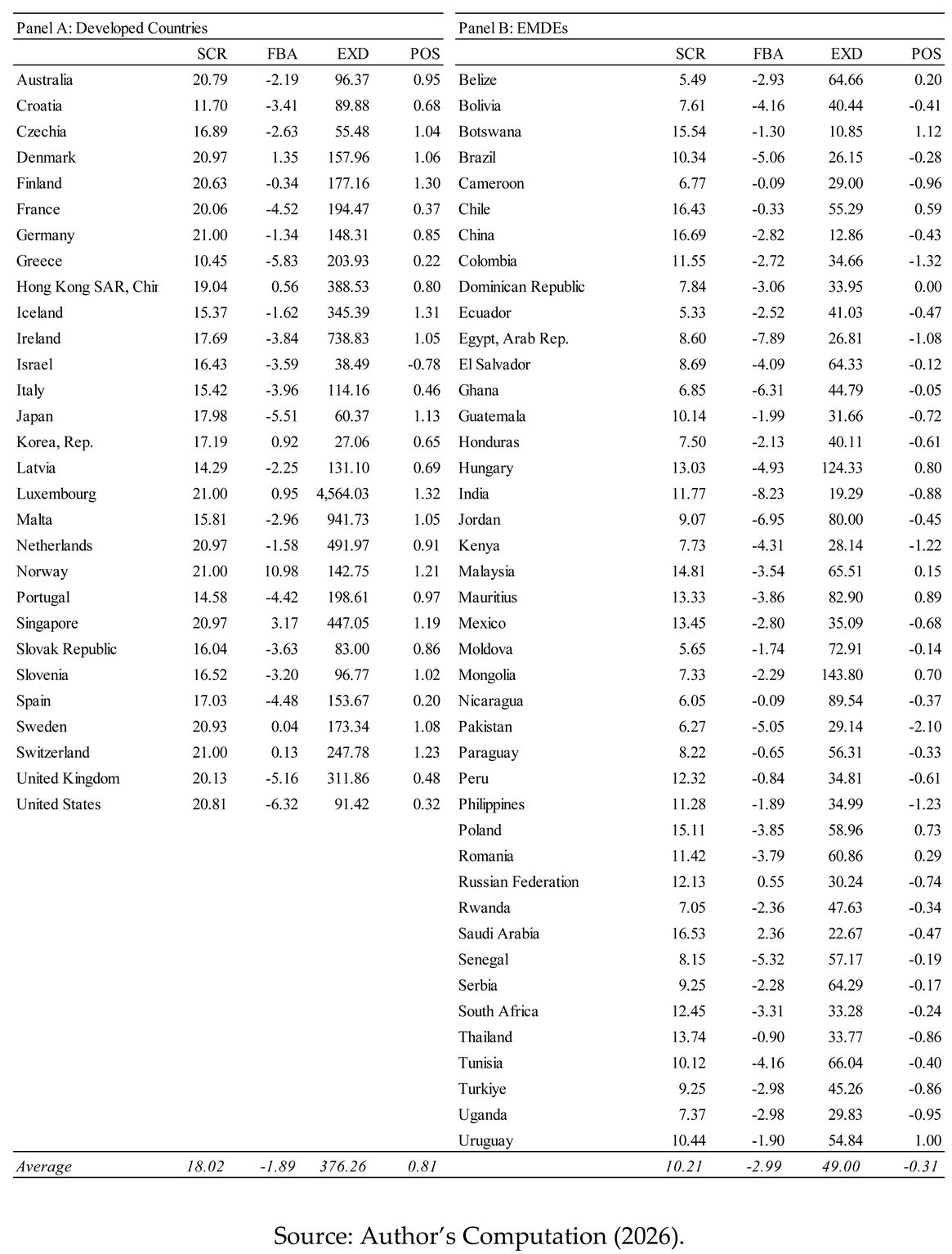
Appendix D: Multicollinearity Test Results
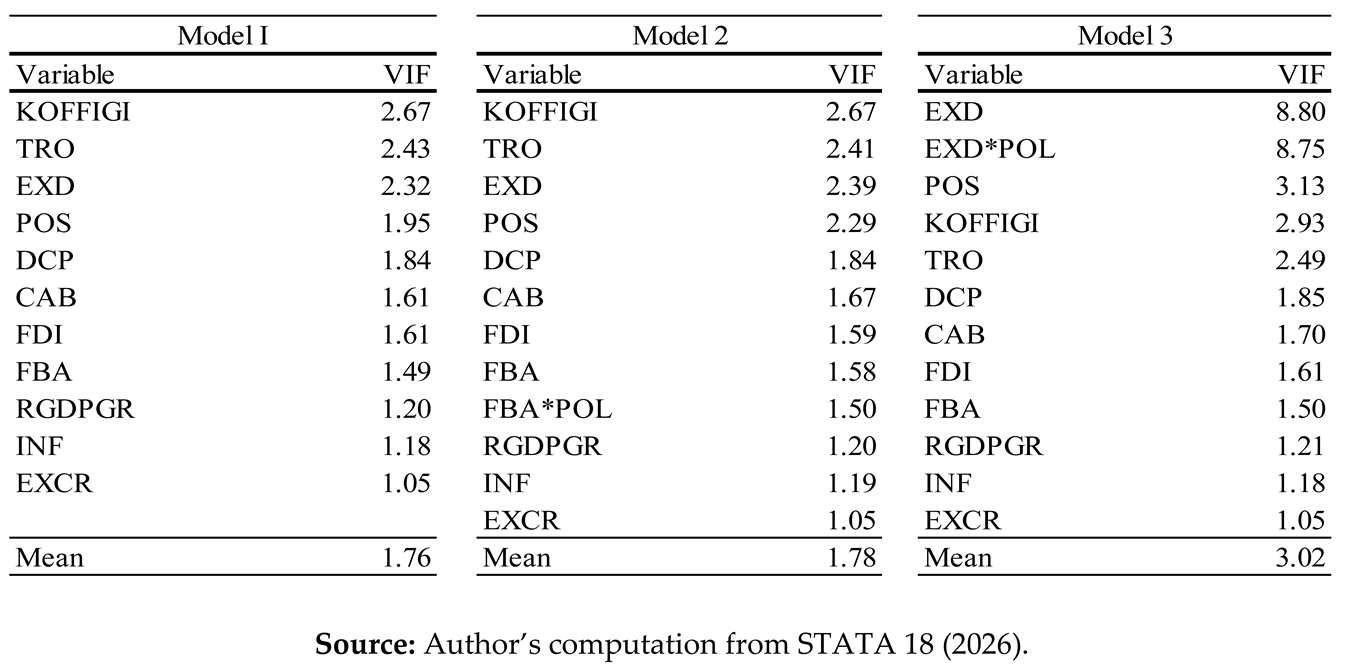
References
- Abdelmohsen, M.; Abdelmohsen, H.; Ahmed, A. E. A.; Ebrahim, E. E. M. Debt Service vs. Debt Stock in Sovereign Credit Ratings: A Systematic Review and Meta-Regression Analysis. Economies 2026, 14(6), 230. [Google Scholar] [CrossRef]
- Abdullahi, M. M. Debt Overhang versus Crowding Out Effects: Understanding the Impact of External Debts on Capital Formation in Theory. International Journal of Economics and Financial Issues 2016, 6(1), 271–278. [Google Scholar]
- Adarov, A.; Panizza, U. Public Investment Quality and Its Implications for Sovereign Risk and Debt Sustainability; World Bank: Washington, DC, 2024. [Google Scholar] [CrossRef]
- Adjei, A. A. F.; Gatsi, John Gartchie; Appiah, M. O.; Abeka, M. J.; Junior, P. O. Financial globalization and economic growth in Sub-Saharan Africa: The moderating role of governance. Development and Sustainability in Economics and Finance 2025, 16(6), 1–10. [Google Scholar] [CrossRef]
- Agbonrofo, H.; Ozegbe, A. E.; Okanya, O. C. Balanced Budget, Social Expenditure and Poverty Reduction: Comparative Evidence from Nigeria and the Horn of Africa. Economies 2026, 14(8), 313. [Google Scholar] [CrossRef]
- Akerlof, G. A. The market for ‘lemons’: Quality uncertainty and the market mechanism. Quarterly Journal of Economics 1970, 84(3), 488–500. [Google Scholar] [CrossRef]
- Akinyemi, J. O. O. Financial globalization forces, financial sector development and country risk premium in leading emerging and developing countries. International Journal of Social Economics 2026a, 53(8), 1248–1268. [Google Scholar] [CrossRef]
- Akinyemi, J. O. O. The Empirical Link Between Financial Globalization and Macroeconomic Volatility in Sub-Saharan African Countries. Journal of Risk and Financial Management 2026b, 19(5), 342. [Google Scholar] [CrossRef]
- Akinyemi, J. O.; Owolabi, A. Modeling equity risk premium in emerging and developing economies: Do financial globalization and financial sector development have explanatory power? Cogent Economics & Finance 2026, 14(1), 2602354. [Google Scholar] [CrossRef]
- Amir, A.; Saeed, H. A.; Haq, Z. U. Political Stability and Sovereign Debt Sustainability in Developing Countries. The Critical Review of Social Sciences Studies, The Crirical Review of Social Sciences Studies 2025, 3(4), 3509–3519. [Google Scholar] [CrossRef]
- Andreasen, E.; Valenzuela, P. Financial openness, domestic financial development and credit ratings. Finance Research Letters 2016, 16, 11–18. [Google Scholar] [CrossRef]
- Ansari, M. G.; Sensarma, R. Bank Liquidity and the Transmission of Monetary Policy: Micro-Level Evidence from Indian Banks. MPRA Paper No. 126943. July 2026. 2023. Available online: https://mpra.ub.uni-muenchen.de/126943/.
- Arellano, M.; Bond, S. Some Tests of Specification for Panel Data: Monte Carlo Evidence and an Application to Employment Equations. The Review of Economic Studies 1991, 58(2), 277–297. [Google Scholar] [CrossRef]
- Arellano, M.; Bover, O. Another look at the instrumental variable estimation of error-components models. Journal of Econometrics 1995, 68(1), 29–51. [Google Scholar] [CrossRef]
- Arogundade, S.; Mduduzi, B.; Naanwaab, C. Sovereign Credit Ratings: A Friend or Foe to Financial Development of African Countries? International Journal of Finance & Economics 2025, 30(4), 3785–3803. [Google Scholar] [CrossRef]
- Asongu, S. Sector formalization, gender inclusive Economics education and inequality in Chad. International Journal of Social Economics 2025, 1–18. [Google Scholar] [CrossRef]
- Baglan, D.; Kearney, D. Government debt and sovereign credit ratings: Nonlinear evidence from emerging economies. Borsa Istanbul Review 2026, 26(5), 100870. [Google Scholar] [CrossRef]
- Bascle, G. Controlling for endogeneity with instrumental variables in strategic management research. Strategic Organization 2008, 6(3), 285–327. [Google Scholar] [CrossRef]
- Bastida, F.; Guillamón, M.-D.; Benito, B. Fiscal transparency and the cost of sovereign debt. International Review of Administrative Sciences 2017, 83(1), 106–128. [Google Scholar] [CrossRef]
- Blundell, R.; Bond, S. Initial conditions and moment restrictions in dynamic panel data models. Journal of Econometrics 1998, 87, 115–143. [Google Scholar] [CrossRef]
- Boot, A. W. A.; Milbourn, T. T.; Schmeits, A. Credit ratings as coordination mechanisms. Review of Financial Studies 2006, 19(1), 81–118. [Google Scholar] [CrossRef]
- Botha, I.; Pretorius, M. The geographical and income differences in the determinants of African sovereign credit ratings. African Journal of Economic and Management Studies 2020, 11(4), 609–624. [Google Scholar] [CrossRef]
- Brambor, T.; Clark, W. R.; Golder, M. Understanding Interaction Models: Improving Empirical Analyses. Political Analysis 2006, 14(1), 63–82. [Google Scholar] [CrossRef]
- Cantor, R.; Packer, F. Determinants and impact of sovereign credit ratings. Economic Policy Review 1996, 2(2), 37–53. [Google Scholar]
- Choy, S. Y.; Chit, M. M.; Teo, W. L. Sovereign credit ratings: Discovering unorthodox factors and variables. Global Finance Journal 2021, 48, 100548. [Google Scholar] [CrossRef]
- Chowdhury, M. A. F.; Prince, E. R.; Shoyeb, M.; Abdullah, M. The threshold effect of institutional quality on sovereign debt and economic stability. Journal of Policy Modeling 2024, 46(1), 39–59. [Google Scholar] [CrossRef]
- Choy, S. Y.; Chit, M. M.; Teo, W. L. Empirical Models of Sovereign Credit Ratings: A Critical Systematic Review and Future Research Directions. Capital Markets Review 2026, 34(1), 63–87. [Google Scholar] [CrossRef]
- Coelho, F. H.; Carrasco-Gutierrez, C. E.; Tessmann, M. S. Sovereign credit rating classification: evaluating the accuracy and driving factors using machine learning techniques. Journal of Economic Studies 2026, 1–18. [Google Scholar] [CrossRef]
- Colak, G.; Habimana, T.; Korkeamäki, T. The effects of government debt on corporate borrowing in developing economies: Evidence from Africa. Journal of International Business Studies 2025, 56(7), 874–900. [Google Scholar] [CrossRef]
- De, S.; Mohapatra, S.; Ratha, D. Sovereign Credit Ratings, Relative Risk Ratings, and Private Capital Flows; World Bank, 2021. [Google Scholar] [CrossRef]
- Dreher, A. Does globalization affect growth? Evidence from a new index of globalization. Applied Economics 2006, 38(10), 1091–1110. [Google Scholar] [CrossRef]
- Driscoll, J. C.; Kraay, A. C. Consistent covariance matrix estimation with spatially dependent panel data. Review of Economics and Statistics 1998, 80(4), 549–560. [Google Scholar] [CrossRef]
- Eaton, J.; Gersovitz, M. Debt with potential repudiation: Theoretical and empirical analysis. Review of Economic Studies 1981, 48(2), 289–309. [Google Scholar] [CrossRef]
- Eozenou, P. Financial integration and macroeconomic volatility: Does financial development matter? (MPRA Paper No. 12738); 2008. [Google Scholar]
- Gbohoui, W.; Ouedraogo, R.; Some, Y. M. Sub-Saharan Africa’s risk perception premium: In the search of missing factors. IMF Working Papers 2023, 2023(130), 1. [Google Scholar] [CrossRef]
- Goel, A.; Singh, A. Impact of economic and socio-political risk factors on sovereign credit ratings. Information Processing & Management 2025, 62(1), 103943. [Google Scholar] [CrossRef]
- Gande, A.; Parsley, D. C. News spillovers in the sovereign debt market. Journal of Financial Economics 2005, 75, 691–734. [Google Scholar] [CrossRef]
- Griffith-Jones, S.; Kraemer, M. Credit rating agencies and developing economies; DESA Working Paper No. 175; United Nations Department of Economic and Social Affairs, 2021; pp. 1–17. [Google Scholar]
- Gygli, S.; Hälg, F.; Sturm, J.-E. The KOF Globalisation Index – Revisited (KOF Working Paper KOF Working Papers, No. 439) [Application/pdf]; KOF Swiss Economic Institute, 2018; Available online: http://hdl.handle.net/20.500.11850/238666.
- Hadzi-Vaskov, M.; Ricci, L. A. The nonlinear relationship between public debt and sovereign credit ratings (IMF Working Paper No. 19/162); International Monetary Fund, 2019. [Google Scholar] [CrossRef]
- Hassan, M. K.; Aysan, A. F.; Kayani, U. N.; Choudhury, T. Working capital as a firm performance savior? Evidence from Scandinavian countries. Research in International Business and Finance 2023, 65, 101959. [Google Scholar] [CrossRef]
- Heinemann, F.; Osterloh, S.; Kalb, A. Sovereign risk premia: The link between fiscal rules and stability culture. Journal of International Money and Finance 2014, 41, 110–127. [Google Scholar] [CrossRef]
- Hill, P.; Brooks, R.; Faff, R. Variations in sovereign credit quality assessments across rating agencies. Journal of Banking & Finance 2010, 34(6), 1327–1343. [Google Scholar] [CrossRef]
- Hmiden, B. O.; Tatoutchoup, D.; Nguimkeu, P.; Avelé, D. Discrepancy and cross-regional bias in sovereign credit ratings: Analyzing the role of public debt. Economic Modelling 2024, 131, 106600. [Google Scholar] [CrossRef]
- Hmiden, O. B.; Berre, M.; Tselika, M. Sovereign credit ratings: The ripple effect of investor protection. Finance Research Letters 2025, 86, 108517. [Google Scholar] [CrossRef]
- Hoechle, D. Robust standard errors for panel regressions with cross-sectional dependence. The Stata Journal: Promoting Communications on Statistics and Stata 2007, 7(3), 281–312. [Google Scholar] [CrossRef]
- Hwang, J.-T.; Chung, C.-P.; Wang, C.-H. Debt overhang, financial sector development and economic growth. Hitotsubashi Journal of Economics 2010, 51(1), 13–30. [Google Scholar]
- Iheanachor, N.; Ozegbe, A. E.; Olusoji, V. New product development practices and financial inclusion: a comparative analysis of tradiational banks and financial technologies firms. Journal of Risk Finance 2026, 1–26. [Google Scholar] [CrossRef]
- IMF. World economic outlook database: Groups and aggregates information; International Monetary Fund, 2024. [Google Scholar]
- Jili, F.; Gumede, S.; Goebel, J.; Wilson, J. Public Transport Emissions and Economic Growth in South Africa: Evidence from a Dynamic STIRPAT–BCMM Framework. Sustainability 2026, 18(4), 1891. [Google Scholar] [CrossRef]
- Kaufmann, D.; Kraay, A. The worldwide governance indicators: Methodology and 2024 update; World Bank: Washington, DC, 2024. [Google Scholar] [CrossRef]
- Klusak, P.; Uymaz, Y.; Alsakka, R. Politicians’ connections and sovereign credit ratings. Journal of International Financial Markets, Institutions and Money 2024, 94, 102022. [Google Scholar] [CrossRef]
- Kose, M. A.; Prasad, E. S.; Terrones, M. E. Financial integration and macroeconomic volatility. IMF Staff Papers 2003, 50, 119–142. development.pdf. [Google Scholar] [CrossRef]
- Krugman, P. Financing vs. Forgiving a debt overhang. Journal of Development Economics 1988, 29, 253–268. [Google Scholar] [CrossRef]
- Le, H. P.; Bao, H. H. G. Renewable and non-renewable energy consumption, government expenditure, institutional quality, financial development, trade openness, and sustainable development in Latin America and Caribbean Emerging Market and Developing Economies. International Journal of Energy Economics and Policy 2020, 10(1), 242–248. [Google Scholar] [CrossRef]
- Le, B.; Reddy, N.; Nguyen, P.; Moore, P. H. The Impact of Financial Liberalization, Political Connection and Audit Quality on the Cost of Debt. International Journal of Financial Studies 2026, 14(5), 132. [Google Scholar] [CrossRef]
- Loussouarn, T.; Vasse, T. Sovereign credit ratings in developing countries: Regional biases and subjectivity factors. In Sovereign credit ratings in developing countries; Editions AFD, 2025; pp. 1–36. [Google Scholar]
- Martín, M. M. I.; Rojas, M. L.; Dabús, C. Debt, economic growth and threshold effects: Evidence from developing countries. EconomiA 2024, 25(1), 92–108. [Google Scholar] [CrossRef]
- Mellios, C.; Paget-Blanc, E. Which factors determine sovereign credit ratings? European Journal of Finance;UNDP 2006, 12(4), 361–377. [Google Scholar] [CrossRef]
- Mikhaylova, A.; Timushev, E. The impact of institutions on regional credit ratings in Russia. R-Economy 2022, 8(1), 43–56. [Google Scholar] [CrossRef]
- Mohapatra, S.; Nose, M.; Ratha, D. Impacts of Sovereign Rating on Sub-Sovereign Bond Ratings in Emerging and Developing Economies; World Bank: Washington, DC, 2016. [Google Scholar] [CrossRef]
- Montes, G. C.; de Oliveira, D. S. P.; de Mendonça, H. F. Sovereign credit ratings in developing economies: New empirical assessment. International Journal of Finance & Economics 2016, 21(4), 382–397. [Google Scholar] [CrossRef]
- Montes, G. C.; Costa, J. Effects of fiscal credibility on sovereign risk: Evidence using comprehensive credit rating measures. International Journal of Emerging Markets 2022, 17(3), 858–888. [Google Scholar] [CrossRef]
- Nounamo, Y.; Asongu, S.; Njangang, H.; Tadadjeu, S. Effects of political institutions on the external debt-economic growth nexus in Africa; 2021; MPRA Paper No. 110131. [Google Scholar] [CrossRef]
- Mpapalika, J.; Malikane, C. The Determinants of Sovereign Risk Premium in African Countries. Journal of Risk and Financial Management 2019, 12(1), 29. [Google Scholar] [CrossRef]
- Mundonde, J.; Takawira, O. Sovereign credit ratings in South Africa: Does institutional quality matter? The Economics and Finance Letters 2025, 12(3), 582–595. [Google Scholar] [CrossRef]
- Myers, S. C. Determinants of corporate borrowing. Journal of Financial Economics 1977, 5, 147–175. [Google Scholar] [CrossRef]
- Nchofoung, T.; Asongu, S.; S. Tchamyou, V. The political implication of women and industrialisation in Africa. SSRN Electronic Journal 2021. [Google Scholar] [CrossRef]
- Ndoricimpa, A. Threshold Effects of Inflation on Economic Growth: Is Africa Different? International Economic Journal 2017, 31(4), 599–620. [Google Scholar] [CrossRef]
- Niemann, S.; Pichler, P. Optimal fiscal policy and sovereign debt crises. Review of Economic Dynamics 2020, 37, 234–254. [Google Scholar] [CrossRef]
- Niyonshuti, M.; Ishimwe, M.; Su, M.; Nketia, E. Analyzing the Factors Influencing Sovereign Credit Ratings in East Africa. OALib 2026, 13(01), 1–23. [Google Scholar] [CrossRef]
- North, D. C. Institutions, institutional change and economic performance; Cambridge University Press, 1990. [Google Scholar]
- Nwani, C.; Okezie, B. N.; Nwali, A. C.; Nwokeiwu, J.; Duruzor, G. I.; Eze, O. N. Natural resources, financial development and structural transformation in Sub-Saharan Africa. Heliyon 2023, 9(9), e19522. [Google Scholar] [CrossRef] [PubMed]
- Okano, E.; Kazuyuki, I. Revisiting the fiscal theory of sovereign risk from the DSGE view ; Working Paper; Nagoya City University, Japan, 2016. [Google Scholar]
- Oyadeyi, O. O. Modelling economic policy uncertainty—Examining the effects of oil prices, global and domestic economic policy uncertainty on firm stability in Nigeria. African Development Review 2025, 37(2), e70012. [Google Scholar] [CrossRef]
- Overes, B. H. L.; van der Wel, M. Modelling sovereign credit ratings: Evaluating the accuracy and driving factors using machine learning techniques. Computational Economics 2023, 61, 1273–1303. [Google Scholar] [CrossRef]
- Pesaran, M. H. General diagnostic tests for cross section dependence in panels. SSRN Electronic Journal 2004. [Google Scholar] [CrossRef]
- Pesaran, M. H. A simple panel unit root test in the presence of cross-section dependence. Journal of Applied Econometrics 2007, 22(2), 265–312. [Google Scholar] [CrossRef]
- Pesaran, M.; Yamagata, T. Testing slope homogeneity in large panels. Journal of Econometrics 2008, 142(1), 50–93. [Google Scholar] [CrossRef]
- Philippon, T. The Macroeconomics of Debt Overhang [Conference Paper]. 10th Jacques Polak Annual Research Conference, Washington, DC, November 5; 2009. Available online: https://www.imf.org/external/np/res/seminars/2009/arc/pdf/Philippon.pdf.
- Proença, C.; Neves, M.; Dias, J. C.; Martins, P. Determinants of sovereign debt ratings in clusters of European countries – effects of the crisis. Journal of Financial Economic Policy 2022, 14(3), 403–427. [Google Scholar] [CrossRef]
- Ramírez-Rondán, N. R.; Rojas-Rojas, R. M.; Villavicencio, J. A. Political institutions, economic uncertainty and sovereign credit ratings. Finance Research Letters 2023, 53, 103656. [Google Scholar] [CrossRef]
- Rashid, W.; Owaisi, M. A.; Hussain, L.; Hofyani, A. A.; Niaz, A.; Niaz, Z. Role of Political Stability on Micro Economic Factors: Evidence from BRI Countries. European Journal of Management, Economics and Business 2026, 3(2), 138–158. [Google Scholar] [CrossRef] [PubMed]
- Roodman, D. How to do Xtabond2: An Introduction to Difference and System GMM in Stata. The Stata Journal 2009, 9(1), 86–136. [Google Scholar] [CrossRef]
- Sahu, U. K.; Pradhan, A. K. Discovering the determinants of energy intensity of Indian manufacturing firms: A panel data approach. Discover Sustainability 2024, 5(1), 139. [Google Scholar] [CrossRef]
- Sanli, D.; Arslan, R. Testing convergence hypothesis for EU countries: A heterogenous panel data approach. Journal of Economic and Administrative Sciences 2025, 41(2), 635–657. [Google Scholar] [CrossRef]
- Santiago, R.; Fuinhas, J. A.; Marques, A. C. The impact of globalization and economic freedom on economic growth: The case of the Latin America and Caribbean countries. Economic Change and Restructuring 2018, 53(1), 61–85. [Google Scholar] [CrossRef]
- Sen, S.; Kasibhatla, K. M.; Stewart, D. B. Debt overhang and economic growth–the Asian and the Latin American experiences. Economic Systems 2007, 31(1), 3–11. [Google Scholar] [CrossRef]
- Seo, M. H.; Kim, S.; Kim, Y.-J. Estimation of dynamic panel threshold model using Stata. The Stata Journal: Promoting Communications on Statistics and Stata 2019, 19(3), 685–697. [Google Scholar] [CrossRef]
- Seo, M. H.; Shin, Y. Dynamic panels with threshold effect and endogeneity. Journal of Econometrics 2016, 195(2), 169–186. [Google Scholar] [CrossRef]
- Slapnik, U.; Loncarski, I. On the information content of sovereign credit rating reports: Improving the predictability of rating transitions. Journal of International Financial Markets, Institutions and Money 2021, 73, 1–19. [Google Scholar] [CrossRef]
- Standard & Poor’s Global Ratings Sovereign rating methodology; S&P Global Ratings, 2017.
- Tun, T. M. M.; Maneejuk, P.; Sriboonchitta, S. Institutional Thresholds and the Distributional Effects of Foreign Direct Investment in ASEAN-5. Economies 2026, 14(2), 45. [Google Scholar] [CrossRef]
- United Nations Development Programme [UNDP]. Sovereign credit ratings: Perspectives, 2025.
- for Africa’s development. New York, NY. Retrieved from.
- Available online: https://www.undp.org/sites/g/files/zskgke326/files/2025-09/en-sovereign_credit_ratingsafrica_.
- Uribe, M. A fiscal theory of sovereign risk. Journal of Monetary Economics 2006, 53(8), 1857–1875. [Google Scholar] [CrossRef]
- Westerlund, J. Testing for Error Correction in Panel Data. Oxford Bulletin of Economics and Statistics 2007, 69(6), 709–748. [Google Scholar] [CrossRef]
- Westerlund, J.; Thuraisamy, K.; Sharma, S. On the use of panel cointegration tests in energy economics. Energy Economics 2015, 50, 359–363. [Google Scholar] [CrossRef]
- World Bank. Worldwide Governance Indicators; World Bank, 2025a. [Google Scholar]
- World Bank. World Development Indicators; World Bank, 2025b. [Google Scholar]
- Wright, M. L. J. Theory of Sovereign Debt and Default. In Handbook of Safeguarding Global Financial Stability; Elsevier, 2013; pp. 187–193. [Google Scholar] [CrossRef]
- Wüste, S. The logics of sovereign credit ratings in developed and developing countries. Research in International Business and Finance 2022, 62, 101717. [Google Scholar] [CrossRef]
- Yang, G.; Liu, H. Financial development, interest rate liberalisation, and macroeconomic volatility. Emerging Markets Finance and Trade 2016, 52(4), 991–1001. [Google Scholar] [CrossRef]
- Vessah, S. A.; Ngnouwal Eloundou, G.; Toukam, D. H.; Possi Tebeng, E. X. Linking country stability and informality: Empirical evidence from developing countries. Oxford Development Studies 2026, 1–21. [Google Scholar] [CrossRef]
Figure 1.
Trends in sovereign credit ratings, fiscal balance, external debt, and political stability. Source: Author’s computation (2026).
Figure 1.
Trends in sovereign credit ratings, fiscal balance, external debt, and political stability. Source: Author’s computation (2026).
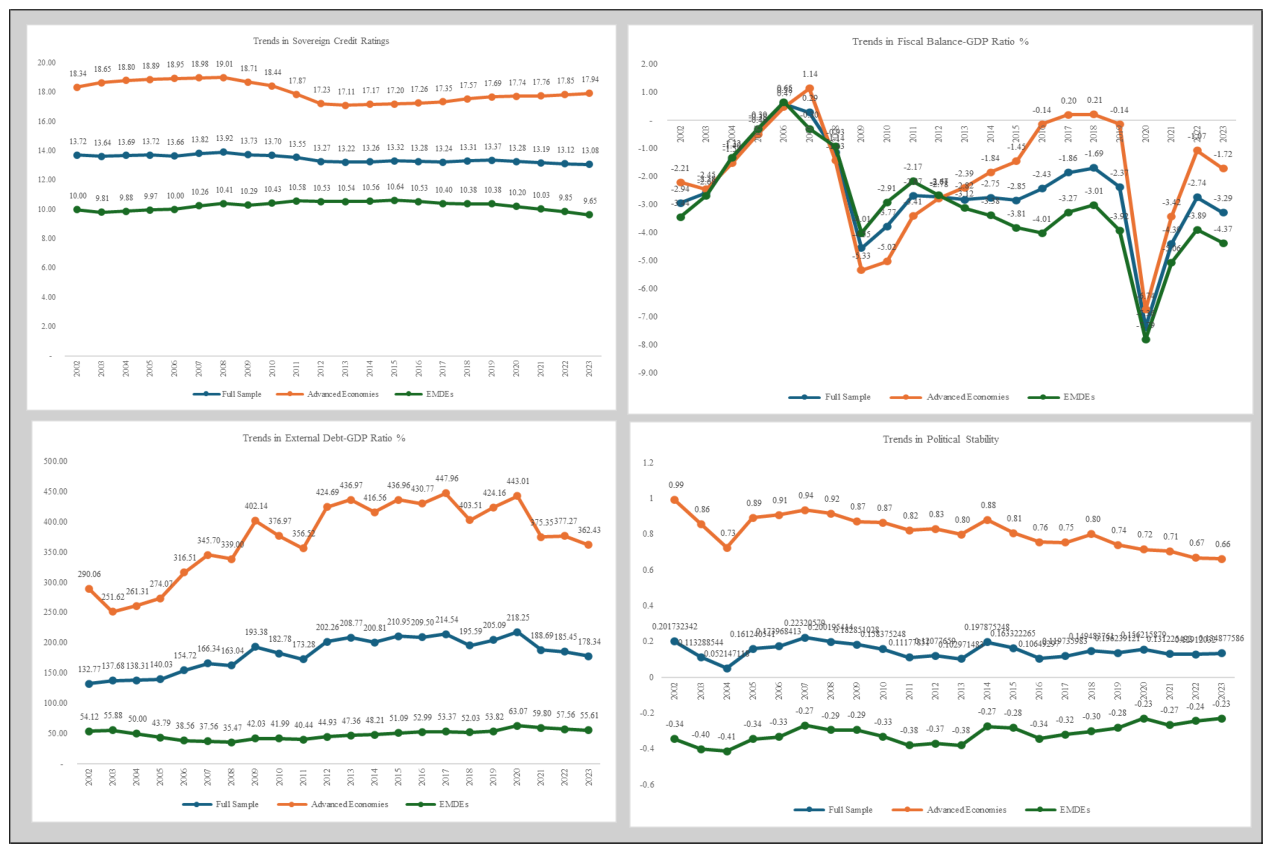

Table 1.
Description of Variables and Source of Data.
| Variable | Notation | Measurement | Expectation | Units | Justification | Data Source |
|---|---|---|---|---|---|---|
| Dependent Variable: | ||||||
| Sovereign credit rating |
SCR | Composite rating score, 1 (lowest) to 21 (highest). | Outcome | Ordinal | Baglan and Kearney (2026); Hmiden et al. (2025); Overes and Wel (2023) | |
| Independent Variables: | ||||||
| Fiscal balance | FBA | The ratio of fiscal balance to GDP |
Positive | Percent | Bastida et al. (2017); Montes and Costa (2022); Mikhaylova and Timushev (2022); Overes and Wel (2023) | World Bank Fiscal Space |
| External debt | EXD | The ratio of external debt to GDP |
Positive/ negative |
Percent | Baglan and Kearney (2026); Hmiden et al. (2025) |
World Bank Fiscal Space |
| Political stability and absence of violence |
EXP | An annual index that measures the likelihood of political structure destabilization or government overthrow by unconstitutional or violent means, including politically motivated violence and terrorism. The estimate ranges from -2.5 to 2.5. | Positive/ Negative | Index | Hmiden et al. (2025); Kaufmann and Kraay (2024); Overes and Wel (2023) |
World Bank WGI |
| Control Variables: | ||||||
| Real GDP growth rate | RGDPGR | Annual percentage change in real GDP | Positive |
Rate | Baglan and Kearney (2026); Overes and Wel (2023); Wüste (2022) |
World Bank GDI |
| Inflation | INF | Rate of change in the consumer price index | Positive/ negative |
Rate | Baglan and Kearney (2026); Hmiden et al. (2025) ; Overes and Wel (2023) |
World Bank GDI |
| Current account balance | CAB | Current account balance as percentage of GDP |
Positive/ negative |
Baglan and Kearney (2026); Overes and Wel (2023) | World Bank GDI | |
| Gross fixed capital formation | GCF | The ratio of capital investment in infrastructure and real estate to GDP. |
Positive | Percent | Adarov and Panizza (2024); Bastida et al. (2017) | World Bank GDI |
| Domestic credit to the private sector |
DCP | This is represented by domestic credit to the private sector divided by GDP. |
Positive | Percent | Coelho et al.(2026); Gbohoui et al. (2023) | World Bank GDI |
| Trade openness |
TRO | The ratio of the sum of exports and imports to GDP. |
Positive/ negative |
Percent | Hmiden et al. (2025); Wüste (2022) | World Bank GDI |
| Foreign direct investment inflows |
FDI | The ratio of FDI inflows to GDP. | Positive | Percent | Mundonde and Takawira (2025) | World Bank GDI |
| Financial globalization | KOFFIGI | This is represented by the overall financial globalization index, capturing de facto and de jure components. This covers both international financial flows and capital account liberalization policy. The score ranges from 0 to 100, with 0 being the lowest. . |
Positive | KOF Swiss Economic Institute | Akinyemi (2026b); Dreher (2006); Gygli et al. (2018) | KOF Swiss Economic Institute |
Source: Author’s compilation (2026).
Table 2.
Descriptive Statistics.
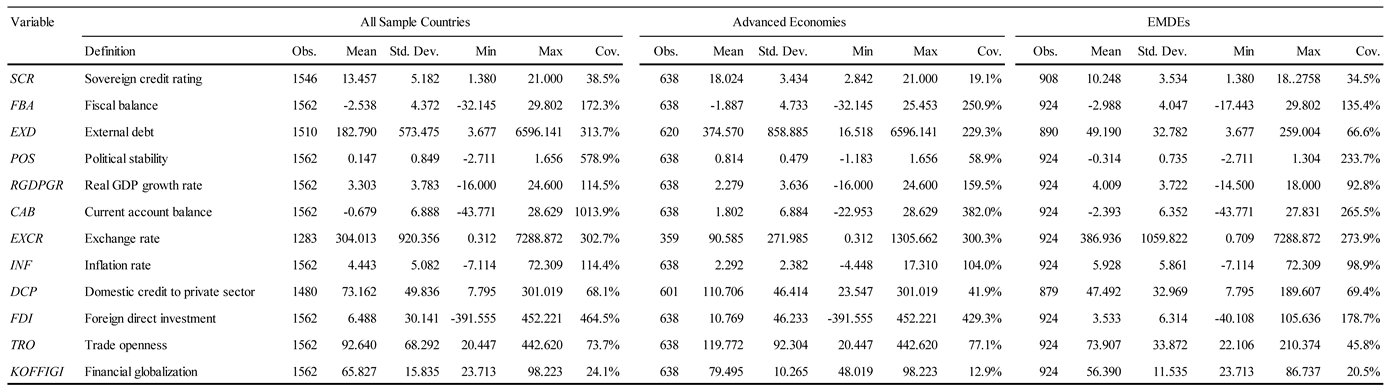 |
Source: Author’s computation from STATA 18 (2026).
Table 3.
Correlation Matrix.
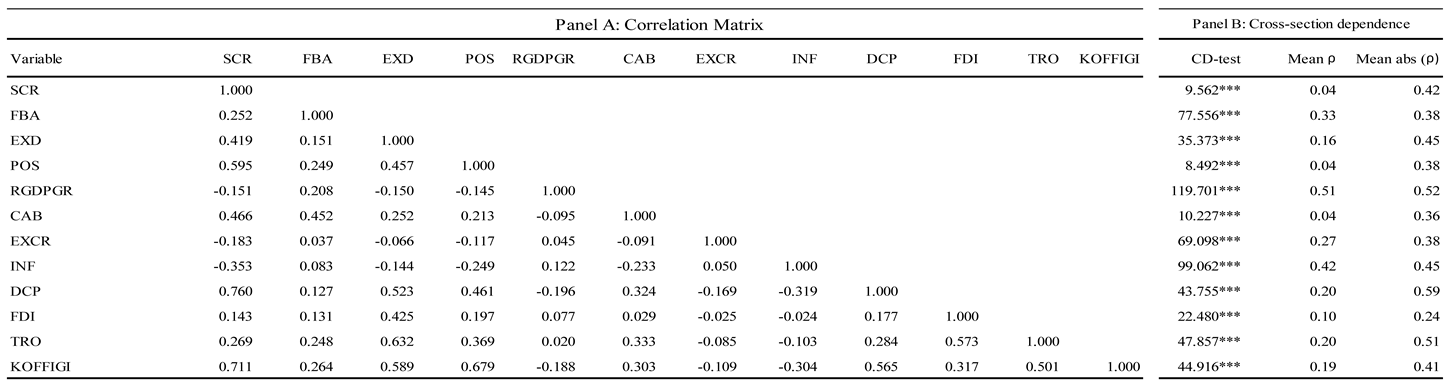 |
Source: Author’s computation from STATA 18 (2026).
Table 4.
Panel Unit Root Test Results.
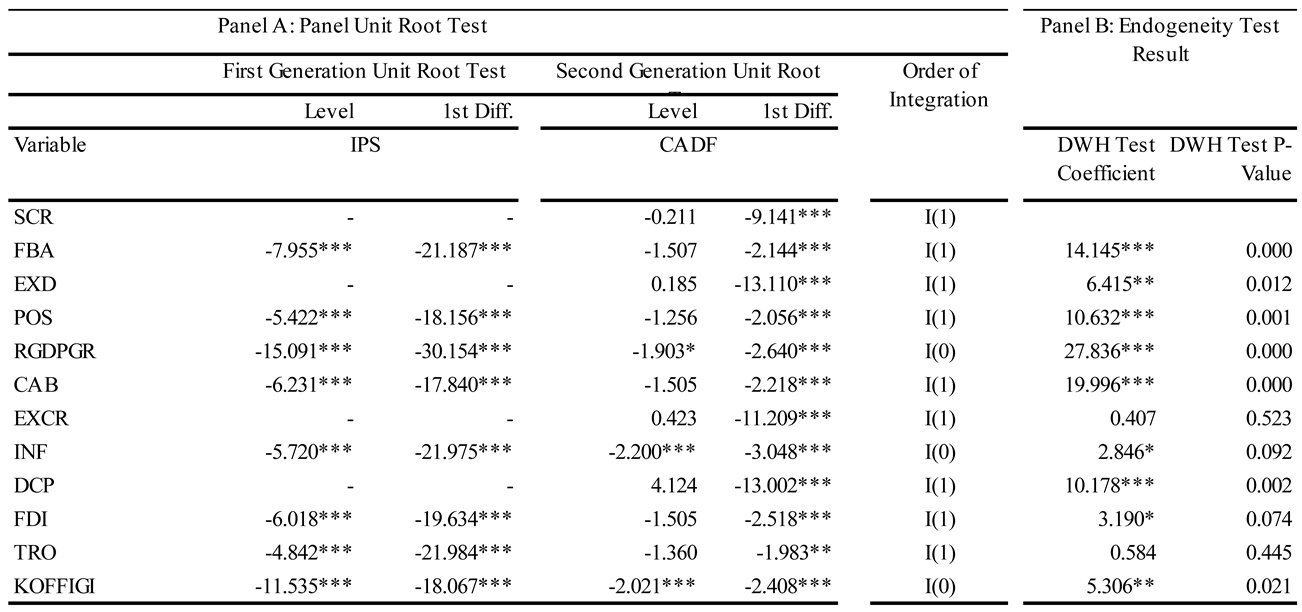 |
Notes: ***, **, * denote statistical significance at 1%, 5%, and 10% levels, respectively. Source: Author’s computation from STATA 18 (2026).
Table 5.
Pre-Estimation and Model Specification Test Results.
| Test | Purpose | Model I | Model II | Model III | Decision |
|---|---|---|---|---|---|
| Modified Wald test | Group-wise heteroskedasticity | 124903.130*** | 192688.570*** | 133087.760*** | Reject H0 and conclude that residual variance differs across groups, making conventional OLS inefficient. |
| Wooldridge test | Serial correlation) | 112.864*** | 109.921*** | 113.285*** | Reject H0 and conclude that first-order autocorrelation exists, indicating that shocks persist over time within countries, making conventional OLS inefficient. |
| Westerlund panel cointegration test | Panel cointegration | 4.021*** | 6.683*** | 7.117** | Reject H0 and conclude that there is a long-run equilibrium relationship among the variables. |
Notes: ***, **, * denote statistical significance at 1%, 5%, and 10% levels, respectively. Source: Author’s computation from STATA 18 (2026).
Table 6.
BCMM Panel Regression Estimates.
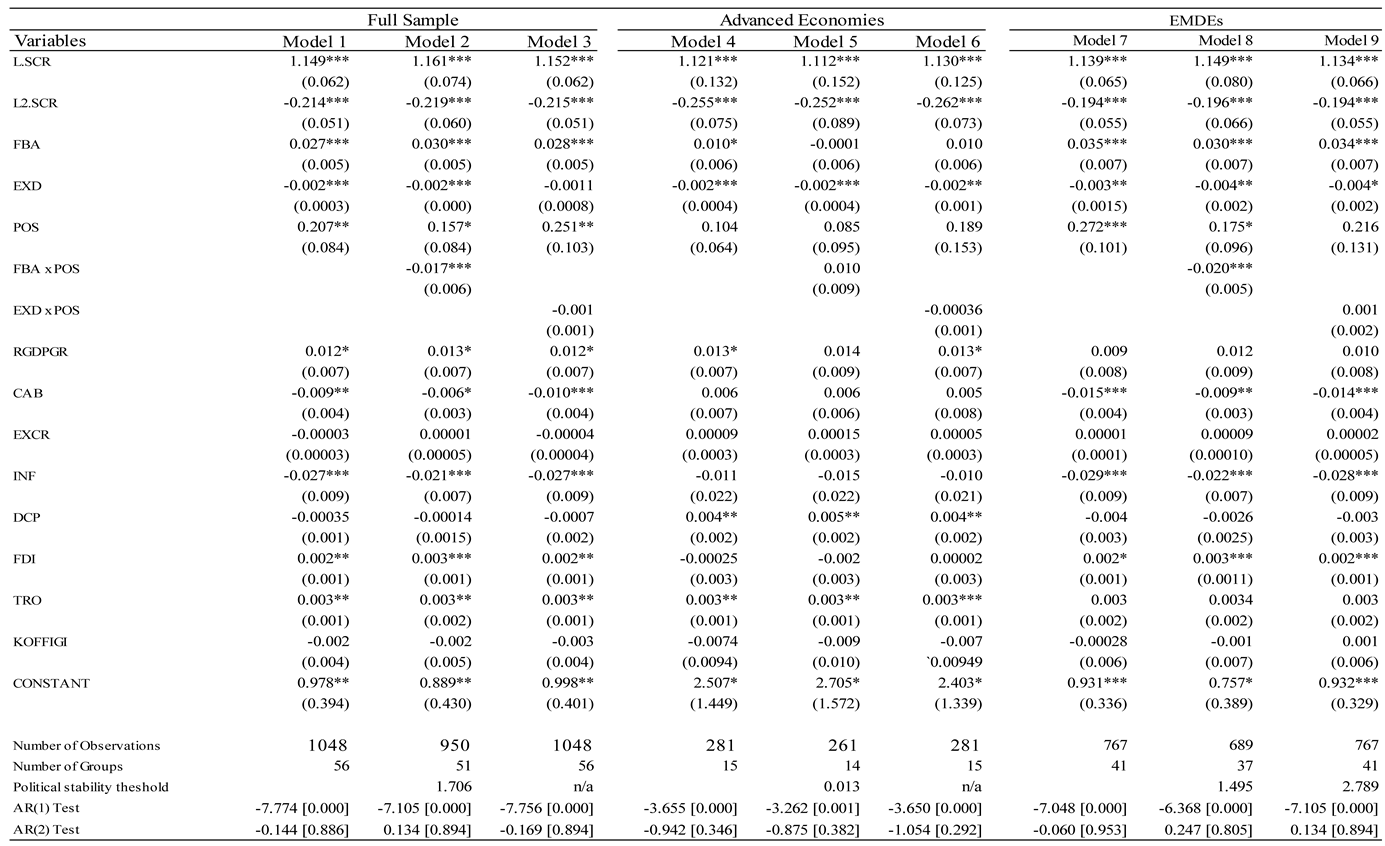 |
Notes: ***, **, * denote statistical significance at 1%, 5%, and 10% levels, respectively. Source: Author’s computation from STATA 18 (2026).
Table 7.
DKSE Panel Regression Estimates.
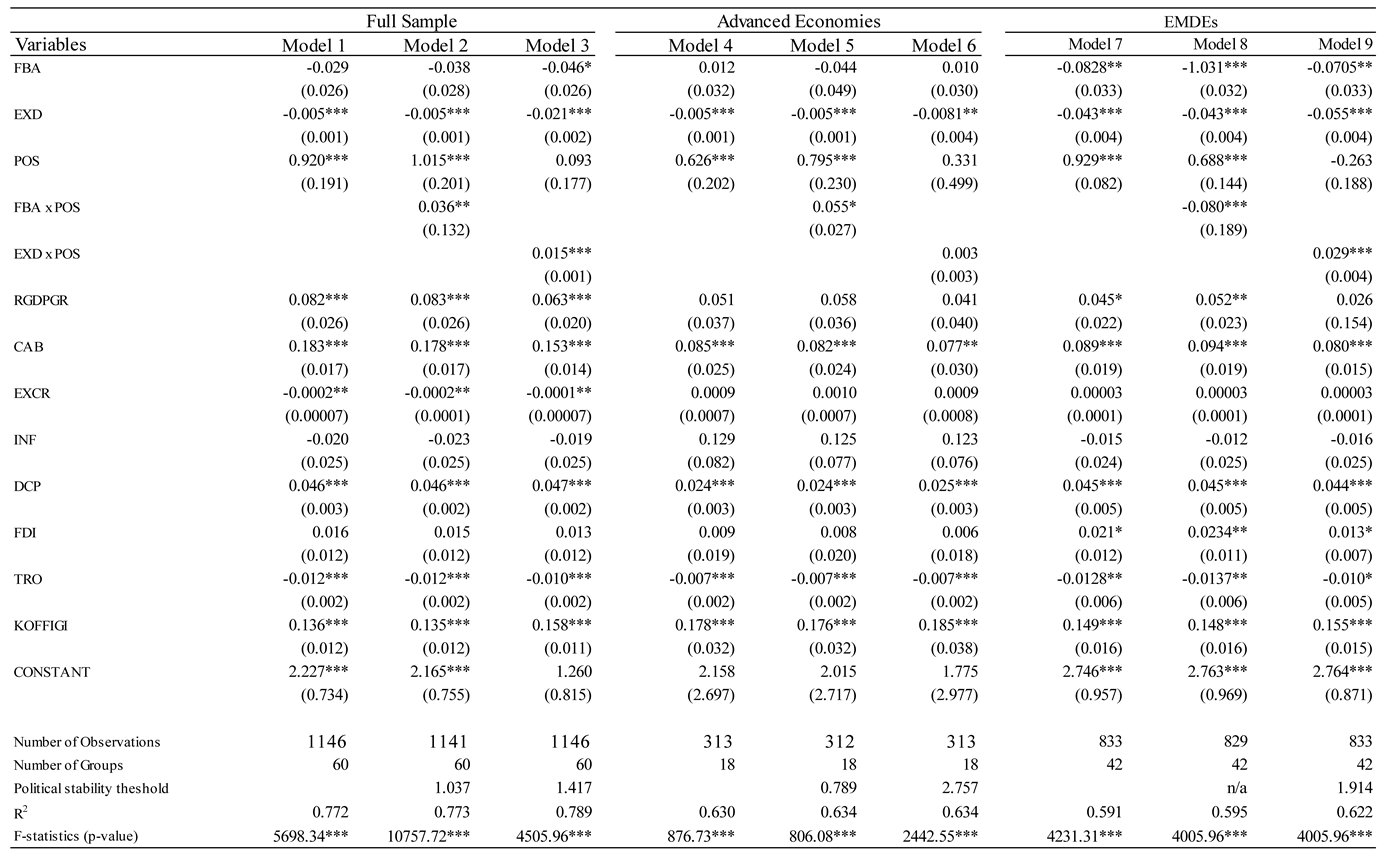 |
Notes: ***, **, * denote statistical significance at 1%, 5%, and 10% levels, respectively. Source: Author’s computation from STATA 18 (2026).
Disclaimer/Publisher’s Note: The statements, opinions and data contained in all publications are solely those of the individual author(s) and contributor(s) and not of MDPI and/or the editor(s). MDPI and/or the editor(s) disclaim responsibility for any injury to people or property resulting from any ideas, methods, instructions or products referred to in the content. |
© 2026 by the authors. Licensee MDPI, Basel, Switzerland. This article is an open access article distributed under the terms and conditions of the Creative Commons Attribution (CC BY) license (http://creativecommons.org/licenses/by/4.0/).
Copyright: This open access article is published under a Creative Commons CC BY 4.0 license, which permit the free download, distribution, and reuse, provided that the author and preprint are cited in any reuse.