

Submitted:
27 October 2026
Posted:
28 October 2026
You are already at the latest version
Abstract
Skills-based organizing replaces jobs and credentials with information on skills, which artificial intelligence now extracts from job postings, résumés and human resource records at scale. Whether this information is valid for the decisions it supports depends on whether research on skills intelligence and research on human resource management inform each other. We mapped 3649 documents published between 2000 and 2026, screened with a large language model audited against a human reviewer, using co-citation, bibliographic coupling and permutation benchmarks. Managerial and computational research form separate communities: only 13% of coupling links connect them, against 46% expected by chance, and the divide is sharpest between studies of the same practice, recruitment and selection. Computational research, 71% of output in 2023–2025, is itself split between recruitment technology and labor-market analytics; it validates skill information mainly against annotated text, about one study in seven relates it to outcomes, and almost none evaluates the decisions it informs. Taxonomies such as ESCO and O*NET do not bridge the communities; work analysis does. We propose a skills intelligence value chain from data to outcomes, with five testable propositions and a research agenda for validating AI-produced skill information.
Keywords:
skills intelligence
; skill extraction
; large language models
; skills-based organization
; skills taxonomy
; ESCO
; O*NET
; information validity
; bibliometric analysis
; human resource management
1. Introduction
For most of the past century, human resource management was organized around jobs. Jobs were analyzed, described, evaluated and priced, and people were selected, trained and paid according to the job they held [1]. A growing number of organizations now propose to replace the job with the skill as the basic unit of work: to hire for skills rather than degrees, to deploy people to projects according to their skills, to build careers through skill acquisition and, in some cases, to pay for skills [2]. The idea is not new. Lawler [3] argued three decades ago for moving from job-based to competency-based organizations, and competency modeling has been a standard human resource practice since the 1990s [4,5]. What is new is the scale at which skills can be observed. Online job postings, résumés, professional profiles and internal HR records can now be processed by machine learning and large language models that identify skills, classify them against taxonomies such as ESCO and O*NET, and match people to work [6,7].
This convergence raises a question that neither literature can answer alone. Skills-based organizing needs reliable information on the skills that people hold and that work requires; computational methods promise to produce that information. Yet the evidence that skills-based practices deliver what they promise is thin. An analysis of millions of job postings and hires found that removing degree requirements changed actual hiring in fewer than one in 700 cases [8]. Surveys of skill extraction, for their part, evaluate methods against annotated text and do not ask whether the skills they extract improve the decisions they are meant to support [7]. Whether the two bodies of research inform each other, or develop in parallel, matters for both: without valid skill data, skills-based organizing remains an aspiration; without a link to human resource decisions, skill extraction remains a technical exercise.
The question has also acquired regulatory weight, in different forms across jurisdictions. In the United States, any selection procedure, algorithmic or not, that has adverse impact on a protected group must be shown to be valid for the job [9], and New York City has required independent bias audits of automated employment decision tools since 2023. In the European Union, AI systems used for recruitment, selection, promotion, task allocation and the evaluation of workers are classified as high-risk, with obligations on data quality, documentation and human oversight that, after a 2026 amendment, apply from December 2027 (Regulation (EU) 2024/1689 [10], Annex III). Different as they are, these rules share a demand that skills-based organizations must meet: evidence that the skill information used in decisions about people is valid and does not discriminate (Section 2.3).
Existing reviews cover parts of this territory. Management research has reviewed competency modeling and its relation to job analysis [4,5,11]; labor economics has reviewed skill mismatch [12]; computer science has surveyed skill identification and extraction from job postings [6,7]. No review has mapped these literatures together, compared their intellectual foundations, or measured how far computational research reaches human resource practice. We address this gap with a bibliometric mapping of 3,649 documents published between 2000 and 2026. We ask how the field has grown (RQ1), on which foundations it rests (RQ2), which research fronts exist and how far the managerial and computational streams are connected (RQ3), how its themes have changed with the arrival of large language models (RQ4), and which human resource practices, levels of analysis and forms of validation it covers (RQ5).
Drawing on human capital and signaling theory, the literatures on credentials, person–job fit and work design, validity theory and the sociology of classification, we derive three expectations about the structure of the field and test them. The study makes three contributions. First, it provides the first integrated map of research on skills in organizations and shows, with tests against random baselines and several robustness checks, that its managerial and computational streams are largely separate: they rest on different foundations, form different research fronts and rarely cite common work, even when they study the same human resource practice; the fragmentation is not one-sided, since much managerial research is itself weakly connected to the field’s shared foundations, and the separation is widest for the core of studies on skills-based organizing in the strict sense, once competency frameworks for single professions are set aside; the computational stream is itself divided between recruitment technology and labor-market analytics. Second, it documents what the separation costs. The fastest-growing part of the field studies labor markets rather than organizations, concentrates on recruitment and labor-market analysis, almost ignores pay and performance management, and very rarely validates skill information against the decisions and outcomes that matter for human resource management. Third, it contributes to theory by framing skills-based organizing as an information problem, in which skill information must be more valid than the credentials it replaces, and by extending validity theory to the chain of inferences that leads from data to decisions. It shows that standard taxonomies do not act as boundary objects between the two communities and that work analysis does, and it builds on these insights an integrative framework, the skills intelligence value chain, which extends the LAMP model and HR analytics value chains to algorithmically produced skill information, with five propositions and a research agenda. Methodologically, the study also shows how a large language model can screen a large and heterogeneous corpus when its decisions are audited against a human reviewer and the resulting error rates are reported.
Section 2 reviews the conceptual background, develops the theoretical lens and presents the analysis grid. Section 3 describes the methods, Section 4 the results. Section 5 discusses the findings, presents the framework and the research agenda, and draws implications for practice. Section 5 also discusses limitations, and Section 6 concludes.
2. Conceptual Background
This section reviews the move from jobs to skills (Section 2.1), the taxonomies (2.2) and computational methods (2.3) that make skills measurable, the regulation that governs their use, and the theoretical lens and expectations that guide the analysis (2.4–2.5).
2.1. From Jobs to Skills as the Unit of Human Resource Management
For most of the twentieth century the job was the basic unit of human resource management: job analysis derived from tasks the knowledge, skills, abilities and other characteristics required of incumbents, and selection, training, appraisal and pay were built on that description [1]. Two lines of work challenged this model. Competency modeling, following McClelland [13], moved the focus from the job to the characteristics of superior performers and linked them to strategy [4]; Lawler [3] argued for organizations designed around people’s competencies, and skill-based pay became its most visible practical expression [14,15]. Competency models were, however, criticized for vague definitions and weak validation [5,11], and the transition to competency-based human resource management remained partial [16]. Labor economics, for its part, explained the effects of technology through the tasks workers perform and the skills these require [17,18], and research on skill mismatch documented the cost of imperfect matching [12]; in this tradition skills are an analytic category, not an organizing principle.
Since the late 2010s the two lines have converged in the skills-based or skills-first organization, which uses skills rather than jobs or degrees as the common currency for hiring, deployment, development, careers and pay. Its diffusion has been slower than its rhetoric: dropping degree requirements changed actual hiring in fewer than one in 700 hires [8], and academic research has only started to theorize the shift [2]. Because the term is used loosely, we distinguish three bodies of work. Skills-based organizing in the strict sense uses skills as the unit on which an organization bases a human resource practice. Profession- and sector-specific competency frameworks describe what one occupation or industry needs to know and do; they supply content but do not by themselves change how work is organized. Labor-market skill analytics measures skill demand, supply and mismatch. A review must include all three, because each produces skill information that organizations use, but its conclusions about skills-based organizing should hold for the first; we therefore report results for the strict core of managerial research as well as for the whole corpus.
2.2. Skills Taxonomies and Ai-Enabled Skills Intelligence
Using skills as a common currency requires a shared language. O*NET describes occupations through a content model of worker and occupational requirements [19]; ESCO links several thousand occupations to more than ten thousand skill concepts in the languages of the European Union [20]; commercial taxonomies built from job postings and profiles are widely used by vendors. Taxonomies embody choices about granularity and about how occupations are defined, and every analysis built on them inherits these choices: measures of exposure to artificial intelligence, for instance, depend on the taxonomy as much as on the technology [21,22].
Online job postings made it possible to observe skill demand at a scale that surveys cannot match [23,24], but turning postings, résumés or internal documents into skill data requires computational methods. Early approaches relied on dictionaries [6]; neural methods reframed extraction as span labeling or classification against a taxonomy [25]; large language models now match text directly to ESCO skills [26]. Surveys note inconsistent definitions and taxonomy versions and the absence of standard benchmarks [7], and they evaluate methods against annotated text, not against the decisions the skills are meant to support. We call skills intelligence the combination of taxonomies and computational methods that produces structured information about the skills of a workforce or labor market.
2.3. Regulation
Skills intelligence is also where artificial intelligence enters human resource management in a way that is regulated, unevenly across jurisdictions. In the United States, Title VII prohibits selection procedures with a disparate impact on protected groups unless they are job-related, and the Uniform Guidelines on Employee Selection Procedures [9] define the validity evidence required, for algorithmic tools as for any test. Federal enforcement has weakened: the Equal Employment Opportunity Commission removed its technical assistance on artificial intelligence in January 2025, and Executive Order 14281 [27] directed agencies to deprioritize disparate-impact enforcement. Regulation has moved to states and cities: New York City’s Local Law 144 [28] has required independent bias audits of automated employment decision tools since July 2023, although its enforcement has been found weak [29]; Illinois has prohibited discriminatory uses of artificial intelligence in employment since January 2026 [30]; and Colorado replaced its 2024 AI Act with a narrower law requiring notice, explanation and human review from 2027 [31]. China’s Personal Information Protection Law [32] gives individuals the right to refuse decisions with significant effects made solely by automated means (Article 24).
In the European Union, the Artificial Intelligence Act classifies AI systems used for recruitment, selection, promotion, task allocation and the evaluation of workers as high-risk (Regulation (EU) 2024/1689 [10], Annex III); the Digital Omnibus on AI [33], approved in June 2026, postponed the obligations for these systems from August 2026 to 2 December 2027. The Pay Transparency Directive requires employers to assess work of equal value on criteria that include skills (Directive (EU) 2023/970 [34], Article 4); it had to be transposed by 7 June 2026, but by then only four of the 27 Member States had done so [35]. The rules differ and are still changing, but each requires, in its own terms, evidence that the information used in decisions about people is valid and does not discriminate. This matters for a global field: 31% of the corpus’s documents have authors in the European Union, 18% in the United States, 12% in India and 9% in China.
2.4. A Theoretical Lens: Skills-Based Organizing as an Information Problem
Skills-based organizing is, at its core, an information problem. Human capital theory holds that workers’ productive capacities are heterogeneous and partly specific to tasks and firms [36]; because they are not directly observable, employers rely on signals such as credentials and job titles [37]. Job-based human resource management economizes on information; skills-based organizing replaces these cheap summaries with finer-grained information, and its promise holds only if this information is more valid than the signals it replaces. Two refinements show why that is hard. Lazear [38] reformulated the distinction between general and specific skills: all skills are general, but each firm weights them differently, so a profile accurate in the portable vocabulary of a taxonomy can still be a poor guide to a decision inside a firm. And credentials serve not only as signals but also as cheap screens and instruments of social closure [39,40], which helps explain why employers who drop degree requirements often keep hiring degree holders [8].
Organizational psychology specifies what skill information must be matched against. Person–job fit distinguishes demands–abilities fit, which mainly predicts performance, from needs–supplies fit, which predicts satisfaction, commitment and turnover [41,42]; algorithms that match on skills operationalize only the first and should be judged against the outcomes it predicts. Work design research shows that skill requirements result from how tasks, autonomy and interdependence are designed [43,44,45], so when skills-based organizing redesigns work, the requirements against which skills are matched change with it.
Three further bodies of theory frame the analysis. Validity theory treats any measure used for decisions as an inference to be supported by evidence on its content, relations and consequences [46], which in personnel selection means predictive validity and adverse impact [47]. Recognizing a skill in a text is evidence about the text, not yet about the person, the job or the decision; we call the sequence of inferences from data to decisions a validity chain. The sociology of classification holds that taxonomies acquire authority through the communities that use them [48] and can act as boundary objects between communities with different goals [49], although integration also requires shared meanings and interests [50]. Research on epistemic communities, finally, shows that communities differing in methods, outlets and standards of evidence develop separate references and criteria of quality [51]. We derive three expectations. E1: the managerial and computational streams form separate epistemic communities, with distinct foundations and fronts. E2: computational research validates mainly the early links of the validity chain, agreement with annotated text, and rarely reaches decisions and outcomes. E3: integration, where it occurs, runs through traditions both communities recognize as authoritative on what work requires, namely work analysis and the taxonomies derived from it.
2.5. Analysis Grid and Existing Reviews
In the managerial stream, skills are an organizing principle: researchers study how organizations design, adopt and evaluate skills-based practices. In the computational stream, skills are data: researchers build taxonomies, extraction methods and matching systems and evaluate them mainly against annotated text. Strong bridges connect the two by using extracted skills in a human resource decision and evaluating it; because this definition is demanding, we also measure weaker connections (Section 3.2). Table 1 presents the grid used to code each document: stream, human resource practice, level of analysis, data source, taxonomy and validation.
Table S1 in the Supplementary Materials compares the existing reviews with the present study. Reviews in the managerial stream have examined competency modeling and its relation to job analysis, mostly as conceptual or practice-oriented syntheses; reviews in labor economics have examined skill mismatch; and reviews in the computational stream have mapped skill extraction from job postings. To our knowledge, no review covers the three components of skills-based organizing, taxonomies and computational skills intelligence within a single corpus, compares their intellectual foundations, or measures how far computational work reaches human resource decisions.
The study addresses five research questions, which operationalize the three expectations. RQ1 asks how research on skills-based organizing, skills taxonomies and skills intelligence has grown, and in which outlets and disciplines. RQ2 asks on which works and traditions it rests. RQ3 asks which research fronts exist and how far the managerial and computational streams are connected. RQ4 asks how themes have changed over time, and in particular since the diffusion of large language models. RQ5 asks which human resource practices and levels of analysis are covered, and how often computational studies are validated against human resource decisions or outcomes. RQ2 and RQ3 test E1 and E3; RQ5 tests E2; RQ1 and RQ4 describe the context in which the expectations are assessed.
3. Materials and Methods
We combined a systematic search with bibliometric and content analyses, following the recommendations for bibliometric reviews in management [52,53] and reporting the selection process with a PRISMA flow diagram [54].
3.1. Search Strategy
We searched Scopus because it indexes management, economics, psychology and computer science journals, including the conference proceedings in which much computational work appears, and exports the cited references needed for science mapping. The search string combined a block on skills-based organizing, skills taxonomies and skill extraction (for example, skills-based organization and hiring, competency models, skills taxonomies, skill extraction and matching, skill-based pay, ESCO, O*NET) with a block restricting results to the world of work (human resources, workforce, employment, labor markets, job postings, recruitment). We retained journal articles, reviews and conference papers in English published between 2000 and 2026; the search, run on 19–20 October 2026, returned 2,313 records (search strings in Supplementary Materials, Section S1.7).
Because a single string can miss work that uses a different vocabulary, we checked its coverage against the field’s own canon: the 86 eligible journal articles and conference papers cited at least ten times by the corpus. The main search retrieved only 43% of them, mostly missing studies of skills in job advertisements and occupational skill requirements. A supplementary search on 21 October 2026 added these vocabularies, together with terms for skill mismatch, competence management, job and work analysis and occupational classifications, and returned 10,227 new records. After it, the corpus retrieved 64% of the canon (95% CI 53–73); the remaining items are mostly economics papers without a skills vocabulary in their abstracts and early competency studies of single professions.
3.2. Screening and Coding
A record was included if it studied skills or competencies as a unit for organizing work or human resource practices, a skills taxonomy applied to work or labor markets, or a method that identifies, classifies or matches skills from work-related data (Appendix A). Screening combined a large language model with human verification (Figure 1). The model (Claude, Anthropic; claude-opus-5-5) applied the criterion to the title, abstract and keywords of every record in two independent runs, which agreed on 97.0% of the main-search records (κ = 0.94); disagreements were adjudicated by the author or, for the supplementary search, which was first screened on titles with a liberal rule, by a third run. Because agreement between runs measures consistency rather than validity, the author coded blind stratified audit samples of 100 and 65 records. Weighting strata by their size, the model’s inclusions had a precision of 85.5% (95% CI 77.3–92.3) and a recall of 88.8% (79.9–98.1) in the main search, and 88.9% and 76.3% in the supplementary search; weighted agreement with the author was κ = 0.72 and raw agreement in the deliberately difficult samples κ = 0.54 and 0.66. The author’s decisions replaced the model’s in the audit samples, and records flagged as doubtful were kept but excluded in a robustness check. The final corpus contains 3,649 documents. No second human reviewer was involved; the criterion was written before the audit, the audit was blind, the codebook and the audit results are reported in the Supplementary Materials, and the coded corpus and all record-level decisions are available from the author on request.
Each document was coded from its title, abstract and keywords on the dimensions of Table 1 within the same runs (κ between runs 0.87–0.98); the coding is a systematic first approximation, used only for aggregate comparisons. Documents on a single occupation or industry were coded separately, by the model and, as a narrower definition, by a dictionary of occupational terms. Because abstracts may omit how results were evaluated, the validation code was checked against the full texts of a random sample of 48 open-access computational documents, each code documented with a verbatim quote and verified by the author. Finally, we distinguish three levels of connection between the streams: a strong bridge uses computational skill information in an actual decision and evaluates it; a content bridge applies one stream’s object to the other’s domain; a citation bridge cites the foundations of both streams. The Supplementary Materials (Section S1) give the details of all these procedures.
3.3. Bibliometric Analyses
We estimated growth with negative binomial regressions of annual counts on year, stream and their interaction over 2010–2025, also for journal articles alone, because the indexing of conference proceedings has expanded over time. Co-citation analysis identified the field’s intellectual foundations [55]: we normalized co-citation counts with the association strength [56] and clustered the network of the 499 references cited at least 12 times, by at least one document in 300. Bibliographic coupling identified current research fronts [57]: we linked documents sharing at least two references, normalized links with the Salton cosine and clustered the largest connected component. Both networks were clustered with the Leiden algorithm [58], run 100 times; we report the medoid partition and, for each cluster, its stable core of nodes assigned together in at least 70% of runs. Clusters were characterized by distinctive keywords, using weighted log-odds ratios [59], and by their coding. Cited references were identified by first author, year and title words, and variants were merged; on audited samples, 92.7% of references were identified correctly and 18% of merges joined different works, so all results were replicated with a strict merging rule and without merging (Supplementary Materials, Section S3).
We measured the separation between streams in three ways: the share of computational references also cited by managerial documents, the share of coupling links that cross streams, both compared with their distribution under permutation of stream labels, and the share of each stream outside the main coupling component, modeled with a logistic regression. Because some separation is expected by construction, we benchmarked it against groups defined without reference to citations: managerial and computational documents on the same practice or level, and groups within each stream. Separation ratios divide the observed overlap or cross-link share by its expected value; 1 indicates no separation.
3.4. Robustness
We repeated the analyses on a strict corpus without doubtful records, on journal articles, on documents published since 2018, and with permutations within strata of publication type, period and reference-list length; under alternative bibliometric settings (co-citation thresholds of 8, 16 and 20; stricter coupling rules; minimum front sizes of 10 and 25; alternative merging rules); and without profession- and sector-specific studies, including for the managerial core that studies human resource practices in organizations, which corresponds to skills-based organizing in the strict sense (Section 2.1).
4. Results
This section answers the five research questions in turn: growth (Section 4.1), foundations and fronts (4.2–4.3), thematic change (4.4), and coverage of practices, levels and validation (4.5); Section 4.6 summarizes the robustness checks. Detailed tables are reported in the Supplementary Materials (Table S2–S8).
4.1. Growth and Composition of the Field
Research on skills in organizations is increasingly computational research. The corpus contains 3,649 documents, 1,414 managerial and 2,235 computational (including three bridging studies). Between 2010 and 2025 the computational stream grew about twice as fast as the managerial one: negative binomial regressions estimate average annual growth at 17.8% (95% CI 14.6–21.1) against 7.6% (4.6–10.6). The gap is not an artifact of the indexing of conference proceedings, where much computational work appears: among journal articles and reviews alone the estimates are 16.3% and 8.1%, and excluding the seven largest proceedings series leaves compound growth almost unchanged. As a result, the computational share rose from 44% of documents in 2000–2010 to 71% in 2023–2025, and from 37% to 58% among journal articles (Figure 2; Table S2). The two streams also publish in different places: managerial research in journals of human resource development, management development and knowledge management, computational research in computer science proceedings.
4.2. Intellectual Foundations
The two streams build on different foundations. Co-citation analysis of the 499 references cited at least 12 times yields seven clusters (modularity 0.67; 94% of references stable across 100 runs), four of which draw almost all their citations from one stream (Table 2; Figure 3). Managerial research rests on the classics of competency modeling, from McClelland [13] to Campion et al. [5]. Computational research rests on three foundations with different origins: task-based labor economics [17,23], the identification of skills in job advertisements, and the language models on which extraction now relies; the last two are almost never cited by managerial documents. Only two small foundations are shared: human capital and signaling theory, which managerial research shares with the economics of skill mismatch, and soft skills and graduate employability.
The separation shows in the references themselves. The 30 most cited references of each stream share only two works, and only 15.0% of the references cited by computational documents are also cited by a managerial document, against 27.6% if stream labels were assigned at random (p < 0.002).
4.3. Research Fronts and the Strength of Separation
Current research is organized in fronts that mostly belong to one stream. Bibliographic coupling of the 2,690 documents in the largest connected component yields nine fronts (modularity 0.67; 93% of documents stable), six of which are dominated by one stream (Table 3; Figure 4). The managerial stream concentrates in one large front on competency modeling and human resource development. The computational stream forms two families. Recruitment technology comprises the largest and fastest-growing front, on skill extraction and job recommendation with language models (69% of its documents published since 2023), a newer front on résumé screening and an older one on competence ontologies. Labor-market analytics comprises fronts on automation and skill demand, on the content analysis of job advertisements and on skill mismatch. Only one front is evenly mixed: job analysis, O*NET, job evaluation and skill-based pay (47% computational), which joins the work-analysis tradition [1] with occupational databases and with the few studies on pay.
The streams rarely build on each other. Only 12.7% of coupling links connect a managerial and a computational document, against 46.4% expected at random, and the assortativity of the network by stream is 0.73. Because the streams are defined by their approach to skills, some separation is expected by construction; the benchmarks in Table S3 show that it is larger than that. Holding the object constant does not remove it: managerial and computational studies of recruitment and selection share references at less than a quarter of the expected rate and are almost never coupled (ratios 0.23 and 0.09), whereas groups within the managerial stream that study different practices or levels are hardly separated (0.76–0.98). The computational stream, by contrast, is itself divided: its labor-market and selection studies are as separated from each other (0.50 and 0.31) as the two streams are overall (0.54 and 0.27). The field thus contains three communities, with the sharpest divide between managerial and computational research on selection.
Fragmentation is not confined to the computational side. Managerial documents are more often outside the main coupling component than computational ones (29.4% against 22.9%; odds ratio for computational documents 0.39, 95% CI 0.32–0.48, controlling for reference-list length, year and conference publication). Competency models for single professions do not explain this: they are disconnected as often as other managerial studies. What explains it is the kind of reference: 70% of the references of a managerial document are cited by no other document in the corpus, against 59% for computational documents, and once this share is controlled for the difference disappears (odds ratio 0.89; 0.68–1.17). The managerial stream is thus a cohesive core, more densely coupled than the computational stream, surrounded by a periphery of little-cited studies, concentrated in performance management, careers and pay, that draw on literatures the rest of the field does not cite.
4.4. Thematic Evolution
The shift between streams is also a shift in themes. Until the late 2000s the corpus was dominated by competency models for managers and professions, content analyses of job advertisements for information systems professionals [71] and studies of skill mismatch. In the 2010s ontology-based competence management and studies of automation and skill demand grew. Since 2023, skill extraction and job recommendation with large language models and the automated screening of résumés have become the largest and fastest-growing fronts. Taxonomies remain a computational resource: ESCO is named in 119 computational documents and in no managerial document, O*NET in 125 and in one.
4.5. Practices, Levels and Validation
The streams study different practices at different levels (Figure 5; Table S4). Managerial research concentrates on training and development (34%) and studies organizations (53%); computational research concentrates on labor-market analysis (49%) and recruitment and selection (29%), and only 14% of it is set inside an organization. Some practices are neglected by both: job evaluation and pay account for 2.5% of managerial and 0.6% of computational documents, performance management for 4.3% and 0.7%, internal mobility and careers for about 5% each.
Validation is the clearest gap. Judged from abstracts, 74% of computational documents report no validation of the skill information they produce, 18% evaluate it against annotated text, 5% against expert judgment and 3.1% against a decision or real outcome; validation against text has grown quickly, validation against outcomes has not. Abstracts understate validation, but a full-text check does not overturn the result (Table S5): in a random sample of 44 computational documents, 13.6% (95% CI 6.4–26.7) related skill information to an outcome, mostly correlationally, and none evaluated a decision actually taken with it (0%; 0.0–8.0). About one computational study in seven thus relates skills to outcomes, but almost none evaluates the decisions that skills-based organizing is meant to improve.
Bridges between the streams exist but carry little evidence. One document in six (16.0%) is a weak bridge: a computational study applied to an organizational practice, a managerial study that uses taxonomies, job advertisements or computational methods, or a study citing both traditions. Yet 80% of the computational applications to organizational practice report no validation, and only three documents in the corpus use skill information in an actual decision and evaluate it.
4.6. Robustness
The separation between streams survives every check we ran (Table S6–S8). It holds in a strict corpus without borderline records, among journal articles, since 2018, and under permutations within strata of publication type, period and reference-list length: the share of computational references also cited by managerial documents stays between 11.0% and 16.6%, and cross-stream links between 10.1% and 13.9% of links, against 39.8–49.7% expected. It holds under alternative bibliometric settings, with co-citation thresholds between 8 and 20 citations (adjusted Rand index with the main partition 0.74–0.80), stricter coupling rules (cross-stream ratio 0.22–0.29) and minimum front sizes of 10 to 25 documents, and it is not driven by errors in the identification and merging of references (same seven foundations with a strict merging rule or none). It also holds, and becomes sharper, without the profession- and sector-specific studies that make up 20–55% of the managerial stream: for the core of managerial research on human resource practices in organizations, only 5.5–7.3% of computational references are also cited, against 16.7–19.8% expected, and 3.6–5.3% of coupling links cross the streams.
5. Discussion
5.1. Two Literatures on One Object
The findings support the three expectations of Section 2.4 and qualify them in two respects. Consistent with E1, research on skills in organizations is not one field but separate epistemic communities that use the same word for the same object yet rest on different foundations, form different fronts and rarely cite common work. The separation is not an artifact of how the streams were defined: it is strongest between managerial and computational studies of the same practice, recruitment and selection, and weakest within the managerial stream (Table S3). The first qualification is that the computational stream is itself divided between recruitment technology and labor-market analytics, which are as separated from each other as the two streams are overall. The managerial community is closest to labor-market analytics, with which it shares human capital theory, and furthest from recruitment technology, although both study hiring. Because the computational stream grew twice as fast and produced 71% of the research published in 2023–2025, the field is being redefined by the community least connected to human resource management.
Consistent with E2, computational evidence concentrates on the early links of the validity chain. Its level of analysis is the labor market rather than the organization, where skills-based organizing takes place; its standard of evidence is agreement with annotated text; and its reference points are taxonomies built for labor-market statistics, which managerial research ignores, while the competency models organizations use are absent from computational work. The weak bridges that connect the streams rarely carry evidence, and studies that use skill information in an actual decision and evaluate it can be counted on one hand. Accuracy in recognizing a skill in a sentence says little about whether the skill is held at the required level, predicts performance or supports fair decisions.
The second qualification is that the problem does not lie only with the computational stream. The managerial stream remains anchored in the competency-modeling tradition and in expert-driven methods that are costly to repeat, and more than half of it, under a broad definition, describes the competencies of single professions or industries; these frameworks are useful raw material but add little theory about organizing. The core that studies skills-based organizing in the strict sense, a few hundred studies of human resource practices in organizations, is the part of the field most separated from computational research, so the divide is widest exactly where skills-based organizing is studied. Moreover, nearly three in ten managerial studies, concentrated in performance management, careers and pay, are not coupled to the main network because they cite literatures no one else in the field cites. A computational researcher looking for criteria against which to validate skill information would find a cohesive core on competency modeling and development, but little cumulative evidence on the decisions where validity matters most, and skill-based pay and job evaluation account for less than 2% of the corpus. The divide has two sides: computational research lacks a link to decisions and outcomes, and managerial research lacks the cumulative evidence on those decisions that could provide one.
E3 is supported, with a qualification that matters for theory. Work analysis, the tradition of job and work analysis in industrial and organizational psychology [1,11,77,78], anchors the only evenly mixed front, together with the documentation and critique of O*NET [19,79], job evaluation and skill-based pay. It offers what each stream lacks: to the computational stream, a theory of what a skill requirement is and how its measurement can be validated; to the managerial stream, a link between organizational practices and standardized descriptions of work. Taxonomies, by contrast, do not act as boundary objects: within the work-analysis front, 30 of 54 computational documents refer to O*NET and none of the 61 managerial documents does. In the terms of Carlile [50], the streams share a syntax at the level of ideas but not the objects through which knowledge could be transferred.
5.2. Theoretical Contributions
The study contributes to theory in three ways. First, it reframes skills-based organizing as an information problem. The literature has mostly treated the move from jobs to skills as a change in practices, to be designed and implemented [2,3]. Our lens shows that its success depends on a prior condition that neither stream examines: skill information must be more valid, for the decisions in which it is used, than the credentials and job descriptions it replaces [37,46]. This explains why skills-based hiring has changed actual hiring so little [8]: removing a signal without replacing it with a validated one leaves decision makers to fall back on the old signal.
Second, it introduces the validity chain as a way to evaluate skills intelligence. Validity is usually assessed for a single measure; skills intelligence involves a sequence of inferences, from text to skill, from skill to person or job, and from person–job match to decision and outcome, each of which can fail. The chain makes visible that the evidence accumulated so far concerns mainly the first inference, that outcome evidence is mostly correlational, and that accuracy at one link does not transfer to the next. This extends validity theory from tests to data pipelines and gives personnel psychology a framework for evaluating algorithmic skill information with its own standards.
Third, it qualifies the role of classifications as boundary objects [48,49]. Standard taxonomies are often presented as the infrastructure that will connect organizations and labor markets. Our evidence suggests that a taxonomy built for statistical purposes does not become a boundary object simply by being available: the managerial community does not use it, and integration occurs instead through a shared theory of work. Boundary objects for skills may therefore need to be built from the organizational side, by mapping internal competency models to external taxonomies, rather than imposed from the labor-market side.
The review also shows how little the field draws on the theories that should frame it. In the reference lists of the corpus, the person–job fit literature [41,42,80] is cited by 0.7% of managerial and 0.8% of computational documents, and by only 3 of the 655 computational studies of selection and matching, the studies that most directly operationalize person–job fit. Work design research is cited by 1.8% of managerial and 0.4% of computational documents, the skill-weights view of specific human capital [38] by one managerial and 16 computational documents, mostly in labor economics, and the LAMP model and the evidence on HR analytics [81,82] by 0.7% and 0.3%. Computational matching thus rediscovers person–job fit without its theory and without the outcomes that theory says fit predicts, and managerial research on skills rarely asks how work design shapes the requirements it describes.
5.3. An Integrative Framework: The Skills Intelligence Value Chain
To organize the findings and the agenda that follows, we propose a skills intelligence value chain (Figure 6). Skill information flows through five links: data (job postings, résumés, profiles, HR records and surveys), taxonomy (the vocabulary in which skills are named and related), inference (extraction, classification, matching and estimation of skill levels), human resource decision (selection, deployment, development, careers, job evaluation and pay) and outcomes (performance, mobility, equity, access and labor-market match). The computational stream concentrates on the first three links and evaluates them mostly against text; the managerial stream studies the last two and rarely uses large-scale skill data. Work analysis underlies the chain, and regulation governs its last links. The framework integrates the theoretical lens of Section 2.4 with the findings; its five propositions specify mechanisms and the evidence that would refute them.
The chain resembles existing frameworks, and its contribution lies in how it differs from them. The closest is the LAMP model of Boudreau and Ramstad [81], in which human capital measurement creates value through logic, analytics, measures and process, and the HR analytics value chain that leads from data to analysis, insight and decisions [82]. These frameworks describe how organizations should turn HR data into decisions; they take the measures as given and say little about how they are produced. The skills intelligence value chain differs in three ways. First, its object is skill information produced by algorithms from text, whose measurement properties are unknown, rather than HR metrics. Second, it treats the taxonomy as a separate link, because the vocabulary in which skills are named is itself a source of error and of disagreement between communities. Third, it applies to each link the logic of validity arguments, in which a use of scores is justified by a chain of inferences, each requiring its own evidence [83]: accuracy at one link does not establish validity at the next, which is the claim that Proposition 2 makes testable. The chain also differs from these frameworks in origin: it is derived from the structure of the literature, and it locates on each link the community that studies it and the evidence that is missing.
We state five propositions, one for each point at which the review locates a gap in the chain. Each relates a defined antecedent to a defined outcome with a stated direction, names the mechanism, and specifies the evidence that would refute it; Table 4 summarizes the constructs, their measures and the finding of the review from which each proposition is derived. The propositions are distinct by construction: P1 concerns the replacement of credentials in hiring, P2 the transfer of validity between links of the chain, P3 the breadth of use of skill information across practices, P4 the design of decisions, and P5 its use in job evaluation and pay.
Proposition 1 (signal substitution). Among employers that remove degree requirements from job postings, the increase in the share of hires without a degree is larger when candidates are screened with a skill measure of documented predictive validity for job performance than when they are not. Mechanism: a degree remains the cheapest informative screen, and decision makers abandon it only when an alternative signal is at least as informative and as cheap to use [37,40]. Refuting evidence: an equal or larger increase in non-degree hires where no validated measure is used.
Proposition 2 (non-transfer of validity). For the same population and data source, skill profiles that estimate the level of each skill held or required predict job performance and mobility better than profiles that record only the presence of skills, even when the latter achieve higher extraction accuracy against annotated text. Mechanism: decisions require estimates of how much of a skill a person holds or a job requires, whereas extraction accuracy measures the recognition of mentions in text [38,83]. Refuting evidence: mention-based profiles with higher extraction accuracy predicting outcomes as well as or better than level-based profiles.
Proposition 3 (boundary objects built from the organizational side). Organizations that map their own competency model to an external taxonomy use skill information in more human resource practices than organizations that use only an internal competency model or only an external taxonomy. Mechanism: the mapping creates an object that is meaningful both to managers, who recognize their own model, and to data systems, which can process the taxonomy [50]. Refuting evidence: no difference, at equal size and sector, between mapping organizations and those that adopt an external taxonomy alone.
Proposition 4 (decision integration). For skill information of a given predictive validity, the performance and retention of people selected or deployed with it are higher when it enters the decision through a structured procedure, at a predefined stage, with overrides that must be justified and with feedback to decision makers on its errors, than when it is offered as optional advice or applied as an automatic screen. Mechanism: structured integration lets decision makers combine the information with their own judgment and learn its error patterns, whereas optional advice is ignored and automatic screens propagate errors uncorrected. Refuting evidence: equal outcomes across the three designs at the same level of validity.
Proposition 5 (work analysis as boundary capability). Organizations with an in-house work-analysis capability, defined as staff or units that conduct job or work analysis, are more likely than organizations relying only on vendors’ systems to use skill information in job evaluation and pay decisions, controlling for size and sector. Mechanism: work analysis produces the evidence on skill requirements and their weights that job evaluation needs, and the documentation of validity and non-discrimination that pay-equity and AI rules require, from the Pay Transparency Directive and the AI Act in Europe to the Uniform Guidelines and local bias-audit laws in the United States [82]. Refuting evidence: no difference in the use of skill information for job evaluation and pay between the two groups.
5.4. Research Agenda
Table 5 translates the framework and the propositions into twelve research questions, each linked to a finding of the review and to designs that could answer it. Three priorities stand out. The first is validation research that follows skill information from extraction to decisions and outcomes, using criteria familiar to personnel psychology, such as predictive validity for performance [47], adverse impact and test–retest stability. The second is research inside organizations, where skills-based practices are adopted, rather than on aggregate labor markets. The third is research on the practices that both streams neglect, job evaluation, pay and performance management, which the Pay Transparency Directive makes urgent in Europe.
5.5. Implications for Practice and Policy
For human resource managers, the findings caution against equating skills-based organizing with the purchase of a skills-intelligence platform. The research that supports such platforms evaluates their ability to recognize skills in text, not their effect on hiring, performance or equity. Organizations adopting them should demand evidence of validity against their own decisions, map vendors’ taxonomies to their competency models, and keep work-analysis expertise in-house. They should also extend skill information beyond recruitment and development to job evaluation and pay, where it can support assessments of work of equal value, which the Pay Transparency Directive requires in Europe and equal-pay laws encourage elsewhere. For vendors and developers, the findings point to a competitive advantage in validation: systems that document predictive validity and adverse impact will be ready for the obligations that apply to high-risk HR systems in the European Union from December 2027, for bias audits such as those required in New York City, and for the validation evidence that the Uniform Guidelines have long required of any selection procedure in the United States. Because these rules differ and are still changing, evidence of validity is a more durable basis for compliance than conformity with any single regime. For policy makers, ESCO and O*NET are now an infrastructure for organizational decisions as well as for labor-market statistics, which strengthens the case for maintaining them with the needs of employers and workers in mind.
5.6. Limitations
The study has limitations. First, it relies on a single database. Scopus covers management and computer science well, including proceedings, but its expanding coverage of proceedings could inflate computational growth, although journal-only estimates lead to the same conclusion; and even after the supplementary search the corpus retrieves 64% of the references the field cites most often, missing mainly economics papers without a skills vocabulary and early competency studies of single professions. Second, screening and coding relied on a large language model and a single human reviewer, who wrote the criterion, adjudicated disagreements and coded the audits; agreement with the model was moderate on hard cases (κ = 0.54) and substantial for the whole screened set (κ = 0.72). The coding of streams, practices, levels and validation was checked for consistency between runs, not against an independent human coder, so we use it only for aggregate comparisons; the full-text check rests on a small open-access sample. Replication with a second coder would strengthen the results, and the availability of the codebook and of the coded corpus makes it possible. Third, the definition of the field is a choice: the share of profession-specific studies depends on the definition, and their identification rests on titles and keywords, although the main results hold, and the separation is sharper, without them. Fourth, our benchmarks of separation are internal to the corpus, and bibliometric links measure citation, not intellectual influence. Fifth, the regulatory context reflects the rules adopted by October 2026, several of which are being amended or await transposition. Finally, recent documents have had less time to be cited, so the newest fronts may be underestimated.
6. Conclusions
Skills-based organizing needs skill information, and artificial intelligence can now produce it at scale. This review shows that the research behind these two developments has grown in parallel rather than together. A managerial stream studies how organizations use competencies, mainly for development, and rarely uses large-scale skill data; a computational stream, now the larger and faster-growing one, extracts and classifies skills from labor-market text and rarely tests whether the results improve human resource decisions. The two streams share almost no references and meet only through work analysis, and the managerial stream is itself split between a cohesive core and a periphery that builds on no shared evidence. The skills intelligence value chain proposed here identifies where integration is needed, between inference and decision, and how it can be achieved: by validating skill information against decisions and outcomes, by studying skills inside organizations, by extending skill data to job evaluation and pay, and by building on work analysis. As regulation in Europe, the United States and elsewhere turns the validity of skill data into a legal requirement, closing this gap is a practical necessity as well as a scientific opportunity.
Supplementary Materials
The following supporting information can be downloaded at the website of this paper posted on Preprints.org. Document S1: Supplementary Materials, containing detailed methods (Section S1), the screening and coding codebook (Section S1.6), the search strings (Section S1.7), Table S1–S8, checks of reference identification and merging (Table S9 and Table S10), and the dictionary of occupational terms and citations of theoretical literatures (Table S11).
Author Contributions
The author confirms sole responsibility for conceptualization, methodology, validation, formal analysis, data curation, writing—original draft preparation, and writing—review and editing. The author has read and agreed to the published version of the manuscript.
Funding
This research was funded by Regione Puglia under the Regional Programme PR Puglia FESR-FSE+ 2021–2027, Priority Axis I “Competitiveness and Innovation”, call “Programmi Integrati di Agevolazione (PIA)”, project CIHUB – eChange Intelligence Hub, project code PIA001554, CUP B95H24000640007.
Institutional Review Board Statement
Not applicable.
Informed Consent Statement
Not applicable.
Data Availability Statement
Bibliographic records were retrieved from Scopus (Elsevier) under license and cannot be redistributed. The codebook, the audit results and the checks of reference identification are provided in the Supplementary Materials. The coded corpus (record identifiers and codes), the record-level screening decisions and the analysis code are available from the author on request.
Conflicts of Interest
The author declares no conflicts of interest. The funder had no role in the design of the study; in the collection, analyses, or interpretation of data; in the writing of the manuscript; or in the decision to publish the results.
Appendix A. Screening Criterion and Coding Rules
Inclusion (all of the following): (1) the document concerns work, employment, organizations or labor markets; and (2) its object is at least one of: (a) skills or competencies as the unit for organizing work or a human resource practice (hiring, deployment, development, careers, pay, workforce planning); (b) a skills or occupational taxonomy (ESCO, O*NET, proprietary or own) applied to work or labor markets; (c) a method that identifies, classifies or matches skills from work-related text or data (job postings, résumés, profiles, HR records).
Exclusion: (1) skills studied only as learning outcomes of education or training programs, with no link to work or hiring; (2) clinical, medical or educational competence assessment without a human resource or labor-market application; (3) generic use of the words skill, competency or gap with no analytic role; (4) editorials, news items, salary surveys and other non-research documents.
Borderline rules: graduate employability studies are included only if they measure employer skill demand or skill matching; studies of digital skills are included only if they concern the workforce of organizations or labor-market demand; occupational exposure studies of AI are included when they rely on a skills or task taxonomy.
Coding rules for stream: code C when the main contribution is a taxonomy, dataset, extraction or matching method and its evaluation is on text or data; code M when the main contribution concerns the design, adoption or effects of a practice or organizing principle; code B only when computational skill information is used in an HR or labor-market decision and that decision or its outcome is evaluated. When in doubt between C and B, code C.
References
- Sanchez, J.I.; Levine, E.L. The rise and fall of job analysis and the future of work analysis. Annu. Rev. Psychol. 2012, 63, 397–425. [Google Scholar] [CrossRef] [PubMed]
- Jooss, S.; Collings, D.G.; McMackin, J.; Dickmann, M. A skills-matching perspective on talent management: Developing strategic agility. Hum. Resour. Manag. 2024, 63, 141–157. [Google Scholar] [CrossRef]
- Lawler, E.E. From job-based to competency-based organizations. J. Organ. Behav. 1994, 15, 3–15. [Google Scholar] [CrossRef]
- Shippmann, J.S.; Ash, R.A.; Battista, M.; Carr, L.; Eyde, L.D.; Hesketh, B.; et al. The practice of competency modeling. Pers. Psychol. 2000, 53, 703–740. [Google Scholar] [CrossRef]
- Campion, M.A.; Fink, A.A.; Ruggeberg, B.J.; Carr, L.; Phillips, G.M.; Odman, R.B. Doing competencies well: Best practices in competency modeling. Pers. Psychol. 2011, 64, 225–262. [Google Scholar] [CrossRef]
- Khaouja, I.; Kassou, I.; Ghogho, M. A survey on skill identification from online job ads. IEEE Access 2021, 9, 118134–118153. [Google Scholar] [CrossRef]
- Senger, E.; Zhang, M.; van der Goot, R.; Plank, B. Deep learning-based computational job market analysis: A survey on skill extraction and classification from job postings. Proc. First Workshop Nat. Lang. Process. Hum. Resour. (NLP4HR 2024) 2024, 1–15. [Google Scholar] [CrossRef]
- Fuller, J.; Langer, C.; Nitschke, J.; O’Kane, L.; Sigelman, M.; Taska, B. Skills-based hiring: The long road from pronouncements to practice; Burning Glass Institute and Harvard Business School: Cambridge, MA, 2024. [Google Scholar]
- Uniform Guidelines on Employee Selection Procedures (1978). 29 C.F.R. Part 1607.
- Regulation (EU) 2024/1689 of the European Parliament and of the Council of 13 June 2024 laying down harmonised rules on artificial intelligence (Artificial Intelligence Act). OJ L 2024, 12.7.
- Sanchez, J.I.; Levine, E.L. What is (or should be) the difference between competency modeling and traditional job analysis? Hum. Resour. Manag. Rev. 2009, 19, 53–63. [Google Scholar] [CrossRef]
- McGuinness, S.; Pouliakas, K.; Redmond, P. Skills mismatch: Concepts, measurement and policy approaches. J. Econ. Surv. 2018, 32, 985–1015. [Google Scholar] [CrossRef]
- McClelland, D.C. Testing for competence rather than for “intelligence”. Am. Psychol. 1973, 28, 1–14. [Google Scholar] [CrossRef] [PubMed]
- Murray, B.; Gerhart, B. An empirical analysis of a skill-based pay program and plant performance outcomes. Acad. Manag. J. 1998, 41, 68–78. [Google Scholar] [CrossRef] [PubMed]
- Shaw, J.D.; Gupta, N.; Mitra, A.; Ledford, G.E. Success and survival of skill-based pay plans. J. Manag. 2005, 31, 28–49. [Google Scholar] [CrossRef]
- Soderquist, K.E.; Papalexandris, A.; Ioannou, G.; Prastacos, G. From task-based to competency-based: A typology and process supporting a critical HRM transition. Pers. Rev. 2010, 39, 325–346. [Google Scholar]
- Autor, D.H.; Levy, F.; Murnane, R.J. The skill content of recent technological change: An empirical exploration. Q. J. Econ. 2003, 118, 1279–1333. [Google Scholar] [CrossRef]
- Acemoglu, D.; Autor, D. Skills, tasks and technologies: Implications for employment and earnings. In Handbook of labor economics; Ashenfelter, O., Card, D., Eds.; Elsevier: Amsterdam, the Netherlands, 2011; Vol. 4B, pp. 1043–1171. [Google Scholar]
- Peterson, N.G.; Mumford, M.D.; Borman, W.C.; Jeanneret, P.R.; Fleishman, E.A.; Levin, K.Y.; et al. Understanding work using the Occupational Information Network (O*NET): Implications for practice and research. Pers. Psychol. 2001, 54, 451–492. [Google Scholar] [CrossRef]
- De Smedt, J.; le Vrang, M.; Papantoniou, A. ESCO: Towards a semantic web for the European labor market. In Proceedings of the Workshop on Linked Data on the Web (LDOW 2015), 2015. [Google Scholar]
- Felten, E.; Raj, M.; Seamans, R. Occupational, industry, and geographic exposure to artificial intelligence: A novel dataset and its potential uses. Strateg. Manag. J. 2021, 42, 2195–2217. [Google Scholar] [CrossRef]
- Eloundou, T.; Manning, S.; Mishkin, P.; Rock, D. GPTs are GPTs: Labor market impact potential of LLMs. Science 2024, 384, 1306–1308. [Google Scholar] [CrossRef] [PubMed]
- Deming, D.; Kahn, L.B. Skill requirements across firms and labor markets: Evidence from job postings for professionals. J. Labor Econ. 2018, 36, S337–S369. [Google Scholar] [CrossRef] [PubMed]
- Hershbein, B.; Kahn, L.B. Do recessions accelerate routine-biased technological change? Evidence from vacancy postings. Am. Econ. Rev. 2018, 108, 1737–1772. [Google Scholar] [CrossRef]
- Zhang, M.; Jensen, K.N.; Sonniks, S.D.; Plank, B. SkillSpan: Hard and soft skill extraction from English job postings. Proc. NAACL 2022, 4962–4984. [Google Scholar] [CrossRef]
- Clavié, B.; Soulié, G. Large language models as batteries-included zero-shot ESCO skills matchers. arXiv. 2023. Available online: https://arxiv.org/abs/2307.03539.
- Exec. Order No. 14281; Restoring equality of opportunity and meritocracy, 90 Fed. Reg. 23 April 2025.
- T. New York City Local Law 144 of 2021. Automated employment decision tools. New York City Administrative Code §§ 20-870–20-874; Rules of the City of New York, Title 6, Chapter 5, Subchapter. 2023.
- Office of the New York State Comptroller. 2025. Enforcement of Local Law 144 – Automated employment decision tools (Report 2024-N-6). Office of the State Comptroller: Albany, NY. [Google Scholar]
- Illinois Public Act 103-0804; An Act concerning employment (amending the Illinois Human Rights Act, 775 ILCS 5/2-102), effective January 1, 2026. 2024.
- Colorado Senate Bill 26-189; Concerning automated decision-making technology. Colorado General Assembly, 2026.
- Personal Information Protection Law of the People’s Republic of China (2021). Adopted. August 20, 2021, effective November 1, 2021. [CrossRef]
- European Parliament and Council of the European Union. Digital Omnibus on AI: Regulation amending Regulation (EU) 2024/1689 as regards the simplification of the implementation of harmonised rules on artificial intelligence. Approv. By Counc. 2026. [Google Scholar]
- Directive (EU) 2023/970 of the European Parliament and of the Council of 10 May 2023 to strengthen the application of the principle of equal pay for equal work or work of equal value between men and women through pay transparency and enforcement mechanisms. OJ L 132 2023, 17.5.
- Lockton. EU Pay Transparency Directive: Implementation status [Alert]. 25 September 2026. Available online: https://global.lockton.com/us/en/news-insights/eu-pay-transparency-directive-implementation-status.
- Becker, G.S. Human capital: A theoretical and empirical analysis, with special reference to education; National Bureau of Economic Research: New York, NY, 1964. [Google Scholar]
- Spence, M. Job market signaling. Q. J. Econ. 1973, 87, 355–374. [Google Scholar] [CrossRef]
- Lazear, E.P. Firm-specific human capital: A skill-weights approach. J. Political Econ. 2009, 117, 914–940. [Google Scholar] [CrossRef]
- Collins, R. The credential society: An historical sociology of education and stratification; Academic Press: New York, NY, 1979. [Google Scholar]
- Bills, D.B. Credentials, signals, and screens: Explaining the relationship between schooling and job assignment. Rev. Educ. Res. 2003, 73, 441–469. [Google Scholar] [CrossRef]
- Edwards, J.R. Person–job fit: A conceptual integration, literature review, and methodological critique. In International review of industrial and organizational psychology; Cooper, C. L., Robertson, I. T., Eds.; Wiley: Chichester, England, 1991; Vol. 6, pp. 283–357. [Google Scholar]
- Kristof-Brown, A.L.; Zimmerman, R.D.; Johnson, E.C. Consequences of individuals’ fit at work: A meta-analysis of person–job, person–organization, person–group, and person–supervisor fit. Pers. Psychol. 2005, 58, 281–342. [Google Scholar] [CrossRef]
- Hackman, J.R.; Oldham, G.R. Motivation through the design of work: Test of a theory. Organ. Behav. Hum. Perform. 1976, 16, 250–279. [Google Scholar] [CrossRef]
- Morgeson, F.P.; Humphrey, S.E. The Work Design Questionnaire (WDQ): Developing and validating a comprehensive measure for assessing job design and the nature of work. J. Appl. Psychol. 2006, 91, 1321–1339. [Google Scholar] [CrossRef] [PubMed]
- Parker, S.K.; Morgeson, F.P.; Johns, G. One hundred years of work design research: Looking back and looking forward. J. Appl. Psychol. 2017, 102, 403–420. [Google Scholar] [CrossRef] [PubMed]
- Messick, S. Validity of psychological assessment: Validation of inferences from persons’ responses and performances as scientific inquiry into score meaning. Am. Psychol. 1995, 50, 741–749. [Google Scholar] [CrossRef]
- Schmidt, F.L.; Hunter, J.E. The validity and utility of selection methods in personnel psychology: Practical and theoretical implications of 85 years of research findings. Psychol. Bull. 1998, 124, 262–274. [Google Scholar] [CrossRef]
- Bowker, G.C.; Star, S.L. Sorting things out: Classification and its consequences; MIT Press: Cambridge, MA, 1999. [Google Scholar]
- Star, S.L.; Griesemer, J.R. Institutional ecology, ‘translations’ and boundary objects: Amateurs and professionals in Berkeley’s Museum of Vertebrate Zoology, 1907–39. Soc. Stud. Sci. 1989, 19, 387–420. [Google Scholar] [CrossRef]
- Carlile, P.R. Transferring, translating, and transforming: An integrative framework for managing knowledge across boundaries. Organ. Sci. 2004, 15, 555–568. [Google Scholar] [CrossRef]
- Knorr Cetina, K. Epistemic cultures: How the sciences make knowledge; Harvard University Press: Cambridge, MA, 1999. [Google Scholar]
- Zupic, I.; Čater, T. Bibliometric methods in management and organization. Organ. Res. Methods 2015, 18, 429–472. [Google Scholar] [CrossRef]
- Donthu, N.; Kumar, S.; Mukherjee, D.; Pandey, N.; Lim, W.M. How to conduct a bibliometric analysis: An overview and guidelines. J. Bus. Res. 2021, 133, 285–296. [Google Scholar] [CrossRef]
- Page, M.J.; McKenzie, J.E.; Bossuyt, P.M.; Boutron, I.; Hoffmann, T.C.; Mulrow, C.D.; et al. The PRISMA 2020 statement: An updated guideline for reporting systematic reviews. BMJ 2021, 372, n71. [Google Scholar] [CrossRef] [PubMed]
- Small, H. Co-citation in the scientific literature: A new measure of the relationship between two documents. J. Am. Soc. Inf. Sci. 1973, 24, 265–269. [Google Scholar] [CrossRef]
- van Eck, N.J.; Waltman, L. How to normalize cooccurrence data? An analysis of some well-known similarity measures. J. Am. Soc. Inf. Sci. Technol. 2009, 60, 1635–1651. [Google Scholar] [CrossRef]
- Kessler, M.M. Bibliographic coupling between scientific papers. Am. Doc. 1963, 14, 10–25. [Google Scholar] [CrossRef]
- Traag, V.A.; Waltman, L.; van Eck, N.J. From Louvain to Leiden: Guaranteeing well-connected communities. Sci. Rep. 2019, 9, 5233. [Google Scholar] [CrossRef] [PubMed]
- Monroe, B.L.; Colaresi, M.P.; Quinn, K.M. Fightin’ words: Lexical feature selection and evaluation for identifying the content of political conflict. Political Anal. 2008, 16, 372–403. [Google Scholar] [CrossRef]
- Boyatzis, R.E. The competent manager: A model for effective performance; Wiley: New York, NY, 1982. [Google Scholar]
- Spencer, L.M.; Spencer, S.M. Competence at work: Models for superior performance; Wiley: New York, NY, 1993. [Google Scholar]
- Frey, C.B.; Osborne, M.A. The future of employment: How susceptible are jobs to computerisation? Technol. Forecast. Soc. Change 2017, 114, 254–280. [Google Scholar] [CrossRef]
- Boselli, R.; Cesarini, M.; Mercorio, F.; Mezzanzanica, M. Classifying online job advertisements through machine learning. Future Gener. Comput. Syst. 2018, 86, 319–328. [Google Scholar] [CrossRef]
- Zhao, M.; Javed, F.; Jacob, F.; McNair, M. SKILL: A system for skill identification and normalization. In Proceedings of the Twenty-Ninth AAAI Conference on Artificial Intelligence, 2015; pp. 4012–4017. [Google Scholar]
- Devlin, J.; Chang, M.-W.; Lee, K.; Toutanova, K. BERT: Pre-training of deep bidirectional transformers for language understanding. Proc. NAACL-HLT 2019, 4171–4186. [Google Scholar] [CrossRef]
- Mikolov, T.; Chen, K.; Corrado, G.; Dean, J. Efficient estimation of word representations in vector space. arXiv. 2013. Available online: https://arxiv.org/abs/1301.3781.
- Vaswani, A.; Shazeer, N.; Parmar, N.; Uszkoreit, J.; Jones, L.; Gomez, A.N.; et al. Attention is all you need. Adv. Neural Inf. Process. Syst. 2017, 30, 5998–6008. [Google Scholar]
- Blei, D.M.; Ng, A.Y.; Jordan, M.I. Latent Dirichlet allocation. J. Mach. Learn. Res. 2003, 3, 993–1022. [Google Scholar]
- Allen, J.; van der Velden, R. Educational mismatches versus skill mismatches: Effects on wages, job satisfaction, and on-the-job search. Oxf. Econ. Pap. 2001, 53, 434–452. [Google Scholar] [CrossRef]
- McGuinness, S. Overeducation in the labour market. J. Econ. Surv. 2006, 20, 387–418. [Google Scholar] [CrossRef]
- Todd, P.A.; McKeen, J.D.; Gallupe, R.B. The evolution of IS job skills: A content analysis of IS job advertisements from 1970 to 1990. MIS Q. 1995, 19, 1–27. [Google Scholar] [CrossRef]
- Gallivan, M.J.; Truex, D.P.; Kvasny, L. Changing patterns in IT skill sets 1988–2003: A content analysis of classified advertising. ACM SIGMIS Database 2004, 35, 64–87. [Google Scholar]
- Lee, D.M.S.; Trauth, E.M.; Farwell, D. Critical skills and knowledge requirements of IS professionals: A joint academic/industry investigation. MIS Q. 1995, 19, 313–340. [Google Scholar] [CrossRef]
- Robles, M.M. Executive perceptions of the top 10 soft skills needed in today’s workplace. Bus. Commun. Q. 2012, 75, 453–465. [Google Scholar] [CrossRef]
- Cappelli, P.H. Skill gaps, skill shortages, and skill mismatches: Evidence and arguments for the United States. ILR Rev. 2015, 68, 251–290. [Google Scholar]
- Heckman, J.J.; Kautz, T. Hard evidence on soft skills. Labour Econ. 2012, 19, 451–464. [Google Scholar] [CrossRef] [PubMed]
- Lievens, F.; Sanchez, J.I.; De Corte, W. Easing the inferential leap in competency modeling: The effects of task-related information and subject matter expertise. Pers. Psychol. 2004, 57, 881–904. [Google Scholar] [CrossRef]
- Lievens, F.; Sanchez, J.I.; Bartram, D.; Brown, A. Lack of consensus among competency ratings of the same occupation: Noise or substance? J. Appl. Psychol. 2010, 95, 562–571. [Google Scholar] [CrossRef] [PubMed]
- Handel, M.J. The O*NET content model: Strengths and limitations. J. Labour Mark. Res. 2016, 49, 157–176. [Google Scholar] [CrossRef]
- Kristof, A.L. Person–organization fit: An integrative review of its conceptualizations, measurement, and implications. Pers. Psychol. 1996, 49, 1–49. [Google Scholar] [CrossRef]
- Boudreau, J.W.; Ramstad, P.M. Beyond HR: The new science of human capital; Harvard Business School Press: Boston, MA, 2007. [Google Scholar]
- Marler, J.H.; Boudreau, J.W. An evidence-based review of HR analytics. Int. J. Hum. Resour. Manag. 2017, 28, 3–26. [Google Scholar] [CrossRef]
- Kane, M.T. Validating the interpretations and uses of test scores. J. Educ. Meas. 2013, 50, 1–73. [Google Scholar] [CrossRef]
Figure 1.
Search, screening and verification flow.
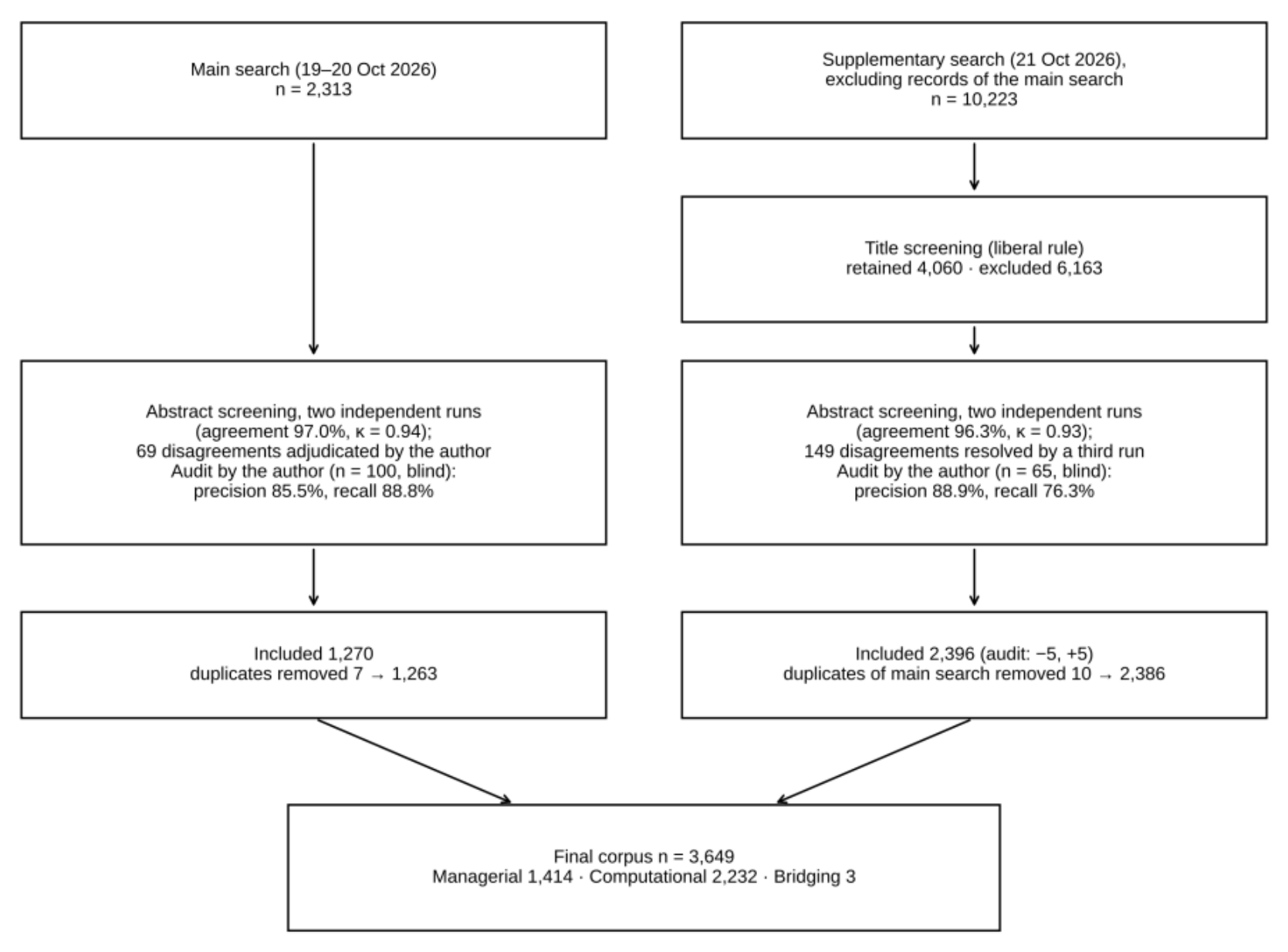
Figure 2.
Documents per year by stream, 2000–2026 (2026 is a partial year).
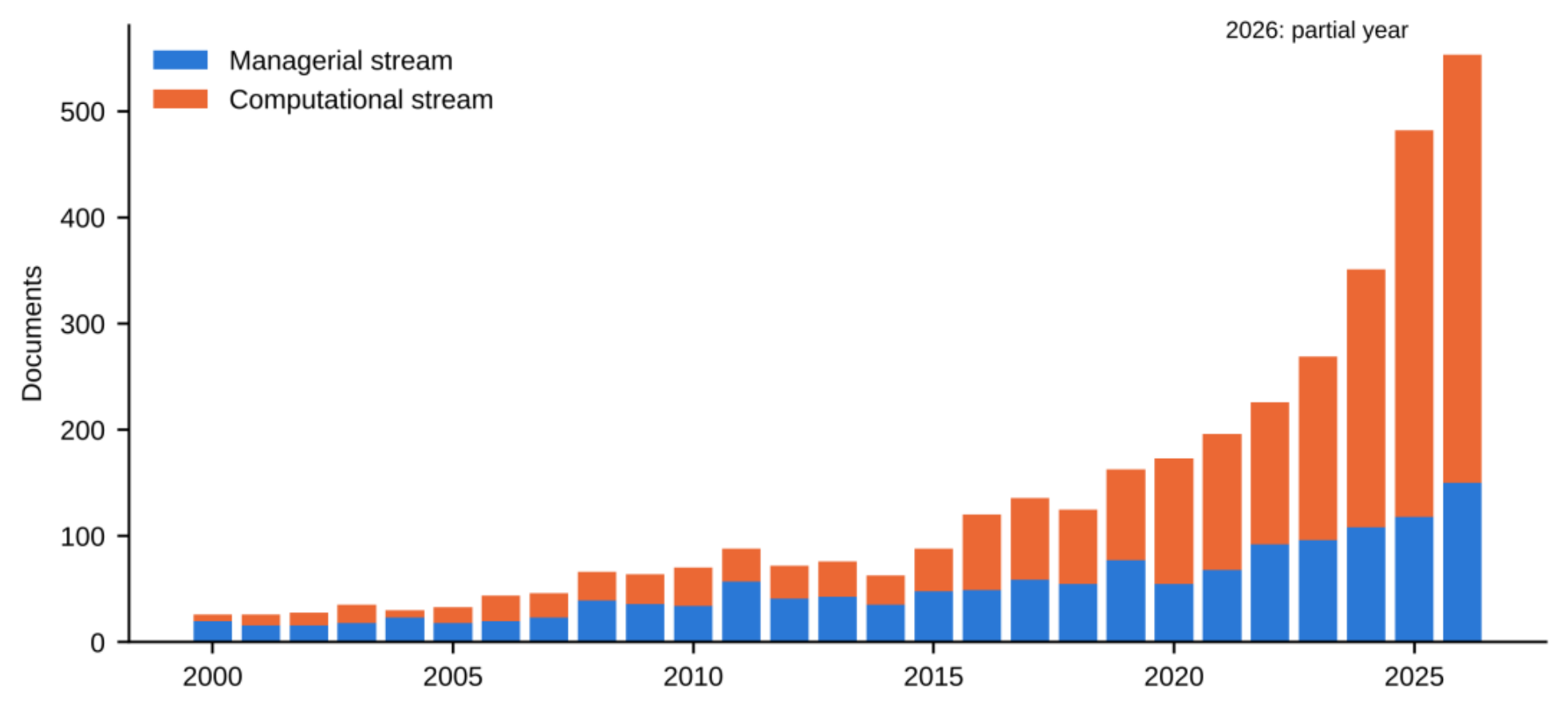
Figure 3.
Map of the intellectual foundations. Each bubble is a co-citation cluster, sized by its number of references and placed by the share of its citations that come from computational documents (horizontal axis) and by the median year of its references (vertical axis); line width is proportional to co-citation links between clusters, normalized by cluster size.
Figure 3.
Map of the intellectual foundations. Each bubble is a co-citation cluster, sized by its number of references and placed by the share of its citations that come from computational documents (horizontal axis) and by the median year of its references (vertical axis); line width is proportional to co-citation links between clusters, normalized by cluster size.
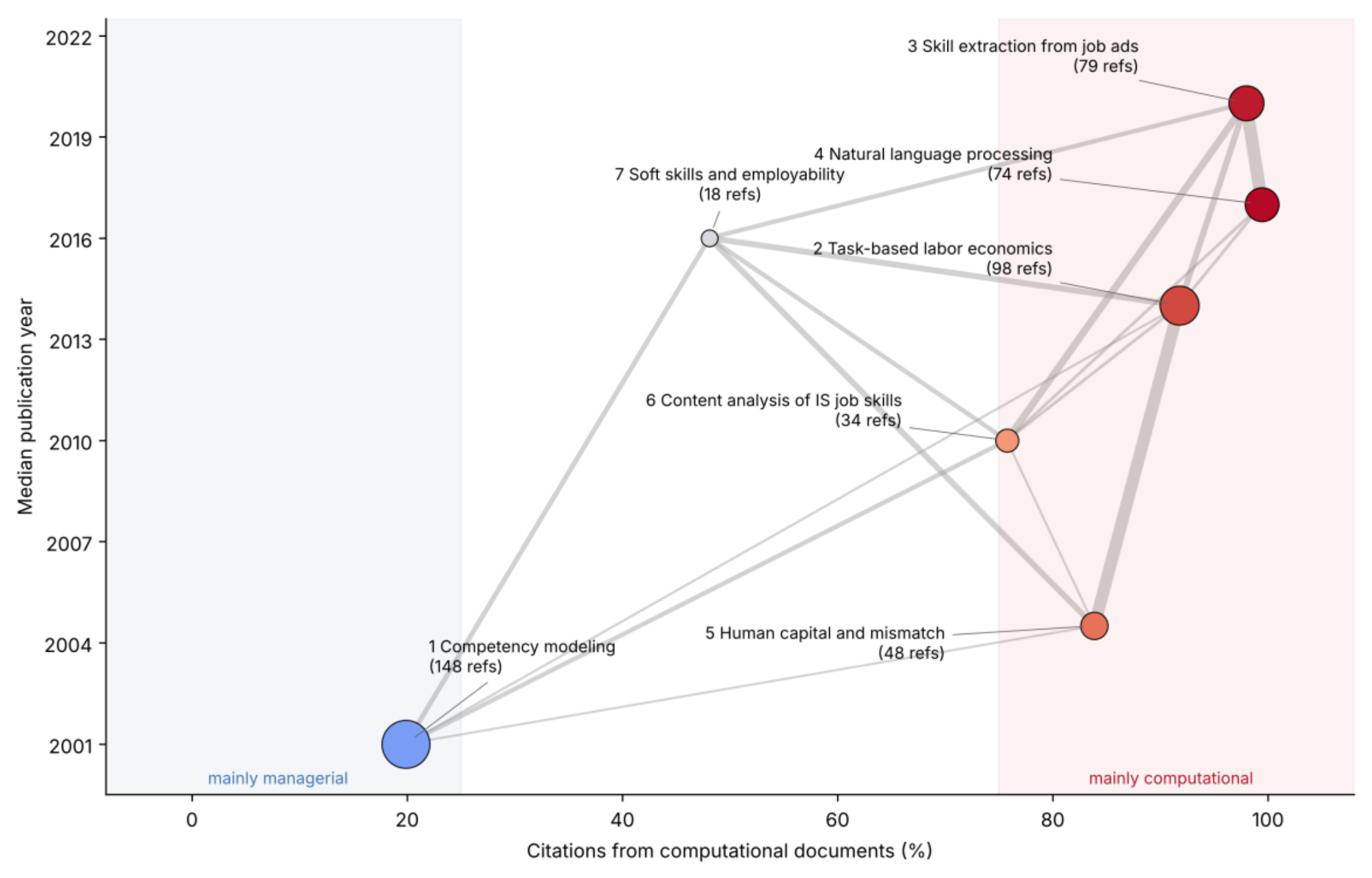
Figure 4.
Map of the research fronts. Each bubble is a bibliographic coupling front, sized by its number of documents and placed by the share of its documents in the computational stream (horizontal axis) and by their median publication year (vertical axis); line width is proportional to coupling links between fronts, normalized by front size.
Figure 4.
Map of the research fronts. Each bubble is a bibliographic coupling front, sized by its number of documents and placed by the share of its documents in the computational stream (horizontal axis) and by their median publication year (vertical axis); line width is proportional to coupling links between fronts, normalized by front size.
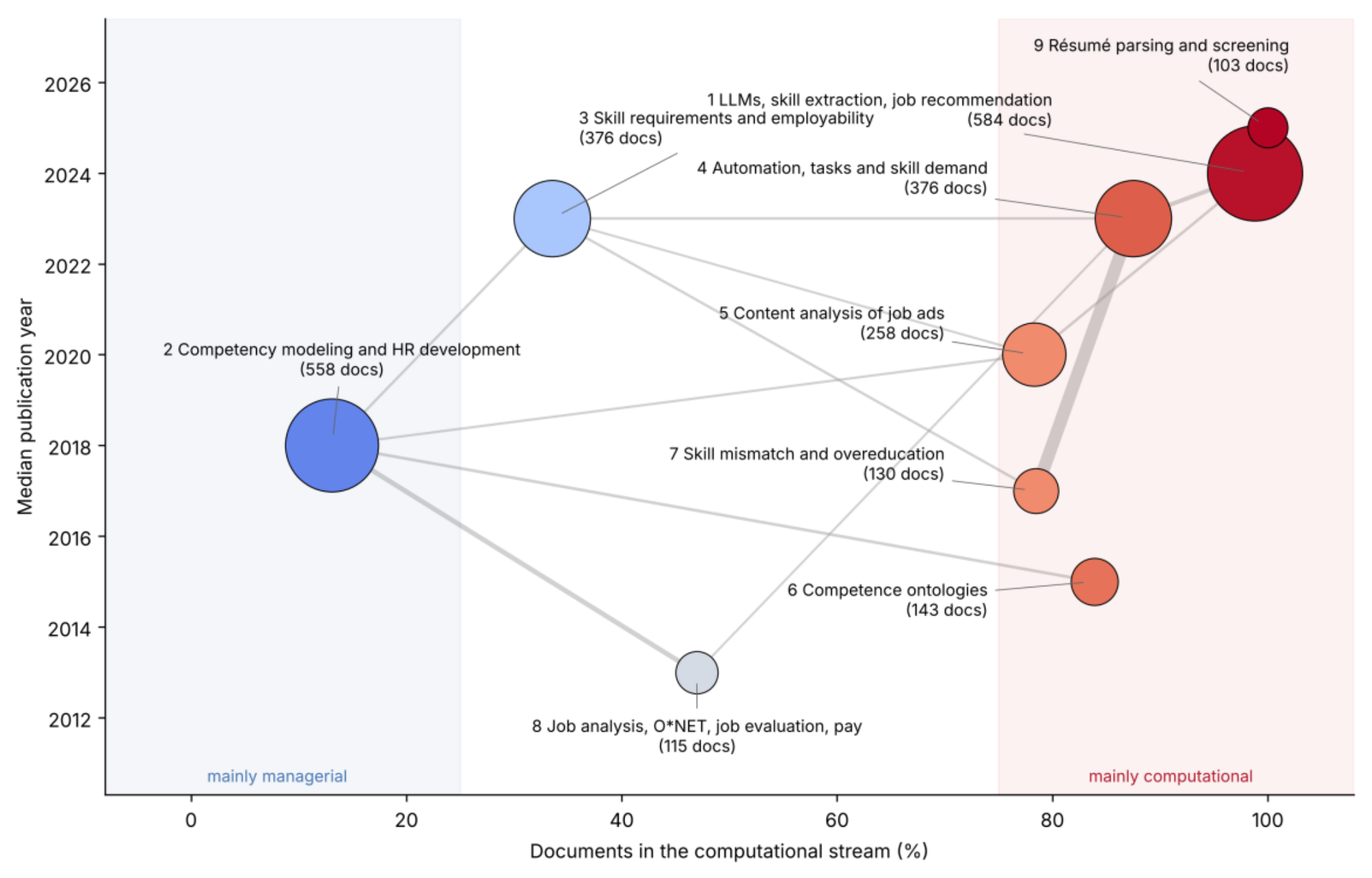
Figure 5.
Human resource practices addressed by each stream (number and column percentage of documents).
Figure 5.
Human resource practices addressed by each stream (number and column percentage of documents).
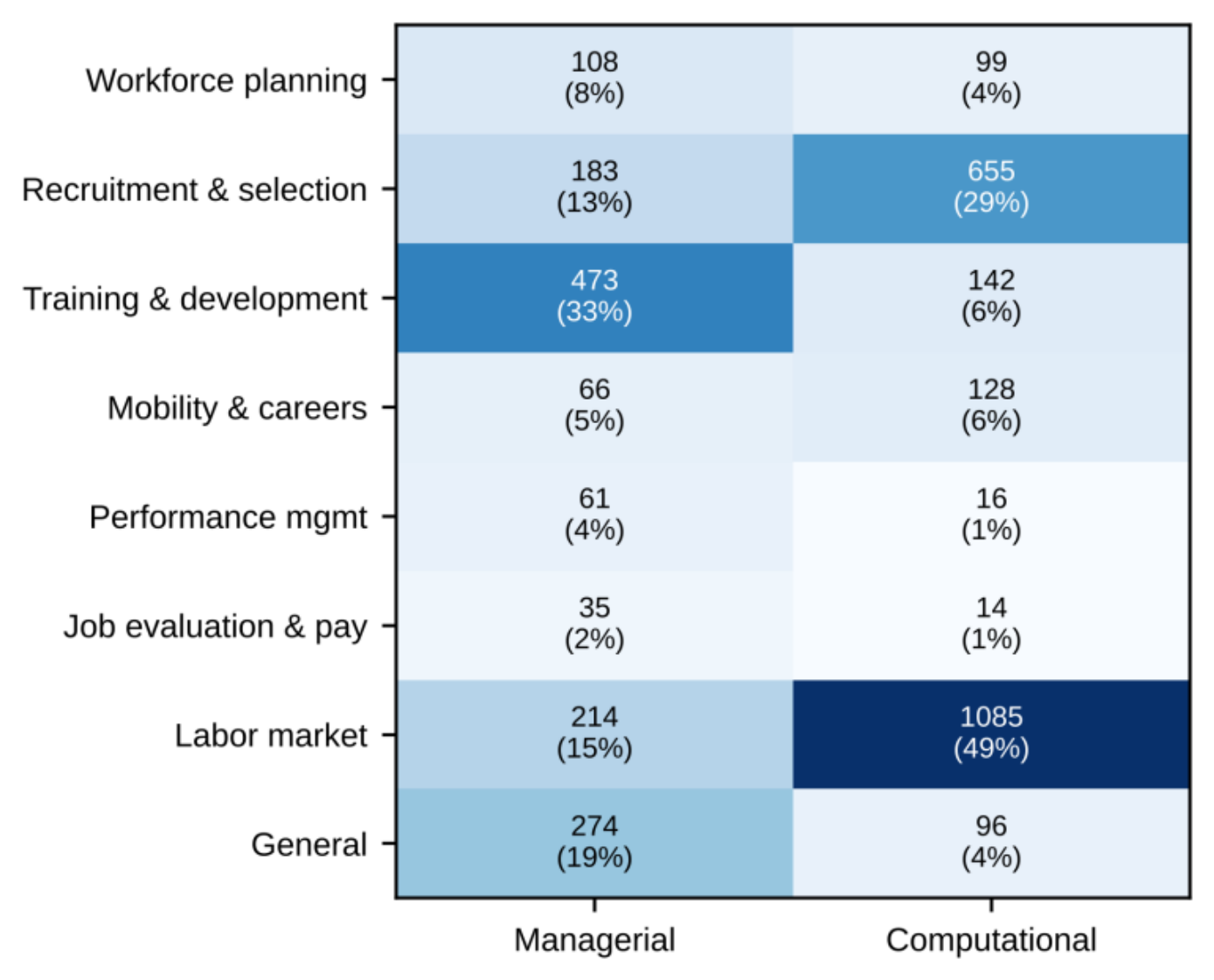
Figure 6.
The skills intelligence value chain. Orange: links studied mainly by the computational stream; blue: links studied mainly by the managerial stream.
Figure 6.
The skills intelligence value chain. Orange: links studied mainly by the computational stream; blue: links studied mainly by the managerial stream.
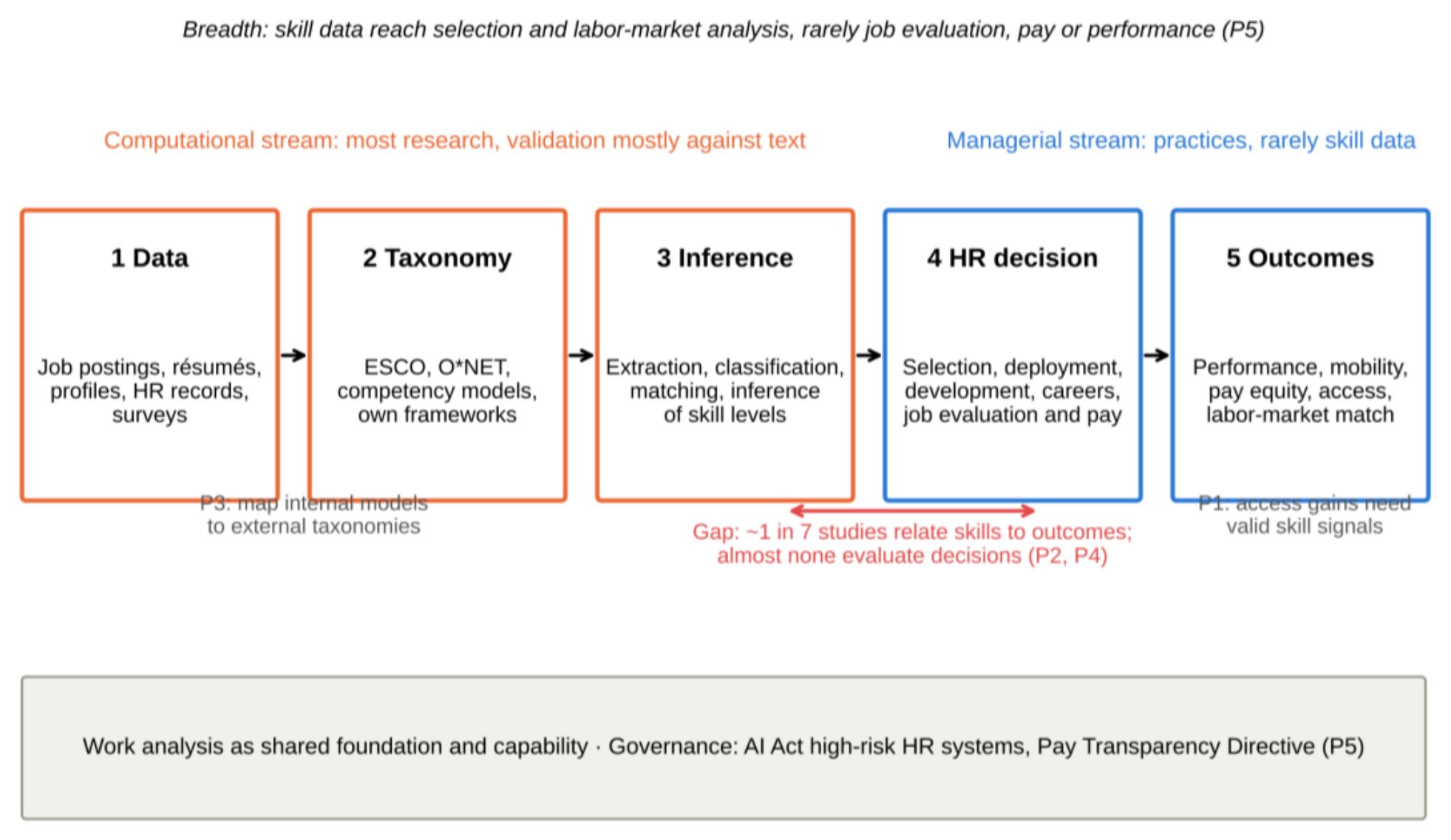

Table 1.
Analysis grid.
| Dimension | Categories | Coding rule |
| Stream | Managerial (M); Computational (C); Bridging (B) | M: skills as organizing principle of HR practice; C: taxonomies, extraction or matching methods evaluated on data; B (strong bridge): computational skill information used in an actual HR or labor-market decision that is then evaluated; weak bridges are defined in Section 3.3 |
| HR practice | Workforce planning; Recruitment and selection; Training and development; Internal mobility and careers; Job evaluation and pay; Performance management; Labor-market matching and policy; None or general | Main practice addressed; a second practice may be coded |
| Level | Individual; Organization; Labor market or occupation | Level at which skills are measured or the outcome is observed |
| Data source | Survey or interviews; Job postings; Résumés or profiles; Internal HR records; Taxonomy only (ESCO, O*NET, other); None (conceptual) | All sources used |
| Taxonomy | ESCO; O*NET; Proprietary; Own; None | Taxonomy used to name or classify skills |
| Validation | None; Against annotated text; Against expert judgment; Against a decision or outcome | Highest level of validation reported |
Table 2.
Intellectual foundations (co-citation clusters).
| Cluster | References (stable core) | Median year | Citations from the computational stream (%) | Most co-cited works |
| 1 Competency modeling | 148 (143) | 2001 | 19.9 | McClelland [13]; Boyatzis [60]; Spencer and Spencer [61]; Shippmann et al. [4]; Campion et al. [5] |
| 2 Task-based labor economics | 98 (98) | 2014 | 91.8 | Autor et al. [17]; Acemoglu and Autor [18]; Frey and Osborne [62]; Deming and Kahn [23] |
| 3 Skill extraction from job advertisements | 79 (79) | 2020 | 98.0 | Zhang et al. [25]; Khaouja et al. [6]; Boselli et al. [63]; Zhao et al. [64] |
| 4 Natural language processing | 74 (63) | 2017 | 99.5 | Devlin et al. [65]; Mikolov et al. [66]; Vaswani et al. [67]; Blei et al. [68] |
| 5 Human capital and mismatch | 48 (48) | 2005 | 83.9 | Becker [36]; Allen and van der Velden [69]; Spence [37]; McGuinness [70] |
| 6 Content analysis of IS job skills | 34 (19) | 2010 | 75.7 | Todd et al. [71]; Gallivan et al. [72]; Lee et al. [73] |
| 7 Soft skills and employability | 18 (18) | 2016 | 48.1 | Robles [74]; Cappelli [75]; Heckman and Kautz [76] |
Note. Stable core: references assigned with the other members of their cluster in at least 70% of 100 Leiden runs.
Table 3.
Research fronts (bibliographic coupling clusters).
| Front | Docs (stable core) | Comput. stream (%) | Median year | Since 2023 (%) | Distinctive keywords |
| 1 Language models, skill extraction and job recommendation | 584 (565) | 98.8 | 2024 | 69.0 | natural language processing; large language models; job recommendation; skill extraction; knowledge graph |
| 2 Competency modeling and HR development | 558 (556) | 13.1 | 2018 | 22.2 | competences; human resource management; competence management; leadership competencies |
| 3 Skill requirements and employability | 376 (265) | 33.5 | 2023 | 58.2 | Industry 4.0; employability skills; supply chain management; graduate employability; skill gap |
| 4 Automation, tasks and skill demand | 376 (371) | 87.5 | 2023 | 58.5 | technological change; skill demand; tasks; automation; human capital |
| 5 Content analysis of job advertisements | 258 (231) | 78.3 | 2020 | 33.7 | text mining; content analysis; job advertisements; job skills |
| 6 Competence ontologies | 143 (143) | 83.9 | 2015 | 11.2 | ontologies; semantic web; competence modeling; competence management |
| 7 Skill mismatch and overeducation | 130 (129) | 78.5 | 2017 | 26.2 | skill mismatch; overeducation; educational mismatch; job satisfaction |
| 8 Job analysis, O*NET, job evaluation and skill-based pay | 115 (106) | 47.0 | 2013 | 21.7 | job analysis; O*NET; job evaluation; work analysis; skill-based pay |
| 9 Résumé parsing and screening | 103 (95) | 100.0 | 2025 | 91.3 | resume screening; resume parsing; optical character recognition; machine learning |
Note. Stable core: documents assigned with the other members of their front in at least 70% of 100 Leiden runs.
Table 4.
Propositions: constructs, measures and refuting evidence.
| Proposition | Antecedent (measure) | Outcome (measure) | Derived from the review | Refuting evidence |
| P1 Signal substitution | Degree requirement removed × validated skill screen used (validity coefficient documented) | Change in share of hires without a degree (hiring records, not postings) | Validation gap: 3.1% (abstracts) to 13.6% (full texts) of computational studies relate skills to outcomes | Equal increase in non-degree hires without a validated screen |
| P2 Non-transfer of validity | Level-based vs mention-based skill profiles; extraction F1 against annotated text | Predictive validity for performance and mobility (correlation with ratings, promotions, moves) | Validation against annotated text grew to 260 studies in 2023–2026; against decisions: none verified | Mention-based profiles with higher F1 predict as well or better |
| P3 Boundary objects | Internal model mapped to ESCO/O*NET vs internal model only vs taxonomy only | Number of HR practices (of seven) using skill information | ESCO in 119 computational vs 0 managerial documents; O*NET in 125 vs 1; work analysis is the only bridge | No difference between mapping and taxonomy-only organizations |
| P4 Decision integration | Structured integration vs optional advice vs automatic screen, at equal validity | Performance and one-year retention of selected or deployed people | No study evaluates a decision taken with skill information; three strong bridges in 3,649 documents | Equal outcomes across designs |
| P5 Work analysis capability | In-house job or work analysis staff or unit (yes/no) | Use of skill information in job evaluation and pay (yes/no) | Work-analysis front is the most mixed (47% computational); pay and job evaluation < 2% of the corpus | No difference between organizations with and without the capability |
Note. Each proposition is stated in the text with its mechanism. Measures are indicative; seven HR practices: selection, deployment, development, careers, performance management, pay and workforce planning.
Table 5.
Research agenda.
| Link | Research question | Origin in the findings | Indicative designs |
| Data | Q1 How representative are job postings and profiles of the skills actually used and required in organizations? | Computational stream relies on postings; 14% of its studies are set in organizations | Comparison of postings with work-analysis data and HR records in the same firms |
| Data | Q2 Which internal data sources (HR records, project data, learning records) yield valid skill profiles, and with what privacy safeguards? | Internal HR data rarely used | Multi-source validation studies; privacy-preserving designs |
| Taxonomy | Q3 How can organization-specific competency models be mapped to ESCO or O*NET, and what is lost in the mapping? | Competency models and taxonomies used by separate streams | Mixed-method mapping studies; expert–algorithm comparison |
| Taxonomy | Q4 How stable are taxonomy-based skill measures across taxonomy versions and languages? | Taxonomy versions used inconsistently [7] | Replication across ESCO versions and languages |
| Inference | Q5 Do extracted skills predict job performance and mobility beyond degrees and experience? | About 1 in 7 computational studies relates skills to outcomes, mostly correlationally (full-text check) | Predictive validity studies linking extracted skills to performance records |
| Inference | Q6 Do large language models infer skill levels, not only skill presence, with acceptable reliability? | Rapid growth of LLM-based extraction since 2023 | Comparison with assessment-center or test scores; reliability studies |
| Decision | Q7 How do recruiters and managers use skill recommendations, and when do they override them? | Bridging studies almost absent | Field experiments; process tracing of decisions |
| Decision | Q8 What is the adverse impact of skills-based screening compared with degree-based screening? | Small effects of skills-based hiring on actual hiring [8] | Audit studies; natural experiments around degree removal |
| Decision | Q9 Can skill information support job evaluation and the assessment of work of equal value? | Job evaluation and pay nearly absent | Design science with HR departments; comparison with point-factor methods |
| Outcomes | Q10 Does skills-based internal mobility improve retention, performance and careers? | Mobility and careers studied in 5% of documents | Longitudinal firm data; difference-in-differences around adoption |
| Outcomes | Q11 What are the effects of skill-based pay in contemporary skills-based organizations? | Skill-based pay and job evaluation survive only in the small work-analysis front | Panel studies of pay systems; comparative case studies |
| Governance | Q12 How do different regulatory regimes (EU AI Act, US Uniform Guidelines and bias-audit laws, China’s PIPL) change the design, validation and documentation of skills intelligence systems in HR? | Validation practices fall short of the evidence these rules require | Comparative case studies of conformity assessments and bias audits; vendor–client studies |
Disclaimer/Publisher’s Note: The statements, opinions and data contained in all publications are solely those of the individual author(s) and contributor(s) and not of MDPI and/or the editor(s). MDPI and/or the editor(s) disclaim responsibility for any injury to people or property resulting from any ideas, methods, instructions or products referred to in the content. |
© 2026 by the authors. Licensee MDPI, Basel, Switzerland. This article is an open access article distributed under the terms and conditions of the Creative Commons Attribution (CC BY) license (http://creativecommons.org/licenses/by/4.0/).
Copyright: This open access article is published under a Creative Commons CC BY 4.0 license, which permit the free download, distribution, and reuse, provided that the author and preprint are cited in any reuse.