
Submitted:
26 October 2026
Posted:
27 October 2026
You are already at the latest version
Abstract
Background: Digital pain self-reporting may support longitudinal assessment of chronic pain, but evidence from lower- and middle-income settings is limited. We assessed the feasibility and acceptability of a digital self-reporting pain tool among people living with chronic musculoskeletal pain in Pakistan and gathered users’ insights into the tools’ feasibility and acceptability. Methods: This mixed-methods feasibility study asked participants to use an Android pain self-reporting app over 40 days. Feasibility was assessed using completion rates and predefined engagement thresholds. Acceptability was assessed using an end-of-study questionnaire. Two in-person focus groups were conducted, which were analysed using framework analysis, and qualitative findings were analysed descriptively and integrated for the final presentation. Results: Sixty-two participants submitted at least one pain report, generating a total of 945 reports. Participants reported a mean of 9.7 ± 11 of 40 study days, equivalent to a mean completion rate of 24.0% ± 28.6%. Eleven participants (18%) reported for at least seven consecutive days, 11 (18%) submitted at least two reports per week, and four (6.5%) submitted at least four reports per week throughout six weeks. Twenty-nine participants (47%) completed the acceptability questionnaire. Most respondents found the app useful (26/29, 90%), easy for indicating pain location (28/29, 97%) and selecting pain intensity (25/29, 86%). Technical issues such as connectivity were common barriers, alongside forgetting to self-report. Focus group discussions with participants attending follow up consultations reported that the app helped them communicate their pain more accurately and enabled developing greater awareness of their pain. However, additional guidance on using the app and pain self-management approaches could be useful. Conclusions: Though a digital pain self-reporting tool is acceptable in low-resource settings, its long-term feasibility remains constrained by low user engagement, which is driven by personal, social and technological and utility related aspects. Future research should explore how improving these aspects can improve outcomes across diverse population subgroups.
Keywords:
chronic pain
; engagement
; feasibility and acceptability
; mobile applications
; health equity
; pain measurement
1. Introduction
Chronic musculoskeletal pain is prevalent in Pakistan, affecting one in four individuals (Ahmed et al., 2024) and leaving a huge economic impact on individuals and the healthcare system (Guven Kose et al., 2023). In addition to being a symptom of an underlying disease or condition, chronic pain is now recognised as a condition in its own right (Treede et al., 2019). There are notable disparities related to age, gender (Azeem et al., 2023), geographical location and socioeconomic status (Todd et al., 2018) in the prevalence of chronic pain and its impact. For example, women and younger men are impacted adversely with chronic pain as compared to men and older men, respectively (Kim et al., 2023). Chronic pain poses a substantial burden, resulting in work absences, difficulty performing daily activities and decreased quality of life (Macfarlane et al., 2017; Saima Dawood & Mamoona Bokhari, 2021).
Owing to the changing and subjective nature of chronic musculoskeletal pain, frequent and longitudinal pain assessment is essential for improving pain management. Capturing pain intensity, quality and spatiotemporal pain variations is also clinically important (Ali, Elsayed, et al., 2025; Fillingim et al., 2016), yet none of the current pain assessment tools captures these dimensions sufficiently (Choi et al., 2024; Scher et al., 2020). Digital pain manikins have the potential to capture this information, including spatiotemporal changes, in real-time. To help address pain disparities across populations, digital pain manikins need to be suitable for frequent and longitudinal pain self-reporting among culturally and linguistically diverse (CALD) communities in high-income countries (HICs).
Many digital pain manikins have been developed and evaluated in HICs mostly with predominantly white populations (Ali, Lau, et al., 2021; Ali, Mountain, et al., 2025). Our previous work identified requirements for making manikins appropriate for CALD communities, including Pakistanis living in the UK (Ali, Lee, et al., 2023). We also gathered requirements from Pakistanis living in Pakistan. These were broadly similar to those from the UK, but differed in manikin layout and in the information that could be shared with healthcare professionals, reflecting differences in social context (Imami et al., 2025). Although our study in the UK showed that digital pain manikins are feasible for pain self-reporting (Ali, Selby, et al., 2023), it is unknown to what extent these findings are transferrable to other settings. The UK findings are not generalisable to Pakistan’s context because the broader social context differs widely, including digital infrastructure, economic barriers, digital literacy and digital divide, trust in digital health technologies and social norms, particularly around women's mobile ownership and internet use (Kazi et al., 2020). Therefore, for wider implementation of digital pain manikins in low-resource settings, it remains uncertain whether, and to what extent people living with chronic musculoskeletal pain are willing and able to self-report their pain via a mobile app on their own smartphones.
Therefore, we aimed to assess the feasibility and acceptability of longitudinal and frequent pain self-reporting using a digital pain manikin and gathering users’ insights into the tool’s feasibility and acceptability in Pakistan. The specific objectives were to:
(a) To assess the completeness of daily digital pain self-reports for 40 days and compare completeness rates across sub-groups.
(b) To assess acceptability to patients of daily digital pain self-reports and compare acceptability across sub-groups.
(c) To explore users’ insights into feasibility and acceptability of digital pain self-reports.
2. Methods
2.1. Study Design
It was a mixed-methods prospective study in which a prospective assessment of feasibility and acceptability was done, followed by focus group discussions to gather users’ insights about potential approaches to optimise feasibility, acceptability and clinical usefulness of digital pain self-reports among people living with chronic musculoskeletal pain. We are reporting our results in accordance with the reporting guidance for non-randomised pilot and feasibility studies, using the CONSORT extension for pilot and feasibility trials (Eldridge et al., 2016), where applicable.
2.2. Study Context
The study was conducted at Shalamar Hospital in Shalamar Town, an administrative town (tehsil) of Lahore, Pakistan. Shalamar town is densely populated and low-income urban area. Shalamar Hospital (study site) is a private, not-for-profit tertiary care teaching hospital, serving underprivileged members of the community. The hospital supports patient population that is largely of lower socio-economic status through its Patient Welfare Services, providing free or subsidised medical services. Owing to the economic challenges, it suggests that the clinical consultations are largely driven by patients’ motivation, rather than clinical needs.
Like many tertiary care hospitals, Shalamar Hospital uses an enterprise-level electronic medical record system, built and deployed by an in-house team. Technological advances in Pakistan have focused mainly on clinics and clinicians, with limited knowledge about tools that may let patients generate and share their own health data. To our knowledge, this is the first study in Pakistan in which a patient-facing technology was used to generate patient health data and share it directly with clinicians or information systems.
In our study, our data collection period was 40 days or six weeks. This reporting period was selected to approximate the usual interval at which patients in the rheumatology clinic are advised to return for follow-up, which is around six weeks. A longer reporting period was not selected for this feasibility study because it could increase participant burden, reduce completion, and introduce additional logistical challenges for follow-up and subsequent research activities in Pakistan.
2.3. Ethics Approval
The ethics approval for this study was obtained from the Institutional Review Board of the Shalamar Medical and Dental College, Lahore, Pakistan (ref # IRB-748).
2.4. Participant Eligibility and Recruitment
Adults (aged 16 and above) who had chronic pain due to any underlying rheumatic condition, had access to the internet and an Android smartphone, were willing to use their smartphone for pain self-reporting and had ability to provide written consent were eligible for the study. Adults who had chronic pain due to non-rheumatic clinical conditions and those without the capacity to give informed consent were ineligible.
We invited and recruited potential participants from the rheumatology clinic of the Shalamar Hospital in Lahore, Pakistan. Potential participants were invited by rheumatology consultants and interested people were referred to the research team for screening. Researchers shared a participant information sheet with eligible people, which they either read themselves or had read to them, explaining research objectives, what participation in the study involves and how participants’ data will be collected, processed, stored and used. Eligible people provided informed written consent.
For focus groups, we invited those participants who completed their follow up clinical consultations after 40-days, where their pain self-reports were summarised and integrated in clinician’s dashboard and were used to during clinical consultations.
2.5. App Onboarding
After the consent was sought, the research team supported participants in downloading and installing the application, known as the Manchester Digital Pain Manikin. Researchers guided all participants regarding how to use the app for daily self-reporting of their pain using their own smartphones and referred to a video tutorial in a language which they would prefer (i.e., English or Urdu - https://www.youtube.com/watch?v=iVqz4asf094&t). Links to YouTube videos (topics: how to set up the manikin and the app, how to self-report pain) were embedded in the guide section of the app. A telephone helpline was also set up for participants to seek help by speaking to one of the research team members.
2.6. Manchester Digital Pain Manikin App
The Manchester Digital Pain Manikin app was developed and tested previously in the United Kingdom (van der Veer et al., 2020, 2024), which we improved further based on the feedback received from Pakistanis living in the UK (Ali, Lee, et al., 2023) and in Pakistan (Imami et al., 2025). The improved version used in the present study was developed in collaboration with a technology partner (Novacare AI Solutions). In this version, users could select a manikin based on gender, body shape and skin tone. Moreover, they could choose between English and Urdu and adjust font size to improve text legibility.
While app onboarding, participants were asked to set up time for reminder notifications. The daily pain report included a single overall pain rating question, a pain drawing on six views of a body manikin (front, back, left lateral, right lateral, head and heel), factors related to perceived pain triggers, pain management strategies, impact of pain on their lives and a free text diary. The weekly pain report included questions related to clinical outcomes, which were adopted from the Global Pain Scale. The pain drawing included reporting of location-specific pain intensity through a slider, location-specific pain quality through a list of pictograms, reflecting different pain qualities, and pain radiation by selecting locations of pain origin and location ends from a pre-specified list. During app on-boarding, we encouraged participants to self-report their pain on pain-free days as well.
2.7. Data Collection
Recruited and consented participants completed a researcher-administered digital baseline questionnaire. The baseline questionnaire included demographic questions (e.g., age, gender, ethnic background, education, and employment status) and questions about pain experience (Appendix A). We asked participants to self-report their pain using the Manchester Digital Pain manikin app installed on their own smartphones for 40 days.
Following the data collection period of 40 days, prior to the follow-up clinical consultation, participants completed a researcher-administered digital end-of-study questionnaire to gather their feedback on the app’s acceptability, including app’s usability, usefulness, intention to use the app and approaches to improve acceptability of the app. These questions were developed based on the Technology Acceptance Model (Holden & Karsh, 2010), QQ-10 (Moores et al., 2012), and a systematic review of digital pain manikins (Ali, Lau, et al., 2021). As a token of appreciation, participants received 3,000 PKR (equivalent to around 10 USD) compensation upon completing questionnaires and submitting at least one pain self-report via the smartphone app. Participants could withdraw from the study at any time.
Focus Groups
Participants were grouped initially based on completeness of data (e.g., participants with higher completion rates vs. those with lower completion rates) and then on the basis of their social determinants. The focus group discussions used the approach outlined in the digital health supplement of Health Equity Impact Assessment (HEIA-DH) (Crawford, 2022) to examine potential impact of a digital pain self-reporting tool. A topic guide was adapted, which was used previously by researchers in the UK (Ali, Gambin, et al., 2024). Focus groups were audio-recorded, transcribed verbatim and anonymised by a researcher before coding and analysis. We used Microsoft Excel to manage the qualitative data.
2.8. Data Analysis
We assessed the overall completion rate and the consistency of reporting across the study period, keeping these methods consistent with our UK-based feasibility study (Ali, Selby, et al., 2023). Empty pain self-reports were considered a valid record as we advised the participants to submit an empty pain self-report on pain-free days. We defined the overall completion rate as the percentage of days during the study period in which a participant submitted at least one pain self-report. Based on completion rates, we developed five categories to reflect engagement levels: (a) most engaged (81-100%); highly engaged (61-80%); moderately engaged (41-60%); marginally engaged (21-40%); and least engaged (0-20%). We assessed the consistency of reporting using three predefined engagement thresholds: submission of pain self-reports for (a) at least seven consecutive days during 40 days of study period (b) at least two days each week for 40 days; and (c) at least four days each week for 40 days. These thresholds were selected to capture both short-term consistency (consecutive daily reporting) and sustained engagement (weekly reporting frequency).
We conducted exploratory subgroup analyses to examine patterns of engagement across groups based on underlying pain condition and selected demographic characteristics using Python (version 3.12). Exploratory regression analyses were conducted to examine associations between participant characteristics and feasibility outcomes defined by whether predefined engagement thresholds were met (yes/no) to identify potential trends which could be examined in future work. Comparisons of mean completion rates between any two subgroups were performed using independent-samples t-tests, while one-way analysis of variance (ANOVA) was used for comparisons across multiple subgroups. When ANOVA indicated statistically significant differences (p ≤ 0.05), post hoc analyses were conducted to identify group-level differences. Tukey's HSD was applied when Levene's test confirmed homogeneity of variances; otherwise, the Games–Howell test was used. Given the feasibility focus of the study, these analyses were interpreted descriptively and exploratorily.
For this manuscript, acceptability was assessed using these sub-domains: representativeness of pain using the manikin, usability, perceived usefulness, intention to use the app, suggested improvements, and reasons for non-completion. The responses to 14 Likert items were coded from 1 to 5, with the complexity item reverse-coded, and averaged to produce a mean acceptability item score. Responses were captured on five-point Likert scale (i.e., 1 to 5), which collapsed to three points (favourable, neutral or unfavourable) for analysis purposes. Reasons for non-completion could include multiple responses and were summarised descriptively.
For focus groups, we reviewed transcripts line-by-line to develop codes. A codebook was developed iteratively using a combination of inductive and deductive coding approaches. We used a framework analysis approach (Gale et al., 2013) to analyse and interpret the data and developed themes from it. We presented themes along with illustrative participants’ quotes.
3. Results
Participant Characteristics
A total of 71 eligible participants were approached, of whom 63 were recruited and completed the baseline questionnaire, demonstrating a recruitment rate of 89%. Of the 63 recruited participants, 62 submitted at least one pain self-report during the 40-day study period and were included in the feasibility analysis, giving an initial reporting uptake of 98%. One participant did not submit any pain self-report after enrolment. End-of-study acceptability questionnaire data was available for nearly half of the recruited participants (n=29; 46%), out of which eleven participated in group discussions (11/29; 38%).
Baseline characteristics are therefore presented for all recruited participants (n = 63), whereas feasibility outcomes and subgroup analyses are reported among participants who submitted at least one pain self-report (n = 62). Table 1 shows that most participants were 44 years or younger (n=46; 73%), females (n=48; 76%), and identified as Punjabis (n=53; 84%). Also, more than half had lived pain experience of less than 3 years (n=36; 57%) and were unemployed (n=32; 51%). Four-fifth (n=51; 81%) of the participants found the use of smartphone either very easy or somewhat easy.
(a) Feasibility of frequent and longitudinal pain self-reporting
Over the 40-day study period (or six weeks), 62 study participants (i.e., who completed at least one pain self-report) completed 945 pain self-reports, with mean of 9.7 (±11.0) report-days (i.e., when report was submitted out of 40 days), completion rate of 24% (±28.6%) with a median of 6 reports per participant (IQR 2–23.75; range 1–85). Figure 1 shows number of reports submitted by each participant during the study period.
Overall, most participants (n= 39; 63%) were least engaged (see Table 2). Regarding other feasibility criteria, 11 participants (18%) self-reported on seven consecutive days, same number of participants reported at least two self-reports and only four participants reported at least four self-reports for all six weeks (see Table 2).
Exploratory subgroup analyses did not demonstrate statistically significant differences in completion levels across age groups, ethnicity, employment status, ease of smartphone use, pain duration, or education level (see table 1 in supplementary materials).
(b) Acceptability of frequent and longitudinal pain self-reporting
Twenty-nine of 62 (47%) participants completed the end-of-study acceptability questionnaire. The exploratory 14-item acceptability score had a mean of 4.02 (SD 0.52) out of total score of 5 and internal consistency was α=0.71.
Table 3 shows that majority of the participants agreed that the app included all important pain aspects (n=26; 90%), and pain drawing and pictograms were true reflection of their pain (n=25; 86%) and pain types (n=24; 83%), respectively. Generally, the usability of the app was higher, particularly reporting of pain location (n=28; 97%), pain intensity (n=25; 86%) and pain type (n=22; 76%). Majority of participants agreed that completing one pain report did not take long (n=25; 86%) and the app was useful for pain reporting (n=26; 90%).
Seventeen participants out of 29 (60%) reported that they would be willing to complete a manikin report once daily, six participants every 2–3 days (21%), five participants once weekly (17%) and one said less often than weekly (3%). However, a majority of participants (n=22; 76%) reported that they would continue daily reporting as long as suggested by their doctor.
Lastly, forgetting to complete a report (n=16; 55%) and technical issues, such as app or Internet connectivity issues (n=14; 48%) were commonly reported reasons for non-completion of daily self-reports. Participants were provided with access to telephone support from the research team for any app-related help during the study period; however, whether each technical issue was fully resolved was not systematically captured in the end-of-study questionnaire. Fewer participants (n=2) also reported difficulty in using the app and pain being unchanged from the previous day as reasons for non-completion. Participants suggested including clearer step-by-step guidance for pain drawing, manikin for reporting small-joints pain, clearer wording for clinical outcomes related questions, and feedback on submitted reports. Moreover, telephonic follow-up with patients highlighted key barriers related to participant engagement. Many participants did not answer our calls, and those who did could not attend because of several reasons: the month of fasting, wrong contact number, no direct contact number of study participants (e.g., female participants sharing contact number of male family members) and smartphone ownership.
(c) Users’ insights into feasibility and acceptability of self-reporting pain
Eleven participants (6 females, 5 males) attended two in-person focus group discussions. Participants were purposively invited to capture variation in reporting completion and selected social determinants, rather than to achieve statistical representativeness of all recruited participants or end-of-study questionnaire respondents. The focus-group sample included six females and five males (see table 4) and was used to explore participant experiences, perceived health-equity impacts, and suggestions for optimising future use of the app. Generally, participants shared potential positive health impact of daily self-reporting of pain and their integration into clinician’s dashboard. Overall wellbeing, reduced anxiety, pain reduction, and aiding patient-provider interaction were identified as potential positive health impacts. However, lack of trust in such tools could have potential negative health impacts.
Majority of participants found the app easy for frequent pain self-reporting. They mentioned that with frequent pain self-reporting they were able to understand their pain experience better, which perceived to address their pain-related stress and resulted in pain reduction as well. Moreover, they perceived that the use of the app was helpful in ensuring their wellbeing, hence demonstrating potential positive health equity impact as one participant said:
‘…the app was very beneficial…Firstly, it helped us identify our illness. Secondly…sitting at home, you can identify exactly where in your body you are experiencing pain…this helps me calm down…I am very thankful that it has been created for our well-being’ (female participant; quote 1)
Moreover, participants found it useful that their pain experience is summarized during the consultations, which supported patient-provider interactions, as one of the participants said:
‘I really liked it…I appreciated that even before I could say anything, my data was already there, and you [clinician] were able to see it. That’s a huge benefit’. (male participant; quote 2)
Participants noted that the app captured important aspects of their pain experience that are typically missed during consultations due to memory issues or recall bias. Since this was their first experience with any digital health tool, the initial skepticism about its potential benefits was common. However, one participant highlighted a shift from such skeptical views to clinical agency and empowerment:
‘I felt it once or twice…we are constantly thinking about ourselves, like checking whether there is pain here or not, and in doing so I felt I might end up making myself even more ill. But then I told myself…I should report it to the doctor, so that when I go, it will be easier for them to understand me and know what I feel each time. That way, whatever medicine they prescribe will actually make a difference for me’ (male participant; quote 3)
In addition to these advantages, participants also shared considerations for future development so that further benefits of digital pain self-reporting could be leveraged. Participants suggested introducing an in-app community, improving remote patient monitoring capabilities and incorporating pain management guidance, particularly related to diet and physical activity.
| Key ideas | Illustrative quotes |
| Experience using the digital pain self-reporting tool and attending clinical consultation | |
| Ease of communicating about pain | [in the pain self-reporting tool] it's indicated whether it's stabbing or pricking pain…by looking at the pictures… otherwise, I wouldn't have known. When I met with them [clinicians], I told them about these things (male participant; quote 4). |
| Aiding patient-provider interaction | At first, I thought it [the app] wouldn't be beneficial for me. But when I used it and when I came the other day for a check-up, the doctor saw it from the system, and he saw all the places where I had marked my pain, and then he asked me about it, so that was very helpful for me., and it also made it easier for the doctor to understand (female participant; quote 5). |
| Memory issue in describing pain experience during clinical consultations | Doctor asked me…the day before yesterday, you had so much pain here [at this location], which I didn’t even remember…It didn’t come to mind immediately…I mean, something happens every day, so I would not remember immediately (female participant; quote 6). |
| Stress relief and pain reduction | I was very stressed before—I used to start crying just from sitting and thinking about my illness…when I reported everything in the app, it felt different in my mind—I noticed a significant reduction in pain…Today, I feel more active, and it brings a sense of peace to my heart (female participant; quote 7) |
| Trust on the tool | We can tell the doctor about our feelings—things that we might not even share with our family at home—daily. It gives us a sense of relief. After reporting, I personally felt calm and at ease (female patient; quote 8). |
| Pain self-awareness | Before using this app, I didn't know about the pain. But now, I have come to know about the different forms of that pain…and times it is more intense (male patient; quote 9). |
| Considerations for future developments | |
| Remote patient monitoring | …sometimes we are under a lot of stress or in severe pain. Usually, we are already taking our prescribed medicine, but the pain persists. At those times, we need a consultant who can advise whether to adjust the dose. |
| Medication safety | I am also an asthma patient, so I sometimes face a lot of problems because of it…the doctors can review my medications and decide what they need to prescribe. Each medication has its own dosage and effects, which should be balanced carefully. I believe if this is included in the application, it would make it easier for us to explain our complete situation and ensure proper care. |
| Exercise related advice | …once you receive your diagnosis, you should also get all the related information with it. For example, there should be alerts suggesting which exercises to do. If someone doesn’t know what exercises are needed — like in my case — then proper guidance becomes very important. |
| Dietary advice | …add a separate section on diet…for example, which foods the patient should avoid. |
| Feedback on pain self-reports | In this app, there should be some option to know that your doctor has checked the entered data or reports. |
| Online community | I think different types of patients should be connected via the app. |
4. Discussion
This mixed-methods study assessed feasibility and acceptability of longitudinal and frequent pain self-reporting among people living with chronic musculoskeletal pain and explored users’ insights into feasibility and acceptability, so that the tool could be improved further. Participants submitted 945 pain self-reports over the 40-day study period, but completion rate was generally low, with a mean of 9.7 report-days. Only 11 participants achieved seven consecutive days of reporting, 11 submitted at least two reports per week across all six weeks, and four submitted at least four reports per week across all six weeks. Despite the lower completion rates, majority of the participants who attended follow up consultations and completed end-of-study questionnaires expressed high acceptability and found the app useful and easy to use. Focus group discussions with participants attending follow up consultations reported that the app helped them communicate their pain more accurately and enabled developing greater awareness of their pain. In addition to receiving additional guidance in using the app, participants suggested introducing an in-app community, building remote patient monitoring capabilities and incorporating pain management guidance, particularly related to diet and physical activity.
Our study demonstrates that smartphone-based digital pain self-reporting can generate meaningful longitudinal pain data, even in a real-world clinical setting with literacy, technical, and follow-up constraints settings of Pakistan. Though the feasibility for sustained frequent reporting over 40 days was limited, the tool showed promise for capturing clinically useful patient-reported pain information, but further optimisation is needed to support consistent long-term engagement. These results are in contrast with the previous study conducted in the UK, where a digital self-reporting tool was found to be feasible for daily self-reporting for 30 days (Ali, Selby, et al., 2023). There is a growing body of evidence from high-income countries supporting feasibility of utilising consumer devices for longitudinal and frequent data collection (Ali, Selby, et al., 2021; Sarkar et al., 2024; Tung et al., 2025). However, it is important to recognise that this is because of decades’ long investment into building digital infrastructure, digital skills and broader public trust (Department for Work and Pensions, 2026; Health and Social Care Committee, 2023). Moreover, high acceptability among those who attended follow-up consultations could also be because of perceived clinical utility, as through sustained use over the study period, these participants recognised the benefits of regular pain tracking: an advantage that less engaged participants could not anticipate.
Even in high-income countries (HICs), certain population subgroups struggle to engage with digital health technologies due to low digital skills and trust in digital health technologies (Aldosari et al., 2023; Ali, Gasteiger, et al., 2024). Our study observed similar patterns, though the scale of the problem differed widely between the two settings. To brindge this gap, HICs increasingly emphasise governance and inclusivity to promote digital health equity (Allcock et al., 2024). In contrast, Pakistan lacks these important policy initiatives. As demonstrated by our findings, the lack of focus develops negative public perceptions, digital divide and lack of digital skills. While such barriers to digital health technologies are also evident in literature from HICs (Ali, Gasteiger, et al., 2024; Ali, Saiyed, et al., 2025), they are further compounded by the lack of data governance framework (Amjad & Aslam, 2026; Kazi et al., 2020). Ultimately, expanding digital health research will be vital to driving the development of evidence-informed digital health technologies for CALD communities living across both HICs and LMICs.
A major strength of this study lies in its real-world implementation of a digital pain self-reporting tool within a socially deprived urban catchment in Shalamar Town, Lahore (Hyder & Sikander, 2011). However, several limitations narrow the generalizability of our findings. The study relied on a single site, a small sample size and a potential selection bias that favoured digitally literate and motivated participants. By requiring participants to have access to an Android smartphone and the internet, we may have excluded individuals with limited digital connectivity and skills. Moreover, because we did not formally assess baseline digital literacy and smartphone ownership, this study likely underestimated the digital barriers faced by the wider chronic pain population. Participant retention was also impacted by cultural factors. Scheduling follow-up appointments during the month of Ramadan affected participants’ retention and motivation negatively and resulted in significant dropout. Because of this we could not capture the experiences of poorly engaged participants, who likely faced more usability, accessibility, and technical issues. To address these gaps, future research should focus on tackling the problem of low engagement as well as evaluating if and to what extent summaries of digital pain reports into clinical consultation influences participants’ engagement.
5. Conclusions
In conclusion, while a digital pain self-reporting tool is acceptable in low-resource settings of Pakistan, its long-term feasibility remains constrained by low user engagement. This attrition was primarily driven by everyday practical barriers, such as smartphone ownership, potential skepticism, forgetfulness and technical challenges related to internet and app connectivity. Participants found the app easy for tracking pain and noted that it enhanced their health agency, reduced anxiety, and improved patient-provider communication by minimising recall bias. However, we found that engagement barriers were systemic and did not differ significantly by age, education or employment status. Future research should focus on conducting a feasibility study with a larger sample size to explore how embedding clinical utility influences participant’s engagement, ultimately demonstrating how digital health technologies can improve outcomes across diverse population subgroups.
Funding
The study received funding from the University of Manchester’s International Science Partnership Fund 2024, supported by the National Institute for Health and Care Research Applied Research Collaboration Greater Manchester. The views expressed in this publication are those of the author(s) and not necessarily those of the National Institute for Health and Care Research or the Department of Health and Social Care.
Authors contribution
Study conception: SMA, SNvdV; Research methods and methodology: SMA, AS, SEAK and SNvdV; Development of data-collection tools: SMA; Participant recruitment and engagement: SM, IMC, SKI and FN; Data analysis: SM, DAM, AS and SMA; Preparation of the first manuscript draft: SM, AS, SMA; All authors critically reviewed the manuscript and approved its final version for submission.
Availability of data and materials
Data will be available upon reasonable request to the corresponding author.
Acknowledgments
We would like to thank Novacore AI Solutions for developing the digital pain reporting tool, and Syed Waqar Ali for creating the web dashboard for data visualisation. We would also like to thank Huzaifa Naveed for developing the pictograms for reporting pain quality.
Conflicts of Interest
Authors declare no conflict of interest.
References
- Ahmed, H., Saeed, M. A., & Attique, F. (2024). The burden of musculoskeletal pain, associated sociodemographic factors, and disability in Pakistan. International Journal of Rheumatic Diseases, 27(1). [CrossRef]
- Aldosari, N., Ahmed, S., McDermott, J., & Stanmore, E. (2023). The Use of Digital Health by South Asian Communities: Scoping Review. Journal of Medical Internet Research, 25, e40425. [CrossRef]
- Ali, S. M., Elsayed, S., Lee, R. R., Firth, J., McCarthy, D., Dixon, W. G., & van der Veer, S. N. (2025). Clinical utility of digital pain drawings captured by people living with musculoskeletal pain conditions: a qualitative study. British Journal of Pain. [CrossRef]
- Ali, S. M., Gambin, A., Chadwick, H., Dixon, W. G., Crawford, A., & Van der Veer, S. N. (2024). Strategies to optimise the health equity impact of digital pain self-reporting tools: a series of multi-stakeholder focus groups. International Journal for Equity in Health, 23(1), 233. [CrossRef]
- Ali, S. M., Gasteiger, N., Masood, Y., Davies, A., Sanders, C., Stanmore, E., & N van der Veer, S. (2024). Addressing Ethnic Health Inequities by Improving the Inclusiveness of Digital Health Research for South Asians. Exchanges: The Interdisciplinary Research Journal, 11(3), 284–303. [CrossRef]
- Ali, S. M., Lau, W. J., McBeth, J., Dixon, W. G., & van der Veer, S. N. (2021). Digital manikins to self-report pain on a smartphone: A systematic review of mobile apps. European Journal of Pain, 25(2), 327–338. [CrossRef]
- Ali, S. M., Lee, R. R., McBeth, J., James, B., McAlister, S., Chiarotto, A., Dixon, W. G., & van der Veer, S. N. (2023). Exploring the Cross-cultural Acceptability of Digital Tools for Pain Self-reporting: Qualitative Study. JMIR Human Factors, 10, e42177. [CrossRef]
- Ali, S. M., Mountain, D. C., Lee, R. R., Murphy, D., Chiarotto, A., Wong, D. C., Dixon, W. G., & van der Veer, S. N. (2025). The current state of digital manikins to support pain self-reporting: a systematic literature review. PAIN Reports, 10(3), e1274. [CrossRef]
- Ali, S. M., Saiyed, M. M., McAvoy, A., Mackin, R., Jay, C., & van der Veer, S. N. (2025). Determinants of mistrust in digital health research and approaches to address them among Muslim ethnic minorities living in the United Kingdom: a qualitative study. International Journal for Equity in Health, 24(1), 225. [CrossRef]
- Ali, S. M., Selby, D. A., Bourke, D., Bravo Santisteban, R. D., Chiarotto, A., Firth, J., James, B., Parker, B., Dixon, W. G., & van der Veer, S. N. (2023). Feasibility and acceptability to use a smartphone-based manikin for daily longitudinal self-reporting of chronic pain. DIGITAL HEALTH, 9. [CrossRef]
- Ali, S. M., Selby, D. A., Khalid, K., Dempsey, K., Mackey, E., Small, N., van der Veer, S. N., Mcmillan, B., Bower, P., Brown, B., McBeth, J., & Dixon, W. G. (2021). Engagement with consumer smartwatches for tracking symptoms of individuals living with multiple long-term conditions (multimorbidity): A longitudinal observational study. Journal of Multimorbidity and Comorbidity, 11. [CrossRef]
- Allcock, J. A., Zhuang, M., Li, S., & Zhao, X. (2024). Landscape of Digital Technologies Used in the National Health Service in England: Content Analysis. JMIR Formative Research, 8, e51859. [CrossRef]
- Amjad, A. I., & Aslam, S. (2026). E-Health implementation in Pakistan: challenges, opportunities, and the path forward. Frontiers in Digital Health, 8. [CrossRef]
- Azeem, Y., Mansoor, A., Naeem, U., Zahir, J., & Zareen, A. (2023). The spectrum of pain patients reporting to the pain clinic of Holy Family Hospital, Rawalpindi (Pakistan). Anaesthesia, Pain & Intensive Care, 27(4), 558–564. [CrossRef]
- Choi, S., Yoon, S.-H., & Lee, H.-J. (2024). Beyond measurement: a deep dive into the commonly used pain scales for postoperative pain assessment. The Korean Journal of Pain, 37(3), 188–200. [CrossRef]
- Crawford, A. (2022). Health Equity Impact Assessment (HEIA) - Digital Health Supplement. https://www.camh.ca/-/media/files/professionals/conditions-and-disorders/heia-digital-health-supplement2022-pdf.pdf.
- Department for Work and Pensions. (2026). Sector Skills Needs Assessment – Digital and technologies. https://www.gov.uk/government/publications/skills-england-annual-skills-report-and-sectoral-skills-needs-assessments-2026/sector-skills-needs-assessment-digital-and-technologies.
- Eldridge, S. M., Chan, C. L., Campbell, M. J., Bond, C. M., Hopewell, S., Thabane, L., & Lancaster, G. A. (2016). CONSORT 2010 statement: extension to randomised pilot and feasibility trials. BMJ, i5239. [CrossRef]
- Fillingim, R. B., Loeser, J. D., Baron, R., & Edwards, R. R. (2016). Assessment of Chronic Pain: Domains, Methods, and Mechanisms. The Journal of Pain, 17(9), T10–T20. [CrossRef]
- Gale, N. K., Heath, G., Cameron, E., Rashid, S., & Redwood, S. (2013). Using the framework method for the analysis of qualitative data in multi-disciplinary health research. BMC Medical Research Methodology, 13(1), 117. [CrossRef]
- Guven Kose, S., Kose, H. C., Celikel, F., Tulgar, S., Cassai, A. De, Akkaya, O. T., & Hernandez, N. (2023). Chronic Pain: An Update of Clinical Practices and Advances in Chronic Pain Management. The Eurasian Journal of Medicine, 54(1), S57–S61. [CrossRef]
- Health and Social Care Committee. (2023). Digital transformation in the NHS. https://publications.parliament.uk/pa/cm5803/cmselect/cmhealth/223/report.html.
- Holden, R. J., & Karsh, B.-T. (2010). The Technology Acceptance Model: Its past and its future in health care. Journal of Biomedical Informatics, 43(1), 159–172. [CrossRef]
- Hyder, K., & Sikander, M. (2011). Poverty, Income Distribution and Social Development in Lahore. https://ideas.repec.org/p/pra/mprapa/30531.html.
- Imami, S. K., Khan, S. E. A., Naeem, F., Mahmood, S., Cheema, I. M., Shahid, A., Riaz, M. S., Baig, S. ur R., Stockton-Powdrell, C., Batool, S., van der Veer, S. N., & Ali, S. M. (2025). Gathering user requirements and assessing usability of a digital pain self-reporting tool among people living with chronic musculoskeletal pain in Pakistan: A qualitative study (Preprint). [CrossRef]
- Kazi, A. M., Qazi, S. A., Ahsan, N., Khawaja, S., Sameen, F., Saqib, M., Mughal, M. A. K., Wajidali, Z., Ali, S., Ahmed, R. M., Kalimuddin, H., Rauf, Y., Mahmood, F., Zafar, S., Abbasi, T. A., Khoumbati, K.-U.-R., Abbasi, M. A., & Stergioulas Abdul Momin; ORCID: https://orcid.org/0000-0001-8253-1777 AI - Qazi, Saad Ahmed; ORCID: https://orcid.org/0000-0002-1522-0677 AI - Khawaja, Sadori; ORCID: https://orcid.org/0000-0002-3049-9979 AI - Sameen, Fareeha; ORCID: https://orcid.org, L. K. A. I.-K. (2020). Current challenges of digital health interventions in Pakistan: Mixed methods analysis. Journal of Medical Internet Research, 22(9). [CrossRef]
- Kim, H. J., Meeker, T. J., Jung, J.-Y., Kim, J.-W., & Kim, H.-A. (2023). Biological sex influences psychological aspects of the biopsychosocial model related to chronic pain intensity and interference among South Korean patients with chronic secondary musculoskeletal pain in rheumatic diseases. Frontiers in Psychology, 14. [CrossRef]
- Macfarlane, G. J., Kronisch, C., Dean, L. E., Atzeni, F., Häuser, W., Fluß, E., Choy, E., Kosek, E., Amris, K., Branco, J., Dincer, F., Leino-Arjas, P., Longley, K., McCarthy, G. M., Makri, S., Perrot, S., Sarzi-Puttini, P., Taylor, A., & Jones, G. T. (2017). EULAR revised recommendations for the management of fibromyalgia. Annals of the Rheumatic Diseases, 76(2), 318–328. [CrossRef]
- Moores, K. L., Jones, G. L., & Radley, S. C. (2012). Development of an instrument to measure face validity, feasibility and utility of patient questionnaire use during health care: the QQ-10. International Journal for Quality in Health Care, 24(5), 517–524. [CrossRef]
- Saima Dawood, & Mamoona Bokhari. (2021). The Link between Chronic Pain and Depression in Low Income Country, Pakistan. Journal of the Pakistan Medical Association. [CrossRef]
- Sarkar, S., Kim, K., Liu, X., Joseph, J., & Natale, J. (2024). Feasibility of “Symptom Discovery,” a Longitudinal and Comprehensive Data Collection Tool During COVID-19. [CrossRef]
- Scher, C., Petti, E., Meador, L., Van Cleave, J. H., Liang, E., & Reid, M. C. (2020). Multidimensional Pain Assessment Tools for Ambulatory and Inpatient Nursing Practice. Pain Management Nursing, 21(5), 416–422. [CrossRef]
- Todd, A., Akhter, N., Cairns, J.-M., Kasim, A., Walton, N., Ellison, A., Chazot, P., Eldabe, S., & Bambra, C. (2018). The Pain Divide: a cross-sectional analysis of chronic pain prevalence, pain intensity and opioid utilisation in England. BMJ Open, 8(7), e023391. [CrossRef]
- Treede, R.-D., Rief, W., Barke, A., Aziz, Q., Bennett, M. I., Benoliel, R., Cohen, M., Evers, S., Finnerup, N. B., First, M. B., Giamberardino, M. A., Kaasa, S., Korwisi, B., Kosek, E., Lavand’homme, P., Nicholas, M., Perrot, S., Scholz, J., Schug, S., … Wang, S.-J. (2019). Chronic pain as a symptom or a disease: the IASP Classification of Chronic Pain for the International Classification of Diseases (ICD-11). Pain, 160(1), 19–27. [CrossRef]
- Tung, H. Y., Galloway, J., Matcham, F., Boalch, A., Shand, G., & Norton, S. (2025). Feasibility of remote measurement in intensive longitudinal data collection for rheumatoid arthritis patients commencing a new treatment. Rheumatology Advances in Practice, 9(3). [CrossRef]
- van der Veer, S. N., Ali, S. M., Yu, Z., McBeth, J., Chiarotto, A., James, B., & Dixon, W. G. (2024). Reliability, validity, and responsiveness of a smartphone-based manikin to support pain self-reporting. PAIN Reports, 9(2), e1131. [CrossRef]
- van der Veer, S. N., Beukenhorst, A. L., Ali, S. M., James, B., Silva, P., McBeth, J., & Dixon, W. G. (2020). Development of a mobile digital manikin to measure pain location and intensity. Studies in Health Technology and Informatics, 270, 946–950. [CrossRef]
Figure 1.
Dot histogram showing the distribution of the number of unique pain self-reports submitted by each participant during their 40-day pain self-reporting period. Each dot represents one participant.
Figure 1.
Dot histogram showing the distribution of the number of unique pain self-reports submitted by each participant during their 40-day pain self-reporting period. Each dot represents one participant.
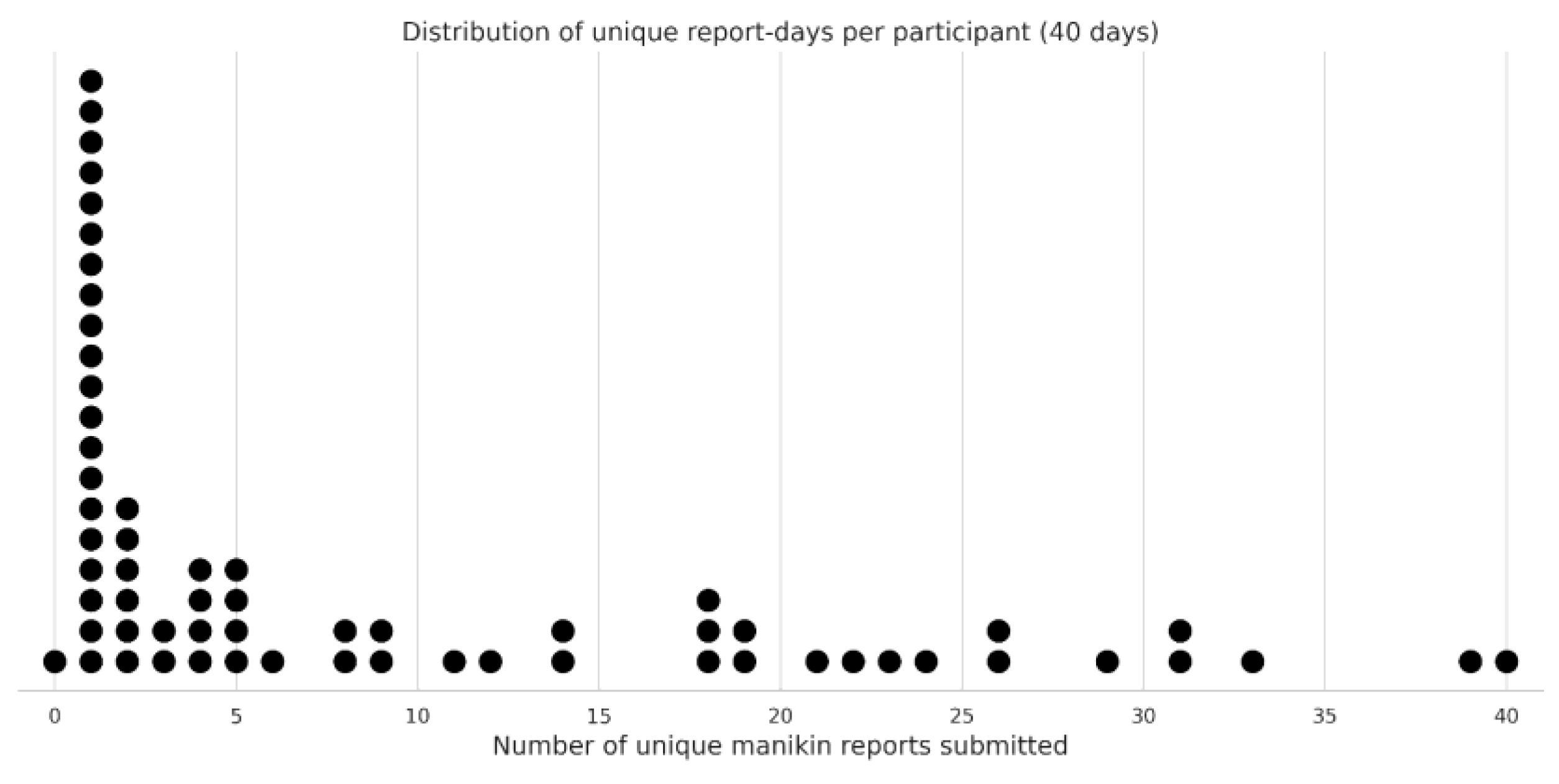

Table 1.
Characteristics of the study population (n=63).
| Characteristics | Categories | N (%) |
|---|---|---|
| Age | 44 or younger | 46 (73) |
| 45 – 64 | 16 (25) | |
| 65 or older | 1 (2) | |
| Gender | Male | 15 (24) |
| Female | 48 (76) | |
| Ethnicity | Punjabi | 53 (84) |
| Urdu Speaking | 7 (11) | |
| Pashtun | 3 (5) | |
| Education | Below graduation | 35 (56) |
| Graduation | 21 (33) | |
| Postgraduate | 7 (11) | |
| Employment status | Employed | 18 (29) |
| Unemployed | 32 (51) | |
| Students | 9 (14) | |
| Retired | 4 (6) | |
| Pain Experience (in years) | Less than a year | 12 (19) |
| 1 – 3 years | 24 (38) | |
| 4 – 10 years | 13 (21) | |
| More than 10 years | 14 (22) |
Table 2.
Completion and Feasibility criteria.
| Feasibility measures | n (%) | 95% CI* |
| ≥7 consecutive days of reporting | 11 (17.7) | 10.2–29.0 |
| ≥2 reports per week for all 6 weeks | 11 (17.7) | 10.2–29.0 |
| ≥4 reports per week for all 6 weeks | 4 (6.5) | 2.5–15.4 |
| Completion rate category (%) | n (%) | |
| Least engaged, 0–20% completion | 39 (62.9) | 50.5–73.8 |
| Marginally engaged, 21–40% completion | 6 (9.7) | 4.5–19.5 |
| Moderately engaged, 41–60% completion | 9 (14.5) | 7.8–25.3 |
| Highly engaged, 61–80% completion | 5 (8.1) | 3.5–17.5 |
| Most engaged, 81–100% completion | 3 (4.8) | 1.7–13.3 |
*Confidence intervals were calculated using the Wilson method.
Table 3.
Acceptability of the Manchester Digital Pain Manikin app (n=29).
| Statements | Favourable n (%) |
Neutral n (%) |
Unfavourable n (%) |
|
|---|---|---|---|---|
| Pain representation | ||||
| Colours reflected different pain intensities | 20 (69) | 5 (17) | 4 (14) | |
| Pictograms/words reflected different pain types | 24 (83) | 3 (10) | 2 (7) | |
| App was not too complicated* | 14 (48) | 6 (21) | 9 (31) | |
| App included all important aspects of my pain | 26 (90) | 2 (7) | 1 (3) | |
| Pain drawing was a true reflection of my pain | 25 (86) | 3 (10) | 1 (3) | |
| Usability, usefulness and intention to use | ||||
| Guidance on using the app was easy to follow | 20 (69) | 6 (21) | 3 (10) | |
| Understanding how the app works did not take long | 20 (69) | 2 (7) | 7 (24) | |
| It was easy to indicate where my pain was | 28 (97) | 1 (3) | Nil | |
| It was easy to select the right pain intensity | 25 (86) | 2 (7) | 2 (7) | |
| It was easy to select the right pain quality | 22 (76) | 2 (7) | 5 (17) | |
| Completing one manikin report did not take long | 25 (86) | Nil | 4 (14) | |
| Daily notification helped me remember to report | 16 (55) | 3 (10) | 10 (35) | |
| Reporting pain using the app was useful | 26 (90) | 2 (7) | 1 (3) | |
| Would recommend the app to others with chronic pain | 25 (86) | 1 (3) | 3 (10) | |
Table 4.
Participants’ characteristics and their completion rates (n=11).
| Gender | Age | Education | Employment | Pain experience | Completion (%) |
|---|---|---|---|---|---|
| Female | 35-44 | 12th grade | Unemployed | 4-10 years | 82 |
| Male | 35-44 | Graduation | Employed | 1-3 years | 60 |
| Female | 35-44 | Graduation | Employed | 1-3 years | 58 |
| Female | 25-34 | 10th grade | Unemployed | Less than a year | 55 |
| Female | 35-44 | 12th grade | Unemployed | 4-10 years | 40 |
| Female | 18-24 | 12th grade | Student | Less than a year | 23 |
| Male | 18-24 | 12th grade | Student | Less than a year | 23 |
| Female | 35-44 | 12th grade | Unemployed | 1-3 years | 15 |
| Male | 35-44 | 10th grade | Employed | 1-3 years | 10 |
| Male | 18-24 | Graduation | Student | Less than a year | 8 |
| Male | 45-54 | Graduation | Unemployed | 1-3 years | 3 |
Disclaimer/Publisher’s Note: The statements, opinions and data contained in all publications are solely those of the individual author(s) and contributor(s) and not of MDPI and/or the editor(s). MDPI and/or the editor(s) disclaim responsibility for any injury to people or property resulting from any ideas, methods, instructions or products referred to in the content. |
© 2026 by the authors. Licensee MDPI, Basel, Switzerland. This article is an open access article distributed under the terms and conditions of the Creative Commons Attribution (CC BY) license.
Copyright: This open access article is published under a Creative Commons CC BY 4.0 license, which permit the free download, distribution, and reuse, provided that the author and preprint are cited in any reuse.