

Submitted:
26 October 2026
Posted:
27 October 2026
You are already at the latest version
Abstract
On-policy distillation (OPD) transfers teacher behavior through feedback on student-generated trajectories. Its efficiency is often expressed in incompatible units: fewer examples, shorter rollouts, lower memory, higher throughput, or cheaper deployment. These gains need not coincide, and an inexpensive update need not minimize the cost of reaching a target capability. We survey efficient OPD through six connected tracks: data, rollout, teacher supervision, optimization, systems, and deployment amortization. A common accounting framework separates additive resource expenditure from elapsed time and peak memory, while preserving differences in state distributions, teacher access, and learning objectives. We accompany the synthesis with a versioned evidence ledger that records the workload, denominator, measurement boundary, and quality condition behind reported efficiency results. The resulting audit exposes several sources of non-comparability, including changed sequence caps, omitted preparation, stage-local memory statistics, and increased scoring cost hidden by faster generation. Building on existing general and formula-driven OPD surveys, our contribution is an operational organization of efficiency evidence and a reproducible cost-to-quality evaluation protocol. We conclude with testable research questions about budget allocation, state coverage, supervision value, and amortized deployment. The literature cutoff is October 25, 2026; no new model-training experiments are claimed.
Keywords:
on-policy distillation
; large language models
; training efficiency
; resource-aware optimization
; cost-quality trade-offs
1. Introduction
Knowledge distillation makes a teacher’s behavior available to a student through training signals [1]. In autoregressive language models, the prefixes used during training are consequential: a student deployed on its own outputs can visit states absent from teacher demonstrations. Imitation-learning approaches address this mismatch by obtaining supervision on learner-induced states [2,3]. Generalized knowledge distillation (GKD) and MiniLLM develop this idea for language models, with different treatments of divergences and trajectory gradients [4,5]. OPD has subsequently become part of practical language-model post-training, including the Qwen3 pipeline [6].
The computational appeal is conditional. Dense teacher feedback can make each trajectory informative, but acquiring that feedback requires generation, scoring, optimization, and coordination. A change that reduces one component can increase another. Prefix truncation changes the visited states; replay changes their freshness; reward shaping changes both convergence and response length; asynchronous execution changes utilization and policy lag. Even the word efficient is ambiguous: an update can fit in less memory while taking longer, and a compressed model can require enough additional inference samples to erode its serving advantage.
We organize the literature around a practical question: What is the least resource expenditure needed to achieve a specified capability, with a specified deployment budget? Figure 1 separates six tracks while retaining their dependencies. Our synthesis has three deliverables. First, a cost-accounting framework connects method choices to the resources they consume. Second, a source-versioned ledger makes reported savings inspectable through model pairs, hardware, horizons, timing boundaries, and quality conditions. Third, an evaluation protocol distinguishes fixed-workload measurements, learning curves, and deployment amortization. The contribution is this operational synthesis, not a new distillation algorithm or an empirical ranking of incompatible results.
Relation to existing surveys.
The April survey of Song and Zheng [7] already discusses FLOPs, memory, and compute–quality trade-offs in v1 (April 1). Its v5 (October 21) expands training dynamics and efficiency, including horizon control, stale replay, sparse supervision, and preparation costs. We compare against that latest version, not only its original release. Zhang [8] organize OPD by feedback-to-update formulations and explicitly discuss estimator and evidence boundaries. Zan et al. [9] offer another broad taxonomy with rollout-cost discussion. These contributions establish much of the conceptual groundwork. Our narrower emphasis is a structured, quantitative audit and a reusable experimental comparison procedure across the six resource tracks. Table 1 identifies the organizing differences without claiming that earlier surveys omit efficiency.
Scope and evidence.
We conduct a targeted scoping review, using keyword search and citation tracing through October 25, 2026. Inclusion requires relevance to teacher-guided student trajectories, their resource cost, or a necessary methodological/system foundation. We prioritize primary papers, proceedings, and official implementation documents, and pin versions for the central comparisons. We distinguish direct OPD results from enabling systems and adjacent offline distillation. The companion catalog records these roles; Appendix A describes selection and its limitations. We make neither an exhaustive-recall claim nor a meta-analytic estimate of a universal speedup.
2. OPD Under a Resource Budget
2.1. Separate States, Targets, and Updates
Let be the student, the teacher, a prompt at round k, and a prefix. The behavior policy induces a normalized prefix distribution under a declared time/horizon convention. A common fixed-state surrogate is
States, weights, and teacher targets are fixed during differentiation, including detached shared-weight self-teachers. The per-state divergences are
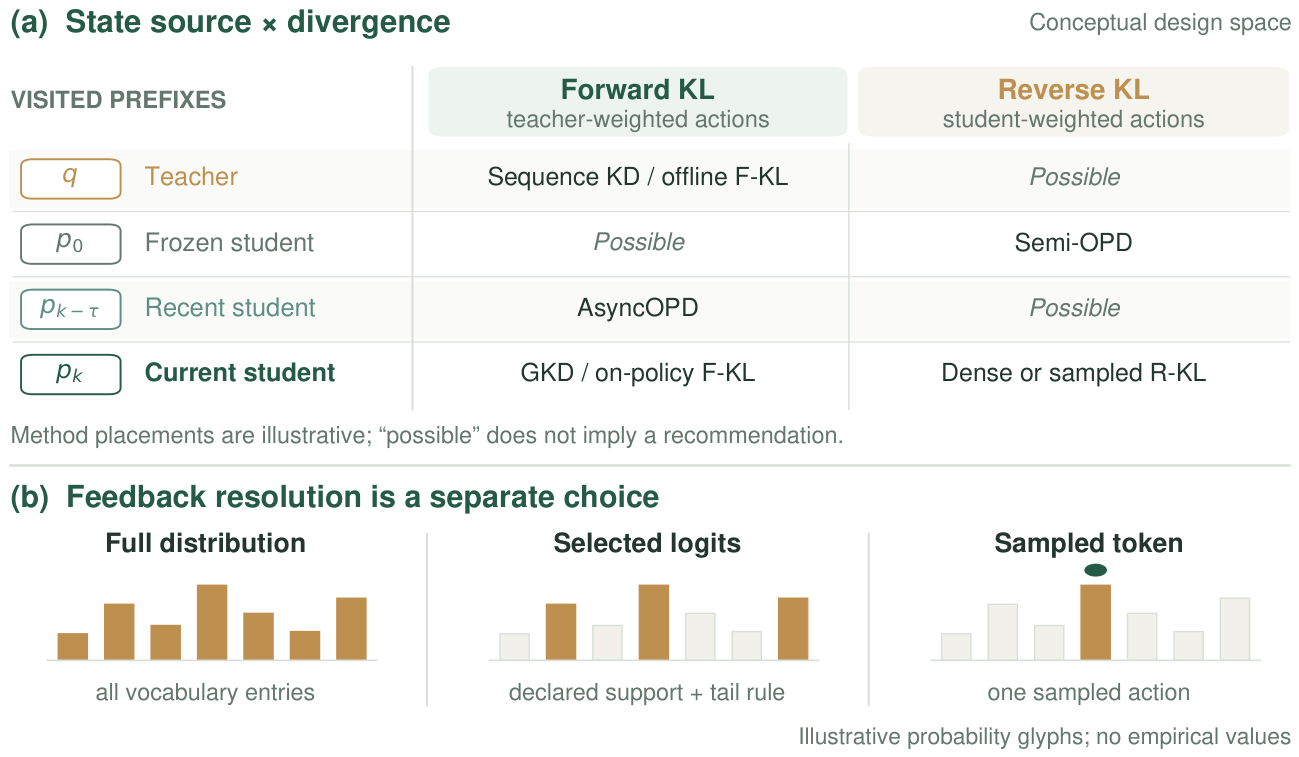
Current-student states do not force reverse KL, and forward KL does not force teacher-generated trajectories. Full-vocabulary losses, selected-logit approximations, and sampled-token policy-gradient losses further differ in information access and computation. Figure A1 and Appendix B disentangle these choices. GKD’s fixed-sampling treatment and MiniLLM’s trajectory-level formulation should not be treated as one exact gradient estimator [4,5].
We use strictly current for newly sampled , recent for a lagged student, and frozen for an initial-student pool. These descriptions are more informative than a binary on/off-policy label. Teacher scores can be refreshed on old states without refreshing the state distribution. Likewise, teacher-guided continuation can change the behavior policy even when the prefix began with the student.
2.2. Define the Efficiency Denominator
For an additive resource r, such as accelerator-hours or expenditure, write
Preparation includes prompt synthesis, warm-up, cached trajectory collection, and any teacher or questioner adaptation attributed to the run. Evaluation and hyperparameter-search costs should be reported separately and included whenever the claimed boundary is the full experiment. FLOPs, tokens, money, and accelerator-hours are different resources, not interchangeable measurements.
Wall-clock time follows the critical path, not generally Eq. 4. Report per-device peak memory; an aggregate peak is the maximum simultaneously resident memory across devices. Neither is a sum of phase peaks. We report a resource vector. For a prespecified resource r, quality metric Q, and serving budget , define
with for an unreached target. Report other resource coordinates at that checkpoint; elapsed time must be measured through the critical path. Estimation requires fixed validation and checkpoint-selection rules. Better quality per example need not mean better quality per accelerator-hour.
3. Six Tracks of Efficient OPD
3.1. Data: Information per Acquired Task
Data efficiency concerns the capability obtained from a limited task pool, annotation budget, or synthesis budget. These denominators differ from generated completion tokens. Reusing one prompt with many student continuations can reduce unique-prompt requirements while leaving rollout expenditure high. Earlier active-distillation work provides useful acquisition ideas, but results for classification or offline explanations do not directly establish OPD savings [10,11,12].
Data-Free OPD constructs prompts from teachers and studies whether external datasets are necessary for capability integration [13]. Here “data-free” concerns the external task corpus; teacher pretraining, generation, and student optimization remain resources. Its latest version uses format/length filtering and deduplication, so it should not be described as literally unfiltered synthesis. Ask-to-Distill trains a questioner with a frozen teacher–student distributional proxy for learning value, without retraining the student for each candidate [14]. This adds questioner-training and proxy-estimation costs.
These works motivate a distinction between difficulty and transfer value. A task can be hard because the student lacks prerequisites, because the teacher is unreliable, or because a useful skill is within reach. Difficulty alone does not identify which explanation holds. Moreover, approximately token-matched prompt banks can still yield different transfer [15]. Acquisition comparisons must control the model pair, downstream optimization, generated tokens, and evaluation distribution. Charge generator preparation once or amortize it over declared reuses. Diversity and decontamination also matter: familiar benchmark-shaped questions can inflate apparent sample efficiency without establishing wider transfer.
3.2. Rollout: Depth, Freshness, and Reuse
Generating student trajectories incurs sequential decoding and, for agents, environment interaction. Prefix-OPD uses short reasoning prefixes; ESR stops generation early to concentrate on informative initial supervision [16,17]. These methods avoid producing suffixes, unlike loss masks applied after a full trajectory has already been generated. Their benefit must be evaluated against the state coverage removed by truncation. STRIDE further studies adaptive stopping and prefix restart [18].
Freshness offers another control axis. Semi-OPD trains from a fixed pool generated by the initial student, whereas AsyncOPD overlaps generation and learning with delayed student policies [19,20]. The former trades tracking for reuse; the latter trades synchronization for bounded or measured lag. DistiLLM and DistiLLM-2 also motivate treating reuse and collection cadence as explicit method variables [21,22]. Neither cached prefixes nor importance weighting automatically recover missing future states.
Speculative generation requires identifying the distribution being preserved. Exact speculative decoding targets a designated model distribution [23]; accepting tokens according to teacher preferences can instead change the behavior distribution. Flash-OPD couples verification and distillation to reduce redundant work, but verification itself processes tokens and can increase teacher-scoring cost [24]. Draft-OPD concerns training draft models for downstream speculative inference; its deployment gain is not an OPD-training speedup [25].
For multi-turn agents, tokens are an incomplete workload measure. ReOPD reuses prefixes to access later interaction states, while turn-aware approaches control the depth and allocation of supervision [26,27,28]. Comparisons should count tool calls, environment resets, prefix acquisition, and long-horizon success in addition to language-model tokens.
3.3. Teacher: Useful Feedback per Query
Teacher cost depends on both the number of evaluated positions and the interface. A locally hosted teacher can score a student sequence in a batched forward pass; generating a new teacher solution adds sequential decoding. Full distributions, top-k distributions, selected-token probabilities, and text-only feedback expose different information. Restricting the returned logits may reduce transfer and retained activations without reducing the teacher’s Transformer computation. A top-k objective must specify how omitted probability mass is treated.
Teacher selection adds a quality–cost trade-off. MOPD combines specialist teachers; Open-MOPD, ROAD-MOPD, TRUST-MOPD, and MOPD-Router examine capability imbalance, cross-teacher constraints, reliability, or routing [29,30,31,32,33]. Their efficiency cannot be summarized by the number of teachers stored. One must count how many teachers score each trajectory, whether routing needs additional inference, and how much work is reused. Consensus supervision can also require more teacher passes [34].
Reliability-aware allocation aims to avoid spending updates on misleading feedback. Teacher gating and sparse probing connect feedback acquisition to estimated usefulness [35,36]. SCOUT goes further by adapting the teacher on student-induced prefixes, improving compatibility at the cost of teacher training and verifier access [37]. These methods belong on a cost–quality frontier even when a single update becomes more expensive. The operative question is whether their additional supervision reduces the total expenditure to reach the desired quality.
3.4. Optimization: Progress per Unit of Work
Optimization efficiency has two components: the cost of an update and the number of updates needed. Their product, together with preparation and rollout, determines the training budget. REOPOLD relaxes imitation through reward control and selective learning; PowerOPD replaces the unbounded log-ratio signal with bounded probability-power differences [38,39]. Both motivate examining gradient variance, response length, and convergence jointly rather than treating fewer steps as a sufficient cost claim.
Divergence design changes what knowledge is transferred. EOPD adds forward-KL supervision at high-entropy teacher positions, while hybrid policy distillation combines divergence and sampling choices [40,41]. Evidence on factual knowledge versus compositional skills further cautions against equating lower imitation loss with uniformly improved capability [42]. Efficiency claims should therefore preserve the intended quality vector, including inference diversity when relevant.
G-OPD/ExOPD alter reference and reward weighting, and OPD2 extracts a signal from the difference between a tuned teacher and its base model [43,44]. Additional reference-model forwards must enter the cost ledger. Dr. OPD optimizes supervision weights through a performance-oriented objective, introducing another allocation mechanism whose extra computation must be counted [45].
SparseOPD separates dense correction construction from sparse differentiation [46]. Its results illustrate why memory and speed require separate reporting. Parameter-space analyses find sparse or concentrated OPD changes, but masks identified after a full training run do not by themselves supply a cheap prospective training procedure [47]. LoRA and QLoRA reduce trainable state and storage under specific adaptation recipes; they do not remove rollout or teacher costs [48,49]. Simple-OPD also makes warm-up a first-class part of the recipe rather than an uncharged prerequisite [50].
3.5. Systems: Utilization and Data Movement
OPD alternates execution modes with different bottlenecks: autoregressive decoding, teacher scoring, and backpropagation. vLLM and SGLang improve serving and prefix management; FlashAttention reduces attention memory traffic [51,52,53]. HybridFlow/verl and OpenRLHF coordinate distributed post-training components [54,55]. These are enabling systems, not independent demonstrations of OPD learning efficiency.
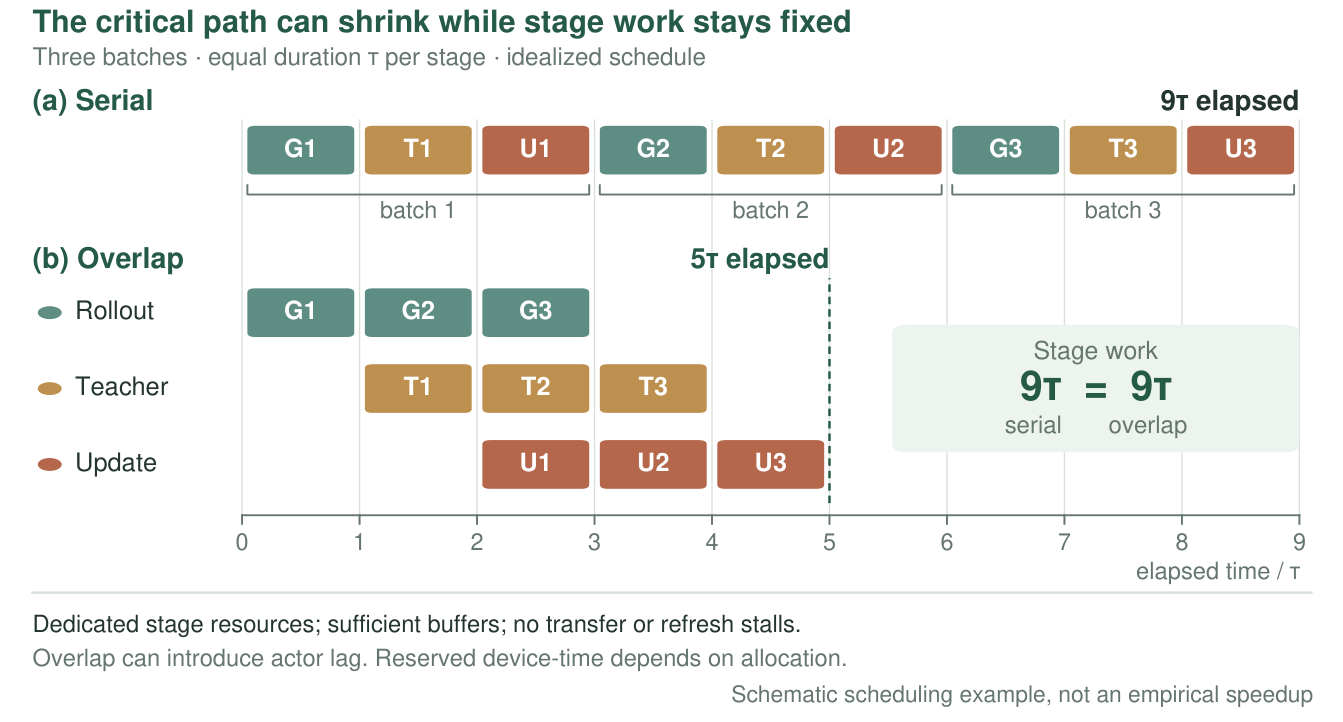
OPD-specific systems such as Lightning-OPD and KDFlow address execution and resource organization [56,57]. The evaluated objective matters: an off-policy forward-KL benchmark cannot be relabeled as a measured on-policy speedup merely because the system also supports OPD. Asynchronous execution can shorten elapsed time while using more devices or increasing policy lag. Figure A2 illustrates this distinction; Appendix C gives the accounting assumptions.
Sharding, fused kernels, and vocabulary-memory optimizations can remove implementation overhead without changing the task distribution [58,59,60]. Nevertheless, a cross-entropy optimization is not automatically a complete full-vocabulary KL implementation. Teacher scoring also needs target probabilities at particular prefixes, so KV-cache availability alone does not establish reusable logits. Reports should pin inference-engine versions, scoring interfaces, and synchronization behavior.
3.6. Deployment: Amortized Cost of Capability
The training objective is often motivated by a cheaper deployed model, but reduced parameter count is only a proxy. Serving depends on active parameters, context length, KV storage, generated tokens, sample count, retries, and hardware. Test-time scaling studies show that OPD improvements at a small sampling budget need not persist at larger budgets [61]. Thus deployment should be evaluated at the intended inference budget, not only with one favorable accuracy metric.
For additive resource units, lifetime cost is
where N is the number of deployed requests and serving includes the complete decision procedure. Comparing two quality-matched systems yields a break-even deployment volume (Appendix C). Reusing a trained questioner, prefix pool, or adapted teacher raises an analogous amortization question. A preparation-heavy recipe can be appropriate for repeated deployments while remaining expensive for a single small experiment.
4. What the Efficiency Evidence Establishes
We audit reported quantities with their experimental boundaries. The catalog contains 88 sources; the ledger contains 28 records, some retaining several explicitly distinguished comparisons from one paper. These counts describe the included evidence, not independent experiments. Table 2 and Figure 2 give complementary views; Appendix E retains source locators and further configurations. Derived ratios are arithmetic summaries, not independent reproductions.
4.1. Three Levels of an Efficiency Claim
A reported saving can be valid while answering a narrower question than the reader assumes. We therefore separate three tests.
Resource identification.
Establish the unit, baseline, workload, and measurement boundary. Extra backward allocation, whole-step peak memory, and complete-run accelerator-hours describe different effects. A single-update profile can establish a resource difference for its configuration without establishing a learning benefit. Measured quantities and analytical estimates remain separate.
Quality identification.
Check whether cost and quality describe the same recipe: model checkpoints, adaptation regime, sequence limits, and evaluation budgets must correspond. Joining a full-parameter memory profile to a separate adapter experiment would manufacture a cost–quality point. Even a matched final cost and accuracy cannot locate the first crossing of a quality target without intermediate evaluations.
Mechanism identification.
A complete recipe may improve cost and quality while changing its rollout horizon, objective, and execution schedule together. Such recipe-level evidence is useful; attributing the gain to one component requires a control that isolates it. Conversely, a faster kernel on fixed trajectories need not make the learning procedure reach a target sooner. These three tests distinguish what was saved, what capability was obtained, and which intervention explains the change.
4.2. Lessons from Reported Comparisons
Changing the workload changes the claim.
Semi-OPD’s largest cited 11.4× GPU-hour reduction uses a 16K cap for OPD and a 4K cap for Semi-OPD; its matched-16K example supports a different, 7.6× comparison. Both are informative, but only the latter holds that cap fixed. Likewise, generator-token efficiency and downstream student-token efficiency must be separated. Ask-to-Distill explicitly notes that its downstream token curves do not establish lower end-to-end cost [14].
A saved tensor is not a saved training loop.
SparseOPD’s 70.5% reduction is extra backward allocation above the pre-step baseline. In the same 8K profiling configuration, complete-update time increases by 14.5%. The memory study uses full-parameter training and one measured update per configuration, separately from its LoRA accuracy experiments. This is useful memory evidence with a narrower scope than a full training-run result. Figure 2 visualizes such distinctions.
Faster generation can move the bottleneck.
Flash-OPD reduces overall step time despite increased teacher time in the displayed pair. MOPD-Router provides a related denominator lesson: total training cost and time per generated token respond differently when methods change output length [33]. These observations justify recording generated, scored, retained, and learner-used tokens separately. Discarded drafts and verification passes are work even when they do not appear in the final training sequence.
Measurement boundaries determine interpretation.
Prefix-OPD’s timing footnote describes hours on an eight-A100 virtual machine, despite the surrounding “GPU hours” terminology [16]. ESR’s reported phase timings exclude model-loading overhead [17]. Such details are not reasons to dismiss the results; they identify the quantities that can be compared. A missing field remains “not reported”, never zero. We reserve measured, modeled, and proposed evidence categories so analytical token-cost estimates do not become empirical wall-clock claims.
5. Evaluation Protocol and Research Agenda
5.1. Three Complementary Comparisons
Fixed workload.
First replay the same prompts and trajectories to isolate scoring, update, memory, and communication costs. Hold hardware, precision, batch size, padding, optimizer, and token counts fixed. This diagnoses implementation efficiency but intentionally excludes differences in the trajectories each learning algorithm would generate. Time the complete update as well as its stages.
Fixed budget and target quality.
Next compare actual learning loops under declared accelerator-hour, teacher-token, or wall-clock constraints, evaluating each budget regime separately. Include frozen-student replay, full current-student OPD, teacher-response SFT, and a simple short-prefix baseline where interfaces permit. Plot quality against consumed resources, not only steps. Record unreached targets, use a fixed development set for checkpoint selection, and report independent test scores. Repeated seeds and timing variability distinguish consistent effects from one favorable run. Appendix F supplies a concrete comparison template and minimum reporting fields.
Matched deployment.
Finally compare deployed quality under identical decoding, sample, context, tool, and retry budgets. Report pass@1 alongside suitable multi-sample or task-completion metrics and response lengths. The resulting serving costs determine whether training investment is amortized. This third comparison is necessary even when model architecture is unchanged, because post-training can change generation length and diversity.
5.2. Open Problems That Survive the Accounting
Joint allocation rather than isolated knobs.
How should a fixed budget be split between acquiring more questions, generating deeper states, querying more teacher information, and taking additional updates? A useful study measures marginal held-out improvement per additional resource and tests interactions, rather than multiplying standalone speedups. Factorial ablations can distinguish complementary components from repeated removal of the same bottleneck.
State value and refresh policy.
The central question is not whether shorter or fresher is always better. It is when a newly visited state adds more useful learning than another update on an existing one. Compare refresh and restart rules under matched generation budgets, stratified by model compatibility and task horizon. Evaluate both local imitation and terminal success; low teacher–student disagreement alone need not certify a good task trajectory.
The value of supervision.
Data acquisition and teacher selection need an objective tied to the student after learning. Difficulty, teacher confidence, and disagreement are candidate proxies, not universal utility measures. Compare proxies against realized validation gains while charging their estimation cost. A trained questioner or adapted teacher should be tested across multiple students to determine when preparation amortizes.
Coverage under aggressive savings.
Efficiency constraints can alter which skills, languages, and modalities remain represented. Video-OPD, Video-MOPD, and student-side multimodal studies show that OPD extends beyond text reasoning [62,63,64]. Their accounting must include media encoding and modality-dependent context. Agentic tasks add environment latency and irreversible trajectory decisions. Budgeted evaluations should stratify long-horizon success, rare capabilities, factual transfer, and relevant safety behavior rather than rely exclusively on one aggregate reasoning score.
Hardware-aware optimization without objective drift.
The opportunity is to co-design kernels and supervision while tracking how approximation changes learning. Report exact-gradient checks at fixed prefixes, end-to-end resource use, and resulting quality for the same implementation. Sparse vocabulary selection, mixed precision, and teacher caching are especially useful test cases. A method that moves the cost–quality frontier on one device or tokenizer should be evaluated on another before claiming broad portability.
6. Conclusion
Efficient OPD is a problem of allocating resources to useful student learning. Its methods change task acquisition, visited states, supervision, updates, execution, and deployment costs in coupled ways. A six-track organization becomes useful when it is paired with explicit measurement boundaries and quality conditions. The versioned ledger and evaluation protocol make those conditions inspectable, while the research agenda focuses on improvements that remain valuable after preparation, discarded work, and deployment are counted.
Limitations
This is a targeted scoping review with a fixed literature cutoff, not a systematic review with established recall or a pooled empirical benchmark. The field changes rapidly, and preprint revisions can alter methods, author lists, and efficiency claims. The catalog preserves version information where available, but implementation documents remain snapshots of evolving systems. Inclusion of a preprint is not an endorsement of its results.
The quantitative audit uses the authors’ reported measurements and accessible protocols. We did not rerun the training experiments, infer missing hardware fields, or normalize unlike hardware with an assumed universal conversion. Consequently, the ledger identifies comparison boundaries and confounders; it cannot establish a universal ranking or isolate causal effects where the original experiment changed several factors. Only a subset of the surveyed literature supplies sufficiently explicit numbers for the compact audit.
The accounting equations are analytical tools with stated assumptions. Fixed-state losses, full trajectory gradients, and approximate practical updates need not have the same optimum. Our break-even formulas assume stable per-use costs in the chosen additive units; asynchronous pipeline expressions assume adequate resources and stationary stages. Open questions are research proposals, not new validated algorithms. Coverage emphasizes language-model post-training, especially reasoning, and is less extensive for speech, multilingual, long-context, and interactive settings. Those gaps motivate broader evaluation rather than claims that these areas lack prior work.
Ethical Considerations
Reducing compute can broaden access to post-training, but cheaper imitation can also propagate undesirable teacher behavior. Safety routing and backdoor analyses make reliability part of the relevant capability vector [65,66]. Synthetic prompt generation should respect data provenance and separate development feedback from held-out evaluation. Reported efficiency should not depend on undisclosed benchmark overlap, omitted preparation, or selectively chosen checkpoints. We propose reporting these boundaries explicitly. This survey introduces no new user data, model deployment, or human-subject study.
Appendix A. Review Scope, Provenance, and Positioning
Appendix A.1. Search and Inclusion Procedure
The review was assembled through primary-source searches, backward citation tracing from established OPD papers and surveys, and targeted follow-up queries for efficiency mechanisms. Queries combined “on-policy distillation” with “survey”, “efficient”, “prefix”, “early stopping”, “asynchronous”, “offline student rollouts”, “data-free”, “synthetic”, “multi-teacher”, “sparse”, and “speculative”. Once a method name was identified, its paper or official implementation was inspected rather than relying on an aggregator’s summary. Searches also covered the spelling variants “on policy” and common method acronyms.
We include (i) direct teacher-guided learning on student-induced states, including clearly labeled replay or mixed-policy variants; (ii) closely related KD/IL foundations needed to define the objective; and (iii) systems or deployment work needed to interpret resource claims. We exclude papers from the quantitative audit when a numerical statement cannot be connected to a primary source and identifiable workload. Such a source may still support a qualitative discussion. We do not infer that an unreported cost is absent, and we do not count every citation in a survey as an independently reviewed paper.
The supplied literature_catalog.csv identifies sources and their author-assigned roles and tracks. CODEBOOK.md defines the annotations, record types, and distinct states for mismatched configurations, unresolved links, and comparisons outside a paired training-cost claim. The claim-level evidence_ledger.csv records multiple comparisons from the same paper separately; model pairs or sequence caps must not be merged into one method-level value. The files contain source URLs and section/table locators. Full-text-derived measurements, abstract-level contextual references, and mutable software documents have different evidential roles. The catalog is a reproducible inclusion set, not an estimate of the total size of the field.
Versions and publication status.
We use the latest inspected version available by the cutoff for rapidly changing preprints, but prefer a verified proceedings record when discussing the historical published contribution. For example, the ICLR 2024 MiniLLM publication retains its proceedings title even though its later arXiv version changes the title. A mutable documentation page is identified by its access date, October 25, 2026, rather than treated as a permanent specification. No source dated after the cutoff is intended to support a claim.
Appendix A.2. Exact Relation to Earlier Surveys
For the April survey, the relevant v1 locators are Section 4.3.1, 7.2, and 7.3; for v5 they are Section 8.1–8.6 and 10.4 [7]. Thus a cost-centered title is insufficient evidence of a new contribution. The formula-driven survey is especially relevant to the estimator distinctions in Appendix B; its proposed GAE-OPD and counterfactual-routing ideas are not treated here as evaluated methods [8]. The author-uploaded Echoes of the Oracle manuscript is a preprint, and its Section 5.5 discusses rollout cost [9].
Adjacent reviews cover general KD, LLM distillation, self-distillation, and the relation between on-policy and off-policy post-training [67,68,69,70]. We retain their distinctions but use resource accounting as the organizing index. The extra deliverable is a claim-level ledger and an explicit test of what each comparison identifies, not a claim that these concepts were previously absent.
Appendix A.3. Applying the Three Audit Tests
Section 4.1 defines resource, quality, and mechanism identification. The ledger records these tests through the metric and phase fields, configuration correspondence, controls, and caveats. A valid complete-recipe improvement can identify resource and quality effects without isolating the mechanism. Conversely, a fast microbenchmark may identify a resource effect without establishing a learning benefit. Endpoint accuracy and endpoint cost do not reconstruct the learning curve in Eq. 5; the ledger does not imply a retrospective time-to-quality result that was never measured.
Appendix B. Objective and Estimator Details
Appendix B.1. Historical Distinctions
Teacher-response training in sequence-level KD minimizes a token negative log-likelihood on teacher-generated responses [71]. Scheduled sampling modifies the source of previous tokens, but that alone does not supply teacher feedback on every student-induced state [72]. ImitKD explicitly connects autoregressive KD to imitation learning [3]. General f-divergence treatments clarify why different distributional objectives need not transfer the same behavior [73]. TAID adjusts the target along an interpolated path, an adjacent efficiency idea whose changing target should not be confused with fresh rollout collection [74].
Figure A1.
Three independent design choices in OPD. (a) State source determines visited prefixes, while KL direction determines action weighting at each fixed prefix. Method placements illustrate formulations rather than uniquely classify method families; “possible” denotes a mathematically definable design. (b) Feedback may expose a full distribution, selected logits, or a sampled action. Probability glyphs are schematic.
Figure A1.
Three independent design choices in OPD. (a) State source determines visited prefixes, while KL direction determines action weighting at each fixed prefix. Method placements illustrate formulations rather than uniquely classify method families; “possible” denotes a mathematically definable design. (b) Feedback may expose a full distribution, selected logits, or a sampled action. Probability glyphs are schematic.
Appendix B.2. The Local Reverse-KL Gradient
Fix a prefix h and teacher probabilities . For student logits , differentiation gives
Equivalently, the negative gradient can be estimated by sampling and multiplying its score function by , with the reward detached. The constant term cancels because . This is a statement about a fixed prefix. It does not differentiate how changing the policy changes later prefixes.
In forward KL, the corresponding local gradient is . The teacher can therefore provide an action distribution at a student-generated prefix. This separates the source of the action-weighting measure from the source of the prefix. Full-vocabulary summation avoids Monte Carlo noise over actions at that prefix, but retains the cost of producing and processing both distributions.
Appendix B.3. The Full Trajectory Reverse-KL Gradient
For a fixed prompt, let and , with a frozen teacher and a common finite horizon including EOS/absorbing termination. Define and . Under the usual support and differentiation assumptions,
To see this, differentiating the sampling distribution gives ; differentiating the explicit log-probability contributes . Past costs are measurable before the current action and disappear by the conditional score-function identity. Future costs remain because the current action changes their prefixes.
Keeping only generally removes those future-state terms. It can be an intentional local surrogate, but should not be described as the exact full-trajectory gradient without further assumptions. Likewise, return discounting, token masks, trajectory-length normalization, advantage baselines, and PPO-style clipping alter the estimator or objective in different ways [75]. A baseline independent of the sampled action can reduce variance without bias under the relevant sampling measure; arbitrary clipping need not preserve that property. This distinction follows the methodological boundary emphasized by GKD, MiniLLM, and the formula-driven survey.
Appendix B.4. Stale Actions Versus Stale States
Suppose a cached trajectory was generated by b, while the desired current policy is p. At a fixed prefix, an importance ratio can correct an action expectation when support and numerical conditions hold. It does not replace the outer prefix distribution by . Full prefix-occupancy correction would require additional trajectory information and ratios, whose variance can be large. If the behavior sampler truncates support through top-p or top-k sampling, some target actions may have zero behavior probability and exact correction is unavailable from those samples.
For normalized prefix distributions with a shared prompt and horizon convention, and a bounded loss , a diagnostic is
where is half the distance. Unbounded KL does not satisfy this assumption automatically. The inequality motivates measuring drift under an explicit bounded proxy; it is not a convergence or task-accuracy guarantee for stale OPD.
Appendix B.5. What top-k compression discards
Let S be the retained vocabulary and its complement. Write , and similarly for p. Forward KL decomposes exactly as
A tail bucket preserves total tail mass but omits the last, conditional-divergence term. Renormalizing only the retained entries makes yet another objective. Thus “top-k KL” requires a normalization and tail convention. Current verl documentation makes related interface distinctions [76]. Vocabulary compression can reduce the feedback payload without eliminating the teacher forward pass.
Appendix C. Accounting Identities and Composition
Appendix C.1. Resource Units and Critical Paths
Accelerator-hours should specify whether they count reserved device time or active kernel time. When stages share devices, their allocation intervals must not be counted twice. Time on an eight-device node and summed device-hours differ by a factor of eight only when that allocation is maintained for the complete measured interval. FLOP estimates should specify forward/backward conventions, attention, output heads, active MoE parameters, and discarded work; neither FLOPs nor tokens capture hardware utilization alone.
For three serial stages with durations per batch, K batches take , excluding overhead. With distinct stage resources, stationary durations, sufficient buffering, and no additional dependencies, an ideal pipeline takes
This is a conditional scheduling identity, not an OPD speed prediction. Actor refresh, finite memory, shared devices, variable sequence lengths, environment latency, and transfers can violate its assumptions. Device-time still counts all stage allocations. AReaL and slime provide relevant asynchronous post-training infrastructure, but their original results cannot be substituted for an OPD-specific comparison [77,78].
Figure A2.
Elapsed time and stage work need not change together. For three batches with equal stage duration , serial execution takes , while an ideal pipeline takes ; summed stage work remains . The illustration assumes dedicated stage resources, sufficient buffers, and no transfer or refresh stalls. Reserved device-time can differ, and overlapping batches may use lagged actors. These quantities are schematic, not measured speedups.
Figure A2.
Elapsed time and stage work need not change together. For three batches with equal stage duration , serial execution takes , while an ideal pipeline takes ; summed stage work remains . The illustration assumes dedicated stage resources, sufficient buffers, and no transfer or refresh stalls. Reserved device-time can differ, and overlapping batches may use lagged actors. These quantities are schematic, not measured speedups.
Appendix C.2. Avoided Work Versus Selected Supervision
Suppose a selector is applied after a full trajectory has been generated and scored. If generation and teacher work remain unchanged, its additive saving is
A positive resource saving requires avoided update work to exceed selection overhead. A mask that merely zeros losses but executes the same dense backward graph may not satisfy this condition. Conversely, a method can be worthwhile when it reduces peak memory enough to make a configuration feasible, even if . Resource feasibility and cost minimization are separate objectives.
For a fixed serial workload whose fraction f is accelerated by s, the ideal total speedup is . This elementary bound explains why rollout-token reductions need not translate proportionally to runtime. It does not apply unchanged when the method changes output length, optimizer steps, or resource concurrency. Flash-OPD’s component timings in the ledger are an example of such a changed workload and shifted cost, rather than an isolated kernel acceleration.
Appendix C.3. Amortization at a fixed quality requirement
Let recipes A and B have preparation costs and compatible per-use costs , measured in the same additive units. If but , then A becomes less expensive after
This assumes both recipes meet the declared quality requirement on all counted uses. A questioner whose prompts cease to be useful for a different student, or a prefix pool invalidated by a changed environment, cannot be credited with arbitrary future reuse. Report an amortization curve over plausible R rather than choosing the most favorable deployment volume.
For student deployment against an alternative system, substitute training costs for P and expected complete serving costs for c in Eq. A8. Include extra samples or retries. When the distilled model has a higher up-front cost, no positive deployment break-even exists unless its quality-matched per-request cost is lower. Startup and maintenance can be added explicitly; request latency remains a separate, non-additive service constraint.

Table A1.
Analytical composition audit. These are accounting conditions for hypothetical combinations, not experimentally established compound methods.
Table A1.
Analytical composition audit. These are accounting conditions for hypothetical combinations, not experimentally established compound methods.
| Combination | Potentially shared saving | New or remaining cost | Necessary check before claiming composition |
|---|---|---|---|
| Truncation + token masking | Both can remove supervision from late positions | Mask selection; the retained prefix still needs generation and scoring | Measure the mask’s incremental saving after truncation; do not multiply standalone ratios. |
| Replay + score caching | Historical tokens and fixed-teacher scores can be reused together | Storage, reads, changed teacher versions, missing new states | Pin teacher, tokenizer, precision, and prompt context; refreshing scores does not refresh occupancy. |
| Sparse logits + asynchronous execution | Lower retained memory may allow a better resource partition | Sparse planning, queues, teacher forwards, lag | Re-profile the complete schedule; shrinking a noncritical stage may not improve elapsed time. |
| Self-distillation + multiple teachers | Some model weights may be shared across roles | Privileged contexts, reference solutions, multiple forward passes | Count calls and context tokens; shared weights do not imply one inference pass. |
| Short rollout + speculative verification | Fewer decoded positions | Drafts, rejected tokens, repeated prefix prefill | Count processed tokens, not only retained tokens; identify the preserved behavior distribution. |
Appendix C.4. Three Conditional Decision Examples
Dense supervision is memory-limited.
If teacher feedback is useful but full-vocabulary backward storage exceeds the device limit, compare sparse differentiation, chunked losses, sharding, and adapter training on a fixed batch. Check the whole-step resident peak and resulting throughput. A slower feasible method can be preferable to an infeasible baseline; report that as feasibility rather than a speedup.
Rollout dominates elapsed time.
First profile generation and environment waits. Compare a simple prefix cap, cached initial-student replay, and asynchronous collection, then inspect which task depths or model pairs lose quality. Use matched rollout budgets to evaluate an adaptive controller. If scoring becomes critical after shortening, its former small share cannot justify excluding it from the revised profile.
Teacher/API expenditure is limited.
Determine whether the service exposes selected probabilities, top-k outputs, or text only. Compare reducing queried positions, sharing a fixed-teacher cache, and paying for richer feedback on selected tasks. Include all proposal, probe, and verification calls. A method requiring inaccessible logits is not a feasible candidate even if its locally hosted benchmark is strong.
Appendix D. Extended Method Map
Table A2–Table A4 map representative mechanisms to the resources they can change. A row is a qualitative classification. It does not claim that the corresponding reduction has been measured for every configuration.
Table A2.
Rollout and reuse map. Citations for the first five rows appear in Section 3; the evidence ledger supplies versions and locators.
Table A2.
Rollout and reuse map. Citations for the first five rows appear in Section 3; the evidence ledger supplies versions and locators.
| Methods | State / acquisition choice | Work targeted | Main cost or coverage condition |
|---|---|---|---|
| Prefix-OPD; ESR | Current-student prefixes | Decode, score, and update positions | Short horizons change late-state exposure. |
| Semi-OPD; Lightning OPD | Fixed initial-student trajectories | Repeated online collection | Preparation and teacher-score storage must be counted. |
| AsyncOPD | Recent student trajectories | Synchronization and utilization | Policy lag, partitions, and state distribution matter. |
| STRIDE; ReOPD | Historical prefix, fresh continuation | Repeated early turns | Charge buffer acquisition; ReOPD replays recorded observations without live tool calls. |
| Flash-OPD | Adaptive verified prefixes | Unused suffixes and redundant scoring | Verification can repeatedly process full prefixes. |
| OmniOPD [79] | Logit-free speculative teacher feedback | Access to dense logit APIs | Teacher continuations still cost decode tokens; reported cost model is not measured end-to-end time. |
| SKD; IPD [80,81] | Interleaved or interpolated behavior | Teacher–student trajectory mismatch | Mixed-policy sampling must be identified explicitly. |
Table A3.
Data and teacher map. Names refer to the primary papers cited in Section 3, not to a universal cost ordering.
Table A3.
Data and teacher map. Names refer to the primary papers cited in Section 3, not to a universal cost ordering.
| Methods | Allocation object | Possible efficiency route | Added work or changed target |
|---|---|---|---|
| Data-Free OPD | Synthetic prompt pool | External-data acquisition | Question generation, filtering, duplicate removal. |
| Ask-to-Distill | Learned prompt distribution | More useful downstream tokens | Questioner optimization and utility estimation. |
| MOPD; Open-MOPD | Specialist supervision | Consolidating domain capabilities | Domain balancing and specialist preparation. |
| ROAD-MOPD; TrustMOPD | Cross-teacher constraints / reliability | Avoiding harmful transfer | Reference scoring, calibration, or cross-teacher constraints. |
| MOPD-Router; C-MOPD | Token-level teacher information | More suitable supervision | Routing or consensus can query multiple teachers. |
| SCOUT | Adapted teacher on student states | Better compatibility | Teacher optimization and reward verification. |
| TG-OPD; SPOT | Reliability probes / selected feedback | Avoiding low-value supervision | Probing is charged; TG-OPD still scores every prompt. |
| Dr. OPD | Supervision weights | Higher progress per update | Weight optimization and outcome information. |
Table A4.
Optimization, systems, and deployment map. Some papers address several tracks; classifications are deliberately nonexclusive.
Table A4.
Optimization, systems, and deployment map. Some papers address several tracks; classifications are deliberately nonexclusive.
| Methods | Main design choice | Resource potentially changed | Interpretation boundary |
|---|---|---|---|
| REOPOLD; PowerOPD | Reward transformation / selection | Steps, generated length, variance | Stabilization gains need cost-to-quality curves. |
| EOPD; HPD | Divergence and sampling mixture | Useful transfer per trajectory | Diversity and knowledge coverage enter quality. |
| G-OPD; ExOPD; OPD2 | Relative or extrapolated signals | Convergence and transfer | Some variants require an extra reference model. |
| SparseOPD | Dense planning, sparse differentiation | Vocabulary-related backward storage | Dense planning and backbone updates remain. |
| Simple-OPD; adapters | Warm-up and parameterization | Preparation and optimizer state | A smaller trainable set does not remove rollout. |
| KDFlow; OPD runtime integrations | Scheduling, engines, precision | Utilization and transfer | Verify whether measured workload includes rollout. |
| Draft-OPD | Training a speculative drafter | Target-model serving | Include drafter training in lifecycle accounting. |
Appendix D.1. Access and Modality Boundaries
An OPD objective on student tokens does not inherently require ground-truth answers. However, prompt utility estimation, teacher gating, teacher adaptation, and outcome-based selection can introduce reference answers, executable tests, environment rewards, or judges. These dependencies belong in the task specification. “No external task data”, “no answer labels”, “no teacher logits”, and “no additional training” are four different claims.
For multi-agent debate, teacher construction can itself contain several interacting models; MAD-OPD is a relevant example [82]. The resulting teacher answer should not be accounted as one free supervision event. For video and speech, media encoding and long input contexts add work absent from text-only completion counts.
Speech supplies concrete preparation examples. X-OPD transfers text-teacher capabilities to a speech student using paired spoken and textual inputs. Its preparation includes rewriting, speech synthesis, and ASR-based filtering, with a frozen audio tower and adapter [83]. Ark-ASR applies OPD after supervised ASR training and reuses an audio corpus; its comparison with a much larger encoder-pretraining corpus does not isolate data savings caused by OPD [84]. Audio duration, media preprocessing, and encoder work belong alongside generated-token accounting.
Data-source effects remain conditional.
With 48 prompts and a Qwen3-4B student and a 30B Instruct teacher, Beyond Prompt Count reports 44.84 for token-matched GSM8K at 16.14 million supervised tokens versus 51.02 for DeepMath at 16.63 million. The macro-average covers mathematics, GPQA, HumanEval+, and LiveCodeBench [15]. These are within-study source comparisons, not a contradiction inferred by comparing raw scores with another paper. Further work on data selection and generalization reinforces the need to specify what transfer is being measured [85,86].
Appendix E. Expanded Quantitative Evidence Ledger
The following tables retain experimental units rather than normalize unlike setups. An arrow denotes baseline to method within one source. nr means not reported or not unambiguously linked to the inspected claim. Complete structured rows, including exclusions and exact source URLs, are provided in evidence_ledger.csv. Numerical entries below are extracted measurements or explicitly labeled estimates; none is a new training result.
Table A5.
Rollout-oriented numerical evidence. References: Zhang et al. [16], Zhou et al. [17], Gui et al. [18], Zhao et al. [19], Wu et al. [56]. The matched-cap Semi-OPD case is retained in Table 2.
| Source / locator | Workload and hardware | Reported quantity | Boundary / qualification |
|---|---|---|---|
| Prefix-OPD, Table 2, footnote 8 | Qwen3-8B-Base ← Qwen3-8B; eight A100s; 60 steps | 148.3 → 53.0 hours; estimated FLOPs | Hours on the eight-GPU VM; evaluation excluded. Linear prefix schedule; checkpoint selected on AIME24. |
| ESR, Appendix A Table 5 | Qwen2.5-Math-1.5B LoRA ← Qwen3-1.7B; one A6000 | Approximate phase total 280 → 8 seconds/step | First 100 response tokens; swaps excluded. Distinct from the 194 → 8 headline row. |
| Semi-OPD, Appendix C Table 4 | Qwen3-1.7B ← Qwen3-4B-Instruct; H100; 100 steps | 56.8 → 5.0 GPU-h | Caps 16K → 4K; includes offline collection/scoring. Evaluation excluded; GPU allocation nr. |
| STRIDE, Table 1 | Qwen3-4B ← Qwen3-30B-A3B; eight GPUs, type nr | 273.8 → 73.3 seconds/step | Retail multi-turn environment; mean@16 .477 → .475. Separate environment-time breakdown nr. |
| Lightning OPD v3, Table 2 | Warmed-up Qwen3-8B-Base ← Qwen3-32B; 150 steps | 120 → 30 GPU-h; 30 = 10 collection + 4 scoring + 16 optimization | Initial SFT is outside this sum; dense-run hardware allocation and evaluation boundary nr. |
Table A6.
Different resources and evidence types. Sources: Lei et al. [25], Xu et al. [33], Zhao et al. [39], Zhang et al. [57], Zhou et al. [79]. The last row is a reported analytical estimate with unresolved arithmetic, not a normalized empirical result.
| Source / locator | Configuration | Reported quantity | Evidential boundary |
|---|---|---|---|
| PowerOPD, Table 4 | Qwen3-0.6B-Base ← Qwen3-4B; hardware nr | Full-vocabulary baseline: 22.14 → 9.03 s/step; 78.99 → 60.72 GiB | Time averaged over 1,500 steps; memory batch size eight. Not a comparison against all OPD implementations. |
| MOPD-Router v2, Table 5 | Same-size domain-labeled setup; eight H20s | Standard → entropy routing: 692.9 → 524.2 GPU-h; .32184 → .36344 ms/token | Outside-step initialization, validation, and checkpoint I/O excluded; full specialist pool scored. |
| KDFlow, Table 3 | Qwen3-1.7B ← Qwen3-30B-A3B; eight H20s | MS-SWIFT 36.9 → KDFlow 5.8 s/iteration | Fastest configuration uses FP8 teacher; static-data benchmark does not establish a full OPD-loop speedup. |
| Draft-OPD, Table 1 | Qwen3-8B target; H200; batch one; AIME25; greedy | DFlash 4.77× → trained draft 5.51× target decoding speed | Relative to ordinary target decoding; training and deployment break-even are outside the ratio. |
| OmniOPD v2, Appendix B | Qwen3-4B sensitivity setup; Qwen3-32B teacher | Modeled teacher effort 1.75 / .88 relative to SFT | Assumed decode/prefill ratio 8.3:1. Output-count formula and table are inconsistent; not used as measured speed evidence. |
Unresolved analytical estimates.
In OmniOPD v2 Appendix B, the explanatory example uses , whereas Table 8 labels a 10,000-output-token row with . The stated rule gives 5,000 for that row. We record this configuration-accounting discrepancy without selecting a corrected estimate. It does not by itself establish anything about the method’s reported accuracy.
Avoiding accidental cross-study synthesis.
Cost and quality from different adaptation regimes must be kept separate. The SparseOPD memory profile uses full-parameter updates, whereas its accuracy experiments use LoRA. A peak-scoring checkpoint may differ from the checkpoint associated with a run-total cost. A study using a fixed number of updates can generate fewer tokens under one method, so it measures a changed recipe rather than isolated throughput. These fields remain explicit in the machine-readable ledger.
Table A7.
Data and teacher evidence: reported scores, counts, and costs are kept in their original units. References: Li et al. [13], Sun et al. [14], Liao et al. [26], ang Gao et al. [30], Sun et al. [32], Huang et al. [37].
| Source / locator | Setting | Reported result | Appropriate interpretation |
|---|---|---|---|
| Data-Free OPD v4, Figure 2 | R1-Distill-Qwen-1.5B ← JustRL | Eight real prompts: 56.3; full 17,917-prompt bank: 56.4 | Peak math macro; fixed rollout/update budgets. Fewer distinct prompts is not less training compute. |
| Ask-to-Distill, Section 3.9 | R1-Distill-Qwen-1.5B ← JustRL | Best downstream math score: 52.27 → 54.8, similar student output-token budgets | Excludes questioner preparation and acquisition; does not establish an end-to-end saving. |
| SCOUT, Tables 4–5 | Qwen3-1.7B ← Qwen3-4B-Instruct; three seeds | Math 49.2 → 51.4; code 56.6 → 59.7 | Teacher adaptation improves reported quality while adding training, continuations, and verifier costs. |
| Open-MOPD, Table 2 | SmolLM3-3B specialists; eight A100s | Overall 28.05 → 31.24; headroom recovery 35.6% → 83.4% | Recovery uses RouteRL=32.35 and initial=25.67, not the separate RouteOPD endpoint. |
| ReOPD v3, Section 5 | Multi-turn math/tools and search; reused teacher histories | At least 4× per-rollout gain; above 2× in a separate new-collection scenario | Reuse assumptions change the boundary. Neither ratio is full teacher-plus-student lifecycle cost. |
| TrustMOPD v3, Table 12 | Eight H20s; totals over five seeds | 179 → 192 GPU-h; 1.3 GPU-h calibration separately | Training/evaluation aggregate; not one-seed runtime. Reference preparation remains a prerequisite. |
Benchmark selection in synthetic-data comparisons.
Ask-to-Distill selects main-table checkpoints on AMC23 or LiveCodeBench. Scores on those selection benchmarks are not held-out estimates; this is a different issue from the synthesis costs omitted by downstream token curves. DF-OPD’s small-prompt analysis reports a peak macro-average. Both conventions are recorded so they are not mistaken for a common independent-test protocol.
Appendix F. A Reproducible Evaluation Template
Appendix F.1. Specify the Comparison Before Running
Choose a teacher–student pair, a capability vector, and the resource that is genuinely limiting. Include the teacher’s architecture, tokenizer, accessible outputs, precision, and preparation. For MoE models, report both total and active parameters, plus the expert-parallel execution scheme. For self-teachers, specify the privileged context and where it comes from. Neither matching parameter count nor sharing base weights guarantees identical execution cost.
For broad claims, include closely related and mismatched teacher–student pairs. Cover short-answer tasks, extended reasoning or code, and long-horizon interaction when agentic applicability is claimed. These are proposed evaluation strata, not a newly assembled benchmark.
Baselines.
Use a common initialization and include teacher-response SFT, current-student full-rollout OPD, frozen initial-student replay, and a simple fixed-prefix OPD baseline where feasible. If the proposed method changes the loss, retain a control with its sampling policy but the original loss. If it changes sampling, retain a control with its loss and the original sampling. Conventional offline distillation such as the distilled models in DeepSeek-R1 is context for the SFT baseline, not evidence that every such baseline has the same preparation cost [87].
Budget controls.
Two experimental questions require different controls. A fixed-token or fixed-trajectory replay profile isolates systems effects; a fixed-resource learning run evaluates the actual recipe. Use both instead of presenting one as the other. When varying rollout length, report prompt and response tokens separately. When varying refresh rate, report the number of distinct states, reuse multiplicity, behavior-policy versions, and age in updates or seconds.
Table A8.
Minimum reporting template. This is a proposed protocol grounded in the audited failure modes, not a claim that a new experimental benchmark has been run.
Table A8.
Minimum reporting template. This is a proposed protocol grounded in the audited failure modes, not a claim that a new experimental benchmark has been run.
| Reporting group | Minimum fields | Why the fields are necessary |
|---|---|---|
| Models and access | Exact checkpoints; tokenizer; total/active parameters; precision; trainable modules; teacher API | Determines representational compatibility and feasible supervision. |
| Preparation | SFT, teacher training, questioner training, pool creation, filters, probes | Prevents offline work from disappearing from the denominator. |
| State distribution | Source policy; refresh cadence; lag distribution; prefix provenance; reset/continuation behavior | Distinguishes current, recent, frozen, and mixed-policy training. |
| Objective | KL direction; temperature; top-k/tail convention; score detachment; returns; clipping; normalization | Determines what information and gradient are being approximated. |
| Token accounting | Prompt, generated, scored, selected, discarded, replayed, and learner-used tokens | Generated output length is not the total processed workload. |
| Systems | Device type/count; placement; parallelism; inference engine and version; warm-up; transfer/swap cost | Makes timing reproducible and identifies changed allocations. |
| Resources | Complete-run time; allocated GPU-hours; peak resident/extra memory; teacher bill; FLOP assumptions | Separates throughput, work, feasibility, and monetary cost. |
| Quality and selection | Development/test split; checkpoint rule; seeds; metrics; inference and tool budgets | Prevents favorable checkpoint or decoding choices from changing the target. |
| Uncertainty and failures | Variation across runs; OOM; unreached targets; stale-data divergence; missing values | Avoids silently dropping infeasible or failed configurations. |
Appendix F.2. Measure the Full Execution Boundary
Warm up compilation and the serving engine, then explicitly report whether the warm-up is included in run totals. Synchronize devices for stage-level kernel timing without turning every production step into an artificially synchronized pipeline. Record end-to-end wall-clock duration independently. Report the maximum simultaneously allocated memory, persistent model state, and extra stage allocations as separate quantities. Do not add forward and backward peaks into a purported concurrent peak.
In API experiments, count input, cached-input, output, and retry tokens according to the actual interface, retaining prices and access dates if reporting money. Include unsuccessful calls and rejected synthetic questions. For locally hosted teachers, include every student, teacher, reference, probe, and verification forward. Weight transfers and model swapping are part of the complete recipe even when excluded from a kernel microbenchmark.
Teacher-output interfaces.
The inspected vLLM teacher-scoring documentation supports per-position candidate token probabilities through a prefill and GPU gather, but that path skips prefix-cache reads because those cache hits do not provide the requested logits [88]. This example illustrates why a scoring integration must be tested against its exact backend version. It does not imply that every KV-caching technique is unusable for every scoring task.
Appendix F.3. Estimate Quality Without Hidden Reuse
Fix the validation subset, evaluation frequency, and checkpoint-selection criterion before training. Evaluate selected checkpoints once on a distinct test set. If an existing paper selects checkpoints on a named benchmark, scores on that benchmark should not be treated as held-out generalization estimates. For exact-match metrics, record parsing and truncation rules. For code or agents, record tests, timeouts, environment versions, and whether execution retries are counted.
Plot quality against consumed resources across repeated seeds. Fixed evaluation intervals locate target crossing only between checkpoints; report that resolution. Retain unreached targets. Final cost and accuracy cannot determine a cost-to-quality ratio without the intervening learning curve.
Appendix F.4. A practical Factorial Pilot
A compact study can begin with three rollout regimes (current full, current prefix, frozen replay), two divergences (forward and reverse), and two feedback resolutions (full vocabulary and a fully specified sparse approximation). This creates twelve recipe cells before seeds, assuming all interfaces are available. Profile a fixed batch first to remove clearly infeasible configurations; then allocate the same pilot accelerator-hour budget to each remaining cell. Record preparation separately, and do not discard a failed learning run because its final score is low.
Use the pilot to choose one main comparison axis rather than conducting an unrestricted search for the strongest score. For an adaptive method, compare against a small grid of fixed schedules using the same development budget. Report tuning cost separately from the selected run. The final study should include a test of the proposed mechanism: for example, equalizing state depth when evaluating freshness, or equalizing teacher calls when evaluating routing quality.
Appendix G. Research Questions and Falsifiable Tests
These synthesis-driven proposals overlap themes in existing work. A contribution requires a precise unresolved setting, a defensible mechanism, and evidence; the broad questions are not claims of untouched research areas.
1. Can prompt utility predict realized transfer under a fixed budget?
Compare confidence, uncertainty, disagreement, and learned utility on the same candidate pool. Measure held-out development gains after controlled updates, charging all scoring and questioner-training costs. Test a new student initialization. The hypothesis fails if a cheaper heuristic reaches the same cost–quality frontier.
2. Which late states justify their acquisition cost?
Match total rollout tokens while varying horizon allocation. Measure terminal success where decisive actions occur late, including short-prefix and prefix-replay controls. Compare an adaptive controller with fixed caps under the same budget; matching a global cap alone does not establish learned state value.
3. When should a replay pool be refreshed?
Compare age, distribution drift, and learning-progress triggers at a fixed new-token budget. Include frozen replay and periodic refresh. Report local imitation and downstream performance: greater teacher–student agreement need not imply broader exploration or better task coverage.
4. Can teacher acquisition become budget-optimal across domains?
Compare the held-out improvement from another teacher call in one domain with that from another update. Include acquisition overhead and domain-specific retention constraints. Report per-domain quality and worst-domain behavior so that an average gain cannot conceal capability loss.
5. Can loss and runtime be co-designed without conflating approximation?
At fixed prefixes, compare gradient direction and norm with a dense reference. Then measure complete-update memory and time, followed by learning under matched resources. This separates implementation gains from objective changes: a fast kernel does not establish a better student, and higher accuracy does not establish a faster kernel.
6. Which preparation artifacts actually transfer across deployments?
Reuse questioners, prefix pools, scores, or adapters across specified students and tasks. Measure the compatible reuse count needed to amortize preparation and failures after model or environment changes. Report when the savings in Eq. A8 are attainable, rather than only the most favorable reuse volume.
7. How does efficiency interact with safety and modality?
Compare a resource-saving recipe with its full-budget counterpart at matched general capability. Stratify rare instructions, adversarial inputs, long-horizon recovery, and modality-specific errors. Charge safety probes and media encoding; report lost coverage alongside gains in average benchmark performance.
References
- Hinton, G.; Vinyals, O.; Dean, J. Distilling the Knowledge in a Neural Network, 2015, [1503.02531v1]. NIPS 2014 Deep Learn. Workshop arXiv 2015. [Google Scholar] [CrossRef]
- Ross, S.; Gordon, G.; Bagnell, D. A Reduction of Imitation Learning and Structured Prediction to No-Regret Online Learning. Proceedings of the Proceedings of the Fourteenth International Conference on Artificial Intelligence and Statistics. PMLR 2011, Vol. 15, 627–635, [1011.0686. [Google Scholar]
- Lin, A.; Wohlwend, J.; Chen, H.; Lei, T. Autoregressive Knowledge Distillation through Imitation Learning. In Proceedings of the Proceedings of the 2020 Conference on Empirical Methods in Natural Language Processing (EMNLP), 2020; Association for Computational Linguistics; pp. 6121–6133. [Google Scholar] [CrossRef]
- Agarwal, R.; Vieillard, N.; Zhou, Y.; Stanczyk, P.; Ramos, S.; Geist, M.; Bachem, O. On-Policy Distillation of Language Models: Learning from Self-Generated Mistakes. In Proceedings of the The Twelfth International Conference on Learning Representations, 2024; p. 2306.13649v3. [Google Scholar] [CrossRef]
- Gu, Y.; Dong, L.; Wei, F.; Huang, M. MiniLLM: Knowledge Distillation of Large Language Models. In Proceedings of the The Twelfth International Conference on Learning Representations, 2024; p. 2306.08543. [Google Scholar]
- Yang, A.; Li, A.; Yang, B.; Zhang, B.; Hui, B.; Zheng, B.; Yu, B.; Gao, C.; Huang, C.; Lv, C.; et al. Qwen3 Technical Report, 2025, [2505.09388v1]. arXiv.
- Song, M.; Zheng, M. A Survey of On-Policy Distillation for Large Language Models, 2026, [2604.00626v5]. arXiv, work in progress; Version v5; [CrossRef]
- Zhang, B. A Formula-Driven Survey and Research Agenda for On-Policy Distillation, 2026, [2606.22793v1]. arXiv. [CrossRef]
- Zan, Z.; Liu, R.; Ye, T.; Tu, D.; Song, H. Echoes of the Oracle: A Survey of On-Policy Distillation in the Era of Large Language Models, 2026. ResearchGate author-uploaded preprint. Version author-uploaded preprint; Accessed. (accessed on 2026-10-25). [CrossRef]
- Liu, C.; Zhao, F.; Kuang, K.; Kang, Y.; Jiang, Z.; Sun, C.; Wu, F. Evolving Knowledge Distillation with Large Language Models and Active Learning. In Proceedings of the Proceedings of the 2024 Joint International Conference on Computational Linguistics, Language Resources and Evaluation (LREC-COLING 2024), Torino, Italia, 2024; pp. 6717–6731. [Google Scholar]
- Di Palo, F.; Singhi, P.; Fadlallah, B.H. Performance-Guided LLM Knowledge Distillation for Efficient Text Classification at Scale. In Proceedings of the Proceedings of the 2024 Conference on Empirical Methods in Natural Language Processing, Miami, Florida, USA, 2024; pp. 3675–3687. [Google Scholar] [CrossRef]
- Zhang, Y.; Pan, B.; Ling, C.; Hu, Y.; Zhao, L. ELAD: Explanation-Guided Large Language Models Active Distillation. In Proceedings of the Findings of the Association for Computational Linguistics: ACL 2024, Bangkok, Thailand, 2024; pp. 4463–4475. [Google Scholar] [CrossRef]
- Li, G.; Zheng, M.; Song, M.; Sun, J.; Liu, Z.; Liu, R.; Yang, T.; Zhong, Q.; Guo, H.; Fang, J.; et al. Data-Free On-Policy Distillation: How Far Can We Go Without External Data? arXiv 2026, 2609.14193v4. [Google Scholar] [CrossRef]
- Sun, J.; Zhang, H.; Xu, X.; Wang, H.; Xie, Y.; Jiang, P.; Yue, Z.; Fan, J.; Li, P.; Liu, G.; et al. Ask to Distill: Learning to Synthesize Data for On-Policy Distillation, 2026, [2610.27450v1]. arXiv. [CrossRef]
- Wang, J.; Lyu, J.; Cai, Y.; Wu, S.; Wang, P.; Liu, J.; Cheng, X.; Yang, K.; Chen, Y.; Yang, S.; et al. Beyond Prompt Count: How Data Shapes Transfer in On-Policy Distillation, 2026, [2609.37377v1]. arXiv. [CrossRef]
- Zhang, D.; Yang, Z.; Janghorbani, S.; Han, J.; Ressler, A., II; Qian, Q.; Lyng, G.D.; Batra, S.S.; Tillman, R.E. Fast and Effective On-policy Distillation from Reasoning Prefixes. Proc. Find. Assoc. Comput. Linguist. ACL 2026, 2026, 25553–25569, [2602.15260. [Google Scholar] [CrossRef]
- Zhou, Z.; Li, J.; Tang, H.; Wu, Y.N.; Terzopoulos, D. Less is More: Early Stopping Rollout for On-Policy Distillation, 2026, [2605.27028v1]. arXiv.
- Gui, Z.; Huang, K.; Guo, J.; Wu, J.; Wang, Z.; Zhang, Z.; Zhou, J.; Wu, J.; Wang, X. Know When to Stop, Where to Restart: Accelerating Multi-Turn Agentic On-Policy Distillation, 2026, [2609.14636v1]. arXiv.
- Zhao, S.; Fu, Y.; Jiang, J.; Liu, S.Y.; Bian, S.; Lee, B.K.; Sreenivas, S.T.; Dai, W.; Ye, H.; Grover, A.; et al. When Do We Need On-Policy Distillation? Distilling on Offline Student Rollouts Is Often Better, 2026, [2610.11291v1]. arXiv, Version v1;
- Kang, W.; Galim, K.; Oh, S.; Kang, M.; Park, S.; Kim, D.; Lee, M.; Kim, M.; Tiwari, R.; Zeng, Y.; et al. AsyncOPD: How Stale Can On-Policy Distillation Be?, 2026, [2606.24143v1]. arXiv.
- Ko, J.; Kim, S.; Chen, T.; Yun, S.Y. DistiLLM: Towards Streamlined Distillation for Large Language Models. Proc. Proc. 41st Int. Conf. Mach. Learn. PMLR 2024, Vol. 235, 24872–24895, [2402.03898v2. [Google Scholar]
- Ko, J.; Chen, T.; Kim, S.; Ding, T.; Liang, L.; Zharkov, I.; Yun, S.Y. DistiLLM-2: A Contrastive Approach Boosts the Distillation of LLMs. Proc. Proc. 42nd Int. Conf. Mach. Learn. PMLR 2025, Vol. 267, 31044–31062, [2503.07067v2. [Google Scholar]
- Leviathan, Y.; Kalman, M.; Matias, Y. Fast Inference from Transformers via Speculative Decoding. In Proceedings of the ICML 2023, 2023; p. 2211.17192v2. [Google Scholar]
- Chen, W.; Chen, J.; Yang, Y.; Xu, Z.; Lin, J.; Liang, Y.; Zhou, X.; Wang, K.; Chen, R. Flash-OPD: Fast On-Policy Distillation, 2026, [2610.06105v1]. arXiv.
- Lei, H.; Li, Y.; Zhang, H.; Zhang, S.; Cheng, Q.; Qu, X.; Cui, G.; Zhou, B.; Ding, N.; Luo, Y.; et al. Draft-OPD: On-Policy Distillation for Speculative Draft Models, 2026, [2605.29343v1]. arXiv.
- Liao, B.; Dong, H.; Monz, C.; Xu, X.; Dong, L.; Wei, F. Multi-Turn On-Policy Distillation with Prefix Replay, 2026, [2607.04763v3]. arXiv. [CrossRef]
- Zhou, Y.; Zheng, K.; Li, H.; Peng, D.; Xu, C.; Chen, J. TurnOPD: Making On-Policy Distillation Turn-Aware for Efficient Long-Horizon Agent Training, 2026, [2607.05804v2]. arXiv. [CrossRef]
- Li, G.; Zheng, M.; Song, M.; Liu, R.; Yang, T.; Sun, J.; Zhong, Q.; Guo, H.; Fang, J.; Zhang, D.; et al. On-Policy Distillation with Curriculum Turn-level Guidance for Multi-turn Agents, 2026, [2606. arXiv 1591. [Google Scholar] [CrossRef]
- Ma, W.; Wei, J.; Zhao, L.; Zhang, H.; Xiao, B.; Li, L.; Yang, Q.; Gao, B.; Wang, Y.; Li, R.; et al. MOPD: Multi-Teacher On-Policy Distillation for Capability Integration in LLM Post-Training, 2026, [2606.30406v1]. arXiv. [CrossRef]
- ang Gao, H.; Chi, H.; Yan, Y.; Feng, S.; Wu, H.; Jiang, Z.; He, B.; Ma, W.Y.; Zhang, Y.Q.; Zhou, H. Open-MOPD: Diagnosing and Fixing Capability Imbalance in Multi-Teacher On-Policy Distillation, 2026, [2608. arXiv 1909. [Google Scholar] [CrossRef]
- Tian, S.Y.; Liu, Y.; Liu, X.; Zhu, T.; Bai, S.; Yang, X.; Liu, R.; Yu, K.Y.; Yang, M.; Zhou, Z.; et al. Beyond Domain-Routed Supervision: Cross-Teacher Guarding for Multi-Teacher On-Policy Distillation, 2026, [2610.13521v2]. arXiv. [CrossRef]
- Sun, J.; Zheng, M.; Song, M.; Liu, Z.; Li, G.; Jiang, H.; Cheng, Y.; Feng, B.; Cai, Y.; Fang, J.; et al. Distill What You Trust: Reliability-Aware Multi-Teacher On-Policy Distillation, 2026, [2609.23697v3]. arXiv. [CrossRef]
- Xu, T.; Zheng, Y.; Zhang, Z.; Yu, Y.; Ma, C.; Zhu, J.; Wu, L.; Ye, L.; Liu, P.; Dong, B.; et al. MOPD-Router: Rethinking Teacher Routing in Multi-Teacher On-Policy Distillation, 2026, [2609.30837v2]. arXiv. [CrossRef]
- Lin, W.; Long, J.; Zhao, J.; Wang, S.; Jiang, X.; Luo, C.; Lan, R.; Ma, Q.; Wen, F.; Wu, H.; et al. Do We Really Need KL Divergence for On-Policy Distillation of Large Language Models?, 2026, [2609.33791v1]. arXiv.
- Zhang, Z.; Sun, Z.; Zhao, F.; Peng, K.; Liang, B.; Deng, H.; Hu, Y.; Wong, K.F.; Chuan, M. Verify Before You Distill: Prompt-Level Teacher Gating for On-Policy Distillation, 2026, [2609.02998v2]. arXiv. [CrossRef]
- Qu, Z.; Zhang, M.; Kong, M.; Shang, Z.; Chen, Z.; Ban, Y.; Qiu, S.; Dai, Z. SPOT: Sparse Probing and Outcome Calibration for On-Policy Distillation, 2026, [2608.04419v2]. arXiv. [CrossRef]
- Huang, L.; Liu, H.; Goswami, M.; Li, X.; Jana, P.; Kanakaris, N.; Blöbaum, P.; Jain, P. On the Off-Policy Teacher in On-Policy Distillation, 2026, [2609.38360v1]. arXiv. [CrossRef]
- Ko, J.; Abdali, S.; Kim, Y.J.; Chen, T.; Cameron, P. Scaling Reasoning Efficiently via Relaxed On-Policy Distillation, 2026, [2603.11137v1]. arXiv.
- Zhao, A.; Tong, J.; Fan, Y.; Nie, P.; Li, W.; Shen, X. PowerOPD: Stabilizing On-Policy Distillation with Bounded Power Transformation, 2026, [2606. arXiv 1719. [Google Scholar]
- Jin, W.; Min, T.; Yang, Y.; Wei, D.; Zhou, Y.; Kadhe, S.R.; Baracaldo, N.; Lee, K. Entropy-Aware On-Policy Distillation of Language Models. In Proceedings of the Proceedings of the 43rd International Conference on Machine Learning. PMLR, Proceedings of Machine Learning Research, 2026; Vol. 306, pp. 53926–53943, [2603.07079v3. [Google Scholar]
- Zhu, W.; Xie, R.; Wang, R.; Liu, P. Hybrid Policy Distillation for LLMs. Proc. Proc. 43rd Int. Conf. Mach. Learn. PMLR 2026, Vol. 306, 167818–167837. [Google Scholar]
- Tang, Y.; Yang, Y. On-Policy Distillation Teaches New Skills but Not New Knowledge, 2026, [2610.09639v1]. arXiv.
- Yang, W.; Liu, W.; Xie, R.; Yang, K.; Yang, S.; Lin, Y. Learning beyond Teacher: Generalized On-Policy Distillation with Reward Extrapolation, 2026, [2602.12125v2]. arXiv.
- Heo, B.; Hwang, J.; Yun, S.; Han, D. On-Policy Delta Distillation, 2026, [2607. arXiv 1516. [Google Scholar]
- Wang, Z.; Wang, T.; Zhang, L.; Hu, Y. Dr. OPD: Learning What to Follow for Optimal On-Policy Distillation of Large Language Models, 2026, [2609.38025v1]. arXiv.
- Miao, Y.; Liu, S.; Liu, Y.; Bai, Y.; Du, M. Look Before You Select: Rethinking Vocabulary Sparsification in On-Policy Distillation, 2026, [2609.34386v1]. arXiv.
- Yu, G.; Liu, W.; Hu, Y.; Ma, H.X.; Jiang, J.P.; Ye, H.J. Dense Supervision, Sparse Updates: On the Sparsity and Geometry of On-Policy Distillation, 2026, [2606.13657v3]. arXiv.
- Hu, E.J.; Shen, Y.; Wallis, P.; Allen-Zhu, Z.; Li, Y.; Wang, S.; Wang, L.; Chen, W. LoRA: Low-Rank Adaptation of Large Language Models, 2021, [2106.09685v2]. arXiv, Version v2;
- Dettmers, T.; Pagnoni, A.; Holtzman, A.; Zettlemoyer, L. QLoRA: Efficient Finetuning of Quantized LLMs, 2023, [2305.14314v1]. arXiv.
- Liu, T.; Wu, T.; Zheng, M.; Luo, X.; Yang, R.; Yang, X.; Wang, J.; Yang, Y. Simple-OPD: Demystifying Warm-up for On-policy Distillation, 2026, [2608.06802v1]. arXiv.
- Kwon, W.; Li, Z.; Zhuang, S.; Sheng, Y.; Zheng, L.; Yu, C.H.; Gonzalez, J.E.; Zhang, H.; Stoica, I. Efficient Memory Management for Large Language Model Serving with PagedAttention. In Proceedings of the SOSP 2023, 2023; p. 2309.06180. [Google Scholar]
- Zheng, L.; Yin, L.; Xie, Z.; Sun, C.; Huang, J.; Yu, C.H.; Cao, S.; Kozyrakis, C.; Stoica, I.; Gonzalez, J.E.; et al. SGLang: Efficient Execution of Structured Language Model Programs, 2023, [2312.07104v2]. arXiv.
- Dao, T.; Fu, D.Y.; Ermon, S.; Rudra, A.; Ré, C. FlashAttention: Fast and Memory-Efficient Exact Attention with IO-Awareness, 2022, [2205.14135v2]. arXiv, Version v2;
- Sheng, G.; Zhang, C.; Ye, Z.; Wu, X.; Zhang, W.; Zhang, R.; Peng, Y.; Lin, H.; Wu, C. HybridFlow: A Flexible and Efficient RLHF Framework. In Proc. EuroSys 2025, 2025, 2409.19256v2. [Google Scholar]
- Hu, J.; Wu, X.; Shen, W.; Liu, J.K.; Zhu, Z.; Wang, W.; Jiang, S.; Wang, H.; Chen, H.; Chen, B.; et al. OpenRLHF: An Easy-to-use, Scalable and High-performance RLHF Framework. arXiv 2024, 2405.11143v6. [Google Scholar]
- Wu, Y.; Han, S.; Cai, H. Lightning OPD: Efficient Post-Training for Large Reasoning Models with Offline On-Policy Distillation, 2026, [2604.13010v3]. arXiv.
- Zhang, S.; Zhang, X.; Zhang, T.; Hu, B.; Chen, Y.; Xu, J. KDFlow: A User-Friendly and Efficient Knowledge Distillation Framework for Large Language Models, 2026, [2603.01875v1]. arXiv.
- Rajbhandari, S.; Rasley, J.; Ruwase, O.; He, Y. ZeRO: Memory Optimizations Toward Training Trillion Parameter Models, 2019, [1910.02054v3]. arXiv.
- Hsu, P.L.; Dai, Y.; Kothapalli, V.; Song, Q.; Tang, S.; Zhu, S.; Shimizu, S.; Sahni, S.; Ning, H.; Chen, Y. Liger Kernel: Efficient Triton Kernels for LLM Training, 2024, [2410.10989v3]. arXiv.
- Wijmans, E.; Huval, B.; Hertzberg, A.; Koltun, V.; Krähenbühl, P. Cut Your Losses in Large-Vocabulary Language Models, 2024, [2411.09009v2]. arXiv.
- Ge, X.; Zhang, Z.; Huang, Y.; Zhu, J.; Yuan, L.; Gu, W.; Wu, W.; Huang, W.; Han, B.; Zhang, X.; et al. Towards Understanding On-Policy Distillation through the Lens of Test-Time Scaling, 2026, [2608.11829v3]. arXiv.
- Li, J.; Yin, H.; Xu, H.; Xu, B.; Tan, W.; He, Z.; Ju, J.; Luo, Z.; Luan, J. Video-OPD: Efficient Post-Training of Multimodal Large Language Models for Temporal Video Grounding via On-Policy Distillation, 2026, [2602.02994v3]. arXiv. [CrossRef]
- Qin, Z.; Shi, P.; Han, C.; Qian, Y.; Jie, Z.; Ma, L. Video-MOPD: Multi-Teacher On-Policy Distillation for Video Understanding, 2026, [2609.09300v1]. arXiv. [CrossRef]
- Liu, S.; Tian, K.; Duan, Y.; He, Y.; Yang, S.; Zhang, J.; Shi, Y. Is Better Teacher Supervision Enough? Unlocking Student-side Learning in Multimodal On-Policy Distillation, 2026, [2609.39120v1]. arXiv. [CrossRef]
- Guo, Y.; Ma, W.; Shen, L.; Xiao, X.; Wen, S. On-Policy Distillation for LLM Safety: A Routing Approach to Template-Robust Realignment, 2026, [2607.27081v1]. arXiv. [CrossRef]
- Luo, J.; Qi, K.; Hu, Q.; Xu, M.; Qiu, J.; Lyu, W.; Zhou, J.; Chen, C. Does On-Policy Distillation for Safety Pose Backdoor Risks? arXiv 2026. [Google Scholar] [CrossRef]
- Gou, J.; Yu, B.; Maybank, S.J.; Tao, D. Knowledge Distillation: A Survey. Int. J. Comput. Vis. 2021, 2006.05525v7. [Google Scholar] [CrossRef]
- Xu, X.; Li, M.; Tao, C.; Shen, T.; Cheng, R.; Li, J.; Xu, C.; Tao, D.; Zhou, T. A Survey on Knowledge Distillation of Large Language Models, 2024, [2402.13116v4]. arXiv. [CrossRef]
- Cui, F.; Li, S.; Li, J. A Brief Overview: On-Policy Self-Distillation In Large Language Models, 2026, [2605. arXiv 1814. [Google Scholar] [CrossRef]
- Zhao, S.; Wang, Z.; Zhao, X.; Zhou, J.; Xu, C.; Liu, C.; Zhang, L.; Jia, Y.; Zhang, Y.; Yu, H.; et al. Large Language Model Post-Training: A Unified View of Off-Policy and On-Policy Learning, 2026, [2604.07941v2]. arXiv. [CrossRef]
- Kim, Y.; Rush, A.M. Sequence-Level Knowledge Distillation. In Proceedings of the Proceedings of the 2016 Conference on Empirical Methods in Natural Language Processing, 2016; Association for Computational Linguistics; pp. 1317–1327, [1606.07947. [Google Scholar] [CrossRef]
- Bengio, S.; Vinyals, O.; Jaitly, N.; Shazeer, N. Scheduled Sampling for Sequence Prediction with Recurrent Neural Networks. Proc. Adv. Neural Inf. Process. Syst. 2015, Vol. 28, 1506.03099v3. [Google Scholar] [CrossRef]
- Wen, Y.; Li, Z.; Du, W.; Mou, L. f-Divergence Minimization for Sequence-Level Knowledge Distillation. In Proceedings of the Proceedings of the 61st Annual Meeting of the Association for Computational Linguistics; 2023; Volume 1, pp. 10817–10834. [Google Scholar] [CrossRef]
- Shing, M.; Misaki, K.; Bao, H.; Yokoi, S.; Akiba, T. TAID: Temporally Adaptive Interpolated Distillation for Efficient Knowledge Transfer in Language Models. In Proceedings of the The Thirteenth International Conference on Learning Representations, 2025; p. 2501.16937v4. [Google Scholar] [CrossRef]
- Schulman, J.; Wolski, F.; Dhariwal, P.; Radford, A.; Klimov, O. Proximal Policy Optimization Algorithms, 2017, [1707.06347v2]. arXiv.
- Helwig, J. On-Policy Distillation (OPD) — verl documentation. Accessed. 2026. (accessed on 2026-10-25).
- Fu, W.; Gao, J.; Shen, X.; Zhu, C.; Mei, Z.; He, C.; Xu, S.; Wei, G.; Mei, J.; Wang, J.; et al. AReaL: A Large-Scale Asynchronous Reinforcement Learning System for Language Reasoning, 2025, [2505.24298v5]. arXiv.
- The slime Team. slime: An SGLang-Native Post-Training Framework for RL Scaling, 2025. Official LMSYS project post; Accessed. (accessed on 2026-10-25).
- Zhou, Y.; Zhang, L.; Wu, Y.; Wang, M.; Peng, B.; Liu, J.; Fan, X.; Zhao, Z. OmniOPD: Logit-Free On-Policy Distillation via Speculative Verification, 2026, [2606.01476v2]. arXiv.
- Xu, W.; Han, R.; Wang, Z.; Le, L.T.; Madeka, D.; Li, L.; Wang, W.Y.; Agarwal, R.; Lee, C.Y.; Pfister, T. Speculative Knowledge Distillation: Bridging the Teacher-Student Gap Through Interleaved Sampling. Proc. ICLR 2025, 2025, 2410.11325v3. [Google Scholar]
- Shi, Y.; Sun, Y.; Yin, D.; Tang, H.; Wang, G.; Rao, F.; Lyu, J.; Liu, D. Interpolated Policy Distillation: A Controllable Continuum Between Off-Policy and On-Policy Distillation, 2026, [2609.37170v1]. arXiv.
- Wang, J.; Liu, Y.; Chen, J.; Hu, X.; Zhang, Q.; Cao, Y.; Wang, J.; Yang, H.; Xie, Y.; Chen, Q. MAD-OPD: Breaking the Ceiling in On-Policy Distillation via Multi-Agent Debate, 2026, [2605.01347v1]. arXiv. [CrossRef]
- Cao, D.; Fu, D.; Yu, H.; Zheng, S.; Tan, X.; Jin, T. X-OPD: Cross-Modal On-Policy Distillation for Capability Alignment in Speech LLMs, 2026, [2603.24596v3]. Interspeech, (accepted; arXiv version consulted); Version v3; 2026. [Google Scholar] [CrossRef]
- Lin, Y.; Wang, Y.; Cai, R.; Zeng, X. Data-Efficient On-Policy Distillation for Automatic Speech Recognition, 2026, [2605.28139v1]. arXiv. [CrossRef]
- Hou, Z.; Zhang, J.; Cai, X.; You, K. What Matters in On-Policy Distillation? A Perspective on Data Efficiency and Data Selection, 2026, [2609.05198v2]. arXiv. [CrossRef]
- Li, Z.; Kong, D.; Wei, Y.; Yang, E.; Shen, R.; Ihsani, M.K.; Yang, M.; Zhang, W.; Hao, C.; Yang, J.; et al. Every Coin Has Two Sides: On the Dual Nature of Generalization in On-Policy Distillation of Large Language Models, 2026, [2608. arXiv 1664. [Google Scholar] [CrossRef]
- DeepSeek-AI.; Guo, D.; Yang, D.; Zhang, H.; Song, J.; Wang, P.; Zhu, Q.; Xu, R.; Zhang, R.; Ma, S.; et al. DeepSeek-R1: Incentivizing Reasoning Capability in LLMs via Reinforcement Learning, 2025, [2501.12948v2]. arXiv.
- vLL. Prompt Token ID Logprobs (Teacher Scoring); Accessed; M, Ed.; 2026; (accessed on 2026-10-25). [Google Scholar]
Figure 1.
Six tracks of efficient OPD. Data, rollout, teacher feedback, and updates form the learning loop; the updated student changes future states. Systems governs execution across stages, while deployment counts repeated use at a fixed inference budget. G, T, and U denote generation, teacher scoring, and updates. All glyphs are conceptual and encode no measured cost.
Figure 1.
Six tracks of efficient OPD. Data, rollout, teacher feedback, and updates form the learning loop; the updated student changes future states. Systems governs execution across stages, while deployment counts repeated use at a fixed inference budget. G, T, and U denote generation, teacher scoring, and updates. All glyphs are conceptual and encode no measured cost.
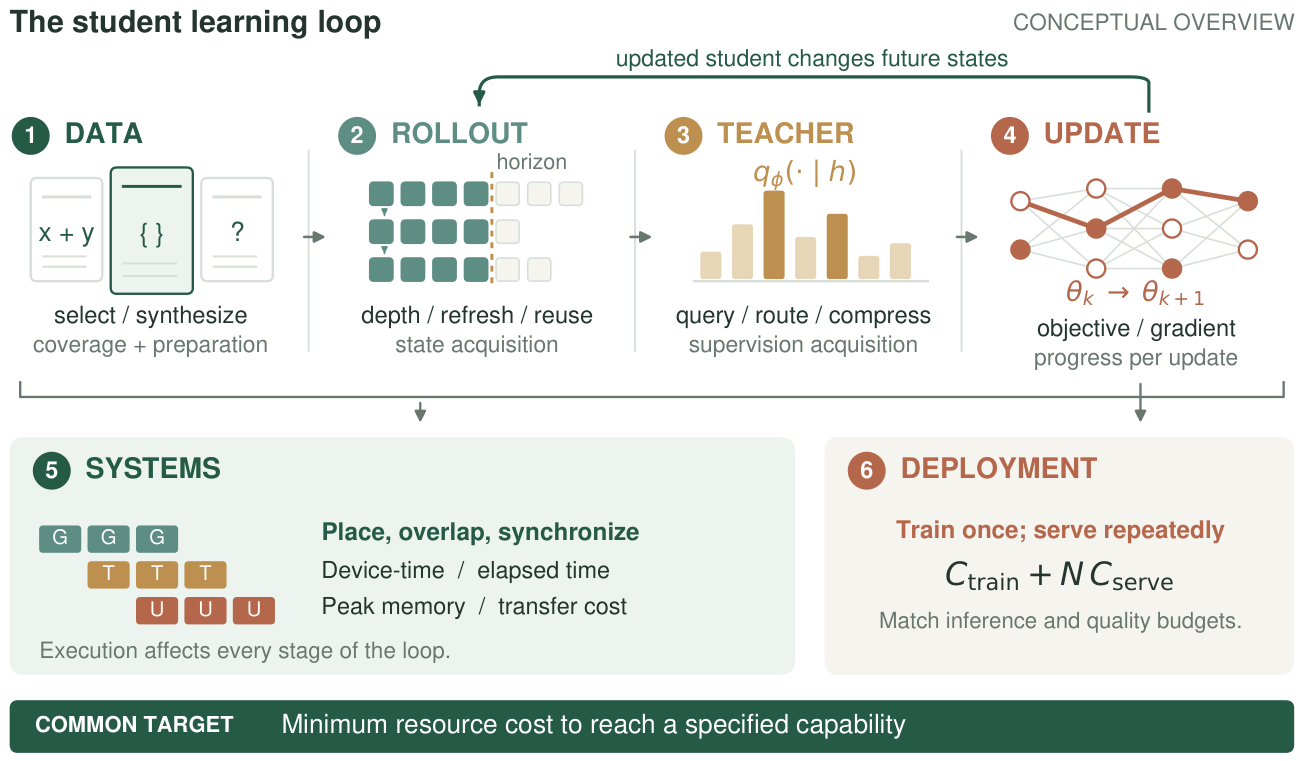
Figure 2.
Within-paper resource trade-offs. Open markers show each paper’s baseline; filled markers show the method, with raw values and derived changes. Sources: SparseOPD Tables 5/9/10, OPD2 Table 9, MOPD-Router Table 5, and Flash-OPD Table 6 [24,33,44,46]. Smaller ratios indicate less of the named resource, not better quality. Panels use different workloads and baselines.
Figure 2.
Within-paper resource trade-offs. Open markers show each paper’s baseline; filled markers show the method, with raw values and derived changes. Sources: SparseOPD Tables 5/9/10, OPD2 Table 9, MOPD-Router Table 5, and Flash-OPD Table 6 [24,33,44,46]. Smaller ratios indicate less of the named resource, not better quality. Panels use different workloads and baselines.
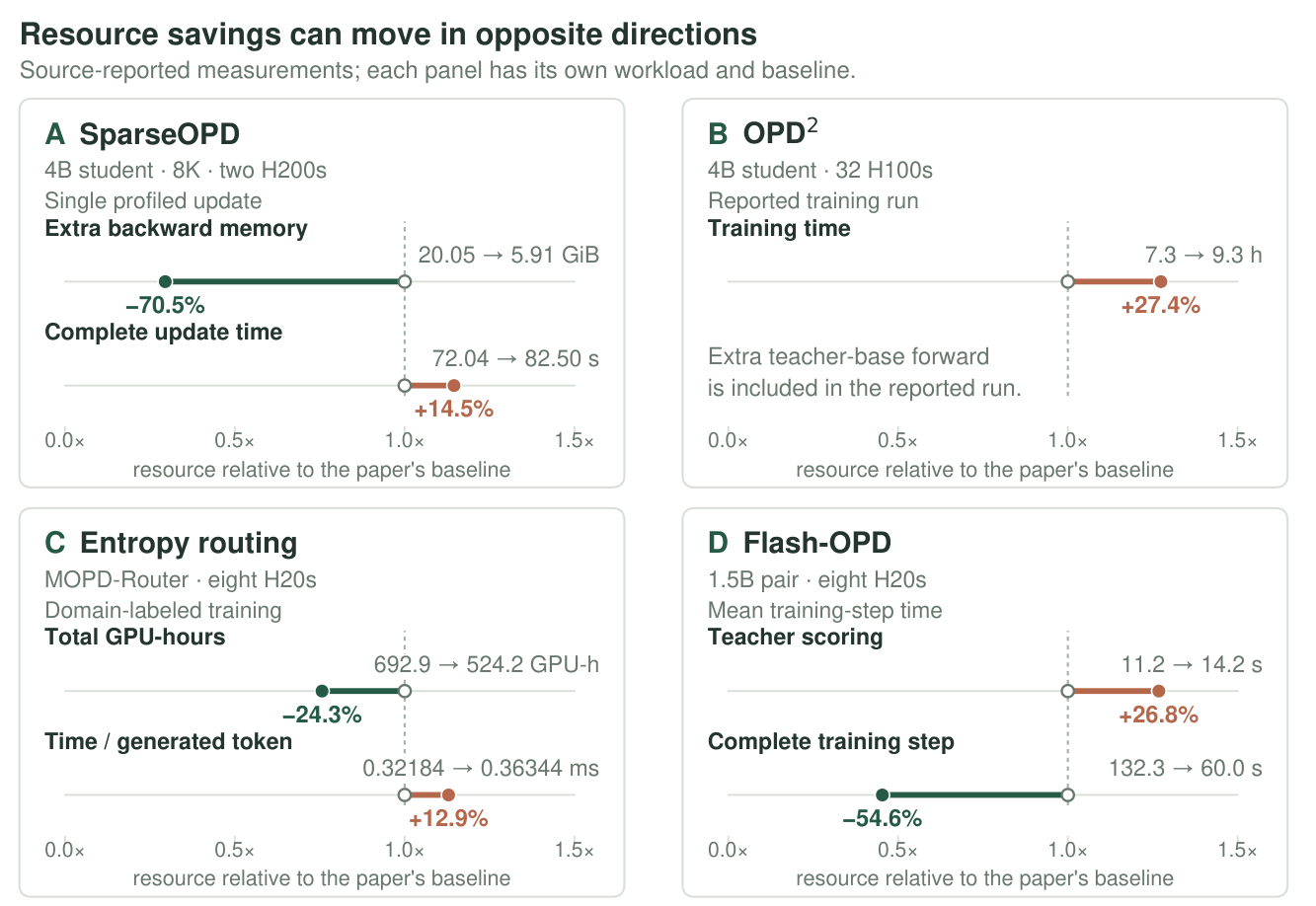
Table 1.
Complementary organizing emphases. These are not binary claims about whether prior surveys contain a topic. Exact version and section locators appear in Appendix A.2.
Table 1.
Complementary organizing emphases. These are not binary claims about whether prior surveys contain a topic. Exact version and section locators appear in Appendix A.2.
| Survey / version | Main organizing question | Relation to the present survey |
|---|---|---|
| Song and Zheng [7], v5 | How do student states, teacher information, and updates interact? | Broad coverage, including an extensive efficiency chapter; our audit operationalizes a narrower cost comparison. |
| Zhang [8], v1 | How is feedback converted into a distributional or policy-gradient update? | Detailed estimator analysis and reporting boundaries; we index evidence by resource, workload, and quality target. |
| Zan et al. [9], May preprint | How do access, supervision, and optimization define OPD families? | Broad method and application taxonomy; we concentrate on accounting and measured trade-offs. |
| This survey | Which resource is reduced, at what quality, and under what accounting boundary? | Six tracks; versioned evidence ledger; confounder audit; cost-to-quality and lifetime-cost protocol. |
Table 2.
Efficiency has multiple denominators. Each arrow compares a method with its own paper’s baseline; rows are not a cross-paper ranking. Quality, workload, and accounting boundaries differ. Complete source locators and missing fields are retained in the ledger.
Table 2.
Efficiency has multiple denominators. Each arrow compares a method with its own paper’s baseline; rows are not a cross-paper ranking. Quality, workload, and accounting boundaries differ. Complete source locators and missing fields are retained in the ledger.
| Method | Reported within-study comparison | What is measured | What the comparison does not establish |
|---|---|---|---|
| Semi-OPD [19] | 480 → 63 H100 GPU-h; Qwen3-14B; matched 16K caps | Collection, scoring, and optimization for 100 steps | Universal superiority of frozen states; the separate 11.4× case has unequal caps. |
| AsyncOPD [20] | 9.5k → 15.8k tokens/s; eight B200s | Training throughput; final AIME24 avg@32 is 25.00 for both | A 1.66× reduction in FLOPs or measured time-to-target. |
| SparseOPD [46] | 20.05 → 5.91 GiB; 72.04 → 82.50 s at 8K | Extra backward allocation and complete-update time | A 70.5% reduction in total resident memory or faster updates. |
| Flash-OPD [24] | Teacher: 11.2 → 14.2 s; total: 132.3 → 60.0 s | Mean training-step components, JustRL-1.5B pair | A reduction in every stage; verification shifts work into scoring. |
| OPD2 [44] | 7.3 → 9.3 h; Qwen3-4B; 32 H100s | Reported training-run wall time | Faster training from stronger final performance alone. |
Disclaimer/Publisher’s Note: The statements, opinions and data contained in all publications are solely those of the individual author(s) and contributor(s) and not of MDPI and/or the editor(s). MDPI and/or the editor(s) disclaim responsibility for any injury to people or property resulting from any ideas, methods, instructions or products referred to in the content. |
© 2026 by the author. Licensee MDPI, Basel, Switzerland. This article is an open access article distributed under the terms and conditions of the Creative Commons Attribution (CC BY) license.
Copyright: This open access article is published under a Creative Commons CC BY 4.0 license, which permit the free download, distribution, and reuse, provided that the author and preprint are cited in any reuse.