
Submitted:
26 October 2026
Posted:
27 October 2026
You are already at the latest version
Preprints on COVID-19 and SARS-CoV-2
Abstract
Respiratory viruses continue to challenge global preparedness because antiviral strategies remain largely pathogen specific. RSV, SARS-CoV-2, influenza, and emerging zoonotic viruses differ genetically, yet increasing evidence suggests that they converge on a common host vulnerability: suppression of the cellular stress-response regulators p53 and NRF2. RSV promotes p53 degradation and NRF2 loss, while SARS-CoV-2 similarly impairs these pathways and amplifies inflammatory signalling. Restoration of p53 and NRF2 reactivates antiviral microRNAs, suppresses viral-entry and inflammatory pathways, restores antioxidant defences, and induces p62/SQSTM1, a broad-spectrum antiviral restriction factor. These observations suggest that host-directed therapies could complement vaccines and direct-acting antivirals by establishing a mutation-resistant layer of protection. We argue that global preparedness frameworks should formally evaluate host-directed antiviral strategies as a third pillar of pandemic readiness.
Keywords:
host-directed therapeutics
; pandemic preparedness
; antiviral policy
; p53
; NRF2
; RSV
; SARS-CoV-2
; broad-spectrum antiviral strategies
; innate immunity
; host resilience
The COVID-19 pandemic and subsequent resurgence of RSV and influenza have exposed a recurring weakness in infectious-disease preparedness: most antiviral strategies remain pathogen-specific. Vaccines and direct-acting antivirals have transformed modern medicine, yet both depend on prior knowledge of the pathogen and remain vulnerable to viral evolution. The recurring emergence of novel variants and zoonotic threats suggests that preparedness frameworks should increasingly consider therapeutic strategies that target the host rather than individual viruses.
A growing body of evidence indicates that RSV and SARS-CoV-2 converge on a shared pathogenic strategy. RSV activates Akt-Mdm2 signalling, promoting degradation of p53 and prolonging survival of infected epithelial cells while amplifying inflammation (1). RSV also induces NRF2 deacetylation and proteasomal degradation, reducing antioxidant defences and exacerbating tissue injury (2). SARS-CoV-2 appears to exploit analogous vulnerabilities through disruption of p53 and NRF2 signalling and activation of inflammatory pathways, including TLR2-dependent responses (3–5). Although biologically distinct, these viruses target a common host-resilience network.
This convergence creates an opportunity for a fundamentally different antiviral paradigm. Rather than targeting viral proteins, host-directed approaches seek to restore conserved cellular defence pathways. p53 activation is associated with induction of antiviral microRNAs, including miR-145, which suppresses IGF1R and TLR2-related signalling. IGF1R has recently been identified as an RSV entry receptor, while TLR2 contributes to inflammatory amplification in respiratory viral infections (6,7). Concurrently, NRF2 activation restores antioxidant defences, limits oxidative stress, and promotes induction of p62/SQSTM1, a restriction factor increasingly recognized as a component of broad-spectrum antiviral defence networks (8).
These mechanisms suggest the existence of a host-directed antiviral architecture in which restoration of p53 and NRF2 simultaneously restricts viral entry, attenuates inflammatory injury, restores redox homeostasis, and enhances intrinsic antiviral defenses. Importantly, such pathways are encoded within the host and remain stable even as viral genomes evolve. This characteristic distinguishes them from many pathogen-specific interventions.
The implications extend beyond RSV and SARS-CoV-2. Seasonal influenza, emerging respiratory viruses, and future zoonotic pathogens may exploit overlapping host vulnerabilities. A preparedness strategy that includes host-directed therapies could therefore provide a reusable defensive framework applicable across multiple outbreaks. Such approaches are not intended to replace vaccines or direct-acting antivirals; rather, they may complement them by providing a broader layer of resilience when vaccines are unavailable, variants emerge, or therapeutics lag behind transmission.
Global health organisations have increasingly emphasized preparedness, surveillance, and rapid response. However, comparatively less attention has been devoted to host-resilience biology as a preparedness asset. WHO, CEPI, NIH, ICMR, and related organisations should consider dedicated programmes evaluating host-directed antiviral interventions, including p53- and NRF2-modulating strategies. Regulatory pathways and funding structures have traditionally been organized around individual pathogens; expanding these frameworks to include host-directed approaches could accelerate development of broad-spectrum countermeasures.
The history of infectious disease is often described as a contest between humans and pathogens. Yet the growing evidence from RSV, SARS-CoV-2, and other respiratory viruses suggests that another perspective is equally important: viruses repeatedly target the same host-defense systems. As respiratory pathogens continue to evolve, the host remains the most stable therapeutic target. Re-centering p53 and NRF2 biology within preparedness policy may help establish a third pillar of antiviral defense alongside vaccines and direct-acting antivirals, providing a pathway toward broader and more durable pandemic resilience.
Figure 1.
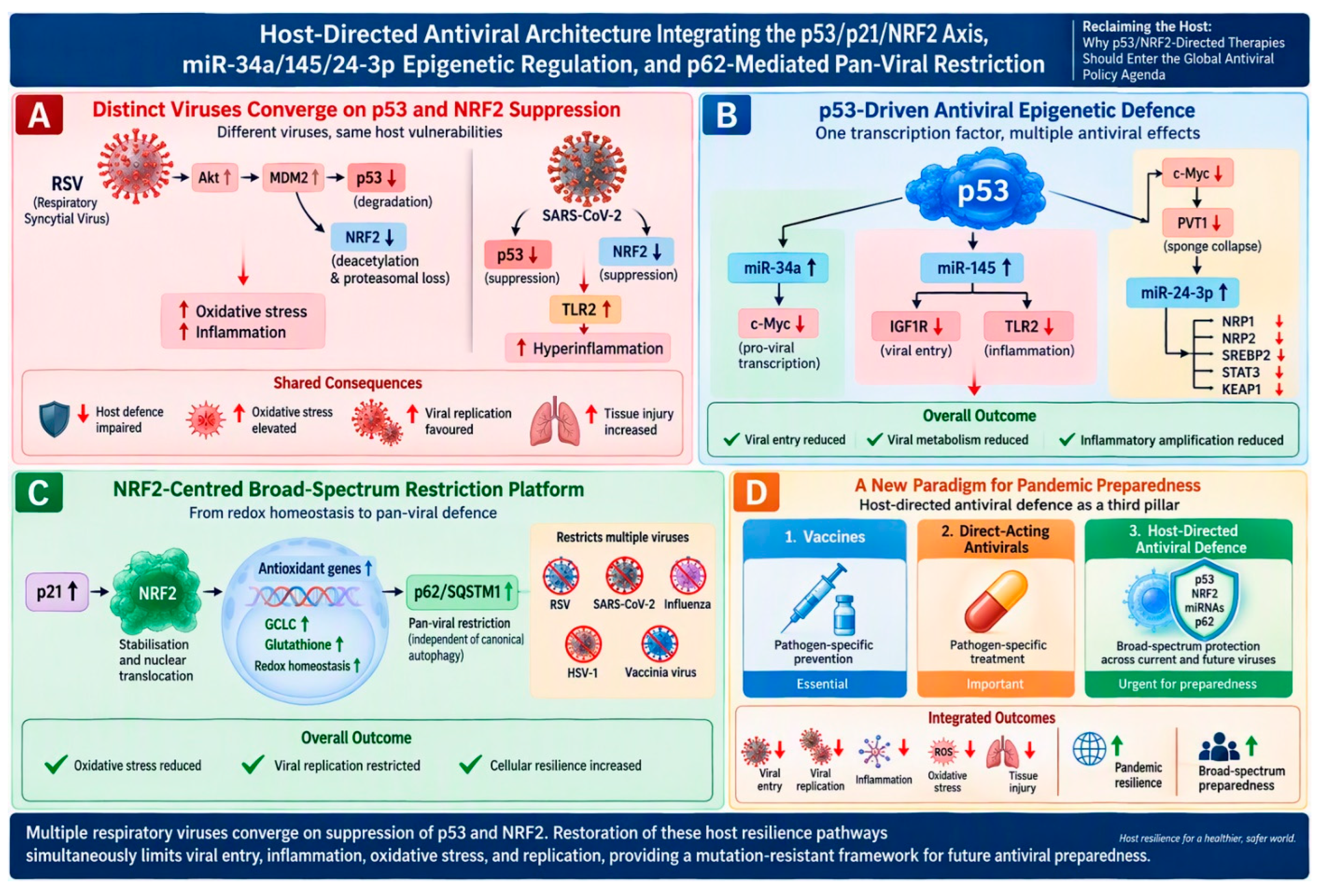
Host-directed antiviral architecture integrating the p53/p21/NRF2 axis, miR-34a/145/24-3p epigenetic regulation, and p62-mediated pan-viral restriction. Panel A: Distinct respiratory viruses converge on suppression of p53 and NRF2. RSV activates Akt-Mdm2 signalling to degrade p53 and induces NRF2 degradation, whereas SARS-CoV-2 similarly impairs p53 and NRF2 pathways while promoting inflammatory signalling. Panel B: Restoration of p53 induces antiviral microRNA networks involving miR-34a, miR-145, and miR-24-3p, suppressing host factors implicated in viral entry, metabolic support, and inflammatory amplification. Panel C: NRF2 stabilisation restores antioxidant defenses and induces p62/SQSTM1, a broad-spectrum antiviral restriction factor effective across multiple virus families. Panel D: Integrated host-directed antiviral defense simultaneously reduces viral entry, viral replication, oxidative stress, and inflammatory injury, illustrating how host-directed therapies could complement vaccines and direct-acting antivirals within future preparedness frameworks.
Figure 1.
Host-directed antiviral architecture integrating the p53/p21/NRF2 axis, miR-34a/145/24-3p epigenetic regulation, and p62-mediated pan-viral restriction. Panel A: Distinct respiratory viruses converge on suppression of p53 and NRF2. RSV activates Akt-Mdm2 signalling to degrade p53 and induces NRF2 degradation, whereas SARS-CoV-2 similarly impairs p53 and NRF2 pathways while promoting inflammatory signalling. Panel B: Restoration of p53 induces antiviral microRNA networks involving miR-34a, miR-145, and miR-24-3p, suppressing host factors implicated in viral entry, metabolic support, and inflammatory amplification. Panel C: NRF2 stabilisation restores antioxidant defenses and induces p62/SQSTM1, a broad-spectrum antiviral restriction factor effective across multiple virus families. Panel D: Integrated host-directed antiviral defense simultaneously reduces viral entry, viral replication, oxidative stress, and inflammatory injury, illustrating how host-directed therapies could complement vaccines and direct-acting antivirals within future preparedness frameworks.
Funding
No external funding was received for this work.
Data Availability Statement
No primary datasets were generated or analysed for this article. All information discussed is derived from published literature cited in the reference list.
Acknowledgments
The author thanks colleagues, collaborators, and members of the broader scientific community whose foundational work on p53, NRF2, host-directed therapeutics, respiratory virology, oxidative stress biology, and antiviral immunity informed the concepts discussed in this article.
Declaration of Interests
The author declares no competing interests.
Figure Credits
Figure designed and conceptualized by Dr L Boominathan, Genome-2-Bio-Medicine Discovery Center (GBMD).
Ethical Statement
This article is a scholarly editorial based exclusively on previously published studies and does not involve human participants, animal experimentation, identifiable personal data, or newly generated experimental data. Ethics committee approval was therefore not required.
Corresponding Author Note
Correspondence and requests for materials should be addressed to: Dr L Boominathan, PhD Email: Drboomi@genomediscovery.org.
References
- Groskreutz, D.J.; Monick, M.M.; Yarovinsky, T.O.; Powers, L.S.; Quelle, D.E.; Varga, S.M.; et al. Respiratory syncytial virus decreases p53 protein to prolong survival of airway epithelial cells. J. Immunol. 2007, 179(5), 2741–2747. [Google Scholar] [CrossRef] [PubMed]
- Komaravelli, N.; Tian, B.; Ivanciuc, T.; Mautemps, N.; Brasier, A.R.; Garofalo, R.P.; et al. Respiratory syncytial virus infection down-regulates antioxidant enzyme expression by triggering deacetylation-proteasomal degradation of Nrf2. Free Radic. Biol. Med. 2015, 88 Pt B, 391–403. [Google Scholar] [CrossRef] [PubMed]
- Kumar, A.; Ishida, R.; Strilets, T.; Cole, J.; Lopez-Otin, C.; Urrutia, R.; et al. SARS-CoV-2 infection and cellular pathways that regulate p53 and related stress-response mechanisms. Viruses 2022, 14(5), 1039. [Google Scholar] [CrossRef] [PubMed]
- Olagnier, D.; Farahani, E.; Thyrsted, J.; Blay-Cadanet, J.; Herengt, A.; Idorn, M.; et al. SARS-CoV-2-mediated suppression of NRF2 signalling reveals potent antiviral and anti-inflammatory activity of 4-octyl-itaconate and dimethyl fumarate. Nat. Commun. 2020, 11, 4938. [Google Scholar] [CrossRef] [PubMed]
- Zheng, M.; Karki, R.; Williams, E.P.; Yang, D.; Fitzpatrick, E.; Vogel, P.; et al. TLR2 senses the SARS-CoV-2 envelope protein to produce inflammatory cytokines. Nat. Immunol. 2021, 22, 829–838. [Google Scholar] [CrossRef] [PubMed]
- Griffiths, C.D.; Bilawchuk, L.M.; McDonough, J.E.; Jamieson, K.C.; Elawar, F.; Cen, Y.; et al. IGF1R is an entry receptor for respiratory syncytial virus. Nature 2020, 583(7817), 615–619. [Google Scholar] [CrossRef] [PubMed]
- Liu, J.; Gao, L.; Zhou, N.; Jiang, Z.; Che, S.; Deng, Y.; et al. p53 suppresses the inflammatory response following respiratory syncytial virus infection by inhibiting TLR2. Virology 2024, 593, 110018. [Google Scholar] [CrossRef] [PubMed]
- Pedersen, A.; Blay-Cadanet, J.; Storgaard, J.; Hernaez, B.; Thyrsted, J.; Bach-Nielsen, C.S.; et al. NRF2 controls a diverse network of antiviral effectors with p62 acting as a central restriction factor effective across virus families. Redox Biol. 2026, 93, 104135. [Google Scholar] [CrossRef] [PubMed] [PubMed Central]
Disclaimer/Publisher’s Note: The statements, opinions and data contained in all publications are solely those of the individual author(s) and contributor(s) and not of MDPI and/or the editor(s). MDPI and/or the editor(s) disclaim responsibility for any injury to people or property resulting from any ideas, methods, instructions or products referred to in the content. |
© 2026 by the author. Licensee MDPI, Basel, Switzerland. This article is an open access article distributed under the terms and conditions of the Creative Commons Attribution (CC BY) license.
Copyright: This open access article is published under a Creative Commons CC BY 4.0 license, which permit the free download, distribution, and reuse, provided that the author and preprint are cited in any reuse.