

Submitted:
23 October 2026
Posted:
27 October 2026
You are already at the latest version
Abstract
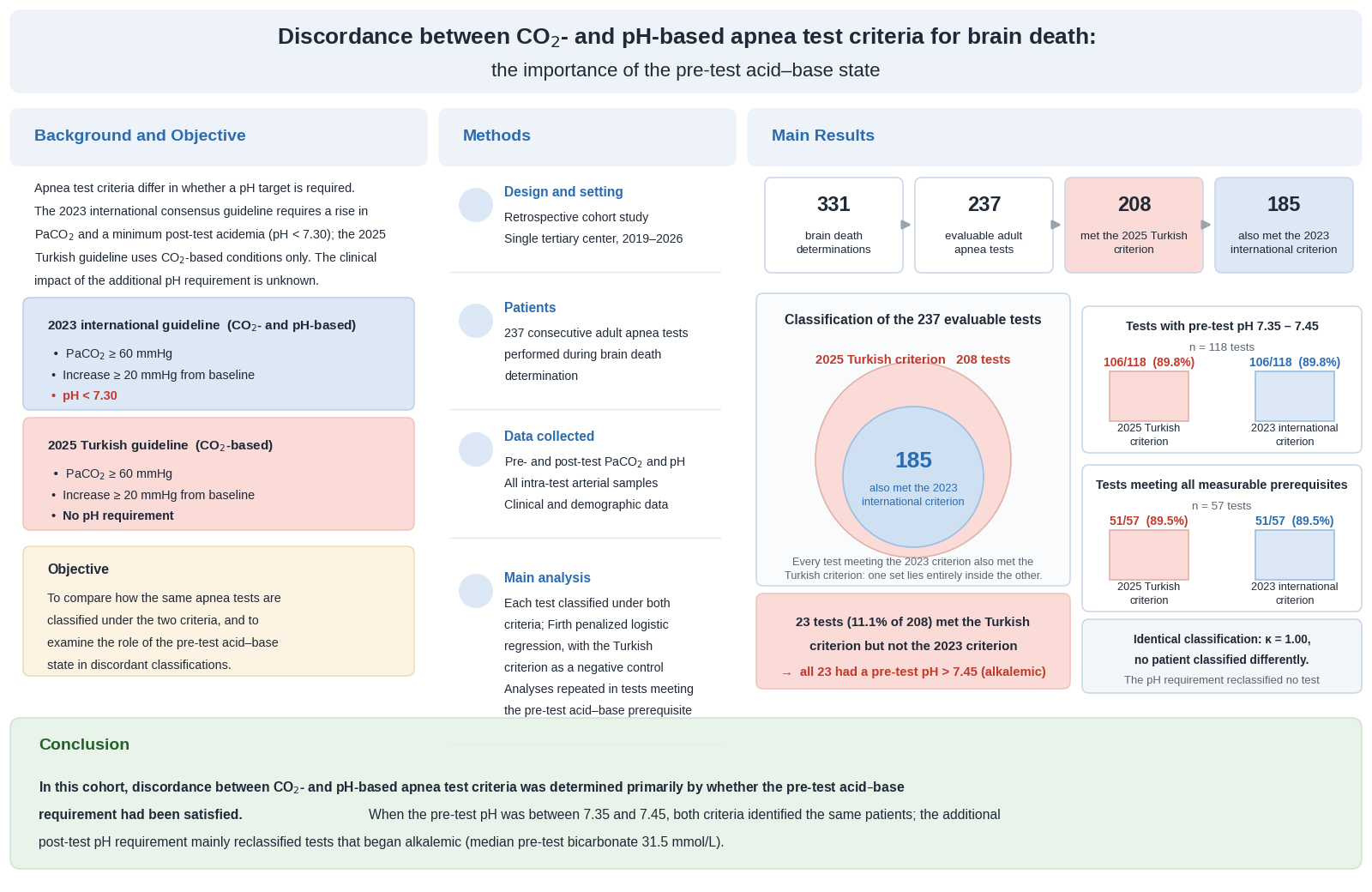
Background and Objectives: Apnea test criteria differ between countries and have changed within them. The 2010 American Academy of Neurology guideline accepted a PaCO2 ≥60 mmHg or a rise of ≥20 mmHg above baseline; the 2023 AAN/AAP/CNS/SCCM consensus guideline requires both together with an arterial pH <7.30; and the Turkish national standard, restated in December 2025, requires both carbon dioxide conditions but no pH target. We examined how the same real-world apnea tests are classified under these three criteria, and what accounts for any disagreement between them. Materials and Methods: All three criteria were applied to every apnea test performed during brain death determination in a tertiary intensive care service between 2019 and 2026 (n = 331). The primary endpoint was the 2023 consensus criterion. Determinants were modelled with Firth penalised logistic regression, with the Turkish criterion as a negative control. Results: 237 adults were evaluable under all three criteria. The proportion of tests meeting the criterion fell from 98.3% (AAN 2010) to 87.8% (Türkiye 2025) to 78.1% (2023 consensus); no test gained positivity at any step, and 48/237 (20.3%) were positive under at least one criterion but not all three. All 23 tests that met the Turkish criterion but failed the 2023 criterion had begun with a pre-test pH above 7.45. Among the 118 tests begun within the pH window that guidelines require, the two criteria were met by the same patients (106/118 (89.8) each). Pre-test bicarbonate was associated with meeting the 2023 criterion (OR 0.84 per mmol/L, 95% CI 0.78–0.92) but not with the Turkish criterion (OR 1.09, 95% CI 0.98–1.20). Conclusions: In this cohort, disagreement between contemporary apnea test criteria was determined mainly by whether the pre-test acid–base requirement had been met, rather than by the criteria themselves.
Keywords:
brain death
; apnea
; hypercapnia
; acid-base equilibrium
; bicarbonates
; alkalosis
; practice guidelines as topic
; intensive care units
1. Introduction
Apnea testing shows that respiratory drive is absent when the chemoreceptors receive a maximal stimulus. It is the part of brain death determination that varies most between countries, and what varies is not the manoeuvre itself but the value that defines a positive result [1,3,5].
For three decades that value was a carbon dioxide tension. The 2010 American Academy of Neurology guideline accepted a PaCO2 of at least 60 mmHg or a rise of at least 20 mmHg above a normal baseline, with no pH requirement, and the 2011 pediatric guideline required both carbon dioxide conditions but likewise set no pH target [3,4]. The 2020 World Brain Death Project added an arterial pH of <7.30, so that adequate acidemia would accompany the hypercapnic stimulus; the relation between a given PaCO2 and the resulting pH depends on metabolic buffering, and the two are therefore not interchangeable [5]. The 2023 AAN/AAP/CNS/SCCM consensus guideline combined all three conditions: PaCO2 ≥60 mmHg, at least 20 mmHg above the pre-apnea value, with a pH <7.30 in the same sample [1]. This is the most substantial change that guideline made to apnea testing relative to its 2010 and 2011 predecessors [2].
Turkish practice has followed a different branch of the same development. Until 2025 the national wording matched the 2010 American criterion and accepted either carbon dioxide condition [7,8]; the national neurology society guideline published in 2014 also set no pH target [15]. The Ministry of Health brain death guide published in December 2025 requires both carbon dioxide conditions, which tightens the stimulus, but does not introduce a pH target [6]. In that guide arterial pH appears only among the preconditions for testing, which specify a pH of 7.35–7.45, normocapnia, a core temperature ≥36 °C, a systolic pressure ≥100 mmHg and a serum sodium of 130–160 mEq/L [6]. The international frameworks set preconditions of the same kind and require pH and PaCO2 to be normalized before disconnection, although they do not state a numerical pH range [1,5].
Three criteria are therefore in current use, and they differ along two axes: whether the two carbon dioxide conditions are combined conjunctively or disjunctively, and whether a pH target is required at all. Whether these differences change the classification of real patients, and if so which patients, has not been reported in a consecutive series. The question matters in intensive care, where hypertonic saline, loop diuretics, therapeutic hyperventilation and volume resuscitation are common and a raised bicarbonate with a high pH is frequent, so that a PaCO2 of 60 mmHg may be reached while the pH remains above any acidemic threshold. Variation in how apnea testing is defined and performed between institutions and countries is itself well described [10].
We applied all three criteria retrospectively to every apnea test performed in our institution over eight years, and asked how the same tests are classified under each, and what accounts for the differences.
2. Materials and Methods
2.1. Design and Setting
This retrospective cohort study was conducted in the intensive care service of a tertiary university-affiliated training and research hospital, which comprises four units with a combined capacity of 25 beds. All consecutive patients in whom a brain death determination was undertaken between 2019 and 2026 were eligible (n = 331). The study was approved by the Scientific Research Ethics Committee of Antalya Training and Research Hospital (study no. 2026/338; decision no. 12/33, 8 July 2026), and the requirement for informed consent was waived because the analysis used data recorded during routine care. Reporting follows the STROBE statement [16].
2.2. Apnea Test Protocol
A single written institutional protocol was used throughout the study period. Because the acid–base findings depend on how the test was performed, the protocol is described in full. Prerequisites were a core temperature ≥36 °C, a systolic arterial pressure ≥100 mmHg, euvolemia, absence of residual sedation or neuromuscular blockade, and correction of severe electrolyte and endocrine disturbance. Patients were pre-oxygenated with an inspired oxygen fraction of 1.0 for at least 10 min with the aim of a PaO2 >200 mmHg, and ventilation was adjusted towards normocapnia before disconnection. A baseline arterial blood gas was drawn immediately before disconnection. Apneic oxygenation was delivered through an intratracheal catheter at 6 L/min in almost all tests, the technique recommended in the national guide [6]; T-piece and continuous positive airway pressure systems are alternatives where apneic oxygenation is unsuitable [13,14]. Patients were observed continuously for respiratory effort, and arterial pressure, heart rate and peripheral oxygen saturation were recorded every two minutes. A repeat arterial sample was drawn at the eighth minute, with further samples at 12 and 15 min when the test continued. Testing was abandoned for a systolic pressure below the institutional floor despite vasopressor support, sustained desaturation below 85%, or a life-threatening arrhythmia. All blood gases were analyzed on the same two point-of-care analyzers (GEM Premier, Instrumentation Laboratory, Bedford, MA, USA; ABL800 FLEX, Radiometer, Brønshøj, Denmark).
2.3. Data Collection
Source documents were the national brain death notification forms, the institutional apnea test record, blood gas analyzer printouts, radiology reports for ancillary imaging, and family consent documentation. Data were abstracted into a standardized 280-field case report form and entered into a structured database with range and consistency checks. Two missing-data codes were used and preserved in analysis: values not documented in the source record, and values not applicable to the patient. Every record was checked against the source documents by a second reviewer. Discrepancies between the handwritten record and the analyzer printout, which arose mainly from differences between clocks, were resolved in favor of the printout.
2.4. Criteria and Endpoints
Each criterion was applied to every arterial sample obtained during or at the end of the apnea period. A criterion was considered met if a single sample satisfied all of its conditions at once; conditions were never combined across samples.
The primary endpoint was the 2023 AAN/AAP/CNS/SCCM consensus criterion: PaCO2 ≥60 mmHg, at least 20 mmHg above the pre-test value, with an arterial pH <7.30 in the same sample [1]. The comparators were the 2010 AAN criterion [3], which was also the Turkish standard for most of the study period [7] (PaCO2 ≥60 mmHg or ΔPaCO2 ≥20 mmHg), and the current Turkish criterion as stated in the 2025 Ministry of Health guide [6] (PaCO2 ≥60 mmHg and ΔPaCO2 ≥20 mmHg). The 2020 World Brain Death Project target [5] and a stricter variant of the 2023 criterion using pH ≤7.28 were evaluated as secondary criteria, and each individual condition was tabulated separately.
Pre-test capnia was categorized as hypocapnia (<35 mmHg), normocapnia (35–45 mmHg) or hypercapnia (>45 mmHg). The PaCO2 rise rate was the difference between the end-of-test and pre-test PaCO2 divided by the recorded duration. Safety endpoints were severe hypercapnia (PaCO2 >80 mmHg), severe acidemia (pH <7.10), the complications recorded on the test form, and early termination. Adherence to the preconditions was assessed against the numerical values in the national guide [6], using the recorded pre-test arterial pH (7.35–7.45), PaCO2 (35–45 mmHg), core temperature (≥36 °C), systolic pressure (≥100 mmHg), serum sodium (130–160 mEq/L) and the oxygenation ratio below which that guide advises against apneic oxygenation (PaO2/FiO2 <200).
2.5. Statistical Analysis
Continuous variables are reported as median (interquartile range) and compared with the Mann–Whitney U or Kruskal–Wallis test; categorical variables are reported as n (%) and compared with Fisher’s exact test, or with a Monte Carlo exact test for larger contingency tables. Binomial proportions are given with Wilson confidence intervals. Agreement between criteria applied to the same patients was assessed with McNemar’s test, and trends across ordered bicarbonate strata by logistic regression on the stratum rank.
Determinants of meeting the primary criterion were modelled with Firth penalised logistic regression, with profile penalised-likelihood confidence intervals and penalised likelihood-ratio p values. This estimator was chosen because the outcome was expected to be common and the number of failures correspondingly small (48 non-events in the primary model), a situation in which maximum-likelihood estimates are biased away from the null [17,18]. Candidate variables were chosen on physiological grounds before the models were fitted and were not selected by univariable screening: pre-test PaCO2, pre-test bicarbonate, recorded duration and age. There was no registered analysis plan, and the restricted and additionally adjusted analyses described below were added during revision. Bicarbonate, base excess and pre-test pH are near-collinear (Spearman ρ > 0.84) and were therefore entered in separate models. The same model was fitted to the Turkish criterion as a negative control, since a criterion defined only by carbon dioxide should show no association with buffer status if the proposed mechanism holds. Discrimination of pre-test acid–base variables for failure of the primary criterion was summarized with the area under the receiver operating characteristic curve, with bootstrap confidence intervals over 2000 resamples. Determinants of the PaCO2 rise rate were examined by ordinary least-squares regression.
Three restricted analyses, added after the primary analysis, address the objection that a criterion cannot properly be applied to a test performed outside its own prerequisites: one restricted to tests with a pre-test pH of 7.35–7.45, one restricted to tests meeting every measurable precondition, and one confined to tests begun alkalemic. Further analyses added sex and broad etiological group to the primary model, examined patients aged under 18 years, and applied the stricter pH ≤7.28 variant. Linearity of the logit in bicarbonate was tested by adding a quadratic term. Analyses were performed in Python 3.12 (statsmodels 0.14, SciPy 1.13) with a two-sided α of 0.05.
3. Results
3.1. Cohort
Of 331 brain death determinations, an apnea test with paired pre- and post-test arterial blood gases was available in 271. The test was not started, or could not be carried to a post-test sample, in 60, most often because of hemodynamic instability. After 3 tests without a paired PaCO2 and pH measurement and 31 patients aged under 18 years were excluded, 237 adults were evaluable under all three criteria (Figure 1).
Median age was 52.0 (42.0–64.0) years and 96 (40.5%) were women. Subarachnoid hemorrhage was the commonest etiology (90 (38.0%)). Median pre-test PaCO2 was 39.0 (36.4–41.7) mmHg and median pre-test bicarbonate 24.8 (21.9–27.7) mmol/L. Baseline characteristics by status under the primary criterion are given in Table 1.
3.2. Classification under the Three Criteria
Applied to the same 237 patients, the three criteria gave a descending sequence: 98.3% under the 2010 AAN criterion and the pre-2025 Turkish standard, 87.8% under the current Turkish criterion, and 78.1% under the 2023 consensus criterion (Table 2, Figure 2). Each step was unidirectional. Requiring both carbon dioxide conditions rather than either removed 25 tests and added none (p < 0.001); adding the pH condition removed a further 23 and added none (p < 0.001); across the whole span 48 tests changed status in one direction and none in the other (p < 0.001).
In total, 48 of 237 patients (20.3%) were positive under at least one criterion but not all three: 23 met two of the three and 25 met only one, while 185 met all three and 4 met none.
The two steps differ in character. Each carbon dioxide condition was met on its own by a large majority of tests, PaCO2 ≥60 mmHg alone in 91.6% and ΔPaCO2 ≥20 mmHg alone in 94.5%, so requiring both narrowed the criterion arithmetically rather than by adding a new physiological condition. The pH condition behaved differently: of the 208 tests meeting the current Turkish criterion, 23 failed the 2023 criterion, and all of them failed on pH.
3.3. Acid–Base Profile of the Discordant Tests
Patients who failed the primary criterion were distinguished at baseline by their acid–base profile rather than by their carbon dioxide tension. Median pre-test pH was 7.47 (7.38–7.51) in those who failed and 7.41 (7.35–7.44) in those who met it (p < 0.001), and median bicarbonate 27.8 (23.1–31.0) and 24.4 (21.6–27.0) mmol/L respectively (p < 0.001). Pre-test PaCO2 differed little, and in the direction opposite to the conventional expectation.
Restricting attention to the 208 tests that already met the Turkish criterion isolates the effect. Those that nonetheless failed the 2023 criterion had a pre-test pH of 7.51 (7.48–7.55) against 7.41 (7.35–7.44) (p < 0.001), a bicarbonate of 31.5 (28.9–33.1) against 24.4 (21.6–27.0) mmol/L (p < 0.001) and a base excess of 7.6 (5.3–9.1) against -0.2 (-3.5–2.8) mmol/L (p < 0.001), with no difference in serum sodium. This is a biochemical profile consistent with metabolic alkalosis, in which a given carbon dioxide load produces a smaller pH excursion. The etiology was not characterized further, since chloride and renal indices were incomplete.
Graded by pre-test bicarbonate, the criteria diverge only where the pH condition is present (Table 3, Figure 3). The 2010 AAN criterion was met in 98.3% to 100.0% of patients across strata (p for trend = 0.302) and the Turkish criterion in 86.2% to 89.3% (p = 0.291), with no gradient in either. The 2023 criterion fell from 86.2% below 22 mmol/L to 42.9% at ≥30 mmol/L (p for trend < 0.001). Above a bicarbonate of 26 mmol/L the pH condition became the binding constraint.
Treated as a continuous variable, bicarbonate gives the same picture without the arbitrariness of strata (Figure 4). With a quadratic term, the predicted probability of meeting the 2023 criterion was flat across the lower part of the range and declined above roughly 25 mmol/L (quadratic term p = 0.011), while the predicted probability of meeting the Turkish criterion showed no such decline (p = 0.90).
3.4. Pre-Test Capnia Category
Pre-test hypocapnia was present in 23 adults, normocapnia in 201 and hypercapnia in 13. Hypocapnic patients required a longer theoretical minimum apnea time (9.4 (8.9–10.0) against 7.0 (6.2–7.6) min, p < 0.001) and produced a larger ΔPaCO2 (34.0 (29.7–37.6) against 27.5 (24.0–33.6) mmHg, p = 0.007), but their PaCO2 rise rate did not differ (3.4 (2.8–4.2) against 3.2 (2.6–3.9) mmHg/min, p = 0.53), and achievement of the primary criterion showed no significant gradient across capnia categories. Severe hypercapnia occurred mainly at the other end of the range, in 6 (46.2) of patients who began the test already hypercapnic. Starting hypocapnic therefore lengthens the test and increases the carbon dioxide excursion required, without determining whether the pH condition is met.

Table 4.
Test physiology and criteria met, by pre-test capnia category.
| Variable | Hypocapnia <35 mmHg | Normocapnia 35–45 mmHg | Hypercapnia >45 mmHg | p |
|---|---|---|---|---|
| n | 23 | 201 | 13 | |
| Pre-test PaCO2, mmHg | 31.8 (30.1–33.3) | 39.1 (37.1–41.4) | 46.4 (45.6–50.4) | <0.001 |
| Pre-test HCO3−, mmol/L | 24.1 (20.8–27.0) | 24.7 (22.0–27.5) | 27.2 (24.3–29.2) | 0.155 |
| Apnea duration, min | 9.0 (8.0–12.0) | 8.0 (8.0–10.0) | 8.0 (8.0–8.0) | 0.139 |
| Theoretical minimum duration, min | 9.4 (8.9–10.0) | 7.0 (6.2–7.6) | 4.5 (3.2–4.8) | <0.001 |
| ΔPaCO2, mmHg | 34.0 (29.7–37.6) | 27.5 (24.0–33.6) | 28.0 (23.3–36.4) | 0.007 |
| PaCO2 rise rate, mmHg/min | 3.4 (2.8–4.2) | 3.2 (2.6–3.9) | 3.3 (2.4–4.5) | 0.534 |
| End-of-test PaCO2, mmHg | 65.2 (61.5–69.6) | 66.8 (63.1–73.6) | 75.0 (71.8–84.0) | 0.001 |
| End-of-test pH | 7.22 (7.19–7.28) | 7.22 (7.17–7.26) | 7.20 (7.18–7.24) | 0.335 |
| AAN 2010 criterion | 22 (95.7) | 198 (98.5) | 13 (100.0) | 0.535 |
| Türkiye 2025 criterion | 20 (87.0) | 178 (88.6) | 10 (76.9) | 0.460 |
| 2023 criterion (primary) | 17 (73.9) | 158 (78.6) | 10 (76.9) | 0.871 |
| Severe hypercapnia (PaCO2 >80) | 2 (8.7) | 19 (9.5) | 6 (46.2) | <0.001 |
| Severe acidemia (pH <7.10) | 2 (8.7) | 10 (5.0) | 1 (7.7) | 0.712 |
| Any complication | 3 (15.8) | 15 (7.9) | 0 (0.0) | 0.264 |
Median (IQR) or n (%). Kruskal–Wallis or exact tests across three groups. The hypocapnic (n = 23) and hypercapnic (n = 13) groups are small, and the p values in this table should be read as descriptive rather than as formal hypothesis tests.
3.5. Multivariable Analysis and Negative Control
In the primary Firth model (227 patients, 48 failures) pre-test bicarbonate remained independently associated with meeting the 2023 criterion, each 1 mmol/L reducing the odds by about a sixth (OR 0.84, 95% CI 0.78–0.92; p < 0.001). Pre-test PaCO2 carried no independent information once the ΔPaCO2 condition was part of the outcome (OR 1.32, 95% CI 0.89–1.96; p = 0.162), and neither did duration or age (Table 5). Entering bicarbonate categorically gave the same picture: a bicarbonate ≥30 mmol/L reduced the odds almost ninefold (OR 0.13, 95% CI 0.05–0.30; p < 0.001), while hypocapnia was not independently associated (OR 0.54; p = 0.256). Substituting pre-test pH for bicarbonate gave an OR of 0.64 per 0.05 pH unit (95% CI 0.51–0.81; p < 0.001). These estimates are made across the whole cohort, including tests begun outside the acid–base window; Section 3.6 shows that the association does not survive restriction to tests begun within it, and the coefficients should be read accordingly rather than as measures of an independent clinical risk factor.
Fitting the same model to the Turkish criterion, which contains no pH condition, no statistically significant association was observed between bicarbonate and the outcome (OR 1.09, 95% CI 0.98–1.20; p = 0.102).
As single pre-test discriminators of failure under the 2023 criterion, pre-test pH gave an area under the curve of 0.67 (95% CI 0.57–0.77), bicarbonate 0.66 (0.56–0.75) and base excess 0.66 (0.56–0.75). The best bicarbonate cut-point was 28.9 mmol/L (sensitivity 46%, specificity 89%). These values are moderate, and the cut-point was derived in the same dataset in which it was evaluated; it is reported as a descriptive summary of the association rather than as a validated decision rule.
3.6. Restriction to Tests Meeting the Pre-Test Preconditions
All three frameworks require a normal acid–base state before testing. The Turkish guide is the one that states this numerically, as a pre-test pH of 7.35–7.45 [6], and that window was therefore used to define the restriction [1,5]. Because a criterion cannot properly be applied to a test performed outside its own prerequisites, the analysis was repeated in restricted cohorts (Table 6).
Among the 118 tests beginning within the specified pH window, the Turkish and 2023 criteria classified every patient identically: 106 were positive under both and 12 negative under both, with no discordant patient in either direction (Cohen’s κ = 1.00). The proportion positive under at least one but not all three criteria fell from 20.3% to 8.5%. The residual discordance at this restriction lay entirely between the 2010 AAN criterion and the other two. Restricting further to the 57 tests meeting every measurable precondition gave the same result (51/57 (89.5) and 51/57 (89.5)).
The complementary analysis locates the discordance. All 23 tests that met the Turkish criterion but failed the 2023 criterion had a pre-test pH above 7.45, and none began within the specified window; their median pre-test bicarbonate was 31.5 mmol/L. Among the 68 tests begun alkalemic, the 2010 AAN criterion was met in 67/68 (98.5), the Turkish criterion in 60/68 (88.2) and the 2023 criterion in 37/68 (54.4), and higher bicarbonate remained associated with failure of the 2023 criterion within this subgroup (OR 0.79 per mmol/L, 95% CI 0.63–1.00; p = 0.031).
In the precondition-satisfying cohort the association between bicarbonate and the 2023 criterion did not persist and ran in the opposite direction (OR 1.54, 95% CI 1.01–2.34), in 114 patients with only 10 failures. With so few events and a bicarbonate range narrowed by the restriction itself, this estimate is unstable and is reported for completeness rather than as a contrasting finding. The point the restriction makes directly is that when the acid–base precondition was met, adding the pH condition reclassified no patient in this cohort.
3.7. Test Duration and Rate of Carbon Dioxide Accumulation
Median recorded duration was 8.0 (8.0–12.0) min. The PaCO2 rise rate varied more than fivefold between patients (median 3.2 (2.6–4.1) mmHg/min; 10th to 90th centile 1.9–5.0; full range 1.4–8.2). In linear regression the rate increased with pre-test bicarbonate (0.039 mmHg/min per mmol/L, p = 0.009) and decreased with pre-test PaCO2 (-0.032, p = 0.04) and with recorded duration (-0.29, p < 0.001), the last reflecting the slowing of carbon dioxide accumulation as the alveolar–arterial gradient narrows.
Achievement of the primary criterion did not increase with longer testing: 138 (81.7) in tests of ≤8 min, 28 (68.3) at >8 to 12 min and 17 (73.9) beyond 12 min. This reflects confounding by indication rather than futility of prolongation, since tests were extended precisely when the target had not been reached at eight minutes. The serial sampling subgroup addresses the question more directly, although it was not randomly constituted: the protocol specified an eighth-minute sample with further samples when the test continued, so patients with more than one intra-test sample are by construction those in whom the clinician elected to continue. They began with a lower pre-test PaCO2 (36.8 against 39.3 mmHg, p < 0.001) and had a longer recorded duration (median 12.0 against 8.0 min), but did not differ in pre-test pH (7.43 against 7.41, p = 0.195) or bicarbonate (24.1 against 24.9 mmol/L, p = 0.316). Among the 36 patients with both an eighth-minute and a later sample, 9 already met the 2023 criterion at eight minutes, 18 met it only on the later sample, and 9 met it at neither. At the eighth minute 25 of these 36 had a pH <7.30 but only 13 had reached PaCO2 ≥60 mmHg.
Table 7.
Criteria met and safety, by recorded test duration.
| Duration (min) | n | 2023 Criterion, n (%) | Türkiye 2025, n (%) | PaCO2 >80 mmHg, n (%) | pH <7.10, n (%) | Any Complication, n (%) |
|---|---|---|---|---|---|---|
| ≤8 | 169 | 138 (81.7) | 153 (90.5) | 22 (13.0) | 11 (6.5) | 10 (6.2) |
| >8–12 | 41 | 28 (68.3) | 33 (80.5) | 3 (7.3) | 1 (2.4) | 5 (13.2) |
| >12 | 23 | 17 (73.9) | 20 (87.0) | 2 (8.7) | 1 (4.3) | 2 (9.1) |
Durations as recorded on the test form; duration was not documented in 4 patients.
3.8. Safety
Apnea testing was well tolerated, consistent with previous reports [11]. There were no cardiac arrests and no arrhythmias recorded as complications; hypotension was documented in 4 (1.9) and hypoxemia in 5 (2.3), and any complication in 18 (8.1). Testing was terminated early in 13 (5.5). Severe hypercapnia occurred in 27 (11.4) and severe acidemia in 13 (5.5). Pre-oxygenation was effective: median pre-test PaO2/FiO2 was 389.0 (303.0–499.5), and only 4 of 203 patients with a calculable ratio were below 200.
Table 8.
Safety endpoints in the primary cohort.
| Endpoint | n (%) |
|---|---|
| Hypotension | 4 (1.9) |
| Hypoxemia (SpO2 <85%) | 5 (2.3) |
| Cardiac arrhythmia | 0 (0.0) |
| Cardiac arrest | 0 (0.0) |
| Severe acidosis (recorded as complication) | 8 (3.6) |
| Any recorded complication | 18 (8.1) |
| Severe hypercapnia (PaCO2 >80 mmHg) | 27 (11.4) |
| Severe acidemia (pH <7.10) | 13 (5.5) |
| Early termination | 13 (5.5) |
Denominators vary with documentation; percentages are of patients with the field recorded.
3.9. Adherence to the Preconditions
The pre-test pH window specified in the national guide was not met in 116 of 234 tests with a recorded pre-test pH (49.6%), and in 68 the pH was above 7.45. Pre-test PaCO2 fell outside 35–45 mmHg in 36 tests, serum sodium exceeded 160 mEq/L in 52 of 230 patients (22.6%), apneic oxygenation was used in 4 patients with a PaO2/FiO2 below 200, and temperature or blood pressure prerequisites were violated in 13 tests.
Adherence and outcome were linked through the pH condition alone. Among the 68 patients who began the test with a pH above 7.45, the 2023 criterion was met in 37 (54.4%); among those who began within or below the window it was met in 146 (88.0%). The Turkish criterion was met at an almost identical rate in both groups (60 (88.2%) and 146 (88.0%)).
Of 293 adults considered for apnea testing, the test was not attempted in 36 and was attempted but not carried to a post-test sample in 13. Among the 239 adults in whom testing was attempted, 232 yielded an evaluable result (97.1%), which is consistent with the statement in the national guide that more than 90% of tests can be completed under ideal conditions [6]; the corresponding figure across all adults considered for testing was 80.9%.
3.10. Pediatric Patients and Further Sensitivity Analyses
Among the 31 children excluded from the primary analysis, the 2023 criterion was met in 30 (96.8%) and the Turkish criterion in 30 (96.8%). Patients with decompressive craniectomy (n = 52) are described in the Supplementary Materials; in brief, they had a higher pre-test bicarbonate and a faster PaCO2 rise rate, and achievement of the 2023 criterion was indistinguishable from patients with an intact skull (42 (80.8) against 135 (77.6), p = 0.704).
Adding sex to the primary model left the bicarbonate estimate essentially unchanged (OR 0.84, 95% CI 0.77–0.91); female sex was itself associated with the outcome (OR 0.43, 95% CI 0.21–0.84; p = 0.014). A smaller body mass carries a smaller carbon dioxide storage capacity, and a given apneic interval might therefore produce a different arterial trajectory, but sex was not part of the prespecified model, the association was not corrected for multiple comparisons, and we regard it as an incidental observation requiring separate study. Adding broad etiological groups also left it unchanged (OR 0.84, 95% CI 0.78–0.92). Including patients under 18 years (n = 256 with complete covariates) gave OR 0.85 (95% CI 0.79–0.92), and restricting to tests meeting the temperature and blood pressure prerequisites gave OR 0.84 (95% CI 0.77–0.91). The stricter pH ≤7.28 variant reduced achievement to 73.4% and strengthened the association (OR 0.82, 95% CI 0.75–0.89). Linearity of the logit was not supported: a quadratic term in bicarbonate improved fit (p = 0.007), the relationship being flat to roughly 25 mmol/L and falling beyond it (Figure 4), so the linear odds ratios should be read as average effects across the observed range.
4. Discussion
Applying three criteria that are in force, or were until recently, to the same consecutive apnea tests produced a descending sequence from 98.3% to 87.8% to 78.1%, and left one test in five classified differently according to which rule was used. The more informative finding is where that disagreement sits. It was not spread across the cohort: every test that the Turkish criterion accepted and the 2023 criterion rejected had begun with a pre-test pH above 7.45, above the upper limit the Turkish guide specifies and outside the normal acid–base state the international frameworks require [1,5,6]. Among tests that began inside that window, the two criteria selected the same patients.
The two steps in the sequence differ in character. Moving from a disjunctive to a conjunctive pairing of the carbon dioxide conditions, as Turkish practice did in 2025 and American practice did in 2023, tightens the criterion arithmetically: each condition was met on its own by more than nine tests in ten, and requiring both excluded a further 25 without reference to any patient characteristic we could identify. Adding a pH condition changes what the criterion measures, from the carbon dioxide stimulus applied to the acidemia produced, and the difference between the two depends on the buffer capacity of the patient.
The negative control is consistent with this reading. In the same patients and the same blood gas samples, pre-test bicarbonate was associated with the 2023 criterion (OR 0.84 per mmol/L; p < 0.001), while no statistically significant association was observed with the Turkish criterion (OR 1.09, 95% CI 0.98–1.20; p = 0.102). The confidence interval for the latter does not exclude a modest association in either direction, so this is an absence of demonstrated effect rather than a demonstration of absence. A criterion defined only by carbon dioxide contains no term that could register buffer status, which is the reasoning the World Brain Death Project gave when it introduced a pH threshold [5].
The reclassification was larger than in a recent Chinese multi-center series, in which dual targets reduced the confirmed positivity rate by 3.4 percentage points across 620 determinations, against 9.7 points for the equivalent step here [9]. Population rather than method is the likely explanation. A cohort in which subarachnoid hemorrhage predominates, hypertonic saline and loop diuretics are routine and median serum sodium is 151 mmol/L is one in which a high pre-test pH with a raised bicarbonate is common. We did not classify acid–base disorders formally, and describe this biochemical pattern rather than assert a diagnosis of metabolic alkalosis in every case; the label is used only for the discordant subgroup, whose profile (median pH 7.51, bicarbonate 31.5 mmol/L, base excess +7.6 mmol/L) leaves little ambiguity.
The restricted analyses change what should be concluded from the sequence. If reclassification were a property of the criteria themselves, it should persist among tests conducted as the frameworks intend, and it did not: among the 118 tests begun with a pre-test pH of 7.35–7.45 the Turkish and 2023 criteria were met by identical patients, and the same held when every measurable precondition was imposed. Among the 68 tests begun alkalemic the two criteria diverged sharply (60/68 (88.2) against 37/68 (54.4)). The pH condition therefore appears redundant when the acid–base precondition has been satisfied and decisive when it has not. Part of this relation is arithmetic: a test begun at a pH of 7.50 requires a larger fall to reach 7.30 than one begun at 7.40, so a criterion containing a pH threshold is bound to be harder to meet in alkalemic patients. That is the mechanism rather than a confounder, but it does mean the restricted analysis confirms the physiology it was designed to test rather than providing independent evidence of it. In this cohort, then, discordance between the contemporary criteria was determined primarily by whether the pre-test acid–base requirement had been satisfied. These findings suggest that adherence to that requirement may be more consequential than the choice between the two contemporary criteria, although the precondition-satisfying cohorts were small (n = 118 and n = 57) and the series comes from a single center.
This also bounds the bicarbonate finding, and we would not present it as an independent predictor of criterion failure. The association between buffer status and failure of the pH-containing criterion was demonstrable in the cohort as a whole and within the alkalemic subgroup, but not in the precondition-satisfying cohort, where bicarbonate spanned a narrow range and failures were few. The categorical estimate for a bicarbonate ≥30 mmol/L, striking on its face, is carried almost entirely by tests that should not have proceeded under any of the frameworks. Buffer status is better understood as the biochemical marker of the acid–base state responsible for the discordance than as a risk factor operating across the normal range.
These findings also reframe the concern usually raised about pre-test hypocapnia [12]. Hypocapnic patients in this series needed a longer test and generated a larger carbon dioxide excursion, as the arithmetic of a 3 mmHg/min rise from a low baseline predicts, and that bears on the ΔPaCO2 condition. Once buffer status was taken into account, however, starting hypocapnic carried no independent penalty. Buffer status appears more informative than pre-test capnia in identifying the patient at risk of an inconclusive test under a pH-containing criterion.
The practical consequence requires no change to any criterion. All three frameworks already require a normal acid–base state before testing, and the Turkish guide states this numerically as a pre-test pH of 7.35–7.45 [6]. This was the commonest deviation we found: half of the tests began outside that window and 68 began alkalemic, and those were the patients who went on to meet the carbon dioxide conditions and miss the pH condition. These findings support prospective evaluation of pre-test bicarbonate as a readily available marker of that acid–base state, since it is reported on the blood gas already drawn, varies less from minute to minute than pH, and was associated with the outcome across its observed range. Such a marker would identify not a patient who necessarily requires an ancillary study, but one at increased risk of not satisfying a pH-containing criterion, for whom correcting the alkalemia, deferring the test, or planning an ancillary study in advance are all reasonable responses. Any cut-point would need external validation before use, since the one identified here was derived in the same dataset. Where a criterion is not met, the guidelines themselves direct that ancillary confirmatory testing be considered [1,6].
The fivefold spread in the PaCO2 rise rate argues against fixed-duration protocols, and bears on the finding in the Chinese series that diagnostic yield plateaued beyond nine minutes [9]. In any retrospective series the tests that were extended are those that had not yet succeeded, so the long-duration stratum is enriched for difficult physiology. The serial sampling subgroup inverts this picture: among patients whose test continued past the eighth minute, two-thirds converted to positive on the later sample. This subgroup is small (n = 36) and was not randomly selected, so it cannot establish how a serial protocol would perform. Both the 2023 guideline and the national guide direct that sampling be repeated at intervals until the target is reached rather than at a single fixed time [1,6]. No increase in the observed frequency of severe hypercapnia or severe acidemia was detected in the longer-duration strata, although these observational data cannot establish the safety of prolonging the test.
Patients with decompressive craniectomy, described in the Supplementary Materials, illustrate how two mechanisms can offset one another: a higher bicarbonate works against the pH condition while a faster carbon dioxide rise works for the carbon dioxide conditions, and net achievement was indistinguishable from patients with an intact skull.
Limitations
This is a single-center series, and the case mix of a Turkish tertiary neurointensive service, with its particular distribution of etiologies and its sodium and chloride management, will not generalize everywhere. The compensating strength is that every test followed one written protocol, was performed by one team and was analyzed on the same two blood gas analyzers, so the acid–base relationships reported here are not diluted by variation between centers in pre-oxygenation technique, oxygen delivery method or sampling time. In a multi-center design these are the sources of variation that would obscure the effect.
Selection of the analysable tests is a further limitation. The test was not attempted or could not be completed in ${R.excl.n} adults, most often because of hemodynamic instability, and pre-test blood gas values were available in only ${R.excl.abg_n} of them, so their acid–base state cannot be compared with that of the analyzed cohort. These patients were older than those analyzed (median ${R.excl.age} against ${R.demo.age} years, p = ${fmtP(R.excl.age_p)}). If instability is associated with a different acid–base profile, both the observed rate of precondition violation and the reclassification rate could be displaced in either direction. Baseline characteristics of the excluded adults are given in the Supplementary Materials. The criteria were applied retrospectively to tests performed, and judged adequate, under a rule that required no pH target. Blood gases were therefore not always drawn at the moments a prospective pH-containing protocol would specify, and serial intra-test sampling was available in only a minority of tests. The reclassification rates reported here should be read as the effect of applying alternative rules to existing practice, not as the failure rates of those rules applied prospectively. Bicarbonate values were calculated by the analyzers rather than measured, and were near-collinear with base excess, so the models cannot separate their contributions. The separate provisions of the 2023 criterion for patients with known or suspected chronic carbon dioxide retention [1] could not be applied, since premorbid baseline PaCO2 values were not available; such patients are few in a brain death population, but their exclusion is a source of misclassification in both directions.
Finally, all patients were clinically determined to be brain dead by the criteria in force at the time, and no independent reference standard was available. The analysis therefore addresses whether a retrospectively applied criterion is met, not whether the original determination was correct, and failure to meet such a criterion should not be read as evidence that it was not.
5. Conclusions
One apnea test in five changed status across the criteria currently in force in different jurisdictions, but the disagreement was confined to tests begun outside the normal acid–base state that the frameworks require before testing. Where that state was present, the carbon dioxide–defined and pH-containing criteria selected the same patients; where it was absent, they diverged, and buffer status was the biochemical feature that distinguished the discordant tests rather than an independent determinant of them. In this cohort, discordance between the contemporary criteria was determined primarily by whether the pre-test acid–base requirement had been satisfied. These findings support prospective evaluation of pre-test bicarbonate as a readily available marker of that state, and of serial rather than fixed single-time-point sampling.
Supplementary Materials
The following supporting information can be downloaded at the website of this paper posted on Preprints.org, Section S1 and Table S1: Adults with and without decompressive craniectomy; Section S2: Adults excluded from the primary analysis; Section S3: Model sensitivity analyses; Section S4: Secondary criteria; Section S5: Data quality.
Author Contributions
Conceptualization, Ş.A.; methodology, Ş.A.; formal analysis, Ş.A.; investigation, Ş.A., D.T.Ö. and M.A.; data curation, Ş.A., D.T.Ö. and M.A.; writing—original draft preparation, Ş.A.; writing—review and editing, Ş.A., D.T.Ö. and M.A.; supervision, Ş.A. All authors have read and agreed to the published version of the manuscript.
Funding
This research received no external funding.
Institutional Review Board Statement
The study was conducted in accordance with the Declaration of Helsinki and approved by the Scientific Research Ethics Committee of Antalya Training and Research Hospital (study no. 2026/338; decision no. 12/33, 8 July 2026).
Informed Consent Statement
Patient consent was waived by the ethics committee because the study was a retrospective analysis of data recorded during routine care.
Data Availability Statement
The de-identified data presented in this study are available from the corresponding author on reasonable request. The data are not publicly available because they derive from national brain death notification records.
Conflicts of Interest
The authors declare no conflicts of interest.
References
- Greer, D.M.; Kirschen, M.P.; Lewis, A.; Gronseth, G.S.; Rae-Grant, A.; Ashwal, S.; Babu, M.A.; Bauer, D.F.; Billinghurst, L.; Corey, A.; et al. Pediatric and Adult Brain Death/Death by Neurologic Criteria Consensus Guideline: Report of the AAN Guidelines Subcommittee, AAP, CNS, and SCCM. Neurology 2023, 101, 1112–1132. [Google Scholar] [CrossRef] [PubMed]
- Lewis, A.; Kirschen, M.P.; Greer, D. The 2023 AAN/AAP/CNS/SCCM Pediatric and Adult Brain Death/Death by Neurologic Criteria Consensus Practice Guideline: A Comparison with the 2010 and 2011 Guidelines. Neurol. Clin. Pract. 2023, 13, e200189. [Google Scholar] [CrossRef] [PubMed]
- Wijdicks, E.F.M.; Varelas, P.N.; Gronseth, G.S.; Greer, D.M. Evidence-Based Guideline Update: Determining Brain Death in Adults. Report of the Quality Standards Subcommittee of the American Academy of Neurology. Neurology 2010, 74, 1911–1918. [Google Scholar] [CrossRef] [PubMed]
- Nakagawa, T.A.; Ashwal, S.; Mathur, M.; Mysore, M. Clinical Report—Guidelines for the Determination of Brain Death in Infants and Children: An Update of the 1987 Task Force Recommendations. Pediatrics 2011, 128, e720–e740. [Google Scholar] [CrossRef] [PubMed]
- Greer, D.M.; Shemie, S.D.; Lewis, A.; Torrance, S.; Varelas, P.; Goldenberg, F.D.; Bernat, J.L.; Souter, M.; Topcuoglu, M.A.; Alexandrov, A.W.; et al. Determination of Brain Death/Death by Neurologic Criteria: The World Brain Death Project. JAMA 2020, 324, 1078–1097. [Google Scholar] [CrossRef] [PubMed]
- Ministry of Health of the Republic of Türkiye; General Directorate of Health Services. 2025. Beyin Ölümü Rehberi—Bölüm 1 [Brain Death Guide—Part 1]; Publication No. 1377. Ministry of Health: Ankara, Türkiye. [Google Scholar]
- Organ Nakli Hizmetleri Yönetmeliği, Ek-1 [Regulation on Organ Transplantation Services, Annex 1]. Resmî Gazete 2022, No. 32038.
- Organ ve Doku Alınması, Saklanması, Aşılanması ve Nakli Hakkında Kanun, No. 2238 [Law on the Procurement, Storage, Grafting and Transplantation of Organs and Tissues]. Resmî Gazete 1979, No. 16655.
- Zhang, X.; Chen, C.; Sun, C.; Su, Y.; Qiu, J.; Du, M.; Xia, M.; Hu, Y. Strategic Analysis of Apnea Testing to Determine Brain Death with PaCO2 and pH Targets in China: A Multi-Center Retrospective Study. J. Crit. Care 2025, 155136. [Google Scholar] [CrossRef] [PubMed]
- Busl, K.M.; Lewis, A.; Varelas, P.N. Apnea Testing for the Determination of Brain Death: A Systematic Scoping Review. Neurocrit. Care 2021, 34, 608–620. [Google Scholar] [CrossRef] [PubMed]
- Wijdicks, E.F.M.; Rabinstein, A.A.; Manno, E.M.; Atkinson, J.D. Pronouncing Brain Death: Contemporary Practice and Safety of the Apnea Test. Neurology 2008, 71, 1240–1244. [Google Scholar] [CrossRef] [PubMed]
- Yee, A.H.; Mandrekar, J.; Rabinstein, A.A.; Wijdicks, E.F.M. Predictors of Apnea Test Failure during Brain Death Determination. Neurocrit. Care 2010, 12, 352–355. [Google Scholar] [CrossRef] [PubMed]
- Lévesque, S.; Lessard, M.R.; Nicole, P.C.; Langevin, S.; LeBlanc, F.; Lauzier, F.; Brochu, J.G. Efficacy of a T-Piece System and a Continuous Positive Airway Pressure System for Apnea Testing in the Diagnosis of Brain Death. Crit. Care Med. 2006, 34, 2213–2216. [Google Scholar] [CrossRef] [PubMed]
- Ahlawat, A.; Carandang, R.; Heard, S.O.; Muehlschlegel, S. The Modified Apnea Test during Brain Death Determination: An Alternative in Patients with Hypoxia. J. Intensive Care Med. 2016, 31, 66–69. [Google Scholar] [PubMed]
- Arsava, E.M.; Demirkaya, Ş.; Dora, B.; Giray, S.; Gökçe, M.; Güler, A.; Güngör, L.; Kamışlı, S.; Kayım Yıldız, Ö.; Nazlıel, B.; et al. Türk Nöroloji Derneği—Beyin Ölümü Tanı Kılavuzu [Turkish Neurological Society—Brain Death Diagnosis Guideline]. Turk. J. Neurol. 2014, 20, 101–104. [Google Scholar]
- von Elm, E.; Altman, D.G.; Egger, M.; Pocock, S.J.; Gøtzsche, P.C.; Vandenbroucke, J.P. The Strengthening the Reporting of Observational Studies in Epidemiology (STROBE) Statement: Guidelines for Reporting Observational Studies. Lancet 2007, 370, 1453–1457. [Google Scholar] [CrossRef] [PubMed]
- Heinze, G.; Schemper, M. A Solution to the Problem of Separation in Logistic Regression. Stat. Med. 2002, 21, 2409–2419. [Google Scholar] [CrossRef] [PubMed]
- Firth, D. Bias Reduction of Maximum Likelihood Estimates. Biometrika 1993, 80, 27–38. [Google Scholar] [CrossRef]
Figure 1.
Patient flow through the study.
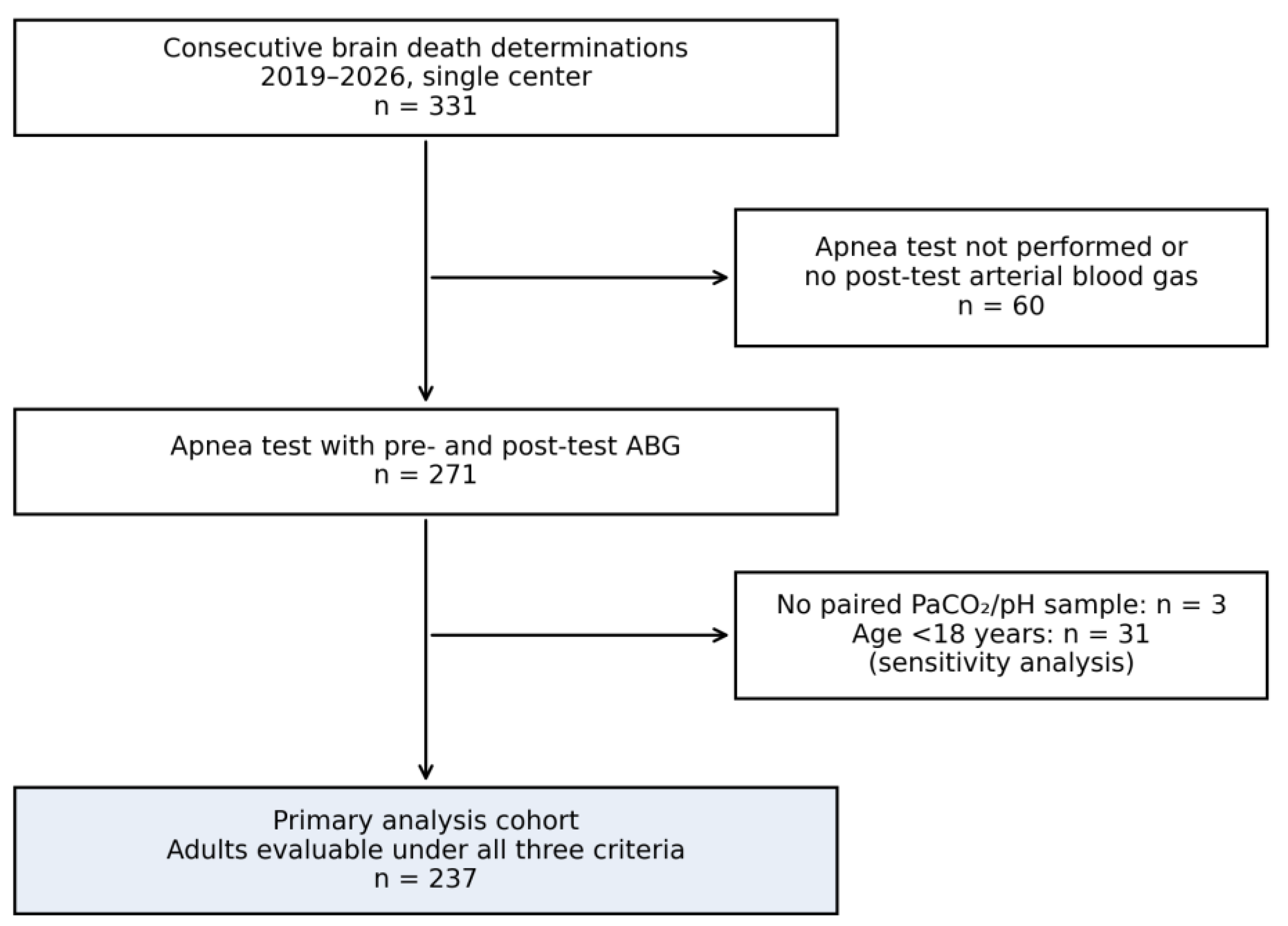
Figure 2.
(Left) Proportion of the same apnea tests meeting each criterion. (Right) End-of-test PaCO2 and pH for each patient, with the 60 mmHg and pH 7.30 thresholds shown as dashed lines. The ΔPaCO2 ≥20 mmHg condition cannot be represented on these two axes, so a small number of points lie inside the shaded thresholds without meeting the 2023 criterion.
Figure 2.
(Left) Proportion of the same apnea tests meeting each criterion. (Right) End-of-test PaCO2 and pH for each patient, with the 60 mmHg and pH 7.30 thresholds shown as dashed lines. The ΔPaCO2 ≥20 mmHg condition cannot be represented on these two axes, so a small number of points lie inside the shaded thresholds without meeting the 2023 criterion.
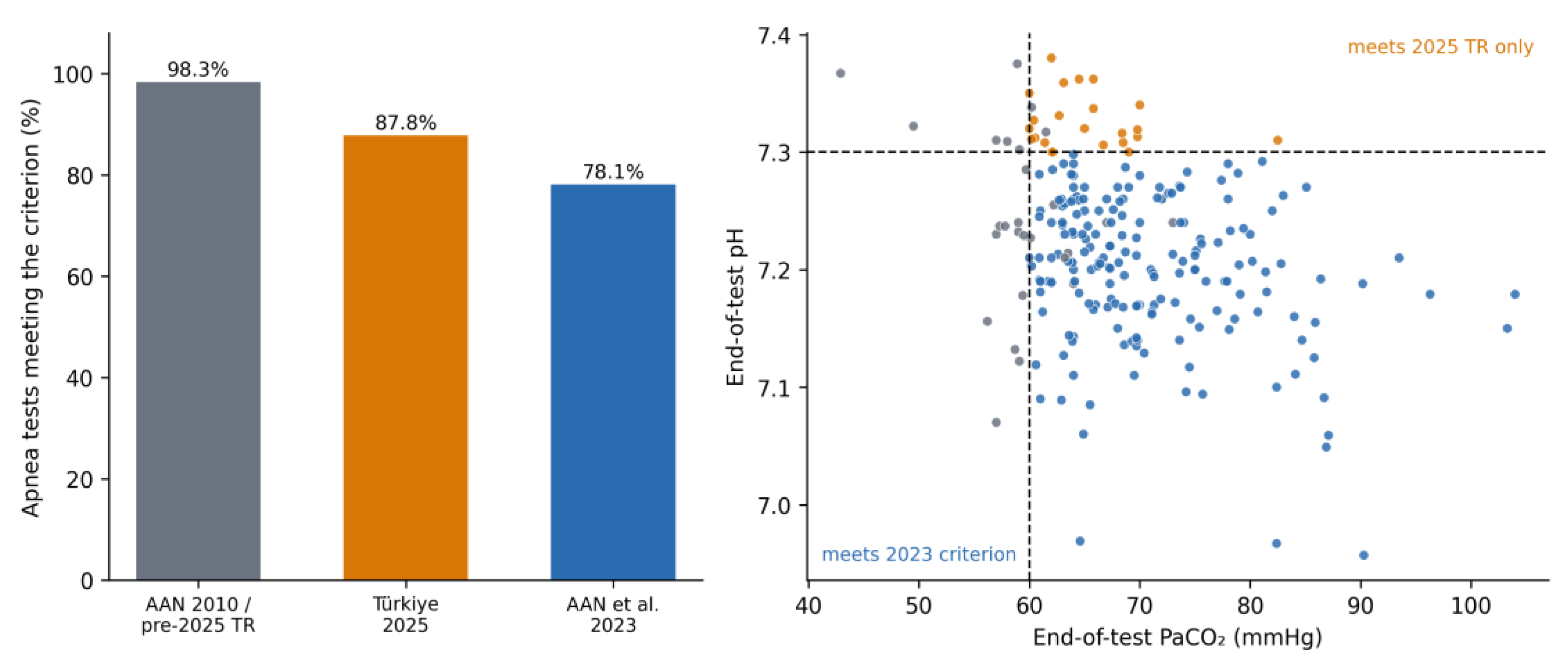
Figure 3.
Criteria met by pre-test bicarbonate stratum. The two carbon dioxide–defined criteria are indifferent to buffer status; the criterion containing a pH condition is not.
Figure 3.
Criteria met by pre-test bicarbonate stratum. The two carbon dioxide–defined criteria are indifferent to buffer status; the criterion containing a pH condition is not.
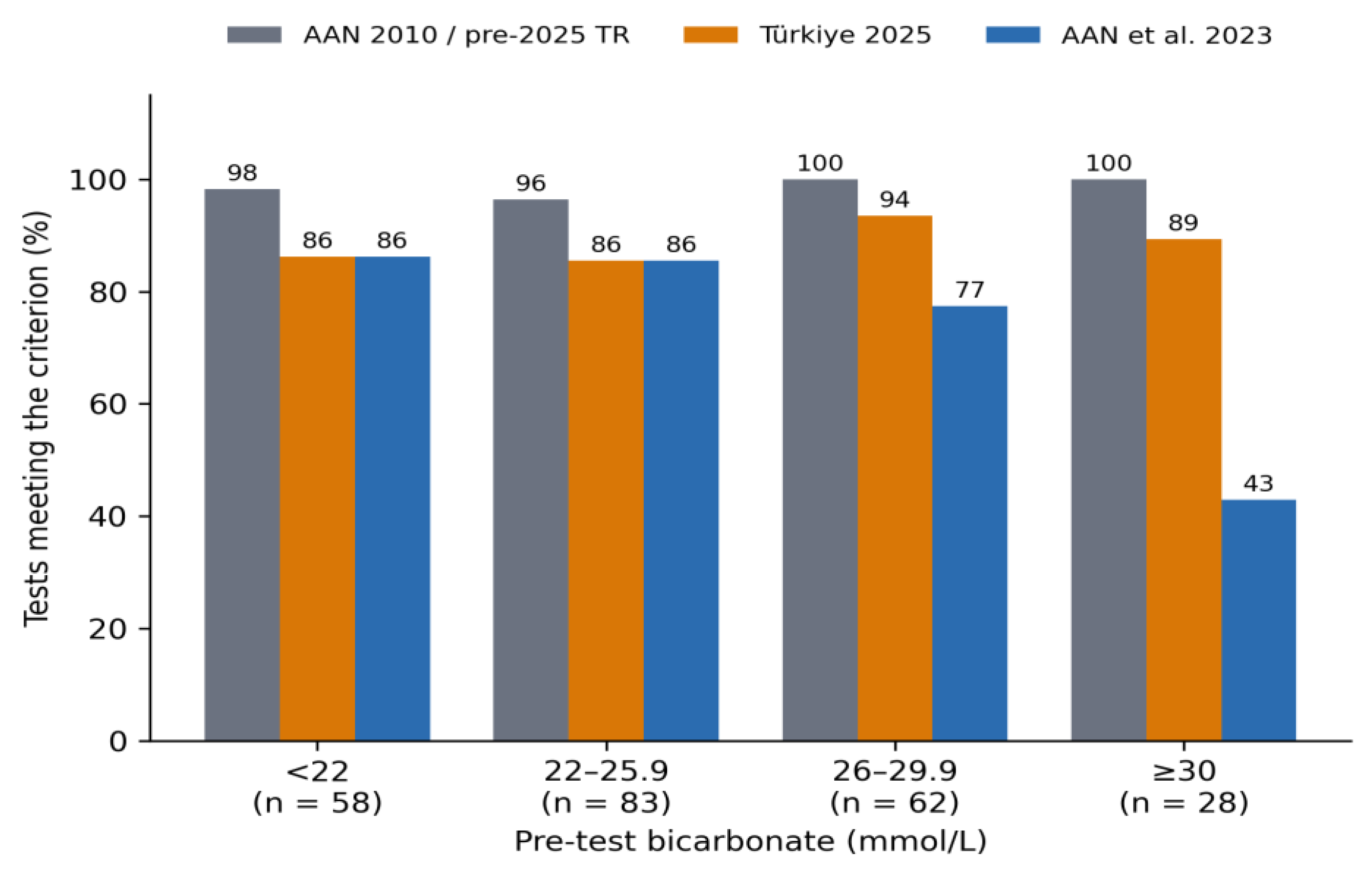
Figure 4.
Probability of meeting each criterion across the observed range of pre-test bicarbonate, from univariable logistic regression with a quadratic term, with 95% confidence bands. Curves are drawn between the 2nd and 98th centiles of bicarbonate; the bands widen at the upper end, where few patients lie.
Figure 4.
Probability of meeting each criterion across the observed range of pre-test bicarbonate, from univariable logistic regression with a quadratic term, with 95% confidence bands. Curves are drawn between the 2nd and 98th centiles of bicarbonate; the bands widen at the upper end, where few patients lie.
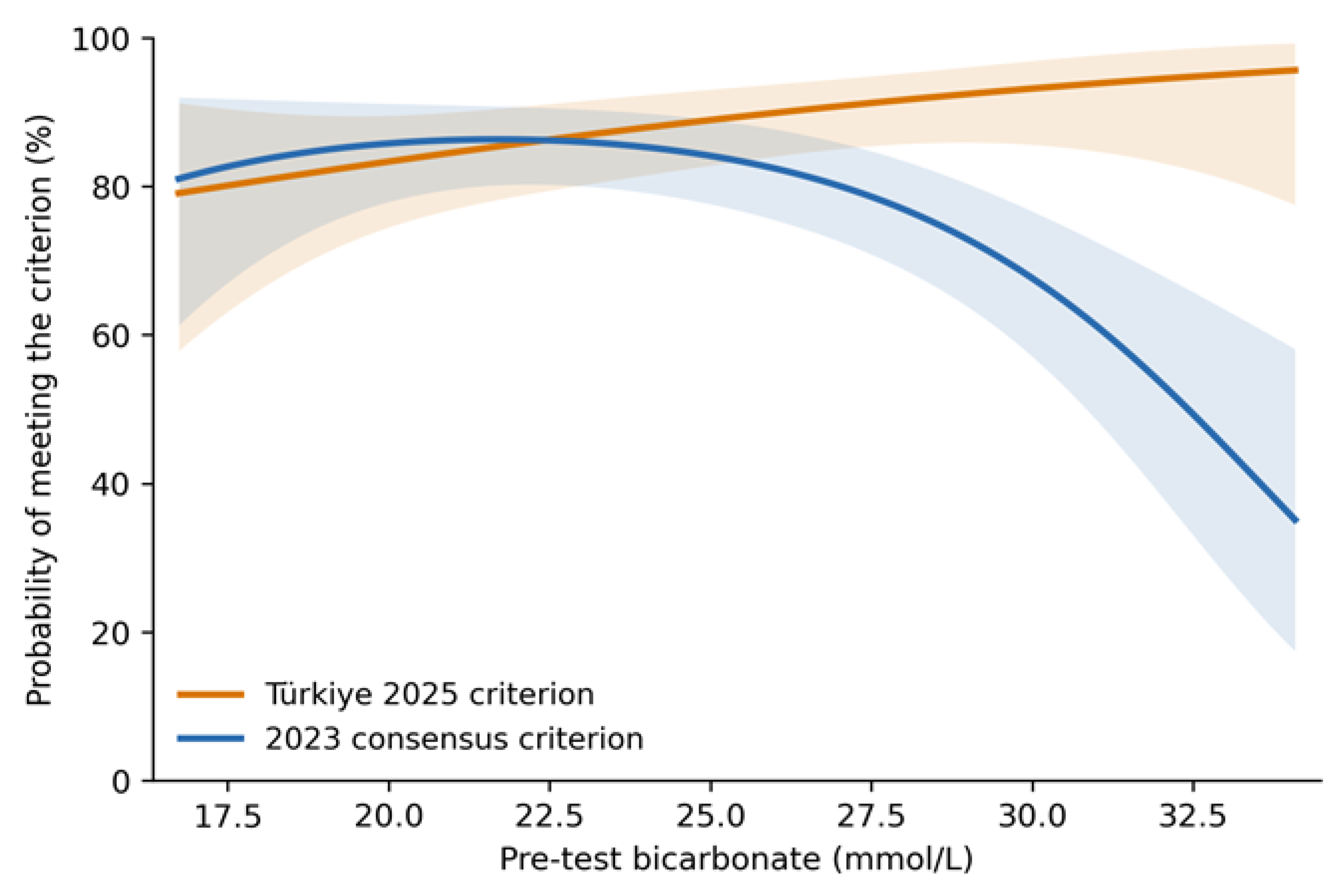
Table 1.
Characteristics of the primary cohort, overall and by status under the 2023 consensus criterion.
Table 1.
Characteristics of the primary cohort, overall and by status under the 2023 consensus criterion.
| Variable | All (n = 237) | Criterion met (n = 185) | Not met (n = 52) | p |
|---|---|---|---|---|
| Age, years | 52.0 (42.0–64.0) | 50.0 (41.0–64.0) | 54.5 (43.0–65.5) | 0.131 |
| Female sex, n (%) | 96 (40.5) | 66 (35.7) | 30 (57.7) | 0.006 |
| BMI, kg/m2 | 26.4 (24.4–29.1) | 26.4 (24.5–29.0) | 26.2 (23.9–30.0) | 0.903 |
| Etiology, n (%) | 0.023 | |||
| Traumatic brain injury | 38 (16.0) | 34 (18.4) | 4 (7.7) | |
| Subarachnoid hemorrhage | 90 (38.0) | 71 (38.4) | 19 (36.5) | |
| Intracerebral hemorrhage | 43 (18.1) | 33 (17.8) | 10 (19.2) | |
| Ischemic stroke | 19 (8.0) | 16 (8.6) | 3 (5.8) | |
| Hypoxic–ischemic encephalopathy | 21 (8.9) | 17 (9.2) | 4 (7.7) | |
| Brain tumor | 7 (3.0) | 2 (1.1) | 5 (9.6) | |
| CNS infection | 2 (0.8) | 1 (0.5) | 1 (1.9) | |
| Other | 17 (7.2) | 11 (5.9) | 6 (11.5) | |
| Decompressive craniectomy, n (%) | 52 (23.0) | 42 (23.7) | 10 (20.4) | 0.706 |
| Core temperature, °C | 36.5 (36.3–36.7) | 36.5 (36.3–36.7) | 36.4 (36.2–36.7) | 0.606 |
| Systolic BP before test, mmHg | 124.0 (111.2–140.0) | 123.0 (111.0–138.0) | 127.0 (113.0–141.0) | 0.149 |
| Vasopressor support, n (%) | 31 (13.1) | 28 (15.1) | 3 (5.8) | 0.102 |
| Serum sodium, mmol/L | 151.0 (143.0–160.0) | 151.0 (142.5–160.0) | 149.0 (143.0–159.0) | 0.869 |
| Serum chloride, mmol/L | 117.0 (106.5–127.0) | 116.0 (106.2–127.0) | 117.0 (117.0–118.0) | 0.782 |
| Pre-test pH | 7.41 (7.36–7.47) | 7.41 (7.35–7.44) | 7.47 (7.38–7.51) | <0.001 |
| Pre-test PaCO2, mmHg | 39.0 (36.4–41.7) | 39.1 (36.9–41.7) | 38.5 (35.7–41.0) | 0.185 |
| Pre-test HCO3−, mmol/L | 24.8 (21.9–27.7) | 24.4 (21.6–27.0) | 27.8 (23.1–31.0) | <0.001 |
| Pre-test base excess, mmol/L | 0.3 (-3.0–3.6) | -0.2 (-3.5–2.8) | 4.4 (-2.3–7.8) | <0.001 |
| Pre-test PaO2/FiO2 | 389.0 (303.0–499.5) | 382.0 (299.0–505.0) | 406.5 (327.5–466.0) | 0.738 |
| Pre-test lactate, mmol/L | 1.5 (1.1–2.2) | 1.5 (1.1–2.2) | 1.4 (0.8–2.2) | 0.313 |
| Apnea duration, min | 8.0 (8.0–12.0) | 8.0 (8.0–8.0) | 8.0 (8.0–12.0) | 0.096 |
| End-of-test PaCO2, mmHg | 67.2 (63.1–73.7) | 68.6 (64.1–75.1) | 61.0 (59.0–64.9) | <0.001 |
| End-of-test pH | 7.21 (7.17–7.26) | 7.21 (7.17–7.25) | 7.31 (7.24–7.32) | <0.001 |
| ΔPaCO2, mmHg | 28.0 (24.3–34.2) | 29.4 (25.6–36.4) | 22.4 (20.0–25.1) | <0.001 |
| PaCO2 rise rate, mmHg/min | 3.2 (2.6–4.1) | 3.4 (2.9–4.3) | 2.6 (2.0–3.0) | <0.001 |
Data are median (interquartile range) or n (%). p values from the Mann–Whitney U test or Fisher’s exact test; the etiology p value is a Monte Carlo exact test across all categories. Denominators vary with documentation of individual variables.
Table 2.
Criteria applied to the same 237 adults.
| Criterion | n/N | % (95% CI) |
|---|---|---|
| AAN 2010 / Türkiye before 2025: PaCO2 ≥60 mmHg or ΔPaCO2 ≥20 mmHg | 233/237 | 98.3 (95.7–99.3) |
| Türkiye 2025: PaCO2 ≥60 mmHg and ΔPaCO2 ≥20 mmHg | 208/237 | 87.8 (83.0–91.3) |
| AAN/AAP/CNS/SCCM 2023: PaCO2 ≥60 mmHg and ΔPaCO2 ≥20 mmHg and pH <7.30 (primary endpoint) | 185/237 | 78.1 (72.4–82.9) |
| World Brain Death Project 2020: PaCO2 ≥60 mmHg and pH <7.30 | 192/237 | 81.0 (75.5–85.5) |
| 2023 criterion with pH ≤7.28 | 174/237 | 73.4 (67.5–78.6) |
| PaCO2 ≥60 mmHg alone | 217/237 | 91.6 (87.3–94.5) |
| ΔPaCO2 ≥20 mmHg alone | 224/237 | 94.5 (90.8–96.8) |
| pH <7.30 alone | 205/237 | 86.5 (81.6–90.3) |
Wilson confidence intervals. The 2023 criterion requires all three conditions in a single arterial sample.
Table 3.
Criteria met, by pre-test bicarbonate stratum.
| Pre-test HCO3− (mmol/L) | n | AAN 2010, n (%) | Türkiye 2025, n (%) | pH <7.30, n (%) | 2023 criterion, n (%) | End-of-test pH |
|---|---|---|---|---|---|---|
| <22 | 58 | 57 (98.3) | 50 (86.2) | 58 (100.0) | 50 (86.2) | 7.15 (7.12–7.19) |
| 22–25.9 | 83 | 80 (96.4) | 71 (85.5) | 81 (97.6) | 71 (85.5) | 7.21 (7.19–7.24) |
| 26–29.9 | 62 | 62 (100.0) | 58 (93.5) | 49 (79.0) | 48 (77.4) | 7.26 (7.22–7.29) |
| ≥30 | 28 | 28 (100.0) | 25 (89.3) | 13 (46.4) | 12 (42.9) | 7.31 (7.27–7.33) |
p for trend < 0.001 for the pH condition and for the 2023 criterion; no trend for either carbon dioxide–defined criterion.
Table 5.
Firth penalised logistic regression for meeting the 2023 consensus criterion, with the Turkish criterion as a negative control.
Table 5.
Firth penalised logistic regression for meeting the 2023 consensus criterion, with the Turkish criterion as a negative control.
| Variable | Odds Ratio | 95% CI | p |
|---|---|---|---|
| Pre-test PaCO2, per 5 mmHg | 1.32 | 0.89–1.96 | 0.162 |
| Pre-test HCO3−, per mmol/L | 0.84 | 0.78–0.92 | <0.001 |
| Apnea duration, per min | 0.92 | 0.80–1.06 | 0.233 |
| Age, per year | 0.99 | 0.96–1.01 | 0.151 |
| Model 2 (categorical predictors) | |||
| Pre-test hypocapnia (<35 mmHg) | 0.54 | 0.20–1.62 | 0.256 |
| Pre-test HCO3− ≥30 mmol/L | 0.13 | 0.05–0.30 | <0.001 |
| Apnea duration, per min | 0.92 | 0.80–1.05 | 0.234 |
| Age, per year | 0.99 | 0.97–1.01 | 0.437 |
| Model 3 (pre-test pH) | |||
| Pre-test pH, per 0.05 unit | 0.64 | 0.51–0.81 | <0.001 |
| Apnea duration, per min | 0.93 | 0.82–1.06 | 0.283 |
| Age, per year | 0.99 | 0.97–1.01 | 0.184 |
| Negative control: Türkiye 2025 criterion | |||
| Pre-test PaCO2, per 5 mmHg | 1.03 | 0.63–1.69 | 0.902 |
| Pre-test HCO3−, per mmol/L | 1.09 | 0.98–1.20 | 0.102 |
| Apnea duration, per min | 0.97 | 0.82–1.15 | 0.746 |
| Age, per year | 0.99 | 0.96–1.01 | 0.304 |
Profile penalised-likelihood confidence intervals and penalised likelihood-ratio p values. Models 1 to 3 are alternative specifications of the same outcome; bicarbonate, its categorical form and pre-test pH are collinear and were therefore not combined.
Table 6.
Criteria met in the full cohort and in cohorts restricted to tests satisfying the pre-test preconditions.
Table 6.
Criteria met in the full cohort and in cohorts restricted to tests satisfying the pre-test preconditions.
| Cohort | n | AAN 2010, n/N (%) | Türkiye 2025, n/N (%) | 2023 criterion, n/N (%) | Positive under some but not all, n/N (%) |
|---|---|---|---|---|---|
| Full primary cohort | 237 | 233/237 (98.3) | 208/237 (87.8) | 185/237 (78.1) | 48/237 (20.3) |
| Pre-test pH 7.35–7.45 | 118 | 116/118 (98.3) | 106/118 (89.8) | 106/118 (89.8) | 10/118 (8.5) |
| All measurable preconditions met | 57 | 57/57 (100.0) | 51/57 (89.5) | 51/57 (89.5) | 6/57 (10.5) |
Restricted cohorts use the pre-test values recorded before disconnection. The third row additionally requires pre-test PaCO2 35–45 mmHg, core temperature ≥36 °C, systolic pressure ≥100 mmHg, serum sodium 130–160 mEq/L and PaO2/FiO2 ≥200.
Disclaimer/Publisher’s Note: The statements, opinions and data contained in all publications are solely those of the individual author(s) and contributor(s) and not of MDPI and/or the editor(s). MDPI and/or the editor(s) disclaim responsibility for any injury to people or property resulting from any ideas, methods, instructions or products referred to in the content. |
© 2026 by the authors. Licensee MDPI, Basel, Switzerland. This article is an open access article distributed under the terms and conditions of the Creative Commons Attribution (CC BY) license (http://creativecommons.org/licenses/by/4.0/).
Copyright: This open access article is published under a Creative Commons CC BY 4.0 license, which permit the free download, distribution, and reuse, provided that the author and preprint are cited in any reuse.