
Submitted:
26 October 2026
Posted:
27 October 2026
You are already at the latest version
Abstract
Cervical cancer is a major cause of morbidity and mortality among women in sub-Saharan Africa, where vaccination coverage remains below the World Health Or-ganization target of 90% of girls fully vaccinated by 15 years of age. This narrative review synthesizes evidence on HPV genotype distribution, single-dose versus two-dose vac-cination, and the implications of HIV co-infection. Although HPV16 and HPV18 remain the predominant oncogenic types, HPV35, HPV52, HPV45, HPV33, and HPV58 are re-ported frequently in sub-Saharan African populations. Consequently, some high-risk infections fall outside bivalent and quadrivalent vaccine coverage, and some detected types remain outside nonavalent vaccine coverage. Randomized trials in Tanzania and Kenya demonstrate durable single-dose immunogenicity through 60 months and vac-cine efficacy above 98% against persistent vaccine-type infection through 54 months, respectively. The ESCUDDO trial in Costa Rica provides a direct five-year randomized comparison showing noninferiority of one dose to two doses. Equivalent single-dose efficacy and durability evidence for people living with HIV remains unavailable. These findings support expanded single-dose vaccination in immunocompetent populations alongside multidose pathways for people living with HIV, genotype-specific surveil-lance, and continued cervical screening.
Keywords:
human papillomavirus
; cervical cancer
; sub-Saharan Africa
; HPV genotypes
; HPV vaccination
; single-dose vaccine
; HIV-HPV co-infection
; vaccine effectiveness
; cervical cancer screening
; immunogenicity
1. Introduction
Human papillomavirus (HPV) is one of the most common sexually transmitted infections (STI) worldwide, and persistent infection with oncogenic HPV genotypes is a necessary cause of invasive cervical cancer [1]. Cervical cancer was the fourth most frequently diagnosed cancer and the fourth leading cause of cancer death in women globally in 2024, with an estimated 604,196 new cases and 279,583 deaths [2].
The distribution of that burden is highly uneven. The WHO has projected that, without acceleration of prevention efforts, cervical cancer will continue to kill several hundred thousand women each year, with the large majority of deaths occurring in low- and middle-income countries (LMICs) and a disproportionate share in sub-Saharan Africa (SSA) [3].
HPV is transmitted principally through sexual contact. Micro-abrasions of the genital epithelium allow virions to access the basal layer of the squamous epithelium, where infection of proliferating basal keratinocytes is required for a productive and potentially persistent infection [4]. Most infections are transient and are cleared by the host immune response; a minority persist, and in a small subset persistent infection with a high-risk (HR) genotype drives progression through cervical intraepithelial neoplasia (CIN) to invasive disease over years to decades [1].
Two developments make a sub-Saharan Africa-focused synthesis timely. In December 2022, WHO recommended one- or two-dose schedules for immunocompetent individuals aged 9–20 years, with girls aged 9–14 years as the primary target population; the single-dose option is an alternative, off-label public-health recommendation. Immunocompromised individuals, including people living with HIV (PLHIV), should receive at least two doses and, where possible, three [5]. Second, an expanding body of SSA pooled analyses and studies from several countries indicate that some HR types reported in the region are not included in the vaccine formulations most commonly used [6,7,8,9]. These two observations pull in different directions: dose reduction improves reach and affordability, while genotype diversity argues for broader valency. Reconciling them requires region-specific evidence.
This review therefore aims to: (1) synthesize the reported distribution of circulating HPV genotypes across SSA; (2) evaluate evidence comparing single-dose and two-dose HPV vaccination, with particular emphasis on trials conducted in SSA populations; and (3) assess the implications of HIV co-infection for HPV natural history, genotype distribution and vaccine response. Evidence from outside SSA is included where it provides essential comparative evidence on vaccine dosing, immunogenicity or long-term effectiveness. We also identify research gaps that investigators and research networks in SSA are well positioned to address.
2. Review Approach
Sources were selected purposively for relevance to the review’s three predefined objectives. The evidence base included peer-reviewed primary studies, randomized trials, observational cohorts, systematic reviews, meta-analyses, modeling studies, and current guidance or surveillance reports from WHO, IARC, and Gavi. Priority was given to primary data from SSA and to studies measuring vaccine efficacy, comparing dose schedules, or comparing vaccine-induced antibody responses with those in groups in which protection has already been demonstrated (immunobridging). Studies conducted outside SSA were included when they provided essential comparative evidence on dose schedules, immunogenicity, efficacy, or long-term effectiveness. Literature available through September 2026 was considered. This was a narrative rather than a systematic review; no protocol was registered, and no duplicate screening, formal risk-of-bias assessment, or quantitative synthesis was undertaken. Findings are therefore presented as a critical narrative synthesis of a heterogeneous evidence base.
3. HPV Biology and Pathogenesis
3.1. Classification
HPVs are small, non-enveloped, double-stranded DNA viruses of the family Papillomaviridae. More than 200 HPV types have been characterized and are assigned to five genera, of which alpha, beta, gamma, mu and nu contain the human types [4]. Members of the alphapapillomavirus genus include the HPV types established as causes of cervical cancer [1].
Genotypes are conventionally divided into HR and low-risk (LR) groups on the basis of epidemiological association with cervical cancer rather than on phylogeny alone. In the 2003 pooled analysis that established an epidemiological classification, 15 types were categorized as high risk: HPV 16, 18, 31, 33, 35, 39, 45, 51, 52, 56, 58, 59, 68, 73, and 82 [10]. LR types are most often implicated in anogenital warts and recurrent respiratory papillomatosis, whereas HR types are associated with carcinomas of the cervix, vulva, vagina, penis, anus and oropharynx [1].
3.2. Infection and the Viral Life Cycle
Infection is initiated when virions reach basal keratinocytes through micro-wounds or at transformation zones where the epithelium is thin, such as the cervical squamocolumnar junction [4]. Following entry, the viral genome is maintained at low copy number as an episome in the basal compartment. Productive viral replication and capsid assembly are coupled to keratinocyte differentiation, so that virion production is confined to the superficial epithelial layers [11]. Because the infectious cycle is intraepithelial, involves minimal cell lysis and produces no viremia, it generates only limited innate immune activation, which contributes to a modest and slowly developing natural antibody response [11].
3.3. From Persistent Infection to Invasive Cancer
Approximately 90% of HPV infections become undetectable within one to two years [1]. Persistence of an HR infection is the key intermediate step toward neoplasia. In persistent infection, deregulated E6/E7 expression—often, but not invariably, associated with integration of viral DNA into the host genome and loss of E2-mediated control—drives degradation of p53 and inactivation of retinoblastoma protein, genomic instability, and clonal expansion [1,4]. Histologically, this progresses through CIN2 and CIN3, which are often grouped analytically as CIN2+, with CIN3 representing the immediate precursor of invasive carcinoma. The two phases differ in pace: CIN3 can arise within a few years of a persistent infection, whereas progression from CIN3 to invasive carcinoma typically takes a decade or longer. This prolonged detectable precancerous phase is what makes screening effective [1]. Figure 1 summarizes the infection cycle and the pathway to carcinogenesis.
3.4. The Cervicovaginal Microbiome
Evidence suggests that the composition of the cervicovaginal microbiome modifies HPV persistence. Lactobacillus-dominant communities are associated with more rapid clearance, whereas depletion of Lactobacillus species, higher bacterial diversity and communities in which Lactobacillus iners or anaerobic taxa predominate are associated with prevalent HPV infection, delayed clearance and higher-grade lesions [12]. In a longitudinal analysis, microbiome features were associated with the natural history of HPV infection independently of baseline cytology [12]. These associations are largely observational and directionality remains incompletely resolved: dysbiosis may facilitate persistence, HPV infection may alter the microbial community, or both may share upstream determinants. Data from SSA cohorts are limited, which is a notable gap given that bacterial vaginosis has been associated with prevalent HPV infection in SSA study populations [13].
3.5. Disease Spectrum Beyond Cervical Cancer
HPV contributes to a wider disease spectrum. LR types 6 and 11 cause the majority of anogenital warts. HR types, predominantly HPV 16, are implicated in a substantial fraction of anal, vulvar, vaginal, penile and oropharyngeal cancers [1]. The attributable fraction varies by site and geography, and SSA data on non-cervical HPV-associated cancers remain sparse relative to cervical cancer data. Because cervical cancer accounts for most of the HPV-attributable cancer burden in SSA women, the remainder of this review focuses primarily on cervical disease while noting that vaccination and surveillance decisions have implications across all HPV-associated sites [1].
4. Epidemiology of HPV in Sub-Saharan Africa
4.1. Regional Patterns
Pooled analyses of women with normal cytology place Africa among the world regions with the highest HPV prevalence [14]. A systematic review and meta-analysis of African studies likewise reported higher pooled prevalence in women with neoplasia than in women with normal cytology [8]. Reported estimates vary widely between and within countries, reflecting genuine epidemiological heterogeneity as well as differences in study population (community-based versus clinic-based), age structure, HIV prevalence, specimen type and the analytical sensitivity and type coverage of the assay used. Comparisons across studies should therefore be interpreted with caution, and Table 1 reports assay and population characteristics alongside prevalence estimates.
HIV contributes substantially to cervical cancer burden, but its contribution varies across SSAn subregions. In a model of cervical cancer burden in 2020, the estimated fraction attributable to HIV was highest in Southern Africa (43.5%), followed by Eastern Africa (23.4%), Central Africa (10.0%) and Western Africa (8.9%) [21]. Figure 2 presents HPV prevalence and HIV-attributable cervical cancer as separate measures; these aggregated estimates do not establish that HIV explains subregional differences in HPV prevalence [8,21].
4.2. Age-Stratified Patterns
HPV prevalence in SSA populations peaks in adolescence and young adulthood. In a cohort of women aged ≤30 years in KwaZulu-Natal (median 21 years; IQR 18–23), HPV prevalence was 76.3%, with HPV 16, 18, 33, 35, 39, 45, 51, 52, 56 and 58 among the most frequently detected types [15]. Among unvaccinated, HIV-negative South African women aged 16-22 years, any HPV was detected in 66.7% (194/291) [13]. The authors interpreted their findings as supporting introduction of the nonavalent vaccine and catch-up vaccination campaigns [13]. Such vaccination aims to prevent new infections with vaccine-targeted types not yet acquired, rather than clear infections already present [5,13]. In Tanzania, a decade of adolescent research documented high HPV prevalence and high incidence of new infection among sexually active girls, with rates exceeding those in older women [22].
Unlike many high-income settings, several African studies do not show a marked decline in prevalence after the third decade of life. A second peak or a sustained plateau in older women has been reported and may reflect reactivation of latent infection, new acquisition, or reduced clearance in the context of HIV [8,18].
4.3. Behavioral and Structural Correlates
Early age at sexual debut, higher lifetime number of partners, concurrent or polygynous partnerships, non-cohabiting partnerships, other sexually transmitted infections (STIs) and bacterial vaginosis have all been associated with prevalent HPV in African study populations [13,15]. In a community-based study in rural Zimbabwe, however, several conventional risk markers, including age at first pregnancy, educational attainment and oral contraceptive use, were not associated with HPV positivity, which the authors interpreted as consistent with near-ubiquitous community-level exposure [6]. These findings suggest that conventional risk markers may have limited discriminatory value in that setting; they should not be used alone to determine screening eligibility.
Structural determinants are at least as important as behavioral ones. Distance to health facilities, out-of-pocket costs, limited laboratory and cold-chain infrastructure, shortages of trained providers and low awareness of HPV all constrain both screening and vaccination [23]. In one rural Zimbabwean survey, 81% of women had heard of cervical cancer but only 12% had heard of HPV, and only 5% had ever been screened [6].
5. HPV Genotype Distribution in Sub-Saharan Africa
5.1. Global Baseline
Globally, HPV 16 and HPV 18 together account for approximately 70% of invasive cervical cancers, with HPV 16 alone responsible for the largest single share [24]. HPV 31, 33, 45, 52 and 58, the five additional oncogenic types covered by the nonavalent vaccine, contribute a further estimated 12-20% [25]. Type distribution in women with normal cytology is broader and less dominated by HPV 16 than distribution in cancer, reflecting differences in oncogenic potential between types [14,24].
5.2. Differential Distribution in Sub-Saharan African Populations
A consistent finding across African studies is a relatively larger contribution of non-16/18 high-risk types. In invasive cervical cancer specimens from SSA, HPV 16 and HPV 18 remained the most common types, but HPV 35 and HPV 45 were detected more frequently than in most other world regions [9]. Pooled African data similarly identify HPV 35, 52, 58, 45 and 33 among the most prevalent non-16/18 high-risk types [8].
HPV 35 has attracted particular attention. HPV 35 has been reported frequently in several African populations, including rural Zimbabwe [6]. Among Zimbabwean women living with HIV (WLHIV) attending routine screening in Harare (n = 2,745), the most prevalent genotypes were HPV 58 (11%), HPV 52 (10%), HPV 35 (10%) and HPV 16 (9%) [26]. In a cross-sectional study of 240 Zimbabwean women with histologically confirmed cervical cancer, HPV 16 (35%), HPV 35 (33%) and HPV 18 (32%) were the most prevalent types [27]. At a rural mission hospital in northern Zimbabwe, 87 of 113 genotype detections (77%) classified as high-risk in the study were types not directly targeted by the bivalent or quadrivalent vaccines, including HPV 35, HPV 45, HPV 52, HPV 58 and HPV 68. Of the 113 detections, 53 (47%) were types not included in the nonavalent vaccine: HPV 35, HPV 39, HPV 51, HPV 53, HPV 56, HPV 66, HPV 68, HPV 69 and HPV 73 [16].
Importantly, the significance of HPV 35 is not only its frequency. Among HPV 35-positive women, the association with CIN3 was reported to be approximately tenfold stronger in women of African ancestry than in white women and identified E7 sequence variants specific to African-ancestry populations, suggesting viral-host interaction [7]. Whether these variants translate into differences in carcinogenicity has not been established, and this remains an open question rather than a settled finding [7].
Country- and region-specific patterns include the following. In Kenya, a systematic review and meta-analysis among HIV-positive women reported that HPV 16 was the most prevalent type in women with abnormal cytology (26%, 95% CI 23-30%), followed by HPV 35 (21%, 95% CI 18-25%) and HPV 52 (18%, 95% CI 15-21%); in invasive cervical cancer the most prevalent types were HPV 16 (37%, 95% CI 28-47%) and HPV 18 (24%, 95% CI 16-33%) [18]. In Burundi, genotype distribution differed by both HIV status and urban or rural residence: among HIV-positive women in urban areas the most common high-risk or probable high-risk types were HPV 52, 51, 56, 18 and 16, whereas among HIV-negative urban women HPV 66, 67, 18, 45 and 39 predominated; in rural areas HPV 66, 16, 18 and 33 predominated among HIV-positive women and HPV 16, 66, 18, 35 and 45 among HIV-negative women [19]. In Ethiopia, an opinion article synthesising published genotype data reported HPV 16 in over 37% of HPV-positive women and HPV 18 in only 4.4%, with non-16/18 high-risk types accounting for approximately 46% of high-risk infections [28]. South African data likewise show high prevalence of non-vaccine high-risk types in adolescents and young women [13,15].
5.3. Implications for Vaccine Type Coverage
The bivalent HPV vaccines target HPV16 and HPV18, the quadrivalent vaccine additionally targets HPV 6 and HPV 11, and the nonavalent vaccine additionally targets HPV 31, HPV 33, HPV 45, HPV 52, and HPV 58 [25,29]. In a rural Zimbabwean study, 69% of detected high-risk HPV genotypes were outside the HPV16/18 targets of the bivalent vaccines, whereas 32% were outside the oncogenic types targeted by the nonavalent vaccine [6]. In Ethiopia, an analogous genotype-coverage analysis estimated that approximately 46% of detected high-risk HPV infections involved types not targeted by the quadrivalent vaccine [28].
These estimates describe genotype coverage, not vaccine effectiveness, and should not be read as predicted vaccine failure. Three qualifications matter. First, oncogenic potential differs markedly between types, so the proportion of infections covered is not the proportion of cancers averted; HPV 16 in particular contributes disproportionately to cancer relative to its share of infections [24]. Second, some bivalent-vaccine studies have reported cross-protection against selected non-vaccine types, particularly HPV 31, 33, and 45; evidence for HPV 35 is less certain [30]. Third, most coverage analyses are based on prevalent infection in screening populations rather than on cancer specimens. Even allowing for these qualifications, broader-valency formulations may increase direct HPV type coverage in SSAn settings, although their incremental cancer-prevention benefit requires cancer-weighted, country-specific evaluation. Continued cervical screening remains necessary in vaccinated cohorts [31].
6. HPV Vaccines: Products, Coverage and Effectiveness
6.1. Available Products
WHO’s 2024 product-choice guidance lists five WHO-prequalified HPV vaccines: Cervarix, Cecolin, and Walrinvax (bivalent); Gardasil (quadrivalent); and Gardasil 9 (nonavalent). Cervavac is nationally licensed but was not listed as WHO-prequalified in the guidance [29]. All are virus-like particle (VLP) vaccines based on the L1 major capsid protein, are prophylactic rather than therapeutic, and do not clear established infection [25]. Additional WHO-prequalified bivalent products manufactured outside the traditional supplier base have entered the market and are relevant to supply security and price in SSA [5]. Table 2 summarizes products, manufacturers, types covered and current status relevant to African immunization programs.
6.2. Program Introduction and Coverage
By the end of April 2026, 36 countries in the WHO African Region had introduced HPV vaccine, and 11 additional countries planned introduction by 2029. Because WHO regional boundaries are not geographically identical to SSA, these figures are presented as regional program context rather than as an exact SSA estimate. HPV vaccination coverage in the WHO African Region was reported as 47% for 2024 [32,35].
Coverage varies substantially between countries and districts within countries. Post-introduction coverage surveys in three Zimbabwean districts illustrate both the achievable reach of school-based delivery and the loss between first and second dose [33]. In England, high sustained coverage was associated with substantial reductions in CIN3 and cervical cancer incidence [36]. These results come from high-income settings, and their magnitude should not be assumed to transfer directly to African programs with different coverage, genotype distribution and HIV prevalence.
6.3. Barriers to Uptake
Systematic reviews of SSA identify recurring barriers: insufficient information about the vaccine among parents, adolescents and health workers; concern about adverse events and about effects on fertility; cost and financing uncertainty; limited cold-chain and transport capacity; difficulty reaching out-of-school girls; and competing demands on health workers during campaign delivery [23]. Facilitators include school-based delivery, inter-ministerial collaboration between health and education sectors, provider recommendation, community and religious leader engagement, and integration with other adolescent health services [23]. Delivery costs are non-trivial. In Zimbabwe’s demonstration project, the mean financial cost per fully immunized girl was US$40.03 and the economic cost was US$91.19, with school-based delivery substantially cheaper per girl than facility or outreach delivery [33].
6.4. Two-Dose Schedule Evidence
The two-dose schedule for individuals aged 9-14 years was adopted after immunobridging studies showed that antibody responses to two doses in this age group were non-inferior to three doses in older adolescents and young women in whom efficacy had been demonstrated [5,37]. Long-term follow-up supports durability: two-dose recipients maintain seropositivity and antibody concentrations over years, with non-inferiority to three doses demonstrated for most vaccine types, although non-inferiority has not been met for every type in every comparison, notably HPV 18 in some analyses [37]. Wider dosing intervals appear to yield antibody responses at least as high as a six-month interval [37].
Direct two-dose effectiveness data from African settings are limited. The DoRIS trial in Tanzania included two-dose arms and is the principal randomized source of two-dose immunogenicity data generated in Africa; at 36 months, two-dose Gardasil 9 recipients were seropositive for all nine vaccine types in almost all cases, including 98.6% seropositivity for HPV 45 and HPV 52 [38,39]. Population-level two-dose effectiveness studies in African cohorts are largely still in progress.
6.5. Single-Dose Schedule Evidence
Table 3 summarizes the principal trials and cohorts comparing single-dose with multi-dose HPV vaccination, together with their designs, populations, follow-up durations and principal findings.
6.5.1. Observational Foundations
Interest in a single dose grew from post-hoc analyses of two trials not designed to test dose reduction. In the Costa Rica Vaccine Trial (CVT), women who received a single dose of the bivalent vaccine maintained stable antibody concentrations and protection against HPV 16/18 infection for more than a decade [49]. In the International Agency for Research on Cancer (IARC) India cohort, in which randomisation was interrupted, recipients of one, two or three doses of the quadrivalent vaccine were followed for 10 years; vaccine efficacy against persistent HPV 16/18 infection after a single dose was comparable to that after two or three doses [50]. An updated systematic review of clinical-trial evidence concluded that a single dose appeared to offer comparable protection against HPV infection to two or three doses up to seven years after vaccination, while noting the observational and post-hoc nature of most data [51].
6.5.2. Randomized Evidence from sub-Saharan Africa
Two randomized trials in African populations now anchor the evidence base.
The DoRIS trial (Dose Reduction Immunobridging and Safety Study, NCT02834637) randomized 930 HIV-negative Tanzanian schoolgirls aged 9-14 years in Mwanza to one, two or three doses of the bivalent or the nonavalent vaccine. At 24 months, 99% of single-dose recipients of either vaccine were seropositive for HPV 16 IgG, meeting the prespecified non-inferiority criterion against two and three doses. Non-inferiority criteria for HPV 18 seropositivity were not met, although more than 98% of girls in all groups were HPV 18 seropositive. Antibody geometric mean concentrations (GMCs) after one dose were lower than after two or three doses. Fifty-three serious adverse events occurred in 42 of 930 girls, most commonly hospital admission for malaria, with no events considered vaccine related [38].
In the long-term extension to month 60, single-dose HPV 16 seropositivity exceeded 99% with either vaccine and remained non-inferior to two doses. HPV 18 seropositivity at month 60 was 98% in the one-dose bivalent group and 93% in the one-dose nonavalent group, and the non-inferiority criteria for HPV 18 were again not met. Single-dose HPV 16 and HPV 18 GMCs were lower than after two doses but remained stable between month 12 and month 60, and there was no evidence of a difference in antibody avidity at month 36 [40]. Multiplex assessment of the nonavalent arms at month 36 showed all one-dose recipients seropositive for HPV 16, 31 and 58; 96.8-98.2% seropositive for HPV 11, 18 and 33; and 73.0-87.7% seropositive for HPV 6, 45 and 52, compared with 98.6% for HPV 45 and 52 after two doses [39]. Participants are being followed to nine years [40].
The KEN SHE trial (NCT03675256) randomized 2,275 Kenyan women aged 15-20 years to single-dose bivalent vaccine, single-dose nonavalent vaccine or meningococcal vaccine as control. At 18 months, vaccine efficacy against incident persistent HPV 16/18 infection was 97.5% for both HPV vaccines [43]. At three years, 75 incident persistent HPV 16/18 infections were detected in the modified intention-to-treat cohort: two in the bivalent group, one in the nonavalent group and 72 in the control group; nonavalent efficacy was 98.8% (95% CI 91.3-99.8) and bivalent efficacy 97.5% (95% CI 90.0-99.4). Against the seven high-risk types covered by the nonavalent vaccine, efficacy was 95.5% (95% CI 89.0-98.2). No vaccine-related serious adverse events were reported [45].
DoRIS directly randomized girls to one-, two-, or three-dose schedules but evaluated immunogenicity rather than virological efficacy. KEN SHE evaluated single-dose efficacy against a meningococcal-vaccine control and did not include a concurrent multidose HPV arm.
6.5.3. Head-to-Head Randomized Comparison of One and Two Doses
The first randomized trial designed to compare one dose directly with two doses of the same vaccine has now reported. The ESCUDDO trial (NCT03180034) enrolled approximately 20,000 girls aged 12-16 years in Costa Rica and randomly assigned them, double-blind, to one or two doses of the bivalent or the nonavalent vaccine; for ethical reasons no placebo arm was included, and absolute vaccine effectiveness was estimated by comparison with a concurrent survey of unvaccinated girls and young women [46]. One dose met the prespecified criteria for non-inferiority to two doses against persistent HPV 16/18 infection for both vaccines, and effectiveness against HPV 16/18 infection relative to the unvaccinated survey population was at least 97% [47]. For the nonavalent vaccine, efficacy against HPV 18 between years 4 and 5 was similar after one and two doses (97.1% and 97.6%, respectively) [47]. Long-term observational follow-up of the Costa Rica Vaccine Trial has separately shown HPV 16 and HPV 18 seropositivity of 99.4% and 98.8% among single-dose recipients 16 years after vaccination [48].
6.5.4. Immunobridging
Because efficacy endpoints are not obtainable in girls vaccinated before sexual debut within a feasible timeframe, immunobridging has been used to extend efficacy inferences to the target age group. Single-dose HPV 16 and HPV 18 GMCs at 24 months in DoRIS were non-inferior to those in single-dose recipients in CVT and the IARC India cohort: for the bivalent comparison, GMC ratios (Doris: VT) were 1.30 (95% CI 1.00-1.68) for HPV 16 and 1.23 (95% CI 0.95-1.60) for HPV 18; for the nonavalent comparison against IARC India, ratios were 2.05 (95% CI 1.61-2.61) and 2.12 (95% CI 1.59-2.83) respectively [41]. In a subsequent analysis, month 24 GMCs in DoRIS were non-inferior to those in single-dose KEN SHE participants, in whom efficacy had been demonstrated: bivalent GMC ratios were 0.90 (95% CI 0.72-1.14) for HPV 16 and 1.02 (95% CI 0.78-1.33) for HPV 18, and nonavalent ratios were 1.44 (95% CI 1.14-1.82) and 1.47 (95% CI 1.13-1.90) [41]. Figure 3 presents these comparisons.
6.5.5. Modeling and Cost-Effectiveness
Modeling analyses indicate that single-dose vaccination could avert a large proportion of the cervical cancers averted by two doses in LMIC settings, provided protection is sufficiently durable, and that the population-level benefit of reallocating doses to increase coverage can exceed the benefit of second doses to already-vaccinated girls [52,53]. Cost data supports the same direction. In Tanzania, the financial cost per fully immunized girl was US$5.17 under a two-dose schedule and US$2.51 in a modeled single-dose scenario, with economic costs falling from US$23.34 to US$12.18 [54]. These are model-based or scenario-based estimates and are sensitive to assumptions about duration of protection.
6.6. Implications of Dose Reduction for sub-Saharan Africa
The programmatic case is strong. A single dose halves vaccine procurement volume in a supply-constrained market, removes the requirement to trace and revaccinate girls after 6-12 months, reduces service delivery and cold-chain burden, and simplifies campaigns for out-of-school populations [54,55]. Stakeholder research across 19 LMICs found broad enthusiasm for single-dose schedules, motivated by anticipated gains in schedule completion and coverage and by savings for countries transitioning out of Gavi co-financing [55]. Among Kenyan health-care professionals, 76% considered a single-dose schedule acceptable or very acceptable, with lack of information the main reason cited by those who were hesitant [56].
Three cautions temper this. First, long-term data from SSA populations remain limited relative to the decades over which cervical cancer develops. Randomized African follow-up now extends to five years for immunogenicity in the DoRIS trial and 54 months for efficacy in the KEN SHE trial. At 54 months, single-dose vaccine efficacy against incident persistent HPV16/18 infection was 99.3% (95% CI 96.2–99.9), while efficacy against persistent infection with the seven high-risk types included in the nonavalent vaccine was 98.9% (95% CI 94.9–99.8) [40,44]. Although these findings demonstrate high and durable protection over the observed period, longer follow-up remains necessary to establish protection across the timeframe relevant to cervical-cancer development. Second, HPV 18 antibody responses after a single dose did not meet the prespecified non-inferiority criterion in the DoRIS trial, although seropositivity remained high [38,40]. Separately, the ZIMGARD study raised a hypothesis concerning HPV 18 immunity, but its cross-sectional design cannot establish waning immunity or vaccine failure [57]. This concern is now partly, though not wholly, addressed: ESCUDDO found similar efficacy against HPV 18 after one and two doses of the nonavalent vaccine at four to five years, which suggests that lower HPV 18 antibody concentrations after a single dose need not translate into measurably lower protection over that interval [47]. ESCUDDO enrolled HIV-negative girls in a setting with a different genotype distribution from most Africa, so the inference should not be extended to PLHIV. Third, protection against non-vaccine types after a single dose remains incompletely characterized. Separately, in the DoRIS 9vHPV substudy, seropositivity after one dose was lower than after two doses for three vaccine-included types -HPV6, 45, and 52 -although the clinical significance is uncertain because no correlate of protection has been established [39]. Reported delays in national decision-making about single-dose adoption in high-HIV-burden countries reflect precisely these concerns [55]. Genotype-specific surveillance should therefore be incorporated into implementation where single-dose schedules are adopted at scale.
7. HIV-HPV Co-infection
7.1. Epidemiological Overlap
HIV and HPV burdens overlap geographically and demographically in SSA. Globally, an estimated 5.8% of cervical cancers are attributable to HIV, and WLHIV have approximately six times the risk of cervical cancer of women without HIV [58]. The concentration in Africa is stark: in SSA, 24.9% of cervical cancers are diagnosed in WLHIV and 20.4% are attributable to HIV, compared with 1.3% and 1.1% respectively in the rest of the world [21]. The HIV-attributable fraction is strongly age-dependent; in Southern Africa it has been estimated at 86% in women aged 34 years or younger, falling to 12% in women aged 55 years and older, so that HIV-attributable disease is concentrated in younger women [21]. Consistent with this, record-linkage data from South Africa show WLHIV presenting with cervical cancer approximately a decade earlier than women without HIV [21].
7.2. Mechanisms of Increased Vulnerability
HIV-associated depletion and activation of cervical mucosal CD4 T cells may impair local immune control of HPV and contribute to HPV-associated cervical lesions [59]. Longitudinal meta-analyses indicate that HIV infection is associated with increased HPV acquisition and reduced HPV clearance; prevalent HPV infection has also been associated with increased HIV acquisition, supporting a bidirectional relationship [60]. Multiple-type infection is more common in PLHIV, increasing the probability that at least one persistent high-risk infection is present [18,19]. In the Harare cohort, HPV-related outcomes varied with markers of HIV disease and treatment history, although the observational design does not establish causality [61].
7.3. Genotype Distribution in People Living with HIV
Although HPV16 remains important, PLHIV often have broader multiple-type distributions with substantial non-16/18 high-risk HPV burden. In Harare, hrHPV prevalence among 2,745 WLHIV attending routine screening was 53%, with HPV 58, 52 and 35 each as or more prevalent than HPV 16 [26]. In an earlier Harare cohort, 65% of hrHPV-positive WLHIV carried types other than HPV 16 or 18/45 [61]. At a rural Zimbabwean hospital, hrHPV was detected in 27% of HIV-positive versus 15% of HIV-negative women [16]. In Burundi, type distribution differed by HIV status and by urban or rural residence, and both HPV and HIV infection were independent risk factors for cervical lesions [19]. Ethiopian data indicate a higher HPV 35 contribution among HIV-positive than HIV-negative women [28]. Table 4 summarizes HIV-HPV co-infection studies in SSA populations.
7.4. Role of Antiretroviral Therapy
Antiretroviral therapy (ART) modifies but does not abolish excess risk. A systematic review and meta-analysis found that ART use, and particularly sustained virological suppression and higher CD4 counts, was associated with reduced hrHPV prevalence and persistence and with reduced progression, and with increased regression, of cervical lesions in WLHIV; effects on invasive cervical cancer incidence were less clear [62]. In the Harare cohort, women on second-line ART were more likely to be hrHPV-positive, plausibly reflecting longer or less well-controlled disease history rather than a treatment effect [61]. Even among women with long ART duration and high rates of viral suppression, hrHPV prevalence remained 53% [26], and incident cervical disease in the earlier Harare cohort occurred only among hrHPV-positive women [61]. The operational conclusion is that ART expansion does not remove the need for cervical screening in WLHIV.
7.5. Post-Vaccination HPV Detection and Immune Response in People Living with HIV
Post-marketing data generated in SSA are still sparse but informative. In the ZIMGARD cohort at Newlands Clinic, Harare, 98 adolescents and young adults with perinatally acquired HIV were assessed a mean of six years after quadrivalent vaccination. Any HPV was detected in 68/98 participants (69%): 38/98 (39%) had both high- and low-risk types, 17/98 (17%) had high-risk types only, and 13/98 (13%) had low-risk types only. The authors proposed possible waning of HPV18 immunity and reduced cross-protection against HPV45 as hypotheses [57]. However, the cross-sectional study lacked prevaccination measurements and an unvaccinated comparator and therefore cannot establish waning immunity, infection timing, or vaccine effectiveness. In a separate UK cohort of people with perinatally acquired HIV found no vaccine-type HPV 16/18 among vaccinated participants but lower HPV 18 than HPV 16 seropositivity, with the two HPV 16/18-seronegative vaccinated participants both having detectable viremia and CD4 counts below 200 cells/mm3 [63]. A prospective Rwandan cohort has been established specifically to measure long-term HPV vaccination effectiveness and immunity in women living with and without HIV [64].
7.6. Implications for Vaccination Schedules in People Living with HIV
WHO continues to recommend two or three doses for immunocompromised individuals, including PLHIV, rather than a single dose [5]. That position is consistent with the current evidence: no randomized trial has evaluated single-dose efficacy in PLHIV, DoRIS enrolled only HIV-negative girls, and KEN SHE was not designed to answer this question [38,43]. Given lower antibody titers reported in PLHIV, uncertainty regarding the durability of HPV 18 responses, and the broader genotype distribution in this population, extrapolating single-dose findings to PLHIV is not currently justified. Two implications follow for programs in SSA: countries adopting single-dose schedules for the general adolescent population need an explicit, funded pathway to deliver a multidose schedule to adolescents living with HIV, which in practice requires linkage between HIV services and immunization programs. Dedicated immunogenicity, immunobridging, durability, and effectiveness studies in PLHIV are a priority [5,28].
8. Discussion
Cervical cancer prevention in SSA is constrained less by the absence of an effective vaccine than by the terms on which that vaccine is delivered. The three bodies of literature examined in this review bear those terms in different ways, and the evidence they contain is best read together. Reduced-dose vaccination, the intervention most likely to raise coverage quickly across the region, is now supported by randomized evidence in immunocompetent adolescents. The products through which coverage is currently delivered do not cover every high-risk genotype commonly reported in African populations. The group carrying a disproportionate share of HPV-attributable disease in the region is the one for which single-dose protection has not been established by the evidence reviewed here. These findings inform three separate program decisions: how to expand vaccination coverage, which HPV genotypes are directly targeted by the vaccine product, and which dose schedule is appropriate for PLWH. Evidence supporting single-dose schedule in immunocompetent populations does not, by itself, determine the most appropriate vaccine product or establish that one dose provides sufficient protection for PLWH.
The case for dose reduction has moved from inference to direct demonstration over approximately five years. Post-hoc analyses of the Costa Rica Vaccine Trial and the IARC India cohort first indicated that one dose conferred protection comparable to multi-dose schedules, with antibody stability in the former subsequently documented to 16 years [48,49,50]. Randomized efficacy data from KEN SHE initially showed efficacy exceeding 97% against persistent HPV16/18 infection at 36 months [46]. At 54 months, single-dose vaccine efficacy was 99.3% (95% CI 96.2–99.9) against incident persistent HPV16/18 infection and 98.9% (95% CI 94.9–99.8) against persistent infection with the seven high-risk types included in the nonavalent vaccine [44]. ESCUDDO has since supplied the head-to-head randomized comparison that this literature previously lacked, finding one dose non-inferior to two doses against persistent HPV 16/18 infection for both the bivalent and the nonavalent vaccine [47]. Two qualifications warrant emphasis. No immunological correlate of protection has been established for HPV vaccines, so non-inferior antibody concentrations support but cannot establish equivalent efficacy [37,41,42]. And HPV 18 antibody responses after a single dose have repeatedly failed prespecified non-inferiority criteria even where seropositivity remained high, although the HPV 18 efficacy findings at four to five years in ESCUDDO suggest that this serological difference need not translate into measurably reduced protection over that interval [38,40,47]. In settings where coverage is the principal constraint, modeling and costing analyses indicate that reallocating doses to extend vaccine reach may avert more cervical cancer than maintaining a two-dose schedule in a supply and financing-constrained environment [52,53,54].
The genotype literature points in a different direction, and the two should not be conflated. Non-16/18 high-risk types account for a substantial share of infections reported in African study populations, with HPV 35, 52, 45, 33 and 58 recurring across sub-regions [8,9,16,26]. HPV 35 merits particular attention because its significance in these populations is not explained by prevalence alone: a pooled analysis reported an approximately ten-fold higher risk of cervical intraepithelial neoplasia grade 3 associated with HPV 35 among women of African ancestry, alongside E7 sequence variants specific to those populations [7]. Coverage-gap analyses from Zimbabwe and Ethiopia estimate that a substantial minority of circulating high-risk types would remain uncovered even by the nonavalent vaccine [6,28]. Such estimates describe genotype coverage rather than vaccine effectiveness, and the qualifications set out in Section 5.3 apply: oncogenic potential differs markedly between types, partial cross-protection has been documented for some non-vaccine types, and most estimates derive from screening rather than cancer specimens. The direction of the evidence is nonetheless consistent, and its implication is that dosing and valency address different problems. Dose reduction determines how many girls are reached; valency, together with continued screening in vaccinated cohorts, determines what those girls are protected against.
HIV modifies every strand of this literature. It is associated with higher HPV acquisition and reduced clearance, shifts genotype distribution further towards non-vaccine types, attenuates vaccine antibody responses, and moves cervical cancer to younger ages [21,60,65]. In SSA approximately one in five cervical cancers is attributable to HIV, and in Southern Africa the attributable fraction among women aged 34 years or younger has been estimated at 86% [21,58]. In the countries carrying the highest cervical cancer burden, this is not a small subgroup. It is also the one population for which no randomized single-dose evidence exists: DoRIS enrolled HIV-negative girls, KEN SHE was not designed to address the question, and ESCUDDO was conducted in an immunocompetent population in a setting with a different genotype distribution [38,43,47]. The World Health Organization continues to recommend two or three doses for immunocompromised individuals, and the evidence reviewed here supports retaining that distinction rather than extrapolating across it [5]. Cross-sectional post-marketing observations concerning HPV 18 immunity among adolescents with perinatally acquired HIV, although hypothesis-generating, illustrate the need for longitudinal post-introduction surveillance [57,63]. On this reading, the reported hesitancy of immunization stakeholders in high-HIV-burden countries about adopting single-dose schedules reflects a genuine evidence gap rather than an obstacle to be overcome [55].
Two categories of limitation apply. The first concerns the literature reviewed. Prevalence and genotype estimates are drawn from studies that differ in population, specimen type, assay type coverage and analytical sensitivity, so cross-study comparison is approximate; the tables presented here report those characteristics alongside the estimates for that reason. Much of the African genotype data derives from screening or clinic populations rather than from cancer specimens, which makes inference about oncogenic contribution indirect. The geographical coverage of the evidence was uneven: studies from Eastern and Southern Africa, particularly Kenya, Tanzania, South Africa and Zimbabwe, were more prominent than evidence from Western and Central Africa. The findings should therefore not be interpreted as uniformly representative of all SSA countries or subregions. Post-vaccination genotype surveillance in African populations remains limited, so type replacement and cross-protection cannot yet be assessed empirically in the settings where they matter most. The second concerns this review. It is narrative rather than systematic; sources were selected for relevance to three predefined objectives rather than against formal eligibility criteria; and no risk-of-bias appraisal or quantitative synthesis was undertaken. Selection bias therefore cannot be excluded, and the account given here should be read as an interpretation of a heterogeneous literature rather than as a pooled estimate of any parameter.
9. Conclusion
Cervical cancer prevention in SSA rests on three findings that must be considered together. In HIV-negative populations, trials conducted in Tanzania and Kenya demonstrate durable single-dose immunogenicity through 60 months and high efficacy against persistent vaccine-type HPV infection through 54 months. A five-year randomized comparison in Costa Rica has also demonstrated the noninferiority of one dose to two doses. Single-dose vaccination therefore offers a practical route to improving coverage toward the WHO target of 90% of girls vaccinated by 15 years of age. Nevertheless, high-risk genotypes reported in SSA populations extend beyond HPV16 and HPV18, and continued cervical screening remains necessary. HIV co-infection accounts for approximately one in five cervical cancers in SSA, yet single-dose adequacy has not been demonstrated in PLHIV; multidose schedules should therefore be retained until single-dose efficacy and durability are established in this population.
For policy, countries adopting single-dose schedules should couple implementation with a funded pathway for multidose vaccination of adolescents living with HIV and with sentinel genotype-specific post-introduction surveillance. Vaccine procurement and Gavi-support decisions should consider country-specific, cancer-weighted genotype distributions when comparing bivalent, quadrivalent, and nonavalent products. Screening programs should assume that vaccinated cohorts will retain residual risk from non-vaccine types, with screening for WLHIV integrated into HIV care.
Much of the evidence that has informed global HPV dose-reduction policy was generated through trials in Tanzania and Kenya involving investigators and institutions in SSA. The remaining priorities include establishing single-dose adequacy in PLHIV, clarifying the carcinogenic contribution of regionally prevalent genotypes, and strengthening post-vaccination surveillance. Sustained investment in research capacity and collaboration with global partners will be important components of cervical cancer elimination efforts in SSA.
Author Contributions
Conceptualization, A.T.M. and M.G.; writing—original draft preparation, M.G.; writing—review and editing, V.K, A.T.M. and M.G.; visualization. All authors have read and agreed to the published version of the manuscript.
Funding
This research received no external funding.
Institutional Review Board Statement
Not applicable. This review analyzed only previously published, publicly available data and involved no human participants or animal subjects.
Informed Consent Statement
Not applicable.
Data Availability Statement
No new data were created or analyzed in this study. All data discussed are available in the published sources cited in the reference list.
Acknowledgments
The authors thank Vanesa Mutirikidi for library and reference support.
Conflicts of Interest
The authors declare no conflicts of interest.
Abbreviations
The following abbreviations are used in this manuscript:
| ART | antiretroviral therapy |
| CI | confidence interval |
| CIN | cervical intraepithelial neoplasia |
| CVT | Costa Rica Vaccine Trial |
| DoRIS | Dose Reduction Immunobridging and Safety Study |
| GMC | geometric mean concentration |
| HIV | human immunodeficiency virus |
| HPV | human papillomavirus |
| hrHPV | high-risk human papillomavirus |
| HR | high-risk |
| IARC | International Agency for Research on Cancer |
| KEN SHE | Kenya Single-dose HPV-vaccine Efficacy study |
| LMIC | low- and middle-income country |
| LR | low-risk |
| PLHIV | people living with HIV |
| SSA | sub-Saharan Africa |
| STI | sexually transmitted infection |
| VLP | virus-like particle |
| WHO | World Health Organization |
| WLHIV | women living with HIV |
| 2vHPV | bivalent HPV vaccine |
| 4vHPV | quadrivalent HPV vaccine |
| 9vHPV | nonavalent HPV vaccine |
References
- Schiffman, M.; Doorbar, J.; Wentzensen, N.; de Sanjosé, S.; Fakhry, C.; Monk, B.J.; Stanley, M.A.; Franceschi, S. Carcinogenic human papillomavirus infection. Nat. Rev. Dis. Primers 2016, 2, 16086. [Google Scholar] [CrossRef] [PubMed]
- Ervik, M.; Laversanne, M.; Lam, F.; Colombet, M.; Ferlay, J.; Filho, A.M.; Bray, F. Global Cancer Observatory: Cancer Today—Cervix Uteri Fact Sheet. Available online: https://gco.iarc.who.int/media/globocan/factsheets/cancers/23-cervix-uteri-fact-sheet.pdf (accessed on 10 September 2026).
- World Health Organization. Global strategy to accelerate the elimination of cervical cancer as a public health problem; World Health Organization: Geneva, 2020. [Google Scholar]
- Doorbar, J.; Quint, W.; Banks, L.; Bravo, I.G.; Stoler, M.; Broker, T.R.; Stanley, M.A. The Biology and Life-Cycle of Human Papillomaviruses. Vaccine 2012, 30, F55–F70. [Google Scholar] [CrossRef] [PubMed]
- World Health Organization. Human papillomavirus vaccines: WHO position paper, December 2022. Wkly. Epidemiol. Rec. 2022, 97, 645–672. [Google Scholar]
- Fitzpatrick, M.B.; Dube Mandishora, R.S.; Katzenstein, D.A.; McCarty, K.; Weber, J.; Sahoo, M.K.; Manasa, J.; Chirenje, Z.M.; Pinsky, B.A. hrHPV prevalence and type distribution in rural Zimbabwe: A community-based self-collection study using near-point-of-care GeneXpert HPV testing. Int. J. Infect. Dis. 2019, 82, 21–29. [Google Scholar] [CrossRef] [PubMed]
- Pinheiro, M.; Gage, J.C.; Clifford, G.M.; Demarco, M.; Cheung, L.C.; Chen, Z.; Yeager, M.; Cullen, M.; Boland, J.F.; Chen, X.; et al. Association of HPV35 with cervical carcinogenesis among women of African ancestry: Evidence of viral-host interaction with implications for disease intervention. Int. J. Cancer 2020, 147, 2677–2686. [Google Scholar] [CrossRef] [PubMed]
- Ogembo, R.K.; Gona, P.N.; Seymour, A.J.; Park, H.S.-M.; Bain, P.A.; Maranda, L.; Ogembo, J.G. Prevalence of Human Papillomavirus Genotypes among African Women with Normal Cervical Cytology and Neoplasia: A Systematic Review and Meta-Analysis. PLoS ONE 2015, 10, e0122488. [Google Scholar] [CrossRef] [PubMed]
- Denny, L.; Adewole, I.; Anorlu, R.; Dreyer, G.; Moodley, M.; Smith, T.; Snyman, L.; Wiredu, E.; Molijn, A.; Quint, W.; et al. Human papillomavirus prevalence and type distribution in invasive cervical cancer in sub-Saharan Africa. Int. J. Cancer 2014, 134, 1389–1398. [Google Scholar] [CrossRef] [PubMed]
- Muñoz, N.; Bosch, F.X.; de Sanjosé, S.; Herrero, R.; Castellsagué, X.; Shah Keerti, V.; Snijders Peter, J.F.; Meijer Chris, J.L.M. Epidemiologic Classification of Human Papillomavirus Types Associated with Cervical Cancer. N. Engl. J. Med. 348 518–527. [CrossRef] [PubMed]
- Doorbar, J.; Egawa, N.; Griffin, H.; Kranjec, C.; Murakami, I. Human papillomavirus molecular biology and disease association. Rev. Med. Virol. 2015, 25, 2–23. [Google Scholar] [CrossRef] [PubMed]
- Usyk, M.; Zolnik, C.P.; Castle, P.E.; Porras, C.; Herrero, R.; Gradissimo, A.; Gonzalez, P.; Safaeian, M.; Schiffman, M.; Burk, R.D.; et al. Cervicovaginal microbiome and natural history of HPV in a longitudinal study. PLoS Pathog. 2020, 16, e1008376. [Google Scholar] [CrossRef] [PubMed]
- Mbulawa, Z.Z.A.; van Schalkwyk, C.; Hu, N.-C.; Meiring, T.L.; Barnabas, S.; Dabee, S.; Jaspan, H.; Kriek, J.-M.; Jaumdally, S.Z.; Muller, E.; et al. High human papillomavirus (HPV) prevalence in South African adolescents and young women encourages expanded HPV vaccination campaigns. PLoS ONE 2018, 13, e0190166. [Google Scholar] [CrossRef] [PubMed]
- Bruni, L.; Diaz, M.; Castellsagué, M.; Ferrer, E.; Bosch, F.X.; de Sanjosé, S. Cervical Human Papillomavirus Prevalence in 5 Continents: Meta-Analysis of 1 Million Women with Normal Cytological Findings. J. Infect. Dis. 2010, 202, 1789–1799. [Google Scholar] [CrossRef] [PubMed]
- Ebrahim, S.; Mndende, X.K.; Kharsany, A.B.M.; Mbulawa, Z.Z.A.; Naranbhai, V.; Frohlich, J.; Werner, L.; Samsunder, N.; Karim, Q.A.; Williamson, A.-L. High Burden of Human Papillomavirus (HPV) Infection among Young Women in KwaZulu-Natal, South Africa. PLoS ONE 2016, 11, e0146603. [Google Scholar] [CrossRef] [PubMed]
- Thistle, P.; Parpia, R.; Pain, D.; Lee, H.; Manasa, J.; Schnipper, L.E. Prevalence and Subtype Distribution of High-Risk Human Papillomavirus Among Women Presenting for Cervical Cancer Screening at Karanda Mission Hospital. JCO Glob. Oncol. 2020, 1276–1281. [Google Scholar] [CrossRef] [PubMed]
- Baisley, K.J.; Andreasen, A.; Irani, J.; Nnko, S.; Changalucha, J.; Crucitti, T.; Francis, S.; Holm Hansen, C.; Hayes, R.J.; Buvé, A.; et al. HPV prevalence around the time of sexual debut in adolescent girls in Tanzania. Sex. Transm. Infect. 2020, 96, 211. [Google Scholar] [CrossRef] [PubMed]
- Menon, S.; Wusiman, A.; Boily, M.C.; Kariisa, M.; Mabeya, H.; Luchters, S.; Forland, F.; Rossi, R.; Callens, S.; vanden Broeck, D. Epidemiology of HPV Genotypes among HIV Positive Women in Kenya: A Systematic Review and Meta-Analysis. PLoS ONE 2016, 11, e0163965. [Google Scholar] [CrossRef] [PubMed]
- Ndizeye, Z.; Vanden Broeck, D.; Lebelo, R.L.; Bogers, J.; Benoy, I.; Van Geertruyden, J.-P. Prevalence and genotype-specific distribution of human papillomavirus in Burundi according to HIV status and urban or rural residence and its implications for control. PLoS ONE 2019, 14, e0209303. [Google Scholar] [CrossRef] [PubMed]
- Seyoum, A.; Seyoum, B.; Gure, T.; Alemu, A.; Belachew, A.; Abeje, D.; Aseffa, A.; Howe, R.; Mulu, A.; Mihret, A. Genotype heterogeneity of high-risk human papillomavirus infection in Ethiopia. Front. Microbiol. 2023, 14–2023. [Google Scholar] [CrossRef] [PubMed]
- Ibrahim Khalil, A.; Mpunga, T.; Wei, F.; Baussano, I.; de Martel, C.; Bray, F.; Stelzle, D.; Dryden-Peterson, S.; Jaquet, A.; Horner, M.-J.; et al. Age-specific burden of cervical cancer associated with HIV: A global analysis with a focus on sub-Saharan Africa. Int. J. Cancer 2022, 150, 761–772. [Google Scholar] [CrossRef] [PubMed]
- Whitworth, H.; Changalucha, J.; Baisley, K.; Watson-Jones, D. Adolescent Health Series: HPV infection and vaccination in sub-Saharan Africa: 10 years of research in Tanzanian female adolescents - narrative review. Trop. Med. Int. Health 2021, 26, 1345–1355. [Google Scholar] [CrossRef] [PubMed]
- Kutz, J.-M.; Rausche, P.; Gheit, T.; Puradiredja, D.I.; Fusco, D. Barriers and facilitators of HPV vaccination in sub-saharan Africa: a systematic review. BMC Public Health 2023, 23, 974. [Google Scholar] [CrossRef] [PubMed]
- Clifford, G.M.; Smith, J.S.; Aguado, T.; Franceschi, S. Comparison of HPV type distribution in high-grade cervical lesions and cervical cancer: a meta-analysis. Br. J. Cancer 2003, 89, 101–105. [Google Scholar] [CrossRef] [PubMed]
- Joura Elmar, A.; Giuliano Anna, R.; Iversen, O.-E.; Bouchard, C.; Mao, C.; Mehlsen, J.; Moreira Edson, D.; Ngan, Y.; Petersen Lone, K.; Lazcano-Ponce, E.; et al. A 9-Valent HPV Vaccine against Infection and Intraepithelial Neoplasia in Women. N. Engl. J. Med. 372 711–723. [CrossRef] [PubMed]
- Kufa, T.; Mandiriri, A.; Shamu, T.; Dube Mandishora, R.S.; Pascoe, M.J. Prevalence of cervical high-risk human papillomavirus among Zimbabwean women living with HIV. 2024, 25. [Google Scholar] [CrossRef] [PubMed]
- Kuguyo, O.; Matimba, A.; Tsikai, N.; Madziyire, M.; Magwali, T.; Dandara, C. Association between human papillomavirus and behaviour, clinicopathology, and cervical cancer outcome in Zimbabwean women: a cross-sectional study. Reprod. Health 2025, 22, 190. [Google Scholar] [CrossRef] [PubMed]
- Gelanew, T.; Wondwossen, L.; Mihret, A.; Mulu, A. A call for switching to a 1-dose 9vHPV national vaccination program in Ethiopia. Front. Public Health 2023, 11–2023. [Google Scholar] [CrossRef] [PubMed]
- World Health Organization (WHO). Considerations for human papillomavirus (HPV) vaccine product choice; World Health Organization, 2024. [Google Scholar]
- Malagón, T.; Drolet, M.; Boily, M.C.; Franco, E.L.; Jit, M.; Brisson, J.; Brisson, M. Cross-protective efficacy of two human papillomavirus vaccines: a systematic review and meta-analysis. Lancet Infect. Dis. 2012, 12, 781–789. [Google Scholar] [CrossRef] [PubMed]
- World Health Organization (WHO). WHO guideline for screening and treatment of cervical pre-cancer lesions for cervical cancer prevention: use of human papillomavirus (HPV) DNA genotyping; World Health Organization: Geneva, 2026. [Google Scholar]
- World Health Organization Regional Office for Africa. Overview of HPV and Cervical Cancer in the WHO African Region: Human Papillomavirus (HPV) Data Pack; World Health Organization Regional Office for Africa, 2026. [Google Scholar]
- Hidle, A.; Gwati, G.; Abimbola, T.; Pallas, S.W.; Hyde, T.; Petu, A.; McFarland, D.; Manangazira, P. Cost of a human papillomavirus vaccination project, Zimbabwe. Bull. World Health Organ 2018, 96, 834–842. [Google Scholar] [CrossRef] [PubMed]
- Gavi, t.V.A. Cervical cancer vaccine introduced in Zimbabwe. Available online: https://www.gavi.org/news/media-room/cervical-cancer-vaccine-introduced-zimbabwe (accessed on 10 September 2026).
- World Health Organization Regional Office for Africa. Africa’s routine vaccine systems deliver gains against cancer and malaria, but funding pressures loom. Available online: https://www.afro.who.int/news/africas-routine-vaccine-systems-deliver-gains-against-cancer-and-malaria-funding-pressures (accessed on 10 September).
- Falcaro, M.; Soldan, K.; Ndlela, B.; Sasieni, P. Effect of the HPV vaccination programme on incidence of cervical cancer and grade 3 cervical intraepithelial neoplasia by socioeconomic deprivation in England: population based observational study. BMJ 2024, 385, e077341. [Google Scholar] [CrossRef] [PubMed]
- Montroy, J.; Salvadori, M.I.; Forbes, N.; Dubey, V.; Almasri, S.; Jirovec, A.; Yan, C.; Gusic, K.; Stevens, A.; Young, K.; et al. Efficacy, effectiveness and immunogenicity of reduced HPV vaccination schedules: A review of available evidence. Can. Commun. Dis. Rep. 2024, 50, 166–178. [Google Scholar] [CrossRef] [PubMed]
- Watson-Jones, D.; Changalucha, J.; Whitworth, H.; Pinto, L.; Mutani, P.; Indangasi, J.; Kemp, T.; Hashim, R.; Kamala, B.; Wiggins, R.; et al. Immunogenicity and safety of one-dose human papillomavirus vaccine compared with two or three doses in Tanzanian girls (DoRIS): an open-label, randomised, non-inferiority trial. Lancet Glob. Health 2022, 10, e1473–e1484. [Google Scholar] [CrossRef] [PubMed]
- Kemp, T.J.; Baisley, K.; Changalucha, J.; Indangasi, J.; Whitworth, H.; Lacey, C.J.; Mwanzalima, D.; Hashim, R.; Kapiga, S.; Hayes, R.J.; et al. Immunogenicity of one and two doses of Gardasil®9 in Tanzanian girls in the DoRIS Trial. npj Vaccines 2025, 11, 22. [Google Scholar] [CrossRef] [PubMed]
- Watson-Jones, D.; Changalucha, J.; Maxwell, C.; Whitworth, H.; Mutani, P.; Kemp, T.J.; Kamala, B.; Indangasi, J.; Constantine, G.; Hashim, R.; et al. Durability of immunogenicity at 5 years after a single dose of human papillomavirus vaccine compared with two doses in Tanzanian girls aged 9–14 years: results of the long-term extension of the DoRIS randomised trial. Lancet Glob. Health 2025, 13, e319–e328. [Google Scholar] [CrossRef] [PubMed]
- Baisley, K.; Kemp, T.; Kreimer, A.; Basu, P.; Changalucha, J.; Hildesheim, A.; Porras, C.; Whitworth, H.; Lacey, C.; Schiller, J.; et al. Comparing one dose of HPV vaccine in girls aged 9–14 years in Tanzania (DoRIS) with one dose of HPV vaccine in historical cohorts: an immunobridging analysis of a randomised controlled trial. Lancet Glob. Health 2022, 10, e1485–e1493. [Google Scholar] [CrossRef] [PubMed]
- Baisley, K.; Kemp, T.J.; Mugo, N.R.; Whitworth, H.; Onono, M.A.; Njoroge, B.; Indangasi, J.; Bukusi, E.A.; Prabhu, P.R.; Mutani, P.; et al. Comparing one dose of HPV vaccine in girls aged 9-14 years in Tanzania (DoRIS) with one dose in young women aged 15-20 years in Kenya (KEN SHE): an immunobridging analysis of randomised controlled trials. Lancet Glob. Health 2024, 12, e491–e499. [Google Scholar] [CrossRef] [PubMed]
- Barnabas Ruanne, V.; Brown Elizabeth, R.; Onono Maricianah, A.; Bukusi Elizabeth, A.; Njoroge, B.; Winer Rachel, L.; Galloway Denise, A.; Pinder Leeya, F.; Donnell, D.; Wakhungu, I.; et al. Efficacy of Single-Dose Human Papillomavirus Vaccination among Young African Women. NEJM Evid. 2022, 1, EVIDoa2100056. [Google Scholar] [CrossRef] [PubMed]
- Barnabas, R.V.; Brown, E.R.; Bukusi, E.A.; Njoroge, B.; Winer, R.L.; Galloway, D.A.; Wakhungu, I.N.; Biwott, C.; Kimanthi, S.; Heller, K.B.; et al. Efficacy and durability of immediate versus delayed single-dose HPV vaccination for persistent infection among young women in Kenya: a randomized, blinded, cross-over clinical trial. Nat. Commun. 2026, 17. [Google Scholar] [CrossRef] [PubMed]
- Barnabas, R.V.; Brown, E.R.; Onono, M.A.; Bukusi, E.A.; Njoroge, B.; Winer, R.L.; Galloway, D.A.; Pinder, L.F.; Donnell, D.; N. Wakhungu, I.; et al. Durability of single-dose HPV vaccination in young Kenyan women: randomized controlled trial 3-year results. Nat. Med. 2023, 29, 3224–3232. [Google Scholar] [CrossRef] [PubMed]
- Porras, C.; Sampson, J.; Gail, M.; Cortés, B.; Hildesheim, A.; Cyr, J.; Romero, B.; Schiller, J.; Montero, C.; Pinto, L.; et al. Rationale and design of a double-blind randomized non-inferiority clinical trial to evaluate one or two doses of vaccine against human papillomavirus including an epidemiologic survey to estimate vaccine efficacy: The Costa Rica ESCUDDO trial. Vaccine 2021, 40. [Google Scholar] [CrossRef] [PubMed]
- Kreimer, A.R.; Porras, C.; Liu, D.; Hildesheim, A.; Carvajal, L.J.; Ocampo, R.; Romero, B.; Gail, M.H.; Cortés, B.; Sierra, M.S.; et al. Noninferiority of One HPV Vaccine Dose to Two Doses. N. Engl. J. Med. 2025. [Google Scholar] [CrossRef]
- Porras, C.; Romero, B.; Kemp, T.; Fantin, R.; Hildesheim, A.; Ocampo, R.; Sierra, M.; Gail, M.; Schussler, J.; Schiller, J.; et al. HPV16/18 antibodies 16-years after single dose of bivalent HPV vaccination: Costa Rica HPV vaccine trial. JNCI Monogr. 2024, 2024, 329–336. [Google Scholar] [CrossRef] [PubMed]
- Kreimer, A.R.; Sampson, J.N.; Porras, C.; Schiller, J.T.; Kemp, T.; Herrero, R.; Wagner, S.; Boland, J.; Schussler, J.; Lowy, D.R.; et al. Evaluation of Durability of a Single Dose of the Bivalent HPV Vaccine: The CVT Trial. JNCI J. Natl. Cancer Inst. 2020, 112, 1038–1046. [Google Scholar] [CrossRef] [PubMed]
- Basu, P.; Malvi, S.G.; Joshi, S.; Bhatla, N.; Muwonge, R.; Lucas, E.; Verma, Y.; Esmy, P.O.; Poli, U.R.R.; Shah, A.; et al. Vaccine efficacy against persistent human papillomavirus (HPV) 16/18 infection at 10 years after one, two, and three doses of quadrivalent HPV vaccine in girls in India: a multicentre, prospective, cohort study. Lancet Oncol. 2021, 22, 1518–1529. [Google Scholar] [CrossRef] [PubMed]
- Whitworth, H.; Mounier-Jack, S.; Choi, E.; Gallagher, K.; Howard, N.; Kelly, H.; Mbwanji, G.; Kreimer, A.; Basu, P.; Barnabas, R.; et al. Efficacy and immunogenicity of a single dose of human papillomavirus vaccine compared to multidose vaccination regimens or no vaccination: An updated systematic review of evidence from clinical trials. Vaccine X 2024, 19, 100486. [Google Scholar] [CrossRef] [PubMed]
- Bénard, É.; Drolet, M.; Laprise, J.F.; Gingras, G.; Jit, M.; Boily, M.C.; Bloem, P.; Brisson, M. Potential population-level effectiveness of one-dose HPV vaccination in low-income and middle-income countries: a mathematical modelling analysis. Lancet Public Health 2023, 8, e788–e799. [Google Scholar] [CrossRef] [PubMed]
- Man, I.; Georges, D.; de Carvalho, T.M.; Ray Saraswati, L.; Bhandari, P.; Kataria, I.; Siddiqui, M.; Muwonge, R.; Lucas, E.; Berkhof, J.; et al. Evidence-based impact projections of single-dose human papillomavirus vaccination in India: a modelling study. Lancet Oncol. 2022, 23, 1419–1429. [Google Scholar] [CrossRef] [PubMed]
- Hsiao, A.; Struckmann, V.; Stephani, V.; Mmbando, D.; Changalucha, J.; Baisley, K.; Levin, A.; Morgan, W.; Hutubessy, R.; Watson – Jones, D.; et al. Costs of delivering human papillomavirus vaccination using a one- or two-dose strategy in Tanzania. Vaccine 2023, 41, 372–379. [Google Scholar] [CrossRef] [PubMed]
- Rosser, E.N.; Sheth, I.; Wysong, M.D.; Roy, S.; Geddes, C.; Limaye, R.J.; Rosen, J.G. Decision-making considerations for single-dose HPV vaccination, including drivers of schedule adoption or switch: insights from immunisation stakeholders in 19 low-income and middle-income countries. BMJ Glob. Health 2026, 11. [Google Scholar] [CrossRef] [PubMed]
- Umutesi, G.; Weiner, B.J.; Oluoch, L.; Bukusi, E.; Onono, M.; Njoroge, B.; Mecca, L.; Ngure, K.; Mugo, N.R.; Barnabas, R.V. Acceptability of single-dose HPV vaccination schedule among health-care professionals in Kenya: a mixed-methods study. JNCI Monogr. 2024, 2024, 358–370. [Google Scholar] [CrossRef] [PubMed]
- Murahwa, A.T.; Mudzviti, T.; Dube Mandishora, R.S.; Chatindo, T.; Chanetsa, P.; Pascoe, M.J.; Shamu, T.; Basera, W.; Luethy, R.; Williamson, A.-L. Vaccine and Non-Vaccine HPV Types Presence in Adolescents with Vertically Acquired HIV Five Years Post Gardasil Quadrivalent Vaccination: The ZIMGARD Cohort. Viruses 2024, 16. [Google Scholar] [CrossRef] [PubMed]
- Stelzle, D.; Tanaka, L.F.; Lee, K.K.; Ibrahim Khalil, A.; Baussano, I.; Shah, A.S.V.; McAllister, D.A.; Gottlieb, S.L.; Klug, S.J.; Winkler, A.S.; et al. Estimates of the global burden of cervical cancer associated with HIV. Lancet Glob. Health 2021, 9, e161–e169. [Google Scholar] [CrossRef] [PubMed]
- Mbuya, W.; McHaro, R.; Mhizde, J.; Mnkai, J.; Mahenge, A.; Mwakatima, M.; Mwalongo, W.; Chiwerengo, N.; Hölscher, M.; Lennemann, T.; et al. Depletion and activation of mucosal CD4 T cells in HIV infected women with HPV-associated lesions of the cervix uteri. PLoS ONE 2020, 15, e0240154. [Google Scholar] [CrossRef] [PubMed]
- Looker, K.J.; Rönn, M.M.; Brock, P.M.; Brisson, M.; Drolet, M.; Mayaud, P.; Boily, M.C. Evidence of synergistic relationships between HIV and Human Papillomavirus (HPV): systematic reviews and meta-analyses of longitudinal studies of HPV acquisition and clearance by HIV status, and of HIV acquisition by HPV status. J. Int. AIDS Soc. 2018, 21, e25110. [Google Scholar] [CrossRef] [PubMed]
- Mandiriri, A.M.; Pascoe, M.J.; Shamu, T.; Lowe, S. Cervical human papillomavirus prevalence, risk factors and outcomes in a cohort of HIV-infected women in Harare, Zimbabwe. South Afr. J. HIV Med. 2020, 21, 1123. [Google Scholar] [CrossRef] [PubMed]
- Kelly, H.; Weiss, H.A.; Benavente, Y.; de Sanjose, S.; Mayaud, P. Association of antiretroviral therapy with high-risk human papillomavirus, cervical intraepithelial neoplasia, and invasive cervical cancer in women living with HIV: a systematic review and meta-analysis. Lancet HIV 2018, 5, e45–e58. [Google Scholar] [CrossRef] [PubMed]
- Henderson, M.; Lyons, D.; Beddows, S.; Cowen, M.; Panwar, K.; Wright, C.; Ujetz, J.; Crook, E.; Patel, H.; Smith, D.; et al. High-risk human papillomavirus prevalence and serostatus in a cohort of cisgender women and people with a cervix living with perinatally acquired HIV. HIV Med. 2025, 26, 709–720. [Google Scholar] [CrossRef] [PubMed]
- Murenzi, G.; Shumbusho, F.; Hansen, N.; Munyaneza, A.; Gage, J.C.; Muhoza, B.; Kanyabwisha, F.; Pierz, A.; Tuyisenge, P.; Anastos, K.; et al. Long-term human papillomavirus vaccination effectiveness and immunity in Rwandan women living with and without HIV: a study protocol. BMJ Open 2022, 12, e061650. [Google Scholar] [CrossRef] [PubMed]
- Akumbom, A.M.; Bergman, A.J.; Strickler, H.; Budhathoki, C.; Nkimbeng, M.; Grant, R.; Reynolds, N.R.; Talaat, K.R. Understanding human papillomavirus vaccine response and efficacy in people living with HIV: A systematic mixed studies review and meta-analysis. PLoS Glob. Public Health 2024, 4, e0003931. [Google Scholar] [CrossRef] [PubMed]
Figure 1.
Human papillomavirus infection and cervical carcinogenesis. (A) The productive infection cycle is coupled to keratinocyte differentiation, from basal episomal genome maintenance to virion assembly and non-lytic release. (B) Most infections become undetectable, but persistent high-risk infection can lead to deregulated E6/E7 expression, disruption of the p53 and retinoblastoma protein (pRb) pathways, and progression through cervical intraepithelial neoplasia (CIN) to invasive cancer. Viral integration is not required, and progression is not inevitable. L1 and L2 denote the major and minor viral capsid proteins [1,4,11].
Figure 1.
Human papillomavirus infection and cervical carcinogenesis. (A) The productive infection cycle is coupled to keratinocyte differentiation, from basal episomal genome maintenance to virion assembly and non-lytic release. (B) Most infections become undetectable, but persistent high-risk infection can lead to deregulated E6/E7 expression, disruption of the p53 and retinoblastoma protein (pRb) pathways, and progression through cervical intraepithelial neoplasia (CIN) to invasive cancer. Viral integration is not required, and progression is not inevitable. L1 and L2 denote the major and minor viral capsid proteins [1,4,11].
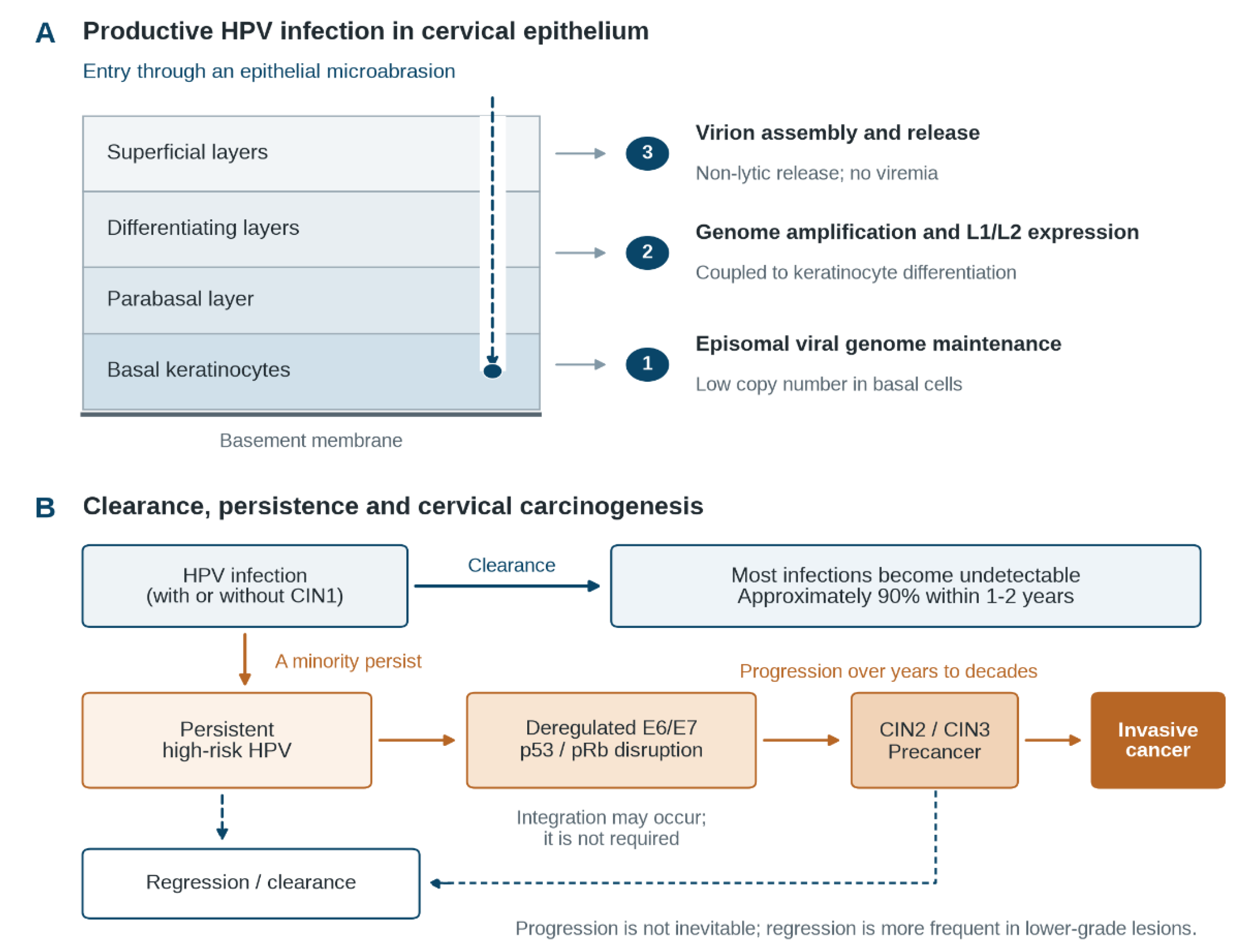
Figure 2.
Regional HPV prevalence and HIV-attributable cervical cancer in sub-Saharan Africa. (A) Pooled prevalence of any HPV among women with normal cervical cytology, from Ogembo et al. [8], published in 2015. No eligible normal-cytology study from Middle Africa was included in that meta-analysis. (B) Modeled population-attributable fractions of incident cervical cancer due to HIV in 2020, from Ibrahim Khalil et al. [21]. The panels represent different outcomes, populations and periods and should not be interpreted as a correlation or causal comparison.
Figure 2.
Regional HPV prevalence and HIV-attributable cervical cancer in sub-Saharan Africa. (A) Pooled prevalence of any HPV among women with normal cervical cytology, from Ogembo et al. [8], published in 2015. No eligible normal-cytology study from Middle Africa was included in that meta-analysis. (B) Modeled population-attributable fractions of incident cervical cancer due to HIV in 2020, from Ibrahim Khalil et al. [21]. The panels represent different outcomes, populations and periods and should not be interpreted as a correlation or causal comparison.
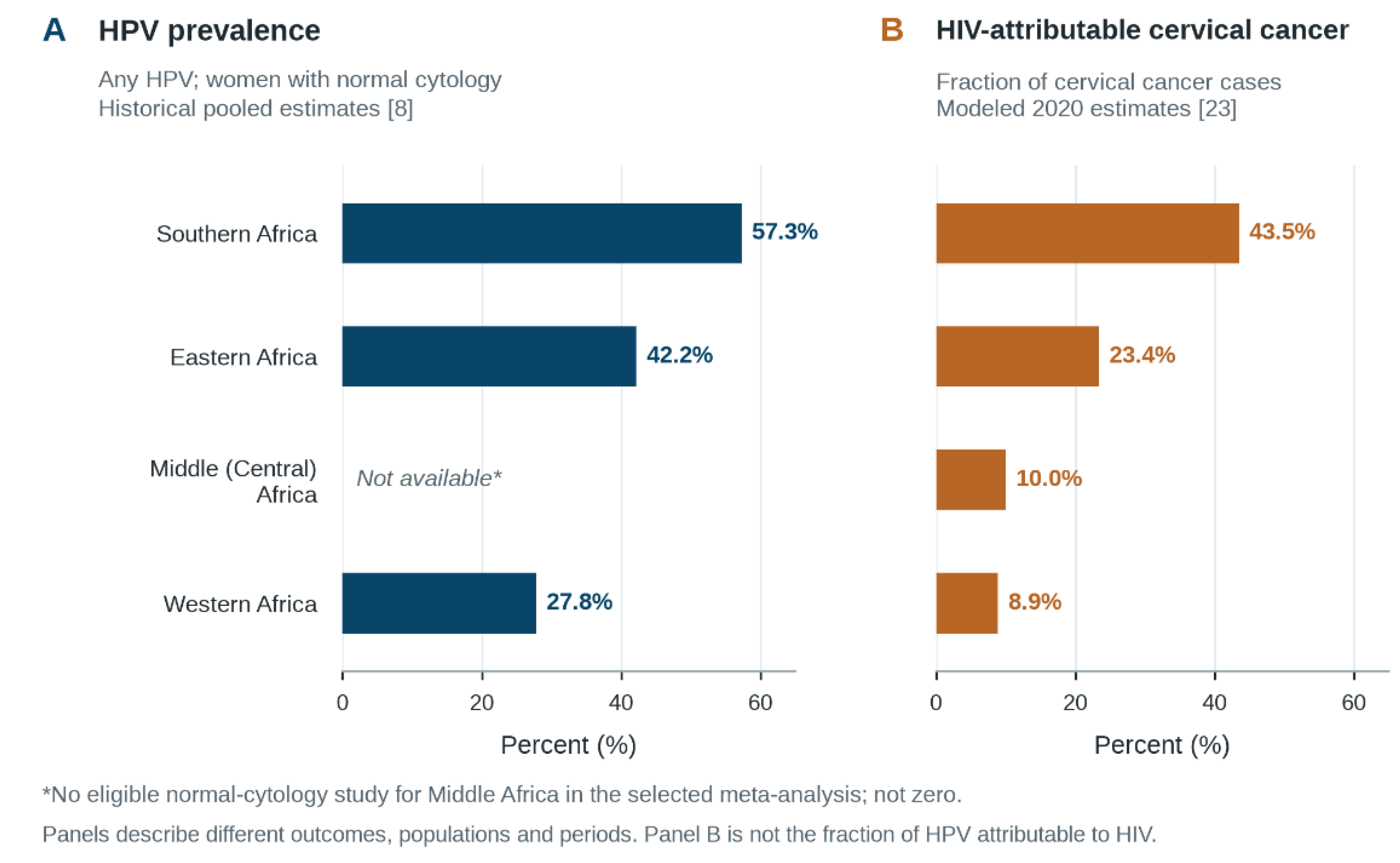
Figure 3.
Single-dose HPV-vaccine immunogenicity and efficacy. (A) Month-24 serum HPV16 and HPV18 IgG geometric mean concentrations after one vaccine dose in the DoRIS, Costa Rica Vaccine Trial, and IARC India cohorts; error bars represent 95% confidence intervals. (B) KEN SHE vaccine efficacy at 54 months against incident persistent HPV16/18 infection in the pooled bivalent and nonavalent groups and against the seven oncogenic vaccine types in the nonavalent group; error bars represent 95% confidence intervals. Sources: [41,44]. 2vHPV, bivalent HPV vaccine; 4vHPV, quadrivalent HPV vaccine; 9vHPV, nonavalent HPV vaccine; CI, confidence interval; CVT, Costa Rica Vaccine Trial; GMC, geometric mean concentration; IARC, International Agency for Research on Cancer.
Figure 3.
Single-dose HPV-vaccine immunogenicity and efficacy. (A) Month-24 serum HPV16 and HPV18 IgG geometric mean concentrations after one vaccine dose in the DoRIS, Costa Rica Vaccine Trial, and IARC India cohorts; error bars represent 95% confidence intervals. (B) KEN SHE vaccine efficacy at 54 months against incident persistent HPV16/18 infection in the pooled bivalent and nonavalent groups and against the seven oncogenic vaccine types in the nonavalent group; error bars represent 95% confidence intervals. Sources: [41,44]. 2vHPV, bivalent HPV vaccine; 4vHPV, quadrivalent HPV vaccine; 9vHPV, nonavalent HPV vaccine; CI, confidence interval; CVT, Costa Rica Vaccine Trial; GMC, geometric mean concentration; IARC, International Agency for Research on Cancer.
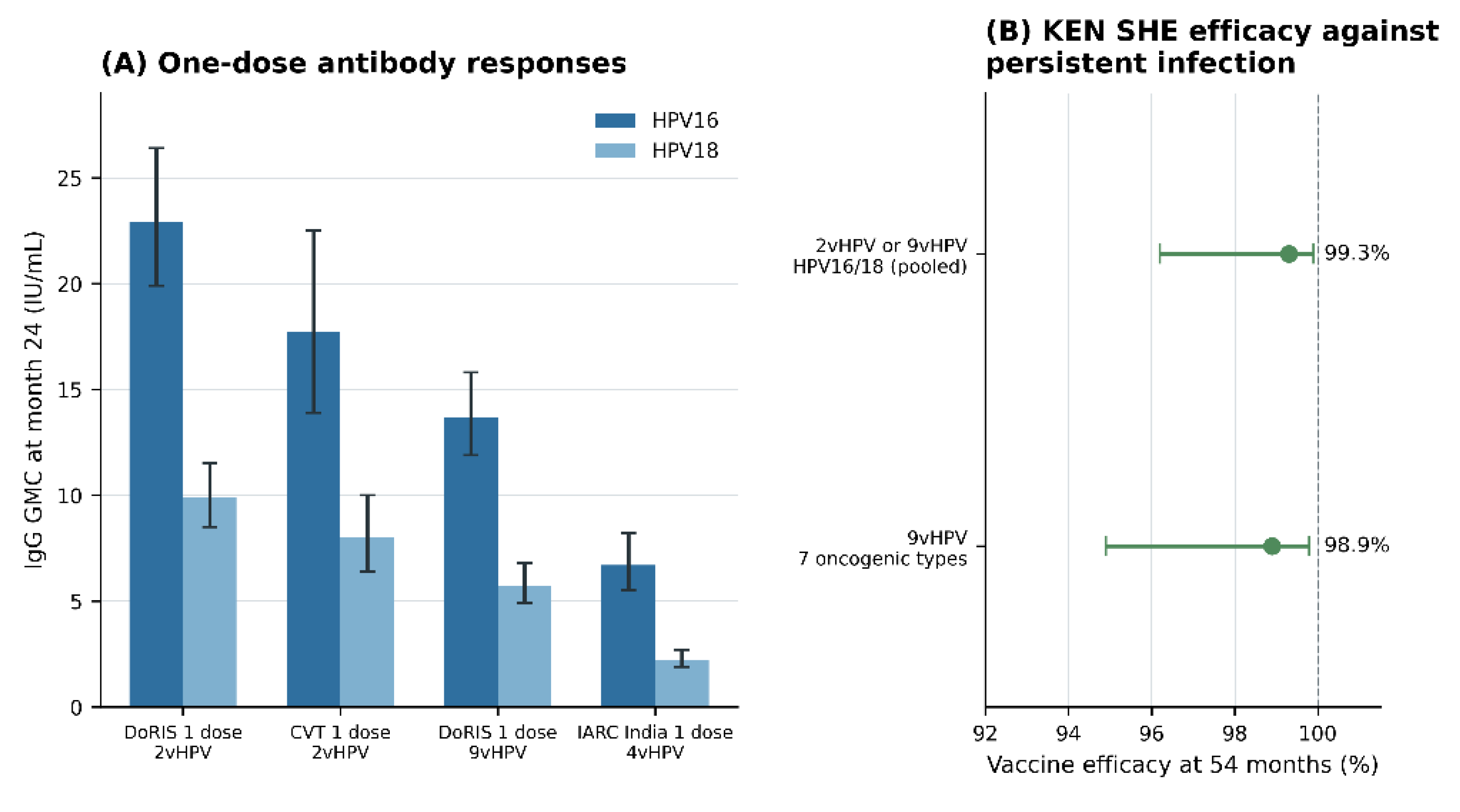

Table 1.
Summary of selected studies and evidence syntheses reporting HPV epidemiology in sub-Saharan African populations.
Table 1.
Summary of selected studies and evidence syntheses reporting HPV epidemiology in sub-Saharan African populations.
| Country / Setting | Study population | Specimen and assay | HPV prevalence | Most frequent high-risk genotypes | Ref. |
|---|---|---|---|---|---|
| South Africa, KwaZulu-Nata | HIV-negative women aged 14-30 years; prospective cohort, n = 224 | Cervicovaginal lavage, Roche Linear Array | Any HPV: 76.3% (171/224; 95% CI 70.8-81.9); HR types: 54.5% (122/224) | 16, 18, 31, 33, 35, 39, 45, 51, 52, 56, 58 | [15] |
| South Africa, Cape Town and Soweto | Unvaccinated, HIV-negative women aged 16-22 years; 291 valid HPV results | Endocervical samples; Roche Linear Array | Any HPV: 66.7% (194/291); HR HPV: 45.7% (133/291) | 16, 18, 51, 58 | [13] |
| Zimbabwe, rural Hurungwe | Women aged 30-65 years; 643 valid results | Self-collected cervicovaginal specimens; GeneXpert with extended genotyping | HR HPV: 17.4% (112/643); HIV-positive: 33.3% (41/123); HIV-negative: 13.7% (71/520) | 16, 18, 35, 51, 52, 58, 68 | [6] |
| Zimbabwe, Karanda Mission Hospital, Mt Darwin) | Women attending cervical screening; n = 400 | Clinician-collected cervical specimens; GeneXpert screening followed by Anyplex II HPV28 genotyping of positive samples | HR HPV: 20.8% (83/400) | 35, 45, 52, 58, 68 | [16] |
| Tanzania, Mwanza | Secondary-school girls aged 17-18 years; 385 valid results | Vaginal swabs; Roche Linear Array | Any HPV: 32.5% (125/385); HR HPV: 18.2% (70/385) | 16, 39, 52, 58, 68 | [17] |
| Kenya | HIV-positive women, systematic review and meta-analysis | Cervical specimens; assays varied across studies | Pooled HR/potentially HR HPV: 64% (95% CI 50-77) | 16, 18, 35, 52 | [18] |
| Burundi |
Women stratified by HIV status and residence; n = 600 |
Cervical specimens; urban RIATOL quantitative PCR and rural nested PCR/genotyping | Any HPV: urban HIV-positive 45.7% (69/151); urban HIV-negative 13.4% (20/149); rural HIV-positive 30.0% (45/150); rural HIV-negative 31.3% (47/150) | 16, 18, 35, 45, 51, 52, 56, 66 | [19] |
| Ethiopia, three eastern hospitals | Women attending screening; 886 valid HPV results | Cervical samples; Anyplex II HPV HR | HR HPV: 12.4% (110/886) | 16, 31, 35, 52, 58 | [20] |
HPV, human papillomavirus; HIV, human immunodeficiency virus; HR, high-risk; CI, confidence interval. Risk classifications follow the individual studies. These estimates describe different populations and should not be treated as directly comparable national prevalence estimates.
Table 2.
Prophylactic HPV vaccines: manufacturers, valency, targeted HPV types, adjuvants, and WHO prequalification status.
Table 2.
Prophylactic HPV vaccines: manufacturers, valency, targeted HPV types, adjuvants, and WHO prequalification status.
| Vaccine | Manufacturer | Valency | HPV types targeted | Adjuvant | WHO prequalification status |
|---|---|---|---|---|---|
| Cervarix | GlaxoSmithKline Biologicals SA | Bivalent (2vHPV) | 16, 18 | AS04: aluminum hydroxide and 3-O-desacyl-4′-monophosphoryl lipid A | Current |
| Cecolin | Xiamen Innovax Biotech Co., Ltd. | Bivalent (2vHPV) | 16, 18 | Aluminum hydroxide | Current |
| Walrinvax | Yuxi Zerun Biotechnology Co., Ltd. (Walvax) | Bivalent (2vHPV) | 16, 18 | Aluminum phosphate | Current |
| Gardasil | Merck Sharp & Dohme LLC | Quadrivalent (4vHPV) | 6, 11, 16, 18 | Amorphous aluminum hydroxyphosphate sulfate | Current |
| Gardasil 9 | Merck Sharp & Dohme LLC | Nonavalent (9vHPV) | 6, 11, 16, 18, 31, 33, 45, 52, 58 | Amorphous aluminum hydroxyphosphate sulfate | Current |
All listed vaccines are non-live recombinant virus-like-particle vaccines and are prophylactic rather than therapeutic. WHO recommends a one- or two-dose schedule for girls aged 9–14 years and for girls and women aged 15–20 years, and two doses administered six months apart for women aged 21 years or older. Individuals known to be immunocompromised or living with HIV should receive at least two doses and, where feasible, three doses. WHO population-level recommendations may differ from the schedules authorized in individual product labels, and national licensure, procurement, and availability may vary. WHO prequalification status was verified on 15 September 2026. 2vHPV, bivalent HPV vaccine; 4vHPV, quadrivalent HPV vaccine; 9vHPV, nonavalent HPV vaccine; AS04, Adjuvant System 04.Source: World Health Organization [29]
Table 3.
Key trials and cohorts comparing single-dose with multi-dose HPV vaccination: design, population, vaccine, follow-up duration and principal immunogenicity or efficacy findings.
Table 3.
Key trials and cohorts comparing single-dose with multi-dose HPV vaccination: design, population, vaccine, follow-up duration and principal immunogenicity or efficacy findings.
| Study | Design | Population | Vaccine product (valency) | Follow-up reported | Principal finding | Ref. |
|---|---|---|---|---|---|---|
| DoRIS (Tanzania) | Open-label randomized non-inferiority trial (1 vs 2 vs 3 doses) | 930 HIV-negative girls aged 9-14 years | Cervarix (2vHPV), Gardasil 9 (9vHPV) | 24 and 60 months | At month 24, approximately 99% of single-dose recipients were seropositive for HPV16. Noninferiority to two or three doses was met for HPV16 but not HPV18, although HPV18 seropositivity exceeded 98%. At month 60, HPV16 seropositivity remained above 99%; HPV18 seropositivity was 98% with 2vHPV and 93% with 9vHPV. Single-dose GMCs remained stable from months 12 to 60. | [38,40] |
| DoRIS multiplex immunogenicity | Randomized trial substudy (1 vs 2 doses) | Same cohort, 9vHPV arms | Gardasil 9 (9vHPV) | 36 months | All one-dose recipients seropositive for HPV 16, 31, 58; 96.8-98.2% for HPV 11, 18, 33; 73.0-87.7% for HPV 6, 45, 52 vs 98.6% for HPV 45 and 52 after 2 doses | [39] |
| DoRIS immunobridging to historical cohorts | Immunobridging analysis | DoRIS vs CVT and IARC India single-dose recipients | Cervarix (2vHPV) in DoRIS and CVT; Gardasil 9 (9vHPV) in DoRIS versus Gardasil (4vHPV) in IARC India | 24 months | Non-inferiority met for HPV 16 and HPV 18 GMCs against both historical efficacy cohorts | [41] |
| DoRIS to KEN SHE immunobridging | Immunobridging analysis | Girls aged 9-14 years vs women aged 15-20 years | Cervarix (2vHPV); Gardasil 9 (9vHPV), in both studies | 24 months | GMC ratios non-inferior; 2vHPV 0.90 (95% CI 0.72-1.14) for HPV 16 and 1.02 (0.78-1.33) for HPV 18; 9vHPV 1.44 (1.14-1.82) and 1.47 (1.13-1.90) | [42] |
| KEN SHE (Kenya) | Randomized, double-blind, controlled superiority trial | 2,275 women aged 15-20 years | Cervarix (2vHPV) or Gardasil 9 (9vHPV), versus meningococcal vaccine control | 18, 36 and 54 months | At month 18, efficacy against incident persistent HPV16/18 infection was 97.5% for both vaccines. At month 36, HPV16/18 efficacy was 98.8% (95% CI, 91.3–99.8) for 9vHPV and 97.5% (95% CI, 90.0–99.4) for 2vHPV; efficacy against the seven oncogenic 9vHPV types was 95.5% (95% CI, 89.0–98.2). At month 54, estimated efficacy was 99.3% (95% CI, 96.2–99.9) against HPV16/18 and 98.9% (95% CI, 94.9–99.8) against the seven oncogenic 9vHPV types. | [43,44,45] |
| ESCUDDO (Costa Rica) | Double-blind randomized non-inferiority trial (1 vs 2 doses), with concurrent unvaccinated survey for absolute effectiveness | ~20,000 girls aged 12-16 years | Cervarix (2vHPV); Gardasil 9 (9vHPV) | Up to 5 years | One dose non-inferior to two doses against persistent HPV 16/18 for both vaccines; effectiveness vs unvaccinated survey at least 97%; 9vHPV efficacy against HPV 18 at years 4-5 similar after one and two doses (97.1% vs 97.6%) | [46,47] |
| Costa Rica Vaccine Trial | Post-hoc analysis of randomized trial, with long-term serological follow-up | Women aged 18-25 years | Cervarix (2vHPV) | Up to 16 years | Stable single-dose antibody concentrations and sustained protection against HPV 16/18; single-dose seropositivity 99.4% (HPV 16) and 98.8% (HPV 18) at 16 years | [48,49] |
| IARC India cohort | Prospective cohort after interrupted randomisation | Girls aged 10-18 years | Gardasil (4vHPV) | 10 years | Single-dose efficacy against persistent HPV 16/18 comparable to 2 and 3 doses | [50] |
Follow-up is measured from initial vaccination. The KEN SHE 54-month estimates were derived from a time-varying Cox model after the delayed-control group received crossover vaccination; they are not based on a continuously unvaccinated control group through month 54. 2vHPV, bivalent HPV vaccine; 4vHPV, quadrivalent HPV vaccine; 9vHPV, nonavalent HPV vaccine; CI, confidence interval; CVT, Costa Rica Vaccine Trial; DoRIS, Dose Reduction Immunobridging and Safety Study; GMC, geometric mean concentration; IARC, International Agency for Research on Cancer; KEN SHE, Kenya Single-dose HPV-vaccine Efficacy study.
Table 4.
Summary of HIV-HPV co-infection studies in sub-Saharan African populations: setting, population, HPV prevalence by HIV status, predominant genotypes and reported cervical outcomes.
Table 4.
Summary of HIV-HPV co-infection studies in sub-Saharan African populations: setting, population, HPV prevalence by HIV status, predominant genotypes and reported cervical outcomes.
| Setting | Population | HPV prevalence by HIV status | Predominant genotypes | Reported cervical outcomes | Ref. |
|---|---|---|---|---|---|
| Harare, Zimbabwe | 2,745 women living with HIV tested; 2,725 with valid HPV results | High-risk HPV: 53% (1,445/2,725; 95% CI, 51–55) |
58 (11%), 52 (10%), 35 (10%), 16 (9%) | High hrHPV prevalence despite sustained viral suppression | [26] |
| Harare, Zimbabwe | Urban cohort of WLHIV, 2-year follow-up | hrHPV 24.9%; 65% of positives carried types other than 16 or 18/45 | Non-16/18/45 high-risk types predominant | Incident cervical disease only in hrHPV-positive women (6.41/100 person-years); positive VIA incidence rate ratio 12.57 (95% CI 4.14-38.19) | [61] |
| Mt Darwin, Zimbabwe | 400 women attending screening | hrHPV 27% (HIV-positive) vs 15% (HIV-negative) | 35, 45, 52, 58, 68 | 47% of hrHPV-positive women carried a single genotype not covered by 9vHPV | [16] |
| Burundi (urban and rural) | Women stratified by HIV status and residence | Higher hrHPV and probable hrHPV burden in HIV-positive urban women | Urban HIV-positive: 52, 51, 56, 18, 16 | HPV and HIV infection were independent risk factors for cervical lesions | [19] |
| Kenya (pooled) | HIV-positive women, systematic review and meta-analysis | Varies by cytology status | Abnormal cytology: 16, 35, 52 | Genotype distribution shifted towards non-16/18 types in abnormal cytology | [18] |
| Harare, Zimbabwe (ZIMGARD) | 98 adolescents/young adults with perinatally acquired HIV, mean 6 years after 4vHPV | Any HPV 69%; high-risk type 17% | 45 (14.3%), 56 (14.3%), 58 (13.3%), 52 (12.2%), 18 (12.2%) | Any HPV: 68/98 (69%); both high- and low-risk types: 38/98 (39%); high-risk types only: 17/98 (17%); low-risk types only: 13/98 (13%). Cross-sectional HPV detection cannot establish vaccine failure, acquisition after vaccination, infection present before vaccination, or waning immunity; longitudinal follow-up is required. | [57] |
| Global / SSA (modeled) | Population-level estimates | Not applicable | Not applicable | SSA: 24.9% of cervical cancers diagnosed in WLHIV, 20.4% attributable to HIV; HIV-attributable fraction 86% in women aged 34 years or younger in Southern Africa | [21] |
| Global (modeled) | Population-level estimates | Not applicable | Not applicable | 5.8% of cervical cancers globally attributable to HIV; approximately six-fold higher cervical cancer risk in WLHIV | [58] |
4vHPV, quadrivalent HPV vaccine; 9vHPV, nonavalent HPV vaccine; ART, antiretroviral therapy; hrHPV, high-risk HPV; SSA, sub-Saharan Africa; VIA, visual inspection with acetic acid; WLHIV, women living with HIV.
Disclaimer/Publisher’s Note: The statements, opinions and data contained in all publications are solely those of the individual author(s) and contributor(s) and not of MDPI and/or the editor(s). MDPI and/or the editor(s) disclaim responsibility for any injury to people or property resulting from any ideas, methods, instructions or products referred to in the content. |
© 2026 by the authors. Licensee MDPI, Basel, Switzerland. This article is an open access article distributed under the terms and conditions of the Creative Commons Attribution (CC BY) license.
Copyright: This open access article is published under a Creative Commons CC BY 4.0 license, which permit the free download, distribution, and reuse, provided that the author and preprint are cited in any reuse.