

Submitted:
26 October 2026
Posted:
27 October 2026
You are already at the latest version
Abstract
Psychosis is a neuropsychiatric feature found across neurodegenerative conditions including Alzheimer’s disease (AD) and Parkinson’s disease (PD). It is also a common feature in psychiatric disorders such as schizophrenia. The apolipoprotein E epsilon 4 (ApoE4) allele is an established genetic risk factor for AD that may also increase the risk of psychosis. However, evidence regarding the association between ApoE4 and psychosis remains unclear. This paper evaluates the relationship between "ApoE" 4 carrier status and psychosis in both neurodegenerative (Alzheimer’s disease and Parkinson’s disease) and non-neurodegenerative disorders (schizophrenia). Additionally it explores whether sex and zygosity modulate this association.A literature review of studies identified through PubMed and Scopus was conducted. Thirty- one studies, were included that investigated the relationship between ApoE4 and psychosis in select neurodegenerative and psychiatric populations. Studies were included if they assessed ApoE4 status in relation to the presence, severity, or age of onset of psychosis.Among the 16 AD- focused studies, a positive association was reported in 11 while 4 showed no significant association and one showed an inverse correlation. ApoE4 carriers and ApoE4 homozygotes that were female were reported to have the strongest association. The three studies examining PD resulted in inconsistent findings limited by small sample sizes. With respect to schizophrenia, associations were predominantly null or inconsistent. There was limited evidence for the influence of sex or ApoE4 zygosity.Of note the risk was enhanced in female carriers and "ApoE" 4 homozygotes. In terms of PD results were conflicting, limited by small sample sizes. Schizophrenia studies produced findings that were predominantly null or equivocal, with no clear evidence that sex or zygosity influenced outcomes.ApoE4 positivity appears to have a stronger association with psychosis in AD compared to PD or schizophrenia. Available evidence suggests that this relationship may be modified by sex and ApoE4 zygosity and that female ApoE4 homozygotes are particularly vulnerable. Findings were however limited by substantial heterogeneity across studies and limited evidence in PD and schizophrenia populations. Thus larger studies are needed to clarify the role of ApoE4 in psychosis, particularly in non-AD cohorts.
Keywords:
ApoE4
; psychosis
; Alzheimer’s disease
; Parkinson’s disease
; schizophrenia
1. Introduction
Psychosis occurs in a wide range of neurological conditions including Alzheimer’s disease (AD) and Parkinson’s disease (PD) [1,2]. It is also a common symptom in psychiatric conditions, including schizophrenia (Sz) and bipolar disorder. In older individuals, psychosis may manifest as late-onset schizophrenia, namely onset after the age of 40, though its underlying mechanism may differ [3]. Symptoms typically include hallucinations (abnormal perceptual experiences) and delusions (fixed false beliefs).
Current treatments for psychosis target symptom relief mainly through dopamine antagonism [4]. However, there are limits to the effectiveness of such medications among patients with neurodegenerative disorders based on the current literature, as well as concerns around mortality [5]. Second-generation atypical antipsychotics have metabolic side effects, elevating cardiovascular mortality risk in schizophrenia patients [4]. Hence, further research is required to understand the mechanisms that underly psychosis as a symptom in various neurological conditions, to eventually provide specific targeted therapies.
Apoprotein (Apo) is a lipid-binding protein resulting from three possible alleles (ApoE 2, 3, 4), critically involved in lipid transport to the brain and neuronal maintenance. On a neuronal level, ApoE4 is a genetic risk factor for AD that increases Aβ production, destabilizes membranes and increases apoptotic cell death [6]. Current studies suggest there is a high prevalence of psychosis in many neurodegenerative diseases, occurring in about a quarter to half of people with with AD and over half of people with dementia with Lewy bodies and Parkinson’s disease dementia (PDD) [7]. Thus, it is reasonable to question whether ApoE4 plays a role in psychosis in such conditions, and more generally.
Prior studies exploring ApoE4 and psychosis in AD have produced discrepant results [8,9]. A 2016 review found in several independent studies that AD and psychosis (AD+P) was heritable, with linkage studies suggesting different possible loci were responsible [10]. A 2021 meta-analysis identified two loci in ENP96 and SUMF1 that had associations with AD+P with ApoE4 reaching criteria for genome-wide significance [11]. Recent studies have highlighted a sex-specific effect of the ApoE4 allele on psychosis in Alzheimer’s disease, suggesting the influence of sex on a possible genetic risk, which could be responsible for some of the prior discrepancy [12,13]. The additional, putative role of Lewy body pathology in this association highlights the heterogeneity of psychotic presentations in Alzheimer’s disease (12,14). Other studies have found no association [8,15].
Regarding the role of APOE4 in schizophrenia, a 2015 meta-analysis found no association between ApoE genotype and development of the disorder [16], though subanalyses with confounding factors like sex and age were not conducted. Studies looking into both AD and Sz acknowledge the need for larger sample sizes to effectively investigate possible associations. Additionally, it is unclear whether papers adjusted for sex/zygosity (two key co-variates) or looked at novel markers such as age of onset or symptom severity. Adding to the uncertainty, a 2008 meta-analysis found a nominally significant association of ApoE4 and 23 other polymorphisms with schizophrenia (“average allelic risk ORs of ∼1.24”) [17]. With regards to PD, a postmortem study found that patients with psychosis did not differ significantly from those without psychosis in age at PD onset, age at death, or ApoE4 allele frequency [18]. Due to the heterogenous nature of the literature regarding the association between ApoE4 and psychosis, a scoping review was the approach chosen to amalgamate the existing evidence, clarify key concepts and identify critical knowledge gaps. This review is guided by the Arksey and O’Malley (2005) methodological framework to address the primary objective [19]: to explore the broader role of ApoE4 across the psychosis spectrum in AD, PD and schizophrenia and determine if sex and/or zygosity is a modulating factor.
2. Methods
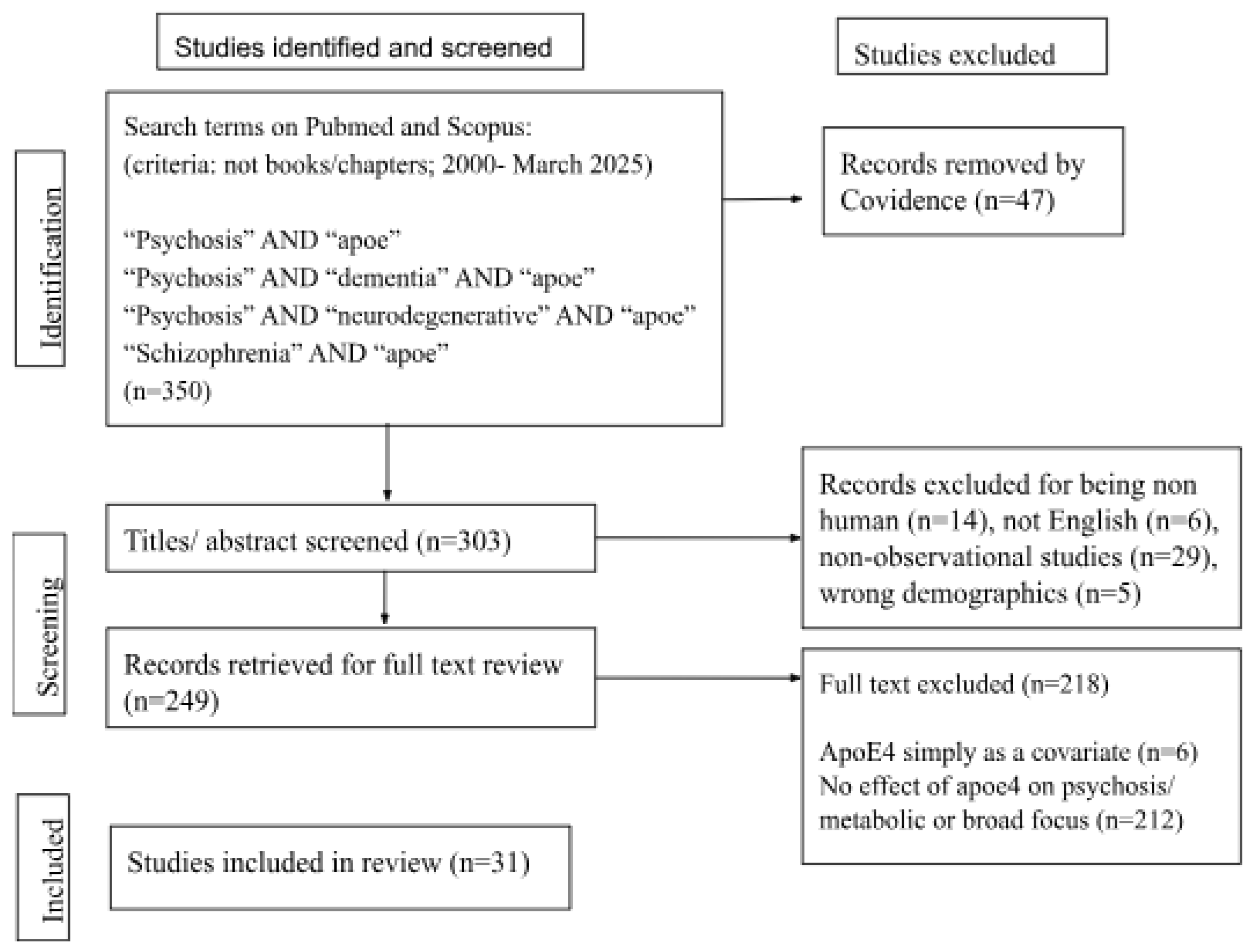
The review was conducted in accordance with PRISMA guidelines; a review protocol has not been registered [20]. The databases Pubmed and Scopus were analyzed. Broad search terms were adapted for each database using a combination of controlled advanced search terms including: “ApoE”, “psychosis”, “schizophrenia”, “dementia”, and “neurodegenerative” (Figure 1). Last search was executed in March 2025. Only studies published from 2000 to March 2025 were included; 303 articles were initially found. Additional inclusion criteria included: observational study; English; ApoE4 effect on psychosis as a primary objective, not simply a covariate; adult human demographic; diagnosed neurological disorders, namely either Alzheimer’s disease, Parkinson’s disease or schizophrenia. This criterion was used to ensure papers included would aid in completing the objective of this scoping review. Following the search, all citations were exported to Covidence where duplicate records were automatically removed. Title and abstract screening were conducted independently by two reviewers (VW and CF) against these predetermined inclusion and exclusion criteria. Subsequently, full-text articles were retrieved and assessed in duplicate by the same reviewers. Any discrepancies at either stage were resolved through discussion until a consensus was reached.
Based on these criteria using team-based consensus, fourteen studies were excluded for having primary focus on in vitro or preclinical work, rather than human participants; six for not being in English; five for studying the wrong demographics, namely age and no or incorrect experimental group; six for simply showing ApoE4 as a covariate; 29 for being non-observational studies; and 212 which did not comment on an association or lack thereof. This left 31 articles used for this literature review. The results were charted based on disease and in order of positive, no and negative association between ApoE4 and psychosis
3. Results and Discussion
3.1. Summary of Results
Of the 31 studies included, there were 17 showing a positive association of ApoE4 and psychosis in AD, PD and Sz patients and only one showing a negative association between ApoE4 and psychosis in AD patients. Sixteen studies involved AD patients, 11 of which suggested a positive association, one a negative association, and four showing no associations between ApoE4 allele and psychosis (presence or age of onset). Three studies involved PD patients, one of which showed a positive association whereas two showed no association. Finally, 12 studies involved patients with schizophrenia and the association with ApoE4 allele: five showed a positive association, one non-statistically significant negative association and six no association.

Table 1.
Observational Studies investigating association between the ApoE4 allele and psychosis in Alzheimer’s Disease (AD), Parkinson’s Disease (PD) and Schizophrenia (Sz).
Table 1.
Observational Studies investigating association between the ApoE4 allele and psychosis in Alzheimer’s Disease (AD), Parkinson’s Disease (PD) and Schizophrenia (Sz).
| Paper | Patient | Study Design | N | Results | Zygosity Effect on Psychosis Risk | Sex Effect on psychosis risk |
|---|---|---|---|---|---|---|
| DeMichele-Sweet et al., 2021 [11] | AD | Prospective cohort | 12317 | Positive: Single nucleotide polymorphisms within ApoE demonstrated gene-based significant association with AD with psychosis ( p = 8.64×10⁻⁶). | No reported adjustment for zygosity. | Covariate for sex was included |
| Dissanayake et al., 2022 [21] | AD | Cohort | 7913 | Positive: there was a positive statistically significant association between the presence of ApoE4 and the neuropsychiatric symptoms (NPS) of delusions. | Homozygotes had a stronger association (p=0.003) between the presence of ApoE4 and the neuropsychiatric symptoms than heterozygotes (p=0.028). | There was a statistically significant female effect on ApoE4 and delusions (p=0.002) with stronger effects in homozygotes. |
| Emanuel et al., 2011 [22] | AD | Prospective cohort study | 362 | Positive: ApoE4 allele presence occurred with higher frequency in those experiencing psychosis than in those who were never psychotic (p=0.034). | ApoE4 status reported as negative and positive without differentiation between homozygotes and heterozygotes. | Using Pearson’s Chi-squared, baseline comparisons between sex were made, showing females being more susceptible to psychosis; it did not account for ApoE4 status.. |
| Fan et al., 2025 [23] | AD | Observational, cross-sectional cohort study | 204 | Positive: Female ApoE4 homozygotes were found to have increased psychosis when adjusting for mini mental state examination score, adjusted hippocampal volume, and age (p = 0.0264). | Homozygotes were found to have significantly increased psychosis, unlike heterozygotes. | The effects of ApoE4 on psychosis risk were only significant in female homozygotes, not males. |
| Huang et al., 2020 [24] | AD | Prospective cohort | 793 | Positive: Patients with AD and the ApoE4 allele exhibited more obvious symptoms of psychosis (p = 0.014) and higher Neuropsychiatric Inventory Questionnaire ( NPI-Q). | Homozygotes had a lower NPI-Q and psychosis score than heterozygotes though not statistically significant. | No sex difference found in regards to ApoE4 and NPS. |
| Kim et al., 2017 [12] | AD | Retrospective cohort using pathological data | 1509 | Positive: a significant association between homozygous ApoE4 patients and development of psychosis was found. Carriers also had a younger age of death than non-carriers. | Homozygotes were found to have a significant association with the development of psychosis; (p=0.010); heterozygotes showed a non-significant positive trend (p=0.110). | In females, homozygotes were significantly associated; heterozygous females (p=0.008) and all males had a non-significant positive association of psychosis with the allele. |
| Scassellati et al., 2020 [25] | AD | cross-sectional | 362 | Positive: ApoE4 allele increased risk of developing psychosis (95% CI: 18.5–22.9). | Results reported as carrier or non-carriers, without differentiation between homozygotes and heterozygotes for the ApoE allele. | No significant association found in separate analysis. |
| Spalletta et al., 2006 [26] | AD | Prospective cohort | 171 | Positive: Late onset AD patients who carried the ApoE4 allele were more delusional than patients who did not carry the ε4 allele (p<0.02). | As homozygotes and heterozygotes were merged in analysis, there is no investigation into zygosity effects. | Adjustments for sex were made. Sex was found to not considered statistically significant as a clinical predictor of the ApoE4 status p=0.465). |
| Qian et al., 2018 [13] | AD | Retrospective cohort using pathological data | 900 | Positive: The frequency of ApoE4 was higher in psychotic patients (p=0.024), with a stronger association with hallucinations. | Analysis simply looked at presence of APOE4 rather than homozygotes and heterozygotes; therefore, there is no investigation into zygosity effects. |
When analyses were repeated separately for each sex, there was a positive significant association between psychosis and the frequency of ApoE4. |
| Valcic et al., 2022 [14] | AD | Retrospective pathological cohort | 1207 | Positive for females: Female ApoE4 carriers and homozygotes were statistically significantly more like to experience psychosis than non-carriers with p=0.048 and p=0.023, respectively. | Female homozygotes were more likely to experience psychosis compared to heterozygotes. | There was a significant effect of female status and homozygous status on psychosis in those with LB pathology. ApoE4 and the presence of psychosis were not found to have a statistically significant association in males. |
| Zdanys et al., 2006 [9] | AD | Prospective cohort | 266 | Positive: the presence of an ApoE4 allele was significantly associated with psychosis, when psychosis was defined by an NPI-Psychosis score ⩾1 (p=0.029), 3 (p=0.020) and 6 (p=0.013). | The paper looked at carriers vs non-carriers. When an analysis with the number of alleles is entered into a multiple logistic regression model, zygosity was not found to affect the presence of psychosis. | Adjusted for sex, ApoE4 is associated with psychotic symptoms( P=0.029). |
| Borroni et al., 2006 [27] | AD | cross-sectional | 232 | None: No association was found between allele and psychosis (p>0.5). | Zygosity was not analysed | Analysis adjusted for sex |
| D’Onofrio et al., 2010 [15] | AD | Prospective cohort | 322 | None: No association of ε4 allele was found with psychotic phenotype (p=0.269). | Analysis did not adjust for zygosity |
Analysis was not adjusted for sex. |
| DeMichele-Sweet et al., 2011 [28] | AD | Prospective cohort | 2317 | None: Psychosis showed no significant association with age at presentation, age of dementia onset (p=0.57), Hachinski score, ApoE ε4 carrier status (p=0.135), or ApoE ε4 allele count (p=0.277). | No significant associations of psychosis with number of alleles. | Adjusted for sex but no association found. |
| Sweet et al., 2002 [8] | AD | Prospective cohort | 316 | None: time to onset of psychotic symptoms in AD participants was not reduced in ApoE4 carriers. | Looked at carriage rather than zygosity differences | Analysis adjusted for sex |
| Christie et al., 2012 [29] | AD | Prospective cohort | 790 | Negative: hallucinations were significantly more likely to occur in participants with no ApoE4 alleles than in participants with two ε4 alleles. | Homozygotes had a decreased occurrence of hallucinations than heterozygotes of the ApoE4 allele. | Analysis adjusted for sex |
| Feldman et al., 2005 [30] | PD | cross-sectional | 87 | Positive: earlier appearance of psychosis was associated with the ApoE4 allele (p=0.02). | All participants in this study with ApoE4 allele were heterozygotes. | Analysis was not adjusted for sex. |
| Goetz et al., 2001 [31] | PD | case-control | 88 | None: For ApoE, 12 cases and 12 controls carried E4 alleles; there was no association between hallucinations and ApoE. (p>.99). | Allele frequency noted, but there is no report on impact on PD. | Analysis was not adjusted for sex. |
| Camicioli et al., 2005 [18] | PD | Prospective cohort | 47 | None: time to onset of psychosis was not associated with ApoE4 (p=0.21). | Looked at presence of ApoE4 rather than adjusting for zygosity. | In males the risk for ApoE4 was increased (RR = 1.92), but not statistically significant. |
| Al-Asmary et al., 2015 [32] | Sz | case-control | 380 | Positive: frequency of allele ApoE4 was higher in patients compared with controls (p=0.0600). | Participants with ApoE4 were all heterozygotes; there were no homozygotes. | Sex was not found to play a role in the genotype/allele distribution among Saudi patients with schizophrenia. |
| Hong et al., 2000 [33] | Sz | association | 95 | Positive: ApoE4 positive Sz patients were statistically significantly younger than those who were ApoE4 negative (p=0.007). | Homozygotes and heterozygotes were not separated in analysis. | Analysis did not adjust for sex. |
| Jonas et al., 2019 [34] | Sz | Longitudinal (cohort) | 116 | Positive: Among individuals with schizophrenia, psychotic symptoms, worsened significantly after age 40 in ApoE4 carriers (p < 0.0001). | Heterozygotes and homozygotes were not separated in analysis due to sample size. | Analysis adjusted for sex. |
| Kampman et al., 2004 [35] | Sz | case-control | 192 | Positive: homozygote ApoE4 patients had a markedly lower age of onset of schizophrenia compared with the rest of the sample (p=0.0015). | Homozygotes were found to have an earlier age of onset than heterozygotes (p=0.07). | When controlled for gender, the same results were found. |
| Martorell et al., 2001 [36] | Sz | case-control | 949 | Positive for negative syndrome subtype in females positive for APOE4: ApoE4 carrier females had a four year earlier age of onset than those that did not carry the allele, with four times greater risk of a negative syndrome subtype. Male counterparts did not have this association (p>0.05). | Homozygotes and heterozygotes were not analysed separately. | Findings were magnified in females in terms of onset and negative symptoms. |
| Dean et al., 2003 [37] | Sz | case-control | 70 | None: no significant differences were found in either genotypic (p=0.65) or allelic (p=0.45) frequency between the schizophrenic and control subjects. | No difference in allelic (p=0.45) frequency between the schizophrenia and control subjects. | Analysis adjusted for sex. |
| Durany et al., 2000 [38] | Sz | Cross sectional | 208 | None: no association was found between genotype (p=0.58) or allele frequency (p=0.39) and Sz. | No association was found between allele frequency (p=0.39) and Sz. | Allele frequency was similar in female and male patients (p=0.68) |
| Kecmanović et al., 2010 [39] | Sz | case-control | 158 | None: genotype frequencies did not differ between schizophrenia and healthy controls (p = 0.44555). | Number of alleles did not differ between those with Sz and healthy controls | Analysis did not adjust for sex. |
| Lee et al., 2001 [40] | Sz | case-control | 120 | None (nonsignificant negative): The frequency of the ApoE4 allele was lower in patients with schizophrenia but this was not statistically significant (p=0.098) | Zygosity was not adjusted for due to sample size. | Analysis adjusted for sex. |
| Martorell et al., 2008 [41] | Sz | Case-control (comparative) | 1236 | None: no association between the Apoe gene and the diagnosis of schizophrenia (p>0.05) | No association was found between allele frequency and the schizophrenia- control sample. | No gender-specific associations were found. |
| Sáiz et al., 2002 [42] | Sz | case-control | 356 | None: No significant differences in ApoE4 allele frequency was found between patients with schizophrenia and controls (p=0.124). Among patients with schizophrenia, the mean age of onset did not differ significantly between ApoE4 carriers and non-carriers (p=0.736). | Genotype frequencies were not significantly different between patients with schizophrenia and controls (p=0.399). | Analysis did not adjust for sex. |
| Schürhoff., 2003 [43] | Sz | Association (case-control) | 205 | None | No association was found between the ApoE4 allele frequency and the incidence of the disease (p=0.2). | Analysis did not adjust for sex. |
Looking at 16 of the 31 observational studies reporting a positive association between the ApoE4 allele and psychosis, the 11 which showed a positive association in AD patients were all statistically significant (p<0.05). Nine of the 11 highlighted the ApoE4 allele effect on psychosis prevalence. One of those nine papers, Kim et al., found that AD patients with two copies of the allele were more likely to develop psychosis, with significant results found for homozygous females. This study has the additional strength of using pathologically confirmed cases. Having one allele also showed a positive minimal yet non-significant trend, and additionally, carrier status was correlated with a younger age of death [12]. Valcic et al. found similar findings with female ApoE4 homozygotes and heterozygotes, to a lesser extent, with Lewy bodies found to be more significantly associated with psychosis compared to female ApoE4 non-carriers; in males, no statistically significant association between ApoE4 and the presence of psychosis was observed [14]. Another paper by Scassellati found that ApoE4’s effect is seen when looking at those grouped in the “Psychosis” endophenotype as a whole [25].
Two other studies, Spaletta et al. and Huang et al., found psychosis severity to be higher in ApoE4 carriers. Spalletta et al. found that late onset AD patients who were ApoE4 carriers were more delusional than non carriers [26]; and Huang et al. found that patients with the ApoE4 allele exhibited more obvious psychosis symptoms, namely higher NPI-psychosis scores [24]. One paper by Qian et al., studying a post-mortem cohort, suggested an interaction between hallucinations-only psychosis and the ApoE4 allele on worsening cognition in AD patients, measured using MMSE scores [13].
When looking at the four studies showing no association between ApoE4 and psychosis in those with AD, one study, by D’Onofrio et al., involving AD patients, found that the presence of the E4 allele (though showing no difference in distribution between AD patients with and without NPS) was associated with higher risk for affective and apathetic syndromes [15]. There was no association of the allele with psychotic phenotype. Similarly, Borroni et al. found no association between ApoE genotype and behavioral endophenotype when adjusting for age, gender and disease severity of AD patients [27]. The time of onset of psychotic symptoms in AD pateints was not found to be reduced in ApoE4 carriers in the paper by Sweet et al. [8]. Conversely, one paper by Christie et al. showed a possible inverse association between the presence of the allele and psychosis in AD [29]. Specifically, the risk of hallucinations decreased by 34% for each increase in one ApoE4 allele; however, no such association was found to occur for delusions.
The one positive paper for PD by Feldman et al. found that ApoE4 carriers were associated with statistically significant earlier appearance of psychosis in PD patients [30]. However, two other papers found no association. Camicioli et al. found that in PD patients, time to onset of psychosis was not significantly associated with ApoE4, adjusting for sex, duration of treatment, and age at onset [18]. Goetz et al. found no association between hallucination prevalence and ApoE4 [31].
Considering cohort studies involving psychosis due to Sz, five articles found a positive association between Sz and the ApoE4 allele. One paper by Al-Asmary et al. highlighted the allele effect on disease prevalence; only the genotype E2/E4 was found to have a statistically significant association [32]. Jonas et al., found a statistically significant escalation in psychotic symptoms, namely hallucinations and delusions, among ApoE4 carriers with onset of symptoms post 40 years old [34]. Another by Hong et al. found the age of patients with schizophrenia with ApoE4 allele to be younger than those without [33]. The other two papers suggested influence of ApoE4 on the age of onset. The first, Morterall et al. (2001), found this effect to be statistically significant only in females [36]. The other, Kampman et al., found a statistically significant association in homozygotes [35]. Of the six papers that showed no association for schizophrenia, four found no association between allelic or genotypic frequency and the incidence of the disease. The other two papers were by Martorell et al. (2008), who found no association between the ApoE4 gene and diagnosis of schizophrenia [41], and by Sáiz et al., who found no association between the ApoE4 allele and the mean age of onset in patients with schizophrenia [42]. Interestingly, the study by Lee et al. found a non-statistically significant inverse relationship between the presence of the ApoE4 allele and psychosis [40].
The present review examined the association between ApoE4 and the development of psychosis in Alzheimer’s disease, Parkinson’s disease, and schizophrenia. When examining the association of the ApoE4 allele across different disorders with psychotic symptoms, 17 of 31 papers yielded positive results with only 2 studies finding negative associations and the remaining finding no association. This provides some basis to the claim that ApoE4 influences psychosis across the disease continuum, though further prospective longitudinal studies are required to confirm this finding. Associations between ApoE4 and psychosis included increasing prevalence or severity of symptoms, earlier time of onset and synergy to worsen disease. Evidence for a possible effect differed with the different conditions: overall positive for AD, less so for Sz, and equivocal for PD limited by the sample size of 3 studies.
3.2. Zygosity Effects
Of the eight studies that noted zygosity, three, Kim et al. (AD), Valcic et al. (AD) and Jonas et al. (Sz) found the presence or onset of psychosis to be more marked and earlier respectively for homozygotes [12,14,34]. Three others, DeMichele- Sweet et al., 2011 (AD), Dean et al. (Sz) and Kecmanović et al. (Sz), found that zygosity was not significantly associated with psychosis [26,37,39]. It should be noted that both Dean et al. and Kecmanović et al. have relatively small sample sizes, which provides limitations in analysis, compared to other studies in this review, with 158 and 70 participants respectively [37,39].
One other study by Christie et al. suggested an inverse relationship between psychosis and ApoE4, namely risk of hallucinations decreased with every ApoE4 allele “added” in an AD patient [29]. That study found no relationship between ε4 allele zygosity and the occurrence of delusions, aberrant motor behavior, or agitation, but instead found a possible protective effect of the allele against the delusions and hallucinations phenotype. The authors speculated that this phenotype may be a genetically distinct subgroup, based on their findings. Another study by Huang et al. found that heterozygous Apoe4 AD patients had a higher NPI-Q psychosis score than non-carriers and even homozygous ApoE4 patients, though not statistically significant [24].
3.3. Sex Effects
Some studies found a possible sex component to the link between ApoE4 and psychosis. A study by Kim et al. conducted using the National Alzheimer’s Coordinating Centre (NACC) neuropathology dataset found that among confirmed AD patients when stratifying by sex, female homozygotes were significantly associated with AD+P [12]. However, in males and heterozygote women, the association between the allele and psychosis while positive was insignificant. Using a similar cohort, Valcic et al. found no statistically significant association for males whereas homozygous females, in alignment with the Kim et al. study, were more likely to experience psychosis than heterozygotes and non-carriers [14]. The effect of the allele was found to be limited to patients with LB pathology. Dissanayake et al. found a statistically significant effect of female sex on the presence of delusions in AD [21]. Spalletta et al. found a possible, yet non-statistically significant, sex role in the presence of delusions as a clinical predictor of ApoE4 carriers [26], whereas Huang et al. found no sex difference for ApoE4 and neuropsychiatric symptoms in AD [24].
Martorell et al. found that the presence of the allele did not affect the risk of developing negative or positive syndrome subtypes in males with schizophrenia, unlike the four times increased risk they found of women developing negative syndromes [36]. However, Scassellati found no significant association between psychosis and ApoE4 when sex effects were undertaken in a separate analysis [25]. Al-Asmary et al. found no association of sex with distribution of alleles or genotypes in patients with [32]. Camicioli et al. also did not find any association of sex with psychosis risk; the risk for ApoE4 in males was increased (RR = 1.92), but not statistically significant [18]. It should be noted that the sample size of 47 participants limits the analysis, a point acknowledged by Camicioli et al.
In summary, the strongest evidence is for ApoE4 and psychosis is found in Alzheimer’s disease where eleven of the sixteen studies found a positive association between ApoE4 and psychosis; evidence in Parkinson’s disease and schizophrenia are mixed. Some studies found that sex and zygosity influenced association, namely female ApoE4 carriers, particularly ApoE4 homozygotes, demonstrated the strongest association with psychosis.
3.4. Possible Mechanisms
ApoE4 is a known risk factor for AD. Mechanistically, it is thought to increase amyloid oligomer burden and decrease astrocyte-blood vessel contacts due to abnormal metabolism [44]. The allele is associated with increased amyloid deposition and decreased hippocampal volume along with greater memory impairment, highlighting its role in AD pathogenesis. Hence, a positive leaning of ApoE4 for AD is expected and may be extended to symptoms that often develop during the course of the disease, including psychosis. Additionally, ApoE4 influence on development and severity of Lewy bodies may explain its role in risk of psychosis with dementia with Lewy bodies and Parkinson disease dementia [45]. A 2016 paper by Fischer et al. found that in AD, psychosis was related to Lewy body pathology rather than AD pathology load [46]. The difference in ApoE4 effect found in this review between AD and schizophrenia can be speculated to be due to the younger age of patients with schizophrenia, resulting in a possible age-restricted effect, namely younger people are less susceptible to AD and hence to the effect of ApoE4. More importantly, there are no prior studies suggesting a strong relationship between ApoE4 and schizophrenia like there are for AD.
The role of sex hormones in ApoE regulation, with estrogen increasing expression and progesterone decreasing expression [47], provides support to the sex-based differences in neurodegenerative disease psychosis (susceptibility or severity) found in this present review. A 2026 study by Rajkumar et al. also supports this sex-specific contribution to psychosis in AD pateients [48]. Interestingly this same effect was not observed to the same extent in studies of the non-neurodegenerative disease schizophrenia, with only one of three papers stating a possible allele-influenced phenotypic expression of the negative syndrome in a sex-dependent manner. The effect of the presence of Lewy bodies in AD should be taken into consideration based on results found in Kim et al. and Valcic et al., which suggested enhanced sex-based effects in females with Lewy body pathology [12,14].
When adjusted for both zygosity and sex, studies found homozygous females to be at highest risk of psychosis, although some of the AD studies focused on postmortem data. ApoE4 was found to affect both prevalence of psychosis and clinical presentation in AD patients, with more papers in this review highlighting prevalence. Regarding studies of schizophrenia, half of those that found that ApoE4 had positive association with psychosis suggested an effect on age of onset with a stronger effect among patients developing symptoms later in life. Papers looking at psychosis in PD and ApoE4 are few making analysis limited. Further research is hence required to further understand the role of ApoE4 in PD related psychosis.
3.5. Limitations
Many papers not adjusting for sex, zygosity, Lewy body, tau or amyloid pathology and co-morbidities limited the analysis possible in this paper. Additionally, the lack of critical appraisal and the breadth at the expense of depth of the review results in limitations in the analysis of the evidence. It is hence necessary for further research to be conducted into the role that ApoE4 plays in these diseases and whether they differ between AD, PD and schizophrenia adjusting for biomarkers and co-pathology.
4. Conclusions
Current antipsychotic treatments aim to reduce positive symptoms of psychosis by reducing dopaminergic neurotransmission rather than treating disease pathology. The possible role of ApoE4 in neurodegeneration makes it a possible target for treatment and risk stratification of patients with AD related psychosis [49]. Future studies should investigate whether the effect of the ApoE4 allele on psychosis time of onset and presentation is shared between neurodegenerative diseases and schizophrenia. This relation would allow for the allele to serve as a genetic marker to stratify psychotic patients into subgroups with differing prognosis. To truly understand why psychosis develops in both neurodegenerative diseases and primary psychiatric disorders, research must account for biological sex, genetic background, and key disease markers like -synuclein. Uncovering how these factors overlap will help clinicians identify high-risk patients earlier and tailor treatments to individual biology rather than broad symptoms.
Author Contributions
Writing-original draft preparation, Veronica Wasef and Corinne Fischer; writing—review and editing, all authors. All authors have read and agreed to the published version of the manuscript.
Informed Consent Statement
Informed consent was obtained from all subjects involved in the studies included in this review.
Data Availability Statement
N/A.
Acknowledgments
This project was supported by the Heather and Eric Donnelly Endowment through St Michael’s Hospital Foundation.
Conflicts of Interest
The authors declare no conflicts of interest.
References
- Ballard, C.; Gauthier, S.; Corbett, A.; Brayne, C.; Aarsland, D.; Jones, E. Alzheimer’s Disease. The Lancet 2011, 377(9770), 1019–1031. [Google Scholar] [CrossRef] [PubMed]
- Samudra, N.; Patel, N.; Womack, K.B.; Khemani, P.; Chitnis, S. Psychosis in Parkinson Disease: A Review of Etiology, Phenomenology, and Management. Drugs Aging 2016, 33(12), 855–863. [Google Scholar] [CrossRef] [PubMed]
- National Institute of Neurological Disorders and Stroke. Parkinson’s Disease: Challenges, Progress, and Promise. 2023. Available online: https://www.ninds.nih.gov/current-research/focus-disorders/parkinsons-disease-research/parkinsons-disease-challenges-progress-and-promise.
- Patel, K.R.; Cherian, J.; Gohil, K.; Atkinson, D. Schizophrenia: Overview and Treatment Options. Pharm. Ther. 2014, 39(9), 638. [Google Scholar]
- Maust, D.T.; Kim, H.M.; Seyfried, L.S.; Chiang, C.; Kavanagh, J.; Schneider, L.S.; Kales, H.C. Antipsychotics, Other Psychotropics, and the Risk of Death in Patients with Dementia. JAMA Psychiatry 2015, 72(5), 438. [Google Scholar] [CrossRef] [PubMed]
- Mahley, R.W.; Weisgraber, K.H.; Huang, Y. Apolipoprotein E: Structure Determines Function, from Atherosclerosis to Alzheimer’s Disease to AIDS. J. Lipid Res. 2008, 50 (Suppl.), S183–S188. [Google Scholar] [CrossRef] [PubMed]
- Cressot, C.; Vrillon, A.; Lilamand, M.; Francisque, H.; Méauzoone, A.; Hourregue, C.; Dumurgier, J.; Marlinge, E.; Paquet, C.; Cognat, E. Psychosis in Neurodegenerative Dementias: A Systematic Comparative Review. J. Alzheimer’s Dis. 2024, 99(1), 85–99. [Google Scholar] [CrossRef] [PubMed]
- Sweet, R.A.; Kamboh, M.I.; Wisniewski, S.R.; Lopez, O.L.; Klunk, W.E.; Kaufer, D.I.; DeKosky, S.T. Apolipoprotein E and Alpha-1-Antichymotrypsin Genotypes Do Not Predict Time to Psychosis in Alzheimer’s Disease. J. Geriatr. Psychiatry Neurol. 2002, 15(1), 24–30. [Google Scholar] [CrossRef] [PubMed]
- Zdanys, K.F.; Kleiman, T.G.; MacAvoy, M.G.; Black, B.T.; Rightmer, T.E.; Grey, M.; Garman, K.S.; Tampi, R.R.; Gelernter, J.; Christopher. Apolipoprotein E ε4 Allele Increases Risk for Psychotic Symptoms in Alzheimer’s Disease. Neuropsychopharmacology 2006, 32(1), 171–179. [Google Scholar] [CrossRef] [PubMed]
- Shah, C.; DeMichele-Sweet, M.A.A.; Sweet, R.A. Genetics of Psychosis of Alzheimer Disease. Am. J. Med. Genet. Part B Neuropsychiatr. Genet. 2016, 174(1), 27–35. [Google Scholar] [CrossRef] [PubMed]
- DeMichele-Sweet, M.A.A.; Klei, L.; Creese, B.; Harwood, J.C.; Weamer, E.A.; McClain, L.; Sims, R.; Hernandez, I.; Moreno-Grau, S.; Tárraga, L.; et al. Genome-Wide Association Identifies the First Risk Loci for Psychosis in Alzheimer Disease. Mol. Psychiatry 2021, 26(10), 5797–5811. [Google Scholar] [CrossRef] [PubMed]
- Kim, J.; Fischer, C.E.; Schweizer, T.A.; Munoz, D.G. Gender and Pathology-Specific Effect of Apolipoprotein E Genotype on Psychosis in Alzheimer’s Disease. Curr. Alzheimer Res. 2017, 14(8). [Google Scholar] [CrossRef] [PubMed]
- Qian, W.; Fischer, C.E.; Schweizer, T.A.; Munoz, D.G. Association Between Psychosis Phenotype and APOE Genotype on the Clinical Profiles of Alzheimer’s Disease. Curr. Alzheimer Res. 2018, 15(2). [Google Scholar] [CrossRef] [PubMed]
- Valcic, M.; Khoury, M.A.; Kim, J.; Fornazzari, L.; Churchill, N.W.; Ismail, Z.; De Luca, V.; Tsuang, D.; Schweizer, T.A.; Munoz, D.G.; et al. Determining Whether Sex and Zygosity Modulates the Association between APOE4 and Psychosis in a Neuropathologically-Confirmed Alzheimer’s Disease Cohort. Brain Sci. 2022, 12(9), 1266, Erratum in Brain Sci. 2022, 13(1), 64. [Google Scholar] [CrossRef] [PubMed]
- D’Onofrio, G.; Panza, F.; Seripa, D.; Sancarlo, D.; Paris, F.; Cascavilla, L.; Urbano, M.R.; Gravina, C.; Fontana, A.; Solfrizzi, V.; et al. The APOE Polymorphism in Alzheimer’s Disease Patients with Neuropsychiatric Symptoms and Syndromes. Int. J. Geriatr. Psychiatry 2010, 26(10), 1062–1070. [Google Scholar] [CrossRef] [PubMed]
- González-Castro, T.B.; Tovilla-Zárate, C.A.; Hernández-Díaz, Y.; Fresán, A.; Juárez-Rojop, I.E.; Ble-Castillo, J.L.; López-Narváez, L.; Genis, A.; Hernández-Alvarado, M.M. No Association between ApoE and Schizophrenia: Evidence of Systematic Review and Updated Meta-Analysis. Schizophr. Res. 2015, 169(1–3), 355–368. [Google Scholar] [CrossRef] [PubMed]
- Allen, N.C.; Bagade, S.; McQueen, M.B.; Ioannidis, J.P.A.; Kavvoura, F.K.; Khoury, M.J.; Tanzi, R.E.; Bertram, L. Systematic Meta-Analyses and Field Synopsis of Genetic Association Studies in Schizophrenia: The SzGene Database. Nat. Genet. 2008, 40(7), 827–834. [Google Scholar] [CrossRef] [PubMed]
- Camicioli, R.; Rajput, A.; Rajput, M.; Reece, C.; Payami, H.; Hao, C.; Rajput, A. Apolipoprotein E ε4 and Catechol-O-Methyltransferase Alleles in Autopsy-Proven Parkinson’s Disease: Relationship to Dementia and Hallucinations. Mov. Disord. 2005, 20(8), 989–994. [Google Scholar] [CrossRef] [PubMed]
- Arksey, H.; O’Malley, L. Scoping studies: towards a methodological framework. Int. J. Soc. Res. Methodol. 2005, 8(1), 19–32. [Google Scholar] [CrossRef]
- Tricco, A.C.; Lillie, E.; Zarin, W.; O’Brien, K.K.; Colquhoun, H.; Levac, D.; Moher, D.; Peters, M.D.; Horsley, T.; Weeks, L.; Hempel, S.; et al. PRISMA extension for scoping reviews (PRISMA-ScR): checklist and explanation. Ann. Intern Med. 2018, 169(7), 467–473. [Google Scholar] [CrossRef] [PubMed]
- Dissanayake, A.S.; Tan, Y.B.; Bowie, C.R.; Butters, M.A.; Flint, A.J.; Gallagher, D.; Golas, A.C.; Herrmann, N.; Ismail, Z.; Kennedy, J.L.; et al. Sex Modifies the Associations of APOE ε4 with Neuropsychiatric Symptom Burden in Both At-Risk and Clinical Cohorts of Alzheimer’s Disease. J. Alzheimer’s Dis. 2022, 90(4), 1571–1588. [Google Scholar] [CrossRef] [PubMed]
- Emanuel, J.E.; Lopez, O.L.; Houck, P.R.; Becker, J.T.; Weamer, E.A.; DeMichele-Sweet, M.A.A.; Kuller, L.; Sweet, R.A. Trajectory of Cognitive Decline as a Predictor of Psychosis in Early Alzheimer Disease in the Cardiovascular Health Study. Am. J. Geriatr. Psychiatry 2011, 19(2), 160–168. [Google Scholar] [CrossRef] [PubMed]
- Fan, J.; Churchill, N.; Fadhel, A.; Fornazzari, L.R.; De Luca, V.; Ismail, Z.; Munoz, D.G.; Schweizer, T.A.; Fischer, C.E. Determining the Role of Sex and APOE4 Status on Psychosis in Alzheimer’s Disease. J. Geriatr. Psychiatry Neurol. 2025. [Google Scholar] [CrossRef] [PubMed]
- Huang, M.; Lee, W.; Yeh, Y.; Liao, Y.; Wang, S.; Yang, Y.; Chen, C.; Fuh, J.L. Genetics of Neuropsychiatric Symptoms in Patients with Alzheimer’s Disease: A 1-Year Follow-Up Study. Psychiatry Clin. Neurosci. 2020, 74(12), 645–651. [Google Scholar] [CrossRef] [PubMed]
- Scassellati, C.; Ciani, M.; Maj, C.; Geroldi, C.; Zanetti, O.; Gennarelli, M.; Bonvicini, C. Behavioral and Psychological Symptoms of Dementia (BPSD): Clinical Characterization and Genetic Correlates in an Italian Alzheimer’s Disease Cohort. J. Pers. Med. 2020, 10(3), 90. [Google Scholar] [CrossRef] [PubMed]
- Spalletta, G.; Bernardini, S.; Bellincampi, L.; Federici, G.; Trequattrini, A.; Caltagirone, C. Delusion Symptoms Are Associated with ApoE ε4 Allelic Variant at the Early Stage of Alzheimer’s Disease with Late Onset. Eur. J. Neurol. 2006, 13(2), 176–182. [Google Scholar] [CrossRef] [PubMed]
- Borroni, B.; Grassi, M.; Agosti, C.; Costanzi, C.; Archetti, S.; Franzoni, S.; Caltagirone, C.; Di Luca, M.; Caimi, L.; Padovani, A. Genetic Correlates of Behavioral Endophenotypes in Alzheimer Disease: Role of COMT, 5-HTTLPR and APOE Polymorphisms. Neurobiol. Aging 2006, 27(11), 1595–1603. [Google Scholar] [CrossRef] [PubMed]
- DeMichele-Sweet, M.A.A.; Lopez, O.L.; Sweet, R.A. Psychosis in Alzheimer’s Disease in the National Alzheimer’s Disease Coordinating Center Uniform Data Set: Clinical Correlates and Association with Apolipoprotein E. Int. J. Alzheimer’s Dis. 2011, 2011, 1–8. [Google Scholar] [CrossRef] [PubMed]
- Christie, D.; Shofer, J.B.; Millard, S.P.; Li, E.; Ann, M.; Weamer, E.A.; Kamboh, M.I.; Lopez, O.L.; Sweet, R.A.; Tsuang, D.W. Genetic Association between APOE*4 and Neuropsychiatric Symptoms in Patients with Probable Alzheimer’s Disease Is Dependent on the Psychosis Phenotype. Behav. Brain Funct. 2012, 8(1). [Google Scholar] [CrossRef] [PubMed]
- Feldman, B.; Chapman, J.; Korczyn, A.D. Apolipoprotein E4 Advances Appearance of Psychosis in Patients with Parkinson’s Disease. Acta Neurol. Scand. 2005, 113(1), 14–17. [Google Scholar] [CrossRef] [PubMed]
- Goetz, C.G.; Burke, P.F.; Leurgans, S.; Berry-Kravis, E.; Blasucci, L.M.; Raman, R.; Zhou, L. Genetic Variation Analysis in Parkinson Disease Patients with and without Hallucinations. Arch. Neurol. 2001, 58(2), 209. [Google Scholar] [CrossRef] [PubMed]
- Al-Asmary, S.M.; Kadasah, S.; Arfin, M.; Tariq, M.; Al-Asmari, A. Apolipoprotein E Polymorphism Is Associated with Susceptibility to Schizophrenia among Saudis. Arch. Med. Sci. 2015, 11(4), 869–876. [Google Scholar] [CrossRef] [PubMed]
- Hong, C.J.; Yu, Y.W.Y.; Lin, C.H.; Song, H.L.; Lai, H.C.; Yang, K.H.; Tsai, S.J. Association Study of Apolipoprotein E ε4 with Clinical Phenotype and Clozapine Response in Schizophrenia. Neuropsychobiology 2000, 42(4), 172–174. [Google Scholar] [CrossRef] [PubMed]
- Jonas, K.; Clouston, S.; Li, K.; Fochtmann, L.J.; Lencz, T.; Malhotra, A.K.; Cicero, D.; Perlman, G.; Bromet, E.J.; Kotov, R. Apolipoprotein E-ε4 Allele Predicts Escalation of Psychotic Symptoms in Late Adulthood. Schizophr. Res. 2019, 206, 82–88. [Google Scholar] [CrossRef] [PubMed]
- Kampman, O.; Anttila, S.; Illi, A.; Mattila, K.M.; Rontu, R.; Leinonen, E.; Lehtimäki, T. Apolipoprotein E Polymorphism Is Associated with Age of Onset in Schizophrenia. J. Hum. Genet. 2004, 49(7), 355–359. [Google Scholar] [CrossRef] [PubMed]
- Martorell, L.; Virgos, C.; Valero, J.; Coll, G.; Figuera, L.; Joven, J.; Pocoví, M.; Labad, A.; Vilella, E. Schizophrenic Women with the APOE ε4 Allele Have a Worse Prognosis than Those without It. Mol. Psychiatry 2001, 6(3), 307–310. [Google Scholar] [CrossRef] [PubMed]
- Dean, B.; Laws, S.M.; Hone, E.; Taddei, K.; Scarr, E.; Thomas, E.A.; Harper, C.; McClean, C.; Masters, C.; Lautenschlager, N.; et al. Increased Levels of Apolipoprotein E in the Frontal Cortex of Subjects with Schizophrenia. Biol. Psychiatry 2003, 54(6), 616–622. [Google Scholar] [CrossRef] [PubMed]
- Durany, N.; Riederer, P.; Cruz-Sánchez, F.F. Apolipoprotein E Genotype in Spanish Schizophrenic Patients. Psychiatric Genetics. 2000. Available online: https://journals.lww.com/psychgenetics/abstract/2000/10020/apolipoprotein_e_genotype_in_spanish_schizophrenic.3.aspx.
- Kecmanović, M.; Dobričić, V.; Dimitrijević, R.; Keckarević, D.; Savić-Pavićević, D.; Keckarević-Marković, M.; Ivkovic, M.; Romac, S. Schizophrenia and Apolipoprotein E Gene Polymorphism in Serbian Population. Int. J. Neurosci. 2010, 120(7), 502–506. [Google Scholar] [CrossRef] [PubMed]
- Lee, M.K.; Park, A.J.; Nam, B.Y.; Min, K.J.; Kee, B.S.; Park, D.B. Apolipoprotein E Genotype in Korean Schizophrenic Patients. J. Korean Med. Sci. 2001, 16(6), 781–783. [Google Scholar] [CrossRef] [PubMed]
- Martorell, L.; Costas, J.; Valero, J.; Gutierrez-Zotes, A.; Phillips, C.; Torres, M.; Brunet, A.; Garrido, G.; Carracedo, A.; Guillamat, R.; et al. Analyses of Variants Located in Estrogen Metabolism Genes (ESR1, ESR2, COMT and APOE) and Schizophrenia. Schizophr. Res. 2008, 100(1–3), 308–315. [Google Scholar] [CrossRef] [PubMed]
- Sáiz, P.A.; Morales, B.; G-Portilla, M.P.; Alvarez, V.; Coto, E.; Fernández, J.M.; Bousoño, M.; Bobes, J. Apolipoprotein E Genotype and Schizophrenia: Further Negative Evidence. Acta Psychiatr. Scand. 2002, 105(1), 71–75. [Google Scholar] [CrossRef] [PubMed]
- Schürhoff, F.; Krebs, M.; Szöke, A.; Loze, J.; Goldberger, C.; Quignon, V.; Tignol, J.; Rouillon, F.; Laplanche, J.L.; Leboyer, M. Apolipoprotein E in Schizophrenia: A French Association Study and Meta-Analysis. Am. J. Med. Genet. Part B Neuropsychiatr. Genet. 2003, 119B(1), 18–23. [Google Scholar] [CrossRef] [PubMed]
- Kane, M. Lecanemab Therapy and APOE Genotype. In Medical Genetics Summaries; Pratt, V.M., Scott, S.A., Pirmohamed, M., et al., Eds.; National Center for Biotechnology Information: Bethesda, MD, USA, 2024; Available online: https://www.ncbi.nlm.nih.gov/books/NBK605938/.
- Dickson, D.W.; Heckman, M.G.; Murray, M.E.; Soto, A.I.; Walton, R.L.; Diehl, N.N.; van Gerpen, J.A.; Uitti, R.J.; Wszolek, Z.K.; Ertekin-Taner, N.; et al. APOE ε4 Is Associated with Severity of Lewy Body Pathology Independent of Alzheimer Pathology. Neurology 2018, 91(12), e1182–e1195. [Google Scholar] [CrossRef] [PubMed]
- Fischer, C.E.; Qian, W.; Schweizer, T.A.; Millikin, C.P.; Ismail, Z.; Smith, E.E.; Lix, L.M.; Shelton, P.; Munoz, D.G. Lewy Bodies, Vascular Risk Factors, and Subcortical Arteriosclerotic Leukoencephalopathy, but Not Alzheimer Pathology, Are Associated with Development of Psychosis in Alzheimer’s Disease. J. Alzheimer’s Dis. 2015, 50(1), 283–295. [Google Scholar] [CrossRef] [PubMed]
- Ratnakumar, A.; Zimmerman, S.E.; Jordan, B.A.; Mar, J.C. Estrogen Activates Alzheimer’s Disease Genes. Alzheimer’s Dement. Transl. Res. Clin. Interv. 2019, 5(1), 906–917. [Google Scholar] [CrossRef] [PubMed]
- Rajkumar, G.; Uthayakumar, H.; Khoury, M.A.; et al. Genetic and Hormonal Contributions to Psychosis Symptoms in Alzheimer’s Disease: A Sex-Stratified Analysis. Am. J. Geriatr. Psychiatry 2026, 34(6), 832–843. [Google Scholar] [CrossRef] [PubMed]
- Li, Y.; Macyczko, J.R.; Liu, C.C.; Bu, G. ApoE4 Reduction: An Emerging and Promising Therapeutic Strategy for Alzheimer’s Disease. Neurobiol. Aging 2022. [Google Scholar] [CrossRef] [PubMed]
Disclaimer/Publisher’s Note: The statements, opinions and data contained in all publications are solely those of the individual author(s) and contributor(s) and not of MDPI and/or the editor(s). MDPI and/or the editor(s) disclaim responsibility for any injury to people or property resulting from any ideas, methods, instructions or products referred to in the content. |
© 2026 by the authors. Licensee MDPI, Basel, Switzerland. This article is an open access article distributed under the terms and conditions of the Creative Commons Attribution (CC BY) license (http://creativecommons.org/licenses/by/4.0/).
Copyright: This open access article is published under a Creative Commons CC BY 4.0 license, which permit the free download, distribution, and reuse, provided that the author and preprint are cited in any reuse.