

Submitted:
24 October 2026
Posted:
27 October 2026
You are already at the latest version
Abstract
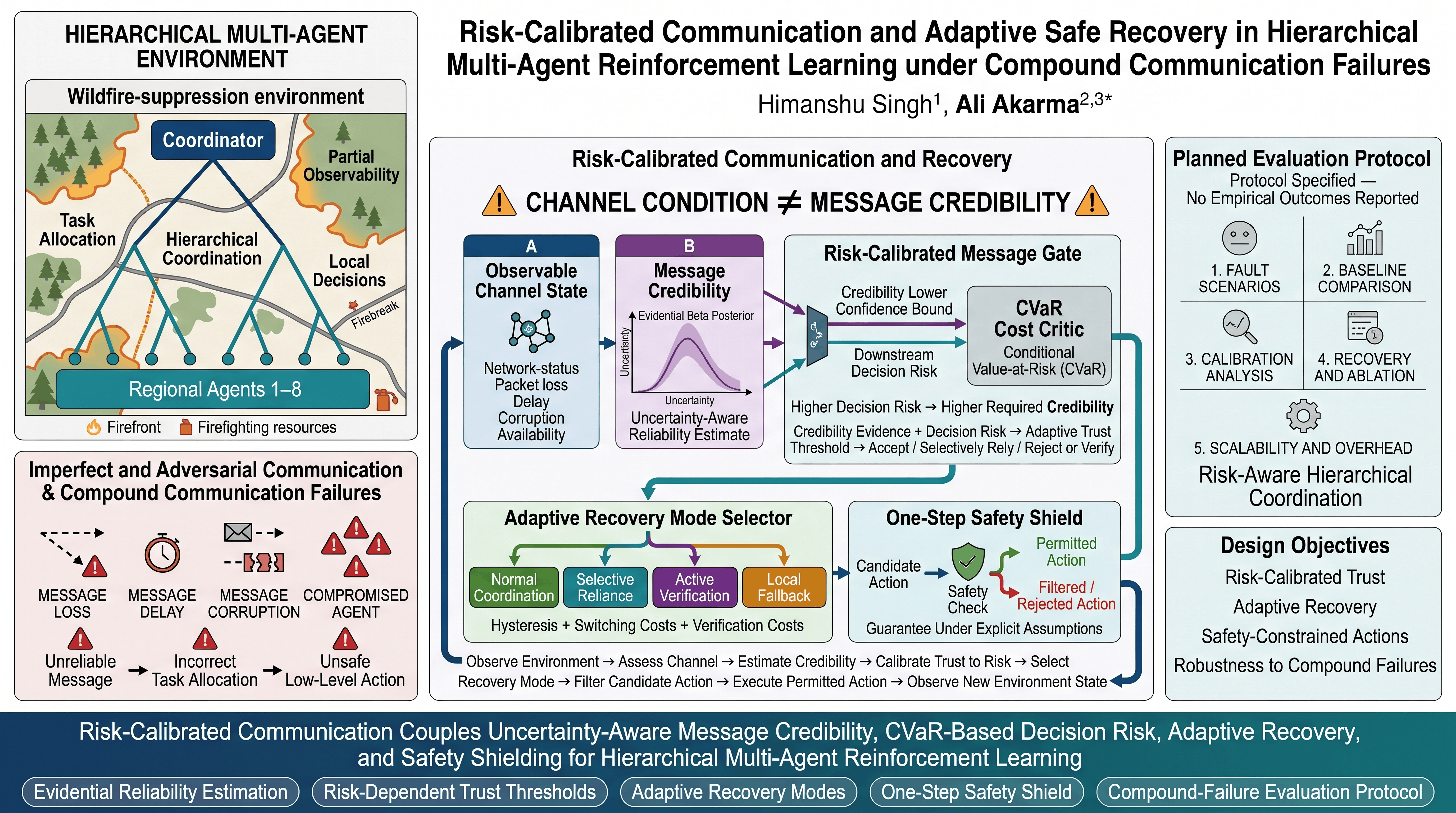
Cooperative multi-agent reinforcement learning (MARL) relies on communication to coordinate under partial observability. Real channels lose, delay, and corrupt messages, and a compromised agent can send misleading ones. In hierarchical MARL, these failures propagate into task-allocation errors and unsafe low-level actions. Prior work has studied message filtering, communication-constrained learning, and hierarchical recovery under message loss largely in isolation. This paper proposes RiCoR, a risk-calibrated communication and recovery framework for hierarchical MARL. RiCoR separates observable channel conditions from message credibility and represents uncertainty in its reliability estimates with an evidential Beta posterior. It gates each message by a lower confidence bound whose threshold rises with the downstream decision risk, measured by a conditional value-at-risk (CVaR) cost critic. A learned mode selector switches among normal coordination, selective reliance, active verification, and local fallback, with hysteresis and explicit switching and verification costs. A one-step safety shield filters low-level actions, and its guarantee is stated under explicit assumptions. The paper also specifies an evaluation protocol for a hierarchical wildfire-suppression benchmark with one coordinator and eight regional agents. The protocol covers isolated, compound, and held-out faults, four baselines, and calibration, recovery, ablation, scalability, and overhead analyses. The paper reports no empirical outcomes.
Keywords:
multi-agent reinforcement learning
; hierarchical coordination
; communication reliability
; uncertainty calibration
; safe reinforcement learning
; resilience
; fault recovery
1. Introduction
Learned communication is a central mechanism through which cooperative agents overcome partial observability [1,2,3]. In hierarchical multi-agent reinforcement learning (MARL), a coordinator aggregates reports from subordinate agents, allocates shared resources, and issues goals that condition local policies [4,5,6]. This structure makes every level depend on information that travels over imperfect links. A coordinator that acts on a stale fire-front report can send scarce resources to the wrong region, and subordinate agents may keep pursuing an outdated goal long after it has stopped being useful. When several fault types co-occur, for instance a bursty outage that coincides with a compromised agent injecting misleading reports, errors compound across levels of the hierarchy. Such multi-agent coordination challenges under distributed communication uncertainty are particularly acute in safety-critical spatial and urban environments, where agentic AI and digital twin frameworks have been proposed for secure, autonomous civil infrastructure management and climate-resilient emergency response [7,8].
The literature addresses parts of this problem. Message-filtering approaches estimate how much each received message should be trusted [9,10,11], trust-based consensus limits reliance on unreliable teammates [12], communication-constrained learning models lossy channels explicitly [13,14], and recent hierarchical controllers predict missing interaction information and add a predictive safety filter when messages are lost [15]. A recent large-scale study further shows that robustness achieved against one type of uncertainty does not reliably transfer to others [16]. What remains less understood is how these capabilities interact. A trust score alone does not distinguish a message that never arrived from one that arrived intact but is wrong, nor does it indicate how confident the estimator is, or whether the decision depending on the message is consequential enough to warrant verification rather than acceptance.
We study this interaction directly. Our premise is that the decision to use, verify, or discard a message should depend jointly on three quantities: the observable state of the channel, a calibrated and uncertainty-aware estimate of content credibility, and the safety cost of acting on the message if it turns out to be wrong. A moderately reliable message may be acceptable for a low-impact decision but insufficient for one that could place a ground crew in the path of a fire. We further argue that recovery should be treated as a decision in its own right, because returning to normal coordination too quickly after an outage re-exposes the hierarchy to residual faults, while returning too slowly wastes performance.
The contributions of this paper are as follows.
- A problem formulation for hierarchical MARL as a cost-augmented Dec-POMDP with Markov channel states, a taxonomy of channel and content failures, a threat model, and a tail-risk-constrained objective (Section 3).
- A reliability formulation that factorizes message reliability into an observable channel term and a content-credibility term, with an evidential Beta posterior that yields a lower confidence bound used for gating (Section 5).
- A risk-conditioned gating rule in which the acceptance threshold for each message increases with a decision-sensitivity measure weighted by a conditional value-at-risk (CVaR) cost critic, linking message use to downstream safety consequences.
- An adaptive four-mode recovery policy with explicit switching and verification costs, combined with a one-step action shield whose guarantee is stated under explicit assumptions.
- An evaluation protocol that defines isolated, compound, and held-out fault conditions, four baselines, metrics, ablation variants, and a statistical analysis plan, together with calibration, recovery, scalability, and overhead analyses (Section 6).
This preprint specifies the framework and the evaluation protocol. It does not report empirical outcomes. Statements about the intended behavior of RiCoR describe design goals and are not findings.
Section 2 reviews related work, and Sections 3–5 present the formulation, architecture, and model. Section 6 specifies the evaluation design. Sections 7–9 discuss design implications, limitations, and scope.
2. Related Work
2.1. Learned Communication in MARL
Early differentiable communication schemes such as DIAL [1] and CommNet [2] showed that agents can learn useful message protocols end to end. Subsequent work introduced attention over senders [3] and learned decisions about when to communicate. The survey of Zhu et al. [17] notes that most of these methods assume reliable delivery and benign senders. Centralized-training architectures such as MADDPG [18], QMIX [19], and MAPPO [20] provide the learning backbones on which many communication schemes are built. Beyond unconstrained communication, governance-aware coordination frameworks combining MARL with accountability mechanisms have been investigated to orchestrate autonomous agents in complex decentralized environments [21].
2.2. Robustness to Unreliable and Adversarial Messages
Adversarial communication can emerge even among cooperating learners [22], and crafted messages can substantially degrade receiving policies [23]. Defenses include Gaussian-process filtering of outlier messages [10], message reconstruction to detect and correct malicious content [11], certifiable robustness through message ablation and aggregation [24], and active defense that estimates the reliability of each message and down-weights suspicious ones [9]. Trust-based consensus [12] learns whom to rely on during collective decisions. The empirical study of Li et al. [16] shows that robustness is uncertainty-specific, which motivates our evaluation on compound and held-out faults. In broader networked cyber-physical and IoT sensing systems, safeguarding communication against malicious disruptions has similarly motivated multi-layered defense strategies: hybrid deep learning architectures have been developed for detecting denial-of-service and network traffic anomalies in smart sensing [25], deep generative models have been explored for intent-based dynamic behavior capture and anomaly profiling [26], and runtime behavior attestation frameworks track execution traces to verify node integrity [27]. Furthermore, multi-pillar governance frameworks emphasize comprehensive cybersecurity and trust layers in distributed IoT environments [28]. These methods generally treat reliability as a single score and do not separate channel failures from content failures or condition acceptance on downstream risk.
2.3. Communication-Constrained and Hierarchical MARL
Communication-constrained priors (CCP) model lossy links and differentiate messages by channel quality [13], and Liu et al. [14] study robustness and efficiency jointly. On the hierarchical side, feudal architectures [4,5] and skill discovery [6] structure coordination across temporal scales. Closest to our work, Sun et al. [15] combine hierarchical MARL with recurrent prediction of missing interaction information and a predictive safety filter for warehouse robots under communication loss. We refer to this approach as HPSF (hierarchical prediction with a safety filter). Its setting focuses on missing messages, and content credibility, calibrated uncertainty, and risk-dependent verification are outside its scope.
2.4. Safe and Risk-Sensitive Reinforcement Learning
Constrained Markov decision process (MDP) formulations [29] and percentile risk criteria [30,31] trade return against expected or tail cost. Shielding enforces safety by filtering actions against a specification [32], and has been extended to multi-agent settings [33]. Safe MARL for multi-robot control has been studied with constrained policy optimization [34]. For uncertainty quantification we draw on calibration analysis [35,36,37] and evidential learning [38]. In safety-critical physical systems, managing strict operational constraints and evaluating rare catastrophic failures have motivated specialized paradigms ranging from certifiable deep importance sampling for rare-event simulation in black-box systems [39] to constrained multi-objective load-following dispatch in critical infrastructure [40].
Table 1 contrasts representative methods along the capabilities targeted in this work. The table reflects the primary mechanisms described in each paper rather than every possible extension.
3. Problem Formulation and Proposed Framework
3.1. Hierarchical Dec-POMDP with Unreliable Communication
We consider a team of one coordinator (agent 0) and N regional agents acting in a decentralized partially observable MDP (Dec-POMDP) augmented with a cost signal, defined by the tuple in (1).
Here R is the shared team reward, C is a non-negative safety cost, is the space of goals that the coordinator issues every K steps, and is the discount factor. At step t, regional agent i observes and sends a report to the coordinator and to its neighbors . The coordinator returns a goal and a shared operating mode . All messages traverse a channel that may apply a fault . The received message and its metadata are modeled as in (2).
In (2), is a latent two-state Markov channel state of Gilbert–Elliott type with loss probability , is the delivery delay, and is a content transformation (identity, noise, replay, or adversarial perturbation). The receiver observes metadata , namely the arrival flag, the message age, and a sequence-gap indicator.
3.2. Threat Model and Assumptions
We distinguish two classes of failure. Channel failures (loss, bursty outage, delay) are partially observable through . Content failures (numerical corruption, stale or contradictory reports, and misleading reports from compromised agents) leave metadata intact and can only be inferred from consistency with local observations, temporal history, and corroborating messages. Up to k regional agents may be compromised. A compromised agent observes truthfully but transmits reports perturbed to maximize coordinator misallocation within an budget . The coordinator itself is assumed uncompromised. We do not assume an oracle for intent: the injected fault labels are used only for training the auxiliary reliability head and for evaluation. Safety is defined by two predicates described in Section 6: crew entrapment and resource drops near crews.
3.3. Design Objective
The goal is to learn policies that maximize expected return subject to a tail-risk constraint on cumulative safety cost, as formalized in (3).
4. System Architecture
Figure 1 shows the RiCoR architecture. Reports leave the regional agents, cross the faulty channel, and enter a communication monitor that extracts metadata. The reliability estimator produces a channel-health probability and an evidential credibility posterior for each message. The risk-conditioned gate combines these with a CVaR cost critic to determine each message’s weight in the coordinator’s attention-based aggregation. A mode selector chooses the team operating mode, which conditions both the coordinator and the regional policies, and a one-step shield filters every low-level action before execution.
4.1. Communication Monitor and Reliability Estimator
For each link , a gated recurrent unit (GRU) consumes the metadata sequence and outputs the probability that the channel is in the good state. In parallel, a credibility network compares the decoded message with the receiver’s local observation, with the sender’s previous reports, and with reports from other senders covering overlapping regions, and outputs non-negative evidence for and against credibility. This separation is deliberate: a missing message should lower without implying anything about the sender, whereas a delivered but inconsistent message should lower credibility without implicating the channel.
4.2. Operating Modes and Governance Loop
The team operates in one of four modes, illustrated in Figure 2. In normal mode (N), all gated messages are used. In selective mode (S), messages below the risk-conditioned threshold are masked and the coordinator relies on its belief state. In verify mode (V), the coordinator issues targeted queries to neighbors of a suspicious sender to obtain corroborating evidence, at a communication cost. In fallback mode (F), regional agents follow locally conditioned policies with the last trusted goal, and the coordinator restricts itself to conservative allocations. Transitions are produced by a learned selector with hysteresis, so that the team does not oscillate when evidence hovers near a threshold.
5. Mathematical Model and Algorithms
5.1. Factorized Reliability with Evidential Uncertainty
Let indicate that the content of is credible. The credibility network outputs evidence , which parameterize a Beta posterior following evidential learning [38], as given in (4).
The posterior variance in (5) captures epistemic uncertainty and is large when evidence in either direction is scarce.
Combining the channel and content terms yields the mean reliability and a lower confidence bound in (6), where controls conservatism.
5.2. Decision Risk and Risk-Conditioned Gating
To quantify how much a message matters for safety, we measure the change in the receiver’s policy when message j is removed and weight it by the tail cost of the resulting decision. The decision-sensitivity score is defined in (7).
In (7), is the set of received messages, excludes message j, and is a distributional cost critic that estimates the CVaR of the cost-to-go. The acceptance threshold then increases with risk, and the gate weight follows a tempered sigmoid, as defined in (8).
The gated weights enter a multi-head attention aggregator, as expressed in (9), where and are query and key projections.
Setting recovers risk-agnostic trust weighting similar in spirit to ADMAC [9], which we use as an ablation.
5.3. Mode Selection with Switching and Verification Costs
The mode selector observes a summary that contains the mean and minimum of , the maximum , mean uncertainty , the current outage length, and the time since the last switch. It is trained with the shaped reward in (10).
Here is the number of verification queries issued and is the Lagrange multiplier of the safety constraint. A mode switch is admissible only if the previous mode has been held for at least H steps, except for transitions into fallback, which are always admissible.
5.4. Safety Shield
Each regional agent has a one-step predicate that encodes entrapment and drop-proximity rules given the locally observed fire intensity, wind, and crew positions. The shield executes the action defined in (11), where is a retreat-to-safe-zone action.
with .
Proposition 1. If over-approximates the true one-step unsafe set (i.e., implies the action is safe in every state consistent with o) and is always safe, then every executed action satisfies the one-step safety predicate. Proof sketch. By (11), the executed action is either with or an element of , and both are safe under the stated assumptions. □ The proposition does not cover multi-step entrapment or errors in the local observation model, so safety violations remain possible under the full framework.
5.5. Learning Objective
5.6. Algorithms
Algorithm 1 summarizes decentralized execution at one time step. Training is centralized and proceeds in three curriculum stages (clean, isolated faults, compound faults). In each iteration we collect rollouts with Algorithm 1, update the reliability heads with (12), update critics and policies with (13), update with (10), and update with (14). After training, the temperatures of and are fitted on the validation split [35].
| Algorithm 1:RiCoR execution at step t |
|
6. Evaluation Design
This section specifies the benchmark environments, fault conditions, baselines, implementation configuration, metrics, and analysis protocols for assessing RiCoR. It defines the design of the evaluation. It reports no outcomes.
6.1. Environments
The primary benchmark, HierFire, is a hierarchical wildfire-suppression environment built on a stochastic cellular-automaton spread model with fuel, terrain, and wind effects [42]. Wildfire suppression represents a prototypical challenge in climate-resilient emergency management, where autonomous multi-agent systems and digital twins are increasingly utilized to orchestrate disaster response and asset protection [8]. A map is divided into regions of cells, each controlled by a regional agent that commands three ground crews with actions for movement, direct suppression, firebreak construction, and resource requests. Every steps the coordinator allocates six shared aerial drops among regions on the basis of 16-dimensional regional reports. Episodes last 400 steps and contain 12–20 assets of varying value. Safety cost counts crew entrapment events (a crew occupying or adjacent to a cell whose spread probability exceeds 0.6) and aerial drops within one cell of a crew. To test transfer to a different task, the protocol adds HCN, a hierarchical cooperative navigation task derived from the multi-agent particle environment [18] with one leader and six followers, in which collisions constitute safety violations.
6.2. Scenario Library and Fault Conditions
The scenario library contains 6,000 procedurally generated HierFire maps that vary fuel load, terrain, wind regime, and ignition points. Maps are split by seed into 4,200 training, 600 validation, and 1,200 test maps. Table 2 lists the fault conditions. Isolated faults F1–F6 and compound faults C1–C3 appear in the training curriculum, whereas held-out conditions U1–U3 combine faults, topologies, or attacker counts never seen during training. All fault-robust methods receive the same curriculum, and the standard hierarchical baseline is trained without faults to serve as a reference.
6.3. Baselines
The protocol compares RiCoR with four baselines. H-MAPPO is a two-level feudal MAPPO with TarMAC-style attention communication [3,5,20], trained on clean communication. H-MAPPO+Drop applies random message dropout and noise during training. ADMAC-H adapts active-defense reliability weighting [9] to both levels of the hierarchy. HPSF is a reimplementation of the hierarchical missing-information prediction and predictive safety filter of Sun et al. [15] for the action space of the benchmark. All methods share the same backbone, observation encoders, and hyperparameter search budget of 24 configurations.
6.4. Implementation and Hyperparameters
The protocol specifies PyTorch 2.2 with a vectorized NumPy environment on a workstation with two NVIDIA RTX A6000 GPUs (48 GB each), an AMD EPYC 7543 32-core CPU, and 256 GB of RAM. Each method is trained for environment steps with 8 independent seeds. Table 3 lists the default hyperparameters of RiCoR. All networks are optimized with Adam.
6.5. Metrics and Statistical Analysis Plan
Figure 3 summarizes the training and evaluation pipeline. Task performance is measured by the asset protection rate (APR), the percentage of total asset value not burned at episode end, together with burned area. Safety is measured by violations per episode (SV). Because the objective in (3) constrains a tail statistic, constraint satisfaction is assessed with the empirical CVaR of per-episode cost compared with the budget d. A mean SV at or below d is necessary but not sufficient, since the CVaR of episode cost is never below its mean.
Reliability estimation is measured by expected calibration error (ECE) with 15 bins [36], Brier score, area under the receiver operating characteristic curve (AUROC), false acceptance rate (FAR), and false rejection rate (FRR) at the operating threshold. Graceful degradation is the relative APR loss from clean to faulty conditions. Recovery time is the number of steps after fault removal until the per-step team reward returns to 95% of its pre-fault level. Communication volume, inference latency, and training time complete the metric set.
Each method is evaluated on 1,200 test maps per condition and seed. The protocol reports means with 95% bootstrap confidence intervals and uses Welch’s t-test across seeds for pairwise comparisons.
6.6. Analysis Protocols
The analyses address five evaluation questions. Each is posed as a question and implies no expected answer.
- Do channel-aware and content-aware baselines differ in which fault families they handle, and does the factorized estimator in (6) cover both?
- Does risk-conditioned gating change the safety–performance trade-off relative to reliability weighting alone ()?
- Does evidential uncertainty matter more under held-out faults than under faults seen in training?
- Does the learned mode selector shorten recovery relative to fixed thresholds?
- What computation and communication overhead do the added components introduce as team size grows?
Overall performance and per-fault analysis. All methods are evaluated under clean communication and under the isolated (F1–F6, averaged), compound (C1–C3, averaged), and held-out (U1–U3, averaged) conditions, reporting APR and SV, with burned area under compound faults. APR is also reported for each isolated fault F1–F6. A packet-loss sweep varies the F1 loss rate from 0 to 0.6.
Reliability estimation. Estimator quality is computed on messages pooled over all test conditions, with injected-fault labels as ground truth. The full estimator is compared with ADMAC-H and with two variants: a point-estimate variant that removes evidential uncertainty while keeping the architecture, and a joint-head variant that removes the channel/content factorization. A diagnosis confusion matrix assigns each message to the most probable of four categories (clean, channel failure, corrupted content, misleading content).
Recovery. Normalized team reward is traced around a compound fault (C2) injected at step 100 and removed at step 250, averaged over test maps. Recovery over all compound conditions is summarized by degradation, recovery time, mean fallback duration, mode switches per episode, and the share of unnecessary switches. A switch is unnecessary if it is reverted within steps without an intervening change in fault state. A fixed-threshold selector variant (Ours-fixed) replaces the learned selector. Mode occupancy is logged for each condition.
Ablations. Under compound faults, the protocol removes one component at a time and reports APR, SV, and ECE, with APR on held-out faults. The variants remove the channel/content split, evidential uncertainty (point estimate), risk conditioning (), adaptive recovery (Ours-fixed), the verify mode, and the safety shield. A sweep over traces the safety–performance trade-off and places each operating point beside the baselines.
Generalization. Held-out conditions U1–U3 are reported individually. Transfer to HCN is assessed under compound faults by success rate and collisions per episode.
Scalability and overhead. The number of regional agents varies over with the region size fixed, reporting APR under compound faults and inference latency per decision step. At , the protocol reports parameter count, per-step team inference latency on one GPU, training time, and communication volume per episode under compound and clean conditions. The added cost of RiCoR comes from the distributional cost critic, the per-message sensitivity computation in (7), which requires one additional forward pass per sender, and verification queries.
7. Discussion of Design Implications
7.1. Design Rationale
Three design decisions follow from the structure of the problem rather than from any measured outcome. The first is the separation of channel and content. A missing message carries no information about the sender, whereas a delivered but inconsistent message implicates the sender and not the link. A single trust score conflates the two, and the factorization in (6) keeps them apart so that each can be estimated from the evidence that bears on it. Channel state is partially observable through metadata, while content failures leave metadata intact and require consistency checks against local observations, sender history, and corroborating reports.
The second decision is to gate on a lower confidence bound whose threshold depends on decision risk. The bound penalizes estimates that rest on scarce evidence, and the threshold in (8) rises with the sensitivity score , so a message that is acceptable for a low-impact decision can be rejected for a consequential one. Setting removes the dependence on risk and recovers risk-agnostic trust weighting, which gives a direct way to isolate the effect of risk conditioning.
The third decision is to treat recovery as a decision. Returning to normal coordination too early re-exposes the hierarchy to residual faults, and returning too late forgoes useful information. The mode selector therefore pays explicit switching and verification costs in (10), uses hysteresis to avoid oscillation, and always permits a transition into fallback so that safety does not wait on the hold time.
7.2. Relation to Prior Work
The closest prior method, HPSF [15], also combines a hierarchy, recovery from communication loss, and a predictive safety filter. Its shield-like component plays a role similar to the shield in Section 5. The two approaches differ in what they treat as the failure of interest. HPSF predicts missing interaction information, whereas RiCoR masks low-reliability messages and relies on the coordinator’s belief state. Content credibility, calibrated uncertainty, and risk-dependent verification fall outside the scope of HPSF as described in the cited work. ADMAC [9] estimates a reliability score per message but does not separate channel from content or condition acceptance on downstream risk. The comparison in Table 1 rests on the primary mechanisms in each paper.
7.3. Operating Conditions and Evaluation Needed
The design assumes an uncompromised coordinator, a bounded number of compromised regional agents, and local safety predicates that over-approximate the true one-step unsafe set. Whether the design achieves its intended effect cannot be established from the formulation alone. The five questions in Section 6 define the evidence that would answer it.
8. Limitations and Assumptions
This document contains no empirical validation of RiCoR. Every statement about its behavior is a design goal or a mathematical consequence of the stated assumptions.
The evaluation protocol is simulation-based. Real communication stacks exhibit correlated failures, such as self-induced congestion, that the channel models in Section 3 do not capture. The threat model assumes an uncompromised coordinator and a bounded number of compromised regional agents. Verification mode relies on corroborating neighbors, so it assumes that honest agents form a majority around a suspicious sender.
The reliability heads are supervised with injected-fault labels that are unavailable in deployment, so calibration may degrade under fault distributions far from training. The guarantee in Proposition 1 is limited to one-step safety under a conservative local model. The Lagrangian relaxation of (3) offers no formal guarantee that the CVaR budget is met, so the method targets risk reduction and does not provide formal constraint satisfaction. Finally, the per-message sensitivity computation in (7) scales linearly with the number of senders, which may restrict its use in much larger teams.
9. Conclusion and Scope
This paper presented RiCoR, a framework for hierarchical MARL under communication failures. It integrates factorized and uncertainty-aware reliability estimation, risk-conditioned message gating, adaptive multi-mode recovery, and action shielding. The paper formalizes the problem as a cost-augmented Dec-POMDP with a tail-risk objective, defines the reliability, gating, mode-selection, and shielding components with their training objectives, and specifies an evaluation protocol with fault taxonomy, baselines, metrics, ablation variants, and a statistical analysis plan.
The paper reports no empirical outcomes, and it makes no claim about the performance, safety, or efficiency of RiCoR in practice. The evaluation questions in Section 6 identify what must be measured to assess those properties. Four directions extend the framework. The first is self-supervised reliability learning that removes the dependence on injected-fault labels. The second is multi-step shielding based on reachability analysis, which would strengthen the safety guarantee. The third is evaluation on hardware-in-the-loop communication with realistic network simulators. The fourth is extending the threat model to a possibly compromised coordinator through redundant coordination layers.
References
- Foerster, J.N.; Assael, Y.M.; de Freitas, N.; Whiteson, S. Learning to Communicate with Deep Multi-Agent Reinforcement Learning. In Proceedings of the Advances in Neural Information Processing Systems, 2016; Vol. 29. [Google Scholar]
- Sukhbaatar, S.; Szlam, A.; Fergus, R. Learning Multiagent Communication with Backpropagation. In Proceedings of the Advances in Neural Information Processing Systems, 2016; Vol. 29. [Google Scholar]
- Das, A.; Gervet, T.; Romoff, J.; Batra, D.; Parikh, D.; Rabbat, M.; Pineau, J. TarMAC: Targeted Multi-Agent Communication. In Proceedings of the Proc. Int. Conf. Mach. Learn. (ICML), 2019. [Google Scholar]
- Vezhnevets, A.S.; Osindero, S.; Schaul, T.; Heess, N.; Jaderberg, M.; Silver, D.; Kavukcuoglu, K. FeUdal Networks for Hierarchical Reinforcement Learning. In Proceedings of the Proc. Int. Conf. Mach. Learn. (ICML), 2017. [Google Scholar]
- Ahilan, S.; Dayan, P. Feudal Multi-Agent Hierarchies for Cooperative Reinforcement Learning. arXiv 2019, arXiv:1901.08492. [Google Scholar]
- Yang, J.; Borovikov, I.; Zha, H. Hierarchical Cooperative Multi-Agent Reinforcement Learning with Skill Discovery. In Proceedings of the Proc. Int. Conf. Auton. Agents Multiagent Syst. (AAMAS), 2020. [Google Scholar]
- Syed, T.A.; Akarma, A.; Alatify, A.; Naqash, M.T.; Alqurashi, A. Agentic AI-enhanced digital twins for Smart City civil infrastructure: A secure, autonomous and auditable management framework. PLoS ONE 2026, 21, e0353610. [Google Scholar] [CrossRef]
- Syed, T.A.; Akarma, A.; Naqash, M.T.; Hameed, D.; Kamal, S.; Formisano, A. Agentic AI for Climate-Resilient Cities: A PRISMA-Guided Review and Digital Twin Framework. Sustainability 2026, 18. [Google Scholar] [CrossRef]
- Yu, L.; Qiu, Y.; Yao, Q.; Shen, Y.; Zhang, X.; Wang, J. Robust Communicative Multi-Agent Reinforcement Learning with Active Defense. Proc. Proc. AAAI Conf. Artif. Intell. 2024, Vol. 38, 17575–17582. [Google Scholar] [CrossRef]
- Mitchell, R.; Blumenkamp, J.; Prorok, A. Gaussian Process Based Message Filtering for Robust Multi-Agent Cooperation in the Presence of Adversarial Communication. arXiv 2020, arXiv:2012.00508. [Google Scholar]
- Xue, W.; Qiu, W.; An, B.; Rabinovich, Z.; Obraztsova, S.; Yeo, C.K. Mis-spoke or Mis-lead: Achieving Robustness in Multi-Agent Communicative Reinforcement Learning. In Proceedings of the Proc. Int. Conf. Auton. Agents Multiagent Syst. (AAMAS), 2022. [Google Scholar]
- Fung, H.L.; Darvariu, V.A.; Hailes, S.; Musolesi, M. Trust-based Consensus in Multi-Agent Reinforcement Learning Systems. Reinf. Learn. J. 2024, 2, 714–732. [Google Scholar]
- Yang, G.; Yang, T.; Qiao, J.; Wu, Y.; Huo, J.; Chen, X.; Gao, Y. Multi-Agent Reinforcement Learning with Communication-Constrained Priors. In Proceedings of the Advances in Neural Information Processing Systems, 2025; Vol. 38. [Google Scholar]
- Liu, Z.; Li, Y.; Wang, J.; Tu, J.; Hong, Y.; Li, F.; Liu, Y.; Sugawara, T.; Tang, Y. Robust and Efficient Communication in Multi-Agent Reinforcement Learning. Chaos An. Interdiscip. J. Nonlinear Sci. 2026, 36, 022101. [Google Scholar] [CrossRef]
- Sun, W.; Xu, G.; Malikopoulos, A.A. Hierarchical Multi-agent Reinforcement Learning for Warehouse Robot Coordination under Communication Loss. arXiv 2026, arXiv:2609.33637. [Google Scholar]
- Li, S.; Mao, Z.; Li, H.; Jing, Z.; Bian, Z.; Guo, J.; Wang, L.; Han, Z.; Xu, R.; Yu, X.; et al. Empirical Study on Robustness and Resilience in Cooperative Multi-Agent Reinforcement Learning. Proc. Adv. Neural Inf. Process. Syst. 2025, Vol. 38. [Google Scholar]
- Zhu, C.; Dastani, M.; Wang, S. A Survey of Multi-Agent Deep Reinforcement Learning with Communication. Auton. Agents Multi-Agent Syst. 2024, 38, 4. [Google Scholar] [CrossRef]
- Lowe, R.; Wu, Y.; Tamar, A.; Harb, J.; Abbeel, P.; Mordatch, I. Multi-Agent Actor-Critic for Mixed Cooperative-Competitive Environments. In Proceedings of the Advances in Neural Information Processing Systems, 2017; Vol. 30. [Google Scholar]
- Rashid, T.; Samvelyan, M.; de Witt, C.S.; Farquhar, G.; Foerster, J.; Whiteson, S. QMIX: Monotonic Value Function Factorisation for Deep Multi-Agent Reinforcement Learning. In Proceedings of the Proc. Int. Conf. Mach. Learn. (ICML), 2018. [Google Scholar]
- Yu, C.; Velu, A.; Vinitsky, E.; Gao, J.; Wang, Y.; Bayen, A.; Wu, Y. The Surprising Effectiveness of PPO in Cooperative Multi-Agent Games. In Proceedings of the Advances in Neural Information Processing Systems (Datasets and Benchmarks Track), 2022; Vol. 35. [Google Scholar]
- Syed, T.A.; Akarma, A.; Kamal, S.; Jan, S.; Alkhodre, A.B.; Jamal, A. Governance-aware autonomous retail coordination in artificial intelligence cities using multi-agent reinforcement learning, blockchain accountability, and federated learning. Front. Artif. Intell. 2026, 9. [Google Scholar] [CrossRef]
- Blumenkamp, J.; Prorok, A. The Emergence of Adversarial Communication in Multi-Agent Reinforcement Learning. In Proceedings of the Proc. Conf. Robot Learn. (CoRL), 2020. [Google Scholar]
- Tu, J.; Wang, T.; Wang, J.; Manivasagam, S.; Ren, M.; Urtasun, R. Adversarial Attacks on Multi-Agent Communication. In Proceedings of the Proc. IEEE/CVF Int. Conf. Comput. Vis. (ICCV), 2021. [Google Scholar]
- Sun, Y.; Zheng, R.; Hassanzadeh, P.; Liang, Y.; Feizi, S.; Ganesh, S.; Huang, F. Certifiably Robust Policy Learning against Adversarial Communication in Multi-agent Systems. arXiv 2022, arXiv:2206.10158. [Google Scholar]
- Shaikh, J.; Syed, T.A.; Shah, S.A.; Jan, S.; Ain, Q.U.; Singh, P.K. Advancing DDoS attack detection with hybrid deep learning: integrating convolutional neural networks, PCA, and vision transformers. Int. J. Smart Sens. Intell. Syst. 17. [CrossRef]
- Jan, S.; Musa, S.; Ali, T.; Alzahrani, A. Deep Convolutional Generative Adversarial Networks for Intent-based Dynamic Behavior Capture. Int. J. Eng. Technol. 2018, 7, 101–103. [Google Scholar] [CrossRef]
- Ismail, R.; Syed, T.A.; Musa, S. Design and implementation of an efficient framework for behaviour attestation using n-call slides. In Proceedings of the Proceedings of the 8th International Conference on Ubiquitous Information Management and Communication, 2014; pp. 1–8. [Google Scholar]
- Jan, S.; Akarma, A.; Syed, T.A.; Muhammad, M.A.; Kamal, S. EAGF: A Four-Pillar Ethical AI Governance Framework for Trustworthy Cybersecurity in 5G Renewable Energy IoT Systems. Sci. Rep. 2026. [Google Scholar] [CrossRef]
- Achiam, J.; Held, D.; Tamar, A.; Abbeel, P. Constrained Policy Optimization. In Proceedings of the Proc. Int. Conf. Mach. Learn. (ICML), 2017. [Google Scholar]
- Chow, Y.; Ghavamzadeh, M.; Janson, L.; Pavone, M. Risk-Constrained Reinforcement Learning with Percentile Risk Criteria. J. Mach. Learn. Res. 2018, 18, 1–51. [Google Scholar]
- Rockafellar, R.T.; Uryasev, S. Optimization of Conditional Value-at-Risk. J. Risk 2000, 2, 21–41. [Google Scholar] [CrossRef]
- Alshiekh, M.; Bloem, R.; Ehlers, R.; Könighofer, B.; Niekum, S.; Topcu, U. Safe Reinforcement Learning via Shielding. In Proceedings of the Proc. AAAI Conf. Artif. Intell., 2018; Vol. 32. [Google Scholar] [CrossRef]
- ElSayed-Aly, I.; Bharadwaj, S.; Amato, C.; Ehlers, R.; Topcu, U.; Feng, L. Safe Multi-Agent Reinforcement Learning via Shielding. In Proceedings of the Proc. Int. Conf. Auton. Agents Multiagent Syst. (AAMAS), 2021. [Google Scholar]
- Gu, S.; Kuba, J.G.; Chen, Y.; Du, Y.; Yang, L.; Knoll, A.; Yang, Y. Safe Multi-Agent Reinforcement Learning for Multi-Robot Control. Artif. Intell. 2023, 319, 103905. [Google Scholar] [CrossRef]
- Guo, C.; Pleiss, G.; Sun, Y.; Weinberger, K.Q. On Calibration of Modern Neural Networks. In Proceedings of the Proc. Int. Conf. Mach. Learn. (ICML), 2017. [Google Scholar]
- Naeini, M.P.; Cooper, G.; Hauskrecht, M. Obtaining Well Calibrated Probabilities Using Bayesian Binning. In Proceedings of the Proc. AAAI Conf. Artif. Intell., 2015; Vol. 29. [Google Scholar] [CrossRef]
- Brier, G.W. Verification of Forecasts Expressed in Terms of Probability. Mon. Weather Rev. 1950, 78, 1–3. [Google Scholar] [CrossRef]
- Sensoy, M.; Kaplan, L.; Kandemir, M. Evidential Deep Learning to Quantify Classification Uncertainty. In Proceedings of the Advances in Neural Information Processing Systems, 2018; Vol. 31. [Google Scholar]
- Arief, M.; Bai, Y.; Ding, W.; He, S.; Huang, Z.; Lam, H.; Zhao, D. Certifiable deep importance sampling for rare-event simulation of black-box systems. arXiv 2021, arXiv:2111.02204. [Google Scholar]
- Oktavian, M.R.; Febrita, D.; Arief, M.M. Cogeneration power-desalination in small modular reactors (SMRs) for load following in Indonesia. In Proceedings of the 2018 4th International Conference on Science and Technology (ICST); IEEE, 2018; pp. 1–6. [Google Scholar]
- Schulman, J.; Wolski, F.; Dhariwal, P.; Radford, A.; Klimov, O. Proximal Policy Optimization Algorithms. arXiv 2017, arXiv:1707.06347. [Google Scholar]
- Alexandridis, A.; Vakalis, D.; Siettos, C.I.; Bafas, G.V. A Cellular Automata Model for Forest Fire Spread Prediction: The Case of the Wildfire that Swept through Spetses Island in 1990. Appl. Math. Comput. 2008, 204, 191–201. [Google Scholar] [CrossRef]
Figure 1.
Architecture of RiCoR. Messages from regional agents pass through a fault-prone channel, after which the communication monitor, reliability estimator, and risk-conditioned gate determine how strongly each message influences coordination. The mode selector conditions the coordinator and regional policies, can trigger verification queries, and the shield filters every executed action.
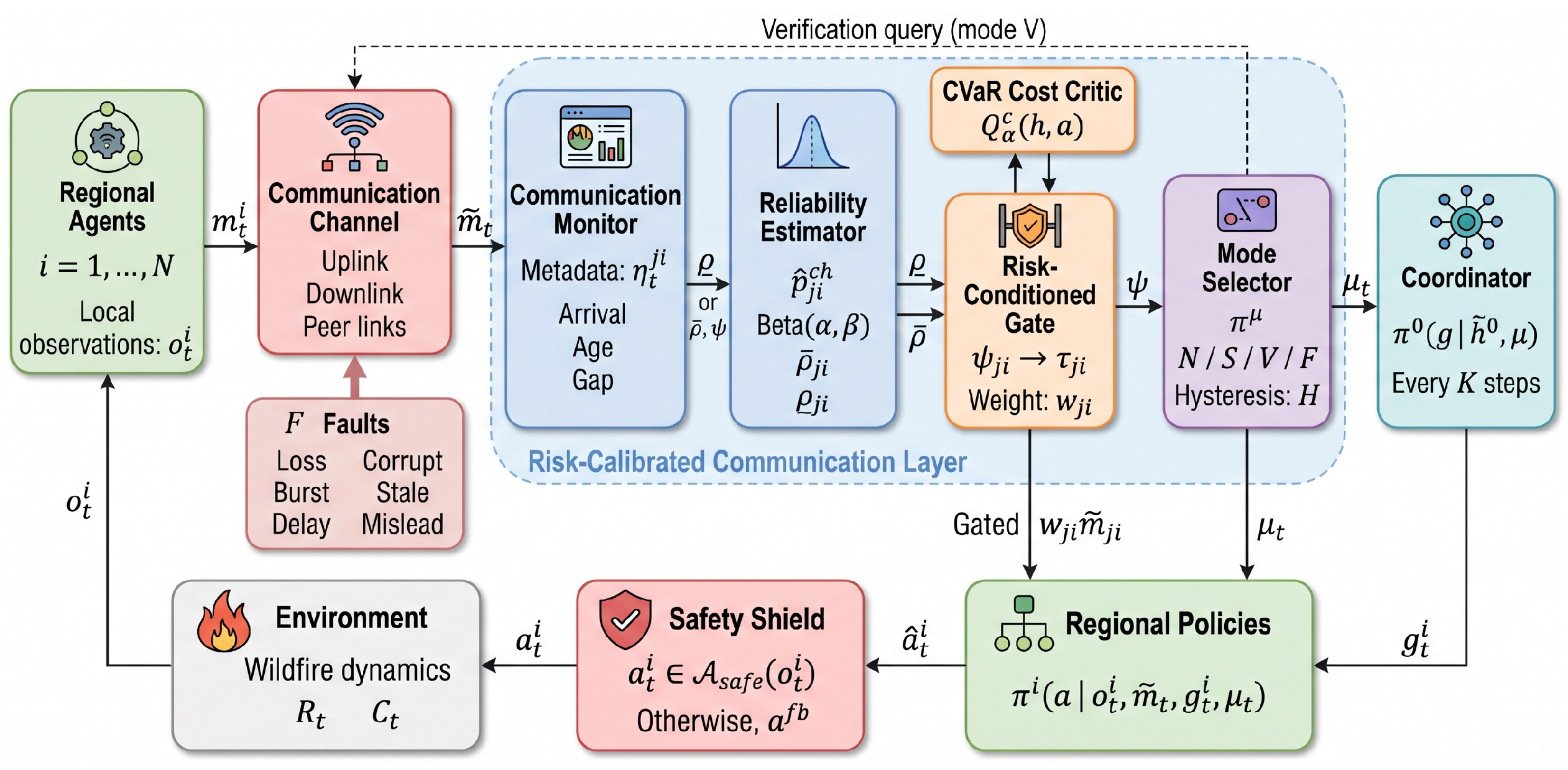
Figure 2.
Operating-mode governance loop. Transitions are chosen by the learned mode selector, and the conditions shown are the principal triggers the design is intended to capture. Hysteresis of H steps is intended to prevent rapid oscillation between modes.
Figure 2.
Operating-mode governance loop. Transitions are chosen by the learned mode selector, and the conditions shown are the principal triggers the design is intended to capture. Hysteresis of H steps is intended to prevent rapid oscillation between modes.
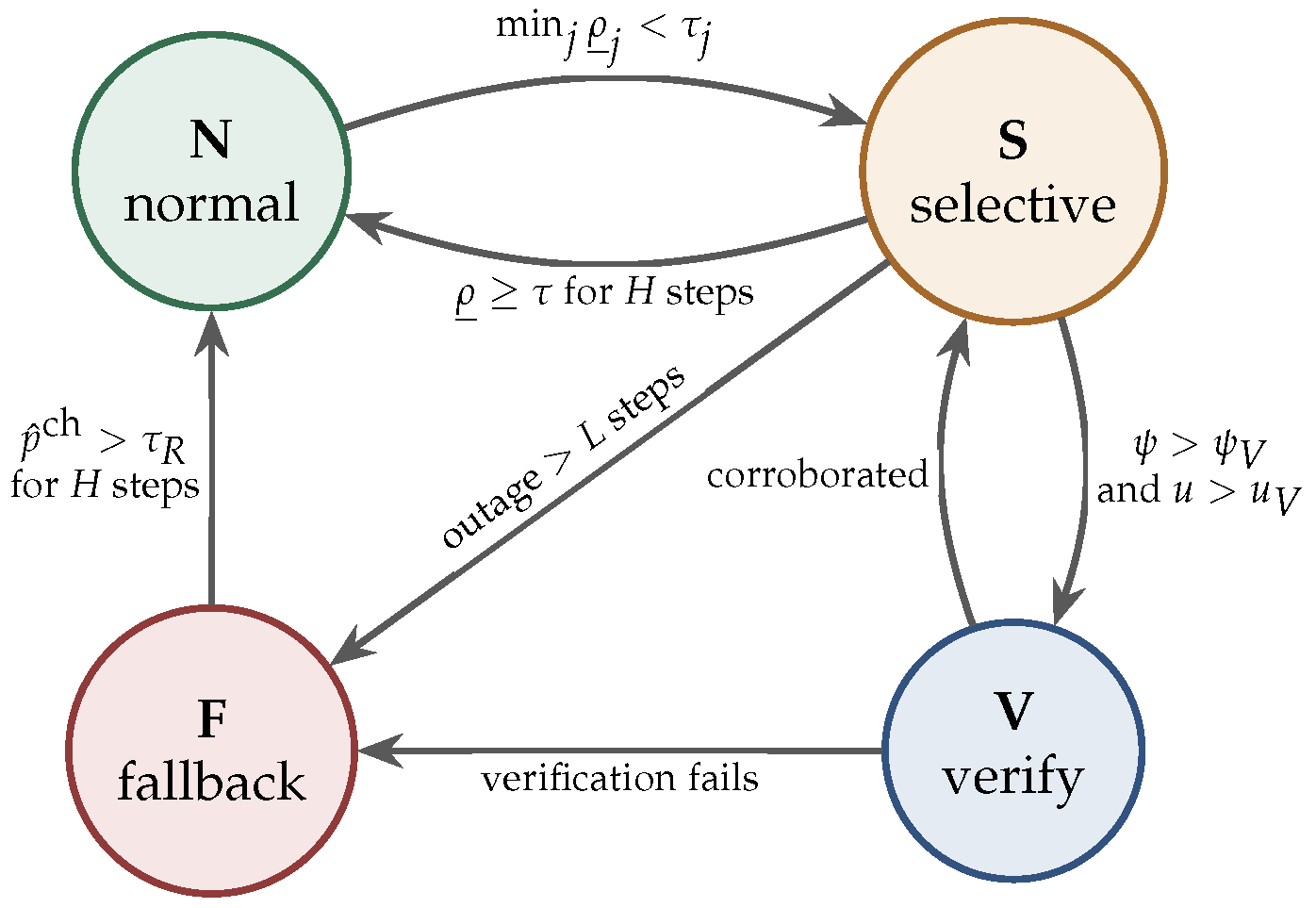
Figure 3.
Experimental pipeline. Maps are split by seed, policies are trained under a staged fault curriculum, reliability heads are temperature-calibrated on validation maps, and evaluation covers isolated, compound, held-out, and sweep conditions on test maps.
Figure 3.
Experimental pipeline. Maps are split by seed, policies are trained under a staged fault curriculum, reliability heads are temperature-calibrated on validation maps, and evaluation covers isolated, compound, held-out, and sweep conditions on test maps.
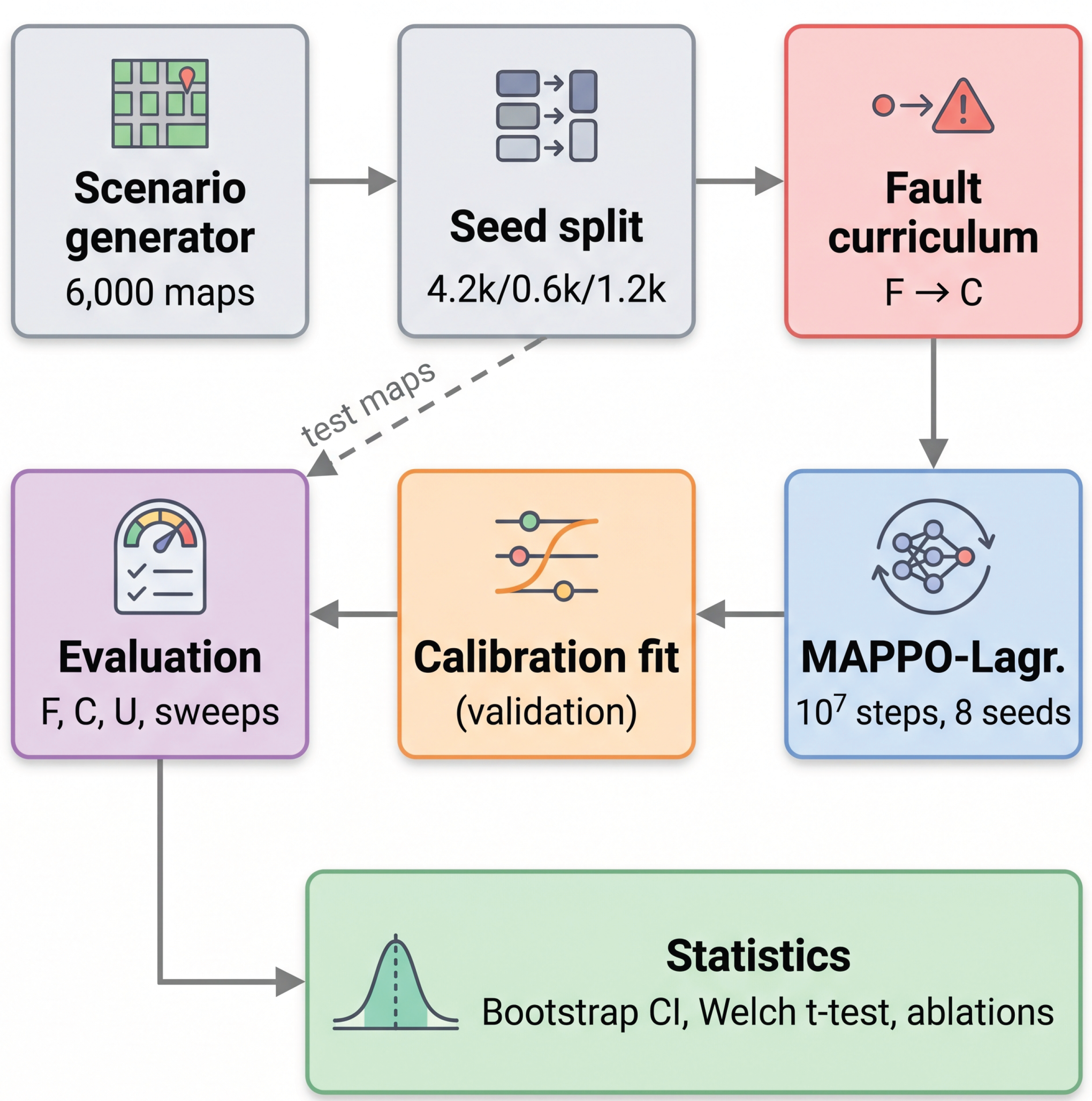

Table 1.
Capability comparison with representative prior work (✓ addressed, ∘ partially addressed, ✗ not a primary focus). Ch.: channel model. Cr.: content credibility. Unc.: uncertainty in reliability. Risk: risk-conditioned use. Hier.: hierarchy. Rec.: recovery. Safe: explicit safety mechanism.
Table 1.
Capability comparison with representative prior work (✓ addressed, ∘ partially addressed, ✗ not a primary focus). Ch.: channel model. Cr.: content credibility. Unc.: uncertainty in reliability. Risk: risk-conditioned use. Hier.: hierarchy. Rec.: recovery. Safe: explicit safety mechanism.
| Method | Ch. | Cr. | Unc. | Risk | Hier. | Rec. | Safe |
|---|---|---|---|---|---|---|---|
| TarMAC [3] | ✗ | ✗ | ✗ | ✗ | ✗ | ✗ | ✗ |
| GP filter [10] | ✗ | ✓ | ∘ | ✗ | ✗ | ✗ | ✗ |
| Mis-spoke/mis-lead [11] | ✗ | ✓ | ✗ | ✗ | ✗ | ∘ | ✗ |
| Certifiable [24] | ✗ | ✓ | ✗ | ✗ | ✗ | ✗ | ✗ |
| ADMAC [9] | ✗ | ✓ | ✗ | ✗ | ✗ | ✗ | ✗ |
| Trust consensus [12] | ✗ | ✓ | ✗ | ✗ | ✗ | ✗ | ✗ |
| CCP [13] | ✓ | ✗ | ✗ | ✗ | ✗ | ✗ | ✗ |
| MARL shield [33] | ✗ | ✗ | ✗ | ✗ | ✗ | ✗ | ✓ |
| HPSF [15] | ✓ | ✗ | ✗ | ✗ | ✓ | ✓ | ✓ |
| RiCoR (ours) | ✓ | ✓ | ✓ | ✓ | ✓ | ✓ | ✓ |
Table 2.
Fault conditions. Parameters are the evaluation settings on test maps. Train marks conditions used in the training curriculum.
Table 2.
Fault conditions. Parameters are the evaluation settings on test maps. Train marks conditions used in the training curriculum.
| ID | Type | Parameters (evaluation) | Train |
|---|---|---|---|
| F1 | Random loss | Bernoulli, (sweep 0–0.6) | ✓ |
| F2 | Bursty outage | Gilbert–Elliott, mean burst 14 steps | ✓ |
| F3 | Delay | Variable, steps | ✓ |
| F4 | Corruption | Gaussian on 30% of fields | ✓ |
| F5 | Stale reports | Replay of 10–30 step old reports | ✓ |
| F6 | Misleading | compromised, | ✓ |
| C1 | Compound | F1 + F4 | ✓ |
| C2 | Compound | F2 + F6 | ✓ |
| C3 | Compound | F3 + F5 + F6 | ✓ |
| U1 | Held-out | F2 + F4 + F6, unseen rates | ✗ |
| U2 | Held-out | 25% uplinks multi-hop relayed | ✗ |
| U3 | Held-out | compromised agents | ✗ |
Table 3.
Default hyperparameters of RiCoR. LR: learning rate. GAE: generalized advantage estimation.
Table 3.
Default hyperparameters of RiCoR. LR: learning rate. GAE: generalized advantage estimation.
| Parameter | Value | Parameter | Value |
|---|---|---|---|
| Actor LR | Critic LR | ||
| Lagrange LR | Discount | 0.99 | |
| GAE | 0.95 | PPO clip | 0.2 |
| PPO epochs | 10 | Minibatches | 4 |
| Parallel envs | 32 | Rollout length | 400 |
| GRU hidden | 128 | Message dim | 32 |
| Attention heads | 4 | Entropy | 0.01 |
| 1.0 | 1.0 | ||
| 0.5 | 0.1 | ||
| CVaR level | 0.9 | Budget d | 0.5 |
| 0.05 | (per query) | 0.02 | |
| Hysteresis H | 5 | (annealed) | 0–0.05 |
Disclaimer/Publisher’s Note: The statements, opinions and data contained in all publications are solely those of the individual author(s) and contributor(s) and not of MDPI and/or the editor(s). MDPI and/or the editor(s) disclaim responsibility for any injury to people or property resulting from any ideas, methods, instructions or products referred to in the content. |
© 2026 by the authors. Licensee MDPI, Basel, Switzerland. This article is an open access article distributed under the terms and conditions of the Creative Commons Attribution (CC BY) license (http://creativecommons.org/licenses/by/4.0/).
Copyright: This open access article is published under a Creative Commons CC BY 4.0 license, which permit the free download, distribution, and reuse, provided that the author and preprint are cited in any reuse.