

Submitted:
23 October 2026
Posted:
27 October 2026
You are already at the latest version
Abstract
Systemic light-chain (AL) amyloidosis and multiple myeloma are two separated but closely related entities. Both are chronic, complex, challenging, heterogeneous, and incurable diseases. Both belong to the broad group of monoclonal gammopathies, with a peak incidence between 60 and 70 years of age. They are characterized by the presence of a bone marrow clonal plasma cell infiltration, and they share similar anti-clonal therapy. Frailty is a dynamic, multidimensional, age-related syndrome, defined by reduced physiological reserve and resistance to stressors, leading to vulnerability and poor outcomes. Therefore, frailty plays a crucial role in clinical decision making to tailor therapy, minimizing toxicity and optimizing outcome. A systematic and comprehensive English PubMed search was undertaken and complemented with other parallel search’ strategies. A growing body of evidence supports including frailty as a standard of care in these diseases, at baseline and dynamically at selected moments through the evolutive course. This narrative review aims to critically analyze the efficiency and prognostic impact of tools and scores used to assess frailty in both clinical scenarios, whether in the context of clinical trials or in real life. Barriers to a widely, dynamic, and standardized use of frailty assessment in the real world are analyzed as well as strategies to overcome them.
Keywords:
frailty
; systemic light-chain (AL) amyloidosis
; multiple myeloma
; prognosis
; tailored therapy
; real-world
; clinical trials
; efficiency
; cost
; outcome
1. Introduction
Systemic light-chain (AL) amyloidosis [1] and multiple myeloma (MM) [2] are two independent entities, characterized in most cases by the presence of a monoclonal protein (M-protein) in blood and/or urine. This abnormal protein can be a complete immunoglobulin (Ig) or only a heavy (HC) or light chain (LC), produced by a B-cell or plasma cell (PC) clone, which is usually located in the bone marrow (BM). Consequently, they are included in the heterogeneous group of monoclonal gammopathies (MGs) [3]. Both are classified within the category of “Plasma cell neoplasms (PCN) and other diseases with paraproteins” in the fifth edition of the World Health Organization classification of lymphoid tumors (WHO-HAEM5) [4]. AL is included in the family of “Diseases with monoclonal Ig deposition” whereas MM is incorporated into the family of “PCNs”.
AL and MM have both similarities and differences. Both are challenging, complex, and heterogeneous MGs. They currently remain unpreventable and incurable. Median age at diagnosis is 65-70 years in most studies. Their incidence is slightly higher in men. Both share the same anti-clonal therapy [5]. Key differences come from epidemiology [6,7]. AL is a rare disease, with an incidence approximately five times lower than that MM. Remarkably, about 20% of AL patients meet de current diagnostic criteria for MM (AL/MM) [8]. The key involved organ in AL is the heart whereas in MM is the bone. Roughly 80% of AL patients have cardiac involvement (AL/CA) and the same percentage of MM patients show bone disease. The prognosis in AL is largely conditioned by AL/CA. Conversely, the prognosis for MM is not subject to bone disease itself, unless skeletal-related events (SREs) such as pathological fractures or spinal cord compression arise [9]. Prognosis is a rapidly changing field which is key for clinical decision-making. Despite recent advances, the outcome of both diseases remains heterogeneous in terms of overall survival (OS) and health-related quality of life (HRQoL). Baseline assessment of prognosis is mandatory and unrepeatable, but prognostic evaluation should be a dynamic process throughout the course of the disease. This is due to the emergence of new prognostic factors (PFs), new prognostic scores and staging systems, the improvement in the methods of evaluating the response, and safer and more effective therapies. Significant changes in the follow-up vs. the baseline prognostic assessment can occur and tailored therapy should be applied accordingly. Overall, the prognosis of both entities can be divided in four groups of PFs: patient-related, disease-associated, staging, and response to therapy. The number of PFs and prognostic scores (PSs) are increasing exponentially but only a selected group of them reach standardization, validation, and general use. No single PF or PS is currently able to accurately predict prognosis in a holistic and comprehensive way. Moreover, validated prognostic tools for clinical purposes should be as simple as possible.
Notwithstanding the above dynamics and complexity, the concept of frailty and the application of specific tools have been gaining ground in recent decades. Growing evidence recognizes frailty as an independent and strong PF in terms of OS. However, a consensus definition of frailty remains to be achieved. Furthermore, two approaches have been used, conceptual or operational. From an integrative point of view, frailty can be considered “a dynamic state affecting an individual who experiences losses in one or more domains of human functioning (physical, psychological, social) that are caused by the influence of a range of variables and which increases the risk of adverse outcomes” [10]. Clinicians caring for AL and MM patients over the past decades were aware that the treatment should be tailored to patients’ frailty. The estimated prevalence of frailty in both diseases was considered high, even though that frailty was not defined nor measured. This controversial statement showed that frailty could be easily suspected and acknowledged from a clinical perspective, based only on basic variables such age, Eastern Cooperative Oncology Group performance status (ECOG PS), and comorbidity. Otherwise, it also emphasized the need to define and operationalize frailty [11,12].
This narrative review aims to critically and comparatively analyze the evolving clinical use and prognostic impact of frailty scores in three clinical scenarios: AL, MM, and AL/MM patients. In most studies, the frailty assessment can improve the prognostic impact of standard prognostic scores, helping to personalize therapy. Standardized frailty scoring is key for optimizing care in these conditions.
2. A Short History of Frailty in AL and MM
The history of frailty focused on these two entities must necessarily be framed within the global evolution of the concept of frailty. Figure 1 highlights the main milestones achieved so far on this path. Overall, three periods can be identified from a practical point of view:
2.1. Conceptual Supports and Definition: Second Half of the 20th Century and First Decade of the 21st
Growing clinical evidence confirmed that the elderly had an excessively high incidence of adverse effects compared to previous stages. This helped to outline the concept of frailty and the need to assess the risk in the frail and elderly [13]. The association of aging and frailty as a geriatric syndrome was evident, but other variables besides age should also be taken into account. In a study of hospitalized elderly patients a practical definition of frailty was used to select patients for geriatric consultation [14].
Two key models of frailty were developed, the phenotype model [15] and the cumulative deficit model [16]. The evidence of frailty as a medical syndrome, the confirmation of transitions between frailty states (non-frail, pre-frail, frail, ultra-frail), and the potential for reversibility of frailty were analyzed [17].
2.2. Development and Validation of General and Specific Frailty Scales: Second Decade of the 21st Century and Beyond
Frailty scales (FSs) can be divided in general or specific. The FRAIL scale [18] consists of a 5-item questionnaire (fatigue, resistance, ambulation, illness, and loss of weight). This simple and validated FS is easy to perform by telephone or self-administered. It can be repeated and, importantly, is able to predict disability. Overall, it is an efficient screening test to recognize frail patients in the general population.
Regarding specific FSs for MM, the most relevant milestone was the International Myeloma Working Group MM FS (IMWG MM FS) [19], combining age, functional status measured by basic and instrumental activities of daily living (ADLs and IADLs, respectively), and comorbidities by the Charlson Comorbidity Index (CCI). Despite its ability to classify frail patients with increased risk of death, progression, adverse events (AEs) and treatment discontinuation, its use in daily clinical practice is limited due to time and staff issues. Other key FSs for MM were developed thereafter. Most of them were based on age and ECOG PS as a basic core. The Mayo FS was built adding N-terminal natriuretic peptide type B (NT-proBNP) ≥300 ng/L to the above mentioned basic couple (age ≥70 and ECOG PS ≥2) [20]. Shortly after, the Revised Myeloma Comorbidity Index (R-MCI) was launched as a risk tool based on age, Karnofsky PS, frailty assessment, and two comorbidities (renal and lung disease) [21]. On the other hand, the Myeloma Risk Profile (MRP) used the basic couple (age and ECOG PS) along with C-reactive protein (CRP) and the International Staging System (ISS) [22]. Interestingly, a simplified frailty scale (SFS) used only age, ECOG PS and CCI [23]. Other FSs for MM continue to be developed currently, such as the novel frailty model, incorporating five variables: age, ECOG PS, ISS, Hematopoietic Cell Transplantation-Comorbidity Index (HCT-CI), and the Prognostic Nutritional Index (PNI) [24].
In contrast to the large number of specific scales for MM, there are no specific scales for AL. The first study to analyze a FS for NDAL patients was conducted by the Spanish Myeloma Group (GEM/PETHEMA), based on the Mayo FS, but using NT-proBNP ≥8500 ng/L as cutoff value [25]. This study also highlighted the key role of comorbidity, particularly using a comprehensive approach.
2.3. New Avenues for the Assessment of Frailty: Third Decade of the 21st Century
New ways to efficiently face the dynamic assessment of frailty have been explored recently. Some of these new approaches are the following:
-Patient-reported outcomes (PROs) data.
PROs are validated tools that capture patient’s perspective on their symptoms, functional status, and HRQoL [26]. PROs have been commonly used in clinical trials and they are progressively integrated in the real world (RW) setting [27]. The use of standardized instruments through electronic platforms allows an efficient and real-time assessment of frailty. For instance, the feasibility to use the European Organization for the Research and Treatment of Cancer Quality of Life Questionnaire Core-30 (EORTC QLQ-C30) items as proxy criteria for the Fried Frailty Phenotype was pointed out in a retrospective study using data from phase III trials [28]. A recent systematic review on the use of PROs in phase III trials for blood cancer identified 25 studies on MM and only two for AL [29]. Despite the challenges to implementing PROs in AL, their use should be integrated into the clinical management of these patients [30].
-Electronic Frailty Index (eFI).
Using the cumulative deficit model of frailty as a framework, an eFI with 36 deficits was developed and validated, leveraging routinely collected data contained within the primary care electronic health records (EHRs). Equal weighting was assigned to each variable [31]. The eFI2 is a new version with better prediction for key frailty-related outcomes [32].
-Artificial intelligence (AI)-based frailty assessment.
AI-based healthcare applications for frailty assessment in older people are progressively booming [33,34,35]. Previously unimaginable practical approaches are increasingly used such as machine learning (ML)-embedded continuously operating wearables to assess gait-based frailty analysis [36]. Remarkably, these technologies also show promise for pain assessment and management [37] as well as mobility decline and early detection of sarcopenia [38]. AI-guided risk stratification will redesign the daily clinical practice in hematological malignancies, including MM and AL [39,40,41,42,43]. AI could probably be considered the beginning of a new era.
-Frailty apps.
The current status of mobile health applications on frailty has been recently reviewed [44]. Most of these tools are targeted for healthcare professionals, helping to identify frail patients. Further development is needed before they can efficiently integrated into daily clinical practice.
-New frailty-associated biomarkers.
Most recent studies on the subject focus on cellular senescence and immune age [45,46,47,48,49,50]. Growing evidence supports immune age as a key indicator of the immune status, independent of chronological age, with relevance for clinical decision-making. The routine clinical use of immune profiles in the future should be facilitated with the development of standardized and user-friendly tools.
3. The Comprehensive Prognostic Impact of Frailty in MM and AL
MM and AL are complex and heterogeneous diseases. An accurate, standardized, efficient, and dynamic prognostic assessment is mandatory to offer a tailored care to MM and AL patients. Prognosis is a rapidly changing and challenging field. Overall, all relevant PFs could be classically included in one of the above mentioned four groups (patient, disease, staging, and response). However, frailty is a construct that challenges this classification, because it may be operationally associated with variables included in any of these groups.
Although international oncogeriatric societies still consider a comprehensive geriatric assessment (CGA) as the gold standard for frailty evaluation in cancer patients [51,52], the feasibility of the systematic use of CGA in hematological malignancies (HMs) remains to be confirmed [53]. Moreover, several economic and structural barriers preclude a widely use for this purpose in the RW setting [54]. However, the use of CGA has been considered cost-effective in some healthcare systems [55,56,57,58]. Remarkably, even the IMWG MM FS has been regarded as difficult to apply in daily clinical practice. For this reason, there was a shift during the past decade towards simplification, with tools that are very easy to use in daily clinical practice. Age, ECOG PS, and comorbidity have been the leading variables used for this purpose, with the SFS being the paradigm of this trend. All in all, given the heterogeneity in healthcare systems, CGA in NDMM is still recommended whenever possible [59]. Nonetheless, an algorithm for geriatric MM care has been proposed as a structured referral pathway, emphasizing the role of geriatricians in multidisciplinary units [60]. AI is undergoing a profound change on the subject in recent years, offering efficient digital solutions. However, the wide applicability of new AI-based tools remains to be established.
The different FSs for MM have been previously described and extensively compared [61,62,63,64,65,66]. None of them is perfect, but all of them are evidence-based and standardized tools for clinical use, helping in risk stratification and clinical-decision making.
The need for a dynamic evaluation of frailty must be emphasized [67,68]. A single baseline estimate is insufficient due to the dynamic nature of frailty [69]. Moreover, the rate of frailty progression adds valuable prognostic information. In a longitudinal population data study, recent accelerated accrual of frailty deficits was associated with adverse outcomes after adjusting for age, sex, and baseline frailty score [70].
Frailty is a construct developed on solid foundations over several decades [71]. Building materials have changed over time, and it has adapted to better fulfill its purpose, proving that it was not a passing fad. A comprehensive, accurate, and efficient assessment of the prognosis for MM and AL patients is more important than ever. Therapeutic advances are improving survival and even offering a glimpse of a cure for some patients. The population is increasingly aging in developed countries, in a context of marked social inequalities. The frailty challenge is to serve as a holistic risk stratification tool capable of reflecting this complexity in every patient throughout their journey. At present, frailty is an exiting field of research.
The current status of frailty in MM and AL presents both strengths and weaknesses. Bellow are some limitations on the use of frailty in MM and AL. First, the contrast between the high number of available FSs for MM and the striking scarcity of them for AL. Second, a lack of consensus on the selection of the best tool for each scenario. Third, the gap between the application of FSs in clinical trials vs. the RW setting, with limited use in the last scenario. Fourth, the RW heterogeneity of frailty-based clinical-decision making. On the other hand, the main advantage of frailty is that it is strongly associated with the entire range of negative outcomes. Figure 2 emphasizes the crucial and central role of frailty in the prognostic evaluation of MM and AL, as well as its great clinical impact in the outcome of these patients.
It should always be borne in mind that the predictive impact of frailty changes over time and depends on when it is measured and the tool used. Remarkably, patients commonly have to face a challenging evolutive course and the healthcare should be adapted to this complexity. Frailty can be assessed at every level of the healthcare system, from primary care to multidisciplinary hospital units, involving different healthcare professionals. The same FS should be used whenever possible through this process to help to find significant changes over time and allow for a standardized frailty-adjusted therapy. Table 1 summarizes the most used frailty tools according to the level of the healthcare system in which the patient is treated at any given time.
The following are the main confirmed associations of frailty:
3.1. Survival
All the above mentioned studies on the impact of frailty in NDMM showed a statistically significant association with OS, despite using different FSs [19,20,21,22,23,24]. When analyzed, progression free survival (PFS) was also significantly poorer in frail patients [19,21,22,23] or nearly significant (p=0.053) [24].
PFS was the primary endpoint in most phase III trials in MM over the past decade. The relevance of analyzing the subgroup of frail patients in these studies was not yet systematically established at that time. In many of these trials, frailty was calculated retrospectively, and in most cases, the clinical benefit of the investigational arm was demonstrated, regardless frailty status [72,73]. The first trial specifically designed for frail NDMM patients used the IMWG FS and showed poor outcome with PFS and OS of 13.8 and 34 months, respectively [74]. A separate frailty subgroup analysis is standard in recent clinical trials and selected RW MM studies [75,76].
Regarding AL, the prognosis remains largely associated to AL/CA and risk stratification has been mainly based on cardiac stages. The first study specifically focussing on frailty in AL patients was the above mentioned GEM/PETHEMA study [25], using an adapted Mayo FS in 416 patients (2005-2023), and demonstrating a huge and significantly poorer OS for frail and ultra-frail patients.
3.2. HRQoL
Besides survival, this essential endpoint has been increasingly included in observational studies and clinical trials over the past decade, both in NDMM and relapsed and refractory (RR) MM (RRMM) [77,78,79]. Similarly, HRQoL is a common secondary endpoint in trials involving NDAL and RRAL patients [80,81]. HRQoL in NDAL is associated with hematologic response and survival [82].
The most frequently used scales in MM are the EORTC QLQ-C-30 and the EORTC MM module (EORTC QLQ-MY20) [83]. Conversely, SF-36v2® Health Survey (SF-36v2; QualityMetric Incorporated, LLC; Johnston, RI USA) and the EuroQol-5D (EQ-5D; EuroQol, Rotterdam, The Netherlands) are more commonly used in AL trials. Despite an intensive use of these scales in MM and AL trials, their use in the RW setting remains limited [84].
3.3. Early Mortality
Mortality and early mortality (EM) should be ideally analyzed in population-based studies [85] or clinical trials. In a population-based RW study with 621 NDMM patients (1985-2015), EM at six months (EM6) improved over time from 24% to 17% [86]. A recent observational study evaluated 207 NDMM patients (2018-2023) and EM6 was 17.9% [87]. The use of a systematically structured classification of the cause of death (COD) is strongly recommended for MM [88].
EM was not included as a primary or secondary end-point in most of the previously described frailty studies for MM using different FSs. However, a clear impact on the initial part of the survival curves can be seen in the studies that used these FSs: IMWG MM FS, Mayo FS, R-MCI, and SFS. The MRP study analyzed EM at two months (EM2) as an exploratory end-point. EM2 was 4% and 7% in the two trials included in this study. Moreover, the frailty-adjusted schedule in the FiTNEss trial reduced EM in transplant-ineligible (TI) NDMM [89].
On the other hand, EM rates are usually higher in AL than in MM, mainly due to AL/CA. In the GEM/PETHEMA RW study [25], EM at 3 months was 17.2% in the derivation cohort (91% AL/CA) and 13.1% in the validation cohort, while the EM6 were 29.1% and 22.7% respectively. In a large study with 2337 AL patients (1980-2019), there were 1160 deaths with an identified COD and 354 (30.5%) occurred during the first six months [90]. The most frequent COD was cardiac (37%) and unexpected sudden death (SD) (30%). Interestingly, SD is more frequent in AL/CA than in transthyretin amyloidosis (ATTR) CA [91]. Remarkably, EM6 was only 10.6% in a recent multicenter retrospective study with 339 NDAL patients treated with D-based regimens [92]. Other multicenter retrospective study with 1071 NDAL patients (2008-2025) showed 16.2% EM6 [93]. In these last two studies D-based therapy was identified as a protective factor for EM6.
The use of dexamethasone (d) has played a critical role in the treatment of MM and AL. However, d has been associated with EM in NDAL patients with advanced cardiac stages, which are mostly frail [94]. Growing evidence supports corticosteroid-sparing regimens in both MM and AL [95], but the role of frailty for guiding this approach must be further explored in ongoing and future clinical trials.
3.4. Infection
The role of infection is paramount in MM because it remains a leading cause of morbidity and mortality [96]. In a cohort of 818 transplant-eligible (TE) NDMM patients in which a systematic classification of COD was used [78], most deaths (90.2%) were disease-related, and infections were the leading therapy-related COD.
Severe infections (grade 3-4) are associated with EM. A recent RW retrospective study in 161 NDMM patients showed that more than a half of them (50.9%) had at least one episode of infection. The infection occurred more frequently in the first 3 months and pneumonia was the most common type (34.1%) [97]. A study evaluated the risk of severe infections and death in 3700 TE NDMM patients from five phase III trials [98]. Four risk factors were identified: low platelet count, ISS III, PS>1, and age>60 years. Furthermore, the overall risk increased from 7.7% vs. 11.5% vs. 23,3% for low, intermediate, and high-risk groups, respectively. Every effort should be made to improve both risk stratification and prevention in this context [99,100,101,102]. A recent meta-analysis on the impact of frailty in severe infections in TI NDMM confirmed that frailty is a key driver of infection in this context [103]. Overall, the risk of infection is higher in RRMM compared to NDMM.
The prognostic relevance of infection in AL patients is also crucial, particularly in older and frail patients. As with MM, infection can eventually be the initial clinical presentation. Data on infection in RW patients are scarce. In a phase II trial using lenalidomide (R), cyclophosphamide (C), and d in 28 NDAL patients, 46.4% of them had grade 3-4 infection [104]. In the ANDROMEDA phase III trial [105], patients with cardiac stages I-IIIA NDAL were treated with daratumumab (D), bortezomib (V), C, and d (DVCd). Grade 3-4 pneumonia was 7.8%. Similarly to what happens in MM, the risk of infection is also usually higher in RRAL compared to NDAL. For instance, in a phase II using pomalidomide and d, the rate of grade 3-4 infection was 25% [106]. In a RW retrospective multicenter study (2023-2025) in 29 RRAL patients treated with bispecific T-cell engagers (19 teclistamab, 6 elranatamab, and 4 talquetamab), the rate of grade 3-4 infections was 25% following the commencement of intravenous Ig prophylaxis [107].
3.5. Cost
A large prospective study with 7947 community-dwelling older adults using the self-reported FRAIL scale underlined that frailty was associated with higher total health care costs, after accounting for claims-based indicators [108]. Another sizable study including 14562 older adults showed that frailty and cancer history were independently associated with higher healthcare utilization in both emergency care and hospitalization [109]. Expected cost drivers in frail MM and AL patients are advanced stages, high tumor burden, prolonged hospital stays, higher frequency of emergency room visits, more intensive supportive care needs, and increased incidence of serious AEs (SAEs).
In MM, the overall cost is largely associated with treatment sequence and drug costs [110]. Cost-effectiveness is increasingly used as a measure of therapeutic efficiency. In the FiTNEss trial, the pre-emptive frailty-adjusted dosing strategy was considered cost-effective in frail patients [111,112].
The total healthcare cost linked with AL was estimated to be more than sixfold higher than controls in a retrospective population-based matched control study [113]. High healthcare resource utilization costs were related with delayed diagnosis and end-organ damage. Frailty is highly prevalent in this poor prognostic group of patients. The annual cost-of-illness was estimated in the retrospective, observational, multinational EMN23 study in UK and Spain, using data from 4480 patients (2004-2018) [114]. The projected cost was €40.96 and €31.90 millions for the UK and Spain, respectively. Dialysis accounted for 28.2% (UK) and 34.7% (Spain) of the total cost.
3.6. Financial Toxicity
A systematic review demonstrated that financial toxicity (FT) remains frequent (20-50%) in HMs. Significant heterogeneity in FT definition was highlighted, pointing out the need to standardize it [115]. The negative impact of FT on HRQoL and OS has been demonstrated [116].
The risk of FT in patients with MM and AL is high. This is largely due to the chronic and RR clinical course, and the high cost of the commonly used regimens, novel immunotherapy approaches, and supportive care [117]. FT is also a dynamic process. Patients with low-income, unemployed, living alone, and/or living in rural areas are at particularly high risk. An observational study with 135 MM patients using the Comprehensive Score for financial Toxicity (COST) showed that 48% of the cohort had FT [118]. A single-center cross-sectional survey in 252 previously transplanted MM patients showed that 22% had FT. FT could be predicted by the monetary status but not by disease status. FT was associated with a meaningful decrease in mental HRQoL [119]. A selection bias could limit the impact of this study. FT has been also associated with treatment satisfaction. The CureCloud initiative from the MM research foundation (MMRF) was developed to better understand the MM journey. 214 out of 638 MM patients completed the baseline PROs including COST for FT evaluation and the Cancer Therapy Satisfaction Questionnaire. 37% had FT and they reported lower treatment satisfaction [120].
Most studies of FT in amyloidosis focus on CA, and particularly on ATTR/CA. The availability of data of FT in AL is lower than in MM. However, factors leading to AL-based economic hardship are expected to be similar in both scenarios. Specific studies on the subject are needed, as well as the development of adapted financial assistance programs. Social work should be a key part of the multidisciplinary approach to MM and AL care.
3.7. Emerging or Potential Associations
A growing list of other factors have been associated with frailty with varying degrees of evidence. Some of these are described below.
3.7.1. Fatigability
Fatigue is a nonspecific term hard to operationalize in frailty research. Alternatively, perceived fatigability has a standardized assessment, and may be used to measure the degree in which fatigue contributes to frailty. Fatigability is the quantification of vulnerability to fatigue in relation to specific intensity and duration of activities. Both physical and mental fatigability have been associated with frailty [121].
3.7.2. Air Pollution
Growing evidence supports environmental air pollution as a potential contributor to frailty. A recent meta-analysis evaluated the impact of air pollution (fine particulate matter), household solid fuel use, and secondhand smoke, on the risk of frailty in middle-aged and older adults. The percentage of increased risk of frailty was 19%, 28%, and 59%, respectively. Heterogeneity among studies and other limitations preclude firm conclusions [122].
3.7.3. Post-Acute Care
In a retrospective cohort of 23407 older US patients admitted for at least one day (2021-2023), frailty was assessed with the eFI score. 46%, 23%, and 8% were categorized as pre-frail, frail, and severely frail. The type of hospital discharge location (home, home health services, and skilled nursing facility) was associated with frailty. Patients with a higher degree of frailty were more likely to discharge with a specific post-acute care. Overall, frail patients had a significantly higher 90-day hospital readmission and mortality [123]. Frailty assessment during admission can identify high-risk patients at discharge, helping to plan and tailor post-acute care interventions.
3.7.4. Patients’ Experience of Cancer Treatment and Care
A prospective observational study of 584 cancer patients (2020-2022) evaluated the association of frailty and patient experience. Median age was 80 years. Frailty was categorized using a CGA prior to treatment decision-making. 38% were pre-frail, and 42% frail. Patient experience was analyzed with three scales: Control Preference Scale, Patient Assessment of Care for Chronic Conditions, and Decision Regret Scale. Frailty was linked to lower perceived quality of care and higher decision regret [124].
3.7.5. Genome-Wide Association Studies (GWASs)
Several susceptibility loci have been associated with frailty. Although underlying mechanisms remain elusive, a genomic latent model of frailty was introduced [125]. A recent GWAS study identified associations between nine aging pathway-related single nucleotide polymorphisms and frailty. However, the involvement of partially different pathways in aging and frailty highlight the genomic complexity of its interaction [126].
3.7.6. Immune Biomarkers
As previously mentioned, most frailty-based new biomarkers focus on the interplay of aging and the immune system [48,49]. This is an exciting field of research, further stimulated by the possibility of conducting non-invasive studies using peripheral blood (pb) of MM and AL patients. The expression signatures of 74 immune cell, ageing, and senescence-related messenger RNAs in pb T cells were analyzed in 69 patients with HMs, most of them MM. The expression of four genes (aryl hidrocarbon receptor, CD27, CD28, and CD25) in T cells was associated with frailty, independently of age, suggesting that this approach could serve as an initial screening tool and complement the frailty CGA assessment [127].
3.7.7. Malnutrition and Sarcopenia [128,129]
Frailty is closely related with these two disorders. Similarly to frailty, these are potentially reversible conditions that should be measured dynamically with standardized tools, through the entire clinical course of every single patient. Overall, reduced muscle mass with normal muscle strength suggests malnutrition rather than sarcopenia, whereas low muscle mass and impaired muscle function indicates sarcopenia instead. A prospective observational study included 52 NDMM patients, all of them referred for oncogeriatric consultation (those with MM/AL were excluded). CGA was systematically performed and frailty was measured by the FRAIL scale. Notably, sarcopenic patients had a significantly shorter OS, but no significant differences were found in frailty or malnutrition between sarcopenic and non-sarcopenic patients [130]. Remarkably, a RW RRMM study included 139 patients treated with chimeric antigen receptor T-cell (CAR-T). Frailty and nutrition were measured by the SFS and the Glasgow prognostic score (GPS), respectively. 30% were categorized as frail and 14% as high-risk GPS. Both groups had significantly poorer OS and PFS. High-risk GPS was an independent PF in terms of OS after adjusting for frailty and other high-risk characteristics [131].
4. Frailty-Adjusted Therapy
The logical consequence of the above frailty-driven negative associations is the need to dynamically tailor therapy to MM and AL frail patients.
Historically, a basic clinical assessment of frailty based on chronological age and PS was empirically assessed to decide dose adjustments in RW MM patients. However, the first study aiming to use frailty to define the proper dose in MM was the previously mentioned phase III FiTNEss trial (Myeloma XIV) [111]. TI NDMM patients received induction with ixazomib, R, and d, an all-oral regimen. They were categorized as fit, unfit, or frail, based on the IMWG FS. A reduction in EM was demonstrated with this approach, without compromising the quality of the response [89]. Subsequently, other similar trials were launched such as the phase III iFIT trial (Myeloma XVIII), using a D-based regimen (DRd). Another phase III trial (IFM2017-03) for NDMM frail patients explored DRd (with d limited to the first two treatment cycles) vs. Rd (control group). PFS was significantly higher in the d-sparing group [132]. A dynamic frailty-tailored therapy has been also applied to RW NDMM patients [68,133]. Overall, this more nuanced approach is also used for the regimen selection in NDMM [134,135]. The impact of frailty in RRMM is being explored to optimize the use of CAR-T and bispecific antibodies (BsAbs) [136]. Overall, a deep hematological response remains the best predictor of organ response in AL [137]. Most frailty-based strategies aims to optimize treatment adherence and tolerance, trying to reduce toxicity and EM whereas hematological and cardiac response are achieved. To achieve this goal, most but not all approaches have used less drugs and/or less doses. Remarkably, the benefit of VRd over Rd was demonstrated in a study with 2573 NDMM frail patients, according to the Veterans Affairs Frailty Index. VRd was associated with lower mortality, particularly in moderate-severely frail patients, despite a higher incidence of hospitalizations [138]. This confirmed the benefit of VRd vs. Rd in frail NDMM patients, emphasizing the convenience of question the “less is more” general approach for MM frail patients and suggesting a frailty-graded and response-based tailored dynamic approach. General recommendations to adapt MM treatment based on frailty degree according to IMWG MM FS and key comorbidities have been reported [139]. More evidence is warranted to face this issue.
Regarding AL, anti-clonal treatment for AL was very restricted until a few years ago. Fortunately, the last therapeutic advances obtained in MM are now being rapidly transferred to AL. The ultimate role of frailty to guide AL clinical decision-making remains to be defined, but contrary to what happens in MM, very limited information on this issue is available at present. Prognosis in AL depends largely on the degree and extent of AL/CA, which is present in around 80% of patients. The more advanced cardiac stage, the higher the percentage of frail patients. Most of them, particularly those with Mayo 2004 cardiac III stages, have heart failure (HF). Frailty is closely related to HF, and international guidelines to assess and manage frailty in advanced HF have been reported [140,141]. Notably, the role of supportive care in these patients is crucial, including a tailored and dynamic exercise prescription program and comprehensive physiotherapy assistance [142]. Home care programs are particularly interesting for frail patients. 22 AL patients were eligible to participate in one home care program [143]. Median age was 76 years, 50% had AL/CA, and 3 of them had AL/MM. Visits to the emergency department and hospitalizations were 52% and 43% during home therapy.
Cardiovascular (CV) toxicity should be avoided whenever possible. Caution with the use of corticoids in AL patients was previously highlighted. Proteasome inhibitors such as V are a critical part of the AL treatment and must be used with care in high-risk AL patients because they may be associated with HF, hypertension, and arrhythmias [144]. Other commonly used drugs in MM and AL such as alkylating agents and immunomodulatory drugs can trigger a similar range of AEs [145]. Although less frequently, these AEs can also be triggered by new targeted therapies. A pharmacovigilance study of 3228 CV AEs associated with new immunotherapy drugs in MM showed that CV AEs accounted for 17.1% of all reported AEs. The highest number of reported CV AEs was linked with D, and the risk was higher within the first month [146]. The use of oral drugs is particularly indicated for frail patients. Venetoclax (Ven) is an oral BCL inhibitor used in AL patients harboring the translocation (t) t(11;14), which is the most common cytogenetic abnormality in AL (40-60%). Ven is considered a relatively safe drug from the point of view of CV toxicity. Several RW studies for RRAL show an overall hematological response rate of 63% [147]. A phase-II study with 36 patients evaluated Ven-d for t(11;14) NDAL, including cardiac stage IIIB, and there were three deaths due to CV AEs [148]. Therefore, Ven-based therapy is an attractive option for t(11;14) RRAL, including frail patients, but the high infectious risk should be considered [149]. Lisaftoclax is a new BCL-2 inhibitor, that was combined with pomalidomide and d in an all oral salvage regimen for RRAL patients, showing an overall response rate of 85.7%. Interestingly, no CV toxicity was reported, making this combination potentially suitable for frail patients [150]. The optimal role and timing of B-cell maturation antigen-directed therapies in frail AL patients remain to be established [151]. A retrospective study including 102 patients compared PFS and OS between frail and non-frail RRMM groups treated with BsAbs (70% teclistamab, 30% elranatamab) and non significant differences were found [152]. The first report on the use of teclistamab in AL was a case report of a patient with RRAL stage 3B and AL/MM [153]. Thereafter, several series have shown impressive hematological responses without significant grade 3-4 CV AEs [154]. No new safety signals were observed in a safety analysis of the ongoing phase 2 (EMN40) of teclistamab in RRAL [155]. The available evidence on the use of talquetamab in AL is still very limited. Similarly to BsAbs, the use of CAR-T in RRAL is safe, with manageable toxicity. The first patient treated with this approach was reported five years ago [156]. The RW evidence is growing [157] and several ongoing trials on the subject will define the optimal use and timing of this procedure [158,159]. The role of frailty to help in patient selection for CAR-T is not yet fully defined. A recent review including 12 hematological studies shows a wide variation in the assessment of frailty before CAR-T [160], concluding that a standardized approach should be implemented. There are still no specific studies on this subject for AL.
AI-based CV imaging advances show promise to improve the accuracy of cardiac prognostic markers, helping to optimize prevention and early treatment of CV toxicity [161,162]. Close and shared monitoring between Hematology and Cardiology is mandatory to identify and manage early CV toxicity.
Frailty has become a key and independent prognostic marker that should always remain central to therapeutic decision-making in MM and AL.
5. Social Frailty
Social frailty was defined as a continuum of being at risk of losing, or having lost, resources that are important for fulfilling one or more basic social needs during life span [163]. There are myriad of factors related to social frailty, provided that social resources, behaviors, and activities, as well as self-management activities must be taken into account. Some of these factors such as age, gender, socioeconomic status, marital status, educational level, living-alone status, caregivers, cognitive performance, or social support network, have been analyzed in most studies on the subject. The evolving role of social circumstances as predictor of health outcomes should be addressed. A comprehensive approach taking into consideration the whole person in society is a complex task. Consequently, a standard method of constructing a social vulnerability index was reported [164].
Overall, frailty is a big challenge for high-income countries with aging populations, due to the associated healthcare burden and cost. The landscape is bleak for underdeveloped countries or underserved areas, and it is even worse from the perspective of social frailty. The societal cost of frailty is increasingly analyzed. A recent study pointed out the importance of informal caregivers in this regard [165].
Median age of NDMM and NDAL patients is around 65-70 years. In developed countries with an aging population structure, prevalence of both entities is increasing, mainly due to longer OS and a slight increase in incidence. Healthcare systems should face this challenge by offering more resources, emphasizing prevention, and increasing efficiency.
Social frailty was analyzed evaluating five social factors in a retrospective study with 237 NDMM patients. 30% were categorized as social frail and this group showed significantly shorter OS and PFS [166]. The landscape of RRMM is particularly challenging from a therapeutic point of view [167]. This complexity is further increased by the impact of sociodemographic factors resulting in a very heterogeneous panorama. An observational, cross-sectional, multi-center study including 276 RRMM patients highlighted the impact of sociodemographic characteristics and the level of dependence in clinical decision making [168]. Living alone status in NDMM patients was analyzed in a population-based study with 200 patients. 17.5% of them lived alone. A trend to poorer OS in comparison with patients who had a caregiver was reported [169]. A survey in 78 AL patients showed that moderate and high distress was reported by 30% and 17%, respectively. More patient with distress lived alone [170]. The integration of health and social care should be a major priority in the elderly [171], and particularly in patients with severe diseases such as MM and AL. Frailty should be placed in the context of global healthy aging goals and policies, and collaborative networks across high- and low-income countries could drive context-specific research [172].
6. Current Molecular Insights on Frailty
Assessing frailty at the molecular level is a relatively novel approach with evolving evidence. Overall, significant progress has been made in the search for new biomarkers associated with frailty. However, a gap remains between the well established frailty assessment in the clinical setting and the discovery of reliable molecular predictors of frailty [173].
Frailty is strongly associated with aging, and aging is linked with mortality, vulnerability to stressors, multimorbidity, toxicity, disability, and a wide spectrum of geriatric disorders, leading to poor health outcomes. A large UK Biobank study investigated the association of adversity and its severity with biological aging, including molecular biomarkers such as metabolomic age (difference between metabolite-predicted age and chronological age) and telomere length (using quantitative polymerase chain reaction). The study concluded that adversity was associated with older biological aging profiles (positive metabolomic age and shorter telomeres) but this association was modest in size [174].
Frailty is a highly complex scenario at pathophysiological level, involving the dysregulation of multiple interconnected processes leading to molecular hallmarks of aging. Inflammaging is a chronic, low-grade, inflammation secondary to the accumulation of senescent cells. These senescent cells are characterized by a pro-inflammatory phenotype, the senescence-associated secretory phenotype (SASP). Inflammaging is currently considered the key hallmark of biological aging, promoting tissue damage, metabolic dysregulation, and immune imbalance. Interestingly, the dynamics of inflammaging is determined by modifiable factors, besides chronological age and age-related diseases and processes. Some mechanisms involved in this complex background are epigenetic changes, autophagy, telomere attrition, mitochondrial dysfunction, impaired proteostasis, microbiome imbalance, and more. The intricate secretome associated to SASP has been recently described [175,176]. Several molecular pathways are involved in inflammaging, including nuclear factor kappa B, the adenosine monophosphate-activated protein kinase (AMPK), mechanistic target of rapamycin (mTOR), hypoxia-inducible factor 1-alpha, nuclear factor erythroid 2-related factor 2, and others [177]. Immunosenescence has been explored as a link between frailty and multimorbidity, analyzing the role of several immune-aging alterations [178]. On the other hand, growing evidence on the crucial role of proteomic biomarkers dynamics helps to better understand multisystem decline, to estimate more precisely biological age [179]. Some of these circulating proteomic biomarkers of aging such as CRP or NTproBNP are well known in the MM and AL clinical setting, whereas others have potential or emerging translational relevance, as is the case of interleukin-6 (IL-6), growth differentiation factor-15 (GDF-15), the chemokine C-X-C ligand (CXCL) family, the vascular cellular adhesion molecule-1, and many more. Consequently, AI-driven predictive models could support precise risk prediction and tailored therapeutic approach, as occurs in chronic kidney disease, for which inflammaging is also a hallmark, with high prognostic impact in MM and AL patients [180]. A similar scenario may be found in HF, which is closely related to advanced stages of AL patients. A recent study emphasized the role of exerkines in patients with HF with reduced ejection fraction (HFrEF). Exercise training (ET) is a cornerstone of HFrEF management, and exerkines are circulating factors released in response to ET, including cytokines, growth factors, enzymes, and others inflammation and metabolic modulators. HFrEF patients had elevated levels of inflammatory and metabolic stress-related exerkines, including IL-6, IL-15, GDF-15, CXCL-8, and others. On the contrary, proteins associated with muscle integrity such as myostatin were reduced and its level was directly correlated with muscle quality and ET capacity, whereas GDF-15 and IL-15 demonstrated an inverse connection with these parameters. Moreover, leptin was significantly associated with adiposity measures. Overall, these findings suggest a cardio-adipose-muscle signaling network in HFrEF patients, identifying potential pathways for intervention [181].
Overwhelming evidence supports the preventive role and clinical benefit of adapted ET in frailty, particularly in MM and AL patients [142]. Remarkably, this clinical evidence is recently translating to the molecular level. A recent clinical trial using two predefined cardiometabolic and inflammation panels, showed relevant changes in serum proteome after a short-term ET program in hospitalized older adults, including IL-7, CXCL-8, amyloid beta precursor-like protein 1, cardiac troponin I, and others [182]. Otherwise, the coexistence of osteoporosis and sarcopenia (osteosarcopenia) is a common scenario associated to frailty and likewise linked to a similar context of cellular senescence and inflammaging. Regular ET promotes protein synthesis and osteogenesis mainly through AMPK and mTOR pathways, as well as suppression of IL-6 and tumor necrosis factor alpha, overall leading to anti-aging effects [183]. Recent evidence supports osteosarcopenia as an integrated musculoskeletal syndrome, sharing RFs and a molecular crosstalk between muscle and bone [184]. Furthermore, mitochondrial dysfunction represents an early mechanism of sarcopenia, and consequently an integrated multi-biomarker approach is needed for early diagnosis [185]. Despite what has been mentioned above, the molecular mechanisms of action of ET remain to be fully deciphered. Importantly, current evidence mainly derived from animal models, but also from some clinical studies, points out ET as an epigenetic reprogramming agent, modulating histone acetylation/methylation and specific microRNAs and long non-coding RNAs, with dose-dependent benefits on muscle function and epigenetic markers [186]. However, the expected benefit of ET is not always achieved. An appropriate and orchestrated response to the imbalance secondary to different stressors is key to maintain the complex process of adaptive homeostasis. A crucial aspect of this process is the response to oxidants, the reactive oxygen species (ROS). The activation of transcription factor nuclear factor erythroid 2–related factor 2 limit ROS, avoiding oxidative damage. The enzyme nicotinamide adenine dinucleotide phosphate oxidase 4 (NOX4) is responsible for ROS generation during muscle contraction. Therefore, a decline in NOX4 in mice prevented ET-related adaptive homeostasis, increasing biological aging [187]. Overall, the accumulated evidence on the benefit of ET in the prevention and treatment of frailty is undeniable, but some patients are unable to fully participate in the planned program. Therefore, pharmacological or biological interventions designed to activate ET-related pathways, the so called exercise mimetics, can mitigate oxidative damage by targeting and modulating oxidative stress, although clinical evidence is still limited. Irisin or metformin are examples of potential exercise mimetics [188].
The complex molecular landscape of MM is characterized by clonal heterogeneity, with primary genetic events such as ts of IgH, secondary events such as MYC activation, and clonal evolution [189]. Regarding AL, genetic, transcriptomic and proteomic alterations are also present [190]. In both cases, integrating DNA, RNA, and protein-level data is highly recommended. The dynamics of molecular-based frailty assessment in each clinical scenario should always be analyzed in the context of an evolving disease background at the molecular level. Comprehensive studies focusing on frailty with a dynamic clinical and molecular approach in MM, AL, and MM/AL patients, are warranted.
Regarding the role of diet, plant-based dietary patterns have been associated with a lower prevalence of frailty [191]. Interestingly, a molecular perspective can also emphasize the critical role of diet on frailty prevention. For instance, a recent study demonstrated that S-1-propenyl-cysteine, a garlic-derived metabolite, can activate liver kinase B1 leading to an increase of extracellular nicotinamide phosphoribosyltransferase in white adipose tissue, significantly enhancing skeletal muscle force and frailty indices in aged mice, opening a new avenue to develop an anti-aging intervention in humans [192].
Gut microbiota is also linked with frailty [193]. Age-related dysbiosis may contribute to inflammaging. Methylglyoxal is a product of glycolysis which has been linked to metabolic disorders and chronic inflammation. Elevated levels of methylglyoxal have been associated with dysbiosis [194].
In summary, biological aging is a complex, heterogeneous, and multisystem process that should be critically operationalized through evidence-based and validated models, and integrated dynamically from data derived from multiple sources, including current and future sensitive biomarkers [195]. Table 2 underscores key aspects to consider regarding frailty assessment in MM and AL today. Figure 3 summarizes inflammaging as the key hallmark of biological aging, emphasizing the crucial role of molecular biomarkers and the opportunity to implement preventive measures to avoid or limit the prognostic impact of frailty.
7. Conclusions
Frailty is a thrilling field of research in Hematology, and particularly in MM and AL, two conditions that predominantly affect older adults. A large body of evidence has accumulated in recent years from both clinical trials and RW studies on this topic. Obviously, the speed and depth of research development has been greater and faster in MM, largely due to epidemiological reasons. Nowadays, frailty occupies a central and privileged position in the prognostic evaluation of both diseases. Awareness of the importance of frailty has grown exponentially within the hematological community, and its use in daily clinical practice continues to grow steadily.
There are myriad of arguments to include a dynamic assessment of frailty in all MM and AL patients, both at baseline workup and at critical points in the clinical follow-up. The evolution of the most commonly used FSs demonstrates a trend towards efficient, easy-to-use tools, capable of providing accurate, real-time information on patient prognosis in terms of EM, OS, HRQoL, toxicity risk, and SAEs risk. A FS may also be used as screening to consider a CGA. Moreover, progress in frailty-adapted therapy allows for a personalized approach through the changing and challenging clinical course of each patient. Regarding recent progress in molecular biomarkers of frailty, particularly those associated with inflammaging, every effort should be made to incorporate this new approach to daily clinical practice as soon as possible, besides clinical assessment. Moreover, RW prevention of frailty should be emphasized through tailored ET programs or exercise mimetics. In the coming years we will likely witness the emergence of AI-based predictive models based on a set of precise and non-invasive biomarkers that will facilitate easy, standardized and accurate management of frailty.
Importantly, information about cost, resource consumption, length of hospitalization, risk of readmissions, and type of post-acute care may be also anticipated by frailty. The direct participation of patients in the frailty assessment is highly recommended, as well as a shared clinical decision making whenever possible. Accordingly, PROs-based frailty tools are increasingly used. Despite all of the above, barriers to the widespread use of frailty still remains. Hopefully, new tools will likely overcome these obstacles.
In an increasingly aging society, the worldwide prevalence of frailty is expected to increase accordingly. Similarly, global awareness of frailty is also growing, and establishing measures for frailty prevention should be a priority health objective. Supportive care and caregivers play a critical role in this regard. Finally, an optimistic view of the aging process, as well as personal awareness to lead a healthy life and active prevention of frailty, should be encouraged by all the education and health systems.
MM and AL are two different but closely interconnected entities. Both remain complex, heterogeneous, chronic, challenging, and incurable diseases. The incidence of frailty in NDMM and NDAL depends on the tool used. Overall, around half of these patients may have some degree of frailty, and this percentage may be even higher in MM/AL patients. The subgroup of frail MM and AL patients should be considered as a high-risk group.
It is vital to ensure standardization in the RW assessment of frailty, using a validated tool through the entire clinical trajectory of every single patient with MM and/or AL. The choice of the specific tool depends on the characteristics of the specific healthcare system. The best tool for each healthcare context should be based on the evolving evidence and endorsed by the respective medical societies. Frailty always matters and should always be measured to make frailty-based clinical decisions.
Funding
This research received no external funding.
Conflicts of Interest
The author declare no conflicts of interest.
Abbreviations
The following abbreviations are used in this manuscript:
| ADLs | Activities of daily living |
| AEs | Adverse events |
| AI | Artificial intelligence |
| AL | Systemic light-chain amyloidosis |
| AL/CA | Cardiac involvement by AL amyloidosis |
| AL/MM | Synchronous association of systemic light-chain amyloidosis and multiple myeloma |
| AMPK | Adenosine monophosphate-activated protein kinase |
| ATTR | Transthyretin amyloidosis |
| BsAbs | Bispecific antibodies |
| C | Cyclophosphamide |
| CA | Cardiac amyloidosis |
| CAR-T | Chimeric antigen receptor T-cell |
| CCI | Charlson Comorbidity Index |
| CGA | Comprehensive geriatric assessment |
| COD | Cause of death |
| COST | Comprehensive Score for financial Toxicity |
| CRP | C-reactive protein |
| CV | Cardiovascular |
| CXCL | chemokine C-X-C ligand family |
| d | Dexamethasone |
| D | Daratumumab |
| ECOG PS | Eastern Cooperative Oncology Group performance status |
| eFI | Electronic Frailty Index |
| EHRs | Electronic health records |
| EORTC | European Organization for the Research and Treatment of Cancer |
| ET | Exercise training |
| FSs | Frailty scales |
| FT | Financial toxicity |
| GDF-15 | Growth differentiation factor-15 |
| GEM/PETHEMA | Spanish Myeloma Group |
| GPS | Glasgow prognostic score |
| GWASs | Genome-wide association studies |
| HC | Heavy chain |
| HCT-CI | Hematopoietic Cell Transplantation-Comorbidity Index |
| HF | Heart failure |
| HFrEF | HF with reduced ejection fraction |
| HRQoL | Health-related quality of life |
| HMs | Hematological malignancies |
| IADLs | Instrumental activities of daily living |
| Ig | Immunoglobulin |
| IL | Interleukin |
| IMWG | International Myeloma Working Group |
| ISS | International Staging System |
| LC | Light chain |
| MGs | Monoclonal gammopathies |
| ML | Machine learning |
| MM | Multiple myeloma |
| MRP | Myeloma Risk Profile |
| mTOR | Mechanistic target of rapamycin |
| ND | Newly diagnosed |
| NOX-4 | Nicotinamide adenine dinucleotide phosphate (NADPH) oxidase 4 |
| NT-proBNP | N-terminal natriuretic peptide type B |
| pb | Peripheral blood |
| PC | Plasma cell |
| PCNs | Plasma cell neoplasms |
| PFs | Prognostic factors |
| PNI | Prognostic Nutritional Index |
| PROs | Patient-reported outcomes |
| PSs | Prognostic scores |
| QLQ-C30 | Quality of Life Questionnaire Core-30 |
| R | Lenalidomide |
| R-MCI | Revised Myeloma Comorbidity Index |
| ROS | Reactive oxygen species |
| RR | Relapsed and refractory |
| RW | Real world |
| SASP | Senescence-associated secretory phenotype |
| SD | Unexpected sudden death |
| SFS | Simplified frailty scale |
| SREs | Skeletal-related events |
| V | Bortezomib |
| WHO | World Health Organization |
References
- Ríos-Tamayo, R. Systemic Light Chain Amyloidosis: An Always Challenging Landscape, 1st ed.; Nova: New York, NY, USA, 2026. [Google Scholar] [CrossRef]
- Dimopoulos, M.A.; Terpos, E.; Boccadoro, M.; Moreau, P.; Mateos, M.-V.; Zweegman, S.; Cook, G.; Engelhardt, M.; Delforge, M.; Hajek, R.; et al. EHA–EMN Evidence-Based Guidelines for diagnosis, treatment and follow-up of patients with multiple myeloma. Nat. Rev. Clin. Oncol. 2025, 22, 680–700. [Google Scholar] [CrossRef]
- Ríos-Tamayo, R. Monoclonal Gammopathies. In Comprehensive Hematology and Stem Cell Research, 1st ed.; Rezaei, N., Ed.; Elsevier: Amsterdam, The Netherlands, 2024; pp. 358–374. [Google Scholar]
- Alaggio, R.; Amador, C.; Anagnostopoulos, I.; Attygalle, A.D.; de Oliveira Araujo, I.B.; Berti, E.; Bhagat, G.; Borges, A.M.; Boyer, D.; Calaminici, M.; et al. The 5th edition of the World Health Organization Classification of Haematolymphoid Tumours: Lymphoid Neoplasms. Leukemia 2022, 36, 1720–1748. [Google Scholar] [CrossRef]
- Ríos-Tamayo, R. The evolving landscape of anti-clonal therapy in newly diagnosed systemic light-chain (AL) amyloidosis: evidence- and time-based comparison with multiple myeloma. Life 2026, 16, 363. [Google Scholar] [CrossRef]
- Ríos-Tamayo, R. Epidemiology of systemic light-chain (AL) amyloidosis. Lymphatics 2025, 3, 25. [Google Scholar] [CrossRef]
- Ríos-Tamayo, R.; Sánchez Rodríguez, D.; Chang-Chan, D.-Y.-L.; Sánchez Pérez, M.J. Epidemiology of Multiple Myeloma. In Update on Multiple Myeloma; Al-Anazi, Khalid Ahmed, Ed.; Intech: London, UK, 2019; pp. 13–33. [Google Scholar] [CrossRef]
- Ríos-Tamayo, R.; Krsnik, I.; Gómez-Bueno, M.; Garcia-Pavia, P.; Segovia-Cubero, J.; Huerta, A.; Salas, C.; Silvestre, R.; Sánchez, A.; Manso, M.; et al. AL Amyloidosis and Multiple Myeloma: A Complex Scenario in Which Cardiac Involvement Remains the Key Prognostic Factor. Life 2023, 13, 1518. [Google Scholar] [CrossRef]
- Ríos-Tamayo, R.; Sánchez Pérez, M.J.; Sánchez Rodríguez, D.; García Ruiz, A.; Garrido Collado, P.; Salas, G.; Muñoz Ballester, J.; Hernández Mohedo, F.; Mesa, Z.; Leyva Ferrer, R.; et al. The prognostic impact of pathologic fracture as myeloma-defining event in newly diagnosed multiple myeloma. Hemasphere 2019, 3(S1), 277. [Google Scholar] [CrossRef]
- Gobbens, R.J.; Luijkx, K.G.; Wijnen-Sponselee, M.T.; Schols, J.M. Toward a conceptual definition of frail community dwelling older people. Nurs. Outlook 2010, 58, 76–86. [Google Scholar] [CrossRef]
- Palladini, G.; Milani, P. Individualized Approach to Management of Light Chain Amyloidosis. J. Natl. Compr. Cancer Netw. 2023, 21, 91–98. [Google Scholar] [CrossRef]
- Bart, N.K.; Bianchi, G.; Cuddy, S.A.M.; Goyal, P.; Griffin, J.M.; Hummel, S.L.; Macdonald, P.; Maurer, M.; Montgomery, E.; Nanne, M.G.; et al. Cardiac Amyloidosis in Older Adults With a Focus on Frailty. JACC Adv. 2025, 4, 101784. [Google Scholar] [CrossRef]
- O’Brien, T.D.; Roberts, J.; Brackenridge, G.R.; Lloyd, W.H. Some aspects of community care of the frail and elderly: the need for assessment. Gerontol. Clin. 1968, 10, 215–27. [Google Scholar] [CrossRef]
- Winograd, C.H.; Gerety, M.B.; Brown, E.; Kolodny, V. Targeting the hospitalized elderly for geriatric consultation. J. Am. Geriatr. Soc. 1988, 36, 1113–1119. [Google Scholar] [CrossRef]
- Fried, L.P.; Tangen, C.M.; Walston, J.; Newman, A.B.; Hirsch, C.; Gottdiener, J.; Seeman, T.; Tracy, R.; Kop, W.J.; Burke, G.; et al. Frailty in Older Adults: Evidence for a Phenotype. J. Gerontol. A Biol. Sci. Med. Sci. 2001, 56, 146–156. [Google Scholar] [CrossRef]
- Rockwood, K.; Song, X.; MacKnight, C.; Bergman, H.; Hogan, D.B.; McDowell, I.; Mitnitski, A. A global clinical measure of fitness and frailty in elderly people. Can. Med. Assoc. J. 2005, 173, 489–495. [Google Scholar] [CrossRef]
- Xue, Q.-L. The Frailty Syndrome: Definition and Natural History. Clin. Geriatr. Med. 2011, 27, 1–15. [Google Scholar] [CrossRef]
- Morley, J.E.; Malmstrom, T.K.; Miller, D.K. A simple frailty questionnaire (FRAIL) predicts outcomes in middle aged African Americans. J. Nutr.Health. Aging 2012, 16, 601–608. [Google Scholar] [CrossRef]
- Palumbo, A.; Bringhen, S.; Mateos, M.-V.; Larocca, A.; Facon, T.; Kumar, S.K.; Offidani, M.; McCarthy, P.; Evangelista, A.; Lonial, S.; et al. Geriatric assessment predicts survival and toxicities in elderly myeloma patients: an International Myeloma Working Group report. Blood 2015, 125, 2068–2074. [Google Scholar] [CrossRef]
- Milani, P.; Vincent Rajkumar, S.; Merlini, G.; Kumar, S.; Gertz, M.A.; Palladini, G.; Dispenzieri, A. N-terminal fragment of the type-B natriuretic peptide (NT-proBNP) contributes to a simple new frailty score in patients with newly diagnosed multiple myeloma. Am. J. Hematol. 2016, 91, 1129–1134. [Google Scholar] [CrossRef]
- Engelhardt, M.; Domm, A.-S.; Dold, S.M.; Ihorst, G.; Reinhardt, H.; Zober, A.; Hieke, S.; Baayen, C.; Müller, S.; Einsele, H.; et al. A concise revised Myeloma Comorbidity Index as a valid prognostic instrument in a large cohort of 801 multiple myeloma patients. Haematologica 2017, 102, 910–921. [Google Scholar] [CrossRef]
- Cook, G.; Royle, K.-L.; Pawlyn, C.; Hockaday, A.; Shah, V.; Kaiser, M.F.; Brown, S.R.; Gregory, W.M.; Child, J.A.; Davies, F.E.; et al. A clinical prediction model for outcome and therapy delivery in transplant-ineligible patients with myeloma (UK Myeloma Research Alliance Risk Profile): a development and validation study. Lancet Haematol. 2019, 6, 154–166. [Google Scholar] [CrossRef]
- Facon, T.; Dimopoulos, M.A.; Meuleman, N.; Belch, A.; Mohty, M.; Chen, W.-M.; Kim, K.; Zamagni, E.; Rodriguez-Otero, P.; Renwick, W.; et al. A simplified frailty scale predicts outcomes in transplant-ineligible patients with newly diagnosed multiple myeloma treated in the FIRST (MM-020) trial. Leukemia 2020, 34, 224–233. [Google Scholar] [CrossRef]
- Tian, B.; Xu, L.; Jia, S.; Sun, W.; Zhang, C.; Feng, J.; Hui, J.; Li, M.; Xiao, W.; Wang, L.; et al. Development and validation of a novel frailty model for the patients with newly diagnosed multiple myeloma. Eur. J. Med. Res. 2026, 31, 89. [Google Scholar] [CrossRef]
- Ríos-Tamayo, R.; Lecumberri, R.; Cibeira, M.T.; González-Calle, V.; Alonso, R.; Domingo-González, A.; Landete, E.; Encinas, C.; Iñigo, B.; Blanchard, M.J.; et al. A Simple Frailty Score Predicts Survival and Early Mortality in Systemic AL Amyloidosis. Cancers 2024, 16, 1689. [Google Scholar] [CrossRef]
- Warsame, R.; D’Souza, A. Patient reported outcomes have arrived: a practical overview for clinicians in using patient reported outcomes in oncology. Mayo Clin. Proc. 2019, 94, 2291–2301. [Google Scholar] [CrossRef]
- Niscola, P.; Scaramucci, L.; Efficace, F. Towards the integration of patient-reported outcomes into the global clinical management of multiple myeloma. Expert Rev. Hematol. 2019, 12, 703–705. [Google Scholar] [CrossRef]
- Murugappan, M.N.; King-Kallimanis, B.L.; Bhatnagar, V.; Kanapuru, B.; Farley, J.F.; Seifert, R.D.; Stenehjem, D.D.; Chen, T.-Y.; Horodniceanu, E.G.; Kluetz, P.G. Measuring Frailty Using Patient-Reported Outcomes (PRO) Data: A Feasibility Study in Patients with Multiple Myeloma. Qual. Life Res. 2023, 32, 2281–2292. [Google Scholar] [CrossRef]
- Patel, K.; Ivanov, A.; Jocelyn, T.-; Hantel, A.; Garcia, J.S.; Abel, G.A. Patient-Reported Outcomes in Phase 3 Clinical Trials for Blood Cancers: A Systematic Review. JAMA Netw. Open 2024, 7, e2414425. [Google Scholar] [CrossRef]
- Dittrich, T.; Weinert, L.; D’Souza, A. Patient-reported outcomes - the missing link to advancing light chain (AL) amyloidosis clinical research. Blood Rev. 2025, 74, 101303. [Google Scholar] [CrossRef]
- Clegg, A.; Bates, C.; Young, J.; Ryan, R.; Nichols, L.; Ann Teale, E.; Mohammed, M.A.; Parry, J.; Marshall, T. Development and validation of an electronic frailty index using routine primary care electronic health record data. Age Ageing 2016, 45, 353–360. [Google Scholar] [CrossRef]
- Best, K.; Shuweihdi, F.; Bazo Alvarez, J.C.; Relton, S.; Avgerinou, C.; Nimmons, D.; Petersen, I.; Pujades-Rodriguez, M.; Conroy, S.P.; Walters, K.; et al. Development and external validation of the electronic frailty index 2 using routine primary care electronic health record data. Age Ageing 2025, 54, afaf077. [Google Scholar] [CrossRef]
- Dalsania, K.A.; Ménard, A.; Sundararaman, S.; Rahgozar, A.; de Lima, s.; Lu, X.; Al-Ali, A.; Singh (Krishnu), K.; Hakimjavadi, R.; Yan (Harriet), H.; et al. Use of Conventional Artificial Intelligence Methods in the Identification of Frailty: A Scoping Review. J. Am. Geriatr. Soc. 2026. [Google Scholar] [CrossRef]
- Kim, S.; Shin, M.-J.; Choi, B.K.; Obradovic, Z.; Rubin, D.J.; Park, J.-H. Machine Learning-Based Frailty Prediction and Classification in Community-Dwelling Older Adults: A Systematic Review of Validation, Explainability, and Implementation Readiness. Healthcare 2026, 14, 1543. [Google Scholar] [CrossRef]
- Ou, Y.; Jiang, D.; Li, P.; Zhang, W.; Zhou, Y.; Chen, Y.; Yin, X. Prediction of frailty in community older adults based on machinelearning: a systematic review and meta-analysis. Front. Public Health 2026, 13, 1667792. [Google Scholar] [CrossRef]
- Kasper, K.A.; Thien, R.; Stuart, T.; Kim, J.; Bhatia, A.; Gutruf, P. Wearable AI for on-device frailty assessment. Nat. Commun. 2026, 17, 991. [Google Scholar] [CrossRef]
- Ilenwabor, R.; Mohammed, M.; Martini, N. Artificial intelligence in pain assessment and management for older adults: A scoping review. Artif. Intell. Med. 2026, 179, 103455. [Google Scholar] [CrossRef]
- Waleed Yousaf, M.; Hassan Nadeem, A.; Faisal Nadeem, M.; Qaisar, R. The role of artificial intelligence in sarcopenia: Advances, applications, and future directions. Comput. Biol. Chem. 2026, 122, 108930. [Google Scholar] [CrossRef]
- Nazha, A.; Elemento, O.; Ahuja, S.; Lam, B.; Miles, M.; Shouval, R.; McWeeney, S.; Sirhan, S.; Srisuwananukorn, A.; Haferlach, T. Artificial intelligence in hematology. Blood 2005, 146, 2283–2292. [Google Scholar] [CrossRef]
- Eckardt, J.-N.; Walter, W.; Middeke, J.M.; Haferlach, T. Artificial intelligence for risk assessment and outcome prediction in malignant haematology. Br. J. Haematol. 2026, 208, 25–38. [Google Scholar] [CrossRef]
- Lee, C.H.; Zhang, Y.; McClure, B.J.; Yong, A.; Scott, H.S.; Kok, C.H. Shaping the future of multiple myeloma with artificialintelligence and digital twins: from concept to clinic. Front. Digit. Health 2026, 8, 1771531. [Google Scholar] [CrossRef]
- Yan, W.; Chen, J.; He, T.; Xu, H.; Chen, J.; Liu, X.; Zhong, L.; Li, Y.; Sun, C.; Wang, X.; et al. Development of an artificial intelligence-based early diagnostic system for light-chain amyloidosis. Ann. Hematol. 2025, 104, 6315–6326. [Google Scholar] [CrossRef]
- Bukhari, S. Artificial Intelligence in Cardiac Amyloidosis: A State-of-the-Art Review. J. Clin. Med. 2026, 15, 3037. [Google Scholar] [CrossRef]
- Li, S.; Lin, J.; Hilmer, S.N.; Thillainadesan, J. Mobile health applications on frailty: A scoping review. Ageing Res. Rev. 2026, 114, 103002. [Google Scholar] [CrossRef]
- Ullrich, F.; Bröckelmann, P.J.; Turki, A.T.; Khan, A.M.; Chiru, E.-D.; Vetter, M.; von Tresckow, B.; Wirth, R.; Cordoba, R.; Ortiz-Maldonado, V.; et al. Impact of immunological aging on T cell-mediated therapies in older adults with multiple myeloma and lymphoma. J. Immunother. Cancer 2024, 12, e009462. [Google Scholar] [CrossRef]
- Bruins, W.S.C.; Smits, F.; Duetz, C.; Nasserinejad, K.; Groen, K.; Korst, C.L.B.M.; Vera de Jonge, A.; Rentenaar, R.; Hageman, T.; Cosovic, M.; et al. Immune signatures in older patients with newly diagnosed multiple myeloma are associated with survival outcomes of first-line therapy irrespective of frailty levels. HemaSphere 2025, 9, e70210. [Google Scholar] [CrossRef]
- Bruins, W.S.C.; Smits, F.; Duetz, C.; Groen, K.; Korst, C.L.B.M.; Vera de Jonge, A.; Verkleij, C.P.M.; Rentenaar, R.; Cosovic, M.; Eken, M.; et al. A T-cell–based metric of immune age predicts outcomes in older patients with myeloma receiving daratumumab-based therapy. Blood 2025, 146, 2517–2530. [Google Scholar] [CrossRef]
- Paiva, B.; Zabaleta, A. iMMune profiling comes of age. Blood 2025, 146, 2496–2498. [Google Scholar] [CrossRef]
- Aurora, R.; Wu, D.; Lubeck, B.; Choudhari, A. The Interplay of Aging and the Immune System. Mo. Med. 2026, 123, 116–123. [Google Scholar]
- Abdallah, N.; Byron Smith, B.; White, T.; Heeren, A.; Wildes, T.; Marar, R.; Yee, C.; Bodily, A.; Kotajarvi, B.; Aug, S.; et al. Biomarkers of Cellular Senescence and their Association with Frailty, Clinical Outcomes, and Survival in Multiple Myeloma. In Res. Sq. [Preprint].; Version 1, Ed.; 19 Mar 2026; pp. rs.3.rs–8605152. [Google Scholar] [CrossRef]
- Loh, K.P.; Liposits, G.; Arora, S.P.; Neuendorff, N.R.; Gomes, F.; Krok-Schoen, J.L.; Amaral, T.; Mariamidze, E.; Biganzoli, L.; Brain, E.; et al. Adequate assessment yields appropriate care- the role of geriatric assessment and management in older adults with cancer: a position paper from the ESMO/SIOG Cancer in the Elderly Working Group. ESMO Open 2024, 9, 103657. [Google Scholar] [CrossRef]
- Choi, J.-Y.; Kim, K. Assessing frailty using comprehensive geriatric assessment in older patients with hematologic malignancy. Blood Res. 2022, 57, S1–S5. [Google Scholar] [CrossRef]
- Andersen, N.; Weber Giger, A.K.; Lawrie, D.A.; Kheng Soo, W.; Lund, C.M.; Ryg, J.; Frederiksen, H. Adding comprehensive geriatric assessment to standard of care in older patients with frailty and hematological cancer: A pilot and feasibility study. J. Geriatr. Oncol. 2026, 17, 102835. [Google Scholar] [CrossRef]
- Dimitriadou, I.; Toska, A.; Eloranta, S.; Mört, S.; Korsström, N.; Lundberg, A.; Häger, M.; Melbarde-Kelmere, A.; Circenis, K.; Šteinmiller, J.; et al. Comprehensive Geriatric Assessment: Addressing Unmet Healthcare Needs in Older Adults. Healthcare 2025, 13, 2715. [Google Scholar] [CrossRef]
- Singh, S.; Gray, A.; Shepperd, S.; Stott, D.J.; Ellis, G.; Hemsley, A.; Khanna, P.; Ramsay, S.; Schiff, R.; Tsiachristas, A.; et al. Is comprehensive geriatric assessment hospital at home a cost-effective alternative to hospital admission for older people? Age Ageing 2022, 51, 1–11. [Google Scholar] [CrossRef]
- Zuccarino, S.; Monacelli, F.; Antognoli, R.; Nencioni, A.; Monzani, F.; Ferrè, F.; Seghieri, C.; Antonelli Incalzi, R. Exploring Cost-Effectiveness of the Comprehensive Geriatric Assessment in Geriatric Oncology: A Narrative Review. Cancers 2022, 14, 3235. [Google Scholar] [CrossRef]
- Kai-Chung Wong, E.; Isaranuwatchai, W.; Sale, J.E.M.; Tricco, A.C.; Straus, S.E.; Naimark, D.M.J. Cost-Effectiveness of the Geriatrician-Led Comprehensive Geriatric Assessment in Different Healthcare Settings: An Economic Evaluation. J. Am. Geriatr. Soc. 2025, 73, 2046–2056. [Google Scholar] [CrossRef]
- Pilotto, A.; Saverio Ragusa, F.; Veronese, N.; Custodero, C.; Titone, P.R.; Vassallo, G.; Seminerio, E.; Morganti, W.; Botrugno, A.; Margilio, B.; et al. Cost effectiveness of comprehensive geriatric assessment: a systematic review. Health Econ. Rev. 2026, 16, 83. [Google Scholar] [CrossRef]
- Yao, Y.; Sui, W.-W.; Liao, A.-J.; Wang, W.; Chen, L.-J.; Chu, X.-X.; Bao, L.; Cen, X.N.; Fu, R.; Liu, H.; et al. Comprehensive geriatric assessment in newly diagnosed older myeloma patients: a multicentre, prospective, non-interventional study. Age Ageing 2022, 51, 1–9. [Google Scholar] [CrossRef]
- Côté, J.; Desforges, P.; Dionne, C.; Larose, F.; Martinez, E.; Trudel, S.; Walker, D. Perspective recommendations on geriatric support for older adults with multiple myeloma based on challenges faced by a multidisciplinary team. Front. Oncol. 2026, 16, 1632275. [Google Scholar] [CrossRef]
- Fierro-Marrero, J.; Reina-Varona, Á.; Paris-Alemany, A.; La Touche, R. Frailty in Geriatrics: A Critical Review with Content Analysis of Instruments, Overlapping Constructs, and Challenges in Diagnosis and Prognostic Precision. J.Clin. Med. 2025, 14, 1808. [Google Scholar] [CrossRef]
- Mian, H.; Brouwers, M.; Kouroukis, C.T.; Wildes, T.M. Comparison of frailty scores in newly diagnosed patients with multiple myeloma: A review. J. Frailty Aging 2019, 8, 215–221. [Google Scholar] [CrossRef]
- Gahagan, A.; Maheshwari, S.; Rangarajan, S.; Ubersax, C.; Tucker, A.; Harmon, C.; Sai Pasala, M.; Bal, S.; Godby, K.; Ravi, G.; et al. Evaluating concordance between International Myeloma Working Group (IMWG) frailty score and simplified frailty scale among older adults with multiple myeloma. J. Geriatr. Oncol. 2024, 15, 102051. [Google Scholar] [CrossRef]
- Li, Y.; Zhao, S.; Xu, J.; Zhang, J.; Wang, J.; Guo, H.; Liu, L.; Xue, H. Selection determines therapeutic effects: a retrospective analysis of the application of different frailty tools in elderly patients with multiple myeloma. Discov. Oncol. 2024, 15, 546. [Google Scholar] [CrossRef]
- Zhang, S.; Li, L.; Tian, W.; Xiang, C.; Zhu, Q.; Wang, T.; Gao, Z.; Xie, Y.; He, S.; Ma, L.; et al. Impact of frailty tools on outcomes in myeloma: MRP and simplified index predict survival but differ in infection risk stratification. Hematology 2026, 31, 2639783. [Google Scholar] [CrossRef]
- Liu, J.; Li, D.; Li, C.; Chen, Z. Advances in the application of frailty scoring in the diagnosis and management of elderly patients with multiple myeloma (Review). Oncol. Rep. 2026, 55, 88. [Google Scholar] [CrossRef]
- Mian, H.; Wildes, T.M.; Vij, R.; Pianko, M.J.; Major, A.; Fiala, M.A. Dynamic frailty risk assessment among older adults with multiple myeloma: a population based cohort study. Blood Cancer J. 2023, 13, 76. [Google Scholar] [CrossRef]
- Smits, F.; Groen, K.; Levin, M.-D.; Stege, C.A.M.; van Kampen, R.; van der Spek, E.; Bilgin, Y.M.; Thielen, N.; Nijhof, I.; Ludwig, I.; et al. Beyond static measurements: dynamic frailty improves survival prediction in multiple myeloma. Blood 2025, 145, 543–546. [Google Scholar] [CrossRef]
- Haider, I.; Leong, D.P.; Shahid, O.; Louzada, L.; McCurdy, A.; Pond, G.R.; Cameron, R.; Balitsky, A.K.; Britto, J.; Aljama, M.; et al. Changes in Frailty Categorization Over One Year among Real-World Patients With Multiple Myeloma: A Prospective Cohort Study (MFRAIL). Clin. Lymphoma Myeloma Leuk. 2026, 26, e164–e171. [Google Scholar] [CrossRef]
- Johnson, L.; Guthrie, B.; Anand, A.; Marshall, A.; Seth, S. Accelerated deficit accumulation in frailty and associations with adverse outcomes: a longitudinal population data analysis. Lancet Healthy Longev. 2026, 7, 100848. [Google Scholar] [CrossRef]
- Rockwood, K.; Howlett, S.E. Fifteen years of progress in understanding frailty and health in aging. BMC Med. 2018, 16, 220. [Google Scholar] [CrossRef]
- Mateos, M.V.; Dimopoulos, M.A.; Cavo, M.; Suzuki, K.; Knop, S.; Doyen, C.; Lucio, P.; Nagy, Z.; Pour, L.; Grosicki, S.; et al. Daratumumab Plus Bortezomib, Melphalan, and Prednisone Versus Bortezomib, Melphalan, and Prednisone in Transplant-Ineligible Newly Diagnosed Multiple Myeloma: Frailty Subgroup Analysis of ALCYONE. Clin. Lymphoma Myeloma Leuk. 2021, 21, 785–798. [Google Scholar] [CrossRef]
- Facon, T.; Cook, G.; Usmani, S.Z.; Hulin, C.; Kumar, S.; Plesner, T.; Touzeau, C.; Bahlis, N.J.; Basu, S.; Nahi, H.; et al. Daratumumab plus lenalidomide and dexamethasone in transplant-ineligible newly diagnosed multiple myeloma: frailty subgroup analysis of MAIA. Leukemia 2022, 36, 1066–1077. [Google Scholar] [CrossRef]
- Smits, F.; Groen, K.; Levin, M.-D.; Stege, C.A.M.; van Kampen, R.; van der Spek, E.; Nijhof, I.; Bilgin, Y.M.; Thielen, N.; Ludwig, I.; et al. Frail subgroups determine heterogeneous outcomes in older patients with NDMM: long-term follow-up of the HOVON 143 trial. Blood Adv. 2025, 9, 5828–5836. [Google Scholar] [CrossRef]
- Manier, S.; Dimopoulos, M.A.; Leleu, X.P.; Moreau, P.; Cavo, M.; Goldschmidt, H.; Orlowski, R.Z.; Tron, M.; Tekle, C.; Brégeault, M.F.; et al. Isatuximab plus bortezomib, lenalidomide, and dexamethasone for transplant-ineligible newly diagnosed multiple myeloma patients: a frailty subgroup analysis of the IMROZ trial. Haematologica 2025, 110, 2139–2150. [Google Scholar] [CrossRef]
- Djebbari, F.; Rampotas, A.; Vallance, G.; Panitsas, F.; Basker, N.; Sangha, G.; Salhan, B.; Karim, F.; Al-Kaisi, F.; Gudger, A.; et al. Frailty subgroup analysis of isatuximab with pomalidomide and dexamethasone in a UK-wide real-world cohort of relapsedmyeloma patients. Br. J. Haematol. 2023, 201, 162–167. [Google Scholar] [CrossRef]
- Efficace, F.; Gaidano, G.; Petrucci, M.T.; Niscola, P.; Cottone, F.; Codeluppi, K.; Antonioli, E.; Tafuri, A.; Larocca, A.; Potenza, L.; et al. Association of IMWG frailty score with health-related quality of life profile of patients with relapsed refractory multiplemyeloma in Italy and the UK: a GIMEMA, multicentre,cross-sectional study. Lancet Healthy Longev. 2022, 3, e628–e635. [Google Scholar] [CrossRef]
- Seefat, M.R.; Stege, C.A.M.; Lissenberg-Witte, B.I.; Levin, M.D.; Timmers, G.J.; Hoogendoorn, M.; Ypma, P.F.; Klein, S.K.; Velders, G.A.; Westerman, M.; et al. Quality of life gains in frail and intermediate-fit patients with multiple myeloma: Findings from the prospective HOVON123 clinical trial. Eur. J. Cancer 2024, 207, 114153. [Google Scholar] [CrossRef]
- Perrot, A.; Facon, T.; Plesner, T.; Usmani, S.Z.; Kumar, S.; Bahlis, N.J.; Hulin, C.; Orlowski, R.Z.; Nahi, H.; Mollee, P.; et al. Sustained Improvement in Health-Related Quality of Life in Transplant-Ineligible Newly Diagnosed Multiple Myeloma Treated With Daratumumab, Lenalidomide, and Dexamethasone: MAIA Final Analysis of Patient-Reported Outcomes. Eur. J. Haematol. 2025, 114, 883–889. [Google Scholar] [CrossRef]
- Sanchorawala, V.; Palladini, G.; Minnema, M.C.; Jaccard, A.; Lee, H.C.; Gibbs, S.; Mollee, P.; Venner, C.; Lu, J.; Schönland, S.; et al. Health-related quality of life in patients with light chain amyloidosis treated with bortezomib, cyclophosphamide, anddexamethasone ± daratumumab: Results from the ANDROMEDA study. Am. J. Hematol. 2022, 97, 719–730. [Google Scholar] [CrossRef]
- Rizio, A.A.; White, M.K.; D’Souza, A.; Hsu, K.; Schmitt, P.; Quock, T.P.; Signorovitch, J.; Lousada, I.; Sanchorawala, V. Health-Related Quality of Life Instruments for Clinical Trials in AL Amyloidosis: Report from the Amyloidosis Forum HRQOL Working Group. Patient Relat. Outcome Meas. 2023, 14, 153–169. [Google Scholar] [CrossRef]
- Cohen, O.; Rendas-Baum, R.; McCausland, K.; Foard, D.; Manwani, R.; Ravichandran, S.; Lachmann, H.; Mahmood, S.; Wisniowski, B.; Hawkins, P.N.; et al. Linking changes in quality of life to haematologic response and survival in systemic immunoglobulin light-chain amyloidosis. Br. J. Haematol. 2023, 201, 422–431. [Google Scholar] [CrossRef]
- Forde, K.; Cocks, K.; Wells, J.R.; McMillan, I.; Kyriakou, C. EORTC Quality of Life Group. Use of the European Organisation for Research and Treatment of Cancer multiple myeloma module (EORTC QLQ-MY20): a review of the literature 25 years after development. Blood Cancer J. 2023, 13, 79. [Google Scholar] [CrossRef]
- Ríos-Tamayo, R.; Sainz, J.; Jurado, M. Comparative Baseline Health-Related Quality of Life in Real-Life Patients with Monoclonal Gammopathies. J. Leuk. 2015, 3, 4. [Google Scholar] [CrossRef]
- Chang-Chan, D.-Y.-L.; Ríos-Tamayo, R.; Rodríguez Barranco, M.; Redondo-Sánchez, D.; González, Y.; Marcos-Gragera, R.; Sánchez, M.J. Trends of incidence, mortality and survival of multiple myelomain Spain. A twenty-three-year population-based study. Clin. Transl. Oncol. 2021, 23, 1429–1439. [Google Scholar] [CrossRef]
- Ríos-Tamayo, R.; Sainz, J.; Martínez-López, J.; Puerta, J.M.; Chang, D.Y.L.; Rodríguez, T.; Lahuerta, J.J. Early mortality in multiplemyeloma: The time-dependent impact of comorbidity. A population-based study in 621 real-life patients. Am. J. Hematol. 2016, 91, 700–705. [Google Scholar] [CrossRef]
- Vlaisavljevic, N.; Milosevic, I.; Sekulic, B.; Nikolic, J.; Tomic, V.; Savic, A. Prognostic impact of early disease progression and early mortality in patients with multiple myeloma: a real world cohort study. Front. Oncol. 2026, 16, 1812031. [Google Scholar] [CrossRef]
- Mai, E.K.; Haas, E.-M.; Lücke, S.; Löpprich, M.; Kunz, C.; Pritsch, M.; Knaup-Gregori, P.; Raab, M.S.; Schlenzka, J.; Bertsch, U.; et al. A systematic classification of death causes in multiple myeloma. Blood Cancer J. 2018, 8, 30. [Google Scholar] [CrossRef]
- Cook, G.; Pawlyn, C.; Royle, K.-L.; Senior, E.R.; Everritt, D.; Bird, J.; Bowcock, S.; Dawkins, B.; Drayson, M.; Gillson, S.; et al. IMWG Frailty Score-Adjusted Therapy Delivery Reduces the Early Mortality Risk in Newly Diagnosed Multiple Myeloma: Results of the UK Myeloma Research Alliance (UK-MRA) Myeloma XIV Fitness Trial. Blood 2024, 144, 673–674. [Google Scholar] [CrossRef]
- Staron, A.; Zheng, L.; Doros, G.; Connors, L.H.; Mendelson, L.M.; Joshi, T.; Sanchorawala, V. Marked progress in AL amyloidosis survival: a 40-year longitudinal natural history study. Blood Cancer J. 2021, 11, 139. [Google Scholar] [CrossRef]
- de Frutos, F.; Saturi, G.; Gonzalez-Lopez, E.; Sguazzotti, M.; Dominguez, F.; Ponziani, A.; Cabrera-Romero, E.; Giuseppe Caponetti, A.; Lozano, S.; Massa, P.; et al. Incidence and predictors of sudden death in patients with cardiac amyloidosis. Amyloid 2024, 31, 334–338. [Google Scholar] [CrossRef]
- Mellgard, G.S.; Bazarbachi, A.-H.; Zanwar, S.; Hegenbart, U.; Bodanapu, G.; Bhutani, D.; Chen, G.; D’Souza, A.; Dispenzieri, A.; Gertz, M.; et al. Predicting Early Mortality in Newly Diagnosed AL Amyloidosis: Development and Validation of the PACE Score for Daratumumab-Treated Patients. Am. J. Hematol. 2026, 101, 768–783. [Google Scholar] [CrossRef]
- Li, J.; Yu, C.; Wang, J.; An, N.; Dong, Y.; Chen, L.; Luo, J.; Wang, S.; Lu, Q.; Jiang, S.; et al. A Multicenter National Study of AL Amyloidosis in China: Insights Into Real-World Diagnosis, Treatment, and Prognosis. Am. J. Hematol. 2026, 101, 2230–2245. [Google Scholar] [CrossRef]
- Bézard, M.; Oghina, S.; Vitiello, D.; Kharoubi, M.; Kordeli, E.; Galat, A.; Zaroui, A.; Guendouz, S.; Gilles, F.; Shourick, J.; et al. Dexamethasone is associated with early deaths in light chain amyloidosis patients with severe cardiac involvement. PLoS ONE 2021, 16, e0257189. [Google Scholar] [CrossRef]
- Banerjee, R.; King, T.; Faiman, B.; Harding, S.; Rosenberg, A.S.; Sanchorawala, V.; Mikhael, J.R.; Cowan, A.J. Past, Present, and Future of Dexamethasone in Multiple Myeloma and AL Amyloidosis. J. Clin. Oncol. 2026, 44, 903–913. [Google Scholar] [CrossRef]
- Raje, N.S.; Anaissie, E.; Kumar, S.K.; Lonial, S.; Martin, T.; Gertz, M.A.; Krishnan, A.; Hari, P.; Ludwig, H.; O’Donnell, E.; et al. Consensus guidelines and recommendations for infection prevention in multiple myeloma: a report from the International Myeloma Working Group. Lancet Haematol. 2022, 9, 143–161. [Google Scholar] [CrossRef]
- Candan, O.; Naghizada, N.; Tuncel, T.; Palaz, B.M.; Tunc, M.A.; Demirtas, D.; Yanik, A.M.; Bayar, A.; Salim, S.; Temiz, F.; et al. Infection incidence, timing, and predictors in newly diagnosed multiple myeloma: a real-world retrospective cohort study. Front. Med. 2026, 13, 1829429. [Google Scholar] [CrossRef]
- Mai, E.K.; Hielscher, T.; Bertsch, U.; Salwender, H.J.; Zweegman, S.; Raab, M.S.; Munder, M.; Pantani, L.; Mancuso, K.; Brossart, P.; et al. Predictors of early morbidity and mortality in newly diagnosed multiple myeloma: data from five randomized, controlled, phase III trials in 3700 patients. Leukemia 2024, 38, 640–647. [Google Scholar] [CrossRef]
- García de Veas Silva, J.L.; González Cejudo, M.T.; Perojil Jimenez, A.; López Velez, M.S.; Ríos-Tamayo, R.; Bermudo Guitarte, C.; de Haro Muñoz, T. HLC Pair Suppression as a Risk Factor for Bacterial Bloodstream Infections and Early Mortality in Newly Diagnosed Intact Immunoglobulin Multiple Myeloma Patients. Front. Oncol. 2021, 11, 599532. [Google Scholar] [CrossRef]
- Encinas, C.; Hernandez-Rivas, J.-A.; Oriol, A.; Rosiñol, L.; Blanchard, M.-J.; Bellón, J.-M.; García-Sanz, R.; de la Rubia, J.; López de la Guía, A.; Jímenez-Ubieto, A.; et al. A simple score to predict early severe infections in patients with newly diagnosed multiple myeloma. Blood Cancer J. 2022, 12, 68. [Google Scholar] [CrossRef]
- Ríos-Tamayo, R.; Chang-Chan, D.Y.-L.; Redondo-Sánchez, D.; Rodríguez-Barranco, M.; Sánchez, M.J. The Prognostic Value of Classical Immunoparesis in Multiple Myeloma. Oncol. Insights 2022, 1, 602. [Google Scholar] [CrossRef]
- Encinas, C.; Blanchard, M.J.; Alonso Fernández, R.; Hernández-Rivas, J.-A.; Ríos-Tamayo, R.; Machado-Vílchez, M.; Martínez-López, J.; Mateos, M.V. Factors Increasing the Risk of Infection in Patients With Multiple Myeloma: From Biology to Prevention. Clin. Lymphoma Myeloma Leuk. 2025, 25, e844–e856. [Google Scholar] [CrossRef]
- Spataro, F.; Armentaro, G.; Di Gioia, G.; Meloni, P.; Rossi, I.; Williams, M.; Romiti, G.F.; Talerico, R.; Villani, R.; Desantis, V.; et al. Impact of frailty on infection risk in non-transplant eligible multiple myeloma patients: a systematic review and meta-analysis. Leukemia 2026, 40, 1072–1075. [Google Scholar] [CrossRef]
- Cibeira, M.T.; Oriol, A.; Lahuerta, J.J.; Mateos, M.V.; de la Rubia, J.; Hernandez, M.T.; Granell, M.; Fernandez de Larrea, C.; SanMiguel, J.; Bladé, J. A phase II trial of lenalidomide, dexamethasone and cyclophosphamide for newly diagnosed patients with systemic immunoglobulin light chain amyloidosis. Br. J. Haematol. 2015, 170, 804–813. [Google Scholar] [CrossRef]
- Kastritis, E.; Palladini, G.; Minnema, M.C.; Wechalekar, A.D.; Jaccard, A.; Lee, H.C.; Sanchorawala, V.; Gibbs, S.; Mollee, P.; Venner, C.P.; et al. Daratumumab-Based Treatment for Immunoglobulin Light-Chain Amyloidosis. N. Engl. J. Med. 2021, 385, 46–58. [Google Scholar] [CrossRef]
- Palladini, G.; Milani, P.; Foli, A.; Basset, M.; Russo, F.; Perlini, S.; Merlini, G. A phase 2 trial of pomalidomide and dexamethasone rescue treatment inpatients with AL amyloidosis. Blood 2017, 129, 2120–2123. [Google Scholar] [CrossRef]
- Rees, M.J.; Khouri, J.; Grajales-Cruz, A.F.; Zanwar, S.S.; Goel, U.; Midha, S.; Kelley, J.; Castaneda Puglianini, O.; De Menezes Silva Corraes, A.; Shahzad Raza, S.; et al. The Real-World Safety and Efficacy of Bispecific T-Cell Engager Therapy in Systemic AL Amyloidosis. Am. J. Hematol. 2025, 101, 187–192. [Google Scholar] [CrossRef]
- Schousboe, J.T.; Langsetmo, L.; Kats, A.M.; Boyd, C.; Sheets, K.M.; Fink, H.A.; Ensrud, K.E. The association of frailty with health care costs using the FRAIL scale. Aging Clin. Exp. Res. 2026, 38, 48. [Google Scholar] [CrossRef]
- Liu, S.; Su, M.; Liu, L.; Wang, Q.; Qin, T.; Wang, F. Frailty level, cancer history and healthcare utilization among older adults:Results from the US National Health Interview Survey. Asia-Pac. J. Oncol. Nurs. 2025, 12, 100736. [Google Scholar] [CrossRef]
- Seefat, M.R.; Cucchi, D.G.J.; Groen, K.; Donker, M.L.; van der Hem, K.G.; Westerman, M.; Gerrits, A.M.; Beeker, A.; van de Donk, N.W.C.J.; Blommestein, H.M.; et al. Treatment sequences and drug costs from diagnosis to death in multiple myeloma. Eur. J. Haematol. 2023, 112, 360–366. [Google Scholar] [CrossRef]
- Coulson, A.B.; Royle, K.-L.; Pawlyn, C.; Cairns, D.A.; Hockaday, A.; Bird, J.; Bowcock; Kaiser, M.; de Tute, R.; Rabin, N.; et al. Frailty-adjusted therapy in Transplant Non-Eligible patients with newly diagnosed Multiple Myeloma (FiTNEss (UK-MRAMyeloma XIV Trial): a study protocol for a randomised phase III trial. BMJ Open 2022, 12, e056147. [Google Scholar] [CrossRef]
- Dawkins, B.; Gkountouras, G.; Meads, D.; Pawlyn, C.; Royle, H.-L.; Senior, E.R.; Everritt, D.; Bird, J.; Bowcock, S.; Drayson, M.; et al. Cost-Effectiveness of Frailty-Adjusted Therapy in Transplant Non-Eligible Patients with Newly Diagnosed MultipleMyeloma - an Economic Evaluation of the Fitness Trial. Blood 2024, 144, 385–386. [Google Scholar] [CrossRef]
- Shen, S.-P.; Hou, H.-A.; Huang, K.-C.; Hua Goh, C.; Qiu, H.; Rothwell, L.A.; Wu, K.-W.; Chandwani, H.; Liu, Y.; Tang, C.-H. Healthcare resource utilisation and costs associated with AL amyloidosis: a retrospective matched cohort study. Sci. Rep. 2024, 14, 16915. [Google Scholar] [CrossRef]
- Jaccard, A.; Bridoux, F.; Roeloffzen, W.; Minnema, M.C.; Bergantim, R.; Hájek, R.; João, C.; Cibeira, M.T.; Palladini, G.; Schönland, S.; et al. Healthcare Resource Utilization and Cost-of-Illness in Systemic Light Chain (AL) Amyloidosis in Europe: Results From the Real-World, Retrospective EMN23 Study. Clin. Lymphoma Myeloma Leuk. 2024, 24, 205–216. [Google Scholar] [CrossRef]
- Ouchveridze, E.; Banerjee, R.; Desai, A.; Aziz, M.; Lee-Smith, W.; Mian, H.; Berger, K.; McClune, B.; Sborov, D.; Qazilbash, M.; et al. Financial toxicity in hematological malignancies: a systematic review. Blood Cancer J. 2022, 12, 74. [Google Scholar] [CrossRef]
- de Souza, J.A.; Yap, B.J.; Wroblewski, K.; Blinder, V.; Araújo, F.F.S.; Hlubocky, F.J.; Nicholas, L.H.; O’Connor, J.M.; Brockstein, B.; Ratain, M.J.; et al. Measuring financial toxicity as a clinically relevant patient-reported outcome: the validation of theCOmprehensive score for financial toxicity (COST). Cancer 2017, 123, 476–484. [Google Scholar] [CrossRef]
- Warsame, R.M.; Schmidt, W.M.; Dispenzieri, A.; Dueck, A.C. At what COST?: A prospective longitudinal cohort assessment of financial toxicity, quality of life, and associated risk factors in patients with plasma cell disorders. Am. J. Hematol. 2024, 99, 2029–2031. [Google Scholar] [CrossRef]
- Fiala, M.A.; Silberstein, A.E.; Schroeder, M.A.; Stockerl-Goldstein, K.E.; Vij, R. The dynamics of Financial Toxicity in Multiple Myeloma. Clin. Lymphoma Myeloma Leuk. 2023, 23, 266–272. [Google Scholar] [CrossRef]
- Banerjee, R.; Cowan, A.J.; Ortega, M.; Missimer, C.; Carpenter, P.A.; Ueda Oshima, M.; Salit, R.B.; Vo, P.T.; Lee, C.J.; Mehta, R.S.; et al. Financial toxicity, time toxicity, and quality of life in multiple myeloma. Clin. Lymphoma Myeloma Leuk. 2024, 24, 446–454. [Google Scholar] [CrossRef]
- Fiala, M.A.; Lepisto, E.; Amadi-Mgbenka, C.; Schulman, J.; Mulligan, G.; Jay Cho, H. Treatment Among Patients With Multiple Myeloma: An Analysis of the MMRF’s Cure Cloud Initiative. Clin. Lymphoma Myeloma Leuk. 2025, 26, 254–260. [Google Scholar] [CrossRef]
- Schumacher, B.T.; Kehler, D.S.; Kulminski, A.M.; Qiao, Y.S.; Andersen, S.L.; Gmelin, T.; Christensen, K.; Wojczynski, M.K.; Theou, O.; Rockwood, K.; et al. The Association between Frailty and Perceived Physical and Mental Fatigability: The Long Life Family Study. J. Am. Geriatr. Soc. 2024, 72, 219–225. [Google Scholar] [CrossRef]
- Jafari, Z.; Andrew, M.; Rockwood, K. A systematic review and meta-analysis of air pollution and increased risk of frailty. Age Ageing 2025, 54, afaf129. [Google Scholar] [CrossRef]
- Semelka, C.T.; White, B.N.; Callahan, K.E.; Pajewski, N.M. The Association of Frailty With Post-Hospital Discharge Location and Health Outcomes. J. Am. Geriatr. Soc. 2025, 73, 3512–3518. [Google Scholar] [CrossRef]
- Nishijima, T.F.; Shimokawa, M.; Arimizu, K.; Esaki, T.; Morita, M.; Muss, H.B. Association Between Frailty and Patients’ Experience of Cancer Treatment and Care. J. Am. Geriatr. Soc. 2025, 73, 3798–3805. [Google Scholar] [CrossRef]
- Foote, I.F.; Flint, J.P.; Fürtjes, A.E.; Lawrence, J.M.; Mullin, D.S.; Fisk, J.D.; Karakach, T.K.; Rutenberg, A.; Martin, N.G.; Lupton, M.K.; et al. Uncovering the multivariate genetic architecture of frailty with genomic structural equation modeling. Nat. Genet. 2025, 57, 1848–1859. [Google Scholar] [CrossRef]
- Kwak, Y.; Yang, S.; Yuk, M.; Oh, K.; Lee, C.; Lee, T.; Jeong Kim, H.; Kim, B.; Kang, M.; Park, H.; et al. Genome-wide association study of frailty and integrative functional analysis to elucidate its relationship with aging. Geroscience. Online ahead of print. 24 Feb 2026. [CrossRef]
- Fell, G.; Rosko, A.E.; Abel, G.A.; Dumontier, C.; Higby, K.J.; Murillo, A.; Neuberg, D.S.; Burd, C.E.; Lane, A.A. Peripheral blood CD3+ T-cell gene expression biomarkers correlate with clinical frailty in patients with haematological malignancies. Br. J. Haematol. 2022, 199, 100–105. [Google Scholar] [CrossRef]
- Cruz-Jentoft, A.J.; Volkert, D. Malnutrition in Older Adults. N. Engl. J. Med. 2025, 392, 2244–2255. [Google Scholar] [CrossRef]
- Sayer, A.A.; Cooper, R.; Arai, H.; Cawthon, P.M.; Ntsama Essomba, M.-J.; Fielding, R.A.; Grounds, M.D.; Witham, M.D.; Cruz-Jentoft, A.J. Sarcopenia. Nat. Rev. Dis. Prim. 2024, 10, 68. [Google Scholar] [CrossRef]
- Sobrini-Morillo, P.; Corral-Tuesta, C.; Sánchez-Castellano, C.; Gutiérrez-Blanco, T.; Blanchard-Rodríguez, M.J.; Escudero-González, B.; Nieto-Góngora, C.; Moujir López, J.; Serra-Rexache, J.A.; Cruz-Jentoftb, A.J. Sarcopenia in Older Patients with Newly Diagnosed Multiple Myeloma. Gerontology 2026, 72, 19–28. [Google Scholar] [CrossRef]
- Modi, K.; Salim Akhtar, O.; Al-Jumayli, M.; Extermann, M.; Booth-Jones, M.; De Avila, G.; Parker, N.; Alexis Castaneda Puglianini, O.; Grajales-Cruz, A.; Baz, R.C.; et al. Association of frailty and high-risk immuno-nutritional score with outcomes in patients with relapsed and refractory multiple myeloma treated with chimeric antigen receptor T-cells. J. Clin. Oncol. 2023, 41, 12052. [Google Scholar] [CrossRef]
- Manier, S.; Lambert, J.; Hulin, C.; Macro, M.; Laribi, K.; Araujo, C.; Matteo Pica, G.; Touzeau, C.; Godmer, P.; Slama, B.; et al. Safety and efficacy of a dexamethasone-sparing regimen with daratumumab and lenalidomide in patients with frailty and newly diagnosed multiple myeloma (IFM2017-03): a phase 3, open-label, multicentre, randomised, controlled trial. Lancet Oncol. 2025, 26, 1323–1333. [Google Scholar] [CrossRef]
- Zhang, Y.; Liang, X.; Xu, W.; Yi, X.; Hu, R.; Ma, X.; Yan, Y.; Zhang, N.; Wang, J.; Sun, X.; et al. Individualized dynamic frailty-tailored therapy (DynaFiT) in elderly patients with newly diagnosed multiple myeloma: a prospective study. J. Hematol. Oncol. 2024, 17, 48. [Google Scholar] [CrossRef]
- Tyczynska, A.; Krzempek, M.K.; Cortez, A.J.; Jurczyszyn, A.; Godlewska, K.; Ciepłuch, H.; Subocz, E.; Hałka, J.; Kulikowska de Nałecz, A.; Wisniewska, A.; et al. The Real-World Evidence on the Fragility and Its Impact on the Choice of Treatment Regimen in Newly Diagnosed Patients with Multiple Myeloma over 75 Years of Age. Cancers 2023, 15, 3469. [Google Scholar] [CrossRef]
- Hester, L.; Makadia, R.; Dymshyts, D.; Del Campo, A.; Zhang, D.; Renaud, T.; Pai, H. First-line treatment in patients with transplant-ineligible, newly diagnosed multiple myeloma by age, frailty, and comorbidity. Blood 2025, 146, 2784–2785. [Google Scholar] [CrossRef]
- Lipof, J.J.; Abdallah, N.; Lipe, B. Personalized Treatment of Multiple Myeloma in Frail Patients. Curr. Oncol. Rep. 2024, 26, 744–753. [Google Scholar] [CrossRef]
- Gertz, M.A. Immunoglobulin Light Chain Amyloidosis: 2026 Update on Diagnosis, Prognosis, and Treatment. Am. J. Hematol. 2026, 101, 1056–1069. [Google Scholar] [CrossRef]
- DuMontier, C.; La, J.; Bihn, J.; Corrigan, J.; Yildirim, C.; Dharne, M.; Hassan, H.; Yellapragada, S.; Abel, G.A.; Gaziano, J.M.; et al. More intensive therapy has a better effect for frail parents with multiple myeloma. Blood Adv. 2023, 7, 6275–6284. [Google Scholar] [CrossRef]
- Aureli, A.; Marziani, B.; Sconocchia, T.; Pasqualone, G.; Franceschini, L.; Spagnoli, G.C.; Venditti, A.; Sconocchia, G. Challenges in Multiple MyelomaTherapy in Older and Frail Patients. Cancers 2025, 17, 944. [Google Scholar] [CrossRef]
- Kittleson, M.M. Guidelines for treating heart failure. Trends Cardiovasc. Med. 2025, 35, 141–150. [Google Scholar] [CrossRef]
- Denfeld, Q.E.; Jha, S.R.; Fung, E.; Jaarsma, T.; Maurer, M.S.; Reeves, G.R.; Afilalo, J.; Beerli, N.; Bellumkonda, L.; De Geest, S. Assessing and managing frailty in advanced heart failure: An International Society for Heart and Lung Transplantationconsensus statement. J. Heart Lung. Transplant. 2024, 43, 1–27. [Google Scholar] [CrossRef]
- Ríos-Sánchez, A.; Riazzo-Benítez, M.A.; Ríos-Tamayo, R. The Current Role of Physiotherapy in Systemic Light-Chain (AL) Amyloidosis and Multiple Myeloma. Life 2026, 16, 1018. [Google Scholar] [CrossRef]
- Bigi, F.; Fiacchini, M.; Restuccia, R.; Masci, S.; Mazzocchetti, G.; Talarico, M.; Puppi, M.; Sacchetti, I.; Manzato, E.; Iezza, M.; et al. Ten-year experience on home care for patients with plasma cell disorders: bringing optimal therapy home. Clin. Exp. Med. 2025, 25, 179. [Google Scholar] [CrossRef]
- Georgiopoulos, G.; Makris, N.; Laina, A.; Theodorakakou, F.; Briasoulis, A.; Trougakos, I.P.; Dimopoulos, M.A.; Kastritis, E.; Stamatelopoulos, K. Cardiovascular Toxicity of Proteasome Inhibitors: Underlying Mechanisms and Management Strategies. J. Am. Coll. Cardiol. CardioOnc. 2023, 5, 1–21. [Google Scholar] [CrossRef]
- Vakilpour, A.; Lefebvre, B.; Lai, C.; Scherrer-Crosbie, M. Heartbreaker: Detection and prevention of cardiotoxicity in hematological malignancies. Blood Rev. 2024, 64, 101166. [Google Scholar] [CrossRef]
- Zhang, Y.; Shan, C.; Zhang, X.; Liu, Y.; Xia, Y.; Wang, Y. Cardiovascular adverse events associated with targeted therapies for multiple myeloma: a pharmacovigilance study. Front. Immunol. 2024, 15, 1400101. [Google Scholar] [CrossRef]
- Cani, L.; Gupta, V.A.; Kaufman, J.L. BCL2 inhibition for multiple myeloma and AL amyloidosis. Br. J. Haematol. 2025, 206, 1285–1296. [Google Scholar] [CrossRef]
- Shen, K.; Guan, A.; Wu, Y.; Sun, C.; Zhong, L.; Luo, J.; Li, J. Venetoclax Plus Dexamethasone As First-Line Treatment for t(11; 14) Light-Chain Amyloidosis: Preliminary Result of a Phase II Prospective, Multicenter, Single-Arm Study. Blood 2024, 144, 893. [Google Scholar] [CrossRef]
- Ling, J.; Sidiqi, M.H.; Gertz, M. Management of relapsed/refractory AL amyloidosis. Blood Adv. 2026, 10, 3799–3810. [Google Scholar] [CrossRef]
- Ailawadhi, S.; Chanan-Khan, A.A.; Khouri, J.; Yannakou, C.K.; Chen, Z.; Wang, Y.; Guo, H.; Wang, H.; Li, M.; Ahmad, M.; et al. Lisaftoclax (APG-2575) Combined with Novel Therapeutic Regimens in Patients (pts) with Relapsed or Refractory Multiple Myeloma (R/R MM) or Immunoglobulin Light-Chain (AL) Amyloidosis. Blood 2024, 144, 1022–1023. [Google Scholar] [CrossRef]
- Jamroziak, K.; Zielonka, K.; Khwaja, J.; Wechalekar, A.D. Update on B-cell maturation antigen-directed therapies in ALamyloidosis. Br. J. Haematol. 2025. [Google Scholar] [CrossRef]
- Adegbite, B.; Tan, C.R.; Shekarkhand, T.; Firestone, R.S.; Jurgens, E.M.; Miller, K.; Lesokhin, A.M.; Shah, G.L.; Korde, N.; Rajeeve, S.; et al. Outcomes in frail patients receiving BCMA-directed bispecific antibodies for relapsed/refractory multiple myeloma. Blood Adv. 2025, 9, 4016–4022. [Google Scholar] [CrossRef]
- Leung, N.; Chapman, J.A.; Bhatia, S. First report of teclistamab in a patient with relapsed AL amyloidosis and multiple myeloma. eJHaem. 2023, 4, 1157–1159. [Google Scholar] [CrossRef]
- Mico, V.; Wu, X.; Toskic, D.; Kiran Bhatt, P.; Kirschmer Klein, A.; Lyons, N.; Fogaren, T.; Comenzo, R. Teclistamab in relapsed/refractory systemic AL amyloidosis. J. Clin. Oncol. 2025, 43, 7562. [Google Scholar] [CrossRef]
- Roussel, M.; Kastritis, E.; Schönland, S.O.; Kortüm, K.M.; Arnulf, B.; Jaccard, A.; Vara, S.; Doyle, M.; Schecter, J.M.; Carpinteiro, A.; et al. Teclistamy (EMN40): a phase 2 trial of teclistanmab in patients with previously treated light-chain AL amyloidosis. Haematologica 2026, 111(s2), P63. [Google Scholar] [CrossRef]
- Oliver-Caldes, A.; Jiménez, R.; Español-Rego, M.; Cibeira, M.T.; Ortiz-Maldonado, V.; Quintana, L.F.; Castillo, P.; Guijarro, F.; Tovar, N.; Montoro, M.; et al. First report of CAR-T therapy in AL amyloidosis and relapsed/refractory multiple myeloma. J.Immunother. Cancer 2021, 9, e003783. [Google Scholar] [CrossRef]
- Tan, M.S.Y.; Warsame, R.; Parrondo, R.; Muchtar, E.; Kourelis, T.; Buadi, F.; Gonsalves, W.; Cook, J.; Kapoor, P.; Hayman, S.; et al. AL Amyloidosis: A Real-World Experience with CAR-T Cell Therapy. Blood Adv. 2026, 10, 535–539. [Google Scholar] [CrossRef]
- Lebel, E.; Asherie, N.; Kfir-Erenfeld, S.; Grisariu, S.; Avni, B.; Elias, S.; Assayag, M.; Dubnikov-Sharon, T.; Pick, M.; Alexander-Shani, R.; et al. Efficacy and Safety of Anti–B-Cell Maturation Antigen Chimeric Antigen Receptor T-Cell for the Treatment of Relapsed and Refractory AL Amyloidosis. J. Clin. Oncol. 2025, 43, 2007–2016. [Google Scholar] [CrossRef]
- Huang, X.; Wu, X.; Chen, W.; Wang, W.; Xu, W.; Guo, J.; Zhao, J.; Xu, X.; Wang, C.; Shan, A.; et al. B -Cell Maturation Antigen-CD19 Dual-Targeted Chimeric Antigen Receptor- T -Cell Therapy for Relapsed or Refractory AL Amyloidosis. J. Am. Soc. Nephrol. 2026. [Google Scholar] [CrossRef]
- Clesham, J.; McGrory, J.; Bannon, A.; Cox, D.; Dowling, M. Role of Frailty in Assessing Eligibility for CAR T-Cell Therapy in Haematology. Eur. J. Haematol. 2026, 116, 4–13. [Google Scholar] [CrossRef]
- Madan, N.; Lucas, J.; Akhter, N.; Collier, P.; Cheng, F.; Guha, A.; Zhang, L.; Sharma, A.; Hamid, I.A.; Ndiokho, I.; et al. Artificial intelligence and imaging: Opportunities in cardio-oncology. Am. Heart J. Plus Cardiol. Res. 2022, 15, 100126. [Google Scholar] [CrossRef]
- Morfino, P.; Aimo, A.; Castiglione, V.; Chianca, M.; Vergaro, G.; Cipolla, C.M.; Fedele, A.; Emdin, M.; Fabiani, I.; Cardinale, D. Cardiovascular toxicity from therapies for light chain amyloidosis. Front. Cardiovasc. Med. 2023, 10, 1212983. [Google Scholar] [CrossRef]
- Bunt, S.; Steverink, N.; Olthof, J.; van der Schans, C.P.; Hobbelen, J. S. M. Social frailty in older adults: a scoping review. Eur. J. Ageing 2017, 14, 323–334. [Google Scholar] [CrossRef]
- Mah, J.C.; Theou, O.; Perez-Zepeda, M.U.; Penwarden, J.L.; Godin, J.; Rockwood, K.; Andrew, M.K. A standard procedure for constructing a multi-level social vulnerability index using CLSA and SOS data as working examples. PLoS ONE 2024, 19, e0315474. [Google Scholar] [CrossRef]
- Nai, Z.L.; Tan, W.S.; Choo, R.; Sum, G.; Goh, S.F.; Lim, W.S.; Ding, Y.Y. Societal cost of frailty in Singapore: An overview to the cost of healthcare and informal caregiving for frail older adults by frailty status, a crosssectional study. BMC Health Serv. Res. 2026, 26, 738. [Google Scholar] [CrossRef]
- Terao, T.; Tsushima, T.; Miura, D.; Narita, K.; Takeuchi, M.; Matsue, K. Social frailty predicts worse outcomes in patients with multiple myeloma: A novelty in an old approach. eJHaem 2020, 1, 103–112. [Google Scholar] [CrossRef]
- Hernández-Rivas, J.A.; Ríos-Tamayo, R.; Encinas, C.; Alonso, R.; Lahuerta, J.J. The changing landscape of relapsed and/orrefractory multiple myeloma (MM): fundamentals and controversies. Biomark. Res. 2022, 10, 1. [Google Scholar] [CrossRef]
- Ocio, E.M.; Montes-Gaisán, C.; Bustamante, G.; Garzón, S.; González, E.; Pérez, E.; Sirvent, M.; Arguiñano, J.M.; González, Y.; Ríos-Tamayo, R.; et al. Clinical and Sociodemographic Characteristics of Patients With Relapsed and/or Refractory Multiple Myeloma and Their influence on Treatment in the Real-World Setting in Spain: The CharisMMa Study. Clin. Lymphoma Myeloma Leuk. 2022, 22, 241–249. [Google Scholar] [CrossRef]
- Ríos-Tamayo, R.; Sánchez-Rodríguez, D.; Garrido, P.; Chang-Chan, Y.L.; Sainz, J.; González, P.A.; Romero, A.; García, A.; Salas, G.; Muñoz, J.; et al. Living alone with multiple myeloma. The next-generation challenge. HemaSphere 2019, 3(s.1), 658. [Google Scholar] [CrossRef]
- Wright, N.L.; Flynn, K.E.; Brazauskas, R.; Hari, P.; D’Souza, A. Patient-reported distress is prevalent in systemic light chain (AL) amyloidosis but not determined by severity of disease. Amyloid 2018, 25, 129–134. [Google Scholar] [CrossRef]
- Garattini, L.; Nobili, A.; Mannuccio Mannucci, P. Loneliness among older adults in Europe: time to integrate health and social care. Intern. Emerg. Med. 2025, 20, 639–642. [Google Scholar] [CrossRef]
- Dlima, S.D.; Hall, A.; Aminu, A.Q.; Akpan, A.; Todd, C.; Vardy, E.R.L.C. Frailty: a global health challenge in need of local action. BMJ Glob. Health 2024, 9, e015173. [Google Scholar] [CrossRef]
- Antunes, J.; Ferreira, R.; Lara Santos, L.; Moreira-Gonçalves, D. Molecular predictors of incident frailty: a systematic review and critical appraisal of longitudinal evidence. GeroScience 2026. [Google Scholar] [CrossRef]
- Aas, M.; Hoppen, T.H.; Morina, N.; Zhang, S.; Li, B.; Miakar, V.; Mutz, J. Adverse events in both childhoodand adulthood are associated with molecular, clinical and functional markers of ageing. BMC Med. 2026, 24, 252. [Google Scholar] [CrossRef]
- Erusalimsky, J.D. The Biological Mechanisms of Frailty: Focusing on Cellular Senescence. Eur. Cardiol. Rev. 2026, 21, e16. [Google Scholar] [CrossRef]
- Zeidan, R.S.; Shirali, A.S.; Reinhard, S.; Picca, A.; Vial, P.; Pruinelli, L.; Garcia, J.G.N.; Leeuwenburgh, C.; Anton, S. Inflammaging: From Mechanisms to Clinical Implications and Targeted Interventions. Aging Dis. 2026. [Google Scholar] [CrossRef]
- Nyáry, D.; Fekete, M.; Lehoczki, A.; Fazekas-Pongor, V.; Lipécz, A.; Csípo, T.; Major, D.; Péterfi, A.; Csík, B.; Zábó, V.; et al. Inflammaging and Sarcopenia as Interconnected Hallmarks of Aging: Integrative Roles of Bioactive Compounds and Lifestyle Interventions. Nutrients 2026, 18, 1920. [Google Scholar] [CrossRef]
- Qiu, R.; Zhang, D.; Feng, H. Immunosenescence as a driver of the transition from frailty to multimorbidity. Front. Immunol. 2026, 17, 1810241. [Google Scholar] [CrossRef]
- Luo, Y.; Xiao, Y.-L.; Chen, J.-H.; Wang, H.; Luo, S.; Dong, H.; Huang, R.-P. Proteomics of aging: biomarkers for physiological systems and diseases. Front. Aging 2026, 7, 1895104. [Google Scholar] [CrossRef]
- Cao, Y.; Wang, Z.; Xue, J.; Wang, L.; Qin, W.; Sun, Q.; Chang, J. Chronic Kidney disease and cognitive frailty in aging: molecular crosstalk and clinical implications. Front. Aging Neurosci. 2026, 18, 1778574. [Google Scholar] [CrossRef]
- Załęska-Kocięcka, M.; Mazuruk, M.; Szcześniak, K.; Łaba, P.; Kacperska, M.; Nogajski, Ł.; Nowakowski, M.; Mączewski, M.; Czerwińska, H.; Rosa, M. Exerkine dysregulation links visceral adiposity to skeletal muscle impairment in end-stage heart failure with reduced ejection fraction: proteomic evidence for a cardio–adipose–muscle axis. Cardiovasc. Diabetol. 2026, 25, 208. [Google Scholar] [CrossRef]
- Izco-Cubero, M.; Lachén-Montes, M.; Chenhuichen, C.; Abel Cedeno-Veloz, B.; Echeverría-Beistegui, I.; Zambom-Ferraresi, F.; Zambom-Ferraresi, F.; Fernández-González de la Riva, M.L.; Álvarez-Rodríguez, P.; Santamaría, E.; et al. Effects of a short-term multicomponent functional exercise program on the serum proteome: an exploratory study in hospitalized older adults. J. Gerontol. A Biol. Sci. Med. Sci. 2026, 81, glag111. [Google Scholar] [CrossRef]
- Liu, T.t.; Zhang, P.; Dong, W.t.; Gong, Y.l.; Fang, Z.j; Li, N.; Ma, X. Physical exercise therapy as an anti-aging strategy forosteosarcopenia: a narrative review. Front. Aging 2026, 7, 1791384. [Google Scholar] [CrossRef]
- Seo, J.; Hoon Hwang, S.; Yeon Yoon, J.; Hong, J.; Hyung Kang, S.; Jin Ko, M.; Lee, S.; Kwon, W.-K.; Koo, H.-W.; Jeong, J.; Lee, B.-J. The Inter-relationship between Sarcopenia and Osteoporosis: Molecular Mechanisms and Therapeutic Interventions. J. Korean Neurosurg. Soc. 2026. [Google Scholar] [CrossRef]
- Toumi, H.; Almhdie-Imjabbar, A.; Ibrahim, N.; Lespessailles, E. Biomarkers and Early Mechanisms of Sarcopenia: Central Roles of Mitochondrial Dysfunction, Inflammaging, Cellular Senescence, and Neuromuscular Degeneration. Int. J. Mol. Sci. 2026, 27, 6332. [Google Scholar] [CrossRef]
- Wang, J.; Li, J. The role of exercise in regulating histone modifications and non-coding RNAs in muscle aging and sarcopenia. Rev. Biochem. Genet. 2026. [Google Scholar] [CrossRef]
- Xirouchaki, C.E.; García-Domínguez, E.; Coughlan, E.; McGrath, M.J.; Giri, S.; Liang, S.; Wiede, F.; Bigot, A.; Sadoshima, J.; Gomez-Cabrera, M.C.; et al. A decline in skeletal muscle NOX4 abrogates exercise-induced adaptive homeostasis and exacerbates biological aging. Sci. Adv. 2026, 12, eadz 1953. [Google Scholar] [CrossRef]
- Zhang, J.; Shao, Q.; Cheng, T.; Lin, J.; Tang, Y.; Lu, H.; Zhang, Y.; Yu, Z.; Cao, L. Exercise mimetics: molecular mechanisms,biological and therapeutic effects. Mol. Biomed. 2026, 7, 81. [Google Scholar] [CrossRef]
- Alberge, J.B.; Dutta, A.K.; Poletti, A.; Coorens, T.H.H.; Lightbody, E.D.; Toenges, R.; Loinaz, X.; Wallin, S.; Dunford, A.; Priebe, O.; Dagan, J.; Boehner, C.J.; et al. Genomic landscape of multiple myeloma and its precursor conditions. Nat. Genet. 2025, 57, 1493–1503. [Google Scholar] [CrossRef]
- Zvida-Bloch, T.; Muchtar, E.; Dispenzieri, A.; Shpilberg, O.; Hershkovitz-Rokah, O. The molecular landscape of AL amyloidosis. Br. J. Haematol. 2025, 206, 1297–1311. [Google Scholar] [CrossRef]
- Watanabe, M.; Koyama, T.; Mizushima, K.; Yasuda, T.; Takagi, T.; Matora, S.; Naito, Y. Sex-specific associations between plant-forward dietarypatterns and frailty among community-dwelling older adults: higher seafood intake among womwn in the Kyotango baseline cohort. J. Nutr. Sci. Vitaminol. 2026, 72, 251–255. [Google Scholar] [CrossRef]
- Suzuki, J.-i.; Yoshioka, K.; Kurita, M.; Sugimoto, T.; Eguchi, T.; Ito, N.; Kodama, A.; Kamei, Y.; Ohtani, M.; Matsutomo, T.; Imai, S.-i. Garlic-derived metabolite activates LKB1, promotes adipose eNAMPT secretion, and improves age-related muscle function via hypothalamic signaling. Cell Metab. 2026, 38, 1218–1228. [Google Scholar] [CrossRef]
- Vilar Geraldi, M.; Dwibedi, C.; Jaiswal, R.; Gregori, G.; Zhou, X.; Lv, B.; Zheng, Y.; Wang, X.; Wu, H.; Axelsson, K.F. Gut microbiota associates with frailty inolder women. Nat. Com. 2026, 17, 5925. [Google Scholar] [CrossRef]
- Tombolesi, N.; Francini, E.; Badillo-Pazmay, G.V.; Fortunato, C.; Marchegiani, F.; Olivieri, F.; Fumarola, S.; Maniscalco, R.; Matacchione, G. Microbiota and Methylglyoxal-Derived AGEs: Implications in Ageing and Age-Related Disease. Life 2026, 16, 1265. [Google Scholar] [CrossRef]
- Li, Q.-M.; Ge, X.-X.; Wen, T.-J.; Zhang, L.-W.; Liu, H.-Y.; Shi, X.-W.; Liu, L.; Gong, T.-T.; Wu, Q.-J.; Gao, S.-Y. From organ age gaps to precision geromedicine: Multi-omic and imaging frameworks for heterogeneous biological aging. Ageing Res. Rev. 2026, 121, 103238. [Google Scholar] [CrossRef]
Figure 1.
Key milestones in the history of frailty in multiple myeloma and systemic light-chain (AL) amyloidosis. AI: artificial intelligence, AL: systemic light-chain amyloidosis, eFI2: electronic frailty index 2, FS: frailty scale, IMWG: International Myeloma Working Group, MM: multiple myeloma, R-MCI: revised myeloma comorbidity index.
Figure 1.
Key milestones in the history of frailty in multiple myeloma and systemic light-chain (AL) amyloidosis. AI: artificial intelligence, AL: systemic light-chain amyloidosis, eFI2: electronic frailty index 2, FS: frailty scale, IMWG: International Myeloma Working Group, MM: multiple myeloma, R-MCI: revised myeloma comorbidity index.
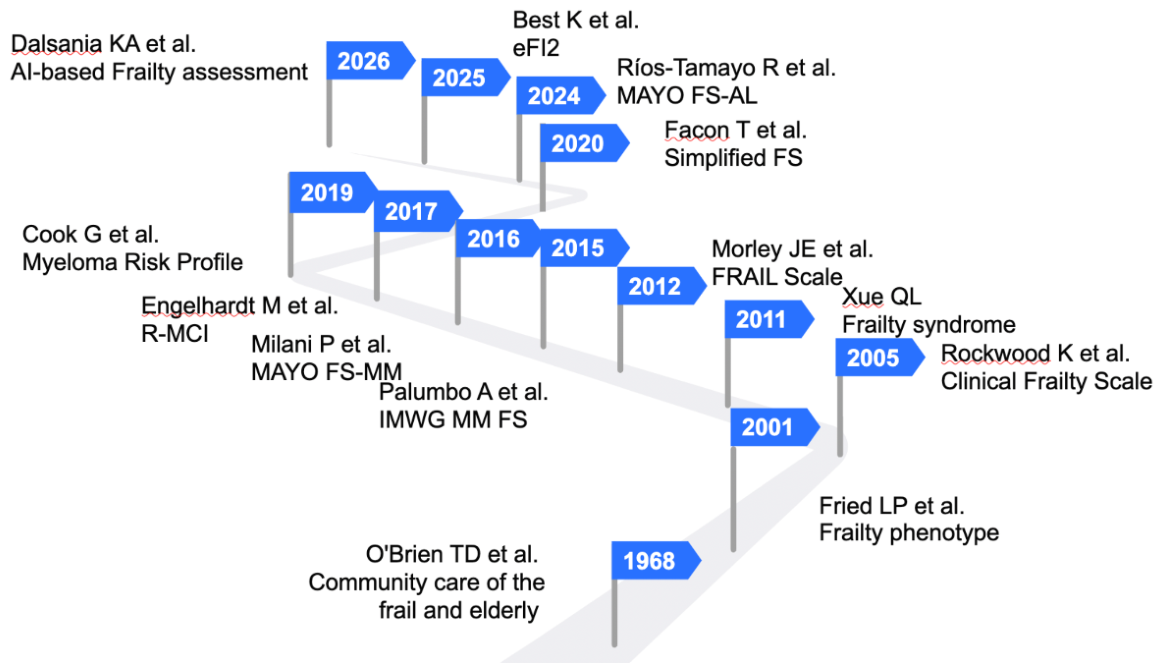
Figure 2.
The central role and clinical impact of frailty in multiple myeloma and AL-amyloidosis.
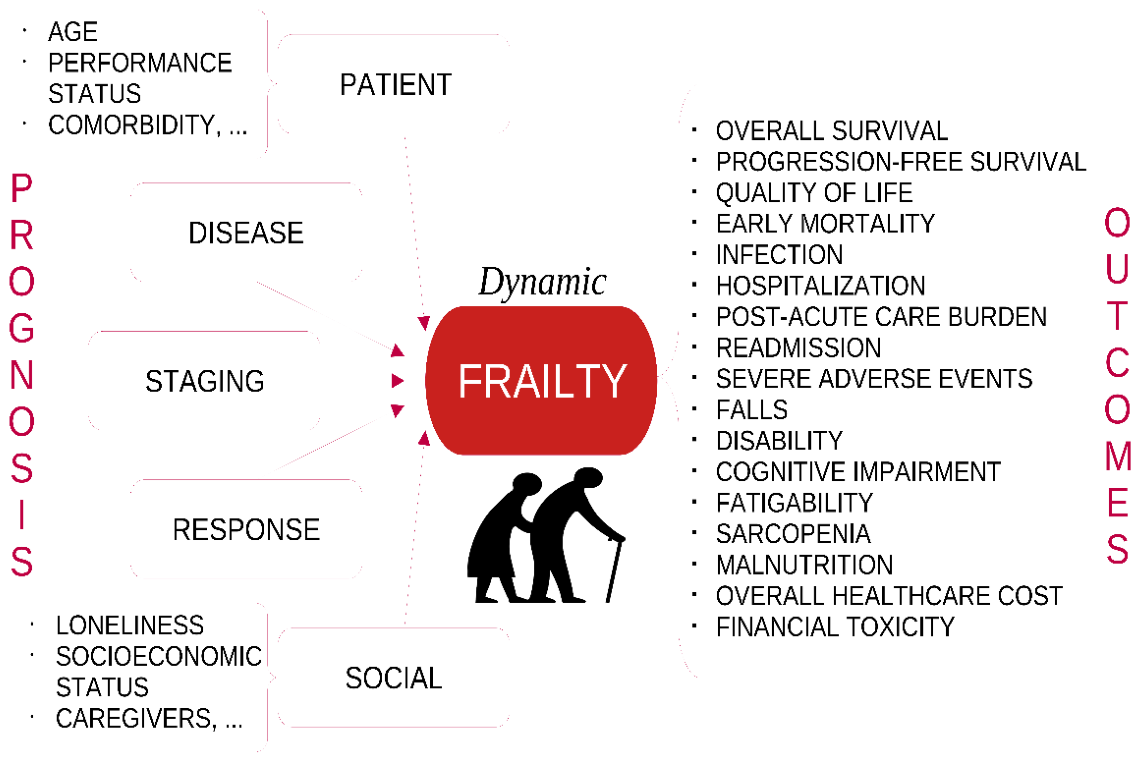
Figure 3.
Inflammagig as the key hallmark of biological aging.
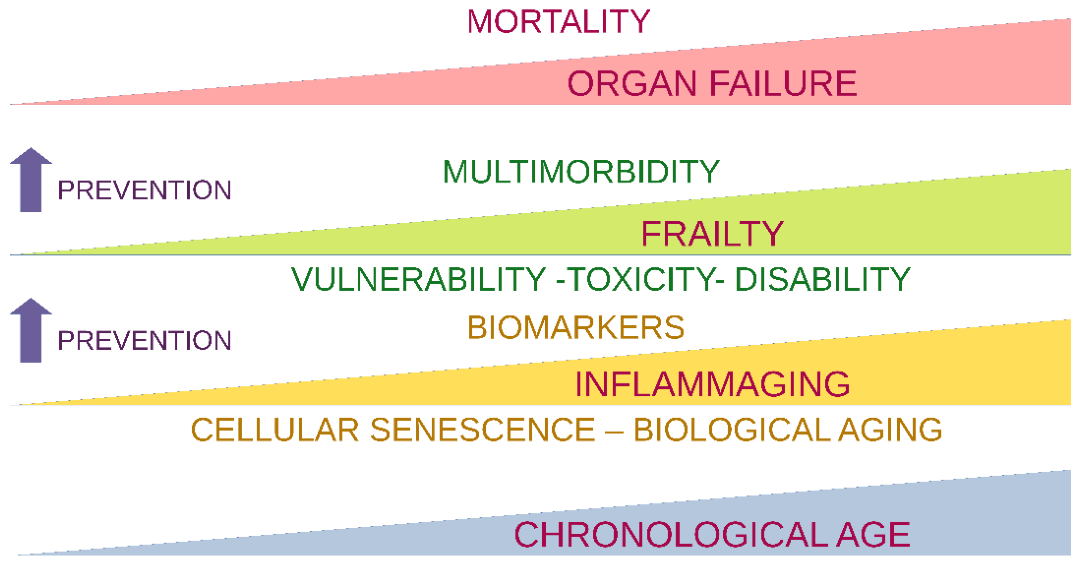

Table 1.
Use of frailty tools according to the type of healthcare in patients with multiple myeloma and/or systemic light-chain (AL) amyloidosis.
Table 1.
Use of frailty tools according to the type of healthcare in patients with multiple myeloma and/or systemic light-chain (AL) amyloidosis.
| Type of healthcare | Frailty tools |
| Primary care | FRAIL scale, eFI2, CGA |
| Hospital-outpatient | PROS, FSs |
| Hospital-admission | PROs, CGA |
| Hospital-emergency | PROs |
| Hospital-intensive | PROs |
| Hospital-multidisciplinary unit | FRAIL scale, FSs, CGA |
| Home | FRAIL scale, Apps |
| Telemedicine | Apps, AI-based |
| Geriatric consultation | CGA |
AI: artificial intelligence, CGA: comprehensive geriatric assessment, eFI2: electronic frailty index two, FSs: frailty scales.
Table 2.
Current considerations about frailty assessment in multiple myeloma and/or systemic light-chain (AL) amyloidosis.
Table 2.
Current considerations about frailty assessment in multiple myeloma and/or systemic light-chain (AL) amyloidosis.
| Feature | Considerations, perspectives, and nuances |
| Target | All MM and/or AL patients |
| Timing | Baseline and key moments throughout the clinical course |
| Tool | See Table 1 |
| Health impact area | Prognosis, clinical decision making, personalized therapy |
| Person in charge | Healthcare staff: hematologist, geriatrician, primary care physician, allied healthcare professionals,... |
| Workload | Variable (minimum for SFS or eFI2, maximum for CGA) |
| Cost | Variable (minimum for SFS or eFI2) |
| Research | Clinical trials, new biomarkers, new AI-based predictive models |
| Prevention | Exercise, exercise mimetics |
| MM specific organ pattern | Focus on bone: pain, skeletal-related events |
| AL specific organ pattern | Focus on heart: heart failure |
| MM/AL shared involvement | Focus on kidney: CKD. Focus on immune system: infection |
AI: artificial intelligence, AL: systemic light-chain (AL) amyloidosis, CGA: comprehensive geriatric assessment, CKD: chronic kidney disease, eFI2: electronic frailty index two, MM: multiple myeloma, SFS: simplified frailty scale.
Disclaimer/Publisher’s Note: The statements, opinions and data contained in all publications are solely those of the individual author(s) and contributor(s) and not of MDPI and/or the editor(s). MDPI and/or the editor(s) disclaim responsibility for any injury to people or property resulting from any ideas, methods, instructions or products referred to in the content. |
© 2026 by the authors. Licensee MDPI, Basel, Switzerland. This article is an open access article distributed under the terms and conditions of the Creative Commons Attribution (CC BY) license (http://creativecommons.org/licenses/by/4.0/).
Copyright: This open access article is published under a Creative Commons CC BY 4.0 license, which permit the free download, distribution, and reuse, provided that the author and preprint are cited in any reuse.