

Submitted:
25 October 2026
Posted:
27 October 2026
You are already at the latest version
Abstract
AI-based credit scoring may broaden the information available to lenders while creating questions about explanation, unequal treatment and control over personal data. This article develops a Bangladesh-focused framework for perceived fairness, integrating the performance-expectancy component of UTAUT2, organisational justice and privacy-calculus reasoning. It also examines whether the supplied Group 8 Law-SDG database can support the proposed empirical model. The workbook contains 385 records and five credit-scoring statements, but it does not contain the proposed multi-item measures of usefulness, explainability, procedural justice, trust, privacy concern and overall perceived fairness. An item-level audit therefore replaces the earlier illustrative regression. Endorsement of disclosure about automated credit decisions is 82.3%, regular bias testing 83.6%, correction of inaccurate information 63.9%, relevant and lawful data use 63.6%, and the proposition that fairness affects acceptance 60.0%. These percentages describe supplied records rather than a representative population. The credit-scoring block has low internal consistency (Cronbach’s alpha = 0.193), precluding its use as a validated reflective fairness scale. The five proposed hypotheses remain untested. The article contributes a distinction between endorsement of safeguards, perceived fairness and acceptance, together with a measurement plan for evaluating their relationships. Recommendations concern understandable reasons, data correction, accessible review and documented model governance. Numeric-response provenance and digital-finance eligibility require confirmation; the codebook labels identifiers and comments synthetic. The study consequently offers a conceptual framework and a descriptive measurement audit, not a completed causal or structural test among verified borrowers.
Keywords:
AI‐based credit scoring
; perceived fairness
; digital finance
; algorithmic accountability
; Bangladesh
; financial regulation
; privacy calculus
1. Introduction
Credit scoring is a central component of lending because providers must estimate whether applicants are likely to repay. Traditional approaches typically rely on documented income, repayment history, collateral and formal credit records. Machine-learning systems can combine a wider range of variables and detect complex patterns that conventional scorecards may miss. Digital footprints and transaction-related signals can sometimes add predictive information, potentially helping lenders assess applicants who have limited conventional credit histories 1. In principle, such approaches can reduce processing time and support more consistent decisions. Yet predictive performance is not the same as fairness: a model can classify risk accurately overall while still producing unequal error rates, relying on questionable proxies or offering applicants little explanation for an adverse decision 2.
The issue is important in digital finance because decisions may be made through applications, mobile interfaces or third-party platforms, where a user may see only an approval, rejection, limit or price rather than the reasoning behind it. If the model uses alternative data, users may not know which information is collected, how long it is retained, whether it is accurate or whether they can correct it. A perceived lack of procedural fairness can therefore arise even when the provider believes that its model is technically efficient. Conversely, clear explanations, consistent treatment, privacy safeguards and accessible human review may improve the legitimacy of automated decisions.3
Bangladesh provides a relevant setting for examining how financial inclusion and digital-service design interact. The World Bank’s Global Findex report distinguishes access to accounts, use of financial services and financial resilience, illustrating why participation cannot be reduced to a single adoption measure. This study does not infer that any Bangladeshi lender uses a particular AI model or that unequal access establishes algorithmic discrimination. Its concern is how a future, appropriately recruited user study could evaluate the procedures surrounding credit decisions.4
The central problem is not simply whether AI can score credit risk. It is whether people affected by AI-based scoring perceive the process and outcome as fair, and which characteristics of the service are associated with those perceptions. Credit scoring systems may draw on data that are incomplete, outdated or indirectly associated with socioeconomic disadvantage. Complex models may be hard to explain, while opaque data practices can create privacy concerns. Applicants may also lack a practical route to request a reason, correct an error or obtain human reconsideration. These concerns have legal and behavioural significance because perceived unfairness can undermine trust, willingness to use digital financial services and confidence in financial institutions.5
The research plan identifies an evidence gap concerning AI-based credit scoring and perceived fairness in Bangladesh. International scholarship examines digital-footprint credit scoring, distributional effects of machine learning and competing fairness metrics, but evidence from one lending market cannot automatically be transferred to another. The proposed survey concerns users’ evaluations of decision procedures; the supplied workbook is examined separately to establish which of those evaluations it actually measures.6
Three connected gaps motivate the study. First, a contextual gap remains to be tested: international findings on AI credit scoring may not capture local users’ expectations about data use, reasons for rejection, human review or complaint mechanisms. Second, a theoretical integration gap exists in the proposed model: technology-acceptance beliefs, organizational-justice perceptions and privacy-calculus concerns are often discussed separately, whereas users may evaluate the same decision through all three lenses. Third, a measurement gap must be addressed: general questions about AI fairness or legal decision-making may not adequately measure fairness in a lending context. The instrument must therefore use credit-specific wording, cognitive pretesting and measurement validation before hypotheses are tested.7
The contribution is a theory-informed framework for distinguishing utility, procedural safeguards, trust, privacy concern and perceived fairness in AI-assisted credit decisions. The accompanying database audit tests the fit between that framework and the available variables. It provides descriptive information about recorded safeguard preferences while identifying the additional measures needed for a defensible empirical test. Neither safeguard endorsement nor self-reported fairness establishes actual discrimination, legal compliance or the accuracy of a deployed scoring system.
The general objective is to examine the factors associated with perceived fairness of AI-based credit scoring among digital finance users in Bangladesh.
- RO1: To assess users’ perceptions of the fairness, transparency and explainability of AI-based credit scoring.
- RO2: To examine the associations of perceived usefulness, procedural justice, explainability, trust and privacy concern with perceived fairness.
- RO3: To assess whether perceived fairness varies across relevant user characteristics, including prior digital-finance experience and digital competence, where sample sizes permit.
- RO4: To identify user-supported safeguards for more accountable and inclusive AI-assisted credit decisions.
The corresponding research questions are: How fair do users perceive AI-based credit scoring to be? Which technology, procedural and privacy-related perceptions are associated with perceived fairness? Do perceptions vary across relevant user groups? Which safeguards do users consider important for responsible AI-based lending?
The article first reviews the relevant literature, develops five prospective hypotheses and presents their conceptual framework. It then distinguishes the proposed user-study protocol from the secondary audit of the supplied database, reports the audit and item-level descriptive results, and discusses the implications for measurement and responsible lending. The hypotheses remain prospective because their required constructs are not adequately measured in the workbook.
2. Literature Review and Theoretical Foundation
This section develops the conceptual basis for examining fairness in AI-assisted credit decisions. It distinguishes predictive performance from users’ evaluations of the decision process, then connects technology acceptance, organisational justice and privacy calculus to explain why efficiency, understandable reasons and control over personal data may matter in different ways. The review leads to five prospective hypotheses and a framework whose measures must be validated before structural relationships can be tested. The supplied database is subsequently assessed against those measurement requirements rather than assumed to operationalise them.
2.1. AI-Based Credit Scoring and Perceived Fairness
AI-based credit scoring refers here to the use of algorithmic or machine-learning systems to estimate creditworthiness or support lending decisions. The term covers a range of systems, from statistical models to more complex machine-learning pipelines; it does not imply that every digital lender in Bangladesh currently uses advanced AI. A survey should therefore screen respondents for familiarity with digital borrowing and explain the concept in plain language before asking perception questions. Respondents’ answers will reflect their beliefs and experiences, not direct knowledge of a lender’s technical model unless they have actually encountered one.8
Perceived fairness is the user’s assessment of whether the decision process and outcome are justifiable and appropriately administered. It can include distributive fairness (whether outcomes seem proportionate and non-discriminatory), procedural fairness (whether the process is consistent, accurate, correctable and open to review), and informational fairness (whether reasons are adequately explained). Organizational-justice research supports treating fairness as multidimensional rather than as a single undifferentiated judgement 9. In algorithmic lending, these dimensions matter because the outcome may affect access to credit while the process may be difficult to observe.
Fairness should be distinguished from model accuracy and legal compliance. Accuracy concerns predictive performance; fairness concerns how outcomes and errors are distributed or experienced; legal compliance depends on the applicable laws, regulations and facts. A perception survey can measure perceived fairness and awareness of safeguards, but it cannot by itself determine whether a model is statistically discriminatory or whether a lender has breached a legal obligation. Those questions require separate technical audits and legal analysis.10
2.2. Digital Finance and the Bangladesh Context
Digital finance can change the information and transaction channels through which people access financial services. When a scoring model uses transaction patterns or digital traces, differences in digital activity may enter assessment even when they reflect circumstances beyond an applicant’s control. This is a risk requiring investigation, not a predetermined finding about Bangladesh. Research on digital footprints shows potential predictive information; research on machine-learning credit markets separately raises distributional questions. Both motivate careful measurement of what data are used, whose circumstances are represented and how an applicant can challenge an error.11
A Bangladesh-focused study should avoid treating “digital finance users” as a homogeneous population. It should document respondent age, gender where voluntarily disclosed, education, employment status, location, digital-finance experience and familiarity with credit decisions. These variables can help describe the sample and, where justified by theory and adequate subgroup sizes, serve as controls or moderators. The sampling strategy must also be reported accurately: a target sample size of 385 does not make a convenience sample representative of all adults or all borrowers in Bangladesh.
2.3. Algorithmic Fairness, Transparency and Explainability
Algorithmic fairness encompasses different objectives, including parity between groups, equality of opportunity and consistency in the treatment of similar individuals. Technical criteria can conflict, and a selected metric expresses a normative choice rather than settling every question of justice. A perception study instead asks how users evaluate reasons, consistency and opportunities to challenge incorrect information. These questions complement technical auditing but cannot substitute for it.12
Explainability can support procedural legitimacy when it provides useful information about the main factors influencing a decision and how an applicant can respond. A generic message such as “the application did not meet our criteria” may be less useful than a clear explanation of the relevant factors, subject to legitimate fraud-prevention and security constraints. Explanation should not be confused with full disclosure of source code. The practical goal is meaningful, accurate and actionable information, with appropriate safeguards against gaming and disclosure of other customers’ data.13
A review by Das, Stanton and Wallace discusses fairness in credit scoring and the difficulty of explaining complex models to affected applicants and oversight bodies. Recent credit-rating research examines how fairness assessments depend on the population and the metrics considered, while explainable credit-modelling research studies technical approaches to performance and explanation. These contributions motivate separate measurement of user-facing explanation, perceived fairness and audited outcomes; they do not validate the present questionnaire automatically.14
2.4. Theoretical Integration
UTAUT2 explains consumer technology acceptance through performance expectancy, effort expectancy, social influence, facilitating conditions, hedonic motivation, price value and habit. This study draws specifically on performance expectancy to motivate a possible usefulness-fairness association. It does not claim to test the full acceptance model, and it keeps perceived fairness distinct from convenience or a general intention to use technology.15
Organisational justice distinguishes distributive, procedural, interpersonal and informational dimensions. In an automated credit setting, procedural and informational justice concern consistent criteria, accurate information, opportunities to correct errors and understandable communication. The proposed model treats perceived procedural quality and explainability as conceptually distinct from an overall fairness judgement. Items must be designed so that the predictor and outcome do not repeat the same wording or define one another.16
Privacy-calculus reasoning examines how people weigh perceived benefits against the risks associated with personal information disclosure. In credit scoring, alternative data may appear useful for applicants with limited formal histories while also raising concerns about excessive collection, unexpected reuse or weak control. Dinev and Hart provide a basis for examining this benefit-risk relationship, rather than assuming that privacy concern always has the same behavioural effect. The proposed study must distinguish concern about specific credit-data practices from general attitudes toward technology.17
2.5. Hypotheses Development
H1: Perceived Usefulness and Perceived Fairness
When users believe AI-assisted credit assessment can improve consistency, reduce arbitrary discretion or extend assessment to applicants with limited conventional histories, they may evaluate it more favourably. UTAUT2 supplies a performance-expectancy argument, but it does not make usefulness equivalent to fairness. The study therefore proposes an association between the two constructs, subject to separate measurement and empirical testing. The full UTAUT2 model is not claimed because several of its constructs lie outside this framework.18
H1:
Perceived usefulness of AI-based credit scoring is positively associated with perceived fairness
H2: Explainability and Perceived Fairness
An explanation may help users understand why a decision was reached and which information mattered. It may also reveal an error or identify a practical route for correction. These possibilities connect explanation with informational and procedural justice. However, interpretable output is not automatically accurate or useful: the proposed measure should assess whether reasons are understandable, faithful to the decision and actionable, rather than whether a disclosure merely exists.19
H2: Perceived explainability of AI-based credit scoring is positively associated with perceived fairness.
H3: Procedural Justice and Perceived Fairness
A fair procedure should apply relevant criteria consistently and provide a meaningful opportunity to correct inaccurate information or request review. In an automated lending context, these safeguards can be evaluated separately from whether an applicant obtains credit. The hypothesis concerns perceived procedural quality, not a legal conclusion that a provider has complied with its obligations. It requires a measure distinct from the outcome judgement of overall fairness.20
H3:
Perceived procedural justice is positively associated with perceived fairness.
H4: Trust and Perceived Fairness
Trust concerns reliance on a provider or system under uncertainty. It may reflect beliefs about competence, integrity or responsible operation, but it is not interchangeable with approval of a particular outcome. The proposed study should identify the trustee and the task, use separate trust and fairness items, and assess whether the measures are distinguishable. A statement that regulation would increase trust is conditional and should not be treated as a direct measure of current trust.21
H4:
Trust in the digital finance provider’s AI-assisted decision process is positively associated with perceived fairness.
H5: Privacy Concern and Perceived Fairness
Concerns about irrelevant, excessive or inadequately protected information may accompany lower fairness evaluations. Privacy calculus provides a rationale for testing that relationship alongside perceived benefits, while the broader privacy literature distinguishes different kinds of informational harm. The instrument should ask about the specific practices relevant to credit assessment, so that privacy concern is not confused with awareness of AI risks or endorsement of safeguards.22
H5:
Privacy concern about data use in AI-based credit scoring is negatively associated with perceived fairness.
2.6. Conceptual Framework
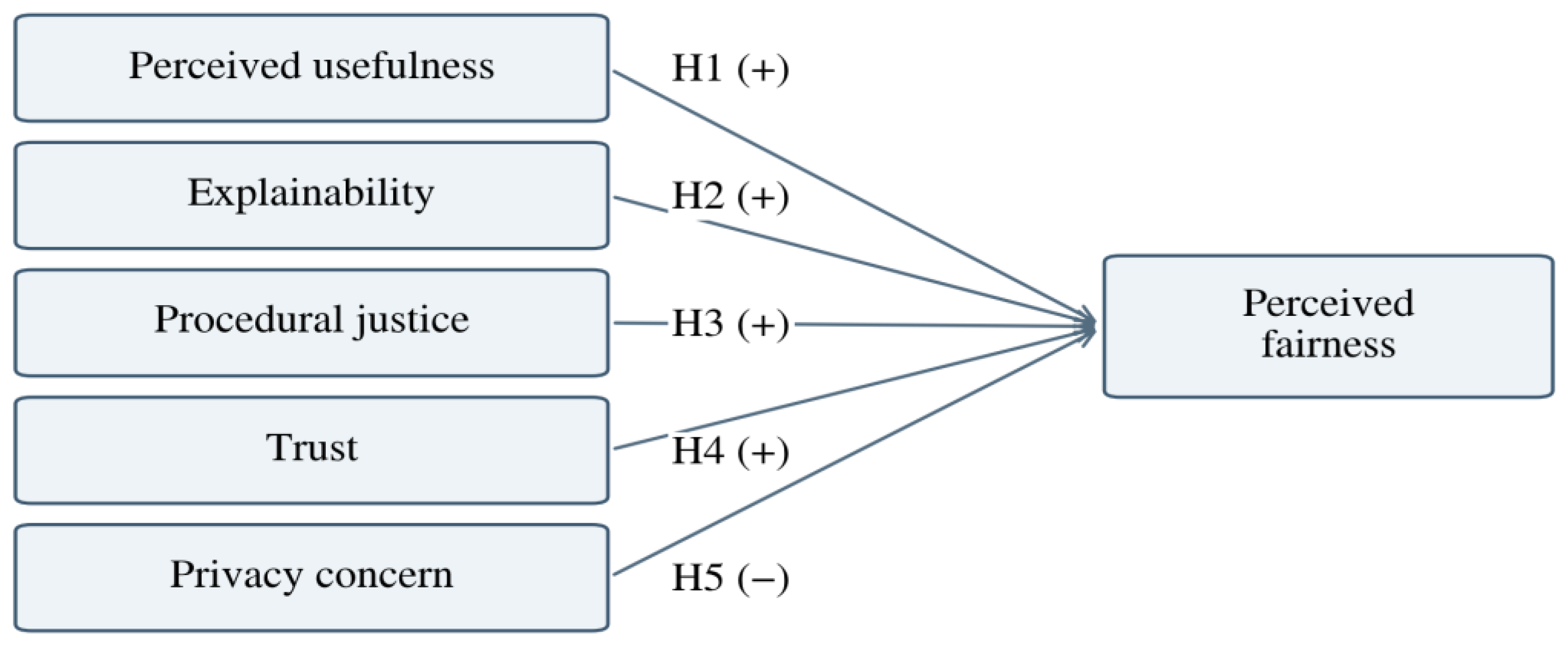
The proposed framework treats perceived fairness as the outcome. Usefulness, explainability, procedural justice and trust are proposed positive correlates, while privacy concern is proposed as a negative correlate. Figure 1 summarises these prospective associations. Age, gender, digital-finance experience and prior credit-application experience may be considered as controls when measured and justified. These are theoretical propositions: the arrows do not represent causal effects or coefficients estimated from the supplied workbook.
Figure 1.
Proposed conceptual framework for perceived fairness in AI-based credit scoring. H1-H5 are prospective associations; the supplied database does not provide a validated test of these paths
Figure 1.
Proposed conceptual framework for perceived fairness in AI-based credit scoring. H1-H5 are prospective associations; the supplied database does not provide a validated test of these paths
3. Methodology
The article combines conceptual model development with a descriptive audit of the supplied Group 8 workbook. The completed audit is distinct from the proposed quantitative, cross-sectional survey of digital-finance users. The audit examines variable coverage, technical data quality and the distributions of the five CSF statements. It does not estimate the proposed six-construct structural model. A future user survey would measure the constructs at one point in time and support association analysis, while temporal ordering and causal effects would remain unresolved.
3.1. Population, Eligibility and Unit of Analysis
The proposed target population is adults in Bangladesh with experience of digital financial services and sufficient familiarity with credit assessment to answer a credit-specific instrument. The available database instead records general adult eligibility, AI awareness and consent, along with legal-study or professional status. It does not establish digital-finance use, a loan application, a credit decision or exposure to a named AI scoring system. The present descriptive unit is therefore a supplied database record, not a verified borrower or digital-credit user. A future study should screen those experiences explicitly or use a clearly identified vignette design.
3.2. Sampling and Sample-Size Determination
The proposed study uses 385 completed responses as a planning benchmark derived from Cochran’s large-population calculation at 95% confidence, five-per-cent precision and p = .50. This benchmark assumes a suitable probability-sampling design for a proportion; it does not establish the precision of a convenience sample or the adequacy of a structural model. A future survey should justify its design and power separately. Approximately 428 contacts would correspond to a ten-per-cent non-response allowance, but that number is a planning assumption, not a documented recruitment count.23
The supplied workbook contains N = 385 records, all retained in the descriptive audit. No recruitment log, sampling frame, invitation count, field dates, selection probabilities or institutional clusters accompanies the file. A response rate and national margin of error are therefore not estimated. The codebook labels the respondent sequence and contextual comments synthetic; it does not independently establish the origin of all numeric responses. Numeric-response provenance requires confirmation, and contextual comments are excluded. These qualifications apply to every reported database percentage.24
3.3. Instrument and Measurement
The supplied workbook uses a five-point agreement scale, from one strongly disagree to five strongly agree. Its credit-scoring block comprises CSF1-CSF5, concerning relevant and lawful data, disclosure of automated involvement, correction of inaccurate information, bias testing and the influence of fairness on acceptance. These statements are retained separately. Appendix A contains the draft’s proposed finance-specific item set; those proposed items are not present as collected columns in the workbook and are not retroactively treated as responses.
The prospective model requires separate measures of usefulness, explainability, procedural justice, trust, privacy concern and overall perceived fairness. Table 1 maps these requirements to the existing file. Conceptual overlap is insufficient for substitution: a disclosure preference is not experienced explainability, a testing preference is not an audit result, and a fairness-contingent acceptance statement is not a direct overall fairness judgement. The proposed measures require expert review, cognitive testing, a documented translation process if used and subsequent validity assessment.
3.4. Pilot Testing and Data Collection
No completed pilot, cognitive testing or translation record accompanies the supplied materials. A future pilot may examine clarity, interpretation and response distributions before the finance-specific instrument is finalised. Recruitment should record channels, dates, invitations, completions, exclusions and the final usable sample. For the present secondary audit, the Data and Codebook sheets were read together, all 385 rows were retained, and the CSF statements were summarised without imputing absent construct measures or borrowing responses from Appendix A.
3.5. Ethical Considerations
The authors report that no formal ethics approval was obtained because an accessible institutional review mechanism applicable to this project was unavailable. That account is not represented as a formal exemption or a general statement about Bangladesh’s legal requirements. The workbook records affirmative consent, adult eligibility and AI awareness in every row; those fields alone do not independently verify recruitment or consent implementation. The secondary audit introduces no identifiers, excludes the contextual comments and reports aggregates. Any future user survey should implement voluntary informed consent, the ability to discontinue, minimal collection of financial information, restricted access and documented retention procedures. Passwords, account credentials and unnecessary transaction details should not be collected.
3.6. Data Preparation and Analytical Strategy
The audit checks missing agreement responses, score ranges, identifier uniqueness, duplicate 20-item response vectors and complete straight-lining. It reports counts and percentages for the recorded profile and means, sample standard deviations and five-category distributions for CSF1-CSF5. Endorsement means a score of four or five; neutrality is not interpreted as opposition. These checks assess the file’s technical properties rather than establishing response authenticity or population representativeness.
Internal consistency is examined for the supplied five-item blocks as a diagnostic. Alpha is not a complete validity test, and heterogeneous normative statements need not behave as a reflective scale. In light of the item content and observed reliability, no aggregate fairness score, factor-loading table, composite reliability, average variance extracted or HTMT matrix is reported as validated evidence. The prospective model must first establish that its constructs are measured distinctly and adequately.25
No coefficients are estimated for H1-H5 because their required measures are absent. In a future instrument-aligned study, a prespecified regression or structural model should report the estimator, measurement assessment, coefficients, standard errors, confidence intervals, exact p-values and relevant diagnostics. The choice between regression and SEM should follow the measurement model and research question. Neither the number of database rows nor a preference for significant paths justifies treating missing constructs as observed.
The completed analysis is descriptive and does not attach population-inference tests to the supplied-record percentages. No exclusions depend on hypothesis results. A future study should define its primary estimands, handling of missing responses and comparison families before analysis, then interpret effect sizes and intervals alongside p-values. A non-significant estimate would not establish the absence of a relationship.26
4. Results
This section reports the completed audit of the supplied Group 8 database and the distributions of its credit-scoring items. It distinguishes recorded safeguard preferences from the unmeasured constructs in the prospective framework. All results use N = 385, with no simulation of missing variables, no illustrative regression coefficients and no decisions on H1-H5.
4.1. Respondent Profile
The workbook contains 385 unique respondent identifiers. The profile includes 194 male, 177 female, four other and ten prefer-not-to-say records. Current status comprises 228 law students, 77 law graduates, 54 advocates or legal professionals and 26 other relevant respondents. The largest age category is 21-23 years (162 records), and 149 records list Dhaka. These are unweighted file descriptions; they do not establish that the records represent borrowers or the Bangladeshi population.

Table 2.
Recorded profile in the supplied database (N = 385).
| Characteristic | Categories and counts |
| Age | 21-23: 162; 24-26: 83 |
| 18-20: 61; 27-30: 40 | |
| 31+: 39 | |
| Gender | Male: 194; Female: 177 |
| Prefer not to say: 10; Other: 4 | |
| Current status | Law student: 228; Law graduate: 77 |
| Advocate or legal professional: 54; Other relevant respondent: 26 | |
| Location | Dhaka: 149; District town: 80 |
| Other city corporation: 76; Upazila-rural area: 64 | |
| Other: 16 | |
| Training | No: 199; Yes, short orientation: 138 |
| Yes, course or certified training: 48 |
Counts describe the complete file and are unweighted. Law-related status does not establish digital-finance or credit-application experience. All 385 records are retained.
4.2. Descriptive Statistics
Table 3 reports the exact five-category counts and descriptive score summaries for CSF1-CSF5. The highest endorsement is for regular bias testing, 322/385 (83.6%), followed by disclosure of automated involvement, 317/385 (82.3%). Correction of inaccurate information is endorsed in 246 records (63.9%), relevant and lawful information in 245 (63.6%), and fairness affecting acceptance in 231 (60.0%). These items describe different propositions and are not averaged into an overall fairness score.
Endorsement means four or five. Means and sample SDs are descriptive score summaries; no validated construct means or population estimates are implied.
The neutral category contains 57 records for bias testing, 63 for automated-involvement disclosure, 130 for data correction, 122 for lawful and relevant data, and 135 for fairness-contingent acceptance. A neutral response does not establish rejection of a safeguard. The differences are descriptive patterns across differently worded statements and do not rank the effectiveness of the safeguards.
4.3. Measurement Model and Reliability
The CSF block has Cronbach’s alpha 0.193. For completeness, alpha is 0.322 for AIL, 0.250 for TRF and 0.224 for FPC. These values, together with the heterogeneous item meanings, provide no adequate basis for the draft’s proposed reflective construct scores. The workbook contains no item-level responses to the PU, EX, PJ, TR, PC and PF measures in Appendix A. Consequently, indicator loadings, convergent validity and discriminant validity for that prospective model cannot be claimed from this file.
4.4. Hypothesis Testing
Table 4 records the measurement status of the five proposed hypotheses. None can be supported or rejected using the available items. In particular, CSF5 asks whether fairness affects acceptance; it does not directly measure whether the respondent regards an AI credit decision as fair. Replacing the intended dependent variable with CSF5 would change the research question and would require a different, explicitly specified analysis.
The hypotheses remain prospective research propositions. No path coefficient, standard error, confidence interval, p-value or support decision is imputed. This decision preserves the distinction between conceptual expectations and observed evidence. Future tests require data from the proposed instrument or a revised framework whose constructs genuinely match the observed variables.
The arrows describe proposed associations, not causal paths or estimated effects. Untested means that the required measurement is unavailable; it does not mean a hypothesis was rejected.
Table 5 summarises the completed technical checks. All 20 agreement items have valid one-to-five scores, with no missing substantive item values. Twelve tool-name responses are missing; that optional field does not enter the CSF summaries. There are no duplicate identifiers, repeated complete 20-item vectors or records with the same response to every agreement item.
Checks cover AIL1-5, CSF1-5, TRF1-5 and FPC1-5. Technical consistency cannot establish human-response provenance, consent implementation or representativeness.
These technical results do not validate the sampling process, verify human participation or establish the completeness of the proposed model. The supplied file’s synthetic labels remain a provenance issue requiring documentary clarification. The earlier illustrative regression and its R² are excluded because they do not represent estimates of the proposed relationships from this workbook.
4.5. Robustness and Supplementary Analysis
The present audit does not claim structural robustness, predictive validity or subgroup invariance. Such analyses require an estimable model and an appropriate measurement design. Future sensitivity analyses should examine justified scoring decisions, recruitment coverage and model specifications without selecting results on significance. The absence of a structural model here is a measurement conclusion rather than evidence that the proposed relationships are absent.
5. Discussion
The supplied data permit a descriptive account of safeguard preferences but do not test the proposed explanation of perceived fairness. The main finding is therefore a distinction between the research question and the available measures. High endorsement of testing and disclosure provides a pattern worth investigating; low block consistency and absent construct measures prevent interpreting that pattern as validation of UTAUT2, organisational justice or privacy calculus.
5.1. Interpreting the Usefulness-Fairness Relationship
Usefulness remains a plausible correlate of perceived fairness in the prospective model, but it is not measured by a dedicated scale in the workbook. The CSF statements focus on data legitimacy, notification, correction, testing and fairness-contingent acceptance. None directly asks whether AI credit scoring improves efficiency or access. The database therefore cannot show that perceived utility explains fairness beyond procedural safeguards. A future user study should measure the performance benefit and the fairness judgement separately.27
5.2. Explainability, Procedural Justice and Trust
The recorded endorsement of disclosure and testing is compatible with interest in visible governance safeguards, but neither item measures experienced procedural quality. Respondents can support being informed about automation without having received an intelligible explanation. They can support bias testing without knowing whether it occurs. Organisational justice consequently informs the interpretation and future measurement plan, while the current percentages remain descriptive preferences rather than evidence of a procedural-justice effect.28
5.3. Privacy Concern and Benefit-Risk Trade-Offs
Privacy concern is likewise not estimated as a predictor of fairness. The fraud block contains conditional acceptance of monitoring and privacy safeguards, which is conceptually different from concern about excessive or unexpected credit-data use. A privacy-calculus test would require separate risk and benefit measures tied to the same decision context. Substituting a safeguard preference for privacy concern could reverse or obscure the meaning of the proposed relationship.29
5.4. Bangladesh-Specific Interpretation
No Bangladesh-wide fairness level, adoption rate or discriminatory effect follows from these records. The profile is concentrated in law-related categories, and digital-finance eligibility is unverified. Generalisation also depends on clarification of response provenance and recruitment. The contribution is a Bangladesh-oriented research framework and a documented assessment of the current file’s measurement limits, rather than a completed test among verified digital-finance users.
6. Theoretical and Practical Implications
The implications connect the proposed fairness framework with the measurement limits identified in the database audit. They distinguish contributions to research from recommendations for lenders, regulators and users. The recommendations concern understandable reasons, proportionate data practices and practical routes to correction and review; they are not presented as effects demonstrated by the untested structural model.
6.1. Theoretical Implications
The proposed model connects perspectives that address different aspects of an AI-mediated credit decision. UTAUT2 contributes the performance-expectancy argument; organisational justice distinguishes evaluations of procedures and communication; privacy calculus concerns the assessment of informational benefits and risks. The integration offers a research framework rather than a new universal theory. Its empirical value depends on measures that can distinguish these constructs instead of using general agreement with safeguards as evidence for every theoretical component.30
The measurement audit adds a specific implication: theoretical relevance does not make questionnaire items interchangeable. Notification, explanation, current trust, conditional confidence and overall fairness are distinct objects of judgement. CSF5 concerns the importance of fairness to acceptance, so it cannot serve uncritically as the outcome measure for a model explaining fairness itself. A future instrument should name the service context and separate these evaluations, then examine content validity and construct distinctness before estimating paths.
6.2. Implications for Lenders and FinTech Providers
Providers should design applicant-facing explanations around the actual factors that materially influenced a decision, using plain language and avoiding misleading certainty. Applicants should have a route to correct inaccurate information, ask questions and request human review where appropriate. Explanation and review processes should be tested for accessibility, including users with limited digital literacy or disabilities. A complaint channel should communicate timelines, evidence requirements and the outcome of review.31
Data governance should address relevance, proportionality, security, retention and documentation of information sources. Providers should examine whether selected features operate as proxies for disadvantage and evaluate performance across relevant groups where lawful and technically appropriate. These are governance proposals supported by algorithmic accountability scholarship; the present survey does not establish whether any provider implements them. Technical testing and user feedback address different questions and should be documented separately.32
6.3. Implications for Regulators and Policymakers
Regulators and policymakers can evaluate whether automated credit processes provide documented responsibilities, understandable reasons, data-correction routes and accessible complaints handling. Oversight should consider third-party models and continuing monitoring, since a provider remains responsible for how a service is deployed. These are policy recommendations, not claims about obligations already imposed on every Bangladeshi financial institution. Their implementation should follow the competent authority’s mandate and the applicable product and institutional framework.
Coordination across financial supervision, consumer protection and data governance can help identify gaps between technical model management and the applicant’s practical ability to obtain review. Legal applicability requires the relevant current instrument and institutional context; no definitive domestic compliance conclusion is offered here. A perception study can identify questions for oversight, but it cannot determine a lender’s legal liability or replace an audit of actual decisions.
6.4. Implications for Users and Civil Society
Users may benefit from plain-language information about data sources, reasons and routes to correction or review. Consumer organisations and financial-literacy programmes can help document recurring difficulties. Such support should complement provider responsibility rather than make applicants responsible for discovering hidden system errors. The present endorsement patterns can inform questions for participatory service evaluation, while evidence of comprehension and effective redress requires direct assessment.
7. Conclusions, Limitations and Future Research
AI-based credit scoring may support efficient risk assessment and could help some applicants whose conventional credit histories are limited. However, the legitimacy of such systems depends on more than predictive performance. Users may also care about whether decisions are explainable, procedures are consistent, data use is proportionate and errors can be challenged. This manuscript proposes a Bangladesh-focused quantitative study integrating UTAUT2, organizational justice and privacy-calculus reasoning to examine perceived fairness among digital finance users. It sets out five testable hypotheses and a data-analysis plan aligned with the research question.33
The supplied database contains 385 records but lacks the full finance-specific measures needed for the proposed hypotheses. The completed descriptive audit reports the CSF distributions and identifies low block consistency, while the five theoretical relationships remain untested. A future empirical study requires verified provenance, appropriate eligibility screening, documented recruitment and an instrument aligned with the model. The central contribution of this version is to make that alignment explicit instead of presenting illustrative coefficients as findings.
The present audit is limited by undocumented recruitment and numeric-response provenance, missing digital-finance eligibility and the use of broad agreement statements rather than experience-specific fairness measures. The codebook identifies respondent sequences and contextual comments as synthetic; comments are excluded and the numeric data’s origin is not independently established. Even a future verified cross-sectional survey would face limits concerning temporal ordering, self-report, common-method influences and generalisation. Perceptions alone would not establish the statistical fairness of an operational credit model.
Future studies could combine survey perceptions with interviews, controlled decision vignettes or audits of anonymised lending decisions where lawful access and appropriate governance are available. Longitudinal designs could examine whether explanations or review experiences change trust over time. Experiments could test whether different explanation formats affect perceived procedural justice, while model audits could examine group-specific error rates and the effects of alternative fairness metrics. Cross-country comparisons may clarify which patterns are specific to Bangladesh and which appear across digital-finance markets. Researchers should also study the experiences of people with thin credit files, irregular income or limited digital access, without assuming in advance that these groups are uniformly disadvantaged.
Ethical Approval and Oversight
Formal ethics approval was not obtained. The authors report that their institutional setting did not provide an accessible review mechanism applicable to this project. This is not represented as an official exemption. Recorded consent and adult eligibility are present in all 385 rows, while the original implementation and numeric-response provenance require documentary confirmation. The present secondary audit excludes contextual comments, introduces no identifiers and reports aggregates. Section 3.5 details the safeguards and the boundary between the audit and a future user survey.
Informed Consent Statement
The workbook records affirmative participation consent and adult eligibility for every row. These recorded fields do not independently establish the conduct of recruitment or the information provided to participants. Any future collection using Appendix A should implement a clear voluntary-consent process, explain confidentiality and allow discontinuation.
Data Availability Statement
The descriptive analysis uses the supplied Group-8-Law-SDG-Database.xlsx, including its Data and Codebook sheets. Source-data access and any redistribution should be arranged with the research team subject to confidentiality and permission. The contextual-text field is excluded. Appendix A provides proposed items, not recorded responses; the reported descriptive values are reproducible from CSF1-CSF5.
Author Contributions
Mst. Asura Jaman Osru: Conceptualisation; preparation of study materials; data curation; writing-original draft; manuscript development. The project was conducted under the supervision of Prof. Dr Kazi Abdul Mannan. Kazi Abdul Mannan: Conceptualisation; methodological guidance; supervision; interpretation; writing-review and editing. The author roles describe the work reported in this manuscript and do not attribute undocumented recruitment or collection of the proposed finance-specific instrument.
Generative AI Disclosure
Generative AI assisted language editing, manuscript organisation, citation conversion, document formatting and development of the descriptive audit code. The revised numerical summaries were computed from the supplied workbook. The authors remain responsible for verification, interpretation and reporting; AI is not an author.
Appendix A. Proposed Finance-Specific Questionnaire Items (For Review and Pilot Testing)
Instructions to respondents: The following statements concern the use of automated or AI-assisted systems to help assess applications for credit or loans through digital financial services. Please answer based on your experience or your understanding of such systems. If you have no basis to answer a statement, choose “Not sure” if that option is provided. These items are proposed for this study and are not represented as an already validated scale.
Response scale: 1 = Strongly disagree; 2 = Disagree; 3 = Neither agree nor disagree; 4 = Agree; 5 = Strongly agree; plus “Not sure / not applicable” if enabled.
Table A1.
Proposed finance-specific questionnaire items.
| Construct | Code | Proposed item |
| Perceived usefulness (PU) | PU1 | AI-assisted credit scoring can help lenders assess applications more efficiently. |
| Perceived usefulness (PU) | PU2 | AI-assisted scoring may help assess applicants who have limited formal credit histories. |
| Perceived usefulness (PU) | PU3 | Using relevant digital information can improve the consistency of credit assessment. |
| Explainability (EX) | EX1 | A digital lender should explain the main factors behind an AI-assisted credit decision. |
| Explainability (EX) | EX2 | The explanation for a credit decision should be understandable to an ordinary applicant. |
| Explainability (EX) | EX3 | Applicants should be told how to correct information that may have affected a credit decision. |
| Procedural justice (PJ) | PJ1 | Comparable applicants should be assessed using consistent criteria. |
| Procedural justice (PJ) | PJ2 | Applicants should be able to request a review of an AI-assisted credit decision. |
| Procedural justice (PJ) | PJ3 | A fair credit process should allow applicants to correct inaccurate personal or financial data. |
| Procedural justice (PJ) | PJ4 | A human reviewer should be available when an applicant challenges an important automated decision. |
| Trust (TR) | TR1 | I would trust a digital finance provider more if it explained how AI-assisted credit decisions are made. |
| Trust (TR) | TR2 | I believe a responsible provider should check its AI-assisted credit system for errors and unfair outcomes. |
| Trust (TR) | TR3 | I would feel more confident if the provider clearly explained how my data are used. |
| Privacy concern (PC) | PC1 | I am concerned that AI-assisted credit scoring may use more personal data than necessary. |
| Privacy concern (PC) | PC2 | I am concerned that my financial or digital data could be used for purposes I did not expect. |
| Privacy concern (PC) | PC3 | I am concerned that incorrect or outdated data could unfairly affect a credit decision. |
| Perceived fairness (PF) | PF1 | Overall, AI-assisted credit decisions can be fair when clear safeguards are in place. |
| Perceived fairness (PF) | PF2 | AI-assisted credit scoring should not unfairly disadvantage people because of their background or circumstances. |
| Perceived fairness (PF) | PF3 | I would regard an AI-assisted credit decision as fair if the reasons were understandable and could be challenged. |
| Perceived fairness (PF) | PF4 | I believe that applicants with similar relevant financial circumstances should receive similar consideration. |
These items are proposed for future review and validation. They are not recorded responses in the supplied Group 8 database and were not used to calculate Table 2 and Table 3 or 5.
The proposed items require expert review, cognitive testing, piloting and measurement validation before use as construct measures. They are not observed variables in the present audit.
Appendix B. Reproducibility Specification
Read the supplied workbook’s Data sheet without excluding rows and use the Codebook to identify the original item wording. For each of CSF1-CSF5, calculate the arithmetic mean, sample standard deviation, counts at scores one through five, and the number scoring four or five. Divide endorsement counts by 385 for the percentages in Table 3. Report profile-category counts from the complete file.
Compute each five-item block’s alpha as 5/4 × [1 - sum of item sample variances / sample variance of the summed score]. Check the 20 agreement items for missingness, range violations, repeated vectors and straight-lining, and check identifiers for duplicates. These diagnostics do not validate a reflective scale.
| 1 | Tobias Berg and others, ‘On the Rise of FinTechs: Credit Scoring Using Digital Footprints’ (2020) 33 Review of Financial Studies 2845. |
| 2 | Sanjiv Das, Richard Stanton and Nancy Wallace, ‘Algorithmic Fairness’ (2023) 15 Annual Review of Financial Economics 565. |
| 3 | Joshua A Kroll and others, ‘Accountable Algorithms’ (2017) 165 University of Pennsylvania Law Review 633. |
| 4 | Asli Demirgüç-Kunt and others, The Global Findex Database 2021: Financial Inclusion, Digital Payments, and Resilience in the Age of COVID-19 (World Bank 2022). |
| 5 | Brent Daniel Mittelstadt and others, ‘The Ethics of Algorithms: Mapping the Debate’ (2016) 3(2) Big Data & Society, DOI: 10.1177/2053951716679679. |
| 6 | Andreas Fuster and others, ‘Predictably Unequal? The Effects of Machine Learning on Credit Markets’ (2022) 77 Journal of Finance 5. |
| 7 | Reuben Binns, ‘Fairness in Machine Learning: Lessons from Political Philosophy’ (2018) 81 Proceedings of Machine Learning Research 149. |
| 8 | Das, Stanton and Wallace (n 2). |
| 9 | Jason A Colquitt, ‘On the Dimensionality of Organizational Justice: A Construct Validation of a Measure’ (2001) 86 Journal of Applied Psychology 386. |
| 10 | Moritz Hardt, Eric Price and Nathan Srebro, ‘Equality of Opportunity in Supervised Learning’ in Advances in Neural Information Processing Systems 29 (Curran Associates 2016) 3315; Jon Kleinberg, Sendhil Mullainathan and Manish Raghavan, ‘Inherent Trade-Offs in the Fair Determination of Risk Scores’ in 8th Innovations in Theoretical Computer Science Conference (LIPIcs vol 67, Schloss Dagstuhl 2017) 43:1. |
| 11 | Berg and others (n 1); Fuster and others (n 6). |
| 12 | Hardt, Price and Srebro (n 10); Kleinberg, Mullainathan and Raghavan (n 10); Binns (n 7). |
| 13 | Zachary C Lipton, ‘The Mythos of Model Interpretability’ (2018) 61(10) Communications of the ACM 36. |
| 14 | Das, Stanton and Wallace (n 2); Ying Chen and others, ‘Measuring Fairness in Credit Ratings’ (2024) 258 Expert Systems with Applications 125184; Chioma Ngozi Nwafor, Obumneme Nwafor and Sanjukta Brahma, ‘Enhancing Transparency and Fairness in Automated Credit Decisions: An Explainable Novel Hybrid Machine Learning Approach’ (2024) 14 Scientific Reports 25174. |
| 15 | Viswanath Venkatesh, James YL Thong and Xin Xu, ‘Consumer Acceptance and Use of Information Technology: Extending the Unified Theory of Acceptance and Use of Technology’ (2012) 36 MIS Quarterly 157. |
| 16 | Colquitt (n 9). |
| 17 | Tamara Dinev and Paul Hart, ‘An Extended Privacy Calculus Model for E-Commerce Transactions’ (2006) 17 Information Systems Research 61. |
| 18 | Venkatesh, Thong and Xu (n 15). |
| 19 | Lipton (n 13). |
| 20 | Colquitt (n 9); Kroll and others (n 3). |
| 21 | Roger C Mayer, James H Davis and F David Schoorman, ‘An Integrative Model of Organizational Trust’ (1995) 20 Academy of Management Review 709. |
| 22 | Dinev and Hart (n 17); Daniel J Solove, ‘A Taxonomy of Privacy’ (2006) 154 University of Pennsylvania Law Review 477. |
| 23 | William G Cochran, Sampling Techniques (3rd edn, John Wiley & Sons 1977). |
| 24 | Group 8 Law–SDG project, ‘Group-8-Law-SDG-Database’ (unpublished supplied workbook, Summer 2026), Data and Codebook sheets. |
| 25 | Lee J Cronbach, ‘Coefficient Alpha and the Internal Structure of Tests’ (1951) 16 Psychometrika 297; Klaas Sijtsma, ‘On the Use, the Misuse, and the Very Limited Usefulness of Cronbach’s Alpha’ (2009) 74 Psychometrika 107. |
| 26 | Ronald L Wasserstein and Nicole A Lazar, ‘The ASA Statement on p-Values: Context, Process, and Purpose’ (2016) 70 American Statistician 129; Douglas G Altman and J Martin Bland, ‘Absence of Evidence Is Not Evidence of Absence’ (1995) 311 BMJ 485. |
| 27 | Venkatesh, Thong and Xu (n 15). |
| 28 | Colquitt (n 9). |
| 29 | Dinev and Hart (n 17). |
| 30 | Venkatesh, Thong and Xu (n 15); Colquitt (n 9); Dinev and Hart (n 17). |
| 31 | Jennifer Cobbe, Michelle Seng Ah Lee and Jatinder Singh, ‘Reviewable Automated Decision-Making: A Framework for Accountable Algorithmic Systems’ in Proceedings of the 2021 ACM Conference on Fairness, Accountability, and Transparency (ACM 2021) 598. |
| 32 | Kroll and others (n 3); Mittelstadt and others (n 5). |
| 33 | Berg and others (n 1); Das, Stanton and Wallace (n 2). |
References
- Altman, D.G.; Bland, J.M. Absence of Evidence Is Not Evidence of Absence. BMJ 1995, 311, 485. [Google Scholar] [CrossRef] [PubMed]
- Berg, T. On the Rise of FinTechs: Credit Scoring Using Digital Footprints. Review of Financial Studies 2020, 33, 2845. [Google Scholar] [CrossRef]
- Binns, R. ‘Fairness in Machine Learning: Lessons from Political Philosophy’. Proceedings of Machine Learning Research 2018, 81, 149. [Google Scholar]
- Chen, Y. ‘Measuring Fairness in Credit Ratings’. Expert Systems with Applications 2024, 258, 125184. [Google Scholar] [CrossRef]
- Cobbe, J.; Lee, M.S.A.; Singh, J. Reviewable Automated Decision-Making: A Framework for Accountable Algorithmic Systems. In Proceedings of the 2021 ACM Conference on Fairness, Accountability, and Transparency (ACM 2021); 2021; p. 598. [Google Scholar]
- Cochran, W.G. Sampling Techniques, 3rd edn; John Wiley & Sons, 1977. [Google Scholar]
- Colquitt, J.A. ‘On the Dimensionality of Organizational Justice: A Construct Validation of a Measure’. Journal of Applied Psychology 2001, 86, 386. [Google Scholar] [CrossRef] [PubMed]
- Cronbach, L.J. ‘Coefficient Alpha and the Internal Structure of Tests’. Psychometrika 1951, 16, 297. [Google Scholar] [CrossRef]
- Das, S.; Stanton, R.; Wallace, N. ‘Algorithmic Fairness’. Annual Review of Financial Economics 2023, 15, 565. [Google Scholar] [CrossRef]
- Demirgüç-Kunt, A. The Global Findex Database 2021: Financial Inclusion, Digital Payments, and Resilience in the Age of COVID-19; (World Bank 2022).
- Dinev, T.; Hart, P. An Extended Privacy Calculus Model for E-Commerce Transactions. Information Systems Research 2006, 17, 61. [Google Scholar] [CrossRef]
- Fuster A and others, ‘Predictably Unequal? The Effects of Machine Learning on Credit Markets’. Journal of Finance 2022, 77, 5. [CrossRef]
- Group 8 Law-SDG project, ‘Group-8-Law-SDG-Database’ (unpublished supplied workbook, Summer 2026), Data and Codebook sheets.
- Hardt, M.; Price, E.; Srebro, N. Equality of Opportunity in Supervised Learning. In Advances in Neural Information Processing Systems 29; 3315; Curran Associates, 2016. [Google Scholar]
- Kleinberg, J.; Mullainathan, S.; Raghavan, M. Inherent Trade-Offs in the Fair Determination of Risk Scores’ in. In 8th Innovations in Theoretical Computer Science Conference (LIPIcs LIPIcs vol 67); Schloss Dagstuhl, 2017; Volume 43, p. 1. [Google Scholar]
- Kroll, J.A.; et al. ‘Accountable Algorithms’; University of Pennsylvania Law Review, 2017; Volume 165, p. 633. [Google Scholar]
- Lipton, Z.C. ‘The Mythos of Model Interpretability’. Communications of the ACM 2018, 61((10) 36). [Google Scholar] [CrossRef]
- Mayer, R.C.; Davis, J.H.; Schoorman, F.D. An Integrative Model of Organizational Trust. Academy of Management Review 1995, 20, 709. [Google Scholar] [CrossRef]
- Mittelstadt, B.D.; et al. ‘The Ethics of Algorithms: Mapping the Debate’; Big Data & Society, 2016; Volume 3. [Google Scholar] [CrossRef]
- Nwafor, C.N.; Nwafor, O.; Brahma, S. ‘Enhancing Transparency and Fairness in Automated Credit Decisions: An Explainable Novel Hybrid Machine Learning Approach’. Scientific Reports 2024, 14, 25174. [Google Scholar] [CrossRef] [PubMed]
- Sijtsma, K. ‘On the Use, the Misuse, and the Very Limited Usefulness of Cronbach’s Alpha’. Psychometrika 2009, 74, 107. [Google Scholar] [CrossRef] [PubMed]
- Solove, D.J. ‘A Taxonomy of Privacy’ (2006) 154. University of Pennsylvania Law Review 477.
- Venkatesh, V.; Thong, J.Y.L.; Xu, X. ‘Consumer Acceptance and Use of Information Technology: Extending the Unified Theory of Acceptance and Use of Technology’. MIS Quarterly 2012, 36, 157. [Google Scholar] [CrossRef]
- Wasserstein, R.L.; Lazar, N.A. ‘The ASA Statement on p-Values: Context, Process, and Purpose’. American Statistician 2016, 70, 129. [Google Scholar] [CrossRef]
Table 1.
Measurement coverage of the proposed model.
| Construct | Available content | Measurement consequence |
| Usefulness | No dedicated PU items | Requires credit-specific performance items |
| Explainability | CSF2 asks for notification | Notification preference is not experienced explanation |
| Procedural justice | CSF1, CSF3, CSF4 are normative safeguards | Not a validated procedural-quality scale |
| Trust | TRF2 and TRF5 are conditional propositions | Not a direct current-trust measure |
| Privacy concern | FPC items concern fraud and safeguards | Not a credit-data concern scale |
| Perceived fairness | CSF5 concerns fairness affecting acceptance | No direct overall fairness judgement |
Source: supplied workbook and draft instrument. Appendix A’s PU, EX, PJ, TR, PC and PF items are proposed, not observed columns. These distinctions determine why H1-H5 are not estimated.
Table 3.
Credit-scoring item distributions (N = 385).
| Statement abbreviated | Mean | SD | Counts for scores 1 / 2 / 3 / 4 / 5 | Endorsed n (%) |
| CSF1: Relevant and lawful data | 3.74 | 0.77 | 1 / 17 / 122 / 188 / 57 | 245 (63.6%) |
| CSF2: Automated-involvement disclosure | 4.21 | 0.76 | 0 / 5 / 63 / 162 / 155 | 317 (82.3%) |
| CSF3: Correction of inaccurate data | 3.78 | 0.74 | 0 / 9 / 130 / 181 / 65 | 246 (63.9%) |
| CSF4: Regular bias testing | 4.22 | 0.75 | 0 / 6 / 57 / 167 / 155 | 322 (83.6%) |
| CSF5: Fairness affects acceptance | 3.69 | 0.77 | 0 / 19 / 135 / 179 / 52 | 231 (60.0%) |
Table 4.
Hypothesis coverage and estimation status.
| Hypothesis | Prospective association | Available-data limitation | Status |
| H1 | Usefulness → fairness (+) | Usefulness and direct fairness measures absent | Untested |
| H2 | Explainability → fairness (+) | Notification item cannot substitute for explanation quality | Untested |
| H3 | Procedural justice → fairness (+) | Normative safeguards do not validate the proposed scale | Untested |
| H4 | Trust → fairness (+) | Conditional trust propositions differ from current trust | Untested |
| H5 | Privacy concern → fairness (-) | Credit-specific concern and fairness measures absent | Untested |
Table 5.
Technical database audit.
| Audit check | Observed result |
| Records retained | 385 |
| Missing agreement-item values | 0 |
| Agreement scores outside 1-5 | 0 |
| Duplicate respondent identifiers | 0 |
| Duplicate complete 20-item vectors | 0 |
| Uniform responses across all 20 items | 0 |
| Missing optional tool names | 12 |
| CSF block Cronbach’s alpha | 0.193 |
Disclaimer/Publisher’s Note: The statements, opinions and data contained in all publications are solely those of the individual author(s) and contributor(s) and not of MDPI and/or the editor(s). MDPI and/or the editor(s) disclaim responsibility for any injury to people or property resulting from any ideas, methods, instructions or products referred to in the content. |
© 2026 by the authors. Licensee MDPI, Basel, Switzerland. This article is an open access article distributed under the terms and conditions of the Creative Commons Attribution (CC BY) license (http://creativecommons.org/licenses/by/4.0/).
Copyright: This open access article is published under a Creative Commons CC BY 4.0 license, which permit the free download, distribution, and reuse, provided that the author and preprint are cited in any reuse.