

Submitted:
25 October 2026
Posted:
26 October 2026
You are already at the latest version
Abstract
Medical embodied artificial intelligence (AI) closes the loop between sensing, action and feedback in clinical and care tasks, from procedures and examination to rehabilitation and hospital logistics. Its clinical value therefore depends not only on what a system can do, but on how its action loop fits the task, the people who supervise it and the service responsible for recovery. In this structured narrative Review, we trace the field from image-guided and teleoperated robots to learned policies and foundation models, and survey its technical foundations along the action loop, from perception and task reasoning to planning, control, vision–language–action and world models and safety monitoring, together with data and simulation resources and applications across eight clinical task categories. A 96-source evidence map and targeted technical searches underpin the synthesis, and a separately defined subset of 40 direct empirical studies characterises the settings in which embodied systems have been validated. Evidence in this subset remains predominantly preclinical or feasibility-based and does not establish clinical superiority or long-term safety. We argue that the principal translational bottleneck is not insufficient autonomy alone but a mismatch among task boundaries, machine authority, evidence maturity and health-service readiness. To address this mismatch, we propose a task-bounded framework that links the operational design domain and allocated authority to the evidence required, the conditions for implementation and the mechanisms for monitoring, revalidation and rollback, and we identify technical priorities in grounded foundation models, shared data, uncertainty-aware autonomy and verifiable safety. The framework prioritises clinically relevant comparators, effective clinician takeover and evaluation of the complete workflow, including preparation, supervision and recovery, and offers a basis for appraising deployment claims; its decision value and effects on care now require prospective evaluation.
Keywords:
medical embodied artificial intelligence
; medical robotics
; vision-language-action model
; world model
; shared autonomy
; safety evaluation
; clinical translation
1. Introduction
Medical artificial intelligence (AI) is increasingly used to interpret clinical information, yet much of care consists of physical work performed around patients, staff and equipment. Medical embodied AI extends into this work by linking sensing, decisions, action and feedback within a task. Proposed applications range from surgery and examination to rehabilitation, bedside care and hospital logistics. Whether these systems improve care depends on how well they fit clinical work, whether people can supervise them and recover from their errors, and whether benefit outweighs harm in the intended setting. Engineering success alone cannot answer these questions [1,2,3]. Because an action can alter tissue, device position or the distribution of work, its consequences extend well beyond the accuracy of an intermediate prediction. The relevant question is therefore whether the complete care pathway remains workable when conditions change and intervention is needed.
The technical foundations of the field are broader than any single model class. Surgical-robotics frameworks have enabled interoperable research platforms, learning from demonstration and collaborative control, while flexible and magnetically actuated systems have extended action into confined anatomical spaces [4,5,6,7,8,9]. More recent work couples these platforms with learned policies or multiagent planning [10]. These advances expand the range of executable tasks, but they also widen the gap between a component benchmark and a health-system claim, because sensing, physical interaction, human authority and recovery must all work together. To interpret such progress, we distinguish three levels: the platform that enables an action, the policy that proposes it and the integrated system that executes it under clinical constraints. A credible clinical claim requires all three to be assessed together within an authorised task.
The clinically relevant unit of analysis is therefore not a robot or model in isolation but a task situated within a care pathway. Open software and reusable control policies may accelerate experimentation, yet local staffing, equipment, anatomy and permissions determine whether a learned capability can be used safely. The same navigation policy can carry different risks in a phantom, an animal model and a patient, and a successful technical demonstration does not show that a system compares favourably with existing care [11,12]. For any given task, evaluation must specify who may authorise action, which conditions permit continued execution and how staff can regain control. The comparison with current practice must also account for preparation, supervision, interruptions and remedial work; an isolated gain in task speed cannot by itself establish improved care or reduced workload. These considerations motivate our emphasis on bounded action, workflow fit and staged evidence, rather than on autonomy as a general property.
We define medical embodied AI by four jointly necessary properties: (i) an embodied substrate, which may be physical, virtual or digital–physical; (ii) interaction with an environment; (iii) an action that changes that environment or workflow; and (iv) feedback that updates subsequent state estimates, plans or control. Online parameter learning is not required. By this definition, a medical robot under purely manual control and a vision–language model (VLM) without an action interface are adjacent technologies rather than embodied AI, and virtual agents qualify only when their actions cause state changes that inform later behaviour. The distinction matters because evidence about a model, simulator or teleoperated platform cannot be transferred directly to a patient-facing autonomous action [13,14]. Applying the same definition consistently across studies also separates evidence about an executed loop from evidence that supports only an adjacent component.
Existing reviews have surveyed applications, medical robotics and surgical autonomy [1,3,13]. Table 1 positions this Review relative to that literature. Earlier work examined the evolution and clinical translation of medical robots [3,15]; autonomy levels, enabling technologies and their ethical and regulatory implications in surgical robotics [13,16,17,18]; commercialisation of robot-assisted surgery [19]; foundation models for surgical and healthcare robots [20,21]; and, most recently, embodied AI in healthcare [1,2,14]. General surveys cover embodied AI simulators, robot foundation models and world models without medical constraints [22,23,24]. Collectively, these reviews provide depth on surgical autonomy, technical components or systematic evidence, but fewer connect technical capability, validation setting, task-level authority and service integration within a single framework. This Review builds on these perspectives by asking a different question: why does technical capability not readily translate into healthcare value? We make four contributions. First, we propose a four-property definition that separates embodied systems from adjacent technologies. Second, we trace the evolution of the field and survey its technical foundations, data and simulation resources and clinical applications, organised along the stages of the action loop and the clinical task categories used throughout the Review. Third, we characterise the validation profile of a purposively selected subset of 40 direct empirical studies. Fourth, we propose a task-bounded framework that connects the operational design domain, machine authority, evidence and service readiness, and we derive translational and technical research priorities from it. Our central argument is that the principal bottleneck is not insufficient autonomy alone but a mismatch among task boundaries, authority, evidence maturity and service capacity. The framework is the authors’ synthesis rather than a validated standard, and the subset does not represent the whole field; we therefore keep the direct empirical subset distinct from the wider evidence map, which we use to connect technical capabilities, clinical applications and governance. The Review proceeds from the evolution of the field (Section 3), task definition and allocated authority (Section 4) and technical foundations (Section 5) through clinical applications (Section 6) and service integration (Section 7) to evaluation and lifecycle management (Section 8), and closes with priorities for responsible adoption (Section 9). Throughout, our aim is to help readers identify what evidence a deployment claim requires, which work remains with clinical teams and which changes should trigger revalidation or rollback.
2. Methods
We conducted a structured narrative review with purposive evidence mapping; the study was not designed as a systematic or scoping review. The principal publication window was January 2019 to July 2026, supplemented by earlier foundational and governance sources. OpenAlex, PubMed and the accessible portion of Semantic Scholar were searched on 30 July 2026, and IEEE Xplore and the ACM Digital Library were searched on 6 August 2026 with the same publication cut-off. Search themes covered embodied medical systems, procedural and care robotics, shared autonomy, clinical workflow, evaluation and governance. Because exports were restricted and queries overlapped, a meaningful combined screening denominator could not be calculated. Search strings, dates, export limits and checksums are documented in Supplementary Table S1; these records are intended to support transparency, not to demonstrate exhaustive retrieval. Scoping-review and reporting frameworks informed how we documented search sources, eligibility concepts and record handling [25,26,27,28]. We do not, however, claim compliance with PRISMA, PRISMA-ScR or PRISMA-S, because the purposive design, truncated exports and absence of exhaustive dual screening do not meet their requirements.
Sources were retained on the basis of relevance to the review questions, explanatory value, task coverage and directness of evidence. The resulting claim-oriented evidence map comprises 96 sources (Supplementary Table S2), all of which are cited in the main text to link the technical, clinical and governance synthesis to its evidence base. This 96-source set is not the denominator of the direct empirical subset. For that separate subset, we required an executed loop meeting all four properties, an identifiable healthcare task and a source locator for the highest documented validation setting. Forty studies met these criteria; their task, participant type, patient involvement, setting, quality profile and locators are recorded in Supplementary Table S3. Four could be classified from sufficiently detailed official abstracts alone, and excluding them did not change the interpretation. The subset is neither an unbiased sample nor a census of publications in the field.
To extend technical and application coverage for this survey, we ran targeted supplementary searches on 24 October 2026 in Crossref, PubMed, IEEE Xplore, the Proceedings of Machine Learning Research, Robotics: Science and Systems proceedings and arXiv. They focused on landmark systems, prior reviews, perception and state estimation, policy learning, vision–language–action and world models, data and simulation resources, under-represented application areas and safety assurance. We retained 110 additional sources and checked the bibliographic metadata of each against publisher or index records. These sources inform Section 3, Section 5, Section 6, Section 8 and Section 9.2 but were selected for illustrative coverage rather than completeness and were not coded into the direct empirical subset, whose counts therefore reflect the original search.
Each record was assigned an evidential role before synthesis. Direct studies supported claims about an executed loop and its documented setting; reviews and standards supported field context, terminology or governance; and perception-only, manually controlled or security-focused reports were retained as adjacent evidence when they clarified a failure mode without satisfying the four-property rule [29]. This separation prevents a broad review, policy document or component study from being counted as patient-facing validation.
For each study, we coded the highest documented validation setting on an eight-stage scale: (1) simulation; (2) hardware-in-the-loop, bench or phantom; (3) ex vivo or animal; (4) human-subject feasibility or clinical-environment observation; (5) retrospective clinical validation; (6) prospective clinical study; (7) multicentre controlled or randomised study; and (8) post-market or long-term monitoring. These stages describe validation settings, not study quality or regulatory approval. In the selected subset, 6, 14, 12, 7 and 1 studies reached stages one to five, respectively, and none reached stages six to eight. Of the seven stage-four studies, five involved non-patient or technical participants and two were patient case studies. One stage-three assignment, for robot-assisted bone milling, remains provisional: the accessible official abstract reports in vivo craniotomies without identifying the species and does not establish patient participation [30]. Clinical-source video or patient-derived data alone did not count as patient-facing validation. Each claim was interpreted in light of its study design, participant type and endpoint, and no pooled effectiveness estimate was attempted.
Automated tools assisted with record normalisation, prioritisation, metadata checks and preliminary coding; this assistance did not constitute independent dual screening. The principal limitations of the approach are restricted database exports, purposive selection, heterogeneous study designs, four abstract-only direct records and the absence of a common formal risk-of-bias instrument across source types. Consequently, the subset counts must not be read as field-wide frequencies, and the evidence cannot establish clinical superiority or long-term safety.
3. Evolution of Medical Embodied AI
Medical embodied AI did not emerge from a single technical breakthrough. Its lineage can be read as three overlapping phases, each of which extended a different part of the action loop later formalised in Figure 1: image-guided positioning and teleoperation strengthened perception and execution under continuous human command; supervised autonomy closed the loop for bounded subtasks; and learned policies and foundation models began to automate reasoning and planning. Table 2 summarises representative milestones. The sequence is illustrative rather than exhaustive, and the listed works are contextual sources outside the 40-study direct subset.
3.1. From Image-Guided Positioning to Teleoperation
The earliest surgical robots coupled preoperative imaging to mechanical positioning. In 1988, an industrial PUMA 200 robot interfaced with a computed tomography scanner was used to orient a probe guide towards a brain target selected on the image, making stereotactic biopsy faster than with a manually adjusted frame [31]. Image-directed femoral canal preparation for cementless hip arthroplasty, the system that became ROBODOC, then showed that an active robot could execute a preoperative plan on bone [32]. Both systems operated in rigid, well-registered anatomy, which kept the perception problem tractable, and both exemplified computer-integrated surgery, in which preoperative models, registration and robotic execution form a single chain [33].
Soft-tissue surgery followed a different route. The da Vinci system introduced a seven-degree-of-freedom master–slave architecture that restored wrist-like dexterity in minimally invasive surgery while leaving every motion under the surgeon’s continuous command [34], and transatlantic robot-assisted telesurgery demonstrated that such control could be exercised across transoceanic distances [35]. Teleoperation has since become the dominant clinical paradigm: more than 4000 surgical robots are reported to be in daily use, all of them telerobots fully controlled by surgeons [17]. In the terms of our framework, these platforms supply high-quality sensing and execution but leave the reasoning and planning stages of the loop entirely with the clinician (L0–L1 in Figure 2). They also generate the kinematic and video records on which later learning-based systems depend [19,36].
3.2. Supervised Autonomy and Autonomy Taxonomies
The Smart Tissue Autonomous Robot (STAR) marked the transition to closed-loop autonomy in deformable tissue. Combining plenoptic three-dimensional and near-infrared fluorescent imaging with an autonomous suturing algorithm, it performed supervised autonomous anastomosis in ex vivo porcine tissue and in living pigs, with outcomes reported as superior to expert manual and robot-assisted techniques on metrics including suture spacing and leak pressure [37]. A later version extended supervised autonomy to laparoscopic intestinal anastomosis [38]. These systems exemplify L2–L3 operation in Figure 2: the robot plans and executes a bounded subtask while a clinician supervises and can intervene.
Autonomy taxonomies developed in parallel. A six-level scale for medical robots, adapted from road-vehicle automation, linked increasing autonomy to regulatory, ethical and legal obligations [39]; subsequent work proposed practical scales for surgical robots, emphasised the absence of autonomy benchmarks and standards [16], and examined surgeon-assist autonomy by analogy with driver-assist systems [13,17]. A systematic review of surgical robots cleared by the US Food and Drug Administration between 2015 and 2023 found that 86% of 49 devices operated at the lowest autonomy level and 6% reached conditional autonomy [18]. The gap between research demonstrations and cleared devices is therefore substantial, and our L0–L5 scheme is intended as a task-level crosswalk to these taxonomies rather than a replacement for them.

Table 2.
Representative milestones in the evolution of medical embodied AI.
| Year | Milestone | Advance relevant to the action loop | Paradigm |
|---|---|---|---|
| 1988 | CT-guided stereotactic biopsy with an industrial robot [31] | Image-to-robot registration links perception to positioning | Image-guided positioning |
| 1992 | Image-directed femoral canal preparation (later ROBODOC) [32] | Active execution of a preoperative plan on bone | Image-guided execution |
| 2000 | da Vinci master–slave system [34] | Seven-degree-of-freedom dexterity under continuous surgeon command | Teleoperation |
| 2001 | Transatlantic robot-assisted telesurgery [35] | Remote execution across transoceanic distances | Networked teleoperation |
| 2016 | STAR supervised autonomous suturing [37] | Closed-loop 3D and fluorescent tracking with autonomous suturing in living pigs | Supervised autonomy |
| 2017 | Levels of autonomy for medical robots [39] | Six-level scale linking autonomy to regulatory and ethical obligations | Conceptual taxonomy |
| 2022 | Autonomous laparoscopic anastomosis [38] | Supervised autonomy extended to laparoscopic soft-tissue surgery | Supervised autonomy |
| 2023 | RT-1 and RT-2 [40,41] | Transformer and vision–language–action policies trained at scale | Generalist learned policy |
| 2024 | Open X-Embodiment, Octo and OpenVLA [12,42,43] | Cross-embodiment data and open generalist policies | Robot foundation model |
| 2024 | Surgical Robot Transformer [36] | Imitation learning on approximate da Vinci kinematics via relative actions | Learned surgical policy |
| 2025 | [44] | Flow-matching vision–language–action policy across platforms | Robot foundation model |
| 2025 | SRT-H [45] | Language-conditioned hierarchical policy; eight of eight ex vivo cholecystectomy steps completed without intervention | Step-level autonomy (ex vivo) |
| 2026 | Open-H-Embodiment and SurgVLA-Bench [46,47] | Pooled medical robot data and a benchmark for surgical vision–language–action models | Data and evaluation infrastructure |
Note: Milestones are illustrative contextual sources and are not part of the 40-study direct subset. Year denotes first publication of the cited work; paradigm labels are the authors’ classification.
3.3. Learned Policies and Foundation Models
The third phase replaced hand-engineered controllers with policies learned from data. Generalist robot learning progressed from transformer policies trained on large demonstration sets to vision–language–action models that inherit web-scale semantic knowledge [40,41], cross-embodiment datasets and open policies [12,42,43], and flow-matching architectures trained across single-arm, dual-arm and mobile platforms [44]. These advances were quickly transferred to surgical platforms. The Surgical Robot Transformer showed that imitation learning on the da Vinci Research Kit can succeed despite inaccurate forward kinematics by using a relative action formulation, and demonstrated tissue manipulation, needle handling and knot tying [36]. Its hierarchical successor, SRT-H, combined a language-level planner that issues task and corrective instructions with a low-level trajectory policy and completed the clipping and cutting steps of cholecystectomy autonomously in all eight ex vivo gallbladders tested [45].
Perspectives on surgical autonomy now argue for multimodal, multitask vision–language–action models, while identifying the scarcity of open surgical data, the limited fidelity of soft-tissue simulation and patient-safety risk as the main obstacles [20,48]. Large aggregated datasets and dedicated benchmarks have begun to address the first obstacle [46,47]. Beyond the operating room, language models are being integrated into assistive and care robots as reasoning layers for communication and task planning, although such integration has not yet been evaluated in clinical settings [21].
Across the three phases, each advance moved a further stage of the loop in Figure 1 from the clinician to the machine, while the evidence base remained concentrated at earlier stages of the translation pathway in Figure 5. The most capable learned systems have been demonstrated ex vivo or in animals, whereas most cleared devices remain teleoperated. This asymmetry motivates the task-bounded framework developed in the following sections.
4. From Embodied Capability to Clinical Work
The elements of our framework, namely the definition, authority levels, evidence layers and translation stages, form a single chain of reasoning: task and domain → allocable authority → required evidence → service conditions → monitoring, update and fallback. Figure 1, Figure 2, Figure 4 and Figure 5 depict successive links in this chain. Our central judgement is that a break at any link prevents a component capability from supporting a deployment claim. The chain is a conceptual synthesis; whether it predicts implementation outcomes remains to be tested.
4.1. A Bounded Action Loop
An embodied system must identify the task and the relevant patient and environmental state, choose an action, monitor its effects and respond when its assumptions fail. A surgical retractor, an ultrasound probe and a ward service robot all require this loop, but they differ in acceptable contact, timing, sterility and rescue conditions. Learned models can contribute to parts of the loop: large language and vision–language models can help interpret instructions or scenes, vision–language–action (VLA) models can propose skills, and world models can predict action-conditioned consequences. None of these components alone supplies a clinically safe action loop. Their outputs require a platform-specific controller, a defined operational design domain and a mechanism to reject or stop unsafe actions [41,49,50].
The distinction between platform, policy and embodied system has practical consequences. Contemporary surgical robots remain predominantly clinician-controlled platforms, whereas a generalist robot policy or VLA model maps observations and instructions to actions without the clinical authority, contact limits or rescue arrangements of a deployed system [12,19,40,43]. Diffusion policies and embodied chain-of-thought methods broaden the range of policy designs, but their outputs still require platform-specific execution and constraint handling [51,52]. World models add action-conditioned prediction and may support planning, yet even strong results in general control do not establish fidelity for deformable anatomy or clinical consequences [53].
Figure 1 situates execution within clinician goals, authorisation, feedback and takeover. Within this loop, we propose an independent safety path that enforces limits on contact force, collision, latency and uncertainty and responds to violations of the operational design domain. This path is an architectural proposal rather than a clinically validated safeguard: it requires fault testing and an accountable owner before it can be relied on. Clinical users also need to know what the system can do, when it will request confirmation, what constitutes a failed handover and how the task can be completed manually [38,54].
Table 3 contrasts medical embodied AI with adjacent concepts in terms of substrate, feedback, action and authority. A model or robot falls within the core scope only when all four properties occur within one continuing loop.
4.2. Authority Follows Task and Setting
Our L0–L5 scheme describes the control allocated for a particular task, operational design domain and system version; it is not a permanent device label. L0 denotes manual operation or information support and lies outside the direct scope of embodied AI. At L1, environmental feedback modifies an action that the clinician continuously commands. L2 executes one authorised, bounded subtask under supervision, and L3 completes multiple steps within a specified domain and requests takeover for exceptions. L4 denotes completion of a full workflow within a defined domain with explicit exit mechanisms, and L5 refers to open-environment autonomy, for which no adequate clinical evidence currently exists. These levels provide a conceptual crosswalk to surgical and shared-control taxonomies rather than a validated maturity scale [13,55].
Contact-aware shared control illustrates why authority must be described at the level of the task rather than assigned to a device as a whole [56]. A clinician may continuously command gross motion while the system regulates contact, or may authorise a single subtask while retaining pause and takeover authority. Reports should therefore state who initiates action, what the system may change, which conditions trigger confirmation and how control is recovered after an exception.
Authority is also dynamic: it should be reduced when uncertainty, abnormal contact or a change in the patient’s condition narrows the safety margin. Confirmation, pause, takeover and emergency stopping are distinct actions, and their usability depends on alert timing, situational awareness, staff availability and a realistic recovery route. Evaluation must therefore include the human team, not only the robot’s task completion. Figure 2 depicts these reversible transitions.
5. Technical Foundations Along the Action Loop
This section surveys the technical methods that implement each stage of the clinician-supervised action loop in Figure 1: perceiving the patient and setting, updating state, reasoning over the task, planning a bounded action, and controlling and executing it, together with the observation of effects and the proposed independent safety path. Table 4 summarises what each module contributes, its clinical constraints and failure modes, and representative work. These functions require system-level integration and evaluation; none alone establishes safe deployment.
5.1. Perceiving the Patient and Setting
The first stage of the loop converts sensor streams into the clinical, anatomical and device information on which later stages act. Medical perception differs from general robot perception in three respects: the scene deforms and bleeds, the relevant structures are small and often occluded, and an error propagates into physical action rather than into a report. Table 5 summarises representative methods and the evidence they provide.
Workflow and scene understanding. Recognising where a procedure stands is a prerequisite for task-level reasoning. EndoNet learned phase recognition and tool-presence detection jointly from cholecystectomy video and introduced Cholec80, a dataset of 80 procedures performed by 13 surgeons [57]. Subsequent models made recognition causal and temporally consistent for online use, through multistage temporal convolution [72] and transformer-based fusion of spatial and temporal features at 91 frames per second [73]. Finer-grained representations describe each action as an instrument–verb–target triplet; the CholecT50 dataset contains 50 videos labelled with 100 triplet classes [74]. At the scale of the whole operating room, semantic scene graphs model staff, patient and equipment as interacting entities, reaching a macro F1 of 0.75 for scene-graph generation on 10 simulated knee replacements [75]. For embodied systems, these outputs are most useful as inputs to the procedure-state constraints discussed below, provided that recognition remains causal and that its latency and uncertainty are reported.
Instruments and anatomy. Instrument segmentation has been benchmarked through community challenges such as the 2017 EndoVis robotic instrument segmentation challenge, in which 10 teams segmented articulated da Vinci instruments at binary, part and type levels [76]. Foundation segmentation models have since been adapted to surgery through lightweight prompt learning that removes the need for manual point or box prompts [77].
Geometry and deformation. Depth and three-dimensional reconstruction convert two-dimensional video into the geometry needed for contact-aware planning. The SCARED challenge provided structured-light ground truth from porcine cadavers for stereo depth estimation [78], and EndoSLAM released 35 ex vivo sub-datasets with six-degree-of-freedom pose ground truth for endoscopic odometry [60]. Neural rendering reconstructs deforming tissue from stereo endoscopy [79], and Gaussian splatting achieves real-time rendering at 338.8 frames per second with about one minute of training per scene [80]. Rendering fidelity is not the same as control readiness, however. SuPer illustrates the step from reconstruction to action by coupling model-based tool tracking with model-free tissue tracking and using the result to control a da Vinci system in real time [58].
Force and touch. Haptic perception is severely degraded in minimally invasive surgery, and direct force and tactile sensing at the instrument tip remains difficult to integrate [81]. Image-based force estimation, which infers applied force from observed tissue deformation, has shifted from model-based to learning-based methods [82]. Force sensing and estimation also underpin autonomous ultrasound scanning in soft, uncertain tissue [66,83], where image-derived vessel geometry can steer the probe with radius and orientation errors of 1.95 mm and 3.3° on a gel phantom [84] and image-quality assessment can guide autonomous screening [85].
Foundation and vision–language models. Self-supervised pretraining is beginning to provide general-purpose surgical representations. Endo-FM was pretrained on more than 33,000 endoscopic clips and improved downstream classification, segmentation and detection over earlier video pretraining methods [59]; SurgVLP learned joint video–language representations from surgical lecture videos and supports zero-shot workflow analysis [86]; and surgical visual question answering frames scene understanding as language interaction [87]. These models are evaluated almost exclusively at the model layer of Figure 4. Whether their representations remain calibrated under bleeding, smoke, instrument exchange or an unfamiliar operator, and whether they improve downstream action rather than recognition, has rarely been tested.
Perception must therefore remain coupled to the state needed for action. Vision-based endoscope navigation has been evaluated with context awareness and monocular spatial estimation, and other platforms combine force, stiffness or geometry estimates with control [30,88,89,90]. These studies show how a bounded loop can be constructed under specified conditions, but not that the same state estimate remains reliable under bleeding, deformation, calibration drift, device exchange or an unfamiliar operator. Evaluation should therefore report not only average perception error but also delay, uncertainty, missing modalities and the action taken when state quality is inadequate.
Table 5.
Representative perception and state-estimation methods for medical embodied AI.
| Function | Representative work | Source-reported data or result | Relevance to action | Main gap |
|---|---|---|---|---|
| Phase recognition | EndoNet [57]; TeCNO [72]; Trans-SVNet [73] | Cholec80: 80 videos, 13 surgeons; online inference at 91 fps (Trans-SVNet) | Procedure state for permitted actions | Causality, latency and uncertainty rarely reported |
| Action triplets | Rendezvous [74] | CholecT50: 50 videos, 100 triplet classes | Fine-grained context for planning | Single procedure type |
| OR scene graphs | 4D-OR [75] | 10 simulated knee replacements; macro F1 0.75 | Team and equipment context | Simulated procedures |
| Instrument segmentation | EndoVis 2017 [76]; SurgicalSAM [77] | 10 challenge teams; state of the art on EndoVis 2017 and 2018 | Tool localisation for control | Benchmark-to-action gap |
| Depth and pose | SCARED [78]; EndoSLAM [60] | Porcine cadaver ground truth; 35 ex vivo sub-datasets | Geometry for navigation | Ex vivo appearance and motion |
| Deformable reconstruction | EndoNeRF [79]; Deform3DGS [80]; SuPer [58] | 338.8 fps rendering (Deform3DGS); real-time da Vinci control (SuPer) | Tissue model for contact planning | Rendering metrics differ from control needs |
| Force estimation | Reviews [81,82] | Shift from model-based to learning-based estimation | Contact limits and haptic feedback | Sensor integration and calibration |
| Ultrasound perception | Vessel-guided scanning [84] | 1.95 mm and 3.3° error on gel phantom | Probe positioning | Patient variability untested |
| Surgical foundation models | Endo-FM [59]; SurgVLP [86]; Surgical-VQA [87] | >33,000 pretraining clips (Endo-FM); zero-shot workflow analysis (SurgVLP) | General representations for downstream policies | Evaluated on recognition, not action |
Note: Results are source-reported and refer to the stated datasets or settings; they are not comparable across rows and do not indicate clinical performance.
5.2. Updating Patient and Procedure State
The second stage integrates observations over time into a state estimate that downstream reasoning can trust. This requires temporal memory, data association and an explicit representation of uncertainty. In practice, state is maintained at several levels at once: device and instrument pose, tissue geometry and deformation, procedure phase and patient condition. Tool and tissue tracking [58], visual odometry [60] and procedure-state models expressed as statecharts [64] address different levels, but few systems fuse them into a single state that can be audited after an event.
Digital twins offer one way to maintain such a state. Twin-S combined optical tracking with real-time simulation to mirror skull-base drilling at 28 frames per second with an average error of 1.39 mm [61], whereas digital twins for health more broadly remain at an early stage [91]. For deployment, the state estimate must be timestamped, linked to the patient and system version, and able to signal when it has become stale or inconsistent. These properties correspond to the stale or mislinked state failure in Table 4 and to the audit trail that spans all evidence layers in Figure 4.
5.3. Reasoning over the Task
The third stage interprets the bounded clinical task and its constraints. Traditionally this knowledge was encoded explicitly, for example as statecharts that restrict which actions are permitted in each phase of a procedure [64]. Large language models now offer a flexible alternative. In general robotics, SayCan grounds language-model proposals in the affordances of pretrained skills and achieved 81% planning and 60% execution success on 101 instructions in a real kitchen [62]; Code as Policies prompts language models to write robot policy code that composes perception and control primitives [92]; and embodied multimodal language models integrate continuous sensor inputs into language reasoning [49].
Medical applications of these ideas are emerging. SuFIA combines a language model for high-level planning with perception modules for low-level control, returns control to the surgeon when information is insufficient, and on a physical da Vinci Research Kit succeeded in all 10 needle-lift trials and in 5 of 10 needle-handover trials [63]. A language-model agent with retrieved domain knowledge converts clinicians’ verbal instructions into robotic ultrasound scans and adjusts the plan in real time to patient motion [93]; multimodal language models have been used to move from decision to action in robot-assisted blood suction [94]; and the high-level policy of SRT-H issues corrective language instructions to recover from low-level errors [45]. Language models are also proposed as reasoning layers for assistive and care robots [21].
Reasoning modules introduce a distinctive failure mode: a fluent but incorrect or out-of-scope plan. Their outputs must therefore be bounded by the authorised task, the operational design domain and the authority level in Figure 2. Uncertainty-aware planners that ask for help when their predictions are ambiguous provide one mechanism [95]. Evaluation should test grounding to the actual scene, refusal of instructions outside the authorised task and correct escalation to the clinician, not only plan success.
5.4. Planning Bounded Actions
The fourth stage generates an authorised, task-specific action plan. Planning and control operate on different timescales. Procedure-state models can restrict which actions are permitted at each stage, learned controllers can optimise a bounded manipulation or navigation task, and reinforcement-learning policies can be trained in a model-based simulator before physical evaluation [64,96,97,98]. Hybrid approaches combine learned and model-based components, for example learned retraction with model-based resection planning for central airway obstruction [65]. Clinical use nevertheless requires a low-level controller that respects contact and device dynamics even when a high-level model is slow or wrong. The proposed safety path is intended to monitor this interface, but its independence, detection performance and stopping behaviour must be demonstrated through direct fault testing rather than assumed from the architecture.
Planning in deformable anatomy is fundamentally a prediction problem: the planner must anticipate how tissue and instruments will respond to an action. World models, which learn action-conditioned dynamics, address this need and have achieved strong results in general control [53]. In medicine, a world model has been used for autonomous navigation in simulated mechanical thrombectomy [50]. Their role in planning and evaluation is discussed further below.
5.5. Controlling and Executing Actions
The fifth stage executes the plan within bounded clinical authority. Most current progress here comes from policy learning, which replaces hand-engineered controllers with policies learned from demonstrations or reward. Table 6 summarises representative learning-based policies and planners.
Imitation learning. Early apprenticeship learning extracted smooth reference trajectories from human-guided demonstrations and executed figure-eight and knot-tying motions 7–10 times faster than the best human-guided trajectories on a physical surgical robot without tissue [99]. Teaching by demonstration has since been developed for robot-assisted minimally invasive surgery [5], reinforcement learning from demonstration has guided optical coherence tomography-based ophthalmic microsurgery [103], and learning-based model predictive control has been demonstrated for soft-tissue manipulation on a Raven IV robot [101]. Modern visuomotor policies, including action chunking with transformers, which reached 80–90% success on fine bimanual tasks from ten minutes of demonstrations [104], and diffusion policies [51], have been transferred to surgical platforms. The Surgical Robot Transformer used a relative action formulation to overcome inaccurate da Vinci kinematics, succeeding in 5 of 5 tissue-lift, 9 of 9 needle pickup and handover, and 18 of 20 knot-tying trials, whereas policies trained on absolute actions failed [36].
Reinforcement learning and simulation-to-reality transfer. Open reinforcement-learning environments compatible with the da Vinci Research Kit, such as dVRL and SurRoL, enabled policies trained in simulation to be transferred to physical hardware [105,106]. Deep reinforcement learning has been applied to tensioning for surgical pattern cutting, evaluated on 17 simulated contours and four physical patterns [100]; to collaborative needle hand-off in running suturing [107]; to continuous-action autonomous surgery [98]; to magnetic micro-robot navigation [96,97]; and, through inverse reinforcement learning and multiagent formulations, to catheter and guidewire navigation [10,108]. The simulation-to-reality gap remains the central obstacle. Domain randomisation enabled object localisation within 1.5 cm using only simulated images in general robotics [109], whereas in surgery, pixel-level domain adaptation allowed a tissue-retraction policy trained in simulation to succeed in 50% of real trials without retraining [67], and a zero-shot needle-lift policy succeeded in 50% of 20 hardware trials [110]. These figures indicate that transfer is possible but not yet reliable enough for patient contact.
Low-level control and contact. Whatever the source of the plan, execution depends on controllers that regulate force and respect device limits, such as force feedforward compensation based on observed stiffness in robot-assisted bone milling [30] and force-guided ultrasound scanning in soft tissue [66]. Safe reinforcement learning, which addresses constraint satisfaction during learning and deployment [111], is directly relevant here because unconstrained exploration is unacceptable in patient contact.
5.6. Cross-Stage Models: Vision–Language–Action and World Models
Vision–language–action models collapse reasoning, planning and control into a single network that maps images and instructions to actions. General-purpose examples include RT-2, OpenVLA, Octo and [12,41,43,44]. Medical variants are appearing for specific tasks: EndoVLA controls a motorised flexible endoscope from images and surgeon prompts and, after reinforcement fine-tuning, raised polyp-tracking overlap from 62.1 to 86.1 in stomach phantoms [68]; RoboNurse-VLA performs scrub-nurse instrument handover [112]; a modular vision–language–action framework addresses pressure-ulcer care [113]; and surgical embodied intelligence has been applied to generalised laparoscopic task sequences [114]. SurgVLA-Bench provides a dedicated benchmark for laparoscopic vision–language–action models [47], and perspectives argue for multimodal, multitask surgical vision–language–action models with explicit mechanisms for risk avoidance and handover [20]. The attraction of end-to-end models is generalisation; the cost is that the intermediate state, plan and uncertainty become harder to inspect, which weakens the stage-wise auditability that Figure 1 assumes. Embodied chain-of-thought reasoning, which makes intermediate reasoning explicit before action, is one response [52].
World models are acquiring two roles beyond planning. As policy evaluators, a world model fine-tuned on da Vinci Research Kit data predicted policy success with a correlation of 0.756 with real-robot results across six vision–language–action checkpoints and, in a preliminary ex vivo cholecystectomy study with SRT-H, predicted 8 of 9 successes against 7 of 9 on the real robot [69]. As data generators, a surgical video world model combined with inverse dynamics produced synthetic video–action pairs that reduced trajectory error when training a surgical vision–language–action policy with only 5–20 real demonstrations [102]. Both studies are preprints. They suggest that world models could become part of the simulation stage and the impact assessment after an update in Figure 5, but a world model that predicts success may still mispredict rare failures, which are precisely the events that matter for patient safety.
5.7. Observing Effects and the Independent Safety Path
Closing the loop requires observing the outcome of each action: the patient response, the environmental change and whether the intended effect was achieved. Real-world adverse-event data show why this matters even before autonomy is added. An analysis of 10,624 reports on robotic surgery submitted to the US Food and Drug Administration between 2000 and 2013 identified 144 deaths, 1,391 patient injuries and 8,061 device malfunctions, and procedures were interrupted in 10.4% of events [115]. Autonomous functions add new failure modes to this baseline rather than replacing it.
The independent safety path in Figure 1 monitors contact, latency and uncertainty, can constrain or pause execution, and can stop or recover the task. Several technical building blocks exist. A context-aware runtime monitor that infers surgical gestures from robot kinematics detected unsafe events with an F1 score of 0.88 and a mean reaction time of 1,693 ms for faults, and an F1 score of 0.76 with a reaction time of 57 ms for human errors [70]. Formal verification has exposed an unsafe virtual-fixture controller for a surgical robot and produced a corrected design with a machine-checked safety proof [71]. Control barrier functions can enforce forbidden regions and force limits at run time [116], and calibrated uncertainty estimates can trigger abstention or escalation [117,118]. Security analyses of autonomous flexible endoscopes add adversarial failure modes to the threat model [29]. None of these components alone constitutes a validated safety path. A monitor with a reaction time measured in seconds may be adequate for one task and too slow for another, so detection latency must be evaluated against the reversibility window of the specific task.
5.8. Human–Robot Interfaces
Interfaces implement the goals, authorisation, confirmation and takeover functions that surround the loop in Figure 1. Haptic feedback remains limited in commercial robot-assisted surgery, and its cost–benefit balance has not been established [119]. Augmented reality can reduce sight diversion and improve situation awareness but is not yet mature [120]. Natural-language interfaces, exemplified by SuFIA and language-driven ultrasound agents, allow instructions and handback at the level of the task [63,93]. Shared-control interfaces allocate authority continuously, for example through foot interfaces for supernumerary manipulation [56] or model-based predictive control under communication delay [121], and reviews of surgical human–robot collaboration document wide variation in role allocation and interface design [122]. Because trust in robots is associated most strongly with robot performance [123], interfaces should make performance and uncertainty visible so that reliance is calibrated rather than assumed.
6. Clinical Applications and Delivery Implications
The value of an application depends on which work is changed, who bears new burdens and which outcomes matter. Figure 3 positions clinical tasks by potential harm and environmental openness as qualitative planning dimensions; these positions reflect author judgement, not evidence strength. Table 7 compares workflow, embodiment, human authority, the evidence profile of the selected subset and principal risks across application areas. We read each application through three questions: what has been demonstrated in the documented setting, what remains unproven about clinical or service value, and which next test could distinguish genuine translation from technical feasibility. A high validation setting in one study does not characterise a whole class of devices. The subsections below follow the eight task categories in Figure 3.
6.1. Surgical Robotics
In surgery, studies of feedback-guided retraction, ophthalmic assistance and supervised anastomosis demonstrate bounded control under defined sensing and operating conditions [38,103,124]. Dental patient cases and a retrospective series provide limited patient-facing feasibility evidence without establishing comparative benefit or long-term safety [125,126]. The retrospective implant series involved 10 patients and 59 implants and had no concurrent or randomised clinical comparator [125]. In the selected direct subset, 18 surgical, ophthalmic or dental studies spanned stages one to five; three involved patients, and only one retrospective dental series reached stage five. In the operating theatre, the questions that matter include preparation time, access to the operative field, loss of view, conversion to manual control, tissue injury and who responds to a failed action. A prospective comparison should predefine complications, rescue and workflow effects alongside task success.
The procedural literature spans assistance, bounded subtask autonomy and emerging multistep systems. Reviews of surgical autonomy and human–robot collaboration identify recurrent requirements for task decomposition, situation awareness and explicit transfer of control [122,127]. Recent demonstrations extend these ideas to generalised laparoscopic task sequences and combined retraction–resection planning, but the reported capability remains tied to the procedures and platforms evaluated [65,114]. Dental case reports similarly show that an autonomous action can reach a patient setting without establishing comparative effectiveness, rare complications or generalisability [128]. These observations favour prospective designs that record clinician interventions and conversions, rather than treating geometric accuracy alone as clinical benefit.
Landmark studies outside the coded subset follow the same pattern. Supervised autonomous anastomosis with STAR outperformed expert manual and robot-assisted techniques on suture spacing, leak pressure and related metrics in ex vivo tissue and living pigs [37], and SRT-H completed the clipping and cutting steps of cholecystectomy without human intervention in all eight ex vivo gallbladders tested [45]. Both represent stage-three evidence in Figure 5. Their significance lies in demonstrating that perception, planning and execution can be closed into a single loop on soft tissue; neither establishes how often a clinician would need to intervene in patients, how quickly rescue could occur or how the procedure would compare with standard care.
Telesurgery extends surgical robotics in a different direction: it relocates rather than automates human control. Following the first transatlantic robot-assisted procedure [35], fifth-generation (5G) networks have supported robot-assisted radical nephrectomy in 29 patients across eight hospitals with a median round-trip delay of 26 ms over a median distance of 187 km [129], and a multicentre phase I trial reported success in all 18 patients at distances of 450–2200 km with a mean round-trip latency of 38.38 ms [130]. These systems remain teleoperated and therefore sit at the adjacent baseline in Figure 2, but they add the network and a geographically separated team to the loop. Their evaluation must therefore include latency, signal loss and the readiness of the local team to convert or complete the procedure, which is the same rescue question raised by autonomous systems.
6.2. Endoscopy and Intervention
Endoscopic and endovascular systems may assist navigation and target access, but the supporting evidence is concentrated in simulation, phantoms, ex vivo tissue and animals [50,131,132,133]. The 13 qualifying studies in the selected subset spanned stages one to four; none involved patients, and the stage-four maximum came from a non-patient user study. Perforation, sensing loss and delayed rescue are plausible failure pathways rather than rates measured in this subset. Translation requires a bounded indication, explicit route and contact limits, a defined takeover trigger and staff able to complete or terminate the procedure safely.
Across intraluminal and endovascular work, the shared technical problem is to infer a safe path while instruments deform, contact tissue and provide incomplete state information. Context-aware endoscopy, autonomous catheter steering, magnetic actuation and soft catheter systems address different parts of this problem [88,108,134,135]. Reviews show that navigation studies vary substantially in anatomy, sensing, platform, comparator and outcome definitions, which limits direct comparison [9,136,137]. Translation therefore requires a task-specific claim, such as reaching a defined target within force and time limits, followed by testing of rescue when those limits are exceeded.
Magnetic flexible endoscopy illustrates how graded autonomy can change who is able to perform a procedure. In two pigs, semi-autonomous navigation with lumen detection allowed non-expert users to perform magnetic colonoscopy in vivo, with the endoscope operating in autonomous mode for 87% and 78% of the procedure time in the two runs [138]. The study compared several autonomy levels directly, an approach that maps naturally onto the authority allocation in Figure 2 and could be extended to measure takeover frequency and recovery.
Needle-based interventions form a further cluster in which the clinician typically selects the target and the system executes the insertion. An autonomous steerable needle reached lung targets in three in vivo deployments in two pigs with final errors of 1.81–3.49 mm, and ex vivo targeting error was 3.36 mm for the robot versus 13.11 mm for manual bronchoscopy [139]. A hands-free, patient-mounted robot for computed tomography-guided biopsy achieved an accuracy of 1.6 ± 1.5 mm in a prospective two-centre study of 32 biopsies, using imaging checkpoints for stepwise trajectory correction [140]. For vascular access, a deep-learning-guided robot improved success rates and procedure times relative to trained operators in phantom and animal models, with vessel tracking evaluated in volunteers [141], and a hand-held autonomous venipuncture device achieved 87% success in a first-in-human study of 31 participants (97% in those without difficult venous access) [142]. These studies show that needle insertion is among the closest embodied tasks to routine use, yet they remain single-arm and small. Comparative trials should report complications, repeat punctures and operator workload, not only targeting accuracy.
In summary, procedural studies across surgical robotics and endoscopy and intervention demonstrate bounded subtask execution, but neither improved patient outcomes nor safety when core assumptions fail. The next discriminating test is a prospective comparison that pairs task completion with injury, conversion, intervention and recovery within a predefined reversibility window.
6.3. Medical Examination
Robotic ultrasound integrates image assessment, probe contact and scan motion. Bench and phantom studies and small studies in volunteers support technical feasibility within tested protocols, but not diagnostic completeness across patients or operators [66,143,144]. The five qualifying examination studies in the subset reached stages two to four, none with patients at the highest coded setting. Clinical evaluation should examine missed coverage, pressure-related harm, diagnostic agreement, examination time and the work of positioning, cleaning and supervision, while the interpreting clinician retains responsibility for findings and follow-up.
Reviews of robotic ultrasound distinguish image-quality assessment, protocol imitation, probe positioning and force control as related but separable functions [145,146,147], and identify machine learning as a key enabler of patient-specific, motion- and deformation-aware acquisition in autonomous systems [148]. Sample roles must be read carefully: in one protocol-imitation study, five volunteers supplied image data, whereas repeated robotic scanning was tested on a single volunteer, so the study cannot be interpreted as a five-person scanning evaluation [149]. Imitation can support repeatable acquisition in a tested setting, but it does not establish that diagnostically important regions were covered across diverse anatomy or pathology. A clinically meaningful comparison should therefore combine coverage and image quality with diagnostic agreement, patient comfort, examination time and the number of, and reasons for, human corrections.
6.4. Rehabilitation and Assistance
Rehabilitation devices can adapt assistance to movement or intent, but greater assistance may reduce active participation or create fall risk. The single qualifying rehabilitation experiment involved four healthy participants and reached non-patient human feasibility; observations of routine caregiver-operated transfers provide useful workflow context but not evidence of autonomous patient benefit [55,150]. Patient studies need to report durable functional outcomes, adverse events and therapist workload across levels of impairment.
Rehabilitation is also the application area with the most mature randomised evidence for robotic devices in general, and that evidence sets a realistic benchmark for embodied AI. A 2025 Cochrane review of electromechanical and robot-assisted gait training after stroke, including 101 trials and 4,224 participants, found increased odds of independent walking (odds ratio 1.65) with a number needed to treat of nine, but no demonstrated benefit at follow-up after the end of the studies [151]. A Cochrane review of robot-assisted arm training reported small improvements in activities of daily living and arm function [152], whereas the RATULS trial, which randomised 770 patients, found that robot-assisted arm training did not improve upper-limb function compared with usual care or enhanced therapy [153]. If decades of rehabilitation robotics have produced modest and context-dependent benefits, claims for adaptive embodied systems should be tested against equally rigorous comparators.
The rehabilitation literature also includes socially assistive and cognitive-training robots, for which engagement, adherence and task completion may be relevant intermediate outcomes [154]. These outcomes should not substitute for sustained function, participation or caregiver burden. Because an adaptive device can alter both physical assistance and the clinical relationship, the control objective, duration of exposure and role of the therapist must be made explicit.
Assistive robots for activities of daily living show that the appropriate level of autonomy depends on the user and context. In robot-assisted feeding, participants with upper-body mobility impairments did not prefer partial autonomy over low autonomy, and preferred interfaces changed between individual and social dining [155]. A later deployment outside the laboratory, including a five-day in-home study, found that off-nominal events were inevitable and that variable autonomy helped users recover from them [156]. Patient-transfer robots such as RIBA, which lifts a person between bed and wheelchair under caregiver guidance, raise similar questions about shared control and physical safety [157]. These findings caution against equating higher autonomy with better assistance.
6.5. Care and Companionship
Bedside care follows a different route to value: reducing delays or repetitive work while preserving dignity, privacy and staff access. A pressure-care prototype and a care-facility simulation support bounded loops [113,158]. In the selected subset, care tasks reached at most stage two. Interviews and ethical analyses raise concerns about dehumanisation, emotional deception and responsibility that cannot be resolved through task accuracy alone [159,160].
Reviews of social robots report wide variation in embodiment, interaction design, intended users and care setting [161]. For health services, this heterogeneity means that acceptance in a supervised demonstration cannot be extrapolated to unsupervised use, cognitively impaired users or another institution. Evaluation should identify who configures the robot, how misunderstandings are detected and whether the device adds surveillance, maintenance or emotional labour for staff and families.
6.6. Hospital Services
Hospital service robots act on the environment and workflow rather than directly on the patient, which places them in the low-harm, open-environment region of Figure 3. Instrument handover has been reported on a bench rather than in a functioning operating theatre [112], and hospital service was represented in the selected subset by a single stage-two study. Across care and service settings, deployment questions include sterility, permissions, interruptions, vulnerable users, near misses and whether staff workload is shifted rather than reduced.
Evidence from operational deployments outside the coded subset shows why process gains must be distinguished from clinical value. Eight autonomous mobile robots delivering endoscopes in a prospective single-centre comparison completed 21,048 deliveries, shortened distribution and retrieval times and reduced workload by 2.18 full-time equivalents, with a delivery failure rate of 0.15% [162]. An autonomous ultraviolet-C disinfection robot deployed for ten months in operating theatres and an intensive care unit reduced surface bacterial load, yet surgical-site infection (8.67% versus 7.5%) and multidrug-resistant organism incidence did not change significantly [163]; reviews of such robots likewise focus on design and germicidal performance rather than patient outcomes [164]. In pharmacy, robotic compounding of chemotherapy reduced accuracy failures from 12.5% to 0.9% and staff safety events from 5.1% to 2.9%, but increased preparation time by 47% [165]. During the COVID-19 pandemic, robots were proposed to reduce staff exposure [166]; a semi-automatic, remotely controlled throat-swab robot achieved 95% sampling success versus 100% for manual sampling while halving sampling time [167]. These examples differ in how fully they meet our four-property definition, but together they illustrate the benchmark–service mismatch discussed in Section 9: improvements in a process metric do not guarantee improvements in clinical outcomes or net workload.
6.7. Telemedicine and Medical Education
Under our four-property rule, telemedicine and medical education were not represented in the verified direct subset. This absence reflects a boundary of the Review, not evidence that such systems do not exist. Remote assistance requires local rescue and latency management, and simulation-based training requires evidence that learned behaviour transfers safely to practice. Neither should be presented as established patient benefit on the strength of a prototype or simulator [168,169]. Remote robotic ultrasound over 5G, for example, was completed without examination-related complications in 23 patients with COVID-19 [170], but the system was teleoperated and the study was not designed to assess diagnostic equivalence.
Taken together, examination, rehabilitation, care, service and remote applications demonstrate bounded acquisition, assistance or interaction, but not consistent gains in diagnostic completeness, function or net workload. The next tests should compare the complete service pathway, including preparation, correction, supervision and failed attempts. Table 8 summarises representative systems outside the coded subset that illustrate these patterns.
7. Implementation in Health Systems
7.1. Workflow Integration and Oversight
Moving from demonstration to routine use shifts the central question from whether a system can act to whether a service can absorb, supervise and sustain it. Implementation therefore begins with a specific use case and an explicit account of current care. Before choosing an autonomy level, a service should map patient selection, handoff points, staff roles, device preparation, monitoring, manual fallback, incident reporting and end-of-task documentation. A robot may save time in one subtask yet add supervision, cleaning, scheduling or maintenance elsewhere, so local clinical leaders, operators, patients and technical teams should define success together and measure the whole workflow. The cited studies provide limited direct evidence on these organisational effects; the recommendations above therefore form an implementation agenda rather than a report of observed benefits [171,172].
The operational design domain should state where, for whom and under which equipment and staffing conditions a system may act. Clinical instructions must specify who authorises a task, who can override the system and who has immediate rescue capability. Training should cover degraded sensing, communication failure, unexpected patient movement and failed takeover. When an action crosses departments or care settings, interoperability must carry patient identity, task state, permissions, device version and a traceable record of what was done. Local integration also requires procurement, cybersecurity, maintenance and change-control processes, whose readiness a successful laboratory demonstration does not establish [54,173].
Human–robot collaboration should be evaluated as a team process rather than inferred from the presence of a supervisor. Reviews of surgical collaboration describe variation in role allocation, interface design and shared control, and contact-aware and cooperative systems show that assistance can change continuously within a task [56,122]. Implementation studies should measure confirmation burden, alert timing, loss of situational awareness, takeover quality and completion after takeover. Staffing assumptions also need testing: a nominal supervisor may not be available quickly if the workflow implicitly assigns simultaneous responsibility for other patients.
In our view, a service should not deploy a system when the operational design domain is undefined, timely human recovery is infeasible, versions are untraceable or the added workload is likely to exceed the benefit. We offer these as proposed exclusion criteria rather than validated thresholds; their value should be tested prospectively against rejection, pause and recovery outcomes.
7.2. Safety, Equity and Governance
Safety assessment should follow the patient and staff pathway from selection to recovery. Technical tests must challenge sensing, control and stopping under occlusion, force error, latency, device variation and out-of-domain conditions, and human-team tests must examine alert burden, confirmation quality, takeover time and near misses. An independent safety path is a design response, not proof of safety; both its false alarms and its missed interventions need to be measured. Post-market reports for teleoperated systems already document deaths, injuries, malfunctions and interrupted procedures [115], so incident review for embodied systems must capture more than device failure. It should link the observed state, model and software version, proposed plan, authorised action, physical outcome and human response [38,54].
Health equity requires evaluation beyond an average success rate. Differences in anatomy, disability, language, skin appearance, institution, equipment and staff experience may alter sensing quality, access and the burden of oversight. External sites and relevant subgroups should be examined before scale-up; where evidence is sparse, the system should operate within a narrower use boundary and have a safe refusal route. Procurement and monitoring should also ask whether scarce staff time or investment is diverted from patients least likely to benefit. These are hypotheses for assessment rather than demonstrated effects of embodied AI [54,174].
Governance must allocate responsibility among the manufacturer, health service and clinician for intended use, training, version changes, logs, incidents and patient communication. Regulatory and good machine learning practice documents offer relevant principles but do not validate any individual system [54,175,176]. Consent and disclosure should be proportionate to the patient’s exposure and the system’s authority. Post-deployment monitoring should detect drift, new failure modes and unequal performance, with the authority to pause use or roll back an update.
Current governance instruments converge on traceability, human oversight and lifecycle control but differ in legal status and scope. The EU Artificial Intelligence Act establishes obligations for high-risk AI systems, whereas medical-device transparency principles emphasise communication of intended use, performance, limitations and updates [177,178]. The earlier US Food and Drug Administration (FDA) action plan for AI- and machine-learning-based software and its later draft lifecycle guidance both support prospective management of change, but neither determines the evidence required for a particular embodied task [179,180]. Health services must translate these principles into local ownership of training, access, incident review, update approval and rollback.
8. Evaluation and Translation
8.1. Data, Simulation and Benchmark Resources
Table 9 and Table 10 contrast representative datasets, benchmarks, simulators and research platforms by modality, action feedback, validation setting and unresolved clinical limitations. Neither the reported scale of a resource nor its use of clinical-source material establishes real-world safety or benefit.
Datasets and benchmarks. Available data fall into three broad generations. The first consists of small bench-top datasets that pair video with robot kinematics. JIGSAWS recorded eight surgeons performing suturing, knot tying and needle passing on a da Vinci system, with 76 kinematic variables at 30 Hz and gesture and skill annotations [181]; its benchmark release defined standard evaluation protocols and reported a drop in accuracy when models were tested on unseen users [182]. The second generation consists of clinical video datasets with labels that approach action. AutoLaparo provides 21 full-length hysterectomy videos, including 300 clips annotated with seven laparoscope motion types [183]; the SurgT challenge benchmarked soft-tissue tracking on 157 stereo videos from 20 clinical cases, where a non-deep-learning baseline remained competitive with the winning method [184]; and the PETRAW challenge showed that combining video and kinematics improved workflow recognition on 150 simulated peg-transfer sequences [185]. The third generation aggregates data across platforms: Open X-Embodiment for general robots [42] and Open-H-Embodiment for medical robots, with 119 datasets and 780 hours of recordings but uneven action labels [46]. Across all three, few resources pair clinical video with robot actions, contact forces, failures and patient outcomes, which are precisely the signals required to train and evaluate a complete action loop.
Simulation can expose a controller to repeatable anatomy, rare events and controlled perturbations before physical testing. Model-based magnetic-robot training, soft-tissue simulation and portable surgical-robot environments illustrate complementary uses of simulated dynamics and workflow rehearsal [96,186,187]. Their value depends on whether the properties relevant to the claim being tested are represented with sufficient fidelity: geometry may be adequate for path planning while contact mechanics, bleeding, device latency or human response remain unrealistic. Simulation-to-reality evaluation should therefore report the transferred policy, hardware differences, calibration procedure and failures after transfer, rather than treating simulator success as a validation stage in itself.
Simulators and research platforms. Surgical simulation has progressed from general physics frameworks to learning-oriented environments. SOFA provides finite-element soft-tissue simulation as a modular scene graph [188] and underpins LapGym, which offers 12 laparoscopic reinforcement-learning environments in four tracks [189]. AMBF couples real-time dynamics with surgical-robot masters and learning agents [190]. SurRoL offers ten tasks compatible with the da Vinci Research Kit and has transferred trained policies to physical hardware [106], and ORBIT-Surgical provides 14 GPU-parallel tasks with photorealistic rendering, although a zero-shot needle-lift policy succeeded in 50% of 20 trials on a physical robot [110]. Outside the operating room, endovascular simulators support autonomous guidewire navigation with success rates of up to 97 of 100 trials on physical test benches [169,191]; SonoGym simulates robotic ultrasound from computed tomography of ten subjects but uses static anatomy without soft-tissue deformation [192]; and Assistive Gym and RCareWorld model physical caregiving tasks with simulated care recipients [193,194]. Open research platforms, notably the da Vinci Research Kit and Raven-II, give researchers access to every level of control [195,196]; Raven-II is explicitly not engineered to safety standards for human use, which illustrates the distance between a research platform and a clinical device.
Metrics and benchmarks. Metrics should be chosen according to the evidence layer in Figure 4. Model-layer benchmarks report segmentation overlap, tracking overlap or phase accuracy; task-layer benchmarks such as SurgVLA-Bench report task success, completion time and interventions [47]; physical-layer evaluation requires force, collision and stopping measures; and clinical-layer evaluation requires patient outcomes, complications and workload. Structured rating scales developed for human surgical skill, such as OSATS and GEARS [197,198], are sometimes used to compare autonomous and human performance. They allow a familiar comparison with surgeons, but they were validated for assessing people rather than machines and do not measure patient outcomes. A minimal reporting set for embodied systems should therefore include the operational design domain, system version, number of trials and subjects, interventions and takeovers with their causes, failures and near misses, and the highest validation setting reached.
Table 9.
Representative datasets and benchmarks with evidence boundaries.
| Resource | Task | State or input | Source-reported scale | Action or feedback | Setting | Main limit |
|---|---|---|---|---|---|---|
| JIGSAWS [181,182] | Gesture and skill recognition | Stereo video; 76-D da Vinci kinematics | 8 surgeons; 3 tasks; 15 gestures | Recorded teleoperation kinematics | Bench-top | Small, single site; accuracy drops on unseen users |
| AutoLaparo [183] | Workflow, laparoscope motion, segmentation | Laparoscopic video | 21 hysterectomies; 300 motion clips | 7 discrete camera-motion labels | Clinical video | Single procedure; no robot state |
| SurgT [184] | Soft-tissue tracking | Calibrated stereo endoscopy | 157 videos; 20 clinical cases | None (perception) | Clinical video | Bounding-box targets; limited annotation |
| PETRAW [185] | Multilevel workflow recognition | Video, kinematics, segmentation | 150 peg-transfer sequences | Kinematic trajectories | Virtual simulator | Simple training task |
| Open X [42] | Cross-robot training | Vision, language, robot state | 21 institutions; 22 embodiments; 527 skills; 160,266 tasks | Trajectories and outcomes | General robots | No medical contact safety |
| Open-H [46] | Medical robot data | Video, kinematics; some force or ultrasound | 119 datasets; 780 h; 125,815 episodes | Recorded task sequences | Mixed preclinical and clinical-source data | Preprint; uneven action labels |
Note: Open X denotes Open X-Embodiment; Open-H denotes Open-H-Embodiment. Scale is source-reported; clinical-source data do not establish patient-facing autonomy or benefit.
Table 10.
Representative simulators and research platforms with evidence boundaries.
| Resource | Task | State or input | Source-reported scale | Action or feedback | Setting | Main limit |
|---|---|---|---|---|---|---|
| SOFA [188] | Interactive soft-tissue physics | FEM meshes; rendered views | Framework | Contact, force, haptics | Simulation | Real-time accuracy trade-off |
| LapGym [189] | Laparoscopic RL | State, RGB, depth, point cloud | 12 environments; 4 tracks | Instrument motion; rewards | SOFA simulation | No physical validation reported |
| AMBF [190] | Teleoperated or learned subtasks | Rigid and soft bodies; haptic devices | Framework | Haptic teleoperation; agent commands | Simulation | Sim-to-real not quantified |
| SurRoL [106] | dVRK subtasks | Robot and object state; images | 10 tasks | Cartesian commands; rewards | Simulation to dVRK | Mostly rigid-body physics |
| ORBIT-Surgical [110] | dVRK and STAR subtasks | States; simulated cameras | 14 tasks; up to 8,000 parallel environments | Cartesian or joint control | GPU simulation to dVRK | 50% zero-shot needle lift on hardware |
| Soft-tissue sim. [186] | Retraction training | Tissue, vision, instrument state | Simulation and dVRK bench | Retraction feedback | Simulation to bench | Incomplete tissue mechanics |
| CathSim [169] | Vascular navigation | Geometry and device state | Open simulator | Advance, rotate, steer | Simulation | Simplified injury and imaging |
| stEVE [191] | Guidewire navigation | Simulated fluoroscopy; device state | 3 benchmark interventions | Translation and rotation | Simulation and physical benches | Large vessels only; no in vivo testing |
| Thromboectomy model [50] | Catheter planning | State and ten patient geometries | Five tasks; 250 evaluations each | Predicted transitions | Simulation | Approximate contact and injury |
| SonoGym [192] | Ultrasound navigation and guided drilling | Simulated ultrasound; probe pose | CT from 10 subjects | Probe or drill commands | GPU simulation | Static anatomy; no tissue deformation |
| Assistive Gym [193] | Daily-living assistance | Robot pose, forces, human joints | 6 tasks; 4 robots | Joint commands; preference reward | Simulation | Not yet transferred to real robots |
| RCareWorld [194] | Physical caregiving | RGB-D, force; clinical avatars | 6 tasks; 16 homes | Joint or Cartesian control | Simulation; one real transfer | Few avatar sources |
| Care-centre twin [158] | Assisted-living navigation | Spatial, IoT and task state | Prototype | Navigation feedback | Digital–physical prototype | No care-outcome evidence |
| Portable dVRK [187] | Virtual training | Vision, robot and goal state | Technical platform | Virtual action feedback | Simulation | No physical safety evidence |
| dVRK [195] | Research platform | Full kinematics; stereo video | Open electronics and software | Low-level to teleoperation control | Laboratory, ex vivo | Research use only |
| Raven-II [196] | Research platform | Kinematics; instruments | Adopted by 7 universities | Open control | Laboratory, animal | Not built to human-use safety standards |
Note: dVRK, da Vinci Research Kit; FEM, finite element method; IoT, Internet of Things; RL, reinforcement learning. Scale is source-reported; simulation or patient-specific geometry does not establish patient-facing autonomy or benefit.
8.2. Evidence Layers
Model, task, physical and clinical evidence answer different questions. We therefore propose a decision rule: the highest-level claim made for a system must be supported by evidence at the corresponding layer, and evidence from a lower layer cannot substitute for it. Model accuracy or action prediction does not show that a task was completed; task completion does not prove safe contact; and preclinical safety does not prove patient benefit. Safety and lifecycle governance span all four layers (Figure 4). Each claim should state the intended use, population, setting, system version, comparator and endpoint, and testing should progress from controlled conditions to real workflows while retaining the ability to step back after failure [47,199]. The rule is intended as an interpretive safeguard against evidence substitution, not as a validated grading instrument.
Figure 4.
Proposed evaluation layers. Model, task, physical and clinical evidence address different claims, and safety and lifecycle assessment spans all of them. Performance at one layer does not establish benefit or safety at another. The framework is the authors’ synthesis and has not been validated as a clinical evaluation instrument.
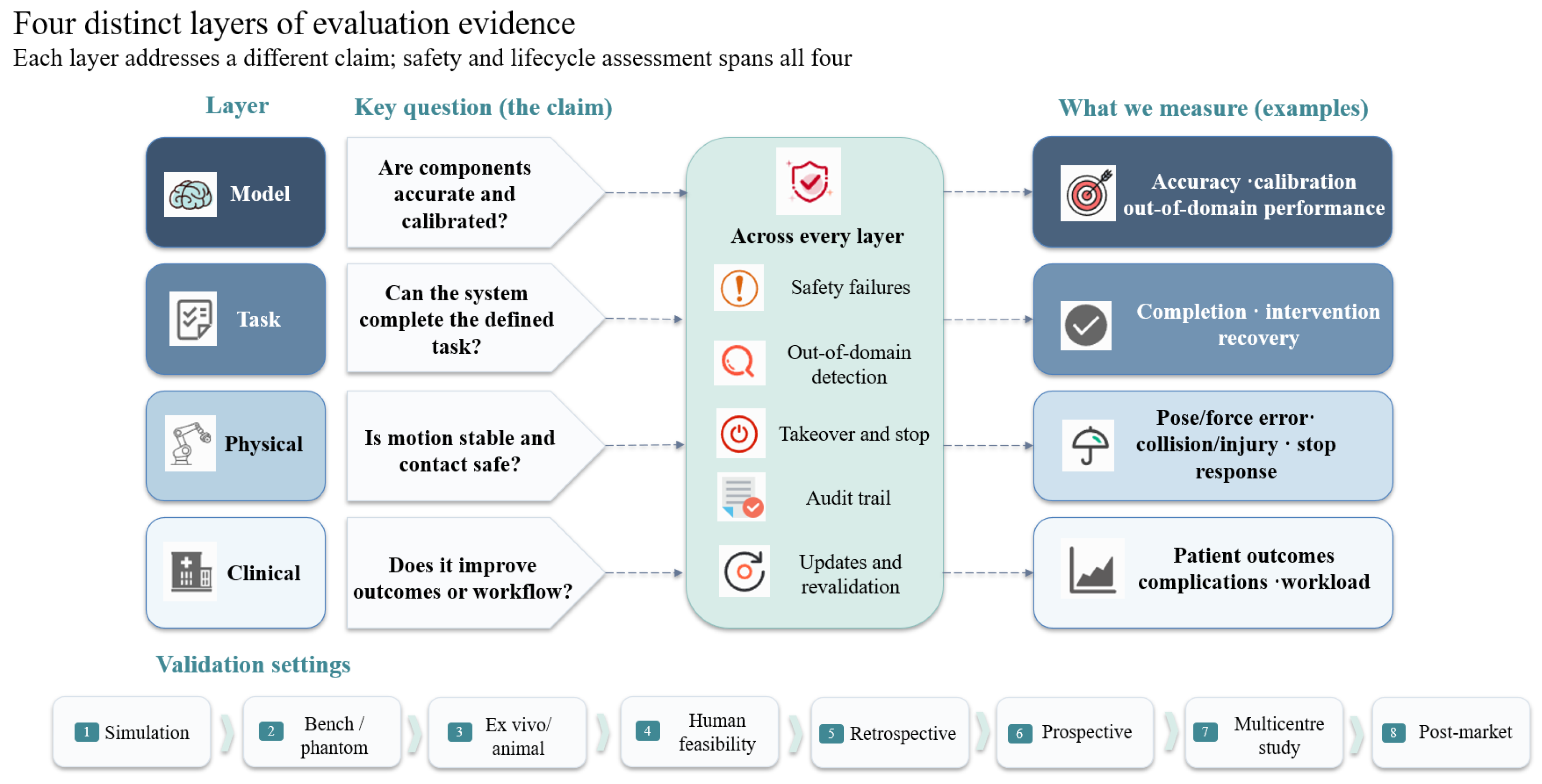
Table 11 operationalises the framework in Figure 4, listing for each evidence layer the question addressed, measures, settings, failures to test and invalid inferences.
Real-world evaluation should capture patient outcomes where relevant, complications, missed care, workflow time, staff workload, usability, rescue, cost and distribution across sites and patient groups. A prospective study should compare the system with the existing care pathway rather than with an idealised operator, and where randomisation is unsuitable, the study design and its limitations should still be stated explicitly. At its highest coded stage, the present subset contains no prospective clinical study, multicentre controlled or randomised study, or post-market monitoring. This finding describes only the purposive subset; it supports a call for stronger studies, not a claim that none exist in the wider field.
Our proposed eight-stage pathway links simulation, bench or phantom testing, ex vivo or animal studies, human feasibility, retrospective validation, prospective study, multicentre controlled study where appropriate, and post-market or long-term monitoring. It is a planning framework rather than a regulatory sequence. Progression between stages requires task-specific gates for safety, performance, human oversight and clinical relevance. Any update that changes sensing, planning, control or the intended setting should trigger an impact assessment and proportionate revalidation, and rollback must remain possible [176,200]. Figure 5 shows these gates and reversals.
Lifecycle evidence should also distinguish proposed regulatory direction from final guidance. The FDA’s 2025 draft recommendations for AI-enabled device software functions address documentation and lifecycle management, whereas its final guidance on predetermined change control plans concerns planned modifications within an authorised scope [176,180]. For embodied systems, a model update may alter action selection, timing or confidence even when the mechanical platform is unchanged. Revalidation should therefore follow the affected evidence layers and include the human team’s response to the updated behaviour.
Figure 5.
Proposed translation pathway from simulation to monitoring, with stage gates, revalidation and rollback. Stages describe evaluation settings, not guaranteed progress or regulatory approval. Passing one stage does not establish safety or effectiveness at the next.
Figure 5.
Proposed translation pathway from simulation to monitoring, with stage gates, revalidation and rollback. Stages describe evaluation settings, not guaranteed progress or regulatory approval. Passing one stage does not establish safety or effectiveness at the next.
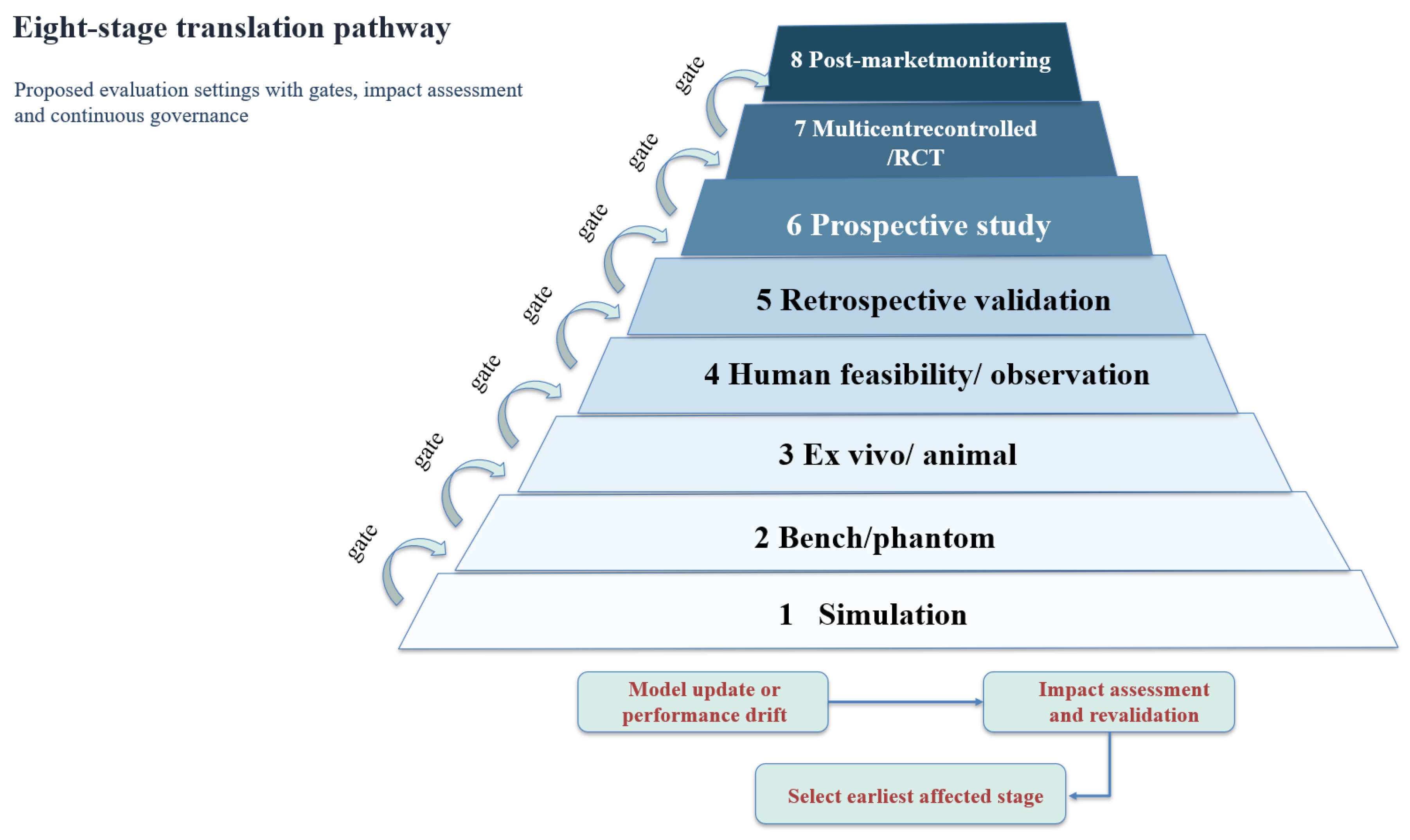
9. Priorities for Responsible Adoption
Synthesising the preceding sections, we identify five structural mismatches that, more than any generic list of technical challenges, help explain why capability has not yet translated into care. For each mismatch, Table 12 sets out the current evidence signal, the underlying mechanism, the consequence for healthcare, a discriminating test and the implication for decisions. The tests are proposed as ways to make each mismatch falsifiable, not as validated adoption thresholds. The research questions that follow most directly from these mismatches, together with the technical directions in Section 9.2, are summarised in Box 1.
9.1. Structural Mismatches and Discriminating Tests
Capability–evidence mismatch. The direct subset is concentrated in preclinical work, with limited human feasibility evidence and a single retrospective study. The mismatch arises when technical endpoints are used to support claims that require clinical evidence, leaving complications, rescue, workload and unequal performance unknown. Studies without patients, comparators or clinical endpoints support engineering claims, not higher-level ones. The next test should match each claim to its evidence layer and include the worst-performing relevant subgroup and the complete pathway. Because the subset is purposive, this signal does not establish field-wide prevalence.
Component–system mismatch. Cross-robot data, generalist policies and world models support reusable representation, action and prediction [12,40,42,43,46,51,52,53]. Component-level tests, however, evaluate these functions in isolation from control, refusal, fault detection and recovery. A locally accurate model can therefore produce an unrecoverable action once anatomy, contact or latency shifts, and plausible rollouts are insufficient without clinical fidelity and fault injection [50,94]. The next test is whether an independent safety path stops injected failures before clinical limits are crossed; this proposal itself requires validation.
Autonomy–accountability mismatch. Shared-control studies show that authority can vary, yet supervision is often equated with effective control [121,201]. Opaque plans, late alerts or unavailable staff can defeat takeover, so responsibility may remain with a clinician who is unable to prevent or reverse harm. Reports should specify monitoring arrangements, transfer timing, reversibility and completion after takeover. The next test is whether users regain safe control before the reversibility window closes under realistic workload and degraded sensing; until this is shown, a human in the loop is not in itself a safety result.
Benchmark–service mismatch. Evaluations emphasise success, error and time over preparation, supervision, maintenance and remedial work. Because automation covers only part of a service, gains in one step can be offset elsewhere, and a faster task may leave workload, cost or completed care unchanged [150,168]. Idealised comparators, excluded downtime and undisaggregated averages therefore provide insufficient evidence. The next test is whether the complete pathway improves against the local baseline once all added work is counted; current evidence does not justify forecasts of system-wide savings.
Update–evidence mismatch. Lifecycle sources emphasise controlled change, but validation is not always bound to a specific version [175,176]. Updates can alter action, latency, confidence, refusal or intervention, so earlier evidence may no longer cover deployed behaviour. Recording an update without identifying the affected evidence layers is insufficient. The next test is prospective impact analysis and proportionate revalidation, with monitoring and rollback; this interpretation does not replace device-specific regulatory judgement.
9.2. Technical Research Directions
Resolving the mismatches identified above also requires technical advances that make embodied systems more measurable, more predictable and easier to supervise. We highlight six directions, each tied to a stage of the action loop in Figure 1, to the authority transitions in Figure 2 or to the translation pathway in Figure 5.
Physically grounded medical foundation models. Generalist medical AI has been proposed as a family of models that interpret imaging, records, laboratory data and text with little task-specific labelling [202], whereas generalist robot policies map observations and language directly to actions [12,40,43]. Medical embodied AI sits at the intersection of these lines of work and inherits the evidence gaps of both. The central research need is grounding rather than scale alone: representations that encode tissue mechanics, instrument–tissue contact and procedure state, evaluated at the physical and clinical layers of Figure 4 rather than on language or vision benchmarks alone.
Shared data ecosystems. Surgical data science has called for standards for data acquisition, annotation, sharing and analytics as preconditions for clinical translation [203,204]. Embodied learning raises the bar further, because kinematics, force, device state and outcome must be recorded together with video and linked to the system version that produced them. Federated learning offers one route to multi-institution training without centralising sensitive data [205], and aggregated resources such as Open-H-Embodiment illustrate both the value and the unevenness of pooled medical robot data [46]. Priorities include common action and annotation schemas, explicit labels for failures and near misses, and documentation of the clinical context in which each episode was recorded.
Uncertainty-aware autonomy. A clinically usable system must recognise when it should not act. Conformal prediction provides distribution-free prediction sets with user-specified coverage [117], and the KnowNo framework uses it to make language-model planners ask for help with statistical guarantees on task completion [95]. In medical machine learning, calibrated uncertainty and abstention have likewise been argued to be prerequisites for safe deployment and clinician trust [118]. For embodied care, the key step is to couple uncertainty to the authority transitions in Figure 2: elevated uncertainty should reduce authority, request confirmation or trigger takeover, and the calibration of these triggers must itself be validated under domain shift.
Safe learning and verifiable safety envelopes. Safe-learning research spans the safe learning of uncertain dynamics, reinforcement learning that encourages robustness, and methods that certify learned policies [111,206]. Building on the runtime monitors, control barrier functions and formally verified controllers reviewed in Section 5, a promising architecture pairs a learned high-level policy with a verified low-level envelope, which corresponds to the independent safety path in Figure 1. Open problems include specifying envelopes for deformable tissue, verifying them when the high-level policy is a large learned model, and demonstrating through fault testing that the envelope remains independent and stops action within each operational design domain.
Digital twins and simulation-to-reality evidence. Digital twins for health remain at an early stage [91], but surgical prototypes indicate what a twin in the loop can provide: Twin-S mirrored skull-base drilling at 28 frames per second with an average error of 1.39 mm [61]. Such twins could support rehearsal, counterfactual testing of software updates and supervisory overlays. Their evidential contribution depends on validated fidelity for the specific claim. Consistent with Figure 5, a twin can inform simulation-stage gates and impact assessment after an update, but it cannot substitute for physical or clinical evidence.
Interfaces that support calibrated trust. The haptic, augmented-reality, natural-language and shared-control interfaces reviewed in Section 5 are rarely evaluated for their effect on supervision itself [63,119,120]. Because trust tracks robot performance [123], future interfaces should communicate the system’s current authority level, uncertainty and intended action, and should be evaluated by their effect on takeover timing, confirmation quality and error detection, not only by user preference.
Box 1. Outstanding Questions.
- What task-specific evidence and comparators are needed to establish clinical benefit and harm, rather than technical feasibility alone, across the intended patient groups and care settings?
- Can an independent safety path detect and stop component failures before clinical limits are crossed during end-to-end testing under domain shift, degraded sensing and latency?
- Is clinician takeover completed before the task’s reversibility window closes under realistic workload, and can the task then be completed or terminated safely?
- Does the complete workflow improve patient care, staff workload or service value once preparation, supervision, maintenance, interruptions and remedial work are included?
- Which evidence layers are affected by a model or software update, and what revalidation, monitoring and rollback are needed before continued use?
- How can physically grounded foundation models and shared data resources be built so that action, force, failure and outcome are recorded together and linked to system version?
- Can uncertainty estimates and verified safety envelopes be calibrated to reduce authority, request confirmation or trigger takeover within each task’s reversibility window?
10. Conclusions
Across its evolution from image-guided and teleoperated robots to learned policies and foundation models, medical embodied AI has progressively moved perception, reasoning, planning and execution from the clinician to the machine, while the evidence base has remained concentrated in early validation settings. The field should be judged by the alignment of a task, its operational design domain, the authority allocated to the system, the supporting evidence and the service that must recover and sustain it. Three conclusions follow from this Review: autonomy is not a measure of maturity; technical feasibility is not clinical value; and deployment decisions should be made for a defined task and health service rather than for a model or robot in general. The direct evidence in our purposively retained subset remains largely preclinical or limited to feasibility studies, and its counts do not describe field-wide prevalence. The proposed task-bounded framework makes the resulting mismatches visible and links each to discriminating tests, monitoring and rollback. Its decision value, and its effects on patient care, staff work and implementation outcomes, now require prospective evaluation. Progress in the field will therefore depend less on further gains in autonomy than on evidence generated within the workflows where care is delivered.
Supplementary Materials
The following supporting information can be downloaded at the website of this paper posted on Preprints.org.
Author Contributions
Zhaoyan Chen conceptualised the study, defined the topic, scope and overall framework of the review, conducted the literature search and evidence synthesis, and was primarily responsible for drafting and integrating the manuscript. Zhongxiu Cong was primarily responsible for the design and preparation of the figures and contributed to the revision of the manuscript. Zhongbin Han provided clinical expertise, reviewed the medical concepts, clinical workflows, representative clinical applications and translational considerations discussed in the manuscript, and provided critical comments from a clinical perspective. Haifan Gong, Congyu Liao, Xiaofeng Liu, Guoliang You and Wei Wang contributed technical expertise in medical artificial intelligence, embodied intelligence and related fields, reviewed the technical taxonomy, representative studies and methodological content, and provided comments on the manuscript. Wanshu Fan supervised the study, provided guidance on the review methodology, evidence organisation and manuscript structure, and substantially revised the manuscript for important intellectual content. Cong Wang supervised the study, provided guidance on the overall framework and interpretation of the conclusions, and critically reviewed the manuscript. All authors reviewed and approved the final manuscript.
Funding
This work was supported in part by the National Natural Science Foundation of China (No. 62502064), the Joint Plan of Liaoning Province Science and Technology Plan (Nos. 2025JH2/101800417 and 2025JH2/101800422), the Scientific Research Project of Liaoning Provincial Department of Education (No. LJ222511258003), the Interdisciplinary Project of Dalian University (No. DLUXK-2025-QN-020) and the 111 Center (No. D23006).
Institutional Review Board Statement
Not applicable. This review does not involve new experiments on humans, animals or human samples.
Informed Consent Statement
Not applicable.
Data Availability Statement
No new primary clinical or experimental datasets were generated. The accompanying six-sheet Supplementary Data workbook contains an explanatory README and five data tables: a query-level search and export-limit audit with available file checksums (Supplementary Table S1); a 96-source manuscript evidence set with metadata checks, publication-status descriptions and claim mapping (Supplementary Table S2); a 40-study direct empirical matrix with participant type, source-access basis, quality profile, eligibility and stage locators (Supplementary Table S3); a five-review comparison with evidence anchors and provisional coding suggestions rather than completed independent reviewer decisions (Supplementary Table S4); and formula-derived primary, abstract-only sensitivity and stage-four subgroup summaries (Supplementary Table S5). Some metadata, evidence coding and publication statuses remain subject to author verification, as marked in the workbook. Historical machine-prioritisation and reviewer-workflow files are retained as internal provenance records and are not part of the submission dataset. Database-licensed abstracts, full text and restricted export fields are not redistributed; access remains subject to the originating database or publisher licence.
Conflicts of Interest
The authors declare no competing interests.
Code availability
Processing scripts for record standardisation, metadata checks, consistency checks and the Supplementary Data workbook are retained in the authors’ project records. Database-licensed abstracts, full text and restricted export fields are not redistributed.
AI disclosure
Automated tools assisted with record normalisation, candidate prioritisation, metadata checks and preliminary coding. A large language model also assisted with targeted supplementary literature searches, verification of bibliographic metadata, drafting of the expanded survey sections, restructuring and language editing in this revision. The authors take full responsibility for verifying all source claims, references and figures and for the final text.
References
- Mir, B.A.; Nishwa, D.E.; Lee, S.W. Embodied Artificial Intelligence in Healthcare: A Systematic Review of Robotic Perception, Decision-Making, and Clinical Impact. Healthcare 2026, 14, 572. [Google Scholar] [CrossRef] [PubMed]
- Zhang, C.; Cai, Q.; Wu, X.; Yang, X.; Chang, X.; Bao, B.; Nie, L.; Liu, X.; Yang, Y. Towards Next-Generation Healthcare: A Survey of Medical Embodied AI for Perception, Decision-Making, and Action. arXiv 2026, arXiv:2606.15647. [Google Scholar]
- Troccaz, J.; Dagnino, G.; Yang, G.Z. Frontiers of Medical Robotics: From Concept to Systems to Clinical Translation. Annu. Rev. Biomed. Eng. 2019, 21, 193–218. [Google Scholar] [CrossRef] [PubMed]
- Su, Y.H.; Munawar, A.; Deguet, A.; Lewis, A.; Lindgren, K.; Li, Y.; Taylor, R.H.; Fischer, G.S.; Hannaford, B.; Kazanzides, P. Collaborative Robotics Toolkit (CRTK): Open Software Framework for Surgical Robotics Research. 2020 Fourth IEEE International Conference on Robotic Computing (IRC), 2020; pp. 48–55. [Google Scholar]
- Su, H.; Mariani, A.; Ovur, S.E.; Menciassi, A.; Ferrigno, G.; De Momi, E. Toward Teaching by Demonstration for Robot-Assisted Minimally Invasive Surgery. IEEE Trans. Autom. Sci. Eng. 2021, 18, 484–494. [Google Scholar] [CrossRef]
- Thai, M.T.; Phan, P.T.; Hoang, T.T.; Wong, S.; Lovell, N.H.; Do, T.N. Advanced Intelligent Systems for Surgical Robotics. Adv. Intell. Syst. 2020, 2. [Google Scholar] [CrossRef]
- Li, X.; Guo, S.; Shi, P.; Jin, X.; Kawanishi, M. An Endovascular Catheterization Robotic System Using Collaborative Operation with Magnetically Controlled Haptic Force Feedback. Micromachines 2022, 13, 505. [Google Scholar] [CrossRef] [PubMed]
- Rogatinsky, J.; Recco, D.; Feichtmeier, J.; Kang, Y.; Kneier, N.; Hammer, P.; O’Leary, E.; Mah, D.; Hoganson, D.; Vasilyev, N.V.; et al. A multifunctional soft robot for cardiac interventions. Sci. Adv. 2023, 9. [Google Scholar] [CrossRef] [PubMed]
- Yang, Z.; Yang, H.; Cao, Y.; Cui, Y.; Zhang, L. Magnetically Actuated Continuum Medical Robots: A Review. Adv. Intell. Syst. 2023, 5. [Google Scholar] [CrossRef]
- Yao, T.; Xu, Y.; Wang, H.; Qiu, X.; Althoefer, K.; Qi, P. Multiagent Fuzzy Reinforcement Learning With LLM for Cooperative Navigation of Endovascular Robotics. IEEE Trans. Fuzzy Syst. 2026, 34, 1109–1119. [Google Scholar] [CrossRef]
- Connolly, L.; Deguet, A.; Sunderland, K.; Lasso, A.; Ungi, T.; Rudan, J.F.; Taylor, R.H.; Mousavi, P.; Fichtinger, G. An Open-Source Platform for Cooperative, Semi-Autonomous Robotic Surgery. 2021 IEEE International Conference on Autonomous Systems (ICAS), 2021. [Google Scholar]
- Kim, M.J.; Pertsch, K.; Karamcheti, S.; et al. OpenVLA: An Open-Source Vision-Language-Action Model. Proc. Proc. 8th Conf. Robot Learn. 2025, Vol. 270, 2679–2713. [Google Scholar]
- Attanasio, A.; Scaglioni, B.; De Momi, E.; Fiorini, P.; Valdastri, P. Autonomy in Surgical Robotics. Annu. Rev. Control Robot. Auton. Syst. 2021, 4, 651–679. [Google Scholar] [CrossRef]
- Liu, Y.; Cao, X.; Chen, T.; Jiang, Y.; You, J.; Wu, M.; Wang, X.; Feng, M.; Jin, Y.; Chen, J. From Screens to Scenes: A Survey of Embodied AI in Healthcare. Inf. Fusion 2025, 119, 103033. [Google Scholar] [CrossRef]
- Dupont, P.E.; Nelson, B.J.; Goldfarb, M.; Hannaford, B.; Menciassi, A.; O’Malley, M.K.; Simaan, N.; Valdastri, P.; Yang, G.Z. A Decade Retrospective of Medical Robotics Research from 2010 to 2020. Sci. Robot. 2021, 6, eabi8017. [Google Scholar] [CrossRef] [PubMed]
- Haidegger, T. Autonomy for Surgical Robots: Concepts and Paradigms. IEEE Trans. Med. Robot. Bionics 2019, 1, 65–76. [Google Scholar] [CrossRef]
- Fiorini, P.; Goldberg, K.Y.; Liu, Y.; Taylor, R.H. Concepts and Trends in Autonomy for Robot-Assisted Surgery. Proc. IEEE 2022, 110, 993–1011. [Google Scholar] [CrossRef] [PubMed]
- Lee, A.; Baker, T.S.; Bederson, J.B.; Rapoport, B.I. Levels of Autonomy in FDA-Cleared Surgical Robots: A Systematic Review. npj Digit. Med. 2024, 7, 103. [Google Scholar] [CrossRef] [PubMed]
- Haidegger, T.; Speidel, S.; Stoyanov, D.; Satava, R.M. Robot-Assisted Minimally Invasive Surgery–Surgical Robotics in the Data Age. Proc. IEEE 2022, 110, 835–846. [Google Scholar] [CrossRef]
- Schmidgall, S.; Kim, J.W.; Kuntz, A.; Ghazi, A.E.; Krieger, A. General-Purpose Foundation Models for Increased Autonomy in Robot-Assisted Surgery. Nat. Mach. Intell. 2024, 6, 1275–1283. [Google Scholar] [CrossRef]
- Pashangpour, S.; Nejat, G. The Future of Intelligent Healthcare: A Systematic Analysis and Discussion on the Integration and Impact of Robots Using Large Language Models for Healthcare. Robotics 2024, 13, 112. [Google Scholar] [CrossRef]
- Duan, J.; Yu, S.; Tan, H.L.; Zhu, H.; Tan, C. A Survey of Embodied AI: From Simulators to Research Tasks. IEEE Trans. Emerg. Top. Comput. Intell. 2022, 6, 230–244. [Google Scholar] [CrossRef]
- Firoozi, R.; Tucker, J.; Tian, S.; Majumdar, A.; Sun, J.; Liu, W.; Zhu, Y.; Song, S.; Kapoor, A.; Hausman, K.; et al. Foundation Models in Robotics: Applications, Challenges, and the Future. Int. J. Robot. Res. 2025, 44, 701–739. [Google Scholar] [CrossRef]
- Liu, Y.; Chen, W.; Bai, Y.; Liang, X.; Li, G.; Gao, W.; Lin, L. Aligning Cyber Space with Physical World: A Comprehensive Survey on Embodied AI. IEEE/ASME Trans. Mechatron. 2025, 30, 7253–7274. [Google Scholar] [CrossRef]
- Arksey, H.; O’Malley, L. Scoping studies: towards a methodological framework. Int. J. Soc. Res. Methodol. 2005, 8, 19–32. [Google Scholar] [CrossRef]
- Tricco, A.C.; Lillie, E.; Zarin, W.; O’Brien, K.K.; Colquhoun, H.; Levac, D.; Moher, D.; Peters, M.D.J.; Horsley, T.; Weeks, L.; et al. PRISMA Extension for Scoping Reviews (PRISMA-ScR): Checklist and Explanation. Ann. Intern. Med. 2018, 169, 467–473. [Google Scholar] [CrossRef] [PubMed]
- Page, M.J.; McKenzie, J.E.; Bossuyt, P.M.; Boutron, I.; Hoffmann, T.C.; Mulrow, C.D.; Shamseer, L.; Tetzlaff, J.M.; Akl, E.A.; Brennan, S.E.; et al. The PRISMA 2020 statement: an updated guideline for reporting systematic reviews. BMJ 2021, 372, n71. [Google Scholar] [CrossRef] [PubMed]
- Rethlefsen, M.L.; Kirtley, S.; Waffenschmidt, S.; Ayala, A.P.; Moher, D.; Page, M.J.; Koffel, J.B.; PRISMA-S Group; Blunt, H.; Brigham, T.; et al. PRISMA-S: an extension to the PRISMA Statement for Reporting Literature Searches in Systematic Reviews. Syst. Rev. 2021, 10, 39. [Google Scholar] [CrossRef] [PubMed]
- Thiruvenkdam; Goyal, M.K.; Saxena, V. The security of minimally invasive surgery with an autonomous flexible endoscope. Multidiscip. Sci. J. 2023, 5, 2023ss01012. [Google Scholar] [CrossRef]
- Ren, H.; Li, Z.; Liang, Z.; Ren, W.; Ma, X.; Wu, D. Stiffness-observation-based force feedforward compensation control for interactive robot-assisted surgical bone milling. Med. Eng. Phys. 2025, 146, 104431. [Google Scholar] [CrossRef] [PubMed]
- Kwoh, Y.S.; Hou, J.; Jonckheere, E.A.; Hayati, S. A Robot with Improved Absolute Positioning Accuracy for CT Guided Stereotactic Brain Surgery. IEEE Trans. Biomed. Eng. 1988, 35, 153–160. [Google Scholar] [CrossRef] [PubMed]
- Paul, H.A.; Bargar, W.L.; Mittlestadt, B.; Musits, B.; Taylor, R.H.; Kazanzides, P.; Zuhars, J.; Williamson, B.; Hanson, W. Development of a Surgical Robot for Cementless Total Hip Arthroplasty. Clin. Orthop. Relat. Res. 1992, 57–66. [Google Scholar] [CrossRef]
- Taylor, R.H.; Stoianovici, D. Medical Robotics in Computer-Integrated Surgery. IEEE Trans. Robot. Autom. 2003, 19, 765–781. [Google Scholar] [CrossRef]
- Guthart, G.S.; Salisbury, J.K. The IntuitiveTM Telesurgery System: Overview and Application. Proc. Proc. 2000 IEEE Int. Conf. Robot. Autom. (ICRA) 2000, Vol. 1, 618–621. [Google Scholar]
- Marescaux, J.; Leroy, J.; Gagner, M.; Rubino, F.; Mutter, D.; Vix, M.; Butner, S.E.; Smith, M.K. Transatlantic Robot-Assisted Telesurgery. Nature 2001, 413, 379–380. [Google Scholar] [CrossRef] [PubMed]
- Kim, J.W.; Zhao, T.Z.; Schmidgall, S.; Deguet, A.; Kobilarov, M.; Finn, C.; Krieger, A. Surgical Robot Transformer (SRT): Imitation Learning for Surgical Tasks. Proc. Proc. 8th Conf. Robot Learn. 2025, Vol. 270, 130–144. [Google Scholar]
- Shademan, A.; Decker, R.S.; Opfermann, J.D.; Leonard, S.; Krieger, A.; Kim, P.C.W. Supervised Autonomous Robotic Soft Tissue Surgery. Sci. Transl. Med. 2016, 8, 337ra64. [Google Scholar] [CrossRef] [PubMed]
- Saeidi, H.; Opfermann, J.D.; Kam, M.; Wei, S.; Leonard, S.; Hsieh, M.H.; Kang, J.U.; Krieger, A. Autonomous robotic laparoscopic surgery for intestinal anastomosis. Sci. Robot. 2022, 7. [Google Scholar] [CrossRef] [PubMed]
- Yang, G.Z.; Cambias, J.; Cleary, K.; Daimler, E.; Drake, J.; Dupont, P.E.; Hata, N.; Kazanzides, P.; Martel, S.; Patel, R.V.; et al. Medical Robotics—Regulatory, Ethical, and Legal Considerations for Increasing Levels of Autonomy. Sci. Robot. 2017, 2, eaam8638. [Google Scholar] [CrossRef] [PubMed]
- Brohan, A.; Brown, N.; Carbajal, J.; Chebotar, Y.; Dabis, J.; Finn, C.; Gopalakrishnan, K.; Hausman, K.; Herzog, A.; Hsu, J.; et al. RT-1: Robotics Transformer for Real-World Control at Scale. In Robotics: Science and Systems; 2023. [Google Scholar]
- Zitkovich, B.; Yu, T.; Xu, S.; et al. RT-2: Vision-Language-Action Models Transfer Web Knowledge to Robotic Control. Proc. Proc. 7th Conf. Robot Learn. 2023, Vol. 229, 2165–2183. [Google Scholar]
- Open X-Embodiment Collaboration.; O’Neill, A.; Rehman, A.; Maddukuri, A.; Gupta, A.; Padalkar, A.; Lee, A.; Pooley, A.; Gupta, A.; Mandlekar, A.; et al. Open X-Embodiment: Robotic Learning Datasets and RT-X Models. 2024 IEEE International Conference on Robotics and Automation (ICRA), 2024; pp. 6892–6903. [Google Scholar]
- Octo Model Team; Ghosh, D.; Walke, H.; et al. Octo: An Open-Source Generalist Robot Policy. In Robotics: Science and Systems XX; 2024. [Google Scholar]
- Black, K.; Brown, N.; Driess, D.; Esmail, A.; Equi, M.R.; Finn, C.; Fusai, N.; Groom, L.; Hausman, K.; Ichter, B.; et al. π0: A Vision-Language-Action Flow Model for General Robot Control. In Proceedings of the Proceedings of Robotics: Science and Systems, 2025. [Google Scholar]
- Kim, J.W.; Chen, J.T.; Hansen, P.; Shi, L.X.; Goldenberg, A.; Schmidgall, S.; Scheikl, P.M.; Deguet, A.; White, B.M.; Tsai, D.R.; et al. SRT-H: A Hierarchical Framework for Autonomous Surgery via Language-Conditioned Imitation Learning. Sci. Robot. 2025, 10, eadt5254. [Google Scholar] [CrossRef] [PubMed]
- Open-H-Embodiment Consortium; et al. Open-H-Embodiment: A Large-Scale Dataset for Enabling Foundation Models in Medical Robotics. arXiv 2026, arXiv:2604.21017. [Google Scholar]
- Sun, J.; He, Y.; Liu, W.; Mao, T.; Wang, J.; Chen, X.; Liu, M. SurgVLA-Bench: Towards Evaluating Vision-Language-Action Models for Laparoscopic Surgical Robotics. arXiv (accepted at MICCAI 2026). 2026, arXiv:2606.29247. [Google Scholar]
- Schmidgall, S.; Opfermann, J.D.; Kim, J.W.; Krieger, A. Will Your Next Surgeon Be a Robot? Autonomy and AI in Robotic Surgery. Sci. Robot. 2025, 10, eadt0187. [Google Scholar] [CrossRef] [PubMed]
- Driess, D.; Xia, F.; Sajjadi, M.S.M.; et al. PaLM-E: An Embodied Multimodal Language Model. Proc. Proc. 40th Int. Conf. Mach. Learn. 2023, Vol. 202, 8469–8488. [Google Scholar]
- Robertshaw, H.; Wu, H.R.; Granados, A.; Booth, T.C. World Model for AI Autonomous Navigation in Mechanical Thrombectomy. Lect. Notes Comput. Sci. 2026, 680–690. [Google Scholar] [CrossRef]
- Chi, C.; Feng, S.; Du, Y.; Xu, Z.; Cousineau, E.; Burchfiel, B.; Song, S. Diffusion Policy: Visuomotor Policy Learning via Action Diffusion. In Robotics: Science and Systems; 2023. [Google Scholar]
- Zawalski, M.; Chen, W.; Pertsch, K.; et al. Robotic Control via Embodied Chain-of-Thought Reasoning. Proc. Proc. 8th Conf. Robot Learn. 2025, Vol. 270, 3157–3181. [Google Scholar]
- Hafner, D.; Pasukonis, J.; Ba, J.; Lillicrap, T. Mastering diverse control tasks through world models. Nature 2025, 640, 647–653. [Google Scholar] [CrossRef] [PubMed]
- International Medical Device Regulators Forum. Good Machine Learning Practice for Medical Device Development: Guiding Principles. IMDRF/AIML WG/N88 FINAL 2025. [Google Scholar]
- Pezeshki, L.; Sadeghian, H.; Keshmiri, M.; Chen, X.; Haddadin, S. Cooperative Assist-as-Needed Control for Robotic Rehabilitation: A Two-Player Game Approach. IEEE Robot. Autom. Lett. 2023, 8, 2852–2859. [Google Scholar] [CrossRef]
- Amanhoud, W.; Hernandez Sanchez, J.; Bouri, M.; Billard, A. Contact-initiated shared control strategies for four-arm supernumerary manipulation with foot interfaces. Int. J. Robot. Res. 2021, 40, 986–1014. [Google Scholar] [CrossRef]
- Twinanda, A.P.; Shehata, S.; Mutter, D.; Marescaux, J.; de Mathelin, M.; Padoy, N. EndoNet: A Deep Architecture for Recognition Tasks on Laparoscopic Videos. IEEE Trans. Med. Imaging 2017, 36, 86–97. [Google Scholar] [CrossRef] [PubMed]
- Li, Y.; Richter, F.; Lu, J.; Funk, E.K.; Orosco, R.K.; Zhu, J.; Yip, M.C. SuPer: A Surgical Perception Framework for Endoscopic Tissue Manipulation With Surgical Robotics. IEEE Robot. Autom. Lett. 2020, 5, 2294–2301. [Google Scholar] [CrossRef]
- Wang, Z.; Liu, C.; Zhang, S.; Dou, Q. Foundation Model for Endoscopy Video Analysis via Large-Scale Self-supervised Pre-train. In Proceedings of the Medical Image Computing and Computer Assisted Intervention – MICCAI 2023, 2023; pp. 101–111. [Google Scholar]
- Ozyoruk, K.B.; Gokceler, G.I.; Bobrow, T.L.; Coskun, G.; Incetan, K.; Almalioglu, Y.; Mahmood, F.; Curto, E.; Perdigoto, L.; Oliveira, M.; et al. EndoSLAM Dataset and an Unsupervised Monocular Visual Odometry and Depth Estimation Approach for Endoscopic Videos. Med. Image Anal. 2021, 71, 102058. [Google Scholar] [CrossRef] [PubMed]
- Shu, H.; Liang, R.; Li, Z.; Goodridge, A.; Zhang, X.; Ding, H.; Nagururu, N.; Sahu, M.; Creighton, F.X.; Taylor, R.H.; et al. Twin-S: a digital twin for skull base surgery. Int. J. Comput. Assist. Radiol. Surg. 2023, 18, 1077–1084. [Google Scholar] [CrossRef] [PubMed]
- Ichter, B.; Brohan, A.; Chebotar, Y.; Finn, C.; Hausman, K.; Herzog, A.; Ho, D.; Ibarz, J.; Irpan, A.; Jang, E.; et al. Do As I Can, Not As I Say: Grounding Language in Robotic Affordances. Proc. Proc. Conf. Robot Learn. 2023, Vol. 205, 287–318. [Google Scholar]
- Moghani, M.; Doorenbos, L.; Panitch, W.C.H.; Huver, S.; Azizian, M.; Goldberg, K.; Garg, A. SuFIA: Language-Guided Augmented Dexterity for Robotic Surgical Assistants. In Proceedings of the IEEE/RSJ International Conference on Intelligent Robots and Systems (IROS), 2024; pp. 6969–6976. [Google Scholar]
- Falezza, F.; Piccinelli, N.; De Rossi, G.; Roberti, A.; Kronreif, G.; Setti, F.; Fiorini, P.; Muradore, R. Modeling of Surgical Procedures Using Statecharts for Semi-Autonomous Robotic Surgery. IEEE Trans. Med. Robot. Bionics 2021, 3, 888–899. [Google Scholar] [CrossRef]
- Watts, T.; Smith, M.; Ferguson, J.; Yilmaz, N.; Maria Scheikl, P.; Thach, B.; Burkhart, B.; Hermans, T.; Deguet, A.; Krieger, A.; et al. Integrating Learned Retraction and Model-Based Resection Planning for Automated Central Airway Obstruction Removal. IEEE Trans. Med. Robot. Bionics 2026, 8, 188–197. [Google Scholar] [CrossRef]
- Ning, G.; Chen, J.; Zhang, X.; Liao, H. Force-guided autonomous robotic ultrasound scanning control method for soft uncertain environment. Int. J. Comput. Assist. Radiol. Surg. 2021, 16, 2189–2199. [Google Scholar] [CrossRef] [PubMed]
- Scheikl, P.M.; Tagliabue, E.; Gyenes, B.; Wagner, M.; Dall’Alba, D.; Fiorini, P.; Mathis-Ullrich, F. Sim-to-Real Transfer for Visual Reinforcement Learning of Deformable Object Manipulation for Robot-Assisted Surgery. IEEE Robot. Autom. Lett. 2023, 8, 560–567. [Google Scholar] [CrossRef]
- Ng, C.K.; Bai, L.; Wang, G.; Wang, Y.; Gao, H.; Yuan, K.; Jin, C.; Zeng, T.; Ren, H. EndoVLA: Dual-Phase Vision-Language-Action for Precise Autonomous Tracking in Endoscopy. Proc. Proc. Conf. Robot Learn. 2025, Vol. 305, 4958–4974. [Google Scholar]
- Zbinden, L.; Nelson, N.; Chen, J.T.; Chen, X.; Kim, J.W.; Azizian, M.; Krieger, A.; Huver, S. Cosmos-Surg-dVRK: World Foundation Model-based Automated Online Evaluation of Surgical Robot Policy Learning. arXiv 2025, arXiv:2510.16240. [Google Scholar]
- Yasar, M.S.; Alemzadeh, H. Real-Time Context-Aware Detection of Unsafe Events in Robot-Assisted Surgery. In Proceedings of the 2020 50th Annual IEEE/IFIP International Conference on Dependable Systems and Networks (DSN), 2020; pp. 385–397. [Google Scholar]
- Kouskoulas, Y.; Renshaw, D.; Platzer, A.; Kazanzides, P. Certifying the safe design of a virtual fixture control algorithm for a surgical robot. In Proceedings of the Proceedings of the 16th International Conference on Hybrid Systems: Computation and Control (HSCC), 2013; pp. 263–272. [Google Scholar]
- Czempiel, T.; Paschali, M.; Keicher, M.; Simson, W.; Feussner, H.; Kim, S.T.; Navab, N. TeCNO: Surgical Phase Recognition with Multi-stage Temporal Convolutional Networks. Proc. Med. Image Comput. Comput. Assist. Interv. – MICCAI 2020, 2020, 343–352. [Google Scholar] [CrossRef]
- Gao, X.; Jin, Y.; Long, Y.; Dou, Q.; Heng, P.A. Trans-SVNet: Accurate Phase Recognition from Surgical Videos via Hybrid Embedding Aggregation Transformer. Proc. Med. Image Comput. Comput. Assist. Interv. – MICCAI 2021, 2021, 593–603. [Google Scholar] [CrossRef]
- Nwoye, C.I.; Yu, T.; Gonzalez, C.; Seeliger, B.; Mascagni, P.; Mutter, D.; Marescaux, J.; Padoy, N. Rendezvous: Attention Mechanisms for the Recognition of Surgical Action Triplets in Endoscopic Videos. Med. Image Anal. 2022, 78, 102433. [Google Scholar] [CrossRef] [PubMed]
- Özsoy, E.; Örnek, E.P.; Eck, U.; Czempiel, T.; Tombari, F.; Navab, N. 4D-OR: Semantic Scene Graphs for OR Domain Modeling. Proc. Med. Image Comput. Comput. Assist. Interv. – MICCAI 2022, 2022, 475–485. [Google Scholar] [CrossRef]
- Allan, M.; Shvets, A.; Kurmann, T.; Zhang, Z.; Duggal, R.; Su, Y.H.; Rieke, N.; Laina, I.; Kalavakonda, N.; Bodenstedt, S.; et al. 2017 Robotic Instrument Segmentation Challenge. arXiv 2019, arXiv:1902.06426. [Google Scholar]
- Yue, W.; Zhang, J.; Hu, K.; Xia, Y.; Luo, J.; Wang, Z. SurgicalSAM: Efficient Class Promptable Surgical Instrument Segmentation. Proc. Proc. AAAI Conf. Artif. Intell. 2024, Vol. 38, 6890–6898. [Google Scholar] [CrossRef]
- Allan, M.; Mcleod, J.; Wang, C.; Rosenthal, J.C.; Hu, Z.; Gard, N.; Eisert, P.; Fu, K.X.; Zeffiro, T.; Xia, W.; et al. Stereo Correspondence and Reconstruction of Endoscopic Data Challenge. arXiv 2021, arXiv:2101.01133. [Google Scholar]
- Wang, Y.; Long, Y.; Fan, S.H.; Dou, Q. Neural Rendering for Stereo 3D Reconstruction of Deformable Tissues in Robotic Surgery. Proc. Med. Image Comput. Comput. Assist. Interv. – MICCAI 2022, 2022, 431–441. [Google Scholar] [CrossRef]
- Yang, S.; Li, Q.; Shen, D.; Gong, B.; Dou, Q.; Jin, Y. Deform3DGS: Flexible Deformation for Fast Surgical Scene Reconstruction with Gaussian Splatting. Proc. Med. Image Comput. Comput. Assist. Interv. – MICCAI 2024, 2024, 132–142. [Google Scholar] [CrossRef]
- Puangmali, P.; Althoefer, K.; Seneviratne, L.D.; Murphy, D.; Dasgupta, P. State-of-the-Art in Force and Tactile Sensing for Minimally Invasive Surgery. IEEE Sens. J. 2008, 8, 371–381. [Google Scholar] [CrossRef]
- Nazari, A.A.; Janabi-Sharifi, F.; Zareinia, K. Image-Based Force Estimation in Medical Applications: A Review. IEEE Sens. J. 2021, 21, 8805–8830. [Google Scholar] [CrossRef]
- Bao, X.; Wang, S.; Zheng, L.; Housden, R.J.; Hajnal, J.V.; Rhode, K. A Novel Ultrasound Robot With Force/Torque Measurement and Control for Safe and Efficient Scanning. IEEE Trans. Instrum. Meas. 2023, 72, 1–12. [Google Scholar] [CrossRef] [PubMed]
- Jiang, Z.; Li, Z.; Grimm, M.; Zhou, M.; Esposito, M.; Wein, W.; Stechele, W.; Wendler, T.; Navab, N. Autonomous Robotic Screening of Tubular Structures Based Only on Real-Time Ultrasound Imaging Feedback. IEEE Trans. Ind. Electron. 2022, 69, 7064–7075. [Google Scholar] [CrossRef]
- Song, Y.; Zhong, Z.; Zhao, B.; Zhang, P.; Wang, Q.; Wang, Z.; Yao, L.; Lv, F.; Hu, Y. Medical Ultrasound Image Quality Assessment for Autonomous Robotic Screening. IEEE Robot. Autom. Lett. 2022, 7, 6290–6296. [Google Scholar] [CrossRef]
- Yuan, K.; Srivastav, V.; Yu, T.; Lavanchy, J.L.; Marescaux, J.; Mascagni, P.; Navab, N.; Padoy, N. Learning Multi-modal Representations by Watching Hundreds of Surgical Video Lectures. Med. Image Anal. 2025, 105, 103644. [Google Scholar] [CrossRef] [PubMed]
- Seenivasan, L.; Islam, M.; Krishna, A.K.; Ren, H. Surgical-VQA: Visual Question Answering in Surgical Scenes Using Transformer. Proc. Med. Image Comput. Comput. Assist. Interv. – MICCAI 2022, 2022, 33–43. [Google Scholar] [CrossRef]
- Chen, Z.; Fan, K.; Cruciani, L.; Fontana, M.; Muraglia, L.; Ceci, F.; Travaini, L.; Ferrigno, G.; De Momi, E. Toward Human-Out-of-the-Loop Endoscope Navigation Based on Context Awareness for Enhanced Autonomy in Robotic Surgery. IEEE Trans. Med. Robot. Bionics 2024, 6, 1116–1124. [Google Scholar] [CrossRef]
- Yang, T.; Yang, Y.; Wang, P.; Cao, Y.; Yang, Z.; Liu, H. A lumen-adapted navigation scheme with spatial awareness from monocular vision for autonomous robotic endoscopy. Robot. Auton. Syst. 2023, 165, 104444. [Google Scholar] [CrossRef]
- Prendergast, J.M.; Formosa, G.A.; Fulton, M.J.; Heckman, C.R.; Rentschler, M.E. A Real-Time State Dependent Region Estimator for Autonomous Endoscope Navigation. IEEE Trans. Robot. 2021, 37, 918–934. [Google Scholar] [CrossRef]
- Katsoulakis, E.; Wang, Q.; Wu, H.; Shahriyari, L.; Fletcher, R.; Liu, J.; Achenie, L.; Liu, H.; Jackson, P.; Xiao, Y.; et al. Digital twins for health: a scoping review. npj Digit. Med. 2024, 7, 77. [Google Scholar] [CrossRef] [PubMed]
- Liang, J.; Huang, W.; Xia, F.; Xu, P.; Hausman, K.; Ichter, B.; Florence, P.; Zeng, A. Code as Policies: Language Model Programs for Embodied Control. In Proceedings of the IEEE International Conference on Robotics and Automation (ICRA), 2023; pp. 9493–9500. [Google Scholar]
- Xu, H.; Wu, J.; Cao, G.; Chen, Z.; Lei, Z.; Liu, H. Transforming Surgical Interventions with Embodied Intelligence for Ultrasound Robotics. Proc. Med. Image Comput. Comput. Assist. Interv. – MICCAI 2024 2024, Vol. 15006, 703–713. [Google Scholar] [CrossRef]
- Zargarzadeh, S.; Mirzaei, M.; Ou, Y.; Tavakoli, M. From Decision to Action in Surgical Autonomy: Multi-Modal Large Language Models for Robot-Assisted Blood Suction. IEEE Robot. Autom. Lett. 2025, 10, 2598–2605. [Google Scholar] [CrossRef]
- Ren, A.Z.; Dixit, A.; Bodrova, A.; Singh, S.; Tu, S.; Brown, N.; Xu, P.; Takayama, L.; Xia, F.; Varley, J.; et al. Robots That Ask For Help: Uncertainty Alignment for Large Language Model Planners. Proc. Proc. 7th Conf. Robot Learn. (CoRL) 2023, Vol. 229, 661–682. [Google Scholar]
- Barnoy, Y.; Erin, O.; Raval, S.; Pryor, W.; Mair, L.O.; Weinberg, I.N.; Diaz-Mercado, Y.; Krieger, A.; Hager, G.D. Control of Magnetic Surgical Robots With Model-Based Simulators and Reinforcement Learning. IEEE Trans. Med. Robot. Bionics 2022, 4, 945–956. [Google Scholar] [CrossRef] [PubMed]
- Mao, Y.; Zhang, D. Deep Reinforcement Learning-Based Semi-Autonomous Control for Magnetic Micro-Robot Navigation with Immersive Manipulation. 2025 IEEE International Conference on Robotics and Automation (ICRA), 2025; pp. 9088–9094. [Google Scholar]
- Shahkoo, A.A.; Abin, A.A. Deep reinforcement learning in continuous action space for autonomous robotic surgery. Int. J. Comput. Assist. Radiol. Surg. 2023, 18, 423–431. [Google Scholar] [CrossRef] [PubMed]
- van den Berg, J.; Miller, S.; Duckworth, D.; Hu, H.; Wan, A.; Fu, X.Y.; Goldberg, K.; Abbeel, P. Superhuman performance of surgical tasks by robots using iterative learning from human-guided demonstrations. In Proceedings of the IEEE International Conference on Robotics and Automation (ICRA), 2010; pp. 2074–2081. [Google Scholar]
- Thananjeyan, B.; Garg, A.; Krishnan, S.; Chen, C.; Miller, L.; Goldberg, K. Multilateral surgical pattern cutting in 2D orthotropic gauze with deep reinforcement learning policies for tensioning. In Proceedings of the IEEE International Conference on Robotics and Automation (ICRA), 2017; pp. 2371–2378. [Google Scholar]
- Shin, C.; Ferguson, P.W.; Pedram, S.A.; Ma, J.; Dutson, E.P.; Rosen, J. Autonomous Tissue Manipulation via Surgical Robot Using Learning Based Model Predictive Control. In Proceedings of the IEEE International Conference on Robotics and Automation (ICRA), 2019; pp. 3875–3881. [Google Scholar]
- He, Y.; Guo, P.; Xu, M.; Li, Z.; Myronenko, A.; Imans, D.; Liu, B.; Yang, D.; Gu, M.; Ji, Y.; et al. Cosmos-H-Surgical: Learning Surgical Robot Policies from Videos via World Modeling. arXiv 2025, arXiv:2512.23162. [Google Scholar]
- Keller, B.; Draelos, M.; Zhou, K.; Qian, R.; Kuo, A.N.; Konidaris, G.; Hauser, K.; Izatt, J.A. Optical Coherence Tomography-Guided Robotic Ophthalmic Microsurgery via Reinforcement Learning from Demonstration. IEEE Trans. Robot. 2020, 36, 1207–1218. [Google Scholar] [CrossRef] [PubMed]
- Zhao, T.Z.; Kumar, V.; Levine, S.; Finn, C. Learning Fine-Grained Bimanual Manipulation with Low-Cost Hardware. In Proceedings of the Robotics: Science and Systems, 2023. [Google Scholar]
- Richter, F.; Orosco, R.K.; Yip, M.C. Open-Sourced Reinforcement Learning Environments for Surgical Robotics. arXiv 2019, arXiv:1903.02090. [Google Scholar]
- Xu, J.; Li, B.; Lu, B.; Liu, Y.H.; Dou, Q.; Heng, P.A. SurRoL: An Open-source Reinforcement Learning Centered and dVRK Compatible Platform for Surgical Robot Learning. In Proceedings of the IEEE/RSJ International Conference on Intelligent Robots and Systems (IROS), 2021; pp. 1821–1828. [Google Scholar]
- Varier, V.M.; Rajamani, D.K.; Goldfarb, N.; Tavakkolmoghaddam, F.; Munawar, A.; Fischer, G.S. Collaborative Suturing: A Reinforcement Learning Approach to Automate Hand-off Task in Suturing for Surgical Robots. In Proceedings of the IEEE International Conference on Robot and Human Interactive Communication (RO-MAN), 2020; pp. 1380–1386. [Google Scholar]
- Robertshaw, H.; Karstensen, L.; Jackson, B.; Granados, A.; Booth, T.C. Autonomous navigation of catheters and guidewires in mechanical thrombectomy using inverse reinforcement learning. Int. J. Comput. Assist. Radiol. Surg. 2024, 19, 1569–1578. [Google Scholar] [CrossRef] [PubMed]
- Tobin, J.; Fong, R.; Ray, A.; Schneider, J.; Zaremba, W.; Abbeel, P. Domain randomization for transferring deep neural networks from simulation to the real world. In Proceedings of the IEEE/RSJ International Conference on Intelligent Robots and Systems (IROS), 2017; pp. 23–30. [Google Scholar]
- Yu, Q.; Moghani, M.; Dharmarajan, K.; Schorp, V.; Panitch, W.C.H.; Liu, J.; Hari, K.; Huang, H.; Mittal, M.; Goldberg, K.; et al. ORBIT-Surgical: An Open-Simulation Framework for Learning Surgical Augmented Dexterity. In Proceedings of the 2024 IEEE International Conference on Robotics and Automation (ICRA), 2024; pp. 15509–15516. [Google Scholar]
- Gu, S.; Yang, L.; Du, Y.; Chen, G.; Walter, F.; Wang, J.; Knoll, A. A Review of Safe Reinforcement Learning: Methods, Theories, and Applications. IEEE Trans. Pattern Anal. Mach. Intell. 2024, 46, 11216–11235. [Google Scholar] [CrossRef] [PubMed]
- Li, S.; Wang, J.; Dai, R.; Ma, W.; Ng, W.Y.; Hu, Y.; Li, Z. RoboNurse-VLA: Robotic Scrub Nurse System Based on Vision-Language-Action Model. 2025 IEEE/RSJ International Conference on Intelligent Robots and Systems (IROS), 2025; pp. 3986–3993. [Google Scholar]
- Wang, T.; Wang, A.; Ma, Y.; Lai, J.; Wang, J.; Ren, H. A Modular Vision-Language-Action Framework for Autonomous Pressure Ulcer Care. 2025 IEEE International Conference on Cyborg and Bionic Systems (CBS), 2025; pp. 491–496. [Google Scholar]
- Long, Y.; Lin, A.; Kwok, D.H.C.; Zhang, L.; Yang, Z.; Shi, K.; Song, L.; Fu, J.; Lin, H.; Wei, W.; et al. Surgical embodied intelligence for generalized task autonomy in laparoscopic robot-assisted surgery. Sci. Robot. 2025, 10. [Google Scholar] [CrossRef] [PubMed]
- Alemzadeh, H.; Raman, J.; Leveson, N.; Kalbarczyk, Z.; Iyer, R.K. Adverse Events in Robotic Surgery: A Retrospective Study of 14 Years of FDA Data. PLoS ONE 2016, 11, e0151470. [Google Scholar] [CrossRef] [PubMed]
- Ames, A.D.; Coogan, S.; Egerstedt, M.; Notomista, G.; Sreenath, K.; Tabuada, P. Control Barrier Functions: Theory and Applications. In Proceedings of the 2019 18th European Control Conference (ECC), 2019; pp. 3420–3431. [Google Scholar]
- Angelopoulos, A.N.; Bates, S. Conformal Prediction: A Gentle Introduction. Found. Trends Mach. Learn. 2023, 16, 494–591. [Google Scholar] [CrossRef]
- Kompa, B.; Snoek, J.; Beam, A.L. Second opinion needed: communicating uncertainty in medical machine learning. npj Digit. Med. 2021, 4, 4. [Google Scholar] [CrossRef] [PubMed]
- Okamura, A.M. Haptic feedback in robot-assisted minimally invasive surgery. Curr. Opin. Urol. 2009, 19, 102–107. [Google Scholar] [CrossRef] [PubMed]
- Qian, L.; Wu, J.Y.; DiMaio, S.P.; Navab, N.; Kazanzides, P. A Review of Augmented Reality in Robotic-Assisted Surgery. IEEE Trans. Med. Robot. Bionics 2020, 2, 1–16. [Google Scholar] [CrossRef]
- Costi, L.; Scimeca, L.; Maiolino, P.; Lalitharatne, T.D.; Nanayakkara, T.; Hashem, R.; Iida, F. Comparative Analysis of Model-Based Predictive Shared Control for Delayed Operation in Object Reaching and Recognition Tasks With Tactile Sensing. Front. Robot. AI 2021, 8. [Google Scholar] [CrossRef] [PubMed]
- Wan, Q.; Shi, Y.; Xiao, X.; Li, X.; Mo, H. Review of Human–Robot Collaboration in Robotic Surgery. Adv. Intell. Syst. 2025, 7. [Google Scholar] [CrossRef]
- Hancock, P.A.; Billings, D.R.; Schaefer, K.E.; Chen, J.Y.C.; de Visser, E.J.; Parasuraman, R. A Meta-Analysis of Factors Affecting Trust in Human-Robot Interaction. Hum. Factors 2011, 53, 517–527. [Google Scholar] [CrossRef] [PubMed]
- Liang, X.; Wang, C.P.; Shinde, N.U.; Liu, F.; Richter, F.; Yip, M. MEDiC: Autonomous Surgical Robotic Assistance to Maximizing Exposure for Dissection and Cautery. 2025 IEEE International Conference on Robotics and Automation (ICRA), 2025; pp. 6889–6895. [Google Scholar]
- Li, P.; Chen, J.; Li, A.; Luo, K.; Xu, S.; Yang, S. Accuracy of autonomous robotic surgery for dental implant placement in fully edentulous patients: A retrospective case series study. Clin. Oral Implant. Res. 2023, 34, 1428–1437. [Google Scholar] [CrossRef] [PubMed]
- Li, C.; Wang, M.; Deng, H.; Li, S.; Fang, X.; Liang, Y.; Ma, X.; Zhang, Y.; Li, Y. Autonomous robotic surgery for zygomatic implant placement and immediately loaded implant-supported full-arch prosthesis: a preliminary research. Int. J. Implant Dent. 2023, 9. [Google Scholar] [CrossRef] [PubMed]
- Gumbs, A.A.; Frigerio, I.; Spolverato, G.; Croner, R.; Illanes, A.; Chouillard, E.; Elyan, E. Artificial Intelligence Surgery: How Do We Get to Autonomous Actions in Surgery? Sensors 2021, 21, 5526. [Google Scholar] [CrossRef] [PubMed]
- Yang, S.; Chen, J.; Li, A.; Li, P.; Xu, S. Autonomous Robotic Surgery for Immediately Loaded Implant-Supported Maxillary Full-Arch Prosthesis: A Case Report. J. Clin. Med. 2022, 11, 6594. [Google Scholar] [CrossRef] [PubMed]
- Li, J.; Yang, X.; Chu, G.; Feng, W.; Ding, X.; Yin, X.; Zhang, L.; Lv, W.; Ma, L.; Sun, L.; et al. Application of improved robot-assisted laparoscopic telesurgery with 5G technology in urology. Eur. Urol. 2023, 83, 41–44. [Google Scholar] [CrossRef] [PubMed]
- Tai, S.; Wang, Y.; Ye, S.; Xu, T.; Cheng, G.; Yang, C.; Wang, H.; Xiao, H.; Huang, Q.; Wang, S.; et al. Safety and reliability of telesurgery in China: a multicenter, single-arm, phase I clinical trial. Int. J. Surg. 2025, 111, 6678–6687. [Google Scholar] [CrossRef] [PubMed]
- Ma, X.; Song, C.; Chiu, P.W.; Li, Z. Autonomous Flexible Endoscope for Minimally Invasive Surgery With Enhanced Safety. IEEE Robot. Autom. Lett. 2019, 4, 2607–2613. [Google Scholar] [CrossRef]
- Fagogenis, G.; Mencattelli, M.; Machaidze, Z.; Rosa, B.; Price, K.; Wu, F.; Weixler, V.; Saeed, M.; Mayer, J.E.; Dupont, P.E. Autonomous robotic intracardiac catheter navigation using haptic vision. Sci. Robot. 2019, 4. [Google Scholar] [CrossRef] [PubMed]
- Gopesh, T.; Wen, J.H.; Santiago-Dieppa, D.; Yan, B.; Pannell, J.S.; Khalessi, A.; Norbash, A.; Friend, J. Soft robotic steerable microcatheter for the endovascular treatment of cerebral disorders. Sci. Robot. 2021, 6. [Google Scholar] [CrossRef] [PubMed]
- Heunis, C.M.; Wotte, Y.P.; Sikorski, J.; Furtado, G.P.; Misra, S. The ARMM System - Autonomous Steering of Magnetically-Actuated Catheters: Towards Endovascular Applications. IEEE Robot. Autom. Lett. 2020, 5, 705–712. [Google Scholar] [CrossRef]
- Zhou, C.; Yang, Y.; Wang, J.; Wu, Q.; Gu, Z.; Zhou, Y.; Liu, X.; Yang, Y.; Tang, H.; Ling, Q.; et al. Ferromagnetic soft catheter robots for minimally invasive bioprinting. Nat. Commun. 2021, 12. [Google Scholar] [CrossRef] [PubMed]
- Pore, A.; Li, Z.; Dall’Alba, D.; Hernansanz, A.; De Momi, E.; Menciassi, A.; Casals Gelpí, A.; Dankelman, J.; Fiorini, P.; Poorten, E.V. Autonomous Navigation for Robot-Assisted Intraluminal and Endovascular Procedures: A Systematic Review. IEEE Trans. Robot. 2023, 39, 2529–2548. [Google Scholar] [CrossRef]
- Robertshaw, H.; Karstensen, L.; Jackson, B.; Sadati, H.; Rhode, K.; Ourselin, S.; Granados, A.; Booth, T.C. Artificial intelligence in the autonomous navigation of endovascular interventions: a systematic review. Front. Hum. Neurosci. 2023, 17. [Google Scholar] [CrossRef] [PubMed]
- Martin, J.W.; Scaglioni, B.; Norton, J.C.; Subramanian, V.; Arezzo, A.; Obstein, K.L.; Valdastri, P. Enabling the future of colonoscopy with intelligent and autonomous magnetic manipulation. Nat. Mach. Intell. 2020, 2, 595–606. [Google Scholar] [CrossRef] [PubMed]
- Kuntz, A.; Emerson, M.; Ertop, T.E.; Fried, I.; Fu, M.; Hoelscher, J.; Rox, M.; Akulian, J.; Gillaspie, E.A.; Lee, Y.Z.; et al. Autonomous medical needle steering in vivo. Sci. Robot. 2023, 8, eadf7614. [Google Scholar] [CrossRef] [PubMed]
- Levy, S.; Goldberg, S.N.; Roth, I.; Shochat, M.; Sosna, J.; Leichter, I.; Flacke, S. Clinical evaluation of a robotic system for precise CT-guided percutaneous procedures. Abdom. Radiol. 2021, 46, 5007–5016. [Google Scholar] [CrossRef] [PubMed]
- Chen, A.I.; Balter, M.L.; Maguire, T.J.; Yarmush, M.L. Deep learning robotic guidance for autonomous vascular access. Nat. Mach. Intell. 2020, 2, 104–115. [Google Scholar] [CrossRef]
- Leipheimer, J.M.; Balter, M.L.; Chen, A.I.; Pantin, E.J.; Davidovich, A.E.; Labazzo, K.S.; Yarmush, M.L. First-in-human evaluation of a hand-held automated venipuncture device for rapid venous blood draws. Technology 2019, 7, 98–107. [Google Scholar] [CrossRef] [PubMed]
- Huang, Q.; Gao, B.; Wang, M. Robot-Assisted Autonomous Ultrasound Imaging for Carotid Artery. IEEE Trans. Instrum. Meas. 2024, 73, 1–9. [Google Scholar] [CrossRef]
- Ma, X.; Zhang, Z.; Zhang, H.K. Autonomous Scanning Target Localization for Robotic Lung Ultrasound Imaging. 2021 IEEE/RSJ International Conference on Intelligent Robots and Systems (IROS), 2021; pp. 9467–9474. [Google Scholar]
- Li, K.; Xu, Y.; Meng, M.Q.H. An Overview of Systems and Techniques for Autonomous Robotic Ultrasound Acquisitions. IEEE Trans. Med. Robot. Bionics 2021, 3, 510–524. [Google Scholar] [CrossRef]
- Huang, Q.; Zhou, J.; Li, Z. Review of robot-assisted medical ultrasound imaging systems: Technology and clinical applications. Neurocomputing 2023, 559, 126790. [Google Scholar] [CrossRef]
- Bi, Y.; Jiang, Z.; Duelmer, F.; Huang, D.; Navab, N. Machine Learning in Robotic Ultrasound Imaging: Challenges and Perspectives. Annu. Rev. Control Robot. Auton. Syst. 2024, 7, 335–357. [Google Scholar] [CrossRef]
- Jiang, Z.; Salcudean, S.E.; Navab, N. Robotic ultrasound imaging: State-of-the-art and future perspectives. Med. Image Anal. 2023, 89, 102878. [Google Scholar] [CrossRef] [PubMed]
- Huang, Y.; Xiao, W.; Wang, C.; Liu, H.; Huang, R.; Sun, Z. Towards Fully Autonomous Ultrasound Scanning Robot With Imitation Learning Based on Clinical Protocols. IEEE Robot. Autom. Lett. 2021, 6, 3671–3678. [Google Scholar] [CrossRef]
- Kato, K.; Yoshimi, T.; Tsuchimoto, S.; Mizuguchi, N.; Aimoto, K.; Itoh, N.; Kondo, I. Identification of care tasks for the use of wearable transfer support robots – an observational study at nursing facilities using robots on a daily basis. BMC Health Serv. Res. 2021, 21. [Google Scholar] [CrossRef] [PubMed]
- Mehrholz, J.; Kugler, J.; Pohl, M.; Elsner, B. Electromechanical-assisted training for walking after stroke. Cochrane Database Syst. Rev. 2025, CD006185. [Google Scholar] [CrossRef] [PubMed]
- Mehrholz, J.; Pohl, M.; Platz, T.; Kugler, J.; Elsner, B. Electromechanical and robot-assisted arm training for improving activities of daily living, arm function, and arm muscle strength after stroke. Cochrane Database Syst. Rev. 2018, CD006876. [Google Scholar] [CrossRef] [PubMed]
- Rodgers, H.; Bosomworth, H.; Krebs, H.I.; van Wijck, F.; Howel, D.; Wilson, N.; Aird, L.; Alvarado, N.; Andole, S.; Cohen, D.L.; et al. Robot assisted training for the upper limb after stroke (RATULS): a multicentre randomised controlled trial. The Lancet 2019, 394, 51–62. [Google Scholar] [CrossRef] [PubMed]
- Yuan, F.; Klavon, E.; Liu, Z.; Lopez, R.P.; Zhao, X. A Systematic Review of Robotic Rehabilitation for Cognitive Training. Front. Robot. AI 2021, 8. [Google Scholar] [CrossRef] [PubMed]
- Bhattacharjee, T.; Gordon, E.K.; Scalise, R.; Cabrera, M.E.; Caspi, A.; Cakmak, M.; Srinivasa, S.S. Is more autonomy always better? Exploring preferences of users with mobility impairments in robot-assisted feeding. In Proceedings of the Proceedings of the 2020 ACM/IEEE International Conference on Human-Robot Interaction, 2020; pp. 181–190. [Google Scholar]
- Nanavati, A.; Gordon, E.K.; Kessler Faulkner, T.A.; Song, Y.R.; Ko, J.; Schrenk, T.; Nguyen, V.; Zhu, B.H.; Bolotski, H.; Kashyap, A.; et al. Lessons learned from designing and evaluating a robot-assisted feeding system for out-of-lab use. In Proceedings of the 2025 20th ACM/IEEE International Conference on Human-Robot Interaction (HRI), 2025; pp. 696–707. [Google Scholar]
- Mukai, T.; Hirano, S.; Nakashima, H.; Kato, Y.; Sakaida, Y.; Guo, S.; Hosoe, S. Development of a nursing-care assistant robot RIBA that can lift a human in its arms. In Proceedings of the 2010 IEEE/RSJ International Conference on Intelligent Robots and Systems, 2010; pp. 5996–6001. [Google Scholar]
- Calderita, L.V.; Vega, A.; Barroso-Ramírez, S.; Bustos, P.; Núñez, P. Designing a Cyber-Physical System for Ambient Assisted Living: A Use-Case Analysis for Social Robot Navigation in Caregiving Centers. Sensors 2020, 20, 4005. [Google Scholar] [CrossRef] [PubMed]
- Vallès-Peris, N.; Barat-Auleda, O.; Domènech, M. Robots in Healthcare? What Patients Say. Int. J. Environ. Res. Public Health 2021, 18, 9933. [Google Scholar] [CrossRef] [PubMed]
- Ibuki, T.; Ibuki, A.; Nakazawa, E. Possibilities and ethical issues of entrusting nursing tasks to robots and artificial intelligence. Nurs. Ethics 2024, 31, 1010–1020. [Google Scholar] [CrossRef] [PubMed]
- Ragno, L.; Borboni, A.; Vannetti, F.; Amici, C.; Cusano, N. Application of Social Robots in Healthcare: Review on Characteristics, Requirements, Technical Solutions. Sensors 2023, 23, 6820. [Google Scholar] [CrossRef] [PubMed]
- Shi, Y.; Bai, J.; Zhou, M.; Cheng, J.; Zhu, X.; Zuo, X.; Ji, R. The effect of autonomous mobile robots on improving endoscope reprocessing efficiency: a prospective comparative trial (with video). Gastrointest. Endosc. 2026, 103, 921–930.e2. [Google Scholar] [CrossRef] [PubMed]
- Herrera, S.; Roca, I.; Del Río, A.; Fernández, J.; Pitart, C.; Fortes, I.; Torralbo, B.; Santana, G.; Parejo-González, R.; Veà-Baró, A.; et al. Performance of an Autonomous Sanitary Sterilisation Ultraviolet Machine (ASSUM) on terminal disinfection of surgical theaters and rooms of an intensive-intermediate care unit. Infect. Prev. Pract. 2024, 6, 100396. [Google Scholar] [CrossRef] [PubMed]
- Mehta, I.; Hsueh, H.Y.; Taghipour, S.; Li, W.; Saeedi, S. UV disinfection robots: A review. Robot. Auton. Syst. 2023, 161, 104332. [Google Scholar] [CrossRef] [PubMed]
- Seger, A.C.; Churchill, W.W.; Keohane, C.A.; Belisle, C.D.; Wong, S.T.; Sylvester, K.W.; Chesnick, M.A.; Burdick, E.; Wien, M.F.; Cotugno, M.C.; et al. Impact of robotic antineoplastic preparation on safety, workflow, and costs. J. Oncol. Pract. 2012, 8, 344–349. [Google Scholar] [CrossRef] [PubMed]
- Yang, G.Z.; Nelson, B.J.; Murphy, R.R.; Choset, H.; Christensen, H.; Collins, S.H.; Dario, P.; Goldberg, K.; Ikuta, K.; Jacobstein, N.; et al. Combating COVID-19—The role of robotics in managing public health and infectious diseases. Sci. Robot. 2020, 5, eabb5589. [Google Scholar] [CrossRef] [PubMed]
- Li, S.Q.; Guo, W.L.; Liu, H.; Wang, T.; Zhou, Y.Y.; Yu, T.; Wang, C.Y.; Yang, Y.M.; Zhong, N.S.; Zhang, N.F.; et al. Clinical application of an intelligent oropharyngeal swab robot: implication for the COVID-19 pandemic. Eur. Respir. J. 2020, 56, 2001912. [Google Scholar] [CrossRef] [PubMed]
- Christoforou, E.G.; Avgousti, S.; Ramdani, N.; Novales, C.; Panayides, A.S. The Upcoming Role for Nursing and Assistive Robotics: Opportunities and Challenges Ahead. Front. Digit. Health 2020, 2. [Google Scholar] [CrossRef] [PubMed]
- Jianu, T.; Huang, B.; Nhat Vu, M.; Abdelaziz, M.E.M.K.; Fichera, S.; Lee, C.Y.; Berthet-Rayne, P.; Rodriguez y Baena, F.; Nguyen, A. CathSim: An Open-Source Simulator for Endovascular Intervention. IEEE Trans. Med. Robot. Bionics 2024, 6, 971–979. [Google Scholar] [CrossRef]
- Ye, R.; Zhou, X.; Shao, F.; Xiong, L.; Hong, J.; Huang, H.; Tong, W.; Wang, J.; Chen, S.; Cui, A.; et al. Feasibility of a 5G-based robot-assisted remote ultrasound system for cardiopulmonary assessment of patients with coronavirus disease 2019. Chest 2021, 159, 270–281. [Google Scholar] [CrossRef] [PubMed]
- Knudsen, J.E.; Ghaffar, U.; Ma, R.; Hung, A.J. Clinical applications of artificial intelligence in robotic surgery. J. Robot. Surg. 2024, 18. [Google Scholar] [CrossRef] [PubMed]
- Huang, R.; Li, H.; Suomi, R.; Li, C.; Peltoniemi, T. Intelligent Physical Robots in Health Care: Systematic Literature Review. J. Med. Internet Res. 2023, 25, e39786. [Google Scholar] [CrossRef] [PubMed]
- Tabassi, E. Artificial Intelligence Risk Management Framework (AI RMF 1.0); National Institute of Standards and Technology, 2023. [Google Scholar]
- World Health Organization. Ethics and Governance of Artificial Intelligence for Health: WHO Guidance; World Health Organization, 2021. [Google Scholar]
- International Medical Device Regulators Forum. Software as a Medical Device (SaMD): Clinical Evaluation. IMDRF/SaMD WG/N41FINAL 2017. [Google Scholar]
- U.S. Food and Drug Administration. Marketing Submission Recommendations for a Predetermined Change Control Plan for Artificial Intelligence-Enabled Device Software Functions. In U.S. Food and Drug Administration, Final Guidance; 2025. [Google Scholar]
- European Parliament and Council of the European Union. Regulation (EU) 2024/1689 Laying Down Harmonised Rules on Artificial Intelligence. In Official Journal of the European Union; 2024. [Google Scholar]
- U.S. Food and Drug Administration. Health Canada.; Medicines and Healthcare products Regulatory Agency. Transparency for Machine Learning-Enabled Medical Devices: Guiding Principles. U.S. Food and Drug Administration, 2024. [Google Scholar]
- U.S. Food and Drug Administration. Artificial Intelligence/Machine Learning (AI/ML)-Based Software as a Medical Device (SaMD) Action Plan. U.S. Food and Drug Administration, 2021. [Google Scholar]
- U.S. Food and Drug Administration. Artificial Intelligence-Enabled Device Software Functions: Lifecycle Management and Marketing Submission Recommendations. In U.S. Food and Drug Administration.; Draft Guidance; 2025. [Google Scholar]
- Gao, Y.; Vedula, S.S.; Reiley, C.E.; Ahmidi, N.; Varadarajan, B.; Lin, H.C.; Tao, L.; Zappella, L.; Béjar, B.; Yuh, D.D.; et al. JHU-ISI Gesture and Skill Assessment Working Set (JIGSAWS): A Surgical Activity Dataset for Human Motion Modeling. In Proceedings of the Modeling and Monitoring of Computer Assisted Interventions (M2CAI) – MICCAI Workshop, 2014. [Google Scholar]
- Ahmidi, N.; Tao, L.; Sefati, S.; Gao, Y.; Lea, C.; Béjar Haro, B.; Zappella, L.; Khudanpur, S.; Vidal, R.; Hager, G.D. A Dataset and Benchmarks for Segmentation and Recognition of Gestures in Robotic Surgery. IEEE Trans. Biomed. Eng. 2017, 64, 2025–2041. [Google Scholar] [CrossRef] [PubMed]
- Wang, Z.; Lu, B.; Long, Y.; Zhong, F.; Cheung, T.H.; Dou, Q.; Liu, Y. AutoLaparo: A New Dataset of Integrated Multi-tasks for Image-guided Surgical Automation in Laparoscopic Hysterectomy. Proc. Med. Image Comput. Comput. Assist. Interv. – MICCAI 2022 2022, Vol. 13437, 486–496. [Google Scholar] [CrossRef]
- Cartucho, J.; Weld, A.; Tukra, S.; Xu, H.; Matsuzaki, H.; Ishikawa, T.; Kwon, M.; Jang, Y.E.; Kim, K.J.; Lee, G.; et al. SurgT challenge: Benchmark of soft-tissue trackers for robotic surgery. Med. Image Anal. 2024, 91, 102985. [Google Scholar] [CrossRef] [PubMed]
- Huaulmé, A.; Harada, K.; Nguyen, Q.M.; Park, B.; Hong, S.; Choi, M.K.; Peven, M.; Li, Y.; Long, Y.; Dou, Q.; et al. PEg TRAnsfer Workflow recognition challenge report: Do multimodal data improve recognition? Comput. Methods Programs Biomed. 2023, 236, 107561. [Google Scholar] [CrossRef] [PubMed]
- Tagliabue, E.; Pore, A.; Dall’Alba, D.; Magnabosco, E.; Piccinelli, M.; Fiorini, P. Soft Tissue Simulation Environment to Learn Manipulation Tasks in Autonomous Robotic Surgery. 2020 IEEE/RSJ International Conference on Intelligent Robots and Systems (IROS), 2020; pp. 3261–3266. [Google Scholar]
- Fontanelli, G.; Selvaggio, M.; Ferro, M.; Ficuciello, F.; Vendittelli, M.; Siciliano, B. Portable dVRK: an augmented V-REP simulator of the da Vinci Research Kit. Acta Polytech. Hung. 2019, 16, 79–98. [Google Scholar] [CrossRef]
- Faure, F.; Duriez, C.; Delingette, H.; Allard, J.; Gilles, B.; Marchesseau, S.; Talbot, H.; Courtecuisse, H.; Bousquet, G.; Peterlik, I.; et al. SOFA: A Multi-Model Framework for Interactive Physical Simulation. Soft Tissue Biomech. Model. Comput. Assist. Surg. 2012, 283–321. [Google Scholar] [CrossRef]
- Scheikl, P.M.; Gyenes, B.; Younis, R.; Haas, C.; Neumann, G.; Wagner, M.; Mathis-Ullrich, F. LapGym – An Open Source Framework for Reinforcement Learning in Robot-Assisted Laparoscopic Surgery. J. Mach. Learn. Res. 2023, 24, 1–42. [Google Scholar]
- Munawar, A.; Fischer, G.S. An Asynchronous Multi-Body Simulation Framework for Real-Time Dynamics, Haptics and Learning with Application to Surgical Robots. In Proceedings of the 2019 IEEE/RSJ International Conference on Intelligent Robots and Systems (IROS), 2019; pp. 6268–6275. [Google Scholar]
- Karstensen, L.; Robertshaw, H.; Hatzl, J.; Jackson, B.; Langejürgen, J.; Breininger, K.; Uhl, C.; Sadati, S.M.H.; Booth, T.; Bergeles, C.; et al. Learning-based autonomous navigation, benchmark environments and simulation framework for endovascular interventions. Comput. Biol. Med. 2025, 196, 110844. [Google Scholar] [CrossRef] [PubMed]
- Ao, Y.; Moghani, M.; Mittal, M.; Prajapat, M.; Wu, L.; Giraud, F.; Carrillo, F.; Krause, A.; Fürnstahl, P. SonoGym: High Performance Simulation for Challenging Surgical Tasks with Robotic Ultrasound. Proc. Adv. Neural Inf. Process. Syst. 2025, Vol. 38, 45013–45040. [Google Scholar] [CrossRef]
- Erickson, Z.; Gangaram, V.; Kapusta, A.; Liu, C.K.; Kemp, C.C. Assistive Gym: A Physics Simulation Framework for Assistive Robotics. In Proceedings of the 2020 IEEE International Conference on Robotics and Automation (ICRA), 2020; pp. 10169–10176. [Google Scholar]
- Ye, R.; Xu, W.; Fu, H.; Jenamani, R.K.; Nguyen, V.; Lu, C.; Dimitropoulou, K.; Bhattacharjee, T. RCareWorld: A Human-centric Simulation World for Caregiving Robots. In Proceedings of the 2022 IEEE/RSJ International Conference on Intelligent Robots and Systems (IROS), 2022; pp. 33–40. [Google Scholar]
- Kazanzides, P.; Chen, Z.; Deguet, A.; Fischer, G.S.; Taylor, R.H.; DiMaio, S.P. An Open-Source Research Kit for the da Vinci Surgical System. In Proceedings of the 2014 IEEE International Conference on Robotics and Automation (ICRA), 2014; pp. 6434–6439. [Google Scholar]
- Hannaford, B.; Rosen, J.; Friedman, D.W.; King, H.; Roan, P.; Cheng, L.; Glozman, D.; Ma, J.; Kosari, S.N.; White, L. Raven-II: An Open Platform for Surgical Robotics Research. IEEE Trans. Biomed. Eng. 2013, 60, 954–959. [Google Scholar] [CrossRef] [PubMed]
- Martin, J.A.; Regehr, G.; Reznick, R.; MacRae, H.; Murnaghan, J.; Hutchison, C.; Brown, M. Objective structured assessment of technical skill (OSATS) for surgical residents. Br. J. Surg. 1997, 84, 273–278. [Google Scholar] [CrossRef] [PubMed]
- Goh, A.C.; Goldfarb, D.W.; Sander, J.C.; Miles, B.J.; Dunkin, B.J. Global Evaluative Assessment of Robotic Skills: Validation of a Clinical Assessment Tool to Measure Robotic Surgical Skills. J. Urol. 2012, 187, 247–252. [Google Scholar] [CrossRef] [PubMed]
- Medical Device Coordination Group. MDCG 2020-1; Guidance on Clinical Evaluation (MDR) / Performance Evaluation (IVDR) of Medical Device Software. 2020.
- Medical Device Coordination Group. MDCG 2023-4; Medical Device Software (MDSW) – Hardware Combinations: Guidance on MDSW Intended to Work in Combination with Hardware or Hardware Components. 2023.
- Marinho, M.M.; Koyama, Y.; Taniguchi, Y.; Yamanaka, T.; Arai, F.; Omata, S.; Sugimoto, K.; Ueta, T.; Totsuka, K.; Shiraya, T.; et al. Evaluation of (Shared) Autonomy in Robot-Assisted Vitreoretinal Surgery Using a Surgical Model. Int. J. Med. Robot. Comput. Assist. Surg. 2025, 21. [Google Scholar] [CrossRef] [PubMed]
- Moor, M.; Banerjee, O.; Abad, Z.S.H.; Krumholz, H.M.; Leskovec, J.; Topol, E.J.; Rajpurkar, P. Foundation models for generalist medical artificial intelligence. Nature 2023, 616, 259–265. [Google Scholar] [CrossRef] [PubMed]
- Maier-Hein, L.; Vedula, S.S.; Speidel, S.; Navab, N.; Kikinis, R.; Park, A.; Eisenmann, M.; Feussner, H.; Forestier, G.; Giannarou, S.; et al. Surgical data science for next-generation interventions. Nat. Biomed. Eng. 2017, 1, 691–696. [Google Scholar] [CrossRef] [PubMed]
- Maier-Hein, L.; Eisenmann, M.; Sarikaya, D.; März, K.; Collins, T.; Malpani, A.; Fallert, J.; Feussner, H.; Giannarou, S.; Mascagni, P.; et al. Surgical data science – from concepts toward clinical translation. Med. Image Anal. 2022, 76, 102306. [Google Scholar] [CrossRef] [PubMed]
- Rieke, N.; Hancox, J.; Li, W.; Milletarì, F.; Roth, H.R.; Albarqouni, S.; Bakas, S.; Galtier, M.N.; Landman, B.A.; Maier-Hein, K.; et al. The future of digital health with federated learning. npj Digit. Med. 2020, 3, 119. [Google Scholar] [CrossRef] [PubMed]
- Brunke, L.; Greeff, M.; Hall, A.W.; Yuan, Z.; Zhou, S.; Panerati, J.; Schoellig, A.P. Safe Learning in Robotics: From Learning-Based Control to Safe Reinforcement Learning. Annu. Rev. Control Robot. Auton. Syst. 2022, 5, 411–444. [Google Scholar] [CrossRef]
Figure 1.
Proposed clinician-supervised action loop. Clinician goals and authorisation bound execution, and feedback can continue, pause or redirect the task. A separate safety path can constrain or stop action; its effectiveness requires task-specific testing.
Figure 1.
Proposed clinician-supervised action loop. Clinician goals and authorisation bound execution, and feedback can continue, pause or redirect the task. A separate safety path can constrain or stop action; its effectiveness requires task-specific testing.
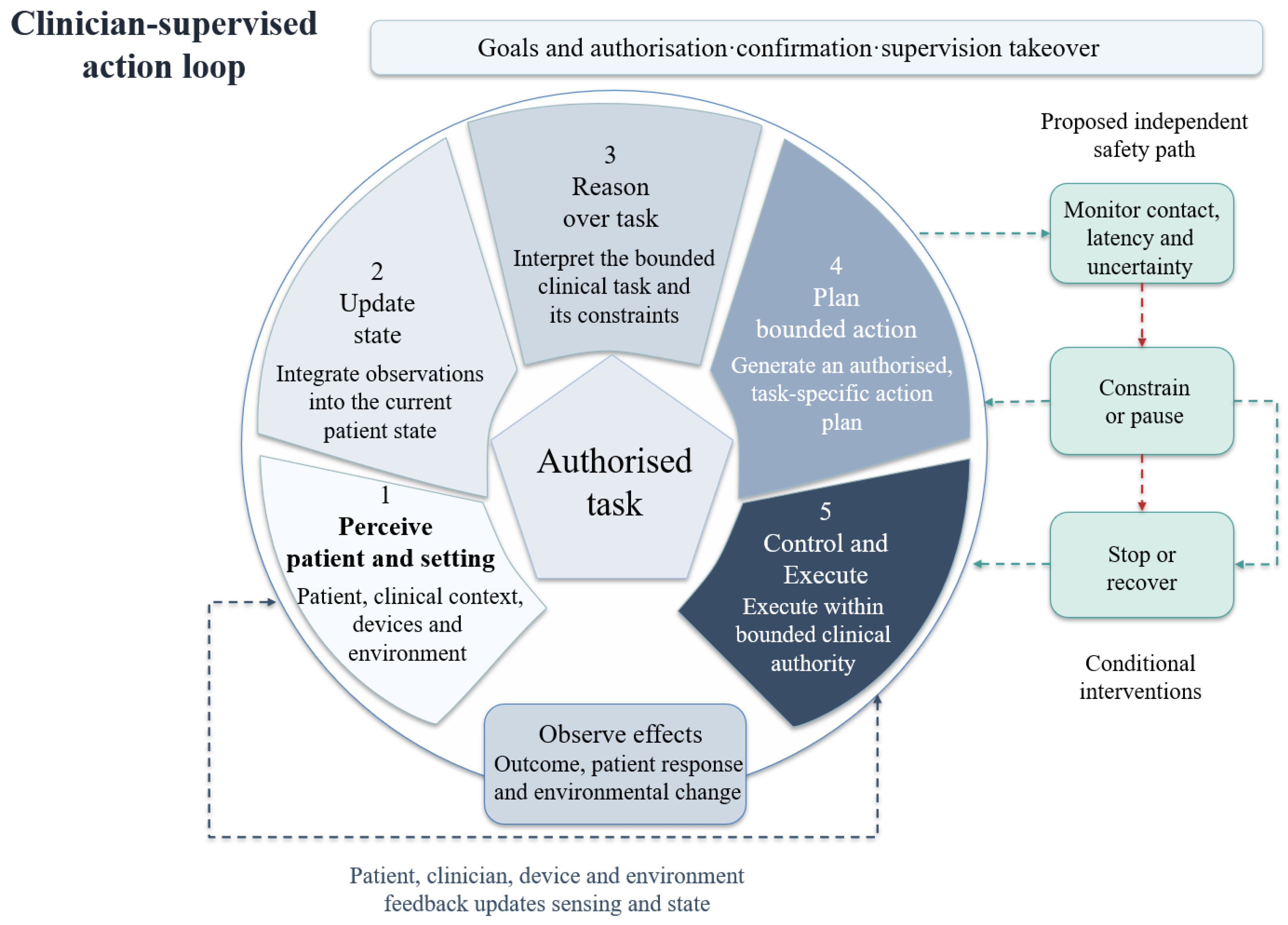
Figure 2.
Proposed task- and domain-specific allocation of control authority. L0 is an adjacent manual baseline; L1 enters the core scope only when feedback changes physical execution. Confirmation, takeover and stopping must be evaluated as part of the workflow. Levels do not indicate clinical maturity.
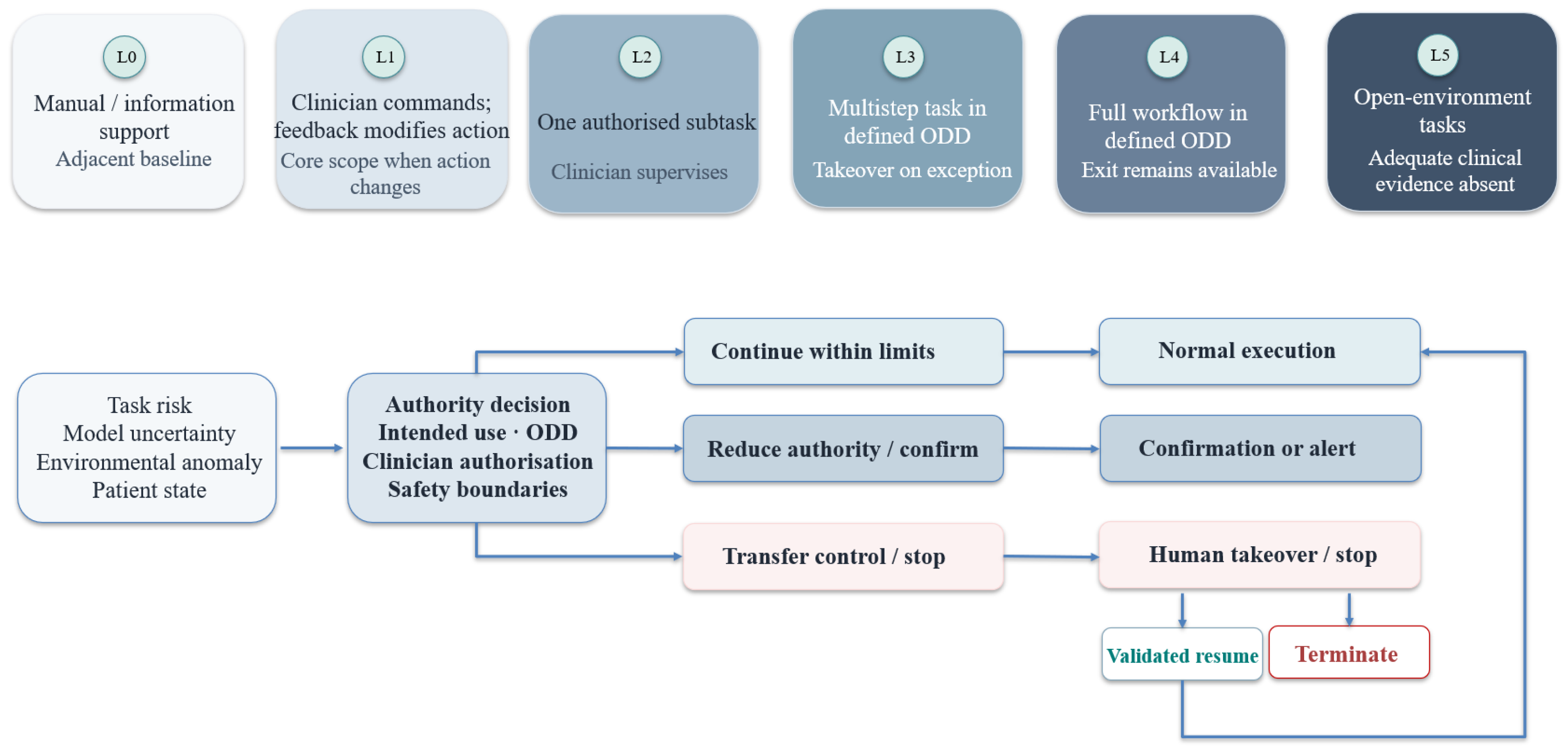
Figure 3.
Qualitative classification of clinical tasks by potential harm and environmental openness. The axes help identify supervision and rescue needs. Box size and position do not encode publication volume, measured risk or clinical maturity.
Figure 3.
Qualitative classification of clinical tasks by potential harm and environmental openness. The axes help identify supervision and rescue needs. Box size and position do not encode publication volume, measured risk or clinical maturity.
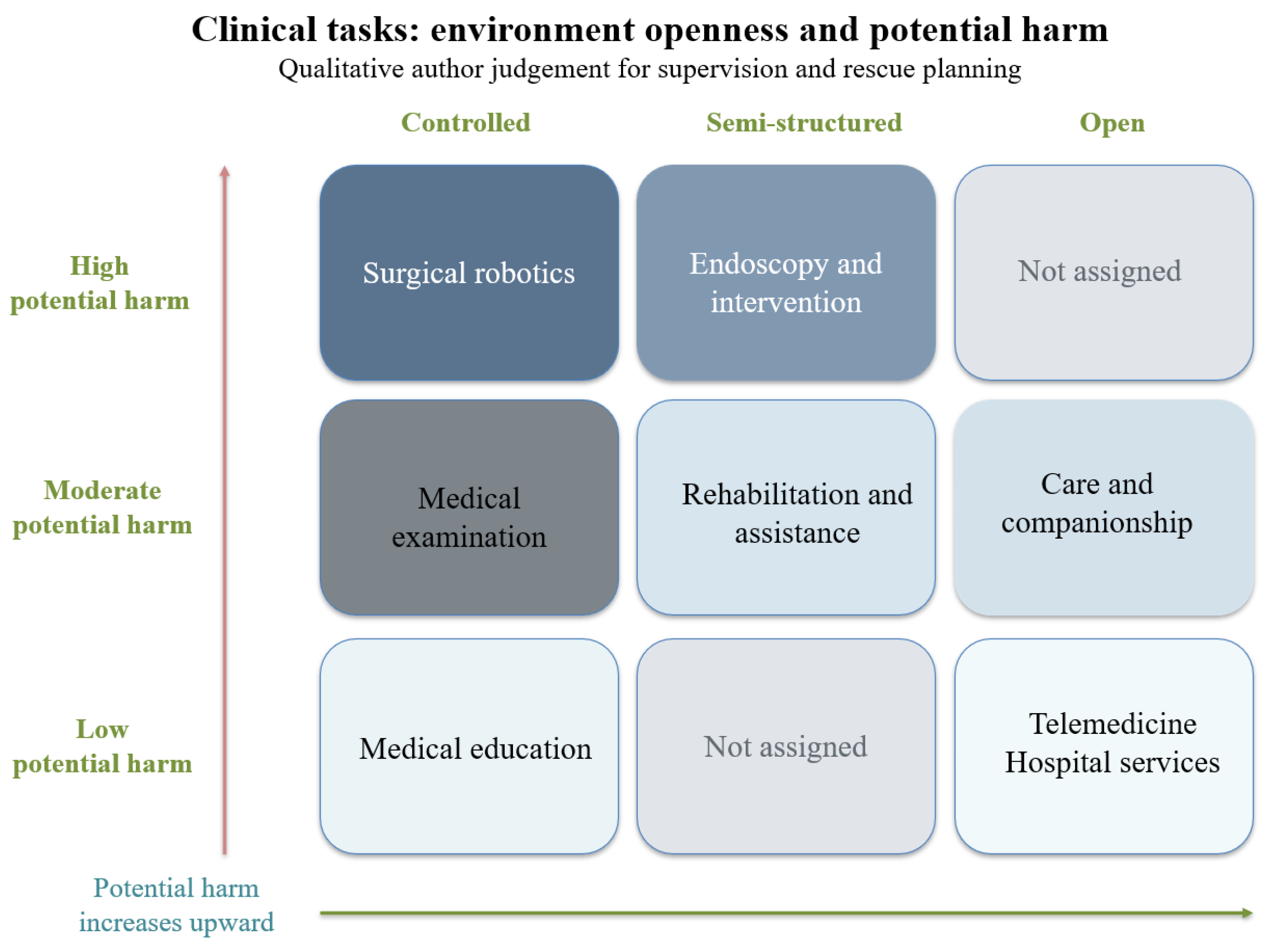
Table 1.
Comparison of this Review with representative prior reviews and perspectives.
| Review | Year | Scope | Primary emphasis |
|---|---|---|---|
| Troccaz et al. [3] | 2019 | Medical robotics, interventional focus | Evolution of interventional robots; coupling of imaging, sensing and robotics; clinical translation |
| Haidegger [16] | 2019 | Surgical robots | Autonomy concepts, standards and a level-of-autonomy scale |
| Attanasio et al. [13] | 2021 | Surgical robots | Levels of autonomy from 0 to 4 and their enabling technologies |
| Dupont et al. [15] | 2021 | Medical robotics | Eight research themes of 2010–2020 and the research–translation gap |
| Fiorini et al. [17] | 2022 | Robot-assisted surgery | Surgeon-assist autonomy; ethical, social and legal implications |
| Haidegger et al. [19] | 2022 | Robot-assisted minimally invasive surgery | Technology development and commercialisation in the data age |
| Lee et al. [18] | 2024 | FDA-cleared surgical robots | Systematic classification of autonomy levels in 49 devices |
| Schmidgall et al. [20] | 2024 | Surgical robotics | Perspective on vision–language–action models; data, simulation and safety barriers |
| Pashangpour and Nejat [21] | 2024 | Healthcare robots | Language-model integration for interaction, reasoning and task planning; ethics |
| Liu et al. [14] | 2025 | Healthcare | Survey of embodied AI in healthcare |
| Mir et al. [1] | 2026 | Healthcare | Systematic review of 17 studies on perception, decision-making and clinical impact |
| Zhang et al. [2] | 2026 | Medical embodied AI | System-level survey integrating perception, decision-making and action |
| General embodied AI surveys [22,23,24] | 2022–2025 | General embodied AI and robotics | Simulators and tasks; foundation models across the autonomy stack; multimodal large models and world models |
| This Review | 2026 | Medical embodied AI across clinical and care tasks | Evolution; technical foundations by loop stage; data and simulation resources; applications in eight task categories; evidence mapping by validation setting; task-level authority; service integration, governance and translation |
Note: Scope and emphasis are summarised from each source’s stated aims. FDA, US Food and Drug Administration.
Table 3.
Medical embodied AI and adjacent concepts.
| Concept | Substrate | Feedback loop | Action | Authority | Typical use | Boundary |
|---|---|---|---|---|---|---|
| Predictive AI | Optional | Usually absent | Information | Clinician | Diagnosis or prediction | No executed action loop |
| Medical robot | Physical | Optional | Physical | Manual to autonomous | Surgery or transport | Robot platform alone is insufficient |
| Medical embodied AI | Physical, virtual or hybrid | Required | Executed | Shared to bounded autonomy | Clinical or care task | Four properties jointly required |
| Medical VLM | Optional | Usually absent | None intrinsic | Clinician | Image-language analysis | No action interface |
| Medical VLA | Not inherent | System dependent | Action output | System dependent | Instruction to skill | Model needs system integration |
| World model | Not required | Predictive support | Indirect | Planner dependent | Consequence prediction | Requires action-conditioned prediction |
| Digital twin | Digital mapping | Possible | Simulated or linked | Variable | Patient or device simulation | Physical loop requires bidirectional coupling |
Note: This taxonomy is the authors’ synthesis; a category does not imply clinical validation.
Table 4.
Technical modules, loop stages and medical requirements.
| Module | Loop stage | Function | Medical requirement | Possible failure | Evaluation | Representative work |
|---|---|---|---|---|---|---|
| Perception | 1 | Estimate tissue, devices and state | Occlusion, deformation and small structures | Miss or drift | Accuracy, delay, uncertainty | [57,58,59] |
| State and memory | 2 | Fuse observations and history | Timely updates and privacy | Stale or mislinked state | Consistency and traceability | [60,61] |
| Task reasoning | 3 | Interpret instructions and constraints | Clinical semantics and authority limits | Hallucinated or out-of-scope plan | Grounding, refusal and escalation | [62,63] |
| Planning | 4 | Order constrained skills | Goal and authority limits | Unsafe plan | Constraint violations | [64,65] |
| Control | 5 | Execute motion and contact | Tissue and device limits | Collision or excess force | Force, stability, stopping | [30,66] |
| Imitation and reinforcement learning | 4–5 | Learn skills | Scarce experts; restricted exploration | Shift or reward error | External and worst-case tests | [36,67] |
| VLA model | 3–5 | Map context to action | Semantic and physical precision | Cross-modal mismatch | Action and constraint tests | [12,68] |
| World model | 4 | Predict action consequences | Patient and tissue fidelity | Rollout error | Calibration and coverage | [53,69] |
| Proposed safety path | Safety path | Constrain or stop execution | Independent risk response | Missed alarm or late stop | Detection and takeover | [70,71] |
Note: Loop stages refer to Figure 1. Requirements and failure modes are review-level comparisons, not validated device standards.
Table 6.
Representative learning-based policies, planners and world models for medical embodied AI.
| Work | Paradigm | Task and platform | Setting | Source-reported result |
|---|---|---|---|---|
| Superhuman knot tying [99] | Learning from demonstration; iterative learning control | Figure-eight and knot tie; Berkeley surgical robots | Physical robot, no tissue | 7–10× faster than best human-guided trajectory |
| Pattern-cutting tensioning [100] | Deep RL, sim-to-real | Gauze tensioning; dVRK | 17 simulated contours; 4 physical patterns | Improved accuracy and robustness in simulation |
| Learning-based MPC [101] | RL and LfD with model predictive control | Tissue manipulation; Raven IV | Simulation; robot feasibility | LfD outperformed RL in simulation |
| Visual sim-to-real retraction [67] | RL with pixel-level domain adaptation | Tissue retraction; surgical robot | Simulation to real | 50% real success without retraining |
| SRT [36] | Imitation learning, relative actions | Tissue lift, needle handover, knot tying; dVRK | Bench; ex vivo background | 5/5, 9/9 and 18/20 successes |
| SRT-H [45] | Hierarchical, language-conditioned imitation | Cholecystectomy clipping and cutting; dVRK | Ex vivo; 8 gallbladders | 8/8 without intervention |
| SuFIA [63] | LLM planner with perception | Needle lift and handover; dVRK | Simulation and physical robot | Physical robot: 10/10 lift; 5/10 handover |
| Ultrasound LLM agent [93] | LLM agent with retrieval | Carotid scanning from verbal instructions | Laboratory demonstration | Real-time plan adjustment to patient motion |
| EndoVLA [68] | VLA with reinforcement fine-tuning | Polyp tracking and marker following; flexible endoscope | Stomach phantoms | Tracking IoU 62.1 to 86.1 after fine-tuning |
| Cosmos-Surg-dVRK [69] | World model as policy evaluator | Suture-pad tasks; dVRK-Si | Tabletop; ex vivo pilot | Correlation with real success |
| Cosmos-H-Surgical [102] | World model for synthetic training data | Needle pickup and handover; endoscopic robot | Physical robot | Lower trajectory error than real-only training |
Note: Results are source-reported for the stated tasks and settings and are not comparable across rows. Cosmos-Surg-dVRK and Cosmos-H-Surgical are preprints. IoU, intersection over union; LfD, learning from demonstration; LLM, large language model; MPC, model predictive control; RL, reinforcement learning; VLA, vision–language–action.
Table 7.
Clinical applications, human authority and evidence boundaries.
| Application | Task | Substrate, inputs and action | Clinician or staff authority | Direct subset | Principal risk or next test |
|---|---|---|---|---|---|
| Surgical robotics | Retract, suture, implant | Robot; video, pose, force; bounded manipulation | Authorise, supervise, convert | ; stages 1–5; 3 patient-involving; stage 5 is one retrospective dental series | Injury or lost view; compare complications and rescue |
| Endoscopy and intervention | Navigate, access target | Scope or catheter; images, shape, force; constrained motion | Set route and limits; take over | ; stages 1–4; no patients; stage 4 is a non-patient user study | Perforation or sensing loss; test conversion |
| Rehabilitation and assistance | Gait or transfer assistance | Wearable device; motion, force or intent; adaptive support | Therapist sets goals and monitors | ; stage 4; non-patient | Falls or over-assistance; test durable function |
| Care and companionship | Care or reminders | Mobile or social robot; vision, audio, user state | Caregiver retains responsibility | ; stages 1–2; no patients | Privacy or dependency; test care outcomes |
| Hospital services | Handover or delivery | Robot arm/mobile unit; vision, request, object state | Staff authorise and intervene | ; stage 2; no patients | Sterility or collision; test live workflow |
| Medical examination | Ultrasound or eye examination | Probe/instrument; images, pose, force | Clinician targets, monitors and interprets | ; stages 2–4; no patients | Pressure or missed coverage; test diagnostic completeness |
| Telemedicine | Remote examination | Remote device state; assisted action | Remote clinician and local rescue | Outside verified direct subset | Delay or failed handover; test local rescue |
| Medical education | Virtual skills training | Virtual agent; learner actions and feedback | Instructor and learner set goals | Outside verified direct subset | Simulation bias; test transfer to practice |
Note: Counts refer only to the purposively retained 40-study direct subset; stage is the highest documented setting, not a quality grade or typical maturity. Healthy or technical participants are not patients. One stage-three assignment remains provisional because the available abstract does not identify the in vivo experimental species. See Supplementary Tables S3 and S5 for study-level coding. L0 and purely teleoperated baselines are outside the direct subset.
Table 8.
Representative systems outside the 40-study direct subset, grouped by the application categories of Figure 3.
Table 8.
Representative systems outside the 40-study direct subset, grouped by the application categories of Figure 3.
| Category | System or study | Control mode | Setting and sample | Source-reported result |
|---|---|---|---|---|
| Surgical robotics | STAR anastomosis [37] | Supervised autonomy | Ex vivo tissue and living pigs | Superior to expert manual and robot-assisted techniques on anastomosis metrics |
| Surgical robotics | SRT-H [45] | Autonomous, language-conditioned | Ex vivo; 8 gallbladders | 8/8 completed without intervention |
| Surgical robotics | 5G telesurgical nephrectomy [129] | Teleoperation | 29 patients, 8 hospitals | Median round-trip delay 26 ms; median distance 187 km |
| Surgical robotics | Multicentre telesurgery trial [130] | Teleoperation | Phase I trial; 18 patients | 100% success; mean latency 38.38 ms |
| Endoscopy and intervention | Magnetic colonoscope [138] | Semi-autonomous navigation | In vivo; 2 pigs | Autonomous mode 87% and 78% of procedure time |
| Endoscopy and intervention | Steerable-needle lung biopsy [139] | Supervised autonomous steering | In vivo; 3 deployments in 2 pigs | Final error 1.81–3.49 mm |
| Endoscopy and intervention | Patient-mounted CT-guided needle robot [140] | Automated steering with imaging checkpoints | Prospective, 2 centres; 32 biopsies | Accuracy 1.6 ± 1.5 mm |
| Endoscopy and intervention | Hand-held venipuncture device [142] | Autonomous insertion | First in human; 31 participants | 87% success (97% without difficult access) |
| Endoscopy and intervention | Deep-learning vascular access [141] | Autonomous insertion | Phantom and animal; imaging in volunteers | Higher success and shorter time than trained operators |
| Rehabilitation and assistance | Robot-assisted gait training [151] | Therapist-supervised device | Cochrane review; 101 trials, 4,224 participants | Odds ratio 1.65 for independent walking |
| Rehabilitation and assistance | RATULS [153] | Robot-assisted arm training | Multicentre RCT; 770 patients | Not superior to usual care or enhanced therapy |
| Rehabilitation and assistance | Assistive feeding [156] | Variable autonomy | Out-of-laboratory and 5-day in-home use | Variable autonomy aided recovery from off-nominal events |
| Hospital services | Endoscope-delivery robots [162] | Autonomous mobile robots | Prospective; 21,048 vs 5,393 deliveries | 2.18 FTE saved; failure rate 0.15% |
| Hospital services | UV-C disinfection robot [163] | Autonomous | 10-month deployment; theatres and ICU | Lower surface bioburden; no significant change in SSI |
| Hospital services | Chemotherapy compounding robot [165] | Automated | Before–after; 1,421 vs 972 preparations | Accuracy failures 12.5% vs 0.9%; time +47% |
| Hospital services | Throat-swab robot [167] | Semi-automatic, remote-controlled | Volunteers and 20 suspected COVID-19 patients | Success 95% vs 100% manual; 9 vs 18 s |
| Telemedicine | Remote robotic ultrasound [170] | Teleoperation | 23 COVID-19 patients | All examinations completed without related complications |
Note: Studies are contextual sources identified in targeted searches and are not coded in the direct subset. Some systems are teleoperated or automated rather than embodied AI in the sense of our four-property definition and are included to illustrate service-level evidence. FTE, full-time equivalent; ICU, intensive care unit; RCT, randomised controlled trial; SSI, surgical-site infection.
Table 11.
Evidence layers and the cross-cutting safety and lifecycle dimension.
| Layer | Question | Measures | Setting | Failure to test | Examples | Invalid inference |
|---|---|---|---|---|---|---|
| Model | Is a component calibrated? | Accuracy, error, delay, uncertainty | Independent data; perturbation | Hallucination or drift | [47,85] | Model score proves task safety |
| Task | Is the task completed in-domain? | Success, time, intervention, recovery | Standard and unseen workflows | Omission or failed takeover | [38,50,112] | Task success proves benefit |
| Physical | Is contact and control safe? | Force, collision, stop, damage | Bench, phantom, ex vivo, animal | Slip, excess force, failed stop | [83,124,131] | Preclinical safety proves human safety |
| Clinical | Does care improve? | Outcomes, complications, workload, cost | Human feasibility to prospective and follow-up | Subgroup harm or new burden | [125,143,150] | Feasibility proves superiority |
| Safety and lifecycle | Can failures be blocked and traced? | Alarm, takeover, logs, drift | All stages and software versions | Missed gate or unsafe update | [54,173,176] | Governance document proves effectiveness |
Note: Layers and invalid inferences are the authors’ synthesis; examples support only claims within their documented settings.
Table 12.
Structural mismatches and discriminating tests for adoption.
| Structural mismatch | Current evidence signal | Mechanism | Healthcare consequence | Discriminating test | Decision implication |
|---|---|---|---|---|---|
| Capability–evidence | Preclinical and feasibility endpoints dominate | Technical endpoints are used for higher-level claims | Benefit and rare harm remain unknown | Test the claimed benefit with the corresponding evidence layer | Do not promote capability as clinical value |
| Component–system | Strong module results; incomplete-loop testing | Perception or planning is separated from control, refusal and recovery | A locally accurate module can still produce unsafe action | Inject base-model errors and test whether the independent safety path stops action | Require end-to-end and fault evidence |
| Autonomy–accountability | Human oversight is often nominal | Opaque plans, late alerts or unavailable staff defeat takeover | Responsibility remains assigned without effective control | Is takeover completed before the task’s reversibility window closes? | Reduce authority or redesign supervision |
| Benchmark–service | Success, error and task time dominate | Preparation, interruptions and remedial work are omitted | Local workload or cost may rise despite benchmark gains | Does the complete workflow improve after preparation, supervision and maintenance? | Adopt only on net service value |
| Update–evidence | Validation is tied weakly to versions | Updates alter action, latency or confidence | Prior assurance may no longer cover deployed behaviour | Which evidence layers fail an impact test and require revalidation? | Bind approval, monitoring and rollback to version |
Note: The mismatch framework and tests are the authors’ synthesis. Evidence signals describe the purposively selected literature and should not be read as field-wide rates or validated decision thresholds.
Disclaimer/Publisher’s Note: The statements, opinions and data contained in all publications are solely those of the individual author(s) and contributor(s) and not of MDPI and/or the editor(s). MDPI and/or the editor(s) disclaim responsibility for any injury to people or property resulting from any ideas, methods, instructions or products referred to in the content. |
© 2026 by the authors. Licensee MDPI, Basel, Switzerland. This article is an open access article distributed under the terms and conditions of the Creative Commons Attribution (CC BY) license (http://creativecommons.org/licenses/by/4.0/).
Copyright: This open access article is published under a Creative Commons CC BY 4.0 license, which permit the free download, distribution, and reuse, provided that the author and preprint are cited in any reuse.