
Submitted:
24 October 2026
Posted:
26 October 2026
You are already at the latest version
Abstract
The Mass Balance Model (MBM) proposes that human body weight regulation is more accurately described by direct mass accounting than by indirect energy balance. This article establishes the MBM Reference Framework, a living document that consolidates, corrects, and extends the prior MBM series. It presents the complete open-system mass balance equation, which explicitly includes inhaled molecular oxygen and insensible evaporative water losses. It states the open-system formulation of the First Law of Thermodynamics and clarifies why an energy balance equation – even when correctly formulated – does not uniquely determine mass change. It presents the corrected stoichiometric equations for substrate oxidation and qualifies the nitrogen-to-protein conversion factor as an empirical average rather than an exact atomic constant. It distinguishes the MBM from both the static CICO heuristic and from multi-compartment dynamic Energy Balance Models, acknowledging the methodological sophistication of the latter while arguing that they remain anchored in the two-step mass-to-energy conversion. It calibrates translational applications to realistic physiological timeframes and states the limitations of the current evidence base. Finally, it documents, in a dedicated section, every technical correction relative to earlier MBM preprints. The framework is offered as a living reference for the MBM research program and will be updated as new evidence becomes available.
Keywords:
mass balance model
; energy balance model
; open-system thermodynamics
; indirect calorimetry
; stoichiometric oxidation
; body weight regulation
; reference framework
; living document
1. Introduction: A Living Reference Framework
The MBM project has, over more than thirty articles e.g., [1,2], developed a sustained critique of the Energy Balance Model (EBM) and an alternative framework for human body weight regulation. That work has been productive but dispersed. Individual papers have addressed specific questions: the two-step conversion trap, the thermodynamics of obligatory nitrogen loss, the epistemology of doubly labeled water methodology, the dynamic properties of mass clearance, and the translational applications of mass accounting. No single document has consolidated these contributions into a coherent reference.
This article fills that gap. It establishes the MBM Reference Framework, a living document that consolidates, corrects, and extends the theoretical, methodological, and translational foundations of the Mass Balance Model. It is intended as the primary citation for the MBM project. When subsequent papers refine specific claims, those refinements will be integrated into future versions of this document, and the version history will be recorded.
The document has three distinguishing features.
First, it is a corrective document. The MBM series has been subjected to sustained post-publication scrutiny, including formal AI-assisted peer review and public debate. Several technical corrections have emerged, ranging from the omission of inhaled oxygen from the mass balance equation to a sign reversal in the stoichiometric equation for fat oxidation. These corrections are documented explicitly in Section 2, not buried in scattered errata. A scientific framework is not validated by the absence of errors. It is validated by the rigor with which errors are identified, documented, and corrected. The corrections strengthen the framework rather than weakening it, because a framework that cannot be corrected cannot be trusted.
Second, it distinguishes its claims from those of adjacent frameworks. The MBM is frequently criticized as a restatement of the dynamic multi-compartment Energy Balance Models developed by Hall and colleagues. That criticism is understandable but incorrect. The dynamic EBMs are methodologically sophisticated, and their contributions to the field are substantial. The MBM differs from them in a specific and defensible way: it treats mass as the primary variable and energy as a derived quantity, whereas the dynamic EBMs treat energy as the primary variable and mass as a derived quantity. Section 9 develops this distinction in detail.
Third, it distinguishes what is established from what is proposed. The MBM's core theoretical claims are well grounded in established stoichiometry and open-system thermodynamics. Its translational claims are more speculative and depend on practical measurement advances that are not yet fully realized. The document states these limitations explicitly rather than eliding them.
The remainder of the document is organized as follows. Section 2 documents the corrections relative to earlier MBM preprints. Section 3 presents the open-system thermodynamic foundations. Section 4 presents the complete mass balance equation. Section 5 revisits the two-step conversion trap in light of the distinction between static and dynamic EBMs. Section 6 presents the corrected stoichiometric equations. Section 7 develops the dynamic framework and qualifies the "no tunable parameters" claim. Section 8 addresses the physiological sensing question. Section 9 distinguishes the MBM from dynamic EBMs. Section 10 calibrates the translational applications. Section 11 states limitations and open questions. Section 12 concludes.
2. Corrections from Earlier Preprints
Transparency about correction is not a weakness of a scientific framework. It is a condition of its credibility. This section documents, in explicit terms, the technical corrections that the MBM series has undergone relative to earlier preprints.
2.1. Inhaled Oxygen and Insensible Water Loss
The mass balance equation presented in earlier MBM preprints omitted inhaled molecular oxygen and insensible evaporative water loss. The complete equation is presented in Section 4. The omission was significant: molecular oxygen contributes the majority of the mass in exhaled carbon dioxide and metabolic water, and its omission would have produced a systematic error of hundreds of grams per day in the calculated mass balance.
2.2. Open-System Formulation of the First Law
Earlier MBM preprints presented the First Law of Thermodynamics in its closed-system form and argued that the equation contains no mass term. This argument is technically correct for a closed system but inapplicable to an open biological system. The open-system formulation, which includes the enthalpy carried by mass inflows and outflows, is presented in Section 3. When correctly formulated, the open-system First Law does contain mass terms – but they do not uniquely determine mass change, which is the point the earlier preprints were attempting to make.
2.3. Sign Reversal in the Fat Oxidation Equation
The stoichiometric equation for fat oxidation presented in earlier MBM preprints reversed the signs on oxygen consumption and carbon dioxide production. The corrected equation is presented in Section 6. The error would have produced physically impossible negative fat oxidation rates at any respiratory quotient below one, and its correction is essential for the empirical credibility of the framework.
2.4. Qualification of the "No Tunable Parameters" Claim
Earlier MBM preprints stated that the framework contains no tunable parameters. This claim is too strong. The dynamic framework includes a mass clearance coefficient whose value is empirically determined and whose trajectory during prolonged fasting is estimated from longitudinal data. The claim is qualified in Section 7: the MBM contains no arbitrarily calibrated energy-conversion parameters, but it does contain empirically determined mass-based rate parameters, whose values can be measured directly rather than inferred from energy proxies.
2.5. Revisiting the Broccoli-Versus-Butter Example
Earlier MBM preprints argued that the body senses one hundred grams identically whether the hundred grams is broccoli or butter. This argument conflates gravimetric mass with physiological sensing. The body senses gastric volume, luminal nutrient concentration, and intracellular energy state, all of which differ between one hundred grams of broccoli and one hundred grams of butter even though the gravimetric mass is identical. Section 8 presents the corrected formulation.
2.6. Qualification of the Uncertainty Reduction Claim
Earlier MBM preprints stated, as a primary quantitative finding, that the MBM reduces propagated uncertainty by forty to sixty-five percent relative to the EBM pipeline. This claim is currently a preliminary estimate pending a formal error-propagation analysis. Section 10 qualifies it accordingly.
2.7. Correction of the Forbes Parameter Identification
Earlier MBM preprints presented the Forbes relation as having two free parameters that could both be determined from a single baseline body composition assessment. This is mathematically impossible: a single baseline measurement constrains only one parameter. The Forbes slope parameter is a fixed population constant (approximately ten point four kilograms), and the baseline measurement determines only the intercept. Section 7 presents the corrected formulation.
2.8. Realistic Physiological Timelines
Earlier MBM preprints stated that clinical decisions could be made within twenty-four to forty-eight hours on the basis of urinary nitrogen measurement. This timeline neglects the five-to-seven-day equilibration of the body urea pool following dietary changes. Section 10 presents realistic timelines.
2.9. Calibrated Quality-Assurance Thresholds
Earlier MBM preprints specified a quality-assurance criterion of five grams per day divergence between measured and computed mass change. This threshold is physically unattainable given the hundreds of grams of daily variance in insensible water loss. Section 10 presents a realistic threshold.
2.10. Reconciliation of Unit Conventions
Earlier MBM preprints mixed grams and kilograms across equations. The present document standardizes the unit conventions throughout.
3. Open-System Thermodynamic Foundations
The human body is an open thermodynamic system. It exchanges mass with its environment continuously, and the exchange carries energy in the form of chemical bond enthalpy. The First Law of Thermodynamics for an open system, in rate form and neglecting kinetic and potential energy changes, is presented in Equation 1.
In this equation, the term on the left represents the rate of change of total energy within the control volume. The first two terms on the right represent heat transfer and work. The final two terms represent the enthalpy carried into and out of the control volume by mass flows. The symbol for specific enthalpy, conventionally denoted by a lowercase letter, is the thermodynamic quantity that couples chemical composition to energy content.
This equation contains mass terms. That is not a weakness of the formulation; it is a feature of it. The open-system First Law makes explicit that mass fluxes carry enthalpy, and that the enthalpy balance of the body is determined by both heat and work transfer and by the chemical enthalpy of incoming and outgoing mass streams.
The relationship between energy balance and mass balance can now be stated precisely. A zero rate of change of body energy does not imply a zero rate of change of body mass. The two are related but not identical. Different substrates carry different specific enthalpies per gram, and water carries zero metabolizable enthalpy while contributing directly to total body mass. Consequently, a body can be in energy balance while gaining or losing mass, and a body can be in mass balance while accumulating or depleting energy stores.
This is the formal thermodynamic foundation of the MBM. It is also the point that earlier MBM preprints attempted to make using the closed-system formulation. The corrected formulation is more rigorous and, if anything, strengthens the argument. The open-system First Law contains mass terms; it is the energy-centric EBM that fails to account for them correctly.
4. The Complete Mass Balance Equation
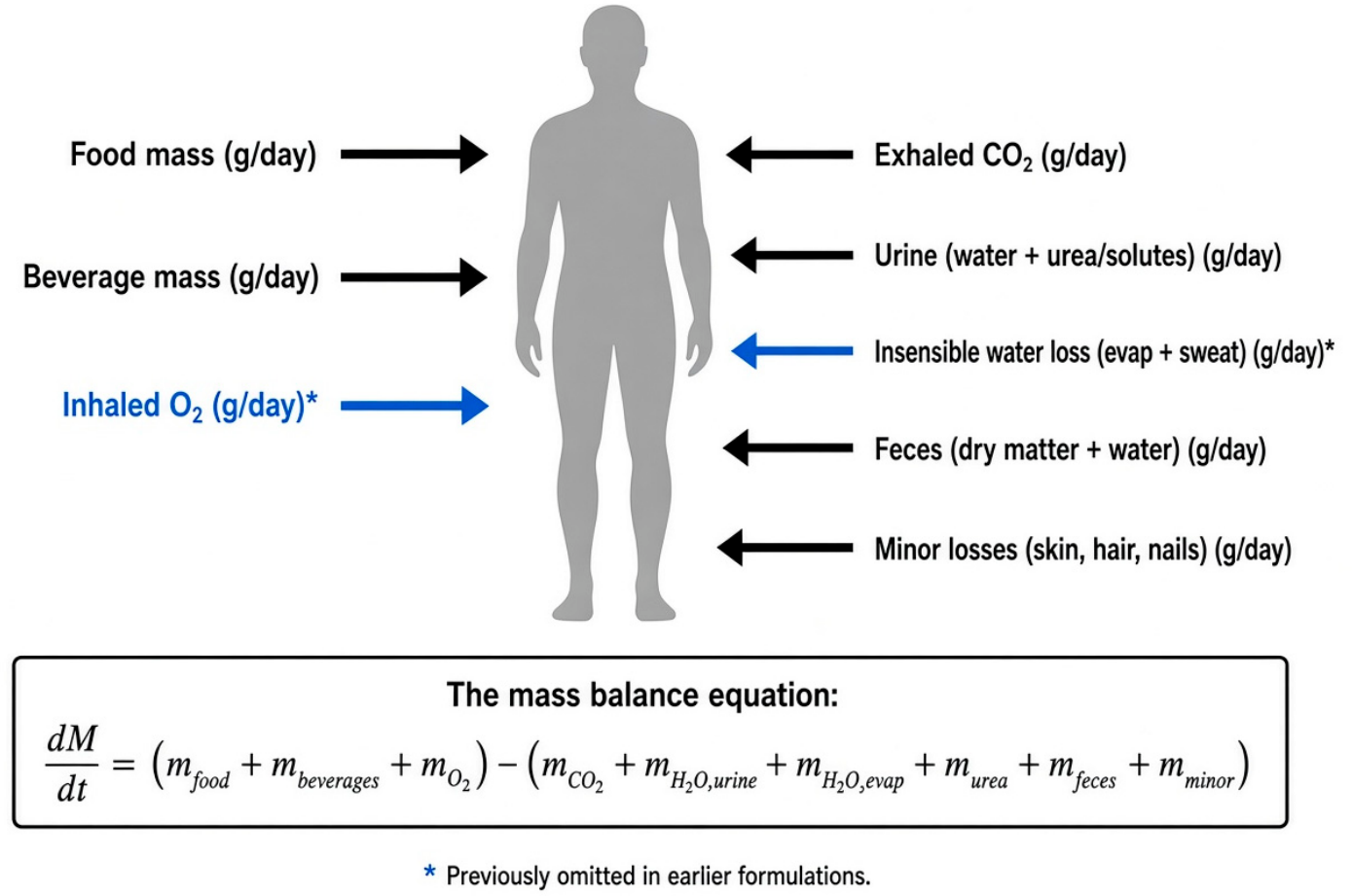
The complete mass balance equation for the human body, stated in rate form, is presented in Equation 2.
In this equation, the terms on the left represent the rate of change of total body mass. The terms inside the first set of parentheses represent the mass inflows: ingested food, ingested beverages, and inhaled molecular oxygen. The terms inside the second set of parentheses represent the mass outflows: exhaled carbon dioxide, urinary water, insensible evaporative water loss, urinary urea and other nitrogenous solutes, fecal matter (dry matter plus water), and minor losses such as desquamated skin, hair, and nails.
The equation is complete in the sense that it accounts for every mass stream that crosses the body boundary. The inclusion of inhaled molecular oxygen is essential: the molecular oxygen consumed in oxidative metabolism contributes the majority of the oxygen atoms in exhaled carbon dioxide and metabolic water. The omission of inhaled oxygen in earlier MBM preprints was not merely a mathematical oversight. It was a conceptual slip into the very energy-centric thinking the MBM was designed to escape. In the EBM, oxygen is absorbed into the energy expenditure calculation and its mass is ignored. In the MBM, oxygen is a massive physical inflow (typically five hundred to eight hundred grams per day) that must be accounted for atom by atom. Correcting this omission does not weaken the MBM; it proves that mass accounting is fundamentally harder – and more honest – than energy accounting.
The inclusion of insensible evaporative water loss is equally essential. This term encompasses respiratory water vapor and transepidermal water loss, which together account for approximately five hundred and fifty to eight hundred grams per day in sedentary adults. This is comparable in magnitude to all other outflows combined. Its omission from earlier formulations would have produced a systematic error of the same magnitude.
The complete mass balance is depicted in Figure 1.
The water balance can be written separately, as presented in Equation 3.
In this equation, metabolic water is the water produced endogenously from substrate oxidation. At steady state, the rate of change of body water is approximately zero, but transient deviations of hundreds of grams are common and must be accounted for when interpreting short-term body mass changes.
5. The Two-Step Conversion Trap, Revisited
The earlier MBM preprints argued that the EBM is committed to a two-step conversion – mass to energy via Atwater factors, and energy to mass via tissue energy densities – that introduces propagated uncertainty. That argument remains valid, but it needs to be refined in light of the distinction between static and dynamic EBMs.
The static EBM – exemplified by the Wishnofsky rule of seven thousand seven hundred kilocalories per kilogram – does indeed use a fixed conversion factor that is known to be inaccurate. The Wishnofsky rule was a clinical heuristic, not a physical model, and its limitations have been documented extensively.
The dynamic EBMs developed by Hall and colleagues are more sophisticated [4,5]. They model separate compartments for fat, protein, and glycogen, track glycogen-bound water, account for diet-induced thermogenesis and adaptive thermogenesis, and use the same indirect calorimetry stoichiometry that the MBM uses. Their predictions for weight loss trajectories are considerably more accurate than the static rule, and they deserve to be treated as serious scientific contributions.
The MBM's critique of the dynamic EBMs is more specific and more defensible. It is not that the dynamic EBMs are inaccurate; they are, in many contexts, accurate. It is that they remain anchored in the two-step conversion: they convert ingested mass to energy via Atwater factors or equivalent, model the energy fluxes, and convert the resulting energy imbalance back to mass via the same stoichiometric coefficients used in the forward direction. Each of these conversions requires empirical inputs – Atwater factors, dietary digestibility, tissue energy densities – whose values carry uncertainty and whose use as fixed parameters is a modeling choice, not a physical necessity.
The MBM avoids these conversions by treating mass as the primary variable. It does not convert food to energy and back. It tracks the mass of food, beverages, and inhaled oxygen entering the body, and the mass of carbon dioxide, water, urea, feces, and minor losses leaving it. The resulting mass balance is exact – it is a statement of the Law of Conservation of Mass, not an approximation – and the substrate oxidation rates that connect the inflows and outflows are derived from the same indirect calorimetry measurements that the dynamic EBMs use. This approach is consistent with the classical macronutrient balance framework, which demonstrated that organisms regulate carbohydrate, protein, and fat balances independently due to vastly different storage capacities [8].
6. Stoichiometric Foundations, Corrected
The stoichiometric equations that convert indirect calorimetry measurements into substrate oxidation rates are well established. The correct equations, following Frayn [3], are presented in Equations 4, 5, and 6.
Protein oxidized (g/day) = 6.25 × UN
Fat oxidized (g/day) = 1.67 × VO2 − 1.67 × VCO2 − 1.92 × UN
Carbohydrate oxidized (g/day) = 4.55 × VCO2 − 3.21 × VO2 − 2.87 × UN
In these equations, oxygen consumption and carbon dioxide production are expressed in liters per day, and urinary nitrogen is expressed in grams per day. These are the same equations used throughout the indirect calorimetry literature, including in the dynamic EBMs. The signs in Equations 5 and 6 are critical: reversing the signs on oxygen consumption and carbon dioxide production in Equation 5, as in earlier MBM preprints, produces physically impossible negative fat oxidation rates at any respiratory quotient below one.
The conversion factors in these equations are not exact physical constants. The nitrogen-to-protein factor of six point two five, often called the Jones factor, assumes that mixed proteins contain approximately sixteen percent nitrogen by mass. Individual amino acids vary widely in nitrogen content, and food-specific factors – such as five point seven zero for wheat and six point three eight for dairy – are more accurate when the dietary composition is known. Similarly, the stoichiometric coefficients in the oxidation equations rely on assumed average elemental compositions for representative triglycerides, glycogen, and mixed amino acids. These are empirical averages, not exact atomic constants, and they carry compositional variance [9].
7. The Dynamic Framework: Mass Clearance and Forbes Partitioning
The dynamic framework combines two elements: a Torricelli-like mass clearance equation and Forbes's partitioning curve, solved via the Lambert W function.
7.1. The Mass Clearance Equation
The core dynamic equation is presented in Equation 7.
In this equation, the term on the left represents the rate of change of body mass. The first term on the right represents net mass inflow – the sum of food, beverages, and inhaled oxygen minus water outflows. The second term represents mass outflow, modeled as a clearance coefficient multiplied by the square root of body mass. The clearance coefficient is expressed in units of kilograms to the power of one half per day. All variables are expressed in kilograms and kilograms per day, standardizing the unit convention across the document.
The mass clearance coefficient is a physiological parameter. Its value depends on physical activity level and on the composition of the diet, because both determine the rate of substrate oxidation and therefore the rate of mass elimination through respiratory gas exchange and urinary nitrogen excretion. Under stable dietary composition and stable physical activity, the coefficient can be treated as approximately constant. When either changes substantially – as during prolonged fasting or a major shift in macronutrient composition – the coefficient is better modeled as time-dependent, as presented in Equation 8.
k(t) = kSS + (k0 − kSS)exp(−t/τ)
In this equation, the steady-state coefficient is the value reached after adaptation, the initial coefficient is the value before adaptation, and the adaptation time constant determines how quickly the transition occurs.
The values of the steady-state coefficient and the time constant are not derived from first principles. They are estimated from longitudinal body mass data. This is the empirical content of the framework. Earlier MBM preprints claimed that the framework contains no tunable parameters. That claim is too strong. The MBM contains no energy-conversion parameters – no Atwater factors, no tissue energy densities, no caloric equivalents. It does contain mass-based physiological rate parameters, specifically the clearance coefficient. The distinction is categorical. An energy-conversion parameter is a statistical abstraction that obscures mechanism. A mass-based rate parameter is a physical property that can be measured directly in the laboratory. The MBM has not traded one fudge factor for another; it has replaced abstract fudge factors with measurable physical parameters.
7.2. The Forbes Partitioning Curve
The Forbes relation between fat mass and fat-free mass is presented in Equation 9.
FFT = αln(FM) + β
The slope parameter is a fixed population constant, approximately ten point four kilograms in Forbes's original formulation and in Hall's revised formulation [5,6]. The intercept parameter is determined from a single baseline body composition measurement, as presented in Equation 10.
β = FFM0 − αln(FM0)
A single baseline measurement cannot determine both the slope and the intercept. It constrains only one. Earlier MBM preprints presented Forbes's relation as having two free parameters that could both be determined from a single baseline assessment. That was an error. The corrected formulation fixes the slope at the population value and uses the baseline measurement to determine the intercept.
With this correction, the Forbes relation is used as a partitioning rule after the total mass trajectory has been determined by Equation 7. It is not used to determine the mass trajectory itself. This is the distinction between the MBM's use of Forbes's relation – as a partitioning rule applied after the fact – and the EBM's use – as a parameterization of body mass energy density used in the forward calculation. The former is not circular; the latter is.
7.3. What the Dynamic Framework Can and Cannot Do
The dynamic framework describes the medium- to long-term trajectory of body mass and body composition. It can predict the asymptotic steady state, the exponential approach to it, and the partitioning of total mass change between fat and fat-free mass according to Forbes's relation.
It cannot, in its current single-compartment form, capture early-phase glycogen and water shifts, transient fluid redistribution, or body recomposition – the simultaneous loss of fat and gain of lean mass. These require a multi-compartment dynamical model with separate state variables for glycogen, extracellular water, and nitrogen pools. The MBM is compatible with such a model, but the present framework does not include it. This limitation is stated explicitly to prevent over-claiming.
8. Physiological Sensing: Beyond Gravimetric Mass
The earlier MBM argument that the body senses one hundred grams identically whether those hundred grams are broccoli or butter conflates gravimetric mass with physiological sensing. The body does not sense gravimetric mass directly. It senses three distinct things.
8.1. Gastric Volume and Wall Tension
Mechanoreceptors in the stomach wall respond to intragastric volume and distension, not to gravimetric weight. Because one hundred grams of broccoli occupies a much larger volume than one hundred grams of butter, it produces greater gastric distension and slower gastric emptying. The relevant variable is volume and wall tension, not mass per se.
8.2. Luminal Nutrient Concentration and Chemical Identity
Enteroendocrine cells in the small intestine express specific chemoreceptors for fatty acids, monosaccharides, amino acids, and peptides. They respond to the molar concentration and chemical identity of luminal nutrients, not to bulk mass. One hundred grams of butter delivers approximately eighty-one grams of triglycerides, which potently stimulate cholecystokinin, glucagon-like peptide-1, and peptide YY secretion and slow gastric emptying. One hundred grams of broccoli delivers approximately eighty-nine grams of water and two point six grams of fiber, which elicit minimal incretin and cholecystokinin responses.
8.3. Intracellular Energy State
Cells throughout the body, including hypothalamic neurons that regulate appetite, sense intracellular energy state via AMP-activated protein kinase, the mechanistic target of rapamycin complex 1, and ATP-sensitive potassium channels. These sensors respond to the adenylate energy charge, not to mass or calories as abstract quantities.
8.4. The Core Distinction
The corrected formulation is this: the body senses mass-linked signals – volume, concentration, and energy state – but it does not sense gravimetric mass or abstract calories directly. The body possesses mechanoreceptors for volume and chemoreceptors for molar concentration. It possesses no calorimeter.
9. The MBM and the Dynamic EBMs: A Precise Distinction
The MBM is frequently criticized as a restatement of the dynamic Energy Balance Models developed by Hall and colleagues [4,5]. The criticism is understandable but incorrect. The dynamic EBMs are methodologically sophisticated and empirically successful. Their contributions to the field are substantial. The MBM differs from them in a specific and defensible way.
The dynamic EBMs model energy fluxes. They convert ingested mass to energy – via Atwater factors or equivalent – model the energy fluxes through the body, and convert the resulting energy balance back to mass via tissue-specific energy densities. This is a sophisticated approach, and it produces predictions that match observed weight loss trajectories with considerable accuracy.
The MBM models mass fluxes. It tracks the mass of food, beverages, and inhaled oxygen entering the body, and the mass of carbon dioxide, water, urea, feces, and minor losses leaving it. The resulting mass balance is exact. The substrate oxidation rates are derived from the same indirect calorimetry measurements that the dynamic EBMs use, but they are treated as mass fluxes rather than being immediately converted to energy.
The dynamic EBMs are not wrong. They are the most sophisticated energy-based models available, and their predictive accuracy is impressive. But they are built on a foundation of mass-to-energy conversions. They measure the energy of the food, model the energy of the body, and convert the energy back to mass. The MBM asks a different question: not what is the energy balance, but where did the atoms go? The dynamic EBMs are an indirect route through an abstract medium. The MBM is a direct route through physical reality. Neither is wrong. But one is more parsimonious, and one is more mechanistically transparent.
10. Translational Applications: Calibrated to Reality
The translational applications of the MBM are substantial, but they must be calibrated to realistic physiological and practical timeframes.
10.1. Metabolic Ward Research
In a controlled metabolic ward, complete mass balance can be determined with high precision. Food and beverages can be weighed to a tenth of a gram, duplicate diets can be chemically analyzed, twenty-four-hour urine and seventy-two-hour fecal collections can be obtained, and respiratory gas exchange can be measured by whole-room calorimetry. In this setting, the MBM's mass balance can be computed with propagated uncertainty that is substantially lower than the EBM's energy balance, pending formal error-propagation analysis currently in preparation.
10.2. Detection of Lean Tissue Loss
Urinary nitrogen measurement in a metabolic ward can detect changes in net protein catabolism, but the physiological equilibration time of the body urea pool is five to seven days following dietary changes. Claims of twenty-four to forty-eight hour detection are too aggressive. Realistic timelines are five to seven days for steady-state nitrogen balance, and seven to fourteen days for reliable detection of trends.
10.3. Real-Time Dietary Monitoring
In a metabolic ward, daily mass balance can be computed and reported. In free-living settings, this is currently infeasible and will depend on advances in wearable sensing technology – carbon dioxide sensors, automated food weighing, smart toileting. The framework's translational promise in this domain is real but future-oriented.
10.4. Personalized Protein Prescription
Nitrogen balance in a metabolic ward can be used to titrate protein intake to individual needs. The five-to-seven-day urea pool equilibration applies, so titration requires patience. The framework offers the clinical insight that the relevant variable is nitrogen balance in grams per day, not protein intake in grams per kilogram of body weight.
10.5. Pharmacotherapy Evaluation
The MBM can be used to evaluate the physiological effects of anti-obesity agents by tracking whether they reduce mass inflow, increase mass outflow, or alter partitioning. This is a genuinely useful framework, but it requires the same measurement infrastructure as other MBM applications.
10.6. Quality Assurance Thresholds
A divergence threshold of five grams per day between measured and computed mass change is physically unattainable given the hundreds of grams of daily variance in insensible water loss. Realistic thresholds in a metabolic ward are on the order of forty to sixty grams per day, consistent with a two percent daily mass flux tolerance. In free-living settings, thresholds are wider still.
10.7. The Uncertainty Reduction Claim
The figure of forty to sixty-five percent uncertainty reduction is currently a preliminary estimate pending formal error-propagation analysis. When that analysis is complete, the figure may be confirmed, refined, or revised. The framework should not be cited as having established this figure until the analysis is published.
11. Limitations and Open Questions
The MBM framework has substantive limitations, and stating them explicitly is a condition of its credibility.
11.1. The Dynamic Framework Is Single-Compartment
The Forbes-coupled scalar model cannot capture early-phase glycogen and water shifts, transient fluid redistribution, or body recomposition. A multi-compartment extension is needed, and it is currently in development.
11.2. The Empirical Evidence Base Is Preliminary
The empirical validation of the MBM has been conducted on single-subject longitudinal data and on small cohort datasets. Larger-scale validation in diverse populations is needed before the framework's empirical claims can be considered established.
11.3. The Error-Propagation Analysis Is Pending
The uncertainty reduction figure is currently a preliminary estimate. Formal analysis is in preparation.
11.4. The Translational Claims Are Future-Oriented
Many of the most compelling translational applications – real-time monitoring, personalized protein prescription outside a metabolic ward, digital health integration – depend on measurement technology that does not yet exist in routine clinical practice.
11.5. The Relationship to Dynamic EBMs Is Not Yet Empirically Resolved
The framework argues that the MBM is more parsimonious than the dynamic EBMs and at least as accurate in the contexts where both have been tested. This claim needs to be substantiated through head-to-head comparison on the same datasets. That comparison is in preparation.
12. Conclusions: A Living Framework
The MBM Reference Framework consolidates, corrects, and extends the theoretical, methodological, and translational foundations of the Mass Balance Model. It is offered as a living document: subsequent versions will integrate new evidence, refine specific claims, and document further corrections as they emerge.
The framework's core insight remains intact despite the corrections. Human body weight is regulated by mass balance, not by energy balance. The two are related, but not identical. The relationship is mediated by stoichiometry, and the stoichiometry is exact. The MBM's contribution is to make the stoichiometry visible as the primary accounting framework, rather than treating it as an intermediate quantity in an energy-based analysis.
The EBM reads the body through the lens of the First Law of Thermodynamics. The MBM reads the body through the lens of the Law of Conservation of Mass. These are two different books. The EBM tries to read the second book by translating it into the first. The MBM reads it in its original language. The body does not count calories. It counts atoms.
Funding
This research did not receive any specific grant from funding agencies in the public, commercial, or not-for-profit sectors.
Institutional Review Board Statement
Not applicable.
Informed Consent Statement
Not applicable.
Data Availability Statement
All data generated or analyzed during this study are contained in the sources cited.
Acknowledgments
I would like to thank my family for their unwavering support and care, as well as my colleagues for many stimulating discussions.
Conflicts of Interest
The author declares no conflict of interest.
References
- Manninen, A.H. Mass Balance over Energy Balance: Why Direct Mass Accounting Offers a More Precise and Mechanistically Faithful Framework for Human Body Weight Regulation. Preprints 2026, 2026040690. [Google Scholar] [CrossRef]
- Manninen, A.H. Implementing the Mass Balance Model (MBM) in Human Nutrition and Obesity Research: Protocols, Analytical Frameworks, and Translational Applications. Preprints 2026, 2026041641. [Google Scholar] [CrossRef]
- Frayn, K.N. Calculation of substrate oxidation rates in vivo from gaseous exchange. J. Appl. Physiol. Respir. Environ. Exerc Physiol. 1983, 55(2), 628–34. [Google Scholar] [CrossRef] [PubMed]
- Hall, K.D.; Sacks, G.; Chandramohan, D.; et al. Quantification of the effect of energy imbalance on bodyweight. Lancet 2011, 378(9793), 826–37. [Google Scholar] [CrossRef] [PubMed] [PubMed Central]
- Hall, K.D. Predicting metabolic adaptation, body weight change, and energy intake in humans. Am. J. Physiol. Endocrinol. Metab. 2010, 298(3), E449-66. [Google Scholar] [CrossRef] [PubMed] [PubMed Central]
- Forbes, G.B. Lean body mass-body fat interrelationships in humans. Nutr. Rev. 1987, 45(8), 225–31. [Google Scholar] [CrossRef] [PubMed]
- Hall, K.D. Body fat and fat-free mass inter-relationships: Forbes's theory revisited. Br. J. Nutr. 2007, 97(6), 1059–63. [Google Scholar] [CrossRef] [PubMed] [PubMed Central]
- Flatt, J.P. Dietary fat, carbohydrate balance, and weight maintenance: effects of exercise. Am. J. Clin. Nutr. 1987, 45((1) Suppl, 296–306. [Google Scholar] [CrossRef] [PubMed]
- Livesey, G.; Elia, M. Estimation of energy expenditure, net carbohydrate utilization, and net fat oxidation and synthesis by indirect calorimetry: evaluation of errors with special reference to the detailed composition of fuels. Am. J. Clin. Nutr. Erratum in: Am J Clin Nutr 1989 Dec;50(6):1475. PMID: 3281434.. 1988, 47(4), 608–28. [Google Scholar] [CrossRef]
Figure 1.
The complete open-system mass balance. All mass streams crossing the body boundary are shown. Inflows include food, beverages, and inhaled oxygen. Outflows include exhaled carbon dioxide, urinary water and solutes, insensible evaporative water loss, fecal matter, and minor losses. The inclusion of inhaled oxygen and insensible water loss is essential for exact mass conservation. The complete formulation demonstrates that mass accounting requires tracking every atomic pathway – a level of detail that energy-centric models systematically omit.
Figure 1.
The complete open-system mass balance. All mass streams crossing the body boundary are shown. Inflows include food, beverages, and inhaled oxygen. Outflows include exhaled carbon dioxide, urinary water and solutes, insensible evaporative water loss, fecal matter, and minor losses. The inclusion of inhaled oxygen and insensible water loss is essential for exact mass conservation. The complete formulation demonstrates that mass accounting requires tracking every atomic pathway – a level of detail that energy-centric models systematically omit.
Disclaimer/Publisher’s Note: The statements, opinions and data contained in all publications are solely those of the individual author(s) and contributor(s) and not of MDPI and/or the editor(s). MDPI and/or the editor(s) disclaim responsibility for any injury to people or property resulting from any ideas, methods, instructions or products referred to in the content. |
© 2026 by the author. Licensee MDPI, Basel, Switzerland. This article is an open access article distributed under the terms and conditions of the Creative Commons Attribution (CC BY) license.
Copyright: This open access article is published under a Creative Commons CC BY 4.0 license, which permit the free download, distribution, and reuse, provided that the author and preprint are cited in any reuse.