

Submitted:
23 October 2026
Posted:
26 October 2026
You are already at the latest version
Abstract
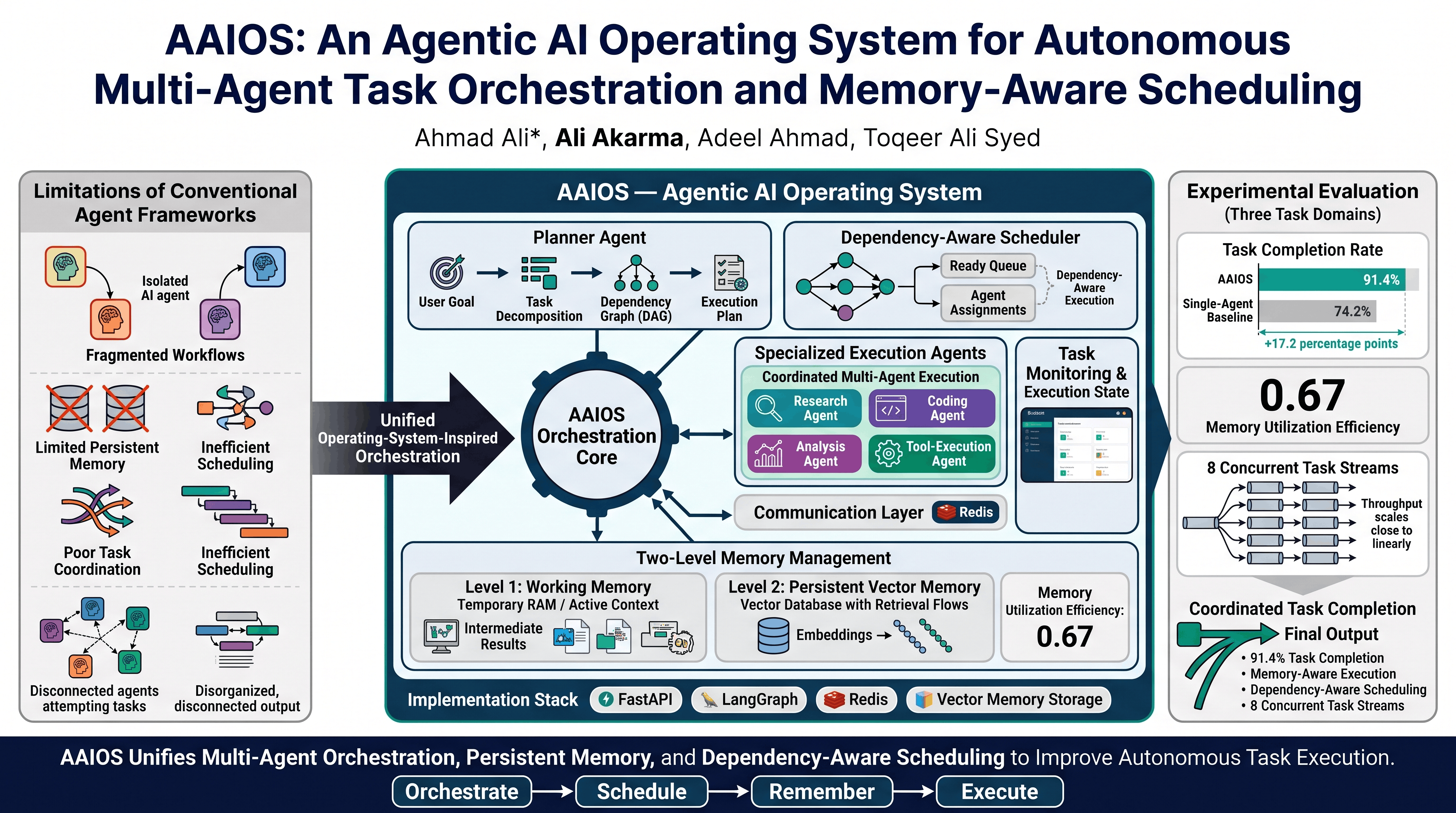
The emergence of Large Language Models (LLMs) and autonomous AI agents has brought about significant progress in the field of intelligent systems that can reason, plan, and use tools. Yet, current agentic frameworks are mostly autonomous task pipelines that are poorly coordinated, have poor memory and have suboptimal execution strategies. In this paper, the authors present an Agentic AI Operating System (AAIOS), which is an operating-system inspired orchestration to support autonomy of multi-agent workflows. The design includes a dynamic agent scheduling component, persistent memory management, inter-agent communication, and task monitoring, all encapsulated as a unified design to coordinate specialized agents capable of complex tasks. The architecture of AAIOS is modular; it includes a Planner Agent, execution agents specific to the different tasks, a two-level memory subsystem, and a dependency-aware scheduling layer. The system uses FastAPI, LangGraph for scalable, autonomous execution, Redis for communication, and vector memory storage. Experimental results in three different task domains show that the proposed multi-agent architecture provides a Task Completion Rate of 91.4% against the single-agent baseline of 74.2% and a Memory Utilization Efficiency of 0.67 and a close linear scaling with throughput of 8 concurrent task streams.
Keywords:
agentic AI
; multi-agent systems
; LLM orchestration
; operating system
; task scheduling
; memory management
; autonomous AI
; LangGraph
Copyright: This open access article is published under a Creative Commons CC BY 4.0 license, which permit the free download, distribution, and reuse, provided that the author and preprint are cited in any reuse.