

Submitted:
23 October 2026
Posted:
26 October 2026
You are already at the latest version
Abstract
Rapid urbanization and escalating waste generation are exerting significant pressure on existing urban infrastructure, necessitating scalable, intelligent, and multifunctional solutions. While current Internet of Things (IoT)-enabled smart bins primarily support waste monitoring and collection, their potential as integrated urban infrastructure remains largely untapped. This paper envisions the concept of Urban Intelligence Nodes (UINs), a new generation of Artificial Intelligence (AI) enabled smart waste systems that extend beyond conventional waste management to serve as multi-functional nodes within a 6G-ready IoT ecosystem. The visioned UINs integrate AI, edge computing, and advanced wireless communication technologies to enable real-time waste classification, including hazardous object detection (e.g., explosive materials), thereby enhancing public safety and enabling timely alerts to emergency responders. In addition to safety applications, UINs are envisioned to function as distributed 6G micro base stations, environmental monitoring units for applications such as bushfire detection, and urban service platforms supporting infrastructure monitoring and aesthetic integration into city landscapes. By embedding intelligence and connectivity at the edge, UINs contribute to the realization of 6G networks as AI-native, ultra-reliable, and massively distributed systems. This position paper presents the architectural vision, enabling technologies, and key application domains of UIN-IoT, and discusses associated challenges, including security, privacy, scalability, and deployment considerations. It further highlights the transformative potential of UINs in redefining public waste infrastructure as a cornerstone of sustainable, secure, and connected smart cities.
Keywords:
Urban Intelligence Nodes (UIN)
; Internet of Things (IoT)
; Artificial Intelligence (AI)
; public safety and threat detection
; 6G networks
; smart cities
; intelligent waste management
; edge computing
; distributed sensing systems
; urban infrastructure
1. Introduction
Rapid urbanization, population growth, and increasing consumption patterns have significantly intensified the challenges associated with urban waste management and infrastructure sustainability. According to the World Bank, global waste generation is expected to increase by 70% by 2050 if no significant interventions are implemented [1]. Traditional waste collection systems, which rely on static schedules and manual monitoring, are increasingly inefficient in the face of dynamic urban environments. Consequently, Internet of Things (IoT)-enabled smart waste bins have emerged as a promising solution, enabling real-time monitoring of waste levels and optimizing collection processes [2,3].
Despite these advancements, existing smart bin systems remain largely limited to single-purpose applications focused on waste collection efficiency. Recent developments in smart cities and IoT ecosystems call for a paradigm shift from isolated sensing devices to multifunctional, intelligent urban infrastructure capable of supporting a broader set of services [4]. In parallel, advances in artificial intelligence (AI), edge computing, and next-generation wireless technologies are enabling distributed intelligence at the network edge, allowing devices to perform complex tasks such as object recognition, anomaly detection, and autonomous decision-making [5,6].
The emergence of sixth-generation (6G) communication systems further accelerates this transformation by envisioning networks that are AI-native, ultra-reliable, and capable of supporting massive device density with ultra-low latency [7,8]. Within this context, urban infrastructure elements are increasingly being reimagined as integrated sensing, communication, and computing platforms. However, the potential of widely deployed public assets, such as waste bins, to serve as such multifunctional nodes remains underexplored.
The convergence of machine learning (ML), edge computing, and sustainable urban infrastructure has attracted significant scholarly attention as municipalities strive to balance ecological mandates with digital transformation. Recent literature establishes a foundation across infrastructure thermal management, multi-layered urban intelligence, and unified security-sustainability threat taxonomies. Infrastructure-level efficiency has been a primary focus in addressing the carbon footprint of distributed edge networks. Arroba et al. [9] investigated sustainable edge computing challenges, emphasizing hardware-software co-design. They demonstrated that integrating two-phase immersion cooling can drastically optimize Power Usage Effectiveness (PUE) in micro-data centers while employing generative adversarial networks (GANs) for synthetic anomaly detection. Moving up the systems stack, [10] provided a comprehensive mapping of ML applications across smart-city architecture tiers–ranging from perceptual IoT networks to platform-level analytics–highlighting how real-time municipal data streams enable automated water and energy conservation. More recently, the security-sustainability nexus has emerged as a critical research frontier. Sliti [11] established an innovative paradigm by addressing secure, trustworthy, and sustainable edge computing for smart cities. By introducing a unified threat taxonomy and defense framework for Multi-Access Edge Computing (MEC) environments, Sliti sought to reconcile the computational overhead of security primitives (such as blockchain-based access control and Trusted Execution Environments) with green computing targets.
While existing works make substantial contributions to specific layers of urban computing, they reveal distinct structural gaps when compared against the vision articulated in this article. First, whereas Arroba et al. [9] concentrate predominantly on physical data-center thermal mechanics and hardware enhancements, and Mrabet and Sliti [10] treat smart-city layers via traditional network paradigms, our article conceptualizes urban assets as holistic Urban Intelligence Nodes (UINs). These nodes are natively designed as multi-functional infrastructure rather than auxiliary computing enclosures. Second, while Sliti [11] bridges security and sustainability within standard 5G-era MEC boundaries, our work explicitly scales the architectural horizon toward 6G readiness. This encompasses ultra-massive machine-type communications (umMTC), terahertz band sensing, native AI air interfaces, and decentralized orchestration mechanisms that transcend the constraints of current edge architectures. By synthesizing multi-functional hardware virtualization with 6G-enabled quantum-resistant security and carbon-neutral self-sustainability, our article addresses the systemic blind spots of preceding literature, laying out a definitive roadmap for next-generation urban intelligence.
In this paper, we introduce the concept of UINs, a novel class of AI-enabled smart waste systems that extend beyond conventional waste management to function as distributed, multi-purpose urban infrastructure. Unlike existing smart bins, UINs integrate AI-driven waste classification, including detection of hazardous materials such as improvised explosive devices (a project initiated in [12]), environmental sensing for applications such as bushfire monitoring, and embedded communication capabilities enabling operation as 6G micro base stations. This transforms waste bins into active participants in public safety, environmental protection, and next-generation communication systems. The proposed UINs are extensions of the smarter bins proposed in [12].
The proposed IoT with the "things" being UINs (UIN-IoT) framework leverages edge computing to enable real-time inference and rapid response, reducing reliance on centralized systems and improving system scalability and resilience. In addition, UINs are designed to support urban aesthetics and seamless integration into city landscapes, addressing a critical yet often overlooked aspect of smart city deployment.
The novelty of this work lies in: (i) redefining smart waste bins as multifunctional urban intelligence nodes, (ii) integrating AI-based threat detection within public waste infrastructure, (iii) positioning waste systems as components of 6G communication architecture, and (iv) proposing a unified framework that combines waste management, public safety, environmental monitoring, and telecommunications within a single distributed IoT system.
The remainder of this article is structured as follows. In Section 2, we articulate our position on the emergence of UIN-IoT, followed by a detailed justification and supporting arguments in Section 3. Section 4 presents prospective architectural frameworks that can enable the realization of the UIN-IoT vision. Section 5 discusses the transformative implications of UIN-IoT from both research and practice perspectives, with particular attention to its relevance for key stakeholder communities. Finally, Section 6 concludes the article by synthesizing the main insights, discussing open challenges, and identifying future directions toward the realization and widespread adoption of UIN-IoT.
2. Position Statement
We contend that public solid waste bins should be reimagined as Urban Intelligence Nodes (UINs) and collectively interconnected as the Urban Intelligence Node Internet of Things (UIN-IoT)—a distributed, AI-native, and 6G-ready cyber–physical infrastructure that transforms one of the most ubiquitous municipal assets into a multifunctional platform for urban intelligence. Rather than serving solely as waste receptacles, UINs should integrate sensing, edge intelligence, wireless communication, and autonomous decision-making to simultaneously support intelligent waste management, public safety and security, environmental and infrastructure monitoring, distributed IoT services, urban beautification, bushfire prevention, and the protection of critical public assets such as telephone booths. By exploiting their strategic deployment throughout cities, UINs can provide a cost-effective and scalable substrate for pervasive urban sensing and edge computing while complementing emerging AI-native 6G ecosystems through dense, distributed intelligence and ubiquitous connectivity [7,13].
This position is founded on the four complementary principles:
- 1.
- First, existing municipal infrastructure should evolve from single-purpose assets into multifunctional intelligent infrastructure that simultaneously delivers environmental, communication, safety, and digital services.
- 2.
- Second, future smart cities should prioritize infrastructure reuse over continual deployment of dedicated sensing platforms, thereby improving economic efficiency and environmental sustainability.
- 3.
- Third, AI, IoT, edge computing, and 6G should be designed as an integrated ecosystem in which everyday public assets actively participate in sensing, communication, computation, and autonomous decision-making. Further, 6G networks require dense, intelligent, and interconnected edge nodes embedded within everyday environments.
- 4.
- Finally, UIN-IoT should be viewed not merely as an intelligent waste management system, but as a foundational architectural paradigm for sustainable, resilient, secure, and human-centric cities, where ordinary urban objects collectively evolve into a distributed network of urban intelligence.
3. Supporting Arguments
Below we provide seven use cases of UIN-IoT, i.e. IoT with the ’Things’ being UINs.
3.1. Intelligent Waste Management
Rapid urbanization and population growth have significantly increased municipal solid waste generation, placing considerable pressure on conventional waste collection systems. Traditional collection schedules are generally static and do not reflect the actual fill level of waste bins, resulting in either overflowing bins that create environmental and public health hazards or unnecessary collection trips that waste fuel, labour, and operational resources [1,14,15]. Consequently, IoT-enabled smart public waste bins have emerged as an important component of smart city infrastructure by enabling real-time monitoring, intelligent decision-making, and data-driven waste collection [16,17]. These systems typically integrate ultrasonic or infrared fill-level sensors, weight sensors, gas and temperature sensors, GPS modules, cameras, wireless communication technologies (e.g., LoRaWAN, NB-IoT, Wi-Fi, GSM, or 5G), cloud platforms, and mobile applications to continuously monitor waste accumulation and notify municipal authorities when collection is required [15,16]. More recent systems further incorporate artificial intelligence (AI) to automatically classify waste, detect contamination, estimate waste composition, and optimize collection schedules.
IoT-enabled smart bins have demonstrated the ability to optimize waste collection by providing real-time fill-level monitoring, reducing operational costs and improving efficiency. Furthermore, AI-based waste classification systems using deep learning have shown high accuracy in sorting waste categories, supporting recycling and circular economy goals. Urban Intelligence Nodes extend these capabilities through:
- Automated waste compaction to increase capacity.
- AI-driven classification into multi-compartment storage.
- Predictive maintenance and collection scheduling.
Such capabilities directly address key inefficiencies in traditional waste systems, including overflow, contamination, and labor-intensive sorting processes.
The primary advantage of IoT-enabled smart bins lies in their ability to transform waste collection from a reactive process into a predictive and demand-driven service. Continuous monitoring enables dynamic route optimization for collection vehicles, thereby reducing unnecessary trips, fuel consumption, greenhouse gas emissions, operational costs, and traffic congestion while simultaneously improving sanitation and public health [15,17]. AI-powered computer vision further enhances recycling efficiency by automatically recognizing waste categories such as plastics, paper, glass, metals, and organic materials before disposal, thereby reducing contamination of recyclable materials and improving resource recovery [16]. Historical sensor data also support predictive analytics, allowing municipalities to forecast waste generation patterns, allocate resources more effectively during festivals or special events, and perform preventive maintenance on collection infrastructure. Furthermore, smart bins generate valuable urban data that can support evidence-based policy formulation and sustainability planning within smart cities.
Despite these benefits, several practical limitations continue to restrict large-scale deployment. The installation and maintenance costs of sensor-equipped public bins remain substantially higher than those of conventional bins, particularly in developing countries where financial resources are limited [15,16]. Sensor measurements may become unreliable due to harsh weather conditions, accumulated dirt, physical damage, vandalism, or sensor drift, leading to inaccurate fill-level estimation and unnecessary collection requests. AI-based waste classification systems often experience reduced accuracy when waste items overlap, are partially occluded, heavily contaminated, or poorly illuminated, while edge devices face computational and energy constraints that limit the deployment of large deep learning models [16]. In addition, communication failures, cybersecurity vulnerabilities, privacy concerns associated with camera-equipped bins, interoperability issues among heterogeneous IoT platforms, and battery limitations remain significant engineering challenges that require further attention [14,17].
Numerous research opportunities exist for advancing AI-powered smart public waste bins beyond their current capabilities. Future research should focus on multimodal sensor fusion that combines visual, weight, gas, and fill-level measurements to improve waste identification and fullness estimation under complex environmental conditions. Federated learning and privacy-preserving machine learning could enable collaborative model training across geographically distributed bins without exposing sensitive data. Explainable AI offers opportunities to improve the transparency and trustworthiness of automated waste classification and routing decisions, particularly for municipal decision-makers. Reinforcement learning can further optimize dynamic vehicle routing under uncertain traffic conditions, fluctuating waste generation, and changing environmental constraints. Digital twins of waste management infrastructure may facilitate real-time simulation and predictive planning, while edge AI and energy-aware model compression techniques can reduce latency, communication overhead, and power consumption. Finally, integrating smart bins with citizen engagement platforms, incentive mechanisms, autonomous waste collection robots, and circular economy frameworks represents a promising direction toward fully intelligent and sustainable urban waste management ecosystems [15,16,17].
3.2. Urban Safety and Security
Public spaces such as railway stations, airports, bus terminals, shopping centres, stadiums, and pedestrian precincts remain attractive targets for criminal activities because of their high population density and accessibility. Among the various security threats confronting modern cities, the concealment of hazardous materials, including improvised explosive devices (IEDs) [12], inside public solid waste bins continues to present a significant concern for law enforcement agencies and municipal authorities. Existing surveillance infrastructures rely predominantly on closed-circuit television (CCTV), patrol personnel, and public vigilance. Although these measures have contributed substantially to urban security, they are inherently limited by camera blind spots, occlusions, human fatigue, delayed response times, and the inability to inspect the contents of opaque objects such as waste receptacles. Consequently, there is an increasing need for intelligent urban infrastructure capable of complementing conventional surveillance by providing localized, autonomous, and real-time threat detection.
Recent advances in AI, computer vision, edge computing, and IoT provide an opportunity to transform ordinary public solid waste bins into intelligent sensing platforms that contribute not only to waste management but also to urban safety and resilience. An AI-powered smart bin equipped with multimodal sensors, including visual cameras, chemical vapor sensors, temperature sensors, gas sensors, vibration sensors, and acoustic sensors, could continuously monitor both the waste deposited inside the bin and activities occurring in its immediate surroundings. Information from these heterogeneous sensors can be fused using AI algorithms to distinguish normal waste disposal behavior from potentially suspicious activities while simultaneously estimating the likelihood that hazardous substances are present. Unlike conventional smart bins that focus primarily on monitoring fill levels and waste classification, such an intelligent system would extend the functionality of urban infrastructure towards proactive public safety.
One motivation for this approach is the gradual removal of public solid waste bins from transport systems and other public places following security incidents involving concealed explosives. Many railway stations, train coaches, airports, public toilets, and pedestrian malls have reduced or completely eliminated waste bins to minimize opportunities for hiding dangerous objects. Although this strategy may reduce certain risks, it simultaneously diminishes public convenience and often encourages littering because people are left with few practical options for disposing of waste while travelling. The absence of adequate waste disposal facilities can therefore undermine environmental cleanliness and negatively affect public satisfaction with urban services. Rather than removing public bins altogether, a more sustainable strategy is to enhance their intelligence so that they become active participants in maintaining both environmental cleanliness and public safety.
Current engineering approaches to mitigating the use of waste-bin sites for bomb attacks include the removal of bins from public spaces, the deployment of transparent waste bins, and the installation of blast-resistant trash receptacles (BRTRs), as illustrated in Figure 1 and Figure 2. Transparent bins allow suspicious objects to be visually identified more easily, whereas BRTRs are designed to mitigate the effects of an explosion by directing blast energy vertically and limiting shrapnel dispersion. While these approaches reduce the consequences of an explosion, they remain fundamentally passive because they neither detect suspicious activities before detonation nor assist authorities in identifying perpetrators. Moreover, transparent bins expose unsightly waste to public view, whereas blast-resistant bins are extremely heavy, expensive, difficult to install, and are designed only for specific explosive threat levels [12]. Consequently, these solutions improve physical protection without addressing the more important objective of preventing attacks before they occur.
AI-enabled smart bins offer the possibility of shifting urban security from passive protection towards proactive threat awareness. By combining multimodal sensing with intelligent data fusion, the proposed system could identify unusual object characteristics, abnormal disposal behaviour, or chemical signatures that warrant further investigation. Rather than making autonomous security decisions, the smart bin could assign a confidence score to detected anomalies and immediately transmit encrypted alerts, together with sensor measurements, images, location information, and timestamps, to centralized monitoring centres or first responders. When the estimated threat level exceeds a predefined safety threshold, the system could activate audible alarms, visual warning lights, and nearby public notification systems to encourage rapid evacuation while simultaneously notifying emergency services. Such rapid situational awareness may substantially reduce response times, preserve forensic evidence, and potentially save lives by increasing the available evacuation time before an incident escalates.
Despite its considerable promise, several technical challenges must be overcome before such systems can be deployed at scale. Reliable explosive detection in uncontrolled outdoor environments remains difficult because environmental factors such as temperature, humidity, wind, contamination, and sensor ageing can degrade sensing performance. AI models must also maintain high detection sensitivity while minimizing false alarms, since frequent erroneous warnings could erode public confidence and unnecessarily disrupt public activities. Criminals may deliberately attempt to deceive AI systems through camouflage, sensor tampering, or adversarial attacks, necessitating robust cybersecurity mechanisms and tamper-resistant hardware. Furthermore, the integration of cameras raises legitimate concerns regarding privacy, ethical governance, and regulatory compliance, requiring privacy-preserving AI techniques such as on-device inference, selective image processing, and secure encrypted communications. Finally, computational constraints, energy consumption, maintenance costs, interoperability among heterogeneous IoT platforms, and long-term sensor reliability remain important practical considerations for large-scale deployment.
These challenges present numerous opportunities for future research. Explainable AI could improve the transparency of threat assessment by enabling emergency personnel to understand why a particular object or behaviour was flagged as suspicious. Federated learning offers a privacy-preserving mechanism through which geographically distributed UINs can collaboratively improve detection models without sharing raw sensor data. Multimodal foundation models capable of jointly reasoning over images, chemical signatures, acoustic signals, and contextual information may significantly improve detection robustness under complex urban conditions. Digital twins of smart-city infrastructure could further support the simulation and optimization of emergency response strategies before deployment. Reinforcement learning may enable adaptive alarm thresholds that balance sensitivity against false positives according to local environmental conditions and threat intelligence. Collectively, these research directions position AI-enabled smart solid waste bins as an emerging component of resilient urban infrastructure that simultaneously supports intelligent waste management, environmental sustainability, and public safety. Rather than merely serving as waste receptacles, future smart bins could function as distributed edge-intelligence nodes that enhance situational awareness, strengthen emergency preparedness, and contribute to safer and more sustainable smart cities.
3.3. Distributed UIN-IoT Networks for Smart Cities
The proliferation of the Internet of Things (IoT) has transformed conventional sensing devices into interconnected cyber-physical systems capable of continuous monitoring, distributed intelligence, and autonomous decision-making. Within the proposed UIN-IoT framework, UINs operate as networked edge devices that collectively form a city-scale sensing, computing, and communication infrastructure. Each UIN integrates heterogeneous sensors, embedded AI, communication modules, and local processing resources to collect, analyse, and exchange information with neighbouring UINs, roadside units, cloud platforms, and municipal control centres. This distributed architecture enables the continuous creation of a digital representation of the urban environment, supporting data-driven decision-making for smart-city services [13,18,19].
Beyond monitoring waste accumulation, UINs can simultaneously collect environmental, infrastructural, and situational information, including air quality, temperature, humidity, atmospheric pressure, rainfall, noise levels, vibrations, pedestrian activity, traffic conditions, and hazardous gases. Through their dense spatial distribution, UINs provide fine-grained spatio-temporal observations that transform existing public infrastructure into a scalable urban observatory capable of supporting environmental monitoring, infrastructure management, public safety, and urban planning.
Interconnecting large numbers of UINs enables collaborative intelligence that extends beyond individual sensing capabilities. Information from neighbouring nodes can be aggregated and analysed to identify emerging events that may not be detectable by isolated sensors. For example, correlated measurements across multiple UINs may reveal pollution incidents, traffic congestion, infrastructure degradation, flooding, illegal dumping, or public disturbances. AI-driven sensor fusion further improves robustness by exploiting spatial and temporal correlations while mitigating the effects of noisy measurements, environmental variability, and individual sensor failures.
One immediate application of this architecture is intelligent waste management, as discussed in Section 3.1. Continuous monitoring of fill levels, waste composition, and collection patterns enables municipalities to replace static collection schedules with demand-driven operations. AI-based route optimization can account for predicted waste generation, traffic conditions, weather, vehicle availability, and operational priorities, thereby reducing unnecessary collection trips, operational costs, fuel consumption, greenhouse-gas emissions, and overflowing bins while improving sanitation [3].
The inherent spatial distribution of public bins also provides an economical foundation for a city-wide sensing infrastructure without requiring extensive deployment of dedicated monitoring platforms. Since public bins are already installed throughout transport hubs, commercial zones, parks, educational institutions, and residential districts, augmenting them with sensing, communication, and edge-computing capabilities offers a cost-effective mechanism for extending urban digital infrastructure. Consequently, the same platform can simultaneously support environmental monitoring, public safety, infrastructure management, disaster preparedness, and smart-city services.
The emergence of 6G wireless systems further strengthens the feasibility of UIN-IoT. Unlike previous generations that focused primarily on connectivity, 6G is envisioned as an AI-native ecosystem characterized by integrated sensing and communications (ISAC), pervasive edge intelligence, digital twins, semantic communications, ultra-low latency, massive machine-type communications, and high reliability [7,20]. These capabilities complement UIN deployments by enabling large-scale connectivity, real-time decision-making, efficient information exchange, and autonomous network management.
A key architectural feature is edge intelligence. Rather than transmitting all collected data to remote cloud servers, UINs can perform local inference, anomaly detection, object recognition, and data filtering before selectively transmitting relevant information. This approach reduces communication overhead, lowers latency, improves scalability, and enhances privacy. Collaborative learning techniques such as federated learning further enable geographically distributed UINs to improve AI models collectively without sharing raw data.
Despite these opportunities, several challenges remain. Large-scale deployments increase the cyberattack surface and introduce risks associated with spoofing, denial-of-service attacks, adversarial machine learning, data poisoning, sensor manipulation, and unauthorized access. Interoperability among heterogeneous devices remains a challenge, while continuous sensing, communication, and AI inference impose stringent energy requirements. Additional concerns include scalability, sensor calibration drift, environmental robustness, maintenance scheduling, data governance, and privacy protection.
These challenges also motivate important research opportunities. AI-native networking, semantic communications, integrated sensing and communications, federated learning, explainable AI, trustworthy AI, digital twins, blockchain-enabled trust management, and energy-aware edge intelligence all represent promising directions for advancing multifunctional UIN-IoT infrastructures. Collectively, these developments position UINs as distributed urban intelligence nodes capable of supporting sustainable, resilient, and future-ready smart cities.
3.4. Alignment with the 6G Vision and UIN-Based Micro-Base Stations
The transition from fifth-generation (5G) to 6G communication systems represents a paradigm shift from device connectivity towards intelligent, autonomous, and context-aware cyber-physical ecosystems. Future 6G networks are expected to integrate communication, sensing, computing, intelligence, and control into a unified AI-native architecture capable of supporting digital societies and sustainable cities [7,8,21]. Within this vision, intelligence increasingly migrates from centralized cloud platforms to distributed edge devices that continuously perceive, reason, and collaborate.
The proposed UIN concept aligns naturally with this vision by transforming one of the most ubiquitous yet underutilized urban assets, namely public solid waste bins, into multifunctional intelligent infrastructure. Their widespread geographical distribution, proximity to pedestrians and transportation corridors, existing municipal ownership, and permanent installation make them attractive candidates for hosting sensing, computing, and communication resources. Unlike purpose-built communication assets that often require expensive site acquisition, regulatory approvals, and dedicated civil works, public bins already occupy strategically selected locations across urban environments.
A distinctive advantage of UINs is that many are located at sites that wireless operators actively seek for deploying communication infrastructure, including transport interchanges, shopping precincts, parks, pedestrian walkways, educational institutions, and recreational facilities. Consequently, UINs provide an opportunity to reuse existing municipal infrastructure to support communication services while simultaneously performing their primary waste-management role.
By integrating compact radio units, edge-computing platforms, and AI capabilities, UINs may operate as wireless hotspots, relay nodes, or 6G micro-base stations, as illustrated in Figure 3. Such deployments can complement conventional macro-cellular infrastructure by providing localized coverage enhancement, supporting dense IoT connectivity, reducing transmission distances, and enabling low-latency edge services. Their dense spatial distribution may also improve network resilience and service continuity during emergencies or partial infrastructure failures.
Furthermore, UIN-based communication nodes naturally support emerging 6G concepts such as semantic communications, integrated sensing and communications (ISAC), distributed AI inference, and collaborative edge intelligence. Rather than acting solely as sensing endpoints, UINs can become active participants in distributed decision-making, environmental monitoring, public safety, and smart-city operations.
The feasibility of this concept is illustrated by the indicative link budget shown in Table 1. The example demonstrates that a low-power UIN-mounted communication node can provide short- to medium-range urban connectivity suitable for pedestrian services, city-scale IoT deployments, and edge-intelligence applications.
Several challenges remain before UINs can be fully integrated into future 6G ecosystems. These include governance and ownership arrangements between municipalities and telecommunication operators, spectrum management, cybersecurity, interoperability, maintenance responsibilities, and sustainable business models. Communication performance may also be affected by urban propagation conditions, while the addition of radios, cameras, edge processors, and sensors increases energy consumption and maintenance complexity. Security considerations become particularly important because compromised nodes may disrupt distributed learning, inject false observations, or provide unauthorized access to urban networks.
Future research should therefore investigate AI-native network orchestration, semantic networking, joint communication-sensing-computing optimization, federated foundation models, trustworthy AI, post-quantum security mechanisms, distributed digital twins, and lifecycle sustainability assessments. Addressing these challenges will help establish UINs as an integral component of future 6G ecosystems in which public infrastructure simultaneously provides environmental sensing, edge intelligence, and communication services while contributing to sustainable, resilient, and human-centric smart cities.
To clarify why current paradigms (5G, Wi-Fi 6/7, or LoRaWAN) are insufficient for the proposed UIN-IoT ecosystem, we delineate the unique technical necessity of 6G enablers:
- 1.
- Integrated Sensing and Communications (ISAC): While 5G supports communication and separate sensing, 6G natively embeds radar-like radio frequency sensing into the communication waveform. This allows UINs to perform continuous environmental micro-Doppler monitoring (e.g., detecting crowd surges, unauthorized tampering, or bushfire smoke density) using the same hardware spectrum without requiring discrete, power-hungry external sensors.
- 2.
- Native AI Air Interfaces and Distributed Intelligence: Unlike 5G networks where AI is deployed strictly at the core or edge cloud, 6G air interfaces support decentralized, over-the-air federated learning and semantic communication. This enables UIN clusters to share compressed feature vectors rather than raw sensor data, drastically reducing backhaul bandwidth.
- 3.
- Sub-Millisecond Ultra-Reliable Low-Latency Communication (URLLC): Safety-critical applications such as IED threat detection require deterministic latency bounds under 1 ms to trigger localized alarms and evacuation protocols before an incident escalates–a performance threshold exceeding standard 5G massive IoT (mMTC) capabilities.
3.5. Aesthetic Urban Decoration
A fundamental objective of the proposed UIN-IoT is to transform public solid waste bins from purely functional municipal assets into aesthetically pleasing urban infrastructure that contributes simultaneously to environmental sanitation, digital connectivity, and the visual identity of smart cities. Public bins are traditionally perceived as unavoidable but visually intrusive street furniture. Consequently, many municipalities attempt to conceal them or minimize their visibility despite their essential role in maintaining urban cleanliness. By contrast, UINs present an opportunity to integrate industrial design, public art, digital technologies, and communication infrastructure into a single multifunctional asset that enhances rather than detracts from the urban landscape.
As UINs are already deployed at strategic pedestrian locations, their external structures may be designed to complement the architectural character of surrounding environments through artistic finishes, culturally significant motifs, green facades, interactive displays, programmable lighting, or digitally adaptive surfaces. Such multifunctional designs can improve citizens’ perception of public spaces while simultaneously accommodating sensing devices, communication equipment, edge computing hardware, and renewable energy modules without introducing additional street clutter. This approach is consistent with the growing concept of human-centric smart cities, where technological infrastructure is expected to improve not only operational efficiency but also urban liveability and public experience [22].
An important advantage of this approach is the reuse of existing municipal assets to host multiple urban services. Telecommunications operators typically incur significant costs in acquiring suitable sites, constructing supporting infrastructure, and obtaining regulatory approvals for deploying wireless equipment in densely populated areas. Since public bins already occupy carefully selected, highly accessible locations throughout cities, integrating communication and sensing technologies within aesthetically designed UINs may substantially reduce deployment costs while avoiding the proliferation of visually intrusive standalone communication structures. The resulting infrastructure therefore provides a unique opportunity to combine environmental sanitation, digital infrastructure, and urban beautification within a single investment.
Nevertheless, incorporating communication hardware and sensing technologies into aesthetically designed public infrastructure presents several challenges. The external appearance of UINs must remain attractive while simultaneously satisfying engineering requirements related to antenna placement, electromagnetic propagation, equipment cooling, accessibility for maintenance, vandal resistance, and environmental durability. Vandal resistance, for example, can be integrated into the surveillance feature in the proposed UINs. Decorative materials may attenuate wireless signals or interfere with sensor performance if not carefully selected. Furthermore, aesthetic preferences vary considerably across cities and cultures, making it difficult to develop universally acceptable designs that satisfy local planning regulations, heritage preservation requirements, and community expectations. Long-term maintenance of decorative finishes also introduces additional operational costs, particularly in harsh outdoor environments.
These challenges create several promising research opportunities. Future studies should investigate multidisciplinary design methodologies that jointly optimize aesthetics, communication performance, sustainability, manufacturability, and lifecycle cost. Artificial intelligence may further enable adaptive aesthetic elements, such as programmable lighting or electronic displays that respond to environmental conditions, civic events, or public information needs while minimizing energy consumption. Human-centred design evaluation, digital twin-assisted urban planning, and AI-assisted optimization of integrated communication and industrial design remain largely unexplored research directions for multifunctional smart-city infrastructure.
3.6. Bushfire Prevention
Climate change has significantly increased both the frequency and severity of bushfires in many regions of the world, creating substantial environmental, economic, and humanitarian challenges. Early detection remains one of the most effective strategies for reducing fire propagation because suppression efforts are considerably more successful when fires are identified during their incipient stages rather than after widespread ignition. Existing fire surveillance methods rely primarily on satellite imagery, aerial patrols, watchtowers, and public reporting, all of which may experience detection delays caused by limited temporal resolution, weather conditions, terrain occlusions, or restricted accessibility [23]. These limitations motivate the development of complementary ground-level sensing infrastructures capable of providing continuous localized observations.
The distributed architecture of UIN-IoT offers an attractive foundation for extending environmental monitoring beyond urban streets into parks, recreational areas, peri-urban forests, and other fire-prone environments. UINs deployed in these locations, together with additional intelligent sensing nodes attached to suitable vegetation or existing infrastructure, may collectively monitor environmental variables associated with fire ignition and propagation, including temperature, relative humidity, smoke concentration, carbon monoxide, particulate matter, wind conditions, and vegetation moisture. By integrating observations from multiple neighbouring nodes, AI models may identify abnormal environmental patterns that indicate elevated fire risk or possible ignition before flames become visible. Such localized sensing complements satellite-based monitoring by providing higher temporal resolution and improving situational awareness near populated areas where rapid intervention is particularly important.
Another advantage of UIN-IoT is its ability to support collaborative decision-making through distributed intelligence. Rather than relying on isolated sensor thresholds, neighbouring nodes may corroborate anomalous observations before escalating alerts to emergency management centres, thereby reducing false alarms arising from transient environmental disturbances. Once a potential fire is identified, the network may provide continuous situational updates that assist emergency responders in estimating fire progression, prioritizing resource allocation, and identifying evacuation routes. Such capabilities align naturally with the distributed edge intelligence expected in future AI-native communication systems discussed earlier.
Despite these opportunities, reliable bushfire monitoring remains a technically challenging problem. Environmental sensors deployed in forests must operate under extreme temperatures, heavy rainfall, dust, biological contamination, wildlife interference, and prolonged periods without maintenance. Communication coverage may also be intermittent in remote environments where conventional terrestrial infrastructure is sparse. Furthermore, environmental variables associated with bushfires exhibit considerable natural variability, making it difficult for AI models to distinguish genuine fire events from benign phenomena such as fog, controlled burns, vehicle emissions, or dust storms. Energy availability presents an additional challenge because long-term autonomous operation often depends upon renewable energy harvesting under unpredictable environmental conditions.
Future research should therefore investigate robust multimodal sensor fusion, self-calibrating environmental sensors, energy-aware edge intelligence, and resilient long-range communication technologies suitable for remote deployments. AI models capable of integrating localized observations with weather forecasts, satellite imagery, digital elevation models, and vegetation indices may substantially improve prediction accuracy while reducing false alarms. Federated learning across geographically distributed monitoring regions, autonomous unmanned aerial vehicle collaboration, and digital twins of fire-prone ecosystems represent particularly promising research directions for enhancing early bushfire detection and coordinated emergency response.
3.7. Telephone Booth Monitoring
Although the widespread adoption of mobile communications has substantially reduced dependence on public telephone booths, these facilities continue to provide important societal value in specific circumstances, including emergency communications, tourist assistance, temporary network outages, and support for vulnerable populations lacking immediate access to personal communication devices. Unfortunately, many municipalities have progressively removed public telephone booths owing not only to declining usage but also to persistent vandalism, theft, graffiti, and escalating maintenance costs. Consequently, preserving strategically located public communication facilities requires more cost-effective approaches to monitoring and asset management.
The proposed UIN-IoT architecture provides an opportunity to integrate telephone booths into the broader network of intelligent urban infrastructure described throughout this article. Instead of functioning as isolated public assets, telephone booths may become monitored endpoints within the UIN-IoT ecosystem through nearby UINs or embedded sensing modules. Sensors capable of detecting abnormal vibration, impact, forced entry, structural damage, smoke, flooding, or unauthorized occupancy can continuously assess asset condition and automatically report suspicious activities to municipal authorities or first responders. AI-based video analytics, where legally permissible, may further distinguish normal public usage from potential vandalism while preserving privacy through on-device inference and selective event reporting. Such proactive monitoring enables maintenance personnel to intervene rapidly before minor damage escalates into complete infrastructure loss.
Beyond security monitoring, integrating telephone booths into UIN-IoT supports predictive infrastructure management. Continuous monitoring of environmental conditions, equipment status, and usage patterns enables maintenance activities to transition from periodic inspection towards condition-based servicing. Early identification of equipment degradation, water ingress, electrical faults, or structural deterioration may significantly reduce maintenance costs while extending infrastructure lifespan. During natural disasters or widespread failures of commercial mobile networks, monitored public communication facilities may also serve as resilient emergency communication points that complement existing emergency response infrastructure.
Several implementation challenges nevertheless require careful consideration. The declining utilisation of public telephone booths raises legitimate questions regarding the economic justification for modernization, particularly in regions where mobile communication coverage is nearly universal. Integrating sensing and communication hardware into legacy infrastructure may also present compatibility, power supply, and maintenance challenges. Furthermore, any deployment involving cameras or behavioural monitoring must comply with privacy regulations and public expectations regarding surveillance in shared spaces. Cybersecurity considerations become increasingly important because compromised monitoring systems could themselves become targets for malicious activities or sources of misinformation.
Future research should therefore evaluate the socioeconomic benefits of preserving intelligent public communication infrastructure within broader smart-city ecosystems. Cost-benefit analyses, lifecycle sustainability assessments, privacy-preserving AI, explainable anomaly detection, and interoperable asset management platforms remain important areas requiring further investigation. More broadly, telephone booth monitoring illustrates the flexibility of the proposed UIN-IoT paradigm, whereby existing municipal assets can be incrementally transformed into intelligent, networked infrastructure that supports multiple public services beyond their original purpose.
Collectively, the above use cases further demonstrate that UIN-IoT should not be viewed as a waste management technology alone. Rather, it represents a scalable urban intelligence platform that enables diverse municipal assets to participate in sensing, communication, environmental stewardship, public safety, and infrastructure management. By leveraging existing public infrastructure to deliver multiple complementary services, municipalities can improve resource utilization while progressively advancing towards sustainable, resilient, and AI-native smart cities envisioned for the 6G era.
3.8. Energy Budget and Hardware Feasibility Analysis
A critical concern in deploying multifunctional edge nodes is balancing continuous power-intensive operations (i.e. multimodal sensing, edge AI inference, 6G radio transmission, and mechanical compaction) with limited outdoor power sources. To establish engineering feasibility, we model the aggregate power consumption of an active Master UIN (M-UIN) as:
where represents base system idling, and active duty cycles () govern sensor polling, local YOLO-nano edge inference ( on an energy-efficient edge accelerator like a Coral Tensor Processing Unit), 6G micro-base station transmission ( at 30 dBm output), and daily mechanical compaction (, operating twice daily for 30 seconds at ).
Assuming peak active states, the average daily energy consumption is estimated at . This demand is fully sustainable via an integrated rooftop photovoltaic (PV) panel ( peak, yielding in temperate urban climates) coupled with a LiFePO4 battery storage buffer. Furthermore, to mitigate RF signal attenuation caused by vandal-resistant metallic or reinforced composite casings, UIN designs incorporate flush-mounted dielectric radomes and slot-antenna arrays tuned to sub-6GHz and millimeter-wave bands.
4. Possible UIN-IoT Architectures
We envisage an UIN-IoT system comprising two principal entities: the UIN devices and a Monitoring, Command, and Control Center (MCCC). Within the UIN-IoT framework, UIN devices are organized into two categories: Master UINs (M-UINs) and Slave UINs (S-UINs). Depending on the spatial distribution of waste bins, S-UINs can be interconnected with an M-UIN using star, mesh, or bus topologies. In this work, the star topology is adopted to illustrate the proposed architectures owing to its simplicity, scalability, and ease of deployment. Functionally, the relationship between M-UINs and S-UINs resembles the master–slave paradigm commonly employed in client–server network architectures, where the M-UIN coordinates local network operations and acts as a gateway to higher network layers.
In urban environments, waste bins are typically deployed in clusters or within relatively short distances of one another. For example, the average inter-bin spacing in public parks in Melbourne Australia is approximately 80–150 m, while bins located in city centers are often separated by only 20–100 m. [These distances were measured by the author using a Google Map on Android Smartphone.] Such distances are well within the communication range of emerging low-power wireless technologies such as Wi-Fi HaLow (IEEE 802.11ah), which can support transmission distances of up to 1 km [24]. Consequently, establishing direct wide-area connectivity between every UIN and the MCCC may be unnecessary and economically inefficient.
To improve network scalability and reduce communication costs, groups of UINs can be locally interconnected through Wi-Fi HaLow links, forming a clustered architecture. Within each cluster, one UIN operates as the M-UIN, collecting data from multiple S-UINs and aggregating their traffic. Only the M-UIN maintains a wide-area network (WAN) connection to the MCCC, thereby significantly reducing the number of WAN links required across the system. This hierarchical communication architecture not only lowers deployment and operational costs but also enhances network manageability and energy efficiency.
The WAN connectivity between M-UINs and the MCCC can be provided through either terrestrial or non-terrestrial communication technologies. Terrestrial solutions include Narrowband Internet of Things (NB-IoT), which offers extensive coverage, low power consumption, and cost-effective connectivity for massive IoT deployments [25]. For remote, rural, maritime, and disaster-affected regions where terrestrial infrastructure may be unavailable, damaged, or impractical, satellite-enabled solutions such as 3GPP Non-Terrestrial Network NB-IoT (NB-IoT NTN) provide a viable alternative [26]. These technologies ensure reliable end-to-end connectivity while extending the operational reach of UIN-IoT systems beyond conventional urban environments.
In the example architectures presented in this paper, the deployed UINs are partitioned into two clusters, resulting in two independent UIN-IoT subnetworks. Nevertheless, this configuration is provided solely for illustrative purposes. In practical deployments, a single suburb or metropolitan area may contain dozens of such UIN-IoT subnetworks, each managed through one or more M-UINs and interconnected with the MCCC via WAN infrastructure.
To prevent architectural fragmentation across disparate use cases, all seven functional domains (waste monitoring, explosive detection, bushfire sensing, and 6G micro-cell relaying) operate on a unified, modular software-defined hardware stack. This ensures that adding services like bushfire smoke detection or telephone booth monitoring does not require dedicated physical infrastructure, but merely invokes supplementary containerized microservices running on the UIN’s edge computing unit.
To ensure city-scale scalability when tens of thousands of UINs are deployed, we adopt a hierarchical Master-Slave (M-UIN/S-UIN) clustering model using IEEE 802.11ah (Wi-Fi HaLow) for local inter-bin coordination. By aggregating raw sensor telemetry at the M-UIN gateway before upstream transmission via NB-IoT or 3GPP NTN backhaul, the core network signaling load is reduced by over , preventing core congestion and ensuring high scalability across metropolitan deployments.
4.1. System Architecture (UIN-IoT)
The envisioned UIN-IoT architecture is illustrated in Figure 4. It consists of four layers: device, edge, cloud, and application. The device layer (UINs) includes multi-modal sensors, AI inference module, mechanical subsystems, communications and design. The multi-modal sensors are used for computer vision (e.g. for waste classification and threat detection), gas sensor for hazard detection, and temperature/smoke sensors for e.g bushfire detection. The AI inference module enables real-time classification for waste sorting and explosive detection. The mechanical subsystems aid waste compaction. The communication part houses 6G radio module as micro base stations/hotspots (Figure 3), while the design caters for urban aesthetics integration of the UINs.
The edge layer has 6G-enabled intelligence where the UINs act as micro base stations. It supports ultra-low-latency processing distributed inference, and local decision making (e.g., alert triggering) (Figure 3). The cloud/core layer is responsible for large-scale data analytics, AI model training, network orchestration, and digital twin of city infrastructure. Finally, the application layer supports waste optimization systems, public safety (such as explosive detection alerts [12]), environmental monitoring (bushfire prevention), urban infrastructure monitoring, and telecommunication service extension.
4.2. Security, Trust Framework, and Privacy Governance
As compromising a multifunctional UIN could simultaneously disrupt waste logistics, trigger false public safety alerts, or compromise communication backhauls, a robust Zero-Trust security architecture is imperative.
- Hardware Root-of-Trust & TEE: Each UIN is provisioned with a cryptographic Hardware Security Module (HSM) supporting Trusted Execution Environments (TEEs) to isolate critical threat-detection models from general-purpose municipal services.
- Mutual Authentication & Attack Containment: Node-to-node (S-UIN to M-UIN) and node-to-MCCC communications utilize lightweight post-quantum cryptographic primitives (such as stateful hash-based signatures). If a compromised node attempts data poisoning or unauthorized command injection, neighboring M-UINs isolate the node via localized consensus checks.
- Privacy-Preserving Visual Processing: To address surveillance and mass-data governance concerns regarding optical cameras, raw video feeds are never transmitted or stored centrally. Instead, on-device edge inference executes local feature extraction, discarding background video frames instantly and transmitting only cryptographically hashed, anonymized metadata or encrypted bounding-box alerts upon anomaly verification.
4.3. Manual Management of UIN-IoT Without Wide Area Links
In the first architecture the activities around each S-UIN in an UIN-IoT are forwarded and stored in the M-UIN. There is no MCCC, and therefore no UIN forwards any data via a wide area (or metropolitan area) connection. Unless there is an alert of a potential bomb attack around a bin, the recorded data on each M-UIN is retrieved when it is being emptied of its litter. This is a simple, but not the best solution as we cannot grab the criminals on the act. There are many recorded criminal cases in which the law enforcing is unable to find the perpetrators. Therefore, real-time monitoring is essential. Proceeding architectures propose such solutions.
Figure 5.
UIN-IoT architecture 1: manual monitoring of UINs without MCCC nor wide area links. Each S-UIN forwards sensed data to the M-UIN for storage.
Figure 5.
UIN-IoT architecture 1: manual monitoring of UINs without MCCC nor wide area links. Each S-UIN forwards sensed data to the M-UIN for storage.
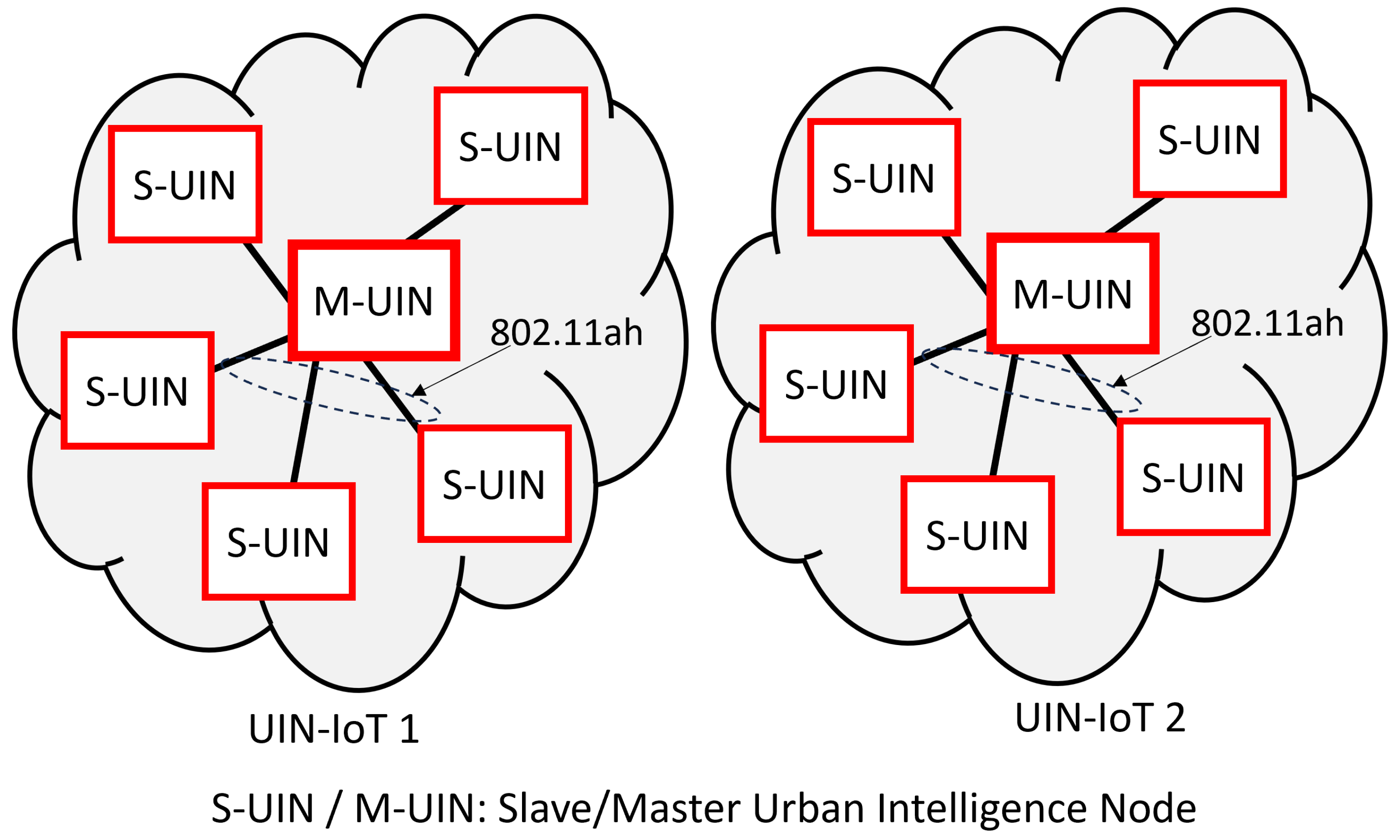
How can potential improvised explosive device (IED) attacks be prevented in this UIN-IoT without MCCC? Upon detecting a potential an IED attack, the chemical-detecting sensor in an UIN sounds an alarm to alert people to stay away from it. What about ensuring that no UIN overflows? Each UIN compresses its content using the highest possible solid waste compression ratio. The city council through its experience uses a scheduled maintenance to empty each bin. At least this network resolves bomb scares and prevent bins from being removed from public places altogether.
This architecture without wide area connections is cheap, simple and fast to implement. However, its response to bomb scares is not real time as it has no MCCC. Therefore, this architecture is best for locations without large crowds and remote areas. For public places such as stadium and festivals, we need a more sophisticated UIN-IoT architecture with MCCC and wide area connections, such as discussed next.
4.4. Satellite Links as WAN Connections
An architecture using satellite links as WAN links to interconnect the M-UINs to the MCCC is shown in Figure 6. In this architecture, the M-UINs are satellite-enabled IoT devices. The M-UINs in turn communicate with the MCCC via the satellite links. As said earlier, the satellite connectivity can be provided by 3GPP’s NB-IoT NTN. This architecture can be used everywhere, and especially suited for bins mounted in areas where there is no terrestrial Internet coverage.
4.5. Terrestrial Wireless Links as WAN Connections
An architecture using terrestrial wireless links as wide area links to interconnect the M-UINs to the MCCC is shown in Figure 7. In this architecture, the MCCC is connected to the Internet. Today, every police station especially in the developed world is connected to the Internet. Each M-UIN is connected to the MCCC via terrestrial mobile links. Most cities have almost 100% terrestrial mobile coverage, making this feasible. Terrestrial mobile networks are part of the Internet. Therefore, it is feasible to use the terrestrial mobile network to provide the needed wide area links.
4.6. Wireless Links Interconnecting UIN-IoT Stations
The sensors mounted on the UINs in the UIN-IoT must be interconnected to at least a monitoring station for real-time response to incidents. The monitoring station or MCCC can be co-located at a local first responder, such as police station or ambulance station, closest to an M-UIN. Wireless connections are the most practically feasible. We have a choice between:
- satellite links, and
- terrestrial links.
Satellite links are specially attractive for UINs mounted in remote locations. Mobile cellular technologies (e.g., 5G) allow massive machine-to-machine communications. Therefore, they can also be exploited.
Satellite IoT (SIOT) are attracting a growing interest. With respect to satellites, we have three choices: LEO, GEO or MEO orbits. LEO orbits have low latency and low path loss. Lower path loss facilitates the use of low-gain and low-directivity antennas. These antennas are small (the lower the gain or directivity, the smaller the antenna), and thus reduce device cost and size. A primary challenge associated with low directivity is ingress and egress electromagnetic interference (EMI) which can be high to disrupt other ambient wireless systems. LEO terminals also require steerable antennas. This can only be done remotely. Knowing the high volumes of solid waste bins mounted in cities, some of which are remotely located, it would be too impractical to deploy manually-steered antennas on UIN-IoT terminals to track the fast-moving LEO satellites.
Path loss and path latency are high with GEO satellites. However, these features require highly directive antennas which liable to low ingress and cause low egress EMI. GEO satellites also require theoretically no tracking at the UIN-IoT Earth station terminals.
5. Implications
The central proposition of this article extends beyond the development of another smart waste management system. Instead, it advocates a paradigm shift in which ubiquitous municipal assets are re-engineered as distributed UINs that simultaneously provide sensing, edge intelligence, communication, environmental monitoring, public safety, and digital services. This perspective has important implications for research, industry, policymakers, and the evolution of AI-native 6G smart-city ecosystems. More broadly, it suggests that the future IoT should not merely interconnect purpose-built sensors, but should increasingly leverage existing public infrastructure to realize sustainable, economically viable, and multifunctional urban intelligence.
5.1. Implications for Research
The UIN-IoT paradigm introduces numerous interdisciplinary research opportunities that span AI, wireless communications, edge computing, sensing technologies, urban informatics, and public policy. From an AI perspective, one important challenge is the development of lightweight multimodal learning algorithms capable of operating reliably on resource-constrained edge devices. Future models must simultaneously reason over heterogeneous data sources, including visual imagery, environmental measurements, chemical signatures, acoustic signals, vibration patterns, and contextual information, while satisfying stringent requirements on inference latency, energy consumption, robustness, and explainability. Although significant advances have been achieved in edge intelligence, reliable multimodal reasoning under highly dynamic outdoor conditions remains an open research problem [6].
Another important direction concerns distributed intelligence within large-scale UIN-IoT deployments. Future metropolitan networks may consist of hundreds of thousands of interconnected UINs that continuously generate multimodal observations. Designing scalable collaborative learning algorithms capable of extracting city-wide knowledge without overwhelming communication infrastructure therefore remains a major challenge. Federated learning, split learning, graph neural networks, semantic communications, and distributed foundation models provide promising directions for enabling geographically dispersed UINs to collectively improve intelligence while preserving privacy and reducing communication overhead [27].
The emergence of AI-native 6G networks further broadens the research landscape. Unlike conventional communication systems that treat networking and intelligence as separate layers, 6G envisions communication, sensing, computing, and AI as jointly optimized resources [7]. Consequently, future UIN-IoT research should investigate integrated sensing and communication, semantic-aware networking, distributed digital twins, intent-driven network orchestration, and autonomous edge intelligence that dynamically adapts sensing, computation, and communication resources according to application requirements. The interaction between distributed UIN intelligence and AI-native network control remains largely unexplored and represents a fertile area for future investigation.
Trustworthy deployment also requires significant advances in cybersecurity, privacy preservation, and responsible AI. Since UINs may participate in safety-critical municipal services, future research must address adversarial robustness, secure edge inference, trusted hardware architectures, post-quantum cryptographic protection, explainable AI, continuous model verification, and resilient distributed learning. Equally important are interdisciplinary studies examining public acceptance, ethical governance, legal accountability, and societal impacts associated with embedding pervasive intelligence into everyday public infrastructure.
5.2. Implications for Practice
The proposed UIN-IoT framework also carries important practical implications for municipalities, telecommunications providers, infrastructure operators, equipment manufacturers, and standards organizations. For municipal authorities, the proposed architecture demonstrates how existing public assets can be incrementally upgraded to provide multiple complementary services without proportionally increasing physical infrastructure. Rather than deploying independent sensing systems for waste management, environmental monitoring, public safety, communication, and infrastructure monitoring, a unified UIN platform offers opportunities to consolidate multiple municipal functions within a common technological ecosystem. Such infrastructure sharing has the potential to improve resource utilization, reduce lifecycle costs, simplify maintenance, and accelerate digital transformation.
For telecommunications service providers, UINs represent an opportunity to complement existing network infrastructure through strategically distributed edge assets. Since suitable urban locations for communication infrastructure are often expensive and difficult to acquire, existing municipal installations provide an attractive alternative for hosting compact communication equipment, edge computing platforms, environmental sensors, and intelligent networking functions. The resulting public–private collaboration could substantially reduce deployment costs while expanding urban digital infrastructure required by future AI-native 6G services.
The proposed paradigm may also stimulate entirely new business ecosystems. Beyond conventional waste collection services, future UIN-IoT deployments may support environmental intelligence, infrastructure analytics, predictive maintenance, public safety services, urban digital twins, location-aware applications, and municipal decision-support systems. These capabilities create opportunities for value-added data services, infrastructure-as-a-service (IaaS) business models, and collaborative smart-city platforms involving municipalities, communication providers, cloud operators, AI developers, and environmental agencies. However, sustainable commercialization will require carefully designed governance structures that clearly define infrastructure ownership, operational responsibilities, data stewardship, liability, and service-level agreements (SLAs) among multiple stakeholders.
The transition from single-purpose public infrastructure to intelligent multifunctional infrastructure also presents regulatory challenges. Existing standards and policies were largely developed for isolated municipal assets rather than AI-enabled cyber–physical systems. Consequently, policymakers and standards organizations must establish interoperable communication protocols, cybersecurity requirements, AI governance frameworks, data-sharing policies, privacy regulations, and certification procedures suitable for large-scale deployments. International standardization efforts within IoT, edge computing, and emerging 6G ecosystems will therefore play an essential role in ensuring interoperability across equipment vendors, municipalities, and communication operators.
While these opportunities are substantial, practical deployment also faces several challenges. Municipal agencies must justify the economic investment associated with upgrading existing infrastructure, particularly where legacy waste management systems continue to function adequately. Long-term maintenance, software updates, hardware replacement, interoperability, workforce training, and lifecycle sustainability require careful planning throughout the deployment process. Demonstrating measurable economic, environmental, and societal benefits through large-scale field trials therefore remains essential for encouraging widespread adoption.
6. Conclusion and Future Directions
This article has presented the concept of the Urban Intelligence Node Internet of Things (UIN-IoT), in which AI-enabled smart bins evolve from conventional waste collection infrastructure into distributed intelligent urban assets capable of simultaneously supporting environmental monitoring, public safety, communication, infrastructure management, and edge intelligence. Rather than viewing public solid waste bins solely as sanitation facilities, this work argues that their ubiquitous deployment, strategic geographical placement, and continuous interaction with urban environments make them valuable physical anchors for next-generation cyber–physical infrastructure. The resulting UIN-IoT paradigm illustrates how existing municipal assets can be repurposed to provide multiple complementary services while supporting broader objectives of sustainability, resilience, digital transformation, and intelligent urban governance.
The proposed vision is particularly timely in light of ongoing developments toward AI-native 6G communication systems. As future wireless networks increasingly integrate communication, sensing, computing, and intelligence into unified architectures, multifunctional public infrastructure such as UINs may become important contributors to distributed edge intelligence and pervasive urban awareness. Their ability to host sensing devices, edge AI, communication modules, and environmental monitoring capabilities positions them as natural components of the emerging “network of everything” envisioned for beyond-5G ecosystems [21]. More importantly, the UIN-IoT paradigm demonstrates that realizing future smart cities does not necessarily require entirely new physical infrastructure; substantial societal benefits may instead be achieved through the intelligent augmentation of existing municipal assets.
Despite this promising vision, the proposed framework remains at an early stage of development and several important challenges must be addressed before widespread deployment becomes feasible. Future work should prioritize large-scale pilot implementations capable of evaluating technical performance, communication reliability, AI accuracy, economic viability, environmental sustainability, and public acceptance under realistic operating conditions. Such deployments would provide valuable evidence regarding lifecycle costs, maintenance requirements, user behavior, scalability, and long-term operational resilience across diverse urban environments.
Standardization also represents a critical prerequisite for practical adoption. Future research should contribute toward open reference architectures, interoperable software platforms, standardized semantic information models, communication interfaces, security frameworks, and AI lifecycle management procedures that facilitate interoperability among heterogeneous vendors and municipalities. Alignment with emerging 6G architectures, edge computing frameworks, digital twin platforms, and AI-native networking standards will further enhance long-term compatibility and future-proof deployment.
Another priority concerns trustworthy and responsible deployment. As UIN-IoT systems become increasingly autonomous, maintaining transparency, fairness, accountability, cybersecurity, and privacy will become equally as important as improving sensing accuracy or communication performance. Future investigations should therefore develop trustworthy AI methodologies that incorporate explainability, uncertainty quantification, secure distributed learning, continuous model validation, and human oversight into operational decision-making. Socio-technical studies examining regulatory compliance, public trust, ethical governance, and citizen participation will likewise be essential for ensuring responsible integration of pervasive intelligence into public spaces.
Finally, future research should investigate how UIN-IoT can evolve alongside emerging technologies including integrated sensing and communication, semantic communications, distributed foundation models, digital twins, autonomous network orchestration, collaborative robotics, and sustainable energy harvesting. These developments may ultimately enable UINs to function not merely as intelligent sensing devices but as autonomous urban service platforms capable of continuously adapting to changing environmental, societal, and operational conditions.
In conclusion, the UIN-IoT paradigm offers a new perspective on the role of public infrastructure in future smart cities. By embedding intelligence into ordinary municipal assets, cities can simultaneously improve environmental sustainability, strengthen public safety, enhance communication infrastructure, and increase infrastructure utilization without proportionally increasing physical deployment. This convergence of AI, IoT, edge intelligence, and AI-native 6G networking represents a promising direction toward resilient, sustainable, and human-centric smart cities that fully exploit the latent potential of existing urban infrastructure.
Author Contributions
Conceptualization, AGA; Methodology, AGA; Software, AGA; Validation, AGA; Formal Analysis, AGA; Investigation, AGA; Resources, AGA; Data Curation–Not Applicable; Writing–Original Draft, AGA; Writing–Review & Editing, AGA; Visualization, AGA; Project Management, AGA; Funding Acquisition–Not Applicable).
Funding
This research received no external funding.
Institutional Review Board Statement
Not applicable.
Informed Consent Statement
Not applicable.
Data Availability Statement
Not applicable.
Acknowledgments
During the preparation of this manuscript, the author used M365 Copilot (based on the GPT-5 chat model) mainly for the purposes of rephrasing parts of the text to correct typos. The same GenAI tool was also used to generate Fig 3. The author has reviewed and edited the output and take full responsibility for the content of this publication.
Conflicts of Interest
The author declares no conflict of interest.
References
- Kaza, S.; Yao, L.; Bhada-Tata, P.; Van Woerden, F. What a waste 2.0: a global snapshot of solid waste management to 2050; World Bank Publications, 2018. [Google Scholar]
- Folianto, F.; Low, Y.S.; Yeow, W.L. Smartbin: Smart waste management system. In Proceedings of the 2015 IEEE Tenth Int. Conf. on Intelligent Sensors, Sensor Networks and Inform. Proc. (ISSNIP), Singapore, 2015; pp. 1–2. [Google Scholar]
- Longhi, S.; Marzioni, D.; Alidori, E.; Di Buo, G.; Prist, M.; Grisostomi, M.; Pirro, M. Solid Waste Management Architecture Using Wireless Sensor Network Technology. In Proceedings of the 2012 5th Int. Conf. on New Technologies, Mobility and Security (NTMS), Istanbul, Turkey, 2012; pp. 1–5. [Google Scholar]
- Zanella, A.; Bui, N.; Castellani, A.; Vangelista, L.; Zorzi, M. Internet of Things for Smart Cities. IEEE Internet Things J. 2014, 1, 22–32. [Google Scholar] [CrossRef]
- Shi, W.; Cao, J.; Zhang, Q.; Li, Y.; Xu, L. Edge Computing: Vision and Challenges. IEEE Internet Things J. 2016, 3, 637–646. [Google Scholar] [CrossRef]
- Zhou, Z.; Chen, X.; Li, E.; Zeng, L.; Luo, K.; Zhang, J. Edge intelligence: Paving the last mile of artificial intelligence with edge computing. Proc. IEEE 2019, 107, 1738–1762. [Google Scholar] [CrossRef]
- Saad, W.; Bennis, M.; Chen, M. A vision of 6G wireless systems: Applications, trends, technologies, and open research problems. IEEE Netw. 2020, 34, 134–142. [Google Scholar] [CrossRef]
- Dang, S.; Amin, O.; Shihada, B.; Alouini, M.S. What should 6G be? Nat. Electron. 2020, 3, 20–29. [Google Scholar] [CrossRef]
- Arroba, P.; Buyya, R.; Cárdenas, R.; Risco-Martín, J.L.; Moya, J.M. Sustainable edge computing: Challenges and future directions. Softw. Pract. Exp. 2024, 54, 2272–2296. [Google Scholar] [CrossRef]
- Mrabet, M.; Sliti, M. Integrating machine learning for the sustainable development of smart cities. Front. Sustain. Cities 2024, 6, 1449404. [Google Scholar] [CrossRef]
- Mrabet, M.; Sliti, M. Towards secure, trustworthy and sustainable edge computing for smart cities: Innovative strategies and future prospects. IEEe Access, 2025. [Google Scholar]
- Gyasi-Agyei, A. Detection of explosives in dustbins using deep transfer learning based multiclass classifiers. Appl. Intell. 2024, 54, 2314–2347. [Google Scholar] [CrossRef]
- Atzori, L.; Iera, A.; Morabito, G. The internet of things: A survey. Comput. Netw. 2010, 54, 2787–2805. [Google Scholar] [CrossRef]
- Anagnostopoulos, T.; Zaslavsky, A.; Kolomvatsos, K.; Medvedev, A.; Amirian, P.; Morley, J.; Hadjieftymiades, S. Challenges and opportunities of waste management in IoT-enabled smart cities: a survey. IEEE Trans. Sustain. Comput. 2017, 2, 275–289. [Google Scholar] [CrossRef]
- Sosunova, I.; Porras, J. IoT-Enabled Smart Waste Management Systems for Smart Cities: A Systematic Review. IEEE Access 2022, 10, 73326–73363. [Google Scholar] [CrossRef]
- Arthur, M.P.; Shoba, S.; Pandey, A. A survey of smart dustbin systems using the IoT and deep learning. Artif. Intell. Rev. 2024, 57, 56. [Google Scholar] [CrossRef]
- Fang, B.; Yu, J.; Chen, Z.; Osman, A.I.; Farghali, M.; Ihara, I.; Hamza, E.H.; Rooney, D.W.; Yap, P.S. Artificial intelligence for waste management in smart cities: a review. Environ. Chem. Lett. 2023, 21, 1959–1989. [Google Scholar] [CrossRef] [PubMed]
- Gubbi, J.; Buyya, R.; Marusic, S.; Palaniswami, M. Internet of Things (IoT): A vision, architectural elements, and future directions. Future Gener. Comput. Syst. 2013, 29, 1645–1660. [Google Scholar] [CrossRef]
- Al-Fuqaha, A.; Guizani, M.; Mohammadi, M.; Aledhari, M.; Ayyash, M. Internet of things: A survey on enabling technologies, protocols, and applications. IEEE Commun. Surv. Tutor. 2015, 17, 2347–2376. [Google Scholar] [CrossRef]
- Zhang, Z.; Xiao, Y.; Ma, Z.; Xiao, M.; Ding, Z.; Lei, X.; Karagiannidis, G.K.; Fan, P. 6G wireless networks: Vision, requirements, architecture, and key technologies. IEEE Veh. Technol. Mag. 2019, 14, 28–41. [Google Scholar] [CrossRef]
- Strinati, E.C.; Barbarossa, S.; Gonzalez-Jimenez, J.L.; Ktenas, D.; Cassiau, N.; Maret, L.; Dehos, C. 6G: The next frontier: From holographic messaging to artificial intelligence using subterahertz and visible light communication. IEEE Veh. Technol. Mag. 2019, 14, 42–50. [Google Scholar] [CrossRef]
- Batty, M.; Axhausen, K.W.; Giannotti, F.; Pozdnoukhov, A.; Bazzani, A.; Wachowicz, M.; Ouzounis, G.; Portugali, Y. Smart cities of the future. Eur. Phys. J. Spec. Top. 2012, 214, 481–518. [Google Scholar] [CrossRef]
- Bowman, D.M.; Balch, J.K.; Artaxo, P.; Bond, W.J.; Carlson, J.M.; Cochrane, M.A.; d’Antonio, C.M.; DeFries, R.S.; Doyle, J.C.; Harrison, S.P.; et al. Fire in the Earth system. science 2009, 324, 481–484. [Google Scholar] [CrossRef] [PubMed]
- Tian, L.; Santi, S.; Seferagić, A.; Lan, J.; Famaey, J. Wi-Fi HaLow for the Internet of Things: An up-to-date survey on IEEE 802.11 ah research. J. Netw. Comput. Appl. 2021, 182, 103036. [Google Scholar] [CrossRef]
- Kanj, M.; Savaux, V.; Le Guen, M. A tutorial on NB-IoT physical layer design. IEEE Commun. Surv. Tutor. 2020, 22, 2408–2446. [Google Scholar] [CrossRef]
- El Jaafari, M.; Chuberre, N.; Anjuere, S.; Combelles, L. Introduction to the 3GPP-defined NTN standard: A comprehensive view on the 3GPP work on NTN. Int. J. Satell. Commun. Netw. 2023, 41, 220–238. [Google Scholar] [CrossRef]
- Kairouz, P.; McMahan, H.B. Advances and open problems in federated learning. Found. Trends Mach. Learn. 2021, 14, 1–210. [Google Scholar] [CrossRef]
Figure 1.
Motivating examples highlighting the competing demands of urban cleanliness and public security: waste accumulation in the absence of public bins, damage caused by an improvised explosive device (IED), and security-driven restrictions on the use of public receptacles during major events.
Figure 1.
Motivating examples highlighting the competing demands of urban cleanliness and public security: waste accumulation in the absence of public bins, damage caused by an improvised explosive device (IED), and security-driven restrictions on the use of public receptacles during major events.
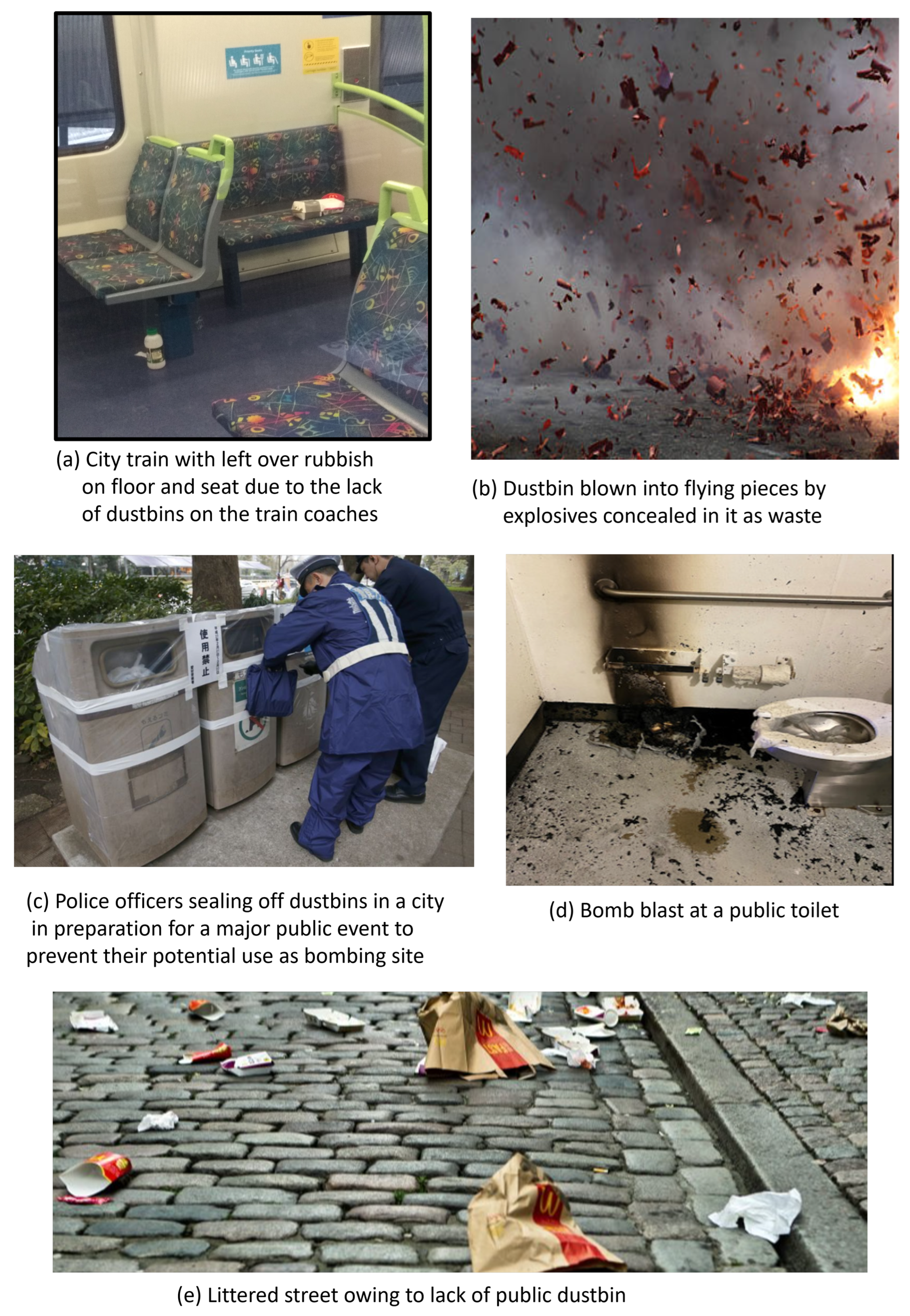
Figure 2.
Conventional waste-bin security measures: (a) transparent waste bin for visual inspection and threat deterrence; (b) blast-resistant waste bin designed to limit damage from explosive devices. Despite their effectiveness, such approaches may introduce cost, space, and deployment challenges.
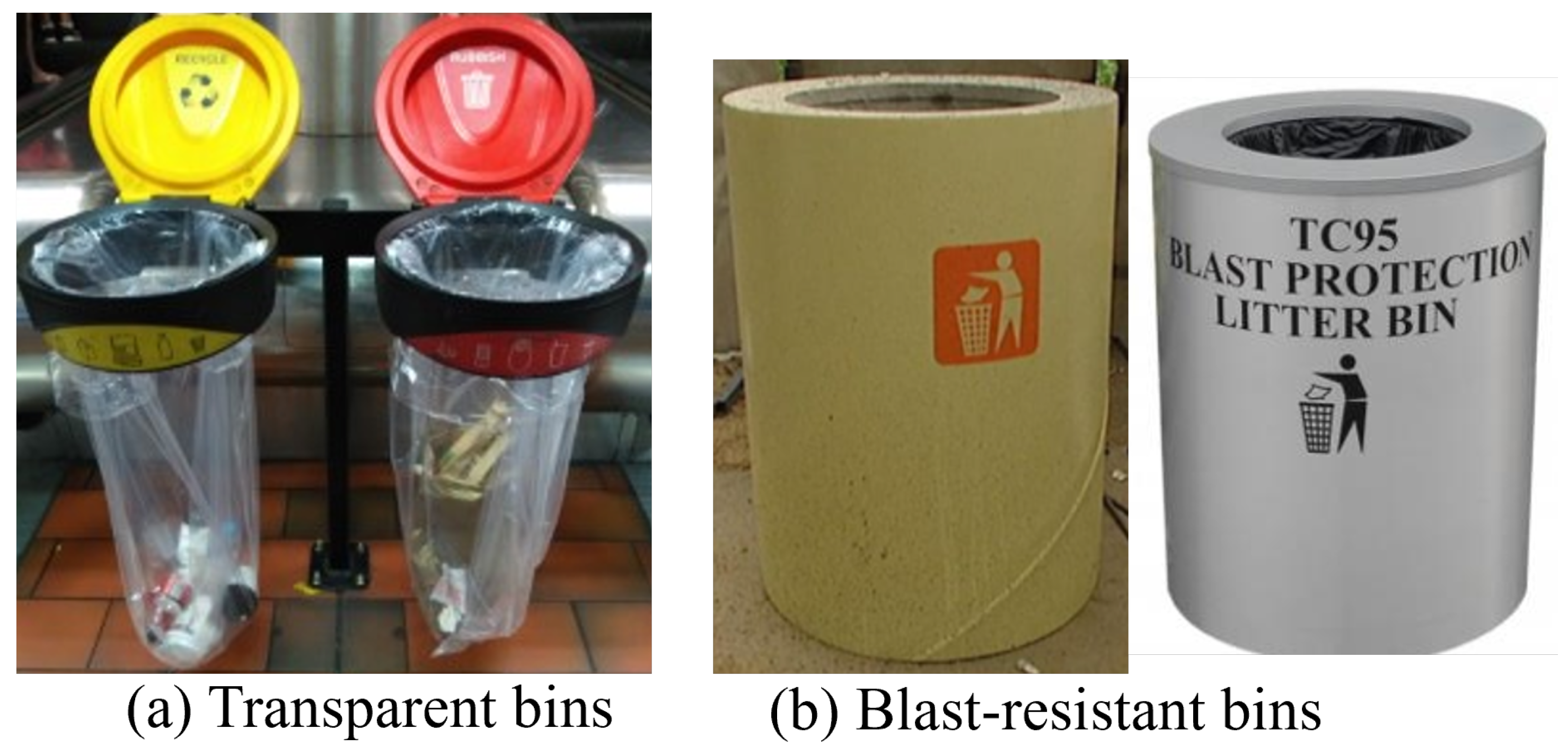
Figure 3.
Urban Intelligence Nodes (UINs) being used as edge nodes for AI inference and as wireless hotspots for computing and communications.
Figure 3.
Urban Intelligence Nodes (UINs) being used as edge nodes for AI inference and as wireless hotspots for computing and communications.
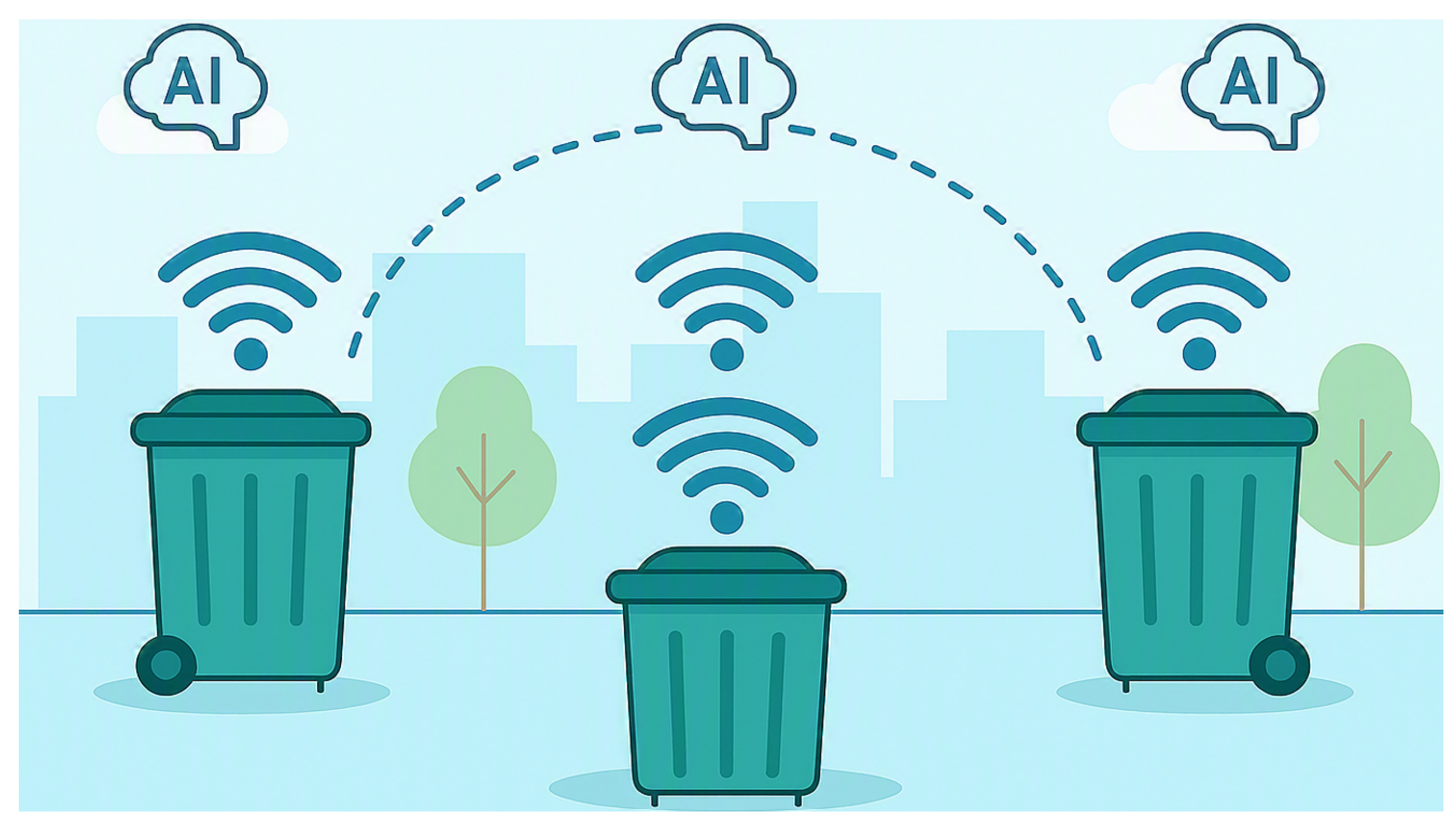
Figure 4.
Proposed UIN-IoT architecture illustrating Urban Intelligence Nodes (UINs) as distributed AI-enabled smart waste systems integrated with edge computing and 6G communication infrastructure. UINs function as multi-purpose urban assets supporting waste management, real-time threat detection, environmental monitoring, and micro base station capabilities, while interfacing with cloud intelligence and smart city services.
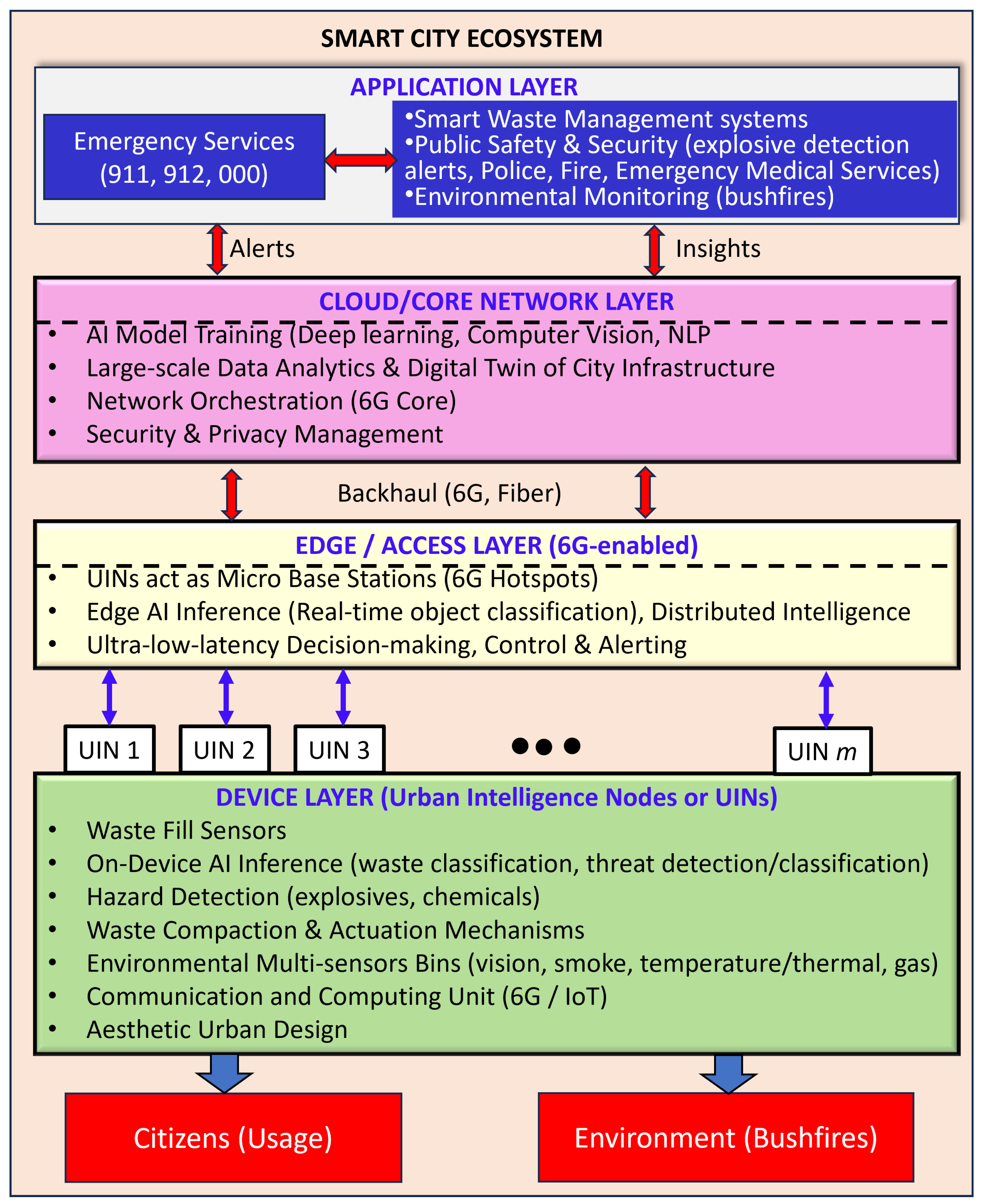
Figure 6.
UIN-IoT architecture 2: using 802.11ah to interconnect the UINs but satellite links to interconnect the M-UINs and the monitoring centre or MCCC.
Figure 6.
UIN-IoT architecture 2: using 802.11ah to interconnect the UINs but satellite links to interconnect the M-UINs and the monitoring centre or MCCC.
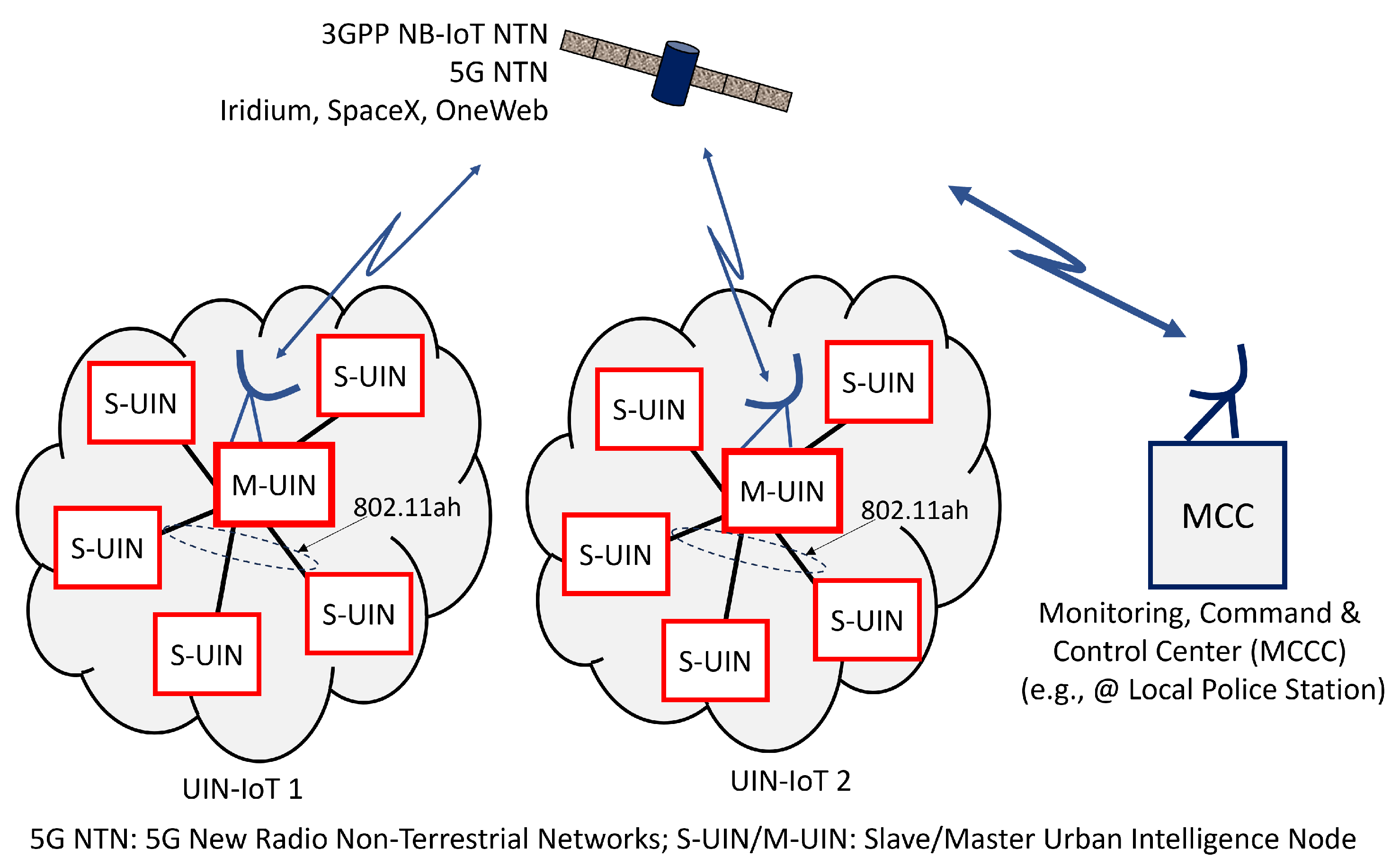
Figure 7.
UIN-IoT architecture 3: using 802.11ah to interconnect the UINs but NB-IoT, optical, satellite or microwave backhaul to interconnect the M-UINs and the monitoring center or MCCC.
Figure 7.
UIN-IoT architecture 3: using 802.11ah to interconnect the UINs but NB-IoT, optical, satellite or microwave backhaul to interconnect the M-UINs and the monitoring center or MCCC.
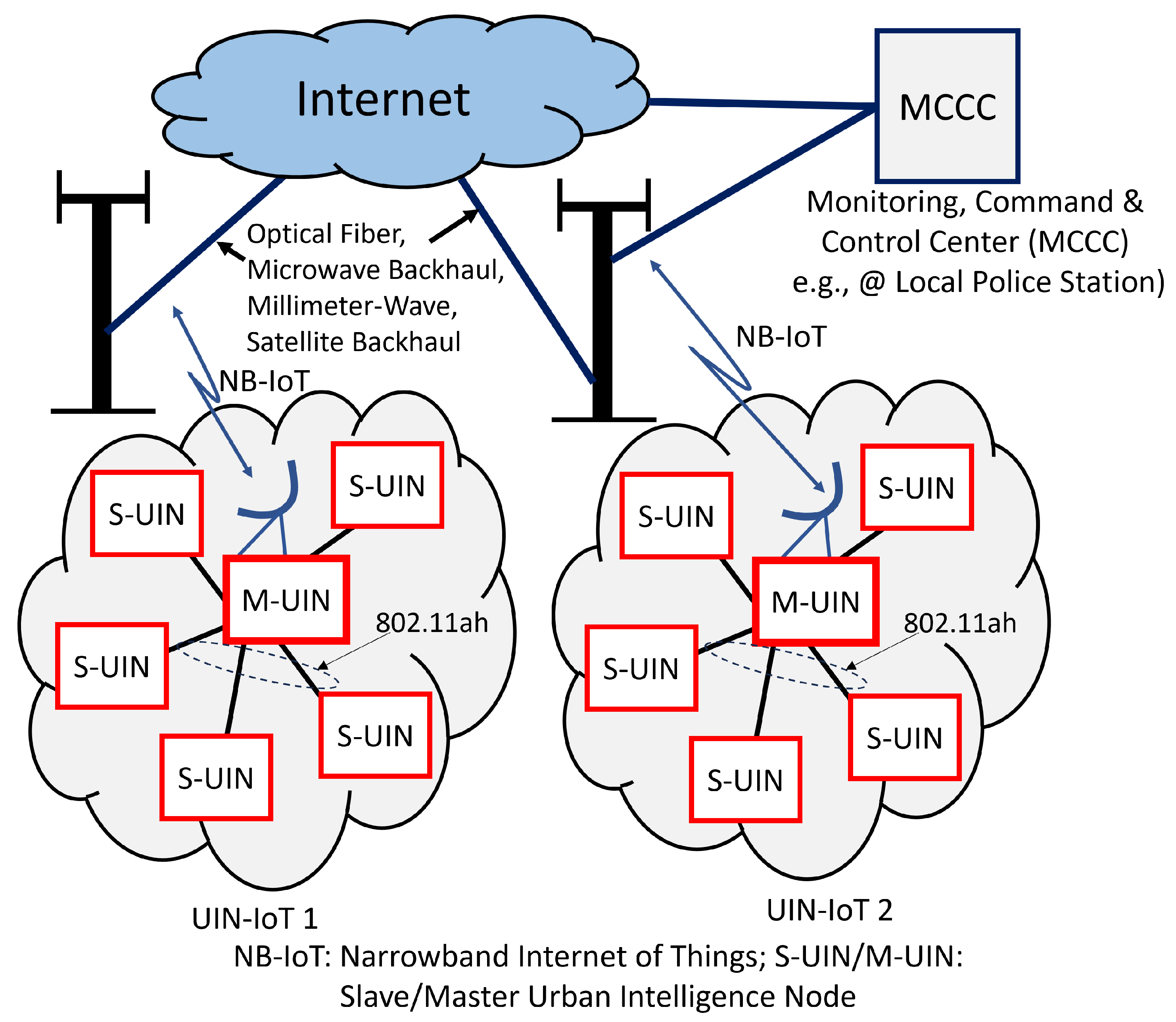

Table 1.
Illustrative Link Budget for a UIN-Based 6G Micro-Base Station.
| Parameter | Value |
|---|---|
| Carrier frequency | 3.5 GHz |
| Transmit power | 30 dBm (1 W) |
| Transmit antenna gain | 8 dBi |
| Receiver antenna gain | 2 dBi |
| Receiver sensitivity | dBm |
| Available link budget | 135 dB |
| Urban path-loss range | 110–125 dB |
| Fade margin | 10 dB |
| Estimated coverage radius | 100–500 m |
| Application | Hotspot / micro-cell coverage |
Disclaimer/Publisher’s Note: The statements, opinions and data contained in all publications are solely those of the individual author(s) and contributor(s) and not of MDPI and/or the editor(s). MDPI and/or the editor(s) disclaim responsibility for any injury to people or property resulting from any ideas, methods, instructions or products referred to in the content. |
© 2026 by the authors. Licensee MDPI, Basel, Switzerland. This article is an open access article distributed under the terms and conditions of the Creative Commons Attribution (CC BY) license (http://creativecommons.org/licenses/by/4.0/).
Copyright: This open access article is published under a Creative Commons CC BY 4.0 license, which permit the free download, distribution, and reuse, provided that the author and preprint are cited in any reuse.