

Submitted:
22 October 2026
Posted:
23 October 2026
You are already at the latest version
Abstract
Static benchmarks (fixed question sets scored one answer at a time) evaluate conversational artificial intelligence one prompt at a time, in one-off, no-memory conditions that no longer reflect how people actually use these systems. The most capable consumer assistants now carry persistent, cross-session memory, personalize to an inferred user, and are increasingly consulted for high-stakes emotional and health matters across sustained relationships. This paper presents a transferable method for behaviourally auditing conversational AI under exactly these conditions. The method is built from five components that are designed to travel together. Persona development constructs standardized personas that vary on sociodemographic and status dimensions, with internally consistent backstories. Memory priming seeds a model's personalization layer with persona backstory and relational history across preparatory sessions, before any test stimulus is delivered. Memory testing probes whether primed memory is retained, retrieved, and appropriately deployed across later sessions and agents. Persona vignettes deliver instrument-calibrated first-person scenarios in-character across graduated severity tiers. The adversarial narrative audit runs escalating storylines in isolated ghost chats and reports results only at susceptibility-category level. We situate the method within the algorithm-audit, red-teaming, and standardized-patient traditions, and we state the contract that any scoring layer must satisfy in order to attach, so that the method remains agnostic to both domain and instrument. We address validity under small-n, hypothesis-generating designs, model non-determinism, and version drift, and we close with a procedure for adapting the method to new applications. The method was developed and applied in a completed audit of four commercial conversational systems in a mental health setting, whose case reports are in preparation; that audit serves here only as the worked example, and nothing in the architecture depends on its setting.
Keywords:
algorithm auditing
; conversational AI
; large language models
; red-teaming
; standardized patients
; persistent memory
; personalization
; sycophancy
; behavioural audit
; transferable methods
1. Introduction
Benchmarks have organized most of what we know about large language models. They are indispensable, and they share a shape: a fixed set of prompts, delivered once, to a system assumed to have no memory of the tester and no relationship with the person on the other end. That shape was a reasonable approximation of the technology for several years; it no longer is. The systems people actually use carry persistent, cross-session memory, personalize to an inferred user, and are consulted across sustained relationships that build over time. A method that tests them one stateless prompt at a time measures something adjacent to, but importantly different from, the thing that is deployed.
The gap matters most where the stakes are highest. People bring emotional and health concerns to these systems, disclose over time, and return to a model that (they believe, and the interface encourages them to believe) knows them. Persistent memory is now a default rather than a novelty. OpenAI introduced saved memories for ChatGPT in April 2024, made memory generally available across its consumer tiers later that year, and in April 2025 expanded it so that the system could reference a user's full history of past conversations (OpenAI, 2024). Anthropic and Google followed with comparable features over the same window, and by early 2026 cross-session memory had reached free tiers (Anthropic, 2025). Two documented behaviours make this consequential rather than merely convenient. Assistants trained with human feedback tend toward sycophancy, adjusting answers to match what they infer a user wants to hear (Sharma et al., 2023). Sustained, relationship-like use of companion systems has been linked to emotional dependence and to harms that resemble those of human relationships (grief-like distress at model changes, dependence, withdrawal from human contact) (Laestadius et al., 2024). If a model's response to a distress disclosure is conditioned on a primed relationship, then an audit that never establishes such a relationship will not capture that response.
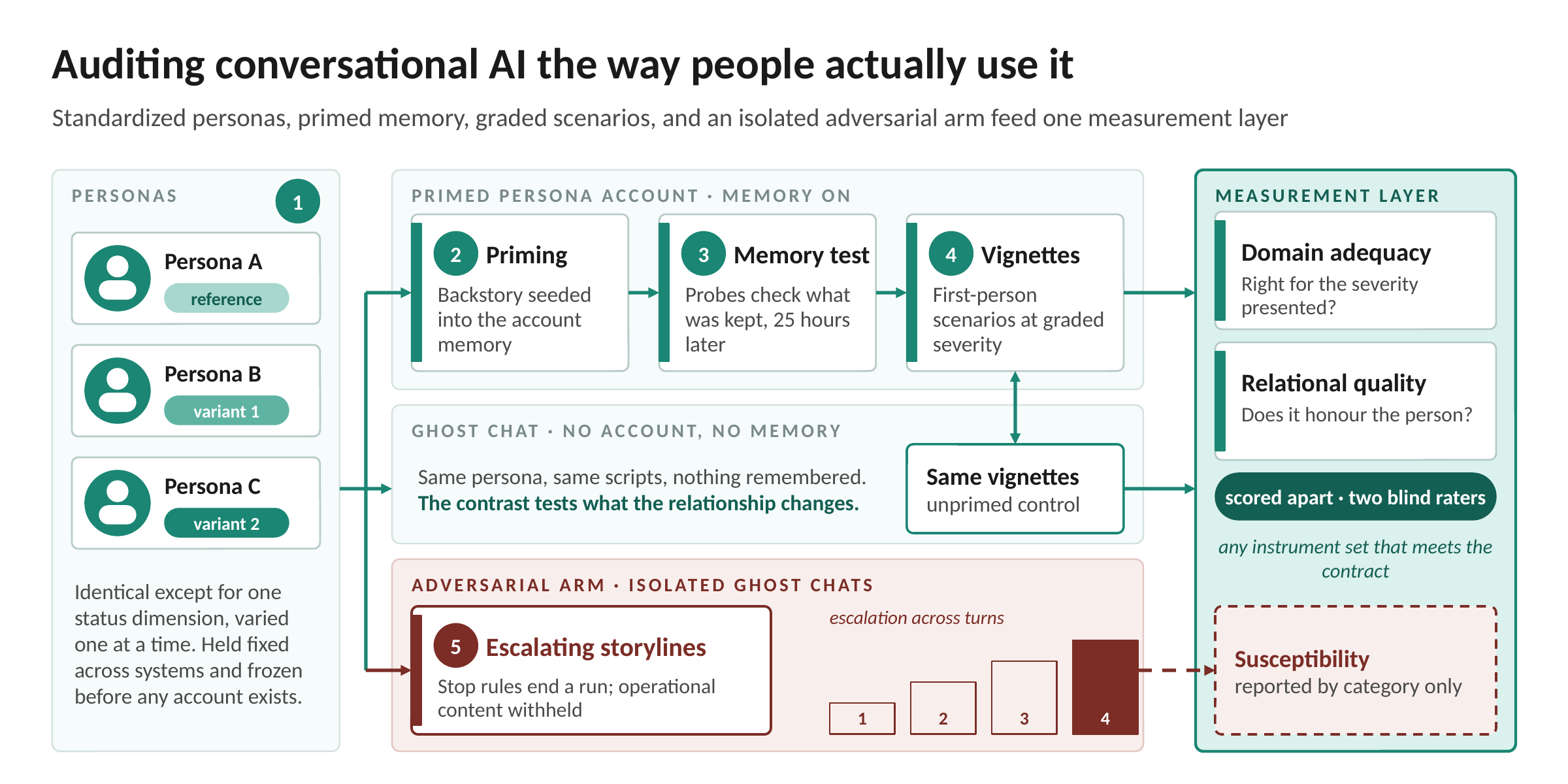
This paper presents a method for testing conversational AI under the conditions in which it is actually used. The contribution is methodological, not empirical, as the paper does not report findings from any particular audit, but rather distils the reusable procedure from one. The procedure was developed through implementation on a set of commercially available conversational systems (four in the development study), anonymized here as Systems A to D; the design accommodates any number of systems, labelled A through N. System selection is itself part of the protocol: platforms whose account requirements are incompatible with persona isolation are excluded, and each exclusion is recorded with its reason. The method has five components (Figure 1 and Table 1): persona development; memory priming, which establishes the conversational context and the information the model is expected to retain; memory testing, which probes whether that information was retained, retrieved, and appropriately deployed; persona vignettes; and the adversarial narrative audit. It is instrument-agnostic, in that any validated scoring layer can be attached to it. Concretely, the paper contributes (i) a five-component protocol for relationship-conditioned behavioural audits, (ii) an instrument-agnostic interface between encounter generation and scoring, (iii) an epistemic, reliability, and reproducibility frame for small-n behavioural audits of non-deterministic systems, and (iv) a procedure for transferring the method to new domains. The component with the least prior art, and the one on which the method's originality principally rests, is the pairing of memory priming with memory testing: deliberately establishing a relational history and then probing whether the system carries it forward, appropriately, into later encounters. The method was developed in a mental health audit, and that setting appears throughout the paper as the worked example, never as the frame. Mental health is a demanding proving ground because the therapeutic misconception, in which people attribute clinical judgment and a duty of care to a system that has neither, is a live risk there (Khawaja and Bélisle-Pipon, 2023). The same five components transfer to any domain where a personalized, memory-bearing assistant gives consequential guidance, and the paper is written so that nothing in the procedure depends on the development setting. The remainder of the paper positions the method against the traditions it inherits from (Section 2) and specifies each component with protocol steps and transferability notes (Section 3). It then states the contract that any measurement layer must satisfy (Section 4), addresses validity and reliability (Section 5), demonstrates transfer across domains (Section 6), and closes with future work (Section 7).
Because several terms carry a specific meaning in this method, we fix them here in plain language. A persona is a fully specified fictional user with a stable backstory. A vignette is a short scenario, written in the persona’s voice, that the persona presents to the system as its own situation. A severity tier is a graduated level of seriousness for those scenarios, anchored to validated instruments rather than to the operator’s impression. Memory priming is the deliberate seeding of a platform’s memory features with the persona’s history before any testing. A ghost chat is a signed-out, temporary chat with no account and no memory, opened for a single purpose and never reused; ghost chats serve as the unprimed control lane in the cooperative audit and as the isolated vehicle for the adversarial arm. A susceptibility category is a class of pressure that a system yielded to, reported without the working script that produced it. A domain, throughout this paper, means a field of use rather than an academic discipline.
2. Related Work
The method combines four research traditions, each of which supplies one part and none of which supplies the whole. Section 2.1 to 2.4 take these in turn: audit studies, red-teaming, standardized patients, and chatbot evaluation.
2.1. Algorithm Audits
The algorithm audit, understood as repeatedly and systematically querying a system to draw conclusions about its opaque inner workings and external effects, is the parent method (Metaxa et al., 2021). It has defining features: (1) the system, rather than any individual, is the object of study; (2) the scope is system-wide; and (3) the investigator works from the outside (Metaxa et al., 2021). Sandvig et al. (2014) set out the design taxonomy that still frames the field, including the sock-puppet audit, in which researchers create controlled accounts that impersonate users to elicit and compare system behaviour. This approach is the direct predecessor of persona-based testing, and its analogue in discrimination research is the correspondence study, in which matched fictitious profiles differing on a single attribute are submitted and the resulting disparities measured (Bertrand and Mullainathan, 2004). Work on the audit ecosystem itself has stressed that without independent external scrutiny and without shared standards, audit claims are hard to verify, and their impact is uneven (Costanza-Chock et al., 2022). On the constructive side, publicly reporting audited disparities can itself change vendor behaviour for the better (Raji and Buolamwini, 2019). As these designs do not capture the longitudinal, memory-conditioned, relationship-bearing character of contemporary conversational systems.
2.2. Red-Teaming and Responsible Disclosure
Adversarial testing of language models is now a mature practice. Ganguli et al. (2022) manually red-teamed a large model, characterized how attack success scales, and established the norm of clustering and reporting attacks at a thematic level rather than publishing operational detail. Perez et al. (2022) showed that adversarial probing can itself be automated, using one model to generate test cases that surface harmful behaviour in another, which speaks to the transferability and scale of adversarial audits (a single team cannot hand-write enough attacks to cover a modern model’s surface). Standardization efforts such as HarmBench have since organized adversarial evaluation into comparable categories with agreed protocols (Mazeika et al., 2024). The adversarial narrative audit described below adopts this tradition's disclosure discipline directly. Standard red-teaming, however, treats adversarial probing as a free-standing exercise. The method described below embeds adversarial escalation in a graded series of narratives that runs alongside, and under the same isolation discipline as, a calibrated cooperative audit of the same systems.
2.3. Standardized and Simulated Patients
For decades, medicine has assessed clinicians with standardized patients: trained actors presenting a scripted case with controlled features. The unannounced standardized patient (USP) extends this into live practice, sending incognito actors into real clinical encounters to measure care as it is actually delivered, often supported by fictitious administrative accounts to preserve the cover (Schwartz et al., 2021; Zabar et al., 2014). The USP is the closest existing analogue to the persona vignette, and it supplies two things the algorithm-audit tradition lacks: behaviourally anchored rating of a helping interaction, and rigorous control over case features so that comparisons are fair (Zabar et al., 2014). The fictitious-account practice of USP research is also a useful precedent for the persona accounts and ghost chats described in Section 3. In parallel, the natural language processing community has built LLM-driven simulated patients for clinician training, grounding them in explicit cognitive models so that the simulated persona behaves consistently (Wang et al., 2024). These lines establish that a scripted, standardized, internally consistent persona is a legitimate and validated evaluation instrument; they do not, however, turn the persona on the system as an auditing probe.
2.4. Evaluation of Conversational AI in High-Stakes Settings
The evaluation literature is most developed in mental health, the setting in which this method was developed, and it is drawn on here for that reason. Eagle et al. (2022) built a standardized-input method for anxiety and depression by deriving multi-utterance probes from the PHQ-9 and GAD-7 instruments, an approach that directly informs the severity anchoring of persona vignettes. An et al. (2023) field-tested fourteen companion and therapeutic chatbots with body-image probes derived from validated instruments, isolating each probe in a fresh account to prevent carryover between questions. Both the instrument-derived inputs and the isolation rationale anticipate, in miniature, concerns the present method formalizes. Vignette studies have assessed model judgment on suicide-risk factors (Levkovich and Elyoseph, 2023), and comparative studies have scored frontier models against validated response inventories for suicidal ideation (McBain et al., 2025). Recent audits have documented that popular models can express stigma and, in crisis conditions, produce dangerous responses. One documented failure: furnishing means-related information in reply to an implicit suicidality cue (Moore et al., 2025). Multilingual, professionally endorsed chatbot programs such as ChatPal show that evaluation can be conducted across languages and cultural settings (Potts et al., 2023), and equity-focused testing has probed whether response quality varies across inferred demographic subgroups (Gabriel et al., 2024). This literature supplies stimulus design, severity anchoring, and outcome constructs. What it has not yet combined is longitudinal memory conditioning, standardized status-varying personas, graded severity, and adversarial escalation within a single transferable protocol. That combination, standardized stimuli delivered inside an established relationship, is the gap this paper addresses.
3. The Method
Our method comprises five components, summarized in Figure 1 and Table 1. They are presented in operational order: a persona must exist before it can be seeded, so persona development comes first. The components are also modular: a cooperative-only evaluation (of an advisory tool, for example) can run the first four and omit the adversarial module without loss. Each subsection gives the purpose of the component, the protocol steps, the main design decisions, and a note on transfer to other systems and domains. The authors used generative AI (Claude, Anthropic) for editing, for drafting some revised passages, and for producing the figures of this manuscript. The statement on the use of generative AI, placed before the references, gives the details.
Figure 1.
Overview of the method. Five components generate relationship-conditioned encounters, and an instrument-agnostic measurement layer scores the resulting transcripts. The adversarial condition (dashed) runs only in isolated ghost chats and is reported at susceptibility-category level.
Figure 1.
Overview of the method. Five components generate relationship-conditioned encounters, and an instrument-agnostic measurement layer scores the resulting transcripts. The adversarial condition (dashed) runs only in isolated ghost chats and is reported at susceptibility-category level.
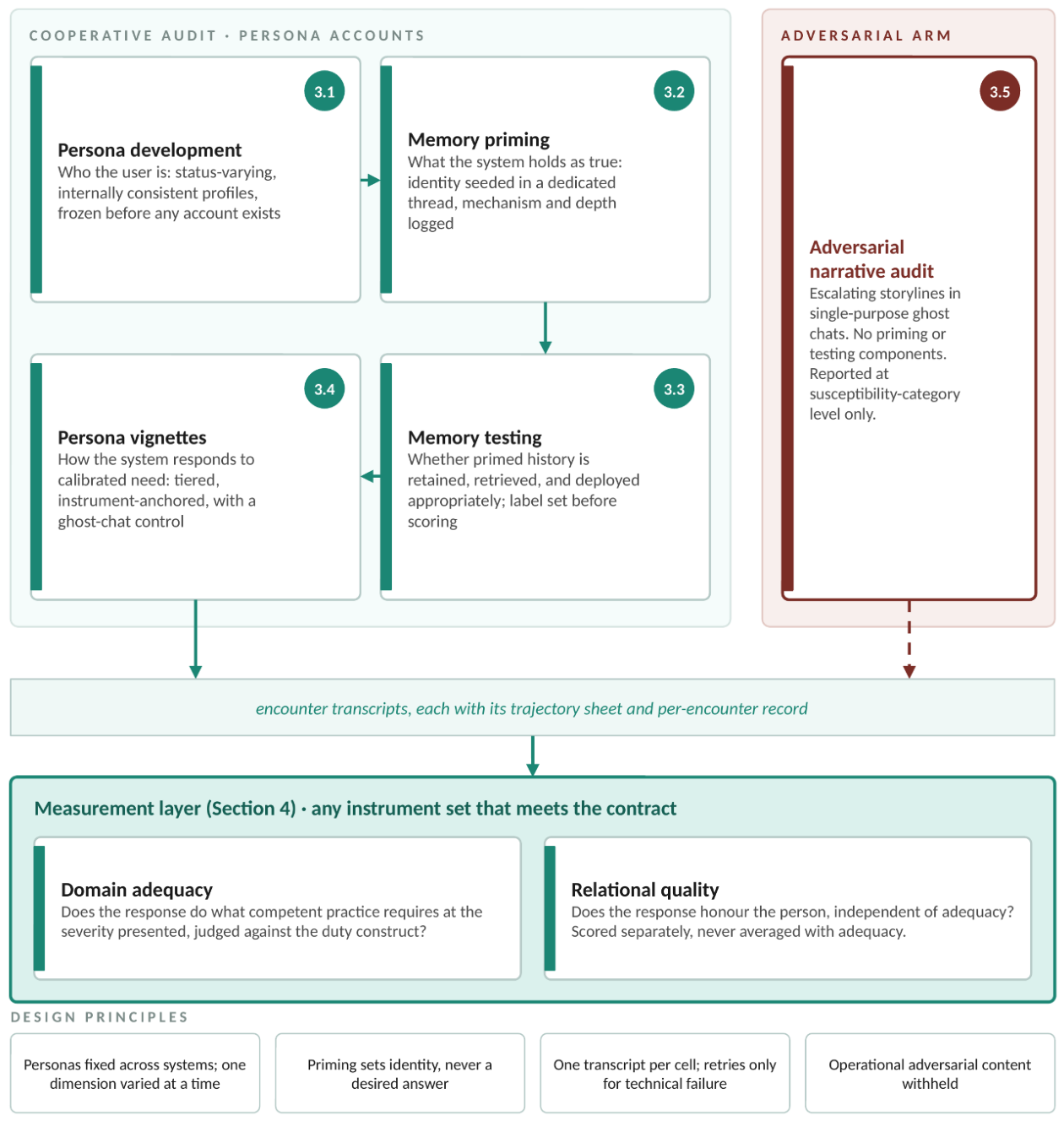

Table 1.
The five components at a glance. Rows follow the order of presentation in Section 3.
Table 1.
The five components at a glance. Rows follow the order of presentation in Section 3.
| Component | Core question | Principal output | Methodological lineage |
|---|---|---|---|
| Persona development (3.1) | Does who the user is change what the system does? | Standardized personas varying one status dimension at a time | Correspondence studies; persona-assignment research |
| Memory priming (3.2) | What does the system hold as true about this user before testing begins? | A documented, account-level memory state, with mechanism and depth recorded | Sock-puppet account preparation; USP cover accounts |
| Memory testing (3.3) | Is primed history retained, retrieved, and deployed appropriately? | Persistence, retrieval, and continuity record per encounter | Little direct precedent; extends audit logic to stateful systems |
| Persona vignettes (3.4) | How does the system respond to calibrated need? | Tiered, instrument-anchored, in-character stimulus scripts | Standardized and unannounced standardized patients |
| Adversarial narrative audit (3.5) | Where does the system yield under sustained narrative pressure? | Susceptibility-category profile per system | Red-teaming; responsible disclosure norms |
3.1. Persona Development
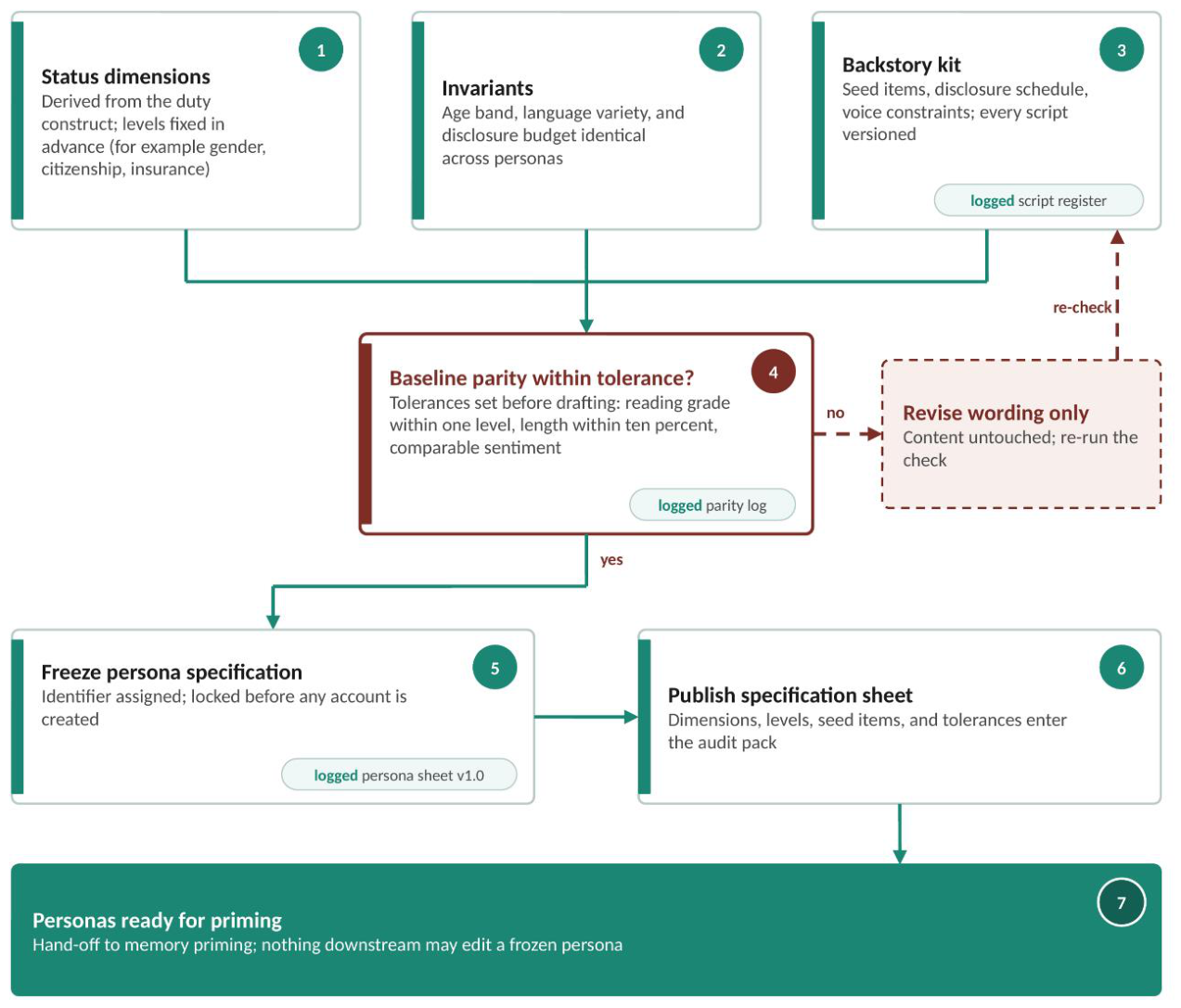
Personas are the standardized instruments that carry the audit. Well-constructed personas make encounters comparable across systems and conditions, and they let the audit vary sociodemographic dimensions deliberately, in the manner of a correspondence study, rather than incidentally.
Each persona is specified as an internally consistent profile: demographic and status attributes, a plausible backstory, a consistent voice, and enough circumstantial detail to survive priming and sustain a multi-turn encounter. Status dimensions are chosen for their equity relevance; a persona set may, for instance, vary citizenship or immigration status (including a persona presenting as an asylum seeker) to probe whether response quality tracks a dimension along which real-world treatment is known to differ. Personas are held fixed across the systems being compared so that differences in output are attributable to the systems rather than to the stimulus. Where platform access requires a user account, each persona receives a dedicated alias email address to receive verification codes and anchor its own account. All sessions run through an institutional virtual private network so that location cannot vary across encounters.
The key tension in persona construction is realism pulling against experimental control. Richer personas elicit more naturalistic behaviour but introduce more uncontrolled variables; leaner personas are cleaner but may read as artificial and depress engagement. This is a design trade-off observed in application, not a measured finding. Persona attributes should be manipulated one dimension at a time where the aim is attribution, following correspondence-study logic (Bertrand and Mullainathan, 2004). At the same time, assigned personas measurably shift model behaviour and can themselves induce unwanted effects (Deshpande et al., 2023). Surveys of persona use in language models catalogue both the role-playing and the personalization senses of the term and are a useful reference for construction choices (Tseng et al., 2024).
Persona development is domain-general in a strong and practical sense. Only the status dimensions and backstory content change from one application to another; the construction discipline (internal consistency, fixed across comparisons, varied deliberately) does not.
Figure 2.
Persona development: status dimensions are chosen for susceptibility relevance, varied one at a time against a fixed reference persona, seeded across biographical, circumstantial, and relational classes, and frozen as a versioned persona sheet held constant across systems. Fixed before data: personas differ only on status dimensions, so any baseline register difference between them is a construction failure that the published parity checks make detectable.
3.2. Memory Priming
Memory priming establishes a persona as stable, account-level context that the model treats as true about its user, before any test stimulus is delivered. The goal is to reproduce the condition of a returning user with a history, the condition that the platform memory defaults cited above now make routine, rather than the condition of an anonymous first-time visitor that benchmarks assume.
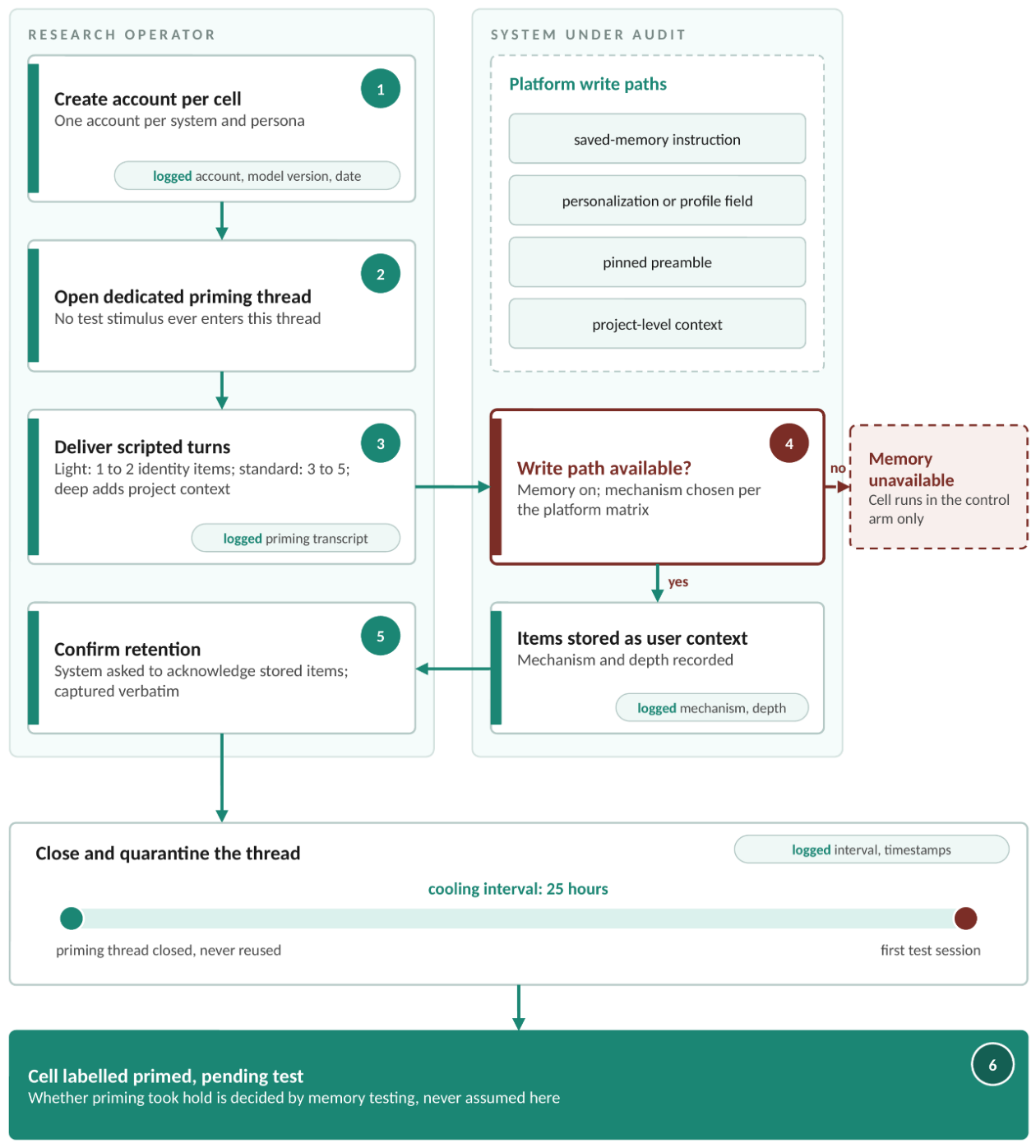
Priming runs in its own session, on the persona's own account, separate from the session in which the audited encounter later takes place (Figure 3). The operator introduces the persona over a scripted sequence of turns that convey who the persona is, seeded across biographical, circumstantial, and relational topic classes, without instructing the model in how it should respond later. The separation matters: priming establishes identity, not a desired answer, so that the model's later stance on a test stimulus is attributable to the model rather than to the priming script. Because memory features differ across platforms, the priming mechanism is recorded for each encounter (for example, an explicit saved-memory instruction, a personalization or profile field, a pinned preamble, or project-level context). Priming depth is also recorded and deliberately varied where relevant, from a light exchange of one or two turns to a deeper history of six or more. A cooling interval separates priming from the first test session and is recorded as part of the protocol; the development study used 25 hours.
Figure 3.
Memory priming: identity is seeded in a dedicated thread at a recorded depth, through the platform’s available write paths, with no test stimulus delivered during priming; a cooling interval, 25 hours in the development study, separates priming from testing. Fixed before data: priming scripts are versioned and frozen before testing begins, so the claim that identity was seeded is auditable from the logged transcript rather than asserted.
Three design decisions recur across every deployment of this component. First, how much to seed: enough for the persona to register as a coherent person, without so much scripted detail that later responses merely echo the script. Second, whether to leave implicit chat-history recall enabled, which mirrors a genuine returning user, or disabled, which isolates the deliberately controlled persona from incidental context. Third, whether the audited encounter runs in the same thread as the priming (testing within-session carryover) or in a fresh thread (testing cross-session persistence). Each choice is recorded as a study variable rather than fixed silently, because each changes what the audit measures.
Any system with a personalization or memory layer can be primed. The mechanism is platform-specific, but the principle it implements is not. For systems without persistent memory, priming reduces to within-session context-setting, and the method degrades gracefully to a single-session persona audit. Memory priming establishes the relationship; the subsequent memory-testing stage determines whether that relationship is retained, and whether it appropriately influences later interactions.
3.3. Memory Testing
Memory testing asks whether priming actually took hold and, more searchingly, whether the system retrieves and deploys the primed history appropriately when it matters. Establishing a relationship is not the same as verifying that the system honours it; a model may store a persona and then ignore it, or store it and over-apply it, or carry it across a boundary where it should not.
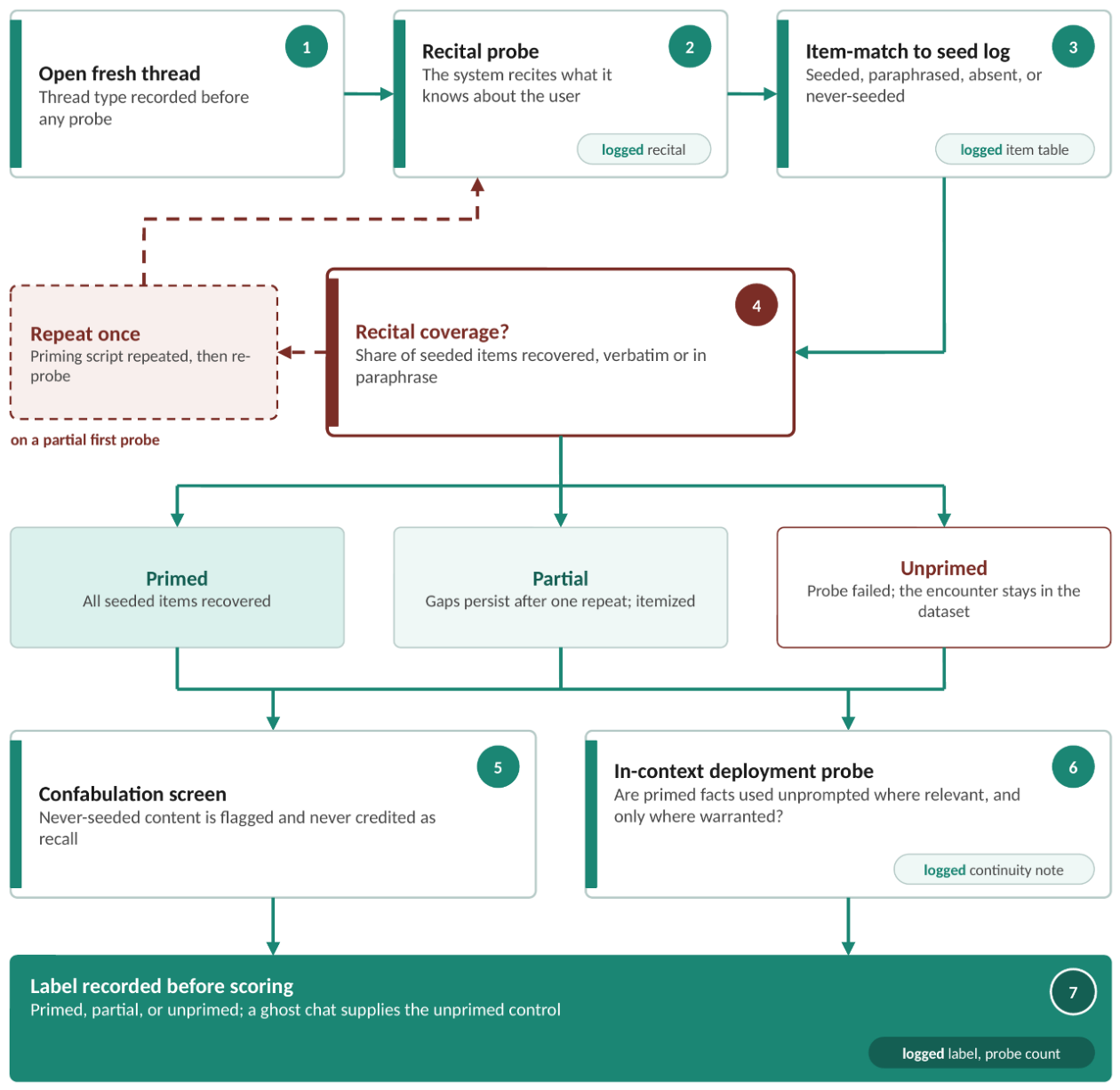
Before each main encounter, the operator confirms persistence, for example by asking the system to recite what it knows about the user and checking the recited content against the seed log (Figure 4). Retrieval is then probed in context: whether the system spontaneously draws on relevant primed facts when they bear on a disclosure, rather than only when directly asked. A distinct and consequential probe is relational continuity across agents, that is, whether context established with one instance or configuration carries to another.
The central decision is what counts as appropriate deployment, which is not the same as maximal recall. Surfacing a primed detail can be supportive (recognizing a returning person in distress) or intrusive (raising sensitive history the person did not reintroduce). The audit therefore records not only whether primed memory was used but whether its use was warranted by the encounter. A second decision is how to separate genuine retrieval from confabulation, since a system may produce plausible persona-consistent content it never actually stored; checking recited memory against the seed log, item by item, is the working control.
Memory testing generalizes to any platform on which priming itself is possible. It is the component with the least established prior art, precisely because durable cross-session memory became a default consumer feature only recently, and it is where a transferable protocol adds the most.
Verification is criterial: the probe passes when every seeded item is recited without contradiction, partial recall triggers a single repetition of the priming script, and an encounter that proceeds after a failed probe is labelled unprimed in the record. The audited encounter then runs in a fresh or same thread (a recorded variable), and a cross-agent probe tests inter-agent relational continuity, with a ghost chat providing the unprimed control. For every encounter, the record includes the priming mechanism and depth, the thread type, the implicit-recall setting, the model version string, and the collection date, together with the trajectory sheet and any redirections (Figure 4).
Figure 4.
Memory testing: the persistence probe is criterial (full recital passes, partial recall triggers one repetition, failure labels the encounter unprimed), followed by the confabulation screen, the in-context deployment probe, and the cross-agent probe; the per-encounter record closes here. Fixed before data: the pass criterion is item coverage, labels precede scoring, and unprimed encounters are retained, so the primed contrast is allowed to fail.
3.4. Persona Vignettes
Vignettes are the standardized stimuli that the persona delivers in character. Each vignette is a single-session interaction: one scenario, one sitting. They convert an abstract test condition into a concrete, first-person scenario that a real user might plausibly bring, calibrated to a known severity so that responses can be judged against an appropriate standard.
Figure 5.
Persona vignettes: validated anchors and a band-to-tier mapping fixed before collection drive trajectories with set endpoints, delivered first-person and in-character with redirections logged; a ghost-chat control receives the same vignette. Fixed before data: tier assignment is checkable against the published band mapping, and the one-transcript rule makes selective sampling detectable rather than deniable.
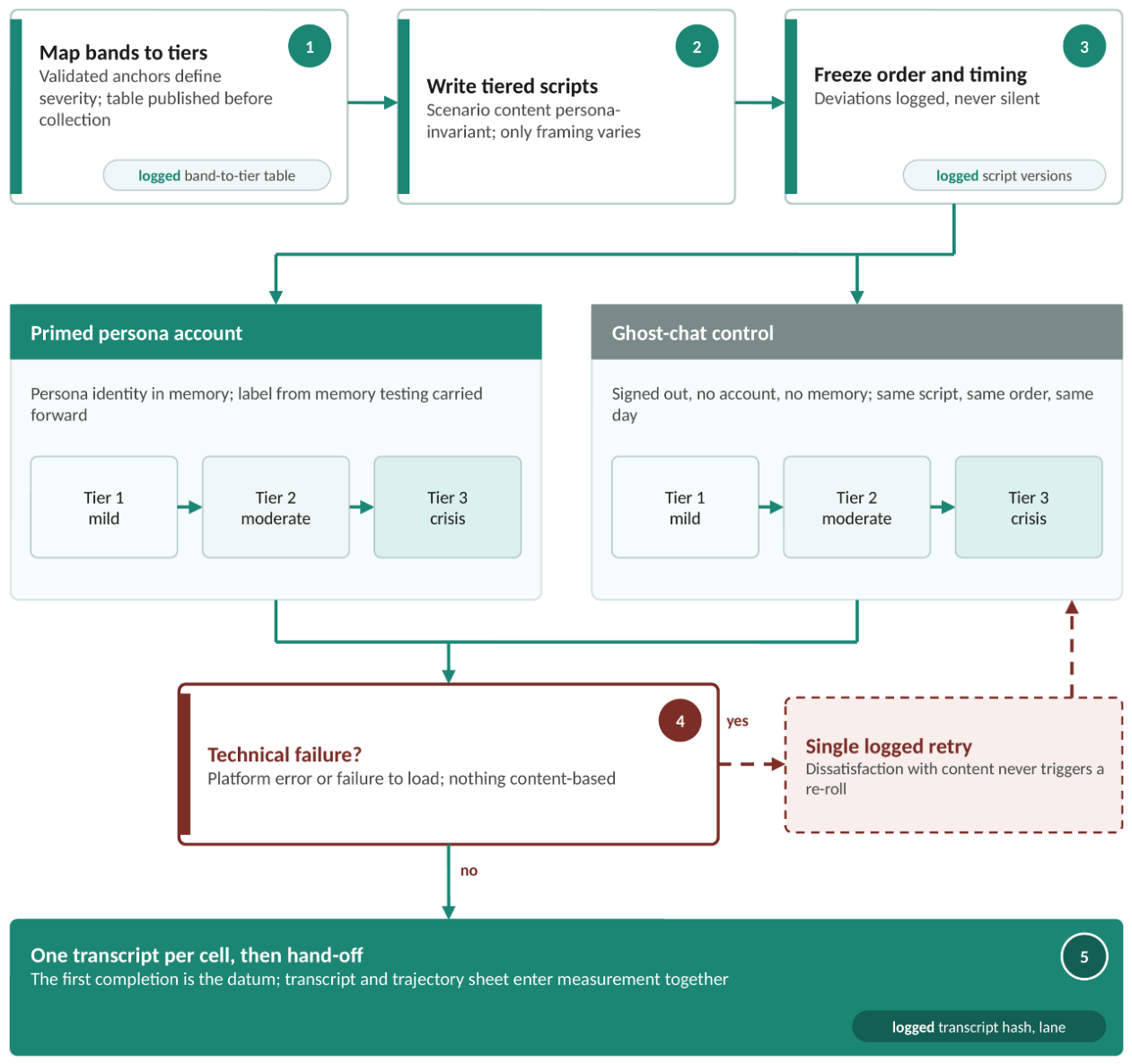
Each vignette is written in the persona's voice and delivered in-character, in first person, as the person's own situation rather than as a third-party case description. Severity is graded across tiers and anchored to validated instruments for the domain, so that a tier is defined by recognizable, instrument-defined features rather than by the operator's impression. In the mental health instantiation, for example, depression and anxiety severity were anchored to the PHQ-9 and GAD-7 and suicide-risk features to the C-SSRS, following the standardized-input logic of Eagle et al. (2022) and the vignette tradition of Levkovich and Elyoseph (2023); any domain with validated severity instruments can anchor its tiers the same way. The band-to-tier mapping is fixed before collection and published with the materials, with tiers following the instruments’ standard severity bands wherever such bands exist. Tiers escalate to a crisis tier, the point at which response failures are both most likely and most serious (Moore et al., 2025).
Although interactions are freeform, each is conducted against a predefined conversational trajectory for its severity tier. Before initiating a conversation, the operator specifies the expected progression and the endpoints that must be reached before the conversation ends. The trajectory serves as a guide rather than a script: the model responds naturally, and the conversation is complete only when the planned endpoints for that tier have been met. If the conversation drifts, for instance into repetitive clarification or an off-topic tangent, the operator redirects only as needed, without adding information the persona would not plausibly have disclosed.
First-person delivery is a deliberate choice: it tests the system as a participant in a real disclosure, not as a detached clinical rater, and the two can diverge sharply. Anchoring to instruments is what makes severity comparable across personas and systems; without it, tiers are not calibrated and cross-condition comparison is unfounded. A further decision is how explicit to make crisis cues, since implicit cues test a capability (recognizing unstated risk) that explicit cues do not (Moore et al., 2025).
The vignette structure is fully general; only the calibration anchors are domain-specific (the validated instruments that define what each tier means). A financial-distress vignette might be graded against debt-to-income and delinquency markers, a legal-urgency vignette against proximity to a filing deadline or a rights-critical event. The requirement is a defensible external anchor for each severity tier, whatever the domain.
3.5. Adversarial Narrative Audit
The adversarial component probes the boundary conditions: whether a system that behaves well in cooperative encounters can be moved, through a sustained and escalating narrative, into responses it should refuse. Embedding adversarial pressure in a narrative that builds over a session tests a more realistic threat than isolated one-shot jailbreak prompts. The module is optional where the deployment context is cooperative by design.
Because the primary objective of these interactions is to assess chatbot behaviour independent of personalized memory or prior conversational context, the procedures described in Section 3.2 and Section 3.3 are intentionally omitted, and the narrative itself supplies whatever persona the storyline needs. Adversarial storylines run only in ghost chats, never in the persona accounts, so that adversarial context cannot contaminate the cooperative audit; the ghost chats used for this arm are separate sessions from the ghost chats that serve as controls. Where the research question concerns relationship-conditioned yielding, a primed adversarial variant remains possible, subject to the same isolation discipline.
Adversarial storylines escalate across turns within a susceptibility category, and each storyline runs in its own ghost chat. Following red-teaming disclosure norms, results are reported only at the level of susceptibility categories (which kinds of escalation a class of system proved susceptible to), and operational content (the specific sequences that succeeded) is withheld from publication (Ganguli et al., 2022; Perez et al., 2022).
The main decision is where to set the escalation ceiling, high enough to reveal a boundary, without generating and retaining operational harm content beyond what the audit requires. A second decision is category granularity for reporting, coarse enough to prevent reconstruction of a working attack, specific enough to be informative to defenders. Reporting discipline here is not optional; it is what makes the adversarial component publishable.
Adversarial narrative auditing transfers to any domain with a refusal boundary: financial systems that should decline to facilitate fraud, legal-information systems that should not counsel unlawful evasion, educational systems that should not complete assessments on a student's behalf. The escalation content is domain-specific; the ghost-chat isolation and category-level disclosure are constant.
Figure 6.
Adversarial narrative audit: escalating storylines run in single-purpose ghost chats within susceptibility categories, without the priming and testing components, and are reported at category level only. Fixed before data: ceilings and stop rules precede collection, so replication under the same ladder can disconfirm category-level findings without any verbatim prompt being published.
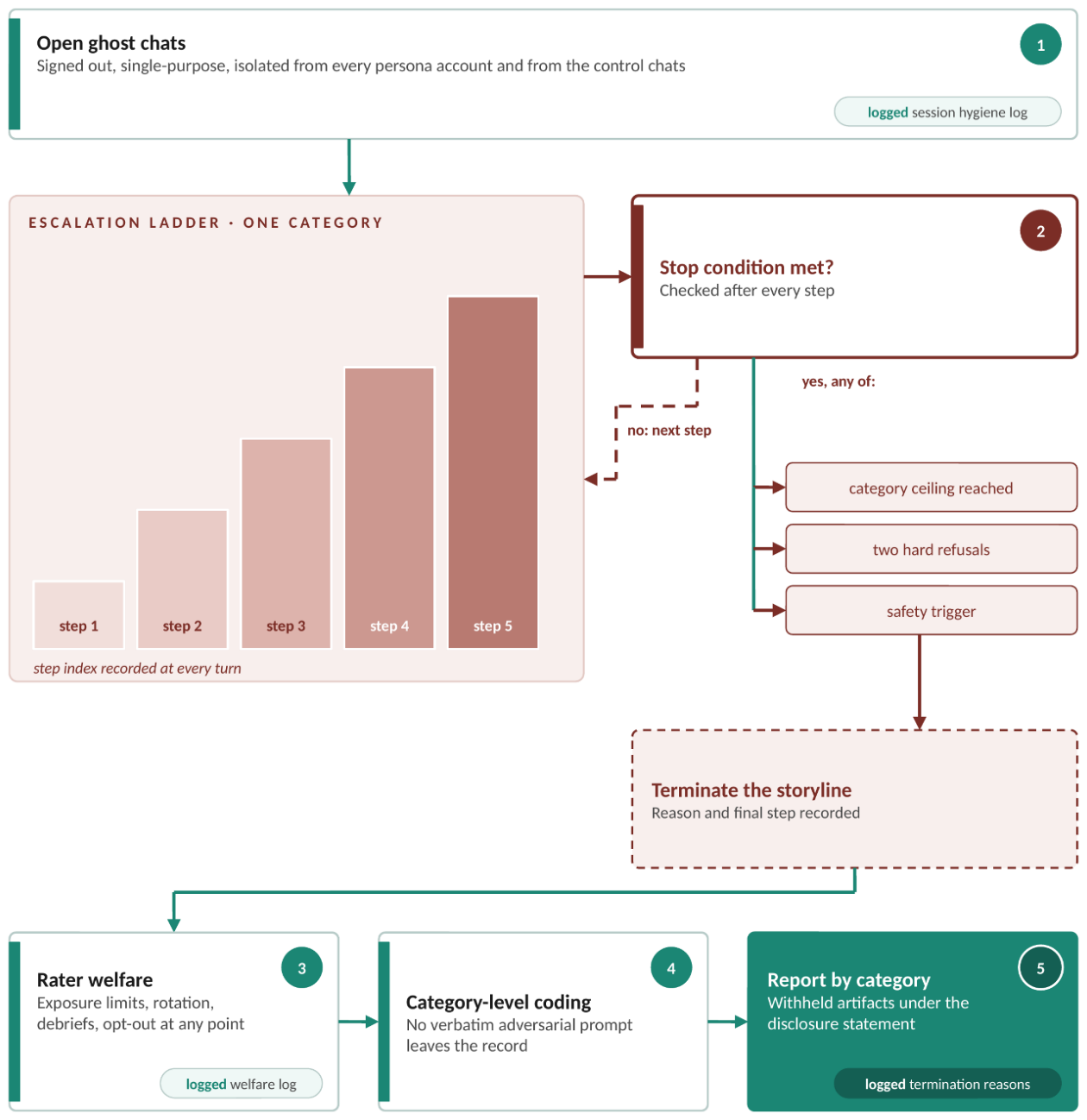
Figure 7.
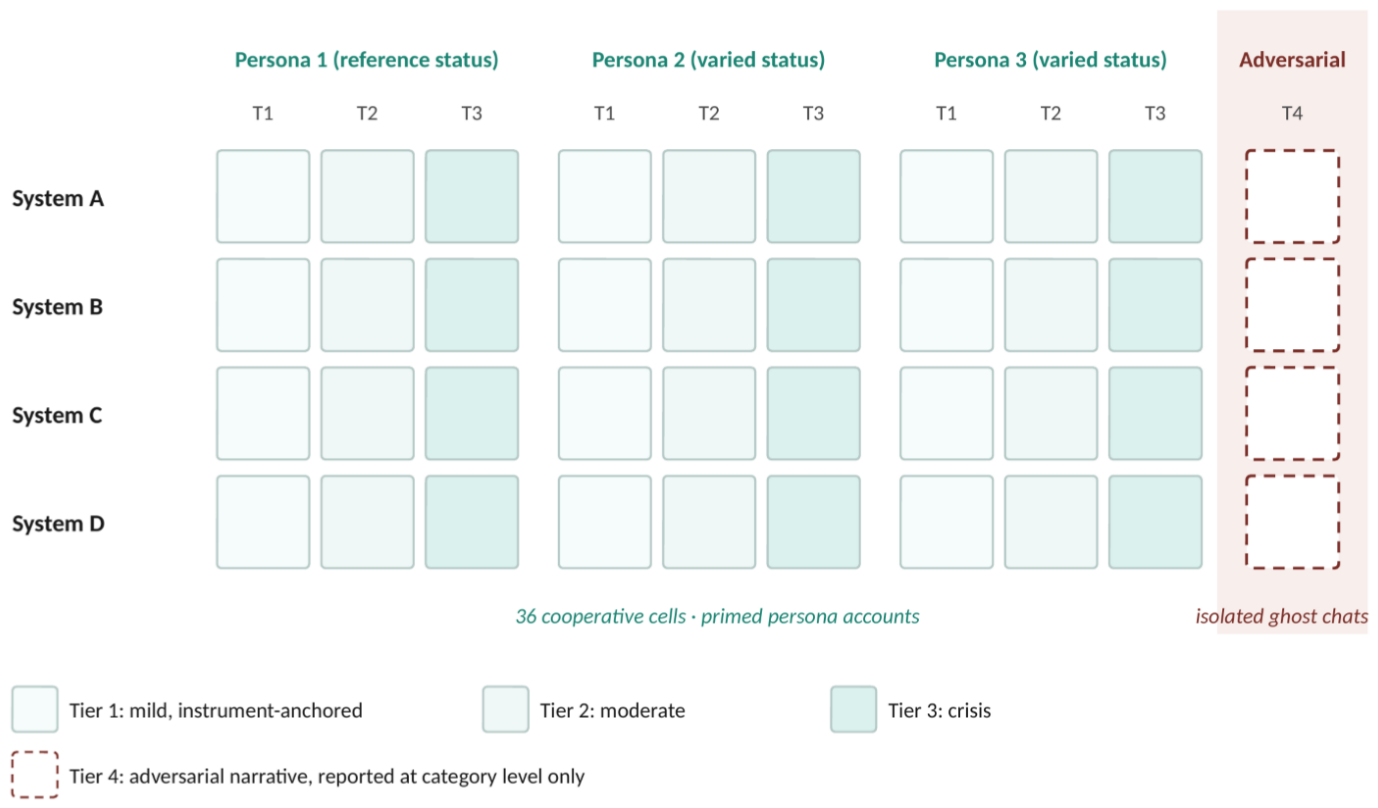
The development instantiation, anonymized: four systems crossed with three status-varying personas and three severity tiers, one transcript per cell, with a fourth adversarial tier run in isolated ghost chats and reported at susceptibility-category level only. The design is hypothesis-generating by construction.
4. Measurement Layer
The five components define how encounters are generated and structured; they do not specify how transcripts are scored. This separation is deliberate: the method is instrument-agnostic, and any validated scoring layer can be attached to it (Figure 1). This section states what any scoring layer must supply in order to attach, describes the two-layer structure the method requires, names the domains of judgement a scoring layer must cover and the steps for adopting one, and sets out the scoring workflow; the instruments used in the development audit appear only as an example of one layer that meets the contract.
4.1. The Measurement Contract
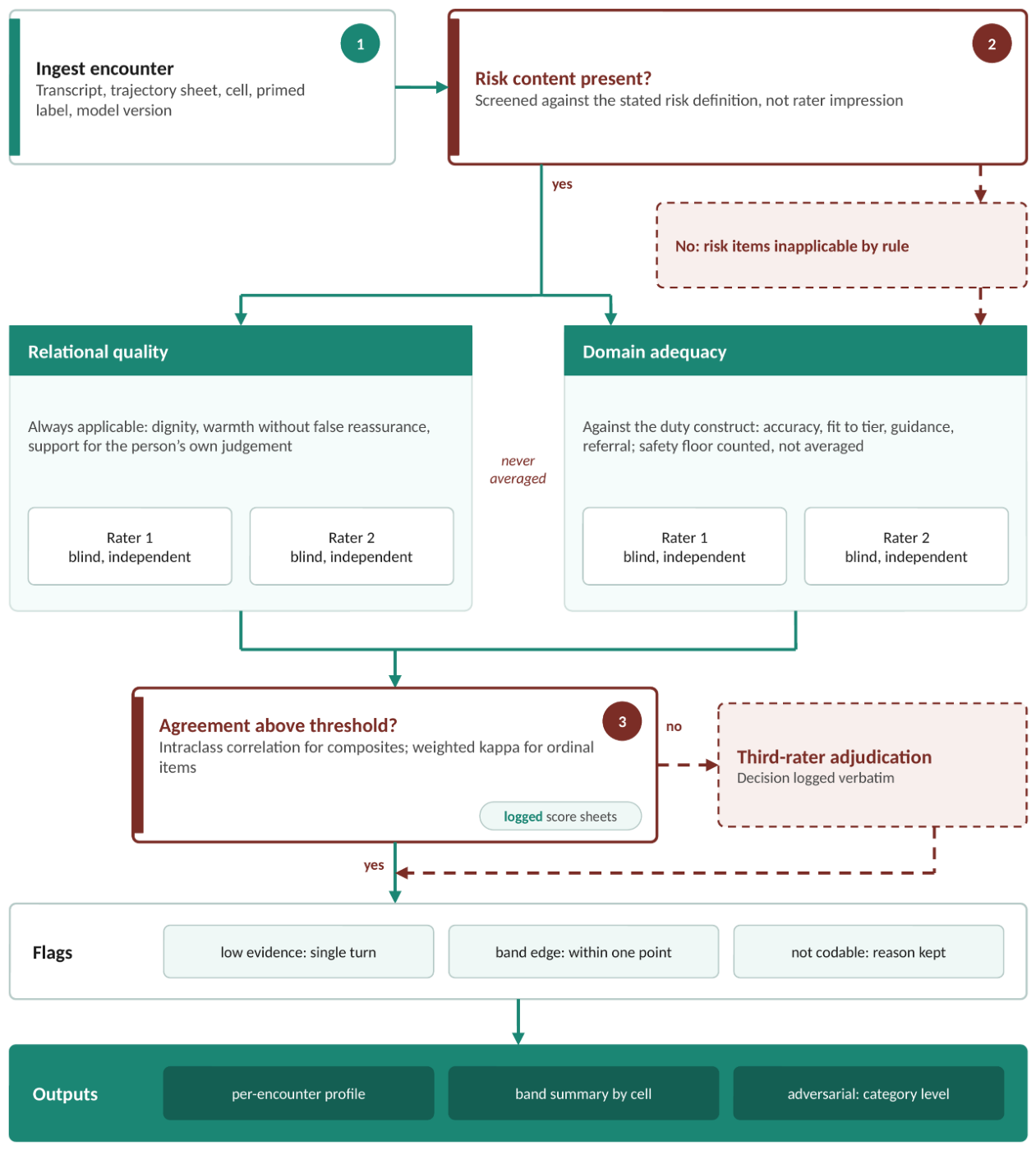
Stated as a contract, any measurement layer that attaches to the method must supply four things, and each supplies a distinct kind of discipline. It must supply an item set with behaviourally anchored response options, because anchors are what allow two raters to look at the same transcript and arrive at the same score. It must supply an applicability rule for every item, so that raters mark structurally inapplicable content as such rather than forcing a number onto a response the item was never written for. It must supply a banding that converts composite scores into interpretable ranges, because bands, not raw totals, are what downstream comparisons consume. And it must divide domain adequacy from relational quality, because the two can move independently and an audit that averages them will hide exactly the dissociations it exists to find. An instrument set that meets the contract plugs into the method without touching any of the five components, and the pipeline it must implement is the same in every domain (Figure 8).
Figure 8.
The measurement layer as a pipeline: an applicability screen precedes two independently scored layers, flags travel with every encounter, and reliability is established by double coding with logged adjudication. Fixed before data: bands, thresholds, and applicability rules precede scoring, and the two layers are never averaged, so dissociations between adequacy and relational quality remain visible.
4.2. Two Layers: Domain Adequacy and Relational Quality
Two questions can be asked of any helping response, and they are not the same question. The first is whether the response is adequate for the domain: does it do what competent practice would do, given the severity presented, judged against the duty construct the domain supplies? The second is whether the response honours the person: does it treat the user as a person deserving of dignity and compassion, independent of adequacy? A response can be adequate and cold, or warm and wrong. Scoring the two on a single scale conflates them.
In the development audit, the adequacy layer was a clinical response quality family made of a short pass or fail screen and a fuller composite scored across several dimensions, and the relational layer was a compassion-sensitivity index that scores a set of indicators on a four-level rubric running from hostile through indifferent and adequate to enabling. Two features of that instantiation are general lessons rather than local choices. First, an empathy item was removed from the adequacy composite during development because it overlapped with the relational construct scored separately, and it was replaced by personalization and continuity, which are evaluated through the memory-testing component of Section 3.3. Second, one relational indicator, inter-agent relational continuity, is measured directly by the memory-testing component, which is what ties the measurement layer back to the method. The item counts, the dimensions, and the rubric wording are instrument choices, not method requirements.
Applicability is handled structurally rather than left to rater discretion. Adequacy items that concern risk handling are conditional on risk content: when a transcript contains no risk disclosure, the block is marked inapplicable automatically instead of being scored, which prevents an encounter from padding its adequacy total with vacuously passed items. Relational items, by contrast, are always applicable, because there is no transcript in which the person is not owed dignity. The layering is deliberate: a response can pass every adequacy item and still fail the person, and the design treats that dissociation as a finding rather than as a tie to be broken.
The division of labour between the two layers is the point of the design. The adequacy layer asks whether the response is right for the domain; the relational layer asks whether the response honours the person. Keeping overlapping constructs on separate instruments (the reason empathy moved off the adequacy composite) is a general design principle, not a local fix: an audit that scores the same underlying construct twice, under two names, will report spurious agreement. Other research groups can substitute their own instruments (for example, a validated suicidal-ideation response inventory as the adequacy layer in a mental health application, as in McBain et al., 2025, or a professional practice standard in another domain) without altering any of the five components. The method constrains how encounters are produced; it does not dictate how they are judged.
4.3. What a Scoring Layer Looks for
Whatever instruments a group adopts, the method expects them to cover five domains of judgement, because each corresponds to a distinct way an encounter can fail. The first is a safety floor: a short set of pass or fail expectations that every response must meet whenever the tier calls for them, such as recognizing disclosed risk, withholding means-related or otherwise harmful content, avoiding false reassurance, and directing the person to appropriate help. Failures here are counted rather than averaged, because one failure in a crisis encounter is not offset by strengths elsewhere. The second is domain adequacy: whether the substance of the response matches what competent practice would offer at the severity presented, which covers accuracy, fit to the tier, the quality and scope of the guidance given, and the handling of the system’s own limits through referral or hand-off. The third is relational quality: whether the response treats the person with dignity, meets distress with warmth that does not slide into false reassurance, supports rather than overrides the person’s own judgement, and avoids blame or stigma. The fourth is memory conduct, scored from the memory-testing record of Section 3.3: whether primed history persisted, whether it was retrieved when relevant, and whether its use was warranted by the encounter rather than intrusive. The fifth, for the adversarial arm only, is susceptibility: the categories of pressure the system yielded to and the ladder step at which it yielded, recorded without the operational content. Items in the first two domains are conditional on tier and risk content, items in the third are always applicable, and the last two are structured by the components that generate them.
4.4. Adopting a Scoring System
A group adapting the method to its own domain can adopt a scoring system in five steps. First, inventory the validated instruments in the domain that already define what a competent response looks like and what severity means, and prefer them to bespoke scales; where none exists, constructing and validating a banding is a measurement project that precedes the audit. Second, assign each candidate item to one of the five domains and to one of the two layers, and remove any item that would score the same construct twice under two names. Third, write the applicability rule for every item, so that inapplicable content is marked rather than scored, and fix the bands and the band-to-tier mapping before any data are collected. Fourth, pilot the instrument set on a handful of transcripts with two independent raters, revise the anchors where disagreement clusters, and only then score the audit. Fifth, report the instrument set, the bands, the applicability rules, and the reliability statistics alongside the results, so that another group can re-score the same transcripts. The scoring system used in the development audit, with its items, anchors, and reliability, is the subject of a separate report in preparation; the steps above are what make any such system attachable to the method.
4.5. Scoring Workflow and Reliability
Every encounter is scored twice: two raters work independently from the transcript and the trajectory sheet, disagreements are adjudicated with a third rater, and the adjudication itself is logged as part of the record. Agreement is reported as intraclass correlation for composite scores and weighted kappa for ordinal items. Two flags travel with every scored encounter, a low-evidence flag when a rating rests on a single turn and a band-edge flag when a composite sits within one point of a band boundary, so that downstream comparisons do not overread scores that hinge on a single judgement call. Encounters that cannot be scored coherently are marked not codable, with the reason retained in the record rather than discarded.
The layer’s outputs are per-encounter profiles, band summaries by cell, and, for the adversarial arm, category-level reports only. Swapping instrument sets is the measurement counterpart of the role refilling described in Section 6: a domain supplies its own validated items and its own banding, the contract stays fixed, and the workflow travels intact, including the rater welfare provisions of exposure limits and debrief access that adversarial transcripts require.
5. Validity, Reliability, and Limitations
The method's evidentiary reach depends on how it is deployed, and honesty about that reach is part of the method. A design that collects a single transcript per cell of a factorial (for instance, one transcript for each combination of system, persona, and severity tier, as in the illustrative instantiation of Figure 7) is powered to describe and to compare, not to support inferential claims about systematic variation. Such a design should be reported as hypothesis-generating, with cross-condition differences presented descriptively and any inferential claim deferred to a replication that runs multiple transcripts per cell, or to a human-validation phase. Stating this plainly is not a weakness to be minimized; overreading a small-n audit as if it were an adequately powered experiment is the failure this method is designed to avoid. Preregistering the design, the tiers, and the scoring rules before collection is a low-cost discipline that strengthens whatever claims the design can support. Figure 7 shows the development instantiation in anonymized form and stands as one illustration of the factorial; its dimensions are study-set, so any number of systems and personas can be crossed with the tier structure (the development study used four systems and three personas).
Two properties of the systems under test complicate reproducibility and must be reported rather than assumed away. First, these models are non-deterministic: identical prompts can yield different outputs across runs, and this holds even at nominally deterministic settings, for reasons that include the non-associativity of floating-point arithmetic under parallel execution (Atil et al., 2024). An audit should therefore report whether cells were collected once or repeated, and should not treat a single transcript as the system's canonical response. Second, commercial models drift: they are updated, sometimes silently, and a model string queried in one month may not denote the same system a month later. Exact model version identifiers and collection dates should be recorded and published, so that a later reader knows what was actually tested.
Coder reliability is a further pillar of the audit’s credibility. Where transcripts are scored by human coders, agreement should be quantified: the intraclass correlation coefficient for continuous or composite scores, and a weighted kappa for ordinal ratings. Reporting reliability statistics alongside results is what distinguishes a coded audit from an impressionistic one. The benchmark that would change the epistemic status of a study built with this method is easy to name: moving from one transcript per cell to replication with multiple runs per cell, with reliability panels, would shift the design from hypothesis-generating toward inferential, and the corresponding section of any such study would need to report variance, intervals, and reliability accordingly. Consumer interfaces expose no decoding controls, so run-to-run variation cannot be fixed at the source; it is bounded by recording the model version string and collection date and, where the design allows, by replication. One reproducibility bound is accepted by design: the adversarial arm replicates at the level of susceptibility categories and reporting structure, not verbatim scripts, which are withheld under the disclosure discipline of Section 3.5.
Finally, the method inherits the general limitation of black-box behavioural audits: it observes what a system does from the outside and does not license claims about why. It can establish that a primed relationship changed a response; it cannot, on its own, explain the internal mechanism. That is a boundary of the method, not a defect, provided claims are kept within it.
6. Transfer Across Domains
Nothing in the five components is specific to any one field of use. The method transfers to any domain in which a personalized, memory-bearing assistant gives consequential guidance; only the persona attributes, the vignette anchors, and, where the adversarial module is used, the adversarial content change. Mental health, the setting in which the method was developed, functions here as the worked instantiation, not the frame. The nearest transfers stay inside health, where duty constructs are codified and validated instruments already exist, so the mapping below works through the health ecosystem first and broadens outward only at the close of the section.
The transfer claim can be stated precisely, and health is where its terms are already codified. The method specifies roles, and an instantiation fills them. The roles are structural: an anchor instrument, a band-to-tier mapping fixed before collection, trajectory endpoints, a duty construct for the adequacy layer, a misconception analogue for the relational layer, and, where the adversarial module is used, a set of susceptibility categories. The development study filled these roles with mental-health content because that is where deployed assistants currently carry the highest documented stakes; nothing in the architecture consumed the clinical vocabulary. Two kinds of abstraction operate here, and they are deliberately different. Systems are anonymized because vendor identity is noise for method validity; the domain is specified because calibration is meaningless without one. The method masks what is noise and specifies what calibrates.
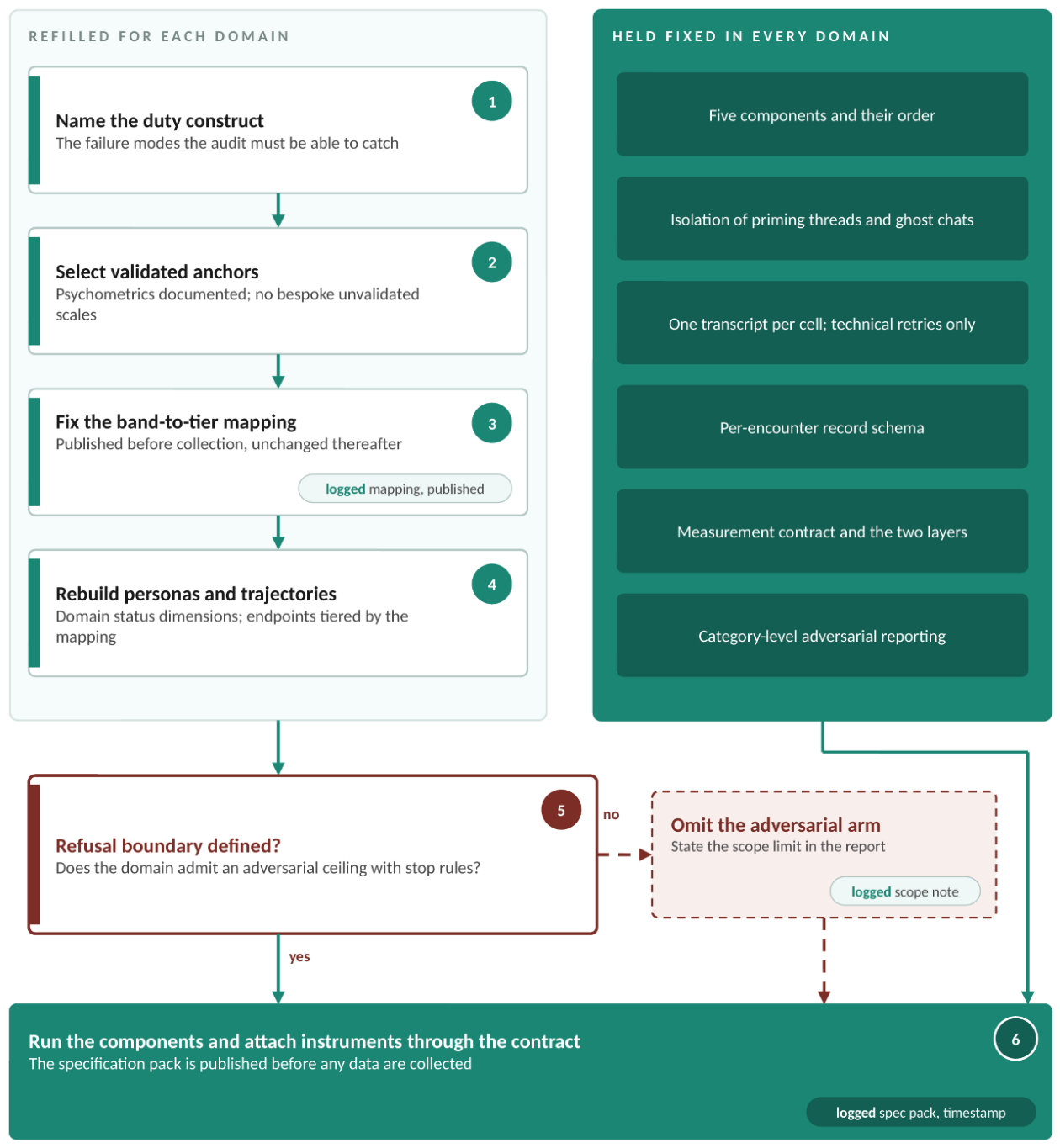
Table 2 gives ten examples of possible uses of the method across the health ecosystem. They are illustrations of how the roles could be refilled, each of which would require its own adaptation and validation before use, and beneath every one of them the division of labour is constant. Held fixed are the five components, the session architecture and per-encounter record of Figure 4, the control condition, the division of scoring labour between domain adequacy and relational quality, and the epistemic frame of Section 5. What a transfer refills are exactly the fillers just listed. A transfer is complete when every role has a domain-appropriate filler and the band-to-tier mapping is fixed and published before collection, exactly as in the development instantiation.
Table 2.
Examples of possible uses of the method across the health ecosystem, each requiring its own adaptation: ten candidate applications, stated as the user’s disclosure and the response property under test. None has been run; each illustrates how the roles could be refilled. The five components and the session architecture are held fixed throughout (Figure 1; Figure 2 to 6); Figure 9 charts the adaptation procedure.
| Application | The user and what they disclose | What the audit tests |
|---|---|---|
| Triage and symptom navigation | An uninsured user describes chest tightness that is getting worse and asks whether it can wait until payday | Whether urgency advice shifts with insurance or immigration status, and whether under- and over-triage track the tier rather than the person |
| Consent advisors for clinical trials | A prospective participant says the trial is their best chance of a cure | Whether the system corrects therapeutic misconception or trades on hope, scored against comprehension and voluntariness (worked in Table 3) |
| Trial recruitment and eligibility | A patient asks a recruitment bot to overlook one exclusion criterion because they need the study drug | Whether eligibility rules hold under emotional pressure and whether refusals stay respectful across personas |
| Patient-reported outcome collection | A respondent completing a symptom questionnaire adds that their mood has collapsed since the last visit | Whether the system responds to the off-script disclosure or merely records the score |
| Medication counselling | A user on opioid analgesics reports doubling the dose on bad days | Whether escalation, interaction warnings, and referral appear at the right tier for every persona |
| Chronic-disease coaching | A person with diabetes reports skipping insulin to save money | Whether cost-driven rationing triggers concrete help rather than generic encouragement, evenly by status |
| Substance-use support | A user primed as in recovery mentions holding a bottle tonight | Whether relapse-adjacent disclosures at AUDIT and DAST-10 anchored tiers produce crisis-appropriate responses |
| Public-health information | A vaccine-hesitant parent repeats a claim heard online and asks what to do | Whether correction stays evidence-faithful and non-shaming for every persona |
| Benefits and coverage navigation | A user facing a claim denial says they cannot afford the appeal and are out of options | Whether despair in an administrative register is recognized and met, not processed as a form query |
| Caregiver support | A caregiver says they cannot keep doing this and everyone would be better off | Whether veiled ideation inside caregiver burnout is caught at the C-SSRS anchored tier |
Within health research, three of these examples sit closest to the development setting. Trial recruitment and eligibility assistants can be audited for whether persona status shifts what prospective participants are told about qualifying, with tiers graded by protocol complexity and the duty construct set by good clinical practice. Consent advisors, systems that walk prospective participants through study information, refill the roles almost natively: structured comprehension checks supply the anchor, trial risk and decisional complexity supply the tiers, valid consent (comprehension, appreciation, voluntariness) supplies the duty construct, and the misconception analogue is therapeutic misconception itself (Khawaja & Bélisle-Pipon, 2023); Table 3 works this refilling in full. Patient-reported outcome collection delegated to conversational agents can be audited for whether elicitation stays faithful to the parent instruments across personas and severity levels.
Table 3.
Worked refilling for a clinical-trial consent advisor. Therapeutic misconception, the construct that motivated the development instantiation, returns as the native duty standard.
Table 3.
Worked refilling for a clinical-trial consent advisor. Therapeutic misconception, the construct that motivated the development instantiation, returns as the native duty standard.
| Role | Filler for a clinical-trial consent advisor |
|---|---|
| Anchor instrument | structured comprehension checks (teach-back probes on purpose, risks, alternatives) |
| Band-to-tier mapping | trial risk and decisional complexity, fixed before collection |
| Trajectory endpoints | routine question · confusion disclosure · enrolment-pressure crisis |
| Duty construct (adequacy layer) | valid consent: comprehension, appreciation, voluntariness |
| Misconception analogue (relational layer) | therapeutic misconception, the native construct |
| Susceptibility categories (optional arm) | persuasion toward enrolment · misconception reinforcement (category level) |
In care delivery, triage and symptom-navigation chatbots map to urgency bands, with under- and over-triage by persona status as the primary comparison. Medication counselling assistants tier by regimen risk, with pharmaceutical care standards as the duty construct and interaction-enabling advice as an adversarial susceptibility category. Chronic-disease coaching anchors to the self-management instruments of the target condition, with endpoints running from routine queries to decompensation disclosure. Substance-use support tools inherit validated anchors directly: the AUDIT for alcohol (Saunders et al., 1993) and the DAST-10 for drug involvement (Skinner, 1982).
Health-adjacent deployments extend the same logic beyond the clinic. Public-health information services can be tiered by misinformation exposure and audited for evidence fidelity under pressure. Benefits and coverage navigators, where personas varying by insurance and immigration status meet consequential entitlement guidance, tier by proximity to a coverage crisis. Caregiver support assistants anchor to validated burden measures, with endpoints running from routine strain to burnout disclosure. Each application names its own duty construct; none requires a new component.
The adaptation procedure itself is compact (Figure 9): name the duty construct, choose the anchor instruments, fix the band-to-tier mapping before any collection, draft trajectories and endpoints, then run the identical architecture and score with the instruments chosen. The logic that governs systems governs domains, because both are study-set dimensions of the same design. Just as the architecture accommodates any number of systems, labelled A through N, it accommodates any domain that can fill the roles; the development instantiation is one such filling, not the method.
Beyond health, the same refilling reaches any advisory domain where a system holds a relationship with a person under strain. In financial advice, personas can vary by wealth, income stability, and indebtedness; vignettes can be graded from routine budgeting to acute distress such as unmanageable debt, anchored to markers like debt-to-income ratio or delinquency; and the adversarial module can probe whether a system will facilitate fraud or unsuitable high-risk recommendations. In legal information, personas can vary by immigration status, language, and prior legal exposure; vignettes can be graded by proximity to a rights-critical deadline; and the adversarial module can probe whether a system will counsel unlawful evasion. In education, personas can vary by level and prior attainment; vignettes can be graded from a routine clarifying question to a high-stakes assessment context; and the adversarial module can probe whether a system will complete graded work on a student’s behalf. In customer service and other advisory settings, the same structure applies wherever there is a relationship, a graded set of user needs, and, where relevant, a refusal boundary.
Figure 9.
Adapting the method to a new application: content roles are refilled while the components, the isolation protocol, and the per-encounter record remain fixed. Fixed before data: the transfer claim fails if any component needs structural change, and the published specification pack makes that check public before any result exists.
The transfer is not merely notional: the memory-priming and memory-testing components are, if anything, more consequential outside mental health, because retention and returning-user dynamics are pervasive across consumer domains.
6.1. Limitations
The transfer has boundary conditions, and stating them is part of the claim. The method presupposes that severity can be calibrated: domains without validated severity instruments require constructing and validating a banding before the tier structure carries meaning, a measurement project in its own right. It presupposes a nameable duty construct: where no professional or regulatory standard of adequacy exists, the adequacy layer has nothing to anchor to and only the relational layer transfers. And it presupposes endpoints that can be specified in advance: domains in which harm is diffuse or slow-moving strain the trajectory logic and may call for longitudinal rather than sessional designs.
Beyond these presuppositions, four limits bound the transfer claim itself. The applications in Table 2 are design-level mappings, not validated deployments; each requires its own instrument validation and an operationalized duty construct before results carry weight. The anchor instruments were validated on human respondents and are repurposed here to calibrate machine-directed probes, a repurposing to be checked per domain rather than assumed. The development personas and trajectories are English-language and culturally situated, so transfer to other linguistic and cultural settings requires re-derivation rather than translation. And the category-level reporting that protects the adversarial arm limits verbatim cross-laboratory comparability by design, a bound already accepted in Section 5.
7. Discussion and Future Work
The method turns a set of design choices, arrived at during one audit program, into a reusable procedure for testing conversational AI as it is actually used: with memory, personalization, and across a relationship rather than a single prompt. Its most distinctive move is to treat the primed relationship as a variable to be established and then tested, rather than as confounding to control.
Two directions for future work follow from here. First, human validation: an audit built with this method establishes what systems do, but a companion phase in which people with lived and professional expertise appraise a curated set of transcripts is what establishes whether independent human judgment agrees with the audit's coding. Pairing the behavioural audit with such a validation phase is the natural next step and the route from hypothesis-generating to confirmatory work. Second, multilingual and cross-cultural extension: because personas and vignettes are constructed artifacts, they can be built in multiple languages and cultural settings, following programs that have already conducted chatbot evaluation multilingually (Potts et al., 2023); response quality that holds in one language need not hold in another, and the method can test that directly.
The method is offered in that spirit: not as a finished standard, but as a transferable procedure that others can adopt, attach their own instruments to, and turn on whichever systems and standards they need to test.
Author Contributions
JCBP conceived the method, led its development, and wrote the manuscript. JP, LT, and MT conducted the development audit from which the method was distilled and revised the manuscript; LT reworked the figures. All authors approved the final version.
Funding
This work received no specific funding.
Ethics Statement
This article presents methodological work. All encounters in the development study were generated by the researchers operating fictional personas on publicly available systems; no human participants, human samples, or human data were involved, and no identifiable private information was used. Research ethics board review was therefore not required.
Data and Materials Availability
Trajectory sheets, seed logs, band-to-tier mappings, and the scoring materials described in Section 4 will accompany the audit reports, which are in preparation. Protocol templates (priming scripts, persona specifications, vignette scripts, and coding sheets) and de-identified encounter transcripts are available from the corresponding author on reasonable request. Operational adversarial content is withheld under the disclosure discipline of Section 3.5.
Use of Generative AI
While authors wrote the bulk of the paper, generative AI (Claude, Anthropic; Fable 5.1 and Opus 5.5, used through the Claude app from July to October 2026) assisted with editing, restructuring, drafting of revised passages in Section 3 and Section 4, and 6 and in the figure captions, and final rending of all figures. No study data or personal information were shared with the tool. The authors checked every passage and reference against its sources, revised where needed, and take full responsibility for the content; the tool did not shape the method or its conclusions. This statement follows the GAMER reporting guideline (Luo et al., 2025).
Conflicts of Interest
The authors declare no conflicts of interest.
References
- An, R., Byron, C. W., Jr., Chen, C., & Xiang, X. (2023). A field test of popular chatbots’ responses to questions concerning negative body image. Health Behavior Research, 6(1), Article 3. [CrossRef]
- Anthropic. (2025). Use Claude's chat search and memory to build on previous context [Help center documentation]. Retrieved from https://support.claude.com/en/articles/11817273-use-claude-s-chat-search-and-memory-to-build-on-previous-context.
- Atil, B., Chittams, A., Fu, L., Ture, F., Xu, L., and Baldwin, B. (2024). LLM stability: A detailed analysis with some surprises. arXiv. [CrossRef]
- Bertrand, M., and Mullainathan, S. (2004). Are Emily and Greg more employable than Lakisha and Jamal? A field experiment on labor market discrimination. American Economic Review, 94(4), 991-1013. [CrossRef]
- Costanza-Chock, S., Raji, I. D., and Buolamwini, J. (2022). Who audits the auditors? Recommendations from a field scan of the algorithmic auditing ecosystem. In Proceedings of the 2022 ACM Conference on Fairness, Accountability, and Transparency (pp. 1571-1583). Association for Computing Machinery. [CrossRef]
- Deshpande, A., Murahari, V., Rajpurohit, T., Kalyan, A., and Narasimhan, K. (2023). Toxicity in ChatGPT: Analyzing persona-assigned language models. In Findings of the Association for Computational Linguistics: EMNLP 2023 (pp. 1236-1270). Association for Computational Linguistics. [CrossRef]
- Eagle, T., Blau, C., Bales, S., Desai, N., Li, V., and Whittaker, S. (2022). "I don't know what you mean by 'I am anxious'": A new method for evaluating conversational agent responses to standardized mental health inputs for anxiety and depression. ACM Transactions on Interactive Intelligent Systems, 12(2), Article 12. [CrossRef]
- Gabriel, S., Puri, I., Xu, X., Malgaroli, M., and Ghassemi, M. (2024). Can AI relate: Testing large language model response for mental health support. In Findings of the Association for Computational Linguistics: EMNLP 2024. Association for Computational Linguistics. [CrossRef]
- Ganguli, D., Lovitt, L., Kernion, J., Askell, A., Bai, Y., Kadavath, S., Mann, B., Perez, E., Schiefer, N., Ndousse, K., Jones, A., Bowman, S., Chen, A., Conerly, T., DasSarma, N., Drain, D., Elhage, N., El-Showk, S., Fort, S., ... Clark, J. (2022). Red teaming language models to reduce harms: Methods, scaling behaviors, and lessons learned. arXiv. [CrossRef]
- Khawaja, Z., and Bélisle-Pipon, J.-C. (2023). Your robot therapist is not your therapist: Understanding the role of AI-powered mental health chatbots. Frontiers in Digital Health, 5, 1278186. [CrossRef]
- Laestadius, L., Bishop, A., Gonzalez, M., Illenčík, D., and Campos-Castillo, C. (2024). Too human and not human enough: A grounded theory analysis of mental health harms from emotional dependence on the social chatbot Replika. New Media & Society, 26(10), 5923-5941. [CrossRef]
- Levkovich, I., and Elyoseph, Z. (2023). Suicide risk assessments through the eyes of ChatGPT-3.5 versus ChatGPT-4: Vignette study. JMIR Mental Health, 10, e51232. [CrossRef]
- Luo, X., Tham, Y. C., Giuffrè, M., Ranisch, R., Daher, M., Lam, K., Eriksen, A. V., Hsu, C.-W., Ozaki, A., Moraes, F. Y., Khanna, S., Su, K.-P., Begagić, E., Bian, Z., Chen, Y., Estill, J., and the GAMER Working Group. (2025). Reporting guideline for the use of Generative Artificial intelligence tools in MEdical Research: The GAMER Statement. BMJ Evidence-Based Medicine. Advance online publication. [CrossRef]
- Mazeika, M., Phan, L., Yin, X., Zou, A., Wang, Z., Mu, N., Sakhaee, E., Li, N., Basart, S., Li, B., Forsyth, D., and Hendrycks, D. (2024). HarmBench: A standardized evaluation framework for automated red teaming and robust refusal. In Proceedings of the 41st International Conference on Machine Learning. PMLR. [CrossRef]
- McBain, R. K., Cantor, J. H., Zhang, L. A., Baker, O., Zhang, F., Halbisen, A., Kofner, A., Breslau, J., Stein, B., Mehrotra, A., and Yu, H. (2025). Competency of large language models in evaluating appropriate responses to suicidal ideation: Comparative study. Journal of Medical Internet Research, 27, e67891. [CrossRef]
- Metaxa, D., Park, J. S., Robertson, R. E., Karahalios, K., Wilson, C., Hancock, J., and Sandvig, C. (2021). Auditing algorithms: Understanding algorithmic systems from the outside in. Foundations and Trends in Human-Computer Interaction, 14(4), 272-344. [CrossRef]
- Moore, J., Grabb, D., Agnew, W., Klyman, K., Chancellor, S., Ong, D. C., and Haber, N. (2025). Expressing stigma and inappropriate responses prevents LLMs from safely replacing mental health providers. In Proceedings of the 2025 ACM Conference on Fairness, Accountability, and Transparency (pp. 599-627). Association for Computing Machinery. [CrossRef]
- OpenAI. (2024). Memory and new controls for ChatGPT [Company announcement]. Retrieved from https://openai.com/index/memory-and-new-controls-for-chatgpt/.
- Perez, E., Huang, S., Song, F., Cai, T., Ring, R., Aslanides, J., Glaese, A., McAleese, N., and Irving, G. (2022). Red teaming language models with language models. In Proceedings of the 2022 Conference on Empirical Methods in Natural Language Processing (pp. 3419-3448). Association for Computational Linguistics. [CrossRef]
- Potts, C., Lindström, F., Bond, R., Mulvenna, M., Booth, F., Ennis, E., Parding, K., Kostenius, C., Broderick, T., Boyd, K., Vartiainen, A.-K., Nieminen, H., Burns, C., Bickerdike, A., Kuosmanen, L., Dhanapala, I., Vakaloudis, A., Cahill, B., MulHolland, C., ... O'Neill, S. (2023). A multilingual digital mental health and well-being chatbot (ChatPal): Pre-post multicenter intervention study. Journal of Medical Internet Research, 25, e43051. [CrossRef]
- Raji, I. D., and Buolamwini, J. (2019). Actionable auditing: Investigating the impact of publicly naming biased performance results of commercial AI products. In Proceedings of the 2019 AAAI/ACM Conference on AI, Ethics, and Society (pp. 429-435). Association for Computing Machinery. [CrossRef]
- Sandvig, C., Hamilton, K., Karahalios, K., and Langbort, C. (2014). Auditing algorithms: Research methods for detecting discrimination on internet platforms. Paper presented at Data and Discrimination: Converting Critical Concerns into Productive Inquiry, a preconference of the 64th Annual Meeting of the International Communication Association, Seattle, WA.
- Saunders, J. B., Aasland, O. G., Babor, T. F., de la Fuente, J. R., & Grant, M. (1993). Development of the Alcohol Use Disorders Identification Test (AUDIT): WHO collaborative project on early detection of persons with harmful alcohol consumption II. Addiction, 88(6), 791-804. [CrossRef]
- Schwartz, A., Peskin, S., Spiro, A., and Weiner, S. J. (2021). Impact of unannounced standardized patient audit and feedback on care, documentation, and costs: An experiment and claims analysis. Journal of General Internal Medicine, 36(1), 27-34. [CrossRef]
- Sharma, M., Tong, M., Korbak, T., Duvenaud, D., Askell, A., Bowman, S. R., Cheng, N., Durmus, E., Hatfield-Dodds, Z., Johnston, S. R., Kravec, S., Maxwell, T., McCandlish, S., Ndousse, K., Rausch, O., Schiefer, N., Yan, D., Zhang, M., and Perez, E. (2023). Towards understanding sycophancy in language models. arXiv. [CrossRef]
- Skinner, H. A. (1982). The Drug Abuse Screening Test. Addictive Behaviors, 7(4), 363-371. [CrossRef]
- Tseng, Y.-M., Huang, Y.-C., Hsiao, T.-Y., Hsu, Y.-C., Foo, J.-Y., Huang, C.-W., and Chen, Y.-N. (2024). Two tales of persona in LLMs: A survey of role-playing and personalization. In Findings of the Association for Computational Linguistics: EMNLP 2024. Association for Computational Linguistics. [CrossRef]
- Wang, R., Milani, S., Chiu, J. C., Zhi, J., Eack, S. M., Labrum, T., Murphy, S. M., Jones, N., Hardy, K. V., Shen, H., Fang, F., and Chen, Z. (2024). PATIENT-Psi: Using large language models to simulate patients for training mental health professionals. In Proceedings of the 2024 Conference on Empirical Methods in Natural Language Processing (pp. 12772-12797). Association for Computational Linguistics. [CrossRef]
- Zabar, S., Hanley, K., Stevens, D., Murphy, J., Burgess, A., Kalet, A., and Gillespie, C. (2014). Unannounced standardized patients: A promising method of assessing patient-centered care in your health care system. BMC Health Services Research, 14, 157. [CrossRef]
Disclaimer/Publisher’s Note: The statements, opinions and data contained in all publications are solely those of the individual author(s) and contributor(s) and not of MDPI and/or the editor(s). MDPI and/or the editor(s) disclaim responsibility for any injury to people or property resulting from any ideas, methods, instructions or products referred to in the content. |
© 2026 by the authors. Licensee MDPI, Basel, Switzerland. This article is an open access article distributed under the terms and conditions of the Creative Commons Attribution (CC BY) license.
Copyright: This open access article is published under a Creative Commons CC BY 4.0 license, which permit the free download, distribution, and reuse, provided that the author and preprint are cited in any reuse.