

Submitted:
21 October 2026
Posted:
23 October 2026
You are already at the latest version
Abstract
Repeated psychosocial stress during adolescence can produce behavioural and neurobiological consequences that extend beyond the period of stress exposure, yet the endogenous systems regulating these responses remain incompletely understood. Orexinergic, galaninergic and neuropeptide Y (NPY) signalling are involved in stress regulation, but their contribution when repeatedly engaged during adverse social experiences has not been directly compared. Here, we investigated how pharmacological modulation of these three stress-responsive systems during intermittent social defeat in late-adolescent male mice influenced early behavioural outcomes and persistent molecular alterations. Mice received the selective orexin-2 receptor agonist YNT-185 (20 mg/kg), the galanin receptor agonist Galnon (10 mg/kg), NPY (0.06 mg/kg), or vehicle before each of four social defeat or control-exploration sessions. Behaviour was assessed 24–48 h after the final session, whereas hippocampal glucocorticoid receptor (GR) and brain-derived neurotrophic factor (BDNF) and prefrontal cortical tumour necrosis factor-α (TNF-α) and interleukin-1β (IL-1β) were quantified five weeks later. Intermittent social defeat reduced open-arm exploration, social interaction, grooming and tail-suspension immobility, demonstrating alterations across anxiety-related, social, depression-related and stress-coping domains. Five weeks later, previously defeated mice exhibited reduced hippocampal GR and BDNF and reduced prefrontal TNF-α and IL-1β, revealing persistent alterations across neuroendocrine, neuroplasticity-related and neuroimmune markers. Pharmacological modulation also affected behavioural and molecular measures in non-defeated animals, demonstrating that these systems regulate the examined processes independently of stress exposure. During social defeat, Galnon and YNT-185 selectively attenuated the deficit in social interaction, whereas NPY did not produce a comparable effect; none of the three manipulations broadly normalized the behavioural or persistent molecular profile associated with defeat. Individual variation in the early behavioural outcomes was not significantly correlated with the molecular markers measured five weeks later, supporting their interpretation as temporally distinct consequences rather than direct behavioural–molecular correlates. Together, these findings show that modulation of galaninergic, orexinergic and NPY signalling during repeated adolescent social experiences produces distinct context-dependent effects and identify persistent molecular consequences of intermittent social defeat that remain detectable weeks after stress cessation.
Keywords:
adolescent social defeat
; psychosocial stress
; neuropeptide signalling
; stress vulnerability
; neuroplasticity
1. Introduction
Exposure to repeated psychosocial stress is a major environmental risk factor for the development of anxiety, depression and other stress-related psychiatric disorders. These conditions represent a major global health and socioeconomic burden, with anxiety and depressive disorders among the most prevalent mental disorders worldwide and together accounting for substantial disability and productivity losses (GBD 2019 Mental Disorders Collaborators, 2022). Importantly, not all individuals exposed to repeated adversity develop psychopathology, indicating that biological mechanisms regulating the response to stress contribute to individual vulnerability or resilience (Charney, 2004; Feder et al., 2009). Understanding how the brain responds to repeated psychosocial challenges, and which neurobiological changes persist after those experiences have ended, therefore represents an important objective in stress neuroscience.
Adolescence is a particularly sensitive developmental period during which repeated psychosocial stress can produce long-lasting alterations in emotional regulation, cognitive function and stress responsiveness (McCormick & Green, 2013; Romeo, 2013). This vulnerability coincides with the continuing maturation of corticolimbic circuits involved in emotional processing, executive control and neuroendocrine regulation. Consequently, adverse experiences during adolescence may have consequences that extend beyond their immediate behavioural effects and influence neurobiological function later in life (Lupien et al., 2009). Importantly, these consequences may emerge across different temporal scales: behavioural alterations can become evident shortly after stress exposure, whereas changes in neuroendocrine, neuroplastic and neuroimmune mechanisms may remain detectable after the stressful experience has ended. Such persistent alterations are particularly relevant during adolescence, when stress-responsive brain regions remain highly plastic, and may modify the neurobiological context in which subsequent environmental challenges are processed (Eiland & Romeo, 2013; Avital & Richter-Levin, 2005).
Repeated social defeat provides an ethologically relevant model for investigating the consequences of psychosocial stress. Unlike physical or non-social stressors, social defeat incorporates social conflict and produces alterations across behavioural domains relevant to stress-related disorders, including anxiety-related behaviour, social interaction and coping responses (Calpe-López et al., 2020). Intermittent social defeat paradigms may be particularly informative because successive episodes of social adversity are separated by periods without direct confrontation, reproducing the recurrent rather than continuous nature of many stressful social experiences while limiting excessive physical injury (Montagud-Romero et al., 2017). Social defeat models also produce substantial inter-individual variability, with animals exposed to similar stressful experiences displaying heterogeneous subsequent responses (Calpe-López et al., 2020). Examining both behavioural consequences emerging shortly after intermittent social defeat and molecular alterations that remain detectable weeks later may therefore provide complementary information about the temporal consequences of adolescent psychosocial adversity.
Multiple endogenous neuromodulatory systems participate in the regulation of responses to stress. Among them, orexinergic, galaninergic and neuropeptide Y (NPY) signalling have each been implicated in emotional behaviour, stress responsiveness and hypothalamic-pituitary-adrenal (HPA)-axis regulation (John et al., 2026; Rana et al., 2022; Heilig, 2004; Katzman & Katzman, 2022; Johnson et al., 2012). These systems act within corticolimbic and hypothalamic networks involved in arousal, motivation, emotional regulation and social behaviour and can influence neuroendocrine and plasticity-related processes. Although each has been independently implicated in the response to stress, their contribution when repeatedly modulated during the stressful experiences themselves remains incompletely understood, particularly during adolescence.
Pharmacological manipulation of these systems during successive stress exposures provides an opportunity to address this question mechanistically. Rather than administering a compound after a stress-induced phenotype has already developed, modulation before each social encounter alters the functional state of the targeted system while the stressful experience is occurring and being processed. This approach can therefore be used to investigate whether orexinergic, galaninergic and NPY signalling participate in determining the behavioural consequences that emerge shortly after repeated social stress and the molecular alterations that remain detectable after stress has ended. Understanding this involvement may also provide a basis for investigating whether naturally occurring differences in these stress-responsive systems contribute to variability in the consequences of adversity, although such individual differences were not directly examined in the present study.
To characterize persistent molecular consequences across complementary stress-related biological systems, we examined glucocorticoid receptor (GR) and brain-derived neurotrophic factor (BDNF) protein levels in the hippocampus and tumour necrosis factor-α (TNF-α) and interleukin-1β (IL-1β) in the prefrontal cortex (PFC). Hippocampal GR contributes to glucocorticoid signalling and HPA-axis feedback regulation, whereas BDNF plays a central role in neuronal plasticity and structural remodelling. Prefrontal TNF-α and IL-1β were assessed as markers of neuroimmune signalling. The hippocampus and PFC are particularly relevant in this context because both contribute to stress regulation, remain highly plastic during adolescence and are sensitive to the long-term consequences of stress exposure (McEwen & Morrison, 2013; Borsini et al., 2023).
Within this framework, the present study investigated the consequences of intermittent social defeat during late adolescence and the contribution of orexinergic, galaninergic and NPY signalling to those consequences. These endogenous stress-responsive systems were pharmacologically modulated before each social encounter, allowing their involvement to be examined while successive stressful experiences were occurring. We first characterized the behavioural consequences emerging shortly after intermittent social defeat and the molecular alterations detectable five weeks later. We then determined whether repeated modulation of each neuropeptide system during the social experiences influenced these early behavioural and persistent molecular outcomes. The primary objective was therefore mechanistic: to determine whether the functional state of these endogenous stress-responsive systems during repeated adverse experiences contributes to the consequences that subsequently emerge. Identifying such mechanisms may ultimately help to understand why adolescent psychosocial adversity produces persistent consequences and provide a biological basis for future strategies aimed at limiting its longer-term impact.
Methods
Animals
A total of 174 male mice (110 C57BL/6J and 64 OF1) were obtained from Charles River Laboratories (France). OF1 mice, only used as aggressive opponents, arrived at the laboratory at postnatal day (PND) 42 and were housed individually in standard plastic cages (23x32x20 cm) for at least one month to induce heightened aggression (Rodriguez-Arias et al., 1998). Experimental mice (C57) arrived at the laboratory at PND 21 and were housed in standard plastic cages (25x25x14.5 cm) in groups of four until the initiation of experimental procedures at PND 47. Experimental procedures and behavioural tests were conducted during late adolescence (PND 47-58). All animals were housed under standard laboratory conditions with controlled temperature and humidity, on a 12 h light/dark cycle (white lights on from 19:30 to 07:30) and with food and water available ad libitum (except during behavioural procedures). All procedures involving the mice and their care were conducted in accordance with Directive 2010/63/EU and were approved by the Ethics Committee for Experimental Research at the University of Valencia and the regional government (2023-VSC-PEA-0292, 2024-VSC-PEA-0281 and 2025-VSC-PEA-0014).
Experimental Design
The study followed a 2 × 2 factorial design for each pharmacological treatment, with stress condition (Control or Social Defeat) and treatment (Vehicle or pharmacological compound) as the two experimental factors. Animals were allocated to the following groups: vehicle-treated control (V+C), vehicle-treated social defeat (V+SD), YNT-185-treated control (YNT+C), YNT-185-treated social defeat (YNT+SD), Galnon-treated control (GAL+C), Galnon-treated social defeat (GAL+SD), NPY-treated control (NPY+C), and NPY-treated social defeat (NPY+SD). This design allowed evaluation of the effects of each pharmacological treatment under basal conditions, the effects of intermittent social defeat, and the interaction between treatment and stress exposure.
Vehicle-treated control and social defeat groups were shared across the different pharmacological treatment conditions. Each experimental replicate included all treatment groups (vehicle, Galnon, YNT-185, and NPY under both control and social defeat conditions), allowing direct comparison with a common set of contemporaneous vehicle-treated animals. This design was implemented a priori to reduce the number of animals required, in accordance with the 3Rs principles, while maintaining appropriate experimental controls for all pharmacological comparisons.
Animals were allocated to eight experimental groups: vehicle-treated control (V+C; n = 10), vehicle-treated social defeat (V+SD; n = 16), Galnon-treated control (GAL+C; n = 12), Galnon-treated social defeat (GAL+SD; n = 16), YNT-185-treated control (YNT+C; n = 12), YNT-185-treated social defeat (YNT+SD; n = 16), NPY-treated control (NPY+C; n = 12), and NPY-treated social defeat (NPY+SD; n = 16). Sample sizes were determined based on previous experience with the intermittent social defeat model, with larger groups assigned to social defeat conditions to accommodate the greater inter-individual variability anticipated following stress exposure. Animals were allocated sequentially to experimental groups, and treatment allocation was known during experimental procedures but blinded during behavioural outcome assessment and data analysis. No a priori exclusion criteria were established for behavioural analyses. All available behavioural data were included, except for one animal in the NPY+SD group that died during the study. For molecular analyses, only a subset of animals from each experimental group was available for biochemical assessment. Consequently, sample sizes varied across molecular endpoints. The exact number of animals included in each analysis is reported in the corresponding figures, where individual data points represent individual animals. Data are presented as mean ± SEM, with individual data points representing individual animals in all graphical representations
The overall experimental design, including the timing of pharmacological treatments, social defeat or control sessions, behavioural assessment and tissue collection, is summarized in Figure 1.
Pharmacological Treatments
Three pharmacological agents targeting stress-related neuromodulatory systems were evaluated. An orexin OX2 receptor agonist, YNT-185 dihydrochloride (CAS number 1804978-82-2, MedChemExpress, LabClinics SA, Barcelona, Spain), a galanin receptor agonist, Galnon TFA (CAS number 1217448-19-5, MedChemExpress, LabClinics SA, Barcelona, Spain) and neuropeptide Y (NPY, CAS number 90880-35-6, Bachem, Cymit Quimica SL, Barcelona, Spain). Galnon and YNT-185 were dissolved in physiological saline (NaCI 0.9%) and Dimethyl Sulfoxide (DMSO, >99.5%) in a 6:1 ratio, adding 0.1 ml of Tween 80. NPY was dissolved in physiological saline. All compounds were injected intraperitoneally at a volume of 0.01 ml/g of body weight.
Each compound was administered 30 min (Galnon) or 60 min (YNT-185 and NPY) prior to each episode of defeat or exploration (in the case of control groups without stress exposure). A single dose per compound (10 mg/kg of Galnon, 20 mg/kg of YNT-185 and 0.06 mg/kg of NPY) was used. The dose and timing of administration were selected based on previous literature reporting anxiolytic or stress-modulating effects (Rajarao et al., 2007; Gelfo et al., 2012; Kim et al., 2023).
Social Defeat Stress Paradigm
Repeated social defeat was conducted at PND 47, 50, 53, and 56, with one defeat session every 72 h. During each session, experimental mice were exposed to a different aggressive adult male OF1 mouse using a resident–intruder paradigm. Each 25-min session consisted of three consecutive phases. During the first phase (10 min), the experimental mouse (intruder) was placed in the home cage of the aggressive resident, with the two animals separated by a wire-mesh partition that prevented physical contact while allowing visual, olfactory, and auditory interaction and threat displays. During the second phase (5 min), the partition was removed, allowing direct physical confrontation between the resident and intruder. During the third phase (10 min), the wire-mesh partition was reintroduced, preventing further physical contact while maintaining sensory exposure to the resident.
All experimental mice displayed a characteristic defeat posture during the direct-confrontation phase, characterised by an upright submissive position, limp forepaws, an upwardly angled head, and retracted ears. Direct confrontation was continuously monitored and was to be terminated immediately by replacing the partition if the resident mouse continued to deliver bites (>10) after the intruder had already signalled defeat (>8 s in a submissive supine posture), or if the intruder exhibited a bleeding wound. However, these termination criteria were not reached, as agonistic encounters between male mice were predominantly characterised by ritualised aggression. Resident mice frequently displayed non-injurious warning signals, such as threat displays, while the adoption of a defeat posture by the intruder acted as a behavioural inhibitor that suppressed further attacks by the resident. Animals were regularly monitored for general health, signs of injury and distress throughout the experimental period. Control mice underwent the same schedule of four 25-min sessions separated by 72 h but were placed in an empty resident cage without exposure to an OF1 mouse. Thus, control animals experienced the same novel-cage exposure and session duration in the absence of social confrontation. The intermittent social defeat procedure was based on the paradigm described by Montagud-Romero et al. (2017)
Behavioral Assessment
Behavioural testing was conducted shortly after the final defeat or control-exploration session and included measures of anxiety-related behaviour in the elevated plus maze (EPM), social interaction in the social interaction test, grooming behaviour in the splash test, and coping-related behaviour in the tail suspension test (TST). Together, these tests were used to assess complementary behavioural domains affected by repeated stress exposure.
All behavioural tests took place during the dark period (8:30-16:30) in an environment different to that of the confrontation sessions. To facilitate adaptation, the mice were transported to the dimly illuminated experimental room (red light of 40 lux at 1 m above floor level) 1 h prior to testing. The order of the behavioural tests was based on previous studies (Calpe-López et al., 2020; Calpe-López et al.,, 2022a; Calpe-López et al., 2022b) according to the degree of stress that the same tests induced in the mice. The EPM was performed first (PND 57) since the open arm measurements are very sensitive to environmental conditions and prior manipulation of the animals. On the same day, mice performed the social interaction test. On PND 58, mice underwent the splash test followed by the TST. Behavioral tests were ordered from less to more stressful procedures to minimize potential carry-over effects of test-induced stress on subsequent behavioral assessments, with the TST performed last. There was a minimal interval of 3 hours between tests. Finally, mice were left undisturbed for 5 weeks until tissue collection for molecular analyses.
Elevated Plus Maze (EPM)
The EPM is used to evaluate anxiety-like behaviour based on the natural aversion of mice to open elevated areas. The apparatus, elevated 45 cm above the floor level, consisted of four arms (two open and two enclosed, 30 × 5 cm each one) which formed a central platform (5 × 5 cm). The floor and the enclosed arms of the maze were made of white and transparent Perspex, respectively. The open arms had a small raised edge (0.25 cm) to provide the animals with additional grip. The mouse was placed on the central platform facing an open arm and allowed to explore it for 5 min. Its behaviour was video recorded and later analysed using a computerised method (Raton Time 1.0 software; Fixma SL, Valencia, Spain). An arm was considered to have been visited when the animal placed all four paws on it. Total time spent in the open and closed arms was recorded. Anxiety levels are considered to be lower when the time in open arms is higher and the time in the closed arms are lower, and vice versa (Rodgers and Dalvi., 1997). The percentage of time spent into the open arms was calculated [% TOA=(time in open arms / time spent in open + time spent in closed) × 100]. The maze was cleaned with a 7% alcohol swab and left to dry completely between trials.
Social Interaction Test
The social behaviour of the mice was assessed using an open field (37 × 37 × 30 cm) which contained a perforated Perspex cage (10 × 6.5 × 30 cm) in one of the walls. The mouse was placed in the centre of the open field, with the perforated Perspex cage empty, and allowed to explore it for 10 min (object phase). Next, the experimental mouse was returned to its home cage for 2 min. Then, to safeguard the experimental mouse from attack, a mouse of the OF1 strain was confined to the perforated cage and the experimental mouse was reintroduced into the open field for 10 min (social phase). In both phases, the time spent in the 8 cm area surrounding the perforated cage (the interaction zone) was recorded automatically using the Ethovision 2.0 software package (Noldus, Wageningen, The Netherlands). An index of social interaction, commonly used as an index of social preference-avoidance (Krishnan et al., 2007) was calculated [ISI= time spent in the interaction zone during the social phase/(time spent in the interaction zone during the social phase + time spent in the interaction zone during the object phase] (Henriques-Alves and Queiroz, 2016)
Splash Test
The splash test was used to assess depressive-like behaviour based on the fact that grooming behaviour, a self-directed behaviour, can be decreased by stress exposure (Smolinsky et al., 2009). Each mouse was placed individually in a transparent cage (15 × 30 × 20 cm), and a 10% sucrose solution was sprayed (three times) onto the dorsal coat. Grooming behaviour was video-recorded and subsequently analysed using a computerised method to obtain the total time spent in grooming during the 5 min test (Raton Time 1.0 software; Fixma SL, Valencia, Spain).
Tail Suspension Test
The TST was used to assess coping-related behaviour in response to an acute, inescapable stressor (Cryan et al., 2005). Mice were suspended by the tail using adhesive tape for a 6-min test period, and their behaviour was video-recorded for subsequent analysis using Raton Time 1.0 software (Fixma SL, Valencia, Spain). Total immobility time was quantified as an index of passive versus active coping behaviour (Vaugeois et al., 1997).
Tissue Collection and Molecular Analyses
To determine whether the behavioural phenotype induced by intermittent social defeat was accompanied by alterations in stress-related molecular pathways, hippocampal and prefrontal cortical protein levels were subsequently quantified.
Five weeks after the end of the behavioral testing (37-39 days after the last stress episode), mice were euthanized by cervical dislocation. Brains were rapidly removed, and bilateral whole hippocampus and prefrontal cortex (PFC) were dissected on an ice-cold surface. Tissue samples were immediately snap-frozen on dry ice and stored at −80 °C until further processing. For molecular analyses, hippocampal and PFC tissues were homogenized according to the manufacturers’ instructions provided with each ELISA kit. Total protein concentration was determined using a bicinchoninic acid (BCA) protein assay, and ELISA values were normalized to total protein content and expressed as ng/mg or pg/mg of total protein, depending on the analyte. All ELISAs were performed according to the manufacturers’ protocols. In the hippocampus, protein levels of the glucocorticoid receptor (GR, CAT number A77054-96, Antibodies.com) and brain-derived neurotrophic factor (BDNF, CAT number A77749-96, Antibodies.com) were quantified. In the PFC, levels of the pro-inflammatory cytokines tumor necrosis factor-α (TNF-α, CAT number A78897-96, Antibodies.com) and interleukin-1β (IL-1β, CAT number 1271-96T, ELK Biotechnology, Biogen Científica SL, Madrid, Spain) were determined to assess PFC neuroimmune-related alterations and their modulation by the pharmacological treatments.
Statistical Analysis
Normality and homogeneity of data were evaluated using Shapiro-Wilk and Bartlett tests, respectively. To characterize the behavioural and molecular consequences of intermittent social defeat independently of pharmacological treatment, vehicle-treated control and vehicle-treated defeated mice were compared using unpaired two-tailed Student’s t-tests. The effects of pharmacological modulation were analysed using two-way analysis of variance (ANOVA), with stress condition (Control vs. Social Defeat) and treatment (Vehicle vs. pharmacological treatment) as between-subject factors. Because the effects of each pharmacological compound were evaluated independently, separate two-way ANOVAs were performed for Galnon, YNT-185, and NPY. In each analysis, the corresponding vehicle-treated Control and Social Defeat groups served as common reference groups for comparison with the respective drug-treated Control and Social Defeat groups. When appropriate, significant effects were further examined using Šídák’s multiple-comparisons tests.
Exploratory associations between early behavioural outcomes and molecular measures assessed five weeks later were examined using Spearman’s rank-order correlations. Correlations were performed separately within each experimental group between each behavioural variable (% time spent in the open arms [%TOA], social interaction index [ISI], grooming time, and immobility time) and each molecular measure (hippocampal GR and BDNF and prefrontal cortical TNF-α and IL-1β).
Data are presented as mean ± SEM. Statistical significance was set at p < 0.05. Statistical analyses were performed using GraphPad Prism (GraphPad Software, San Diego, CA, USA).
Results Behavioral Characterization of Intermittent Social Defeat and the Effects of Pharmacological Modulation
3.1. Early Behavioural Consequences of Intermittent Social Defeat
Intermittent social defeat during late adolescence produced significant behavioural alterations shortly after stress exposure (Figure 2). Compared with vehicle-treated control mice, vehicle-treated defeated mice showed a significantly lower percentage of time spent in the open arms of the elevated plus maze (%TOA; t(24) = 3.295, p < 0.01), a lower social interaction index (ISI; t(24) = 3.244, p < 0.01), reduced grooming time in the splash test (t(24) = 2.440, p < 0.05), and reduced immobility time in the tail suspension test (t(24) = 2.540, p < 0.05). Thus, intermittent social defeat produced early behavioural alterations across anxiety-related exploration, social interaction, grooming and coping-related behaviour
3.2. Effects of YNT-185 on Behavioral Outcomes
The effects of YNT-185 on behavioural outcomes were examined using two-way ANOVA, with treatment and stress condition as factors (Figure 3). For the percentage of time spent in the open arms of the elevated plus maze (%TOA; Figure 3A), significant main effects of treatment (F(1,50) = 27.095, p < 0.001) and stress (F(1,50) = 15.911, p < 0.001) were observed. Treatment × stress interaction was not significant (F(1,50) = 0.53, p = 0.819). YNT-185 treatment was associated with lower %TOA compared with vehicle treatment, and social defeat was associated with lower %TOA compared with the control condition.
For the social interaction index (ISI; Figure 3B), there was a significant main effect of stress (F(1,49) = 8.455, p < 0.005) and a significant treatment × stress interaction (F(1,49) = 9.490, p < 0.003). Šídák’s post hoc comparisons showed that vehicle-treated defeated mice had a lower ISI than vehicle-treated control mice (p < 0.001). Importantly, YNT-185-treated defeated mice showed a higher ISI than vehicle-treated defeated mice (p < 0.01).
For grooming time in the splash test (Figure 3C), a significant main effect of treatment (F(1,50) = 12.284, p < 0.001) and a significant treatment × stress interaction (F(1,50) = 20.400, p < 0.001) were observed. Post hoc comparisons showed reduced grooming in vehicle-treated defeated mice compared with vehicle-treated control mice (p < 0.01). YNT-185-treated control mice also showed reduced grooming compared with vehicle-treated control mice (p < 0.001) and with YNT-185-treated defeated mice (p < 0.001).
For immobility time in the tail suspension test (Figure 3D), significant main effects of treatment (F(1,50) = 5.041, p < 0.03) and stress (F(1,50) = 4.735, p < 0.05) were observed. Treatment × stress interaction was not significant (F(1,50) = 1.354, p = 0.25). YNT-185 treatment was associated with lower immobility overall compared with vehicle treatment, while social defeat was associated with lower immobility overall compared with the control condition.
3.3. Effects of Galnon on Behavioral Outcomes
The effects of Galnon on behavioural outcomes were examined using two-way ANOVA, with treatment and stress condition as factors (Figure 4). For the percentage of time spent in the open arms of the elevated plus maze (%TOA; Figure 4A), significant main effects of treatment (F(1,50) = 20.711, p < 0.001) and stress (F(1,50) = 12.430, p < 0.001) were observed. Treatment × stress interaction was not significant (F(1,50) = 0.360, p = 0.551). Galnon treatment was associated with lower %TOA compared with vehicle treatment, and social defeat was associated with lower %TOA compared with the control condition.
For the social interaction index (ISI; Figure 4B), there was a significant main effect of stress (F(1,50) = 12.488, p < 0.001) and a significant treatment × stress interaction (F(1,50) = 4.094, p < 0.05). Šídák’s post hoc comparisons showed that vehicle-treated defeated mice had a lower ISI than vehicle-treated control mice (p < 0.001). Galnon-treated defeated mice showed a higher ISI than vehicle-treated defeated mice (p < 0.05).
For grooming time in the splash test (Figure 4C), a significant main effect of treatment (F(1,50) = 12.599, p < 0.001) and a significant treatment × stress interaction (F(1,50) = 21.676, p < 0.001) were observed. Post hoc comparisons showed reduced grooming in vehicle-treated defeated mice compared with vehicle-treated control mice (p < 0.01). Galnon-treated control mice also showed reduced grooming compared with vehicle-treated control mice (p < 0.001) and with Galnon-treated defeated mice (p < 0.001).
For immobility time in the tail suspension test (Figure 4D), there was a significant main effect of treatment (F(1,49) = 5.524, p < 0.05), with lower immobility overall in Galnon-treated mice than in vehicle-treated mice. Treatment × stress interaction was not significant (F(1,49) = 2.108, p = 0.153).
3.4. Effects of NPY on Stress-Induced Behavioral Alterations
The effects of NPY on behavioural outcomes were examined using two-way ANOVA, with treatment and stress condition as factors (Figure 5). For the percentage of time spent in the open arms of the elevated plus maze (%TOA; Figure 5A), significant main effects of treatment (F(1,49) = 13.598, p < 0.001) and stress (F(1,49) = 10.409, p < 0.002) were observed. NPY treatment was associated with lower %TOA compared with vehicle treatment, and social defeat was associated with lower %TOA compared with the control condition.
For the social interaction index (ISI; Figure 5B), there was a significant main effect of stress (F(1,49) = 10.689, p < 0.002) and a significant treatment × stress interaction (F(1,49) = 6.116, p < 0.05). Šídák’s post hoc comparisons showed that vehicle-treated defeated mice had a lower ISI than vehicle-treated control mice (p < 0.001). NPY-treated control mice also showed a lower ISI than vehicle-treated control mice (p < 0.05). No significant difference in ISI was observed between NPY-treated defeated mice and vehicle-treated defeated mice.
For grooming time in the splash test (Figure 5C), a significant main effect of treatment (F(1,49) = 7.790, p < 0.01) and a significant treatment × stress interaction (F(1,49) = 15.387, p < 0.001) were observed. Post hoc comparisons showed reduced grooming in vehicle-treated defeated mice compared with vehicle-treated control mice (p < 0.01). NPY-treated control mice also showed reduced grooming compared with vehicle-treated control mice (p < 0.001) and with NPY-treated defeated mice (p < 0.01).
For immobility time in the tail suspension test (Figure 5D), significant main effects of treatment (F(1,49) = 9.305, p < 0.01) and stress (F(1,49) = 5.379, p < 0.05) were observed. NPY treatment was associated with lower immobility overall compared with vehicle treatment, while social defeat was associated with lower immobility overall compared with the control condition.
4. Molecular Characterization of Intermittent Social Defeat and the Effects of Pharmacological Modulation
4.1. Molecular Characterization of the Intermittent Social Defeat Model
Five weeks after the final social defeat session, previously defeated mice exhibited persistent molecular alterations in both the hippocampus and prefrontal cortex (PFC) (Figure 6). Compared with vehicle-treated control mice, vehicle-treated defeated mice showed significantly lower hippocampal glucocorticoid receptor (GR; p = 0.0069; Figure 6A) and brain-derived neurotrophic factor (BDNF; p = 0.0102; Figure 6B) protein levels. In the PFC, TNF-α (p = 0.024; Figure 6C) and IL-1β (p = 0.008; Figure 6D) levels were also significantly lower in vehicle-treated defeated mice than in vehicle-treated controls. Thus, intermittent social defeat during late adolescence was associated with molecular alterations that remained detectable five weeks after stress exposure across markers related to glucocorticoid signalling, neuroplasticity and neuroimmune signalling .
4.2. Effects of YNT-185 on Persistent Molecular Alterations
YNT-185 administration was associated with persistent alterations in hippocampal GR and BDNF levels (Figure 7A,B). For GR, two-way ANOVA revealed a significant treatment × stress interaction (F(1,45) = 13.77, p = 0.0006) and a significant main effect of treatment (F(1,45) = 5.277, p = 0.0263), whereas the main effect of stress was not significant (F(1,45) = 1.478, p = 0.2304). For BDNF, significant effects of the treatment × stress interaction (F(1,44) = 7.994, p = 0.0070), treatment (F(1,44) = 8.604, p = 0.0053), and stress (F(1,44) = 8.292, p = 0.0061) were observed. Šídák’s post hoc comparisons showed that vehicle-treated defeated mice and YNT-185-treated control mice had lower GR and BDNF levels than vehicle-treated control mice. No other significant pairwise differences were detected.
In the PFC, TNF-α levels showed significant main effects of treatment (F(1,24) = 7.668, p = 0.0107) and stress (F(1,24) = 5.555, p = 0.0269), without a significant treatment × stress interaction (F(1,24) = 0.9848, p = 0.3309) (Figure 7C). TNF-α levels were therefore lower overall following YNT-185 treatment and social defeat, although no individual pairwise comparison reached statistical significance. For IL-1β, significant effects of the treatment × stress interaction (F(1,28) = 10.38, p = 0.0032), treatment (F(1,28) = 16.09, p = 0.0004), and stress (F(1,28) = 10.38, p = 0.0032) were observed (Figure 7D). Post hoc comparisons showed lower IL-1β levels in vehicle-treated defeated mice and YNT-185-treated control mice than in vehicle-treated controls, with no other significant pairwise differences.
4.3. Molecular Effects of Galnon
Galnon administration was associated with persistent alterations in hippocampal GR and BDNF levels (Figure 8A,B). For GR, two-way ANOVA revealed a significant treatment × stress interaction (F(1,41) = 7.309, p = 0.0099), together with significant main effects of treatment (F(1,41) = 12.17, p = 0.0012) and stress (F(1,41) = 5.109, p = 0.0292). Šídák’s post hoc comparisons showed lower GR levels in vehicle-treated defeated mice (p = 0.0074) and Galnon-treated control mice (p = 0.0016) than in vehicle-treated control mice. For BDNF, two-way ANOVA also revealed a significant treatment × stress interaction (F(1,38) = 5.237, p = 0.0278), together with significant main effects of treatment (F(1,38) = 18.35, p = 0.0001) and stress (F(1,38) = 8.238, p = 0.0067). Post hoc comparisons showed lower BDNF levels in vehicle-treated defeated mice (p = 0.0034) and Galnon-treated control mice (p = 0.0009) than in vehicle-treated control mice. In the PFC, TNF-α levels were significantly affected by both treatment (F(1,25) = 7.335, p = 0.0120) and stress (F(1,25) = 4.257, p = 0.0496), with no significant treatment × stress interaction (F(1,25) = 0.3929, p = 0.5365) (Figure 8C). However, Šídák’s post hoc comparisons did not reveal significant pairwise differences. For IL-1β (Figure 8D), two-way ANOVA revealed a significant main effect of stress (F(1,23) = 16.64, p = 0.0005), whereas the effects of treatment (F(1,23) = 2.935, p = 0.1001) and the treatment × stress interaction (F(1,23) = 1.954, p = 0.1755) were not significant. Šídák’s post hoc comparisons showed lower IL-1β levels in vehicle-treated defeated mice than in vehicle-treated control mice (p = 0.0061), whereas Galnon-treated control mice did not differ significantly from vehicle-treated controls (p = 0.2909).
4.4. Molecular Effects of NPY
NPY administration was associated with persistent alterations in hippocampal GR and BDNF levels (Figure 9A,B). For GR, two-way ANOVA revealed a significant treatment × stress interaction (F(1,39) = 12.50, p = 0.0011) and a significant main effect of treatment (F(1,39) = 6.143, p = 0.0176), whereas the main effect of stress was not significant (F(1,39) = 2.190, p = 0.1469). Šídák’s post hoc comparisons showed lower GR levels in vehicle-treated defeated mice and NPY-treated control mice than in vehicle-treated control mice. No other significant pairwise differences were detected. For BDNF, significant main effects of treatment (F(1,47) = 7.504, p = 0.0087) and stress (F(1,47) = 12.50, p = 0.0009) were observed, whereas the treatment × stress interaction was not significant (F(1,47) = 3.072, p = 0.0862). Thus, BDNF levels were lower overall following NPY treatment and social defeat, without evidence of a treatment × stress interaction.
In the PFC, TNF-α levels showed significant main effects of treatment (F(1,26) = 8.774, p = 0.0065) and stress (F(1,26) = 4.548, p = 0.0426), with no significant treatment × stress interaction (F(1,26) = 0.3065, p = 0.5845) (Figure 9C). Similarly, for IL-1β, significant main effects of treatment (F(1,26) = 9.86, p = 0.0042) and stress (F(1,26) = 15.7, p = 0.0005) were observed, whereas the treatment × stress interaction was not significant (F(1,26) = 2.65, p = 0.1153) (Figure 9D). Thus, both TNF-α and IL-1β levels were lower overall following NPY treatment and social defeat, without evidence that the effect of NPY differed according to stress condition.
4.5. Relationship Between Early Behavioural Outcomes and Persistent Molecular Alterations
Exploratory Spearman correlation analyses were performed within each experimental group to determine whether individual variability in the behavioural outcomes assessed shortly after social defeat was associated with molecular measures obtained five weeks later. No significant correlations were observed between any of the behavioural variables (%TOA, ISI, grooming time or immobility time) and hippocampal GR or BDNF or prefrontal cortical TNF-α or IL-1β levels in any experimental group (all p > 0.05). Thus, individual variation in the early behavioural outcomes was not significantly associated with variation in the persistent molecular measures assessed at the later time point.
5. Discussion
Intermittent social defeat during late adolescence produced measurable behavioural consequences shortly after stress exposure and was associated with persistent molecular alterations detectable five weeks later. Pharmacological modulation of galaninergic, orexinergic and NPY signalling during the repeated social encounters revealed distinct contributions of these stress-responsive systems to the consequences of social defeat. Importantly, these manipulations also affected behavioural and molecular measures in non-defeated animals, an effect that must be considered when interpreting their interaction with stress.
5.1. Early Behavioural Consequences and Persistent Molecular Alterations Following Intermittent Social Defeat During Adolescence
Intermittent social defeat during late adolescence produced behavioural alterations across multiple domains shortly after stress exposure. Within 24–48 h of the final defeat session, defeated mice showed reduced open-arm exploration, social interaction, grooming, and tail-suspension immobility. Rather than representing a unitary anxiety- or depression-like phenotype, this pattern indicates changes in anxiety-related exploration, social behaviour, self-directed behaviour, and coping-related responding. These findings are consistent with previous studies showing that repeated social defeat during adolescence affects multiple behavioural domains (Montagud-Romero et al., 2017; Calpe-López et al., 2020; Martínez-Caballero et al., 2025, 2026). They also extend previous work from our group showing that intermittent social adversity during adolescence can influence subsequent responses to environmental challenges, including exposure to drugs of abuse (Rodríguez-Arias et al., 2016; Montagud-Romero et al., 2017; Rodríguez-Arias et al., 2017; García-Pardo et al., 2019; Calpe-López et al., 2020; Martínez-Caballero et al., 2025). Together, these observations indicate that relatively spaced episodes of social adversity during adolescence are sufficient to produce a broad early behavioural impact.
A notable contribution of the present study is the identification of molecular alterations that remained detectable several weeks after stress exposure. Previously defeated mice exhibited reduced hippocampal GR and BDNF protein levels five weeks after the final defeat session. These proteins represent complementary components of the response to stress: hippocampal GR contributes to glucocorticoid signalling and negative-feedback regulation of the HPA axis, whereas BDNF plays a central role in neuronal plasticity and structural remodelling (de Kloet et al., 2005; Duman and Monteggia, 2006; McEwen et al., 2015). Previous studies have shown that repeated social stress can alter hippocampal GR expression and glucocorticoid signalling as well as BDNF-related pathways (Martínez-Caballero et al., 2025; Han et al., 2017; Mallei et al., 2019). Persistent, brain-region-dependent changes in BDNF have also been reported after social defeat, including alterations in the nucleus accumbens, ventral tegmental area, amygdala, hippocampus, and striatum (Fanous et al., 2010; Montagud-Romero et al., 2017). The present findings extend this literature by showing that intermittent social defeat during late adolescence is followed by concurrent reductions in hippocampal GR and BDNF that remain evident approximately five weeks after stress exposure. This pattern is consistent with a persistent modification of glucocorticoid- and plasticity-related signalling, although protein abundance alone cannot establish changes in receptor function, HPA-axis activity, or the structural and functional consequences of altered BDNF signalling.
Persistent alterations were also evident in prefrontal neuroimmune signalling, with both TNF-α and IL-1β reduced five weeks after social defeat. This profile contrasts with the increased pro-inflammatory signalling frequently described during or shortly after stress exposure (Ferrer-Pérez et al., 2018; Ballestin et al., 2021). However, neuroimmune responses to stress are dynamic and vary according to the nature and duration of the stressor, developmental stage, brain region examined, and interval between stress exposure and tissue collection (Montagud-Romero et al., 2022; Vecchiarelli et al.,2016).Using a related intermittent social defeat procedure, increases in PFC IL-6 following the first and fourth defeat episodes, but not three weeks later, have been reported (Ferrer-Pérez et al., 2018). Increased striatal IL-6 has also been observed in susceptible adolescent mice following social defeat and subsequent behavioural testing (Reguilón et al., 2022). In a different intermittent social defeat paradigm, increased PFC IL-1β was reported three weeks after defeat in early-adolescent mice (Xu et al., 2020). The present findings therefore extend previous evidence by showing that adolescent social defeat can leave a persistent neuroimmune signature that does not necessarily take the form of sustained elevation of pro-inflammatory cytokines. Whether the reductions in TNF-α and IL-1β reflect compensatory regulation, altered neuroimmune homeostasis, or a later phase of an earlier inflammatory response cannot be determined from a single terminal measurement. Moreover, because only two cytokines were assessed, broader conclusions regarding persistent activation or suppression of neuroinflammation are not warranted.
Taken together, the present study extends previous work on adolescent social defeat by identifying consequences across two distinct temporal levels: a multidimensional behavioural phenotype emerging shortly after intermittent social defeat and a persistent molecular signature, detectable several weeks later, involving hippocampal glucocorticoid/plasticity-related and prefrontal neuroimmune pathways. These findings demonstrate that relatively spaced episodes of social adversity during late adolescence can produce consequences extending well beyond the period of direct stress exposure. However, the persistence of these molecular alterations does not establish their functional consequences or whether they contribute to subsequent behavioural vulnerability or resilience.
5.2. Modulation of Stress-Responsive Systems During Social Defeat
Having established the early behavioural and persistent molecular consequences of intermittent social defeat, the pharmacological manipulations provide a means to examine the contribution of endogenous neuropeptide systems to these responses. Galnon, YNT-185 and NPY were administered before each defeat or control-exploration session, thereby modulating galaninergic, orexinergic and NPY signalling while successive social experiences were occurring. This approach allows us to examine whether the functional state of these stress-responsive systems during exposure influences the consequences that subsequently emerge, both at the behavioural level shortly after stress and at the molecular level several weeks later. Importantly, all three treatments also modified behavioural and molecular measures in non-defeated animals, further demonstrating that these systems participate in the regulation of the processes examined independently of stress exposure. Together, the findings provide a framework for understanding how galaninergic, orexinergic and NPY signalling contribute to the regulation of behavioural responses and persistent molecular consequences associated with repeated psychosocial stress.
5.2.1. Orexinergic Signalling
The orexin (hypocretin) system is involved in the regulation of arousal, vigilance, motivation, and behavioural responses to salient environmental stimuli and also contributes to stress responsivity through interactions with limbic circuits and the HPA axis (Nevárez and de Lecea, 2018; Tyree et al., 2018; Grafe and Bhatnagar, 2018). Importantly, its effects on stress-related behaviour depend on the receptor subtype and neural circuit engaged (Luo and Trainor, 2025). Whereas OX1R signalling has frequently been associated with stress-promoting responses, OX2R has been implicated in behavioural responses to social stress (Arendt et al., 2014; Chung et al., 2014; Wang et al., 2021) In the Stress Alternatives Model, OX2R stimulation reduced freezing and startle and promoted escape and social interaction, whereas OX2R inhibition shifted behaviour towards greater stress susceptibility (Staton et al., 2018). Studies in the basolateral amygdala have further implicated OX1R- and OX2R-related signalling in behavioural responses to social stress (Arendt et al., 2014; Yaeger et al., 2022). In contrast, OX2R signalling in the nucleus accumbens has been implicated in acute stress-induced anxiety-like behaviour (Li et al., 2021), further highlighting the brain-region-dependent effects of this receptor on emotional responses.These findings are particularly relevant to the present study because YNT-185 selectively targets OX2R, and its effects should therefore be considered within the receptor- and circuit-dependent organisation of the orexin system.
Previous research also indicates that orexinergic activity during the stressful experience itself can influence behavioural outcomes observed subsequently. Manipulation of orexin neurons during repeated social defeat altered coping during the encounters and later social behaviour and recognition memory; reduced orexin-system activity was associated with resilience, whereas inhibition of orexin neurons increased subsequent social interaction in stress-vulnerable animals (Grafe et al., 2018). These manipulations are not equivalent to selective pharmacological activation of OX2R, but they provide evidence that the state of the orexin system during repeated adverse social experiences can influence behaviour expressed after those experiences. More specifically, systemic YNT-185 administration has been reported to reduce baseline anxiety-like behaviour and morphine-withdrawal-related anxiety in adult male mice, while OX2R knockdown in the ventral tegmental area increased anxiety-like behaviour (Chen et al., 2025) Together, previous studies provide a basis for examining selective OX2R activation during repeated social stress while also illustrating the dependence of orexin-related behavioural effects on receptor subtype, neural circuit, and experimental context.
Our findings extend this previous work to repeated YNT-185 administration during intermittent social defeat in late adolescence. Shortly after the final stress exposure, YNT-185 influenced several behavioural measures. The clearest stress-dependent finding concerned social interaction: YNT-185 did not significantly alter social interaction in non-defeated mice, whereas YNT-185-treated defeated mice showed greater social interaction than vehicle-treated defeated mice. This result is consistent with previous evidence relating OX2R activation to increased social interaction under social stress (Staton et al., 2018), while extending the observation to selective OX2R activation during intermittent social defeat in adolescence. YNT-185 also reduced open-arm exploration, grooming, and tail-suspension immobility across experimental conditions. Thus, its behavioural effects were not restricted to social interaction and did not follow a uniform direction across the different behavioural domains assessed. This profile also differs from the predominantly anxiolytic effects associated with OX2R activation in some adult paradigms (Chen et al., 2025; Liu et al., 2025). Differences in developmental stage, treatment schedule, dose, timing of assessment, and behavioural paradigm may contribute to these differences and should be considered when comparing the present findings with previous studies.
The molecular findings provide a second temporal dimension to the effects of repeated OX2R activation. Approximately five weeks after stress exposure and the last YNT-185 administration, differences remained detectable in hippocampal GR and BDNF and in PFC cytokine levels. In non-defeated mice, YNT-185-treated animals showed lower hippocampal GR and BDNF and lower PFC IL-1β than vehicle-treated controls. In the analyses including social defeat, significant treatment × stress interactions were detected for GR, BDNF, and IL-1β; however, YNT-185-treated defeated mice did not differ significantly from vehicle-treated defeated mice in the corresponding post hoc comparisons. For PFC TNF-α, significant treatment and stress effects were detected without a significant interaction. The molecular profile observed five weeks later therefore did not reproduce the pattern found for social interaction shortly after defeat. Given the different assessment times, these findings are best considered as distinct behavioural and molecular outcomes of the experimental manipulation rather than as evidence that the later molecular changes account for the earlier behavioural effects.
Overall, the present findings extend previous research on OX2R signalling by examining repeated selective receptor activation during intermittent social defeat in late adolescence and by assessing outcomes at different intervals after the manipulation. YNT-185 administration during the repeated social encounters was associated with greater subsequent social interaction in defeated mice, alongside effects on other behavioural measures that were also evident independently of defeat. In addition, differences in hippocampal GR and BDNF and PFC cytokine levels remained detectable approximately five weeks later. These observations indicate that repeated OX2R activation during adolescence can influence both early behavioural and later molecular outcomes, although the nature of these effects differs according to the endpoint and experimental context.
5.2.2. Galaninergic Signalling: Galnon
Galanin signalling is involved in the regulation of stress-related behaviour through its actions within limbic, hypothalamic, and monoaminergic circuits, including pathways involved in HPA-axis regulation (Holmes and Picciotto, 2006; Lang et al., 2015; Mitsukawa et al., 2008). Previous studies indicate that this system participates not only in acute responses to stress (Khoshbouei et al., 2002; Morilak et al., 2003), but also undergoes changes following more prolonged or repeated stressful experiences (Holmes et al., 1995; Zhao et al., 2013). In noradrenergic locus coeruleus circuits in particular, galanin signalling has been implicated in the regulation of behavioural responses to repeated stress and in phenotypes associated with stress resilience (Tillage et al., 2020, 2021). This literature provides a relevant framework for the present experiment, in which galaninergic signalling was repeatedly modulated while successive social experiences were occurring.
The effects of galaninergic manipulation, however, depend strongly on the receptor population recruited and the experimental context. Galanin acts through three receptor subtypes, GAL1, GAL2, and GAL3 (Webling et al., 2012), whose functional consequences are not equivalent. Previous pharmacological studies have reported depression-like effects following activation of GAL1 and GAL3 receptors and antidepressant-like effects associated with GAL2 receptor activation (Kuteeva et al., 2007; 2008a,b; Mitsukawa et al., 2008; Wang et al., 2016). Galnon is a brain-penetrant, non-selective galanin receptor ligand with affinity for the three known receptor subtypes (Saar et al., 2002), and its pharmacological effects should not be assumed to reproduce those of endogenous galanin (Rajarao et al., 2007; Lang et al., 2015). Acute Galnon administration has produced anxiolytic- and antidepressant-like effects in several behavioural paradigms (Lu et al., 2005; Rajarao et al., 2007). In addition, Galnon administered after predator-scent stress reduced extreme behavioural responses and trauma-cue freezing, altered corticosterone responses, and increased hippocampal CA1 BDNF expression (Kozlovsky et al., 2009). These studies support the sensitivity of stress-related outcomes to galanin receptor modulation, while also illustrating the importance of stress paradigm, receptor recruitment, developmental stage, treatment schedule, and timing of administration when comparing findings across studies. The receptor heterogeneity underlying galanin pharmacology is well established and makes this caution particularly important for a non-selective ligand such as Galnon.
In the present study, repeated Galnon administration during late adolescence influenced several behavioural measures assessed shortly after the final social experience. Galnon was associated with reduced open-arm exploration and tail-suspension immobility across experimental conditions and showed a treatment-dependent effect on grooming. The pattern for social interaction was particularly notable: Galnon did not significantly alter social interaction in non-defeated mice, whereas Galnon-treated defeated mice showed greater social interaction than vehicle-treated defeated mice. Thus, the effect observed after defeat was not simply a reflection of a corresponding difference between Galnon- and vehicle-treated animals under control conditions. This finding extends previous evidence that galaninergic signalling can influence behavioural responses to stressful experiences (Holmes and Picciotto, 2006; Lang et al., 2015; Tillage et al., 2020, 2021), while showing that repeated Galnon administration during intermittent social defeat in adolescence is associated with a subsequent difference in social behaviour. At the same time, the broader behavioural effects of Galnon indicate that its influence was not restricted to the social domain.
Differences were also detected at the molecular level approximately five weeks after stress exposure and the last Galnon administration. In non-defeated mice, Galnon-treated animals showed lower hippocampal GR than vehicle-treated controls, and the BDNF analysis also indicated an overall treatment effect. For hippocampal GR, a significant treatment × stress interaction was detected, although Galnon-treated defeated mice did not differ significantly from vehicle-treated defeated mice in the corresponding post hoc comparison. For BDNF, treatment and stress effects were observed without a significant interaction. The PFC cytokine findings did not show a comparable Galnon-related pattern. Thus, as observed with YNT-185, the difference in social interaction detected shortly after defeat was not mirrored by a corresponding Galnon-related difference across the molecular measures assessed five weeks later. These later findings nevertheless show that repeated Galnon exposure during adolescence was associated with changes in hippocampal molecular measures that remained detectable several weeks after administration had ended.
Overall, the present findings extend previous research on galaninergic modulation of stress-related behaviour by examining repeated Galnon administration during intermittent social defeat in late adolescence and by assessing outcomes at two distinct intervals after the manipulation. Galnon administration was associated with behavioural differences shortly after the final social experience, including greater social interaction in defeated mice relative to vehicle-treated defeated mice, as well as with hippocampal molecular differences detectable approximately five weeks later. Given the non-selective receptor profile of Galnon and the established functional heterogeneity of galanin receptors, these findings are most appropriately interpreted as evidence that pharmacological modulation of galaninergic signalling during repeated adolescent social experiences can influence subsequent behavioural and later molecular outcomes, rather than as evidence for the involvement of a specific galanin receptor or signalling mechanism
5.2.3. Neuropeptide Y Signalling
Neuropeptide Y is widely implicated in the regulation of stress responses and has frequently been associated with stress resilience. Through its distribution across corticolimbic and hypothalamic circuits, NPY contributes to the regulation of emotional behaviour, HPA-axis activity, autonomic responses, and stress coping (Heilig, 2004, Alldredge, 2010). However, NPY signalling is not functionally uniform, and its behavioural effects depend on the receptor subtype, brain region, and mode of administration (Kormos and Gaszner, 2013). Y1 receptor signalling has been most consistently associated with anxiolytic and stress-buffering effects, whereas Y2 receptor signalling can produce different, and in some contexts opposing, behavioural effects (Heilig, 2004; Tschenett et al., 2003; Carvajal et al., 2006). Experimental manipulation of Y1- and Y5-receptor-expressing neuronal populations further indicates that NPY-dependent regulation of emotional behaviour does not necessarily parallel changes in HPA-axis activity (Longo et al., 2015). Thus, the extensive literature linking NPY to stress resilience provides an important framework for the present findings, but does not predict a uniform behavioural response to exogenous NPY administration.
Previous studies demonstrating attenuation of stress-related behavioural consequences by NPY have frequently used approaches favouring central exposure. Intracerebroventricular (i.c.v.) and intranasal NPY administration have been shown to modify behavioural and neuroendocrine responses to stress, including attenuation of subsequent anxiety- and depression-related phenotypes and persistent neuroendocrine alterations following single prolonged stress (Sajdyk et al., 1999; Stogner and Holmes, 2000; Serova et al., 2013; Laukova et al., 2014). Receptor-selective studies have further implicated Y1R signalling in these effects (Nwokafor et al., 2020) These findings provide substantial evidence that NPY can modulate the consequences of stressful experiences, while also indicating that receptor recruitment and the site and route of administration are important determinants of the resulting phenotype.
Consistent with the involvement of endogenous NPY signalling in stress responses, different stress paradigms have been associated with region-specific alterations in NPY and its receptors. For example, increased hypothalamic NPY and Y1R gene expression has been reported in male mice exposed to social crowding (Lin et al., 2015) and chronic social defeat stress (CSDS; Patterson et al., 2013), while repeated social defeat increased NPY gene expression in the arcuate nucleus in both female (Smith et al., 2023) and male mice (Coccurello et al., 2018). Conversely, CSDS downregulated hippocampal NPY and Y2R expression in susceptible mice (He et al., 2018), while chronic social isolation reduced hippocampal NPY expression (Berry et al., 2021). Together, these findings indicate that stress-related changes in endogenous NPY signalling vary according to the stress paradigm, brain region, receptor subtype, and experimental context.
In the present study, intact NPY was administered systemically at 0.06 mg/kg before each defeat or control-exploration session during late adolescence. Shortly after the final session, NPY-treated mice showed differences across several behavioural measures. Open-arm exploration and tail-suspension immobility were lower overall following NPY administration, while grooming showed a treatment-dependent pattern. Social interaction was particularly informative because its profile differed from that observed with YNT-185 and Galnon. NPY-treated non-defeated mice showed lower social interaction than vehicle-treated controls, whereas NPY-treated defeated mice did not differ significantly from vehicle-treated defeated mice. Thus, under the present experimental conditions, repeated systemic NPY administration affected social behaviour in the absence of defeat but was not associated with a corresponding difference in social interaction between NPY- and vehicle-treated defeated mice. This pattern differs from previous reports of predominantly anxiolytic or stress-buffering behavioural effects following central or intranasal NPY administration (Heilig, 2004; Serova et al., 2013; Laukova et al., 2014; Nwokafor et al., 2020). Rather than being considered contradictory, these findings illustrate the strong dependence of NPY-related behavioural effects on the conditions under which the peptide system is engaged. (Kornhuber and Zoicas, 2019).
Differences associated with repeated NPY administration were also detectable at the molecular level approximately five weeks after stress exposure and the final treatment. For hippocampal GR, a significant treatment × stress interaction was observed, with NPY-treated non-defeated mice showing lower GR levels than vehicle-treated controls, whereas NPY-treated defeated mice did not differ significantly from vehicle-treated defeated mice. Hippocampal BDNF showed significant treatment and stress effects without a significant interaction. In the PFC, both TNF-α and IL-1β similarly showed significant treatment and stress effects without significant treatment × stress interactions. The molecular findings therefore indicate that repeated systemic NPY administration was associated with differences in glucocorticoid-, plasticity-, and neuroimmune-related measures that remained detectable several weeks later, but they do not show a uniform NPY-dependent modification of the molecular effects associated with social defeat. As in the YNT-185 and Galnon experiments, the later molecular pattern did not reproduce the pattern observed for social behaviour shortly after defeat.
Overall, these findings extend previous research on NPY and stress by examining repeated systemic administration of intact NPY during intermittent social defeat in late adolescence and by assessing both early behavioural outcomes and molecular measures approximately five weeks later. Under these conditions, NPY affected multiple behavioural measures, including social interaction in non-defeated mice, but did not produce the same social-interaction pattern observed with YNT-185 and Galnon following defeat. Differences in hippocampal GR and BDNF and PFC cytokine measures were also detectable several weeks later. The present findings therefore add to evidence that NPY signalling is sensitive to experimental context and show that repeated systemic NPY administration during adolescence can be associated with both early behavioural and later molecular differences without producing a uniform pattern across stress conditions or endpoints.
5.3. Integrated Contribution of Stress-Responsive Neuropeptide Systems to the Consequences of Social Stress
Considered together, the three pharmacological manipulations show that orexinergic, galaninergic, and NPY signalling can influence behavioural and molecular outcomes associated with repeated social experiences during adolescence, but the patterns observed for the three systems were not equivalent. This distinction is important because orexin, galanin, and NPY are all implicated in stress regulation, yet they act through different receptor systems and neural circuits and should not be expected to produce a common behavioural or molecular phenotype. In the present study, YNT-185 and Galnon showed a similar pattern for social interaction: neither significantly altered social interaction in non-defeated mice, whereas treated defeated mice showed greater social interaction than their respective vehicle-treated defeated groups. NPY produced a different pattern, with lower social interaction in non-defeated NPY-treated mice and no significant difference between NPY- and vehicle-treated defeated mice. Thus, pharmacological modulation during the social experiences influenced subsequent social behaviour in a compound- and stress-dependent manner rather than producing a uniform effect across the three systems.
The other behavioural measures further illustrate this heterogeneity. Each manipulation affected more than one behavioural domain, including open-arm exploration, grooming, and tail-suspension immobility, but the pattern depended on the compound and experimental condition. These findings are consistent with the broader literature discussed above, in which orexinergic, galaninergic, and NPY signalling participate in multiple aspects of behavioural regulation rather than selectively controlling anxiety-, social-, depression or coping-related behaviour (Heilig, 2004; Holmes and Picciotto, 2006; Lang et al., 2015; Grafe and Bhatnagar, 2018). Accordingly, the present behavioural findings are better considered as compound-specific profiles across several behavioural domains than as evidence for a common effect of the three pharmacological manipulations.
A notable feature of the study is the temporal organisation of the experimental design. YNT-185, Galnon, and NPY were administered before each defeat or control-exploration session, so pharmacological modulation occurred while the successive social experiences were taking place. Behaviour was then assessed shortly after the final exposure, whereas hippocampal GR and BDNF and prefrontal TNF-α and IL-1β were measured approximately five weeks later. This design therefore differs from studies in which these systems are manipulated after stress exposure and permits examination of whether pharmacological modulation during repeated adolescent social experiences is associated with outcomes emerging over different post-exposure intervals. The presence of behavioural differences shortly after the manipulation and molecular differences several weeks later indicates that its consequences were not confined to the immediate period surrounding drug administration and social exposure.
The molecular findings also revealed both similarities and differences among the three pharmacological conditions. All three manipulations were associated with differences in hippocampal GR and/or BDNF, including effects detected in non-defeated animals, whereas their profiles for PFC TNF-α and IL-1β were less uniform. Importantly, however, similar changes in a molecular endpoint should not be taken to imply that YNT-185, Galnon, and NPY acted through a common mechanism. The three manipulations differ substantially in their pharmacology, receptor recruitment, and biological actions. The molecular results therefore show that repeated modulation of each system during adolescence was followed by changes in proteins related to glucocorticoid signalling, neuroplasticity, and/or neuroimmune signalling, while the particular pattern varied according to the pharmacological manipulation and endpoint examined.
The relationship between the early behavioural findings and the molecular measures obtained five weeks later should likewise be interpreted descriptively. The social-interaction patterns observed with YNT-185 and Galnon were not reproduced across the later molecular endpoints, and NPY showed yet another combination of behavioural and molecular effects. Moreover, no significant correlations were detected within the experimental groups between the early behavioural variables and the later hippocampal or PFC measures. These results indicate that, within the present dataset, variation in behaviour shortly after social defeat was not significantly associated with variation in the molecular measures obtained five weeks later. They do not establish that the behavioural and molecular consequences are independent or unrelated mechanistically; rather, they reinforce the value of considering them as outcomes assessed at different stages after the experimental manipulation.
Taken together, an important contribution of the present study is therefore not the identification of a single neuropeptide mechanism underlying the consequences of adolescent social stress, but the demonstration of distinct pharmacological profiles within a common experimental framework. Selective OX2R activation, non-selective galanin receptor modulation, and systemic NPY administration were applied according to the same repeated pre-exposure schedule during intermittent social defeat, allowing their behavioural and later molecular outcomes to be examined under comparable experimental conditions. The resulting profiles show that manipulating these three stress-responsive signalling systems during adolescent social experiences can be followed by differences at both behavioural and molecular levels, while the nature of those differences depends on the system and outcome examined. This provides a basis for more targeted studies addressing which receptor populations, neural circuits, and temporal processes contribute to these compound-specific effects.
5.4. Strengths, Limitations and Future Perspectives
Several features of the present study strengthen its contribution to the literature on adolescent psychosocial stress. First, the intermittent social defeat procedure models repeated social adversity across late adolescence rather than a single acute stress experience. The resulting behavioural changes were observed across several domains shortly after the final defeat, while molecular alterations in hippocampal GR and BDNF and prefrontal cytokines remained detectable approximately five weeks later. The inclusion of these two assessment intervals provides complementary information about early behavioural consequences and later molecular alterations following adolescent social stress.
A further strength is the timing of the pharmacological manipulations. YNT-185, Galnon, and NPY were administered before each defeat or control-exploration session rather than after completion of the stress procedure. The study therefore examined the consequences of pharmacologically modulating orexinergic, galaninergic, or NPY signalling while the repeated social experiences were occurring. In addition, the inclusion of pharmacologically treated non-defeated groups allowed treatment-related effects to be distinguished from those emerging specifically in the context of social defeat. This proved particularly informative because all three manipulations affected behavioural and/or molecular measures in the absence of defeat. Finally, examining the three pharmacological manipulations within the same experimental framework revealed distinct profiles across behavioural and molecular endpoints rather than a uniform response to modulation of stress-responsive neuropeptide systems.
Several limitations should nevertheless be considered when interpreting these findings. Only a single dose and treatment schedule were evaluated for each compound. Moreover, systemic administration does not identify the receptor populations, brain regions, or neural circuits responsible for the observed effects. This consideration is particularly relevant for Galnon, which interacts with multiple galanin receptor subtypes, and for intact NPY, whose effects depend on receptor recruitment and may involve both central and peripheral actions. YNT-185 provides greater receptor selectivity through OX2R activation, but systemic administration likewise does not establish the neural circuits underlying its behavioural or molecular effects. Dose-response experiments, receptor-selective approaches where applicable, and region- or circuit-specific manipulations would therefore be valuable for determining how the effects observed here arise.
The temporal organisation of the experiment represents both a strength and an important consideration for interpretation. Molecular analyses performed approximately five weeks after social defeat identified alterations that remained detectable well after the end of stress exposure and pharmacological treatment. However, because molecular endpoints were assessed at a single terminal time point, the present study cannot determine when these differences emerged or describe their trajectory between stress exposure and tissue collection. Similarly, the behavioural measures were obtained shortly after defeat rather than contemporaneously with the molecular assessment. Consistent with this temporal separation, no significant within-group correlations were detected between the early behavioural measures and the later molecular endpoints. These analyses therefore did not identify significant associations between individual variation in early behaviour and the protein levels measured five weeks later, but they do not establish that the behavioural and molecular outcomes are mechanistically independent. Future studies incorporating molecular assessment at several post-stress intervals together with later behavioural reassessment would help define their temporal relationship.
An additional consideration is that locomotor activity was not independently assessed. This is relevant because orexinergic, galaninergic, and NPY signalling can influence arousal, motivation, and behavioural activation, and some of the measures examined here may therefore reflect contributions from more than one behavioural process. In particular, changes in open-arm exploration should be interpreted as alterations in anxiety-related exploratory behaviour rather than as definitive evidence of increased or decreased anxiety. Similarly, differences in tail-suspension immobility are most appropriately considered changes in coping-related behaviour in the present context. Future experiments incorporating an independent measure of locomotor activity would facilitate interpretation of these behavioural effects.
The molecular analyses were intentionally focused on a limited set of proteins selected to represent stress-related glucocorticoid, neuroplasticity, and neuroimmune processes. Consequently, changes in hippocampal GR and BDNF protein abundance do not establish corresponding alterations in receptor function, HPA-axis feedback, or BDNF-dependent plasticity. Similarly, measurements of PFC TNF-α and IL-1β provide information about two neuroimmune-related signals but are insufficient to characterise the broader inflammatory state of the PFC. The observed cytokine reductions should therefore not be interpreted as evidence of reduced neuroinflammation. Future studies incorporating additional signalling components, cellular markers, and functional measures could determine the biological context of these persistent protein differences.
The present study was also restricted to male mice. Accordingly, the behavioural and molecular profiles reported here cannot be assumed to generalise to females, particularly given evidence for sex-related differences in responses to psychosocial stress and in stress-responsive neuropeptide systems(Nahvi & Sabban, 2020). Evaluation of comparable experimental conditions in females will therefore be important for determining whether the effects observed here are sex-dependent.
Finally, the pharmacological design addresses the consequences of experimentally modifying these signalling systems during repeated social experiences, but it does not establish whether naturally occurring differences in orexinergic, galaninergic, or NPY function predict susceptibility or resilience to adolescent social stress. This distinction is important for the broader hypothesis arising from the present findings. Because manipulation of each system during the social experiences was followed by distinct behavioural and molecular profiles, an important next question is whether endogenous variation in these systems before or during stress is associated with differences in subsequent outcomes. Prospective studies measuring endogenous neuropeptide activity, together with individual behavioural trajectories across repeated stress exposure, could directly address this possibility.
Overall, these strengths and limitations define a clear framework for subsequent investigation. The present study establishes a common experimental platform in which pharmacological modulation of three distinct stress-responsive signalling systems during intermittent social defeat is associated with early behavioural and later molecular outcomes during adolescence. Future receptor-, circuit-, dose-, sex-, and time-dependent studies can now determine the biological mechanisms and boundary conditions underlying these observations.
6. Conclusions
Intermittent social defeat during late adolescence produced early behavioural alterations together with persistent changes in hippocampal GR and BDNF and prefrontal TNF-α and IL-1β detectable approximately five weeks later. Pharmacological modulation of orexinergic, galaninergic, and NPY signalling during the repeated social experiences was associated with distinct behavioural and molecular profiles, with YNT-185 and Galnon showing particularly notable effects on social interaction following defeat, whereas NPY produced a different pattern. Importantly, all three manipulations also affected outcomes in non-defeated animals, highlighting the context-dependent nature of their effects. Together, these findings extend our understanding of adolescent social stress by showing that modulation of stress-responsive signalling systems while adverse experiences are occurring can influence both early behavioural outcomes and molecular alterations detected several weeks later. The distinct profiles observed for each system provide a basis for future studies defining the receptor-, circuit-, and time-dependent processes that contribute to individual responses to repeated psychosocial stress.
Funding
This research was funded by the Spanish Ministry of Science and Innovation (MICINN) and the State Research Agency (AEI; 10.13039/501100011033) through grant PID2020-118945RB-I00 (MAA). MAMC was supported by the University of Valencia through the “Atracció de Talent” programme. MP was supported by funding from the Fundación Alicia Koplowitz and the Spanish State Research Agency (AEI; grant RYC2022-035438-I).
Data Availability Statement
No study protocol was prepared or prospectively registered before the study commenced. The data supporting the findings of this study are available from the corresponding author upon reasonable request and will be deposited in Zenodo following publication.
Conflicts of Interest
The authors declare no financial or non-financial conflicts of interest. The funders had no role in the study design, data analysis or reporting of the results.
References
- Alldredge, B. Pathogenic involvement of neuropeptides in anxiety and depression. Neuropeptides 2010, 44(3), 215–24. [Google Scholar] [CrossRef] [PubMed]
- Arendt, D. H.; Hassell, J.; Li, H.; Achua, J. K.; Guarnieri, D. J.; DiLeone, R. J.; Ronan, P. J.; Summers, C. H. Anxiolytic function of the orexin 2/hypocretin A receptor in the basolateral amygdala. Psychoneuroendocrinology 2014, 40, 17–26. [Google Scholar] [CrossRef] [PubMed]
- Arnsten, A. F. Stress signalling pathways that impair prefrontal cortex structure and function. Nature reviews. Neuroscience 2009, 10(6), 410–422. [Google Scholar] [CrossRef] [PubMed]
- Avital, A.; Richter-Levin, G. Exposure to juvenile stress exacerbates the behavioural consequences of exposure to stress in the adult rat. The international journal of neuropsychopharmacology 2005, 8(2), 163–173. [Google Scholar] [CrossRef] [PubMed]
- Ballestín, R.; Alegre-Zurano, L.; Ferrer-Pérez, C.; Cantacorps, L.; Miñarro, J.; Valverde, O.; Rodríguez-Arias, M. Neuroinflammatory and behavioral susceptibility profile of mice exposed to social stress towards cocaine effects. Progress in Neuro-Psychopharmacology & Biological Psychiatry 2021, 105, 110123. [Google Scholar] [CrossRef] [PubMed]
- Berry, A.; Collacchi, B.; Capoccia, S.; D’Urso, M.T.; Cecchetti, S.; Raggi, C.; Sestili, P.; Aricò, E.; Pontecorvi, G.; Puglisi, R.; Ortona, E.; Cirulli, F. Chronic Isolation Stress Affects Central Neuroendocrine Signaling Leading to a Metabolically Active Microenvironment in a Mouse Model of Breast Cancer. Frontiers in Behavioral Neuroscience 2021, 15, 660738. [Google Scholar] [CrossRef] [PubMed]
- Borsini, A.; Giacobbe, J.; Mandal, G.; Boldrini, M. Acute and long-term effects of adolescence stress exposure on rodent adult hippocampal neurogenesis, cognition, and behaviour. Molecular psychiatry 2023, 28(10), 4124–4137. [Google Scholar] [CrossRef] [PubMed]
- Calcia, M. A.; Bonsall, D. R.; Bloomfield, P. S.; Selvaraj, S.; Barichello, T.; Howes, O. D. Stress and neuroinflammation: a systematic review of the effects of stress on microglia and the implications for mental illness. Psychopharmacology 2016, 233(9), 1637–1650. [Google Scholar] [CrossRef] [PubMed]
- Calipari, E. S.; España, R. A. Hypocretin/orexin regulation of dopamine signaling: implications for reward and reinforcement mechanisms. Frontiers in behavioral neuroscience 2012, 6, 54. [Google Scholar] [CrossRef] [PubMed]
- Calpe-López, C.; García-Pardo, M. P.; Martínez-Caballero, M. A.; Santos-Ortíz, A.; Aguilar, M. A. Behavioral Traits Associated With Resilience to the Effects of Repeated Social Defeat on Cocaine-Induced Conditioned Place Preference in Mice. Frontiers in behavioral neuroscience 2020, 13, 278. [Google Scholar] [CrossRef] [PubMed]
- Calpe-López, C.; Martínez-Caballero, M. A.; García-Pardo, M. P.; Aguilar, M. A. Intermittent voluntary wheel running promotes resilience to the negative consequences of repeated social defeat in mice. Physiology & behavior 2022a, 254, 113916. [Google Scholar] [CrossRef] [PubMed]
- Calpe-López, C.; Martínez-Caballero, M. A.; García-Pardo, M. P.; Aguilar, M. A. Resilience to the effects of social stress on vulnerability to developing drug addiction. World journal of psychiatry 2022b, 12(1), 24–58. [Google Scholar] [CrossRef] [PubMed]
- Carvajal, C.; Dumont, Y.; Quirion, R. Neuropeptide Y: role in emotion and alcohol dependence. CNS Neurol Disord Drug Targets 2006, 5(2), 181–95. [Google Scholar] [CrossRef] [PubMed]
- Charney, D. S. Psychobiological mechanisms of resilience and vulnerability: implications for successful adaptation to extreme stress. The American journal of psychiatry 2004, 161(2), 195–216. [Google Scholar] [CrossRef] [PubMed]
- Chen, L.; Tian, R.; Wei, S.; Yang, H.; Zhu, C.; Li, Z. Activation of orexin receptor 2 plays anxiolytic effect in male mice. Brain research 2025, 1859, 149646. [Google Scholar] [CrossRef] [PubMed]
- Chung, H. S.; Kim, J. G.; Kim, J. W.; Kim, H. W.; Yoon, B. J. Orexin administration to mice that underwent chronic stress produces bimodal effects on emotion-related behaviors. Regulatory Peptides 2014, 194–195, 16–22. [Google Scholar] [CrossRef] [PubMed]
- Coccurello, R.; Romano, A.; Giacovazzo, G.; Tempesta, B.; Fiore, M.; Giudetti, A.M.; Marrocco, I.; Altieri, F.; Moles, A.; Gaetani, S. Increased intake of energy-dense diet and negative energy balance in a mouse model of chronic psychosocial defeat. European Journal of Nutrition 2018, 57(4), 1485–1498. [Google Scholar] [CrossRef] [PubMed]
- Cohen, H.; Liu, T.; Kozlovsky, N.; Kaplan, Z.; Zohar, J.; Mathé, A. A. The neuropeptide Y (NPY)-ergic system is associated with behavioral resilience to stress exposure in an animal model of post-traumatic stress disorder. Neuropsychopharmacology: official publication of the American College of Neuropsychopharmacology 2012, 37(2), 350–363. [Google Scholar] [CrossRef] [PubMed]
- Cryan, J. F.; Mombereau, C.; Vassout, A. The tail suspension test as a model for assessing antidepressant activity: review of pharmacological and genetic studies in mice. Neuroscience and biobehavioral reviews 2005, 29(4-5), 571–625. [Google Scholar] [CrossRef] [PubMed]
- de Kloet, E. R.; Joëls, M.; Holsboer, F. Stress and the brain: from adaptation to disease. Nature reviews. Neuroscience 2005, 6(6), 463–475. [Google Scholar] [CrossRef] [PubMed]
- Duman, R. S.; Monteggia, L. M. A neurotrophic model for stress-related mood disorders. Biological psychiatry 2006, 59(12), 1116–1127. [Google Scholar] [CrossRef] [PubMed]
- Eiland, L.; Romeo, R. D. Stress and the developing adolescent brain. Neuroscience 2013, 249, 162–171. [Google Scholar] [CrossRef] [PubMed]
- Fanous, S.; Hammer, R. P., Jr.; Nikulina, E. M. Short- and long-term effects of intermittent social defeat stress on brain-derived neurotrophic factor expression in mesocorticolimbic brain regions. Neuroscience 2010, 167(3), 598–607. [Google Scholar] [CrossRef] [PubMed]
- Feder, A.; Nestler, E. J.; Charney, D. S. Psychobiology and molecular genetics of resilience. Nature reviews. Neuroscience 2009, 10(6), 446–457. [Google Scholar] [CrossRef] [PubMed]
- Ferrer-Pérez, C.; Escrivá-Martínez, T.; Montagud-Romero, S.; Ballestín, R.; Reguilón, M. D.; Miñarro, J.; Rodríguez-Arias, M. Indomethacin blocks the increased conditioned rewarding effects of cocaine induced by repeated social defeat. PLOS ONE 2018, 13(12), e0209291. [Google Scholar] [CrossRef] [PubMed]
- García-Pardo, M. P.; Calpe-López, C.; Miñarro, J.; Aguilar, M. A. Role of N-methyl-D-aspartate receptors in the long-term effects of repeated social defeat stress on the rewarding and psychomotor properties of cocaine in mice. Behavioural Brain Research 2019, 361, 95–103. [Google Scholar] [CrossRef] [PubMed]
- GBD 2019 Mental Disorders Collaborators. Global, regional, and national burden of 12 mental disorders in 204 countries and territories, 1990-2019: a systematic analysis for the Global Burden of Disease Study 2019. The lancet. Psychiatry 2022, 9(2), 137–150. [Google Scholar] [CrossRef] [PubMed]
- Gelfo, F.; Tirassa, P.; De Bartolo, P.; Croce, N.; Bernardini, S.; Caltagirone, C.; Petrosini, L.; Angelucci, F. NPY intraperitoneal injections produce antidepressant-like effects and downregulate BDNF in the rat hypothalamus. CNS neuroscience & therapeutics 2012, 18(6), 487–492. [Google Scholar] [CrossRef] [PubMed]
- Grafe, L. A.; Eacret, D.; Dobkin, J.; Bhatnagar, S. Reduced orexin system function contributes to resilience to repeated social stress. Eneuro 2018, 5(2), ENEURO–0273. [Google Scholar] [CrossRef] [PubMed]
- Grafe, L. A.; Bhatnagar, S. The contribution of orexins to sex differences in the stress response. Brain research 2020, 1731, 145893. [Google Scholar] [CrossRef] [PubMed]
- Han, Q. Q.; Yang, L.; Huang, H. J.; Wang, Y. L.; Yu, R.; Wang, J.; Pilot, A.; Wu, G. C.; Liu, Q.; Yu, J. Differential GR Expression and Translocation in the Hippocampus Mediates Susceptibility vs. Resilience to Chronic Social Defeat Stress. Frontiers in neuroscience 2017, 11, 287. [Google Scholar] [CrossRef] [PubMed]
- He, Y.; Li, W.; Tian, Y.; Chen, X.; Cheng, K.; Xu, K.; Li, C.; Wang, H.; Qu, C.; Wang, C.; Li, P.; Chen, H.; Xie, P. iTRAQ-based proteomics suggests LRP6, NPY and NPY2R perturbation in the hippocampus involved in CSDS may induce resilience and susceptibility. Life Sciences 2018, 211, 102–117. [Google Scholar] [CrossRef] [PubMed]
- Heilig, M. The NPY system in stress, anxiety and depression. Neuropeptides 2004, 38(4), 213–224. [Google Scholar] [CrossRef] [PubMed]
- Heilig, M.; McLeod, S.; Brot, M.; Heinrichs, S. C.; Menzaghi, F.; Koob, G. F.; Britton, K. T. Anxiolytic-like action of neuropeptide Y: mediation by Y1 receptors in amygdala, and dissociation from food intake effects. Neuropsychopharmacology: official publication of the American College of Neuropsychopharmacology 1993, 8(4), 357–363. [Google Scholar] [CrossRef] [PubMed]
- Helman, T. J.; Headrick, J. P.; Vider, J.; Peart, J. N.; Stapelberg, N. J. C. Sex-specific behavioral, neurobiological, and cardiovascular responses to chronic social stress in mice. Journal of neuroscience research 2022, 100(11), 2004–2027. [Google Scholar] [CrossRef] [PubMed]
- Henriques-Alves, A. M.; Queiroz, C. M. Ethological Evaluation of the Effects of Social Defeat Stress in Mice: Beyond the Social Interaction Ratio. Frontiers in behavioral neuroscience 2016, 9, 364. [Google Scholar] [CrossRef] [PubMed]
- Holmes, A.; Picciotto, M. R. Galanin: A novel therapeutic target for depression, anxiety disorders and drug addiction? CNS & Neurological Disorders – Drug Targets 2006, 5(2), 225–232. [Google Scholar] [CrossRef] [PubMed]
- Holmes, P. V.; Blanchard, D. C.; Blanchard, R. J.; Brady, L. S.; Crawley, J. N. Chronic social stress increases levels of preprogalanin mRNA in the rat locus coeruleus. Pharmacology Biochemistry and Behavior 1995, 50(4), 655–660. [Google Scholar] [CrossRef] [PubMed]
- John, M. M.; Gale, J. J.; Yaeger, J. D. W.; Gerberding, H. A.; Meyer, L. S.; Legner, G. L.; Cox, B. S.; Brummels, R. A.; Segar, S. M.; Summers, C. H. Selective orexin receptor cross-over treatment increases resilience and expression of neuroplastic signaling genes. Neuropsychopharmacology : official publication of the American College of Neuropsychopharmacology Advance online publication. 2026. [Google Scholar] [CrossRef] [PubMed]
- Johnson, P. L.; Molosh, A.; Fitz, S. D.; Truitt, W. A.; Shekhar, A. Orexin, stress, and anxiety/panic states. Progress in brain research 2012, 198, 133–161. [Google Scholar] [CrossRef] [PubMed]
- Katzman, M. A.; Katzman, M. P. Neurobiology of the Orexin System and Its Potential Role in the Regulation of Hedonic Tone. Brain sciences 2022, 12(2), 150. [Google Scholar] [CrossRef] [PubMed]
- Khoshbouei, H.; Cecchi, M.; Morilak, D. A. Modulatory effects of galanin in the lateral bed nucleus of the stria terminalis on behavioral and neuroendocrine responses to acute stress. Neuropsychopharmacology 2002, 27(1), 25–34. [Google Scholar] [CrossRef] [PubMed]
- Kim, H. J. J.; Zagzoog, A.; Ceni, C.; Ferrisi, R.; Janz, N.; Laprairie, R. B. Dual Cannabinoid and Orexin Regulation of Anhedonic Behaviour Caused by Prolonged Restraint Stress. Brain sciences 2023, 13(2), 314. [Google Scholar] [CrossRef] [PubMed]
- Kormos, V.; Gaszner, B. Role of neuropeptides in anxiety, stress, and depression: from animals to humans. Neuropeptides 2013, 47(6), 401–419. [Google Scholar] [CrossRef] [PubMed]
- Kornhuber, J.; Zoicas, I. Neuropeptide Y reduces expression of social fear via simultaneous activation of Y1 and Y2 receptors. Journal of psychopharmacology (Oxford, England) 2019, 33(12), 1533–1539. [Google Scholar] [CrossRef] [PubMed]
- Kozlovsky, N.; Matar, M. A.; Kaplan, Z.; Zohar, J.; Cohen, H. The role of the galaninergic system in modulating stress-related responses in an animal model of posttraumatic stress disorder. Biological psychiatry 2009, 65(5), 383–391. [Google Scholar] [CrossRef] [PubMed]
- Krishnan, V.; Han, M. H.; Graham, D. L.; Berton, O.; Renthal, W.; Russo, S. J.; Laplant, Q.; Graham, A.; Lutter, M.; Lagace, D. C.; Ghose, S.; Reister, R.; Tannous, P.; Green, T. A.; Neve, R. L.; Chakravarty, S.; Kumar, A.; Eisch, A. J.; Self, D. W.; Nestler, E. J. Molecular adaptations underlying susceptibility and resistance to social defeat in brain reward regions. Cell 2007, 131(2), 391–404. [Google Scholar] [CrossRef] [PubMed]
- Kuteeva, E.; Wardi, T.; Hökfelt, T.; Ögren, S. O. Galanin enhances and a galanin antagonist attenuates depression-like behaviour in the rat. European Neuropsychopharmacology 2007, 17(1), 64–69. [Google Scholar] [CrossRef] [PubMed]
- Kuteeva, E.; Hökfelt, T.; Wardi, T.; Ögren, S. O. Galanin, galanin receptor subtypes and depression-like behaviour. Cellular and Molecular Life Sciences 2008a, 65(12), 1854–1863. [Google Scholar] [CrossRef] [PubMed]
- Kuteeva, E.; Wardi, T.; Lundström, L.; Sollenberg, U.; Langel, Ü.; Hökfelt, T.; Ögren, S. O. Differential role of galanin receptors in the regulation of depression-like behavior and monoamine/stress-related genes at the cell body level. Neuropsychopharmacology 2008b, 33(11), 2573–2585. [Google Scholar] [CrossRef] [PubMed]
- Lang, R.; Gundlach, A. L.; Holmes, F. E.; Hobson, S. A.; Wynick, D.; Hökfelt, T.; Kofler, B. Physiology, signaling, and pharmacology of galanin peptides and receptors: three decades of emerging diversity. Pharmacological reviews 2015, 67(1), 118–175. [Google Scholar] [CrossRef] [PubMed]
- Laukova, M.; Alaluf, L. G.; Serova, L. I.; Arango, V.; Sabban, E. L. Early intervention with intranasal NPY prevents single prolonged stress-triggered impairments in hypothalamus and ventral hippocampus in male rats. Endocrinology 2014, 155(10), 3920–3933. [Google Scholar] [CrossRef] [PubMed]
- Li, B.; Chang, L.; Peng, X. Orexin 2 receptor in the nucleus accumbens is critical for the modulation of acute stress-induced anxiety. Psychoneuroendocrinology 131 2021, 105317. [Google Scholar] [CrossRef] [PubMed]
- Lin, E.-J. D.; Sun, M.; Choi, E.Y.; Magee, D.; Stets, C.W.; During, M.J. Social overcrowding as a chronic stress model that increases adiposity in mice. Psychoneuroendocrinology 2015, 51, 318–30. [Google Scholar] [CrossRef] [PubMed]
- Liu, D.; Zheng, X.; Wang, L.; Zhang, W.; Che, Y.; Du, J.; Du, Z.; Yu, G.; Ren, B.; Wu, F.; Zhang, J.; Cha, C.; Gong, X.; Guo, G. Orexinergic lateral hypothalamus-anterior cingulate cortex circuit alleviates chronic stress-induced anxiety-like behaviors. Current Biology 2025, 35(24), 6038–6053.e7. [Google Scholar] [CrossRef] [PubMed]
- Longo, A.; Oberto, A.; Mele, P.; Mattiello, L.; Pisu, M. G.; Palanza, P.; Serra, M.; Eva, C. NPY-Y1 coexpressed with NPY-Y5 receptors modulate anxiety but not mild social stress response in mice. Genes, Brain and Behavior 2015, 14(7), 534–542. [Google Scholar] [CrossRef] [PubMed]
- Lu, X.; Barr, A. M.; Kinney, J. W.; Sanna, P.; Conti, B.; Behrens, M. M.; Bartfai, T. A role for galanin in antidepressant actions with a focus on the dorsal raphe nucleus. Proceedings of the National Academy of Sciences 2005, 102(3), 874–879. [Google Scholar] [CrossRef] [PubMed]
- Luo, P. X.; Trainor, B. C. Hypocretin modulation of behavioral coping strategies for social stress. Neuroscience 2025, 564, 126–134. [Google Scholar] [CrossRef] [PubMed]
- Lupien, S. J.; McEwen, B. S.; Gunnar, M. R.; Heim, C. Effects of stress throughout the lifespan on the brain, behaviour and cognition. Nature reviews. Neuroscience 2009, 10(6), 434–445. [Google Scholar] [CrossRef] [PubMed]
- Mallei, A.; Ieraci, A.; Popoli, M. Chronic social defeat stress differentially regulates the expression of BDNF transcripts and epigenetic modifying enzymes in susceptible and resilient mice. The World Journal of Biological Psychiatry 2019, 20(7), 555–566. [Google Scholar] [CrossRef] [PubMed]
- Martínez-Caballero, M. Á.; Navarro, D.; Calpe-López, C.; Torregrosa, A. B.; García-Pardo, M. P.; Manzanares, J.; Aguilar, M. A. Cannabidiol prevents social avoidance, potentiation of cocaine reward and gene expression alterations induced by exposure to intermittent social defeat in mice. Neuropharmacology 2025, 279, 110630. [Google Scholar] [CrossRef] [PubMed]
- Martínez-Caballero, M. Á.; García-Pardo, M. P.; Calpe-López, C.; Arenas, M. C.; Manzanedo, C.; Aguilar, M. A. Ketamine attenuates the effects of intermittent social defeat on anxiety, social interaction and cocaine-induced conditioned place preference in male mice. Physiology & Behavior 2026, 305, 115189. [Google Scholar] [CrossRef] [PubMed]
- McCormick, C. M.; Green, M. R. From the stressed adolescent to the anxious and depressed adult: investigations in rodent models. Neuroscience 2013, 249, 242–257. [Google Scholar] [CrossRef] [PubMed]
- McEwen, B. S. Physiology and neurobiology of stress and adaptation: central role of the brain. Physiological reviews 2007, 87(3), 873–904. [Google Scholar] [CrossRef] [PubMed]
- McEwen, B. S.; Morrison, J. H. The brain on stress: vulnerability and plasticity of the prefrontal cortex over the life course. Neuron 2013, 79(1), 16–29. [Google Scholar] [CrossRef] [PubMed]
- McEwen, B. S.; Bowles, N. P.; Gray, J. D.; Hill, M. N.; Hunter, R. G.; Karatsoreos, I. N.; Nasca, C. Mechanisms of stress in the brain. Nature Neuroscience 2015, 18(10), 1353–1363. [Google Scholar] [CrossRef] [PubMed]
- Mitsukawa, K.; Lu, X.; Bartfai, T. Galanin, galanin receptors and drug targets. Cellular and Molecular Life Sciences 2008, 65(12), 1796–1805. [Google Scholar] [CrossRef] [PubMed]
- Montagud-Romero, S.; Nuñez, C.; Blanco-Gandia, M. C.; Martínez-Laorden, E.; Aguilar, M. A.; Navarro-Zaragoza, J.; …; Rodríguez-Arias, M. Repeated social defeat and the rewarding effects of cocaine in adult and adolescent mice: dopamine transcription factors, proBDNF signaling pathways, and the TrkB receptor in the mesolimbic system. Psychopharmacology 2017, 234(13), 2063–2075. [Google Scholar] [CrossRef] [PubMed]
- Montagud-Romero, S.; Miñarro, J.; Rodríguez-Arias, M. Unravelling the neuroinflammatory mechanisms underlying the effects of social defeat stress on use of drugs of abuse. Current Topics in Behavioral Neurosciences 2022, 54, 153–180. [Google Scholar] [CrossRef] [PubMed]
- Morilak, D. A.; Cecchi, M.; Khoshbouei, H. Interactions of norepinephrine and galanin in the central amygdala and lateral bed nucleus of the stria terminalis modulate the behavioral response to acute stress. Life Sciences 2003, 73(6), 715–726. [Google Scholar] [CrossRef] [PubMed]
- Nahvi, R. J.; Sabban, E. L. Sex differences in the neuropeptide Y system and implications for stress related disorders. Biomolecules 2020, 10(9), 1248. [Google Scholar] [CrossRef] [PubMed]
- Nevárez, N.; de Lecea, L. Recent advances in understanding the roles of hypocretin/orexin in arousal, affect, and motivation. F1000Research 2018, 7, 1421. [Google Scholar] [CrossRef] [PubMed]
- Nwokafor, C.; Serova, L. I.; Nahvi, R. J.; McCloskey, J.; Sabban, E. L. Activation of NPY receptor subtype 1 by [D-His26] NPY is sufficient to prevent development of anxiety and depressive like effects in the single prolonged stress rodent model of PTSD. Neuropeptides 2020, 80, 102001. [Google Scholar] [CrossRef] [PubMed]
- Patterson, Z.R.; Khazall, R.; Mackay, H.; Anisman, H.; Abizaid, A. Central ghrelin signaling mediates the metabolic response of C57BL/6 male mice to chronic social defeat stress. Endocrinology 2013, 154(3), 1080–91. [Google Scholar] [CrossRef] [PubMed]
- Rajarao, S. J.; Platt, B.; Sukoff, S. J.; Lin, Q.; Bender, C. N.; Nieuwenhuijsen, B. W.; Ring, R. H.; Schechter, L. E.; Rosenzweig-Lipson, S.; Beyer, C. E. Anxiolytic-like activity of the non-selective galanin receptor agonist, galnon. Neuropeptides 2007, 41(5), 307–320. [Google Scholar] [CrossRef] [PubMed]
- Rana, T.; Behl, T.; Sehgal, A.; Singh, S.; Sharma, N.; Abdeen, A.; Ibrahim, S. F.; Mani, V.; Iqbal, M. S.; Bhatia, S.; Abdel Daim, M. M.; Bungau, S. Exploring the role of neuropeptides in depression and anxiety. Progress in neuro-psychopharmacology & biological psychiatry 2022, 114, 110478. [Google Scholar] [CrossRef] [PubMed]
- Reguilón, M. D.; Ballestín, R.; Miñarro, J.; Rodríguez-Arias, M. Resilience to social defeat stress in adolescent male mice. Progress in Neuro-Psychopharmacology & Biological Psychiatry 2022, 119, 110591. [Google Scholar] [CrossRef] [PubMed]
- Reichmann, F.; Holzer, P. Neuropeptide Y: A stressful review. Neuropeptides 2016, 55, 99–109. [Google Scholar] [CrossRef] [PubMed]
- Rodgers, R. J.; Dalvi, A. Anxiety, defence and the elevated plus-maze. Neuroscience and biobehavioral reviews 1997, 21(6), 801–810. [Google Scholar] [CrossRef] [PubMed]
- Rodríguez-Arias, M.; Miñarro, J.; Aguilar, M. A.; Pinazo, J.; Simón, V. M. Effects of risperidone and SCH 23390 on isolation-induced aggression in male mice. European neuropsychopharmacology: the journal of the European College of Neuropsychopharmacology 1998, 8(2), 95–103. [Google Scholar] [CrossRef] [PubMed]
- Rodríguez-Arias, M.; Navarrete, F.; Blanco-Gandía, M. C.; Arenas, M. C.; Bartoll-Andrés, A.; Aguilar, M. A.; Rubio, G.; Miñarro, J.; Manzanares, J. Social defeat in adolescent mice increases vulnerability to alcohol consumption. Addiction Biology 2016, 21(1), 87–97. [Google Scholar] [CrossRef] [PubMed]
- Rodríguez-Arias, M.; Montagud-Romero, S.; Rubio-Araiz, A.; Aguilar, M. A.; Martín-García, E.; Cabrera, R.; Maldonado, R.; Porcu, F.; Colado, M. I.; Miñarro, J. Effects of repeated social defeat on adolescent mice on cocaine-induced CPP and self-administration in adulthood: integrity of the blood-brain barrier. Addiction Biology 2017, 22(1), 129–141. [Google Scholar] [CrossRef] [PubMed]
- Romeo, R. D. The Teenage Brain: The Stress Response and the Adolescent Brain. Current directions in psychological science 2013, 22(2), 140–145. [Google Scholar] [CrossRef] [PubMed]
- Russo, S. J.; Murrough, J. W.; Han, M. H.; Charney, D. S.; Nestler, E. J. Neurobiology of resilience. Nature neuroscience 2012, 15(11), 1475–1484. [Google Scholar] [CrossRef] [PubMed]
- Saar, K.; Mazarati, A. M.; Mahlapuu, R.; Hallnemo, G.; Soomets, U.; Kilk, K.; Hellberg, S.; Pooga, M.; Tolf, B.-R.; Shi, T. S.; Hökfelt, T.; Wasterlain, C.; Bartfai, T.; Langel, Ü. Anticonvulsant activity of a nonpeptide galanin receptor agonist. Proceedings of the National Academy of Sciences 2002, 99(10), 7136–7141. [Google Scholar] [CrossRef] [PubMed]
- Sajdyk, T. J.; Vandergriff, M. G.; Gehlert, D. R. Amygdalar neuropeptide Y Y1 receptors mediate the anxiolytic-like actions of neuropeptide Y in the social interaction test. European Journal of Pharmacology 1999, 368(2–3), 143–147. [Google Scholar] [CrossRef] [PubMed]
- Sakurai, T. The role of orexin in motivated behaviours. Nature reviews. Neuroscience 2014, 15(11), 719–731. [Google Scholar] [CrossRef] [PubMed]
- Serova, L. I.; Tillinger, A.; Alaluf, L. G.; Laukova, M.; Keegan, K.; Sabban, E. L. Single intranasal neuropeptide Y infusion attenuates development of PTSD-like symptoms to traumatic stress in rats. Neuroscience 2013, 236, 298–312. [Google Scholar] [CrossRef] [PubMed]
- Serova, L. I.; Laukova, M.; Alaluf, L. G.; Pucillo, L.; Sabban, E. L. Intranasal neuropeptide Y reverses anxiety and depressive-like behavior impaired by single prolonged stress PTSD model. European neuropsychopharmacology: the journal of the European College of Neuropsychopharmacology 2014, 24(1), 142–147. [Google Scholar] [CrossRef] [PubMed]
- Smith, A.; Hyland, L.; Al-Ansari, H.; Watts, B.; Silver, Z.; Wang, L.; Dahir, M.; Akgun, A.; Telfer, A.; Abizaid, A. Metabolic, neuroendocrine and behavioral effects of social defeat in male and female mice using the chronic non-discriminatory social defeat stress model. Hormones and Behavior 2023, 155, 105412. [Google Scholar] [CrossRef] [PubMed]
- Stogner, K. A.; Holmes, P. V. Neuropeptide-Y exerts antidepressant-like effects in the forced swim test in rats. European Journal of Pharmacology 2000, 387(2), R9–R10. [Google Scholar] [CrossRef] [PubMed]
- Smolinsky, A. N.; Bergner, C. L.; LaPorte, J. L.; Kalueff, A. V. Analysis of grooming behavior and its utility in studying animal stress, anxiety, and depression. In Mood and anxiety related phenotypes in mice: Characterization using behavioral tests; Humana Press, 2009; pp. 21–36. [Google Scholar]
- Staton, C. D.; Yaeger, J. D. W.; Khalid, D.; Haroun, F.; Fernandez, B. S.; Fernandez, J. S.; Summers, B. K.; Summers, T. R.; Sathyanesan, M.; Newton, S. S.; Summers, C. H. Orexin 2 receptor stimulation enhances resilience, while orexin 2 inhibition promotes susceptibility, to social stress, anxiety and depression. Neuropharmacology 2018, 143, 79–94. [Google Scholar] [CrossRef] [PubMed]
- Tasan, R. O.; Nguyen, N. K.; Weger, S.; Sartori, S. B.; Singewald, N.; Heilbronn, R.; Herzog, H.; Sperk, G. The central and basolateral amygdala are critical sites of neuropeptide Y/Y2 receptor-mediated regulation of anxiety and depression. The Journal of neuroscience: the official journal of the Society for Neuroscience 2010, 30(18), 6282–6290. [Google Scholar] [CrossRef] [PubMed]
- Tillage, R. P.; Wilson, G. E.; Liles, L. C.; Holmes, P. V.; Weinshenker, D. Chronic Environmental or Genetic Elevation of Galanin in Noradrenergic Neurons Confers Stress Resilience in Mice. The Journal of neuroscience: the official journal of the Society for Neuroscience 2020, 40(39), 7464–7474. [Google Scholar] [CrossRef] [PubMed]
- Tillage, R. P.; Foster, S. L.; Lustberg, D.; Liles, L. C.; McCann, K. E.; Weinshenker, D. Co-released norepinephrine and galanin act on different timescales to promote stress-induced anxiety-like behavior. Neuropsychopharmacology: official publication of the American College of Neuropsychopharmacology 2021, 46(8), 1535–1543. [Google Scholar] [CrossRef] [PubMed]
- Tschenett, A.; Singewald, N.; Carli, M.; Balducci, C.; Salchner, P.; Vezzani, A.; Herzog, H.; Sperk, G. Reduced anxiety and improved stress coping ability in mice lacking NPY-Y2 receptors. European Journal of Neuroscience 2003, 18(1), 143–8. [Google Scholar] [CrossRef] [PubMed]
- Tsujino, N.; Sakurai, T. Role of orexin in modulating arousal, feeding, and motivation. Frontiers in behavioral neuroscience 2013, 7, 28. [Google Scholar] [CrossRef] [PubMed]
- Tyree, S. M.; Borniger, J. C.; de Lecea, L. Hypocretin as a hub for arousal and motivation. Frontiers in Neurology 2018, 9, 413. [Google Scholar] [CrossRef] [PubMed]
- Vaugeois, J. M.; Passera, G.; Zuccaro, F.; Costentin, J. Individual differences in response to imipramine in the mouse tail suspension test. Psychopharmacology 1997, 134(4), 387–391. [Google Scholar] [CrossRef] [PubMed]
- Vecchiarelli, H. A.; Gandhi, C. P.; Gray, J. M.; Morena, M.; Hassan, K. I.; Hill, M. N. Divergent responses of inflammatory mediators within the amygdala and medial prefrontal cortex to acute psychological stress. Brain, behavior, and immunity 2016, 51, 70–91. [Google Scholar] [CrossRef] [PubMed]
- Wang, P.; Li, H.; Barde, S.; Zhang, M.-D.; Sun, J.; Wang, T.; Zhang, P.; Luo, H.; Wang, Y.; Yang, Y.; Wang, C.; Svenningsson, P.; Theodorsson, E.; Hökfelt, T. G. M.; Xu, Z.-Q. D. Depression-like behavior in rat: Involvement of galanin receptor subtype 1 in the ventral periaqueductal gray. Proceedings of the National Academy of Sciences 2016, 113(32), E4726–E4735. [Google Scholar] [CrossRef] [PubMed]
- Wang, D.; Li, A.; Dong, K.; Li, H.; Guo, Y.; Zhang, X.; Cai, M.; Li, H.; Zhao, G.; Yang, Q. Lateral hypothalamus orexinergic inputs to lateral habenula modulate maladaptation after social defeat stress. Neurobiology of stress 2021, 14, 100298. [Google Scholar] [CrossRef] [PubMed]
- Webling, K. E. B.; Runesson, J.; Bartfai, T.; Langel, Ü. Galanin receptors and ligands. Frontiers in Endocrinology 2012, 3, 146. [Google Scholar] [CrossRef] [PubMed]
- Wrenn, C. C.; Holmes, A. The role of galanin in modulating stress-related neural pathways. Drug news & perspectives 2006, 19(8), 461–467. [Google Scholar] [CrossRef] [PubMed]
- Xu, Y.; Fang, Z.; Wu, C.; Xu, H.; Kong, J.; Huang, Q.; Zhang, H. The long-term effects of adolescent social defeat stress on oligodendrocyte lineage cells and neuroinflammatory mediators in mice. Neuropsychiatric Disease and Treatment 2020, 16, 1321–1330. [Google Scholar] [CrossRef] [PubMed]
- Yaeger, J. D. W.; Krupp, K. T.; Summers, T. R.; Summers, C. H. Contextual generalization of social stress learning is modulated by orexin receptors in basolateral amygdala. Neuropharmacology 2022, 215, 109168. [Google Scholar] [CrossRef] [PubMed]
- Zhao, X.; Seese, R. R.; Yun, K.; Peng, T.; Wang, Z. The role of galanin system in modulating depression, anxiety, and addiction-like behaviors after chronic restraint stress. Neuroscience 2013, 246, 82–93. [Google Scholar] [CrossRef] [PubMed]
Figure 1.
Experimental design. Pharmacological modulation was performed during four social defeat or control-exploration sessions (PND 47–56), followed by behavioural assessment (PND 57–58) and tissue collection for hippocampal and prefrontal cortical molecular analyses five weeks after stress exposure (PND 93–95). PND, postnatal day; GR, glucocorticoid receptor; BDNF, brain-derived neurotrophic factor; TNF-α, tumor necrosis factor-α; IL-1β, interleukin-1β.
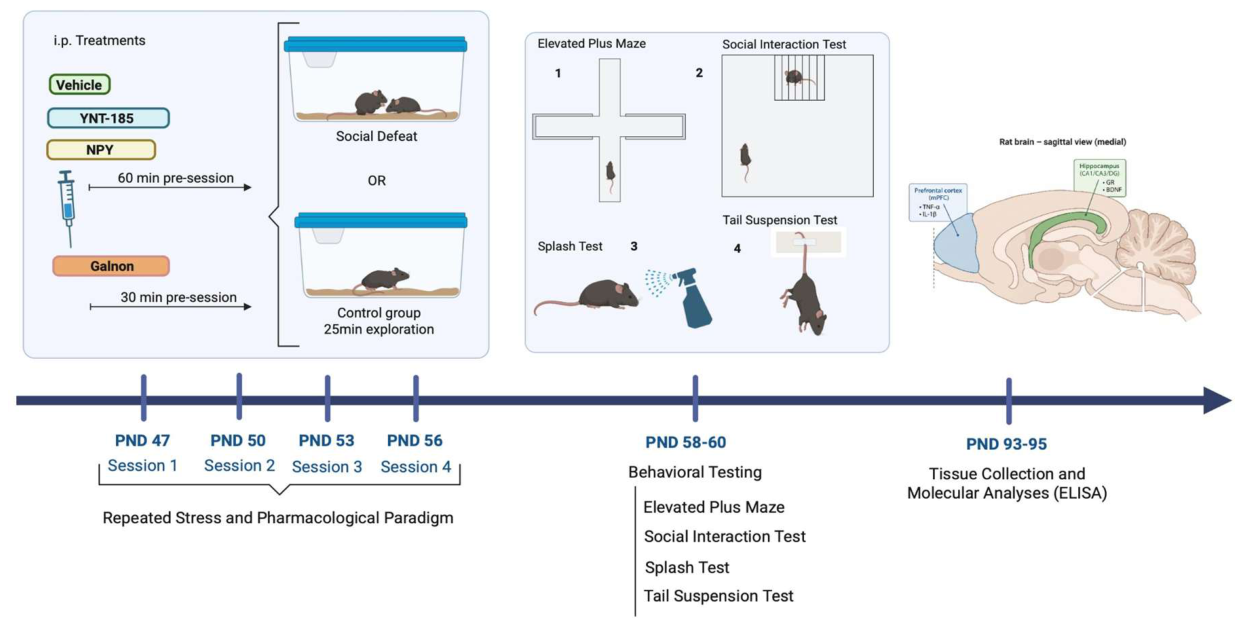
Figure 2.
Validation of the intermittent social defeat model (Vehicle Control vs Vehicle Defeat). Effects of defeat on (A) Percentage of time spent in open arms (OA) of the EPM, (B) Index of social interaction (ISI) in the Social Interaction test, (C) Time of immobility in the Tail Suspension test, and (D) Time spent in grooming in the Splash test. Data are presented as mean ± SEM. *p < 0.05, **p < 0.01 compared with the control group, individual dots represent individual animals.
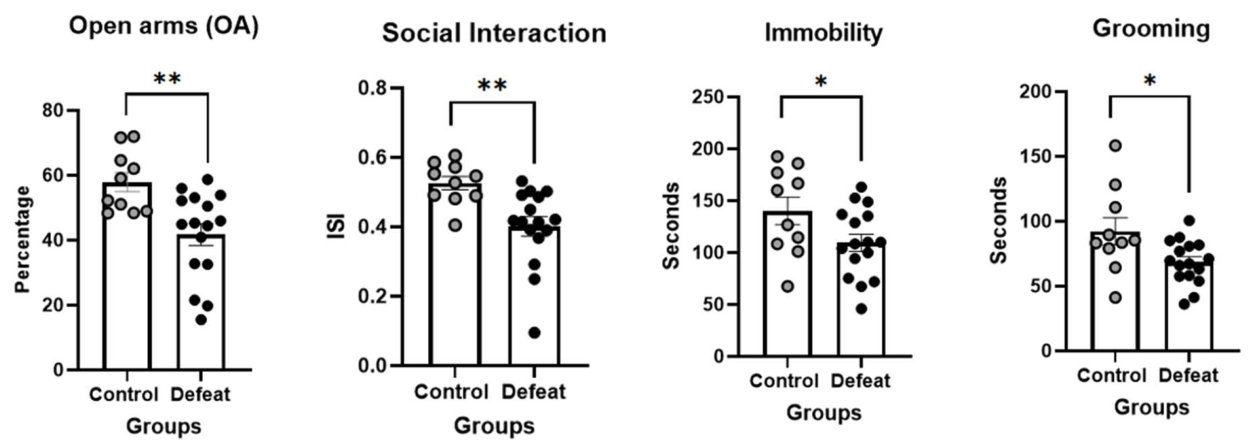
Figure 3.
Effect of YNT-185 on behavioral outcomes. Effects of YNT-185 and intermittent social defeat on (A) percentage of time spent in the open arms (OA) of the EPM, (B) social interaction index (ISI) in the Social Interaction Test, (C) time spent grooming in the Splash Test, and (D) immobility time in the Tail Suspension Test. Data are presented as mean ± SEM; individual dots represent individual animals. *p < 0.05, **p < 0.01, ***p < 0.001; compared with the indicated group.
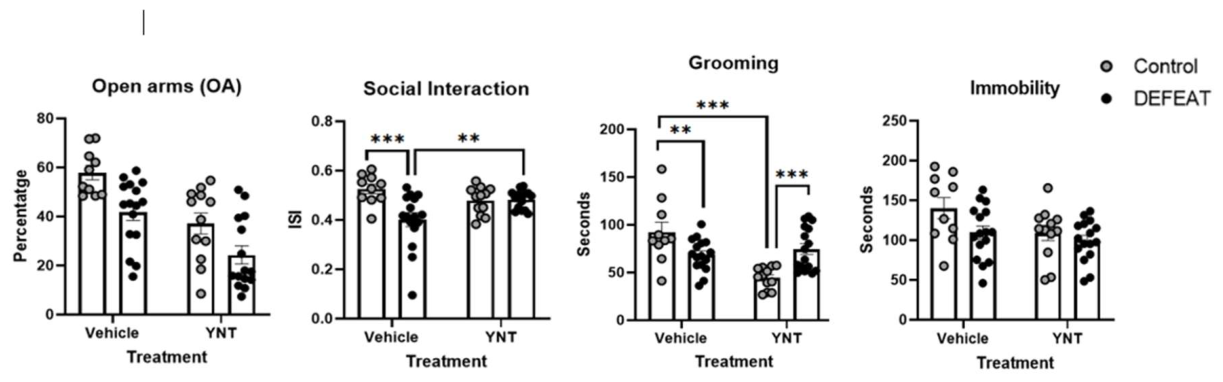
Figure 4.
Effect of Galnon on behavioral outcomes. Effects of Galnon and intermittent social defeat on (A) percentage of time spent in the open arms (OA) of the EPM, (B) social interaction index (ISI) in the Social Interaction Test, (C) time spent grooming in the Splash Test, and (D) immobility time in the Tail Suspension Test. Data are presented as mean ± SEM; individual dots represent individual animals. *p < 0.05, **p < 0.01, ***p < 0.001; compared with the indicated group.
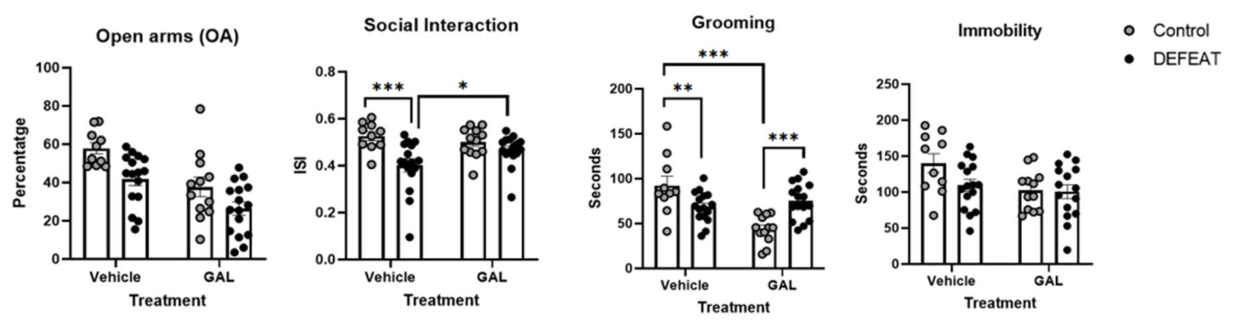
Figure 5.
Effect of NPY on behavioral outcomes. Effects of NPY and intermittent social defeat on (A) percentage of time spent in the open arms (OA) of the EPM, (B) social interaction index (ISI) in the Social Interaction Test, (C) time spent grooming in the Splash Test, and (D) immobility time in the Tail Suspension Test. Data are presented as mean ± SEM; individual dots represent individual animals. *p < 0.05, **p < 0.01, ***p < 0.001; compared with the indicated group.
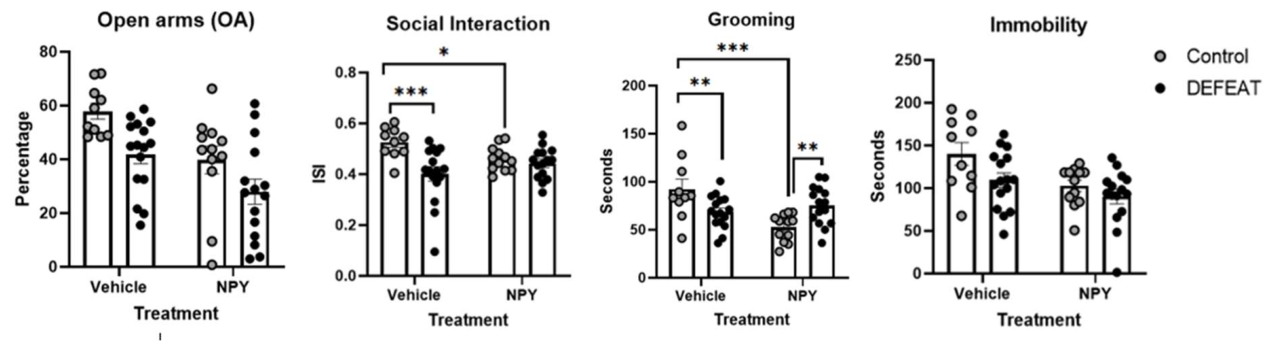
Figure 6.
Persistent molecular alterations following intermittent social defeat. Protein levels of (A) Hippocampal glucocorticoid receptor (GR). (B) Hippocampal brain-derived neurotrophic factor (BDNF). (C) PFC tumor necrosis factor-α (TNF-α). (D) PFC interleukin-1β (IL-1β). Data are presented as mean ± SEM. *p < 0.05, **p < 0.01, individual dots represent individual animals.
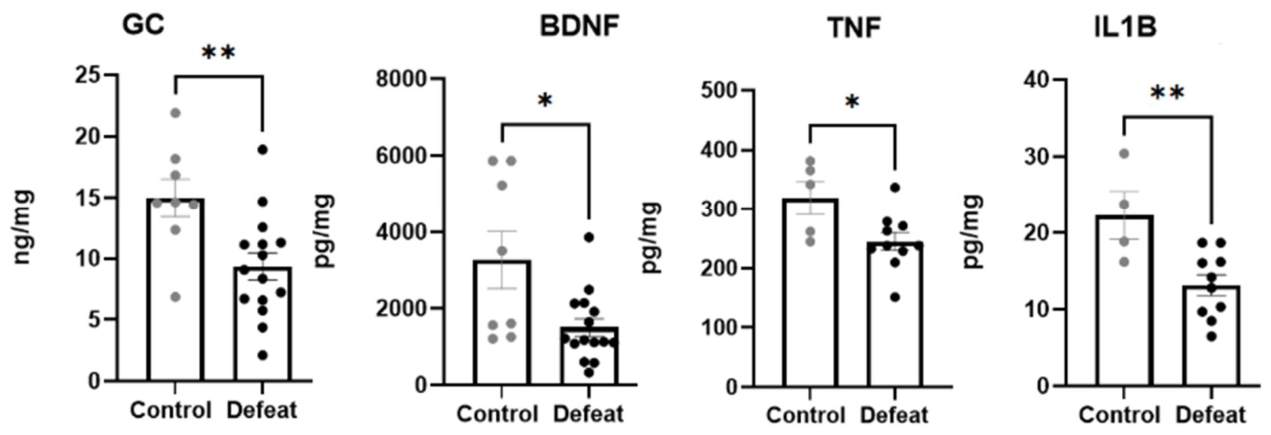
Figure 7.
Effect of YNT on stress-induced molecular alterations. Protein levels of (A) Hippocampal glucocorticoid receptor (GR). (B) Hippocampal brain-derived neurotrophic factor (BDNF). (C) PFC tumor necrosis factor-α (TNF-α). (D) PFC interleukin-1β (IL-1β). Data are presented as mean ± SEM. *p < 0.05, **p < 0.01, ***p < 0.001 compared with the indicated group; individual dots represent individual animals.
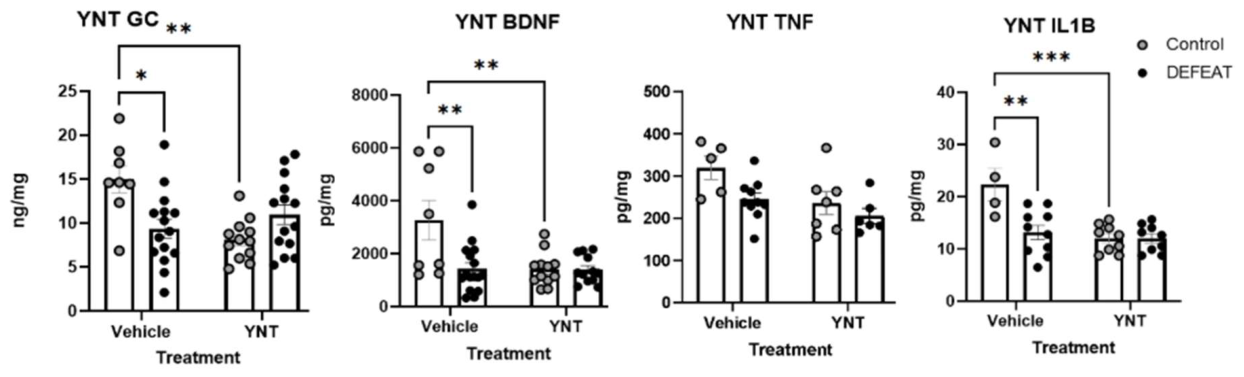
Figure 8.
Effect of Galnon on stress-induced molecular alterations. Protein levels of (A) Hippocampal glucocorticoid receptor (GR). (B) Hippocampal brain-derived neurotrophic factor (BDNF). (C) PFC tumor necrosis factor-α (TNF-α). (D) PFC interleukin-1β (IL-1β). Data are presented as mean ± SEM. *p < 0.05, **p < 0.01, ***p < 0.001 compared with the indicated group; individual dots represent individual animals.
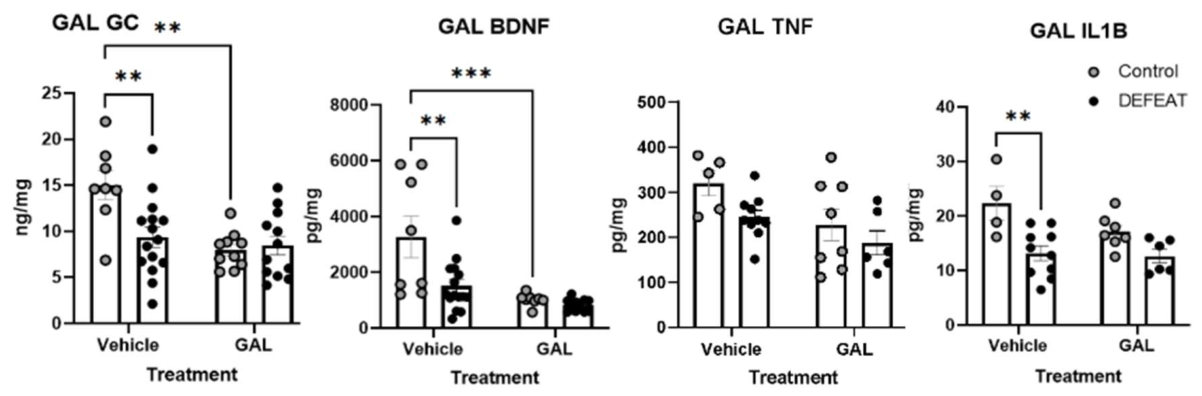
Figure 9.
Effect of NPY on stress-induced molecular alterations. Protein levels of (A) Hippocampal glucocorticoid receptor (GR). (B) Hippocampal brain-derived neurotrophic factor (BDNF). (C) PFC tumor necrosis factor-α (TNF-α). (D) PFC interleukin-1β (IL-1β). Data are presented as mean ± SEM. *p < 0.05, **p < 0.01, ***p < 0.001 compared with the indicated group; individual dots represent individual animals.
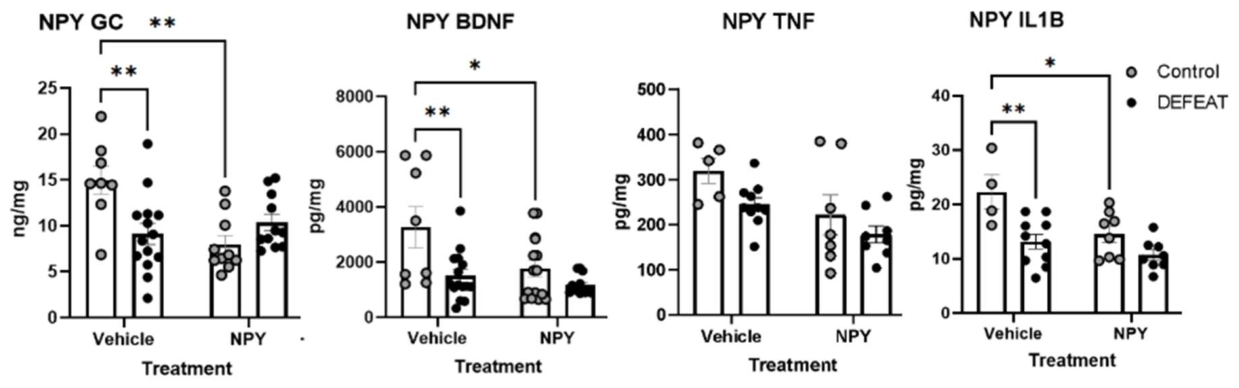
Disclaimer/Publisher’s Note: The statements, opinions and data contained in all publications are solely those of the individual author(s) and contributor(s) and not of MDPI and/or the editor(s). MDPI and/or the editor(s) disclaim responsibility for any injury to people or property resulting from any ideas, methods, instructions or products referred to in the content. |
© 2026 by the authors. Licensee MDPI, Basel, Switzerland. This article is an open access article distributed under the terms and conditions of the Creative Commons Attribution (CC BY) license (http://creativecommons.org/licenses/by/4.0/).
Copyright: This open access article is published under a Creative Commons CC BY 4.0 license, which permit the free download, distribution, and reuse, provided that the author and preprint are cited in any reuse.