

Submitted:
21 October 2026
Posted:
23 October 2026
You are already at the latest version
Abstract
The conventional account of Jenner’s cowpox vaccine attributes a series of enabling properties to pre-laboratory inoculation: harvesting, preserving and transmitting infectious material; attenuating disease first through variolation and again through cowpox substitution; and a visible ‘take’ validating the procedure. Applying Occam’s razor, this review considers simpler alternative explanations. A recurring pattern is revealed in which early assumptions became established premises that were insufficiently challenged even as scientific standards advanced. Thus, the take alone did not establish poxvirus transmission, and variolation’s 0.5–2% versus 20–30% mortality comparison improperly contrasted healthy recipients with patients already ill with smallpox. Jennerian vaccination inherited and compounded these limitations and was not demonstrably superior to contemporary refined variolation. The major/minor division did not independently explain the decline in smallpox burden, and the attributed 300-million twentieth-century death toll could not be substantiated from contemporary population-level mortality records. Most importantly, eradication coincided with a diagnostic discontinuity: 1978 marked both the first year without recognised naturally acquired cases and the first year in which laboratory confirmation became a de facto requirement for validating suspected smallpox outbreaks. These findings challenge the traditional interpretation of smallpox and its eradication.
Keywords:
smallpox
; variolation
; Jennerian vaccination
; vaccine take
; historical epidemiology
; variola minor
; eradication
; diagnostic classification
1. Introduction
The accepted smallpox narrative credits an eighteenth-century intervention with enabling what the World Health Organization (WHO) has called “the greatest public health triumph in history” [1]. Most eighteenth-century medical interventions are now treated with substantial scepticism, but Jennerian vaccination and variolation are treated differently, and early claims of efficacy are broadly accepted at face value. Thus, paradoxically, some of the most extraordinary claims of medical success originated in eighteenth-century evidence whose foundational assumptions were never adequately reassessed. In modern terms, orthopoxviruses are considered unusually cross-protective and unusually stable outside the body, properties essential for the success of early Jennerian vaccination. Smallpox itself is also considered unusually route-dependent, essential for variolation in its several forms, and unusually eradicable.
What evidence showed that variolation and cowpox inoculation produced milder illness while protecting against smallpox? Were these effects independently demonstrated, or simply assumed from reactions labelled successful? A closer look at the historical sequence reveals additional enabling properties: the lesions formed after inoculation, later referred to as the ‘take’, served as a presumed indicator of immunity, while the inoculated skin provided a living system for propagating the next dose, and arm-to-arm transfer substituted for separate vaccine production and prolonged storage. Table 1 compares these properties with selected major infections. The comparison is descriptive rather than probabilistic.
Applying Occam’s razor, this review asks which interpretations account for the historical observations with fewer unsupported assumptions. It examines five linked themes—variolation, Jennerian vaccination, the take and propagation, smallpox case-fatality trends and classification, and eradication—assessing the evidence for each independently of conclusions drawn from subsequent stages. Conventional and alternative explanations are assessed against the same requirement: accounting for the relevant evidence without treating the interpretation under examination as an established premise.
2. Materials and Methods
The review used a Koch-inspired causal framework and was guided by six questions: (1) Was the claimed agent present in the inoculum? (2) Did it infect the recipient? (3) Did that infection cause the lesion or illness? (4) Was illness attenuated? (5) Did inoculation prevent subsequent natural smallpox? (6) Did it confer net benefit relative to no inoculation? The six questions concern distinct propositions: agent identification alone does not establish the cause of every reaction, attenuation, subsequent protection or net benefit. Conversely, an appropriately designed outcome comparison can establish protection or net benefit without resolving every mechanistic question; the six propositions need not be sequential prerequisites for demonstrating an outcome. Smallpox case-fatality rate (CFR) trends were assessed in relation to major/minor classification, while eradication was examined for diagnostic validation, burden estimates and measurement continuity. Throughout this review, ‘not established’ means not established by the evidence examined for the specified proposition, rather than falsified. Speculative explanatory mechanisms are identified as hypotheses.
PubMed, WHO collections, CDC Stacks, Global Health Chronicles and digitised government, parliamentary and historical archives were searched during August–October 2026. Searches used terms relating to mortality, efficacy, take, laboratory confirmation, surveillance and historical trials; references were followed to primary reports and later analyses. This was a targeted historical review rather than a systematic review. Searches sought supporting and contrary evidence, prioritising primary reports and official records containing original counts, observations, comparator or challenge data, surveillance definitions or laboratory results.
Ratios and proportions were recalculated where possible. The quantitative analyses included historical mortality comparisons after variolation and vaccination, CFR and scarring across variola classifications, and clinical, laboratory and mortality records from eradication. Figure 1 is AI-generated conceptual artwork, not historical clinical photography or diagnostic evidence. Figure 2 uses England and Wales observations involving at least 100 cases. Table 2 compares WHO-reported cases, published deaths and laboratory records. Figure 3A compares an illustrative allocation to India of the retrospective 300-million worldwide smallpox-death attribution with historical Indian smallpox death records and estimates of all-cause mortality. Figure 3B compares global clinical notifications with laboratory-positive specimens. Differences among sources precluded pooled effect estimates or inferential meta-analysis. Underlying values and calculations are provided in Supplementary Table S1–S4, Table S7 and Table S8 and the figure source data.
Occam’s razor was applied qualitatively by distinguishing recorded observations from assumptions about agent identity, protection and causation, and assessing whether those assumptions had independent support. Competing explanations were evaluated by whether they accounted for the same observations without relying on additional unsupported premises.
AI-assisted tools (ChatGPT, OpenAI) supported quantitative cross-checking, formatting, proofreading and figure generation. The author independently reviewed the outputs and remains responsible for the manuscript’s content and conclusions.
3. Results
3.1. Variolation
Variolation purported to transmit smallpox in a milder form and confer immunity. Early variolation accounts treated local pustules or mild eruptions as evidence of successful inoculation without independently establishing their cause or protective significance. The local reaction alone established neither inoculum identity nor viability, transmission, the cause or severity of illness, nor subsequent protection. The commonly cited comparison of 0.5–2% mortality following variolation with 20–30% CFR from natural smallpox [2] compounded the problem by comparing initially healthy recipients with patients already ill, rather than with the untreated risk faced by comparable healthy people over an equivalent period. Jurin and Scheuchzer recorded 897 inoculations during 1721–1728, with 17 deaths attributed or possibly attributed to the procedure. Although they investigated reports of subsequent natural smallpox, they did not systematically follow the inoculated cohort to establish long-term protection [15].
Jurin also extrapolated a lifetime smallpox mortality risk of approximately 7% from historical death records, but this estimate applied from birth, whereas smallpox deaths were concentrated in childhood. It therefore did not establish the substantially different remaining risk faced by adults selected for variolation, which must be considered against the reported 0.5–2% mortality associated with the procedure itself, particularly if repeated. A modern review nevertheless treated this historical evidence as sufficiently reliable to support variolation’s protective efficacy [15].
Dimsdale accepted local lesions as successful variolation even with little fever or only a few pimples. He also reported resistance to reinoculation and deliberate exposure, and claimed never to have encountered natural smallpox after successful inoculation, but supplied no denominators, standardised exposure criteria or susceptible controls [16]. Conversely, Mudge (1776) reported reproducible local pustules in 30 recipients who subsequently developed fever and eruptions following reinoculation [17]. Jenner likewise described deteriorated material producing local reactions and eruptions without protection [3,4]. The Newgate experiment involved six prisoners but only one clearly described natural-exposure test, while larger mortality series lacked systematic follow-up [15]. Sutton also reported failures with alternative oral, nasal and indirect exposure methods [18,19,20].
Source identity created an additional problem. Variolation became established in Europe before chickenpox was clearly distinguished from smallpox; Heberden explicitly suggested that some people had probably been inoculated from chickenpox and that the resulting illness was then mistaken for smallpox [21]. Preference for unusually mild source cases compounded this ambiguity, concentrating sampling near the clinical boundary between chickenpox and mild smallpox. Crosse cited reports of chickenpox being mistaken for smallpox during variolation and described an apparent inoculation take that failed to prevent subsequent fatal smallpox [22].
During eradication-era investigations, one specimen collected from a professional Pakistani variolator contained numerous herpesvirus rather than poxvirus particles; Fenner and colleagues suggested that, with smallpox material scarce, it had probably been collected from a chickenpox patient deliberately or through misdiagnosis [2]. WHO reported positive virus isolation from four Afghan variolators’ preparations, but no independent species-identification results were documented for these specimens. It also attributed 47 of 237 Afghan outbreaks during 1970–1972 to variolation, although no laboratory linkage between the attributed outbreaks and the sampled preparations was documented [2, pp. 683–685].
Late Chinese variolation reports retrospectively attributed eruptions and secondary cases to smallpox, citing reported isolation of viable variola from inoculation material and clinical specimens [23]. Yet smallpox had last been reported in the affected regions 7–11 years earlier. Variolators claimed to have maintained infectious material through periodic inoculation, but no continuous chain was documented. WHO acknowledged that the transmission chains remained unexplained and that stored variolation material seldom remained viable for a year [2, pp. 1333–1334]. Moreover, no deaths were recorded among 62 secondary cases in unvariolated contacts (0/62). The investigators attributed this discrepancy with expected variola-major fatality “almost certainly” to deficient records, without evidence of unrecorded deaths [23]. The reported isolations therefore leave the provenance of the inoculum unresolved and do not independently establish that the attributed illnesses resulted from variola transmitted through variolation.
3.2. Vaccination
The hypothesis underlying Jennerian vaccination arose largely from resistance to variolation. Fewster recounted that in 1768 a farmer repeatedly inoculated without effect reported having recently experienced cowpox “to a violent degree”, suggesting an association between cowpox and resistance to variolation [24]. Even if the farmer’s resistance was genuine, it neither established protection against natural smallpox nor showed that Jenner’s milder induced lesion would reproduce it. Jenner’s 1798 Inquiry likewise relied mainly on retrospective histories of purported natural cowpox, with protection inferred from subsequent resistance to variolation or exposure rather than from prospective comparison [3,4].
In 1789, Jenner inoculated his infant son with material described as swinepox and interpreted subsequent resistance to variolation as evidence of protection, yet this finding lacked further recognition [25]. Seven years later, Jenner used essentially the same experimental approach with cowpox in a single recipient, James Phipps, whose apparent protection was similarly inferred from resistance to variolation, yet this became the founding discovery of vaccination [3]. Jenner’s later experiments included a comparison in which the same variolous material reportedly produced smallpox in one recipient but only transient local inflammation in two other recipients previously inoculated with cowpox. The comparator’s illness was not clinically described [3]. Jenner also cited Fry’s report of people without prior cowpox or swinepox who repeatedly resisted variolation [4]. Baron subsequently recalled Jenner stating in 1818 that Phipps had been inoculated against smallpox “for the twentieth time”, but no corresponding series of challenge records or procedural details was supplied [25].
Waterhouse’s 1802 Boston experiment involved 19 vaccinated children. Twelve were initially challenged with variolous material, while two unvaccinated controls given the same material reportedly developed smallpox. The remaining seven vaccinated children were challenged later, and the vaccinated group was also exposed to the resulting smallpox cases [26]. As reported, these results support short-term resistance to variolous challenge. Neither Waterhouse’s nor Jenner’s experiments established whether this resistance conferred protection against naturally acquired smallpox, or the magnitude and duration of any such protection.
Some 30 years before Jenner’s cowpox experiment, Boylston’s account of the Suttonian method reported three deaths among 22,000 inoculations in 1763–66 (0.014%), far below the commonly cited 0.5–2% range [20,27]. Madras government returns for 1800–02 reported seven casualties among 26,396 inoculations (0.027%) [28]. Woodville’s 1799 hospital series reported one death among approximately 500 cowpox inoculations (0.20%), compared with mortality no higher than one in 600 among his last 5,000 variolations (≤0.17%). He questioned introducing cowpox into his hospital on the basis of these results [29]. These unmatched observations do not establish the comparative safety of the two procedures. Despite these reports, the 1807 parliamentary case for Jennerian vaccination used one death per 300 variolations (0.33%), approximately 24 times Sutton’s reported rate [30]. The 1807 parliamentary inquiry reported 164,381 vaccinations, three deaths attributed to vaccination and 56 subsequent cases of smallpox, but these were accumulated practitioner returns without uniform prospective follow-up [30].
The direction of the mortality-comparison bias reversed. In promoting variolation, advocates contrasted its reported 0.5–2% mortality with the 20–30% CFR of people already ill with natural smallpox, rather than the risk faced by comparable untreated recipients [2]. In promoting Jennerian vaccination, later comparisons used higher variolation mortality figures despite much lower contemporary returns from refined procedures, including the Suttonian and Madras series and Woodville’s hospital experience [20,27,28,29]. WHO’s 1988 history presented the widely repeated 0.5–2% range, echoed in a 2026 review [2,19]. Fenner’s Boston series nevertheless included 0.6–2.0% fatality estimates during 1764–1792 (Table 6.2) [2]. These heterogeneous reports do not show a uniformly low variolation mortality rate, but selecting higher comparators enlarges vaccination’s apparent safety advantage relative to the lower refined-procedure returns; neither type of comparison independently establishes comparative safety.
Successful vaccination was recognised principally by the local reaction. Jenner distinguished local inflammation from ‘genuine’ cowpox, yet vaccination came to rely heavily on the local take as evidence that the intended infection had occurred. Neither a local lesion nor resistance to variolous challenge was therefore individually specific for successful vaccination. A characteristic lesion could support classification as successful vaccination, while later failure could be accommodated by reclassifying the earlier episode as spurious. Brown’s 48 reported post-vaccination smallpox cases illustrate the interpretive problem: the Edinburgh Vaccine Institution described 25 as having the usual appearances of chickenpox [31], whereas Blane subsequently counted the same 48 as mitigated smallpox and calculated that vaccination had saved at least eight lives [32]. Thus, the same illnesses could be excluded as vaccination failures or interpreted as evidence that vaccination had mitigated smallpox.
British public-vaccination instructions advised vaccinating only healthy subjects except when smallpox posed an immediate danger, and recording vaccination as successful only after subsequent inspection [33]. Defining the vaccinated group by a post-vaccination scar therefore classified people by their response to vaccination rather than by whether they received it. Marson’s hospital analysis excluded 3.5% of deaths among unvaccinated patients but 13.3% among scar-positive vaccinated patients from the smallpox fatality calculation as deaths from ‘superadded disease’ [34]. Among 1,263 patients with four or more good scars, Marson excluded 10 of 11 deaths as superadded disease, reducing the calculated CFR from 0.87% to 0.08% [34]. This approximately elevenfold reduction in calculated CFR resulted from excluding ten recorded deaths, not from observing fewer deaths among the patients.
In Sheffield, apparent protection fell from approximately 90% in crude health-office comparisons to 55% after adjustments to exposure denominators, vaccination status and case classification [35,36,37]. These were not estimates from identical populations, and Barry recognised that vaccinated and unvaccinated residents could differ substantially in exposure [35]. A separate workhouse comparison yielded only 13% lower crude attack risk, although based on just three attacks among unvaccinated residents [35,37]. Among children under ten in affected households, attack rates were 353/4,493 in the vaccinated versus 228/263 in the unvaccinated, corresponding to approximately 91% lower crude attack risk (Barry, p. 182) [35]. However, the unvaccinated comprised only 5.5% of this selected population, with an exceptionally high recorded attack rate (87%). Public-vaccination guidance favouring healthy recipients could also have introduced health selection into this comparison [33].
Rao’s 1968 study included 254 families affected by smallpox. Among 1,146 contacts classified as vaccinated or previously infected with natural smallpox, 14 developed smallpox; among 103 contacts classified as unvaccinated before exposure, 38 developed smallpox [38]. The resulting crude apparent protection was approximately 97%. It was 88% in families with secondary transmission and 59% in families with more than two unvaccinated members [39]. None of these comparisons was randomised or independently controlled for differences in exposure.
A Brazilian study reporting approximately 95% vaccine effectiveness against variola minor identified 1,492 largely retrospectively ascertained cases, of which only 27 (1.8%) had initially been reported. Illness was generally mild, potentially resembling chickenpox in some cases (one outbreak of 77 cases resulted in only one hospitalisation), although 12 deaths were recorded (0.8%). The study reported neither case-level laboratory confirmation nor detailed clinical descriptions, provided no explicit clinical case definition or indication of blinded diagnosis, and used vaccination scars as a proxy for vaccination status [40].
The identity of Jenner’s original vaccine material and its continuity with later vaccinia vaccines remain uncertain; nineteenth-century samples included horsepox-related lineages [2,41,42]. Jenner considered protective cowpox a constitutional infection [4], yet modern human cowpox and zoonotic vaccinia predominantly cause local lesions, unlike systemic smallpox [43,44]. Conversely, mpox can closely resemble smallpox clinically despite its distinct genomic lineage [45]. Superficial variolation could therefore resemble local cowpox or vaccinia lesions more closely than generalised naturally acquired smallpox; resemblance between local lesions would not itself demonstrate either variola infection or immunity. Thus, Jennerian vaccination largely retained the procedure of refined variolation, while the identity of the material described as cowpox—its defining innovation—cannot be retrospectively verified.
3.3. Take and Propagation
Before virological assays, the vaccine ‘take’ served as both evidence of successful vaccination and the source of material for arm-to-arm inoculation. The Balmis expedition relied on successive child vaccinifers during long voyages [5,46], and practitioners developed lesion-selection rules without independent tests of agent identity or protection [3]. Thus, reproducing the same local reaction through successive transfers did not independently establish the identity of the transmitted agent or its protective effect. The possibility that a take reflected a non-specific local reaction rather than successful infection by the intended agent warrants examination. This explanation remains hypothetical.
Jenner himself associated deeper incisions with severe complications and deaths, contrasting them with the slightest possible cut and asking whether success depended on placing material “in or upon the skin” [3]. If the transition from deeper incisions to superficial scratches nearly eliminated deaths, why were earlier deaths ever attributed to smallpox infection without independently establishing transmission or ruling out procedural complications? A simpler explanation is that variolation was a crude eighteenth-century surgical procedure that became progressively less invasive and safer.
The Suttonian method reportedly achieved favourable outcomes even when copied by practitioners without medical training [20,27]. A spurious take could require little more than scratching the skin and introducing biological material, whereas successful variola inoculation required obtaining the correct infectious agent, preserving its viability and establishing infection.
Superficial skin inoculation was the dominant method of variolation and was carried forward into Jennerian and later vaccinia vaccination, which was adopted on a global scale (Supplementary Table S5). By contrast, historical nasal methods have little comparable quantitative evidence of effectiveness [19,20]. This raises the question of how far the dominance of skin inoculation reflected its readily visible local take, rather than independently demonstrated superiority in producing protective infection.
The route of infection could also affect disease severity. Milton cited monkey experiments in which both mucosal and cutaneous variola inoculation produced local lesions, but generalised eruptions occurred in only 10% following mucosal inoculation versus 70–80% following cutaneous inoculation [47]. The experiments also involved mucosal scarification, so their local lesions cannot be interpreted independently of procedure-induced tissue injury. These experiments favour cutaneous inoculation for producing generalised disease in monkeys.
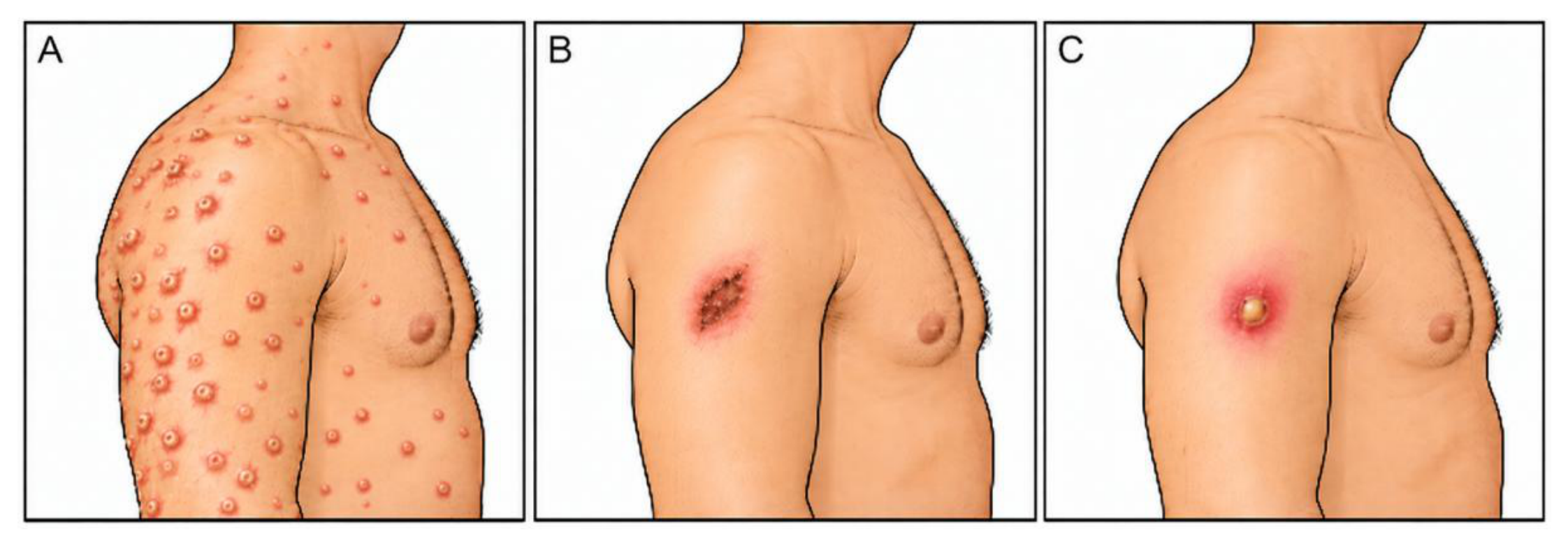
The take was interpreted as a miniature reproduction of smallpox at the inoculation site (Figure 1), although its specificity had not been established. Later observations show that take-like lesions are not unique to poxvirus infection. Greenthal produced local ‘takes’ in 19 of 36 recipients after varicella-vesicle inoculation by the smallpox-vaccination technique [48]; herpes-zoster vesicular fluid produced similar responses [49], while BCG can ulcerate and scar [10]. A modern scarified Francisella tularensis vaccine likewise used a take endpoint, while saline scarification on vaccine recipients’ opposite arms met the trial’s take criterion in 10% of sites [50]. Scarification without virus also produced rapid local inflammation in rabbits [51]. These observations show that a local lesion after scarification does not, by itself, identify vaccinia or establish protection.
Local take morphology was not agent-specific. In 1804, serum inoculation produced lesions resembling early variolation [52], while Jenner reported that vaccine and variolation pustules could be nearly indistinguishable on day 12 [3]. Practitioners developed increasingly refined criteria for distinguishing genuine from spurious vaccine lesions and for selecting material for transfer [22,52,53,54]. Where subsequent failure itself determined whether a take was classified as spurious, the classification preserved the original claim rather than independently testing it. No blinded controlled primary-vaccination study was identified that established take morphology as specific to vaccinia or poxvirus infection. A primary take’s ability to predict protection differs from the effect of prior immunity on subsequent takes. Nineteenth-century army revaccinations produced primary-type takes in one-third to over half of previously vaccinated soldiers [55], while Vichniakov reported positive takes in 53.9% of 425 people with prior smallpox [56]. Conversely, previous MVA vaccination attenuated subsequent Dryvax takes in 21/29 recipients versus 0/7 controls [57].
A subsequent take was therefore not a reliable binary measure of pre-existing immunity, nor did revaccination results establish whether a primary take predicted protection against natural smallpox. Heat-inactivated vaccinia could produce early local reactions without the characteristic later vaccinal response [58]. These experiments with characterised vaccinia do not establish the identity or potency of early arm-to-arm material.
Figure 1.
Generalised smallpox versus local inflammation following skin injury or inoculation. (A) Schematic generalised smallpox eruption. (B) Schematic local inflammatory lesion resulting from an infected scratch or superficial skin injury. (C) Schematic historical variolation take, showing a local lesion at the inoculation site on the upper arm. The figure is illustrative rather than diagnostic. The comparison illustrates why a local lesion following inoculation does not, by itself, establish the identity of the infectious agent or subsequent protection against smallpox.
Figure 1.
Generalised smallpox versus local inflammation following skin injury or inoculation. (A) Schematic generalised smallpox eruption. (B) Schematic local inflammatory lesion resulting from an infected scratch or superficial skin injury. (C) Schematic historical variolation take, showing a local lesion at the inoculation site on the upper arm. The figure is illustrative rather than diagnostic. The comparison illustrates why a local lesion following inoculation does not, by itself, establish the identity of the infectious agent or subsequent protection against smallpox.
3.4. Smallpox CFR
Mortality from many infectious diseases declined sharply from the late nineteenth century [59], yet smallpox continued to be characterised by a 20–30% CFR [2]. The twentieth-century division into variola major and minor was based on CFR [60], preserving the earlier high fatality estimates under variola major while classifying low-CFR outbreaks separately as variola minor. The resulting CFR differences cannot independently validate a division defined by those same differences. Nor can the CFR of variola major establish the CFR of smallpox overall.
Smallpox burden declined markedly over time, particularly from the late nineteenth century, during a broader decline in infectious-disease mortality [61]. Large CFR gradients need not imply distinct pathogens: reported measles CFR differed more than 100-fold between Samoa’s 2019 outbreak (1.45%) and South Korea in 2000–2001 (0.013%) [62,63]. Jameson wrote that an isolated minor case was usually indistinguishable from a mild major case and characterised minor chiefly by its non-fatal course [64].
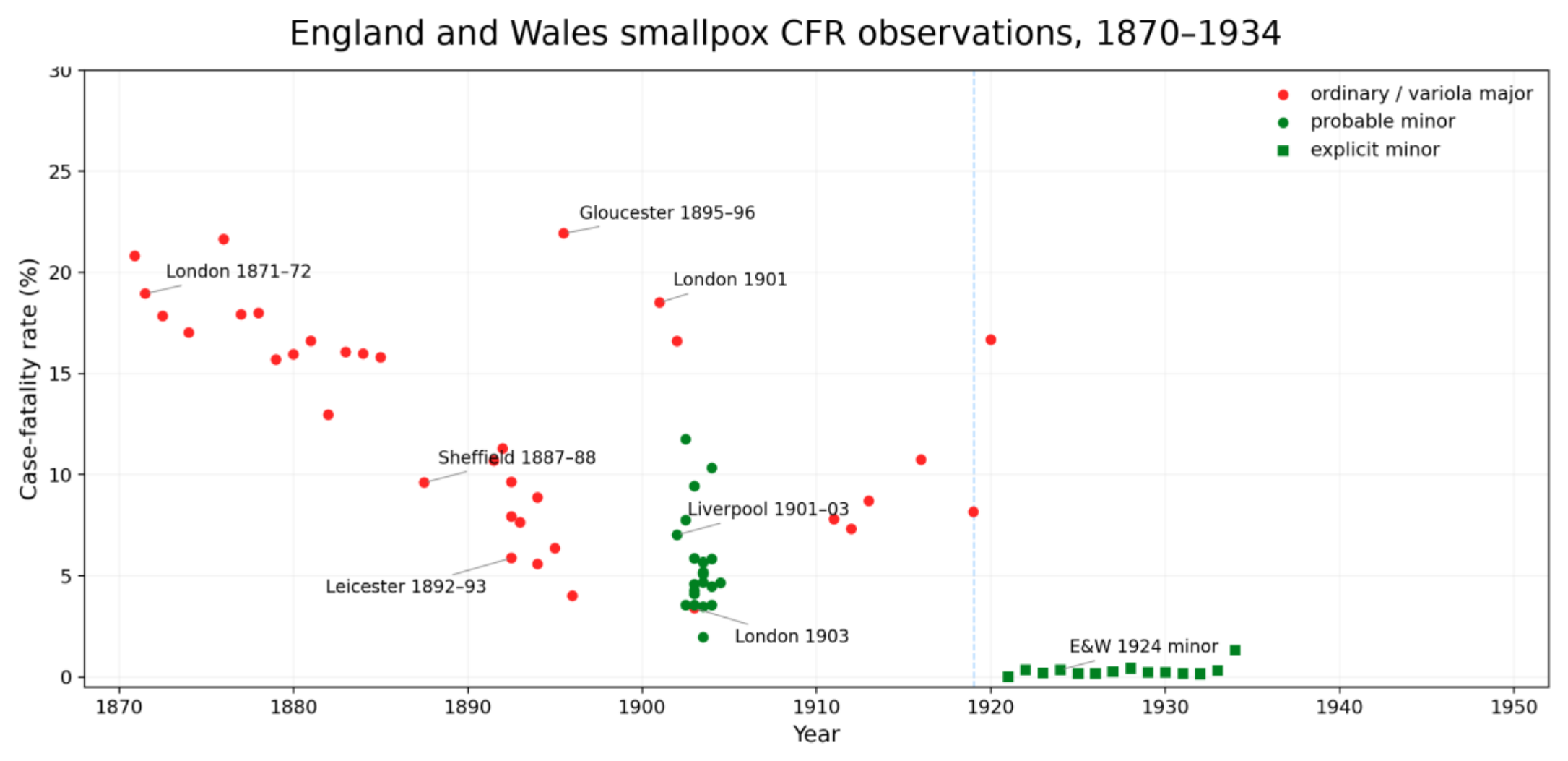
Figure 2 shows a broad shift towards lower CFR over time, rather than independently establishing two stable severity clusters. Outbreaks from 1902–1905 retrospectively assigned to ‘probable minor’ had fatality ratios of 1.96–11.75%, overlapping ordinary/major observations yet markedly exceeding the 0–0.43% recorded in the explicitly classified minor series of 1921–1929. Combining these substantially different observations under a single ‘minor’ label does not establish that they represented the same disease form or that its emergence explains the decline. Where relative fatality supplies the classification, invoking that classification to explain the fatality differences is circular [2,64,65,66]. In the original descriptive fits, calendar year explained more variation in fatality than major/minor classification (R² = 0.62 versus 0.53), but the ranking reversed after the 22 London hospital observations were excluded (R² = 0.33 versus 0.40; Supplementary Table S1). These associations do not establish causation. Rucker questioned whether alastrim might be a separate disease; Leake and Force interpreted experimental cross-immunity as supporting identity with smallpox [67,68]. Cross-protection alone, however, does not establish pathogen identity—the same distinction that underlies cowpox vaccination using a different poxvirus.
The historical smallpox series shows wide variation in CFR: some nineteenth-century ordinary/major outbreaks exceeded 20%, whereas Leicester recorded 5.9%, Brabin’s north-western outbreaks 6.3%, and London 16.2% [2,64,65,66]. Similar variation occurred outside Britain: Japan recorded 3.6%, 4.3% and 8.3% in 1900–1903, Indonesia 3.0% in 1963 [69], and India declined from 31.2% in 1967 to 12.3% in 1975, a decline Fenner attributed to increasingly complete case notification [2]. Reported incidence also increased abruptly during wartime disruption: Japan recorded 17,800 cases in 1946, Italy more than 6,000 in 1944, and South Korea 43,213 in 1951 versus 790 in 1954 [2]. Much of the British interwar classification was retrospective, relying on Dixon’s 1962 reconstruction, while laboratory differentiation emerged only in the mid-1950s [2,70,71]. Diagnosis also depended on vaccination history: Sykes’s 1902 report treated efficient infant vaccination as confirming a medically certified chickenpox diagnosis in a child under ten “almost to a certainty”, despite documenting smallpox mistaken for chickenpox [72]. Thus, vaccination history could influence whether a rash illness was labelled smallpox or chickenpox.
Facial scarring after varicella and variola minor was also similar: one year after illness, at least one persistent facial scar was recorded in 18.4% (46/250) of laboratory-confirmed varicella cases and 23.4% (41/175) of variola minor survivors [73]. Using the more stringent threshold of at least five facial scars, the proportions with such scarring were 2.4% for varicella, 6.8% for variola minor, 64.6% for vaccinated variola major and 85.4% for unvaccinated variola major [73]. Thus, variola minor was substantially closer to varicella than to variola major by this measure.
Genetic studies identified distinguishable lineages but did not consistently reproduce the historical CFR-based major/minor division or establish that lineage differences explained historical severity variation [60,74]. Dumbell and Huq distinguished European and South American alastrim from African minor isolates using laboratory markers, but could not distinguish individual African minor isolates from variola major [71]. The historical major/minor division therefore lacked a consistent counterpart in the markers examined. Historical classification was also disputed: the milder Liverpool form discussed by Brabin was classified as variola major by Fenner [66]. WHO reviewers described the major/minor division as an ‘oversimplification’ [2,75]. Together, these findings suggest a gradual decline in smallpox CFR, rather than a decline explained by the emergence of variola minor while variola major retained a consistently high CFR.
Figure 2.
Smallpox CFR observations in England and Wales, 1870–1934. Seventy-two observations involving ≥100 cases with usable tabulated fatality information are shown [2,64,65,66]. Eight observations from Brabin’s Table 2 are included; Swansea and Bristol are excluded because the published case, death and fatality figures are internally inconsistent (Supplementary Table S1). Red circles indicate ordinary smallpox or observations explicitly classified as variola major; green circles indicate outbreaks retrospectively interpreted as probable variola minor; green squares indicate observations explicitly classified as variola minor. The dashed line marks 1919, when variola minor was described as well established in England. The ≥100-case threshold limits instability from very small outbreaks. The major-only temporal trend also depended on London hospital-admission observations (Supplementary Table S1).
Figure 2.
Smallpox CFR observations in England and Wales, 1870–1934. Seventy-two observations involving ≥100 cases with usable tabulated fatality information are shown [2,64,65,66]. Eight observations from Brabin’s Table 2 are included; Swansea and Bristol are excluded because the published case, death and fatality figures are internally inconsistent (Supplementary Table S1). Red circles indicate ordinary smallpox or observations explicitly classified as variola major; green circles indicate outbreaks retrospectively interpreted as probable variola minor; green squares indicate observations explicitly classified as variola minor. The dashed line marks 1919, when variola minor was described as well established in England. The ≥100-case threshold limits instability from very small outbreaks. The major-only temporal trend also depended on London hospital-admission observations (Supplementary Table S1).
3.5. Eradication
By the start of the intensified eradication programme in 1967, endemic smallpox had already been eliminated from most countries and territories—125 of the 156 in Fenner’s historical tabulation (p. 175)—with only 31 remaining endemic [2]. During 1950–1954, India accounted for roughly half of all reported smallpox cases worldwide [76]. The much larger historical burden estimates of millions of annual cases depended on retrospective reconstruction: Fenner estimated that pre-programme WHO notifications represented only 1–2% of true incidence [2], while WHO estimated more than one million Indian cases in 1944 [75].
England and Wales illustrate the preceding decline: variola-minor notifications rose during the 1920s but fell from 11,839 cases in 1930 to none in 1935, while infant vaccination uptake had declined to 35.4% [2,64,65,66,75,77]. The decline in smallpox mortality was not confined to Western countries; substantial reductions also occurred in Brazil, parts of Africa and India before the intensified global eradication programme [2]. Nevertheless, WHO attributed approximately 300 million deaths to smallpox in the twentieth century [1]. WHO’s 2007 World Health Report also estimated 50 million cases and 15 million deaths annually in the early 1950s [78]. The 15-million death estimate equals the 50-million case estimate multiplied by a 30% CFR, but the report gives no separate mortality derivation. If calculated this way, mortality would inherit the assumed incidence and fatality rather than independently corroborate them [78].
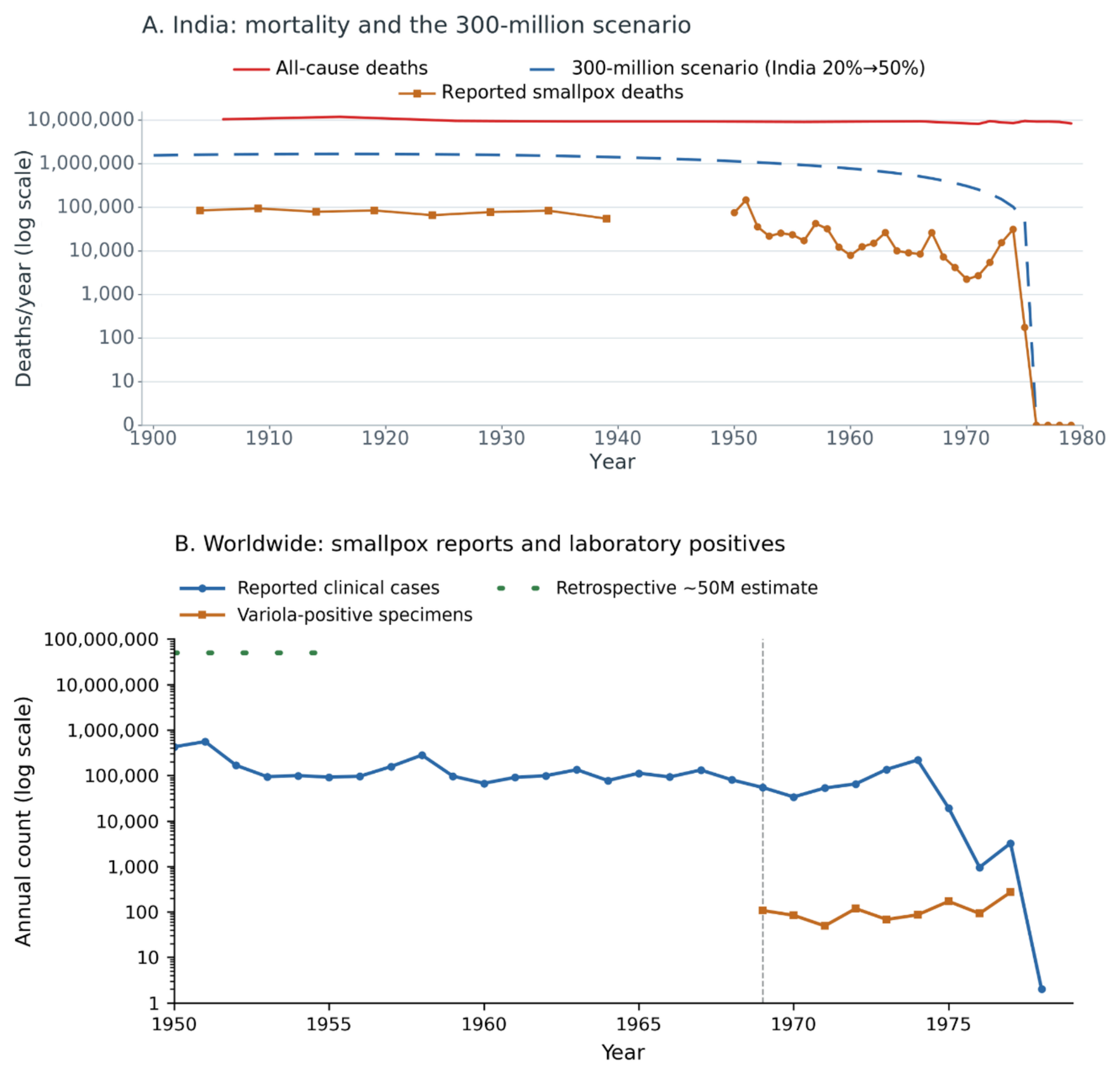
Figure 3A illustrates the demographic implications of WHO’s widely cited attribution of approximately 300 million smallpox deaths during the twentieth century. Under an illustrative worldwide annual mortality trajectory declining linearly to zero in 1978, with India’s assumed share rising from 20% in 1900 to 50% by 1966, the scenario implies approximately 1.59 million Indian smallpox deaths annually in 1900–1939 and 94.7 million cumulatively. Relative to the separately reconstructed all-cause mortality series this is numerically on the order of 14–17%; it must not be interpreted as a population-matched share of actual mortality, because pre-Partition British Indian smallpox returns and post-Independence-boundary all-cause reconstructions have different geographical coverage. Contemporary British Indian records attributed a much smaller fraction of registered deaths to smallpox: 70,962 of 8,117,771 deaths in 1905 (0.87%) and a mean of 69,474 smallpox deaths among approximately 6.20 million registered deaths annually in 1932–1941 (1.12%) [79,80]. Holding India’s share constant at 20% over the same worldwide trajectory would imply approximately 808,000 annual Indian smallpox deaths during 1932–1941, versus 69,474 recorded. The illustrative allocation implies an exceptionally high smallpox mortality burden in India during 1900–1939, equivalent to approximately 14–17% of reconstructed all-cause mortality, despite the substantial decline in smallpox mortality already underway. The assumed Indian share may itself be conservative, given India’s concentration of cases labelled variola major while much of the world had already transitioned towards predominantly lower-fatality outbreaks.
Figure 3.
Historical smallpox mortality and reporting. (A) India, 1900–1979: reconstructed all-cause mortality, reported smallpox deaths and an illustrative allocation of WHO’s 300-million global death attribution [1,79,80,81,82,83]. The hypothetical global trajectory declines to zero in 1978, while India’s illustrative allocation reaches zero in 1976, corresponding to its first year without reported smallpox cases. India’s assumed share rises from 20% in 1900 to 50% by 1966, implying approximately 94.7 million Indian deaths cumulatively. This scenario is illustrative, not a historical mortality estimate. Early smallpox observations are multi-year averages; the all-cause series contains reconstructed period estimates rather than continuously registered annual deaths. Pre-Partition smallpox records and later all-cause estimates have different geographical coverage and are not directly comparable. (B) Worldwide reported clinical cases, 1950–1979, and international collaborating-centre variola-positive specimens, 1969–1979 [2,75]. Spaced dots indicate the retrospective estimate of approximately 50 million annual cases in the early 1950s [2,78]. Clinical notifications and laboratory-positive specimens are different ascertainment units; zero counts are omitted from panel B’s logarithmic axis.
Figure 3.
Historical smallpox mortality and reporting. (A) India, 1900–1979: reconstructed all-cause mortality, reported smallpox deaths and an illustrative allocation of WHO’s 300-million global death attribution [1,79,80,81,82,83]. The hypothetical global trajectory declines to zero in 1978, while India’s illustrative allocation reaches zero in 1976, corresponding to its first year without reported smallpox cases. India’s assumed share rises from 20% in 1900 to 50% by 1966, implying approximately 94.7 million Indian deaths cumulatively. This scenario is illustrative, not a historical mortality estimate. Early smallpox observations are multi-year averages; the all-cause series contains reconstructed period estimates rather than continuously registered annual deaths. Pre-Partition smallpox records and later all-cause estimates have different geographical coverage and are not directly comparable. (B) Worldwide reported clinical cases, 1950–1979, and international collaborating-centre variola-positive specimens, 1969–1979 [2,75]. Spaced dots indicate the retrospective estimate of approximately 50 million annual cases in the early 1950s [2,78]. Clinical notifications and laboratory-positive specimens are different ascertainment units; zero counts are omitted from panel B’s logarithmic axis.
No continuous, comparable worldwide smallpox mortality series was identified spanning eradication. WHO’s provisional worldwide death totals for 1962–1964 were even lower than India’s national totals alone [81,84], revealing inconsistencies in the historical reporting. These records cannot independently validate the much larger retrospective mortality estimates. In Guinea, 18 deaths among 316 cases classified as chickenpox (5.7%) were recorded in 1973, four years after smallpox was considered eliminated, without documented laboratory verification or an explanation of the deaths [85]
WHO documented a progressive shift in diagnostic practice over the eradication period [2,75]. By 1978, laboratory confirmation had become a de facto requirement for recognising new outbreaks, coinciding with the first year without recognised naturally acquired smallpox. WHO collaborating centres reported 1,044 variola-positive specimens during 1969–1977, compared with 583,559 clinical notifications [2,75]. The 1978 zero is therefore comparable in measurement type to the earlier laboratory-positive series, not directly to the much larger clinical-notification totals.

Table 2.
WHO clinical case reports, published smallpox death counts and collaborating-centre laboratory records, 1969–1979.
Table 2.
WHO clinical case reports, published smallpox death counts and collaborating-centre laboratory records, 1969–1979.
| Year | Clinical reporting |
WHO-recorded deaths |
Laboratory submissions | Arithmetic comparison | |
| Reported smallpox cases |
Documented country countsᶜ |
Specimens received | Variola-positive specimens | Reported / positive specimens | |
| 1969 | 54,202 | IN 4,156 | 368 | 107 | 506.6 |
| 1970 | 33,706 | IN 2,240 | 277 | 84 | 401.3 |
| 1971 | 52,806 | IN 2,706 | 646 | 49 | 1,077.7 |
| 1972 | 65,153 | IN 5,457 BD 3,053 |
496 | 118 | 552.1 |
| 1973 | 135,859 | IN 15,434 BD 4,522 |
376 | 68 | 1,997.9 |
| 1974 | 218,367 | IN 31,262 BD 2,860; NP 305 |
288 | 86 | 2,539.2 |
| 1975 | 19,278 | IN 176 BD 2,492; NP 15 |
778 | 170 | 113.4 |
| 1976 | 954 | 0 (SEARO)ᵈ | 1,300 | 92 | 10.4 |
| 1977 | 3,234 | SO 12 0 (SEARO) |
3,766 | 270 | 12.0 |
| 1978 | 2 | UK 1 | 4,650 | 0ᵃ | —ᵃ |
| 1979 | 0 | 0 (world) | 4,280 | 0 | —ᵇ |
Note: Worldwide reported clinical cases [75]; collaborating-centre specimens and variola-positive results (Fenner, Table 24.1) [2]. ᶜ Reported smallpox deaths published in WHO sources, not estimates obtained by applying a CFR; this column is not a worldwide annual total. IN = India, BD = Bangladesh, NP = Nepal, SO = Somalia, UK = United Kingdom; SEARO = WHO South-East Asia Region. Indian deaths, 1969–1975: Fenner, Table 15.4 [2]; Bangladesh, 1972–1975, and Nepal, 1974–1975: WHO regional reports SEA/RC28/2 and SEA/RC30/2 (full citations in the Supplementary Table S3 source notes); Somalia, 1977: [75]; UK, 1978: [86]. ᵈ No deaths reported from SEARO in 1976 does not mean zero worldwide. WHO editions differ on some national counts (Supplementary Table S3 and Table S7). The last column divides global clinical cases by collaborating-centre positive specimens, not confirmed patients. ᵃ The Birmingham cases in 1978 were confirmed outside the collaborating-centre series [86]; 2/0 is not a ratio. ᵇ The 1979 ratio 0/0 is undefined.
Requiring laboratory confirmation need not mean that smallpox transmission is about to end. If transmission continued, confirmed cases could be reported for years. In 31 of the 32 jurisdictions examined, reported cases still outnumbered variola-positive specimens recorded by WHO collaborating centres in the final year with reported cases. The following year, no cases were reported (Supplementary Table S4) [2,75]. Rwanda shows how a confirmation rule could produce zero reports when no testing was done: during 1966–1968, only laboratory-confirmed cases could be counted, but no specimens were examined [2] (pp. 946–947). This raises the possibility that changes in which illnesses were counted as smallpox also contributed to the final reported declines elsewhere. Any such contribution remains unresolved.
In India, smallpox cases fell from 188,003 in 1974 to 1,436 in 1975 and zero in 1976; Bihar alone fell from 126,872 to 839 and zero [2,87]. The decline coincided with anticipated seasonal decline, while April 1975 guidance generally exempted recognised chickenpox from testing and permitted laboratory-negative outbreaks to be closed when another diagnosis was supported [2,76,87,88]. Nationwide fever-and-rash surveillance was introduced in January 1976, after India’s last recognised smallpox case in May 1975. By November, the system had recorded nearly two million fever-and-rash illnesses, including over 800,000 classified as chickenpox, but only a subset was laboratory-tested [2,87,89]. Without comparable earlier data, the relative contributions of reduced transmission, seasonal decline and changing ascertainment remain unclear.
4. Discussion
The Institut Pasteur described Jenner’s discovery as arising from “exceptional circumstances” [90]. However, Table 1 identifies a succession of enabling properties attributed to smallpox inoculation, rather than a single exceptional feature. This creates a cumulative plausibility problem: successive attributed enabling properties were treated as established even where evidential support depended on premises inherited from preceding stages. The inference is qualitative, not a multiplication of probabilities; where competing explanations are proposed, the relevant test is which accounts for the recorded observations with fewer unsupported assumptions.
By the time more stringent scientific standards became common, early claims had acquired institutional authority and were seldom subjected to independent reassessment. The burden of proof rests with those making causal claims, whether conventional or alternative. Questioning whether variolation transmitted attenuated smallpox, or whether vaccination prevented natural smallpox, does not require first establishing an alternative explanation. Nor can the absence of a demonstrated alternative validate the original claims.
The foundational gap concerns what established that reactions after variolation represented attenuated smallpox. Reported reactions often bore little resemblance to naturally acquired smallpox, yet were interpreted as an attenuated form of the disease [16,17,91]. A local lesion did not identify its cause, and a death following inoculation did not establish transmitted smallpox as the cause of death. Where generalised illness followed inoculation during an outbreak, attribution also required distinguishing procedure-induced infection from coincident natural exposure. Mudge’s observations exposed a further separation: local reactions could be reproduced without the resistance attributed to successful inoculation [17]. Producing a reaction, transmitting smallpox and conferring subsequent protection were therefore distinct outcomes; evidence for one could not simply substitute for evidence of the others [15,16,17,91].
An alternative interpretation is that later variolation was simply less harmful than earlier forms because it had become less invasive [3,20,27,28]. The lower mortality would then reflect reduced procedural harm. The identity of the local reaction remained a separate question: introduced biological material could produce local infection or inflammation without producing smallpox (Figure 1). Where that reaction itself defined successful inoculation, a safer procedure could appear to produce a mild form of smallpox without independently establishing that smallpox had occurred or that protection followed [17,48,49,50,51,52,53].
A related distinction concerns the mode of transmission. Four orthopoxviruses and three inoculation practices are historically important: variola, cowpox, vaccinia and monkeypox virus, and variolation, cowpox vaccination and vaccinia vaccination. Across these infections and practices, direct skin exposure was generally the predominant or intended route, with one striking exception: naturally acquired smallpox, whose transmission was attributed primarily to the respiratory route. It is noteworthy that smallpox, the only human orthopoxvirus infection regarded as predominantly transmitted through the respiratory route, is also the only one considered eradicated [2,43,44,47].
Eradication depends partly on how the biological target is defined [92]. Wild poliovirus types 2 and 3 have been declared eradicated, but poliovirus as a whole has not [93]. Notably, the three poliovirus serotypes belong to a single species despite sharing only 71% of nucleotide positions across their genomes [94,95], whereas distinct Eurasian/African orthopoxvirus species share over 96% identity in their conserved genomic cores (Supplementary Table S6). Although these measurements are not directly comparable, they illustrate that taxonomic boundaries do not follow a universal threshold of genetic similarity. No naturally acquired smallpox cases have been recognised since 1977, while cowpox, vaccinia and mpox persist. Different taxonomic boundaries would therefore alter the description of eradication without changing the underlying epidemiological observations.
Smallpox outbreak magnitude and CFR declined in Britain and elsewhere, with Figure 2 illustrating the British trend before and after variola minor became established, while retrospective and contemporary minor classifications remained heterogeneous [2,64,65,66,96]. An alternative interpretation is that outbreaks labelled minor formed part of a broader decline in disease burden and mortality, rather than their emergence explaining that decline. By the mid-twentieth century, endemic smallpox of both forms had largely disappeared from industrialised countries, well before the intensified global eradication programme. The historical series do not establish how much of the subsequent global decline was attributable to programme intensification.
The Sheffield–Rao contrast illustrates how strongly historical vaccine-effectiveness estimates depended on exposure, selection and classification. Sheffield’s apparent protection ranged from approximately 90% to 55% across different comparisons, while Rao’s later 97% estimate fell to 59% among families with more than two unvaccinated members [35,36,37,38,39]. These estimates are not directly interchangeable, but the high eradication-era estimates cannot retrospectively validate earlier claims without resolving their methodological differences.
As early interpretations acquired historical authority, inadequately validated claims became the foundation for subsequent assumptions, creating a self-confirming loop. Resistance to reinoculation was interpreted as protection against natural smallpox, an interpretation that Jennerian vaccination subsequently inherited as evidence of efficacy. At several stages of the historical sequence, unfavourable observations were reclassified rather than treated as potential challenges to the prevailing account. When variolation’s effects did not resemble smallpox, this was reinterpreted as successful attenuation. Jenner labelled cowpox failures as spurious as opposed to true, a practice challenged by Ingen Housz in 1798 [97]. The identity of the vaccine material itself also remained unresolved: nineteenth-century vaccines included horsepox-related lineages, without an established connection to Jenner’s original cowpox inoculum [2,41,42]. Thus, the continued success attributed to Jennerian vaccination could not retrospectively establish the identity of the original agent. The major/minor classification likewise persisted despite genetic evidence that the traditional distinction did not map consistently onto the observed viral phylogeny [60].
As vaccination expanded alongside modernisation and other public-health improvements, declining smallpox burden appeared to validate the intervention narrative, although these concurrent trends did not isolate vaccination’s contribution. Meanwhile, the historical emphasis on Jenner’s discovery obscured the longer chain of assumptions beginning with variolation, while selective use of higher variolation mortality figures exaggerated Jennerian vaccination’s apparent safety advantage [2,20,27,28,29,30].
In its 1988 history of smallpox, WHO explicitly described an incidence-dependent change in diagnostic practice: “Relatively few specimens were collected when smallpox was widespread because the diagnosis was usually obvious; if there was any doubt, cases were treated as smallpox. As the incidence fell to low levels, increasing numbers of specimens were taken and, as transmission came closer to being interrupted, specimens were collected from each suspected case.” [2], p. 1118.
This transition may have created an ascertainment ratchet. A decline in reported cases, whether seasonal, cyclical or sustained, could prompt closer investigation of suspected cases. Cases previously counted as smallpox despite diagnostic doubt could then be excluded, further reducing reported incidence and prompting even closer scrutiny. The result could be a continued decline in reported smallpox without a corresponding decline in the underlying number of fever-and-rash illnesses. In several jurisdictions, including India and Somalia, sharp rises in reported smallpox preceded the terminal declines. If seasonal or multiyear fluctuations contributed to the initial fall, this could have triggered the ascertainment ratchet: declining numbers prompted increasingly stringent investigation, which could then have reduced recognised cases further, potentially turning a temporary decline into an official zero. Whether this occurred remains unresolved, but the diagnostic discontinuity does not depend on establishing that residual outbreaks persisted.
Eradication was nevertheless portrayed as Jennerian vaccination’s “ultimate vindication” [98]. Yet the disappearance of recognised cases under changing diagnostic criteria cannot, by itself, retrospectively validate earlier clinical classifications, historical burden estimates or the interventions credited with their decline. These propositions require independent evidence. Otherwise, the argument becomes self-confirming: the historical assumptions are used to explain eradication, and eradication is then invoked as independent confirmation of those same assumptions. The principal claims not independently established by the historical evidence reviewed are summarised in Table 3.
5. Conclusions
The historical record reveals gaps between observations and the conclusions drawn from them. The mortality comparisons reviewed did not establish net benefit from early variolation, and early vaccination reports did not demonstrate superiority over contemporary refined variolation. A local take alone established neither agent identity nor subsequent protection. The widely cited 20–30% CFR range was not independently established as a general estimate across historically classified cases. The terminal reporting of zero recognised naturally acquired cases occurred amid changing diagnostic acceptance criteria, without a calibrated link between the earlier clinical burden and the terminal agent-specific endpoint. Taken together, these findings warrant re-examination of how historical intervention effects, disease classifications and burden estimates were validated, rather than treating a terminal zero in recognised cases as independent confirmation of each earlier premise.
Supplementary Materials
The following supporting information can be downloaded at the website of this paper posted on Preprints.org. Supplementary Table S1–S8 present CFR observations (S1), exploratory mortality comparisons (S2), WHO clinical/laboratory reconstructions (S3–S4 and S7), inoculation and classification sources (S5–S6), and ecological vaccination comparisons (S8). Figure_3A_India_20to50_Source_Data_Final.csv and Figure3_Source_Data_Final_Oct2026.xlsx are separate supporting data files for Figure 3A and Figure 3B, respectively.
Funding
None.
Institutional Review Board Statement
This study analysed published and publicly accessible historical aggregate records and did not involve prospective recruitment, intervention or access to identifiable private participant data. Institutional ethics approval and participant consent were therefore not applicable.
Data Availability Statement
All analyses use published historical aggregate records. Supplementary Table S1–S4, Table S7 and Table S8 present supporting CFR, mortality and clinical/laboratory data. Figure 3A compares reported Indian smallpox deaths with reconstructed all-cause mortality and a hypothetical global-death allocation whose Indian share rises from 20% to 50%; the underlying observations, non-matched historical geographical coverage, annual-sum normalisation and modelling assumptions are provided in Figure_3A_India_20to50_Source_Data_Final.csv. Figure 3B source data are provided separately in Figure3_Source_Data_Final_Oct2026.xlsx. Figure 1 is an illustrative schematic; no individual-level dataset was created.
Conflicts of Interest
None.
References
- World Health Organization. WHO Director-General’s Opening Remarks at the Media Briefing on COVID-19—8 May 2020; World Health Organization: Geneva, 2020; Available online: https://www.who.int/news-room/speeches/item/who-director-general-s-opening-remarks-at-the-media-briefing-on-covid-19---8-may-2020.
- Fenner, F.; Henderson, D.A.; Arita, I.; Jezek, Z.; Ladnyi, I.D. Smallpox and Its Eradication; World Health Organization: Geneva, 1988. [Google Scholar]
- Jenner, E. An Inquiry Into the Causes and Effects of the Variolae Vaccinae; Sampson Low: London, 1798. [Google Scholar]
- Jenner, E. Further Observations on the Variolae Vaccinae, or Cow-Pox; Sampson Low: London, 1799. [Google Scholar]
- Mark, C.; Rigau-Pérez, J.G. The world’s first immunization campaign: The Spanish Smallpox Vaccine Expedition, 1803-1813. Bull. Hist. Med. 2009, 83, 63–94. [Google Scholar] [CrossRef] [PubMed]
- McCollum, A.M.; Li, Y.; Wilkins, K.; Karem, K.L.; Davidson, W.B.; Paddock, C.D.; et al. Poxvirus viability and signatures in historical relics. Emerg. Infect. Dis. 2014, 20, 177–184. [Google Scholar] [CrossRef] [PubMed]
- Huygelen, C. The early years of vaccinology: Prophylactic immunization in the eighteenth and nineteenth centuries. Sartoniana 1997, 10, 79–110. [Google Scholar] [CrossRef]
- Griffin, D.E. Measles vaccine. Viral Immunol. 2018, 31, 86–95. [Google Scholar] [CrossRef] [PubMed]
- Hovi, T.; Shulman, L.M.; van der Avoort, H.; Deshpande, J.; Roivainen, M.; de Gourville, E.M. Role of environmental poliovirus surveillance in global polio eradication and beyond. Epidemiol. Infect. 2012, 140, 1–13. [Google Scholar] [CrossRef] [PubMed]
- Bricks, L.F. Percutaneous or intradermal BCG vaccine? J. Pediatr. (Rio J) 2004, 80, 93–98. [Google Scholar] [CrossRef] [PubMed]
- Li, J.; Lu, J.; Wang, G.; Zhao, A.; Xu, M. Past, present and future of Bacillus Calmette-Guérin vaccine use in China. Vaccines 2022, 10, 1157. [Google Scholar] [CrossRef] [PubMed]
- World Health Organization. Global Tuberculosis Report 2025; World Health Organization: Geneva, 2025. [Google Scholar]
- Natesan, K.; Isloor, S.; Vinayagamurthy, B.; Ramakrishnaiah, S.; Doddamane, R.; Fooks, A.R. Developments in rabies vaccines: The path traversed from Pasteur to the modern era of immunization. Vaccines 2023, 11, 756. [Google Scholar] [CrossRef] [PubMed]
- Innis, B.L.; Berlanda Scorza, F.; Blum, J.S.; Jain, V.K.; Older Aguilar, A.; Post, D.J.; et al. Meeting report: Convening on the influenza human viral challenge model for universal influenza vaccines, Part 1: Value; challenge virus selection; regulatory, industry and ethical considerations; increasing standardization, access and capacity. Vaccine 2019, 37, 4823–4829. [Google Scholar] [CrossRef] [PubMed]
- Huth, E.J. Quantitative evidence for judgments on the efficacy of inoculation for the prevention of smallpox: England and New England in the 1700s. J. R Soc. Med. 2006, 99, 262–266. [Google Scholar] [CrossRef] [PubMed]
- Dimsdale, T. The Present Method of Inoculating for the Small-Pox: To Which Are Added, Some Experiments, Instituted with a View to Discover the Effects of a Similar Treatment in the Natural Small-Pox; W. Owen: London, 1767. [Google Scholar]
- Mudge, J. A Dissertation on the Inoculated Small-Pox; E. Allen: London; sold by T. Davies; Volume 1777, pp. 20–24.
- Maty, M. A short account of the manner of inoculating the small pox, on the coast of Barbary, and at Bengal, in the East Indies, extracted from a memoir written in Dutch by Mr Chais. Philos. Trans. R Soc. Lond. 1768, 58, 128–131. [Google Scholar] [CrossRef]
- Guan, L.; Gu, S.; Pan, Y.; Rodewald, L.E.; Fu, C. Variolation techniques, medical explanations, and dissemination in late imperial China. Emerg. Infect. Dis. 2026, 32, 1677–1685. [Google Scholar] [CrossRef]
- Sutton, D. The Inoculator; Or, Suttonian System of Inoculation, Fully Set Forth in a Plain and Familiar Manner; Printed for the author; London, 1796. [Google Scholar]
- Heberden, W. On the Chicken-Pox. Med. Trans. Coll. Physicians Lond. Paper read. 1768, 1, 427–436. [Google Scholar]
- Crosse, J.G. A History of the Variolous Epidemic Which Occurred in Norwich in the Year 1819 and Destroyed 530 Individuals; with an Estimate of the Protection Afforded by Vaccination, and a Review of Past and Present Opinions Upon Chicken-Pox and Modified Smallpox; Burgess and Hill: London; Volume 1820, p. 152–155, 226–228, 286–287.
- Jiang, Y.; Ma, J.; Xiahou, G. Outbreaks of smallpox due to variolation in China, 1962-1965. Am. J. Epidemiol. 1988, 128, 39–45. [Google Scholar] [CrossRef]
- Pearson, G. An Inquiry Concerning the History of the Cowpox: Principally with a View to Supersede and Extinguish the Smallpox; J. Johnson: London; Volume 1798, pp. 102–103.
- Baron, J. The Life of Edward Jenner; Henry Colburn: London; Volume 2, p. 1838:304.
- Waterhouse, B. A Prospect of Exterminating the Small Pox. Part II: Being a Continuation of a Narrative of Facts Concerning the Progress of the New Inoculation in America; Printed for the author, at the University Press, by William Hilliard: Cambridge, MA, 1802. [Google Scholar]
- Boylston, A.W. Daniel Sutton, a forgotten 18th century clinician scientist. J. R Soc. Med. 2012, 105, 85–87. [Google Scholar] [CrossRef] [PubMed]
- Brimnes, N. Variolation, vaccination and popular resistance in early colonial South India. Med. Hist. 2004, 48, 199–228. [Google Scholar] [CrossRef] [PubMed]
- Woodville, W. Reports of a Series of Inoculations for the Variolæ Vaccinæ, or Cow-Pox; with Remarks and Observations on This Disease, Considered as a Substitute for the Small-Pox; James Phillips and Son: London; Volume 1799, pp. 148–152.
- Great Britain; Parliament. Debates in Parliament Respecting the Jennerian Discovery: Including the Late Debate on the Further Grant of Twenty Thousand Pounds to Dr. Jenner; W. Phillips: London; Volume 1808, pp. 60–61.
- Vaccine Institution (Edinburgh). Report of the Surgeons of the Edinburgh Vaccine Institution: Containing an Examination of the Opinions and Statements of Mr. Brown of Musselburgh, on Vaccination; A. Neill: Edinburgh; Volume 1809, pp. 22–25.
- Blane, G. A Statement of Facts Tending to Establish an Estimate of the True Value and Present State of Vaccination; Thomas and George Underwood: London; p. 1820:12.
- Public vaccination. Edinb. Med. J. 1859, 4, 1073–1074. Available online: https://pmc.ncbi.nlm.nih.gov/articles/PMC5303528/. [PubMed] [PubMed Central]
- Great Britain. Parliament. House of Commons. Report from the Select Committee on the Vaccination Act (1867), Together with the Proceedings of the Committee, Minutes of Evidence, Appendix and Index; HMSO: London; Volume 1871, p. 236–239, 423–424.
- Barry, F.W. Report on an Epidemic of Small-Pox at Sheffield During 1887-88; Printed for Her Majesty’s Stationery Office by Eyre and Spottiswoode: London, 1889. [Google Scholar]
- Great Britain; Royal Commission on Vaccination. Final Report of the Royal Commission Appointed to Inquire Into the Subject of Vaccination; Command Paper C.8270; HMSO: London, 1896. [Google Scholar]
- Metzger, W.G. Smallpox in the 19th century—lessons learned from a historical manuscript: Dr Frederick W Barry’s report on Sheffield in 1887–88. In University of Tübingen Repository; 2025. [Google Scholar] [CrossRef]
- Rao, A.R.; Jacob, E.S.; Kamalakshi, S.; Appaswamy, S.; Bradbury. Epidemiological studies in smallpox: A study of intrafamilial transmission in a series of 254 infected families. Indian J. Med. Res. 1968, 56, 1826–1854. [Google Scholar] [PubMed]
- Metzger, W.G.; Köhler, C.; Mordmüller, B. Lessons from a modern review of the smallpox eradication files. J. R Soc. Med. 2015, 108, 473–477. [Google Scholar] [CrossRef] [PubMed]
- de Quadros, C.C.A.; Morris, L.; da Costa, E.A.; Arnt, N.; Tigre, C.H. Epidemiology of variola minor in Brazil based on a study of 33 outbreaks. Bull. World Health Organ. 1972, 46, 165–171. Available online: https://pmc.ncbi.nlm.nih.gov/articles/PMC2480711/. [PubMed] [PubMed Central]
- Downie, A.W. The immunological relationship of the virus of spontaneous cowpox to vaccinia virus. Br. J. Exp. Pathol. 1939, 20, 158–176. [Google Scholar] [PubMed Central]
- Brinkmann, A.; Souza, A.R.V.; Esparza, J.; Nitsche, A.; Damaso, C.R. Re-assembly of nineteenth-century smallpox vaccine genomes reveals the contemporaneous use of horsepox and horsepox-related viruses in the USA. Genome Biol. 2020, 21, 286. [Google Scholar] [CrossRef] [PubMed]
- Kallio-Kokko, H.; Uzcategui, N.; Vapalahti, O.; Vaheri, A. Viral zoonoses in Europe. FEMS Microbiol. Rev. 2005, 29, 1051–1077. [Google Scholar] [CrossRef] [PubMed]
- Trindade, G.S.; Drumond, B.P.; Guedes, M.I.M.C.; Leite, J.A.; Mota, B.E.F.; Campos, M.A.; et al. Zoonotic vaccinia virus infection in Brazil: Clinical description and implications for health professionals. J. Clin. Microbiol. 2007, 45, 1370–1372. [Google Scholar] [CrossRef] [PubMed]
- Shchelkunov, S.N.; Totmenin, A.V.; Babkin, I.V.; Safronov, P.F.; Ryazankina, O.I.; Petrov, N.A.; et al. Human monkeypox and smallpox viruses: Genomic comparison. FEBS Lett. 2001, 509, 66–70. [Google Scholar] [CrossRef] [PubMed]
- Tuells, J.; Duro-Torrijos, J.L. The journey of the vaccine against smallpox: One expedition, two oceans, three continents, and thousands of children. Gac. Med. Mex. 2015, 151, 388–397. [Google Scholar]
- Milton, D.K. What was the primary mode of smallpox transmission? Implications for biodefense. Front Cell Infect. Microbiol. 2012, 2, 150. [Google Scholar] [CrossRef] [PubMed]
- Greenthal, R.M. The prophylaxis of varicella with vesicle fluid. Am. J. Dis. Child 1926, 31, 851–855. [Google Scholar] [CrossRef]
- Bruusgaard, E. The mutual relation between zoster and varicella. Br. J. Dermatol. Syph. 1932, 44, 1–24. [Google Scholar] [CrossRef]
- Mulligan, M.J.; Stapleton, J.T.; Keitel, W.A.; Frey, S.E.; Chen, W.H.; Rouphael, N.; et al. Tularemia vaccine: Safety, reactogenicity, “Take” skin reactions, and antibody responses following vaccination with a new lot of the Francisella tularensis live vaccine strain—a phase 2 randomized clinical trial. Vaccine 2017, 35, 4730–4737. [Google Scholar] [CrossRef] [PubMed]
- Rice, A.D.; Adams, M.M.; Lindsey, S.F.; Swetnam, D.M.; Manning, B.R.; Smith, A.J.; et al. Protective properties of vaccinia virus-based vaccines: Skin scarification promotes a nonspecific immune response that protects against orthopoxvirus disease. J. Virol. 2014, 88, 7753–7763. [Google Scholar] [CrossRef] [PubMed]
- Vaccine Pock Institution. A Statement of Evidence from Trials by Inoculation of Variolous and Vaccine Matter; to Judge of the Question, Whether or Not a Person Can Undergo the Small Pox After Being Affected by the Cow Pock; Cuthell and Martin: London; Volume 1804:59, pp. 63, 68–70.
- Willan, R. On Vaccine Inoculation; Richard Phillips: London; Volume 1806, pp. 39–49.
- Goldson, W. Cases of Small Pox, Subsequent to Vaccination, with Facts and Observations, Read Before the Medical Society, at Portsmouth, March 29th 1804; Addressed to the Directors of the Vaccine Institution; W. Woodward: Portsea, 1804. [Google Scholar]
- United States Sanitary Commission. Report of a Committee Appointed by the Sanitary Commission to Prepare a Paper on the Value of Vaccination in Armies; Collins, Printer: Philadelphia, 1861. [Google Scholar]
- Vichniakov, V.E. A study of immunity to smallpox in persons who have experienced a previous attack. Bull. World Health Organ. 1968, 39, 433–437. [Google Scholar] [PubMed]
- Seaman, M.S.; Wilck, M.B.; Baden, L.R.; Walsh, S.R.; Grandpre, L.E.; Devoy, C.; et al. Effect of vaccination with modified vaccinia Ankara (ACAM3000) on subsequent challenge with Dryvax. J. Infect. Dis. 2010, 201, 1353–1360. [Google Scholar] [CrossRef] [PubMed]
- Andervont, H.B.; Rosenau, M.J. Vaccinia: Studies of immunity, reactions and effects of heat. J. Immunol. 1930, 18, 51–63. [Google Scholar] [CrossRef]
- Wolleswinkel-van den Bosch, J.H.; Looman, C.W.N.; van Poppel, F.W.A.; Mackenbach, J.P. Cause-specific mortality trends in The Netherlands, 1875–1992: A formal analysis of the epidemiologic transition. Int. J. Epidemiol. 1997, 26, 772–781. [Google Scholar] [CrossRef] [PubMed]
- Li, Y.; Carroll, D.S.; Gardner, S.N.; Walsh, M.C.; Vitalis, E.A.; Damon, I.K. On the origin of smallpox: Correlating variola phylogenics with historical smallpox records. Proc. Natl. Acad. Sci. U S A 2007, 104, 15787–15792. [Google Scholar] [CrossRef] [PubMed]
- McKeown, T.; Record, R.G. Reasons for the decline of mortality in England and Wales during the nineteenth century. Popul Stud. (Camb) 1962, 16, 94–122. [Google Scholar] [CrossRef]
- World Health Organization; UNICEF. 2020.
- Centers for Disease Control and Prevention. Elimination of measles—South Korea, 2001-2006. MMWR Morb. Mortal. Wkly. Rep. 2007, 56, 304–307. [Google Scholar] [PubMed]
- Jameson, R.W. Concerning the two types of small-pox and the administrative methods applicable to them. Lancet 1925, 205, 92–94. [Google Scholar] [CrossRef]
- Hardy, A. Smallpox in London: Factors in the decline of the disease in the nineteenth century. Med. Hist. 1983, 27, 111–138. [Google Scholar] [CrossRef] [PubMed]
- Brabin, B. An analysis of the United States and United Kingdom smallpox epidemics (1901-5)—the special relationship that tested public health strategies for disease control. Med. Hist. 2020, 64, 1–31. [Google Scholar] [CrossRef] [PubMed]
- Rucker, W.C. Alastrim. Public Health Rep. 1921, 36, 3023–3027. Available online: https://stacks.cdc.gov/view/cdc/68044. [CrossRef]
- Leake, J.P.; Force JN. Experiments on alastrim. Public Health Rep. 1921, 36, 1437–1443. Available online: https://stacks.cdc.gov/view/cdc/68017. [CrossRef]
- World Health Organization Regional Office for South-East Asia. Smallpox Eradication; SEA/RC17/5; World Health Organization: New Delhi, 1964. [Google Scholar]
- Dixon, C.W. Smallpox; J & A Churchill: London, 1962. [Google Scholar]
- Dumbell, K.R.; Huq, F. The virology of variola minor: Correlation of laboratory tests with the geographic distribution and human virulence of variola isolates. Am. J. Epidemiol. 1986, 123, 403–415. [Google Scholar] [CrossRef] [PubMed]
- Sykes, J.F.J. Report of the Medical Officer of Health for St. Pancras, London, Borough of, 1902. St. Pancras Borough Counc. 1903, 50. Available online: https://wellcomelibrary.org/moh/report/b18251857/57.
- Jezek, Z.; Hardjotanojo, W.; Rangaraj, A.G. Facial scarring after varicella: A comparison with variola major and variola minor. Am. J. Epidemiol. 1981, 114, 798–803. [Google Scholar] [CrossRef] [PubMed]
- Esposito, J.J.; Sammons, S.A.; Frace, A.M.; Osborne, J.D.; Olsen-Rasmussen, M.; Zhang, M.; et al. Genome sequence diversity and clues to the evolution of variola (smallpox) virus. Science 2006, 313, 807–812. [Google Scholar] [CrossRef] [PubMed]
- World Health Organization. The Global Eradication of Smallpox: Final Report of the Global Commission for the Certification of Smallpox Eradication, Geneva, December 1979; World Health Organization: Geneva, 1980; Volume §11.2.1.6, pp. 54–55. Available online: https://iris.who.int/bitstream/handle/10665/39253/a41438.pdf.
- Bhattacharya, S. Uncertain advances: A review of the final phases of the smallpox eradication program in India, 1960–1980. Am. J. Public Health 2004, 94, 1875–1883. [Google Scholar] [CrossRef] [PubMed]
- UK Parliament. Vaccination (Statistics). Hansard House Commons Writ. Answ. 1938, 331. c2089W. Available online: https://api.parliament.uk/historic-hansard/written-answers/1938/feb/17/vaccination-statistics.
- World Health Organization. The World Health Report 2007: A Safer Future: Global Public Health Security in the 21st Century; World Health Organization: Geneva, 2007; p. 5. [Google Scholar]
- Health Survey and Development Committee (Bhore Committee). Report of the Health Survey and Development Committee. Vols I–II. Government of India; 1946. Vol I, p. 10; Vol II, p. 166. Available online: https://nihfw.ac.in/Doc/Reports/bhore%20Committee%20Report%20VOL-1%20.pdf.
- Sanitary Commissioner with the Government of India. Annual Report of the Sanitary Commissioner with the Government of India for the Year 1905 Government of India. 1906, p. 99, 115. Available online: https://archive.org/stream/annualreportofsa1905indi/annualreportofsa1905indi_djvu.txt.
- Central Bureau of Health Intelligence; Directorate General of Health Services; Government of India. Health Information of India 1999 Table 10.01, p. 161. 2002. Available online: https://dspace.gipe.ac.in/xmlui/bitstream/handle/10973/26945/GIPE-259656.pdf?isAllowed=y&sequence=3.
- Office of the Registrar General and Census Commissioner; India. A Hand Book of Population Statistics. Census of India; 1988 (1981 census series). Table 35: Crude birth and death rates, India. Available online: https://censusindia.gov.in/nada/index.php/catalog/28122/download/31304/49962_1981_POR.pdf.
- Health Survey and Planning Committee (Mudaliar Committee). Report of the Health Survey and Planning Committee. Vol I. Government of India; 1961. Historical annual smallpox mortality table. Available online: https://ruralindiaonline.org/media/documents/Report_of_the_Health_Survey_and_Planning_Committee_Volume_I.pdf.
- World Health Organization. Smallpox cases and deaths reported by continent. In Eighteenth World Health Assembly, Part I. Official Records of the World Health Organization, No. 143.; World Health Organization: Geneva, 1965; Available online: https://iris.who.int/bitstream/handle/10665/85780/Official_record143_eng.pdf.
- Republic of Guinea. Report to the International Commission for the Certification of Smallpox Eradication in Western Africa: Republic of Guinea. WHO document SE/WP/75.1. 1975. Available online: https://www.zero-pox.info/who_se/SE_WP_75-01.pdf.
- Shooter, R.A. Report of the Investigation Into the Cause of the 1978 Birmingham Smallpox Occurrence; HMSO: London, 1980; Volume HC 668, ISBN 0-10-266880-9. [Google Scholar]
- Basu, R.N.; Jezek, Z.; Ward, N.A. The Eradication of Smallpox from India; World Health Organization, South-East Asia Regional Office: New Delhi, 1979. [Google Scholar]
- Government of India; National Smallpox Eradication Programme; World Health Organization; Global Smallpox Eradication Programme. Operation Smallpox Zero: Provisional Draft. Operational Guide for Smallpox Eradication in India—From 1st April, 1975. Global Health Chronicles. 1975. Available online: https://www.globalhealthchronicles.org/items/show/3021.
- Brilliant, L.B. The Management of Smallpox Eradication in India; University of Michigan Press: Ann Arbor, 1985; p. 73. [Google Scholar]
- Institut Pasteur. The final years 1877–1887. Available online: https://www.pasteur.fr/en/about-us/final-years-1877-1887 (accessed on 10 October 2026).
- Watson, W. An Account of a Series of Experiments, Instituted with a View of Ascertaining the Most Successful Method of Inoculating the Small-Pox. In J; Nourse: London, 1768. [Google Scholar]
- Dowdle, W.R. The principles of disease elimination and eradication. Bull. World Health Organ. 1998, 76, 22–25. [Google Scholar] [PubMed]
- World Health Organization. Two out of three wild poliovirus strains eradicated. 24 October 2019. Available online: https://www.who.int/news-room/feature-stories/detail/two-out-of-three-wild-poliovirus-strains-eradicated.
- Carstens, E.B.; Ball, L.A. Ratification vote on taxonomic proposals to the International Committee on Taxonomy of Viruses (2008). Arch. Virol. 2009, 154, 1181–1188. [Google Scholar] [CrossRef] [PubMed]
- Toyoda, H.; Kohara, M.; Kataoka, Y.; Suganuma, T.; Omata, T.; Imura, N.; Nomoto, A. Complete nucleotide sequences of all three poliovirus serotype genomes: Implication for genetic relationship, gene function and antigenic determinants. J. Mol. Biol. 1984, 174, 561–585. [Google Scholar] [CrossRef] [PubMed]
- Krylova, O.; Earn, D.J.D. Patterns of smallpox mortality in London, England, over three centuries. PLoS Biol. 2020, 18, e3000506. [Google Scholar] [CrossRef] [PubMed]
- Beale, N.; Beale, E. Evidence-based medicine in the eighteenth century: The Ingen Housz–Jenner correspondence revisited. Med. Hist. 2005, 49, 79–98. [Google Scholar] [CrossRef] [PubMed]
- Riedel, S. Edward Jenner and the history of smallpox and vaccination. Proc (Bayl Univ Med Cent) 2005, 18, 21–25. [Google Scholar] [CrossRef] [PubMed]
Table 1.
Attributed pre-laboratory enabling properties for a scalable preventive inoculation: smallpox versus selected major infections.
Table 1.
Attributed pre-laboratory enabling properties for a scalable preventive inoculation: smallpox versus selected major infections.
| Property | Smallpox | Measles | Polio | TB | Rabies | Influenza |
| A. Enabling properties under pre-laboratory conditions | ||||||
| Harvestable infectious material | ✓ | △ | △ | △ | △ | △ |
| Stability of the disease agent outside the host | ✓ | △ | ||||
| Attenuation without laboratory manipulation | ✓ | |||||
| Visible marker of successful administration | ✓ | △ | ||||
| Mild, accessible, cross-protective animal proxy | ✓ | |||||
| Serial re-harvesting from inoculated recipients | ✓ | |||||
| B. Additional exceptional features attributed to the smallpox system | ||||||
| Global eradication of a human disease achieved | ✓ | △ | ||||
| Exceptional disease burden / deaths prevented | ✓ | △ | △ | |||
| Retrospective division into high- and low-fatality forms | ✓ | |||||
Note: ✓ = reported or attributed fit; △ = partial analogue; blank = no comparable example identified. Entries summarise properties attributed under the conventional account; they do not independently validate them. Sources: smallpox [2,3,4,5,6]; measles [7,8]; polio [9]; tuberculosis (TB) [10,11,12]; rabies [13]; influenza [14]. Selected major infections are illustrative rather than exhaustive.
Table 3.
Claims not independently established by the historical evidence reviewed.
| Claim assessed | Finding of this review |
| Variolation demonstrably transmitted smallpox | Not established |
| The ‘take’ represented successful poxvirus transmission | Not established |
| Cowpox vaccination was safer than refined contemporary variolation | Not established |
| Standard smallpox had a consistent case-fatality rate above 20% | Not established |
| Smallpox vaccine field effectiveness was reliably above 90% | Not established |
| Smallpox caused 300 million deaths in the twentieth century | Not established |
| Diagnostic criteria were applied consistently throughout eradication. | Not established |
Disclaimer/Publisher’s Note: The statements, opinions and data contained in all publications are solely those of the individual author(s) and contributor(s) and not of MDPI and/or the editor(s). MDPI and/or the editor(s) disclaim responsibility for any injury to people or property resulting from any ideas, methods, instructions or products referred to in the content. |
© 2026 by the authors. Licensee MDPI, Basel, Switzerland. This article is an open access article distributed under the terms and conditions of the Creative Commons Attribution (CC BY) license (http://creativecommons.org/licenses/by/4.0/).
Copyright: This open access article is published under a Creative Commons CC BY 4.0 license, which permit the free download, distribution, and reuse, provided that the author and preprint are cited in any reuse.