

Submitted:
21 October 2026
Posted:
23 October 2026
You are already at the latest version
Abstract
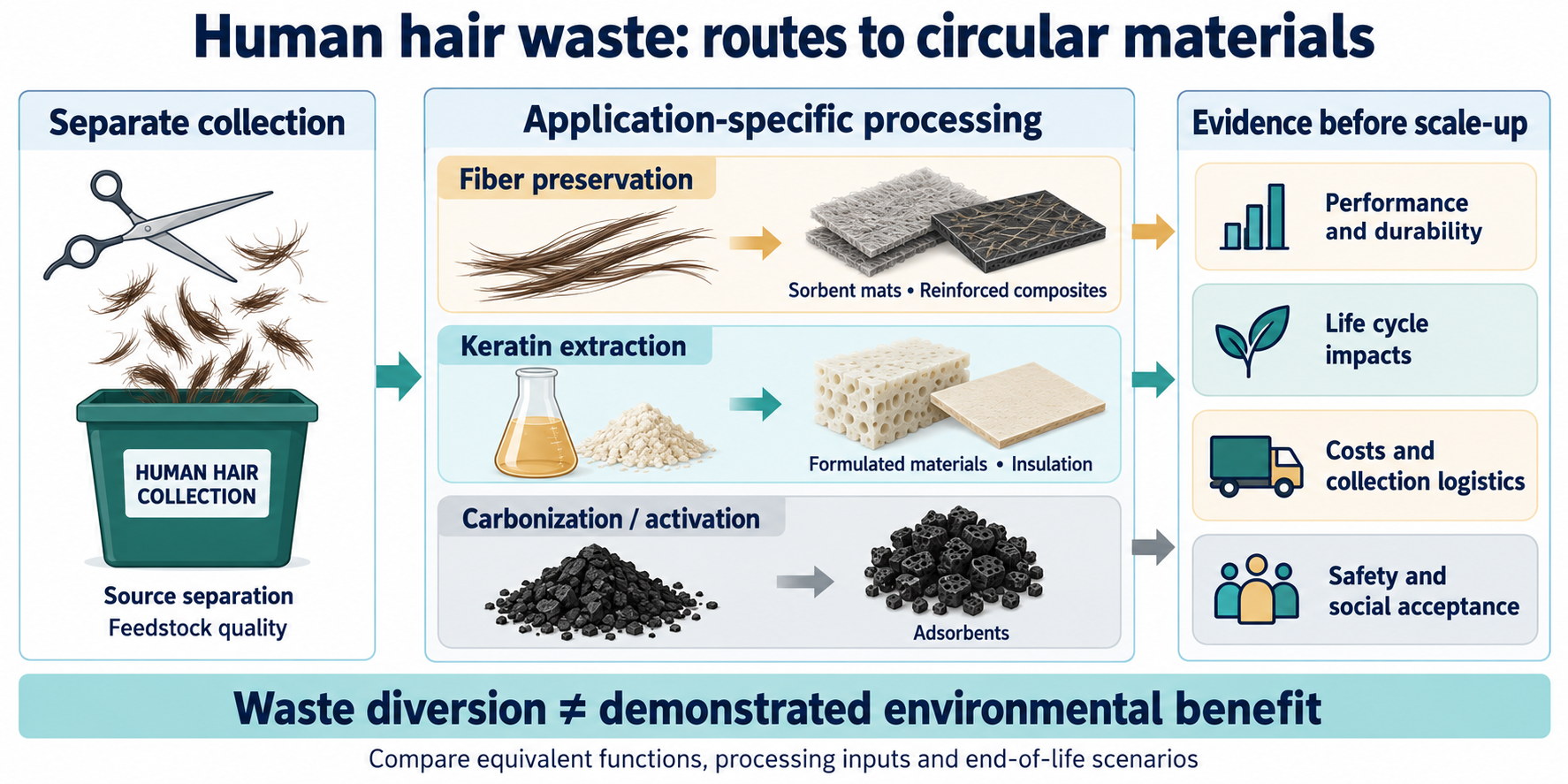
Human hair discarded by salons, barbershops and households is a dispersed keratin-rich resource whose recovery requires more than identifying a technically possible application. This critical narrative review examines published evidence on human hair valorization, with emphasis on textile and related material systems. It connects collection and material variability with preprocessing, demonstrated applications, environmental assessment and social acceptance. Published studies support oil sorption, metal-ion removal, polymer reinforcement and keratin-based insulation, but these routes differ substantially in processing requirements and evidence maturity. Performance measured for selected fibers, synthetic solutions or laboratory composites cannot establish the effectiveness of mixed salon waste under service conditions. Likewise, results for extracted keratin or animal-derived fibers cannot be transferred directly to untreated human hair. The synthesis identifies opportunities for fiber-preserving technical products while showing that chemical extraction and carbonization require separate environmental justification. Functional equivalence, processing inventories, durability, contaminant management and end-of-life scenarios are essential to substantiate sustainability claims. Transparent collection arrangements and product-specific acceptance studies are equally necessary. Human hair valorization is best pursued through application-specific pilots that verify material performance and net environmental benefit before wider implementation.
Keywords:
human hair waste
; keratin
; circular economy
; urban metabolism
; technical textiles
; nonwovens
; sorption
; life cycle assessment
; consumer acceptance
Copyright: This open access article is published under a Creative Commons CC BY 4.0 license, which permit the free download, distribution, and reuse, provided that the author and preprint are cited in any reuse.