

Submitted:
21 October 2026
Posted:
22 October 2026
You are already at the latest version
Abstract
Bacteriophage (phage) therapy is an emerging adjunctive strategy for treatment-resistant periprosthetic joint infections (PJI), but evidence on long-term outcomes and criteria for sustained control of infection remains limited. We previously reported the first use of personalized phage therapy in Canada for a life-threatening, multidrug-resistant (MDR) Staphylococcus epidermidis PJI. Here, we report longer-term clinical and microbiological follow up over two years, demonstrating sustained clinical control of infection with microbiological evidence of no recurrence. This study provides longitudinal clinical and microbiological evidence supporting sustained control of infection following phage therapy, and highlights the importance of standardized clinical and microbiological outcomes to define long-term response to treatment. We propose standardized endpoints for assessing phage therapy in PJI.
Keywords:
bacteriophage therapy
; phage therapy
; periprosthetic joint infection
; staphylococcus epidermidis
; multidrug resistant
; antibiotic resistance
; 16S gene rRNA sequencing
1. Introduction
Joint replacement surgery is a highly effective intervention that significantly improves patients’ quality of life, providing symptom relief, restoration of joint function and mobility, and functional independence [1]. Periprosthetic joint infection (PJI) is a serious complication of joint replacement surgery, affecting approximately 1-2% of primary arthroplasties [2]. PJI negatively affects patients’ lives, with physical, social, and emotional effects, because of high readmission rates, costly repeat procedures, extended hospital stays, increased use of outpatient services, and prolonged antibiotic therapy. Further, the treatment of PJI is expensive, time-consuming, and resource-intensive, causing a substantial economic burden on health care systems [3].
PJI involves complex interactions between microorganisms, the implant, and host immune system. PJI can develop rapidly following inoculation with a low microbial burden, as bacteria and, less commonly, fungi adhere to implant surfaces and form biofilms. Causative microorganisms are often skin microbiota inoculated at the time of surgical placement, although implants may be seeded after placement, either hematogenously or through compromised local tissues [3].
The unique physiological and anatomical features of bones and the peri-implant environment promote biofilm formation, reducing antibiotic efficacy. These biofilms consist of extracellular polymeric substances secreted by bacteria, including proteins, polysaccharides, extracellular nucleic acids, and lipids. This matrix protects microorganisms from host immune responses and limits antimicrobial penetration and activity. Biofilms are difficult to eliminate, even with surgical intervention, contributing to persistent infection and treatment failure. Moreover, biofilm formation not only complicates PJI treatment but also impedes early diagnosis [4].
While advances in surgical technique and perioperative protocols have reduced overall PJI rates, antibiotic resistant microorganisms present an ongoing challenge in treating these complex infections. Staphylococcus epidermidis, one of the leading causes of PJI, is particularly adapted to biofilm formation, and methicillin and multidrug resistance are common among S. epidermidis clinical PJI isolates [5].
When surgical source control is not feasible or compatible with preservation of joint function, antibiotics alone are inadequate in the treatment of such infections. There is a dire need for alternatives to conventional antibiotics for the treatment of biofilm-mediated infections due to the rising number of implantable medical devices as well as increasing antimicrobial resistance (AMR).
Bacteriophages (phages) are viruses that selectively infect and lyse bacteria and can retain activity against antibiotic resistant microorganisms and biofilm-associated infections [6]. In a retrospective analysis of 100 consecutive cases of personalized phage therapy for difficult-to-treat infections, clinical improvement and eradication of the targeted bacteria were reported in 77.2% and 61.3% of infections, respectively; phages were combined with antibiotics in 69.3% of cases [7].
However, evidence for phage therapy in PJI remains largely limited to case reports and small series, with long-term outcomes incompletely characterized [7,8]. Relapse and microbiological persistence have been reported despite clinical improvement, and phage resistance and neutralizing antibodies may emerge during treatment [7,8]. Interpretation is further complicated by heterogeneous outcome reporting: some patients considered successfully treated remained on suppressive antibiotics [9,10], whereas others remained infection-free after antimicrobial discontinuation [11]. These limitations highlight the need for standardized clinical and microbiological outcomes to distinguish ongoing infection suppression from durable infection eradication [12]. Although these are not clinical outcomes, standardized reporting of key treatment details is also important, as published studies of phage therapy may incompletely describe the route of administration, manufacturing methods, use of single phages versus phage cocktails, dose, dosing frequency, and treatment duration.
Integrating phage therapy into the treatment of PJI requires a concerted effort to overcome regulatory hurdles and establish clinical evidence through well-designed trials. Worldwide cooperation is crucial in evolving phage therapy from an intriguing idea to an established therapeutic decision.
In 2025, we reported the first use of phage therapy in Canada for a life-threatening multidrug-resistant (MDR) Staphylococcus epidermidis PJI (Cammuso et al. 2025) [13]. The patient had a complex history of recurrent right hip PJI, multiple surgical procedures, and limited options for long-term antimicrobial therapy. Personalized phage therapy was administered via both intra-articular and intravenous routes in conjunction with standard of care antibiotic therapy and surgical management. At 12 months, the patient demonstrated clinical improvement, normalization of serum inflammatory markers, and sustained control of infection with no recurrent operation.
The absence of standardized clinical and microbiological outcomes to define control of infection following phage therapy limits the interpretation of treatment outcomes and complicates comparisons across cases and clinical studies. This lack of consensus endpoints is a major barrier to the development of prospective clinical trials and to generating robust evidence to define the role of phage therapy in PJI.
Here, we describe the two-year follow up of this patient. This longitudinal observation provides an opportunity to consider how sustained response following phage therapy should be defined and measured.
2. Materials and Methods
We performed microbiological follow up of the patient previously described by Cammuso et al. (2025), with surgical specimens at the time of operation for a mechanical right hip dislocation.
Clinical and surgical findings and outcomes, including subsequent revision arthroplasty and intraoperative findings, antimicrobial therapy, and laboratory, microbiological, and radiographic investigations, were reviewed for approximately two years following completion of phage therapy. Following a recent mechanical fall resulting in right hip dislocation, the patient underwent revision arthroplasty, during which perioperative specimens were collected for repeat microbiological evaluation, including broad-range 16S rRNA gene sequencing.
3. Results
Two years after completion of personalized phage therapy, the patient remains clinically stable without evidence of recurrent PJI (Figure 1). Following phage treatment, the patient had demonstrated progressive clinical improvement, including complete wound healing, improved right hip pain and mobility, and normalization of inflammatory markers during the first year of follow up. Importantly, prior to phage therapy, the patient had persistent, microbiologically confirmed MDR S. epidermidis despite standard of care antibiotics and repeated surgical interventions.
Following phage treatment, antimicrobial therapy was continued and subsequently modified during longitudinal follow up. Oral linezolid was discontinued because of concern for drug-induced retinopathy, and suppressive therapy was changed to intermittent daptomycin administered three times weekly, which she remains on currently.
Recently, around 2 years after completion of phage treatment, the patient sustained a mechanical fall resulting in dislocation of the previously infected right hip. Repeat imaging demonstrated a stable periprosthetic collection without hardware loosening or other hardware complication (Figure 2). A chronic right iliac fracture and T12 compression fracture with mild retropulsion were also identified following the mechanical fall. She underwent revision arthroplasty. Given her history of complex PJI, intraoperative assessment included evaluation for gross evidence of infection and collection of specimens for microbiological investigation. No gross intraoperative evidence of infection was identified. Perioperative tissue and fluid specimens were submitted for aerobic and anaerobic bacterial cultures with 14-day incubation. Broad-range 16S rRNA gene sequencing was performed on hip tissue. All bacterial cultures and 16S rRNA sequencing were negative. She continues to receive suppressive intravenous daptomycin three times weekly.
Just prior to revision, serum inflammatory markers, including C-reactive protein (CRP) and erythrocyte sedimentation rate (ESR), were non-elevated (Table 1).
4. Discussion
This longitudinal follow up expands on our previous study to approximately two years after completion of personalized phage therapy for a life-threatening, MDR S. epidermidis PJI and provides a unique opportunity to evaluate the previously infected periprosthetic joint during a revision arthroplasty for hip dislocation following a mechanical fall. The patient remained clinically and radiographically stable without evidence of recurrent PJI, and intraoperative assessment revealed no gross evidence of infection, with negative bacterial cultures and broad-range 16S rRNA sequencing. The negative microbiologic studies are likely related to a combination of phage therapy and post-phage antibiotic treatment and could signify actual microbiological cure. Objective evidence of cure would require repeating hip tissue cultures without antibiotic treatment or pressure, which is impractical.
Interpretation of phage treatment outcomes remains challenging, as current literature is highly heterogeneous in terms of phage preparations, administration, concomitant antibiotic therapy and/or surgical intervention, and duration of follow up. Importantly, many studies do not provide sufficient detail, if any, pertaining to how treatment success is defined or lack long-term follow up. Further, unsuccessful or negative outcomes may be less likely to be published, introducing potential publication bias. Most patients receive phage therapy as part of multimodal treatment, further complicating assessment of the contribution of phage therapy to clinical outcomes. Standardized definitions of treatment success and prospective, longitudinal follow up are therefore needed to facilitate comparisons across studies and inform future clinical trials.
In our case, prior to phage therapy, MDR S. epidermidis was repeatedly recovered despite prolonged antimicrobial therapy and multiple surgical interventions over several years, demonstrating failure of conventional treatment approaches. Although ongoing intermittent daptomycin suppression limits definitive attribution of infection control to phage therapy alone, the only major change in the treatment strategy was the addition of personalized phage therapy. The subsequent sustained clinical and microbiological control therefore provides supportive evidence of a potential contribution of phage therapy to the observed outcome.
Future phage studies should incorporate standardized clinical, inflammatory, microbiological, molecular, functional, and antimicrobial endpoints, with explicit distinction between control of infection during suppressive therapy and remission following discontinuation of antibiotics. Such standardized outcomes will be important for defining the role of phage therapy in PJI and advancing prospective clinical studies.

Table 2.
Proposed standardized outcomes for endpoints for assessing phage therapy in PJI.
| Outcome | Proposed Endpoints for Phage Therapy in PJI |
| Clinical and Functional* | Longitudinal assessment of pain, mobility, and joint function using validated patient-reported outcome measures (PROMs) and/or clinician-assessed functional measures. |
| Inflammatory | Serial CRP and ESR measurements; IL-6 may be assessed where clinically appropriate. Trends should be interpreted in conjunction with clinical and microbiological findings, and comorbidities. |
| Microbiological | Culture results from clinically indicated joint aspirates and/or intraoperative tissue specimens obtained using a standardized PJI microbiological workup. Document microorganism(s), culture results at baseline and follow up (positive or negative), and antimicrobial susceptibility, where applicable. |
| Molecular | Validated molecular testing, such as broad-range 16S rRNA gene sequencing, when clinically indicated or prespecified in the study protocol. Molecular results should be considered complementary to culture-based assessment. |
| Surgical/histopathological | Intraoperative assessment for purulence or other evidence of gross infection. When tissue is obtained during subsequent clinically indicated surgery, document histopathological findings relevant to PJI. |
| Radiographic | Serial assessment of implant stability, component loosening, osteolysis, periprosthetic changes, and other radiographic evidence of infection or mechanical failure. |
| Antimicrobial Therapy | Record antimicrobial agents, dose, route of administration, duration of therapy, treatment interruptions, use and duration of suppressive therapy, including the date and reason for discontinuation when applicable. |
*Outcomes should distinguish clinical control of infection while receiving suppressive antimicrobial therapy from microbiological cure following discontinuation of antimicrobial therapy; C-reactive protein (CRP), erythrocyte sedimentation rate (ESR); interleukin-6 (IL-6).
5. Conclusions
We report a longitudinal follow up of the patient previously described by Cammuso et al. (2025) who received phage therapy for recalcitrant right hip PJI. Clinical and surgical findings and outcomes, including subsequent revision arthroplasty and intraoperative findings, antimicrobial therapy, and laboratory, microbiological, and radiographic investigations, were reviewed for approximately two years following completion of phage therapy with no signs of PJI relapse. We also propose standardized outcomes for endpoints for assessing phage therapy in PJI.
Several barriers to the widespread use of phage therapy exist, including regulatory hurdles, and a lack of standardized outcomes and high-quality evidence to better understand which PJI patients would benefit most from this therapy. Despite these challenges, phage therapy appears to be a promising potential adjunct for recalcitrant PJI, especially where standard medical and surgical management has repeatedly failed.
Author Contributions
Conceptualization, Hasan Fadlallah, Md Ramim Tanver Rahman, and Marisa A. Azad; Writing - original draft preparation, Hasan Fadlallah and Md Ramim Tanver Rahman; Writing - review and editing, Hasan Fadlallah, Md Ramim Tanver Rahman, Melissa T. Cammuso, Bradley W. M. Cook, D. William Cameron, Stephen Ryan, Frenk Smrekar, Yang Yu, and Marisa A. Azad; Validation, Marisa A. Azad; Supervision, Marisa A. Azad.
Funding
DWC and MAA received partial salary support from the Department of Medicine, University of Ottawa at The Ottawa Hospital.
Institutional Review Board Statement
REB Protocol ID: 20240008-01H.
Data Availability Statement
Additional data available from the corresponding author upon reasonable request, subject to patient confidentiality and applicable ethical restrictions.
Acknowledgments
We wish to thank our microbiology colleagues at Eastern Ontario Regional Laboratory Association (EORLA), including Mr. Michael Snudden and Dr. Leanne Mortimer. .
Conflicts of Interest
All authors have read and agreed to the published version of the manuscript.
References
- Osmon, D.R.; Berbari, E.F.; Berendt, A.R.; Lew, D.; Zimmerli, W.; Steckelberg, J.M.; Rao, N.; Hanssen, A.; Wilson, W.R. Diagnosis and Management of Prosthetic Joint Infection: Clinical Practice Guidelines by the Infectious Diseases Society of America. Clin. Infect. Dis. 2013, 56, e1–e25. [CrossRef]
- Kurtz, S.M.; Lau, E.; Watson, H.; Schmier, J.K.; Parvizi, J. Economic Burden of Periprosthetic Joint Infection in the United States. J. Arthroplast. 2012, 27 (Suppl. 8), 61–65.e1. [CrossRef]
- Patel, R. Periprosthetic Joint Infection. N. Engl. J. Med. 2023, 388, 251–262. [CrossRef]
- Peng, J.; Guo, C.; Yang, C.; Zhang, L.; Yang, F.; Huang, X.; Yu, Y.; Zhang, T.; Peng, J. Phage Therapy for Bone and Joint Infections: A Comprehensive Exploration of Challenges, Dynamics, and Therapeutic Prospects. J. Glob. Antimicrob. Resist. 2024, 39, 12–21. [CrossRef]
- Hischebeth, G.T.; et al. Staphylococcus aureus versus Staphylococcus epidermidis in Periprosthetic Joint Infection—Outcome Analysis of Methicillin-Resistant versus Methicillin-Susceptible Strains. Diagn. Microbiol. Infect. Dis. 2019, 93, 125–130.
- Strathdee, S.A.; Hatfull, G.F.; Mutalik, V.K.; Schooley, R.T. Phage Therapy: From Biological Mechanisms to Future Directions. Cell 2023, 186, 17–31. [CrossRef]
- Pirnay, J.-P.; Djebara, S.; Steurs, G.; Griselain, J.; Cochez, C.; De Soir, S.; et al. Personalized Bacteriophage Therapy Outcomes for 100 Consecutive Cases: A Multicentre, Multinational, Retrospective Observational Study. Nat. Microbiol. 2024, 9, 1434–1453. [CrossRef]
- Young, J.; Mehta, N.; Lee, S.W.; Rodriguez, E.K. How Effective Is Phage Therapy for Prosthetic Joint Infections? A Preliminary Systematic Review and Proportional Meta-Analysis of Early Outcomes. Medicina 2024, 60, 790. [CrossRef]
- Cano, E.J.; Caflisch, K.M.; Bollyky, P.L.; Van Belleghem, J.D.; Patel, R.; Fackler, J.; Brownstein, M.J.; Horne, B.; Biswas, B.; Henry, M.; Malagon, F.; Lewallen, D.G.; Suh, G.A. Phage Therapy for Limb-Threatening Prosthetic Knee Klebsiella pneumoniae Infection: Case Report and In Vitro Characterization of Anti-Biofilm Activity. Clin. Infect. Dis. 2021, 73, e144–e151. [CrossRef]
- Doub, J.B.; Johnson, A.J.; Nandi, S.; Ng, V.; Manson, T.; Lee, M.; Chan, B. Experience Using Adjuvant Bacteriophage Therapy for the Treatment of 10 Recalcitrant Periprosthetic Joint Infections: A Case Series. Clin. Infect. Dis. 2023, 76, e1463–e1466. [CrossRef]
- Cesta, N.; Pini, M.; Mulas, T.; Materazzi, A.; Ippolito, E.; Wagemans, J.; Kutateladze, M.; Fontana, C.; Sarmati, L.; Tavanti, A.; Lavigne, R.; Andreoni, M.; Di Luca, M. Application of Phage Therapy in a Case of a Chronic Hip-Prosthetic Joint Infection due to Pseudomonas aeruginosa: An Italian Real-Life Experience and In Vitro Analysis. Open Forum Infect. Dis. 2023, 10, ofad051. [CrossRef]
- Diaz-Ledezma, C.; Higuera, C.A.; Parvizi, J. Success after Treatment of Periprosthetic Joint Infection: A Delphi-Based International Multidisciplinary Consensus. Clin. Orthop. Relat. Res. 2013, 471, 2374–2382. [CrossRef]
- Cammuso, M.T.; Cook, B.W.M.; Cameron, D.W.; Ryan, S.; Tamayo, M.; Peters, M.J.; Arnaud, T.; Lau, S.; Almblad, H.; Fournier, N.; LoVetri, K.; Lightly, T.J.; Chung, Y.M.; Roy, R.; Theriault, N.; Theriault, S.S.; Suh, G.A.; Azad, M.A. First Use of Phage Therapy in Canada for the Treatment of a Life-Threatening, Multidrug-Resistant Staphylococcus epidermidis Periprosthetic Joint Infection. Viruses 2025, 17, 1118. [CrossRef]
- Azad, M.A.; Patel, R. Practical Guidance for Clinical Microbiology Laboratories: Microbiologic Diagnosis of Implant-Associated Infections. Clin. Microbiol. Rev. 2024, 37, e0010423. [CrossRef]
Figure 1.
Clinical improvement of the right hip surgical site after phage therapy. (A) Right hip sinus tract from PJI before phage therapy. (B) Right hip 2 years after completion of phage therapy.
Figure 1.
Clinical improvement of the right hip surgical site after phage therapy. (A) Right hip sinus tract from PJI before phage therapy. (B) Right hip 2 years after completion of phage therapy.
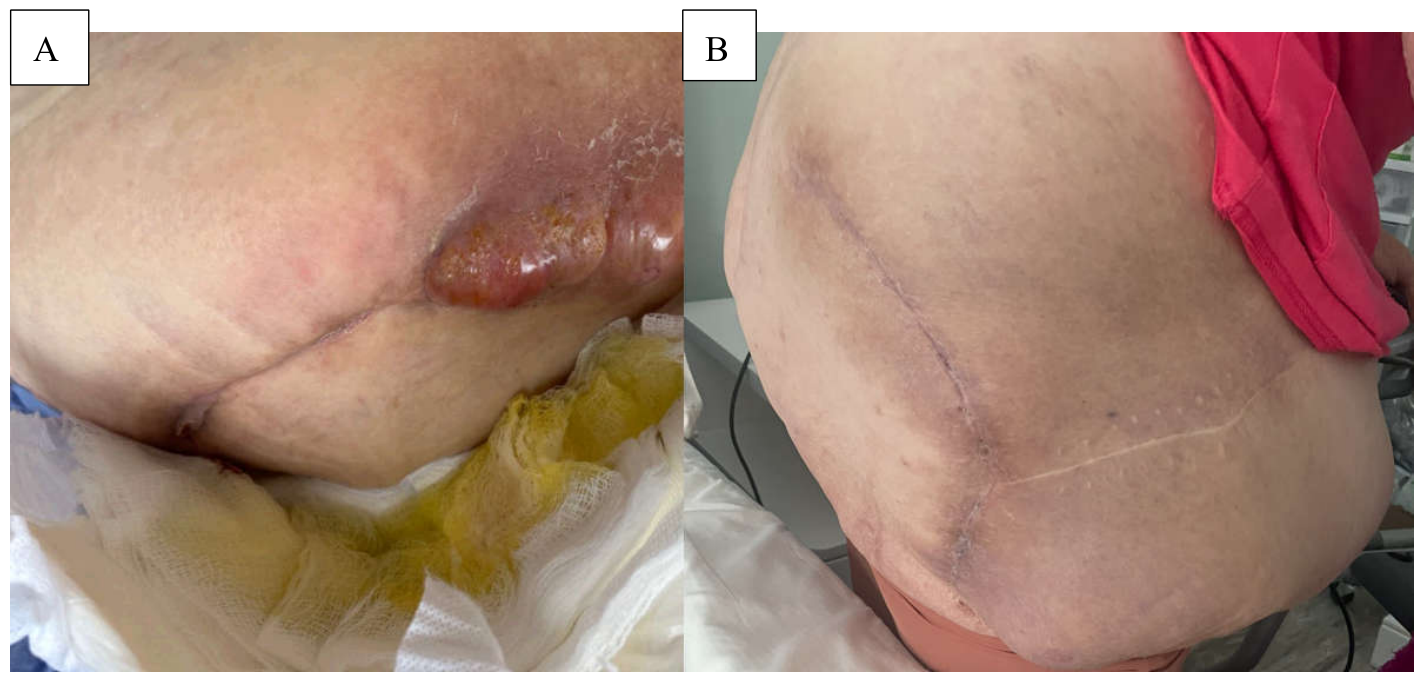
Figure 2.
Radiographic stability of the right hip PJI after phage therapy. (A) Right hip x-ray approximately 4 months before phage therapy. (B) Right hip x-ray approximately 2 years after completion of phage therapy.
Figure 2.
Radiographic stability of the right hip PJI after phage therapy. (A) Right hip x-ray approximately 4 months before phage therapy. (B) Right hip x-ray approximately 2 years after completion of phage therapy.
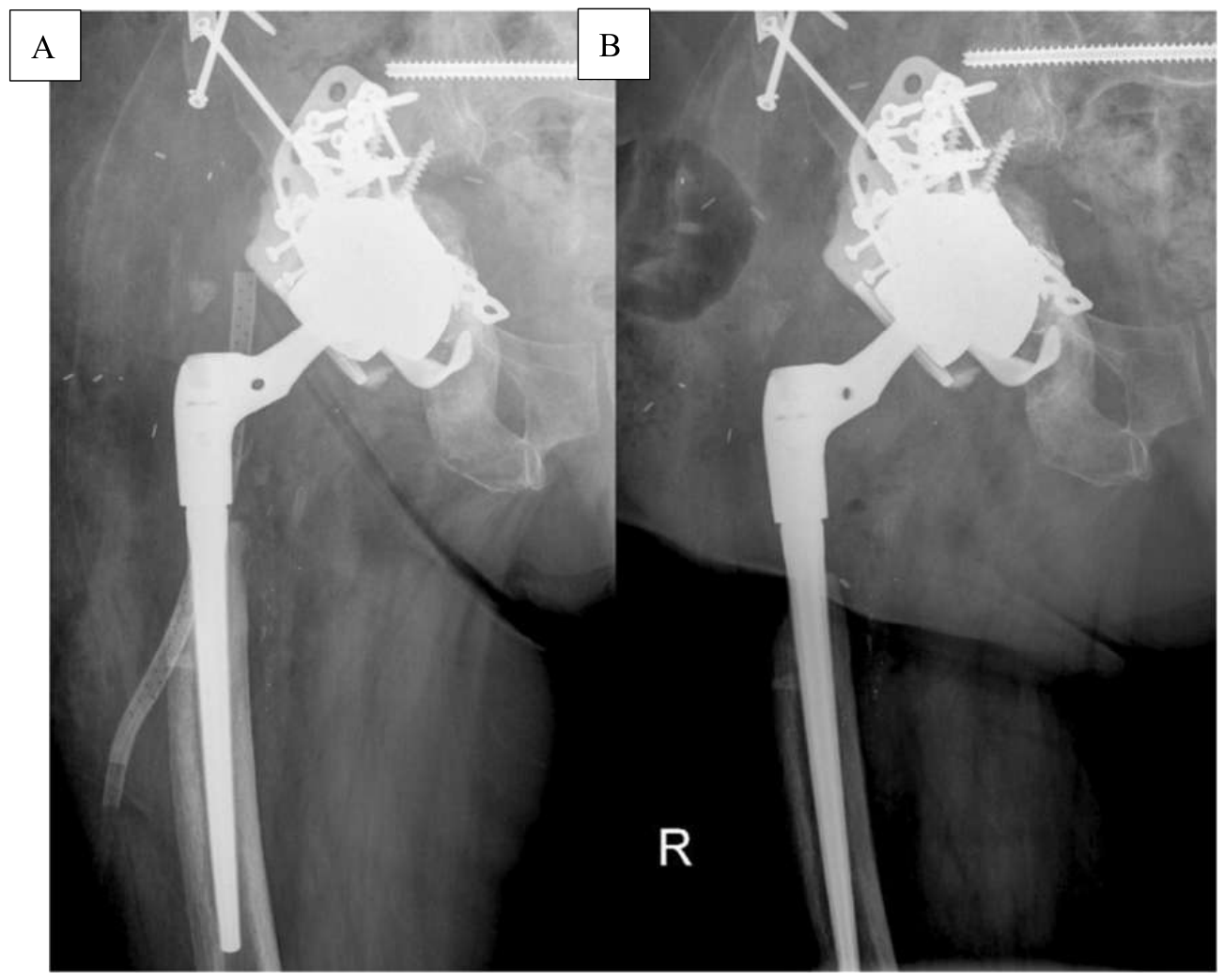
Table 1.
Overall trend of inflammatory markers during and after phage therapy.
| Inflammatory marker | Baseline | Week 1 of treatment | Week 2 of treatment | Month 6 follow up | Month 12 follow up | Month 18 follow up | Month 24 follow up |
| CRP (mg/L) | 28 | 64 | 34 | 23 | 2.4 | 3.6 | 8.7 |
| ESR (mm/h) | 51 | 55 | 46 | 43 | 5 | 12 | 18 |
Disclaimer/Publisher’s Note: The statements, opinions and data contained in all publications are solely those of the individual author(s) and contributor(s) and not of MDPI and/or the editor(s). MDPI and/or the editor(s) disclaim responsibility for any injury to people or property resulting from any ideas, methods, instructions or products referred to in the content. |
© 2026 by the authors. Licensee MDPI, Basel, Switzerland. This article is an open access article distributed under the terms and conditions of the Creative Commons Attribution (CC BY) license.
Copyright: This open access article is published under a Creative Commons CC BY 4.0 license, which permit the free download, distribution, and reuse, provided that the author and preprint are cited in any reuse.