

Submitted:
21 October 2026
Posted:
22 October 2026
You are already at the latest version
Abstract
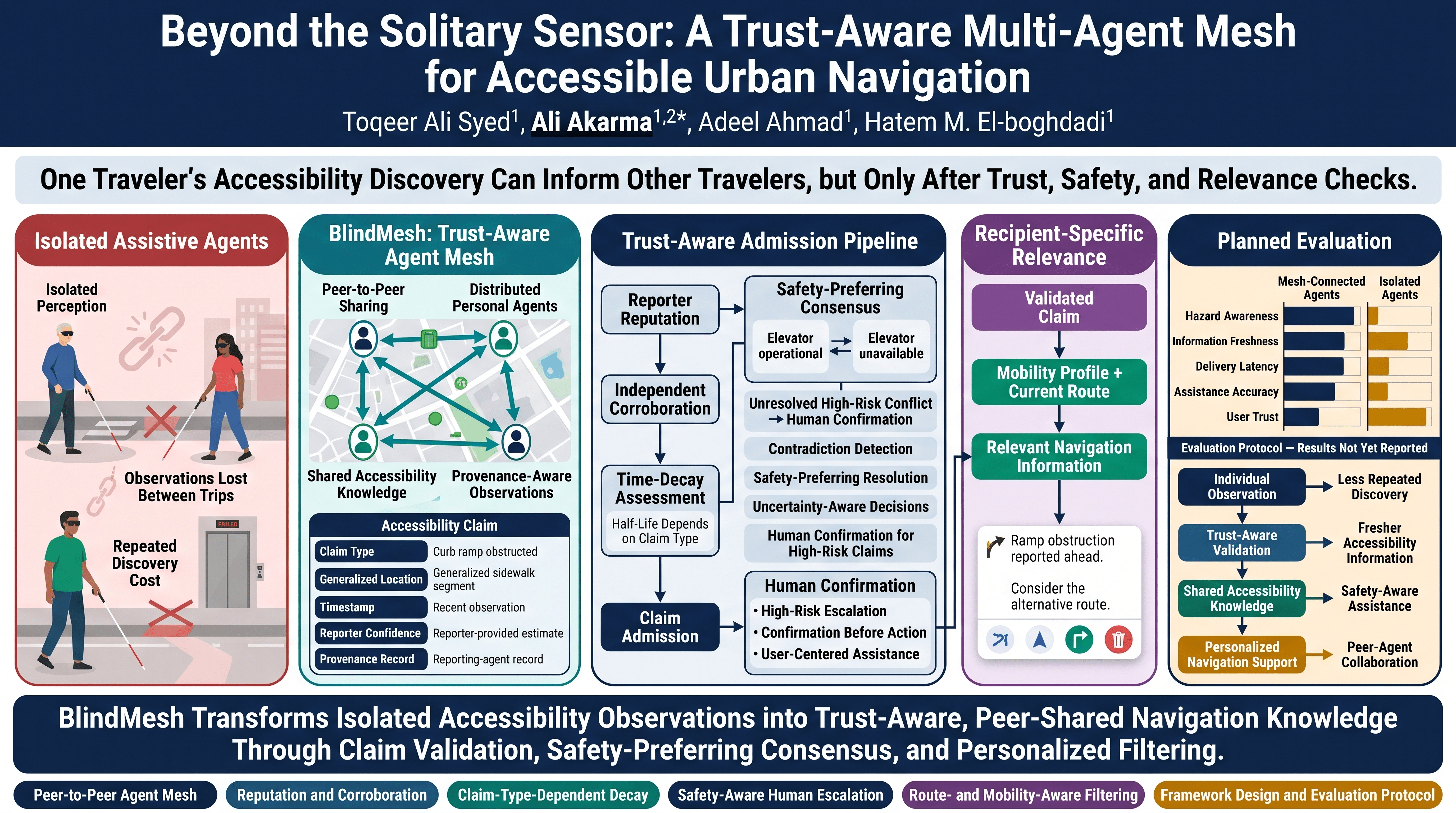
Assistive systems for blind and visually impaired (BVI) travelers perceive, reason, and advise one person at a time. When a personal assistant discovers that a curb ramp is fenced off or that a station elevator has failed, the finding is consumed by a single trip and then lost, so the next traveler pays the same discovery cost. This paper presents BlindMesh, a framework in which the personal agent of each BVI user publishes accessibility observations to, and draws them from, a mesh of peer agents instead of a central, human-moderated service. A published observation carries a typed claim, a generalized location, a timestamp, the reporting agent's own confidence, and a provenance record. Nothing reaches a user directly. Each claim first passes a validation stage that combines reporter reputation, independent corroboration, and a decay term whose half-life depends on the claim type, then a safety-preferring consensus step that resolves contradictory reports, then a filter that matches the claim against the recipient's mobility profile and current route. Claims in the high-risk tier are escalated for human confirmation rather than acted on automatically. We formalize the observation model and the admission rule, describe the agent architecture, and specify the protocol we will apply to compare mesh-connected agents against isolated ones on hazard awareness, information freshness, delivery latency, assistance accuracy, and user trust. This version reports the design and the protocol. It does not report empirical results.
Keywords:
accessibility
; agentic AI
; assistive technology
; blind and visually impaired
; knowledge sharing
; multi-agent systems
; navigation
; trust management
; vision-language models
1. Introduction
Traveling alone remains one of the hardest problems a blind or visually impaired (BVI) person faces, and it has absorbed decades of engineering effort: electronic travel aids, smartphone wayfinding, wearable cameras, haptic interfaces, indoor localization, and obstacle detection. Recent surveys agree that the problem remains open. El-Taher et al. decompose urban navigation into localization, orientation, obstacle avoidance, journey planning, and interaction with the environment, and find no stage reliably solved outside controlled settings [1]. Later surveys covering a decade of work reach similar conclusions [2,3], and a 2026 survey of 75 navigation studies reports that indoor-to-outdoor navigation is still not seamless and that usability, co-design, and readiness for real deployment are given too little consideration [4,5].
The systems covered by those surveys share one architectural assumption: the traveler is a solitary sensor. Consider a station elevator that fails at 08:00. The first BVI traveler’s assistant detects the failure from the user’s own sensing and dialogue, guides that user to a different route, and then the episode ends. An hour later a second assistant repeats the detection from scratch, and so does a third. The condition is public and affects everyone who passes through that station, which makes it the kind of fact a community can hold collectively. Much of what matters to a BVI traveler has this character. Scaffolding on a sidewalk, a relocated bus stop, a fenced crossing, a door that no longer opens automatically, or a useful tactile landmark are all local, shared, and often short-lived.
Two research lines approach this problem without closing it. Work on collaborative navigation shows that BVI travelers exchange route descriptions among themselves and that pooled knowledge of familiar routes widens the area a person can cover independently [6]. Crowdsourcing systems show that distributed human effort covers what automation cannot: VizWiz answers a blind user’s spoken question with remote human labor [7], VizMap assembles accessibility-relevant spatial information from volunteer contributions [8], and Plikynas et al. pair wearable sensing with an online community for indoor route guidance [9]. Every contribution in these systems begins with a deliberate human act. Separately, agentic assistants now coordinate several AI components for a single traveler. Ayanzadeh and Oates parse a floor plan into a spatial knowledge graph through a self-correcting multi-agent pipeline with a safety evaluator on the output [10], the LAZAR framework organizes perception, decision, interaction, safety, and adaptation around cognitive load [11], Romero et al. combine augmented-reality spatial anchors, real-time detection, and language-model dialogue inside a cognitive architecture [12], and specialized frameworks such as ADAPT [13] tailor agentic support to individuals with disabilities. All of these agents serve one user. Nothing crosses the boundary between two travelers’ assistants.
What is absent is a layer connecting one agentic assistant to the knowledge held across a population of such assistants. BlindMesh supplies that layer. Each BVI user keeps a personal agent, every agent can publish to and query its peers without a person composing a report, and knowledge therefore accumulates across the population rather than inside one application.
Transporting records between devices is the simpler part of the problem. Accessibility claims go stale on timescales that differ by orders of magnitude between a construction barrier and a wet floor. Independent reports about the same place disagree. Vision-language descriptions can assert visual detail the image never contained, a failure mode documented for exactly this user population [14], and a wrong claim about the physical world can send a traveler into a hazard. Reports also carry location and timing, which together expose a person’s daily routine. A mesh is therefore useful only with validation, aging, conflict handling, privacy-oriented publication, and per-user filtering built into the exchange rather than added afterward.
Our contributions are as follows.
- 1.
- A two-level agent formulation that separates specialization inside one user’s assistant from exchange across users, together with an observation model in which a claim travels with its location, time, confidence, and provenance.
- 2.
- An admission rule that folds reporter reputation, independent corroboration, and a claim-type-specific freshness decay into a single score, with separate thresholds governing storage, propagation, and action.
- 3.
- A safety-preferring consensus rule for contradictory reports about the same referent, with escalation to human confirmation for high-risk claim types.
- 4.
- A publication filter designed to limit exposure of identity and mobility patterns through spatial and temporal generalization and pseudonymous reporting identities.
- 5.
- An evaluation protocol that compares mesh-connected agents against isolated agents and against ungoverned pooling, under a controlled adversarial condition.
This version states the design and the protocol.1 The framework has not been validated in deployment, and no performance claim is made here.
2. Related Work
2.1. Assistance for the Individual Traveler
Electronic travel aids, smartphone wayfinding, and camera-based obstacle detection form the established body of work, and recent surveys agree on both the progress and the residual gaps [1,2,3,5]. Isazade additionally argues that practical accessibility solutions depend on developers, clinicians, and caregivers working together [5], and the 2026 survey finds that user experience and co-design receive too little consideration in the studies it reviews [4]. This literature does not treat the traveler as a contributor to anyone else’s knowledge.
2.2. Community Knowledge and Crowdsourcing
Balata et al. observed BVI travelers describing routes to one another and suggested that such exchange, when pooled, can enlarge the area a person is able to navigate alone [6]. That finding matters for our argument because it indicates that community accessibility knowledge is not an engineering invention layered onto the population. It is already part of how the population travels. What the study does not provide is an autonomous mechanism, since every exchange requires an explicit conversation between two people.
The crowdsourcing line supplies a mechanism but keeps the human inside it. VizWiz routes a photograph and a spoken question to remote workers [7], and analysis of the resulting question stream showed how wide the range of everyday visual needs is [15]. The VizWiz Grand Challenge dataset later made a second point that shapes any system in this space: images captured by blind users are frequently blurred, poorly framed, or simply missing the evidence the question requires [16]. VizMap builds a queryable spatial representation from crowd contributions and 3D reconstruction [8], and Plikynas et al. organize an online community around indoor route mapping [9]. Both follow a client-server pattern with volunteers at the center. Remote sighted-assistance services take this further toward pure human-to-human help, which serves the immediate request well and leaves behind no machine-readable record for the next traveler. In broader mobile environments, collaborative augmented reality frameworks such as CAR-tourist [17] have explored decentralized spatial sharing across mobile peers under integrity-preservation guarantees, though targeting sighted leisure rather than the strict safety margins of BVI wayfinding.
2.3. Vision-Language Assistance
Multimodal foundation models allow joint reasoning over what the camera sees and what the user asks, replacing pipelines of separate detectors. WalkVLM targets the streaming case and the problem of keeping spoken guidance short enough for walking pace [18], and PathFinder couples vision-language reasoning with depth estimation and path search for map-less wayfinding [19]. Both advance what one assistant can interpret. Both also inherit the hallucination risk that Huh et al. documented for long-form answers given to blind and low-vision users [14], which is why our design never treats a single agent’s description as sufficient evidence for a high-risk claim. Moreover, as vision-language models are integrated into autonomous agentic workflows, they face vulnerabilities such as multimodal prompt injection and adversarial input manipulation, underscoring the requirement for trustworthy agentic defenses [20].
2.4. Agentic Assistants
Recent systems decompose assistance into cooperating components with state, tool calls, and internal checking. Ayanzadeh and Oates report improved route success rates for their floor-plan parser over single-call language-model baselines, and they place a safety evaluator after path planning [10]. LAZAR coordinates perception, decision, interaction, safety, and user adaptation under a cognitive-load budget [11]. Romero et al. integrate augmented-reality spatial anchors, real-time detection, and conversation within one cognitive architecture [12].
More broadly, specialized agentic AI frameworks have increasingly addressed complex challenges across accessibility, federated cooperation, and urban infrastructure. In disability assistance, architectures such as ADAPT [13] coordinate personalized, adaptive support tailored for individuals with disabilities and neurodivergence, while FedAgent-Chain [21] establishes secure, privacy-preserving federated agent collaboration for disability inclusion in smart cities. For dynamic spatial environments, multi-agent frameworks have been demonstrated for rapid hazard forecasting and distributed emergency coordination [22], as well as digital-twin-based autonomous monitoring and auditable management of smart city civil and climate infrastructure [23,24]. These developments highlight the effectiveness of autonomous agents in managing distributed environmental uncertainties and user-centric support. Nonetheless, existing assistive navigation agents remain confined to single-user silos: their agents cooperate inside one assistive system on behalf of one user, without protocols for peer-to-peer sharing.
2.5. Position of This Work
Table 1 summarizes the resulting arrangement. Knowledge either stays inside one user’s system or moves between people. None of these classes lets one traveler’s agent hand a validated, aging, privacy-filtered observation to another traveler’s agent. BlindMesh addresses that gap, and the requirements it implies are set out next.
3. Problem Formulation
3.1. Two Levels of Agency
A conventional agentic assistant places a set of specialized agents around one user ,
covering perception, route planning, hazard checking, and interaction. This is the structure of the systems reviewed above. BlindMesh keeps (1) and adds a second level at which the personal accessibility agents themselves communicate,
where is the agent acting for . Each may internally contain the agents of (1). The contribution of this work lies in (2).
3.2. Observations
An observation produced by is the tuple
where is a typed accessibility claim of type , is the confidence the producing agent assigns to it, is the observation time, is provenance (sensing modality, whether the user confirmed it, and the pseudonymous handle of the reporter), and is the spatial referent. Throughout the paper, claim denotes the typed assertion , observation denotes the tuple that carries it, and report denotes an observation that has been transmitted to the mesh. Claim types partition into risk tiers, so that a blocked crossing and a relocated bench are not treated alike. Community knowledge is the union of observations that survive a validation map ,
The remainder of the paper is an account of and of what happens on either side of it.
3.3. Requirements
Five properties follow from the failure modes listed in Section 1, and they drive the design.
R1, admission control. A claim must be scored before it is stored, propagated, or acted on, and the three decisions need separate thresholds.
R2, aging. Validity must expire at a rate set by the claim type, so that a construction barrier and a spilled liquid are not retained on the same schedule.
R3, safe disagreement. When reports contradict each other, the resolution must favor the cautious reading unless the permissive reading is clearly better supported.
R4, bounded disclosure. Publication must not expose the reporter’s identity, precise position, or repeated travel pattern.
R5, recipient fit. A claim that is useful to one traveler may be noise, or bad advice, for another with a different aid, route, or tolerance.
4. The BlindMesh Framework
Figure 1 shows the path a claim takes from the traveler who encounters a condition to the traveler who benefits from it. Its stages implement requirements R1 through R5.
4.1. Claim Types and Risk Tiers
The type attached to a claim is what makes the rest of the pipeline concrete, because it fixes the half-life , the corroboration radius , the safety margin , and whether human confirmation is required. The types the framework covers are the conditions BVI travelers already report to one another: temporary obstructions such as scaffolding or a vehicle parked across a path, service failures such as a stopped elevator or a door that no longer opens automatically, access changes such as a closed entrance or a relocated bus stop, route conditions including construction detours and altered pedestrian crossings, and durable landmarks such as a tactile marker or a reliable orientation cue. Monitoring dynamic pedestrian pathways and physical assets mirrors priorities in smart-city digital twin and civil infrastructure frameworks [23,24]; BlindMesh extends this vision toward decentralized, peer-contributed pedestrian accessibility sensing.
Two properties separate these types, and both matter downstream. The first is persistence. A landmark holds for months, a construction barrier for weeks, an elevator failure for hours, and a spill for minutes. Any single retention policy therefore either discards useful knowledge or keeps dangerous knowledge. The second property is the cost of acting on a claim that turns out to be wrong. A landmark reported after it has been removed costs the traveler a little time. A crossing wrongly reported as passable can send a traveler into traffic. Membership in the high-risk tier is decided by that second property rather than by how often the condition occurs, and it is what triggers the corroboration floor and the requirement for human confirmation described below. Neither nor the tier boundaries are asserted here as measured quantities. They are design-time parameters, and fitting them is part of the protocol in Section 5.
4.2. Publication
does not forward everything it perceives. A claim is published when it concerns a condition that is public, persistent enough to matter to a later traveler, and different from the state the mesh already holds for that referent. The filter then reduces disclosure before release, addressing R4. The location is generalized to a cell of a fixed tessellation whose granularity depends on the claim type, the timestamp is quantized into a bucket, the reporter appears under a rotating pseudonymous handle rather than a stable identity, and reports originating near a user’s frequent dwell points are withheld or delayed so that repeated publication does not trace a home or workplace. We claim no formal privacy guarantee for this filter. It reduces exposure, and whether that is sufficient is an open question we return to in Section 6. Future extensions may incorporate decentralized federated learning protocols, akin to FedAgent-Chain [21], to strengthen privacy guarantees during multi-agent knowledge exchange.
4.3. Scoring a Claim
Three quantities determine whether an incoming claim is admitted. Together they address R1 and R2.
Freshness. For a claim of type observed at T and evaluated at time t, the decay factor is
where is the half-life for that type. This parameter is what separates a multi-week construction barrier from a hazard that is gone in minutes, and its value per type has to be estimated from data rather than assumed.
Corroboration. Let be the number of distinct reporters whose compatible claims of the same type fall within a spatial radius of L and a window of T. Additional reports should help with diminishing returns, so
with setting how quickly agreement saturates.
Reputation. Each reporter carries , bound to its pseudonymous credential. Once a claim is later confirmed or refuted by sensing or by a user, the contributing reporters are updated as with outcome and rate .
Support for a single report combines the reporting agent’s own confidence with the two signals defined above,
and the admission score discounts that support by age,
Because multiplies rather than adds, an old claim cannot be rescued by a confident reporter, which is the intended behavior.
4.4. Consensus and the Safety Gate
Reports attach to a referent, meaning a generalized location together with a claim type. Reports on one referent group into competing hypotheses, for instance that a crossing is passable and that it is fenced. Evidence for a hypothesis h aggregates over its supporting reports as
so that many weak independent reports can accumulate without any single one dominating, and belief over the hypotheses stays normalized.
Selecting would be wrong here, because the two errors are not symmetric. Routing a traveler around a crossing that is in fact open costs time. Routing a traveler into a crossing that is in fact fenced costs far more. R3 is therefore enforced by a margin: let be the more restrictive hypothesis on the referent. The permissive hypothesis is adopted only when
and otherwise the restrictive reading is conveyed. Three thresholds then separate the decisions of R1: to retain a claim, to relay it onward, and to let it change guidance, with . For claim types in the high-risk tier, passing is not sufficient. Either corroboration reaches independent reporters or a person confirms the claim before guidance changes. This is where the hallucination risk of single-model description [14] is contained. This conservative multi-stage gating operationalizes the multi-pillar principles of ethical AI governance frameworks [25], which mandate verifiable safety margins, accountability, and strict risk thresholds before autonomous systems execute decisions impacting human safety.
4.5. Personalization and Delivery
Admission answers whether a claim is credible. R5 asks a separate question: whether the claim is relevant to this traveler. A recipient profile records the mobility aid in use, tolerance for detours, preference for familiar routes, and how much spoken detail the user wants. A relevance function suppresses claims off the active route or irrelevant to the user’s aid, and sets the verbosity of what is spoken. Reconciling candidate recommendations against complex individualized profiles parallels constraint-aware agentic planning in personalized assistants; for example, FinNutriAgent [26] balances multi-dimensional personal constraints against candidate actions. In BlindMesh, similarly filters incoming spatial claims against the traveler’s mobility constraints and cognitive preferences. Keeping delivery short is a practical constraint at walking pace, as WalkVLM’s treatment of streaming guidance makes clear [18].
Algorithm 1 assembles these stages into the procedure a receiving agent runs per incoming claim.
| Algorithm 1:Claim lifecycle at receiving agent |
|
5. Evaluation Protocol
This section specifies how the framework will be assessed. No results are reported in this version.
5.1. Conditions and Baselines
The central comparison holds the personal agent fixed and varies only what it may exchange. Isolated agents operate independently, which is the prevailing design in the systems of Section 2. Pooled agents share every observation without scoring, aging, or a safety gate, which isolates the contribution of the governance machinery. BlindMesh agents run the full pipeline of Figure 1. Ablations that remove one of reputation, corroboration, or decay attribute the effect to individual components.
A separate adversarial condition varies the fraction of reporters injecting false claims, including claims that contradict true reports on the same referent. This directly tests (9) and (10), since a mesh that accepts confident false reports is worse than no mesh at all. In multimodal agent networks, malicious input manipulation can mimic perceptual injections or corrupted sensory assertions designed to fool agentic reasoning [20]. Furthermore, peer meshes must withstand high-rate flooding and distributed denial-of-service (DDoS) attempts, where deep learning anomaly detection mechanisms become essential for sustaining network availability [27].
5.2. Setting
Two settings are needed, because neither one alone supports every question the evaluation must answer. A controlled environment populated with scripted accessibility events, in which the ground truth timeline of every condition is known by construction, supports measurement of freshness, latency, and correctness at a population scale that recruitment cannot reach. A study with BVI participants is then required for the questions ground truth cannot answer, namely whether delivered claims are useful, whether the verbosity is tolerable while walking, and whether participants trust guidance that originates from another traveler’s agent rather than from their own device. Instruments, recruitment, sample size, and ethics approval for the participant study are not yet fixed, and we will report them with the study.
5.3. Measures
Five measures follow from the requirements.
Hazard awareness: the fraction of conditions active on the traveled route that the agent surfaces before the user reaches them. Freshness: the age of a delivered claim relative to the event timeline. Latency: elapsed time from the first report of a condition by any agent to its delivery to a later traveler. Assistance accuracy: precision and recall of delivered claims against the true environment state, reported jointly, since suppressing everything trivially maximizes precision. Trust: participant-reported trust in the delivered guidance, reflecting both subjective confidence and adherence to ethical AI governance principles [25] through transparent corroboration.
Precision alone understates the cost of an error, so the rate of acted-upon false claims is reported separately for the high-risk tier. A configuration that improves awareness while raising that rate has not improved the system. Thresholds, half-lives , and the weights of (7) will be fit on a held-out portion of the controlled setting and then held fixed, so that reported outcomes do not reflect tuning against the evaluation set.
5.4. What Would Count Against the Design
The protocol is arranged so that the framework can fail the comparison. If pooled agents match BlindMesh on hazard awareness and freshness without raising the rate of acted-upon false claims, then the scoring, decay, and gating machinery adds complexity the problem does not require, and the simpler design is preferable. If the adversarial condition shows the admission rule accepting confident false reports at an attacker fraction a real deployment would face, the mesh is unsafe for the high-risk tier regardless of its average-case behavior. If participants report that guidance traceable to another traveler’s agent is not trusted, the architecture fails on adoption whatever the measurements show. Stating these conditions before the study is run prevents the reported outcome from being selected after the fact.
6. Discussion and Limitations
The most important limitation is that BlindMesh is a design. It has not been deployed, and the protocol of Section 5 has not been executed, so nothing here should be read as evidence that agent-mediated sharing helps in practice.
Several open problems are structural rather than incidental. The framework offers no benefit to a user in a region with no other participating agents, and the benefit grows with agent density, which makes early deployment hardest exactly where mobility barriers are often worst. Reputation and pseudonymity pull against each other, since accountability wants a persistent identity and R4 wants the opposite, and binding reputation to a rotating credential mitigates that tension without dissolving it. Resistance to one reporter creating many identities depends on an enrollment assumption this paper does not settle, and (6) is meaningful only if reporters are genuinely independent. Likewise, peer-to-peer mesh availability requires resilience against volumetric denial-of-service and report flooding attacks, motivating the integration of hybrid deep-learning anomaly filtering for distributed network traffic [27]. The safety margin can over-restrict: a mesh that too often reports a crossing as blocked imposes detours on people for whom detours are expensive, and that is a real cost rather than a conservative default.
Two further points concern the wider literature. Corroboration reduces the weight of a hallucinated visual description [14] but cannot remove it, particularly when several agents observe the same misleading scene, and the poor image quality documented for photographs captured by blind users [16] means degraded evidence is the normal case rather than the exception. Surveys of this field also report usability, co-design, and deployment readiness as underexamined [4,5]. A system that asks BVI users to contribute observations, however automatically, has to be designed with them rather than for them, and we treat participatory design as a requirement of the next stage of this work.
7. Conclusions
Accessibility conditions that one blind traveler’s assistant discovers are currently discarded at the end of a trip, leaving the next traveler to rediscover them. BlindMesh treats those discoveries as community property by letting personal agents publish and consume observations directly, with the governance such exchange requires: an admission score built from confidence, reputation, corroboration, and type-specific decay, a safety-preferring rule for contradictory reports, escalation to a person for high-risk claims, and generalization of location and time before anything leaves the device. We have formalized the observation model and the admission rule, and specified the protocol that will compare mesh-connected agents with isolated ones. Executing that protocol, fitting the decay half-lives to real event data, and resolving the identity assumption behind corroboration are the immediate next steps.
References
- El-Taher, F.E.Z.; Taha, A.; Courtney, J.; McKeever, S. A systematic review of urban navigation systems for visually impaired people. Sensors 2021, 21, 3103. [Google Scholar] [CrossRef] [PubMed]
- Abidi, M.H.; Siddiquee, A.N.; Alkhalefah, H.; Srivastava, V. A Comprehensive Review of Navigation Systems for Visually Impaired Individuals. Heliyon 2024, 10, e31825. [Google Scholar] [CrossRef] [PubMed]
- Okolo, G.I.; Althobaiti, T.; Ramzan, N. Assistive systems for visually impaired persons: Challenges and opportunities for navigation assistance. Sensors 2024, 24, 3572. [Google Scholar] [CrossRef] [PubMed]
- Belli, D.; Barsocchi, P.; Lombardi, G.; Coffrini, A.; Furfari, F.; Crivello, A. Navigation solutions for blind and visually impaired persons: A state-of-the-art survey. Int. J. Human–Computer Interact. 2026, 1–30. [Google Scholar] [CrossRef]
- Isazade, V. Advancement in navigation technologies and their potential for the visually impaired: A comprehensive review. Spat. Inf. Res. 2023, 31, 547–558. [Google Scholar] [CrossRef]
- Balata, J.; Franc, J.; Míkovec, Z.; Slavík, P. Collaborative Navigation of Visually Impaired. J. Multimodal User Interfaces 2014, 8, 175–185. [Google Scholar] [CrossRef]
- Bigham, J.P.; Jayant, C.; Ji, H.; Little, G.; Miller, A.; Miller, R.C.; Miller, R.; Tatarowicz, A.; White, B.; White, S.; et al. VizWiz: Nearly Real-time Answers to Visual Questions. In Proceedings of the Proceedings of the 23rd Annual ACM Symposium on User Interface Software and Technology, New York, NY, USA, 2010; pp. 333–342. [Google Scholar] [CrossRef]
- Gleason, C.; Guo, A.; Laput, G.; Kitani, K.M.; Bigham, J.P. VizMap: Accessible Visual Information Through Crowdsourced Map Reconstruction. In Proceedings of the Proceedings of the 18th International ACM SIGACCESS Conference on Computers and Accessibility, New York, NY, USA, October 2016; pp. 273–274. [Google Scholar] [CrossRef]
- Plikynas, D.; Indriulionis, A.; Laukaitis, A.; Sakalauskas, L. Indoor-guided navigation for people who are blind: Crowdsourcing for route mapping and assistance. Appl. Sci. 2022, 12, 523. [Google Scholar] [CrossRef]
- Ayanzadeh, A.; Oates, T. LLM-Guided Agentic Floor Plan Parsing for Accessible Indoor Navigation of Blind and Low-Vision People. In Proceedings of the Proceedings of the IEEE/CVF Conference on Computer Vision and Pattern Recognition (CVPR) Workshops, June 2026; pp. 11124–11132. [Google Scholar]
- Herrero-Martín, P.; García-Ballestero, Á. Designing human-centred adaptive AI navigation for blind and visually impaired individuals: A cognitive load-aware framework for accessible urban mobility. AI 2026, 7, 206. [Google Scholar] [CrossRef]
- Romero, O.J.; Tomasic, A.; Carter, E.J.; Zimmerman, J.; Steinfeld, A. Navigation and interaction for blind users via a cognitive architecture. Proc. AAAI Conf. Artif. Intell. 2026, 40, 39151–39162. [Google Scholar] [CrossRef]
- Siddiqui, M.S.; Syed, T.A.; Akarma, A. ADAPT: An Agentic AI Framework for People with Disabilities and Neurodivergence. J. Disabil. Res. 2026, 5, e20260830. [Google Scholar] [CrossRef]
- Huh, M.; Xu, F.; Peng, Y.H.; Chen, C.; Murugu, H.; Gurari, D.; Choi, E.; Pavel, A. Long-form answers to visual questions from blind and low vision people. arXiv 2024, arXiv:2408.06303. [Google Scholar] [CrossRef]
- Brady, E.; Morris, M.R.; Zhong, Y.; White, S.; Bigham, J.P. Visual challenges in the everyday lives of blind people. In Proceedings of the Proc. SIGCHI Conference on Human Factors in Computing Systems (CHI), 2013; pp. 2117–2126. [Google Scholar] [CrossRef]
- Gurari, D.; Li, Q.; Stangl, A.J.; Guo, A.; Lin, C.; Grauman, K.; Luo, J.; Bigham, J.P. VizWiz Grand Challenge: Answering Visual Questions From Blind People. In Proceedings of the Proceedings of the IEEE Conference on Computer Vision and Pattern Recognition (CVPR); IEEE, June 2018; pp. 3608–3617. [Google Scholar] [CrossRef]
- Syed, T.A.; Jan, S.; Siddiqui, M.S.; Alzahrani, A.; Nadeem, A.; Ali, A.; Ullah, A. CAR-tourist: An integrity-preserved collaborative augmented reality framework-tourism as a use-case. Appl. Sci. 2022, 12, 12022. [Google Scholar] [CrossRef]
- Yuan, Z.; Zhang, T.; Zhu, Y.; Zhang, J.; Deng, Y.; Jia, Z.; Luo, P.; Duan, X.; Zhou, J.; Zhang, J. WalkVLM: Aid visually impaired people walking by vision language model. In Proceedings of the Proc. IEEE/CVF International Conference on Computer Vision (ICCV), 2025; pp. 9845–9854. [Google Scholar] [CrossRef]
- Das, D.; Das, A.D.; Sadaf, F. Real-Time Wayfinding Assistant for Blind and Low-Vision Users. arXiv 2025, arXiv:cs. [Google Scholar] [CrossRef]
- Syed, T.A.; Almutairi, M.A.; Moaty, M.A. Toward trustworthy agentic ai: A multimodal framework for preventing prompt injection attacks. arXiv 2025, arXiv:2512.23557. [Google Scholar]
- Syed, T.A.; Siddiqui, M.S.; Akarma, A.; Formisano, A. FedAgent-Chain: A Secure Federated and Agentic AI Framework for Multilingual Disability-Inclusive Employment in AI Cities. Smart Cities 2026, 9. [Google Scholar] [CrossRef]
- Syed, T.A.; Khan, S.; Jan, S.; Ali, G.; Nauman, M.; Akarma, A.; Ali, A. Agentic AI Framework for Cloudburst Prediction and Coordinated Response. arXiv 2025, arXiv:2511.22767. [Google Scholar] [CrossRef]
- Syed, T.A.; Akarma, A.; Naqash, M.T.; Hameed, D.; Kamal, S.; Formisano, A. Agentic AI for Climate-Resilient Cities: A PRISMA-Guided Review and Digital Twin Framework. Sustainability 2026, 18. [Google Scholar] [CrossRef]
- Syed, T.A.; Akarma, A.; Alatify, A.; Naqash, M.T.; Alqurashi, A. Agentic AI-enhanced digital twins for Smart City civil infrastructure: A secure, autonomous and auditable management framework. PLoS ONE 2026, 21, e0353610. [Google Scholar] [CrossRef] [PubMed]
- Jan, S.; Akarma, A.; Syed, T.A.; Muhammad, M.A.; Kamal, S. EAGF: A Four-Pillar Ethical AI Governance Framework for Trustworthy Cybersecurity in 5G Renewable Energy IoT Systems. Sci. Rep. 2026. [Google Scholar] [CrossRef]
- Syed, T.A.; Alshahrani, A.; Akarma, A.; Khan, S.; Nauman, M.; Lee, I.E.; Jan, S.; Ullah, A. FinNutriAgent (FNA): An Agentic AI for Nutrition Planning Considering Budget Constraints. Eng. Technol. Appl. Sci. Res. 2026, 16, 36408–36417. [Google Scholar] [CrossRef]
- Shaikh, J.; Syed, T.A.; Shah, S.A.; Jan, S.; Ain, Q.U.; Singh, P.K. Advancing DDoS attack detection with hybrid deep learning: integrating convolutional neural networks, PCA, and vision transformers. Int. J. Smart Sens. Intell. Syst. 2024, 17. [Google Scholar] [CrossRef]
| 1 | An extended version reporting the empirical study is in preparation. |
Figure 1.
Path of an accessibility claim through BlindMesh. The left half is publication by the agent that observed the condition, the right half is admission and delivery at an agent whose user may be affected. Dashed elements are the escalation and feedback paths.
Figure 1.
Path of an accessibility claim through BlindMesh. The left half is publication by the agent that observed the condition, the right half is admission and delivery at an agent whose user may be affected. Dashed elements are the escalation and feedback paths.
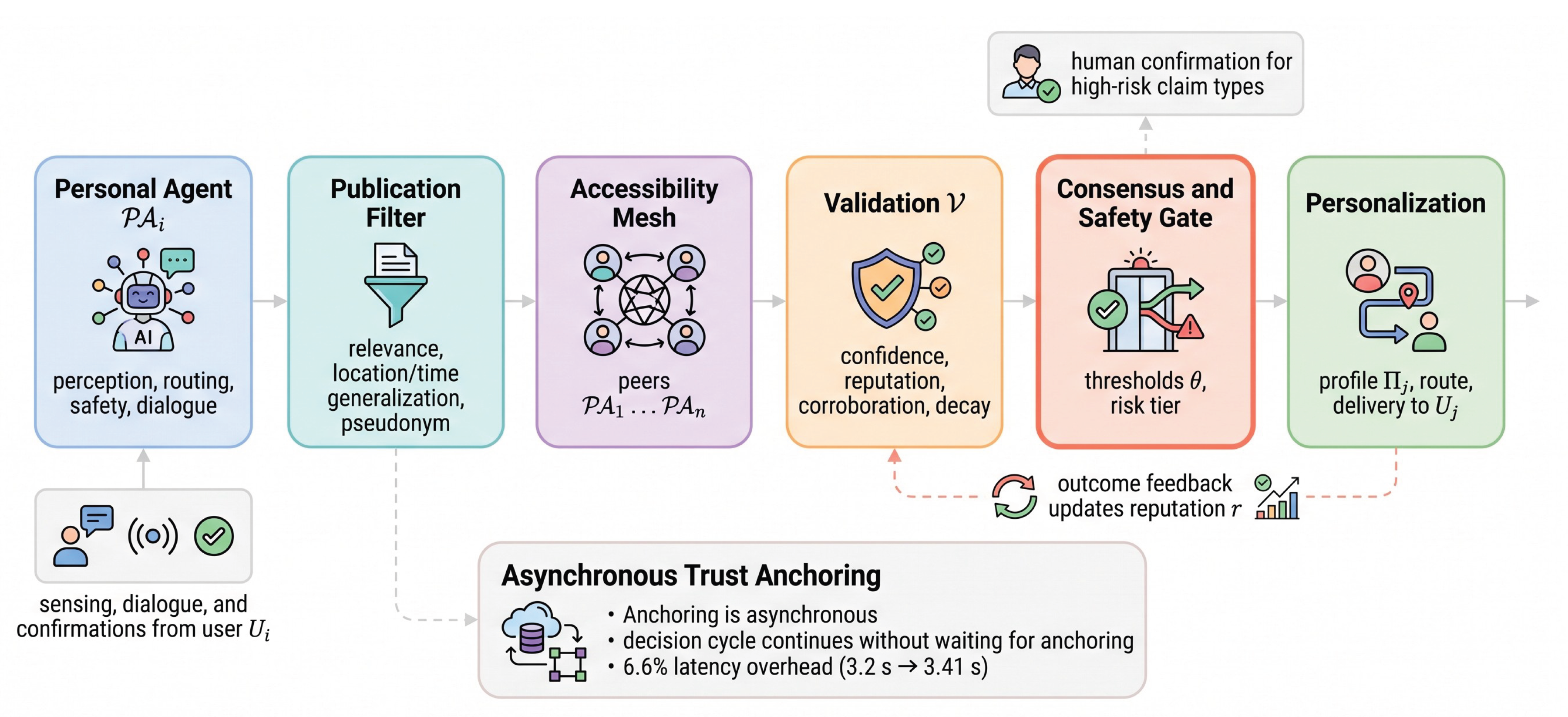

Table 1.
Where accessibility knowledge comes from and how it is governed, by class of system.
| System class | Who shares | Validation of shared claims | Aging of claims |
|---|---|---|---|
| Individual travel aids [1,2,3] | nobody | not applicable | not applicable |
| Peer route exchange [6] | people | listener judgment | implicit |
| Crowdsourced mapping and remote help [7,8,9] | people | human workers | weak |
| Vision-language assistants [18,19] | nobody | not applicable | not applicable |
| Single-user agentic systems [10,11,12] | within one system | internal safety check | not applicable |
| BlindMesh (this work) | agents | agent-side scoring | explicit decay |
Disclaimer/Publisher’s Note: The statements, opinions and data contained in all publications are solely those of the individual author(s) and contributor(s) and not of MDPI and/or the editor(s). MDPI and/or the editor(s) disclaim responsibility for any injury to people or property resulting from any ideas, methods, instructions or products referred to in the content. |
© 2026 by the authors. Licensee MDPI, Basel, Switzerland. This article is an open access article distributed under the terms and conditions of the Creative Commons Attribution (CC BY) license (http://creativecommons.org/licenses/by/4.0/).
Copyright: This open access article is published under a Creative Commons CC BY 4.0 license, which permit the free download, distribution, and reuse, provided that the author and preprint are cited in any reuse.