

Submitted:
20 October 2026
Posted:
22 October 2026
You are already at the latest version
Abstract
Early warning of failure would let costly episodes of large language model (LLM) agents be stopped early. Across five model families and five task domains (3421 usable rollouts), we study a black-box signal: the divergence of a rollout’s judged goal progress from sibling rollouts of the same task after k steps. Under our original judging protocol, cohort divergence predicted failure (pooled AUROC 0.73 in retail). A judge swap revealed that the judge had received a task identifier in place of the task objective. After re-judging with the correct objective, the cohort signal fell to chance in retail and airline (0.47 to 0.52), and a single-rollout judge score had the higher point estimate in eight of ten combinations of domain and horizon. In paired contrasts, before adjustment for multiple comparisons, cohort divergence was significantly worse in two and better in one. Of three pre-specified failure-onset profiles, one met its criterion under the original protocol and none under the corrected one. Task-preserving perturbations produced no detectable amplification of divergence. In an abort simulation, under the stated cost assumptions, the cohort monitor lost tokens for every model, and the judge monitor saved tokens for two of five and had no usable operating point for the other three. Judge instructions are thus a first-order threat to validity in agent-monitoring research.
Keywords:
LLM agents
; failure prediction
; early warning
; trajectory monitoring
; agent reliability
; LLM-as-a-judge
; measurement validity
; negative results
; reproducibility
; τ-bench
1. Introduction
Agents built on large language models (LLMs) solve multi-step tasks by interleaving reasoning with tool calls [1]. They are now evaluated on customer-service dialogues with simulated users [2], repository-level software repair [3], web navigation [4], and broader multi-environment suites [5]. Two observations recur across these benchmarks. Success rates remain well below ceiling, and repeated trials of the same task often give different outcomes, so that consistency over several trials is markedly lower than single-trial success [2,6]. Because every episode consumes many model calls, a failed episode is also an expensive one, and cost is increasingly treated as a quantity that agent evaluations should report alongside accuracy [7].
These observations motivate early warning: a signal, available a few steps into an episode, that the episode is heading for failure. A dependable early signal would let an operator abort, resample, or escalate to a human before most of the cost has been incurred and before irreversible actions have been taken. Runtime monitoring of model trajectories is also a building block of proposed safety protocols for untrusted models [8]. Recent studies report that failure can be anticipated before an episode ends, using linear probes on hidden states [9], finite-state automata mined from execution traces [10], and trained online auditors for multi-agent systems [11]. Other results are more cautious. Uncertainty estimates have been reported to stay below a mean area under the receiver operating characteristic curve (AUROC) of 0.60 halfway through long-horizon trajectories [12], and annotated evidence of failure has been reported to first appear, on average, after more than half of the trajectory has elapsed [13].
A question that this literature leaves largely open is whether an early-warning rule transfers. A monitor is normally specified by a horizon, the number of initial steps it observes, and a threshold on some score. Monitoring designs implicitly assume that a horizon chosen in one setting remains appropriate in another. If the step at which failure becomes visible depends on the agent model, the task domain, or the selection of tasks, then a rule tuned in one setting may be uninformative, or actively misleading, elsewhere. We are not aware of a study that tests this assumption directly across a crossed design of models and domains.
This paper examines that assumption for black-box behavioural signals, which require no access to model internals. Two candidate sources of such a signal follow from prior work. The first is perturbation sensitivity. LLM outputs can change substantially under meaning-preserving changes to a prompt [14,15], and rephrased queries degrade agentic function calling [16]. This suggests that latent instability might be exposed by injecting small task-preserving perturbations and measuring how far the trajectory moves. The second is sampling consistency. Disagreement among independently sampled responses is an established indicator of unreliable generation [17,18,19]. The trajectory-level analogue is the divergence of a rollout from other rollouts of the same task.
The work was carried out incrementally, in three stages. Study 1 was conducted on the retail domain of -bench [2] with five model families. It tested the perturbation hypothesis with a pre-specified amplification metric, and no amplification was detected. An exploratory analysis of the unperturbed rollouts then suggested that a rollout’s early divergence from its sibling rollouts predicted eventual failure, with a warning horizon that differed by model. A preliminary account of Study 1 was presented as a conference abstract [20]. Study 2 was designed from the limitations that Study 1 left open. It fixed the horizon, the metric, and a falsifiable prediction in version control before the new data were analysed, in the spirit of preregistration [21], and tested them on four further domains with a second judge, formal contrasts, a calibration experiment, and a confirmation run on unseen tasks.
The second judge exposed an error in the instructions that the judge had received in both studies: it had been given a task identifier in place of the task objective. In a third, correction stage, carried out after the first full draft of this article and not pre-specified, all rollouts were re-judged with the correct objective and every analysis was repeated. The correction changes the main conclusions. Most of the predictive signal that Studies 1 and 2 attributed to cohort divergence, including the results reported in the conference abstract [20], does not survive it. This article reports the results under both protocols and treats those under the corrected protocol as authoritative.
The work addresses four research questions:
- RQ1. Do task-preserving perturbations amplify trajectory divergence beyond the divergence already present among unperturbed rollouts?
- RQ2. Does a rollout’s early divergence from unperturbed siblings predict eventual task failure, and does it add information beyond a judge’s score of that rollout alone?
- RQ3. Is the horizon at which failure becomes predictable a stable property of the agent model across domains?
- RQ4. Do the conclusions survive a change of judge, a correction of the judging protocol, and evaluation on unseen, unscreened tasks?
The contributions supported by the evidence are as follows.
- A null result for perturbation amplification as a way to measure agent instability on -bench retail, obtained after metric saturation was diagnosed and removed and after tasks were screened for headroom.
- A documented case in which an error in the instructions given to an LLM judge produced an apparently strong early-warning signal. Under the original protocol, cohort divergence predicted failure with pooled AUROC between 0.64 and 0.80 in four conversational domains. After 3462 rollouts were re-judged with the correct objective, it fell to chance in two of those domains. The error was found by running a second judge on identical inputs.
- Evidence that, under the corrected protocol, cohort divergence does not consistently outperform a single-rollout judge score. The judge score has the higher point estimate in eight of ten combinations of domain and horizon. In paired contrasts, before adjustment for multiple comparisons, cohort divergence is significantly worse in two combinations and significantly better in one, and that one advantage is not significant under a second judge. Signed variants of the cohort feature do no better. The single-rollout judge score is itself a modest predictor.
- A negative result for a prediction fixed in advance, that each model keeps a characteristic failure-onset profile across domains. Under the original protocol one of the three profiles met its criterion on the original task sets, one could not be assessed, and one was refuted. Under the corrected protocol none is supported. Estimates for single combinations of model and domain range from 0.15 to 0.92 and change by up to 0.24 when the judge is replaced, so they do not support claims about individual models.
- A coverage analysis and a cost-aware simulation of early abort with held-out thresholds, in which the cohort monitor is net-negative for every model. The single-rollout judge monitor gives net token savings for two of the five models and has no usable operating point for the other three, because its scores are too coarse.
- A public pipeline in which every reported number is recomputed from logged rollouts under either judging protocol.
We describe the methods in the order in which the work unfolded, and we report the hypothesis that was not supported, the predictions that failed, and the correction of our own instrument, because the sequence is itself informative about how such errors arise and how they can be caught. Section 2 reviews related work. Section 3 describes the measurement framework, the protocols of the two studies, and the correction stage. Section 4 reports the results under the corrected protocol first and then summarizes those obtained under the original one, Section 5 discusses them, and Section 6 concludes.
2. Related Work
2.1. Agent Benchmarks and Reliability
-bench evaluates an agent that converses with an LLM-simulated user while acting through domain tools under a written policy, in retail and airline domains, and introduced the pass⌃k metric for consistency over k trials of the same task [2]. Its authors reported that agents built on a strong function-calling model succeeded on fewer than half of the tasks and that eight-trial consistency in retail fell below 25%. -bench extends the setting to a domain in which user and agent both act on a shared environment [22]. SWE-bench frames software repair as resolving real repository issues that are checked by tests [3], and WebArena and AgentBench cover web and multi-environment tasks [4,5]. Rabanser et al. proposed twelve reliability metrics spanning consistency, robustness, predictability, and safety, and found that gains in capability were accompanied by only small gains in reliability [6]. Khanal et al. proposed a reliability framework for long-horizon agents [23], and Lee attributed long-horizon failure to trajectories that deviate from a canonical solution path [24]. Kapoor et al. argued that agent evaluations should report cost jointly with accuracy and use proper holdouts [7]. These works characterize outcomes at the end of an episode or variation at the level of a population of runs. The present work asks when, during a single episode, the outcome becomes predictable, and whether that timing is stable.
2.2. Failure Analysis and Early Failure Prediction
A first line of work explains failures after the fact. Cemri et al. derived a taxonomy of fourteen failure modes from annotated multi-agent traces [25]. Zhang et al. posed the task of attributing a failure to a responsible agent and step, and found step-level attribution accuracy to be low even for the best method [26]. Deshpande et al. released human-annotated agent traces with an error taxonomy on which current models localize errors poorly [27]. Closer to our domains, Cuadron et al. found on -bench and SWE-bench Verified that deviations in state-mutating actions sharply reduce the odds of success, whereas deviations in non-mutating actions matter little [28]. Advani studied episodes on -bench that close confidently although the task has failed, and reported that LLM judges detect such false successes only weakly [29]. This is related to the pattern that we later call illegible failure. Two studies of coding-agent trajectories reported that failed trajectories are longer and more variable [30] and that the association between length and failure reverses once task difficulty is controlled [31], which motivates the length control used in our analysis.
A second line of work predicts failure online. Ruan et al. reported that probes on hidden states identify doomed episodes earlier than behaviour-only monitors and allow large token savings at fixed recall [9]. Cho et al. mined automata from traces and reported that a runtime monitor ranks failing runs above passing runs a quarter of the way through a trace [10]. Zhang et al. trained an online auditor for multi-agent systems [11]. Against these, Li et al. found that confidence is informative at the final step but that no uncertainty method exceeded a mean AUROC of 0.60 at the midpoint of long-horizon trajectories [12], and Baidya et al. reported that failure evidence is sparse and appears late [13]. Our work differs from these in three respects. It uses only black-box behaviour and an unsupervised feature, with no training on labelled failures. It compares the feature with a single-rollout baseline scored by the same judge at the same step. Its main object is the transfer of the warning horizon across a crossed set of models and domains, tested with predictions fixed in advance, and not the best achievable detection performance.
2.3. Perturbation Sensitivity and Sampling Consistency
Sclar et al. showed that meaning-preserving changes to prompt format can shift task accuracy by large margins [14], and Mizrahi et al. argued on that basis for evaluation over multiple instruction paraphrases [15]. LLM outputs also vary from run to run under identical inputs [32]. For agents, Rabinovich and Anaby Tavor found that meaning-preserving rephrasings of user queries lowered function-calling performance by 8 to 19% [16], Wang et al. benchmarked tool-using agents under injected noise on the user and tool sides [33], and Zhang and Guo compared how agents treat surface and semantic noise [34]. These results concern the effect of perturbations on outcomes. Study 1 asks a different question, namely whether such perturbations move trajectories further apart than repeated sampling already does. For sampling consistency, semantic entropy [17,19] and SelfCheckGPT [18] detect unreliable text generation from disagreement among sampled responses. Cohort divergence applies the same principle to agent trajectories, with the difference that samples are compared step by step along a prefix and scored against the eventual task outcome.
2.4. LLM Judges
Our goal-drift measure depends on an LLM judge. Strong LLM judges can agree with human preferences at rates above 80%, but they show systematic biases [35]. Structured judging prompts improve correlation with human ratings [36]. LLM evaluators can recognize and favour their own generations [37], which is a direct concern when the judge model is also one of the agents under test. Judges have also been used to evaluate agent trajectories and intermediate steps [38,39]. These findings motivate the judge-swap experiment of Study 2 (Section 3.4.4), in which the judging model is replaced while all inputs are held fixed.
3. Materials and Methods
3.1. Overview of the Study Design
The work consists of two studies carried out in sequence with one measurement framework (Table 1), followed by a correction stage in which all rollouts were re-judged and additional analyses were run (Section 3.5). Study 1 used one domain. Its amplification test followed a protocol specified before the campaign, whereas its early-warning analysis, including the choice of horizon , was exploratory. Study 2 added four domains and reused the Study 1 retail data unchanged. Its primary horizon, primary metric, baseline, and a falsifiable prediction about model profiles were committed to version control before the multi-model data for the new domains were analysed. Two amendments, a horizon-calibration procedure and a confirmation run on unseen tasks, were committed before their own data were analysed. These commitments are timestamped commits in the public project repository (pre-specification: commit bc51d1b, 13 July 2026; amendments: commit b0b5c4f, 14 July 2026) and were not deposited in an independent registry. The first rollout of the confirmation run started after the amendment had been committed. The calibration procedure was fixed before it was run, but it re-analyses rollouts that had already been inspected for the main analysis. The code and data of Study 1 were frozen under the version tag paper1-v1.0 before Study 2 began. An AI coding assistant was used to implement and run both studies under the authors’ direction, as detailed in the Acknowledgments.
Study 2 was designed from the limitations that Study 1 left open. Table 2 lists each limitation, the element of Study 2 that addresses it, and where the outcome is reported.
3.2. Measurement Framework Common to Both Studies
3.2.1. Agents and Models
An agent is an LLM inside a fixed ReAct scaffold [1]. At step t the agent emits an action , consisting of a tool name and arguments, and receives an observation . The trajectory prefix of length t is . An episode ends with a binary outcome given by the environment’s reward. All agents used a decoding temperature of 0.7 and a limit of 15 steps (12 in code repair), and all were called through one client layer with provider-specific endpoints. Table 3 lists the five models, which were the same in both studies.
Rollouts were collected on 12 and 13 July 2026 for Study 1 and from 13 to 15 July 2026 (UTC) for Study 2. The logs record the model identifier that was requested and not the snapshot to which the provider resolved it.
3.2.2. Measurement Architecture and Logging
Figure 1 shows the pipeline. Agent API calls happen only during rollout generation. Each step is logged with the agent’s raw completion, the parsed action, the verbatim observation, token usage, latency, and a SHA-256 hash of the exact prompt. Prompts are reconstructed deterministically and verified by replay. Everything downstream is a deterministic function of the stored logs, so no analysis step issues new agent calls. Rollouts that terminated because of a provider error were excluded from all analysis by the loader and were re-run through a resume mechanism that deletes only the failed logs. Every rollout is planned in a manifest with a seed derived from the campaign seed and the rollout identifier, so a retry re-issues the identical request. The seed is passed to the providers that accept one, which honour it on a best-effort basis, and it does not make sampling at temperature 0.7 reproducible. Perturbations are deterministic functions of their seed, so all rollouts of a perturbed condition see the same perturbation. An inventory of the runs, with model, environment, rollout counts, failures, and cost, is kept in a machine-readable experiment log.
3.2.3. Frozen Annotation Pass
Judging and embedding are decoupled from rollout generation. One annotation pass processes every logged rollout once and stores, for each step, a short state summary, embeddings, and a goal-pursuit score. Embeddings use text-embedding-3-small. The summarizer and judge are gpt-4o-mini at temperature 0. Scores are computed per prefix, so the judge does not see how the episode ended or whether it was perturbed. Because every model is measured by the same stored instrument, comparisons between models and domains are not affected by differences in instrumentation.
3.2.4. Divergence Functions
Two prefixes of equal length from the same task are compared with three functions.
Action divergence () is the normalized Levenshtein distance [40] between the two sequences of canonicalized actions. Two actions with the same tool are treated as matching when the cosine similarity of their embedded argument strings exceeds . The soft match was introduced because raw edit distance marks any two competent rollouts as highly divergent when they take valid actions in a different order.
Semantic divergence () compares the embedded state summaries and at step t:
where is the embedding model and is cosine similarity. The rescaling places in , with 0 for identical summaries. It measures whether two runs are in different situations, independent of surface action choices.
Goal divergence () uses the judge’s score , which answers how consistent the trajectory so far is with eventually satisfying the user’s goal:
The raw score is retained as a baseline (Section 3.2.5). The final-step score is never used, because closing turns of successful conversations score low on goal progress. In practice the score takes few distinct values, which matters for threshold-based monitoring (Section 4.2.9). The judge prompt is reproduced in Appendix B.
Two order-invariant diagnostics, the Jaccard distance over the set of actions and over the subset of state-changing tools, were computed to expose metric saturation and carry no claims.
3.2.5. Early-Warning Feature and Baselines
For each task and model we collect a cohort of n unperturbed rollouts at fixed temperature ( in the main campaigns and in the confirmation run). The unit of prediction is one rollout observed up to step k. Its early cohort divergence under divergence function d is the mean divergence at step k from the other rollouts of the same cohort (Figure 2):
where i indexes the rollout being scored and is its prefix truncated at step k. The mean runs over all other rollouts of the same task and model (up to five in the main campaigns). A sibling with fewer than k annotated steps is dropped from the mean, and a rollout that itself has fewer than k annotated steps has no feature at horizon k and is excluded at that horizon. The feature is unsupervised: it uses no outcome labels and no training. Its ability to predict failure is summarized by the AUROC, the probability that a randomly chosen failing rollout receives a higher score than a randomly chosen successful one [41]. We refer to this AUROC for a given model and domain as the legibility of failure at horizon k. Horizons were examined.
Three comparisons discipline the interpretation. The single-rollout baseline is the rollout’s own judge score , negated so that higher values indicate failure. It is available at the same step from the same annotation, but it uses one rollout, whereas the cohort feature also uses the sibling rollouts. The comparison therefore asks whether relating a rollout to its siblings adds anything beyond asking the judge how that rollout is going. It is not a comparison between monitors of equal cost. The length control is total trajectory length, which uses information from after step k and is reported only to bound what an outcome-correlated length effect could achieve [30,31]. A multivariate model, a logistic regression on the three cohort divergences evaluated with task-grouped cross-validation, tests whether a single decision rule is shared across models.
Only rollouts with at least k steps contribute at horizon k. Early-terminating episodes drop out as k grows, so the number of rollouts is reported at every horizon and is treated as diagnostic. Results at different horizons therefore describe different sets of rollouts. A change in AUROC between two horizons can reflect which episodes remain as well as a change in how visible failure is, and in the original analysis the horizons were not compared on a common set of eligible rollouts. That comparison was added in the correction stage (Section 3.5 and Section 4.2.7).
3.2.6. Headroom Screening
Divergence between two rollouts can be measured only where it is neither trivially small nor saturated. Candidate tasks were therefore screened with baseline-only rollouts of gpt-4o-mini. A task was retained if its baseline at horizon 8 (5 in code repair) lay in , and a domain passed the gate if at least eight tasks were retained. A task can be scored only if at least one pair of its screening rollouts reaches the screening horizon. Screening uses one model and conditions the task set on a divergence statistic. This is a selection effect, and Study 2 examines it directly (Section 4.3.2).
3.2.7. Uncertainty
Rollouts of the same task share difficulty and are not independent. All confidence intervals are therefore percentile intervals from a cluster bootstrap that resamples tasks with replacement (1000 draws) [42]. A cell in which every rollout has the same outcome has no defined AUROC.
3.3. Study 1 Protocol: Single Domain
3.3.1. Domain and Campaigns
Study 1 used the retail domain of -bench (version 0.1.0) [2], in which the agent converses with an LLM user simulator and acts through a typed tool interface, and the environment terminates the episode. Three campaigns were run. A pilot (five models, two tasks, six rollout pairs, tool-output noise only) served to test the pipeline. An effect check (gpt-4o-mini, six headroom-screened tasks, baseline and three perturbed arms) provided the amplification test and a first look at early warning. A validation campaign ran the five models on 20 retail tasks with six unperturbed rollouts per task. All 20 candidate tasks passed the headroom screen, so no retail task was removed by it. Of the 600 planned rollouts, 559 are usable, because gemini-flash lost 41 to provider failures (79 usable). A further 16 rollouts of grok-4 ended at step 2, so 543 rollouts have a feature at . The effect check comprises 228 rollouts: 120 in the baseline arm (10 pairs for each of six tasks) and 36 in each of the three perturbed arms. Study 1 therefore comprises 828 rollouts, of which 787 are usable.
3.3.2. Perturbation Amplification
The hypothesis was that a small task-preserving perturbation amplifies divergence beyond baseline stochasticity. For horizon h, measured in steps from the start of the episode, let be the median divergence between perturbed and baseline rollouts of a task, and the median divergence among baseline rollout pairs of the same task. The perturbation amplification ratio (PAR) and the excess divergence (ED) are
and mean that the perturbation is absorbed into ordinary sampling variation. ED is reported alongside PAR because the ratio is unstable when is small. Five perturbation classes were implemented: paraphrase of the user goal, a single-token edit of the goal, tool-output noise that is byte-equivalent after parsing, reordering of list-valued observations, and reordering of a memory recap in an optional memory scaffold. Goal perturbations were applied to the user simulator’s private instruction and never to the agent’s prompt, so the agent-side interface is identical across arms. They are applied once, when the environment is reset, whereas tool-output noise is applied to every tool observation throughout the episode. Each perturbed condition uses one fixed perturbation per task. PAR and ED were evaluated at , with task-cluster bootstrap intervals (1000 draws) for the per-condition medians. The amplification test used paraphrase and token edit as semantically real perturbations and tool-output noise as an inert control.
3.3.3. Construct Check of the Judge
Before was used for prediction, we checked that the judge score separates outcomes at small k: the mean of eventually successful rollouts should exceed that of eventually failing ones. The gap, and not the absolute level, is the check.
3.4. Study 2 Protocol: Multiple Domains
3.4.1. Domains and Tasks
Table 4 summarizes the five domains. Retail and airline are the public -bench domains. Health and banking were written for this work on a generic conversational engine that reproduces the -bench interaction protocol, so that the protocol is held fixed while the content varies. Code repair is a deliberate protocol contrast with no user and a test-based reward.
In the authored conversational engine, a domain pack supplies a JSON database template that is deep-copied at every reset, a policy document, tools implemented as pure functions of the database and their arguments, and tasks whose success criteria are declarative checks on the final database state. The user simulator is gpt-4o-mini at temperature 0.7, prompted with the task’s private goal. The agent sees only the simulated customer’s opening message, and the episode ends when the simulator emits a stop token. The health pack models a clinic patient-services desk with 11 tools (identity verification by name and date of birth, appointment scheduling, cancellation and rescheduling against explicit availability, prescription refills with an escalation path for controlled substances, and contact updates) and 20 candidate tasks. The banking pack models a retail-bank desk with 9 tools (identity verification, transfers between a customer’s own accounts with a limit of 5000.00, card blocking and replacement, transaction disputes, and address changes) and 20 candidate tasks.
Each code-repair task is a small Python module containing a bug, with a failing visible test file in a scratch workspace. Success requires the full suite to pass, including a hidden test file that is added only at submission, which prevents hard-coding the visible assertion. This follows the fail-to-pass idea of SWE-bench [3] at a much smaller scale, and it should not be read as a SWE-bench result. A second tier of nine harder tasks was added after two models solved every base task. The repository test suite verifies for every code-repair task that the shipped module fails its visible tests and that a committed reference fix passes the visible and hidden tests. For the conversational packs, engine tests cover success and failure flows, policy refusals, database isolation between resets, and injection of goal perturbations. The repository contains 149 such tests, all of which passed at the time of the campaigns.
3.4.2. Screening and Rollout Budget
Each new domain was screened as in Section 3.2.6, with three cohort pairs per task. Twenty candidate tasks were run per domain. In airline, health, and banking, 18, 19, and 18 tasks could be scored, and 15, 15, and 16 of them lay in the band and were retained. The success rate of the screening model on the candidate tasks was 13% in airline, 57% in banking, 83% in health, and 92% in the base tier of code repair, against about 10% in retail, so the domains cover a wide range of difficulty. Code repair failed the gate (5 of 14 scorable tasks in the band), because agents solve these tasks along nearly deterministic trajectories. It was run on all tasks as a low-power contrast declared in advance. The gpt-4o-mini screening rollouts also serve as that model’s campaign arm. Each remaining model was run on the screened tasks with six rollouts per task.
3.4.3. Pre-Specified Predictions
The following were fixed before the Study 2 multi-model data were analysed. The primary horizon is , selected on Study 1 data. Horizons 2, 3, and 8 are exploratory. The primary metric is the AUROC of cohort at k against eventual failure, analysed per domain, with the judge score as baseline. The falsifiable prediction is that each model keeps its Study 1 onset profile in at least three of the four new domains: early-onset for gpt-4o-mini, late-onset for qwen3-max, and illegible for claude-haiku-4-5 (the profiles are defined in Section 4.3.1). grok-4 had no Study 1 profile when the prediction was fixed and is therefore descriptive only. No numeric threshold for assigning a cell to a profile was fixed. Cells were classified from their AUROC at and .
3.4.4. Judge Robustness Passes
Three judging passes were run on the banking domain, in which only goal scores were recomputed while summaries and embeddings were inherited. Pass A is the original protocol of Section 3.2.3 with the gpt-4o-mini judge. During Study 2 we found that pass A supplied the judge with the bare task identifier in place of the task objective, so the judge scored general trajectory health and not progress toward the specific goal. Pass B uses the same judge with the corrected protocol, in which the judge receives the real task instruction. Pass C uses claude-sonnet-4-5 with the corrected protocol and inputs identical to pass B. A planned fourth pass with a third judge family was interrupted twice by exhausted provider credit after 15 of 504 rollouts. Its partial output was discarded and it is reported as not run.
Pass A is the protocol under which Studies 1 and 2 were originally analysed. Under pass A, should be read as divergence in judged general trajectory health. The pass B configuration was later applied to all rollouts (Section 3.5).
3.4.5. Amendments: Calibrated Horizon and Confirmation Run
Two amendments followed the first Study 2 results. In the calibrated-horizon procedure, the tasks of each model and domain pair are split into calibration and holdout halves by a fixed seed, is chosen to maximize AUROC on the calibration half, and AUROC at is reported on the holdout half against fixed and . In the confirmation run, the next 15 unseen airline tasks (t20 to t34) were run without headroom screening for all five models with two cohort pairs per task (300 rollouts), with the evaluation horizon fixed at before analysis. The criteria were that each model’s AUROC fall within the confidence interval of its original airline cell and that the drop from to reappear.
3.4.6. Contrasts
Differences between two AUROCs use a paired task-cluster bootstrap (2000 draws) in which the same resampled tasks are applied to both scores on identical rollouts, or to both models on their shared tasks. We report the point difference, its 95% percentile interval, and a two-sided bootstrap p-value. The DeLong test [43] is not used because it assumes independent observations. No correction for multiple comparisons was applied, and p-values are reported as descriptive. Pooling rollouts across models within a domain can produce an association that is absent within each model [44], so pooled values are interpreted alongside per-model values.
3.4.7. Token Accounting and Simulated Abort Policy
From per-step token usage we define as the tokens consumed after step k in episodes that eventually fail, as a fraction of all agent tokens, and as the same quantity as a fraction of the tokens of failing episodes. is the share of spend that a perfect abort at step k would recover. An abort policy was simulated in the correction stage (Section 3.5). The token analysis covers the validation campaign of Study 1 and the runs of the model-by-domain matrix, and excludes the pilot, the effect check, and the confirmation run.
3.5. Correction Stage: Re-Judging and Additional Analyses
The analyses in this subsection were carried out after a critical review of the first full draft of this article. They were not pre-specified.
3.5.1. Re-Judging All Rollouts with the Corrected Protocol
The banking passes showed that correcting the judge’s instructions changed the results (Section 4.3.3). All remaining rollouts were therefore re-judged with the pass B configuration: the gpt-4o-mini judge, the same prompt, and the real task instruction as the objective. This covered 2958 rollouts and 29,582 judge calls at a cost of about USD 5. Together with the 504 banking rollouts of pass B, corrected goal scores exist for 3462 rollouts, including the effect check and the confirmation run. Summaries and embeddings were inherited, so and are unchanged. The analyses of Studies 1 and 2 that estimate AUROC (pooled and per-cell estimates, the horizon sweep, the effect check, and the confirmation run) were then recomputed from the corrected scores with the same code. The paired bootstrap contrasts between cohort divergence and the judge score were recomputed for every domain at and , under the second judge where it was run, and the contrasts between models were recomputed for claude-haiku-4-5 in health and airline. The amplification grid for was recomputed for the effect check. The second judge, claude-sonnet-4-5, had been run under the corrected protocol on banking (pass C). It was then also run on all 480 health rollouts (5471 steps) with the same prompt and inputs, at a cost of about USD 22, so agreement between judges under the corrected protocol has been checked in two of the five domains. The horizon calibration of Section 3.4.5 was repeated with the corrected scores.
3.5.2. Coverage and Common-Set Comparison
For every model, domain, and horizon we counted the rollouts that receive a feature among all usable rollouts, separately for failures and successes. To separate changes in visibility from changes in the set of surviving rollouts, AUROC at was recomputed on the rollouts that also reach and compared with AUROC at on the same set.
3.5.3. Signed Cohort Baselines
Cohort divergence under is unsigned: it measures how far a rollout’s judge score lies from those of its siblings in either direction. Two signed alternatives were evaluated, the deviation of the rollout’s score from the mean and from the median of its siblings’ scores,
and the analogous , so that a rollout scored below its siblings receives a higher, more failure-like value.
3.5.4. Cost-Aware Abort Simulation
The abort simulation was repeated under the corrected protocol with three changes. Tasks were split into calibration and holdout halves by a fixed seed, the threshold of each monitor was chosen on the calibration half as the value closest to a 10% false-positive rate, and recovery was measured on the holdout half with the realized false-positive rate reported. Monitoring costs were charged as follows. The single-rollout judge monitor was charged the tokens of its judge calls, 1306 tokens per call and one call per step up to . Three calls reflect the annotation pipeline, which scores every step. The decision at step 3 uses only , so a monitor built for deployment could call the judge once, at the horizon. We therefore also report a one-call scenario, obtained by dividing the judge cost by three with the abort decisions unchanged. Both scenarios assume a constant cost per judge call and do not charge the summarizer call that produces the state description. The cohort monitor was charged the judge calls for the monitored rollout and for each sibling, and the agent tokens that the siblings actually consumed through step 3. Sibling tokens after step 3 were not charged. This corresponds to a deployment in which siblings are run only for monitoring and are stopped at the horizon, and it is an upper bound for deployments in which the siblings are themselves wanted. Thresholds were chosen separately for each model. Two pooled policies were then evaluated: the five per-model thresholds applied to their own models and pooled, and a single threshold chosen on the calibration tasks of all models together.
4. Results
The results are presented in order of authority and not in the order in which they were obtained. Section 4.1 reports the amplification test, whose outcome is the same under both judging protocols. Section 4.2 reports all analyses of failure prediction under the corrected judging protocol, and the conclusions of this article rest on it. Section 4.3 then summarizes the two studies as they were originally analysed, under the protocol in which the judge did not receive the task objective, and describes how the error was found. The complete original-protocol tables and figures are given in Document S3 of the Supplementary Materials.
4.1. No Amplification of Trajectory Divergence Was Detected (RQ1)
The pilot returned for every model, but it could not be interpreted. Baseline divergence under the original action-sequence metrics was between 0.65 and 0.99, because two competent rollouts usually take valid actions in a different order. A metric that is already near its maximum cannot register amplification. In addition, the only perturbation in the pilot was the inert control.
The protocol was therefore redesigned before further data were collected. The soft-matched lowered baseline divergence, provided headroom (baseline between 0.09 and 0.23), tasks were screened for headroom, and paraphrase and token-edit perturbations were injected into the user simulator’s goal. In the effect check, on six screened retail tasks with gpt-4o-mini, no amplification by paraphrase or token edit was detected (Table 5). Every interval for PAR includes 1 and every interval for ED includes 0, at each of the four horizons evaluated, and the two semantically real perturbations are indistinguishable from the inert control. The intervals are wide, because they rest on six tasks. The rows of Table 5 use the original judging protocol. When the grid was recomputed under the corrected protocol, every interval for PAR again included 1, for all three perturbation classes at all four horizons (Table S1, Part IV), so this result does not depend on the protocol.
No amplification was detected in this setting. With six tasks and intervals this wide, the test could have missed a moderate effect, so the result is an absence of evidence for amplification and not evidence that perturbations have no effect. The result is limited to one agent model, six tasks, and one domain, and it does not exclude amplification under stronger perturbations or in other settings. We also did not test whether the perturbations changed task outcomes without changing trajectory divergence.
4.2. Results Under the Corrected Judging Protocol
This subsection reports the analyses of both studies with the corrected goal scores (Section 3.5). These are the results on which the conclusions of this article rest. The same analyses under the original protocol are summarized in Section 4.3 and given in full in Document S3, and the rollouts and the counts of failures are identical under the two protocols. The complete output for both protocols is given in Table S1 of the Supplementary Materials.
4.2.1. The Cohort Signal Largely Disappears (RQ2, RQ4)
Table 6 and Figure 3 compare the pooled estimates under the two protocols. In retail, the domain in which the signal was first observed, the pooled AUROC of cohort falls from 0.662 to 0.473 at and from 0.728 to 0.500 at , and both corrected intervals include 0.5. In airline the estimate at falls from 0.643 to 0.524. In health the estimate at falls from 0.781 to 0.579, while the estimate at is unchanged (0.730 and 0.735). In banking the estimates fall by 0.07 to 0.08 and remain clearly above chance. The pooled code-repair values, which had been flagged as confounded by model identity, fall from 0.831 and 0.862 to 0.622 and 0.479. Under the corrected protocol the interval of the pooled estimate excludes 0.5 in banking at both horizons, in health at , and in code repair at .
The estimates that had motivated the work change most. The effect-check value for gpt-4o-mini at falls from 0.906 (95% CI [0.780, 0.957]) to 0.544 ([0.259, 0.856]), and at it falls from 0.821 to 0.290 ([0.179, 0.449]), which is below chance. In the retail validation campaign the value for the same model at falls from 0.846 ([0.689, 0.991]) to 0.385 ([0.235, 0.542]). Figure 4 shows the retail horizon sweep under the corrected protocol, in which the pooled estimate stays between 0.47 and 0.54 at every horizon and the single-rollout baseline lies above it throughout. Figure 5 shows the corrected pooled estimates by domain.
4.2.2. Cohort Divergence Against the Single-Rollout Judge Score (RQ2)
Table 8 compares cohort with the single-rollout baseline and with the two signed cohort baselines under the corrected protocol. The judge score of the rollout alone has the higher point estimate in eight of the ten combinations of domain and horizon. Cohort divergence is ahead in airline at , where both are at chance, and in banking at (0.705 against 0.578), a comparison that is examined under three judging passes in Section 4.3.3. The correction affected the two quantities differently. In retail at the judge score moved from 0.678 to 0.664, whereas cohort divergence moved from 0.728 to 0.500.
Table 7 gives the paired contrasts on identical rollouts. Under the gpt-4o-mini judge, cohort divergence is significantly below the judge score in retail at (, 95% CI [, ], ) and in code repair at (, [, ], ). It is significantly above the judge score only in banking at (, [, ], ). The intervals of the other seven contrasts include zero. No correction for multiple comparisons was applied. With ten contrasts, only the retail result at would remain significant at a Bonferroni threshold of 0.005.
These results support the statement that cohort divergence has no consistent advantage over the judge score and is worse in at least one setting. They do not establish that the two monitors are equivalent where the intervals include zero, because several of those intervals are wide. In airline they span more than 0.4.
The single-rollout judge score is itself a modest predictor. Its interval excludes 0.5 at in retail (0.664), health (0.782), banking (0.737), and code repair (0.670), and at in health and code repair. In airline it is at chance at both horizons.

Table 8.
Corrected protocol: pooled AUROC of cohort , of the signed cohort baselines, and of the single-rollout baseline , with 95% task-cluster bootstrap CIs.
Table 8.
Corrected protocol: pooled AUROC of cohort , of the signed cohort baselines, and of the single-rollout baseline , with 95% task-cluster bootstrap CIs.
| Domain and Horizon | Cohort (Unsigned) | Signed Mean | Signed Median | Baseline |
|---|---|---|---|---|
| Retail, | 0.473 [0.402, 0.565] | 0.484 [0.435, 0.539] | 0.459 [0.412, 0.518] | 0.576 [0.472, 0.645] |
| Retail, | 0.500 [0.406, 0.595] | 0.534 [0.486, 0.582] | 0.515 [0.468, 0.551] | 0.664 [0.591, 0.729] |
| Airline, | 0.524 [0.394, 0.636] | 0.557 [0.442, 0.623] | 0.474 [0.414, 0.531] | 0.506 [0.358, 0.613] |
| Airline, | 0.467 [0.353, 0.613] | 0.512 [0.462, 0.554] | 0.490 [0.437, 0.569] | 0.558 [0.433, 0.649] |
| Health, | 0.579 [0.497, 0.673] | 0.566 [0.502, 0.640] | 0.543 [0.475, 0.622] | 0.609 [0.524, 0.701] |
| Health, | 0.735 [0.633, 0.820] | 0.728 [0.673, 0.786] | 0.696 [0.641, 0.766] | 0.782 [0.707, 0.855] |
| Banking, | 0.705 [0.608, 0.794] | 0.454 [0.363, 0.524] | 0.475 [0.422, 0.527] | 0.578 [0.446, 0.702] |
| Banking, | 0.718 [0.611, 0.822] | 0.573 [0.491, 0.666] | 0.604 [0.533, 0.688] | 0.737 [0.648, 0.821] |
| Code repair, | 0.622 [0.548, 0.691] | 0.522 [0.479, 0.563] | 0.509 [0.471, 0.550] | 0.649 [0.582, 0.718] |
| Code repair, | 0.479 [0.373, 0.580] | 0.558 [0.504, 0.611] | 0.503 [0.468, 0.543] | 0.670 [0.589, 0.747] |
The signed cohort baselines did not help. They are below the single-rollout judge score in nine of the ten combinations, the exception again being airline at , and they are below the unsigned cohort divergence wherever the latter carries signal. The concern that an unsigned feature penalizes an unusual success in a mostly failing cohort is therefore not what limits the cohort feature. Under the corrected protocol, the answer to RQ2 is that cohort divergence carries some signal in banking and in health at five steps, and adds little or nothing to a single-rollout judge score.
4.2.3. Onset Profiles Are Not Supported, and Cell Estimates Vary Widely (RQ3)
Table 9 and Table 10 give the corrected estimate for every model and domain with its interval (Figure 6). The numbers of failures and rollouts are given as subscripts in Figure 6.
The pre-specified prediction concerned three onset profiles that had been defined from the retail results of Study 1 under the original protocol (Section 4.3.1): early-onset for gpt-4o-mini (failure more predictable at than at ), late-onset for qwen3-max (at chance at , predictable by ), and illegible for claude-haiku-4-5 (near chance at every horizon). Each model was predicted to keep its profile in at least three of the four new domains. None of the three profiles is supported. For gpt-4o-mini, predicted to be early-onset, the estimate at is not higher than at in any new domain except banking, where the two are equal (0.622 and 0.617), and its retail values are below chance (0.385 and 0.277). For qwen3-max, predicted to be late-onset, the rise from to appears in banking (0.423 to 0.778, three failures) and in health (0.151 to 0.558, four failures), but in retail, where the profile was defined, the direction reverses (0.624 to 0.370). For claude-haiku-4-5, predicted to be illegible, the estimates are near chance in airline and code repair and well above chance in banking and in health at , so the prediction fails as it did under the original protocol.
The estimates differ widely between cells, from 0.15 to 0.92. Some cells with many failures lie clearly above chance, such as claude-haiku-4-5 in banking (0.814 and 0.873), and others lie clearly below it, such as gpt-4o-mini in retail at (0.277, 95% CI [0.167, 0.412]), claude-haiku-4-5 in retail at (0.305, [0.189, 0.449]), and grok-4 in code repair (0.266 and 0.337). A value below 0.5 means that successful rollouts lie further from their siblings than failing ones. The lowest of these cells have failure rates near 90%, but gpt-4o-mini in airline has a similar failure rate and an estimate of 0.857 at , so the failure rate alone does not determine the direction. Paired contrasts between models were recomputed for claude-haiku-4-5 in health and airline (Table S1, Part IV). In health at , where the original analysis had placed this model ahead of gpt-4o-mini and grok-4, it is ahead only of qwen3-max (, with four failures in the comparison cell). At it is ahead of gpt-4o-mini (, ), grok-4 (, ), and qwen3-max (, ), and not of gemini-flash (, ). In airline at it is below gpt-4o-mini (, ). These contrasts use the first judge only, and the health cell on which they rest does not keep its value under the second judge (Section 4.2.4), so we do not interpret them as established differences between models.
Under the original protocol one of the three profiles had met its criterion (Section 4.3.2). Under the corrected protocol none does, so the answer to RQ3 is negative: the horizon at which failure becomes predictable is not a stable property of the model, and the feature does not even have a stable sign.
4.2.4. A Second Judge Under the Corrected Protocol (RQ4)
Table 11 compares the two judges under the corrected protocol in the two domains in which both were run. Their step-level scores correlate at in health (5471 steps) and in banking (5907 steps). The pooled estimates agree to within 0.03 to 0.07, and the two judges agree on the central comparison: in health the single-rollout baseline exceeds cohort divergence at both horizons under either judge, and in banking the two judges give the same pattern of an advantage for cohort divergence at and none at .
The estimates for individual cells are not robust to the judge. For claude-haiku-4-5 in health at , the highest cell under the gpt-4o-mini judge (0.918, 95% CI [0.840, 0.980]), the second judge gives 0.678 ([0.389, 0.975]). For grok-4 in the same domain the change goes the other way (0.572 against 0.802). In banking, the values for claude-haiku-4-5 are 0.814 and 0.873 under the first judge and 0.663 and 0.714 under the second, with intervals that include 0.5. With 15 to 44 failures per cell, single cells move by 0.1 to 0.25 between judges while the pooled estimates and the ordering of cohort divergence and baseline hold. No conclusion in this article should therefore rest on the value of a single cell.
The paired contrasts of Table 7 show the same sensitivity. In health at the disadvantage of cohort divergence is significant under the second judge (, ) and not under the first (, ). In banking at , the one setting in which cohort divergence is significantly ahead under the first judge, the contrast under the second judge is with an interval that includes zero (). The single positive result for cohort divergence is therefore of borderline significance under one judge and not significant under the other.
4.2.5. Confirmation Run Under the Corrected Protocol
Table 12 repeats the confirmation analysis (Figure 7). On the unseen, unscreened airline tasks, no model has an interval that excludes 0.5 at either horizon. The pooled estimate of cohort is 0.554 at and 0.537 at , and the single-rollout baseline is 0.509 and 0.410. Neither monitor carries a detectable signal on these tasks. The drop from to that was treated as a replicated feature of airline under the original protocol is small under the corrected one (0.524 to 0.467 on the screened tasks, 0.554 to 0.537 on the unseen ones).
4.2.6. Horizon Calibration Under the Corrected Protocol
The calibrated-horizon procedure (Section 3.4.5) was repeated with the corrected scores (Figure 8). The mean holdout AUROC over cells is lower than under the original protocol for all three policies, and the calibrated horizon is now the worst of the three, at 0.518 against 0.578 for fixed and 0.562 for fixed over the 22 cells. Selecting a horizon on half of the tasks does not help when the feature carries little signal to select on.
4.2.7. Coverage and Horizon Comparisons on a Common Set
In health and banking every usable rollout is scored at both and , so comparisons between these horizons do not involve a change in the set of rollouts. The rise of the corrected health estimate from 0.579 to 0.735 is therefore a change on identical rollouts. In retail, 512 of 559 usable rollouts are scored at both horizons, and the corrected estimates on that common set are 0.491 and 0.500. In airline, the drop from to under the original protocol persists on the 433 rollouts scored at both horizons (0.636 to 0.452), so it was not produced by attrition, and under the corrected protocol the same comparison gives 0.524 and 0.467.
Coverage matters most in code repair, where many episodes end within two steps. Of the 39 failures of claude-haiku-4-5, 8 are scored at and 5 at , and only 24 of the 174 rollouts of qwen3-max reach . A monitor that waits three steps cannot act on the episodes that have already ended, whatever its AUROC on those that remain. Coverage by model, domain, horizon, and outcome is given in Table S1.
4.2.8. Token Spend After the Warning Horizon
The campaigns consumed 81.5 million agent tokens over the 2893 usable rollouts of the Study 1 validation campaign and the model-by-domain matrix. Table 13 reports the share of tokens spent after step k in episodes that eventually failed. Pooled over models, 54.4% of all tokens were spent after step 3 of episodes that went on to fail. Within a failing episode, 87.2% of its tokens were still to be spent at step 3. These figures reflect the high failure rates of the screened task sets and are an upper limit on what a perfect monitor could recover.
Table 13 does not depend on the judge. It bounds what any abort policy could recover, and the simulation of Section 4.2.9 estimates what the two monitors recover in practice.
4.2.9. Cost-Aware Abort Simulation
Table 14 reports the abort simulation under the corrected protocol, with thresholds chosen on a calibration half of the tasks and evaluated on the holdout half, and with monitoring costs charged (Section 3.5). The cohort monitor is net-negative for every model when its sibling rollouts are run only for monitoring, because the sibling prefixes and the judge calls cost 135% to 194% of the tokens of the monitored rollouts while the monitor recovers 5% to 12%.
The single-rollout judge monitor is net-positive for two of the five models: 21.0% of tokens for gemini-flash and 3.8% for claude-haiku-4-5. For gpt-4o-mini, grok-4, and qwen3-max no usable operating point exists. The judge reports scores on a coarse scale, and for these three models the attainable false-positive rate closest to the 10% target on the calibration tasks was zero. The selected threshold aborts no rollout, successful or failing, on calibration or on holdout, so the judge calls are a pure cost of 14% to 18% of agent tokens.
Two pooled policies are reported, and they give opposite signs. Applying the five per-model thresholds, each to its own model, aborts 44 of the 834 successful holdout rollouts (5.3%) and 63 of the 583 failing ones. It recovers 11.1% of agent tokens and costs 14.2%, a net loss of 3.1%. Applying a single threshold to all models, chosen on the pooled calibration tasks, gives a net gain of 10.2%, but the attainable false-positive rate closest to the target was 19.2% on calibration and 21.9% on holdout (183 of 834 successful rollouts aborted), about twice the target. The single-threshold rows are therefore not an average of the per-model rows. They describe a different and more aggressive policy, in which about one in five successful episodes is aborted. The granularity of the judge score is thus a first-order limit on its use for early abort: for three models it leaves no operating point, and for the pooled data it leaves none near the target. All of these values are far below the share of tokens spent after step 3 in failing episodes (Table 13).
The simulated cost charges three judge calls per rollout, although the decision at step 3 uses only (Section 3.5). Table 15 therefore repeats the net recovery of the judge monitor with one judge call at the horizon. The abort decisions and the gross recovery are unchanged, and the monitoring cost falls to one third. The sign of the result does not change for any single model: the monitor remains net-positive for gemini-flash and claude-haiku-4-5 and remains a pure cost for the three models at which it aborts nothing. The sign does change for the pooled policy with per-model thresholds, which moves from a net loss of 3.1% to a net gain of about 6.4% at the same pooled holdout false-positive rate of 5.3%. Whether the judge monitor pays for itself when pooled over these five models thus depends on how many judge calls a deployment needs, and we do not draw a conclusion from the sign of that pooled figure. The one-call values are derived from the rounded costs of Table 14 and were not obtained by rerunning the simulation, and neither scenario charges the summarizer call that produces the state description given to the judge. For the cohort monitor, one judge call for the monitored rollout and one for a single sibling already cost about 9.5% of agent tokens in the pooled analysis, more than its pooled gross recovery of 6.4% to 6.9%, before any sibling agent tokens are counted. Its pooled net recovery therefore remains negative under the one-call scenario.
4.3. The Original Analysis and How the Error Was Found
This section summarizes the results of Studies 1 and 2 as they were first analysed, under the protocol in which the judge received the task identifier in place of the task objective, and it describes how the error was found. The complete original-protocol tables and figures are given in Document S3 of the Supplementary Materials. All values for and in this section are superseded by Section 4.2.
4.3.1. Study 1
In the retail validation campaign (543 usable rollouts at , 74% failures), the pooled AUROC of cohort was 0.529 at , 0.662 (95% CI [0.558, 0.769]) at , 0.728 ([0.653, 0.788]) at , and 0.542 at , against 0.640 and 0.678 for the judge score at and . Among the three divergence functions, was the most predictive ( 0.598 and 0.591 at ), and the length control stayed near chance. The horizon differed by model. For gpt-4o-mini the signal was strongest at (0.846), for qwen3-max and grok-4 it emerged by , and for claude-haiku-4-5 it stayed below 0.58 at every horizon.
From the step-wise judge scores we defined three onset profiles. In the early-onset profile (gpt-4o-mini), failing rollouts dropped sharply by step 3. In the late-onset profile (qwen3-max, grok-4), failing and successful rollouts separated only by step 5. In the illegible profile (claude-haiku-4-5), failing rollouts stayed close to successful ones throughout. These profiles were the basis of the conference abstract [20] and of the prediction tested in Study 2.
4.3.2. Study 2
On the development tasks, the pooled AUROC of cohort was between 0.64 and 0.80 in the four conversational domains (Table 6, first column), and the pooled code-repair values (0.83 and 0.86) were confounded by model identity. The pre-specified prediction, that each model keeps its retail profile in at least three of the four new domains, was met on the original task sets for gpt-4o-mini (airline, health, and banking). It could not be assessed for qwen3-max, whose matching cells in health and banking contained four and three failures. It was refuted for claude-haiku-4-5, which was among the most predictable models in health (0.89 at , 19 failures) and banking (0.82, 15 failures).
The pre-specified horizon failed in airline, where the pooled estimate fell from 0.643 at to 0.452 at . A post hoc split of the airline tasks by failure rate gave 0.768 and 0.493 within the two groups at , so the pooled value below chance was a composition effect between tasks [44]. The calibrated-horizon procedure (Section 3.4.5) did not beat a fixed horizon. Over 22 cells, the mean holdout AUROC was 0.643 for the calibrated horizon, 0.653 for fixed , and 0.621 for fixed . On 15 unseen, unscreened airline tasks, four of five models stayed within 0.06 of their original estimates, the highest original cell (gpt-4o-mini, 0.847, with 7 successes among 88 rollouts) fell to 0.317, and the pooled estimate at was 0.583 ([0.462, 0.685]). Paired contrasts on identical rollouts gave cohort an advantage over the judge score of in retail at , in airline at , in health at , and in banking at , with intervals that excluded zero in all domains except health. The horizons for these contrasts were chosen per domain after inspection.
4.3.3. How the Error Was Found (RQ4)
The error was found by the judge swap of Study 2 (Section 3.4.4). When the second judge, claude-sonnet-4-5, was first run on the banking rollouts with the original inputs, its scores were close to zero throughout and were uncorrelated with those of the first judge (). Inspection of the raw outputs showed that both judges had received the task identifier as the objective. The second judge scored trajectories near zero against an objective it could not interpret, whereas the first had scored general trajectory health.
Table 16 gives the banking results under the three judging passes. Correcting the instructions lowered the AUROC of by 0.07 to 0.08 with the same judge (pass A against pass B). Under the corrected protocol the two judges agree closely: the AUROC of cohort was 0.705 and 0.677 at and 0.718 and 0.726 at , and their step-level scores correlate at over 5907 steps. The correctly instructed judge is also a stronger baseline at (0.737 against 0.696). This result led to the re-judging of all rollouts (Section 3.5).
5. Discussion
5.1. Summary of Findings
Under the corrected judging protocol, the four research questions receive the following answers. No amplification of trajectory divergence by task-preserving perturbations was detected (RQ1). A rollout’s early divergence from its unperturbed siblings predicts failure above chance in banking at both horizons and in health and code repair at one horizon each, and it shows no consistent advantage over a judge’s score of the rollout alone, which has the higher point estimate in eight of ten comparisons. In paired contrasts, before adjustment for multiple comparisons, cohort divergence is significantly worse in two comparisons and significantly better in one, banking at three steps, where the advantage is not significant under the second judge (RQ2). The horizon at which failure becomes predictable is not a stable property of the model, and none of the three pre-specified onset profiles is supported (RQ3). The conclusions of Studies 1 and 2 were not robust to the correction of what the judge was asked. Under the corrected protocol the pooled estimates and the ordering of cohort divergence and judge score agree between two judges in the two domains where this was tested, whereas estimates for single combinations of model and domain do not. On unseen tasks the pooled estimate does not exclude chance under either protocol (RQ4).
5.2. What the Correction Changed
It is useful to state plainly which earlier conclusions survive. The null result for perturbation amplification survives. The negative verdict on the pre-specified onset profiles survives and becomes stronger. Under the original protocol one profile, that of gpt-4o-mini, had met its criterion on the original task sets, one could not be assessed, and one was refuted. Under the corrected protocol none is supported. The stronger statement of the first draft, that the visibility of failure is a joint property of model and domain, survives only in a weak form. Estimates for single cells differ widely under both protocols, but the cells that looked most distinctive under one judge moved toward chance under the other (Section 4.2.4), so we do not treat any single cell as established. Three conclusions do not survive. The first is that cohort divergence is a useful early-warning signal in general: it is at chance in the domain in which it was discovered. The second is that it adds information to a single-rollout judge score: the added value reported under the original protocol for retail and banking at five steps and for airline at three steps is absent under the corrected one, and in retail at five steps the contrast is reversed. The third is the description of models by onset profiles, on which the conference abstract of Study 1 [20] was built. Those results were obtained with the original protocol and are superseded by this article.
The practical recommendation also changes. Study 1 recommended calibrating a warning horizon per model, and the first analysis of Study 2 recommended calibrating it per model and domain. The corrected results support a simpler statement: of the monitors examined, the properly instructed single-rollout judge score is the better and the cheaper one, and its usefulness has to be established for each model and domain.
5.3. Interpretation
We separate what was observed from the explanations we propose for it.
Why an uninformed judge produced a signal. The observation is that a judge that did not know the task produced scores whose dispersion within a cohort predicted failure, and that this predictive value disappeared when the judge was told the task. A proposed explanation is that, without an objective, the judge scored generic features of a trajectory prefix, such as coherence, apparent progress, or the presence of errors and apologies, and that in some models and domains unusual values of these features happen to accompany failure. Once the judge can assess progress toward the actual goal, its score of a single rollout carries that information directly, and distance from siblings adds little. This explanation is untested. It is consistent with the fact that the single-rollout judge score at five steps changed little under the correction in retail (0.678 to 0.664) while cohort divergence fell to chance, but we did not analyse what the uninformed judge responded to.
The role of the pooled comparison. Under the original protocol the pooled code-repair value was high because models with higher failure rates also showed higher divergence, and it was reported with that caveat. Under the corrected protocol the same value is 0.62 at three steps and 0.48 at five. Together with the stratified airline analysis of Section 4.3.2, this indicates that pooled estimates of this feature are sensitive to how tasks and models with different failure rates are mixed.
Differences between cells. The observation is that estimates for the same model differ between domains under both protocols, and that some cells with many failures lie below chance. Part of this variation is noise in the instrument, since single cells moved by 0.1 to 0.25 when the judge was replaced. To the extent that it is real, one explanation is that legibility depends on how a task is failed. An episode can fail through a visible derailment, such as a wrong tool call or an abandoned sub-goal, or through a locally plausible conversation that ends in a wrong final database state. Only the first kind is visible in a prefix. We did not annotate failure types, so this explanation is also untested.
The amplification null. Paraphrasing or editing the user’s goal moved trajectories no detectably further apart than repeated sampling did. At temperature 0.7 and with a stochastic user simulator, the variation between two unperturbed rollouts may already be large relative to the effect of a meaning-preserving change. The result rests on six tasks and one model. It is not in tension with reports that perturbations change task outcomes [16,33], which concern a different quantity.
5.4. Relation to Previous Work
The corrected results agree with the more cautious part of the literature. Li et al. found that uncertainty methods stayed below a mean AUROC of 0.60 midway through long-horizon trajectories [12], and Baidya et al. reported that evidence of failure tends to appear late [13]. The AUROC of our single-rollout judge score at three to five steps, which ranges from chance in airline to 0.78 in health at five steps, is of the same order. The cohort feature is close in spirit to sampling-based consistency checks for text generation [17,18,19] and to the view of failure as deviation from a canonical path [24]. In our data, comparing a trajectory with its siblings did not give the benefit that comparing sampled answers gives for hallucination detection. Studies that report strong early prediction use probes on internal states [9] or monitors built from collections of earlier traces [10,11], which have access to information that a black-box, unsupervised feature does not.
The failures that neither monitor detected, such as those in airline, resemble the confidently closed but failed episodes described by Advani, which LLM judges detected poorly [29]. The finding that deviations in state-mutating actions largely determine success on -bench [28] suggests one route to illegibility, since a single late mutating error would leave little trace in an early prefix.
The methodological result relates to work on LLM judges. Known concerns include systematic biases and self-preference [35,37]. The failure documented here is of a different kind. The judge behaved reasonably given its input, and the input was wrong. A single judge gave internally consistent scores that correlated with outcomes, so nothing in the pipeline signalled a problem. The error became visible only when a second judge, given the same inputs, returned scores near zero.
5.5. Practical Implications
Four implications follow. First, studies that use LLM judges to score agent trajectories should verify what the judge actually receives, and should run a second judge on identical inputs as a routine check. Low agreement between judges should be treated as a possible instrument fault before it is treated as a finding. Second, a feature built on a judge should be compared with the judge’s own score, because that comparison is what exposed the limited value of the cohort feature here. Third, for early abort, the single-rollout judge score is the monitor to evaluate first. In our simulation it was the only monitor with net token savings, and only for two of five models. Its coarse score scale left the other three without a usable operating point, and with per-model thresholds its pooled net result, at a pooled holdout false-positive rate of 5.3%, was a loss of 3.1% when three judge calls per rollout were charged and a gain of about 6.4% when one was. A single threshold for all models gave a larger saving, but at twice the intended false-positive rate. The granularity of a judge’s score therefore limits its use for early abort as much as its discrimination does, and a judge intended for this purpose should be asked for a finer scale. The cohort monitor cost more tokens than it recovered for every model. Fourth, any such monitor should be validated for the model, domain, and task distribution in which it will run, on tasks that were not selected using the monitored quantity, with coverage reported alongside discrimination.
5.6. Limitations
- Status of the corrected analysis. The correction stage was not pre-specified and was carried out after the original results were known. The second judge was run on two of the five domains, so agreement between judges under the corrected protocol has not been checked in retail, airline, or code repair, and judge scores were not validated against human ratings.
- Sensitivity of cell estimates to the judge. Where two judges were run, estimates for single combinations of model and domain changed by 0.1 to 0.25, and the highest cell of the corrected matrix fell from 0.918 to 0.678. Only pooled estimates and the ordering of cohort divergence and judge score were stable.
- Multiple comparisons and judge dependence of the contrasts. The paired contrasts were not corrected for multiple comparisons. The one significant advantage of cohort divergence (banking at three steps, ) would not survive such a correction and is not significant under the second judge (). The contrasts between models were computed under the first judge only.
- Small numbers of failures. Several cells contain fewer than five failures, intervals for individual cells are wide, and contrasts were not corrected for multiple comparisons.
- Eligibility by horizon. A rollout contributes at horizon k only if it reaches step k, so episodes that fail quickly are never scored. In code repair, 31 of the 39 failures of claude-haiku-4-5 ended before step 3.
- Task selection. Tasks were screened for headroom with one model, which conditions the task set on a divergence statistic. The only evaluation on unscreened tasks covers one domain, differs from the original runs in cohort size, and had no power for the cell of greatest interest.
- Domains. Health and banking were written for this work with an AI coding assistant, and although they follow the -bench protocol, their content has not been externally reviewed. The code-repair domain is small, is not SWE-bench, and is saturated by one model.
- Agents. One scaffold, one temperature, and five models were used, three of them from the lower-cost tier of their providers.
- Instruments. The user simulator, the summarizer, and the judge are the same model, which is also one of the agents. For all models the logs record the requested identifier and not the resolved snapshot, and one model was accessed through a moving alias.
- Pre-specification. The predictions of Study 2 are timestamped commits in a public repository and not entries in an independent registry, and the assignment of cells to onset profiles did not use a numeric rule fixed in advance.
- Amplification test. The amplification null rests on one model, six tasks, and one domain.
- Economic analysis. The abort policy was simulated on logged rollouts and was not tested as a live intervention. Its cost model assumes a constant cost per judge call and omits the summarizer, and the pooled net result of the judge monitor changes sign between a three-call and a one-call scenario. The one-call figures are derived arithmetically and were not simulated.
5.7. Future Work
Several extensions follow directly and have not been carried out. A second judge, preferably from a provider family that fields no agent, should be applied to the three remaining domains under the corrected protocol, and a sample of judge scores should be compared with human ratings. The scores of the uninformed judge should be analysed to establish what they responded to. A judge with a finer score scale should be tested, since the coarse scale left three models without an operating point for early abort. The confirmation design should be extended to the other domains with equal cohort sizes and more tasks. A live intervention experiment, in which flagged episodes are stopped or escalated, would measure the gains that the simulation can only estimate. Finally, the design should be repeated with more capable models, other scaffolds, and third-party domains such as SWE-bench [3].
6. Conclusions
This work set out to find an early-warning signal for the failure of LLM agents and to test whether it transfers between settings. Two studies appeared to find one: a rollout’s early divergence in judged goal progress from sibling rollouts of the same task predicted failure in four conversational domains. A second judge then revealed that the judge had been scoring trajectories without knowing the task. After every rollout was re-judged with the correct objective, the signal fell to chance in the domain where it had been discovered and in one other, and a judge’s score of the single rollout had the higher point estimate in eight of ten comparisons. In paired contrasts, before adjustment for multiple comparisons, cohort divergence was significantly worse in two comparisons and significantly better in one. The descriptions of models by failure-onset profiles did not survive either.
Three results remain. Task-preserving perturbations produced no detectable amplification of trajectory divergence. The one failure-onset profile that had met its pre-specified criterion under the original protocol did not do so under the corrected one, so no model showed a consistent profile across domains, and estimates for single combinations of model and domain were too sensitive to the judge to support claims about individual models. A properly instructed single-rollout judge score is a modest early predictor. In a cost-aware simulation, under the stated cost assumptions, it saved tokens for two of five models and had no usable operating point for the other three, whereas the cohort monitor lost tokens for all five.
The contribution that we consider most useful to others is methodological. An error in the instructions given to an LLM judge produced a coherent, replicable, and publishable-looking result, and nothing inside a single-judge pipeline indicated that anything was wrong. Running a second judge on identical inputs cost a few dollars and exposed it. The analysis code is public, and the rollouts and both sets of annotations are available on request pending a dataset deposit, so that these conclusions can be checked and extended.
Supplementary Materials
The following supporting information accompanies the project repository: Table S1, complete results under the original and the corrected judging protocol for every model, domain, and horizon, with coverage, signed baselines, paired contrasts, the abort simulation with counts, the horizon calibration, the amplification grid, and the second-judge results for health and banking (output of scripts/journal_revision.py); Document S1, full protocol of Study 2 (METHOD2.md); Document S2, complete result tables of both studies (RESULTS.md and RESULTS2.md); Document S3, the complete original-protocol results of Studies 1 and 2 with all tables and figures (Document_S3.pdf); File S1, machine-readable inventory of all runs with rollout counts, failures, and cost (logs/EXPERIMENT_LOG.json); File S2, redacted transcript of the research session (logs/session_transcript_redacted.jsonl).
Author Contributions
Conceptualization, E.P.O.O.; methodology, E.P.O.O.; software, E.P.O.O.; validation, E.P.O.O. and D.E.; formal analysis, E.P.O.O.; investigation, E.P.O.O.; data curation, E.P.O.O.; writing, original draft preparation, E.P.O.O.; writing, review and editing, E.P.O.O., D.E., C.K. and M.M.R.; visualization, E.P.O.O.; supervision, M.M.R.; funding acquisition, E.P.O.O. and M.M.R. All authors have read and agreed to the published version of the manuscript.
Funding
This research was supported in part by allocation CIS251242 from the Advanced Cyberinfrastructure Coordination Ecosystem: Services & Support (ACCESS) program, which is supported by U.S. National Science Foundation grants #2138259, #2138286, #2138307, #2137603, and #2138296. The costs of the commercial model APIs used for the rollouts and annotations were not covered by this allocation.
Institutional Review Board Statement
Not applicable. The work involved no human participants or animals. All conversational partners of the agents were LLM-simulated users.
Informed Consent Statement
Not applicable.
Data Availability Statement
The harness, analysis code, campaign configurations, experiment inventory, and figure scripts are available in the project repository at https://github.com/Ejigsonpeter/agent-failure-legibility. The rollout logs and annotation passes (about 1 GB) are archived by the authors and are available on request until the dataset deposit is published. The state of the code and data at the end of Study 1 is preserved under the version tag paper1-v1.0. Every reported number and figure can be regenerated from the logged rollouts without access to model APIs.
Acknowledgments
During the preparation of this manuscript, the authors used Claude (Anthropic; model identifier claude-opus-5-5 as configured in the drafting session) to draft the text of the manuscript from the authors’ research notes, result tables, figures, and the earlier conference version of Study 1, and to check bibliographic details of the references. The authors have reviewed and edited the output and take full responsibility for the content of this publication. An AI coding assistant, Claude Code (Anthropic; desktop application version 2.1.205, with the models claude-fable-5 and claude-opus-4-8), was also used during the research itself under the authors’ direction. It implemented the experimental harness and the authored domains, launched the runs, and wrote the analysis and figure scripts and the project documentation. The redacted transcript of that work (3811 records) is archived with the repository (File S2). LLMs were also the object of study and served as user simulator, summarizer, and judge, as described in Section 3.
Conflicts of Interest
The authors declare no conflicts of interest.
Abbreviations
The following abbreviations are used in this manuscript:
| API | Application programming interface |
| AUROC | Area under the receiver operating characteristic curve |
| CI | Confidence interval |
| ED | Excess divergence |
| LLM | Large language model |
| PAR | Perturbation amplification ratio |
| RQ | Research question |
Appendix A. Chronology of Design Decisions
Table A1 records the main decisions in the order in which they were taken, with the evidence available at the time and the outcome. It documents how Study 2 followed from Study 1.
Table A1.
Chronology of design decisions across the two studies and the correction stage.
| No. | Study | Evidence at the Time | Decision | Outcome |
|---|---|---|---|---|
| 1 | 1 | Hypothesis that perturbation sensitivity predicts failure | Implement the amplification protocol with five perturbation classes and three divergence functions | Pilot gave , but the metrics were saturated |
| 2 | 1 | Sequence metrics near their maximum; the only pilot perturbation was inert | Redesign before collecting more data: soft-matched and semantic metrics, headroom screening with a go or no-go gate, injection into the user simulator’s goal | Screen passed. Amplification remained absent (Section 4.1) |
| 3 | 1 | Unperturbed cohorts show variance between rollouts | Test whether early cohort divergence predicts failure, first on one model and six tasks | AUROC 0.906 for gpt-4o-mini |
| 4 | 1 | Result for one model only | Validate on five models and 20 screened tasks | Pooled 0.728 at , with per-model values from 0.48 to 0.85 at |
| 5 | 2 | Profiles could be model traits or artefacts of one benchmark and one judge | Freeze Study 1, fix a falsifiable prediction, and build four new domains | Prediction refuted for one of three models (Section 4.3.2) |
| 6 | 2 | Code repair failed the headroom gate | Run it as a low-power contrast declared in advance, and add a harder tier | One model never failed. Another failed often and illegibly |
| 7 | 2 | gpt-4o-mini judges its own rollouts | Three judging passes on banking in which only the judge or its instructions change | Judges agree () under the corrected protocol |
| 8 | 2 | Second judge scored near zero ( between judges) | Inspect raw outputs before rerunning | Judge had received the task identifier as objective. Protocol corrected and disclosed |
| 9 | 2 | Fixed failed in airline | Specify per-cell calibration of the horizon as an amendment | Calibration did not beat fixed (Section 4.3.2) |
| 10 | 2 | All results on tasks used in development | Confirmation run on 15 unseen, unscreened airline tasks | Four of five models similar. The highest original estimate was not reproduced (Section 4.3.2) |
| 11 | Corr. | A critical review of the full draft noted that the main results rested on the uncorrected judging protocol | Re-judge all rollouts with the corrected protocol and repeat every analysis | Cohort signal at chance in retail and airline. Single-rollout judge score has the higher point estimate in eight of ten comparisons (Section 4.2.1) |
| 12 | Corr. | The same review questioned survivorship, the baseline, and the token savings | Coverage and common-set analysis, signed cohort baselines, cost-aware abort simulation with held-out thresholds | Signed baselines do not help. The cohort monitor is net-negative for all models, and the judge monitor is net-positive for two of five (Section 4.2.9) |
| 13 | Corr. | The second judge had been run under the corrected protocol in one domain | Run the second judge on health with identical inputs | Pooled estimates and the ordering of the two monitors agree. Single cells shift by up to 0.24 (Section 4.2.4) |
| 14 | Corr. | A further review found the pooled abort row inconsistent with the per-model rows and the monitor comparison unsupported by paired contrasts | Recompute paired contrasts, report abort counts, and add a pooled row with per-model thresholds | Cohort divergence significantly worse in two of ten comparisons and better in one. Judge monitor has no operating point for three of five models, and its pooled net result changes sign with the number of judge calls charged (Section 4.2.2 and Section 4.2.9) |
Appendix B. Judge Prompt
The goal judge receives the following system prompt: “You are a goal-pursuit judge. Given an original objective and the agent’s current state, output a single number in [0,1]: 1.0 = fully on-task pursuing the original objective, 0.0 = fully off-task. Output only the number.” The user message contains the original objective (truncated to 2000 characters), the current state description (truncated to 3000 characters), and the request “Score (0.00-1.00):”. The judge is called at temperature 0 with a limit of 6 output tokens for gpt-4o-mini and 8 for claude-sonnet-4-5. The score is the first number between 0 and 1 in the reply, and a reply that cannot be parsed is scored 0.5. Under the original protocol (pass A), the objective passed to the judge was the task identifier. Under the corrected protocol (passes B and C), it was the task instruction. In the correction stage all rollouts were re-judged under the corrected protocol with gpt-4o-mini, and the health and banking rollouts were also judged with claude-sonnet-4-5.
References
- Yao, S.; Zhao, J.; Yu, D.; Du, N.; Shafran, I.; Narasimhan, K.; Cao, Y. ReAct: Synergizing Reasoning and Acting in Language Models. In Proceedings of the 11th International Conference on Learning Representations (ICLR 2023), Kigali, Rwanda, 1–5 May 2023. [Google Scholar]
- Yao, S.; Shinn, N.; Razavi, P.; Narasimhan, K. τ-bench: A Benchmark for Tool-Agent-User Interaction in Real-World Domains. In Proceedings of the 13th International Conference on Learning Representations (ICLR 2025), Singapore, 24–28 April 2025. [Google Scholar]
- Jimenez, C.E.; Yang, J.; Wettig, A.; Yao, S.; Pei, K.; Press, O.; Narasimhan, K. SWE-bench: Can Language Models Resolve Real-World GitHub Issues? In Proceedings of the 12th International Conference on Learning Representations (ICLR 2024), Vienna, Austria, 7–11 May 2024. [Google Scholar]
- Zhou, S.; Xu, F.F.; Zhu, H.; Zhou, X.; Lo, R.; Sridhar, A.; Cheng, X.; Ou, T.; Bisk, Y.; Fried, D.; et al. WebArena: A Realistic Web Environment for Building Autonomous Agents. In Proceedings of the 12th International Conference on Learning Representations (ICLR 2024), Vienna, Austria, 7–11 May 2024. [Google Scholar]
- Liu, X.; Yu, H.; Zhang, H.; Xu, Y.; Lei, X.; Lai, H.; Gu, Y.; Ding, H.; Men, K.; Yang, K.; et al. AgentBench: Evaluating LLMs as Agents. In Proceedings of the 12th International Conference on Learning Representations (ICLR 2024), Vienna, Austria, 7–11 May 2024. [Google Scholar]
- Rabanser, S.; Kapoor, S.; Kirgis, P.; Liu, K.; Utpala, S.; Narayanan, A. Towards a Science of AI Agent Reliability. arXiv 2026, arXiv:2602.16666. [Google Scholar]
- Kapoor, S.; Stroebl, B.; Siegel, Z.S.; Nadgir, N.; Narayanan, A. AI Agents That Matter. Trans. Mach. Learn. Res. 2025. Available online: https://arxiv.org/abs/2407.01502 (accessed on 4 October 2026).
- Greenblatt, R.; Shlegeris, B.; Sachan, K.; Roger, F. AI Control: Improving Safety Despite Intentional Subversion. In Proceedings of the 41st International Conference on Machine Learning (ICML 2024), Vienna, Austria, 21–27 July 2024; PMLR 235, pp. 16295–16336. [Google Scholar]
- Ruan, K.; Huang, Z.; Zhou, Z.; Wei, Q.; Lin, J.; Wang, X.; Sun, H. Doomed from the Start: Early Abort of LLM Agent Episodes via a Recall-Controlled Probe Cascade. arXiv 2026, arXiv:2607.06503. [Google Scholar]
- Cho, S.; Cardenoso Fernandez, F.; Mohammed, U.; Wu, Z.; Da Costa, K.; Wicaksono, I.; Koshiyama, A. Automata from Agent Traces: Failure and Next-Step Prediction. arXiv 2026, arXiv:2608.23670. [Google Scholar]
- Zhang, B.; Zhu, J.; Shi, Z.; Liu, D.; Tang, R. AgentForesight: Online Auditing for Early Failure Prediction in Multi-Agent Systems. arXiv 2026, arXiv:2605.08715. [Google Scholar]
- Li, Z.; Yu, C.; Zang, L.; Zhuang, C.; Mo, L.; Gan, L. Last Step Matters: Early Uncertainty Cannot Predict Failure in Long-Horizon Agents. arXiv 2026, arXiv:2608.29685. [Google Scholar]
- Baidya, A.; Liang, X.; Guo, R.; Gao, X.; Das, K. When Evidence is Sparse: Weakly Supervised Early Failure Alerting in Dialogs and LLM-Agent Trajectories. arXiv 2026, arXiv:2606.05414. [Google Scholar]
- Sclar, M.; Choi, Y.; Tsvetkov, Y.; Suhr, A. Quantifying Language Models’ Sensitivity to Spurious Features in Prompt Design or: How I Learned to Start Worrying about Prompt Formatting. In Proceedings of the 12th International Conference on Learning Representations (ICLR 2024), Vienna, Austria, 7–11 May 2024. [Google Scholar]
- Mizrahi, M.; Kaplan, G.; Malkin, D.; Dror, R.; Shahaf, D.; Stanovsky, G. State of What Art? A Call for Multi-Prompt LLM Evaluation. Trans. Assoc. Comput. Linguist. 2024, 12, 933–949. [Google Scholar] [CrossRef]
- Rabinovich, E.; Anaby Tavor, A. On the Robustness of Agentic Function Calling. In Proceedings of the 5th Workshop on Trustworthy NLP (TrustNLP 2025), 2025; pp. 298–304. [Google Scholar] [CrossRef]
- Kuhn, L.; Gal, Y.; Farquhar, S. Semantic Uncertainty: Linguistic Invariances for Uncertainty Estimation in Natural Language Generation. In Proceedings of the 11th International Conference on Learning Representations (ICLR 2023), Kigali, Rwanda, 1–5 May 2023. [Google Scholar]
- Manakul, P.; Liusie, A.; Gales, M. SelfCheckGPT: Zero-Resource Black-Box Hallucination Detection for Generative Large Language Models. In Proceedings of the 2023 Conference on Empirical Methods in Natural Language Processing (EMNLP 2023), Singapore, 6–10 December 2023; pp. 9004–9017. [Google Scholar] [CrossRef]
- Farquhar, S.; Kossen, J.; Kuhn, L.; Gal, Y. Detecting hallucinations in large language models using semantic entropy. Nature 2024, 630, 625–630. [Google Scholar] [CrossRef]
- Ejiga Peter, O.O.; Emakporuena, D.; Shaharear, M.R.; Rahman, M. When Do Agent Failures Become Visible? Model-Dependent Warning Horizons in LLM Agents. Abstract presented at SNAS 2026, 2026. [Google Scholar]
- Nosek, B.A.; Ebersole, C.R.; DeHaven, A.C.; Mellor, D.T. The preregistration revolution. Proc. Natl. Acad. Sci. USA 2018, 115, 2600–2606. [Google Scholar] [CrossRef]
- Barres, V.; Dong, H.; Ray, S.; Si, X.; Narasimhan, K. τ2-Bench: Evaluating Conversational Agents in a Dual-Control Environment. In Proceedings of the 43rd International Conference on Machine Learning (ICML 2026), 2026. [Google Scholar]
- Khanal, A.; Tao, Y.; Zhou, J. Beyond pass@1: A Reliability Science Framework for Long-Horizon LLM Agents. arXiv 2026, arXiv:2603.29231. [Google Scholar]
- Lee, W.Y. Capable but Unreliable: Canonical Path Deviation as a Causal Mechanism of Agent Failure in Long-Horizon Tasks. arXiv 2026, arXiv:2602.19008. [Google Scholar]
- Cemri, M.; Pan, M.Z.; Yang, S.; Agrawal, L.A.; Chopra, B.; Tiwari, R.; Keutzer, K.; Parameswaran, A.; Klein, D.; Ramchandran, K.; et al. Why Do Multi-Agent LLM Systems Fail? Adv. Neural Inf. Process. Syst. 2025, arXiv:2503.1365738(NeurIPS 2025). [Google Scholar]
- Zhang, S.; Yin, M.; Zhang, J.; Liu, J.; Han, Z.; Zhang, J.; Li, B.; Wang, C.; Wang, H.; Chen, Y.; et al. Which Agent Causes Task Failures and When? On Automated Failure Attribution of LLM Multi-Agent Systems. In Proceedings of the 42nd International Conference on Machine Learning (ICML 2025), Vancouver, BC, Canada, 13–19 July 2025; PMLR 267, pp. 76583–76599. [Google Scholar]
- Deshpande, D.; Gangal, V.; Mehta, H.; Krishnan, J.; Kannappan, A.; Qian, R. TRAIL: Trace Reasoning and Agentic Issue Localization. arXiv 2025, arXiv:2505.08638. [Google Scholar]
- Cuadron, A.; Yu, P.; Liu, Y.; Gupta, A. SABER: Small Actions, Big Errors. Safeguarding Mutating Steps in LLM Agents. arXiv 2025, arXiv:2512.07850. [Google Scholar]
- Advani, L. From Confident Closing to Silent Failure: Characterizing False Success in LLM Agents. arXiv 2026, arXiv:2606.09863. [Google Scholar]
- Majgaonkar, O.; Fei, Z.; Li, X.; Sarro, F.; Ye, H. Understanding Code Agent Behaviour: An Empirical Study of Success and Failure Trajectories. arXiv 2025, arXiv:2511.00197. [Google Scholar]
- Mehtiyev, T.; Assunção, W. Beyond Resolution Rates: Behavioral Drivers of Coding Agent Success and Failure. arXiv 2026, arXiv:2604.02547. [Google Scholar]
- Ouyang, S.; Zhang, J.M.; Harman, M.; Wang, M. LLM is Like a Box of Chocolates: The Non-determinism of ChatGPT in Code Generation. arXiv 2023, arXiv:2308.02828. [Google Scholar]
- Wang, R.; Chen, Y.; Wang, Y.; Wu, C.; Fang, J.; Cai, X.; Gu, Q.; Su, H.; Zhang, A.; Wang, X.; et al. AgentNoiseBench: Benchmarking Robustness of Tool-Using LLM Agents Under Noisy Condition. In Proceedings of the 43rd International Conference on Machine Learning (ICML 2026), 2026. [Google Scholar]
- Zhang, L.; Guo, J. When Do LLM Agents Treat Surface Noise Differently from Semantic Noise? A 68-Cell Measurement Study with a Held-Out Trace-Level Validation. arXiv 2026, arXiv:2605.25981. [Google Scholar]
- Zheng, L.; Chiang, W.-L.; Sheng, Y.; Zhuang, S.; Wu, Z.; Zhuang, Y.; Lin, Z.; Li, Z.; Li, D.; Xing, E.P.; et al. Judging LLM-as-a-Judge with MT-Bench and Chatbot Arena. In Advances in Neural Information Processing Systems 36 (NeurIPS 2023), Datasets and Benchmarks Track; New Orleans, LA, USA, 10–16 December 2023. [Google Scholar]
- Liu, Y.; Iter, D.; Xu, Y.; Wang, S.; Xu, R.; Zhu, C. G-Eval: NLG Evaluation using GPT-4 with Better Human Alignment. In Proceedings of the 2023 Conference on Empirical Methods in Natural Language Processing (EMNLP 2023), Singapore, 6–10 December 2023; pp. 2511–2522. [Google Scholar] [CrossRef]
- Panickssery, A.; Bowman, S.R.; Feng, S. LLM Evaluators Recognize and Favor Their Own Generations. In Advances in Neural Information Processing Systems 37 (NeurIPS 2024); Vancouver, BC, Canada, 10–15 December 2024; pp. 68772–68802. [Google Scholar]
- Zhuge, M.; Zhao, C.; Ashley, D.; Wang, W.; Khizbullin, D.; Xiong, Y.; Liu, Z.; Chang, E.; Krishnamoorthi, R.; Tian, Y.; et al. Agent-as-a-Judge: Evaluate Agents with Agents. In Proceedings of the 42nd International Conference on Machine Learning (ICML 2025), Vancouver, BC, Canada, 13–19 July 2025; PMLR 267, pp. 80569–80611. [Google Scholar]
- Pan, J.; Zhang, Y.; Tomlin, N.; Zhou, Y.; Levine, S.; Suhr, A. Autonomous Evaluation and Refinement of Digital Agents. In Proceedings of the 1st Conference on Language Modeling (COLM 2024), 2024. [Google Scholar]
- Levenshtein, V.I. Binary codes capable of correcting deletions, insertions, and reversals. Sov. Phys. Dokl. 1966, 10, 707–710. [Google Scholar]
- Hanley, J.A.; McNeil, B.J. The meaning and use of the area under a receiver operating characteristic (ROC) curve. Radiology 1982, 143, 29–36. [Google Scholar] [CrossRef]
- Field, C.A.; Welsh, A.H. Bootstrapping clustered data. J. R. Stat. Soc. Ser. B 2007, 69, 369–390. [Google Scholar] [CrossRef]
- DeLong, E.R.; DeLong, D.M.; Clarke-Pearson, D.L. Comparing the areas under two or more correlated receiver operating characteristic curves: A nonparametric approach. Biometrics 1988, 44, 837–845. [Google Scholar] [CrossRef]
- Simpson, E.H. The interpretation of interaction in contingency tables. J. R. Stat. Soc. Ser. B 1951, 13, 238–241. [Google Scholar] [CrossRef]
Figure 1.
Measurement architecture. Rollout generation (left of the dashed line) is the only stage that calls agent models, and it writes append-only logs. The annotation pass and all metrics and analyses (right) are computed from the logs and the annotation store.
Figure 1.
Measurement architecture. Rollout generation (left of the dashed line) is the only stage that calls agent models, and it writes append-only logs. The annotation pass and all metrics and analyses (right) are computed from the logs and the annotation store.
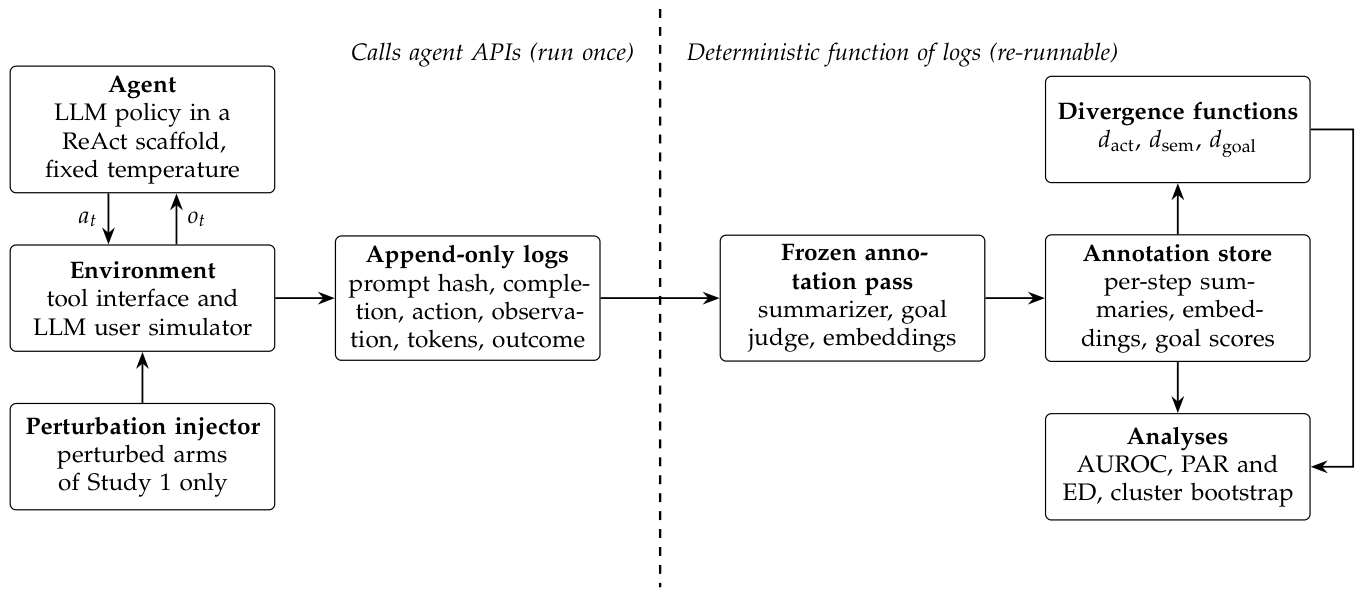
Figure 2.
Construction of the early cohort divergence (Equation (3)). The feature uses only information available k steps into the episode.
Figure 2.
Construction of the early cohort divergence (Equation (3)). The feature uses only information available k steps into the episode.
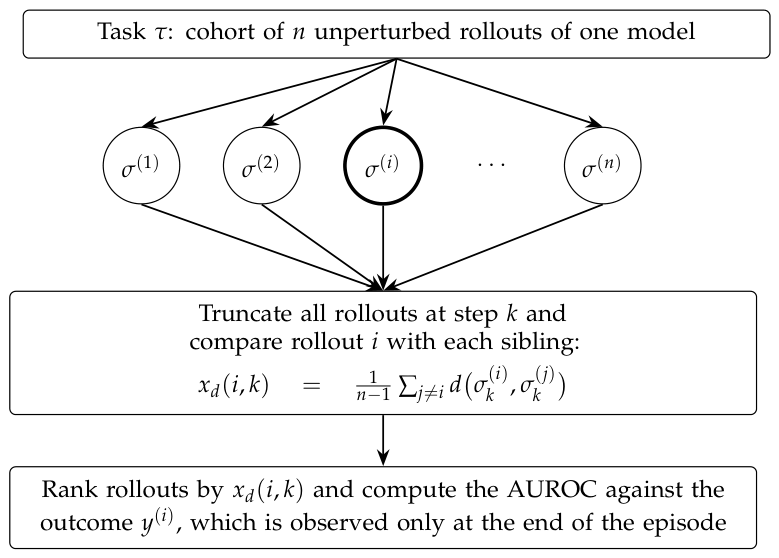
Figure 3.
Pooled AUROC of cohort under the original protocol (open circles) and the corrected protocol (filled circles), and of the single-rollout baseline under the corrected protocol (grey squares), for the estimates of Table 6. The vertical line marks chance.
Figure 3.
Pooled AUROC of cohort under the original protocol (open circles) and the corrected protocol (filled circles), and of the single-rollout baseline under the corrected protocol (grey squares), for the estimates of Table 6. The vertical line marks chance.
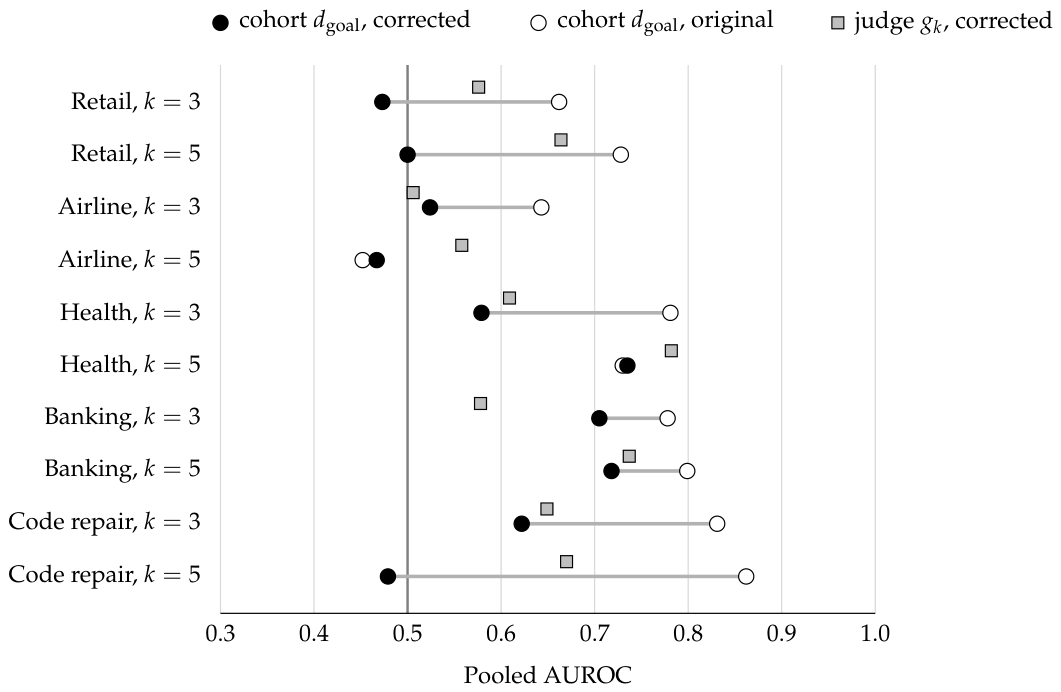
Figure 4.
Retail under the corrected protocol: AUROC of cohort as a function of the warning horizon k, per model. The dashed black line is the pooled estimate with its 95% task-cluster bootstrap interval, and the dotted line is the single-rollout baseline .
Figure 4.
Retail under the corrected protocol: AUROC of cohort as a function of the warning horizon k, per model. The dashed black line is the pooled estimate with its 95% task-cluster bootstrap interval, and the dotted line is the single-rollout baseline .
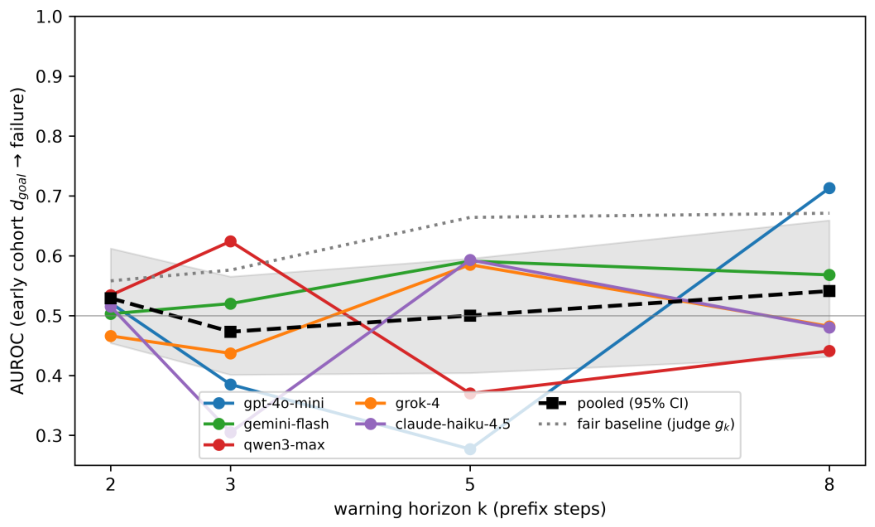
Figure 5.
Corrected protocol: pooled AUROC of cohort (circles) and of the baseline (squares) per domain at and , with 95% task-cluster bootstrap intervals.
Figure 5.
Corrected protocol: pooled AUROC of cohort (circles) and of the baseline (squares) per domain at and , with 95% task-cluster bootstrap intervals.
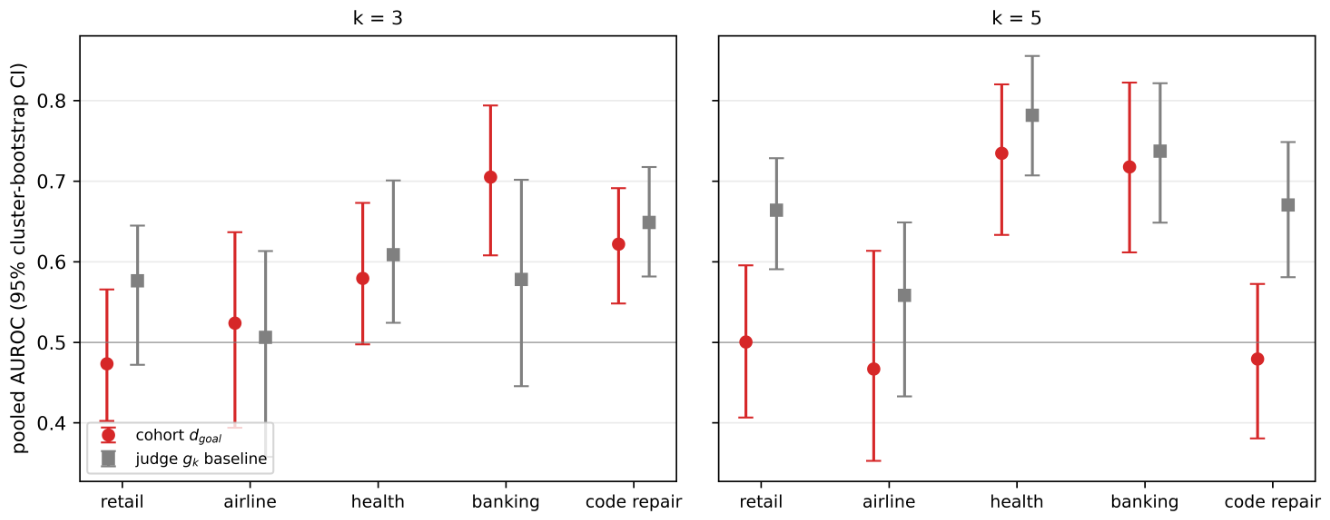
Figure 6.
Corrected protocol: AUROC of cohort for eventual failure by model and domain at (left) and (right). Subscripts give failures/rollouts. Grey cells contain no failures.
Figure 6.
Corrected protocol: AUROC of cohort for eventual failure by model and domain at (left) and (right). Subscripts give failures/rollouts. Grey cells contain no failures.
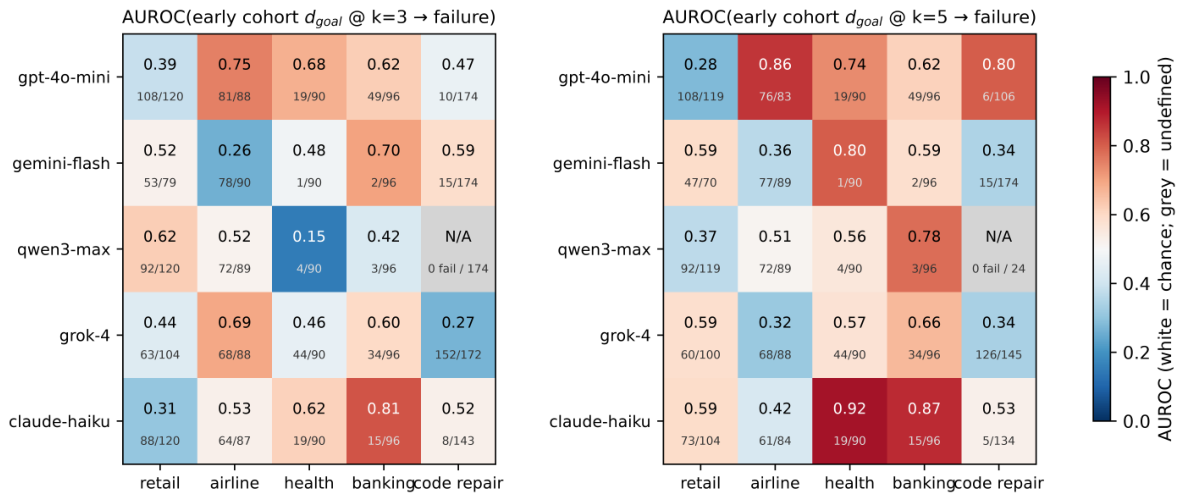
Figure 7.
Corrected protocol, airline: AUROC of cohort at on the original headroom-screened tasks and on 15 unseen, unscreened tasks, per model, with 95% task-cluster bootstrap intervals for the unseen tasks.
Figure 7.
Corrected protocol, airline: AUROC of cohort at on the original headroom-screened tasks and on 15 unseen, unscreened tasks, per model, with 95% task-cluster bootstrap intervals for the unseen tasks.
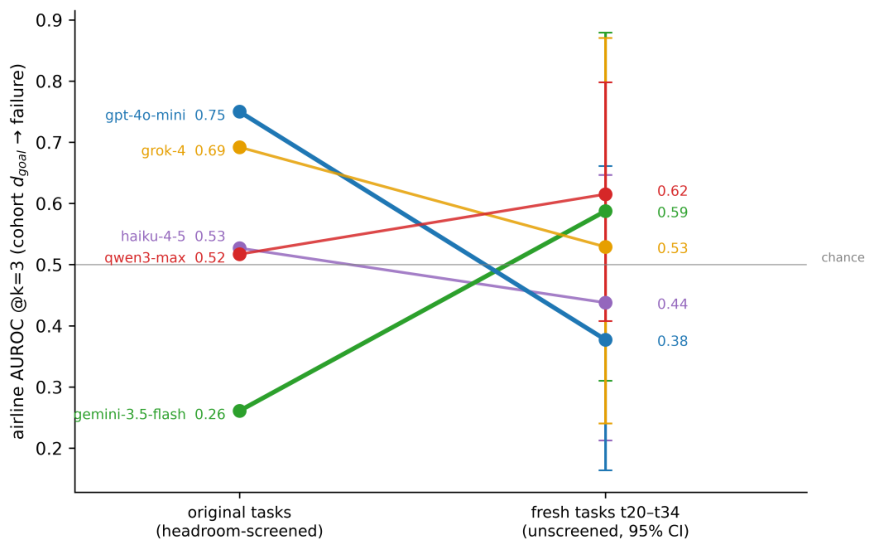
Figure 8.
Corrected protocol: holdout AUROC for each model and domain cell under the calibrated horizon and under fixed and . Dashed vertical lines are means over cells.
Figure 8.
Corrected protocol: holdout AUROC for each model and domain cell under the calibrated horizon and under fixed and . Dashed vertical lines are means over cells.
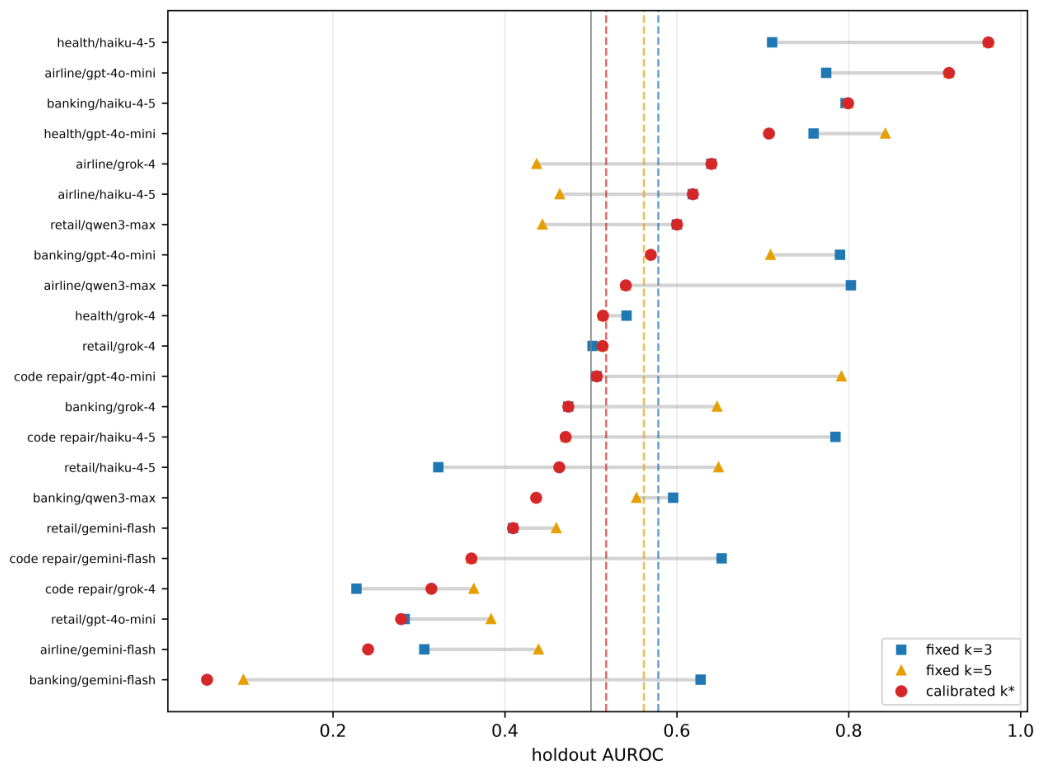
Table 1.
Overview of the two studies.
| Study 1 (Single Domain) | Study 2 (Multi-Domain) | |
|---|---|---|
| Questions | RQ1, RQ2 | RQ2, RQ3, RQ4 |
| Domains | -bench retail | -bench airline, health, banking, code repair, plus the Study 1 retail data |
| Agent models | Five model families | The same five model families |
| Tasks | 20 headroom-screened tasks, and 6 tasks in a single-model effect check | 15, 15, 16, and 29 tasks in the four new domains, and 15 unseen airline tasks for confirmation |
| Rollouts | 828 in total (787 usable): 600 in the validation campaign (559 usable, 543 with a feature at ) and 228 in the effect check | The matrix of five models and five domains reuses the Study 1 validation data. Both studies together comprise 3421 usable rollouts: 2893 in the Study 1 validation campaign and the matrix, 228 in the effect check, and 300 in the confirmation run |
| Judging | One judge (gpt-4o-mini), original protocol | Original protocol for the main matrix. Three judging passes on banking, two with a corrected protocol and one with a second judge. All rollouts of both studies were later re-judged with the corrected protocol |
| Status of the horizon | Selected by a sweep on the same data (exploratory) | fixed in advance. fixed in advance for the confirmation run |
| Statistical treatment | Task-cluster bootstrap intervals for pooled estimates | The same, plus paired task-cluster bootstrap contrasts |
| Approximate API cost | USD 36, plus USD 9 for the pilot | USD 142 for the whole project including Study 1, of which USD 24 for the confirmation run |
Table 2.
Limitations of Study 1 and the design elements of Study 2 that address them.
| Limitation of Study 1 | Response in Study 2 | Outcome |
|---|---|---|
| One domain (-bench retail) | Four further domains: one public (-bench airline), two written to the same interaction protocol (health, banking), and one protocol contrast (code repair) | Section 4.3.2 |
| One judge, which is also an agent under test | Three judging passes on banking in which only the judge or its instructions change | Section 4.3.3 |
| Horizon selected on the same data | fixed before analysis. After it failed in one domain, a calibration procedure was specified as an amendment | Section 4.3.2 and Section 4.2.6 |
| Differences between models reported descriptively | A falsifiable prediction about onset profiles, and paired task-cluster bootstrap contrasts | Section 4.3.2 and Section 4.2.2 |
| Tasks selected with one model, and no held-out tasks | Confirmation run on 15 unseen tasks without screening | Section 4.3.2 |
| High failure rate (74%) on the screened retail tasks | Domains with failure rates from 19% to 82% | Section 4.3.2 |
| Amplification tested with one model on six tasks | Not addressed. The scope of the null is unchanged | Section 5.6 |
Table 3.
Agent models. All models share the scaffold, temperature, and step limit.
| Provider | Model Identifier | Role and Remarks |
|---|---|---|
| OpenAI | gpt-4o-mini | Agent. Also the user simulator, the summarizer, and the judge of passes A and B |
| gemini-flash-latest | Agent. The alias resolved to gemini-3.5-flash during Study 2, and the pinned identifier was used for later runs | |
| Alibaba | qwen3-max | Agent (US-region endpoint) |
| xAI | grok-4 | Agent. Added to Study 1 after the first four models. In Study 2 it is descriptive only for RQ3 (Section 3.4.3) |
| Anthropic | claude-haiku-4-5 | Agent. Same provider family as the pass C judge, but a different model |
Table 4.
Domains, interaction protocols, and tasks used for the main analysis.
| Domain | Environment | Interaction Protocol | Tasks Used | Success Criterion |
|---|---|---|---|---|
| Retail | -bench 0.1.0 | Agent converses with an LLM user simulator, and the environment terminates the episode | 20 (screened, Study 1) | -bench reward (database state and outputs) |
| Airline | -bench 0.1.0 | Same | 15 (screened) | -bench reward |
| Health | Authored conversational engine | Same protocol | 15 (screened) | Declarative checks on the final database state |
| Banking | Authored conversational engine | Same protocol | 16 (screened) | Declarative checks on the final database state |
| Code repair | Authored code-repair environment | Tool-only (list, read, write, run tests, submit), no user | 29 (20 base, 9 hard) | Visible and hidden pytest suites pass on submission |
Table 5.
Study 1, effect check (gpt-4o-mini, six tasks): PAR at horizons 3 and 5 and ED at horizon 5, with 95% task-cluster bootstrap intervals. Tool-output noise is the inert control. Horizons 2 and 8 lead to the same conclusion.
Table 5.
Study 1, effect check (gpt-4o-mini, six tasks): PAR at horizons 3 and 5 and ED at horizon 5, with 95% task-cluster bootstrap intervals. Tool-output noise is the inert control. Horizons 2 and 8 lead to the same conclusion.
| Perturbation | Metric | PAR, | PAR, | ED, |
|---|---|---|---|---|
| Paraphrase | 1.098 [0.449, 1.565] | 1.020 [0.842, 1.491] | [, ] | |
| Paraphrase | 0.834 [0.524, 1.598] | 0.925 [0.548, 1.361] | [, ] | |
| Token edit | 0.862 [0.591, 1.741] | 1.165 [0.755, 1.711] | [, ] | |
| Token edit | 0.817 [0.594, 1.692] | 1.363 [0.850, 1.524] | [, ] | |
| Tool-output noise | 1.084 [0.687, 1.607] | 1.138 [0.772, 1.439] | [, ] | |
| Tool-output noise | 1.266 [0.876, 1.665] | 0.996 [0.559, 1.533] | [, ] |
Table 6.
Pooled AUROC of cohort under the original and the corrected judging protocol, and of the single-rollout baseline under the corrected protocol, with 95% task-cluster bootstrap CIs. The judge model is the same throughout.
Table 6.
Pooled AUROC of cohort under the original and the corrected judging protocol, and of the single-rollout baseline under the corrected protocol, with 95% task-cluster bootstrap CIs. The judge model is the same throughout.
| Domain and Horizon | Cohort , Original | Cohort , Corrected | Baseline , Corrected |
|---|---|---|---|
| Retail, | 0.662 [0.558, 0.769] | 0.473 [0.402, 0.565] | 0.576 [0.472, 0.645] |
| Retail, | 0.728 [0.653, 0.788] | 0.500 [0.406, 0.595] | 0.664 [0.591, 0.729] |
| Airline, | 0.643 [0.515, 0.746] | 0.524 [0.394, 0.636] | 0.506 [0.358, 0.613] |
| Airline, | 0.452 [0.326, 0.635] | 0.467 [0.353, 0.613] | 0.558 [0.433, 0.649] |
| Health, | 0.781 [0.690, 0.862] | 0.579 [0.497, 0.673] | 0.609 [0.524, 0.701] |
| Health, | 0.730 [0.672, 0.790] | 0.735 [0.633, 0.820] | 0.782 [0.707, 0.855] |
| Banking, | 0.778 [0.687, 0.858] | 0.705 [0.608, 0.794] | 0.578 [0.446, 0.702] |
| Banking, | 0.799 [0.709, 0.874] | 0.718 [0.611, 0.822] | 0.737 [0.648, 0.821] |
| Code repair, | 0.831 [0.747, 0.914] | 0.622 [0.548, 0.691] | 0.649 [0.582, 0.718] |
| Code repair, | 0.862 [0.789, 0.928] | 0.479 [0.373, 0.580] | 0.670 [0.589, 0.747] |
Table 7.
Corrected protocol: difference in AUROC between cohort and the single-rollout baseline on identical rollouts (paired task-cluster bootstrap, 2000 draws, two-sided p-values, no correction for multiple comparisons). Negative values favour the judge score.
Table 7.
Corrected protocol: difference in AUROC between cohort and the single-rollout baseline on identical rollouts (paired task-cluster bootstrap, 2000 draws, two-sided p-values, no correction for multiple comparisons). Negative values favour the judge score.
| Domain and Horizon | Difference in AUROC [95% CI] | p |
|---|---|---|
| gpt-4o-mini judge | ||
| Retail, | −0.103 [−0.218, +0.078] | 0.223 |
| Retail, | −0.163 [−0.254, −0.058] | 0.001 |
| Airline, | +0.018 [−0.189, +0.241] | 0.871 |
| Airline, | −0.091 [−0.268, +0.149] | 0.450 |
| Health, | −0.029 [−0.115, +0.066] | 0.586 |
| Health, | −0.047 [−0.119, +0.024] | 0.214 |
| Banking, | +0.127 [+0.007, +0.258] | 0.039 |
| Banking, | −0.019 [−0.123, +0.078] | 0.775 |
| Code repair, | −0.027 [−0.104, +0.050] | 0.510 |
| Code repair, | −0.191 [−0.344, −0.038] | 0.012 |
| claude-sonnet-4-5 judge | ||
| Health, | −0.162 [−0.256, −0.077] | <0.001 |
| Health, | −0.064 [−0.204, +0.067] | 0.411 |
| Banking, | +0.114 [−0.005, +0.219] | 0.059 |
| Banking, | −0.009 [−0.114, +0.104] | 0.910 |
Table 9.
Corrected protocol: AUROC of cohort at by model and domain, with 95% task-cluster bootstrap CIs.
Table 9.
Corrected protocol: AUROC of cohort at by model and domain, with 95% task-cluster bootstrap CIs.
| Model | Retail | Airline | Health | Banking | Code Repair |
|---|---|---|---|---|---|
| gpt-4o-mini | 0.385 [0.235, 0.542] | 0.750 [0.265, 0.908] | 0.679 [0.560, 0.799] | 0.622 [0.432, 0.814] | 0.466 [0.151, 0.709] |
| gemini-flash | 0.520 [0.252, 0.807] | 0.261 [0.063, 0.571] | 0.483 [0.298, 0.705] | 0.702 [0.447, 0.902] | 0.586 [0.280, 0.920] |
| qwen3-max | 0.624 [0.447, 0.801] | 0.517 [0.202, 0.719] | 0.151 [0.047, 0.280] | 0.423 [0.200, 0.842] | Undefined |
| grok-4 | 0.437 [0.307, 0.604] | 0.692 [0.427, 0.913] | 0.458 [0.322, 0.587] | 0.601 [0.476, 0.740] | 0.266 [0.154, 0.392] |
| claude-haiku-4-5 | 0.305 [0.189, 0.449] | 0.527 [0.316, 0.718] | 0.616 [0.455, 0.783] | 0.814 [0.673, 0.937] | 0.525 [0.209, 0.948] |
Table 10.
Corrected protocol: AUROC of cohort at by model and domain, with 95% task-cluster bootstrap CIs.
Table 10.
Corrected protocol: AUROC of cohort at by model and domain, with 95% task-cluster bootstrap CIs.
| Model | Retail | Airline | Health | Banking | Code Repair |
|---|---|---|---|---|---|
| gpt-4o-mini | 0.277 [0.167, 0.412] | 0.857 [0.562, 0.982] | 0.736 [0.615, 0.869] | 0.617 [0.398, 0.828] | 0.802 [0.383, 0.977] |
| gemini-flash | 0.591 [0.365, 0.755] | 0.364 [0.114, 0.773] | 0.803 [0.684, 0.904] | 0.585 [0.065, 0.995] | 0.344 [0.163, 0.921] |
| qwen3-max | 0.370 [0.196, 0.584] | 0.512 [0.329, 0.720] | 0.558 [0.293, 0.769] | 0.778 [0.526, 0.921] | Undefined |
| grok-4 | 0.585 [0.436, 0.701] | 0.315 [0.153, 0.537] | 0.572 [0.398, 0.730] | 0.662 [0.532, 0.798] | 0.337 [0.197, 0.498] |
| claude-haiku-4-5 | 0.593 [0.410, 0.770] | 0.420 [0.210, 0.637] | 0.918 [0.840, 0.980] | 0.873 [0.750, 0.998] | 0.526 [0.393, 0.723] |
Table 11.
Corrected protocol with two judges: pooled AUROC of cohort and of the single-rollout baseline , with 95% task-cluster bootstrap CIs.
Table 11.
Corrected protocol with two judges: pooled AUROC of cohort and of the single-rollout baseline , with 95% task-cluster bootstrap CIs.
| gpt-4o-mini Judge | claude-sonnet-4-5 Judge | |||
|---|---|---|---|---|
| Domain and Horizon | Cohort | Baseline | Cohort | Baseline |
| Health, | 0.579 [0.497, 0.673] | 0.609 [0.524, 0.701] | 0.505 [0.430, 0.590] | 0.666 [0.601, 0.742] |
| Health, | 0.735 [0.633, 0.820] | 0.782 [0.707, 0.855] | 0.777 [0.675, 0.889] | 0.841 [0.761, 0.909] |
| Banking, | 0.705 [0.608, 0.794] | 0.578 [0.446, 0.702] | 0.677 [0.571, 0.767] | 0.563 [0.456, 0.681] |
| Banking, | 0.718 [0.611, 0.822] | 0.737 [0.648, 0.821] | 0.726 [0.632, 0.834] | 0.735 [0.631, 0.827] |
Table 12.
Corrected protocol, airline: AUROC of cohort on the original screened tasks and on the 15 unseen, unscreened tasks, with 95% task-cluster bootstrap CIs. The last row gives the single-rollout baseline.
Table 12.
Corrected protocol, airline: AUROC of cohort on the original screened tasks and on the 15 unseen, unscreened tasks, with 95% task-cluster bootstrap CIs. The last row gives the single-rollout baseline.
| Model | Original Tasks, | Unseen Tasks, | Unseen Tasks, |
|---|---|---|---|
| grok-4 | 0.692 [0.427, 0.913] | 0.529 [0.240, 0.870] | 0.512 [0.086, 0.782] |
| gemini-flash | 0.261 [0.063, 0.571] | 0.588 [0.310, 0.879] | 0.339 [0.120, 0.627] |
| claude-haiku-4-5 | 0.527 [0.316, 0.718] | 0.438 [0.213, 0.647] | 0.381 [0.180, 0.690] |
| qwen3-max | 0.517 [0.202, 0.719] | 0.615 [0.408, 0.798] | 0.541 [0.279, 0.751] |
| gpt-4o-mini | 0.750 [0.265, 0.908] | 0.377 [0.164, 0.661] | 0.589 [0.363, 0.941] |
| Pooled, cohort | 0.524 [0.394, 0.636] | 0.554 [0.450, 0.666] | 0.537 [0.422, 0.690] |
| Pooled, judge | 0.506 [0.358, 0.613] | 0.509 [0.303, 0.680] | 0.410 [0.269, 0.577] |
Table 13.
Tokens spent after step k in eventually failing episodes, as a share of all agent tokens (W) and of failing-episode tokens (F).
Table 13.
Tokens spent after step k in eventually failing episodes, as a share of all agent tokens (W) and of failing-episode tokens (F).
| Model | ||||
|---|---|---|---|---|
| gpt-4o-mini | 63.7% | 55.1% | 86.1% | 74.4% |
| grok-4 | 55.1% | 46.7% | 84.6% | 71.7% |
| gemini-flash | 54.6% | 49.5% | 91.2% | 82.5% |
| qwen3-max | 53.1% | 46.1% | 88.1% | 76.5% |
| claude-haiku-4-5 | 47.1% | 40.9% | 85.9% | 74.6% |
| Pooled | 54.4% | 47.4% | 87.2% | 75.9% |
Table 14.
Corrected protocol: simulated abort at with thresholds chosen on calibration tasks (target: 10% of successful rollouts aborted) and evaluated on holdout tasks. Counts are aborted rollouts over all rollouts of that outcome. Tokens are shares of the agent tokens of the monitored holdout rollouts, and net recovery is gross recovery minus monitoring cost. “All, single threshold” uses one threshold chosen on the pooled calibration tasks. “All, per-model thresholds” applies each model’s threshold to its own rollouts and pools the result.
| Model | Monitor | Successes Aborted, Calibration | Successes Aborted, Holdout | Failures Aborted, Holdout | Gross Tokens Recovered | Monitoring Cost | Net Tokens Recovered |
|---|---|---|---|---|---|---|---|
| claude-haiku-4-5 | Cohort | 17/166 (10.2%) | 28/176 (15.9%) | 12/101 | 6.3% | 162.7% | −156.3% |
| claude-haiku-4-5 | Judge | 18/166 (10.8%) | 27/176 (15.3%) | 24/101 | 16.7% | 12.9% | +3.8% |
| gemini-flash | Cohort | 20/189 (10.6%) | 31/191 (16.2%) | 10/85 | 5.9% | 134.7% | −128.8% |
| gemini-flash | Judge | 21/189 (11.1%) | 17/191 (8.9%) | 39/85 | 33.3% | 12.2% | +21.0% |
| gpt-4o-mini | Cohort | 14/140 (10.0%) | 22/161 (13.7%) | 11/133 | 4.9% | 193.6% | −188.7% |
| gpt-4o-mini | Judge | 0/140 (0.0%) | 0/161 (0.0%) | 0/133 | 0.0% | 17.7% | −17.7% |
| grok-4 | Cohort | 10/93 (10.8%) | 18/96 (18.8%) | 27/181 | 12.3% | 156.6% | −144.4% |
| grok-4 | Judge | 0/93 (0.0%) | 0/96 (0.0%) | 0/181 | 0.0% | 13.8% | −13.8% |
| qwen3-max | Cohort | 18/188 (9.6%) | 10/210 (4.8%) | 9/83 | 4.8% | 172.6% | −167.9% |
| qwen3-max | Judge | 0/188 (0.0%) | 0/210 (0.0%) | 0/83 | 0.0% | 15.4% | −15.4% |
| All, single threshold | Cohort | 78/776 (10.1%) | 82/834 (9.8%) | 68/583 | 6.4% | 162.2% | −155.8% |
| All, single threshold | Judge | 149/776 (19.2%) | 183/834 (21.9%) | 218/583 | 24.4% | 14.2% | +10.2% |
| All, per-model thresholds | Cohort | n/a | 109/834 (13.1%) | 69/583 | 6.9% | 162.2% | −155.3% |
| All, per-model thresholds | Judge | n/a | 44/834 (5.3%) | 63/583 | 11.1% | 14.2% | −3.1% |
Table 15.
Corrected protocol: net tokens recovered by the single-rollout judge monitor when it is charged three judge calls per rollout, as simulated, and one judge call at the horizon. One-call values are derived from Table 14 by dividing the monitoring cost by three with decisions unchanged, and are approximate.
| Model | Gross Tokens Recovered | Net, Three Calls | Cost, One Call | Net, One Call |
|---|---|---|---|---|
| claude-haiku-4-5 | 16.7% | +3.8% | 4.3% | +12.4% |
| gemini-flash | 33.3% | +21.0% | 4.1% | +29.2% |
| gpt-4o-mini | 0.0% | −17.7% | 5.9% | −5.9% |
| grok-4 | 0.0% | −13.8% | 4.6% | −4.6% |
| qwen3-max | 0.0% | −15.4% | 5.1% | −5.1% |
| All, single threshold | 24.4% | +10.2% | 4.7% | +19.7% |
| All, per-model thresholds | 11.1% | −3.1% | 4.7% | +6.4% |
Table 16.
Banking: AUROC of cohort and of the baseline under three judging passes, with 95% task-cluster bootstrap CIs for .
Table 16.
Banking: AUROC of cohort and of the baseline under three judging passes, with 95% task-cluster bootstrap CIs for .
| Pass | Judge and Objective Given to the Judge | , | , | Baseline, | Baseline, |
|---|---|---|---|---|---|
| A | gpt-4o-mini, task identifier only | 0.778 [0.687, 0.858] | 0.799 [0.709, 0.874] | 0.652 | 0.696 |
| B | gpt-4o-mini, real task instruction | 0.705 [0.608, 0.794] | 0.718 [0.611, 0.822] | 0.578 | 0.737 |
| C | claude-sonnet-4-5, real task instruction | 0.677 [0.571, 0.767] | 0.726 [0.632, 0.834] | 0.563 | 0.735 |
Disclaimer/Publisher’s Note: The statements, opinions and data contained in all publications are solely those of the individual author(s) and contributor(s) and not of MDPI and/or the editor(s). MDPI and/or the editor(s) disclaim responsibility for any injury to people or property resulting from any ideas, methods, instructions or products referred to in the content. |
© 2026 by the authors. Licensee MDPI, Basel, Switzerland. This article is an open access article distributed under the terms and conditions of the Creative Commons Attribution (CC BY) license.
Copyright: This open access article is published under a Creative Commons CC BY 4.0 license, which permit the free download, distribution, and reuse, provided that the author and preprint are cited in any reuse.