

Submitted:
15 October 2026
Posted:
28 October 2026
You are already at the latest version
Abstract
Patient satisfaction and patient-reported experience are widely used as indicators of the quality of mental health care and, implicitly, as proxies for treatment benefit, whereas clinical outcome is usually judged from clinician-rated symptom scales. This narrative review examines whether, and why, these two assessments diverge in psychiatric treatment. It clarifies the constructs of satisfaction, experience and outcome; examines measurement- and rater-level sources of apparent disagreement; synthesises studies that directly compare patient- and clinician-derived assessments; and proposes an explanatory framework. Associations between satisfaction and clinician-rated outcome are consistently positive but small: in one acute-care study, experience of care accounted for less than 7% of the variance in symptom change, and patient–clinician agreement about the same care episode was low. Patients and clinicians judge improvement from different frames of reference, while ceiling effects, social desirability and fixed thresholds for meaningful change further distort comparison. Seven mechanisms sustain divergence: expectancy, therapeutic alliance, insight, subjective tolerability, decisional involvement, perceived coercion and the conceptual gap between symptom remission and personal recovery; each shapes satisfaction largely independently of symptom change. Satisfaction and clinical outcome are therefore related but non-interchangeable constructs. Services should measure both, adjust satisfaction scores for patient characteristics, and treat discordance as clinically informative rather than as error. Shared decision-making, honest expectation management, reduction of perceived coercion and recovery-oriented care are the most plausible routes to aligning patient experience with clinical outcome.
Keywords:
patient satisfaction
; patient-reported experience measures
; treatment outcome
; therapeutic alliance
; measurement-based care
; psychiatry
1. Introduction
Few propositions in mental health services research enjoy as much uncritical assent as the idea that satisfied patients do better. Patient satisfaction is routinely described as an important process variable and quality indicator in mental health care, valued both because it predicts the extent to which the aims of care may be achieved and because treatments should be patient-friendly irrespective of their effect on health and social outcomes [1]. The empirical basis for this position is real: more satisfied patients tend to be more adherent to treatment and, even where adherence does not differ, appear to benefit more from care [1]. Satisfaction assessed within the first two days of hospital care predicts later outcomes, suggesting that it captures something clinically consequential early in the treatment episode [1].
Yet the relationship is considerably more tangled than the aphorism suggests. The earliest systematic comparison of satisfaction and treatment success found that therapists' mean ratings of treatment success were significantly lower than patients' at both the second visit and the last visit, and that although correlations between satisfaction and success were statistically significant, they were low — leading the authors to conclude that satisfaction ratings cannot replace success ratings or other outcome indicators in the assessment of quality of care [2]. That caution, published in 1978, anticipated four decades of findings that have repeatedly documented divergence between what patients report about their care and what clinicians judge about their clinical response.
The problem is not merely academic. Mental health services worldwide are under mounting pressure to demonstrate value, and patient experience data are increasingly used as a headline metric of service quality — sometimes in place of, rather than alongside, outcome data. Health systems have invested in patient-reported experience measures (PREMs) and patient-reported outcome measures (PROMs) as accountability instruments, while clinician-rated symptom scales remain the currency of trials, guidelines and reimbursement. When the two disagree, clinicians, administrators and policymakers must decide which to believe. The default has often been to treat the patient's satisfaction as the more humane indicator and the clinician's rating as the more objective one, or vice versa — a false dichotomy that obscures what each measure actually captures.
There is also a long-recognised asymmetry between what professionals expect patients to report and what patients actually report. Kalman observed that mental health professionals systematically underestimate patient satisfaction, with patients reporting higher satisfaction than clinicians anticipate, and argued that this gap reflects a deeper failure to take seriously the subjective experience of those receiving care, including those participating in research, teaching and involuntary commitment [3]. The mirror-image problem — clinicians rating improvement that patients do not experience — is equally well documented.
This review addresses the discordance between patient experience and psychiatric treatment response as a substantive clinical phenomenon rather than a nuisance in the data. Its aims are fourfold: (i) to clarify the constructs of satisfaction, experience and outcome and to specify what "discordance" means; (ii) to examine the measurement-level and rater-level sources of apparent disagreement; (iii) to review the empirical literature that has directly compared patient- and clinician-derived assessments; and (iv) to propose an explanatory framework that integrates expectancy, alliance, insight, tolerability, autonomy, coercion and the conceptual gap between symptom change and personal recovery, before drawing out implications for practice, services and research.
2. Review Approach
This is a narrative review. Relevant literature was identified through searches of PubMed/MEDLINE and Google Scholar using combinations of terms for patient satisfaction, patient-reported experience, treatment outcome, clinician rating, patient–clinician agreement, therapeutic alliance, expectancy, insight, coercion, shared decision-making and personal recovery, supplemented by backward and forward citation tracking of key papers. Priority was given to systematic reviews, meta-analyses, large observational studies and foundational conceptual papers concerning adults receiving psychiatric care, and particularly to studies in which patient-reported satisfaction or experience could be set against clinician-rated or instrument-based outcome. Because the aim was conceptual integration rather than effect estimation, no formal eligibility protocol, risk-of-bias appraisal or meta-analysis was undertaken, and the review was not registered. Evidence is synthesised around a heuristic model of divergence (Fig. 1) and a four-quadrant typology of concordance and discordance (Fig. 2).
3. Conceptual Foundations: Satisfaction, Experience and Outcome Are not the Same Thing
3.1. Satisfaction and Patient-Reported Experience
Patient satisfaction with mental health care has been measured since the 1960s, under the alternative labels of treatment satisfaction, service satisfaction and consumer satisfaction [1]. Despite an extensive literature, there is no consensus on how satisfaction should be measured, and across scales patients are asked to rate their satisfaction with 19 different aspects of care [1]. Only four instruments have been used in more than 15 studies and can therefore be regarded as relatively established: the Client Satisfaction Questionnaire for outpatient treatment and the Client Assessment of Treatment Scale for inpatient treatment, both brief global measures of 8 and 7 items respectively, and the longer Verona Service Satisfaction Scale and Self-Rating Patient Satisfaction Questionnaire, which provide subscales on different aspects of care in addition to a global score [1]. This heterogeneity of instrumentation is itself a source of apparent inconsistency across studies, because different scales are sensitive to different aspects of the care encounter.
A crucial conceptual distinction is that between satisfaction and experience. Satisfaction is an evaluative judgement — a summary appraisal of whether care met expectations — whereas experience measures capture what happened during care (whether information was given, whether the patient was involved, whether staff were respectful). Satisfaction research has attracted sustained methodological criticism, including concerns about whether satisfaction surveys can legitimately be used as a measure of healthcare quality, though the prevailing conclusion is that their limitations do not merit abandoning them [4]. Both constructs, however, share a vulnerability: they are reported by the recipient of care and are therefore subject to the same motivational and cognitive influences that shape any self-report in a dependent relationship.
3.2. Clinical Outcome
Clinical outcome in psychiatry is conventionally operationalised as change in symptom severity on clinician-administered instruments, supplemented by observer-rated functioning. This convention has deep historical roots. Psychiatry, with its focus on symptoms and functioning, developed elaborate assessments, standardised interviews and rating scales to document and monitor psychopathology, measuring positive and negative psychotic symptoms, depression and anxiety, cognitive deficits and functioning [5]. The resulting measures have strong psychometric pedigrees and are indispensable for comparing treatments. They are, however, structured around the clinician's frame of reference: the clinician locates the patient's symptoms within a distribution of all similar patients they have encountered, whereas the patient's reference point is almost entirely their own prior experience [6].
3.3. Clinical Versus Personal Recovery
The recovery literature offers the sharpest conceptual articulation of why these frames may legitimately diverge. A distinction is drawn between clinical recovery — outcome-based, observer-rated, emphasising symptom reduction and improved functioning through effective service intervention — and personal recovery, understood as a highly individual process defined by the person, which may require neither symptom reduction nor mental health service utilisation [7]. For many people with mental illness, recovery is about staying in control of one's life rather than returning to a premorbid level of functioning; this approach does not focus on full symptom resolution but emphasises resilience and control over problems and life [5]. Systematic review and meta-analysis of the relationship between clinical and personal recovery in schizophrenia spectrum disorders confirms that these are related but distinct constructs, with clinical recovery defined by remission of symptoms and functional improvement against operational criteria such as sustained mild-or-less symptom scores [8].
The divergence is not an artefact of measurement philosophy; it has been demonstrated empirically that clients tend to report better outcomes than their providers, and that conventional approaches have neglected this considerable disagreement in appraisals of clients' quality of life [9]. The recovery movement's foundational claim — that the goal of services must not be limited to symptom reduction but should strive for restoration of a meaningful and productive life — makes explicit that symptom scales and experience measures are answering different questions [10].
3.4. Defining Discordance
Against this background, discordance can be defined as a statistically or clinically meaningful discrepancy between (a) the patient's evaluation of their care or their own state and (b) an external assessment of treatment response, whether clinician-rated, instrument-based or functional. Four quadrants are possible: satisfied and improved (concordant positive); dissatisfied and unimproved (concordant negative); satisfied but unimproved (discordant positive experience); and improved but dissatisfied (discordant negative experience). Most of the literature concerns the first two, and the assumption that the third and fourth are rare is precisely what the evidence reviewed below calls into question. The four quadrants, their typical drivers and the clinical questions each raises are illustrated in Fig. 2.
4. A conceptual Model of Divergence
Discordance should be expected rather than surprising, because satisfaction and clinical outcome are generated by partially non-overlapping causal processes. Fig. 1 presents a heuristic model.
The model's central claim is that the four families of determinants act on the comparison rather than on either measure in isolation. A service can therefore increase satisfaction scores without improving outcomes, or improve outcomes without improving satisfaction, and both patterns are predictable rather than paradoxical.
5. Measurement-Level Determinants of Apparent Discordance
5.1. Instrument Properties: Ceiling Effects, Skew and Positivity Bias
Satisfaction scales are persistently negatively skewed, with a high proportion of maximum scores. In a Norwegian validation of the Client Satisfaction Questionnaire, 14.5% of respondents achieved maximum total scores on the CSQ-8, right at the 15% threshold conventionally used to indicate ceiling effects, although the shorter CSQ-4 did not suffer from this problem [11]. Negatively skewed scores have long been recognised as a problem in patient satisfaction research, in part because dissatisfied patients may be more likely to drop out and less likely to complete questionnaires [11]. Where a scale cannot differentiate among degrees of high satisfaction, it will necessarily show attenuated associations with any external criterion, including symptom change — producing apparent discordance that is in fact a measurement artefact.
A second instrument-level problem is positivity bias. In work from child and adolescent mental health services, it is widely acknowledged that PREMs often give an overly positive picture of experiences; inflated satisfaction scores have been attributed partly to biased sampling, where only the most satisfied patients return questionnaires, and partly to social desirability effects [12]. In the specific context of evaluating service providers, overly positive feedback may be driven less by classical self-presentation than by a desire to please the person being rated, fear of confrontation, and similar processes; interviews with service users have revealed a highly conditioned and contrived process by which patients decide whether to report satisfaction or dissatisfaction despite being clear about the valence of their experiences, with users generally inclined to report satisfaction and to "forgive" negative care episodes [12]. Reports shaped by these dynamics cannot be taken as a true reflection of patients' experiences [12].
5.2. Rater Perspective: Patients and Clinicians Do not Measure the Same Thing
The most direct source of discordance is that patients and clinicians rate different constructs using different reference frames. In the PREVENT study, agreement between clinician and patient on whether the patient was actually "better" at the end of a 10-week trial was poor; preliminary inspection suggested that a significant proportion of patients consistently rated their depression as more severe than the clinician, while others rated themselves as less depressed than the clinician [6]. The authors attributed this to divergent frames of reference: for the patient, the frame is almost solely their own experience, whereas for the clinician, the patient's symptoms are considered within the context of all depressed patients the clinician has evaluated [6]. They further noted that performing a clinician-administered rating shortly before the patient completes a self-report is likely to influence how the patient responds to the self-rating scale [6] — a methodological caution with direct implications for routine services that collect both.
The divergence is not confined to mood disorders. In a comparison of 200 adult psychiatric inpatients rated on the Brief Symptom Inventory at admission and discharge against clinician ratings on the Global Assessment of Functioning, analyses indicated no significant relationships between symptom distress reported by patients and global functioning rated by clinicians, supporting previous research showing minimal congruence among criterion measures that differ in rating source [13].
5.3. What Counts as Improvement: The Minimal Clinically Important Difference
Discordance can also arise from disagreement about the threshold of meaningful change. Clinician ratings of improvement have frequently been used in depression research, but historically none of the available approaches incorporated the patient's perspective, and it is therefore important to establish a minimal clinically important difference (MCID) anchored in the experiences and perceptions of patients [14]. The UK National Institute for Health and Care Excellence proposed a reduction of three points on the Hamilton Depression Rating Scale as clinically important, but this was based solely on the opinion of an expert group [14]. Patient-anchored approaches, using a global rating of change to identify the score change corresponding to a patient reporting they feel "better", produce markedly different thresholds [15].
Critically, these thresholds vary with baseline severity. Using an effective-dose-50 method across two randomised controlled trials for depression (n = 1,122), MCID estimates ranged from no change for very mild presentations up to 14 points (52%) on the PHQ-9 and up to 10 points (48%) on the GAD-7 for very high severity, with average estimates of 3.7 points (23%) and 3.3 points (28%) respectively [16]. The implication for discordance research is substantial: a fixed clinician-defined cut-off applied to patients of varying baseline severity will necessarily misclassify improvement for some, generating apparent disagreement that reflects an inappropriate threshold rather than a genuine difference in experience. Related work in treatment-resistant depression has similarly sought to identify clinically meaningful and clinically substantial change on both symptom measures and patient-reported outcomes, in order to facilitate translation of trial results into practice [17].
5.4. Confounding by Patient Characteristics
Satisfaction scores are influenced by patient characteristics that are also associated with outcome, creating spurious or masked associations. Socio-demographic features such as gender, ethnicity, socio-economic and marital status have weak and inconsistent associations with satisfaction; the only socio-demographic feature consistently linked with higher satisfaction is older age, which is itself associated with higher satisfaction with life in general [1]. More substantial correlations are found with clinical characteristics: patients with higher symptom levels, especially more depressive symptoms, with personality disorders and with lower subjective quality of life tend to express less satisfaction with their care [1]. The practical consequence is that patients with marked depressive mood are more likely to express lower satisfaction with any form of care, so that positive or negative ratings may be falsely attributed to a specific service when they in fact reflect the general tendencies of a patient group with particular characteristics [1]. Adjustment for age and legal status of treatment is usually feasible in mental health services because such data are available in most routine documentation systems [1].
6. Empirical Evidence on the Satisfaction–Outcome Relationship
6.1. Direct Comparisons
The empirical literature on direct comparisons is smaller than one might expect, and its consistent finding is that satisfaction and outcome are positively but weakly related. The study by Edwards and colleagues introduced above, conducted in two community mental health centres, remains the template: patients rated treatment success more highly than their therapists, and satisfaction correlated only weakly with success [2].
Contemporary work using patient-reported outcome and experience measures confirms the pattern with greater statistical precision. In an acute psychiatric care setting, symptom improvement explained 28.5% of the variance in subjective well-being (r² = 0.285), but the correlation between symptom change and experience of care was weak and negative (r = −0.262, p < 0.003), revealing that patients' satisfaction with the experience of care did not fully explain — accounting for only 6.8% — the improvement in symptoms (r² = 0.068) [18]. The same study found a low level of agreement between patients' and their primary clinicians' ratings of the hospital care sequence across all items (Kendall's W ≤ 0.118, p < 0.001), with clinicians rating most items significantly higher than patients (p < 0.001) [18].
A third study of people with schizophrenia found a moderate degree of association between patient satisfaction and patient-reported outcome, but only the latter was correlated with an independent rating of global quality of care provided by the participating Trusts, suggesting that patient-rated outcomes may be a better indicator of the quality of care a service provides than patient-rated satisfaction with care [19]. Notably, the two measures of patient-rated experience were associated with different elements of care: services that promoted patients' involvement in decisions about care and higher compliance with recommended prescribing practice had patients more likely to state that services were improving their mental health, whereas services with higher compliance with recommendations for a jointly developed care plan had higher ratings on patient satisfaction with care [19]. These results support the view that patients rate their experience and outcomes of care according to different criteria, and highlight the importance of both in assessing overall quality [19].
6.2. What Does Predict Satisfaction?
Where discordance exists, it is instructive to ask what does drive satisfaction. In a study of outpatient psychiatric treatment, patient-reported change and diagnostic category appeared to play a relevant role in generating satisfaction, indicating that perceived change — not merely measured change — is the operative input [20]. Satisfaction is also prospectively associated with outcome: patients with psychosis who are more satisfied show more favourable outcomes ranging from psychopathological symptoms to quality of life [21]. Routine data from an East London mental health trust found that patients were on average "fairly satisfied" with treatment aspects, receiving higher scores on PREM items than on life-aspect PROM items, and that both PROM and PREM scores increased over time, with mental health satisfaction increasing most rapidly while job situation remained the lowest-scoring item [22]. That study also found that models remained poorly specified, indicating that important predictors were missing from the available dataset [22] — an honest acknowledgment that the determinants of satisfaction are only partly understood.
Contextual and legal factors matter considerably. Among involuntary inpatients, satisfaction with treatment was associated with perceptions of coercion during admission and treatment rather than with the documented extent of coercive measures, leading the authors to conclude that interventions to reduce perceived coercion might increase overall treatment satisfaction [23]. In the underlying observational study of 778 involuntary inpatients across 67 acute wards in 22 hospitals, mean satisfaction scores ranged from 5.5 to 6.0 on a 0–10 scale and improved significantly from admission to follow-up; patients who perceived less coercion were more satisfied overall, while coercive measures documented in the medical records were not linked to satisfaction, and patients with more symptom improvement expressed higher satisfaction [23]. The differential weight of perceived versus documented coercion is a striking illustration of how patient experience and clinical record can diverge while both remain internally coherent.
The type of coercive measure also matters. Among 111 patients admitted to two psychiatric units, higher levels of perceived coercion were associated with mechanical restraint (p = 0.002) and combined measures (p < 0.001) compared with involuntary medication; mechanical restraint (p = 0.013) and combined measures (p = 0.004) were more stressful; and the use of combined measures was associated with lower satisfaction with inpatient psychiatric treatment compared with involuntary medication (p = 0.006) [24].
6.3. Summary of the Direct Evidence
Table 1 summarises selected empirical studies that have directly compared patient-reported satisfaction or experience with clinical outcome.
7. Mechanisms Sustaining Discordance
7.1. Non-Specific Factors, Expectancy and Placebo
One of the most robust findings in psychiatric therapeutics is that a substantial portion of symptom change is attributable to non-pharmacological mechanisms. Meta-analyses of antidepressant trials show that placebo response rates are high, typically around 30%, and often larger than the difference in response rates between drug and placebo, typically around 10% [26]. Some of the response to placebo is due to natural history, but a growing literature suggests that much of the improvement on placebo is due to active neurobiological processes related to expectancy, and several studies have shown that higher expectation of therapeutic improvement leads to greater improvement in psychiatric symptoms, particularly in major depressive disorder [26].
Two mechanisms are generally invoked: expectancy theory, which postulates that placebo treatments instil a conscious positive expectation of improvement that itself causes symptom change, and conditioning theory, which holds that placebo responses represent non-conscious learning in which improvement is associated with neutral stimuli such as pills, health care providers or procedures [27]. Both mechanisms likely contribute. The influence of expectancy on antidepressant response has been observed in comparisons of medication response between placebo-controlled and active-comparator trials, and the number of treatment arms is negatively correlated with the success of a trial, plausibly because more arms increase the probability of receiving active medication and thereby raise patient expectations [27]. Consistent with this, medication response rates are lowest in drug–placebo trials (51.7%), intermediate in drug–drug–placebo trials (57.7%) and highest in drug–drug trials (65.4%) [28]. Such marked differences depending on trial design imply that a medication's pharmacologic effect is only one contributor to symptom change; non-pharmacologic mechanisms — spontaneous improvement and worsening, expectation of benefit, therapeutic effects of the treatment situation, positive life events, and sources of measurement error and bias — also contribute, and their relative contributions may change across treatment settings [28]. Formal mediation analysis has confirmed that patient expectancy is a significant mediator of placebo effects in antidepressant trials [29].
Expectancy also operates on the rater. A meta-analysis of 96 randomised placebo-controlled trials found substantially larger placebo responses in observer ratings compared with self-report, and effect sizes in observer ratings showed a strong increase with publication year while this effect was not found for patients' self-ratings — reflecting the strong influence of investigators' expectations [30]. The same analysis of nocebo effects confirmed the impact of expectations: symptoms in placebo groups reflected the typical side-effect patterns expected in the drug group, with higher symptom rates in placebo groups of tricyclic antidepressant trials compared with placebo groups of trials testing selective serotonin reuptake inhibitors [30]. This divergence between observer-rated and self-rated trajectories is a direct mechanism of discordance: if investigators' expectations inflate observer-rated improvement over time while self-ratings remain stable, the two will drift apart even when the underlying clinical state is unchanged.
Expectations are not confined to trial settings. Patients who are more pessimistic about their prognosis tend to be less engaged with treatment, which actually impedes improvement in their symptoms, whereas when patients expect their treatment to be effective these expectations can be a positive driver of clinical improvement, especially in depression [31]. Crucially, therapists' expectations of patients' improvement are also a significant predictor of patients' outcomes, suggesting that clinicians' beliefs about their clients' prognoses can have real-world clinical implications and that prognostic expectancies can become self-fulfilling prophecies [31]. Expectancy therefore shapes both sides of the comparison, and it is a manageable target: the evidence points to interventions aimed at optimising positive expectations of treatment benefit while minimising the impact of adverse effects [30].
7.2. The Therapeutic Alliance
The therapeutic alliance — the extent of patient–provider agreement on treatment goals, collaboration on treatment tasks, and the affective bond of caring, liking and trust — is the most extensively studied relational predictor of outcome [32]. Meta-analysis of 295 independent studies covering more than 30,000 patients found an overall alliance–outcome association for face-to-face psychotherapy of r = .278 (95% CI .256–.299, p < .0001; equivalent to d = .579), with approximately the same correlation for internet-based psychotherapy (r = .275), and the relation remained consistent across assessor perspectives, alliance and outcome measures, treatment approaches, patient characteristics and countries [33]. An earlier meta-analysis of 79 studies reached the same conclusion: the overall relation of therapeutic alliance with outcome is moderate but consistent, regardless of many of the variables posited to influence it, including the type of outcome measure, the type of outcome rater, the timing of alliance assessment and the type of treatment [34].
The magnitude deserves emphasis: meta-analytic findings reveal that the alliance–outcome relationship is modest, accounting for 5–8% of the variance in outcome [32]. A more recent meta-analysis of 125 effect sizes in 60 independent samples found moderate alliance–outcome correlations with or without adjustment for intake characteristics and simultaneous treatment processes, ranging from r = .23 to r = .31, providing robust evidence that the alliance–outcome association is an independent process-based factor above and beyond patient intake characteristics and treatment processes [35]. Yet methodological caution is warranted: well-controlled studies that require temporal precedence report a median correlation of .24 and a mean of .19, and single-session snapshots may substantially underestimate the relationship, since one alliance score accounted for 4.7% of outcome variance whereas the average of six early sessions accounted for nearly 15% [32]. Unrepaired alliance ruptures have been shown to predict poor treatment outcome [32].
In psychosis specifically, a systematic review of nine primary studies that prospectively tested the association of the therapeutic relationship with hospitalisation, symptom levels and functioning found that, for each outcome, the number of statistically significant findings in the hypothesised direction exceeded chance expectation, but studies had methodological shortcomings and effect sizes were rather small — leading to the conclusion that there is some, but not overwhelming, evidence that the therapeutic relationship predicts outcomes of complex psychiatric treatment programmes [36]. A broader review concluded that the therapeutic relationship is a reliable predictor of patient outcome in mainstream psychiatric care, while noting that valid assessment in psychiatric settings must account for greater heterogeneity of treatment components and goals, increased variability of setting, and the statutory responsibility of the clinician [37].
The alliance also bears on adherence, and hence on the discordance between subjective experience and measured response. Among 162 patients with psychotic disorders in ambulatory treatment, the working alliance was the most significant and consistent predictor of adherence to medication recommendations, with Cox regression showing that working alliance, global functioning and being prescribed clozapine predicted longer maintenance of adherence [38]. Because patients often judge the quality of care largely through the relationship with the clinician, a strong alliance can sustain high satisfaction even when symptom change is limited — and a poor alliance can depress satisfaction despite measurable clinical gains.
7.3. Insight and Illness Awareness
Poor insight is among the most powerful and least discussed sources of discordance between patient report and clinical assessment. About 50% of persons with schizophrenia do not know they have an illness, and this unawareness typically does not improve with education, time or treatment; most studies of nonadherence and partial adherence find that the best predictor is unawareness of illness or poor insight [39]. The concept has a long history: poor insight was reported to be one of the three most discriminating symptoms for schizophrenia diagnosis among psychotic disorders, and the expert consensus reflected in the DSM-IV-TR held that poor insight is a manifestation of the illness rather than a coping strategy, comparable to the lack of awareness of neurological deficits seen in stroke, and that it predisposes the individual to noncompliance with treatment and predicts higher relapse rates, increased numbers of involuntary hospital admissions, poorer psychosocial functioning and a poorer course of illness [39].
Contemporary reviews concur that insight cannot be reduced to a symptom, a psychological mechanism or a neuropsychological function, but is likely to have dynamic relationships with all these dimensions and with responses to personal events and contextual factors; social consequences of mental illness and explanatory models alternative to the medical model may fundamentally shape insight and treatment choice, and the cultural or individual stigmatisation of mental illness may turn the acquisition of insight into a painful event and increase the risk of depression [40]. It is estimated that about half of patients with schizophrenia lack insight, with consequences including higher risk of nonadherence to treatments, negative clinical outcomes and worse community functioning [40].
Insight is therefore doubly relevant to discordance. First, it determines whether a patient's self-report of symptoms will align with an observer's assessment, because awareness is multidimensional and multiply determined, with cognitive insight predicting awareness into mental illness better than neuropsychological measures [39]. Second, it complicates the interpretation of satisfaction: a patient who does not regard themselves as ill may report high satisfaction with a service they experience as supportive while showing little clinical change, or may report dissatisfaction with treatment they regard as unnecessary. Reviews of insight in schizophrenia spectrum disorders trace how the view of poor insight as primarily a barrier to treatment adherence, referenced in DSM-5, has framed clinical expectations [41]. The foundational work establishing unawareness of illness as a diagnostic and treatment-relevant feature of schizophrenia anticipated much of this discussion [42].
7.4. Subjective Tolerability and Side-Effect Burden
Patients' subjective response to medication is a distinct dimension of experience that is only loosely coupled to symptom change. Early work on subjective response to neuroleptics established that negative subjective response is linked to noncompliance and less favourable therapeutic outcome, and examined the construct's relevance to patients' functional status and quality of life, calling for improved methods in researching subjective responses and better understanding of the factors contributing to their genesis [43]. Subsequent research has found that subjective response is not only relevant to compliance but has also been identified as prognostic and linked to treatment response, quality of life, drug abuse and suicidality [44] — a point of clinical importance given that trials typically exclude patients with limited illness awareness and those with substance use or comorbid conditions, precisely the groups most likely to diverge from clinician judgement [44].
Tolerability carries considerable weight in patients' own appraisal of treatment. Reviews of noncompliance in schizophrenia identify medication side effects, negative attitudes towards medication and poor insight among the most consistent predictors of patients discontinuing treatment [45], and naturalistic comparison of antipsychotics has shown that the patient's subjective response, rather than clinician-rated efficacy alone, is closely linked to whether treatment is continued [44]. Where tolerability is poor, patients may therefore report dissatisfaction and discontinue treatment despite objective symptom reduction — a canonical discordant pattern; where tolerability is good, satisfaction and willingness to continue may run ahead of measured symptom change.
Adherence data illustrate the downstream consequence. Non-adherence is common across all branches of medicine, and psychotic disorders pose additional challenges that increase its risk; clinicians generally spend too little time assessing and addressing adherence attitudes and behaviours, and the most frequently employed methods — asking patients or judging adherence indirectly from efficacy or tolerability information — have poor validity [46]. A systematic review of adherence in psychosis found that non-adherence is a complex process influenced by numerous risk factors including younger age, poor illness insight and cannabis abuse, and to some extent by present positive symptoms, whereas positive attitude toward medication, family involvement and increased insight seem to positively influence adherence [47]. In a baseline assessment within a randomised controlled trial, adherence in atypical antipsychotic users has been reported at 55% after 12 months [48]. Since adherence is jointly determined by subjective experience and by clinical judgement, it is a mechanism through which early satisfaction and later outcome become decoupled.
7.5. Shared Decision-Making and Decisional Satisfaction
If discordance arises partly because patients and clinicians evaluate care by different criteria, then the degree to which patients participate in decisions should matter. Shared decision-making is endorsed as the gold standard of patient–clinician interaction in preference-based care by the National Academy of Medicine in the United States and the National Institute for Health and Care Excellence in the United Kingdom, and studies in the last decade have demonstrated the feasibility of using shared decision-making with individuals with serious mental illness and its potential to improve outcomes [49]. In psychiatry, however, the topic remains comparatively underdeveloped: poor treatment adherence among people with psychiatric illness and their demands for more information and a collaborative relationship with their psychiatrist point to the potential importance of shared decision-making skills and the need to examine the extent to which decisions are actually shared in routine practice, and early assessment using the OPTION scale found the field to be in its infancy [50]. Direct observation of ongoing outpatient psychiatric treatment has shown that patient involvement is not influenced by the length of the visit — an important finding given that time pressure is a frequently cited barrier in busy clinical practice [51].
The outcome evidence is consistent. In the CEDAR European longitudinal study of 588 patients with severe mental illness across six countries, higher participation in clinical decisions was associated with improved social functioning and quality of life and reduced interpersonal conflicts, sense of loneliness, feelings of inadequacy and withdrawal in friendships after one year (p < 0.05); higher satisfaction with decisions was associated with better quality of life (p < 0.0001), reduced symptom severity (p < 0.0001) and significantly lower illness burden associated with symptoms of distress (p < 0.0001), interpersonal difficulties (p < 0.0001) and problems in social roles (p < 0.05) [25]. At baseline, a shared decision-making style was preferred by 70.6% of clinicians, and about 40% of patients indicated a high level of satisfaction with the decision while 31% indicated a medium level [25]. These findings show that involvement and satisfaction with decisions are associated with better outcomes, and the authors concluded that more efforts are needed to increase patient involvement in routine care settings [25].
The mechanism linking decisional satisfaction to outcome is plausibly twofold: decisions that reflect patient values produce better adherence and engagement, and the process of being involved is itself valued independently of the decision's content. Both pathways allow satisfaction to rise without immediate symptom change, or symptom change to occur in the absence of felt involvement.
7.6. Coercion and the Legal Context of Care
Coercion is the clearest case in which experience and outcome are structurally decoupled. Involuntary admission to a psychiatric inpatient unit is one of the most ethically challenging practices in medicine and is associated with fear, exclusion, powerlessness and low satisfaction with care [52]. As reviewed above, satisfaction among involuntary patients is predicted by perceived rather than documented coercion, and symptom improvement contributes to satisfaction but does not eliminate the effect of perceived coercion [23]. The type of intervention matters, with mechanical restraint and combined coercive measures producing more perceived coercion, more post-traumatic stress and lower satisfaction than involuntary medication alone [24]. Reviews of involuntary admission document wide variation in the extent to which individuals regard their admission as justified or treatment as beneficial, with satisfaction rates tending to increase with time since admission in some studies, and staff and patients holding different perceptions of coercion and of the triggers of dangerous situations [53].
The clinical implication is that a service can achieve good symptomatic outcomes and simultaneously generate poor experience — and that this is a predictable consequence of the legal and ethical structure of involuntary care, not a failure of measurement. Reducing perceived coercion, rather than merely reducing the documented use of coercive measures, is the lever most likely to improve satisfaction in this population [23].
7.7. Subjective Well-Being and Quality of Life: Dissociations from Symptoms
Quality of life provides the clearest demonstration that symptom severity and subjective evaluation are distinct. In schizophrenia, the best independent predictor of subjective quality of life is the severity of depressive symptoms, whereas the best independent predictor of objective quality of life is the severity of negative symptoms — indicating that these two domains are anchored to different aspects of the illness [54]. Longitudinal work in schizophrenia found that the alleviation of depressive symptoms, rather than the alleviation of negative symptoms, is more likely to lead the patient to rate their quality of life as improved; the authors also cautioned that including patients with low insight scores, low depression scores and high negative symptom scores will increase the degree of discrepancy between patient-rated and assessor-rated quality of life [55].
Methodological work reinforces the point. In people with schizophrenia, there were only a few significant correlations between a subjective quality-of-life scale and an objective quality-of-life scale, and the symptoms and side-effects subscale did not correlate significantly with objective quality-of-life scores; the conclusion drawn was that researchers should use both subjective and objective measures as complementary outcome measures to avoid introducing bias [56]. Because symptom scales, objective quality-of-life measures and subjective well-being measures can move independently, discordance between "satisfaction" and "outcome" is in part a consequence of comparing instruments that were never designed to track one another.
7.8. Personal Recovery, Meaning and the Limits of Symptom Change
Finally, the recovery literature supplies the conceptual reason why some discordance is not only expected but desirable. Where recovery is defined by the person themselves, it may require neither symptom reduction nor service utilisation [7], and it is framed as a process defined and assessed by the person, emphasising commonalities across human experience such as struggling and searching for fulfilment rather than remission [9]. The recovery model's core claim — that recovery is about staying in control of one's life rather than the elusive state of return to premorbid functioning, and that approaches should build resilience rather than merely treat symptoms — reframes the goal of care in terms that symptom scales cannot capture [5]. Because practitioners have been trained in reducing and managing symptoms but not necessarily in restoring a meaningful life, and because it remains primarily up to the patient and their loved ones to decide what makes a life meaningful, the patient's own evaluation is not a softer version of the clinical measure but a different and irreplaceable source of information [10]. Systematic review confirms that clinical and personal recovery are distinct, with personal recovery only partly related to symptomatic remission [8].
8. Where Satisfaction and Outcome do Converge
An honest account must acknowledge the evidence of convergence. Satisfaction predicts adherence and, even controlling for adherence, benefit from care, and it predicts outcomes from the earliest stages of treatment [1]. In psychosis, more satisfied patients show more favourable outcomes across psychopathological symptoms and quality of life [21]. Greater symptom improvement is associated with higher satisfaction even among involuntary patients [23]. Higher satisfaction with clinical decisions is associated with better quality of life and lower symptom severity and illness burden in a six-country cohort [25]. Satisfaction with clinicians and relational continuity of care are linked to recovery from serious mental illness [57]. And patients' subjective response to medication, which tracks tolerability as well as efficacy, is linked to their willingness to continue treatment [44].
What the convergence literature shows, however, is that the association is real but modest — typically explaining a small fraction of variance — and that the direction of causality is not established by observational designs. Predictors of satisfaction identified in primary care include functional and symptom-specific improvement, but the strength of the relationship depends on whether satisfaction is measured visit-specifically or as an overall appraisal [58]. The defensible conclusion is not that satisfaction is meaningless but that it is a partially independent construct whose overlap with clinical outcome is insufficient to justify substitution.
9. Clinical and Service Implications
9.1. Measure Both, and Interpret Each According to Its Own Logic
Table 2 maps each mechanism reviewed above onto the discordant pattern it typically produces and the clinical response it suggests. The single most important implication is that satisfaction and outcome should be measured and reported separately, and neither should be used as a proxy for the other. The evidence that satisfaction ratings cannot replace success ratings or other outcome indicators was available in 1978 [2], and subsequent findings that only patient-reported outcome correlated with independent quality ratings — while satisfaction did not — reinforce the point [19]. Where both are collected, services gain the ability to detect the two discordant quadrants and to ask why they have arisen. Because satisfaction is strongly influenced by age, legal status and symptom severity, particularly depressive symptoms, scores used to evaluate services should be adjusted for these confounders to avoid attributing to a service what is in fact a general tendency of a patient group [1].
Interpretation should also respect the limits of instruments. Differences in quantitative satisfaction scores alone will not precisely guide which aspects of care should be improved; subscales or single items may help, but even these have limitations, since no scale covers all aspects of care and low satisfaction scores do not necessarily indicate what should be done to make patients more satisfied [1]. Open questions about what specifically patients are satisfied or dissatisfied with can elicit information on a wide range of aspects of care that professionals can potentially act on — for example, dissatisfaction with the behaviour of a particular staff member, the timing of home visits, or the dose of medication [1]. No scale or survey can replace direct and open communication between patients and clinicians about patients' experiences, appraisals and wishes, which can facilitate ongoing consideration of these views in shared treatment planning and service development [1].
9.2. Measurement-Based Care and Routine Outcome Monitoring
Measurement-based care — the systematic evaluation of patient symptoms before or during an encounter to inform behavioural health treatment — has demonstrated the ability to enhance usual care by expediting improvements and rapidly detecting patients whose health would otherwise deteriorate, yet it is underused, with typically less than 20% of behavioural health practitioners integrating it into practice [59]. Barriers occur at multiple levels: patient (for example, concerns about confidentiality breach), practitioner (for example, beliefs that measures are no better than clinical judgment), organisation (for example, no resources for training) and system (for example, competing requirements) [59]. Implementation strategies include using measurement feedback systems, leveraging local champions, forming learning collaboratives, training leadership, improving expert consultation with clinical staff and generating incentives [59]. National experience is instructive: the Department of Veterans Affairs' Measurement-Based Care in Mental Health Initiative increased implementation across mental health programmes and increased the proportion of patient-reported outcome measures among veterans new to mental health care, but use of patient-reported outcome measures across the system remained proportionally low, with technology, hierarchical structure and competition from other initiatives slowing national implementation [60].
Two design lessons follow. First, routine outcome monitoring must include both symptom measures and experience measures, because they capture different things and neither alone identifies all patients who are failing to benefit. Second, the feedback loop must reach the clinician in time to change the plan; where measurement does not feed back into decisions, its value is limited. This is also the arena in which discordance can be used therapeutically: an elevated symptom score in a patient who reports high satisfaction is a signal to explore insight, expectations or unspoken concerns, and a high satisfaction score in a patient who is deteriorating is a signal to examine whether the treatment is meeting the patient's actual goals.
9.3. Manage Expectations and Negotiate The Treatment Model
Because expectancy mediates a substantial portion of symptom change [29] and because both patients' and clinicians' prognostic expectations predict outcomes [31], expectation management is a legitimate clinical intervention rather than a placebo trick. The evidence supports interventions aimed at optimising positive expectations of treatment benefit while minimising the impact of adverse effects [30]. Explanation of the rationale, honest discussion of likely benefit and side effects, and attention to the credibility of the treatment offered are all relevant, since the perceived prestige, credibility and sophistication of a proffered treatment can significantly increase patients' expectations of improvement [26].
Expectations also shift over the course of treatment, changing in a complex process based on the therapeutic alliance, initial treatment benefits or side effects, and the severity of the patient's illness [26]. This suggests that expectation should be revisited rather than set once at the outset. Patients' explanatory models matter too: when expectations and beliefs about the nature of the problem are mismatched to the treatment offered, discordance between experience and outcome becomes more likely.
9.4. Reduce Perceived Coercion and Restore Agency
Given that perceived coercion, rather than documented coercion, predicts satisfaction among involuntary patients [23], services should treat perceived coercion as a modifiable clinical variable. Practical implications include minimising the use of mechanical restraint and combined coercive measures where involuntary medication alone is clinically appropriate [24], attending to the informational and relational dimensions of detention, and recognising that staff and patients may hold different perceptions of the events that triggered coercive intervention [53]. Because satisfaction among involuntary patients tends to increase over time in some studies [52,53], early dissatisfaction should not be treated as a permanent verdict — but neither should it be dismissed as inevitable.
9.5. Practice Shared Decision-Making and Recovery-Oriented Care
Shared decision-making is the intervention with the strongest dual rationale: it improves the process of care as experienced by patients and is associated with better outcomes. Higher involvement and satisfaction with clinical decisions were associated with improved social functioning and quality of life and reduced symptom severity and illness burden in a six-country study [25], and shared decision-making is endorsed as the gold standard of preference-based care by major national bodies [49]. Given that involvement is not determined by consultation length, the barrier of time pressure is less absolute than commonly assumed [51]. Complementing this, recovery-oriented practice — oriented to resilience, control and meaning rather than symptom resolution alone — provides the conceptual justification for valuing the patient's appraisal on its own terms [5,10]. Because clinical and personal recovery are related but distinct [8], services that report only symptom outcomes will systematically miss the dimension of outcome that patients most value.
10. Equity and Global Perspectives
The discordance problem is not uniformly distributed. In low- and middle-income countries the structural conditions that shape both experience and outcome differ markedly. As one structural indicator, there are 1.4 and 4.8 mental health workers per 100,000 population respectively in the African and South East Asian World Health Organization regions, compared with 43.5 in the European region [61]. The same analysis identified a lack of standardised service quality monitoring tools, weak health system environments with suboptimal information systems, and diverse cultural environments and pathways to care that make assessment of processes and outcomes of care highly challenging [61]. Where measurement infrastructure is weak, experience data may be the only routinely available signal — which increases the risk that satisfaction is used as a substitute for outcome measurement precisely where the capacity to interpret it is lowest. The Donabedian structure–process–outcome framework, used to map causal pathways from entry into care to patient- and population-level outcomes, offers a disciplined way to avoid this substitution [61].
There are also encouraging developments. As summarised by Moro and colleagues, the first large-scale implementation and systematic evaluation of the WHO QualityRights instruments in Gujarat, India, showed that over 12 months the quality of care in psychiatric services significantly improved, mental health professionals had improved attitudes towards persons with mental health conditions, and service users felt more empowered and had higher satisfaction with services, while caregivers reported reduced care burden [62]. This demonstrates that experience and quality can be improved together when the intervention targets the culture and organisation of care rather than only symptoms. In India specifically, work on service user involvement has found that respondents prioritised greater involvement of service users in planning their own individual-level mental health care before considering involvement at the mental health system level, endorsing a stepwise progression from needs assessment through empowerment and organisation of service users and caregivers to meaningful involvement — while noting that societal and system-level barriers need to be addressed, and that shifting from a largely provider-centric to a more user-centric model of mental health care may be a fundamental first step [63].
For services in settings such as these, three practical priorities follow: (i) collect a minimum dataset that includes at least one patient-reported measure and one clinician-rated outcome measure, so that discordance is detectable at all; (ii) use brief, validated instruments to reduce burden, since satisfaction assessment that is easy to implement in routine services is more likely to be sustained [11]; and (iii) invest in the relational and cultural dimensions of care, which are the most plausible common pathways to both better experience and better outcome.
11. Directions for Research
Several gaps follow directly from the evidence reviewed.
Disentangling the quadrants prospectively. Most studies report correlations between satisfaction and outcome at a single point or across two points, and few prospectively identify patients who fall into the discordant quadrants and follow them. Cohort designs that classify patients by concordance status at a defined time point and then track adherence, relapse, functioning and service use would test whether discordance is a transient artefact or a clinically meaningful marker.
Establishing direction of causality. Alliance–outcome research is predominantly observational, and inferring causality requires temporal precedence — the alliance must predict subsequent outcome while accounting for change that occurred before the alliance assessment — a criterion many studies do not meet [32]. The same limitation applies to satisfaction. Experimental and quasi-experimental designs that manipulate the relational or decisional components of care, rather than merely measuring them, are needed.
Patient-anchored outcome definitions. Because MCID estimates depend on baseline severity and range from no change to more than half the scale range [16], studies of discordance should report patient-anchored thresholds rather than fixed cut-offs, and should report both patient- and clinician-defined response.
Insight-informed analyses. Given that about half of patients with schizophrenia lack insight and that unawareness is the best predictor of nonadherence [39], discordance analyses should routinely stratify or adjust for insight, and should examine whether the discordant quadrants have different insight profiles.
Expectancy as a measurable and modifiable covariate. Since expectancy mediates placebo response [29] and both patient and clinician expectations predict outcome [31], expectancy should be measured in service evaluations, not only in trials. This is particularly important in routine settings, where expectancy has rarely been assessed.
Implementation research on dual measurement. The evidence base on how to implement measurement-based care is still developing, and barriers are multi-level [59]. Research is needed on whether adding a PREM to an existing symptom-monitoring system improves care, and on how clinicians should be trained to act on discordant profiles.
Equity-focused measurement. Instruments developed and validated in high-income settings require local validation before routine use elsewhere, and the structural constraints on quality monitoring in low-resource settings need to be addressed directly [61]. Cross-cultural work on what "satisfaction" means, and on how explanatory models shape its expression, is a priority.
Recovery-aligned outcomes. Because personal recovery may occur without symptom reduction [7] and is only partly related to clinical recovery [8], outcome batteries should include a personal recovery measure alongside symptom and experience measures, and studies should examine whether discordance between symptoms and satisfaction is partly explained by personal recovery trajectories.
12. Strengths and Limitations of this REVIEW
This review's principal strength is its integration of four literatures that are usually treated separately — satisfaction and experience measurement, rater-discrepancy research, expectancy and alliance research, and the recovery literature — into a single explanatory framework, and its insistence that discordance be treated as a substantive finding rather than a nuisance. It also deliberately prioritises foundational, frequently cited work, systematic reviews and meta-analyses, so that the central claims rest on a well-established evidence base. That selection strategy is also a limitation: it under-represents recent, lower-citation studies, including work published after the major reviews synthesised here, and it may privilege established findings over emerging challenges to them.
Further limitations should be acknowledged. The literature on direct comparison of satisfaction and outcome is heterogeneous in instruments, populations and settings, which limits the precision of any synthesis; different satisfaction scales ask about different aspects of care, and different outcome measures capture different domains. Many of the studies reviewed are observational and cannot establish the direction of the associations reported. Several of the most informative studies are drawn from high-income health systems with well-developed measurement infrastructure, which may limit generalisability to settings with different care models and resource profiles. Finally, this is a narrative rather than a systematic review; study selection was purposive, no formal risk-of-bias assessment or quantitative pooling was undertaken, and the conclusions should be read as an interpretive synthesis rather than as an effect estimate.
13. Conclusions
Satisfaction and clinical outcome are not two measures of one thing. They are related but distinct constructs, generated by partially independent processes, and assessed from different vantage points with different reference frames. The empirical record shows consistently positive but small associations, poor agreement between patients and clinicians about whether improvement has occurred, and a set of identifiable mechanisms — expectancy, alliance, insight, tolerability, decisional autonomy, perceived coercion, and the conceptual gap between symptom change and personal recovery — that each push the two apart.
Three practical conclusions follow. First, measure both and report both; neither is a proxy for the other, and adjustment for patient characteristics is necessary if satisfaction scores are to be used comparatively. Second, interpret discordance rather than correcting it away: the patient who is satisfied but unimproved, and the patient who is improved but dissatisfied, are each telling the clinician something that no single instrument could. Third, act on the mechanisms that are modifiable — manage expectations honestly, invest in the therapeutic relationship, support insight without coercion, attend to subjective tolerability, share decisions, minimise perceived coercion, and orient care towards what the patient regards as a meaningful life. Alignment between experience and outcome is not achieved by choosing which measure to believe, but by changing the care that both are describing.
Statements and Declarations
Author Contributions
Details are provided on the separate title page to preserve double-blind review.
Ethics Approval
Not applicable. This review is based exclusively on previously published literature and did not involve human participants or animals.
Consent to Participate
Not applicable.
Consent for Publication
Not applicable.
Data Availability
Data sharing is not applicable to this article as no datasets were generated or analysed during the current study.
Competing Interests
The author has no relevant financial or non-financial interests to disclose.
References
- Priebe, S.; Miglietta, E. Assessment and determinants of patient satisfaction with mental health care. World Psychiatry 2019, 18(1), 30–1. [Google Scholar] [CrossRef] [PubMed]
- Edwards, D.W.; Yarvis, R.M.; Mueller, D.P.; Langsley, D.G. Does patient satisfaction correlate with success? Hosp. Community Psychiatry 1978, 29(3), 188–90. [Google Scholar] [CrossRef] [PubMed]
- Kalman, T.P. An overview of patient satisfaction with psychiatric treatment. Hosp. Community Psychiatry 1983, 34(1), 48–54. [Google Scholar] [CrossRef] [PubMed]
- Powell, R.A.; Holloway, F.; Lee, J.; Sitzia, J. Satisfaction research and the uncrowned king: challenges and future directions. J. Ment. Health 2004, 13(1), 11–20. [Google Scholar] [CrossRef]
- Jacob, K.S. Recovery model of mental illness: a complementary approach to psychiatric care. Indian J. Psychol. Med. 2015, 37(2), 117–9. [Google Scholar] [CrossRef] [PubMed]
- Dunlop, B.W.; Li, T.; Kornstein, S.G.; Friedman, E.S.; Rothschild, A.J.; Pedersen, R.; et al. Correlation between patient and clinician assessments of depression severity in the PREVENT study. Psychiatry Res. 2010, 177(1–2), 177–83. [Google Scholar] [CrossRef] [PubMed]
- Green, C.A.; Estroff, S.E.; Yarborough, B.J.H.; Spofford, M.; Solloway, M.R.; Kitson, R.S.; et al. Directions for future patient-centered and comparative effectiveness research for people with serious mental illness in a learning mental health care system. Schizophr. Bull. 2014, 40 (Suppl 1), S1–94. [Google Scholar] [CrossRef]
- van Eck, R.M.; Burger, T.J.; Vellinga, A.; Schirmbeck, F.; de Haan, L. The relationship between clinical and personal recovery in patients with schizophrenia spectrum disorders: a systematic review and meta-analysis. Schizophr. Bull. 2018, 44(3), 631–42. [Google Scholar] [CrossRef] [PubMed]
- Leonhardt, B.L.; Huling, K.; Hamm, J.A.; Roe, D.; Hasson-Ohayon, I.; McLeod, H.J.; et al. Recovery and serious mental illness: a review of current clinical and research paradigms and future directions. Expert Rev. Neurother. 2017, 17(11), 1117–30. [Google Scholar] [CrossRef] [PubMed]
- Davidson, L. The recovery movement: implications for mental health care and enabling people to participate fully in life. Health Aff. (Millwood) 2016, 35(6), 1091–7. [Google Scholar] [CrossRef] [PubMed]
- Pedersen, H.; Skliarova, T.; Attkisson, C.C.; Lara-Cabrera, M.L.; Havnen, A. Measuring patient satisfaction with four items: validity of the client satisfaction questionnaire 4 in an outpatient population. BMC Psychiatry 2023, 23, 808. [Google Scholar] [CrossRef] [PubMed]
- Brown, A.; Ford, T.; Deighton, J.; Wolpert, M. Satisfaction in child and adolescent mental health services: translating users' feedback into measurement. Adm. Policy Ment. Health 2014, 41(4), 434–46. [Google Scholar] [CrossRef] [PubMed]
- Piersma, H.L.; Boes, J.L. Agreement between patient self-report and clinician rating: concurrence between the BSI and the GAF among psychiatric inpatients. J. Clin. Psychol. 1995, 51(2), 153–7. [Google Scholar] [CrossRef] [PubMed]
- Kounali, D.; Button, K.S.; Lewis, G.; Gilbody, S.; Kessler, D.; Araya, R.; et al. How much change is enough? Evidence from a longitudinal study on depression in UK primary care. Psychol. Med. 2022, 52(10), 1875–82. [Google Scholar] [CrossRef] [PubMed]
- Button, K.S.; Kounali, D.; Thomas, L.; Wiles, N.J.; Peters, T.J.; Welton, N.J.; et al. Minimal clinically important difference on the Beck Depression Inventory-II according to the patient's perspective. Psychol. Med. 2015, 45(15), 3269–79. [Google Scholar] [CrossRef] [PubMed]
- Bauer-Staeb, C.; Kounali, D.Z.; Welton, N.J.; Griffith, E.; Wiles, N.J.; Lewis, G.; et al. Effective dose 50 method as the minimal clinically important difference: evidence from depression trials. J. Clin. Epidemiol. 2021, 137, 200–8. [Google Scholar] [CrossRef] [PubMed]
- Turkoz, I.; Alphs, L.; Singh, J.; Jamieson, C.; Daly, E.; Shawi, M.; et al. Clinically meaningful changes on depressive symptom measures and patient-reported outcomes in patients with treatment-resistant depression. Acta Psychiatr. Scand. 2021, 143(3), 253–63. [Google Scholar] [CrossRef] [PubMed]
- Scanferla, E.; de Bienassis, K.; Pachoud, B.; Gorwood, P. How subjective well-being, patient-reported clinical improvement (PROMs) and experience of care (PREMs) relate in an acute psychiatric care setting? Eur. Psychiatry 2023, 66(1), e20. [Google Scholar] [CrossRef] [PubMed]
- Aimola, L.; Gordon-Brown, J.; Etherington, A.; Zalewska, K.; Cooper, S.; Crawford, M. Patient-reported experience and quality of care for people with schizophrenia. BMC Psychiatry 2019, 19, 17. [Google Scholar] [CrossRef] [PubMed]
- Hasler, G.; Moergeli, H.; Bachmann, R.; Lambreva, E.; Buddeberg, C.; Schnyder, U. Patient satisfaction with outpatient psychiatric treatment: the role of diagnosis, pharmacotherapy, and perceived therapeutic change. Can. J. Psychiatry 2004, 49(5), 315–21. [Google Scholar] [CrossRef] [PubMed]
- Vermeulen, J.M.; Schirmbeck, N.F.; van Tricht, M.J.; de Haan, L. Satisfaction of psychotic patients with care and its value to predict outcomes. Eur. Psychiatry 2018, 47, 60–6. [Google Scholar] [CrossRef] [PubMed]
- Mosler, F.; Priebe, S.; Bird, V. Routine measurement of satisfaction with life and treatment aspects in mental health patients – the DIALOG scale in East London. BMC Health Serv. Res. 2020, 20, 1020. [Google Scholar] [CrossRef] [PubMed]
- Katsakou, C.; Bowers, L.; Amos, T.; Morriss, R.; Rose, D.; Wykes, T.; et al. Coercion and treatment satisfaction among involuntary patients. Psychiatr. Serv. 2010, 61(3), 286–92. [Google Scholar] [CrossRef] [PubMed]
- Guzmán-Parra, J.; Aguilera-Serrano, C.; García-Sanchez, J.A.; García-Spínola, E.; Torres-Campos, D.; Villagrán, J.M.; et al. Experience coercion, post-traumatic stress, and satisfaction with treatment associated with different coercive measures during psychiatric hospitalization. Int. J. Ment. Health Nurs. 2019, 28(2), 448–56. [Google Scholar] [CrossRef] [PubMed]
- Luciano, M.; Sampogna, G.; Amore, M.; Andriola, I.; Calcagno, P.; Carmassi, C.; et al. Impact of clinical decision-making participation and satisfaction on outcomes in mental health practice: results from the CEDAR European longitudinal study. Int. Rev. Psychiatry 2022, 34(7–8), 848–60. [Google Scholar] [CrossRef] [PubMed]
- Rutherford, B.R.; Wager, T.D.; Roose, S.P. Expectancy and the treatment of depression: a review of experimental methodology and effects on patient outcome. Curr. Psychiatry Rev. 2010, 6(1), 1–10. [Google Scholar] [CrossRef] [PubMed]
- Rutherford, B.R.; Roose, S.P. A model of placebo response in antidepressant clinical trials. Am. J. Psychiatry 2013, 170(7), 723–33. [Google Scholar] [CrossRef] [PubMed]
- Rutherford, B.R.; Wall, M.M.; Glass, A.; Stewart, J.W. The role of patient expectancy in placebo and nocebo effects in antidepressant trials. J. Clin. Psychiatry 2014, 75(10), 1040–6. [Google Scholar] [CrossRef] [PubMed]
- Rutherford, B.R.; Wall, M.M.; Brown, P.J.; Choo, T.H.; Wager, T.D.; Peterson, B.S.; et al. Patient expectancy as a mediator of placebo effects in antidepressant clinical trials. Am. J. Psychiatry 2017, 174(2), 135–42. [Google Scholar] [CrossRef] [PubMed]
- Shedden Mora, M.; Nestoriuc, Y.; Rief, W. Lessons learned from placebo groups in antidepressant trials. Philos. Trans. R Soc. Lond. B Biol. Sci. 2011, 366(1572), 1879–88. [Google Scholar] [CrossRef] [PubMed]
- Lebowitz, M.S.; Appelbaum, P.S. Biomedical explanations of psychopathology and their implications for attitudes and beliefs about mental disorders. Annu Rev. Clin. Psychol. 2019, 15, 555–77. [Google Scholar] [CrossRef] [PubMed]
- Arnow, B.A.; Steidtmann, D. Harnessing the potential of the therapeutic alliance. World Psychiatry 2014, 13(3), 238–40. [Google Scholar] [CrossRef] [PubMed]
- Flückiger, C.; Del Re, A.C.; Wampold, B.E.; Horvath, A.O. The alliance in adult psychotherapy: a meta-analytic synthesis. Psychotherapy (Chic) 2018, 55(4), 316–40. [Google Scholar] [CrossRef] [PubMed]
- Martin, D.J.; Garske, J.P.; Davis, M.K. Relation of the therapeutic alliance with outcome and other variables: a meta-analytic review. J. Consult Clin. Psychol. 2000, 68(3), 438–50. [Google Scholar] [CrossRef]
- Flückiger, C.; Del Re, A.C.; Wlodasch, D.; Horvath, A.O.; Solomonov, N.; Wampold, B.E. Assessing the alliance–outcome association adjusted for patient characteristics and treatment processes: a meta-analytic summary of direct comparisons. J. Couns. Psychol. 2020, 67(6), 706–11. [Google Scholar] [CrossRef] [PubMed]
- Priebe, S.; Richardson, M.; Cooney, M.; Adedeji, O.; McCabe, R. Does the therapeutic relationship predict outcomes of psychiatric treatment in patients with psychosis? A systematic review. Psychother. Psychosom. 2011, 80(2), 70–7. [Google Scholar] [CrossRef] [PubMed]
- McCabe, R.; Priebe, S. The therapeutic relationship in the treatment of severe mental illness: a review of methods and findings. Int. J. Soc. Psychiatry 2004, 50(2), 115–28. [Google Scholar] [CrossRef] [PubMed]
- Weiss, K.A.; Smith, T.E.; Hull, J.W.; Piper, A.C.; Huppert, J.D. Predictors of risk of nonadherence in outpatients with schizophrenia and other psychotic disorders. Schizophr. Bull. 2002, 28(2), 341–9. [Google Scholar] [CrossRef] [PubMed]
- Arango, C.; Amador, X. Lessons learned about poor insight. Schizophr. Bull. 2011, 37(1), 27–8. [Google Scholar] [CrossRef] [PubMed]
- Belvederi Murri, M.; Amore, M. The multiple dimensions of insight in schizophrenia-spectrum disorders. Schizophr. Bull. 2019, 45(2), 277–83. [Google Scholar] [CrossRef] [PubMed]
- Lysaker, P.H.; Pattison, M.L.; Leonhardt, B.L.; Phelps, S.; Vohs, J.L. Insight in schizophrenia spectrum disorders: relationship with behavior, mood and perceived quality of life, underlying causes and emerging treatments. World Psychiatry 2018, 17(1), 12–23. [Google Scholar] [CrossRef] [PubMed]
- Amador, X.F.; Strauss, D.H.; Yale, S.A.; Gorman, J.M. Awareness of illness in schizophrenia. Schizophr. Bull. 1991, 17(1), 113–32. [Google Scholar] [CrossRef] [PubMed]
- Awad, A.G.; Hogan, T.P. Subjective response to neuroleptics and the quality of life: implications for treatment outcome. Acta Psychiatr. Scand. Suppl. 1994, 380, 27–32. [Google Scholar] [CrossRef] [PubMed]
- García-Cabeza, I.; Gómez, J.C.; Sacristán, J.A.; Edgell, E.; González de Chavez, M. Subjective response to antipsychotic treatment and compliance in schizophrenia. A naturalistic study comparing olanzapine, risperidone and haloperidol (EFESO Study). BMC Psychiatry 2001, 1, 7. [Google Scholar] [CrossRef] [PubMed]
- Perkins, D.O. Predictors of noncompliance in patients with schizophrenia. J. Clin. Psychiatry 2002, 63(12), 1121–8. [Google Scholar] [CrossRef] [PubMed]
- Kane, J.M.; Kishimoto, T.; Correll, C.U. Non-adherence to medication in patients with psychotic disorders: epidemiology, contributing factors and management strategies. World Psychiatry 2013, 12(3), 216–26. [Google Scholar] [CrossRef] [PubMed]
- El Abdellati, K.; De Picker, L.; Morrens, M. Antipsychotic treatment failure: a systematic review on risk factors and interventions for treatment adherence in psychosis. Front Neurosci. 2020, 14, 531763. [Google Scholar] [CrossRef] [PubMed]
- Stentzel, U.; van den Berg, N.; Schulze, L.N.; Schwaneberg, T.; Radicke, F.; Langosch, J.M.; et al. Predictors of medication adherence among patients with severe psychiatric disorders: findings from the baseline assessment of a randomized controlled trial (Tecla). BMC Psychiatry 2018, 18, 155. [Google Scholar] [CrossRef] [PubMed]
- Zisman-Ilani, Y.; Roth, R.M.; Mistler, L.A. Time to support extensive implementation of shared decision making in psychiatry. JAMA Psychiatry 2021, 78(11), 1183–4. [Google Scholar] [CrossRef] [PubMed]
- Goss, C.; Moretti, F.; Mazzi, M.A.; Del Piccolo, L.; Rimondini, M.; Zimmermann, C. Involving patients in decisions during psychiatric consultations. Br. J. Psychiatry 2008, 193(5), 416–21. [Google Scholar] [CrossRef] [PubMed]
- McCabe, R.; Khanom, H.; Bailey, P.; Priebe, S. Shared decision-making in ongoing outpatient psychiatric treatment. Patient Educ. Couns. 2013, 91(3), 326–8. [Google Scholar] [CrossRef] [PubMed]
- Bainbridge, E.; Hallahan, B.; McGuinness, D.; Gunning, F.; Newell, J.; Higgins, A.; et al. Predictors of involuntary patients' satisfaction with care: prospective study. BJPsych Open 2018, 4(6), 492–500. [Google Scholar] [CrossRef] [PubMed]
- Wynn, R. Involuntary admission in Norwegian adult psychiatric hospitals: a systematic review. Int. J. Ment. Health Syst. 2018, 12, 10. [Google Scholar] [CrossRef] [PubMed]
- Narvaez, J.M.; Twamley, E.W.; McKibbin, C.L.; Heaton, R.K.; Patterson, T.L. Subjective and objective quality of life in schizophrenia. Schizophr. Res. 2008, 98(1–3), 201–8. [Google Scholar] [CrossRef] [PubMed]
- Hayhurst, K.P.; Massie, J.A.; Dunn, G.; Lewis, S.W.; Drake, R.J. Validity of subjective versus objective quality of life assessment in people with schizophrenia. BMC Psychiatry 2014, 14, 365. [Google Scholar] [CrossRef] [PubMed]
- Tomotake, M. Quality of life and its predictors in people with schizophrenia. J. Med. Invest. 2011, 58(3–4), 167–74. [Google Scholar] [CrossRef] [PubMed]
- Green, C.A.; Polen, M.R.; Janoff, S.L.; Castleton, D.K.; Wisdom, J.P.; Vuckovic, N.; et al. Understanding how clinician–patient relationships and relational continuity of care affect recovery from serious mental illness: STARS study results. Psychiatr. Rehabil. J. 2008, 32(1), 9–22. [Google Scholar] [CrossRef] [PubMed]
- Jackson, J.L.; Chamberlin, J.; Kroenke, K. Predictors of patient satisfaction. Soc. Sci. Med. 2001, 52(4), 609–20. [Google Scholar] [CrossRef] [PubMed]
- Lewis, C.C.; Boyd, M.; Puspitasari, A.; Navarro, E.; Howard, J.; Kassab, H.; et al. Implementing measurement-based care in behavioral health: a review. JAMA Psychiatry 2019, 76(3), 324–35. [Google Scholar] [CrossRef] [PubMed]
- Resnick, S.G.; Hoff, R.A. Observations from the national implementation of measurement based care in mental health in the Department of Veterans Affairs. Psychol. Serv. 2020, 17(3), 238–46. [Google Scholar] [CrossRef] [PubMed]
- Lund, C. Improving quality of mental health care in low-resource settings: lessons from PRIME. World Psychiatry 2018, 17(1), 47–8. [Google Scholar] [CrossRef] [PubMed]
- Moro, M.F.; Pathare, S.; Zinkler, M.; Osei, A.; Puras, D.; Paccial, R.C.; et al. The WHO QualityRights initiative: building partnerships among psychiatrists, people with lived experience and other key stakeholders to improve the quality of mental healthcare. Br. J. Psychiatry 2022, 220(2), 49–51. [Google Scholar] [CrossRef] [PubMed]
- Samudre, S.; Shidhaye, R.; Ahuja, S.; Nanda, S.; Khan, A.; Evans-Lacko, S.; et al. Service user involvement for mental health system strengthening in India: a qualitative study. BMC Psychiatry 2016, 16, 269. [Google Scholar] [CrossRef] [PubMed]
Figure 1.
Heuristic model of sources of concordance and discordance between patient-reported experience and clinician-rated clinical outcome. Four families of determinants — measurement, patient, relational and conceptual — act on the comparison between the two assessments rather than on either assessment alone, yielding two concordant and two discordant profiles. MCID, minimal clinically important difference; PREMs, patient-reported experience measures.
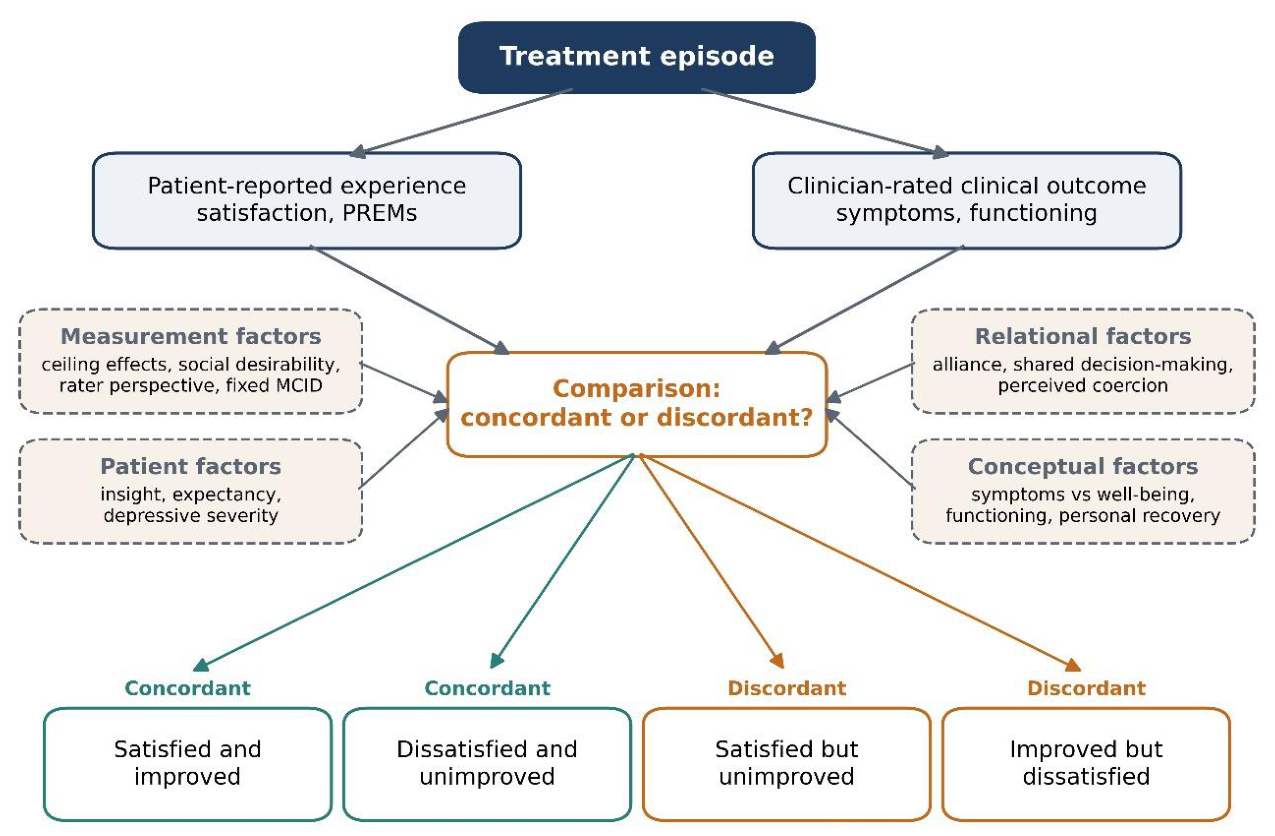
Figure 2.
Four-quadrant typology of satisfaction–outcome concordance. Each quadrant lists the drivers most consistently associated with that profile in the reviewed literature and the clinical question it should prompt. The two discordant quadrants (upper left, lower right) are treated as clinically informative signals rather than measurement error.
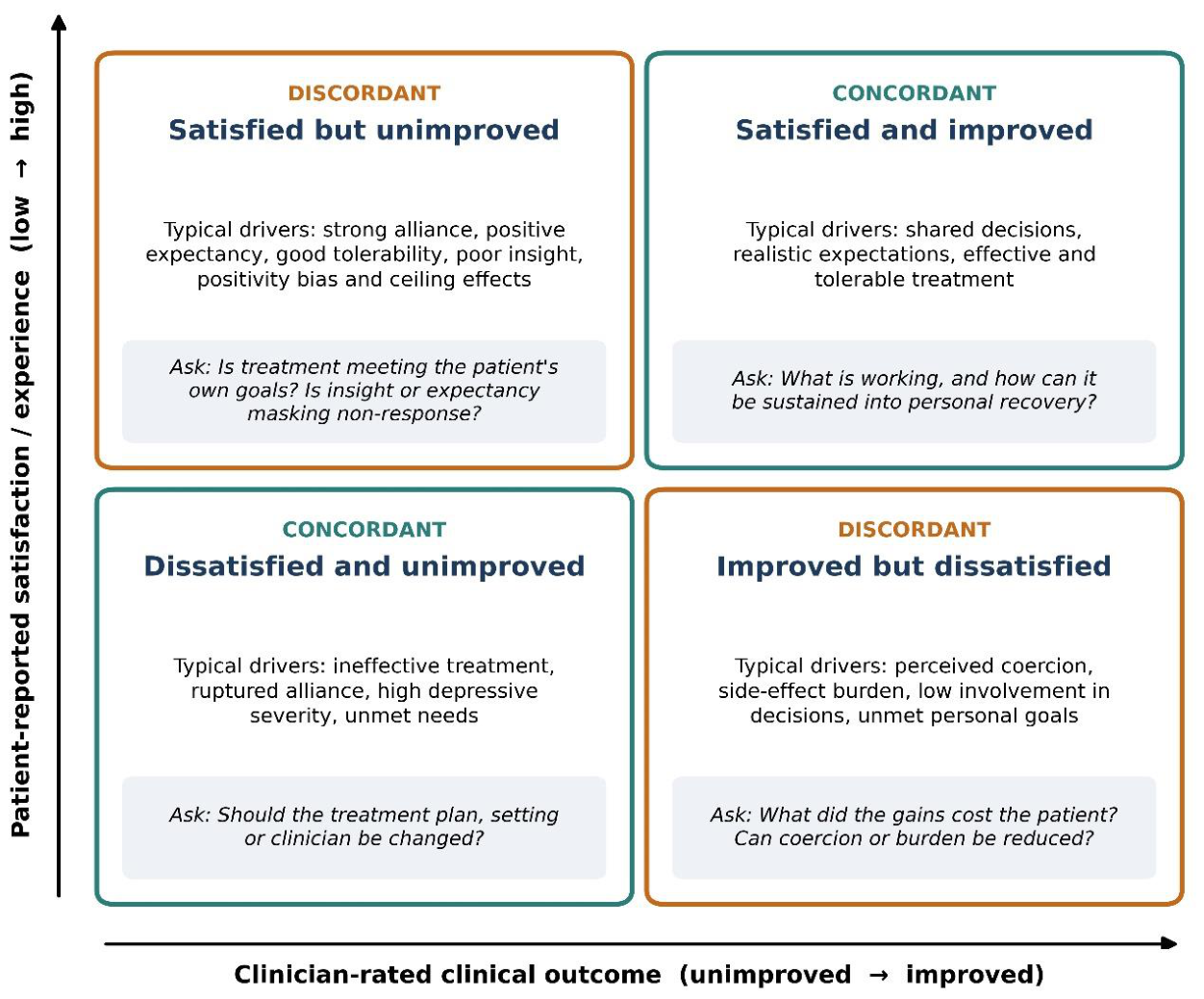

Table 1.
Selected studies directly comparing patient-reported satisfaction or experience with clinical outcome in psychiatric treatment.
Table 1.
Selected studies directly comparing patient-reported satisfaction or experience with clinical outcome in psychiatric treatment.
| Study | Population and design | Key finding |
| Edwards et al. (1978) [2] | Outpatients consecutively admitted to two community mental health centres | Therapists' mean ratings of treatment success significantly lower than patients' at both time points; satisfaction–success correlations significant but low; satisfaction ratings cannot replace success ratings |
| Piersma and Boes (1995) [13] | 200 adult psychiatric inpatients, admission and discharge | No significant relationship between patient-reported symptom distress (BSI) and clinician-rated global functioning (GAF); minimal congruence among measures differing in rating source |
| Dunlop et al. (2010) [6] | Patients with depression in a 10-week trial (PREVENT) | Poor clinician–patient agreement on whether the patient was "better"; some patients rated depression as more severe, others as less severe, than the clinician; frames of reference differ |
| Katsakou et al. (2010) [23] | 778 involuntary inpatients, 67 acute wards, 22 hospitals | Mean satisfaction 5.5–6.0 (0–10 scale), improving to follow-up; perceived, not documented, coercion predicted satisfaction; greater symptom improvement associated with higher satisfaction |
| Guzmán-Parra et al. (2019) [24] | 111 inpatients receiving involuntary medication, mechanical restraint, or both | Restraint and combined measures linked to more perceived coercion (p = 0.002; p < 0.001) and were more stressful (p = 0.013; p = 0.004) than involuntary medication; combined measures linked to lower satisfaction (p = 0.006) |
| Aimola et al. (2019) [19] | People with schizophrenia; satisfaction and patient-reported outcome compared with independent Trust-level quality rating | Moderate association between satisfaction and patient-reported outcome; only patient-reported outcome correlated with the independent quality rating; the two measures were linked to different elements of care |
| Mosler et al. (2020) [22] | Routine data, East London NHS Foundation Trust (DIALOG scale) | Patients "fairly satisfied"; treatment-aspect (PREM) scores exceeded life-aspect (PROM) scores; both rose over time; models poorly specified |
| Luciano et al. (2022) [25] | 588 patients with severe mental illness, six European countries (CEDAR) | Higher satisfaction with clinical decisions associated with better quality of life, lower symptom severity and lower illness burden (p < 0.0001 to p < 0.05) |
| Scanferla et al. (2023) [18] | Acute psychiatric care setting | Symptom improvement explained 28.5% of variance in well-being; symptom change and PREMs weakly, negatively correlated (r = −0.262; 6.8% of variance); low patient–clinician agreement (Kendall's W ≤ 0.118); clinicians rated most items higher than patients |
BSI, Brief Symptom Inventory; CEDAR, Clinical Decision Making and Outcome in Routine Care for People with Severe Mental Illness; GAF, Global Assessment of Functioning; NHS, National Health Service; PREM, patient-reported experience measure; PROM, patient-reported outcome measure
Table 2.
Mechanisms sustaining discordance between satisfaction and clinical outcome, and implications for practice.
Table 2.
Mechanisms sustaining discordance between satisfaction and clinical outcome, and implications for practice.
| Mechanism | Typical discordant pattern | Key sources | Suggested clinical or service response |
| Measurement artefacts (ceiling effects, positivity bias, rater frame of reference, fixed MCID) | Either pattern; attenuates any satisfaction–outcome association | [6,11,12,13,16] | Use brief validated scales with open questions; report patient-anchored, severity-adjusted thresholds; separate clinician and self-ratings in time |
| Expectancy and placebo processes (patient and rater) | Ratings drift apart independently of pharmacological effect | [26,27,28,29,30,31] | Elicit, calibrate and revisit expectations; measure expectancy in service evaluations |
| Therapeutic alliance | Satisfied but unimproved (strong alliance); improved but dissatisfied (poor alliance or rupture) | [32,33,34,35,36,38] | Monitor alliance routinely; detect and repair ruptures |
| Insight and illness awareness | Satisfied with a supportive service but unimproved; dissatisfied with treatment seen as unnecessary | [39,40,41,42] | Assess insight; support it without coercion; stratify analyses by insight |
| Subjective tolerability | Improved but dissatisfied; discontinuation despite symptom gains | [43,44,45] | Ask about subjective response and side-effect burden; adjust dose or agent |
| Decisional involvement | Low involvement lowers satisfaction even with gains | [25,49,50,51] | Structured shared decision-making; time pressure is not a decisive barrier |
| Perceived coercion | Improved but dissatisfied, especially in involuntary care | [23,24,52,53] | Minimise restraint and combined measures; target perceived (not only documented) coercion; debrief |
| Symptoms versus quality of life and personal recovery | Either pattern; personal recovery may occur without remission | [7,8,54,55,56] | Add quality-of-life and personal-recovery measures to symptom and experience measures |
MCID, minimal clinically important difference
Disclaimer/Publisher’s Note: The statements, opinions and data contained in all publications are solely those of the individual author(s) and contributor(s) and not of MDPI and/or the editor(s). MDPI and/or the editor(s) disclaim responsibility for any injury to people or property resulting from any ideas, methods, instructions or products referred to in the content. |
© 2026 by the authors. Licensee MDPI, Basel, Switzerland. This article is an open access article distributed under the terms and conditions of the Creative Commons Attribution (CC BY) license (http://creativecommons.org/licenses/by/4.0/).
Copyright: This open access article is published under a Creative Commons CC BY 4.0 license, which permit the free download, distribution, and reuse, provided that the author and preprint are cited in any reuse.