

Submitted:
20 October 2026
Posted:
21 October 2026
You are already at the latest version
Abstract
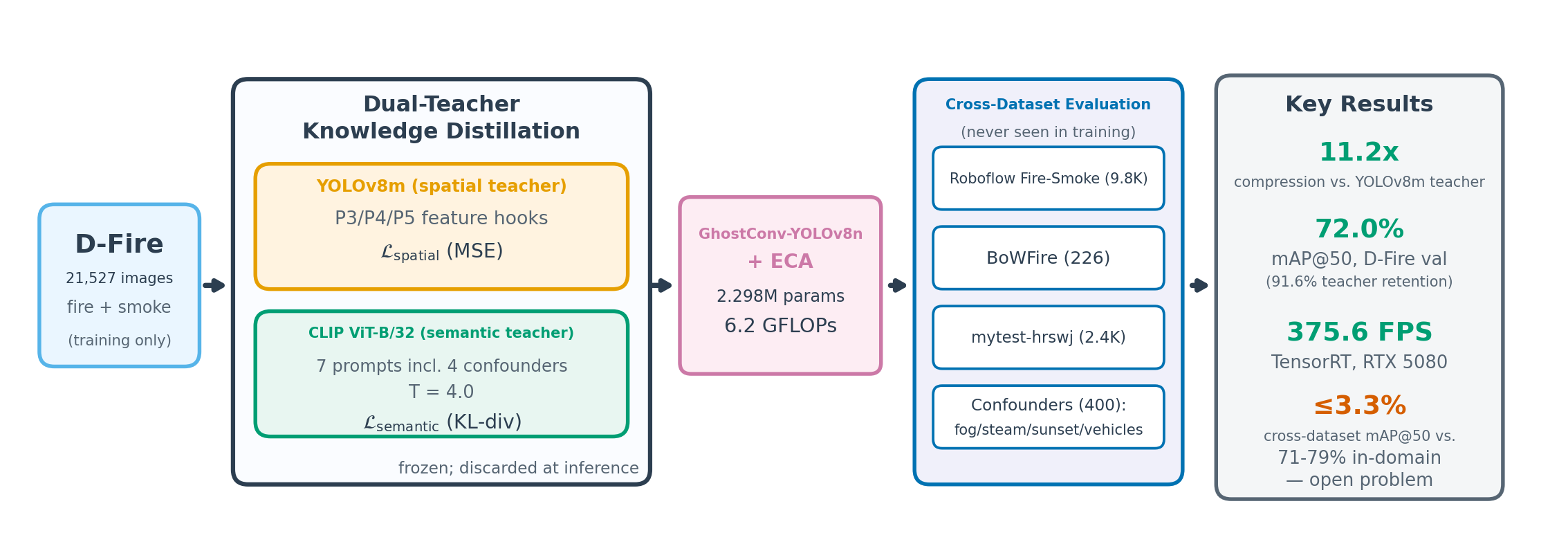
Deep learning fire detectors are usually optimised for in-domain accuracy, while their cross-dataset generalisation, which is vital for real-world deployment, remains poorly understood. We propose a dual-teacher knowledge distillation framework that compresses a YOLOv8m teacher (25.84M parameters, 78.7 GFLOPs) into a GhostConv-enhanced YOLOv8n student with efficient channel attention (2.298M parameters, 6.2 GFLOPs) through spatial feature mimicry and CLIP ViT-B/32 semantic guidance. The distilled student achieves 72.0\% mAP@50 on the D-Fire validation set (four-seed mean), retaining 91.6\% of teacher performance with 11.2\(\times\) fewer parameters, and 71.5\% mAP@50 on the held-out test set at 375.6 FPS with TensorRT on an RTX 5080, exceeding the closest distillation baseline by 9.3 percentage points. Ablations show that CLIP semantic distillation alone reaches 72.6\% mAP@50, surpassing the combined loss and revealing the importance of the transfer mechanism under architectural mismatch. Across four external benchmarks, however, all eight tested models fall from 71--79\% mAP@50 on D-Fire to \(\leq\)3.3\%, and CLIP-based confounder prompts do not reduce false positives relative to detection-only training. This first multi-benchmark generalisation analysis of a sub-5M-parameter fire detector shows that distillation delivers edge-deployment gains but leaves cross-domain robustness unresolved.
Keywords:
fire detection
; smoke detection
; YOLOv8
; knowledge distillation
; CLIP
; GhostConv
; efficient channel attention
; edge deployment
; cross-dataset generalisation
1. Introduction
Fire and smoke pose severe threats to life, property, and ecological systems. Although deep learning object detectors, particularly YOLO-family models [1,2], achieve high accuracy on fire detection benchmarks [3,4,5], real-world deployment imposes two competing constraints: (i) real-time operation on edge hardware, and (ii) reliable generalisation to unseen environments. These objectives are usually pursued independently: compressed models are evaluated only on training-set benchmarks, while generalisation work ignores parameter budgets.
Existing models report 68–86% mAP@50 on D-Fire, yet cross-dataset evaluation is rare. Of the fire detection papers surveyed, only two report results on more than one benchmark. Boroujeni et al. [6] document catastrophic cross-dataset collapse across all surveyed models (e.g., FLAME1 drops from 98.49% to 23.95% on BoWFire), confirming that within-dataset accuracy is not diagnostic of deployment robustness.
Knowledge distillation (KD) [7] is a natural compression strategy, but only two prior fire detection papers apply it to ground-level benchmarks: Pruned-KD [8] achieves 62.7% mAP@50 on D-Fire (as re-evaluated in [3]) via single-teacher YOLO KD, and FFYOLO [9] applies GhostConv with single-teacher KD for forest fire only. Further KD work exists for aerial fire detection [10,11], but none evaluates on D-Fire or uses a vision-language model (VLM) as a semantic teacher. Cross-dataset evaluation is absent from all prior fire KD papers.
CLIP [12], specifically the laion2b_s34b_b79k checkpoint pretrained on 2.3 billion image-text pairs (LAION-2B [13]), provides semantically rich class-boundary knowledge unavailable from detection-domain data. We hypothesised that CLIP’s confounder-aware soft labels would (i) improve within-dataset precision and (ii) improve cross-dataset robustness. Both hypotheses are empirically tested in Section 3 and Section 4.
This paper makes four contributions. First, the first VLM-guided dual-teacher KD framework for fire detection is presented. Second, a GhostConv-YOLOv8n+ECA student is described that achieves 11.2× compression at 91.6% mAP@50 retention on D-Fire validation (four-seed mean; held-out test: 71.5%, 90.9% retention). Third, a six-configuration ablation isolates the contributions of spatial KD, CLIP semantic KD, GhostConv, and ECA individually, with multi-seed confirmation and an -sweep for the two primary configurations. Fourth, the first systematic multi-benchmark cross-dataset generalisation evaluation for a sub-5M-parameter fire detector is reported, quantifying collapse severity and CLIP confounder failure as open problems.
The methodological novelty of this work is not any single component—GhostConv, ECA, and CLIP are each established independently—but the decomposable, cross-modal dual-teacher protocol built from them and the diagnostic use to which it is put. Prior dual-teacher KD systems in fire and wildfire detection pair two same-modality vision teachers: FireNet-KD [10] distils a Swin Transformer and a CNN jointly into one student, and Keerthinathan et al. [11] pair a Grounding DINO detector with a YOLO Nano student for aerial plume detection; both fix the two teachers as a single joint objective and report only aggregate accuracy, without a mechanism to isolate either teacher’s marginal contribution. The present framework instead pairs a spatial CNN teacher with a vision-language teacher operating in a fundamentally different representational space (image-text similarity rather than pixel-level feature maps), and implements the two supervisory signals as independently switchable loss terms (Table 3) rather than a fixed combination. This design is what makes the -sweep in Section 4.2 possible: to our knowledge, no prior fire-detection KD paper quantifies the marginal and interactive contribution of each teacher signal, as opposed to reporting only the accuracy of the already-combined system. The methodological contribution is therefore the ablatable dual-teacher protocol itself, and the architecture-mismatch diagnosis it enables (Section 4.2), rather than the union of pre-existing modules.
1.1. Related Work
1.1.1. Fire Detection
Lightweight fire detection work splits along two largely independent axes: architectural capacity and supervision signal. On the capacity axis, larger models buy accuracy through richer feature aggregation—YOLOGX [3] reaches 80.9% mAP@50 on D-Fire (6.2M params) via asymptotic feature pyramids and cross-level dual attention, and TFNet [5] reaches 81.2% at ∼30M through a Transformer-CNN hybrid neck—whereas the sub-5M class relies on cheaper compression modules: CCi-YOLOv8n [4] (78.5%, 3.8M) uses CARAFE up-sampling and context-guided feature fusion, and LD-YOLO [14] applies GhostConv with a spatial context awareness module to forest fire detection at 3–4M params. Notably, YOLOv11n [15] breaks the expected size-accuracy trade-off, leading the sub-5M class at 85.9% with only 2.6M params—evidence that architectural design choice, not raw compression ratio, is the dominant factor. On the orthogonal supervision axis, CLIP prompt tuning improves fire alarm classification by ≥12.45% [16] and transfer learning achieves competitive accuracy at reduced parameter budgets in resource-constrained settings [17], but both operate on whole-image classification rather than detection, and neither is paired with architectural compression. LD-YOLO is the only prior work to combine GhostConv with an attention-like module, yet it targets a single forest-fire domain and uses no semantic supervision. No existing lightweight detector jointly combines GhostConv-based compression with vision-language semantic supervision—the gap this work addresses.
Cross-dataset generalisation is rarely evaluated. Han et al. [18] identified critical inconsistencies in existing public fire and smoke detection datasets—stemming from heterogeneous labelling conventions and limited scene diversity—and introduced a standardised Multi-Scene Fire and Smoke Detection Benchmark (MS-FSDB; 12,586 images, 2731 scenes) with cross-dataset evaluation protocols to expose this problem. Boroujeni et al. [6] surveyed 20 years of fire and smoke datasets and documented catastrophic cross-dataset collapse across all surveyed models, confirming that within-dataset accuracy is not diagnostic of deployment robustness. Yan et al. [19] showed that unsupervised domain adaptation [20] yields only limited generalisation improvement, confirming the severity of the distribution mismatch.
For edge and aerial deployment, Keerthinathan et al. [11] distil a Grounding DINO teacher into YOLO Nano students for real-time aerial wildfire detection on drones, achieving substantial throughput gains at modest accuracy cost. DSS-YOLO [21] targets real-time mobile deployment, reporting 89.5% mAP@50 on mytest-hrswj after in-distribution training. The persistent challenge is that lightweight architectures trained on narrow data distributions generalise poorly to novel environments—a gap that neither larger model capacity nor stronger supervision has resolved in the existing literature.
1.1.2. Knowledge Distillation
KD methods are broadly categorised as response-based (mimicking final predictions), feature-based (mimicking intermediate representations), and relation-based (preserving inter-sample relationships). Hinton et al. [7] showed that temperature-scaled soft labels alone “often suffice” as a response-based signal. FitNets [22] introduced feature-level mimicry, effective when teacher and student architectures are structurally compatible. CRD [23] demonstrated empirically that contrastive, relation-based objectives outperform feature-level mimicry across heterogeneous architecture pairs; ReviewKD [24] identifies architectural alignment as a prerequisite for effective spatial distillation—both findings are directly relevant to the C2f→C3Ghost mismatch in this work.
For object detection specifically, FGD [25] and PKD [26] refine feature distillation through foreground-selective attention weighting and Pearson-normalised magnitude matching, respectively. CrossKD [27] advances detection KD by routing student head features through the teacher detection head before computing mimicry losses, thereby decoupling annotation supervision from distillation supervision; on MS-COCO, this raises GFL ResNet-50 mAP from 40.2 to 43.7 and generalises to heterogeneous-backbone pairs. Hybrid CNN-Transformer KD has demonstrated effective lightweight compression in related classification tasks [28].
Among fire-specific KD papers, FireNet-KD [10] uses dual vision-based teachers (Swin Transformer + CNN) on the FASDD dataset with no VLM and no cross-dataset evaluation; Keerthinathan et al. [11] distil a Grounding DINO teacher into YOLO Nano students for aerial wildfire detection, introducing a third plume class but evaluating only on domain-specific aerial data; and a hierarchical multi-task KD classifier [29] includes confounder supervision in a classification-only setting. None of these works employs a vision-language model as a distillation teacher. Both FireNet-KD [10] and Keerthinathan et al. [11] are, like this work, dual-teacher systems, but each pairs two teachers from the same visual modality (Swin+CNN; Grounding DINO+YOLO) trained as one fixed joint objective; neither reports an ablation isolating each teacher’s individual contribution. The cross-modal (vision + language) pairing used here, combined with independently switchable spatial and semantic loss terms, is what distinguishes the present dual-teacher design from these prior systems and is what enables the teacher-interaction analysis in Section 4.2.
1.1.3. CLIP for Dense Prediction
ViLD [30], Ma et al. [31], and VL2Lite [32] established the paradigm of distilling VLM knowledge into lightweight detection students for open-vocabulary recognition. Beyond open-vocabulary detection, WinCLIP [33] demonstrated that window-based CLIP feature aggregation—composing state words and prompt templates over sliding windows—achieves 91.8% AUROC zero-shot anomaly classification on MVTec-AD, establishing CLIP as a viable teacher for domain-specific, safety-critical visual inspection without task-specific training data. This precedent motivates using CLIP soft labels as semantic supervision for fire/confounder discrimination in our framework. Critically, DenseCLIP [34] and CORA [35] showed that global-image CLIP representations cannot provide reliable region-level supervision for dense prediction without explicit region prompting—directly explaining the confounder failure reported in Section 4.
1.1.4. Efficient CNN Design
GhostNet [36] replaces standard convolutions with cheap linear operations (intrinsic features + cheap ghost features), achieving ∼50% MAC reduction at comparable accuracy; the C3Ghost module extends this to CSP bottleneck blocks. ECA-Net [37] delivers Squeeze-and-Excitation [38]-equivalent channel attention at negligible cost (≤9 parameters), demonstrating that cross-channel interaction does not require full dimensionality reduction. Both modules have been applied independently to fire detection—GhostConv in LD-YOLO [14] and FFYOLO [9]—but were never jointly ablated in a controlled study, leaving their combined contribution and the sign of their interaction uncharacterised. This work provides the first controlled ablation that isolates GhostConv and ECA individually within an identical training protocol, directly attributing the 23.5% parameter reduction to GhostConv and the precision improvement to ECA.
2. Materials and Methods
2.1. System Overview
The framework combines three components active only during training: a frozen YOLOv8m spatial teacher [2], a frozen CLIP ViT-B/32 semantic teacher, and a trainable GhostConv-YOLOv8n student with learnable projection heads. At inference, all KD components are discarded; only the student weights are deployed.
At each training step, the spatial teacher provides feature maps at three pyramid levels (P3/P4/P5) via forward hooks; the semantic teacher computes per-image similarity scores against seven pre-computed text embeddings; and the student produces detection outputs and intermediate features. Three loss terms back-propagate through the student and projectors only (Figure 1).
2.2. Student Architecture: GhostConv-YOLOv8n with ECA
All backbone Conv blocks are replaced with GhostConv and all C2f modules with C3Ghost. GhostConv computes intrinsic features via standard convolution and generates the remaining ghost features via cheap depthwise convolution:
An ECA module is inserted after SPPF. For feature map ,
ECA adds exactly 5 trainable parameters. The resulting student has 2,298,159 parameters and 6.2 GFLOPs at , compared to the teacher’s 25,840,918 parameters and 78.7 GFLOPs—compression ratios of 11.24× (params) and 12.69× (GFLOPs). Spatial KD hooks are registered at P3 (Layer 4, 64 ch), P4 (Layer 6, 128 ch), and P5 (Layer 10, 256 ch).
2.3. Spatial and Semantic Teachers
YOLOv8m is selected as the spatial teacher (trained to 78.65% mAP@50 on D-Fire). No directly comparable published YOLOv8m result on D-Fire was found; the closest reference point is the unspecified-variant YOLOv8 baseline in [3] (79.46% mAP@50, 3.0M parameters—consistent with YOLOv8n rather than our 25.84M-parameter YOLOv8m), whose own improved YOLOGX architecture reaches 80.9% (Table 7). Learnable FeatureProjectors (1×1 Conv + BN + ReLU) bridge channel-dimension mismatches between student and teacher at each pyramid level and are discarded after training; Table 1 specifies the per-scale dimensions.
CLIP ViT-B/32 [12,39] is used frozen in inference mode. Seven text prompts encode fire/smoke targets and four explicit confounders (Table 2). Embeddings are pre-computed and cached. For each training image, cosine similarities against all seven embeddings are temperature-scaled at to produce soft target probabilities. A learnable SemanticProjector maps the student’s pooled P5 map to a 7-dim distribution aligned with CLIP outputs; it is also discarded after training. CLIP image processing operates through a pipeline entirely separate from the YOLO detection pipeline: each training image is independently resized to pixels and normalised using CLIP’s training statistics (means 0.481, 0.458, 0.408; stds 0.269, 0.261, 0.276 per channel), as opposed to the resolution and ImageNet-derived normalisation used for the YOLO pipeline. Maintaining independent preprocessing pipelines for the two teacher signals prevents cross-contamination of their respective feature spaces.
2.4. Loss Function
The student is optimised with a weighted sum of a detection term and two distillation terms:
where is the standard YOLOv8 loss (CIoU + BCE classification + DFL [40]). The spatial term is the MSE between projected student and frozen teacher features at P3/P4/P5:
and the semantic term is the KL divergence between the student projector output and the CLIP soft labels:
This forward-KL direction—CLIP as reference, student as approximant—minimises the expected log-ratio under the CLIP distribution, penalising the student for placing low probability mass wherever CLIP assigns high confidence, which is the intended behaviour for prompt-guided semantic supervision.
The hyperparameters are , , and for the primary full_kd ablation run. A post hoc -sweep over identified as the operating point that best recovers combined-loss performance; full results are discussed in Section 4.2. Six ablation configurations were designed to isolate the contribution of each framework component, as detailed in Table 3.

Table 3.
Six ablation configurations used to isolate each framework component.
| Config | Architecture | |||
|---|---|---|---|---|
| full_kd 1 | ✓ | ✓() | ✓() | GhostConv + ECA |
| spatial_only | ✓ | ✓ | — | GhostConv + ECA |
| semantic_only | ✓ | — | ✓ | GhostConv + ECA |
| det_only | ✓ | — | — | GhostConv + ECA |
| no_ghost | ✓ | ✓ | ✓ | Standard Conv + ECA |
| no_eca | ✓ | ✓ | ✓ | GhostConv, no ECA |
1 full_kd uses for ablation consistency across all six configurations; the -sweep (Section 4.2, Table 12) identifies as the empirically optimal value for deployment.
2.5. Datasets
D-Fire [41] (training + within-dataset evaluation): 21,527 images, YOLO bounding-box annotations, two classes (fire = 0, smoke = 1), train/val/test split 14,122/3099/4306. All training is restricted to D-Fire only; external datasets are reserved exclusively for evaluation.
Roboflow Fire-Smoke 9.8K [42] (cross-dataset evaluation #1): 9860 community-contributed images covering diverse indoor/outdoor scenarios, native YOLO format.
BoWFire [43] (cross-dataset evaluation #2—hardest): 226 images from broadcast footage. Ground-truth boxes are derived via connected-components analysis of binary segmentation masks (min. area 200 px2), yielding 586 boxes across 119 fire-positive images; the 107 non-fire images have empty labels.
mytest-hrswj [44] (cross-dataset evaluation #3): publicly available open-source dataset on Roboflow Universe (Mytyolov8, May 2024), 2384 images, YOLO bounding-box format, fire class only (smoke: N/A). DSS-YOLO [21] reports 89.5% mAP@50 after in-distribution training on this benchmark.
Confounder suite (false-positive evaluation only): 400 images, 100 per category (fog, steam, sunset, vehicles), all with empty labels, never included in any training split.
Dataset preprocessing. Four preprocessing steps were applied to ensure YOLO framework compatibility across all datasets. First, a class-identity audit confirmed that all three YOLO-format datasets share the convention class 0 = fire, class 1 = smoke; the single-class mytest-hrswj dataset was verified to use class 0 = fire exclusively, precluding silent label-assignment errors that would corrupt training without raising an exception. Second, BoWFire’s pixel-level binary segmentation masks were converted to YOLO axis-aligned bounding boxes using connected-components analysis (connectedComponentsWithStats, 8-connectivity) with a minimum component area of 200 px2 to suppress noise artefacts, yielding 586 bounding boxes distributed across 119 fire-positive images; the 107 non-fire images received empty label files. Third, the two Roboflow datasets were distributed with malformed data.yaml configurations specifying a relative validation path (../valid/images) with no explicit path: root key, causing Ultralytics to resolve paths one directory level above the dataset root; both files were corrected by adding absolute path: keys and removing the erroneous prefix. Fourth, 400 confounder images were organised into the standard YOLO images/labels/ hierarchy with empty label files, since Ultralytics derives label paths by substituting /images/ with /labels/ in each image file path and cannot locate labels in flat directory layouts. Following all corrections, nine data.yaml configurations were independently verified by checking directory existence, image counts, and image-to-label correspondence; all nine passed without error.
2.6. Implementation
All experiments were run on an NVIDIA RTX 5080 (16 GB GDDR7) with an AMD Ryzen 9 9900X CPU and 32 GB DDR5 memory, using PyTorch 2.10.0+cu130 under WSL2. Table 4 summarises the training hyperparameters used for the spatial teacher and for all student/knowledge-distillation configurations.
Student training applies the following Albumentations [46] transforms to training images only: random horizontal flip (), HSV jitter (hue ±0.015, saturation ±0.7, value ±0.4), random scale (±0.5), and mosaic augmentation (). No augmentation is applied at evaluation.
All evaluations use raw unaugmented images at . TensorRT (TRT) engines are exported at FP16; FPS is measured over 1000 iterations (500 warm-up) at batch size 1.
3. Results
3.1. Within-Dataset Performance (D-Fire Validation)
Four-seed training of full_kd and semantic_only (original run plus three independent seeds) confirms stable convergence across random initialisations (Figure 2). Total training loss trajectories are equally consistent across seeds (Figure 3), confirming that the mAP@50 gap is not attributable to optimisation instability or differential loss convergence. The semantic_only > full_kd ordering is statistically robust: the mean difference of mAP@50 exceeds the sum of one standard deviation for both models (0.0015 + 0.0031 = 0.0046), establishing non-overlapping 1 intervals. All student models are precision-heavy () relative to the teacher—a conservative detection profile desirable for fire detection, where false alarms trigger costly evacuations (Table 5, Figure 4).
Per-class decomposition (Table 6). Smoke recall consistently lags fire recall (∼0.58 vs. ∼0.72), reflecting smoke’s greater morphological complexity. Backbone structural differences across the three architecture variants are illustrated in Figure 5. Training dynamics for all six ablation configurations—both validation mAP@50 trajectories and total loss curves—are shown in Figure 6; all configurations converge smoothly without instability, confirming that the mAP@50 spread in Table 5 reflects genuine architectural and loss differences rather than optimisation variance.
3.2. Comparison with Published State of the Art on D-Fire
Table 7 places our students alongside published D-Fire results.
Table 7.
Comparison with published D-Fire results. Our models (bold) are evaluated on the D-Fire validation split under a fixed training protocol (100 epochs, D-Fire train split only, , , ); held-out test results are in Table 8. Literature entries use independently optimised training configurations (epochs, augmentation, and hyperparameters may differ); they establish the competitive landscape but are not equivalent-protocol comparisons.
| Model | Params | mAP@50 | mAP@50:95 | Year |
|---|---|---|---|---|
| Published methods (independently optimised training configurations): | ||||
| YOLOv11n [15] | 2.6M | 85.9% | 55.8% | 2025 |
| TFNet [5] | ∼30M | 81.2% | 46.8% | 2025 |
| YOLOGX [3] | 6.2M | 80.9% | N/R | 2024 |
| CCi-YOLOv8n [4] | 3.8M | 78.5% | 46.6% | 2024 |
| YOLOv11-CHBG [47] | ∼1.8M | 78.4% | — | 2025 |
| This work—D-Fire validation split, fixed training protocol: | ||||
| Ours: no_ghost | 3.006M | 73.6% | 42.6% | 2026 |
| Ours: semantic_only 1 | 2.298M | 2026 | ||
| Ours: full_kd 1 | 2.298M | 2026 | ||
| Published KD and architecture baselines (independently optimised): | ||||
| YOLOv8n baseline [4] | 3.2M | 68.4% | 38.2% | 2024 |
| Pruned-KD [8] 2 | 2.64M | 62.7% | 48.8% | 2021 |
1 Four-seed mean ± s.d. 2 D-Fire result as re-evaluated in [3]; the original paper evaluated on a proprietary UAV dataset.
Table 8.
Cross-dataset mAP@50 (). Avg. ext. excludes D-Fire test. YOLOv8nbase = vanilla YOLOv8n trained with identical protocol (no KD, standard Conv).
Table 8.
Cross-dataset mAP@50 (). Avg. ext. excludes D-Fire test. YOLOv8nbase = vanilla YOLOv8n trained with identical protocol (no KD, standard Conv).
| Model | D-Fire Test | Roboflow | BoWFire | mytest | Avg. ext. |
|---|---|---|---|---|---|
| Teacher | 0.7868 | 0.0255 | 0.0333 | 0.0238 | 0.0275 |
| YOLOv8nbase | 0.7797 | 0.0155 | 0.0275 | 0.0283 | 0.0238 |
| no_ghost | 0.7324 | 0.0140 | 0.0247 | 0.0177 | 0.0188 |
| full_kd | 0.7154 | 0.0158 | 0.0296 | 0.0194 | 0.0216 |
| spatial_only | 0.7142 | 0.0166 | 0.0219 | 0.0262 | 0.0216 |
| semantic_only | 0.7224 | 0.0136 | 0.0199 | 0.0138 | 0.0158 |
| det_only | 0.7196 | 0.0111 | 0.0217 | 0.0130 | 0.0153 |
| no_eca | 0.7087 | 0.0143 | 0.0250 | 0.0180 | 0.0191 |
The full_kd student achieves +3.6 pp over the published YOLOv8n baseline (68.4%) at 28% fewer parameters and +9.3 pp over Pruned-KD at comparable parameter count (Figure 7); both margins are computed from the four-seed mean (72.0%0.3%, Table 7). The Pruned-KD margin warrants qualification: Wang et al. [8] originally trained on a private 1844-image custom forest-fire dataset, not D-Fire; the 62.7% figure is a third-party re-evaluation on D-Fire reported in [3], making the +9.3 pp gap a cross-benchmark margin rather than a direct same-dataset head-to-head. Published state-of-the-art entries—YOLOv11n (85.9%), CCi-YOLOv8n (78.5%), TFNet (81.2%)—used independently optimised training configurations; their figures establish the competitive landscape but are not equivalent-protocol comparisons with our results. The primary contribution of this work is not state-of-the-art accuracy on D-Fire but the compression ratio, the KD analysis, and the multi-benchmark evaluation: no sub-5M-parameter model in the literature has been evaluated simultaneously on D-Fire, Roboflow, BoWFire, and the mytest dataset.
3.3. Cross-Dataset Generalisation
Table 8 reports mAP@50 on the held-out D-Fire test split and the three external benchmarks.
All eight models—including the vanilla YOLOv8n baseline—collapse to mAP@50 on every external benchmark (Figure 8). Crucially, YOLOv8nbase achieves 0.7797 mAP@50 on D-Fire test (nearly matching the 25.8M-parameter teacher) yet collapses identically on external datasets (avg. ext. ). This result confirms that the generalisation failure is caused by the single-source D-Fire training distribution, not by KD, GhostConv compression, or any other architectural factor. Table 9 confirms that this is driven by precision collapse (–), not recall collapse (–): models continue to detect genuine fire regions at reasonable recall but are overwhelmed by false positives on out-of-distribution backgrounds.
Feature-space analysis confirms the domain shift responsible for the collapse. Figure 9 shows t-SNE projections of the full_kd student’s P5 layer features (Layer 10, global average pooled) extracted from 1726 images across all four datasets. D-Fire test images cluster distinctly from all external benchmarks, with Roboflow, BoWFire, and mytest forming separate, non-overlapping regions in the 2D embedding. This distributional disjointness at the deepest feature level explains why the student’s detection head—trained entirely on D-Fire feature representations—generates uncontrolled false positives when presented with structurally different image distributions at inference.
Qualitative inspection of false-positive detections on out-of-distribution images further illustrates the failure modes (Figure 10). On Roboflow negatives (empty-label images with no fire) and BoWFire non-fire images, the student fires on dark backgrounds, textured walls, and illuminated objects that share local colour or texture statistics with D-Fire training images. On confounder categories, steam patches produce the most frequent false positives due to their visual similarity to smoke.
3.4. Confounder False-Positive Analysis
Table 10 reports the false-positive rate (FPR) on the 400-image confounder suite.
Steam produces the highest FPR (29–43%) due to visual similarity to smoke; vehicles produce the lowest (1–7%) (Figure 11). no_ghost achieves the best overall FPR at all thresholds, outperforming even the teacher. Critically, CLIP-distilled models (semantic_only, full_kd) do not outperform det_only at any confidence threshold.
3.5. Deployment Benchmark
Table 11 reports inference throughput and latency for the teacher and all six student/KD configurations under PyTorch FP32, PyTorch FP16, and TensorRT FP16 execution.
full_kd achieves 375.6 FPS—30.7% faster than the teacher with 11.2× fewer parameters (Figure 12). All students exceed the real-time threshold of 30 FPS by at least 8×.
4. Discussion
4.1. Compression Efficiency and Architecture Trade-Offs
GhostConv delivers ∼23.5% parameter reduction versus no_ghost (3.006M → 2.298M) at a cost of −1.58 pp mAP@50 (73.61% → 72.03%). The mAP@50:95 gap (0.4256 → 0.4094) is proportionally larger, confirming that GhostConv’s linear ghost features lose fine spatial detail needed for tight bounding-box localisation. For region-level alarm triggering in surveillance systems, this localisation trade-off is operationally acceptable; for fire boundary delineation applications, no_ghost is preferable.
ECA contributes +0.99 pp mAP@50 (semantic_only four-seed mean: vs. no_eca: 0.7156) and, more operationally significant, +2.52 pp precision ( vs. 0.7182) at a cost of 5 parameters. For systems where false alarms trigger costly evacuations, this precision gain is meaningful at negligible overhead. ECA also provides a disproportionate recall benefit on high-diversity OOD distributions, as evidenced by the no_eca Roboflow recall anomaly (0.107 vs. 0.434–0.524 for all ECA models; Table 9).
KD versus detection-only training provides +0.34–0.60 pp mAP@50 and consistently improves precision across all KD variants.
4.2. KD Loss Decomposition and -Sweep
The multi-seed mAP@50 ordering—semantic_only () > spatial_only (, single-seed) > det_only (, single-seed) > full_kd ()—is statistically confirmed for the two primary configurations: the gap between semantic_only and full_kd exceeds the combined 1 envelope (0.0046), establishing non-overlapping intervals across four independent seeds (original run plus three re-initialised seeds; Figure 2).
This is not a novel finding but a domain-specific confirmation of established KD theory. CRD [23] demonstrated that under architectural mismatch, semantic distillation outperforms spatial feature mimicry because the spatial MSE gradient becomes noisy when teacher features (C2f residual) and student features (C3Ghost linear ghost) have structurally incompatible generation mechanisms. At , the noisy spatial gradient dominates the more reliable semantic signal.
To test whether the ordering is correctable by reweighting, an -sweep was performed over with and held fixed (Figure 13; validation trajectories in Figure 14). The results are summarised in Table 12.
Table 12.
-sweep results: full_kd at four spatial KD weights (100 epochs, , fixed; all values single-seed). semantic_only (, single-seed) is shown for reference; its four-seed mean is mAP@50 , P , F1 (Table 5). All precision and F1 deltas discussed in the text use this four-seed mean, not the single-seed row below, as the semantic_only reference point.
| mAP@50 | mAP@50:95 | P | F1 | |
|---|---|---|---|---|
| 0 (sem. only) | 0.7265 | 0.4121 | 0.7552 | 0.7009 |
| 0.1 | 0.7196 | 0.4099 | 0.7343 | 0.6876 |
| 0.2 | 0.7265 | 0.4153 | 0.7628 | 0.6971 |
| 0.3 | 0.7257 | 0.4094 | 0.7574 | 0.6964 |
| 0.5 (original) | 0.7239 | 0.4118 | 0.7425 | 0.6953 |
At , full_kd matches the four-seed semantic_only mean in mAP@50 within noise (0.7265 vs. ) and achieves the highest precision among all student/KD configurations (0.7628 vs. the four-seed semantic_only mean of , +1.94 pp). F1 at (0.6971) is statistically indistinguishable from the four-seed semantic_only mean (), indicating that optimally weighted spatial KD recovers CLIP-only performance on mAP@50 and F1 while also delivering a measurable precision gain, rather than trading precision for a recall penalty as a single-seed comparison would suggest. The result (0.7196) undershoots the four-seed semantic_only mAP@50 mean, suggesting an optimal narrow window around . Together, these results establish that the semantic_only > full_kd finding at is not an artefact of arbitrary weighting, but rather reflects the fundamental asymmetry between CLIP’s strong semantic signal and spatial MSE’s structurally noisy gradient under C2f→C3Ghost mismatch. Practitioners adopting this framework should use as the deployment hyperparameter, since it recovers semantic_only-level mAP@50 and F1 while providing a measurable precision advantage; the ablation suite in this work uses solely for cross-configuration consistency, not as a performance recommendation.
These results invite a direct question: if semantic_only matches or exceeds the combined loss on D-Fire at every tested above 0.1, why retain spatial supervision at all rather than deploying semantic_only outright? Two considerations motivate keeping the dual-teacher design. First, the decomposable spatial/semantic loss structure is itself the instrument that produced this finding—without an ablatable spatial branch, the architecture-mismatch diagnosis above could not have been established, and the -sweep would have nothing to sweep. Second, and more consequentially, spatial supervision confers a measurable cross-dataset generalisation benefit that semantic supervision alone does not, as quantified next in Section 4.3; the dual-teacher framework’s value is therefore realised primarily outside the D-Fire distribution rather than within it.
4.3. Cross-Dataset Generalisation: A Universal Open Problem
All eight models—spanning 11.2× in parameter count and including the vanilla YOLOv8n baseline—fall within an absolute range of 0.012 mAP@50 on external datasets (0.0153–0.0275), compared to a within-dataset spread of 0.078. The generalisation gap (∼0.76 mAP@50 units) is approximately ten times larger than the architectural or training effect.
The vanilla YOLOv8nbase—identical training protocol, standard Conv, no KD—achieves 0.7797 mAP@50 on D-Fire test (nearly matching the full teacher) yet collapses to avg. ext. , the same order of magnitude as all KD variants. This conclusively rules out distillation artefacts or GhostConv compression as causal factors. The t-SNE feature visualisation (Figure 9) and qualitative failure examples (Figure 10) confirm that the P5 feature space is partitioned by dataset of origin, not by semantic content: external images occupy non-overlapping regions of the feature manifold, causing the detection head to generate uncontrolled false positives.
det_only—no KD, detection loss only—collapses equally to all KD variants, ruling out distillation artefacts. The teacher—standard C2f at 25.8M parameters—collapses equally to all students, ruling out architectural modifications. Together they establish that the collapse is independent of both KD strategy and architecture type, implicating single-source D-Fire training as the primary cause. CLIP-distilled models generalise no better than det_only, directly refuting the hypothesis that CLIP’s domain-diverse pretraining improves cross-dataset transfer in this formulation.
A finer-grained reading of Table 8, however, distinguishes the two CLIP-supervised configurations from one another and provides the empirical justification for retaining the dual-teacher design despite the D-Fire-only semantic_only advantage reported in Section 4.2. full_kd and spatial_only—the two configurations that retain spatial feature mimicry against the YOLOv8m teacher—achieve the highest average external mAP@50 among all GhostConv+ECA students (0.0216 each), exceeding semantic_only (0.0158) and det_only (0.0153) by 37–41% relative. Table 9 localises this advantage to recall: full_kd and spatial_only sustain higher recall on Roboflow (0.499, 0.524) and mytest (0.335, 0.426) than semantic_only (0.473, 0.278), indicating that spatial feature mimicry against the teacher preserves more of the teacher’s general-purpose objectness cues under domain shift than semantic supervision alone provides—even though this same spatial term is shown in Section 4.2 to be sub-optimally weighted for in-domain mAP@50 at . Semantic distillation alone therefore yields the best within-distribution accuracy, but spatial distillation contributes an external-generalisation benefit that semantic supervision does not replicate; the two signals are complementary along different evaluation axes rather than redundant, which is the direct answer to why the dual-teacher architecture is retained rather than collapsed to semantic_only.
4.4. CLIP Confounder Prompts: A Constructive Negative Result
CLIP-distilled models do not reduce FPR relative to det_only (Table 10). The failure has two reinforcing causes.
First, scale mismatch: CLIP operates on whole-image crops, producing a global embedding. Detection false positives occur at the region level—a 15% steam patch activates local convolution filters regardless of the global CLIP label learned from training (Figure 15). Second, coverage gap: CLIP soft labels are computed only on D-Fire training images; the student receives no supervision signal from actual confounder scenes encountered at deployment. DenseCLIP [34] and CORA [35] confirm that region-conditioned CLIP features are required for dense prediction—precisely the modification needed to address this failure.
4.5. Limitations
BoWFire bounding boxes are algorithmically derived; mAP@50 is internally consistent across all models but should not be interpreted as absolute localisation accuracy. Multi-seed confirmation is provided for full_kd and semantic_only; the remaining four configurations (spatial_only, det_only, no_ghost, no_eca) are single-seed, so differences mAP@50 among these should be treated as indicative. The -sweep identifies as optimal but tests each value as a single run; a multi-seed -sweep would fully quantify the optimum. Extended training beyond 100 epochs would likely improve mAP@50:95. All benchmarks use an RTX 5080; absolute FPS on edge hardware (e.g., Jetson Orin NX) would differ, though relative compression gains are architecture-portable.
5. Conclusions
A dual-teacher KD framework has been presented—the first to use a VLM as a semantic distillation signal for fire detection—compressing a YOLOv8m teacher into a GhostConv-YOLOv8n+ECA student at 11.2× parameter compression and 12.7× FLOP reduction with 91.6% mAP@50 retention on D-Fire validation (four-seed mean: 72.0% ± 0.3%; held-out test: 71.5%, 90.9% retention). The student surpasses Pruned-KD [8] by +9.3 pp on D-Fire validation (cross-benchmark context: Pruned-KD was originally trained on a different custom forest-fire dataset; 62.7% is a third-party D-Fire re-evaluation [3]) and the published YOLOv8n baseline by +3.6 pp with fewer parameters, reaching 375.6 FPS under TensorRT. ECA delivers +0.99 pp mAP@50 and disproportionate recall preservation on OOD distributions at a cost of 5 parameters. Multi-seed experiments confirm that CLIP semantic distillation statistically outperforms combined spatial + semantic KD across all four seeds ( vs. ), consistent with CRD theory under C2f→C3Ghost architectural mismatch. An -sweep identifies as the operating point where the combined loss recovers to the four-seed semantic_only mean (mAP@50 vs. ; F1 vs. ) while achieving a +1.94 pp precision gain over that mean (precision vs. ). Although semantic distillation alone attains the best in-domain accuracy, the dual-teacher design is retained because spatial supervision measurably improves cross-dataset generalisation—full_kd and spatial_only exceed semantic_only’s average external mAP@50 by 37–41% relative (Section 4.3)—demonstrating that the two teacher signals are complementary across evaluation axes rather than one simply subsuming the other.
The cross-dataset evaluation—the first systematic multi-benchmark study for a sub-5M-parameter fire detector, controlled by the inclusion of a vanilla YOLOv8n baseline—establishes that all architectures, all KD strategies, and even uncompressed baselines collapse from 71–79% to ≤3.3% mAP@50 on external benchmarks. The t-SNE feature analysis confirms that P5 features are partitioned by training domain, not semantic content. CLIP confounder prompts provide no false-positive reduction, explained by the incompatibility between global-image CLIP supervision and region-level detection. These results are reported as quantified open problems: multi-source training and region-conditioned CLIP distillation (DenseCLIP, CORA) are the direct paths forward.
Author Contributions
Conceptualization, M.J.I., M.A.H.P. and A.S.M.M.; methodology, M.A.H.P. and S.J.; software, M.A.H.P.; validation, M.A.H.P., M.H.M. and S.J.; formal analysis, M.A.H.P., M.H.M., F.A.F. and H.A.K.; investigation, M.A.H.P. and M.H.M.; resources, A.S.M.M.; data curation, M.A.H.P. and S.J.; writing—original draft preparation, M.A.H.P.; writing—review and editing, M.J.I., M.H.M., S.J., A.S.M.M., M.N.I., F.A.F. and H.A.K.; visualization, M.A.H.P. and A.S.M.M.; supervision, M.J.I., M.N.I., F.A.F. and H.A.K.; project administration, M.J.I. and M.N.I.; funding acquisition, M.J.I. All authors have read and agreed to the published version of the manuscript.
Funding
This research was funded by Chandpur Science and Technology University, Bangladesh, under Research Project Code RP-C1/01/25-26.
Institutional Review Board Statement
Not applicable.
Informed Consent Statement
Not applicable.
Data Availability Statement
The D-Fire dataset is publicly available at https://github.com/gaiasd/DFireDataset. The BoWFire dataset is available at http://www.ic.unicamp.br/~rocha/pub/downloads/2014-bowfire/. The Roboflow Fire-Smoke 9.8K and mytest-hrswj datasets are available on Roboflow Universe. The confounder dataset (400 images), trained model weights (kd_student_*.pt), and evaluation scripts will be deposited on Zenodo upon acceptance.
Acknowledgments
During the preparation of this manuscript, the authors used the Scientific Agent Skills toolkit (K-Dense Inc., 2026) [49], an AI-agent-based software framework, for the purposes of formatting the manuscript to the target journal’s LaTeX template, managing and validating the bibliography and in-text citation style, and checking compliance with the journal’s submission guidelines. This tool was not used to generate, analyse, or interpret any research data, results, or scientific conclusions, nor to draft the scientific content of any section. The authors have reviewed and edited the output and take full responsibility for the content of this publication.
Conflicts of Interest
The authors declare no conflicts of interest. The funders had no role in the design of the study; in the collection, analyses, or interpretation of data; in the writing of the manuscript; or in the decision to publish the results.
Abbreviations
The following abbreviations are used in this manuscript:
| CLIP | Contrastive Language–Image Pre-training |
| CRD | Contrastive Representation Distillation |
| ECA | Efficient Channel Attention |
| FPN | Feature Pyramid Network |
| FPR | False-Positive Rate |
| FPS | Frames Per Second |
| GAP | Global Average Pooling |
| GFLOPs | Giga Floating-Point Operations |
| KD | Knowledge Distillation |
| KL | Kullback–Leibler |
| mAP | Mean Average Precision |
| MSE | Mean Squared Error |
| OOD | Out-of-Distribution |
| SPPF | Spatial Pyramid Pooling—Fast |
| TRT | TensorRT |
| t-SNE | t-Distributed Stochastic Neighbour Embedding |
| ViT | Vision Transformer |
| VLM | Vision-Language Model |
| YOLO | You Only Look Once |
References
- Redmon, J.; Divvala, S.; Girshick, R.; Farhadi, A. You Only Look Once: Unified, Real-Time Object Detection. In Proceedings of the Proceedings of the IEEE Conference on Computer Vision and Pattern Recognition (CVPR). IEEE Conference on Computer Vision and Pattern Recognition (CVPR), 2016; pp. 779–788. [Google Scholar] [CrossRef]
- Jocher, G.; Chaurasia, A.; Qiu, J. Ultralytics YOLOv8. GitHub repository, 2023. Version 8.4.24, AGPL-3.0 license. Available online: https://github.com/ultralytics/ultralytics.
- Li, C.; Du, Y.; Zhang, X.; Wu, P. YOLOGX: an improved forest fire detection algorithm based on YOLOv8. Front. Environ. Sci. 2025, 12, 1486212. [Google Scholar] [CrossRef]
- Lv, K.; Wu, R.; Chen, S.; Lan, P. CCi-YOLOv8n: Enhanced fire detection with CARAFE and context-guided modules. In Proceedings of the International Conference on Intelligent Computing. International Conference on Intelligent Computing (ICIC); Springer, 2025; pp. 128–140. [Google Scholar] [CrossRef] [PubMed]
- Liu, H.; Zhang, F.; Xu, Y.; Wang, J.; Lu, H.; Wei, W.; Zhu, J. TFNet: Transformer-Based Multi-Scale Feature Fusion Forest Fire Image Detection Network. Fire 2025, 8, 59. [Google Scholar] [CrossRef]
- Boroujeni, S.P.H.; Mehrabi, N.; Afghah, F.; McGrath, C.P.; Bhatkar, D.; Biradar, M.A.; Razi, A. Eyes on the Environment: AI-Driven Analysis for Fire and Smoke Classification, Segmentation, and Detection originally titled “Fire and Smoke Datasets in 20 Years: An In-depth Review”. arXiv 2025, arXiv:2503.14552v2. [Google Scholar] [CrossRef]
- Hinton, G.; Vinyals, O.; Dean, J. Distilling the Knowledge in a Neural Network. arXiv NIPS 2014 Deep Learning and Representation Learning Workshop (non-archival). 2015, arXiv:1503.02531. [Google Scholar] [CrossRef]
- Wang, S.; Zhao, J.; Ta, N.; Zhao, X.; Xiao, M.; Wei, H. A real-time deep learning forest fire monitoring algorithm based on an improved Pruned + KD model. J. Real.-Time Image Process. 2021, 18, 2319–2329. [Google Scholar] [CrossRef]
- Yun, B.; Zheng, Y.; Lin, Z.; Li, T. FFYOLO: A lightweight forest fire detection model based on YOLOv8. Fire 2024, 7, 93. [Google Scholar] [CrossRef]
- Ahmad, N.; Akbar, M.; Alkhammash, E.H.; Jamjoom, M.M. FireNet-KD: Swin Transformer-Based Wildfire Detection with Multi-Source Knowledge Distillation. Fire 2025, 8, 295. [Google Scholar] [CrossRef]
- Keerthinathan, P.; Sandino, J.; Mahendren, S.; Uthayasooriyan, A.; Galvez, J.; Hamilton, G.; Gonzalez, F. Advancing Real-Time Aerial Wildfire Detection Through Plume Recognition and Knowledge Distillation. Drones 2025, 9, 827. [Google Scholar] [CrossRef]
- Radford, A.; Kim, J.W.; Hallacy, C.; Ramesh, A.; Goh, G.; Agarwal, S.; Sastry, G.; Askell, A.; Mishkin, P.; Clark, J.; et al. Learning transferable visual models from natural language supervision. In Proceedings of the Proceedings of the 38th International Conference on Machine Learning (ICML). 38th International Conference on Machine Learning (ICML), PMLR, 2021; Vol. 139, pp. 8748–8763. Available online: https://proceedings.mlr.press/v139/radford21a.html. [CrossRef]
- Schuhmann, C.; Beaumont, R.; Vencu, R.; Gordon, C.; Wightman, R.; Cherti, M.; Coombes, T.; Katta, A.; Mullis, C.; Wortsman, M.; et al. LAION-5B: An Open Large-Scale Dataset for Training Next Generation Image-Text Models. In Proceedings of the Advances in Neural Information Processing Systems 35 (NeurIPS). Advances in Neural Information Processing Systems 35 (NeurIPS), 2022; pp. 25278–25294. [Google Scholar] [CrossRef]
- Lin, Z.; Yun, B.; Zheng, Y. LD-YOLO: A Lightweight Dynamic Forest Fire and Smoke Detection Model with Dysample and Spatial Context Awareness Module. Forests 2024, 15, 1630. [Google Scholar] [CrossRef]
- Alkhammash, E.H. A comparative analysis of YOLOv9, YOLOv10, YOLOv11 for smoke and fire detection. Fire 2025, 8, 26. [Google Scholar] [CrossRef]
- Wu, S.; Qiao, Y.; He, S.; Zhou, J.; Wang, Z.; Li, X.; Wang, F. FireCLIP: Enhancing forest fire detection with multimodal prompt tuning and vision-language understanding. Fire 2025, 8, 237. [Google Scholar] [CrossRef]
- Hasan, M.; Prince, M.M.A.H.; Ansari, M.S.; Jahan, S.; Miah, A.S.M.; Shin, J. Firelite: Leveraging Transfer Learning for Efficient Fire Detection in Resource-Constrained Environments. In Proceedings of the 2024 27th International Conference on Computer and Information Technology (ICCIT). 27th International Conference on Computer and Information Technology (ICCIT); IEEE, 2024; pp. 545–550. [Google Scholar] [CrossRef]
- Han, X.; Pu, N.; Feng, Z.; Bei, Y.; Zhang, Q.; Cheng, L.; Xue, L. Benchmarking Multi-Scene Fire and Smoke Detection. In Proceedings of the Proc. Chinese Conference on Pattern Recognition and Computer Vision (PRCV). Chinese Conference on Pattern Recognition and Computer Vision (PRCV), 2024. [Google Scholar] [CrossRef]
- Yan, Z.; Wang, L.; Qin, K.; Zhou, F.; Ouyang, J.; Wang, T.; Hou, X.; Bu, L. Unsupervised Domain Adaptation for Forest Fire Recognition Using Transferable Knowledge from Public Datasets. Forests 2023, 14, 52. [Google Scholar] [CrossRef]
- Ganin, Y.; Lempitsky, V. Unsupervised domain adaptation by backpropagation. In Proceedings of the Proc. ICML. International Conference on Machine Learning (ICML) No DOI assigned by PMLR, 2015; PMLR; pp. 1180–1189. Available online: https://proceedings.mlr.press/v37/ganin15.html.
- Wang, H.; Fu, X.; Yu, Z.; Zeng, Z. DSS-YOLO: An improved lightweight real-time fire detection model based on YOLOv8. Sci. Rep. 2025, 15, 8963. [Google Scholar] [CrossRef] [PubMed]
- Romero, A.; Ballas, N.; Kahou, S.E.; Chassang, A.; Gatta, C.; Bengio, Y. FitNets: Hints for Thin Deep Nets. In Proceedings of the 3rd International Conference on Learning Representations (ICLR 2015), 3rd International Conference on Learning Representations (ICLR 2015), San Diego, CA, USA, 2015. [Google Scholar] [CrossRef]
- Tian, Y.; Krishnan, D.; Isola, P. Contrastive Representation Distillation. In Proceedings of the 8th International Conference on Learning Representations (ICLR 2020), 8th International Conference on Learning Representations (ICLR 2020), Addis Ababa, Ethiopia, 2020; Available online: https://openreview.net/forum?id=SkgpBJrtvS. [CrossRef]
- Chen, P.; Liu, S.; Zhao, H.; Jia, J. Distilling Knowledge via Knowledge Review. In Proceedings of the Proceedings of the IEEE/CVF Conference on Computer Vision and Pattern Recognition (CVPR). IEEE/CVF Conference on Computer Vision and Pattern Recognition (CVPR), 2021; pp. 5008–5017. [Google Scholar] [CrossRef]
- Yang, Z.; Li, Z.; Jiang, X.; Gong, Y.; Yuan, Z.; Zhao, D.; Yuan, C. Focal and global knowledge distillation for detectors. In Proceedings of the Proceedings of the IEEE/CVF Conference on Computer Vision and Pattern Recognition (CVPR). IEEE/CVF Conference on Computer Vision and Pattern Recognition (CVPR), 2022; pp. 4633–4642. [Google Scholar] [CrossRef]
- Cao, W.; Zhang, Y.; Gao, J.; Cheng, A.; Cheng, K.; Cheng, J. PKD: General distillation framework for object detectors via Pearson correlation coefficient. In Proceedings of the Advances in Neural Information Processing Systems 35 (NeurIPS) Advances in Neural Information Processing Systems 35 (NeurIPS), 2022; pp. 15394–15406. [Google Scholar] [CrossRef]
- Wang, J.; Chen, Y.; Zheng, Z.; Li, X.; Cheng, M.M.; Hou, Q. CrossKD: Cross-Head Knowledge Distillation for Object Detection. In Proceedings of the Proceedings of the IEEE/CVF Conference on Computer Vision and Pattern Recognition (CVPR). IEEE/CVF Conference on Computer Vision and Pattern Recognition (CVPR), 2024; pp. 16520–16530. [Google Scholar] [CrossRef]
- Prince, M.M.A.H.; Islam, M.J.; Jahan, S.; Miah, A.S.M.; Chowdhury, M.N.H. A Hybrid CNN-Transformer Knowledge Transfer Technique for Lightweight Skin Lesion Classification using Dermoscopic Image. In Proceedings of the 2025 IEEE 2nd International Conference on Computing, Applications and Systems (COMPAS). IEEE 2nd International Conference on Computing, Applications and Systems (COMPAS), 2025; pp. 1–6. [Google Scholar] [CrossRef]
- El-Madafri, I.; Peña, M.; Olmedo-Torre, N. Real-Time Forest Fire Detection with Lightweight CNN Using Hierarchical Multi-Task Knowledge Distillation. Fire 2024, 7, 392. [Google Scholar] [CrossRef]
- Gu, X.; Lin, T.Y.; Kuo, W.; Cui, Y. Open-Vocabulary Object Detection via Vision and Language Knowledge Distillation. In Proceedings of the 10th International Conference on Learning Representations (ICLR 2022). 10th International Conference on Learning Representations (ICLR 2022), 2022; Available online: https://openreview.net/forum?id=lL3lnMbR4WU.
- Ma, Z.; Luo, G.; Gao, J.; Li, L.; Chen, Y.; Wang, S.; Zhang, C.; Hu, W. Open-vocabulary one-stage detection with hierarchical visual-language knowledge distillation. In Proceedings of the Proceedings of the IEEE/CVF Conference on Computer Vision and Pattern Recognition (CVPR). IEEE/CVF Conference on Computer Vision and Pattern Recognition (CVPR), 2022; pp. 14054–14063. [Google Scholar] [CrossRef]
- Jang, J.; Ma, C.; Lee, B. VL2Lite: Task-specific knowledge distillation from large vision-language models to lightweight networks. In Proceedings of the Proc. IEEE/CVF CVPR. IEEE/CVF Conference on Computer Vision and Pattern Recognition (CVPR), 2025. [Google Scholar] [CrossRef]
- Jeong, J.; Zou, Y.; Kim, T.; Zhang, D.; Ravichandran, A.; Dabeer, O. WinCLIP: Zero-/Few-Shot Anomaly Classification and Segmentation. In Proceedings of the Proceedings of the IEEE/CVF Conference on Computer Vision and Pattern Recognition (CVPR). IEEE/CVF Conference on Computer Vision and Pattern Recognition (CVPR), 2023; pp. 19606–19616. [Google Scholar] [CrossRef]
- Rao, Y.; Zhao, W.; Chen, G.; Tang, Y.; Zhu, Z.; Huang, G.; Zhou, J.; Lu, J. DenseCLIP: Language-guided dense prediction with context-aware prompting. In Proceedings of the Proceedings of the IEEE/CVF Conference on Computer Vision and Pattern Recognition (CVPR). IEEE/CVF Conference on Computer Vision and Pattern Recognition (CVPR), 2022; pp. 18061–18070. [Google Scholar] [CrossRef]
- Wu, X.; Zhu, F.; Zhao, R.; Li, H. CORA: Adapting CLIP for open-vocabulary detection with region prompting and anchor pre-matching. In Proceedings of the Proceedings of the IEEE/CVF Conference on Computer Vision and Pattern Recognition (CVPR). IEEE/CVF Conference on Computer Vision and Pattern Recognition (CVPR), 2023; pp. 7031–7040. [Google Scholar] [CrossRef]
- Han, K.; Wang, Y.; Tian, Q.; Guo, J.; Xu, C.; Xu, C. GhostNet: More features from cheap operations. In Proceedings of the Proceedings of the IEEE/CVF Conference on Computer Vision and Pattern Recognition (CVPR). IEEE/CVF Conference on Computer Vision and Pattern Recognition (CVPR), 2020; pp. 1577–1586. [Google Scholar] [CrossRef]
- Wang, Q.; Wu, B.; Zhu, P.; Li, P.; Zuo, W.; Hu, Q. ECA-Net: Efficient channel attention for deep convolutional neural networks. In Proceedings of the Proceedings of the IEEE/CVF Conference on Computer Vision and Pattern Recognition (CVPR). IEEE/CVF Conference on Computer Vision and Pattern Recognition (CVPR), 2020; pp. 11531–11539. [Google Scholar] [CrossRef]
- Hu, J.; Shen, L.; Sun, G. Squeeze-and-excitation networks. In Proceedings of the Proc. IEEE/CVF CVPR. IEEE/CVF Conference on Computer Vision and Pattern Recognition (CVPR), 2018. [Google Scholar] [CrossRef]
- Dosovitskiy, A.; Beyer, L.; Kolesnikov, A.; Weissenborn, D.; Zhai, X.; Unterthiner, T.; Dehghani, M.; Minderer, M.; Heigold, G.; Gelly, S.; et al. An Image is Worth 16×16 Words: Transformers for Image Recognition at Scale. In Proceedings of the 9th International Conference on Learning Representations (ICLR 2021). 9th International Conference on Learning Representations (ICLR 2021), 2021. [Google Scholar] [CrossRef]
- Li, X.; Wang, W.; Wu, L.; Chen, S.; Hu, X.; Li, J.; Tang, J.; Yang, J. Generalized Focal Loss: Learning Qualified and Distributed Bounding Boxes for Dense Object Detection. Proc. Adv. Neural Inf. Process. Syst. (NeurIPS). Advances in Neural Information Processing Systems 33 (NeurIPS) 2020, arXiv:2006.0438833, 21002–21012. [Google Scholar] [CrossRef]
- de Venâncio, P.V.A.B.; Rezende, T.M.; Lisboa, A.C.; Barbosa, A.V. Fire Detection based on a Two-Dimensional Convolutional Neural Network and Temporal Analysis. In Proceedings of the Proc. IEEE Latin American Conf. on Computational Intelligence (LA-CCI). IEEE Latin American Conference on Computational Intelligence (LA-CCI), 2021. [Google Scholar] [CrossRef]
- Roboflow. Fire and Smoke Detection Dataset. Roboflow Universe, 2024. Available online: https://universe.roboflow.com/ (accessed on June 2026).
- Chino, D.Y.T.; Avalhais, L.P.S.; Rodrigues, J.F.; Traina, A.J.M. BoWFire: Detection of fire in still images by integrating pixel color and texture analysis. In Proceedings of the 2015 28th SIBGRAPI Conference on Graphics, Patterns and Images (SIBGRAPI). 28th SIBGRAPI Conference on Graphics, Patterns and Images (SIBGRAPI), 2015; pp. 95–102. [Google Scholar] [CrossRef]
- Mytyolov8. Mytest Dataset Open Source Dataset. Roboflow Universe. 2024. Available online: https://universe.roboflow.com/mytyolov8/mytest-hrswj (accessed on 17 June 2026).
- Loshchilov, I.; Hutter, F. Decoupled weight decay regularization. In Proceedings of the Proc. ICLR. International Conference on Learning Representations (ICLR), 2019. [Google Scholar] [CrossRef]
- Buslaev, A.; Iglovikov, V.I.; Khvedchenya, E.; Parinov, A.; Druzhinin, M.; Kalinin, A.A. Albumentations: Fast and Flexible Image Augmentations. Information 2020, 11, 125. [Google Scholar] [CrossRef]
- Jiang, Y.; Liu, P.; Han, Y.; Xiao, B. YOLOv11-CHBG: A Lightweight Fire Detection Model. Fire 2025, 8, 338. [Google Scholar] [CrossRef]
- Gildenblat, J. pytorch-grad-cam: Advanced AI Explainability for PyTorch. GitHub repository; 2021; Available online: https://github.com/jacobgil/pytorch-grad-cam.
- K-Dense Inc. Scientific Agent Skills: A Comprehensive Collection of Scientific Tools for AI Agents, 2026. 161 skills covering databases, packages, integrations, and analysis tools.
Figure 1.
Overview of the FireLite-KD framework. Left: D-Fire (21,527 images) is the sole training set; four evaluation benchmarks (Roboflow 9.8K, BoWFire, mytest-hrswj, and confounders) are reserved exclusively for evaluation. Centre: dual-teacher knowledge distillation pipeline (training phase only)—frozen YOLOv8m provides P3/P4/P5 feature maps via forward hooks (, MSE); frozen CLIP ViT-B/32 processes crops and produces 7-prompt similarity scores at (, KL divergence); all gradients back-propagate through the GhostConv-YOLOv8n student and projection heads only (); all KD heads are discarded at inference. Six ablation configurations (full_kd, spatial_only, semantic_only, det_only, no_ghost, no_eca) systematically isolate each contribution. Right: evaluation protocol—within-dataset mAP@50/50:95 on D-Fire, cross-dataset generalisation across three external benchmarks (7 models), confounder false-positive rate at three confidence thresholds, and TensorRT deployment benchmarking on an NVIDIA RTX 5080.
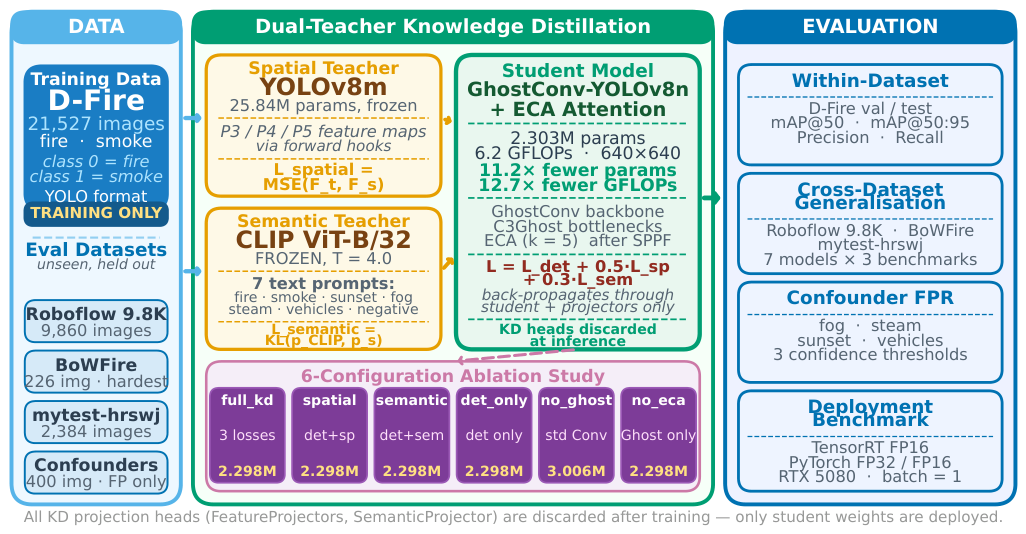
Figure 2.
Validation mAP@50 convergence over 100 training epochs for three independent seeds. (a) full_kd seeds s0/s1/s2 alongside the original single-seed run (dark green); all four curves are tightly clustered (s.d. ≤ 0.0024), confirming reproducible convergence to . (b) semantic_only seeds s0/s1/s2; even tighter clustering (s.d. ≤ 0.0021) converging to . The consistent ∼0.006 gap between semantic_only and full_kd across seeds demonstrates that the CLIP-only configuration reliably outperforms the combined loss under C2f→C3Ghost architectural mismatch.
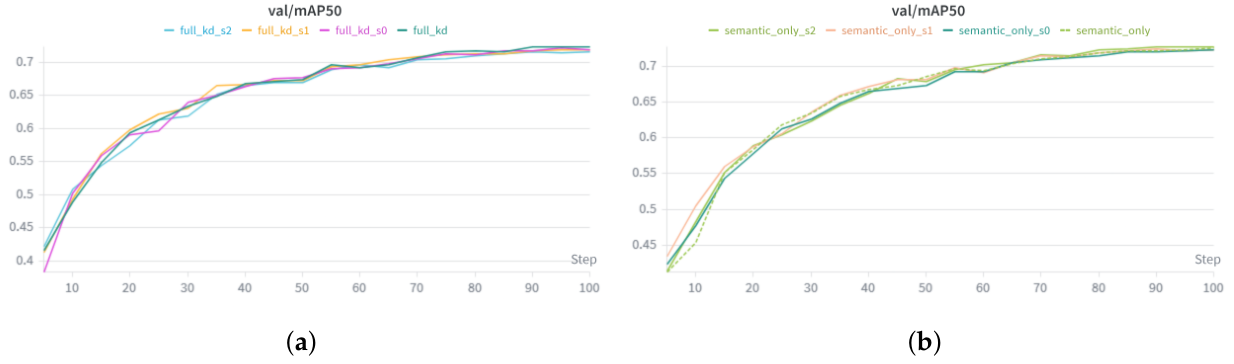
Figure 3.
Total training loss over 100 epochs for three independent seeds. (a) full_kd seeds s0/s1/s2 alongside the original single-seed run; all four curves follow an identical exponential decay profile with near-perfect overlap throughout training. (b) semantic_only seeds s0/s1/s2; the clustering is even tighter than for full_kd, consistent with the simpler two-term loss surface ( versus the three-term combined loss). The loss stability across seeds rules out gradient instability as a cause of the mAP@50 gap between the two configurations.
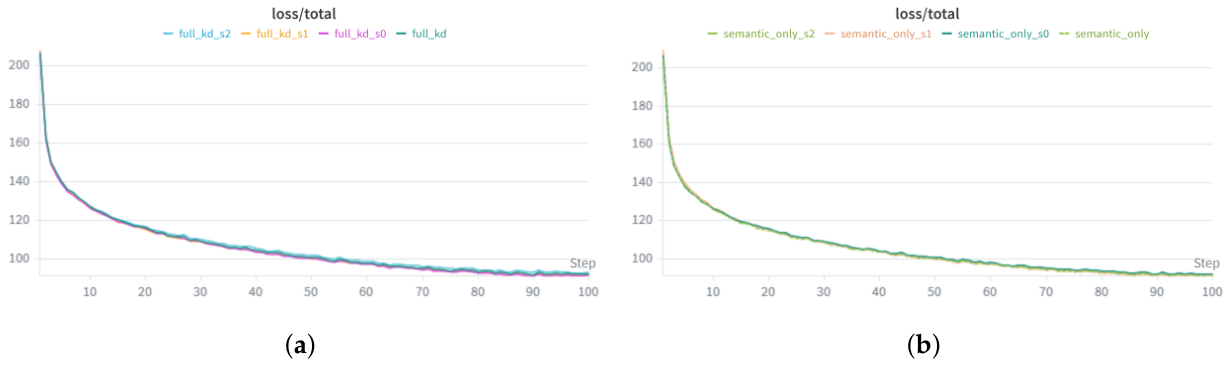
Figure 4.
D-Fire validation multi-metric grouped bar chart (mAP@50, Precision, Recall, F1) for all seven models. no_ghost leads on all metrics; semantic_only achieves the highest mAP@50 among GhostConv+ECA students (0.726, four-seed mean).
Figure 4.
D-Fire validation multi-metric grouped bar chart (mAP@50, Precision, Recall, F1) for all seven models. no_ghost leads on all metrics; semantic_only achieves the highest mAP@50 among GhostConv+ECA students (0.726, four-seed mean).
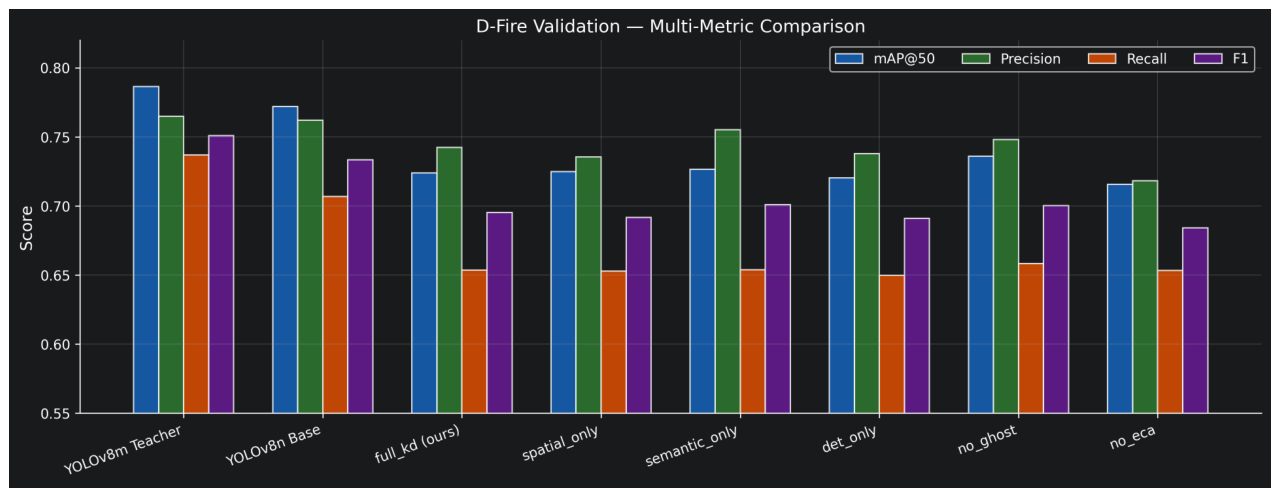
Figure 5.
Backbone comparison across the three structural ablation variants. ghostconv_yolov8n (primary student, 2.298M params, 6.2 GFLOPs) replaces all Conv layers with GhostConv and all C2f modules with C3Ghost, with ECA () after SPPF. yolov8n_no_ghost (3.006M, 8.1 GFLOPs) substitutes standard Conv and C2f at every layer. yolov8n_no_eca (2.298M, 6.2 GFLOPs) is identical to the primary student with the ECA module removed. Quantitative mAP@50 results for all six configurations are in Table 5.
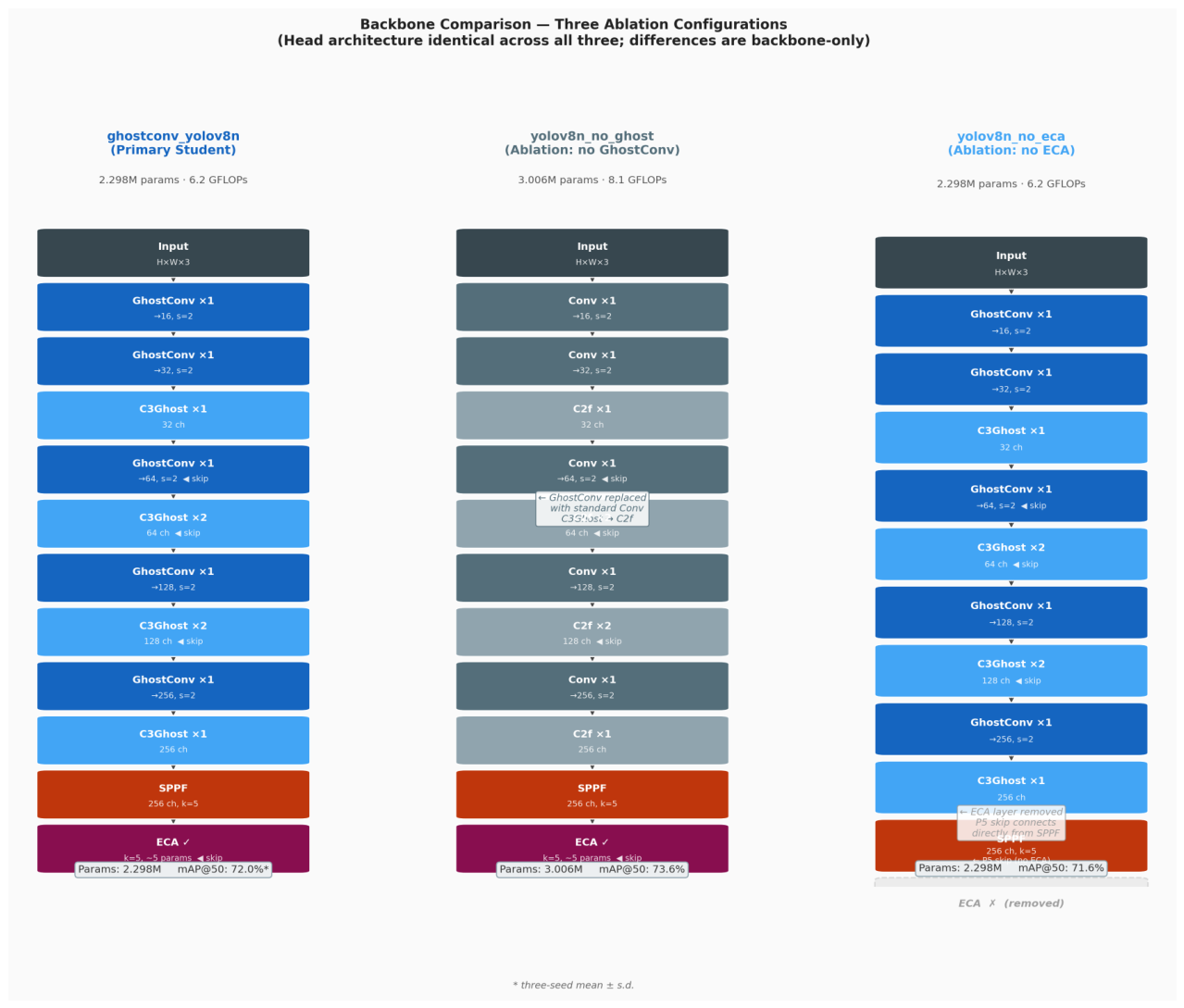
Figure 6.
Training dynamics for all six ablation configurations over 100 epochs. (a) Validation mAP@50 trajectories. no_ghost (standard Conv+ECA) consistently leads throughout training, converging to 0.736. The four GhostConv+ECA configurations (full_kd, semantic_only, spatial_only, det_only) cluster tightly in the 0.716–0.726 band, with semantic_only emerging as the best GhostConv student from epoch ∼60 onward. no_eca trails marginally, consistent with the −0.99 pp mAP@50 gap identified in Table 5 (semantic_only: 0.726 vs. no_eca: 0.716). (b) Total training loss curves. All six configurations follow near-identical exponential decay profiles with no instability, confirming that the performance differences are attributable to architecture and loss formulation rather than optimisation variance.
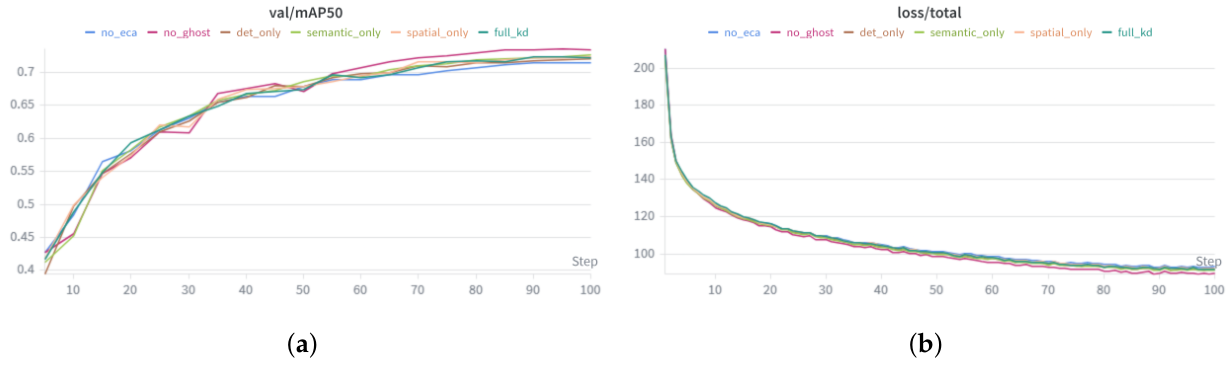
Figure 7.
Parameter–accuracy trade-off: our configurations (starred markers, D-Fire validation split, fixed training protocol) versus published D-Fire methods (filled circles, independently optimised training configurations). Our 2.3M-parameter students (semantic_only 72.6%, full_kd 72.0%) exceed the published YOLOv8n baseline (68.4%, 3.2M) and Pruned-KD (62.7%, 2.64M), occupying a distinct efficiency region. YOLOv11n (2.6M, 85.9%) and CCi-YOLOv8n (3.8M, 78.5%) are published figures from separately optimised configurations; they indicate the current state-of-the-art landscape but do not constitute equivalent-protocol comparisons with our results.
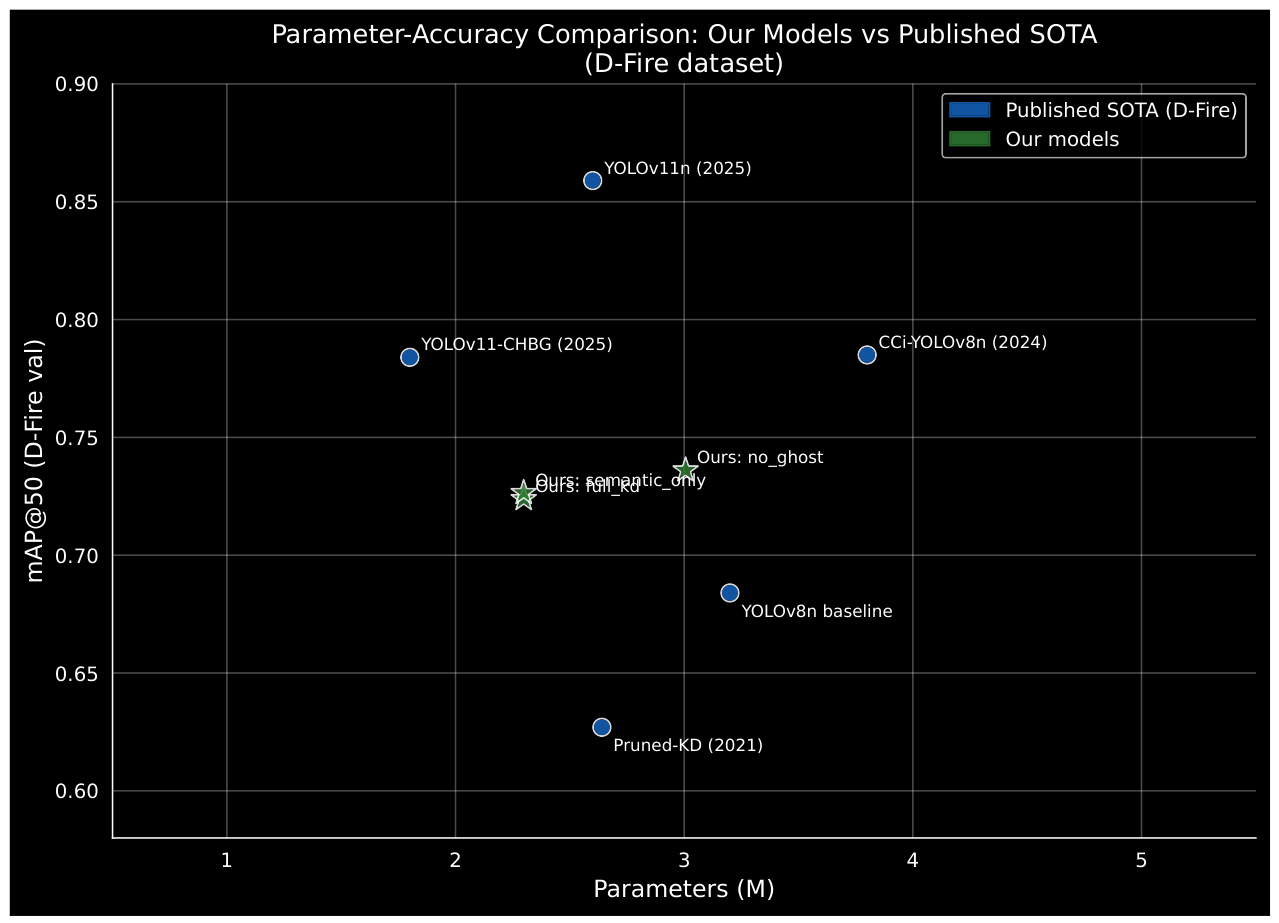
Figure 8.
7×4 cross-dataset mAP@50 heatmap for the six KD ablations and the teacher. The dramatic colour transition from the D-Fire column (0.71–0.79) to external columns (≤0.034) visualises catastrophic generalisation collapse affecting all models equally. Model scale and distillation strategy make no meaningful difference to the gap. YOLOv8nbase (Table 8) is omitted from this figure for space; its near-identical collapse pattern (avg. ext. ) is the primary evidence ruling out KD and architecture as causal factors.
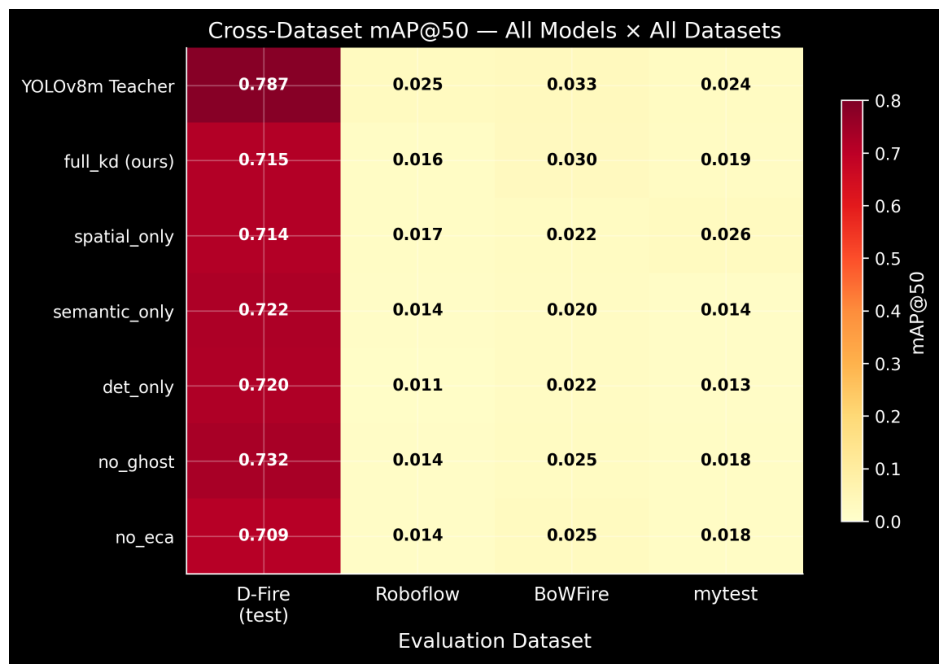
Figure 9.
t-SNE (perplexity = 30) of full_kd student P5 features (Layer 10, global average pooled, 256-d) for 500 D-Fire test images (blue), 500 Roboflow images (red), 500 mytest images (orange), and 226 BoWFire images (green). D-Fire occupies a distinct region; external benchmarks form separate, non-overlapping clusters. This distributional disjointness at the deepest feature level is the mechanistic cause of the precision collapse documented in Table 8 and Table 9.
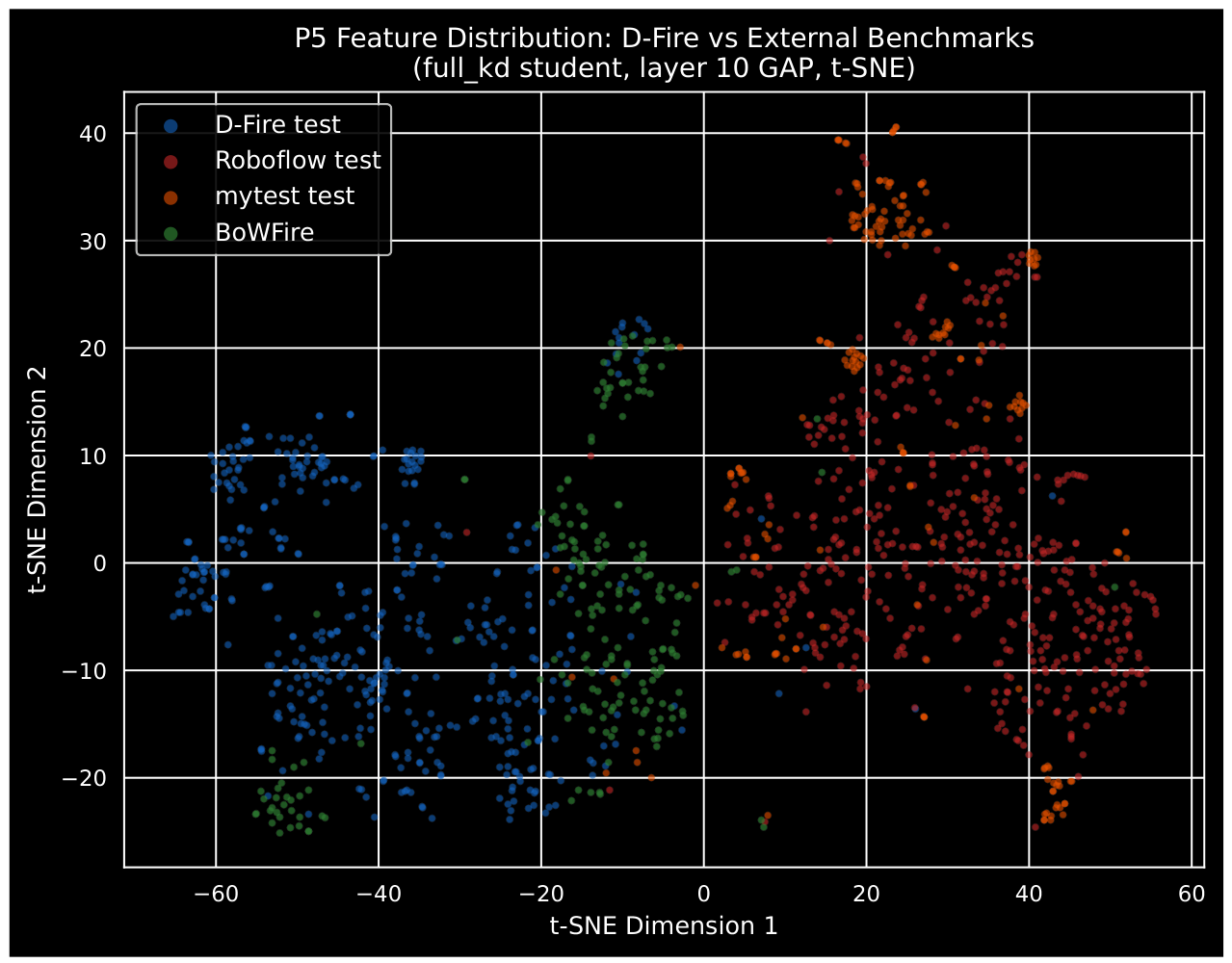
Figure 10.
Representative false-positive detections () on out-of-distribution images. Each cell shows the predicted bounding box with class label (fire/smoke) and confidence score. Row A: Roboflow empty-label negatives. Row B: mytest empty-label negatives. Row C: BoWFire non-fire images. Row D: confounder categories (fog, steam, sunset, vehicles). All detections shown are incorrect; steam (Row D, col. 2) consistently produces the highest-confidence false positives across all models, consistent with its visual similarity to smoke in the training distribution.
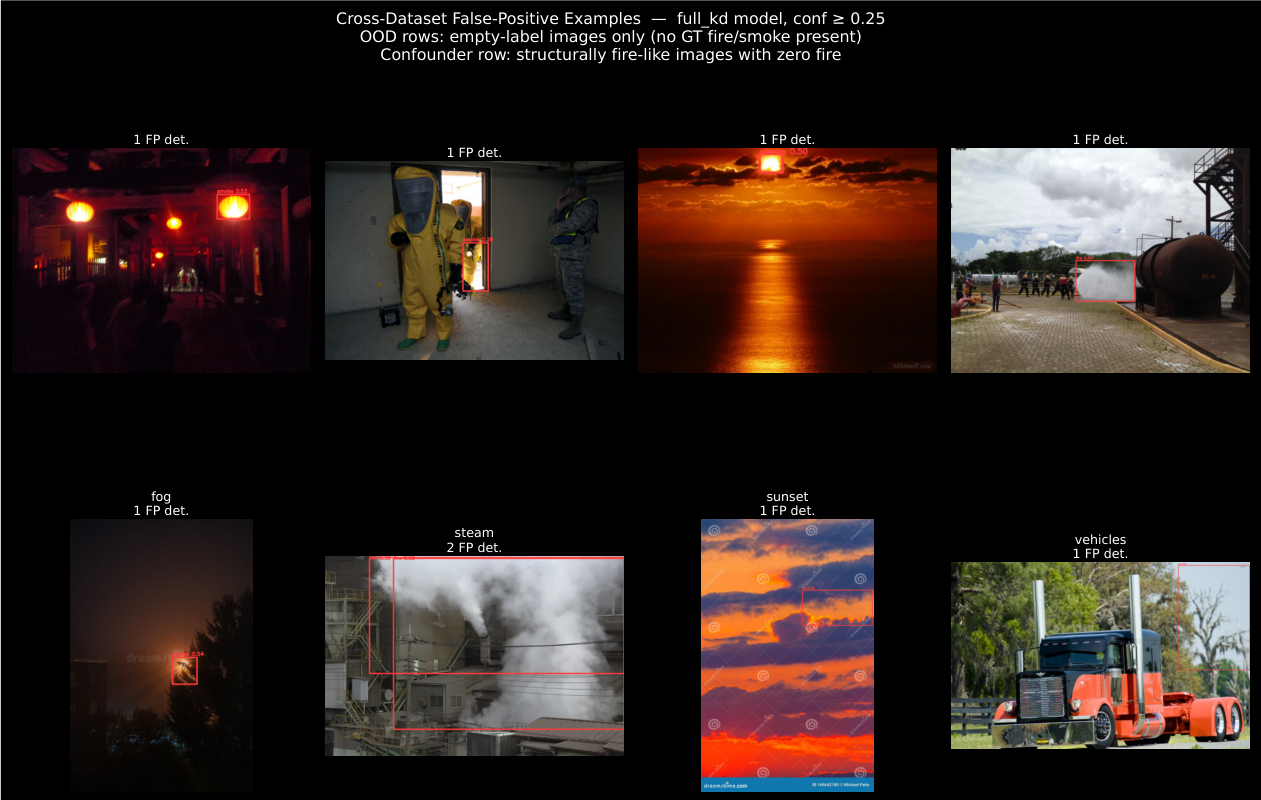
Figure 11.
Per-category confounder FP rate () for all seven models. Steam (29–43%) is consistently hardest; vehicles (1–7%) easiest. no_ghost achieves the best overall suppression (13.5%), outperforming the 25.8M-parameter teacher (15.75%).
Figure 11.
Per-category confounder FP rate () for all seven models. Steam (29–43%) is consistently hardest; vehicles (1–7%) easiest. no_ghost achieves the best overall suppression (13.5%), outperforming the 25.8M-parameter teacher (15.75%).
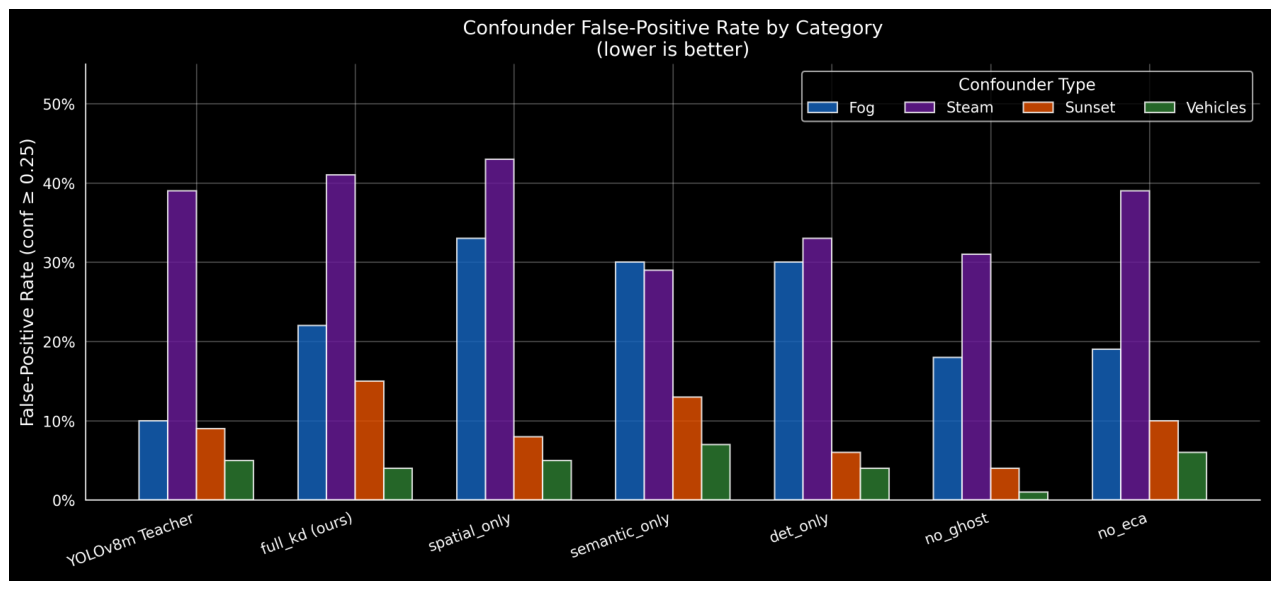
Figure 12.
TensorRT FP16 inference speed vs. D-Fire validation mAP@50; bubble size is proportional to parameter count. full_kd (2.3M, 72.0%, 375.6 FPS) and no_ghost (3.0M, 73.6%, 368.0 FPS) define the student efficiency frontier. The teacher (25.8M, 78.7%, 287.4 FPS) is higher in mAP@50 but slower in throughput. no_eca (304.3 FPS) and semantic_only (277.3 FPS, TRT tactic anomaly) anchor the lower speed bound.
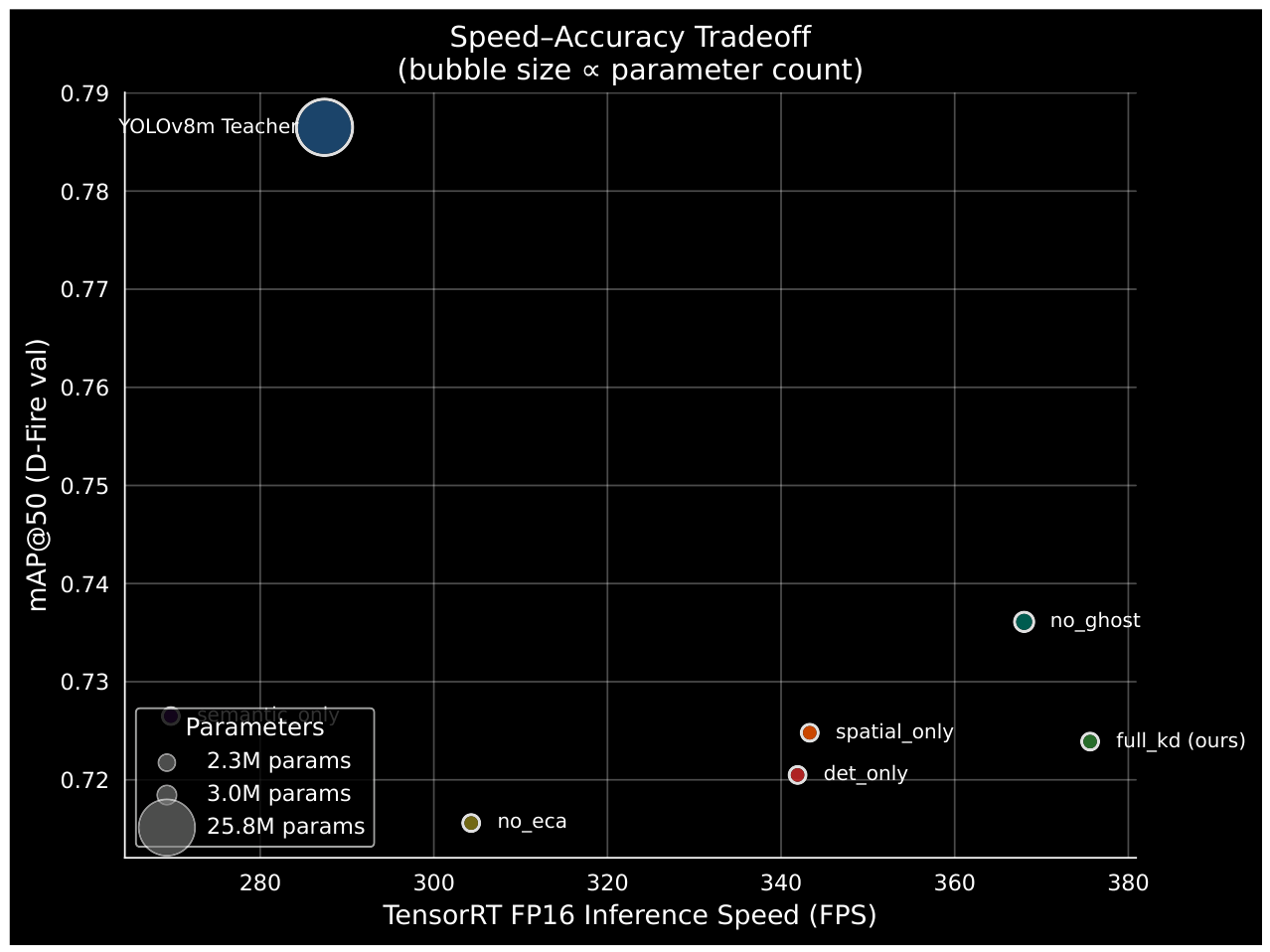
Figure 13.
mAP@50 versus spatial KD weight (with fixed). The horizontal dashed line indicates semantic_only (, 0.7265). At , full_kd matches the semantic_only mAP@50 exactly and achieves the highest precision in the sweep (0.7628 vs. 0.7552). Beyond , increasing the spatial weight monotonically degrades performance, consistent with noisy spatial KD under C2f→C3Ghost mismatch overriding the CLIP semantic signal.
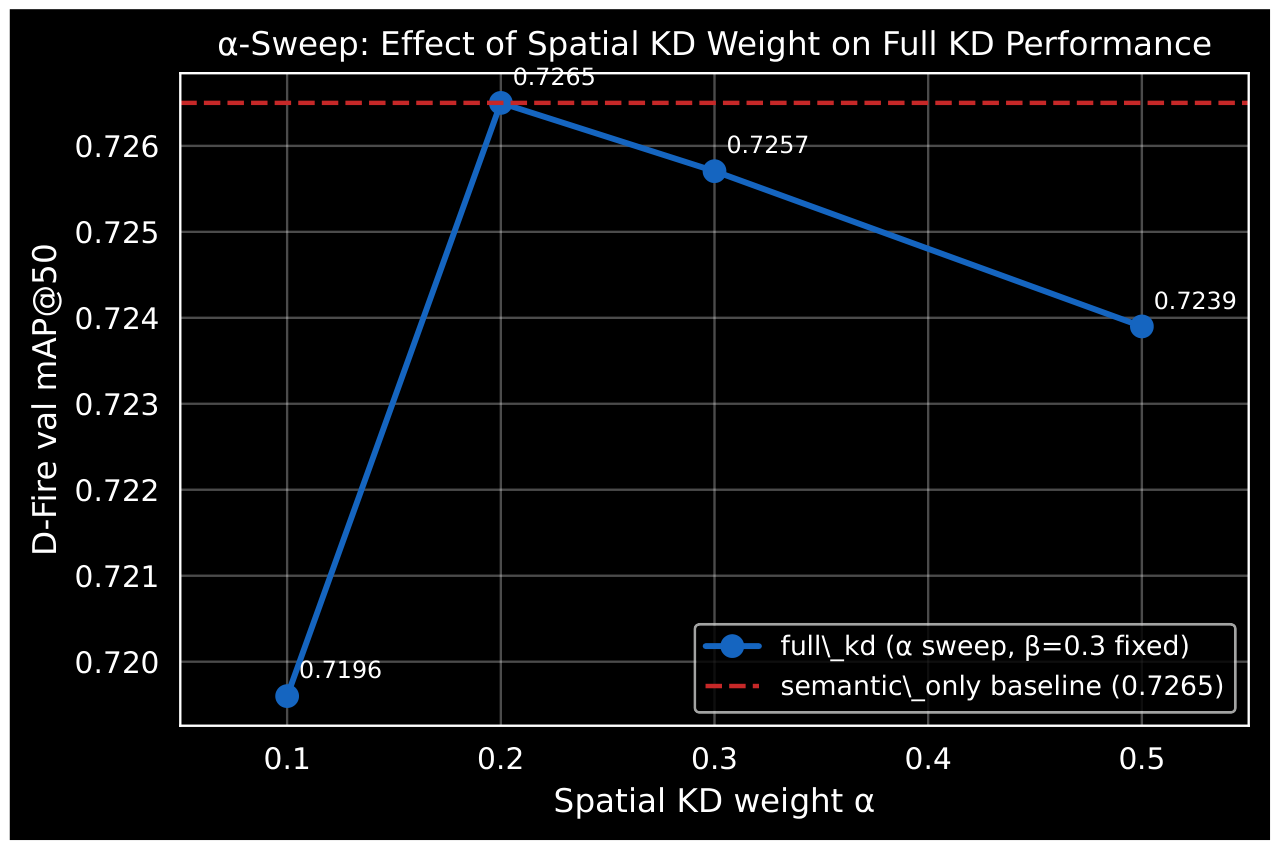
Figure 14.
Validation mAP@50 trajectories over 100 epochs for all four values in the spatial KD weight sweep (, , fixed). All four configurations converge by epoch 80 within a narrow 0.007-unit band (0.7196–0.7265), with curves tightly clustered from epoch 40 onward; shows a modest dip below the group in early training before recovering. Final-epoch ordering confirms as the optimum (0.7265, equal to the single-seed semantic_only result), with performance degrading monotonically at higher weights (: 0.7257; : 0.7239) as the spatial MSE gradient increasingly suppresses the CLIP semantic signal, and falling below the semantic_only baseline at (0.7196). Quantitative results are in Table 12.
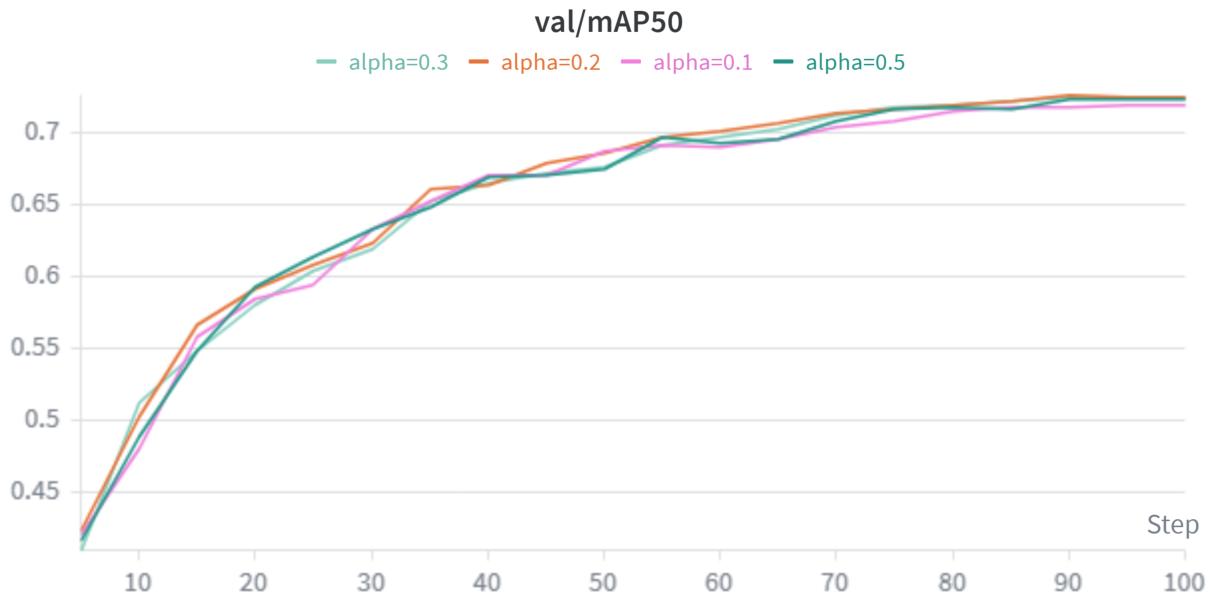
Figure 15.
EigenCAM [48] activation maps on confounder images (steam, sunset, fog, vehicles) for full_kd, semantic_only, and det_only. All three models activate on steam and fog patches regardless of CLIP distillation strategy, demonstrating that false-positive activations are driven by local texture patterns that global-image CLIP supervision cannot suppress.
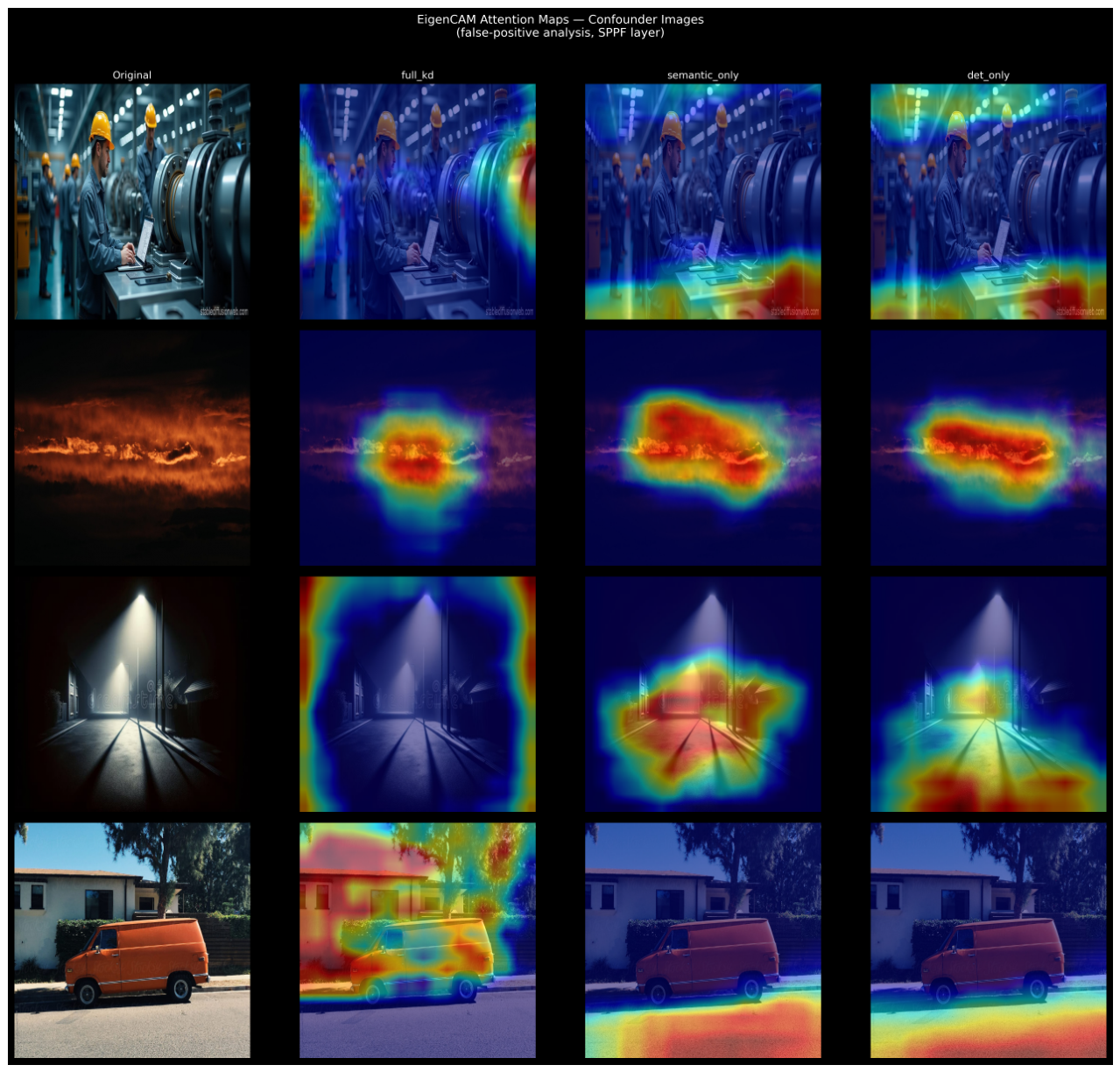
Table 1.
FeatureProjector channel dimensions per FPN scale. Projectors are discarded after KD training.
Table 1.
FeatureProjector channel dimensions per FPN scale. Projectors are discarded after KD training.
| Scale | Resolution | Student Layer | Student Ch | Teacher Ch |
|---|---|---|---|---|
| P3 | 4 (C3Ghost) | 64 | 192 | |
| P4 | 6 (C3Ghost) | 128 | 384 | |
| P5 | 10 (ECA) | 256 | 768 |
Table 2.
CLIP text prompts used for semantic distillation.
| Index | Prompt | Role |
|---|---|---|
| 1 | “a photograph of a real fire with visible flames” | Fire positive |
| 2 | “a photograph of thick smoke from a burning fire” | Smoke positive |
| 3 | “a photograph of a sunset or sunrise with orange sky” | Confounder |
| 4 | “a photograph of fog or mist in the atmosphere” | Confounder |
| 5 | “a photograph of industrial steam or exhaust” | Confounder |
| 6 | “a photograph of a red or orange coloured vehicle” | Confounder |
| 7 | “a normal outdoor scene without any fire or smoke” | Negative |
Table 4.
Training hyperparameters for the spatial teacher and all student/KD configurations.
| Hyperparameter | Teacher | Student/KD |
|---|---|---|
| Epochs | 100 (best @ ep. 76) | 100 |
| Optimiser | AdamW [45] | AdamW |
| Learning rate | ||
| LR schedule | Cosine + 3 warmup epochs | CosineAnnealingLR |
| Weight decay | ||
| Momentum | 0.937 1 | 0.9 |
| Batch size | 16 | 24 |
| Image size | 640 | 640 |
| Augmentation | Ultralytics default | Albumentations (train only) |
1 Teacher follows the Ultralytics YOLOv8 default; student follows the PyTorch AdamW default.
Table 5.
D-Fire validation results (, all-class mean). Best student value per column in bold.
| Model | Params | GFLOPs | mAP@50 | mAP@50:95 | P | R | F1 |
|---|---|---|---|---|---|---|---|
| YOLOv8m Teacher | 25.84M | 78.7 | 0.7865 | 0.4720 | 0.7650 | 0.7370 | 0.7508 |
| no_ghost | 3.006M | 8.1 | 0.7361 | 0.4256 | 0.7480 | 0.6584 | 0.7003 |
| semantic_only 1 | 2.298M | 6.2 | |||||
| spatial_only | 2.298M | 6.2 | 0.7248 | 0.4102 | 0.7356 | 0.6530 | 0.6918 |
| det_only | 2.298M | 6.2 | 0.7205 | 0.4122 | 0.7378 | 0.6499 | 0.6911 |
| full_kd 1 | 2.298M | 6.2 | |||||
| no_eca | 2.298M | 6.2 | 0.7156 | 0.4107 | 0.7182 | 0.6534 | 0.6842 |
1 Four-seed mean ± population s.d. (original run + three independent seeds); all other rows are single-seed.
Table 6.
Per-class D-Fire validation results.
| Model | Fire mAP@50 | Fire Recall | Smoke mAP@50 | Smoke Recall |
|---|---|---|---|---|
| Teacher | 0.845 | 0.797 | 0.731 | 0.676 |
| YOLOv8nbase | 0.834 | 0.781 | 0.711 | 0.632 |
| no_ghost | 0.799 | 0.741 | 0.673 | 0.576 |
| semantic_only | 0.783 | 0.724 | 0.670 | 0.584 |
| full_kd | 0.783 | 0.733 | 0.665 | 0.574 |
| spatial_only | 0.777 | 0.716 | 0.672 | 0.590 |
| det_only | 0.781 | 0.724 | 0.660 | 0.575 |
| no_eca | 0.771 | 0.715 | 0.660 | 0.591 |
Table 9.
Cross-dataset precision/recall decomposition on external benchmarks.
| Model | Roboflow P | Roboflow R | BoWFire P | BoWFire R | mytest P | mytest R |
|---|---|---|---|---|---|---|
| Teacher | 0.031 | 0.434 | 0.054 | 0.203 | 0.034 | 0.245 |
| no_ghost | 0.017 | 0.475 | 0.039 | 0.217 | 0.026 | 0.327 |
| full_kd | 0.019 | 0.499 | 0.044 | 0.251 | 0.025 | 0.335 |
| spatial_only | 0.017 | 0.524 | 0.033 | 0.217 | 0.034 | 0.426 |
| semantic_only | 0.015 | 0.473 | 0.029 | 0.213 | 0.020 | 0.278 |
| det_only | 0.013 | 0.455 | 0.033 | 0.227 | 0.016 | 0.223 |
| no_eca | 0.020 | 0.107 1 | 0.037 | 0.275 | 0.025 | 0.385 |
1 The no_eca Roboflow recall anomaly (0.107 vs. 0.434–0.524 for all others) suggests that ECA provides disproportionate benefit for fire recall on high-diversity OOD distributions.
Table 10.
Confounder false-positive rate (100 images per category, three confidence thresholds). Per-category rates are at . Best value per column in bold.
Table 10.
Confounder false-positive rate (100 images per category, three confidence thresholds). Per-category rates are at . Best value per column in bold.
| Model | Fog | Steam | Sunset | Vehicles | FPR@0.25 | FPR@0.50 | FPR@0.75 |
|---|---|---|---|---|---|---|---|
| Teacher | 10% | 39% | 9% | 5% | 15.75% | 10.00% | 3.50% |
| no_ghost | 18% | 31% | 4% | 1% | 13.50% | 5.50% | 1.00% |
| semantic_only | 30% | 29% | 13% | 7% | 19.75% | 10.00% | 1.50% |
| full_kd | 22% | 41% | 15% | 4% | 20.50% | 6.50% | 0.50% |
| det_only | 30% | 33% | 6% | 4% | 18.25% | 7.75% | 0.50% |
| no_eca | 19% | 39% | 10% | 6% | 18.50% | 6.50% | 1.00% |
| spatial_only | 33% | 43% | 8% | 5% | 22.25% | 8.75% | 0.50% |
Table 11.
Inference benchmark (NVIDIA RTX 5080, batch = 1, ). PT = PyTorch; TRT = TensorRT FP16.
| Model | Params | GFLOPs | PT FP32 (FPS) | PT FP16 (FPS) | TRT FP16 (FPS) | TRT (ms) |
|---|---|---|---|---|---|---|
| Teacher | 25.84M | 78.7 | 187.2 | 143.9 | 287.4 | 3.479 |
| full_kd | 2.298M | 6.2 | 206.6 | 158.7 | 375.6 | 2.663 |
| spatial_only | 2.298M | 6.2 | 225.9 | 155.8 | 343.3 | 2.913 |
| semantic_only | 2.298M | 6.2 | 223.9 | 156.3 | 277.3 2 | 3.606 |
| det_only | 2.298M | 6.2 | 237.1 | 156.2 | 341.9 | 2.925 |
| no_ghost | 3.006M | 8.1 | 307.3 1 | 291.1 1 | 368.0 | 2.717 |
| no_eca | 2.298M | 6.2 | 192.8 | 175.0 | 304.3 | 3.286 |
1 no_ghost PyTorch FPS is paradoxically higher than that of GhostConv models despite 30% more GFLOPs: standard Conv maps directly to BLAS im2col+GEMM kernels with contiguous memory access, whereas GhostConv’s cheap-operation branch introduces gather/scatter overhead that limits GPU utilisation at small batch sizes. 2 The semantic_only TRT shortfall is attributable to non-deterministic tactic selection; PyTorch FP16 shows near-identical throughput across all GhostConv+ECA models (CV ).
Disclaimer/Publisher’s Note: The statements, opinions and data contained in all publications are solely those of the individual author(s) and contributor(s) and not of MDPI and/or the editor(s). MDPI and/or the editor(s) disclaim responsibility for any injury to people or property resulting from any ideas, methods, instructions or products referred to in the content. |
© 2026 by the authors. Licensee MDPI, Basel, Switzerland. This article is an open access article distributed under the terms and conditions of the Creative Commons Attribution (CC BY) license (http://creativecommons.org/licenses/by/4.0/).
Copyright: This open access article is published under a Creative Commons CC BY 4.0 license, which permit the free download, distribution, and reuse, provided that the author and preprint are cited in any reuse.