

Submitted:
20 October 2026
Posted:
21 October 2026
You are already at the latest version
Abstract
Quantum gravity requires a common language in which microscopic quantum structure, dynamical geometry, and the maps between them carry compatible mathematical types. We develop one from an eleven-generator real quadratic carrier of adopted signature (4,7), whose Clifford algebra Cl(4,7) has 2048 real basis blades; we call the resulting structure Rolandion algebra (R11). We establish an exact ordered-blade multiplication law, identify the 1024-dimensional even subalgebra, and separate 110 directed blade-replacement channels from the 55 metric-skew generators of so(4,7). Scale dependence is carried by a Clifford–Jordan family interpolating between the associative Clifford product and its Jordan symmetrization; the complete associator is obtained in closed form and shown, at fixed scale and for the declared regular bimodule, to be a Hochschild coboundary. Scale-labelled subalgebras with canonical defects form one category, while typed transfer restrictions generate a separate path category and presheaf topos. In a direct-sum Hilbert realization, adjoint-paired transfer blocks yield a self-adjoint Hamiltonian, unitary evolution, and exact antisymmetric population currents. The demonstrated gravitational branch is a four-dimensional Lorentzian base with an internal R11 bundle and a real covariant effective action; an eleven-dimensional geometric interpretation remains conditional. A three-qubit information-transfer model and normalized gravitational-wave, CMB, and laboratory responses illustrate constraint interfaces; no ultraviolet completeness is claimed.
Keywords:
quantum gravity
; Clifford algebra
; Cl(4
; 7)
; directed transfer
; scale-dependent algebra
; R11
; Rolandion algebra
; category theory
; presheaf topos
; quantum information
MSC: 15A66; 15A67; 17C50; 16E40; 18B25; 81V17
1. Introduction
Quantum theory describes matter and information with extraordinary precision, while general relativity identifies gravitation with the dynamics of Lorentzian geometry. Their conceptual and technical incompatibilities become unavoidable in high-curvature, early-universe, and black-hole regimes. Established research programs approach this problem through different organizing structures, including strings and extended objects, canonical and covariant quantum geometry, causal order, and renormalization-group fixed points [8,9,10,11]. The framework developed here begins instead from a finite, exact algebraic carrier: an eleven-generator real quadratic space of signature , whose Clifford algebra supplies every ordered multivector sector. We write R11 for this carrier and the structures built on it, and call the algebra itself Rolandion algebra.1 R11 is complementary in emphasis to the programs above: it asks which directed microscopic operations, operator realizations, and geometric matchings can consistently be built from that carrier.
The framework is organized around three ideas. First, an eleven-generator quadratic space provides a fixed carrier whose full Clifford algebra contains all ordered multivector sectors. Second, a positive resolution-length scale controls a minimal Clifford–Jordan deformation, allowing algebraic properties to be compared continuously without identifying an endpoint with a complete physical theory. Third, dimensional transfer is represented microscopically by directed index replacements and only later realized, under additional assumptions, as Hilbert-sector exchange, local field mixing, or geometric dynamics. Category and presheaf constructions record how these typed objects compose; they organize structure but do not themselves prove a physical interpretation.
The number eleven is therefore an organizing dimension of the carrier, not by itself a statement that observed spacetime has eleven coordinates. The adopted signature is a modeling choice satisfying the R11 admissibility conditions , , and , which select . A balanced-capacity functional alone instead favors and , so the role constraints and the empirical meaning of the signature remain distinct questions [1].
This distinction leads to two gravitational levels. The controlled realization developed here uses a four-dimensional Lorentzian base with an internal bundle and a variational effective action. A genuinely eleven-dimensional R11 geometry remains a conditional research branch. It requires its own metric and causal structure, hyperbolic dynamics, stability analysis, compactification, and a map between microscopic transfer and geometric evolution. The two levels preserve the larger R11 objective while keeping the construction actually established in this paper explicit.
The ambition of a framework for quantum gravity is consequently held in a bounded sense here. R11 supplies a rigorous microscopic carrier, a typed transfer and operator architecture, a controlled covariant realization, and parameterized interfaces to quantum information and phenomenology. It does not yet supply a unique vacuum, a complete ultraviolet theory, a nonperturbative measure over geometries, an anomaly-free particle spectrum, or experimental confirmation.
1.1. Scope and Status of Results
Table 1 summarizes the evidentiary level of the constructions. The distinctions are used sparingly below so that definitions, exact results, realization-dependent statements, phenomenological models, and open targets remain visible without interrupting the scientific argument.
The principal results are:
- (i)
- an exact ordered-blade theorem verified over all basis products;
- (ii)
- a dimensionless Clifford–Jordan scale interpolation with the complete associator;
- (iii)
- a genuine category of closed scale-labelled algebras and canonical multiplicative defects, together with a separate free transfer-path category and associated presheaf topos;
- (iv)
- a distinction between 110 directed replacement channels and 55 metric-skew generators;
- (v)
- a self-adjoint direct-sum transfer Hamiltonian and exact antisymmetric population currents;
- (vi)
- a controlled four-dimensional covariant realization on a Lorentzian base with internal R11 structure;
- (vii)
- a valid quantum-instrument realization and a reproducible unitary information-transfer toy model; and
- (viii)
- dimensionally closed, parameterized phenomenological channels whose matching coefficients remain explicit.
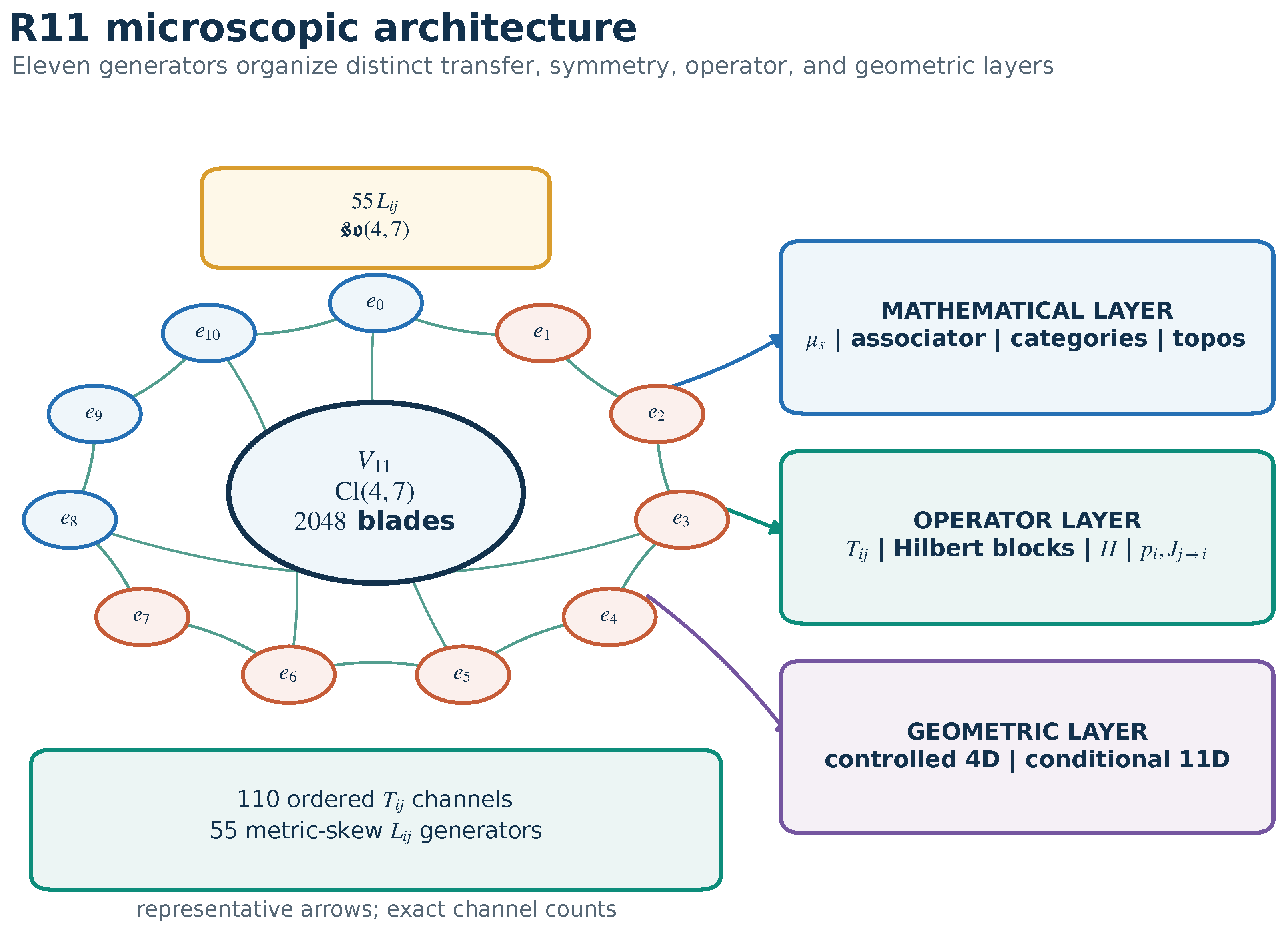
The first four results establish the algebraic and categorical foundation. The next three show how directed microscopic structure can support conservative operator dynamics and a controlled geometric realization. The last identifies observable interfaces without converting a normalized response into a numerical prediction. Figure 1 gives the resulting one-page map from the carrier to its mathematical, operator, and geometric layers.
Figure 1.
R11 architecture. The eleven-generator quadratic carrier supports 110 directed microscopic replacement channels, while metric-skew combinations form a distinct 55-generator layer. The mathematical branch contains the scale and categorical structures; the operator branch contains self-adjoint sector dynamics; and the geometry branch distinguishes the controlled four-dimensional realization from the conditional eleven-dimensional research branch.
2. Mathematical Foundations: Algebraic Structure
2.1. Quadratic Carrier and Clifford Classification
Definition 1
(R11 quadratic carrier). Let be an eleven-dimensional real vector space with ordered basis and nondegenerate quadratic form
The R11 Clifford carrier is
The phrase “eleven-dimensional algebra” is avoided: has dimension 11, while its Clifford algebra has dimension .
Proposition 1
(Standard real classification). With the positive-square/negative-square convention in Equation (1),
Consequently and .
Proof.
Thus the full algebra is not its own even subalgebra. The adopted index placement makes positive-square and negative-square; only these counts enter the classification. The distinction between the carrier dimension and the algebra dimension is important: the eleven generators specify elementary directions, while the 2048 ordered blades encode all their multivector combinations.
Our Clifford notation lists positive squares first. Accordingly, a physical four-dimensional tangent metric of signature has real Clifford fiber type . Selecting one positive-square and three negative-square internal generators instead produces an abstract subalgebra of ; it is not identified with . Comparing the two requires an explicitly justified sign reversal, complexification, or representation map, none of which is implicit in the internal carrier.
2.2. Ordered Blades and Exact Multiplication
For , define and . Let denote symmetric difference and
Theorem 1
(Exact ordered-blade product). For all ordered basis blades,
Proof.
Move, from left to right, each generator in through the ordered word until the combined word is increasing. Every unequal inverted pair contributes one minus sign, giving . Equal adjacent generators contract to and are removed in pairs, leaving precisely the symmetric-difference blade. No other terms occur because the basis is orthogonal. A bit-mask proof and exhaustive verification are supplied in the supplement and code. □
Examples include
The accompanying implementation stores I as an 11-bit mask and evaluates Equation (5) exactly. This bit-mask representation is more than a computational convenience: it makes support, grade, intersection, and directed replacement tests transparent at the level of individual blades.
2.3. Grading, Subalgebras, and Familiar Number Systems
The standard grading is
For any index set I, define
Proposition 2
(Dimensional subspaces). Each is the Clifford subalgebra generated by . Moreover,
Equality in Equation (10) is not generic because mixed blades can occur only on the right.
Proof.
Equation (5) gives closure and product support. Linear independence of the blade basis gives the intersection identity and the stated inclusion. □
The span is a copy of because . The span is a copy of . Octonions are not a subalgebra under the inherited Clifford product: every subalgebra of an associative algebra is associative. A projected nonassociative product or external octonion module may be studied in a future exceptional-algebra extension, but neither is assumed here.
3. Scale-Dependent Algebra
3.1. Clifford–Jordan Interpolation with Dimensionless Weight
Let be a positive resolution-length scale and let be a crossover or matching length with the same units. The ratio is dimensionless. Smaller s means finer resolution and greater Clifford weight; larger s means coarser resolution and greater Jordan weight. The algebra does not identify with the Planck length. Let be dimensionless and set
The physical domain is . The values and are continuous computational endpoint extensions used to verify and ; they are not physical scales. No dimensionful Planck constant is inserted into the algebraic coefficients.
Definition 2
(Endpoint and scale products). For , define
and
The labels Q and C mean quantum-weighted and classical/geometric-weighted algebraic endpoints. They are not, by themselves, complete models of quantum mechanics or general relativity.
Proposition 3
(Actual endpoint properties). is bilinear, unital, associative, and generally noncommutative. is bilinear, unital, commutative, power-associative as a special Jordan algebra, and generally nonassociative. The family is bilinear and continuous in s, with
Every is closed under all three products.
Figure 2 combines the fixed signature data, the crossover weight, and the associator behavior in a single view of the scale family.
3.2. Exact Associator and Cohomological Status
For any bilinear product m, write
Let and .
Theorem 2
Proof.
Expand both nested occurrences of and collect the , , and terms. Equation (18) follows by direct expansion of the symmetrized product. Equivalently, with , ; direct expansion gives and . □
Proposition 4
(Narrow cohomological status). Fix s and use the associative algebra with its regular bimodule. Let the Hochschild 2-cochain be . With
one has
Thus is an exact, hence cohomologically trivial, Hochschild 3-cocycle at each fixed scale.
The statement is deliberately local in scale and precise about its cochain complex: it uses the associative Clifford algebra, its regular bimodule, and the displayed cochain. Exactness here classifies this associator in that specific Hochschild complex; it supplies no causal, higher-categorical, or unitarity conclusion. Alternative deformations with nontrivial cohomology remain open to classification.
Table 2 records the algebraic properties that survive in each resolution regime without assigning either endpoint a complete physical theory.
4. Mathematical Foundations: Categorical Framework
4.1. Defect-Tracked Scale Category
Fix a set of allowed positive scales . For and , define the closed scale-labelled algebraic object
For a linear map , define its canonical multiplicative defect between scales s and t by
The defect is derived data, not an independently adjustable correction.
Theorem 3
(Defect-tracked R11 category). Objects and morphisms form a category . If and , then
The categorical identity on has zero defect. The same underlying identity map between different scale-labelled objects has
and is not a categorical identity when .
Proof.
This construction records failure of multiplicativity rather than pretending every transfer is an algebra homomorphism. It therefore accommodates the microscopic directed maps introduced below without confusing their defects with categorical identities.
4.2. Scale Functor
Let satisfy .
Proposition 5
(Scale functor). The assignment
with canonical defects recomputed at the rescaled endpoints, is an endofunctor on .
Proof.
The underlying linear identity and compositions are unchanged. Applying Equation (24) with proves that the recomputed defect of a composite is exactly the composite defect required in the rescaled objects. □
When , the same relabelling acts on a typed transfer generator by
This statement changes the scale labels and recomputes the corresponding defects; it does not turn the scale parameter into a dynamical spacetime field.
4.3. Transfer Path Category and Presheaf Topos
Let be the directed quiver whose vertices are the admissible scale-labelled subalgebras. For and , its generating arrow is the nontrivial typed restriction
of the global replacement map defined in Section 5. Its canonical same-scale multiplicative defect is
If , the restriction is the zero map and is available algebraically but is not a quiver generator. The free path category has finite directed paths as morphisms and empty paths as identities.
No relation is imposed. Indeed, occupancy restrictions make it false in general. The microscopic statement concerns a linear self-transfer operator; it is not the identity path. The distinction between and is useful: the former records how linear maps fail to preserve multiplication, whereas the latter remembers the order and composability of actual transfer histories.
Corollary 1
Presheaves can encode scale- and path-dependent assignments of states, observables, parameter sets, or local data. This standard topos result does not by itself derive quantum mechanics, spacetime, measurement, or a holographic dictionary. A nontrivial Grothendieck topology and sheaf semantics are future refinements. Likewise, functors from selected R11 subcategories to Hilbert spaces or geometric categories are called target realization functors unless their object and arrow maps are explicitly constructed.
5. Dimensional Transfer Formalism
5.1. Directed Microscopic Replacement Maps
The indefinite quadratic form and the positive inner product used for adjoints serve different purposes. Define the positive blade inner product by
and extend sesquilinearly after complexification. This inner product does not replace the quadratic form.
For , the directed replacement map sends an occupied index i to an unoccupied index j. On a basis blade,
where
The output blade is written in increasing order. We set as a microscopic no-self-transfer convention.
Operationally, removes one occupied label and inserts another while retaining grade and the sign forced by ordered exterior reassembly. For example, the declared convention gives . This blade-level action supplies a microscopic vocabulary for directed change. It does not yet specify a rate, a Hamiltonian matrix element, or a spacetime trajectory; those enter only in a chosen realization.
Equivalently, for , in the exterior realization, with exterior creation and contraction relative to the positive orthonormal basis. The explicit sign in Equation (32) fixes all ordering conventions.
Theorem 4
(Directed replacement properties). For , is real-linear, preserves grade, obeys , and satisfies
with respect to Equation (31). There are ordered nonzero channel labels.
Proof.
Linearity and grade preservation are immediate from Equation (32). After a nonzero application, i is absent and j is present, so a second vanishes. The blade matrix of is a signed partial permutation matrix, and reversing each nonzero replacement gives the transpose signed partial permutation ; hence Equation (34). The supplement gives the basis-level sign proof and exhaustive checks. □
The 110 maps are directed data. They are neither Clifford bivectors nor a basis of a 55-dimensional Lie algebra, and an individual is not called a unitary map.
5.2. The Distinct Metric-Skew Lie Layer
Let . For , define
and extend . With the standard matrix-unit convention , one has and therefore
Theorem 5
( representation). The 55 independent are metric-skew,
and their exterior action satisfies
Thus they realize on the Clifford/exterior carrier.
Proof.
The matrix-unit form gives metric skewness by direct multiplication and yields Equation (38) from . The exterior representation preserves commutators. All 55 matrices and commutators are checked computationally. □
The group preserves the fixed quadratic form and its signature. Genuine signature evolution would require a family of forms or a different dynamical groupoid; it is not generated by itself. The distinct domains and roles of the microscopic, Lie, and realized operators are collected in Table 3.
5.3. Hermitian Phase-Covariant Classical Exchange
A classical exchange current requires an action and a symmetry; an arbitrary field difference is not a Noether current. The following is one explicit Hermitian realization on a four-dimensional Lorentzian spacetime .
Let be complex scalars and let be a Hermitian mixing matrix with mass dimension two. Define
With real , variation with respect to gives
Define the sector phase current
Then
The diagonal global symmetry therefore gives
Equations (42) and (44) are properties of this declared realization, not universal identities of the abstract Clifford carrier.
Hermiticity of K guarantees a real action and the antisymmetric exchange sources above; it does not by itself prove classical stability. If stability is required, the total potential
must be bounded below, the chosen background must be stationary, and its Hessian must be nonnegative (or positive, when strict stability is intended) on the relevant real fluctuation sector.
5.4. Quantum Direct-Sum Transfer Network
Let
with injections , projections , and . For clarity the theorem below is stated for finite-dimensional sectors, or more generally for bounded blocks; an unbounded realization must supply a common invariant dense domain and a self-adjointness theorem.
Let on and . Define
Theorem 6
(Self-adjoint transfer evolution). Under the stated assumptions, and
is unitary. A solution of satisfies
Proof.
Unitarity belongs to the full evolution. A rectangular block is not individually unitary unless its source and target dimensions and additional isometry conditions happen to permit that separate statement.
5.5. Microscopic Sector Populations and Pair Currents
For a density operator satisfying , define
Then
Let and .
Theorem 7
(Pairwise population-current decomposition). Define
For the self-adjoint block model,
Proof.
Block expansion of gives a term and its conjugate . Their difference yields . Interchanging i and j complex conjugates , proving antisymmetry and total conservation. □
These are microscopic population currents of the declared direct-sum realization. A coarse-graining may aggregate them into a two-sector projector current
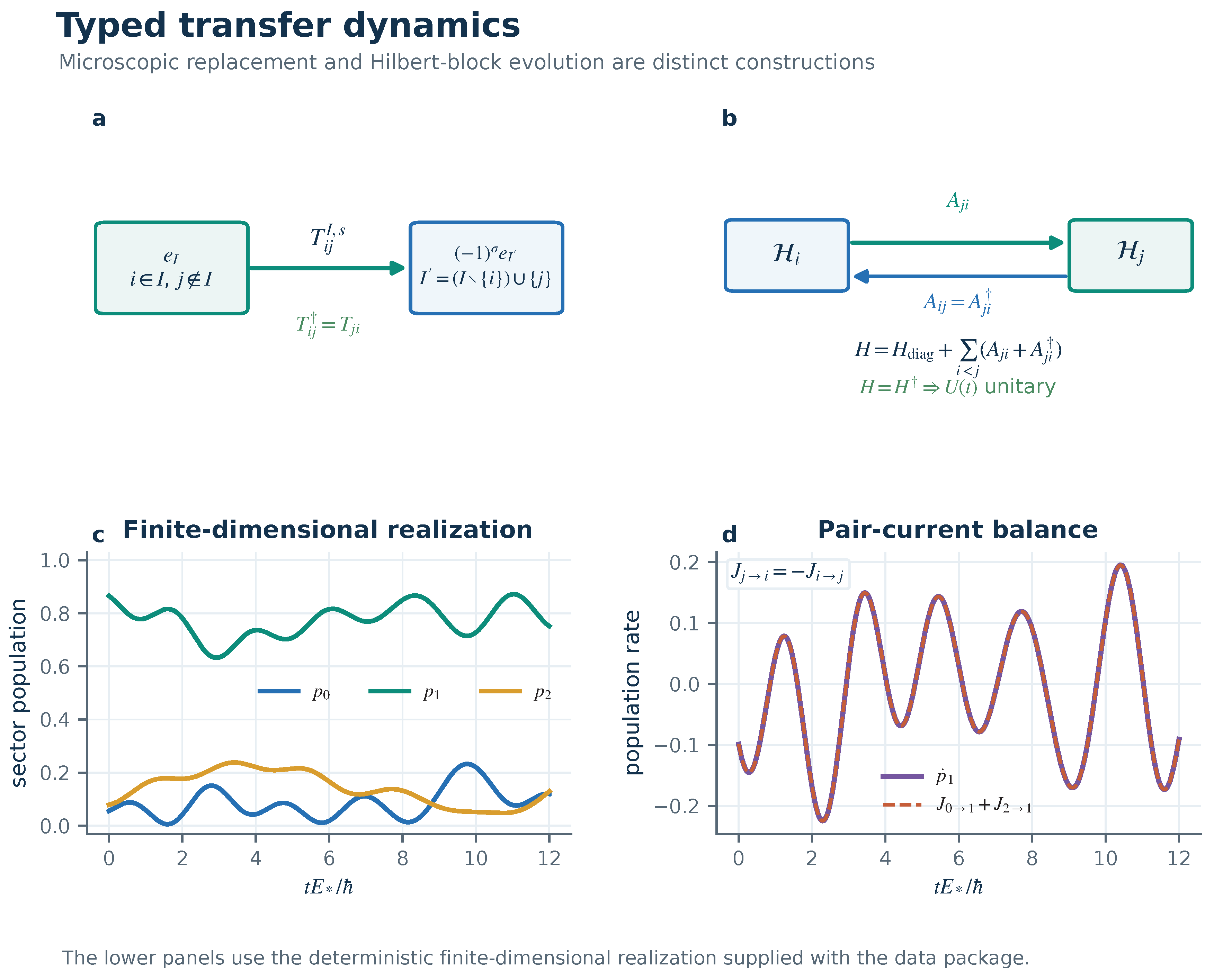
but the objects are not identical and the aggregation remains realization dependent [3]. Figure 3 follows the typed progression from a blade replacement to the adjoint-paired block model and its conservative population currents.
Figure 3.
Typed transfer dynamics. Directed microscopic blade replacements motivate, but do not automatically equal, rectangular Hilbert blocks. Adjoint-paired blocks make the full Hamiltonian self-adjoint; fixed projectors define populations and exact antisymmetric pair currents. The displayed relations are calculated identities of the stated block realization.
5.6. Incoherent Channel and Local QFT Realizations
Coherent Hamiltonian transfer and a quantum channel are distinct constructions. For a fixed source sector , Kraus maps define a trace-preserving channel only when
including a no-transfer outcome when required.
An explicit local QFT ansatz may instead use Dirac fields of mass dimension in a common four-dimensional Fock space and common Lorentz/gauge representation:
The local mixing matrix has mass dimension one and must respect the declared internal symmetries. Higher-dimensional transfer operators appear with Wilson coefficients and powers of a cutoff . Equation (58) is a Hermitian R11 QFT realization/ansatz, not a microscopic matching theorem or ultraviolet completion.
5.7. Realization Levels and Program Context
The coherent Hamiltonian, incoherent channel, and local-field constructions are three distinct realization levels. Each requires its own state space, domains, symmetries, and matching coefficients. Related compactification and cosmology studies develop effective two-sector currents and parity-sensitive observables, while a broader foundations study places the typed algebraic and information-geometric structures in a common setting [2,3,4]. These effective objects can motivate matching maps, but they do not redefine the microscopic operators used here. The present article therefore supplies the originating microscopic and algebraic R11 quantum-gravity framework; the later effective studies draw on it without serving as proofs of its results.
The accompanying reproducibility package implements the 2048-blade carrier, replacement maps, Lie generators, scale product, associator, finite block dynamics, information-transfer toy, phenomenological response functions, and all numerical values plotted in this article. Its finite checks support the stated identities within their executable domains; analytic theorems retain the hypotheses given in the text.
6. Controlled Four-Dimensional and Conditional Eleven-Dimensional R11 Realizations
The algebraic carrier and physical spacetime have different mathematical types. Let be an oriented, time-oriented four-dimensional Lorentzian manifold of signature , with Levi–Civita connection and spacetime Clifford bundle . Independently, let
The internal generators are fiber labels, not spacetime coordinates. The positive blade metric used for adjoints and field energies is distinct from both g and the indefinite internal form . The minimal realization uses a flat fiber connection ; a nontrivial internal connection would be additional dynamical data.
Definition 3
(Four-dimensional R11 realization). A minimal typed realization is
An eleven-dimensional spacetime interpretation is not part of this four-dimensional construction.
6.1. Conditional Eleven-Dimensional Geometric Branch
The eleven-generator carrier makes an eleven-dimensional geometric realization a natural and important research objective, but algebraic dimension alone does not supply a spacetime. A complete branch on must independently establish: (i) a physical metric and signature; (ii) a causal structure; (iii) a hyperbolic initial-value formulation; (iv) ghost and stability control; (v) a dimensionally consistent eleven-dimensional action; (vi) the precise relation among , , and ; (vii) compactification or reduction to the controlled four-dimensional theory; (viii) a matching from microscopic dynamics to geometric evolution; (ix) boundary conditions; and (x) consistency with the fixed-signature algebraic layer. In particular, this branch neither establishes four physical time dimensions nor inherits the four-dimensional action unchanged. It remains scientifically valuable because satisfying these conditions would connect the exact microscopic carrier to a genuinely dynamical higher-dimensional geometry.
6.2. Metric Independence of the Scale Product
For scalar projection , the scale product obeys
Thus its symmetric generator product recovers the fixed internal quadratic form (up to representation trace normalization); it does not induce a scale-dependent spacetime metric. The Lorentzian field is therefore independent geometric data varied in the action below.
6.3. Real Covariant Effective Action
Use in this subsection and hold the positive resolution scale s fixed over spacetime. Let be a real R11-valued scalar multiplet and set
This expression is real and requires no associativity assumption. Because both arguments coincide, is exactly independent of for the declared endpoints; any scale dependence in this one-field truncation resides in and the transfer coefficients. A genuinely ordering-sensitive interaction would require distinct ordered fields and therefore defines a different interaction. The 110 directed channels remain microscopic data while forming the self-adjoint quadratic kernel
Here are real dimensionless matching functions. A sufficient quadratic stability condition is .
The conditional two-derivative effective action is
The mass dimensions are
Every displayed Lagrangian term therefore has dimension four. Higher EFT operators require explicit powers of a cutoff .
Proposition 6
(Variational field equations). Assume compactly supported variations (or fixed boundary data) and spacetime-covariantly constant internal data. Variation of Equation (64) gives
where
and
Writing and , the gradient is
The supplement gives the complete field and metric variations. The transfer stress is obtained from the same action, rather than appended to Einstein’s equation by analogy.
6.4. Connection, Conservation, and Conditional Limits
This realization is torsion-free and metric-compatible:
Consequently,
on the field equations. Transfer modifies the source sector; it does not modify the geometric Bianchi identity. If s or the kernels become fields, their actions and balance equations must be included.
Proposition 7
This is a matched consistency limit, not a derivation of general relativity from an endpoint of alone.
Proposition 8
(Conditional quantum-mechanical sector limit). Let a bounded finite-dimensional realization satisfy
Then Duhamel’s identity gives
so initial data in the physical block converge uniformly on compact time intervals to . For unbounded operators, common-domain or strong-resolvent control is required.
The two geometric levels and their distinct construction burdens are shown in Figure 4.
6.5. Curvature Diagnostic for an Metric Correction
Proposition 9
(An term is not regularizing). For
the exact Kretschmann scalar is
Thus produces a leading divergence, while retains the Schwarzschild divergence.
This diagnostic rules out the displayed correction as a singularity-resolution mechanism. Any alternative must establish finite curvature invariants, controlled horizons and asymptotics, on-shell stress conservation, causal-geodesic extension, and perturbative hyperbolicity and stability.
7. Quantum Foundations and Information Transfer
7.1. Conditional Hilbert and Symplectic Kinematics
Standard quantum kinematics can be applied inside a chosen R11 Hilbert realization, but it is not generated by the scale product alone. If A and B are self-adjoint with the required finite moments on a common invariant domain, the Robertson–Schrödinger theorem gives
with the analogous definition of [18]. This is a scalar state-dependent bound. No additive tensor-valued Planck-length term is implied by .
Likewise, geometric prequantization requires separately declared symplectic data. A symplectic manifold admits a Hermitian line bundle with unitary connection
exactly when is an integral de Rham class [19]. If and remains nondegenerate, a fixed prequantum bundle may use . Approximate integrality is not integrality, a connection potential is a one-form rather than a two-form, and polarization is still needed for geometric quantization. These are conditional consistency results, not an R11 derivation of quantization.
7.2. A Valid R11 Quantum-Instrument Realization
Let be a density operator, let , and let bounded Kraus maps have range in the ath orthogonal outcome sector and satisfy
Define the operations and outcome probabilities
Proposition 10
(Transfer-network instrument). If selected R11 transfer blocks, after injection into the common output and possibly after unitary coupling to an environment and projection on orthogonal pointer sectors, give Kraus maps obeying Equation (80), then is a completely positive quantum instrument, , and for every normalized ρ.
Proof.
Each operation has Kraus form and is completely positive. Cyclicity of the trace and Equation (80) give . □
This is a valid realization of measurement as sector transfer; it does not derive the Born rule from R11 first principles [15]. Decoherence may be obtained by tracing an explicit environment in the unitary model. A quantitative decoherence time additionally requires a stated state, spectral density or noise kernel, and coupling strengths, none of which is fixed by the bare algebra.
Coherent transfer also does not clone an arbitrary unknown state. If a unitary U obeyed for all , preservation of inner products would require , which fails for generic nonorthogonal states [17]. R11 redistribution is therefore compatible with the no-cloning theorem.
7.3. R11 Unitary-Transfer Toy Model
To test the information bookkeeping, take three qubits
where B, R, and X are black-hole-like, radiation-like, and auxiliary R11 sectors. On the one-excitation chain let
It is self-adjoint. For ,
The populations are
The global state remains pure, . Each one-qubit reduction has spectrum and entropy
At the excitation has transferred completely from B to X. These identities are reproduced by exact diagonalization and partial traces in the companion code.
For comparison, Page’s random-state benchmark for a bipartite Hilbert space with dimensions has mean smaller-subsystem entropy
in nats [20]. This statistical benchmark and the deterministic three-qubit transfer curve answer different questions. The partition benchmark is plotted in Figure 5, while Figure 6 displays the exact dynamics of the finite transfer chain.
The model proves only that the typed R11 network can preserve global information while redistributing it. A black-hole information calculation would still require a dynamical geometry, quantum fields on that geometry, state preparation, backreaction, radiation observables, and a controlled semiclassical or quantum-gravitational approximation.
7.4. Holography and ER=EPR as Research Targets
The transfer path category and its presheaves supply candidate bookkeeping for data distributed over boundary- and bulk-labelled objects. No functor identifying those objects with a gravitational boundary theory, no entanglement-wedge reconstruction map, and no area law have yet been constructed. Holography is therefore an R11 research direction, not a derived dictionary. Likewise, ER=EPR is a conceptual comparison: no map from R11 transfer entanglement to a semiclassical wormhole geometry is claimed [21].
8. Phenomenological and Experimental Realizations
8.1. Exchange Cosmology and Oscillatory Equation of State
The microscopic pair currents motivate asking how a conserved exchange would appear after a severe coarse graining into visible and auxiliary cosmological sectors. At that phenomenological level, a dimensionally closed two-component branch is
where is a dimensionless matching parameter, not an algebraic prediction. Summing the equations gives total continuity. A separate no-exchange illustrative template explores an oscillatory equation of state:
Here is a fit/model parameter. The displayed illustrations use solely to expose the response and sign; none is inferred from a Planck length or fit to data.
Figure 7 places the conserved exchange law beside the separate oscillatory equation-of-state template and its density response.
Cosmological surveys constrain time-dependent dark-energy models, but the R11 template cannot be confronted with those data until a likelihood, nuisance model, and microscopic matching calculation are specified [24]. Connecting the exchange current to a controlled compactification chain remains an open forward-matching problem [2,3].
8.2. Gravitational-Wave and CMB Response Templates
For the helicity vector and an EFT scale , consider the Hermitian propagation matrix
The perturbative propagation regime additionally requires
At leading order, the normalized eigenmode response is for an eigenvalue of . The common term gives dispersion, gives helicity birefringence, and the off-diagonal give polarization mixing. Under Equation (91), the eigenfrequencies are positive and real; together with the nondissipative perturbative WKB approximation, this yields phase-unitary propagation. Hermiticity alone is not sufficient for that statement. Damping would require a separate friction or noise kernel. These Wilson coefficients are not determined here.
Figure 8 displays the response per unit eigenvalue together with the physical conditions under which the perturbative expression applies.
Gravitational-wave catalog tests constrain departures from general relativity [25,26]. The present propagation ansatz is distinct from the compactification-based primordial tensor chirality developed in a companion cosmology calculation [2]. In that controlled weak-coupling, ghost-free, adiabatic specialization,
with and ; the ellipsis denotes higher weak-coupling, slow-roll, and adiabatic corrections. One must not substitute these horizon-exit parameters or conventions into Equation (90) without a matching calculation.
A data-free CMB shape template is
All displayed amplitude, frequency, scale, width, and phase quantities are phenomenological inputs. The plotted example uses , , , , , , and a separate shape illustration.
Figure 9 isolates the windowed oscillatory shape and the steps needed to connect it to a likelihood.
Confronting this shape with a CMB likelihood requires transfer functions, foreground and calibration nuisance parameters, a covariance model, and a microscopic map to and the shape parameters. No survey sensitivity is inferred from the normalized curve.
8.3. Laboratory and Open-System Constraint Channels
Each laboratory channel is organized by an effective operator, a dimensionless response coordinate, an unmatched coefficient, and the experimental ingredients needed for a constraint. For tunneling, begin with the explicit effective Hamiltonian
where and are dimensionless. On a forbidden interval, its linear WKB response is
For neutron paths and , a potential gives the dimensionless phase
For an idealized vacuum-mode branch, specify the spectrum before the force:
The observable is only after the boundary–continuum mode difference is renormalized. Its leading form contains a nonuniversal fixed by field content, boundary conditions, counterterms, material response, temperature, and geometry.
Finally, a completely positive open-system template is
for dimensionless L and . Every remains an unmatched coefficient.
For the four-channel laboratory-response comparison below, the four channel-specific dimensionless invariants are sampled over and the normalized display laws are chosen as , , , and . These are declared illustrative response coordinates, not derivations of absolute signal magnitudes from.
Table 4 states the next calculation needed to turn each response or toy construction into an empirical test.
9. Computation, Parameters, and Framework Context
9.1. Measured Implementation Benchmarks
The reproducibility package uses exact 11-bit blade masks and sparse multivectors. It reports CPU measurements from the recorded reference environment, including raw repetitions, warmups, precision, input sizes, sparsity, timer, and hardware metadata. These timings are implementation characterization, not GPU/FPGA/TPU comparisons and not evidence for quantum speedup.
9.2. Typed Parameter Census
The carrier dimension, signature, and blade ordering are discrete conventions. Physical realizations additionally require functions, coefficients, state and boundary data, and matching choices. Keeping these types separate prevents a fixed algebraic convention from being mistaken for a fitted parameter.
Table 5 separates conventions, matching functions, state data, and phenomenological coefficients.
9.3. Relations to Other Quantum-Gravity Programs
R11 shares organizing motifs with several quantum-gravity programs, but an analogy becomes an equivalence only after an explicit map of actions, states, spectra, or observables. Table 6 states the present level of each comparison and the missing mathematical construction.
The information-geometric and QFT companion study develops additional conjectural connections but is not used as a proof of anomaly cancellation, a unique Standard Model, three generations, a code, black-hole information recovery, or the Born rule [1]. Those topics require independent typed constructions. The broader foundations synthesis is likewise used for program context rather than as a premise of the exact results proved here [4].
10. Discussion and Outlook
The central contribution of R11 is a separation of mathematical structures that must remain distinct if the framework is to support physical interpretation. The real quadratic carrier fixes an exact Clifford product and a finite blade basis. On that carrier, the ordered replacements provide 110 directed transfer channels, whereas the metric-skew combinations span the 55-generator orthogonal Lie layer. Directional transfer and reversible internal symmetry can therefore coexist without being identified. The scale-labelled product, its computed associator, the defect and free-path categories, and the associated presheaf construction extend this distinction to composition across scales.
Exact algebra does not, by itself, select the physical use of scale. The family , the reference value , and the matching between s and a laboratory or cosmological resolution length remain realization data. The limiting products characterize algebraic regimes; they should not be read as an automatic derivation of a quantum-to-classical transition. Likewise, the internal quadratic form of signature organizes the carrier but does not create a spacetime metric or prove that this signature is dynamically preferred. A selection principle for the signature and the scale family would therefore be a substantive physical result rather than a change of notation.
The four-dimensional covariant realization shows how R11-valued fields may be coupled to a Lorentzian metric through a real effective action with well-defined variations and a general-relativistic consistency limit. It is a controlled bridge to gravitational physics, but it is not a unique action and has not been obtained by coarse-graining the transfer system [12,13,14]. The conditional eleven-dimensional branch carries a larger burden: its physical interpretation requires dynamics that select and stabilize a four-dimensional extended spacetime together with seven compact directions (a dimensional decomposition distinct from the fixed internal algebraic signature ), determine the low-energy spectrum, control chirality and anomalies, and remain consistent under renormalization and backreaction. Comparisons with string theory, loop quantum gravity, or holography become physical only when an explicit map relates observables, spectra, or state spaces on both sides.
The finite-dimensional quantum realizations establish several useful facts. A Hermitian transfer Hamiltonian generates unitary evolution, its block populations satisfy exact current-balance equations, and the measurement map used here is a valid quantum instrument [15,16]. The three-qubit example similarly demonstrates unitary relocation of correlations. These results show that the transfer architecture is compatible with operational quantum mechanics; they do not derive the Born rule or a microscopic theory of measurement. Nor does a Page-type finite-system benchmark constitute a black-hole evaporation calculation. That problem requires joint evolution of geometry and quantum state, horizon-scale backreaction, and a fine-grained entropy calculation [22,23]. A holographic interpretation would additionally require a boundary algebra, a bulk–boundary map, and an independently derived area law.
The phenomenological sectors are best understood as interfaces between the framework and data. Their normalized response functions identify how an R11 coefficient could enter cosmological evolution, wave propagation, CMB statistics, or laboratory dynamics. Until those coefficients are obtained from a common microscopic matching calculation, the responses are parameterized templates rather than absolute signal predictions. DESI and gravitational-wave results could constrain a specific R11 realization only after its coefficient map, likelihood, and nuisance model are supplied; the generic effective constraints do not select R11 from the broader space of models. The same principle applies to any future signal: evidential force would come from linked predictions across independent channels, not from fitting each channel separately.
The most consequential next calculation is a controlled map from blade-level replacement amplitudes to Hilbert-space operators and then to Wilson coefficients in the covariant theory. That map would make renormalization, vacuum selection, compactification, and likelihood analysis part of one testable chain. In parallel, the framework needs a background-sensitive black-hole calculation and a perturbative cosmology carried through to observable correlation functions. These steps also define clear failure modes: inconsistency of the low-energy action, an unavoidable anomaly or instability, or exclusion of a derived cross-channel relation would rule out the corresponding realization.
11. Conclusion
R11 supplies an eleven-generator algebraic setting in which Clifford multiplication, directed dimensional transfer, orthogonal symmetry, scale deformation, and categorical composition can be treated within one typed architecture. Its exact content includes the classified real Clifford algebra, exhaustive blade multiplication, the distinction between 110 ordered replacements and 55 metric-skew generators, the scale associator and its restricted coboundary result, the defect and path categories, and the finite-dimensional transfer identities. These elements form the mathematical foundation of the proposal.
The physical content begins with additional realization maps. The four-dimensional covariant construction provides a controlled effective description with general relativity and ordinary quantum evolution as consistency limits. The eleven-dimensional geometric branch, the information-theoretic interpretation, and the cosmological, black-hole, and laboratory applications are progressively more model-dependent. Their status does not diminish their value as research directions, but it fixes what must be calculated before they become predictions.
Figure 14 summarizes this relation between the exact carrier and its physical realizations. The central point is that each arrow has a mathematical type and a physical burden: exact constructions can be checked internally, controlled realizations must satisfy their equations and limits, model-dependent matchings require derived parameters, and open problems require new dynamics.
The practical standard is consequently clear. Mathematical coherence must be followed by matching calculations that expose the same coefficients to more than one observable. A derived low-energy spectrum, stable geometric realization, and successful cross-channel tests would substantially strengthen the framework; failure of closure, stability, anomaly consistency, or linked observational bounds would eliminate particular realizations. R11 is offered as a concrete program whose future rests on the continuing confrontation between exact structure, dynamical calculation, and experiment.
Supplementary Materials
The following supporting information can be downloaded at the website of this paper posted on Preprints.org, the accompanying Supplementary Information provides extended conventions, proofs and derivations, realization details, computational verification, and a notation glossary.
Funding
This research received no external funding.
Data Availability Statement
The original contributions presented in this study are included in the article and the supplementary material. Further inquiries can be directed to the corresponding author.
Acknowledgments
The author thanks the mathematical physics and quantum-gravity communities whose work provided the foundations and questions that motivated this study.
References
- Caulfield, T. R. Information Geometry and Directed Transfer on a Cl(4,7) Carrier: A Four-Dimensional Effective Field Theory with Anomaly Cancellation and One-Loop Running; Digital Ether Computing: Miami, USA, 2026; Unpublished manuscript. [Google Scholar]
- Caulfield, T. R. Dimensional Evolution and Primordial Symmetry Inheritance: A Comparator Framework for Compactification–Inflation Coupling and Parity-Odd Relic Sectors; Digital Ether Computing: Miami, USA, 2026; Unpublished manuscript. [Google Scholar]
- Caulfield, T. R. From Effective Dimensional Evolution to R11-Grounded Primordial Symmetry Inheritance: A Companion Cosmology Framework with Constrained (4,7) Structure; Digital Ether Computing: Miami, USA, 2026; Unpublished manuscript. [Google Scholar]
- Caulfield, T. R. Foundations of R11: Dimensional Transfer, Information-Geometric Structure, and the Emergence of Effective Physical Theories; Digital Ether Computing: Miami, USA, 2026; Unpublished manuscript. [Google Scholar]
- Porteous, I. R. Clifford Algebras and the Classical Groups, 2nd ed.; Cambridge University Press: Cambridge, UK, 1995. [Google Scholar] [CrossRef]
- Doran, C.; Lasenby, A. Geometric Algebra for Physicists; Cambridge University Press: Cambridge, UK, 2003. [Google Scholar] [CrossRef]
- MacLane, S.; Moerdijk, I. Sheaves in Geometry and Logic: A First Introduction to Topos Theory; Springer: New York, NY, USA, 1992. [Google Scholar] [CrossRef]
- Polchinski, J. String Theory, Vols. 1 and 2; Cambridge University Press: Cambridge, 1998. [Google Scholar]
- Rovelli, C. Quantum Gravity; Cambridge University Press: Cambridge, 2004. [Google Scholar]
- Bombelli, L.; Lee, J.; Meyer, D.; Sorkin, R. D. Space-Time as a Causal Set. Phys. Rev. Lett. 1987, 59(5), 521–524. [Google Scholar] [CrossRef] [PubMed]
- Reuter, M. G. Nonperturbative Evolution Equation for Quantum Gravity. Phys. Rev. 1998, 57(2), 971–985. [Google Scholar] [CrossRef]
- Wald, R. M. General Relativity; University of Chicago Press: Chicago, 1984. [Google Scholar] [CrossRef]
- Weinberg, S. Phenomenological Lagrangians. Physica A 1979, 96, 327–340. [Google Scholar] [CrossRef]
- Donoghue, J. F. General relativity as an effective field theory: The leading quantum corrections. Phys. Rev. D. 1994, 50, 3874–3888. [Google Scholar] [CrossRef] [PubMed]
- Kraus, K. States, Effects, and Operations; Springer: Berlin, 1983. [Google Scholar] [CrossRef]
- Davies, E. B.; Lewis, J. T. An operational approach to quantum probability. Commun. Math. Phys. 1970, 17, 239–260. [Google Scholar] [CrossRef]
- Wootters, W. K.; Zurek, W. H. A single quantum cannot be cloned. Nature 1982, 299, 802–803. [Google Scholar] [CrossRef]
- Robertson, H. P. The uncertainty principle. Phys. Rev. 1929, 34, 163–164. [Google Scholar] [CrossRef]
- Kostant, B. Quantization and unitary representations. In Lectures in Modern Analysis and Applications III; Lecture Notes in Mathematics; Springer, 1970; Volume 170, pp. 87–208. [Google Scholar] [CrossRef]
- Page, D. N. Average entropy of a subsystem. Phys. Rev. Lett. 1993, 71, 1291–1294. [Google Scholar] [CrossRef] [PubMed]
- Maldacena, J.; Susskind, L. Cool horizons for entangled black holes. Fortschritte Der Phys. 2013, 61, 781–811. [Google Scholar] [CrossRef]
- S. W. Hawking, Particle creation by black holes. Commun. Math. Phys. 1975, 43, 199–220. [CrossRef]
- Almheiri, A.; Hartman, T.; Maldacena, J.; Shaghoulian, E.; Tajdini, A. The entropy of Hawking radiation. Rev. Mod. Phys. 2021, 93, 035002. [Google Scholar] [CrossRef]
- DESI Collaboration, DESI DR2 results. II. Measurements of baryon acoustic oscillations and cosmological constraints. Phys. Rev. D. 2025, arXiv:2503.14738112, 083515. [CrossRef]
- LIGO–Virgo–KAGRA Collaboration. GWTC-5.0 Tests General. Relativ. 2026, arXiv:2607.19293. [CrossRef]
- LIGO–Virgo–KAGRA Collaboration. GWTC-5.0 Constraints Cosm. Expans. Rate Modif. Gravitational-Wave Propag. 2026, arXiv:2605.27227. [CrossRef]
| 1 | The numeral records the eleven generators, . Rolandion is a working label adopted early in the project and retained for continuity with the companion manuscripts; no part of the construction depends on it. |
Figure 2.
Scale-dependent Clifford–Jordan structure. Only the ratio appears. Fine resolution is Clifford-dominant and coarse resolution is Jordan-dominant. The endpoint values are computational extensions, and the illustrative choice does not determine a physical value of .
Figure 2.
Scale-dependent Clifford–Jordan structure. Only the ratio appears. Fine resolution is Clifford-dominant and coarse resolution is Jordan-dominant. The endpoint values are computational extensions, and the illustrative choice does not determine a physical value of .
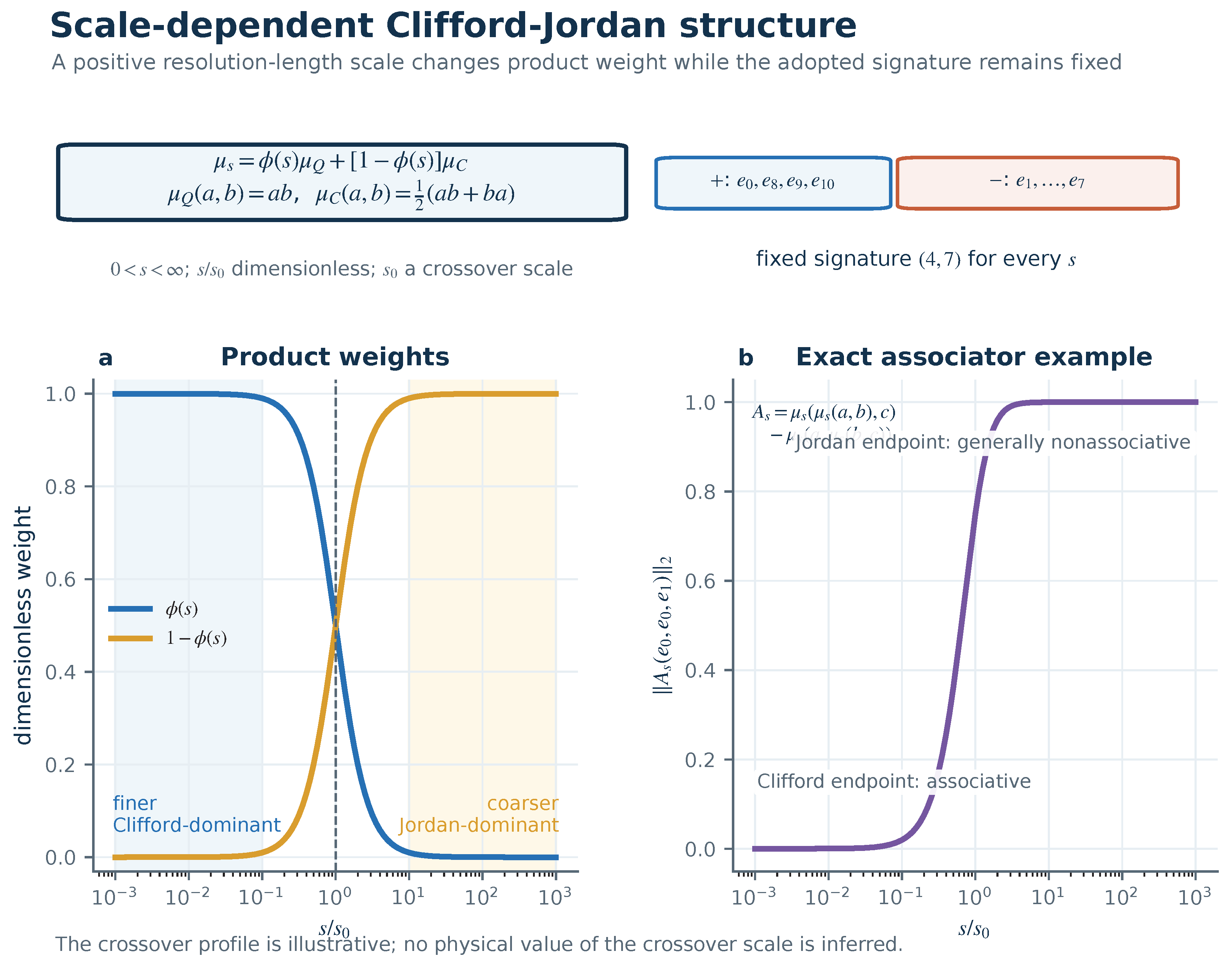
Figure 4.
R11 gravitational realization branches. The controlled branch uses a four-dimensional Lorentzian base, an independent spacetime Clifford bundle, an internal bundle, and a real covariant action. The conditional eleven-dimensional branch is shown separately with the metric, causal, dynamical, reduction, and microscopic-matching constructions still required.
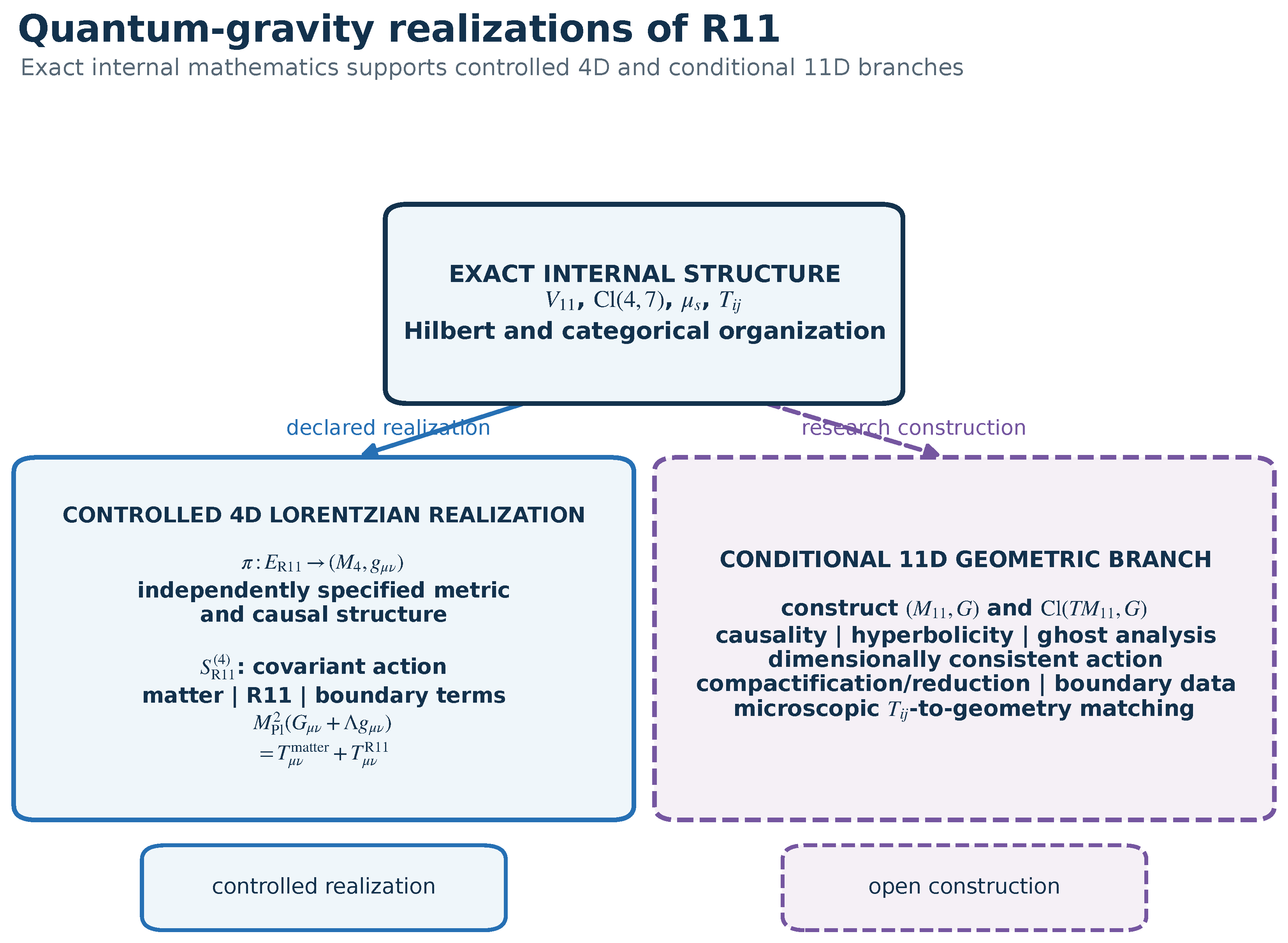
Figure 5.
Page’s exact random-state benchmark at fixed total Hilbert dimension, plotted against partition coordinate. The coordinate is not evaporation time, and no information jump is inserted.
Figure 5.
Page’s exact random-state benchmark at fixed total Hilbert dimension, plotted against partition coordinate. The coordinate is not evaporation time, and no information jump is inserted.
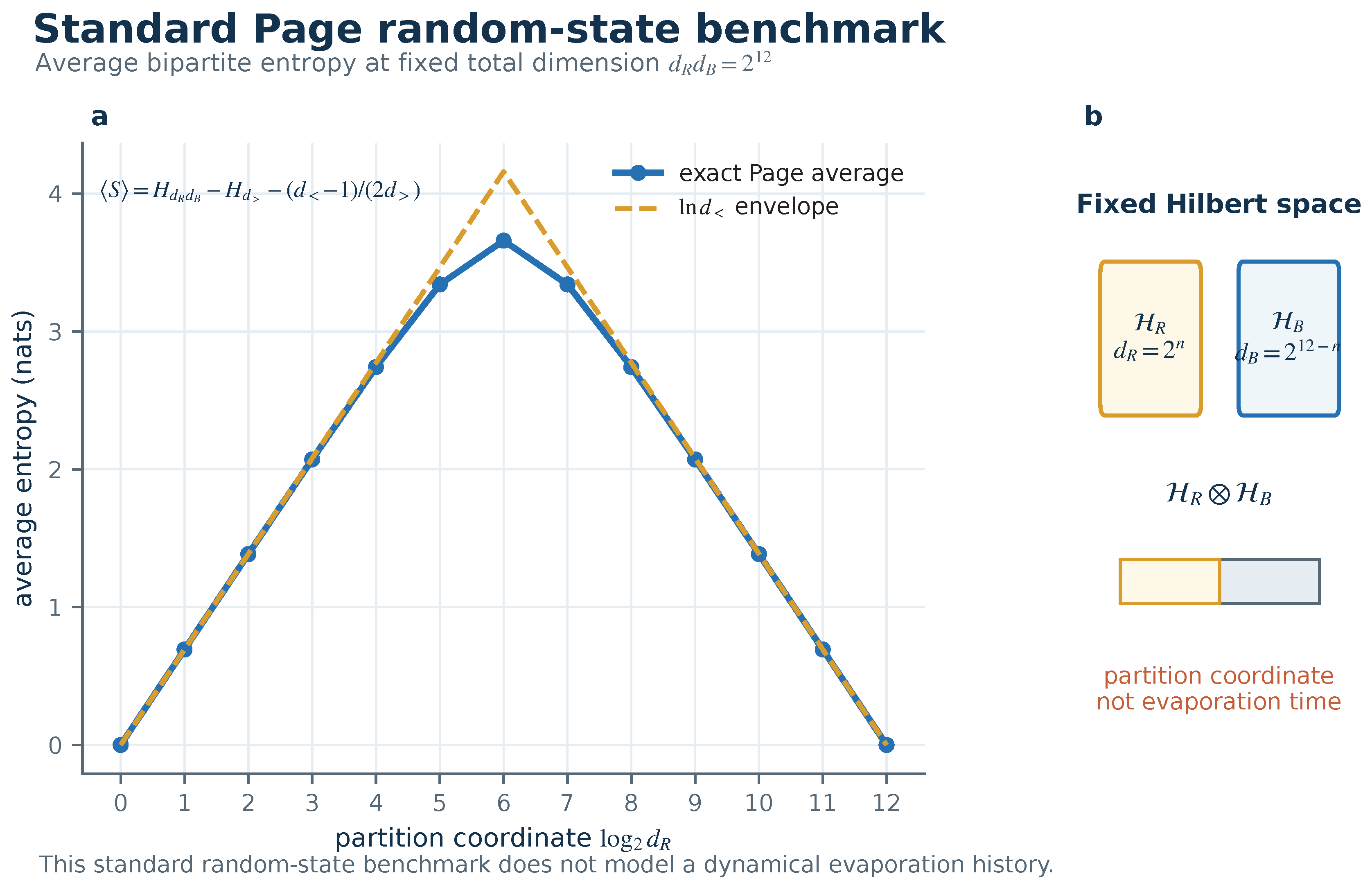
Figure 6.
Exact unitary transfer in the three-qubit model. The populations in Equation (85) and one-qubit entropies are shown together with the B–R–X coupling chain. Global entropy remains zero. This finite model tests conservative redistribution; it is not an evaporating spacetime.
Figure 6.
Exact unitary transfer in the three-qubit model. The populations in Equation (85) and one-qubit entropies are shown together with the B–R–X coupling chain. Global entropy remains zero. This finite model tests conservative redistribution; it is not an evaporating spacetime.
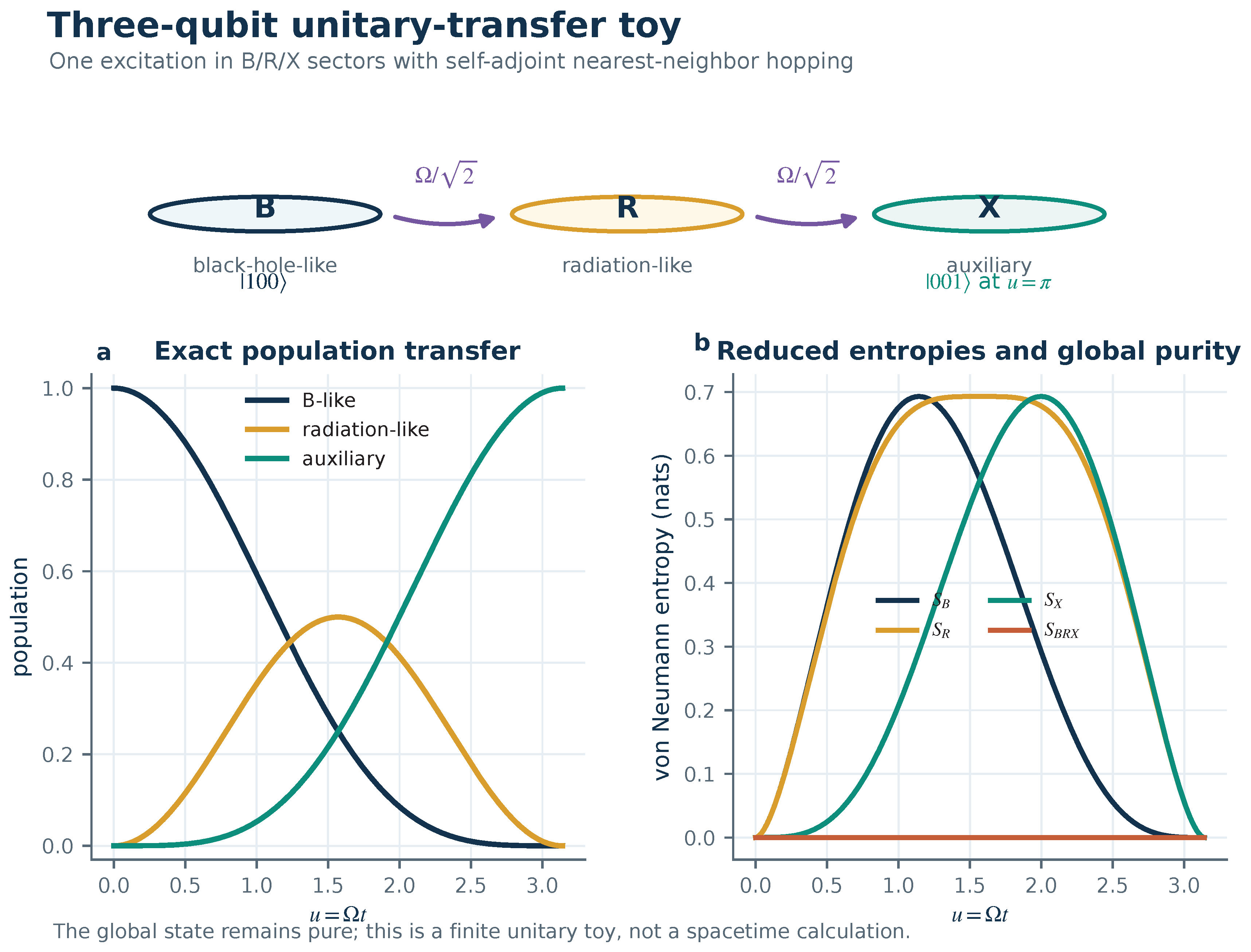
Figure 7.
Conserved exchange cosmology and an illustrative oscillatory model. The exchange equations display the exact balance. The oscillatory and continuity-consistent density ratio from Equation (89) for the stated free amplitudes . The curves are not an R11 fit or prediction.
Figure 7.
Conserved exchange cosmology and an illustrative oscillatory model. The exchange equations display the exact balance. The oscillatory and continuity-consistent density ratio from Equation (89) for the stated free amplitudes . The curves are not an R11 fit or prediction.
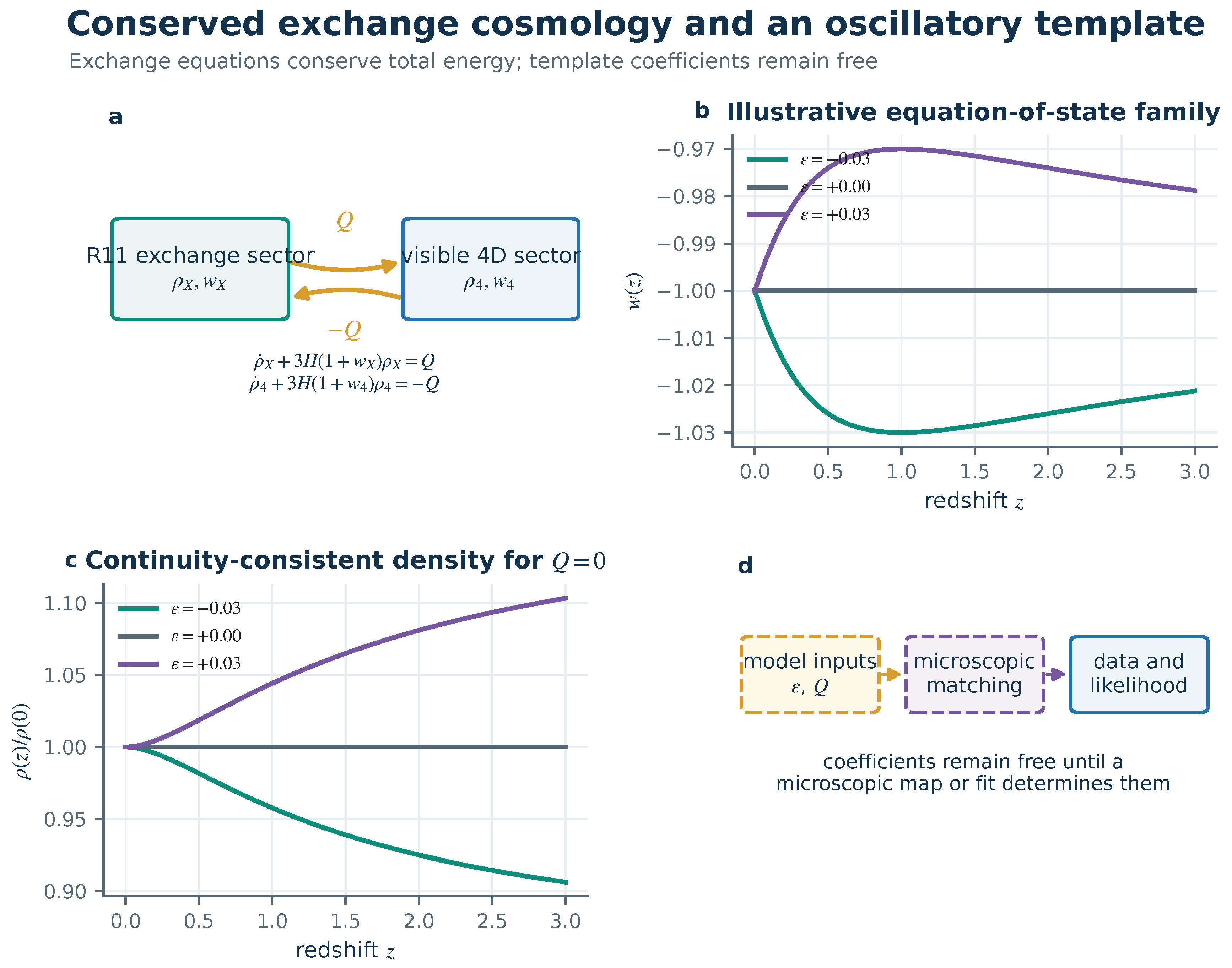
Figure 8.
Normalized gravitational-wave EFT response. The leading from Equation (90). The figure reports response per unit Wilson coefficient, not a forecast or detection significance; the positivity and perturbativity conditions delimit its validity.
Figure 8.
Normalized gravitational-wave EFT response. The leading from Equation (90). The figure reports response per unit Wilson coefficient, not a forecast or detection significance; the positivity and perturbativity conditions delimit its validity.
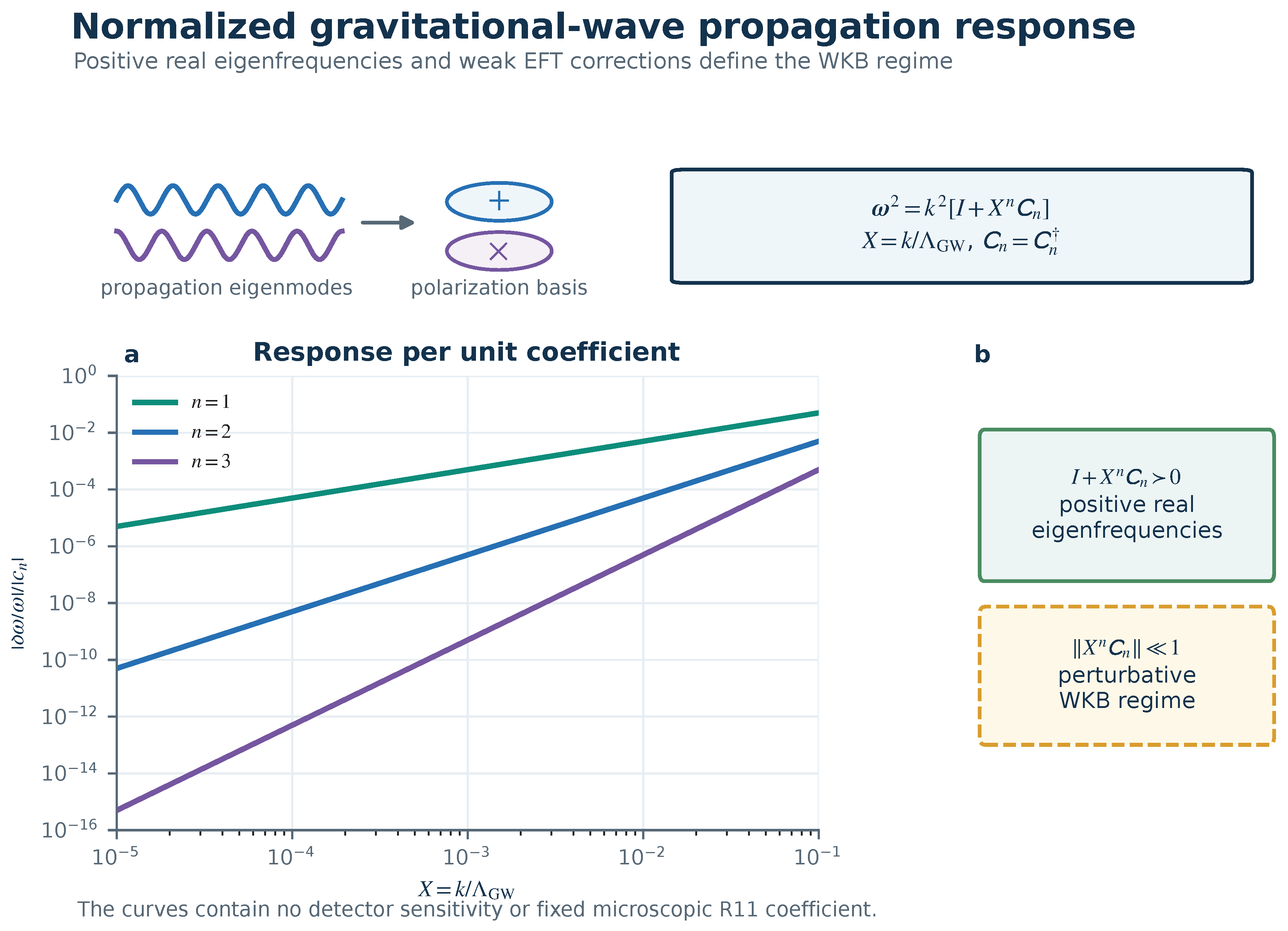
Figure 9.
Oscillatory CMB response template. The normalized shape from Equation (93), together with the declared shape illustration. No likelihood, , or significance is attached.
Figure 9.
Oscillatory CMB response template. The normalized shape from Equation (93), together with the declared shape illustration. No likelihood, , or significance is attached.
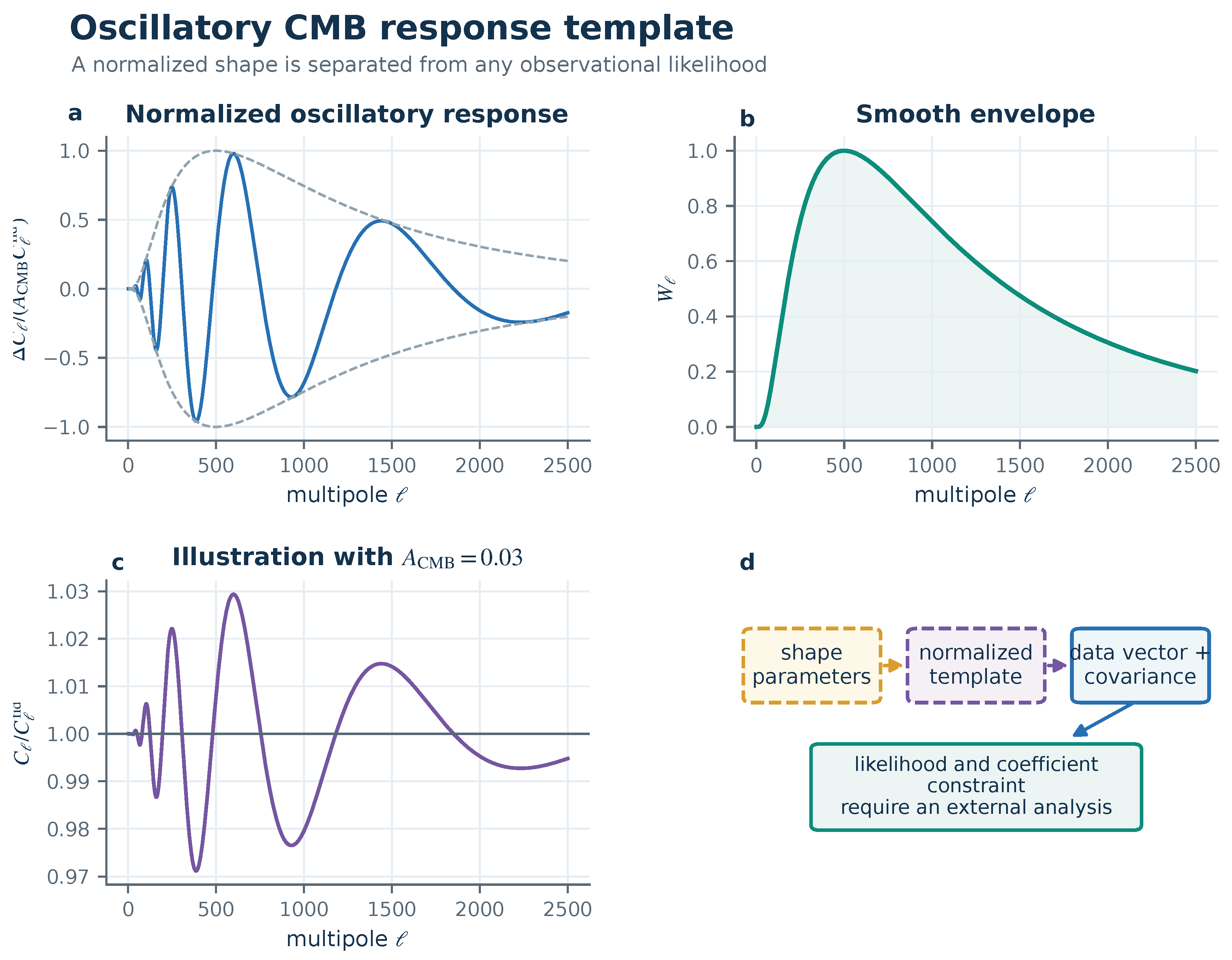
Figure 10.
R11 validation pathways. Formal definitions feed microscopic matching, effective-operator derivation, coefficient constraints, and finally laboratory or observational interfaces. Each arrow denotes a calculation that must be supplied for the following stage.
Figure 10.
R11 validation pathways. Formal definitions feed microscopic matching, effective-operator derivation, coefficient constraints, and finally laboratory or observational interfaces. Each arrow denotes a calculation that must be supplied for the following stage.
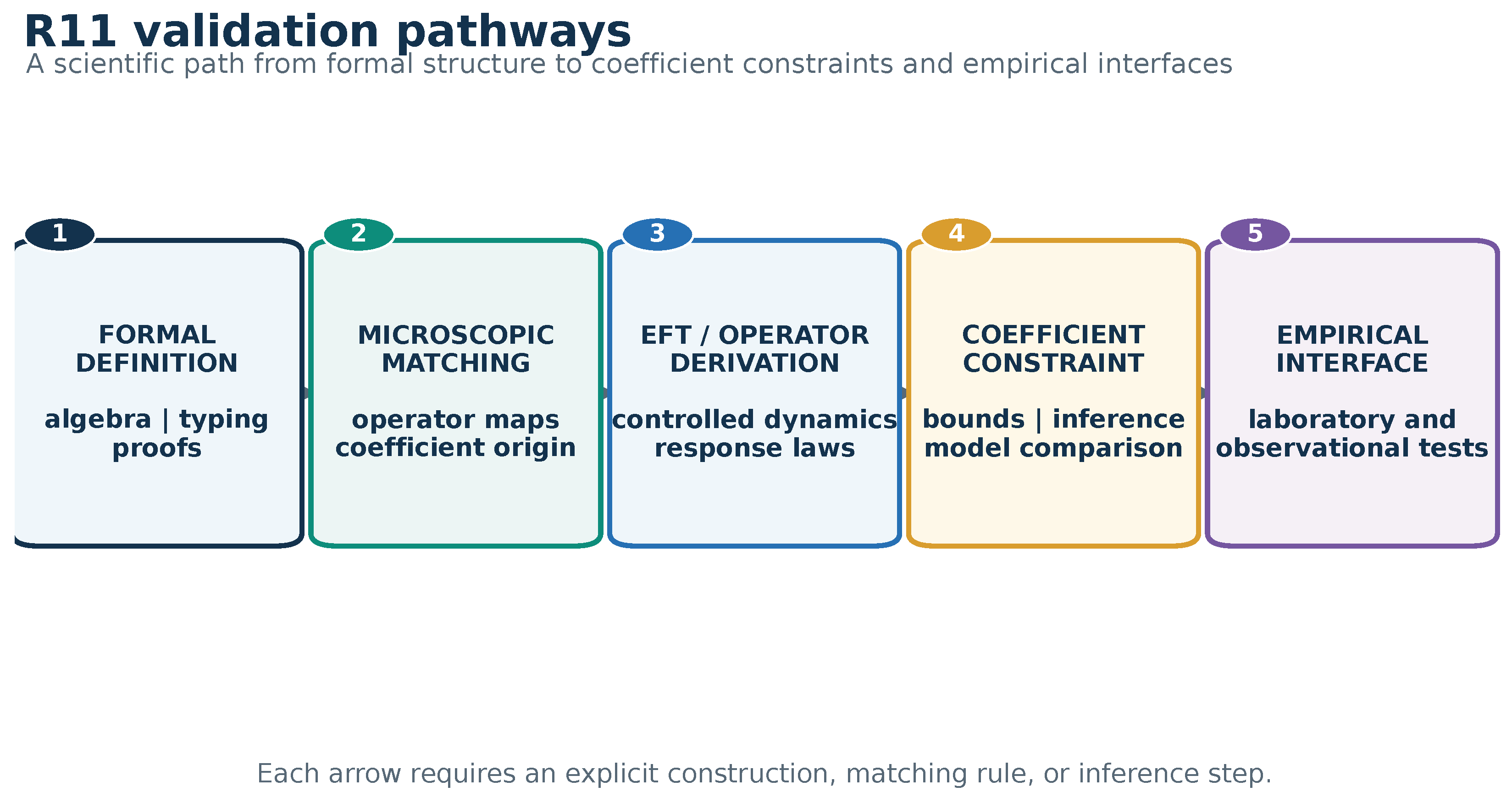
Figure 11.
Mathematical architecture of R11. The fixed quadratic carrier, scale-labelled closed subalgebras, defect-tracked linear morphisms, free transfer paths, presheaf topos, Hilbert realization, and covariant geometric realization are distinct typed layers. Arrows denote constructions or declared realization maps, not automatic equivalences.
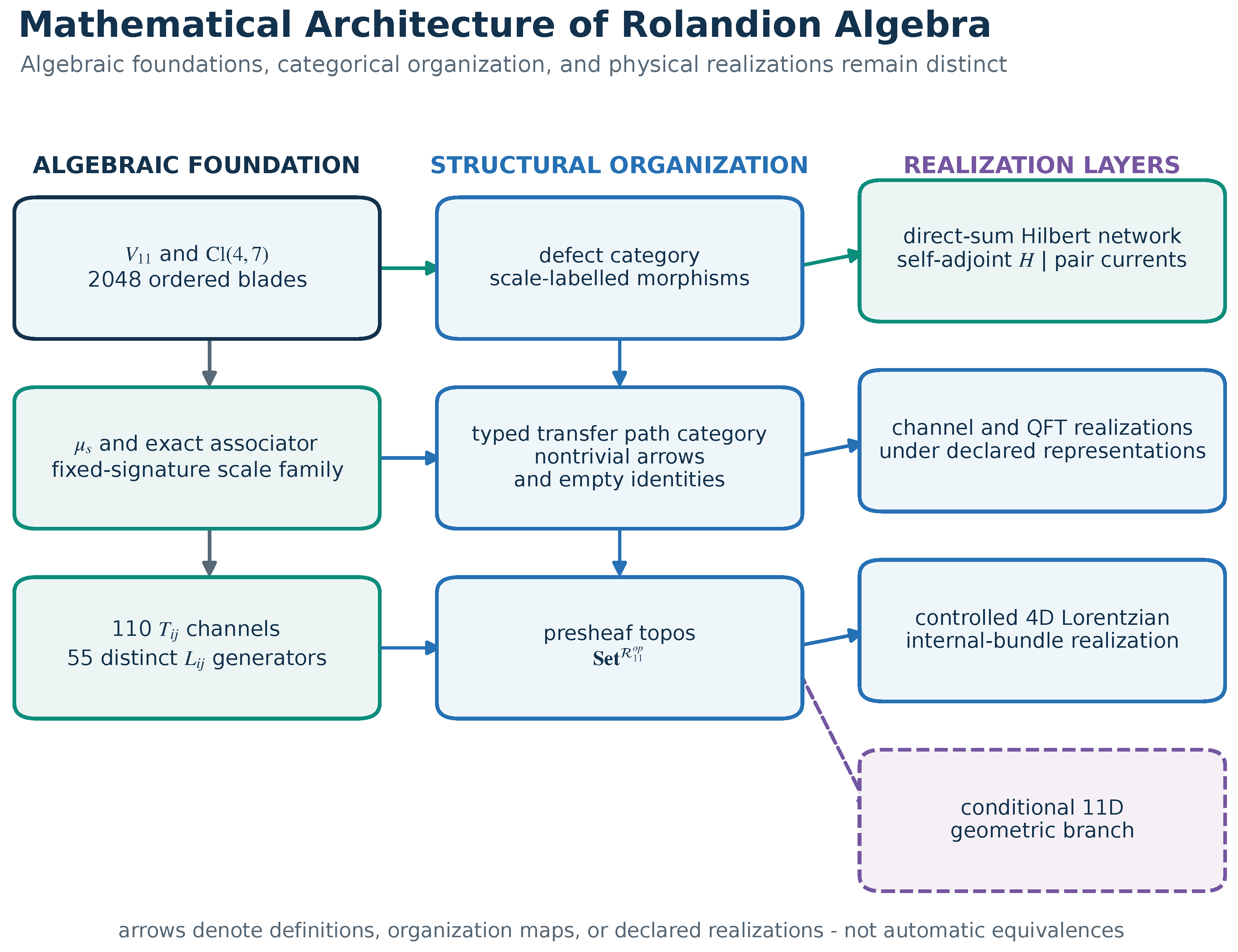
Figure 12.
Parameter and data hierarchy. Fixed algebraic conventions, realization data, EFT coefficients, states, and phenomenological parameters enter at distinct stages of calculation and constraint.
Figure 12.
Parameter and data hierarchy. Fixed algebraic conventions, realization data, EFT coefficients, states, and phenomenological parameters enter at distinct stages of calculation and constraint.
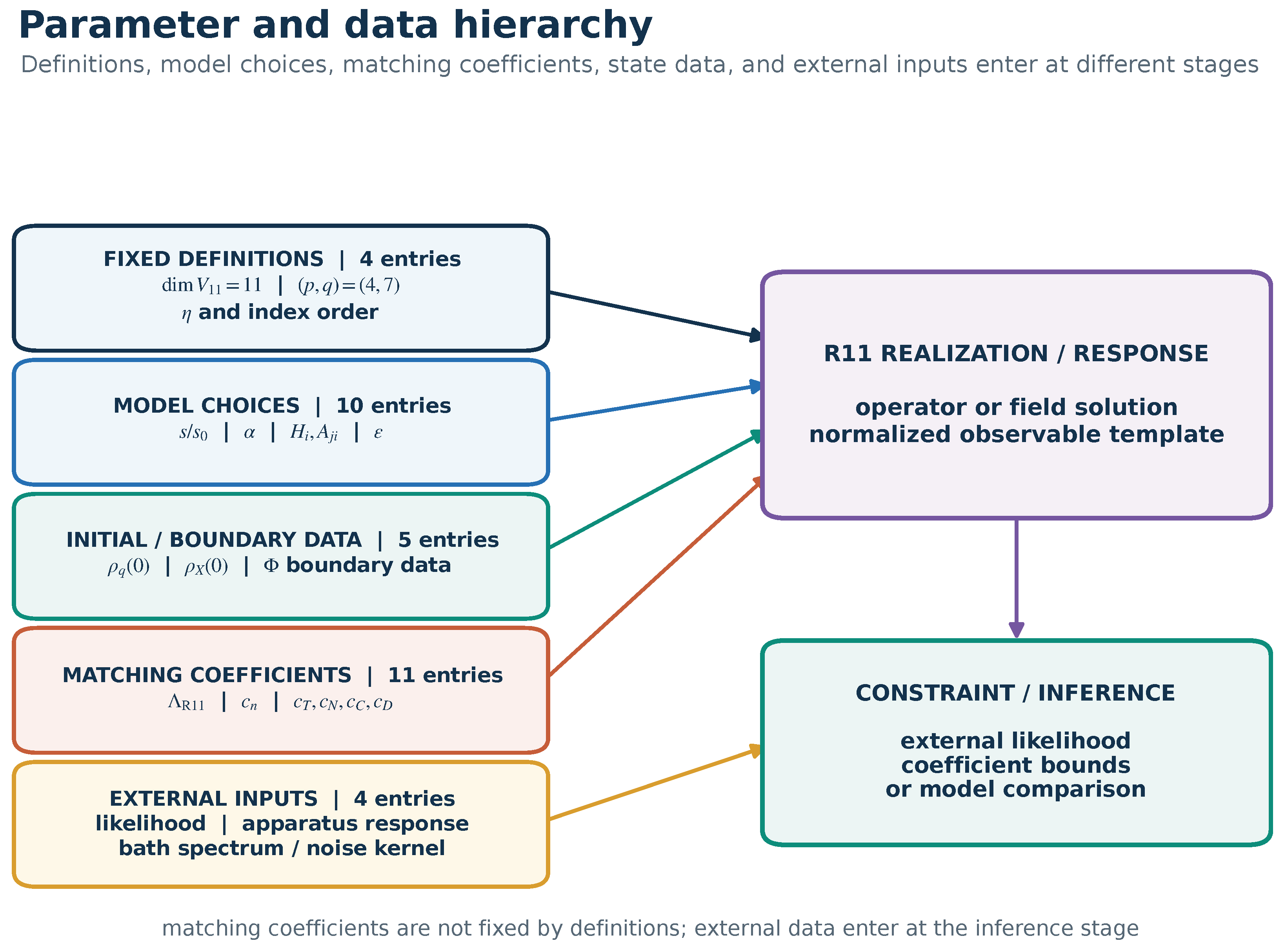
Figure 13.
Laboratory constraint channels. The four declared small-invariant display laws in the preceding paragraph, each per unit unmatched coefficient. They define possible parameter-constraint channels; they are neither absolute signal derivations nor sensitivity forecasts.
Figure 13.
Laboratory constraint channels. The four declared small-invariant display laws in the preceding paragraph, each per unit unmatched coefficient. They define possible parameter-constraint channels; they are neither absolute signal derivations nor sensitivity forecasts.
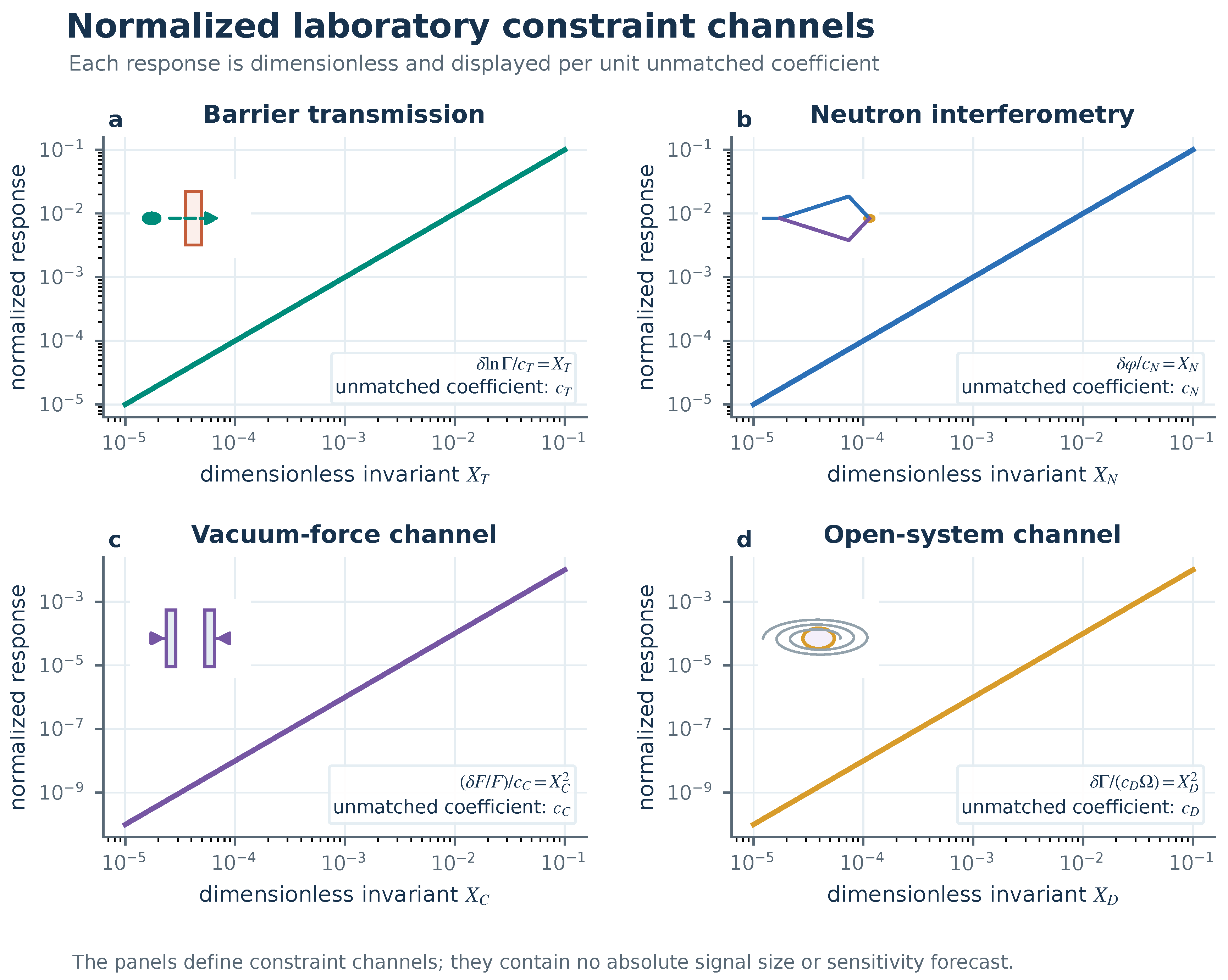
Figure 14.
Synthesis of the R11 framework. The central eleven-generator carrier supports exact Clifford structure, scale-dependent composition, directed transfer, and categorical organization. Controlled realizations connect this core to finite-dimensional quantum dynamics and a covariant four-dimensional effective theory; model-dependent matching then leads to cosmological, gravitational-wave, black-hole, and laboratory channels. The in-figure legend distinguishes exact, controlled, model-dependent, and open elements. Arrows denote specified constructions or matching tasks, not automatic equivalences.
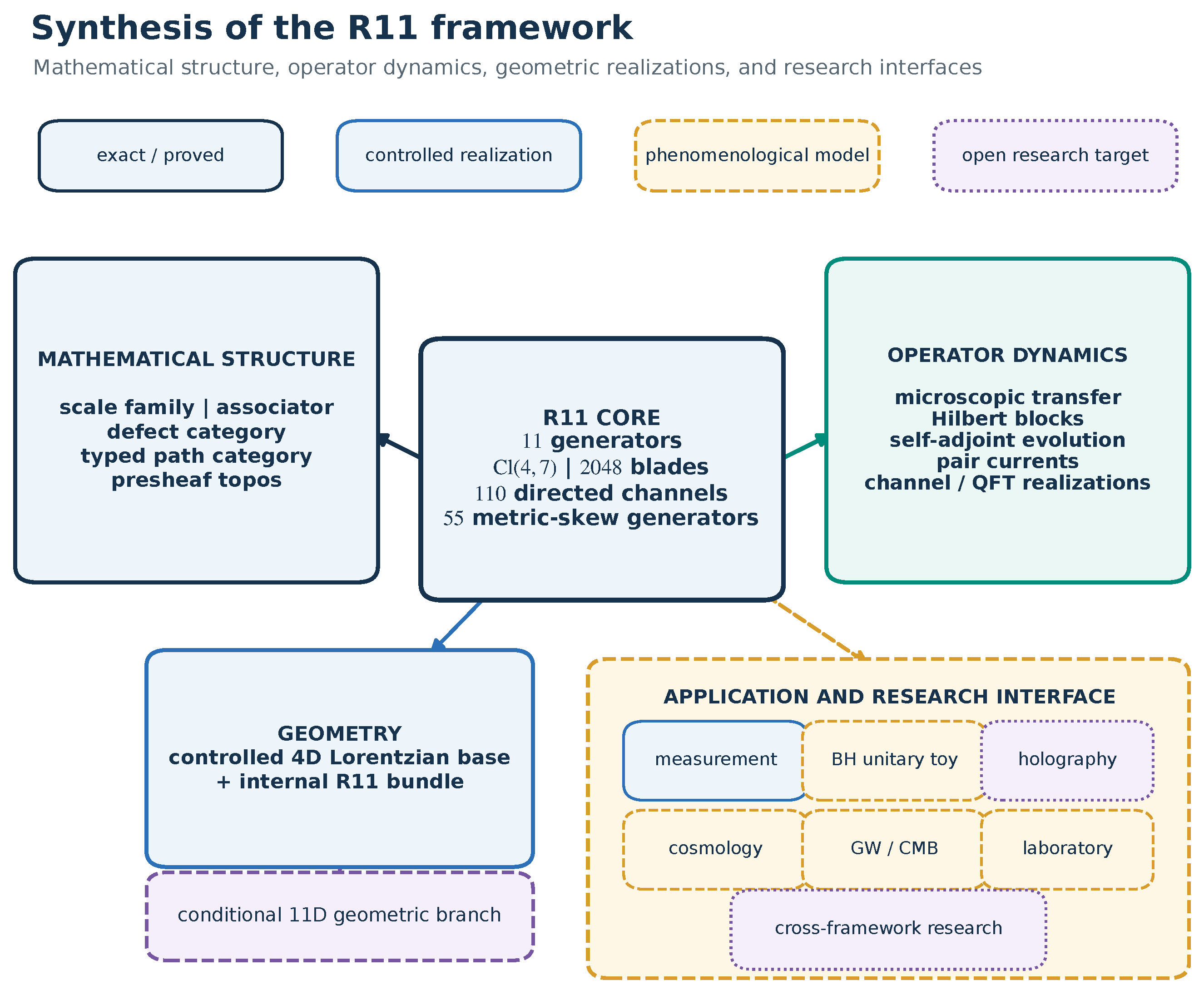

Table 1.
Scope and status of the principal R11 constructions.
| Level | Content |
|---|---|
| Rigorous mathematics | , , blade multiplication, subalgebras, scale product, exact associator, defect category, path category, presheaf topos, directed replacements, Lie layer, and block-operator theorems. |
| Controlled and conditional realizations | Hilbert, QFT, and classical-field realizations under explicit representation, regularity, and domain assumptions; the controlled four-dimensional covariant realization; and the distinct conditional eleven-dimensional branch. |
| Phenomenological model | Exchange cosmology, oscillatory , propagation and laboratory EFT responses with free matching coefficients. |
| Research program | Black-hole evaporation, a holographic dictionary, microscopic measurement selection, anomaly/gauge/family/QEC constructions, and exact relations to other quantum-gravity programs. |
Table 2.
Algebraic regimes of the scale-dependent product.
| Regime | Dominant product | Established property |
|---|---|---|
| Clifford-dominant | Fine-resolution regime; associative, unital, and generally noncommutative. | |
| Mixed | Bilinear; associativity is measured exactly by Equation (17). | |
| Jordan-dominant | Coarse-resolution regime; commutative and power-associative, but generally nonassociative. | |
| All scales | Closed on | Coefficients are dimensionless and product support remains in . |
Table 3.
Typed distinction among transfer and symmetry objects.
| Object | Type | Established role |
|---|---|---|
| , directed | One of 110 global channel labels; a grade-preserving nilpotent replacement with under . | |
| Nontrivial typed quiver restriction for and ; its target and multiplicative defect are explicit. | ||
| even Clifford element | One of 55 bivector planes; not a directed replacement. | |
| metric-skew endomorphism | One of 55 generators representing and preserving the fixed form. | |
| Realization-dependent rectangular Hilbert block, not automatically inherited from . | ||
| Coarse two-sector block | An effective object obtained only after a declared aggregation; not a microscopic blade replacement. |
Table 4.
Path from effective operator to empirical constraint.
| Channel | Present construction | Next falsifiable step |
|---|---|---|
| GW propagation | Parameter-constraint ready | Match to a covariant R11 operator and confront waveform posteriors. |
| Dark energy | Model derivation required | Derive or fit Q, , and with a declared likelihood. |
| CMB | Formal matching required | Map an R11 initial-state or transfer operator to and its shape parameters. |
| Tunneling/neutrons | Model derivation required | Specify , apparatus response, and nuisance model. |
| Vacuum force | Formal matching required | Derive the modified spectrum and renormalized force. |
| Open systems | Parameter-constraint ready after kernel choice | State L, bath spectrum, and microscopic coefficient map. |
| Black holes | Future technical target | Construct dynamical evaporation and backreaction, beyond the toy model. |
Table 5.
Typed census of data in the R11 framework.
| Type | Examples | Status |
|---|---|---|
| Fixed convention | dimension 11; signature ; blade ordering | Adopted modeling data, not fitted parameters. |
| Scale deformation | , , function | Chosen family; physical matching unspecified. |
| Microscopic transfer | allowed and realization maps | Algebraically defined maps; Hilbert/QFT matching is extra. |
| Covariant EFT | Standard constants plus free R11 matching data. | |
| States and boundaries | , data, geometry, boundary conditions | Realization-specific initial/boundary data. |
| Phenomenology | Free or constrained coefficients until matched. | |
| Toy/benchmark | , Hilbert dimensions, grids, seed | Declared illustrative or computational settings. |
Table 6.
Calibrated relationships; none is asserted to be an exact embedding.
| Program | Relationship level | Scientific comparison and missing map |
|---|---|---|
| M-theory | Analogy/research direction | Both use eleven-dimensional organizing data. An analytic continuation can relate signatures as forms, but no action, supersymmetry, brane, spectrum, or duality equivalence follows. |
| String theory | Structural analogy | Extended/path composition and scale organization are suggestive; no world-sheet CFT, critical spectrum, T-duality, or S-duality map is constructed. |
| Loop quantum gravity | Conceptual analogy | Discrete algebraic labels invite comparison with spin networks, but no blade–spin-network functor or area-spectrum equality is given. |
| Holography | Research direction | Presheaf/transfer data may organize distributed information; a boundary/bulk dictionary and area bound remain open. |
| Thermodynamics | Conditional model | Exchange currents may enter open-system balance laws under stated reservoir and entropy definitions; no universal second law follows from unspecified dimensional temperatures. |
Disclaimer/Publisher’s Note: The statements, opinions and data contained in all publications are solely those of the individual author(s) and contributor(s) and not of MDPI and/or the editor(s). MDPI and/or the editor(s) disclaim responsibility for any injury to people or property resulting from any ideas, methods, instructions or products referred to in the content. |
© 2026 by the authors. Licensee MDPI, Basel, Switzerland. This article is an open access article distributed under the terms and conditions of the Creative Commons Attribution (CC BY) license (http://creativecommons.org/licenses/by/4.0/).
Copyright: This open access article is published under a Creative Commons CC BY 4.0 license, which permit the free download, distribution, and reuse, provided that the author and preprint are cited in any reuse.