

Submitted:
18 October 2026
Posted:
21 October 2026
You are already at the latest version
Abstract
The adaptation cost of parameter-efficient fine-tuning (PEFT) depends on trainable parameters, activation storage, and the computations required for optimization. Methods such as LoRA and adapters may still require backward computation through frozen backbone operations and retention or recomputation of intermediate activations. Side-tuning places trainable adaptation modules outside the backbone, creating opportunities to reduce this cost through different connections to the backbone gradient graph. This survey presents a topology- and deployment-aware study of side-tuning for foundation models and proposes a graph-topological definition with three categories: graph-coupled side-tuning, in which an external side branch remains coupled to backbone gradients; mixed side-tuning, in which a detached side path re-enters a later layer of the same backbone; and detached side-tuning, in which an external trainable network consumes frozen backbone representations through a stop-gradient interface and computes task-specific gradients entirely outside the backbone. We review a curated cross-domain corpus spanning natural language processing, computer vision, multimodal learning, recommendation, and relevant methodological precursors, while examining information retrieval as an emerging deployment setting. The literature is organized along three axes: gradient topology, feature interface, and deployment regime. We derive a resource model that accounts for backward activations, online feature production, and cached representations, and use it to develop design guidelines and reporting recommendations. This organization connects the training graph of each method to its resource requirements and the conditions under which its features can be reused.
Keywords:
side-tuning
; parameter-efficient fine-tuning
; foundation models
; gradient topology
; activation memory
; feature caching
1. Introduction
Foundation models are increasingly reused as backbones across language, vision, multimodal learning, and recommendation systems [1,2]. Their adaptation cost is commonly summarized by the number of trainable parameters. Although parameter-efficient fine-tuning (PEFT) methods such as adapters [3], LoRA [4], BitFit [5], IA3 [6], and Compacter [7] substantially reduce task-specific parameter and optimizer-state storage, many of them place trainable components inside the backbone computation graph.
Figure 1.
Graph-topology contrast between frozen in-graph PEFT and detached side-tuning. In-graph PEFT retains a backward path through relevant backbone operations, whereas detached side-tuning restricts backward propagation to the external adaptation path. The figure illustrates the detached case only; graph-coupled and mixed side-like methods are separated in Figure 2. Backbone forward and feature-storage costs depend separately on the deployment regime.
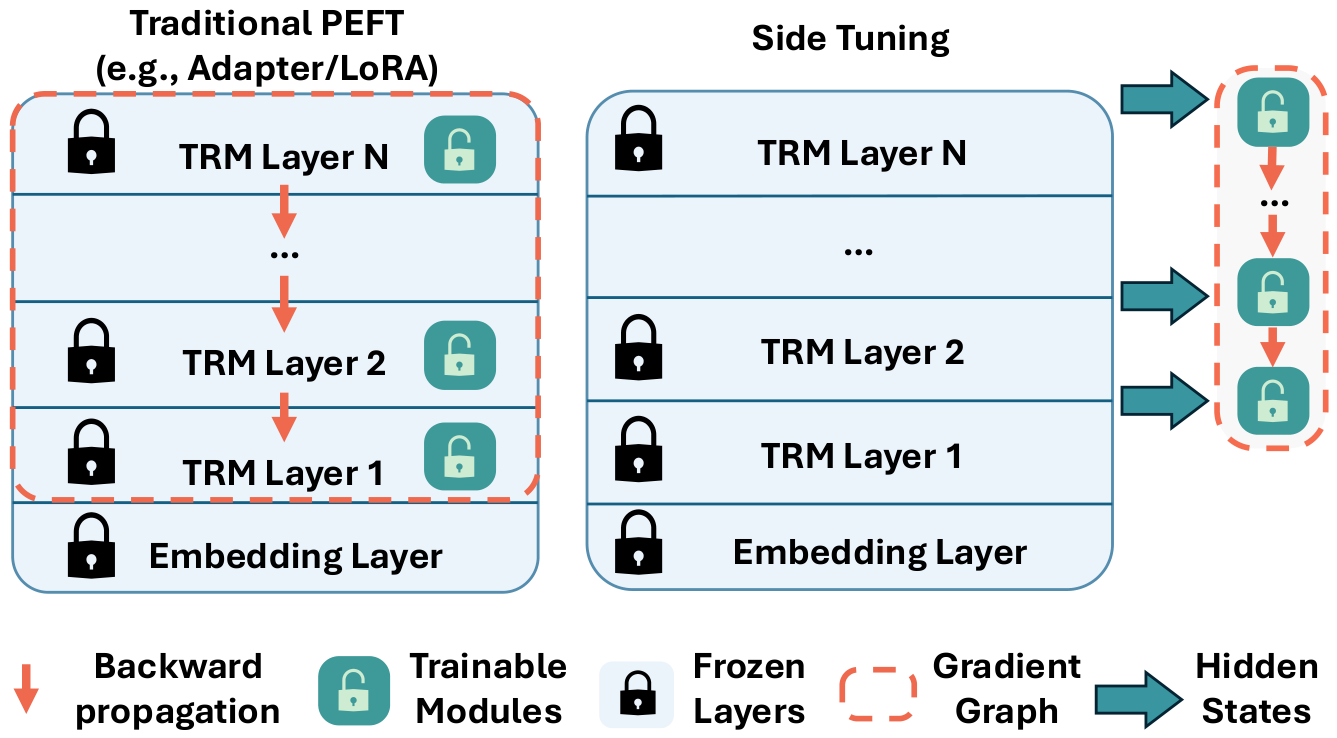
Figure 2.
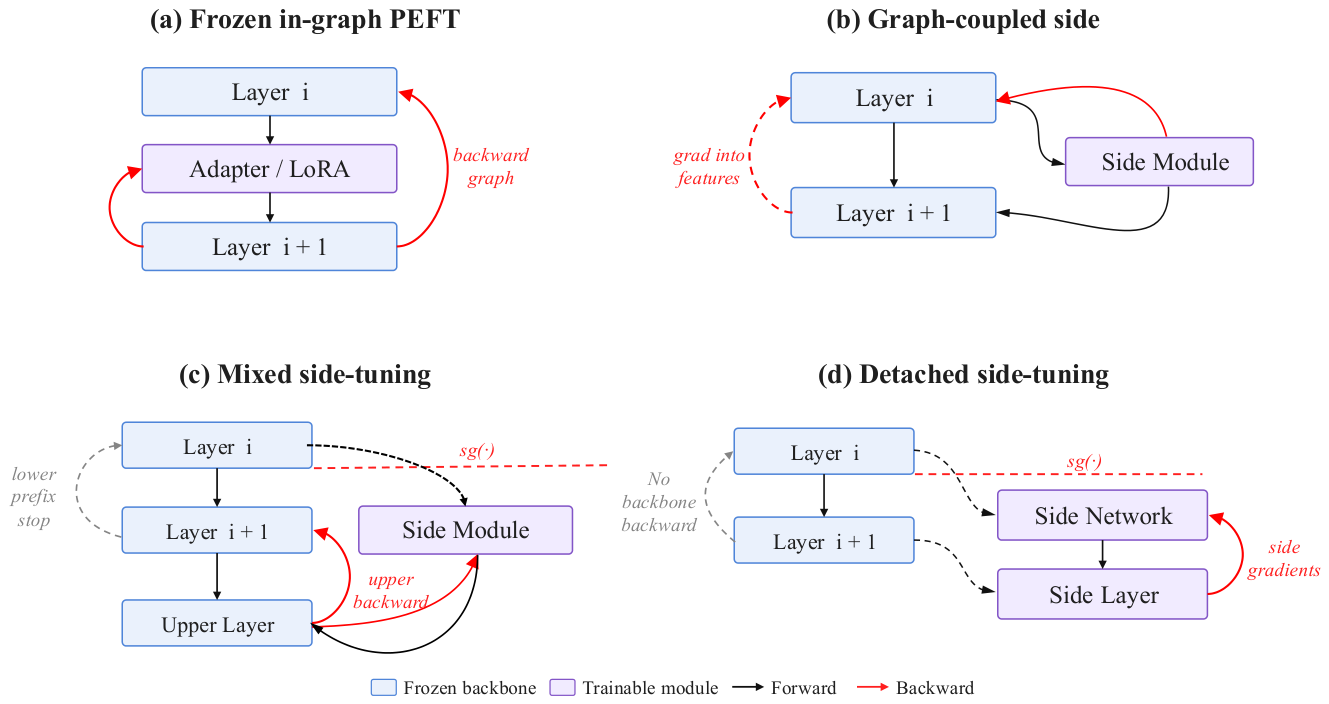
Training-graph distinction. Black arrows denote ordinary forward data flow, black dashed arrows denote detached forward feature transfer, red arrows denote active backward propagation, and gray dashed arrows denote blocked or absent backbone backward paths. Norm/token updates, side-to-backbone gradients, and trainable control modules inside an active generator create graph-coupled paths. A side path receiving detached features and re-entering an upper layer of the same backbone creates a mixed topology.
Optimizing these components may still require backward computation through frozen backbone operations and retention or recomputation of their intermediate activations [8]. Methods with similar parameter budgets can differ substantially in activation memory, computation, feature storage, and serving cost.
Side-tuning places task-specific capacity alongside a pretrained backbone [9]. The feature and fusion paths determine whether an external module remains connected to the backbone backward graph. We define and classify side-tuning according to its training-graph topology: graph-coupled side-tuning retains a backward path through backbone operations; mixed side-tuning uses detached features before re-entering an upper layer of the same backbone; and detached side-tuning supplies frozen backbone representations to an external trainable network through a stop-gradient interface. In the detached case, task-specific gradients are computed entirely outside the backbone.
Gradient topology determines only part of the resource profile. Detached methods may still execute the frozen backbone online and must materialize the representations consumed by the side network. Alternatively, these representations can sometimes be precomputed, shifting cost to feature extraction, storage, transfer, refresh, and invalidation. The exposed feature interface also affects this trade-off: final outputs are relatively compact, whereas multi-layer, token-level, spatial, temporal, or multimodal features provide richer task information but incur greater interface and storage costs. Consequently, detachment, feature reuse, and backbone-free serving should be treated as distinct properties.
These observations motivate three organizing axes for this survey: gradient topology, which specifies where backward propagation occurs; feature interface, which specifies the frozen representations exposed to the side network and how they are processed; and deployment regime, which specifies whether representations are generated online, cached, or periodically refreshed. Together, these axes explain why visually similar side-tuning methods may have different training and serving profiles. Figure 2 and Figure 3 summarize this organization as a compact map of the surveyed literature.
Existing PEFT surveys provide broad taxonomies of adaptation mechanisms and domain-specific analyses of language, vision, multimodal learning, and recommendation [10,11,12,13,14,15,16,17,18,19]. This survey examines side-tuning through a curated corpus spanning natural language processing, computer vision, multimodal learning, and recommendation, while examining information retrieval as an emerging application setting. Its organizing questions concern gradient topology, feature interfaces, side-network design, and deployment. Earlier work on broadly pretrained backbones is included when it introduced a topology subsequently adopted in foundation-model adaptation.
The main contributions of this survey are as follows:
- A graph-topological taxonomy. We distinguish graph-coupled, mixed, and detached side-tuning according to the gradient paths in each training variant.
- An evidence-coded literature organization. We tabulate detached and boundary variants by domain, backbone, feature interface, side architecture, topology evidence, reported resource measurements, and deployment assumptions.
- A cross-domain design synthesis. We analyze how task structure and feature access shape side-network designs across language, vision, multimodal learning, recommendation, and retrieval.
- A deployment-aware resource analysis. We separate parameter, optimizer-state, activation, forward computation, feature-storage, cache-refresh, and serving costs, and derive design and reporting recommendations.
The remainder of this survey is organized as follows. Section 2 reviews related surveys and adjacent paradigms. Section 3 defines the scope and review protocol, and Section 4 formalizes the topology taxonomy. Section 5, Section 6 and Section 7 review application domains, while Section 8, Section 9 and Section 10 present cross-domain design principles, limitations, and future directions.
2. Related Surveys
Prior surveys address PEFT, domain adaptation, modular learning, and efficient foundation-model reuse. This section compares their primary organizing questions and relates them to the focus of this survey: the interaction between gradient coupling, feature access, and deployment in side-tuning.
2.1. General PEFT Surveys
General PEFT surveys commonly organize methods into additive, reparameterized, selective, prompt-based, and hybrid families [10,11,12]. This organization explains how task-specific parameters are introduced, where they are placed, and how their storage or inference overhead differs. Several surveys also discuss computational costs, applications, and practical system implementations. Gradient detachment and feature deployment provide additional dimensions for analyzing these mechanisms.
Gradient topology complements the conventional PEFT taxonomy. Adapters [3], LoRA [4], and prefix-style methods can freeze backbone weights and remove their optimizer states. Optimizing trainable modules embedded at different depths still requires the relevant backbone activations to be retained or recomputed. A detached external side network receives selected representations as fixed inputs and computes gradients within the external path. He et al. [20] provide a mathematical unification of several in-graph PEFT mechanisms. The present analysis covers external detached computation and feature-cache deployment. Together, these perspectives characterize both the parameterization of adaptation and its gradient and deployment topology.
Federated and system-oriented PEFT surveys emphasize communication, privacy, client heterogeneity, and resource constraints [21]. These dimensions describe the environment in which adaptation operates. The deployment axis studied here concerns whether frozen representations are generated online or reused from storage, which components remain in the serving path, and how feature extraction, transfer, refresh, and invalidation contribute to end-to-end cost.
2.2. Domain-Specific Adaptation Surveys
Domain-specific surveys provide greater methodological and benchmark depth. NLP-oriented surveys cover prompt tuning, adapters, LoRA, limited-data adaptation, and scaling practices for language models [13,14,15,22]. Vision surveys organize adaptation methods for pretrained visual backbones and explicitly include side-tuning among visual PEFT architectures [16,17,23]. Vision-language and recommendation surveys discuss efficient adaptation within multimodal pipelines and recommender systems [18,19,24,25].
These surveys follow domain-specific evaluation conventions. Language studies frequently report task quality, trainable parameters, peak training memory, or throughput. Vision studies additionally emphasize spatial resolution, dense-prediction quality, and backbone architecture. Recommendation studies often report ranking quality, offline feature extraction, feature reuse, and online serving latency. This survey maps the reported quantities onto a common resource schema while retaining each paper’s evaluation conditions. The schema records whether each effect concerns parameter storage, backward activations, forward computation, feature storage, cache refresh, or serving.
The value of a cross-domain view is to expose how task structure determines the required feature interface. Output-level representations may be sufficient for classification or static-item recommendation, while semantic segmentation requires spatially resolved features and language tasks may require token- or layer-level information [8,26,27,28]. A shared topology can consequently lead to different architecture and deployment choices in different domains.
2.3. Adjacent Paradigms
Side-tuning also intersects with modular learning, continual learning, mixture-of-experts (MoE), frozen feature extraction, and residual or ensemble adaptation. Modular-learning surveys study the composition and reuse of trainable components [29]; continual-learning surveys examine adaptation and forgetting with pretrained models [30]; and MoE surveys analyze routing, expert specialization, and capacity allocation [31]. These perspectives explain modular composition, temporal knowledge retention, and conditional computation in side networks. The gradient boundary describes how these capabilities connect to the frozen feature producer during training.
Frozen feature extraction is the closest classical reference point. A conventional frozen-feature pipeline computes a representation and trains a shallow task head. We treat this construction as a limiting case within the broader side-tuning design space. Modern side networks may consume multiple hidden-state levels, perform learned feature selection, use recurrent or attention-based processing, route examples through experts, or construct spatial and multimodal hierarchies. Their classification depends on the external task-specific computation and the coupling between its loss and the backbone graph.
Modular and continual-learning properties can coexist with detached side-tuning. Side networks may be swapped, composed, personalized, or expanded without editing the backbone, and streaming systems may add or route side capacity while preserving previously computed features [32]. Each property has a specific requirement: modularity depends on interchangeable components, detachment on the gradient boundary, and cache reuse on stable feature inputs and extraction settings.

Table 1.
Compact positioning of this survey relative to related survey families. ✓ denotes a central focus, Δ denotes partial discussion, and ✗ denotes a topic outside the primary focus. Entries summarize thematic emphasis.
Table 1.
Compact positioning of this survey relative to related survey families. ✓ denotes a central focus, Δ denotes partial discussion, and ✗ denotes a topic outside the primary focus. Entries summarize thematic emphasis.
| Survey family | Side-tuning | Gradient topology | Feature/cache interface | Deployment regime | Crossdomain | Measured vs. inferred |
|---|---|---|---|---|---|---|
| General PEFT surveys | Δ | ✗ | ✗ | ✗ | Δ | ✗ |
| Unified PEFT theory | ✗ | Δ | ✗ | ✗ | ✗ | ✗ |
| Federated/system PEFT | ✗ | ✗ | Δ | ✓ | ✗ | ✗ |
| NLP/LLM adaptation surveys | ✗ | ✗ | ✗ | ✗ | ✗ | ✗ |
| Vision adaptation surveys | Δ | ✗ | ✗ | ✗ | ✗ | ✗ |
| VLM/recommendation surveys | Δ | Δ | Δ | Δ | Δ | ✗ |
| Adjacent modular paradigms | ✗ | Δ | Δ | ✗ | Δ | ✗ |
| This survey | ✓ | ✓ | ✓ | ✓ | ✓ | ✓ |
2.4. Positioning
The unit of analysis in this survey is the combination of an adaptation graph and its deployment path. For each method, we record trainable-module placement, backbone parameter status, gradient coupling, exposed representations, side-network architecture, reported resource evidence, and the conditions under which representations can be reused. This organization separates three questions that are often conflated: how many task-specific parameters are stored, which computations participate in backpropagation, and which components or representations must be produced during deployment.
The comparison records the evidence supporting each method’s topology and resource profile. Numerical memory, runtime, and performance results retain the source paper’s backbone, dataset, precision, implementation, and hardware. Potential cacheability and feature-storage overhead are labeled as topology-based interpretations when the source provides no direct measurement. This evidence coding supports cross-domain analysis while preserving the conditions and provenance of each result.
3. Preliminaries, Scope, and Review Protocol
3.1. Operational Definition
Let denote a pre-trained backbone with parameters , and let denote the representation exposed at interface i. For detached side-tuning, a trainable side path and its fusion module are written as
where is the identity in the forward pass and has zero derivative in reverse-mode differentiation. The optional dependence on allows an independent side branch; is empty when fusion is fixed.
We call a concrete training variant detached side-tuning when three conditions hold during adaptation: (i) no backbone parameter is optimized; (ii) task-specific trainable capacity is external to the backbone parameterization; and (iii) computing gradients for the task-specific parameters does not require a vector–Jacobian product through any backbone operation. Operationally, every backbone-to-side tensor is treated as a constant, and side outputs are not re-injected into a backbone suffix through which gradients must pass. We apply this definition to each training variant, so coupled, detached, and partially detached variants within one paper receive separate labels.
This definition separates three properties of adaptation. Freezing means that the optimizer keeps fixed. Detachment means that the backward graph needed to optimize the adaptation path excludes backbone operations. Feature reuse means that the required interface tensors can be reused across optimization steps or serving requests without side-dependent recomputation. Each property is assessed from its parameter, gradient, or deployment conditions.
Detachment changes the backward graph while preserving numerical forward dependence. The selected representations still condition the prediction and must be materialized, transferred, or stored. When features are generated online, the backbone forward pass and its transient workspace remain. When features are precomputed, that cost is shifted to offline extraction, feature storage, refresh, and invalidation. We therefore distinguish the internal backbone activation tape retained or recomputed for backward propagation from the selected detached interface tensors consumed by the side path.
Frozen-feature extraction provides a classical reference point. A linear probe or shallow readout is treated as an adjacent limiting case. A work enters the core corpus only when the external adaptation path is a substantive methodological contribution and its gradient boundary can be audited.
The term backbone covers general-purpose pre-trained language, vision, multimodal, generative, and recommender encoders. Earlier work on broadly pre-trained backbones is retained only when it introduced a topology later reused in foundation-model adaptation, and is identified as a methodological precursor to foundation-model adaptation.
3.2. Coding Dimensions
The survey retains the three organizing axes introduced in Section 1: gradient topology, feature-interface design, and deployment regime. For method-level coding, the feature-interface axis is resolved into two fields: the frozen representation exposed at the boundary and the trainable side processor/fusion applied after that boundary. Evidence provenance is recorded separately for each coding decision. Table 2 gives the resulting coding schema.
These fields are coded independently, although Table 4 displays the feature interface and side design together for compactness. For example, “cross-attention” describes a side operator, “hierarchical” describes feature granularity, and quantization describes weight and arithmetic precision. Gradient topology and cacheability are recorded in their respective fields.
3.3. Literature Audit and Corpus Boundaries
The literature search was last updated in June 2026. Candidate papers were identified through Google Scholar, DBLP, arXiv, OpenReview, publisher pages, and backward and forward citation chaining. Queries combined naming terms such as “side tuning,” “side network,” “side adapter,” “ladder side tuning,” “parallel tuning,” “control module,” “Q-Former,” and “multimodal connector” with mechanism terms such as “frozen backbone,” “detached feature,” “stop gradient,” “decoupled PEFT,” “adapter skipping,” “memory efficient,” and “cached representation.” Domain-specific variants were added for language, vision, multimodal learning, diffusion generation, recommendation, retrieval, medical imaging, video, and 3D point clouds. These searches form a structured literature audit.
Records were consolidated by title, persistent identifier, and method lineage. A conference paper, preprint revision, and journal extension share one method record unless they introduce materially different training graphs. The latest archival version is used as the primary citation; preprint status is retained when no peer-reviewed version is available. Distinct variants are coded separately when their gradient topology differs.
Table 3 states the corpus labels and evidence rules. A candidate enters the reviewed corpus when it adapts a broadly pre-trained or foundation-model backbone, introduces substantive external task-specific capacity, and provides enough methodological detail to inspect the feature and gradient paths. It enters the detached core only when all relevant backbone-to-side paths have paper-explicit (P) detachment evidence and no side output re-enters the backbone. Inferred (I) entries remain provisional and outside the strict core. A detached side path re-entering a later layer of the same backbone is mixed; other active backbone backward paths are graph-coupled. Ordinary partial unfreezing belongs to the end-to-end reference family. Unresolved cases remain boundary cases.
For each candidate, we record publication status, domain, backbone, feature interface, side processor, fusion direction, optimized parameters, topology evidence, deployment regime, and reported resource dimensions. Paper-explicit (P) evidence states the gradient boundary and optimized parameter set of the concrete variant. Inferred (I) evidence derives topology from the described training graph or implementation. Executable detach/no_grad operations or optimization from fixed feature tensors under the same objective provide corroborating evidence; code-only support remains I.
The scope excludes works whose only adaptation mechanism is in-graph LoRA, adapters, prompts, prefixes, bias tuning, or selective parameter updates; pure inference acceleration; and standalone quantization, pruning, distillation, offloading, or retrieval augmentation without a central trainable side path. These works may still appear as baselines or orthogonal system combinations.
4. Graph-Topology Taxonomy and Audit Procedure
The taxonomy describes the training graph of each adaptation variant. We record three descriptors: whether any backbone parameters are optimized, whether gradients for task-specific parameters traverse backbone operations, and whether the task-specific trainable path is external to the backbone parameterization. Quantization, pruning, mixed precision, offloading, caching, and split execution are recorded separately as system attributes.
4.1. Operational Categories
End-to-end adaptation is a non-side reference family that updates all or selected backbone parameters, so the task loss retains a gradient path to the updated backbone components. Full fine-tuning and ordinary partial unfreezing belong to this family. When a substantive external side path is present, the variant is classified from that side path’s concrete training graph, including any trainable backbone components and the paths through which side-parameter gradients are computed.
Frozen in-graph PEFT keeps most backbone weights fixed while placing trainable parameters inside the active backbone computation, as in adapters, LoRA, prompt or prefix tuning, and IA3 [3,4,6]. Optimizer state scales with the small trainable set, but optimizing those parameters typically requires reverse-mode differentiation through downstream frozen backbone operations and therefore requires the corresponding states to be retained or recomputed.
Graph-coupled side modules contain an external or separately parameterized side branch whose adaptation graph is directly coupled to the backbone. We assign this label when the objective updates backbone-resident components, such as normalization parameters or learnable tokens, or when side-parameter gradients traverse backbone operations without the detached-prefix/re-entry pattern defined below. This category covers direct backbone coupling; the detached-then-re-injected suffix pattern is coded separately as mixed topology.
Detached side-tuning keeps all backbone parameters and backbone-resident adaptation variables fixed, treats every backbone-derived tensor supplied to the side path or fusion module through a stop-gradient boundary, and keeps side outputs outside all backbone layers. The task loss may depend arbitrarily on the numerical backbone features. Computing does not require a vector–Jacobian product through a backbone operation. Internal backbone states are therefore not retained or recomputed for the side loss, although the selected interface tensors, side-network states, and any online backbone forward workspace remain.
Mixed-topology methods contain both detached and graph-coupled segments within the same concrete training variant. In this survey, the side path must receive detached prefix features and re-enter a later layer of that same backbone. Backbone backward computation is restricted to the upper suffix after re-entry, and the lower feature-producing prefix remains detached. The exact re-entry layer and active suffix specify this topology. A detached encoder feeding a different active generator is graph-coupled; ordinary partial unfreezing follows the end-to-end reference family. Each variant in a paper family is coded independently. Quantization and caching remain orthogonal unless they alter the gradient graph.
Backbone identity is fixed before the topology audit using the source model’s pretrained architecture and layer ordering. We record the feature-producing component, the receiving component, and the relevant layers separately. Distinct encoder and generator components retain their identities when combined in one software wrapper. Renaming or regrouping modules therefore preserves the classification; mixed topology requires re-entry within the originally declared backbone component.
Under this rule, SAN and SHERL are mixed because their side paths pass through top backbone layers, and TS-SAM is mixed because coupling begins at an intermediate SAM layer [26,33,34]. HST, TBAC-UniImage, and ViT-Adapter are graph-coupled because they respectively train backbone normalization parameters, optimize token-like variables inside an active diffusion backbone, and propagate side-path gradients into the backbone feature construction [27,35,36].
Residual and dynamic residual adapters provide earlier examples of graph coupling. Their trainable branches sit inside CNN blocks and retain an active backbone backward graph [37,38,39]. Convpass, DTL, and related visual adapter variants use a similar pattern in ViT-style feature streams: bypass or compact side networks feed adapted information back into later backbone computation [40,41,42].
Frozen-backbone bridges also use graph-coupled training. FPT trains input/output mappings and selected normalization and positional parameters around a largely frozen transformer [43]. Frozen trains a visual encoder through a frozen language model, while ClipCap’s mapping-only variant trains a visual-prefix mapping through frozen GPT-2 operations [44,45]. Modern vision-language systems extend this pattern with Perceiver or Q-Former style bridges, projectors, and modality-specific query modules, as in Flamingo, BLIP-2, InstructBLIP, MiniGPT-4, LLaVA, and Video-LLaMA [46,47,48,49,50,51]. Their connector-training variants are graph-coupled: connector gradients are computed through the receiving language model’s operations. For BLIP-2 this denotes its second-stage generative pre-training, and for LLaVA it denotes first-stage feature alignment.
Diffusion-control and generation methods provide another large family of graph-coupled and boundary variants. ControlNet, T2I-Adapter, Uni-ControlNet, IP-Adapter, IMAGDressing, AlignVTOFF, MuLan, and Diffusion Controller freeze major generative components while training lightweight conditioners, adapters, or gray-box controllers whose outputs condition active denoising computation [52,53,54,55,56,57,58,59]. ControlNet and T2I-Adapter are graph-coupled: external conditioning enters the frozen denoiser, whose operations remain on the loss-to-conditioner gradient path. GLIGEN, AnimateDiff, and Golden RPG use graph-coupled control modules because they inject trainable grounding, motion, or region-attention components into the active generation backbone [60,61,62].
Architecture-skipping methods provide related non-detached designs. DAS and EAS are frozen in-graph comparators: their trainable adapters substitute for selected backbone blocks or attention submodules within the retained pretrained stream. Adapter gradients traverse the surviving backbone operations [63,64]. Double-Filter uses related layer skipping [65]; a mixed label requires an established detached external side path and same-backbone re-entry for the concrete variant. MobiLLM and Fed MobiLLM describe detached split execution: frozen client backbones produce features, while server-side networks train from uploaded tensors without backbone backpropagation [66,67]. Their device placement is recorded as a deployment attribute.
4.2. Auditing a Method’s Topology
A method is coded by tracing one complete training step and recording the following properties.
- 1.
- Identify the optimized parameter set. Record whether any backbone parameter, normalization layer, embedding, prompt, or input stem is updated. Backbone-resident updates imply end-to-end or graph-coupled topology, depending on whether a substantive side path is present.
- 2.
- Trace gradients to every task-specific parameter. Determine whether the loss-to-parameter path crosses a backbone operation, including operations whose weights are frozen.
- 3.
- Inspect every backbone–side interface and fusion point. Record explicit detach/no_grad operations and whether side outputs are re-injected into later backbone layers. Re-injection creates a mixed suffix when the original side input was detached from that same backbone, and a graph-coupled path when gradients also reach the feature-producing backbone operations.
- 4.
- Use fixed-feature training as corroborating evidence. If the identical objective can be optimized from stored interface tensors without a differentiable backbone graph, detachment is strongly supported. Cacheability additionally depends on whether those inputs recur under stable extraction settings.
- 5.
- Code system techniques separately. Quantization, checkpointing, offloading, mixed precision, and caching alter resource constants or deployment. The topology label changes when the gradient path changes.
The matrix distinguishes paper-explicit topology (P) from topology inferred from the described training graph or implementation (I). Inferred assignments remain provisional, and unresolved interfaces remain boundary cases. Each label is tied to the evidence available for the concrete training variant.
4.3. Method-Level Evidence Matrices
The matrices record source-reported measurements and identify survey-authored interpretations separately. They focus on detached and boundary variants; graph-coupled and mixed methods are discussed in the taxonomy and domain sections. Paper-explicit detachment requires a source description of the backward boundary. In particular, CST states that back-propagation is confined to its side network, SDST confines it to the sparse–dense parallel module, and SymTune confines it to the symbiotic module; these variants remain in the detached matrix [68,69,70]. FST is kept in the boundary matrix because its available description specifies backbone freezing and memory efficiency while leaving some stop-gradient and fusion paths unresolved [71].
4.4. Resource and Reporting Implications
Freezing backbone weights removes their gradients and optimizer states. Activation memory depends on the backward graph. Detached side-tuning removes the need to retain or recompute internal backbone states for the side loss; selected interface tensors, side-network activations, and online backbone forward cost remain. The resource profile comprises backbone weights, trainable parameters, optimizer states, backward activations, forward computation, interface storage or transfer, cache construction and refresh, and serving latency.
Feature reuse depends on the deployment workload. Novel queries require fresh features, while a static item or document corpus can make an output-level or selected-layer interface reusable. A backbone-free serving description specifies which inputs are cached, feature size and precision, refresh policy, precomputation cost, and whether query-dependent backbone computation remains.
Baseline comparisons must attribute gains to the correct mechanism. A quantized detached method combines weight-memory and backward-graph savings; a cached method incurs offline extraction and storage; and an in-graph PEFT baseline may use checkpointing or specialized kernels. Comparisons should therefore preserve precision, sequence length or image resolution, batch size, hardware, and the inclusion or exclusion of precomputation.
Table 4.
Compact characterization of detached and provisionally detached side-tuning variants. Superscripts indicate topology evidence. Resource columns identify the quantities evaluated under each source paper’s experimental conditions.
Table 4.
Compact characterization of detached and provisionally detached side-tuning variants. Superscripts indicate topology evidence. Resource columns identify the quantities evaluated under each source paper’s experimental conditions.
| Method / status | Domain / backbone | Interface and side design | Reported resources | Deployment regime |
|---|---|---|---|---|
| General and language-oriented methods | ||||
| Side-Tuning [9] I (2020, conf.) | CV, NLP; ResNet, BERT | Independent base and side branches → terminal additive fusion of their outputs | Parameters | Online; final features may be precomputed |
| SideControl [72] P (2021, conf.) | NLP dialogue; DialoGPT | Final frozen states → control side network, terminal fusion and vocabulary head | Decoding time | Online; paper/DialoGPT variants |
| LST [8] P (2022, conf.) | NLP, multimodal; T5, CLIP | Selected-layer ladder → MLP/Transformer side ladder with additive fusion | Parameters; memory | Online; traffic grows with attachment count |
| READ [73] P (2023, preprint) | NLP, CV; T5, ViT | Multi-layer sequence → recurrent side network | Parameters; memory; energy | Online; transfers multiple hidden states |
| UniPT [74] P (2024, conf.) | CV, NLP, multimodal; ViT, Swin, BERT | Selected intermediate features → parallel network with confidence aggregation | Parameters; memory | Online; confidence aggregation remains dynamic |
| QST [75] P (2024, conf.) | NLP; quantized LLM | Layer-wise hidden states → downsampled side ladder with additive fusion | Memory; time | Online; quantization is an orthogonal mechanism |
| FLAT [28] I (2024, journal) | NLP; BERT, RoBERTa | Layer representations → token-dependent attention fusion | Parameters; time | Online; token-dependent feature selection |
| SymTune [70] P (2025, journal) | NLP; BERT, RoBERTa | Hidden states and attention statistics → ICA/ATS side modules | Memory | Online; states and attention statistics are retained |
| xLadder [76] P (2025, preprint) | NLP; Llama-class LLM | Selected-layer ladder → side ladder network | Memory | Online; multi-layer interface traffic |
| Vision, medical imaging, and video methods | ||||
| InCA [77] P (2023, conf.) | CV; large ViTs | Selected activation maps → cross-attention probes | Parameters; memory | Online; feature bank may be shared |
| LoSA [78] P (2024, conf.) | CV, video; large-scale ViT | Selected intermediate features → mixer-style side path | Parameters; memory; time | Online; large video-feature tensors |
| LAST [79] P (2024, preprint) | CV; ViT | Selected intermediate outputs → low-rank self-attention side network | Parameters; memory; time | Online; cost depends on layers and token count |
| CST [68] P (2024, preprint) | Detection; Faster R-CNN, ResNet | Stage-wise features → synchronous side layers with calibration gating | Parameters; memory | Online; stage features may be precomputed |
| SDST [69] P (2025, conf.) | Video grounding; InternVideo2 | Spatio-temporal features → sparse–dense temporal side tuner | Parameters; memory | Online; temporal features may be pre-extracted |
| Multimodal, recommendation, and system-oriented methods | ||||
| IISAN / IISAN-Versa [80,81] P (2024 conf.; 2025 journal) | Recommendation; text/image encoders | Multi-layer multimodal features → intra-/inter-modal side networks | Parameters; memory; time; cache | Explicitly cached item features |
| M2IST [82] P (2026, journal) | Multimodal grounding; ViT, BERT | Modality-specific features → M3ISA adapters with interactive fusion | Parameters; memory; time | Online interactive fusion |
| IISAN-MoE [83] I (2025, conf.) | Multimodal emotion; AST, BERT | Multimodal hidden features → dynamically gated MoE | GPU memory; time | Cached or online; router overhead remains |
| XSMoE [32] P (2025, conf.) | Streaming recommendation; multimodal encoders | Multimodal hidden features → expandable side experts with gating | Task and system metrics | Streaming; feature refresh and expert growth |
| MobiLLM [66] P (2025, journal) | Edge/mobile LLM | Selected activations → server-side additive side network | Memory; time; communication | Split execution |
| PAE-MobiLLM [84] P (2025, preprint) | Edge/mobile LLM | Cached activations → server-side additive side network | Memory; time; communication | Split execution with activation caching |
| CROSSAN [85] P (2025, preprint) | Multimodal recommendation; multiple encoders | Multi-encoder features → cross-modal side adapters and expert fusion | Parameters; memory; time | Reusable encoder-specific feature stores |
P Paper-explicit topology evidence; I topology inferred from the described training graph or implementation. Entries marked I should remain outside the strict detached-core synthesis until paper-explicit verification; only P-supported detached variants enter that core. ‘Precomputed’ denotes compatibility under reusable-input assumptions; evaluated deployment settings are identified explicitly.
Table 5.
Topology assessments of additional side-like methods. The rows record confirmed training graphs, variant-specific families, and unresolved interfaces. Fed MobiLLM provides a detached reference case for split execution.
Table 5.
Topology assessments of additional side-like methods. The rows record confirmed training graphs, variant-specific families, and unresolved interfaces. Fed MobiLLM provides a detached reference case for split execution.
| Method / status | Domain / backbone | Current label | Training graph and evidence |
|---|---|---|---|
| Res-Tuning [86] (2023, conf.) | CV, NLP, generative; ViT/transformers | Variant-specific | The family includes residual/bypass variants and a memory-efficient detached variant; each variant receives its own topology label. |
| MuLan [58] (2025, conf.) | Multilingual T2I diffusion | Graph-coupled (paper-explicit) | In the language-adapter training stage, the generation loss passes through the frozen diffusion model to optimize the adapter. Its input comes from a distinct frozen text encoder (Sec. 3.2, Eq. 4 of the source). |
| STAG [87] (2026, journal) | 3D point-cloud transformers | Mixed (paper-explicit) | Accumulation blocks use frozen prefix tokens; modulation blocks re-inject refined tokens into later blocks of the same transformer, creating suffix backward traversal. |
| FST [71] (2024, conf.) | Medical classification; ViT/ResNet | Boundary | The backbone is frozen and a fusion side network is trained. Some stop-gradient and fusion paths remain unresolved in the available description. |
| Mamba-SAM [88] (2026, preprint) | 3D medical segmentation; SAM/Mamba | Variant-level | The dual-branch frozen-SAM variant and the adapter-insertion variant have different training graphs and receive separate topology labels. |
| E3VA [89] (2024, conf.) | Dense prediction; visual adapters | Boundary / resource evidence | The method targets parameter, memory, and time efficiency and motivates gradient-path reduction. Topology assignment requires stop-gradient or re-entry evidence for each adapter variant. |
| Diffusion Controller [59] (2026, conf.) | Diffusion control / reward tuning | Boundary | The side-network parameterization is conditioned on exposed denoising outputs; the exact gray-box loss-to-side path remains unresolved for topology coding. |
| Fed MobiLLM [67] (2025, preprint) | Federated mobile LLM | Detached split-execution (paper-explicit) | Frozen clients perform forward passes only; the server optimizes an external side network from uploaded activations and residuals without backbone backpropagation. Feature production and side optimization run on separate devices. |
Finally, topology must be reproducible from the paper and implementation. Authors should state which tensors are detached, whether the backbone forward runs under a no-gradient context, which backbone components remain trainable, and whether stored features are used. A detached/non-detached ablation of the same side architecture is especially valuable because it isolates graph topology from side-network capacity and fusion design.
5. Side-Tuning in NLP Tasks
NLP side-tuning combines choices about gradient topology, linguistic information, and feature deployment. The gradient topology determines whether adaptation requires a backbone backward pass. The feature interface determines which token- and layer-level information is available to the side path, and the deployment regime determines whether those representations are generated online or reused from storage. Attention-based and ladder-shaped modules can be evaluated along each of these axes through their gradient paths, selected states, and feature-production costs.
The main domain-specific pressure is representational depth. Language tasks may depend on information distributed across token positions and backbone layers, while a single final representation offers a compact but potentially restrictive interface. NLP side-tuning therefore develops along a recurring trade-off: exposing more frozen states can improve task adaptation, but increases interface-tensor traffic, side computation, and possible feature-store size. The discussion below distinguishes methods included in the detached core from methods whose topology remains conditional or unresolved in the audit of Section 4.
5.1. Output-Level Detached Adaptation
The original Side-Tuning formulation additively combines the output representations of a frozen base model and an independent trainable side network [9]. In the audited variant, the base and side branches are independent during optimization, so the method is treated as an output-level precursor to detached side-tuning. The resulting interface is narrow: only the final base representation reaches the terminal fusion module. The independent side branch also consumes the raw input and can learn information absent from that frozen representation.
Output-level interfaces provide compact candidates for feature reuse under suitable deployment conditions. A fixed classification corpus may permit one-time feature extraction followed by side-network training from stored representations. Interactive generation or continually arriving text generally requires fresh backbone computation. Cached training is most useful when inputs repeat; backbone-free serving additionally requires that all needed features be available at prediction time.
5.2. Multi-Layer Feature Interfaces
Ladder Side-Tuning (LST) exposes selected intermediate states to a side ladder while avoiding backbone backpropagation [8]. This construction turns the frozen transformer into a read-only multi-level feature producer. The side path accesses linguistic abstractions from several depths. Selected states cross an explicit gradient boundary and act as constant inputs during side-network optimization.
Quantized Side Tuning (QST) applies a detached side path to a quantized LLM backbone and reports memory and training-time effects in its own experimental setting [75]. Its resource profile combines two mechanisms. Quantization changes backbone weight storage and arithmetic, and detachment removes backbone operations from the side objective’s backward graph. Online feature extraction still requires a backbone forward pass. Comparisons should report the quantized backbone cost, the side-network cost, and the backward-graph saving as distinct components.
READ uses recurrent processing over multiple frozen transformer states and explicitly motivates training without backbone backpropagation [73]. FLAT uses token-dependent fusion of layer representations; in the present audit, its detached status remains inferred (I), so it is excluded from the strict core [28]. xLadder studies a ladder regime for larger LLMs and explicitly excludes backbone gradients in the studied setting, while its preprint status and interface assumptions should remain visible in any evidence table [76]. Together, these methods illustrate that multi-layer access and side-processor design are different choices: recurrent processing, token-dependent fusion, and ladder attachment can operate over similar frozen interfaces while incurring different side-network costs.
The principal resource term introduced by a ladder interface is the selected feature set itself. If k layers are exposed, the amount of data materialized, transferred, or stored grows with k, sequence length, hidden width, batch size, and precision. These retained interface tensors form a separate memory term from the internal backbone activation tape removed by detachment. Comparisons should report both quantities. Holding side capacity approximately fixed when varying attachment strategies isolates the effect of broader feature access.
5.3. Expressive Side Processors and Topology Boundaries
LAST places low-rank self-attention in an external side network and freezes both the backbone parameters and the exposed outputs in the reported construction [79]. Graph placement determines which backbone operations participate in optimization, while rank controls the size of the trainable operator. A low-rank operator embedded in the backbone remains in-graph PEFT; a low-rank operator applied to detached representations belongs to the detached side path.
SideControl’s paper formulation and audited DialoGPT variants use detached output-level adaptation (P) [72]. The paper fixes Transformer B and its final hidden states; audited DialoGPT no_grad execution corroborates this boundary. Side outputs undergo terminal fusion and vocabulary projection. In the source’s Eqs. (2)–(5), is the prediction head outside B. The paper learns this head; released DialoGPT code ties it to the frozen input embeddings. Side-network and fusion parameters receive gradients through the terminal head, with no Transformer backward path. This assignment is specific to these variants.
Recurrent, attention-based, and gated side processors can add task-specific interaction over frozen backbone features. Their additional expressivity requires side activations and computation. A frozen feature bank may be cached while a query-dependent side processor runs online. This deployment combines reusable feature production with task-dependent side computation at each request.
SymTune enriches the side interface with hidden states and attention-derived statistics [70]. The source explicitly states that, during the backward pass, gradients propagate only through the symbiotic module while the backbone language model remains in inference-only mode. Because the extracted signals are read-only inputs and the symbiotic output is terminal, the audited variant is retained in the detached core. All selected hidden states and attention statistics must be materialized or transferred. Its memory profile therefore depends on the size of this richer interface as well as the symbiotic module’s activations.
5.4. LLM-Scale and Edge Deployment
At LLM scale, online and cached detached adaptation have different execution costs. QST combines detachment with a quantized backbone [75]; xLadder studies a selective multi-layer interface for Llama-class models [76]; and MobiLLM and PAE-MobiLLM introduce split or mobile adaptation patterns in which a compact side component is trained without a backbone backward pass [66,84]. Their reported savings depend on parameter count, quantization, split execution, activation transfer, and caching, each of which should be included in the comparison.
Three deployment regimes should be stated explicitly. In online detached extraction, each example still incurs a backbone forward pass, but optimization retains only the selected interface tensors and side-network states. In offline fixed-feature training, the required representations are precomputed and the training job can operate without a differentiable backbone graph and, in some systems, without loading the backbone at all. In split execution, feature production and side optimization occur on different devices or services, adding communication, privacy, and compression costs. These regimes realize different benefits from the same gradient topology.
For mobile or personalized adaptation, a small task-specific delta can simplify update storage and isolation. Privacy analysis follows the data path: transferred or cached representations may expose sensitive information, and side parameters may memorize user data. Deployment descriptions should specify where representations are produced, transmitted, stored, and refreshed, together with the controls applied at each stage.
5.5. NLP Synthesis
The NLP evidence supports a topology-first design sequence. First determine whether the intended variant is detached, graph-coupled, or mixed. Next choose the narrowest feature interface that plausibly contains the task information: a final state for compact readout, selected layers for distributed linguistic evidence, or token-level multi-layer states for tasks that need fine-grained distinctions. Only then choose the side processor needed to transform that interface.
This sequence makes the central trade-off explicit. Broader feature access and richer side interaction can reduce representation mismatch at the cost of additional interface traffic, side activations, and online computation. Evaluation should report task quality together with backbone-forward cost, side forward/backward cost, selected-interface size, peak memory, and any feature extraction, storage, or refresh cost. Results from methods with unresolved topology remain boundary evidence pending verification of their gradient paths.
6. Side-Tuning in CV and Multimodal Tasks
Computer vision and multimodal learning place stronger demands on the feature interface than many sequence-level NLP tasks. Classification may use a pooled representation, whereas detection, segmentation, video grounding, and referring-expression comprehension require spatial, temporal, or cross-modal structure. Side-network design therefore begins with selecting the structured representations needed by the task and specifying their gradient boundary.
This section follows the evidence rules established in Section 4. Only methods with paper-explicit (P) detachment enter the strict core; inferred (I) entries are provisional comparisons. Graph-coupled, mixed, and unresolved methods illustrate the architectural demands of each task. Their resource results are interpreted under their respective training graphs.
6.1. Detached Processing of Frozen Visual Features
InCA trains task-specific cross-attention probes over selected representations from a fixed visual backbone and explicitly avoids backbone backpropagation [77]. The backbone features act as a shared key–value bank, while each probe supplies task-specific queries and prediction logic. This supports parallel task adaptation without modifying the feature producer. The deployment implication is conditional: the frozen feature bank may be reused, but cross-attention remains query- and task-dependent side computation.
UniPT uses a parallel network and confidence-based aggregation over selected intermediate features, with the source construction explicitly processing those features detachedly [74]. LoSA applies mixer-style side blocks to selected intermediate states of large image and video backbones and explicitly excludes backbone gradient propagation [78]. READ and LAST provide related recurrent and attention-based side processors that can also operate over frozen visual representations [73,79]. These methods demonstrate that a common detached interface can support different trainable processors; the side architecture and the gradient topology should therefore be coded separately.
For these methods, detachment removes the internal backbone activation tape required by the side objective, but selected patch, frame, or layer tensors still have to be materialized. Online use retains the frozen backbone forward pass and its transient workspace. Offline reuse is practical only when the visual inputs recur and the selected features can be stored at acceptable size and precision. In high-resolution or video settings, interface volume can dominate even when the backward graph is small.
6.2. Dense Prediction and Spatial Interfaces
Dense prediction motivates hierarchical feature access and task-specific spatial processing. SAN predicts masks and an attention bias for open-vocabulary segmentation, and the side signal is applied through the top CLIP layers; the audited system is mixed [26]. Its semantic and spatial interaction relies on a differentiable upper CLIP suffix, which contributes to the method’s backward-state requirements.
HST constructs a hierarchical side network for dense vision tasks and updates ViT layer-normalization parameters, giving the reported configuration a graph-coupled topology [27]. CST states that back-propagation passes only through its synchronous side network; the ResNet stages evolve independently in the forward pass and supply read-only features to the calibration gates, so the audited CST variant is detached [68]. FST freezes the high-resolution backbone and trains a fusion side network. Some stop-gradient and fusion paths remain unresolved in the available description, so FST is retained as a boundary case [71]. Convpass and DTL use graph-coupled visual adapters: convolutional bypasses or compact side networks feed adapted information into an active ViT feature stream [40,41]. VMT-Adapter applies shared and task-specific adapters within the active dense-prediction graph for multi-task scene understanding [42].
SAM-oriented variants combine side components with different parts of the segmentation pipeline. SAM-LST fine-tunes an added CNN and the SAM decoder; TS-SAM motivates structured SAM-side decoding and is coded as mixed because coupling begins from an intermediate backbone layer; DB-SAM inserts learnable channel-attention blocks after frozen SAM attention blocks; and Mamba-SAM contains both a dual-branch frozen-encoder path and an adapter variant that enters the SAM/Vision-Mamba computation [34,88,90,91]. SAM-Adapter, Medical SAM Adapter, and SurgicalSAM adapt SAM through prompt, adapter, or class-prompt components coupled to the segmentation graph [92,93,94]. These methods illustrate ways to preserve spatial detail. Their inclusion in detached-core resource analysis requires variant-level evidence of the gradient boundary.
Dense prediction often needs a spatial or multi-scale interface, which can be implemented with detached, graph-coupled, or mixed topology. The topology is established by identifying the feature maps treated as constants, listing trainable backbone components, and tracing terminal or re-injected side outputs through the prediction graph.
6.3. Large Vision and Video Backbones
Res-Tuning introduces a residual bypass and a separate memory-efficient variant that explicitly detaches that path [86]. The detached variant supports the corresponding backward-state claim, and each variant receives its own topology label. LoSA uses a detached construction for large ViTs and video models [78].
Video grounding and 3D point-cloud adaptation add temporal, geometric, or state-space interfaces to the spatial one. ST-Adapter inserts compact spatio-temporal adapters when transferring image backbones to video, giving its temporal module a graph-coupled topology [95]. SDST explicitly freezes InternVideo2, extracts intermediate visual–textual representations, and restricts back-propagation to the sparse–dense parallel module; its reused adaptive pooling module is frozen as well. The audited variant is detached, with intermediate video tensors contributing a substantial online interface cost [69]. STAG is mixed: its side path accumulates frozen prefix tokens and then re-injects graph-convolutional refinements into later transformer blocks, while Mantis injects task-conditioned signals into frozen Mamba state-space updates [87,96]. These methods expose a trade-off between structured evidence and interface traffic. Dense frame-, clip-, point-, or state-level features preserve detailed information; sparse selection reduces transfer and storage at the risk of discarding events or geometric relations needed by the downstream task.
Large visual backbones therefore create two separate scaling pressures. Avoiding backbone backward traversal becomes increasingly valuable as the backbone grows, but the detached interface can also grow with image resolution, frame count, attachment depth, and feature width. Reporting only peak GPU memory can hide a shift from retained internal activations to large detached tensors or feature stores. At minimum, evaluations should state the number and shape of exposed feature levels, whether extraction is online, and whether feature transfer or storage is included in the timing and memory measurements.
6.4. Multimodal and Generative Interaction
Multimodal side paths must create task-specific interaction among representations produced by multiple frozen components. Some audited detached methods, including LST and UniPT variants, operate across language and vision backbones through selected frozen interfaces [8,74]. In such cases, modality-specific features can remain detached while the side path learns fusion or confidence aggregation.
Interactive multimodal methods connect modality-specific representations through trainable fusion paths. M2IST fixes unimodal encoders and trains modality-specific and interactive side paths for referring-expression comprehension; the audited construction is detached [82]. Its topology is described by the fixed encoder outputs, the directions of interactive fusion, and the gradient paths within the side modules.
Generative conditioning is graph-coupled when gradients traverse the receiving denoiser; it is mixed only with detached feature extraction and re-entry into the same backbone. ControlNet and T2I-Adapter train condition branches for frozen text-to-image diffusion models; Uni-ControlNet and IP-Adapter add unified or image-prompt control; and virtual-dressing systems such as IMAGDressing and AlignVTOFF inject garment or reference features into a frozen denoising U-Net through trainable attention [52,53,54,55,56,57]. GLIGEN, AnimateDiff, and Golden RPG place trainable gated, motion, or region-attention modules inside the active generation path, creating graph-coupled side-like controls [60,61,62]. MuLan’s language-adapter training is graph-coupled: its generation loss differentiates through the frozen diffusion model to an adapter fed by a distinct text encoder [58]. Diffusion Controller remains a boundary case because the exact gray-box loss-to-side path is unresolved [59].
TBAC-UniImage applies ladder-side processing to iterative diffusion states and optimizes token-like variables inside the active backbone computation [35]. These updates give it a graph-coupled topology. Its intermediate states also participate in repeated, input-dependent denoising steps, which limit their reuse across requests. The deployment analysis therefore tracks both the active backward graph and the frequency with which diffusion states must be recomputed.
6.5. CV and Multimodal Synthesis
The CV and multimodal literature supports three conclusions. First, output geometry determines the minimum useful feature interface: labels may need a final representation, masks and boxes need spatial structure, video segments need temporal structure, and grounding needs cross-modal correspondence. Second, hierarchical and interactive modules admit detached, mixed, and graph-coupled implementations, each requiring path-level classification. Third, detached variants retain the storage, transfer, and online production costs of their selected visual and multimodal features.
A complete method description specifies four properties: the backbone components being optimized, the tensors crossing the side interface, the destination of each side output, and the online, cached, or periodically refreshed feature-production regime. These properties connect the spatial or multimodal architecture to its training-memory and serving costs.
7. Side-Tuning in IR and Recommendation Tasks
Information retrieval (IR) and recommendation make the deployment axis especially visible because many systems separate reusable corpus objects from dynamic requests. Item images, descriptions, audio, video, or documents may change slowly enough to encode offline, whereas user histories and queries change at interaction time. Detached side-tuning reduces the training backward graph, and reusable backbone interfaces can also reduce serving cost [81]. Other efforts, such as SSNA [97], explore side-tuning for direct recommendation adaptation.
The item and query paths have different reuse opportunities. A static item cache may remove expensive content encoders from repeated optimization and, under suitable system design, from online scoring. A dynamic query encoder may still run for every request. The deployment description therefore records feature caching, backbone participation in training, and backbone participation in serving separately.
7.1. Cached Multimodal Item Representations
IISAN adapts frozen text and image encoders for sequential recommendation through intra-modal and inter-modal side networks [81]. The source explicitly uses a decoupled construction and fixed-feature caching, and reports task and resource measurements within its own experimental setting. In the survey taxonomy, IISAN therefore provides direct evidence for a detached recommendation pipeline in which item representations can be produced once and reused by the trainable recommender-side modules. Its journal extension, IISAN-Versa, retains this decoupled design while supporting asymmetric text and image encoders through group layer-dropping and dimension alignment [80]; it is treated as part of the same method lineage under the consolidation rule in Section 3.
The deployment benefit depends on a stable item corpus. Detachment confines the side objective’s backward pass to the recommender-side modules. Caching replaces repeated BERT or CLIP feature extraction with feature reads across training epochs. Online reuse further depends on whether the serving model can rank from stored item features and lightweight user-history processing. Reporting these stages separately identifies the training and serving costs saved by each mechanism.
Sequential recommendation requires temporal processing over reusable item representations. Item relevance depends on ordered user interactions, recency, and cross-modal preference. The side network models sequence and fusion dynamics while treating the content encoders as read-only feature producers. This is a favorable regime for side-tuning: expensive features are reusable, and task-specific temporal computation remains compact and updateable.
7.2. Multiple Encoders, Modalities, and Streaming Capacity
CROSSAN extends the decoupled pattern to multiple multimodal encoders and learns cross-modal side-adapter and expert fusion over reusable features [85]. The architecture reflects a common production setting in which text, image, audio, video, and metadata encoders have different costs and update schedules. A topology-aware deployment analysis should therefore report a cache contract for each encoder: feature shape and precision, extraction cost, refresh trigger, and behavior when one modality is missing or stale.
XSMoE addresses streaming recommendation with external expandable experts while retaining frozen multimodal encoders [32]. Its topology supports modular capacity growth without editing the feature producers, but long-run efficiency is governed by additional quantities: expert count, router cost, pruning or merging policy, and drift in both the stream and the cached representations. Freezing the backbone prevents weight-level forgetting in the encoder, yet the overall system can still forget through shared side parameters, poor routing, or obsolete experts.
These examples connect gradient topology with the lifecycle of side capacity. Detachment specifies the backward boundary; capacity management determines how modules are added, shared, or retired over time. Recommendation studies should report both properties. For continual settings, relevant measurements include old-period performance, new-period adaptation, cumulative side-parameter growth, routing overhead, and feature-refresh frequency.
7.3. IR as an Emerging Deployment Setting
The audited corpus contains mature recommendation examples and comparatively little method-specific evidence for ad-hoc retrieval. We discuss IR as an emerging deployment setting. Document collections offer reusable objects, and the retrieval architecture determines which document-side information can be exposed to a trainable side path.
For a bi-encoder, document-side representations can be precomputed, and a detached side module could transform or score them together with query representations. The document encoder may be removed from repeated indexing or serving until documents or the backbone change. Query-side computation is less reusable and may remain online. A complete evaluation should consequently separate document extraction, index or feature-store size, query encoding, side scoring, and refresh cost.
For a cross-encoder, relevance depends jointly on a query–document pair. Joint encoding supplies pairwise interactions that document-only states may omit. Possible detached designs include a side interaction model over separately cached document features and online query features, or fixed pair features for a bounded reranking set. These designs trade representational fidelity against index storage and latency. Their evaluation should identify which pairwise computations are retained and measure the relevance effects of the chosen interface.
Corpus churn is a decisive deployment variable. A static enterprise collection, a batch-updated product catalog, and a continuously changing web index offer different reuse horizons. IR benchmarks for side-tuning should report the number of reuses per extracted representation, the fraction of the corpus refreshed per update, the effect of stale features, and the latency of query-dependent backbone computation. These measurements connect adaptation cost to end-to-end retrieval efficiency.
7.4. IR and Recommendation Synthesis
Recommendation currently provides the clearest audited example of cached detached side-tuning because expensive item encoders and reusable catalog representations naturally form a fixed interface. Streaming recommendation extends the same topology with external capacity management. IR presents a related but less mature opportunity whose feasibility depends on whether document-side features remain useful without joint query–document backbone computation.
The practical decision rule follows the input workload. When the expensive backbone processes reusable corpus objects, evaluate offline extraction, feature-store size, refresh, and whether serving can operate from cached interfaces. When it processes dynamic users, queries, or pairs, report the remaining online forward cost and the training-graph saving from detachment. When both kinds of inputs are present, account for the corpus and request paths separately. This accounting connects deployment benefits to the topology and evidence rules established earlier in the survey.
8. Design Guidelines and Cross-Cutting Analysis
The domain sections reveal a common design problem: maximize task-relevant information at the side interface without losing the backward-graph and deployment advantages that motivate detached side-tuning. Table 6 summarizes domain-specific choices. The discussion below turns the survey’s three axes—gradient topology, feature interface, and deployment regime—into a topology-first design and reporting procedure.
8.1. Establish the Training Graph
The first step is to identify the operations in the reverse-mode graph used to optimize task-specific parameters. A detached variant requires fixed backbone parameters, external task-specific capacity, and gradients computed entirely outside backbone operations.
A side path that consumes detached prefix features and re-enters an upper layer of the same backbone is mixed. Backbone-resident updates and other side paths traversing backbone operations are graph-coupled under the definitions in Section 4.
The paper and implementation should identify every backbone-to-side tensor, state whether it is produced under a no-gradient context or explicitly detached, list all optimized parameter groups, and describe every fusion direction. Training from fixed feature tensors under the same objective provides corroborating evidence of detachment. Online detached extraction can establish the same boundary through its execution graph. Useful reuse additionally depends on recurring inputs and stable feature-extraction settings.
When a paper contains multiple variants, each receives its own topology label and evidence tag. A memory-efficient detached variant can then be analyzed alongside configurations that update backbone components or re-inject side outputs. Unresolved paths remain boundary cases until their gradient behavior is verified.
8.2. Choose the Minimum Sufficient Feature Interface
After topology is established, the next decision is which frozen representations cross the boundary. Output-level interfaces minimize feature traffic and are natural for classification or reusable catalog objects. Selected-layer interfaces expose additional abstraction levels for language and general visual adaptation. Spatial, temporal, or multimodal hierarchies are often needed when outputs must preserve geometry, ordering, or cross-modal correspondence.
The design target is the minimum interface that supplies the task-relevant information. Each additional token sequence, feature map, frame level, or modality bank increases the amount of data that must be materialized, transferred, or stored. Interface memory can remain high even with a detached backbone. Sparse attachment, feature selection, compression, lower precision, and task-conditioned readout can reduce this cost. Their effects should be reported separately from the backward-state saving of detachment.
Interface ablations should hold the side processor approximately fixed while varying the exposed states. This isolates gains from broader frozen evidence. Side-capacity ablations should hold the interface fixed to measure the contribution of the trainable processor. Together with topology ablations, these controls attribute changes in quality and efficiency to their specific mechanisms.
8.3. Match the Side Processor and Fusion to the Missing Structure
The side processor should implement task-specific structure that is absent from a simple readout. MLP or additive fusion is a reasonable default for compact output-level adaptation. Recurrent or attention-based processors are appropriate when selected states must be integrated across tokens, layers, or time. Convolutional and decoder-style side paths preserve spatial inductive bias, while gating and mixture-of-experts mechanisms support conditional capacity.
Fusion direction determines how the side processor connects to the gradient graph. Cross-attention over detached keys and values can remain detached; a residual branch becomes coupled to backbone computation when its output enters an active backbone suffix. Processor type and fusion location should be reported as separate fields.
A practical development sequence is incremental. Begin with the narrowest interface and a shallow terminal side path. Add selected intermediate states only when diagnostic probes indicate missing representation access. Add gating or token-dependent selection when different examples require different feature levels. Introduce attention, hierarchical decoding, or expert routing only when simpler processors underfit. This sequence makes each increase in expressivity traceable to an observed limitation.
8.4. Select the Deployment Regime Explicitly
Detached side-tuning admits several deployment regimes with different resource profiles. In online detached extraction, the frozen backbone runs for every input, but its internal activation tape is not retained for the side objective. In offline fixed-feature training, the required interfaces are precomputed and the side network trains from storage. In periodic-refresh systems, a cache is rebuilt when the data, preprocessing, backbone version, or exposed layer set changes. Mixed online/offline systems may cache item or document features while computing query- or user-dependent features online.
Cacheability depends on input reuse, interface size, extraction cost, cache precision, refresh frequency, and whether useful predictions require side-dependent or pair-dependent backbone computation. A backbone-free serving description should specify which inputs are represented in the cache, which components remain online, and what event invalidates stored features.
The deployment regime should be chosen before the side architecture is finalized. A static catalog can amortize a relatively rich item interface over many uses. A mobile setting may prefer a smaller interface because communication, storage, and privacy dominate. A video or generative system may obtain little reuse from input-dependent intermediate states even though the training graph is detached. These differences can reverse the preferred design under the same parameter budget.
8.5. Report the Resource Components
Trainable-parameter count contributes to a broader resource profile. Evaluations should separate backbone weight memory; task-specific trainable parameters; gradients and optimizer states for those parameters; internal backward activations or recomputation; backbone forward computation and transient workspace; selected-interface storage or transfer; cache construction and refresh; and serving latency. Energy and communication should be added when they are material to the deployment setting.
These terms can move independently. An in-graph PEFT method may have a smaller task delta and a larger active backbone graph. A detached method may remove that graph while exposing a larger feature interface. A quantized detached system combines a topology effect with lower weight or arithmetic cost. A cached system trades repeated computation for offline extraction, storage, and freshness management. Each reported saving should be attributed to the resource component and mechanism responsible for it.
Reported numerical results should retain the original backbone, dataset, sequence length or image resolution, batch size, precision, hardware, and treatment of precomputation. Cross-paper tables should record the dimensions measured under those conditions. Direct numerical comparisons require a shared evaluation protocol. Properties inferred from the graph or deployment design should carry an explicit survey-interpretation label.
8.6. Training and Deployment Specification
A complete side-tuning description specifies one training step and one serving request. The training specification includes optimized parameters, detached tensors, fusion directions, saved or recomputed states, and online or offline feature extraction. The deployment specification includes cache contents, location, size, refresh frequency, and any backbone computation in the request path. Evidence tags distinguish paper-explicit topology (P) from topology inferred from the described training graph or implementation (I).
These specifications guide the choice of adaptation topology. In-graph PEFT, partial unfreezing, or mixed topology may be preferable when task-relevant information is absent from the exposed representations, the required interface is too large to move or store, or interactive fusion needs backbone computation. The choice follows the task’s information requirements and the deployment budget.
9. Theoretical Considerations
The operational definition in Section 4 describes the reverse-mode graph. A component-wise resource model connects this graph to memory, computation, and deployment cost. Let B denote the frozen backbone, S the trainable side path and fusion module, and the set of exposed backbone interfaces. For one batch, let be the selected interface tensors, the internal backbone states retained or recomputed because a backward path traverses B, the side-network activations, and the transient workspace required by the backbone forward pass. Let and denote backbone and side-parameter memory, and let include gradients and optimizer states for the trainable side parameters. The size and scaling of each quantity depend on the architecture and implementation, including transformer, convolutional, video, and diffusion designs.
9.1. Training Memory Budgets
The following additive expressions give approximate component-wise device-memory budgets. They sum representative component footprints that may be allocated at different stages: in particular, and the side-network backward states can have different lifetimes. Actual peak memory depends on the overlap of these allocations over the execution schedule, together with implementation-specific workspace and allocator overhead.
A representative frozen in-graph PEFT configuration has a memory budget of the form
where P denotes the embedded trainable modules and denotes the backbone states needed to propagate gradients among them. Here, , , and denote the parameter memory, gradient and optimizer-state memory, and activations of the embedded PEFT modules, respectively. Frozen backbone weights have no optimizer states; the active gradient paths between trainable modules still require backbone backward computation.
For online detached side-tuning with the backbone and side network co-located on the same device, the corresponding decomposition is
Detachment removes from the side objective’s memory budget. The selected interfaces remain inputs to the trainable side path and may be large. Online backbone execution also retains its weight memory and transient workspace , including when the forward pass runs under a no-gradient context. These retained terms determine how the backward-state saving translates into peak device memory.
When the exact interfaces are precomputed, a fixed-feature training job has the approximate device-memory form
where captures buffering and data-transfer overhead. The side-training job can operate from stored interfaces, with backbone weights and feature extraction handled by a separate stage of the system. Equations (4) and (5) describe online feature extraction and cached training, respectively.
Checkpointing, mixed precision, offloading, and specialized kernels change the size or placement of resource components within a given topology. Checkpointing reduces stored states by adding recomputation along the existing backward path. Quantization changes weight storage and arithmetic cost. The presence of backbone vector–Jacobian products remains a separate property of the training graph.
Dense-prediction adapter studies such as E3VA make this distinction empirical: they explicitly argue that parameter-efficient visual adapters can still be memory- and time-inefficient when the expensive backbone backward path remains active [89]. E3VA provides resource evidence for this model; its topology assignment remains conditional on the stop-gradient or re-entry boundary of each variant.
9.2. Training Computation
Let denote backbone forward computation, the backward traversal through the relevant backbone path, and and the side forward and backward costs. An online detached step is approximately
whereas a comparable in-graph method additionally incurs and the forward/backward costs of its embedded modules. The size of must be measured or estimated for the specific module placement and implementation.
With stored interfaces, the amortized computation per training use can be written as
where R is the average number of useful reuses per extracted representation. Serving omits the side-backward term and retains feature reads, side-forward computation, and any online backbone computation in the request path.
Wall-clock measurements should state whether extraction, cache construction, cache reads, and refresh are included. Training from a prebuilt feature table combines the backward-graph saving of detachment with the amortization of feature extraction. Reporting these stages separately makes their contributions visible.
9.3. Interface and Cache Cost
Let N be the number of reusable objects, q the number of bytes per stored element, and the number of elements in interface tensor i for object . The uncompressed feature-store requirement is
For fixed-shape interfaces this reduces to . Output-level interfaces generally minimize this term. Multi-layer token sequences, spatial pyramids, and temporal feature banks can increase it substantially. Compression or lower precision reduces storage and transfer but may change task quality, so both the representation format and its accuracy effect should be reported.
A cache is also versioned state. It is tied to the backbone checkpoint, preprocessing pipeline, tokenizer or image transform, exposed layer set, and numerical format. If any of these change, some or all stored representations may become invalid. The deployment cost includes extraction, storage, retrieval, consistency management, and refresh alongside side-network training.
9.4. Expressivity of a Detached Interface
Suppose the side prediction depends only on the frozen interface , so that . For any two inputs x and satisfying
a deterministic side path must produce the same output for both inputs. Information collapsed by the selected interface cannot be recovered by increasing side capacity alone. Expanding , exposing finer token or spatial states, or changing the backbone can relax this restriction.
This statement assumes that the side path observes only the frozen interfaces. The operational definition in Section 4 also permits an independent side branch that consumes the raw input x. Such a branch can recover information absent from , with its capacity and computation included in the resource model. Expressivity therefore depends on both the information sources available to the external path and its capacity to process them.
The usefulness of additional states depends on their relevance, redundancy, noise, and optimization cost. Controlled experiments should vary interface breadth and side capacity separately. If quality improves with broader interfaces at fixed side capacity, representation access was limiting. If it improves with a larger processor at a fixed interface, side capacity was limiting. If neither helps, partial unfreezing or in-graph adaptation may be required.
9.5. Scope of the Model
The model decomposes resource costs for comparisons under specified execution conditions. Exact memory and runtime depend on architecture, sequence length or resolution, attention implementation, batch scheduling, checkpointing, precision, hardware, compiler behavior, and data movement. Applying the equations requires a verified stop-gradient boundary and measurements that specify whether feature precomputation is included.
Detached side-tuning is attractive when frozen representations are adequate and the deployment budget values a smaller backward graph, reusable features, modular task deltas, or split execution. In-graph PEFT or partial unfreezing may provide a better quality–cost trade-off when the target requires changes to internal backbone computation. The resource decomposition identifies the costs and conditions relevant to choosing among these alternatives.
10. Challenges and Future Directions
The main open problems concern topology verification, controlled separation of interface and processor effects, and deployment studies covering feature production and refresh. These questions connect architectural choices to their training and serving costs. Resolving them would support comparisons across methods with different gradient paths, interfaces, and online or cached execution regimes.
10.1. Reproducible Topology and Standardized Resource Evidence
Reproducible topology descriptions should list every trainable parameter group, identify all backbone-to-side tensors, state whether each tensor is detached, and show whether any side output is re-injected into backbone computation. Released code should expose the same boundary through no-gradient execution, explicit detachment, or fixed-feature training. An automated audit that records saved tensors and backward operators could make these properties easier to verify.
Efficiency benchmarks should report task-specific parameters, optimizer and gradient memory, peak device memory, retained or recomputed backbone states, backbone and side forward/backward time, interface transfer or storage, cache construction and refresh, and serving latency. Precision, batch size, sequence length or image resolution, hardware, and inclusion of precomputation must be fixed or stated. Direct numerical comparisons require a controlled common protocol.
At least three deployment regimes should be represented: online detached extraction, offline fixed-feature training, and mixed or streaming operation. A method’s relative performance can change across these workloads. Benchmark results should be reported separately for each regime.
10.2. Controlled Topology and Interface Ablations
Controlled experiments can isolate the mechanisms behind a side method’s efficiency and accuracy. Where an architecture admits both cases, authors should compare a detached variant with a graph-coupled counterpart while matching exposed features, side capacity, precision, and optimizer. The coupled variant must have a verified backbone backward path. This requires inspecting the execution graph after changing the detachment operation, especially when frozen parameters or no-gradient contexts already suppress parts of that graph.
Interface and processor effects should be separated. One ablation should vary final, selected-layer, and hierarchical interfaces at approximately fixed side capacity. Another should vary side depth, width, attention rank, or expert count at a fixed interface. A third should compare terminal fusion with re-injected fusion while reporting the resulting topology. These controls would reveal whether gains arise from broader frozen evidence, a stronger external processor, or renewed access to backbone computation.
The same experiments should measure both quality and the full resource vector. This is essential for dense vision and multimodal tasks, where a richer interface can improve quality while shifting cost into large spatial, temporal, or multimodal tensors.
10.3. Interface Selection, Compression, and Capacity Scaling
Selecting the smallest useful interface and side network requires task-specific scaling evidence. Future studies should map quality against attachment count, selected-layer depth, interface precision, side width and depth, and . The objective is to derive domain-conditional rules that reflect sequence length, visual resolution, modality count, temporal extent, and corpus size.
Automatic interface selection is a promising direction. A method could probe frozen layers, select a sparse subset under a storage or latency constraint, and compress the chosen tensors before side processing. The selection mechanism itself must remain outside the backbone graph if the method claims detached topology. It should also be evaluated against fixed sparse interfaces to determine whether dynamic selection justifies its additional computation and complexity.
Representation-mismatch diagnostics should accompany scaling studies. If no frozen interface supports a competent shallow probe, increasing side capacity may be ineffective. If selected intermediate states are predictive but an output-only method fails, the interface is the bottleneck. If a rich detached processor still underperforms while a coupled or partially unfrozen variant succeeds, the task may require changes to internal backbone computation. This diagnostic sequence turns a negative side-tuning result into an actionable design conclusion.
10.4. Cache-Aware Training and Serving
Cache evaluation should connect feature reuse to training and serving cost. Future work should report the number of reuses per extracted representation, cache size and precision, extraction throughput, read bandwidth, hit rate, refresh frequency, invalidation triggers, and the fraction of serving requests that still invoke the backbone. These quantities should be measured separately for reusable corpus objects and dynamic query or user inputs.
Cache maintenance deserves algorithmic attention. Incremental refresh, versioned feature stores, selective invalidation, and asynchronous updates may determine whether a side-tuning system remains economical under catalog or data churn. Evaluations should quantify accuracy and refresh cost under both synchronized and stale or asynchronously updated features.
The strongest deployment studies will compare end-to-end alternatives: online detached extraction, cached detached training, in-graph PEFT, and full fine-tuning under the same service objective. Recommendation provides a natural test bed, while IR requires separate document-side, query-side, and pairwise accounting. Generative and streaming settings are important counterexamples because their input-dependent intermediate states may offer little reuse even when the backward graph is detached.
10.5. Multi-Task, Continual, and Compositional Side Capacity
One independent side network per task preserves isolation at the cost of linear storage growth. Expandable expert systems such as XSMoE offer an alternative [32], with router overhead, expert imbalance, pruning decisions, and long-run capacity management as additional design variables. Future work should compare private, shared, factorized, and routed side modules under a fixed cumulative storage budget.
Continual evaluation should track both backbone preservation and system-level forgetting. Encoder weights remain fixed, while old-task performance can degrade as shared side parameters are overwritten, experts are merged, routers drift, or cached features become stale. Relevant metrics include old-task retention, new-task adaptation speed, total side-parameter growth, active experts per request, router latency, and feature-refresh cost.
Compositionality is another open question. Side modules may encode reusable domain transformations, modality alignment, or task-specific decision functions. A library that composes these elements could reduce repeated training, but composition must preserve topology and avoid unbounded inference cost. Formal interface contracts—required feature layers, dimensions, precision, and fusion semantics—would make side modules more portable across tasks and backbone versions.
10.6. Robustness, Privacy, and Security
Robustness and privacy depend on the side network, feature store, and deployment process. Side networks can overfit small target datasets, amplify spurious features, and memorize sensitive examples. Cached representations can support inversion, linkage, or membership inference, while swappable side modules require provenance and integrity checks. Privacy-aware mobile settings illustrate the need to analyze these risks with frozen backbones [84].
Future evaluations should include distribution shift, corruptions, missing modalities, stale caches, malicious or erroneous side-module replacement, and privacy attacks against both side parameters and feature stores. Deployment controls should cover feature encryption, access control, provenance, cache versioning, and compatibility checks between a side module and its expected backbone interface.
10.7. Co-Design with Orthogonal System Techniques
Quantization, pruning, distillation, sparsity, mixed precision, checkpointing, offloading, and split execution can be combined with detached side-tuning, but their effects must be attributed separately. QST is a representative combination of a quantized backbone and a detached side path [75]; MobiLLM-style systems additionally introduce communication and placement choices [66,84]. Similar care is needed for future compiler, distributed, or hardware-aware designs.
A useful experimental decomposition has three layers. The topology layer records whether and where backbone backward traversal occurs. The representation layer records which interfaces are produced, transferred, cached, compressed, and refreshed. The system layer records quantization, offloading, kernel choice, device placement, and communication. Reporting all three makes it possible to reproduce a result and to determine which component transfers to another deployment.
A configurable adaptation stack could combine a stable feature producer, an explicit gradient boundary, a task-matched external processor, a versioned representation store when reuse is available, and system techniques chosen for the target hardware. Measurable interfaces and costs would support independent improvements to these components and their integration across deployment settings.
11. Conclusion
Side-tuning has expanded from additive side networks to ladder, parallel, attention-based, hierarchical, quantized, multimodal, and expert-routed designs [8,9,75,81]. This survey organizes these designs by their training graphs. Detached side-tuning uses fixed backbone parameters, external task-specific capacity, and a stop-gradient interface, with task-specific gradients computed outside backbone operations. Graph-coupled methods retain active backbone gradient paths, and mixed methods connect a detached prefix to a differentiable upper suffix through same-backbone re-entry.
Across NLP, vision, multimodal learning, recommendation, and emerging retrieval settings, three axes explain the recurring trade-offs: gradient topology, exposed representation, and deployment regime. Detachment removes the internal backbone activation tape and backward traversal for the side objective; broader interfaces and richer side processors can improve task adaptation; and feature reuse can amortize backbone forwards when inputs recur. The resulting resource profile includes selected interface tensors, side activations, online backbone forwards, feature-store size, refresh, and serving costs.
The practical implication is to evaluate adaptation through its complete resource and deployment profile. Future work should make topology auditable, record evidence provenance, compare online and cached regimes, and isolate interface breadth from side capacity. Detached side-tuning is most useful when frozen representations supply the task information and the deployment benefits from a smaller backward graph, reusable features, or modular task-specific computation.
References
- Awais, M.; Naseer, M.; Khan, S.; Anwer, R.M.; Cholakkal, H.; Shah, M.; Yang, M.H.; Khan, F.S. Foundation models defining a new era in vision: a survey and outlook. IEEE Transactions on Pattern Analysis and Machine Intelligence 2025, 47, 2245–2264. [CrossRef]
- Xu, M.; Cai, D.; Yin, W.; Wang, S.; Jin, X.; Liu, X. Resource-Efficient Algorithms and Systems of Foundation Models: A Survey. ACM Computing Surveys 2025, 57, 110:1–110:39. [CrossRef]
- Houlsby, N.; Giurgiu, A.; Jastrzebski, S.; Morrone, B.; De Laroussilhe, Q.; Gesmundo, A.; Attariyan, M.; Gelly, S. Parameter-efficient transfer learning for NLP. In Proceedings of the Proceedings of the 36th International Conference on Machine Learning. PMLR, 2019, Vol. 97, Proceedings of Machine Learning Research, pp. 2790–2799.
- Hu, E.J.; Shen, Y.; Wallis, P.; Allen-Zhu, Z.; Li, Y.; Wang, S.; Wang, L.; Chen, W. LoRA: Low-Rank Adaptation of Large Language Models. In Proceedings of the International Conference on Learning Representations, 2022.
- Ben Zaken, E.; Goldberg, Y.; Ravfogel, S. BitFit: Simple Parameter-Efficient Fine-Tuning for Transformer-Based Masked Language-Models. In Proceedings of the Proceedings of the 60th Annual Meeting of the Association for Computational Linguistics (Volume 2: Short Papers), 2022, pp. 1–9. [CrossRef]
- Liu, H.; Tam, D.; Muqeeth, M.; Mohta, J.; Huang, T.; Bansal, M.; Raffel, C. Few-shot parameter-efficient fine-tuning is better and cheaper than in-context learning. In Proceedings of the Advances in Neural Information Processing Systems, 2022, Vol. 35, pp. 1950–1965.
- Karimi Mahabadi, R.; Henderson, J.; Ruder, S. Compacter: Efficient low-rank hypercomplex adapter layers. In Proceedings of the Advances in Neural Information Processing Systems, 2021, Vol. 34, pp. 1022–1035.
- Sung, Y.L.; Cho, J.; Bansal, M. LST: Ladder Side-Tuning for Parameter and Memory Efficient Transfer Learning. In Proceedings of the Advances in Neural Information Processing Systems, 2022, Vol. 35, pp. 12991–13005.
- Zhang, J.O.; Sax, A.; Zamir, A.; Guibas, L.; Malik, J. Side-tuning: a baseline for network adaptation via additive side networks. In Proceedings of the European conference on computer vision. Springer, 2020, pp. 698–714. [CrossRef]
- Han, Z.; Gao, C.; Liu, J.; Zhang, J.; Zhang, S.Q. Parameter-Efficient Fine-Tuning for Large Models: A Comprehensive Survey. Transactions on Machine Learning Research 2024.
- Wang, L.; Chen, S.; Jiang, L.; Pan, S.; Cai, R.; Yang, S.; Yang, F. Parameter-Efficient Fine-Tuning in Large Language Models: A Survey of Methodologies. Artificial Intelligence Review 2025, 58. Art. no. 227, . [CrossRef]
- Zhang, D.; Feng, T.; Xue, L.; Wang, Y.; Dong, Y.; Tang, J. Parameter-Efficient Fine-Tuning for Foundation Models. arXiv preprint arXiv:2501.13787 2025. [CrossRef]
- Ding, N.; Qin, Y.; Yang, G.; Wei, F.; Yang, Z.; Su, Y.; Hu, S.; Chen, Y.; Chan, C.M.; Chen, W.; et al. Parameter-Efficient Fine-Tuning of Large-Scale Pre-Trained Language Models. Nature Machine Intelligence 2023, 5, 220–235. [CrossRef]
- Lialin, V.; Deshpande, V.; Yao, X.; Rumshisky, A. Scaling Down to Scale Up: A Guide to Parameter-Efficient Fine-Tuning. arXiv preprint arXiv:2303.15647 2024. [CrossRef]
- Xu, L.; Xie, H.; Qin, S.J.; Tao, X.; Wang, F.L. Parameter-Efficient Fine-Tuning Methods for Pretrained Language Models: A Critical Review and Assessment. IEEE Transactions on Pattern Analysis and Machine Intelligence 2026, 48, 6107–6126. [CrossRef]
- Yu, B.X.; Chang, J.; Wang, H.; Liu, L.; Wang, S.; Wang, Z.; Lin, J.; Xie, L.; Li, H.; Lin, Z.; et al. Visual Tuning. ACM Computing Surveys 2024, 56, 1–38. [CrossRef]
- Xin, Y.; Yang, J.; Luo, S.; Du, Y.; Qin, Q.; Chen, H.; Cen, K.; He, Y.; Fu, B.; Cao, Y.; et al. Parameter-Efficient Fine-Tuning for Pre-Trained Vision Models: A Survey and Benchmark. International Journal of Computer Vision 2026, 134. Art. no. 304, . [CrossRef]
- Danish, S.; Sadeghi-Niaraki, A.; Khan, S.U.; Dang, L.M.; Tightiz, L.; Moon, H. A Comprehensive Survey of Vision-Language Models: Pretrained Models, Fine-Tuning, Prompt Engineering, Adapters, and Benchmark Datasets. Information Fusion 2026, 126. Art. no. 103623, . [CrossRef]
- Liu, Q.; Zhu, J.; Yang, Y.; Dai, Q.; Du, Z.; Wu, X.M.; Zhao, Z.; Zhang, R.; Dong, Z. Multimodal Pretraining, Adaptation, and Generation for Recommendation: A Survey. In Proceedings of the Proceedings of the 30th ACM SIGKDD Conference on Knowledge Discovery and Data Mining (KDD), 2024, pp. 6566–6576. [CrossRef]
- He, J.; Zhou, C.; Ma, X.; Berg-Kirkpatrick, T.; Neubig, G. Towards a Unified View of Parameter-Efficient Transfer Learning. In Proceedings of the International Conference on Learning Representations, 2022.
- Bian, J.; Peng, Y.; Wang, L.; Huang, Y.; Xu, J. A Survey on Parameter-Efficient Fine-Tuning for Foundation Models in Federated Learning. arXiv preprint arXiv:2504.21099 2025. [CrossRef]
- Szep, M.; Rueckert, D.; von Eisenhart-Rothe, R.; Hinterwimmer, F. Fine-tuning Large Language Models with Limited Data: A Survey and Practical Guide. Transactions of the Association for Computational Linguistics 2026, 14, 341–377. [CrossRef]
- Tenagyei, E.K.; Wang, L.; Gao, Y. Beyond Fine-Tuning: The Present and Future of Parameter-Efficient Fine-Tuning in Vision Transformers. In Proceedings of the Companion Proceedings of the ACM Web Conference 2026, 2026, pp. 1222–1232. [CrossRef]
- Xing, J.; Liu, J.; Wang, J.; Sun, L.; Chen, X.; Gu, X.; Wang, Y. A Survey of Efficient Fine-Tuning Methods for Vision-Language Models—Prompt and Adapter. Computers & Graphics 2024, 119. Art. no. 103885, . [CrossRef]
- Lin, J.; Dai, X.; Xi, Y.; Liu, W.; Chen, B.; Zhang, H.; Liu, Y.; Wu, C.; Li, X.; Zhu, C.; et al. How Can Recommender Systems Benefit from Large Language Models: A Survey. ACM Transactions on Information Systems 2025, 43, 1–47. [CrossRef]
- Xu, M.; Zhang, Z.; Wei, F.; Hu, H.; Bai, X. SAN: Side Adapter Network for Open-Vocabulary Semantic Segmentation. IEEE Transactions on Pattern Analysis and Machine Intelligence 2023, 45, 15546–15561. [CrossRef]
- Lin, W.; Wu, Z.; Yang, W.; Huang, M.; Huang, J.; Jin, L. Hierarchical Side-Tuning for Vision Transformers. arXiv preprint arXiv:2310.05393 2023. [CrossRef]
- Zhu, W.; Li, Y.; Liu, C.; Zhao, Y. FLAT: Fusing Layer Representations for More Efficient Transfer Learning in NLP. Neural Networks 2024, 179. Art. no. 106631, . [CrossRef]
- Pfeiffer, J.; Ruder, S.; Vulić, I.; Ponti, E.M. Modular Deep Learning. Transactions on Machine Learning Research 2023.
- Zhou, D.W.; Sun, H.L.; Ning, J.; Ye, H.J.; Zhan, D.C. Continual Learning with Pre-Trained Models: A Survey. In Proceedings of the Proceedings of the 33rd International Joint Conference on Artificial Intelligence (IJCAI), 2024, pp. 8363–8371. [CrossRef]
- Cai, W.; Jiang, J.; Wang, F.; Tang, J.; Kim, S.; Huang, J. A Survey on Mixture of Experts in Large Language Models. IEEE Transactions on Knowledge and Data Engineering 2025, 37, 3896–3915. [CrossRef]
- Qu, Y.; Qu, L.; Chen, T.; Nguyen, Q.V.H.; Yin, H. Efficient Multimodal Streaming Recommendation via Expandable Side Mixture-of-Experts. In Proceedings of the Proceedings of the 34th ACM International Conference on Information and Knowledge Management (CIKM), 2025, pp. 2460–2470. [CrossRef]
- Diao, H.; Wan, B.; Jia, X.; Zhuge, Y.; Zhang, Y.; Lu, H.; Chen, L. SHERL: Synthesizing High Accuracy and Efficient Memory for Resource-Limited Transfer Learning. In Proceedings of the European Conference on Computer Vision (ECCV), 2024, pp. 75–95. [CrossRef]
- Yu, Y.; Xu, C.; Wang, K. TS-SAM: Fine-Tuning Segment-Anything Model for Downstream Tasks. In Proceedings of the 2024 IEEE International Conference on Multimedia and Expo (ICME). IEEE, 2024, pp. 1–6. [CrossRef]
- Xu, J.; Yin, Y.; Chen, X. TBAC-UniImage: Unified Understanding and Generation by Ladder-Side Diffusion Tuning. arXiv preprint arXiv:2508.08098 2025. [CrossRef]
- Chen, Z.; Duan, Y.; Wang, W.; He, J.; Lu, T.; Dai, J.; Qiao, Y. Vision transformer adapter for dense predictions. In Proceedings of the International Conference on Learning Representations, 2023.
- Rebuffi, S.A.; Bilen, H.; Vedaldi, A. Learning Multiple Visual Domains with Residual Adapters. In Proceedings of the Advances in Neural Information Processing Systems, 2017, Vol. 30, pp. 506–516.
- Rebuffi, S.A.; Bilen, H.; Vedaldi, A. Efficient Parametrization of Multi-Domain Deep Neural Networks. In Proceedings of the Proceedings of the IEEE Conference on Computer Vision and Pattern Recognition, 2018, pp. 8119–8127.
- Deecke, L.; Hospedales, T.; Bilen, H. Latent Domain Learning with Dynamic Residual Adapters. arXiv preprint arXiv:2006.00996 2020. [CrossRef]
- Jie, S.; Deng, Z.H.; Chen, S.; Jin, Z. Convolutional Bypasses Are Better Vision Transformer Adapters. In Proceedings of the ECAI 2024, 2024, pp. 202–209. [CrossRef]
- Fu, M.; Zhu, K.; Wu, J. DTL: Disentangled Transfer Learning for Visual Recognition. In Proceedings of the Proceedings of the AAAI Conference on Artificial Intelligence, 2024, Vol. 38, pp. 12082–12090. [CrossRef]
- Xin, Y.; Du, J.; Wang, Q.; Lin, Z.; Yan, K. VMT-Adapter: Parameter-Efficient Transfer Learning for Multi-Task Dense Scene Understanding. In Proceedings of the Proceedings of the AAAI Conference on Artificial Intelligence, 2024, Vol. 38, pp. 16085–16093. [CrossRef]
- Lu, K.; Grover, A.; Abbeel, P.; Mordatch, I. Frozen Pretrained Transformers as Universal Computation Engines. In Proceedings of the Proceedings of the AAAI Conference on Artificial Intelligence, 2022, Vol. 36, pp. 7628–7636. [CrossRef]
- Tsimpoukelli, M.; Menick, J.L.; Cabi, S.; Eslami, S.M.A.; Vinyals, O.; Hill, F. Multimodal Few-Shot Learning with Frozen Language Models. In Proceedings of the Advances in Neural Information Processing Systems, 2021, Vol. 34, pp. 200–212.
- Mokady, R.; Hertz, A.; Bermano, A.H. ClipCap: CLIP Prefix for Image Captioning. arXiv preprint arXiv:2111.09734 2021. [CrossRef]
- Alayrac, J.B.; Donahue, J.; Luc, P.; Miech, A.; Barr, I.; Hasson, Y.; Lenc, K.; Mensch, A.; Millican, K.; Reynolds, M.; et al. Flamingo: a visual language model for few-shot learning. In Proceedings of the Advances in Neural Information Processing Systems, 2022, Vol. 35, pp. 23716–23736.
- Li, J.; Li, D.; Savarese, S.; Hoi, S. BLIP-2: Bootstrapping Language-Image Pre-training with Frozen Image Encoders and Large Language Models. In Proceedings of the Proceedings of the 40th International Conference on Machine Learning. PMLR, 2023, Vol. 202, Proceedings of Machine Learning Research, pp. 19730–19742.
- Dai, W.; Li, J.; Li, D.; Tiong, A.M.H.; Zhao, J.; Wang, W.; Li, B.; Fung, P.; Hoi, S. InstructBLIP: Towards General-Purpose Vision-Language Models with Instruction Tuning. In Proceedings of the Advances in Neural Information Processing Systems, 2023, Vol. 36, pp. 49250–49267. [CrossRef]
- Zhu, D.; Chen, J.; Shen, X.; Li, X.; Elhoseiny, M. MiniGPT-4: Enhancing Vision-Language Understanding with Advanced Large Language Models. In Proceedings of the International Conference on Learning Representations, 2024.
- Liu, H.; Li, C.; Wu, Q.; Lee, Y.J. Visual instruction tuning. In Proceedings of the Advances in Neural Information Processing Systems, 2023, Vol. 36, pp. 34892–34916.
- Zhang, H.; Li, X.; Bing, L. Video-LLaMA: An Instruction-Tuned Audio-Visual Language Model for Video Understanding. In Proceedings of the Proceedings of the 2023 Conference on Empirical Methods in Natural Language Processing: System Demonstrations, 2023, pp. 543–553. [CrossRef]
- Zhang, L.; Rao, A.; Agrawala, M. Adding Conditional Control to Text-to-Image Diffusion Models. In Proceedings of the Proceedings of the IEEE/CVF International Conference on Computer Vision, 2023, pp. 3813–3824. [CrossRef]
- Mou, C.; Wang, X.; Xie, L.; Wu, Y.; Zhang, J.; Qi, Z.; Shan, Y. T2I-Adapter: Learning Adapters to Dig Out More Controllable Ability for Text-to-Image Diffusion Models. In Proceedings of the Proceedings of the AAAI Conference on Artificial Intelligence, 2024, Vol. 38, pp. 4296–4304. [CrossRef]
- Zhao, S.; Chen, D.; Chen, Y.C.; Bao, J.; Hao, S.; Yuan, L.; Wong, K.Y.K. Uni-ControlNet: All-in-One Control to Text-to-Image Diffusion Models. In Proceedings of the Advances in Neural Information Processing Systems, 2023, Vol. 36, pp. 11127–11150. [CrossRef]
- Ye, H.; Zhang, J.; Liu, S.; Han, X.; Yang, W. IP-Adapter: Text Compatible Image Prompt Adapter for Text-to-Image Diffusion Models. arXiv preprint arXiv:2308.06721 2023. [CrossRef]
- Shen, F.; Jiang, X.; He, X.; Ye, H.; Wang, C.; Du, X.; Li, Z.; Tang, J. IMAGDressing-v1: Customizable Virtual Dressing. In Proceedings of the Proceedings of the AAAI Conference on Artificial Intelligence, 2025, Vol. 39, pp. 6795–6804. [CrossRef]
- Zhu, Y.; Ge, M. AlignVTOFF: Texture-Spatial Feature Alignment for High-Fidelity Virtual Try-Off. arXiv preprint arXiv:2601.02038 2026. [CrossRef]
- Xing, S.; Zhong, M.; Lai, Z.; Li, L.; Liu, J.; Wang, Y.; Dai, J.; Wang, W. MuLan: Adapting Multilingual Diffusion Models for Hundreds of Languages with Negligible Cost. In Proceedings of the Proceedings of the 42nd International Conference on Machine Learning. PMLR, 2025, Vol. 267, Proceedings of Machine Learning Research, pp. 68953–68969.
- Yang, T.; Ryu, M.; Hsu, C.W.; Tennenholtz, G.; Chi, Y.; Boutilier, C.; Dai, B. Diffusion Controller: Framework, Algorithms and Parameterization. In Proceedings of the Proceedings of the 43rd International Conference on Machine Learning. PMLR, 2026, Vol. 306, Proceedings of Machine Learning Research, pp. 145823–145854.
- Li, Y.; Liu, H.; Wu, Q.; Mu, F.; Yang, J.; Gao, J.; Li, C.; Lee, Y.J. GLIGEN: Open-Set Grounded Text-to-Image Generation. In Proceedings of the Proceedings of the IEEE/CVF Conference on Computer Vision and Pattern Recognition, 2023, pp. 22511–22521. [CrossRef]
- Guo, Y.; Yang, C.; Rao, A.; Liang, Z.; Wang, Y.; Qiao, Y.; Agrawala, M.; Lin, D.; Dai, B. AnimateDiff: Animate Your Personalized Text-to-Image Diffusion Models without Specific Tuning. In Proceedings of the International Conference on Learning Representations, 2024.
- Li, H. Golden RPG: Confidence-Adaptive Region-Aware Noise for Compositional Text-to-Image Generation. arXiv preprint arXiv:2604.25314 2026. [CrossRef]
- Wu, Q.; Yu, W.; Zhou, Y.; Huang, S.; Sun, X.; Ji, R. Parameter and Computation Efficient Transfer Learning for Vision-Language Pre-trained Models. In Proceedings of the Advances in Neural Information Processing Systems, 2023, Vol. 36, pp. 41034–41050. [CrossRef]
- Wu, Q.; Zhou, Y.; Ye, W.; Sun, X.; Ji, R. Not All Attention is Needed: Parameter and Computation Efficient Tuning for Multi-modal Large Language Models via Effective Attention Skipping. International Journal of Computer Vision 2026, 134. Art. no. 128, . [CrossRef]
- He, Y.; Fu, J.; Zheng, K.; Xu, S.; Chen, F.; Li, J.; Jose, J.M.; Ge, X. Double-Filter: Efficient Fine-tuning of Pre-trained Vision-Language Models via Patch&Layer Filtering. In Proceedings of the Proceedings of the 42nd International Conference on Machine Learning. PMLR, 2025, Vol. 267, Proceedings of Machine Learning Research, pp. 22407–22421.
- Li, L.; Yang, X.; Wu, W.; Wang, H.; Ohtsuki, T.; Fu, X.; Pan, M.; Shen, X. MobiLLM: Enabling On-Device Fine-Tuning of Billion-Sized LLMs via Server-Assisted Side-Tuning. IEEE Journal of Selected Topics in Signal Processing 2025, 19, 1251–1265. [CrossRef]
- Yang, X.; Li, L.; Li, S.; Guan, L.; Wang, H.; Qi, X.; Liu, J.; Fu, X.; Pan, M. Fed MobiLLM: Efficient Federated LLM Fine-Tuning over Heterogeneous Mobile Devices via Server Assisted Side-Tuning. arXiv preprint arXiv:2508.06765 2025. [CrossRef]
- Chen, F. CST: Calibration Side-Tuning for Parameter and Memory Efficient Transfer Learning. arXiv preprint arXiv:2402.12736 2024. [CrossRef]
- Pujol-Perich, D.; Escalera, S.; Clapés, A. Sparse-Dense Side-Tuner for Efficient Video Temporal Grounding. In Proceedings of the Proceedings of the IEEE/CVF International Conference on Computer Vision (ICCV), 2025, pp. 21515–21524. [CrossRef]
- Feng, Z.Q.; Lin, Y.J.; Chuang, K.T.; Kao, H.Y. Symbiotic Tuning: A Simple Approach for Enhancing Task Performance of Side-Tuning. IEEE Access 2025, 13, 198471–198481. [CrossRef]
- Wang, Z.; Huang, Y.; Wu, Y.; Cheng, P.; Lin, L.; Guo, Q.; Tang, X. Fusion Side Tuning: A Parameter and Memory Efficient Fine-Tuning Method for High-Resolution Medical Image Classification. In Proceedings of the 2024 IEEE International Conference on Bioinformatics and Biomedicine (BIBM). IEEE, 2024, pp. 1690–1694. [CrossRef]
- Du, W.; Ji, Y. SideControl: Controlled Open-domain Dialogue Generation via Additive Side Networks. In Proceedings of the Findings of the Association for Computational Linguistics: EMNLP 2021, 2021, pp. 2175–2194. [CrossRef]
- Nguyen, J.; Wang, S.; Li, K.; Wu, C.J. READ: Recurrent Adaptation of Large Transformers. arXiv preprint arXiv:2305.15348 2023. [CrossRef]
- Diao, H.; Wan, B.; Zhang, Y.; Jia, X.; Lu, H.; Chen, L. UniPT: Universal Parallel Tuning for Transfer Learning with Efficient Parameter and Memory. In Proceedings of the IEEE/CVF Conference on Computer Vision and Pattern Recognition (CVPR), 2024, pp. 28729–28740. [CrossRef]
- Zhang, Z.; Zhao, D.; Miao, X.; Oliaro, G.; Zhang, Z.; Li, Q.; Jiang, Y.; Jia, Z. Quantized Side Tuning: Fast and Memory-Efficient Tuning of Quantized Large Language Models. In Proceedings of the Proceedings of the 62nd Annual Meeting of the Association for Computational Linguistics (Volume 1: Long Papers), 2024, pp. 1–17. [CrossRef]
- Zheng, E.; Cerisara, N.; Warichet, S.; Helbert, E.; Cerisara, C. Ladder Up, Memory Down: Low-Cost Fine-Tuning With Side Nets. arXiv preprint arXiv:2512.14237 2025. [CrossRef]
- Dukler, Y.; Achille, A.; Yang, H.; Vivek, V.; Zancato, L.; Bowman, B.; Ravichandran, A.; Fowlkes, C.; Swaminathan, A.; Soatto, S. Your representations are in the network: composable and parallel adaptation for large scale models. In Proceedings of the Advances in Neural Information Processing Systems, 2023, Vol. 36, pp. 28832–28860.
- Mercea, O.B.; Gritsenko, A.; Schmid, C.; Arnab, A. Time-, Memory- and Parameter-Efficient Visual Adaptation. In Proceedings of the Proceedings of the IEEE/CVF Conference on Computer Vision and Pattern Recognition, 2024, pp. 5536–5545. [CrossRef]
- Tang, N.; Fu, M.; Zhu, K.; Wu, J. Low-rank Attention Side-Tuning for Parameter-Efficient Fine-Tuning. arXiv preprint arXiv:2402.04009 2024. [CrossRef]
- Fu, J.; Ge, X.; Xin, X.; Karatzoglou, A.; Arapakis, I.; Zheng, K.; Ni, Y.; Jose, J.M. Efficient and Effective Adaptation of Multimodal Foundation Models in Sequential Recommendation. IEEE Transactions on Knowledge and Data Engineering 2025, 37, 7076–7089. [CrossRef]
- Fu, J.; Ge, X.; Xin, X.; Karatzoglou, A.; Arapakis, I.; Wang, J.; Jose, J.M. IISAN: Efficiently Adapting Multimodal Representation for Sequential Recommendation with Decoupled PEFT. In Proceedings of the Proceedings of the 47th International ACM SIGIR Conference on Research and Development in Information Retrieval, 2024, pp. 687–697. [CrossRef]
- Liu, X.; Liu, T.; Huang, S.; Xin, Y.; Hu, Y.; Qin, L.; Wang, D.; Wu, Y.; Chen, H. M2IST: Multi-Modal Interactive Side-Tuning for Efficient Referring Expression Comprehension. IEEE Transactions on Circuits and Systems for Video Technology 2026, 36, 1341–1354. [CrossRef]
- Liu, Z.; Fu, J.; Zheng, K.; Jose, J.M. Exploring Multimodal Pre-trained Models for Speech Emotion Recognition. In Proceedings of the Companion Proceedings of the ACM on Web Conference 2025, 2025, pp. 2176–2180.
- Yang, X.; Li, L.; Wan, Z.; Li, S.; Qi, X.; Liu, J.; Ohtsuki, T.; Fu, X.; Pan, M. PAE MobiLLM: Privacy-Aware and Efficient LLM Fine-Tuning on the Mobile Device via Additive Side-Tuning. arXiv preprint arXiv:2507.01216 2025. [CrossRef]
- Fu, J.; Ni, Y.; Jose, J.M.; Arapakis, I.; Zheng, K.; Li, Y.; Ge, X. CROSSAN: Towards Efficient and Effective Adaptation of Multiple Multimodal Foundation Models for Sequential Recommendation. arXiv preprint arXiv:2504.10307 2025. [CrossRef]
- Jiang, Z.; Mao, C.; Huang, Z.; Ma, A.; Lv, Y.; Shen, Y.; Zhao, D.; Zhou, J. Res-tuning: A flexible and efficient tuning paradigm via unbinding tuner from backbone. In Proceedings of the Advances in Neural Information Processing Systems, 2023, Vol. 36, pp. 42689–42716.
- Furuya, T. Token Adaptation via Side Graph Convolution for Efficient Fine-Tuning of 3D Point Cloud Transformers. Machine Vision and Applications 2026, 37. Art. no. 44, . [CrossRef]
- Shahraki, M.G.; Rezaeian, M.; Ghasemzadeh, M. A Hybrid Mamba-SAM Architecture for Efficient 3D Medical Image Segmentation. arXiv preprint arXiv:2602.00650 2026. [CrossRef]
- Yin, D.; Han, X.; Li, B.; Feng, H.; Bai, J. Parameter-efficient is not Sufficient: Exploring Parameter, Memory, and Time Efficient Adapter Tuning for Dense Predictions. In Proceedings of the Proceedings of the 32nd ACM International Conference on Multimedia, 2024, pp. 1398–1406. [CrossRef]
- Chai, S.; Jain, R.K.; Teng, S.; Liu, J.; Li, Y.; Tateyama, T.; Chen, Y.w. Ladder Fine-tuning Approach for SAM Integrating Complementary Network. Procedia Computer Science 2024, 246, 4951–4958. [CrossRef]
- Qin, C.; Cao, J.; Fu, H.; Khan, F.S.; Anwer, R.M. DB-SAM: Delving into High Quality Universal Medical Image Segmentation. arXiv preprint arXiv:2410.04172 2024. [CrossRef]
- Chen, T.; Zhu, L.; Ding, C.; Cao, R.; Wang, Y.; Zhang, S.; Li, Z.; Sun, L.; Zang, Y.; Mao, P. SAM-Adapter: Adapting Segment Anything in Underperformed Scenes. In Proceedings of the Proceedings of the IEEE/CVF International Conference on Computer Vision Workshops, 2023, pp. 3359–3367. [CrossRef]
- Wu, J.; Wang, Z.; Hong, M.; Ji, W.; Fu, H.; Xu, Y.; Xu, M.; Jin, Y. Medical SAM Adapter: Adapting Segment Anything Model for Medical Image Segmentation. Medical Image Analysis 2025, 102. Art. no. 103547, . [CrossRef]
- Yue, W.; Zhang, J.; Hu, K.; Xia, Y.; Luo, J.; Wang, Z. SurgicalSAM: Efficient Class Promptable Surgical Instrument Segmentation. In Proceedings of the Proceedings of the AAAI Conference on Artificial Intelligence, 2024, Vol. 38, pp. 6890–6898.
- Pan, J.; Lin, Z.; Zhu, X.; Shao, J.; Li, H. ST-Adapter: Parameter-Efficient Image-to-Video Transfer Learning. In Proceedings of the Advances in Neural Information Processing Systems, 2022, Vol. 35, pp. 26462–26477. [CrossRef]
- Guo, Z.; Sun, Y.; Zhu, J.; Liu, J.; Mian, A.S. Mantis: Mamba-native Tuning is Efficient for 3D Point Cloud Foundation Models. arXiv preprint arXiv:2605.03438 2026. [CrossRef]
- Peng, B.; Burns, B.; Chen, Z.; Parthasarathy, S.; Ning, X. Towards efficient and effective adaptation of large language models for sequential recommendation. arXiv preprint arXiv:2310.01612 2023.
Figure 3.
Topology-aware adaptation landscape covered in this survey. Frozen in-graph PEFT is shown as a reference family, while representative side-like methods are organized by the audited training graph: mixed side-tuning, graph-coupled side modules, and detached side-tuning. Labels denote the variants discussed throughout this survey, including BLIP-2’s generative stage and LLaVA’s alignment stage.
Asterisks mark inferred (I) assignments, excluded from the strict detached core until supported by paper-explicit (P) evidence. IISAN / Versa denotes the consolidated conference/journal lineage.
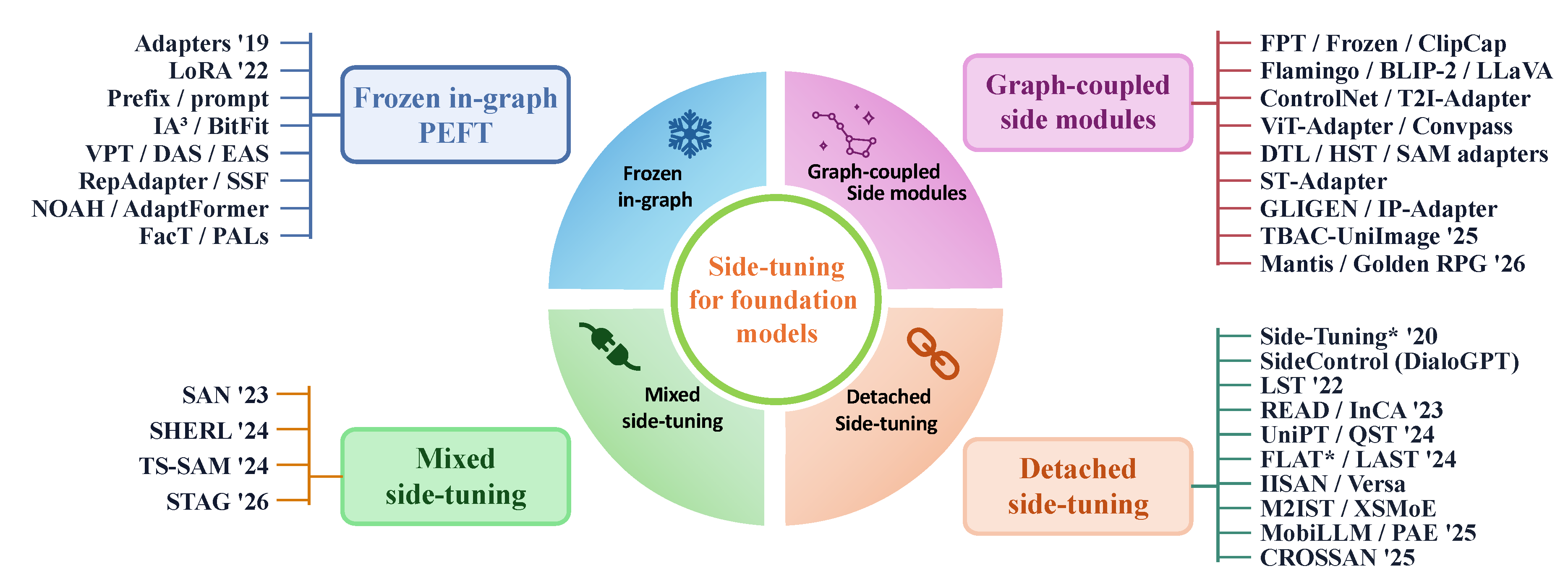
Table 2.
Compact coding schema for auditing side-tuning methods. Each field is coded independently.
| Field | Codes | Main implication |
|---|---|---|
| Gradient topology | In-graph / graph-coupled / mixed / detached | Backward path; activation tape. |
| Feature interface | Output / layer / token–patch / spatial–temporal / multimodal | Information access; feature size. |
| Side/fusion module | MLP / RNN / attention / CNN–decoder / mixer / MoE; terminal / additive / gated / re-injected | Side cost; possible gradient re-coupling. |
| Deployment regime | Online / fixed-feature / periodic refresh / mixed serving | Forward cost; cache I/O; staleness; latency. |
| Evidence provenance | P: paper-explicit / I: inferred from graph or implementation | Reported fact vs. survey inference. |
Table 3.
Compact topology labels and evidence tags. ✓: yes; ✗: no; “Varies”: variant- or interface-dependent. Side input refers to its producing backbone; backward traversal covers all backbone components on the loss-to-side-parameter path, including a distinct receiving generator. Mixed topology uses a prefix and suffix of the same declared backbone. Adjacent denotes related reference paradigms rather than a distinct gradient topology.
| Label | Backbone updated? |
Side input detached? |
Re-enters backbone? |
Backbone backward? |
Survey use |
|---|---|---|---|---|---|
| Core detached | ✗ | ✓ | ✗ | ✗ | Core synthesis; detached resource profile. |
| Graph-coupled | Varies | Varies | Varies | ✓ | Coupled resource profile; outside strict core. |
| Mixed topology | Varies | ✓ | ✓ | suffix only | Same-backbone re-entry; suffix backward only; outside strict core. |
| Adjacent | – | – | – | – | Precursor, baseline, or deployment analogue. |
| Evidence tag | Minimum support | Survey use | |||
| Paper-explicit (P) | Paper states trainable parameters and the relevant gradient boundary. | Direct support; detached variants eligible for strict core. | |||
| Inferred (I) | Topology inferred from the described training graph or implementation. | Provisional comparison only; excluded from strict core. | |||
Table 6.
Design trade-offs for side-tuning.
| Regime | Prefer | Watch / report |
|---|---|---|
| Classification / NLU | Output or shallow ladder; additive fusion; cache final or selected hidden states | Underfitting from coarse final features; report parameters, peak memory, quality |
| LLM adaptation | Output or selective ladder; additive or gated fusion | Separate detachment savings from quantization, offloading, and checkpointing |
| Dense CV / medical | Hierarchical side branch with gated or multi-scale fusion | Multi-scale feature storage; report spatial quality and feature-cache cost |
| Video grounding | Parallel or attention side path; online features unless clips are reusable | Dynamic queries reduce cache reuse; report latency and storage |
| Rec. / retrieval | Output or ladder side path; precompute item/document features | Feature staleness, catalog churn, refresh cost, online latency |
| Streaming / continual | Expandable side experts with gated routing | Capacity growth, pruning cost, forgetting, router drift |
Disclaimer/Publisher’s Note: The statements, opinions and data contained in all publications are solely those of the individual author(s) and contributor(s) and not of MDPI and/or the editor(s). MDPI and/or the editor(s) disclaim responsibility for any injury to people or property resulting from any ideas, methods, instructions or products referred to in the content. |
© 2026 by the authors. Licensee MDPI, Basel, Switzerland. This article is an open access article distributed under the terms and conditions of the Creative Commons Attribution (CC BY) license (http://creativecommons.org/licenses/by/4.0/).
Copyright: This open access article is published under a Creative Commons CC BY 4.0 license, which permit the free download, distribution, and reuse, provided that the author and preprint are cited in any reuse.