

Submitted:
18 October 2026
Posted:
20 October 2026
You are already at the latest version
Abstract
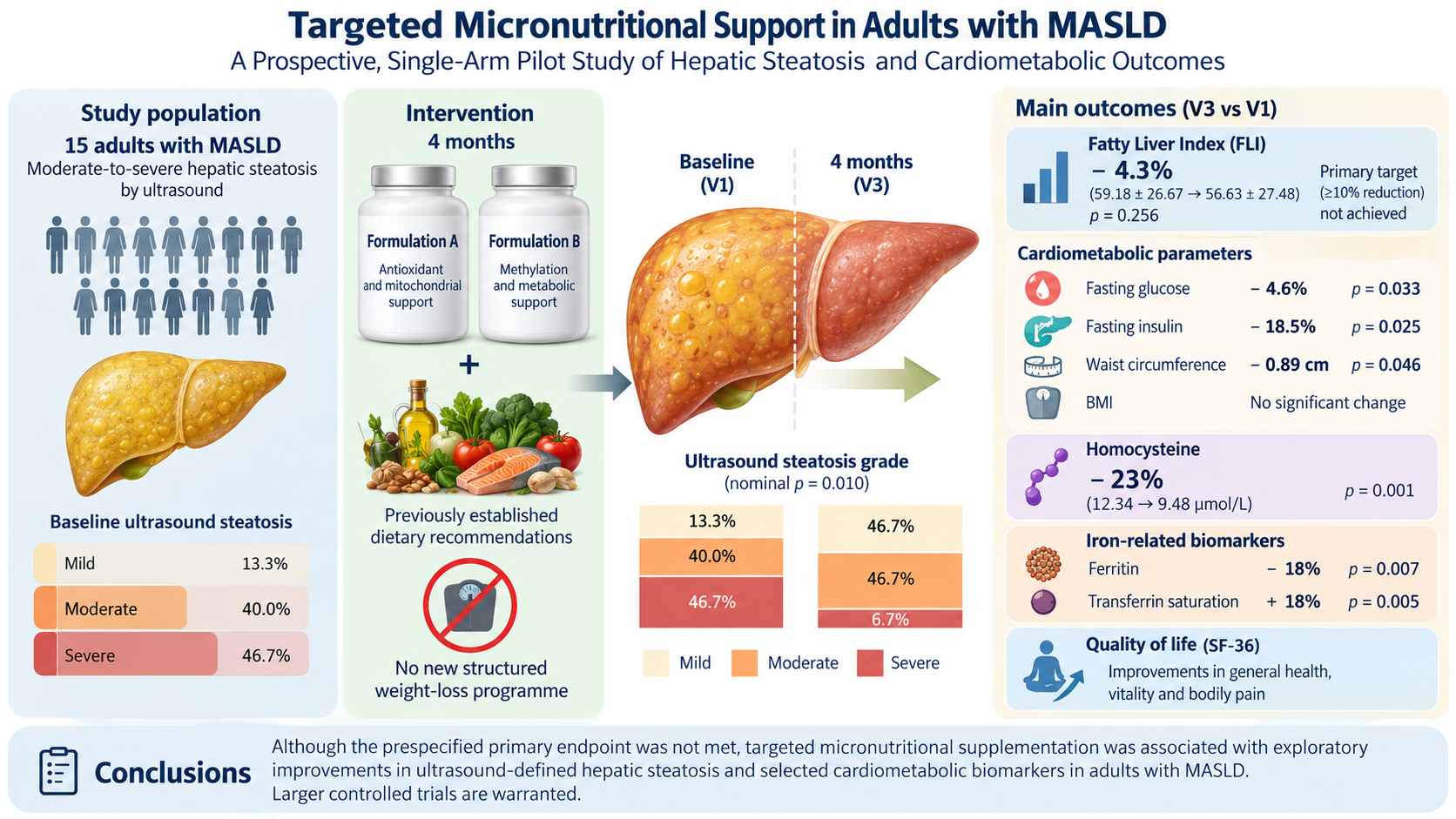
Background/Objectives: Metabolic dysfunction-associated steatotic liver disease (MASLD) involves insulin resistance, altered iron homeostasis, and oxidative stress. We explored changes in hepatic steatosis and cardiometabolic parameters following targeted micronutritional supplementation. Methods: In this prospective, single-center, open-label, single-arm pilot study, 15 adults with ultrasound-confirmed moderate-to-severe hepatic steatosis received two standardized micronutrient formulations for four months, alongside previously established dietary recommendations. No new structured weight-loss program was introduced. The pre-specified primary efficacy target was a ≥10% reduction in Fatty Liver Index (FLI). Secondary outcomes included ultrasound steatosis severity, metabolic and biochemical parameters, quality of life, and safety. Results: The primary efficacy target was not achieved. Mean FLI decreased by 2.55 points (59.18 ± 26.67 to 56.63 ± 27.48), corresponding to a 4.3% relative reduction (p = 0.256). Exploratory analyses showed a shift towards lower ultrasound-defined steatosis grades (nominal p = 0.010), with severe steatosis decreasing from 46.7% to 6.7%. BMI remained unchanged, while waist circumference decreased by 0.89 cm (p = 0.046). Fasting glucose (p = 0.033), insulin (p = 0.025), homocysteine (−23%; p = 0.001), and ferritin (p = 0.007) decreased, while transferrin saturation increased (p = 0.005). No serious adverse events occurred. Conclusions: Although the primary endpoint was not met, micronutritional support was associated with exploratory improvements in ultrasound-defined steatosis and selected cardiometabolic biomarkers. Larger controlled trials are warranted.
Keywords:
metabolic dysfunction-associated steatotic liver disease
; micronutritional support
; hepatic steatosis
; Fatty Liver Index
; homocysteine
; iron metabolism
; cardiometabolic health
; quality of life
1. Introduction
Metabolic dysfunction-associated steatotic liver disease (MASLD), a term introduced through the 2023 international nomenclature consensus to replace non-alcoholic fatty liver disease (NAFLD), is among the most prevalent chronic liver diseases worldwide and is closely associated with cardiometabolic dysfunction. Its high prevalence, close relationship with visceral obesity, insulin resistance and type 2 diabetes mellitus, as well as its association with cardiovascular disease, chronic kidney disease and increased overall mortality, have made it a major public health problem [1,2,3,4,5]. Although this study was designed using the MAFLD nomenclature in force at the time, this discussion primarily uses the term MASLD in accordance with the most recent international recommendations [2].
The therapeutic strategies currently recommended are based on intensive lifestyle modification through energy restriction, improvement in dietary quality and increased physical activity, with the aim of inducing sustained weight loss [4, 6–10]. However, the clinical response is highly variable and depends largely on the degree of adherence achieved, which is difficult to maintain in routine clinical practice. Furthermore, a considerable proportion of patients continue to present with significant steatosis or disease progression despite following conventional dietary recommendations, which has driven the search for complementary strategies targeting specific pathophysiological mechanisms [4,7,9,10].
In recent years, our understanding of the pathophysiology of MASLD has evolved from a model focused exclusively on hepatic fat accumulation towards a multifactorial process in which insulin resistance, low-grade chronic inflammation, lipid metabolism abnormalities, mitochondrial dysfunction, oxidative stress, gut dysbiosis and genetic susceptibility all converge [11]. Within this framework, various studies have highlighted the possible role of iron metabolism and carbon-1 metabolism as modulators of disease progression [12,13,14,15,16,17,18,19].
Elevated serum ferritin, frequently accompanied by normal or only mildly increased transferrin saturation, is commonly observed in patients with metabolic dysfunction and MASLD. This dysmetabolic hyperferritinaemia may reflect inflammatory and metabolic alterations and does not necessarily indicate increased hepatic iron stores or dysmetabolic iron overload syndrome. Its relationship with hepatic disease severity and cardiometabolic risk remains an area of clinical interest [12-16]. At the same time, hyperhomocysteinemia has been associated with insulin resistance, activation of hepatic stellate cells, fibrotic remodeling and increased vascular risk, which positions one carbon metabolism as a potential therapeutic target in this context [17-20]. Furthermore, an imbalance in the redox state and reduced glutathione availability promote lipotoxicity, lipid peroxidation, and the progression of hepatocellular damage [21,22,23].
Although numerous studies have assessed the effects of the Mediterranean diet [24], weight loss or pharmacological interventions [25] on hepatic steatosis, there is far less evidence regarding nutritional strategies aimed simultaneously at modulating several of these pathophysiological mechanisms. In particular, there are few prospective studies that have comprehensively assessed the progression of hepatic steatosis, iron metabolism, one carbon metabolism, biomarkers related to redox balance, the cardiometabolic profile and health-related quality of life within a single cohort of patients with MASLD [11,20,26,27,28,29,30,31,32,33].
Furthermore, most studies use indirect indices of steatosis, such as the Fatty Liver Index (FLI), whose usefulness for longitudinal monitoring remains a subject of debate, while few studies combine these indices with follow-up ultrasound assessment and biomarkers mechanistically linked to the disease [34,35,36,37,38].
Based on these considerations, this prospective pilot study aimed to explore changes in hepatic steatosis following four months of targeted micronutritional support in adults with ultrasound-confirmed grade II–III fatty liver disease and metabolic dysfunction. As secondary objectives, changes in anthropometric parameters, the glucometabolic profile, iron metabolism, one carbon metabolism, biomarkers of redox balance, health-related quality of life and safety variables were analysed, based on the hypothesis that an intervention simultaneously targeting several pathophysiological mechanisms might be associated with an overall improvement in the cardiometabolic phenotype characteristic of the disease. The conceptual framework underlying the study is summarised in Figure 1.
2. Materials and Methods
A prospective, single-center, open-label, single-arm pilot study with repeated within-participant measurements was conducted over four months in adults with ultrasound-confirmed hepatic steatosis and metabolic dysfunction. The original study protocol used the MAFLD terminology; the present manuscript uses MASLD where appropriate, acknowledging that the two definitions are not fully interchangeable.
The aim was to assess the association between a multimodal nutritional intervention with micronutrient support and the progression of hepatic steatosis, the cardiometabolic profile, iron metabolism, biomarkers related to redox balance and quality of life in adults with MASLD.
Patients aged 18 years or over with a diagnosis of grade II–III MASLD confirmed by abdominal ultrasound were eligible. Patients with other chronic liver diseases, alcohol consumption exceeding the limits set by current clinical guidelines, decompensated liver disease, uncontrolled diabetes mellitus, or anticipated significant changes to pharmacological treatment during the follow-up period were excluded. All participants provided written informed consent prior to inclusion.
Intervention
For four months, participants received targeted micronutritional support comprising two commercial formulations (CN Base® and Metabolic Pur®, Laboratorio LCN, Spain), alongside dietary recommendations consistent with clinical guidelines for MASLD.
Before enrolment, participants had already reported following guideline-consistent dietary recommendations. Therefore, no new structured weight-loss programme was introduced during the study. Instead, previously established dietary recommendations were reinforced through brief motivational counselling and assessment of self-reported adherence at each visit. Thus, the intervention primarily involved adding micronutritional supplementation to participants' existing dietary habits, rather than implementing an intensive lifestyle modification programme.
CN Base® provided vitamins, minerals, and metabolic cofactors, including coenzyme Q10 and alpha-lipoic acid, selected for their roles in energy metabolism and antioxidant defence. Metabolic Pur® contained N-acetylcysteine, glycine, and B vitamins, selected for their potential roles in one-carbon metabolism and glutathione synthesis and recycling. Both formulations were administered orally for four months according to the study protocol. Their complete qualitative and quantitative composition, daily doses, and administration schedules are provided in Supplementary Table S1.
Adherence to supplementation and dietary recommendations was assessed through structured clinical interviews at each scheduled visit. No protocol-defined changes to concomitant medications were introduced, and any clinically relevant pharmacological changes during follow-up were recorded.
Study variables
Primary objective
The prespecified primary efficacy outcome was the change in the Fatty Liver Index (FLI) from baseline to month 4. A relative reduction of at least 10% from the individual baseline FLI value was defined as the efficacy target.
Secondary objectives
The secondary objectives included the assessment of:
Steatosis and liver function
- Degree of steatosis as assessed by ultrasound.
- FIB-4.
- NAFLD Fibrosis Score.
- AST.
- ALT.
- ALT/AST ratio.
- GGT.
- Alkaline phosphatase.
- Total bilirubin.
Anthropometric variables
- Body weight.
- Body mass index.
- Waist circumference.
Cardiovascular parameters
- Systolic blood pressure.
- Diastolic blood pressure.
- Resting heart rate.
Glucometabolic profile
- Fasting glucose.
- Fasting insulin.
- HbA1c.
- Uric acid.
- Total cholesterol.
- HDL cholesterol.
- LDL cholesterol.
- Triglycerides.
Iron metabolism
- Ferritin.
- Transferrin saturation.
Nutritional status
- 25-hydroxyvitamin D.
Biomarkers related to redox balance
- Reduced glutathione (GSH).
- Oxidised glutathione (GSSG).
- GSH/GSSG ratio.
- Malondialdehyde (MDA).
- Anti-oxidised LDL IgG antibodies.
Safety
- Full blood count.
- Basic coagulation parameters.
- Adverse event log.
Quality of life
This was assessed using the validated SF-36 questionnaire, with particular focus on the domains of physical pain, general health, vitality and mental health.
Procedures
Clinical, anthropometric and laboratory assessments were carried out at the start of the study and at the end of the fourth month of follow-up.
Hepatic steatosis was assessed by conventional abdominal ultrasonography at baseline and month 4. Both examinations were performed by the same experienced sonographer using a standardised imaging protocol. Changes in steatosis grade were interpreted as exploratory semiquantitative imaging findings rather than direct measurements of hepatic fat content.
Health-related quality of life was assessed using the SF-36 questionnaire, administered at scheduled visits in accordance with the study protocol.
Statistical analysis
Continuous variables were expressed as mean ± standard deviation or median and interquartile range where necessary, whilst categorical variables were described using absolute frequencies and percentages.
The distribution of continuous variables was assessed using the Shapiro–Wilk test. Intra-individual comparisons between the baseline assessment and the final visit were performed using the Wilcoxon signed-rank test for paired data. Ordinal categorical variables, including the ultrasound classification of steatosis, were analysed using marginal homogeneity tests.
Associations between continuous variables were explored using Pearson’s or Spearman’s correlation coefficients, depending on the data distribution.
A p-value < 0.05 was considered statistically significant.
As this was an exploratory pilot study, no formal sample-size calculation was performed. The sample size was determined by feasibility. No adjustment for multiple comparisons was applied; therefore, all secondary analyses were considered hypothesis-generating, and their p-values are reported as nominal. The exact statistical tests and software used are specified in the analysis methods.
3. Results
3.1. Study Population
Only fifteen participants with grade II–III MAFLD were enrolled, and all 15 completed the four-month intervention and were included in the per-protocol analysis. Baseline demographic, anthropometric, clinical and biochemical characteristics are presented in Table 1. The cohort consisted mainly of men (60%) with a mean age of 56.8 ± 13.8 years, who were overweight or obese (BMI 28.6 ± 3.7 kg/m²) and had marked central adiposity (waist circumference 101.2 ± 11.2 cm). Almost half of the participants (46.7 %) had severe hepatic steatosis on baseline ultrasound assessment, whilst only 20 % had moderate steatosis. Overall, the cohort represented a clinical phenotype characteristic of MAFLD with established liver involvement and associated cardiometabolic abnormalities.
Values are mean ± standard deviation unless otherwise indicated. The baseline GSH/GSSG ratio (9.51) was calculated as the mean reduced glutathione concentration divided by the mean oxidised glutathione concentration (3.52/0.37 µmol/L). This ratio of group means is not equivalent to the mean of individual participant ratios; therefore, no SD is reported.
3.2. Primary Objective
Mean FLI decreased from 59.18 ± 26.67 at baseline to 56.63 ± 27.48 at month 4, corresponding to an absolute reduction of 2.55 points and a 4.3% reduction relative to the baseline group mean (p = 0.256). The prespecified primary efficacy target of a ≥10% reduction was not achieved. The trends in the individual components of the index were heterogeneous. Whilst waist circumference and body mass index decreased during follow-up, γ-glutamyltransferase and triglycerides remained virtually stable.
3.3. Ultrasound Regression of Hepatic Steatosis
Although the primary endpoint based on the FLI was not met, the ultrasound assessment showed a consistent shift towards lower categories of steatosis severity. Ultrasound assessment showed a shift in the distribution of steatosis severity towards lower grades between baseline and month 4 (nominal p = 0.010). The number of participants classified as having severe steatosis decreased from seven (46.7%) to one (6.7%), while five participants (33.3%) were classified as having mild steatosis at month 4, compared with none at baseline (Figure 2). These findings represent exploratory changes in semiquantitative ultrasound grades. Serum concentrations of AST, ALT and GGT showed modest decreases that did not reach statistical significance.
3.4. Anthropometric Changes and Cardiometabolic Profile
Waist circumference decreased by 0.89 cm (nominal p = 0.046), whereas the reduction in BMI was not statistically significant. Exploratory analyses also showed reductions in fasting glucose (96.13 ± 10.68 to 91.73 ± 11.79 mg/dL; nominal p = 0.033) and fasting insulin (11.19 to 9.12 µU/mL; nominal p = 0.025). Plasma homocysteine decreased by 2.86 µmol/L, from 12.34 ± 3.60 to 9.48 ± 1.87 µmol/L (approximately 23% from baseline; nominal p = 0.001), representing one of the largest relative changes observed during follow-up.
3.5. Iron Metabolism and Haematological Parameters
Hematological parameters remained stable throughout the study, and no findings consistent with anemia or depletion of iron stores were observed. Serum ferritin decreased from 219.87 ± 224.32 to 174.77 ± 210.23 ng/mL (nominal p = 0.007), while transferrin saturation increased from 23.60 ± 7.63% to 28.20 ± 9.07% (nominal p = 0.005). The proportion of circulating monocytes also decreased (8.29% to 7.25%; nominal p = 0.033). These changes were exploratory and do not, by themselves, establish changes in systemic inflammation or iron stores. Serum levels of 25-hydroxyvitamin D showed an upward trend that did not reach statistical significance.
3.6. Biomarkers Related to Redox Balance
Exploratory biomarkers related to redox balance showed a consistent trend, although none reached statistical significance. The GSH/GSSG ratio tended to increase (p = 0.088), whilst concentrations of malondialdehyde and titres of anti-oxidised LDL antibodies showed slight reductions. Taken together, these results suggest a possible improvement in redox status, although they should be interpreted with caution due to the exploratory nature of the analysis and the small sample size.
3.6. Health-Related Quality of Life
Exploratory analysis of the SF-36 showed improvements in general health (+18.10 points; nominal p = 0.005), bodily pain (+10.83 points; nominal p = 0.035), and vitality (+13.67 points; nominal p = 0.009). Scores for physical functioning, social functioning, and mental health also increased, although these changes did not reach statistical significance.
3.7. Safety
The intervention was well tolerated. Five adverse events were recorded in three participants (20 %); none of these were considered to be related to the intervention, and no serious adverse events occurred. Haematological, biochemical and coagulation parameters remained stable throughout the study, with no clinically relevant abnormalities observed.
4. Discussion
This prospective pilot study shows that a multimodal nutritional intervention with micronutrient support over four months was associated with a significant reduction in the ultrasound severity of hepatic steatosis in adults with grade II–III MASLD, accompanied by a coordinated improvement in various components of the cardiometabolic phenotype characteristic of the disease. Importantly, the primary FLI endpoint was not met, and all secondary outcomes should be interpreted as exploratory. Although the prespecified primary FLI endpoint was not achieved, exploratory analyses identified concurrent changes in ultrasound-defined steatosis severity and several cardiometabolic and biochemical parameters. The convergence of these findings is biologically interesting and supports further investigation of nutritional strategies targeting interconnected metabolic pathways in MASLD. However, these findings should be regarded as hypothesis-generating rather than confirmatory findings.
The most notable secondary finding was the shift toward lower ultrasound steatosis grades. Almost half of the cohort had severe steatosis at the start of the study, while only one patient remained in that category after four months and one-third were reclassified as having mild steatosis; no worsening was observed in any participant. The shift in ultrasound-defined steatosis severity contrasted with the absence of a statistically significant change in FLI. These measures capture different aspects of hepatic steatosis and metabolic status, and their longitudinal responsiveness may differ. However, the present study was not designed to compare their diagnostic performance or sensitivity to change. The FLI was developed as a cross-sectional tool for identifying steatosis and cardiometabolic risk and relies heavily on variables that change slowly, such as body mass index, triglycerides or GGT [34,35,36,37,38]. In contrast, conventional ultrasound provides a semi-quantitative assessment of hepatic steatosis based on predefined imaging features. Although it may detect changes in steatosis grade, its limited sensitivity for small changes in liver fat content and its operator dependence should be acknowledged. Although conventional ultrasound does not provide an absolute quantification of hepatic fat content and remains to some extent operator-dependent, all scans were performed by the same experienced sonographer following a standardised protocol, thereby reducing inter-observer variability.
The changes in ultrasound-defined steatosis severity were accompanied by a small reduction in waist circumference and concurrent decreases in fasting glucose and insulin concentrations. These observations are consistent with changes in selected cardiometabolic parameters, although insulin sensitivity was not directly assessed. These changes are consistent with the close relationship between insulin resistance and hepatic fat accumulation, currently considered one of the main pathophysiological mechanisms of MASLD [2,4,5]. Particularly noteworthy was the reduction in plasma homocysteine, one of the largest relative changes observed during follow-up, decreasing by approximately 23%. Hyperhomocysteinemia has been linked to insulin resistance, oxidative stress, activation of hepatic stellate cells, fibrotic remodelling and increased cardiovascular risk [17,18,19]. Although our study design does not allow us to establish causal relationships, the observed reduction is consistent with the hypothesis that the modulation of carbon-1 metabolism could represent an additional mechanism of interest within the nutritional management of MASLD.
A particularly noteworthy finding was the coordinated pattern of changes observed in biomarkers of iron metabolism. The concurrent decrease in serum ferritin and increase in transferrin saturation represent an interesting exploratory finding. In MASLD, ferritin may reflect a combination of iron-related, inflammatory, hepatic, and metabolic processes. Although the observed pattern could be consistent with changes in dysmetabolic iron handling, it cannot establish normalisation of iron homeostasis or a reduction in hepatic iron stores. However, ferritin is also an acute-phase reactant, and the underlying mechanism cannot be fully established. Hyperferritinaemia in this context does not necessarily reflect an absolute excess of iron, but rather a complex state in which low-grade inflammation, insulin resistance and alterations in iron homeostasis converge. Several studies have linked this phenotype to increased fibrosis progression, a higher inflammatory burden and a poorer metabolic prognosis [12,13,14,15]. The concurrent reduction in the percentage of circulating monocytes is another exploratory observation of potential interest. Given the involvement of innate immune pathways in MASLD, this finding may warrant further investigation. However, changes in monocyte percentages alone cannot establish reduced monocyte activation or systemic inflammation.
Exploratory biomarkers related to redox balance did not reach statistical significance, probably due to the small sample size. Nevertheless, the observed trends were consistent with expectations, showing a tendency towards an increase in the GSH/GSSG ratio and parallel reductions in malondialdehyde and antibodies against oxidised LDL. From a biological perspective, the direction of these exploratory changes is compatible with the hypothesised involvement of redox-related pathways. However, none of the measured redox biomarkers showed a statistically significant change, and intracellular antioxidant capacity was not directly assessed. Given that one carbon metabolism, glutathione synthesis and the availability of vitamin cofactors are closely interrelated processes [39], it is plausible that the reduction in homocysteine and the trends observed in the redox biomarkers form part of the same integrated metabolic response. However, this hypothesis will need to be confirmed by studies specifically designed to evaluate these mechanisms.
Beyond the biochemical variables, the intervention was associated with a significant improvement in several domains of the SF-36 questionnaire, particularly in general health, bodily pain and vitality. Quality of life is an increasingly relevant clinical outcome in MASLD, as the condition is frequently associated with fatigue, functional limitation and impaired physical well-being, even in the absence of advanced cirrhosis [27,28,29]. These exploratory findings suggest an improvement in self-reported health-related quality of life during follow-up. The improvements in self-reported health-related quality of life are clinically relevant exploratory observations. However, given the open-label design and absence of a control group, expectancy effects and other non-specific influences cannot be excluded, and the relationship between biochemical changes and perceived health remains uncertain.
This study has several strengths. Firstly, it simultaneously integrates hepatic, anthropometric and cardiometabolic variables, those related to iron metabolism, biomarkers of redox balance and patient-centred outcomes, providing a comprehensive overview that is rare in nutritional studies on MASLD. Secondly, it evaluates a cohort with predominantly moderate-to-severe steatosis, representative of patients seen in routine clinical practice. Finally, the combined inclusion of biomarkers related to iron metabolism, one carbon metabolism and redox balance provides a novel pathophysiological perspective that could guide future research.
The present study has also several limitations that must be taken into account when interpreting the results. The main limitation stems from its open-label, single-centre design without a control group, which prevents the establishment of causal relationships between the intervention and the observed changes. Regression to the mean, spontaneous lifestyle modifications or behavioural changes resulting from participation in the study itself cannot be ruled out. The open-label design may also have influenced patient-reported outcomes through expectancy or participation effects. The small sample size limits statistical power, particularly for exploratory biomarkers related to redox balance and liver enzymes. Furthermore, the high number of variables analysed increases the risk of type I errors; therefore, secondary results should be regarded as hypothesis-generating. The absence of objective quantification of dietary intake, physical activity levels and adherence to supplementation constitutes another significant methodological limitation. Similarly, the use of conventional ultrasound does not allow for direct quantification of hepatic fat content, although this limitation was partially mitigated by having all scans performed by the same operator using a standardised protocol. In addition, the absence of quantitative imaging techniques such as MRI-PDFF or controlled attenuation parameter limits conclusions regarding the magnitude of change in hepatic fat content.
5. Conclusions
In this prospective, single-arm pilot study involving 15 adults with metabolic dysfunction-associated fatty liver disease, four months of targeted micronutritional support did not achieve the prespecified primary FLI efficacy target. Nevertheless, exploratory analyses identified a shift towards lower ultrasound-defined steatosis grades, together with reductions in fasting glucose, insulin, homocysteine, and ferritin, and an increase in transferrin saturation. These findings suggest that micronutritional strategies targeting interconnected metabolic pathways deserve further investigation. Given the small sample size, uncontrolled design, and multiple exploratory comparisons, the observed changes cannot be attributed causally to the intervention. Larger randomised controlled trials incorporating quantitative hepatic fat assessment are warranted.
Supplementary Materials
The supporting information can be downloaded at the website of this paper posted on Preprints.org. Table S1: Composition and daily doses of the micronutrient formulations
Author Contributions
Conceptualization, Núria Capdevila Menac, and Jordi Esquirol; methodology, Montserrat Argemí Relat, Sergio Abanades, Ismael San Mauro and Jordi Esquirol.; validation, Ismael San Mauro, formal analysis Ismael San Mauro.; investigation, Montserrat Argemí Relat, and Jordi Esquirol.; data curation, Ismael San Mauro; writing—original draft preparation, Montserrat Argemí Relat and Sergio Abanades; writing—review and editin, Montserrat Argemí Relat, Sergio Abanades, Ismael San Mauro and Jordi Esquirol; supervision, Ismael San Mauro and Núria Capdevila Menac,; project administration, Núria Capdevila Menac.; funding acquisition Núria Capdevila Menac, All authors reviewed and approved the final manuscript.
Funding
Laboratorio Complementos Nutricionales (LCN, Barcelona, Spain) provided financial support for the study and supplied the micronutrient formulations used in the intervention.
Institutional Review Board Statement
The study was conducted in accordance with the principles of the Declaration of Helsinki. The study protocol (version 1.1, dated 22 July 2024) was reviewed and approved by the Research Ethics Committee for Medicinal Products (CEIM) of Grupo Hospitalario Quirónsalud-Catalunya on 1 August 2024 (Minutes No. 16/2024). The Committee’s internal reference number was 2024/66-END-PSC.
Informed Consent Statement
Informed consent was obtained from all subjects involved in the study.
Data Availability Statement
The data supporting the findings of this study are presented in the article and its supplementary materials. Additional de-identified participant-level data may be made available by the corresponding author upon reasonable request, subject to applicable ethical and data protection requirements. The complete dataset is not publicly available to protect participant confidentiality, given the small sample size and the clinical nature of the information collected.
Acknowledgments
During the preparation of this manuscript, the authors used ChatGPT (OpenAI) exclusively to assist with the graphical design of Figures 1 and 2 and Table 1. The scientific concepts, literature selection and interpretation, manuscript preparation, and critical revision were undertaken by the authors. All AI-assisted output was reviewed and edited by the authors, who take full responsibility for the final content of the publication.
Conflicts of Interest
Montserrat Argemí Relat, Sergio Abanades León, Ismael San Mauro and Jordi Esquirol declare that they received no personal fees, remuneration or other financial compensation from LCN in connection with this study, apart from institutional support provided for the research project. Núria Capdevila Menac is employed by LCN as Director of its Medical Department. Her affiliation and involvement in the study are disclosed to ensure transparency regarding the relationship between the sponsor and the research team. The authors declare no other known financial or personal conflicts of interest relevant to this work. The statistical analysis was conducted independently of the sponsor. Although a representative of LCN participated as a coauthor, the scientific interpretation of the findings, preparation of the manuscript and decision to submit it for publication remained under the responsibility of the authors.
Abbreviations
The following abbreviations are used in this manuscript:
| MDPI | Multidisciplinary Digital Publishing Institute |
| DOAJ | Directory of open access journals |
| TLA | Three letter acronym |
| LD | Linear dichroism |
References
- Eslam, M.; Newsome, P.N.; Sarin, S.K.; et al. A new definition for metabolic dysfunction-associated fatty liver disease: An international expert consensus statement. J. Hepatol. 2020, 73, 202–209. [Google Scholar] [CrossRef]
- Rinella, M.E.; Lazarus, J.V.; Ratziu, V.; et al. A multi-society Delphi consensus statement on new fatty liver disease nomenclature. Hepatology 2023, 78, 1966–1986. [Google Scholar] [CrossRef]
- Lin, Z.; Zhang, R.; Ren, S.; He, T.; Mi, H.; Jiang, W.; Su, C. Global burden of metabolic dysfunction-associated steatotic liver disease from 1990 to 2021 and the prediction for the next 10 years. Prev. Med. Rep. 2025, 59, 103248. [Google Scholar] [CrossRef]
- Romero-Gomez, M.; Zelber-Sagi, S.; Trenell, M. Treatment of NAFLD with diet, physical activity and exercise. J. Hepatol. 2017, 67, 829–846. [Google Scholar] [CrossRef]
- Stefan, N.; Häring, H.U.; Cusi, K. Non-alcoholic fatty liver disease: Causes, diagnosis, cardiometabolic consequences, and treatment strategies. Lancet Diabetes Endocrinol. 2019, 7, 313–324. [Google Scholar] [CrossRef]
- European Association for the Study of the Liver (EASL); European Association for the Study of Diabetes (EASD); European Association for the Study of Obesity (EASO). EASL-EASD-EASO Clinical Practice Guidelines on the management of metabolic dysfunction-associated steatotic liver disease (MASLD). J. Hepatol. 2024, 81, 492–542. [Google Scholar] [CrossRef]
- Plauth, M.; Bernal, W.; Dasarathy, S.; et al. ESPEN guideline on clinical nutrition in liver disease. Clin. Nutr. 2019, 38, 485–521. [Google Scholar] [CrossRef]
- Machado, M.V. What should we advise MAFLD patients to eat and drink? Metab. Target Organ Damage 2021, 1, 9. [Google Scholar] [CrossRef]
- Janota, B.; Janion, K.; Buzek, A.; Janczewska, E. Dietary strategies in the prevention of MASLD: A comprehensive review of dietary patterns against fatty liver. Metabolites 2025, 15, 528. [Google Scholar] [CrossRef]
- Keating, S.E.; Chawla, Y.; De, A.; et al. Lifestyle intervention for metabolic dysfunction-associated fatty liver disease: A 24-h integrated behavior perspective. Hepatol. Int. 2024, 18 (Suppl. 2), 959–976. [Google Scholar] [CrossRef]
- Buzzetti, E.; Pinzani, M.; Tsochatzis, E.A. The multiple-hit pathogenesis of non-alcoholic fatty liver disease (NAFLD). Metabolism 2016, 65, 1038–1048. [Google Scholar] [CrossRef]
- Handa, P.; Vemulakonda, A.L.; Maliken, B.D.; et al. Differences in hepatic expression of iron, inflammation and stress-related genes in patients with non-alcoholic steatohepatitis. Ann. Hepatol. 2017, 16, 77–85. [Google Scholar] [CrossRef]
- Datz, C.; Felder, T.K.; Niederseer, D.; Aigner, E. Iron homeostasis in the metabolic syndrome. Eur. J. Clin. Investig. 2013, 43, 215–224. [Google Scholar] [CrossRef]
- Dongiovanni, P.; Fracanzani, A.L.; Fargion, S.; Valenti, L. Iron in fatty liver and in the metabolic syndrome: A promising therapeutic target. J. Hepatol. 2011, 55, 920–932. [Google Scholar] [CrossRef]
- Xia, T.; Ni, J.; Ni, Y.; Wu, X.; Du, K.; Wan, X.; You, X. Serum iron status is associated with all-cause mortality in metabolic dysfunction-associated steatotic liver disease: A prospective, observational study. Front. Endocrinol. 2024, 15, 1454193. [Google Scholar] [CrossRef]
- Stein, J.; Connor, S.; Virgin, G.; Ong, D.E.H.; Pereyra, L. Anaemia and iron deficiency in gastrointestinal and liver conditions. World J. Gastroenterol. 2016, 22, 7908–7925. [Google Scholar] [CrossRef]
- Škovierová, H.; Vidomanová, E.; Mahmood, S.; Sopková, J.; Drgová, A.; Červeňová, T.; Halašová, E.; Lehotský, J. The Molecular and Cellular Effect of Homocysteine Metabolism Imbalance on Human Health. Int. J. Mol. Sci. 2016, 17, 1733. [Google Scholar] [CrossRef]
- Chen, P.; Yang, Z.; Guo, L.; Huang, Y.; Li, J.; Chen, X. Effects of homocysteine on non-alcoholic fatty liver disease: A Mendelian randomisation study. Front. Mol. Biosci. 2022, 9, 1083855. [Google Scholar] [CrossRef]
- Suzuki, M.; Kim, H.Y.; Reed, M.C.; et al. Elevated homocysteine is associated with liver fibrosis in metabolic dysfunction-associated steatotic liver disease in a sex- and menopause-specific manner. Gastro Hep Adv. 2025, 5, 100800. [Google Scholar] [CrossRef]
- Fernandez-Ramos, D.; Lopitz-Otsoa, F.; Millet, O.; Alonso, C.; Lu, S.C.; Mato, J.M. One-carbon metabolism and S-adenosylmethionine in the pathogenesis and subtypes of non-alcoholic fatty liver disease. Livers 2022, 2, 243–257. [Google Scholar] [CrossRef]
- Rolo, A.P.; Teodoro, J.S.; Palmeira, C.M. Role of oxidative stress in the pathogenesis of non-alcoholic steatohepatitis. Free Radic. Biol. Med. 2012, 52, 59–69. [Google Scholar] [CrossRef]
- Vairetti, M.; Di Pasqua, L.G.; Cagna, M.; Richelmi, P.; Ferrigno, A.; Berardo, C. Changes in glutathione content in liver diseases: An update. Antioxidants 2021, 10, 364. [Google Scholar] [CrossRef]
- Sumida, Y.; Niki, E.; Naito, Y.; Yoshikawa, T. The role of free radicals and oxidative stress in NAFLD/NASH. Free Radic. Res. 2013, 47, 869–880. [Google Scholar] [CrossRef]
- Zanini, B.; Benini, F.; Marullo, M.; Simonetto, A.; Rossi, A.; Cavagnoli, P.; Bonalumi, A.; Marconi, S.; Pigozzi, M.G.; Gilioli, G.; Valerio, A.; Donato, F.; Castellano, M.; Ricci, C. Mediterranean-oriented dietary intervention is effective to reduce liver steatosis in patients with nonalcoholic fatty liver disease: Results from an Italian clinical trial. Int. J. Clin. Pract. 2024, 2024, 8861126. [Google Scholar] [CrossRef]
- Malandris, K.; Charalampidis, K.; Loomba, R.; Sinakos, E. Pharmacologic treatment of metabolic dysfunction-associated steatotic liver disease in the context of type 2 diabetes. Curr. Diab. Rep. 2026, 26, 6. [Google Scholar] [CrossRef]
- Barchetta, I.; Cimini, F.A.; Cavallo, M.G. Vitamin D and metabolic dysfunction-associated fatty liver disease (MAFLD): An update. Nutrients 2020, 12, 3302. [Google Scholar] [CrossRef]
- Sayiner, M.; Stepanova, M.; Pham, H.; Noor, B.; Walters, M.; Younossi, Z.M. Assessment of health utilities and quality of life in patients with non-alcoholic fatty liver disease. BMJ Open Gastroenterol. 2016, 3, e000106. [Google Scholar] [CrossRef]
- Heyens, L.J.M.; Van Steenkiste, C.; Struyve, M.; et al. MASLD is associated with decreased general health perception, quality of life and work productivity in a low fibrosis population. Liver Int. 2026, 46, e70604. [Google Scholar] [CrossRef]
- Younossi, Z.M.; Stepanova, M.; Kim, Y.; Dodge, S.; Labriola, D.; Taub, R.; Nader, F. Assessments of health utilities in patients with metabolic dysfunction-associated steatohepatitis: Cross-walk between disease-specific Chronic Liver Disease Questionnaire, Short Form SF-6D, and EuroQol EQ-5D instruments. Gastro Hep Adv. 2025, 4, 100642. [Google Scholar] [CrossRef]
- Simancas-Racines, D.; Annunziata, G.; Verde, L.; et al. Nutritional strategies for battling obesity-linked liver disease: The role of medical nutritional therapy in metabolic dysfunction-associated steatotic liver disease (MASLD) management. Curr. Obes. Rep. 2025, 14, 7. [Google Scholar] [CrossRef]
- Perva, I.T.; Simina, I.E.; Bende, R.; Motofelea, A.C.; Chirita Emandi, A.; Andreescu, N.; Sima, A.; Vlad, A.; Sporea, I.; Zimbru, C.; et al. Use of a micronutrient cocktail to improve metabolic dysfunction-associated steatotic liver disease (MASLD) in adults with obesity: A randomised, double-blinded pilot clinical trial. Medicina 2024, 60, 1366. [Google Scholar] [CrossRef]
- Lyon, P.; Strippoli, V.; Fang, B.; Cimmino, L. B-vitamins and one-carbon metabolism: Implications in human health and disease. Nutrients 2020, 12, 2867. [Google Scholar] [CrossRef]
- Liu, Y.; Qin, X.; Chen, T.; Chen, M.; Wu, L.; He, B. Exploring the interactions between metabolic dysfunction-associated fatty liver disease and micronutrients: From molecular mechanisms to clinical applications. Front. Nutr. 2024, 11, 1344924. [Google Scholar] [CrossRef]
- Bedogni, G.; Bellentani, S.; Miglioli, L.; et al. The fatty liver index: A simple and accurate predictor of hepatic steatosis in the general population. BMC Gastroenterol. 2006, 6, 33. [Google Scholar] [CrossRef]
- Lonardo, A.; Ballestri, S.; Bedogni, G.; Bellentani, S.; Tiribelli, C. The fatty liver index (FLI) 15 years later: A reappraisal. Metab. Target Organ Damage 2021, 1, 10. [Google Scholar] [CrossRef]
- Carli, F.; Sabatini, S.; Gaggini, M.; Sironi, A.M.; Bedogni, G.; Gastaldelli, A. The Fatty Liver Index (FLI) identifies not only individuals with hepatic steatosis but also those at high cardiometabolic risk. Int. J. Mol. Sci. 2023, 24, 14651. [Google Scholar] [CrossRef]
- Zou, B.; Yeo, Y.H.; Cheung, R.; Ingelsson, E.; Nguyen, M.H. Fatty liver index and development of cardiovascular disease: Findings from the UK Biobank. Dig. Dis. Sci. 2021, 66, 2092–2100. [Google Scholar] [CrossRef]
- Sun, M.; Zhong, M.; Luo, F.; Lan, M.; Zhang, X.; Nie, W.; Ma, Z. Noninvasive assessment of hepatic steatosis grades by ultrasound derived fat fraction in metabolic dysfunction associated steatotic liver disease. Sci. Rep. 2024, 14, 32044. [Google Scholar] [CrossRef]
- da Silva, R.P.; Eudy, B.J.; Deminice, R. One-carbon metabolism in fatty liver disease and fibrosis: One-carbon to rule them all. J. Nutr. 2020, 150, 994–1003. [Google Scholar] [CrossRef]
Figure 1.
Proposed Biological Pathways and Exploratory Outcomes of Micronutrient Supplementation in MASLD.
Figure 1.
Proposed Biological Pathways and Exploratory Outcomes of Micronutrient Supplementation in MASLD.
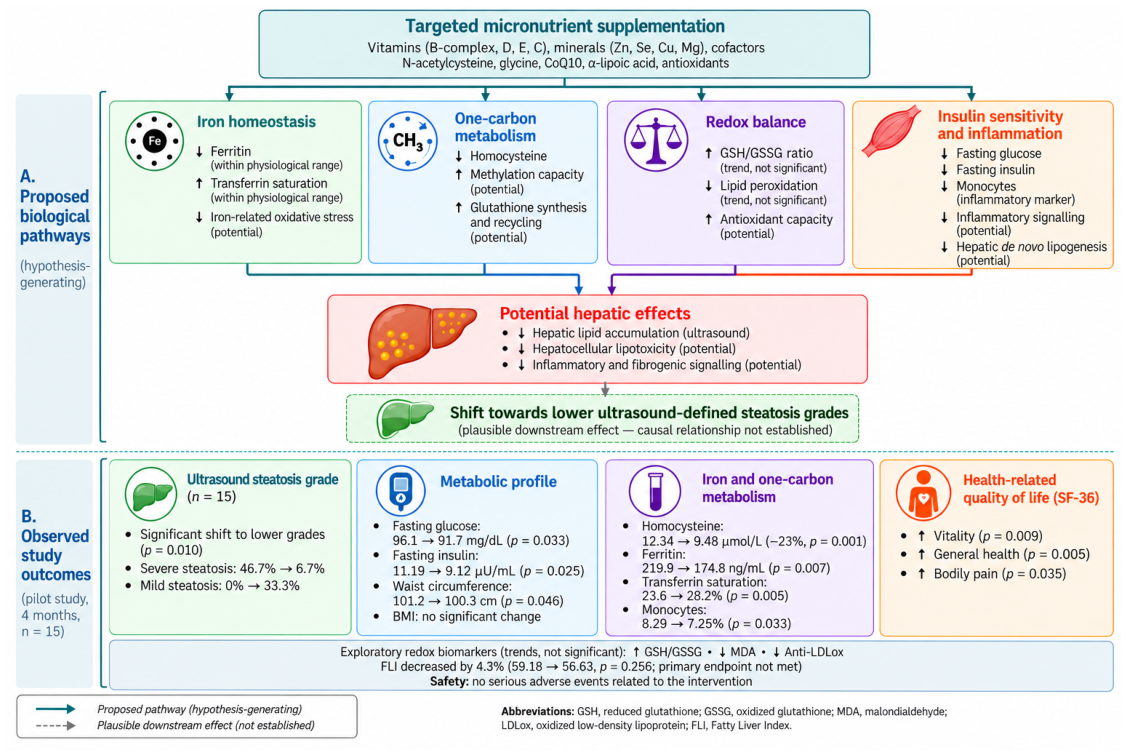
Figure 2.
Distribution of ultrasound-defined hepatic steatosis severity at baseline (V1) and month 4 (V3). Data are presented as percentages of participants (n = 15). Changes in the distribution of steatosis severity were assessed using a marginal homogeneity test (nominal p = 0.010). Results are exploratory and were not adjusted for multiple comparisons.
Figure 2.
Distribution of ultrasound-defined hepatic steatosis severity at baseline (V1) and month 4 (V3). Data are presented as percentages of participants (n = 15). Changes in the distribution of steatosis severity were assessed using a marginal homogeneity test (nominal p = 0.010). Results are exploratory and were not adjusted for multiple comparisons.
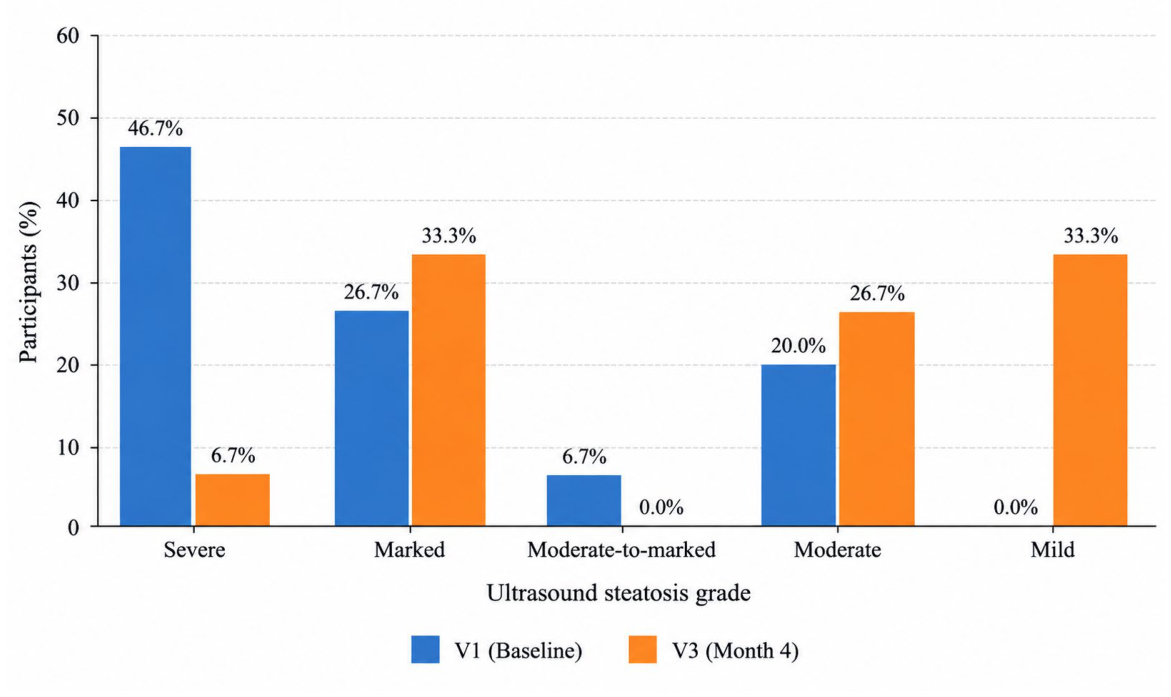

Table 1.
Baseline demographic, anthropometric, clinical, and biochemical characteristics.
| Variable | Mean ± SD or n (%) |
|---|---|
| Demographic and anthropometric characteristics | |
| Participants, n | 15 |
| Female sex, n (%) | 6 (40.0%) |
| Male sex, n (%) | 9 (60.0%) |
| Age (years) | 56.80 ± 13.81 |
| Height (m) | 1.73 ± 0.09 |
| Body weight (kg) | 85.81 ± 14.43 |
| BMI (kg/m²) | 28.61 ± 3.65 |
| Waist circumference (cm) | 101.20 ± 11.18 |
| Systolic blood pressure (mmHg) | 128.73 ± 11.13 |
| Diastolic blood pressure (mmHg) | 82.73 ± 8.49 |
| Heart rate (beats/min) | 77.13 ± 13.11 |
| Ultrasound-defined steatosis severity | |
| Mild, n (%) | 0 (0.0%) |
| Moderate, n (%) | 3 (20.0%) |
| Moderate-to-marked, n (%) | 1 (6.7%) |
| Marked, n (%) | 4 (26.7%) |
| Severe, n (%) | 7 (46.7%) |
| Complete blood count | |
| Red blood cells (×10⁶/µL) | 5.00 ± 0.34 |
| Haemoglobin (g/dL) | 14.82 ± 0.79 |
| Haematocrit (%) | 43.89 ± 2.43 |
| Mean corpuscular volume (fL) | 88.00 ± 4.05 |
| Mean corpuscular haemoglobin (pg) | 29.76 ± 1.74 |
| Platelets (×10³/µL) | 243.67 ± 43.69 |
| White blood cells (×10³/µL) | 6.75 ± 2.01 |
| Neutrophils (%) | 56.93 ± 7.94 |
| Lymphocytes (%) | 31.42 ± 6.27 |
| Monocytes (%) | 8.29 ± 1.84 |
| Eosinophils (%) | 2.58 ± 1.29 |
| Basophils (%) | 0.57 ± 0.29 |
| Iron metabolism | |
| Ferritin (ng/mL) | 219.87 ± 224.32 |
| Transferrin saturation (%) | 23.60 ± 7.63 |
| Glucose and metabolic parameters | |
| Fasting glucose (mg/dL) | 96.13 ± 10.68 |
| Fasting insulin (µU/mL) | 11.19 ± 4.53 |
| HbA1c (%) | 5.46 ± 0.37 |
| Homocysteine (µmol/L) | 12.34 ± 3.60 |
| Uric acid (mg/dL) | 6.27 ± 1.73 |
| Lipid profile | |
| Total cholesterol (mg/dL) | 188.87 ± 29.89 |
| HDL cholesterol (mg/dL) | 56.40 ± 12.09 |
| LDL cholesterol (mg/dL) | 112.07 ± 26.75 |
| Triglycerides (mg/dL) | 114.20 ± 53.97 |
| Liver function and nutritional parameters | |
| AST (U/L) | 34.47 ± 12.70 |
| ALT (U/L) | 36.80 ± 13.86 |
| GGT (U/L) | 39.33 ± 31.03 |
| ALT/AST ratio | 1.06 ± 0.18 |
| Alkaline phosphatase (U/L) | 75.87 ± 21.51 |
| Total bilirubin (mg/dL) | 0.77 ± 0.28 |
| Total protein (g/dL) | 7.253 ± 0.318 |
| Albumin (g/dL) | 4.453 ± 0.292 |
| 25-hydroxyvitamin D (ng/mL) | 25.07 ± 10.98 |
| Coagulation parameters | |
| Prothrombin time (s) | 11.34 ± 0.55 |
| Activated partial thromboplastin time (s) | 28.20 ± 1.57 |
| Fibrinogen (mg/dL) | 254.40 ± 36.13 |
| Redox-related biomarkers | |
| GSH/GSSG ratio (ratio of group means; unitless) | 9.51 |
| Malondialdehyde (µmol/L) | 3.36 ± 0.93 |
| Anti-oxidised LDL IgG (U/mL) | 11,592.56 ± 6,687.16 |
Disclaimer/Publisher’s Note: The statements, opinions and data contained in all publications are solely those of the individual author(s) and contributor(s) and not of MDPI and/or the editor(s). MDPI and/or the editor(s) disclaim responsibility for any injury to people or property resulting from any ideas, methods, instructions or products referred to in the content. |
© 2026 by the authors. Licensee MDPI, Basel, Switzerland. This article is an open access article distributed under the terms and conditions of the Creative Commons Attribution (CC BY) license.
Copyright: This open access article is published under a Creative Commons CC BY 4.0 license, which permit the free download, distribution, and reuse, provided that the author and preprint are cited in any reuse.