

Submitted:
19 October 2026
Posted:
20 October 2026
You are already at the latest version
Abstract
Fixed-combination pharmaceutical forms offer the advantage of simple, reliable admin-istration of two different active substances. This study aimed to develop atorvastatin- and amlodipine-containing polymer-based fibrous sheets at a 1:4 dose ratio for fast disintegra-tion, enhancing elderly patient compliance. Polyvinyl pyrrolidone-based polymer disper-sion was embedded with two active ingredients via solubilization with polysorbate 80. The dispersions were described by pH, conductivity, and texture analysis. The fibrous sheets were characterized by morphology, disintegration, and dissolution. The single-jet electrospun fibers had an average diameter of 588 ± 190 nm. Differential Scanning Calo-rimetry (DSC) and Fourier Transform Infrared (FTIR) results suggest the amorphization of the active substances. Disintegration was very fast, with a measured time under 3 seconds. The API release occurs in a burst, with complete dissolution achieved within the first 5 minutes. The fixed-dose combination fibrous sheets offer a possible fast-delivery system for buccal administration in elderly patients.
Keywords:
polymer based-fibers
; PVP
; atorvastatin
; amlodipine
; fixed-dose combination
; electrospinning
; burst dissolution
1. Introduction
Atorvastatin (ATOR) is a lipid-lowering statin. By inhibiting the endogenous production of cholesterol in the liver, statins reduce abnormal cholesterol and lipid levels and ultimately reduce the risk of cardiovascular disease. In terms of its mechanism of action, it competitively inhibits the enzyme hydroxymethylglutaryl-coenzyme A (HMG-CoA) reductase, which catalyzes the conversion of HMG-CoA to mevalonate. This conversion is a critical metabolic reaction involved in the production of low-density lipoprotein (LDL) and very low-density lipoprotein. It is therefore an early rate-limiting step in cholesterol biosynthesis [1,2]. Atorvastatin and other statins are considered first-line treatments for dyslipidemia and are also useful for their numerous pleiotropic effects [3,4]. Due to its structural properties, atorvastatin is practically insoluble in water (0.00063 mg/mL) and is classified as Biopharmaceutic Classification System (BCS) class II, characterized by low solubility and good permeability [5,6,7].
Amlodipine (AMLO) is a dihydropyridine calcium channel blocker used to treat hypertension and angina. It specifically inhibits the L-type Ca2+ channel at the plasma membrane, which mediates action potentials in smooth muscle. Consequently, it reduces Ca2+ entry into the cell, producing a significant vasodilatory effect in the arterial system. Amlodipine is a long-acting dihydropyridine (plasma half-life of 35-50 h), allowing once-daily administration, a favorable feature for tolerability in chronic therapy.
A fixed-dose combination of atorvastatin and amlodipine is available as tablets in a 1:4 dose ratio (1 tablet contains 5 mg amlodipine and 20 mg atorvastatin). The combination of active ingredients promotes patient comfort, a very important aspect of chronic treatment, thereby making drug therapy more tolerable over time [8,9,10].
A combination of drugs for concomitant hypertension and hypercholesterolemia offers clinical benefits, including reduced risk of cardiovascular death, acute myocardial infarction, stroke, and coronary intervention, as well as enhanced drug adherence [11,12,13,14].
Micro- and nanofibers are synthetic nanotechnological materials fabricated using various nanotechnological methods, with diameters of a few hundred nanometers. Due to their nanoscale, these products exhibit a large specific surface area. This drug carrier disintegrates rapidly and disperses, ensuring rapid release of the active ingredient and increased bioavailability. Electrospinning is considered a scalable, cost-effective, and reasonably automated technique for preparing fibers, allowing easy manipulation of the composition and properties of fibers [15,16,17]. Polyvinylpyrrolidone, as a fiber-forming polymer, can be characterized by an amorphous nature, biocompatibility, and water solubility. For nanofiber formation, the conditions were studied between 7-33 w/w%, combined with metallic oxides, insolvents like water, ethanol, dichloromethane, and N-dimethylformamide [18,19,20].
Atorvastatin and nifedipine coaxial electrospun nanofibers were developed for buccal administration in geriatric patients to improve convenience [21]. Atorvastatin-loaded core-shell fibers were studied for intravascular treatment of brain aneurysms [22]. Atorvastatin-polycaprolactone fibrous sheets demonstrated the wound healing capacity of atorvastatin [23]. Atorvastatin-loaded collagen-silver nanoparticle-coated polycaprolactone fibers manufactured by electrospinning could serve as a promising wound-dressing platform for the effective treatment of diabetic wounds [24].
This study aims to obtain and characterize single-jet electrospun fibrous sheets of atorvastatin and amlodipine (combined) as potential novel drug formulations for geriatric patients.
2. Materials and Methods
2.1. Materials
Atorvastatin calcium was provided by Morepen Laboratories, New Delhi, India, amlodipine maleate by Glochem Industries Ltd., Telangana, India, ethanol by Chemical Company, Iasi, Romania, methanol by Adra Chim Srl, Bucharest, Romania, Tween 80 by Sigma Aldrich, Taufkirchen, Germany, and Povidone K29/32 by GAF Chemicals, Parsippany, New Jersey, USA.
2.2. Methods
2.2.1. Preparation of Fibrous Sheets
As the first step in the electrospinning process, we prepared four polymer dispersions: ATOR alone, AMLO alone, and both in methanol, ethanol, Tween 80, and Povidone K29/32. A blank or unloaded dispersion without an active substance was also prepared.
The main goal of this research was to produce fibrous sheets containing a 1:4 weight ratio of AMLO and ATOR. Due to the poor solubility of the active ingredients in water (atorvastatin - 0.00063 mg/mL [25], amlodipine - 0.0074 mg/mL [26], it was necessary to dissolve them in alcohol. ATOR and AMLO were dissolved under continuous stirring (at a speed of 500 rpm) on a JK SMS HS magnetic stirrer (JKI, Shanghai, China) in a methanol and ethanol mixture with Tween 80. After the solution was formed, Povidone was added and stirred at 1000 rpm at room temperature (20 ± 2°C) for 40 min using the same equipment. Fiber mats were prepared using an eSpin Tube system (SpinSplit, Budapest, Hungary) under the following conditions: 15-cm needle-to-collector distance (mechanically controlled), 25 kV tension, and flow rate of 2 mL/hour, using a G21 needle with an ID of 0.8 mm The electrospinning was conducted at ambient temperature (20 ± 2°C) and humidity (30–60%).
2.2.1. pH and Conductivity Measurement of the Dispersion
The pH measurement was performed using a Consort C831 digital pH meter at 20 ± 2°C. 0.5 g of the polymer dispersion was diluted with 20 mL of ultra-filtered water to determine the pH. Conductivity was recorded in mS. Values are presented as mean and standard deviation (n=3).
2.2.2. Texture Analysis of the Dispersion
Texture analysis was performed on the polymer dispersions. Dispersions were placed in a 3.8 cm-diameter crucible, and a TPA (Texture Profile Analysis) cycle comprising two consecutive Compression/Tension cycles was initiated on a Texture Analyzer TX 700 (Lamy Rheology, Champagne au Mont d’Or, France) using a spherical probe. The analysis parameters were: speed of 0.5 mm/s, initial force of 1 g, distance of 4 mm, and time between cycles of 5 s.
2.2.3. Fiber Morphology by Optical and Scanning Electron Microscopy (SEM)
Fibrous sheets were photographed with an optical microscope (Bresser LCD Micro 5 MP) with 10x and 40x magnification.
The fiber diameter was determined. SEM images were collected using a JEOL JSM-5200 electron microscope (JEOL, Japan) at an accelerating voltage of 10 kV. The fibrous sheets were examined in their original state, without sputter coating. The average fiber diameter was calculated using 100 fibers measured randomly from three SEM photos of different parts of each sample, with a magnification of 5000x. The open-source ImageJ version 1.45 (National Institutes of Health, USA) software was used to perform the measurements.
2.2.4. Disintegration Test
Weighted samples of 20 mg were placed in a Petri dish containing 15 mL of distilled water, and the time to disintegration was measured (n=3).
2.2.5. Differential Scanning Calorimetry (DSC)
The test was performed using a Shimadzu DSC-60 (Shimadzu, Kyoto, Japan) apparatus over the temperature range 30-300°C at a heating rate of 5°C/min under air (oxygen present). 5 mg of the sample was weighed out on an analytical balance and sealed in a 40 μl aluminum vessel. Al2O3 was used as a reference material. The curves were evaluated with the device's own software.
Binary 1:1 weight ratio physical mixture of amlodipine and Povidone, atorvastatin and Povidone, and amlodipine and atorvastatin completed the sample list.
2.2.6. Fourier Transform Infrared Spectroscopy (FT-IR)
A Thermo Scientific Nicolet 380 Spectrometer (Waltham, Massachusetts, USA) was used to record spectra of the samples (powdered nanofibers and active ingredients). The measurements were performed over the spectral range 4000-400 cm-1 with a resolution of 4 cm-1. The measurements were performed at room temperature by pressing 1 mg of the sample into a 100 mg KBr pellet using a hydraulic press. The FT-IR spectra were analyzed using the device's in-house software (OMNIC Lite).
2.2.7. Determination of Drug Content and Dissolution Study by HPLC Method
To determine the active-ingredient content of the nanofibers, an HPLC-UV system (Thermo Finnigan Surveyor and ChromQuest 4.0 software) was used, employing a Waters Symmetry C18 5 µm column (4.6 mm × 150 mm) as the stationary phase. The mobile phase consisted of 10 mM phosphate buffer (pH 2.5) and acetonitrile (ACN), with a flow rate of 1 mL/min and a gradient elution (ACN: 0-3.1 min, 35%; 3.1-10 min, 55%; 10.1-13 min, 35%). Detection was performed at 237 nm. The chromatographic column was maintained at room temperature; the injection volume was 20 μl.
To measure the active ingredient content, 10 mg of nanofibers were weighed on an analytical balance and dissolved in 50 mL of purified water under ultrasonic assistance (Isolab, Laborgeräte GmbH, Eschau, Germany). The resulting solution was filtered, diluted with water, and the drug content was determined using the aforementioned HPLC method. The drug content was quantified against a standard calibration curve of peak area versus concentration.
The dissolution test was performed using a Biobase BK-RC3 apparatus, with 15 mg of sample in 100 mL of distilled water at 37°C, stirred at 50 rpm with a rotating paddle. Samples were collected at 5-minute intervals for 30 minutes for all three nanofiber formulations containing active ingredients (Atorvastatin, Amlodipine, and Atorvastatin plus Amlodipine). For each measurement, we used three parallel samples.
2.2.8. Statistical Analysis
All data are presented as mean ± standard deviation (SD). Statistical analyses were conducted using one-way analysis of variance (ANOVA) and Tukey’s post hoc test. A p-value < 0.05 was considered significant. All statistical analyses were performed using GraphPad Prism software (version 10.1, Dotmatics, Boston, MA, USA).
3. Results and Discussion
3.1. pH and Conductivity of the Dispersions
The measured pH values are acidic, above 3; the exact data are summarized in Table 1.
All dispersions had acidic pH. Adding atorvastatin increased the pH, whereas amlodipine decreased it compared with the blank. The pH of the dispersion containing the combined active ingredient is between the pH of the dispersion containing the two active ingredients.
Conductivity increased with the addition of the active ingredients. This change can be explained by the fact that they were added to the mixture as salts (atorvastatin calcium and amlodipine maleate). In the dispersion containing the combined active ingredient, the change relative to the blank is the greatest.
3.2. Texture Analysis of the Dispersions
The results of the TPA cycle for the dispersions (using two consecutive Compression/Tension cycles) are shown in Table 2.
During the texture analysis, elasticity remained constant, and adhesiveness was relatively low. Cohesiveness is lowest for the atorvastatin dispersion and highest for the amlodipine dispersion, likely due to differences in chemical structure and intermolecular forces. Adhesion decreases with the incorporation of active substances compared with that of a polymer dispersion. For a fast disintegration drug delivery system, low adhesiveness is preferred.
3.3. Fiber Morphology by Optical and Scanning Electron Microscopy (SEM)
The produced fibers (F) were first examined with a microscope. The following images (Figure 1) were taken with 10x and 40x magnification:
The images show smooth-surfaced, droplet-free fibers.
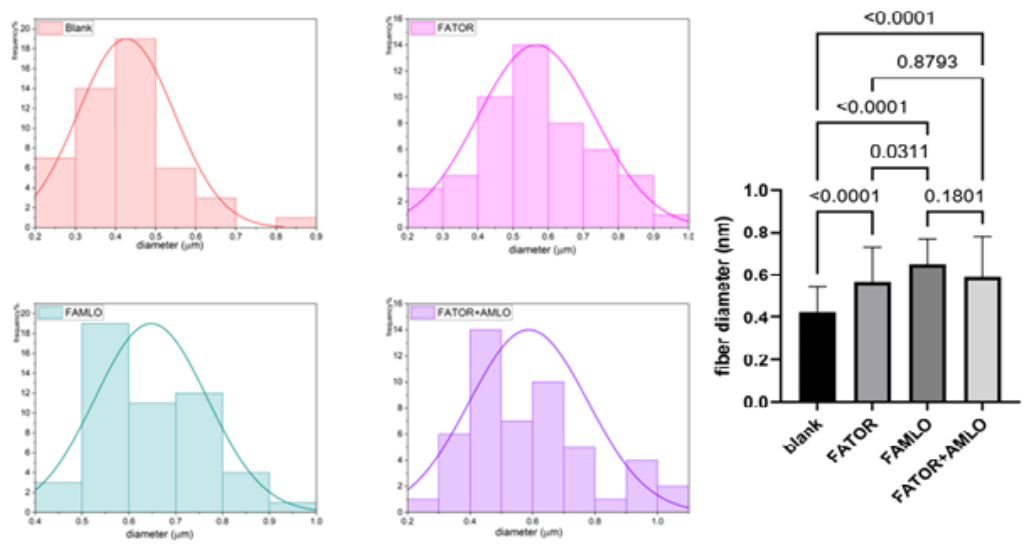
The nanofibers, as measured by scanning electron microscopy, are in the nanometer range, with average diameters of 426.54-647.42 nm. The nanofiber without the active ingredient has the smallest diameter, and the nanofiber containing amlodipine has the largest. Compared to the blank nanofiber, the diameter of those containing the active ingredient is significantly larger. The diameter of the combined active-ingredient fiber is 587.70 ± 189.85 nm, indicating that it lies between the two single-ingredient fibers.
Figure 2.
SEM images (blank - a, FATOR - b, FAMLO - c, FATOR+AMLO - d).
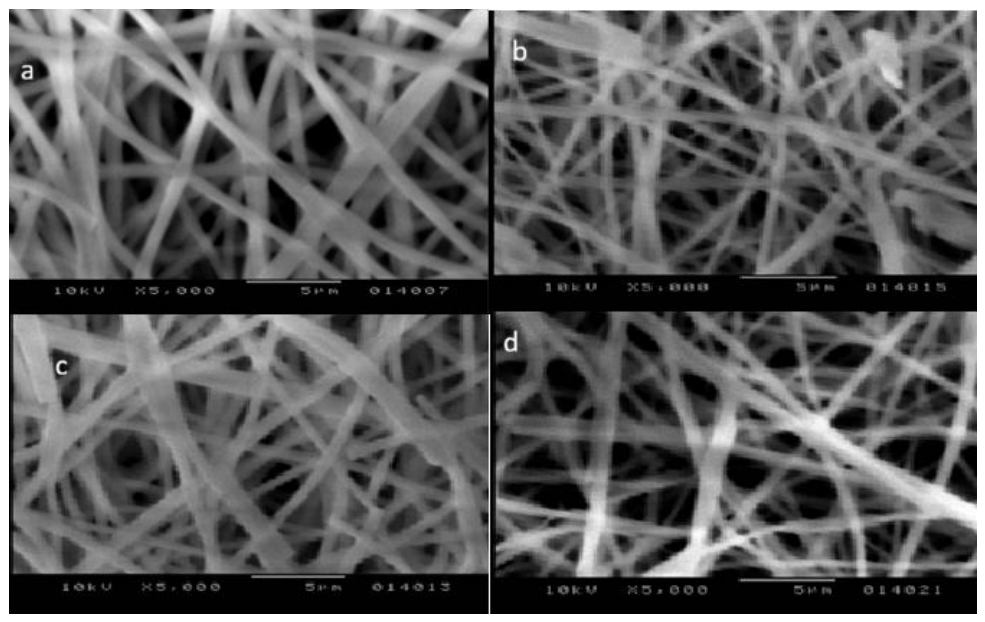
Table 3 presents the average diameters and their standard deviations for the different fibers.
Conductivity influences fiber diameter; the solutions' conductivity values increased monotonically with increasing salt content [27]. Combining ATOR and AMLO with a conductivity of 61.0 mS yields a fiber diameter of 588 ± 190 nm.
Statistically significant differences in fiber diameter were observed between blank and all three active substance-containing fibers. The fiber diameter difference between the combined and single-drug fibers was not statistically significant.
Figure 3.
Histograms of the four fibrous samples and the results of statistical analysis (the numbers represent p-values).
Figure 3.
Histograms of the four fibrous samples and the results of statistical analysis (the numbers represent p-values).
3.5. Disintegration Time
Disintegration was very fast, with all disintegration times under 3 s (FATOR 1,49 ± 0,12 s, FAMLO 2,24 ± 0,19 s, FAMLO+ATOR 2,36 ± 0,24 s, blank 1,28 ± 0,01 s). In a study, amlodipine and valsartan PVP-based nanofibers showed complete disintegration times under 3 seconds [28]. Nifedipine and atorvastatin core-shell nanofibers, for buccal administration in geriatric patients, presented a disintegration time under 12 s [21].
3.6. Differential Scanning Calorimetry Measurement
The DSC curve (Figure 4) shows the melting of the active ingredient, ATOR, at 162.03°C, as evidenced by a sharp endothermic peak. Povidone an amorphous polymer, does not exhibit a sharp melting point; the DSC curve shows a broad endothermic peak below 100 °C, attributed to water loss. The melting peak is absent in the atorvastatin-containing nanofiber, suggesting that the active ingredient is fully embedded within the nanofiber or that atorvastatin undergoes amorphization.
For amlodipine, a sharp endothermic peak is observed at 174.5°C. In this case, only a broad peak characteristic of Povidone is visible on the curve of the nanofiber (below 100°C), indicating that the active ingredient is fully embedded in the nanofiber.
In the physical mixture (PMATOR+AMLO), endothermic peaks appear between 167.01 and 173.2 °C but are shifted relative to those of the pure crystalline active ingredients. The fiber curve shows no prominent peaks.
The DSC curve of the nanofibers shows no melting peaks characteristic of pure crystalline active ingredients.

Table 4.
Normalized DSC thermograms of the tested samples.
| Sample | T (°C) | Δ(mW/g) |
| AMLO | 174.50 | -10.74 |
| FAMLO | 61.48 | -3.26 |
| ATOR | 162.03 | -6.92 |
| FATOR | 57.80 | -2.59 |
| PMATOR+AMLO | 167.01 | -4.14 |
| FATOR+AMLO | 70.13 | -2.55 |
| Blank | 38.53 | -2.00 |
| Povidone K29/32 | 106.99 | -3.24 |
3.7. Fourier Transform Infrared Spectroscopy
Figure 5 shows the infrared spectra of the pure active ingredients and the fibers.
The FTIR spectrum of ATOR showed O–H stretching at 3252 cm−1, characteristic bands at 1649.95 cm−1 (asymmetric C = O stretching), 1511 cm−1 (symmetric C = O stretching), 1216 cm−1 (C–N stretching/C–O stretching), and between 1580–1438 cm−1 (C–C ring stretching), hydrogen bond stretching (–OH group at 3668.59 cm−1), and amine group stretching (–N–H at 3365.122 cm−1), which is in agreement with Utkarsh et al. [21].
The IR spectrum of AMLO shows characteristic C=O stretches at 1690.02 cm−1 and a C-O-C asymmetric stretch at 1106 cm-1. Other bands are present at 1040.44 cm−1 (NH3 wagging), at 847.15 cm−1 (-C-O in-plane bending), and at 763.11 cm−1 and 740.7 cm−1 (N-H vibrations) [28].
The carbonyl group gives rise to characteristic bands at 1668 cm-1 in the blank and Plasdone spectra.
The infrared spectrum of the fibers containing one or even two active ingredients is very close to the spectrum of the blank fiber. The characteristic absorption peaks of atorvastatin and amlodipine do not appear in it.
3.8. Active Ingredient Content and Dissolution Study
Figure 6 presents the calibration curves used to measure the two active ingredients:
As can be seen from the calibration curves, the linearity range is 0.1-10 µg/ml for both active ingredients. The residuals are randomly distributed around the zero line.
The peaks of the measured standard solution (1 µg/ml amlodipine and atorvastatin) measured with the method used are shown in the figure below:
Figure 7.
Chromatogram of a standard solution (1 μg/mL).
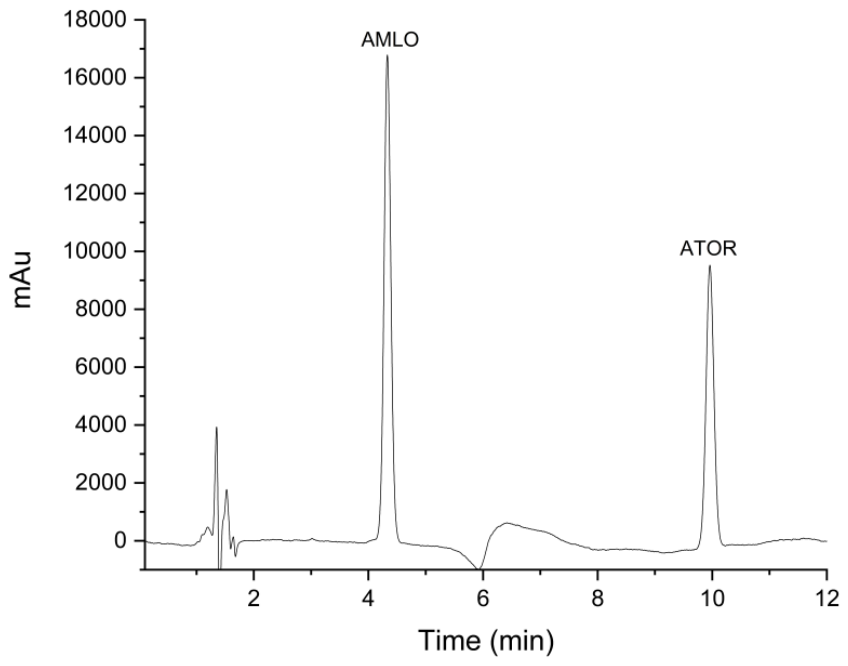
The retention time of atorvastatin is 9.95 ± 0.1 minutes, whereas that of amlodipine is 4.3 ± 0.09 minutes.
Regarding the active ingredient content of the fibers, 10 mg of FATOR+AMLO contains 77.1 µg of AMLO and 250.5 µg of ATOR, representing deviations of 13.9% and 15.9% from the theoretical values, respectively.
Figure 9 shows the dissolution curves of the tested fibers (containing the active ingredient individually, and the fiber containing both active ingredients).
Figure 8.
Result of the dissolution test: AMLO – 1: amlodipine from FAMLO, AMLO–2: amlodipine from FAMLO+ATOR, ATOR – 1: atorvastatin from FATOR, ATOR-2: atorvastatin from FAMLO+ATOR.
Figure 8.
Result of the dissolution test: AMLO – 1: amlodipine from FAMLO, AMLO–2: amlodipine from FAMLO+ATOR, ATOR – 1: atorvastatin from FATOR, ATOR-2: atorvastatin from FAMLO+ATOR.
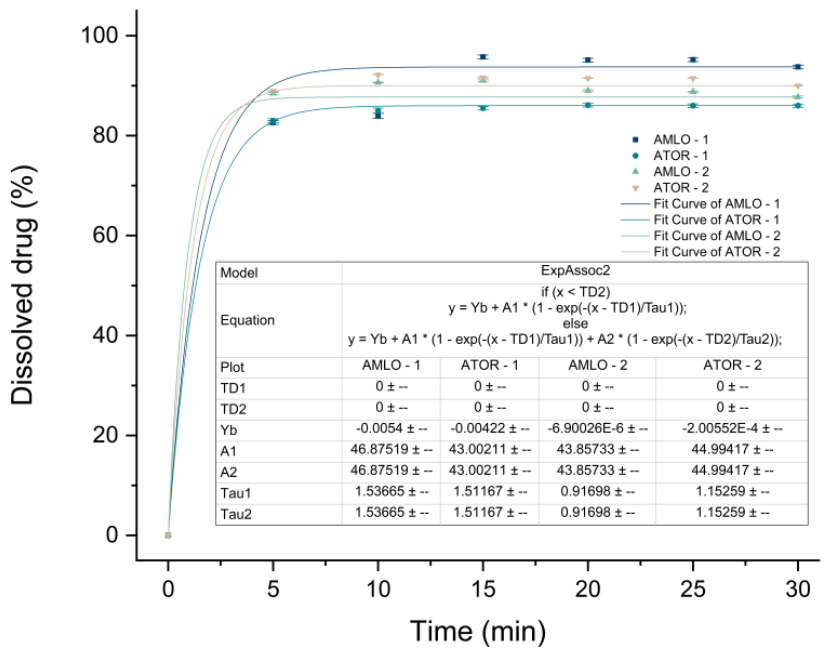
As the graphs show, dissolution is fast; the embedded active ingredient is practically released after 5 minutes. This is consistent with the short disintegration time and meets expectations.
Compared to atorvastatin fibers from previous studies, which presented burst release in the first minutes of the dissolution test (above 80% in the first 10 minutes), our fibers release the API more rapidly, with 90% released within 5 minutes [21]. Amlodipine and nifedipine fibers released over 90% of amlodipine within 120 s [28], a similar release to our findings.
4. Conclusions
In chronic treatment, the use of a combined active-ingredient-containing pharmaceutical formulation becomes more tolerable over time and more convenient for the patient. Fibers, through rapid disintegration, promote rapid drug release, thereby increasing bioavailability.
Polymer dispersions were successfully prepared by solubilizing the API. DSC and FT-IR results show amorphization of AMLO and ATOR in the PVP nanofibres. Disintegration was extremely fast, with a measured time under 3 seconds. The API is released in a burst, with full dissolution occurring within the first 5 minutes. The fixed-dose combination fibrous sheets present a potential fast-delivery system for buccal administration in elderly patients.
Author Contributions
Conceptualization, E.M.R., A.C., I.F, E.S., A.L.G. and P.A.; methodology, E.M.R., O.P., R.A.V., C.P. and P.A.; software, N.T., A.L.G., C.P. and P.A.; writing-original draft preparation, E.M.R., I.F, A.L.G., C.T.C, and T.N.; writing-review and editing, A.P., R.A.V., E.S., P.A. and A.C.; visualization, E.M.R., T.N., A.L.G., C.T.C and A.C.; supervision, A.C. and E.S. All authors have read and agreed to the published version of the manuscript.
Funding
This research received no external funding.
Institutional Review Board Statement
Not applicable.
Informed Consent Statement
Not applicable.
Data Availability Statement
The datasets generated and analyzed during the current study are available from the corresponding author on reasonable request.
Conflicts of Interest
The authors declare no conflicts of interest.
Abbreviations
The following abbreviations are used in this manuscript:
| AMLO | Amlodipine |
| ATOR | Atorvastatin |
| DAMLO | Dispersion of amlodipine |
| DATOR | Dispersion of atorvastatin |
| DAMLO+ATOR | Dispersion of amlodipine and atorvastatin |
| BCS | Biopharmaceutical Classification System |
| FAMLO | Fiber containing amlodipine |
| FATOR | Fiber containing atorvastatin |
| FAMLO+ATOR | Fiber containing amlodipine and atorvastatin |
| PAMLO+ATOR | Physical mixture amlodipine and atorvastatin |
| PVP | Polyvinyl pyrrolidone |
| API | Active pharmaceutical ingredient |
| DSC | Differential Scanning Calorimetry |
| FTIR | Fourier-transformed infrared spectroscopy |
References
- Lagunas-Rangel, F.A.; Liepinsh, E.; Fredriksson, R.; Alsehli, A.M.; Williams, M.J.; Dambrova, M.; Jönsson, J.; Schiöth, H.B. Off-target Effects of Statins: Molecular Mechanisms, Side Effects and the Emerging Role of Kinases. Br. J. Pharmacol. 2024, 181, 3799–3818. [Google Scholar] [CrossRef] [PubMed]
- Istvan, E.S.; Deisenhofer, J. Structural Mechanism for Statin Inhibition of HMG-CoA Reductase. Science 2001, 292, 1160–1164. [Google Scholar] [CrossRef] [PubMed]
- Zeng, W.; Deng, H.; Luo, Y.; Zhong, S.; Huang, M.; Tomlinson, B. Advances in Statin Adverse Reactions and the Potential Mechanisms: A Systematic Review. J. Adv. Res. 2025, 76, 781–797. [Google Scholar] [CrossRef] [PubMed]
- Sirtori, C.R.; Mombelli, G.; Triolo, M.; Laaksonen, R. Clinical Response to Statins: Mechanism(s) of Variable Activity and Adverse Effects. Ann. Med. 2012, 44, 419–432. [Google Scholar] [CrossRef] [PubMed]
- Rodde, M.S.; Divase, G.T.; Devkar, T.B.; Tekade, A.R. Solubility and Bioavailability Enhancement of Poorly Aqueous Soluble Atorvastatin: In Vitro, Ex Vivo, and In Vivo Studies. BioMed Res. Int. 2014, 2014, 463895. [Google Scholar] [CrossRef] [PubMed]
- Saiyed, N.; Nathani, C.; Patel, S.; Saduwala, Z.; Ugle, V.; Patel, M.; Shah, C.; Upadhyay, U. Solubility Enhancement of Atorvastatin by Different Solubility Enhancement Techniques: A Comparison Study. Pharma Sci. Monit. 2023, 14. [Google Scholar]
- Foroughi, H.; Rahimpour, E.; Kouhkan, M.; Fathi Azarbayjani, A.; Jouyban, A. Solubility Enhancement of Atorvastatin Calcium and Ethanol-Mediated Transition with Some Surfactants. Phys. Chem. Liq. 2023, 61, 285–290. [Google Scholar] [CrossRef]
- Wilkins, C.A.; Hamman, H.; Hamman, J.H.; Steenekamp, J.H. Fixed-Dose Combination Formulations in Solid Oral Drug Therapy: Advantages, Limitations, and Design Features. Pharmaceutics 2024, 16, 178. [Google Scholar] [CrossRef] [PubMed]
- Kushwaha, V.; Agrawal, P.; Azmi, T.; Shukla, V.; Das, A. Fixed Dose Combination: Rationale, Uses, Advantages, and Disadvantages-A Brief Review. World J. Pharm. Res. 2022, 11, 628–638. [Google Scholar]
- Janczura, M.; Sip, S.; Cielecka-Piontek, J. The Development of Innovative Dosage Forms of the Fixed-Dose Combination of Active Pharmaceutical Ingredients. Pharmaceutics 2022, 14, 834. [Google Scholar] [CrossRef] [PubMed]
- Lin, C.; Hsu, T.; Tung, Y.; Hsiao, F.; Chou, S.; Lin, Y.; Chen, S.; Chu, P. Clinical Benefit of Fixed-Dose Combination of Amlodipine and Potent Atorvastatin in Patients with Concomitant Hypertension and Hypercholesterolemia. J. Am. Heart Assoc. 2024, 13, e033780. [Google Scholar] [CrossRef] [PubMed]
- Lin, C.-P.; Hsiao, F.-C.; Wu, C.-T.; Lin, Y.-S.; Chen, S.-W.; Chu, P.-H. Beneficial Effects of Fixed-Dose Combination of Amlodipine and Atorvastatin in Patients with Concomitant Hypertension and Hypercholesterolemia: A Multi-Institutional Cohort Study. Acta Cardiol. Sin. 2022, 38, 736. [Google Scholar] [PubMed]
- Park, J.; Bae, S.H. Physiologically-Based Pharmacokinetic Modeling of Atorvastatin and Amlodipine in Asian Populations. Drug Targets Ther. 2024, 3, 149–158. [Google Scholar] [CrossRef]
- Chu, P.H.H.; Lin, C.-P. Abstract P345: Concomitant Hypertension and Dyslipidemia Patients Treated by Either Fixed-Dose or Free-Combination Amlodipine and Atorvastatin. Hypertension 2023, 80, AP345–AP345. [Google Scholar] [CrossRef]
- Ji, D.; Lin, Y.; Guo, X.; Ramasubramanian, B.; Wang, R.; Radacsi, N.; Jose, R.; Qin, X.; Ramakrishna, S. Electrospinning of Nanofibres. Nat. Rev. Methods Primers 2024, 4, 1. [Google Scholar] [CrossRef]
- Keirouz, A.; Wang, Z.; Reddy, V.S.; Nagy, Z.K.; Vass, P.; Buzgo, M.; Ramakrishna, S.; Radacsi, N. The History of Electrospinning: Past, Present, and Future Developments. Adv. Mater. Technol. 2023, 8, 2201723. [Google Scholar] [CrossRef]
- Guo, Y.; Wang, X.; Shen, Y.; Dong, K.; Shen, L.; Alzalab, A.A.A. Research Progress, Models and Simulation of Electrospinning Technology: A Review. J. Mater. Sci. 2022, 57, 58–104. [Google Scholar] [CrossRef] [PubMed]
- Virginia, C.; Khasanah, A.; Jauhari, J.; Sriyanti, I. Electrospinning and Characterization Nanofibers and Nanoparticle of Polyvinylpyrrolidone. In Journal of Physics: Conference Series; IOP Publishing: Bristol, UK, 2020; Vol. 850, p. 012039. [Google Scholar]
- Kurakula, M.; Rao, G.K. Moving Polyvinyl Pyrrolidone Electrospun Nanofibers and Bioprinted Scaffolds toward Multidisciplinary Biomedical Applications. Eur. Polym. J. 2020, 136, 109919. [Google Scholar] [CrossRef]
- Utkarsh; Hegab, H.; Tariq, M.; Syed, N.A.; Rizvi, G.; Pop-Iliev, R. Towards Analysis and Optimization of Electrospun PVP (Polyvinylpyrrolidone) Nanofibers. Adv. Polym. Technol. 2020, 2020, 4090747. [Google Scholar] [CrossRef]
- Alshaya, H.A.; Alfahad, A.J.; Alsulaihem, F.M.; Aodah, A.H.; Alshehri, A.A.; Almughem, F.A.; Alfassam, H.A.; Aldossary, A.M.; Halwani, A.A.; Bukhary, H.A. Fast-Dissolving Nifedipine and Atorvastatin Calcium Electrospun Nanofibers as a Potential Buccal Delivery System. Pharmaceutics 2022, 14, 358. [Google Scholar] [CrossRef] [PubMed]
- Chu, J.; Chen, L.; Mo, Z.; Aldalbahi, A.; El-Newehy, M.; Wang, W.; Mo, X. Atorvastatin Calcium and Poly(L-Lactide-co-Caprolactone) Core-Shell Nanofiber Covered Stent Separating Aneurysm and Promoting Endothelialization. SSRN Electron. J. 2020, 3539225. [Google Scholar] [CrossRef]
- El-Okaily, M.S.; Mostafa, A.A.; Dulnik, J.; Denis, P.; Sajkiewicz, P.; Mahmoud, A.A.; Dawood, R.; Maged, A. Nanofibrous Polycaprolactone Membrane with Bioactive Glass and Atorvastatin for Wound Healing: Preparation and Characterization. Pharmaceutics 2023, 15, 1990. [Google Scholar] [CrossRef] [PubMed]
- Pamu, D.; Garikapati, K.K.; Kuppusamy, G.; Krishnamurthy, P.T.; Ganesan, S.; Naik, M.R.; Karri, V.V.S.R.; Ponpandian, N.; Alexiou, A.; Antoniou, S. Electrospun Statin-Loaded Nanofibers for Treating Diabetic Wounds. Polym. Eng. Sci. 2024, 64, 1715–1730. [Google Scholar] [CrossRef]
- PubChem. PubChem. Atorvastatin Calcium. Available online: PubChem Atorvastatin Calcium (accessed on 19 February 2026).
- PubChem. PubChem. Amlodipine. Available online: PubChem Amlodipine (accessed on 19 February 2026).
- Zeng, J.; Haoqing, H.; Schaper, A.; Wendorff, J.H.; Greiner, A. Poly-L-Lactide Nanofibers by Electrospinning: Influence of Solution Viscosity and Electrical Conductivity on Fiber Diameter and Fiber Morphology. e-Polymers 2003, 3, 009. [Google Scholar] [CrossRef]
- Bukhary, H.; Williams, G.R.; Orlu, M. Electrospun Fixed-Dose Formulations of Amlodipine Besylate and Valsartan. Int. J. Pharm. 2018, 549, 446–455. [Google Scholar] [CrossRef] [PubMed]
Figure 1.
Images of FATOR+AMLO nanofibers taken with an optical microscope (using magnification of 10X and 40X).
Figure 1.
Images of FATOR+AMLO nanofibers taken with an optical microscope (using magnification of 10X and 40X).
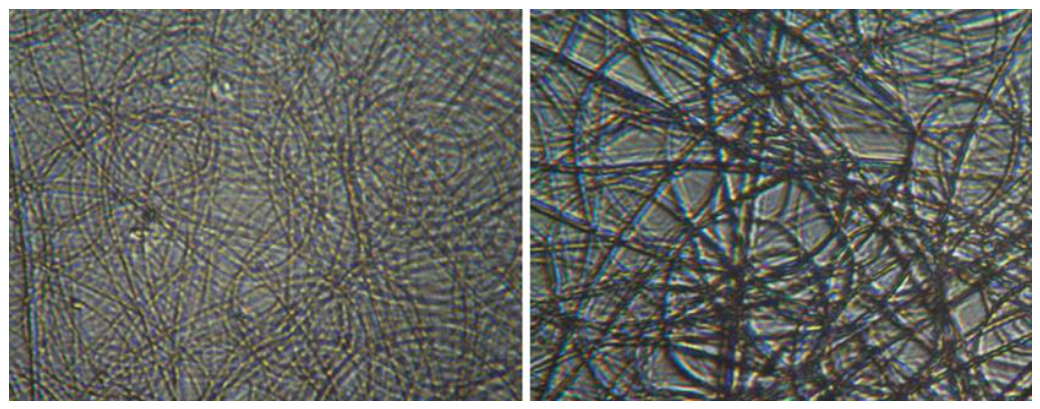
Figure 4.
DSC thermograms of ATOR, Povidone K29/32, Blank fibers, AMLO, FAMLO, FTOR, FATOR+AMLO.
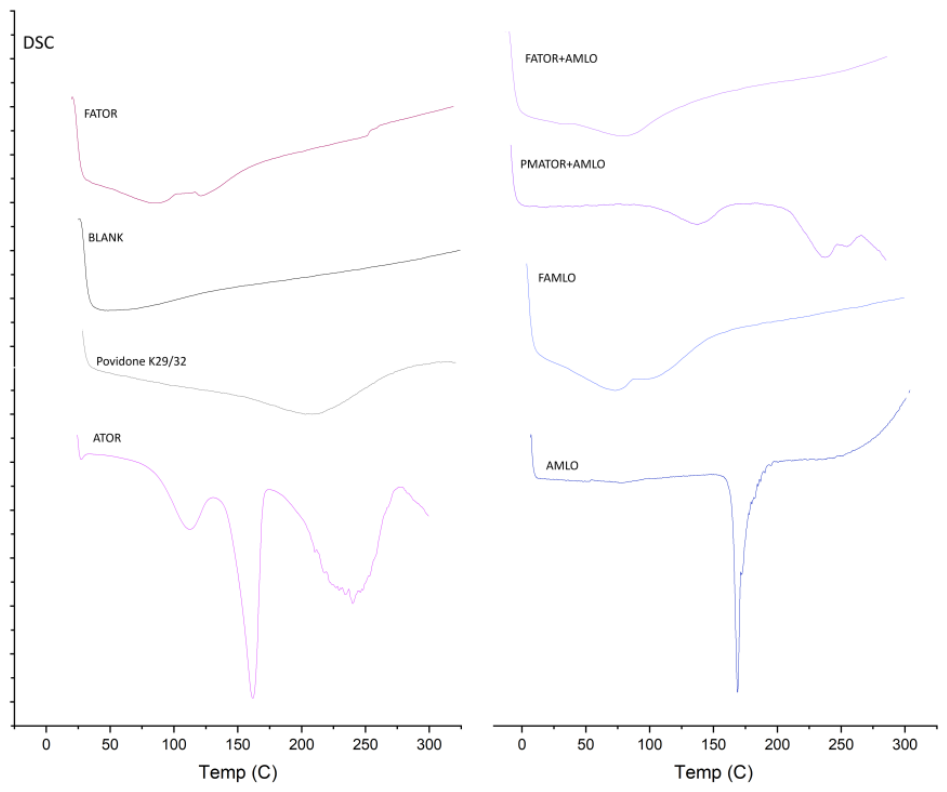
Figure 5.
Infrared spectra of the pure active ingredients and the fibers.
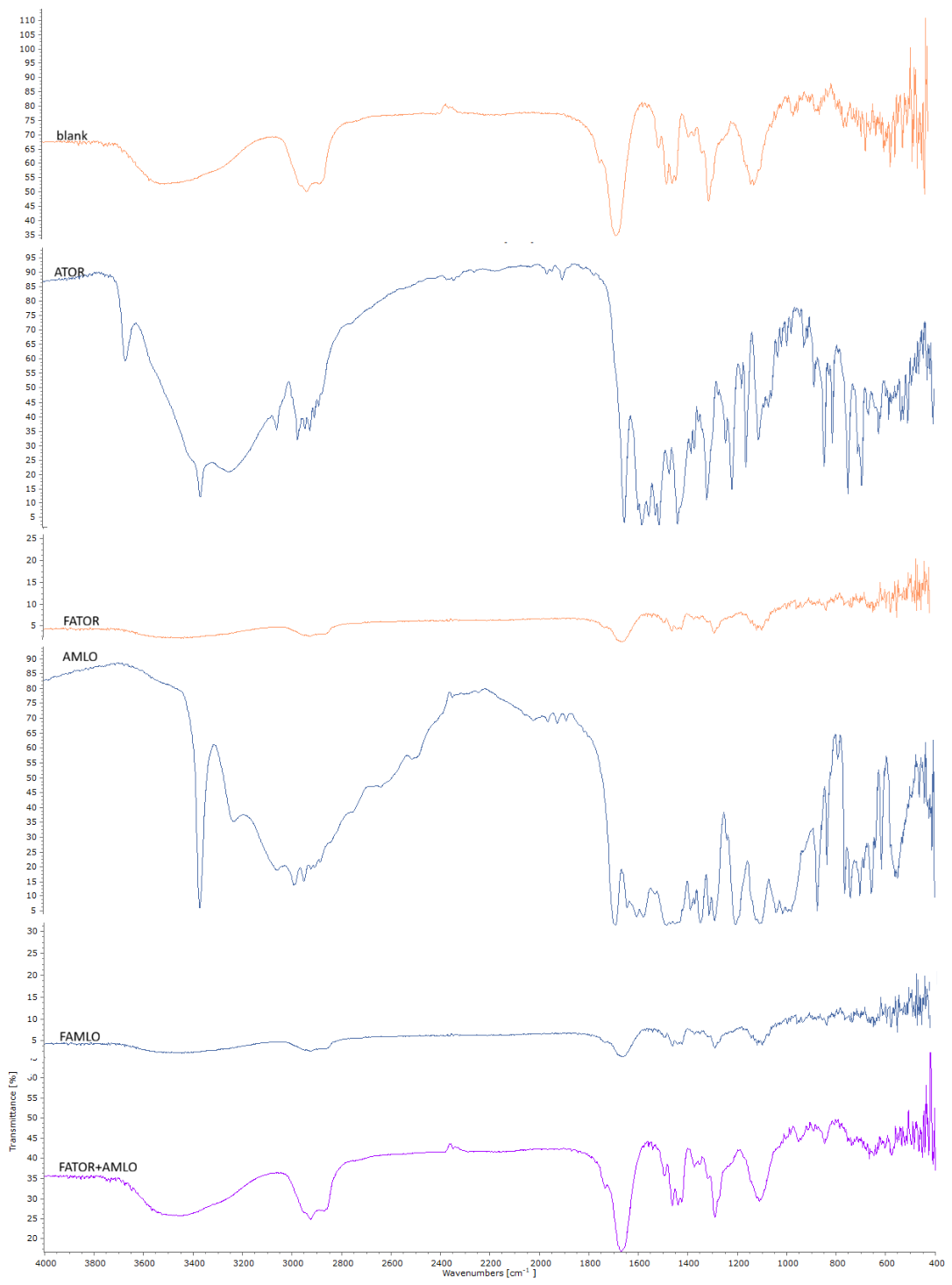
Figure 6.
Calibration curves of the tested active ingredients.
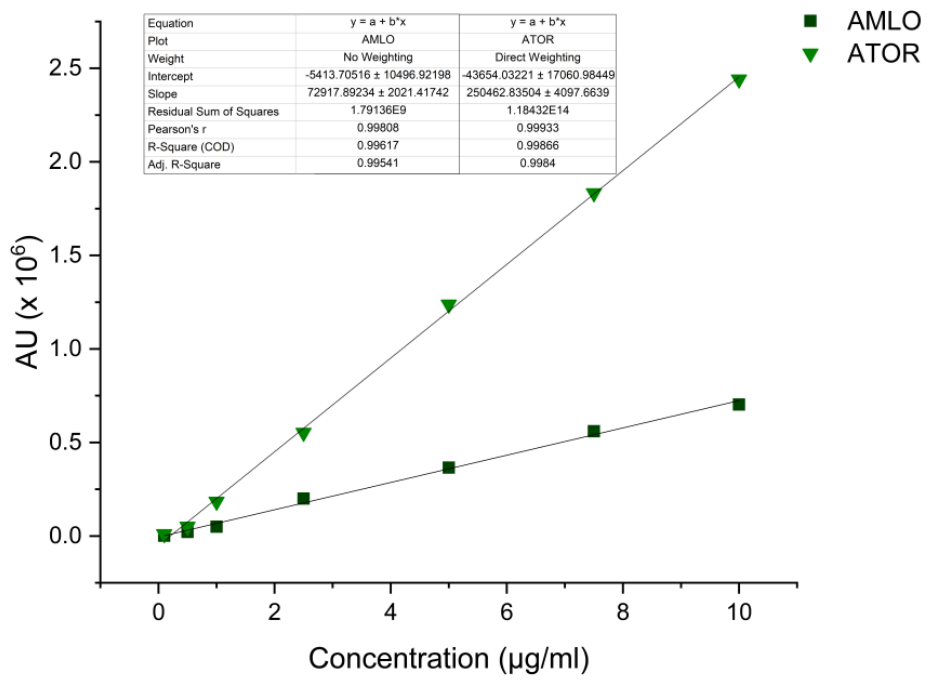
Table 1.
pH and conductivity values for the dispersions (D).
| Sample | pH ± SD | Conductivity (mS) ± SD |
| DBlank | 3.28 ± 0.21 | 18.25 ± 0.91 |
| DATOR | 3.84 ± 0.14 | 42.0 ± 3.37 |
| DAMLO | 3.17 ± 0.12 | 47.7 ± 4.16 |
| DATOR+AMLO | 3.61 ± 0.28 | 61.0± 4.81 |
Table 2.
Results of texture analysis.
| Sample | Max force 1 (g) ± SD | Max force 2 (g) ± SD |
Min force (g) ± SD |
Cohesivity ± SD |
Adhesion (mJ) ± SD |
Elasticity ± SD |
| DBlank | 8.8 ± 0.74 | 9.1 ± 0.82 | -3.1 ± 0.26 | 0.83 ± 0.07 | 11.2 ± 1.02 | 0.33 ± 0.02 |
| DATOR | 9.6 ± 0.90 | 8.8 ± 0.59 | -2.7 ± 0.22 | 0.79 ± 0.05 | 8.4 ± 0.78 | 0.33 ± 0.03 |
| DAMLO | 8.8 ± 0.61 | 9.0 ± 0.93 | -2.8 ± 0.29 | 0.91 ± 0.08 | 7.6 ± 0.74 | 0.33± 0.03 |
| DATOR+AMLO | 8.4 ± 0.92 | 9.0± 0.72 | -2.5± 0.16 | 0.90± 0.07 | 6.8 ± 0.59 | 0.33± 0.02 |
Table 3.
Fiber diameter values.
| Sample | Average diameter (nm) ± SD |
| Blank | 426± 120 |
| FATOR | 566 ± 167 |
| FAMLO | 647 ± 120 |
| FATOR+AMLO | 588 ± 190 |
Disclaimer/Publisher’s Note: The statements, opinions and data contained in all publications are solely those of the individual author(s) and contributor(s) and not of MDPI and/or the editor(s). MDPI and/or the editor(s) disclaim responsibility for any injury to people or property resulting from any ideas, methods, instructions or products referred to in the content. |
© 2026 by the authors. Licensee MDPI, Basel, Switzerland. This article is an open access article distributed under the terms and conditions of the Creative Commons Attribution (CC BY) license (http://creativecommons.org/licenses/by/4.0/).
Copyright: This open access article is published under a Creative Commons CC BY 4.0 license, which permit the free download, distribution, and reuse, provided that the author and preprint are cited in any reuse.