

Submitted:
16 October 2026
Posted:
20 October 2026
You are already at the latest version
Abstract
Which products a shopper sees first, in search results or recommendations, shapes what they buy. Retailers increasingly use language models to judge product relevance. Decision models (Jev, Clef and Perplexity Decider) return a probability for each permitted judgement instead of generated text, which makes them natural rerankers for search and recommendation. We present, to our knowledge, the first independent, pre-specified evaluation of decision models on the Amazon Shopping Queries (ESCI) benchmark, with 1,000 US-English, 200 Spanish and 200 Japanese queries. Baselines were a dedicated reranker (Qwen3-Reranker-4B), general-purpose language models, a cross-encoder fine-tuned on 50,000 in-domain pairs, and BM25. Every decision model improved nDCG@10 over BM25, by 0.084 to 0.114 in English and by 0.100 to 0.149 in Spanish and Japanese (for Japanese, against a BM25 with character-bigram segmentation). Perplexity Decider ranked best (0.822) and significantly outperformed the dedicated reranker (0.787) by 0.032 to 0.035, whether run locally or through its hosted API. Asking for a four-way relevance label, an ordinal score or a yes/no exact-match judgement mattered little; the four-way label was best or tied in every comparison. All systems confused Exact with Substitute products; recall of Complement products, which underpin accessory recommendations, ranged from 15% to 68%. Clef’s labels were unaffected by the order of answer options, which it sorts internally, whereas a general-purpose language model changed up to 26% of its labels. The hosted Perplexity API reranked 1,000 queries for US$0.10–0.14 and, with the yes/no design, lay on the cost–quality frontier. We discuss implications for retailers, marketplaces, recommender systems and shopping agents.
Keywords:
product search
; e-commerce
; reranking
; recommender systems
; decision models
; large language models
; Amazon Shopping Queries (ESCI)
; nDCG
; substitute and complementary products
1. Introduction
On an e-commerce site, search and recommendation are where intent meets inventory: both decide which products a shopper sees, and in what order [1]. Shoppers rarely look beyond the first results, so the ranking of products determines what they consider and what they buy. Changes in ranking measurably affect click-through, purchases and platform revenue [2]. Product search is also harder than web search. Queries are short and specific, product texts are semi-structured, and the notion of relevance is graded. A case for the requested phone is not irrelevant to its buyer, and a cheaper model from another brand may be an acceptable substitute [1]. Retailers therefore typically retrieve a candidate set with a fast method and then rerank it with a stronger relevance model. Large-scale recommender systems follow the same retrieve-then-rank design, so the same reranking models can serve both.
The Amazon Shopping Queries dataset (ESCI) formalises graded product relevance [3]. Each query–product pair is labelled Exact (the product satisfies all of the query’s specifications), Substitute (it fails some aspects but could serve as a functional substitute), Complement (it does not fulfil the query but could be used together with an exact item), or Irrelevant. Substitutes and complements are also the two relations behind many product recommendations, such as alternatives to a viewed item and accessories bought with it [4]. The benchmark covers English, Spanish and Japanese queries, and its reranking task asks systems to order a fixed set of judged candidates per query.
Language models have changed how such relevance judgements can be made. Cross-encoders fine-tuned on relevance data [5,6], zero-shot LLM rankers [7,8], LLM-based relevance labelling for product search [9] and dedicated LLM rerankers [10] all compete for the reranking stage. LLMs are also increasingly used in recommender systems [11,12,13]. A further option appeared in September and October 2026: decision models. Given a query and a product, these models answer a typed question (for example, the four ESCI relations) with a probability for every permitted answer, in a single pass and without generating text. TypeSafe AI’s Jev introduced the interface [14]. Cloudflare’s Clef models [15] and Perplexity’s Decider [16] followed, with open weights. Their probabilities can be turned directly into a ranking score. The same judgement underlies substitute and complementary recommendations, and it is also what an AI agent shopping on a consumer’s behalf must make: is this product what the customer asked for, a substitute, an accessory, or none of these?
The only published evidence on decision models for product search is a vendor-adjacent blog post. On 250 US queries, reranking with Jev raised nDCG@10 from 0.935 (Elasticsearch hybrid search) and 0.923 (BM25) to 0.957 [17]. Its absolute values depend on its own query sample and candidate sets and are not directly comparable with ours. That study used one model and a hand-designed scoring policy. The independent evaluations of decision models published so far report no product-search ranking results [18,19,20]. The vendors’ own benchmark suite, the Decision Index, includes ESCI only as a classification task: Clef’s model card reports a macro-F1 score but no ranking quality [21].
This paper provides an independent, pre-specified evaluation at a larger scale. We rerank the full judged candidate sets of 1,000 US-English queries (20,477 pairs), 200 Spanish queries (5,314 pairs) and 200 Japanese queries (5,504 pairs) with four decision models: Jev 1.13, Clef 27B, Clef-flash 9B and Perplexity Decider v1.1 (both self-hosted and through its hosted API). The comparison set comprises a dedicated reranker, two general-purpose LLMs used in two ways each, a cross-encoder fine-tuned on in-domain data, BM25 and random ordering. Five research questions guide the study:
- RQ1: Do decision models improve product ranking over lexical retrieval (BM25)?
- RQ2: How do they compare with a dedicated reranker and with general-purpose LLMs?
- RQ3: Which question design ranks best: a four-way relevance label, an ordinal relevance score, or a yes/no exact-match judgement?
- RQ4: How well do the models recognise Substitute and Complement products, which matter for recommendations?
- RQ5: What does reranking cost per 1,000 queries?
The main contributions are:
- an independent, pre-specified evaluation of decision models as product rerankers that covers three markets and a hard-query subset, with query-level paired statistics and openly released code, prompts and predictions;
- to our knowledge, the first comparison of decision-model question designs for ranking;
- a class-level analysis of the Exact/Substitute boundary and of Complement recognition;
- an analysis of label-order stability and of agreement between hosted and locally run deployments;
- a cost–quality frontier that shows which configurations a retailer should consider.
The paper proceeds as follows. Section 2 places the study within product-search and reranking research. Section 3 details the benchmark, systems and statistics. Section 4 presents the findings by research question. Section 5 draws out what they mean for e-commerce operators and states the limitations, and Section 6 concludes the paper and outlines future work.
2. Background and Related Work
2.1. Product Search and Graded Relevance
E-commerce search differs from document retrieval in its short, attribute-heavy queries, its semi-structured product data and its business objectives [1]. Rank position has economic weight: products shown higher receive disproportionate attention and purchases [2]. Graded relevance is natural in this setting, and the ESCI labels add a commercial dimension. Substitutes and complements are classic relations in recommendation, where they are inferred from co-purchase and co-view behaviour [4]. Ranking quality is commonly measured with normalised discounted cumulative gain (nDCG), which rewards placing highly relevant items near the top [22]. Lexical ranking with BM25 remains the standard first-stage method and baseline [23].
2.2. Neural and LLM Rerankers
Cross-encoders that read a query and a candidate together and output a relevance score set the neural standard for reranking [5], and sequence-to-sequence models extended the approach [6]. Large language models can rerank zero-shot, either by listwise prompting [7,8] or by judging relevance pointwise. Fine-tuned LLMs approach human annotators in judging product relevance [9]. Dedicated rerankers built on LLM backbones, such as the Qwen3-Reranker series, are trained specifically to output a relevance probability for a query–document pair [10]. Generative LLMs that state their own confidence tend to be overconfident [13,24], and multiple-choice prompts are sensitive to option order [25].
2.3. Decision Models
Decision models receive a state and typed questions and return a probability for every permitted answer [14]. Three primitives are relevant here:
- choice: one of several labelled options;
- score: one level of an ordered scale;
- noul: yes or no.
Jev is a hosted model. Clef and Clef-flash are open-weight models with a joint scoring head on Qwen backbones [15]. Perplexity Decider v1.1 adds a decision head to the Qwen3.8-27B base model and is likewise released with open weights [16]. Independent studies found Jev accurate and calibrated on public classification tasks [18], found decision models strong when the evidence is in the input [19], and found fine-tuned classifiers more accurate wherever training labels exist [20]. For product search, the only evidence is the Elasticsearch study [17]. It reported gains over BM25 and hybrid search with a hand-weighted combination of Jev’s probabilities, but evaluated a single model on 250 queries.
3. Materials and Methods
3.1. Data
We used the reduced version (Task 1) of the ESCI test split [3], loaded from a public mirror, and removed rows with duplicate example identifiers. For each locale we drew a seeded random sample of queries and kept all of their judged products (Table 1). Each product was described by its title, brand, colour and first three bullet points, truncated to 1,200 characters. We call a query hard if its candidates include at least one Exact and at least one Irrelevant product. On such queries, a random order cannot score well by chance. The supervised cross-encoder was trained on 50,000 US pairs from the ESCI training split, whose queries are disjoint from the test queries.
3.2. Systems
Decision models.
- Jev 1.13, through the TypeSafe API pinned to jev-1.13.0.
- Clef 27B and Clef-flash 9B, run from their released code.
- Perplexity Decider v1.1 27B, in two deployments: on our own GPU with the vendor’s reference code, and through the vendor’s hosted Decisions API.
General-purpose LLMs. Qwen3.8-27B in its FP8 release [26,27] and Gemma-4-31B-it [28] were served with vLLM [29] in two modes:
- Readout. Each relation was listed under a number, and we computed the model’s exact probability of answering with each number.
- Generative. The model answered in schema-constrained JSON with a label and a 0–100 confidence.
Dedicated reranker. Qwen3-Reranker-4B [10] scored each pair as after its standard instruction. Following the model card’s vLLM example, decoding was restricted to the two answer tokens, so both probabilities were available for every pair.
Supervised cross-encoder. ModernBERT-large [30] was fine-tuned as a four-class ESCI classifier on the 50,000 training pairs (two epochs, learning rate , gradient clipping at 1.0, maximum length 256 tokens). These settings were chosen on a query-disjoint split of the training pairs alone, because the first configuration we tried collapsed to the label prior.
Baselines. BM25 (, , inverse document frequency computed over each market’s candidate products) [23], and random ordering averaged over 20 seeds. As pre-specified, BM25 split text into runs of word characters, without stemming. Japanese is written without spaces, so this left Japanese text largely unsegmented and made the Japanese BM25 artificially weak. After the run we therefore also computed BM25 with Japanese text split into overlapping character bigrams, the usual treatment of Chinese, Japanese and Korean text in lexical search; all other settings were unchanged. We report the Japanese gains over BM25 against this segmented baseline.
3.3. Question Designs and Ranking Scores
Every model received the same state: the shopping query followed by the product text. The question took one of three designs:
- Four-way (choice): “How does this product relate to the customer’s shopping query?”, with the four ESCI relations as options and their definitions condensed from the ESCI guidelines (Appendix A). The ranking score is the expected ESCI gain , with gains g = 1 (Exact), 0.1 (Substitute), 0.01 (Complement) and 0 (Irrelevant), as in the benchmark.
- Ordinal (score): “Rate how well this product satisfies the customer’s shopping query”, on the ordered scale Irrelevant < Complement < Substitute < Exact. The ranking score is the expected level (0–3).
- Yes/no (noul): “Is this product an exact match for the customer’s shopping query, satisfying all of the query’s specifications?” The ranking score is .
The decision models and the LLM readouts answered all three designs in English. In Spanish and Japanese, and for the generative LLMs and the cross-encoder, only the four-way design was used. The cross-encoder, trained on US data, was evaluated in English only. The reranker has a single, fixed relevance question.
3.4. Measures
Within each query, candidates were sorted by score (ties broken by pair identifier).
- nDCG@10 uses the ESCI gains above [22].
- MRR is the reciprocal rank of the first Exact product; every sampled query had at least one Exact product, so MRR is defined for all queries.
- Classification measures for the four-way design are accuracy, macro-F1, recall per ESCI class, and the expected calibration error (ECE, 15 equal-mass bins) [31].
- Label-order stability was measured on 50 seeded queries (1,049 pairs): the four-way options were reversed and shuffled, and we report the share of changed labels. To separate reordering effects from ordinary variability, the two hosted APIs were sent the unchanged requests two further times.
- Cost. API calls were costed from the input tokens the providers billed, at the October 2026 list prices of US$0.042 (Jev) and US$0.02 (Perplexity) per million tokens. Models on our own hardware were costed from the GPU time each pair consumed on one NVIDIA H100 NVL (the wall time of a batch divided by its size), at an assumed US$2.50 per GPU-hour. Costs are reported per 1,000 queries with all of their candidates.
3.5. Statistical Inference
All comparisons are paired by query. Differences in nDCG@10 are reported with percentile 95% confidence intervals obtained by resampling queries 10,000 times [32]. Two-sided bootstrap p-values are floored at and adjusted with the Holm procedure [33]. Each family of adjusted tests contains all systems compared with the same reference (BM25 or the reranker), in the same market and on the same query subset. Design comparisons form one family per market. Because of the floor, the smallest attainable adjusted p-value is 0.0026 in English (26 systems) and 0.0011 in Spanish and Japanese (11 systems). Differences are computed from unrounded scores, so they can differ by 0.001 from the difference of two rounded values; for example, Jev’s Japanese gain over the segmented BM25 is 0.0995, reported as 0.100.
3.6. Pre-Specification and Data Hygiene
Before the main run, we committed and tagged the analysis plan, the code and the SHA-256 hashes of the test files. Three problems surfaced in pilot runs and were fixed before the freeze:
- Missing brand, colour or bullet fields had been rendered as the literal text “nan” in 6,638 of the 20,477 US product texts. The texts were rebuilt with the same queries and pairs.
- The reranker’s probabilities had been read from a truncated list of next-token candidates, which created artificial ties.
- The first cross-encoder configuration collapsed, as described above.
The analysis plan specified bootstrap p-values with Holm adjustment, but the frozen code reported only the intervals. The p-values and their adjustment were added after the main run; they change no score or interval. The segmented Japanese BM25 (Section 3) and the comparison of mean confidence with accuracy (Section 4.4) are the only other analyses added after the run.
Clef’s model card lists ESCI classification among its own benchmarks (macro-F1 57.5) and publishes no training-data manifest [21], so Clef’s exposure to ESCI can neither be shown nor ruled out. Perplexity Decider’s training manifest includes two Amazon review datasets (review polarity and counterfactual statements) but no ESCI or other product-search data [16].
4. Results
4.1. Ranking Quality in the US Market (RQ1, RQ2)
Table 2 and Figure 1 summarise ranking quality on the 1,000 US queries. BM25 reached an nDCG@10 of 0.707 and random ordering 0.583. Every decision model, under every question design, ranked significantly better than BM25, by 0.084 (Jev, ordinal) to 0.114 (Perplexity Decider). The gains held on the 585 hard queries (0.079 to 0.108). Perplexity Decider was the best system overall, at 0.822 locally and 0.819–0.821 through the hosted API.
The dedicated reranker reached 0.787. Both Perplexity configurations significantly exceeded it under all three designs, by 0.032 to 0.035, on all queries and on the hard subset. Clef exceeded it by 0.022 with the four-way design and by 0.021 with the yes/no design, both significant on both subsets. Clef-flash’s yes/no design was significantly better on all queries (by 0.016) but not on the hard subset. Jev’s four-way design was 0.014 better, but the difference did not survive Holm adjustment ( = 0.053). Among the general-purpose LLMs, the Qwen3.8 readout also outperformed the reranker with the four-way design (by 0.020). The Gemma-4 readout did not differ significantly from it. Both generative LLMs were significantly worse, by 0.026 (Qwen3.8) and 0.024 (Gemma-4). The fine-tuned cross-encoder (0.780) did not differ significantly from the reranker and ranked below every decision-model configuration. Measured by MRR, the decision models placed the first Exact product at an average reciprocal rank of 0.848–0.888.
4.2. Spanish and Japanese Markets
Table 3 and Figure 2 report the 200-query samples from the Spanish and Japanese stores. BM25 was weaker there (0.677 and 0.643), so the decision models’ gains over it were larger: 0.138 to 0.149 in Spanish and 0.145 to 0.172 in Japanese, all significant. With Japanese text segmented into character bigrams, BM25 reached 0.689 in Japanese, so part of its weakness came from the tokenisation. Against this baseline the decision models gained 0.100 to 0.126 in Japanese, all still significant (); generative Gemma-4 (+0.023, ) was no longer significantly better than BM25. Against the reranker (0.794 and 0.763):
- Both Perplexity configurations were significantly better in both markets (by 0.027 to 0.052).
- Clef-flash was significantly better in Spanish, and Clef in Japanese.
- Jev, Clef in Spanish and Clef-flash in Japanese had positive intervals before adjustment, but these did not remain significant after Holm adjustment over the smaller samples.
- Among the LLMs, generative Qwen3.8 was significantly worse in Spanish and generative Gemma-4 in Japanese.
4.3. Which Question Design Ranks Best? (RQ3)
Table 4 compares the three question designs within each model on the US queries. The differences were small. For Jev and Clef, the four-way design ranked significantly better than the ordinal design (by 0.009 each, = 0.004 and 0.012). No other difference was significant after adjustment, and the four-way and yes/no designs were statistically tied for every model (at most 0.006 apart). The ordinal design was never significantly better than either alternative. For both Perplexity configurations, all three designs were within 0.003 of each other. As a consistency check, the probability of Exact under the four-way design and the probability of “yes” under the yes/no design were strongly rank-correlated within each model (Spearman’s between 0.950 and 0.972 over the 20,477 pairs [34]).
4.4. Substitutes and Complements (RQ4)
Class-level recognition did not mirror ranking quality (Table 5, Figure 3). As four-way classifiers, all systems performed modestly: accuracy ranged from 52.3% to 58.2% and macro-F1 from 0.452 to 0.529. Summed over both directions, confusion between Exact and Substitute was the most frequent error for every system (38–53% of all errors). Recall of Exact itself was only 45.3–63.3%. For every system, the most frequent label given to a missed Exact product was Substitute (46–78% of those errors, depending on the system), a boundary the ESCI annotators also found difficult [3]. For ranking, this confusion matters less than it seems. An Exact product mislabelled as Substitute still outranked the Complement and Irrelevant products of its query in 63–84% of such pairs, depending on the system.
Complement recognition varied widely across the models. Clef (67.6%) and Clef-flash (62.6%) recognised about two thirds of Complement products, and the Gemma-4 configurations about half (51.3–54.1%). Jev (34.9%), the fine-tuned cross-encoder (34.3%), the Perplexity configurations (26.3–26.7%) and the Qwen3.8 configurations (14.8–24.0%) recognised far fewer. Substitute recall ranged from 39.0% (Gemma-4 readout) to 62.5% (Perplexity Decider). Clef-flash was the best-calibrated system (ECE 0.022), followed by Clef (0.047). Every other system was overconfident: its mean confidence exceeded its accuracy by 0.11 to 0.43, most strongly for the Gemma-4 readout and the generative LLMs (ECE 0.406 to 0.434).
4.5. Cost and Latency (RQ5)
Table 6 and Figure 4 relate ranking quality to cost, for 1,000 US queries with their 20.5 candidates on average.
- Cheapest. The fine-tuned cross-encoder (US$0.02) and the dedicated reranker (US$0.04). The cross-encoder’s cost covers inference only, not its training or the 50,000 labels it required.
- Hosted APIs. The hosted Perplexity API cost US$0.10–0.14 depending on the design, and Jev US$0.37–0.51.
- Self-hosted decision models. Clef-flash cost US$0.29–0.37, and Clef and the local Perplexity Decider US$0.76–1.00.
- General-purpose LLMs. The Qwen3.8 readout was the most expensive configuration, at US$3.02–6.60. Like the other readouts, it scored each numbered option separately on our serving stack.
Only four configurations lie on the cost–quality frontier: the cross-encoder, the reranker, the hosted Perplexity API with the yes/no design (0.821 for US$0.10) and the local Perplexity Decider with the four-way design (0.822 for US$0.98). Moving from the reranker to the hosted Perplexity API raised nDCG@10 by 0.034 for an extra US$0.06 per 1,000 queries. Moving on to the local Perplexity Decider added only 0.001 at about ten times the cost of the hosted API.
With the four-way design, the hosted APIs answered each pair in 0.28–0.38 seconds of round-trip time. A query’s candidates can be scored in parallel, so per-query latency is close to the per-pair figure. Locally, the decision models needed 0.026–0.070 GPU-seconds per pair.
4.6. Stability and Deployment
Table 7 reports how often a model’s four-way label changed when the options were reordered.
- The Qwen3.8 readout changed 26.4% (reversed) and 20.0% (shuffled) of its labels, and the Gemma-4 readout 6.8% and 8.8%.
- Jev changed 9.3% and 5.7%, well above the 3.6–3.9% of labels that changed when identical requests were simply resent.
- Perplexity Decider changed 4.9% and 3.5%.
- Clef changed none, because it sorts the options internally. Clef-flash changed one label in 1,049.
The hosted Perplexity API returned identical answers to repeated requests. Its labels agreed with those of the locally run model on 96.7–98.5% of pairs, and their nDCG@10 differed by at most 0.003 in English and by 0.005 and 0.008 in the Spanish and Japanese samples (Table 8).
5. Discussion
5.1. Implications for Retailers and Marketplaces
Decision models are a credible reranking layer. Every decision model lifted ranking quality well above lexical search in all three markets, and the best ones exceeded a dedicated reranker. The largest gains came in the Spanish store, where BM25 was weakest; the Japanese BM25 was weak partly because of its tokenisation. Operators of multilingual storefronts, where simple lexical baselines are weaker, are likely to benefit most.
Pick by measured ranking quality, and check class-level recognition separately. Ranking quality did not predict how well the individual ESCI relations were recognised. Perplexity Decider ranked best and had the highest four-way accuracy (58.2%), yet it recognised only about a quarter of Complement products. Clef recognised two thirds of them while ranking slightly lower, and Clef-flash had the highest macro-F1. A retailer choosing a reranker should evaluate nDCG on its own judged queries. A retailer building recommendation features, such as “frequently bought together”, should evaluate Complement recall separately.
Keep the question simple. The four-way label was never significantly worse than the alternatives and was sometimes better. A yes/no exact-match question gave nearly the same ranking at lower cost per pair, because it requires fewer input tokens. Elaborate scoring policies therefore appear unnecessary for ranking alone.
The hosted API is the efficient choice at moderate volume. The hosted Perplexity API reached the quality of the locally run model for about one seventh of its GPU-equivalent cost, at US$0.10–0.14 per 1,000 queries. For a store serving one million searches a day, that is roughly US$100–140 per day for reranking 20 candidates per search. The cheaper dedicated reranker or a trained cross-encoder remains attractive when latency budgets are tight or when in-house relevance labels exist. However, a cross-encoder trained on 50,000 in-domain pairs did not reach the decision models’ ranking quality here.
Agentic commerce. An AI agent buying on a consumer’s behalf must decide whether a product is exact, an acceptable substitute, or a needed accessory. The Exact/Substitute confusion we observed in every system suggests that agents should confirm substitutions with the user rather than act on a single label. The order sensitivity of several models suggests that agents should present options in a fixed order.
5.2. Limitations
- Fixed candidates. We studied reranking of fixed, fully judged candidate sets, as in ESCI Task 1, not end-to-end retrieval. Gains in production depend on what the first stage retrieves.
- Query-driven, not personalised. Relevance was judged against the query alone, without user history or profile. The results therefore apply to the ranking stage of query-driven search and recommendation, not to personalised recommendation, where relevance also depends on the individual shopper.
- Smaller multilingual samples. The Spanish and Japanese samples have 200 queries each, so their intervals are wide.
- ESCI as a benchmark. ESCI labels are themselves noisy at the Exact/Substitute boundary, and nDCG with ESCI gains rewards Exact far more than Substitute. Other gain choices could change close rankings.
- Possible exposure. Clef’s possible exposure to ESCI cannot be assessed (Section 3). More generally, ESCI has been public since 2022, so exposure during pretraining cannot be ruled out for any LLM-based system.
- Single runs. Each configuration was run once. Jev changed 3.6–3.9% of its labels on identical repeated requests (Table 7), so its scores carry some run-to-run variation; this matters most for its comparison with the reranker ().
- Model versions. The hosted models were pinned to the versions they served in October 2026.
- Costs. Costs use list prices and an assumed GPU price.
- General-LLM implementation. The general-purpose LLM readouts were not optimised for throughput, so their costs are upper bounds.
- Product text. We used title, brand, colour and up to three bullet points. Richer product data (images, specifications) might change the results.
6. Conclusions and Future Work
On the Amazon Shopping Queries benchmark, decision models proved strong and economical product rerankers, applicable to the ranking stage of both search and recommender systems. All of them improved substantially on BM25 in English, Spanish and Japanese, and Perplexity Decider significantly outperformed a dedicated LLM reranker in all three markets, and Clef and Clef-flash in two (Clef-flash in English only with the yes/no design). The way the relevance question was asked mattered little, so a simple four-way or yes/no question suffices. As classifiers, the models shared the human difficulty of separating Exact from Substitute products and differed widely in recognising Complements. The hosted Perplexity API offered the best ranking quality per dollar among the strongest systems. Retailers should validate rerankers on their own judged queries, evaluate complement recognition separately from ranking, and fix the order of answer options.
Future work should test decision models in end-to-end retrieval, with richer product data, in personalised recommendation settings that combine the query with the shopper’s history, and in live A/B experiments that measure conversion. Because a decision model’s state is free text, a shopper’s history could be added for personalised recommendation. Uneven Complement recall also calls for evaluating complementary recommendation on co-purchase data [4].
Author Contributions
Conceptualization, D.M., K.I.R., D.S. and C.V.; methodology, D.M., K.I.R., D.S. and C.V.; software, D.M. and K.I.R.; validation, D.M., K.I.R., D.S. and C.V.; formal analysis, D.M., K.I.R., D.S. and C.V.; investigation, D.M., K.I.R., D.S. and C.V.; resources, D.M., K.I.R., D.S. and C.V.; data curation, D.M., K.I.R., D.S. and C.V.; writing—original draft preparation, D.M. and K.I.R.; writing—review and editing, D.M., K.I.R., D.S. and C.V.; visualization, D.M. and K.I.R.; supervision, C.V.; project administration, D.M., K.I.R.; funding acquisition, D.M., K.I.R., D.S. and C.V. All authors have read and agreed to the published version of the manuscript.
Funding
This research received no external funding.
Institutional Review Board Statement
Not applicable.
Informed Consent Statement
Not applicable.
Data Availability Statement
The Amazon Shopping Queries dataset is publicly available under the Apache License 2.0. The evaluation code, prompts, test-set hashes, raw predictions and analysis scripts are publicly available on GitHub under the Apache License 2.0.
Acknowledgments
This research has utilised equipment that was acquired through funding by the European Union—NextGenerationEU and the Recovery and Resilience Facility (Greece 2.0), under the project SUB2: “Universities of Excellence” (Project code: OPS TA 5180665). All experiments were conducted on a server provided by the University of the Peloponnese, equipped with four NVIDIA H100 NVL GPUs (96 GB VRAM each) and an Intel Xeon Platinum 8452Y processor (36 cores). During the preparation of this work the authors used Claude (Anthropic) and Grammarly in order to
enhance grammatical accuracy and refine sentence structure. After using these tools, the authors reviewed and
edited the content as needed and take full responsibility for the content of the published article.
Conflicts of Interest
The authors declare no conflicts of interest. The authors have no affiliation with Amazon, TypeSafe AI, Cloudflare, Perplexity, Alibaba (Qwen), Google or Elastic.
Abbreviations
The following abbreviations are used in this manuscript:
| BM25 | Best Matching 25 (lexical ranking function) |
| ECE | Expected calibration error |
| ESCI | Exact, Substitute, Complement, Irrelevant |
| LLM | Large language model |
| MRR | Mean reciprocal rank |
| nDCG | Normalised discounted cumulative gain |
| TV | Total variation (distance) |
Appendix A. Model Inputs
The state sent to every model was:
Shopping query: <query>
Product: <title> Brand: <brand> Color: <color> Features: <b1> | <b2> | <b3>
The four-way options were defined as follows:
- Exact: the product is relevant for the query and satisfies all of the query’s specifications (e.g., product type, brand, size, color, quantity).
- Substitute: the product is somewhat relevant; it fails some aspects of the query but could be used as a functional substitute.
- Complement: the product does not fulfil the query but could be used together with an exact item (e.g., a case for a requested phone).
- Irrelevant: the product is irrelevant to the query or fails a central aspect of it.
The ordinal design used the same four descriptions as an ordered scale. The yes/no design asked whether the product is an exact match. The LLM readouts saw the options as a numbered list, and the generative LLMs as a list of identifiers with the instruction to answer in JSON with a confidence from 0 to 100.
Appendix B. Classification Metrics by Design

Table A1.
Classification measures of each question design on the US pairs: accuracy (%), macro-F1 and ECE. The yes/no design is a two-class task, so its values are not comparable with the four-class designs.
Table A1.
Classification measures of each question design on the US pairs: accuracy (%), macro-F1 and ECE. The yes/no design is a two-class task, so its values are not comparable with the four-class designs.
| Four-Way | Ordinal | Yes/No | |||||||
|---|---|---|---|---|---|---|---|---|---|
| System | Acc. | F1 | ECE | Acc. | F1 | ECE | Acc. | F1 | ECE |
| Jev 1.13 (API) | 57.4 | 0.516 | 0.194 | 55.9 | 0.505 | 0.159 | 70.1 | 0.694 | 0.085 |
| Clef 27B | 54.9 | 0.515 | 0.047 | 56.4 | 0.528 | 0.019 | 71.5 | 0.706 | 0.110 |
| Clef-flash 9B | 56.4 | 0.529 | 0.022 | 57.7 | 0.540 | 0.069 | 70.7 | 0.703 | 0.107 |
| Perplexity Decider (local) | 58.2 | 0.523 | 0.136 | 58.4 | 0.513 | 0.123 | 72.6 | 0.709 | 0.156 |
| Perplexity Decider (API) | 57.8 | 0.519 | 0.157 | 58.6 | 0.516 | 0.139 | 72.6 | 0.710 | 0.163 |
| Qwen3.8 readout | 52.3 | 0.452 | 0.162 | 48.9 | 0.410 | 0.201 | 70.5 | 0.685 | 0.141 |
| Gemma-4 readout | 55.2 | 0.511 | 0.434 | 54.9 | 0.503 | 0.437 | 71.4 | 0.706 | 0.279 |
References
- Tsagkias, M.; King, T.H.; Kallumadi, S.; Murdock, V.; de Rijke, M. Challenges and research opportunities in eCommerce search and recommendations. SIGIR Forum 2021, 54. [Google Scholar] [CrossRef]
- Ghose, A.; Ipeirotis, P.G.; Li, B. Examining the Impact of Ranking on Consumer Behavior and Search Engine Revenue. Manag. Sci. 2014, 60, 1632–1654. [Google Scholar] [CrossRef]
- Reddy, C.K.; Màrquez, L.; Valero, F.; Rao, N.; Zaragoza, H.; Bandyopadhyay, S.; Biswas, A.; Xing, A.; Subbian, K. Shopping Queries Dataset: A Large-Scale ESCI Benchmark for Improving Product Search, 2022. arXiv arXiv:cs.IR/2206.06588.
- McAuley, J.; Pandey, R.; Leskovec, J. Inferring Networks of Substitutable and Complementary Products. In Proceedings of the 21st ACM SIGKDD International Conference on Knowledge Discovery and Data Mining, New York, NY, USA, 2015; KDD ’15, pp. 785–794. [Google Scholar] [CrossRef]
- Nogueira, R.; Cho, K. Passage Re-ranking with BERT, 2020. arXiv arXiv:cs.IR/1901.04085.
- Nogueira, R.; Jiang, Z.; Pradeep, R.; Lin, J. Document Ranking with a Pretrained Sequence-to-Sequence Model. In Proceedings of the Findings of the Association for Computational Linguistics: EMNLP 2020; Cohn, T., He, Y., Liu, Y., Eds.; Online, 2020; pp. 708–718. [Google Scholar] [CrossRef]
- Sun, W.; Yan, L.; Ma, X.; Wang, S.; Ren, P.; Chen, Z.; Yin, D.; Ren, Z. Is ChatGPT Good at Search? Investigating Large Language Models as Re-Ranking Agents. In Proceedings of the 2023 Conference on Empirical Methods in Natural Language Processing; Bouamor, H., Pino, J., Bali, K., Eds.; Singapore, 2023; pp. 14918–14937. [Google Scholar] [CrossRef]
- Pradeep, R.; Sharifymoghaddam, S.; Lin, J. RankVicuna: Zero-Shot Listwise Document Reranking with Open-Source Large Language Models, 2023. arXiv arXiv:cs.IR/2309.15088.
- Mehrdad, N.; Mohapatra, H.; Bagdouri, M.; Chandran, P.; Magnani, A.; Cai, X.; Puthenputhussery, A.; Yadav, S.; Lee, T.; Zhai, C.; et al. Large Language Models for Relevance Judgment in Product Search. arXiv 2024, arXiv:cs.IR/2406.00247. [Google Scholar]
- Zhang, Y.; Li, M.; Long, D.; Zhang, X.; Lin, H.; Yang, B.; Xie, P.; Yang, A.; Liu, D.; Lin, J.; et al. Qwen3 Embedding: Advancing Text Embedding and Reranking Through Foundation Models. arXiv 2025, arXiv:cs.CL/2506.05176. [Google Scholar]
- Roumeliotis, K.I.; Tselikas, N.D.; Nasiopoulos, D.K. Precision-Driven Product Recommendation Software: Unsupervised Models, Evaluated by GPT-4 LLM for Enhanced Recommender Systems. Software 2024, 3, 62–80. [Google Scholar] [CrossRef]
- Toudas, K.; Roumeliotis, K.I.; Nasiopoulos, D.K.; Georgakopoulos, G. An Explainable AI Multi-Agent Recommender System for Financial Document Access Control. In Information Systems Frontiers; 2026. [Google Scholar] [CrossRef]
- Roumeliotis, K.I.; Margaris, D.; Spiliotopoulos, D.; Vassilakis, C. A Large-Scale Empirical Study of LLM Orchestration and Ensemble Strategies for Sentiment Analysis in Recommender Systems. Future Internet 2026, 18. [Google Scholar] [CrossRef]
- TypeSafe, A.I. System One Concepts: Jev Documentation. 2026. Available online: https://docs.typesafe.ai/concepts/system-one (accessed on 12 October 2026).
- Chen, M. Introducing Clef: Our Open-Source Decision Models, and New RL Fine-Tuning Platform. Cloudflare Blog. 1 October 2026. Available online: https://blog.cloudflare.com/clef-decision-models (accessed on 12 October 2026).
- Perplexity, A.I. pplx-decider-v1.1-27b: Model Card and Training-Data Manifest. Available online: https://huggingface.co/perplexity-ai/pplx-decider-v1.1-27b (accessed on 12 October 2026).
- Coates, D. Using Jev as a Search Reranker: Benchmarks and How to Implement. Elasticsearch Labs blog. 30 September 2026. Available online: https://www.elastic.co/search-labs/blog/ecommerce-search-reranking-llm-alternative-jev (accessed on 12 October 2026).
- Deußer, T.; Sparrenberg, L.; Sifa, R. Evaluating and Benchmarking the System One Model Jev, 2026. arXiv arXiv:cs.CL/2609.37647.
- Duan, F.; Lin, J.; Wang, J.; Xiang, J.; Wu, J.; Zhang, X.; Yan, H.; Wang, S.; Wei, Z. General Decision Models: Benchmarking and Insights Beyond Jev, 2026. arXiv arXiv:cs.CL/2610.03935.
- Rafe, A.; Das, S. Benchmarking System One decision models against trained classifiers and language models for automated decision gates. arXiv 2026, arXiv:cs.LG/2610.00346. [Google Scholar]
- Cloudflare. Clef and Clef-Flash: Model Cards Revisions 0b331204 and 8b2e5fd1. 2026. Available online: https://huggingface.co/Cloudflare/clef and https://huggingface.co/Cloudflare/clef-flash (accessed on 12 October 2026).
- Järvelin, K.; Kekäläinen, J. Cumulated gain-based evaluation of IR techniques. ACM Trans. Inf. Syst. 2002, 20, 422–446. [Google Scholar] [CrossRef]
- Robertson, S.; Zaragoza, H. The Probabilistic Relevance Framework: BM25 and Beyond. Found. Trends Inf. Retr. 2009, 3, 333–389. [Google Scholar] [CrossRef]
- Xiong, M.; Hu, Z.; Lu, X.; Li, Y.; Fu, J.; He, J.; Hooi, B. Can LLMs Express Their Uncertainty? An Empirical Evaluation of Confidence Elicitation in LLMs. In Proceedings of the Twelfth International Conference on Learning Representations (ICLR), 2024. [Google Scholar]
- Zheng, C.; Zhou, H.; Meng, F.; Zhou, J.; Huang, M. Large Language Models Are Not Robust Multiple Choice Selectors. In Proceedings of the Twelfth International Conference on Learning Representations (ICLR), 2024. [Google Scholar]
- Qwen Team. Qwen3.8-27B-FP8: Model Card. Available online: https://huggingface.co/Qwen/Qwen3.8-27B-FP8 (accessed on 12 October 2026).
- Yang, A.; Li, A.; Yang, B.; et al. Qwen3 Technical Report. arXiv 2025, arXiv:cs.CL/2505.09388. [Google Scholar]
- Google DeepMind. Gemma-4-31B-it: Model Card. Available online: https://huggingface.co/google/gemma-4-31B-it (accessed on 12 October 2026).
- Kwon, W.; Li, Z.; Zhuang, S.; Sheng, Y.; Zheng, L.; Yu, C.H.; Gonzalez, J.; Zhang, H.; Stoica, I. Efficient Memory Management for Large Language Model Serving with PagedAttention. In Proceedings of the 29th Symposium on Operating Systems Principles, New York, NY, USA, 2023; SOSP ’23, pp. 611–626. [Google Scholar] [CrossRef]
- Warner, B.; Chaffin, A.; Clavié, B.; Weller, O.; Hallström, O.; Taghadouini, S.; Gallagher, A.; Biswas, R.; Ladhak, F.; Aarsen, T.; et al. Smarter, Better, Faster, Longer: A Modern Bidirectional Encoder for Fast, Memory Efficient, and Long Context Finetuning and Inference. In Proceedings of the 63rd Annual Meeting of the Association for Computational Linguistics; Che, W., Nabende, J., Shutova, E., Pilehvar, M.T., Eds.; Vienna, Austria, 2025; Volume 1, pp. 2526–2547. [Google Scholar] [CrossRef]
- Guo, C.; Pleiss, G.; Sun, Y.; Weinberger, K.Q. On calibration of modern neural networks. Proc. 34th Int. Conf. Mach. Learn.-Vol. 70. JMLR.org 2017, ICML’17, 1321–1330. [Google Scholar]
- Efron, B.; Tibshirani, R.J. An Introduction to the Bootstrap; Chapman & Hall: New York, NY, USA, 1993. [Google Scholar] [CrossRef]
- Holm, S. A Simple Sequentially Rejective Multiple Test Procedure. Scand. J. Stat. 1979, 6, 65–70. [Google Scholar]
- Spearman, C. The Proof and Measurement of Association between Two Things. Am. J. Psychol. 1904, 15, 72–101. [Google Scholar] [CrossRef] [PubMed]
Figure 1.
nDCG@10 on the US market for each system (four-way design for decision models and LLMs; yes/no relevance for the reranker). Filled markers: all queries; hollow markers: hard queries.
Figure 1.
nDCG@10 on the US market for each system (four-way design for decision models and LLMs; yes/no relevance for the reranker). Filled markers: all queries; hollow markers: hard queries.
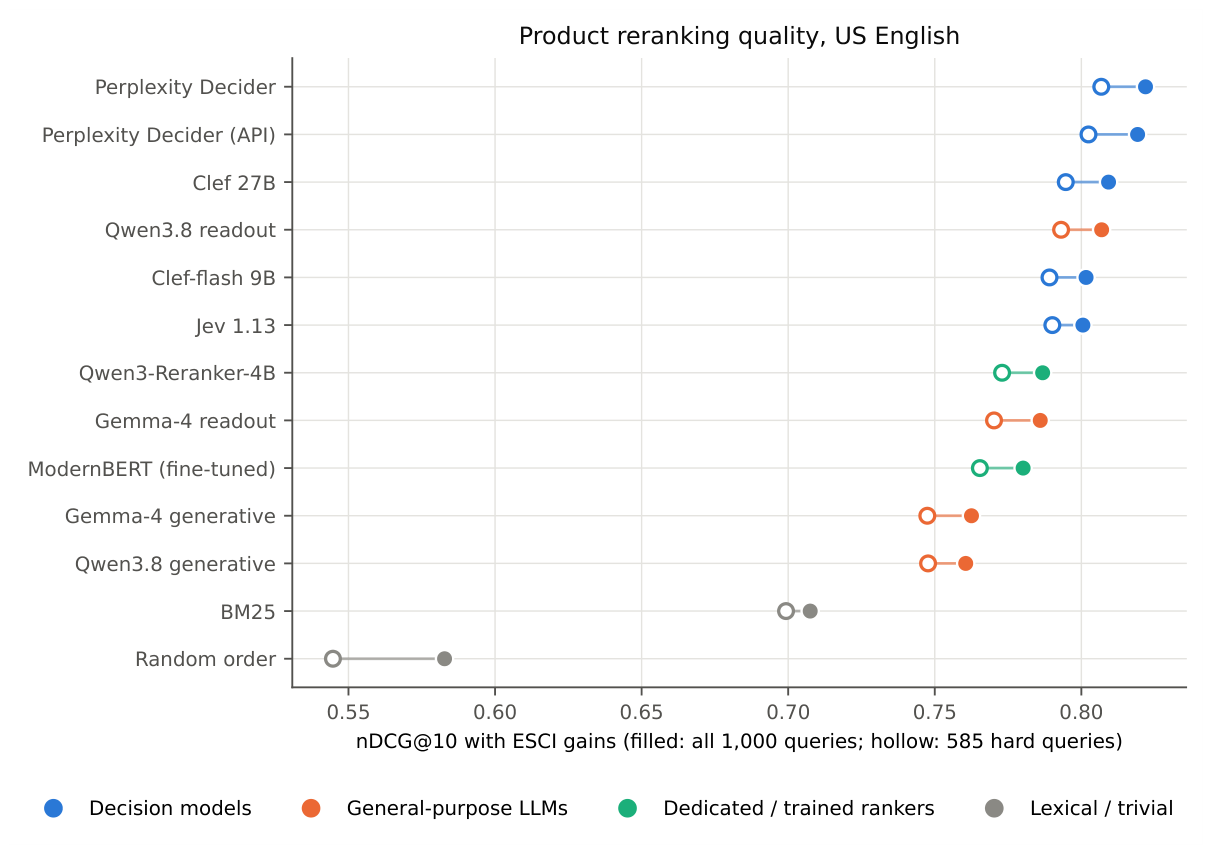
Figure 2.
Difference in nDCG@10 to the dedicated reranker (Qwen3-Reranker-4B) with 95% query-bootstrap intervals, four-way design. Filled markers: significant after Holm adjustment.
Figure 2.
Difference in nDCG@10 to the dedicated reranker (Qwen3-Reranker-4B) with 95% query-bootstrap intervals, four-way design. Filled markers: significant after Holm adjustment.
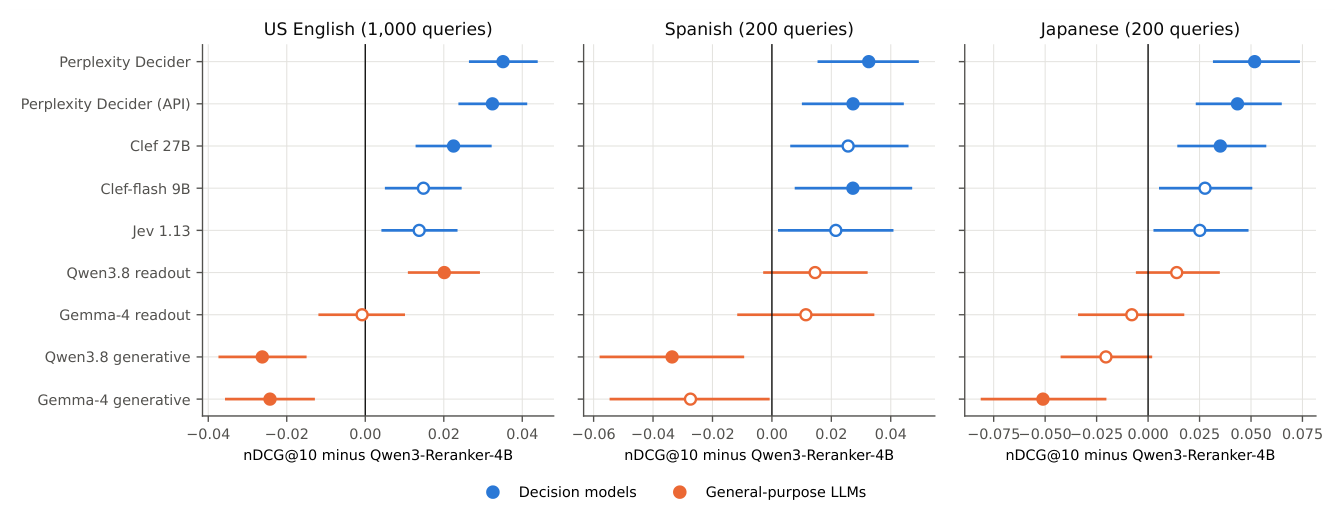
Figure 3.
Recall (%) per ESCI class for the four-way design on the US pairs.
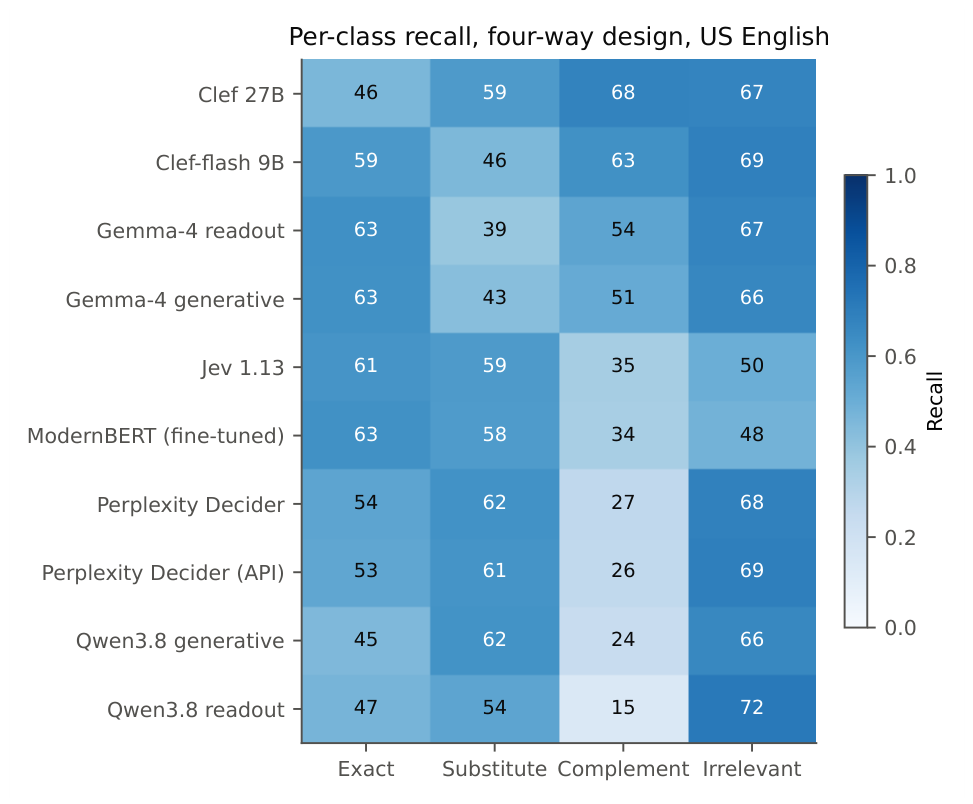
Figure 4.
Cost per 1,000 queries versus nDCG@10 for every system and design on the US market. The dashed line connects the configurations on the cost–quality frontier; unlabelled points are the remaining configurations in Table 6.
Figure 4.
Cost per 1,000 queries versus nDCG@10 for every system and design on the US market. The dashed line connects the configurations on the cost–quality frontier; unlabelled points are the remaining configurations in Table 6.
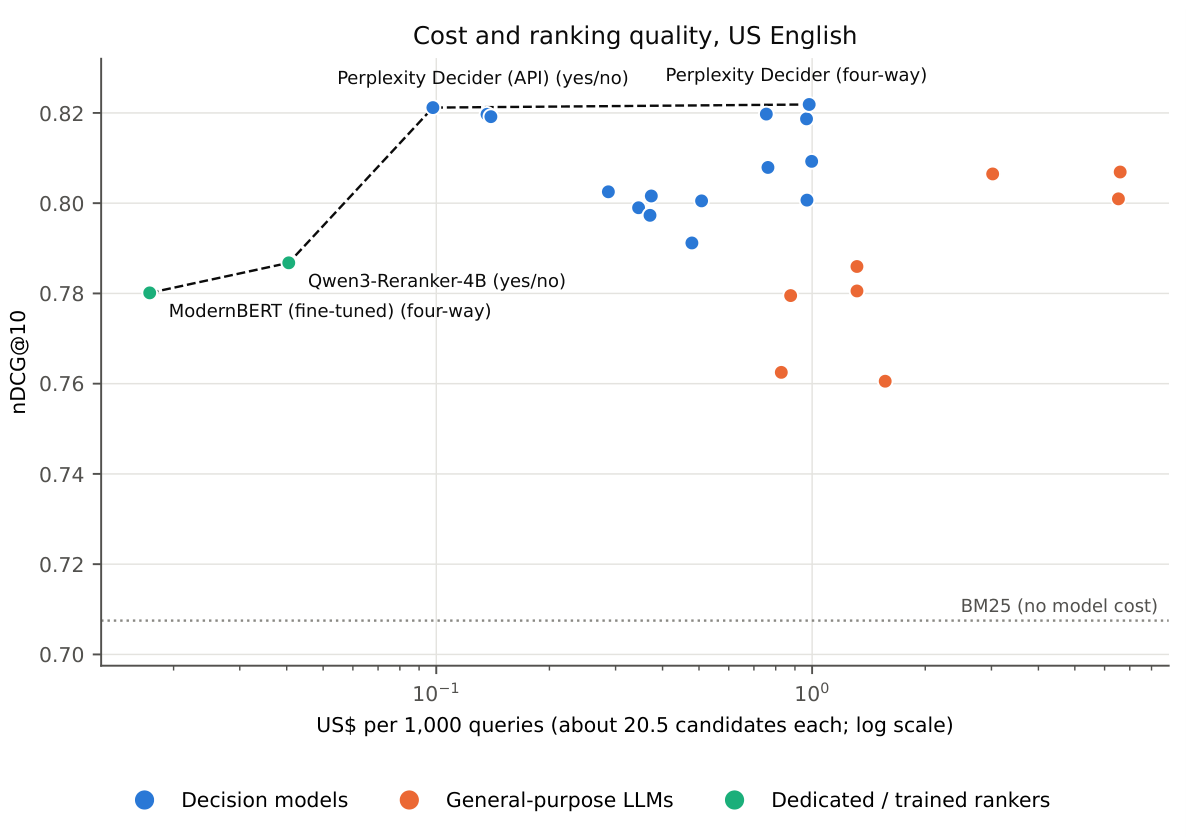
Table 1.
Evaluation data (ESCI reduced test split). Candidates per query: mean (range). Label shares in %. Hard queries contain at least one Exact and one Irrelevant product.
Table 1.
Evaluation data (ESCI reduced test split). Candidates per query: mean (range). Label shares in %. Hard queries contain at least one Exact and one Irrelevant product.
| Market | Queries | Pairs | Candidates/Query | Exact | Substitute | Complement | Irrelevant | Hard Queries |
|---|---|---|---|---|---|---|---|---|
| United States (English) | 1,000 | 20,477 | 20.5 (8–76) | 44.7 | 34.4 | 4.1 | 16.9 | 585 |
| Spain (Spanish) | 200 | 5,314 | 26.6 (11–40) | 40.1 | 32.8 | 8.0 | 19.0 | 135 |
| Japan (Japanese) | 200 | 5,504 | 27.5 (13–48) | 42.5 | 34.3 | 5.0 | 18.2 | 133 |
Table 2.
Ranking quality on the US market (1,000 queries; 585 hard). nDCG@10 with ESCI gains; MRR of the first Exact product. : difference in nDCG@10 to BM25 or to Qwen3-Reranker-4B, with 95% query-bootstrap interval for all queries. *: . Bold: best value in the column.
Table 2.
Ranking quality on the US market (1,000 queries; 585 hard). nDCG@10 with ESCI gains; MRR of the first Exact product. : difference in nDCG@10 to BM25 or to Qwen3-Reranker-4B, with 95% query-bootstrap interval for all queries. *: . Bold: best value in the column.
| Quality | nDCG@10 | ||||||
|---|---|---|---|---|---|---|---|
| System | Design | nDCG@10 | nDCG@10 Hard | MRR | vs. BM25 | vs. Reranker [95% CI] | vs. Reranker, Hard |
| Decision models | |||||||
| Jev 1.13 (API) | four-way | 0.801 | 0.790 | 0.861 | +0.093* | +0.014 [+0.004, +0.023] | +0.017 |
| Jev 1.13 (API) | ordinal | 0.791 | 0.779 | 0.848 | +0.084* | +0.004 [−0.006, +0.015] | +0.006 |
| Jev 1.13 (API) | yes/no | 0.797 | 0.786 | 0.865 | +0.090* | +0.011 [0.000, +0.021] | +0.013 |
| Clef 27B | four-way | 0.809 | 0.795 | 0.876 | +0.102* | +0.022* [+0.013, +0.032] | +0.022* |
| Clef 27B | ordinal | 0.801 | 0.784 | 0.867 | +0.093* | +0.014 [+0.004, +0.024] | +0.011 |
| Clef 27B | yes/no | 0.808 | 0.794 | 0.871 | +0.100* | +0.021* [+0.012, +0.031] | +0.021* |
| Clef-flash 9B | four-way | 0.802 | 0.789 | 0.863 | +0.094* | +0.015 [+0.005, +0.025] | +0.016 |
| Clef-flash 9B | ordinal | 0.799 | 0.787 | 0.865 | +0.091* | +0.012 [+0.002, +0.022] | +0.014 |
| Clef-flash 9B | yes/no | 0.803 | 0.787 | 0.866 | +0.095* | +0.016* [+0.006, +0.025] | +0.014 |
| Perplexity Decider (local) | four-way | 0.822 | 0.807 | 0.885 | +0.114* | +0.035* [+0.026, +0.044] | +0.034* |
| Perplexity Decider (local) | ordinal | 0.819 | 0.803 | 0.885 | +0.111* | +0.032* [+0.023, +0.041] | +0.030* |
| Perplexity Decider (local) | yes/no | 0.820 | 0.803 | 0.885 | +0.112* | +0.033* [+0.024, +0.042] | +0.030* |
| Perplexity Decider (API) | four-way | 0.819 | 0.802 | 0.883 | +0.112* | +0.032* [+0.024, +0.041] | +0.029* |
| Perplexity Decider (API) | ordinal | 0.820 | 0.802 | 0.888 | +0.112* | +0.033* [+0.024, +0.042] | +0.029* |
| Perplexity Decider (API) | yes/no | 0.821 | 0.804 | 0.885 | +0.114* | +0.034* [+0.026, +0.043] | +0.031* |
| General-purpose LLMs | |||||||
| Qwen3.8 readout | four-way | 0.807 | 0.793 | 0.872 | +0.099* | +0.020* [+0.011, +0.029] | +0.020* |
| Qwen3.8 readout | ordinal | 0.801 | 0.789 | 0.867 | +0.093* | +0.014 [+0.004, +0.024] | +0.016 |
| Qwen3.8 readout | yes/no | 0.806 | 0.792 | 0.867 | +0.099* | +0.020* [+0.011, +0.029] | +0.019 |
| Gemma-4 readout | four-way | 0.786 | 0.770 | 0.846 | +0.078* | −0.001 [−0.012, +0.010] | −0.003 |
| Gemma-4 readout | ordinal | 0.781 | 0.766 | 0.836 | +0.073* | −0.006 [−0.017, +0.005] | −0.006 |
| Gemma-4 readout | yes/no | 0.780 | 0.761 | 0.845 | +0.072* | −0.007 [−0.019, +0.004] | −0.012 |
| Qwen3.8 generative | four-way | 0.761 | 0.748 | 0.825 | +0.053* | −0.026* [−0.037, −0.015] | −0.025* |
| Gemma-4 generative | four-way | 0.763 | 0.747 | 0.813 | +0.055* | −0.024* [−0.036, −0.013] | −0.026* |
| Dedicated and trained rankers | |||||||
| Qwen3-Reranker-4B | yes/no | 0.787 | 0.773 | 0.844 | +0.079* | – | – |
| ModernBERT-large (fine-tuned) | four-way | 0.780 | 0.765 | 0.843 | +0.073* | −0.007 [−0.016, +0.003] | −0.008 |
| Lexical and trivial baselines | |||||||
| BM25 | – | 0.707 | 0.699 | 0.769 | – | −0.079* [−0.090, −0.069] | −0.074* |
| Random order | – | 0.583 | 0.545 | 0.618 | −0.125* | −0.204* [−0.216, −0.192] | −0.228* |
Table 3.
Ranking quality in the Spanish (ES) and Japanese (JP) markets (200 queries each; four-way design). : difference to Qwen3-Reranker-4B with 95% query-bootstrap interval; *: . BM25 as pre-specified; with Japanese text segmented into character bigrams, the Japanese BM25 reached 0.689.
Table 3.
Ranking quality in the Spanish (ES) and Japanese (JP) markets (200 queries each; four-way design). : difference to Qwen3-Reranker-4B with 95% query-bootstrap interval; *: . BM25 as pre-specified; with Japanese text segmented into character bigrams, the Japanese BM25 reached 0.689.
| Spanish | Japanese | |||
|---|---|---|---|---|
| System | nDCG@10 | vs. Reranker [95% CI] | nDCG@10 | vs. Reranker [95% CI] |
| Jev 1.13 (API) | 0.815 | +0.022 [+0.002, +0.041] | 0.788 | +0.025 [+0.003, +0.049] |
| Clef 27B | 0.819 | +0.026 [+0.006, +0.046] | 0.798 | +0.035* [+0.014, +0.057] |
| Clef-flash 9B | 0.821 | +0.027* [+0.008, +0.047] | 0.791 | +0.028 [+0.005, +0.051] |
| Perplexity Decider (local) | 0.826 | +0.033* [+0.015, +0.049] | 0.815 | +0.052* [+0.032, +0.074] |
| Perplexity Decider (API) | 0.821 | +0.027* [+0.010, +0.044] | 0.806 | +0.043* [+0.023, +0.065] |
| Qwen3.8 readout | 0.808 | +0.015 [−0.003, +0.032] | 0.777 | +0.014 [−0.006, +0.035] |
| Gemma-4 readout | 0.805 | +0.011 [−0.012, +0.034] | 0.755 | −0.008 [−0.034, +0.018] |
| Qwen3.8 generative | 0.760 | −0.034* [−0.058, −0.009] | 0.743 | −0.020 [−0.043, +0.002] |
| Gemma-4 generative | 0.766 | −0.027 [−0.055, −0.001] | 0.712 | −0.051* [−0.081, −0.020] |
| Qwen3-Reranker-4B | 0.794 | – | 0.763 | – |
| BM25 | 0.677 | −0.117* [−0.141, −0.093] | 0.643 | −0.120* [−0.152, −0.088] |
| Random order | 0.529 | −0.264* [−0.293, −0.235] | 0.538 | −0.225* [−0.255, −0.196] |
Table 4.
Paired differences in nDCG@10 between question designs (US, 1,000 queries), with 95% query-bootstrap intervals; *: (one family of 21 comparisons).
Table 4.
Paired differences in nDCG@10 between question designs (US, 1,000 queries), with 95% query-bootstrap intervals; *: (one family of 21 comparisons).
| System | Four-Way − Ordinal | Four-Way − Yes/No | Ordinal − Yes/No |
|---|---|---|---|
| Jev 1.13 (API) | +0.009* [+0.004, +0.014] | +0.003 [−0.002, +0.009] | −0.006 [−0.012, 0.000] |
| Clef 27B | +0.009* [+0.004, +0.014] | +0.001 [−0.004, +0.006] | −0.007 [−0.013, −0.001] |
| Clef-flash 9B | +0.003 [−0.001, +0.007] | −0.001 [−0.005, +0.003] | −0.004 [−0.009, +0.002] |
| Perplexity Decider (local) | +0.003 [−0.001, +0.007] | +0.002 [−0.002, +0.007] | −0.001 [−0.006, +0.004] |
| Perplexity Decider (API) | −0.001 [−0.004, +0.003] | −0.002 [−0.007, +0.003] | −0.001 [−0.007, +0.004] |
| Qwen3.8 readout | +0.006 [0.000, +0.012] | 0.000 [−0.004, +0.005] | −0.006 [−0.012, +0.001] |
| Gemma-4 readout | +0.005 [0.000, +0.010] | +0.006 [0.000, +0.013] | +0.001 [−0.006, +0.008] |
Table 5.
Four-way classification on the US pairs (20,477): accuracy (%), macro-F1, ECE, and recall (%) per ESCI class (Exact n = 9,146; Substitute 7,034; Complement 839; Irrelevant 3,458).
Table 5.
Four-way classification on the US pairs (20,477): accuracy (%), macro-F1, ECE, and recall (%) per ESCI class (Exact n = 9,146; Substitute 7,034; Complement 839; Irrelevant 3,458).
| Recall by Class (%) | |||||||
|---|---|---|---|---|---|---|---|
| System | Acc. | Macro-F1 | ECE | Exact | Substitute | Complement | Irrelevant |
| Jev 1.13 (API) | 57.4 | 0.516 | 0.194 | 61.3 | 58.9 | 34.9 | 49.8 |
| Clef 27B | 54.9 | 0.515 | 0.047 | 46.0 | 58.7 | 67.6 | 67.5 |
| Clef-flash 9B | 56.4 | 0.529 | 0.022 | 59.4 | 45.6 | 62.6 | 69.0 |
| Perplexity Decider (local) | 58.2 | 0.523 | 0.136 | 54.0 | 62.5 | 26.7 | 68.4 |
| Perplexity Decider (API) | 57.8 | 0.519 | 0.157 | 53.5 | 61.4 | 26.3 | 69.4 |
| Qwen3.8 readout | 52.3 | 0.452 | 0.162 | 47.1 | 53.9 | 14.8 | 71.7 |
| Gemma-4 readout | 55.2 | 0.511 | 0.434 | 63.3 | 39.0 | 54.1 | 67.2 |
| Qwen3.8 generative | 53.7 | 0.482 | 0.418 | 45.3 | 62.0 | 24.0 | 66.3 |
| Gemma-4 generative | 56.0 | 0.518 | 0.406 | 62.6 | 42.8 | 51.3 | 66.4 |
| ModernBERT-large (fine-tuned) | 57.6 | 0.512 | 0.110 | 62.8 | 58.4 | 34.3 | 48.0 |
Table 6.
Cost in US$ per 1,000 queries (all candidates of each query) by market and design, and latency in seconds per pair (US; four-way, or yes/no for the reranker). API costs use billed input tokens at list price. Self-hosted costs use batch-normalised GPU time at US$2.50 per GPU-hour. API latency is the client round trip and is not comparable with GPU time.
Table 6.
Cost in US$ per 1,000 queries (all candidates of each query) by market and design, and latency in seconds per pair (US; four-way, or yes/no for the reranker). API costs use billed input tokens at list price. Self-hosted costs use batch-normalised GPU time at US$2.50 per GPU-hour. API latency is the client round trip and is not comparable with GPU time.
| US | ES | JP | |||||
|---|---|---|---|---|---|---|---|
| System | Basis | Four-Way | Ordinal | Yes/No | Four-Way | Four-Way | s/Pair |
| Jev 1.13 (API) | API | 0.51 | 0.48 | 0.37 | 0.69 | 0.78 | 0.283 |
| Clef 27B | GPU | 1.00 | 0.97 | 0.76 | 1.35 | 1.31 | 0.070 |
| Clef-flash 9B | GPU | 0.37 | 0.35 | 0.29 | 0.48 | 0.47 | 0.026 |
| Perplexity Decider (local) | GPU | 0.98 | 0.97 | 0.76 | 1.38 | 1.37 | 0.069 |
| Perplexity Decider (API) | API | 0.14 | 0.14 | 0.10 | 0.20 | 0.19 | 0.381 |
| Qwen3.8 readout | GPU | 6.60 | 6.53 | 3.02 | 9.60 | 8.91 | 0.464 |
| Gemma-4 readout | GPU | 1.32 | 1.32 | 0.88 | 1.83 | 1.77 | 0.093 |
| Qwen3.8 generative | GPU | 1.56 | – | – | 2.19 | 2.11 | 0.110 |
| Gemma-4 generative | GPU | 0.83 | – | – | 1.14 | 1.11 | 0.058 |
| Qwen3-Reranker-4B | GPU | – | – | 0.04 | 0.07 | 0.07 | 0.003 |
| ModernBERT-large (fine-tuned) | GPU | 0.02 | – | – | – | – | 0.001 |
Table 7.
Labels changed (%) and mean total-variation distance (TV) when the four-way options were reversed or shuffled (US, 50 queries, 1,049 pairs). The last two rows resend identical requests (first and second resend).
Table 7.
Labels changed (%) and mean total-variation distance (TV) when the four-way options were reversed or shuffled (US, 50 queries, 1,049 pairs). The last two rows resend identical requests (first and second resend).
| System | Changed, Rev. | Changed, Shuf. | TV, Rev. | TV, Shuf. |
|---|---|---|---|---|
| Qwen3.8 readout | 26.4 | 20.0 | 0.173 | 0.149 |
| Gemma-4 readout | 6.8 | 8.8 | 0.072 | 0.088 |
| Jev 1.13 (API) | 9.3 | 5.7 | 0.074 | 0.051 |
| Perplexity Decider (local) | 4.9 | 3.5 | 0.043 | 0.030 |
| Clef 27B | 0.0 | 0.0 | 0.000 | 0.000 |
| Clef-flash 9B | 0.1 | 0.1 | 0.000 | 0.000 |
| Jev 1.13, identical resend | 3.6 | 3.9 | 0.030 | 0.030 |
| Perplexity API, identical resend | 0.0 | 0.0 | 0.000 | 0.000 |
Table 8.
Hosted (API) versus locally run Perplexity Decider: label agreement (%) and nDCG@10 of each deployment, with the difference API minus local.
Table 8.
Hosted (API) versus locally run Perplexity Decider: label agreement (%) and nDCG@10 of each deployment, with the difference API minus local.
| Market | Design | Agreement | nDCG@10 Local | nDCG@10 API | |
|---|---|---|---|---|---|
| US | four-way | 96.7 | 0.822 | 0.819 | −0.003 |
| US | ordinal | 97.0 | 0.819 | 0.820 | +0.001 |
| US | yes/no | 98.5 | 0.820 | 0.821 | +0.001 |
| ES | four-way | 96.7 | 0.826 | 0.821 | −0.005 |
| JP | four-way | 96.8 | 0.815 | 0.806 | −0.008 |
Disclaimer/Publisher’s Note: The statements, opinions and data contained in all publications are solely those of the individual author(s) and contributor(s) and not of MDPI and/or the editor(s). MDPI and/or the editor(s) disclaim responsibility for any injury to people or property resulting from any ideas, methods, instructions or products referred to in the content. |
© 2026 by the authors. Licensee MDPI, Basel, Switzerland. This article is an open access article distributed under the terms and conditions of the Creative Commons Attribution (CC BY) license (http://creativecommons.org/licenses/by/4.0/).
Copyright: This open access article is published under a Creative Commons CC BY 4.0 license, which permit the free download, distribution, and reuse, provided that the author and preprint are cited in any reuse.