

Submitted:
14 October 2026
Posted:
20 October 2026
You are already at the latest version
Abstract
Chronic hepatitis C virus (HCV) infection remains a major global health burden, potentially leading to cirrhosis and hepatocellular carcinoma. Direct-acting antivirals (DAAs) have improved treatment outcomes, achieving high sustained virologic response (SVR) rates. However, real-world evidence from Mexico remains limited. This study aimed to evaluate DAA effectiveness in Mexican patients with chronic HCV infection and compare outcomes according to cirrhosis status. A retrospective, multicenter cohort study was conducted across five public healthcare institutions in Mexico. We included 253 patients who received DAA therapy. The primary outcome was SVR, defined as undetectable HCV RNA after treatment. Clinical, demographic, and treatment-related variables were analyzed, with statistical significance set at p < 0.05. Overall, SVR was achieved in 94.5% of patients. Among those with cirrhosis (54.1%), the SVR rate was 95.6%, compared with 93.1% among those without cirrhosis (p = 0.536). Patients with cirrhosis were older and had longer treatment durations, while baseline viral load and genotype distribution were comparable. Treatment completion was high (94.1%), with low discontinuation rates and no significant differences by cirrhosis status. DAAs were highly effective in Mexican patients with chronic HCV infection, regardless of cirrhosis status. Expanding access to diagnosis and treatment is essential to reduce disease burden and achieve hepatitis C elimination goals.
Keywords:
direct-acting antivirals
; hepatitis C
; sustained virologic response
1. Introduction
Hepatitis C is caused by infection with the hepatitis C virus (HCV), a hepatotropic RNA virus belonging to the Flaviviridae family. Following acute infection, approximately 50–80% of patients develop chronic hepatitis C, which may lead to progressive liver disease [1,2,3]. HCV is primarily transmitted through percutaneous exposure to infected blood, including unsafe injections, blood transfusions, and injection drug use [4]. The virus exhibits substantial genetic heterogeneity, with multiple genotypes and subtypes that influence disease progression and therapeutic response [2,3].
HCV infection represents a major global public health problem, with an estimated 71.1 million individuals chronically infected worldwide [2,4]. In Mexico, prevalence estimates range from approximately 0.7% to 2.5% in the general population, with significantly higher rates in high-risk groups [5]. Despite this burden, underdiagnosis remains a critical barrier, with only a minority of infected individuals aware of their condition [4]. Diagnosis is based on serologic screening followed by confirmation with detection of HCV RNA and viral characterization [1].
Chronic HCV infection is associated with significant long-term complications. Approximately 10–20% of chronically infected individuals develop cirrhosis over 20–30 years, which may progress to liver failure and hepatocellular carcinoma (HCC) [4] . HCV is a leading cause of chronic liver disease worldwide and a major indication for liver transplantation [1]. These complications contribute substantially to global morbidity and mortality and represent a significant burden on healthcare systems.
The introduction of direct-acting antivirals (DAAs) has revolutionized HCV treatment, achieving sustained virologic response (SVR) rates exceeding 90% and significantly improving patient outcomes [1,2]. Current clinical guidelines recommend DAA-based regimens as the standard of care due to their high efficacy and favorable safety profile [6,7]. However, real-world data evaluating treatment effectiveness across different patient subgroups, particularly in populations with cirrhosis, remain limited.
The aim of this study is to evaluate the effectiveness of direct-acting antivirals, measured by sustained virologic response, and to compare treatment outcomes between patients with and without cirrhosis.
2. Materials and Methods
Study design and setting
This observational study was designed and reported in accordance with the Strengthening the Reporting of Observational Studies in Epidemiology (STROBE) guidelines [8] . A retrospective, multicenter cohort study was conducted using clinical data from five public healthcare institutions in Mexico: Hospital Regional de Alta Especialidad de la Península de Yucatán (HRAEPY), Instituto Mexicano del Seguro Social (UMAE), Hospital General Regional No. 1 “Ignacio García Téllez”, Hospital General Agustín O’Horan (SSY), and Hospital Regional “Elvia Carrillo Puerto” (ISSSTE).
Patients with confirmed hepatitis C virus infection who received treatment with direct-acting antivirals were identified from institutional medical records. A total of 320 patients were initially screened, of whom 68 were excluded due to missing post-treatment viral load data. The final study population consisted of 253 patients. The primary outcome was sustained virologic response (SVR), defined as undetectable HCV RNA following completion of antiviral therapy. Secondary outcomes included treatment duration, therapy discontinuation, and subgroup analyses according to cirrhosis status. Clinical and demographic variables included age, sex, HCV genotype, coinfection status (HIV or HBV), prior antiviral treatment, DAA regimen, baseline viral load, and treatment duration. Patients were stratified according to the presence of cirrhosis, which served as the main grouping variable for comparative analyses. Data were obtained from clinical records and laboratory databases. Viral load was reported in IU/mL and log10-transformed values were also analyzed. Treatment regimens and duration were recorded for each patient, along with treatment completion and discontinuation status. The study size was determined by the number of eligible patients identified during the study period.
Statistical analysis
Categorical variables were expressed as frequencies and percentages, while continuous variables were reported as mean ± standard deviation or median with interquartile ranges, depending on data distribution. Normality was assessed using the Kolmogorov–Smirnov test. Comparisons between groups (patients with and without cirrhosis) were performed using the Chi-square test with Yates correction for categorical variables, Student’s t-test for normally distributed continuous variables, and the Mann–Whitney U test for non-normally distributed variables. Statistical analyses were performed using IBM SPSS Statistics version 22.0 (IBM Corp., Armonk, NY, USA). A p-value < 0.05 was considered statistically significant.
Ethical considerations
This study was conducted in accordance with ethical standards for observational research. Due to its retrospective design and the use of anonymized data, informed consent was not required. Patient confidentiality was strictly maintained.
3. Results
This section may be divided by subheadings. It should provide a concise and precise description of the experimental results, their interpretation, and the experimental conclusions that can be drawn.
3.1. Baseline Characteristics
The demographic and clinical characteristics of the study population are summarized in Table 1. The median age was 56 years (IQR 49–65), and 55.3% of patients were female. The most frequent HCV genotypes were 1A (35.2%) and genotype 2 (19.8%), while 22.9% of cases had an unknown genotype. Most patients had no coinfection (88.9%), whereas 10.7% were coinfected with HIV and 0.4% with HBV.
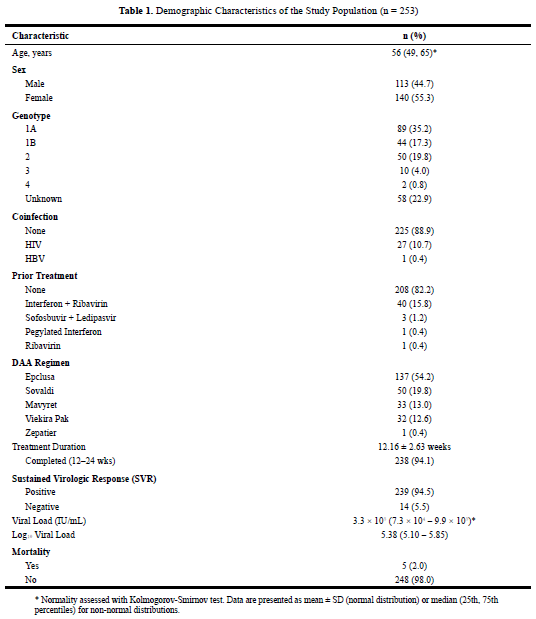
Regarding prior treatment, 82.2% of patients were treatment-naïve. The most commonly prescribed DAA regimen was Epclusa (54.2%), followed by Sovaldi (19.8%) and Mavyret (13.0%). The mean treatment duration was 12.16 ± 2.63 weeks, and 94.1% of patients completed therapy. Overall, sustained virologic response (SVR) was achieved in 94.5% of patients. The median baseline viral load was 3.3 × 10⁵ IU/mL, with a median log10 viral load of 5.38. Mortality occurred in 2.0% of patients (Table 1) .
3.2. Clinical Characteristics According to Cirrhosis
Clinical characteristics stratified by cirrhosis status are presented in Table 2. Of the total cohort, 137 patients (54.1%) had cirrhosis and 116 (45.9%) did not. Patients with cirrhosis were significantly older than those without cirrhosis (median 59.5 vs 52 years, p < 0.001).
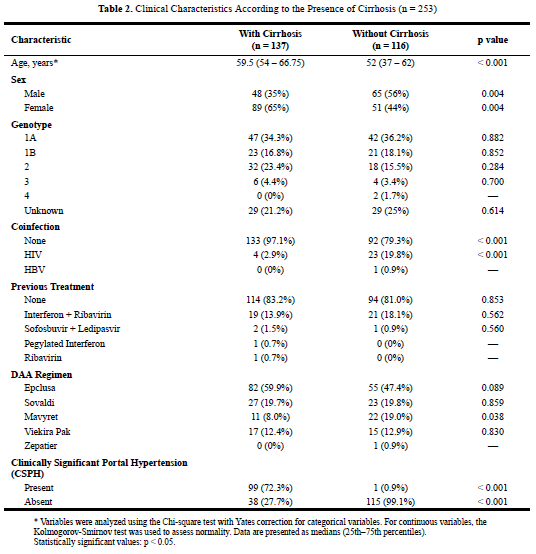
Sex distribution differed significantly between groups, with a higher proportion of females in the cirrhosis group (65% vs 44%) and males in the non-cirrhosis group (56% vs 35%) (p = 0.004). No significant differences were observed in genotype distribution between groups.
Coinfection status showed significant differences: patients with cirrhosis had lower rates of HIV coinfection compared to those without cirrhosis (2.9% vs 19.8%, p < 0.001).
Regarding treatment regimens, Mavyret was more frequently used in patients without cirrhosis (19.0% vs 8.0%, p = 0.038), while no significant differences were observed for other regimens. Clinically significant portal hypertension was present in 72.3% of patients with cirrhosis compared to 0.9% in those without cirrhosis (p < 0.001) (Table 2).
3.3. Treatment Outcomes and Sustained Virologic Response
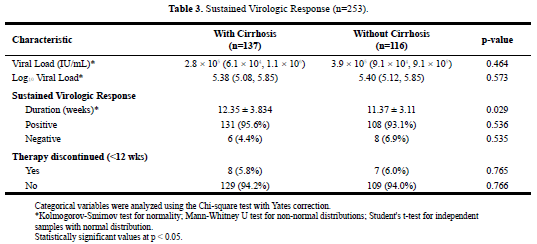
Treatment outcomes stratified by cirrhosis status are shown in Table 3. Baseline viral load and log10 viral load were comparable between patients with and without cirrhosis (p = 0.464 and p = 0.573, respectively).
The mean treatment duration was significantly longer in patients with cirrhosis compared to those without cirrhosis (12.35 ± 3.83 vs 11.37 ± 3.11 weeks, p = 0.029).
SVR rates were high in both groups, with no statistically significant difference between patients with cirrhosis (95.6%) and those without cirrhosis (93.1%) (p = 0.536). Similarly, rates of virologic failure were comparable between groups (4.4% vs 6.9%, p = 0.535).
Treatment discontinuation before 12 weeks occurred in a small proportion of patients, with no significant difference between groups (5.8% vs 6.0%, p = 0.765) (Table 3).
3. Discussion
The present study demonstrates that direct-acting antiviral (DAA) therapy achieves high rates of sustained virologic response (SVR) in a real-world Mexican cohort of patients with chronic hepatitis C, regardless of cirrhosis status. Overall, treatment effectiveness was consistently high, with no statistically significant difference in SVR between patients with and without cirrhosis, suggesting that DAA regimens maintain robust antiviral efficacy even in populations with advanced liver disease. These findings support the growing body of evidence indicating that DAAs have transformed the therapeutic landscape of hepatitis C, achieving viral eradication rates exceeding 90% across diverse clinical settings.
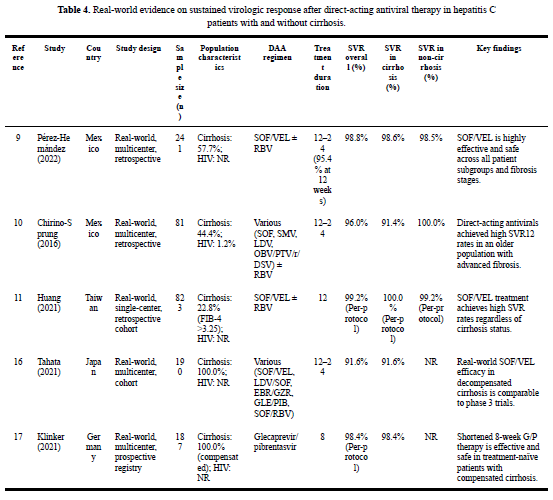
When contextualized with existing literature, our results are consistent with both national and international real-world studies. In Mexico, Pérez-Hernández et al. reported SVR rates close to 98% using sofosbuvir/velpatasvir-based regimens, with comparable effectiveness across fibrosis stages [9], while Chirino-Sprung et al. demonstrated SVR rates of approximately 96% in a multicenter cohort using various DAA combinations [10]. These findings align closely with the data summarized in our Table 4, where Mexican cohorts consistently achieve SVR rates above 95%, reinforcing the reproducibility of treatment outcomes in real-world clinical practice. Similarly, international studies have reported comparable efficacy. For instance, Huang et al. observed SVR rates exceeding 90% in patients with advanced fibrosis or cirrhosis, with no significant differences according to fibrosis stage [11], while large cohort analyses have reported SVR rates approaching 100% with modern DAA regimens [12]. Together, these findings confirm that the effectiveness of DAAs is consistent across geographic regions, healthcare systems, and patient subgroups.
An important observation in our study is the absence of a significant difference in SVR between cirrhotic and non-cirrhotic patients, despite cirrhotic patients being older and having a different clinical profile. This finding is clinically relevant, as cirrhosis has historically been associated with lower treatment response rates in the interferon era. The comparable outcomes observed in this study suggest that current DAA regimens effectively overcome traditional barriers to treatment success, likely due to their potent antiviral activity and improved tolerability. This is supported by previous studies showing that fibrosis stage does not significantly impact SVR when using pan-genotypic regimens [11]. However, although virologic cure is achieved at similar rates, it is important to note that patients with cirrhosis remain at risk for liver-related complications even after viral eradication, including hepatocellular carcinoma and hepatic decompensation [13].
Beyond virologic outcomes, the clinical implications of achieving SVR are substantial. Multiple studies have demonstrated that viral eradication is associated with improvement in liver function, regression of fibrosis, and reduced risk of liver-related morbidity and mortality [14] . Long-term follow-up data indicate that patients who achieve SVR experience histological improvement and stabilization of liver disease, even in advanced stages [12] . Furthermore, improvements in biochemical and non-invasive fibrosis markers have been documented following DAA therapy, supporting the concept that viral clearance translates into meaningful clinical benefit [15]. Therefore, the high SVR rates observed in our cohort are not only indicative of antiviral efficacy but also suggest a potential positive impact on long-term liver outcomes.
The findings of this study have important implications for clinical practice and public health in Mexico. Given the high effectiveness of DAAs across different patient subgroups, including those with cirrhosis, efforts should focus on expanding access to diagnosis and treatment, particularly among high-risk populations. Early identification and treatment of hepatitis C infection remain critical, as timely intervention can prevent progression to cirrhosis and its associated complications. These results support current strategies aimed at hepatitis C elimination and reinforce the need for widespread implementation of screening and treatment programs.
This study has several limitations that should be acknowledged. First, its retrospective design may introduce selection bias and limits the ability to establish causal relationships. Second, although multicenter, the study population may not fully represent all patient subgroups, particularly those with more advanced or decompensated disease. Third, the lack of long-term follow-up data precludes assessment of outcomes such as hepatocellular carcinoma, liver-related mortality, and fibrosis regression after SVR. Additionally, variability in treatment regimens and clinical management across centers may have influenced outcomes. Despite these limitations, the study provides valuable real-world evidence on the effectiveness of DAA therapy in a Mexican population.
4. Conclusions
This study confirms that direct-acting antiviral therapy achieves high rates of sustained virologic response in patients with chronic hepatitis C in Mexico, regardless of cirrhosis status. These findings are consistent with both national and international data and highlight the transformative impact of DAAs on hepatitis C management. Future research should focus on long-term outcomes following viral eradication, including fibrosis regression, risk of hepatocellular carcinoma, and strategies to optimize care in patients with advanced liver disease. Continued efforts toward early diagnosis and universal treatment will be essential to achieving hepatitis C elimination goals.
Author Contributions
Conceptualization, F.J.P.H., D.T.E., P.C.O., C.D.F.G., A.M.Q., F.J.A.C. and A.E.O.B.; methodology, F.J.P.H., D.T.E., P.C.O., C.D.F.G., A.M.Q., F.J.A.C., A.E.O.B., B.A.H.C., C.A.G.C., J.I.M.O. and B.I.P.E.; software, F.J.P.H., D.T.E., P.C.O., C.D.F.G. and F.J.A.C.; validation, F.J.P.H., D.T.E., P.C.O., C.D.F.G. and F.J.A.C.; formal analysis, F.J.P.H., D.T.E., C.D.F.G., A.M.Q., F.J.A.C., B.A.H.C. and B.I.P.E.; investigation, F.J.P.H., D.T.E., P.C.O., C.D.F.G., A.M.Q., F.J.A.C., A.E.O.B., B.A.H.C., C.A.G.C., J.I.M.O., B.I.P.E. and J.C.G.H.; resources, F.J.P.H., D.T.E., P.C.O., C.D.F.G., F.J.A.C. and J.C.G.H.; data curation, F.J.P.H., D.T.E., P.C.O., C.D.F.G., A.M.Q., F.J.A.C., A.E.O.B., B.A.H.C., C.A.G.C. and J.I.M.O.; writing—original draft preparation, F.J.P.H., D.T.E., P.C.O., C.D.F.G., A.M.Q., F.J.A.C., A.E.O.B., B.A.H.C., C.A.G.C., J.I.M.O., B.I.P.E. and J.C.G.H.; writing—review and editing, F.J.P.H., D.T.E., P.C.O., C.D.F.G., A.M.Q., F.J.A.C., A.E.O.B., B.A.H.C., C.A.G.C., J.I.M.O., B.I.P.E. and J.C.G.H.; visualization, F.J.P.H., D.T.E., P.C.O., C.D.F.G. and F.J.A.C.; supervision, F.J.P.H., D.T.E., P.C.O., C.D.F.G. and F.J.A.C.; project administration, F.J.P.H., D.T.E., P.C.O., C.D.F.G., A.M.Q. and F.J.A.C.; funding acquisition, F.J.P.H., D.T.E., C.D.F.G. and F.J.A.C. All authors have read and agreed to the published version of the manuscript.
Funding
This research received no external funding.
Institutional Review Board Statement
The study was conducted in accordance with the Declaration of Helsinki and approved by the Research Ethics Committee of the High Specialty Regional Hospital of the Yucatán Peninsula (HRAEPY), IMSS-Bienestar (protocol/registration code: RPI/HRECP/041).
Informed Consent Statement
Not applicable.
Data Availability Statement
Data available on request due to restrictions.
Acknowledgments
Not applicable.
Conflicts of Interest
The authors declare no conflicts of interest.
Abbreviations
The following abbreviations are used in this manuscript:
| HCV | Chronic hepatitis C virus |
| DAAS | Direct-acting antivirals |
| SVR | sustained virologic response |
| HCC | hepatocellular carcinoma |
| HIV | Human Immunodeficiency Virus |
| HBV | Hepatitis B Virus |
References
- Manns, M.P.; Buti, M.; Gane, E.; Pawlotsky, J.M.; Razavi, H.; Terrault, N.; et al. Hepatitis C virus infection. Nat. Rev. Dis. Primers [Internet] 2017, 3(1). Available online: https://www.nature.com/articles/nrdp20176. [PubMed]
- Rabaan, A.A.; Al-Ahmed, S.H.; Bazzi, A.M.; Alfouzan, W.A.; Alsuliman, S.A.; Aldrazi, F.A.; et al. Overview of hepatitis C infection, molecular biology, and new treatment. J. Infect. Public Health [Internet] 2020, 13(5), 773–83. Available online: https://www.sciencedirect.com/science/article/pii/S1876034119303569?via%3Dihub. [CrossRef] [PubMed]
- Martinez, M.A.; Franco, S. Therapy Implications of Hepatitis C Virus Genetic Diversity. Viruses [Internet] 2020, 13(1), E41. Available online: https://pubmed.ncbi.nlm.nih.gov/33383891/. [CrossRef] [PubMed]
- Spearman, C.W.; Dusheiko, G.M.; Hellard, M.; Sonderup, M. Hepatitis C. The Lancet [Internet] 2019, 394(10207), 1451–66. Available online: https://www.thelancet.com/journals/lancet/article/PIIS0140-6736(19)32320-7/fulltext?hss_channel=tw-27013292. [CrossRef] [PubMed]
- Sedeño-Monge, V.; Laguna-Meraz, S.; Santos-López, G.; Panduro, A.; Sosa-Jurado, F.; Jose-Abrego, A.; et al. A comprehensive update of the status of hepatitis C virus (HCV) infection in Mexico—A systematic review and meta-analysis (2008–2019). Ann. Hepatol. 2021, 20, 100292. [Google Scholar] [CrossRef] [PubMed]
- Aiza-Haddad, I.; Ballesteros-Amozurrutia, A.; Borjas-Almaguer, O.D.; Castillo-Barradas, M.; Castro-Narro, G.; Chávez-Tapia, N.; et al. Consenso Mexicano para el Tratamiento de la Hepatitis C. Rev. De Gastroenterol. De México [Internet] 2018, 83(3), 275–324. Available online: http://www.revistagastroenterologiamexico.org/es-consenso-mexicano-el-tratamiento-hepatitis-articulo-S0375090618300399. [CrossRef] [PubMed]
- Alghamdi, A.S.; Alghamdi, H.; Alserehi, H.A.; Babatin, M.A.; Alswat, K.A.; Alghamdi, M.; et al. SASLT guidelines: Update in treatment of hepatitis C virus infection, 2024. Saudi J. Gastroenterol. 2024, 30(Supp 1), S1–42. [Google Scholar] [CrossRef] [PubMed]
- Cuschieri, S. The STROBE guidelines. Saudi J. Anaesth. [Internet] 2019, 13(5), 31. Available online: https://www.ncbi.nlm.nih.gov/pmc/articles/PMC6398292/. [CrossRef] [PubMed]
- Pérez-Hernández, J.L.; Arce-Salinas, C.A.; Lehmann-Mendoza, R.; Torre-Delgadillo, A.; Castro-Narro, G.E.; Cerda-Reyes, E.; et al. Sofosbuvir-velpatasvir en pacientes mexicanos con hepatitis C: una revisión retrospectiva. Rev. De Gastroenterol. De México 2021. [Google Scholar] [CrossRef] [PubMed]
- Chirino-Sprung, R.A.; Dehesa, M.; Wolpert-Barraza, E.; Corona-Lau, C.; Garcia-Juarez, I.; Sanchez-Avila, J.F.; et al. Chronic Hepatitis C Treatment with Direct-Acting Antiviral Agents in a Real-Life Setting. Rev. De Investig. Clínica 2016, 68(4). [Google Scholar] [CrossRef]
- Huang, Y.T.; Hsieh, Y.Y.; Chen, W.M.; Tung, S.Y.; Wei, K.L.; Shen, C.H.; et al. Sofosbuvir/velpatasvir is an effective treatment for patients with hepatitis C and advanced fibrosis or cirrhosis in a real-world setting in Taiwan. BMC Gastroenterol. 2021, 21(1). [Google Scholar] [CrossRef] [PubMed]
- Iwamoto, T.; Nozaki, Y.; Inoue, T.; Suda, T.; Mizumoto, R.; Arimoto, Y.; et al. Histological improvement of fibrosis in patients with hepatitis C who achieved a 5-year sustained virological response to treatment with direct-acting antivirals. J. Gastroenterol. 2024. [Google Scholar] [CrossRef] [PubMed]
- Tahata, Y.; Hikita, Hayato; Mochida, Satoshi; Enomoto, N.; Kawada, N.; Kurosaki, M.; et al. Liver-related events after direct-acting antiviral therapy in patients with hepatitis C virus-associated cirrhosis. J. Gastroenterol. 2022, 57(2), 120–32. [Google Scholar] [CrossRef] [PubMed]
- Calvaruso, V.; Craxì, A. Hepatic benefits of HCV cure. J. Hepatol. 2020, 73(6), 1548–56. [Google Scholar] [CrossRef] [PubMed]
- Sung, B.R.; Shim, S.G.; Kim, K.M.; Lee, J.W.; Kim, J.Y.; Lee, B.K.; et al. Evaluating long-term outcomes of direct-acting antiviral therapy in chronic hepatitis C: A retrospective study. Medicine 2025, 104(50), e46449. [Google Scholar] [CrossRef] [PubMed]
- Tahata, Y.; Hikita, Hayato; Mochida, Satoshi; Kawada, N.; Enomoto, N.; Ido, Akio; et al. Sofosbuvir plus velpatasvir treatment for hepatitis C virus in patients with decompensated cirrhosis: a Japanese real-world multicenter study. J. Gastroenterol. 2020, 56(1), 67–77. [Google Scholar] [CrossRef] [PubMed]
- Klinker, H.; Naumann, U.; Rössle, M.; Berg, T.; Bondin, M.; Lohmann, K.; et al. Glecaprevir/pibrentasvir for 8 weeks in patients with compensated cirrhosis: Safety and effectiveness data from the German Hepatitis C-Registry. Liver Int. 2021, 41(7), 1518–22. [Google Scholar] [CrossRef] [PubMed]
Disclaimer/Publisher’s Note: The statements, opinions and data contained in all publications are solely those of the individual author(s) and contributor(s) and not of MDPI and/or the editor(s). MDPI and/or the editor(s) disclaim responsibility for any injury to people or property resulting from any ideas, methods, instructions or products referred to in the content. |
© 2026 by the authors. Licensee MDPI, Basel, Switzerland. This article is an open access article distributed under the terms and conditions of the Creative Commons Attribution (CC BY) license (http://creativecommons.org/licenses/by/4.0/).
Copyright: This open access article is published under a Creative Commons CC BY 4.0 license, which permit the free download, distribution, and reuse, provided that the author and preprint are cited in any reuse.