

Submitted:
18 October 2026
Posted:
20 October 2026
You are already at the latest version
Abstract
Poor aqueous solubility remains a major challenge in formulating BCS Class II and IV drugs, while therapeutic peptides face additional challenges in stability and biological delivery. In the present study, we evaluated Facilitated Self-Assembling Technology (FAST) for the rapid preparation of aqueous nanosuspensions of 11 clinically relevant small-molecule drugs and two lipidated peptides, semaglutide and retatrutide. The compounds represent diverse structural classes and therapeutic uses, including targeted anticancer agents, immunosuppressants, anti-inflammatory drugs, and incretin-based peptides. Nanoparticle tracking analysis detected FAST-generated nanoscale particle populations in all 13 preparations, with number-weighted mean diameters from 126.7 to 219.1 nm and particle concentrations from 9.0 × 10⁷ to 5.4 × 10⁹ particles/mL. Semaglutide and retatrutide yielded mean diameters of 126.7 ± 55.6 and 163.0 ± 64.6 nm, respectively. All preparations exhibited negative zeta potentials. Paired-vial photographs showed similar aqueous appearances after more than 30 days at room temperature, except a slightly darker color in the venetoclax preparation. Transmission electron microscopy demonstrated predominantly rounded nanoscale particles in representative adagrasib and cyclosporine preparations. X-ray diffraction profiles of six selected FAST-generated BCS Class II/IV drug formulations exhibited broad, diffuse features near 20° 2θ, suggesting low apparent crystalline order and amorphous-like characteristics, which may favor improved dissolution of poorly water-soluble drugs. Taken together, these results support our hypothesis that FAST can generate aqueous nanoparticle preparations from clinically important compounds with widely different molecular structures. The extension to lipidated peptides suggest opportunities for future development of alternative peptide formulations and delivery systems.
Keywords:
facilitated self-assembling technology (FAST)
; BCS Class II and IV drugs
; aqueous nanoformulations
; nanoparticle tracking analysis
; semaglutide
; retatrutide
; lipidated peptides
; drug reformulation
; nanoparticle delivery
1. Intriduction
Poor aqueous solubility is a persistent challenge in pharmaceutical development, especially for compounds with high therapeutic potential but difficult formulation characteristics. Limited solubility can affect drug dissolution, gastrointestinal absorption, systemic exposure, and the selection of dosage forms. These challenges are common among newly discovered small molecules and several existing medications [1,2,3,4].
The Biopharmaceutics Classification System (BCS) divides orally administered drug substances according to aqueous solubility and intestinal permeability [2,5]. BCS Class II compounds have low solubility and high permeability, whereas BCS Class IV compounds have both low solubility and low permeability. Nanoparticle formulation is therefore of considerable interest for increasing the dispersibility and dissolution rate of Class II drugs and developing integrated delivery strategies for Class IV drugs [4,6,7].
Current formulation approaches include wet milling, high-pressure homogenization, drug nanocrystals and nanosuspensions, amorphous solid dispersions, lipid-based nanoparticles, self-emulsifying systems, and polymeric drug carriers [1,3,4,7,8,9,10,33,35,36]. These technologies have expanded the possibilities for poorly soluble drugs and led to several successful pharmaceutical products. Preparation frequently requires the selection of drug-specific excipients, carrier systems, and processing conditions. A versatile nanoformulation platform with a simple preparation process would be valuable for both new drug development and reformulation of clinically used medications.
Facilitated Self-Assembling Technology (FAST) was developed as a relatively simple approach for preparing aqueous nanosuspensions using food-grade or generally recognized as safe (GRAS)-compatible formulation materials. Previous studies demonstrated FAST-generated nanoparticles of epigallocatechin-3-gallate-palmitate (EC16), hydrophobic pharmaceuticals, and nutraceutical compounds, together with applications in nasal and oral-rinse formulations [11,12,13]. These findings encouraged us to investigate the adaptability of FAST to structurally diverse pharmaceutical compounds of high clinical interest.
The present study includes 11 small-molecule drugs selected for their clinical applications and formulation challenges, as summarized in Table 1. Seven are targeted anticancer therapeutics; two are macrocyclic immunosuppressants; and the remaining compounds are apremilast and tafamidis. We also included two lipidated peptide therapeutics, semaglutide and retatrutide, to extend the evaluation beyond conventional small molecules. Semaglutide is a GLP-1 receptor agonist available in injectable and oral formulations, whereas retatrutide is an investigational triple agonist of GLP-1, GIP, and glucagon receptors [27,28,29,30]. Fatty-acid modification promotes albumin association and prolonged circulation of these peptide drugs [45,46,47]. Their inclusion provides an opportunity to explore FAST-generated nanosuspensions of more complex therapeutic molecules.
We hypothesized that FAST could generate aqueous nanoparticle populations from structurally diverse BCS Class II/IV drugs and selected lipidated peptides through a common formulation approach. The aim of this study was to examine the breadth of FAST nanoformulation capability and characterize the resulting nanosuspensions.
Thirteen compounds were evaluated by nanoparticle tracking analysis (NTA), including measurements of mean particle size, size distribution, particle concentration, and zeta potential (Table 2). The preparations were also examined by photography (Figure 2), representative transmission electron microscopy (TEM; Figure 3), and X-ray diffraction (XRD) of selected formulations (Figure 4). These complementary observations provide a foundation for understanding the physicochemical characteristics of the preparations and identifying opportunities for further pharmaceutical formulation and delivery studies.
Structural and Therapeutic Diversity of the Selected Compounds
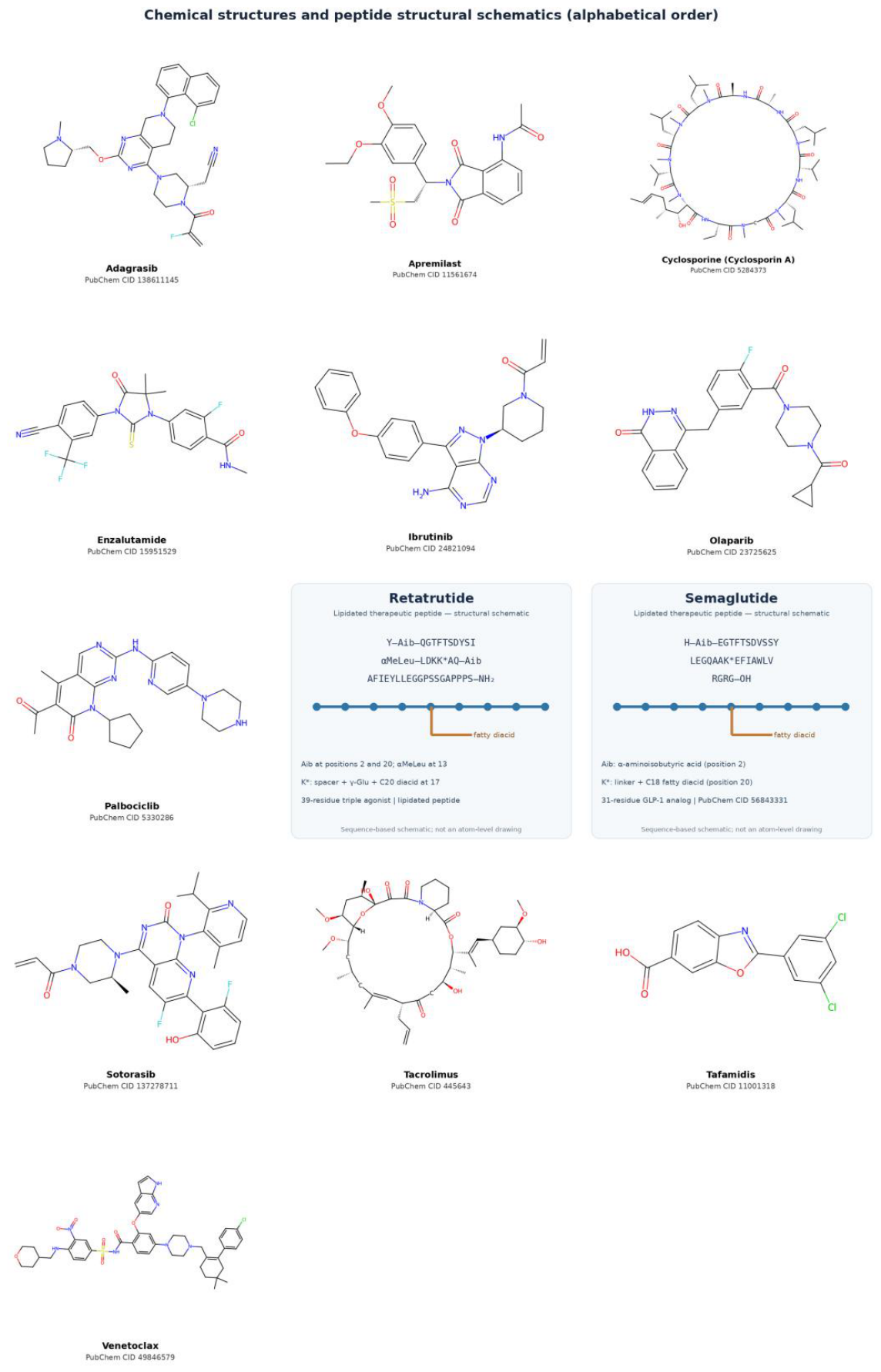
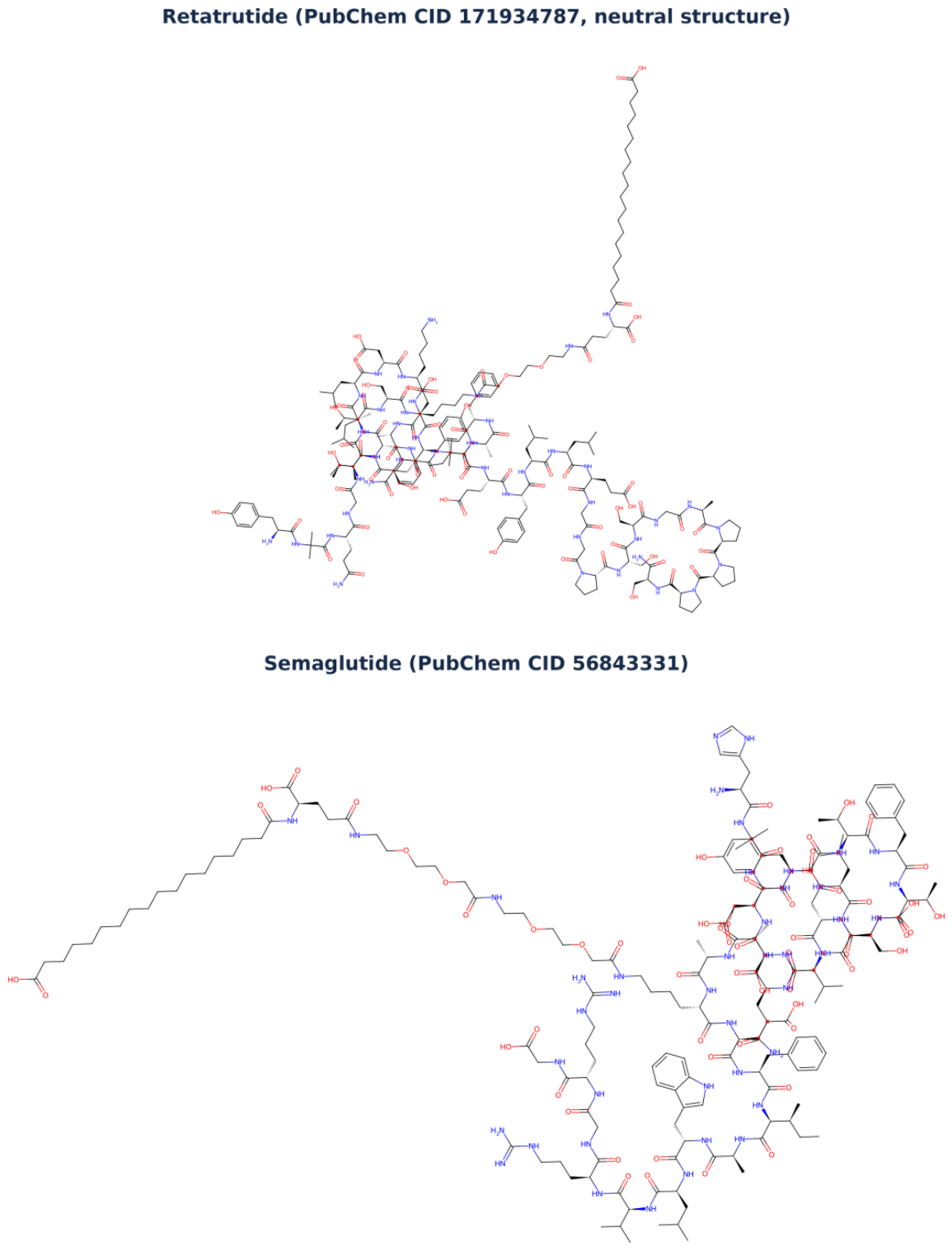
The structural diversity of the 11 small molecules includes different aromatic and ionizable groups, macrocycles, molecular weights, and lipophilic characteristics (Figure 1). Semaglutide is a 31-residue GLP-1 analog modified with a C18 fatty diacid, and retatrutide is a 39-residue triple-receptor agonist modified with a C20 fatty diacid [28,31,32,45,46,47]. The fatty-acid modifications are of pharmacological interest because their reversible association with serum albumin extends systemic circulation. The addition of these peptides provides a wider range of chemical structures for evaluating FAST nanoformulation.
Figure 1.
A. Chemical structures of the 13 compounds arranged alphabetically: adagrasib, apremilast, cyclosporine, enzalutamide, ibrutinib, olaparib, palbociclib, retatrutide, semaglutide, sotorasib, tacrolimus, tafamidis, and venetoclax. The small-molecule structures were assembled from PubChem-referenced molecular representations; the semaglutide and retatrutide panels summarize their peptide backbones and fatty-diacid modifications [25,26,31,32].
2. Materials & Methods
2.1. Compounds and Reagents
Epigallocatechin-3-gallate-palmitate (EC16) was obtained from Camellix, LLC (Evans, GA, USA). Adagrasib, apremilast, cyclosporine, enzalutamide, ibrutinib, olaparib, palbociclib, sotorasib, tacrolimus, tafamidis, and venetoclax were obtained from AdooQ BioScience (Irvine, CA, USA). Semaglutide [GLP-1 (SMA)] was obtained from Peptide Source (Philadelphia, PA, USA), and retatrutide [RETA-20; reported molecular formula C221H342N46O68] was obtained from Pura Peptides (Sheridan, WY, USA). Double-distilled water, filtered water, glycerol, paraformaldehyde, glutaraldehyde, and uranyl acetate were used in the preparation and characterization procedures.
2.2. Preparation of Drug Nanoparticles
Each compound was processed separately using Facilitated Self-Assembling Technology (FAST), with compound-specific adjustments to the previously described protocols [11,12,13]. The process employs mild conditions and food-grade/GRAS-compatible materials to prepare nanoparticle stocks suitable for subsequent dilution in water. FAST is protected by patent filings, including U.S. application 19/111,317 and international publication WO 2026/177783 A2. The preparation conditions were selected according to the properties of the individual drugs and peptides. Stock suspensions were prepared and diluted with double-distilled water for particle characterization and photography.
2.3. Nanoparticle Tracking Analysis and Zeta-Potential Measurement
Particle size distributions and particle concentrations were characterized using a ZetaView X20 nanoparticle tracking analyzer (Particle Metrix, Meerbusch, Germany) with a 520-nm laser. The instrument settings used for these preparations included a nominal 30-frame/s acquisition rate, sensitivity 83, shutter 100, 11 measurement positions in one cycle, minimum particle area 10, maximum area 1000, minimum brightness 30, and trace length 15. Samples were diluted in 0.1-µm-filtered water before measurement, and particle concentrations were corrected for the recorded dilution factors. Table 2 reports number-weighted arithmetic mean particle diameters and standard deviations (SD). An NTA-derived relative-variance index (CV2) was calculated as (SD/mean)2 to describe the breadth of each measured size distribution.
Zeta potentials were measured on the ZetaView system in low-conductivity aqueous diluent. Particle concentrations are expressed as particles per milliliter of the original suspension, after correction for sample dilution. The number-weighted mean diameter, SD, and NTA-derived CV2 values are reported separately from the median (X50) values supplied by the instrument.
2.4. Visual Assessment of Aqueous Drug Nanoparticle Suspensions
FAST-generated nanoparticle stocks were diluted 50-fold in double-distilled water for photographic comparison. For each compound, the left vial contained a diluted preparation maintained at room temperature for more than 30 days, and the right vial contained a freshly diluted preparation from the corresponding stock. All paired samples were photographed under comparable conditions for visual assessment of clarity, color, precipitation, and phase separation (Figure 2).
2.5. Transmission Electron Microscopy
Transmission electron microscopy was used to examine the morphology of selected FAST-generated drug nanoparticles. Drug nanoparticle stocks were diluted with double-distilled water and fixed in 4% paraformaldehyde and 2% glutaraldehyde. After mixing, 5 µL of each sample was transferred to a Formvar/carbon-coated copper 200-mesh grid and allowed to dry for 15 minutes. Excess liquid was removed using filter paper. Samples were negatively stained with 5 µL of 2% aqueous uranyl acetate. Multiple fields were captured using a JEM 1400 Flash transmission electron microscope (JEOL, Peabody, MA, USA) operated at 120 kV with a Gatan OneView digital camera (Gatan Inc., Pleasanton, CA, USA).
2.6. X-Ray Diffraction (XRD) Analysis
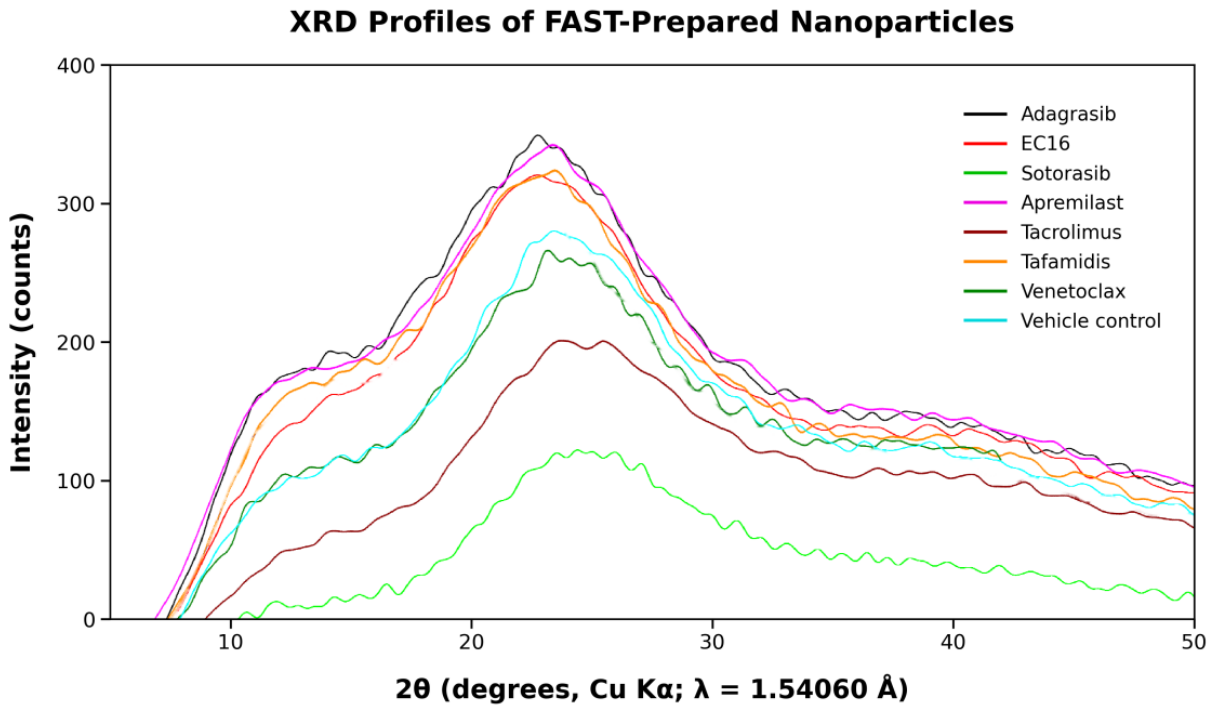
X-ray diffraction (XRD) profiles of selected FAST-generated preparations were acquired using a Bruker D6 PHASER diffractometer with Cu Kα radiation (λ = 0.154060 nm). The displayed diffraction profiles cover approximately 10–50° 2θ (Figure 4). FAST preparations of adagrasib, apremilast, sotorasib, tacrolimus, tafamidis, and venetoclax were compared with EC16 and the formulation vehicle control. Solid preparations using maltodextrin/colloidal silicon dioxide (CAB-O-Sil) were placed on the instrument sample holder and examined for the distribution of diffractive features.
3. Results
3.1. Nanoparticle Size, Number Concentration, and Surface Charge
As summarized in Table 2, FAST-generated preparations of all 13 compounds contained nanoscale particle populations with number-weighted mean diameters from 126.7 nm (semaglutide) to 219.1 nm (sotorasib). The 11 small-molecule formulations had mean diameters from 161.0 nm for cyclosporine to 219.1 nm for sotorasib. The particle concentrations ranged from 9.0 × 10⁷ particles/mL (olaparib) to 5.4 × 10⁹ particles/mL (venetoclax). All 13 preparations showed negative zeta potentials ranging from −46.8 mV (retatrutide) to −97.5 mV (olaparib). Calculated CV2 values varied among compounds; tacrolimus showed the broadest size distribution (171.9 ± 176.1 nm; CV2 = 1.049). These measurements demonstrate the preparation of aqueous nanoscale populations across the chemically diverse panel.
3.2. Extension of FAST Nanoparticle Formation to Lipidated Peptide Therapeutics
Semaglutide (Peptide 33/G2) and retatrutide (Peptide 39/R) were included to evaluate FAST with lipidated incretin-related peptides (Figure 1). Semaglutide yielded nanoparticles with a number-weighted mean diameter of 126.7 ± 55.6 nm (median X50 = 113.3 nm) and a concentration of 5.2 × 10⁸ particles/mL. Retatrutide yielded a mean diameter of 163.0 ± 64.6 nm (median X50 = 149.3 nm) and a concentration of 3.1 × 10⁹ particles/mL. Their NTA-derived CV2 values were 0.193 and 0.157, respectively, and the corresponding zeta potentials were −86.4 ± 14.8 mV and −46.8 ± 11.8 mV (Table 2). These results extend the range of FAST-generated preparations to clinically important lipidated peptide therapeutics.
3.3. FAST Generated Aqueous Nanoscale Suspensions Across 13 Structurally Diverse Drugs
The aqueous appearance of all 13 FAST-generated preparations is presented in Figure 2. The paired vials showed comparable visual characteristics after more than 30 days at room temperature, including the absence of readily visible precipitation or phase separation. The venetoclax preparation developed a slightly darker appearance over this period. Together with the NTA measurements (Table 2), these observations illustrate the feasibility of preparing water-dispersible nanoscale formulations across multiple therapeutic classes.
Figure 2.
Photographic appearance of FAST-generated aqueous preparations. Representative photographic appearance of the 13 FAST-generated aqueous nanoparticle preparations. Top row, from left to right: adagrasib, apremilast, cyclosporine, enzalutamide, ibrutinib, and olaparib. Bottom row, from left to right: palbociclib, retatrutide (Peptide 39), semaglutide (Peptide 33), sotorasib, tacrolimus, tafamidis, and venetoclax. Each pair contains an aqueous suspension stored at room temperature for more than 30 days (left) and a freshly diluted preparation (right). All preparations were diluted 50-fold with double-distilled water. The venetoclax suspension showed a slightly darker color after storage.
3.4. TEM Morphology of Representative FAST-Generated Nanoparticles
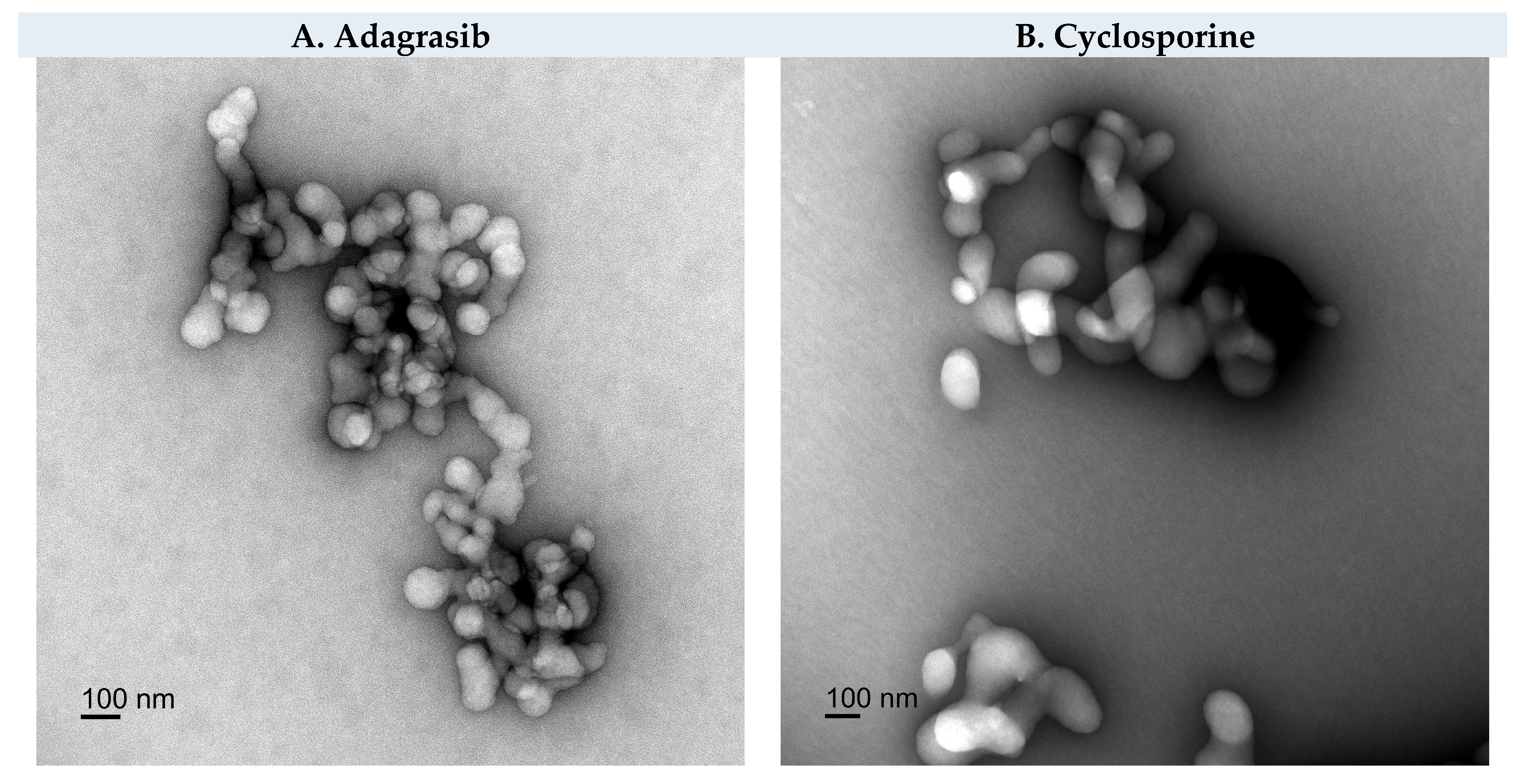
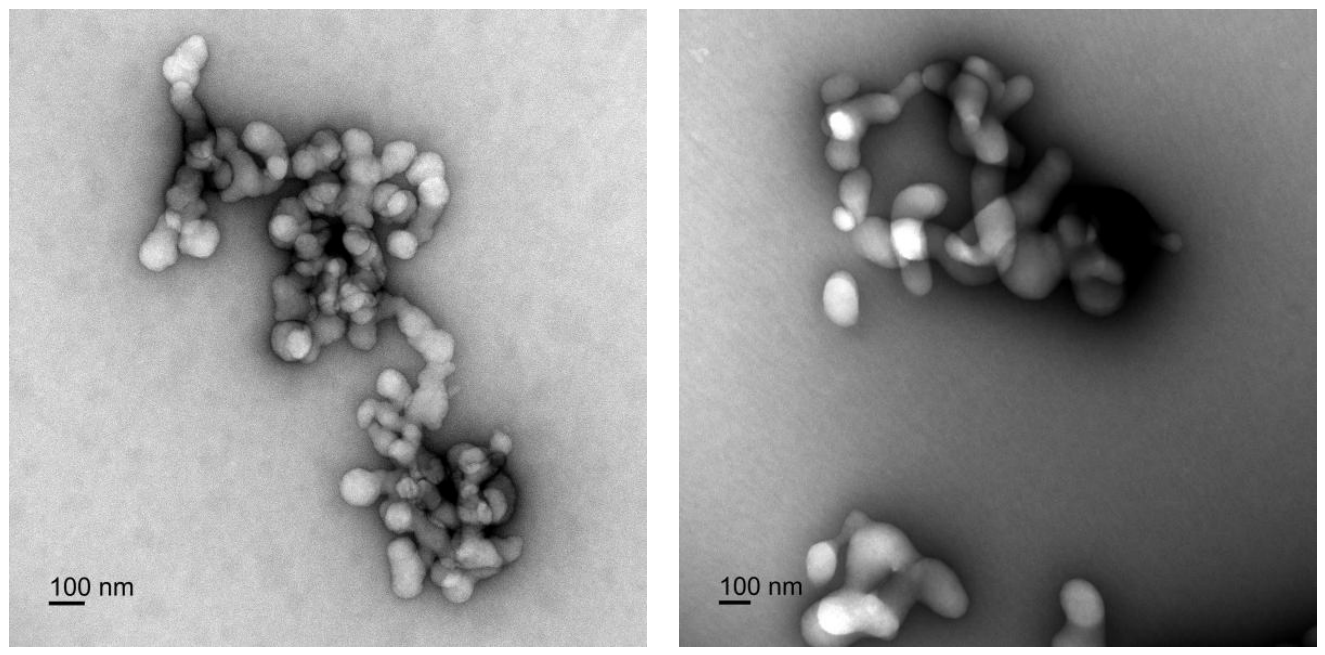
Representative TEM images of FAST-generated adagrasib and cyclosporine nanoparticles are shown in Figure 3. Adagrasib exhibited predominantly rounded or quasi-spherical particles, while cyclosporine showed rounded to oval particles and some short elongated profiles. Localized clustering was visible in both selected fields. Their corresponding mean diameters determined by NTA were 172.5 ± 62.1 nm for adagrasib and 161.0 ± 55.9 nm for cyclosporine (Table 2), consistent with the presence of nanoscale objects in these preparations. The representative TEM images provide additional morphological evidence of FAST-generated nanoscale structures and illustrate particle appearance after fixation and negative staining.
Figure 3.
Representative negative-stain transmission electron micrographs of FAST-generated nanoparticles: (A) adagrasib and (B) cyclosporine. Both preparations showed predominantly rounded to oval nanoscale structures with areas of particle clustering. Scale bars = 100 nm.
Figure 3.
Representative negative-stain transmission electron micrographs of FAST-generated nanoparticles: (A) adagrasib and (B) cyclosporine. Both preparations showed predominantly rounded to oval nanoscale structures with areas of particle clustering. Scale bars = 100 nm.
3.5. X-Ray Diffraction Profiles of Selected FAST-Generated Formulations
The XRD patterns of six selected FAST-generated drug preparations are shown in Figure 4, together with EC16 and the formulation vehicle control. Adagrasib, apremilast, sotorasib, tacrolimus, tafamidis, and venetoclax displayed predominantly broad diffraction features, including a diffuse maximum near 20° 2θ. The profiles shared similar overall features despite differences in the chemical structures of the starting compounds. The results provide initial information about the apparent structural organization of FAST-generated drug preparations and support further investigation of their solid-state characteristics.
Figure 4.
X-ray diffraction profiles of FAST-generated adagrasib, apremilast, sotorasib, tacrolimus, tafamidis, and venetoclax, together with EC16 and the formulation vehicle. Diffraction intensity (counts) is shown as a function of 2θ using Cu Kα radiation (λ = 0.154060 nm). Broad diffraction features are present near 20° 2θ.
4. Discussion
The results of this study demonstrate that Facilitated Self-Assembling Technology (FAST) can be applied to a broad range of clinically important pharmaceuticals. Using the same general technology, we prepared aqueous nanoparticle suspensions from 11 BCS Class II/IV small-molecule drugs and two lipidated therapeutic peptides. These compounds represent markedly different chemical structures and therapeutic applications, as illustrated in Figure 1 and Table 1. The mean particle sizes ranged from 126.7 to 219.1 nm, and all 13 preparations contained measurable nanoscale particle populations (Table 2). Together with our previously published studies on hydrophobic drugs, nutraceuticals, and EC16/EC16m, the present findings substantially expand the potential applications of FAST in pharmaceutical formulation and drug delivery [11,12,13].
4.1. Current Nanotechnology Approaches for BCS Class II/IV Drugs and Therapeutic Peptides
BCS Class II and IV drugs are among the most challenging compounds for oral formulation because of their poor aqueous solubility, and Class IV drugs have the additional challenge of low intestinal permeability [2,5,6]. Nanotechnology has been widely used to improve the dispersion and dissolution properties of these drugs. Nanocrystals and nanosuspensions produced by wet milling, high-pressure homogenization, or bottom-up precipitation increase the surface area available for dissolution. These approaches have been used successfully in marketed drug products, establishing the importance of nanoscale drug formulations in pharmaceutical development [1,7,8,9,33,36]. They commonly involve mechanical size reduction and the use of surfactants, polymers, or other stabilizing agents to maintain the nanoparticles in suspension [7,10,33].
Other approaches include solid lipid nanoparticles, nanostructured lipid carriers, nanoemulsions, self-emulsifying drug delivery systems, polymeric nanoparticles, micelles, and amorphous solid dispersions. Lipid-based formulations have been particularly useful for highly lipophilic drugs, whereas polymer-based systems can be designed to modify drug dissolution and release [3,4,8,35,44]. These technologies have generated important advances, but formulation design often requires multiple materials and processes selected for individual compounds. In contrast, FAST uses a relatively simple preparation process with mild conditions and food-grade or GRAS-compatible materials. Our previous studies demonstrated that FAST could prepare stable aqueous nanoparticle suspensions of EC16, hydrophobic pharmaceuticals, and nutraceuticals without conventional lipid or polymer encapsulation [11,12,13]. The present work extends this application to a larger panel of approved or clinically investigated drugs.
For therapeutic peptides, currently investigated delivery strategies include lipid and polymer nanoparticles, absorption enhancers, mucoadhesive formulations, and ingestible delivery devices [29,30,37,39]. Oral semaglutide provides a successful clinical example of using the absorption enhancer sodium N-(8-[2-hydroxybenzoyl]amino)caprylate (SNAC) to facilitate gastric uptake [30,38]. These advances demonstrate the growing importance of combining peptide molecular design with formulation technology. The ability to prepare aqueous nanoparticle suspensions of lipidated peptides using FAST offers another approach for developing new peptide formulations.
4.2. Nanoparticle Characteristics of BCS Class II/IV Drugs (Table 1 and Table 2)
The 11 small-molecule drugs selected for this study have very different molecular structures, pharmacological targets, and formulation requirements (Table 1 and Figure 1). Seven are targeted anticancer drugs, including KRAS G12C inhibitors, while cyclosporine and tacrolimus are macrocyclic immunosuppressants. The remaining compounds include apremilast and tafamidis. As shown in Table 2, FAST generated aqueous nanoparticle suspensions from all 11 drugs, with mean particle sizes ranging from 161.0 nm for cyclosporine to 219.1 nm for sotorasib. Adagrasib, apremilast, cyclosporine, palbociclib, and tacrolimus had mean sizes between 161.0 and 172.5 nm. The mean sizes of enzalutamide, ibrutinib, olaparib, tafamidis, and venetoclax were between 189.5 and 199.5 nm. These results indicate that a common FAST process can generate nanoparticles of comparable dimensions from compounds with substantially different chemical and physical properties.
The particle concentrations also showed a broad range across the 11 compounds, from 9.0 × 10⁷ particles/mL for olaparib to 5.4 × 10⁹ particles/mL for venetoclax (Table 2). This variation may reflect differences in the molecular properties and particle organization of each drug. All 11 small-molecule preparations exhibited strongly negative zeta potentials, ranging from −53.8 to −97.5 mV. The negative surface charge is a favorable property for maintaining aqueous nanoparticle dispersions through electrostatic repulsion, consistent with our earlier findings for EC16 and other FAST-generated nanoparticles [11,12,13]. The relatively broad size distribution of tacrolimus (171.9 ± 176.1 nm) further suggests that formulation conditions can be optimized for individual compounds to achieve the desired particle-size profiles.
The clinical significance of these results is particularly relevant to drugs whose current administration is affected by poor solubility, large dose requirements, or formulation-dependent absorption. For example, cyclosporine is marketed in specialized oral formulations, while tacrolimus requires careful dose adjustment and therapeutic monitoring. Likewise, several targeted anticancer drugs in this panel are administered in relatively high oral doses (Table 1) [14,15,16,17,18,19,20,21,22,23,24]. The preparation of aqueous nanoparticle suspensions offers opportunities to investigate alternative dosage forms, improved dissolution characteristics, and drug delivery tailored to the therapeutic application. This is an important extension of our previous FAST results with hydrophobic drug candidates [11].
4.3. Expansion of FAST to Semaglutide and Retatrutide (Figure 1 and Table 2)
One of the most interesting findings is that FAST also generated aqueous nanoparticles from semaglutide and retatrutide, two clinically important lipidated peptide therapeutics. Semaglutide is a 31-amino-acid GLP-1 receptor agonist, while retatrutide is a 39-amino-acid peptide with agonist activities at the GLP-1, GIP, and glucagon receptors [27,28,31,32]. These peptide structures are considerably larger and more complex than most small molecules in the study (Figure 1). Nevertheless, semaglutide nanoparticles had a mean diameter of 126.7 ± 55.6 nm and a concentration of 5.2 × 10⁸ particles/mL, while retatrutide nanoparticles had a mean diameter of 163.0 ± 64.6 nm and a concentration of 3.1 × 10⁹ particles/mL (Table 2). Their zeta potentials were −86.4 ± 14.8 and −46.8 ± 11.8 mV, respectively. These findings considerably broaden the molecular scope of FAST beyond conventional poorly soluble small-molecule pharmaceuticals.
There is also an important structural connection to our earlier work on EC16. EC16 contains epigallocatechin gallate modified with palmitate groups, which substantially increases its lipid solubility and makes it suitable for aqueous nanoparticle preparation using FAST [11,12]. Semaglutide and retatrutide likewise contain fatty-acid modifications, although their pharmacological functions and molecular structures are quite different (Figure 1). In semaglutide, a C18 fatty-diacid side chain promotes reversible binding to serum albumin, thereby reducing clearance and prolonging systemic circulation. This principle was central to the development of once-weekly semaglutide [45,46]. Retatrutide contains a C20 fatty-diacid modification designed to support albumin binding and a prolonged duration of action [47]. Thus, fatty-acid conjugation has an established role in the pharmacokinetics of these peptide drugs, in addition to its influence on their chemical and physicochemical properties.
The importance of peptide nanoformulation is illustrated by the successful development of oral semaglutide and the continuing interest in noninjectable peptide delivery [29,30,37,38]. Retatrutide has also produced promising clinical results following subcutaneous administration [28]. Because conventional peptide administration often depends on injections, a versatile aqueous nanoformulation technology could facilitate development of new oral, nasal, buccal, or other delivery systems. The FAST results presented here provide a practical starting point for combining lipidated peptide nanoparticles with formulation vehicles designed for specific routes of administration, including further development of the FAST NaviTraX platform.
4.4. Aqueous Suspension Appearance and Visual Stability (Figure 2)
The aqueous appearance of the 13 drug preparations is shown in Figure 2. Each pair of vials compares a sample maintained at room temperature for more than 30 days (left) with a freshly diluted sample prepared from the corresponding stock (right). The suspensions retained a similar overall appearance, with no readily visible precipitation or phase separation. The most noticeable change occurred in the venetoclax preparation, which showed a slightly darker color after more than 30 days. These visual observations are encouraging because maintaining an aqueous suspension is an important consideration for practical drug formulation, storage, and administration.
Our earlier studies found that FAST-generated EC16 nanoparticles could be incorporated into saline-based nasal formulations and aqueous oral-rinse preparations [11,12]. The present observations suggest that the aqueous nanosuspension format can be extended to a much broader group of pharmaceuticals. Liquid nanoparticle preparations may be particularly useful for flexible dosing, topical and mucosal applications, and subsequent preparation of solid or semi-solid dosage forms. The selection of formulation vehicles and storage conditions can be optimized for individual drugs and intended delivery routes [7,10,35].
4.5. Nanoparticle Morphology and XRD Characteristics (Figure 3 and Figure 4)
Transmission electron microscopy further demonstrated the nanoscale morphology of representative adagrasib and cyclosporine preparations (Figure 3). Both formulations contained mainly rounded or oval particles, with some particles appearing together in localized clusters. The particle dimensions observed in the micrographs were consistent with the nanoscale populations measured by NTA (Table 2). Our previous TEM studies of EC16 also revealed rounded nanoparticle structures, providing continuity between the original FAST studies and the present pharmaceutical compounds [11,12]. The similar morphology observed for two structurally different drugs supports further investigation of FAST-generated particle organization and its relationship to aqueous dispersion properties.
X-ray diffraction (XRD) is an important method for investigating crystalline order in pharmaceutical formulations because the physical state of a drug can influence dissolution and stability. As shown in Figure 4, the FAST-generated preparations of adagrasib, apremilast, sotorasib, tacrolimus, tafamidis, and venetoclax exhibited broad diffraction features, particularly near 20° 2θ. Their patterns had an amorphous-like appearance and shared features with the EC16 reference. The similarity among these chemically diverse preparations is an interesting observation, suggesting that FAST processing may influence the structural organization of drug particles. Amorphous and low-crystallinity formulations have attracted considerable interest in drug development because reduced crystal-lattice organization can favor drug dissolution [3,4,9]. Additional drug-specific solid-state characterization will help identify the most advantageous formulations for future development.
4.6. Significance for Drug Reformulation and Future Pharmaceutical Development
The present study demonstrates the versatility of FAST across a wide range of pharmaceutical compounds, including highly lipophilic anticancer agents, macrocyclic immunosuppressants, and lipidated peptide therapeutics. This is an important advance from the initial FAST work on EC16 and selected hydrophobic drugs [11,12,13]. The relatively simple preparation process, compatibility with aqueous suspensions, and ability to accommodate different drug structures may provide substantial advantages for both the development of new pharmaceuticals and the reformulation of approved drugs. These features could be particularly useful for compounds that are difficult to formulate using conventional approaches, and for new drug candidates emerging from modern medicinal chemistry and AI-assisted drug discovery [33,34,40,41].
FAST also offers opportunities beyond conventional oral drug formulations. The aqueous nanoparticles may be incorporated into vehicles selected for nasal, oral, buccal, topical, or injectable administration, depending on the therapeutic target. The ability to formulate semaglutide and retatrutide is particularly relevant to current efforts to develop peptide-delivery systems and to reduce the dependence on injectable treatment [29,30,37,38,39]. Further optimization of particle composition, release characteristics, and delivery vehicles could support new dosage forms with improved handling, local delivery, or systemic exposure. The emerging use of high-throughput experiments and machine learning in nanoparticle design further suggests the possibility of integrating FAST-based formulation data into efficient drug formulation and delivery development workflows [42,43].
The present investigation focused on nanoparticle formation and physicochemical characterization. Future studies will measure drug-specific nanoparticle content, repeat-batch consistency, chemical stability, and dissolution characteristics, together with appropriate solid-state reference measurements. For the peptide preparations, additional studies of molecular integrity, gastric and intestinal stability, transport, and pharmacokinetics will guide route-specific formulation development. These investigations will help translate the broad formulation capability demonstrated in Figure 1, Figure 2, Figure 3 and Figure 4 and Table 2 into practical new drug products [34,40,41].
5. Conclusions
FAST generated aqueous nanoscale particle populations from 11 structurally diverse BCS Class II/IV drugs and two lipidated peptide therapeutics using as a common nanoformulation platform. The preparations had mean particle diameters of 126.7–219.1 nm and strong negative zeta potentials, and the visually evaluated suspensions maintained similar appearances after more than 30 days at room temperature. The peptide results extend the potential applications of FAST to modified incretin-related therapeutics, while TEM and XRD characterization provided additional information about particle morphology and structural organization. Together, these new findings establish a foundation for developing FAST-generated aqueous nanoparticle preparations for the reformulation of established medicines and the design of new drug-delivery systems. Further optimization of formulation composition, stability, dissolution, peptide integrity, and route-specific transport will guide development toward pharmaceutical applications.
Acknowledgments
The authors thank Dr. Zi-Qiang Gu and Dr. Derek Zhang for their valuable advice on drug selection and the scientific rationale for evaluating the selected compounds; the Department of Cellular Biology and Anatomy, Medical College of Georgia, Augusta University, for assistance with ZetaView measurements; and the Electron Microscopy and Histology Core Laboratory for transmission electron microscopy (TEM) imaging.
References
- Bhalani DV, Nutan B, Kumar A, Chandel AKS. Bioavailability enhancement techniques for poorly aqueous soluble drugs and therapeutics. Biomedicines. 2022;10:2055. [CrossRef]
- Amidon GL, Lennernäs H, Shah VP, Crison JR. A theoretical basis for a biopharmaceutic drug classification: the correlation of in vitro drug product dissolution and in vivo bioavailability. Pharm Res. 1995;12:413-420. [CrossRef]
- Kumari L, Choudhari Y, Patel P, et al. Advancement in solubilization approaches: a step towards bioavailability enhancement of poorly soluble drugs. Life. 2023;13:1099. [CrossRef]
- Liu Y, Liang Y, Yuhong J, Xin P, Han JL, Du Y, Yu X, Zhu R, Zhang M, Chen W, Ma Y. Advances in Nanotechnology for Enhancing the Solubility and Bioavailability of Poorly Soluble Drugs. Drug Des Devel Ther. 2024 May 1;18:1469-1495. [CrossRef]
- International Council for Harmonisation. ICH M9: Biopharmaceutics Classification System-Based Biowaivers. Step 4 Guideline. 2019.
- Samineni R, Chimakurthy J, Konidala S. Emerging role of biopharmaceutical classification and biopharmaceutical drug disposition system in dosage form development: a systematic review. Turk J Pharm Sci. 2022;19:706-713. [CrossRef]
- Rossier B, Jordan O, Allémann E, Rodríguez-Nogales C. Nanocrystals and nanosuspensions: an exploration from classic formulations to advanced drug delivery systems. Drug Deliv Transl Res. 2024 Dec;14(12):3438-3451. [CrossRef]
- Khan KU, Minhas MU, Badshah SF, Suhail M, Ahmad A, Ijaz S. Overview of nanoparticulate strategies for solubility enhancement of poorly soluble drugs. Life Sci. 2022 Feb 15;291:120301. doi: 10.1016/j.lfs.2022.120301.
- Chary PS, Shaikh S, Bhavana V, et al. Emerging role of nanocrystals in pharmaceutical applications: a review of regulatory aspects and drug development process. Appl Mater Today. 2024;40:102334.. [CrossRef]
- Ozsoysal, S.; Bilgili, E. Non-Traditional Natural Stabilizers in Drug Nanosuspensions. J. Pharm. BioTech Ind. 2024, 1, 38-71. [CrossRef]
- Frank N, Dickinson D, Liu Y, Yu H, Cai J, Hsu S. Facilitated Self-Assembling Technology (FAST) for the preparation of nanoparticles to increase the solubility and bioavailability of hydrophobic molecules. Fortune J Health Sci. 2025;8:283-295. [CrossRef]
- Frank N, Dickinson D, Lovett G, Liu Y, Yu H, Cai J, Yao B, Jiang X, Hsu S. Evaluation of novel nasal mucoadhesive nanoformulations containing lipid-soluble EGCG for long COVID treatment. Pharmaceutics. 2024;16(6):791. [CrossRef]
- Cai J, Dudish C, Mouna A, et al. Food-grade preparation of nutraceutical nanoparticles using Facilitated Self-Assembling Technology (FAST) for a new generation of nutritional supplements. J Nanotechnol Res. 2026;8:7-17. [CrossRef]
- U.S. Food and Drug Administration. KRAZATI (adagrasib) tablets, for oral use: U.S. prescribing information. Revised 2024. https://www.accessdata.fda.gov/drugsatfda_docs/label/2024/216340s005lbl.pdf.
- U.S. Food and Drug Administration. LUMAKRAS (sotorasib) tablets, for oral use: U.S. prescribing information. Revised 2025. https://www.accessdata.fda.gov/drugsatfda_docs/label/2025/214665Orig1s009correctedlbl.pdf.
- U.S. Food and Drug Administration. IMBRUVICA (ibrutinib) capsules, tablets, and oral suspension: U.S. prescribing information. Revised October 2025. https://dailymed.nlm.nih.gov/dailymed/fda/fdaDrugXsl.cfm?setid=0dfd0279-ff17-4ea9-89be-9803c71bab44.
- U.S. Food and Drug Administration. XTANDI (enzalutamide) capsules and tablets, for oral use: U.S. prescribing information. Updated July 2026. https://dailymed.awsprod.nlm.nih.gov/dailymed/drugInfo.cfm?setid=b129fdc9-1d8e-425c-a5a9-8a2ed36dfbdf.
- U.S. Food and Drug Administration. LYNPARZA (olaparib) tablets, for oral use: U.S. prescribing information. Revised 2025. https://www.accessdata.fda.gov/drugsatfda_docs/label/2025/208558s031lbl.pdf.
- U.S. Food and Drug Administration. VENCLEXTA (venetoclax) tablets, for oral use: U.S. prescribing information. Revised May 2026. https://www.accessdata.fda.gov/drugsatfda_docs/label/2026/208573s032lblCorrected.pdf.
- U.S. Food and Drug Administration. IBRANCE (palbociclib) capsules and tablets, for oral use: U.S. prescribing information. Revised 2025. https://www.accessdata.fda.gov/drugsatfda_docs/label/2025/207103s020lbl.pdf.
- U.S. Food and Drug Administration. PROGRAF (tacrolimus) capsules, injection and granules for oral suspension: U.S. prescribing information. Revised 2020. https://www.accessdata.fda.gov/drugsatfda_docs/label/2020/050708s052%2C050709s044%2C210115s04lbl. pdf.
- U.S. Food and Drug Administration. VYNDAQEL (tafamidis meglumine) and VYNDAMAX (tafamidis) capsules: U.S. prescribing information. Revised 2023. https://www.accessdata.fda.gov/drugsatfda_docs/label/2023/211996s002%2C212161s002lbl.pdf.
- U.S. Food and Drug Administration. OTEZLA (apremilast) tablets and OTEZLA XR extended release tablets, for oral use: U.S. prescribing information. Revised August 2025. https://www.accessdata.fda.gov/drugsatfda_docs/label/2025/210745s000lbl.pdf.
- U.S. Food and Drug Administration. NEORAL (cyclosporine modified) soft gelatin capsules and oral solution: U.S. prescribing information. Revised 2023. https://www.accessdata.fda.gov/drugsatfda_docs/label/2023/050715s041%2C050716s041%2C050735s 03%2C050736s001%2C050737s003%2C050738s001lbl.pdf.
- National Center for Biotechnology Information. PubChem Compound Summary: Adagrasib. National Library of Medicine. Accessed October 2026. https://pubchem.ncbi.nlm.nih.gov/#query=adagrasib.
- National Center for Biotechnology Information. PubChem Compound Summaries: Apremilast, Cyclosporine, Enzalutamide, Ibrutinib, Olaparib, Palbociclib, Sotorasib, Tacrolimus, Tafamidis, and Venetoclax. National Library of Medicine. Accessed October 2026. https://pubchem.ncbi.nlm.nih.gov/.
- U.S. Food and Drug Administration. Center for Drug Evaluation and Research. Quality Assessment, NDA 213051/213182 (oral semaglutide; Rybelsus). 2019. BCS Designation, pp. 32–33. https://www.accessdata.fda.gov/drugsatfda_docs/nda/2019/213051Orig1s000ChemR.pdf.
- Jastreboff AM, Kaplan LM, Frias JP, et al. Triple-hormone-receptor agonist retatrutide for obesity—a phase 2 trial. N Engl J Med. 2023;389:514–526. [CrossRef]
- Peng H, Wang J, Chen J, et al. Challenges and opportunities in delivering oral peptides and proteins. Expert Opin Drug Deliv. 2023;20:1349–1369. [CrossRef]
- Solis-Herrera C, Kane MP, Triplitt C. Current understanding of sodium N-(8-[2-hydroxylbenzoyl] amino) caprylate (SNAC) as an absorption enhancer: the oral semaglutide experience. Clin Diabetes. 2024;42:74–86. [CrossRef]
- National Center for Biotechnology Information. PubChem Compound Summary: Semaglutide, CID 56843331. https://pubchem.ncbi.nlm.nih.gov/compound/56843331 (accessed October 2026).
- National Center for Biotechnology Information. PubChem Compound Summary: Retatrutide (sodium salt), CID 171934787. https://pubchem.ncbi.nlm.nih.gov/compound/171934787 (accessed October 2026). Counterion form is not asserted for the experimental peptide.
- Rabinow BE. Nanosuspensions in drug delivery. Nat Rev Drug Discov. 2004;3:785–796. [CrossRef]
- Joyce P, Allen CJ, Alonso MJ, et al. A translational framework to DELIVER nanomedicines to the clinic. Nat Nanotechnol. 2024;19:1597–1611. [CrossRef]
- Gangavarapu A, Tapia-Lopez LV, Sarkar B, et al. Lipid nanoparticles for enhancing oral bioavailability. Nanoscale. 2024;16:18319–18338. [CrossRef]
- Yanamadala Y, Muthumula CMR, Khare S, Gokulan K. Strategies to enhance nanocrystal formulations for overcoming physiological barriers across diverse routes of administration. Int J Nanomedicine. 2025;20:367–402. [CrossRef]
- Al Tahan MA, Al-Khattawi A, Russell C. Oral peptide delivery systems: synergistic approaches using polymers, lipids, nanotechnology, and needle-based carriers. J Drug Deliv Sci Technol. 2025;112:107205. [CrossRef]
- Buckley ST, Bækdal TA, Vegge A, et al. Transcellular stomach absorption of a derivatized glucagon-like peptide-1 receptor agonist. Sci Transl Med. 2018;10:eaar7047. [CrossRef]
- Abramson A, Caffarel-Salvador E, Khang M, et al. An ingestible self-orienting system for oral delivery of macromolecules. Science. 2019;363:611–615. [CrossRef]
- Cabral H, Li J, Miyata K, Kataoka K. Controlling the biodistribution and clearance of nanomedicines. Nat Rev Bioeng. 2024;2:214–232. [CrossRef]
- U.S. Food and Drug Administration. Drug Products, Including Biological Products, that Contain Nanomaterials: Guidance for Industry. Final guidance. April 2022. https://www.fda.gov/regulatory-information/search-fda-guidance-documents/drug-products-including-biological-products-contain-nanomaterials-guidance-industry.
- Hanna AR, Issadore DA, Mitchell MJ. High-throughput platforms for machine learning-guided lipid nanoparticle design. Nat Rev Mater. 2026;11:50–64. [CrossRef]
- Panagiotakopoulou M, Goren A, Reker D, et al. Artificial intelligence and machine learning in nanoparticle drug delivery systems. Nat Rev Bioeng. Published online September 17, 2026. [CrossRef]
- Karmaker S, Rosales PD, Tirumuruhan B, Viravalli A, Boehnke N. More than a delivery system: the evolving role of lipid-based nanoparticles. Nanoscale. 2025;17:11864–11893. [CrossRef]
- Lau J, Bloch P, Schäffer L, et al. Discovery of the Once-Weekly Glucagon-Like Peptide-1 (GLP-1) Analogue Semaglutide. J Med Chem. 2015;58(18):7370–7380. [CrossRef]
- Knudsen LB, Lau J. The Discovery and Development of Liraglutide and Semaglutide. Front Endocrinol (Lausanne). 2019;10:155. [CrossRef]
- Goldney J, Hamza M, Surti F, Davies MJ, Papamargaritis D. Triple Agonism Based Therapies for Obesity. Curr Cardiovasc Risk Rep. 2025;19:18. [CrossRef]
- U.S. Food and Drug Administration, Center for Drug Evaluation and Research. OTEZLA XR (apremilast) extended-release tablets: quality assessment and biopharmaceutics review, NDA 210745. 2025. Section B.1, BCS Designation. https://www.accessdata.fda.gov/drugsatfda_docs/nda/2025/210745Orig1s000Orig2s000ChemR.pdf.
- U.S. Food and Drug Administration, Center for Drug Evaluation and Research. LUMAKRAS (sotorasib): quality assessment, NDA 214665. 2021. Section 8, Biopharmaceutics (BCS classification). https://www.accessdata.fda.gov/drugsatfda_docs/nda/2021/214665Orig1s000ChemR.pdf.

Table 1.
Clinical and formulation rationale for the 13 study compounds, listed alphabetically.
| Drug | BCS class* | Primary clinical use | Current delivery/dose feature | Formulation-relevant issue | FAST evaluation purpose |
| Adagrasib | II | KRAS G12C-mutated cancers | 600 mg orally twice daily as tablets [14] | High total daily dose; low aqueous solubility; tablet-only dosing limits flexible liquid delivery. | Evaluate a high-dose oncology compound for aqueous nanoparticle reformulation. |
| Apremilast | IV | Psoriatic arthritis, plaque psoriasis, Behçet oral ulcers | Titrated to 30 mg twice daily; OTEZLA XR 75 mg once daily is also available [23] | Twice-daily chronic dosing and titration to reduce gastrointestinal intolerance. | Evaluate aqueous nanosuspension feasibility for future dose/exposure optimization studies. |
| Cyclosporine | IV | Transplantation and immune-mediated diseases | Individualized oral dosing; modified microemulsion and nonmodified products are not bioequivalent [24] | Very poor aqueous solubility, variable absorption, narrow therapeutic management, and formulation dependence. | Benchmark FAST against a clinically established drug whose delivery requires specialized formulations. |
| Enzalutamide | II | Advanced prostate cancer | 160 mg orally once daily [17] | Chronic oral treatment; capsules/tablets must be swallowed according to product instructions. | Evaluate a chronic high-value oncology drug for alternate aqueous formulation feasibility. |
| Ibrutinib | II | B-cell malignancies | 420 or 560 mg once daily depending on indication; oral tablets/capsules/suspension [16] | Low and pH-dependent solubility; exposure variability and multiple dosage-form considerations. | Assess FAST for simplified aqueous nanosuspension and dose-flexibility concepts. |
| Olaparib | IV | BRCA/HRR-associated cancers | 300 mg orally twice daily as tablets [18] | Twice-daily chronic therapy; low-solubility/low-permeability classification used in this study. | Determine whether FAST can remove the aqueous-dispersibility barrier for a Class IV PARP inhibitor. |
| Palbociclib | II | HR-positive/HER2-negative advanced breast cancer | 125 mg once daily for 21 days followed by 7 days off [20] | Cyclic chronic dosing; capsule food requirement differs from current tablet administration. | Evaluate whether FAST can support formulation-independent aqueous testing and alternate dosage concepts. |
| Retatrutide | Not established | Investigational GLP-1/GIP/glucagon triple-receptor agonist for obesity/metabolic disorders [28] | Subcutaneous investigational dosing in Phase 2 publication [28] | 39-residue lipidated peptide with macromolecular permeation and stability barriers; no verified BCS assignment | Test transferability of FAST from semaglutide to a structurally different lipidated incretin-based peptide. |
| Semaglutide | IV [27] | GLP-1 receptor agonist for type 2 diabetes and weight management | Injection; oral tablets are coformulated with SNAC [27,30] | Peptide susceptibility to GI proteolysis and low epithelial permeability; oral delivery uses an absorption enhancer | Test FAST aqueous nanoparticle formation with a marketed lipidated peptide; motivates later integrity and GI-stability studies. |
| Sotorasib | IV | KRAS G12C-mutated cancers | 960 mg once daily in current U.S. labeling; tablets may also be dispersed for patients unable to swallow [15] | pH-dependent solubility and clinically relevant acid-reducing-agent interaction; high dose. | Test whether FAST can generate a clean nanosuspension from a difficult Class IV KRAS inhibitor. |
| Tacrolimus | II | Prevention of organ-transplant rejection | Individualized oral dosing with therapeutic drug monitoring [21] | Narrow therapeutic index, variable absorption, food effects, and multiple specialized dosage forms. | Assess FAST as a controlled aqueous nanosuspension platform for future PK and local-delivery research. |
| Tafamidis | IV | Transthyretin amyloid cardiomyopathy | 61 mg tafamidis once daily or 80 mg tafamidis meglumine once daily [22] | Chronic therapy; distinct salt/free-acid products are not interchangeable on a mg-for-mg basis. | Test Class IV nanoparticle formation and explore future formulation-efficiency concepts. |
| Venetoclax | IV | CLL/SLL and AML | Dose ramp-up to 400 mg daily for CLL/SLL; indication-specific AML schedules [19] | Complex ramp-up used to control tumor-lysis risk; highly lipophilic molecule and formulation-dependent exposure. | Assess a highly lipophilic Class IV drug for nanosuspension feasibility and future dose-flexible studies. |
*BCS assignments for the small-molecule compounds follow the classification used for this study. FDA biopharmaceutics assessments specifically describe apremilast and sotorasib as BCS Class IV [48,49], and the FDA review of oral semaglutide identifies it as BCS Class IV [27]. Retatrutide has no assigned BCS classification.
Table 2.
Physicochemical characteristics of 13 FAST-generated aqueous nanoparticle preparations measured by NTA and zeta-potential analysis.
Table 2.
Physicochemical characteristics of 13 FAST-generated aqueous nanoparticle preparations measured by NTA and zeta-potential analysis.
| Drug | BCS | Working preparation level | Mean ± SD (nm) | NTA CV2* | Particle concentration (particles/mL) | Zeta potential (mV) |
| Adagrasib | II | 1.2 mg/ml | 172.5 ± 62.1 | 0.130 | 6.3 × 10⁸ | −77.8 ± 8.7 |
| Apremilast | IV | 2 mg/ml | 161.9 ± 77.7 | 0.230 | 9.8 × 10⁸ | −65.4 ± 7.17 |
| Cyclosporine | IV | 4.4 mg/ml | 161.0 ± 55.9 | 0.121 | 5.5 × 10⁸ | −67.5 ± 4.5 |
| Enzalutamide | II | 2.5 mg/ml | 193.6 ± 83.6 | 0.186 | 8.8 × 10⁸ | −65.7 ± 7.6 |
| Ibrutinib | II | 2.8 mg/ml | 198.8 ± 98.3 | 0.244 | 1.5 × 10⁹ | −53.8 ± 10.9 |
| Olaparib | IV | 1.3 mg/ml | 196.9 ± 107.6 | 0.299 | 9.0 × 10⁷ | −97.5 ± 12.0 |
| Palbociclib | II | 1 mg/ml | 170.8 ± 69.7 | 0.167 | 9.2 × 10⁸ | −59.0 ± 4.8 |
| Retatrutide | Not assigned | 5 mg/ml | 163.0 ± 64.6 | 0.157 | 3.1 × 10⁹ | -46.8 ± 11.8 |
| Semaglutide | IV [27] | 5 mg/ml | 126.7 ± 55.6 | 0.193 | 5.2 × 10⁸ | -86.4 ± 14.8 |
| Sotorasib | IV | 1 mg/ml | 219.1 ± 118.4 | 0.292 | 1.1 × 10⁹ | −62.0 ± 9.3 |
| Tacrolimus | II | 1 mg/ml | 171.9 ± 176.1 | 1.049 | 1.3 × 10⁹ | −97.1 ± 7.0 |
| Tafamidis | IV | 1 mg/ml | 199.5 ± 95.4 | 0.229 | 1.0 × 10⁹ | −67.4 ± 5.2 |
| Venetoclax | IV | 1 mg/ml | 189.5 ± 84.7 | 0.200 | 5.4 × 10⁹ | −90.21 ± 7.0 |
*NTA-derived CV2 = (number-weighted SD/number-weighted mean)2. Values reflect the measured particle-size distribution and are distinct from the cumulants PDI obtained by dynamic light scattering. Particle concentrations are corrected for dilution to represent the original preparations.
Disclaimer/Publisher’s Note: The statements, opinions and data contained in all publications are solely those of the individual author(s) and contributor(s) and not of MDPI and/or the editor(s). MDPI and/or the editor(s) disclaim responsibility for any injury to people or property resulting from any ideas, methods, instructions or products referred to in the content. |
© 2026 by the authors. Licensee MDPI, Basel, Switzerland. This article is an open access article distributed under the terms and conditions of the Creative Commons Attribution (CC BY) license (http://creativecommons.org/licenses/by/4.0/).
Copyright: This open access article is published under a Creative Commons CC BY 4.0 license, which permit the free download, distribution, and reuse, provided that the author and preprint are cited in any reuse.