

Submitted:
19 October 2026
Posted:
20 October 2026
You are already at the latest version
Abstract
Research on artificial intelligence (AI) and organizational change is growing fast but fragmented. Two perspectives coexist: one uses AI, defined here as machine learning, natural language processing, generative AI and related intelligent systems, as a tool to diagnose, design, implement and monitor change; the other studies AI as the object whose adoption triggers change. We map the field and how the two perspectives relate. Of 1,402 Scopus records, a large language model applying a criterion calibrated on the author's judgment retained 525 documents (2000–2026). We combined performance analysis, co-citation, bibliographic coupling, keyword and topic analysis, and a coding of change phases. The field has grown by almost 70% a year since 2018, mostly through research on AI as an object; the share of studies using AI as a tool fell from 28% up to 2020 to 11% in 2024–2026. The two perspectives rest on largely separate references. Research on AI as an object forms eight research fronts; research on AI as a tool forms none, and almost half of its documents are disconnected from the main coupling network. Only 32 documents propose or evaluate AI as an instrument for managing change. Diagnosis dominates and studies that use AI across several phases of change are rare. These findings hold under alternative inclusion criteria, except the absence of a tool-based front, which reflects the narrow definition of AI adopted. We argue that the field lacks integration and validation rather than new algorithms, and propose an integrative framework with six propositions.
Keywords:
artificial intelligence
; organizational change
; change management
; people analytics
; bibliometric analysis
; research agenda
1. Introduction
Organizational change is a permanent condition of contemporary organizations and one of their most difficult tasks. Although the often-quoted claim that most change programs fail rests on weak evidence (Hughes 2011), research has long documented how readiness, resistance, communication and stakeholder involvement shape the course and outcome of change (Armenakis and Bedeian 1999; Oreg et al. 2011). These factors, however, are hard to observe while change is under way, and change agents typically rely on periodic surveys, interviews and their own judgment.
Artificial intelligence (AI) promises to change this situation. Machine learning, natural language processing and related techniques can turn the digital traces that organizations produce, such as communication metadata, internal documents, workflow logs and HR records, into indicators of the states that matter for change, helping to diagnose the context, identify influencers, anticipate resistance and detect early signs that a program is going off course. At the same time, AI is itself one of the main sources of organizational change: the diffusion of generative AI since 2023 has made the management of AI adoption an urgent practical and scholarly concern (Raisch and Krakowski 2021; Bankins et al. 2024).
These developments point to the distinction that structures this study. In the first perspective, AI is a tool used to diagnose, design, implement, monitor or evaluate organizational change of any kind. In the second, AI is the object of change: the technology whose adoption triggers changes in work, structures and capabilities. The two can coincide when AI is used to manage the introduction of AI, yet they draw on different traditions: people analytics, organizational network analysis and computational modeling for the tool perspective (Marler and Boudreau 2017; Kilduff and Brass 2010; Harrison et al. 2007), technology acceptance and digital transformation research for the object perspective (Venkatesh et al. 2003; Vial 2019).
We adopt a deliberately narrow definition of AI: machine learning and deep learning, natural language processing, generative AI and other intelligent or algorithmic decision systems. Data-driven approaches without AI, such as social network analysis, descriptive people analytics or simulation, are treated as antecedents of the tool perspective and are included only when combined with AI; studies set in clinical healthcare practice, which form a distinct literature on the implementation of clinical technologies, are excluded. The narrow definition makes the two perspectives comparable, since both are defined by the same technology, and Section 4.6 shows which results depend on it.
Both perspectives have been reviewed, but separately. Recent reviews have mapped the effects of AI adoption on employees, leadership and work design, the enablers of AI integration and the field of people analytics, while a review of change management for AI applications explicitly set aside the use of AI to support change management. Organization development and people analytics have also developed as largely separate practices (Levenson et al. 2022). A bibliometric review of AI in organizational management, development, change and culture includes studies of both kinds (Bilan et al. 2022), but it does not distinguish the two roles of AI or relate them to each other. We are not aware of a study that maps research on AI as a tool and as an object of organizational change within a single corpus, compares their foundations and research fronts, or examines how they cover the phases of the change process.
This study addresses that gap through a bibliometric analysis of the literature on AI and organizational change published between 2000 and 2026. It asks five research questions:
- RQ1. How has research on AI and organizational change developed in terms of volume, outlets, countries and impact, and how has the balance between the two perspectives evolved?
- RQ2. On which intellectual foundations does the field rest, and do the two perspectives draw on the same sources?
- RQ3. Which research streams are currently active, and how are the two perspectives distributed across them?
- RQ4. How have the themes of the field evolved over time?
- RQ5. Which phases of the change process does the literature cover, and to what extent does it address their integration?
To answer these questions we retrieved 1,402 records from Scopus, screened them with a large language model applying an inclusion criterion calibrated on the author's judgment, and analyzed the resulting corpus of 525 documents with performance analysis, co-citation analysis, bibliographic coupling, keyword analysis and a topic model, complemented by a coding of the phase of the change process addressed by each document.
The study makes four contributions. First, it provides a joint map of the two perspectives, covering their growth, outlets, intellectual foundations and current research streams. Second, it shows, with citation-based, network-based and text-based evidence, that the two perspectives draw on largely separate references and that only research on AI as an object has developed into cumulative research fronts. Third, it reads the field through the phases of the change process, showing that research concentrates on diagnosis and that approaches integrating several phases are rare. Fourth, it derives from these results an integrative framework that links AI capabilities, change constructs and phases of change, with six testable propositions, and a research agenda with validation, longitudinal designs and evaluation in real organizations as priorities. Methodologically, it documents a transparent screening procedure in which a language model applies an inclusion criterion calibrated on records coded by the author.
Section 2 introduces the phases of the change process and the two perspectives on AI; Section 3 describes the methods; Section 4 presents the results for each research question; Section 5 discusses the findings, presents the integrative framework and the research agenda and draws implications for practice; Section 6 discusses limitations and Section 7 concludes.
2. Theoretical Background
This section introduces the two lenses used to read the literature: the phases of the change process (Section 2.1), which structure the analysis of RQ5, and the two perspectives on AI in organizational change, AI as a tool and AI as an object (Section 2.2), whose roots are traced and positioned with respect to existing reviews.
2.1. Organizational Change and Its Phases
Research on organizational change distinguishes the content of change, what changes, from its process, how change unfolds over time (Armenakis and Bedeian 1999; Pettigrew et al. 2001). Process models, from Lewin's (1947) unfreezing, moving and refreezing to Kotter's (1995, 1996) eight managerial steps, describe change as a sequence of stages, while later work stressed that change is often continuous and emergent rather than episodic (Weick and Quinn 1999), encouraging iterative cycles in which interventions are designed, tested, evaluated and adapted.
Rather than adopt a single model, we condense their common elements into four operational phases: diagnosis, design, implementation, and monitoring and evaluation. The phases form a cycle rather than a strict sequence, but each poses different questions, relies on different constructs and requires different data, and therefore offers different opportunities for the use of AI and analytics (Table 1).
Diagnosis establishes the current state of the organization, the gap with respect to a desired state and the conditions that will support or hinder the transition. Its central construct is readiness for change, the beliefs of organizational members about whether change is needed and the organization is capable of undertaking it (Armenakis et al. 1993), conceptualized at individual and organizational levels (Weiner 2009; Rafferty et al. 2013) and measured with validated instruments (Holt et al. 2007). Diagnosis also identifies stakeholders and their influence (Mitchell et al. 1997) and the informal networks through which influence travels, which often differ from the formal hierarchy (Kilduff and Brass 2010).
Design translates the diagnosis into objectives, intervention plans, resources and responsibilities. A central component is the planning of communication, since the change message shapes how recipients interpret change and is itself a means of building readiness (Armenakis and Harris 2002; Lewis 2011).
Implementation carries out the intervention, whose success depends on whether people adopt new routines, tools or roles (Klein and Sorra 1996). Its central construct is resistance to change, both an individual disposition (Oreg 2003) and a relational phenomenon shaped by change agents and their relationships with recipients (Ford et al. 2008), whose cognitive, affective and behavioral reactions evolve during implementation (Oreg et al. 2011).
Monitoring and evaluation track progress against objectives, detect deviations early and assess outcomes such as performance, well-being and the durability of new practices, criterion issues that Armenakis and Bedeian (1999) found to be often neglected. Evaluation closes the cycle by informing the next round of diagnosis and design.
The grid has two implications for the analysis. First, the phases differ in their data needs: diagnosis can rely on one-off surveys, whereas implementation and monitoring require observations repeated over time. Second, the value of AI for change management is likely to lie not only in supporting individual phases but in connecting them, so that what is measured at diagnosis informs design and is tracked during implementation. RQ5 uses the grid to examine both aspects.
2.2. AI as a Tool and as an Object of Organizational Change
Throughout this study, AI refers to computational systems that learn from data or generate outputs that inform or make decisions: machine learning and deep learning, natural language processing, generative AI and large language models, and intelligent or algorithmic decision systems. This definition is deliberately narrower than the broader family of data-driven approaches to organizations (Section 2.2.1). We define AI as a tool as the use of AI, in this sense, to diagnose, design, implement, monitor or evaluate organizational change of any content, such as a restructuring, a merger or a new strategy. We define AI as an object as the study of organizational change triggered by the introduction, adoption or integration of AI, asking how organizations and their members accept, resist or adapt to it. The two roles can coincide, when AI is used to manage the introduction of AI, but they rest on different theories, use different data and answer different questions.
2.2.1. Roots of the AI-as-Tool Perspective
The tool perspective builds on three traditions of data-driven organizational research. HR and people analytics uses data on employees and their work to inform decisions about people and organizations (Marler and Boudreau 2017; Tursunbayeva et al. 2018), amid persistent debates on definitions, ethics and the lack of evidence on impact (McCartney and Fu 2022). Organizational network analysis maps the informal relationships through which advice and influence flow (Kilduff and Brass 2010; Cross and Parker 2004) and has shown that network structure shapes how change is implemented (Tenkasi and Chesmore 2003). Computational modeling, including simulation (Harrison et al. 2007) and text analysis (Kobayashi et al. 2018), allows interventions to be tested before they are introduced and attitudes to be measured from organizational texts at scale. Machine learning and generative AI extend these traditions through prediction, classification of unstructured data and generation of content and recommendations. Notably, organization development and people analytics have developed as largely separate practices despite a shared aim (Levenson et al. 2022).
We treat these traditions as antecedents of the tool perspective and include their applications only when they involve AI, for example machine learning applied to network or HR data. Each tradition has its own established reviews, so including them would largely reproduce existing syntheses; the question motivating this review is whether systems that learn and generate, which have diffused rapidly since the early 2020s, are used to manage change; and a narrow definition makes the two perspectives comparable, because both are then defined by the same technology. Section 4.6 reports how the results change when analytics without AI are admitted.
For a similar reason we exclude studies set in clinical healthcare practice, such as the adoption of AI-based diagnostic or decision-support systems by physicians and nurses. This large literature studies mainly the adoption of a clinical technology by professionals rather than the change of the organization as such, is published largely in medical and health informatics journals, and relies on implementation science frameworks such as the Consolidated Framework for Implementation Research and the NASSS framework (Damschroder et al. 2009; Greenhalgh et al. 2017). The exclusion concerns the setting and applies whatever the topic, which keeps the criterion simple and reproducible. Because it affects in particular the evidence on implementation, Section 4.6 also reports the results with clinical studies readmitted.
2.2.2. Roots of the AI-as-Object Perspective
The object perspective draws on research on technology adoption and digital transformation. Technology acceptance models explain individual adoption through perceived usefulness, ease of use and related beliefs (Davis 1989; Venkatesh et al. 2003), while diffusion theory (Rogers 2003) and the technology–organization–environment framework (Tornatzky and Fleischer 1990) explain adoption at the organizational level. Digital transformation research treats technology-driven change as a strategic process that reshapes value creation, structures and capabilities (Vial 2019; Hanelt et al. 2021). A rapidly growing body of work addresses AI specifically: organizational AI readiness (Jöhnk et al. 2021), automation and augmentation (Raisch and Krakowski 2021), algorithmic control (Kellogg et al. 2020), trust in AI (Glikson and Woolley 2020) and implications for organizational behavior across levels of analysis (Bankins et al. 2024).
2.2.3. Existing Reviews and the Gap Addressed
Both perspectives have been reviewed, but separately (Table 2). Reviews in the object perspective have mapped AI adoption and its consequences for employees (Soulami et al. 2024), for leadership (González-Reyes et al. 2025) and for decision-making and work design (Vera et al. 2026), the enablers and challenges of AI integration (Romeo and Lacko 2026) and AI in organizational behavior (Bankins et al. 2024). Reviews in the tool perspective have focused on people analytics without a specific focus on organizational change. Three contributions come closer to our question. Bilan et al. (2022) mapped AI in organizational management, development, change and culture in 191 publications up to 2020, but did not distinguish the roles of AI and predated generative AI. Alshaikh et al. (2026) noted that technologies such as chatbots can support engagement when embedded in change management, within a review centered on resistance. Hüllmann (2026) reviewed change management for AI applications and explicitly set aside the use of AI to support change management.
None of these reviews maps the two perspectives within a single corpus, compares their intellectual foundations and research fronts, or examines how they cover the phases of the change process. This is the gap addressed here. Mapping both perspectives together makes it possible to test whether they form one literature or two, to identify where they could inform each other, and to locate the use of AI as a tool along the change process. The distinction matters: a field that studies how organizations respond to AI without using AI to understand change, and a field that builds analytical tools without engaging with change theory, would each miss what the other offers.
3. Methodology
The study follows the established science-mapping workflow in management research (Zupic and Čater 2015; Donthu et al. 2021): definition of the research questions, retrieval and screening of a corpus, application of complementary bibliometric techniques and interpretation, each reported in enough detail for replication. Table 3 links each research question to its technique.
3.1. Search Strategy and Corpus Construction
We retrieved the corpus from Scopus, which offers the broadest coverage of management, business and social science journals among the major citation databases and exports the complete cited-reference lists that co-citation and bibliographic coupling require (Donthu et al. 2021). A single database avoids the record-merging errors that arise when reference formats are combined; the resulting loss of coverage is discussed among the limitations.
The search string, applied to titles, abstracts and keywords, combines two blocks with AND. The first captures AI and related analytical approaches (machine learning, natural language processing, text mining, sentiment analysis, topic models, organizational network analysis, people and HR analytics, big data, agent-based modeling, large language models and chatbots); the second captures organizational change (change management, readiness for and resistance to change, organizational transformation, change initiatives and organizational development) in American and British spellings. The first block deliberately includes data-driven approaches that are not AI in themselves, such as network analysis, people analytics, big data and agent-based modeling, to retrieve studies that apply AI to these data or combine them with AI; records without an explicit AI component were excluded at screening (Section 3.2), consistent with the scope defined in Section 2.2. The complete string, executed on 14 October 2026, is:
| TITLE-ABS-KEY ( ("artificial intelligence" OR "machine learning" OR "deep learning" OR "natural language processing" OR "text mining" OR "sentiment analysis" OR "topic model*" OR "social network analysis" OR "organizational network analysis" OR "organisational network analysis" OR "people analytics" OR "workforce analytics" OR "HR analytics" OR "human resource analytics" OR "predictive analytics" OR "big data" OR "data mining" OR "agent-based model*" OR "agent based model*" OR "large language model*" OR "generative AI" OR "chatbot*") AND ("organizational change" OR "organisational change" OR "change management" OR "managing change" OR "readiness for change" OR "change readiness" OR "resistance to change" OR "organizational transformation" OR "organisational transformation" OR "change initiative*" OR "organizational development" OR "organisational development")) |
| AND PUBYEAR > 1999 AND PUBYEAR < 2027 |
| AND (LIMIT-TO (DOCTYPE , "ar") OR LIMIT-TO (DOCTYPE , "re")) |
| AND (LIMIT-TO (LANGUAGE, "English")) |
Three filters were applied: a time window from 2000 to the date of extraction (2026 is therefore a partial year), chosen to cover the period in which machine learning and data mining entered management research; since only six documents in the final corpus predate 2018, an earlier start would not affect the results; journal articles and reviews only, as peer-reviewed outputs with complete metadata; and English language. The search returned 1,402 records (1,215 articles and 187 reviews), exported in CSV format with all available fields, including abstracts, author and index keywords, affiliations and cited references.
The term "digital transformation" was deliberately excluded from the second block: it would have retrieved a large literature in which AI is one of many digital technologies and organizational change a consequence of digitalization in general, diluting the focus and making the screening considerably noisier. A control string identical to the main one but with the term added returned 8,345 records, almost six times as many as the main search (1,402), that is, 6,943 additional records; including the term would therefore have produced a corpus dominated by the general digital transformation literature, in which AI and organizational change are often peripheral.
No duplicates were found on Scopus identifier (EID) or DOI; one pair of records with identical titles, checked manually, corresponds to two distinct documents (a teaching case and its companion answer), both later excluded as off topic. Figure 1 summarizes the selection process in the format recommended by PRISMA 2020 (Page et al. 2021), adapted to a bibliometric study. Search string, date of extraction and the Scopus identifiers of the final corpus (Online Resource 1) allow exact reconstruction of the corpus; full records are not redistributed because of the Scopus license.
3.2. Screening and Classification of Records
Each record was assessed on its title, abstract and author keywords and included when it studies organizational change in which AI, as defined in Section 2.2, plays a substantive role. Included records were assigned to the AI as tool stream (T) when AI is used or proposed to diagnose, design, implement or monitor organizational change, including change not related to AI, and to the AI as object stream (O) when the change studied is the introduction, adoption or integration of AI in the organization and its consequences; when both applied, the record went to the tool stream. All other records were off topic (X).
The inclusion criterion was calibrated on the author's judgment before being applied at scale. An earlier, stricter screening of all records, carried out with the same language model in three stages (an initial screening, an independent re-screening of all records not excluded with a stricter codebook, and adjudication of disagreements) and requiring organizational change to be substantive in the research question, theory or variables, served only to build the calibration set: the author coded, in random order and without classification proposals, 139 records, namely the 39 it had flagged as borderline and a random sample of 100, half included and half excluded by it. The author included 81 and excluded 58. Agreement with the stricter screening was low (κ = 0.26 on the random sample), mainly because the author read organizational change more broadly, including the adoption and integration of AI, while requiring explicit AI and excluding clinical healthcare practice.
Three candidate codebooks, differing in the breadth of the AI component and in the exclusion of clinical settings, were formulated after inspecting the author's decisions on the calibration set and were applied to the 139 calibration records through independent runs of a large language model (Claude, Anthropic; model claude-opus-5-5, used in October 2026) without access to the author's decisions, after splitting the set at random into two halves. Codebook D, which requires explicit AI (machine learning, natural language processing, generative AI or other intelligent or algorithmic decision systems, as opposed to generic digital technologies, enterprise systems, big data or network analysis without an AI component), reads organizational change broadly and excludes clinical healthcare practice (Section 2.2.1), agreed best with the author on the first half (κ = 0.54) and was retained. On the held-out half it reached κ = 0.67 (84.1% raw agreement), an estimate of agreement between the model-assisted screening and the author's judgment. Because the candidate codebooks were formulated with knowledge of the whole calibration set, this estimate may be optimistic; the audit of model decisions described below provides an estimate free of this dependence. Model use follows the journal's policy on documented use of AI tools.
Codebook D (Appendix A) was then applied to the remaining 1,263 records by two independent model runs, each judging every record individually from its metadata, without keyword rules or access to the other run. They agreed on 96.2% of records (κ = 0.92 on the three categories; κ = 0.93 on include–exclude); a third run, given the record and both rationales, adjudicated the 48 disagreements. As both runs share model and codebook, this agreement measures classification stability, not inter-coder agreement; accuracy is assessed against the author's judgment through the held-out half and the audit below. For the 139 calibration records the author's inclusion decisions are final, with streams taken from the model coding under codebook D (Figure 1).
To estimate the accuracy of model-only decisions, the author blind-coded a stratified random sample of 100 of the 1,263 model-screened records (50 included, 50 excluded); one excluded record was left uncoded, leaving 99. Agreement was 81.8% (κ = 0.64), in line with the held-out estimate. Weighting strata by population size (444 included, 819 excluded), precision (share of model inclusions the author would include) is 80.0% (95% bootstrap interval 68.0–90.0%), negative predictive value 83.7% (73.5–93.9%) and estimated recall (share of relevant records included) 72.7% (60.4–87.4%). Audited decisions were left unchanged, so these estimates describe the corpus analyzed.
The final corpus contains 525 documents, 69 AI-as-tool and 456 AI-as-object; seven lack cited references in Scopus and enter only reference-free analyses. Two alternative corpora test dependence on the inclusion criterion. The first readmits clinical healthcare studies: a variant of codebook D without that exclusion was applied by two independent model runs to the 240 records excluded with a clinical rationale (agreement 93.3%, κ = 0.87; 16 disagreements adjudicated), and to calibration records the author excluded for that reason, adding 116 documents (641 in total). The second is the earlier, stricter corpus (555 documents, 318 shared with the final corpus). Section 4.6 compares the main results across the three corpora.
For RQ5, all 525 documents were coded with the language model for the main phase of change addressed (codebook C, Appendix A): diagnosis, design, implementation, monitoring and evaluation, multi-phase (two or more phases substantively, or an integrated approach) and general or conceptual. The same pass recorded the role of AI independently of screening; agreement of 92.2% with the stream assignment provides a consistency check. The author blind-coded a stratified random sample of 50 included documents (25 per stream) for the role of AI (instrument of change management, research method or object; codebook E) and the main phase: agreement with the model was 84.0% on role (κ = 0.72) and 64.0% on phase (κ = 0.55), with most disagreements between design and multi-phase or general contributions.
Because screening assigned to the tool stream every document using AI as a tool, including marginal uses and AI as the study's analytical method, the 69 AI-as-tool documents were recoded with codebook E (Appendix A): AI as an instrument used, proposed or evaluated for those who manage change (T1), AI as the authors' research method only (T2), and marginal tool role with AI adoption as main topic (O). Two independent model runs agreed on 89.9% (κ = 0.84); the seven disagreements were adjudicated. Main analyses use the screening stream; Section 4.7 reports the three groups.
3.3. Bibliometric Techniques
All analyses used Python 3 with pandas, NetworkX 3.6 (networks, community detection), scikit-learn 1.9 (topic model, agreement measures) and SciPy (tests). Online Resource 1 provides the record-level classifications with Scopus identifiers of all 1,402 records, Online Resource 2 the original codebooks and model instructions, Online Resource 3 the analysis code and Online Resource 4 the full-text coding of central documents.
3.3.1. Preparation of Cited References and Keywords
Cited references were parsed from the Scopus reference field and keyed by author's surname, year and the first five content words of the title. Keys sharing surname and year were merged when the overlap coefficient of their title stems (first five characters of each word, stop words removed) was at least 0.6 (36 variant keys); references without identifiable author or title, typically web pages or reports, were discarded, leaving 24,411 distinct cited works. Author keywords were harmonized with a synonym dictionary (Appendix B) merging spelling variants, acronyms and related labels (e.g. TAM and UTAUT into technology acceptance; HR and workforce analytics into people analytics); source titles were harmonized for case, spacing and leading articles.
3.3.2. Performance Analysis (RQ1)
Performance analysis (Donthu et al. 2021) reports the annual number of documents by stream; the compound annual growth rate between 2018 and 2025 (the last complete year; earlier years contain too few documents for a meaningful base); the distribution of documents across sources, including the number of sources covering the first third of the corpus (Bradford 1934); the countries of the authors' affiliations (each counted once per document); and Scopus citation counts at the date of extraction.
3.3.3. Co-Citation Analysis (RQ2)
Two works are co-cited when they appear together in a reference list, frequent co-citation signaling that the community regards them as related (Small 1973). The co-citation network includes works cited at least six times, retaining the most influential works while keeping the network interpretable; links with fewer than two co-citations were removed, and weights normalized by association strength, the co-citation count divided by the product of the two citation counts (van Eck and Waltman 2009). Clusters were identified with Louvain modularity optimization (Blondel et al. 2008) at default resolution. To test whether the streams share foundations, the share of references cited by AI-as-tool documents also cited by AI-as-object documents was compared with its distribution under 200 random permutations of stream labels; we also computed the overlap of the streams' thirty most cited references and the Jaccard index of their distinct references.
3.3.4. Bibliographic Coupling (RQ3)
Two documents are bibliographically coupled when they cite common references (Kessler 1963); coupling thus reflects current research fronts, co-citation foundations (Boyack and Klavans 2010). Documents sharing at least two references were linked, weighted by Salton's cosine (shared references over the geometric mean of reference-list lengths; Salton and McGill 1983), and clustered with Louvain on the largest connected component; clusters of at least 15 documents are reported. For co-citation and coupling clusters alike, stability was assessed with 100 Leiden runs (Traag et al. 2019) with different seeds: nodes assigned with the other members of their reported cluster in at least 70% of runs form its stable core (Lancichinetti and Fortunato 2012). Distinctive author keywords, frequent in a cluster and rare elsewhere, were identified with the weighted log-odds ratio with an informative Dirichlet prior (Monroe et al. 2008); stream segregation was measured with attribute assortativity (Newman 2003) against 200 random permutations of stream labels. Each cluster was characterized by size, median year, share of AI-as-tool documents, distinctive keywords and phase distribution, and interpreted through its five most central documents (weighted degree within the cluster) and up to two further highly cited ones, 55 in total. Of the 34 open access, 25 could be read in full and were coded with a structured form covering research design, data, validation of measures, data collected over time, evaluation in a real organization and the role of AI (Online Resource 4); the other 30 (21 not open access, 9 not retrievable) were coded from abstracts. Cluster descriptions were drafted with the language model from this material, and all reported counts and shares were checked against the bibliometric data.
3.3.5. Thematic Evolution (RQ4)
Thematic evolution was analyzed on harmonized author keywords, excluding the three search terms present in most documents (artificial intelligence, organizational change, change management), as the share of documents using each keyword in 2000–2020, 2021–2023 and 2024–2026; output before 2021 is too small for a finer split. For 2024–2026, keywords in at least five documents were clustered by co-occurrence with Louvain and the themes positioned by Callon's centrality and density (Callon et al. 1991).
As an independent check on the citation-based structures, a non-negative matrix factorization topic model (Lee and Seung 1999) was fitted to all titles and abstracts (TF-IDF, unigrams and bigrams; removing terms in fewer than five or more than half of documents, English stop words, generic research vocabulary and structured-abstract headings). Documents were assigned to their dominant topic, and topic–cluster agreement measured with normalized and adjusted mutual information (Vinh et al. 2010).
3.3.6. Coverage of the Change Process (RQ5)
The phase codes (Section 3.2) were cross-tabulated with the two streams and the coupling clusters; the association between stream and phase was tested with Pearson's χ² test and its strength measured with Cramér's V. The analytical methods of AI-as-tool documents were described by counting seven non-exclusive method families in their titles, abstracts and author keywords with a dictionary of terms (Appendix B).
3.3.7. Robustness Checks
Six checks address sensitivity to analytical choices: (1) Louvain re-runs with 30 seeds (co-citation) and 10 (coupling), compared with the reported partitions by the adjusted Rand index (Hubert and Arabie 1985); (2) co-citation thresholds of five and eight, comparing partitions on shared works; (3) topic models with eight and twelve topics, compared by normalized mutual information; (4) the topic model itself, a vocabulary-based check on coupling clusters; (5) the performance, co-citation, coupling and phase analyses on the two alternative corpora (Section 3.2); (6) to test whether stream separation reflects reference-list length, outlet or year rather than what documents read, the reference-overlap test with labels permuted within deciles of reference-list length and outlet types (management, technical or other, from the source title), a logistic regression of lying outside the main coupling component, coupling density among AI-as-tool documents versus random groups matched on reference-list length (500 draws), and a size-corrected Jaccard index. Section 4 reports checks 1–4 with the related findings, Section 4.6 the fifth and Section 4.3 the sixth.
4. Results
This section reports the results in the order of the research questions. Section 4.1 describes the development of the field (RQ1); Section 4.2 identifies its intellectual foundations through co-citation analysis (RQ2); Section 4.3 maps the current research streams through bibliographic coupling (RQ3); Section 4.4 traces thematic evolution and cross-checks it with a topic model (RQ4); Section 4.5 positions the literature along the phases of the change process (RQ5); Section 4.6 tests the robustness of the main findings to the inclusion criterion; and Section 4.7 distinguishes the uses of AI within the tool stream. Throughout, we distinguish the two perspectives introduced in Section 2: research that uses AI as a tool for managing organizational change, and research that studies AI as the object that triggers organizational change.
4.1. Development of the Field (RQ1)
The final corpus comprises 525 documents (476 articles and 49 reviews) published between 2000 and mid-October 2026 in 361 sources by 1,553 distinct authors (Table 4). Together they cite 31,090 references, 59.2 per document on average. Of the 525 documents, 69 (13.1%) belong to the AI-as-tool stream and 456 (86.9%) to the AI-as-object stream. An independent re-coding of the role of AI, carried out on all documents for the phase analysis in Section 4.5, agreed with the screening classification in 92.2% of cases.
The field is very young: only six documents predate 2018. Output rose from 4 documents in 2018 to 28 in 2023 and then accelerated, reaching 157 in 2025 and 222 in the first nine and a half months of 2026 (Figure 2a), a compound growth of 68.9% a year since 2018; 81.3% of the corpus was published in 2024–2026. Citations are therefore concentrated: the mean is 15.1 per document, the median 3.
The share of AI-as-tool studies fell from 28% of documents up to 2020 (8 of 29, a small base that calls for caution) to 19% in 2021–2023 (13 of 69) and 11% in 2024–2026 (48 of 427) (Figure 2b). The stream has grown in absolute terms, but the AI-as-object stream has grown much faster, from 21 to 379 documents across the same periods, in step with the diffusion of generative AI, a keyword absent before 2024 and present in 8.9% of later documents (Section 4.4).
The literature is dispersed: the 525 documents appear in 361 sources, 280 of which (78%) published a single document, and 47 sources are needed to cover the first third of the corpus. No outlet contributes more than 10 documents (Table 5); the most productive span organization studies, management and systems research. Only the Journal of Applied Behavioral Science publishes more than two AI-as-tool documents (4 of its 8).
Authors are affiliated with institutions in 88 countries (Figure 3), led by the United States (65 documents), the United Kingdom (51), India (48), China (45) and Italy (36). The AI-as-tool stream is spread thinly: no country contributes more than 12% of it, with Germany (8 documents) and China (7) the largest contributors.
Impact is concentrated in the AI-as-object stream: nine of the ten most cited documents treat AI as the object of change (Table 6), such as the relational perspective on emerging technologies of Bailey et al. (2022) and the study of human–AI coexistence by Einola and Khoreva (2023). The only AI-as-tool document in the top ten, Kuzior et al. (2019) (120 citations), proposes a combinatorial AI model for sustainable organizational development; the next are Shahi and Sinha (2021) (97), Schwaeke et al. (2025) (94) and Kanitz et al. (2023) (78). AI-as-tool documents receive slightly fewer citations (median 2 versus 3.5); the difference is not significant in raw counts (Mann–Whitney test, p = 0.61), but within publication years AI-as-tool documents rank lower than AI-as-object documents (median within-year percentile 0.34 versus 0.48; p = 0.03).
4.2. Intellectual Foundations (RQ2)
The 31,090 references cited by the corpus correspond to 24,411 distinct works after harmonization of variant spellings. Of these, 89.8% are cited only once, a first indication that the field draws on a broad and weakly consolidated knowledge base. To identify its foundations we built a co-citation network of the works cited at least six times, normalized link weights by association strength (van Eck and Waltman 2009) and partitioned the network with the Louvain algorithm (Blondel et al. 2008). The resulting network contains 229 works and 2,135 co-citation links (modularity 0.453). It is organized in seven clusters of at least 15 works and two residual clusters of three works each, on AI in Industry 5.0 and AI in construction, which we do not interpret further. The partition is moderately stable across random initializations (mean adjusted Rand index with the reported solution 0.603, minimum 0.471 over 30 runs) and sensitive to the citation threshold: on the works they share, the partitions obtained with thresholds of five and eight citations agree with it at 0.492 and 0.332. We therefore interpret the content of the cluster cores, which recur across thresholds, rather than the exact boundaries between clusters. A consensus of 100 runs of the Leiden algorithm (Section 4.3) confirms this reading: C1, C2, C3 and C6 have stable cores (48 of 62, 30 of 42, 19 of 30 and all 19 works, respectively), whereas the works of C4, C5 and C7, which combine research methods with applied topics, are regrouped differently across runs. Table 7 summarizes the clusters.
All seven clusters are rooted in the AI-as-object perspective (Table 7). C1 joins accounts of AI in organizations and of the automation–augmentation paradox (Davenport and Ronanki 2018; Raisch and Krakowski 2021) with work on the economics of AI, digital transformation and sociotechnical systems (Brynjolfsson and McAfee 2014; Vial 2019; Trist and Bamforth 1951). C2 gathers research on AI capabilities and organizational AI readiness (Mikalef and Gupta 2021; Jöhnk et al. 2021), C3 technology acceptance and institutional theory (Davis 1989; Venkatesh et al. 2003; DiMaggio and Powell 1983), C4 case research on AI in the public sector (Gioia et al. 2013; Wirtz et al. 2019), C5 survey methods and studies of AI-related job insecurity (Fornell and Larcker 1981; Brougham and Haar 2018), C6 reviews of AI in human resource management (Tambe et al. 2019; Budhwar et al. 2022) and C7 qualitative methods and the TOE framework (Braun and Clarke 2006; Tornatzky and Fleischer 1990).
Organizational change theory does not form a cluster of its own. The classic process and practice models enter C1 (Kotter 1996; Armenakis and Bedeian 1999; Hiatt 2006; Stouten et al. 2018), while readiness constructs are co-cited with the survey methods of C5 (Holt et al. 2007; Weiner 2009). Change theory thus serves mainly as a source of constructs to be measured in surveys of adoption and as a general backdrop to the study of AI-induced change.
The clusters form a dense core (Figure 4a): the strongest ties link C2 with C4 and C3 with C7 and C5 (normalized strengths 39–41), and C1 is the most self-contained cluster. No cluster draws a share of its citations from AI-as-tool documents close to their weight in the corpus (Figure 4b): these documents make 11.8% of all identifiable references but only 5.6% of the citations to the 229 works of the network (134 of 2,389), between 2% and 8% per cluster. Only 3.8% of their references point to this shared core, against 8.5% of those of AI-as-object documents.
The reference lists of the two streams confirm the separation. Seven works appear among the thirty most cited references of both, mostly general references on digital transformation, technology adoption and research methods (e.g., Vial 2019; Venkatesh et al. 2003). Beyond these, AI-as-tool documents cite machine learning methods that AI-as-object documents ignore (Breiman 2001, cited by seven AI-as-tool documents and no other; Friedman 2001) and works on the practice of change (Pettigrew et al. 2001; Bushe and Marshak 2009; Hiatt 2006; Stouten et al. 2018); works by Kotter are cited by 9% of AI-as-tool and 4% of AI-as-object documents. Conversely, Davenport and Ronanki (2018), cited by 42 AI-as-object documents, is cited by no AI-as-tool document. Only 13.8% of the references of AI-as-tool documents are cited by any AI-as-object document, against 25.6% expected under random labels (5th percentile 22.8%; p < 0.005); the Jaccard index of the two reference sets is 1.7%. One stream reads the literature on AI adoption; the other combines data science methods with change practice.
4.3. Current Research Streams (RQ3)
Bibliographic coupling links documents that cite the same references and therefore reveals the research fronts that are active today. Documents were linked when they shared at least two references, with links weighted by Salton's cosine, and the network was partitioned with the Louvain algorithm. Of the 525 documents, 394 (75.0%) are coupled to at least one other document, and 390 of them form a single connected component. The partition of this component yields eight clusters with at least 15 documents, which together cover 379 of its documents (modularity 0.346; mean adjusted Rand index across ten random initializations 0.548). The 135 documents outside the main component include 33 of the 69 AI-as-tool documents (48%) but only 102 of the 456 AI-as-object documents (22%).
The AI-as-tool stream therefore does not form a research front of its own. Nearly half of its documents lie outside the main component of the coupling network, most of them sharing no references with the rest of the field, and the 36 that do are scattered across the clusters as minority contributions. Their largest shares are in K5 (18%), K1 (16%) and K4 (15%); in the other five clusters they account for 7% or less. The streams are only weakly segregated within the connected component: their assortativity coefficient is 0.075, small but above the value expected when the stream labels are randomly permuted (-0.005; 95th percentile 0.017). Table 8 summarizes the clusters. The descriptions that follow draw on the bibliometric profile of each cluster and on the 55 most central and most cited documents across clusters; statements about what a cluster does not do refer primarily to these documents.
The full texts sharpen this picture. Of the 25 central documents that could be read in full, 23 rely on data collected at a single point in time. The two exceptions are a two-stage survey whose waves are about two weeks apart (Ren et al. 2025) and a nine-month study of an AI project in vehicle manufacturing (Leberruyer et al. 2026), which is also the only one of the 25 that evaluates an AI application within a real organization. The full texts also reveal weaknesses in the validation of measures that the abstracts do not show, such as low reliability of some scales, missing tests for common method bias and inconsistencies between the numbers reported in text and tables, as well as literature reviews that do not report their selection procedure.
Because Louvain partitions vary across runs, we assessed the stability of each cluster with a consensus procedure: the Leiden algorithm (Traag et al. 2019) was run 100 times with different seeds, and for each document we computed how often it was assigned together with the other members of its reported cluster. The Leiden partitions agree with the reported one at a mean adjusted Rand index of 0.558, and half of the documents (51%) are assigned to their cluster in at least 70% of runs. Stability differs markedly across clusters (Table 8). K1, K5, K7 and K8 have large stable cores, between 79% and 96% of their documents, and K3 a core of 58%. K2 and K6 have no stable core, and K4 only a partial one: their documents are frequently regrouped with one another across runs, so that together they form a broad zone of research on the implementation of AI in organizations and on AI-driven transformation rather than three sharply separated streams. The synthesis in Table 9 should be read accordingly, with the boundaries between K2, K4 and K6 treated as indicative; 35 of the 55 central documents used to interpret the clusters belong to stable cores. AI-as-tool documents are about as stable as AI-as-object documents (median stability 0.68 and 0.71), so their dispersion across clusters is not an artifact of unstable assignments.
Table 9 synthesizes the eight streams, drawing on their central documents. Their full descriptions, with the documents on which they rest, are available as Online Resource 4.
4.3.1. Cross-Cutting Patterns
Three patterns cut across the eight streams. First, all of them study AI as the object of change. They are recent (median publication year 2025 or 2026) and share a diagnostic orientation: they explain why individuals and organizations adopt, accept or resist AI, mostly through cross-sectional surveys analyzed with structural equation models, small interview studies or literature reviews. Second, AI-as-tool research has no front of its own. Its documents are either isolated from the main coupling network or dispersed as minority contributions within clusters defined by AI-as-object research, such as maturity models and text analytics of employee concerns in K1, generative AI for change and strategy activities in K4 and ontologies for transformation projects in K5. Third, the gaps reported for each cluster recur across the field and are confirmed by the full texts of the central documents: proposed frameworks are rarely tested in organizations, measures of readiness, resistance or transformation are rarely validated beyond reliability and fit indices, longitudinal designs are scarce, and AI is almost never used to sense, monitor or steer the change processes that the clusters describe.
4.3.2. Controls for Confounding
The separation could reflect how documents are written rather than what they read: AI-as-tool documents have slightly shorter reference lists (median 44 against 52) and appear somewhat more often in technical outlets (28 of 69 against 113 of 456). Three controls rule this out. When stream labels are permuted only within deciles of reference-list length, the overlap of the references of AI-as-tool documents with those of AI-as-object documents (12.1%, computed here on the reference sets used for coupling and therefore slightly lower than in Section 4.2) remains far below expectation (21.3%; 5th percentile 19.1%; p < 0.01), and stratifying also by outlet type changes nothing (21.1%). In a logistic regression of being outside the main coupling component, AI-as-tool documents remain about four times more likely to be isolated (odds ratio 3.97, 95% CI 2.10–7.52) after controlling for reference-list length, publication since 2024 and outlet type (n = 525).
Finally, a null model shows that the absence of a front is not a matter of size: only 0.94% of the pairs of AI-as-tool documents are coupled, against 2.09% for random groups of 69 documents with the same reference-list lengths (95th percentile 3.15%), and the size-corrected Jaccard index between their references and those of 69 random AI-as-object documents (2.02%) is half that between two random groups of AI-as-object documents (4.03%). AI-as-tool documents read different sources from AI-as-object research and share few sources with one another.
4.4. Thematic Evolution (RQ4)
To trace thematic evolution we harmonized author keywords (for example, merging TAM and UTAUT into technology acceptance, and HR analytics and workforce analytics into people analytics), excluded the three search terms that appear in most documents, and computed the share of documents using each keyword in three periods: 2000–2020 (29 documents), 2021–2023 (69) and 2024–2026 (427). The earliest period groups two decades because annual output before 2021 is too small for a finer split. Figure 5 reports the 20 most frequent keywords, ordered by their change between the first and the last period.
The vocabulary of the field has shifted from data and knowledge to adoption. Because the first period contains only 29 documents, its shares rest on few cases (one document corresponds to 3.4%) and the declines should be read as indicative. The keywords that decline most are knowledge management (from 13.8% of documents in 2000–2020 to 1.6% in 2024–2026), big data (10.3%, 5.8%, 1.6%), organizational development (6.9% to 1.4%) and machine learning (10.3%, 8.7%, 5.9%). The keywords that rise describe AI as something to be adopted and integrated: generative AI (absent before 2024, 8.9% in 2024–2026) and technology adoption (0%, 2.9%, 8.4%), followed by sustainability, human resource management, sociotechnical systems, change readiness and human–AI collaboration, all of which appear only after 2020. Digital transformation remains stable at around 15%. Some absences are telling. Natural language processing appears as an author keyword in a single document, sentiment analysis in three documents in 2021–2023 and one in 2024–2026, and agent-based modeling in none. The techniques that could measure readiness, resistance or communication at scale are therefore almost absent from the field's own description of itself.
A co-word analysis of 2024–2026 (Callon et al. 1991) places generative AI, technology adoption and change readiness in the basic theme, machine learning together with application domains (human resource management, the public sector, higher education and sustainability) in the motor theme, and organizational transformation, sociotechnical systems and human–AI collaboration among the emerging themes. Earlier periods are too thin for a comparable map.
As an independent check, we fitted a topic model to the titles and abstracts of all 525 documents using non-negative matrix factorization (Lee and Seung 1999) on TF-IDF weighted terms, after removing the structured-abstract headings used by several publishers. We report a ten-topic solution; solutions with eight and twelve topics agree with it at a normalized mutual information of 0.678 and 0.655. Table 10 lists the topics and the coupling cluster with which each overlaps most.
Topics and coupling clusters agree only weakly (normalized mutual information 0.2), as expected for partitions based on vocabulary and on citations. Where they converge, they do so on domains: the topic on reviews of AI in human resource management maps onto K7, the public-sector topic onto K2, and the readiness and job-crafting topics onto K1. The decisive divergence concerns AI-as-tool research: the largest topic, on machine learning, processes and decisions (94 documents), has by far the highest AI-as-tool share (37%), yet its documents are spread across clusters or lie outside the coupling network. AI-as-tool research shares a vocabulary of methods without sharing references.
4.5. Coverage of the Change Process (RQ5)
To assess which parts of the change process the literature covers, we coded each document by the main phase it addresses, using the four phases introduced in Section 2.1 plus two residual categories for studies spanning several phases and for general or conceptual contributions. Diagnosis is by far the most studied phase, with 158 documents (30.1%). Monitoring and evaluation follows (89, 17.0%), while design (65, 12.4%) and implementation (65, 12.4%) receive a smaller share. Only 40 documents (7.6%) address several phases or propose an integrated approach, and 108 (20.6%) are general or conceptual.
The two streams cover the process differently (Figure 6a; χ²(5) = 23.65, p < 0.001, Cramér's V = 0.212). AI-as-object research is concentrated on diagnosis (30.7%), consistent with its focus on adoption intentions, readiness and resistance, and includes a larger share of conceptual work (21.9%). AI-as-tool research is weighted toward monitoring and evaluation (29.0%), diagnosis (26.1%) and design (20.3%), the last nearly twice as frequent as in the other stream. Implementation is almost absent from it: a single AI-as-tool document (1.4%) addresses how a change is actually carried out, a result that is sensitive to the inclusion criterion (Section 4.6). At the cluster level (Figure 6b), diagnosis predominates in the adoption streams K3 (56% of documents) and K1 (46%), K1 also holding the largest number of monitoring studies (23), while the implementation-oriented streams K2 and K6 have the largest numbers of implementation studies (15 and 10) and the conceptual cluster K4 has the most general and multi-phase contributions.
The intersection that matters most for the management of change is the smallest. Only 8 documents, 1.5% of the corpus, use AI as a tool across more than one phase of the change process (Table 11). Six of them were published in 2025–2026. Most propose frameworks, methods or prototypes evaluated through conceptual argument, expert judgment, benchmarks or proofs of concept rather than within a live change program: an ontology for managing knowledge about digital transformation projects (Ben-arlee and Angsuchotmetee 2026), a method that combines semantic process management and text analytics to translate gaps between current and target processes into change recommendations (Gáspár et al. 2026), a maturity model for change management that integrates AI (Bosbach et al. 2026), a text-mining study that maps the challenges of digital transformation onto possible solutions (Shahi and Sinha 2021) and an essay on how generative AI can support planning, stakeholder mobilization and monitoring of change initiatives (Kanitz et al. 2023). Only two report applications in organizations: an AI-enabled framework for redesigning administrative processes in higher education (Zaki et al. 2026) and an intelligent decision support system for organizational change tested in several enterprises (Zhang 2025).
The scarcity concerns integration more than availability of techniques. A dictionary-based count over the titles, abstracts and keywords of the 69 AI-as-tool documents shows that every major family of methods is present at least in some form (Table 12). Machine learning is by far the most frequent (32 documents, 46.4%), followed by text analytics (15), decision support and optimization (14), generative AI (12), big data and people analytics (6), social network analysis (4) and simulation (2). These techniques are recent: 30 of the 32 machine learning documents, 13 of the 15 text analytics documents and all 12 generative AI documents were published from 2021 onwards. Taken together with Sections 4.2 to 4.4, the evidence indicates that the field lacks less the individual analytical methods than their combination along the change process and their evaluation in real change programs.
4.6. Robustness to the Inclusion Criterion
Because the boundary of the corpus depends on how AI and organizational change are defined, we repeated the main analyses on two alternative corpora (Table 13). The first relaxes one element of codebook D by readmitting studies set in clinical healthcare practice (641 documents, 84 AI-as-tool). The second is the corpus produced by the earlier, stricter screening, which required organizational change to be a substantive topic but accepted data-driven approaches without AI, such as network analysis and people analytics (555 documents, 100 AI-as-tool, 318 shared with the final corpus). All analytical choices, including thresholds and random seeds, were kept identical.
Four findings are robust to the criterion. The share of AI-as-tool research declines over time in all three corpora, to between 10% and 11% in 2024–2026. AI-as-tool documents cite the references of AI-as-object research about half as often as expected by chance. Diagnosis is the most studied phase, with about a third of the documents. And AI-as-tool documents that address several phases remain rare, between 8 and 10 documents.
Two findings depend on the definition. The first is the absence of a research front of AI-as-tool studies. When data-driven approaches without AI are admitted, a distinct front appears, built on social network analysis: a co-citation cluster of 11 works drawing 77% of its citations from AI-as-tool documents and a coupling cluster of 29 documents that are all AI-as-tool, with strong segregation of the two streams (assortativity 0.46). The absence of a front in our results is therefore specific to AI in the narrow sense. Analytical approaches to change management do form a community, but it rests on network analysis rather than on AI, and the newer AI-based contributions have neither joined it, since only 2 of the 69 AI-as-tool documents of the final corpus belong to it, nor formed one of their own. The second is the near-absence of implementation among AI-as-tool studies, which rises from 1.4% to 9.5% when clinical settings are readmitted and to 15.0% in the stricter corpus. Implementation-oriented uses of analytics thus exist, mainly in healthcare and in network studies of change implementation, but they are rare in the AI literature on organizational change outside the clinical domain.
4.7. AI as an Instrument of Change Management
The AI-as-tool stream is heterogeneous. A second coding of its 69 documents (Section 3.2) distinguishes three groups. In 32 documents AI is proposed, built, applied or evaluated as an instrument for those who manage change (T1), for example a decision support system for organizational change, a model that forecasts silent resistance, the inference of employee concerns from open-text survey responses or generative AI that supports change and strategy activities. In 23 documents AI is a research method, used by the authors to estimate the drivers of adoption or readiness or to analyze texts about transformation, without being proposed as an instrument of change management (T2). In 14 documents the use of AI as a tool turned out to be marginal, and the main topic is the adoption of AI and its consequences, so they belong in substance to the AI-as-object stream (Table 14).
The core of the research question, AI as an instrument of change management, is therefore small: 32 documents, 6.1% of the corpus. Its share of the corpus has fallen from 21% up to 2020 to 9% in 2021–2023 and 5% in 2024–2026. The main findings of Sections 4.2 to 4.5 hold, and are sharper, for this group. Of its 32 documents, 19 (59%) lie outside the main component of the coupling network, and the remaining 13 are spread over five clusters. Only 11.4% of its references are also cited by AI-as-object documents, against 24.1% expected for a random group of the same size (5th percentile 20.6%). Its documents concentrate on design (11) and diagnosis (9), followed by monitoring (6) and multi-phase approaches (5), while only one addresses implementation. Machine learning (16 documents) and decision support or expert systems (12) are its main techniques, followed by generative AI (7) and text analytics (6). Most of these documents propose models, architectures or prototypes, and few report their use in an organization undergoing change.
The second group shows that the analytical techniques of AI also enter the field as research methods, mostly to model the determinants or effects of change (monitoring 13, diagnosis 7), in the same way as structural equation models in the AI-as-object stream. The third group shows that the rule used at screening, which assigned to the tool stream the documents in which both roles were present, inflated the stream with 14 recent and mostly conceptual contributions on AI-led change. Reassigning them to the AI-as-object stream would reduce the AI-as-tool stream from 69 to 55 documents and reinforce, rather than weaken, the asymmetry between the two perspectives.
5. Discussion
5.1. Interpretation of the Findings
Taken together, the results describe a field that is growing quickly but unevenly. Research on AI and organizational change has expanded from a handful of documents a year to more than 150, but almost all of this growth concerns how organizations and their members adopt, accept or resist AI. How AI can help organizations diagnose, design, implement and monitor change accounts for about one document in eight overall and one in ten in recent years, and only one in sixteen treats AI as an instrument in the hands of those who manage change.
5.1.1. Two Perspectives that Rarely Meet
The two perspectives do not form comparable literatures. AI-as-object research has a shared core of references and eight active research fronts; AI-as-tool research has no front of its own (except, beyond AI in the narrow sense, an older network-analysis front that AI-based work has not joined; Section 4.6). Reference overlap between the streams is roughly half the level expected by chance, almost half of AI-as-tool documents lie outside the main component of the coupling network against about one in five AI-as-object documents, and the topic model identifies an AI-as-tool vocabulary that corresponds to no citation community. AI-as-tool documents remain about four times more likely to be isolated after controlling for reference-list length, technical outlets and recency (Section 4.3). Three independent views thus converge: research that uses AI to manage change is a set of scattered contributions rather than a cumulative community.
The separation is asymmetric. Research on AI as the object of change rarely uses AI to understand it. Its dominant design is the cross-sectional survey of adoption intentions, analyzed with structural equation models anchored in technology acceptance theory, and its dominant phase is diagnosis: readiness, anxiety and resistance are measured once, through self-reports, and rarely linked to implementation, behavior or performance. Conversely, AI-as-tool research combines data science methods with the practice literature on change and cites classic change models proportionally more often, but only about half of it, 32 documents, proposes AI as an instrument for those who manage change (Section 4.7). Even this core consists mostly of frameworks, prototypes and proofs of concept that rarely address implementation outside clinical settings (Section 4.6) or report evaluations within change programs. The tool stream thus has methods but no cumulative research front; the object stream has a cumulative front without methods that capture change as it unfolds.
5.1.2. Possible Explanations
A bibliometric study cannot establish the causes of this separation. We offer four conjectures that are consistent with the data and that future research could test.
The first is disciplinary. The two perspectives draw on different traditions: technology acceptance and information systems research on one side, change practice and data science on the other. With the corpus dispersed across 361 sources and only one outlet publishing more than two AI-as-tool studies, the tool stream lacks an institutional home, and reviewers are likely to reward contributions to their own conversation.
The second concerns data. Using AI to diagnose or monitor change requires communication metadata, internal documents, workflow logs or HR records, which are proprietary, sensitive, regulated by data protection and labor law, and obtainable only through sustained cooperation over a change program. Surveys of adoption intentions can be administered quickly to large samples. This difference in cost is consistent with the small number of AI-as-tool studies that report evaluations in real organizations.
The third is timing. The surge in publications since 2024 coincides with the diffusion of generative AI, which raised an urgent question about how organizations and employees would respond. Adoption studies could answer it rapidly; building and validating analytical tools is slower.
The fourth is methodological. A tool that infers readiness or resistance from text, or influence from network traces, must show that its outputs measure the constructs they claim to measure. Because these latent states are rarely observed directly, the validation burden is substantial, and it falls between communities: computer science does not usually require construct validity, while organizational research rarely has the technical means to provide it for computational measures. The near-absence of natural language processing and sentiment analysis among author keywords is consistent with this explanation.
5.1.3. Consequences for the Field
For adoption research, the reliance on cross-sectional self-reports means that the field knows much about intentions at one point in time and little about how AI-driven change unfolds, which interventions alter its course and whether early readiness predicts later outcomes. For research on analytical tools, the weak connection to change theory creates a risk of metrics without meaning: indicators computable at scale whose relation to readiness, resistance or change success is unknown. The scarcity of integrated approaches compounds both problems. Only 1.5% of the documents use AI across more than one phase of the change process, although the value of analytics arguably lies in connecting what is measured at diagnosis to the design and tracking of interventions.
The analytical methods needed are largely available. What is missing is their validation against established constructs, their embedding in longitudinal designs and their evaluation within real change programs. The gap is one of integration and evidence rather than of invention. This reframing is the main conceptual contribution of the review: it shifts the question from which algorithms can be applied to organizational change toward how analytical tools can be connected to change theory and assessed in use.
The review makes three further contributions. To our knowledge, it is the first to map AI as a tool and AI as an object of organizational change within a single corpus and to test their relationship with citation-based, network-based and text-based evidence. It organizes the field by the phases of the change process, showing where research is concentrated and where it is thin. And it documents a transparent screening procedure in which a language model applies an inclusion criterion calibrated on the author's judgment and tested on held-out records.
5.2. An Integrative Framework
The findings can be organized into a framework that connects the two perspectives (Figure 7). It links four capabilities of AI, sensing and measuring, predicting, generating and optimizing, to the constructs that research on organizational change has established as central, readiness, resistance, communication and sensemaking, and influence through informal networks, and connects these constructs to the four phases of the change process. Each element of the framework is derived from the results. Readiness, resistance and communication come from change research as used in the AI-as-object stream, which measures them mostly once and through self-reports, while influence through informal networks comes from the network-analysis front that appears when analytics without AI are admitted (Section 4.6) (Section 4.3 and Section 4.5). The capabilities come from the AI-as-tool stream, whose 32 instrumental documents use machine learning, decision support, generative AI and text analytics, concentrate on design and diagnosis and only once address implementation (Section 4.7). The validation weaknesses found in the full texts of the central documents and the rarity of multi-phase approaches identify the two conditions on which the value of AI for change management depends: that its indicators measure the constructs they claim to measure, and that they connect the phases rather than serving one of them. Six propositions make the framework testable.
- Proposition 1 (validation). Indicators of readiness, resistance or communication climate that AI derives from digital traces predict the course and outcomes of change beyond established survey measures only to the extent that they show convergent and discriminant validity with those measures.
- Proposition 2 (integration). The contribution of AI to change outcomes increases with the number of phases it connects: indicators produced at diagnosis and tracked through implementation and monitoring enable earlier corrective interventions than applications confined to a single phase.
- Proposition 3 (implementation). Because implementation is the phase in which readiness turns into adoption or resistance, AI applications that support implementation decisions, such as allocating resources, timing communication or answering employees' questions, have a larger effect on change outcomes than applications limited to diagnosis.
- Proposition 4 (representativeness). The predictive validity of trace-based indicators is lower for employee groups with smaller digital footprints, unless digital traces are combined with survey or interview data.
- Proposition 5 (trust). Employees' trust in AI and the perceived intrusiveness of data collection moderate the effect of AI-based change management on readiness: where its use is perceived as surveillance, it increases rather than reduces resistance.
- Proposition 6 (reflexivity). When the change being managed is the introduction of AI, the use of AI to manage it is reflexive: employees' experience of the AI used to diagnose, communicate or monitor the change shapes their readiness for the AI being introduced.
The framework also clarifies how the two perspectives could meet. Propositions 1, 4 and 5 require the constructs and measurement standards of the AI-as-object stream; Propositions 2 and 3 require the instruments of the AI-as-tool stream; and Proposition 6 describes the situation, increasingly common since the diffusion of generative AI, in which the two coincide. Testing them would therefore turn the separation documented in this review into a joint research program.
5.3. Research Agenda
Table 15 translates the gaps documented in Sections 4.3 to 4.7 and the propositions of the framework into twelve research questions, organized by phase of the change process and by stream: AI-as-tool, AI-as-object, or the space between them, which we label bridge. Each question is linked to the specific finding from which it derives, and to the proposition it would test, and is paired with designs that address the limitations observed in the corpus. Three priorities cut across the table.
The first is validation (Proposition 1). Computational measures of organizational states, whether derived from text, networks or behavioral traces, need the scrutiny given to psychometric scales: convergent and discriminant validity against established readiness and resistance instruments, and predictive validity for change outcomes. The full texts of the central documents show that even conventional survey measures are often weakly validated in this field.
The second is time (Propositions 2 and 3). Twenty-three of the 25 central documents read in full rely on a single point in time, and only one AI-as-tool document addresses implementation outside clinical settings (Section 4.6). Designs that follow organizations through a change program, combining repeated surveys with digital traces, would move the field from explaining intentions to explaining trajectories and test whether early signals predict later outcomes.
The third is evaluation in use (Propositions 2, 4 and 5). Only one of the 25 central documents read in full evaluates an AI application within a real organization. Integrated approaches should be evaluated as artifacts in real settings, following design science principles (Hevner et al. 2004), with explicit criteria for validity of measures, usefulness to change agents, fairness to employees and compliance with regulation.
The agenda is weighted toward the AI-as-tool stream and bridge questions, where the review found the fewest studies, but it does not imply that adoption research has run its course: questions Q3 and Q7 show how it could strengthen its contribution by following adoption over time and focusing on strategies rather than barriers.
5.4. Implications for Practice
For managers, HR professionals and change consultants, the review offers orientation rather than proof. Organizational network analysis (Kilduff and Brass 2010) and validated readiness instruments (Holt et al. 2007) have an established record, whereas machine learning to predict resistance, sentiment monitoring, generative AI for change agents (Kanitz et al. 2023) and integrated platforms remain largely untested in real change programs and should be evaluated locally. The main risks concern measurement validity, the misrepresentation of groups that leave fewer digital traces, perceived surveillance and regulation.
In the European Union, the AI Act (Regulation (EU) 2024/1689) has prohibited, since February 2025, AI systems that infer the emotions of workers from biometric data, except for medical or safety reasons, and classifies as high-risk the systems used for promotion, termination, task allocation and the monitoring of workers. Under the Digital Omnibus on AI (Regulation (EU) 2026/1744), in force since 27 July 2026, these obligations apply from 2 December 2027. Organizations should therefore ask vendors what construct each indicator measures and with what validity evidence, whether performance holds across groups with different digital footprints, which data are collected on what legal basis, how the system is classified and overseen under the AI Act, and whether real deployments improved change outcomes.
6. Limitations
The findings are subject to several limitations; for each, we indicate how it was addressed and how it may affect the conclusions.
Single database and language. The corpus comes from Scopus only and includes English-language articles and reviews, omitting work indexed only in Web of Science, IEEE Xplore or the ACM Digital Library, conference proceedings and other languages. A single source avoids reference-merging errors that would compromise co-citation and coupling analyses, and Scopus broadly covers the management journals that study organizational change. Excluding proceedings, which matter for the computational strand, probably underestimates the AI-as-tool stream, so the imbalance between streams should be read as an upper bound.
Fixed extraction date. The search was run on 14 October 2026, and 2026 is a partial year; in a fast-growing field, recent counts, and the share of generative AI research in particular, will change quickly. We report the search string and corpus identifiers for replication and base growth rates on 2025, the last complete year.
Dependence on the search string. Excluding "digital transformation" kept the corpus focused on AI and organizational change but omits studies that describe AI-enabled change only in those terms. The control search including the term returned 8,345 records, 6,943 more than the main search, showing how strongly the corpus boundary depends on this choice.
Classification assisted by a language model. Screening, stream assignment and phase coding used a large language model with the codebooks in Appendix A, which may introduce systematic errors. The inclusion criterion was calibrated on 139 records coded by the author, with the codebook selected on one half and tested on the other (κ = 0.67); two independent model runs on all remaining records agreed at κ = 0.92, with disagreements adjudicated, a measure of stability rather than independent judgment; and an independent re-coding of the role of AI agreed with the stream assignment in 92.2% of cases. With one human coder and agreement of κ = 0.67 on held-out records and 0.64 on an audit of 99 model decisions, the inclusion of individual borderline documents remains uncertain. The audit suggests a precision of about 80% and a recall of about 73%. Errors were uneven: four of the eight AI-as-tool inclusions in the audit were judged off topic, against 6 of the 42 AI-as-object inclusions, and all eight missed relevant records date from 2024–2026. These small subsamples suggest that the AI-as-tool stream is, if anything, smaller and recent growth larger than reported, so the main asymmetry is more likely understated; with the stability across the alternative corpora of Section 4.6, comparisons between streams appear robust, while absolute counts are approximate. On a sample of 50 documents, agreement was substantial for the role of AI (κ = 0.72) and moderate for the phase (κ = 0.55), so phase results indicate broad patterns rather than exact shares. All record-level classifications, rationales and codebooks are provided as Online Resources 1 and 2.
Dependence on the inclusion criterion. The criterion (explicit AI, broad organizational change, no clinical practice) rests on a single author's judgment. Section 4.6 shows that the decline of AI-as-tool research, the separation of references, the dominance of diagnosis and the rarity of multi-phase approaches hold under two alternative criteria, whereas the absence of a tool-based research front and the near-absence of implementation studies do not; conclusions on these two points are specific to AI in the narrow sense and to non-clinical settings.
What citations can and cannot show. Bibliometrics describes the structure of a literature, not study quality or method effectiveness; the separation between streams is a pattern of citation and vocabulary, not of practice. Clusters also depend on analytical choices: partitions were moderately stable across random initializations, coupling clusters K2, K4 and K6 have no or only partial stable cores in a consensus of 100 Leiden runs, and the co-citation partition is sensitive to the citation threshold. We therefore interpret cluster cores rather than boundaries and checked them against an independent topic model. Interpretations rest on the most central and cited documents, of which 25 of 55 were read in full; claims about designs and validation are otherwise indicative.
Citation lag. More than 80% of the documents were published in 2024–2026 and have had little time to be cited, so citation counts favor older work. We report medians, avoid ranking recent documents by citations and identify current streams by bibliographic coupling; co-citation clusters reflect foundations that recent work has not yet reshaped.
7. Conclusions
This study mapped research on AI and organizational change and examined how two perspectives, AI as a tool for managing change and AI as the object that triggers change, relate to each other. The two perspectives rarely cite the same works; only research on AI as an object has formed cumulative research fronts, while research on AI as a tool remains a set of scattered contributions; and the growth of the field since the arrival of generative AI has taken place mostly in research on AI as an object. Research concentrates on diagnosis, studies using AI across several phases are rare, and only 32 documents treat AI as an instrument in the hands of those who manage change. These patterns hold under alternative inclusion criteria, except that a research front built on network analysis appears when analytics without AI are admitted. The integrative framework and its six propositions specify the conditions, validation, integration across phases, attention to implementation, representative data, employee trust and reflexivity, under which AI could become an instrument of change management, and the research agenda translates them into questions organized by phase.
The main message is that the value of AI for organizational change depends less on individual algorithms than on their integration along the change process and their validation in real organizations. The analytical methods are largely available; what is missing is their connection to the theory of organizational change, measures whose meaning has been demonstrated, and evidence from change programs in which such tools have actually been used. Closing it requires those who study responses to AI and those who build tools for managing change to work together.
Funding
This research was funded by Regione Puglia under the Regional Programme PR Puglia FESR-FSE+ 2021–2027, Priority Axis I “Competitiveness and Innovation”, call “Programmi Integrati di Agevolazione (PIA)”, project CIHUB – eChange Intelligence Hub (project code PIA001554, CUP B95H24000640007). The funder had no role in the study design, data collection and analysis, interpretation of results, or the decision to submit the manuscript for publication.
Conflicts of Interests
the authors declare no conflict of interests.
Appendix A. Codebooks Used For Screening and Coding
The codebooks were given to the language model verbatim, in Italian; codebook D was selected among three candidates on the calibration set (Section 3.2), and codebook E was written after the screening to recode the AI-as-tool documents. The original texts and the instructions given to the model are reproduced in Online Resource 2. The English versions below are translations.
Codebook D — Screening of All Records
Question: does the study address an ORGANIZATIONAL CHANGE in which ARTIFICIAL INTELLIGENCE plays a substantive role?
1. ORGANIZATIONAL CHANGE (broad interpretation): change management; organizational or digital transformation of an organization; adoption, integration or implementation of a technology in an organization with effects on work, roles, skills, processes, structures, leadership or culture; readiness for or resistance to change; redefinition of a profession in an organizational context. The change of the organization or of work must be a main topic; the term "change management" is not required.
2. EXPLICIT AI: artificial intelligence, machine learning, deep learning, natural language processing, generative AI, large language models or chatbots, intelligent or algorithmic decision systems, AI-based analytics. Generic digital technologies, enterprise resource planning, information systems, big data or network analysis without an explicit AI component are NOT sufficient.
3. Always EXCLUDE (X): technical or natural-science studies (climate, remote sensing, ecology, engineering), even when they use machine learning; studies set in clinical and healthcare practice (hospitals, physicians, nurses, diagnosis, surgery, drugs, clinical records), even when they address AI adoption or change; studies of consumers, customers or students without an organizational dimension; teaching; politics and elections; finance or economics without organizational change.
Categories: T = AI AS TOOL: AI or data analysis is used or proposed to diagnose, design, implement or monitor an organizational change (including a change not related to AI). O = AI AS OBJECT: the change studied is the introduction, adoption or integration of AI in the organization and its consequences. X = excluded. If both T and O apply, choose T.
Output: category, confidence (high, medium, low) and a rationale of at most 15 words. The adjudicating run received the record and the two disagreeing classifications with their rationales and applied the same codebook.
The two candidate codebooks that were not retained differed from codebook D in accepting data-driven technologies without explicit AI (big data, analytics, information systems, network analysis, simulation) as the AI component, or in not excluding clinical healthcare settings.
Codebook E — Role of AI Within the AI-as-Tool Stream (69 Documents)
All documents address organizational change in which AI plays a substantive role and were classified as AI as tool. Assign the category that best describes the MAIN CONTRIBUTION.
T1 = AI AS AN INSTRUMENT OF CHANGE MANAGEMENT: the study uses, proposes, designs or evaluates AI as an instrument for those who lead organizational change (managers, HR, consultants, change agents) to diagnose, design, implement or monitor it; for example a decision support system for change, a predictive model of readiness or risk used by the organization, text analysis of employee feedback during a change program, an AI framework or prototype for change management, or generative AI supporting change management activities.
T2 = AI AS A RESEARCH METHOD: the researchers use AI (machine learning, text mining, topic modeling, neural networks, large language models) as an analytical technique to study a phenomenon of change or adoption, without proposing it as an instrument for managing change; for example machine learning to estimate the drivers of adoption or readiness in a sample, hybrid PLS-SEM and neural network models, or text mining of literature or documents.
O = AI AS OBJECT: the main topic is the adoption or integration of AI and its impact on the organization, and the use of AI as a tool is marginal or only recommended.
Mixed cases: choose T1 only if an AI instrument for managing change is a substantive part of the contribution (proposed, developed, applied or evaluated), not a mere recommendation; if the study uses AI as an analytical method and explicitly proposes the model as an operational instrument for the organization, choose T1.
Codebook C — Role of AI and Phase of the Change Process (All Included Records)
Codebook C was written before the scope of the study was narrowed and refers to "AI or analytical methods" and "AI or digital technology". Because it was applied only to documents that meet codebook D, its categories refer in practice to AI as defined in Section 2.2.
Role: T = tool (AI or analytical methods used or proposed to manage change: measure, predict, simulate, decide, communicate); O = object (AI or digital technology is what causes the change; adoption, readiness, resistance, impacts, management of its introduction); B = both, substantively.
Phase (main phase addressed, whatever the role of AI): DIAGNOSIS = assessment of the as-is context, readiness, attitudes, perceptions, expected resistance, stakeholder mapping, antecedents of acceptance; DESIGN = definition of objectives, strategies, intervention plans, change management models and frameworks, communication or training plans, change leadership as a design choice; IMPLEMENTATION = how the change is actually carried out, implementation processes, involvement during implementation, implementation cases; MONITORING AND EVALUATION = measurement of the results and impacts of change (performance, well-being, productivity), risk monitoring, ex post evaluation; MULTI-PHASE = two or more phases addressed substantively, or an end-to-end framework or pipeline; GENERAL = review or general reflection not focused on a phase.
Appendix B. Dictionaries

Table B1.
Synonym dictionary for author keywords.
| Harmonized keyword | Variants merged |
|---|---|
| artificial intelligence | artificial intelligence (ai); ai |
| organizational change | organisational change |
| organizational transformation | organisational transformation |
| big data | big data analytics |
| generative ai | genai; generative artificial intelligence; generative artificial intelligence (genai); generative ai (genai); chatgpt |
| large language model | large language models; llm; llms |
| machine learning | machine learning (ml) |
| change readiness | readiness for change; organizational readiness; readiness to change |
| people analytics | hr analytics; human resource analytics; hra; workforce analytics |
| social network analysis | sna; social networks; network analysis |
| technology acceptance | utaut; tam; technology acceptance model; unified theory of acceptance and use of technology; utaut2 |
| technology adoption | ai adoption; artificial intelligence adoption; adoption |
| hrm | human resource management; human resource management (hrm); human resources |
| digital transformation | digitalization; digitalisation |
| sme | smes; small and medium enterprises; small and medium-sized enterprises |
| structural equation modelling | pls-sem; sem; structural equation modeling |
| organizational culture | organisational culture |
| organizational learning | organisational learning |
| organizational development | organisational development |
Table B2.
Dictionary of analytical method families (AI-as-tool documents).
| Method family | Terms searched (case-insensitive) |
|---|---|
| Social network analysis | social network; network analysis; sociometric; SNA |
| Machine learning / neural networks | machine learning; deep learning; neural network; random forest; classification model; predictive model |
| Text analytics (NLP, sentiment, topic models) | natural language; text mining; text analytic(s); sentiment; topic model; NLP; BERTopic |
| Generative AI / LLMs / chatbots | generative; large language; LLM; ChatGPT; chatbot; GPT |
| Simulation | agent-based; agent based; system dynamics; simulation |
| Decision support / expert systems / optimization | decision support; expert system; fuzzy; optimization; goal programming; AHP; ontology |
| Big data / people and HR analytics | big data; people analytics; HR analytics; workforce analytics; data analytics; dashboard |
References
- Ajonbadi, H; Adekoya, OD; Mahmoud, S; Mansour, Y; Daher, K; Owolewa, MA. The augmented recruiter: examining AI integration and decision-making dynamics in Qatar's organisational hiring practices. Journal of Work-Applied Management 2026. [Google Scholar] [CrossRef]
- Akahome, JE. Bridging creativity and structure: how generative AI aligns innovation and project management practices in agricultural initiatives. International Journal of Managing Projects in Business 2026, 1–21. [Google Scholar] [CrossRef]
- Alamäki, A. Expanding AI adoption in public sector organizations: perspectives on management practices. Transforming Government: People, Process and Policy 2026, 20(2), 165–187. [Google Scholar] [CrossRef]
- Alsadoun, AA; Alateeg, S. Impact of Artificial Intelligence on Sustainable Performance: The Mediating Roles of Supportive Leadership and Organizational Change. Sustainability (Switzerland) 2026, 18(5), 2435. [Google Scholar] [CrossRef]
- Alshaikh, R; Al-Khafaf, I; Ahmed, V; Bahroun, Z. Navigating organizational change: A systematic review of resistance and technology-driven transformation. International Journal of Engineering Business Management 2026, 18. [Google Scholar] [CrossRef]
- Aourarh, Y; Elkharraz, A. Artificial Intelligence Adoption in Recruitment and Selection: A Socio-Technical TAM–TOE Framework Explaining HR Professionals’ Behavioral Intention. Systems 2026, 14(9), 1173. [Google Scholar] [CrossRef]
- Armenakis, AA; Bedeian, AG. Organizational change: a review of theory and research in the 1990s. J Manag 1999, 25(3), 293–315. [Google Scholar] [CrossRef]
- Armenakis, AA; Harris, SG. Crafting a change message to create transformational readiness. J Organ Change Manag 2002, 15(2), 169–183. [Google Scholar] [CrossRef]
- Armenakis, AA; Harris, SG; Mossholder, KW. Creating readiness for organizational change. Hum Relat 1993, 46(6), 681–703. [Google Scholar] [CrossRef]
- Aruntammanak, W; Sukamongkol, Y. Assessing AI readiness and adoption for marketing optimization in Bangkok's SMEs: An application of structural equation modeling (SEM). Decision Science Letters 2026, 15(4), 1123–1132. [Google Scholar] [CrossRef]
- Bailey, DE; Faraj, S; Hinds, PJ; Leonardi, PM; von Krogh, G. We Are All Theorists of Technology Now: A Relational Perspective on Emerging Technology and Organizing. Organization Science 2022, 33(1), 1–18. [Google Scholar] [CrossRef]
- Bankins, S; Ocampo, AC; Marrone, M; Restubog, SLD; Woo, SE. A multilevel review of artificial intelligence in organizations: implications for organizational behavior research and practice. J Organ Behav 2024, 45(2), 159–182. [Google Scholar] [CrossRef]
- Benabou, A; Touhami, F. Artificial Intelligence in Human Resource Management: A PRISMA-based Systematic Review. Acta Informatica Pragensia 2025, 14(3), 489–505. [Google Scholar] [CrossRef]
- Ben-arlee, S; Angsuchotmetee, C. Dx-Onto: A Core Ontology for a Semantic-Based Framework for Managing Digital Transformation Projects. Applied System Innovation 2026, 9(7), 146. [Google Scholar] [CrossRef]
- Bilan, S; Šuleř, P; Skrynnyk, O; Krajňáková, E; Vasilyeva, T. Systematic bibliometric review of artificial intelligence technology in organizational management, development, change and culture. Business: Theory and Practice 2022, 23(1), 1–13. [Google Scholar] [CrossRef]
- Blondel, VD; Guillaume, JL; Lambiotte, R; Lefebvre, E. Fast unfolding of communities in large networks. J Stat Mech Theory Exp 2008, 2008(10), P10008. [Google Scholar] [CrossRef]
- Bosbach, J; Lattemann, C; Helms, M. A maturity model for change management in digital transformation: employee needs, AI and leadership in projects and innovation. International Journal of Managing Projects in Business 2026, 1–22. [Google Scholar] [CrossRef]
- Bouladasse, H; Idari, H; El Ganich, S; Yahyaoui, T. Dynamic Capabilities and Digital Technologies: A Scoping Review, Meta-Analysis, and Integrative Framework for Organizational Transformation and Performance. Information (Switzerland) 2026, 17(9), 838. [Google Scholar] [CrossRef]
- Boyack, KW; Klavans, R. Co-citation analysis, bibliographic coupling, and direct citation: which citation approach represents the research front most accurately? J Am Soc Inf Sci Technol 2010, 61(12), 2389–2404. [Google Scholar] [CrossRef]
- Bradford, SC. Sources of information on specific subjects. Engineering 1934, 137, 85–86. [Google Scholar]
- Braun, V; Clarke, V. Using thematic analysis in psychology. Qual Res Psychol 2006, 3(2), 77–101. [Google Scholar] [CrossRef]
- Breiman, L. Random forests. Mach Learn 2001, 45(1), 5–32. [Google Scholar] [CrossRef]
- Brougham, D; Haar, J. Smart technology, artificial intelligence, robotics, and algorithms (STARA): employees’ perceptions of our future workplace. J Manag Organ 2018, 24(2), 239–257. [Google Scholar] [CrossRef]
- Brynjolfsson, E; McAfee, A. The second machine age: work, progress, and prosperity in a time of brilliant technologies; W. W. Norton: New York, 2014. [Google Scholar]
- Brynjolfsson, E; McAfee, A. The business of artificial intelligence. Harv Bus Rev 2017. [Google Scholar] [CrossRef]
- Budhwar, P; Malik, A; De Silva, MTT; Thevisuthan, P. Artificial intelligence—challenges and opportunities for international HRM: a review and research agenda. Int J Hum Resour Manag 2022, 33(6), 1065–1097. [Google Scholar] [CrossRef]
- Bushe, GR; Marshak, RJ. Revisioning organization development: diagnostic and dialogic premises and patterns of practice. J Appl Behav Sci 2009, 45(3), 348–368. [Google Scholar]
- Callon, M; Courtial, JP; Laville, F. Co-word analysis as a tool for describing the network of interactions between basic and technological research: the case of polymer chemistry. Scientometrics 1991, 22(1), 155–205. [Google Scholar] [CrossRef]
- Chowdhury, S; Dey, P; Joel-Edgar, S; Bhattacharya, S; Rodriguez-Espindola, O; Abadie, A; Truong, L. Unlocking the value of artificial intelligence in human resource management through AI capability framework. Hum Resour Manag Rev 2023, 33(1), 100899. [Google Scholar] [CrossRef]
- Chrancokova, M; Mitkova, L; Vartiak, L. A Framework for Digital Technology and AI Adoption in Slovak Firms: Evidence from Qualitative Analysis. International Journal of Advanced Computer Science and Applications 2026, 17(4), 627–636. [Google Scholar] [CrossRef]
- Cross, R; Parker, A. The hidden power of social networks: understanding how work really gets done in organizations; Harvard Business School Press: Boston, 2004. [Google Scholar]
- Damschroder, LJ; Aron, DC; Keith, RE; Kirsh, SR; Alexander, JA; Lowery, JC. Fostering implementation of health services research findings into practice: a consolidated framework for advancing implementation science. Implement Sci 2009, 4, 50. [Google Scholar] [CrossRef] [PubMed]
- Davenport, TH; Ronanki, R. Artificial intelligence for the real world. Harv Bus Rev 2018, 96(1), 108–116. [Google Scholar]
- Davis, FD. Perceived usefulness, perceived ease of use, and user acceptance of information technology. MIS Q 1989, 13(3), 319–340. [Google Scholar] [CrossRef] [PubMed]
- DiMaggio, PJ; Powell, WW. The iron cage revisited: institutional isomorphism and collective rationality in organizational fields. Am Sociol Rev 1983, 48(2), 147–160. [Google Scholar] [CrossRef]
- Dittmar, EC; Sposato, M; Portillo, JPV. Bridging Environmental Wisdom and Artificial Intelligence: A Transformation Framework for Sustainable Organizations. Business Strategy and Development 2025, 8(2), e70113. [Google Scholar] [CrossRef]
- Donthu, N; Kumar, S; Mukherjee, D; Pandey, N; Lim, WM. How to conduct a bibliometric analysis: an overview and guidelines. J Bus Res 2021, 133, 285–296. [Google Scholar] [CrossRef]
- Duan, Y; Edwards, JS; Dwivedi, YK. Artificial intelligence for decision making in the era of big data—evolution, challenges and research agenda. Int J Inf Manag 2019, 48, 63–71. [Google Scholar] [CrossRef]
- Dwivedi, YK; Hughes, L; Ismagilova, E; et al. Artificial intelligence (AI): multidisciplinary perspectives on emerging challenges, opportunities, and agenda for research, practice and policy. Int J Inf Manag 2021, 57, 101994. [Google Scholar] [CrossRef]
- Einola, K; Khoreva, V. Best friend or broken tool? Exploring the co-existence of humans and artificial intelligence in the workplace ecosystem. Human Resource Management 2023, 62(1), 117–135. [Google Scholar] [CrossRef]
- Eisenhardt, KM. Building theories from case study research. Acad Manag Rev 1989, 14(4), 532–550. [Google Scholar] [CrossRef]
- Eisenhardt, KM; Graebner, ME. Theory building from cases: opportunities and challenges. Acad Manag J 2007, 50(1), 25–32. [Google Scholar] [CrossRef]
- Enholm, IM; Papagiannidis, E; Mikalef, P; Krogstie, J. Artificial intelligence and business value: a literature review. Inf Syst Front 2022, 24(5), 1709–1734. [Google Scholar] [CrossRef]
- European Union (2024) Regulation (EU) 2024/1689 of the European Parliament and of the Council of 13 June 2024 laying down harmonised rules on artificial intelligence (Artificial Intelligence Act). Off J Eur Union L 2024.
- European Union (2026) Regulation (EU) 2026/1744 of the European Parliament and of the Council of 8 July 2026 amending Regulations (EU) 2024/1689, (EU) 2018/1139 and (EU) 2023/1230 as regards the simplification of the implementation of harmonised rules on artificial intelligence (Digital Omnibus on AI). Off J Eur Union L, 2026/1744, 24 July 2026.
- Ford, JD; Ford, LW; D'Amelio, A. Resistance to change: the rest of the story. Acad Manag Rev 2008, 33(2), 362–377. [Google Scholar] [CrossRef]
- Fornell, C; Larcker, DF. Evaluating structural equation models with unobservable variables and measurement error. J Mark Res 1981, 18(1), 39–50. [Google Scholar] [CrossRef]
- Frick, NRJ; Mirbabaie, M; Stieglitz, S; Salomon, J. Maneuvering through the stormy seas of digital transformation: the impact of empowering leadership on the AI readiness of enterprises. Journal of Decision Systems 2021, 30(2-3), 235–258. [Google Scholar] [CrossRef]
- Friedman, JH. Greedy function approximation: a gradient boosting machine. Ann Stat 2001, 29(5), 1189–1232. [Google Scholar] [CrossRef]
- George, B; Wooden, O. Managing the Strategic Transformation of Higher Education through Artificial Intelligence. Administrative Sciences 2023, 13(9), 196. [Google Scholar] [CrossRef]
- Getzin, F; Henschel, T; Kuttner, M; McKinney, E. Organizational change factors and their impact on artificial intelligence adoption in management accounting. Journal of Accounting and Organizational Change 2026, 1–22. [Google Scholar] [CrossRef]
- Gioia, DA; Corley, KG; Hamilton, AL. Seeking qualitative rigor in inductive research: notes on the Gioia methodology. Organ Res Methods 2013, 16(1), 15–31. [Google Scholar]
- Glikson, E; Woolley, AW. Human trust in artificial intelligence: review of empirical research. Acad Manag Ann 2020, 14(2), 627–660. [Google Scholar] [CrossRef]
- Gonçalves, MJA; da Silva, ACF; Ferreira, CG. The Future of Accounting: How Will Digital Transformation Impact the Sector? Informatics 2022, 9(1), 19. [Google Scholar] [CrossRef]
- González-Reyes, C; Ficapal-Cusí, P; Torrent-Sellens, J. AI and organizational leadership: bibliometric review and future trends. Journal of Organizational Change Management 2025, 1–35. [Google Scholar] [CrossRef]
- Greenhalgh, T; Wherton, J; Papoutsi, C; Lynch, J; Hughes, G; A'Court, C; Hinder, S; Fahy, N; Procter, R; Shaw, S. Beyond adoption: a new framework for theorizing and evaluating nonadoption, abandonment, and challenges to the scale-up, spread, and sustainability of health and care technologies. J Med Internet Res 2017, 19(11), e367. [Google Scholar] [CrossRef] [PubMed]
- Gáspár, D; Szabó, I; Ternai, K; Fodor, S. Harnessing Process Models and Standards for Change Management Boosted by Industry 4.0. Journal of Industrial Integration and Management 2026. [Google Scholar] [CrossRef]
- Guest, G; Bunce, A; Johnson, L. How many interviews are enough? An experiment with data saturation and variability. Field Methods 2006, 18(1), 59–82. [Google Scholar]
- Gupta, P; Lakhera, G; Sharma, M. Examining the impact of artificial intelligence on employee performance in the digital era: An analysis and future research direction. Journal of High Technology Management Research 2024, 35(2), 100520. [Google Scholar] [CrossRef]
- Handfield, R; Jeong, S; Choi, T. Emerging procurement technology: data analytics and cognitive analytics. International Journal of Physical Distribution and Logistics Management 2019, 49(10), 972–1002. [Google Scholar] [CrossRef]
- Hanelt, A; Bohnsack, R; Marz, D; Antunes Marante, C. A systematic review of the literature on digital transformation: insights and implications for strategy and organizational change. J Manag Stud 2021, 58(5), 1159–1197. [Google Scholar] [CrossRef]
- Hangl, J; Krause, S; Behrens, VJ. Drivers, barriers and social considerations for AI adoption in SCM. Technology in Society 2023, 74, 102299. [Google Scholar] [CrossRef]
- Hao, X; Demir, E; Eyers, D. Critical success and failure factors in the AI lifecycle: a knowledge graph-based ontological study. Journal of Modelling in Management 2025. [Google Scholar] [CrossRef]
- Harrison, JR; Lin, Z; Carroll, GR; Carley, KM. Simulation modeling in organizational and management research. Acad Manag Rev 2007, 32(4), 1229–1245. [Google Scholar] [CrossRef]
- Henseler, J; Ringle, CM; Sarstedt, M. A new criterion for assessing discriminant validity in variance-based structural equation modeling. J Acad Mark Sci 2015, 43(1), 115–135. [Google Scholar] [CrossRef]
- Hevner, AR; March, ST; Park, J; Ram, S. Design science in information systems research. MIS Q 2004, 28(1), 75–105. [Google Scholar] [CrossRef]
- Hiatt, JM. ADKAR: a model for change in business, government and our community; Prosci: Loveland, CO, 2006. [Google Scholar]
- Hüllmann, JA. The changing nature of work: change management for applications of artificial intelligence. HMD Prax Wirtsch 2026. [Google Scholar] [CrossRef]
- Holt, DT; Armenakis, AA; Feild, HS; Harris, SG. Readiness for organizational change: the systematic development of a scale. J Appl Behav Sci 2007, 43(2), 232–255. [Google Scholar]
- Hradecky, D; Kennell, J; Cai, W; Davidson, R. Organizational readiness to adopt artificial intelligence in the exhibition sector in Western Europe. Int J Inf Manag 2022, 65, 102497. [Google Scholar] [CrossRef]
- Hržica, R; Debelak, K; Pevcin, P. A Dual-Level Model of AI Readiness in the Public Sector: Merging Organizational and Individual Factors Using TOE and UTAUT. Systems 2025, 13(8), 705. [Google Scholar] [CrossRef]
- Hubert, L; Arabie, P. Comparing partitions. J Classif 1985, 2(1), 193–218. [Google Scholar] [CrossRef]
- Hughes, M. Do 70 per cent of all organizational change initiatives really fail? J Change Manag 2011, 11(4), 451–464. [Google Scholar] [CrossRef]
- Hu, L; Bentler, PM. Cutoff criteria for fit indexes in covariance structure analysis: conventional criteria versus new alternatives. Struct Equ Model 1999, 6(1), 1–55. [Google Scholar] [CrossRef]
- Jarrahi, MH. Artificial intelligence and the future of work: human–AI symbiosis in organizational decision making. Bus Horiz 2018, 61(4), 577–586. [Google Scholar] [CrossRef]
- Jöhnk, J; Weißert, M; Wyrtki, K. Ready or not, AI comes—an interview study of organizational AI readiness factors. Bus Inf Syst Eng 2021, 63(1), 5–20. [Google Scholar] [CrossRef]
- Kanitz, R; Gonzalez, K; Briker, R; Straatmann, T. Augmenting Organizational Change and Strategy Activities: Leveraging Generative Artificial Intelligence. Journal of Applied Behavioral Science 2023, 59(3), 345–363. [Google Scholar] [CrossRef]
- Kellogg, KC; Valentine, MA; Christin, A. Algorithms at work: the new contested terrain of control. Acad Manag Ann 2020, 14(1), 366–410. [Google Scholar] [CrossRef]
- Kessler, MM. Bibliographic coupling between scientific papers. Am Doc 1963, 14(1), 10–25. [Google Scholar] [CrossRef]
- Khandelwal, K; Upadhyay, AK; Rukadikar, A. The synergy of human resource development (HRD) and artificial intelligence (AI) in today’s workplace. Human Resource Development International 2024, 27(4), 622–639. [Google Scholar] [CrossRef]
- Kilduff, M; Brass, DJ. Organizational social network research: core ideas and key debates. Acad Manag Ann 2010, 4(1), 317–357. [Google Scholar] [CrossRef]
- Klein, KJ; Sorra, JS. The challenge of innovation implementation. Acad Manag Rev 1996, 21(4), 1055–1080. [Google Scholar] [CrossRef]
- Kobayashi, VB; Mol, ST; Berkers, HA; Kismihók, G; Den Hartog, DN. Text mining in organizational research. Organ Res Methods 2018, 21(3), 733–765. [Google Scholar] [CrossRef] [PubMed]
- Kotter, JP. Leading change: why transformation efforts fail. Harv Bus Rev 1995, 73(2), 59–67. [Google Scholar]
- Kotter, JP. Leading change; Harvard Business School Press: Boston, 1996. [Google Scholar]
- Kulkov, I; Kulkova, J; Rohrbeck, R; Menvielle, L; Kaartemo, V; Makkonen, H. Artificial intelligence - driven sustainable development: Examining organizational, technical, and processing approaches to achieving global goals. Sustainable Development 2024, 32(3), 2253–2267. [Google Scholar] [CrossRef]
- Kumar, A; Krishnamoorthy, B; Bhattacharyya, SS. Machine learning and artificial intelligence-induced technostress in organizations: a study on automation-augmentation paradox with socio-technical systems as coping mechanisms. International Journal of Organizational Analysis 2024, 32(4), 681–701. [Google Scholar] [CrossRef]
- Kuzior, A; Kwilinski, A; Tkachenko, V. Sustainable development of organizations based on the combinatorial model of artificial intelligence. Entrepreneurship and Sustainability Issues 2019, 7(2), 1353–1376. [Google Scholar] [CrossRef] [PubMed]
- Lancichinetti, A; Fortunato, S. Consensus clustering in complex networks. Sci Rep 2012, 2, 336. [Google Scholar] [CrossRef] [PubMed]
- La Torre, D; Colapinto, C; Durosini, I; Triberti, S. Team Formation for Human-Artificial Intelligence Collaboration in the Workplace: A Goal Programming Model to Foster Organizational Change. IEEE Transactions on Engineering Management 2023, 70(5), 1966–1976. [Google Scholar] [CrossRef]
- Leberruyer, N; Bruch, J; Ahlskog, M; Bouchereau, S. Beyond technology: how systemic coordination enables AI integration in manufacturing. Journal of Manufacturing Technology Management 2026. [Google Scholar] [CrossRef]
- Lee, DD; Seung, HS. Learning the parts of objects by non-negative matrix factorization. Nature 1999, 401(6755), 788–791. [Google Scholar] [CrossRef] [PubMed]
- Levenson, A; Stevenson, M; Fink, A. Are OD and analytics twins separated at birth? Toward an integrated framework. In Research in organizational change and development; Shani, AB, Noumair, DA, Eds.; Emerald: Bingley, 2022; Volume 29, pp. 1–31. [Google Scholar]
- Lewin, K. Frontiers in group dynamics: concept, method and reality in social science; social equilibria and social change. Hum Relat 1947, 1(1), 5–41. [Google Scholar]
- Lewis, LK. Organizational change: creating change through strategic communication; Wiley-Blackwell: Chichester, 2011. [Google Scholar]
- Liu, S. The conditional turn: algorithmic transformation of organizational decision programmes. Management Decision 2026, 1–18. [Google Scholar] [CrossRef]
- Lopez-Lopez, D; Fondevila-Gascón, J-F; Torres-Peregrina, B-M; Marco-Simó, J-M. Aligning stakeholders in AI-enabled customer service: Toward human-centric adoption in electronic marketplaces. Electronic Markets 2026, 36(1), 42. [Google Scholar] [CrossRef]
- Ly, B; Ly, R. Adopting generative AI in emerging economies: organizational change, work process transformation, and employee adaptation. Journal of Organizational Change Management 2026, 39(4), 900–917. [Google Scholar] [CrossRef]
- Madanchian, M; Taherdoost, H. Barriers and Enablers of AI Adoption in Human Resource Management: A Critical Analysis of Organizational and Technological Factors. Information (Switzerland) 2025, 16(1), 51. [Google Scholar] [CrossRef]
- Mane, PR. A Practitioner's Perspective on Enterprise AI Delivery for Scalable Implementation. IEEE Engineering Management Review 2026. [Google Scholar] [CrossRef]
- Marković, B; Mandić, A; Blaži, J. AI Perception, Work Changes, and Readiness for Change in Organizations: A Cross-Sector Study. Systems 2026, 14(9), 1089. [Google Scholar] [CrossRef]
- Marler, JH; Boudreau, JW. An evidence-based review of HR analytics. Int J Hum Resour Manag 2017, 28(1), 3–26. [Google Scholar] [CrossRef]
- McCartney, S; Fu, N. Promise versus reality: a systematic review of the ongoing debates in people analytics. J Organ Eff People Perform 2022, 9(2), 281–311. [Google Scholar] [CrossRef]
- Mikalef, P; Gupta, M. Artificial intelligence capability: conceptualization, measurement calibration, and empirical study on its impact on organizational creativity and firm performance. Inf Manag 2021, 58(3), 103434. [Google Scholar] [CrossRef]
- Min, H. Developing a smart port architecture and essential elements in the era of Industry 4.0. Maritime Economics and Logistics 2022, 24(2), 189–207. [Google Scholar] [CrossRef]
- Mitchell, RK; Agle, BR; Wood, DJ. Toward a theory of stakeholder identification and salience: defining the principle of who and what really counts. Acad Manag Rev 1997, 22(4), 853–886. [Google Scholar] [CrossRef]
- Monroe, BL; Colaresi, MP; Quinn, KM. Fightin' words: lexical feature selection and evaluation for identifying the content of political conflict. Polit Anal 2008, 16(4), 372–403. [Google Scholar] [CrossRef]
- Murire, OT. Artificial Intelligence and Its Role in Shaping Organizational Work Practices and Culture. Administrative Sciences 2024, 14(12), 316. [Google Scholar] [CrossRef]
- Neumann, O; Guirguis, K; Steiner, R. Exploring artificial intelligence adoption in public organizations: a comparative case study. Public Manag Rev 2024, 26(1), 114–141. [Google Scholar] [CrossRef]
- Newman, MEJ. Mixing patterns in networks. Phys Rev E 2003, 67(2), 026126. [Google Scholar] [CrossRef] [PubMed]
- Nguyen, MT. Artificial intelligence in educational management: a conceptual review of leadership and governance implications. Journal of Applied Research in Higher Education 2026, 1–15. [Google Scholar] [CrossRef]
- Oreg, S. Resistance to change: developing an individual differences measure. J Appl Psychol 2003, 88(4), 680–693. [Google Scholar] [CrossRef] [PubMed]
- Oreg, S; Vakola, M; Armenakis, A. Change recipients' reactions to organizational change: a 60-year review of quantitative studies. J Appl Behav Sci 2011, 47(4), 461–524. [Google Scholar]
- Page, MJ; McKenzie, JE; Bossuyt, PM; et al. The PRISMA 2020 statement: an updated guideline for reporting systematic reviews. BMJ 2021, 372, n71. [Google Scholar] [CrossRef] [PubMed]
- Peretz-Andersson, E; Parida, V; Mikalef, P; Riveiro, M. AI transformation in the public sector: Findings from a case study in Sweden. International Journal of Information Management Data Insights 2026, 6(1), 100419. [Google Scholar] [CrossRef]
- Pettigrew, AM; Woodman, RW; Cameron, KS. Studying organizational change and development: challenges for future research. Acad Manag J 2001, 44(4), 697–713. [Google Scholar] [CrossRef]
- Podsakoff, PM; MacKenzie, SB; Lee, JY; Podsakoff, NP. Common method biases in behavioral research: a critical review of the literature and recommended remedies. J Appl Psychol 2003, 88(5), 879–903. [Google Scholar] [CrossRef] [PubMed]
- Punnanan, C. Examining Local Governments Readiness and Transformation for AI Adoption: A Qualitative Case Study Approach in Public Administration. Digital Government: Research and Practice 2026, 7(2), 8. [Google Scholar] [CrossRef]
- Rafferty, AE; Jimmieson, NL; Armenakis, AA. Change readiness: a multilevel review. J Manag 2013, 39(1), 110–135. [Google Scholar]
- Raisch, S; Krakowski, S. Artificial intelligence and management: the automation–augmentation paradox. Acad Manag Rev 2021, 46(1), 192–210. [Google Scholar] [CrossRef]
- Razmak, J; El Refae, GA; Farhan, W. The role of AI applications in production and operations management: complementing or replacing human labour. International Journal of Economics and Business Research 2025, 29(13), 1–28. [Google Scholar] [CrossRef]
- Ren, L; Zhang, X; Duan, H; Liu, N. Understanding Artificial Intelligence Awareness and Digital Innovativeness: A Moderated-Mediation Model. SAGE Open 2025, 15(3), 21582440251379337. [Google Scholar] [CrossRef]
- Richthofen, GV; Ogolla, S; Send, H. Adopting AI in the Context of Knowledge Work: Empirical Insights from German Organizations. Information (Switzerland) 2022, 13(4), 199. [Google Scholar] [CrossRef]
- Robertson, J; Botha, E; Oosthuizen, K; Montecchi, M. Managing change when integrating artificial intelligence (AI) into the retail value chain: The AI implementation compass. Journal of Business Research 2025, 189, 115198. [Google Scholar] [CrossRef]
- Rogers, EM. Diffusion of innovations, 5th edn; Free Press: New York, 2003. [Google Scholar]
- Romeo, E; Lacko, J. Adoption and integration of AI in organizations: a systematic review of challenges and drivers towards future directions of research. Kybernetes 2026, 55(3), 1286–1307. [Google Scholar] [CrossRef]
- Salton, G; McGill, MJ. Introduction to modern information retrieval; McGraw-Hill: New York, 1983. [Google Scholar]
- Schwaeke, J; Gerlich, C; Nguyen, HL; Kanbach, DK; Gast, J. Artificial intelligence (AI) for good? Enabling organizational change towards sustainability. Review of Managerial Science 2025, 19(10), 3013–3038. [Google Scholar] [CrossRef]
- Serbaya, SH. The impact of renewable and sustainable energy adoption on organizational development in small-to-medium enterprises (SMEs). Sustainable Computing: Informatics and Systems 2026, 51, 101379. [Google Scholar] [CrossRef]
- Shahi, C; Sinha, M. Digital transformation: challenges faced by organizations and their potential solutions. International Journal of Innovation Science 2021, 13(1), 17–33. [Google Scholar] [CrossRef]
- Shin, KS; Kang, IS; Lee, M. From AI Adoption to AI Transformation: The AX-5R Framework for Socio-Technical Work System Redesign. Systems 2026, 14(8), 912. [Google Scholar] [CrossRef]
- Small, H. Co-citation in the scientific literature: a new measure of the relationship between two documents. J Am Soc Inf Sci 1973, 24(4), 265–269. [Google Scholar] [CrossRef]
- Soulami, M; Benchekroun, S; Galiulina, A. Exploring how AI adoption in the workplace affects employees: a bibliometric and systematic review. Frontiers in Artificial Intelligence 2024, 7, 1473872. [Google Scholar] [CrossRef] [PubMed]
- Sposato, M; Dittmar, EC; Vargas Portillo, JP. Navigating AI integration in sustainability-oriented organisations: balancing technological innovation with environmental and social values. International Journal of Organizational Analysis 2025. [Google Scholar] [CrossRef]
- Stouten, J; Rousseau, DM; De Cremer, D. Successful organizational change: integrating the management practice and scholarly literatures. Acad Manag Ann 2018, 12(2), 752–788. [Google Scholar] [CrossRef]
- Suseno, Y; Chang, C; Hudik, M; Fang, ES. Beliefs, anxiety and change readiness for artificial intelligence adoption among human resource managers: the moderating role of high-performance work systems. International Journal of Human Resource Management 2022, 33(6), 1209–1236. [Google Scholar] [CrossRef]
- TALLAL MOHAMMED, M; Osama Jarallah, R; HOOD M SALIH, M; Mohammed Abdullah, A; Siddeek Al-gahwachi, N; HASAN FATHI, W. The Impact of Artificial Intelligence in Enabling Digital Innovation/ The Mediating Role of Digital Transformation: A Survey Study Opinions of a Sample for Faculty Members at University of Ninevah. F1000Research 2026, 15, 312. [Google Scholar] [CrossRef] [PubMed]
- Tambe, P; Cappelli, P; Yakubovich, V. Artificial intelligence in human resources management: challenges and a path forward. Calif Manag Rev 2019, 61(4), 15–42. [Google Scholar] [CrossRef]
- Tangi, L; Rodriguez Müller, AP; Janssen, M. AI-augmented government transformation: Organisational transformation and the sociotechnical implications of artificial intelligence in public administrations. Government Information Quarterly 2025, 42(3), 102055. [Google Scholar] [CrossRef]
- Tenkasi, RV; Chesmore, MC. Social networks and planned organizational change: the impact of strong network ties on effective change implementation and use. J Appl Behav Sci 2003, 39(3), 281–300. [Google Scholar]
- Tomaževič, N; Babšek, M; Ravšelj, D; Aristovnik, A. AI readiness as a human-centered organizational capability: evidence on the role of HR development in public administration. Frontiers in Human Dynamics 2026, 8, 1829457. [Google Scholar] [CrossRef]
- Tornatzky, LG; Fleischer, M. The processes of technological innovation; Lexington Books: Lexington, MA, 1990. [Google Scholar]
- Traag, VA; Waltman, L; van Eck, NJ. From Louvain to Leiden: guaranteeing well-connected communities. Sci Rep 2019, 9, 5233. [Google Scholar] [CrossRef] [PubMed]
- Trist, EL; Bamforth, KW. Some social and psychological consequences of the longwall method of coal-getting. Hum Relat 1951, 4(1), 3–38. [Google Scholar] [CrossRef]
- Tursunbayeva, A; Di Lauro, S; Pagliari, C. People analytics—a scoping review of conceptual boundaries and value propositions. Int J Inf Manag 2018, 43, 224–247. [Google Scholar] [CrossRef]
- van Eck, NJ; Waltman, L. How to normalize cooccurrence data? An analysis of some well-known similarity measures. J Am Soc Inf Sci Technol 2009, 60(8), 1635–1650. [Google Scholar] [CrossRef]
- Venkatesh, V; Morris, MG; Davis, GB; Davis, FD. User acceptance of information technology: toward a unified view. MIS Q 2003, 27(3), 425–478. [Google Scholar] [CrossRef]
- Venugopal, M; Madhavan, V; Prasad, R; Raman, R. Transformative AI in human resource management: enhancing workforce planning with topic modeling. Cogent Business and Management 2024, 11(1), 2432550. [Google Scholar] [CrossRef]
- Vera, CL; Bhimani, A; Gandía, JAG; de Lucas, A. Generative AI and the algorithmic workplace: A bibliometric and conceptual analysis of its impact on organisational decision-making and work design. Journal of Open Innovation: Technology, Market, and Complexity 2026, 12(1), 100710. [Google Scholar] [CrossRef]
- Verma, S; Rana, N; Meher, JR. Identifying the enablers of HR digitalization and HR analytics using ISM and MICMAC analysis. International Journal of Organizational Analysis 2024, 32(3), 504–521. [Google Scholar] [CrossRef]
- Vial, G. Understanding digital transformation: a review and a research agenda. J Strateg Inf Syst 2019, 28(2), 118–144. [Google Scholar] [CrossRef]
- Vinh, NX; Epps, J; Bailey, J. Information theoretic measures for clusterings comparison: variants, properties, normalization and correction for chance. J Mach Learn Res 2010, 11, 2837–2854. [Google Scholar]
- Vrontis, D; Christofi, M; Pereira, V; Tarba, S; Makrides, A; Trichina, E. Artificial intelligence, robotics, advanced technologies and human resource management: a systematic review. Int J Hum Resour Manag 2022, 33(6), 1237–1266. [Google Scholar] [CrossRef]
- Wamba-Taguimdje, SL; Fosso Wamba, S; Kala Kamdjoug, JR; Tchatchouang Wanko, CE. Influence of artificial intelligence (AI) on firm performance: the business value of AI-based transformation projects. Bus Process Manag J 2020, 26(7), 1893–1924. [Google Scholar] [CrossRef]
- Weick, KE; Quinn, RE. Organizational change and development. Annu Rev Psychol 1999, 50, 361–386. [Google Scholar] [CrossRef] [PubMed]
- Weiner, BJ. A theory of organizational readiness for change. Implement Sci 2009, 4, 67. [Google Scholar] [CrossRef] [PubMed]
- Wirtz, BW; Weyerer, JC; Geyer, C. Artificial intelligence and the public sector—applications and challenges. Int J Public Adm 2019, 42(7), 596–615. [Google Scholar] [CrossRef]
- Wu, L; Kane, GC. Network-biased technical change: How modern digital collaboration tools overcome some biases but exacerbate others. Organization Science 2021, 32(2), 273–292. [Google Scholar] [CrossRef]
- Zaki, N; Alneyadi, A; Alamoodi, M; Alshaali, S; Alkaabi, F; Alhashmi, A. An AI-enabled framework for reducing administrative bureaucracy in higher education while maintaining governance and compliance. Discover Artificial Intelligence 2026, 6(1), 879. [Google Scholar] [CrossRef]
- Zhang, K. Research on an intelligent decision support system for enterprise organizational change in the digital economy environment. Future Technology 2025, 4(4), 128–137. [Google Scholar] [CrossRef]
- Zupic, I; Čater, T. Bibliometric methods in management and organization. Organ Res Methods 2015, 18(3), 429–472. [Google Scholar] [CrossRef]
Figure 1.
Flow diagram of record identification, calibration, screening and inclusion. Codebook D: final screening codebook (Appendix A); κ: Cohen's kappa.
Figure 1.
Flow diagram of record identification, calibration, screening and inclusion. Codebook D: final screening codebook (Appendix A); κ: Cohen's kappa.
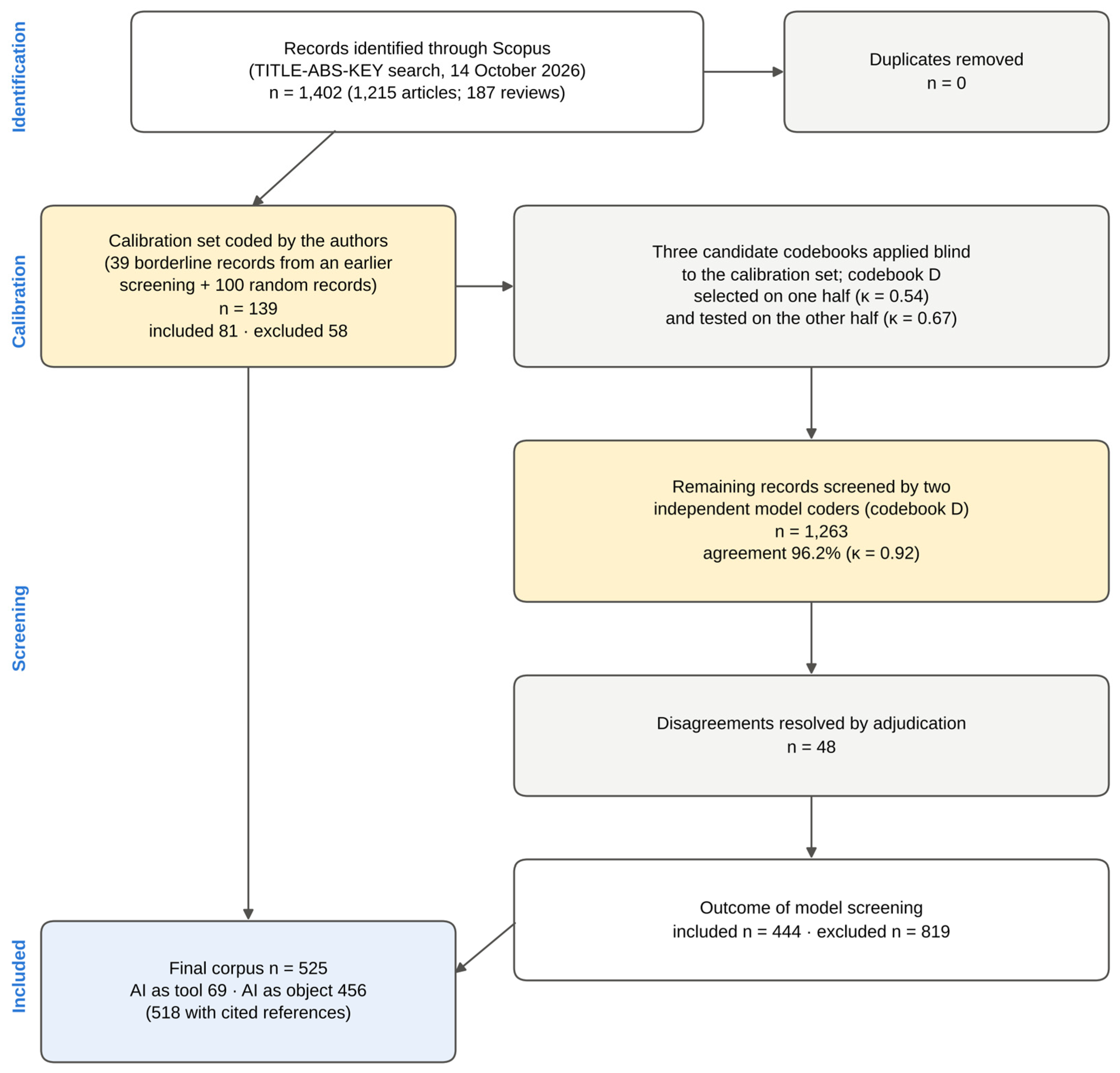
Figure 2.
Annual scientific production by stream. (a) Number of documents per year, AI-as-object (solid) and AI-as-tool (hatched); 2026* covers 1 January–14 October. (b) Share of AI-as-tool documents by period.
Figure 2.
Annual scientific production by stream. (a) Number of documents per year, AI-as-object (solid) and AI-as-tool (hatched); 2026* covers 1 January–14 October. (b) Share of AI-as-tool documents by period.
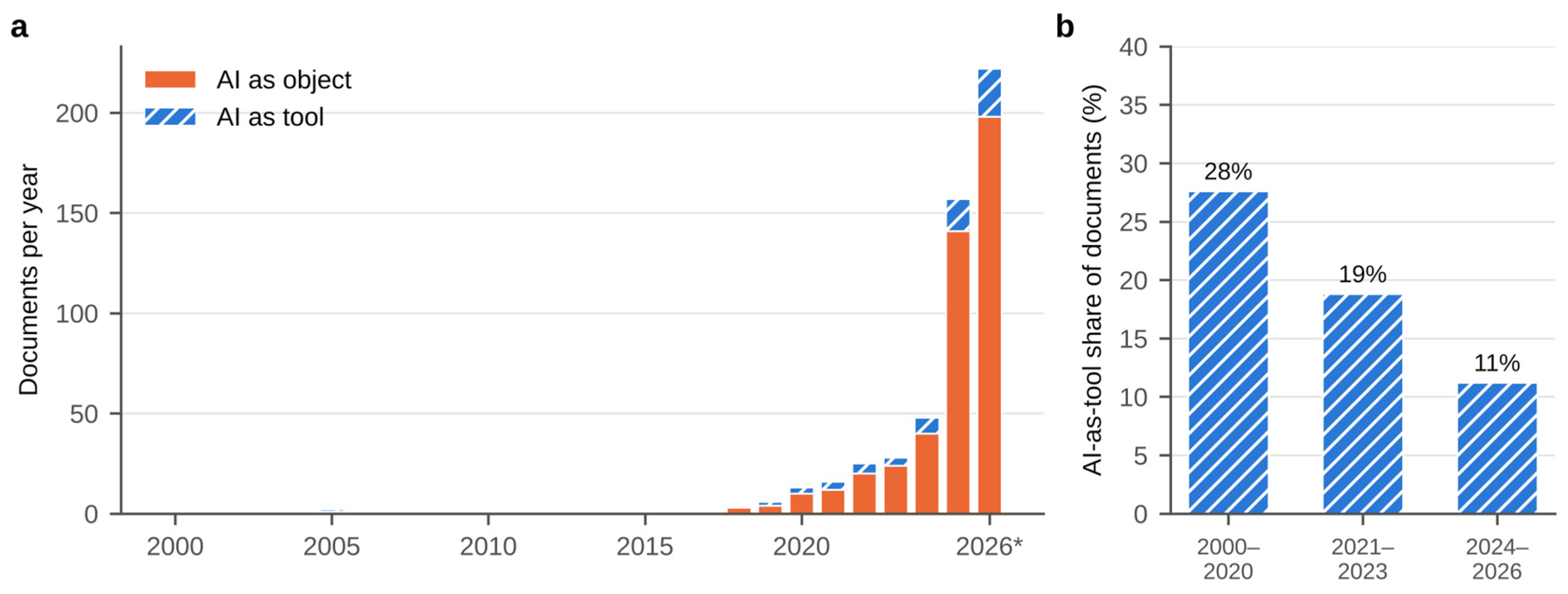
Figure 3.
Most productive countries by stream. A document is counted once for each country appearing among its author affiliations. Solid: AI-as-object documents; hatched: AI-as-tool documents.
Figure 3.
Most productive countries by stream. A document is counted once for each country appearing among its author affiliations. Solid: AI-as-object documents; hatched: AI-as-tool documents.
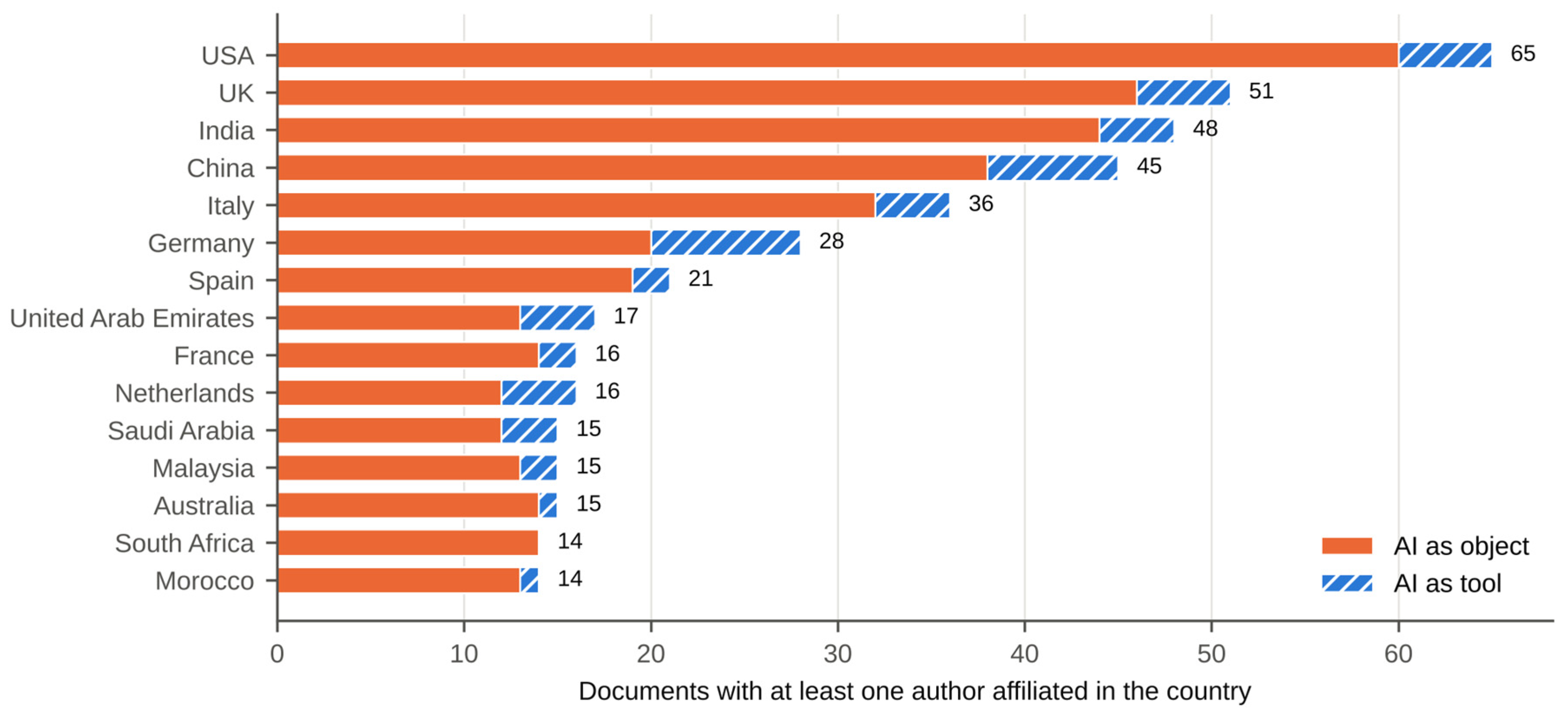
Figure 4.
Structure of the co-citation clusters. (a) Normalized co-citation strength between clusters (number of co-citation links divided by the product of the clusters' citation counts, ×10⁴); darker cells indicate stronger ties. (b) Share of citations to each cluster that come from AI-as-tool documents; the dashed line marks the share across all works in the network (5.6%) and the dotted line the share across all identifiable references cited by the corpus (11.8%).
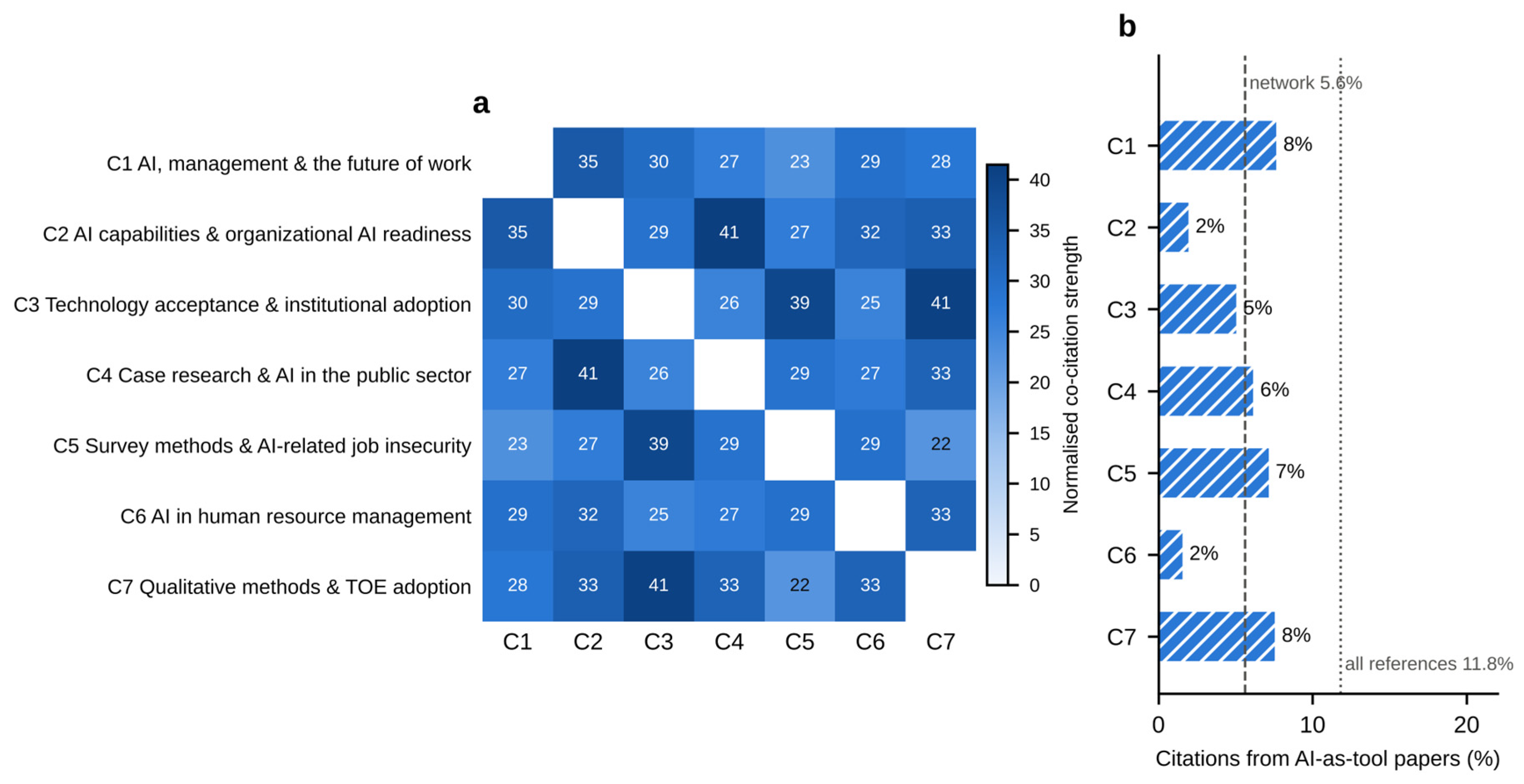
Figure 5.
Prevalence of the 20 most frequent author keywords by period (percentage of documents in the period using the keyword; total number of documents in parentheses). Keywords ordered by change between 2000–2020 and 2024–2026; synonyms harmonized and search terms excluded.
Figure 5.
Prevalence of the 20 most frequent author keywords by period (percentage of documents in the period using the keyword; total number of documents in parentheses). Keywords ordered by change between 2000–2020 and 2024–2026; synonyms harmonized and search terms excluded.
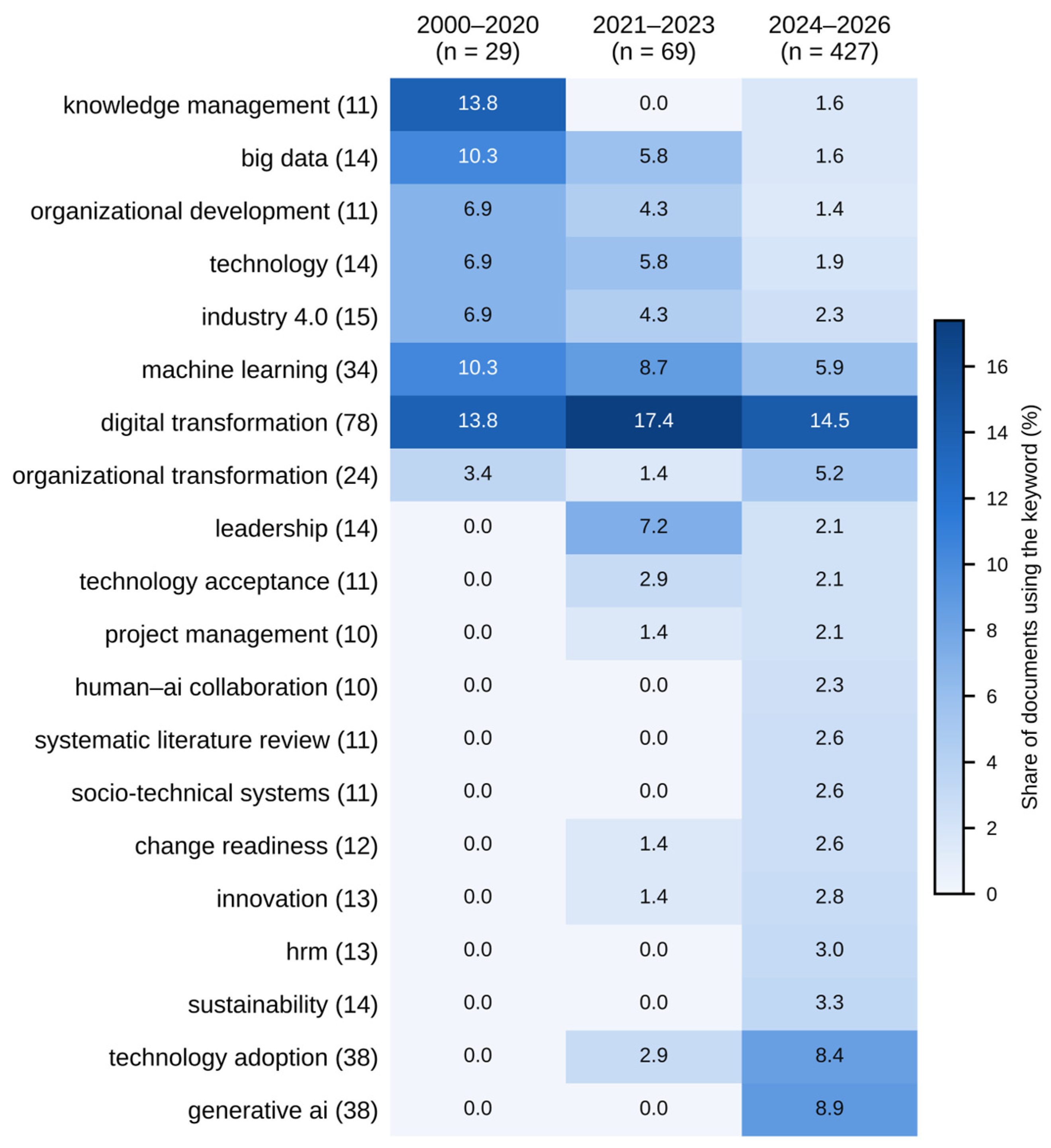
Figure 6.
Coverage of the phases of the change process. (a) Distribution of documents across phases within each stream (percentage of the stream; number of documents in parentheses). (b) Number of documents by phase in each bibliographic coupling cluster; shading reflects the share within the cluster.
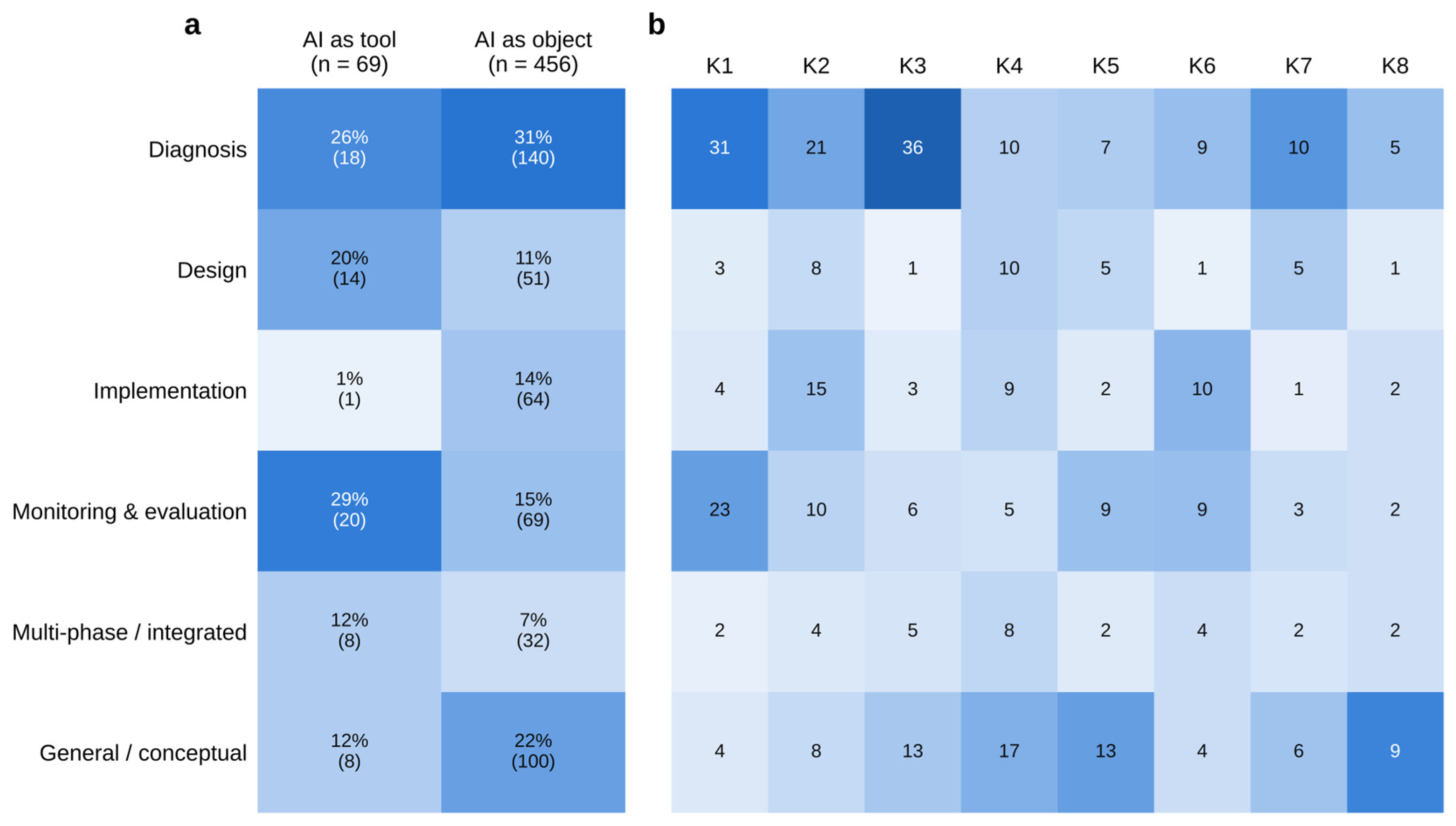
Figure 7.
Integrative framework linking AI capabilities, change constructs and phases of the change process. Counts in the phase boxes are documents by main phase: AI as tool refers to the 32 documents in which AI is an instrument of change management (Section 4.7), AI as object to the AI-as-object stream (Section 4.5). P1–P6: propositions in Section 5.2.
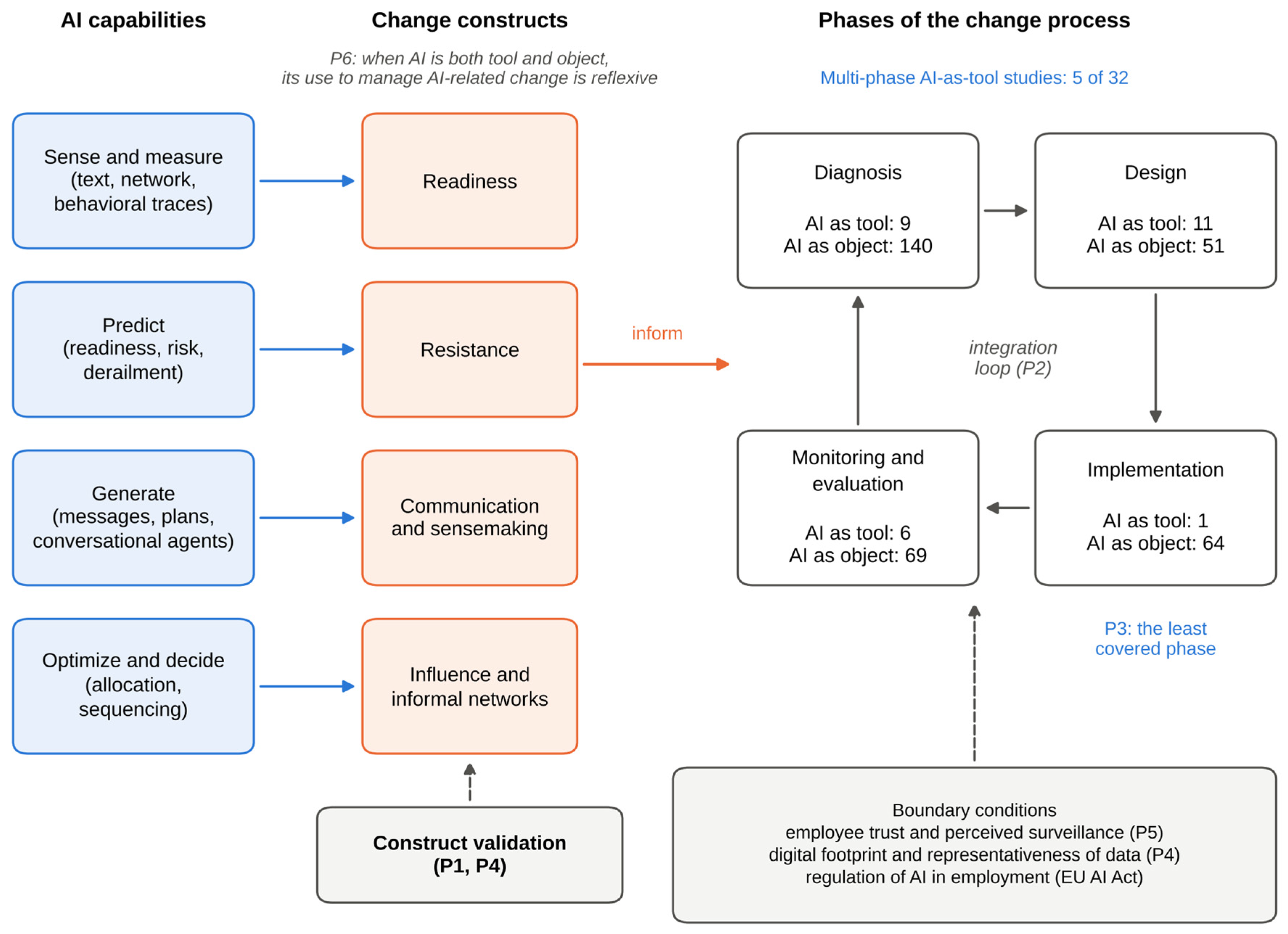
Table 1.
Phases of the change process used as analytical grid.
| Phase | Core questions | Key constructs | Typical data | Illustrative uses of AI |
|---|---|---|---|---|
| Diagnosis | Where are we? Who is affected? Are people and units ready? | Readiness for change; stakeholder interest and influence; informal networks; organizational context | Surveys; documents; communication metadata; HR records | Machine learning on HR and communication data; language models that infer readiness and climate from text; clustering of units |
| Design | What should change, how and in which sequence? How should change be communicated? | Objectives and priorities; intervention strategies; change message; training needs | Process models; competence profiles; resource data | AI-based decision support for choosing interventions; recommendation of training paths; generation and tailoring of change communication |
| Implementation | Is the change being adopted? Where does resistance arise? | Adoption of new practices; resistance; involvement; agent–recipient relationships | Usage logs; feedback; communication flows | Decision support during roll-out; conversational agents for questions and feedback; allocation of tasks and resources |
| Monitoring and evaluation | Are we on track? What are the outcomes? What should be adapted? | Progress against objectives; risks; performance and well-being outcomes; sustainability of change | KPIs; panel data on units; repeated surveys | Anomaly detection and early warning; forecasting of outcomes; continuous sentiment monitoring with natural language processing |
Synthesis based on Lewin (1947), Kotter (1996), Armenakis and Bedeian (1999) and Weick and Quinn (1999). Phases are analytical categories and may overlap or recur in iterative change processes.
Table 2.
Existing reviews closest to the scope of this study.
| Review | Focus | Design and corpus | Perspective on AI | Joint mapping of both perspectives |
|---|---|---|---|---|
| Bilan et al. 2022 | AI in organizational management, development, change and culture | Bibliometric; 191 publications, 1983–2020 | Both, not distinguished | No |
| Soulami et al. 2024 | Effects of AI adoption on employees | Bibliometric and systematic; 92 articles, 2015–2024 | Object | No |
| González-Reyes et al. 2025 | AI and organizational leadership | Bibliometric and thematic; 304 articles (WoS), 2014–2025 | Object | No |
| Romeo and Lacko 2026 | Enablers and challenges of AI adoption in organizations | Systematic (PRISMA) with thematic analysis | Object | No |
| Vera et al. 2026 | Generative AI, decision-making and work design | Bibliometric and conceptual; 212 publications, 2018–2025 | Object | No |
| Alshaikh et al. 2026 | Resistance and technology-driven transformation | Systematic and bibliometric; 83 articles | Mainly object; technologies as engagement aids | Partly |
| Hüllmann 2026 | Change management for AI applications | Qualitative literature review; 222 sources analyzed | Object; tool use explicitly excluded | No |
| Bankins et al. 2024 | AI in organizations from an organizational behavior perspective | Multilevel review | Object | No |
| Marler and Boudreau 2017; Tursunbayeva et al. 2018; McCartney and Fu 2022 | HR and people analytics | Evidence-based, scoping and systematic reviews | Tool (not change-specific) | No |
| Levenson et al. 2022 | Organization development and people analytics | Conceptual chapter | Tool and change practice | Conceptual only |
Table 3.
Research questions and analytical techniques.
| Research question | Technique | Unit of analysis | Section | |
|---|---|---|---|---|
| RQ1 | How has research on AI and organizational change developed? | Performance analysis: annual production, sources, countries, citations | Documents | 4.1 |
| RQ2 | On which works and traditions does the field rest? | Co-citation analysis | Cited references | 4.2 |
| RQ3 | Which research streams are active today, and how do the two perspectives relate? | Bibliographic coupling | Documents | 4.3 |
| RQ4 | How have the themes evolved over time? | Keyword prevalence and co-word analysis; topic model as independent check | Author keywords; titles and abstracts | 4.4 |
| RQ5 | Which phases of the change process are covered, and how integrated is the research? | Content coding of the change phase; cross-tabulation with streams and clusters | Documents | 4.5 |
Table 4.
Main information on the corpus.
| Indicator | Value |
|---|---|
| Timespan | 2000–2026 (2026 up to 14 October) |
| Documents | 525 (476 articles, 49 reviews) |
| Sources (journals) | 361 |
| Sources with a single document | 280 (77.6%) |
| Distinct authors | 1,553 |
| Single-authored documents | 91 |
| Authors per document (mean) | 3.06 |
| Countries of author affiliation | 88 |
| Cited references (total / mean per document) | 31,090 / 59.2 |
| Citations per document (mean / median) | 15.1 / 3 |
| AI-as-tool documents | 69 (13.1%) |
| AI-as-object documents | 456 (86.9%) |
| Documents published 2024–2026 | 81.3% |
| Compound annual growth 2018–2025 | 68.9% |
Source: Scopus, search executed on 14 October 2026; authors counted by Scopus author identifier. Citation counts as reported by Scopus at the date of extraction.
Table 5.
Most productive sources.
| Source | Total | AI as object | AI as tool |
|---|---|---|---|
| Journal of Organizational Change Management | 10 | 9 | 1 |
| Administrative Sciences | 9 | 7 | 2 |
| Journal of Applied Behavioral Science | 8 | 4 | 4 |
| Management Decision | 8 | 7 | 1 |
| International Journal of Organizational Analysis | 8 | 8 | 0 |
| Systems | 8 | 8 | 0 |
| Development and Learning in Organizations | 7 | 7 | 0 |
| Sustainability (Switzerland) | 7 | 7 | 0 |
| Frontiers in Artificial Intelligence | 5 | 4 | 1 |
| Frontiers in Psychology | 4 | 3 | 1 |
| International Journal of Artificial Intelligence and Machine Learning | 4 | 3 | 1 |
| IEEE Engineering Management Review | 4 | 4 | 0 |
Sources ordered by total number of documents in the corpus; ties broken by number of AI-as-tool documents.
Table 6.
Most cited documents in the corpus.
| Document | Title | Source | Citations | Stream |
|---|---|---|---|---|
| George and Wooden 2023 | Managing the Strategic Transformation of Higher Education through Artificial Intelligence | Administrative Sciences | 481 | Object |
| Kulkov et al. 2024 | Artificial intelligence - driven sustainable development: Examining organizational, technical, … | Sustainable Development | 411 | Object |
| Bailey et al. 2022 | We Are All Theorists of Technology Now: A Relational Perspective on Emerging Technology and Org… | Organization Science | 279 | Object |
| Einola and Khoreva 2023 | Best friend or broken tool? Exploring the co-existence of humans and artificial intelligence in… | Human Resource Management | 197 | Object |
| Suseno et al. 2022 | Beliefs, anxiety and change readiness for artificial intelligence adoption among human resource… | International Journal of Human Resource Management | 169 | Object |
| Handfield et al. 2019 | Emerging procurement technology: data analytics and cognitive analytics | International Journal of Physical Distribution and Logistics Management | 134 | Object |
| Murire 2024 | Artificial Intelligence and Its Role in Shaping Organizational Work Practices and Culture | Administrative Sciences | 126 | Object |
| Frick et al. 2021 | Maneuvering through the stormy seas of digital transformation: the impact of empowering leaders… | Journal of Decision Systems | 120 | Object |
| Kuzior et al. 2019 | Sustainable development of organizations based on the combinatorial model of artificial intelli… | Entrepreneurship and Sustainability Issues | 120 | Tool |
| Min 2022 | Developing a smart port architecture and essential elements in the era of Industry 4.0 | Maritime Economics and Logistics | 111 | Object |
Global citations recorded by Scopus at the date of extraction.
Table 7.
Co-citation clusters: the intellectual foundations of the field.
| Cluster | Works | Citations | From AI-as-tool papers | Most cited works | |
|---|---|---|---|---|---|
| C1 | AI, management and the future of work | 62 | 717 | 8% | Davenport and Ronanki 2018; Raisch and Krakowski 2021; Jarrahi 2018; Brynjolfsson and McAfee 2014; Vial 2019 |
| C2 | AI capabilities and organizational AI readiness | 42 | 399 | 2% | Mikalef and Gupta 2021; Duan et al. 2019; Jöhnk et al. 2021; Wamba-Taguimdje et al. 2020; Eisenhardt 1989 |
| C3 | Technology acceptance and institutional adoption | 30 | 334 | 5% | Venkatesh et al. 2003; Davis 1989; Dwivedi et al. 2021; Bankins et al. 2024; DiMaggio and Powell 1983 |
| C4 | Case research and AI in the public sector | 28 | 258 | 6% | Gioia et al. 2013; Enholm et al. 2022; Wirtz et al. 2019; Eisenhardt and Graebner 2007; Neumann et al. 2024 |
| C5 | Survey methods and AI-related job insecurity | 27 | 278 | 7% | Fornell and Larcker 1981; Podsakoff et al. 2003; Henseler et al. 2015; Brougham and Haar 2018; Hu and Bentler 1999 |
| C6 | AI in human resource management | 19 | 187 | 2% | Tambe et al. 2019; Page et al. 2021; Budhwar et al. 2022; Chowdhury et al. 2023; Vrontis et al. 2022 |
| C7 | Qualitative methods and TOE-based adoption | 15 | 171 | 8% | Braun and Clarke 2006; Tornatzky and Fleischer 1990; Brynjolfsson and McAfee 2017; Guest et al. 2006; Hradecky et al. 2022 |
Works cited at least six times; clusters with at least 15 works. 'From AI-as-tool papers' is the share of citations to the cluster that come from AI-as-tool documents. Across all 229 works in the network this share is 5.6%; across all identifiable references cited by the corpus it is 11.8%.
Table 8.
Bibliographic coupling clusters: current research streams.
| Cluster | N | Median year | Since 2024 | AI as tool | Stable core | Dominant phase | Distinctive author keywords | |
|---|---|---|---|---|---|---|---|---|
| K1 | Employee and managerial readiness for AI-induced change | 67 | 2025 | 84% | 16% | 53 (79%) | Diagnosis (46%) | job crafting, AI anxiety, AI awareness, technological readiness |
| K2 | Managing AI implementation in public and knowledge-intensive organizations | 66 | 2025 | 86% | 6% | 0 (0%) | Diagnosis (32%) | public sector, framework, data science, chatbots |
| K3 | Technology-organization-environment determinants of AI adoption across sectors | 64 | 2025 | 89% | 3% | 37 (58%) | Diagnosis (56%) | construction industry, technology adoption, technology acceptance model, behavioral intention |
| K4 | Conceptualizing AI transformation, decision structures and human-AI coexistence | 59 | 2026 | 81% | 15% | 21 (36%) | General (29%) | digital technology, paradox theory, sensemaking, work |
| K5 | Digital transformation capabilities and AI-enabled organizational adaptation | 38 | 2026 | 95% | 18% | 31 (82%) | General (34%) | digital transformation, higher education institutions, PLS-SEM, strategic management |
| K6 | Implementing AI in work practices, decisions and coordination | 37 | 2026 | 86% | 3% | 0 (0%) | Implementation (27%) | digital technologies, big data, public administration, human–AI collaboration |
| K7 | AI in human resource management and development | 27 | 2025 | 96% | 7% | 26 (96%) | Diagnosis (37%) | HRM, human resource development, talent management, HR analytics |
| K8 | AI adoption in supply chains and sustainability-oriented organizations | 21 | 2025 | 90% | 0% | 19 (90%) | General (43%) | supply chain management, leadership, machine learning, innovation |
Clusters with at least 15 documents in the largest connected component of the coupling network. Stable core: documents assigned together with the other members of their cluster in at least 70% of 100 runs of the Leiden algorithm. Phases as coded in Section 4.5. Distinctive keywords: the four harmonized author keywords with the highest weighted log-odds of occurring in the cluster rather than in the rest of the network (Monroe et al. 2008), excluding the search terms.
Table 9.
Synthesis of the research streams.
| Research question | Main lenses and designs | Key findings | Main gaps | |
|---|---|---|---|---|
| K1 | Which individual, leadership and HRM factors shape readiness for, or resistance to, AI-induced organizational change? | Change-readiness and resistance constructs with socio-technical, TOE and diffusion-of-innovation lenses; mainly surveys analyzed with structural equation modeling. | Beliefs about AI raise and AI anxiety lowers change readiness (Suseno et al. 2022); AI awareness reduces digital innovativeness through resistance to change (Ren et al. 2025); HR development is the only factor associated with all AI readiness components (Tomaževič et al. 2026). | Mostly cross-sectional surveys with weak measurement (Tomaževič et al. 2026: SRMR 0.121); two waves about two weeks apart (Ren et al. 2025); no evaluation during actual implementation. |
| K2 | How do public administrations and knowledge-intensive firms manage AI implementation and the resulting work, process and cultural changes? | Sociotechnical theory, sociomateriality, TOE and process-people-technology frameworks; qualitative case studies, expert interviews and systematic reviews. | An AI transformation framework centers on knowledge gaps, resource constraints and integration challenges (Peretz-Andersson et al. 2026); technological design, AI project management and networking practices help scale AI (Alamäki 2026); AI materiality alters routines and employee capabilities (Tangi et al. 2025). | Mostly one-time interviews, e.g., 22 coded by a single researcher (Alamäki 2026); only Peretz-Andersson et al. 2026 follows change over time; no field evaluation of outcomes. |
| K3 | Which technological, organizational, environmental and individual determinants explain AI adoption across SMEs, accounting, construction, customer service and public administration? | TOE integrated with TAM, UTAUT/UTAUT2, institutional and stakeholder theory; surveys with structural equation modeling, multicriteria methods and qualitative cases. | Behavioral intention is the strongest predictor of AI usage (β = .591) (Aruntammanak and Sukamongkol 2026); institutional pressures initiate adoption, while perceived usefulness and ease of use sustain integration (Getzin et al. 2026); an AHP model assesses public-sector AI readiness (Hržica et al. 2025). | No longitudinal or field-evaluated study; single-informant cross-sectional survey without common-method-bias test (Aruntammanak and Sukamongkol 2026); model tested only on synthetic organizations (Hržica et al. 2025). |
| K4 | How does AI, particularly generative AI, transform organizational structures, decision processes and work systems, and what does this imply for change management? | Theory-building with relational, socio-technical, Luhmannian, paradox and routine-dynamics lenses; mainly conceptual contributions, plus surveys and exploratory studies. | Sustained algorithmic mediation drifts decision programs from purposive to conditional structures (Liu 2026); groups make sense of automation and augmentation differently (Einola and Khoreva 2023); AI perception, work reconfiguration and trust are positively associated with readiness for change (Marković et al. 2026). | Frameworks remain untested in the field; cross-sectional survey without confirmatory validation (Marković et al. 2026); LLM-judged artifacts, not organizational outcomes (Shin et al. 2026); no longitudinal study. |
| K5 | How do AI and broader digital technologies enable organizational transformation and performance? | Dynamic capabilities as main lens; scoping reviews, meta-analysis, surveys and qualitative cases. | Dynamic capabilities mediate the technology-performance link (beta = 0.356; I² = 96.3%) (Bouladasse et al. 2026); digital transformation mediates AI's effect on digital innovation (Tallal Mohammed et al. 2026); initial resistance gave way to adaptation through informal learning and role redesign (Chrancokova et al. 2026). | No longitudinal or field-evaluated study; single-university cross-sectional survey (Tallal Mohammed et al. 2026); meta-analysis pools mostly cross-sectional self-reports (Bouladasse et al. 2026); ontology evaluated on synthetic data. |
| K6 | How does AI integration reshape concrete work practices, decision-making and coordination inside organizations? | Qualitative case studies guided by socio-technical systems, dynamic capabilities and TOE/UTAUT2 lenses; implementation is the most frequent phase. | AI recruitment tools work best as augmentative technologies (Ajonbadi et al. 2026); an anomaly-detection model outperformed baseline (ROC AUC 0.881-0.941 vs. 0.518-0.842), with success depending on dual PDCA cycles (Leberruyer et al. 2026); an expertise search tool improves performance unevenly (Wu and Kane 2021). | AI is the object implemented, not an instrument for steering change; two Qatari firms only (Ajonbadi et al. 2026); sole field evaluation covers nine months (Leberruyer et al. 2026). |
| K7 | How does AI transform HRM and HRD functions, and which factors enable or hinder its adoption? | Systematic and bibliometric reviews dominate, with resource-based, dynamic capabilities and institutional theories as recurring lenses. | AI streamlines screening and real-time performance assessment, while algorithmic bias requires governance (Venugopal et al. 2024); change aversion, data security and integration costs are barriers (Madanchian and Taherdoost 2025); change management is the key enabler of HR digitalization and analytics (Verma et al. 2024). | Review-based evidence or small expert panels (ten experts, Verma et al. 2024); reviews lack transparent protocols (Madanchian and Taherdoost 2025); no field or longitudinal evaluation of AI-enabled HR practices. |
| K8 | How can supply chain and sustainability-oriented organizations integrate AI while managing barriers, leadership and change? | Mostly literature reviews and conceptual analyses, complemented by expert surveys and structural equation modeling. | Data quality, resistance to change and lack of trust impede AI adoption in SCM (Hangl et al. 2023); an AI lifecycle knowledge graph identifies 11 dimensions, including overcoming resistance (Hao et al. 2025); AI is associated with sustainable performance through supportive leadership and organizational change (Alsadoun and Alateeg 2026). | Mainly conceptual or review-based, requiring empirical validation (Dittmar et al. 2025); cross-sectional survey lacking HTMT, CFA and common-method-bias tests (Alsadoun and Alateeg 2026); no longitudinal or field evaluation. |
Based on the five most central and up to two highly cited documents of each cluster; 25 of these 55 documents were read in full and the others through their abstracts (Section 3.3.4).
Table 10.
Topic model of titles and abstracts (non-negative matrix factorization, ten topics).
| Topic | Top terms | Docs | AI as tool | Main coupling cluster | |
|---|---|---|---|---|---|
| 1 | AI governance and strategic frameworks | framework, governance, strategic, ethical, technical, human | 50 | 8% | Dispersed (max 9 of 43, 2 clusters) |
| 2 | Readiness and adoption surveys (SEM) | structural, structural equation, equation, smes, adoption, equation modeling | 47 | 11% | K1 (23 of 43) |
| 3 | Digital transformation and accounting | digital, digital transformation, transformation, accounting, technologies, organizational | 65 | 17% | Dispersed (max K3, 11 of 49) |
| 4 | Employees, jobs and job crafting | employees, employee, work, job, workplace, crafting | 67 | 9% | K1 (24 of 56) |
| 5 | Reviews of AI in HRM | human resource, hr, review, hrm, human, resource | 33 | 0% | K7 (14 of 28) |
| 6 | Supply chains and operations | supply, chain, supply chain, chain management, resilience, scm | 27 | 11% | K8 (9 of 21) |
| 7 | Public sector and administration | public, public sector, sector, administration, public administration, government | 34 | 9% | K2 (14 of 24) |
| 8 | Adoption barriers in industry | challenges, adoption, barriers, construction, industry, benefits | 72 | 1% | Dispersed (max K3, 24 of 61) |
| 9 | Machine learning, processes and decisions | machine, machine learning, learning, process, business, model | 94 | 37% | Dispersed (max K4, 11 of 42) |
| 10 | Higher education and libraries | education, higher education, library, university, higher, educational | 36 | 3% | Dispersed (max small clusters, 8 of 23) |
Documents assigned to their dominant topic. The last column reports the coupling cluster containing the largest number of the topic's documents among those in the coupling network; a topic is labeled dispersed when this cluster holds less than 40% of them.
Table 11.
AI-as-tool documents addressing more than one phase of the change process.
| Document | Title | Source |
|---|---|---|
| Shahi and Sinha 2021 | Digital transformation: challenges faced by organizations and their potential solutions | International Journal of Innovation Science |
| Kanitz et al. 2023 | Augmenting Organizational Change and Strategy Activities: Leveraging Generative Artificial Intellige… | Journal of Applied Behavioral Science |
| Zhang 2025 | Research on an intelligent decision support system for enterprise organizational change in the digit… | Future Technology |
| Serbaya 2026 | The impact of renewable and sustainable energy adoption on organizational development in small-to-me… | Sustainable Computing: Informatics and Systems |
| Ben-arlee and Angsuchotmetee 2026 | Dx-Onto: A Core Ontology for a Semantic-Based Framework for Managing Digital Transformation Projects | Applied System Innovation |
| Gáspár et al. 2026 | Harnessing Process Models and Standards for Change Management Boosted by Industry 4.0 | Journal of Industrial Integration and Management |
| Zaki et al. 2026 | An AI-enabled framework for reducing administrative bureaucracy in higher education while maintainin… | Discover Artificial Intelligence |
| Bosbach et al. 2026 | A maturity model for change management in digital transformation: employee needs, AI and leadership … | International Journal of Managing Projects in Business |
Table 12.
Analytical method families in AI-as-tool documents.
| Method family | Documents | Share of AI-as-tool documents | Of which since 2021 |
|---|---|---|---|
| Machine learning / neural networks | 32 | 46.4% | 30 |
| Text analytics (NLP, sentiment, topic models) | 15 | 21.7% | 13 |
| Decision support / expert systems / optimization | 14 | 20.3% | 11 |
| Generative AI / LLMs / chatbots | 12 | 17.4% | 12 |
| Big data / people & HR analytics | 6 | 8.7% | 6 |
| Social network analysis | 4 | 5.8% | 3 |
| Simulation (agent-based, system dynamics) | 2 | 2.9% | 2 |
Dictionary-based count on titles, abstracts and author keywords of the 69 AI-as-tool documents; a document can belong to more than one family.
Table 13.
Robustness of the main findings to the inclusion criterion.
| Indicator | Final corpus (codebook D) | Clinical settings readmitted | Stricter screening, analytics without AI admitted |
|---|---|---|---|
| Documents (AI as tool / AI as object) | 525 (69 / 456) | 641 (84 / 557) | 555 (100 / 455) |
| AI-as-tool share of documents, %: up to 2020 / 2021–2023 / 2024–2026 | 28 / 19 / 11 | 30 / 21 / 11 | 49 / 23 / 10 |
| References of AI-as-tool documents also cited by AI-as-object documents, % (expected under permutation) | 13.8 (25.6) | 12.9 (25.2) | 10.4 (24.1) |
| Co-citation cluster dominated by citations from AI-as-tool documents | None (maximum 8%) | None (maximum 8%) | Social network analysis (11 works, 77%) |
| Coupling cluster dominated by AI-as-tool documents | None (maximum 18%) | None (maximum 28%) | Social network analysis (29 documents, 100%) |
| Documents outside the main coupling component, %: AI as tool / AI as object | 48 / 22 | 52 / 24 | 32 / 25 |
| Stream assortativity in the coupling network (95th percentile under permutation) | 0.075 (0.017) | 0.063 (0.019) | 0.46 (0.022) |
| Most studied phase (share of documents) | Diagnosis (30%) | Diagnosis (32%) | Diagnosis (33%) |
| AI-as-tool documents addressing implementation, % | 1.4 | 9.5 | 15.0 |
| AI-as-tool documents addressing several phases (n) | 8 | 9 | 10 |
Clusters with at least 15 works (co-citation) or 15 documents (coupling), except where the size is reported. All thresholds, normalizations and random seeds are identical across corpora.
Table 14.
Three groups within the AI-as-tool stream.
| AI as instrument of change management (T1) | AI as research method (T2) | Tool role marginal, AI as object in substance | |
|---|---|---|---|
| Documents | 32 | 23 | 14 |
| Median publication year | 2025 | 2024 | 2026 |
| Published 2024–2026 | 62% | 65% | 93% |
| Outside the main coupling component | 19 (59%) | 13 (57%) | 1 (7%) |
| References also cited by AI-as-object documents, % (expected under permutation) | 11.4 (24.1) | 10.5 (24.9) | — |
| Phases: diagnosis / design / implementation / monitoring / multi-phase / general | 9 / 11 / 1 / 6 / 5 / 0 | 7 / 0 / 0 / 13 / 2 / 1 | 2 / 3 / 0 / 1 / 1 / 7 |
Coding of the 69 AI-as-tool documents with codebook E (Appendix A) by two independent model runs (agreement 89.9%, κ = 0.84; 7 disagreements adjudicated). Permutation: 200 random draws of documents of the same size from the corpus.
Table 15.
Research agenda by phase of the change process.
| Phase | Research question | Stream | Origin in the findings | Indicative designs |
|---|---|---|---|---|
| Diagnosis | Q1. How far do measures of readiness and resistance derived from organizational text converge with validated scales, and do they add predictive power for change outcomes? | Bridge | Weak validation of measures in central documents (Section 4.3); text analytics in 6 of 32 instrumental documents (Section 4.7); P1 | Multi-trait multi-method designs pairing scales and texts from the same respondents |
| Q2. Do trace-based diagnostics perform equally well for employee groups with different digital footprints? | Tool | No document assesses the representativeness of trace data; P4 | Comparisons of predictive validity across occupational groups; combination with survey data | |
| Q3. Does readiness for AI measured before adoption predict actual use, sustained use and performance? | Object | Adoption studies rely on intentions measured once (K1, K3; 23 of 25 central documents cross-sectional) | Panels linking survey measures to usage logs and performance records | |
| Design | Q4. How can AI support the choice and sequencing of change interventions, and how should such decision support be evaluated? | Tool | Design is the most frequent phase among instrumental documents (11 of 32), but proposals are rarely tested (Section 4.7) | Design science with field evaluation; comparison with expert judgment |
| Q5. Do change communications personalized or generated with AI improve understanding, perceived justice and engagement? | Bridge | Generative AI in 7 instrumental documents, mostly as proposals (Section 4.7); P5 | Field and online experiments | |
| Implementation | Q6. How can AI support implementation decisions, such as allocating resources, timing communication and answering employees' questions, and with what effect on outcomes? | Tool | Only 1 of 32 instrumental documents addresses implementation (Section 4.7); P3 | Staggered roll-outs across units; comparative case studies |
| Q7. Which implementation strategies and change interventions, rather than barriers, explain the sustained use of AI in organizations? | Object | Implementation research is barrier-oriented and based on one-time interviews (K2, K6; Table 9) | Multi-site comparative case studies; process tracing of implementation decisions | |
| Q8. How does the use of AI to manage the introduction of AI affect employees' readiness for it? | Bridge | Fourteen documents mix the two roles of AI (Section 4.7); P6 | Longitudinal case studies; ethnography of AI-supported change programs | |
| Monitoring and evaluation | Q9. Can AI-based indicators detect early that a change program is derailing, and with what rate of false alarms? | Tool | Monitoring in 6 instrumental documents, none evaluated prospectively (Section 4.3 and Section 4.7) | Prospective tests on repeated organizational data |
| Q10. How do trust in AI and perceived surveillance moderate the effects of AI-based change management on readiness and resistance? | Bridge | Trust in AI is a foundation of the field (Table 7) but is not studied in tool-based research; P5 | Surveys combined with field experiments | |
| Integration across phases | Q11. Do AI systems that connect diagnosis, implementation and monitoring improve change outcomes compared with single-phase tools? | Tool | Only 5 of 32 instrumental documents span several phases, and few are tested in organizations (Section 4.5 and Section 4.7); P2 | Design science research; multi-level evaluation |
| Q12. Are AI systems used to manage change fair across employee groups, and how can they comply with regulation on AI in employment? | Bridge | No central document addresses regulation; employment uses of AI are high-risk under the AI Act (Section 5.4) | Fairness audits across groups; legal analysis |
Stream: Tool = AI as a tool for managing change; Object = organizational change triggered by AI; Bridge = questions that require both perspectives. P1–P6: propositions of the framework (Section 5.2). Instrumental documents: the 32 documents in which AI is an instrument of change management.
Disclaimer/Publisher’s Note: The statements, opinions and data contained in all publications are solely those of the individual author(s) and contributor(s) and not of MDPI and/or the editor(s). MDPI and/or the editor(s) disclaim responsibility for any injury to people or property resulting from any ideas, methods, instructions or products referred to in the content. |
© 2026 by the authors. Licensee MDPI, Basel, Switzerland. This article is an open access article distributed under the terms and conditions of the Creative Commons Attribution (CC BY) license (http://creativecommons.org/licenses/by/4.0/).
Copyright: This open access article is published under a Creative Commons CC BY 4.0 license, which permit the free download, distribution, and reuse, provided that the author and preprint are cited in any reuse.