

Submitted:
19 October 2026
Posted:
20 October 2026
You are already at the latest version
Abstract
A false proposition can coexist with a documented historical act of asserting it. Digital interventions that limit harmful circulation therefore raise a distinct question: what contextual relationships should remain recoverable when the evaluated material becomes unavailable? This theoretical essay develops Contextualized Epistemic Preservation (PEC), a framework for retaining a proportionate, revisable relationship among an informational occurrence, its assessment, supporting evidence, provenance and subsequent corrections. The approach combines conceptual analysis, purposive narrative engagement with interdisciplinary literature and institutional documents, and a temporal thought experiment termed the 2035 Paradox. The scenario examines the possible asymmetric survival of misleading fragments and the contextual records needed to evaluate them. The framework distinguishes factual assessment from documentary authenticity, institutional disposition, public exposure and computational retrieval. It specifies a layered record architecture, a substitution test for selecting safer representations, differentiated governance safeguards, and an empirical agenda containing seven hypotheses and six candidate metrics. Preservation, public indexing, recommendation, restricted access and destruction are treated as distinct operations. The proposed benefits remain conditional: persistent records may facilitate verification but may also reproduce harm, entrench erroneous classifications or impose unjustified maintenance costs. No PEC implementation or experiment is reported. The contribution is an auditable design proposal for preserving the history of evaluation under proportionate protections; its effectiveness, feasibility and comparative value require empirical testing.
Keywords:
digital preservation
; misinformation correction
; collective memory
; information provenance
; epistemic governance
1. Introduction
A false statement can be a real historical occurrence. The event described by a statement may never have happened, while the production, circulation and subsequent correction of that statement remain matters that can be investigated. This distinction becomes consequential when a digital intervention removes not only a misleading publication but also the accessible record linking that publication to its assessment. A surviving screenshot may then be easier to find than the explanation that establishes what is wrong with it. The question is not whether every misleading object should remain publicly available. It is what must remain, under appropriate protections, for later observers to reconstruct the relationship between an allegation and its correction.
Digital preservation scholarship supplies a background for this question. Rosenzweig (2003) describes the coexistence of abundant digital production and vulnerable historical records, emphasizing that preservation responsibilities cannot be reduced to technical storage. Owens (2018) likewise presents preservation as a deliberate practice shaped by the purposes of collections and the characteristics of digital objects. These perspectives caution against assuming that widespread circulation guarantees a durable, intelligible record. They do not establish that every act of content removal causes an epistemic loss; the relevant consequences depend on what other records survive and who can access them.
Content moderation and preservation also address different institutional tasks. Gillespie (2018) examines how platform moderation decisions shape public discourse. UNESCO’s Charter on the Preservation of Digital Heritage recognizes both continued access and the protection of sensitive information (UNESCO, 2003). Read together, these concerns motivate an analytical separation between limiting harmful circulation and maintaining a suitable record. Neither the existence of a preservation interest nor the recognition of a harmful effect settles the appropriate degree of public exposure in a particular case.
This essay proposes Contextualized Epistemic Preservation, abbreviated PEC after the Portuguese Preservação Epistemológica Contextualizada, as an approach to maintaining an auditable relationship among an informational occurrence, its assessment, the evidence supporting that assessment and subsequent revisions. Its central object is a contextualized record, rather than the unrestricted reproduction of a falsehood. Depending on the risk, the record may include a limited description, a redacted representation, documented reasons for a decision, or a reference to material held under controlled access. The amount of content retained and the audience permitted to access it must be justified separately.
The research question is therefore conditional: under what circumstances might preserving a proportionate representation of an allegation and its assessment improve future verifiability without unnecessarily reproducing the harm associated with that allegation? The formulation deliberately leaves open the possibility that preservation may be ineffective, unnecessary or harmful in some settings. A searchable record could expose people to renewed stigma; a poorly designed warning could be separated from its object; an incorrect classification could acquire undeserved durability. These possibilities are design constraints and potential objections, not exceptions to be considered only after implementation.
A related boundary concerns the difference between documentary access and belief revision. Ecker et al. (2022) review the persistence of misinformation’s influence after correction and the cognitive, social and affective barriers to updating beliefs. Recovering a correction is consequently not equivalent to persuading a reader or eliminating an earlier belief. PEC initially concerns whether the relevant assessment remains available and interpretable. Whether that availability improves recognition, learning or behavior requires additional investigation. Broader accounts of socially sustained false belief and post-truth complement research on the psychology of fake news (O’Connor; Weatherall, 2019; McIntyre, 2018; Pennycook; Rand, 2021). These different levels of explanation caution against treating documentary availability as a sufficient account of belief.
The contribution developed here is an integrative conceptual model. It connects the historical occurrence of misleading claims to a proposed epistemic evidentiary chain, a possible verifiability vacuum and a temporal thought experiment termed the 2035 Paradox. The argument does not claim that archives, correction records or structured fact-checking are new. It asks how their functions might be connected so that restrictions on circulation do not inadvertently sever the recoverable history of evaluation. Section 2, Section 3, Section 4 and Section 5 define the scope, distinctions and architecture of the proposal and develop the temporal scenario. Section 6, Section 7 and Section 8 examine social memory, correction and computational retrieval. Section 9, Section 10 and Section 11 specify governance, operational decisions and empirical tests; Section 12 and Section 13 discuss the limits and draw the conclusion.
2. Scope and Conceptual Approach
2.1. Nature of the Inquiry
This is a theoretical interdisciplinary essay developed through conceptual analysis, a purposive narrative engagement with literature and institutional documents, and a thought experiment. It reports no experiment, participant recruitment, original dataset or measured effect of PEC. The literature is used to establish relevant distinctions and background problems; the proposed architecture and scenarios are the authors’ synthesis. A source addressing preservation, moderation or correction is not treated as direct evidence that the combined PEC model is effective.
The source corpus was assembled purposively around epistemology, social memory, misinformation correction, moderation, digital preservation, legal instruments and technical specifications. Sources were selected for their relevance to a conceptual distinction, empirical background finding or institutional constraint. Targeted verification used accessible scholarly texts, article records and abstracts, publisher descriptions, official legal texts and technical documentation. The extent of accessible material varied by source. Claims based only on abstracts or descriptions were limited accordingly; these materials were not treated as substitutes for a full examination of detailed arguments or methods.
This is a narrative conceptual inquiry rather than a systematic review. It does not provide an exhaustive search, a preregistered selection protocol, a study-level risk-of-bias assessment or a quantitative synthesis. The literature supports specified background claims; the PEC architecture, diagnostic indicators, substitution test and research program are the authors’ proposals. Neither the completeness of the conceptual antecedents nor the effectiveness of PEC is established by assembling this corpus. Institutional and technical descriptions reflect the materials consulted on 19 October 2026 and may require updating as practices and decisions change.
Three forms of statement are kept distinct. Descriptive statements concern practices, definitions or findings documented by sources. Analytical statements specify distinctions or logical relationships used in this essay. Normative and design statements propose what a preservation system should make possible, subject to justified constraints. The third category does not become an empirical finding merely because it is compatible with the first two. Similarly, proposed criteria for institutional decisions are not presented as existing legal duties. Longino (1990) and Goldman (1999) provide complementary backgrounds for examining the social organization of knowledge and assessment. PEC draws a design question from that literature rather than claiming that institutional endorsement establishes truth.
2.2. Units of Analysis and Limits
The analysis distinguishes a proposition, an occurrence and a record. A proposition is what is asserted about the world. An occurrence is an identifiable act or episode in which an assertion or representation is produced or communicated. A record is a retained representation from which aspects of that occurrence may be reconstructed. These units can diverge: multiple records may describe one occurrence, while the same proposition may appear in many occurrences. A fabricated record may falsely claim to document a genuine-looking event. The existence of a file therefore establishes neither the historical occurrence it purports to depict nor the truth of the proposition it contains.
The appropriate unit for PEC is a linked record of an occurrence and its assessment, with uncertainty preserved where the occurrence itself is disputed. The proposal is limited to cases with a defensible historical, scientific, educational, accountability or evidentiary purpose. It does not imply that trivial mistakes, private communications or allegations about identifiable individuals warrant permanent public indexing. The possible relevance of a record is a reason for appraisal, not an automatic instruction to retain or disclose it.
The analysis also distinguishes loss of access from destruction. A record unavailable to a general search engine may remain accessible to an authorized archivist. Conversely, a nominally preserved record may be unusable because its context, explanation or access route has disappeared. The relevant question must specify the user, the task and the time of inquiry. This perspective prevents the ambiguous claim that something has been “erased” from doing the work of several different empirical descriptions.
2.3. Use of AI-Assisted Technology in Manuscript Preparation
During manuscript preparation, the authors used ChatGPT (OpenAI) for organization of author-supplied materials, English-language drafting and revision, structural editing, editorial refinement, preparation of conceptual tables and diagrams, and targeted bibliographic checking. The authors critically reviewed and verified all scientific claims, cited sources, interpretations, and final wording and take full responsibility for the content of the manuscript. No empirical study was conducted or simulated using this tool.
3. Falsehood and Historical Occurrence
3.1. A distinction Between the Claim and the Act of Claiming
Consider the proposition that an institution published a particular instruction in a given year. If a fabricated document attributes that instruction to the institution, two questions arise: did the institution issue the instruction, and did someone circulate the fabricated attribution? Evidence against the first does not answer the second. A properly documented forgery can be evidence that a forgery was produced, even while it fails as evidence that the attributed instruction was issued. This is the limited sense in which a falsehood can be historically real: the claim-making event can be established without validating the claim’s content.
The distinction does not imply that every report of a falsehood deserves belief. A person may fabricate a screenshot today and describe it as an old publication. Nor does it imply that all consequences attributed to a falsehood occurred. Production, distribution, reception, belief and behavioral influence are separate claims, requiring different evidence. PEC should therefore resist a common compression in historical narratives: moving from proof that a statement was made to an unsupported assertion that it was widely believed or socially decisive.
Preserving an occurrence also differs from preserving its authority. A record can document a statement together with the reasons it should not be relied upon. The editorial challenge is to keep the qualification sufficiently connected to the representation that it remains intelligible when encountered later. This is a design aim, not a guarantee that copying, quotation or selective presentation will leave the context intact.
3.2. Distinctions That a Record Should Preserve
A contextual record requires more than a binary label. A proposition can be unsupported without being demonstrated false; a document can be authentic while presenting an inaccurate claim; and an accurate fragment can become misleading when detached from its original setting. These distinctions specify different objects of inquiry and different evidentiary burdens. A classification must therefore identify what has been assessed before stating its outcome.
Fallis (2015) analyzes disinformation in terms of its misleading function, including cases that cannot be captured by an equation between disinformation and literally false content. The vocabulary used here separates propositional accuracy from presentation, attribution and communicative function; it does not resolve every philosophical dispute about those terms. Bok’s (1978) ethical analysis of lying supplies a further distinction: evaluating deliberate deception is a different task from documenting an inaccurate statement whose speaker’s intention remains unestablished.
Table 1 separates eleven working categories. They are not mutually exclusive or a progression from minor error to serious wrongdoing. A manipulated image may also be decontextualized, while its distribution may or may not involve deliberate deception. Some categories concern a proposition, others a representation, and others an agent’s conduct. Combining them into one undifferentiated status would conceal precisely the contextual differences that PEC is intended to preserve.
An institutional disposition should be recorded alongside these categories rather than treated as a twelfth factual verdict. The record must preserve the deciding body, question, standard, date, outcome, reasons and procedural status. Under the Brazilian Code of Civil Procedure, termination without a decision on the merits is distinguished from the situations addressed as resolution of the merits; rejection of a claim and recognition of prescription cannot simply be grouped as merely procedural termination (Brasil, 2015, arts. 485–487). None of these outcomes supplies an automatic, universal classification of the historical truth of every assertion raised in the proceeding. The relevant grounds must be examined.
This layered vocabulary also protects the history of scientific learning. Calling an explanation superseded states a relationship between accounts and evidence over time. Calling a document forged states a relationship between an object and its purported identity. Calling conduct fraudulent makes a further allegation about action and potentially legal responsibility. A record that substitutes any one of these classifications for all the others becomes less informative even if its label appears more decisive. Precision should be maintained when translating the record for general audiences or machine-readable interfaces.
3.3. Independent Layers of Assessment
At least five questions should remain separable within a record. Is this the file or representation it is claimed to be? Is there evidence that the asserted publication or circulation occurred? Is the content accurate? What evaluation was conducted, by whom and under which remit? What access to the material is appropriate? An affirmative answer to one question supplies no automatic answer to the others. An authentic recording can contain a false claim; an accurate report can disclose protected information; a questionable screenshot can depict words that were independently documented elsewhere.
For that reason, the proposed record assigns classifications to identified objects and scopes. “Authentic file” concerns the object’s history. “Claim contradicted by evidence” concerns a proposition. “Publication documented” concerns an occurrence. “Access restricted” concerns a decision about availability. A judicial or administrative outcome must be recorded in its own terms rather than automatically substituted for any of these categories. Detailed legal interpretation belongs to the later governance analysis; the present requirement is documentary fidelity to the scope of the assessment.
The same separation supports revision. An earlier assessment can be preserved as an event in the record while being clearly marked as no longer current. The history of a mistaken classification is itself relevant to audit, but its retention must not cause the obsolete label to dominate the present representation. A system that preserves errors by silently perpetuating its own erroneous classifications would undermine the purpose of PEC.
4. The PEC Framework
4.1. Definition and Preservation Purpose
PEC is proposed as a practice of retaining a proportionate and revisable representation of an informational occurrence together with the context needed to identify its assessment, evidentiary basis and subsequent changes. It may involve public, restricted and internal layers. Its purpose is to preserve the possibility of checking what was claimed and how it was evaluated, while limiting unnecessary disclosure and renewed harm. “Contextualized” therefore denotes a relationship that must remain reconstructable, rather than a warning placed next to an otherwise unmodified object.
This separation of preservation and public access has an institutional antecedent. UNESCO’s 2015 Recommendation explicitly distinguishes preservation action from legitimate restrictions on access, while addressing privacy, safety and other grounds for restrictions (UNESCO, 2015, sections 2.5 and 3.5). PEC draws a design implication from that distinction: the material needed for controlled verification and the material suitable for general exposure need not be identical. The Recommendation does not itself prescribe the PEC architecture or validate its anticipated effects.
A preservation purpose should be stated before the representation is selected. If the purpose is to document that a public warning was later corrected, reproducing the names of uninvolved individuals may add no necessary information. If the purpose is expert examination of an altered image, a description alone may be insufficient for authorized analysis. A public explanation and a controlled original can serve different tasks. No single level of detail can be assumed adequate for all audiences and purposes.
4.2. Epistemic Evidentiary Chain and Record Architecture
The expression epistemic evidentiary chain translates the working concept of lastro epistemológico. It is not a claim of compliance with formal legal requirements for chain of custody. It denotes the traceable relationship among an allegation, evidence of its occurrence, the assessed representation, the grounds of evaluation and subsequent revisions. It makes the route to a judgment inspectable without guaranteeing that the judgment is correct. A confidential source may support an authorized examination while remaining unavailable to a general reader. The record must disclose that difference rather than claiming a uniform level of auditability.
The architecture develops three descriptions of the same proposal. The initial model contains seven functional elements: E1 persistent identity; E2 occurrence record; E3 classification; E4 grounds; E5 provenance and evaluator; E6 proportionate protection; and E7 interoperable metadata. The temporal model extends these into twelve requirements. Table 2 maps those requirements to the eight components used to organize a practical record. Multiple correspondences are deliberate: continuity, for example, depends on a stable identity, maintained relationships and a revision policy rather than a single metadata field. Masanès (2006) describes web-archiving methods, while Conway (2010) distinguishes digitization for preservation from digital preservation. These antecedents reinforce the need to specify capture, access and maintenance processes rather than equating preservation with possession of a copy.
The twelve requirements are T1 a persistent claim or variant-family identifier; T2 a minimum suitable public representation, where disclosure is justified; T3 the date and context of the occurrence; T4 a granular current classification; T5 grounds, evidence and analytical limits; T6 the evaluator and its remit; T7 versions, revisions and appeals; T8 protective measures; T9 structured interoperable metadata; T10 a retention and preservation policy; T11 mechanisms for linking later copies or variants; and T12 explicit uncertainty where the evidence does not support a binary conclusion. These requirements are conditional on lawful, proportionate retention and access. T2 can be withheld when even a public substitute would cause unjustified harm.
For example, a cropped image can be associated with a record only through an adequately supported matching process. A file hash identifies an exact bit sequence; it does not establish that a crop, translation or paraphrase expresses the same claim. A family-level identifier can organize proposed relationships, but those relationships require confidence information, review and a route to contest incorrect association. Otherwise, a correction could be attached to material that was never evaluated.
Similarly, a revised classification should identify the version to which it applies and state why the assessment changed. Preserving the former label as part of the audit history is compatible with preventing that label from being displayed as current. The public derivative, the controlled evidentiary object and the descriptive record may need different access rules. These distinctions make preservation a governed process over time rather than the passive accumulation of files. Digital preservation scholarship supplies the general context for this concern; it does not validate this particular architecture (Rosenzweig, 2003; Owens, 2018).
Figure 1 summarizes how the assessed representation, evaluation and access arrangements remain connected through review and maintenance.
A documented occurrence and the assessed representation are linked to reasons, evidence and a revisable assessment. Access appraisal governs the public derivative and controlled materials separately. Review can change both the assessment and access conditions. Retention and any disposition remain subject to the applicable regime. Source: authors’ conceptual proposal.
4.3. The Verifiability Vacuum
A verifiability vacuum is proposed as a task-dependent deficit in the relationship between a surviving allegation and the contextual record needed to evaluate it. It is not the assertion that all relevant information has disappeared. Three conditions delimit the construct: a residual representation or report occasions a new inquiry; the material needed to reconstruct the relevant evaluation is unavailable or insufficiently linked for a specified audience; and that deficit matters to the verification question. A restricted archive may adequately serve an authorized investigator while leaving a general reader unable to identify the evaluation.
Five candidate indicators make the proposal more operational. They concern access to a contextualized source, provenance of surviving fragments, recoverability of the evaluator and grounds, temporal and version uncertainty, and association between a variant and its assessment. Table 3 specifies an observable task and an alternative explanation for each. These are diagnostic candidates; they have not been calibrated, weighted or validated as a scale. Their presence does not justify a universal conclusion about an information environment.
Assessment should begin with a defined user, task, access regime and observation date. A search log, a record of requests to the custodian, available identifiers and the reasons for unsuccessful association can document the result. “Not found through this route” is a more faithful observation than “erased everywhere.” Where an independent source resolves the question, its contribution should be recorded; failure to recover the original does not necessarily prevent verification.
Nor is disagreement itself a vacuum. Two accessible evaluations reaching different conclusions may preserve a live dispute. The relevant question is whether a reader can reconstruct their objects, evidence, authority and chronology. Forcing agreement through a single label would substitute administrative certainty for documentary intelligibility. PEC should preserve appropriately qualified disagreement and make limitations visible.
Finally, the construct concerns the recoverability of assessment rather than its persuasive success. An accessible correction may be ignored or distrusted, while a belief may be revised without the original documentary record. Research on the persistence and correction of misinformation establishes reasons to keep these outcomes separate (Lewandowsky et al., 2012; Ecker et al., 2022). Improved retrieval must therefore be measured as retrieval; changes in belief, learning and behavior require their own designs and outcomes.
4.4. Continuity Without Unrestricted Circulation
Existing structured vocabularies show that an allegation and its review can be represented as related objects. ClaimReview, for example, provides a claimReviewed field and review properties for describing a claim assessment (Schema.org, [s. d.]). This is a relevant component, not evidence that a complete PEC system already exists. The proposed architecture additionally asks who maintains the record, how revisions remain discoverable, and how disclosure is limited. It does not assume that structured markup guarantees indexing, correct interpretation or incorporation into a trained model.
The decisive design question is what survives a change in availability. Removing an unrestricted publication could coexist with a public explanatory record, a controlled evidentiary copy or, where justified, only a limited decision record. In some cases even a public description may reveal too much. PEC must permit that outcome and acknowledge the resulting limit to public verifiability. Its objective is the greatest defensible continuity for a specified purpose, not a requirement that every object remain discoverable by everyone.
5. The 2035 Thought Experiment
5.1. Scenario and Assumptions
Imagine that a misleading document circulates in 2026 and is assessed shortly afterwards. The assessment identifies the examined version and explains why a specified allegation is false. In 2035, someone presents a screenshot said to reproduce that document. The screenshot contains neither the assessment nor a reliable route to it. The observer must now answer several questions: does the screenshot correspond to the earlier publication; what was actually evaluated; what evidence supported the conclusion; and has that conclusion changed?
The date 2035 is a heuristic device for examining temporal continuity, not a prediction about technological or political conditions. The scenario assumes that an assessment once existed and that some trace is later presented. It does not assume that the trace is authentic, that the assessment was correct or that the content necessarily influenced anyone. These uncertainties are part of the verification task. Establishing that a particular screenshot is a faithful representation may require evidence independent of both the screenshot and the earlier assessment.
The apparent paradox is an asymmetry between the survival of a trace and the survival of the means to evaluate it. An intervention may succeed in reducing availability in its original channel while leaving future observers with a fragment that is harder to contextualize. This is not a logical contradiction. It is a possible tension between an immediate circulation objective and a later verification objective. If the contextual record remains accessible elsewhere, the stipulated tension may be reduced or absent.
5.2. Comparative Conditions
Four conditions clarify the mechanism without assigning unmeasured superiority to any strategy. In the first, neither the original publication nor a usable substitute for its assessment is available to the future observer. In the second, an archive holds relevant material under restricted access, but there is no public discovery route. In the third, the original is publicly preserved without an attached assessment. In the fourth, a proportionate representation is linked to a revisable assessment, with a controlled route to additional material where justified.
The first condition creates the relational deficit specified by the thought experiment, but independent evidence might still settle the allegation. The second may serve an authorized investigation well while failing a general user’s search. The third preserves something to inspect but may invite renewed misunderstanding. The fourth is the proposed PEC condition: it is designed to support recognition and reconstruction, yet it can fail through misclassification, broken links, inadequate redaction or loss of maintenance. Comparing these conditions requires specifying both the verification task and the harm outcomes.
Consider a narrow illustrative task: determining whether the presented screenshot belongs to the same version examined in 2026. A persistent identifier helps only if the screenshot can be reliably associated with that record. A cropped or altered image may frustrate the association. A second task, determining whether the assessment remains justified in 2035, requires access to reasons and later revisions. Success on the first task does not imply success on the second. The proposed benefit is thus decomposable rather than an undifferentiated claim that memory has been preserved.
Figure 2 presents the four arrangements as conditional comparisons rather than a ranking of effectiveness.
A shared hypothetical occurrence and assessment in 2026 lead to four arrangements examined from the perspective of a future inquiry. In the first arrangement a fragment survives while the contextual record is unavailable to that observer. The other arrangements vary public exposure, controlled access and linkage to assessment. The diagram makes no prediction about 2035 and reports no ordering of effectiveness. Source: authors’ thought experiment.
5.3. Propositions and Possible Failures
The thought experiment yields three propositions for later testing. First, where residual traces survive and other sources are held constant, a recoverable link to an assessment may reduce the effort needed to reconstruct its history. Second, that link is useful only insofar as its identification, assessment and revision information are adequate for the task. Third, protecting access to an original may be compatible with some forms of public recognition, but not necessarily with full public audit. These propositions concern conditions and mechanisms; no effect size or universal ordering of strategies follows from the scenario.
The three propositions derived from the thought experiment identify possible mechanisms; they do not replace the seven hypotheses of the empirical program. H1 concerns a verifiability deficit when residual traces outlast their contextual records. H2 concerns whether the linked evidentiary chain improves reconstruction. H3 concerns educational uses of contextualized error. H4 concerns computational recovery of the claim together with its assessment. H5 concerns perceived concealment. H6 compares proportionate hybrid arrangements with alternatives. H7 concerns granular, revisable classification. Section 11 and Table 9 specify comparators, outcomes and limitations for each hypothesis.
These relations require different evidence. A retrieval benchmark can test whether a system returns the appropriate assessment and version, but cannot establish that a reader learns from it. A human study can measure perceived concealment, but cannot establish that a particular disappearance resulted from intentional concealment. An expert audit can reveal an incorrect variant association without demonstrating a general failure of correction. Preserving these distinctions prevents the temporal scenario from carrying more explanatory weight than its assumptions allow.
The comparative conditions in Section 5.2 are therefore analytical arrangements rather than rankings. They must hold the verification question and available independent evidence sufficiently constant while reporting differences in exposure, access, correction maintenance and cost. A controlled archive may be preferable for a sensitive investigation; a public description may be adequate for recognition but inadequate for forensic inspection. The outcome can favor different arrangements for different tasks. Figure 2 depicts this conditional structure without assigning measured effects to any pathway.
A convincing evaluation must permit adverse results. A contextualized record might increase exposure to a false allegation, preserve a misleading classification, or impose a maintenance burden that diverts resources from more valuable records. A restricted archive might outperform a public representation for expert tasks. Independent evidence might make the proposed link redundant. In addition, the absence of a record is not evidence of a conspiracy, and the scenario does not establish that removal increases conspiratorial belief. That psychological relationship is a separate empirical hypothesis. Nyhan and Reifler (2010) supply an earlier example of correction failure and reported adverse responses in particular political experiments. That setting-specific finding is not a universal prediction that corrections backfire; later reviews should inform the design and interpretation of any new test (Ecker et al., 2022).
The 2035 Paradox consequently shifts the design question from whether a falsehood should remain visible to which relationships must remain reconstructable after an intervention. PEC proposes that, where justified, the history of evaluation should survive changes in the visibility of the evaluated object. Its adequacy depends on selection, safeguards, evidentiary quality and maintenance. The following sections examine the memory, educational and computational conditions under which that proposed continuity might become useful.
6. Social Memory and the Preservation of Error
6.1. Distributed Memory and the Limits of an Intervention
A removal acts on a particular arrangement of records and access. Its success must therefore be described in relation to that arrangement. A platform may remove a post while a photograph of the screen remains in a private collection. A search engine may stop returning a page while the page remains accessible by its address. A family may continue discussing an allegation after its digital source becomes unavailable. These are possible pathways of survival, rather than a claim that every intervention leaves every pathway intact. The question for PEC is which connections between surviving narratives and their assessment remain recoverable.
Collective memory supplies a relevant conceptual background. Halbwachs (1992) situates remembering within social frameworks, while Hirst, Yamashiro and Coman (2018) review psychological approaches to shared representations of history, the processes through which collective memories form, and transmission across generations. These perspectives discourage treating a public archive as the whole of a society’s memory. A searchable institutional record and a socially maintained account can overlap while retaining different contents, audiences and routes of transmission. Connerton (1989), Assmann (2011), and Wertsch and Roediger (2008) extend this background through accounts of social remembering, cultural transmission and collective-memory frameworks. These are conceptual resources for distinguishing forms of memory, rather than measurements of the proposed preservation intervention.
For the present model, institutional memory means records maintained through an identifiable organizational procedure; social memory means accounts sustained through interpersonal communication and shared practices. Neither designation establishes accuracy. An institution may preserve an erroneous assessment, and an informal account may preserve a neglected fact. Their disagreement creates a need to examine evidence, rather than a reason to privilege one category automatically. A useful PEC record should allow an observer to identify what is documented, what is remembered, and where their relationship remains uncertain. Nora’s (1989) distinction between memory and history further cautions against equating a socially meaningful site of remembrance with a complete reconstruction of the past.
This distinction changes the unit of evaluation. Removing a page can be effective in reducing access through that page without resolving whether a later observer can assess a circulating copy. Conversely, maintaining an archive can preserve evidence without improving public recognition if its existence is unknown or its description is unintelligible. Circulation, documentary survival and evaluative accessibility consequently require separate outcomes. Calling all three “memory” would conceal the particular benefit or failure being claimed.
6.2. Oral Transmission and the Evidentiary Status of Recollection
Oral transmission deserves explicit inclusion because the problem cannot be confined to searchable text. Vansina’s Oral Tradition as History (1985) provides a methodological point of reference for treating orally transmitted accounts as historical material requiring evaluation. The present argument does not equate an online rumor with the traditions examined in that work. It adopts the narrower implication that non-written transmission belongs within the field of inquiry and cannot be dismissed merely because a digital source has disappeared. Ong (1982) supplies a complementary account of relations between oral and written communication. The implication used here is limited: preserving searchable text cannot be assumed to capture every form of transmission.
In the 2035 scenario, a recollection such as “I saw that announcement” supplies a report about an encounter. It does not independently establish the exact wording, date, publisher or truth of the announcement. The speaker may have seen an altered copy, confused two episodes or encountered a later reconstruction. A screenshot can likewise document the existence of a file in the observer’s possession without proving the publication history attributed to it. PEC therefore preserves recollection as a type of testimony, with its status and limits, rather than converting recollection into a certified original.
Maswood and Rajaram (2019) review research on the social transmission of false memories in small groups and larger networks. Their account identifies social interaction as a setting for transmitting accurate as well as false memories. This matters for PEC because survival through conversation is not equivalent to faithful preservation. A narrative can persist while its evidentiary anchors weaken, change or become detached from it.
A contextual record would provide an external point against which a recollection could be compared. It should show the assessed representation and the reasons for the assessment, including any inability to authenticate the original. If no match can be established, the appropriate response is an unresolved association. Recording that uncertainty preserves the distinction between a historical claim about circulation and evidence sufficient to confirm it. This protects the model from manufacturing continuity where the material does not support it.
6.3. Survival Asymmetry and Retrospective Sanitization
We use survival asymmetry to describe a conditional configuration in which fragments remain available while a more informative assessment becomes inaccessible. The asymmetry concerns the relative survival of documentary functions. A fragment may preserve recognizable wording but lose its date; an institutional statement may preserve a verdict but lose the object to which it applied. Either can fail to support the task of relating an old allegation to its later evaluation. The existence of copies is therefore insufficient to conclude that adequate historical memory has survived.
Consider an illustrative sequence. An altered image circulates, a review identifies the alteration, and a later website migration preserves only the review’s title. A cropped copy of the image survives elsewhere. The future observer may encounter both items yet remain unable to determine whether the review concerns that crop or another version. This is a relational failure even though neither side has entirely vanished. A record linking the assessed version, the identified alteration and the review history would address a more precise problem than merely increasing the number of stored files.
Retrospective sanitization is retained as a provisional term for a narrower concern: an intervention removes enough of the record that later inquiry loses the means to inspect an episode and its evaluation. The term describes a possible consequence and does not establish an actor’s motive. Legitimate redaction, archival selection, routine technical failure and intentional concealment require distinct explanations. A study should not classify all disappearance as sanitization, nor infer conspiracy from an unsuccessful search.
An important counterexample constrains the thesis. If a restricted repository retains the relevant version and an accessible description directs an authorized investigator to it, removal of the public original may leave the investigator’s task intact. If independent records fully establish the matter, loss of one source may have little consequence. PEC is needed only insofar as the relationships it proposes to maintain contribute to a specified purpose. This makes the survival asymmetry testable rather than a universal indictment of removal.
6.4. Archives and the Distinction Between Documentation and Endorsement
Preserving a representation creates an opportunity for inquiry, but the mode of presentation influences what a reader understands that representation to mean. An altered document displayed without its assessment may be mistaken for evidence of the event it falsely describes. The same document, clearly identified as an alteration and connected to an explanation of its production, can support inquiry into the alteration itself. The epistemic role depends on the relationship between the object, its description and the question being asked.
Digital preservation scholarship emphasizes the problem of retaining usable historical material in an environment of abundance and fragility (Rosenzweig, 2003). UNESCO’s 2015 Recommendation also distinguishes preservation from conditions governing access. These sources support treating retention and public availability as separate institutional decisions. They do not establish that every false or harmful item merits collection, or that public display produces an educational benefit (UNESCO, 2015). Brügger (2018) and Milligan (2019) examine the archived web as a historical source and the methodological consequences of abundant digital records. Their work supports asking how a record was captured and what a surviving version permits a historian to infer.
PEC extends that separation into an explicit representational choice. An original may be retained for expert examination while a public description explains that a misleading allegation circulated and was assessed. A blurred illustration may preserve the relevant manipulation while concealing a person’s identity. In some cases, even a detailed public description could renew harm, making a limited record or restricted discovery process preferable. The representation must be sufficient for the intended task and proportionate to the exposure it creates.
This approach also limits the analogy with archives and museums. The fact that an institution can document objectionable material does not settle whether a platform should make a particular item searchable. A collection has selection criteria, interpretation, staff and access conditions that an isolated web page may lack. The relevant lesson is the possibility of preserving an object under critical description. Applying that lesson to a distributed digital system requires additional arrangements for discovery, revision and protection.
6.5. Scientific Error and the History of Evaluation
The history of scientific ideas offers a conceptual analogy for preserving the difference between a proposition’s current status and its historical role. A superseded model can remain an object of inquiry because researchers want to understand the observations it organized, its limits and the reasons for its replacement. Preserving that history does not require presenting the model as the best available current explanation. Equally, replacement does not retrospectively make all earlier work fraudulent. Accounts of scientific criticism, revolutions and research programs provide distinct philosophical backgrounds for this analogy (Popper, 2002; Kuhn, 2012; Lakatos, 1978); they do not establish that every superseded claim deserves public retention.
The analogy must be constrained. An obsolete explanatory model, a deliberately fabricated result and an untested hypothesis differ in evidentiary status and in the conduct they imply. A PEC system should preserve these distinctions through explicit descriptions. “Superseded after new evidence” should not become “deliberate deception.” A correction to one figure should not be generalized to every claim in a publication. An unresolved disagreement should remain identifiable as unresolved rather than being forced into a binary inventory of true and false statements.
For this reason, the historical unit should include transitions in assessment. A record may state that an allegation was rejected at one date and reconsidered later, identifying the reasons for the change. An earlier decision remains part of the history while the current interface presents the current status. Such a record makes fallibility inspectable. Without this temporal structure, an archive intended to preserve correction could instead preserve an obsolete correction as permanent authority.
The scientific analogy consequently contributes a procedural requirement rather than proof of effectiveness. A record should enable a reader to distinguish what was asserted, what evidence was available, how it was assessed and what subsequently changed. Whether this improves understanding is an empirical question. Its conceptual value is that it defines a richer object of preservation than either the unqualified original or an isolated verdict.
6.6. Social Recognition as a Bounded Preservation Purpose
The normative purpose emerging from this section is to retain the capacity to recognize an evaluated allegation when relevant traces recur. Recognition is only the first step. The observer must also determine whether the returning trace corresponds to the assessed object, whether the assessment applies to the present claim and whether that assessment remains justified. A preserved label that answers none of these questions would offer a weak form of recognition and could encourage misplaced confidence.
Recognition also has a proportionality boundary. An educational example may need the structure of a deceptive argument while requiring neither the victim’s name nor the entire original image. A historical investigation may need additional detail under controlled access. A casual search may need only a concise explanation and a route to the current assessment. These purposes should be stated before deciding what to expose. The existence of a possible future inquiry cannot justify retaining every detail in unrestricted circulation.
The resulting proposal is deliberately conditional: where an evaluated occurrence has a defensible preservation purpose, the surviving representation should support recognition without obscuring its assessment history. This is a criterion for design and later testing. It does not imply that social memory is accurate, that institutional memory is complete, or that more exposure necessarily produces better public understanding.
The possibility of recognizing a returning allegation establishes a documentary objective. The next question is whether access to its evaluation can support understanding and learning, and which evidence would justify that inference.
7. Correction Persistence and Epistemic Learning
7.1. Documentary Availability and Belief Revision
A durable correction and a corrected belief are different outcomes. A person can have access to a reliable assessment without reading, understanding or accepting it. An observer can also remember that a correction occurred while continuing to use the original allegation in reasoning. Research on misinformation therefore constrains any transition from a preservation argument to a psychological claim. The existence of a record establishes an opportunity for consultation, not a demonstrated change in belief.
Lewandowsky et al. (2012) review cognitive factors involved in resistance to correction and implications for retractions and communication. Ecker et al. (2022) describe the continued influence effect as the lingering influence of misinformation after correction, addressing cognitive, social and affective barriers to revision. This literature supports treating correction as a process whose success cannot be inferred from publication alone. It does not directly test the long-term archival architecture proposed here. Meta-analyses of debunking and continued influence provide additional evidence that correction and elimination of misinformation’s effects are separate outcomes (Chan et al., 2017; Walter; Tukachinsky, 2020). Their studies do not compare the PEC architecture with removal or establish its long-term effectiveness.
For PEC, at least four outcomes should remain separable: a record can be found; its current classification can be understood; an applicable correction can be recalled; and reasoning about the allegation can improve. Sharing intention is another outcome, which may diverge from belief. Conflating them would allow a favorable search result to be reported as public learning or a lower belief rating to be reported as durable historical verification. Each inference needs its own evidence.
The practical implication is to design for a sequence of tasks. A user encountering a fragment first needs a plausible association with an assessed object, then a readable explanation of the assessment and a clear statement of its current scope. The system should make the reasons available rather than relying entirely on a badge. Whether users follow this sequence, and whether it changes their subsequent judgments, should be evaluated separately from whether the sequence is technically possible.
7.2. Empirical Evidence on Warning Labels
Martel and Rand (2024) report meta-analyses of 21 experiments involving 14,133 participants, comparing conditions without warnings with conditions labeling a high proportion of false news posts. They report average reductions of 27.6% in belief in false headlines and 24.7% in willingness to share. For participants most distrustful of fact-checkers, the reported reductions were 12.9% and 16.7%, respectively. These are relative reductions reported by the authors, rather than percentage-point changes or rates of complete belief elimination.
The finding matters because an explicit assessment can influence responses while an item is present. It supplies evidence for a component potentially used within PEC, rather than for the whole model. The experiments do not establish that a persistent public record outperforms removal, that an archive remains effective over nine years, or that sharing measures translate directly into observed redistribution. Trust-related heterogeneity also cautions against assigning one uniform effect to every audience or institutional setting. Research on general warnings, fact-check tags and correction of health misinformation extends the range of relevant interventions (Clayton et al., 2020; Bode; Vraga, 2018; Walter et al., 2021). Differences in context, message and outcome preclude treating these interventions as interchangeable with a persistent contextual archive.
The manuscript therefore retains these quantitative results with their comparator and endpoint. No PEC effect size is calculated from them. A future comparison would need to hold relevant content and exposure conditions constant while varying persistence, explanation and accessibility. It should measure renewed exposure alongside recognition and belief, allowing a contextual archive to perform worse on a particular outcome.
7.3. Timing and the Scope of Inoculation Evidence
Brashier et al. (2021) conducted two experiments with a total of 2,683 participants. True and false headlines were accompanied by truth-status tags before, during or after exposure, with a no-tag control; participants rated the headlines again one week later. In those experiments, tags presented after exposure improved later truth discernment more than tags presented during or before it. This is evidence about the timing of brief factual assessments in a defined task.
The study’s “prebunking” condition should not be conflated with every intervention called prebunking. Showing a verdict before a particular headline differs from teaching a person to recognize a manipulation technique before encountering new examples. That distinction prevents the timing result from being used to dismiss a different intervention whose content, mechanism and transfer task differ.
Roozenbeek et al. (2022) report seven preregistered studies: six randomized controlled studies with 6,464 participants and a YouTube field study with 22,632 participants. Their short inoculation videos addressed manipulation techniques and improved relevant recognition and discernment outcomes across the reported studies. These findings support investigating educational interventions at scale. They do not test a PEC repository or establish protection against every later variant of misinformation.
Cook, Lewandowsky and Ecker (2017) provide a further example by examining inoculation against misleading argumentation in a climate misinformation context. The relevant contribution is the possibility of teaching a recognizable technique, rather than storing an indefinitely growing list of forbidden statements. Transferring that mechanism to preserved historical records remains a proposed application requiring its own evaluation.
Table 4 summarizes the bounded evidence used here. Different outcome measures and designs prevent interpreting the rows as a ranking of interventions.
7.4. Epistemic Immunity as an Educational Hypothesis
The expression epistemic immunity is retained as a metaphor for learning to recognize recurrent forms of error under controlled conditions. It does not imply a biological mechanism, permanent protection or a measurable state that this essay has already established. The more precise educational hypothesis is that an appropriately selected and explained record may help a learner identify a relevant feature when a different allegation uses it again. Inoculation research includes gamified interventions, discussions of COVID-19 misinformation, and a broader review of inoculation and prebunking (Basol; Roozenbeek; Van der Linden, 2020; Van der Linden; Roozenbeek; Compton, 2020; Lewandowsky; Van der Linden, 2021). These precedents motivate testing transfer of learning rather than assuming general immunity.
This hypothesis has several distinct forms. Item-specific recognition concerns encountering the same allegation again. Variant recognition concerns recognizing a changed wording, crop or translation that preserves the relevant claim. Technique recognition concerns identifying an underlying operation, such as presenting an unrelated image as evidence. The last is a stronger transfer claim than remembering a label attached to an earlier item. A training exercise that improves one form should not be reported as improving all three.
A pedagogical PEC record should consequently identify the feature being taught. For a fictional altered image, an exercise might ask learners to compare dates and locate the source image before viewing an explanation. A follow-up could present a different image using the same misleading association. Accurate classification of that new example would test transfer more directly than asking whether the learner remembers the original verdict. Control items should include genuine material to detect indiscriminate distrust.
Exposure should be proportionate to the learning objective. A reconstructed or redacted example may preserve the relevant manipulation without reproducing personal accusations or traumatic imagery. The learner should encounter a clear current explanation and know which details were modified for protection. These are proposed educational design criteria, not a claim that a warning neutralizes every harm of exposure. If a safer fictional example teaches the same skill, the historical original requires a separate justification.
7.5. Correction Persistence as a Relational Requirement
Correction persistence means that an assessment remains recoverable and interpretable when the allegation it addresses is encountered again. A page that remains online but cannot be connected to a returning fragment fails this purpose for that encounter. A page that is discoverable yet displays a superseded verdict as current fails differently. Persistence therefore includes retention, association, access and current-status clarity, rather than uptime alone.
This yields a temporal requirement specific to PEC. The duration of an assessment’s usefulness depends partly on the survival of relevant traces and the continuing value of the verification task. The aspiration that a correction should survive as long as relevant traces is a policy principle, not a guarantee of exhaustive monitoring. Institutions cannot know every private copy. A practical policy must identify record classes, review intervals, maintenance responsibilities and conditions for reducing publicity or ending retention.
When a correction changes, continuity should preserve the update relationship. Suppose a review initially rejects an entire image but later establishes that only its caption was misleading. A returning user needs to see that narrower current conclusion and the reason for revision. An old warning may need a visible supersession notice. Maintaining only the original rejection would allow preservation to perpetuate error; deleting every earlier assessment would prevent inquiry into how the institution revised its position.
The operational object is thus an evolving assessment history with an explicit present state. A maintenance process should test whether links resolve, descriptions still refer to the assessed object, and restrictions remain appropriate. These proposed checks convert persistence into an accountable task. They do not supply a validated threshold for how much maintenance is enough, which should be determined for the record’s purpose and evaluated empirically.
7.6. Informational Corrective Symmetry
Informational corrective symmetry is proposed as a principle for aligning corrective infrastructure with the channels through which an allegation remains reachable. It has three dimensions: proportionate reach to relevant audiences, persistence in relation to recurring traces, and traceability to an identifiable assessment. Symmetry does not mean mathematically equal impressions, compulsory repetition of the original content or a universal duty to notify every past viewer.
The distinction between availability and delivery matters here. A correction may be technically accessible while users encounter only the allegation. A search interface could respond to relevant queries with an explanatory record; a publisher could append an update to an earlier item; a service could notify appropriate users of a material correction. Each route has different privacy and amplification implications. Choosing a route requires considering who would otherwise see the allegation, what additional exposure the correction creates and whether the service has a justified basis for reaching that audience.
For example, a correction distributed to everyone might introduce an obscure allegation to many people who had never encountered it. A narrowly targeted message could reduce that exposure yet reveal sensitive information about what recipients previously viewed. A public record linked through relevant searches could avoid individualized targeting while reaching fewer affected users. None is inherently the PEC solution. The principle asks institutions to compare reach, protection and traceability explicitly rather than treating publication of a correction as sufficient delivery. Riemer and Peter (2021) examine how algorithms organize audiences, while Donovan and boyd (2021) analyze strategic silence and amplification. Together they provide a background for distinguishing retaining a record from actively drawing new audiences to it.
Corrective symmetry should also permit withdrawal of an erroneous correction. If the same infrastructure distributes classifications but cannot reliably propagate their revision, its asymmetry merely changes direction. The assessment’s identity and version should accompany its circulation so that a later update can refer to what users actually saw. This is a design proposal whose benefits and costs require measurement.
7.7. Selective Labels and Misplaced Certainty
Preserving assessed examples can create a misleading boundary between classified and unclassified material. Pennycook et al. (2020) identify an implied truth effect: warning only a subset of false headlines can increase the perceived accuracy of headlines that remain unlabeled. Their experiments concern a particular labeling environment, but the mechanism is relevant to the interpretation of incomplete coverage. A missing warning cannot be treated as evidence that an item was verified.
PEC should therefore distinguish at least three procedural states: not reviewed, reviewed without a conclusive result, and reviewed with a stated conclusion. “Not found in this repository” is a retrieval result, not a truth verdict. An interface should explain the bounds of its collection and avoid presenting coverage as comprehensive unless that claim has been demonstrated. This matters especially for rare languages, local events and claims outside the curator’s expertise.
An incorrect warning introduces a separate problem. Because classifications can influence readers, an assessment needs an identifiable basis, a scope and a route for contestation. A badge should not conceal whether the dispute concerns a date, a causal inference, an altered image or the whole proposition. A repository could otherwise become an efficient distributor of erroneous authority. Historical preservation does not excuse that present effect.
The design objective is calibrated understanding: confidence should track the evidence and its limits. Evaluation should therefore include accurate recognition of true or unresolved items, confidence calibration and the ability to explain the basis of a classification. Lower belief in all content, or greater obedience to a repository’s labels, would not by itself establish improved epistemic competence.
7.8. Citizen Autonomy and Institutional Digital Literacy
Citizen autonomy requires more than access to a conclusion. A useful educational record should help readers inspect source, date, context and the distinction between an original and a reproduction. It should explain why an identified authority is competent for the specific assessment and where uncertainty remains. The purpose is to enable informed judgment, including reasonable disagreement with a classification, rather than replace inquiry with an institutional instruction to believe.
Institutional digital literacy is the corresponding requirement on the decision-making side. A body considering an intervention should be able to distinguish removal from deindexing, public visibility from archival retention, and technical authenticity from factual truth. It should understand that an identical-file hash is unsuitable for recognizing every edited variant, and that adding a record to the web does not automatically update every AI model. These competencies can be supplied through interdisciplinary procedures and expert support; they need not reside in a single decision maker. Studies of social-media archiving, API-dependent access and the UK Web Archive show why such literacy also concerns organizational and technical arrangements (Vlassenroot et al., 2021; Acker; Kriesberg, 2020; Bingham; Byrne, 2021). These sources address actual archival constraints; they do not establish an implemented PEC service.
A practical consequence is to describe the expected technical effect of a proposed measure before evaluating its adequacy. Which object will become unavailable? To which users? Through which route? What record of the decision will remain? What evidence is needed to verify a future copy? Answering these questions exposes assumptions that legal, educational and technical participants can examine together. This is a proposed competence framework, not a claim that current authorities uniformly lack such knowledge.
The educational and institutional dimensions meet in the quality of the explanation. A technically complete record that ordinary readers cannot interpret may preserve an expert resource while failing the public purpose. A simplified public explanation that erases uncertainty may appear accessible while distorting the assessment. Layered presentation can offer a concise current statement and a fuller evidentiary account, provided the relationship between them remains explicit.
These educational and institutional requirements also constrain automated use. A correction must remain identifiable and properly qualified as it moves from an archive into an index, a retrieval result or a generated answer.
8. Computational Memory and the Persistent Negative Reference
8.1. Different Meanings of Computational Memory
Computational memory is used here as an umbrella term for stored information and the procedures by which a system can use it later. It should not suggest a single faculty shared by search engines, language models and databases. A preserved document, an index entry, a graph relationship, a model parameter and an agent’s temporary context play different roles. Losing one can affect performance without implying that all the others disappear.
The distinction is visible in retrieval-augmented generation. Lewis et al. (2020) describe a model combining parametric and non-parametric memory for knowledge-intensive language tasks. This supplies a technical anchor for distinguishing information encoded through model training from documents retrieved for a particular computation. It does not establish that every contemporary system follows that architecture or that retrieval guarantees a correct response.
For PEC, the immediate computational proposal concerns the availability and interpretation of external evidence. A record can become a candidate for indexing or retrieval, subject to permissions and system behavior. Its presence does not imply that it was indexed, selected, read correctly or incorporated into model parameters. An assessment of benefit should identify the actual operation being tested. Claims that “AI learns the correction” are too imprecise unless the learning procedure and outcome are specified.
Table 5 distinguishes the principal operations. The failure descriptions are possibilities in the proposed model, rather than observed failure rates.
8.2. The Persistent Negative Reference
A persistent negative reference is proposed as a structured, revisable record that connects an evaluated allegation to the reasons for rejecting, limiting or qualifying it. “Negative” identifies a contrastive function: the record explains why a particular representation should not be accepted in a specified way. It is not a technical synonym for negative training examples, an automatic blacklist or a claim that every entry is entirely false.
The distinction is necessary because the categories in Table 1 include manipulated, superseded, inconclusive and unsubstantiated material. These categories do not authorize the same response. A genuinely unresolved allegation may be retained to document an assessment without being treated as a known falsehood. An outdated numerical estimate can be unsuitable for current use without having been deceptive at publication. A machine-readable record must preserve those qualifications instead of compressing them into one adverse score.
The proposed unit contains an identified object, the exact scope of the assessment, its grounds, its responsible evaluator and its temporal status. It should also state what the assessment does not establish. For example, identifying a manipulated caption does not determine whether the underlying image is authentic; finding no supporting evidence in a defined investigation does not demonstrate that the event was impossible. These boundaries matter when an automated system transforms a record into a brief answer.
The expected benefit is an opportunity to recover prior evaluative work when a relevant allegation returns. Whether that opportunity improves performance depends on record quality and system behavior. A defective negative reference can make repeated error more efficient by supplying a persuasive but inapplicable verdict. The model therefore treats reliability, contestability and revision as part of the reference itself.
8.3. Matching Claims and Variants Without Transferring Verdicts Blindly
Matching is a central difficulty in the 2035 scenario. Exact file identity, visual resemblance and propositional equivalence are different relations. A cryptographic hash can help establish that available bytes match a previously hashed file, assuming the procedure and reference are reliable. A crop, recompression or edited caption will generally change that identity. Conversely, the same image can support different claims in different contexts. File matching alone cannot determine which proposition a review assessed.
PEC should therefore represent a family of variants as a documented relationship requiring a stated basis. An exact duplicate, a crop of an assessed image, a translation of an allegation and a new claim using the same image should have distinguishable links. A candidate association generated through text or image similarity can be useful for retrieval while remaining unconfirmed. It should not automatically inherit the original verdict.
A hypothetical example illustrates the scope problem. A photograph of a real demonstration is falsely captioned as occurring in another city. A review rejects the location attributed by the caption. Later, the same photograph appears with the correct location but a new unsupported claim about attendance. Applying the old “false” label to the entire new item would conceal which allegation was refuted and which still requires investigation. Preserving the original review is useful only if the system respects that difference.
Evaluation should include hard non-matches as well as easy duplicates. A system that retrieves a correction for every superficially similar item may achieve high apparent coverage while harming precision. Human review may be necessary when the association changes the meaning of the allegation or the consequences of classification. The required threshold depends on the task; this essay supplies no validated similarity score.
8.4. Existing Components and Their Limits
ClaimReview provides a vocabulary for describing an assessment of a claim, including properties such as claimReviewed and inherited review-related properties. Its value here is the possibility of linking a readable assessment to structured information about what was reviewed. A schema definition does not guarantee that a publisher uses it correctly, that a search service processes it, or that the record will persist (Schema.org, [s. d.]).
Google’s Fact Check Tools API documents a claims.search operation for searching fact-checked claims, with filters including query, language and review publisher. The existence of this documented interface illustrates a retrieval route for prior reviews. It is not a measurement of coverage, accuracy or availability. Google’s Search documentation also states that support for ClaimReview in Google Search is being phased out while the markup remains supported by Fact Check Explorer. This distinction shows why a vocabulary, an API and a search presentation feature must be evaluated separately (Google, 2024; Google, [s. d.]).
C2PA’s version 2.4 explainer describes Content Credentials as structures for recording an asset’s provenance and makes explicit that they do not provide a truth judgment about the content. The provenance layer is relevant to origin and modification history, subject to its trust and implementation conditions. It cannot independently establish that an allegation depicted by an asset is true, or that an unsigned asset is false (Coalition for Content Provenance and Authenticity, [s. d.]).
These components address different parts of the proposed architecture. A review vocabulary describes an assessment; a retrieval interface provides a route to records; a provenance mechanism addresses aspects of asset history. Their integration into PEC would still require policies for identity, revision, retention, access and evaluation. No implementation was built or benchmarked for this essay, and the existence of standards is not evidence that a complete PEC system already operates.
8.5. A Record Architecture with Temporal and Access Distinctions
The eight functional components and twelve requirements specified in Section 4.2 provide the basis for a computational representation. Their implementation must preserve the relationships in Table 2, including the scope and uncertainty attached to each assessment. The discussion here concerns how those relationships survive retrieval and use; the architecture is a proposed set of requirements rather than a validated data standard.
Temporal distinctions are especially important. The date of the alleged event, the date of publication, the date of assessment and the date of a later revision answer different questions. A review published recently may concern an old event; an old review may remain current. A system should not rank current status solely by whichever timestamp is newest without interpreting what that timestamp describes. It should retain the relationship between an assessment and the version assessed.
Access should likewise be represented at the level of the material involved. A public description can point to the existence of restricted evidence without disclosing it. The record should state which parts a reader can inspect, what remains unavailable and how that limitation affects verification. A public summary must not imply full public auditability when the underlying basis is accessible only to authorized users. Some restrictions may also limit what can safely be said about the record’s existence.
8.6. Indexing and Generation can Detach a Correction from Its Object
Structured data are useful only if the relevant relationships survive the path from storage to use. A full record may contain an accurate explanation, yet a search snippet may display the allegation while omitting its assessment. A retrieved excerpt may contain an obsolete version without its supersession notice. A generated answer may summarize a rejection without preserving the limitation that made it valid. These are proposed failure modes to evaluate in actual interfaces.
For that reason, the assessment context should be close enough to the representation that ordinary extraction is less likely to separate them. Titles, concise descriptions and passage boundaries can be designed to retain current status and scope. Exported records should distinguish quoted allegations from the curator’s own assertions. Redacted derivatives should identify their relationship to restricted originals without silently claiming to reproduce every evidentiary detail. These design choices require empirical testing rather than an assumption that metadata solve the problem.
Updates create another path to detachment. A repository may correct its record while an external cache retains the earlier version. A system consulting a local copy may answer from that copy rather than the current source. A useful output should therefore identify the assessment version and consultation date when they matter. It should avoid presenting an unverified older copy as a live current determination. Cross-system freshness remains a maintenance problem even when the originating record is well designed.
Training introduces a different uncertainty. A future corpus could include the allegation and discard its qualification through extraction or filtering. Another corpus could retain the relationship correctly. Neither outcome follows simply from public availability. Any proposal to use PEC records for training should therefore evaluate the resulting examples and downstream behavior, rather than infer successful learning from the number of archived pages.
8.7. Retrieval Failure and Responsible Uncertainty
Failure to find a record has several possible explanations: the claim was never reviewed, the repository does not cover it, the query used different wording, access is restricted, or the relevant association was lost. None independently proves the allegation true or false. A PEC-assisted system should communicate the scope of its search and distinguish a missing match from a negative factual finding.
Conflicting assessments require similar care. A system should preserve who evaluated which proposition, under what procedure and at what date. It should not resolve disagreement by counting records without considering whether they are independent, applicable or superseded. Equally, disagreement does not make all evidence equally strong. An answer can identify the best-supported current account while explaining unresolved limitations, provided the reasoning is inspectable.
The permission to abstain is part of the model. If an old screenshot cannot be associated reliably with an assessed version, a system should say that the association is unconfirmed. If a review’s conclusion depends on evidence the system cannot access, it should distinguish reporting the review from independently verifying the allegation. This protects against transforming preserved authority into simulated verification.
Such restraint has an evaluative implication. A correct abstention should not be scored identically to a confident incorrect verdict. Performance measures should distinguish successful retrieval, appropriate uncertainty, unsupported rejection and unsupported acceptance. Otherwise, a system can appear more useful merely by assigning a classification to every input, including those for which the record supports none.
8.8. A Bounded Evaluation for Computational Continuity
A direct test of the computational proposal should separate preservation from contextualization and access. One condition could remove the original without a substitute; another could retain an archive under controlled access with a discovery route; a third could preserve a public representation without an assessment; and a fourth could link a proportionate representation to a versioned assessment. The available evidence outside the experimental intervention should be held comparable or explicitly modeled.
The tasks should distinguish identification from verification. Can the system locate the relevant assessment? Can it establish that the returning fragment corresponds to the assessed version? Does its answer preserve the classification’s scope and current status? Can a reader inspect the cited basis? A retrieved document count answers none of these questions alone. Evaluation should also include genuine items, changed claims, ambiguous variants and cases in which abstention is appropriate.
Temporal evaluation can simulate a later state by varying which versions and links remain available. This would test performance under specified conditions, not demonstrate nine years of real-world persistence. A longitudinal study would be needed to examine maintenance over time. Likewise, evidence from one language, repository or retrieval system should not be generalized to all systems without further comparison.
Protection outcomes must accompany utility outcomes. Reviewers should examine whether responses unnecessarily expose sensitive details, reproduce an accusation without its qualification or apply a verdict to an unrelated person or event. The computational hypothesis would be weakened if contextual records improved retrieval while causing unacceptable disclosure or systematic false matches. Section 11 develops these tasks into an empirical program with distinct hypotheses and outcomes.
8.9. Continuity Without Technological Determinism
The proposed connection between PEC and AI is a connection through evidence infrastructure. A maintained record may give future systems a better opportunity to retrieve a prior assessment, provided the system can find, interpret and appropriately use it. That is a bounded opportunity, not an automatic correction mechanism or a guarantee of factual reliability. The social value also depends on who can access and contest the record and who maintains it after the original controversy has faded.
The 2035 thought experiment remains useful without a prediction about a particular technology. A future observer might consult an archive, a search interface, an agent or an ordinary printed catalogue. In each case, the relevant issue is whether the surviving trace can be connected to an identifiable and revisable evaluation. New media can change the difficulty and cost of that task while leaving its conceptual structure intact.
Across the social, educational and computational dimensions, the central proposal is to preserve an inspectable relationship. Social memory can retain a narrative after its source disappears; education can use a carefully selected record to teach recognition; computational systems can seek an earlier assessment when a variant returns. Each step has distinct failure modes and needs separate evidence. These mechanisms therefore require governance, proportional access, explicit decision criteria and an empirical agenda capable of finding where PEC is useful, unnecessary or harmful.
9. Rights and Governance of Contextual Preservation
9.1. Preservation Requires a Legitimate Purpose and a Competent Custodian
A preservation proposal must establish why an identifiable record should be retained, who may retain it and under what conditions it can be used. Public interest cannot function as an unrestricted label attached to whatever a curator wishes to collect. Historical, evidentiary, scientific and educational purposes require an account of the question the record can help answer and the material needed for that purpose. The same episode may justify a restricted evidentiary copy while providing no justification for publishing a person’s identity.
The Brazilian Constitution provides a bounded example of the rights involved: Article 5 protects expression and information alongside intimacy, private life, honor and image, while Article 216 addresses cultural heritage. Their coexistence supports examining several protected interests together rather than treating documentary value as a complete answer to an exposure question (Brasil, 1988). The legal result in a particular case depends on applicable law, facts and competent decisions; the philosophical distinction between occurrence and truth does not supply that result.
PEC consequently treats preservation, disclosure and distribution as decisions requiring their own grounds. A custodian should identify its mandate, the interests affected, the foreseeable uses of the material and the restrictions governing it. If it lacks a lawful basis to retain an original, the proposal cannot cure that deficiency by renaming the collection an archive. If retention is required, a preference for less exposure cannot by itself authorize destruction. These are boundaries on the proposed decision procedure.
Competence also has an epistemic dimension. A court can decide legal consequences within a proceeding; a scientific evaluator can assess a claim through disciplinary methods; a repository can document provenance; and a platform can apply its rules. Their conclusions may overlap, but each must identify what was assessed and under which procedure. A record should preserve the responsible entity’s actual remit rather than display an undifferentiated institutional seal.
9.2. Privacy and Archival Retention in Brazil
Brazil’s LGPD distinguishes purposes and lawful grounds for processing, includes necessity and data-quality principles, and provides rights concerning correction, anonymization, blocking and erasure. Articles 15–16 address termination and permitted retention; Articles 7 and 11 contain distinct grounds for personal and sensitive data. Research grounds refer to a legally defined research body and do not automatically cover every self-described research project. The academic-purpose provision also retains the application of Articles 7 and 11 (Brasil, 2018).
These distinctions limit an easy but mistaken inference that a historical or academic purpose makes every operation permissible. A research collection, its public catalogue and an unrestricted website may involve different processing and disclosure questions. The proposed custodian should identify the relevant ground and assess whether each disclosed detail is necessary. Prior public availability does not settle all later uses. This is an implication for PEC design, not a determination that one legal ground applies to every institution.
Archival status introduces a further distinction. Law No. 8,159/1991 defines permanent records through historical, evidentiary and informational value; Article 9 requires authorization by the competent public archival institution for elimination of documents produced by public institutions or those of a public character. This constrains treating destruction as a discretionary response to reputational risk (Brasil, 1991). The first task is to determine the record’s applicable regime and retention obligations.
CONARQ Resolution No. 54/2023 addresses personal data in permanent archives. It prohibits custodians from eliminating personal data in those archives, requires protection of authenticity and integrity, and provides a route for justified correction through descriptive instruments rather than rewriting the permanent document itself, subject to the resolution’s qualifications. Its rules address a defined archival setting, not every item that happens to be saved online (Conselho Nacional de Arquivos, 2023c).
For the PEC architecture, a useful inference is to distinguish the preserved original from the public derivative and the descriptive assessment. An authorized restricted original may remain intact while a public copy omits identifying details and an accompanying description records a justified correction. Altering a derivative must not silently alter the evidentiary original. The record should identify that relationship and disclose relevant limits on what the derivative allows a reader to verify.
9.3. Access Rights and Restrictions Are Separate Questions
Brazil’s Access to Information Law addresses access to information while also protecting personal information. Article 31 treats privacy, honor and image and establishes conditions for third-party access, including specified exceptions. Its provisions do not support the proposition that everything held by a public body must be exposed without qualification (Brasil, 2011). Conversely, a restriction on disclosure does not by itself answer how long the underlying document must be retained.
The European Commission’s guidance on requests for erasure under the GDPR illustrates another arrangement in which erasure rights coexist with specified grounds for continued processing, including expression and information, legal obligations, certain public-interest and research purposes, and legal claims. These are conditional grounds, rather than a general archival exemption (European Commission, [s. d.]a). This essay uses the guidance for a limited comparison, without claiming an exhaustive account of European or international law.
The comparison supports a procedural question: which operation is being authorized or restricted? A person may request correction of a description, removal from ordinary search, limits on third-party access, or elimination of data. A custodian may have grounds to perform one operation while being unable to perform another. Recording the requested operation and the reasons for the response makes the decision more intelligible than describing every request as a conflict between memory and forgetting.
Public discovery can itself cause harm. A catalogue entry might disclose that an identifiable person is linked to a stigmatizing episode even if the original is restricted. Some records may therefore require a restricted discovery route or a more general description. PEC does not presume that public metadata are harmless. Its preservation purpose must be evaluated at the level of the actual description, identifiers and access route available to a user.
9.4. Judicial Outcomes Must Retain Their Exact Scope
In Theme 786, the Brazilian Supreme Federal Court rejected a right to prevent dissemination, merely through the passage of time, of truthful facts or data lawfully obtained and published. The thesis also requires case-by-case analysis of excesses and abuses affecting protected personality interests. It cannot be read as a general authorization to circulate false accusations, unlawfully obtained material or every historically interesting record (Brasil, 2021).
Other precedents have different objects. Theme 837 concerns civil-society campaigns based on fundamental-rights agendas and directed at discouraging financial or institutional support. Its 2026 thesis addresses protection of expression and conditions for liability involving demonstrated bad faith. That context-specific holding should not become a universal test for every disputed publication. Theme 987 addresses platform liability under the Marco Civil; the official docket records refinements on 17 June 2026. The relevant lesson for PEC is to preserve the applicable version and scope rather than freeze an earlier rule (Brasil, 2026a; Brasil, 2026b).
The Marco Civil itself illustrates the specificity of an intervention. Article 21 addresses notification concerning unauthorized disclosure of intimate nudity or sexual material, while Article 19 must now be considered with the Court’s interpretation. A generic proposition that all platform liability always depends on a prior judicial order would be inadequate (Brasil, 2014; Brasil, 2026b). An archival argument cannot suspend applicable duties to make content unavailable.
Precision is equally necessary when describing procedural results. Under the Brazilian Code of Civil Procedure, Article 485 concerns disposition without resolution of the merits. Article 487 includes acceptance or rejection of a claim and decisions concerning prescrição or decadência. These are legally distinct outcomes; none may be translated automatically into a factual verdict that every allegation was false. “Improcedente” should not be used as a synonym for a purely procedural termination (Brasil, 2015).
A PEC record should therefore preserve the operative conclusion, its grounds and its procedural status. If a court rejects a request because the applicable burden was not met, the public description should identify that basis where established by the decision. If a court finds that a specific document was fabricated, that finding should remain tied to that document and proceeding. An archivist should not expand the finding to unrelated allegations or infer deceptive intent without supporting grounds.
9.5. Existing Preservation and Moderation Transparency Arrangements
CONARQ Resolution No. 52/2023 establishes a policy for preserving websites and social media within Sinar, including institutional responsibilities, metadata and continuity. Resolution No. 53/2023 specifies minimum preservation requirements within that setting. Together they provide concrete antecedents for treating web preservation as an institutional process rather than occasional downloading. Their scope should not be expanded into a duty for every private person or a mandate to publish all moderated content (Conselho Nacional de Arquivos, 2023a; Conselho Nacional de Arquivos, 2023b).
The DSA Transparency Database provides a different antecedent. The European Commission describes statements of reasons for content-moderation decisions and their submission by online platforms, with personal data excluded from database submissions. Such a statement records a moderation decision and its grounds; it is not an independent adjudication of the truth of the underlying allegation. A terms-of-service violation, illegality and factual falsehood must therefore remain distinguishable (European Commission, [s. d.]b).
The database’s retention policy supplies an especially relevant example. Under the policy consulted, effective from 18 February 2025, statements are searchable through the ordinary search page for 180 days. Afterwards, they remain available in daily downloadable files, which are available for five years before transfer to cold storage. Departure from the search index is therefore not equivalent to destruction. Neither the presence of a search interface nor an unsuccessful ordinary query establishes the full retention state (European Commission, 2025).
PEC draws a design inference from this distinction. A record should describe its discovery route and access horizon, not merely claim that it has been preserved. If ordinary search, bulk download and archival consultation differ, those differences matter to the future user’s task. The DSA example demonstrates distinct institutional operations; it does not establish that a particular retention period is appropriate for PEC or that every statement contains enough information to recognize a returning fragment.
9.6. Accountable and Potentially Federated Governance
Klonick (2018) examines private content-moderation systems through interviews, archived materials and internal documents, treating major platforms as systems of governance. Gorwa, Binns and Katzenbach (2020) discuss technical and political challenges in automated moderation. These contributions support examining how decisions are organized and made inspectable. They do not demonstrate that the federation proposed here is superior to a centralized repository. Roberts (2019) examines the human labor of commercial moderation, while De Gregorio (2020) and Cobbe (2021) address constitutional and power-related questions in online and algorithmic moderation. These perspectives support examining accountability beyond the technical act of retaining or removing an item.
We propose a potentially federated arrangement in which custodians retain responsibility for their records while using compatible descriptions and update relationships. A public archive, a university and a specialist verification organization could expose interoperable assessment records without acquiring identical mandates. Federation would permit comparison and redundancy, but it could also reproduce the same error across several services. Multiple copies of one assessment must remain identifiable as dependent copies rather than independent corroboration.
Within a custodian, selection, assessment, access control and review should have named responsibilities. For contested high-impact records, a reviewing role sufficiently independent of the original classification can help expose mistakes and conflicts of interest. The appropriate separation depends on institutional scale. A small organization might rely on external review rather than maintain a permanent second team. The model requires an accountable route, not a fixed bureaucracy.
Contestation should allow an affected person or another qualified participant to challenge identity, evidence, scope, current status or exposure. A challenge should not silently overwrite the record, and a disputed entry should not automatically remain publicly exposed until every appeal ends. Interim restriction, a visible qualification or suspension of a contested association may be appropriate. The decision should identify its grounds and review conditions without publishing unnecessary details of the complainant. Fricker’s (2007) account of epistemic injustice adds a reason to examine whose testimony is discounted and whose interpretive resources are available. A PEC review process should therefore be examined for unfair credibility judgments as well as factual errors.
Governance also requires an exit arrangement. Funding, hosting and responsible organizations can change. A custodian should specify what happens to identifiers, restricted originals and unresolved requests if a service closes. Transfer to a competent institution may preserve a legitimate function; some records may instead require authorized disposal. Persistent identifiers cannot substitute for these responsibilities. The ability to maintain a record is part of deciding whether to create it.
9.7. Difficult Cases and Protection Against Renewed Harm
The strongest test of PEC concerns material whose reappearance can itself injure people. An accusation can remain searchable under a person’s name even when every page labels it false. A blurred image can still identify a victim through surrounding details. An archive of propaganda can become a source of redistributable material. The protective question is therefore broader than whether the original is accompanied by an accurate warning.
Table 7 specifies questions for difficult classes of material. These are proposed safeguards and examples of assessment needs, not automatic permissions or universal legal outcomes. Retention of unlawful material requires a lawful basis and competent custody; historical interest alone cannot establish either.
An access restriction can be necessary even when it reduces public auditability. That reduction should be stated honestly, rather than concealed through a claim that a summary preserves everything of evidentiary importance. Authorized experts may need an original that the public cannot inspect. In other cases, the legitimate purpose may be served through a general decision record without retaining an allegation in recognizable detail. If even that record creates disproportionate exposure, a public trace may be inappropriate.
The protection of a person is not contingent on proving that a disputed statement is false. Truthful sensitive information can require protection; false material can contain authentic personal data. PEC therefore evaluates the content’s factual assessment and the risks of exposure independently. This separation prevents a favorable truth verdict from functioning as an automatic license to publish and prevents a falsehood label from excusing renewed injury.
The governance constraints establish the conditions within which a custodian can act. An operational procedure must now connect those conditions to a specific object, proposed intervention and future verification task.
10. A Procedure for Epistemic Substitution
10.1. Identify the Object and the Intervention
An operational decision begins by identifying the object to be acted upon. The object may be a public post, a stored original, an index entry, a recommendation rule, a descriptive record or a relationship linking one item to another. A request to remove a post does not necessarily determine what should happen to a lawful evidentiary copy. Equally, preserving an original does not require preserving its former ranking or visibility.
The custodian should then state the intervention’s purpose in observable terms. Reducing discovery through a person’s name, preventing public access to an image, preserving evidence of a manipulation and retaining a review history are different purposes. A description such as “protect memory” is insufficient to choose among them. The record should specify whose access is affected and which future verification task remains relevant.
Mandatory legal measures and urgent protection come first. An assessment of archival value should not delay a required removal or the containment of immediate exposure. Where legally permitted, a secure preservation decision can proceed alongside a visibility intervention. Where retention itself is prohibited or disposal is required, the procedure must respect that limit. The substitution test operates within these constraints rather than providing an exception to them.
10.2. Apply the Substitution Test
The proposed epistemic substitution test asks whether a permitted and sufficiently protective representation can preserve the relevant verification function. It begins with the concrete harm of the current exposure, followed by the intended preservation purpose. The custodian then considers whether that purpose requires the original in public, an authorized original under restricted access, a derivative, or a limited descriptive record.
Seven questions structure the substitution test: what concrete harm does the current representation create; must the original remain public; would redaction or anonymization adequately reduce exposure; would deindexing or deamplification address the relevant route; what historical, evidentiary, scientific or educational value remains; what specific verification deficit would the intervention create; and when and by whom will the measure be reviewed? Each question requires a reasoned answer rather than a numerical score invented for the case.
The test should also include a comparison against a less exposed substitute. If a non-identifying description allows learners to recognize the manipulation technique, there may be no educational reason to disclose the individual involved. If a description prevents experts from authenticating the object, it may be adequate for public recognition while remaining inadequate for expert verification. The decision can preserve these different purposes through separate access layers.
An acceptable substitute must preserve enough information for the task it claims to serve. A statement that “content was removed” may document a moderation event while being insufficient to connect a later screenshot to the assessed version. A detailed description might establish that connection while creating unwanted discovery. The test exposes that trade-off; it cannot guarantee that a representation satisfying every objective exists.
10.3. Choose and Combine Measures
Table 8 specifies seven actions available for consideration. The actions are not a progression from good to bad, and the rows do not assign presumed levels of protection. Several can be combined. Their actual consequences depend on the object, implementation and audience.
A hybrid decision could remove an original from general circulation, retain it under authorized custody, publish a minimized assessment and make that assessment discoverable through relevant claims rather than an affected person’s name. This is an illustrative configuration, not a recommended default. Some purposes require wider access; others cannot justify even that public description. The decision must explain the chosen combination.
10.4. Document the Decision and Reassess Its Effects
A decision record should connect the action to the assessed object, the grounds for intervention, the preservation purpose and the expected residual limitations. It should specify who authorized the measure, what public representation remains, who maintains any restricted material and when reassessment is due. If the measure reduces future verifiability, that consequence should be recorded rather than treated as proof that the measure was necessarily wrong.
Reassessment should distinguish a change in the factual classification from a change in access conditions. New evidence may justify revising the verdict without expanding public exposure. A person’s circumstances or a new threat may justify reducing exposure while the factual assessment remains unchanged. A technical failure may break a discovery route even though no policy changed. Keeping these transitions distinct makes the history of intervention inspectable.
An erroneous classification requires a corrective process proportionate to the original exposure. A custodian should update the current record, identify the superseded version and consider which dependent services need notice. It should also examine whether the earlier record caused avoidable exposure. A correction that merely replaces the displayed badge can leave copied descriptions and external associations untouched. The model therefore includes update relationships and records limits on their propagation.
Maintenance should be selective and accountable. High-impact records may need more frequent review, while some low-impact records may not justify ongoing public display. Review intervals should follow the record’s purpose, sensitivity and applicable obligations. This essay does not establish a universal retention period or an automatic rule that interest in a controversy always fades with time.
10.5. Recognize When the Procedure Cannot Justify a Public Record
The substitution test can end without a public representation. That is a substantive outcome of proportional preservation. If the task can be served only through disclosure that is unlawful or disproportionate, the public version should not be produced. Lawful restricted retention may still serve an evidentiary purpose, but its existence and access route may themselves require limits.
The procedure can also find that a proposed archive adds little value. Independent sources may already preserve the relevant relationship reliably. The allegation may be too indeterminate to associate with any assessed object. A small institution may lack the capacity to maintain a revisable record whose authority users would reasonably expect it to sustain. In these circumstances, creating another public entry could increase confusion or exposure without a demonstrated preservation benefit.
Conversely, a desire to avoid controversy cannot settle a duty to preserve public records or permanent archives. The procedure must keep legal retention obligations visible even when access is restricted. Its purpose is to make the reasons and consequences of each intervention explicit. It supplies a structured inquiry, not a rule authorizing the custodian to select whichever outcome is easiest.
The substitution procedure specifies the decisions that an implementation should make explicit. Whether those decisions preserve useful verification functions at acceptable cost and exposure remains an empirical question.
11. An Empirical Program for PEC
11.1. Seven Hypotheses and Their Distinct Tests
The proposal should be evaluated through separable hypotheses rather than a single claim that preservation is beneficial. Table 9 articulates seven hypotheses and specifies a comparison, an observable outcome and a result that would limit the claim. The wording is conditional because no PEC experiment has been conducted for this essay.
H1 concerns a verification deficit after intervention; H2 concerns the contribution of an evaluative relationship; H3 concerns learning; H4 concerns computational retrieval; H5 concerns perceptions of concealment; H6 concerns combinations of measures; and H7 concerns classification granularity. Their outcomes may diverge. A record could improve retrieval while increasing unwanted exposure, or improve recognition without changing belief. Such results would refine the model rather than be absorbed into a claim of overall success.

Table 9.
Seven hypotheses and discriminating observations.
| Hypothesis | Proposed comparison | Outcome and possible limiting result |
| H1 Verifiability vacuum | Removal without a substitute versus retention of a usable assessment, with residual traces held comparable. | History reconstruction and effort; independent evidence may eliminate the proposed deficit. |
| H2 Epistemic evidentiary chain | Linked allegation, grounds and revisions versus disconnected or incomplete records. | Correct identification of the assessment and its basis; extra information may add burden without benefit. |
| H3 Education and resilience | Controlled contextual instruction versus absence of the example or a matched alternative lesson. | Recognition of new variants or techniques; familiarity, generalized distrust or no transfer would limit benefit. |
| H4 Computational retrieval | Equivalent corpora varying assessment metadata, version links and access. | Appropriate joint retrieval and scoped answers; false matches or stale verdicts may offset improved recall. |
| H5 Perceived concealment | A returning fragment with no public reference, a simple label, or an explained record. | Perceived concealment and belief, moderated by prior trust; null or adverse effects remain possible. |
| H6 Proportionate combinations | Removal, restricted retention, labeling and hybrid measures under comparable tasks. | Verification utility alongside exposure, harm and cost; a restricted alternative may outperform public PEC. |
| H7 Classification granularity | Precise factual and legal descriptions versus binary labels. | Understanding of what was established; complexity may impair comprehension or produce no improvement. |
Source: authors’ research proposal. H1–H7 are candidate tests, with no measured effects or validated thresholds.
11.2. Human Experiments Should Separate Exposure from Recognition
A human study could begin with fictional or otherwise ethically suitable materials that support controlled comparisons. Participants could encounter a returning fragment under four record conditions: no accessible contextual substitute, an unqualified preserved representation, a simple assessment label, or an assessment with explanation, evidence and provenance. A restricted-archive condition with an explicit discovery route can be added when the research question concerns expert access. The original allegation and the returning fragment should be comparable across relevant groups.
At least two tasks are needed. One asks whether the fragment corresponds to the version previously assessed. Another asks whether the current assessment and its reasons justify accepting or rejecting the present claim. These tasks prevent success at matching an image from being reported as success at factual verification. Correct answers should be determined independently of the experimental interface, and the materials should include true, false, unresolved and changed claims.
An educational experiment should distinguish same-item memory from transfer. A participant who remembers a warning attached to one item may still fail to recognize a new manipulation. A suitable follow-up can present unfamiliar examples using the same technique, alongside legitimate examples that share superficial features. Measures should detect indiscriminate skepticism as well as acceptance of false material. Confidence and the explanation offered by the participant can reveal whether improvement reflects understanding or simple reliance on labels.
Timing requires a prespecified design. An immediate assessment, a delayed follow-up and later re-exposure measure different processes. A simulated 2035 encounter is an experimental arrangement, not evidence of nine years of real-world preservation. A longitudinal program would be needed to evaluate that duration. The existing evidence on warning labels and inoculation discussed in Section 7 supplies component-level motivation, not a substitute for these comparisons.
Research on sensitive topics must minimize exposure and provide an appropriate debriefing and correction process. The present proposal does not require experiments involving real victims, actual intimate imagery or live dangerous advice. Synthetic, redacted or low-risk materials can test many matching and recognition mechanisms. If a research objective requires more sensitive materials, it needs its own ethical justification and review rather than an appeal to the general value of PEC.
11.3. Computational Studies Should Evaluate the Whole Evidence Path
A computational study should fix a corpus and its ground truth independently of the system under evaluation. Researchers can create snapshots containing the allegation, assessed versions, evidence and revision history, then vary which permitted relationships remain accessible. The comparison should specify whether the intervention changes storage, index inclusion, retrieval permissions, metadata, or several of these together. Otherwise, a favorable result cannot be attributed to contextual preservation specifically.
The test set should include exact duplicates, paraphrases, translations, crops, changed captions and superficially similar non-matches. A review about one date or location must not be treated as ground truth for an altered claim about another. Version changes should include cases where an earlier correction is superseded. Evaluators should test whether the system reports that change rather than reward it simply for retrieving any adverse label.
The pipeline should be examined at several stages: candidate retrieval, association with the assessed object, selection of the current evaluation, and production of a supported answer. A system may retrieve the right record yet summarize it incorrectly. Another may answer correctly from independent evidence even when it misses the archive. Both cases matter, but they support different claims about PEC. Ablation comparisons can remove particular fields or links to test their contribution.
Generative answers should be evaluated against their cited evidence. A citation that exists but does not support the specific verdict should count as a provenance or support failure. Appropriate abstention should be distinguished from both unsupported acceptance and unsupported rejection. For restricted evidence, evaluators should determine whether the system accurately reports the access limit rather than inventing an examination it could not perform.
Any test of model training would constitute a separate study. A retrieval result does not demonstrate a change in model parameters, and adding contextual documents to a training corpus does not establish that their qualifications were learned. Training studies would need a stated training procedure, controls for prior exposure and appropriate downstream measures. This essay proposes no claim that preserving a web record automatically updates a previously trained model.
11.4. Operationalize the Six Proposed Metrics
Table 10 defines six complementary metrics and makes their units and denominators explicit. These are operational candidates. They should be selected for a defined task and accompanied by uncertainty estimates; the table does not establish a validated measurement instrument.
Utility metrics must be accompanied by protection measures. These can include unnecessary disclosure, identification of affected people, renewed circulation of sensitive elements and incorrect adverse associations. A system that increases contextual recoverability by publishing everything would fail the proportionality objective. Conversely, a system that prevents every disclosure by becoming unusable may fail its stated public verification purpose. Evaluation must make both consequences visible.
No single composite score is proposed. Combining protection, verification and cost requires value judgments that should be explicit and defensible. A study can instead compare outcomes jointly and identify configurations that improve one outcome without worsening a prespecified protection boundary. Where trade-offs remain, they should be reported as trade-offs rather than concealed through an arbitrary weighted average.
11.5. Statistical Inference and Generalization
Before data collection, a study should identify its primary task, comparison and outcome. Sample-size planning should use a justified effect or precision target appropriate to that design; this essay supplies none. If participants assess several items, analyses should account for dependence across participants and items. Network-level interventions may require assignment and analysis at the group or network level rather than treating every response as independent.
Follow-up studies should report attrition and consider whether returning participants differ across conditions. A delayed result among those who return should not automatically be treated as the outcome for the original sample. Multiple outcomes and subgroup comparisons should be prespecified where possible, with exploratory analyses identified. Effect estimates and uncertainty are more informative than a declaration that a particular strategy “worked.”
Trust, prior familiarity, literacy, language and the topic of the claim are plausible moderators to investigate. Their effects should be estimated rather than assumed. In particular, the concealment hypothesis should not be tested only among participants already selected for extreme institutional distrust and then generalized to an entire society. Nor should a favorable result among technically trained users establish accessibility for the general public.
External validity also requires distinguishing ordinary use from prompted verification. Participants explicitly instructed to inspect an archive may use it more carefully than people scrolling past a fragment. Field research can examine discovery and actual consultation, subject to appropriate protections. Laboratory and field evidence can complement each other without either design being presented as a complete test of the social architecture.
11.6. Results That Would Narrow or Reject Parts of the Proposal
The research program must permit failure at the level of individual hypotheses. H1 would be limited where removal leaves adequate independent evidence and does not increase reconstruction difficulty. H2 would be weakened if additional linkage contributes no benefit over a simpler reliable record. H3 would be undermined by absent transfer or by increased familiarity that worsens later judgment. None of these outcomes should be explained away merely by asserting that the implementation was insufficiently faithful to PEC.
H4 requires correct and applicable retrieval, not merely more documents. High recall accompanied by systematic false matches could count against the proposed configuration. H5 could yield no effect on perceived concealment, or the explained record could increase attention to the allegation. H6 could show that restricted preservation achieves the relevant verification purpose with less harm and cost. H7 could show that detailed vocabulary confuses readers unless a clearer interface is used.
Such outcomes would help delimit the model’s appropriate use. The objective is to identify which relationships are necessary for a specified task and which forms of exposure or complexity are unjustified. An implementation that preserves fewer public details could be preferable. A setting in which an existing archive already provides the relevant functions might require no new PEC service.
The program should also evaluate maintenance failure. If institutions cannot sustain current classifications, resolve challenges or protect restricted originals, an initial retrieval benefit may not justify long-term deployment. Longitudinal reliability, institutional capacity and rights protection belong to effectiveness, rather than being treated as secondary issues after a successful demonstration.
12. Discussion
12.1. The Contribution Concerns Continuity of Evaluation
The proposed contribution is a relationship among an informational occurrence, its assessment, the grounds for that assessment and its revisions. The distinction between factual falsehood and historical occurrence establishes why an evaluated allegation can remain an object of inquiry. The verifiability vacuum identifies a possible failure when a surviving trace loses a usable connection to its evaluation. The 2035 thought experiment exposes the temporal dimension of that failure, while the epistemic evidentiary chain specifies what a later observer may need to reconstruct.
Existing archival, correction, provenance and transparency arrangements already perform parts of these functions. PEC should therefore be assessed as an integrative conceptual proposal, with originality claims limited to what a broader literature comparison can substantiate. A new name does not establish a new empirical mechanism. The model’s usefulness depends on whether its distinctions improve the description, design or evaluation of a problem that existing arrangements leave unresolved.
The strongest formulation is task-dependent. A future historian authenticating a document, a citizen recognizing a returning image and an automated system retrieving a review need different access and detail. A record can succeed for one purpose and fail for another. Defining the purpose prevents a finding about expert retrieval from being generalized into a claim that public preservation improves learning or reduces harm.
The same specificity limits the normative inference. Retaining the capacity to examine an assessment can be valuable, but that value must be weighed within lawful and proportionate arrangements. The model supplies reasons to examine what survives an intervention. It does not establish a presumption that a public representation is always the correct outcome.
12.2. Objections About Amplification and Institutional Power
The objection that preserved falsehoods can circulate again is substantive. A searchable record can create an additional encounter, and a qualification may be lost in a screenshot or excerpt. Deamplification and layered access may reduce particular routes of exposure but do not guarantee that the representation will never be misused. A defensible deployment must evaluate whether its stated function justifies the residual risk and whether a less exposed substitute can serve the same task. Studies of news diffusion and election-related fake-news consumption, alongside the multidisciplinary agenda outlined by Lazer et al. (2018), provide background for examining circulation and exposure (Vosoughi; Roy; Aral, 2018; Allcott; Gentzkow, 2017). Their objects and designs differ from a contextual preservation system, so their findings cannot quantify its benefits or harms.
The objection concerning institutional fallibility is equally central. A record can make an erroneous verdict durable and easier to distribute. Transparency about the evaluator is insufficient if the underlying reasoning cannot be contested or the current interface hides subsequent reversals. PEC therefore includes assessment scope, evidence limits, contestation and revision as constitutive requirements. Those requirements make error inspectable; they do not make it impossible.
A further risk is selective memory. Curators may preserve allegations against some groups more readily than comparable allegations against others. An archive can then create a distorted impression even if each retained entry is individually described correctly. Selection policies, representation across communities and refusals to collect deserve scrutiny alongside the accuracy of individual labels. Federation might diversify custodians, but it can also reproduce dominant sources or create incompatible classifications.
The archive should not become a catalogue of permanent suspicion. Removing a name from ordinary search can be valuable even when the episode remains historically documented. Some descriptions should become less visible or less identifying as circumstances change, subject to applicable retention obligations. The model should protect inquiry into an event without making a person’s continued association with an accusation its default public identity. The case for retaining a record must also engage arguments about forgetting and private governance. Mayer-Schönberger (2009) examines the value of forgetting, while Suzor (2019) and Napoli (2019) analyze platform governance and public-interest questions; preservation is consequently one interest to justify alongside other affected interests.
12.3. Limits of the Philosophical and Educational Analogies
The claim that an occurrence cannot be made never to have happened is an ontological distinction, not a proof that a particular record must survive. Institutions routinely select records, and not every lost item creates a socially meaningful deficit. The relevant question is whether a lawful intervention unnecessarily destroys a relationship needed for a defensible future task. That is a narrower question than whether deletion changes the past.
The analogy with preserving scientific error has similar limits. Understanding a superseded model can be valuable without demonstrating that an archive of contemporary accusations has the same value or acceptable risks. Historical distance, subject matter and the identity of affected people change the assessment. A pedagogical example should be selected for what it teaches, not retained merely because it is false.
Epistemic immunity remains a metaphor for an educational hypothesis. Evidence that a particular inoculation intervention improves a defined recognition task cannot establish permanent resistance or validate every form of contextual exposure. A well-designed exercise might improve technique recognition while a poorly designed archive increases familiarity with the allegation. The educational rationale therefore requires measures of transfer, calibration and harm rather than a general assertion that seeing error is beneficial.
The concealment hypothesis requires the same discipline. An absent public reference does not demonstrate censorship, conspiracy or improper motive. It can reflect lawful restriction, technical failure, limited coverage or a poor query. Whether that absence increases perceived concealment is a psychological question. The architecture preserves the question as testable while rejecting the use of documentary absence as factual proof of an explanation.
12.4. Limits of This Essay and Conditions for Implementation
This essay is a conceptual and interdisciplinary synthesis using purposively selected literature and institutional materials. It does not provide a systematic review, a complete account of all jurisdictions or an empirical comparison of removal and PEC. The legal discussion is bounded by the Brazilian instruments and selected European institutional guidance consulted. It should not be generalized to regimes or record categories not examined.
Some cited sources were accessible only through abstracts, institutional records or publisher descriptions. Claims based on those materials are restricted to what they support; they do not substitute for a full examination of methods or detailed arguments. Component-level findings motivate particular comparisons without providing an effect estimate for PEC. The purposive selection also limits coverage of conceptual antecedents. The proposed metrics and decision procedure require operational testing.
No repository, classifier or agent was implemented for this work. Interoperability, sustained funding, secure custody and accessible explanations remain practical requirements to investigate. A specification that appears coherent on paper may impose burdens that a small custodian cannot sustain. A technically successful system may also prove unacceptable if affected people cannot obtain correction or protection.
Implementation should therefore begin with bounded tasks, appropriate institutional oversight and explicit criteria for stopping or revising a configuration. Those criteria include inaccurate adverse associations, unnecessary disclosure, persistent obsolete classifications and an inability to maintain the promised access route. The aim is to evaluate an architecture capable of being corrected, including the possibility that a simpler or more restricted arrangement serves the purpose better.
13. Conclusions
A proposition can be false while its production and evaluation remain historically investigable occurrences. PEC develops the consequence of that distinction for interventions in digital availability: the material that survives should, where justified, remain connectable to the assessment that explains its status. The proposed object of preservation includes the allegation’s identified representation, provenance, evaluative grounds, scope and revision history. It can take public, restricted or substitute forms according to the purpose and the interests affected.
The 2035 thought experiment identifies a possible asymmetry in which traces of an allegation survive while a usable evaluative reference disappears. This possibility justifies investigating correction persistence, social recognition and computational retrieval. It does not establish that removal is generally harmful or that public preservation is universally preferable. The seven hypotheses specify distinct tests through which the proposal can be supported, narrowed or rejected.
The normative contribution is a requirement to consider the continuity of evaluation alongside protection from harm. A competent custodian should be able to explain what an intervention changes, what remains available for a legitimate future inquiry and which limitations cannot safely or lawfully be avoided. Legal duties, institutional fallibility, stigma, maintenance costs and the possibility of renewed exposure constrain the available choices.
The desired inheritance is an intelligible history of evaluation. Future observers need sufficient evidence to distinguish a returning allegation from an established fact, an authentic file from a true proposition, and an earlier verdict from its current status. Preserving that capacity, under proportionate and revisable conditions, is the proposed purpose of Contextualized Epistemic Preservation.
Author Contributions
Conceptualization, T.J.S.L. and M.A.Z.; methodology, T.J.S.L.; literature review and synthesis, T.J.S.L.; financial framing and discussion of analytical criteria, M.A.Z.; writing—original draft, T.J.S.L.; writing—review and editing, T.J.S.L. and M.A.Z. Both authors have read and approved the submitted version of the manuscript.
Funding
This research received no external funding.
Institutional Review Board Statement
This theoretical essay reports no newly conducted study involving human participants or animals. Any future studies proposed in the research agenda will require their own assessment of applicable ethical and regulatory requirements before implementation.
Informed Consent Statement
No new participant recruitment or collection of participant data is reported in this theoretical essay.
Data Availability Statement
No original empirical dataset was generated for this article. The argument draws on the literature and institutional documents identified in the reference list. The proposed hypotheses, metrics and diagrams are conceptual materials; no implemented PEC system or benchmark dataset is reported.
Conflicts of Interest
T.J.S.L. is named as an inventor on Brazilian patent applications in biomedical technology. These patent applications are entirely unrelated to the subject matter, evidence base, analysis, and conclusions of this manuscript; no patent-related data, claims, technologies, or commercial interests are discussed or evaluated in this work. No commercial entity influenced the design, analysis, interpretation, or writing of this manuscript. M.A.Z. declares no conflicts of interest.
References
- ACKER, Amelia; KRIESBERG, Adam. Social media data archives in an API-driven world. Archival Science, Dordrecht, v. 20, n. 2, p. 105-123, 2020. Author-name correction published 2 June 2020: https://doi.org/10.1007/s10502-020-09343-y. [CrossRef]
- ALLCOTT, Hunt; GENTZKOW, Matthew. Social media and fake news in the 2016 election. Journal of Economic Perspectives, Nashville, v. 31, n. 2, p. 211-236, 2017. [CrossRef]
- ASSMANN, Jan. Cultural memory and early civilization: writing, remembrance, and political imagination. Cambridge: Cambridge University Press, 2011.
- BASOL, Melisa; ROOZENBEEK, Jon; VAN DER LINDEN, Sander. Good news about bad news: gamified inoculation boosts confidence and cognitive immunity against fake news. Journal of Cognition, London, v. 3, n. 1, art. 2, 2020. [CrossRef]
- BINGHAM, Nicola Jayne; BYRNE, Helena. Archival strategies for contemporary collecting in a world of big data: challenges and opportunities with curating the UK Web Archive. Big Data & Society, London, v. 8, n. 1, 2021. [CrossRef]
- BODE, Leticia; VRAGA, Emily K. See something, say something: correction of global health misinformation on social media. Health Communication, London, v. 33, n. 9, p. 1131-1140, 2018. [CrossRef]
- BOK, Sissela. Lying: moral choice in public and private life. New York: Pantheon Books, 1978.
- BRASHIER, Nadia M.; PENNYCOOK, Gordon; BERINSKY, Adam J.; RAND, David G. Timing matters when correcting fake news. Proceedings of the National Academy of Sciences of the United States of America, v. 118, n. 5, e2020043118, 2021. [CrossRef]
- BRASIL. Constituição da República Federativa do Brasil de 1988. Brasília, DF: Presidência da República, 1988. Available at: https://www.planalto.gov.br/ccivil_03/constituicao/constituicao.htm. Accessed on: 19 Oct. 2026.
- BRASIL. Lei nº 12.527, de 18 de novembro de 2011. Regula o acesso a informações. Brasília, DF: Presidência da República, 2011. Available at: https://www.planalto.gov.br/ccivil_03/_ato2011-2014/2011/lei/l12527.htm. Accessed on: 19 Oct. 2026.
- BRASIL. Lei nº 12.965, de 23 de abril de 2014. Estabelece princípios, garantias, direitos e deveres para o uso da Internet no Brasil. Brasília, DF: Presidência da República, 2014. Available at: https://www.planalto.gov.br/ccivil_03/_ato2011-2014/2014/lei/l12965.htm. Accessed on: 19 Oct. 2026.
- BRASIL. Lei nº 13.105, de 16 de março de 2015. Código de Processo Civil. Brasília, DF: Presidência da República, 2015. Available at: https://www.planalto.gov.br/ccivil_03/_ato2015-2018/2015/lei/l13105.htm. Accessed on: 19 Oct. 2026.
- BRASIL. Lei nº 13.709, de 14 de agosto de 2018. Lei Geral de Proteção de Dados Pessoais. Texto com alterações. Brasília, DF: Presidência da República, 2018. Available at: https://www.planalto.gov.br/ccivil_03/_ato2015-2018/2018/lei/l13709.htm. Accessed on: 19 Oct. 2026.
- BRASIL. Lei nº 8.159, de 8 de janeiro de 1991. Dispõe sobre a política nacional de arquivos públicos e privados e dá outras providências. Brasília, DF: Presidência da República, 1991. Available at: https://www.planalto.gov.br/ccivil_03/leis/l8159.htm. Accessed on: 19 Oct. 2026.
- BRASIL. Supremo Tribunal Federal. Tema 786 da repercussão geral. RE 1.010.606/RJ. Relator: Ministro Dias Toffoli. Julgamento de mérito em 11 fev. 2021. Brasília, DF: STF, 2021. Available at: https://portal.stf.jus.br/jurisprudenciarepercussao/verAndamentoProcesso.asp?classeProcesso=RE&incidente=5091603&numeroProcesso=1010606&numeroTema=786. Accessed on: 19 Oct. 2026.
- BRASIL. Supremo Tribunal Federal. Tema 837 da repercussão geral. RE 662.055. Relator originário: Ministro Luís Roberto Barroso; redator para o acórdão: Ministro Alexandre de Moraes. Julgamento de mérito em 11 fev. 2026; andamento consultado até Oct. 2026. Brasília, DF: STF, 2026a. Available at: https://portal.stf.jus.br/jurisprudenciaRepercussao/verAndamentoProcesso.asp?classeProcesso=RE&incidente=4161468&numeroProcesso=662055&numeroTema=837. Accessed on: 19 Oct. 2026.
- BRASIL. Supremo Tribunal Federal. Tema 987 da repercussão geral. RE 1.037.396/SP. Relator: Ministro Dias Toffoli. Andamento e decisões, com aperfeiçoamentos da tese registrados em 17 jun. 2026. Brasília, DF: STF, 2026b. Available at: https://portal.stf.jus.br/jurisprudenciaRepercussao/verAndamentoProcesso.asp?incidente=5160549&numeroTema=987. Accessed on: 19 Oct. 2026.
- BRÜGGER, Niels. The archived web: doing history in the digital age. Cambridge, MA: MIT Press, 2018.
- CHAN, Man-pui Sally; JONES, Christopher R.; JAMIESON, Kathleen Hall; ALBARRACÍN, Dolores. Debunking: a meta-analysis of the psychological efficacy of messages countering misinformation. Psychological Science, Washington, DC, v. 28, n. 11, p. 1531-1546, 2017. [CrossRef]
- CLAYTON, Katherine et al. Real solutions for fake news? Measuring the effectiveness of general warnings and fact-check tags in reducing belief in false stories on social media. Political Behavior, New York, v. 42, n. 4, p. 1073-1095, 2020. [CrossRef]
- COALITION FOR CONTENT PROVENANCE AND AUTHENTICITY. C2PA and Content Credentials Explainer. Version 2.4. [S. l.]: C2PA, [s. d.]. Available at: https://spec.c2pa.org/specifications/specifications/2.4/explainer/Explainer.html. Accessed on: 19 Oct. 2026.
- COBBE, Jennifer. Algorithmic censorship by social platforms: power and resistance. Philosophy & Technology, Dordrecht, v. 34, n. 4, p. 739-766, 2021. [CrossRef]
- CONNERTON, Paul. How societies remember. Cambridge: Cambridge University Press, 1989.
- CONSELHO NACIONAL DE ARQUIVOS (Brasil). Resolução nº 52, de 25 de agosto de 2023. Estabelece a Política de Preservação de Websites e Mídias Sociais no âmbito do Sistema Nacional de Arquivos. Brasília, DF: CONARQ, 2023a. Available at: https://www.gov.br/conarq/pt-br/legislacao-arquivistica/resolucoes-do-conarq/resolucao-no-52-de-25-de-agosto-de-2023. Accessed on: 19 Oct. 2026.
- CONSELHO NACIONAL DE ARQUIVOS (Brasil). Resolução nº 53, de 25 de agosto de 2023. Define requisitos mínimos de preservação para websites e mídias sociais no âmbito do Sistema Nacional de Arquivos. Brasília, DF: CONARQ, 2023b. Available at: https://www.gov.br/conarq/pt-br/legislacao-arquivistica/resolucoes-do-conarq/resolucao-no-53-de-25-de-agosto-de-2023. Accessed on: 19 Oct. 2026.
- CONSELHO NACIONAL DE ARQUIVOS (Brasil). Resolução nº 54, de 8 de dezembro de 2023. Estabelece diretrizes e regras para a aplicação da LGPD aos arquivos permanentes custodiados por pessoa física ou jurídica de direito público ou privado. Brasília, DF: CONARQ, 2023c. Available at: https://www.gov.br/conarq/pt-br/legislacao-arquivistica/resolucoes-do-conarq/resolucao-no-54-de-8-de-dezembro-de-2023. Accessed on: 19 Oct. 2026.
- CONWAY, Paul. Preservation in the age of Google: digitization, digital preservation, and dilemmas. The Library Quarterly, Chicago, v. 80, n. 1, p. 61-79, 2010. [CrossRef]
- COOK, John; LEWANDOWSKY, Stephan; ECKER, Ullrich K. H. Neutralizing misinformation through inoculation: exposing misleading argumentation techniques reduces their influence. PLOS ONE, San Francisco, v. 12, n. 5, e0175799, 2017. [CrossRef]
- DE GREGORIO, Giovanni. Democratising online content moderation: a constitutional framework. Computer Law & Security Review, Oxford, v. 36, art. 105374, 2020. [CrossRef]
- DONOVAN, Joan; BOYD, danah. Stop the presses? Moving from strategic silence to strategic amplification in a networked media ecosystem. American Behavioral Scientist, Thousand Oaks, v. 65, n. 2, p. 333-350, 2021. [CrossRef]
- ECKER, Ullrich K. H. et al. The psychological drivers of misinformation belief and its resistance to correction. Nature Reviews Psychology, London, v. 1, n. 1, p. 13–29, 2022. [CrossRef]
- EUROPEAN COMMISSION. Data retention policy. DSA Transparency Database. Version 2.0. Released 17 Feb. 2025; effective 18 Feb. 2025. [S. l.]: European Commission, 2025. Available at: https://transparency.dsa.ec.europa.eu/page/data-retention-policy. Accessed on: 19 Oct. 2026.
- EUROPEAN COMMISSION. Dealing with requests from individuals. [S. l.]: European Commission, [s. d.]a. Available at: https://commission.europa.eu/law/law-topic/data-protection/information-business-and-organisations/dealing-requests-individuals_en. Accessed on: 19 Oct. 2026.
- EUROPEAN COMMISSION. DSA Transparency Database questions and answers. [S. l.]: European Commission, [s. d.]b. Available at: https://digital-strategy.ec.europa.eu/en/faqs/dsa-transparency-database-questions-and-answers. Accessed on: 19 Oct. 2026.
- FALLIS, Don. What is disinformation? Library Trends, Baltimore, v. 63, n. 3, p. 401–426, 2015. [CrossRef]
- FRICKER, Miranda. Epistemic injustice: power and the ethics of knowing. Oxford: Oxford University Press, 2007.
- GILLESPIE, Tarleton. Custodians of the internet: platforms, content moderation, and the hidden decisions that shape social media. New Haven: Yale University Press, 2018.
- GOLDMAN, Alvin I. Knowledge in a social world. Oxford: Clarendon Press, 1999.
- GOOGLE. Fact check (ClaimReview) structured data. [S. l.]: Google Search Central, [s. d.]. Available at: https://developers.google.com/search/docs/appearance/structured-data/factcheck. Accessed on: 19 Oct. 2026.
- GOOGLE. Method: claims.search. Fact Check Tools API. [S. l.]: Google for Developers, 2024. Available at: https://developers.google.com/fact-check/tools/api/reference/rest/v1alpha1/claims/search. Accessed on: 19 Oct. 2026.
- GORWA, Robert; BINNS, Reuben; KATZENBACH, Christian. Algorithmic content moderation: technical and political challenges in the automation of platform governance. Big Data & Society, London, v. 7, n. 1, 2020. [CrossRef]
- HALBWACHS, Maurice. On collective memory. Edited and translated by Lewis A. Coser. Chicago: University of Chicago Press, 1992.
- HIRST, William; YAMASHIRO, Jeremy K.; COMAN, Alin. Collective memory from a psychological perspective. Trends in Cognitive Sciences, v. 22, n. 5, p. 438–451, 2018. [CrossRef]
- KLONICK, Kate. The new governors: the people, rules, and processes governing online speech. Harvard Law Review, v. 131, n. 6, p. 1598–1670, 2018. Available at: https://harvardlawreview.org/print/vol-131/the-new-governors-the-people-rules-and-processes-governing-online-speech/. Accessed on: 19 Oct. 2026.
- KUHN, Thomas S. The structure of scientific revolutions. 4. ed. Chicago: University of Chicago Press, 2012.
- LAKATOS, Imre. The methodology of scientific research programmes. Cambridge: Cambridge University Press, 1978.
- LAZER, David M. J. et al. The science of fake news. Science, Washington, DC, v. 359, n. 6380, p. 1094-1096, 2018. [CrossRef]
- LEWANDOWSKY, Stephan; ECKER, Ullrich K. H.; SEIFERT, Colleen M.; SCHWARZ, Norbert; COOK, John. Misinformation and its correction: continued influence and successful debiasing. Psychological Science in the Public Interest, v. 13, n. 3, p. 106–131, 2012. [CrossRef]
- LEWANDOWSKY, Stephan; VAN DER LINDEN, Sander. Countering misinformation and fake news through inoculation and prebunking. European Review of Social Psychology, London, v. 32, n. 2, p. 348-384, 2021. [CrossRef]
- LEWIS, Patrick et al. Retrieval-augmented generation for knowledge-intensive NLP tasks. In: Advances in Neural Information Processing Systems 33. [S. l.]: Curran Associates, 2020. Available at: https://proceedings.nips.cc/paper/2020/hash/6b493230205f780e1bc26945df7481e5-Abstract.html. Accessed on: 19 Oct. 2026.
- LONGINO, Helen E. Science as social knowledge: values and objectivity in scientific inquiry. Princeton: Princeton University Press, 1990.
- MARTEL, Cameron; RAND, David G. Fact-checker warning labels are effective even for those who distrust fact-checkers. Nature Human Behaviour, v. 8, n. 10, p. 1957–1967, 2024. [CrossRef]
- MASANÈS, Julien. Web archiving. Berlin: Springer, 2006. [CrossRef]
- MASWOOD, Raeya; RAJARAM, Suparna. Social transmission of false memory in small groups and large networks. Topics in Cognitive Science, Hoboken, v. 11, n. 4, p. 687–709, 2019. [CrossRef]
- MAYER-SCHÖNBERGER, Viktor. Delete: the virtue of forgetting in the digital age. Princeton: Princeton University Press, 2009.
- MCINTYRE, Lee. Post-truth. Cambridge, MA: MIT Press, 2018.
- MILLIGAN, Ian. History in the age of abundance? How the web is transforming historical research. Montreal: McGill-Queen’s University Press, 2019. [CrossRef]
- NAPOLI, Philip M. Social media and the public interest: media regulation in the disinformation age. New York: Columbia University Press, 2019.
- NORA, Pierre. Between memory and history: les lieux de mémoire. Representations, Oakland, n. 26, p. 7-24, 1989. [CrossRef]
- NYHAN, Brendan; REIFLER, Jason. When corrections fail: the persistence of political misperceptions. Political Behavior, New York, v. 32, n. 2, p. 303-330, 2010. [CrossRef]
- O’CONNOR, Cailin; WEATHERALL, James Owen. The misinformation age: how false beliefs spread. New Haven: Yale University Press, 2019.
- ONG, Walter J. Orality and literacy: the technologizing of the word. London: Methuen, 1982.
- OWENS, Trevor. The theory and craft of digital preservation. Baltimore: Johns Hopkins University Press, 2018. [CrossRef]
- PENNYCOOK, Gordon; BEAR, Adam; COLLINS, Evan T.; RAND, David G. The implied truth effect: attaching warnings to a subset of fake news headlines increases perceived accuracy of headlines without warnings. Management Science, v. 66, n. 11, p. 4944–4957, 2020. [CrossRef]
- PENNYCOOK, Gordon; RAND, David G. The psychology of fake news. Trends in Cognitive Sciences, Cambridge, MA, v. 25, n. 5, p. 388-402, 2021. [CrossRef]
- POPPER, Karl R. The logic of scientific discovery. London: Routledge, 2002.
- RIEMER, Kai; PETER, Sandra. Algorithmic audiencing: why we need to rethink free speech on social media. Journal of Information Technology, London, v. 36, n. 4, p. 409-426, 2021. [CrossRef]
- ROBERTS, Sarah T. Behind the screen: content moderation in the shadows of social media. New Haven: Yale University Press, 2019.
- ROOZENBEEK, Jon; VAN DER LINDEN, Sander; GOLDBERG, Beth; RATHJE, Steve; LEWANDOWSKY, Stephan. Psychological inoculation improves resilience against misinformation on social media. Science Advances, v. 8, n. 34, eabo6254, 2022. [CrossRef]
- ROSENZWEIG, Roy. Scarcity or abundance? Preserving the past in a digital era. The American Historical Review, v. 108, n. 3, p. 735–762, 2003. Available at: https://rrchnm.org/publications/scarcity-or-abundance-preserving-the-past-in-a-digital-era/. Accessed on: 19 Oct. 2026.
- SCHEMA.ORG. ClaimReview. [S. l.]: Schema.org, [s. d.]. Available at: https://schema.org/ClaimReview. Accessed on: 19 Oct. 2026.
- SUZOR, Nicolas P. Lawless: the secret rules that govern our digital lives. Cambridge: Cambridge University Press, 2019.
- UNESCO. Charter on the preservation of digital heritage. Paris: UNESCO, 15 Oct. 2003. Available at: https://www.unesco.org/en/legal-affairs/charter-preservation-digital-heritage. Accessed on: 19 Oct. 2026.
- UNESCO. Recommendation concerning the preservation of, and access to, documentary heritage including in digital form. Paris: UNESCO, 17 Nov. 2015. Available at: https://www.unesco.org/en/legal-affairs/recommendation-concerning-preservation-and-access-documentary-heritage-including-digital-form. Accessed on: 19 Oct. 2026.
- VAN DER LINDEN, Sander; ROOZENBEEK, Jon; COMPTON, Josh. Inoculating against fake news about COVID-19. Frontiers in Psychology, Lausanne, v. 11, art. 566790, 2020. [CrossRef]
- VANSINA, Jan. Oral tradition as history. Madison: University of Wisconsin Press, 1985.
- VLASSENROOT, Eveline et al. Web-archiving and social media: an exploratory analysis. International Journal of Digital Humanities, Cham, v. 2, n. 1–3, p. 107-128, 2021. [CrossRef]
- VOSOUGHI, Soroush; ROY, Deb; ARAL, Sinan. The spread of true and false news online. Science, Washington, DC, v. 359, n. 6380, p. 1146-1151, 2018. [CrossRef]
- WALTER, Nathan; BROOKS, John J.; SAUCIER, Camille J.; SURESH, Sapna. Evaluating the impact of attempts to correct health misinformation on social media: a meta-analysis. Health Communication, London, v. 36, n. 13, p. 1776-1784, 2021. [CrossRef]
- WALTER, Nathan; TUKACHINSKY, Riva. A meta-analytic examination of the continued influence of misinformation in the face of correction: how powerful is it, why does it happen, and how to stop it? Communication Research, Thousand Oaks, v. 47, n. 2, p. 155-177, 2020. [CrossRef]
- WERTSCH, James V.; ROEDIGER III, Henry L. Collective memory: conceptual foundations and theoretical approaches. Memory, London, v. 16, n. 3, p. 318-326, 2008. [CrossRef]
Figure 1.
PEC record and review cycle.
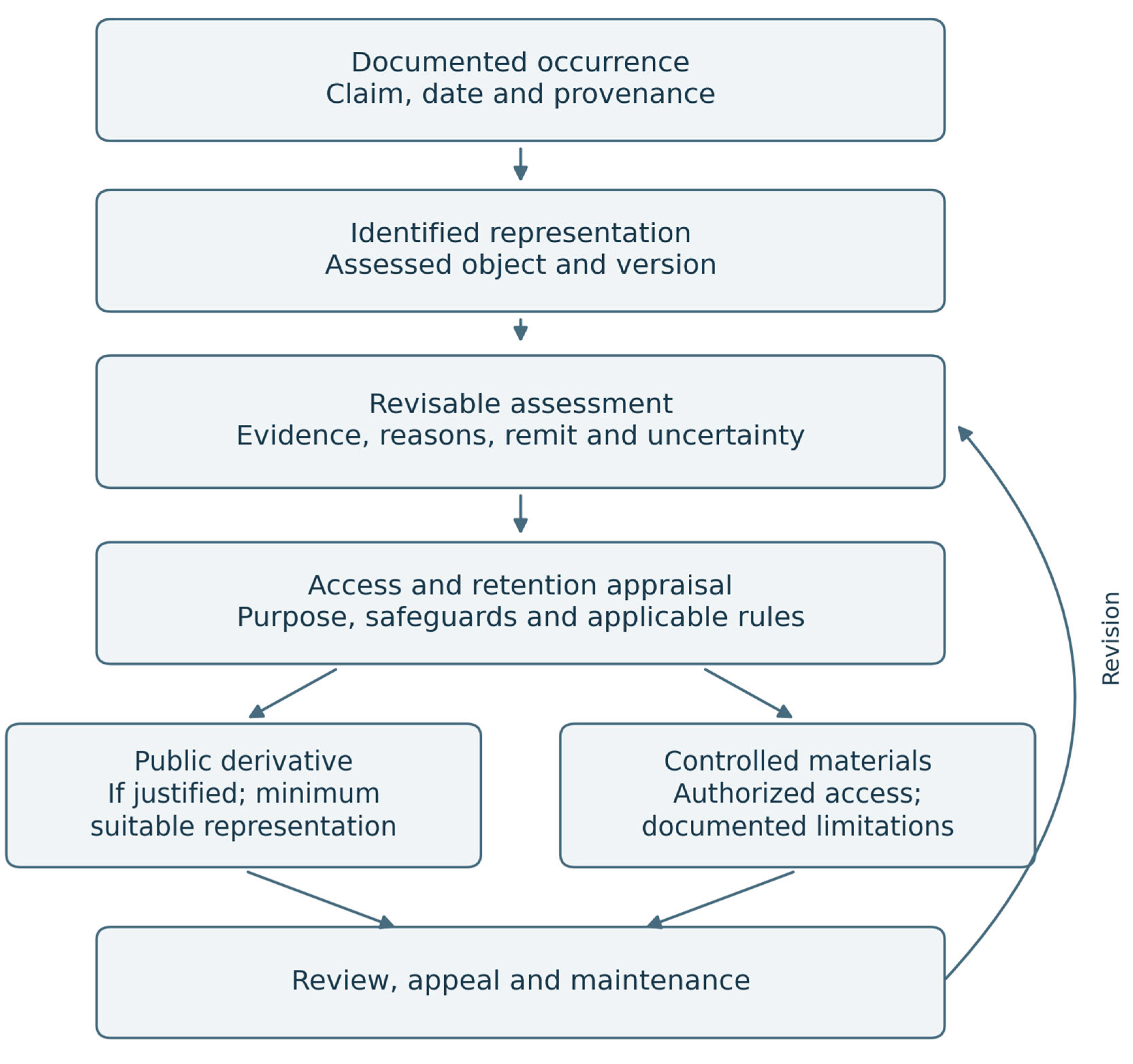
Figure 2.
Comparative arrangements in the 2035 thought experiment.
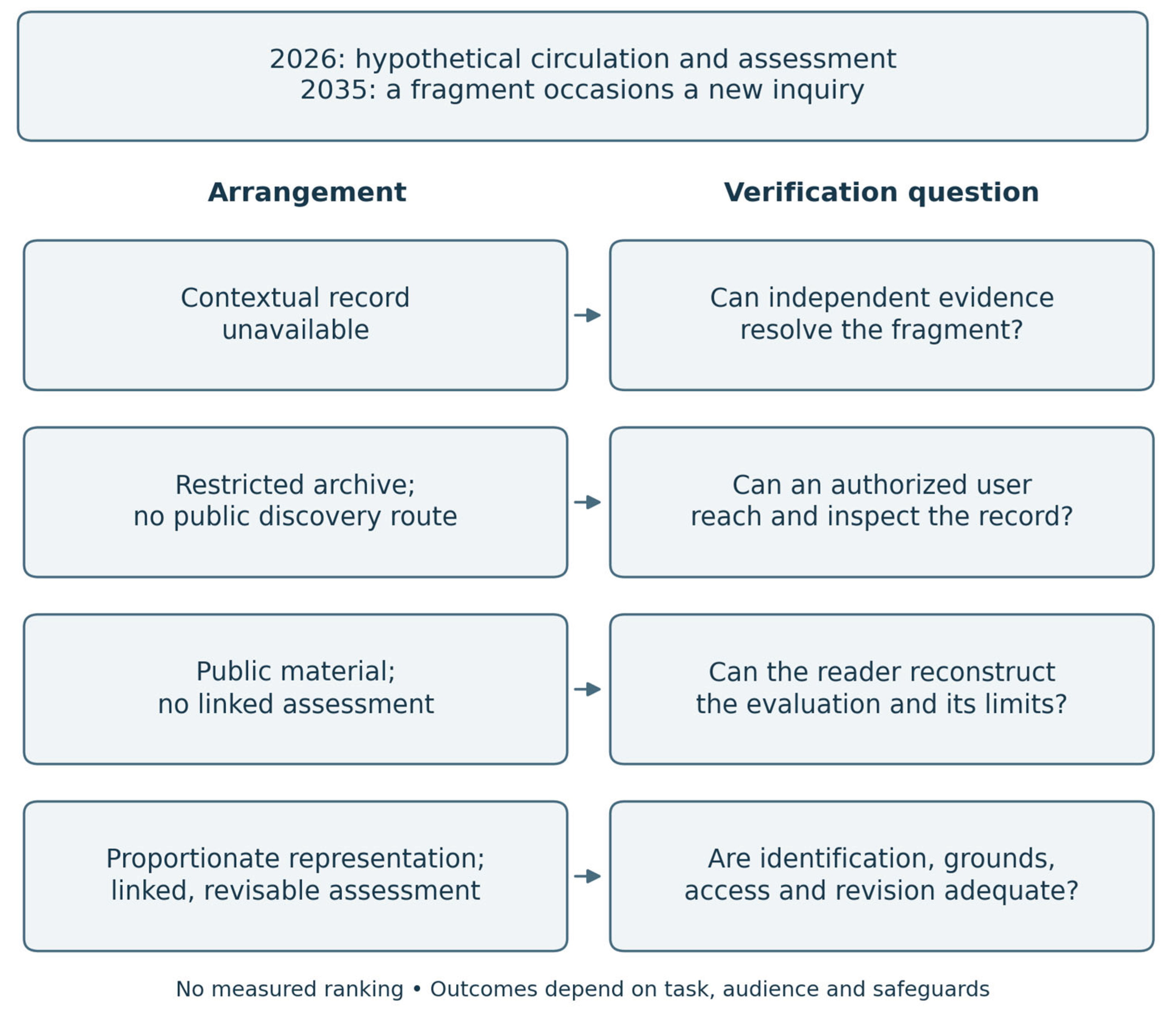
Table 1.
Operational distinctions for a contextualized record.
| Category | Working distinction | Evidentiary boundary |
| Error | An incorrect assertion, inference or interpretation, without deceptive intent established by the classification itself. | Document the error and the basis for correction; do not infer intent from inaccuracy. |
| Factual falsehood | A bounded proposition contradicted by adequate evidence about its stated referent. | Identify the proposition, time, domain and evidence; avoid an unrestricted verdict about an entire narrative. |
| Misinformation | False or misleading information, used here without requiring proof of deliberate deception. | State the adopted convention; neither sharing nor falsity alone establishes the distributor’s mental state. |
| Disinformation | Information functioning to mislead, with deliberate production or distribution assessed separately where supported. | Literal truth can be used misleadingly; record evidence for intentional conduct rather than assuming it. |
| Lie | An assertion classified in relation to an agent’s belief and deceptive conduct. | Falsity does not by itself establish that the speaker believed the proposition false or intended deception. |
| Fraud | Deceptive conduct with a specified instrumental, material or legally defined component. | State the relevant conduct and basis; a legal finding must retain its jurisdiction and scope. |
| Unproven claim | A proposition for which the available evidence does not establish the relevant conclusion. | Insufficient confirmation does not establish falsity; identify unavailable or inconclusive evidence. |
| Superseded hypothesis | An explanation replaced, narrowed or revised by later evidence or a more adequate account. | Retain its original domain and evidentiary setting; scientific revision is not evidence of misconduct. |
| Documentary forgery | A fabricated object, attribution or alteration presented as a document it is not. | Establish what was fabricated; the existence of a forged object does not authenticate its attributed occurrence. |
| Manipulated content | A technically modified representation whose modification is relevant to interpretation. | Distinguish ordinary editing from materially misleading change; modification alone does not establish deception. |
| Decontextualized content | Material presented without temporal, spatial, causal or communicative context needed to interpret it. | Specify the missing context and how it changes the inference; authentic material can still mislead. |
Source: authors’ analytical synthesis. Fallis (2015) informs the distinction between misleading function and literal falsity. This is a proposed documentation vocabulary, not a validated scale or a comprehensive legal taxonomy.
Table 2.
Correspondence between seven elements, twelve temporal requirements and eight record components.
Table 2.
Correspondence between seven elements, twelve temporal requirements and eight record components.
| Functional component | Original elements and temporal requirements | Information that must remain explicit |
| F1 Claim and occurrence | E2; T2, T3 | Bounded claim, evidence of occurrence, date, context and the representation suitable for each audience. A public representation may be inadmissible. |
| F2 Identity and version | E1, E2; T1, T7, T11 | Persistent record identity, assessed version and documented relation to copies. Exact file matching and semantic association are different tasks. |
| F3 Assessment | E3; T4, T12 | Current classification, scope, assessment date and unresolved uncertainty; mixed findings remain possible. |
| F4 Grounds | E4; T5 | Evidence, reasons, method, limitations and access conditions. A restricted source must not be described as publicly auditable. |
| F5 Evaluator and remit | E5; T6 | Responsible evaluator, competence, provenance and accountability; institutional status does not establish correctness. |
| F6 History and current status | E3, E4, E5; T4, T7, T12 | Earlier findings, revisions, appeals and current status. Superseded labels remain distinguishable from current assessments. |
| F7 Protection and access | E6; T2, T8, T10 | Purpose, redaction, audiences, restrictions, review dates and lawful disposition rules; retention and publication require separate justification. |
| F8 Continuity and relationships | E1, E7; T1, T7, T9, T10, T11 | Maintenance responsibility, interoperable links, persistence policy and version-aware association with variants; export and migration must preserve restrictions. |
Source: authors’ mapping of the initial seven-element model, its twelve temporal requirements and the eight-component organization. The correspondences establish coverage, not empirical equivalence or technical interoperability.
Table 3.
Candidate indicators of a verifiability vacuum.
| Indicator | Task that could reveal the deficit | Alternative explanation to examine |
| V1 Contextualized source absent or inaccessible | Can the specified audience reach a contextualized primary record or an adequate authorized substitute? | Search failure, access restrictions or an incorrect locator can occur without destruction. |
| V2 Fragments with incomplete provenance | Can the surviving representation be linked to a documented occurrence and assessed version? | The fragment may be newly fabricated or unrelated to the alleged earlier event. |
| V3 Evaluator or grounds unrecoverable | Can the reader identify who assessed the claim, under what remit and for what reasons? | An assessment may never have occurred; the scenario must not manufacture a lost assessment. |
| V4 Dates, versions or context uncertain | Can the reader distinguish original occurrence, capture, assessment and revision dates? | Conflicting sources can document genuine disagreement rather than a missing record. |
| V5 Variant-to-assessment association fails | Can a supported route connect a later copy, crop or paraphrase to the appropriate evaluation? | The variant may change the proposition enough that the earlier evaluation no longer applies. |
Source: authors’ proposed operational indicators. No composite score, threshold, sensitivity or specificity is asserted.
Table 4.
Selected empirical anchors and limits of transfer to PEC.
| Study | Design and reported finding | Limit for the present proposal |
| Martel and Rand 2024 | Meta-analyses of 21 experiments; N = 14,133. Relative reductions of 27.6% in belief and 24.7% in willingness to share false headlines. | Tests warning labels; no direct comparison of a persistent PEC archive with removal. |
| Brashier et al. 2021 | Two experiments; N = 2,683; follow-up after one week. Tags after exposure improved later discernment more than tags before or during exposure. | Timing of brief tags is distinct from technique-based inoculation or multiyear preservation. |
| Roozenbeek et al. 2022 | Six randomized studies; n = 6,464; YouTube field study; n = 22,632. Technique-focused videos improved relevant recognition and discernment outcomes. | Training intervention; no demonstration that archiving alone generates learning. |
| Pennycook et al. 2020 | Experiments identify an implied truth effect when only a subset of false headlines receives warnings. | Selective labels can change interpretation of unlabeled material; repository coverage requires explanation. |
Source: authors’ synthesis of the cited studies. Samples and outcomes belong to the original studies; they are not measurements of PEC. Percentages are relative reductions reported by Martel and Rand (2024).
Table 5.
Computational operations relevant to preservation.
| Operation | Role of a PEC record | Distinct failure to evaluate |
| Model training | May supply a contextualized example in a selected future training corpus. | Corpus excludes the record, drops its qualification or preserves an obsolete assessment. |
| Search indexing | May make a permitted representation discoverable through an index. | Record is omitted, stale, poorly ranked or represented without its qualification. |
| Retrieval and RAG | May supply evidence when a system queries an external source. | Wrong variant or superseded review is retrieved; relevant material is missed. |
| Knowledge graph | May represent typed relations among claim, version, assessment and evidence. | Relation is absent, too broad or treated as timeless. |
| Agent context or memory store | May retain an assessment for a bounded later task. | Temporary context is lost or persistent notes retain an outdated verdict. |
| Automated checking | May support matching against previously evaluated claims. | Similarity is mistaken for equivalence or missing evidence becomes a false verdict. |
Source: authors’ analytical distinctions. Lewis et al. (2020) provide the RAG reference; the PEC applications and failure cases are proposals for evaluation.
Table 6.
Requirements retained from the temporal PEC architecture.
| Requirement group | Distinctions to preserve | Consequence if omitted |
| Identity and representation | Claim, assessed version, occurrence context and proportionate public representation. | Users cannot establish what the assessment concerns. |
| Assessment and grounds | Exact classification, scope, evidence, method, uncertainty and access limitations. | A verdict is transferred beyond its evidentiary basis. |
| Evaluator and revision | Responsible entity, remit, assessment date, revisions and current status. | Institutional authority or an obsolete verdict becomes indistinguishable from current evidence. |
| Protection and access | Redaction, restricted originals, authorized routes and limits on public discovery. | Preservation becomes unnecessary disclosure or overstates auditability. |
| Continuity and variants | Persistent reference, maintenance policy, structured links and basis for variant associations. | Records survive as disconnected files or misclassify similar claims. |
Source: authors’ conceptual synthesis. The functional groups retain the twelve requirements described above.
Table 7.
Difficult cases and the preservation question.
| Material or context | Public representation to consider | Question that remains decisive |
| Non-consensual intimate imagery and sexualized deepfakes | Non-identifying account of the decision; no reproduction of intimate imagery. | Would the description or discovery route identify or re-expose the affected person? |
| Material depicting child sexual abuse | No public reproduction; at most a non-identifying decision record where lawful. | Does any retention occur only under lawful authority and competent custody? |
| False criminal accusations | Minimized account of the assessment, often without a searchable personal identity. | Does retaining the accusation perpetuate stigma despite the correction? |
| Sensitive personal data | Restricted original if lawfully retained; necessary public context only. | Are re-identification, purpose and third-party access adequately addressed? |
| Hate speech and terrorist propaganda | Critical description or limited non-replicating representation. | Could the retained material facilitate harassment, recruitment or targeted abuse? |
| High-risk health misinformation | Current explanatory assessment and a safely recognizable description. | Could users mistake the historical allegation for current advice? |
| Election-related manipulation | Dated and versioned assessment with appropriate legal and factual scope. | Does presentation preserve context and avoid transferring a verdict to a new claim? |
| Forged documents and manipulated media | Protected original where authorized; derivative showing only necessary features. | Can the relevant alteration be examined without disclosing sensitive details? |
Source: authors’ proposed case analysis. Applicable law and competent decisions govern retention, access and disclosure; no efficacy or risk ranking is claimed.
Table 8.
Measures and the functions they change.
| Measure | Function changed | Preservation condition to examine |
| Retain availability | Existing access remains possible. | Is the purpose adequate, the assessment current and the exposure proportionate? |
| Contextualize | Adds or revises the interpretation presented with the object. | Does the qualification remain attached in search, reuse and export? |
| Deamplify | Reduces recommendation or other active distribution. | Can the intended user still locate an authorized record when needed? |
| Deindex | Reduces discovery through a specified search index. | What direct, archival or restricted discovery route remains? |
| Restrict access | Limits the audience or permitted uses. | Are authorization, security and the limits of public auditability explicit? |
| Provide a substitute | Publishes a description, redacted derivative or limited metadata. | Does it serve the stated task without re-identifying people or overstating evidentiary completeness? |
| Authorize destruction | Removes stored material through a permitted disposition procedure. | Is disposal legally available, with retention duties and permanent-archive restrictions resolved? |
Source: authors’ operational proposal. The destruction row is subject to applicable archival and legal constraints; risk severity alone does not authorize destruction.
Table 10.
Candidate metrics and measurement boundaries.
| Metric | Proposed operational definition | Boundary or complementary measure |
| Contextual recoverability | Proportion of eligible test queries retrieving the applicable allegation representation and current assessment within a prespecified result limit. | Report failures, access conditions and precision; retrieval alone does not establish understanding. |
| Correction persistence | Proportion of scheduled time points or re-encounters at which the correction remains accessible, linked and current. | Distinguish observed longitudinal maintenance from simulated snapshots. |
| Provenance integrity | Completeness and verified correctness of required origin, version, evidence and evaluator relationships. | A complete form can still contain false or unsupported assertions. |
| Correction latency | Time between a defined relevant circulation event and availability of the applicable contextual assessment. | Prespecify start and end events; do not reward rapid but erroneous classification. |
| Variant coverage | Proportion of independently established eligible variants correctly associated with the assessment. | Report false associations and performance by variant type and language. |
| Verification cost | Time, interactions or documented resources needed to reach a correctly scoped conclusion. | Separate human effort, computational expense and institutional maintenance cost. |
Source: authors’ proposed operational definitions. No numerical score, target or universal weighting has been validated.
Disclaimer/Publisher’s Note: The statements, opinions and data contained in all publications are solely those of the individual author(s) and contributor(s) and not of MDPI and/or the editor(s). MDPI and/or the editor(s) disclaim responsibility for any injury to people or property resulting from any ideas, methods, instructions or products referred to in the content. |
© 2026 by the authors. Licensee MDPI, Basel, Switzerland. This article is an open access article distributed under the terms and conditions of the Creative Commons Attribution (CC BY) license (http://creativecommons.org/licenses/by/4.0/).
Copyright: This open access article is published under a Creative Commons CC BY 4.0 license, which permit the free download, distribution, and reuse, provided that the author and preprint are cited in any reuse.