
Submitted:
16 October 2026
Posted:
20 October 2026
You are already at the latest version
Abstract
Shifting to telehealth care model, care’s migration to low-cost settings and value-based care expansion, which are currently the leading trends in the healthcare sector, healthcare executives know that digital investment will be required, apart from the rising-demand costs they have to address, making immediate operational resilience and sustainability the top concern for healthcare systems (HCSs), globally. Care coordination and sustained care can’t be efficiently materialized, without the existence of a reliable and efficient monitoring system. Hence, this study addresses the following questions: Do recent healthcare organizations monitor effectively their sustainable performance? Do the current monitoring tools have the required properties, to enable organizations operate as part of a sustainable healthcare system? This study’s objective is to establish a common ground in monitoring, for healthcare organizations, that enables them to sustain their mission. For addressing these questions, a 3-phase Integrated Evidence Synthesis was conducted, following Equator-Network guidelines. Some of the study’s major findings are that only 18 over 138 scientific articles/reports retrieved from the literature are describing a valid monitoring framework (MFW) for sustainable performance, revealing that this area of study is relatively unexplored. 72% of them use conventional techniques. Healthcare centres in the USA that were in the scope of this study use a mix of MFWs in practice. Although the monitoring approaches, between high-performing and low-performing organizations vary, both sides are struggling for sustaining the quality level of their operations. Conclusions: The conceptual framework that emerges from this study encourages the adoption of an operational monitoring mechanism -infrastructure-, by healthcare organizations, with the indicative systemic properties required, for promoting sustainable institutional performance.
Keywords:
continuity of patient care
; data interpretation
; statistical
; delivery of healthcare
; health information systems
; artificial intelligence
1. Introduction
Healthcare is a sector that experiences surging progress the last decade, especially with the wider adoption of technology (it is enough to look at the annual numbers of new interventions on clinical trial in the USA [1] - 42966 in 2025 - to realize the pace of productivity).
However, there is significant fragmentation, in multiple components of the HCS, which became particularly evident, along with its impact, during the covid-19 pandemic, where the capacity of most healthcare centres was significantly tested.
Nevertheless, not all healthcare organizations “suffer” the same, during crisis, due to their different performance level. Hence, knowing their performance, against their short-to-mid-term and long-term objectives, is not only essential for the continuation of their operation, but also an advantage that they can turn into an opportunity.
Despite multiple efforts, continuity in healthcare is significantly hindered by systemic issues, associated with the governance of healthcare centres, their administration and their collaboration with other sectors (3 major components in WHO frameworks [2]), that are hard to monitor, they are rarely monitored and captured, and hence they remain unsolved.
Some examples of such systemic issues are: misaligned HCS components (e.g., ministries, insurers etc.) [3,4,5], the lack of accountability over the whole patient journey [5,6,7,8], misaligned incentives [8,9,10,11] (providers paid for volume, not for service continuity) and supply chain disturbances [12,13,14,15,16]. Also, diseases with comorbidities often cause significant disruptions in the HCS [7,17,18,19,20].
Given the importance of operational continuity in healthcare, this study investigates the spectrum of monitoring mechanisms for sustainable performance, applied today.
2. Materials and Methods
Study Design
For addressing the questions of the study, an Integrated Multi-Phase Evidence Synthesis was conducted, with 3 phases, followed iteratively, including:
- A Systematic Review, following relevant parts of the PRISMA reporting guideline [21]
- A Scoping Review, adhering to the PRISMA-ScR reporting protocol [22]
- And an Evidence Synthesis, synthesizing the outcomes of the previous phases, by following the ENTREQ Equator-Network guideline [23].
Research Methodology
The Systematic Review [Suppl1] aimed at building an understanding of the MFWs for healthcare centres, suggested by research recently, by reviewing peer-reviewed publications and further characterizing the MFWs they described, using a categorization framework – developed for this study-, against their capacity to help organizations operate sustainably.
As most reports’ findings were narrow and didn’t expand beyond the experimentation phases, for capturing a wider spectrum of monitoring approaches and for acquiring feedback of their true effectiveness in practice, a Scoping Review [Suppl2] was conducted.
In the Scoping Review, the monitoring approaches of 7 high-performing and 7 low-performing healthcare centres, according to CMS-ratings [24,25,26], were analysed, using grey literature and further characterized, under the same categorization framework, against their properties.
The use of the same categorization framework in both studies allowed, during the evidence synthesis phase, for the meaningful summarization of their findings, the discovery of common patterns, between the research methodologies and real monitoring practice and the identification of properties of the categorization framework that correlate with the differentiation in the organizations’ performance.
All phases of the study were visited iteratively, for reducing human error and until a robust conceptual framework for the evaluation and development of monitoring systems was shaped.
The Categorization Framework
A categorization framework was built, tailored to evaluate each valid MFW’s capacity to enable healthcare delivery organizations, become more sustainable.
It is the product of the author’s prior research work and its validation against the 4Cs framework, presented by Serafeim G. [27,28,29,30].
The 4Cs framework highlights the major barriers, preventing organizations reach the performance frontier in their industry. The fundamental questions the 4Cs framework calls organizations to address, for improving their performances are: Clarity - do you see the performance gap from the best performance, and do you know your priorities? Craft - knowing the gap, do you know what to do and how? Consequences - knowing the gap and what to do next, are people
incentivized to do right thing? Collaboration - being anything in place, can units move together without friction [27,28,29,30]?
The categorization framework is composed of categories and subcategories, which are briefly described in Suppl3 and explained in detail in Table 1.
Information and Evidence Sources
The Information Sources, Search Strategy, Screening and Study Selection, the Critical Appraisal, the Data Extraction and Categorization and the Descriptive Summary Statistics of the phase studies are summarized in Table 2. For more details, as well as, for the PRISMA and PRISMA-ScR diagrams, please visit Suppl1 and Suppl2.
Synthesis
At this stage, a sufficiently broad view of the recent applicable monitoring approaches has been established, included of their effectiveness, in propelling the organizations sustainable performance, and of their shortcomings.
Furthermore, the qualitative difference, between the monitoring approaches of the two groups of organizations, provides real feedback on the monitoring dimensions that separate the two groups of performance.
The potential alignment of these properties, with the categorization framework, would further validate the framework, as an evaluation mechanism for MFWs.
Hence, the Synthesis phase provides a quite comprehensive response on how monitoring is performed and the mechanism to evaluate its effectiveness in healthcare organizations’ sustainable performance.
Meta-aggregation, critical-interpretative synthesis, deductive and inductive derivation of themes/categories and framework synthesis were applied in this phase.
3. Results
The main findings from the Systematic Review [Suppl1] are presented below:
3.1. Synthesis of the Systematic Review’s Findings
From 138 studies screened, only a 14% were describing a valid MFW, matching the study selection criteria (Table 2, Suppl1). This finding agrees with Zurynski et al.’s [31] and Khalil et al.’s [32] observation that healthcare systems’ performance conceptualization, definition and measurement are relatively unexplored, based on their study, prior to 2022.
Monitoring Approach
39% of the frameworks proposed are extensions of long-established conceptual frameworks, such as the Donabedian [33], the TQM [34], Balanced Scorecards (BSCs) [35] and others, to the medical domain (Figure 1-Category). 33% used Conceptualization of Indicators - involving the statistical analysis of various forms of data, for the detection or direct selection of features, correlating with the constructs being monitored. 22% are technology-based, leveraging AI, Blockchain, Internet of Medical Things (IoMT) and Business Intelligence, over a reference architecture specific to the business domain of the environment being monitored.
Sustainability
61% of the frameworks monitor either short-to-mid-term or long-term sustainability and 39% monitor both (Figure 1-Approach to Sustainability). 82% of the studies made no reference to any major sustainability governance framework, revealing that alignment with frameworks of international/national scale isn’t broadly considered a priority, during the development of MFWs.
Non-operational Function
78% of the frameworks rely on iterative cycles with manual procedures, in the development and/or operation phase; thus, increasing the risk of unreliable and biased performance estimates.
Methodology
50% of the studies apply scoring-based methodologies (Figure 1-Scoring vs Measuring), 17% measure-based, 17% are combining both methodologies and the rest are using other kinds of methods.
Scoring-based methods are cheaper to develop, require periodic human reviews and are considered less reliable than measure-based methods, which are most costly to implement, but generally cheaper to maintain and more interpretable [36,37].
Adoption of Technology
44% operate on a digital platform, 33% can or already leverage AI and Data Analytics and 22% are fully automated.
Scalability
83% of the frameworks can’t scale, decreasing the possibility of operating cross-border and cross-sector.
Risk
28% of the performance evaluators, proposed in the studies, quantify the risk of missing targets. These frameworks use mostly reference-architecture monitoring approaches.
From the above findings, 2 broad categories of research MFWs emerge:
The first, where most of the frameworks belong, is characterized by the use of traditional techniques of monitoring (Extension-based, Conceptualization of Indicators), bearing legacy features, such as semi-automation, partial incorporation of sustainability, strong reliance on expert and stakeholder groups, limited adoption of AI and Data Analytics, limited scalability and so on. Though financially more attractive, they often lead organizations to a false view of where exactly they stand against their mission and to ratings non-functional, beyond the organization boundaries, preventing collaboration.
The second is characterized by technology-based frameworks, leveraging AI & other recent technologies, being often part of a broader telemonitoring hospital care model. Though the frameworks of this category exhibit optimal monitoring features, they are slowly or poorly adopted, due to their limited integration, with the healthcare environment [38,39,40,41].
3.2. Synthesis of the Scoping Review’s Findings
For a detailed view of the Scoping Review’s findings, please see Suppl2.
Insights from the high-performing healthcare centres
The healthcare delivery organizations of this group, been rated in the top tier of quality by CMS [24,25], are multi-hospital, academic, medical centres, with millions of encounters annually and most cases reaching them being very complex [42,43]. Their revenue-base is diversified including patient services, research grants, philanthropic contributions, commercialization of technology and consultation to other organizations, amounting to several billion dollars, annually. Their operating margins are positive, but thin, and net asset change, although fluctuating, it is sustained across time, driven by investment return, philanthropy and retained earnings [Suppl4, 44]. They have good and sustained performance, however they are challenged in fulfilling their goals and vision across time.
Monitoring Approach
Their approach is a mixture of monitoring systems, including BSCs, adapted to the medical domain, for internal governance reporting [35,45], CMS Conditions of Participation (CoP) [46] reporting, state authorities reporting, adhering to national and international accreditation organizations’ rules [47,48], tools for conforming with national and
academic benchmarks [49,50,51,52,53,54,55], with NSQA/HEDIS requirements for qualitative reporting, and last but not least, Internal Quality Systems (IQS), sustained significantly by digital platforms [56,57,58].
Their approach is based on all three types identified in the Systematic Review [Suppl1] and is largely driven by regulation. Key differences between organizations in this group come from the IQSs they implement (Table 3).
Sustainability
They monitor both short-to-mid-term and long-term sustainability. Complying with CMS and local policy builds baseline capacity in these organizations and determines their eligibility to federal billing programs, thus impacting their long-term sustainability. Complying to accreditation organizations’ standards and operating IQSs, help them operate both with immediate resiliency and sustainably [47,48,56,57,58].
Non-operational function
Although their performance is substantially monitored by their IQSs and their digital platforms [56,57,58], they are subject to audits and inspections by CMS, state and accreditation organization officials, which introduce manual procedures and stakeholders’ involvement, in the monitoring process [Suppl2].
Methodology
As we don’t have access to the built-in methodologies of their IQSs, though these are mostly drawn from research [56,57,58], we focus on CMS’s methodologies, which are like those applied by other governance bodies, in their principles.
Most CMS Scoring methodologies [Suppl2,49–54], are influenced by research and they rely, on a combination of measure-based and index-based techniques [Suppl2,36,37].
Adoption of Technology
They rely substantially on technology and on digital IQSs, for staying on the performance frontier, in medical services and innovation [68]. They spend at least 5% of their revenue annually on IT [Suppl4,59] and the amount gets higher, if including the investments on internal IT projects [Suppl4].
Scalability
Performance evaluations are meaningful across country borders, mainly within their ecosystem, through their IQSs and their uniform governance system across centres, in multiple geographical sites [Suppl2].
CMS only partially integrates with international standards.
Risk
Most IQSs [56,57,58] are equipped with performance optimization components that quantify and minimize the risk of an organization missing its internal and regulatory targets.
Insights from the low-performing healthcare centres
There is an estimated 31% [60], according to CMS Overall Hospital Star Ratings [54], that are performing low, represented mostly by rural and/or safety-net hospitals and which are struggling to sustain their operations.
Their services are mainly of low-complexity, essential services, serving mostly uninsured and rural population. Many have been forced to close departments, due to lack of demand in commercial care and operational stability. Their revenue-base is constrained to patient services, and it amounts to tens of million dollars or less [Suppl4].
Monitoring Approach
They monitor performance, using a composite model analogously with the high-performing healthcare centres, but with the difference of adhering also to local Certificate of Need [61,67] rules - in certain cases and only in some states - to accreditation bodies’ requirements [Suppl2], where applicable, and that their annual budget doesn’t allow for investing in IQSs.
Sustainability
As they don’t invest in IQSs, they mainly monitor long-term sustainability, essentially trying to sustain their operations under razor thin margins, while staying compliant to CMS.
Non-operational Function
As their monitoring relies mainly on CMS and local-state reporting, much of their performance monitoring is mediated by audits and inspections that CMS and local-states conduct quarterly or annually.
Methodology
As complying to CMS and state regulation is their primary performance monitoring mechanism, their methodology follows a combination of measures’ monitoring and aggregation [Suppl2].
Adoption of Technology
Due to their limited annual budget, their investment in technology is insignificant, hence their monitoring relies on CMS’s and states’ online platforms [62,63].
Scalability
Any performance rating they preserve, only partially or not at all, integrate with ratings of other, cross-border or national, units.
Risk
Although they usually don’t maintain IQSs, some medical centres are enforced by state regulation [64], to operate an internal risk management system, for meeting, adequately, patient safety standards.
The major qualitative difference, between the two groups of organizations, stems from the different level of visibility they have in their operation and ultimately, from their different access to resources.
Both types of organizations need tools for monitoring their performance, beyond those they maintain for compliance with CMS, and their current multi-stack approach isn’t enough to ensure sustainable performance.
A few important observations from the findings of the two studies:
i) There are few efforts been made recently by research, in evaluation and development of MFWs for healthcare centres’ sustainable performance, mainly due to the complexity of the task.
ii) Even fewer are the MFWs that have been developed and validated, under rigorous analytical techniques, for ensuring that the monitored constructs are reliably estimated.
iii) From the applicable MFWs, tracking healthcare organizations’ performance, few are designed with operational resiliency and sustainability in mind.
iv) Most performance MFWs tend to adopt past and established practices, adjusted to the environment being monitored. There are few frameworks designed with scalability, automation or performance optimization in mind.
v) Most organizations tend to adopt multiple monitoring systems in practice, drawing methods from research, both for covering their own needs and for meeting compliance obligations. This design incurs significant costs annually, while even high-performing organizations are struggling to sustain the quality of their services.
vi) The distinctive features separating the two groups into high-performing and low performing organizations - such as adequate and reliable monitoring, performance optimization, investment in technology, increased automation - show that monitoring plays an integral role in organizations’ performance.
vii) The dimensions of the qualitative difference, between the two groups, in performance - adequate and reliable monitoring, performance optimization, investment in technology, increased automation etc. - align with the categories of the categorization framework, which further validates the framework’s capability to identify dimensions of monitoring that foster sustainable performance.
4. Discussion
CMS’s Monitoring Methodology - Final Remarks
From the outcomes of the study, it is evident the primary role CMS’ monitoring and policy play in the sustained performance of the HCS, which is its primary mission.
Below, we briefly analyse CMS’s monitoring, from the lens of the categorization framework of the study.
The main monitoring frameworks it operates are under CoP [46], the Hospital Value-based Purchasing (HVBP) [49,53], the Hospital Readmission Reduction (HRR) [50], Hospital-Acquired Condition (HAC) [51], the Comprehensive Care for Joint Replacement (CCJR) [52] and the Hospital Overall Quality Star Rating (HOQSR) [54] Programs.
Through CoP, CMS determines the minimum operation safety and preparedness criteria, for healthcare centres to remain Medicare-Medicaid-eligible, which is essential for their financial viability, with the aim of building a baseline performance across the HCS. HVBP, HRR, HAC and CCJR quality standards act as incentivizers or penalizers of healthcare centres’ performance.
CMS’s monitoring methodology is a combined Measuring and Scoring approach, with built-in mechanisms for delivering valid performance evaluations [Suppl2].
Despite its robustness, there have been reported caveats that need to be rectified to operate a truly value-based care model.
As an example, while measurements of institutions’ performance are scientifically sound, when evaluated individually, their validity weakens, when bundled into single star ratings [65]. Pollock et al. [65], showed that due to CMS’s MFW sensitivity in the HOQSR program, a hospital’s rating can swing between a 3-star and a 5-star rating. In addition, Jianhui et al.l [66] highlight that care rated with 5 stars, due to high patient experience scores, can mask underperformance, with below-average mortality rates, across care paths that are outside HOQSR’s monitoring perimeter.
The processing of the submitted data to the Inpatient and Outpatient Quality Reporting Systems and effective decision making on payments takes place annually, reflecting performance prior to one year back, thus these ratings don’t convey an informative view of how an organization operates now.
Although CMS documents clearly the monitoring methodology it applies, the strong involvement of stakeholder/expert groups and manual procedures (e.g., audits, indicators definition, measure selection etc.) in the monitoring process [54], may set the creditworthiness of the process at stake.
The risk of failure against performance targets isn’t quantified and exact performance targets for the sustained operation of the HCS aren’t set [46] for each organization, hence CMS doesn’t cater, for organizations staying on performance track.
High-Performers’ Tracking of Progress - Final Remarks
It comes out that, due to the highly complex cases reaching these healthcare centres, they need to invest significantly on the co-ordination of care, on research-embedded care pathways and hence on extensive quality measurement.
These requirements can’t be covered by regulatory bodies’ monitoring or funding mechanisms.
Besides, for the core of their monitoring system, their IQSs, it can be inferred, from their spend on IT – 3% on average of their annual opex [Suppl4,69] - and their estimated spend on Labor - 60% on average of their annual opex [Suppl4,69] -, that these systems are likely multi-stack, with some parts likely duplicated, not fully-automated, requiring human intervention for their operation. That structure of IQSs is expected, considering their composite model (§Results) and the lack of a unified approach in monitoring, and it accounts for an inflated annual cost.
Low-Performers’ Tracking of Progress - Final Remarks
The lack of investment in IQSs and technology, due to the limited budget of these organizations, doesn’t allow them enough visibility into their weaknesses.
Maintaining compliance with CMS, through measures’ monitoring isn’t capable to help them exit the crisis, while the cost of regulatory compliance exacerbates their crisis. States complement CMS’s baseline performance monitoring, through state-specific measures’ monitoring, licensure statutes, inspections and other actions, but they cannot revert their route to closure of facilities/departments.
A Conceptual Framework for the Evaluation and Development of MFWs
Based on the meaningful outcomes of the categorization framework, used in this study, and its discriminating capability of a broad sample of monitoring approaches, against their capability to promote organizations’ sustainability, a conceptual framework was created, for the aim of informing the evaluation and future development of MFWs, for healthcare centres and, potentially, for other components of the HCS, as well.
One instantiation of the conceptual framework and an example of its application in practice, has been the categorization framework of this study.
The principal design of the conceptual framework has been the adoption of a set of properties, any MFW is expected to have, for providing the required visibility to healthcare centres that will enable them to sustain their vision, while operating as part of a sustainable HCS. These are:
1. Operational - the monitoring process should not interfere with any healthcare process.
2. Reliable - it should provide correct view of the constructs it monitors. Changes in estimates, should reflect analogous changes in the constructs.
3. Feasible and Practical - it should not demand significant investment by an organization, and it should use existing technology efficiently.
4. Scalable and Adaptable - it should be able to operate reliably, under varying contexts.
5. Invariant - estimates of monitored constructs should not vary, because of any parameter change, beyond constructs.
6. Interpretable - it should be capable to explain any variation of the constructs’ estimation.
7. Transparent
8. It should track the risk of missing targets.
The reason ‘monitoring of risk’ is included in the properties, is, first, to provide a measure of the tracking progress of an organization and hence of its resiliency.
Secondly, to connect each MFW with the domain of finances, for the purpose of enabling payment and incentivization mechanisms over the MFW, linked to reliable and transparent performance aspects, and to financial instrument applications.
It becomes apparent that this property could directly and further propel organizations’ sustainability.
All properties are further validated, as promising dimensions of MFWs for organizations’ performance, by the 4Cs framework [27,28,29,30], as they rigorously act towards empowering the 4Cs, hence decreasing the gap from the performance frontier.
In Table 4 is shown, how the properties of the conceptual framework align with the categorization framework and the 4Cs framework.
5. Conclusions
This study highlights the strengths and the weaknesses of the recent monitoring approaches applied in practice, towards providing healthcare organizations with the required visibility, into their operation, for performing sustainably. Furthermore, it identifies the benefit of using a unified approach in evaluating and building MFWs, by instantiating the conceptual model that emerged from this study. With the properties of estimating performance reliably, being efficient and practical, scalable, invariant, interpretable, transparent and capturing risk of failure, the monitoring mechanisms produced not only enable organizations quantify their progress in sustainability but also help them improve their sustainability.
Supplementary Materials
The following supporting information can be downloaded at https://www.mdpi.com/article/doi/s1, Supplementary Material S1: Suppl1; Supplementary Material S2: Suppl2; Supplementary Material S3: Suppl3, Supplementary Material S4: Suppl4 and Supplementary Material S5: e-Appendix1.
Funding
This research received no external funding.
Institutional Review Board Statement
Not applicable.
Informed Consent Statement
Not applicable.
Data Availability Statement
All required data for reproducing this study are included in the main manuscript, the supplemental material and in e-Appendix1.
Acknowledgments
The author extends her gratitude to the authors listed in the References section, for the ideas and work that have shared in their studies, which contributed to the production of this article.
Conflicts of Interest
The author declares no conflicts of interest.
References
- https://clinicaltrials.gov/.
- Primary health care monitoring framework and indicators; World Health Organization and the United Nations Children’s Fund (UNICEF): Geneva; Licence: CC BY-NC-SA 3.0 IGO, 2022.
- Riley, L.; Maggie, S. Administrative Fragmentation in Health Care. NBER Work. Pap. 33863 2025. [Google Scholar] [CrossRef]
- Randall, D.; Rebitzer, J.; Taylor, L.; et al. Organizational Fragmentation and Care Quality in the U.S. Healthcare System. J. Econ. Perspect. 2008, 22(4), 93–113. [Google Scholar] [CrossRef]
- Gatome- Munyua, A.; Sparkes, S.; Mtei, G.; et al. Reducing fragmentation of primary healthcare financing for more equitable, people- centred primary healthcare. BMJ Glob. Health 2025, 10, e015088. [Google Scholar] [CrossRef] [PubMed]
- Wang, P.; Vienneau, M.; Vogeli, C.; et al. Reframing Value-Based Care Management: Beyond Cost Reduction and Toward Patient Centeredness. JAMA Health Forum 2023, 4(6), e231502. [Google Scholar] [CrossRef] [PubMed]
- Prior, A.; Vestergaard, C.H.; Vedsted, P.; et al. Healthcare fragmentation, multimorbidity, potentially inappropriate medication, and mortality: a Danish nationwide cohort study. BMC Med. 2023, 21(1), 305. [Google Scholar] [CrossRef] [PubMed] [PubMed Central]
- Zope, M.; Sullivan, R.; Gutnik, L. Fragmented care and misaligned incentives of stakeholders in breast cancer care for the uninsured in the United States. Cancer 2025, e35878. [Google Scholar] [CrossRef] [PubMed]
- Castano, R.; Prada, S.I.; Maldonado, N.; et al. Managed competition in Colombia: convergence of public and private insurance and delivery. Health Econ. Policy Law 2025, 20(2), 175–189. [Google Scholar] [CrossRef] [PubMed]
- Petracca, F.; Ardito, V.; Sala, F.; et al. Harnessing financial incentives for health promotion: A scoping review of prevention programs implemented in upper-middle and high-income countries. Soc. Sci. Med. Epub. 2025, 383, 118499. [Google Scholar] [CrossRef] [PubMed]
- The Misaligned Incentives of the American Health Care System. 2024. Available online: https://www.ajmc.com/view/no-free-lunch-the-misaligned-incentives-of-the-american-health-care-system.
- New Year, Ongoing Challenges: The State of Healthcare Supply Chain Disruptions in 2024 - Premier Inc. 2024. Available online: https://premierinc.com/newsroom/blog/new-year-ongoing-challenges-the-state-of-healthcare-supply-chain-disruptions-in-2024.
- American Hospital Association, America’s Hospitals and Health Systems Continue to Face Escalating Operational Costs and Economic Pressures as They Care for Patients and Communities; 2024.
- Healthcare Business Review, Improving health access in Latin America: The importance of supply chain services, 2024. Available online: https://www.healthcarebusinessrevieweurope.com/news/improving-health-access-in-latin-america-the-importance-of-supply-chain-services-nwid-3127.html.
- European Court of Auditors. Critical shortages of medicines EU measures were of added value, but structural problems remain. 2025. Available online: https://www.eca.europa.eu/en/publications?ref=SR-2025-19.
- Miljković, N.; Polidori, P.; Leonardi Vinci, D.; et al. Results of EAHP’s 2023 shortages survey. Eur. J. Hosp. Pharm. 2025, 32(4), 307–315. [Google Scholar] [CrossRef] [PubMed]
- Ramos, K.; Boing, A.; Andrade, J.; et al. Polypharmacy among older adults in Brazil: Association with sociodemographic factors and access to health services. Dialogues Health 2022, Volume 1, 100078. [Google Scholar] [CrossRef] [PubMed]
- Olanite, M. K.; Wiredu, B.; Figueroa, A. S.; et al. Emergency Department Visits for Circulatory System Diseases: A Study of Primary Diagnoses Using National Hospital Ambulatory Medical Care Survey (NHAMCS) Data From 2016 to 2022. Cureus 2025, 17(5), e83569. [Google Scholar] [CrossRef] [PubMed]
- Jumah, A.; Ro, J.; Ma, T.; et al. Predictors of unplanned hospital readmissions and emergency department revisits in patients with acute ischemic stroke. Front. Neurol. 2025, 16, 1683753. [Google Scholar] [CrossRef] [PubMed]
- Daunt, R.; Curtin, D.; O’Mahony, D. Polypharmacy stewardship: a novel approach to tackle a major public health crisis. Lancet Healthy Longev. 2023, 4, e228–35. Available online: S2666-7568(23)00036-3. [CrossRef]
- Page, M.J.; McKenzie, J.E.; Bossuyt, P.M.; et al. The PRISMA 2020 statement: an updated guideline for reporting systematic reviews. BMJ. 2021, 372(71), n71. [Google Scholar] [CrossRef] [PubMed]
- Tricco, A.C.; Lillie, E.; Zarin, W.; et al. PRISMA Extension for Scoping Reviews (PRISMA-ScR): Checklist and Explanation. Ann. Intern Med. 2018, 169(7), 467–473. [Google Scholar] [CrossRef] [PubMed]
- Tong, A.; Flemming, K.; McInnes, E.; et al. Enhancing transparency in reporting the synthesis of qualitative research: ENTREQ. BMC Med. Res. Methodol. 2012, 12, 181. [Google Scholar] [CrossRef] [PubMed] [PubMed Central]
- 384 hospitals with 5 stars from CMS, Mariah Taylor, Becker’s Hospital Review. 2026. Available online: https://www.beckershospitalreview.com/rankings-and-ratings/384-hospitals-with-5-stars-from-cms/.
- MD Anderson ranked No. 1 in the nation for cancer care. 2025. Available online: https://www.mdanderson.org/newsroom/md-anderson-ranked-number-1-in-the-nation-for-cancer-care.h00-159778023.html.
- Hospital Data Centre. Available online: https://www.hospitaldatacenter.com/.
- Serafeim, G. The 4Cs of Driving Performance: Clarity. Driving Performance Through Accountability, Control and Governance, The Edge. 2025. Available online: https://theedgeletter.substack.com/p/the-4cs-of-driving-performance-part.
- Serafeim, G. The 4Cs of Driving Performance: Craft. Driving Performance Through Accountability, Control and Governance, The Edge. 2025. Available online: https://theedgeletter.substack.com/p/the-4cs-of-driving-performance-craft.
- Serafeim, G. The 4Cs of Driving Performance: Consequences. Driving Performance Through Accountability, Control and Governance, The Edge. 2025. Available online: https://theedgeletter.substack.com/p/the-4cs-of-driving-performance-consequences.
- Serafeim, G. The 4Cs of Driving Performance: Collaboration. Driving Performance Through Accountability and Governance, The Edge. 2025. Available online: https://theedgeletter.substack.com/p/the-4cs-of-driving-performance-collaboration.
- Zurynski, Y.; Herkes-Deane, J.; Holt, J.; et al. How can the healthcare system deliver sustainable performance? A scoping review. BMJ Open 2022, 12, e059207. [Google Scholar] [CrossRef] [PubMed]
- Khalil, M.; Ravaghi, H.; Samhouri, D.; et al. What is “hospital resilience”? A scoping review on conceptualization, operationalization, and evaluation. Front. Public Health 2025, 10, 1009400. [Google Scholar] [CrossRef]
- DONABEDIAN, A. Evaluating the Quality of Medical Care. Milbank Q. 2005, 83, 691–729. [Google Scholar] [CrossRef] [PubMed]
- Martínez-Lorente, Angel; Dewhurst, Frank; Dale, Barrie. Total quality management: Origins and evolution of the term. In The TQM Magazine; 1998. [Google Scholar] [CrossRef]
- Bohm, V.; Lacaille, D.; Spencer, N.; et al. Scoping review of balanced scorecards for use in healthcare settings: development and implementation. BMJ Open Qual. 2021, 10, e001293. [Google Scholar] [CrossRef] [PubMed]
- Devinney, Timothy; Coltman, Tim; Midgley, David. Formative Versus Reflective Measurement Models: Two Applications of Formative Measurement. J. Bus. Res. 2008, 61. 1250–1262. [Google Scholar] [CrossRef]
- Edwards, J. R.; Bagozzi, R. P. On the nature and direction of relationships between constructs and measures. Psychol. Methods 2000, 5, 155–174. [Google Scholar] [CrossRef] [PubMed]
- Emami, S.G.; Lorenzoni, V.; Turchetti, G. Towards Resilient Healthcare Systems: A Framework for Crisis Management. Int. J. Environ. Res. Public Health 2024, 21, 286. [Google Scholar] [CrossRef] [PubMed]
- El Khatib, Mounir; Alzoubi, Haitham M; Hamidi, Samer; et al. Impact of Using the Internet of Medical Things on e-Healthcare Performance: Blockchain Assist in Improving Smart Contract. Clin. Outcomes Res. 2023, 397–411. [Google Scholar] [CrossRef] [PubMed]
- Elkefi, S.; Asan, O. Digital Twins for Managing Health Care Systems: Rapid Literature Review. J. Med. Internet Res. 2022, 24(8), e37641. Available online: https://www.jmir.org/2022/8/e37641. [CrossRef] [PubMed]
- Rahman, A. Anita J.; Opeyemi, O.; Stephane, J.; et al. The role of business intelligence tools in improving healthcare patient outcomes and operations. World J. Adv. Res. Rev. 2024, 24(02), 1039–1060. [Google Scholar] [CrossRef]
- Top 30 Centers of Excellence 2026. Available online: https://hcranking.com/news/2026/05/202605288861.
- Managing Complex Cases, Cleveland Clinic, Neurological Institute Special Report 2018. Available online: https://my.clevelandclinic.org/-/scassets/files/org/neurological/publications/2018-19-neurological-institute-special-report.pdf.
- Management Discussion: an Analysis for the Year Ended 1 December 2023. Mayo Clin. 2024.
- § 482.12 Condition of participation: Governing body. Available online: https://www.ecfr.gov/current/title-42/chapter-IV/subchapter-G/part-482/subpart-B/section-482.12.
- § 482.21 Condition of participation: Quality assessment and performance improvement program. Available online: https://www.ecfr.gov/current/title-42/chapter-IV/subchapter-G/part-482/subpart-C/section-482.21.
- Performance Measurement, Joint Commission. Available online: https://www.jointcommission.org/en-us/accreditation/performance-measurement.
- National Performance Goals, Joint Commission. Available online: https://healthcarefacilitiesnetwork.com/insights/accreditation-360-what-are-the-national-performance-goals.
- Hospital Value-Based Purchasing (VBP) Program. Available online: https://data.cms.gov/provider-data/topics/hospitals/linking-quality-to-payment#hospital-value-based-purchasing-program.
- Hospital Readmissions Reduction Program. Available online: https://data.cms.gov/provider-data/topics/hospitals/linking-quality-to-payment#hospital-readmissions-reduction-program.
- Hospital-Acquired Condition (HAC) Reduction Program. Available online: https://data.cms.gov/provider-data/topics/hospitals/linking-quality-to-payment#hac-reduction-program.
- Comprehensive Care for Joint Replacement (CJR) model. Available online: https://data.cms.gov/provider-data/topics/hospitals/linking-quality-to-payment#comprehensive-cjr-model.
- CMS Step-by-Step Calculations for Value-Based Purchasing. Available online: https://www.qualityreportingcenter.com/globalassets/iqr_resources/11_vbp_fy2019_ppsrrelease_scoring_qrg_vfinal508.pdf.
- CMS Overall Hospital Quality Star Rating, 2026. Available online: https://data.cms.gov/provider-data/topics/hospitals/overall-hospital-quality-star-rating/.
- Mayo Clinic again receives top honours for high-quality patient care, Luckstein. 2021. Available online: https://newsnetwork.mayoclinic.org/discussion/mayo-clinic-again-receives-top-honors-for-high-quality-patient-care-5/.
- Ramar, K.; Oxentenko, A.; Dowdy, S. Transforming Health Care Through Quality and Safety. Mayo Clin. Proc. 2025, 100, 1385–1401. [Google Scholar] [CrossRef] [PubMed]
- Cullinan, S. The Mayo Clinic Safety System. International Symposium Mayo Clinic Model of Care, October 9-10, 2023; Available online: https://ce.mayo.edu/sites/default/files/media/202310/25_Cullinan_MayoClinicPatientSafetySystemSafetybyDesign_CA.pdf?utm_source=copilot.com.
- Paulson, et al. Severity of illness and risk of mortality in Mayo Clinic’s virtual hybrid advanced care at home program: a retrospective cohort study. BMC Health Serv. Res. 2023, 23, 287. [Google Scholar] [CrossRef] [PubMed]
- IT Budget Calculator. Available online: https://itbudgetcalculator.com/benchmarks.
- CMS’ latest Star Ratings are out. How did your hospital fare?, Advisory Board, Daily Briefing. 2025. Available online: https://www.advisory.com/daily-briefing/2025/08/13/cms-star-ratings.
- Conover, C.J.; Bailey, J. Certificate of need laws: a systematic review and cost-effectiveness analysis. BMC Health Serv. Res. 2020, 20(1), 748. [Google Scholar] [CrossRef] [PubMed] [PubMed Central]
- Hospital Inpatient Quality Reporting Program. Available online: https://www.cms.gov/medicare/quality/initiatives/hospital-quality-initiative/inpatient-reporting-program.
- Hospital Outpatient Quality Reporting Program. Available online: https://www.cms.gov/medicare/quality/initiatives/hospital-quality-initiative/hospital-outpatient-quality-reporting-program.
- 2021 Florida Statutes (Including 2021B Session). The Florida Senate. Available online: https://www.flsenate.gov/laws/statutes/2021/395.0197.
- Pollock, B.D.; Ubl, D.S.; Devkaran, S.; et al. Simulating the Overall Hospital Quality Star Ratings With Random Measure Weights. JAMA Netw. Open 2025, 8(7), e2519029. [Google Scholar] [CrossRef] [PubMed] [PubMed Central]
- Hu, Jianhui; Nerenz, David R. Properties of the Overall Hospital Star Ratings and Consumer Choice. Am. J. Manag. CARE 2021, 27(5), 203–210. [Google Scholar] [CrossRef] [PubMed]
- Certificate of Need. Available online: https://www.ncsl.org/health/certificate-of-need-state-laws.
- Youngerman, B.; Bruce, J. Capturing Quality: The Challenge for High-Volume Academic Medical Centres. Mayo Clin. Proc. 2018, 93(1), 4–6. Available online: www.mayoclinicproceedings.org. [CrossRef] [PubMed]
- Hospitals with the highest IT expenses. 2024. Available online: https://www.definitivehc.com/resources/healthcare-insights/25-hospitals-highest-operating-budget?utm_source=copilot.com.
- Liberati, E.G.; Tarrant, C.; Willars, J.; et al. Seven features of safety in maternity units: a framework based on multisite ethnography and stakeholder consultation. BMJ Qual. Saf. 2021, 30, 444–456. [Google Scholar] [CrossRef] [PubMed]
Figure 1.
Distribution of MFWs proposed by the research studies by category value [Suppl1].
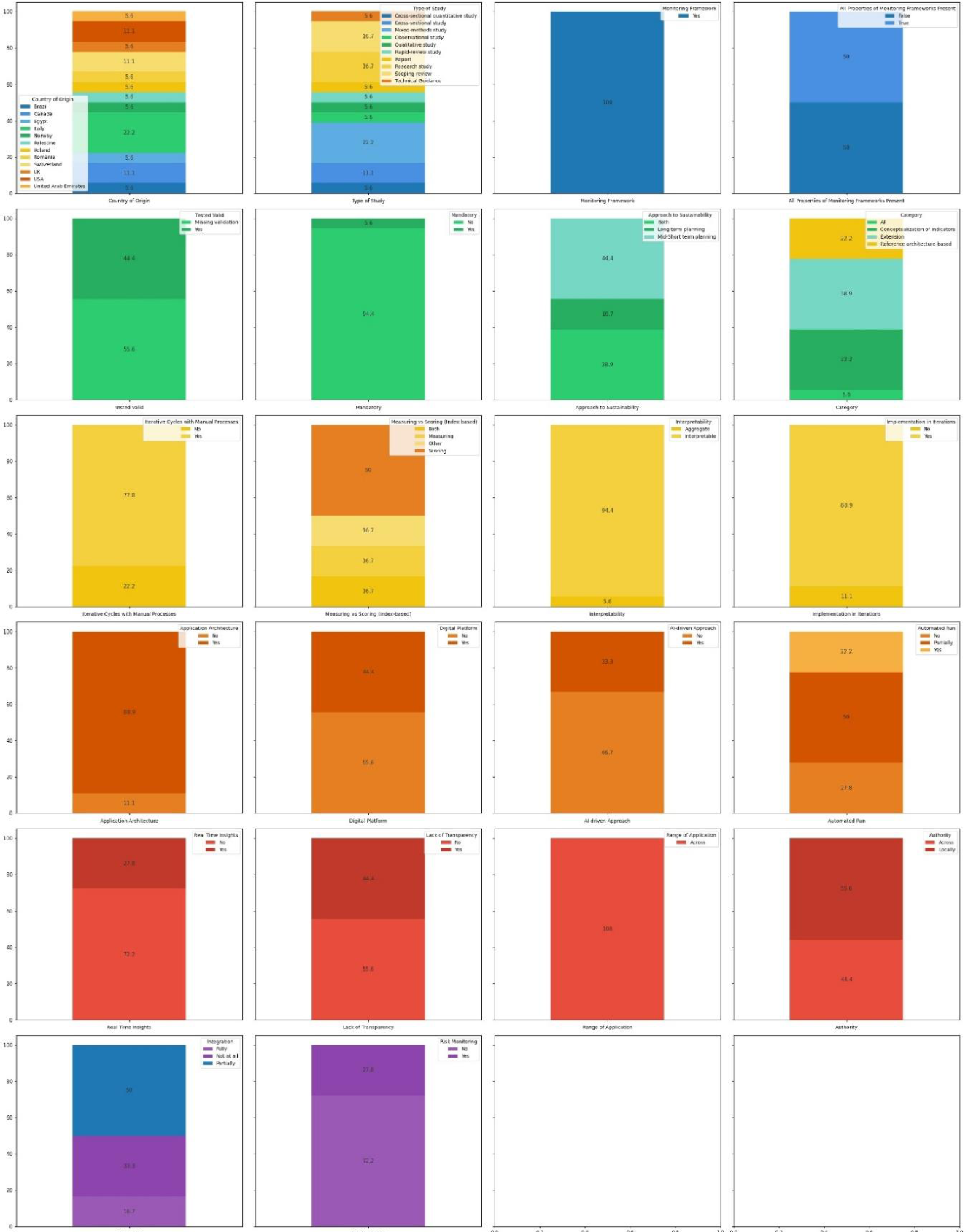

Table 1.
The Categorization Framework. The words in bold under the field ‘Description’ correspond to the possible values of the subcategories.
Table 1.
The Categorization Framework. The words in bold under the field ‘Description’ correspond to the possible values of the subcategories.
| Category | Sub-category | Description |
| Monitoring Framework Class | Monitoring Framework | (Yes/No) Is the framework a valid monitoring mechanism of healthcare organizations’ overall performance? |
| All Properties of Monitoring Frameworks Present | (FALSE/TRUE) Does the MFW fulfil the following criteria: 1) Are the constructs clearly defined, stated and reflect the overall performance? 2) Are reliable sources of data and techniques used in estimating the constructs? 3) has the model been validated, using a rigorous analytical method? |
|
| Tested Valid | (Missing validation/Yes/No/Other) Has the framework been tested for its validity and found valid? |
|
| Mandatory | (Yes/No) Is the use of the framework mandatory for complying with regulation? |
|
| Performance Targets | (Text/NA) Have specific performance targets been set by policy or by the organization, which the MFW needs to consistently track? |
|
| Constructs | (Text) Which are the constructs monitored by the MFW? |
|
| Sustainability | Clustered Constructs | (Resilience & Risk Management/Operational Efficiency & Service Performance/Quality, Safety & Clinical Performance/Organizational Capacity & Sustainability) How do the constructs monitored cluster? Do they cluster under specific areas directly linked to sustainability? |
| Approach to Sustainability | (Mid-short term/Long term/Both) Does the MFW track organizations’ long-term capacity to achieve their vision or does it rather track mid-short-term sustainability, or does it do both? |
|
| Monitoring Approach | Category | (Extension/Reference Architecture/Conceptualization of Indicators/All) In which broad category of monitoring approach does the MFW belong? Extension: extending an already established MFW Reference Architecture: technology-platform-based MFW, adapting to a specific business reference architecture Conceptualization of Indicators: MFW based on the Indices methodology All: combination of the three categories The “Monitoring Approach” category largely determines the categorization of the MFW, under the rest categories. |
| Non-Operational Function | Iterative Cycles with Manual Processes | (Yes/No) Does the MFW rely on the collection of data from surveys, interviews, stakeholder consultations or other manual procedures, for its design or operation or the contrary, its functions are streamlined? |
| Methodology | Technique | (Text) Brief description of the analytical methodology applied, for the estimation of the constructs? |
| Measuring vs Scoring (Index-based) | (Scoring/Measuring/Other) Does the methodology applied rely on measure-theory principles or on scoring methodology principles? Measures are scientific tools, providing reliable and interpretable estimates. Indicators/Scores are cheaper and easier to develop, less reliable, less interpretable and more costly to maintain. |
|
| Interpretability | (Aggregate/Interpretable/Other) Are the performance-construct estimates interpretable? Does the performance estimation provide insights on what helps or inhibits performance? Aggregation usually hides information and leads to less interpretable estimates, compared to other ways of combining information. |
|
| Implementation in Iterations | (Yes/No) Does the MFW methodology require the repetition of phases that were followed, during the development of the framework, for the framework to be reliable across time? Implementation in cycles is often required in MFWs, which rely on iterative consultations, and may lead to long implementation cycles and lack of synchronicity in monitoring. However, reviewing iterations in the maintenance phase are essential, in any case, for ensuring the validity of the monitoring approach. |
|
| Adoption of Technology | Application Architecture | (Yes/No) Is the MFW structured in an architecture that is directly linked to the business domain the framework will serve and does its architecture render it applicable on digital infrastructure? This subcategory tests, if the framework is organized, in clear functional modules that would enable its implementation on a digital platform. |
| Digital Platform | (Yes/No) Does the MFW operate over a digital platform? |
|
| AI-driven Approach | (Yes/No) Does the MFW demonstrate advanced features, through the usage of AI, ML or Analytics? It is interesting to know the penetration AI has in monitoring mechanisms, for development and maintenance cost estimation and for awareness of its broader capabilities. |
|
| Automated Run | (Yes/No/Partially) Can the MFW operate in an automated fashion, enhancing transparency and decreasing maintenance costs? |
|
| Real-time Insights | (Yes/No) Is the MFW capable of producing real-time insights on the constructs monitored and on the organization’s track of performance? |
|
| Transparency | Lack of Transparency | (Yes/No) Is the MFW’s development and operation transparent enough? |
| Scalability | Range of Application | (Locally/Across) Is the MFW applicable across healthcare centers in the same country, so that it can be deployed in multiple healthcare centers and the insights extracted from it can be shared across the centers? |
| Authority | (Locally/Across) Can the MFW be applied across country borders, in the sense that insights produced by it can be used across countries and healthcare systems? |
|
| Integration | (Fully/Partially/Not at all) Does the MFW integrate with other monitoring and governance frameworks that the healthcare center applies? |
|
| Risk | Risk Monitoring | (Yes/No) Does the MFW monitor the risk of missing targets? |
Table 2.
PRISMA and PRISMA-ScR Steps.
| Study | Phase | Systematic Review | Scoping Review |
| More Information | Suppl1 | Suppl2 | |
| Information Sources and Search Strategy | Data Sources | Scientific, peer-reviewed articles or reports retrieved from Google Scholars and Semantic Scholars. | Organization reports, annual fillings, organizational websites, field specialist reports, policy reports, retrieved from validated Generative (GenAI) model responses and AI Web Search results. Besides, hand-searched peer-reviewed articles and reports retrieved via web-searches. |
| Key Phrase | “framework for monitoring healthcare units’ or hospitals’ performance” [Suppl1] | ||
| Period of Publication/ Referenced Time Window | June 2021 - June 2026 | 2021 - 2026 | |
| Retrieval Date | 22nd June 2026 | July 2026 - September 2026 | |
|
Search Strategy |
Pre-planned, comprehensive search strategy to find all (up to 100 from each database) most relevant studies. | Iterative search, involving multiple interrogative rounds with GenAI and collection of the relevant information from its responses, for further validation, until full coverage of the topic was achieved. | |
|
Screening and Study Selection |
Screening Approach | The first 100 most relevant records to the search phrase from each database were retrieved. The records were filtered and deduplicated and ultimately 138 records of peer-reviewed articles or reports, in total, were screened and reviewed independently by a Specialist in Healthcare Informatics (HI) and a GenAI model, previously trained and validated on the reviewer’s - for this study -, role [Suppl1, e-Appendix1]. | The information collected was validated, screened and selected by a Specialist in HI and facilitated by GenAI, through multiple interrogative cycles of question-answering-validation of the answer. |
| Study Selection Criteria/Material Selection Criteria | The selected studies should propose a valid performance monitoring framework for healthcare centers, hence: i) the constructs monitored should be clearly stated and reflect the organization’s overall performance ii) it should use trustworthy data sources and reliable techniques of estimating constructs and iii) it should use rigorous methods of validation. | The aim of the study wasn’t to retrieve only the valid performance MFWs, but rather a good sample of the performance MFWs applied in practice. However, only valid, publicly accessible information, available in official organizational websites was considered for review. | |
|
Selected Studies/ Material |
In Suppl1 [7,8,9,10,11,12,13,14,15,16,17,18,19,20,21,22,23,24]. | In Suppl2 [2,3,4,7,8,9,10,11,12,13,14,15,16,17,18,19,20,21,22,23,24,25,26,27,28]. | |
| Access Rights-License | All accessed publications are freely available under open-access terms [Suppl1]. | Publicly available information accessible on the web. | |
| Software Used | 1. Python script for the deduplication of the articles/reports 2. Python script for the extraction of meta-data 3. Python script and Google Cloud Gemini-2.5-Pro for the training, validation and evaluation of the GenAI model used in the study. |
Microsoft Copilot, Google AI Web Search | |
| Critical Appraisal | Critical Appraisal | For ensuring that the empirical outcomes of the Systematic Review, driving the final synthesis, were valid and unbiased: i) the Systematic Review was developed and assessed using the PRISMA checklist ii) the use of a trained and validated GenAI model in the role of an independent reviewer, in addition to a human specialist, full-text-reading the publications in all phases of the review process, added objectivity and transparency in the study selection iii) the conflict-resolution stages, further refined the list of the selected studies and iv) the enforcement of clear and specific eligibility criteria further enhanced the list of the selected studies [Suppl1]. |
For ensuring that enough and valid scope was captured by the Scoping Review: i) the review was developed and assessed, using the PRISMA-ScR checklist, ii) only publicly accessible information from official organizational websites was considered and iii) responses from GenAI were always validated [Suppl2]. |
|
Data Extraction and Categorization |
Data Extracted/Meta-data | Suppl1 | Suppl2 |
| Categorization | For the characterization of the MFWs, using the categorization framework, the selected studies were full-text-read, independently by both the Specialist and the GenAI model [Suppl1] and conflicts were resolved, through interrogating the GenAI model and validating its responses. | The monitoring approaches of the selected healthcare centers for this study were characterized, using the same categorization framework as in phase 1. The process was performed by the Specialist, facilitated by interrogative cycles with GenAI, but the generative model of the previous phase wasn’t used in this setting. | |
|
Descriptive and Summary Statistics |
Descriptive and Summary Statistics | The distribution of the selected studies by category value was estimated and from the most frequent category values the characteristics of the prevalent monitoring approach were crafted (Figure 1). | 2 patterns of monitoring systems emerge, one for each type of organization |
| Synthesis Methods | Synthesis Methods | 1. Meta-aggregation - the characterization of the research MFWs was co-evaluated with the characterization of the practical monitoring approaches 2. Critical interpretative synthesis 3. Deductive and inductive derivation of themes/categories - for the categorization framework to reach its final form, iterative deductive and inductive derivations have been applied |
|
Table 3.
Monitoring approaches followed by healthcare centres in the US and their characterization.
| Meta-data | Organization | High performers | Low performers |
| Monitoring Framework Class | Monitoring Framework | Yes | Yes |
| All Properties of MFWs Present | Yes | Yes | |
| Tested Valid | Yes | Yes | |
| Mandatory | Yes | Yes | |
|
Performance Targets |
1. CMS Conditions of Participation (CoP) [46] 2. Regularly report on various value-based performance measures determined by CMS Value-Based Programs (e.g., VBP, HRRP, HACRP) [49,50,51,52,53,54] 3. Conforming/Surpassing national and academic benchmarks [55,56] 4. Internal performance targets connected to the organization’s strategy & vision [45] 5. Performance targets required by large accreditation organizations [47,48] 6. State-specific performance targets |
1. CMS Conditions of Participation (CoP) [46] 2. Regularly report on various value-based performance measures determined by CMS Value-Based Programs (e.g., VBP, HRRP, HACRP) [49,50,51,52,53,54]. 3. Internal performance targets connected to the organization’s strategy & vision [45] 4. Rural/emergency care standards (although subject under the same regulation, their targets are calibrated through statistically adjusted peer comparisons, achievement levels, and improvement rules to ensure equity [53,54]) 5. Targets required by accreditation organizations [Suppl2 - Ref. 25] 6. Targets set by Certificate of Need (CoN) rules [61,67] 7. State-specific performance targets |
|
| Constructs |
1. CoP constructs 2. Standards required by the accreditation organization 3. Performance of health plans 4. State-specific performance measures 5. Constructs tracked by internal quality systems |
1. CoP constructs 2. emergency/rural hospital standards 3. standards set by Certificate of Need (CoN) rules 4. State-specific measures 5. Standards required by accreditation organizations |
|
| Sustainability | Clustered Constructs |
1. Resilience & Risk Management 2. Operational Efficiency & Service Performance 3. Quality, Safety & Clinical Performance 4. Organizational Capacity & Sustainability |
1. Resilience & Risk Management (enforced only by some states [Suppl2- Ref. 28]) 2. Quality, Safety & Clinical Performance 3. Organizational Capacity & Sustainability |
| Approach to Sustainability | Both | Long term | |
| Monitoring Approach | Category |
1. Extension 2. Conceptualization of indicators 3. Reference Architecture |
1. Extension 2. Conceptualization of indicators |
| Non-Operational Function | Iterative Consultation | Yes | Yes |
| Methodology | Technique |
1. Balanced Scorecards [35] 2. CMS Methodologies [49-54, Suppl2-Ref. 23] 3. The Joint Commission/DNV methodology [47,48] 4. NCQA/HEDIS methodology 5. State-specific regulation and monitoring frameworks 6. International accreditation organizations (JC International, OECD etc) 7. Internal quality systems [56,57,58] |
1. Balanced Scorecards [35] 2. CMS Methodologies [49-54, Suppl2-Ref. 27] 3. The Joint Commission/DNV methodology [47,48] 4. State-specific regulation and monitoring frameworks 5. CoN rules - methodology [61,67] |
| Measuring vs Scoring (Index-based) | Both | Both | |
| Interpretability | Yes | Yes | |
| Implementation in Iterations | Yes | Yes | |
| Adoption of Technology | Application Architecture | Yes | Yes |
| Digital Platform | Yes | No | |
| AI-driven Approach | Yes | No | |
| Automated Run | No | No | |
| Real Time Insights | Yes | No | |
| Transparency | Lack of Transparency | No | No |
| Scalability | Range of Application | Across | Single |
| Authority | Across | Locally | |
| Integration | Partially | Partially | |
| Risk | Risk Monitoring | Yes | No [Suppl2-Ref. 28] |
Table 4.
Conceptual framework’s alignment with the Categorization and the 4Cs frameworks.
| Conceptual Framework | Categorization Framework | 4Cs Framework |
| Operational | A monitoring system being Operational describes the situation, where it can operate without being interrupted, delayed or altered in a way that impacts the monitoring process. Iterative Cycles of Consultation may impact the reliability and the transparency of the monitoring process. Manual procedures would best fit in the monitoring system’s initial design, recovery, testing, periodic reviews etc. The categorization framework assesses the MFWs reliance on manual procedures. |
The structured and non-intervened operation of the monitoring mechanism provides a more reliable and comprehensive view of where the organization stands, any time, improving Clarity. Enhanced clarity, predictability and trust on the monitoring mechanism’s insights, along with the use of decision analysis tools, can inform on the organization’s next steps (Craft). Employees’ productivity and engagement improve, when they use trustworthy and efficient operations and digital systems [70] (Consequences). Collaboration is better when parts of the processes are automated and informed by reliable and correct insights (Collaboration). |
| Reliable | The categorization framework evaluates the reliability of the MFWs, through the Tested-valid category - examining if the MFW’s validity has been tested rigorously, its estimation techniques, measure-theory-based approaches versus other methodologies, interpretability - as it contributes to reliability gradually - and its automated operation over a digital platform. | Reliability enhances, substantially, Clarity. It also increases predictability, which enables correct decision making, any time (Craft). Reliability gains trust, which acts, as an incentive for people to act (Consequences). Conflicts and friction due to lack of reliability on the information shared, reduce Collaboration. |
| Feasible and Practical | The MFWs’ implementation and operation, without incurring significant costs and investment to organizations, helps in its adoption and doesn’t impact organizations’ sustainability. Efficient use of Data Analytics and AI, over modular technological platforms and the reduction of manual procedures impacting the quality of the monitoring process, improve the feasibility and practicality of the overall mechanism. The categorization framework evaluates the MFWs against these properties. |
Feasible systems, using existing infrastructure and well understood technology, favor Clarity. Feasible and practical systems decrease cost barriers to organizations to implement the solutions they want (Craft). If the MFW improves the quality of the organization’s operation - hence it is practical - the adoption of the MFW and the engagement with the organization increase (Consequences). With an effective MFW in place, its reach and adoption may expand quickly across the wider ecosystem of the organization, improving Collaboration. |
| Scalable and Adaptable | A monitoring system is scalable, when its insights can be functional to other healthcare organizations in the same healthcare system (Range of Application) or cross-border (Authority) and/or to other sectors (Integration). AI applications and modular architectures exhibit scalability features. Mechanisms that use reliable estimation techniques, producing real-time insights and operating without heavily relying on manual procedures exhibit features of adaptation. All these properties are evaluated by the categorization framework. |
Acquiring visibility into other organizations’ operation in the interface of the HCS and sectors improves the organization’s Clarity. The capability to exchange functional insights with other organizations worldwide it may open a range of opportunities an organization to improve its performance against its mission (Craft, Collaboration and Consequences). |
| Invariant | In an Invariant monitoring system, the weighting of performance variables should not vary with parameters, such as gender, race, state or other parameters, because of bias, human error, untrustworthy techniques or illegitimate purposes. Although this property isn’t directly evaluated by the categorization framework of the study, as it required more granular data than the information provided in the grey literature and in the peer-reviewed publications, a MFW capable to operate across units (Range of Application) or across countries (Authority) or across sectors (Integration), is expected to be invariant, otherwise the shared insights wouldn’t make sense or be functional in the context of different countries/communities/sectors. Also, a reliable estimation technique is assumed to be free of sources of Invariance in monitoring, to provide reliable estimates, under various settings. |
Having insights that clearly reflect the dynamics that affect the organizations’ operation enhances Clarity. Built-in invariance in the insights the organization draws from the monitoring system, leads to Invariance and fairness in decisions, which enhances Collaboration, increases engagement (Consequences) and contributes, by design, into solving matters that often present challenges to organizations, which have not catered for addressing Invariance in the services they deliver, in their supply chain management etc. (Craft) |
|
Interpretable |
A monitoring framework that produces Interpretable estimates, allows for many benefits, included its transparency, reliable operation, increased adoption, increased likelihood of producing sharable insights and a set of many other features that can be deployed over an interpretable monitoring system. The categorization framework directly evaluates the interpretability of a MFW, and indirectly from the estimation techniques it uses and based on whether they are measure-based techniques. |
Interpretability in the insights, the organization collects from its monitoring mechanism, enhances Clarity. Interpretable insights can inform action and guide the organization on how to close its performances gap (Craft). Based on the interpretable insights, they can build more effective incentivization mechanisms (Consequences). Interpretable insights can be better understood and can be functional, under varying contexts, which enhances Collaboration. |
|
Transparent |
Transparency of the monitoring mechanism is essential for testing and ensuring its validity across the organization and the broader HCS. It doesn’t describe the transparency of the whole organization but contributes to the healthcare organization’s transparency. Transparency is directly evaluated by the categorization framework and estimated, indirectly, through other categories, such as Tested-Valid, Non-Operational Function, Technique and Implementation in Iterations. |
With a transparent monitoring mechanism, the organization has access to true and the required information, any time, improving Clarity. By knowing where the cause of problems and errors are, organizations are more equipped in acting (Craft). Only over transparent monitoring mechanisms, effective incentivization mechanisms can be built (Consequences). Transparency makes a performance issue visible and prevents it from getting bigger, which may impact Collaboration of the organization with its staff, its partners and other stakeholders. |
|
Risk |
The capability of the framework to track the risk of missing internal targets, allows for building features, capable to improve an organization’s resilience, care co-ordination and sustainability. The categorization framework directly evaluates MFWs against this capability and indirectly through its Approach to Sustainability. |
Estimating the risk of not achieving internal targets, increases the organization’s awareness of its current and future position, against its goals and vision (Clarity). Knowing early what it is not going to work, can inform future decisions and actions. If the MFW provides interpretable insights, it allows for even more granular guidance on actions that need to be taken (Craft). The capability of quantifying risk allows for meaningful and effective incentivization mechanism to operate over the MFW (Consequences). Sharing clearer, risk-informed action plans, the units will move with less friction, thus collaborating better (Collaboration). |
Disclaimer/Publisher’s Note: The statements, opinions and data contained in all publications are solely those of the individual author(s) and contributor(s) and not of MDPI and/or the editor(s). MDPI and/or the editor(s) disclaim responsibility for any injury to people or property resulting from any ideas, methods, instructions or products referred to in the content. |
© 2026 by the author. Licensee MDPI, Basel, Switzerland. This article is an open access article distributed under the terms and conditions of the Creative Commons Attribution (CC BY) license.
Copyright: This open access article is published under a Creative Commons CC BY 4.0 license, which permit the free download, distribution, and reuse, provided that the author and preprint are cited in any reuse.