

Submitted:
19 October 2026
Posted:
20 October 2026
You are already at the latest version
Abstract
Artificial intelligence (AI) and machine learning (ML) are revolutionizing composite manufacturing by enabling data-driven forecasts, process optimization, defect identification, and intelligent process control. The objective of this review is to discuss the recent innovations and emerging trends in the application of AI/ML in the major composite manufacturing technologies, such as automated fiber placement (AFP), automated tape laying (ATL), resin transfer molding (RTM), resin infusion, compression molding, pultrusion, additive manufacturing, and non-destructive evaluation (NDE). This paper discusses the capabilities and limitations of advanced technologies, including deep learning, physics-informed machine learning, transfer learning, multimodal learning, explainable AI, digital twin, surrogate modeling, and closed-loop control, and their future potential. A comprehensive literature survey explored the latest developments in composite manufacturing using AI/ML. The review categorized the research by manufacturing process, AI/ML approach, sensor and inspection modality, prediction and/or optimization objective, and reported performance. The review thoroughly addressed applications in process monitoring, defect prediction, quality evaluation, surrogate modeling, intelligent inspection, and adaptive process control. The review also surveyed data scarcity, domain shift, model interpretability, multimodal sensing, and the incorporation of physical process knowledge. The literature study reveals a substantial potential for AI/ML in prediction, inspection, process optimization, and manufacturing decision-making. Reported applications include RTM filling-pattern prediction, automated thermographic and ultrasonic flaw identification, process-properties prediction, and composite additive-manufacturing inspection. For example, a PixelRNN surrogate model predicted RTM filling patterns with up to 97.35% accuracy, at roughly half the computational cost of exhaustive simulation. In ultrasonic composite inspection, ML-based thermographic impact-damage detection reached 98.8% classification accuracy, while DenseNet121 and VGG19 reached 98.6%. Integrating deep learning and infrared thermography in fiber-reinforced composite additive manufacturing achieved a mean average precision of 99.3%. Under the reported experimental conditions, the defect-area error was within 6%. These results are promising, but differences in datasets, sensors, fault types, validation procedures, and performance measures make direct comparisons difficult. Major challenges for industrial adoption include small, proprietary datasets; non-standard data formats; domain shift between materials and machines; sensor variability; limited model interpretability; the simulation-to-reality gap; cybersecurity and intellectual property constraints; and a lack of closed-loop validation. The assessment noted that purely data-driven methods may not transfer easily when processing conditions and/or the material system change. Thus, a promising approach to build more reliable and transferable Intelligent manufacturing systems is to use hybrid methods that combine artificial intelligence/machine learning with physical knowledge, multimodal sensing, digital twins, uncertainty quantification, and human expertise. In composite manufacturing, AI/ML is becoming an important enabling technology for next-generation approaches such as automated inspection, fault categorization, surrogate modeling, production-process prediction, and parameter optimization. Future work should move beyond laboratory-level prediction accuracy toward validated manufacturing applications with standard datasets, third-party validation, machine validation, physics-informed and multimodal learning, digital-twin integration, and measurable manufacturing-level performance indicators. Coupling AI/ML with physical process models, intelligent sensing, and human-in-the-loop decision-making can enable even more autonomous, high-quality, low-waste, adaptable, and intelligent composite manufacturing systems.
Keywords:
AI
; ML
; composite
; AFP
; RTM
; digital twin
; NDT
1. Introduction
Composite industries offer high strength, high stiffness, corrosion resistance, design flexibility, bespoke fiber architecture, and applications in aerospace, automotive, wind energy, hydrogen energy storage, marine, infrastructure, and high-performance sports 1–3. However, this personalization also creates production control challenges that depend on the enabling process’s sensitivity 4–6. Defects can include voids, dry patches, wrinkles, tow gaps, overlaps, porosity, delamination, fiber waviness, and dimensional deviations, and can result from variations in fiber placement, resin viscosity, permeability, temperature, pressure, consolidation, cure kinetics, and environmental conditions 4,7–9. Quantitative data from fiber-reinforced thermoplastic extrusion production indicate that, in some cases, there may be a porosity of up to 10-15%, and manufacturing errors may affect tensile strength by up to 30% and fatigue life by up to 20% 10. Automated manufacturing is increasing, adding more heterogeneous process data from AFP, ATL, RTM, resin infusion, and NDE systems. They include machine-state, thermal, force, vision, geometry, pressure, flow-front, cure, ultrasonic, thermographic, radiographic, and optical measures 11–13. Conventional empirical models and high-fidelity simulations remain important tools for process knowledge and prediction, but complex multiscale and transient behavior can challenge modeling of automated fiber installation. AI/ML offers complementary data-driven approaches to identify non-linear relationships between process parameters, sensor measurements, manufacturing defects, and final material attributes 14,15. Predictive modeling has also been applied to optimize machining performance during the drilling of graphene oxide/carbon fiber-reinforced polymer nanocomposites 16. Recently, several studies have explored AI/ML applications for composite defect detection, mechanical property prediction, manufacturing process optimization, microstructure analysis, and material design 17,18. The 2024 review, ML Applications in the Inspection of Composite Defects, reviews ML techniques for defect identification and prediction, including supervised learning, deep learning, and other data-driven approaches. Quantitative results for manufacturing fiber-reinforced thermoplastic materials further show that, as reported in the surveyed literature, ML defect-detection performance may improve by about 25–30% in several experimental situations 10. Figure 1 presents the integrated framework for intelligent composite manufacturing. It is an AI/ML-based system linking material architecture, process parameters, sensor/NDE data, forecasting, and manufacturing decisions. The framework begins with selecting the composite material and fiber architecture, then tracks and controls key process parameters, including temperature, speed, feed, pressure, and processing time. The AI/ML models use process and quality data from the sensor and NDE systems to predict problems, assess quality, and optimize operations. The model outputs support manufacturing decisions, such as selecting optimal parameters, ensuring quality, and improving process control. A feedback loop enables ongoing parameter adjustments and defect mitigation as forecast outcomes are fed back into the production process, supporting adaptive control, improved product quality, and more dependable composite manufacturing 10,12. However, the results are transferable only to a certain degree, depending on the material system, sensor type, data volume, defect type, and validation technique. Therefore, this review focuses on AI/ML applications in composite production and highlights the links between process monitoring, defect prediction, process optimization, and intelligent process control. The following four questions were examined: (i) What are the contributions of AI/ML approaches in manufacturing? (ii) Which algorithms and sensing modalities are most suitable for particular composite production processes? (iii) What are some of the issues that hinder the transition from lab demonstration to a robust manufacturing system? (iv) What are some new research directions that will shape smart manufacturing composites?
This review highlights recent advances and trends in applying AI/ML to composites manufacturing. Section 1 presents an overview of the background, importance, and challenges of composite manufacturing and the role of AI/ML in process monitoring, defect prediction, and intelligent process control. Section 2 describes the AI/ML environment for composite manufacturing, including supervised learning, deep learning, reinforcement learning, physics-informed machine learning, and digital twin technologies. Section 3 describes AI/ML applications in major composite manufacturing processes, including AFP, ATL, RTM, resin infusion, compression molding, pultrusion, and additive manufacturing (AM) of fiber-reinforced composites. Section 4 reviews intelligent inspection and flaw identification using machine vision, infrared thermography, ultrasonic testing, and other non-destructive evaluation methods. Section 5 discusses emerging AI trends, including physics-informed AI, transfer learning, multimodal learning, explainable AI, federated learning, digital twins, surrogate models, and closed-loop control. Section 6 highlights problems and research gaps in data availability, domain shift, model interpretability, sensor integration, validation, and industrial implementation. Finally, the paper describes major findings and recommendations for dependable, sustainable, and intelligent composite manufacturing systems and suggests future research topics.
2. AI/ML Landscape in Composite Manufacturing
AI in manufacturing can be seen as having several levels of intelligence. The descriptive level classifies or visualizes process states using algorithms. Predictive systems forecast future process states, such as defect probability, the resin-flow front, void fraction, and temperature history. In prescriptive systems, the process parameters are recommended, and in closed-loop systems, the process parameters are communicated to the equipment, and the recommendation is updated continually. Separating predictive and validated process-control actions matters because many published composite studies remain at the predictive level, although industrial value increases when predictions are linked to verified process-control activities. The main families of ML are conventional supervised learning, deep learning, unsupervised learning, reinforcement learning, and hybrid physics-data techniques. If data are limited and the input-output relationship is clear, supervised regression models such as random forests, gradient boosting, support vector regression (SVR), Gaussian processes, or multilayer perceptrons are attractive. Recurrent networks and transformers can exploit temporal sensor sequences, whereas convolutional networks are particularly well-suited to images and spatial maps. Unsupervised approaches can be useful for ultrasonic or thermographic measurements where labeled defect information is minimal. Reinforcement learning has become an increasingly appropriate approach to adaptive control, where the process behavior is learned from a reward function. One major shift is from isolated models to integrated digital workflows. Recently, researchers developed a PixelRNN metamodel to predict RTM filling patterns, achieving up to 97.35% prediction accuracy while reducing computation compared to exhaustive physics-based simulations 19. After training, these surrogate models can quickly evaluate thousands of parameter combinations, making this viable. The next stage is to insert the surrogate into a digital twin that continuously exchanges data with the actual machine and the virtual process model 20. Physics-informed ML is especially crucial for composites, since purely data-driven models may extrapolate poorly when composite material batches, shapes, sensors, or processing methods change 20,21. Recent manufacturing studies show that physics-informed models can improve data efficiency and physical consistency by embedding governing relations or constraints within learning systems 21. These constraints for composite production can include relations governing heat transfer, resin flow, cure kinetics, fiber placement geometry, conservation laws, or relationships between process parameters and defect generation, as described in the literature 21.
The association between AI/ML approaches, process data, physics-informed models, and intelligent control in composite production is shown in Figure 2. The framework progresses from descriptive intelligence (manufacturing condition identification and visualization) to predictive intelligence (defect prediction and process behavior), prescriptive intelligence (optimal process parameter recommendation), and closed-loop control (continuous process adjustment). AFP/ATL, RTM, infusion, autoclave curing, and NDE systems provide diverse data for AI/ML technologies, including supervised learning, deep learning, unsupervised learning, reinforcement learning, and hybrid physics–data models 19,21. These data support feature engineering, model construction and surrogate modeling, defect prediction, process optimization, and quality assessment. Physics-informed ML and digital twins also allow the addition of controlling principles such as heat transfer, resin flow, cure kinetics, and fiber-placement geometry, leading to more realistic and valid models and better process understanding 20,22. Table 1 presents a typical role of AI/ML in composite manufacturing.
3. AI/ML Applications Across Composite Manufacturing Processes
3.1. AFP and ATL
AFP and ATL are among the most strategically important processes because of their many process variables and the high-value composite structures they produce. Steering, gaps, overlaps, tow waviness and wrinkles, insufficient consolidation, heat variations, and machine tolerances can all create faults. The AFP manufacturing review shows that key manufacturing parameters such as consolidation force, lay-up speed, temperature, and steering-control flaws affect part quality, and it emphasizes the importance of in-situ monitoring and ML-based prediction 13,37. Computer vision may be particularly useful for visually detectable gaps and overlaps. ML inspection can provide learned representations for categorizing defect classes under different lighting, geometry, and texture conditions, rather than relying on hard-coded lighting, geometry, and texture criteria. The thermal sensor also provides supplemental information, as the thermal state of the input tape and substrate affects heating and consolidation conditions 38. In recent years, research has increasingly focused on multimodal surrogate ML for automated composite manufacturing, including reinforcement-learning-based thermal control, ML-driven laser process control, process-structure-property modeling, point-cloud defect identification, and physics-informed digital twins 12. The long-term goal is a closed-loop AFP cell. Here, a vision system identifies a gap or overlap, a thermal model correlates this gap/overlap with local process parameters, and a controller adjusts lay-up speed, compaction, heating power, or path strategy. The key challenges are not the ML algorithm itself but its seamless integration with machine control and its consistent performance across new geometries and material batches.
3.2. RTM, Resin Infusion, and Liquid Composite Molding
RTM and infusion are greatly influenced by the resin flow, permeability, viscosity, temperature, pressure, and cure kinetics. Traditional simulation can be time-consuming when considering many combinations of gate positions, injection conditions, tool shape, and material parameters 39. ML surrogate models can approximate the mapping from process inputs to filling patterns, pressure histories, and/or defect probability 40. The 2024 PixelRNN investigation exemplifies this, using image-based ML to simulate mold filling. The recorded prediction accuracy reached 97.35% using 50% of the available training data and at nearly half the cost of comprehensive simulations 19. This means ML can serve as a tool for rapid exploration of the design space, rather than replacing physics-based simulation. Hybrid workflows are extremely tempting: a smaller set of high-fidelity simulations/experiments provides training data, and the surrogate model then expedites optimization. AI can also be used in resin infusion to track the flow front with cameras or dielectric/pressure sensors, detect infilling abnormalities, and assess the likelihood of dry areas. A potential opportunity is multimodal learning, where flow-front images, pressure, temperature, resin viscosity, and permeability estimates are combined into a single model. Such models could convert the infusion from an open-loop monitoring system to an adaptive infusion control system 41,42.
3.3. Compression Molding and Thermoplastic Composite Processing
Compression molding is a manufacturing method that involves substantial interactions between temperature, pressure, fiber content, material viscosity, consolidation time, cooling rate, and tooling 43–45. In recent years, research has focused on optimizing the process through pressure, temperature, clamp tonnage, cooling rate, automation, and AI-based optimization to ensure process control and part quality 46. ML can anticipate thickness, void content, warpage, mechanical performance, and cycle time, and optimize multiple targets simultaneously 47,48. Thermoplastic composites with heating and cooling histories provide further opportunities. From these data-driven models, we can correlate thermal histories with end-of-process parameters and establish processing windows. The model, however, should account for batch-to-batch fluctuations and the machine’s thermal behavior. Consistent datasets that record material grade, fiber architecture, temperature history, pressure, cooling rate, and measured quality indicators considerably improve transferability 43.
3.4. Pultrusion and Continuous Composite Manufacturing
Pultrusion is a continuous process where fiber reinforcement is impregnated, molded, and cured through a die as it is pulled 49,50. Process stability depends on pulling speed, resin temperature, die temperature, resin viscosity, fiber volume fraction, tension, and cure state 51,52. In continuous processes, sensors can capture long time-series data, and the manufacturing objective of maintaining process state makes this well suited to AI/ML 11. These can be utilized to forecast dimensional variation, cure quality, pull force, surface flaws, and mechanical performance 53. Anomaly-detection algorithms can alert operators to unanticipated departures from normal process operation before lengths begin to fail. Longitudinal validation studies are in high demand because models must be evaluated across large production runs and multiple raw-material batches, not just on randomly split laboratory data sets 11.
3.5. Additive Manufacturing of Fiber-Reinforced Composites
In the developing field of composite additive manufacturing (CAM), AI can help address the process-structure-property uncertainty challenges associated with reinforcement orientation, interlayer bonding, voids, residual stress, thermal history, and process-induced anisotropy. A 2026 evaluation of CAM identifies nonuniform reinforcement dispersion and orientation drift, inadequate interlayer bonding, voids, residual stress, and property scatter as key industrial constraints. It also highlights transfer learning, domain adaptability, and self-supervised learning as potential avenues for addressing data scarcity 54. AI can help in optimizing deposition parameters, bead geometry, raster orientation, temperature conditions, and tool path planning. It can also incorporate infrared imaging, machine vision, acoustic signals, and dimensional measurement to detect printing problems. In 2026, deep learning was combined with infrared thermography to quantify faults in additively built carbon-fiber composites, achieving mAP values of 99.3% for instance segmentation and image classification, with defect-area error within 6% of experimental settings. These results are encouraging, but they do not support a general conclusion about industrial accuracy, as lab data, controlled flaws, and constrained geometries can yield optimistic results 55–57.
Figure 3 shows the performance of multiple composite manufacturing and AI/ML-based inspection approaches, such as RTM, CFRP NDE, DenseNet121, VGG19, and CAM IR. The results indicate that the methods perform very close to 100%, with CFRP NDE near 100%, DenseNet121 at 99%, and CAM IR at 98.5%. The RTM value is lower, at about 97%, compared with the others 58–60. The error bars show the range of reported measurements and indicate variations in the performance of the methodologies studied. The results suggest that deep learning models and infrared inspection can assess composite manufacturing quality. However, the percentages reported may not be directly comparable, as each study uses specific datasets, evaluation criteria, experimental settings, and validation techniques.
4. Intelligent Inspection and Defect Detection
One of the most sophisticated uses of AI in composite engineering is defect detection, because NDE produces image-like or signal-rich datasets. Common faults include voids, delamination, debonding, inclusions, fiber waviness, gaps, overlaps, porosity, impact damage, and lack of consolidation. Manual interpretation is important and time-consuming but also vulnerable to operator variation; traditional inspection cannot be replaced 13,61,62. Data classification and segmentation, as well as AI-based anomaly and defect quantification. Researchers developed a new method integrating thermography with deep learning to detect composite faults 17,63. Bang et al. 64 proposed a strategy that includes a deep-learning framework based on thermographic images. They tested their method on composite specimens fabricated by RTM and thermoplastic injection molding. Recently, researchers tested nine ML models based on flash-pulse thermography for automated CFRP impact-damage detection, with the bagged-tree model reporting 99.8% balanced accuracy when using the recommended preprocessing on the examined dataset. The results show that classical ML approaches without feature engineering and deep neural networks may be important 65. Table 2 presents an AI/ML tool for detecting common defects and its deployments.
A 2024 study demonstrated the capacity of unsupervised ML to help detect issues in automated ultrasonic inspection of CFRP, addressing the problem of large automated scans that are difficult to interpret manually. Transfer learning has also been studied using multimodal ultrasonic images: a 2024 study reported DenseNet121 and VGG19 achieving accuracies of 98.8% and 98.6% on two datasets, respectively 66. A trained model may not generalize well to a different scanner, frequency, fault geometry, or laminate design. Thus, future NDE work should focus on cross-machine validation, out-of-distribution testing, uncertainty estimation, and calibration, rather than accuracy on a single random train/test split 67,68. Explainability is also vital, as it provides documentation for inspectors and the certification authority that an algorithm responds to physically meaningful fault signatures 69,70.
5. Digital Twins, Surrogate Models, and Closed-Loop Control
AI and digital twins go beyond prediction toward intelligent industrial systems. A digital twin is a digital copy of a physical object or process that is automatically updated with data from the original. ML can speed up the twin by employing surrogate models to predict unmeasured states, detect deviations, and forecast future quality. Key factors in intelligent manufacturing in contemporary industrial digital-twin studies include position sensing, modeling and prediction, and decision-making 84. The twin could encompass the entire composite manufacturing process, including material characterization, lay-up or mold filling, curing, machining, NDE, and structural performance 85,86. AI can be trained to distinguish between simulated and real process performance 87. The resin flow may be predicted by a physics model, and the systematic deviation can be learned by an ML model from permeability uncertainty 88,89. Similarly, IR-observed data can tune an AFP thermal model (Liang et al., 2026; Lu et al., 2023). Next, we consider closed-loop control. The system does not anticipate a defect; it adjusts a process variable to prevent one 92. This demands very fast inference, strong uncertainty modeling, machine interfaces, safe operating envelopes, and explicit fallback procedures 93. Reinforcement learning can eventually optimize sequential activities; first, simulate and learn actions under constraints, then confirm them with humans on expensive composite equipment 94.
6. Emerging AI Trends
6.1. Physics-Informed and Hybrid AI
Most composite manufacturing involves multiphysics phenomena, and physics-informed ML is predicted to be a major approach. ML models approximate expensive submodels or unknown constitutive behavior and preserve physical relationships in hybrid models. A new cross-sector study of manufacturing identifies data scarcity, physical inaccuracy, and interpretability as key issues for purely data-driven techniques, and shows that PIML provides a way to create more data-efficient and physically realistic models 21.
6.2. Transfer Learning, Self-Supervised Learning, and Domain Adaptation
Transfer learning is of special interest, since the knowledge to build a composite may be hard to come by, even if only in name. Pretrained image models can be adapted to thermographic or ultrasonic data, and self-supervised learning can leverage the large volume of unlabeled sensor data. The CAM review (2026) indicates that transfer learning, domain adaptation, and self-supervised learning address data paucity and that, because the source and target processes are physically distinct, negative transfer can occur 54.
6.3. Multimodal and Foundation-Style Models
Data in composite manufacturing are multimodal. The same manufacturing event can be described by an image, a thermal map, an auditory signal, a machine status, a process parameter, a simulation output, and a material certificate. Compared to single-sensor models, multimodal models can learn associations not visible to a single sensor. The current research approach is not just a larger CNN but a model that can also reason across heterogeneous input streams and link them to process and quality outcomes 95.
6.4. Explainable AI and Trustworthy Manufacturing
Explainability is vital for safety and essential for composite manufacturing. Recent manufacturing evaluations cite model-agnostic methods as an emerging approach to handling black-box behavior, which can hinder confidence, safety, and acceptance in manufacturing 96–98. In composites, explanations must be linked to engineering parameters, including temperature excursions, compaction force, fiber angle, flow-front behavior, and defect shape. A model that provides a forecast and the dominant physical/process characteristics supporting the prediction is more valuable for engineering decision-making 96,99,100.
6.5. Federated Learning and Cross-Factory Knowledge
Sometimes, manufacturers don’t provide raw production data because of intellectual property, contractual, or cybersecurity reasons. Federated learning trains models on multiple datasets owned by different businesses without sharing data locally. Federated learning is proposed as a solution for smart manufacturing and product lifecycle management in 2025, especially when data is distributed and not available for centralized learning. Federated learning could enable composite manufacturers to build models to detect problems or optimize operations without revealing proprietary process knowledge to other manufacturers 101–103.
7. Challenges and Research Gaps
AI/ML has made significant progress but remains in the middle stage of industrial maturity in composite manufacturing 12,17,54. Algorithm availability matters less than evidence quality 104. Constructing a dataset is difficult because these manufacturing datasets are small, proprietary, inconsistently formatted, and generated under narrow conditions. The data distribution can depend on material batch, fiber architecture, resin chemistry, machine settings, sensor calibration, environment, and geometry. The second problem is interpolation and extrapolation. A model can achieve good accuracy on training and testing data within the same experiment, but poor accuracy on a fresh machine or material batch. Robust research should report external validation, leave-one-batch-out validation, leave-one-machine-out validation, uncertainty intervals, and out-of-distribution testing. Third, much research focuses on improving forecast accuracy without measuring its effects on production. A 1% increase in classification accuracy does not justify adding a second or an expensive sensor 105. Further work is needed to relate ML metrics to manufacturing KPIs such as scrap rate, cycle time, energy usage, material use, rework, dimensional tolerance, certified structural quality, etc. Fourth, certification and responsibility remain unresolved. Aerospace and other safety-sensitive applications require traceable proof, validation, and regulated alterations. AI models should therefore be understood as part of a quality assurance system and not as an effective and independent authority. Human-in-the-loop architectures, version control, uncertainty estimation, audit trails, and predefined acceptability thresholds will matter.
AI-enabled composite production can contribute to sustainability by reducing scrap, rework, energy use, material overuse, and wasteful inspection. Predictive models can detect unstable process conditions before defective parts are produced, and optimization algorithms can minimize cycle time or energy consumption while maintaining the required quality level. Recent assessments on AI and sustainable manufacturing have identified optimization, resilience, real-time monitoring, anomaly detection, and predictive maintenance as significant prospects within Industry 5.0 106,107. Large models, high-performance processors, and sensors might increase energy and hardware requirements. So, the right move now is to optimize across the lifecycle: compare the AI system’s energy and material costs with the costs of preventing scrap, rework, inspection, and process inefficiency. This is especially true in composite production, where raw materials and processing costs are often considerable, and recycling is not trivial. Industry 5.0 also emphasizes human-centric production. Operators and engineers in composite production have implicit knowledge about material handling, process abnormalities, tooling, and quality. Knowledge should be augmented by AI, not replaced. Human-in-the-loop systems can combine model recommendations with human expertise, and subsequent decisions can continue to contribute labeled data for ongoing learning 107,108. Table 3 represents the research gap and the recommended direction.
8. Conclusions and Recommendations
AI and ML are emerging as crucial enabling technologies for the next generation of composite manufacturing. The best state of the art is in automated inspection, defect classification, process surrogate modeling, and parameter optimization. Efforts also exist in AFP/ATL, RTM, compression molding, CAM, and intelligent NDE. The most compelling results suggest that standard AI can reduce computation time, automate analysis of vast sensor data, and enable fast exploration of process windows. However, the field should not confuse high lab prediction accuracy with industrial readiness. Data scarcity, domain shift, sensor variability, explainability, cybersecurity, certification, and closed-loop validation remain important challenges. The most promising option is a hybrid paradigm that combines AI and physical models, digital twins, multimodal sensing, and human expertise. These can improve data efficiency, enhance physical credibility, and enable real-time decision-making. Over the next 10 years, optimizing a few parameters is expected to become more self-monitoring, adaptive, and autonomous in composite manufacturing. The fundamental research challenge is therefore to build reliable AI systems that understand the process, not just correlate the data. With benchmark datasets, rigorous validation methods, physics-informed models, and manufacturing-level KPIs, AI/ML can provide a feasible foundation for generating higher-quality, lower-waste, and more responsive composites 12,17.
Table 4 summarizes the quantitative performance of AI/ML applications used for composite production (process modeling, non-destructive evaluation (NDE), and additive manufacturing). The results show that data-driven methodologies can improve analysis and characterization of manufacturing problems. The PixelRNN surrogate model achieved a maximum accuracy of 97.35% when trained on 50% of the training data, and it took about half the computation time of exhaustive simulations for resin transfer molding (RTM) 19. The machine learning model obtained the best performance among the models for thermographic impact-damage detection, with balanced accuracies of 99.8% for the machine learning model, 98.8% for DenseNet121, and 98.6% for VGG19, respectively 65,66. The deep learning and infrared thermography methods of the authors give a mean average precision (mAP) of 99.3% and an error in defect area within 6% under the experimental circumstances in composite additive manufacturing 55. These quantitative results demonstrate AI/ML’s potential to support surrogate modeling, defect detection, and process-quality assessment across a broad spectrum of composite manufacturing methods. However, comparisons based on reported performance values are limited because datasets, sensor types, defect types, and performance indicators differ. Future research needs to be directed toward generating consistent datasets, machine-to-machine validation, physics-informed learning, and metrics for performance at the manufacturing level, such as defect reduction, computational efficiency, cycle time, and energy consumption, to validate the industrial reliability and value of the AI/ML assisted composite manufacturing systems.
Future research should move from proof of concept to validated manufacturing environments. First, gather standardized datasets that include all metadata, such as material batch, fiber architecture and architecture parameters, sensor configuration, geometry, machine type, and quality outcomes. Second, validate models using external validation rather than only random train/test splits. Third, develop physics-informed and multimodal models to improve transferability. Fourth, include AI in digital twins and restricted control systems, and demonstrate measurable savings in defects, cycle time, energy, and/or prices. The medium-term objective is to construct a manufacturing cell that can sense process conditions, anticipate quality, determine the underlying cause of any deviation, and recommend and/or implement corrective action. Longer-term systems could involve generative design and autonomous process planning, foundation-style multimodal models, federated learning, and ongoing digital-twin updates. Work has already begun on a unified approach to customizable CFCs, in which AI explores combinations of architecture and process that are difficult to evaluate by hand.
Funding
Not applicable.
Acknowledgments
The authors thank the Aerspace Consultancy Private Limited for providing testing facilities for this work.
Conflicts of Interest
The authors have declared no potential conflicts of interest.
Data availability
All data generated and analyzed during the study are included in this manuscript.
Consent for publication
Not applicable.
References
- Edah, G. O.; Atiba, J. O.; Fayomi, O. S. I. Advancements in Fibre-Reinforced Polymers: Properties, Applications (A Mini Review). Next Mater. 2025, 8, 100743. [Google Scholar] [CrossRef]
- Wani, I. N.; Aggarwal, K.; Bishnoi, S.; Shukla, P. K.; Harursampath, D.; Garg, A. Materials Used in Space Shuttle: Evolution, Challenges, and Future Prospects— An Overview. Compos. B Eng. 2025, 303, 112540. [Google Scholar] [CrossRef]
- Tonannavar, S.; Das, S. K.; Kumar, J.; Garg, A. Comparative Assessment and Review of Hydrogen Storage Technologies: Materials, System Architectures, Performance Metrics, Challenges, Economics Analysis and Safety Considerations. ChemRxiv 2026, 2026(0602). [Google Scholar] [CrossRef] [PubMed]
- Mesogitis, T. S.; Skordos, A. A.; Long, A. C. Uncertainty in the Manufacturing of Fibrous Thermosetting Composites: A Review. Compos. Part A Appl. Sci. Manuf. 2014, 57, 67–75. [Google Scholar] [CrossRef]
- Taddei, F.; Struzziero, G.; Michaud, V. Mitigation of Infusion and Cure-Induced Defects for Thick Thermosetting Composites: Current Challenges and Future Trends. Polym. Compos. 2025, 46(S1), S9–S25. [Google Scholar] [CrossRef]
- Kumar, J.; Singh, D. K.; Verma, R. K.; Mondal, A. K.; Yadav, R. K.; Garg, A. Development and Physiomechanical Performance Evaluation of Graphene/Carbon Fiber-Reinforced Polymer Nanocomposites for Structural Applications. Proceedings of the Institution of Mechanical Engineers, Part E: Journal of Process Mechanical Engineering 2026, 09544089261470695. [Google Scholar] [CrossRef]
- Mehdikhani, Mahoor; Gorbatikh, Larissa; Verpoest, Ignaas; Lomov, S. V. Voids in Fiber-Reinforced Polymer Composites: A Review on Their Formation, Characteristics, and Effects on Mechanical Performance. J. Compos. Mater. 2019, 53(12), 1579–1669. [Google Scholar] [CrossRef]
- Alves, M. P.; Cimini Junior, C. A.; Ha, S. K. Fiber Waviness and Its Effect on the Mechanical Performance of Fiber Reinforced Polymer Composites: An Enhanced Review. Compos. Part A Appl. Sci. Manuf. 2021, 149, 106526. [Google Scholar] [CrossRef]
- Tonannavar, S.; Garg, A. Structural Mechanics, Aeroacoustics and Aerodynamics of EVTOL Aircraft: Review of Green Aviation Challenges and Design Solutions for Urban Air Mobility. ChemRxiv 2026, 2026(0729). [Google Scholar] [CrossRef] [PubMed]
- Ashebir, D. A.; Hendlmeier, A.; Dunn, M.; Arablouei, R.; Lomov, S. V.; Di Pietro, A.; Nikzad, M. Detecting Multi-Scale Defects in Material Extrusion Additive Manufacturing of Fiber-Reinforced Thermoplastic Composites: A Review of Challenges and Advanced Non-Destructive Testing Techniques. Polymers 2024, 16(21). [Google Scholar] [CrossRef] [PubMed]
- Malashin, I.; Martysyuk, D.; Tynchenko, V.; Gantimurov, A.; Nelyub, V.; Borodulin, A. Data-Driven Optimization of Discontinuous and Continuous Fiber Composite Processes Using Machine Learning: A Review. Polymers 2025, 17(18). [Google Scholar] [CrossRef] [PubMed]
- Malashin, I. P.; Martysyuk, D.; Nelyub, V.; Borodulin, A.; Gantimurov, A.; Tynchenko, V. A Review of Multimodal Surrogate Machine Learning Models for Real-Time Control and Defect Mitigation in Automated Composite Manufacturing. Discov. Appl. Sci. 2026, 8(4), 421. [Google Scholar] [CrossRef]
- Oromiehie, E.; Prusty, B. G.; Compston, P.; Rajan, G. Automated Fibre Placement Based Composite Structures: Review on the Defects, Impacts and Inspections Techniques. Compos. Struct. 2019, 224, 110987. [Google Scholar] [CrossRef]
- Brasington, A.; Francis, B.; Godbold, M.; Harik, R. A Review and Framework for Modeling Methodologies to Advance Automated Fiber Placement. Compos. Part C Open Access 2023, 10, 100347. [Google Scholar] [CrossRef]
- Mishra, Y. K.; Garg, A.; Soni, R. C.; Kumar, J. An Artificial Intelligence Approach for Prediction of Hole Taper in Nd: YAG Laser Drilling on Thermoplastic Material Reinforced by Glass Fiber. ChemRxiv 2026, 2026(0220). [Google Scholar] [CrossRef] [PubMed]
- Kumar, J.; Verma, R. K.; Mondal, A. K. Predictive Modeling and Machining Performance Optimization during Drilling of Polymer Nanocomposites Reinforced by Graphene Oxide/Carbon Fiber. Arch. Mech. Eng. 2020, 67(2), 229–258. [Google Scholar] [CrossRef]
- Daghigh, V.; Daghigh, H.; Lacy, T. E.; Naraghi, M. Review of Machine Learning Applications for Defect Detection in Composite Materials. Mach. Learn. With Appl. 2024, 18, 100600. [Google Scholar] [CrossRef]
- Kesarwani, S.; Pratap, P.; Kumar, J.; Verma, R. K.; Singh, V. K. An Integrated Approach for Machining Characteristics Optimization of Polymer Nanocomposites. Mater. Today Proc. 2021, 44, 2638–2644. [Google Scholar] [CrossRef]
- Wang, Y.; Xu, S.; Bwar, K. H.; Eisenbart, B.; Lu, G.; Belaadi, A.; Fox, B.; Chai, B. X. Application of Machine Learning for Composite Moulding Process Modelling. Compos. Commun. 2024, 48, 101960. [Google Scholar] [CrossRef]
- Malashin, I. P.; Martysyuk, D.; Nelyub, V.; Borodulin, A.; Gantimurov, A.; Tynchenko, V. A Review of Physics-Informed and Data-Driven Approaches for Manufacturing Process Optimization in Polymer Matrix Composites. Adv. Manuf. Polym. Compos. Sci. 2025, 11(1), 2547335. [Google Scholar] [CrossRef]
- Ra, D.; Lee, J.; Lee, M.; Kwak, S.; Lee, S.; Lee, S. Physics-Informed Machine Learning across Manufacturing Processes: Recent Advances, Challenges, and Directions. J. Manuf. Syst. 2026, 85, 72–95. [Google Scholar] [CrossRef]
- Chai, B. X.; Eisenbart, B.; Nikzad, M.; Fox, B.; Blythe, A.; Bwar, K. H.; Wang, J.; Du, Y.; Shevtsov, S. Application of KNN and ANN Metamodeling for RTM Filling Process Prediction. Materials 2023, 16(18). [Google Scholar] [CrossRef] [PubMed]
- Kumar, V. V.; Santos, T. F.; Santos, C. M.; Nzeyimana, B. S.; Shahin, K.; Jeevan Rao, H.; Nascimento, J. H. O. Artificial Intelligence and Machine Learning Approaches for Composite Materials: Recent Developments and Applications. Polym. Compos. 2026, 47(12), 10636–10663. [Google Scholar] [CrossRef]
- Zhang, Z.; Friedrich, K. Artificial Neural Networks Applied to Polymer Composites: A Review. Compos. Sci. Technol. 2003, 63(14), 2029–2044. [Google Scholar] [CrossRef]
- Parvez M, M.; Mishra, S. K.; Nandini, K.; Ahammad, S. H.; Inthiyaz, S.; Altahan, B. R.; Smirani, L. K.; Hossain, Md. A.; Rashed, A. N. Z. Machine Learning Based Models for Defect Detection in Composites Inspected by Barker Coded Thermography: A Qualitative Analysis. Adv. Eng. Softw. 2023, 178, 103425. [Google Scholar] [CrossRef]
- Marani, R.; Palumbo, D.; Galietti, U.; D’Orazio, T. Deep Learning for Defect Characterization in Composite Laminates Inspected by Step-Heating Thermography. Opt. Lasers Eng. 2021, 145, 106679. [Google Scholar] [CrossRef]
- Saeed, N.; King, N.; Said, Z.; Omar, M. A. Automatic Defects Detection in CFRP Thermograms, Using Convolutional Neural Networks and Transfer Learning. Infrared Phys. Technol. 2019, 102, 103048. [Google Scholar] [CrossRef]
- Cao, Y.; Dong, Y.; Cao, Y.; Yang, J.; Yang, M. Y. Two-Stream Convolutional Neural Network for Non-Destructive Subsurface Defect Detection via Similarity Comparison of Lock-in Thermography Signals. NDT E Int. 2020, 112, 102246. [Google Scholar] [CrossRef]
- Jin, L.; Zhai, X.; Wang, K.; Zhang, K.; Wu, D.; Nazir, A.; Jiang, J.; Liao, W.-H. Big Data, Machine Learning, and Digital Twin Assisted Additive Manufacturing: A Review. Mater. Des. 2024, 244, 113086. [Google Scholar] [CrossRef]
- Vesala, G. T.; Ghali, V. S.; Sastry, D. V. A. R.; Naik, R. B. Deep Anomaly Detection Model for Composite Inspection in Quadratic Frequency Modulated Thermal Wave Imaging. NDT E Int. 2022, 132, 102710. [Google Scholar] [CrossRef]
- Kumar, D.; Agraharam, P. C.; Namilae, S. Unsupervised Anomaly Detection in Composite Manufacturing Using Autoencoders and Cluster-Specific Thresholding. Manuf. Lett. 2025, 45, 101–106. [Google Scholar] [CrossRef]
- Dogru, O.; Xie, J.; Prakash, O.; Chiplunkar, R.; Soesanto, J.; Chen, H.; Velswamy, K.; Ibrahim, F.; Huang, B. Reinforcement Learning in Process Industries: Review and Perspective. IEEE/CAA J. Autom. Sin. 2024, 11(2), 283–300. [Google Scholar] [CrossRef]
- Mayerhoff, J.; Schmidt, M. Reinforcement Learning for Autonomous Production Planning and Control: A Systematic Literature Review. J. Manuf. Syst. 2026, 86, 546–568. [Google Scholar] [CrossRef]
- Pashmforoush, F.; Pedrammehr, S. Towards Digital Twins in Additive Manufacturing: A Physics-Informed Machine Learning Framework for Thermal Modeling in Directed Energy Deposition Process. J. Braz. Soc. Mech. Sci. Eng. 2026, 48(7), 457. [Google Scholar] [CrossRef]
- Efa, D. A.; Ifa, D. A. Systematic Review of Multiscale Thermal Prediction Models for FDM/FFF Additive Manufacturing: Toward Digital Twin Integration with Physics-Informed Machine Learning. Results Eng. 2025, 28, 108087. [Google Scholar] [CrossRef]
- Ahsan, M. M.; Liu, Y.; Raman, S.; Siddique, Z. Digital Twins in Additive Manufacturing: A Systematic Review. Internet Things 2025, 33, 101692. [Google Scholar] [CrossRef]
- Brasington, A.; Sacco, C.; Halbritter, J.; Wehbe, R.; Harik, R. Automated Fiber Placement: A Review of History, Current Technologies, and Future Paths Forward. Compos. Part C Open Access 2021, 6, 100182. [Google Scholar] [CrossRef]
- Oromiehie, E.; Chakladar, N. Das; Rajan, G.; Prusty, B. G. Online Monitoring and Prediction of Thermo-Mechanics of AFP Based Thermoplastic Composites. Sensors 2019, 19(6). [Google Scholar] [CrossRef] [PubMed]
- Mendikute, J.; Plazaola, J.; Baskaran, M.; Zugasti, E.; Aretxabaleta, L.; Aurrekoetxea, J. Impregnation Quality Diagnosis in Resin Transfer Moulding by Machine Learning. Compos. B Eng. 2021, 221, 108973. [Google Scholar] [CrossRef]
- Tifkitsis, K. I.; Skordos, A. A. Real Time Uncertainty Estimation in Filling Stage of Resin Transfer Molding Process. Polym. Compos. 2020, 41(12), 5387–5402. [Google Scholar] [CrossRef]
- Causon, M. E.; Iglesias, M. A.; Matveev, M. Y.; Endruweit, A.; Tretyakov, M. V. Real-Time Bayesian Inversion in Resin Transfer Moulding Using Neural Surrogates. Compos. Part A Appl. Sci. Manuf. 2024, 185, 108355. [Google Scholar] [CrossRef]
- Zhu, Junhong; Droste, David; Dimassi, Adli; Herrmann, Axel S. A Neural-Network-Assisted Method for Flow-Front Estimation in Resin Transfer Molding Using Pressure Sensors. J. Compos. Mater. 2022, 56(19), 2979–2993. [Google Scholar] [CrossRef]
- Nardi, D.; Sinke, J. Design Analysis for Thermoforming of Thermoplastic Composites: Prediction and Machine Learning-Based Optimization. Compos. Part C Open Access 2021, 5, 100126. [Google Scholar] [CrossRef]
- Isayev, A. I. Molding: Compression. Wiley Encycl. Compos. 2012, 1–18. [Google Scholar] [CrossRef]
- Xie, J.; Wang, S.; Cui, Z.; Wu, J. Process Optimization for Compression Molding of Carbon Fiber–Reinforced Thermosetting Polymer. Materials 2019, 12(15). [Google Scholar] [CrossRef] [PubMed]
- Stanley, A. O.; Rusnáková, S.; Ogunleye, R. O.; Ajayi, N. E. Optimization of Compression Moulding Technology for Laminar Composites: An Overview. Next Res. 2025, 2(4), 101027. [Google Scholar] [CrossRef]
- Hou, J.; You, B.; Xu, J.; Wang, T. Prediction of Curing Process for Thermosetting Prepreg Compression Molding Process Based on Machine Learning. Polym. Compos. 2022, 43(3), 1749–1762. [Google Scholar] [CrossRef]
- Hariharasakthisudhan, P.; Kandasamy, M.; Logesh, K.; Sathickbasha, K. Machine Learning-Guided Evolutionary Optimization of Compression Molding Parameters for Graphene-Enhanced Jute Fiber Composites. Fibers Polym. 2025, 26(7), 3123–3145. [Google Scholar] [CrossRef]
- Volk, M.; Yuksel, O.; Baran, I.; Hattel, J. H.; Spangenberg, J.; Sandberg, M. Cost-Efficient, Automated, and Sustainable Composite Profile Manufacture: A Review of the State of the Art, Innovations, and Future of Pultrusion Technologies. Compos. B Eng. 2022, 246, 110135. [Google Scholar] [CrossRef]
- Safonov, A. A.; Carlone, P.; Akhatov, I. Mathematical Simulation of Pultrusion Processes: A Review. Compos. Struct. 2018, 184, 153–177. [Google Scholar] [CrossRef]
- Minchenkov, K.; Vedernikov, A.; Safonov, A.; Akhatov, I. Thermoplastic Pultrusion: A Review. Polymers 2021, 13(2). [Google Scholar] [CrossRef] [PubMed]
- Mukherji, A.; Njuguna, J. An Assessment on Effect of Process Parameters on Pull Force during Pultrusion. Int. J. Adv. Manuf. Technol. 2022, 121(5), 3419–3438. [Google Scholar] [CrossRef]
- Izadi, R.; Wagner, D.; Löpitz, D.; Zopp, C.; Klaerner, M.; Michel, A.; Albrechtsen, Y.; Çoban, O.; Drossel, W.-G.; Lies, C.; Basaran, M.; Belouettar, S.; Makradi, A. Machine Learning-Enhanced Modelling and Experimental Analysis of Foam-Core Thermoplastic Composites Produced via Pultrusion. Compos. B Eng. 2026, 314, 113476. [Google Scholar] [CrossRef]
- Rahman, M. Z.; Azad, H. K. M.; Diganto, M. H. Emerging Processes, Machine Learning and Applications in Composite Additive Manufacturing. Mater. Adv. 2026, 7(15), 7423–7466. [Google Scholar] [CrossRef]
- Tuo, H.; Wang, L.; Zhang, J.; Zhang, X.; Dong, S.; Li, X. The Defect Quantification in Additive Manufacturing Composites Using Fused Infrared Thermography and Artificial Intelligence. Compos. B Eng. 2026, 309, 113114. [Google Scholar] [CrossRef]
- Wei, Y.; Xiao, Y.; Yang, S.; Li, S.; Gu, X.; He, D. Automated Defect Detection Using Spatial and Temporal Deep Learning in Thermographic Nondestructive Evaluation. Infrared Phys. Technol. 2026, 158, 106777. [Google Scholar] [CrossRef]
- Garcia Vargas, I.; Fernandes, H. Spatial and Temporal Deep Learning Algorithms for Defect Segmentation in Infrared Thermographic Imaging of Carbon Fibre-Reinforced Polymers. Nondestruct. Test. Eval. 2026, 41(1), 45–65. [Google Scholar] [CrossRef]
- Lee, J.; Su, H.; Macchi, M.; Polenghi, A.; Wu, W.; Zhao, Z.; Huang, G. Q.; Allgood, K.; Jain, D.; Gieger, B.; Pandhare, V.; Bhattacharjee, S.; Mohril, R.; Kong, L.; Wang, Q.; Tang, X.; Kim, S.; Park, C. H.; Youn, B. D.; Goh, G. D.; Huang, X.; Yeong, W. Y.; Shin, Y. C.; Zhang, H.; Wang, Z.; Tao, F.; Srai, J. S.; Gupta, S. K.; Joung, B. G.; John, A.; Sutherland, J. W.; Lee, S. W.; Fink, O.; Sharma, V.; Ahmed, F.; Chen, W. ‘Wayne’; Fuge, M.; Waaler, A.; Skjæveland, M. G.; Kyritsis, D.; Chen, W.; Karkaria, V. N.; Chen, Y.-P.; Tsai, Y.-K.; Cohen, J.; Huan, X.; Lin, J.; Zhang, L.; Vogl, G. W.; Cornelius, A. W.; Jia, X.; Ji, D.-Y.; Minami, T.; Wang, R. 2026 Roadmap on Artificial Intelligence and Machine Learning for Smart Manufacturing. Mach. Learn. Eng. 2026, 2(2), 22001. [Google Scholar] [CrossRef]
- Crawford, B.; Sourki, R.; Khayyam, H.; S. Milani, A. A Machine Learning Framework with Dataset-Knowledgeability Pre-Assessment and a Local Decision-Boundary Crispness Score: An Industry 4.0-Based Case Study on Composite Autoclave Manufacturing. Comput. Ind. 2021, 132, 103510. [Google Scholar] [CrossRef]
- Zaidi, A. A.; Asif, M.; Aljabri, A.; Khan, S. Z. Intelligent Composite 3D Printing: The Role of Artificial Intelligence, Machine Learning, and in-Situ Monitoring in next-Generation Additive Manufacturing. Front. Mech. Eng. 2026, 12–2026. [Google Scholar] [CrossRef]
- Chen, J.; Yu, Z.; Jin, H. Nondestructive Testing and Evaluation Techniques of Defects in Fiber-Reinforced Polymer Composites: A Review. Front. Mater. 2022, Volume 9-2022. [Google Scholar] [CrossRef]
- Wang, Bing; Zhong, Shuncong; Lee, Tung-Lik; Fancey, Kevin S; Mi, Jiawei. Non-Destructive Testing and Evaluation of Composite Materials/Structures: A State-of-the-Art Review. Adv. Mech. Eng. 2020, 12(4), 1687814020913761. [Google Scholar] [CrossRef]
- Nahar, L.; Awrangjeb, M.; Islam, Md. S. AI-Enabled Defect Detection in Industrial Products: A Comprehensive Survey, Key Insights and Future Research Challenges. Adv. Eng. Inform. 2026, 69, 104067. [Google Scholar] [CrossRef]
- Bang, H.-T.; Park, S.; Jeon, H. Defect Identification in Composite Materials via Thermography and Deep Learning Techniques. Compos. Struct. 2020, 246, 112405. [Google Scholar] [CrossRef]
- Moskovchenko, A.; Švantner, M. Automated CFRP Impact Damage Detection with Statistical Thermographic Data and Machine Learning. Int. J. Therm. Sci. 2025, 208, 109411. [Google Scholar] [CrossRef]
- Gulsen, A.; Kolukisa, B.; Ozdemir, A. T.; Bakir-Gungor, B.; Gungor, V. C. Defect Classification of Composite Materials Using Transfer Learning Methods. Nondestruct. Test. Eval. 2025, 40(9), 4338–4354. [Google Scholar] [CrossRef]
- Wronkowicz, A.; Dragan, K.; Lis, K. Assessment of Uncertainty in Damage Evaluation by Ultrasonic Testing of Composite Structures. Compos. Struct. 2018, 203, 71–84. [Google Scholar] [CrossRef]
- Sharma, K.; Kumar, A.; Yadav, V.; Dhar, S.; Banerjee, D. K. From Detection to Prediction: The NDE 4.0 Transition. NDT 2026, 4(3). [Google Scholar] [CrossRef]
- Tunukovic, V.; McKnight, S.; Pyle, R.; Wang, Z.; Mohseni, E.; Gareth Pierce, S.; K. W. Vithanage, R.; Dobie, G.; MacLeod, C. N.; Cochran, S.; O’Hare, T. Unsupervised Machine Learning for Flaw Detection in Automated Ultrasonic Testing of Carbon Fibre Reinforced Plastic Composites. Ultrasonics 2024, 140, 107313. [Google Scholar] [CrossRef]
- Daghigh, V.; Bakhtiari Ramezani, S.; Daghigh, H.; Lacy, T. E., Jr. Explainable Artificial Intelligence Prediction of Defect Characterization in Composite Materials. Compos. Sci. Technol. 2024, 256, 110759. [Google Scholar] [CrossRef]
- Zhang, Y.; Wang, W.; Liu, Q.; Guo, Z.; Ji, Y. Research on Defect Detection in Automated Fiber Placement Processes Based on a Multi-Scale Detector. Electronics 2022, 11(22). [Google Scholar] [CrossRef]
- Tang, Y.; Wang, Q.; Cheng, L.; Li, J.; Ke, Y. An In-Process Inspection Method Integrating Deep Learning and Classical Algorithm for Automated Fiber Placement. Compos. Struct. 2022, 300, 116051. [Google Scholar] [CrossRef]
- He, Y.; Deng, B.; Wang, H.; Cheng, L.; Zhou, K.; Cai, S.; Ciampa, F. Infrared Machine Vision and Infrared Thermography with Deep Learning: A Review. Infrared Phys. Technol. 2021, 116, 103754. [Google Scholar] [CrossRef]
- Liu, Y.; Yao, Y.; Wang, F.; Sfarra, S.; Liu, K. Review of Unsupervised Machine Learning Methods in Active Infrared Thermography for Defect Detection and Analysis. Quant. Infrared Thermogr. J. 2026, 23(3), 223–250. [Google Scholar] [CrossRef]
- Yang, R.; He, Y. Optically and Non-Optically Excited Thermography for Composites: A Review. Infrared Phys. Technol. 2016, 75, 26–50. [Google Scholar] [CrossRef]
- Yang, H.; Yang, L.; Yang, Z.; Shan, Y.; Gu, H.; Ma, J.; Zeng, X.; Tian, T.; Ma, S.; Wu, Z. Ultrasonic Detection Methods for Mechanical Characterization and Damage Diagnosis of Advanced Composite Materials: A Review. Compos. Struct. 2023, 324, 117554. [Google Scholar] [CrossRef]
- Vasilache, M. M.; Tayong, R. B.; Velisavljevic, V. Comprehensive Review on the Use of Machine Learning Techniques Applied to the Ultrasound Data for the Characterisation of Porosity across Carbon Fibre Reinforced Polymer Layers. Appl. Compos. Mater. 2025, 32(4), 1315–1339. [Google Scholar] [CrossRef]
- Almeida, R. S. M.; Magalhães, M. D.; Karim, M. N.; Tushtev, K.; Rezwan, K. Identifying Damage Mechanisms of Composites by Acoustic Emission and Supervised Machine Learning. Mater. Des. 2023, 227, 111745. [Google Scholar] [CrossRef]
- Muir, C.; Swaminathan, B.; Almansour, A. S.; Sevener, K.; Smith, C.; Presby, M.; Kiser, J. D.; Pollock, T. M.; Daly, S. Damage Mechanism Identification in Composites via Machine Learning and Acoustic Emission. npj Comput. Mater. 2021, 7(1), 95. [Google Scholar] [CrossRef]
- Upadhyay, S.; George Smith, A.; Vandepitte, D.; Lomov, S. V.; Swolfs, Y.; Mehdikhani, M. Deep-Learning versus Greyscale Segmentation of Voids in X-Ray Computed Tomography Images of Filament-Wound Composites. Compos. Part A Appl. Sci. Manuf. 2024, 177, 107937. [Google Scholar] [CrossRef]
- Yang, R.; Zhang, J. X-Ray CT Analysis of Internal Defects in 3D-Printed Continuous Carbon Fiber Composites Using Deep Learning. Mater. Lett. 2026, 407, 140102. [Google Scholar] [CrossRef]
- Tang, C.; Sun, D.; Zou, J.; Xiong, Y.; Fang, G.; Zhang, W. Lay-up Defects Inspection for Automated Fiber Placement with Structural Light Scanning and Deep Learning. Polym. Compos. 2025, 46(12), 11089–11099. [Google Scholar] [CrossRef]
- Wen, B.; Jia, S.; Zhang, H.; Lin, Z.; Wang, L.; Han, M.; Xu, Y.; Liu, Z. Point Cloud Segmentation-Based Defect Detection for Automated Fiber Placement Layup Surface. Measurement 2026, 274, 121236. [Google Scholar] [CrossRef]
- Meng, W.; Li, S.; Gao, R.; Yue, Z.; Tu, Z.; Chu, D. Industrial Digital Twin for Intelligent Manufacturing: Key Technologies, Core Challenges, Applications, and Forward-Looking Trends. Robot. Comput. Integr. Manuf. 2026, 101, 103321. [Google Scholar] [CrossRef]
- Weckx, S.; Meyers, B.; Jordens, J.; Robyns, S.; Baake, J.; Lietaert, P.; De Geest, R.; Maes, D. Development and Deployment of a Digital Twin for Monitoring of an Adaptive Clamping Mechanism, Used for High Performance Composite Machining. IET Collab. Intell. Manuf. 2022, 4(2), 112–122. [Google Scholar] [CrossRef]
- Meyer, N.; Gajek, S.; Görthofer, J.; Hrymak, A.; Kärger, L.; Henning, F.; Schneider, M.; Böhlke, T. A Probabilistic Virtual Process Chain to Quantify Process-Induced Uncertainties in Sheet Molding Compounds. Compos. B Eng. 2023, 249, 110380. [Google Scholar] [CrossRef]
- Yan, S.; Matveev, M. Y.; Causon, M. E.; Endruweit, A.; Iglesias, M. A.; Tretyakov, M. V. Deep Learning Surrogates for Resin Impregnation of 3D Preforms with Complex Geometry and Non-Uniform Material Properties. Compos. Part A Appl. Sci. Manuf. 2026, 206, 109783. [Google Scholar] [CrossRef]
- Fontes, A.; Zobeiry, N.; Shadmehri, F. Theory-Guided Machine Learning for Thermal Modeling of in-Situ Automated Fiber Placement of Thermoplastic Composites. Compos. Sci. Technol. 2025, 260, 110987. [Google Scholar] [CrossRef]
- Godbold, M.; Francis, B.; Harik, R.; Anderson, E.; Jegley, D. Data-Driven Surface Temperature Prediction for Variable Tool Geometries in Automated Fiber Placement. Compos. B Eng. 2026, 309, 113047. [Google Scholar] [CrossRef]
- Lu, L.; Hou, J.; Yuan, S.; Yao, X.; Li, Y.; Zhu, J. Deep Learning-Assisted Real-Time Defect Detection and Closed-Loop Adjustment for Additive Manufacturing of Continuous Fiber-Reinforced Polymer Composites. Robot. Comput. Integr. Manuf. 2023, 79, 102431. [Google Scholar] [CrossRef]
- Liang, C.; Hu, S.; Yao, X. A Closed-Loop Digital Twin for Online Curing Optimization of Scarf-Repaired Composite Laminates. Compos. Sci. Technol. 2026, 285, 111821. [Google Scholar] [CrossRef]
- Xu, S.; Ma, S.; Han, Q.; Zhu, H.; Chu, F. Deep Sequential Adaptive Reinforcement Learning for Manufacturing Process Optimization. Adv. Eng. Inform. 2025, 66, 103456. [Google Scholar] [CrossRef]
- Mocerino, D.; Fernández-León, S.; Fernández-León, J.; Baumela, L.; González, C. Reinforcement Learning for Real-Time Control of Resin Transfer Molding: Bridging Simulation and Experiments. Compos. Part A Appl. Sci. Manuf. 2026, 202, 109511. [Google Scholar] [CrossRef]
- Fan, H.; Li, B.; Ma, J.; Chow, E.; Fuh, J. Y. H.; Zhang, H.-C. From Natural Language to RL Formulation: A Digital Twin–Centered Optimization Framework for Manufacturing Systems. CIRP Ann. 2026, 75(1), 161–165. [Google Scholar] [CrossRef]
- Lu, L.; Yuan, S.; Yao, X.; Li, Y.; Zhu, J.; Zhang, W. In-Situ Process Evaluation for Continuous Fiber Composite Additive Manufacturing Using Multisensing and Correlation Analysis. Addit. Manuf. 2023, 74, 103721. [Google Scholar] [CrossRef]
- Qu, X.; He, L.; Chen, Y.; Fan, C.; Song, W.; Zheng, J.-H.; Xiao, R. Multi-Objective Optimization of AFP Thermoplastic Composites via Few-Shot Data Augmentation and Two-Stage Explainable Machine Learning. Compos. Struct. 2026, 393, 120606. [Google Scholar] [CrossRef]
- Zaman, S.; Mahmud, M. S.; Mollick, A. A.; Lhaden, T.; Dantzler, J.; Arroyo, S.; Goona, N. K.; Mesbah, M.; Ahsan, Md. A.; Lin, Y. Artificial Intelligence in Additive Manufacturing: Advances in Smart Materials, Lattice Optimization, and Process Intelligence. Int. J. Adv. Manuf. Technol. 2026, 144(5), 3115–3169. [Google Scholar] [CrossRef]
- Huang, P.; Zhang, G.; Chen, Z.; He, X.; Lu, Q.; Huang, Y.; Jiao, H.; Zhou, J.; Long, Y. Interpretable Machine Learning for Laser Machining Morphology Prediction of CFRP Driven by Physical-Derived Features. Opt. Laser Technol. 2026, 198, 114872. [Google Scholar] [CrossRef]
- Tzionis, G.; Mouratidis, P.; Kougka, G.; Gialampoukidis, I.; Vrochidis, S.; Kompatsiaris, I.; Vlachopoulou, M. A Review of Explainable AI Methods and Their Application in Manufacturing Systems. Discov. Appl. Sci. 2025, 8(1), 52. [Google Scholar] [CrossRef]
- Oliveira, R. M. A.; Sant’Anna, Â. M. O.; da Silva, P. H. F. Explainable Machine Learning Models for Defects Detection in Industrial Processes. Comput. Ind. Eng. 2024, 192, 110214. [Google Scholar] [CrossRef]
- Gehrer, R.; Dumss, S.; Gast, F.; Wünschel, W.; Schwill, F.; Šoša, M.; Zhou, S.; Ristow, G. H.; Gharagyozyan, T.; Heistracher, C.; Grafinger, M.; Weigold, M. EuProGigant: A Decentralized Federated Learning Approach Based on Compute-to-Data and Gaia-X. Procedia CIRP 2024, 128, 710–715. [Google Scholar] [CrossRef]
- Mehta, M.; Bimrose, M. V.; McGregor, D. J.; King, W. P.; Shao, C. Federated Learning Enables Privacy-Preserving and Data-Efficient Dimension Prediction and Part Qualification across Additive Manufacturing Factories. J. Manuf. Syst. 2024, 74, 752–761. [Google Scholar] [CrossRef]
- Zhou, S.; Tian, W. Privacy-Preserving Process-Defect Modelling for Metal-Based Additive Manufacturing Processes: A Federated Learning-Based Case Study. Manuf. Lett. 2025, 44, 1016–1025. [Google Scholar] [CrossRef]
- Tercan, H.; Meisen, T. Machine Learning and Deep Learning Based Predictive Quality in Manufacturing: A Systematic Review. J. Intell. Manuf. 2022, 33(7), 1879–1905. [Google Scholar] [CrossRef]
- Kausik, A. K.; Rashid, A. Bin; Baki, R. F.; Jannat Maktum, M. M. Machine Learning Algorithms for Manufacturing Quality Assurance: A Systematic Review of Performance Metrics and Applications. Array 2025, 26, 100393. [Google Scholar] [CrossRef]
- Qing, C.; Ramayah, T. Artificial Intelligence Adoption in Sustainable Manufacturing: A Systematic Review of Antecedents, Mediators, Moderators, and Outcomes. Sustain. Dev. 2026, n/a (n/a). [Google Scholar] [CrossRef]
- Rani, S.; Karnati, R.; Patel, V.; Ranganathaswamy, M. K.; Tomar, P.; Kataria, A.; Pal, A. AI-Driven Optimization Techniques for Smart Sustainable Manufacturing in Industry 5.0 Ecosystem: A Comprehensive Review. Alex. Eng. J. 2026, 137, 133–158. [Google Scholar] [CrossRef]
- Rojek, I.; Mikołajewski, D. Generative AI vs. Traditional Machine Learning for Energy-Efficient and Circular Manufacturing in Industry 5.0: A Life-Cycle-Based Framework for Sustainable Manufacturing. Machines 2026, 14(9). [Google Scholar] [CrossRef]
- Mittal, S.; Gangadhara Prusty, B. Artificial Intelligence-Enabled Material Design for Automated Manufacturing of Tailored Composites—a Review. Compos. B Eng. 2026, 320, 113658. [Google Scholar] [CrossRef]
- Chai, Z.; Zhao, C.; Huang, B. Cross-Domain Knowledge Transfer in Industrial Process Monitoring: A Survey. J. Process Control 2025, 149, 103408. [Google Scholar] [CrossRef]
- Liu, Q.; Senanayaka, A.; Lee, N.; Mun, S.; Amirlatifi, A.; Jabour, J.; Arnold, T.; Seale, M. Applications, Challenges, Recommendations, and Future Directions of Additive Manufacturing with Transfer Learning. Adv. Eng. Inform. 2026, 76, 104962. [Google Scholar] [CrossRef]
- Li, S.; Zheng, P. Transfer Learning for Smart Manufacturing: A Stepwise Survey. IFAC-PapersOnLine 2020, 53(5), 37–42. [Google Scholar] [CrossRef]
- Nikiforidis, K.; Kyrtsoglou, A.; Vafeiadis, T.; Kotsiopoulos, T.; Nizamis, A.; Ioannidis, D.; Votis, K.; Tzovaras, D.; Sarigiannidis, P. Enhancing Transparency and Trust in AI-Powered Manufacturing: A Survey of Explainable AI (XAI) Applications in Smart Manufacturing in the Era of Industry 4.0/5.0. ICT Express 2025, 11(1), 135–148. [Google Scholar] [CrossRef]
- Li, D.; Liu, S.; Wang, B.; Yu, C.; Zheng, P.; Li, W. Trustworthy AI for Human-Centric Smart Manufacturing: A Survey. J. Manuf. Syst. 2025, 78, 308–327. [Google Scholar] [CrossRef]
- Leng, J.; Zuo, K.; Xu, C.; Zhou, X.; Zheng, S.; Kang, J.; Liu, Q.; Chen, X.; Shen, W.; Wang, L.; Gao, R. X. Physics-Informed Machine Learning in Intelligent Manufacturing: A Review. J. Intell. Manuf. 2026, 37(6), 2215–2257. [Google Scholar] [CrossRef]
- Tang, Y.; Rahmani Dehaghani, M.; Wang, G. G. Review of Transfer Learning in Modeling Additive Manufacturing Processes. Addit. Manuf. 2023, 61, 103357. [Google Scholar] [CrossRef]
- Sadiku, M. N. O.; Ajayi-Majebi, A. J.; Adebo, P. O. Artificial Intelligence in Manufacturing. In Emerging Technologies in Manufacturing; Sadiku, M. N. O., Ajayi-Majebi, A. J., Adebo, P. O., Eds.; Springer International Publishing: Cham, 2023; pp. 13–32. [Google Scholar] [CrossRef]
- Bin Syed, M. A.; Rhaman, Q.; Sushil, S. Federated Learning in Manufacturing: A Systematic Review and Pathway to Industry 5.0. 2023 5th International Conference on Sustainable Technologies for Industry 5.0 (STI), 2023; pp. 1–6. [Google Scholar] [CrossRef]
- Leng, J.; Li, R.; Xie, J.; Zhou, X.; Li, X.; Liu, Q.; Chen, X.; Shen, W.; Wang, L. Federated Learning-Empowered Smart Manufacturing and Product Lifecycle Management: A Review. Adv. Eng. Inform. 2025, 65, 103179. [Google Scholar] [CrossRef]
- Alazab, M.; RM, S. P.; M, P.; Maddikunta, P. K. R.; Gadekallu, T. R.; Pham, Q.-V. Federated Learning for Cybersecurity: Concepts, Challenges, and Future Directions. IEEE Trans. Ind. Inform. 2022, 18(5), 3501–3509. [Google Scholar] [CrossRef]
Figure 1.
Conceptual architecture of AI-enabled composite manufacturing, from material/process data acquisition to prediction, decision support, and closed-loop control 10,12.
Figure 1.
Conceptual architecture of AI-enabled composite manufacturing, from material/process data acquisition to prediction, decision support, and closed-loop control 10,12.
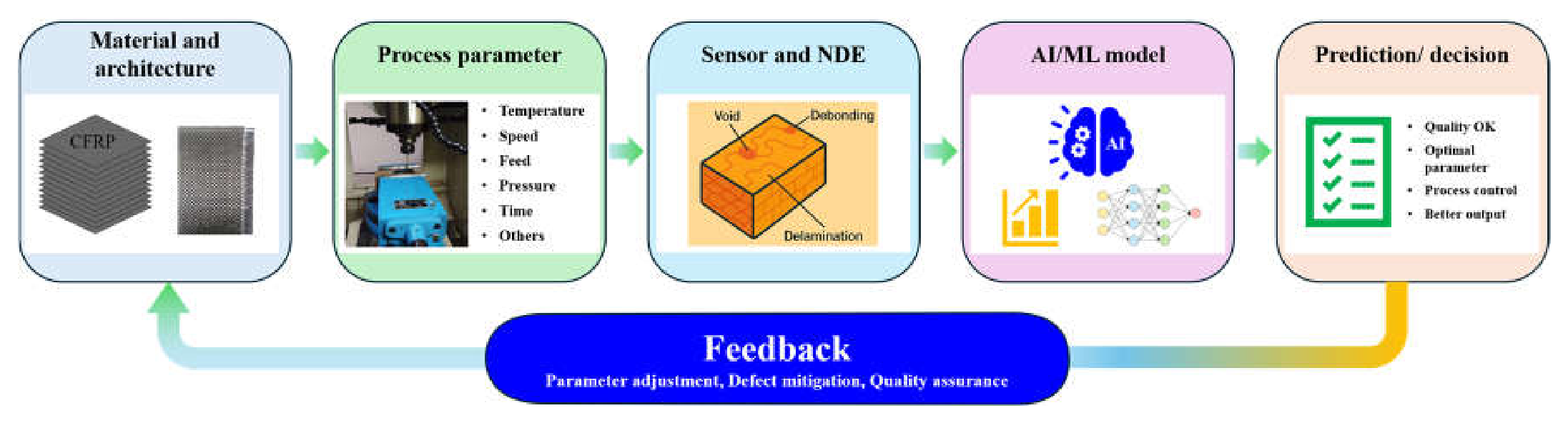
Figure 2.
Conceptual Framework for AI/ML-Enabled Intelligent Composite Manufacturing 19–22.
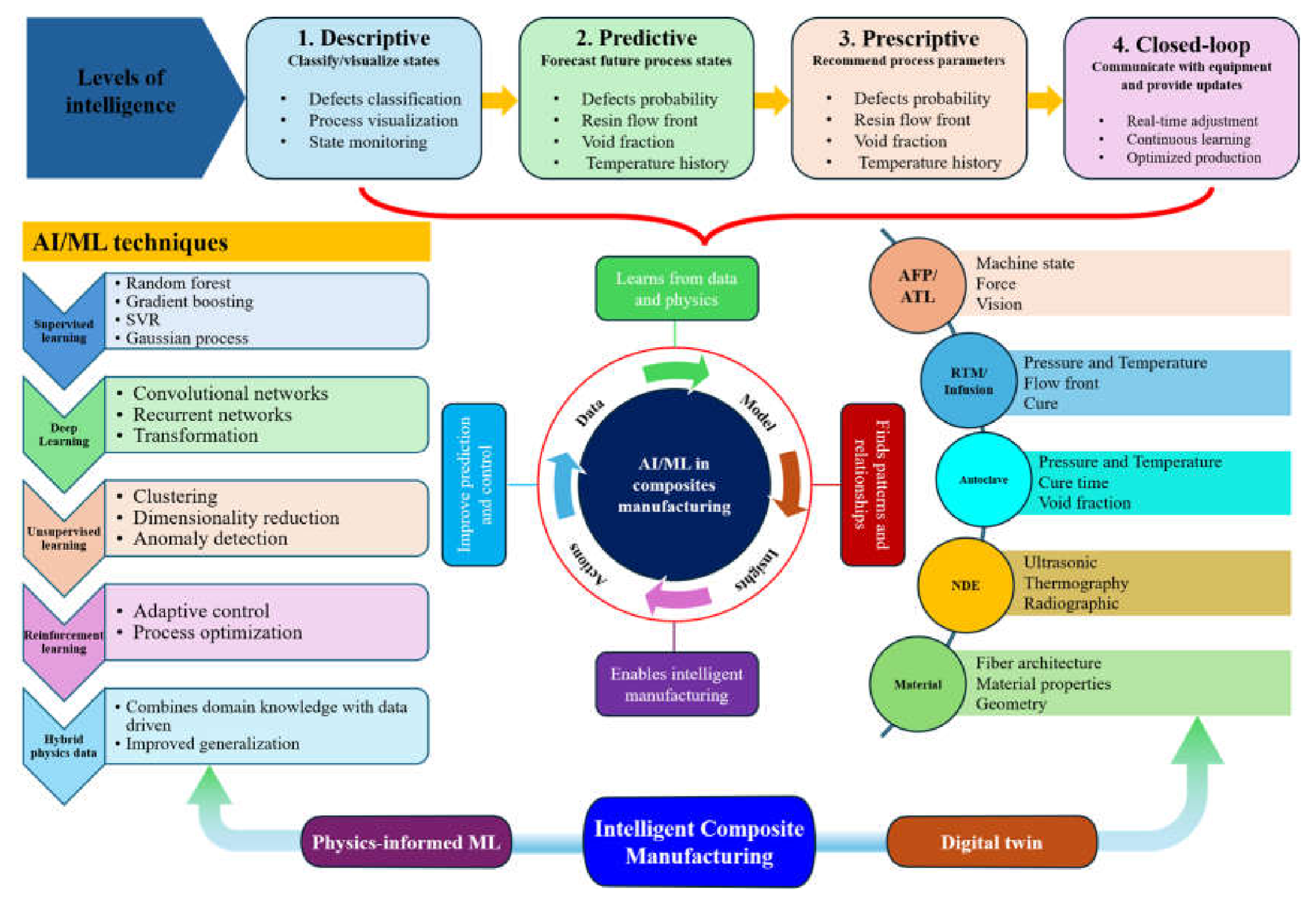
Figure 3.
Key barriers to industrial deployment of AI/ML in composite manufacturing 58–60.
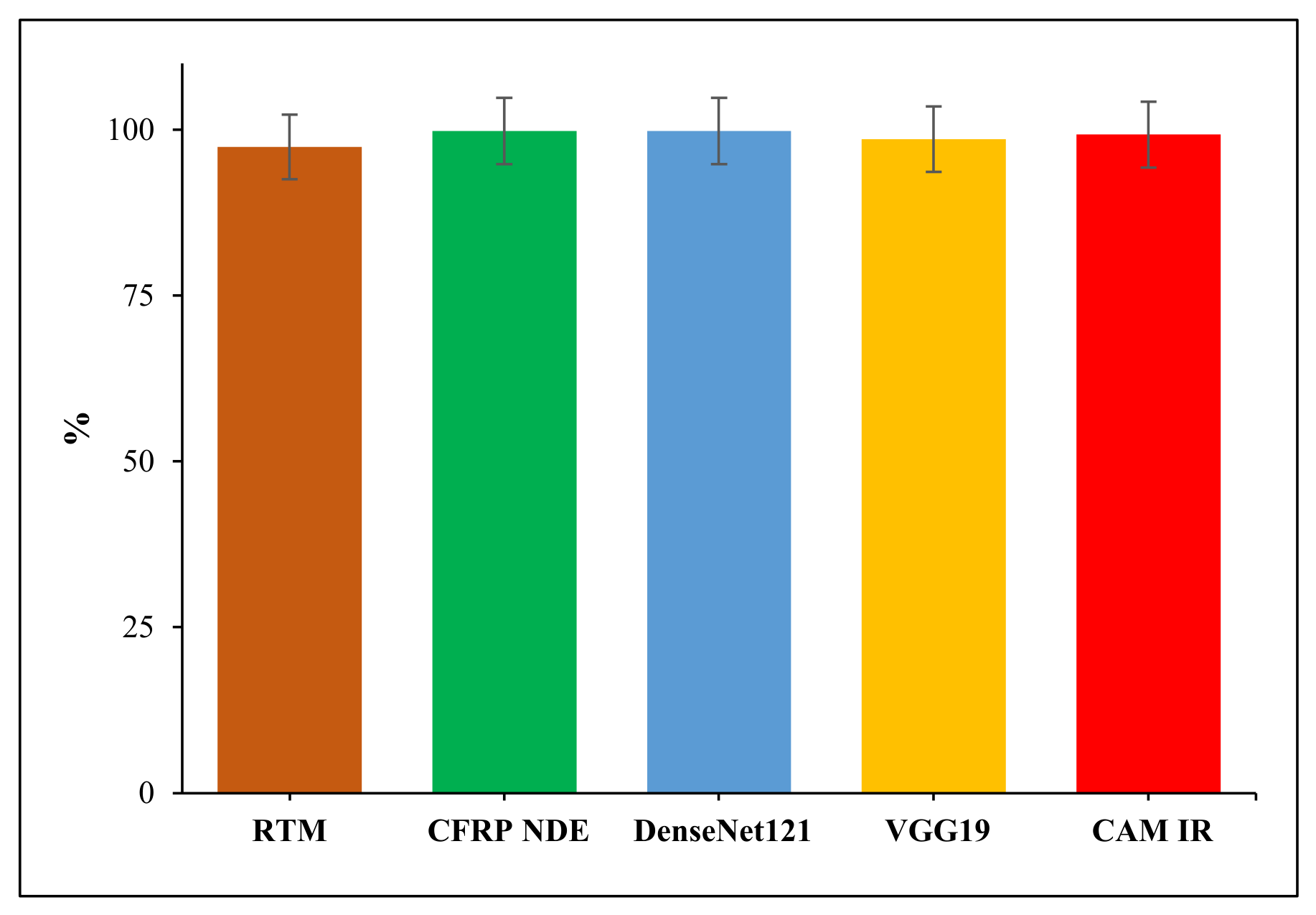

Table 1.
Major AI/ML approaches and typical roles in composite manufacturing.
| AI/ML approach | Typical input | Primary manufacturing role | Main advantage | Key limitation | Ref. |
| ANN/MLP | Process parameters, sensor features | Property/process prediction | Simple nonlinear mapping | Sensitive to scaling and data quality | 23,24 |
| Random forest/boosting | Tabular process data | Parameter optimization, defect risk | Strong on small/medium datasets | Limited temporal/spatial representation | 17,23 |
| SVM / SVR | Engineered features | Classification/regression | Effective with limited data | Kernel/model selection | 17,25 |
| CNN / U-Net | Images, thermograms, C-scans | Defect detection/segmentation | Automatic feature extraction | Needs labeled images | 26–28 |
| RNN / LSTM / Transformer | Time-series sensor data | Thermal/cure/process prediction | Captures temporal dependence | Training cost; data-hungry | 23,29 |
| Unsupervised ML | Unlabelled NDE/sensor data | Anomaly detection, clustering | Reduces labeling requirement | Cluster interpretation | 30,31 |
| Reinforcement learning | State/action/reward data | Adaptive control | Can optimize sequential decisions | Safety and sim-to-real issues | 32,33 |
| Physics-informed ML | Sensors + physical constraints | Surrogate modeling/control | Better physical consistency | More complex formulation | 34,35 |
| Digital-twin + ML | Multimodal process data | Real-time prediction/control | Lifecycle integration | Integration and validation burden | 12,29,36 |
Table 2.
AI-enabled inspection modalities for composite manufacturing.
| Inspection modality | AI/ML task | Typical defects | Strength | Main deployment issue | Ref. |
| Machine vision | Detection/ segmentation | Gaps, overlaps, surface damage | Fast, non-contact | Lighting and geometry sensitivity | 71,72 |
| Infrared thermography | Classification/ segmentation | Delamination, voids, inclusions | Full-field and rapid | Environmental/thermal variability | 73–75 |
| Ultrasonic C-scan | Classification/ segmentation/ anomaly detection | Delamination, porosity, debonding | High sensitivity to internal defects | Large data volumes; coupling/scanning | 76,77 |
| Acoustic emission | Event classification | Crack initiation, damage | Can be used during loading/process | Signal interpretation and noise | 78,79 |
| X-ray/CT | 3D defect quantification | Voids, inclusions, fiber architecture | Volumetric information | Cost, time, radiation constraints | 80,81 |
| Point clouds/3D metrology | Geometry/ defect detection | Wrinkles, dimensional errors | Direct geometric information | Registration and data size | 80,82,83 |
Table 3.
Major research gaps and recommended responses.
| Research gap | Why it matters | Recommended direction | Ref. |
| Small, proprietary datasets | Limits generalization and reproducibility | Shared benchmark datasets; synthetic data; self-supervised learning | 21,108,109 |
| Domain shift | Performance can collapse on new machines/materials | Domain adaptation; calibration; leave-one-machine-out validation | 110–112 |
| Black-box predictions | Reduces engineering trust | XAI, uncertainty quantification, and physically meaningful features | 99,113,114 |
| Sensor fragmentation | Single sensors miss-coupled process states | Multimodal sensor fusion | 12,58 |
| Simulation–reality gap | Digital models differ from production | Hybrid physics-ML and continuous model updating | 115,116 |
| Lack of closed-loop validation | Prediction does not prove control value | Hardware-in-the-loop and pilot production trials | 12 |
| Inconsistent reporting | Difficult to compare studies | Standard reporting of data, splits, metrics, and the domain of validity | 117 |
| Cybersecurity/IP constraints | Blocks collaborative learning | Federated learning and secure data architectures | 118–120 |
Table 4.
Quantitative performance indicators, manufacturing applications, and research implications.
Table 4.
Quantitative performance indicators, manufacturing applications, and research implications.
| Process/application | AI/ML method | Quantitative indicator | Reported result and significance | Ref. |
| RTM / composite molding | PixelRNN surrogate model | Prediction accuracy; training-data proportion | Maximum prediction accuracy of 97.35% using 50% of available training data. The study reports approximately half the cost of exhaustive simulations, supporting rapid process-design exploration. | 19 |
| CFRP impact-damage NDE | Bagged-tree ensemble + statistical thermographic features | Balanced accuracy | 99.8% balanced accuracy using 40 statistical features in the reported evaluation. Demonstrates the potential of feature-based ML for thermographic impact-damage classification. | 65 |
| CFRP ultrasonic NDE | Transfer learning; DenseNet121 | Classification accuracy | DenseNet121 reported 98.8% accuracy on the UNDT dataset. The study used ultrasonic images from 60 composite materials and 1,150 images across the dataset. | 66 |
| CFRP ultrasonic NDE | Transfer learning; VGG19 | Classification accuracy | The published study reports 98.6% accuracy for VGG19 on the USimgAIST dataset. Results depend on dataset and evaluation conditions. | 66 |
| Fiber-reinforced composite additive manufacturing | Deep learning + infrared thermography | mAP; defect-area error | 99.3% mAP for instance segmentation and image classification, with defect-area error within 6% in the experimental setting. Demonstrates quantitative defect characterization in a specific experimental setting. | 55 |
| Fiber-reinforced thermoplastic manufacturing | ML-assisted NDT / manufacturing analysis | Porosity; mechanical-property effect | The manuscript reports porosity up to 10–15%, tensile-strength effects up to 30%, and fatigue-life effects up to 20% in some reported cases. These are defect- and performance-context indicators, not universal AI improvement values. | 10 |
Disclaimer/Publisher’s Note: The statements, opinions and data contained in all publications are solely those of the individual author(s) and contributor(s) and not of MDPI and/or the editor(s). MDPI and/or the editor(s) disclaim responsibility for any injury to people or property resulting from any ideas, methods, instructions or products referred to in the content. |
© 2026 by the authors. Licensee MDPI, Basel, Switzerland. This article is an open access article distributed under the terms and conditions of the Creative Commons Attribution (CC BY) license (http://creativecommons.org/licenses/by/4.0/).
Copyright: This open access article is published under a Creative Commons CC BY 4.0 license, which permit the free download, distribution, and reuse, provided that the author and preprint are cited in any reuse.