

Submitted:
18 October 2026
Posted:
20 October 2026
You are already at the latest version
Abstract
Background. Perivascular hydrogel wrapping of abdominal aortic aneurysm (AAA) can sustain high local drug concentrations while avoiding systemic exposure, but no study has systematically prioritized which approved small molecules are best suited to such an extra-adventitial depot. This study combined drug-target evidence with physicochemical filtering to rank small-molecule candidates for local hydrogel formulation. Methods. Differentially expressed AAA genes were integrated from public human datasets (GSE57691, GSE7084, GSE47472) and mapped to approved small molecules using the Open Targets platform and ChEMBL. Links were filtered for coherent direction (inhibitors targeting up-regulated genes), and retained drugs were profiled with RDKit for molecular weight, lipophilicity (logP), and topological polar surface area (TPSA). A local-fit rule (molecular weight 200-500, logP 1-4, TPSA below 150) was applied, and candidates were organized into three tiers. Results. The integrated AAA target set contained 2,437 genes. Matching to approved small molecules yielded 1,061 drug-target links, and coherent filtering retained 152 links (121 drugs, 32 targets). The leading Tier 1 candidates were sulfasalazine, dasatinib, and celecoxib, targeting ALOX5/PTGS2 and the Src-family kinases. A second tier included diclofenac, etoricoxib, zileuton, balsalazide, idelalisib, ibuprofen, and ketorolac. The literature anchors colchicine (suitable physicochemistry) and doxycycline (borderline, overly hydrophilic) were retained separately, and the central AAA targets matrix metalloproteinase (MMP)-9, MMP-12, NLRP3, and CASP1 had no approved small-molecule ligand. Conclusions. This computational analysis prioritizes a small set of approved, physicochemically suitable small molecules for local perivascular hydrogel delivery against AAA. The ranking is a formulation hypothesis rather than evidence of efficacy; local release, toxicity, and in vivo effects require biomaterial and animal validation.
Keywords:
abdominal aortic aneurysm
; perivascular hydrogel
; drug repurposing
; small molecule
; local drug delivery
; ChEMBL
; physicochemical properties
1. Introduction
Abdominal aortic aneurysm (AAA) is a chronic, progressive dilation of the infrarenal aorta whose principal danger is rupture. Management is surveillance for small lesions and open or endovascular repair for large or rapidly enlarging aneurysms, and there is no approved pharmacological therapy that limits expansion [1]. Systemic drug trials, including matrix metalloproteinase (MMP) inhibitors, statins, antibiotics, and anti-inflammatory agents, have generally failed to reduce growth, although some improve comorbid cardiovascular risk [1-3].
Systemic administration faces several obstacles: AAA has no single dominant driver, drugs are often started late, and systemically delivered agents reach the aortic wall at low and transient concentrations while producing off-target effects. Local delivery is an attractive alternative. The outer adventitia is an accessible surface, and a perivascular hydrogel can sustain a high local concentration over the relevant tissue while minimizing systemic exposure. A hydrogel can also mechanically reinforce the wall, although that physical effect is outside the scope of the present molecular analysis.
Drug repurposing is well suited to this setting. Approved small molecules already have established dosing, safety, and manufacturing histories, and the question is not whether they are active in principle but whether their targets are relevant in AAA and whether their physicochemical properties fit a sustained local depot. Suitable molecules should act on an AAA-relevant target with a coherent direction and should have a molecular size, lipophilicity, and polarity compatible with retention in and gradual release from a hydrogel.
No study has yet integrated these two requirements. We therefore performed a computational repurposing analysis. We first built an AAA target set from public human transcriptomes, then mapped these targets to approved small molecules through the Open Targets platform and ChEMBL, filtered for coherent direction, and profiled the retained drugs with RDKit. We applied a local-fit rule and produced a tiered list of small-molecule candidates for perivascular hydrogel delivery, while clearly distinguishing database-validated from literature-supported candidates and prediction from demonstrated efficacy.
2. Materials and Methods
2.1. AAA Target Set
Differentially expressed genes were integrated from public human AAA datasets as described in the companion analysis: GSE57691 (small and large AAA versus donor), GSE7084 (AAA wall, two platforms), and GSE47472 (AAA neck) [4-6]. Genes significant at an adjusted P-value below 0.05 and an absolute log2 fold-change of at least 0.5 in at least one dataset were combined, with the direction of change retained. The union comprised 2,437 AAA target genes. Gene symbols were standardized and mapped to Ensembl identifiers, yielding 2,157 mapped genes.
2.2. Drug-Target Mapping
Drug-target associations were obtained from the Open Targets platform (release 26.06), which integrates mechanism-of-action records from ChEMBL and other sources [9,10]. Molecule and mechanism-of-action tables were used to link approved small molecules to AAA targets. The initial matching produced 1,061 drug-target links involving 620 drugs and 234 targets.
2.3. Coherent-Direction and Approval Filtering
Links were restricted to small molecules at the highest clinical stage and to associations with a coherent direction of action. For an up-regulated AAA target, an inhibitor was retained as coherent; for a down-regulated target, an activating or agonistic action was retained. Associations with ambiguous or opposing direction were removed. This filtering retained 152 links covering 121 drugs and 32 targets.
2.4. Physicochemical Profiling
Canonical SMILES were used to compute molecular weight (MW), the octanol-water partition coefficient (logP), topological polar surface area (TPSA), hydrogen-bond donors and acceptors, and rotatable bonds with RDKit [11]. These descriptors characterize size, lipophilicity, and polarity.
2.5. Local-Fit rule and TIERING
A local-fit rule was defined to reflect sustained release from a hydrogel: MW between 200 and 500, logP between 1 and 4, and TPSA below 150. The windows were chosen to balance diffusion out of the gel (favored by moderate lipophilicity) against retention and local cell penetration (favored by limited polarity), with the Lipinski rule-of-five as a reference [12]. Molecules within all three ranges were classified as suitable; those outside one range were classified as borderline. Candidates were organized into three tiers: Tier 1, database-validated, multi-target or central-target drugs suitable for formulation; Tier 2, database-validated single-target or redundant candidates; and Tier 3, literature-supported anchors with weak or absent database target records.
3. Results
3.1. The AAA Target Landscape
The integrated AAA target set contained 2,437 genes, of which 2,157 mapped to Open Targets identifiers. The pathogenic core included inflammatory signaling genes (IL1B, IL6, TNF), the central AAA effectors MMP9 and MMP12, the inflammasome genes NLRP3 and CASP1, and the small-molecule-accessible enzymes and kinases PTGS2, ALOX5, PIK3CD, and the Src-family kinases HCK, LYN, FGR, and LCK.
3.2. Most AAA Targets are not Accessible to Approved Small Molecules
The targets separated into three classes. A small-molecule-accessible set included PTGS2 (32 approved drugs), ALOX5 (4), PIK3CD (4), LCK (3), and HCK, LYN, and FGR (one each). The central effectors MMP9, MMP12, NLRP3, and CASP1 had no approved small-molecule ligand in the database. The inflammatory cytokines IL1B, IL6, and TNF were addressable only by biologics. Thus the most direct disease drivers are largely outside the small-molecule space, while the accessible targets lie upstream or in parallel.
3.3. The Filtered Drug-Target Network
After coherent-direction filtering, the network contained 152 links (121 drugs, 32 targets). PTGS2 dominated the network, linked to many approved non-steroidal anti-inflammatory drugs, while the Src-family kinase and PIK3CD nodes provided fewer, more selective links. Drugs acting on several coherent AAA targets were prioritized over redundant single-target entries.
3.4. Physicochemical Filtering
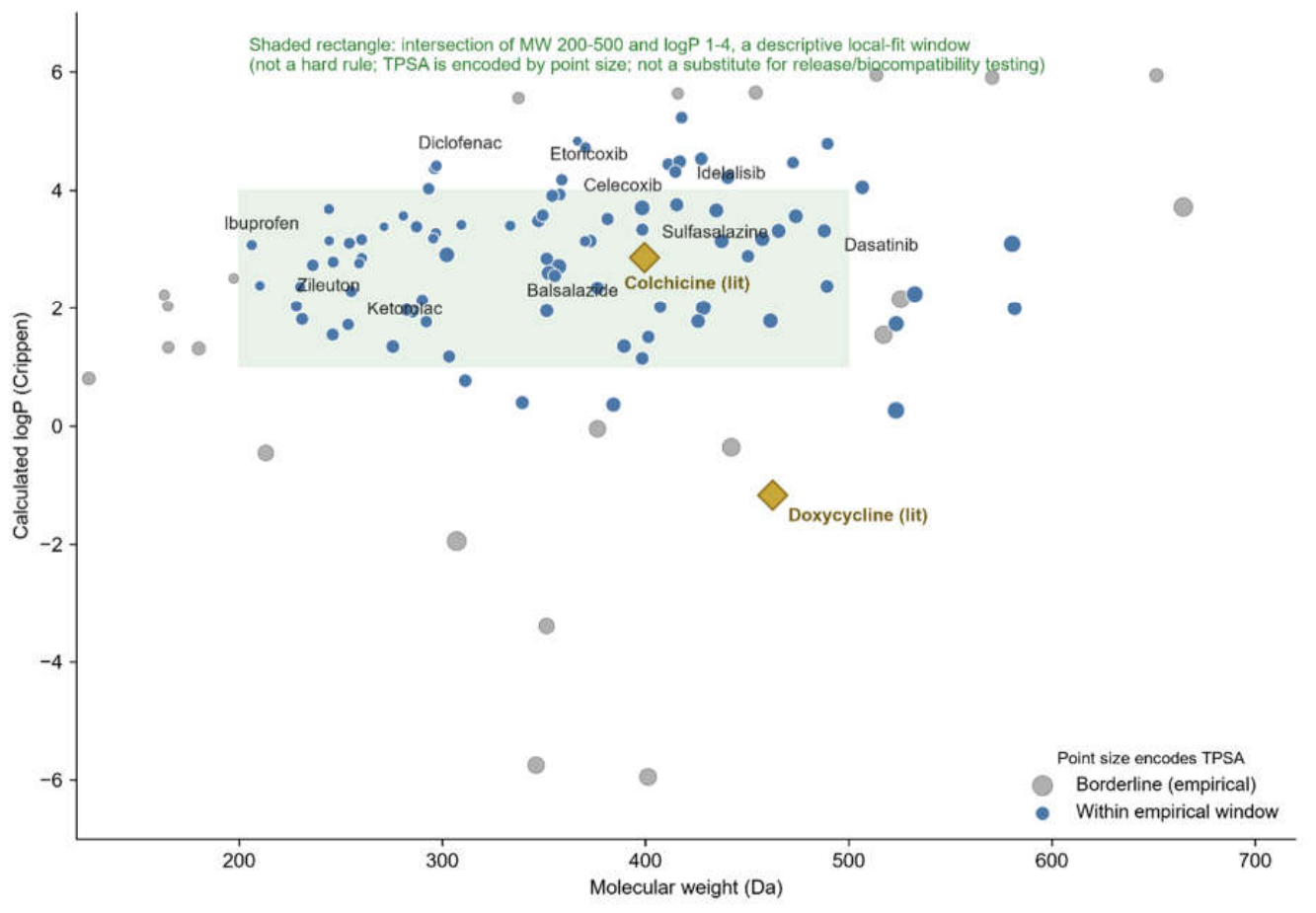
Most retained drugs fell within the local-fit ranges, with MW between roughly 200 and 500, logP between 1 and 4, and TPSA below 150. The literature anchors differed: colchicine (MW 399.4, logP 2.87, TPSA 83.1) was physicochemically suitable, whereas doxycycline (MW 462.5, logP -1.17, TPSA 213.1) was borderline because it is highly hydrophilic and polar and may be prone to rapid release from a water-rich gel.
3.5. Tiered Shortlist
Tier 1 comprised sulfasalazine (ALOX5, PTGS2; MW 398.4, logP 3.70, TPSA 141.3), dasatinib (FGR, HCK, LCK, LYN; MW 488.0, logP 3.31, TPSA 106.5), and celecoxib (PTGS2; MW 381.4, logP 3.51, TPSA 78.0). Tier 2 comprised diclofenac, etoricoxib, zileuton, balsalazide, idelalisib, ibuprofen, and ketorolac. These drugs were retained as database-validated candidates, although several are redundant PTGS2 inhibitors.
3.6. Literature-Supported Anchors
Tier 3 contained colchicine and doxycycline, both of which have AAA experimental literature but weak database target coverage. Colchicine had no ChEMBL mechanism-of-action record for an AAA target, and doxycycline was annotated to bacterial ribosomal targets and MMP7/MMP13, but not MMP9. These drugs were therefore distinguished from database-validated candidates. Rodent studies of colchicine are mixed, with reports that it reduces inflammation and growth and a separate report that it did not limit growth, which is treated as an unresolved context-dependent question rather than a settled result.
4. Discussion
4.1. Tier 1 Candidates
Sulfasalazine, dasatinib, and celecoxib combine database-validated, coherent AAA targets with suitable physicochemistry. Sulfasalazine inhibits both ALOX5 and PTGS2, addressing leukotriene and prostaglandin inflammation. It is an azo prodrug whose conventional activation depends on intestinal bacterial reduction, which is absent in a sterile perivascular depot; whether local cleavage occurs or the parent molecule acts directly is therefore uncertain. Its relatively high TPSA also limits passive penetration. Dasatinib inhibits several Src-family kinases linked to inflammatory and remodeling signaling, but it is a potent systemic oncology drug whose local dose and off-target effects require careful control. Celecoxib is a selective PTGS2 inhibitor with favorable size and polarity, although the redundancy of PTGS2 inhibitors means its advantage is primarily physicochemical rather than mechanistic.
4.2. Tier 2 Candidates
The second tier provides broader, mostly interchangeable options. Zileuton and the PTGS2 inhibitors cover eicosanoid inflammation, while idelalisib adds a selective PIK3CD link. Balsalazide, like sulfasalazine, is a colon-directed aminosalicylate prodrug whose local activation could be exploited in a depot. Because many of these drugs share the same target, selection should be driven by release kinetics and local tolerability rather than by target novelty.
4.3. Literature-Supported Anchors and Their Controversy
Colchicine and doxycycline are the most frequently discussed local candidates in the AAA literature but occupy the weakest database position [13-15]. Doxycycline is reported to suppress MMP activity and elastin degradation in rodent AAA, yet its hydrophilicity and polarity make sustained hydrogel retention challenging, and the database does not support a direct MMP9 interaction; a controlled-release formulation would be needed. Colchicine is reported to inhibit the NLRP3 axis and smooth muscle cell phenotypic switching in several mouse studies, but another controlled study found no growth limitation, and the present database mapping provides no AAA mechanism-of-action record. The disagreement plausibly reflects model, dose, and timing differences and should not be resolved by selecting only favorable studies.
4.4. Physicochemical Rationale for Local Sustained Release
Physicochemistry determines whether a drug can be retained and released gradually. A moderately lipophilic molecule (logP 1-4) of modest size (MW 200-500) and limited polarity (TPSA below 150) can partition into and diffuse slowly from a gel while still reaching adjacent cells. Strongly hydrophilic drugs such as doxycycline risk burst release, whereas highly lipophilic drugs may aggregate or remain trapped. The local-fit rule therefore translates a generic repurposing hit into a formulation-relevant candidate, which is the specific contribution of this analysis.
4.5. Local Safety is not Established by Systemic Evidence
An approved drug's systemic safety record does not establish safety at high local concentration beside the aorta. A potent kinase inhibitor such as dasatinib or a broad anti-inflammatory drug could impair vascular smooth muscle and fibroblast viability, and over-suppression of inflammation may hinder normal repair. Local fibrosis, the foreign-body response, compression of adjacent structures, and degradation products are additional risks. Local release kinetics, cytotoxicity, and biocompatibility therefore require independent testing; the shortlist provides candidates, not safety assurances.
4.6. Limitations
This is a computational, hypothesis-generating study. It uses no hydrogel-intervention data and cannot demonstrate efficacy or assess the mechanical support provided by a gel. The target set is derived mainly from advanced, surgically obtained human AAA, which introduces a stage bias toward the target population of small lesions. Database annotations are incomplete, as shown by the missing colchicine and doxycycline mechanism records, and the local-fit thresholds are heuristic rather than experimentally calibrated. The strategy also acts on the wall from outside and cannot directly address the intraluminal thrombus, a major source of proteases in human AAA. Every candidate requires formulation, local safety, animal, and ultimately translational validation.
5. Conclusions
This computational analysis prioritizes a small set of approved small molecules for local perivascular hydrogel delivery in AAA. Sulfasalazine, dasatinib, and celecoxib lead a database-validated shortlist, with colchicine and doxycycline retained as literature-supported anchors, while the central AAA targets MMP9, MMP12, NLRP3, and CASP1 remain without approved small-molecule ligands. The ranking is a formulation hypothesis rather than evidence of treatment efficacy and cannot assess the hydrogel's mechanical effect. Biomaterial, local safety, and animal experiments are required before any clinical claim. The work returns to the central questions for translation: which targets are causal, what local dose and release profile are safe, and whether the strategy can address the human intraluminal thrombus.
Declarations
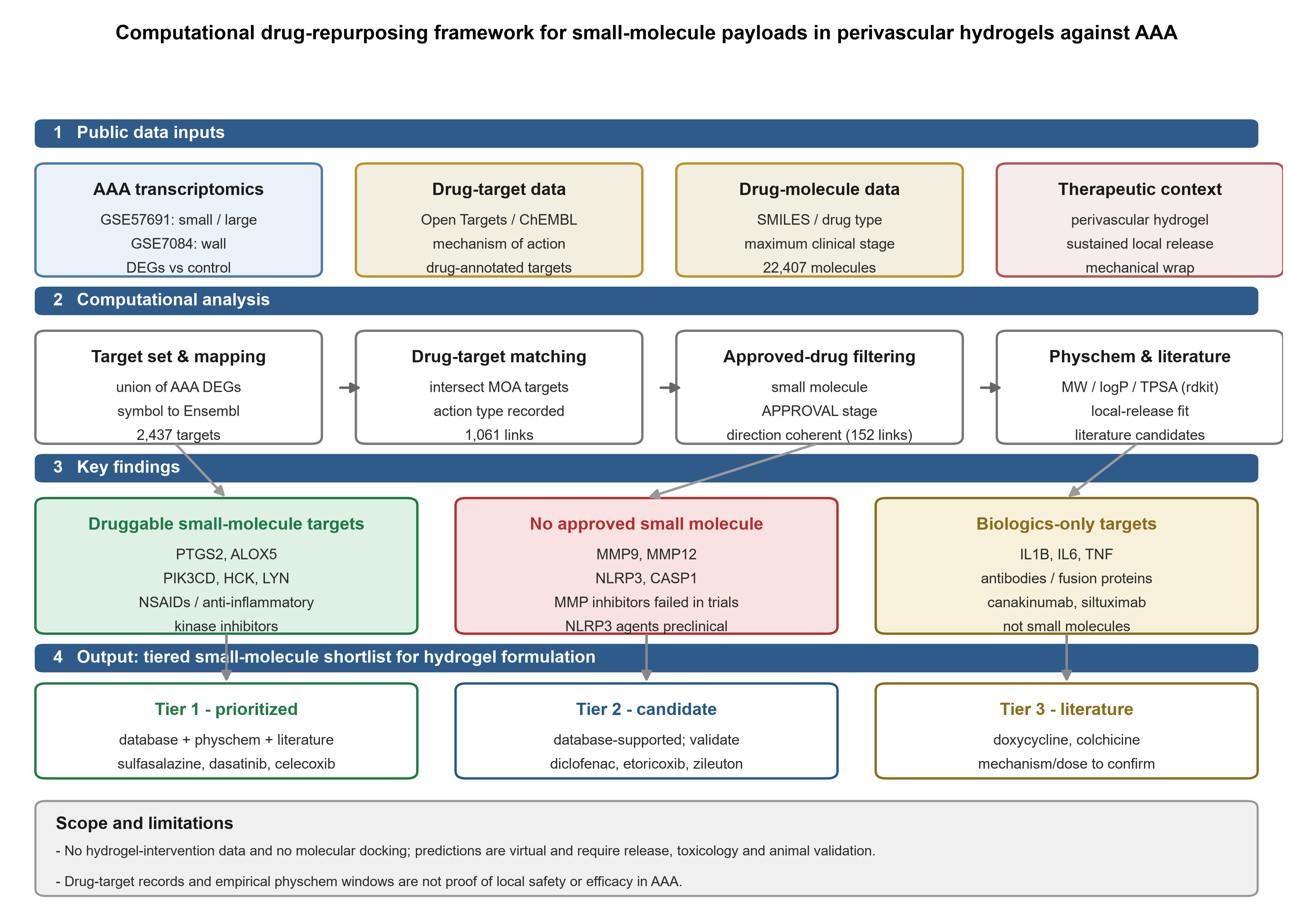
Figure 1.
Computational repurposing workflow. Public AAA transcriptomes define the target set, which is mapped to approved small molecules through Open Targets and ChEMBL, filtered for coherent direction, profiled with RDKit (MW, logP, TPSA), and screened with a local-fit rule. The output is a tiered shortlist of drugs for perivascular hydrogel formulation. The footer records the scope: no hydrogel-intervention data, no mechanical assessment, and a need for biomaterial and animal validation.
Figure 2.
Drug-target network. Bipartite network linking approved small molecules (one set of nodes) to AAA targets (the other set). Targets are grouped into small-molecule-accessible enzymes and kinases, targets with no approved small-molecule ligand (MMP9, MMP12, NLRP3, CASP1), and targets addressable only by biologics (IL1B, IL6, TNF). Database-validated links are distinguished from literature-supported links, which are indirect or upstream and are not recorded as mechanisms of action in ChEMBL.
Figure 2.
Drug-target network. Bipartite network linking approved small molecules (one set of nodes) to AAA targets (the other set). Targets are grouped into small-molecule-accessible enzymes and kinases, targets with no approved small-molecule ligand (MMP9, MMP12, NLRP3, CASP1), and targets addressable only by biologics (IL1B, IL6, TNF). Database-validated links are distinguished from literature-supported links, which are indirect or upstream and are not recorded as mechanisms of action in ChEMBL.
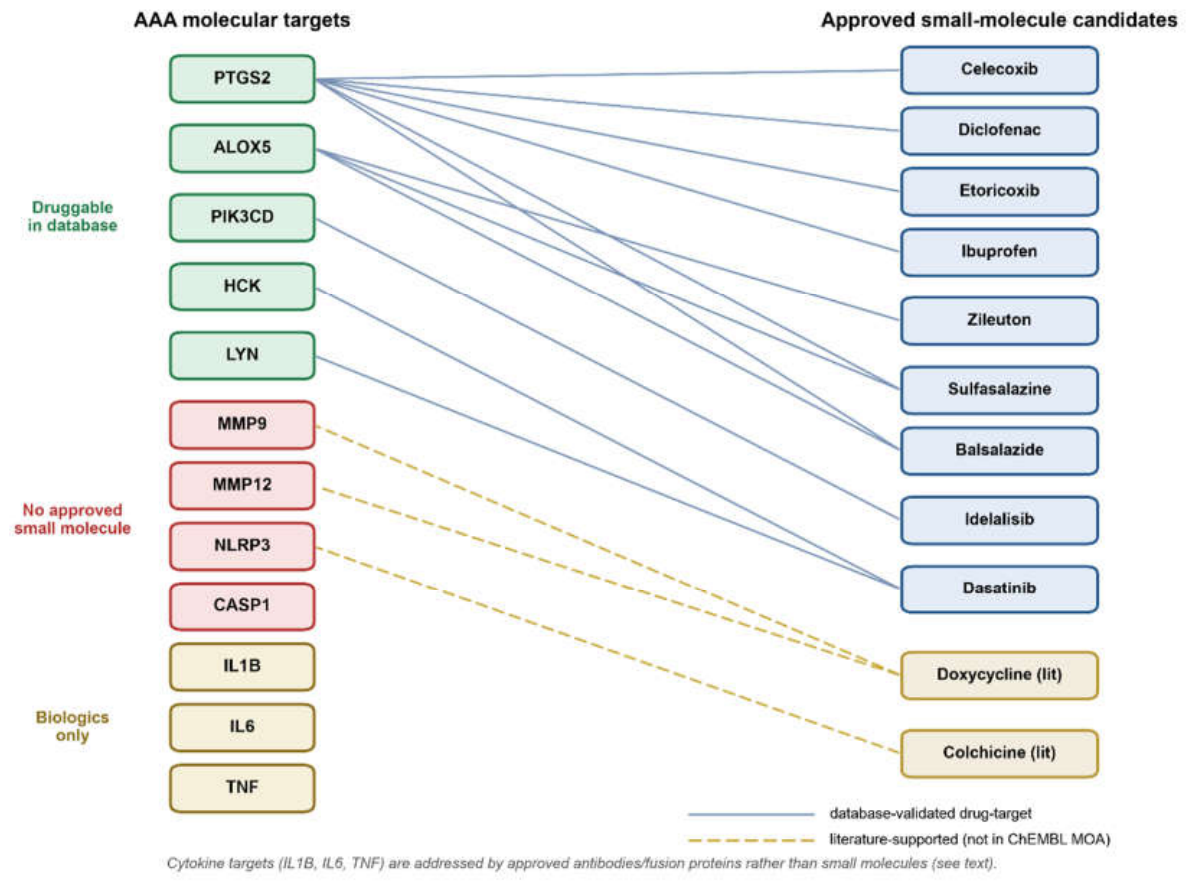
Figure 3.
Physicochemical landscape. Scatter of molecular weight (x-axis) and logP (y-axis) for retained drugs, with point size encoding TPSA. Local-fit ranges are shaded, and the literature anchors colchicine and doxycycline are highlighted; doxycycline falls outside the lipophilicity and polarity ranges and is classified as borderline.
Figure 3.
Physicochemical landscape. Scatter of molecular weight (x-axis) and logP (y-axis) for retained drugs, with point size encoding TPSA. Local-fit ranges are shaded, and the literature anchors colchicine and doxycycline are highlighted; doxycycline falls outside the lipophilicity and polarity ranges and is classified as borderline.
Author Contributions
H.C. conceived and designed the study, performed the computational analyses, wrote the manuscript, and approved the final version.
Funding
This research received no specific grant from any funding agency in the public, commercial, or not-for-profit sectors.
Data Availability Statement
All source datasets are publicly available in the Gene Expression Omnibus (GSE57691, GSE7084, GSE47472) and the Open Targets and ChEMBL resources. The computed shortlist is available from the corresponding author on reasonable request.
Ethics Approval
Not applicable; this study used de-identified, publicly available data and involved no new human or animal work.
Conflicts of Interest
The author declares that he has no competing interests.
References
- Golledge, J. Abdominal aortic aneurysm: update on pathogenesis and medical treatments. Nat. Rev. Cardiol. 2019, 16(4), 225–242. [Google Scholar] [CrossRef] [PubMed]
- Raffort, J.; Lareyre, F.; Clément, M.; et al. Monocytes and neutrophils in atherothrombosis and abdominal aortic aneurysms. Nat. Rev. Cardiol. 2017, 14(7), 421–429. [Google Scholar]
- Michel, J.B.; Martin-Ventura, J.L.; Egido, J.; et al. Novel aspects of the pathogenesis of aneurysms and dissections of the aorta. Cardiovasc Res. 2011, 90(1), 18–27. [Google Scholar] [CrossRef] [PubMed]
- Lenk, G.M.; Tromp, G.; Weinsheimer, S.; et al. Whole genome expression profiling reveals a significant role for immune function in human abdominal aortic aneurysms. BMC Genom. 2007, 8, 237. [Google Scholar] [CrossRef] [PubMed]
- Biros, E.; Moran, C.S.; Rush, C.M.; et al. Differential gene expression in the proximal neck of human abdominal aortic aneurysm. Atherosclerosis 2014, 233(1), 211–218. [Google Scholar] [CrossRef] [PubMed]
- Biros, E.; Gäbel, G.; Moran, C.S.; et al. Differential gene expression in human abdominal aortic aneurysm and aortic occlusive disease. Oncotarget 2015, 6(15), 12984–12996. [Google Scholar] [CrossRef] [PubMed]
- Spin, J.M.; Hsu, S.J.; Nackman, G.; et al. Transcriptional profiling and network analysis of the murine angiotensin II-induced abdominal aortic aneurysm. Physiol. Genom. 2011, 43(17), 993–1003. [Google Scholar] [CrossRef] [PubMed]
- Xiong, T.; Lv, X.S.; Wu, G.J.; et al. Single-cell sequencing analysis and multiple machine learning methods identified G0S2 and HPSE as novel biomarkers for abdominal aortic aneurysm. Front Immunol. 2022, 13, 907309. [Google Scholar] [CrossRef] [PubMed]
- Ochoa, D.; Hercules, A.; Carmona, M.; et al. The next-generation Open Targets platform: reimagined, redesigned, rebuilt. Nucleic Acids Res. 2023, 51(D1), D1353–D1359. [Google Scholar] [CrossRef] [PubMed]
- Gaulton, A.; Bellis, L.J.; Bento, A.P.; et al. ChEMBL: a large-scale bioactivity database for drug discovery. Nucleic Acids Res. 2012, 40(D1), D1100–D1107. [Google Scholar] [CrossRef] [PubMed]
- Landrum, G.; et al. RDKit: a software suite for cheminformatics, computational chemistry, and predictive modeling; Landrum, Greg, et al., Eds.; 2013. [Google Scholar]
- Lipinski, C.A.; Lombardo, F.; Dominy, B.W.; Feeney, P.J. Experimental and computational approaches to estimate solubility and permeability in drug discovery and development settings. Adv. Drug Deliv. Rev. 1997, 23(1-3), 3–25. [Google Scholar] [CrossRef]
- Petrinec, D.; Liao, S.; Holmes, D.R.; et al. Doxycycline inhibition of aneurysmal degeneration in an elastase-induced rat model of abdominal aortic aneurysm: preservation of aortic elastin associated with suppressed production of 92 kD gelatinase. J. Vasc. Surg. 1996, 23(2), 336–346. [Google Scholar] [CrossRef] [PubMed]
- Hu, J.; Xu, J.; Zhao, J.; et al. Colchicine ameliorates short-term abdominal aortic aneurysms by inhibiting the expression of NLRP3 inflammasome components in mice. Eur. J. Pharmacol. 2024, 964, 176297. [Google Scholar] [CrossRef] [PubMed]
- Zhao, Y.; Shen, Q.R.; Chen, Y.X.; et al. Colchicine protects against the development of experimental abdominal aortic aneurysm. Clin. Sci. (Lond) 2023, 137(19), 1533–1545. [Google Scholar] [CrossRef] [PubMed]
Disclaimer/Publisher’s Note: The statements, opinions and data contained in all publications are solely those of the individual author(s) and contributor(s) and not of MDPI and/or the editor(s). MDPI and/or the editor(s) disclaim responsibility for any injury to people or property resulting from any ideas, methods, instructions or products referred to in the content. |
© 2026 by the author. Licensee MDPI, Basel, Switzerland. This article is an open access article distributed under the terms and conditions of the Creative Commons Attribution (CC BY) license.
Copyright: This open access article is published under a Creative Commons CC BY 4.0 license, which permit the free download, distribution, and reuse, provided that the author and preprint are cited in any reuse.